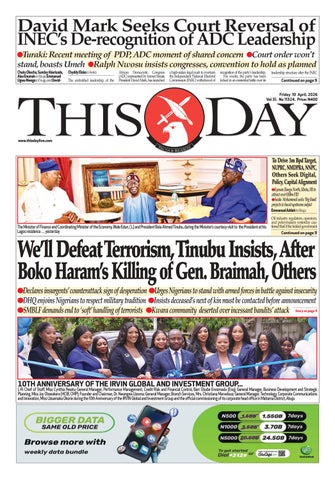
David Mark Seeks Court Reversal of INEC’s De-recognition of ADC Leadership
Chyddy Eleke in Awka
The embattled leadership of the
African Democratic Congress (ADC) represented by former Senate President David Mark, has launched a high-stakes legal push to overturn the Independent National Electoral Commission (INEC) withdrawal of
recognition of the party’s leadership. For weeks, the party has been locked in an existential battle over its
www.thisdaylive.com
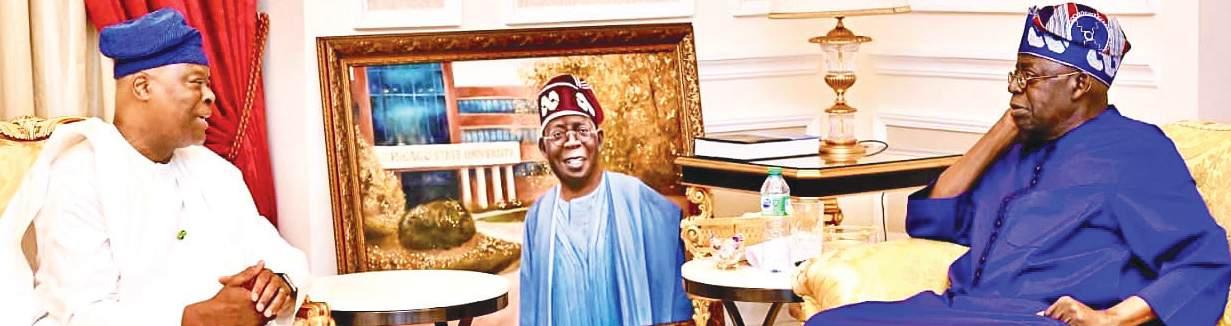
The Minister of Finance and Coordinating Minister of the Economy, Wale Edun, ( L) and President Bola Ahmed Tinubu, during the Minister’s courtesy visit to the President at his Lagos residence … yesterday
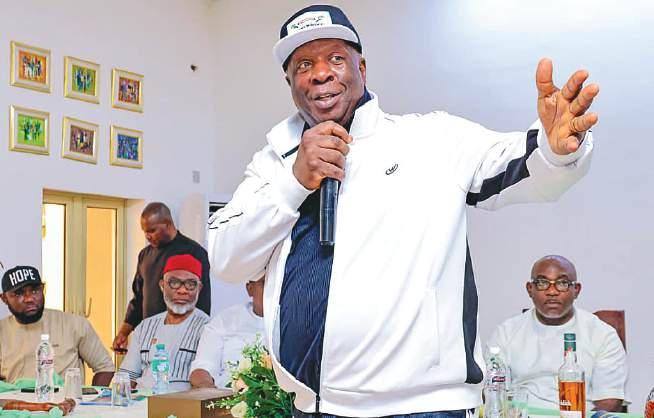
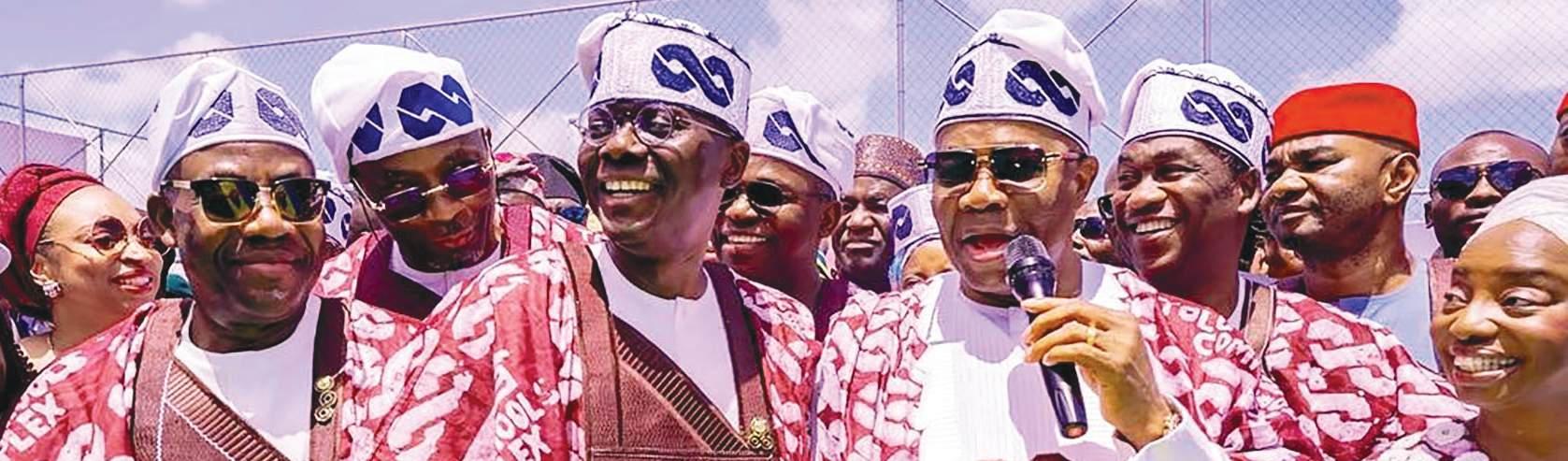
Turaki: Recent meeting of PDP, ADC moment of shared concern Court order won’t stand, boasts Umeh Ralph Nwosu insists congresses, convention to hold as planned Chuks Okocha, Sunday Aborisade, Alex Enumah in Abuja, Emmanuel Ugwu-Nwogo in Enugu and David-
Continued on page 9
To Drive 3m Bpd Target, NUPRC, NMDPRA, NNPC, Others Seek Digital, Policy, Capital Alignment
Emmanuel Addeh in Abuja Oil industry regulators, operators, and policymakers yesterday cautioned that if the federal government Eyesan: Bonga North, Ubeta, HI to attract over $10bn FID Saidu Mohammed seeks ‘Big Bank’ projects to boost upstream output
Continued on page 9 leadership structure after the INEC
We’ll Defeat Terrorism, Tinubu Insists, After Boko Haram’s Killing of Gen. Braimah, Others
Declares insurgents’ counterattack sign of desperation Urges Nigerians to stand with armed forces in battle against insecurity
DHQ enjoins Nigerians to respect military tradition Insists deceased’s next of kin must be contacted before announcement
SMBLF demands end to ‘soft’ handling of terrorists Kwara community deserted over incessant bandits’ attack
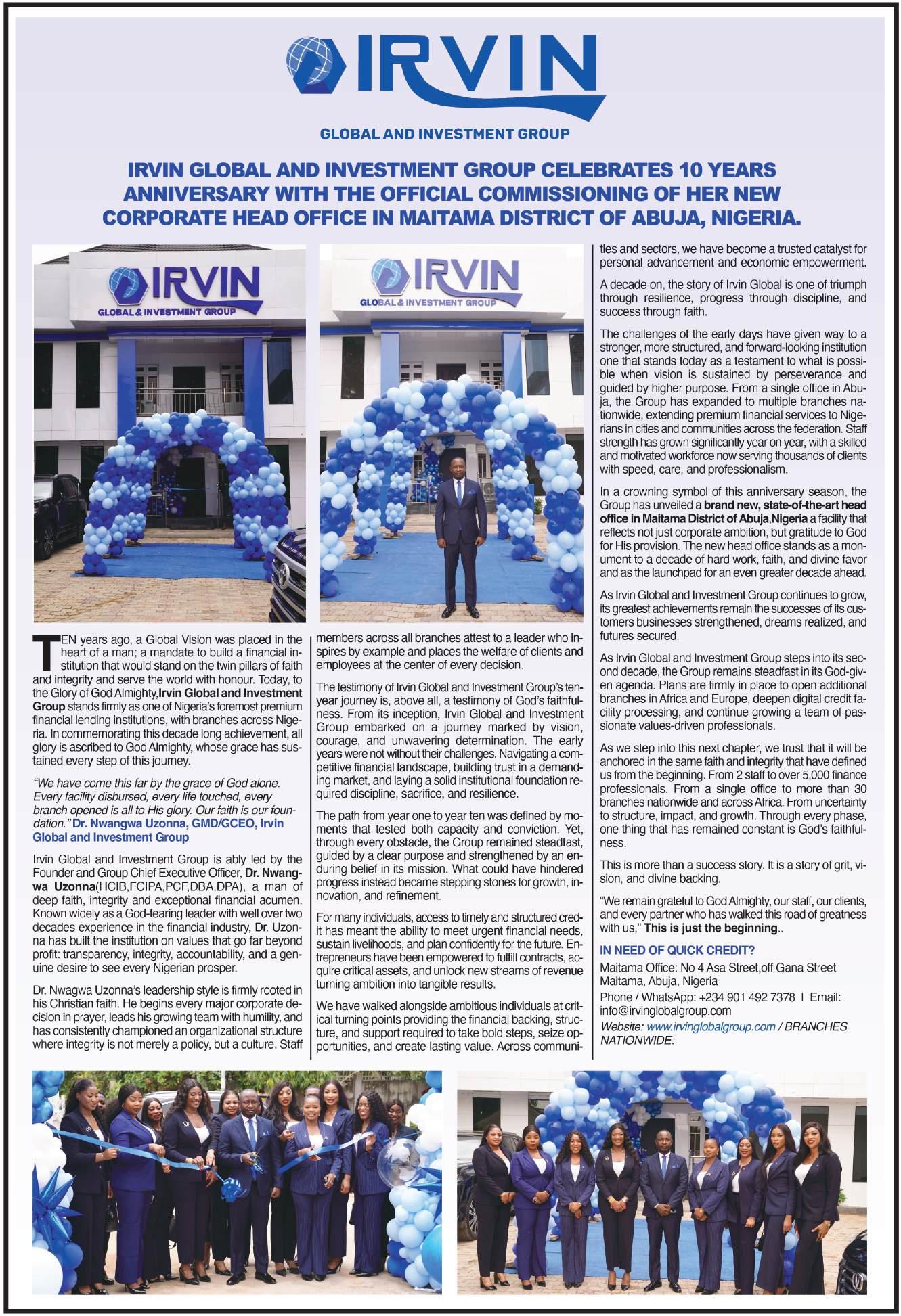
10TH ANNIVERSARY OF THE IRVIN GLOBAL AND INVESTMENT GROUP...
L-R: Chief of Staff, Miss Cynthia Nwatu; General Manager, Performance Management, Credit Risk and Financial Control, Barr. Ebube Eresimadu (Esq); General Manager, Business Development and Strategic Planning, Miss Joy Olowokere (HCIB, CMP); Founder and Chairman, Dr. Nwangwa Uzonna; General Manager, Branch Services, Mrs. Christiana Marvelous; General Manager, Technology, Corporate Communications and Innovation, Miss Uzoamaka Okorie during the 10th Anniversary of the IRVIN Global and Investment Group and the official commissioning of its corporate head office in Maitama District, Abuja
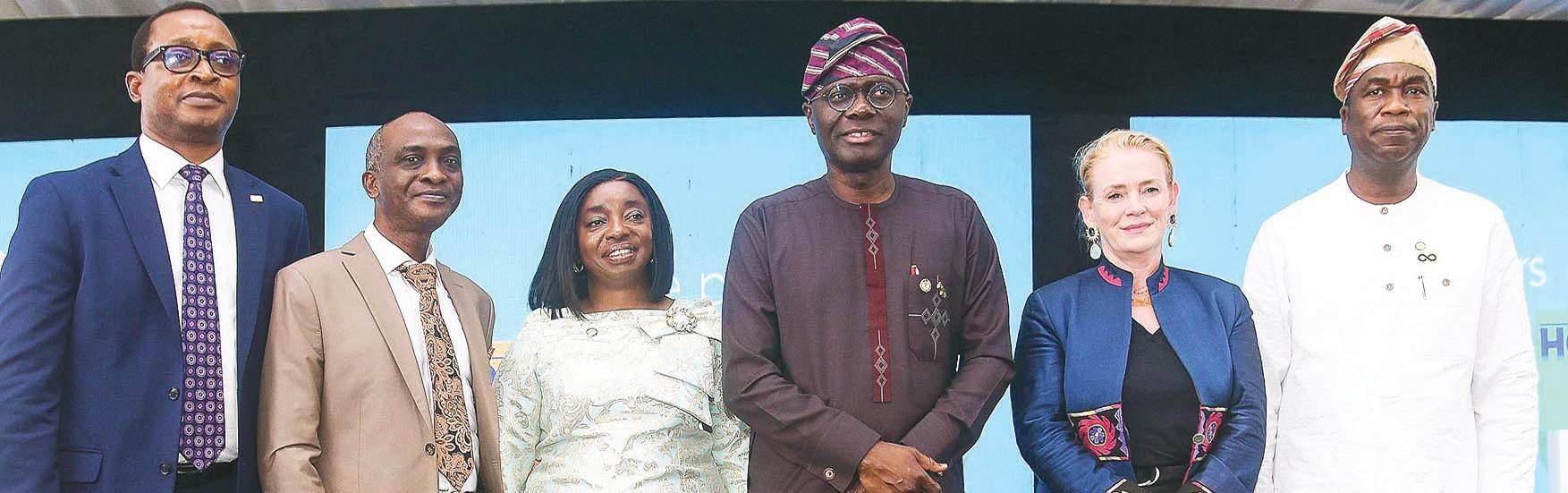
LAGOS, WORLD BANK, FCMB ADVANCE $500M DRIVE FOR INCLUSIVE EDUCATION AND HEALTHCARE...
L-R: National Head of Sales, First City Monument Bank (FCMB), Mr. Emmanuel Comla; Senior Procurement Specialist at the World Bank, Mr. Akin Onimole; First Lady of Lagos State, Mrs.
Governor Babajide Sanwo-Olu of Lagos; A Development Partner at UNICEF, Celine Lafoucriere, and Deputy Governor of Lagos, Mr. Obafemi Hamzat, at the presentation of Lagos State’s strides in the implementation of the World Bank’s HOPE-GOV programme in governance, primary health and basic education. The ceremony was held at the Lagos House, Marina in Lagos
Afreximbank Beefs Up Assets to
Net Loans,
James Emejo in Abuja
African Export-Import Bank (Afreximbank), alongside its subsidiaries, yesterday said it grew total assets and contingencies by 21 per cent to $48.5 billion in 2025, from $40.1 billion in the preceding year.
The performance underscored sustained financial resilience, increased market confidence, and strategic execution amid consistent growth trajectory.
In a statement, the bank said the group’s net loans and advances stood at $33.5 billion, compared to $29 billion in 2024, an increase of 16 per cent, supported by continued disbursements across the continent and the Caribbean through various product offerings.
The group funded strategic priority areas, including manufacturing, infrastructure, food security, and climate adaptation.
The group’s non-performing loan (NPL) ratio remained stable at 2.43 per cent, compared to 2.33 per cent in the preceding year, demonstrating consistent portfolio quality.
Group’s liquidity position remained robust, with cash and cash equivalents at $6.0 billion, compared to $4.6 billion in 2024. Liquid assets accounted for 14 per cent of total assets, above the
$48.5bn as
Advances Hit $33.5bn in 2025
bank’s strategic minimum level of 10 per cent.
Shareholders’ funds grew by 17 per cent to $8.4 billion, driven by net income of $1.2 billion, and new equity inflows of $299.4 million raised under the General Capital Increase II.
According to the bank, Gross Income increased by 6.06 per cent, reaching $3.5 billion in the review period, from $3.3 billion achieved in 2024.
However, operating expenses increased to $459.2 million, from $367.7 million, reflecting strategic staff expansion, and inflationary pressures, with the group maintaining strong cost efficiency resulting in a cost-to-income ratio of 21 per cent in 2025, compared to 18 per cent in 2024, well below the strategic ceiling of 30 per cent.
Afrexim bank stated that contrary to concerns raised by some rating agencies during the year, the bank accessed international bond markets by successfully raising over $800 million from Japan and China, courtesy of the Samurai and Panda bonds in 2025. This, it said, demonstrated the group’s fund-raising capabilities and the solid nature of its DNA as a pan-African multilateral financial institution committed to ensuring that Africa’s full and sustainable
self-reliance remained firm.
Net income increased by 19 per cent to $1.2 billion in 2025, up from $973.5 million in the prior year.
The results were achieved through the expanded delivery of tailored financial and advisory solutions that supported trade, fostered industrialisation, and enhanced economic self-reliance.
Commenting on the report, Afreximbank’s Senior Execu-
tive Vice President, Mr. Denys Denya, said, “Despite continuing global geopolitical challenges and disruptions caused by some rating actions, the group delivered excellent financial performance in 2025, a fitting tribute to a decade of consequential leadership under Professor Oramah, with total assets and contingencies reaching $49 billion.
“Pleasingly, the group is way
ahead on most of its targets in delivery on its 6 Strategic plan that ends on 31 December 2026. With recently established subsidiaries such as FEDA and AfrexInsure becoming profitable, Net income grew by 19 per cent to stand at $1.2 billion, underpinned by a strong capital base of $8.4 billion.”
Denya added, “The group’s balance sheet is at its strongest level ever, with liquidity levels and
capitalisation well above target and good asset quality. These results are a testament to the unwavering execution by the group’s hard working human capital.
“We entered the 2026 financial year with significant momentum, ready to scale the group’s impact, accelerate trade integration and value addition across Global Africa, and deliver greater value to our shareholders.”
Manufacturers Slam NBC Over Alleged Digital Switchover Breaches, Seek Tinubu’s Urgent Intervention
Warn of investor flight, allege plan to import set-top boxes undermining local industry
Association of Licensed Set-Top Box Manufacturers of Nigeria (STBMAN) has accused National Broadcasting Commission (NBC) of breaching due process in the management of Nigeria’s Digital Switch Over (DSO) programme, warning that the development is stalling progress and threatening local investments.
In a statement issued in
Abuja and signed by its Chairman, Godfrey Ohuabunwa, on Thursday, the group expressed “deep concern” over what it described as persistent regulatory infractions by the commission, which it said were undermining the integrity of the long-delayed digital migration project.
STBMAN alleged that NBC’s actions were slowing Nigeria’s transition from analogue to digital broadcasting, nearly 17 years after
PIA: Stakeholders Urge Strategic Partnership Between Host Communities, Oil/Gas Companies
Olusegun Samuel in Yenagoa
Stakeholders have advocated strategic partnerships between host communities, oil and gas companies, regulators, and government, saying it is crucial for the effective implementation of the Petroleum Industry Act (PIA).
The position emerged at a Stakeholders Forum organised by the KEFFESSO Host Community Development Trust, held at the NCDMB Conference Centre, Yenagoa.
The theme for the engagement was ‘Strengthening Visionary Leadership, Accountability and Inclusive Growth in Host Communities.’
The KEFFESSO Host Community Development Trust is made up of 11
host communities in Southern Ijaw and Brass local government areas of Bayelsa State, comprising Koluama 1 & 2, Ezetu 1 & 2, Foropa, Fish Town, Ekeni, Sangana, Opu-Okumbiri, Okumbiribeleu and Oginbiri.
The trust is one of the legal entities established under the PIA 2021 to manage proceeds of the three per cent annual operating expenditure of the oil companies operating in the area for the development of host communities.
In his address at the one-day interactive session, Chairman of KEFFESSO HCDT Board of Trustees, King Moses Theophilus, who is also the traditional ruler of Moko Ama in Sangana and Akassa kingdom in Brass Local Government Area, highlighted some of the success
stories of the body.
Theophilus stated that to overcome the challenges of the PIA, there was need for all stakeholders to close ranks and work towards actualising the objective of developing the communities.
He stated, “Distinguished participants, while we acknowledge the PIA as a transformative framework that has placed development opportunities directly in the hands of our communities, we must also be candid in recognising that its implementation is not without challenges.
“There are still gaps that require deliberate attention particularly in areas such as local community participation in contracting and subcontracting, employment op-
portunities, and sustained capacity building for our people.:
Theophilus said, “The PIA, therefore, must be seen not as a complete solution in itself, but as a strong foundation upon which we must continue to build through intentional actions and sustained commitment.
“This is why collaboration is no longer optional it is essential. It is imperative that we, as stakeholders across all sectors, come together to forge coordinated and practical solutions to these challenges.”
He explained, “Within the HCDTs especially, there is a growing need for stronger alignment, shared learning, and collective problem-solving to avoid duplication, improve efficiency, and maximize impact.
formal discussions on DSO began in 2008.
The group stated that while Nigeria continued to struggle with implementation, several countries that once looked up to the country for guidance had since completed their transitions.
The manufacturers also cited a recent position by Independent Broadcasters Association of Nigeria as reinforcing longstanding concerns about inconsistencies and policy missteps in the DSO process.
According to the statement, STBMAN has consistently advocated three core principles for the success of the programme: protection of local manufacturers in line with the “Nigeria First” policy of the Bola Tinubu government, strict adherence to the federal government’s White Paper on DSO, and respect for the rule of law to sustain investor confidence.
“These key demands have largely been ignored,” the statement said.
The association further faulted an alleged move by NBC to approve the importation of hybrid set-top boxes from China, describing it as a direct affront to local manufacturers who had already committed significant capital to the sector.
It stated that such a policy direction contradicted the federal government’s industrialisation agenda and weakened efforts
to build indigenous capacity. “Government agencies should be strengthening local industries, not side-lining them,” the group stated.
It stated that its members had invested heavily in infrastructure, technology upgrades, and workforce development based on expectations of policy consistency and institutional support.
STBMAN consequently called on Tinubu to intervene urgently by directing NBC to suspend all new licensing, permits, and certifications related to set-top box importation and manufacturing pending the resolution of an ongoing court case.
The association warned that failure to heed the call could further erode investor confidence and derail the DSO project.
It accused NBC of acting in defiance of a subsisting court order in Suit No. FCT/HC/GAR/ CV/442/2024, cautioning that no government agency is above the law.
While reaffirming its commitment to supporting the federal government’s digital transition agenda, the group signalled its readiness to initiate contempt proceedings if the situation persisted.
STBMAN maintained that only a transparent, law-abiding, and collaborative approach could guarantee the successful rollout of Nigeria’s digital broadcasting framework.
Sunday Aborisade in Abuja
Ibijoke SanwoOlu;
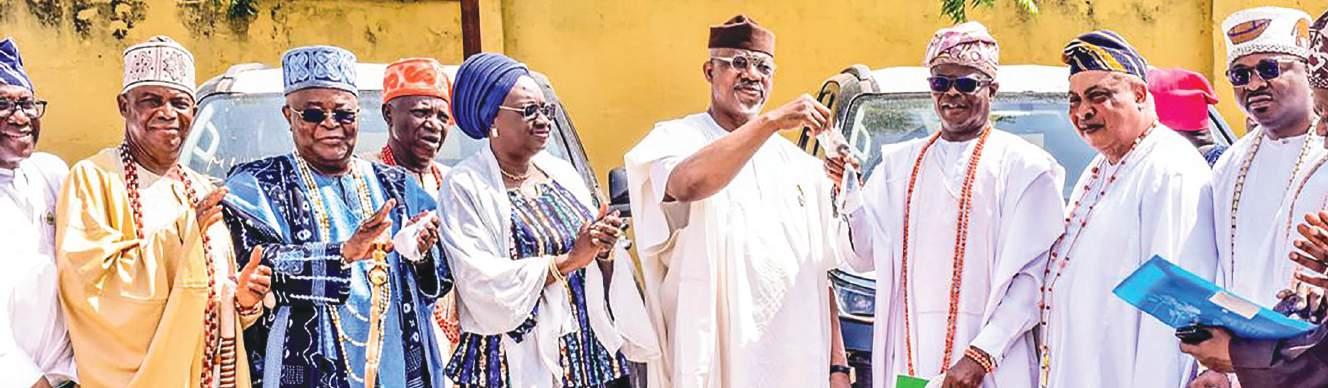
ABIODUN PRESENTS NEW VEHICLES TO TRADITIONAL RULERS...
L-R: The Orimolusi of Ijebu-Igbo, Oba Lawrence Jayeoba; the Alake and Paramount Ruler of Egbaland, Oba Adedotun Aremu Gbadebo; Ogun State Deputy Governor, Engr. Noimot Salako-Oyedele; Governor Dapo Abiodun; Chairman, Ogun State Council of Obas and the Paramount Ruler of Yewaland, Oba Kehinde Olugbenle; the Akarigbo and Paramount Ruler of Remoland, Oba Babatunde Ajayi; and the Olofin of Isheri, Oba Sulaimon Bamgbade during the first quarterly meeting of the Ogun State Council of Obas and the presentation of brand new vehicles to traditional rulers at the Obas Complex, Oke-Mosan, Abeokuta on Thursday
Hormuz Still Blocked as US-
Iran Begin Negotiations Today
Oil rebounds amid fragile ceasefire
Ship traffic through the Strait of Hormuz stood at well below 10 per cent of normal volumes yesterday despite a U.S.-Iran ceasefire, as Tehran asserted its control by warning ships to report to its authorities while doing so.
Hundreds of tankers and other ships have been stuck inside the Gulf since the Iran war began on February 28, cutting global oil supply by 20
per cent in the world’s biggest-ever supply disruption. Prices for some physical oil grades hit new highs on Thursday as the crisis showed little signs of abating.
Just seven ships had passed through the strait in the past 24 hours as of yesterday versus about 140 normally, ship-tracking data showed. They included one oil products tanker and six dry bulk carriers, data from Kpler, Lloyd’s List Intelligence and Signal Ocean
showed.
NATO: Trump considers moving US troops from Europe
A chemical tanker was set to cross destined for India, ship-tracking data on the MarineTraffic and Pole Star Global platforms showed, as reported by Reuters.
“Most shipping lines are likely to remain cautious, and two weeks will not be enough to clear the backlog even if there is a marked increase in traffic,” said Torbjorn Soltvedt at risk intelligence company Verisk Maplecroft.
It came as Iran agreed to a two-week ceasefire with the United States, with its National Security Council saying talks with Washington will begin in the Pakistani capital, Islamabad, on Friday (today), based on Tehran’s 10-point proposal.
The statement was disclosed after Trump said he was holding off on a threat to end Iranian civilisation and would “suspend” attacks on the country for two weeks.
Iran’s Islamic Revolutionary
Idris: Nigeria’s Stability Critical to West Africa’s Peace, Prosperity
Minister of Information and National Orientation, Mohammed Idris, has said Nigeria is paramount to the stability and peace of the West African region. Idris said this yesterday at the Voice of Nigeria (VON) Forum 2026, held at Shehu Musa Yar’Adua Centre, Abuja.
The minister stated that Nigeria was a stable and functional sovereignty steadfastly on the path of recovery and growth.
He stated, “Nigeria’s stability and progress are closely tied to West Africa’s stability. A peaceful and democratic region creates opportunities for growth, investment, and shared prosperity.”
He stressed that for over five decades the country had played a leading role in promoting peace, democratic governance, and regional integration across West Africa.
Idris itemised the country’s contributions to include peacekeeping missions, mediation efforts, and support for democratic transitions, saying the country has consistently demonstrated leadership in advancing peace and cooperation across the sub-region.
He restated the federal government’s commitment to working
with regional and global partners to ensure that Nigeria continued to play its leadership role in advancing peace, security, and development across West Africa.
Idris also referenced recent narratives suggesting that Nigeria was on the brink of collapse, describing them as false and misleading.
He stressed that current realities showed a country making steady progress in security and economic reforms.
He said, “We must reject the false narrative that Nigeria is on the brink of collapse. This does not reflect the realities of governance, security management, and ongoing reforms. Nigeria remains stable and is moving forward.”
The minister reiterated the federal government’s strong commitment to security, backed by significant investment and operational results.
He said N5.41 trillion was allocated to security in the 2026 budget – the highest sectoral allocation – to strengthen military capacity, intelligence coordination, and community-based peacebuilding.
He added that several terror commanders had been neutralised during recent operations, while thousands of kidnapped victims
were rescued across the country.
The minister also alluded to the positive effects of the ongoing economic reforms, with improved fiscal stability and stronger growth projections.
He stated, “Fuel subsidy removal and foreign exchange reforms are stabilising public finances. Inflation has reduced, and global institutions project Nigeria’s economy will grow above the global average in 2026.”
Meanwhile, the federal government reassured Nigerians and international partners that public institutions remained fully operational, with no disruption to governance, economic activity, or daily life.
Idris delivered the conviction in the light of the recent US government advisory directing the departure of non-emergency personnel from its embassy in Abuja.
He described the US warning as a routine precaution guided by internal protocols that did not reflect the overall security situation across Nigeria.
“While we acknowledge isolated security challenges in some areas, there is no general breakdown of law and order, and the vast majority of the country remains stable,” he said.
The minister highlighted ongoing
and measurable gains in security operations that had minimised threats and sustained stability in the country.
He said recent military operations in the affected regions had disrupted criminal networks, limited the activities of armed groups, and improved safety in vulnerable communities.
Guard Corps (IRGC) has told vessels to sail through Iranian waters around Larak Island to avoid the risk of naval mines in the usual lanes through the strait, Iran’s semi-official Tasnim news agency reported on Thursday.
Media reports have suggested that Iran might want to charge a toll for ships passing through, some pinning the figure at $2 million, and ship-tracking data has shown some vessels are already taking the unusual route around Larak Island.
Also, oil prices rose over 3 per cent on Thursday as doubts over a fragile two-week Middle East ceasefire raised concerns that energy flows through the crucial Strait of Hormuz will remain restricted, with shippers hesitant to resume transit.
Brent crude futures were up $3.41, or 3.6 per cent, at $98.16 a barrel, while U.S. West Texas Intermediate (WTI) crude rose $4.74, or 5 per cent, to $99.15 a barrel.
Both benchmarks fell below $100 per barrel in the previous trading session, with WTI recording its biggest decline since April 2020, on optimism the ceasefire would result in a reopening of the strait.
However, Israel bombed more targets in Lebanon yesterday, putting the ceasefire in further jeopardy
after its biggest attacks of the war on its neighbour killed more than 250 people and threatened to torpedo Donald Trump’s truce from the outset.
Market participants were unwilling to fully strip out the geopolitical risk premium, analysts said, adding there was no clarity on what U.S.-Iran talks would mean for oil flows.
Meanwhile, Donald Trump is considering withdrawing some US troops from Europe amid dismay over NATO allies’ failure to help secure the Strait of Hormuz, according to a report in Reuters.
The US president has discussed the option - which would be a significant move demonstrating the growing strain in transatlantic relations - with his advisors, a senior White House official said.
More than 80,000 troops are currently stationed in Europe, more than 30,000 of which are located in Germany, with sizeable numbers also stationed in Italy, the United Kingdom and Spain.
Israeli Prime Minister Benjamin Netanyahu has said Israel will begin peace talks with Lebanon “as soon as possible” after the military launched a ferocious wave of strikes on Wednesday that killed 303.
BON Honours DSS DG Oluwatosin Ajayi
Linus Aleke in Abuja
The Broadcasting Organisation of Nigeria (BON) has honoured the Director-General of the Department of State Services (DSS), Mr. Oluwatosin Adeola Ajayi, recognising him as Friend of the Media at the Nigeria Broadcasting Awards Night held on Wednesday in Abuja.
The recognition comes barely five months after the International Press Institute (IPI) honoured Ajayi with an award for championing press freedom, further underscoring his growing reputation for fostering a positive relationship with the media.
Announcing the award, BON described Ajayi as a thoroughbred professional who, since his appointment by President Tinubu,
has demonstrated utmost respect for the media.
The head of the BON Steering Committee, Bayo Awosemo, who was also honoured for his exemplary leadership, received the award on behalf of the DSS Director-General.
Also recognised at the event were the Governor of Zamfara State, Dr. Dauda Lawal; his Cross River State counterpart, Senator Bassey Otu; the Minister of Information and National Orientation, Alhaji Mohammed Idris; and a former Executive Secretary of BON, Mr. Obadiah Tohomdet, for their support to the media industry.
It would be recalled that on December 2, the IPI honoured Ajayi for upholding “press freedom” and fostering a better relationship with the media.
The award, presented at the IPI Annual Conference in Abuja, acknowledged his commitment to respecting journalists and improving the security agency’s engagement with the media since his appointment in August 2024.
In his remarks, Governor Dauda Lawal of Zamfara State thanked the organisers for recognising hard work, professionalism, and impactful contributions to society.
“I believe the media has a role to play in shaping everything that we do, not just in Nigeria but all over the world,” Lawal stated.
The Minister of Information and National Orientation, Mohammed Idris, who was the chief host, commended BON for conceiving and sustaining the initiative.
Olawale Ajimotokan in Abuja
Emmanuel Addeh in Abuja
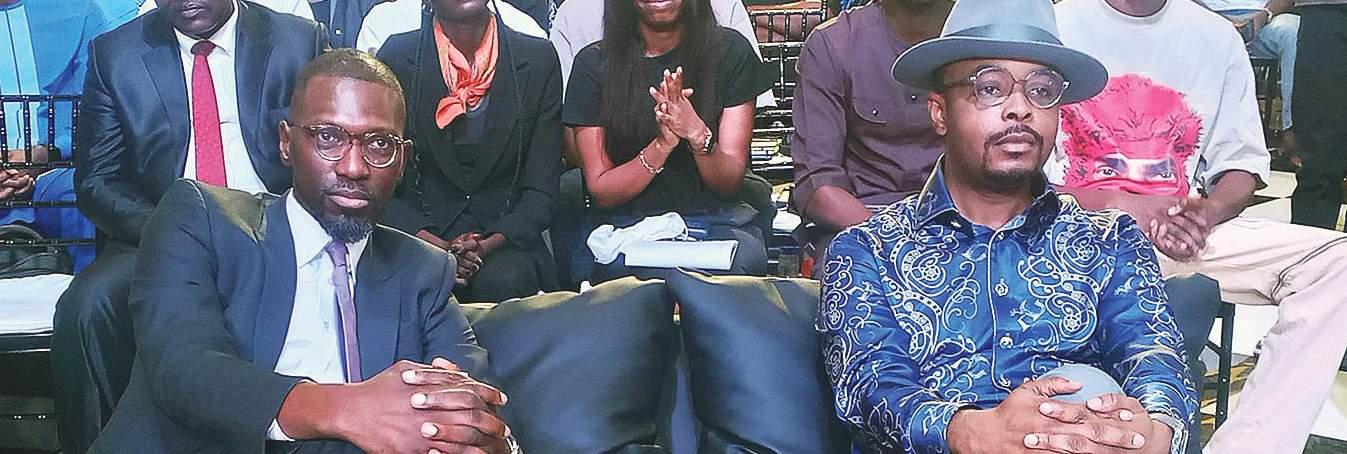
ANAMBRA AS NEW FRONTIER FOR FLUTTERWAVE...
Chief Executive Officer, CEO of Flutterwave, Mr. Olugbenga Agboola (L) and CEO of Stanel Group and Proprietor of Delborough Hotel, Lagos, Dr.
Uzochukwu, during a reception organised for them by members of the tech community in Anambra, yesterday
Oyetola Unveils Sweeping Reforms to Unlock
Nigeria’s $3tn Blue Economy Potential
Eliminates Apapa gridlock, ends piracy, secures $746m port upgrade financing Shippers’ Council identifies connectivity as AfCFTA bottleneck
APM terminals flag global trade disruptions, urges faster digitalisation Delta woos investors with coastal assets, policy roadmap
Sunday Aborisade in Abuja
Minister of Marine and Blue Economy, Adegboyega Oyetola, on Thursday unveiled a far-reaching reform agenda aimed at unlocking Nigeria’s estimated $3 trillion blue economy potential.
Oyetola declared that recent policy, security, and infrastructure interventions had already begun to reposition the country as a leading maritime hub in Africa.
Speaking at the Blue Economy Investment Summit held at Bola Ahmed Tinubu International Conference Centre, Abuja, Oyetola disclosed that the federal government had eliminated the long-standing Apapa gridlock, eradicated piracy in Nigerian waters for over four years, and secured $746 million in financing to modernise key ports.
He said the reforms marked a decisive shift from inefficiency and underutilisation to productivity and global competitiveness in Nigeria’s maritime sector.
The minister said, “Nigeria has moved from fragmentation to coordination and from insecurity to a stable maritime domain that now inspires investor confidence.
“For the first time in decades, we
are seeing order restored in our port corridors and sustained safety across our waters.”
He stated that Nigeria’s maritime sector currently handled over 90 per cent of the country’s international trade by volume, underscoring its strategic importance as a gateway for commerce in West Africa.
Oyetola revealed that government agencies under the ministry increased revenue generation from N700.79 billion in 2023 to about N1.83 trillion in 2025, attributing the surge to improved regulatory oversight, transparency, and automation of key processes.
Oyetola also disclosed that fish production rose from 1.1 million tonnes to 1.4 million tonnes within the same period, boosting food security and livelihoods, while creating new opportunities across fisheries, aquaculture, and marine value chains.
He announced that President Bola Tinubu had approved the disbursement of the Cabotage Vessel Financing Fund (CVFF) to indigenous ship-owners, a move expected to generate at least 30,000 jobs and reduce capital flight in coastal shipping.
The minister added that Nigeria
especially Anambra State.
The Chief Executive Officer of Flutterwave, a leading African Fintech company, Mr. Olugbenga Agboola, has announced plans to make Anambra State the company’s hub in the South East.
Agboola was in Awka yesterday with the CEO of Stanel Group and proprietor of Delborough Hotel, Dr. Stanley Uzochukwu, where they were received by players in the Anambra tech community.
Agboola who recently got a banking license from the Central Bank of Nigeria (CBN) said with the new license, he hopes to further simplify payment systems in the fintech ecosystem and impact more on businesses in Nigeria,
had regained a seat on the Council of the International Maritime Organisation after 14 years, signalling renewed global confidence in the country’s maritime governance.
Highlighting infrastructure expansion, Oyetola said the government had begun the process of modernising Apapa and Tin Can Island ports, while also advancing plans for new deep-sea ports and inland dry ports in Funtua, Moniya, and Jos
to improve cargo movement and reduce logistics costs.
He stressed that the blue economy policy framework recently launched by the government would serve as a comprehensive blueprint to drive investments across maritime transport, offshore energy, tourism, marine biotechnology, and shipbuilding.
“This summit must go beyond dialogue to deliver tangible investments and partnerships. Nigeria today
offers scale, stability, and opportunity for global investors,” Oyetola said.
In his keynote address, Chief Executive Officer of APM Terminals Nigeria, Frederik Klinke, warned that rising geopolitical tensions and disruptions in global shipping routes were increasing freight costs and creating uncertainties in international trade.
Klinke stated that Nigeria’s maritime sector had shown resil-
ience amid global shocks, citing the introduction of the National Single Window platform expected to reduce cargo clearance time to 48 hours. He disclosed that APM Terminals had invested over $600 million in Nigeria, including renewable energy projects and port automation initiatives, adding that export volumes through its terminals has grown significantly due to improved efficiency.
TUC Pushes for Crude Oil Subsidy for Local Refineries to Reduce Fuel Price
Onyebuchi Ezigbo in Abuja
Amid the economic crisis generated by the ongoing United States and Israel war against Iran, Trade Union Congress (TUC) advised the federal government to subsidise the crude oil being supplied to Dangote refinery and other local refineries to help check the skyrocketing fuel price in Nigeria.
Addressing a press conference in Abuja on Thursday, TUC president, Festus Osifo, said one of the issues
Announces Plans
Hub
He said: “So, Flutterwave is the biggest payment system out of Africa today, but also born from Nigeria. Our infrastructure today powers so many companies everywhere across Nigeria today.
“We want Anambra to be our hub for the entire South East of Nigeria. We want to put a system here, put our fees here, put our infrastructure here, and put our POS in every small business and large firms in Anambra State.
“Our services should be the consumer choice in this state. So, we’re committing to doing a lot more here. That is why we’re planning an impact program for entrepreneurs in Anambra State that will be very, very big and very, very
huge. And the goal is, we want to create more people here, who can create global platforms all the way from Anambra, which is key for us.
“We’ve built tech that has gone global. It can be done again, and with our platform being available now, with our banking license that we just got, we can make it easy for the new entrepreneurs all over Nigeria to even grow faster and quicker via our platform.”
Agboola said for the past 10 years, Flutterwave has been a platform where money goes through, but he wants to give South East the opportunity of enjoying his products, by helping to grow small businesses, through partnership.
generating concern among Nigerians was the rising cost of petroleum products arising from the war.
Osifo stated, “We are seeing that the cost of petrol is heading towards N2,000 per litre, depending on which the part of the country.”
He added that the situation had compounded the already harsh economic conditions facing Nigerian workers.
He said the union had considered the issues involved and was proposing that the federal government and the subnational governments should agree to subsidise crude oil being supplied to the Dangote refinery and other local refineries.
The TUC president said since the
country was currently witnessing a revenue windfall as a result of the Middle East conflict, the government could deploy 60 per cent of the excess oil revenue to subsidise crude oil prices for local refineries.
He said that will go a long way in reducing the cost of production at the refineries, thereby cutting the prices of petroleum products in the domestic market.
Osifo, who was flanked by TUC Secretary-General, Dr. Nuhu Toro, and other executive members, said, “You could recall that the budget that was just passed by the National Assembly, they pegged the crude oil price at $64.85 per barrel.
“What I mean is that whenever
the crude oil price goes much more than the projected benchmark in our budget, what will happen is that it leads to excess fund, right? It leads to excess money.
“So, this excess money, you know, is being shared consistently in the Federation Account by the three tiers of government.
“But what we are saying is that if you budget, if you accept that the benchmark is $64.85, any excess above that” should be used to subsidise crude supply to local refineries.
Osifo explained, “So that means when the crude oil price goes up above that benchmark, we will pay more at the pump price.
Push for Justice Reform Gains Momentum as AGF Backs Practical Legal Training for Young Lawyers
Michael Olugbode in Abuja
Nigeria’s drive to strengthen its criminal justice system received a fresh boost on Thursday as the Attorney General of the Federation and Minister of Justice, Lateef Fagbemi, threw his weight behind practical legal training as a catalyst for reform, urging emerging lawyers to take ownership of the country’s rule of law. Speaking in Abuja through his
representative, Hauwa Dimka, at the Administration of Criminal Justice Academy Moot Competition, Fagbemi underscored the urgent need to move beyond theoretical legal education to hands-on experience that prepares young practitioners for the realities of Nigeria’s justice system.
The competition, organised by the Juristrust Centre in partnership with the MacArthur Foundation, was framed not just as a student
exercise, but as a strategic intervention in addressing longstanding gaps in legal training and justice delivery.
Fagbemi described Nigeria’s justice sector as one that requires bold, skilled and ethically grounded professionals, noting that the success of reforms such as the Administration of Criminal Justice Act 2015 hinges on the capacity of lawyers to interpret and apply the law effectively.
ExxonMobil briefs NUPRC on planned multi-billion-dollar FID Says Bosi project may attract fresh $16bn capital
Emmanuel Addeh in Abuj and Peter Uzoho in Lagos
Goldman Sachs has trimmed its second quarter 2026 forecasts for Brent and U.S. crude to $90 and $87 a barrel, respectively, after the U.S. and Iran agreed to a two-week ceasefire.
Previously, the bank forecast Brent and West Texas Intermediate (WTI) oil prices to average $99 and $91 a barrel, respectively.
“Given the reduction in the risk premium at the front of the curve and already edging up oil flows through the SoH (Strait of Hormuz), we nudge down our Q2 forecast for Brent/WTI,” the bank said in a note.
Brent crude oil prices are down over 11 per cent so far this week amid hopes that the Strait of Hormuz would reopen after the U.S. President Donald Trump agreed to the ceasefire with Iran.
However, prices rose on Thursday on concerns that supply from the key Middle East producing region might not fully resume amid doubts about the ceasefire holding and as the crucial strait remained restricted.
Goldman kept its third-quarter forecast unchanged at $82 for Brent and $77 for WTI, and for the fourth quarter at $80 for Brent and $75 for WTI, a Reuters report said.
The bank also said risks to its price forecasts remained skewed to the upside, reflecting the potential for longer lasting disruptions and more persistent crude production losses.
In a severe case, where the ceasefire does not hold and with persistent Middle East production losses of around two million barrels per day, Brent could average closer to $115 in the fourth quarter, the bank said.
Goldman also lowered its second-
quarter European benchmark (Title Transfer Facility (TTF) gas price forecast to 50 euros per megawatt-hour (EUR/ MWh), from 70 EUR/MWh, on the assumption of gradual normalisation of LNG flows through Hormuz from mid-April.
However, if LNG flows are significantly delayed or production infrastructure is damaged, prices will likely go above 75 EUR/MWh, Goldman added.
Meanwhile, ExxonMobil briefed the Nigerian Upstream Petroleum Regulatory Commission (NUPRC) on its plan to invest in multi-billion dollar deep-water projects.
The oil major unveiled its plans when it visited the NUPRC headquarters in Abuja as part of activities to mark 20 years of Erha deep water project.
In his remarks, Senior Vice President, Deepwater, ExxonMobil Upstream
Company, Mr. Hunter Farris, said the oil major was encouraged by Nigeria’s improved investment climate, hence its decision to “renew our vows to Nigeria”.
Specifically, Farris stated that the Production Sharing Contract (PSC) on Erha had been extended to 2042 and the company was doing a lot of life extension works to get the Erha FPSO back to maximum performance.
Besides Erha, he said ExxonMobil was gearing up for potential new investments on Usan, which entails “drilling a handful of wells”, as well as the Owowo deepwater project.
On the Owowo project, Farris said, “There is about a billion barrels of developed resource, of between $7 billion and $8-billion-dollar project, that we are progressing, looking into an FID as early as next year.”
Farris also spoke on the Bosi oil
and gas field adjacent to Erha, which he said had the potential of attracting fresh capital of between $15 billion and $16 billion if the company was to develop a new FPSO and new pipelines.
The ExxonMobil executive said the proposed investments in Nigeria were evidence that the company was “getting back in business and we’re serious about what we’re doing”. He stated that the company was keying into the golden age of deep-water or the rejuvenation of deep-water in Nigeria.
Farris commended Nigeria’s improved regulatory environment, which he said had tremendously improved the ease of doing business.
Responding, Chief Executive of NUPRC, Oritsemeyiwa Eyesan, expressed excitement over the company’s fresh commitment to Nigeria. “To hear that FIDs are likely next year is
very exciting and rest assured we are willing to support you,” Eyesan stated. She said the commission will continue to encourage and safeguard petroleum investments, especially those that were in the interest of the Nigerian people. Goldman Sachs CEO, David Solomon
WE’LL DEFEAT TERRORISM, TINUBU INSISTS, AFTER BOKO HARAM’S KILLING OF GEN. BRAIMAH, OTHERS
Hammed Shittu in Ilorin and Muhammad Sabiru in Maiduguri
President Bola Tinubu yesterday vowed that Nigeria would defeat terrorism, declaring that the killing of Brigadier General Oseni Braimah and others by Boko Haram insurgents in Borno State on Thursday would not weaken the country’s resolve to end the prolonged insurgency.
The President, therefore, urged the leadership of the Armed Forces and all soldiers on the frontline not to be discouraged by the severity of their challenges in the war theatre, stressing that the nation remains appreciative of their sacrifices.
Tinubu expressed deep sadness over the loss of the brave soldiers of the 29 Task Force Brigade, Operation Hadin Kai, who died in a coordinated terrorists’ attack on their camp in Benisheikh part of Borno State.
In a release by his Adviser on
said it acted to implement a Court of Appeal order that effectively altered the party’s recognised leadership, triggering deep political tensions and a widening legal contest over the control of the platform.
To this end, Mark-led leadership of the ADC has approached the Federal High Court, Abuja, to reverse the decision by INEC that de-recognised it as the leadership of the party.
The electoral umpire, citing a ruling of the appellate court, had on April 1, officially removed the names of Mark (National Chairman) and Rauf Aregbesola (National Secretary) of the ADC from its official portal and website.
An aggrieved member of the APC, Nafiu Bala Gombe, laying claim to the leadership of the ADC, had sought an order of injunction restraining INEC from recognising the Mark-led leadership. But Justice Emeka Nwite, in a ruling, turned down the request and ordered that the applicant put the defendants on notice.
But in their response, the Mark-led leadership approached the appellate court to challenge the jurisdiction of Nwite to entertain a suit they claimed centred around their internal affairs, which according to them was not justiciable.
They also claimed that the court of Nwite had become functus officio, having held that the application for an order of injunction was denied.
Information and Strategy, Bayo Onanuga, Tinubu also expressed heartfelt condolences to the military and the families of the soldiers, urging them to take heart in the face of the unfortunate loss.
The Defence Headquarters had earlier confirmed the attack and the tragic loss of lives, which occurred early Thursday, April 9, 2026.
In the government release, Tinubu praised the courage and heroism of the soldiers who fought valiantly to repel the terrorists and ensure that Boko Haram could not overrun the communities the soldiers protect.
While mourning the death of the gallant soldiers, the president urged the leadership of the Armed Forces and all soldiers on the frontline not to be discouraged, but to draw strength from the nation’s deep appreciation for their sacrifices.
“From the reports I have received, our armed forces have been conducting sustained, intense land and air offensives against the insurgents,
But, the appellate court, in holding that the case of the appellant was premature, dismissed it and ordered accelerated hearing of the substantive suit at the trial court.
Specifically, the appellate court ordered the parties to maintain status quo ante bellum, a ruling upon which INEC decided to remove the names of the Mark-led leadership, which the commission had hitherto recognised as the leadership of the ADC.
Responding, the Mark-led leadership of the ADC approached the Federal High Court, seeking amongst others an order of mandatory injunction setting aside INEC’s refusal to attend or monitor the ADC congresses or convention, pending the hearing and determination of the instant suit.
They equally sought an order of mandatory injunction directing INEC to forthwith restore and maintain the names of all ADC National Working Committee (NWC) in its records and portal, prior to the institution of the suit, and pending the hearing and determination of the substantive suit.
The motion on notice, dated and filed on April 7 was filed by Mark’s new lawyer, Sulaiman Usman (SAN).
The motion was brought pursuant to Order 26, Rules 1, 2, 3 and 4 of the Federal High Court (Civil Procedure) Rules, 2019; and under the inherent jurisdiction of the court and equitable jurisdiction of the court to grant injunctive reliefs.
The reliefs sought included “an
neutralising many of their fighters and commanders. The insurgents’ counterattack is a sign of desperation.
“I extend my condolences to the families of our gallant soldiers, led by Brigadier General Oseni Omoh Braimah, who made the ultimate sacrifice in the defence of our country today (yesterday) in Borno State.
“The government will never forget their sacrifices. Their sacrifices will not be in vain. Because of the courage and dedication of our troops on the frontline, our resolve to defeat terrorism and all forms of violence across Nigeria is stronger than ever.”
Besides, the President enjoined media houses and indeed all Nigerians to desist from ‘celebrating’ or condoning the attacks on troops, describing the soldiers as heroes.
“I urge the Military High Command and our troops in all theatres of operation: Do not lose heart, do not be weary, do not be discouraged. Our officers and men should continue to serve with honour, courage, and
patriotism.
“The government will always stand by the Armed Forces, provide more of the equipment needed and ensure the welfare of all who risk their lives for our safety.
“I urge Nigerians and the media to continue to support our Military in their relentless battle against insurgency and banditry. We should desist from celebrating or condoning the attacks against our troops. These soldiers are our heroes; unforgettable and irreplaceable.
“My condolences also go to the government and people of Borno State. The federal government will continue to work with the state government to achieve total victory and lasting peace,” he added.
DHQ Urges Nigerians to Respect Military Tradition
The Defence Headquarters (DHQ) has urged Nigerians and the media to respect established military tradition
order of mandatory injunction, setting aside the decision, act, or directive of the respondent removing the names of the applicant’s National Working Committee from its official portal and the decision of refusal to attend or monitor the applicant’s congresses or convention pending the hearing and determination of the suit.”
The motion also sought another order of mandatory injunction, directing INEC to forthwith restore and maintain records of the names of Mark as National Chairman and Aregbesola as National Secretary, as
Continued on page 45
in the announcement of fallen officers, following reports of casualties from a fresh terrorist attack in Borno State.
This latest attack came barely five months after the killing of a commanding officer under Joint Task Force North-East Operation Hadin Kai, Brigadier General Musa Uba, who was also killed in an ambush by ISWAP terrorists.
Reacting to the development, DHQ emphasised the importance of due process in communicating such losses, particularly the need to notify families before public disclosure.
Confirming the attack and the casualties, Director of Defence Media Operations, Major General Michael Onoja,in a statement, expressed regret that the encounter resulted in the loss of a ‘few’ brave and gallant soldiers, who paid the supreme price in the line of duty.
The Chief of Defence Staff, General Olufemi Oluyede, honoured their heroism, sacrifice, and unwavering commitment to the defence of the nation, noting that their courage would remain a lasting source of pride and inspiration to the Armed Forces of Nigeria and the country at large.
The high command also extended its deepest condolences to the families and loved ones of the deceased.
“’In line with established military tradition and respect for the fallen, the general public and media are
kindly requested to allow the Armed Forces to formally notify the next of kin before the release of further details.
“The public is also urged to disregard misinformation, sensational reports, and unverified content circulating across social media platforms, as these undermine ongoing operations and national security efforts,” l Onoja said. Providing further details on the incident, Onoja explained that troops of the 29 Task Force Brigade under Operation Hadin Kai came under a coordinated terrorist attack at their Brigade Headquarters in Benisheikh. According to him, the attack occurred at approximately 0030hrs (12:30am) on Thursday, 9 April 2026, when insurgents attempted to breach the defensive perimeter of the military installation.
“However, the troops, led by the Commander 29 Brigade, Brigadier General Oseni Braimah, responded with exceptional courage, professionalism, and superior firepower.
In a well-coordinated counteraction, the insurgents were decisively engaged and forced to retreat in disarray, abandoning their mission and leaving behind traces of their failed assault,” he said.
Onoja also described the attack as a sign of desperation by terrorists who, after suffering significant losses
Continued on page 44
TO DRIVE 3M BPD TARGET, NUPRC, NMDPRA, NNPC, OTHERS SEEK DIGITAL, POLICY, CAPITAL ALIGNMENT
must achieve its long-standing target of 3 million barrels per day by 2030, sector players must urgently align their digitalisation, capital investment, and policy frameworks.
This position dominated discussions at the 26th Oloibiri Lecture Series and Energy Forum (OLEF) held in Abuja, where the key stakeholders across the value chain highlighted the need for a coordinated, technology-driven approach to unlock production, improve efficiency, and strengthen energy security.
The event themed: “Beyond 3 Million Barrels Target: Harmonising Digitalisation, Capital and Policy Frameworks for Intelligent Operations and Asset Optimisation,” was organised by the Society of Petroleum Engineers (SPE) Nigeria Council.
Speaking at the event, the Chief Executive of the Nigerian Upstream Petroleum Regulatory Commission (NUPRC), Oritsemeyiwa Eyesan,
said recent reforms under the Petroleum Industry Act (PIA) had begun to reposition Nigeria’s upstream sector, unlocking major investments and restoring investor confidence.
She disclosed that flagship projects such as Bonga North, Ubeta, and HI are expected to attract over $10 billion in Final Investment Decisions (FIDs), following years of delays caused by regulatory uncertainty and fiscal ambiguity.
According to her, the introduction of clear rules, transparent processes, and defined timelines under the PIA has replaced discretion with predictability, significantly reducing investment risk and enabling operators to move forward with large-scale developments.
Eyesan noted that Nigeria’s vast hydrocarbon resources, estimated at over 37 billion barrels of crude oil and more than 200 trillion cubic feet of gas, have not translated into optimal output due to weak
execution, stalled investments, and rising costs.
She stressed that achieving production targets of 2 million barrels per day and 10 billion cubic feet of gas by 2027, and scaling to 3 million barrels and 12 billion cubic feet by 2030, would require more than drilling, but a deliberate alignment of policy, capital, and technology.
“Let me highlight three recent case studies that exemplify how these reforms have enabled investment and delivered tangible results: Bonga North, Ubeta, and HI. … Collectively, these projects represent over $10 billion in new upstream investment, demonstrating that clear policy, firm regulation, and deliberate leadership are essential to unlocking real value and cementing Nigeria’s position as a competitive upstream destination,” she stated.
Central to this transformation, she said, is the adoption of digital technologies across both operations
and regulation, with the commission already advancing a digital-first environment for approvals, reporting, and compliance.
She explained that tools such as digital twins, predictive maintenance, and real-time data analytics are increasingly critical for improving operational efficiency, reducing downtime, and enhancing recovery rates in a capital-constrained environment.
“...Digitalisation is also reshaping our regulatory landscape. Digital technology underpins operational excellence and must be at the center of regulatory oversight. The commission is advancing a digital-first environment where approvals, reporting, and compliance are managed through integrated platforms, delivering speed, transparency, accountability, and real-time visibility for operators.
“Beyond regulation, digitalisation
DAVID MARK SEEKS COURT REVERSAL OF INEC’S DE-RECOGNITION OF ADC LEADERSHIP
Deji Elumoye, Alex Enumah, Linus Aleke in Abuja, Segun Awofadeji in Bauchi,
Group Business Editor Eromosele Abiodun Email oriarehu.eromosele@thisdaylive.com 08056356325, 07034471123
RATES AS AT A PRIL 9,2026
Report: Manufacturing Output Declines as Higher Fuel Costs Slow Growth
Dike Onwuamaeze
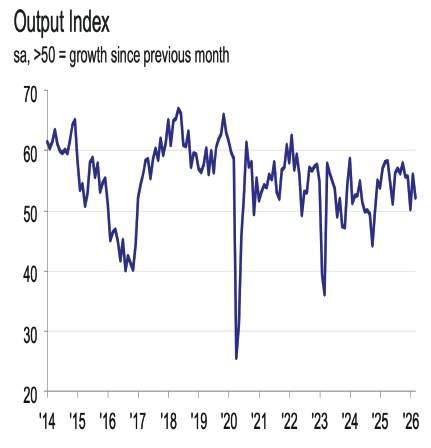
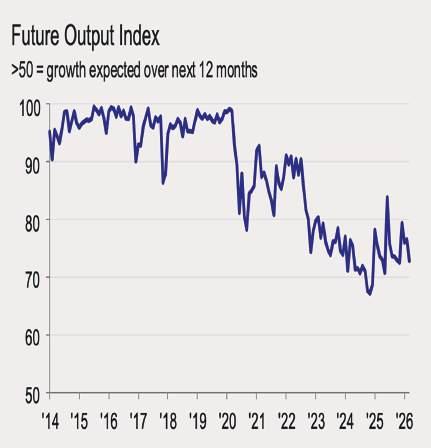
The output of the manufacturing sector decreased as steep intensification of inflationary pressures that were propelled by higher fuel costs slowed growth in the economic activity of the Nigerian private sector at the end of the first quarter of 2026.
This is according to the Purchasing Managers’ Index (PMI) report of the Stanbic IBTC, which stated that although business activity
in Nigeria’s private sector continued to rise in March, the rate of expansion eased from that seen in February and was only modest.
The report stated, “The rate of growth was only slightly softer than that seen in February. The rate of expansion in business activity slowed more markedly, however, and was only modest overall. A number of firms continued to raise output in response to higher new orders, but others suggested that rising fuel costs
had limited growth.”
It also highlighted that the ongoing tensions in the Middle East pose a downside risk to the growth outlook as higher inflation emanating from sustained increase in fuel prices may lead to higher-forlonger interest rates.
It added, “This may influence a slowdown in demand conditions should the tensions continue to escalate.”
Commenting, the Head of Equity Research, West Africa, at Stanbic IBTC Bank, Mr. Muyiwa Oni, said; “The
headline PMI posted 51.9 in March, down from 53.2 in February but still above the 50.0 no-change mark and therefore signalling an improvement in the health of the private sector during the month. Business conditions have strengthened in 15 of the past 16 months.
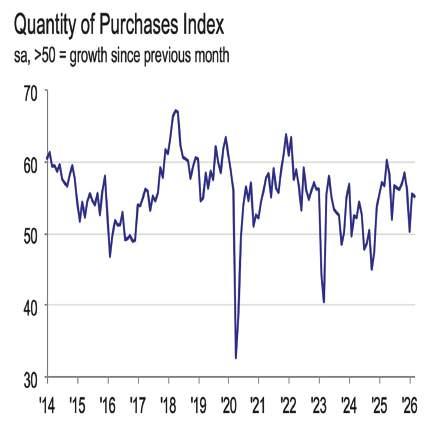
“Output growth was only modest, but underlying demand reportedly remained resilient, leading to a further sharp rise in new orders. In turn, firms continued to expand their employment
and purchasing activity.”
Oni added, “While higher fuel costs and power supply issues contributed to a slowdown in the growth of Nigeria’s private sector activity, underlying demand remains strong. This is reflected in an increase in customer demand and the associated impact of new product launches, both of which supported an improvement in new orders.
“Businesses also remained optimistic about increases in future output amid their plans to invest in
business expansions and boost promotional efforts. Nonetheless, input prices rose markedly at the sharpest pace since January 2025, with all four monitored sectors seeing sharper rates of inflation.” He added that the PMI numbers in Q1:26 were consistent with an estimated 3.99 per cent y/y GDP growth for the quarter after also accounting for crude oil sector’s performance.
chinedu eze
Airline operators have urged the federal government to institute policies and strengthen regulations that will make the aviation industry attractive to long term and single digit loans from financial institutions.
They also called on government to enact special portfolio arrangement to enable airlines that want to
finance aircraft acquisition, to secure long term loans with lean interest rate from the Bank of Industry (BOI).
Speaking on behalf of his members, a Trustee Member of Airline Operators of Nigeria (AON), Captain Roland Iyayi, told THISDAY that despite the seeming new interest Nigerian banks are having in the aviation industry, the banks do not like long term financing
of projects or investing in a project that will require long term amortisation.
According to him, this explains why they do not like investing hugely in the aviation industry.
“What I feel is that Nigerian banks have appetite to finance retail rather than long term investment.
Nigerian banks like short term funding structure better than long term arrangement
of five to 10 years. But government is building confidence in the system but we cannot applaud them yet,” he said.
The operators noted that airline business remained capital intensive and that in many countries government gave different kinds of funding incentives to encourage banks to lend long term loans to airlines with single digit interest rates.
The federal government, led by President Bola Ahmed Tinubu has carried out actions and enacted laws to enhance leasing of aircraft by Nigerian carriers, which hitherto insisted only on wet lease.
This is expected to encourage Nigerian banks to show more commitment in the aviation industry.
But the Managing Director and CEO of Aero
Contractors, Captain Ado Sanusi, told THISDAY that what the federal government is doing to expedite the trust of the lessors was good. He however said the lessors could also think that if the current government leaves office, the next government may not attune itself to the commitments of the previous government.
NCAA Confirms Decline in Flight Delays, Cancellation on Domestic Routes
Chinedu Eze
The Director of Public Affairs and Consumer Protection, Nigeria Civil Aviation Authority (NCAA), Michael Achimugu, has confirmed the notable reduction in flight delays and cancellation in recent months.
Achimugu described the current development as impressive and encouraging, attributing the improvement to a combination of stabilized operations following the peak
festive season and a natural dip in passenger volume.
He, however, warned that as Nigeria enters the rainy season, travellers should still anticipate some weatherrelated disruptions in the coming weeks.
He made this known at a ceremony marking Ethiopian Airlines’ 80th anniversary in Lagos, remarking that a recent Aircraft Acquisition Summit hosted by the Aviation Minister has brought
new focus to the Nigerian aviation sector.
He said the authority has made passenger feedback easy, but noted that while some passengers are making good use of the portal provided by NCAA to address their complaints, some still find it difficult to navigate through the portal and that is why there is an option of emails and social media for passengers to explore and rectify their issues.
Skyway Aviation Declares 54% Increase in Revenue
Skyway Aviation Handling Company Plc delivered a robust financial performance for the year ended December 31, 2025, with revenue growing significantly by 54 per cent to N44.46 billion in 2025, up from N28.94 billion recorded in 2024.
The growth, the company said, was driven largely by increased demand for
passenger and cargo handling services, alongside improved contributions from ancillary and Value Chain operations.
The company’s profit after tax more than doubling to N11.73 billion in 2025, underscoring strong operational momentum and improved efficiency across its business lines.
Speaking on the Company’s financial performance, the Managing Director/CEO,
Adenike Aboderin stated that the results reflect the strength of SAHCO’s strategic direction, the resilience of its business model, and the unwavering commitment of its workforce.
She noted that despite a challenging operating environment marked by inflationary pressures and rising costs, the Company sustained strong margins and nearly doubled its operating profit.
United Nigeria Airlines Admitted into IATA Traffic Agreement
United Nigeria Airlines has announced that it has achieved a significant milestone in global expansion strategy by being officially admitted as a party to the International Air Transport Association (IATA) Multilateral Interline Traffic Agreement (MITA) for passenger operations.
The landmark achievement, confirmed via IATA Memorandum ADMIN/
INTERLINE/4811, follows strict compliance with PSC Resolution 780.
Spokesman of the airline, Chibuike Eloka, said the inclusion marked a pivotal moment for United Nigeria Airlines, transitioning from a domestic operator to a globally recognized player capable of seamless international collaboration.
He said that by joining the MITA framework, United
Nigeria Airlines was now positioned to enter into code-sharing and interline partnerships with hundreds of IATA-member airlines worldwide, significantly enhancing the passenger experience through seamless, single-ticket itineraries, unified baggage check-ins, and smoother connections between United Nigeria Airlines flights and those of major global carriers.
Dun & Bradstreet Named G2 Leader in Winter 2026 Awards
feedback across its business intelligence portfolio.
verified customer
The global provider of business data and analytics said the Leader designation on G2 is awarded to roughly three percent of globally listed software providers and is determined by independent customer reviews reflecting real-world usage and outcomes.
Asst.
Asst. Editor, Money Market
Nume Ekeghe
Correspondents
Kayodetokede(CapitalMarkets)
James Emejo (Finance)
Ebere Nwoji (Insurance)
“The recognition does not rely on vendor submissions. In the Winter 2026 assessment, D&B Hoovers™ received Leader recognition for its sales intelligence and lead identification capabilities.
D&B Connect™ was also recognized as a Leader for its data governance and account intelligence functionality,” the company said in a statement.
Air
WAtCh
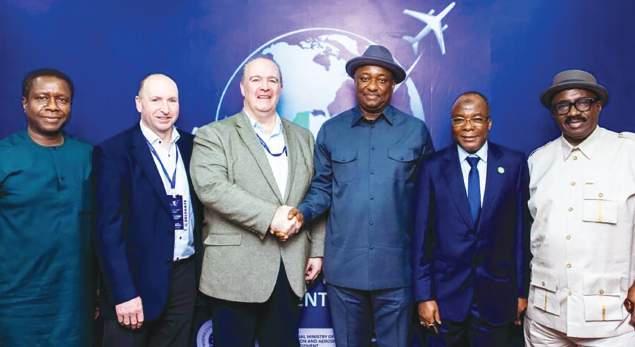
One of the issues discussed during the Nigerian Aircraft Acquisition and Investment Summit (NAAIS), which held last week in Lagos, was over-taxation and its negative influence on the aviation sector.
Two other issues brought to the fore included; the low capacity of African airlines and the challenges of airport infrastructure on the African continent.
The summit attracted global aviation experts, aircraft manufacturers, lessors, financiers, suppliers, insurers and other stakeholders.
The experts left their marks with the signing of deals and commitment of lessors who have promised to adopt compliant strategy in dealing with Nigerian carriers. This is because the federal government has shown enough commitment in the protection of leased equipment, and has given assurance that the lessor must have their equipment back, should Nigerian carrier reneges in the leasing agreement.
The Director General of World Trade Organization (WTO), Dr. Ngozi OkonjoIweala, said the potential for growth of air transport in Africa remained huge but stymied by over taxation of the sector.
status for its application in third-party and supplier risk management. Users highlighted the role of D&B solutions in supporting prospect targeting and opportunity identification for revenue-focused teams.
According to customer reviews, the tools also help organisations monitor exposure across extended supply chains and strengthen risk oversight in complex operating environments.
She noted that the abundant opportunities in the aviation industry in Africa, could lead to the maximisation of the contributions of the sector in the economic development of the region, if well harnessed. She however said this could happen only if existing constraints were removed.
Okonjo-Iweala regretted that African airlines were earning less than expected in global average in terms of traffic and revenue and urged governments to support infrastructure investments in underlying ecosystem, sustained airport infrastructure, air navigation services and other essentials.
Part of the support is reviewing downwards the high taxation of the industry by government and its agencies.
She further said that existing airlines needed to upgrade their fleet to scale up competitiveness. According to her, aviation does not move bulk commodities but moves most sensitive goods and “when air cargo functions well, it does not only complement trade. It enables it.”
She therefore advised the federal government to call for private sector participation in aviation development and growth.
“The good news is that the burden needs not be borne by government alone. This calls for public-government partnerships. Private financing needs to be mobilised for modernisation of airport infrastructure,” Okonjo-Iweala said.
She also called for a review of rising fuel, taxes, and airport charges, which, according to her, can lead to higher operating costs for airlines.
“The fuel costs need to be re-examined –fuel costs, airport taxes, levies and charges”, she stated.
These, she said impede growth in the industry and urged that enabling business environment needs to be created to boost investors’ confidence in the sector.
“The model is straightforward –government provides the enabling framework, the regulatory certainty, and the long-term concession structures that give the private sector the confidence to commit. The private sector brings capital, operational expertise, and the discipline of commercial incentives. Once these structures are set, there is no reason it will not bring commercial growth as experienced in other parts of the world.
“The model is straightforward – government provides the enabling framework, the regulatory certainty, and the long-term concession structures that give the private sector the confidence to commit. The private sector brings capital, operational expertise, and the discipline of commercial incentives.
It added that D&B Risk Analytics also earned Leader
Dun & Bradstreet maintains one of the world’s largest commercial databases and provides data intelligence tools to support operations, compliance and growth. The company said more than 90 percent of Fortune 500 firms, alongside millions of businesses globally, rely on its data for decision-making.
“Governments must maintain a fair and predictable tax regime and remove bilateral restrictions to enable African airlines fly,” she said, adding that when government gets it right, connectivity will grow and airfares will drop.
“Once these structures are set, there is no reason it will not bring commercial growth as experienced in other parts of the world,” Okonjo-Iweala further said.
At the NAAIS summit, the Director General of the Nigeria Civil Aviation Authority (NCAA), Captain Chris Najomo also spoke about the need to bring private sector to invest in aviation development. According to him, for this to happen, government must have strong regulator and the rules of engagement must be clear.
reporter Peter Uzoho (Energy) the story continues online on
Speaking about Nigeria, the Director General said: “The aspiration of transforming Nigeria into a high value trading economy and a gateway between West Africa and global market cannot be achieved without investing in the underlying aviation ecosystem.”
Chinedu Eze
Kayode tokede
Dun & Bradstreet has been named a Leader in the Winter 2026 Awards by G2, based on
Much Ado About Excise Tax on SSBs
The agitation for increased excise duty on Sugar Sweetened Beverages is once again troubling manufacturers in the beverage industry amidst raging global energy disruptions, writes Dike Onwuamaeze
For the umpteenth time the campaign to increase the excise duty on Sugar Sweetened Beverages (USB) is rearing its head. Like a recurring decimal, the campaign is once again a subject of legislative agenda of the National Assembly. One of it arch proponents is Corporate Accountability and Public Participation Africa (CAPPA).
CAPPA is urging the National Assembly to make utilise the unique opportunity of working on a bill for the amendment of the excise duty to strengthen Nigeria’s weak tax on non-alcoholic, sweetened beverages and protect millions of Nigerians from preventable non-communicable diseases (NCDs).
According to CAPPA, the Senate has been on this process since 2025 when it started work on a bill seeking to replace the current flat N10-per-litre excise duty on SSBs with “a percentage-based levy tied to retail price, and to earmark part of the revenue for health promotion, was introduced.”
The bill is formally titled, “A Bill for an Act to Amend Section 21(3) of the Customs, Excise Tariffs, Etc. (Consolidation) Act to Replace the Fixed Ten Naira (N10) Per Litre Excise Duty on Non-Alcoholic, Carbonated SugarSweetened Beverages with a Percentage Levy Based on Retail Price, and to Provide for the Earmarking of a Portion of the Revenue for Health Promotion and Disease Prevention Programmes.”
CAPPA has described this bill as, “A significant policy turning point” stating that in November 2025, the Senate Joint Committee on Finance, Customs and Excise convened a public hearing in Abuja to take input from stakeholders across the country.”
CAPPA claimed that Nigeria has been facing an escalating burden of debilitating diseases linked to unhealthy diets aggressively promoted by ultra-processed food corporations at the expense of public health.
According to CAPPA, “Nigeria now has over 11 million people living with diabetes, and thousands die each year from preventable complications. Nearly a third of all deaths are now linked to non-communicable diseases, a staggering human and economic toll.”
It claimed, “One of the most preventable drivers of this crisis is the excessive consumption of SSBs. Public health research – both local and global – clearly points to frequent intake of sugary drinks as increasing the risk of obesity, insulin resistance and elevated blood pressure, particularly among children and adolescents. In Nigeria, where preventive healthcare remains weak and treatment costs are high, this pattern is unsustainable.”
In 2021, the federal government reflected on the problem and introduced the SSB tax, a token N10 per litre excise duty on all non-alcoholic, sweetened, and carbonated drinks, through the Finance Act.
This pro-health policy sought to discourage excessive consumption of SSBs, reduce Nigerians’ addiction to sugary drinks, and stem the rise in SSB-fuelled incommunicable diseases, and generate revenue.
But CAPPA said, “Though commendable as a starting point, the reality is that the N10/ litre tax is, and has always been, grossly inadequate. The tax was fixed when the average 33cl bottle of SSB cost about N150. A little above three 33cl bottles equal one litre of SSB, meaning the tax was a mere N3.30 per bottle in 2012.
“Today, with bottles selling for over N300, the tax is almost invisible. Clearly, the N10/ litre tax is far too low to change consumer behaviour or meaningfully reduce sugar consumption.”
It added that “fixed-rate levies, like Nigeria’s
current system, are easily absorbed by manufacturers and seldom influence consumer behaviour.”
CAPPA’s argument re-echoed the views of the World Health Organisation (WHO) that such taxes only achieve meaningful reductions in consumption when they raise retail prices by at least 20 per cent.
Currently, it said, that the National Assembly has proposed amendments to replace the flat-rate tax with a percentagebased levy tied to retail prices is crucial.
But the question begging for an answer is whether the amendment of the excise duty as proposed fulfilled the cardinal principles of taxation, such as fairness, ability to pay amongst others.
This is the reason the Manufacturer Association of Nigeria (MAN) and other leading voices in organised private sector in Nigeria are opposed to increasing the excise duty on SSBs.
They believed that introducing new sector-specific taxes, especially on a sector already severely impacted by energy cost shocks and would contradict the government’s reform philosophy, create policy uncertainty, send negative signals to investors and undermine confidence in Nigeria’s manufacturing sector.
MAN in a recent statement on the US-Iranian Crisis for the Manufacturing Sector said specifically that three sectoral groups of MAN, namely the chemical and pharmaceuticals group, the basic metal, iron and steel group and the food, beverages and tobacco group would face “existential headwinds” even though the entire real sector would feel the pinch.
It said: “A rising tide of global conflict does not sink all ships equally; some sectors are fundamentally more exposed. While the entire real sector will feel the pinch, these specific sectoral groups within MAN face existential headwinds.”
Furthermore, MAN stated that the food, beverage and tobacco sectoral group that is highly dependent on imported grains and packaging materials will face price hikes emanating from severe imported inflation and escalating freight costs, which would directly impact the Nigerian consumer’s daily survival.
It said that the operating margins of manufacturers that rely heavily on gas and diesel to power operations would be wiped out by the global energy shock that is driving domestic pump and depot prices upward.
“Also, the global flight to safe-haven assets has strengthened the USA’s dollar, applying renewed depreciation pressure on our currency. The adverse ripple effects of these could arrive squarely on our factory floors,” MAN said.
On its part, The Centre for the Promotion of Private Enterprise (CPPE) said that it
strongly opposes the call for additional taxation on SSBs as canvassed by the (CAPPA). It argued that the proposal is ill-conceived, poorly timed, and inconsistent with the current administration’s tax reform agenda, which is anchored on reducing the burden of taxation on businesses, improving tax efficiency, and stimulating investment.
The Chief Executive Officer of CPPE, Dr. Muda Yusuf, said that at a time when the Nigerian economy is still navigating a fragile recovery, the imposition of new taxes on the manufacturing sector—particularly a highly energy-intensive segment such as the sugar-sweetened beverage industry— would be profoundly counterproductive and disruptive to growth, employment, and investment.
Yusuf argued strongly that the proposal for additional taxation on sugar-sweetened beverages is misaligned with Nigeria’s current economic realities, inconsistent with ongoing tax reforms, and particularly unjustifiable given the extraordinary energy cost pressures confronting the industry.
At a time when beverage manufacturers are grappling with surging fuel costs, weak demand, and shrinking margins, additional taxation would undermine business sustainability, threaten jobs across the value chain.
Yusuf pointed out that the Nigerian business environment remained extremely challenging for a crippling hike in excise duty.
For him, key macroeconomic indicators, such as inflation, high interest rate, spiking energy costs and exchange rate deprivation of the Naira underscored the vulnerability of firms operating in Nigeria.
He said: “Inflation has remained elevated, significantly eroding consumer purchasing power. In addition, interest rates are at historic highs, with the Monetary Policy Rate (MPR) at over 26.5 per cent, translating to lending rates of 30 per cent+ for many businesses.
“Also, energy costs have surged sharply, with diesel prices rising by over 70 per cent, while petrol prices have increased by over 200%l per cent in the past two years, making self-generation of power prohibitively expensive amid weak grid electricity supply. Exchange rate depreciation at the onset of the reforms significantly increased the cost of imported inputs and raw materials.”
He averred that within this context, “the manufacturing sector—including the food and beverage industry—has come under intense strain, being one of the most energy-dependent sub-sectors in manufacturing.”
The SSB industry relies heavily on energy at multiple stages of production, including water extraction, purification,
and treatment and for heating, pasteurisation, and carbonation processes.
It also relies on energy for high-speed bottling, canning, and packaging lines, refrigeration and cold-chain logistics across distribution networks.
Yusuf, therefore, summed up that, “the combined burden of soaring energy bills and extremely high distribution costs has significantly worsened the operating environment for beverage manufacturers, further weakening the justification for any additional tax on the sector.”
He said that evidence already showed that prices of beverages and other consumer goods have increased by over 50 per cent in the last two years. Sales volumes have declined due to weakened consumer purchasing power. While many operators—especially small and medium-scale beverage producers—are under existential pressure
“In this context, imposing additional taxes on an already energy-burdened sector would amount to a punitive layering of fiscal pressure on top of an unprecedented cost crisis, further weakening already fragile business fundamentals,” he said.
The food and beverage sector is a critical component of Nigeria’s industrial ecosystem and the largest employers in the manufacturing space. It supports an extensive value chain spanning agriculture and raw material supply (including sugar, fruits, and packaging inputs), manufacturing and processing, logistics and distribution as well as retail and hospitality.
In addition, the sugar-sweetened beverage segment plays a particularly strategic role because of its scale, distribution reach, and integration with multiple upstream and downstream sectors.
Given the energy-intensive nature of the industry, Yusuf said that additional taxation at this time would have amplified negative consequences, including accelerated downscaling of production due to unsustainable operating costs, closure of vulnerable small and medium beverage manufacturers, job losses across production, distribution, and retail segments, disruptions to agricultural supply chains linked to beverage production and increased informalisation of the sector as firms struggle to survive.
Therefore, at a time of already high unemployment and underemployment, such policy actions would exacerbate socio-economic vulnerabilities.
While CPPE acknowledges the rising incidence of non-communicable diseases such as diabetes, it said that it is important to emphasise that taxation of sugar-sweetened beverages is not a silver bullet for addressing these concerns.
It argued that public health outcomes are primarily influenced by broader lifestyle factors, including dietary habits across multiple food categories, physical inactivity and overall consumption patterns.
“Singling out a highly energy-stressed industrial segment for punitive taxation is therefore neither equitable nor effective. Global evidence on sugar taxes shows mixed outcomes, with limited long-term impact on health indicators in many jurisdictions, particularly where complementary lifestyle interventions are weak,” Yusuf said.
He said that a more sustainable approach should focus on public health education, awareness campaigns and promotion of healthy lifestyles and physical activity. He also suggested improved access to preventive healthcare services and constructive stakeholder collaboration with industry players.
Champion Breweries Completes Redemption of Series 1 and 2 N15.00bn
Oriarehu Bonny
Following the repayment of Series 1 N4.22 billion Commercial Paper issuance in December 2025, Champion Breweries Plc has announced that it has redeemed the Series 2 N10.78 billion issuance, which matured on Wednesday, April 1, 2026, fully repaying its oversubscribed inaugural issuance of N15.00 billion issued in July 2025.
The repayment reflects the company’s strong liquidity position and its consistent track record of meeting investor commitments.
The Series 1 and 2 issuances attracted
diverse participation from institutional investors, signalling strong confidence in Champion Breweries’ financial position, strategy, and growth outlook.
Commenting on the milestone, Chairman of Champion Breweries Plc, Mr. Imo-Abasi Jacob, said the successful completion reflects the Company’s disciplined approach to financial management and long-term strategy.
“The successful redemption of our series 1 and 2 commercial paper issuance reflects the strength of our financial position and the confidence investors have in our business. It demonstrates
the strength of our governance and the resilience of our business.
“As we look ahead, we remain focused on executing our growth strategy, driven by a consumer-led approach and responsible innovation, while continuing to deliver sustainable value to all stakeholders.
“Since the establishment of the Programme, Champion Breweries has demonstrated its ability to engage the debt capital markets with credibility, reinforcing its reputation as a reliable issuer and a company well-positioned to leverage future funding opportunities,” he said.
Lagos, World Bank, FCMB Advance $500m for Inclusive Education, Others
The Lagos State Government, the World Bank and First City Monument Bank (FCMB) are advancing the Human Capital Opportunities for Prosperity and Equity–Governance (HOPEGOV) programme. This $500 million initiative is designed to strengthen the systems behind basic education and primary healthcare in Nigeria.
Backed by the federal government and operating across all 36 states and the Federal Capital Territory, the programme focuses on improving resource management and outcome measurement. Funding is tied not to plans, but to verified progress. For Lagos, the shift is already taking shape. At a public presentation on the state’s progress
in implementation, Governor Babajide Sanwo-Olu pointed to early gains. He highlighted improvements in education and healthcare delivery, driven by a shift from input-based spending to performanceled outcomes.
“For us in Lagos, this is about people,” he said. “It is about ensuring that a child has access to the right learning materials, that a mother receives quality care at a primary health centre, and that public resources are managed transparently for all to see.”
According to Akin Onimole, Senior Procurement Specialist at the World Bank, the programme addresses long-standing structural gaps in service
delivery. He noted that Lagos has shown a strong commitment to strengthening its procurement and institutional frameworks. These efforts help translate reform into practical outcomes.
FCMB supports the programme’s fund flows. The bank says its role reflects a broader commitment to expanding access and opportunity.
“We are working with our partners to open up more opportunities for children and communities,” said Yemisi Edun, Managing Director/Chief Executive Officer of FCMB. “By supporting education and primary healthcare, we are contributing to a system where more people can participate and progress.”
2025: Custodian Investment Grows Revenue by 48%
Kayode Tokede
Custodian Investment Plc has announced its audited financial results for the year ended December 31, 2025, delivering a strong performance driven by significant growth across key financial indicators and major strategic milestones, despite a challenging operating environment.
The Group recorded robust growth in both revenue and profitability, highlighting the strength and resilience of its diversified financial services model.
Gross Revenue rose by 48 per cent to N225 billion (2024: N152 billion), while Profit Before Tax increased by 24per cent to N77 billion (2024: N62 billion). Profit After Tax also grew by 24per cent to N68 billion (2024: N55 billion), with Earnings Per Share advancing 26per cent to N11.19 (2024: N8.89).
In a defining milestone, Custodian’s total assets surged by 155per cent to N1 trillion (2024: N416 billion), while shareholders’ equity increased by 53per cent to N199 billion, reflecting enhanced balance sheet strength and sustained value creation.
The Group also recorded strong growth in its core insurance business, with Insurance Service Revenue increasing from N96 billion to N141 billion, driven by improved underwriting performance and expanded distribution capabilities.
Commenting on the results, the Group Managing Director, Mr. Wole Oshin, stated:
“Our 2025 performance reflects disciplined execution, the resilience of our business model, and our deliberate expansion into high-growth financial segments.”
Operationally, the Group made significant strategic progress during the year. Most notably, Custodian completed the acquisition of Quest Merchant Bank through the EverQuest Acquisition LLP consortium, marking its entry into wealth management, and advisory services. This move broadens the Group’s earnings base and reinforces its evolution into a fully diversified financial services powerhouse.
The price of OPEC basket of twelve crudes stood at $63.14
The OPEC Reference Basket of Crudes (ORB) is made up of the following: Saharan Blend (Algeria), Djeno (Congo), Zafiro (Equatorial Guinea), Rabi Light (Gabon), Iran Heavy (Islamic Republic of Iran), Basrah Medium (Iraq), Kuwait Export (Kuwait), Es Sider (Libya), Bonny Light (Nigeria), Arab Light (Saudi Arabia), Murban (UAE) and Merey (Venezuela). OPEC DAILY BASKET PRICE
Wema Bank Grows PBT by 116% to N221.85bn in 2025FY
Kayode Tokede
Wema Bank Plc has recorded strong revenue growth in the 2025 financial year, with profit before tax crossing the N200billion mark to N221.85 billion, about 116per cent significant increase over N102.51 billion declared in 2024. From the profit & loss
figures, Wema Bank posted N194.5billion profit after tax in 2025, a growth off 125.4per cent when compared to N86.3 billion in 2024, demonstrating strong earnings conversion.
Amid significant increase in profit, the management of Wema Bank has proposed a dividend per share of N1.25 for 2025 financial year.
The lender’s increase in profit is on the back drop of N660.6 billion gross earnings in
2025, representing an increase of 53 per cent from N432.3 billion in 2024.
The growth in gross earnings was largely driven by a 62.7per cent growth in interest income, reflecting improved yields on earning assets and growth in the loan book.
Net interest income more than doubled, rising by 103.9per cent to N361.0 billion, supported by improved asset pricing and balance sheet expansion.
Non-interest income also grew modestly by 8.3per cent to N85.3 billion, supported by transaction banking activities, digital banking revenues, and FX-related income.
Overall, the strong growth across core revenue lines translated to a 79.6per cent increase in operating income, which rose to N420.6 billion.
Operating income growth reflects the bank’s improved revenue generation capacity
and stronger contribution from core banking operations. The increase was primarily supported by growth in funded income as well as stable expansion in fee-based income streams.
Wema Bank, thus declared N198.8 billion operating expenses in 2025, about 51.0per cent increase compared to N131.7 billion in 2024, reflecting inflationary pressures, regulatory costs,
and continued investments in technology and business expansion.
Despite the increase in costs, the bank achieved positive operating leverage as revenue growth outpaced cost growth. This is further reflected in the improvement in the cost-toincome ratio, which declined to 47.3per cent from 56.2per cent, indicating improved efficiency and stronger cost management.
PRICES FOR SECURITIES TRADED AS OF APRIL 9/26
Politics
Osinbajo’s Visibility on Global Platforms
Etim Etim writes on the rising international profile of former Vice President, Prof yemi Osinbajo and the importance of public officials serving with integrity and honour.
Afew days before Prof Yemi Osinbajo left office in May 2023 as Nigeria’s fifth democratically elected vice president, a few journalists and writers went to visit him in his office at the State House in Abuja. I was part of the group.
The visit was essentially for us to formally present a book we had jointly authored on his stewardship to him, and thank him for the friendship some of us shared with him.
Led by Richard Akinola, a lawyer, journalist and columnist, we took turn to make a few remarks as the Vice President listened attentively. When it came to my turn, I said something like ‘’your Excellency, I know that you are going to play big on the international stage…I have no doubts that you’d do Nigeria proud…’’.
Three years on, Osinbanjo has become the nation’s most sought after international statesman, who has been appointed into senior positions in nine global organizations and is highly preferred to give speeches at international forums. His calendar for 2026 is already full, an associate confided in me. These recognitions buttress the importance of serving in public office with honour, integrity and transparency.
A few of Nigeria’s former public officials and business leaders like Chief Olusegun Obasanjo; Chief Emeka Anyaoku; Prof Akinwunmi Adesina and Mr. Aigboje Aig-Imoukhuede have also received laurels at the global stage for their service. I celebrate them also. But Osinbajo’s honour looms large in the horizon given the high number of persons who served in the same administration with him that are facing trial for corrupt practices.
In the last three years, I have been informed of the indignities and humiliation Osinbajo suffered in the hands of the cabal members of that administration, especially the late Chief of Staff to the President. I have also learned of the intrigues and subterfuge that went on during the 2022/2023 primary season during which the Osinbajo offered himself as an aspirant for the APC presidential ticket. It is not a surprise that some of those people who were highly involved in Palace intrigues – persons like Malami; El Rufai; Emefiele - are now facing their comeuppances while our professor is being celebrated all over the globe. But that’s a story for another day.
Osinbajo’s first post-office international appointment came a few days after he left office and that was to lead the Commonwealth Observer Group for Sierra Leone’s 2023 general elections, a role reserved for leaders of exceptional credibility, judgment, and diplomacy. His deep understanding of governance and West African politics as well as his adherence to constitutional principles recommended him for the role.
By July 2023, he was named Global Advisor to the New York-based Global Energy Alliance for People and Planet (GEAPP), navigating complex intersections of climate finance, sustainable energy, and development policy. This role demands a mind capable of synthesizing economics, law, and strategy - qualities he repeatedly demonstrated while steering Nigeria’s economic sustainability programmes.
In August 2023, Osinbajo founded Future Perspectives, a visionary platform designed to incubate ideas, cultivate leadership, and translate thought into action. This initiative reflects his rare ability to merge intellectual rigour with strategic execution, inspiring confidence that Africa’s future leadership can be both visionary and effective.
His continental influence deepened in September 2023 when he was named Board Chair of the Climate Action Platform for Africa (CAP-A), a responsibility that allows him shape Africa’s climate response with precision, foresight, and strategic insight. Climate, like governance, requires disciplined analysis and practical solutions - qualities Osinbajo has consistently demonstrated.
The role may bring him in conflict with known Climate Deniers like Donald Trump and Victor Urban of Hungary. But the professor is equal to the task.
In November 2023, he joined the Mo Ibrahim Foundation Council, affirming his status as one of Africa’s foremost governance minds. Here, he contributes to shaping standards of accountability, institutional integrity, and ethical governance, leveraging the same clarity and reform-oriented thinking that marked his service in Nigeria. He also serves as Board Member of the Africa Innovation Foundation, shaping innovation ecosystems that convert ideas into scalable solutions.
In 2024, Osinbajo was invited to join the
African Leaders Debt Relief Initiative (ALDRI). Launched in February 2025 by a group of former African government leaders in Cape Town, South Africa, with Olusegun Obasanjo serving as chair, ALDRI is a high-level advocacy effort focused on comprehensive debt relief for highly indebted African countries. The initiative aims to negotiate debt restructuring or cancellation, enhance fiscal headroom and promote sustainable financing. Other founding members are Macky Sall (Senegal); Joyce Banda (Malawi); Jakaya Mrisho Kikwete (Tanzania)
and Ameenah Gurib-Fakim (Mauritius).
Working with these eminent Africans, Osinbajo engages one of the continent’s most critical economic challenges, applying legal expertise, economic insight, and negotiation acumen.
By March 2026, Osinbajo’s leadership expanded into climate and health financing across West Africa, demonstrating a rare capacity to operate at the nexus of policy, finance, and social development. This multidimensional engagement reflects his ability to work in multi-sector roles to deliver solutions that are systemic, sustainable, and impactful, just as he did in driving complex reforms and initiatives during his days in the State House.
The appointment of Osinbajo as Senior Strategic Advisor to the Africa Centres for Disease Control and Prevention (Africa CDC) in March 2026 represents the pinnacle of his post-office trajectory. He now influences Africa’s health sovereignty, leveraging a record of disciplined governance, strategic clarity, and reform-driven leadership to shape systems, partnerships, and policies that secure the continent’s future.
In just three years, Osinbajo has proven that true leadership transcends office, thrives on intellect and integrity, and commands unwavering global respect. He is a transformative leader whose influence streaks across continents, earning admiration, trust and respect.
I have often written and spoken about poor leadership as one of the main causes of Nigeria’s underdevelopment. Some of us have also identified corruption, incompetence and decadence as the major impediments in our search for advancement.
But Nigeria’s problem is not lack of good leaders. The challenge is that these good leaders have been crowded out of our politics by people of doubtful backgrounds, shady character and dubious intentions.
Good Nigerians continue to excel - and are celebrated - outside the country in various fields, while Nigeria is governed by election riggers; certificate forgers; tribal bigots and corrupt persons. It is high time we brought in the good people into our government.
-Etim writes from Abuja.
David Mark: The Officer-Politician at 78
Paul Mumeh writes about ex-Senate President, Senator david Mark, a man widely regarded as a public servant defined by discipline, purpose, and enduring accomplishments - an enduring symbol of leadership - whose imprint on Nigeria’s political and democratic landscape remains indelible as he clocks 78.
At 78, David Alechenu Bonaventure Mark stands tall as one of Nigeria’s most enduring figures in public service—an embodiment of discipline, resilience, and unwavering commitment to national stability.
An officer and a gentleman, a soldier and an astute politician, Mark’s life journey reflects purpose and achievement.
Born on April 8, 1948, in Otukpo, his early years were shaped by rigorous military training at the Nigerian Military School and the Nigerian Defence Academy (Regular Course 3). Rising through the ranks as a Signals officer, he distinguished himself with professionalism and strategic depth, eventually becoming Director of Signals of the Nigerian Army.
As a young Major, he was entrusted with the sensitive responsibility of Chairman of the Abandoned Property Committee following the Nigerian Civil War—a role that demanded tact, fairness, and national sensitivity.
His leadership trajectory later saw him serve as Military Governor of Niger State and Minister of Communications, contributing significantly to Nigeria’s early telecommunications framework.
In 1994, amid a principled disagreement with the regime of Sani Abacha, Mark chose exile over compromise. He returned only
after the transition led by General Abdulsalami Abubakar in 1998—an enduring testament to his courage and conviction.
It was, however, in democratic governance that Mark etched his name indelibly in Nigeria’s history. As Senate President from 2007 to 2015—the longest-serving in the nation’s history—he earned the title “Mr. Stability,” steering the National Assembly through turbulent political waters with calm authority. His tenure was marked by a defining legislative intervention: the invocation of the Doctrine of Necessity, which resolved
a constitutional crisis arising from the ill health of President Umaru Musa Yar’Adua and ensured continuity in governance.
Today, as leader of the African Democratic Congress (ADC), Mark remains a central figure in Nigeria’s evolving political landscape—calm, experienced, and resolute in offering alternative leadership anchored on democratic ideals.
A devoted family man, he balances public service with private commitments, maintaining humility despite decades of prominence. Beyond the offices he has held, Mark’s legacy lies in his ability to inspire confidence across divides. In moments of uncertainty, his presence reassured colleagues and citizens alike. He cultivated not just a reputation for leadership, but for steadiness—an increasingly rare quality in Nigeria’s dynamic political terrain.
His years in the Senate were defined not merely by longevity, but by institutional memory and procedural mastery that helped shape legislative culture. Drawing from military discipline and democratic patience, he strengthened the Senate as a pillar of national stability.
-Mumeh writes from Abuja
Moremi E lekwachi: Bridging the Gap in P R for Women Founders
Moremi Elekwachi, Founder of Queen Moremi, love affair with storytelling started in her childhood, inspired by her journalist father and fueled by her own creativity. This passion led her to study Journalism and Marketing Communications, setting the stage for a successful career in PR. However, it was her experience working with female SME founders that sparked a new purpose: making PR accessible to everyone. She believes PR should be a tool for all, not just big brands. In this exclusive interview with MARY NNAH, she shares her knowledge and skills, and how she is bridging the gap to empower women to tell their stories and build credible brands
Can you share a bit about your background and how it led you to where you are today?
For as long as I can remember, I have always had a passion for storytelling through the arts. From creating written stories inspired by my classmates’ adventures, to my early fascination with news media, to my love for music with strong storylines, I always knew that whatever career I chose would be rooted in storytelling.
I looked up to my dad, Dr. Chidi Amuta, a trailblazing professor, journalist, and public affairs consultant. Seeing how his career - built around storytelling - was able to influence government and shape society made a very strong impression on me at a young age.
So when it was time for me to attend university at age 16, choosing a major wasn’t difficult. It was a choice between psychology—because I was fascinated by how people’s experiences shape their life stories, and journalism, because I was interested in how stories shape societal norms. In the end, I opted for journalism.
I hold a Bachelor’s Degree in Journalism from the University of Georgia and a Master’s Degree in Marketing Communications from the University of Southern California.
Currently, I’m the Founder and Lead Consultant at Euphorique PR, a Lagos-based Creative Communications Agency with a global footprint. I am also the founder of the women’s empowerment platform, Queen Moremi.
You have had an illustrious career in PR and marketing, working with top brands like Google and PUMA. What inspired you to start Queen Moremi and focus on empowering female SME founders?
The vision for Queen Moremi actually stemmed from my experience as Lead Consultant at Euphorique PR. Although we have worked with prestigious global brands over the years, we began to notice that alongside that clientele, female SME founders were increasingly reaching out to us. They needed PR support but often couldn’t afford long-term agency retainerships.
We took on a number of these projects and, in many cases, subsidized costs to accommodate their needs because we saw the potential in their businesses. However, it became clear that most mainstream PR companies didn’t have a structured solution for this segment.
The demand continued to grow, and that’s when my team and I decided to launch this initiative under Queen Moremi - to train 5,000 female SME founders and equip them with the foundational PR skills needed to amplify their business visibility, impact, and profitability.
Originally, Queen Moremi was founded as a faith-based media platform designed to inspire, uplift, and connect modern African women who seek fulfillment in all aspects of life. However, the vision evolved over time to reflect one of my favourite Bible verses: “Faith without works is dead.” I realized that beyond inspiration and storytelling, it was equally important to provide women with practical tools for growth and self-improvement.
Based on our experience supporting female SME founders at Euphorique PR, PR education became the most impactful way we could serve—and that’s how this current focus was born.
Your 2026 initiative aims to train 5,000 female SME founders in PR skills. What’s the goal behind this massive undertaking? How do you plan to achieve this goal, given the scale of the initiative?
I know it’s a really lofty goal, but my team and I are fully committed to achieving it.
The training will be conducted predominantly virtually, which allows us to reach a wider audience across Nigeria and beyond. We will also be hosting a few in-person training sessions in Lagos to create more hands-on learning experiences.
One of the most important aspects of this initiative is that it is completely free. Participants do not need to pay to be a part of it, because we want to remove financial barriers and make PR knowledge truly accessible.
To achieve this at scale, we are leveraging structured training modules, digital platforms, and strategic partnerships that will help us expand our reach while maintaining quality. It’s about creating a system that is both impactful and scalable.
What makes your approach to PR unique, and how will it benefit these female SME founders?
What sets us apart is that we are shifting PR from a luxury service to a practical, learnable skill.
In Nigeria, many PR companies tend to prioritize clients with significant budgets. While that works from a business standpoint, it leaves a large gap - especially for SMEs. With the Queen Moremi initiative, we are equipping female SME founders with the basic knowledge and tools they need to carry out key PR functions in-house. We are not just sharing theory - we are providing actionable insights, frameworks, and resources that they can immediately apply to their businesses.
The knowledge we are providing is invaluable, and it empowers these entrepreneurs to take control of their brand narratives, increase their visibility, and build credibility - without being entirely dependent on expensive agency services.
How do you think PR can be democratized to make it more accessible to SMEs and female entrepreneurs?
By intentionally sharing knowledge through accessible training initiatives, workshops, and
digital platforms.
I believe there is too much gatekeeping in the PR industry, especially in Nigeria. Practitioners often focus on defining what PR is not, instead of actually educating people on what it is and how to use it effectively.
Nigeria is home to one of Africa’s most vibrant SME sectors. According to SMEDAN and the National Bureau of Statistics, SMEs account for 96% of all businesses in the country. Nigerian women are playing an increasingly significant role within this sector, with over 41% of micro-businesses and about 32% of SMEs led by women.
In recent years, female entrepreneurship has continued to grow, with a reported 14.29% rise in women-led businesses in 2024 despite economic challenges. This makes it even more important for female-led SMEs to amplify their visibility and impact in an increasingly competitive marketplace.
Democratizing PR simply means giving these founders the knowledge and tools they need to tell their stories and position their brands effectively.
What are some common misconceptions about PR that you’d like to clear up, especially for our readers who may not have a background in the field?
One of the most common misconceptions is that PR is the same as advertising. It is about earning credibility through strategic storytelling and relationships.
Another misconception is that PR is limited to press releases. While press releases are one tool, PR goes far beyond that - it includes brand positioning, reputation management, media relations, community relations, crisis communications, and thought leadership.
There is also the belief that PR delivers instant results. Unlike advertising, PR is a long-term investment that requires consistency and clarity to build trust and authority over time.
Finally, many people think PR is only for big brands. In reality, SMEs need PR just as much—if not more—because it helps them stand out, build credibility, and compete
effectively in crowded markets.
How can female SME founders leverage PR to rise above the noise and achieve their business goals?
Female SME founders can leverage PR by first gaining clarity on their brand story - what they stand for, who they serve, and what makes them unique.
From there, they should focus on building visibility across multiple touchpoints, including social media, media features, collaborations, and speaking opportunities.
Consistency is key. It’s not just about having one viral moment, but about showing up consistently with a clear and compelling message. They should also position themselves as thought leaders within their industries by sharing insights, experiences, and expertise. People are more likely to trust and support brands when they connect with the person behind them. Ultimately, PR helps founders move from simply selling products or services to building a recognizable and respected brand.
What practical steps can female SME founders who are struggling to get visibility and credibility in their industries take to start building their PR skills and increasing their visibility?
The first step is to define your brand narrative. Be clear about your story, your purpose, and the problem your business is solving. Next, ensure your online presence reflects your brand clearly. Your social media pages and website should communicate your value and positioning at a glance.
Start creating and sharing content consistently— this could include educational posts, behindthe-scenes insights, customer testimonials, and personal stories.
Learn how to pitch your story to media platforms such as blogs, podcasts, and online publications. Even without a PR agency, founders can begin reaching out with well-crafted pitches.
Networking is also important. Building relationships within your industry can open doors to collaborations and visibility opportunities.
Most importantly, invest in learning. There are resources, training, and initiatives - like Queen Moremi - that are designed to equip founders with these skills.
How can organizations and individuals support Queen Moremi’s mission and initiative?
We are open to mutually beneficial sponsorships and partnerships for this initiative. Organizations and individuals who are passionate about women’s empowerment and SME development can support us through funding, collaborations, and by providing platforms that help us reach more women.
Interested partners should kindly contact us via queenmoremi@gmail.com
How do you see the PR landscape evolving in Nigeria, and how does Queen Moremi fit into that picture?
The PR landscape in Nigeria is evolving rapidly, especially with the rise of digital media and personal branding.
We are seeing a shift from traditional PR methods to a more integrated approach that includes social media, digital storytelling, influencer collaborations, and thought leadership.
Moremi Elekwachi
Gov Diri’s Six Years of Silent, Impactful Revolution in Bayelsa
Daniel Alabrah
On February 13, 2020, less than 24 hours before the scheduled inauguration of a new governor in Bayelsa State, a five-man panel of the Supreme Court of Nigeria delivered a verdict that altered the state’s trajectory.
In a pronouncement many still call a “divine miracle,” Senator Douye Diri was declared the rightful winner of the governorship election conducted by the Independent National Electoral Commission on November 16, 2019. What followed was not the thunderclap of fanfare but something quieter, deeper, and more enduring: six years of a silent revolution.
Under Governor Diri’s stewardship, Bayelsa has been reshaped not by slogans or spectacle, but by deliberate, compassionate governance that blends visionary planning with an almost paternal care for the people who call the “Glory of all Lands” their home.
From the moment he was inaugurated, Diri hit the ground running. He has equally demonstrated the rare quality of a leader who finishes what others begun and dared to dream bigger.
He did not discard inherited projects in a rush for new glory; instead, he completed them with quiet efficiency while initiating a cascade of new ones that now stitch the state together like threads of a single, vibrant fabric.
As President Bola Ahmed Tinubu visits Bayelsa on Friday, April 10, 2026, the timing feels providential — a moment to witness firsthand how one man’s steady hand has turned potential into progress across infrastructure, security, sports, civil service welfare, youth empowerment, power and energy, agriculture, and, most profoundly, the unity of a people long tested by division and circumstance.
Nowhere is this revolution more visible than in the transformation of Bayelsa’s physical landscape. Roads that once existed only in dreams now stretch like lifelines across riverine communities.
The 22.2-kilometre Yenagoa-OporomaUkubie Road, the majestic Angiama-Oporoma Bridge across the River Nun, and the Angiama-Otuan and Angiama-EniwariFonibiri corridors have opened the heart of the state to its hinterlands.
Further west, the 42-kilometre SagbamaEkeremor Road, complete with five new bridges, and the Ekeremor-Agge Road (first phase reaching Toru-Ndoro and Peretorugbene) have ended decades of isolation.
In the east, the 21-kilometre Nembe-Brass Road (first phase) and the reconstructed Nembe Unity Bridge stand as symbols of reconnection.
Within Yenagoa itself, the Glory Drive Phases II and III, the dualised New Yenagoa City Roads 1 through 6, the Igbogene-AIT/ Elebele Outer Ring Road, and the Isaac Boro Expressway’s completion among other eyepopping projects have turned the capital into a city that breathes modernity while honouring its roots.
These are not mere ribbons of asphalt. Each kilometre carries farmers to markets, students to schools, and traders to opportunity. Bridges like that in Imiringi, Elebele, and the Onuebum-Otuoke road have replaced peril with passage.
About 200 new concrete roads now crisscross Yenagoa and rural communities across all eight local government areas, while the Ox-Bow Lake-Agbura and Polaku-Sabagreia projects link riverine hearts to the mainland. These interventions speak of a leader who understands that development must touch
every ward, every creek.
The governor’s administration has also beautified the Etegwe-Edepie Roundabou and working assiduously to deliver the Akaba-Ogu-Okodi and Toru-Orua-BolouOrua-Akeddei-Toru-Ebeni roads — each one a quiet declaration that no community shall be left behind.
Yet infrastructure for Diri has always been about more than concrete and steel; it is the foundation for human flourishing.
The iconic nine-storey Secretariat Complex rises as a beacon of efficient governance, while the Ernest Ikoli Media Complex, Finance House, Labour House, and BHIS Administrative Complex provide the institutional backbone for a state on the move.
Judges’ Quarters have been remodelled, a new High Court Complex named after Justice Ungbunku stands completed at Onopa, and civil servants now enjoy a dedicated canteen at the Secretariat.
Community pavilions — from Peretorugbene to Kaiama, Ofoni to Odi, Sampou to Ekeremor — have become gathering places where the people’s voice finds resonance.
This same compassion flows through the governor’s approach to the civil service — the lifeblood of public service. Salaries are paid promptly, pensions disbursed without delay, and between N200 million and N400 million released monthly to clear outstanding gratuities and death benefits. Promotions are conducted as due, with incremental benefits implemented faithfully.
Teachers who waited years for their long-overdue advancements finally received justice. Over a thousand civil servants have been allocated plots for housing schemes, while a transport scheme eases their daily commute.
Training and retraining programmes, including mandatory intensive driving courses for lower-grade officers, have uplifted morale and capacity.
In Diri’s Bayelsa, the civil servant is not a faceless bureaucrat but a partner in the collective dream.
Nowhere does the governor’s vision
sees potential in every son and daughter. Security, once a lingering shadow, has been tackled with strategic compassion. Flashpoints were identified and neutralised through infrastructure — shanties around the Etegwe-Edepie Roundabout gave way to beauty and order. The state government equipped security agencies with over 80 patrol vehicles, motorbikes, and communication gadgets.
As a priority, the governor has adopted technology to secure lives and property through the installation of closed circuit television (CCTV) cameras across the state capital just as it has established the Bayelsa Community Safety Corps by law, harmonising its activities with Operation Doo-Akpo, the Vigilante, and Volunteers into a single, effective force.
The result? Bayelsa today ranks as perhaps Nigeria’s safest state — a testament to proactive leadership that protects without oppression.
Sports, too, has become a unifying force.
The construction of a 30,000-seat international stadium signals ambition, but the real victories lie in the achievements of Bayelsa’s athletes.
meet compassion more tenderly than in agriculture and food security. Bayelsa, blessed with fertile soil and abundant water, had long yearned for self-reliance.
Dori answered with action: support for cassava, rice, and plantain cultivation; the establishment of rice farms at Otuasega, Amassoma, and Imiringi Road; and the installation of rice mills at Niger Delta University and Federal University, Otuoke to process “Made-in-Bayelsa” rice.
In partnership with the Central Bank of Nigeria, land and seedlings reached 3,500 farmers across all eight local governments.
The cassava starch processing factory at Ebedebiri was completed, farm inputs distributed, and over 400 Bayelsans trained at the CSS Integrated Farms in Nasarawa State and in soilless farming in Ogun State.
These efforts are not statistics; they are meals on tables, incomes in pockets, and dignity restored to the farmer who once watched potential rot in the fields.
Energy and power have received their own quiet revolution through Operation Light-up Bayelsa. Solar streetlights now illuminate roads and communities that once vanished into darkness at dusk, extending safety, commerce, and study hours deep into the night.
The message is clear: progress must be sustainable, and light — literal and metaphorical — must reach every corner.
All these are reinforced by the state’s independent power plant project with an installed 60-megawatt gas turbines to be inaugurated by President Tinubu during his visit.
Empowerment programmes have turned skills into livelihoods. Over 10,000 young Bayelsans have been trained in various skills and vocations. Another 366 received starter packs through the state’s SDG office.
Most remarkably, 420 small business owners— four from each of the 105 wards — were empowereda monthly with N400,000 each, a direct injection of hope that ripples through families and markets. These are not handouts but hand-ups, evidence of a governor who
Bayelsa United and Bayelsa Queens made history by winning the 2021 AITEO Cup — the first time any state claimed both titles. Blessing Oborududu’s Olympic silver in Tokyo, Bayelsa Queens’ triumphs in the Nigerian league, WAFU Zone B, and African Champions League, Timma Godbless’s junior record and African gold, and the global successes of Bishop Dimeari Grammar School and St. Jude’s Girls College in basketball have filled the state with pride.
The grassroots-based Prosperity Cup and the maiden Bayelsa State Sports Festival have ignited passion from the creeks to the capital. In sports, Diri has shown that glory is collective.
Health and education, woven into the fabric of empowerment, have received equal attention. Referral hospitals at Kaiama, Oporoma, and Ekeremor stand completed, and upgrades to primary health centres.
In education, all 71 programmes at the Niger Delta University received accreditation; new science and technical colleges at Ayamasa, Sampou, Swali, and Ofoni offer free tuition, feeding, and uniforms.
Six new schools within Yenagoa, ICT centres, Microsoft partnerships training 12,000 teachers, and the teaching of the Ijaw language in schools preserve culture while preparing minds.
Above all, Governor Diri has fostered a sense of oneness and peaceful coexistence. His administration’s deliberate spread of projects across senatorial districts and local governments has healed old fault lines.
In a region once prone to tension, Bayelsa under Diri breathes a spirit of shared destiny.
The governor’s quiet demeanour masks a fierce love for his people; his vision is never abstract but always rooted in their daily realities.
As President Tinubu arrives, he will see more than projects. He will witness a state reborn through silent, impactful revolution — a testament to what visionary administration fused with compassion can achieve.
Senator Douye Diri has not merely governed Bayelsa; he has nurtured it, united it, and set it on a path where every road leads home, every light shines brighter, and every citizen feels seen.
Six years and counting, the miracle of 2020 continues to unfold — not with noise, but with results that speak for themselves. The “Glory of all Lands” is rising, and its governor walking beside it, steady, compassionate, and unyielding in purpose.
•Alabrah is Chief Press Secretary to the Governor of Bayelsa State
Governor Diri
LAUNCH OF RENEWED HOPE ENTERPRISE INITIATIVE...
L-R: Minister of Art, Culture and Creative Economy, Hannatu Musawa; Chief of Staff to the President, Femi Gbajabiamila; Senior Special Assistant to the President on Entrepreneurship Development, Chalya Shagaya; Veteran Journalist, Lola Ogunnaike; Deputy Chief of Staff to the President, Office of the Vice President, Senator Ibrahim Hadejia; Senior Special Assistant to the President on MSMEs and Job Creation, Temitola Adekule Johnson; and Director-General, Centre for Black and African Arts and Civilisation, Aisha Adamu during the
the Renewed Hope Enterprise Initiative at the Conference Centre of the Presidential Villa, Abuja, yesterday
FG Institutes Technical Committee to Vet
$200bn High-speed Rail, Power, Gas Project
The federal government has inaugurated a technical committee to review the $200 billion high-speed rail and integrated power and gas project proposed by De Sadel (Nig.) Limited consortium in partnership with China Liancai Petroleum Investment Holdings Limited (Liancai Group).
The multi-agency committee is chaired by Permanent Secretary of the Political and Economic Affairs Office (OSGF), with representation from the Federal Ministries of Transportation, Petroleum Resources, Finance, Justice, and Environment; Central Bank of Nigeria (CBN); Nigeria Financial Intelligence Unit (NFIU); Economic and Financial Crimes Commission (EFCC); National Intelligence Agency (NIA); Office of the National Security Adviser (ONSA); Debt Management Office (DMO), and others.
The committee was instituted yesterday in Abuja by Secretary to the Government of the Federation (SGF), Senator George Akume.
It aims to end power shortages by directly linking the country’s proven over 200 trillion cubic feet gas reserves to power generation and rail electrification.
The project, operating at a speed of 200–250 km/h, will reposition
The project was embedded into the Renewed Hope Agenda plan designed to transform national transport connectivity, upgrade energy supply, and industrialise the gas sector.
Nigeria Unveils $1bn Forest Rescue Plan to Combat Climate Crisis, Halt Rapid Deforestation
Michael Olugbode in Abuja
Nigeria has launched an ambitious $1 billion forest recovery initiative, in one of its most decisive moves to confront deforestation, climate change, and the growing threat to livelihoods tied to shrinking natural resources.
The plan was unveiled in Abuja at the National Validation Workshop of Nigeria’s Country Package, titled, “Securing Nigeria’s Forest Future (SNFF).”
It outlined a sweeping 10-year strategy (2026–2036) aimed at restoring degraded forest landscapes, strengthening governance, and unlocking sustainable financing for the sector.
Speaking at the event, Minister of Environment, Malam Balarabe Lawal, warned that Nigeria’s forests—long regarded as critical national assets—were under severe
and escalating pressure.
He said deforestation, unsustainable resource extraction, land-use changes, and climate variability were rapidly eroding forest ecosystems that millions of Nigerians depended on for survival.
“Forests are central to our environmental stability, economic resilience, and the livelihoods of our people, but the pressures they face today demand urgent and coordinated national action,” the minister said.
The SNFF initiative, developed under the global Forest and Climate Leaders Partnership (FCLP), is designed to translate Nigeria’s climate commitments into measurable outcomes by integrating forest restoration, climate resilience, green job creation, and innovative financing into a unified national framework.
At the core of the plan is a target to mobilise approximately $1 billion in blended finance, combining public
funding, international climate support, private investment, and carbon market mechanisms.
Director of Forestry in the Ministry of Environment, Halima Bawa-Bwari, described the initiative as a critical turning point in Nigeria’s environmental governance, emphasising the urgent need for long-term, coordinated action.
Bawa-Bwari stated that Nigeria’s forests played a vital role in biodiversity conservation, climate regulation, and national economic development, but were increasingly threatened by rising energy demand, agricultural expansion, and environmental degradation.
She said, “Our forest landscapes are under immense strain. Addressing these challenges requires a comprehensive approach that brings together government, private sector actors, development partners, and local communities.”
Insecurity: Visa Applicants Stranded as U.S. Embassy Abuja Suspends Appointments after Evacuation of Staff
Visa applicants in Abuja have been left stranded following the suspension of visa appointments at the United States Embassy after the evacuation of its staff and their family members in Nigeria.
The development came barely a day after the U.S. government ordered the evacuation of non-emergency personnel and their dependants from its embassy in Abuja, citing growing security concerns across the country.
Although it said emergency consular services for American citizens
are still available, they noted that it’s strictly by appointment.
In a fresh notice issued to applicants, the embassy stated that its Abuja office is currently closed for visa appointments, advising affected individuals to monitor their email for further updates regarding new schedules.
“U.S. Embassy Abuja is closed for visa appointments. Applicants should check their email for details on rescheduled appointments. Visa operations at U.S. Consulate General Lagos continue. American citizen services are available in emergencies
and by appointment,” the embassy stated.
The notice clarified that visa services at the U.S. Consulate General in Lagos remain operational despite the temporary disruption in Abuja, while emergency consular services for American citizens are still available, although strictly by appointment.
The embassy did not specify how long the suspension of visa appointments in Abuja would last but reiterated that applicants would be duly informed once normal operations resume, leaving many applicants uncertain about their travel plans.
Bawa-Bwari explained that the SNFF framework provided a detailed roadmap for systemic reform, including restoring degraded lands, strengthening institutional coordination, expanding green livelihood opportunities, and improving transparency and monitoring systems.
Beyond financing and policy, both officials stressed that the success of the initiative will depend heavily on inclusive participation, particularly from forest-dependent communities, civil society groups, and state governments.
They said the validation workshop was a crucial stage in refining the framework to ensure it reflected broad national ownership and delivered tangible results.
Nigeria as a regional logistics and manufacturing hub through the creation of industrial estates along the rail-gas-power corridor, in addition to other benefits, including decongestion of road networks and shifting long haul freight and passenger traffic to high speed rail.
Akume said the project was “too large and too important” to be rushed.
He stated that construction of a 4,000 kilometre high speed rail network linking major economic corridors, such as Lagos, Abuja, Kaduna, Kano and Port Harcourt, was envisioned in the integrated gas development, power generation, and transmission project.
“These kinds of projects have the potential to transform Nigeria’s transport infrastructure, strengthen energy security, stimulate industrial growth and deepen national integration, but they must also be carefully evaluated to ensure they align with national priorities, are technically sound, financially viable, and fully compliant with Nigeria’s legal and regulatory frameworks,”Akume said.
He emphasised the need for a coordinated technical review, adding that the Office of the Secretary to the Government of the Federation has received inputs from security, financial intelligence and regulatory agencies, notably on the consortium’s project financial plans and the profile of the participating partners, including China Railway Group
Limited/China Railway Engineering Corporation.
The SGF tasked the technical committee to accord the highest level of professionalism and patriotism to the assignment. He said their collective expertise and institutional knowledge would be critical in ensuring that the federal government received relevant recommendations that will guide appropriate decisions at the highest level.
The committee is tasked with verifying proof of funds as well as assessing financial, sovereign and contingent liability risks.
It will also review the integrated oil & gas–rail financing model and any proposed oil and gas asset divestments.
Members of the committee were also tasked with conducting technical and engineering, procurement and construction (EPC) due diligence on China Liancai Petroleum Investment Holdings Limited and its proposed partners, while ensuring compliance with Public Private Partnership (PPP) guidelines, including risk allocation, environmental and social safeguards, and resettlement issues.
Akume urged the committee to carefully examine all relevant documentation, verify claims made by the project proponents, review the technical, financial, legal and environmental aspects of the proposal, and provide objective, evidence based recommendations.
Crisis Looms in NMA as Aggrieved Members Protest Exclusion from Election
The election of new National Executive of the Nigerian Medical Association (NMA) is currently fueling conflict with one of the members, a consultant family physician and past chairman of the Medical Guild, Lagos, Dr. Sodipo Oluwajimi, threatening to challenge his exclusion from the contest in court.
Oluwajimi alleged he and six other candidates were being excluded contesting for electoral positions by the association despite meeting all the requirements.
In a statement signed by Oluwajimi, the physician said despite the objection to the disqualification
by all the organs of the association, the incumbent NMA president, Prof Bala Audu, and members of his national officers committee have refused to budge.
Aggrieved Oluwajimi said:
“Despite meeting the constitutional requirement of a signed form with valid proposer and seconder alongside evidence of previously being a National Executive Council member, six (6) candidates were disqualified including myself.
“The overall consensus from all the organs of the association including past presidents, past secretaries-general and the members of the national executive council committee is that the disqualification is illegal.
“However, the president, Dr. (Prof.) Bala Audu and members of his national officers committee have remained recalcitrant in reversing the illegal disqualification,” Oluwajimi said.
He said the exclusion plot amounts to jettisoning integrity, rule of law and the association’s constitution.
He also said the disregard for rules is alien to doctors and our profession and must be resisted by all. With the annual general meeting less than three weeks away, Oluwajimi called for immediate intervention of state chairmen, past presidents, delegates and members of NMA to save the organization from avoidable crisis.
official launch of
PHOTO: GODWIN OMOIGUI
Chiemelie Ezeobi
Onyebuchi Ezigbo in Abuja
Olawale Ajimotokan in Abuja
MINISTER OF STATE FOR INDUSTRY AND INVESTMENT VISITS DANGOTE SUGAR REFINERY...
L-R: Dangote Industries Limited Group Vice President, Mr. Olakunle Alake; Minister of state for Industry, Trade and Investment, Dr. John Owan Enoh; and Executive Secretary/CEO, National Sugar Development Council, Mr. Kamar Bakrin during the minister of state’s visit to Dangote Sugar Refinery Plc Sugar Backward Integration Project at Numan,
Tinubu Inaugurates Rehabilitated Schools in Lagos, Unveils Football Pitches
It’s re-imagination of what public education should look like, says Sanwo-Olu
Segun James
President Bola Tinubu yesterday inaugurated the regenerated and upgraded Tolu Schools Complex in Ajegunle, a densely populated Lagos suburb.
The cluster of 36 public schools got its facilities rehabilitated in an infrastructure renewal programme supervised by the Special Committee on Rehabilitation of Public Schools (SCRPS), a government statement said last night.
The school complex was commissioned along with Maracana Stadium, comprising 19 mini-football pitches built side by side close to the complex.
The president, represented by Senate President, Senator Godswill Akpabio, also commissioned the Fresh Food Hub built by the state governor, Babajide Sanwo-Olu, in Abijo, Ajah area of Eti Osa.
Equally at the event were Minister of Education, Dr. Tunji Alausa; Lagos State Deputy Governor, Dr. Obafemi Hamzat; Deputy Governor of Plateau State, Mrs. Josephine Piyo; and members of the National Assembly.
Tinubu said the scale of regeneration of Tolu Schools Complex by the Sanwo-Olu government was “exceptional and remarkable”, stressing that the intervention reflects the vision, planning, and commitment of the governor to improve the lives of young citizens.
The accomplishment, the president said, demonstrated what could be achieved with bold and focused leadership. He commended SanwoOlu and his team for delivering a project that would serve tens of thousands of students within a school environment.
Tinubu stated, “The remarkable scale and significance of Tolu Schools Complex regeneration is truly exceptional. The successful upgrade of such a large and complex educational facility is highly commendable.
“This reflects the vision, planning and very clear commitment to improving the lives of our young citizens. Sanwo-Olu and his team deserve commendation for delivering a project of this magnitude and for demonstrating what is possible when leadership is bold and focused.”
He added, “We must continue to invest in education, not just as a social service but as a driver of economic growth and national development.
When we equip our children with knowledge and skills, we prepare them to contribute meaningfully to society and compete in a changing world.
“This is an investment in the strength and progress of not just our State but the country. No nation can rise above the quality of its human capital. When we give our young people access to quality education, the right skills and supportive environment, we are preparing them not just for today, but for the future we all desire.”
Through his administration’s Renewed Hope Agenda, Tinubu said he designed programmes that would ensure every child had access to quality learning and was equipped with practical skills to compete and thrive in the emerging modern economy.
By strengthening human capital development, the president said a society would build a workforce capable of driving innovation, creating jobs, and sustaining national growth. He said educational policies must focus on boosting capacity and ensuring schools produce thinkers, problem solvers, and innovators that will move the country’s economy forward.
He stated, “Projects like these show what is possible when leadership is focused and deliberate. This is how we turn opportunities to progress, potential into prosperity for all Nigerians. Lagos is leading in this direction.”
While unveiling the Mid-Level Fresh Food Hub in Abijo, in virtual commissioning, the president said the food sustainability intervention delivered by Sanwo-Olu was in alignment with his administration’s aggressive agricultural production programmes. He said the facility would simplify the complex logistical process that entailed transporting of farm produce to the market for consumption.
In his remarks, Sanwo-Olu said the commissioning of the Tolu Schools Complex represented a beacon of hope and a message of reassurance to children living in Ajegunle.
He pointed out that the mega school project showed the government did not neglect the people.
The governor said the story of Tolu Schools Complex started in 1981 during the Mass Education Policy
of the late Alhaji Lateef Jakande administration, and it was intended to provide accessible education in Ajegunle. He said the government reclaimed land from the Lagos lagoon to build the complex, which started with two pioneer schools — Unity and Olodi Apapa Secondary Schools.
The complex was expanded by the successive military administrations, after which a major milestone was recorded during the administration of the then Governor Tinubu, who added Bola Ige Millennium Secondary School.
The complex’s condition deteriorated due to a growing pupil population. Classrooms originally designed for 35 students were crammed with over 100 pupils and the perimeter fencing was damaged by floodwater.
In response, Sanwo-Olu, the statement said, initiated a regeneration project for the complex. It said this
involved giving all 36 schools in the cluster a complete infrastructural makeover.
The governor stated, “We took a clear and deliberate decision to regenerate this historic complex completely and courageously. What we are commissioning today is not a facelift or a cosmetic intervention.
“It is a full re-imagination of what public education should look like in a modern African city. We have transformed the Tolu Schools Complex into the largest integrated educational community in West Africa, providing a complete educational ladder from foundation to the threshold of higher learning.
“To tackle overcrowding and create a more conducive learning environment, we have delivered 12 new classroom blocks, each containing 18 classrooms.
“In addition, 24 existing school
buildings have been comprehensively rehabilitated, restoring them into safe, habitable and inspiring spaces for teaching and learning. We also built a four-storey vocational and skills acquisition centre with dedicated workshops designed to bridge the gap between academic instruction and practical competence.”
The Tolu Schools Complex is also equipped with central science laboratories and ICT Complex that can accommodate 200 pupils at a time.
Sanwo-Olu renamed the Maracana Stadium, comprising 19 mini-football pitches, after Tinubu for his consistent championing of youth and sports development.
The governor said the 23,000sq metre Abijo Mid-Level Agro Food hub was designed to create a sustainable food distribution network along
the Eti-Osa corridor.
He stated, “This facility, with its modern storage infrastructure, trading floors, and logistics systems, will decentralise access to fresh produce beyond our traditional markets, bringing affordable, quality food closer to families across the Lekki-Ajah axis and beyond. It is a critical piece of our food security architecture.”
Alausa said the massive regeneration of Tolu Schools Complex stood as a powerful testament to the vision of a committed leadership in Lagos. He stated that the accomplishment reflected what could be possible when leadership was purposeful, intentional, and people-centric.
The minister said the achievement was in furtherance of Tinubu’s visionary leadership and his commitment to quality education through the Renewed Hope Agenda.
Barau Urges Stronger Democratic Institutions to Tackle West Africa’s Security Threats
Akpoti-Uduaghan backs women’s inclusion, pledges N1m monthly for documentation initiative
Sunday Aborisade
Deputy President of the Senate, Senator Jibrin Barau, on Thursday called for the sustained strengthening of democratic institutions across West Africa, warning that only resilient governance structures can effectively confront the region’s growing security and political challenges.
Speaking as Special Guest of Honour at the 2026 Forum organised by Voice of Nigeria, VON, in Abuja, Barau said although the sub-region had made notable democratic gains, much work remained to consolidate those achievements.
The high-level event, held at the Shehu Musa Yar’Adua Centre, brought together media professionals, parliamentarians, diplomats, heads of agencies, senior military officers and traditional rulers to examine Nigeria’s role in advancing democratic stability within the Economic Community of West African States (ECOWAS).
Barau, who also serves as First
Deputy Speaker of the ECOWAS Parliament, stressed that recent developments in parts of the region underscore the urgency of reinforcing democratic institutions to withstand emerging threats.
He described legislatures as pivotal to democratic sustainability, noting they remain the bedrock of accountability, transparency and constitutional order.
“As parliamentarians, we are committed to legislative initiatives that reinforce democratic governance, deepen regional collaboration, and strengthen Nigeria’s contributions to West Africa’s collective progress,” he said.
The Deputy Senate President assured the National Assembly would continue to deepen legislative oversight and pursue policies aimed at strengthening governance and regional cooperation.
He added that Nigerian lawmakers had sustained engagement with their counterparts across West Africa to promote dialogue, cooperation
and legislative diplomacy in line with ECOWAS objectives.
Barau however stressed that democracy must ultimately deliver tangible benefits to citizens, urging governments across the sub-region to prioritise people-centred policies.
He also highlighted Nigeria’s leadership role within ECOWAS, describing it as both a privilege and a responsibility that must be exercised through example, partnership and adherence to democratic norms.
According to him, strengthening institutions domestically while supporting democratic stability across the region would position Nigeria as a pillar of stability and a driver of regional integration.
The lawmaker further charged the media to play a more proactive role in shaping global narratives about Africa, warning that misinformation could erode public trust and weaken democratic culture.
“The future of West Africa depends on our shared commitment
to peace, democratic governance and regional solidarity,” he said.
Meanwhile, Senator Natasha Akpoti-Uduaghan (Kogi Central) has made a strong case for greater inclusion of women in leadership and knowledge systems, stressing that documentation of women’s contributions is critical to achieving gender equality.
Speaking at the WikiGap Nigeria Symposium 2026 in Abuja, the senator argued the marginalisation of women in knowledge spaces directly translates to their exclusion from positions of power.
“When women are invisible in knowledge, they are excluded from power. That is why WikiGap is not just a project; it is a movement to correct historical silence,” she said.
Akpoti-Uduaghan lamented that despite the significant roles played by Nigerian women in leadership, innovation and community development, many of their contributions remain undocumented and undervalued.
Adamawa State on Wednesday
in Abuja
LIFE SAVING INTERVENTIONS BY NDLEA...
L-R: Alhaja Abdullahi Bahijja Aminu; Chairman/Chief Executive Officer of the National Drug Law Enforcement Agency (NDLEA), Brig. Gen. Mohamed Buba Marwa (Rtd); Alhaji Baffa Abdullahi; and Alhaja Maryam Hussain Abdullahi, when Alhaji Abdullahi led two of the three Nigerian pilgrims who were detained in the Kingdom of Saudi Arabia over illicit drugs smuggled into their luggage by a syndicate but later released by the Saudi authorities following multi-stakeholder efforts coordinated by NDLEA, to thank Marwa for the life saving interventions at the agency’s National Headquarters in Abuja, yesterday
NISO Announces Power Outage Across 7 Northern States for Grid Upgrade
FG defends N3.3tn deal with Gencos amid backlash
The Nigerian Independent System Operator (NISO) yesterday announced a scheduled power outage affecting Plateau, Gombe, Bauchi, Borno, Adamawa, Taraba and Yobe states as part of ongoing efforts to upgrade critical transmission infrastructure.
In a public notice dated April 8, 2026, the system operator disclosed that the outage will take place on the Jos–Gombe 330kV transmission line from April 9 to May 22, 2026. The disruption is expected to occur weekly from Thursday to Sunday
between 9:00 a.m. and 6:00 p.m.
According to NISO, the outage is necessary to enable the installation of Optical Ground Wire (OPGW) fibre optic infrastructure along the transmission corridor, a move aimed at strengthening grid management and operational efficiency.
The organisation explained that the upgrade will enhance Supervisory Control and Data Acquisition (SCADA), Energy Management Systems (EMS), and telecommunications capabilities, thereby improving real-time monitoring, fault detection, load balancing, and overall electricity
delivery in the region.
Although power supply will be maintained through available 132kV transmission lines during the period, NISO warned that customers in the affected states may experience reduced supply due to network constraints and limited capacity on the alternative lines.
The system operator noted that it is working closely with key stakeholders, including Jos and Yola Distribution Companies, as well as the Transmission Company of Nigeria (TCN), to minimise disruptions. It added that efforts are being made to manage out-
ages across feeders, substations and customer clusters within the specified timeframe.
NISO stated that upon completion, the project is expected to significantly improve the quality and reliability of electricity supply in the affected states. It also highlighted anticipated benefits such as enhanced grid coordination, faster fault restoration, improved system stability, better integration of generation and load data, and a strengthened telecommunications backbone for power system operations.
The operator apologised for
the inconvenience the outage may cause and appealed for the understanding and cooperation of electricity consumers as it works to deliver a more efficient and resilient power supply network.
“This upgrade is part of ongoing efforts to enhance grid operations through improved SCADA (Supervisory Control and Data Acquisition), EMS (Energy Management Systems), and telecommunications capabilities. It is expected to strengthen real-time monitoring, fault detection, load balancing, and overall energy delivery across the region.
“During the outage period,
Yilwatda, Other NWC Members Receive Certificates of Return, Assures Implementation of Party’s Manifesto
The National Chairman of the All Progressives Congress (APC), Prof. Nentawe Yilwatda, has assured the party would ensure its manifesto based on progressive principles, is implemented across Nigeria for the benefit of the people.
Yilwatda made this known on Thursday in Abuja after receiving the Certificate of Return alongside other members of the National Working Committee (NWC) of the party.
He said: “Well, for us, the assurance we give the party and Nigerians is that this party is strong, prepared, and ready. The National Working Committee has been given the certificate, which is the authority to carry out the mandate entrusted to us.
“We will ensure that the party’s manifesto, based on progressive principles, is implemented across Nigeria for the benefit of our people.”
Yilwatda noted the convention would go down in history as one without a single litigation.
He said it was almost as if we were at a carnival rather than a convention, noting the internal wrangling that used to trail conventions was completely absent.
The chairman stated: “For the new National Working Committee
which has held its first meeting, we are committed to the party. The assurance I give you is that we will deepen democracy. We will uphold democracy within the party and ensure stability.
“We will continue to expand the party—keep reaching out, keep engaging, keep mobilising—to increase membership across the country. We must ensure that our party remains strong and focused.
We must present clear policies, clear candidates, and a clear direction for Nigeria.
“Our responsibility is to strengthen democracy and build confidence in the political process. We will continue to work hard to ensure that our party remains the platform of choice for Nigerians.
We assure you that this party will work towards credible elections and stronger democratic institutions.
“Our duty is to ensure that we deliver results at all levels— governors, senators, members of the House of Representatives and Houses of Assembly. We will put in all our energy and effort to ensure success for our candidates.
“We will also maintain strong working relationships between the party, the states, and the federal level, ensuring coordination and unity of purpose. We pledge loyalty
to the party, loyalty to Nigeria, and commitment to responsible leadership. I want to thank you for your efforts and your dedication.
This is a responsibility we carry with honour—a responsibility to serve our people.”
Earlier, the chairman, Convention Central Coordination Committee, Hon. Aminu Masari, said the committee did a good job by delivering a contentious free convention.
supply to the affected areas will be maintained through available 132kV transmission lines. However, due to inherent network constraints and limited capacity on these lines, customers may experience reduced power supply and service limitations within the stated outage window,” the statement added.
Meanwhile, the Presidency yesterday defended the approval of a N3.3 trillion plan by President Bola Tinubu to settle verified legacy debts owed to Power Generation Companies (Gencos) between February 2015 and March 2025. With N223 billion already disbursed and 15 power plants signing settlement agreements totalling N2.3 trillion, the approval has generated controversy, as the opposition has framed the latest pronouncement as ‘political’ and as Generation Companies (Gencos) seeking clarifications. who asked Tinubu to clarify how the Federal Government arrived at the reported N3.3 trillion debt, raising concerns over discrepancies between the figure and reconciled industry records.
But in a post on its official X handle, the Presidency noted that the debt settlement approval was geared towards addressing financial challenges in the power sector, not a reward beyond service delivery.
PTDF Screens Over 746 Candidates for Overseas Scholarship in Rivers
Blessing Ibunge in Port Harcourt
The Petroleum Technology Development Fund (PTDF) has commenced screening and interviews of over 746 candidates shortlisted for MSc and PhD under the PTDF 2026/2027 Overseas Scholarship Scheme (OSS) in Rivers State, the South-South zonal centre.
The exercise which began on April 7, ending on April 17, 2026, took place concurrently across the six geo-political zones of Nigeria with various centres at Abuja (North-central), Bauchi (North-East), Kaduna (North-West), Enugu (South-East), Oyo (SouthWest) and Rivers (South-South).
Speaking during the screening of the MSc candidates yesterday, at
the PTDF Centre for Skills Development & Training, Airport Road, Igwuruta Port Harcourt, a Deputy Manager at PTDF and Team Lead, Port Harcourt Centre, Peter Egheneji said “We are having 503 candidates for Master’s Degree and 243 for Ph.D. programs”.
Egheneji who explained that part of the mandate of the PTDF is to provide scholarship and bursaries for the development of the oil and gas industry, said the programme tends to provide support in form of scholarships for Nigeria’s that qualify in the oil and gas industry.
He revealed the criteria used to shortlist the applicants include; their grades at the O’level, first degrees and their proposals. “So, we want to give the best opportunity to
go for the scholarship,” he said.
One of the panelists at the interview and screening exercise, Prof. Godwin Chukwu, an affiliate of the University of Port Harcourt Emerald Energy, stated that PTDF is adding value to the nation’s oil and gas industry as most beneficiaries of the scholarship have become assets for the country.
He said the exercise commenced on Tuesday for those applying for Master’s Degree. “We look at what the student has done at the undergraduate, how the student can interface that particular background and knowledge to doing a Masters in an area that will be beneficial in the oil and gas operations in Nigeria”.
Prof. Chukwu who is also the
Chief Executive Officer of Toncia Energy Consulting, Abuja, stated that “Our job starts with reviewing what we see and recommending to PTDF, and PTDF will take it up from there. Then it’s left for PTDF to decide on what they want. But our recommendation should be something that should guide them in their final decision.
“You will be surprised that we have some people that are coming from the background of political science, some people coming from the background of Law, and you will be asking, what are they coming here to do? These people did very, very well in the process”.
Other panelists sighted during the screening were Prof.
Tebekeme Koko of the Niger Delta University, Bayelsa, and Dr. Garba Malumfashi, Senior Fellow with National Institute for Policy and Strategic Studies (NIPSS), Kuru, Plateau State.
Some of the candidates that spoke with journalists after their screening, lauded PTDF for what they described as “smooth application process”, adding that there were no issues of uploading their documents during the process.
Ifeoluwa Ajetunmo, who was at the centre for Masters scholarship interview with focus on Engineering Management for Process Sustenance, said “I am going to apply everything that I Iearnt to addressing the gaps to host I have seen in the oil and gas industry”.
Adedayo Akinwale in Abuja
Emmanuel Addeh in Abuja
LAUNCHING OF A MILK COLLECTION POINT...
L-R: Representative of the Emir of Suleja, Alhaji Musa Ijah; Minister of Livestock Development, Alhaji Idi Mukhtar Maiha; Corporate Communications, Public Affairs and Sustainability Manager, Nestlé Nigeria, Mrs. Victoria Uwadoka; Executive Director, Maidoki Farms, Senator Garba Musa; and CEO, CBI Innovation Limited, Mr. Olusoji Apampa during the launching of a Milk Collection Point established in collaboration with Nestlé and Maidoki Farms in Suleja, Niger State, yesterday
INEC, APC Bent on Destroying Nigeria’s
Democracy, PDP Chieftain, Bode George, Warns
Segun James
A former Deputy National Chairman of the Peoples Democratic Party (PDP), Chief Olabode George, has warned that the All Progressives Congress (APC) and the Independent National Electoral Commission (INEC) mightdestroy Nigeria’s democracy.
The octogenarian, in a statement yesterday, cried that,”Actions and utterances coming from APC and INEC in recent weeks show that they don’t want any other presidential candidate in 2027 aside President Bola Tinubu of APC.”
According to him, “and they are ready to destroy all democratic fundamentals, tenets and ethos to have their way.”
George, likened what is going on to actions of the Biblical Abimelech, who destroyed almost everybody and everything to become a king, warning that, “but God proved to Abimelech and the people of Shechem that there is nobody He
created that He cannot handle.
“This is the time for all leaders and elders, irrespective of party affiliation, to rise and condemn what is going on. You don’t appease evil. You deal with evil. Enough is enough. This nation must not sink.
“At 80 years, what am I looking for? I was in Form 4 in secondary school when the Western Region crisis started in 1962. I don’t think some of those causing crisis in the polity today were born then.
“Military or civilian, I have
seen it all. We must not allow this country to go down. We are firing the warning shot now. Nigeria is too big to be manipulated by a greedy and selfish few.
“Look at insecurity. This country is gradually collapsing. I don’t want
to hear anything like external factors or elements. Those killing and kidnapping Nigerians all over the place are in this country.
“Instead of the president, as the Commander-in-Chief to deal with these blood-thirsty maniacs,
he is busy using INEC to destroy opposition parties.
“Nigerians will not allow this to happen. It is unfortunate that the electoral body has become an undertaker, mandated by the ruling party to destroy this democracy.”
FG Urges UN to Foster Inclusive, Equitable Hydrogen Economy
James Emejo in Abuja
Minister of Budget and Economic Planning, Senator Abubakar Bagudu, has urged the United Nations to foster an inclusive and equitable hydrogen economy, adding that no region should be left behind in global transition to a cleaner energy ecosystem.
Bagudu made the call during his closing remarks at the Conference on Clean Hydrogen: Shaping Sustainable Industry’s Future, organised by the United Nations Industrial Development Organisation (UNIDO) in Vienna, Austria.
The minister emphasised the need
for the global body to address historical imbalances where value creation has been concentrated in a few regions, while others have remained mere suppliers of raw potential.
He stressed that hydrogen represents far more than a decarbonisation tool, describing it as a pathway to industrialisation, job creation, energy security, and economic diversification.
According to him, it offers a historic opportunity for many countries to move from the margins to the mainstream of global energy systems.
However, the minister stressed that the transition must be cooperative, inclusive, and equitable.
He said, “We must ensure that the emerging hydrogen economy does not replicate past inequalities, where value creation is concentrated in a few regions while others remain mere suppliers of raw potential.”
Bagudu also called for renewed commitment to fast-track policies and regulatory frameworks that would mobilise large-scale investment, strengthen cross-regional partnerships, and position hydrogen as a tool for shared prosperity.
He said, “The future of clean hydrogen is not predetermined but will be shaped by the choices we make, the partnerships we forge, and the
urgency with which we act.
“Concerted action on a hydrogen future that is not only clean but fair; not only innovative but inclusive; and not only global but truly shared.”
The minister observed that although opportunities in the hydrogen space are vast, they are not evenly distributed,arguing that countries rich in renewable resources, particularly in the Global South, are well-positioned to shape the future of green energy.
Nonetheless, he cautioned that potential alone is insufficient, stressing the need for deliberate policy actions, credible demand signals from developed economies, strategic
TO DRIVE 3M BPD TARGET, NUPRC, NMDPRA, NNPC, OTHERS SEEK DIGITAL, POLICY, CAPITAL ALIGNMENT
must transform the entire value chain. For operators, real-time data is a competitive necessity, enabling faster, evidence-based decisions, lower operating costs, safer operations, and more reliable outcomes. Through digital twins, real-time monitoring, predictive maintenance, and advanced analytics, operations are more precise, downtime is minimised, and asset value is consistently enhanced,” she pointed out.
Eyesan also highlighted the importance of performance-based regulation, noting that new frameworks now tie field development approvals to sound reservoir management and improved recovery techniques, ensuring that assets are optimally developed and managed.
Also, the Chief Executive of the Nigerian Midstream and Downstream Petroleum Regulatory Authority (NMDPRA), Saidu Mohammed, called for a deliberate focus on large-scale, high-impact projects to accelerate production growth. Mohammed emphasised the need for what he described as “Big Bank” projects capable of delivering hundreds of thousands of barrels of oil and billions of cubic feet of
gas per day.
He argued that such projects are essential if Nigeria is to meet its production targets within the current decade, particularly in the context of evolving global energy dynamics and rising demand for reliable supply sources.
Mohammed revealed that the Authority is set to unveil Project NEXUS, a transformation initiative aimed at enhancing regulatory efficiency, supporting sustainable energy development, and positioning Nigeria as a leading energy hub in Africa.
At the national oil company level, the Nigerian National Petroleum Company Limited (NNPC) signalled a more aggressive push towards digital transformation, particularly in the deployment of artificial intelligence.
The Group Chief Executive Officer of the Nigerian National Petroleum Company Limited (NNPC), Bayo Ojulari, represented by the company’s Executive Vice President, Upstream, Udy Ntia, said NNPC would begin reviewing the budgets of its partners to assess their level of investment in AI and digital technologies.
He stressed that the industry can no longer afford to pay lip service to digitalisation, warning that failure to adopt data-driven approaches would lead to rising costs and declining competitiveness.
According to him, Nigeria possesses decades of valuable data, including well logs and seismic information dating back to 1956, much of which remains underutilised or stored in analogue formats.
He said harnessing this data through artificial intelligence, advanced analytics, and modern data infrastructure was critical to improving decision-making, reducing operational costs, and optimising production.
According to Ojulari, achieving 3 million bpd is not just a production target, but a commercial and technological opportunity, requiring coordinated action across operators, service providers, and regulators.
“We have rich data going back to 1956. We have logs that are still on paper, well logs, seismic information that are not being mined. We have so many things that we can begin to do.
“We have three to four years to get there. By next year, I’m going to
be looking at everybody’s budgets. I want to see what everybody is doing with AI. Nobody is doing it today. Nobody. All we do is just talk. We have to do it as an imperative,” he said.
For his part, the Minister of State for Petroleum Resources (Gas), Ekperikpe Ekpo, underscored the importance of automation and digitalisation in enhancing efficiency across the oil and gas value chain.
He said intelligent operations driven by data and technology are essential for reducing downtime, improving reservoir management, and optimising asset performance.
Ekpo emphasised that Nigeria’s energy strategy is anchored on creating an enabling environment that attracts investment while ensuring sustainability and environmental responsibility.
He reiterated the central role of natural gas in the country’s energy transition, noting that initiatives under the Decade of Gas are focused on expanding infrastructure, increasing domestic utilisation, and linking gas production to industrial development.
Besides, Roger Brown, Chief Executive of one of Nigeria’s biggest
operators, Seplat Energy, said the company plans to significantly scale production through a combination of investment and operational efficiency.
Represented by the Managing Director of Seplat Onshore Ltd, IbiAda Itotoi, the company disclosed that it is planning to invest about $6 billion in capital and operational expenditure to increase production to 500,000 barrels per day by 2030.
Brown noted that a key challenge facing the industry is the decline in output from ageing fields, estimating that Nigeria would need to add about 200,000 barrels per day just to stabilise current production levels.
To reach the 3 million bpd target, he said an additional 300,000 to 500,000 barrels would need to be developed, requiring both large-scale projects and incremental improvements in existing assets.
Earlier in his opening remarks, Chairman of the Society of Petroleum Engineers (SPE) Nigeria Council, Francis Nwaochei, said the forum was designed to move beyond discussions and deliver practical solutions to the industry’s most pressing challenges.
investments, and genuine international cooperation.
Bagudu also highlighted Nigeria’s Hydrogen Policy as a critical component of the country’s broader energy and development strategy.
He said the policy is anchored on enhancing climate resilience while sustaining economic growth, industrialisation, and energy access. In a statement by his media aide, Mr. Bolaji Adebiyi, Bagudu said, “Under the current administration of President Bola Ahmed Tinubu, our approach is both pragmatic and forward-looking. We are leveraging natural gas to advance blue hydrogen through our ‘Decade of Gas’ initiative, while scaling renewable energy to unlock long-term green hydrogen opportunities.”
He added that Nigeria had moved from concept to implementation through the development of a comprehensive National Hydrogen Policy, advancement of large-scale investments, integration of hydrogen into initiatives such as gas flare commercialisation, and the strengthening of financing frameworks through climate funds and blended finance platforms.
The minister called for urgency in translating dialogue into bankable and actionable projects, stressing the need to deepen public-private partnerships, enhance technical capacity and knowledge transfer, and ensure equitable access to finance, particularly for developing countries.
He said, “In this regard, the role of UNIDO remains essential as a convener, facilitator, and trusted partner in promoting inclusive and sustainable industrial development. Nigeria remains firmly committed to leveraging global partnerships and platforms to boost industrial growth and adopt innovative solutions for national development.”
The UNIDO International Conference on Hydrogen in Industry, themed, “Clean Hydrogen: Shaping Sustainable Industry’s Future,” brought together policymakers, industry leaders, and international partners.
PHOTO : KINGSLEY ADEBOYE
PRESENTATION OF CERTIFICATES TO THE NEWLY ELECTED APC NWC MEMBERS...
L-R: Deputy National Women Leader, All Progressives Congress (APC), Zainab Ibrahim; Governor of Yobe State/Secretary, APC National Convention Centre Coordination Committee (NCCC), Malam Mai Mala Buni; APC National Chairman, Prof. Nentawe Yilwatda; Former Speaker, House of Representatives/Chairman, NCCC, Hon. Aminu Bello Masari; and Former Deputy Speaker/Member, NCCC, Hon. Babangida Nguroje during the committee briefing to journalists shortly after the presentation of Certificates of Return to the newly elected members of the APC National Working Committee (NWC) at the party’s national secretariat in Abuja, yesterday
WE’LL DEFEAT TERRORISM, TINUBU INSISTS, AFTER BOKO HARAM’S KILLING OF GEN. BRAIMAH, OTHERS
in recent operations, had continued to launch futile offensives against “well-defended military positions”.
“The swift and decisive response by troops underscores the high level of combat readiness, resilience, and operational effectiveness of Operation Hadin Kai in safeguarding critical locations and maintaining pressure on terrorist groups across the North-East theatre.
“The Armed Forces of Nigeria, in collaboration with other security agencies and stakeholders, remain resolute and undeterred in the ongoing fight against terrorism and insurgency. Additional clearance and exploitation operations are ongoing in the general area to track and neutralise fleeing insurgents, as well as to deny them any opportunity to regroup,” he said.
The Chief of Defence Staff commended the bravery, discipline, and steadfastness of the troops, whose sacrifices continued to ensure the safety, stability, and sovereignty of Nigeria.
He added that their dedication in one of the most challenging operational environments reaffirmed the Armed Forces’ commitment to restoring lasting peace in the North-East and across the country.
The public was also encouraged to support the Armed Forces with timely and credible information, while remaining calm, vigilant, and law-abiding as operations continued.
An earlier report by international news agency, Reuters, had Tuesday stated that Islamist militants killed at least 14 Nigerian soldiers and injured several others during two separate attacks on army bases in Borno State on March 5.
Quoting security sources, the report indicated that suspected ISWAP fighters attacked a Nigerian Army base in Ngoshe town, Gwoza district, killing at least nine troops and a local Imam. It further alleged that the attackers seized weapons and ammunition and abducted an unspecified number of women.
Reuters also reported that another military base in Pulka, further north in Gwoza district, was attacked, resulting in the death of five soldiers, including a commanding officer, according to two sources familiar with the incident.
The Chairman of the Kaga Local Government Area, Zanna Ajimi, also confirmed the killing of the senior officer. “Yes, we just left the military base now, and I can confirm to you that the brigade commander is among the casualties,” Ajimi stated.
Also, reacting to the attacks in Pulka and other parts of the state, Senator Ali Ndume (APC, Borno
South) urged Tinubu to walk-the-talk as many lives, especially of security forces, were dying on a daily basis.
“Although, from the information at my disposal, the terrorists who came to Pulka in large numbers succeeded in killing some soldiers after troops ran out of ammunition.
A member of the Civilian Joint Task also lost his life, while most of the equipment and machines belonging to Decency Road Construction Firm were set ablaze by the terrorists.
“Before invading Pulka, the terrorists killed one person in Warabe village after the community resisted the attack,” Ndume lamented.
Ndume, who attributed the fatal attacks to lack of enough fighting equipment said things will not change, “unless President Tinubu leaves politicking and concentrates on how to end Boko Haram, by equipping the military with fighter jets, drones, Mine Resistant Ambush Protected (MRAP) vehicles.”
SMBLF Seeks End to ‘Soft’ Handling of Terrorists, Bandits
The Southern and Middle Belt Leaders Forum (SMBLF) has raised fresh concerns over the increasing boldness of terrorists operating across Nigeria, warning that the nation’s security situation was fast deteriorating.
In a statement in Kaduna, the group said the frequency, spread and brutality of attacks clearly indicated a worsening crisis.
The statement yesterday was jointly signed by the leader of Afenifere, Oba Oladipo Olaitan; President of the Middle Belt Forum, Dr Bitrus Pogu; President General of Ohanaeze Ndigbo Worldwide, Senator Azuta Mbata; and National Chairman of PANDEF, Ambassador Godknows Igali.
It said Nigerians were becoming increasingly unsafe, whether in rural communities or urban centres.
It cited recent incidents, including the killing of innocent citizens on Palm Sunday in Unguwan Rukuba in Jos, Plateau State; the killing and abduction of Christian worshippers during Easter in Kahir village in Kachia Local Government Area of Kaduna State; and the killing of 17 persons in Gwer community in Benue State. It also referenced several other violent attacks across the country.
“These heinous crimes must not go without accountability and justice. Heads must roll,” the statement said.
While commending the security forces for their efforts in various theatres of operation, the forum expressed concern that certain sections within the federal government
appeared to be lenient in dealing with terrorists.
It cited recent remarks by the Chief of Defence Staff, Lt. Gen. Olufemi Oluyede, who reportedly described terrorists as “prodigal sons” deserving reintegration, as well as comments by the National Security Adviser (NSA), Nuhu Ribadu, who referred to bandits as “our brothers that we must live with.”
PANDEF said, “These statements send a dangerous message that those who kill innocent Nigerians should be treated with sympathy rather than face to justice.”
The forum argued that such a mindset has resulted in policies that favour perpetrators over victims.
It also criticised the federal government’s deradicalisation initiative –Operation Open Corridor – describing it as a programme that expended significant resources rehabilitating former terrorists while their victims were left to suffer.
“These individuals have destroyed communities, killed thousands and displaced millions. Yet they are rehabilitated and reintegrated, while their victims remain in overcrowded IDP camps under deplorable conditions.
“This situation is not only unjust, it is deeply insulting to those who have suffered,” the forum said.
The group called for the immediate abolition of the programme, insisting that no serious nation rewards mass violence while neglecting victims.
The forum further stressed the need for a comprehensive overhaul of Nigeria’s security architecture, advocating a strategy anchored on intelligence, accountability and deterrence.
It urged that security agencies be better equipped, motivated and held accountable for performance.
Court Jails More Terror Suspects
Similarly, a special court sitting in Abuja has sentenced scores of defendants to various jail terms, over their alleged complicity in the activities of the Boko Haram and Islamic State West Africa Province (ISWAP).
Their sentencing yesterday followed their admission to guilt in the terrorism charge read against them. The special court sitting on terrorism which resumed on Tuesday was tasked with the trial of 500 terror suspects held in military facilities in Kainji and Maiduguri.
While the Attorney-General of the Federation (AGF) and Minister of Justice, Lateef Fagbemi, (SAN), led the prosecution, the Director-General of the Legal Aid Council of Nigeria (LACON), headed the defence team.
At yesterday’s proceedings, Justice Obiora Egwuatu, convicted and sentenced 11 persons to various jail terms ranging from 60 to 40 years imprisonment, on offences that were brought under the Terrorism (Prohibition and Prevention) Act.
Their sentencing, according to the judge, would run concurrently and commencing from the date of their arrest and detention. The court also ordered that the convicts be rehabilitated and de-radicalised after serving their various jail terms.
The convicts included Musa Mustapha, Ali Mohammed, Babagana Ali, Abacha Abba, Ali Abbagana Umar, Kadi Agwala, Yahaya Umara, Alhaji Ari, Goni Mustapha, Ali Modu and Alhaji Fannaya.
They were accused of belonging to a proscribed organisation known as the Boko Haram sect and rendering materials and logistics support to members of the group. The convicts were sentenced upon their confession to the offences in open court as well as in their extra judicial statements.
Justice Egwuatu in handing down their various jail terms, held that the court was allowed to summarily convict the defendants upon an admission to guilt without calling on the prosecution to prove his case. The Judge added that the court could convict an accused upon his confessional statement.
In the case of Alhaji Fannaya, a Boko Haram member from Bama Local Government Area of Borno State, he was convicted and sentenced to 20 years on each of the four-count charge against him. This was after he pleaded to four out of the five count charges.
Abacha Abba, a confessed Boko Haram member from Dikwa Local Government Area of Borno, was convicted and sentenced to 20 years on each of the three-count charge including conveying weapons to members of the sect and receiving training instructions on weapon handling.
Ali Babagana Umar was also convicted and sentenced to 20 years on each of the two-count charge including rendering support to Boko Haram members.
Kadi Agwala of Dikwa Local Government Area of Borno State, was sentenced and convicted to 20 years on each of the two-counts for rendering support to members of Boko Haram.
In his own judgment, Justice Peter Lifu sentenced one Ali Kolo, to nine years imprisonment for failing to report the activities of the dreaded terrorists to security agents. Kolo told the court that he was shot in the
right leg by Boko Haram terrorists in Borno State while going to report the activities of the terrorists to the military.
He was however convicted for concealing information regarding the activities of the terrorists group in Borno State.
The defendant who was 37 years old when the terrorists shattered his right leg with bullets informed the court that he was shot with an AK-47 gun while on his way to report the terrorists to the military.
The defendant, through his lawyer, Mrs Usman explained that his journey to report the terror group was cut short because he landed in the hospital as a result of the gun injury and pleaded with the judge to be lenient with him.
In his judgment, Justice Lifu agreed that the defendant didn’t report the activities of the terror group to the military but held that it was due to circumstances beyond his control.
Lifu consequently, sentenced him to nine years imprisonment and ordered that the sentence should start from 2017 when the defendant was arrested and clamped into detention.
Lifu held that by prison law, the convict had already spent more than 10 years in detention and must therefore, be immediately released from custody to enable him attend to his injury.
The judge in his discretion observed that the convict was not found guilty for belonging to the Boko Haram sect nor received training in weapons but was found guilty only on concealment of information.
The trial continues today.
Kwara Community Deserted over Incessant Bandits’ Attacks
Indigenes of Omugo community, Oro-Ago district in the Ifelodun Local Government Area of Kwara State have raised the alarm that the area was now deserted owing to incessant attacks from bandits and terrorists.
Representatives of the community, who spoke with journalists in Ilorin, yesterday, appealed for rescue of eight abducted worshippers on Sunday, March 22, 2026 and total security intervention in Omugo community.
Leading the delegation of the community, coordinator and Secretary of the Concerned Citizens of Omugo, Balogun Oladiran Johnson and Adeniyi Olasunkanmi, respectively, said that March 22 abduction was the third time in six months that “the shadow of terror has fallen upon our land”.
They added: “Reports from contacts with the abductors indicate that an initial ransom demand of N1
billion was made and later reduced to N150 million—an amount far beyond the financial capacity of the victims’ families and the community.”
The people, who said the current situation in Omugo community demanded urgent and coordinated intervention, added that protection of lives and property remained the fundamental responsibility of the government.
“The circumstances surrounding the abduction of these worshippers call for swift, decisive, and sustained security action that restores safety, confidence, and dignity to the people of the community.
“We call for immediate rescue operation. We urge the Federal Government of Nigeria, the Kwara State Government, Ifelodun Local Government, and all relevant security agencies to launch a coordinated, intelligence-driven rescue operation to secure the safe and unconditional release of the abducted worshippers. The lives of these innocent citizens must be treated as a matter of urgent national priority,” they added.
Bauchi Shuts 24 Cattle Markets in Four LGAs
Bauchi State Governor, Bala Mohammed, has directed the immediate suspension of all commercial activities in Twenty-four cattle markets operations in Alkaleri, Bauchi, Kirfi and Tafawa Balewa Local Government Areas of the state, as part of measures to address security concerns in the state. The measure was taken in order to checkmate activities of bandits and other criminal elements, particularly in addressing security concerns arising from the use of such markets to support criminal activities.
This included rampant cattle rustling, killings, kidnapping for ransom, extortion, facilitation of exchange of weapons and illegal monetary supply, among others.
This was contained in a press statement by the Special Adviser, Media and Publicity to the governor, Mukhtar Gidado.
The markets, while in operation, had become soft targets for criminals, who stole livestock, terrorised traders, and disrupted food supply chains, causing significant economic losses which the government viewed as unacceptable and a threat to sustained livelihood of the adjoining communities.
While the measure was temporary and would remain in force until significant improvement was achieved, security agencies have been directed to ensure full compliance with the order.
PHOTO: ENOCK REUBEN
GRADUATION CEREMONY HELD FOR OVER 700 TRAINEES ACROSS AFRICA...
Jonathan Queries Why Democracy Does Not Ensure Economic Growth in Africa
Says UAE, China recording economic gains without democracy Admits democracy under increasing strain globally
Former President Goodluck Jonathan has queried why democracy in Africa does not guarantee economic gains, saying even in countries like the United Arab Emirates and China, there have been evident economic gains without democracy.
He spoke at the tenth founder’s day anniversary of the Goodluck Jonathan Foundation, on the convening and report launch on the strengthening of the nexus between Democracy and the economic growth in Nigeria.
In his closing remarks, Jonathan
said, “This gathering comes at a critical moment in our national and global history. Across the world, democracy is under increasing strain. It is challenged by economic hardship, social pressures, insecurity, and a growing distrust in institutions.
“In Africa, these pressures are further reflected in contested elections, democratic backsliding, and rising instability. For too long, the relationship between democracy and economic growth has been assumed, but not sufficiently examined within our local realities.
“The central question before
us is clear: how can democratic governance become a more effective vehicle for economic transformation and shared prosperity? (Is democracy promoting economic growth better than other forms of government?)
“Democracy, in its truest form, is not merely a system of elections. It is a system of accountability, inclusion, and opportunity. It is about building institutions that are strong, transparent, and responsive.
“It is about creating an environment where enterprise can flourish, innovation can thrive, and every citizen can find dignity in work
and hope in the future.
“And yet, we must also confront an uncomfortable truth: where democratic systems fail to deliver economic progress, they risk losing legitimacy. This is the gap we must urgently close.
‘’Our country is not immune to these trends. Nigeria’s journey offers both lessons and opportunities. Our democracy has endured, but endurance alone is not enough. Effective policies that promote economic growth are crucial to making our democracy more sustainable.
“The findings of this report
challenge us to rethink assumptions, strengthen institutions, and align our democratic processes with sound economic policies. The path forward is not to choose between democracy and development, but to make them mutually reinforcing.
“A strong democracy should create the conditions for economic growth, and inclusive economic growth should, in turn, deepen and sustain democracy. This is the vision we must pursue at this point in our national development experience,” he stated.
He wondered how countries that don’t practise democracy
DAVID MARK SEEKS COURT REVERSAL OF INEC’S DE-RECOGNITION OF ADC LEADERSHIP well as all members of the National Executive Committee.
He sought an “order restraining INEC from tampering with, or otherwise interfering with the said leadership records of the 1st defendant, recognising or giving effect to any contrary or competing claims, pending the final determination of this suit.”
In the motion predicated on seven grounds, the applicant argued that the “status quo ante bellum” referred to the last lawful, uncontested state of affairs prior to the institution of the suit.
“As of September 2, 2025, when this action was instituted, the 2nd defendant (Senator David Mark) was the recognised National Chairman of the 1st defendant.
“The said leadership structure had already been constituted. The plaintiff had already resigned his prior office and had no subsisting role within the party,” Usman submitted.
He submitted further that INEC, acting under a misapprehension of the Court of Appeal order, removed the names of the said leadership from its portal, and adopted a position of non-recognition which created a vacuum in the leadership structure of the ADC.
Usman argued that INEC’s actions were inconsistent with the true meaning of the Court of Appeal order, capable of rendering the subject matter of the suit nugatory and prejudicial to Mark and Aregbesola.
“The law is settled that a mandatory injunction may be granted at an
interlocutory stage to restore a party to the position wrongfully altered.
“This is a proper case for the exercise of the equitable jurisdiction of this honourable court,” the senior lawyer submitted.
Also, in another motion on notice dated April 2 but filed April 7 on Mark’s behalf, the lawyer sought an order granting accelerated hearing of the suit.
Usman, who prayed the court for an order abridging the time within which the parties were to file and exchange all processes in the suit, also sought an order directing that the suit be heard on a day-to-day basis until its final determination.
On why the case should be given accelerated hearing, the lawyer stated that the suit had raised fundamental issues affecting the leadership structure of the ADC, a registered political party.
He said the subject matter of the suit has far-reaching implications for democratic governance and political participation. According to him, the Court of Appeal has already directed that the matter be heard expeditiously.
He said the present uncertainty surrounding the leadership of ADC was affecting its internal administration, impeding its participation in political activities and creating avoidable institutional confusion.
Usman further stated that the continued pendency of the suit was capable of rendering the subject matter nugatory, encouraging parallel structures and conflicting claims.
The lawyer, who said the court has the power to accelerate proceedings in deserving cases, said it was in the interest of justice to determine the matter without delay.
Turaki: What PDP, ADC Leaders Discussed
Embattled National Chairman of the Peoples Democratic Party (PDP), Tanimu Turaki, has explained why he led a delegation of party members on a solidarity visit to the David Mark-led ADC, hinting also at the thrust of their engagements.
Turaki described the meeting as “a moment of reflection, shared concern, and a reaffirmation of our collective duty to protect Nigeria’s democracy.”
In a statement on his page, he said the visit brought together key political figures, including former Vice-President Atiku Abubakar, Peter Obi, and other ADC leaders.
The discussions, he explained, focused on the challenges facing opposition parties in Nigeria.
Turaki added: “As we sat across from respected leaders such as Atiku Abubakar, Peter Obi, and other ADC leaders, there was a clear and sobering understanding: the challenges facing opposition parties in Nigeria today are real, shared, and demand unity of purpose.”
The PDP delegation included Oyo State Governor Seyi Makinde, Chairman of the party’s Board of Trustees, Adolphus Wabara, and founding party member and former Minister of Information, Jerry Gana,
among others.
He noted that the talks were frank and concentrated on political pressures confronting opposition groups, which “are not isolated experiences; they are part of a broader pattern that threatens the very essence of political plurality in our country.”
Turaki emphasised that both parties shared a common resolve “to defend democratic principles and preserve space for dissenting voices in the country.”
He said the meeting highlighted the importance of maintaining a vibrant opposition as part of Nigeria’s democratic process.
“This visit was a reminder that beyond politics, there is a higher responsibility—to Nigeria, to its people, and to the future we all hope to build,” he said.
Umeh: Amupitan Deliberately Sabotaging ADC
The Senator representing Anambra Central Senatorial Zone, Victor Umeh, has accused the chairman of INEC, Prof Joash Amupitan of deliberately sabotaging the ADC.
Umeh stated this yesterday in Awka after a preparatory meeting for the party’s congress in the state.
He said it was surprising that the chairman of an electoral body, who was not just a lawyer, but a Senior Advocate of Nigeria and a law professor claimed not to know that internal party matters were not justiciable.
“Well, the controversy over the
party (ADC) leadership is very simple and straightforward. We are talking about the court making an order in the leadership of African Democratic Congress, and people are busy discussing the order made by the court, which INEC, headed by a professor of law and a senior advocate of Nigeria, feigned ignorance that no court in Nigeria has jurisdiction to entertain any matter bordering on internal affairs of a political party or leadership of a political party.
“The Supreme Court has delivered judgment a number of times in the past on this, the oldest was in 1983. The Supreme Court said that courts do not answer political questions. Issues concerning internal affairs of political parties are not justiciable. Issues concerning leadership of a political party are not justiciable. In other words, you can’t bring to court such issues since 1983.
“Then last year, for example, the Supreme Court in the case in the appeal brought by Senator Nenadi Usman against Julius Abure and the Labour Party, emphasized again that court has no jurisdiction to determine the leadership of a political party, or to get into any disputes involving internal affairs of a party or leadership of a political party. That was delivered on the 4th of April, 2025.
“Then this year, we, the National Assembly amended the Electoral Act, and in Section 83, subsection 5 of the Electoral Act 2026, as amended, the provision says that no court in
like China and the United Arab Emirates and yet thrive more than those that practise democratic rule. According to him, “Countries that practise democracy still send their children to the countries where democracy is not practised and yet there is good governance in these countries.”
He commended the Goodluck Jonathan Foundation, it’s partners, and all contributors for launch of the report, saying, “I urge policymakers, civil society, and the private sector to take these insights seriously and act on them with urgency and commitment.
Nigeria shall entertain jurisdiction to hear any matter or suit concerning internal affairs of a political party. Is there any ambiguity in this?
“So whether the Federal High Court of Justice Nwite made any order or raised any issue, it cannot stand. And the Court of Appeal that made the damning order that INEC wants to rely on, to say now, ‘oh, the order is that we should return to status quo and nobody should do anything’, that will render the trial court proceedings nugatory.
“The same court of appeal has no jurisdiction, because the matter in dispute is who are the leaders of ADC. Is it David Mark and Rauf Aregbshola, or Nafiu Bala Gombe?
“So the Federal High Court has no jurisdiction, the Court of Appeal has no jurisdiction, even the Supreme Court has no jurisdiction by this explanation. So they now made that order and INEC lapped on it to begin to say that there are issues in.
“That is murder. What they committed is murder and is unacceptable. They cannot do that. Nigeria is a country that is governed by laws, and the instances I have given you now show you clearly that the two courts have no reason to meddle into this matter, and INEC that is acting on it is mischievous.
“INEC is headed by a professor of law and a senior advocate of Nigeria. He knows that the two courts have no jurisdiction to entertain the matter. So why is he acting on it? And in acting on it, he acted on it wrongly,” Umeh queried.
Group Chairman, United Bank for Africa, Mr. Tony Elumelu (6th left); Group Managing Director, UBA, Mr. Oliver Alawuba (5th left); and Group Head, Human Resources, Mrs. Modupe Akindele flanked by some of the graduands of the 2026 Graduate Management Accelerated Programme (GMAP) class of UBA Academy during the graduation ceremony held for over 700 trainees across Africa in Lagos, yesterday
Chuks Okocha in Abuja
MENTORsHiP, LEadERsHiP, COMMUNiTy dEVELOPMENT FOR WOMEN…
L–R: Head of Corporate Services, Chemical and Allied Products (CAP) Plc and Vice Chairperson, Women’s Inclusive Network for Growth and Success (WINGS), Aramide Nwokediuko; Regional Sales Manager (North Central 1), CAP Plc and Co-President, WINGS, Adefolahan Ojo; President and Chairman of Council, National Institute of Marketing of Nigeria, Dr. Bolajoko Bayo-Ajayi; Managing Director, CAP Plc and Chairperson, WINGS, Bolarin Okunowo, and Regional Sales Manager (Lagos 1), CAP Plc and Co-President, WINGS, Ijeoma Barnaby-Nsikak, at the second anniversary celebration of CAP Plc’s WINGS held in Lagos…recently
UNIJOS Counts Losses, Strengthens Security as Academic Activities Resume
yemi Kosoko in Jos
The Vice-Chancellor of the University of Jos, Professor Tanko Ishaya, has confirmed the deaths of two students and injuries to three other members of the university community following the March 29 Angwan Rukuba attack and subsequent violence around Bauchi Road.
Speaking during a press briefing at the university yesterday, the VC described the incidents as “deeply
chAnge
of nAmes
I formerly known and addressed as Miss JOY OLUCHi OBiOHA, now wish to be known and addressed as MRs JOY OLUCHi ONUOGU. All former documents remain valid. The general public should please take note.
I formerly known and addressed as Miss CHUKWU CHiNECHEREM CYNTHiA, now wish to be known and addressed as MRs PETER CHiNECHEREM CYNTHiA. All former documents remain valid. The general public should please take note
I formerly known and addressed as OsAYOMi BABAJidE now wish to be known and addressed as OsAYOMi BABAJidE PETER All former documents remain valid. The general public should please take note.
I, formerly known as OLAYEMi AYOOLA OLANiYi wish to be now known as OLAYEMi AYOOLA AdEJiMi All former documents remain valid. The general public should please take note.
I, formerly known as Miss ONYEdiKAM CHidiMMA FAiTH wish to be now known as MRs iLECHUKWU CHidiMMA FAiTH All former documents remain valid. The general public should please take
I, formerly known and addressed as MRs NsiNNE EMEdiONG RAPHAEL, now wish to be known and addressed as Miss NsiNNE UdO NdEM. All former documents remain valid. nigeria Immigration services and the general public should please take note.
saddening,” and extended condolences to the affected families and the Angwan Rukuba community, where over 25 people were killed by unidentified gunmen.
The attacks, which began on March 29, prompted the Plateau State Government to impose a 48-hour curfew in Jos North. The University of Jos, which had commenced first-semester examinations on March 16, was forced to reschedule examinations slated for March 30 and 31, and later those of April 1 and 2, in line with security directives.
NIJ to Honour Customs CG, Bashir Adeniyi
segun awofadeji in Bauchi
Nigerian Institute of Journalism (NIJ) will be hosting a special convocation ceremony on Wednesday, April 15, at its Ogba-Ikeja, Lagos campus, in honour of the ComptrollerGeneral of Nigeria Customs Service, Bashir Adewale Adeniyi.
He will be conferred the fellowships of the NIJ.
According to a statement, the Chairman, NIJ Governing Council and former Governor of Ogun State, Aremo Olusegun Osoba, will preside at the event to be held at Sir Kesington Adebutu Media Resource Centre starting 1:00 p.m.
“Adeniyi, a proud alumnus of NIJ, is being honoured for his exceptional leadership, dedication to public service and tireless efforts in promoting excellence in the Nigerian media. Notable dignitaries from various sectors, comprising media executives, security personnel, captains of industry, NIJ Alumni, and media scholars, are expected to attend the event,” the statement said.
Although the curfew was relaxed on April 1, renewed violence erupted that same morning in areas close to the university, heightening
tension among students and residents.
Professor Ishaya explained that management had advised students wishing
to travel for the Easter break to use buses provided in collaboration with security agencies. However, the move triggered an
uncoordinated influx of evacuation vehicles from state governments, local governments, and private organisations.
Osun Assembly Decries Sudden Transfer of INEC REC
inka Kolawole in Osogbo
The Osun State House of Assembly yesterday alleged foul play in the transfer of the state Resident Electoral Commissioner (REC) of the Independent National Electoral Commission (INEC), Dr Mutiu Agboke, to Ondo State.
The Assembly also said it has credible information that further deployments of interested
FRSC
people are being planned and may extend to other key officials, including the Administrative Secretary, Electoral Officers, Assistant Electoral Officers, and ICT personnel across the state.
In a statement issued yesterday, the Assembly questioned Agboke’s deployment, noting that such action was not done in Ekiti State, whose election precedes Osun State.
“We are particularly concerned
by a deliberate pattern of actions aimed at influencing the electoral process in Osun State.
“Let it be clearly stated that no amount of administrative changes or deployments of interested officials will override the will of the people of Osun State.
“These calculated efforts, no matter how structured, cannot alter the resolve of our people. The people of Osun State are politically conscious, vigilant, and
determined to ensure that their votes count and reflect their true choice,” the statement noted.
The Assembly further said it received credible reports that there are plans to compromise the election in Ife /Ijesa senatorial district.
“Let it be made unequivocally clear that whoever is deployed to conduct elections in Osun State must do so in strict accordance with the constitution and the law.
Records 61.29% Drop in Tanker Fatalities
Kasim sumaina in abuja
The Federal Road Safety Commission (FRSC) has announced a landmark breakthrough in its sustained campaign against tanker and trailer related crashes, recording a remarkable 61.29 percent reduction in fatalities
and a 15.53 percent decline in crash severity index in 2025.
These gains, it noted, have been directly attributed to the effective implementation of the Safe-to-Load Programme under the strategic leadership of the Corps Marshal, Shehu Mohammed.
Speaking during the
flag-off of the 2026 Technical Training for FRSC Desk Officers at petroleum depots and terminals in Lagos, the Corps Marshal described the figures as a clear validation of the Corps data-driven enforcement model and inter-agency collaboration framework.
He noted that the Safe-toLoad Programme, introduced in 2015 alongside Nigeria’s alignment with global safety protocols on the transportation of dangerous goods, has fundamentally transformed compliance levels across the petroleum haulage sector.
CVR: INEC Registers 3.4m New Voters in Ongoing Registration Exercise
Ilorin Emirate targets one million voters
adedayo akinwale in abuja and Hammed shittu in Ilorin
Ahead of the 2027 elections, the Independent National Electoral Commission (INEC) has registered over 3.4 million new voters in the second phase of the Continuous Voter Registration (CVR) exercise, with youths and women leading participation figures.
The commission, however, noted that voter registration remained suspended in the Federal Capital Territory (FCT) under Section 9(6) of the Electoral Act 2022, consequent upon the Area Council Election held on February 21. INEC in week 13 update revealed that it has registered a total of 3,441,121 as of April 3, comprising both online pre-registrations and physical walk-ins nationwide.
Of the total, 2,068,384 citizens enrolled online while 1,372,737 registered physically at designated centres across the country.
The commission noted that students formed the largest group at 1,235,931 registrants (35.92 per cent), followed by those in business at 701,912 (20.40 per cent) and farmers and fishermen at 615,967 (18.28 per cent).
Group Faults Lawmakers’ Position on Pipeline Surveillance Contracts
Blessing ibungeinPort Harcourt
The Niger Delta Stakeholders Forum (NDSF) has criticised the National Assembly for its alleged negligence on the risk of not supporting decentralisation of pipeline surveillance contracts in the Niger Delta region. The group made the criticism why reviewing the proceedings of the Parliamentary Roundtable
on Pipeline Security and the Battle Against Crude Oil Theft, held on April 8, 2026, in Abuja.
Speaking with journalists in Port Harcourt, Rivers State, the group said rather than providing clarity on the effectiveness of Nigeria’s pipeline surveillance archi-tecture, “what transpired at the National Assembly was a mere jamboree, stage-managed to deceive the general public and to cover up the failures
and questionable activities surrounding the current surveillance system.”
Led by its Publicity Secretary, Nicholas Firitoru, the forum said the roundtable exposed deep structural weaknesses, a lack of transparency, and troubling national security implications within the current surveillance framework. The Forum, therefore, reiterated its position that the existing
pipeline surveillance contract framework is fundamentally flawed, non-performing, and must be dismantled and replaced with a transparent, decentralised, and accountable system.
The group regretted that: “The most disturbing aspect of the roundtable was the National Assembly’s failure to demand full operational reports from all surveillance contractors currently operating within the system.
Lookman Warns Atlético Not Yet in S’final Despite Win at Camp Nou
Says return leg fixture will be ‘massive challenge’ from ‘wounded’ Barcelona
Duro Ikhazuagbe
Despite gaining a 2-0 advantage in the first leg of the UEFA Champions League quarter final clash with Barcelona at Camp Nou on Wednesday night, Nigerian international forward, Ademola Lookman, has warned his Atletico Madrid teammates not to take their feet off the pedal as the semifinal ticket is not in the bag yet.
Atlético won 2-0 at Camp Nou for the first time in 20 years to set the tone for an epic rematch in front of their fans against Barcelona on Tuesday at Wanda Metropolitano.
“It will be a massive challenge, massive match, we know. So, calm heads for sure,” Ademola Lookman reasoned after the clash.
“We got the victory, but on to
CHAMPIONS LEAGUE
the next game.
“It was a very good result, good performance by the team. We got our moments and we took them. That’s thanks to the work that everyone has been doing.”
Ademola Lookman said the timing of his team’s two goals went a great way to define the outcome of Wednesday’s all-Spanish clash.
“We scored after they had a man sent off, that was key. A brilliant free kick by Julian (Alvarez) and also the timing of our second goal in the second half,” said the forward, who said his first months at Atleti have been “great”.
But Lookman remembers with hindsight how a similar 4-0
almost turned into a nightmare for Atlético when Barcelona canceled out three of
FC Porto with Moffi, Zaidu Held by Forest
FC Porto, parading Super Eagles stars Terem Moffi and Zaidu Sanusi, were held to a 1-1 draw by Nottingham Forest in a UEFA Europa League quarterfinal first leg tie last night.
Moffi had two big chances at both sides of the first half but could not take them. He got 6.5 points by Sofascore for his personal performance.
Zaidu was solid in defence for the home team and Sofascore awarded him 6.9 points, while another Super Eagles star Ola
Aina was an unused sub for Forest. Taiwo Awoniyi was not listed by Forest in the line up for the Europa League fixture. Both teams will do battle again next Thursday to determine who moves into the semifinals of the Europa League. Forest beat the Portuguese league leaders 2-0 in the group phase of the competition earlier this season.
the goals and narrowly missed dragging that match into extra time or possible shootouts.
Goals in either half by Julian Alvarez and Alexander Sorloth secured the win for Atlético in the first-leg of their quarter-final tie.
Barcelona had been the better side for much of the game but a foul on Giuliano Simeone by Pau Cubarsi just before half-time proved pivotal.
The defender was initially shown a yellow card by referee
Ex-Lawmaker, Nwogu, Bolsters Sports Devt in Nkwerre Country Club
The Nkwerre Country Club in Nkwerre, Imo State, has been revitalised with the construction of a tennis pavilion through the efforts of Hon. Chidi Nwogu, a tennis aficionado and illustrious son of the soil.
The project was undertaken by the former member of the Federal House of Representatives in memory of his late mother, Chief (Mrs) Fanny Nwogu (Akpaka), who was a tennis enthusiast and all-court player.
Hon. Chidi Nwogu and his mother often played doubles together during her lifetime.
In a statement, Hon. Chidi Nwogu, expressed his desire to not only keep his mother’s memory alive but also contribute significantly to sports development, recreational activities, and promoting active living for the community and visiting players from other states at the Nkwerre Country Club in Nkwerre Imo State, where he hails from.
In appreciation of his structural investment, the Executive Committee of Nkwerre Country Club formally invested him as a Patron on Wednesday, April 8,
2026, while the tennis pavilion was also named the Honourable Chidi Nwogu Tennis Pavilion.
The club’s President, Engr. Mike Ezeh, remarked that the structural support to the tennis section has had a lasting impact
on the collective identity of the members and the club.
Hitherto , there was no grandstand of any kind for spectators and lovers of tennis to sit and watch games.
The President and members
of the club lauded Hon. Chidi Nwogu’s monumental contribution of building a tennis pavilion for the use of tennis enthusiasts.
The Gov. Of Imo State, Senator Hope Uzodimma, was ably represented by the Deputy Governor,
Country Club in Imo State ...on Wednesday
Lady Chinyere Ihuoma Ekomaru (PhD), her husband, Barr. Chukwuma Ekomaru (SAN) alongside Barr. Nnamdi Anyaehie, Chief of Staff Imo Govt. House; Senator Patrick Ndubueze, representing Imo North Senatorial Zone; Senator Osita Izunaso, representing Imo West Senatorial Zone; and the Executive Secretary of the National Assembly Library Fund, Hon. Henry Nwauba.
Others include: Hon Harrison Nwadike, Member, House of Representatives, Nkwerre/ Nwangele/Isu/Njaba Federal Constituency; Dr. Goddy Jedy Agba, former Minister of State for Power; Chairman/CEO Genesis group, Chief Nnaeto Orazuluike and several other elder statesmen were all in attendance to witness the investiture of Hon. Chidi Nwogu as the club’s patron.
Sporting Lagos
One Game Away from Return to NPFL
Sporting Lagos are now just a victory away from return to the Nigeria Premier Football League (NPFL).
The Lagos club, who brought a lot of glamour to the NPFL when they featured there two years ago, recorded a hard-fought 1-0 home win over Calabar Rovers on Wednesday to climb to the top of the NNL Conference B with 33 points from 17 matches, a point ahead of closest rivals Akwa United.
Victory over hosts Osun United in the final game of the season on Wednesday, April 15, will now seal their promotion back to the top flight to give Lagos city three clubs in the Nigerian top flight – Ikorodu City, Inter Lagos and Sporting Lagos.
Closest rivals Akwa United, who are handled by former Sporting Lagos coach Paul Offor, will also be away to Solution FC on the final of the season.
Istvan Kovacs after sending Simeone flying as he broke through one-on-one, but that was changed to a red card when Kovacs was asked by the video assistant referee to review the incident on the pitchside monitor.
defeat of the Catalan giants in the Copa del Rey
Zaidu Sanusi (left) and Terem Moffi (right) were in action as Nottingham Forest held FC Porto to a 1-1 draw in the first leg of the quarter final of the UEFA Europa League fixture at the Estadio do Dragao in Porto...on Thursday night
Hon. Chidi Nwogu speaking shortly after his investiture as Patron of Nkwerre
INAUGURATION OF TOLU SCHOOLS COMPLEX, 19 FOOTBALL PITCHES...
L-R: Minister of Education, Dr. Olatunji Alausa; Deputy Speaker, House of Representatives, Hon. Benjamin Kalu; Governor of Lagos State, Mr Babajide Sanwo-Olu; President Bola Tinubu represented by the Senate President, Senator Godswill Akpabio; Deputy Governor, Dr. Obafemi Hazmat and First Lady of Lagos State, Dr. (Mrs) Ibijoke Sanwo-Olu during the commissioning of the newly built Tolu Schools Complex (comprising 36 schools) and the 19 football pitches in Ajegunle, Lagos, ... yesterday
STEVE OSUJI EXPRESSO
Desperate Tinubu Rallies Former Igbo Governors
The president and his party are obviously in a frenzy. The next election in 2027 seems like a last battle for them. The passcode in the country today which gives them away is ‘support Tinubu.’ It’s as if the president is an invalid on crutches needing support. No official speech ends without a word for President Tinubu; every government activity dovetails into a subtle campaign for reelection of President Bola Tinubu. The desperation, or shall we say, trepidation, by the ruling party over the 2027 general elections is so intense one wonders if anything else is attended to by this government.
THE GREAT RUNNING DOG:
The latest signpost was raised in Enugu, Enugu State capital two days ago where Works Minister, Mr. Dave Umahi corralled a few former governors of the southeast into the Support Tinubu Orchestra.
Note that Mr Umahi who ruled Ebonyi State like an emperor is President Tinubu’s Man Friday and running dog. Since he was handed (some cynics say he procured it) the highly coveted Works Ministry, Mr Umahi has been over the moon.
Let’s be fair. He gets jobs done. At least by the standards of a highly deficient and corrupt country where public officials think of little else than raiding public treasury.
Umahi manages to deliver a bit of results even though at pernicious costs. For instance, imagine the malfeasance of awarding a fifteen trillion naira contract without a public bid. Umahi woke up one dawn and proudly announced to a yet sleepy nation that he had awarded what’s probably the largest single infrastructure contract in subsahara Africa to a two-bit firm in which Nigeria’s first family has ample beneficial interest.
Such is Umahi’s persona and barbarian frame of mind. He seems to have no qualms about good or bad, and right and wrong. Indeed, he seems not to know the difference between the twain.
Therefore, as Works Minister, the man sitting on the hugest annual budget in the land, Umahi has let himself loose on his hapless geopolitical zone in the last three years. He has run roughshod on Igboland and her people like a slave master. He seems intent on recolonising Ndigbo for the interest of his master, Tinubu. He also has his bleary eyes on the presidency. At every opportunity, he berates Ndigbo, mocks them and talks down at them as if they were bonded slaves in Nigeria.
Evidently, Igbo are kept in the fringes and margins of federal affairs in Nigeria since the end of the civil war in 1970. While this tribal exclusion has heightened since the advent of the APC in 2015, it has risen to genocidal proportions since the coming of Tinubu in 2023. But Umahi in his daily Igbo harangue would tell them Tinubu is the best thing to have happened to them.
UMAHI’S ATILOGU DANCE TROUPE:
Umahi’s latest scheme for his master, Tinubu, is to
herd former governors of the Southeast into a group. He calls it Southeast Former Governors’ Forum (SFGF); they are supposed to help further the cause of the zone but in reality, they are Umahi’s new Atilogu Dance Troupe to entertain Umahi’s lord and master, Tinubu. They are to help Tinubu win the hearts and votes of Ndigbo.
He founded the group in his domain, Abakaliki, Ebonyi State a few days ago, hosted it, christened it, led the discussion and read their communique! It was an Umahi show. We may have to reformat the group as the Umahi Southeast Front.
UMAHI SOUTHEAST FRONT: A HOUSE DIVIDED:
The so-called former governors forum seems actually flawed and divided from the outset. Many former governors can already see through the Umahi scheme and they ducked. Only a few tired, jobless and hounded former governors attended. Present were Pa Martin Elechi, Umahi’s predecessor. He is 85. Old, frail and on support. Standing their during Umahi’s press show, it was apparent Papa Elechi would rather be left alone. For a man Umahi practically shoved out of the Government House with ignominy, Papa Elechi was dragged to the meeting, we wager. Also present were the duo of Sullivan Chime and Ifeanyi Ugwuanyi. Their tenures in Enugu had little signature or signage. Their tenures and natures were in character but without significant character. They stood there in the Umahi line up like the stooges they are, morbidly alife.
There’s Okezie Ikpeazu too, Abia’s albatross. And Chris Ngige of Anambra who seems like the odd man out considering his glittering tenure and his stature as Igbo leader.
THE NGIGE TREATMENT:
But Ngige joining Umahi’s Tinubu orchestra must be seen from the light of trying to save his head (and
of course, his rich, silky beards which he seems to treasure and nurture in an especial way).
Recall that Ngige who’s member of late President Muhammadu Buhari political school has been lukewarm and aloof in the Tinubu era. Just like all the core Buhari men, they were never integrated into the Tinubu camp.
A few weeks ago, Tinubu’s Pit Bulls, EFCC gave Ngige a bit of a run-around when they dusted up an old file of his. Before you could say Onwa, the 73-year old had been flung into Kuje prisons for about one week. Before this, he had earlier been shot at by purported armed robbers. All these were apparently to have Ngige’s brain reset to join the Tinubu Orchestra.
IT WAS A NO-SHOW:
Umahi’s scheme to rally former southeast governors was a flop. Though he tried to explain why many supposed members failed to attend - he said many were on medical trips abroad. (We say shame on them for not building hospitals and health systems in Nigeria that are good enough to afford them good health care in Nigeria.)
Only six out of about sixteen former governors answered the call. Let’s say most of the others boycotted Umahi’s call. It’s because they could see through Umahi’s disguise and dark agenda. Nobody trusts him.
Though he claims the body would work with the incumbents to drive development in the zone, everyone knows this is a blatant lie. Umahi simple wants to hijack the leadership of the Southeast for himself and his master in Aso Rock.
Why is the Southeast Governors’ Forum not functioning? All the southeast governors have been bought over by Tinubu. Even the so-called Southeast Development Commission is a Tinubu ruse just like most of his activities.
In one breath, Umahi said the body is nonpartisan and in another he says: “The Forum expressed support for President Bola Tinubu, applauding his administration for the appointments, some of them key, to the sons and daughters of the Southeast and for the infrastructure revolution in our zone.” He never names one project!
IGBO
MARGINALISATION ALL THE WAY:
There’s nothing Umahi and his master can do to win Igbo heart or vote. Igbo dislike for APC is mutual and total. The simple reason is that APC has an unwritten policy to put Ndigbo down and reduce them to second class citizens in Nigeria.
Just a few examples will suffice: it’s only the southeast that has no international airport in it’s zone even though the people probably travel the most. Akanu Ibiam International Airport, Enugu which was delivered during the PDP days has been virtually damaged and localised by APC. Sam Mbakwe International Cargo Airport, completely built and delivered by the Imo people is only used for annual airlift of
pilgrimages to Mecca and Jerusalem. Why isn’t it used for commercial cargo businesses for which it was built? Igbo marginalisation. Rail lines are active in the West, Lagos, Abuja, Kaduna, even on to Niger Republic. There’s none in the southeast. Southeast has the largest gas reserve. But the gas is piped and used industrially in other zones but the southeast. AKK, the multi billion naira gas pipeline project is to take gas from the south up to Kaduna and Kano!
Seaports would not be developed in the southeast despite the hue and cry. Instead congested Lagos ports are being expanded. It is worse with Federal appointments. If it were in Tinubu’s powers, he would give the southeast zero appointments. Yet Umahi would heap coal on the injury of Ndigbo by telling them Tinubu is the best thing that happened to them. In a nutshell, the pains of Igbo people are deep and Umahi’s antics only aggravate it.
LAST LINE:
ADC VERSUS INEC: AMUPITAN WAS ALWAYS A MARIONETTE
Only a simpleton expected anything of value from Prof. Joash Amupitan’s INEC. Not in the least, this column. The reasons are plenty but let’s make do with just a few.
First, AMUPITAN was an APC lawyer, though a fringe one.
Two, he’s a buddy of die-hard Tinubu boys (yes boys!) like Babatunde Ogalla, SAN, (APC legal chief) and Abiodun Faleke with whom he’s from the same LGA.
Three, his CV and career trajectory don’t quite add up. Some lacunae are open and gapping and Nigerians inexplicably accepted it.
Finally his visage presents a fellow with seeming integrity deficiency.
Amupitan was always a marionette briefed and programmed for afore-written outcomes. Unfortunately, in APC’s desperation he showed his hands too early thus the current mistake. He got stampeded. Even this column can fathom clearly, what ‘status quo ante-bellum’ means in this instance. It simply means don’t disrupt the matter until the court has spoken. But Amupitan, supposedly a professor of Law and a senior advocate, did the direct opposite of the court’s ruling. He didn’t only pour petrol in the matter, he knowingly and roguishly decided to barred Nigeria’s only opposition party from participating in the 2027 elections.
Here’s the test for Amupitan roguery: if the court eventually rules in favour of the ADC he suspended, but the election timetable has lapsed, would Amupitan change the election rules or the hand of the clock to bring ADC back into contention?
We wager that Amupitan is on a mission to kill the only opposition party left. Shocking !###