Atiku, PDP Head to S’Court over INEC Server Tribunal refuses request for inspection
Alex Enumah in Abuja The Peoples Democratic Party’s (PDP) presidential candidate in the last general election, Alhaji Atiku Abubakar, and
his party are heading to the Supreme Court to challenge the ruling of the Presidential Election Petition Tribunal (PEPT), sitting in Abuja, which yesterday denied them access
Buhari gets three days to amend reply to petition
to the server and data of smart card reader the Independent National Electoral Commission (INEC) allegedly used to compute the results of the 2019 presidential election.
Atiku and the PDP signified their intention to challenge the tribunal ruling shortly after the presiding justice of the five-man panel, Justice Mohammed Garba, in a ruling,
rejected their application to inspect the materials INEC reportedly deployed in the conduct of the February 23 election. The petitioners, through
their counsel, held that section 151 of the Electoral Act allows them to inspect materials used by INEC for the election. Continued on page 6
No Election is Perfect, INEC Chairman Tells Critics…
Page 8
Tuesday 25 June, 2019 Vol 24. No 8842. Price: N250
www.thisdaylive.com TR
UT H
& RE A S O
N
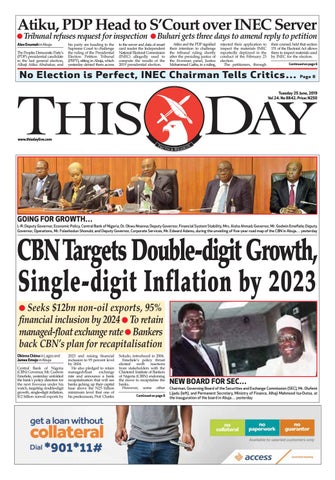
GOING FOR GROWTH… L-R: Deputy Governor, Economic Policy, Central Bank of Nigeria, Dr. Okwu Nnanna; Deputy Governor, Financial System Stability, Mrs. Aisha Ahmad; Governor, Mr. Godwin Emefiele; Deputy Governor, Operations, Mr. Folashodun Shonubi; and Deputy Governor, Corporate Services, Mr. Edward Adamu, during the unveiling of five-year road map of the CBN in Abuja… yesterday
CBN Targets Double-digit Growth, Single-digit Inflation by 2023 Seeks $12bn non-oil exports, 95% financial inclusion by 2024 To retain managed-float exchange rate Bankers back CBN’s plan for recapitalisation Obinna Chima in Lagos and James Emejo in Abuja Central Bank of Nigeria (CBN) Governor, Mr. Godwin Emefiele, yesterday unfolded the bank’s policy direction for the next five-year under his watch, targeting double-digit growth, single-digit inflation, $12 billion non-oil exports by
2023 and raising financial inclusion to 95 percent level by 2024. He also pledged to retain managed-float exchange rate and announce a bank recapitalisation that will see banks jacking up their capital base above the N25 billion minimum level that one of his predecessors, Prof. Charles
Soludo, introduced in 2004. Emefiele’s policy thrust elicited swift reactions from stakeholders with the Chartered Institute of Bankers of Nigeria (CIBN) endorsing the move to recapitalise the banks. However, some other Continued on page 8
NEW BOARD FOR SEC… Chairman, Governing Board of the Securities and Exchange Commission (SEC), Mr. Olufemi Lijadu (left), and Permanent Secretary, Ministry of Finance, Alhaji Mahmood Isa-Dutse, at the inauguration of the board in Abuja… yesterday
2
TUESDAY JUNE 25, 2019 • T H I S D AY
TUESDAY JUNE 25, 2019 • T H I S D AY
3
4
TUESDAY JUNE 25, 2019 • T H I S D AY
TUESDAY JUNE 25, 2019 • T H I S D AY
5
6
TUESDAY, ÍşÍ˝Ëœ ͺ͸͚Π˞ T H I S D AY
PAGE SIX
No Election is Perfect, INEC Chairman Tells Critics Chuks Okocha in Abuja The Chairman of the Independent National Electoral Commission (INEC), Prof. Mahmood Yakubu, yesterday took on critics of the 2019 general election, saying no poll is ever perfect. Yakubu, speaking against the backdrop of the reports of the European Union Election Observation Mission to Nigeria and the joint election observation mission of the National Democratic Institute and International Republican Institute to Nigeria, which highlighted some of the flaws of the elections, described democracy as work-in-progress. The reports had decried low voter turnout and the systemic challenges that hobbled INEC from having a good outing. However, Yakubu called on the 774 Electoral Officers (EOs) of the commission to feel free to criticise the outcome of the last general election and advise
the commission when necessary. He said: "I have consistently said that friends will criticise you, but your enemies will condemn you. But criticism is the basis to make any system work. No democracy, no electoral process is perfect. Every democracy is work-in-progress. "So, feel free to suggest, advise on all issues relating to conduct of elections - the whole gamut. And you have the protection of the chairman that whatever you say will not be held against you." Yakubu, who spoke on the roles of EOs during the review of the 2019 general election in Abuja, described the electoral officials as the engine room of all elections as they are directly responsible for the execution of all policy decisions from the INEC headquarters. As EOs, Yakubu said, they are responsible for all logistics need of any elections at the local government level, including movement of staff, vehicles,
polling materials and election day management of men and materials. According to him, the EOs are also in charge of registration of voters and handling of all sensitive election materials as well as monitoring of political party’s primaries at the ward levels, including the polling duties during elections. The commission commenced the review of the 2019 general election with 774 EOs across the country with the aim of broadly evaluating the conduct and what vital lessons it has learnt. INEC National Commissioner, Monitoring and Strategy, Alhaji Mohammed Lucky, told the EOs from the 19 Northern states in attendance that the review was aimed at evaluating the conduct of the 2019 general election and learn vital lessons. He added that the programme also afforded the commission the opportunity to review its policies and programmes during
the last general election, which would serve as a roadmap to the 2023 general election. He explained: "This process is essentially a sort of SWOT analysis involving identification of our strengths, performance, weaknesses or lapses, opportunities missed or taken, as well as impediments, bottlenecks and/or threats uncovered across all the processes before, during and the fallouts since the conduct of the 2019 general election. "The commission is aiming to be comprehensive in its attempts to review all the issues connected to the general election; from preparation through execution and its aftermath, hence the review timetable and schedule of activities has provided for consultations at multi-levels. "The commission over the past two weeks undertook state level reviews in each and every state of the federation. All the Electoral Officers (EOs) present at this meeting were part of
their respective state’s review exercise.’’ According to him, because of the critical roles that EOs play in the elections, it is deemed fit to have a more focused discussion with them, with a slightly modified template to dig deeper with regards to certain issues. He said: ‘’In addition, we feel there's value to be added by pairing EOs across states for them to share experiences and make more robust recommendations arising from this cross-fertilization of experiences and ideas." He said the meeting was one of a two-stage meeting with the EOs, adding that a total of 387 EOs from 19 states are part of the first stage. He said over the next two days, INEC authorities would meet with the remaining batch of another 387 EOs. Lucky said the template for discussion covered about
seven thematic areas, ranging from RAC preparation and Election Day activities; logistics; voter registration; recruitment, trainings and remuneration of all categories of election officials; publicity and stakeholders’ engagement; election results management; and management of electoral processes at the local government level, for which the EOs are directly responsible. He also said the Planning, Monitoring and Strategy Committee (PMSC) has the mandate of the commission to superintend the review in collaboration with relevant departments, including the states in taking the entire process of the exercise forward. He added that similar series of review meetings for both internal and external stakeholders would take place in Abuja and Lagos. He said that thereafter that the commission would engage civil society groups and political parties as part of the review.
Edo House Settles In, Appoints Principal OfďŹ cers Speaker inaugurates two new members-elect Adibe Emenyonu in Benin City The Speaker of the Edo State House of Assembly, Hon. Frank Okiye, yesterday inaugurated two more members-elect, raising the number of lawmakers in the legislature, which is embroiled in a crisis following the war of attrition between All Progressives Congress (APC) National Chairman, Mr. Adams Oshiomhole, and the Governor, Mr. Godwin Obaseki, to 11. THISDAY learnt yesterday that the two lawmakers inaugurated, Hon. Sunday Ojiezele, representing Esan
South East Constituency, and Hon. Emmanuel Okoduwa, representing Esan North East Constituency II, hitherto belonged to the Oshiomhole faction of the state chapter of the party. The face-off between the governor and his predecessor, Oshiomhole, had delayed the inauguration of the state legislature until last Tuesday when Obaseki issued the proclamation and only nine of the 24 members-elect were present. It was learnt that some APC leaders in the state had camped some 15 members-elect of the
state House of Assembly in Abuja, including the two newly sworn in lawmakers. Ojiezele and Okoduwa took the oath of office after completing due documentation and were formally inaugurated by Okiye. During the sitting, the speaker said the inauguration was done after the members had completed documentation and to also prove to the world that they were not shielding anyone from accessing the House. "After the inauguration of the House, the sitting was adjourned till July 17, but
exigencies have necessitated the recall of members from their various committee assignments, reason being that it has become very necessary to demonstrate to the world that this House is not intended to shut out anybody. "Last Friday, the Clerk of the House brought to my knowledge that two memberselect have completed their documentation. I immediately told them to come forward for inauguration, and issued a notice of this sitting where the members were inaugurated," he later told journalists in Benin. According to him, the move is
to encourage members-elect who are foot-dragging to complete their documentation preparatory to their swearing-in. "They should know that we were serious when we told them to complete their documentation and come forward to be sworn-in. As a matter of fact, this House has a responsibility to the people. We must hit the ground running. We have constituted our Principal Officers’ Council so that some decisions that need to be referred to the principal officers can now be done and the council can take decisions," he added.
At the sitting, he said, the House ratified a letter from the Edo State chapter of the APC on the appointment of principal officers. According to him, upon ratification, the House appointed Hon. Roland Asoro, representing Orhionmwon South Constituency, as House leader. It also appointed Hon. Henry Okhuarobo, representing Ikpoba-Okha Constituency as Chief Whip; Marcus Onobun, representing Esan West, as Deputy House Leader; and Hon. Nosa Okunbor as coopted member of the Principal Officers’ Council.
transmitted to. He added that INEC officials, including one of the spokespersons of the APC, Mr. Festus Keyamo (SAN), had one time or the other attested to the existence of the central server. He stated: "All the electoral commissioners maintained that the stage we are in now is a technological stage where things would not be done manually and anything not done with the PVC, which results would be transmitted electronically to the central server would not be valid. "What the court has said today is like more or less you don't have the right under section 151 of the Electoral Act to maintain your petition." According to him, the petitioners are not asking for details or content in the central server but simply to grant them access. He said: "We are appealing the decision because it is like tying your hands behind your back and expecting you to fight. We are appealing the decision because we want to know what is in the central server that they are hiding." He added that the public is also interested because budget was made for procurement of the central server in billions and it was approved by the National Assembly and it was disbursed. "And INEC said they have done all that. So where is the money, what is there that they are hiding.
"This is not just a case between Atiku and Buhari; it is a case that have generated public interest for electoral transparency, credibility and freedom," Ozekhome said. Earlier, the tribunal had granted the application by Buhari to amend his reply to Atiku and the PDP’s petition against his victory. Counsel to Buhari had while responding to the petitioners’ claim that Buhari lacked the prerequisite qualification to contest for the office of the president of Nigeria, failed to include his name and the National Identification Number (NIM) on the process as required by law, had sought the tribunal’s nod to amend his reply. The application to amend the reply to reflect the name and NIM on the process was, however, opposed by the petitioners because failure to do so when the reply was filed had rendered the reply incompetent. "An incompetent process cannot be amended. There is nothing to amend once time for filing of the reply has expired. Further amendment cannot be done", Uzoukwu had said. However, Olanipekun in urging the tribunal to allow the application for amendment, submitted that the application was harmless as it does not affect the response of the president in anyway nor prejudice against the petitioners. He added that failure to supply address of the second respondent
does not affect the process. In its ruling, the tribunal agreed that allowing the amendment would do no harm to the petition. "The omission of name and address does not make the reply incompetent, the order to amend is hereby granted. The second respondent is granted three days from now to file his amendment," the tribunal held. The matter has been adjourned till June 26 for continuation of pre-hearing.
ATIKU, PDP HEAD TO S’COURT OVER INEC SERVER But in his ruling, Justice Garba held that granting their application for access to the server and data of the smart card would imply that the court had delved into and resolved the contentious issue of the existence of a central server at INEC. He said doing so would further create the impression that the tribunal had concluded that there is a central server where results of the February 23 election were received and stored. The tribunal, on June 13, had reserved ruling in the application filed by Atiku and PDP on May 8, for access to inspect INEC's central server and smart card reader, they claimed were used in the conduct of the presidential election. In arguing the motion, lead counsel to Atiku and PDP, Dr. Levy Uzoukwu (SAN), said the request was to enable them to maintain their petition against the outcome of the February 23 presidential poll won by President Muhammadu Buhari, candidate of the All Progressives Congress (APC). The petitioners, in their petition, had stated that by figures obtained from INEC's server, they, and not Buhari and the APC, which is the third respondent, won the presidential election. According to the figures allegedly obtained from the server, Atiku said he scored 18, 356,732 votes against Buhari’s 16, 741,430 votes. Uche told the tribunal that
the inspection of the server and data was necessary in the interest of justice, transparency and neutrality on the part of the first respondents, INEC. But INEC, Buhari and the APC opposed the granting of the application. In his response, INEC's lawyer, Mr. Yunus Usman (SAN), opposed the application for inspection because the Court of Appeal on March 6 had refused the prayers of the petitioners to inspect INEC server and smart card readers. He said the court having refused the prayers, the tribunal lacked jurisdiction to revisit the same application. Usman, therefore, urged the tribunal to dismiss the application, adding: "We do not have server." The lead counsel to Buhari, Chief Wole Olanipekun (SAN), and that of the APC, Mr. Lateef Fagbemi (SAN), also made a similar argument in opposing Atiku’s application. Olanipekun told the tribunal that it lacks jurisdiction to overrule itself while Fagbemi urged the tribunal to be wary of making an order, which it is not capable of enforcing because INEC has said it has no server. However, delivering ruling on the application, the tribunal in a unanimous decision, refused to grant the application. It said since parties had argued the issues, the tribunal could not at the interlocutory stage make
an order that would affect the substantive issue. "I decline to grant the reliefs sought; this application is refused and accordingly dismissed," Justice Garba held. In a swift reaction, Uche and another senior lawyer in the PDP and Atiku’s legal team, Chief Mike Ozekhome (SAN), served a notice to appeal the ruling. Uche, while stressing that the nation is looking forward to the ruling of the tribunal on the petitioners’ application seeking to inspect the electoral materials, which he noted is pivotal, said granting the application would in no way prejudice the substantive matter. He added that their request was in order and within the provisions of the law, which, ought not to be denied them by the tribunal. He said: "We are not asking the court to decide whether there is a server or not; so the aspect of the court prejudging in the issue doesn't arise at all. All we are saying is that the court should allow us access to inspect the materials, which we are entitled to as INEC is a public institution funded by public funds. "So, we are going to challenge that." Ozekhome said INEC, through its Chairman, Professor Mahmoud Yakubu, had on several occasions before and during the election said there was a central server where results would be electronically
TOP GAINERS CHAMPBREW GSK PRESTIGE LASACO MUTUALBENEFITS TOP LOSERS CCNN NEM ETI
NGN NGN 0.14 1.56 0.90 10.25 0.05 0.59 0.02 0.31 0.01 0.21 NGN 1.35 12.15 0.28 2.80 1.10 10.25 NPFMFB 0.10 1.20 DANGSUGAR 0.95 11.45 HPE Nestle Nig Plc â‚Ś1,399.20 Volume: 573.674 million shares Value: N10.213 billion Deals: 4,076 As at yesterday 24/6/19 See details on Page 31
% 9.8 9.6 9.2 6.9 5.0 % 10 10 9.6 7.6 7.6
TUESDAY JUNE 25, 2019 • T H I S D AY
7
8
TUESDAY, ÍşÍ˝Ëœ ͺ͸͚Π˞ T H I S D AY
NEWS
Five Years after, FG Inaugurates SEC Board Ndubuisi Francis in Abuja Almost five years after the expiration of the tenure of the last board of the Securities and Exchange Commission (SEC), the federal government yesterday reconstituted the board of the regulatory body for the country’s capital market. The commission has been without a board and is presently being run by an acting director general and acting executive commissioners, a situation, market watchers said had partially affected the effective regulation of the market. Following this development, the commission always relies on the Federal Ministry of Finance for direction in the absence of a board. Two weeks after THISDAY exclusively reported that the federal government would constitute the board to be chaired by a lawyer, Mr. Olufemi Lijadu, the federal government
inaugurated him yesterday. Speaking during the inauguration, the Permanent Secretary, Federal Ministry of Finance, Alhaji Mahmoud IsaDutse, who is also overseeing the office of the Minister of Finance, urged listed companies in the capital market to imbibe good corporate governance and accountability in a bid to stimulate growth of the market and increase both domestic and foreign investors participation. The Nigerian capital market, he stated, is growing and evolving, adding that to sustain this growth and eventual transformation to a world-class capital market, transparency and investor confidence were desirable. According to him, like worldclass markets, the Nigerian capital market should be characterised by high levels of liquidity, depth, breath and sophistication with a strong domestic investor base. “It should be innovative, transparent due to robust
investor base. It should be innovative, transparent due to robust disclosure regimes, and efficient both in price discovery and in the allocation of capital. "We must have it in mind that world-class capital markets do far more than provide access to capital. They are enablers of socio-economic development because they hasten the rate of capital formation, foster a meritocracy and promote good corporate governance, innovation and entrepreneurship. “Thus, our capital market should broaden access to economic prosperity by enabling the emergence of financially responsible citizens, accelerating wealth creation and wealth distribution, providing capital to small and medium scale enterprises (SMEs), and catalysing housing finance," he said. The inauguration of the SEC board, he noted, is coming at a time when many players in the market are displaying
weak corporate governance practices that could potentially dampen investor confidence and undermine the steady gains achieved since the 2008 stock market crash. He urged the board members to play their own part as crucial enablers in the industry towards advancing a common vision for the growth and revitalisation of our market. “The administration of President Muhammadu Buhari is committed to transparency and accountability in corporate governance. To this end, I must emphasise that the role of governing boards is to provide effective oversight and strategic advisory to management team. I would therefore like to advise all concerned to study and strictly adhere to laid down laws that have clearly defined the roles and responsibilities of the board members�, he added. In his remarks, Chairman of the SEC Board, Lijadu emphasised
that capital markets are very important in the socio-economic development of any nation as it plays a critical role in attracting investments. He said: “As we all join hands together to build our country, we need investments and the capital market plays a critical role in that respect. We need to see how we can move forward to have a more orderly market, a market that is fair and transparent and can attract investments to build Nigeria. We need a market that is attractive to investors, both local and foreign “We need a capital market where the rules are enforced and where the public who invests are all protected. We need to reinforce the public trust. I therefore enjoin everyone to help us towards building a capital market that this country deserves�. In her own remarks, the acting Director General of the SEC, Ms. Mary Uduk expressed
delight at the inauguration of the board which she said will assist in moving the capital market forward. She welcomed the new members and expressed optimism that they will bring their wealth of experience to bear in the running of the Commission and the market. The SEC board members are Lijadu, (Chairman); Mr. Lamido Yuguda (non-executive Commissioner); Mrs Rekiya Ladi (non-executive Commissioner); Mr. Okokon Ekanem Udo, representative of the Ministry of Finance; Mrs. Angela Adewumi Sere-Ejembi, representative of the Central Bank of Nigeria (CBN), and Ms. Mary Uduk, acting DG. Others are Mr. Henry Rowlands-, acting Executive Commissioner, Corporate Services; Mr. Isyaku Tilde, acting Executive Commissioner Operations, and Mr. Reginald Karawusa, acting Executive Commissioner, Legal and Enforcement.
$75 million. "What we are trying to say is that recapitalisation has weakened quite substantially and there is a need for us to say it is time to recapitalise Nigerian banks again. "It is a policy thrust which will be discussed at the Committee of Governors' meeting and of course, the framework for the recapitalisation of Nigerian banks will be unfolded for the whole world to know." However, reacting to the CBN’s planned recapitalisation programme, CIBN President, Mr. Uche Olowu, described it as a step in the right direction. Olowu, in an interview with THISDAY, said for Emefiele to have said the banks should be ready for another round of recapitalisation, “it means that capital has been eroded and if the banks would have to take on more business and to be well positioned for the kind of opportunity that would come, then they have to be recapitalised.� He added: “This is because without capital, it would be difficult for you to do the kind of business you are expected to do. So, if a regulator has said that, he has all the data. “All the banks need to do is to re-strategise and start working towards the direction of the CBN. Today, if they have to play in certain markets, they definitely need to beef up their capital.� But the Chief Executive Officer, Financial Derivatives Company Limited, Mr. Bismarck Rewane, said the first step ought to be for the regulator to evaluate whether the recapitalisation that was done in 2004 has any impact on the industry and the economy. According to Rewane, consolidation can either be regulatory induced or market-induced. He said: “What is the objective of the new recapitalisation? Is it that the buffers are not enough? Is it that the banks are distressed? What is the need for doing it? “Obviously, there is always the need for buffers, but you cannot make the minimum capital requirement a buffer requirement. “Those who are well capitalised would be able to do things and would be able to differentiate themselves from others who are not well capitalised. I think that without knowing the objective for the consolidation and an evaluation of the current
consolidation to see whether it has achieved the objective for which it started; or is it competitive pressure to say because Ghana and few other countries have done it?� Also, a former bank Chief Executive Officer, Mr. Okechukwu Unegbu, said the pronouncement by the CBN governor could send panic into the system if not properly managed. Unegbu, who is presently the CEO of Maxifund Investments and Securities Plc, said beyond recapitalisation, the issue of human capital in the banking industry should also be given attention. “We must understand that everything is not about money coming into the system. We should be talking about capacity building and the type of personnel behind these institutions. “These days, a lot of bankers don’t have career path. Most bankers don’t have job satisfaction. Today, the level of fraud in the system is on the rise and it is a result of deficiency in capacity building. So, it is not only money that we should be talking about. “If these institutions don’t have the required capacity and you throw money into them, they would probably be out of business before you know it,� he added. But the Head of Research at FSDH Merchant Bank, Mr. Ayodele Akinwunmi, said with the double-digit growth the CBN governor has said he would be targeting in the next five years, recapitalising the banks would be essential. “As the economy grows, lending activities would increase and more viable lending opportunities would be thrown up. As that increases, the capital that bank would require to support the expected increase in lending would increase. “So, it is going to be a winwin for everyone. For me, if we are expecting double-digit growth in the Gross Domestic Product, then the financial system must then be well capitalised to ensure that they support that growth that we are expecting. “Secondly, I think the capital market is deep enough to support any banking recapitalisation. So, until we see the modalities and the amount, for now, I think any bank in Nigeria can raise any money in the capital market to support their business,� Akinwunmi stated.
CBN TARGETS DOUBLE-DIGIT GROWTH, SINGLE-DIGIT INFLATION BY 2023 financial market analysts expressed divergent views about this pronouncement. Emefiele, at press conference in Abuja, gave more details of his five-year policy direction, listing CBN priorities over the period to include preservation of domestic macroeconomic and financial stability; fostering the development of a robust payments system infrastructure that will increase access to finance for all Nigerians thereby raising the financial inclusion rate in the country and working with the Deposit Money Banks (DMBs) to improve access to credit for not only small holder farmers and MSMEs but also consumer credit and mortgage facilities for bank customers. He said henceforth, the CBN intervention support programme would also be extended to the youth population who possess entrepreneurship skills in the creative industry. He said within the intervening period, the CBN would further encourage banks to direct more focus in supporting the education sector. According to him, he will strive to grow the external reserves and support efforts at diversifying the economy through the CBN intervention programmes in the agriculture and manufacturing sectors. He added: "We are confident that when implemented, these measures will help to insulate our economy from potential shocks in the global economy. "In my second term in office, part of my pledge, is to work to the best of my abilities in fulfilling these objectives." He also disclosed that the apex bank would leverage monetary policy tools in supporting a low inflation environment, while seeking to maintain stability in exchange rate- with a key emphasis on supporting improved GDP growth and greater private sector investment. He added that decisions by the Monetary Policy Committee on inflation and interest rates would also be dependent on insights generated from data on key economic variables. Emefiele added that the CBN would seek to broaden financial inclusion by ensuring that at least 95 per cent of all eligible adults have access to financial services by 2024. In addition, the apex bank will strive to sustain a positive
interest rate regime, "to the delight of our important stakeholders." The CBN governor said monetary policy measures would be geared towards containing inflationary pressures and supporting improved productivity in the agricultural and manufacturing sectors. Also, the CBN, working with other stakeholders, will reduce the cost of food items, which has considerable weight on inflation. He said: "Our ultimate objective is to anchor the public’s inflation expectation at single-digit in the medium to long run. “We believe a low and stable inflationary environment is essential to the growth of our economy because it will help support long term planning by individuals and businesses. "It will also help to lower interest rates charged by banks to businesses thereby facilitating improved access to credit and a corresponding growth in output and employment." Emefiele also said the CBN would continue to operate a managed-float exchange rate regime in order to reduce the impact which continuous volatility in the exchange rate could have on the economy. He added that the country remained committed to a free trade regime that is mutually beneficial and particularly aimed at supporting domestic industries and creating jobs on a mass scale for Nigerians while the dynamics of global trade continues to evolve in advanced economies. He said the CBN would support measures to increase and diversify Nigeria’s exports base and help in shoring up reserves. "We intend to aggressively implement our N500 billion facility aimed at supporting the growth of our non-oil exports, which will help to improve non-oil export earnings," he stated. He said though the goals were onerous and tasking, the CBN would remain committed to fulfilling its mandated objectives of price and exchange rate stability. He added: "We will continue to work to safeguard the stability of our financial system, while supporting the development of a payment system infrastructure that will improve access to credit for all eligible Nigerians. "Nevertheless, additional emphasis will be placed on
supporting greater growth of our economy and in reducing unemployment, through targeted interventions in the agricultural and manufacturing sectors." Also, Emefiele said the CBN would launch a Trade Monitoring System (TRMS) in October, which is an automated system to reduce the length of time required to process export documents from one week to a day, adding that the measure will help support efforts at improving non-oil exports of goods and services. He said the CBN would also work with its counterparts on the fiscal side in supporting improved FDI flows to various sectors namely agriculture, manufacturing, insurance and infrastructure. He noted that the measures while supporting improved inflows into the country, would also help to stabilise exchange rate and build external reserves. According to him, emphasis will also be placed on improving speed and efficiency of payment channels, while working to ensure that digital channels are safe and secure as this will help to build confidence in the nation's payment system. Emefiele said to improve utilisation rate, the CBN would continue to ensure that payment channels are interoperable, to enable individuals with digital devices to transact across different banks or payment modes. He assured the public of significant improvement in the payment system during his new tenure. He said the CBN would further work with NIBSS, banks and Fintechs in developing a regulatory sandbox to "enable us to test financial innovations by Fintechs and banks in a controlled environment, in order to assess its impact on the growth and safety of our financial system." The CBN governor said he would boost productivity growth through the provision of improved seedlings, as well as access to finance for rural farmers in the agricultural sector, across 10 different commodities namely rice, maize, cassava, cocoa, tomato, cotton, oil-palm, poultry, fish and livestock/dairy. According to him: "Our choice of these 10 crops is driven by the amount spent on the importation of these
items into the country, and the over 10 million jobs that could be created over the next five years if efforts are made to expand cultivation and processing of these items in Nigeria. "So far, we have held series of engagements with importers and producers of these products. Most of them have committed that they would install or expand their production capacities in Nigeria. We believe these measures will help to boost not only our domestic outputs but also improve our annual non-oil exports receipts from $2 billion in 2018 to $12 billion by 2023." He said CBN intervention programmes would strengthen the linkage between farmers and agro-processors/ manufacturers by ensuring that the output of farmers is purchased by agro-processors/ manufacturers. On the planned recapitalisation of banks, Emefiele said the CBN would embark on the programme to position Nigerian banks among the top 500 in the world. According to him, when the scheme becomes effective, banks will be required to maintain higher level of capital and liquid assets to reduce the impact of an economic crisis on the financial system. Providing insights into reasons for the planned recapitalisation, the CBN boss said the 2004 banking industry recapitalisation, which increased banks' capital base from N2 billion to the current N25 billion, had weakened. He said: "You will all agree with me that it was Governor Soludo in 2004 that did the last recapitalisation we had, moving the capitalisation from N2 billion to N25 billion. "And I must commend those efforts because it resulted in positioning Nigerian banks not only in Africa, but also being among the banks in the world in terms of capitalisation and it also increases or helps to strengthen the banking industry capacity to take on large ticket transactions- and those are some of the things we badly need today. "And if you relate N25 billion in 2004 exchange rate, which was about N100 to N25 billion, it is certainly only about $200 million. Today, if we relate N25 billion at N360, you can see that it is substantially even lower than
TUESDAY JUNE 25, 2019 ˾ T H I S D AY
9
NEWS
Group News Editor Ejiofor Alike Email Ejiofor.Alike@thisdaylive.com, 08066066268
Appeal Court Gives Buhari Five Days to Respond to Alleged Certificate Fraud Suit Fixes July 8 for hearing
Alex Enumah in Abuja The Abuja division of the Court of Appeal yesterday ordered
President Muhammadu Buhari to respond within five days to the appeal filed against his qualification for the 2019
End Banditry in Two Weeks, Zamfara CP Orders Miyetti Allah CAN urges group to expose killers in their midst The Zamfara State Police Commissioner, Usman Nagogo, has a given two-week ultimatum to Miyetti Allah to end banditry in the state or face the wrath of the laws. This is coming as the President of Christian Association of Nigeria (CAN), Rev. Samson Ayokunle, yesterday asked the leadership of the Miyetti Allah Cattle Breeders Association of Nigeria (MACABAN) to protect the image of President Muhammadu Buhari by exposing the killer-herdsmen in the country. Addressing leaders of Miyetti Allah during a reconciliation meeting held at J.B Yakubu secretariat Gusau, the state capital, yesterday, the commissioner said the state has had enough of banditry, and called on the Fulani bandits to embrace peace and surrender their weapons. The commissioner asked the Fulani leaders to call their people to order and stop all forms of banditry and other criminal activities or face the full wrath of the law. He blamed the Fulani leaders for all atrocities being committed by the bandits, as according to him, they have not taken enough measures to call their subjects to order despite the reconciliation accord signed by both the Fulani and the farmers in the state. The commissioner maintained that the volunteer groups have since surrendered more than 9,000 weapons in a bid to embrace peace, lamenting that, the Fulani cattle rearers were yet to do so. Reacting to the commissioner’s speech, the Sarkin Fulani Zamfara, (leader of the Fulani), Alhaji Ahmed Mutawalle said, “Fulani are peace loving people”. The Sarkin Fulani said Fulani herdsmen were subjected to all forms of intimidations and harassment by farmers who have continued to encroach and cultivate grazing lands and cattle routes meant for the herdsmen. According to Sarkin Fulani, the refusal of the farmers to vacate grazing lands was one of the factors that contributed to the current insecurity problems, stressing that, “This was the beginning of farmersFulani clash, which led to reprisal attacks and finally metamorphosed into armed banditry”. He stated however that, armed banditry could only be effectively controlled if the state government waded in and forced farmers to move out of grazing lands and allow herders to move freely with their cattle in the grazing areas. The Sarkin Fulani also used the opportunity to announce the dissolution of leaders of MACABAN and banned the
association’s activities until further notice. Meanwhile, the CAN President, Ayokunle, has asked the leadership of MACABAN to protect the image of President Buhari by exposing the killer- herdsmen in the country. Ayokunle gave the counsel in Abuja yesterday while hosting a MACBAN delegation led by its National Secretary, Baba Othman Ngadzarna and Alhaji Sidia Metankari, who came to congratulate him on his re-election and to seek a date for dialogue with the leadership of CAN on the ongoing security challenges in the country. The Christian leader said CAN was not against the president, noting that all the association demanded was for the government to be responsive to the yearnings of Nigerians. He attributed the challenges facing the country to a lack of good leadership, adding that good governance would change the negative narratives in the country. Ayokunle noted, “The leadership of CAN is not attacking President Muhammadu Buhari on religious grounds. All we are asking the government is to be more responsible and responsive to the yearnings of the people of Nigeria irrespective of their faith, ethnic background, and political leanings. “Good governance will surely change the current disturbing narratives. There is no reason why the criminals amidst us should not be brought to book. Now that you have said it is not all herdsmen that belong to MACBAN, then your association should stop justifying the atrocities being perpetrated by those criminals.” The Christian leader observed that criminal herdsmen were giving Buhari a bad name, adding that as the president’s kinsmen, the only way the Miyetti Allah could support the Presidency was by exposing the killers among them. He added, “The criminal herdsmen are giving the president a bad name and the only way this can be stopped is by exposing those criminals that are carrying guns around, maiming and killing innocent people. “President Buhari is Fulani like you and the best thing you can do for him is by exposing those criminals. This will make Nigerians not to reject another Fulani man who may want to rule.” He cited a few instances where the MACBAN failed to condemn criminal herdsmen who killed their victims, stressing that the wave of anger against the herdsmen by Nigerians resulted from their criminal activities.
presidential election. Also to respond within same five days are the All Progressives Congress (APC), which nominated Buhari for the presidential poll and the Independent National Electoral Commission (INEC), which accepted the Buhari’s nomination as candidate of the APC in the 2019 presidential election. Justice Datti Yayaya who issued the order, also directed that Buhari’s counsel, Abdullahi Abubakar, must within the period file necessary processes in relation to the appeal filed against Buhari’s qualification by three appellants - Agu Kalu, Labaran Ismail and Hassy El-Kuris. The decision of the appellate court was sequel to a motion on notice filed by counsel to the appellants, Uchenna Ndubuisi, who prayed the Court of Appeal in the motion to abridge the time within which Buhari,
APC and INEC will join issues with the appellants on the certificate suit. Abubakar and APC’s counsel, Temitayo Lasaki had urged the appellate court in their response to the motion to give them five days to enable them file their respondents’ brief of argument along with other processes so as to set the stage for hearing of the substantive appeal. Kalu, Ismail and El-Kuris had approached the appellate court to nullify and set aside the judgment of the Abuja division of the Federal High Court, which declined to hear their suit instituted to challenge the educational qualification of President Buhari before the conduct of the 2019 general election. The appellants in their appeal are asking the appellate court to reverse the judgment of Justice Ahmed Mohammed on the grounds that the processes filed by Buhari and used to
strike out their suit were not competent. While faulting the judgment of the lower court, which was predicated on the grounds that the suit was statute-barred, the appellants claimed that the Federal High Court erred in law and in its decision because they did not challenge the primary election that produced Buhari as candidate of the APC. They therefore urged the Court of Appeal to assume jurisdiction over the suit and grant all the reliefs sought at the Federal High Court but which were refused. Among the reliefs are a declaration that Buhari submitted false information regarding his qualification and certificate to INEC for the purpose of contesting election into the office of the President of Nigeria and that he should be disqualified. They also prayed for an order of court directing INEC
to remove Buhari’s name as a candidate of APC and another order restraining Buhari from parading himself as a candidate in the 2019 presidential election and also APC from recognising Buhari as a candidate. The Federal High Court had on May 2 declined to grant the request of the appellants on the grounds that the suit was not filed within the time allowed by law and therefore sustained the preliminary objection raised by Buhari at the hearing. But not satisfied, the appellants are now asking the Court of Appeal to grant their reliefs because they are not challenging the primary election of APC as erroneously held by the lower court but the qualification of Buhari to stand for the presidential election without demonstrating his educational certificates as required by law. Hearing in the appeal is adjourned to July 8.
HONOUR TO THE FOURTH CITIZEN...
R-L: Lagos State Governor, Mr. Babajide Sanwo-Olu; Plateau State Governor, Hon. Simon Lalong; National Leader, All Progressives Congress (APC), Bola Ahmed Tinubu; Speaker, House of Representatives, Hon. Femi Gbajabiamila; and Lagos State Deputy Governor, Dr. Obafemi Hamzat, during a reception in honour of the speaker in Lagos...recently
Rejection of Server Inspection by PDP Triumph of Justice, Says Presidency Ejiofor Alike The Presidency last night commended the ruling of the Presidential Election Petitions Tribunal that turned down the request of the Presidential candidate of the Peoples Democratic Party (PDP), in the February 23, 2019 election for the inspection of the server allegedly used for the election. The Presidency in a statement signed by the Senior Special Assistant to the President on Media and Publicity, Mallam Garba Shehu in Abuja, described the ruling as a mark of triumph of justice over propaganda. According to the statement,
“In a landmark ruling by the Presidential Election Tribunal, a desperate attempt by the Peoples Democratic Party (PDP) to overreach judicial process was overwhelmingly rejected by a unanimous decision and the long standing principle of law has once again been re-enacted. “An attempt to cause the determination of an issue that constitutes the fulcrum of contention between the parties, at an interlocutory stage, has again been rejected by the tribunal. “What this means is that Justice and fair hearing through due contest by the parties of a major issue for determination remains sacrosanct and remains considerable by the tribunal
upon according parties just and fair hearing and not the other way round. “The election petitions tribunal unanimously rejected the PDP’s request to inspect a server which existence is being disputed. “The existence of a purported server is being contested and if a purported inspection had been allowed at this stage, it would have amounted to the determination that it indeed existed even when its existence is being contested. “The electoral law prescribes manual transmission of results only and this was what the Independent National Electoral Commission (INEC)
did, in obedience to the law as witnessed by real electoral observers. “YIAGA Africa deployed 3,906 real individuals to run a parallel tabulation which returned the same results the INEC announced. “Last week, the final reports of the International Republican Institute and National Democratic Institute (IRI/NDI) electoral observer mission made clear that the results of the election reflected the votes cast. “President Muhammadu Buhari won with a majority of four million votes and because only real votes matter, INEC announced him as the winner of the 2019 presidential election.”
10
TUESDAY JUNE 25, 2019 ˾ T H I S D AY
NEWS
Acting CJN Asks Colleagues to Nominate Supreme Court Justices Alex Enumah in Abuja The Acting Chief Justice of Nigeria (CJN), Justice Tanko Muhammad, has called on the justices of the Supreme Court to nominate suitable candidates for appointment as justices into the bench of the apex court. The move, which was sequel to an earlier request by President Muhammadu Buhari, is aimed at meeting the constitutional requirements of 21 justices on the bench of the Supreme Court. Currently, the Supreme Court has 15 justices on the bench, after the voluntary retirement of former CJN, Justice Walter Onnoghen, some weeks back. In a memo dated June 11, 2019 and signed by the Acting CJN, those to be nominated by
the justices of the apex court must have proven competence to occupy the bench of the apex court. The memo a copy of which was sighted by THISDAY, was titled ‘Appointment of Six Justices to the Supreme Court of Nigeria’. It read: “By the provisions of section 230(1) of the Constitution of the Federal Republic of Nigeria, 1999 as amended, the Supreme Court of Nigeria shall consist of the CJN and such number of justices of the Supreme Court, not exceeding twenty-one, as maybe prescribed by an Act of the National Assembly. “As there are 15 justices on the bench at present, it is necessary to take steps to fill the remaining six vacancies to make 21 justices. “I shall be grateful if you could
nominate suitable candidates for consideration for appointment as justices of the Supreme Court of Nigeria”. The Acting CJN however told the justices of the apex court to accompany the names of their nominees with 10 judgments delivered by him or her in contested cases in the last two years preceding the date of nomination in the case of judicial officers and 10 Judgments obtained
in contested cases five years preceding the date of nomination in the case of legal practitioners in private practice and certified by competent authorities. The justices in addition are requested to comment on the suitability of the candidates nominated by them. The justices however have up till June 25, 2019 to send in their nominees President Buhari had in
a statement issued by his spokesman, Garba Shehu, urged the acting CJN to initiate moves for the appointment of five more justices for the apex court. Shehu said the president wrote: ‘‘Pursuant to the provisions of Section 230(2) A&B of the Constitution of the Federal Republic of Nigeria, 1999 (as amended), I am pleased to request that you initiate in earnest the process of appointing additional
five Justices of the Supreme Court of Nigeria to make the full complement of 21 Justices as provided by the aforementioned provisions of the Constitution. ‘‘This is in line with the Government’s Agenda of repositioning the Judiciary in general and Supreme Court in particular for greater efficiency, with a view to reducing the backlogs of appeals pending at the Supreme Court.”
South-east Govs Reject Miyetti Allah’s ProposedVigilance Group, Cattle Ranch Benjamin Nworie in Abakaliki Following the lingering controversies surrounding the alleged proposal by the Miyetti Allah to organise local vigilance groups in the South-east region to curtail menace of crime, the South-east Governors Forum has denied ever being ready to allow such suggestions come to fruition. The Chairman of the South-east Governors Forum and Governor of Ebonyi State, Chief David Umahi, in a statement issued by his Chief Press Secretary, Emmanuel Uzor, described the allegation that the governors would allow MACBAN to form vigilance group as strange. Umahi said: “I find it extremely strange for anybody to think that non-locals in any part of the country, including South east, could be allowed to form any vigilance outfit . The Miyetti Allah group may have made that suggestion which I believe will never mean to form a vigilance group in the region, no governor will allow that. “South-east governors have their local vigilante group working with security agencies. Any such demand by Miyetti Allah group is a joke and not acceptable.
Governors of Southeast are doing their best, and we have no problems receiving insults from our people. It’s the price for leadership. The important thing for us is the safety and well-beings of our people. O’dua Peoples Congress (OPC) and other pressure groups may not have found it fashionable to insult their leaders even when their leaders may not be saints. “My task is to develop Ebonyi State, contribute in rebuilding South-east region and Nigeria. My calling is not to insult others for me to do these things. Have we been fairly treated? No. Can we solve the problem with hate speeches? For me, no. Nobody, no matter the level of pretense, can change my style of peaceful leadership. Ebonyi State in particular has suffered so much even in the context of Southeast. We believe that we do not need hate speeches as a strategy to solve our problems.” The governors stressed that there won’t be any Miyetti Allah vigilante, cattle ranch or colony in the Southeast, but they must live peacefully with herdsmen that do not destroy their farm land especially those who were born in the region and have lived peacefully with them.
Insurgency: Troops Kill Three Terrorists, Rescue 93 Children, Women Kingsley Nwezeh in Abuja The Nigerian Army yesterday said it killed three terrorists and rescued 93 children and women in two separate operations in Borno State. Troops of the 112 Task Force Battalion and 22 Brigade killed three terrorists holding the women and children as farm slaves in Kobe and Boboshe villages in the state. The army said 42 women and 51 children were set free during the operation. Army regimental medical officers in collaboration with the Nigerian Primary Healthcare Development Agency (NPHCDA) meanwhile, administered polio vaccine on
24 of the rescued children. A statement by the army said troops also discovered newly established camps at Dubula village with some bicycles and motorcycle tracks, adding that the camp was destroyed and one of the terrorists was neutralised while trying to escape. Similarly, the army, in conjunction with Civilian Joint Task Force, vigilante and hunters group, conducted an offensive clearance operation to Tafana 1 and Tafana 2 villages. The troops came in contact with some terrorists who fled their camps on sighting the approaching troops in mines resistance anti-patrol vehicles.
TOWN HALL MEETING…
L-R: Senior Special Assistant to the Vice President on Media and Publicity, Mr. Laolu Akande; Consul-General of Nigeria in New York, Mr. Benayaogha Okoyen; Consul in-charge of Immigration and Community Relations, Mrs Nini Okey-Uche; and Vice President Yemi Osinbajo, during a town hall meeting with Nigerians in New York…recently
PDP Constitutes Fact-finding Committee on N’Assembly Leadership Election Blames Buhari over Buratai’s comment on Nigerian Army Chuks Okocha in Abuja The National Working Committee (NWC) of the Peoples Democratic Party (PDP) has set up a fact-finding committee on the role played by some of its members at the election of the presiding officers of the National Assembly. The NWC of the main opposition party also yesterday said that the comments by the Chief of Army Staff, Lt. Gen. Tukur Buratai, on the national security, affirmed the position of the PDP and millions of Nigerians that President Muhammadu Buhari failed in his duties as a Commander-in-Chief.
The party disclosed the constitution of the committee in a statement issued by its National Publicity Secretary, Mr. Kola Ologbondiyan, yesterday in Abuja. The Chairman of the committee, according to Ologbondiyan, is a former President of the Senate, Senator Adolphus Wabara, while a former National Secretary of the party, Prof. Wale Oladipo, is the committee’s Secretary. Other members of the committee include: Senator Ibrahim Mantu, Senator Stella Omu, Austin Opara, Senator Abdul Ningi, and Mrs. Margaret Icheen. The terms of reference of the
committee, according to Ologbondiyan is to find out why some of the PDP lawmakers failed to abide by the decisionofthepartyduringtheNational Assembly leadership election. It is also to find out whether there was any involvement of the ruling party in the decision taken by the members involved. “To find out where there are established reasons for taking the action by members, the committee should identify such so that the party can create mutual and political atmosphere for reasonable interaction with senators and honourable members. “To find out and recommend
ways to checkmate such tendencies in the future and ensure that, moving forward, all members work together to defend the interest of the party at all times and circumstances.” Ologbondiyan said that the committee was given three weeks from the date of its inauguration to report to the party’s NWC. Meanwhile, the NWC of the PDP yesterday said that the comments by Buratai, on national security, affirmed the position of the PDP and millions of Nigerians that President Buhari failed in his duties as a Commander-in-Chief.
Buratai: I was Quoted Out of Context on Troops’ Commitment to Insurgency Michael Olugbode in Maiduguri The Chief of Army Staff, Lt. Gen. Tukur Buratai, yesterday denied indicting commanders and soldiers of lack of commitment to ongoing counter-insurgency and counter-terrorism operations in the North-east. He claimed that he was quoted out of context. Buratai had at a leadership transformational workshop for
middle cadre officers and soldiers in Abuja on June 18 said that some setbacks in operations in recent times stemmed from “insufficient commitment’’ by those at the frontlines. “It is unfortunate, but the truth is that almost every setback the Nigeria army has had in our operations in recent times can be traced to insufficient willingness to perform assigned tasks. But, responding to a question when he visited Governor
Babagana Zulum of Borno State in Maiduguri yesterday, Buratai said: “Let me categorically say that I never said in my remarks that the troops lack commitment. “It was completely wrong and I want to believe that somehow, I was quoted out of context and probably with element of mischief. “If you read that remark which was published on our website, you will see that there is nothing like lack of commitment. “Some have even gone beyond
that and quoted me as saying that the troops are cowards. This is far, far from the truth,’’ he said. The army chief said it was unfortunate that some journalists and indeed, newspaper houses went to the extent of distorting fact. He recalled that the statement was made at a training workshop to re-assess operations and find solutions to the challenges being faced in order to do better.
TUESDAY JUNE 25, 2019 • T H I S D AY
11
12
TUESDAY JUNE 25, 2019 • T H I S D AY
TUESDAY JUNE 25, 2019 • T H I S D AY
13
14
T H I S D AY Ëž Ëœ Í°ÍłËœ Ͱ͎ͯ͡
COMMENT
Editor, Editorial Page PETER ISHAKA Email peter.ishaka@thisdaylive.com
SO FAR, SO GOOD
The not- too- young- to-run act is bearing fruits, writes Tony Ademiluyi
I
n 2018 the National Assembly passed the Not- too- young to- run bill which President Muhammadu Buhari assented to. The general public praised both parties for the realization of this bill as the polity is extremely hostile to youths playing key roles in it. Many youths are marginalized to the point of being mere bag carriers and in some tragic cases, thugs for the ruling elite who don’t want to let go of the sweet elixir of power. The then ruling Peoples Democratic Party (PDP) had its youth leader who was well over 50 years of age. Things were not always like this. How did we get to this sorry state? Once upon a time, youths were entrusted with gargantuan responsibilities that made them stand tall amongst their peers and elders alike. Matthew Mbu was the Minister for Labour and Productivity at the age of 23 in 1954 long before he went to the United Kingdom to study law and end up as a world renowned diplomat. Anthony Eromosele Enahoro became the nation’s youngest editor at the age of 21 when he edited the Daily Comet, one of the newspapers in the stables of the Zik Group of Newspapers in 1944. He did this without a university degree. He moved the motion for our independence from Great Britain at the age of 30 in 1953. His younger brother, Peter Enahoro a.k.a Peter Pan edited the Sunday Times under the Daily Times stable at the age of 23 in 1958 and became the Editor of the Daily Times at 29 in 1964. Like his elder brother, he possessed no university degree. The late Bola Ige became the organizing secretary of the Action Group at the age of 23 in 1953. Dr. Nnamdi Azikiwe started the struggle for our independence at the age of 33 in 1937 when he founded the irascible West African Pilot. Chief Obafemi Awolowo influenced the election of Ernest Ikoli who won the Presidency of the Nigerian Youth Movement at the age of 32 in 1941. Ernest Ikoli himself edited the Daily Times at the age of 33 in 1926 when the paper was founded. Prof. Pat Utomi became the political adviser to the then President Shehu Shagari at the age of 27 in 1983 and acting Managing Director of the now moribund Volkswagen of Nigeria at the age of 35 in 1991. Atedo Peterside started the Investment Bank and Trust Company (IBTC) at age 33 in 1989. I can go on and on of the monumental achievements of these illustrious Nigerians in their youth. The military intervention which destroyed the fabric of the nation and the attendant brain drain and exile of the brightest and the best to foreign lands especially the west left the youths without adequate mentors and led to this current trend of the breeding of overgrown babies who are literarily still in the diapers well into their 50’s in some sad instances. It was with joy that the bill that was barely signed a year ago has started yielding fruits as the likes of Adebo Ogundoyin got elected as the Speaker of the Oyo State House of Assembly at the age of 32; Abok Ayuba emerged as the Speaker of the Plateau State House of Assembly at 33, Yakubu Danladi became the Speaker of the Kwara
THE BILL THAT WAS BARELY SIGNED A YEAR AGO HAS STARTED YIELDING FRUITS AS THE LIKES OF ADEBO OGUNDOYIN GOT ELECTED AS THE SPEAKER OF THE OYO STATE HOUSE OF ASSEMBLY AT THE AGE OF 32
State House of Assembly at the age of 34. Indeed this new trend at the States Houses of Assemblies is cheering news as the youths will be in charge of their elders in the various assemblies. These youths are officially the number three men in their states and can even initiate impeachment proceedings against their governors. The bill was a good omen to the beleaguered polity which was earnestly yearning for progressive reforms. This change has to find its way to the federal level where the oldies still holds firmly sway. The various political parties should de-monetize the process that leads to the emergence of their leaders so that the youths who are economically disenfranchised will be able to muzzle their way through. We need to encourage politics of ideas and vision rather than the stomach infrastructure politics made popular by the likes of former Ekiti State Governor, Ayo Fayose and the late Alhaji Lamidi Adedibu amongst many others who valued the belly more than the medulla oblongata. For starters, the amount spent to purchase the nomination forms should be reduced so as not to discourage brilliant but indigent young aspirants. The practice of consensus candidacy should also be abrogated as it makes a mockery of the wonderful idea of the party primaries which is meant to bring out the best in the candidates for the larger benefit of the electorate who have been receiving the short end of the stick since the return to democracy two decades ago. The electorate clearly deserves better and the soothing balm they need is for more younger and cerebral people to be attracted to politics. The polity should be made less attractive. It’s an avenue for selfless service and should be run on a part-time basis especially the legislature. The do- or- die nature should give way for passion if the large perks are done away with. The assassinations, electoral manipulations, financial impropriety will not abate if the stakes are too high. Politics should stop being the last resort to wealth making when all options fail. In the west, politicians are among the poorest professionals. Bill Clinton left office in 2001 after over two decades in politics in debt. His millions came from his speaking engagements and his book writing. Tony Blair became a Member of Parliament at 30 in 1983 and was in partisan politics for 24 years which didn’t make him a millionaire. His millions came after he stepped down from Number 10 Downing Street in 2007 from speaking deals and consultancy assignments. The practice of our legislators being the highest paid in the world for doing next to nothing especially those who are either absentees or perpetual bench warmers should cease forthwith. The ascension of Ogundoyin and co is a sign of greater things to come. We hope this can be speedily replicated at the federal level so that the dividends of democracy can be better felt by the hapless hoi polloi who have been emotionally and physically battered since 1999. Ademiluyi wrote from Lagos
HIGH EXPECTATIONS FOR PENSIONERS Ofem Uket writes that the ongoing reforms in the civil service will take care of pensioners
P
otential retirees in the civil service are not expected to exit the service henceforth without receiving their entitlements - gratuities and pensions - to enable them go home wellequipped to start a new life. In the past, retirees wait for years before their benefits are processed and paid. This is part of the ongoing civil service reforms under President Muhammadu Buhari, demonstrating high level commitment and preparedness to ensure that retirees from the civil service do not face the danger of waiting endlessly to be paid their pensions. Relevant retirement training programmes are organized for potential retirees to get them equipped in any area of endeavour, ranging from animal production, fish farming, crop production, water and irrigation farming, amongst others. Such trainings are organized by the Office of the Head of Civil Service as contained in the eight core modules of the implementation strategy plan of the reform agenda of the present administration aimed at addressing all forms of impediments drawn against viable and a more productive public sector. Palpable fear often grips a section of civil servants approaching retirement because of the delay associated with payment of statutory entitlements, such as gratuity and pensions, with some retirees actually dying before payments are made. However, such occurrences are now considered to be in the past, given the fact that preparation for potential retirees are made ahead in the areas of training, capacity building, skill acquisition, evaluation of entitlements and subsequent payment before retirement date. Again, towards national development in public
sector reforms, an 80-seater computer-based test (CBT) centre in the Public Service Institute was commissioned by the Head of Civil Service, Winifred Oyo-Ita, last week in Abuja. The centre is a donation to the Public Service Institute (PSIN) by the African Capacity Building Foundation (ACBF) under the Bill and Melinda Gates Foundation Africa Capacity Building grant. These efforts are to reposition the public service; to build capacity of its work force in order to imbibe the culture of being efficient, productive, incorruptible and citizen-centered in the Nigerian workforce. The new centre will strengthen the capacity of the institute, which will in turn go a long way to help in actualizing the strategic plan of the Office of the Head of Civil Service of the Federation. Nigeria had therefore called for continuous support from the ACBF to build PSIN capacity to become the foremost capacity building institute in Africa, describing the partnership between ACBF and PSIN as “partnership that works�. This development will indeed boost the mandate of the institute to provide competencybased and demand-driven capacity building to public servants. The new 80-seater CBT Centre will among other things shorten the time frame used in conducting computer- based tests and also ensure transparency and enhanced integrity of examination processes as well as promote E-Governance through Information and Communications Technology (ICT). Therefore there has to be concerted efforts by civil servants to utilize the centre to acquire computer literacy, transparency in their recruitment and promotion exercises. To further strengthen federal government resolve to prepare the way of retirees ahead of time, the National Pension Commission (Pencom)
said the commission has finalized arrangement to commence the verification of prospective retirees expected to retire from the public service of the federation next year. Already, 15 centres which cut across the six geo-political zones of the country had been earmarked for the verification exercise and would hold between July 1 and August 2. The centers are Abuja, Lagos, Kano, Port Harcourt, Ilorin, Gombe, Owerri, Sokoto, Enugu, Lokoja, Ibadan, Lafia and Benin. Speaking at the pre-retirement workshop for the federal government retirees due to retire in 2020 in Ilorin, Kwara State on Monday, DahirUmar, acting Director General PENCOM said, “the workshop was necessary to create awareness and enlighten the potential retirees on what they need to know on documentation requirement, payments of retirement benefits and best way to enjoy life retirement.� The fundamental objectives of the pension reform act (PRA 2014) is to ensure that every person who worked in either the public service of the federation, Federal Capital Territory, states and local governments or the private sector receive his or her retirement benefits as and when due and to establish uniform set of rules, regulations and standards for all aspects of pension administration including payment of retirement benefits to retirees amongst others�. Therefore, the forthcoming verification exercise necessitates the need to undertake adequate sensitization and public enlightenment in order to prepare prospective retirees on the steps to take towards a hitch free retirement life.� President Buhari has therefore reiterated the federal government’s commitment to make life worth living after retirement with payment of retirees’ benefits, while it’s clear that retirees
have to make useful suggestions during the pre-retirement workshop about the issues that may further help to make their retirement life more comfortable. On the ongoing IPPIS verification, from records made available by the Office of the Accountant General of the Federation, about N220bn is said to have been savings accruing from the implementation of the IPPIS, and an exercise that is one of the major components of the ongoing reforms. A statement from the Office of the Accountant General of the Federation said that the amount is expected to increase when other agencies of government are enrolled into the platform which will significantly promote the automation of the public service as constituted. The IPPIS is one of the federal government’s reform initiatives conceived to transform the Nigerian public service and aimed at improving the management of human resources and providing a centralized payroll system in the service. The project implementation commenced at the Bureau of Public Service Reforms before its management was transferred to the Office of the Accountant-General of the Federation in October 2008. The project went live in April 2007 with seven pilot ministries, departments and agencies and its objective include centralized payment of salaries; aid manpower planning and budgeting as well as facilitate convenient staff remuneration payment with minimal wastage. Over 447 MDAs are already on the IPPIS platform while others are expected to be enrolled to facilitate a uniform and harmonized payment option that is capable of voiding corrupt intentions of some unscrupulous elements in the civil service bent on damaging the integrity of public sector reforms.
15
T H I S D AY TUESDAY, JUNE 25, 2019
EDITORIAL When Council Officials Go Awol Council officials should live among their people
I
f the essence of creating councils was to bring government closer to the people, engender speedy rural development and ensure that services and development activities respond to local needs, there is no reason why council officials would abandon their duty posts to stay in their state capitals. Unfortunately, the reality today is that these lofty objectives are far from being realised. At a recent town hall meeting with the chairmen and other local government areas officials in Enugu State, Governor Ifeanyi Ugwuanyi directed them to relocate back to their various domains. The local government system has increasingly retrogressed in terms of sense of responsibility, performance, and closeness to the people. In fact, some argue, perhaps rightly so, that the local governments performed better under the military and the first few years into the current democratic dispensation. Likewise, the local government elections conducted under the military, including the 1998 nationwide council elections that heralded the current democratic era, THERE CANNOT BE ANY have also been rated MEANINGFUL NATIONAL higher than most local DEVELOPMENT UNTIL government elections THERE IS A DEMOCRATIC, in the states today. The 1999 ConstituRESPONSIBLE, tion in its Fourth ACCOUNTABLE Schedule outlined the LEADERSHIP IN THE RURAL AREAS WHERE THE functions, duties and MAJORITY OF NIGERIANS responsibilities of the local councils. UnRESIDE fortunately, the same constitution is silent regarding any protective mechanism that guarantees financial and political autonomy to the councils. And to the extent that most of these crucial decisions are left at the whims of the state governors, it stands to reason that they are in control, perhaps because they are also held to account by their people for responsibilities that ordinarily should be that of local governments. As things stand today, the best way to resolve this stalemate is through a constitutional review that will redefine the role and structure of the local government.
More worrying is the prevalent practice in which council chairmen, councillors, and other key players reside in the cities, abandoning the rural areas they are supposed to administer. In many instances, they only show their faces at their local government secretariats once in a month to share the allocations. The result of this national malaise is that the rural people have no one to interface with over their problems or government policies. Undue pressure is brought to bear on the state and federal players over issues that are best tackled by the local governments and their functionaries. Also, since these critical players earn fat salaries and allowances but spend their earnings in the townships, they weaken the local economies further.
T T H I S DAY EDITOR BOLAJI ADEBIYI DEPUTY EDITOR YEMI AJAYI, DAVIDSON IRIEKPEN, MANAGING DIRECTOR ENIOLA BELLO DEPUTY MANAGING DIRECTOR KAYODE KOMOLAFE CHAIRMAN EDITORIAL BOARD OLUSEGUN ADENIYI EDITOR NATION’S CAPITAL IYOBOSA UWUGIAREN MANAGING EDITOR JOSEPH USHIGIALE
T H I S DAY N E W S PA P E R S L I M I T E D EDITOR-IN-CHIEF/CHAIRMAN NDUKA OBAIGBENA GROUP EXECUTIVE DIRECTORS ENIOLA BELLO, KAYODE KOMOLAFE, ISRAEL IWEGBU, IJEOMA NWOGWUGWU, EMMANUEL EFENI DIVISIONAL DIRECTORS BOLAJI ADEBIYI, PETER IWEGBU, ANTHONY OGEDENGBE DEPUTY DIVISIONAL DIRECTOR OJOGUN VICTOR DANBOYI SNR. ASSOCIATE DIRECTOR ERIC OJEH ASSOCIATE DIRECTORS PATRICK EIMIUHI, SAHEED ADEYEMO CONTROLLERS ABIMBOLA TAIWO, UCHENNA DIBIAGWU, NDUKA MOSERI DIRECTOR, PRINTING PRODUCTION CHUKS ONWUDINJO TO SEND EMAIL: first name.surname@thisdaylive.com
herefore, we commend the move by the Enugu State Government and recommend it to the rest 35 states and the Federal Capital Territory (FCT). Anybody who feels too big to reside among the people in rural communities should have no business whatsoever in local government administration. But there is also an urgent need for a comprehensive reform of the local government system to actualise the objectives for which they exist. Such reform should overhaul the leadership recruitment process. Residence in the respective localities should be a precondition for election and appointment into the 774 local government councils in the country. The ninth National Assembly should, as a matter of priority, resuscitate the work of the Senator Ike Ekweremadu-led constitution amendment panel on the local government autonomy, which was stalled in the various Houses of Assembly. That way, the challenge of credible electoral process, financial independence, and other ancillary issues pertaining to effective local government system can be meaningfully addressed. For the umpteenth time, we must stress that there cannot be any meaningful national development until there is a democratic, responsible, accountable leadership and good governance in the rural areas where the overwhelming majority of Nigerians reside. Therefore, every effort must be made to rescue the local government from the path of total collapse.
TO OUR READERS Letters in response to specific publications in THISDAY should be brief (150-200 words) and straight to the point. Interested readers may send such letters along with their contact details to opinion@thisdaylive.com. We also welcome comments and opinions on topical local, national and international issues provided they are well-written and should also not be longer than (9501000 words). They should be sent to opinion@thisdaylive.com along with the email address and phone numbers of the writer.
Letters to the Editor
THEYOUTHS AND LURE OF SUICIDE
N
igeria is in the firm grip of the epidemic of suicide. From the sun-baked land of Yola to the marshy creeks of the Niger Delta, from the urbane coal city of Enugu to the boisterous Lagos, we hear morbid tales about those who killed themselves. Our young people’s embracing of suicide as a way of escapism has got to an alarming and disturbing dimension. Till now, in Igbo land, Southeast of Nigeria, it is a sacrilegious act for a man to kill himself. Here, in Igbo land, we do not perform funeral ceremonies for suicides. They are ignominiously wrapped in cloths and thrown into dense forests, where wild beasts will feast on them. After that, a traditional medicine man will be invited to cleanse his family house to prevent recurrence of such evil and despicable act in future. Chinua Achebe’s fictive and anthropological novel, Things Fall Apart, offers us insight and elucidation on suicide. It is not only the Igbo custom that frowns at suicide. The Christian religion is condemnatory of it, too. The Bible exhorts us to seek God’s intercession when we are experiencing existential problems. Our Christian clerics do urge us to exercise faith in the teachings of Jesus Christ and pin our hope on Christ, who is the ransom for our sins. It is an indisputable fact that no religions, which are practised by the people(s) of the earth, approve of people to take their own lives. The act of committing suicide by people is perceived as an act of cowardice by adherents of many religions. But since the epidemic of suicide broke out in Nigeria, this question has been agitating our minds: Why do seemingly imperturbable
people commit suicide? People take their lives for variety of reasons like depression, impecuniousness, betrayals in relationships, failures in academics and business, psychiatric problems, drug addiction, and others. In today’s Nigeria, our economy is so grossly mismanaged that millions of Nigerians are living below the breadline owing to their joblessness. Yet, our universities, polythenics, and other schools still churn our graduates who join the growing number of the unemployed people in the country. So owing to these people’s hopelessness, impecuniousness, and the non-existence of love among us, innumerable unemployed people and others, who had suffered privations, took their lives in the recent past. A civil servant in Kogi State, who was owed arrears of salary by the state government, killed himself after his wife was delivered of a baby some years ago. But it’s not only the dire economic situation obtaining in our country that predisposes or compels people to do hara-kiri. Here, cuckolds do kill themselves, too. In Nigeria, many people chose the path of suicide upon their discovery that their wives had cuckolded them and bore children, who are not biologically their own children. As they could not live with the shame and the betrayal they suffered, they decided to do themselves in. Some ladies did themselves harm when their boyfriends threw them over for other beautiful ladies. Some days ago, an undergraduate of University of Benin, Christabel Buoro, killed herself because her boyfriend jilted her. More, so some Nigerians had taken their own lives owing to their failures to realize their goals in the areas of academic and business.
They thought themselves under- achievers and the rejects of society; consequently, they committed suicide. And it’s a known fact that bereavements can cause people to experience bouts of depression, which make them susceptible to romanticizing the idea of committing suicide. And people who have psychiatry or mental cases emanating from their intake of hard drugs or hereditary factors are liable to committing suicide if they’re not properly monitored and treated. In addition to these, young people who are exposed to mystical books can start contemplating death and life hereafter after digesting the teachings in those books. My Facebook friend, one Goddy, put up a Facebook post announcing and indicating his intention to leave our terra firma as soon as possible. When I visited his Facebook wall for perusal, I discovered that he has been reading books, which have imbued and given him vast knowledge about death and the life hereafter. In order to stem the tide of suicide in Nigeria, governments at different levels should implement economic measures to ameliorate our people’s sufferings. And, our leaders should diversify the economy to create job opportunities for unemployed people in the country. More so, religious clerics should not cease to encourage their followers to continue reposing faith in God rather than committing suicide. And there is urgent need in Nigeria for our schools to train many more psychiatrists, who can treat millions of Nigerians who are suffering from mental illnesses, which can predispose them to commit suicide. Chiedu Uche Okoye, Uruowulu-Obosi, Anambra State
16
TUESDAY JUNE 25, 2019 • T H I S D AY
TUESDAY JUNE 25, 2019 • T H I S D AY
17
T H I S D AY ˾ TUESDAY JUNE 25, 2019
18
POLITICS
Group Politics Editor NSEOBONG OKON-EKONG Email nseobong.okonekong@thisdaylive.com (08114495324 SMS ONLY)
TRENDING NEWS
Salute to a Resourceful Speaker Olanrewaju Smart
F
ifty-seven years ago, precisely on June 25, 1962, a star, a man of high intellect, a repository of legislative knowledge in the person of Rt. Hon. Femi Hakeem Gbajabiamila, Speaker of the House of Representatives was born. Gbaja, as he is called by friends, associates and wellwishers, is a man that has a date with destiny. Today is exactly two weeks that this Great Mind became the Speaker of the 9th House of Representatives, in what has become the greatest, remarkable and most befitting cum historic way of marking one’s birthday on mother earth. When Gbajabiamila first came to the Green Chamber 16 years ago, in 2003, little did he know he would spend more than a quarter of his life in the legislature. Out of those 16 solid years, Gbajabiamila spent 14years as a principal officer, first as a Minority Whip from 2005 to 2007, Minority Leader (Opposition Leader) from 2007 to 2015 and later as Leader of the House/ Majority Leader between 2015 and 2019. It was then natural that Gbaja should become Speaker after acquiring more than enough experience in the House as one of its leaders for 16 years. In the history of the Nigerian Legislature, Gbajabiamila is the first person to have risen from the position of Minority Leader to Majority Leader and then to Speaker all in a space of 16 years. This is by no means a great feat. His legislative prowess certainly confers on him the title of ‘Legislative Czar ’ in the Nigerian parliament. As Minority Leader of the House for eight years, Gbajabiamila provided the needed voice for the opposition, and each time he spoke, it was as if an ordinary Nigerian was on the floor of the House speaking, because he spoke the mind of the masses. After Gbajabiamila became the Leader of the House in 2015, he did not relent in defending and presenting the yearnings and aspirations of Nigerians, despite being saddled with the responsibility of defending the position of the government of the day. No wonder Gbajabiamila singlehandedly came up with a bill to criminalise estimated billing by electricity distribution companies (Discos), which has arguably become one of the most popular draft laws in the 8th Assembly. History will indeed be kind to this lover of the Nigerian masses. Make no mistake about it, Gbajabiamila had qualified to become Speaker over four years ago. After his historic contest to occupy the Number 4 Citizen’s seat in 2015, which should have been ceded to him naturally without any contest, Gbaja went on with his life as if nothing happened. He left everything to God and believed that the Creator did not approve that he be Speaker at that time. Call him a workaholic, and you won’t be wrong because Gbajabiamila isn’t a lazy fellow. Despite being a principal officer for 14
Gbajabiamila
years, he remains one of the most resourceful lawmakers that has journeyed the House. Matter of factly, Gbajabiamila served, and still serves, as an unpaid consultant to many of his colleagues. Before he presents any matter on the floor of the House, he makes sure that he researches it thoroughly, which explains why he never fails as a lawmaker. To say that Gbaja became a household name all over Nigeria long before his present status in the House is to state the obvious. Despite all that he has achieved as a fine legislator, he never let it get into his head, which is what his good upbringing is all about. But if his campaign for speaker gathered strong momentum four years ago, the one he embarked on after the Presidential and National Assembly elections held on February 23 this year was a masterstroke. It had everybody on board: lawmakers from both the ruling and the opposition parties did not only buy the idea, they also took it upon themselves to sell the idea to all members of the 9th House. No wonder Gbajabiamila polled 281 votes, which is unprecedented in the history of speakership contest in the House. The slogan for his campaign for speaker ‘Nation Building: A Joint Task’ captured all that Gbajabiamila stood, and still stands for, which is that every Nigerian, irrespective of party affiliations, must be on board for the country to move forward. Unassuming, chivalrous, accommodating, sincere, humble, courteous, adaptable, adventurous, affectionate, amiable,
intuitive, dependable, easy-going, compassionate, courageous, considerate, diligent, frank, charming, generous, gregarious, impartial, inventive, reliable, resourceful, sympathetic, name it, Gbajabiamila fits the bill for a perfect gentleman. Unfortunately, he is often misunderstood by some, which is normal with human beings. But those that relate with him closely know that he represents all the adjectives above. And I am pretty sure that those that misunderstood him would now have the opportunity of knowing him better as he pilots the affairs of the House in the next four years. Immediately after becoming speaker two weeks ago, Gbajabiamila made it clear that his would be a House of reforms. Though he promised to ‘shake the table’ in bringing reforms to the House, he said it would be in phases in order not to bring too much shock into the system. If not a man of intellect, who would make such move? During his inaugural speech on that auspicious occasion of his emergence as Speaker on June 11, Gbajabiamila did not mince words. He said: “Hon colleagues, I understand that I hold this office in trust for you and Nigerians. Conscious of this sacred trust, I hereby dedicate myself to the service of this Honourable House and of the good citizens of this great country, with the commitment that I shall at all times strive to defend the constitution of our Republic. “I equally commit myself to always observe the tenets of
justice, equity and fairness in my dealings with my colleagues, and to apply the ideals of transparency, probity and accountability in my management of the affairs of this Honourable House. “Whatever political party each one of us may belong, we must be conscious of the fact that Nigerians are truly desirous of good governance and are looking to us to be the agents that will through meaningful legislation combat security, poverty, corruption and other problems and contradictions that have held our country back and stunted our development.” To show that he knows the nature of the Herculean task ahead of him, Gbajabiamila has since set in place the machinery of how to go about his reforms. I believe very soon, Nigerians will have the privilege of seeing that unveiled to them. At the age of 57, Gbajabiamila has achieved a lot both as a lawyer, who practised both within and outside the shores of Nigeria, and a legislator per excellence. But, the man never blows his trumpet! Because he represents excellence, Gbajabiamila doesn’t accept anything short of that. As Mr Speaker marks his 57th birthday today, I have no doubt in my mind whatsoever that he has acquired more wisdom to lead the 9th House of Representatives and bring the right reforms in the next four years as he promised. -Smart is of the Office of the Speaker, House of Representatives, Abuja.
19
T H I S D AY ˾TUESDAY JUNE 25, 2019
TRENDING NEWS
How Anambra House Speaker Surprisingly Went North David-Chyddy Eleke writes on the intrigues that upset the applecart in the contest for Speaker of the Anambra State House of Assembly
Obiano
B
efore Wednesday, June 12, when the Seventh Anambra State House of Assembly was inaugurated, many believed that a deal had been sealed for the speaker of the assembly to emerge from the southern senatorial zone of the state. This assumption followed the fact that the state governor, Chief Willie Obiano hailed from Anambra North zone, while his deputy, Dr Nkem Okeke is from the Central zone, and for a state that prides itself as one which respects equity, the speaker was expected to emerge from the southern zone of the state, but that did not happen. Initially, a two-term law maker in the state, Hon. Paschal Agbodike who represents Ihiala State constituency, in the Southern senatorial zone of the state had been touted for the speakership position, at least to balance power among the three zones, but on Wednesday, it was a surprise when the Cerk of the House, Mr. Pius Udoh called for nomination for the position of the speaker and Hon. Edward Igbuzor, the member representing Onitsha North State constituency nominated Hon. Uchenna Okafor, as a lone nominee. His nomination was seconded by Lawrence Ezeudu. Okafor a two-term lawmaker represents Ayamelum State constituency, which falls within Anambra North Senatorial zone. The area is regarded as neighbors to Anambra East Local Government Area, where Governor Willie Obiano hails from, in the same northern zone. No sooner was Okafor nominated than murmurs, especially from the gallery where most visitors sat to monitor the proceedings started making the rounds. An indigene of the state, who gave his name as Hon Samuel Okonkwo from the Southern Senatorial Zone was the
Obi
most audible among the voices that protested the nomination of Okafor. “What are they doing? Does Willie Obiano want to destroy a foundation that had been existing long before he came to power?” He queried. All attempts to persuade him to maintain decorum as the affairs of the house proceeded failed as he continued, insisting that such an arrangement would not stand as Anambra South was the pillar of the state and could not be denied the chance of producing the Number Three citizen in the state. The immediate past Speaker of the Assembly, Rt Hon Rita Maduagwu was from the southern zone, and it was believed that even against protest, the position was handed to her because she hailed from the southern zone, since Anambra already had a governor and deputy from the North and Central zones respectively. Meanwhile, THISDAY gathered that the decision to zone the speakership position to the North was based on an initial agreement that the South would succeed Obiano who would be leaving office in 2022. A source told our correspondent that after a cursory look at the game, the leaders of the Southern Senatorial Zones, especially those from the ruling All Progressives Grand Alliance, APGA, decided that it was better to wait for two years and some months to get the governorship position, instead of insisting on producing the speaker. From the calculations of the leaders from Anambra south, if the Anambra Assembly had produced a speaker from the southern zone, the tenure of the speaker would still be running as at 2021, when the zone would hope to produce a governor, and that would automatically leave two plum positions in the zone; the governor and the speaker. It was
also argued that since the Peoples Democratic Party, PDP, led by former governor, Mr Peter Obi had already played its hand by trying to shoot down the zoning arrangement in the state with the argument that all zones of the state have tasted the governorship position, and as such, the next governorship election should be thrown open, and that if such argument holds water, the southern zone may lose the governorship position. Therefore, to show its seriousness in taking the governorship position, leaders of the southern zone had to concede the speakership position to another zone. To corroborate this, the APGA National Chairman, has said that the zoning of the speakership position to the north, despite the fact that it was the zone of the sitting governor was deliberate. A statement by the National Chairman of the party, Dr Victor Oye stated that the move was to secure the position of the governor for the southern zone in 2022, as choosing a speaker from the south would mean concentrating the governorship and speakership position in the zone. Oye said, “It has become expedient to issue this statement to correct the malicious and tendentious misrepresentation of facts with regards to the choice of the Speaker of the 7th Session of the Anambra State House of Assembly. The decision to zone the Speakership position to the Northern part of the state arose from the simple fact that our party had earlier zoned the governorship position in 2022 to the South. Again, the decision was reached after due and wide consultations with critical stakeholders and to maintain equity and justice. We urge our members across the various divide in the state to abide by the choices made by the party to oversee its affairs in the
7th Assembly.” Oye added that that the choice made by the party was made to position it to face the challenges ahead and discharge itself creditably in line with democratic tenets, expectations of the people and the development of the state. All zones of the state have produced governors of the state, with Obiano being the first governor of the state since creation in 1991 to hail from the northern senatorial zone. Former governor of the state, Mr Peter Obi had against all odds, insisted that Anambra North produce a governor after him, to ensure equity in the state. Obiano, on his part, has also favoured the zoning of the governorship position to the southern zone after him, but his predecessor in a recent utterance by his media aide, Mr Valentine Obienyem insisted that Obi only championed the emergence of a governor from the northern zone because they never produced one since the creation of the state, and that now that all zones have had a shot at the position, zoning can again begin from the central zone or be thrown open to all. All sides seem justified in their argument, but as time ticks, it would be interesting to see which argument would hold water. While Anambra South has had its turn in Dr Chinwoke Mbadinuju, Dame Virgy Etiaba and Senator Andy Uba who spent three months, and 17 days respectively also hail from the zone. For Anambra Central, Dr Chris Ngige and Mr Peter Obi have mounted the top seat, while for Anambra North, only Obiano has tasted the position. Anambra is among the few states which holds staggered elections, and with Obiano already approaching the second year of his second term, the polity of the state would become heated soon, and the zoning argument would then become more pronounced.
20
T H I S D AY Ëž Ëœ Í°ÍłËœ Ͱ͎ͯ͡
FEATURES
Group Features Editor: Chiemelie Ezeobi Email chiemelie.ezeobi@thisdaylive.com, Tel: 08152252325
Transforming Lives through CSR Interventions Sunday Ehigiator reports that GetAlert in Millions, one of the CSR projects of Fidelity Bank, has added value to many lives by meeting the needs of some indigent Nigerians
L-R: Regional Bank Head, Rivers/Bayelsa 2, Fidelity Bank Plc, Evi Kanu; Grand Prize winner of N10 million in the Fidelity Get Alert in Millions Savings Promo, John Poubo; Executive Director, South, Fidelity Bank Plc, Aku Odinkemelu and wife of the star prize winner, Mary John Poubo at the grand prize presentation ceremony of Get Alert in Millions Savings Promo (GAIM Season 3) in Port Harcourt, recently
C
orporate social responsibility (CSR) is a broad term used to describe a company's efforts to improve society in one way or the other. No matter the measures used to carry out the CSR efforts, which can range from donating money to nonprofits to implementing environmentally-friendly policies in the workplace, CSR is undeniably important for companies, nonprofits, and employees alike. Accordingly, CSR strategies encourage the company to make a positive impact on the environment and stakeholders including consumers, employees, investors, communities, and others. In other words, CSR is titled to aid an organisation’s mission as well as serve as a guide to what the company represents for its consumers. It also aims to ensure that companies conduct their business in a way that is ethical. This means taking account of their social, economic and environmental impact, and consideration of human rights. It can involve a range of activities such as: Working in partnership with local communities, socially responsible investment (SRI), developing relationships with employees and customers, as well as environmental protection and sustainability. For Fidelity Bank, their CSR projects are being channeled through the Get Alert In Millions (GAIM). Already in season three, the GAIM strives to further drive a national savings culture in Nigeria. At the launch of the season three promo last year, the MD/
CEO, Mr. Nnamdi Okonkwo, said customer service delivery was key to the financial institution. He also disclosed that Fidelity Bank was undertaking a transformation plan, through its digital strategy that will move it to a digital-led era. Essentially, an estimated N110m has been earmarked for the promo and the draws will be held across the six geo-political zones. Okonkwo said the season three promo of the ‘Get Alert in Millions Promo’ was the eighth promo in 11 years, and is designed to create value and opportunities
Oghenewajutome Dennis Ezo, an unemployed graduate from Delta State was a lucky winner of N3 million in the fourth monthly /second bimonthly draw of the GAIM Season three promo. Today, Ezo is not at the mercy of Nigeria’s dysfunctional labour market as he has ploughed his cash winnings into a lucrative business venture and furthering his education
for customers. Speaking on the objective of the promo at the launch, the Executive Director, Shared Services for Fidelity Bank, Chijioke Ugochukwu said it was designed to deepen financial inclusion in the country. She also asserted that the promo was focused on reaching out to the unbanked population across the nation. Criteria According to the bank, the criteria and rewards for the promo include; customers are to grow their bank account to N20,000 while existing customers are to top up account with N10,000 or more to qualify for monthly draws to win N2m, 1m and consolation prizes; topping up a Fidelity bank account with N50,000 or more qualifies one for Bi-monthly draws to win N3m; a N200,000 balance or more qualifiers one for the grand draw to win N10million. Destiny Helpers It is often said that when God wants to help you, he uses a fellow human being to do so. These helpers are commonly referred to as ‘Destiny Helpers’. They are of various kinds, sent along our paths in times of great need and various examples abound. So, how do you describe bankers that strive to find solutions to the myriads of problems afflicting society especially those in their immediate environments? Well, Kingsley Ibenegbu, a technologist at the University of Nigeria, Nsukka (UNN), described Fidelity Bank as a ‘Destiny Helper’.
He was one of 68 winners in the Get Alert In Millions (GAIM) Season 3 Savings promo. Ibenegbu, who was announced the winner at the grand prize presentation ceremony in Port Harcourt recently, collected his cash prize of N3 million at the occasion. His story is rather pathetic but reassures us of the existence of a higher power who is willing to rescue his children in times of difficulties. Ibenegbu was scheduled to undergo a surgical procedure on his eyes having been involved in a road accident in November, 2018. However, the lack of requisite funds seemed set to scuttle the surgery. “I was referred to the University of Nigeria Teaching Hospital (UNTH) which diagnosed that I had a retinal detachment. Unfortunately, the hospital did not have the equipment to help my case.� Ibenegbu said he tried to get treatment from a private hospital in Enugu and was told that the surgery would cost him N1.1m which he did not have. Speaking to journalists at the prize presentation ceremony in Port Harcourt recently said, “I went home that night and prayed to God, asking for the forgiveness of my sins and to bless me with a miracle; the following day, I got a call that I have won N3million,� he said. Ibenegbu lauded the bank for the gesture, describing it as a ‘destiny helper’. The technologist however confirmed that he would now proceed with the surgery this June. Ibenegbu is just one of the few individuals that have benefited from the bank’s savings promo and CSR interventions. In the course of the savings promo,
A
25.06.2019
WEEKLY PULL-OUT
‘ENVIRONMENTAL SANITATION WITH RESTRICTION OF MOVEMENT, IS CONTEMPT OF COURT’
Lagos g State Governor Babajide S Sanwo-Olu
2/DASHBOARD
25.06.2019
When Judgement Debtor will be Granted Audience in Garnishee Proceedings PAGE 5
CJ Kogi v Governor Bello: Court Indicts Bello’s Lawyer for Misconduct PAGE 6
An Oil Rig is a Vessel Under the Cabotage Act, 2003, Court Rules PAGE 6
At 4th ICC Africa Regional Arbitration Conference, Experts Stress the Need for Quicker Resolution of Commerce Disputes PAGE 7
QUOTABLES ‘What June 12 represented, was a denial of power. Have we come to the point where we can say that, it’s now alright? No.....But, credit goes to President Buhari, for enshrining June 12 as Democracy Day. I don’t see why Obasanjo or Jonathan shouldn’t have done it......You can’t take it away from Buhari.’ – Dr Olisa Agbakoba, SAN, Founder, Civil Liberties Organisation, former President, Nigerian Bar Association
‘Carve a Niche for Yourself, Early in Practice’ PAGE 7
‘Beyond the election of the principal officers of the National Assembly, let us see how the leadership of the National Assembly will address the challenges of democracy, particularly, how we can actualise the provisions of Chapter 2 of the Constitution.....’ – Femi Falana, SAN, Human Rights Lawyer and Activist
Today, NBA Lagos Decides PAGE 10
COLUMNISTS DR. MIKE OZEKHOME, SAN, OFR, FCIARB, PH.D, LL.D Constitutional Democracy, means a system of government, in which political and governmental power, is defined, limited and shared by a grundnorm called the Constitution, which provides inbuilt checks and balances. This column seeks to fiercely discuss constitutional, legal and political issues, with a view to strengthening, deepening and widening the plenitude and amplitude of democracy and good governance, without fear or favour. The writer of this column, Dr. Mike Ozekhome, SAN, is a Constitutional Lawyer, Human Rights Activist, Pro-Democracy Campaigner, Notary Public and Motivational Speaker. He co-founded the Civil Liberties Organisation (CLO), Nigeria's pioneer human rights league, on October 15,1987, the Universal Defenders of Democracy (UDD), in 1992, and with Chief Gani Fawehinmi and others in 1998, the Joint Action Committee of Nigeria (JACON), to push out the military. In his early days, he lectured at the University of Ife. Dr. Ozekhome is an author of many books. He is also a Special Counsel at the International Criminal Court (ICC), at The Hague.
ABUBAKAR D. SANI Abubakar D. Sani holds a Bachelors degree from the University of Maiduguri, and has been in active private legal practice since he was called to the Nigerian Bar in 1987.He is the Principal of Abubakar D. Sani & Co., which has offices in Abuja and Kano. " INSIGHT" aims to unravel, analyse and proffer solutions to numerous anomalies in Nigerian law and practice, particularly statutes, vis-a-vis the Constitution, International Treaties and Conventions to which Nigeria is a signatory, Judicial Precedent and other relevant statutes and issues.
DR. KUBI UDOFIA Dr. Kubi Udofia holds a Doctorate degree in Law from the University of Nottingham, a Certificate in International Risk Management from the Institute of Risk Management, London, a Masters degree in Corporate Law from University College London, and a Bachelors degree from University of Uyo, in Nigeria. Called to the Nigerian Bar in 2007, Dr. Udofia is a scholar-practitioner, and routinely provides a wide range of contentious and noncontentious legal services, to both local and foreign firms. Dr. Udofia is an acknowledged expert, in Insolvency and Restructuring law in Nigeria
ONIKEPO BRAITHWAITE EDITOR JUDE IGBANOI DEPUTY EDITOR AKINWALE AKINTUNDE REPORTER TUNDE BUSARI GROUP HEAD OCHI OGBUAKU II ART DIRECTOR
/3
Presidential Dictatorship Nigeriana!
D
Baron de Montesquieu and Separation of Powers uring the recent national debate, on those who would emerge as the principal officers of the Legislature, I decided to read up more about the theory of ‘separation of powers’, which was propounded by Baron de Montesquieu in his book written as far back as 1748, “The Spirit of the Laws”. The main part of the theory states that, the three organs of government, namely the Legislature, Executive and Judiciary, must be separate and distinct, in order to check and balance one another, to avoid tyranny and dictatorship, and must be co-equal, with none of them getting so powerful so as to become stronger than the other two organs, and subjugate them. Even a combination of two of the three organs, according to Montesquieu, could become inimical to individual liberty. I wish that I could tell Baron de Montesquieu, “you would be traumatised, to see how your theory is being bastardised in Nigeria”. Isn’t it interesting, that three centuries ago, Montesquieu already understood the importance of checks and balances on each organ of government, to be able to achieve optimal levels of governance, and for the welfare of the people? And, yet, today, our own leaders do not? Senator Omo-Agege’s ‘Boo-boo’ If Senator Ovie Omo-Agege, the Deputy Senate President’s recent embarrassing sycophantic genuflection to President Muhammadu Buhari (Baba) (when they paid Baba a courtesy visit immediately after their election into the principal offices of the Senate), is anything to go by or take a cue from, it is crystal clear that, the Nigerian Executive certainly holds sway over the Legislature (and the Judiciary, for that matter). According to the Google Online Dictionary, Genuflect is defined as to “lower one’s body briefly by bending one knee to the ground, typically in worship or as a sign of respect; show deference or servility”. Senator Omo-Agege, even seemed to go on both knees, not just one, with his head bowed. It was a somewhat, absurd sight. I paused the television, rewound it, and watched the particular segment twice, in amazement. My second comment to Baron de Montesquieu would be that, certainly, you cannot be on the same level or be a co-equal, to
someone you have shown such servility to, almost worshipping! Even we Yoruba women, when we kneel down to greet, we do not bow our heads in obeisance, paying homage, like Senator Omo-Agege did. As a Catholic, I only add head bowing to kneeling, when I am worshipping God in Church. So, a little argument arose about the incident, on a what’s app platform which I belong to. One member expressed disgust at Senator Omo-Agege, more or less calling him a bootlicker. Another member then responded in Omo-Agege’s defence, saying that there was nothing wrong in showing respect, after all, that is how the Queen of England is greeted. Not a good analogy, I thought. First, the Queen is a monarch and her role is traditional, while Baba is a President and his role is formal. Secondly, women, whether British or not, greet the Queen by curtsying, while men bow, but no one hits the ground like Omo-Agege! It would have been adequate, if Senator Omo-Agege simply added a polite nod to the handshake, to greet Baba and show respect for an elder, but he went too far. Constitutional Provisions and Superiority Yes, I am sure that, by now, we all know by heart, the provisions of Sections 4, 5, and 6 of the 1999 Constitution of the Federal Republic of Nigeria (as amended) (the Constitution), assigning powers and roles to the Legislature, Executive and Judiciary respectively. While the Legislature is empowered to make laws, the Executive is empowered to execute and maintain the laws, and the Judiciary’s function, is to interpret the laws and adjudicate. However, it seems to me that, if anything, the Constitution makes the Legislature slightly higher/superior in terms of hierarchy, than the other two organs of government. I say this because, while the National Judicial Council (NJC)( a Federal Executive Body) requires the input of the President and the Senate, to appoint and sack the Chief Justice of Nigeria, the head of the Judiciary (Section 231(1) and Third Schedule Part 1 I Section 21(a)(i) and (b) of the Constitution), the President, the head of the Executive, can be removed by the National Assembly (Sections 143 and 144 of the Constitution), the heads of the bi-cameral chambers forming the Legislature, can only be removed by a resolution of either house as the case may be, by votes of not less than two-thirds majority of the members of that House (Section 50(2)(c) of the Constitution), that
is, the heads of the Legislature can only be removed by their peers, with no input from the other organs of government. Of course, there are instances where the Judiciary can play a role in appointments and removals while adjudicating, like in election matters, where it is left for a Tribunal or Court to make the decision of choosing one Legislator or Politician over another, but the adjudication process is not the same as the straightforward provisions of the Constitution, as elucidated above. Strength of the Legislature:’Sarakigate’ ‘Sarakigate’ is a classic example of the strength of the Legislature, over and above the other organs of government. Dr Bukola Saraki, the immediate past Senate President, had snookered the President and his former party, the All Progressives Congress (APC) to become Senate President, instead of the preferred candidate, Senator Ahmed Lawan (the new Senate President). About a year to the end of the 8th National Assembly, Dr Saraki added insult to injury, by returning to his former party, the Peoples Democratic Party (PDP). Try as they could, the Executive and APC were unable to remove him from office, because the Executive constitutionally and officially, has no direct input in the removal of any member of the Legislature, and the two-thirds majority of the Senate which is the requirement for removal, could not be mustered to get Dr Saraki out of office. Likewise, when the Governor of Kogi State tried to have Senator Dino Melaye recalled, he failed abysmally, because the Governor of a State, again, does not have direct input in the recall of a member of the National Assembly; the role of recalling a member of the National Assembly, is placed squarely in the hands of his/her constituents (Section 69 of the Constitution). Presidential System, Separation of Powers and the Nigerian Situation Separation of Powers, is one of the main elements of the Presidential system which we copied form USA, and practice in Nigeria. When President Donald Trump tried to implement his travel ban policy, the American Judiciary stopped him. However, “I am sorry to say, Baron, that we are operating our own home grown Nigerian doctrine of separation of powers, which is rather discombobulating; it runs foul of yours, and in terms of the organs of government, is similar to the
Senate President, Ahmed Lawan (left) looking on as Deputy Senate President, Ovie Omo-Agege pays homage to President Muhammadu Buhari
ONIKEPO BRAITHWAITE
THE ADVOCATE onikepo.braithwaite@thisdaylive.com onikepob@yahoo.com
“MY SECOND COMMENT TO BARON DE MONTESQUIEU WOULD BE THAT, CERTAINLY, YOU CANNOT BE ON THE SAME LEVEL OR BE A CO-EQUAL, TO SOMEONE YOU HAVE SHOWN SUCH SERVILITY TO, ALMOST WORSHIPPING!”
Parliamentary system where the Executive comes from the Legislature, and only the Judiciary is separate, as our own three organs of government seem so close and intertwined”. Today, the Executive is certainly the Lord and Master of the other organs of government, and the most obvious example to prove this state of affairs, is that of the President (and the APC) selecting Ahmed Lawan and Femi Gbajabiamila, as the Senate President and Speaker of the House of Representatives, respectively, and them emerging victorious. Even though ostensibly, they were ‘elected by the members from among themselves’ (Section 50(1)(a) and (b) of the Constitution), the elections were simply an execution of a Presidential Order. No wonder, Senator Omo-Agege was so effusive, in his show of gratitude to the President! As Lord and Master, the Executive hounded the former Chief Justice of Nigeria (CJN), out of office in a most unconstitutional manner, until he resigned. Even if the CJN was guilty of all the allegations that were levelled against him, there are provisions in the Constitution, on how his matter should have been addressed. Separation of powers and democracy, are antithetic to the type of arbitrariness we seem to be experiencing in Nigeria. Many are saying that, just as the Judiciary seems to have almost been cowed into submission (not forgetting the October 2016 raids on Judges and Justices), they fear that, the 9th National Assembly leadership having been handpicked by the Executive, is likely to be its rubber stamp. Sounds like a form of dictatorship, to me! I suppose this is a natural consequence of having soldiers masquerading as democrats, at the helm of our affairs. Having been fully socialised into the system of receiving and issuing commands - ‘obey before complaint’ for at least 35 years of one’s adult life, understandably, it must be difficult to convert to, ‘majority carries the vote’, in the twinkling of an eye. Let’s wait and see, how it all plays out, in the next four years.
4/
25.06.2019
25.06.2019
LAW REPORT/5
When Judgement Debtor will be Granted Audience in Garnishee Proceedings
T
Garnishee and the Judgement Debtor, have a right of audience. Counsel for the 1st Respondent relied on the decisions of the Court of Appeal in STANBIC IBTC BANK PLC v LONG TERM GLOBAL CAPITA LTD (2016) LPELR -40517, Pgs. 24-32 E-B and NIGERIAN BREWERIES PLC v DUMUJE (2016) 8 NWLR (Pt. 1515) 536. He referred to Section 832(2) of the Sheriffs and Civil Process Act and Order VIII Rule 8 (1) of the Judgement (Enforcement) Rules on the submission that, to the extent that Order VIII Rule 8(1) of the Judgement (Enforcement) Rules makes it mandatory for the court to hear from the Judgement Debtor before proceeding to make the Garnishee Order Absolute, it means that having labelled the 1st Respondent as a Judgement Debtor, the 1st Respondent ought to be heard by the trial court.
Facts
he Supreme Court in its judgement delivered on 24th October, 2014 in Appeal No. SC. 255/2013 between the Jenkins Giane Duvie Gwede v Independent Electoral Commission (INEC), Edoja Rufus Akpodiete, Julius Oghenevwegba Bobi and Democratic Peoples Party (DPP), declared the Appellant as the duly nominated candidate by substitution of DPP, for the election in respect of Ughelli North Constituency II of the Delta State House of Assembly. The Supreme Court ordered INEC to issue the Appellant with a Certificate of Return, and also ordered Edoja Rufus Akpodiete to vacate the seat and refund to the Delta State House of Assembly within 90 days of the order, all monies he had received as salary, allowances since he assumed the seat, under the pretext of being the duly elected candidate. Thereafter, the Appellant approached the Supreme Court, to vary and correct the consequential orders it made in the judgement. The Court, by an order made on 26th October, 2015 directed that all the monies so refunded by Edoja Rufus Akpodiete to the Delta State House of Assembly, shall be paid to the Appellant as salaries, allowances and perquisites of office, from June 2011 till October 2014. Further to the foregoing, the Appellant approached the Federal High Court for a Garnishee Order Nisi to attach the funds of the 1st Respondent as judgement debtor, in Guaranty Trust Bank Plc. The Garnishee Order Nisi was granted as prayed, and thereafter, made absolute against the bank in the sum of N83,254,648.71. Again, by a motion ex-parte dated 2nd June, 2016, the Appellant proceeded to garnishee the monies of the 1st Respondent, in Skye Bank Plc. The Federal High Court granted a Garnishee Order Nisi against Skye Bank Plc, and directed Skye Bank Plc to appear to show cause why the Garnishee Order Nisi should not be made absolute. The 1st Respondent filed a Notice of Preliminary Objection, challenging the jurisdiction of the Federal High Court to further embark on adjudicating on Garnishee Proceedings against its monies, on the ground that the alleged debt was calculated by the Appellant unilaterally, and more importantly, the proper parties were not before the court. The trial Judge dismissed the Preliminary Objection, and assumed jurisdiction to entertain the Garnishee Proceedings. The trial court also made the Garnishee Order Nisi against Skye Bank Plc, absolute. Dissatisfied, the 1st Respondent appealed to the Court of Appeal which allowed the appeal and set aside the judgement of the trial court, as well as the Order Absolute made by the trial court. Consequently, the Appellant appealed to the Supreme Court. Issues for Determination The issues considered for determination of the appeal are: 1. Having regard to the peculiar circumstances of this case, is the Delta State House of Assembly the Appellant’s Judgement Debtor in the proceedings? 2. Whether judgement debtors are passive spectators, or active parties in Garnishee Proceedings. Arguments On the first issue, Counsel for the Appellant contended that, a Judgment Creditor such as the Appellant, has the liberty of selecting who among the Judgement Debtors, he wants to proceed against, to recover his money. He relied on MOBIL PRODUCING NIGERIA UNLIMITED v MONKPO (2001) 18 NWLR (Pt. 744) 212 at 244-245. Relying on Order 2 Rule 16 of the Judgement (Enforcement) Rules, Counsel postulated that, judgement can be enforced against a person who was not listed as a party in the suit. He also argued that, whereas the Supreme Court had held that the 1st Respondent is a Judgement Debtor in this matter, the decision of the Court of Appeal was tantamount to overruling the Apex Court. In response, Counsel for the 1st Respondent argued that, the Apex Court did not find the 1st Respondent liable as a Judgement Debtor in Appeal No. SC. 255/2013, as alleged by the Appellant. Referring to the judgement and the subsequent varied consequential order therein, he submitted that, it is Edoja Rufus Akpodiete, the removed member, who was the de facto judgement Debtor in the proceedings, and the duty to refund the monies rests squarely on the removed member, and not the 1st Respondent. He submitted that, it is the sums of money refunded by the removed member, that triggers a payment obligation from the 1st Respondent to the Appellant. On the second issue, it was argued for the Appellant that, by the provisions of Section 83(1) of the Sheriffs and Civil Processes Act, the person ordered to statutorily show cause is the Garnishee, and not the Judgement Debtor. He argued that, the Statute having excluded the Judgement Debtor from showing cause at the Garnishee proceedings, the Court of Appeal was wrong to have imputed an obligation not provided in the Statute, for the judgement debtor to show cause. He submitted that, the decision of the trial court to discountenance the 1st Respondent’s
Hon. Justice John Inyang Okoro, JSC
In the Supreme Court of Nigeria Holden at Abuja On Friday, the 15th day of February, 2019 Before Their Lordships Walter Samuel Nkanu Onnoghen (CJN) Musa Dattijo Muhammad Kumai Bayang Akaa’hs John Inyang Okoro Sidi Dauda Bage Justices, Supreme Court SC.595/2018 Between Jenkins Duvie Giane Gwede........Appellant And 1. Delta State House of Assembly 2. Skye Bank Plc ...........Respondents (Lead Judgement delivered by Hon. John Inyang Okoro, JSC)
affidavit to show cause, did not in any way infringe on the 1st Respondent’s right to fair hearing, as no such right was given to it by Statute. Conversely, Counsel for the 1st Respondent postulated that, the 1st Respondent did not concede that it is the Judgement Debtor in the proceedings, and the submissions made were necessary, having been wrongly labelled as a Judgement Debtor by the Appellant and the trial court. He argued that, the second stage of the substantive Order Absolute in a Garnishee Proceeding, envisages a situation in which the Judgement Creditor, the
“.....IT IS NOT CAST IN STONE THAT A JUDGEMENT DEBTOR CANNOT BE HEARD IN GARNISHEE PROCEEDINGS.....IF THE APPLICATION OF THE JUDGEMENT DEBTOR IS TO RE-OPEN ISSUES SETTLED IN THE JUDGEMENT, HE CANNOT BE HEARD, BUT IF THE APPLICATION IS TO DRAW THE ATTENTION OF THE COURT, TO MISLEADING FACTS PUT FORWARD BY THE JUDGEMENT CREDITOR, HE CAN BE HEARD”
Court’s Judgement and Rationale On the first issue, the Court held that a document, including a judgement of the court, speaks for itself, and one cannot read into the text what is not contained therein. - AHMED v CENTRAL BANK OF NIGERIA (2013) 11 NWLR (Pt. 1365) 352 at 374, Para. A-C. The Apex Court held that, it is evident in its judgement and consequential orders in SC.255/2013, that the liability to refund the monies collected by Edoja Rufus Akpodiete, the removed member of the 1st Respondent, rests solely on him, and by the said Order, the 1st Respondent was the beneficiary as all the salaries and allowances already collected by the removed member, were to be returned to its coffers. The court held further that, going by the order made on 26th October, 2015 varying the consequential order in the SC.255/2013, it is the sums of monies refunded by Edoja Rufus Akpodiete to the 1st Respondent, that triggers a payment obligation from the 1st Respondent to the Appellant. The Court held that, it is the removed member that is indebted to the Appellant as the Judgement Debtor, and not the 1st Respondent. The 1st Respondent can only be found to be indebted to the Appellant, where it is shown that the removed member has refunded sums of money to the 1st Respondent, and the 1st Respondent refused and/or neglected to pay such refunded sums to the Appellant. The Court held that, the garnishee proceedings commenced against the 1st Respondent by the Appellant was done in error, as it is only monies refunded by the removed member, that can be the subject of the garnishment. The Court further held that, having failed to show that the said removed member refunded any monies which the 1st Respondent failed to pay over to him, the Appellant could not commence Garnishee Proceedings against the 1st Respondent’s money . On the second issue, the Court held that, it is not cast in stone that a Judgement Debtor cannot be heard in Garnishee Proceedings, and it is the court that will determine whether he should be heard or not, depending on the circumstances of the case. By a combination of Section 832(2) of the Sheriffs and Civil Process Act and Order VIII Rule 8(1) of the Judgement (Enforcement) Rules, a Judgement Debtor after being served with a Garnishee Order Nisi can be heard by the court, only where he observes irregularities in what is presented before the court by the Judgement Debtor. If the application of the Judgement Debtor is to re-open issues settled in the judgement, he cannot be heard, but if the application is to draw the attention of the court, to misleading facts put forward by the Judgement Creditor, he can be heard. Thus, where the judgement sought to be enforced is certain, in terms of parties, the Judgement Sum and the party adjudged the debtor, then the Judgement Debtor has nothing to say. However, where, as in this case, the judgement sum is not certain, the Judgment Creditor failed to make full and frank disclosure of all relevant facts, and the party adjudged as the Debtor is confused by the Creditor, “Justice demands that the “Judgement Debtor” be heard in such circumstance - NIGERIAN BREWERIES PLC v DUMUJE (Supra) and BARBEDOS VENTURES LTD v ZAMFARA STATE (2017) LPELR – 424999, CA. The Court held that, in view of the fact that the 1st Respondent was served with the Garnishee Order Nisi and branded a Judgement Debtor, and it had, in turn, filed processes to bring certain facts concealed by the Judgement Creditor to the attention of the court, as well as protest its being labelled as Judgement Debtor, the 1st Respondent, was not a passive speculator as argued by the Appellant, but indeed, a necessary party in the proceedings, with a constitutional right to appeal the Order nisi made Absolute, against its funds. Appeal Dismissed. Representation Joe Agi, SAN with others for the Appellant. Isaiah Bozimo Esq. with Ebuka Enechebe Esq. for the 1st Respondent. A. Uno Kanu for the 2nd Respondent.
6/NEWS
25.06.2019
CONFERMENT OF HONORARY DEGREE The Emir of Kano, Muhammad Sanusi II and Chief Folake Solanke, SAN on her conferment of the Honorary degree, Doctor of Laws (LLD) by Bayero University, Kano recently
Chief Solanke being congratulated by fellow Conferee, General Yakubu Gowon GCFR, former Head of State, Federal Republic of Nigeria
CJ Kogi v Governor Bello: Court Indicts Bello’s Lawyer for Misconduct Yekini Jimoh in Lokoja An aftermath of the judgement of the High Court, Kotonkarfe, Kogi State, in the case filed by Kogi State Chief Judge, Justice Nasir Ajanah and the Chief Registrar of the High Court of Kogi State, against the Governor of Kogi State, Alhaji Yahaya Bello and the Kogi House of Assembly, was the indictment of the Governor's counsel, Mr. Adetunji Oso from the chambers of Chief A.A. Adeniyi & Co., who the court found to have behaved in an unprofessional manner. In the judgement of the court handed down on Tuesday, June 18, 2019, the presiding judge of the court, Justice Alaba Omolaye-Ajileye, stated that the gravity of the misbehaviour of Mr Oso, in
the face of the court, made it expedient that the matter not only be put on record for future reference, but attract the attention of of the leadership of the Nigerian Bar Association (NBA) and the Body of Benchers for appropriate action, in order that the integrity of the court system may be preserved. Reviewing the facts of the incident leading to the indictment in the judgement, Justice Omolaye-Ajileye stated that the genesis was the bare statement of Mr Oso informing the trial court on Friday, June 14, 2019, of a pending application for stay of proceedings of the case before it, pending before the Court of Appeal, Abuja. Mr Oso argued that, because he had informed
the court of the pending application, the trial court must not proceed with the case, slated for definite hearing on that day. Mr Oso was over-ruled by the court, which directed that the case should proceed to hearing. Upon being overruled, the Judge stated further, Mr Oso "in a most defiant, disrespectful and impudent manner, unbecoming of a legal practitioner, walked out on the court”. Justice Omolaye-Ajileye considered Mr Oso' s action, as most unprofessional and condemnable. "It is, unequivocally, a breach of the Rules of Professional Conduct", the court held, stating further that, "I suppose a Lawyer’s
paramount duty, is to the court and the rule of law. He must avoid doing anything that may have the effect of diminishing court's authority, or ridiculing the aura of respectability it commands and enjoys." Justice Omolaye-Ajileye explained that, as a Judge, he was duty-bound to enforce high standards of conduct of legal practitioners, who appeared before him. Accordingly, he directed the Registrar of the court to make copies of the judgement of the court and the proceedings of the court of June 14, 2019, available to the Acting Chief Justice of Nigeria, Chairman Body of Benchers, and the President, Nigerian Bar Association, for their notification.
An Oil Rig is a Vessel Under the Cabotage Act, 2003, Court Rules Akinwale Akintunde Justice Babs Keuwumi of the Federal High Court, Lagos, has ruled that, an Oil Rig is a vessel under the Cabotage Act, 2003. The Judge, in a landmark judgement delivered on June 14, 2019, in Seadrill Mobile Units Nigeria Limited v The Honourable Minister for Transportation & 2 Ors with the suit No: FHC/L/ CS/607/2016, held that, drilling operations fall within the definition of ‘coastal trade’ under the Coastal and Inland Shipping (Cabotage) Act, and that, oil rigs fall within the definition of vessels under the Act. Seadrill Mobile Units Nigeria Limited had initiated the suit, in reaction to the detention of its oil rig, The West Capella, by the Nigerian Maritime Administration and Safety Agency (NIMASA), which had been detained upon the Plaintiff’s failure to register it as a vessel, at the Ship Registry
for cabotage operations. In seeking the release of its vessel from detention, the Plaintiff raised two questions for determination: That the court to determine, whether drilling operations fall within the definition of ‘coastal trade’ and ‘cabotage’ under Section 2 of the Coastal and Inland Shipping (Cabotage) Act, and whether on a proper interpretation of the Cabotage Act – particularly Sections 2, 5 and 22(5) – drilling rigs fall within the definition of vessel under the Coastal and Inland Shipping (Cabotage) Act. Counsel to the Plaintiff had argued before the court that, drilling operations were simply limited to oil production, and this had no relation to the carriage of goods and passengers within Nigerian waters, which had been defined as coastal trade and cabotage under Section 2 of the Act. The Plaintiff further
argued that, Section 22(5) of the Act expressly included certain vessels that were eligible for cabotage registration, under the Act. It was argued that, it was immaterial that the word ‘include’ was used in Section 22(5), and that the express mention of the specific vessels in the section, meant the exclusion of an oil rig, which was not mentioned. Opposing the Plaintiff’s argument, counsel to the the 1st and 3rd Defendants, Dr. Oluwole Akinyeye of Olisa Agbakoba Legal, argued that, the Plaintiff’s drilling operations, which involved oil production, encompassed the exploration and exploitation of minerals or non-living natural resources in Nigeria, and that the nature and functions of The West Capella compulsorily required it to carry persons and goods in relation to its oil drilling operations, which fell within
the definition of coastal trade or cabotage under Section 2 of the Act. Dr. Akinyeye further argued that, the nature and functions of The West Capella satisfied the three elements required to be fulfilled under Section 2 of the Act, for the purpose of classifying an oil rig as a vessel. It was also argued that, The West Capella was a type of oil rig known as a drillship, and that this fact ought to be taken into joint consideration with the provisions of the Admiralty Jurisdiction Act, NIMASA Act, and Merchant Shipping Act, which all contained provisions defining an oil rig as a ship. The court, in deciding the first question for determination in the affirmative, found that the Plaintiff’s drilling operations, which were conducted offshore, CONTINUED ON PAGE 10
Family Sues LASG over Illegal Acquisition of Land for Housing Project Peter Taiwo The Lagos State Government has been dragged to court by the Akinlowo Olaife family, in the Shasha area of Lagos, for allegedly taking over their ancestral land without compensation, and concessioning it, for a fraudulent housing project. In the suit filed by six members of the family before Justice O.A Ogala, they claimed that, the disputed land which is covered by a survey plan No. LAT/437/ L77 was initially encroached on by one Alhaji Salami Tijani, through a fake memorandum of land sale purportedly issued by their late father and three other members of the family, in 1976. The six members of the family are, Chief Tajudeen Odubiyi, Karamot Ahmed, Abibat Ahmed, Kudirat Ahmed, Sule Ahmed, and Kazeem Bankole. The Claimants noted that, despite the fact that the said memorandum of land sale and other documents purportedly used to purchase the land had been ascertained to be fake, the said Tijani continued to trespass on the land, and even sold portions to unsuspecting third parties. The family members further averred that, when some members of staff of Ministry of Housing, Lagos State discovered that the disputed land was vacant, they allegedly used the apparatus of government for their private interest to encroach on the land, sighting a global acquisition of 1976. They claimed that, the land was subsequently given to private developers Arc Jagunna Abiodun and Arc. Abiodun Rufai, operators of a non-existent company parading as TOOBI Projects Ltd, for the construction of a building project under a 70-30 sharing agreement. The family members, are amongst other things, asking for N1 billion as damages for trespass, an order of possession of the land, including all 18 block of flats
constructed on the land, and a perpetual restraining injunction against all the Defendants. The Lagos State Government, through the Lagos State Attorney-General and Commissioner of Justice and Ministry of Housing, has however, filed a joint defence to the suit, claiming that the disputed land was acquired through a Global Acquisition dated July 1976, and that the customary land owners, the Akinlowo Olaife family, could not be found when the land was acquired. They further claimed that, the disputed land was subsequently, allocated to the Ministry of Housing in 2009, for the development of 108 housing units, under a public private partnership. The State Government, was however, silent on the allegation that the company, which was awarded the contracted to execute the building, was fake and not registered with the Corporate Affairs Commission. The alter egos of the company, Arc. Abiodun Rufai and Arc. Abiodun Jagunna in their joint defence, simply dismissed the allegation that their company TOOBI Projects Ltd was not registered with the CAC, describing it as gold digging on the part of the Claimants. But, in their reply to statement of defence, the Akinlowo Olaifes refuted the State Government’s claim, stating that, the Global Acquisition referred to by the State covered the entire land west of Muritala Mohammed Airport, and not particularly, the disputed land. The family also affirmed that, TOOBI POJECTS Ltd is an illegal company, insisting that a search conducted for name registration, indicated that the company was available for registration. Hearing in the matter, has been fixed for July 8, 2019.
25.06.2019
/7
At 4th ICC Africa Regional Arbitration Conference, Experts Stress the Need for Quicker Resolution of Commerce Disputes Akinwale Akintunde Arbitration experts have stressed the need for quicker resolution of commerce disputes, in Africa. The experts include Professor Gabriel Olawoyin, SAN, Chairman of the Arbitration & ADR Committee of the International Chamber of Commerce (ICC), Nigeria, Mr. Babatunde Savage, Chairman ICC Nigeria & Regional Coordinator, Sub-Saharan Africa, Chief Olusegun Osunkeye, Chairman Emeritus, ICCN Nigeria, Mr. Alex Mourre, President of ICC International Court of Arbitration, Paris, and Alexander Fessas, Secretary-General of ICC International Court of Arbitration in Paris. Speaking at the 4th ICC Conference on International Arbitration hosted by ICC Nigeria in Lagos, last week, the arbitration experts also stressed the importance of ICC Nigeria, in maintaining a sustainable commercial and trade tranquility in the region. The arbitration experts noted that, the recent ICC Report on Financial Institutions and International Arbitration, has challenged the historical perception that arbitration is unsuitable for disputes involving financial institutions. In his address, Professor Olawoyin, SAN said the world revolves around commerce, and conflict resolution revolves around commerce, adding that, this has made ICC a sine qua non in maintaining a sustainable commercial and trade tranquility. The Senior Advocate said, “Over the years we have witnessed different gatherings of this nature, and with the same purport - to widen the horizon of key players in this industry, and harness capacity building. I am glad to inform you that, this year’s edition will not be an exception, but will in fact, be an improvement on the previous.
“I have gone through the draft schedule of events, and I am confident that the issues to be attended to by this conference, are those which will make a long lasting effect in the commerce and arbitration clime. “I also make bold to say that, all the moderators, debaters and speakers, are those whose expertise and professionalism have traversed the length and breadth of global ADR practice. So, be rest assured of in depth engagements and discourse, during the course of this conference. Professor Olawoyin called for the practical application of Calvo Doctrine in Dispute Resolution, under African Continental Free Trade Area (AfCTA), stressing that, operation of the principle may make it easier to utilise Africa as the seat of arbitration, in international arbitration matters. The learned silk also noted that, in the past years, banks and financial institutions have been reluctant to accept arbitration and ADR as a dispute settlement mechanism, adding it may be because financial institutions doubt the efficiency of arbitration, especially for disputes that may arise from loan facility agreements. Earlier, Chairman, ICC Nigeria, Mr. Savage while welcoming participants, stressed that a new look on the dispute resolution provisions in the AfCTA is necessary, to check whether they mark a retreat from the Calvo Doctrine and a return to diplomatic espousal. According to him, there is need to establish African jurisdictions as “safe seats”, since an investor will require some comfort that the local Judiciary will support arbitration, and uphold the New York Convention. “It is worthy of note that, the recent ICC Report on Financial Institutions and International Arbitration, has challenged the historical perception that arbitration is unsuitable for disputes involving financial institutions. “For the first time, we will be featuring a
L-R: Mr. John Denton, Secretary-General, International Chamber of Commerce, Paris; Chief Olusegun Oshunkeye CON,OFR, Chairman Emeritus, ICC Nigeria; Mrs. Ogunmola, Permanent Secretary, Ministry of Commerce, Industry & Cooperatives, Lagos State who represented Mr Babajide Sanwo-Olu, Governor of Lagos State; Mr Babatunde Savage FCA; Chairman, ICC Nig, Mr Mike Igbokwe, SAN; Chairman Planning Committee of the 4th ICC Africa Arbitration Conference & Mr. Alexis Mourre, President, ICC International Court of Arbitration, Paris, at the just concluded 4th ICC Africa Arbitration Conference, Lagos
debate session aimed at understanding the place of African States, when it comes to International Arbitration. There are, in fact, 38 African States that are party to the New York Convention. “However, to establish African jurisdictions as “safe seats”, this is not enough in and of itself. An investor will require some comfort that the local Judiciary will support arbitration and uphold the New York Convention, practitioners will accept the finality of arbitral awards, and that the Continent has strong dispute resolution infrastructure”, savage added. For Chief Olusegun Osunkeye, Chairman Emeritus, ICCN Nigeria, there is need for timeous resolution of disputes. He said this is important in the conduct of business every where in the world, stressing that, government needs to initiate business friendly policy, policy stability and ethics, to ensure ease of doing business. In their short remarks, Alex Mourre, President
of ICC International Court of Arbitration, Paris, called for increase of African presence in ICC, while Alexander Fessas, Secretary-General of ICC International Court of Arbitration in Paris, advocated for synergy and development of technical solutions, to ensure that business is done in a predictable and inclusive manner. On his part, Lagos State Governor, Mr. Babajide Sanwo-Olu, said Africa had, in the past three years, caught the attention as the next future destination of investment, with large resources, population, and economic potentials. According to the Governor who was represented at the event by the Permanent Secretary, Lagos State Ministry of Commerce, Industry and Cooperative, Mrs. Omobolanle Ogunmola, Lagos is strategically positioned to play key role in that regard, and has evolved several reforms to guarantee the ease of doing business.
CONTINUED ON PAGE 10
Legal Personality of the Week Oyebiyi Ladapo
‘Carve a Niche for Yourself, Early in Practice’ Please, give a brief introduction of yourself My name is Oyebiyi Ladapo, I am the Founder and Managing Partner of the BL Practice Hub, a Transactions Law Consulting firm in Lagos (A Niche of Business Law). I am an Alumnus of ISL Lagos, Kings College, Lagos, Lagos State University, where I got my LLB, and Edinburg Business School (Heriot-Watt University) where I got my Master’s degree in Business Administration. Have you ever had any challenges in your career, and if so, what were the challenges? For the purpose of this interview, I will restrict myself to the challenges faced as a law student at the University, and then as a qualified Lawyer. For the former, you are faced with a lot of challenges, such as industrial actions which can extend the course duration, beyond the standard five years. Another challenge, is the inadequate exposure to various legal procedures at home. Abroad, for example, the elective programme Universities in developed countries, allow students visit other schools and countries, in order to have international exposure. Some foreign trained law students therefore, have an edge over the Nigerian trained students, at some stages of our career. As a qualified Lawyer, inadequate exposure, diminished vitality and limited opportunities in our society, often blur the vision and mission of most Nigerian trained lawyers. Often times, Lawyers are more interested in securing jobs to make an ends meet, than pursuing aspects of law that they are passionate about. It is essentially, a case of survival and self sustenance. By the time you are a qualified Lawyer and after NYSC, you are already older than the minimum age to get a job in the society, because of loss time in your undergraduate years of studying in Nigeria Universities. What was your worst day as a lawyer?
Oyebiyi Ladapo
The first day I appeared in court as a Youth Corper, was a day I can never forget in my life. I was given a case file from the Ministry of Justice where I served in the department of PPP, with no endorsement, no last action report, so I had no idea of what to say or what the case entailed. I had less than 10 minutes to prepare for this. I was like a fish out of water. What was your most memorable experience as a Lawyer? I worked for a top law firm which was partnered with other top firms, to represent a multinational company that has been in Nigeria since the 1970’s, and I was a member of a team that completed a landmark case, and got judgement in our client’s favour. This was my first major exposure, to winning.
Who has been most influential in your life? First of all, I will say God, because I am a product of Grace, I don’t think I would have come this far in this profession, without His divine positioning. Also, in various stages of my life, as a man of many parts, I have met different people who have mentored and given me direction. Some of these individuals include, my Mother, who exposed me to current affairs, and a lot of social life balance; my Father, who exposed me to history of the world of why and how, anthropology, psychiatry and mental health at a very early stage of my life; Mr. Biyi; my cousin, G.A; Dare Falana, a very senior colleague, who gave me my very first major exposure in litigation, during chamber attachment; Yemi Edun of Daniel Ford, who made me see opportunities in every challenge I came across in my day to day activities; and Pastor Tai Adesugba, who helped me develop a positive and beautiful mind-set in any challenge, as well as an excellent spirit. Why did you become a lawyer? I never knew I would become a Lawyers. I found myself as a Lawyer, which I somehow believe is divine, because I have always been in the middle of medical doctors, so it was just right for me to be a medical doctor by tradition. What would be your advice to anyone wanting a career in law? I will advice anyone who wants to have a career as a Lawyer, to identify their strength, passion, weakness, and do something totally unrelated at some point in time, either in business, finance, religion, medical ethics or human rights, to gain a competitive edge from the synergy, upon completion of the first degree, because knowledge is power.
Also, not to ignore little steps of progress from University days, because every stage and every day in your formative years of the career, counts in the future. This is because, the end justifies the means, but don’t ignore the means to the end. As undergraduates or qualified Lawyers, you should have identified and studied the professional terrain by breaking it into segments, target which niche suits your capacity, and position yourself there at a very early stage, from internships to building professional practice based relationships. If you had not become a Lawyer, what other career would you have chosen? Asides being a man in the middle of six medical doctors which I am one of them in equity, I would have probably been in the forefront of entertainment in Nigeria, from club ownerships, to restaurant business, fashion or stand-up comedy. Essentially, an entrepreneur of some worth. Where do you see myself in the next 10 years? Wow! In 10 years, I see myself as a leader of an executive arm of government, either at the Federal or State level, or a member of the team or group of forward thinking Nigerians, who will take Nigeria back to her glory days before 1964, because I am very passionate about Nigeria being in the forefront of the world, and I am also hopeful that I will empower as many young professionals as possible, to see the business side of law. I also intend to be a staunch advocate of men’s mental health, in Nigeria. You never know, I may become a professor of business law, sharing my expertise with young minds in various Tertiary institutions, or business schools in Nigeria and abroad.
8/COVER
25.06.2019
25.06.2019
COVER/9
‘Environmental Sanitation with Restriction of Movement, is Contempt of Court’ By virtue of the decision of the Court of Appeal, Lagos Division, delivered on November 4th, 2016, the monthly Environmental Sanitation exercise, which restricted the movement of persons and vehicles, every last Saturday of the month between the hours of 7am and 10am, was held to be unconstitutional, and was abolished. But, the new Lagos State Governor, Mr. Babajide Sanwo-Olu, is however, alleged to have announced plans to reinstate the exercise.Francis Moneke and Ikenna Okoli argue that, it would be contemptuous for the Lagos State Governor to reinstate the environmental exercise, with restrictions on human and vehicular movement, when the Appellate Court has already declared it to be not only a breach of citizens’ constitutional right to freedom of movement, but also, unlawful, as the offence purported to be created by movement during the exercise, is not provided for by any law. They suggest other effective ways, of implementing a seamless and robust sanitation policy
I
t has been reported in the media that, the newly inaugurated administration of Governor Babajide Sanwo-Olu, plans to reintroduce the monthly environmental sanitation exercise in Lagos State. This planned move, is purportedly predicated on the increasing level of waste accumulation in various parts of the State, which casts a slur on the image of the State, and tends to jeopardise the health of the populace.
Faith Okafor v Lagos State For the avoidance of doubt, the abolition of the monthly environmental sanitation exercise sometime in November 2017 by the immediate past Governor of the State, Akinwunmi Ambode, was not a mere policy summersault, but was informed by or premised on the compelling order of the Court of Appeal, Lagos Division, in its judgement in the landmark case of Faith Okafor v Lagos State Government 4 NWLR 2017 Part 1556 Page 404. That case, which was sponsored by the Human Rights and Empowerment Project Ltd/Gte (HREP), and prosecuted from the High Court of Lagos State up to the Court of Appeal by Mr. Ikenna Okoli, Esq. with a team of other Lawyers as counsel for the Appellant, has laid to rest, the issue of the propriety of restricting the movement of people, for the reason of environmental sanitation. Prayers In a fundamental rights enforcement action filed by the aforesaid senior counsel at the Lagos State High Court, the Court was urged to declare that the arrest, hauling into a Black-maria, and detention of one Faith Okafor, violated her fundamental rights to dignity of human person, personal liberty and freedom of movement guaranteed under Sections 34, 35 and 41 respectively of the Constitution of the Federal Republic of Nigeria, 1999 (as amended), and relevant provisions of the African Charter on Human and Peoples Rights (Ratification and Enforcement) Act. The Court was further prayed to declare that, the summary trial of Faith Okafor by the Special Offences Tribunal without any opportunity for effective legal representation, violated her right to
fair hearing also guaranteed by Section 36 of the said 1999 Constitution. Finally, the Court was prayed, for an order compelling Lagos State Government, to refund the N2,000 fine to the Applicant and to pay her the sum of N5,000,000 in compensation, as exemplary damages. High Court Judgement The High Court, in its judgement, dismissed the Application, on grounds that the Environmental Sanitation Enforcement Agency Law of 1991 and Environmental Sanitation Law of 2000 were laws justifiable under subsection 2 of Section 41 of the 1999 Constitution, and as such, that the sanitation officers are empowered under the laws to carry out any directive of the Governor, which includes the directive restricting the movement of persons during environmental exercise. The Lagos State High Court accordingly, dismissed the application. The Appeal Aggrieved by this judgement, the Applicant with the support of HREP and through her counsel, Ikenna Okoli, Esq., immediately lodged an appeal against the said judgement, at the Lagos Division of the Court of Appeal. The Appeal numbered as CA/1106/2014 was robustly defended by Lagos State Government, with a voluminous Respondents’ Brief filed by the Attorney-General of Lagos State, who was himself, the 2nd Respondent in the matter. When the Appeal came up for hearing, the Attorney-General of Lagos State led a retinue of Lawyers in his Ministry, to adopt the Respondents’ Brief of Argument, while Ikenna Okoli leading Uche Obiorah, adopted the Brief of the Appellant. The Court of Appeal Judgement On November 4th, 2016 the Court of Appeal coram Dauda Bage JCA, Abraham Georgewill JCA and Ugochukwu Ogakwu JCA, in a unanimous decision, upturned and rubbished the aforesaid judgement of the Lagos State High Court. In his lead judgement in that landmark, progressive and unprecedented decision, Ugochukwu Ogakwu JCA beautifully redefined and amplified the scope and ambit of the right to Freedom of Movement, enshrined under Section 41
Stare Decisis: The Anambra State High Court Decision The above Court of Appeal decision has been followed, in a recent judgement delivered by a young and cerebral Judge of the High Court of Anambra State, Hon. Justice S. N. Odili, who on 13th March, 2018 (in the case of Mayor Asiegbu v Anambra State Government & Ors. – Suit No. A/Misc. 310/2017) handed down an interesting and courageous decision, that effectively affirmed the correct position of the law as enunciated by the Court of Appeal in Faith Okafor’s case. The learned trial Judge declared that, the restriction of movement of people in Anambra State by the Respondents by themselves or through any of their agencies or agents between the hours of 7.00am and 10.00am on every last Saturday of the month, during the State environmental sanitation exercise, is illegal, unconstitutional, null and void for reasons of inconsistency with Section 41 of the Constitution of the Federal Republic of Nigeria, 1999 (as amended). The Applicant in this case, was awarded N500,000 as damages.
Lagos State Governor, Babajide Sanwo-Olu signing Executive Order on Enforcement of Traffic, Sanitation Matters
of the 1999 Constitution. His Lordship held that, subsection 2 of Section 41 has no place in the matter, to justify any law restricting movement of persons on grounds of environmental sanitation, since such restriction has no bearing to the exceptions contemplated under that subsection – which exceptions relate only to laws made for purposes of restricting any person who has committed or is reasonably suspected of having committed a criminal offence from leaving Nigeria, or for removing any person to be tried or to undergo imprisonment for a criminal offence, in another country, which has a reciprocal agreement with Nigeria. His Lordship shuddered at the contention by the Respondent, that a directive of the Governor can be equated to a law, for which criminal sanction could lie. Such argument, the court held, takes us back to the dark ages of the Hobbesian state of nature. In his concurring judgement, Georgewill, JCA eloquently and trenchantly captured the heart of the matter in the following beautiful prose: “I think it is worth reiterating here that, the culture of impunity, this time as displayed by the Respondent, in not only restricting the movement of the Appellant, a free citizen of this country, on 25/5/2013, but also arresting, prosecuting, convicting and punishing her, not for any breach of any offence as prescribed in any written law, but, purportedly for breaching the directive of the Governor of Lagos State, which like many other acts of impunity in the land have been tolerated for far too long in this country, and has indeed, run its full circle and must be stopped now! I hereby, so stop it in this appeal, and hold that, the actions of the Respondent against the Appellant were totally unwar-
“NOW, IT IS SETTLED THAT, ENVIRONMENTAL SANITATION IS CERTAINLY NOT A JUSTIFIABLE REASON, TO RESTRICT THE FUNDAMENTAL RIGHT TO FREEDOM OF MOVEMENT....ANY ATTEMPT TO CARRY ON WITH SUCH IDEA, WILL BE A DIRECT AFFRONT TO THE JUDGEMENT AND ORDER OF THE COURT OF APPEAL, AND ANY AUTHORITY OR PERSON THAT ENGAGES IN ENFORCING SUCH POLICY, WILL BE LIABLE FOR CONTEMPT OF COURT”
ranted, wantonly reckless, unjustifiable, unconstitutional, illegal and unlawful, with not even an iota of any redeemable feature”. The Court of Appeal further held that, the charge against the Appellant before the Special Offences Court for “wandering, loitering and walking about in defiance of the monthly compulsory environmental sanitation exercise”, is not an offence prescribed under any written law. Therefore, the purported conviction of the Appellant, the court held, ran foul of Section 36 (12) of the 1999 Constitution, which provides that a person shall not be convicted of an offence unless such offence is defined, and punishment thereof, prescribed under a written law. In the final analysis, the Court of Appeal set aside the conviction of the Appellant as unconstitutional, and cast the decision of the Lagos State High Court into the doldrums of things forgotten and things past, with the profound declaration that, restriction of movement during environmental sanitation exercise is null, void and unconstitutional, being a gross violation of the sacrosanct right to freedom
Lagosians observing environmental sanitation
of movement guaranteed to all law abiding citizens of Nigeria. The Court awarded a cost of N100,000, to the Appellant. It however, did not award damages on the basis that the Appellant prayed for exemplary damages, but did not establish that the act of the Respondents was sufficiently outrageous to merit punishment. HREP had some reservations with the refusal of the Court of Appeal to award substantial damages, even after it recognised that damages are awardable in fundamental rights applications as a matter of course, once a violation is established. So, it is immaterial if the Applicant failed to ask for damages, or asked for same under a wrong head. In any event, HREP was elated at this scintillating, erudite, progressive and pacesetting decision of the Court of Appeal. We commended and eulogised the awesome intellectual sophistication, that went into the grafting of that landmark and unprecedented decision, that has pushed the envelope in human rights jurisprudence in Nigeria.
The Way Forward Now, it is settled that, environmental sanitation is certainly not a justifiable reason, to restrict the fundamental right to freedom of movement. Nothing stops the Lagos State Government, from running or implementing a seamless and robust sanitation policy without restricting the movement of people, as it is done in other civilised nations. Indeed, sanitation exercise ought to be a continuous or regular exercise, that should not be limited to a once-a-month ritual. It is incumbent on the government, to recreate that culture of sanitation in the people of the State, and what is more, set up a functional and effective sanitation and waste management agency, that will be saddled with the responsibility of keeping the State clean at all times. People must embrace the habit of keeping their environments clean at all times, and the sanitation agency must ensure that, wastes are effectively gathered and disposed of regularly. The sanitation agency should constantly monitor the sanitary conditions of public and private spaces, and impose appropriate fines where such environments are found to be in filthy condition, or prosecute such defaulters for a specified offence of neglecting to keep their environments clean. These and more, are some of the issues that should be addressed, with a good Environmental Sanitation Law. It is cheering that Lagos State Government, is concerned about the need to keep the State clean. The take off point, is to embark on reform of the Environmental Sanitation legal regime, so long as any such reform, does nothing to contemplate restricting people’s movement in any way. HREP is willing and ready to collaborate with Lagos State Government, in fashioning a robust Environmental Sanitation law, with a view to bringing the State up to speed, as it were, with current international standards on environmental sanitation law and policy. Contempt of Court Against the foregoing background, it is imperative to advice the Lagos State Government, to do away with the idea of reintroducing the monthly sanitation exercise, if same will involve restriction of movement between the hours of 7am and 10am or any time whatsoever, on the designated sanitation day. Apparently, the State Government is not properly advised on this matter, owing to the fact that the new administration is yet to appoint a new AttorneyGeneral, who would have advised on the impropriety of reintroducing the sanitation exercise, in the face of a subsisting judgement of the Court of Appeal. Be that as it may, any attempt to carry on with such idea, will be a direct affront to the judgement and order of the Court of Appeal, and any authority or person that engages in enforcing such policy, will be liable for contempt of Court. The Human Rights & Empowerment Project will be all out to initiate contempt proceedings against any such dissident authority or person, no matter how highly placed. Finally, it is our sincere hope that, this development in Lagos State will resonate in every part of the country, and that other State Governments, will follow suit in cancelling the monthly sanitation exercise, to then put in place effective laws and/or policies, that will make environmental sanitation some sort of an entrenched tradition in the collective consciousness of the people. Anambra State has made progress in this direction, with the judgement in Mayor Asiegbu v Anambra State Government (Supra). However, the Anambra State Government needs to take steps to end any form of restriction of movement, during sanitation exercises. Where any State Government fails or neglects to tow this line, citizens are called upon to ignore any restriction of movement and go about their normal activities, so long as they endeavour to keep their surroundings clean. Any citizen who is restricted or apprehended in any part of the country on account of going about his or her lawful activities during sanitation exercise should contact HREP, or otherwise, file an action at the High Court nearest to them, to challenge such restriction or arrest. The decision of the Court of Appeal on this matter is binding on all States of the Federation, and no High Court of any State can depart from it, except in the unlikely event that the decision is subsequently overturned by the Supreme Court. Francis Moneke, Esq. LLM (London), Executive Director, Human Rights & Empowerment Project, Ltd/ Gte (HREP) and Ikenna Okoli, Legal Practitioner, Lagos
10/
25.06.2019
Today, NBA Lagos Decides
L
agos, the largest Branch of the Nigerian Bar Association (NBA) goes to the polls today, to elect its officers to run the affairs of the Branch from 2019 – 2021. THISDAY LAWYER profiles the three contenders for the office of Chairman of the Premier Bar. The Premier Bar has a membership in excess of 12,000, but with its strict Bye- laws, only 800 are eligible to vote. The rules provide that, a member must attend at least 5 meetings in a year, in order to qualify to vote. Before these strict rules came into force, any member of the Branch who had paid his Bar Practicing Fees and Branch Dues, automatically qualified to vote, and contestants had always relied on the strength and numbers of Lawyers in commercial law firms and the Lagos State Ministry of Justice, to win votes. But, this factor doesn’t seem to be a serious point, in this year’s election. Adebola Lema - I have a Personal Leadership Capacity Lema’s strong points are that, he is a consummate Barman with a rich experience at the Bar, having held offices at the Lagos Branch for which he is seeking to lead. He said ‘My Record of Service and Fidelity to the Branch and the NBA: I joined the NBA, Lagos Branch in 2004 as soon as I started work at the Law offices of T.B Akinyeye & Co. My then Principal under whom I cut my teeth, Timothy Boluwaji Akinyeye Esq., was himself a former Secretary of the Lagos Branch. So, from day one, I immersed myself in the activities of the Bar. I have actively participated in all the Branch Law Weeks and Annual Bar Dinners, since I joined the Branch and my Law Firm, Fountain Court Partners, where I am Managing Partner and had sponsored the activities/programs of the Branch in times past. Upon the unfortunate death of our former Secretary, Babatola Akpata (May God bless his soul) in 2014, I contested the Bye Election to fill the vacant office of Secretary, and you gave me your mandate by electing me to serve you then, a privilege for which I remain grateful. In the year 2015, at the inception of the Mrs Uche Ikwueme led Human Rights Committee, I voluntarily joined the Committee, in order to continue to serve the Branch and impact Society where it matters. Sometime in 2017, the then President of the NBA, A.B. Mahmoud, SAN found me worthy and appointed me into the Technical Committee on Conference Planning. Apart from the regular tedious work of the Committee led by Professor Konyin Ajayi, SAN and travel commitments involved, I took on the extra job of helping to register over 250 members of our Branch who had issues with the Conference portal for the 2017 Annual General Conference. I have attended all the General Conferences of the NBA since 2009, when the Conference was held in Lagos. I have similarly attended
Adebola Lema
Bolatumi Animashaun
Omoyemi Akangbe
all NEC meetings since I was elected Secretary in 2014, bar one or two meetings. In a personal leadership capacity, I set up the Legal Touchbearers, a forum for Lawyers from across the country, which the erudite and elite speaker and leading Lawyer, Professor Chidi Odinkalu described as a body of young activists at the Bar. In a break from tradition, the Legal Touchbearers honoured that iconoclast of the Lagos Bar, Pa Tunji Gomez when he turned 90 in 2018 with a wonderful lecture and sundry activities attended by de creme de la crème of the legal profession in Lagos ‘including seven ‘7’ past Chairmen of the branch, to wit; Honourable Justice Adesuyi Olateru-Olagbegi; Honourable Justice Taiwo O. Taiwo; Honourable Justice Adebajo; Chief Badru Olaogun; Alex Muoka, Chief Nasiru Dabiri and Mr. Foluso Fayokun, beyond for which we were commended by members of the Bar and the honouree who died the following year before the anniversary of his birth’. Lema in his Manifesto, said he has a 7-Point Agenda, including prioritising welfare of members if elected as Chairman, revisit the Branch Insurance Scheme and make it more encompassing to include Medical Care, as well as Death Benefits, to liaise with the Judiciary to provide robing rooms in all Judicial Divisions and Magisterial Districts in Lagos. He is the Managing Partner of Fountain Court Partners, and holds a Master in Law degree from the University of Lagos.
developed expertise in the field of Commercial Litigation and Arbitration. I obtained a Bachelor of Laws Degree (LLB) from the University of Wolverhampton, in 1998, a Master of Laws Degree (LLM) in International Commercial Law, from the University of Westminster in 2000 and Masters in Business Administration (MBA) from the University of South Wales in 2001. I am a Member of the Chartered Institute of Arbitrators (UK) Nigerian Branch (MCI Arb). I was admitted to the Nigerian Bar in 2003. I am a member of the Continuing Legal Education and Mentorship Committee of the NBA, Lagos Branch (CLE & Mentorship Committee). I was a member and the Chairman of the Budget and Finance Sub-Committee of the NBA, Lagos Branch Law Week Planning Committee for 2018 (where the Sub-Committee raised the sum of N21 Million Naira for the Committee and returned N5 Million Naira surplus to the Branch). I was the Chairman of the Young Members Group (YMG) of the Chartered Institute of Arbitrators (UK), Nigerian Branch, between 2009 and 2014. I was a member of the Executive Committee and the immediate past Treasurer of the Chartered Institute of Arbitrators (UK), Nigerian Branch, 2016 - 2019. I was the Secretary of the Conference Planning Committee of the Chartered Institute of Arbitrators, (UK), Nigerian Branch in 2016. I am a member of the International Chamber of Commerce (ICC). I am member of the International Bar Association (IBA) and the immediate past Country Representative for the Taxation Committee of the International Bar Association 2016-2018. I am a contributing author to The International Arbitration Review, 3rd Edition, The Dispute Resolution Review, 4th Edition and Dispute Resolution in 48 Jurisdictions Worldwide, from the 2007 to 2013 editions, Tax Controversy, Getting the Deal Through 2017 till date. I humbly urge you to support my ambition to become the Chairman of the
NBA, Lagos Branch, so that together we can raise the bar at the Premier Bar’.
Omoyemi Akangbe – Continued Service to the Bar Another contender for the office is, Lateef Omoyemi Akangbe. He has an 8-point agenda. He said ‘I am a Partner in the Dispute Resolution Group in the law firm of Messrs Sofunde, Osakwe, Ogundipe & Belgore. I have been in active legal practice over the last 16 years, and I have
AN OIL RIG IS A VESSEL UNDER THE CABOTAGE ACT, 2003, COURT RULES CONTINUED FROM PAGE 6 fell within the ambit of the definition of costal trade and cabotage, in Section 2 of the Cabotage Act. According to Justice Keuwumi, the pictorial evidence of The West Capella, reflected that its drilling operations encompassed the carriage of goods and persons, for the purpose of being classified as coastal trade or cabotage under Section 2 of the Act. In also deciding the second question for determination in the affirmative, the court considered the provisions of the Admiralty Jurisdiction Act and Interpretation Act, and
found that an oil rig was defined as a ship. The court was of the position that, the word – ‘include’ as utilised in Section 22(5) of the Cabotage Act, was to broaden the scope of the Act’s application to encompass vessels not specifically mentioned in the Act. It was the court’s position that, the community reading of the Admiralty Jurisdiction Act, Interpretation Act and Cabotage Act, meant that drilling rigs fell under the definition of vessel under the Act. The judgement is groundbreaking, as it
AT 4TH ICC AFRICA REGIONAL ARBITRATION CONFERENCE The two day conference also had presentations from, Mr. John Denton, Secretary-General, ICC, Paris, Mrs. Adedoyin Rhodes-Vivour, Member, ICC International Court of Arbitration, Robert Wheal, Partner, White & Case, UK, Yolanda Ngozi Walker, Senior Associate, CMS, UK, Krista Lee, Chartered Arbitrator, Keating Chambers, UK and Tim Hardy, Independent
has now settled the age-long controversy regarding whether the oil rigs employed by oil and gas companies in the maritime industry, can be regarded as vessels, for the purpose of the Cabotage Act. The judgement is also far-reaching, as NIMASA can now charge and demand statutory levies on the oil rigs for cabotage activities, which had hitherto, been contested by the oil and gas companies. As a corollary, the Government stands to derive significant revenue from these levies, thereby improving Nigeria’s economic fortunes.
CONTINUED FROM PAGE 7
Arbitrator and Mediator, UK. Other speakers include, Mike Igbokwe, SAN, Olubunmi Osuntuyi, Aderemi Tolu, Adebayo Folahan Ajayi, Adetola Onayemi, Babajimi Ayorinde, Chukwendu Madumere, Folashade Alli, Diamana Diawara, Mohammed Kebe, Ope Olugasa and Loura Alakija. Topics examined at the sessions include,
‘Presenting Damages in Construction Arbitration’, ‘Dispute Resolution under the AfCTA: A new look at the Calvo, Blockchain, Smart Contracts & Arbitration’, ‘Arbitration of Banking & Financial Disputes’, ‘Diversity and Disqualification: Recent Trends in Domestic International Arbitration and Oxford Style Debates’.
Bolatumi Animashaun - A Promise of Leadership with a Human Touch The only female contender for the office of Chairman in the election, is Bola Animashaun. In her profile she said: ‘A seasoned legal practitioner and administrator, Bola Animashaun brings a formidable combination of experience, expertise and excellent interpersonal skills, to her quest to become the next Chairman of the NBA’s Lagos Branch. A holder of degrees in education, public administration and law, she is the current Vice Chairman of the Premier Branch, and Chairman of its Human Rights Committee. A UK certified Mediator, Mrs. Animashaun is a member of both the NBA’s Section on Business Law and its Section on Legal Practice, as well as the International Federation Of Women Lawyers (FIDA). ‘I want to become the Chairman of NBA Lagos Branch, because it is an opportunity for me to serve the Bar, to the best of my capacity. As the Vice-Chairman of the outgoing Executive, taking over as Chairman will make it a seamless transition, to continue the landmark successes of the Chukwuka Ikwuazom-led administration. ‘A Chairman must be a person of integrity, focused, firm, tolerant, level-headed, presentable, confident, committed, hardworking and selfless. ‘We need to have more functional and well equipped health centres, to reduce the pressure on the General Hospital; Permission for representatives of NBA to attend and observe plenary sessions of the House; and The NBA Lagos Branch to make valuable contributions to the House, on matters that touch the public’. Her plans include: ‘Migrating into the new modern-day accounting system for the Branch; raising money for the Branch, by getting donations for our various events and having a surplus. Moving the NBA office, to a more spacious office at City Hall. Organising mentorship programmes for members. During his time, attendance at the meetings witnessed an increase of over 300%, due to the monthly knowledge sharing in Continuing Legal Education (CLE). Arousing the interest of commercial law firms to participate in Bar activities. Organising a summit for young Lawyers, who have felt neglected in the past. Under his leadership, the Human Rights Committee activities, became loud and clear’. ‘The outgoing Chairman, has elevated the NBA to a great height. If the tenure had been longer than two years, his achievements would have been enormous. There is therefore, the need for continuity, to continue the achievements from where he is leaving off. It is in this regard, that I, as the Vice Chairman and an active member of the Executive, am willing to carry on this legacy. Bar Centre – All required support will be given to the Building Committee of which I am a member, to build the Centre within a year. The Chairman of the Building Committee, Mr. Tunde Busari, SAN, is passionate about the building, like many people who had made financial contributions towards this project. I personally contributed one million naira in 2016, to express my dream.’
25.06.2019
COVER/11
TALKING CONSTITUTIONAL DEMOCRACY DR. MIKE OZEKHOME, SAN
SMS only to 08098898888
Is Democracy the Best form of Government? (Part 2)
I
Introduction t was Churchill that once theorised that, “Democracy is the worst form of government, except for all those other forms that have been tried from time to time.” How correct is the above assertion? Only time will tell, as I continue my discourse on the above topic. Last week, I made it clear that, there are well over 65 forms and structures of government. Democracy, is just one of them. Having considered the origin, definitions by various scholars and ingredients of democracy in my last outing, I shall today continue with types of democracy, and the genre of democracy practiced in Nigeria, and some other countries. Types of Democracies Democracies differ from society to society, in their form and content. It is usually based on the peculiar experiences, of a people. The main forms of democracy are however, as follows:
Participatory Democracy (or Direct Democracy) This is a form of democracy, in which decisions are made jointly and communally, by those affected by them. This was the original type of democracy practised in ancient Greece and India (Gram Panchayat), from where the idea of democracy actually originated. Participatory democracy is however, of limited importance in modern societies, where the mass of the population have political rights. It is therefore, impossible for everyone to communally participate actively in the making of decisions. Virtually, only a small or tiny minority of people, actually participate in political process and political organisations, at the local or national level. Monarchical Democracy There are some modern States, such as Britain and Sweden, where traditional rulers—the King or the Queen, act as constitutional monarchs that actually head the elected government. Their power is severely restricted to ceremonial matters by the Constitution, which vests real authority in the elected representatives of the people. In most cases, they are mere symbols of national identity, rather than personages having any direct or executive power, in political life. The vast majority of modern States are Republican. In such States, there is no King or Queen. It should be noted that, almost everyone, including constitutional monarchies, profess adherence to democracy. Liberal (Representative) Democracy Liberal democracy, is a framework for the expression of diverse views and interests. It does not specify how we should behave, apart from insisting that we should respect the views of others. Consequently, it is compatible with the pluralism of attitudes and ways of life. In practice, a liberal democracy is a representative multi-party democracy (such as in India), where citizens can vote for one of at least, two parties. Liberal democracy is, in part, a theory about the relationship between the majority of the people and their leaders (the political elite). Liberal theorists state that, democratic political elites are representative of the people, and are, ultimately accountable to them. In liberal democracies, voters can choose between two or more political parties, and the mass adult population has the right to vote. It is a political system which is different from communism, as found in the former Soviet Union (and which still exists in China). Communism was, essentially, a system of one-party rule. Since 1989, with the fall of the communistic regime, the processes of democratisation commenced across the world, in all the countries which were ruled by the Soviet-style one-party regimes. Liberal democracy involves several political parties, and free and fair
“THERE IS LESS DIFFERENCE BETWEEN AN ENGLISHMAN AND AN ITALIAN, BOTH OF WHOM HAVE A COMMON CIVILISATION BASED ON GREEK AND ROMAN FOUNDATION AND ON CHRISTIANITY, THAN BETWEEN A MUSLIM VILLAGER IN SOKOTO, KANO OR KATSINA, AND AN IGBO, IJAW OR A KALABARI”
President Muhammadu Buhari
elections at regular intervals. Those who favour liberal democracy argue that, parties and pressure groups should effectively represent people, and influence government. They believe that, the Civil Service is the ‘servant’ of government. The Judiciary is regarded as independent of government, and is not expected to concern itself with political matters. Most Marxists may not agree with the model of liberal democracy described above, as ‘real’ democracy. For them, it is merely ‘bourgeois democracy’, a smokescreen behind which the capitalist class pursues its own interests. Parliament and political government, are not considered to be the major source of power. Capitalists make the decisions, and control politicians. Marxists believe that, in liberal capitalist democracies, the capitalist class actually rules, not the people. Many contemporary Marxists have different (modified) views, about modern liberal democracies. Political Sociologists have explored the nature of the State as a sociological entity, political socialisation, voting behaviour and political participation, the relationships between democracy and economic systems, and the manipulation of public opinion. Problems of Democracy Democracy has become, a global phenomenon. Even then, all is not going well with this political system. It has got into some turbulent times, almost everywhere. Democracy is in trouble, even in the countries of its origin—Britain, the US, and many European countries. Surveys show that, increasing proportions of people are dissatisfied with this political system, or indifferent towards it. Political participation is decreasing day by day, as is evident from the percentage of voter turnout at the hosting and the attendance in the parliament and assemblies, during debates. Nigeria is an example, of so-called constitutional democracy. The suffering masses are genuinely wondering if democracy is the answer, since their lot has never improved under successive democratic regimes. Most People are Unhappy, because of the following Reasons: The government is unable to address, many needs of its citizens. Decisions affecting lives of the people, are made by distant ‘power brokers’ - in Delhi; or State Headquarters—party officials, interest groups, bureaucratic officials, and the like. In Nigeria, it is now the faceless infamous cabal, that reigns supreme. People believe that government is unable to deal with important local issues, such as corruption, security, parlous economy, crimes, cleanliness, road repairs, unemployment, slums and encroachments. Like all bureaucracies, democracy creates its own vested interests and tends to be slow-moving, and at certain times, it becomes oppressive. Civil servants may give partial advice to Ministers, or take too long in producing it. In Nigeria and India, for example, democracy has not produced the intended results, because of many manifest pitfalls (corruption, nepotism, communalism, regionalism, prependalism, cronyism, favouritism, etc). For its failure, it could be argued that, it is not the institution itself which is to be blamed, but the way it has worked, or that the way it is working, has been distorted by those in power.
It is usually because of the vested interests of a few negligible people, that the tangible gains cannot go round to the large masses of people. Notwithstanding the many problems and difficulties of liberal democracy, it is not only persisting in the countries where this system is being practiced, but is even spreading to those countries where other political systems are operating. The freedom that exists in liberal democratic societies is so cherished, that we cannot undervalue it. Within broadly defined limits, people can speak their minds, and organise themselves for a cause. Private lives are largely left private, by the State. In their individual homes, people can at least ‘be themselves’. These freedoms might not seem so substantial or so precious, if we did not experience the agony of full blown totalitarianism practiced in Germany and Soviet Union in the 1930s, or Taliban’s Afghanistan and Saddam Hussain’s regime in Iraq. Perhaps, the major argument in favour of liberal democracy, is that there is every scope to bring improvement in the system. This is why Churchill once described liberal democracy, as ‘the least worst system’ of government. In spite of its many pitfalls and weaknesses, democratisation is one of the major political forces in the world today. Like many aspects of contemporary societies, the realm of government and politics, is undergoing major changes. In many parts of the world, pro-democracy movements have been successful in toppling authoritarian and dictatorial regimes. In the former Soviet Union and Eastern Europe, Communism was overthrown by such movements. But, democracy is still not a reality in China, though a movement in favour of democracy was launched as early as in 1989, and a demonstration was held in Tiananmen Square in Beijing. Democratic forms of government have also been established in recent years in much of Latin America, and some countries in Africa and Asia, such as Afghanistan, Iraq and some Arab countries. Democracy in Nigeria The British philosopher, John Stuart Mill, had argued that, “for a (democratic) federalism to work, no one group will have the advantage of relying on its unaided strength. If there is such a one, and only one, it will insist on being master of the joint deliberations”. Britain, certainly, did not heed Mill’s warning. Rather, in 1914, she cobbled together an unbalanced colonial amalgam, that clearly laid the groundwork for northern geographical and political domination of the South, without the consent of the amalgamated Protectorates. Having brought together an unwieldy and unwilling collection of over three hundred and fifty ethnic groups of different sizes and persuasions into an unwieldy non-consensual union, the colonial power handed the topmost political office, the post of Prime Minister, to its preferred Northern stooge, velvety-voiced Alhaji Tafawa Balewa. Sir James Robertson, the last British Governor- General of Nigeria, knew that the country Britain would be granting independence to on October 1, 1960, might not survive for long. In his own parting words: “The general outlook of the Northern [people], is so different from those in Southern Nigeria. There is less difference between an Englishman and an Italian, both of whom have a common civilisation based on Greek and Roman foundation and on Christianity, than between a Muslim villager in Sokoto, Kano or Katsina, and an Igbo, Ijaw or a Kalabari. How can any feeling of common purpose of nationality, be built up between people whose culture, religion and mode of living are so completely different?” Robertson said it all. It is self-evident that, the British colonial officials knew that the geopolitical contraption they were leaving behind, would be unstable. Still they, and prominent Southern Nigerian politicians, led by Dr. Nnamdi Azikiwe, persisted in their quest for “One Nigeria”. Indeed, Azikiwe exhibited extraordinary naiveté, in thinking that his people, the Igbo, given their relentless quest for success, industriousness and gregarious nature, would thrive in a united Nigerian nation. Consequently, Zik of Africa, ignored or downplayed warning signs from key Northern traditional rulers who, in 1942, arrogantly proclaimed that “holding this country together is not possible, except by means of the religion of the Prophet. If they want political unity let them, [Southern politicians] follow our religion.” (To be continued). THOUGHT FOR THE WEEK “Democracy is the theory that the common people know what they want, and deserve to get it good and hard”. (H. L. Mencken).
12/
25.06.2019
INSOLVENCY DISCOURSE DR. KUBI UDOFIA
k.udofia@live.com
The Efficacy of Insolvency-related Termination Clauses in Commercial Agreements (Part 1)
I
Introduction t is common practice for contracting parties, to include provisions for termination or variation of their commercial agreements on a party’s insolvency. These insolvency-related termination clauses, are usually aimed at insulating solvent parties from a counterparty‘s insolvency. Although, parties are bound by the terms of arm’s length contracts, the commencement of formal insolvency proceedings may invalidate unambiguous and copper-bottomed contractual rights. Insolvencyrelated termination clauses, are no exceptions. A core objective of corporate insolvency law, is to impose a mandatory collective regime for resolving insolvencies. This collective regime, supplants the free-for-all individual enforcement actions against insolvents. This two-part article, explores the efficacy of insolvencyrelated termination clauses which are sometimes regarded as boilerplates. The first part examines primary principles of insolvency law, against which the enforceability of insolvencyrelated termination clauses may be assessed. The second part will examine the enforceability of insolvency-related termination clauses, in certain commercial agreements. The Anti-Deprivation Principle and the Pari Passu Rule The anti-deprivation principle and the pari passu rule, are the most fundamental rules of insolvency law. They are sub-rules, of the rule against contracting out of insolvency law. The anti-deprivation principle invalidates agreements which seek to withdraw assets from an insolvent, on the commencement of formal insolvency proceedings: Perpetual Trustee Co Ltd v BNY Corporate Trustees Trustee Services [2010] 3 W.L.R. 87 at 122. In Whitmore v Mason (1861) 2 J & H 204 at 212-213, Page Wood V-C expressed the principle as being that, “no person possessed of property can reserve that property to himself until he shall become bankrupt, and then provide that, in the event of his becoming, shall pass to another, and not to his creditors”. The pari passu rule ensures that, similarly-ranked creditors are treated equally. The pari passu rule safeguards an orderly and pro-rata distribution, of an insolvent’s assets among creditors. It ensures that, no creditor gets a head start, or receives more than its proper share. Although, sometimes wrongly used interchangeably, the pari passu rule, is distinguishable from the anti-deprivation principle. In Lomas v JFB Firth Rixson Inc [2012] 1 CLC 713,750 Longmore L.J. rightly described the relationship between the anti-deprivation principle and the pari passu rule, as “dependent” and “autonomous”. The two rules invalidate contracting out of insolvency law, albeit in different ways. The pari passu rule ensures proportional distribution among similarly-ranked creditors, while the anti-deprivation principle frustrates efforts to transfer to non-creditors, assets meant for distribution among creditors. The pari passu rule, is only relevant among creditors. Where assets are transferred to non-creditors, the anti- deprivation principle is breached. The anti-deprivation principle, is not concerned with distributions among creditors. Indeed, transfers to non-creditors invalidated by the anti-deprivation principle, may not be available for distribution among unsecured creditors, as such assets may be clawed by a floating charge. Executory Contracts Insolvency-related termination clauses in executory contracts, are generally enforceable. Considering that, executory contracts consist of mere mutual unperformed obligations, termination will not amount to stripping the insolvent’s estate of assets. In BNY Corporate Trustee Services Ltd v Belmont Park Investments Pty Ltd [2011] B.C.C. 734 at 780 the UK Supreme Court held that, where a contract provides for the performance in the future of reciprocal obligations, the performance of each of which is the quid pro quo of the other, there is nothing objectionable about enforcing an insolvent-related termination clause. This reasoning accords with the well-settled principle that, a liquidator inherits no greater rights than the debtor, but stands in exactly the same position: In re Scheibler (1874) L.R. 9 Ch. 722,727. Arguably, some executory contracts, may be beneficial to an insolvent’s estate. Accordingly, Section 365(e) of the US Bankruptcy Code, invalidates insolvency-related termination clauses (i.e. ipso facto clauses) in executory contracts: Mims v Fidelity Funding Inc. 307 B.R. 849,858 (N.D.Tex. 2002). The UK appears to be partially inclined, to this approach. On 26 August, 2018, the UK Government announced plans to legislate to prohibit enforcement of insolvency-related termination clauses (without leave of court), in contracts for supply of goods and services. Where an insolvent had utilised its resources in performing
contractual obligations, terminating the contract at insolvency, will obviously prevent the insolvent’s estate from receiving the benefits of the contract. This will amount to depriving the estate of assets, which ought to be available to the general body of creditors. Accordingly, in the BNY Corporate Trustee Services Ltd case [supra] at 780, Lord Walker accepted that, the forfeiture of contractual rights on the insolvency of the party enjoying them, is capable of constituting a deprivation of property where (i) there are accrued rights, or (ii) the insolvent has performed its part before going insolvent or (iii) the right can fairly be treated as independent of any as yet unperformed obligation. Valueless Assets Where an asset is objectively assessed as being valueless, its transfer at insolvency may not be objectionable. The insolvent’s estate would not be deprived of any valuable asset, which ought to be available to its creditors. In Money Market International Stockbrokers Ltd v London Stock Exchange Ltd [2002] 1 W.L.R. 1150 Neuberger J. described a valueless asset, as an asset where the right or property has no value or is incapable of assignment. In that case, LSE’s constitution permitted only members to hold category B shares. These shares had only voting rights and no monetary value, and members were mandatorily required to transfer their shares to LSE on their cessation of membership, for no consideration. Upon cessation of membership by MMI, due to failure to honour its obligations and voluntary liquidation, MMI’s shares were forfeited. MMI’s action against LSE was unsuccessful, on the ground, inter alia, that its estate had not been deprived of any valuable asset. Compensation with Fair Value Where a withdrawal of an asset from an insolvent’s estate is accompanied by commensurate compensation, an insolvency-related termination clause, may be unobjectionable. To ensure that the insolvent estate does not lose value, the compensation ought to be of equivalent value. In Borland Trustees v Steel Brothers Company [1901] 1 Ch. 279, 291 Farwell J. upheld the enforceability of a provision in a company’s articles of association, which provided for the sale of the shares of an insolvent member, on the ground that
“NO PERSON POSSESSED OF PROPERTY CAN RESERVE THAT PROPERTY TO HIMSELF UNTIL HE SHALL BECOME BANKRUPT, AND THEN PROVIDE THAT, IN THE EVENT OF HIS BECOMING, SHALL PASS TO ANOTHER, AND NOT TO HIS CREDITORS”
the insolvent member was fairly compensated. In that case, the Court noted that, the price at which the shares were to be sold was fixed for all members, and was not less than a fair price. The Court further took into account, the fact that two previously insolvent shareholders had been compelled to sell their shares on the same terms, without any objection. Limited and Determinable Interests A defeasible interest involves the grant of an absolute interest, with a proviso for forfeiture at insolvency. In contrast, a determinable interest involves the grant of an interest which is expressly limited to a specified period of time, the termination of which is effective, on its own terms: Belmont Park Investments Pty Ltd case [2011] 3 W.L.R. 521, 547-548. Determinable interests which are structured to have effect on insolvency of a party are enforceable, while defeasible interests are unenforceable: Belmont Park Investments Pty Ltd case [supra] at 555. A grantee of a determinable interest receives a limited interest, which is delineated by the event of insolvency. The determinable interest automatically ends on the grantee’s insolvency, and the grantee’s estate is not deprived of any asset which ought to be available to creditors: In re Scientific Investment Pension Plan Trust [1999] Ch. 53,59. In contrast, defeasible interest involves the forfeiture or termination of interest in an asset, which had been absolutely transferred to the insolvent. This amounts to a withdrawal of asset, which ought to be available to creditors. Often, the distinction between a defeasible and a determinable interest may be more formalistic than realistic, as this may substantially depend on skillful drafting. Termination/Forfeiture conditioned on other events Where a contract is terminated at insolvency resulting to the withdrawal of assets, this may be unobjectionable, if the termination is based on other events – such as breach. In Ex parte Jay (1879) 14 Ch. D. 19, Brett J. explained that, the forfeiture in that case would have been valid if it had taken place on the builder’s breach (as provided in the agreement), rather than on insolvency. In re Garrud (1880-1) 16 Ch. D. 522 an agreement provided that, chattels brought on a construction site were, in the event of certain breaches, to be forfeited to the land-owner as liquidated damages. On forfeiture by an insolvent builder, the court held that, the forfeiture provision was valid, as it operated on breach and not on insolvency. In Re Apex Supply Company Ltd [1942] Ch. 108, 113-114 a contractual requirement for a hirer to pay compensation for acts of default, one of which was liquidation, was upheld, as being valid. Gibson J. held that, since the claim could arise in a multitude of circumstances, one only of which was liquidation, it would be extravagant to suggest that, the clause violated the rules of insolvency law. Counterparties desiring to effect a forfeiture at insolvency may take advantage of the above, by hinging forfeiture on other events of default, which coincide with insolvency. Postscript The second/concluding part of this article, will examine the enforceability of insolvency-related termination clauses in certain commercial agreements.
PANELISTS
ZINNIA HALL
1:45PM - 2:45PM
CEO, Teach For Nigeria
Folawe Omikunle
ZINNIA HALL
Senior Partner, Control Risks
Tom Griffin
11:40AM - 12:10PM
PANELISTS
CEO/Managing Director, Frontier Oil Limited
Partner, Detail Commercial Solicitors
MODERATOR
Dada Thomas
Dolapo Kukoyi
ABORA
CEO/MD, Niger Delta Exploration & Production Plc.
Layi Fatona
Company Secretary, Shell Nigeria Exploration and Production Company (SNEPCo)
Nike Olafimihan
MOVING FROM CRUDE EXPORTS TO VALUE ADDITION
SESSION 3A
LUNCH
MODERATOR
Ola Brown
CEO, Flying Doctors
Patrick Okigbo
CEO, Nextier Advisory
TEA BREAK
ZINNIA HALL
Dr. Leke Oshunniyi
Programme Manager, National LPG Expansion Plan, Office of the Vice President
Dayo Adesina
Rodio Diallo
Senior Program Officer, Bill & Melinda Gates Foundation
Managing Director, Niger Delta Power Holding Plc.
Chiedu Ugbo
3:00PM - 4:30PM
Managing Director, AIICO Multishield Limited
AMERICA, ASIA & AFRICA ROOMS
ZINNIA HALL
PLENARY SESSION 10:35AM - 11:55AM
SPEAKER
Regional Head, International Air Transport Association (IATA)
DG, Federal Competition and Consumer Protection Commission
CHAIR
Funke Adeyemi
Babatunde Irukera
MAZONIA
PANELISTS
Director, Legal Services & Regulatory Department, Nigerian Communications Commission
Yetunde Akinloye Partner, Oake Legal
Sola Arifayan
Partner, Banwo & Ighodalo
Seyi Bella
Judge, National Industrial Court
Justice Obaseki Osaghae
SMARTER REGULATION – A CATALYST FOR GROWTH, INVESTMENT & EMPLOYMENT
SESSION 5
MD/CEO, FBN Quest Funds
Ijeoma Agboti-Obatoyinbo
ZINNIA HALL
TALES BEYOND THE BAR
MAZONIA
ZINNIA HALL
3:00PM - 4:30PM
INVESTING IN TRADE: OPTIONS, CHALLENGES AND KEYS TO SUCCESS
SESSION 3C
CLOSING PARTY
MODERATORS
ZINNIA HALL
ZINNIA HALL
ABORA
FEATURING
BREAKOUT SESSION
SPEAKERS
Paul Erokoro & Co.
1917-2017
Alex Muoka & Co.
Legal Practitioners, Arbitrators and Notaries Public
SPA Ajibade & Co.
25.06.2019 /13
14/IMAGES
25.06.2019
As part of the activities to mark the Nigerian Bar Association Lagos Branch 2019 Law Week, last Thursday, June 20th, George and Efe Etomi hosted Lawyers to ‘Elders’ Night’, at their residence in Ikoyi, Lagos. Here are some of the personalities, who attended the function..... photos: Kolawole Alli
L-R: Former NBA President, Mr. Augustine Alegeh, SAN former Governor of Cross River State, Mr. Donald Duke, Host of the Elder's Night, Mr. George Etomi, Ms. Funke Aboyade, SAN, Chairman, NBA Lagos Branch, Mr. Chuks Ikwuazom and The King of Duke\former SSG, Bayelsa State, HRH Serena Dokubo-Spiff
L-R: Mr. Tony Nwaohei, Mr. Chuks Ikwuazom, Chairman, Law Week Planning Committee, Mr. Oyetola Oshobi, SAN and Mr. Aderemi Oguntoye
L-R: Mr. Charles Ndiomu, Life Bencher, Chief Ziggy Azike, former NBA National Secretary, Mr. Dele Adesina, SAN, Mrs. Ferishat Alegeh, Mr. .Augustine Alegeh, SAN and President, Nigerian Stock Exchange, Mr. Abimbola Ogunbanjo
L-R: Mr. Olumide Sofowora, SAN, Dr. Wale Babalakin, SAN, Mr. Kayode Sofola, SAN, Mr. Tokunbo Adesanya, Mrs. Efe Etomi, Mrs. Adesanya, Mr. George Etomi and Chief Ajomale
L-R: Chief Frank Agbedo, former NBA National Treasurer, Joyce Oduah and President, Africa Bar Association, Mr. Hannibal Uwanfo
Mr. Simeon Okodawa and Mrs. Adedoyin Rhodes-Vibour
Mrs. Stella Ugboma (left) and Oby Ugboma
Mr. Charles Adeogun-Phillips (left) and former Chairman, NBA-SBL, Mr. Olumide Akpata.
L-R: Mrs. Efe Etomi, Chief Ajomale and Mr. George Etomi
L-R: Mrs. Ifueko Alufohai, Mrs. Obosa Akpata, Mrs. Efe Etomi and Mrs. Adenrele Eduards
L-R: Mr. Jeffrey Eboh, Chinenye Osagwu and Mr. George Ukwuoma
25.06.2019
/15
INSIGHT ABUBAKAR D. SANI
xL4sure@yahoo.com
Recovering Bank Debts: Is AMCON a Meddlesome Interloper?
I
believe that, certain provisions of the Asset Management Corporation Act, 2010 (AMCON Act), as well as other provisions relating to banking and insolvency law and practice in Nigeria, are inconsistent with relevant provisions of the 1999 Constitution and the African Charter on Human and Peoples Rights, to wit: 1. The Banks & Other Financial Institutions Act, 1991; 2. The Nigeria Deposit Insurance Corporation Act, 1988; and 3. The CBN directive to banks on ‘Delinquent Debtors’ They are reviewed seriatim below. 1. The Asset Management Corporation Act, 2010 1.1. Sections 33 - 35, inter alia, of this Act, in my view, constitute a radical revision of the hallowed doctrine of privity of contract, and the presumption against retrospectivity of legislation vis-à-vis vested rights, both of which are well-entrenched in our jurisprudence. This isbecausetheypurporttosupplantoneofthepartiesina banker/ customer relationship, with the Asset Management Corporation (AMCON), which of course, was not a party ab initio, to the transaction. It is trite law that, the relationship between a bank and its customer is contractual, and that it is that of debtor and creditor: BANK OF THE NORTH v YAU (2001) 10 NWLR pt. 721 pg. 408 @ 438. 2. Under the doctrine of privity of contract, as a general rule, a contract only affects the parties thereto, and it cannot be enforced by or against a person who is not a party to it. Only parties to a contract can sue or be sued on the contract, and a stranger to a contract can neither sue nor be sued on the contract, even if the contract is made for his benefit, and purports to give him the right to sue or make him liable upon it. See BASINCO MOTORS v WOERMANN LINE (2009) All FWLR pt 485 pg.1634 @1656C. 3. As stated earlier, Sections 33, 34(1) & (2) and 35(1), (2) & (3) of the AMCON Act purport to depart from the established principle of privity of contract, by empowering AMCON to step into the shoes of banks, by assuming their rights vis-à-vis their customers. The question is: are those provisions of the Act valid? I submit that, no legislature is competent to alter vested rights in the way these provisions, inter alia, of the AMCON Act has done, to the contractual relationship between banks and their debtor customers, at least, such rights as were vested prior to the commencement of the Act on the 19th day of July, 2010. 4. This is because, a statute is not to be given retrospective effect, so as to impair existing or vested rights. See OJOKOLOBO v ALAMU (1987)18 NSCC pt. II pg. 991 @ 1003, where the Apex Court adopted, with approval, the following passage in Craies on Statute Law at page 386, vis: “A statute is retrospective, which takes away or impairs any vested right acquired under existed laws or creates a new obligation, or imposes a new duty, or attaches a new disability in respect of transactions or considerations already past’. See also AFOLABI v GOVERNOR OF OYO STATE (1985)2 NSCC pt. II pt. 1151, where the Supreme Court held that: “a statute does not retrospectively abrogate vested rights or take away proprietary rights, without making provision for compensation”. 5. When, therefore, is a right said to have vested? That is the question. For the answer, see AGBETOBA v LAGOS STATE EXECUTIVE COUNCIL (1991)2 NSCC pt. II pg. 14 @ 29 where the Supreme Court held that: “For a right to be described as having vested, it must be more than mere expectation based on anticipation of continuance. It must have actually settled on the
AMCON Chairman, Dr. Muiz Banire, SAN
person enjoying the right, but for the formality of conferment. It should not be contingent, on the happening of an event”. 6. To the extent that the AMCON Act does not provide compensation for abrogating/taking away the vested/proprietary rights of bank customers, I submit that, it is ultra vires the National Assembly, at least in respect of rights which were vested in the so-called eligible back assets prior to the commencement of the Act, on the 19th day of July, 2010. In other words, in my view, the Act only applies to transactions made between banks and their debtor-customer after the said commencement date of the Act. As was aptly captured by the Apex Court in ATT-GEN. OF FED. v A.I.C. LTD. (2000) FWLR pt. 26. 1744 @ 1762: “A right to inquire into a contract, is a right in personam - a stranger cannot enquire into a contract”. 2. The Banks & Other Financial Institutions Act, 1991 I believe that the following provisions of the law, are anomalous for the reasons indicated:1. Section 11 titled ‘Restriction of legal proceedings, in respect of shares held in the name of another”. As its title suggests, this provision precludes any suit against a bank shareholder, on the ground that, the share(s) is or are vested in another person. I believe that, it is inconsistent with the right of action under Section 4(8) of the 1999 Constitution, as well as Article 7(1) of the African Charter on Human & Peoples Rights.
“.....NO LEGISLATURE IS COMPETENT TO ALTER VESTED RIGHTS, IN THE WAY THESE PROVISIONS, INTER ALIA, OF THE AMCON ACT HAS DONE, TO THE CONTRACTUAL RELATIONSHIP BETWEEN BANKS AND THEIR DEBTOR CUSTOMERS.....”
2. Section 41 of the Act provides that, no suit shall be instituted against a bank which has been taken over by the Nigerian Deposit Insurance Corporation (NDIC), and that, if any such proceedings is instituted, it shall abate, without further assurance than the Act. As with Section 11 of the Act, discussed supra, I believe that, this provision is inconsistent with the right of action under Article 7(1) of the African Charter and Section 4(8) of the Constitution. See EYESAN v SANUSI (1984)15 NSCC pg. 271. 3. Section 43 of the Act provides that: “every bank shall use as part of its description or title the word “bank”, or any one or more of its derivatives, either in English or some other language”. The Nigerian Mortgage Refinance Company (NMRC) was granted a banking licence by the Central Bank of Nigeria, sometime in February 2015. I believe that, the breach of this provision of BOFI by the NMRC, is evident from the omission of the word “bank” or any of its derivatives from its name: I submit that, neither “mortgage” nor “refinance” are derivatives of “bank”. For the meaning of “derivatives”, see the Oxford Advance Learner’s Dictionary, 6th edition, page 314. 4. Section 45 of the Act empowers the President to proscribe any trade union, whose members are employed in a bank, once he “is satisfied that the union has been engaged in acts calculated to disrupt the economy”; the proscription takes effect upon mere publication of the order in the Gazette, and the trade union shall, “as from the date of the order, cease to exist”. I submit that, the provision violates the fundamental right to fair hearing under Section 36(1) & (2) of the 1999 Constitution: see BAKARE v L.S.C.S.C (1992) 8 NWLR pt. 262 pg. 641 @ 689 and ADIGUN v ATT-GEN OF OYO STATE (1987) 18 NSCC pt. 1 pg. 346 @ 401. 3. The Nigerian Deposit Insurance Corporation Act, 1988 Section 10(1) of this Act provides as follows: “The Corporation shall establish a general reserve fund, to which shall be transferred, the Corporation’s net operational surplus before tax, if the reserve fund is less than ten times the paid-up capital”. The Nigerian Deposit Insurance Corporation (NDIC) is one of 31- odd Government-owned statutory Corporations, to which the provisions of the Fiscal Responsibility Act, 2007 are applicable. I believe that, Section 10(1) of the NDIC Act is inconsistent with Section 22 of the Fiscal Responsibility Act, which provides, inter alia, that only one-fifths of the operating surplus of the corporation for the year should be retained, with the balance paid into the Consolidated Revenue Fund of the Federation. 3. The CBN Directive to banks on “Delinquent” Debtors. (i) The ongoing publication by banks of debtors alleged to be indebted to them in the sum of N50 million or more, are ostensibly in obedience to a directive issued by the Central Bank of Nigerian (CBN). I believe that, this “name and shame” policy, is inconsistent with the duty of confidentiality owed by the banks to such account holders under Section 37 of the Constitution. (ii) While this right is not absolute, (it can be derogated from under Section 45 of the Constitution, in the interest of “public safety, public morality, defence or for the purpose of protecting the right and freedom of other persons” ). However, I believe that, the circumstances for such derogation are not present in the mere fact that a person owes a bank the sum of N50 million. (iii) This is all the more so, because, the details of a customer’s account with a bank are privileged, and, unless the customer waives that privilege, the bank would be liable for any unauthorised disclosure of those details: TOURNIER v NATIONAL PROVINCIAL UNION BANK OF ENGLAND (1924) K.B 461.
16/
25.06.2019
WORDS OF WISDOM
(Culled from the Internet)
21
T H I S D AY Ëž Ëœ Í°ÍłËœ Ͱ͎ͯ͡
FEATURES
L-R: Head, Savings, Fidelity Bank Plc, Janet Nnabuko; Regional Bank Head, Rivers/Bayelsa 2, Fidelity Bank Plc, Evi Kanu; N2 million winner, Okoye Ndubuisi; N3 million winner, Kingsley Ibenegbu; Grand Prize N10 million winner, John Silus Poubo; Executive Director, South, Fidelity Bank, Aku Odinkemelu; N2 million winner, Dokpesi Nasiru; GAIM 3 Dance Contest winner, The Exceptional Dancers, Daniel Clinton; Divisional Head, Retail Group, Richard Madiebo; Head, Strategy & Business Transformation, Fidelity Bank Plc, Tunji Mustafa
L-R: Divisional Head, Retail Group, Fidelity Bank Plc, Richard Madiebo; Sister of GAIM 3 Winner, Nwadiuto Ibenegbu; N3 million winner, Kingsley Ibenegbu; and the Regional Bank Head, Rivers/Bayelsa 2, Fidelity Bank Plc, Evi Kanu
Oghenewajutome Dennis Ezo, an unemployed graduate from Delta State was a lucky winner of N3 million in the fourth monthly /second bi-monthly draw of the GAIM Season three promo. Today, Ezo is not at the mercy of Nigeria’s dysfunctional labour market as he has ploughed his cash winnings into a lucrative business venture and furthering his education. For Master Collins Oragwam, a ten-year old school boy from Anambra State, his N2m prize money has brought with it renewed hope for a better and more prosperous future. Whilst expressing his sincere gratitude to Fidelity Bank for not only keeping its words but providing innovative financial services to the general public, the father of the winner, Mr. Oragwam assured that, “I will invest the money wisely and will use it to take care of his secondary and university education�.
There’s one thing common amongst these winners though, all have cultivated the habit of saving. When Fidelity Bank set out to implement its GAIM promo, it was oblivious of the value this initiative would bring particularly with respect to transforming the lives of ordinary Nigerians
There’s one thing common amongst these winners though, all have cultivated the habit of saving. When Fidelity Bank set out to implement its GAIM promo, it was oblivious of the value this initiative would bring particularly with respect to transforming the lives of ordinary Nigerians. The savings promo has in many respects provided timely assistance to many people regardless of their age, tribe, gender or political affiliation. Executive Director, South, Aku Odinkemelu said the essence of the promo was to encourage customers and their families to imbibe the saving culture. Odinkemelu pointed out that the initiative was in line with the Central Bank of Nigeria’s (CBN) financial inclusion strategy. She however stated that the importance of saving for a rainy day could not be overemphasised. The executive director
told observers including staff members and bystanders that in 2017, a man won a house in Port Harcourt through the promo, adding that N110 million and 108 consolation prizes have been given out in the promo. Past prize winners of the season’s promo, who were present at the occasion, recounted their joys when they received the calls announcing them winners and commended the bank for bettering their lives. Refrigerators and generating set were given out as consolation prizes to Nkem Isichei and Ejirooghene Ekeuwei respectively. Whilst the financially savvy skeptics do the math to determine how the promo would impact on the bank’s bottom-line, ordinary people who never in their wildest imagination expected to become millionaires amidst the harsh economic realities are sharing their testimonies across the country.
22
TUESDAY JUNE 25, 2019 • T H I S D AY
23
T H I S D AY ˾ JUNE 25, 2019
Group Business Editor Obinna Chima
BUSINESSWORLD R A T E S MONEY MARKET OBB OVERNIGHT
A S
A T REPO
10.86 % 11.43 %
CALL 1-MONTH 3-MONTH
11.50 % 12.25 % 12.63%
J U N E
7 ,
S & P INDEX INDEX LEVEL 1-DAY MONTH-TO-DATE
Email obinna.chima@thisdaylive.com 08152447875
2 0 1 9
393.05 % -0.52 % -0.48 %
S & P INDEX 1/4 TO DATE YEAR TO DATE
1.67 % 10.11 %
EXCHANGE RATE N306.95/1US DOLLAR* *AS AT LAST FRIDAY
Quick Takes Afreximbank Approves $69mn Dividend
The African Export-Import Bank (Afreximbank) paid a total of $69 million to its shareholders as dividend from its 2018 earnings, according to decisions reached during its just concluded Annual General Meeting of Shareholders (AGM) in Moscow.The shareholders also appointed one new member to its Board of Directors and decided to retain Nigeria, which has been its Chairman since the last meeting in Abuja in 2018, in that position for one more year. In another decision, the AGM approved the Bank’s 2018 Annual Report which included the 2018 financial statements. In his report to the meeting, Prof. Benedict Oramah, President of Afreximbank, said that the Bank’s total revenues rose by 24 per cent in 2018 to reach $806 million while the net income increased to $276 million, representing a 26 per cent increase on the level in 2017. The Bank’s total assets, including contingent liabilities, went up by 15 per cent from $13 billion in 2017 to $15 billion in 2018, said President Oramah.That profit performance reflected strong growth in interest and fee income from diversified sources by geography and financial products.
Vodacom, Congo Seal Deal
KNOWLEDGE SHARING SESSION
L-R: GMD/CEO, Zenith Bank Plc, Mr Ebenezer Onyeagwu; Founder, Agusto & Co., Mr. Olabode Agusto, and Managing Director, Zenith Bank Ghana, Mr. Henry Oroh, at the Financial Market Dealers Association quarterly meeting hosted by the bank in Lagos…recently
W’Bank Highlights Benefits of Investing in Infrastructure Peter Uzoho The net benefit on average of investing in more resilient infrastructure in low- and middle-income countries will be $4.2 trillion with $4 in benefit for each $1 invested, according to a new report from the World Bank and the Global Facility for Disaster Reduction and Recovery (GFDRR). The report titled: “Lifelines: The Resilient Infrastructure Opportunity,” laid out a framework for understanding infrastructure resilience, which is the ability of infrastructure systems to function and meet users’ needs during and after a natural hazard. It examined four essential infrastructure systems: power, water and sanitation, transport, and telecommunications. Making them more resilient is critical, the report stated, not only to avoid costly repairs but also to minimise the wide-ranging consequences of natural disasters for the livelihoods and well-being of people.
ECONOMY Outages or disruptions to power, water, communication and transport affect the productivity of firms, the incomes and jobs they provide, as well as directly impacting people’s quality of life, making it impossible for children to go to school or study, and contributing to the spread of water-borne diseases like cholera, it added. “Resilient infrastructure is not about roads or bridges or power plants alone. It is about the people, the households and the communities for whom this quality infrastructure is a lifeline to better health, better education and better livelihoods,” said World Bank Group President, David Malpass. “Investing in resilient infrastructure is about unlocking economic opportunities for people. This report offers a pathway for countries to follow for a safer, more secure, inclusive and prosperous future for all,” he added. The report also found out that lack of resilient infrastructure
harms people and firms more than previously understood. Natural disasters, for instance, cause direct damages to power generation and transport infrastructure, costing about $18 billion a year in low- and middle-income countries. But the wider disruptions that they trigger on households and firms is an even bigger problem. Altogether, disruptions caused by natural hazards, as well as poor maintenance and mismanagement of infrastructure, costs households and firms at least $390 billion a year in low- and middle-income countries. “For infrastructure investors – whether governments, development banks or the private sector – it is clear that investing in resilient infrastructure is both sound and profitable,” the Senior Director, Climate Change, at the World Bank, John Roome said. “It is not about spending more, but about spending better.’ ‘It is cheaper and easier to build resilience if we look beyond individual assets, like bridges or
electric poles, and understand the vulnerabilities of systems and users,” lead author of the report, Stephane Hallegatte said. “By doing so, entire systems can be better designed and with greater flexibility so that damages are localised and do not spread through entire networks, crippling economies at large,” he added. Drawing from a wide range of case studies, global empirical analyses, and modelling exercises, the report also finds major region and country-specific implications of investing in resilient infrastructure. For instance, today Africa and South Asia bear the highest losses from unreliable infrastructure: For instance, in Kampala, Uganda, even just moderate floods block enough streets to make it impossible for over a third of Kampalans to reach a hospital during the critical window of time following a medical emergency. Also, in Tanzanian firms are Continued on page 22
‘264.9mb of Oil Deferred from Nigeria’s Oil Fields’
Chineme Okafor in Abuja
The Department of Petroleum Resources (DPR) has said that in 2017, a total of 264,938,662 barrels of crude oil were stopped from getting out of oil fields in the country into export terminals due to repeated pipeline vandalism and other production associated challenges. In its oil and gas annual report obtained by THISDAY, the DPR equally explained that in 2017, except for Europe and Oceania,
ENERGY the percentage volume of Nigeria’s crude oil blends exported to north and south American countries, as well as to Asia and other African countries dropped. The DPR noted that in 2017, Nigeria on the average deferred 725,859 barrels of oil every day (bd). It added that cumulatively the deferred figure for the year was 264,938,662 barrels. For instance, it said in January
of same year, about 34 million barrels (mb) was deferred, while 18mb and 27mb were deferred in February and March. In April, May, and June, it was 22mb, 19mb, 16mb respectively, while in July, August, September, October, November and December, it was 18mb, 19mb, 22mb, 23mb, 20mb, 21mb respectively. According to the report, in 2016, the percentage of Nigeria’s oil export to Europe was 34.9 per cent, which subsequently rose in 2017 to 37.3 per cent.
However, countries in north and south America imported less of Nigeria’s oil in 2017 compared to 2016 with the figures for both years settling at 22.5 per cent in 2016 and 21.4 per cent in 2017. Importation by African countries also followed the same trajectory dropping from 14.6 per cent in 2016 to 12.5 per cent in 2017. With regards to imported volumes for the period, it stated that European countries imported 245mb of oil from Continued on page 22
Vodacom Group has reached an agreement with the Congolese government to end a standoff over the suspension of its 2G telecoms licence, the telecommunications ministry said last Friday. The ministry had suspended the licence in April, saying Vodacom Congo had not followed correct procedure when it paid $16 million to renew it in 2015. The company had been negotiating with the authorities after losing the chance to challenge the suspension for three months as a result of a court ruling recently. “An agreement has been reached. Vodacom has committed to comply with the demands of the state,” said John Aluku, chief of staff to the telecommunications minister. He declined to give further details. The ministry has previously said that the cost of renewing the licence was $65 million. Vodacom declined immediate comment. An internal email, seen by Reuters, announced to staff that an agreement had been reached, but did not mention the terms of the deal.
MultiChoice to Sack More Workers
South African pay-television firm MultiChoice Group is planning to lay off more than 2,000 workers in South Africa in a shake-up of its customer care service, the company has revealed. MultiChoice, which competes with Netflix in online streaming via Showmax, said in a statement it is launching a consultation process to cut 2,194 positions in MultiChoice South Africa’s customer care call centres and walk-in centres. “This has not been an easy decision to make but, in a business driven by advancing technologies, we must continue to drive efficiencies yet be agile enough to adapt to evolving customer needs,”Reuters quoted MultiChoice Group Chief Executive, Calvo Mawela, to have said. “We must act decisively to align to the change in customer behaviour and competition from over-the-top services,”he added, referring to video services that stream directly over the internet. “If we don’t reposition now, we run the risk of being completely misaligned and we put everyone’s jobs at risk.” Under the Labour Relations Act, the consultation process will take 60 days. Over the past three years, MultiChoice has seen a steady decline in the number of customer telephone calls and e-mails into its call centres and walk-ins to its customer service centres, the company said. In contrast, self-service digital channels have continued to grow, now accounting for 70 per cent of all its customer service contacts. “The company is also in an environment where it will rely more on technology than people,”it said. Job cuts are politically sensitive in South Africa, where the unemployment rate is more than 27 percent.
What worries me is that we need to get money into the fund. It is extremely important to us because if you end up investing all our infrastructure funds, you might run out of capital MD/CEO, Nigeria Sovereign Investment Authority,
Mr. Uche Orji
24
T H I S D AY Ëž JUNE 25, 2019
BUSINESSWORLD W’BANK HIGHLIGHTS BENEFITS OF INVESTING IN INFRASTRUCTURE incurring losses of $668 million a year (or 1.8 percent of GDP) from power and water outages and transport disruptions, regardless of their origin. Almost half of transport disruptions in the country are also due to floods, and flood-related transport disruptions cost more than $100 million per year. “Reliable access to electricity has more favorable effects on income and social outcomes than access alone in Bangladesh, India, and Pakistan: boosting per capita income, study time for girls and women’s participation in the labor force. “In India, access to electricity increases women’s employment by 12 percent. But access is usually unreliable. Where access is reliable – that is, available 24/7 – the increase reaches 31 percent. “East Asia is a hotspot of infrastructure asset vulnerability to natural hazards and climate change: there are four East Asia countries among the top five countries globally in terms of risk to transport assets, and three out of five for the risk to power generation. “In China, 64 million people are dependent on waste water treatment plants that are exposed to earthquake and soil liquefaction risks, and almost 200 million people are dependent on treatment plants that will be exposed to increasing flood risks due to climate change. ‘264.9MB OF OIL DEFERRED FROM NIGERIA’S OIL FIELDS’ Nigeria, followed by Asia which imported 181mb. North America imported 119mb while African countries imported 82mb from Nigeria, and south America and Oceania imported 21mb and 6mb respectively. It added that out of 41 licenses it granted to private investors to build refineries, 20 had expired, but did not disclose if they were renewed by their promoters. With regards to the Domestic Gas Supply (DGS) obligation which the government imposed on oil producers in the country, the DPR said its performance in the year was 41 per cent, with 11 oil companies 1065.58 million standard cubic feet of gas per day (mscfd) to key sectors such as power and industries in the country for the period under consideration.
NEWS
DPR, NSCDC Arrest 19 over Illegal Fuel Station Operation Seriki Adinoyi in Jos
The Department of Petroleum Resources (DPR) has arrested 19 operators of illegal filling stations across the six local government areas of the Plateau State. The agency also sealed off 23 erring stations in the operation. The two-day operation which was in collaboration with men of the Nigerian Security and Civil Defence Corps (NSCDC) covered Jos North, Jos South, Jos East, Bassa, Bokkos and Barkin-Ladi local government areas. Addressing newsmen during the exercise, Operations Controller of DPR Jos field office, Jerome Agada said the clampdown on the illegal stations was necessary to ensure sanity and to make the operators comply with standing rules of engagement. He said, “The filing stations sealed are illegally established and they sell above the usual pump price. The operators of these filling stations did not come for us to guide them on their operations neither are they documented with us. “So they did not follow due process in setting up the stations. And since we don’t even have them on record, we cannot monitor or regulate them. That is the challenge we are facing. “But today, we are on a mop-up, and the long arm of the law has caught up with them. The way some of them operate is that they come at night to sell fuel, but in the day time the place will be quiet. “We thank God for men of Nigerian Security and Civil Defence Corps that
are collaborating with us on the operation. All those arrested will be sanctioned and prosecuted accordingly. “I call on all operators to follow the genuine standard in their operations in order to operate safely and smoothly. But toeing the part of illegality is not proper, and all those operating illegally are the ones patronising those who usually divert petroleum products, and those who sell adulterated and low quality products. “Again, these illegal operators are the ones who usually cheat the public because they buy from wrong sources
instead of major marketers. They also don’t want to pay the required fee to government. But this time around, we will not allow them, and we will bring them to book.� Agada, lamented that the DPR has been appealing to the illegal operators to desist from the act and follow the proper process of operating, but to no avail, adding that clamping down on them and making arrests has become inevitable. He said they would no longer allow the act of impunity to continue, and that apart from their illegal
operation, many of the outlets constitute serious hazard to the society as they are situated in inappropriate places and close to residential areas. He added that, “Anyone desirous of operating a filling station should apply to us and we will first of all go and inspect the suitability of the site. The other processes are the electrical and technical design of the site. “But unfortunately these operators are bypassing all due processes and they keep increasing in their numbers. The issue of illegal stations has become a societal menace. Imagine siting a gas plant
close to residential areas. That is very dangerous to the lives of the people if there is an explosion.� He called on motorists and other petroleum users in the state to desist from patronising filling stations operating illegally or those even without names, stressing that the operations will continue in other parts of the state until the entire state is rid of illegal operators. In his remarks, the state Commandant of NSCSC, Solomon Olasupo said those arrested will be prosecuted, and will be made to pay for their illegality.
Ě‹ Ë? ĂœĂ™Ă”Ă?Ă?Ăž Ă“ĂœĂ?Ă?ĂžĂ™ĂœËœ Ă‹Ă˜Ă?ĂŁ Ă?ËÖÞÒ Ă˜Ă“ĂžĂ“Ă‹ĂžĂ“Ă Ă?Ëœ ĂœË› Ă?Ă‹Ă“Ă‹Ă’ ĂĄĂ™Ă–Ă‹ĂŒĂ“Ëž Ă?Ă‹ĂŽ Ă&#x;Ă?ĂžĂ‹Ă“Ă˜Ă‹ĂŒĂ“Ă–Ă“ĂžĂŁËœ Ă?Ă?Ă?Ă?Ă? Ă‹Ă˜Ă• Ă–Ă?Ë› Ă—Ă™ĂŒĂ™Ă–Ă‹Ă˜Ă–Ă? Ă“Ă?ĂžĂ™ĂœËž Ă™Ă&#x;Ă˜ĂžĂœĂŁ Ă?ĂšĂœĂ?Ă?Ă?Ă˜ĂžĂ‹ĂžĂ“Ă Ă?Ëœ Ă˜Ă“ĂžĂ?ĂŽ Ă‹ĂžĂ“Ă™Ă˜Ă? ÙÚĂ&#x;Ă–Ă‹ĂžĂ“Ă™Ă˜ Ă&#x;Ă˜ĂŽ Ě™ ĚšËœ ĂœË› Ă&#x;Ă‘Ă?Ă˜Ă? Ă™Ă˜Ă‘Ă˜ĂŁĂ&#x;ĂŁËœ Ă‹Ă˜ĂŽ Ă—ĂŒĂ‹Ă?Ă?Ă‹ĂŽĂ™ĂœËœ Ëœ ĂžĂ?ĂšĂ’Ă‹Ă˜Ă“Ă? Ă“Ă˜Ă&#x;Ă?Ëœ Ă‹Ăž Ă™Ă˜Ă?Ě‹ĂŽĂ‹ĂŁ ĂšĂœĂ“Ă Ă‹ĂžĂ? Ă?Ă?Ă?ĂžĂ™Ăœ Ă?Ă&#x;Ă—Ă—Ă“Ăž Ă™ĂœĂ‘Ă‹Ă˜Ă“Ă?Ă?ĂŽ ĂŒĂŁ ÞÒĂ? Ëœ Ă’Ă?Ă–ĂŽ Ă“Ă˜ Ă‹Ă‘Ă™Ă?Ë&#x;ĂœĂ?Ă?Ă?Ă˜ĂžĂ–ĂŁ SUNDAY ADIGUN
NPF Partners Firm on Digitalisation of Records Ugo Aliogo As part of efforts to improve services as well as strengthen its collaboration with the general public towards crime reduction, the Nigeria Police Force (NPF) recently entered into a Public Private Partnership with Ace of Spades Consult Nigeria Limited (AoS), to Build Operate and Transfer (BOT) a civil database and also update criminal records. A statement explained that the partnership aims specifically to digitise criminal records and provide a web portal for an online automated system of background checks and issuance of criminal records clearance certificate. The project is to be
operated by AoS as a business, and would make the process of background checks and issuance of clearance certificates automated, seamless, credible, and affordable for everyone and every legal entity. The system would also help build security awareness and serve as a deterrent to crime as most individuals and corporate establishments would seek to avoid having negative records that may affect their sources of livelihood and erode their image. “All previously documented criminal records stored at the Criminal Records Registry (CRR) in Alagbon are at the present time being converted into an electronic format and stored on
a database, while new criminal records from the courts will be uploaded to the database from all legal departments of the NPF using the innovative idea of a Police Background Check Number (PBCN). “The Police Background Check Number will be associated with every individual’s biometric information and corporate entity’s Registration Certificate (RC) number already held by other government agencies. “For this purpose, every individual and legal entity, both foreign and domestic is encouraged to sign up and acquire a PBCN to ensure accurate records. “The opportunity to do this
will be from the 1st of July 2019 through a dedicated website to be unveiled soon,� it added. This initiative was also aimed at creating a purpose-built civil database for the NPF by interacting with other relevant government agencies like the National Identity Management Commission (NIMC), Nigeria Immigration Service (NIS), Federal Road Safety Corps (FRSC), Bank Verification Number (BVN) etc, in order to enhance criminal investigations through proper and accurate forensic identification of individuals, thereby giving the NPF access to real time accurate biometric data to function better. When completed, the process would enable every individual
and legal entity, including embassies and employers from any part of the world access to a seamless and credible online background checks system as well as the acquisition of automated forge-proof digital certificates when required. Commenting on the partnership, the Chief Operating Officer of Ace of Spades Consult Nigeria Limited, Mr Afolabi Giwa Amu, said: “Together we can achieve better security through the implementation of a national public awareness campaign of the necessity and requirement for community policing through Criminal Records Checks of individuals and corporate organisations seeking any form of service or engagement.
Obinna Chima
Stakeholders Seek Favourable Policies to Spur Luxury Industry
Capital Market Editor
Ă–Ă&#x;Ă?Ă’Ă“ Ă’Ă“ĂŒĂ&#x;Ă¤Ă™Ăœ
Group Business Editor
Goddy Ogene AgriBusiness/Industry Editor
Jonathan Eze Comms/e-Business Editor
Emma Okonji Senior Correspondent
Raheem Akingbolu (Advertising) Correspondents
Chinedu Eze (Aviation) Eromosele Abiodun (Maritime) James Emejo (Finance) Ebere Nwoji (Insurance) Chineme Okafor (Energy) Reporters
Nume Ekeghe (Money Market) Nosa Alekhuogie (ICT)
Stakeholders in the luxury industry have said the potential of the sector remains untapped, even as they called for an enabling environment to encourage investors. Speaking at the fifth anniversary edition of The Luxury Reporter magazine (TLR) and the unveiling of TLR international luxury conference, held in Lagos, recently, the Publisher, Mrs. Funke Osae-Brown, said it had been a journey of success that started six years ago. She said the vision was to
report on the African Luxury by projecting Nigerian brands. This, according to her, prompted the visit of her team to the 2019 edition of the Baselworld in Switzerland where they interacted with CEOs of renowned luxury brands in the watch and jewelleries. “We are constantly in search of indigenous luxury brands that will compete with international brands; we believe this will contribute to economic growth of Africa. “Furthermore, it is no longer news that Nigerians top the list
of high spenders, they spend on luxury brands. We don’t just want Nigeria to be a consumer of luxury but also manufacturer of luxury products that can compete with their counterparts not just on the continent but globally,� she said. Commenting on the Luxury international conference, she noted that clocking five years in business was a sign of maturity and that the venture has come to stay. “TLR International Luxury Conference will attract senior luxury sector executives, corporate decision-makers
and financiers from around Africa and the world including Chairmen of different sectors.� Meanwhile in a panel session titled, “Luxury Retail in Nigeria: The Opportunities, Challenges and Policy Options,� stakeholders selected across automobile, aviation, among others, agreed that people derive satisfaction from different things, adding that luxury as a concept was fast growing in Nigeria. However, they noted that the industry remains untapped, saying challenges of poor infrastructure, epileptic
power supply, lack of creativity, high cost of importing finish materials for local products, policy instability and lack of data, were affecting the sector. Speaking at the event, the General Manager, Marketing & Corporate Communications, Coscharis, Abiona Babarinde said, “for us, automobile is about lifestyle to complement your successful life to give people experience they deserve because average Nigerians is a car freaks,� adding “that you want to drive a good car you have a bad road and are in secured.�
T H I S D AY Ëž JUNE 25
25
BUSINESSWORLD
ANALYSIS
New Measures against Resource Abuse From its recent global summit in Paris France, the Extractive Industries Transparency Initiative has offered Nigeria and other mineral-rich countries new approach to get rid of prevalent abuse associated with mining of their natural resources, writes Chineme Okafor
T
agged ‘ideas for the future,’ the Extractive Industries Transparency Initiative (EITI) in Paris, France, rolled out a number of initiatives it expects would help member-countries who are rich in mineral deposits, but which excavation has not really helped its citizens, overcome the tough problem of resource corruption and mismanagement of natural resource incomes. Although it stated the new ideas were preliminary, far from exhaustive, and intended to spark discussion, the global extractive sectors watchdog however noted they were mostly what it could do itself, as well as require collaboration with various partners to improve resource mining accountability. According to the group, these new ideas would however not overshadow its wider agenda to ensure that audit reports of activities in the mining sectors of member countries are timely, covers a good breadth of activities with comprehensive details, and equally accessible to the public. The proposals Considering its central position in the global conversation on natural resource accountability, EITI said that it could help countries fix their challenges in this regards by clearly articulating its role in addressing corruption associated with mineral resource mining. It explained that at the moment some actors discuss the EITI in ways that exaggerate its ability to fight corruption, and talk about their participation as evidence that corruption is well under control while others reportedly condemn it unfairly on the ground that its member countries continue to have corruption cases or even score poorly on cross-national measures of corruption. However, from its perspective, it said it could communicate more clearly about its role in fighting corruption by describing its strengths and limitations, and addressing corruption more explicitly in its various implementation documents, including to justify why certain types of information are required to be disclosed. It equally noted that while the EITI validation which countries secure does not measure control of corruption, the EITI is only one part of what countries need to rein in extractive sector corruption, and as such could never be a proxy for an adequate anti-corruption response. This thus suggested that countries and governments could not really hang on the EITI validation to overlook critical accountability reforms needed in their extractive sectors. Furthermore, it said it would facilitate disclosures of information on known areas of risk, adding that while it already pushes for transparency in many areas of the extractive sector that exhibit high corruption risks, and has proven its ability to introduce thoughtful and effective new reporting standards to various parts of the sector, there were however some important exceptions such as service contracting which it said should be prioritised. “If the EITI was to assume a risk-based approach to prioritising what information should be required to disclose, the oilfield and mining services sector would be at the top of the list. It is a glaring gap in the EITI Standard and the industry constituency.
If the EITI was to assume a risk-based approach to prioritising what information should be required to disclose, the oilďŹ eld and mining services sector would be at the top of the list. It is a glaring gap in the EITI Standard and the industry constituency “The oil and mining companies typically outsource the majority of their exploration and production work to a wide range of contractors. A forthcoming report by NRGI estimates that these contracts are worth somewhere between $745 billion and $1.3 trillion a year. “The spending goes to all kinds of third parties, from huge multinational oilfield service companies like Schlumberger and Halliburton to tiny local providers of transport or catering services. “Total, for example, spends â‚Ź30 billion a year on goods and services, and made payments to 150,000 suppliers in 2016. In this large and populous sector, bribery appears widespread,â€? said the EITI. It noted that during the recent oil boom, court proceedings indicate that bribery infiltrated oilfield service deals in countries like Nigeria, Algeria, Angola, Brazil, Colombia, Ecuador, Equatorial Guinea, Iraq, Kazakhstan, Russia, Saudi Arabia, the UK and Venezuela, which are still ongoing. “Along with bribery, subcontracting appears vulnerable to self-dealing among political elites, contract inflation, collusion and tax evasion. “To address this blind-spot, the EITI could analyse the corruption risks and transparency needs, learn from the few countries that have addressed subcontracting, and set up a working group with some major service companies along with oil and mining companies, government and SOE (State Owned Enterprises) representatives that oversee contracting, home country officials, and civil society. “This group could discuss lessons learned from past corruption cases, what kinds of transparency measures would help, what other anti-corruption measures are needed, existing good practices, and how the EITI can add
value,â€? it added. Going further, the EITI said fixers, agents and intermediaries were potential loops for extractive sectors abuses, adding that companies and traders in extractive sectors often hire individuals or companies to help open doors and drum up business in foreign countries, with huge payments further made to them if they land lucrative deals. It explained that: “These relationships are fraught with corruption risks. The OECD and others have also recognised intermediaries as a risk area and have published some analysis on the subject. The EITI could consider helping identify methods for screening out suspicious intermediaries.â€? The EITI noted that state capture by powerful private interests was another major challenge of its member countries, and that it could do more to expose systems and practices that are vulnerable to such abuses. Addressing Corruption Furthermore, it noted that it could also treat corruption more directly and with greater savvy, adding that while at the national and global level, some of its members will not want to talk about corruption, especially around realworld cases such constraints should not hold the initiative back from addressing corruption cases more explicitly. It explained that as a champion of beneficial ownership reporting, it could evaluate companies for the involvement of politically-exposed persons, records of criminality and scandal, or other red flags, which countries could hopefully follow Adding that it could engage with other partners against extractive sectors’ corruption, the EITI said its members could reach out to law enforcement agencies, anti-corruption commissions, supreme audit institutions, journalists and other actors who seek to identify corruption or corruption risks, introduce them to the information available, and exchange ideas about its potential uses. “One goal of these interactions is to raise awareness so that when investigators pursue a case in the extractive sector, they know to seek out EITI reports. Another goal is to share information about possible red flags of corruption, especially as most investigators are unlikely to comprehensively review EITI data looking for concerns. “Country and global level EITI staff and independent administrators are intimately familiar with the EITI reports and have already spotted unusual or concerning transactions or process vulnerabilities. This valuable information should not be lost,â€? it said. ÑÙÙÎ Ă?Ă™Ă˜Ă Ă?ĂœĂ?Ă‹ĂžĂ“Ă™Ă˜ Ă?Ă™Ăœ Ă“Ă‘Ă?ĂœĂ“Ă‹ Based on the unique experience of Nigeria with poor extractive sectors’ accountability, and the works put into opening up the sector
by the Nigeria Extractive Industries Transparency Initiative (NEITI), the proposal by the EITI could in many ways buoy the NEITI which in many occasions appear to be alone in the push for extractive sector transparency. For example, several years of audit reports of operations of stakeholders in Nigeria’s oil sector by the NEITI indicated the SOE – the Nigerian National Petroleum Corporation (NNPC), had over time failed the transparency tests in managing oil resources it holds for the country in trust. NEITI explained that over the years, domestic crude oil valued at $15.67 billion (N2.44 trillion) was lifted by the NNPC, but only N1.36 trillion was received and N0.83 trillion deducted, thus leaving an unreconciled balance of N0.25 trillion. It also said the corporation do not comply with the 30-days remittance rule by crude oil and gas traders, while no consideration was paid on four Oil Mining Leases (OMLs) in of the Nigeria Agip Oil Company (NAOC) Joint Venture assigned by NNPC to NPDC in December 2012. The equally NNPC owed an outstanding debt of N3.98 billion to the country as a result of over-recovery under the Petroleum Support Fund Scheme (PSF) in 2012, while keeping inconsistent records oil sales transactions under its belt. For clarity, it stated that its review of some of NNPC’s JV partners’ contributions revealed that cash call payments documented in cashcall schedule and template sometimes differed from actual payments reflected in JV operations bank statements, adding that the corporation also failed to remit about $1.8 billion worth of gas flare penalty as at 2014. Also, with regards to specificity, the NEITI indicated that about N250 billion was the unreconciled balance from crude oil sales for 2014 that the NNPC has yet to deal with. As at 2014, the NEITI said there was a prior year Petroleum Profit Tax (PPT) liability of $1.18 billion the corporation’s subsidiary - the Nigerian Petroleum Development Company (NPDC), was yet to remit, as well as another outstanding PPT liability of $1.12 billion. These remedial issues which the national legislature is expected to in line with the founding laws of the NEITI, deliberate on and enforce implementation, have gone unattended to for years, while the country’s anticorruption agencies hardly considered them in their fight against corruption. A united push from the EITI and NEITI in this regards could set up actions to remedy the issues and further transparency in the sector. Profiling of commodity traders by the NEITI and EITI could also help the country deepen transparency in its terminal crude oil lifting contracts as well as crude for products swaps scheme which have for years been reportedly fraught with corrupt tendencies.
T H I S D AY ˾ JUNE 25, 2019
26
BUSINESSWORLD
ANALYSIS
Pains of Electricity Consumers Peter Uzoho in this report, examines the harrowing experience of electricity consumers in the country
W
hen in 2013, the distribution companies (DisCos) took over the responsibility of electricity distribution in the country, many Nigerians thought that the end to years of darkness had set in. To Nigerian masses, the days of incessant power outage and administrative callousness had come to an end. They believed that with the electricity distribution finally in the hands of private entities, there would be a turnaround in electricity supply in the country. Unfortunately, five years down the line, those thoughts and imaginations have not come to pass. Nigerians have now come to the realisation that their suffering with respect to electricity had only taken a new dimension. From Lagos to Ibadan, Abuja to Kaduna, Kano to Maiduguri, Port Harcourt to Enugu, Benin to Asaba, and many other parts of the country, complaints of lack of electricity, outrageous bills, extortion, unjust load shedding, group disconnection, insensitivity and rudeness of the discos abound. Such unwholesome practices and non-performance were again brought to the fore last week, during a town hall meeting convened by the Federal Competition and Consumer Protection Commission (FCCPC) in collaboration with the McArthur Foundation. The forum attended by the Ikeja Electricity Distribution Company (IKEDC), customers under its network, consumer rights groups and some other regulators, was aimed providing a platform for dialogue and constructive engagement amongst all stakeholders and to proffer workable solutions to the challenges in the sector. As if waiting for such platform and opportunity to pour out their long accumulated frustrations and grievances, the customers descended on the Ikeja disco, accusing it of incompetence, issuance of crazy bills, insincerity, daylight robbery, hoarding of meters, insensitivity and rudeness. ÜËäã ÌÓÖÖÝ According to the customers, the disco has subjected them to paying crazy bills, a term that represents outrageous electricity bills, which has gained popularity among customers. They said such bills are not a true reflection of the energy they consume. A customer who resides at Ojodu, Mr. Lawal Babatunde, said the transformer serving his street, Odozie Road and 10 other streets, was removed by an official of Ikeja Electric on January 6, 2019, and that since then, they had not had light. He said after several months of staying without electricity, a bill of N26 million was brought to them as debts incurred. “How could we have incurred such debt within the six months of staying without light? Residents who owed up to December
2018 before January 2019 when the transformer was taken away have paid their outstanding bill of one million naira and there is no other money owed the disco,” Babatunde said. Another customer, Dr. Tunde Aina of Ikorodu, said for over five years, Ikeja Electric has been giving over 300 houses in his area the same crazy estimated bill, saying even the meetings they had with the FCCPC and the disco could not resolve the issue. “My community has sent me to go and seek redress on behalf of us as every effort we made in the past to resolve this issue has failed. Each time we go to their office, they insult and bully us. How can residents of one room use the same energy as those living in flats and bigger houses?,” Aina asked. ÓÑÒ ËØÎÏÎØÏÝÝ Worried by the insensitivity and rude approach to customers by all the discos in general, the National President of the Landlords/Tenants Association of Nigeria, Prince Rilwan Akiolu, described as unfortunate the sudden transformation of discos into demigods. Akiolu, attributed the development to the failure of the regulators to discharge their statutory duties by penalising them, alleging that it was so because the discos give them bribe for them to look the other way. “They have no regard for consumers or the rule of law. They disconnect consumers without due process, etcetera. Until the regulators live up to their responsibilities, the challenges in the power sector will continue,” he said. ÙËÜÎÓØÑ ÙÐ ×ÏÞÏÜÝ Another customer of the disco, Mr. Princewill Ekwujuru, alleged that the disco was hoarding meters that were supposed to be given to them. He said the firm decided to be hoarding the meters so that they would con-
tinue give crazy bills to customers. “I have been paying N10, 000 every month to Ikeja Electric as I already told you. By my calculation, I discovered that I am spending N300, 000 annually to refuel my generator at N1, 000 every day, together with exorbitant payment to Ikeja Disco. Yet, they refused to give us prepaid meter in our area. We know they are hoarding it so that we continue paying their crazy bills,” Ekwujuru said. ÓØÞÏÜàÏØÞÓÙØ However, to calm the rising tension in the hall resulting from barrage of complaints by the customers, the Chief Executive Officer of FCCPC, Mr. Babatunde Irukera, who acted as the chairman of the forum, acknowledged that issues raised by the customers, which they suffer in the hands of discos were unwarranted and illegal. According to him, the billing system which is now considered as outrageous for most of the consumers/crazy bills was uncalled for, adding that there was no basis for a disco to resort to group disconnection simply because some customers in an area did not pay. Irukera, noted that while load shedding system was not totally wrong, the disco must find a way to distribute power fairly to all people in the community. He decried the extortion of customers by discos’ officials in the name of buying transformer, pole or whatever facility, stressing that provision of equipment through contributions by consumers should not be. He said: “There must be responsibility and dignity that will enhance trust from customers. There must be fairness and justice on the part of disco officials. “Besides, it is absurd for discos to assume that they are doing consumers favor because it is the other way round. For instance, I don’t see anything bad in bill estimation but it is bad if it is ‘crazy’ as consumers often say.
“Also, there is no justification for discos to disconnect electricity of those that do not owe because of those that are indebted. It is also illegal for technical staff of discos to mount pressure on community to buy transformer when they have it in their offices. This is one area the management should look into very well. The FCCPC chief also stressed the need for consumers to avoid taking laws into their hands through indulging in illegal connection, harassing discos’ officials when they come to do their jobs and also be on the watch out for those wanting to indulge in such activities. According to him, there is need for consumers to be awake to their responsibility, such as making undisputed payment of the bill to get solutions to pressing issues. He added that there was the need for increased sensitisation and cooperation with the Discos, in order to help address illegal electricity connections in the community. Erukera further noted that there was need to address the issue of violence, with communities restraining from acts of violence against the operators of electricity that are allocated to their areas. ÓÝÍÙ˪Ý ÜÏÝÚÙØÝÏ Reacting to the customers’ complaints, the Managing Director of Ikeja Electric, Mr. Anthony Youdeowei, expressed his satisfaction with the meeting, saying his firm was ready to collaborate with the FCCPC to serve the customers better. “We have witnessed several hostilities from the customers and we have witnessed cases when we had to resolve such cases at the police station. You can’t believe that most of the electricity consumers who are complaining about meter, when we go and install such meters, we also have challenges with them as customers,” Youdeowei explained.
Group Urges FG to Revive Ajaokuta Steel Company ÏÞÏÜ äÙÒÙ The Nigerian Academy of Engineering has called on the federal government to resuscitate the moribund Ajaokuta Steel Company Limited in Kogi State, saying the facility remains critical to the nation’s development. The President of the academy, Prof. Lola Lasisi, made the call at its 2019 Annual Lecture, Life Achievement Award & Induction of New Fellows held at the University of Lagos, with the theme: “Fueling the Nigerian Economy: State of Domestic Refining and Distribution Facilities.” Lasisi, said the issue of Ajaokuta Steel company was discussed at the group’s recent fo-
rum, adding that the challenges and solutions of the facility which have been on for decades became a critical outcome of the forum. “The academy notes the importance of this critical extensive multi-dimensional facility to the national economic development and engineering community. Hence, the academy is working with various stakeholders in the sector to provide solution and advise the federal government to resuscitate the extensive facility,” he said. He explained that the lecture was another opportunity for the academy to address an issue of significant impact to our country’s socio-economic development, stressing that “our choice of this topic is in furtherance of
our avowed commitment to positively impact our economy and the socio-economic life of Nigerians”. Lasisi added: “The challenges of the effectiveness of refining impacts directly on our lives at all levels. We are in for a clear elucidation of the factors involved”. The guest lecturer, Mr. Afolabi Oladele, who during his presentation, showed huge losses and burdens arising from weak policies in the petrol refining process, distribution and importation, advised that “policy needs to be strengthened to reduce burden on government and be competitive to similar markets.” Oladele said the distribution system for
petroleum products has continued to deteriorate due to pipeline vandalisation, adding that increased imports were becoming very expensive for the government. The highpoint of the occasion was the presentation of Life Achievement Awards to three distinguished members of the academy: Prof. S.O. Adeyemi, Prof. Sanmbo Balogun, and Prof. Buba Bajoga. Also, 13 new fellows were inducted into the academy, among whom were the immediate past Minister of Water Resources, Mr. Suleiman Adamu and the out-going Group Managing Director of the Nigerian National Petroleum Corporation (NNPC), Dr. Maikanti Baru.
TUESDAY JUNE 25, 2019 • T H I S D AY
27
28
T H I S D AY Ëž Ëœ Í°ÍłËœ Ͱ͎ͯ͡
PROPERTY & ENVIRONMENT Expanding Lagos via the Lekki Free Zone
Alaro City to the rescue
Fadekemi Ajakaiye
T
he notorious “mainland-island� rush hour traffic in Lagos is not for the faint hearted. The average commuter has been known to spend more than three hours in traffic congestion, regardless of route, travelling between the mainland to island parts of Lagos between the hours of 5am and 9am. Michael Obamila, a civil engineer who resides in Surulere and works at the Lekki Free Zone (LFZ), refuses to be part of the daily torture. The father of four joins an increasing number of Lagos residents who rent hostels close to their workplaces on the island; live in them from Mondays to Fridays; and return to their families during the weekends. “When my firm won a contract to work at the Dangote Refinery site (in the LFZ), my wife’s initial joy didn’t last long when it turned out I often came home around midnight and had to leave the next day latest 4am,� he said. “And that wasn’t even the major problem, the fact that I was subsequently a wreck over the weekends and would hardly get out of bed as I needed the rest made matters worse. So, she quickly agreed to this arrangement when some of my colleagues suggested it. This way, I return home Friday nights and have the energy to attend to my family over the weekend.� Mr. Obamila is part of the over 30,000 people who are currently directly or indirectly involved in various construction activity in the South East Quadrant of the LFZ, where Dangote Group is investing billions of dollars in the construction of a petroleum refinery, a fertilizer processing plant, a gas pipeline project and a petro-chemical plant. While all these are still in construction phase, an estimated 120 companies are providing goods and services valued at N148 billion at the sites. This number will increase as construction scales up.
In other quadrants of the zone, increased activity is also being witnessed. In the South West Quadrant, the Lekki Free Zone Development Company (LFZDC), a joint venture between China-Africa Lekki Investment and the Lagos State Government, has already attracted multiple investors. In the North West Quadrant of the zone, Rendeavour, the largest city developer in Africa, in a partnership with the Lagos State Government, is building Alaro City, a planned 2,000-hectare mixed-use satellite city that has been widely hailed as the next phase in the evolution of Lagos. Launched in January, Alaro City has already attracted some investors who have commenced construction of their facilities in the city. Ongoing construction of supporting infrastructure in the city, as well as facilities being built by investors, have created hundreds of jobs. Alaro City has particularly gained interest for its provision of residential plots in its master planning; a development that has led to full subscription of the phase one of its residential plots, which the company announced in a recent statement. The development comes as a much-needed succor to the rapidly declining state of Lagos living. Lagos State receives an estimated 86 people every hour; the highest by any megacity in the world. This number adds to the estimated 24 million people currently living in the city. Investors in the LFZ see this population and the city’s economic potential. As these investors continue to make a statement in the LFZ, resulting in increased interest and traffic, stakeholders have intensified calls for critical surrounding infrastructure needed to ensure that the area develops in line with expected growth. “Lagos is too small for its population; and this therefore makes the LFZ a laudable project that attracts people off the centre and provides an alternative,� said Femi Lasisi, a surveyor. “However, if the government at all levels fail to properly plan and put in place supporting public infrastructure, we will be
heading back to square one.� As hundreds of trucks head towards the LFZ every day in response to increased construction and related activity in the zone, stakeholders are unanimous in their calls for urgent attention to be paid to transportation infrastructure. The Lekki-Epe Expressway is the major link to the LFZ. Stakeholders have urged the newly inaugurated state government to ensure complete rehabilitation (and expansion) of especially the Epe axis of the road. The road is expected to host its fair share of the 6,650 daily truck movement that the state’s former Commissioner for Commerce, Industry and Cooperatives, Mrs Olayinka Oladunjoye, estimates will occur as investments ramp up in the area. “The government cannot avoid providing alternative roads to Lekki,� said James Emadoye, president of the Lekki Estates Residents and Stakeholders Association, during a pre-inaugural dinner the group held for Vice President Yemi Osinbajo and Lagos Governor Babajide Sanwo-Olu. “We’ve been told there is going to be a new airport, Dangote Refinery, deep seaport and so on in this area. There is no way you will make these things work without providing better roads, alternative transport system like rail and waterways.� Governor Sanwo-Olu will also be expected to complete ongoing supporting infrastructure projects such as the design and subsequent construction of the proposed 50-hectare truck park announced by the immediate past administration; as well as supporting roads such as the 7th Axial Road from the Lekki Deep Sea Port, linking the Lekki Free Zone to the Shagamu-Benin Expressway. The proposed Lekki Deep Seaport, a private partnership initiative, has the potential of emerging a game changer in the state and indeed Nigeria; and the government must play its role to make its estimated completion within the next two years a reality. The development of the LFZ is being keenly
watched by Lagos residents; with the more ambitious already investing in real estate within and around the zone. Experts are pointing at next year’s commissioning of Dangote Refinery; the increased development of Alaro City; and the fast-increasing presence of foreign/local investors as major drivers for the increased interest by Lagos residents in the zone. Interest is soaring; and this is evidenced by the increased marketing of the area within real estate circles. As witnessed with the development of areas like Ikeja, Surulere and Lekki Phase One, Lagos residents – encouraged by the shrinking of the city as a result of its exploding population – are quick to seize opportunities in expanding into new developed areas. The LFZ is the biggest of such evolutions in Lagos; and the state government, as well as the federal government, must therefore avoid the mistakes that hampered these other developments. The Lekki Free Zone is an ambitious project, no doubt; but nothing is too ambitious for a city like Lagos with over 20 million inhabitants. This number is expected to double in the next three decades. The Population Reference Bureau predicts that Nigeria’s population will hit 397 million by 2050; with over 10% of this figure residing in Lagos. An increasing number of this population will constantly explore options such as Mr. Obamila’s, at great personal cost, to survive in the mega city. Constantly teased by friends about his living arrangement, which usually exists when a person lives in a different city from his/her family, he waves it off. “It doesn’t bother me, “he said. “Look at it critically, isn’t movement from one end of Lagos to another like travelling to another city? On four different occasions, my wife who I dropped at the airport got to her destination, which involves a 45 minutes flight, before I got back home from the airport (10 kilometres). I also know that soon I will be able to live in the Zone and access the benefits that come with it.�
TUESDAY JUNE 25, 2019 • T H I S D AY
29
30
T H I S D AY Ëž Ëœ Í°ÍłËœ 2019
BUSINESS/MONEYGUIDE
All Retirees Must Get Benefits, Says PenCom Boss James Emejo Ă“Ă˜ ĂŒĂ&#x;ÔË The acting Director General, National Pension Commission (PenCom), Mrs. Aisha DahirUmar, yesterday reassured Nigerians that all persons who had worked in either in the public service of the federation, Federal Capital Territory (FCT), states and local governments as well as the private sector will receive their retirement benefits as and when due, in line with the Pension Reform Act (PRA 2014). She said this in Abuja, at the opening ceremony of the pre-retirement workshop for federal government retirees (due to retire in 2020) under the Contributory Pension Scheme (CPS), She said the commission has on its part, finalised arrangements to commence the verification of prospective retirees who would be retiring in 2020 from the public
service of the federation. According to her, the verification exercise has been scheduled to hold from July 1 to August 2 across 15 centres nationwide. She said the forthcoming exercise necessitated the need to undertake adequate sensitisation and public enlightenment in order to prepare prospective retirees on the steps to take towards a hitch free retirement life. In the past, lack of adequate preparation and education had made similar verification exercises a nightmare for pensioners- some even losing their lives in the process. But, the acting DG insisted that it considers all contributors who are about to join the CPS retirees as, “very important stakeholders� who need useful information to make the verification exercise worthwhile. According to her, participants would be lectured on topics
such as enrolment exercise and documentation requirements, accessing retirement under the CPS and life in retirement. She said: “It is our hope that the workshop would inform participants on what they need to know on documentation requirements, payment of retirement benefits and best ways to enjoy life in retirement. “We are therefore, looking forward to fruitful deliberations at this workshop and feel free to make suggestions during and after these workshops, about issues that may further help to make retirement life more comfortable to you and future retirees.� Total Pension Fund Asset under management stood at N9.03 trillion as at the first quarter of the year (Q1 2019), compared to N8.63 trillion in Q4 2018, according to the National Bureau of Statistics (NBS).
L-R: Chairman, Dangote Cement Plc, Aliko Dangote; Independent Non-Executive Director, Cherie Blair; Non-Executive Director, Olakunle Alake, and Group Chief Executive Officer, Engr. Joseph Makoju, at the 10th Annual General Meeting of the company held in Lagos‌ recently SUNDAY ADIGUN
MARKET INDICATORS
FirstBank Hits 27,000 Banking Agents, Deepens Financial Inclusion First Bank of Nigeria Limited has announced that it now has over 27,000 agents on its Firstmonie network. This feat, according to a statement from the bank yesterday, reinforces its steering role at promoting financial inclusion in the country. The over 27,000 Firstmonie agents are present in almost all Local Government Areas across the country, it explained. In line with the financial inclusion objectives of the Central Bank of Nigeria (CBN) to bring financial services closer to Nigerians, Firstmonie Agent Network is a channel designed by the bank to solve the challenge of access to financial services. Firstmonie agents are empowered with secured digital channels to provide basic financial services such as account opening, cash-in, cash-out, funds transfer, airtime top-up, and bill payments to customers across the country.
“FirstBank, through this Financial Inclusion drive, is making very impressive impact on job creation, women and youth empowerment, and entrepreneurship development – fundamental pillars of overall economic development,� the statement added. Alhaji Bashir Aliyu Muhammad Rimin-Gado, a Firstmonie Agent operating from RiminGado area in Kano State, was quoted to have said: “I have been with Firstmonie since they started and I can say that it has been a life changing experience, I have been able to build trust of the communities around me as many workers in my area have forgotten the last time they visited any bank branch for basic banking services. I am a proud employer of labour and as a result my staff are well paid and comfortable. On the back of its drive to
deepen inclusion through Agent Banking, FirstBank had also partnered with National Union of Road Transport Workers (NURTW). First Bank is also in partnership with Azuri Technologies Limited, an off-grid power distribution company to make access to off-grid power easy, especially in rural communities, as well as other institutions, who are seeking to provide resources to cushion the effects of economic and social shocks on low income individuals. According to the Chief Executive Officer of First Bank of Nigeria Limited, Dr. Adesola Adeduntan “Our Firstmonie Agent Banking network, spread across the nook and cranny of the country, is a demonstration of our resolve to promoting financial inclusion and business in the country.
MONEY AND CREDIT STATISTICS Money Supply (M3)
31,794,803.44
-- CBN Bills Held by Money Holding Sectors
6,333,064.28
Money Supply (M2)
25,461,739.17
-- Quasi Money
14,773,076.98
-- Narrow Money (M1)
10,688,662.18
---- Currency Outside Banks
1,711,763.59
---- Demand Deposits
8,976,898.59
Net Foreign Assets (NFA)
Sterling Bank Plc has said it is lending support to a programme organised by the Teaching Network Foundation (TTNF). The initiative is aimed at improving the quality of teachers in Nigeria’s education sector. The programme themed: “Introducing and Developing a Sustainable Assessment Strategy to Improve Teaching and Learning,� was held at the Scholars Crest International School, Ikeja in Lagos recently. The guest speaker was Nicholas Dunn, the International Assessment Resources Manager, Hodder Education, United Kingdom (UK) Speaking on the programme, the Education Sector Lead, Sterling Bank, Mrs Eniola Obe, in a statement said that the bank decided to support the programme as part of a deliberate effort to contribute to the welfare of teachers and improve them professionally because they are the most important factor in the school system. She said the bank was focused on education with a
view to improving the quality of infrastructure in schools by providing modern technological equipment to teach children who are already technologically savvy. According to her, the bank was also interested in the education sector because it seeks to create a conducive environment for teaching as well as improve the quality of teachers. Eniola said, “In Sterling Bank, we are focusing on five sectors of the Nigerian economy that are facing serious challenges.� The sectors which are regarded as the HEART of Sterling are Health, Education, Agriculture, Renewable Energy and Transportation.� She remarked that the bank was focusing on increasing and improving the number of children in schools because many children are unable to attend school as a result of being displaced while others stay at home because their parents cannot afford to pay the ever-increasing school fees charged by private schools. Also speaking, the Founder and Director of TTN, Dr. Dolapo Ogunbawo, commended Sterling Bank for partnering with the foundation on the programme.
She noted that the outcome of the training was wonderful, fantastic and beyond her expectation. She explained that the foundation came into being as a result of her passion for the teaching profession, saying she is an advocate for teachers. “I know for us to raise the quality of education in Nigeria, we need to do a lot of work on the teachers,� she added. “We need to give them what they need because teachers want to learn but they do not have the resources to do so because they are poorly paid.� She described TTNF as her own way of coming up with a strategy, a model that will help teachers to develop. Nicholas Dunn of Hodder education, United Kingdom who was the guest speaker noted that he was excited at the idea of teachers working with teachers because of the peer to peer knowledge sharing it offered. He added that there is a lot of investment coming into the education sector in the country and that parents should pay more attention to the education being provided their wards.
18,990,400.78
Net Domestic Assets(NDA)
12,804,402.66
-- Net Domestic Credit (NDC)
26,062,986.22
---- Credit to Government (Net)
2,980,229.66
---- Memo: Credit to Govt. (Net) less FMA
7,093,619.43
---- Memo: Fed. and Mirror Accounts (FMA)
-4,144,571.43
---- Credit to Private Sector (CPS)
23,082,756.56
--Other Assets Net
13,258,583.57
Reserve Money (Base Money
6,811,192.37
--Currency in Circulation
2,100,129.91
--Banks Reserves
4,366,259.05
Sterling Bank EmpowersTeachers Nume Ekeghe
(MILLION NAIRA)
NOVEMBER 2018
Ëž Ă™Ă&#x;ĂœĂ?Ă? Ě‹
Money Market Indicators (in Percentage) Month
March 2018
Inter-Bank Call Rate
15.16
Minimum Rediscount Rate (MRR) Monetary Policy Rate (MPR)
14.00
Treasury Bill Rate
11.84
Savings Deposit Rate
4.07
1 Month Deposit Rate
8.82
3 Months Deposit Rate
9.72
6 Months Deposit Rate
10.93
12 Months Deposit Rate
10.21
Prime Lending rate
17.35
Maximum Lending Rate
31.55
Ëž Ă™Ă˜Ă?ĂžĂ‹ĂœĂŁ ÙÖÓĂ?ĂŁ Ă‹ĂžĂ? Ě‹ ͯ͹Ϲ
OPEC DAILY BASKET PRICE Ëœ Í°ÍŻ Ͱ͎ͯ͡
The price of OPEC basket of fourteen crudes stood at $65.29 a barrel on Friday, compared with $63.95 the previous day, according to OPEC Secretariat calculations. The OPEC Reference Basket of Crudes (ORB) is made up of the following: Saharan Blend (Algeria), Girassol (Angola), Djeno (Congo), Oriente (Ecuador), ZaďŹ ro (Equatorial Guinea), Rabi Light (Gabon), Iran Heavy (Islamic Republic of Iran), Basra Light (Iraq), Kuwait Export (Kuwait), Es Sider (Libya), Bonny Light (Nigeria), Arab Light (Saudi Arabia), Murban (UAE) and Merey (Venezuela). SOURCE: OPEC headquarters, Vienna
31
T H I S D AY Ëž Ëœ Í°ÍłËœ Ͱ͎ͯ͡
MARKET NEWS
Forte Oil Shares Rise as Adeosun is Appointed Chief Operating Officer Goddy Egene Shares in Forte Oil Plc rose further by 2.5 per cent to N32.00 per share as investors reacted positively to the appointment of Mr. Olumide Adeosun as the new chief executive officer(CEO) of the company and Mr. Moshood Olajide as chief financial officer(COO). Their appointment followed the acquisition of 74 per cent equity stake in Forte Oil Plc by Ignite Investments and
Commodities Limited led by Prudent Energy Services Limited, divested by Femi Otedola. Adeosun has extensive knowledge developed over 18 years of experience encompassing oil and gas, renewable energy, power, and strategy both locally and internationally. The CEO began his career at Price Waterhouse Cooper (PwC) in London in 1998, where he provided advisory services to a range of multinational clients in the financial sector. In 2004,
P R I C E S MAIN BOARD
F O R DEALS
he worked as a consultant to British Petroleum (BP) Plc on a compliance program and eventually moved to join the company as Group Control Manager, BP Finance. At BP Plc, he helped to deliver a successful organisational transformation program, reducing complexity across the firm’s global financial business processes. Following the successful delivery of the transformation programme, he held several commercial roles in BP Plc,
S E C U R I T I E S MARKET PRICE
QUANTITY TRADED
VALUE TRADED ( N )
eventually culminating in his playing a key role in the integrated supply and trading business. He supported the development of a West Africa trading and shipping strategy, which was instrumental in opening oil trades with Nigerian and West African counterparties. In 2011, he was appointed Vice President, Commercial Development & Operations for BP’s Nigeria trading business, which delivered a gross profit
T R A D E D MAIN BOARD
A S
of $12 million in the first year of operations in West Africa. Prior to his recent appointment as Adeosun, led the Energy & Power (West Africa) PWC. He held various leadership roles including, Head of Strategy Consulting for West Africa and Head of Capital Projects and Infrastructure where he was lead adviser on a number of multi-billion-dollar projects. Notably, he co-led the buy-side advisory of one of the largest acquisition deals in the Nigerian
O F
downstream oil and gas sector. While at PwC, he contributed to leading industry publications including “Nigeria’s Refining Revolution� (2016), which still serves as a roadmap for local refining in Nigeria. He is also a PwC Africa Values Award Winner (2017). He holds a BSc in Architecture from Woodbury University, California and an MSc in Mathematics from Royal Holloway College, University of London.
2 0 / 0 6 / 2 0 1 9 DEALS
MARKET PRICE
QUANTITY TRADED
VALUE TRADED ( N)
˾ TUESDAY, JUNE 25, 2019
32
7 R S * D L Q H U V T ic k er
7 R S 7 U D G H V E \ 9 R O X P H
P ric e
P ric e C hg %
1.56
9.9%
Z EN IT H B A N K
GLA XOSM IT H
10.25
9.6%
P R EST IGE
0.59
LA SA C O
0.31
T H OM A SWY
0.42
M B EN EF IT WA P IC P R ESC O WA P C O N EST LE
C H A M P ION
T ic k er
P ric e C hg %
355.2
0.0%
A C C ESS
35.7
-4.3%
9.3%
WA P C O
32.5
3.9%
6.9%
GUA R A N T Y
25.8
-0.5%
5.0%
LA SA C O
15.0
6.9%
0.21
5.0%
UN ILEVER
12.2
3.2%
0.43
4.9%
FCM B
9.0
-3.0%
52.00
4.0%
UB A
8.1
0.0%
12.00
3.9%
FB NH
7.2
-0.7%
1399.20
3.6%
ST ER LN B A N K
6.1
0.4%
7 R S / R V H U V
Afrinvest West Africa Limited
Vo lum e
7 R S 7 U D G H V E \ 9 D O X H
T ic k er
P ric e
P ric e C hg %
T ic k er
Value
CCNN
12.15
-10.0%
Z EN IT H B A N K
7104.4
N EM
2.52
-10.0%
GUA R A N T Y
ET I
802.1
P ric e C hg % 0.0% -0.5%
10.25
-9.7%
N EST LE
503.4
3.6%
NP FM CRFB K
1.20
-7.7%
UN ILEVER
390.6
3.2%
D A N GSUGA R
11.45
-7.7%
WA P C O
388.9
3.9%
SOVR EN IN S
0.21
-4.5%
A C C ESS
240.8
-4.3%
WEM A B A N K
0.64
-4.5%
M OB IL
233.4
0.0%
A C C ESS
6.60
-4.3%
NB
59.2
-2.5%
J A P A ULOIL
0.23
-4.2%
FO
59.0
2.6%
LIVEST OC K
0.53
-3.6%
UB A
51.2
0.0%
Brokerage
Asset Management
Investment Research
Ayodeji Ebo | aebo@afrinvest.com
Ola Belgore | obelgore@afrinvest.com
Robert Omotunde | romotunde@afrinvest.com
Adedoyin Allen | aallen@afrinvest.com Oluwarotimi Ashimi | oashimi@afrinvest.com
Adedayo Bakare | abakare@afrinvest.com
33
TUESDAY, JUNE 25, 2019 ˾ T H I S D AY
MARKET NEWS
SUNU Assurances Chairman Restates Commitment to Raise $80m for IDP Camps Goddy Egene The Chairman of SUNU Assurances, Mr. Kyari Abba Bukar has reiterated commitment to raise the sum of $80 million in financial aid to support thousands of displaced people currently living in Internally displaced persons (IDPs) camps spread across Maiduguri State. Bukar stated when he and
private sector actors under the aegis of the Nigerian Humanitarian Fund Private Sector Initiative (NHF-PSI), along with the United Nations (UN), visited Borno State for the second time to assess the condition of internally displaced persons as part of efforts to provide an indigenous support to them. The delegation was in Maiduguri in May for the first visit, led by UN Country
A Mutual fund (Unit Trust) is an investment vehicle managed by a SEC (Securities and Exchange Commission) registered Fund Manager. Investors with similar objectives buy units of the Fund so that the Fund Manager can buy securities that willl generate their desired return. An ETF (Exchange Traded Fund) is a type of fund which owns the assets (shares of stock, bonds, oil futures, gold bars, foreign currency, etc.) and divides ownership of those assets into shares. Investors can buy these ‘shares’ on the
Director, Mr. Edward Kallon the co-chairmen of NHF-PSI. Speaking about his experience visiting the camps in May, Bukar said: “It is quite encouraging to see how Nigerian corporates are responding to what the United Nations is doing. It was a day trip but at the same time, it had touched their lives. As we were returning, many of them didn’t realise how dire the situation is
floor of the Nigerian Stock Exchange. A REIT (Real Estate Investment Trust) is an investment vehicle that allows both small and large investors to part-own real estate ventures (eg. Offices, Houses, Hospitals) in proportion to their investments. The assets are divided into shares that are traded on the Nigerian Stock Exchange. GUIDE TO DATA: Date: All fund prices are quoted in Naira as at 21June-2019, unless otherwise stated.
over there.” He expressed delight about the private sector in Nigeria’s enthusiasm in mobilising resources and expertise to provide homegrown humanitarian assistance to the IDPs in the North East. He said over $83 million has been donated to the UN Nigerian Humanitarian Fund by 17 different countries. This has thrown a challenge to the private sector as
they have set a target of raising $80 million as Nigerians also to commit to various humanitarian causes. Sometimes it’s bringing the people in touch with how we can impact people’s lives”, he further noted. He explained that in a situation where the camp clinic cannot handle their health situation, they find it difficult to access health services outside because of the cost
involved. Similarly, he said that ‘we do not have enough shelter and even for those who do have them that does not mean we have beddings, blankets and what have you. ‘We also have problem that has to do with water. Our boreholes are powered by solar and whenever there is rainfall, there would not be enough power to supply water for us,’’ the local leader explained.
Offer price: The price at which units of a trust or ETF are bought by investors. Bid Price: The price at which Investors redeem (sell) units of a trust or ETF. Yield/Total Return: Denotes the total return an investor would have earned on his investment. Money Market Funds report Yield while others report Year- to-date Total Return. NAV: Is value per share of the real estate assets held by a REIT on a specific date.
DAILY PRICE LIST FOR MUTUAL FUNDS, REITS and ETFS MUTUAL FUNDS / UNIT TRUSTS AFRINVEST ASSET MANAGEMENT LTD aaml@afrinvest.com Web: www.afrinvest.com; Tel: +234 818 885 6757 Fund Name Bid Price Offer Price Yield / T-Rtn Afrinvest Equity Fund 146.67 148.83 -6.72% Afrinvest Plutus Fund 100.00 100.00 8.11% Nigeria International Debt Fund 277.60 277.60 1.60% ALTERNATIVE CAPITAL PARTNERS LTD info@acapng.com Web: www.acapng.com, Tel: +234 1 291 2406, +234 1 291 2868 Fund Name Bid Price Offer Price Yield / T-Rtn ACAP Canary Growth Fund 0.88 0.89 4.45% ACAP Income Funds 0.76 0.76 34.37% AIICO CAPITAL LTD ammf@aiicocapital.com Web: www.aiicocapital.com, Tel: +234-1-2792974 Fund Name Bid Price Offer Price Yield / T-Rtn AIICO Money Market Fund 100.00 100.00 13.22% AIICO Balanced Fund 2.32 2.35 4.49% ARM INVESTMENT MANAGERS LTD enquiries@arminvestmentcenter.com Web: www.arm.com.ng; Tel: 0700 CALLARM (0700 225 5276) Fund Name Bid Price Offer Price Yield / T-Rtn ARM Aggressive Growth Fund 15.26 15.72 -8.02% ARM Discovery Fund 342.29 352.61 -4.02% ARM Ethical Fund 28.62 29.49 1.37% ARM Money Market Fund 1.00 1.00 13.15% AXA MANSARD INVESTMENTS LIMITED investmentcare@axamansard.com Web: www.axamansard.com; Tel: +2341-4488482 Fund Name Bid Price Offer Price Yield / T-Rtn AXA Mansard Equity Income Fund 96.61 97.29 -4.52% AXA Mansard Money Market Fund 1.00 1.00 12.59% CAPITAL EXPRESS ASSET AND TRUST LIMITED info@capitalexpressassetandtrust.com Web: www.capitalexpressassetandtrust.com ; Tel: +234 803 307 5048 Fund Name Bid Price Offer Price Yield / T-Rtn CEAT Fixed Income Fund 1.83 1.83 13.49% CHAPELHILL DENHAM MANAGEMENT LTD investmentmanagement@chapelhilldenham.com Web: www.chapelhilldenham.com, Tel: +234 461 0691 Fund Name Bid Price Offer Price Yield / T-Rtn Chapelhill Denham Money Market Fund 100.00 100.00 13.64% Paramount Equity Fund 11.99 12.10 1.56% Women's Investment Fund 105.61 106.35 2.02% CORDROS ASSET MANAGEMENT LIMITED assetmgtteam@cordros.com Web: www.cordros.com, Tel: 019036947 Fund Name Bid Price Offer Price Yield / T-Rtn Cordros Money Market Fund 100.00 100.00 12.97% Cordros Milestone Fund 2023 98.91 99.37 Cordros Milestone Fund 2028 98.87 99.18 CORONATION ASSEST MANAGEMENT investment@coronationam.com Web:www.coronationam.com , Tel: 012366215 Fund Name Bid Price Offer Price Yield / T-Rtn Coronation Money Market Fund 1.00 1.00 12.45% Coronation Balanced Fund 0.83 0.84 Coronation Fixed Income Fund 1.20 1.20 7.53% EDC FUNDS MANAGEMENT LIMITED mutualfundng@ecobank.com Web: www.ecobank.com Tel: 012265281 Fund Name Bid Price Offer Price Yield / T-Rtn EDC Nigeria Money Market Fund Class A N/A N/A N/A EDC Nigeria Money Market Fund Class B N/A N/A N/A FBNQUEST ASSET MANAGEMENT LTD invest@fbnquest.com Web: www.fbnquest.com/asset-management; Tel: +234-81 0082 0082 Fund Name Bid Price Offer Price Yield / T-Rtn FBN Fixed Income Fund N/A N/A N/A FBN Heritage Fund 143.13 144.07 0.25% FBN Money Market Fund 100.00 100.00 12.87% FBN Nigeria Eurobond (USD) Fund - Institutional N/A N/A N/A FBN Nigeria Eurobond (USD) Fund - Retail N/A N/A N/A FBN Nigeria Smart Beta Equity Fund 136.39 138.29 -9.07% FIRST CITY ASSET MANAGEMENT LTD fcamhelpdesk@fcmb.com Web: www.fcamltd.com; Tel: +234 1 462 2596 Fund Name Bid Price Offer Price Yield / T-Rtn Legacy Money Market Fund 1.00 1.00 11.28% Legacy Debt Fund 3.43 3.43 5.81% Legacy Equity Fund 1.12 1.14 -8.52% Legacy USD Bond Fund 1.05 1.05 2.24% FSDH ASSET MANAGEMENT LTD coralfunds@fsdhgroup.com Web: www.fsdhaml.com; Tel: 01-270 4884-5; 01-280 9740-1 Fund Name Bid Price Offer Price Yield / T-Rtn Coral Growth Fund 3,035.26 3,064.21 1.68% Coral Income Fund 2,922.74 2,922.74 6.68% GREENWICH ASSET MANAGEMENT LIMITED assetmanagement@gtlgroup.com Web: www.gtlgroup.com ; Tel: +234 1 4619261-2 Fund Name Bid Price Offer Price Yield / T-Rtn Greenwich Plus Money Market Fund 100.00 100.00 10.78% Nigeria Entertainment Fund 109.16 109.69 1.43% GROWTH & DEVELOPMENT ASSET MANAGEMENT LIMITED assetmanagement@gdl.com.ng Web: www.gdl.com.ng ; Tel: +234 9055691122 Fund Name Bid Price Offer Price Yield / T-Rtn GDL Money Market Fund 10.00 10.00 12.99%
INVESTMENT ONE FUNDS MANAGEMENT LTD enquiries@investment-one.com Web: www.investment-one.com; Tel: +234 812 992 1045,+234 1 448 8888 Fund Name Bid Price Offer Price Yield / T-Rtn Abacus Money Market Fund 100.00 100.00 12.21% Vantage Balanced Fund 2.17 2.19 1.04% Vantage Guaranteed Income Fund 1.00 1.00 15.89% Kedari Investment Fund (KIF) 131.78 131.87 5.44% LOTUS CAPITAL LTD fincon@lotuscapitallimited.com Web: www.lotuscapitallimited.com; Tel: +234 1-291 4626 / +234 1-291 4624 Fund Name Bid Price Offer Price Yield / T-Rtn Lotus Halal Investment Fund 1.21 1.23 5.47% Lotus Halal Fixed Income Fund 1,112.00 1,112.00 6.46% MERISTEM WEALTH MANAGEMENT LTD info@meristemwealth.com Web: http://www.meristemwealth.com/funds/ ; Tel: +234 1-4488260 Fund Name Bid Price Offer Price Yield / T-Rtn Meristem Equity Market Fund 10.71 10.80 -6.88% Meristem Money Market Fund 10.00 10.00 12.14% PAC ASSET MANAGEMENT LTD info@pacassetmanagement.com Web: www.pacassetmanagement.com/mutualfunds; Tel: +234 1 271 8632 Fund Name Bid Price Offer Price Yield / T-Rtn PACAM Balanced Fund 1.28 1.30 4.04% PACAM Fixed Income Fund 11.57 11.64 3.94% PACAM Money Market Fund 10.00 10.00 12.49% SCM CAPITAL LIMITED info@scmcapitalng.com Web: www.scmcapitalng.com; Tel: +234 1-280 2226,+234 1- 280 2227 Fund Name Bid Price Offer Price Yield / T-Rtn SCM Capital Frontier Fund 125.13 125.87 3.71% SFS CAPITAL NIGERIA LTD investments@sfsnigeria.com Web: www.sfsnigeria.com, Tel: +234 (01) 2801400 Fund Name Bid Price Offer Price Yield / T-Rtn SFS Fixed Income Fund 1.03 1.03 6.93% STANBIC IBTC ASSET MANAGEMENT LTD assetmanagement@stanbicibtc.com Web: www.stanbicibtcassetmanagement.com; Tel: +234 1 280 1266; 0700 MUTUALFUNDS Fund Name Bid Price Offer Price Yield / T-Rtn Stanbic IBTC Balanced Fund 2,358.37 2,370.71 1.88% Stanbic IBTC Bond Fund 202.85 202.85 6.68% Stanbic IBTC Ethical Fund 0.89 0.90 -5.79% Stanbic IBTC Guaranteed Investment Fund 257.38 257.48 6.17% Stanbic IBTC Iman Fund 152.85 154.57 -6.30% Stanbic IBTC Money Market Fund 100.00 100.00 12.87% Stanbic IBTC Nigerian Equity Fund 7,913.63 8,006.76 -6.79% Stanbic IBTC Dollar Fund (USD) 1.11 1.11 2.88% UNITED CAPITAL ASSET MANAGEMENT LTD unitedcapitalplcgroup.com Web: www.unitedcapitalplcgroup.com; Tel: +234 803 306 2887 Fund Name Bid Price Offer Price Yield / T-Rtn United Capital Balanced Fund 1.20 1.21 0.56% United Capital Bond Fund 1.71 1.71 7.58% United Capital Equity Fund 0.72 0.73 0.95% United Capital Money Market Fund 1.00 1.00 13.25% United Capital Eurobond Fund 111.32 111.32 3.78% United Capital Wealth for Women Fund 1.13 1.14 3.58% QUANTUM ZENITH ASSET MANAGEMENT & INVESTMENTS LTD service@quantumzenithasset.com.ng Web: www.quantumzenith.com.ng; Tel: +234 1-2784219 Fund Name Bid Price Offer Price Yield / T-Rtn Zenith Equity Fund 10.60 10.78 0.49% Zenith Ethical Fund Zenith Income Fund Zenith Money Market Fund
11.39 22.10 1.00
11.53 22.10 1.00
-4.92% 14.48% 12.17%
REITS NAV Per Share
Yield / T-Rtn
5.40 121.56 52.50
-44.85% 3.25% 1.47%
Bid Price
Offer Price
Yield / T-Rtn
9.68 98.38 81.87
9.78 100.44 83.34
-8.21% -16.15% -7.69%
Fund Name FSDH UPDC Real Estate Investment Fund SFS Skye Shelter Fund Union Homes REIT
EXCHANGE TRADED FUNDS Fund Name Lotus Halal Equity Exchange Traded Fund SIAML Pension ETF 40 Stanbic IBTC ETF 30 Fund
VETIVA FUND MANAGERS LTD Web: www.vetiva.com; Tel: +234 1 453 0697 Fund Name Vetiva Banking Exchange Traded Fund Vetiva Consumer Goods Exchange Traded Fund Vetiva Griffin 30 Exchange Traded Fund Vetiva Industrial Goods Exchange Traded Fund Vetiva S&P Nigeria Sovereign Bond Exchange Traded Fund
funds@vetiva.com Bid Price
Offer Price
Yield / T-Rtn
3.64 5.99 13.05 10.78 142.82
3.68 6.07 13.15 10.98 144.82
-8.95% -21.29% -10.85% -12.66% 8.50%
NAV Per Share
Yield / T-Rtn
111.37
17.40%
INFRASTRUCTURE FUND Fund Name Chapel Hill Denham Nigeria Infrastructure Debt Fund
The value of investments and the income from them may fall as well as rise. Past performance is a guide and not an indication of future returns. Fund prices published in this edition are also available on each fund manager’s website and FMAN’s website at www.fman.com.ng. Fund prices are supplied by the operator of the relevant fund and are published for information purposes only.
34
TUESDAY JUNE 25, 2019 • T H I S D AY
TUESDAY JUNE 25, 2019 • T H I S D AY
35
36
TUESDAY JUNE 25, 2019 • T H I S D AY
TUESDAY JUNE 25, 2019 • T H I S D AY
37
38
TUESDAY JUNE 25, 2019 • T H I S D AY
TUESDAY JUNE 25, 2019 • T H I S D AY
39
40
TUESDAY JUNE 25, 2019 • T H I S D AY
TUESDAY JUNE 25, 2019 • T H I S D AY
41
42
TUESDAY JUNE 25, 2019 • T H I S D AY
43
TUESDAY JUNE 25, 2019 ˾ T H I S D AY
NEWSEXTRA
SEC Opposes Oando’s Application to Join Tinubu, Boyo’s Suit Davidson Iriekpen The Securities and Exchange Commission (SEC) yesterday opposed an application for joinder, in a suit before a Federal High Court in Lagos by two Executive Officers of Oando Plc, seeking rights enforcement. The suit was filed by the Group Chief Executive Officer of Oando Plc, Mr. Adewale Tinubu, and his deputy, Mr. Omamofe Boyo, seeking enforcement of their fundamental rights. Recall that on May 31, The SEC had ordered the applicants and other affected board members to resign over their alleged infractions. Dissatisfied with the decision, the applicants raised concerns that the alleged infractions and penalties were unsubstantiated, ultra vires, invalid and calculated to prejudice the business of the company. They consequently, approached the court by way of an exparte application on June 3, seeking an interim order restraining SEC from giving effect to its decision. Justice Mojisola Olatoregun on same June 3, granted the interim orders. The court restrained SEC, its servants or agents from
taking any step concerning the commission’s letter dated May 31 in which it barred the applicants from being directors. The court also restrained Sunmonu from acting as Head of Oando’s interim management team, pending the hearing and determination of the motion. The court had urged parties to maintain the status quo pending the determination of the motion on notice. The main suit was consequently, assigned to Justice Ayotunde Faji, who on June 13, set down hearing for June 24. At the resumed hearing of the case yesterday, Mr. Tayo Oyetibo (SAN) appeared for the applicants, while Chief Anthony Idigbe (SAN) appeared for SEC. Meanwhile, Mr. Yele Delano (SAN) announced appearance as representing Oando. He expressed the company’s intention to be joined in the suit as well as seeking a consolidation of similar suits pending before the court. He also sought an adjournment to enable him file his processes in the suit. In response, counsel to SEC, Idigbe raised opposition to their request for joinder, on the grounds that it would predetermine the respondent’s case. According to him, “My Lord,
this matter was adjourned today for hearing and I am prepared to go on.” He argued that the issue of consolidation of the cases, is meant to accelerate the matter rather than taking it backward. He argued that where the court allows the joinder, it would have predetermined the case of the defence and therefore, urged the court to refuse the application. On his part, Oyetibo argued in favour of the request for joinder and urged the court to allow the party seeking to be joined in the suit. According to him, if the court refuses the application for joinder, and the party goes on appeal, then he, the applicant, will be affected. He therefore, urged the court to take a favourable look at the application for joinder, so that progress can be made in the suit. In a short consideration of the issues, the court held that it was far-reaching to think that the grant of an adjournment to enable a party file a motion, will be considered prejudicial to the defence On that note, the court adjourned the case until July 4 to hear arguments on the motion for consolidation and also fixed July 22 for hearing of the substantive suit.
Era of Multiple Identity over in Nigeria, Says NIS Chinedu Eze andOluchi Chibuzor The Comptroller-General of the Nigerian Immigration Service (CGIS), Muhammad Babandede, has said that the era of multiple identity is over with the new passport that is integrated with National Identification Number (NIN) and Biometric Verification Number (BVN). Babandede stated this yesterday at the inauguration of some corporate social responsibility (CSR) projects undertaken by the Nigerian Immigration Service at the Ikoyi Passport Office to enhance efficient service delivery at the outlet. He said in line with the Executive Order One signed by President Mohammadu Buhari towards enhancing transparency and ease of doing business in Nigeria, the mmigration was
determined to eradicate multiple identities in the country, adding that this is the best thing to happen to the country. He also advised people to maintain one identity as this would help in national security, social development and planning, because they would find it more difficult to change their data in future, in the integrated system that is in place now. Babandede disclosed that the service has recorded over 7,000 passports abandoned by applicants, noting that such would not be tolerated again. He also stressed that his management would not tolerate any officer who undermined any directive from the president aimed at easy business process for investors and tightening up the security on the new passport. He added; “It will be more
difficult for people to change data in their passports henceforth, as we already have about 7000 uncollected passports. The security in the new passport will discourage people who believe they can just wake up and change their names due to reason best known to them. The passport is linked with the NIN and the BVN, so with this, it will be difficult for anybody to change data, but my duty as manager is to reduce the level of corruption in the system. “Towards making the service more efficient, we have decided to introduce so many initiatives to accommodate high profile customers who want VIPs treatment, e-border, and we have recently advertised for companies to apply in other to help us reach Nigerians in the countries where we do not have diplomatic missions”.
NCC Moves to Bridge Digital Divide Oghenevwede Ohwovoriole in Abuja The Nigerian Communications Commission (NCC) in its bid to bridge the digital divide in internet coverage in the country, has given Landing Right Permit approval to AVANTI Communications Group, a UK- based satellite firm, for the provision of commercial satellite communication services in Nigeria. The Executive Vice Chairman, Prof. Umar Dambatta, made this known yesterday during the official presentation of the certificate to the satellite company. Speaking through the Director of Spectrum Administration in the commission, Mr Austin Nwaulune, who represented him, the NCC boss said that satellite
communication is an alternative to broadband service delivery. According to him, “given the enormous opportunities offered by satellite communication as an alternative model to broadband service delivery, the commission has approved a Landing Right Permit for the HYLAS-4 satellite space segment over Nigerian territory. “This landing permit is the first of its kind in satellite communications in Nigeria as a direct consequence of one of our operators employing the services of the satellite operator (AVANTI). AVANTI is the only operator that has invested in the installation of national gateways and data centres in Africa. “AVANTI has a fleet of satellites
and one of them which is called HYLAS-4, is used to extend coverage to West, Central and Sub-Saharan Africa, and it is this HYLAS-4 that has been deployed to extend coverage over Nigeria territory. This satellite uses the latest Kaband satellite to and has additional capacity to the tune of 2GHz. This high capacity service has come to Nigeria through an International gateway that has been deployed by one of our local operator. ‘’With such high capacity facility in place and easily accessible, our local operators can now be more encouraged to deploy services via satellite to serve the underserved/ unserved areas hence bridging the digital divide currently being experienced by the nation.”
44
TUESDAY JUNE 25, 2019 ˾ T H I S D AY
NEWSEXTRA
Insecurity: Osinbajo Urges Nigerians to be Wary of Media Reports EstherOluku Vice President Yemi Osinbajo has urged Nigerians in the Diaspora not to rely entirely on social media
reports on the security challenges facing the country. Speaking at a town hall meeting in New York Sunday evening, Osinbajo said the social media “tends
Court Issues Bench Warrant for Arrest of Innoson CEO Bench warrant an abuse of court process, Chukwuma insists Davidson Iriekpen in Lagos and Christopher Isiguzo in Enugu A Federal High Court in Lagos yesterday issued a bench warrant for the arrest and production in court of the Chairman of Innoson Nigeria Limited, Innocent Chukwuma, and two others charged with alleged fraud. But in a swift reaction, Chukwuma has dismissed the bench warrant, describing it “an abuse of process taken too far by the court and made without jurisdiction”. The defendants were charged before Justice Ayokunle Faji. The police authority had charged them with an alleged N2.4 billion shipping fraud, but the Attorney-General of the Federation later took over the case. Others named in the charge are Charles Chukwuma, Maximian Chukwura, Mitsui Osk Lines and Anajekwu Sunny. The prosecutor, Mr. Julius Ajakaiye, had urged the court to order the arrest of Innoson and others, for failing to appear in court to take their plea to the criminal charge. He had said that the charge was served on the defendants by an order for substituted service on February 8, 2016 following the AGF’s take-over of the case. Ajakaiye said that since then, the third and fourth defendants had been coming to court, while the first, second
and fifth defendants had refused, failed and neglected to appear in court till date. Delivering his ruling yesterday, Justice Faji first highlighted the various arguments and submissions as canvassed by respective parties. The court held that it is clear that the first, second and fifth defendant have not appeared in the criminal charge and consequently held that the application by the prosecution has merit. “I hereby order as follows: Warrant of arrest is hereby issued against Innocent Chukwuma, Charles Chukwuma and Sunny Anajekwe . The court adjourned the case until June 28 for report. But in his reaction, Chukwuma has dismissed the bench warrant, saying it is “an abuse of process taken too far by the Court and made without jurisdiction”. He said the order itself is a nullity and does not have grounds on law. In a statement issued on his behalf by the Head Corporate Communications and Affairs of Innoson Group, Mr. Cornel Osigwe, the Innoson Vehicle Manufacturing (IVM) boss said there was no prima facie case against me, insisting that the charge was based on suspected or trumped up action against Innoson Nigeria Ltd. He said the company was a party originally to the charge but was discharged by the Court of Appeal.
Focus on Insecurity in Kaduna, CAN Tells el-Rufai John Shiklam in Kaduna The Kaduna State chapter of the Christian Association of Nigeria (CAN) has asked Governor Nasir el-Rufai to focus his attention and energy on the security challenges bedeviling the state, rather than wasting his energy on the controversial bill on regulation of religious preaching in the state. Addressing journalists yesterday during a meeting with church leaders across the state, the state chairman of the association, Rev. Joseph Hayab, said rather than dissipate his energy on the bill, the governor should enact a law on hate speech, incitement and pollution. He said the recent judgment by the state high court, which declared a provision in the bill prescribing the screening and licensing of religious preachers in the state as a huge relief to all peacelovers in Kaduna. The high court, while delivering
judgment in a suit by the Pentecostal Fellowship of Nigeria (PFN) challenging the bill, had declared that the provision of the bill seeking to screen and issue licence to religious preachers was unconstitutional. According to Hayab, given the ominous purpose of the bill, CAN will continue to stand with the PFN to legally pursue the matter to the apex court. “We invited you here to make a public statement on some recent developments in Kaduna State, particularly, the recent court judgment on the controversial executive bill seeking to regulate religious preaching in our dear state. “We wish to state that the judgment of the court is a welcome development and a huge relief to all peaceloving people in the state, both Christians and lovers of peace from other faiths,” Hayab said.
to be hysterical about practically everything”. The News Agency of Nigeria (NAN) reported that the vice president spoke in response to several questions and comments on the security situation back home. Many members of the audience had taken turns to express concern about the reported spate of killings and kidnapping back home, and wanted to know what the government is doing to address the situation. He said, “With respect to general
kidnapping which we have seen in parts of the country, again, this is not entirely new. “In fact, some of the kidnapping stories you read or listen to are simply not true anywhere, some are fuelled by politics. “There are cases of kidnapping, no question at all about that, but some of the more dramatic stories that you hear are simply not true. “Every report of kidnapping we receive, we try to verify, and at the end of the day you find out that people
just tell all sorts of stories,” he said. The vice president said the Federal Government was working with the states to check kidnapping where it was actually taking place, using technology to track the perpetrators. He said the efforts were already yielding results with several arrests made by security agencies in affected areas. Osinbajo said the government was capable of addressing the security challenges, assuring Nigerians that the news “will be a lot better very
soon”. Turning to banditry and farmers/ herders clashes in the North-west and central, the vice president described them as “resource conflicts”. According to him, banditry especially in Zamfara and Katsina was more of a fight over the control of mining sites by armed groups. He said the government was taking several measures, including shutting down the mines, to address the problem.
WELCOMING NEW MEMBERS…
L-R: Trustee of Fs Club, Chief Oladeinde Brown; Vice President /Chairman, Gala/Award Night Planning Committee, Mr. Tope Ashiwaju; former Registrar, University of Lagos, Dr. Taiwo Folasade Ipaye; President Fs Club, David Lola Majekodunmi; and past President, Senator Olugbenga Ashafa, during Fs Club’s gala/award night and induction of new members held in Lagos… yesterday SUNDAY ADIGUN
Oyo APC Dares Makinde to Name Those Who Carted Away GovtVehicles Kemi Olaitan in Ibadan The Oyo State chapter of the All Progressives Congress (APC) yesterday challenged the ruling Peoples Democratic Party (PDP) to either make public the identity of anyone in illegal possession of government property among the officials who served in the immediate past administration of Governor Abiola Ajimobi or stop spending available resources on cheap blackmail. The state Governor, Seyi Makinde’s administration had lamented that some government officials who served with Ajimobi carted away vehicles and other unspecified properties of the state government before it took over the
government on May 29, 2019. But state APC in a statement issued by the Assistant Publicity Secretary, Prince Ayobami Adejumo, said the noise about the issue of vehicles allegedly taken away by unnamed persons was a clear indication that the PDP was not prepared for the serious business of governance in the state. According to him, “They were desperate for power, and now that they have it, they do not know what to do with it. How can a serious party be comfortable with the fact that a governor it sponsored into power cannot muster a significant action plan or blueprint but choose to dwell on mundane issues four weeks after inauguration without any sign of promise to deliver?
“As concerned stakeholders, we have done our investigation and found out that none of our members went away with official vehicles or any government property illegally as Makinde and his party want the public to believe. “Therefore, we challenge the present administration or any of its sympathisers to name all those they established to be in possession of the said items and initiate appropriate measures to recovery same from them. “But if all the present administration and the PDP would prefer to do is to wage war against Ajimobi and others who served the state meritoriously between 2011 and 2019, we wish them good luck.”
The party further urged Makinde “to resist every instinct or pressure capable of causing unrest in the state especially as it concerned sponsorship of anarchy and confusion at the local government area level. Again, the state should not be in the news for any wrong reason because a governor must satisfy himself or his party men. “The current officials at the local council are a product of legitimacy and since the governor has agreed to edge them out after his first self-help attempt failed, he should submit himself wholly to the court process without any overt or covert effort to circumvent democracy and the rule of law.
Buhari Hasn’t Sacked Me, Ofili-Ajumogobia Tells Court Davidson Iriekpen Justice Rita Ofili-Ajumogobia, who was dismissed by the National Judicial Council (NJC) yesterday told the Federal High Court in Lagos that she is still a judge of the court. According to her, she remains a judge until President Muhammadu Buhari’s approval of her dismissal is gazetted. She is praying the court to decline jurisdiction to try her for money laundering because a serving judge cannot undergo trial until formally dismissed. Arguing her preliminary
objection, Ofili-Ajumogobia’s lawyer, Robert Clarke (SAN), faulted a letter from the Presidency confirming that she had been dismissed. The Economic and Financial Crimes Commission (EFCC), which arraigned Ofili-Ajumogobia, tendered the letter as proof that she is no longer a judge. But Clarke contended the letter was addressed to the Chief Justice of Nigeria (CJN) rather than to the Chairman of the Federal Judicial Service Commission (FJSC). Besides, he said the letter was marked “Restricted,” both of which make it a private document.
“Having been marked by the maker as ‘Restricted’, it means the letter cannot be used by third parties for any purpose,” Clarke said. The octogenarian SAN argued that the recommendation to dismiss Ofili-Ajumogobia was sent to the President by the FJSC. He said there is no evidence that the FJSC has received the president’s response approving or rejecting the recommendation. “The prosecution has failed to show that Justice Ofili-Ajumogobia is not a judge of the Federal High Court. “Until that is resolved, your
Lordship’s hands are tied with regards to the Nganjiwa case,” Clarke said. He referred to the Court of Appeal judgment in which it was held that a sitting judge cannot be tried. Meanwhile, Ajumogobia’s co-accused Godwin Obla (SAN) is praying the court to quash the charge or order that he be tried separately. Arguing the application, his lawyer, Chief Ifedayo Adedipe (SAN), accused EFCC of persecuting his client and abusing the judicial process.
TUESDAY JUNE 25, 2019 ˾ T H I S D AY
45
NEWSEXTRA
Yari Left N2.8bn Debt on NECO, WAEC, Others, Says Transition Committee The immediate past administration in Zamfara State led by former Governor Abdul’aziz Yari is said to have left over N2.8 billion liabilities involving external examinations, the state transition committee has disclosed. The Chairman of the committee, Malam Ibrahim Wakkala, disclosed this at a press conference in Gusau, the state capital, yesterday. News Agency of Nigeria (NAN) reported that Wakkala, the immediate past deputy governor of the state was a member of the APC-G8 political group in the state who was appointed as the Chairman of the state’s Transition Committee by Governor Bello Matawallen-Maradun. Wakkala said that the examination bodies involved are the West African Senior Secondary School Certificate Examination (WASSCE), National Examination Council (NECO), National Board for Technical Examination Board
(NABTEB) and National Board For Islamic and Arabic Studies (NBAIS). He also said there were also liabilities from the institutions including the Crescent University Abeokuta; Al-Hikma University, Ilorin, and Key Science Academy, Abuja. “This is the total amount of the debt under the State Ministry of Education which stands at N2,812,172,155,” he said. Wakkala said the transition committee was in place for over a month and “the social media reports on the activities of the committee necessitated this news conference”. “I deemed it fit to make a briefing on the significant stage we have reached in the course of this onerous assignment in order to clear the air on the activities of the committee and put the records straight. “The committee is here to serve
Zamfara State with all sense of humility and patriotism not to witch-hunt anybody or group of individuals. “This committee has received and reviewed submissions from various Ministries, Departments and Agencies through various subcommittees consisting of seasoned administrators and technocrats and also from the reports of the Transition Committee of the immediate past administration of former governor Adul’aziz Yari,” he said. Reacting to the development, the Media Aide to former governor Yari, Mr. Ibrahim Dosara, has denied the allegations against the past administration. Dosara noted that the transition committee had no constitutional right to brief journalists on findings of the committee. “Let the present administration speak on this matter but not transition committee,” he said.
Don’t Abuse Varsity Scholarship Offer, Amnesty Office Warns N’Delta Youths Ndubuisi Francis in Abuja The Amnesty Office has warned Niger Delta youths who were offered scholarship on compassionate grounds to study in universities across the country not to see the gesture as a right, but a rare privilege to enable them equip themselves with tertiary education and better their lives. The Amnesty Office said being from the Niger Delta is not an automatic qualification to enjoy the benefits of the programme, as its mandate mainly covered the management of 30, 000 persons captured in the database of beneficiaries. Murphy Ganagana, the Special Assistant on Media to the Coordinator of the Presidential Amnesty Programme (PAP), Prof. Charles Dokubo, said in a statement issued yesterday that the warning became necessary in view of an unruly behaviour exhibited last week by some non-beneficiaries of the programme offered scholarship on compassionate grounds at the Gregory University, Uturu, Abia State. He expressed dismay that rather than concentrating on their studies and show gratitude to the Coordinator of Amnesty Programme for providing them succour after they were fraudulently and illegally deployed to the university in March, last year by a former official of the Amnesty Office in the previous administration, the students who are not bona fide beneficiaries of the Amnesty Programme engaged in acts that breached the peace in the university. Ganagana said reports on the cause of the incident indicated that the students were simply being mischievous by demanding to be granted same allowances meant for beneficiaries of the programme on scholarship duly captured in the database, not minding the fact that they are not beneficiaries and were illegally sent to the institution through the back door. “We wish to clarify that there are two categories of persons in the March 2018 deployment of delegates to universities onshore for
various educational programmes which was illegally carried out by a former staff of the Amnesty Office under the immediate past managers of the Amnesty Programme. “This became a subject of investigation by relevant security
and anti-graft agencies. The discovery of illegal deployments followed a verification exercise ordered by the Special Adviser to the President on Niger Delta and Coordinator, Presidential Amnesty Programme, Prof. Charles Dokubo on assumption of office.
46
TUESDAY JUNE 25, 2019 • T H I S D AY
T H I S D AY ˾ TUESDAY, JUNE 25, 2019
47
TUESDAYSPORTS
ÜÙßÚ ÚÙÜÞÝ ÎÓÞÙÜ˝ Duro Ikhazuagbe ×ËÓÖ˝ duro.ikhazuagbe@thisdaylive.com 08111813083
Jumbo Pay for Eagles if They Win AFCON 2019 Each player to pocket $95,000 as champions of Egypt 2019
In a bid to motivate the Super Eagles to win the 2019 Africa Cup of Nations in Egypt, a massive $95,000 bonus has been put on the line for each of the players to pick up should the good run that started with the opening Group B win against Burundi continues till the final whistle on July 19 at the 80,000 capacity Cairo International Stadium. The massive pay out is way higher than what the 2013 class of Eagles earned when late Stephen Keshi tutored the squad to win that third title for Nigeria inside the FNB Stadium in Soweto, South Africa. Already the players are guaranteed $10,000 for their 1-0 win over Burundi last Saturday in Alexandria and the same pay awaits the team should they beat Syli Stars of Guinea tomorrow afternoon at the same venue. They will get a total of $30,000 should they maintain a perfect record in the group. A top official of Nigeria Football Federation (NFF) confirmed to THISDAY yesterday evening that
it was part of the agreement the federation board reached with the players before they departed their Asaba training camp to Ismailia for final week of preparations before kick off last Friday. “At the last World Cup finals in Russia, we never had any problem over payments because everything was stated in black and white. Although the team didn’t make it to the knock out phase, the take away from the Mundial was that absolute peace reigned all through our stay in Russia,” the official who did not want his name in print revealed further last night. Although the football federation has been in the news for the wrong reasons over non-payment of outstanding bonuses to the Super Falcons, the agreement in Asaba has ensured that there will be no such heat from the Nigerian senior men’s team here in Egypt. Should the team win its Round of 16 match early next month, each of the players will pocket $12,500 while for the quarter final each player will get $15,000. Progress to the semi final will fetch each
Odion Ighalo (right) scored Nigeria’s lone goal winner against Burundi at the ongoing 2019 AFCON in Egypt…on Sunday player $17,500 and a win in the final match on July 19 will give the players a whooping $20,000 each as match bonus. Aside the players’ jumbo pay, the technical crew are not left behind in the largesse. The Eagles Head Coach (Rohr) will collect double what the players get as reward
while his assistants namely goalkeepers trainer and assistant coach Alloy Agu and Imama Amapakabo will collect 75% of coach’s reward. The Backroom Staff which include; the team’s Media Officer, Curator, Secretary are all guaranteed of 75% of what the players received in
the progression scale. Should Nigeria win the cup for the fourth time, at the official conversion rate of 306 per US dollar, each of the 23 players at AFCON 2019 will smile back home with N34.2 million in their bank accounts while the Franco-German Rohr will be a Nigerian millionaire to the
tune of N68.4 million in his accounts. Aside the match bonuses, the players are also entitled to $100 per day as camp allowance and will get this amount all through to the final match next month should the good fortunes continue.
Go for More Goals, NB Plc Charges Eagles after Win against Burundi FEMI’S AFCON 2019 FLAKES “One The lone strike by Ighalo down, six more to go”, that winning start at the tournament, are behind with one point each Nigeria Versus Guinea In Perspective
The second Group match between Nigeria and Syli Stars of Guinea tomorrow will mark the 70th year since Nigeria national team was first composed on June 26th, 1949 when the names of 17 of the eventual 18 national team players were announced. The encounter with Guinea will be Nigeria’s 88th AFCON match in 18 out of the 32 editions. Nigeria has won 46 of the matches, lost 19 and drew 22. It has scored 121 goals and conceded 84 in the process.
Guinea’s Paul Put Seeks Revenge Against Nigeria
Guinea’s Head Coach, Paul Put will be playing against Nigeria for the third time. In 2013, he guided Burkina Faso matches against Nigeria. First at group phase which ended 1-1 and lost by a lone goal in the final of the tournament in South Africa. He will surely be on vengeance mission in Alexandria on Wednesday afternoon.
After 39 Years, Tanzania Still Searching for a Win
Former Nigerian International, Emmanuel Amuneke may have broken the jinx of leading the Central African nation to their first ever tournament after the debut in 1980 when Nigeria played host to the continent. The ambition of Taifa Stars was cut to pieces following the 0-2 loss to Senegal in the opening match on Sunday. Before now, the team lost 1-3 to the then Green Eagles of Nigeria in the opening match of 1980 fiesta, drew 1-1 to Côte d’ Ivoire and lost to Egypt 1-2 in the final Group A match of the 1980 edition in Lagos.
Burundi Added to Class Debutants
Super Eagles first opponent at the ongoing tournament, Burundi added to the number of debutants at the biennial African showpiece. The team held Super Eagles for greater part of the of match but caved in courtesy of Odion Ighalo’s late strike to give Nigeria the valuable three points. Other debutants are Madagascar and Mauritania.
Own Goal Ruins Dogged Namibia
Playing against formidable Atlas Lions of Morocco was a pleasant opportunity for Namibia to announce itself on global stage. The chance came on Sunday afternoon as they held on for a greater part of the match against one of the tournament’s favourites, Morocco. But their efforts caved in when their striker, Itamunua Keimune found the wrong net in the last minute, an own goal. But for that, the Namibians would have earned a point and wipe off the memory of 1-5 loss to Morocco at the 2008 edition held in Ghana
was the immediate reaction of the Marketing Director of Nigerian Breweries Plc, Emmanuel Oriakhi, the brewers of Star Lager beer, the official partner of the Super Eagles and the Nigeria Football Federation (NFF), the moment Nigeria recorded a hard-won victory over Burundi to lead Group B match of the 2019 Africa Cup of Nations. The Super Eagles who are returning to the continental showpiece after missing back-to-back editions secured all three points against the hard-fighting Burundi national team on Saturday courtesy of a well-taken goal scored by Odion Ighalo. While commending the Eagles for not letting down their numerous fans across the world with their
Oriakhi urged the team to take the remaining matches one at a time and that winning the championship next month should be the ultimate goal. “We should break new ground by winning for the fourth time”, he said, saying that Star Lager beer is solidly behind the Super Eagles. “The win in the opening match no doubt has brought shining moments to Nigerians and we expect the team to go all out in the remaining group phase games.” The NB plc marketing director stated after the Saturday night encounter. The Super Eagles are presently top in Group B having secured maximum points in their opening game while Guinea and Madagascar
having played out a 2-2 draw also on Saturday. “The team has seven matches leading to the winning of the competition. They have won one and are leading the group. Two more matches at the group stage and one in the Round of 16 put the team within medal range if they scale the quarter finals hurdle,” the marketing director of the biggest brand supporter of the Super Eagles observed. Meanwhile passionate fans at various locations across the country also had a taste of the Star Lager shining moments following the Super Eagles win in Alexandria on Saturday night, as they were treated to premium entertainment.
literarily summarised a wonderful night of the Shine On Naija Campaign of Star Lager beer in its television commercial that was unveiled last Friday. Star Lager beer recognizes that behind the passion associated with the game of football, is the greatness and victory that is not only up to the players on the field. It is about the millions of fans united by passion and pride that sparks and ignites winning moments. “We (Star Lager) want to celebrate the passion and pride of the fans as the true power behind the winning moments of the Super Eagles as they attempt to win the biggest continental football glory again,” Oriakhi remarked.
CBN SENIOR TENNIS
Sylvester, Imeh through to Second Round Defending Champion of the Central Bank of Nigeria Senior Tennis Championship and tournament top seed, Sylvester Emmanuel lived
up to expectations in the opening round matches of the on -going 41st edition of the championship when he defeated Isiaka Tortola in
two straight sets, 6-0, 6-3 to advance to the second where he will face the winner of the clash between Eze Tochukwu and Okwuchukwu Michael. But it was indeed a tough one for tournament second seed and last year’s runners-up, Imeh Joseph who had to play the game of his life before overcoming unseeded Ikakah Emmanuel. He was stretched to his limit before recording victory to move to the next round. Having lost the first set 3-6, Imeh bounced back in the second set by winning it 6-2 before rounding it up in the third set that ended 6-3 in his favour. Imeh will today engage Henry John in the second round
John Henry beat Jubrin Hassan 6-1, 6-2 while Mohammed Musa outstroke Idris Aliyu 6-1, 6-0. In the CBN Tennis women’s category, Moses Favour Blessing beat Omolayo Blessing 6-3, 6-4 whileAanu Aiyegbusi dismissed Joy Sunday by handing two straight sets defeat of 6-0, 6-0 to her even as Blessing Anuna coasted home with a 2-0 victory over Amara Nwokolo whom she beat 6-2, 6-2 to move on. Onebamhun Patience defeated Stella Udokwelu 6-3, 6-2 while Omolayo Osewa picked her second round ticket by beating Fola Ogunshola 6-1, 6-0. Also in the second round is Mohammed Jumai who stopped Jesutoyosi Adewusi 6-4, 6-3.
Tuesday June 25, 2019
TR
UT H
& RE A S O
N
Price: N250
MISSILE Oyegun to Oshiomhole “Today, there is rancour in Edo State. They all boil down to godfatherism that is heating up the polity in the state. Obaseki is the executive governor of Edo State and he should be allowed to exercise the powers vested in him by the law. To what purpose is the APC chairman putting the state under tension?” – Former National Chairman of APC, John Odigie-Oyegun, accusing his successor, Adams Oshiomhole, of working to undermine Governor Godwin Obaseki.
TUESDAY WITH REUBENABATI abati1990@gmail.com
Ahmed Lawan, Festus Adedayo and the APC Mob
S
enator Ahmed Lawan is the incumbent Senate President of Nigeria, having won the election into that office, 79-28, beating his rival, Senator Ali Ndume of the same ruling All Progressives Congress (APC). Lawan was the anointed candidate of his party, the APC, but he worked hard to negotiate with and secure the support of other members of the Senate across party lines. He secured a bi-partisan victory in such a convincing manner that has caused turmoil in the People’s Democratic Party (PDP), Nigeria’s main opposition party. The PDP has since ordered an investigation into how its National Assembly members voted contrary to the party’s directives. The PDP must pursue that course with extreme caution in order not to shoot itself in the foot. But what has Ahmed Lawan done with his victory and what has been the fall-outs? Immediately after his declaration and inauguration as Senate President of the 9th National Assembly on June 11, he and his equally “anointed” Deputy, Senator Ovie Omo-Agege went straight to the Aso Rock Presidential Villa to pay homage to President Muhammadu Buhari. When they got there, Ovie Omo-Agege whose role in the 8th National Assembly was controversial, knelt down before the President as if he was in front of a demi-god. In Africa, some Presidents consolidate power so much in their persons, that people actually worship them. Ovie-Agege knelt down; Nigerians cried out in criticism. I didn’t join that needless outcry, because from the looks on Omo-Agege’s face, he came across like the kind of guy who would even have preferred to prostrate before the President, and if he was asked to jump up in the air, he would gladly have done so. It is part of African culture to pay respects to elders, but a “Kabiyesi syndrome” as poet laureate Niyi Osundare once put it, persists in Nigerian politics. Men and women of power are treated like monarchs and there is never a short supply of acolytes, relying on culture and custom, curtsying and genuflecting, masking what is in reality, opportunistic sycophancy. Ahmed Lawan’s first act in office (his urgent and prompt visit to the Presidential Villa) became an issue because he had promised that he would not run a rubber-stamp Senate, and that the 9th National Assembly (the Senate President is the Chairman of the National Assembly) under his watch, while seeking a harmonious and qualitative relationship with the Executive arm of government, would act only strictly in the interest of the Nigerian people and in line with the legislature’s Constitutional mandate. Rushing off to go and “kiss” the President’s feet, just hours after being inaugurated didn’t send the right signals to an observant public. The newly elected Speaker and Deputy Speaker of the House of Representatives would soon follow in tow, but those ones at least allowed one or two days to pass. The dynamics of power in African democracies more or less subordinates one arm of government to the other, structurally and unjustifiably, but the sad part is how those who should ensure the integrity of spaces wilfully violate them. Shortly after President Muhammadu Buhari’s administration was inaugurated for a second term on May 29, 2019, his first assignment in office was to jet off to Saudi Arabia for a meeting of the Organization of Islamic Cooperation (OIC). Barely 10 days before then, he was shown observing the Umrah (lesser hajj) in Makkah, Saudi Arabia. The incumbent Senate President, Ahmed Lawan and the Speaker of the House of Representatives, Femi Gbajabiamila have both followed in the President’s footsteps, visiting Saudi Arabia, either before or after their emergence as heads of the National Assembly. The number of trips that have been made to Saudi Arabia by the Nigerian ruling elite, before, during and after the 2019 general elections deserves an independent and rigorous study of
Lawan its own for all its connotations. These trips are not limited to religious observances, there have been reports of interactions with Saudi officials. Even Christian officials working for the Buhari administration have had to visit Saudi Arabia, decked in traditional Saudi garbs. For more than the reasons of spiritual pilgrimage, Saudi Arabia has always been Nigeria’s strategic partner, but the kind of Saudi Arabian sycophancy that the current government has been demonstrating is the most bizarre that I have seen. Our embassy in Saudi Arabia must be the busiest mission that we have. Were Saudi Arabia to allow dual citizenship, many of our political leaders would have since joined the queue to beg for Saudi citizenship. For now, they have just turned it into their second London and they go and return, and do not fail to flaunt the trips in our face. But whereas, we may cite the aforementioned illustrations as evidence of Senator Ahmed Lawan’s attempts to be like the boss, he eventually took a significant step to assert his independence and demonstrate that he has a mind of his own. The fact that he abandoned that attempt in the face of harassment and intimidation, indeed his cowardice in the face of pressure, and how that could well be a sad indication of what to expect, is the bigger point of this commentary. Six days ago, the Senate President Ahmed Lawan, unlike President Buhari, “hit the ground running” by announcing the appointment of his aides. President Buhari is yet to appoint any personal or official aides, his former aides continue to work for him by conduct in utter violation of Sections 151 and 171 of the Constitution. Lawan took the right step of announcing his aides. He retained three media aides who worked with his predecessor, Senator Bukola Saraki - Senate President of the 8th National Assembly. These are Mohammed Isa, Special Assistant on Media and Publicity, Olu Onemola, Special Assistant on New Media, and Tope Brown, Special Legislative Assistant on Photography. He retained another Saraki aide: Dr. Betty Okoroh. He further announced Dr. Festus Adedayo, former Special Adviser Media to former Governor Chimaroke Nnamani (Enugu State) and Senator Abiola Ajimobi (Oyo State), and a journalist with the Nigerian Tribune newspapers as his Special Adviser on Media and Publicity. By retaining former aides of Senator Bukola Saraki, a former Senate President who had been declared persona non grata by the Presidency and the ruling APC, Lawan was obviously looking at continuity. He didn’t want to start his career as Senate President on a tabula rasa. It helps to have in place persons with institutional memory who may know where all the corpses in the office
are buried. Part of the problem we have in the governance process in Nigeria is that every new person who assumes an office believes that the first thing to do is to get rid of staff who may have worked with the predecessor and who may still be loyal to that predecessor. Lawan took the moral high ground. He showed confidence by re-appointing some of the persons who worked with Bukola Saraki. Then, he chose as the head of his media team, a man who has been very critical of the Buhari administration and even of him. By Adedayo’s account himself, Lawan said he was looking for a man who could get the job done. Certainly, Festus Adedayo has the experience and the skills to deliver on the job. When I was approached about two years ago to provide a shortlist of persons who could act as spokesperson for a government agency, he was one of the top favourites on the short list that I submitted. Festus Adedayo has the know-how, the intellectual heft, the street wisdom, the personality, and the courage to do a job that I consider, in retrospect, the most suicidal job in government. As things have turned out, Festus Adedayo’s appointment as Special Adviser, Media and Publicity to Senate President Ahmed Lawan became the latter’s first major test. An APC mob crawled out of the woods to demand that this was an unacceptable choice. Adedayo was accused of having written a series of anti-Buhari, anti-Lawan, and anti-APC articles in the Nigerian Tribune where he runs a column titled “Flickers” and also works as an editorial board member. Social media herdsmen pursuing this line of argument created a #sackFestusAdedayo handle online and within 24 hours they were in everyone’s face urging that Festus Adedayo does not deserve to get such a high office in a government that he had consistently disparaged and under a President for whom he seems to have no respect. Passages from Festus Adedayo’s writings were copied, pasted and distributed. He was accused of trying to reap where he did not sow. Those who claimed they worked to ensure APC’s victory and Ahmed Lawan’s emergence as Senate President protested that they had been insulted and marginalized. They talked about the soup that they had prepared and now that the food was ready, it would be most unfair to invite an enemy to the table. Festus Adedayo was accused of having no shame, to have done so much damage condemning a party and a government, and to have the temerity to attend an interview for a job under the same government and believe that he could be allowed to take the job. He was labelled an enemy and an unprincipled person. He was asked to go and get a job from the PDP. “You can’t eat where you did not help to prepare the food”, they told him! The way the APC mob was talking about “soup”, “food”, and “juicy positions”, an outsider following the entire saga would think the Nigerian political arena is one big kitchen where Nigerians fight over food, soup and fruit juice, rather than a democracy. There was so much talk about whose stomach should consume the food that the APC had prepared in Ahmed Lawan’s kitchen. We were even told that the APC has seasoned media managers who have worked and suffered and now that it is dinner-time, outsiders should be kept out. In less than 48 hours, there was a press statement relieving Festus Adedayo of his appointment. This must be one of the shortest-lived appointments in Nigeria since 1999. Senator Lawan acted too prematurely and cowardly. He succumbed to blackmail. He may have been intimidated by the fact that the wife of the President, Aisha Buhari also waded into the matter with a widely circulated tweet, but he should have restrained himself from rushing to judgement. He interviewed Festus Adedayo. He didn’t just appoint him without a
prior check. To sack him so hurriedly just because of the harassment of the APC mob shows cowardice, lack of principles, and an abject moral stature. He says he will not be a rubber stamp Senate President. He has just rubber stamped the wish of the APC herdsmen on social media. So, if tomorrow an opposition candidate opposes an Executive motion on the floor of the Senate, and we have the APC Senate gang screaming, what would he do? A man who cannot stand by his own choice and principles is a weakling whose politics cannot be trusted. Senator Ahmed Lawan, who was brought to office on a bi-partisan basis must show greater confidence going forward. He must be the Senate President of all Nigerians not a Senate President that shakes and dithers when either the wife of the President or a frustrated APC mob sneezes. I have been told by a guest on The Morning Show – which I co-anchor on Arise News, Channel 416 on DSTV – (I will not mention the guest’s name because we intend to invite him again) that it would have been better if Festus Adedayo did not accept the appointment in the first place, and that persons in the public place should always stand by their own beliefs and not seek to benefit wherever there is food to be served. Festus Adedayo has already defended himself in characteristically sturdy and lyrical prose. But I told the fellow I hope the professional political class will also abide by the moral code that he prescribes. He merely repeated his position. It seems to me, overall, that the ruling APC is mismanaging its success by adopting in most cases a winner-takes-it-all attitude, sheer intolerance, post-election and the needless dictatorship of the APC Headquarters. The only exception to this rule is probably the Dapo Abiodun administration in Ogun State where after the election, all stakeholders have been invited to be part of an inclusive process instituted by Governor Abiodun. I am told, however, that he is also under pressure from the APC to keep “enemies” away from the “kitchen.” The situation is worse in Edo and Bauchi states where infantile politics, and ego-conflict are on full display over the inauguration of the State Houses of Assembly and the election of principal officers. The APC must be reminded that Nigeria belongs to all of us whatever creed we subscribe to. The prevalent Manichean interpretation of power: them vs. us; winners vs. losers belongs to the age of Thomas Hobbes. There was a time after the 2019 general elections that President Muhammadu Buhari talked about inclusion – but there has been nothing inclusive so far since he assumed office for a second time. It is dangerous that other levels of government are beginning to emulate and mutate the arrogance of the APC. When there is inclusion, the advantage is a no-brainer: when a so-called enemy is brought into the fold, he automatically becomes a friend, because clearly, there is no way a Festus Adedayo as spokesperson for Ahmed Lawan would have continued to criticize and condemn either Lawan’s Senate Presidency or the Federal Government. Nobody saw that or they thought it didn’t matter. Alimentary politics blocks vision and reason. Perhaps seeing how Adedayo has been treated, Olu Onemola, who used to work for Saraki, has rejected his re-appointment by Lawan. This is not a good sign- Lawan should note that. I urge Senator Ahmed Lawan to avoid this kind of situation in the future. Critics are not destroyers. They are also part of the national common project. Nobody should be subjected to an apartheid treatment or the politics of segregation just because they express a different opinion. Central to all of this is the failure to understand the difference between the job of a journalist and the job description of a spokesperson. I reserve the commentary on that subject for another occasion.
Printed and Published in Lagos by THISDAY Newspapers Limited. Lagos: 35 Creek Road, Apapa, Lagos. Abuja: Plot 1, Sector Centre B, Jabi Business District, Solomon Lar Way, Jabi North East, Abuja . All Correspondence to POBox 54749, Ikoyi, Lagos. EMAIL: editor@thisdaylive.com, info@thisdaylive.com. TELEPHONE Lagos: 0802 2924721-2, 08022924485. Abuja: Tel: 08155555292, 08155555929 24/7 ADVERTISING HOT LINES: 0811 181 3085, 0811 181 3086, 0811 181 3087, 0811 181 3088, 0811 181 3089, 0811 181 3090. ENQUIRIES & BOOKING: adsbooking@thisdaylive.com