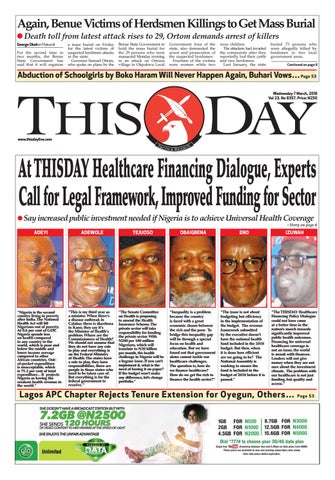
Again, Benue Victims of Herdsmen Killings to Get Mass Burial Death toll from latest attack rises to 29, Ortom demands arrest of killers George Okoh in Makurdi For the second time in two months, the Benue State Government has said that it will organise
a mass burial on Friday for the latest victims of suspected herdsmen attacks in the state. Governor Samuel Ortom, who spoke on plans by the
Benue State Government to hold the mass burial for the 29 persons who were massacred Monday evening in an attack on Omusu village in Okpokwu Local
Government Area of the state, also demanded the arrest and prosecution of the suspected herdsmen. Fourteen of the victims were women while two
were children. The attackers had invaded the community after they reportedly lost their cattle and two herdsmen. Last January, the state
buried 73 persons who were allegedly killed by herdsmen in two local government areas. Continued on page 6
Abduction of Schoolgirls by Boko Haram Will Never Happen Again, Buhari Vows… Page 53 Wednesday 7 March, 2018 Vol 23. No 8357. Price: N250
www.thisdaylive.com TR
UT H
& RE A S O
N
At THISDAY Healthcare Financing Dialogue, Experts Call for Legal Framework, Improved Funding for Sector Say increased public investment needed if Nigeria is to achieve Universal Health Coverage - Story on page 6
ADEYI
"Nigeria is the second country living in poverty after India. The National Health Act will lift Nigerians out of poverty. At 0.6 per cent of GDP, Nigeria spends less on health compared to any country in the world, which is poor and below the middle and lower income average compared to other African countries. Outof-pocket expenditure is unacceptable, which is 75.2 per cent of total expenditure... It projects Nigeria as having the weakest health revenue in the world."
ADEWOLE
"This is my third year as a minister. When there's a disease outbreak in Calabar, there is diarrhoea in Kano, they say it's the Minister of Health's problem. Where are the Commissioners of Health? We should not assume that they do not have any role to play and everything is on the Federal Ministry of Health. The states have a role to play, they have responsibilities, there are people in those states who need to be taken care of. But everything is for the federal government to resolve."
TEJUOSO
"The Senate Committee on Health is proposing to amend the Health Insurance Scheme. The private sector will take responsibility for funding the private sector. With N200 per 100 million Nigerians, which will translate to N20 billion per month, the health challenge in Nigeria will be a bygone issue. If you can’t implement it, what is the need of having it on paper? If the budget won’t make any difference, let’s change portfolio."
OBAIGBENA
"Inequality is a problem because the country is faced with a great economic chasm between the rich and the poor. To bridge this inequality gap will be through a special focus on health and education. But we have found out that government alone cannot tackle our healthcare challenges. The question is, how do we finance healthcare? How do we get the rich to finance the health sector?"
ENO
"The issue is not about budgeting but efficiency in the implementation of the budget. The revenue framework submitted by the executive doesn’t have the national health fund included in the 2018 budget. But then, when it is done how efficient are we going to be? The National Assembly is working to ensure the fund is included in the budget of 2018 before it is passed."
IZUWAH
"The THISDAY Healthcare Financing Policy Dialogue could not have come at a better time in the nation’s march towards significantly improved public health outcomes. Financing for universal healthcare coverage is not an issue, the world is awash with finances. Lenders will not give money when they are not sure about the investment climate. The problem with our healthcare is not just funding, but quality and access."
Lagos APC Chapter Rejects Tenure Extension for Oyegun, Others…
Pa g e 5 3
2
T H I S D AY ˾ ͵˜ ͰͮͯͶ
T H I S D AY ˾ WEDNESDAY MARCH 7, 2018
3
T H I S D AY ˾ ͵˜ ͰͮͯͶ
4
ZZZ DFFHVVEDQNSOF FRP VDYHWRGD\
T H I S D AY ˾ WEDNESDAY MARCH 7, 2018
5
WEDNESDAY, ÍľËœ ͺ͸͚͜ Ëž T H I S D AY
6
PAGE SIX
At THISDAY Healthcare Financing Dialogue, Experts Call for Legal Framework, Improved Funding for Sector Say increased public investment needed if Nigeria is to achieve Universal Health Coverage Iyobosa Uwugiaren, Senator Iroegbu, Chineme Okafor, Sumaina Kasim in Abuja Different experts and speakers drawn from the public and private health sector yesterday canvassed for a legal framework to finance the sector, adding that the framework should be robust enough to support the delivery of a set of high impact interventions. They equally harped on the need for increased public investment in the health sector if Nigeria is to achieve Universal Health Coverage (UHC), advocating that state governments should increase public funding, as more than two-thirds of public sector funding for healthcare currently comes from the federal government In a communiquÊ issued yesterday at the end of the THISDAY Health Financing Policy Dialogue, which held at the Shehu Musa Yar’Adua Center, Abuja, participants observed that although investment in health leads to economic growth, Nigeria has invested too little and inefficiently in the health sector, spending less than nearly every country in the world. THISDAY, the nation’s foremost newspaper of record, as part of its social corporate responsibility efforts to help Nigeria focus on the
challenges of financing its health sector and finding sustainable solutions to them, held a policy dialogue yesterday, which had as participants, senior government officials, the private health sector, domestic and international public health institutions, as well as nongovernmental organisations (NGOs). In the robust dialogue, which attracted a huge audience, it was agreed that the country’s development partners should also support the federal government’s efforts at improving primary healthcare delivery, using the Basic Health Care Provision Fund (BHCPF) as the vehicle, adding that credible metrics and effective health planning, monitoring and evaluation, by federal and state ministries of health were required to encourage confidence. They also agreed that the BHCPF should be funded without further delay, in order to unleash the cycle of better health, economic and sustained development. Giving the keynote address at the policy dialogue, the Director, Health Nutrition Population, the World Bank Group, Dr. Olusoji Adeyi, expressed concern that public health spending, as a share of total health spending in Nigeria was low at 22 per cent, compared to 36 per cent for Lower-Middle-Income
Countries (LMICs) and 57 per cent for Upper-Middle-Income (UMICs). He added that in the fight against out-of-pocket expenditure, which is experienced by most Nigerians in accessing basic healthcare, the National Health Act has the capacity to be of benefit to 8 million Nigerians by the end of 2018, if captured and implemented in the 2018 budget of the federal government. Adeyi said now was the time to unleash the National Health Act, saying it would lift Nigerians out of poverty and misery, judging from the fact that Nigeria spends less on healthcare compared to any country in the world. He put the country’s spending on the health sector at 0.6 per cent of Gross Domestic Product (GDP). The World Bank expert said the current out-of-pocket expenditure was unacceptable, adding that Nigeria was prone to a poverty trap if the government fails in the provision of basic healthcare. While emphasising that universal health coverage was achievable in Nigeria, he explained that public accountability for basic healthcare services, credible budgeting of public funds and effective/sustained planning would tackle the challenges enveloping the universal health coverage in the country.
According to him, “Nigeria is the second country living in poverty after India . The National Health Act will lift Nigerians out of poverty. At 0.6 per cent of GDP, Nigeria spends less on health compared to any country in the world, which is poor and below the middle and lower income average compared to other African countries. “Out-of-pocket expenditure is very unacceptable, which is 75.2 per cent of the total expenditure and the highest in the world, and projects Nigeria as having the weakest health revenue in the world. All states must receive equal share of funding based on population.� On his part, the Minister of Health, Professor Isaac Adewole, said that the federal government recognises that the country’s future success depends on its ability to transform non-renewable natural capital into productive wealth by investing more in human capital. He said as the most populous country in Africa that has yet to complete its demographic transition, its human capital potential was substantial. He added: “Yet, slow progress on poverty reduction, health outcomes, literacy, and governance challenges threaten further development. Our country is home to the second largest
number of people living in extreme poverty, after India at 86 million in 2013, a 69 per cent increase from 1990. “We significantly underperform in key health outcomes such as life expectancy, maternal mortality, and child health compared to regional and lower to middle income averages.� Adewole agreed with the World Bank director that Nigeria spends less on health than nearly every country in the world, adding that for Nigeria to accelerate progress to universal health coverage, the federal and state governments would need to significantly invest more in health. “In 2016, government health spending was 0.6 per cent as a share of GDP or just $11 per capita. This is below the regional and the lower to middle-income averages and the recommended $86 per capita for low and middle-income country benchmark needed to deliver a limited set of key health services,� the minister added. Describing the dialogue as unique, the minister commended the management of THISDAY for the initiative, promising that the federal government would ensure that the outcome of the dialogue is promoted. He shared the popular view by the participants that although investment in health leads to
economic growth, Nigeria invests too little and inefficiently in the health sector, spending less than nearly every country in the world. Explaining the importance of a sound, healthy environment, Adewole noted that without an educated, healthy workforce, the nation would not be able to build the necessary infrastructure, saying it was important that the narrative is changed with a proper accountability framework. Continuing, the minister wondered why the state governments and their health ministries were not doing enough to deliver improved healthcare services to the people, saying funds needed to be spent judiciously. “We must spend these monies judiciously, we must account for it and we must justify increased allocations. I believe that this meeting will help us to articulate further what we need to do. And the media has a role. “This is my third year as a minister. When there’s disease outbreak in Calabar, there is diarrhoea in Kano, they say it’s the Minister of Health’s problem. Where are the Commissioners of Health? We should not assume that they do not have Continued on page 8
Finally, SEC Gives Deloitte Go Ahead on Forensic Audit of Oando Chineme Okafor in Abuja Several months after the forensic audit of Oando Plc was suspended owing to lawsuits and the alleged interference by the Minister of Finance, Mrs. Kemi Adeosun, the Securities and Exchange Commission (SEC) yesterday disclosed that it has directed the accounting firm of Deloitte to proceed with the forensic audit of indigenous energy firm. It said this had become possible after Oando withdrew the lawsuit it filed attempting to stop the forensic audit. Speaking in Abuja yesterday, the acting Director-General of SEC, Dr. Abdul Zubair, stated that Oando’s withdrawal of the lawsuit was heard and granted by the Court of Appeal on
March 5. He said this followed the application for withdrawal of another suit filed by the shareholders of Oando at the Federal High Court, and which was heard on February 21 by the court. According to him, with the dismissal of the lawsuits, SEC has notified Deloitte to proceed with the forensic audit, adding that the commission was committed to its primary mandate of protecting investors in Nigeria’s capital market and will take all necessary steps to fulfill this mandate and uphold the integrity of the capital market. Zubair stated that SEC had also transmitted the dismissal notices of the lawsuits to the audit firm, noting that its job would not be interfered with.
The auditor, he added, was given a very short timeframe to do a very thorough job that the market would be happy with. “We didn’t mince words that the forensic audit will resume and continue as soon as we have the impediments removed, that is what we said. Today, I am here and pleased to give you an update. “As of Monday, 5th of March 2018, all the two lawsuits had been dismissed from the law courts. “And, since the impediment has been removed, I am pleased to let you know that the coast is clear. We did all we could because we needed to respect the law. “We maintain that we will continue to be good corporate citizens and law abiding,� said
Zubair. He further explained: “The important thing is that having received those letters of dismissals, we have also transmitted them to the forensic auditors to continue. “We have with us evidence that the lawsuits have been dismissed and as we speak today, we have transmitted same to the forensic auditors to continue with their job. “We will not interfere with their job, everything we did, we did in the interests of investors and to maintain integrity in the matter. “The assignment will be completed within the shortest time possible. I cannot give you a precise date, as I am not the forensic auditor but we have told them to fast-track the job and do a good job that
everybody in the market will be satisfied with.� Last year, SEC had ordered the Nigerian Stock Exchange (NSE) to halt trading on the shares of Oando for 48 hours, and subsequently directed the stock exchange to place the shares on a technical suspension, following what it said were a number of infractions committed by the firm. SEC had given the directive after it had investigated the petitions from two shareholders of Oando – Dahiru Mangal and Ansbury Investment Inc – who had accused the management of the oil firm listed on the Nigerian and Johannesburg Stock Exchanges of mismanaging the affairs of Oando. SEC also appointed a team
of experts lead by Deloitte to undertake a forensic audit of Oando to reaffirm its findings. However, the audit was suspended owing to the lawsuit instituted by Oando, and interference by the finance minister who allegedly ordered the then DG of SEC, Mounir Gwarzo, to stop the audit. Although Adeosun has repeatedly denied that she asked Gwarzo to stop the audit, 24 hours after his refusal, he was suspended by the minister who set up an administrative panel of inquiry to investigate him over allegations of financial mismanagement. The administrative panel, last month, found him guilty and recommended his dismissal from the public sector for violation of public service rules.
villagers from Okana and Okpolikpo had deserted their homes and relocated to Ojapo and other neighboring communities for safety. In a statement also, the spokesman of the Police Command in Benue, Mr. Moses Yamu said the “herdsmen surreptitiously went on the rampage, resulting in stabbing to death of 15 persons, mainly women and children, while some houses were set ablaze�. He added that four suspects had so far been arrested in connection with the incident, while security was reinforced in the affected area. One of the community leaders, Mr. Itodo Ojobo acknowledged the swift response of the security agencies to their distress call and appealed for assistance to enable family members bury their dead
and take care of those being treated in various hospitals.
AGA IN, B ENUE VICT IMS OF HERDSMEN KI L L I N GS TO GE T M ASS B U R I AL The governor, who was adamant that the killers must be apprehended, made the call during an assessment tour of Omusu when he visited the village yesterday to ascertain the level of destruction and provide immediate relief to the displaced. Ortom described the attack as unfortunate, saying such barbaric acts were unacceptable in the 21st century. He reiterated his call for the arrest of the leadership of Miyetti Allah Kautal Hore whom he said were sponsoring the Fulani herdsmen militia and still moving freely in Abuja and giving directives to the mercenaries. While directing the State Emergency Management Agency (SEMA) to immediately provide relief materials to the displaced persons, Ortom appealed to
the community not to embark on reprisals, stressing that the security agencies had been mobilised to forestall further attacks on the community. The governor visited St. Mary’s Hospital, Okpokwu, where the injured were being treated and proceeded to the general hospital in the town where the bodies of dead victims had been deposited. The governor had initially announced that 24 were killed in the Monday attack, only to get to the hospital where another three victims had died from their injuries. Another two bodies were also discovered in the village, bringing the death toll to 29. Ortom also paid a condolence visit to Mr. Abba Moro, a former interior minister who lost his first wife recently. He directed that arrangements
be made for the mass burial of the victims on Friday. Moro condemned the killings, just as he called on the federal government to beef up security in the area. He commended the state government for its proactive measures by visiting the area to console the people. In his reaction, the Deputy Speaker of the Benue House of Assembly, Hon. Okefe Ejimbi commended Ortom and security agencies for securing the area, even as he condemned the killing of innocent people. The state Police Command said trouble started after two herdsmen were declared missing on Monday morning at about 7.30 a.m. Some irate youths from Omusu were said to have engaged the herdsmen in a
fight, during which some of their cows were rustled. Subsequently, a peace meeting was convened by the chairman of the local government area, Mr. Olofu Ogwuche and the head of the Fulani community in the area, while the police were mandated to look for the missing herdsmen. However, before the peace initiative was concluded, one of the herdsmen was reportedly found dead, resulting in the reprisal later in the day. Ogwuche, while speaking to reporters, said 29 persons were killed in the incident. Ogwuche disclosed that 17 corpses were recovered on Monday, 12 yesterday while 10 were receiving treatment in Enugu and at St. Mary’s and the General Hospital in Okpokwu. He said other neighboring
TOP GAINERS NGN NGN UNILEVER 5.50 59.60 CAVERTON 0.24 2.67 JAPAUL 0.06 0.75 AGLEVENTIS 0.04 0.61 CONSHALLMARK 0.02 0.33 TOP LOSERS NGN NGN REGENCYINS 0.04 0.40 MULTIVERSE 0.02 0.25 WEMA 0.05 0.95 UNIC 0.01 0.20 VITAFOAM 0.14 2.85 HPE Nestle Nig Plc â‚Ś1,400 Volume: 346.829 million shares Value: N 3.596 billion Deals: 3,864 As at 6/3/18 See details on Page 39
% 10.1 9.8 8.7 7.0 6.4 % 9.0 7.4 5.0 4.7 4.6
7
T H I S D AY ˾ WEDNESDAY MARCH 7, 2018
! """ # $ """ !" """ # ! " #
! "
% &' #$$" " !
'"
%" !
&'
WEDNESDAY, ÍľËœ ͺ͸͚͜ Ëž T H I S D AY
8
PAGE EIGHT
Lessons to be Learnt from Black Panther Atiku Abubakar Over the weekend, I joined my children to watch the much talked about ‘Black Panther’ movie. It was a good film, and I was happy they took me to see it. However, I came out of the movie theatre a little upset. When the first scenes came up and I saw the Sambisa Forest, I was unhappy that the only reference the filmmakers had for Nigeria was a negative one. But I was later encouraged by the thought of Africans solving African problems. That is a good thing, the kind of things we used to do. For young people who may not remember, Nigerian civil servants and indeed most able citizens used to contribute money every month to support the struggle against Apartheid in South Africa. Nigeria was the single stabilising force across West Africa; helping to restore peace in Liberia and Sierra Leone are examples of the gigantic status we once had. Seeing another African country come play ‘Big Brother’ to Nigeria made me very sad. We must return to a place of respect. We may argue that the film is a work of fiction, but there are many truths in the story – one of them being that young girls are being abducted by terrorists across the northeast of Nigeria, and they need to be rescued. Only recently, a band of terrorists stormed another girls’ school in Dapchi, Yobe State. After days of confusing information, it is now confirmed that 110 girls are missing. Nigeria has once again been thrown into sorrow with many of us wishing that there was indeed a ‘Black Panther’ to help rescue the girls.
PERSPECTIVE Here are my takeaways from the Black Panther:
Institutions are Important Wakanda, the fictional African nation in the film, was portrayed as a technological giant, which ruled great kinds, supported by a council and traditions are held in high esteem. But it was easy to see that most of the decisions are those of the king, which presents serious institutional problems. Institutional order in the dispensation of justice could have helped handle the betrayal of Wakanda by the king’s brother, which would have prevented the hatred of Wakanda that filled the heart of the nephew who was left behind. The succession system is also another example of institutional weakness in Wakanda. The young man from America came in and within days, destroyed the long-standing institutions, even when he seemed to be trying to help Black people all over the world. In one moment of folly, he decided to destroy the garden that guarantees powers to every other king of the future. Should there not have been a process whereby a council needs to approve the king’s orders before they are carried out? Institutions are better guarantors of good governance than kings or strong men/ women. Checks and balances are important in leadership. This is why democracy is important. As a Nigerian who has lived through many dictatorships, I
would have liked Wakandans to adopt a new model, which gives them a say in who leads them, as well as includes checks and balances. This would at least insure the country against the rise of tyrants and demagogues.
Flawed Liberation Philosophy The most successful tyrants always have simple philosophies, which on the surface appear good. We only see the deviousness of the plan after a second look. Many people would be drawn to the message of black liberation that the young American returnee preached, but closer scrutiny reveals that it wasn’t liberation he was preaching, but reverse oppression. When the oppressed becomes the oppressor, has justice really been done or are we just exchanging one evil for another?
Nigeria’s Hope are Nigerians One of Wakanda’s most valuable resources was mentioned in the film, but not shown: many Wakandans abroad providing intelligence to their country back home. There’s enough Nigerian talent abroad to turn our country into a technological and industrial giant. The question then is how we can make the environment conducive for them to return and contribute to its growth and development. During my time in government, mining the ‘natural resource’ of Nigerians in the diaspora was an important part of our strategy, bringing back Nigerians who
had established themselves abroad to come home to work. Sadly, many of those people who came back have packed up and returned abroad. We are losing professionals in all sectors in their droves every month, at the fastest rate not seen since the 1980s. We cannot build the Nigeria of our dreams without keeping our best people in the country and empowering them to work and build businesses. We cannot keep our people healthy when the best of our medical professionals are being forced to pack up and leave.
Strategic Alliances One of my favourite characters in the film was Mbaku, the big chief from the mountain tribe. He sounded and acted very Nigerian, which made me like him a lot. His alliance with T'Challa, the king, was very innocuous – having failed to defeat the new king in the challenge for the throne, the king encouraged him to give up, that he will be useful to the king in the future. That little moment is the reason Wakanda was saved later in the film. As a Nigerian, I always wonder how much stronger our regional leadership would be if we built better alliances. Nigerian soldiers spent most of the 90s and 2000s helping to stabilise West Africa. Wouldn’t it be in our interest to strengthen our influence on the basis of those sacrifices?
Strong African Women One important thing I noticed in Wakanda was the strong role of women in all aspects – defense, technology,
Film poster for the Black Panther
leadership, and spiritual leadership, among others. When there was trouble, the women of Wakanda did not just stand by, they found a way. I remember in the mid90s, when many of Nigeria’s leading democracy activists were running away in crates and bush border crossings (I also miraculously escaped), the women were there to save us. Women were either helping the movement go underground, or taking up the fight. It would be a disservice to Nigerian women if we speak about June 12 without mentioning the role of Kudirat Abiola. I was honoured to present a posthumous award to MKO Abiola’s family during the recently held Silverbird Man
of the Year Awards, and I wish more awards will go to the women who often led or supported the pro-democracy movement. I finished watching the Black Panther movie wondering how much better our country would be if we let more women into leadership. We are losing up to 40 per cent of our productivity because we still haven’t fully integrated our women into economic and socio-political leadership. But I was also left thinking, what if the king’s first child was a girl; would Wakandans support her to be a Black Panther? r "UJLV "CVCBLBS JT B GPSNFS 7JDF 1SFTJEFOU PG /JHFSJB BOE 1%1 DIJFGUBJO
AT T H IS DAY H EALT HCAR E FINAN CIN G D I ALOGU E, EX PERT S CAL L F OR L EGAL F R AM E W O RK , I M P ROV E D F UN D I N G F O R S E CTO R any role to play and everything is on the Federal Ministry of Health; that is wrong. “The states have a role to play, they have responsibilities, there are people in those states who need to be taken care of. But everything is for the federal government to resolve. Maybe, when oil prices were high and there was a lot of money, the federal government could take on everything. “But let the states rise up to the challenge, the states are not improving their health workforce; they are not employing nurses, they are not employing doctors, they are not even paying their salaries. At the state level, a consultant in the state earns close to what the most junior doctor at the federal level will earn. “That is where we have a problem. So, we need to work together and I must thank THISDAY. This is unique, this is unprecedented and I want to assure you that we will partner with you,� he stated. In his intervention, the Chairman, Senate Committee on Health, Senator Olarenwaju Tejuoso, said the senate was working on modalities to see how N200 per 100 million Nigerians, which will translate to N20 billion per month, will solve the challenge of attaining the objectives of the National Health Act. According to him, “The minimum expectation for Nigeria to have a functional health system is 15 per cent of the budget, as captured by the Abuja Declaration, but 16 years
after, this is still not feasible.� Senator Tejuoso declared on his behalf and that of the minister that if the 2018 budget does not make any difference in the lives of Nigerians as it relates to health, then he would have no option than to change his portfolio in the Senate. “The Senate Committee on Health is proposing to amend the Health Insurance Scheme. The private sector will take responsibility for funding the private sector. With N200 per 100 million Nigerians, which will translate to N20 billion per month, the health challenges in Nigeria will be a bygone issue,� the senator added. “If you can’t implement it, what is the need of having it on paper? If the budget won’t make any difference, let’s change portfolio. It will be best if I am taken to a place like the labour committee,� he said. One of the panelists, Chairman of the Senate Committee on Finance, Senator John Eno, however, said that the issue was not about budgeting but efficiency in the implementation of the budget. For instance, he explained that the revenue framework submitted by the executive did not include the national health fund in the 2018 budget, hoping, however, that it will be done. “But then, when it is done how efficient are we going to be? But answering straightforward, the National Assembly is working to ensure the fund is included in
the national budget of 2018 before it is passed,� he added. Another parliamentarian, Chairman of the House of Representatives Committee on Health, Hon. Betty Apiafia, agreed with her colleague, Senator Eno, saying: “We need to improve on the budgeting for the health sector, and of course the efficiency of the funds budgeted.� Also, the acting Director-General of the Infrastructure Concession Regulatory Commission (ICRC), Mr. Chidi Izuwa, while contributing to the panel discussion, said financing for universal health care coverage was not an issue, pointing out that the world is awash with funds. However, he said lenders would not give money when they are not sure about the investment climate, adding that the problem with Nigeria’s healthcare was not just funding, but quality and access. On his part, the Chief Executive Officer of the Nigerian Sovereign Investment Authority (NSIA), Mr. Uche Orji, said healthcare should be recognised as an investable sector, while making the case for training of personnel in the sector. The Chairman, House Committee on Primary Healthcare Services, Hon. Chika Okafor, also called for a neutral regulator that would observe what the HMOs are doing and taking impartial decisions. Earlier while welcoming participants to the dialogue, the Chairman/Editor-in-Chief of THISDAY Newspapers and
ARISE News Channel, Mr. Nduka Obaigbena, assured the audience that the media group would pay special attention to the health sector of the country for the next 12 months. “We at THISDAY have focused a lot on the economy and politics, but I believe as the election year draws near, we will be focusing more on the health issues. So, in the next 12 months, we would be focusing more on health and education,� he said. He also informed the audience that the forthcoming THISDAY Awards will target the health sector rather than governors and other politicians. He explained that health was critical to the overall development, peace and security of the country, adding that it helps to improve three key areas of national lives, namely: living standards, poverty and inequality. According to him, “Inequality is a problem because the country is faced with a great economic chasm between the rich and the poor,� stressing that even the state of insecurity Nigeria is currently grappling with, was rooted in inequality. “And to bridge this inequality gap will be through a special focus on health and education. But we have found out that government alone cannot tackle our healthcare challenges. So, the question is, how do we finance the health sector? How do we get the rich to finance
the health sector?â€? Meanwhile, the communiquĂŠ, which was read out by the Managing Director of THISDAY Newspaper, Mr. Eniola Bello, at the end of the policy dialogue, said: “Participants observed that although investment in health leads to economic growth, Nigeria invests too little and inefficiently in the health sector, spending less than nearly every country in the world.â€? It added: “Where political leadership has rallied stakeholders behind investments in the health sector, significant improvements have been possible. “The National Health Act passed in 2014, charts the way forward for increased investments in health and provides a legal framework for achieving Universal Health Coverage (UHC).â€? Part of the recommendations from the policy dialogue, the communiquĂŠ noted included: Improved transparency and accountability in public financial management; r -FHBM GSBNFXPSL GPS Ă OBODJOH the health sector should be robust enough to support the delivery of a set of high impact interventions; r *ODSFBTFE QVCMJD JOWFTUNFOU JT important if Nigeria is to achieve Universal Health Coverage (UHC); r %FWFMPQNFOU BTTJTUBODF TIPVME only support government policy; r 4UBUF HPWFSONFOUT TIPVME increase public funding as more than two-thirds of public sector funding currently comes from the
federal government; r 5IF QVCMJD TIPVME UBLF NPSF interest in government policy and funding of the health sector and should demand greater accountability and transparency; r 5IF #BTJD )FBMUI $BSF Provision Fund (BHCPF) should be funded without further delay, in order to unleash the cycle of better health, and sustained economic development; r %FWFMPQNFOU QBSUOFST UP support the federal government’s efforts to improve primary care delivery using the BHCPF as the vehicle; r $SFEJCMF NFUSJDT BOE FGGFDUJWF health planning, monitoring and evaluation by the Federal and State Ministries of Health is required to engender confidence; r 3FEVDUJPO JO PVU PG QPDLFU payments at point of service delivery through better and improved public investments in health; r &Gà DJFOU VTF PG UIF QSJWBUF sector for supply chains and clinical delivery; r %FWFMPQNFOU PG JOTUJUVUJPOT to perform core public health functions; r )FBMUI *OTVSBODF TIPVME CF made compulsory; r $IBOOFMMJOH DJWJM TPDJFUZ activism and emerging accountability paradigm; and r '.P) BOE /4*" TIPVME quicken the delivery of the centres of excellence in existing teaching hospitals.
T H I S D AY ˾ WEDNESDAY MARCH 7, 2018
9
10
T H I S D AY ˾ ͵˜ ͰͮͯͶ
T H I S D AY ˾ WEDNESDAY MARCH 7, 2018
11
T H I S D AY Ëž ÍľËœ Í°ÍŽÍŻÍś
12
Vol. 1 Issue 35 Mar. 07, 2018
Nextier Power is a consulting firm that provides policy advisory, investment advisory, and support services to the electricity supply industry. The firm aims to use this weekly publication to educate Nigerians on the intricacies of the Nigeria electricity supply industry on the assumption that a more informed public would advocate for the right policies and programmes which, in turn, would lead to a robust market that delivers the electricity needs of Nigerians. This column will cover everything from the basics of the industry to the more intricate, sometimes, complex policies and programmes.
Changes in Natural Gas Trends and the Implication for Power Generation in Nigeria Interesting! So, what is the significance of this development for power generation? The implication of this change in trend is lower power generation until the liquidity issue abates. This new trend emphasised gas producers’ unwillingness to supply gas to the power sector without payment assurance. In addition, it shows that the power sector requires prompt intervention to sustain power generation, however, for such intervention to be effective, the root factors causing the liquidity crisis will also have to be addressed. This will lead to a more sustainable market underpinned by valid and operable transactional contracts.
Introduction What are natural gas trends?
Natural gas trends refer to the general direction of the gas market by evaluating the historical pattern of one or more of its key indicators such as; prices, production, sales quantity, incidents of pipeline vandalism, gas flaring etc. These indicators, evaluated over a period of time (from short, intermediate, to long-term) form trends. Why are these trends important? For critical stakeholders such as policymakers, investors, producers and consumers, gas trends assist them in planning and making right decisions by observing the pattern of past events. For example, evaluation of the pattern of pipeline vandalism over the last twelve (12) months may show a gradual increase in the total number of occurrences. An investor may interpret this trend as an indication of high risk for investing in constructing new pipelines. Inversely, a reduction in the number of occurrences can infer more steady and reliable thermal power generation. Changes in Natural Gas Trends In your opinion, what constitutes a natural gas trend? Changes in Natural gas trends occurs when there is a deviation from the previously observed pattern of activities in the gas market. For example, if gas sales grew by five-percent (5%) every quarter from 2010 to 2015 and suddenly declines by twopercent (2%) for every quarter of 2016, we refer to this as a change in the trend. Changes in Natural gas trends are usually caused by changes in any or several factors of demand or supply such as increased gas infrastructure, high exchange rate, new policies, power industry liquidity crisis, pipeline vandalism, increased gas reserves etc. Are these changes important? Changes in trends are important because they serve as signals for stakeholders to adjust and re-strategise. However, it is important to understand the reason for a change in trend because some changes are short-lived which may be inconsequential. Consequently, caution should be exercised when making strategic decisions, particularly in the short-term after a change in trend. Furthermore, it is important to evaluate trends of more than one indicator before making conclusions and decisions because interpreting the trend of an indicator in isolation might be misleading. For example, increase in gas reserves does not necessarily infer an increase in gas production, it could just be accidental discoveries during crude oil exploration without any immediate plan to develop the reserve.
How significant are these changes for power generation in Nigeria? As mentioned in one of our published articles, ‘Addressing Key Issues in the Value Chain: Gas to Power Generation’, “thermal power generation from gas turbines and steam power plants accounts for eighty-percent (80%) of the nation’s power generation� and about sixty-percent (60%) of domestic gas sales, thus, natural gas trends have significant implications for power generation in Nigeria. There are several indicators that explain natural gas trends but only a few have experienced changes in trend. Domestic gas prices have progressively increased over the years, pipeline vandalism has persisted and remained volatile, gas reserves keep increasing; in general, most of the key natural gas indicators have relatively maintained the same trend except a few such as gas constraints due to payment defaults. Gas Constraints What are gas constraints? Gas constraints is a popular term in the power sector that refers to the electricity that could not be generated due to gasrelated challenges (see Figure 1). Typically, gas constraints occur if there is no gas flowing due to pipeline vandalism or if a gas facility or delivery infrastructure is inadequate and has become impeded at that point in time i.e. due to low pressure or force majeure issue. What are the implications of gas constraints on power generation in Nigeria? Gas constraints significantly accounted for low power generation in 2015 and 2016, which was largely attributed to pipeline vandalism. Based on this trend, it implies that if stakeholders resolve the issue of pipeline vandalism, the nation might have witnessed an increase in power generation beyond what was recorded during the same period.
So, what changed about this trend? In the fourth quarter (Q4) of 2016, the trend changed despite sustained gas constraints. The change was not caused by vandalism and infrastructure constraints which were still existing, but by supply restriction from gas suppliers, particularly those in the eastern network. The restriction was due to large payment arrears for past supplies. What caused these payment defaults to gas suppliers? Payment default to gas suppliers by power generation plants is largely due to the liquidity challenge in the power sector. The liquidity challenge stems from several reasons such as the foreign exchange crisis, the cost of acquiring the privatised assets, not cost reflective tariffs, huge collection losses, and lack of affordable funding. The liquidity issue has been a challenge in the value chain prior to Q4’2016, so why did it suddenly constitute Gas constraints? In November 2014, the Federal Government of Nigeria (FGN) provided a N213 Billion Loan facility through the Central Bank of Nigeria (CBN), to address shortfalls in power sector revenues caused by needed adjustments in electricity tariff and gas debts. This facility addressed postprivatization gas debts up to December 2014. At the time, this initiative provided comfort to gas suppliers and it explained why payment default did not cause gas constraints. However, the removal of collection losses, failure of recipients to meet pre-agreed condition precedents (CPs), and force majeure notices declared by the DISCOs, resulted in the suspension of the disbursement of the NEMSF funds. As the liquidity challenge persisted without any intervention, gas debts also piled up, and gas suppliers began to lose confidence in the power sector’s capacity to pay its gas bills. This led to the suspension of gas supply to some thermal power plants in Q4’2016 while other gas suppliers threated to do same if the situation persisted.
How did stakeholders react to this development? In view of the aforementioned, the FGN through the CBN provided a Payment Assurance Guarantee (PAG) of N701 Billion to guarantee payment obligations to power generating companies (GENCOs) and gas suppliers for a two-year period from January 2017 to December 2018. At the end of 2017, the Managing Director of the Niger Delta Power Holding Company (NDPHC) stated that the PAG has helped to mitigate the impact of the liquidity crisis in the power sector and improved the revenue of the company and other GENCOs by offsetting gas cost directly. Conclusion What is your recommendation to stakeholders? The intervention of the FGN helped prevent the looming collapse of the electricity market, however, the issues that led to the change in trend still exist. In other words, when either the loan facility or term is exhausted, gas suppliers are likely to revert to cutting gas supply to GENCOs if gas bills are not paid. Therefore, the sustenance of current generation level and expected increase in power generation are hinged on resolving the liquidity challenge in the power sector permanently. However, as stated earlier, it is unsafe to conclude and make decisions by analysing just one indicator. For example, notwithstanding the intervention provided by the FGN, the power sector can still experience gas constraints from pipeline vandalism. Author Oladiran Adesua is a Business Analyst focused Editor Chinazo Ifeanyi-Nwaoha is a power sector analyst focused on the interplay of policy-practice and regulation Next Topics Mar. 14
Existing Utilities getting Ahead by Expanding Energy
Mar. 21 Debates of efficient Tariff Design Rate Mar 28 Should Utilities be Customercentric? www.nextierpower.com empower@nextierpower.com
T H I S D AY ˾ WEDNESDAY MARCH 7, 2018
13
14
T H I S D AY Ëž Ëœ ÍľËœ 2018
COMMENT
Editor, Editorial Page PETER ISHAKA Email peter.ishaka@thisdaylive.com
HATE SPEECH BILL PROMOTES HATRED Sonnie Ekwowusi argues that the bill violates the right to freedom of speech and expression
A
side from violating the right to freedom of speech and expression as enshrined in our 1999 Constitution and the Freedom of Information Act, the Hate Speech Bill being sponsored in the Senate by the Chairman, Senate Committee on Media and Publicity, Senator Aliyu Sabi Abdullahi (APC, Niger State) is essentially a hateful bill containing abusive or insulting words, stirring up ethnic hatred or ethnic killings capable of resulting in the death of many Nigerians. To begin with, the bill stirs up public hatred against the sponsor. Because Senator Abdullahi is a member of the ruling party, the bill also stirs up public hatred against the Buhari government. It depicts President Buhari as a power-drunk dictator and a suppressor of public opinion and freedom of speech. The bill also promotes hatred and mutual suspicion among members of the National Assembly. Equally, it fans the ember of ethnic rivalry and hatred in Nigeria. The bill contains euphemistic expressions that promote disunity and mistrust among Nigerian Muslims and Christians. Therefore Senator Abdullahi is respectfully advised, in the interest of national unity and national integration, to withdraw the offensive bill. We have shed enough blood in Nigeria in the last three years. Therefore anything capable of causing a breach of public peace that could lead to the shedding of more blood should be avoided. Besides, the elections are around the corner. The APC is already walking a tight rope. Therefore anything capable of further jeopardising the chances of APC in 2019 should be avoided. Coming on the heels of the anti-NGO bill at the House of Representatives by Hon. Umar Buba Jibril, Senator Abdullahi’s bill is repugnant to equity, justice and good conscience. It provides that any person found guilty of any form of hate speech that results in the death of another person shall die by hanging upon conviction. Also the bill provides that offences such as harassment on the grounds of ethnicity or racial contempt, the culprit shall be sentenced to “not less than a five-year jail term or a fine of not less than N10 million or both.� But as I said earlier, the bill is a hateful bill. It violates the right to freedom of speech and expression guaranteed in our constitution. It aims at emasculating the Nigerian press. The role of the press is so important in the society that different adjectives are employed to emphasize it. Given its role in constitutional democracy, the press is dubbed the Fourth Estate of the Realm, after the Legislature. In common parlance, the press is simply referred to as the watchdog of the society. In their book entitled: “The Crisis of Press Freedom in Nigeria,� Clement Nwakwo, Frank Aigbogun, Eluem Emeka Izeze and Dulue Mbachu stated: “A free media will be able to provide to the people a true account of the goings-on in government and society at large and act as a watch dog of the people’s rights against government abuses�. Also in their book: “Nigerian Media Law� (1991 Edition) page four, Osinbajo and Fogam stated that a free press that is also independent is an essential element of a free state under modern democracy. Suffice it to say that under the different military totalitarian regimes in Nigeria, the Nigerian press suffered emasculation, intimidation, suppression and proscription. In a bid to perpetuate their
THE BILL IS TRYING TO TAKE NIGERIA BACK TO THE HELLISH MILITARY TOTALITARIAN REGIMES. NIGERIA IS NOW UNDER A CIVILIAN RULE
dictatorial hold onto power, the military spewed out several unjust laws and draconian decrees with ouster clauses which effectively excluded the fundamental human rights provision in our constitution. You will recall the draconian Decrees Two and Four of 1984 under which the Buhari-Idiagbon military regime arrested and detained many Nigerian journalists and sealed up the premises of the Guardian newspapers. We can also recall the trial of journalists Tunde Thompson and Nduka Irabor under the obnoxious Decree Four. Of course under Sani Abacha’s dictatorial regime, journalists were bundled out in broad daylight and dumped into the gulag for speaking the truth. However, with the restoration of democratic government in Nigeria since May 29, 1999 the fundamental human rights enshrined in sections 33-46 of the 1999 constitution have equally been restored. Therefore Senator Abdullahi’s bill is setting the hands of the clock back. The bill is trying to take Nigeria back to the hellish military totalitarian regimes. Nigeria is now under a civilian rule. Come to think of it, laws on libel, slander and hate speech are not lacking in Nigeria. Senator Abdullahi is not a lawyer. Therefore he may not understand that there are copious laws in Nigeria dealing with libel, slander and hate speech. The Nigerian media and the activities of Nigerian journalists are already within the purview of the law. They are already governed by existing laws. So, the Hate Speech Bill is superfluous and unnecessary. Let me repeat what has somewhat become an aphorism. Our main problem in Nigeria is not lack of laws: our problem is enforcing the existing laws. So the bill is unwarranted. Already the bill promotes disaffection and hatred among different people from different strata of Nigerian society. For example, in a statement issued last Friday, the Nigeria Union of Journalists (NUJ) cautioned against prescribing death penalty for an alleged hate speech. It also stated that the hate speech law “could be used indiscriminately against perceived political opponents by unscrupulous members of the political elite�. Of course, the NUJ is right. The punishment prescribed for alleged offenders under the bill is so outrageously disproportional to the alleged offence. How can Senator Abdullahi impose a death sentence on a citizen exercising his or her right to freedom of speech as guarantied in our constitution when the politicians under the Buhari government are freely looting public funds and freely walking the streets? What we need at this moment in Nigeria is good governance. If the Buhari government has failed to live up to its bidding, no hate speech law in this world can salvage it. We must begin to move away from the Statist mentality conveying the impression that once we enact laws all our human problems will be solved. We have to understand that not every obligation that augurs well for proper ordering of society can be codified in positive law. More importantly, we must envision a democracy that guarantees freedom of expression. Freedom is more than absence of imprisonment or deliverance from despotic rulers. Freedom concerns shared beliefs, shared values and liberating principles. If there are no liberating principles to guide political activity, then political ideas and convictions can easily be manipulated or corrupted for reasons of power.
REDEFINING GOVERNANCE ON THE PLATEAU Life is returning to normal in the state wracked by violence, writes Yakubu Dati
A
t the inauguration of the Governor Simon Bako Lalongled administration in Plateau State, the governor made it clear that his government was coming with a clear vision for the development of the state and would, as a matter of priority concentrate on five areas which policy has been termed the Five-Point Policy Thrust. These are peace, security and good governance; human capital development and social welfare; agriculture and rural development; entrepreneurship and industrialisation; and physical infrastructure and environment. After about 33 months in office, it would suffice to say that progress had been made in these core areas that are beginning to define the current administration in Plateau State. It is common knowledge that the current administration inherited a state which psyche has been assaulted by an avalanche of crisis and which needed healing to get back on track. Taking serious the fact that without peace there cannot be meaningful development, the current administration immediately set out to work out strategies that would ensure a lasting peace in the state. Part of the strategies devised was to put in place an inclusive government that gives every section of the state a sense of belonging as part of the problems of the past, it was observed, was the feeling of alienation by certain parts of the state. This policy made it imperative not to unnecessarily malign a particular section
but to take everybody along in the scheme of things in terms of project allocation and appointments for the mutual benefit of all citizens of the state. Having achieved that, the government realised that to go side by side with this policy of an all-inclusive government is to pursue dialogue with warring communities and find out what exactly was the sore point that has made it difficult for people to line together and work proactively towards resolving such issues. The dialogue proved useful as communities began to express their minds and let out long-bottled up grievances which were on the verge of exploding. The result is that communities that were in the past no-go areas for some citizens are now open and have become melting point of social and economic activities. It then became clear to the government that the issue of peace and continuous dialogue with communities to understand their grievances is a wholesome task and cannot be done in piecemeal if effective results are to be achieved, The need for a body with the primary responsibility to pursue that task dawned on the government and that was when the Plateau Peace Building Agency was established. The establishment of the agency has underlined the seriousness with which the Lalong government is taking the issue of peace. All these efforts restored confidence among the ethnic nationalities living on the Plateau and rekindled hope on the possibil-
ity of having a peaceful state built on the foundation of equity and social justice and brought out the best in these citizens. The state government also moved swiftly to resolve boundary issues within and outside the state. Still in the bid to ensure peace, the state government also adopted a different approach in its relationship with the central government and chose not to be antagonistic but work in synergy with the federal government in providing logistical support to security agencies. All of a sudden, the image of Plateau as a crisis-prone state with belligerent leaders who are hostile to support from external forces began to give way and the governor began to have unlimited access to the central government in Abuja which has influenced a lot of things in the state. In no time, focus shifted back to Jos and activities of the federal government and its agencies and parastatals which were taken out of Jos began to reoccur. Social life began to return to Jos and other towns in the state with an an increase in recreational activities to the extent that Jos is regaining its glory as a tourism destination, attracting conferences and boosting economic activities for its people and government, Much as all these goals have begun to redefine the concept of good governance in the state and have driven away the tension and apprehension in matters concerning the state, the government felt there was a need to do an introspection and work on any loophole that could cause ill-feeling or demotivate its work force and it almost
immediately set machinery in motion to ensure prompt payments of salaries. The issue of non-payment of salaries to the civil servants had lingered for long and had continued to cause embarrassment to the state government not to talk of the untold hardships to the citizenry and its implication to the socio-economic wellbeing of the state. The security implication of continually pauperising the citizenry was also not lost on the government and the governor decided that as one of the first set of remedies he is going to put in place would be ensuring the welfare of its workforce because, as they say, charity begins at home. The Lalong administration thereby resisted the temptation to use the scarce resources of the state on some egotistical ventures and decided to put to good use payments from the Paris Club bail-out funds and overdraft. The government did not also close its eyes to the financial implication of having a debt overhang of N220billion inherited from the previous administration. This has crippled many enterprises and small scale businesses as contractors were not being paid and there was little money in circulation to patronise these businesses. The government set to work huge sums to defray the liability through salary payments and contractual obligations, amongst others. These have indeed injected life into the state and Plateau, known as the beautiful, is reliving its essence as vibrant social economic hub of northern Nigeria. Dati, Plateau State Commissioner for Information, can be reached on yakubudati@gmail.com
15
T H I S D AY Ëž Ëœ ÍľËœ 2018
EDITORIAL TIME TO RECHARGE LAKE CHAD
The campaign to revive the lake has been a failure. The concerned authorities must do more to catch up with the rhetoric
A
t a three-day international conference on how to recharge the drying and shrinking Lake Chad in Abuja last week, President Buhari warned that the world would pay dearly if the lake was allowed to go into extinction. He said the shrinking of the lake and intensiďŹ cation of desertiďŹ cation had caused several people who were dependent on it for irrigation, farming and drinking water for cattle to leave the area. What is worrying is that there is nothing new in what the president said as he merely re-echoed the same view he canvassed almost three years ago. There seems to be no commitment to changing the narrative despite the obvious danger to the nation and the Lake Chad region. A 2015 report, the “Environmental Audit of the Drying Up of the Lake Chadâ€? had similarly warned of dire consequences for Nigeria and other neighbouring countries should the Lake Chad basin be allowed to dry up. The key message in the report which noted that there is a correlation between the shrinking of Lake Chad and the current insecurity EXPERTS HAVE BLAMED in the Northeast of the THE SHRINKAGE OF THE country was that “Lake LAKE ON A NUMBER OF Chad is drying up FACTORS LIKE CLIMATE very fast--from 25,000 CHANGE, OVERGRAZING, Square Kilometre EXCESSIVE AND in 1963 to just 1500 INAPPROPRIATE Square Kilometre at DEMAND FOR WATER present.â€? RESOURCES, AS WELL Situated on the AS POOR ENFORCEMENT extreme northern part OF ENVIRONMENTAL of Borno State and LEGISLATION bordering three other countries (Niger, Cameroun and Chad), the lake, once famous for being one of the largest water bodies in Africa, has become a shadow of itself. Experts have blamed the shrinkage of the lake on a number of factors like climate change, overgrazing, excessive and inappropriate demand for water resources, as well as poor enforcement of environmental legislation. A combination of these factors have had adverse effect
Letters to the Editor
on the lake so much that apart from occupying less than a twentieth of its original size, there is now receding shoreline, desertiďŹ cation, and a threat to livelihood among the surrounding communities drawn from Nigeria, Cameroun, Chad and Niger. With lack of water for irrigation leading to crop failures, livestock deaths because of desertiďŹ cation, collapsed ďŹ sheries, soil salinity, wilting plants, withered trees and shrubs, Lake Chad is fast losing its traditional staples of water and vegetation which had sustained livelihood and bourgeoning economic activities for about 30 million people in the area.
U T H I S DAY
EDITOR DEPUTY EDITORS ˜ MANAGING DIRECTOR DEPUTY MANAGING DIRECTOR CHAIRMAN EDITORIAL BOARD
EDITOR NATION’S CAPITAL
T H I S DAY N E W S PA P E R S L I M I T E D
EDITOR-IN-CHIEF/CHAIRMAN GROUP EXECUTIVE DIRECTORS ˜ ˜
˜ ˜
DIVISIONAL DIRECTORS ˜ DEPUTY DIVISIONAL DIRECTOR
SNR. ASSOCIATE DIRECTOR ASSOCIATE DIRECTORS ˜ CONTROLLERS ˜ ˜
DIRECTOR, PRINTING PRODUCTION TO SEND EMAIL: ďŹ rst name.surname@thisdaylive.com
nderstandably, the shrinkage has also led to some tension and communal clashes among the remaining communities as they struggle to control what is left of the water body. Nigerian communities have clashed severally with Nigerien communities, as a result. Since many people who had drawn livelihood from the Lake Chad area are moving southward in search of the proverbial greener pasture, this has also promoted clashes between herdsmen and their host communities. It is in a bid to rescue the lake from extinction that both the United Nations Environmental Programme (UNEP) and the Lake Chad Basin Commission (LCBC) have been seeking ways of reviving and replenishing it. The LCBC, in this regard, had raised the sum of $5 million aimed at funding research on how best to resuscitate the lake and rekindle the socio-economic activities associated with it. But the greater responsibility lies with the four countries while Nigeria is expected to take the lead. It is particularly noteworthy that the United Nations Food and Agriculture Organisation (FAO) has linked the rise of the insurgency in the North East to poverty as a result of the failing fortunes of the lake. What that suggests is that the federal government and other stakeholders must muster the will to implement the relevant recommendations in the many reports on how to resuscitate the economic activities associated with the lake. It is time to move from empty rhetoric to concrete actions!
TO OUR READERS Letters in response to speciďŹ c publications in THISDAY should be brief (150-200 words) and straight to the point. Interested readers may send such letters along with their contact details to opinion@thisdaylive.com. We also welcome comments and opinions on topical local, national and international issues provided they are well-written and should also not be longer than (9501000 words). They should be sent to opinion@thisdaylive.com along with the email address and phone numbers of the writer.
ENDING FUEL SHORTAGES IN NIGERIA
T
he issue of perennial shortages of petrol in the country appeared to have been permanently resolved on May 11, 2016, when the federal government introduced a new pricing regime that increased the pump price of petrol from N86 per litre to N145 per litre. Fast forwarding to December 2017 till February 2018, the issue of scarcity and fuel subsidy seems to take worse turn with long queues at filling stations and increased fares on public transportation due to shortages. Fuel subsidy is the Nigerian government’s financial aid to Nigerians to enable the consumption of fuel at a cheaper rate, end unpredictable supply, and ensure stability in domestic fuel price. The fuel subsidy payment was initially introduced as a policy into Nigeria during the Ibrahim Babangida administration when our refineries failed due to non-maintenance. It was introduced to temporarily stabilise the price of petroleum products while the refineries underwent rehabilitation. The policy that was meant to last only six months has now lasted for 24 years! However, during Goodluck Jonathan’s administration, it was openly declared that fuel subsidy payment will be removed partially; leading to a nationwide protest by Nigerians which was popularly called ‘Occupy Nigeria’, but in truth fuel subsidy payment was in fact sustained. Fuel subsidy removal was said to be beneficial to the Nigerian economy. Amongst the few advantages are its ability to help reduce hoarding, smuggling and diversion of petroleum products and help
ensure product price, and free market stability through private sector participation, stabilising the labour market, enabling employment creation through new investments in private refineries, oil retailing, and loss of excess crude via gas flaring; ensured competition in the industry and market forces which will drive down the price of petrol in the long run as witnessed in the telecoms sector. The subsidy removal will give government access to more funds for development of other sectors such as education, health, employment, transportation. But there are also disadvantages, especially on the other sectors of the economy. A few unfavourable effects that should be expected from this development will be the obvious increased cost of living: with the price of premium motor spirit (PMS) increased, the economy will face a sudden surge of inflation. Inflation is defined as a general and progressive increase in prices for goods and services. Transportation cost has gone up as much as 300 per cent since the N145/litre increase. This increase has caused a ripple effect on other sectors of the economy which revolve around transportation; increase in the cost of small scale business services especially those businesses that depend on subsidised fuel to render services, as public electricity supply. In the current administration, the decision of the Muhammadu Buhari administration to remove the subsidies on petroleum products has not been received well by Nigerians. Expectedly, there is outrage among the citizens given the economic hardship the masses are facing now. Many Nigerians are still not aware of the benefits of the policy because of lack of awareness and education by government and its
agencies. The Nigerian economy seems to be synonymous with fuel shortages. It does not seem to matter which regime is in charge, every couple of years, or in some cases months, the problem rears its ugly head. Every regime follows the typical playbook in dealing with the scarcity: sympathise with Nigerians and talk about how they shouldn’t be wasting useful hours queuing for fuel; talk about how marketers, smugglers, and various middlemen are sabotaging the economy for their own selfish interests; promise to revamp the refineries; pay off marketers so they can settle their debts, import new products and flood the market with fuel, with the hope that it makes the scarcity go away. In all this we often forget to ask ourselves a simple question: Is fuel scarcity the problem or is it just a symptom of the problem? The long-term solution is for the government to simply stop fixing prices. Let markets work and let prices be set by buyers and sellers like every other commodity. Prices will go up and down like everything else. People rarely bother about small increases in prices even if it happens frequently. It’s the large overnight increases that get the blood boiling. Functioning markets will ensure that we get rid of the scarcity once and for all and that we stop the reckless subsidy spending. It’s also time that we, as a country, stop repeating the lie that the fuel price fixing is about helping the poor. We all know it’s about politics. It’s always about politics. Rahma Oladosu, Wuye, Abuja
T H I S D AY ˾ ͵˜ ͰͮͯͶ
16
/(*$/ 127,&(
17
T H I S D AY ˾ WEDNESDAY MARCH 7, 2018
/(*$/ 127,&(
T H I S D AY ˾ WEDNESDAY, MARCH 7, 2018
18
MIDWEEKPOLITICS
Group Politics Editor Tobi Soniyi Email tobi.soniyi@thisdaylive.com 07054786260 SMS ONLY
THE NEWSMAKER
In Oyo State, Ajimobi, Ladoja Hold the Aces Thoseaspiringto becomegovernorofOyoState, mustrecognisetheoverridinginfluence of the incumbent governor, Abiola Ajimobi and a former governor of the state, Rashidi Ladoja, writes Ademola Babalola
Ladoja Ajimobi
T
he two dominant political parties; ruling All Progressives Congress (APC), and the main opposition party, the Peoples Democratic Party stand shoulder high to produce a successor to the incumbent Governor Abiola Ajimobi. While the governor ostensibly remains the incontrovertible leader of the APC today in the 42-year-old Pace Setters State, the PDP has been put under the firm control of a former Governor Rashidi Ladoja, an old war horse politician who wields enormous power to decide the fate of would-be standard bearer as the race to the Agodi Government house gets under way. For bookmakers, both Ajimobi and Ladoja are the gladiators who hold the aces on who gets what as far as both parties are concerned. A number of other parties are also getting ready to give these dominant parties, a run for their much-acclaimed popularity. In this category are the touted ‘Third Force’; the remnants of Labour Party; Accord and Alliance for Democracy. Like 2015 election, Oyo State is likely to have five formidable governorship candidates in APC, PDP, Labour, AD and possibly ADP. Permutations across political circles give vent to such information as far as the forthcoming politicking is concerned. Except the unthinkable happens, both the APC and the PDP still stand the chance to occupy the seat of power in 2019. Curiously, while Ajimobi will be serving out his second term as governor, Ladoja fought effortlessly for the same opportunity but providence would not allow this to be. Ladoja is a man loved and loathed for his style of politics; depending on which side of the divide you belong. At the moment, the battle ahead appears a straight fight between the APC and the PDP. And it will be fought and won by the duo of Ajimobi and Ladoja who are today sworn enemies as they seek to test their capability in the race to the coveted seat, this time around through their protégés. Their third; Adebayo Alao-Akala also a former governor is on the match again to try his luck the third time; having failed in
2011 as a sitting governor and in the 2015 as the candidate of the Labour Party. Presently, eyeing APC and looking fervently for the favour of both Ajimobi and APC National Leader, Bola Tinubu to hand him the party ticket, it remains to be seen if his wish this time around would not be a forlorn hope as over 30 other aspirants lined up to undo one another in the battle for the ticket of APC. Aside, Akaka, other front liners seeking Ajimobi’s blessing to secure APC governorship ticket are (not in particular order of popularity); Deputy Governor Moses Adeyemo; Bimbo Adekanmbi (Current Finance Commissioner); Dr. Yunus Akintunde (Former Works and Transport Commissioner); Prof. Adeolu Akande (former Chief of Staff); Mr. Bayo Adelabu (Deputy Governor of Central Bank); Chief Adeniyi Akintola, SAN; Engr. Remi Olaniyan and Mr. Soji Eniade, the immediate past Head of Service. Others in their category are the serving Minister of Communications, Adebayo Shittu; a member of the House of Representatives, Temitope Olatoye Sugar; Commissioner for Health, Dr. Azeez Adeduntan and one of his predecessors in the same ministry, Dr. Owolabi Babalola; Mr. Kehinde Olaosebikan; former Guardian Editor, Mr. Debo Omotoso among others. Just as aspirants on the platform of the APC are seeking the blessing of Ajimobi, the same is also for Ladoja. Aspirants jostling for the PDP ticket are counting on his support to
At the moment, the battle ahead appears a straight fight between the APC and the PDP. And it will be fought and won by the duo of Ajimobi and Ladoja
pick the ticket. Among them arE two former senators; Femi Lanlehin and Ayoade Adeseun; a former Secretary to the State Government, Sharafadeen Abiodun Alli; businessman, Mr. Seyi Makinde; a former deputy governor, Alhaji Hazeem Gbolarumi; Mr Femi Babalola (Jogor); and a Senior Advocate of Nigeria, Chief Bolaji Ayorinde; among others. Feelers from both camps say Ajimobi and Ladoja would use the opportunity of the 2019 race to undo each another as they set for political retirement. However, while Ajimobi is eyeing senatorial seat once again having served in the same capacity between 2003-2007, Ladoja has made it clear that he was no longer contesting for the governorship. A government house source who spoke on the condition of anonymity said “Ajimobi is unlikely to watch PDP overrun APC in 2019. He is set and going into the forthcoming poll with all arsenals at his disposal. He has beaten Ladoja twice and is set to repeat such feat again in 2019. He knows what is at stake and that was why his group is the most formidable political platform today in Oyo state. He attracted Akala to his side; ditto for other politicians like ex-Senate Leader, Teslim Folarin; a serving member of the House of Reps, Segun Odebunmi, a number of professionals and captains of industries to the party. “He is much aware that the coming back of the PDP would rubbish all his achievements as governor and he believes so much in continuity and his major preoccupation today is to handover power to another APC elected governor for the ongoing transformation and repositioning agenda he started in 2011 to continue unhindered”. Like a wounded lion, Ladoja on the other hand, will be working towards ensuring PDP’s success at the poll, said a party chieftain who prefers anonymity. Sources close to Ladoja confided in THISDAY that he was not sparing effort in his commitment to put forward “the best striker among the top PDP contenders to ensure successful prosecution of the governorship poll in the party’s favour. Do you know that a number of things are running in his chest as we speak?
First is the need to pay Ajimobi back in his own coin by ensuring that the governor fails in his disposition to install a successor. Secondly is the need to ensure status quo in the Olubadan chieftaincy system which the governor attempted to rubbish by installing new kings in Ibadan. “He knows that an APC governor will continue such infamous chieftaincy reform and as an high chief himself, he is determined to ensure a reversal of the review. And above all, he appears to be favourably disposed to having an all-inclusive party primary devoid of acrimony where the best candidate can emerge and others working with the winners for the party’s victory in general election”. Whatever is the thinking in the gladiators’ camps and across political divides, Oyo State needs a leader who can deliver on electioneering promises and rule with the fear of God. Personalities issue would come into play and focus as people yearn for progressively upward mobile governor who will provide quality leadership that can earn the state its true sobriquet, pace setter. As things stand today, the talk that power is never served ala carte will continue to come handy as the march towards 2019 starts in earnest. A point to this, for instance in PDP is the recent uproar over reported harmonization of the PDP State Executive and counter instruction to that effect. It was the same ball game in the ruling party as the members are currently up in arms against the party leadership on the botched local government party primaries. As things stand today, both parties have tendencies to implode but the wisdom and sagacity of both leaders, Ajimobi and Ladoja will soon be put to test and the outcome of such, will greatly determine the swing of pendulum in 2019. Every gubernatorial contender appears woken up to the stark reality and wise saying thus: “When you think that your problems are unique, remember, the fish in the ocean cannot ask for a shark-free ocean..., the same way the deer in the jungle cannot expect a lion-free jungle...., All they can do is outsmart the predators!”
T H I S D AY ˾ WEDNESDAY, MARCH 7, 2018
19
POLITICS
MIDWEEKPOLITICS
Matter Arising from Ogunba’s Suspension as SAN The clean bill of health given to Kunle Ogunba by the Nigerian Bar Association is an invitation to the Legal Practitioners’ Privileges Committee to restore his rank of Senior Advocate of Nigeria, writes Davidson Iriekpen
A
gain, the Nigerian Bar Association (NBA) under the leadership of Mr. A. B, Mahmoud (SAN) last week, cleared a Lagos lawyer, Mr. Kunle Ogunba, of the alleged professional misconduct levelled against him by Honeywell Group Limited. In a letter dated February 20, 2018, which was signed by the General Secretary of the NBA, Mr. Isiaka Abiola Olagunju, the association said it had dismissed the petition by Honeywell for lack of prima facie case of professional misconduct against the lawyer. Recall that the Legal Practitioners’ Privileges Committee (LPPC) had recently stripped Ogunba of his Senior Advocate of Nigeria rank on the basis of a petition written by Honeywell Group alleging that he filed multiple suits against the group of companies and thereby abused court process. The LPPC had in a statement signed by its Secretary and Registrar of the Supreme Court, Hadizatu Mustapha, said the withdrawal of Ogunba’s rank and privileges was based on a petition by Honeywell Group. “The misconduct alleged consists of the institution of multiplicity of proceedings before different judges of the Federal High Court on the same subject with the deliberate aim of abusing the process of court and derailing the course of justice. After a thorough investigation of the petition by the sub-committee set up by the LPPC, it was decided that the petition is meritorious. Consequently, the LPPC at its 129th plenary meeting had withdrawn the rank of Senior Advocate of Nigeria from Ogunba and other privileges attached to the rank forthwith,” LPPC explained. Before the action by the LPDC, the NBA under the leadership of Mr. Austine Alegeh (SAN) had cleared Ogunba of any wrongdoing in the petition against him. The body in a letter dated August 5, 2016 and signed by its then General Secretary Mazi Afam Osigwe, and addressed to Honeywell, said after carefully reading the firm’s petition, it found that it did not disclose any alleged infraction of the Rules of Professional Conduct 2007 by Ogunba. It said it was satisfied that the suits the lawyer filed did not amount to an abuse of court process as the companies were separate entities and that the cases were not in respect of the same facts nor did they seek the same reliefs. The NBA listed the cases, including Ecobank vs Honeywell Flour Mills Plc, Ecobank vs Siloam Global Services Limited, Ecobank vs Anchorage Leisures, Ecobank vs Honeywell Group Ltd, among others. “We regret to inform you that a careful reading of the petition failed to disclose any alleged infraction of the Rules of Professional Conduct 2007 in respect of which Ogunba could be called upon to offer an explanation. It is a principle of law that companies are separate legal entities capable of suing and being sued. “Placing this principle side by side your allegation of abuse of court process, we are satisfied the cases referred to as well as the court processes attached by your good-selves failed to show the existence of a case involving same parties in respect of same facts and seeking same reliefs,” NBA said. The associations listed the suits as Ecobank Nigeria Limited vs Anchorage Leisures Ltd & 2 Ors v (FHC/L/CS/1219/2015); Ecobank Plc vs Honeywell Flour Mills Plc (FHC/L/ CP/1569/2015), Mr. Oba Otudeko vs Ecobank Nigeria Limited (FHC/L/BK/19/2015), Ecobank Nigeria Limited vs Siloam Global Services Ltd (FHC/L/CP/1572/2015), Ecobank Nigeria Limited vs Anchorage Leisures Ltd (FHC/L/ CP/ 1570/2015), Ecobank Nigeria Limited vs Honeywell Group Ltd (FHC/L/CP/1571/2015) and Ecobank Nigeria Limited vs Honeywell Flour Mills Plc (FHC/L/CP/ 1689/2015). “It is difficult to concede to the allegation that the suits amount to abuse of court process upon which a disciplinary proceeding should commence,” NBA said. According to the association, the suits by Otudeko and Anchorage Leisures seek a
NBA President, A.B. Mahmoud
declaration that they are no longer indebted to Ecobank and that the bank should be restrained from publishing their names as bad debtors. It said it found that Ecobank’s actions against Honeywell Flour Mills and Honeywell Group were petitions filed consecutively for winding-up proceedings against them, but were later discontinued to correct anomalies in them. It added that the Ecobank’s suits against Siloam Global Services and Anchorage Leisures involve petitions for winding-up “against the two different companies.” NBA said: “The fact the companies may have common ownership or directors does not make them the same entity or preclude the presentation of petitions against them if counsel believes grounds exist for doing so. A careful examination of the court processes filed by parties at the various suits indicates differences in either parties or reliefs sought, which defeats your (Honeywell’s) allegation of abuse of court process.” NBA said a Court of Appeal judgment which Honeywell attached to the petition “did not make any pronouncement against the respondent (Ogunba) on the issue of abuse of court process,” According to it, the appellate court did not indict Ogunba, therefore, the judgment would “not be used as a basis for coming to the conclusion that grounds exist for commencing disciplinary hearing against the respondent. “The respondent’s actions are in our respectful view in line with the duty of a counsel to do everything which in the exercise of his discretion he thinks best for the general interest of his client, which cannot be fettered by subjecting him to disciplinary proceedings. The respondent owed his client a duty to take all lawful steps to directly and or indirectly represent his client and or get the best in the circumstance for his client in reliance on the
It is difficult to concede to the allegation that the suits amount to abuse of court process upon which a disciplinary proceeding should commence
best of his professional ability. “We are of the informed view that the actions and or decisions taken by the respondent were not only authorised by his instruction but were made in the course of an attempt at arriving at an amicable settlement in the matter. The respondent’s actions in the course of representing his client are instilled by his duty to get the best for his client and do not impugn the integrity of the legal profession. “We are, therefore, of the considered belief that the allegations contained in the petition under reference do not contain facts indicating any infraction of the Rules of Professional Conduct. In the light of the foregoing, we will be unable to further Inquire into the matter by forwarding the petition to the LPDC. The petition is hereby dismissed as it lacks merit,” NBA said. In his own defence, Ogunba had claimed that the suits were against the individual companies and did not amount to an abuse. Besides, he said Honeywell’s suit was “a bid to perpetually tie the hands” of his client. He further told the LPPC that his client’s decision to file several actions against individual companies within Honeywell Group was supported by judicial authorities. The lawyer also told the LPPC that the suits did not have the same parties and therefore did not amount to an abuse as alleged. “The suits have to be separate because winding up petition is ad-hominem to each individual company and can thus not be lumped together by a collective action,” Ogunba added. Why observers are wondering why the LPDC took the decision against Ogunba when the NBA had cleared him of any wrongdoing, the latest clearance by the NBA has again shown that the legal disciplinary body was bias in its decision to strip the insolvency lawyer of his SAN rank. To them, even though many have argued that the LPDC is not bound by the decision of the NBA and that the fact that Ogunba was cleared by NBA does not mean the LPDC should accept the clearance, it was simply bizarre that the same petition could produce different judgments when the facts and evidence are the same. Many legal pundits have submitted that the fact the NBA would clear the lawyer of any wrongdoing and get sanctioned by the LPDC showed that the legal disciplinary body was put under pressure to arrive at the decision. They also believed that the LPDC committee did not carefully examine the respondent’s reply, otherwise, the outcome naturally should
have been the same. The pundits concluded that the latest clearance by the NBA may have shown that the committee the LPDC appointed to investigate the petition did not do a thorough job. Their submission is that the cases that Ogunba was said to have filed were all in order. They stated that the fact that Honeywell is a group of companies and owned by one man (Otudeko) does not mean that Ogunba needed to file one suit. Others believe that this is the first time that the NBA would clear a lawyer of misconduct allegations and the LPDC would still go ahead to sanction the person. They are equally surprised why the LPDC would use abuse of due process to cure another abuse of court process? To further vindicate Ogunba, when one of the cases came up for hearing in court recently, Honeywell Group Chairman Dr Oba Otudeko, admitted to Justice Mohammed Idris of the Federal High Court in Lagos that his companies owed Ecobank Nigeria Limited individually, but that the debt had been repaid. In his witness statement on oath filed before the judge, the business mogul said the firms jointly negotiated with the bank on the repayment terms. Justice Idris had, at the instance of Ecobank’s lawyer Mr. Divine Agbua, subpoenaed Otudeko to testify in an alleged N5.5billion debt suit between three of his companies and the bank. The companies – Anchorage Leisures Ltd, Siloam Global Ltd and Honeywell Flour Mills Plc – are praying the court to hold that they are not indebted to Ecobank. In his witness statement on Oath, Otudeko admitted that his companies owed the bank separately. He maintained that his companies had paid N3.5billion as of December 12, 2013 as the full and final payment for the N5.5billion debt as agreed by the parties in a July 22, 2013 meeting. He said: “The plaintiffs were individual customers of the defendant (Ecobank) and had personal outstanding exposures to the defendant. In view of the fact that Honeywell Group Limited is the parent company of the plaintiffs, the plaintiffs under the auspices of the Honeywell Group, led by me, opened up negotiations to settle the then outstanding indebtedness of the plaintiffs to the defendant.” With the foregoing, analysts have called on the LPDC to redeem itself by carefully examining the petition and restoring Ogunba’s SAN title in the interest of justice.
T H I S D AY Ëž Ëœ ÍľËœ Í°ÍŽÍŻÍś
20
FEATURES
Acting Features Editor Charles Ajunwa Email charles.ajunwa@thisdaylive.com
Changing the Niger Delta Narrative Emmanuel Addeh examines the attempt by one man to change the unsavoury Niger Delta story that could take restive youths off the streets in the region
L-R: King Alfred Diette-Spif, Obasanjo, Dickson and Eruani, at the foundation laying ceremony of Azikel ReďŹ nery in Gbarain, Bayelsa...recently
T
I have seen in Dr. Azibapu Eruani a genuine entrepreneur, a good ambassador of the nation, and I have the hope that the reďŹ nery project will go a long way in creating jobs not only for the people of Bayelsa but for all citizens. Azikel Group has demonstrated the true entrepreneurial spirit inherent in Nigerians with its approach to investment
he Niger Delta, unarguably Nigeria’s goose that lays the golden eggs, has for a long time been bedevilled by several vices, including kidnapping, pipeline vandalism and even outright
militancy. In the past, succeeding governments have made efforts, including granting presidential amnesty to warlords who succeeded in reducing Nigeria's oil export earnings by more than half by their activities. However, many of the attempts at resolving many of the knotty issues have remained cosmetic and short-lived. Not even the payment of monthly stipends to youths who are perpetually angry and frustrated with how the Niger Delta has been treated has helped to end the problem. But one man, who believes that job creation and massive industrialisation remains the key to ending violence and destruction by the young people in the oil-producing areas, seems to have taken up the gauntlet, and has decided to match words with action. His private initiative, he surmises, has the capacity to turn the Delta’s youths from crimes and criminalities to productive young people who can earn a living from their sweat, rather than waiting for handouts. The man, Dr. Azibapu Eruani, originally a medical expert, owns Azikel Refinery, a full hydro-scheming plant, Azikel Power, which is licensed for 500 megawatts on-grid power generation for the country; Azikel Air which is the aviation wing; and Azikel sand, which
President of Azikel Group, Dr. Eruani Azibapu presenting his welcome address at the ground breaking of Azikel ReďŹ nery
is involved in dredging activities. According to the 45-year-old entrepreneur, beyond seeking temporary solutions, creating
jobs for the teeming youths remains one of the most long-lasting ways to stop restiveness in the Niger Delta.
It was in confirmation of this belief, that he recently pulled the crème of Nigeria’s captains of industry, political leaders and other professionals to Yenagoa for the foundation laying ceremony of one of his pet projects, the Azikel Refinery in Gbarain, Bayelsa. Gifted with a somewhat unusual confidence, the story of Eruani, a trained medical doctor, who was Health Commissioner in his home state of Bayelsa and later special adviser to former President, Dr. Goodluck Jonathan,
T H I S D AY Ëž Ëœ ÍľËœ Í°ÍŽÍŻÍś
21
FEATURES
remains the typical grass to grace story. Somehow, he has succeeded in conquering the many vicissitudes faced by entrepreneurs in the country from where he started by selling sand to builders where he first noticed that money could be made from even the most artisanal endeavours. “I had my own challenges and learnt all quests for survival in medical school, because it came at a time when my father had some business challenges and he couldn’t cope with a lot of the financial obligations and I had to try to take the lead. This led me into all sorts of legal jobs in the university. “I quickly realised that the only way to create wealth is sell something, buy something and create something. I said what am I going to sell? I decided on what to do I said I was going to sell sand,� he said in an interview recently. By recognising opportunities, like the typical entrepreneur, along with 22 others, Eruani got a license to build a modular refinery years later, but of the 22, only himself and Alhaji Aliko Dangote are currently in the race to build the first refinery in the country. Perhaps, because of his burning desire to change the status quo and re-launch the Niger Delta into prominence, the medical doctor-turned entrepreneur, from Ogbia, former President Goodluck's hometown, has been generating employment and creating financial freedom on a stainable template for the Niger Delta. Eruani insists that he was buoyed to commence the refinery project partly because of the persistent long human and vehicular queues at Nigerian filling stations, acute short supply, importation of refined crude and the burden of incessant increase in pump price, being the reasons he applied to President Muhammadu Buhari at the inception of his administration in 2015 for a license. At the foundation laying ceremony of the project in Yenagoa by many eminent Nigerians recently, an elated Group Managing Director (GMD) of the Nigerian National Petroleum Corporation (NNPC), Maikanti Baru, lauded the resilience of the entrepreneur. “Of the initial refinery licenses granted by President Muhammadu Buhari, Azikel Refinery is in the fore-front on delivery of the refinery, having achieved task in the Phase I, II and III and a record performance of attaining 65 percent completion,� he said. Former President, Olusegun Obasanjo who was also on hand to perform the foundation laying ceremony of the 12, 000 barrel per stream day (bpsd) hydro-skimming Azikel Refinery, said he doubted the seriousness of the project at the initial stage as none of the 18 private refineries licenses granted during his tenure moved to site. He said President Buhari was lucky to have such committed persons, particularly Eruani among the beneficiaries of his licensing round, unlike him (Obasanjo) who gave out 18 and none was able to operate till date. The refinery project, seated on a 19.9 hectare landmass, it was learnt, will create 10, 000 direct jobs, and is expected to refine Bonny Light Crude Oil, and condensate to produce Premium Motor Spirit (PMS), Kerosene, Jet A1, Diesel, LPG and Heavy Fuel Oil among other by-products. “We will reverse net importation of refined petroleum products, add value to Nigeria crude oil, and proffer solution to decades of problems limiting the nation’s capacity to improve fuel production, which has become
I want to create that industrialisation that is very much needed in the Niger Delta. We want to create a platform for Bayelsans and Niger Deltans to look up to and say this is possible, then I will think I have achieved a major objective
R-L: Eruani, Obasanjo, Dickson and his wife, Rachel, at the foundation laying ceremony of Azikel ReďŹ nery in Gbarain, Bayelsa
A cross section of people at the event
the nightmare of successive leaders,� he says. Aside his new project, Eruani said his passion to create jobs for Nigerians in general and the people of the Niger Delta in particular as well as add value to the economy, has always existed. “Azikel dredging business has impacted a whole lot on the Bayelsa economy and that of the Niger Delta. We have provided employment to the people in the region and in Bayelsa,� he adds. He boasts that “Azikel dredging is one of the biggest tax paying companies in Bayelsa State and in the Niger Delta,� maintaining that “We have re-engineered the economy of Bayelsa State. We have also taken on huge infrastructural development critical to Bayelsa State and the region.� But how would Azikel succeed where others have failed, given that they all operate in the same environment. To this he responded: “We are operating this refinery in line with international best practices. And the scenario here is this, we are selling the refined products to Nigerians. The market is available here. We are buying the crude oil from the same Nigerian market. There is not going to be freight charge on the crude oil, so the economy of freight is already going to come to us. “Why it would not fail is because we haven’t failed in all other business operations. Because
we deployed best business practices, any business that does not follow best practices would fail even if it is in the United States or in Nigeria.� During the foundation laying ceremony, Obasanjo also commended Eruani, for taking the bold step to invest in the first modular refinery in Nigeria. Obasanjo added: “I must confess that when Eruani brought the investors to me about a year or so, I had my doubts. This is because out of the 18 licenses issued by my administration, not one was built with the beneficiaries blaming it on a number of excuses. “So, I didn’t know that this would be possible. Now, I believe that it can be done and I must commend President Buhari and his government for this initiative. “I must also advise that more Nigerians should be encouraged to do this and there is space for everyone to operate with the government providing the enabling environment.� Obasanjo said Eruani had broken new grounds for both local and foreign investors to emulate, adding that he would gladly be available to inaugurate the project next year. “I have seen in Dr. Eruani a genuine entrepreneur, a good ambassador of the nation, and I have the hope that the refinery project will go a long way in creating jobs not only for the people of Bayelsa but for
all citizens,� he said. “Azikel Group has demonstrated the true entrepreneurial spirit inherent in Nigerians with its approach to investment,� the former President concluded. Governor Seriake Dickson, who signed the certificate of occupancy and handed it over to Eruani, during the event, explained that he would continue to support viable economic ventures in the state, especially those with such serious-minded persons as Eruani. Eruani thanked the governor for his support, stating that he had been a keen supporter of the project and has ensured all government machinery were working amicably for the development of the project. Besides making money, Eruani's abiding passion, he says, is to be able to affect the average Niger Delta person with his efforts through his companies positively. According to him, “the next thing is the big dream that I have, changing the world, and changing the world from home. I want to change home. I want to create the muchneeded employment base. I want to create that financial freedom. “I want to create that industrialisation that is very much needed in the Niger Delta. We want to create a platform for Bayelsans and Niger Deltans to look up to and say this is possible, then I will think I have achieved a major objective.�
22
IMAGES
L-R; Executive Director, Great Place To Work Nigeria, Mr. Michael Oni; Senior Vice President/Divisional Head, Corporate Services of First City Monument Bank (FCMB), Felicia Obozuwa and Marketing Communications of GPTW Nigeria, Omowunmi George-Taylor, during the presentation of the Great Place To Work (GPTW) certiďŹ cate to FCMB by Oni in Lagos....recently
L-R: Marketing Manager, GOtv, Chidozie Bede-Nwokoye; Public Relations Manager, Jennifer Ukoh and Senior Regional Sales Manager, South, Chinagorom Ekwonwa, during the GOtv customer forum, in Uyo, Akwa Ibom State‌..recently
L-R:: Bayelsa State Governor, Seriake Dickson; Former President of Nigeria, Olusegun Obasanjo; and Chief Medical Director, St. Leo Hospital, Enugu State, Sir. Dr Chike Akunyili, in a congratulatory handshake after when one of the Drug Mart Center Halls was named after his late wife, Prof. Dora in Yenagoa, Bayelsa State....recently
L-R Product Partnerships Lead, Paystack, Khadijah Abu; Government Aairs Director, MEA Emerging Markets, Nigeria & Ghana, Microsoft, Rimini Makama; General Manager, Corporate Aairs, MTN Nigeria, Omasan Ogisi and Vice President & Area Business Head for West Africa, MasterCard, Omokehinde Adebanjo at the Women in Tech Panel for Running In Heels Career Development Conference in Lagos...recently
T H I S D AY Ëž Ëœ ÍľËœ Í°ÍŽÍŻÍś
Photo Editor ĂŒĂ“Ă™ĂŽĂ&#x;Ă˜ ÔËÖË Email Ă‹ĂŒĂ“Ă™ĂŽĂ&#x;Ă˜Ë›Ă‹Ă”Ă‹Ă–Ă‹ĚśĂžĂ’Ă“Ă?ĂŽĂ‹ĂŁĂ–Ă“Ă Ă?Ë›Ă?Ù×
L-R; Head Project Management OďŹƒce Eko Electricity Distribution Plc, Chacha Momoh; Managing Director Eko Electricity Distribution Pl, Adeoye Fadeyibi;Commissioner of Police, Lagos State, Imohimi Oluwole Edgal, and Deputy Commissioner of Police Administration, Ayuba Elkanah Nabuni during the visit of Eko Electricity Management to the Commissioner in Lagos...Recently
Commissioner for Commerce and industry, Otunba Bimbo Ashiru receiving an award of excellence from the president National association of Ogun State Student, Obafemi Awolowo University Chapter, Elizabeth Babatunde in Abeokuta...recently
L-R: Partner, Board Advisory, KPMG Professional Services Nigeria, Tomi Adepoju; Co-chair, Women Corporate Directors (WCD) Nigeria,Bisi Lamikanra; KPMG Lead, WCD EMA . Ciska Knight; Co-chair, WCD Nigeria, Mosun Bello-Olusoga; Partner, Audit Services, KPMG, Toyin Gbagi; and Head, Markets Operations,KPMG, Nike Oyewolu, at the launch of WCD Foundation in Nigeria held at the Civic Centre Lagos... recently.
L-R : President, Young Women’s Christian Association of Nigeria (YWCA), Mrs. Christine Onabu; Chairman, Lagos Branch, Mrs. Olapeju Sofowora; Guest Speaker, Cobhams Azuquo; Managing Director, Hydra VeriďŹ cations Limited, Mrs. Omotola Akinola and CEO, Protiquette, Mrs. Kemi Adewole, during a life skills for self-discovery on self actualization, organized by young woman’s Christian Association of Nigeria, Lagos Branch, in Lagos...recently
23
T H I S D AY Ëž Ëœ ÍľËœ Í°ÍŽÍŻÍś
BUSINESSWORLD R A T E S MONEY MARKET OBB OVERNIGHT
A S
A T
REPO CALL
͡˛;ͳ Ϲ ʹ˛ͳ͜ Ϲ
1-MONTH 3-MONTH
ͯͯϹ ͯͯ˛ʹ͹ Ϲ ͯͰ˛͹͜Ϲ
M A R C H S & P INDEX INDEX LEVEL 1-DAY MONTH-TO-DATE
Group Business Editor Chika Amanze-Nwachuku
Email chika.amanzenwachukwu@thisdaylive.com 08033294157
2 , 2 0 1 8 ͹ͲͰ˛ͰͲ Ϲ ͎̋˛ͯͯ Ϲ ͎̋˛ͯͯϹ
S & P INDEX 1/4 TO DATE YEAR TO DATE
͹˛͜͜ Ϲ ͹˛͜͜ Ϲ
EXCHANGE RATE N305.85/1US DOLLAR* ĚŠ
Quick Takes Delta State Commends AMCON
WOOING INVESTORS
L-R: Senior Private Sector Development Adviser, British Deputy High Commission, Richard Sandall; Group Head, Agric Finance, Heritage Bank Plc, Olugbenga Awe; Divisional Stakeholder Engagement, Kano, Sanusi Bature; Deputy Governor of Kano State, Prof. HaďŹ zu Abubakar; Chief Executive OďŹƒcer, FROS Capital, Francis Osuyah; Dean, Dangote Business School, Bayero University, Kano, Prof. Murtala Sabo Sagagi and Deputy Country Director, Sasakawa Africa Association, Sani Sagagi, at the Lagos-Kano Economic and Investment Summit in Epe, Lagos‌recently
Report: Nigeria Still Six Places Below its Vision 20: 2020 Target Obinna Chima Nigeria is still lagging in its vision of being among the top 20 largest economies in the world by 2020, as the country is currently ranked 26th largest economy with respect to its Gross Domestic Product (GDP). Based on the most recent nominal GDP data from the World Bank, the country was the 26th largest economy in the world in 2016. In 2010 when the vision 20:2020 was created, Nigeria was the 30th in terms of GDP, which showed an improvement between 2010 and 2016. The Financial Derivatives Company Limited (FDC), revealed these in its latest bi-monthly economic bulletin obtained on Monday. According to the report, a look
ECONOMY at how the country has fared in terms of meeting its broad objectives showed mixed results. Firstly, it pointed out that the country’s aim to achieve rapid growth has not materialised, adding that while the Nigerian economy grew by 7.8 per cent in 2010, economic growth has slowed and contracted by 1.5% in 2016. It however grew marginally by 0.83 per cent in 2017. “In a similar vein, the country has not been able to achieve significant improvements in terms of records of social development. “Nigeria’s progress on the Human Development Index (HDI) is also not encouraging. Between 2010 and 2015, Nigeria’s HDI increased to 0.527 from 0.5 in 2010.
“In comparison to other economies, its ranking has not significantly improved. In 2010, it ranked 153rd among 188 economies; in 2015 it was 152nd. In a similar vein, the country’s gini coefficient, which measures income inequality, widened to 48.8 in 2013 from 43 in 2009. “These statistics demonstrate that the economy has not fared noticeably better after the adoption of the Vision 20:2020 in 2009,� it added. Continuing, the FDC report, pointed out that the reason for the poor performance was not farfetched, saying the federalgovernment did not appear to have takenany concrete action towards the Vision 20:2020 goals. For example, according to the report, the country allocated 6.54 per cent of its total annual expenditure to the educational
sector in the 2009 budget. By 2010, when the vision’s implementation was intended to have commenced, the sector’s allocation had declined to 5.4 per cent. This was despite the plan’s strategy of investing in human capital. “However, in line with the strategy to develop infrastructure, the government increased its allocation for capital expenditure from 29 per cent of the total budget in 2009 to 34 per cent in 2010. “Although this increase was commendable, relative to GDP, the total capital expenditure in 2010 was 2.5 per cent, much below the international benchmark of 70 per cent,� it added. The Economic Planning Continued on page 24
Retail Investors Increase Demand for Equities, Invest N106bn in one Month Goddy Egene Retail investors are now showing more interest in the Nigerian equities market as the amount they invested in January rose by 221 per cent from the figures of December 2017. Although the overall transactions on the Nigerian Stock Exchange (NSE) decreased by 17.9 per cent to N394.44 billion in January compared with N480.80 billion in December 2017, domestic investors increased their stake in the market. Specifically, domestic investors accounted for N228.05 billion, which is 57.82 per cent, while foreign investors transacted N166.39 billion or 42.2 per cent. However, in comparison to
CAPITAL MARKET January in 2017, total transactions increased significantly by 313.81 from N95.32billion recorded in 2017. Foreign investors conceded about 15.64 per cent of trading to domestic investors in the month of January 2018. Total foreign transactions decreased by19.42 from N206.48 billion recorded in December 2017 to N166.39billion in January 2018. Meanwhile, an analysis of transactions by domestic investors in January 2018, showed that retail investors accounted N106.49 billion out of the N228.05 billion. This indicates a growth of 221
per cent from N32.92 billion invested in December 2017. On the other hand, domestic institutional investors staked N121.56 billion, which is decline of 49.6 per cent from N241.40 billion invested in December 2017. Market analysts said this growth in the domestic investors’ participation in the month of January 2018 is a good development that should be sustained. Despite having a population of over 180 million, those who invest in stocks in Nigeria are less than six million. This has led to calls on the capital market regulators and stakeholders to intensify enlightenment and investor education on the need
to invest in the stock market. The Chief Executive Officer of NSE, Mr. Oscar Onyema had said the exchange will increase its focus on growing retail participation as a key component of a well-functioning and resilient market. “To this end, we will be partnering market stakeholders to deliver a number of financial literacy and investor outreach initiatives which align with existing plans as well as undertake new initiatives that can help drive a more radical change. At the crux of our efforts, is the establishment of a Retail Coverage Department, which will be dedicated to the development Continued on page 24
The Governor of Delta State, Senator Ifeanyi Okowa and the Minister of Solid Minerals, Dr. Kayode Fayemi have commended the role the Asset Management Corporation of Nigeria (AMCON) played in the resuscitation of the former (PSML). Delta Steel Company Limited, which has been rebranded as Premium Steel and Mines Limited Okowa who spoke while formally commissioning the rejuvenated Premium Steel and Mines Limited at the factory’s complex in Ovwian- Aladja in Delta State recently, said: “We must appreciate AMCON for the very important role they played in being able to resolve the issues that surrounded the company without which we would not be here today unveiling Premium Steel and Mines Limited, which was previously known as Delta Steel Company Limited.â€? According to the governor, such pivotal role AMCON played, which led to Premium Steel and Mines Limited coming back to life with the huge investment by its new management led by Mr. Prasnata Mishra as Chief Executive OďŹƒcer, should be a source of excitement to both the host community and Delta State at large. In the same vein, Minister of Solid Minerals represented by Mr. Ime Ekrikpo, Acting Director of Steel in the Ministry of Mines and Steel Development also commended AMCON and the new owners of Premium Steel and Mines Limited for bringing the company back on stream.
ICRC Restates Commitment to PPP
The Infrastructure Concession Regulatory Commission (ICRC) has restated its commitment to eectively monitor Public Private Partnership (PPP) projects to ensure optimum utilization of public assets. This position was reinforced at a recent on-the-spot assessment visit to Shiroro Hydro Electric Power Plant in Shiroro, Niger State, undertaken by a joint team from the ICRC, Nigeria Electricity Regulatory Commission (NERC), and the Nigerian Electricity Management Services Agency (NEMSA). The visit followed a recent ooding at Shiroro plant which occurred as a result of a ruptured valve of the cooling water system at the lower level of the power station during a routine maintenance. The ooding led to a disruption of power generation. During the inspection, the Director, Contract Compliance Department of the ICRC, Mr. Mohammed Bamalli, who led the delegation, expressed regret over the unfortunate incident. He said: “We are relieved that no casualty was recorded as a result of this incident.â€? Concessionaires of the plant, the North South Power Company Limited, speaking through its Chief Operating OďŹƒcer, Engr. U. Chioke, disclosed that the company since commencement of operation in 2013 had embarked on major rehabilitation and turnaround maintenance of the asset leading to a complete recovery of the dam’s installed capacity of 600mw from 450mw at take over.
Diamond Bank Partners Nordica
Aspartofitseortstowardsbreakingthesilenceonendometriosis, The Endometriosis Support Group Nigeria (ESGN) in partnership with Nordica Fertility Centre and Diamond Bank will on March 10, 2018 holding its annual Endo Walk. A statement quoted the ESGN led by the Chief Executive OďŹƒcer of Nordica Fertility Center, Dr. Abayomi Ajayi, to have said the center has been championing the cause for the past 12 years and has raised the consciousness about the condition amongst suerers, medical practitioners, media and the general public. “Endometriosis as you may be aware, is a condition which aects women and generally has a debilitating eect on their quality of life and relationships (at home, at work, with spouses, friends and family). It is a major cause of infertility among women as a result of the adverse eects it has on the female reproductive system.â€? In the light of this, the Centre is partnering with the German Endometriosis ScientiďŹ c Research Foundation to help increase awareness among medical practitioners about advancements in the management of endometriosis.
If you receive a phone call from someone claiming to be from the Tax Office, do not panic. Ask them to send you a written notice. Do not provide any details like your address or bank details�
Minister of Finance
Kemi Adeosun
T H I S D AY Ëž Ëœ ÍľËœ Í°ÍŽÍŻÍś
24
REPORT: NIGERIA STILL SIX PLACES BELOW ITS VISION 20: 2020 TARGET Minister, Mr. Udo Udoma, had disclosed that infrastructure spending has declined to 0.5 per cent of GDP as at 2017. Furthermore, even though the vision did well by identifying some fundamental constraints (weak institutions and epileptic power supply) to growth and tackling them, little progress has been seen in this regard. Nigeria’s institutions have remained weak and largely corrupt. Its corruption perceptions index (CPI) has only improved slightly in the six years following 2010. In 2010, Nigeria’s CPI was 24 points (out of 100 - the closer to 0, the more corrupt) while it was 28 in 2016.22 Similarly, the country’s rank in terms of enforcing contract deteriorated. The index, reported by the World Bank, measures time and cost to resolve a commercial dispute and the quality of judicial processes. RETAIL INVESTORS INCREASE DEMAND FOR EQUITIES, INVEST N106BN IN ONE MONTH and publicity of simple, affordable and efficient investment products and services that can effectively support the Nigerian populace – at various stages of financial mobility – to create durable wealth,� Onyema said at the beginning of the year. Also, the acting Director General of the Securities and Exchange Commission (SEC), Dr. Abdul Zubair, recent said the commission would achieve increased level of financial inclusion of Nigerians by the year 2020. He stated this at a financial inclusion sensitisation campaign in Abuja recently. Speaking through the Director, Market Development Department of the commission, Mr. Abdul Bello, financial inclusion as we all know is to ensure that various products at affordable costs are made available to the excluded. “This is why we have carried this enlightenment campaign to Karshi so that the excluded will have an understanding of the available products in the Nigeria capital market.
How Nigeria Loses $70m to Illegal Fishing Chiemelie Ezeobi The Nigeria Navy has disclosed that the country loses as much as $70milion annually to illegal, unreported and unregulated fishing (IUU), activities of some Chinese Fishing vessels in the maritime domain. These Chinese vessels, THISDAY gathered, usually come as close as four nautical miles to the coast, which is illegal, thus depriving local fishermen of the resources. This was disclosed when a delegation from the German Armed Forces General Staff College visited the Western Naval Command (WNC) headquarters in Lagos, recently. According to the WNC Flag Officer Commanding (FOC), Rear Admiral Sylvanus Abbah, the perpetrators usually come as close as four nautical miles to the coast. He said such acts are not allowed, further adding that by so doing, they deprive local fishermen of the resources they ought to accrue to them. Although Abbah said there was significant reduction in unregulated fishing, he noted that this was because a lot of vessels had been arrested for IUU and handed over to relevant authorities. He said: “The command went to work and started
arresting vessels without fishing license. Any vessel that does not respond to our fishing codes or without authorised licenses are apprehended and handed over to the appropriate authorities for prosecution. “Even those with licenses are also arrested if they are found to be acting against the terms of their licenses in line with the Harmonised Standard Operating Procedures of arrests and prosecution of vessels and
persons in Nigeria’s maritime domain.� On measures put in place to ameliorate the effects of piracy, he said Lagos waters were relatively safe as the command recorded only case of piracy, which they recorded a break through by rescuing the victims and arresting the Pirates. “To ameliorate the effects of piracy, we have put together a safe anchorage area in a general axis on Lagos waters and we have deployed vessels
to protect them. “If others can buy into this method, it will go a long way to fight piracy and ensure protection of our vesselsâ€?, he stressed. Meanwhile, the Defence AttachĂŠ, Colonel Thomas Brillisauer said that plans had been concluded for Germany to donate five Epenal Boats to the Nigerian Navy (NN). He said the boats, which were built at the Naval Shipyard Limited in Port Harcourt, would
be handed over to the NN in a few weeks’ time to aid the service’s fight against oil theft and other maritime crimes. According to him, Germany was open to donate more boats as its assistance to the NN to boost its presence within the Niger Delta and the Lake Chad regions, adding that Epenal Boats were chosen because the navy already had similar ones in its fleet and understood its functionality.
CELEBRATING INDIGENOUS PIONEERS
L-R: A former Group Managing Director of NNPC and Chairman of Brass LNG Limited, Dr. Jackson Gaius-Obaseki, in a warm handshake with a former DeputyManagingDirectorofShellPetroleumDevelopmentCompany(SPDC)andChairmanoftheAretAdamsFoundation,Mr.EgbertImomoh,atthe 15th Anniversary of the Foundation’s Lecture Series, held in Lagos‌recently
DPR: Supply of Fuel to Plateau Now Relatively Steady Flays marketers for hoarding product
r
SerikiAdinoyi in Jos The Operations Manager of the Department of Petroleum Resources (DPR) Jos field office, Mr. Jeremiah Mashat has disclosed that for the fuel scarcity in Plateau State to be finally solved, marketers in the state must desist from hoarding the product. He also said there would be surplus fuel in the state if the current level of supply is sustained, noting that in the
last few days, the state has had supply of 30 trucks per day, which the DPR is monitoring to ensure that it is neither diverted nor dispensed wrongly. Mashat spoke during the monitoring of filling stations in parts of Mangu and Pankshin local government areas of the state. The exercise was aimed toensure that marketers don’t extort buyers by selling above the approved pump price of N145 per liter. While expressing displeasure
at the level of hoarding by the marketers, Mashat charged them to adhere to ethical practices in the sale of the product to avoid sanction. According to him, DPR officials have been stationed at some of the filling stations to monitor and ensure compliance by the independent marketers as they dispense the product to the members of the public. He stressed that any marketercaught selling fuel above N145 per liter will incur the wrath
of the regulating agency and the filling station shut down. “We cannot fold our hands and watch some people sabotaging the effort of federal government to ensure availability of fuel to its citizenry. We know that product distribution is determined by marketers and our job is to strictly monitor them. But the DPR alone can’t stop the illegality in oil business. That is why we often sensitise the people to also beware of marketers’
sharp practices and to call our attention to it. “The marketers too must desist from sharp practices and join hands with us and the government in general to ensure the availability of fuel and to boost the oil sector by extension. We have sealed four stations today for selling above the normal price, and we shall continue and as well expand on our sanctions if the marketers don’t change from their sharp practices�, he said.
Kebbi Targets 2.5m Metric Tonnes of Rice Production in 2018 Olawale Ajimotokan in Birnin Kebbi
Group Business Editor
Ă’Ă“Ă•Ă‹ Ă—Ă‹Ă˜Ă¤Ă?Ě‹ ĂĄĂ‹Ă?Ă’Ă&#x;Ă•Ă&#x; AgriBusiness/Industry Editor
Ă™Ă˜Ă‹ĂžĂ’Ă‹Ă˜ äĂ? Comms/e-Business Editor
Ă—Ă—Ă‹ Ă•Ă™Ă˜Ă”Ă“ Capital Market Editor
ÙÎÎã Ă‘Ă?Ă˜Ă? Senior Correspondent
Ă‹Ă’Ă?Ă?Ă— Ă•Ă“Ă˜Ă‘ĂŒĂ™Ă–Ă&#x; (Advertising) Correspondents
Ă’Ă“Ă˜Ă?ĂŽĂ&#x; äĂ? (Aviation) Ă“Ă˜ĂŽĂ‹ ĂœĂ™Ă•Ă? (Labour) ĂœĂ™Ă—Ă™Ă?Ă?Ă–Ă? ĂŒĂ“Ă™ĂŽĂ&#x;Ă˜ (Cap Mkt) ÔÓÙĂ?Ă™Ăœ Ă–Ă“Ă•Ă? (Energy) Ă‹Ă—Ă?Ă? Ă—Ă?ÔÙ (Nation’s Capital) ĂŒĂ“Ă˜Ă˜Ă‹ Ă’Ă“Ă—Ă‹ (Money Mkt) Reporters
Ă&#x;Ă—Ă? Ă•Ă?Ă‘Ă’Ă? (Money Market) Ă™Ă?Ă‹ Ă–Ă?Ă•Ă’Ă&#x;ÙÑÓĂ? (Maritime)
Kebbi State has projected an aggregate production target of 2.5 million metric tonnes of paddy rice at the end of the 2018 dry and rainy planting seasons. The target is also to provide Nigeria with 50 per cent of its rice requirement. The estimation was given on Monday by the state’s commissioner of Agriculture, Garba Mohammed Dandiga, at a media tour of the major rice producing areas of the state. Dandiga also disputed the agricultural performance survey (APS) carried out by the National Agricultural Extension and Research Liaison Services (NAERLS), which put its national output for last year
at 411,490 metric tonnes as misleading and inaccurate. The survey had placed Kebbi as the fifth biggest rice producing state in the country behind Niger and Kogi States. He said the state government had acquired 100 tractors, 300 power tillers, 300 threshers and 200 ripers to support paddy rice growing. In addition, he said that rice is grown in 16 of the 22 local government areas of the state. While addressing reporters, he described the Suru rice cluster settlement is the biggest paddy market in the state, saying it produced 1.5 million bags of rice (115,384mt) last year. “From the look of things, we expect a bumper harvest this year. Normally, if the yield increases, the tonnage also increases. We want to produce
2.5 million metric tonnes, “ Dandiga said. He said government had assisted farmers to increase output by subsidizing the prices of fertilizer. He however, refused to guarantee that rice will sell as low as N8,000 at the end of the year. He said farmers would not be forced to sell below the production cost as they are buying fuel at N300 per litre. Meanwhile, Minister of Information and Culture, Alhaji Lai Mohammed, has credited the federal government’s Anchor Borrowers’ Programme with the current revolution in rice production across the country. He stated this in Jega, Kebbi State, while leading the media on an inspection of rice farms across the state.
He said the benefits that have accrued to rice farmers in the provision of improved seedling, farm input and extension services have led to the increase of yield per hectare from 2.5 to between 10 and 11 metric tonnes. “The difference between then and now is the Anchor Borrowers’ Programme because with the Anchor Borrowers’ Programme, the average farmer today is assisted in terms of input, agronomic practices and seedling. “So this system has now taken the burden off the farmer and given him what he normally would have gone out to buy or procure. But the important thing is that from 2.5 metric tonnes to 10 to 11 metric tonnes within the same space, I think is a new revolution,� Mohammed said.
He said with 32 states currently covered by the Anchor Borrowers’ Programme, the federal government is determined to turn Nigeria into a net exporter of rice in the not distant future. “Two years ago, Nigeria used to import 644,000 metric tonnes of rice from Thailand. Today, we import less than 20,000 metric tonnes..... But I think the most important thing for us in Nigeria is to see that officially we have been able to eliminate over 90% of rice importation into Nigeria,� the Minister said. He said that a new pilot scheme that targets the cultivation of 200,000 hectares of rice has taken off with 31,000 farmers being empowered by the Anchor Borrowers’ Programme.
T H I S D AY Ëž Ëœ ÍľËœ Í°ÍŽÍŻÍś
25
BUSINESSWORLD
NEWS
Nigeria Tops Three Global Internet Consumer List, Says Opeke Emma Okonji The Chief Executive Officer, MainOne, Funke Opeke has stressed the need for Nigeria to adopt and implement technology solutions that would enable the country move away from the league of technology consuming nations. According to her, a recent survey carried out by MainOne, classified Nigeria as one of the world’s top three consumers of the internet. Opeke, who made the disclosure at the MainOne’s flagship IT event, Nerds Unite, which held recently in Lagos with the theme ‘Radical Digital Transformation’, noted that aside connectivity to the internet, there was the need to work together in increasing the rate of technology adoption, local data hosting and content distribution in Nigeria. Opeke further emphasised that it was important to engage technology experts in sharing ideas and finding new ways of technology to improve standard of living, adding that the conference was a platform designed to bring together professionals from the world of technology. “Technology is critical to the sustenance of the Nigerian community. There
is no way the economy will grow without technology, and the need for radical digital transformation,� Opeke said. At the event, other Information Technology (IT) experts highlighted the importance of applying technology to every facet of life in line with digital transformation agenda of the Federal Government. The keynote speaker at the event, Nnamdi Oranye, urged Nigerians to be passionate about the development of their country, adding that technology remained the only way to move the country forward. Oranye, who is the author of ‘Disrupting Africa’, stated that a recent United Nations survey estimated that Nigeria would be the third largest country in the world by 2050. He said Nigeria could not afford to fail as a country, adding that Africa would be highly dependent on Nigeria. According to him, Nigeria is described as a developing country because of its low industrial base. Oranye further stated that before the country could be developed, technology and innovation had to be used to identify new trends, incentivise actions and develop new ideas. He added that people should take advantage of available
tools to build a legacy for the coming generations. During a panel discussion centred on ‘Disruptive Solutions for Enterprise,’ the Presales Customer Solutions Manager, SAP West Africa, Chibuzor Ezeasor, said technology could be used to engage customers and the workforce in an organisation. Ezeasor shared that SAP, through its CSR programme, would organise events and training around Africa for young entrepreneurs and developers. He said SAP would also build an application for entrepreneurs to build other applications. Also speaking at the event, the Chief Technology Officer, Microsoft, Hakeem AdenijiAdele, emphasised the need for the SMEs to adopt technology. “enterprises are driven by customer experience and engagement and technology can be adopted to get adequate feedback and suggestions�, Adeniji-Adele stated. Adeniji-Adele, who noted the interdependence of technology and innovation, also stated that there was no way an entrepreneur could innovate without using technology. He stated that 62 per cent of the revenue generate by Microsoft was from the innovation of CloudShare.
Women Corporate Directors Foundation Launched Ugo Aliogo The Women Corporate Directors (WCD) Foundation Nigeria Chapter has been launched. Speaking at the event, the Director, KPMG Global Sales and Markets, Ciska Knight, said the foundation is the only global membership organisation and community of women corporate directors, stressing that in this new era of responsibility, WCD is committed, not just to good governance, but to governance with global vision. She said the foundation helps make the challenges of being a director easier,
improves your international knowledge and connections, and enables you to have more impact and influence on public policy and in the boardroom In her remarks, the Cochairman WCD, Mrs. Mosun Belo- Olusoga, said it is a privilege to be part of WCD, adding that as an organisation it is a responsibility for them to make sure that they have successors, adding that if there are no successors to build on the legacies they have left behind, it would be adjudged that they have failed. She explained that if women in boardpositions perform very well, it would open the
door for more women to be invited into top management andboards of organisations. Belo- Olusoga added: “For me, we are privilege to have WCD. With privilege comes power and with power comes responsibility, therefore I take my role very seriously. This is a sisterhood for me to be myself, blossom and strive. The benefits of the WCD are incredible. One of the benefits for me is to learn from directors who have been at senior positions in directorship level. We have to encourage people coming behind us; we should make sure that they have opportunities to learn.�
Lalong Acquires 400 New Tractors to Boost Mechanised Farming Seriki Adinoyi in Jos In a bid to boost mechanised farming in Plateau State and harness its huge agriculture potential, Governor Simon Lalong has purchased over 400 new tractors. Lalong disclosed this on Monday after inspecting projects lined up for unveilng by President Muhammadu Buhari who is expected to pay a one-day working visit to the state on Thursday. He said that government was leveraging on the benefits of public and private sector investment through partnership to achieve the goal of diversifying its economy to agriculture.
He added that the state would soon venture into large scale mechanised farming through public-private partnership, noting that his administration’s determined to ensure a bumper harvest in Plateau this year. Lalong also said his administration would continue to deliver on its electioneering promises, adding that “my administration is determined to make lives comfortable for all citizens of Plateau.� He said: “We would continue to embark on developmental projects that have direct bearing on the people of the state especially for those in the rural areas. We are also revamping the
education sector as well as the health sector and we would continue to do more for our people.� Projects slated for commissioning by the President include the federal low cost road, the Maraba Jamma road, the secretariat Junction fly over, among others. Meanwhile, the governor has offset the hospital bill of pupils of Fatima Primary and Nursery school in Kuru Jos South local government area, who were involved in auto crash. The accident occurred around 7 30am on Monday when a bus conveying the pupils to school veered off the road resulting in hospitalisation of 76 of the pupils.
ELEVATING TO THE NEXT LEVEL Marie-Therese Phido
What is Your Fatal Flaw? Let’s start by attempting to define what a fatal flaw is. “Fatal flaws are weaknesses that are extreme and can have a dramatic, negative effect on a leader, seriously hampering their contribution to the organisation and their career progress. Everyone else can see this clearly; but the person with the fatal flaw almost never does.� Data shows that someone perceived very poorly on any single, important leadership trait pays a high price. If their score is in the bottom 10 percent on one skill, they will rank in the bottom fifth overall – no matter how strong other strengths are. “Bottomline, leaders don’t need to be extremely good at everything, but they generally cannot be totally void in one area and still succeed.� Data also says, most of the fatal flaws noticed as “sins of omission� from leaders have been in the areas of a lack of strategic thinking, not taking responsibility for outcomes, not building strong relationships, or “sins of commission�, having a terrible temper, an executive who lies, is arrogant, lacks empathy, etc. When I read literature to support this article, it got me thinking. You and I know many leaders who have at least 2-3 sins of omission and as well as sins of commission rising to the top of their career. My conclusion is that, it was pure luck or destiny. Each leader I know with these weaknesses, now I’m talking about at the CEO level, had these leadership positions fall on them because of extenuating circumstances in the organisations they led. Had the situation been normal, where there was competition or a vote to attain these positions, many of them would not have achieved this feat in their careers. Haven cleared that exception, let’s look at normal people like you and I and leaders who have had to go through an evaluation system to
It was not immediately visible to me that I was suffering from a fatal sin of omission of “not building strong relationships�. It took me a while to realise that there was more at play than just the work, it was more about your alignments, who was with whom, were you perceived as loyal or subordinate enough, etc.Your work still spoke for you, but there was more that was required. Let me also say that merit was still highly prized and rewarded, and was not detrimental to my growth. I also had a colleague, who did excellent work, but her sin of omission was also a lack of “not building strong relationships�. She was quiet and reserved, but everybody felt the job she was performing required a more extroverted personality
achieve the next level of growth in their careers. Let’s start with me. Like I have mentioned on this page before in my article “It Takes More Than Hard Work. Politics is Key!� I thought it was all about getting the work done, being innovative, pushing myself and my team to excel. At the lower rung of my career, this objective worked very well for me and was appreciated by the organisation I worked in. As I moved up the ladder, I started to suffer from a fatal sin of omission, which was very hard for me to see. The main reason was, though the organisation was a meritocracy, I thought that was all that mattered. Doing a good job! It was not immediately visible to me that I was suffering from a fatal sin of omission of “not building strong relationships�. It took me a while to realise that there was more at play than just the work, it was more about your alignments, who was with whom, were you perceived as loyal or subordinate enough, etc. Your work still spoke for you, but there was more that was required. Let me also say that merit was still highly prized and rewarded, and was not detrimental to my growth. I also had a colleague, who did excellent work, but her sin of omission was also a lack of “not building strong relationships�. She was quiet and reserved, but everybody felt the job she was performing required a more extroverted personality. Being her direct supervisor, I disagreed with this assertion, because I found her very effective on her job and knew that everybody could not have the same personality. She could never understand this requirement, and it was detrimental to her growth. I have had bosses, whose sins of omission, I felt were a lack of strategic thinking. They were also good at getting the work done, but lacked the strategic thinking of ensuring that innovation and “new thinking� for the future was woven into their work. We all also know leaders who lack empathy or jokingly degrade the people they interact with or work with as well as leaders who do not take responsibility for any negative outcome performed by their team members. The greatest sin in my view is the leader that lies. Thank God in my over 20 years as a professional, I came across very few but one in particular with a penchant to lie. Research has shown that many of us are not aware of our flaws. Jack Zenger, the author of “Most Leaders Know Their Strengths – but Are Oblivious to Their Weaknesses�, said becoming more self-aware is where to start. He says there are several ways you can learn to identify your weaknesses, and start to figure out whether they are serious or mild. Start by finding a “truth teller�, who will share honest feedback with you. He says data shows, and from my own personal experience that our colleagues know about or see firsthand failing in us. We just need to find these people and encourage them to give us feedback. If that doesn’t work, hire an external consultant to give you feedback. I know of a colleague who did this. I know because I was one of those who provided feedback to the outside consultant. I was very proud of her for going the extra mile to be self-aware. You are not alone if you do not know your fatal flaw. Over two thirds of leaders do not recognize this deficiency because it takes a while for the direct correlation of our flaw to start showing. It is important to start evaluating yourself early in your growth trajectory, to determine where your errors of omission and commission are and start to actively working on correcting them. Good luck!
.– Marie-Therese Phido is Sales & Market Strategist and Business Coach Email: mphido@elevato.com.ng tweeter handle @osat2012 TeL: 08090158156 (text only)
T H I S D AY Ëž Ëœ ÍľËœ Í°ÍŽÍŻÍś
26
Total Nigeria’s Bottom Line Takes a Hit Total Nigeria’s profit for 2017 suffered a slump as its reliance on bank overdrafts took a toll on its bottom line. Goddy Egene reports
Total Nigeria Plc recently announced its audited financial results for the year ended December 2017, which showed a decline in profit after tax (PAT). However, in spite of the fall in bottom-line, shareholders are to receive the same amount of dividend paid for 2016 financial year, which is N17.00 per share. Although the high dividend payment appears to be in line with the company’s dividend policy, it is believed that the petroleum marketing firm needs to work hard and rely less on bank overdrafts so as to improve on its performance in this current year in order to sustain the dividend payout.
Financial Performance Total Nigeria Plc recorded a turnover of N288.1 billion, down marginally from N291 billion in 2016. Cost of sale rose from N241.9 billion to N258.8 billion. Other income jumped from N1.449 billion to N3.936 billion, while sell and distribution expenses rose from N15.848 billion to N18.244 billion. Similarly, finance income soared from N273 million in 2016 to N2.719 billion in 2017, while finance cost grew from N851 million to N3.063 billion due to a spike in charges on bank overdraft. Total obtained overdraft of N9.575 billion in 2017, a jump of 238 per cent from N2.825 billion in 2016. Profit before tax fell 42 per cent from N20.353 billion to N11.795 billion. Despite a reduction in tax from N5.55 billion in 2016 to N3.756 billion in 2017, profit after tax closed 46 per cent lower at N8.019 billion, from N14.794 billion in 2016. In all, Total Nigeria ended 2017 with a gross profit margin of 10.17, down from 16.88 per cent and net profit margin of 2.78 per cent compared with 5.09 per cent in 2016.
Company explains performance The Chairman of Total Nigeria Stanislas Mittelmen blamed the poor bottom-line on the economic recession in the country and its consequent contraction of the downstream market; the scarcity of PMS due to high landing cost compared to the template; foreign exchange scarcity hindering the importation AGO & ATK and high financial costs due to increase in bank lending interest rates and reduction of their credit terms for PMS purchases. He said: “In 2017, the price of PLATT was high making importation of PMS difficult as the landing cost was higher than pump price.
The capacity of oil traders to import products was greatly diminished. In most of 2017, NNPC assumed the role of sole importer of PMS. This led to supply challenges and of course PMS shortages. Notwithstanding pump price remained N145 per litre throughout 2017. Since June 2016 it has not been possible to directly buy dollars from the upstream sector and this has made doing business difficult for us as we have challenges procuring dollars for the importation of AGO and ATK. In September, there was an explosion at the NNPC Apapa jetty which made it impossible for Major marketers to receive products in Apapa for the rest of the year. All these factors have greatly affected our ability to do business.� However, while the company was having challenges in PMS sales, it increased its market share in lubricants from 25.7 per cent in 2016 to 28.1 per cent in 2017. “In addition, we increased our lubricants production capacity by 33 per cent with the addition of two high speed filling machines in Koko, Delta State and Lagos, as well as carried out solarisation of the Lagos blending plant and developed power purchase offers
for industrial use,� he said. Looking ahead, Mittelmen said a stable and conducive business environment, they envisage that 2018 will provide Total Nigeria with opportunities for growth, investment and consolidation. “We intend to take advantage of the projected growth the Nigerian economy will offer and deliver value to you our shareholders and other stakeholders,� he said.
Analysts’ projections Although the chairman of Total Nigeria is optimistic about the future performance of the company, Vetiva Capital Limited, a Lagos based investment banking firm, has said earnings will moderate. According to analysts at the Vetiva Research, they expect to see normalisations across a number of line items in Total Nigeria’s 2018 full year’s (FY’18 ) results. “Selling and distribution came in quite low given historical trend, current level of sales as well as inflationary pressures during the year. As a percentage of sales, the expense line printed at 0.9 per cent for full year 2017(FY’17)
TOTAL NIGERIA FULL YEAR FINANCIAL SUMMARY 300
DEC. 2016 DEC. 2017 N291Bn N288.1Bn
280
DEC. 2017 N258.8Bn DEC. 2016 N241.9Bn
260 240 220 200 180 160 140 120 100 80 60 40
DEC. 2017 DEC. 2016 N18.2Bn N15.8Bn
20 0
REVENUE
COST OF SALES
ADMIN EXPENSES
DEC. 2017 DEC. 2016 N3.1Bn N0.9Bn
FINANCE COSTS
DEC. 2016 DEC. 2017 N14.5Bn N8.0Bn
PROFIT AFTER TAX
versus the average 2.0 per cent in the last five years. We have taken a conservative stance in estimating the expense line going forward and thus forecast FY’18 at 1.7 per cent,� they said. They also explained that other income of N3.9 billion consists of some items which they do not see as recurring items. The in items include: reversal and re-measurement of FX forward contract (N1.6 billion), FX gains (N1.0 billion). “After adjusting for non-recurring income from FX transactions and gains from asset disposal, we forecast other income of N2.1 billion for FY’18. Also, we do not expect the N1.9 billion from “forex differential on Petroleum Subsidy Fund (PSF)� recognised in Q3’17 to re-occur, hence we exclude this from our forecast going forward. With improving operating cash flow, we expect the oil marketer to be less dependent on overdraft financing over the course of the year. As such, we revise our FY’18 net finance cost to N2.3 billion (previous: N2.6 billion). After updating our model, we revise our FY’18 PAT lower to N3.9 billion (previous: N4.7 billion). Largely buoyed by the strong improvement in cash position however, we have revised our Target Price to N258.67 (Previous: N249.67). The analysts said the full liberations remains biggest upside to Total Nigeria’s earnings, stressing that the maintained their erstwhile outlook on the company. The company remains well positioned to maintain its long-standing dominance in the Nigeria downstream petroleum industry given its fuel distribution network even as it continues to expand its asset base (FY’17 capex: N7.2 billion, FY’16: N5.4 billion). Notwithstanding, policy catalyst particularly in form of full liberalisation of the sector is required to extract optimal value from these assets. With oil prices expected to remain strong in 2018, we expect PMS landing cost to remain higher than the regulated pump price band of N135 – N145/ litre making it uneconomical for independent markets to import,� they said. However, they noted that they did not foresee deregulation in the sector in the near term even as the 2019 general elections draw nearer. “As such, we expect the current status quo in the sector to be maintained – NNPC to remain the sole importer of PMS, rationing the supply to marketers at regulated thin margins. With fuel shortages slightly worse than anticipated thus far in 2018, we cut our FY’18 revenue to N300 billion (previous: N313 billion).
T H I S D AY Ëž Ëœ ÍľËœ Í°ÍŽÍŻÍś
27
Raising Agriculture Productivity Obinna Chima examines the contribution of the Anchor Borrowers’ Programme, a development finance initiative of the Central Bank of Nigeria, towards the country’s drive to raise productivity in the agriculture sector In order to develop other sources of revenue as well as to protect the economy from perennial shocks occasioned by the drop in crude oil prices, the federal government has been paying more attention to the agricultural sector. Indeed, that has prompted the Central Bank of Nigeria (CBN), through its Anchor Borrowers’ Programme (ABP), under its development finance function to continue to seek for ways to support operators in the agricultural sector in order to create job opportunities and help preserve foreign exchange (forex) revenues. In fact, agriculture has been described as a key catalyst for creating jobs, reducing unemployment and driving growth in Nigeria. The ABP was also one of the reasons why the non-oil sector’s contribution to the country’s Gross Domestic Product figures released recently improved. According to the NBS, the Nigerian economy grew in real terms by 1.92 per cent in the fourth quarter (Q4) of 2017 (year-on-year), maintaining its positive growth trajectory since the emergence of the economy from recession in the second quarter (Q2) of 2017. Specifically, the non-oil sector recorded an annual growth of 0.47 per cent compared to -0.22 in 2016, adding that the fourth quarter growth was 1.78 points higher than the rate recorded in the same quarter of 2016 but 2.21 per cent point higher than in the third quarter of 2017. The pilot phase of the ABP with rice cultivation that commenced in Kebbi state had proven to be a success, which was extended to other states. The ABP programme was designed to assist small scale farmers to increase the production and supply of feedstock to agro-processors. The programme is aimed at creating an ecosystem to link out-growers (small holder farmers) to local processors, increase banks’ financing to the agricultural sector enhance capacity utilisation of agricultural firms involved in the production of identified commodities and as well as the productivity and incomes of farmers. The anchor borrowers’ programme is also a platform to build capacity of banks in agricultural lending to farmers and entrepreneurs in the value chain, reduce commodity importation. It is also expected to reduce the level of poverty among small holder farmers and create jobs while assisting rural small-holder farmers to grow from subsistence to commercial production levels. In terms of the modalities for implementation, the programme was hinged on three pronged approach namely the out-grower support programme; training of farmers, extension workers and banks; and risk mitigation. In addition, the major stakeholders in the agricultural value chain worked with financial institutions, including the insurance industry and CBN, to create the linkages required to sustainably ramp up production. The second leg is the training of farmers, extension workers and banks. The training component involved customised value-chain finance modules for banks and an agri-business training protocol for farmers that is consistent with the aspiration of the ABP. The Governor of the CBN, Godwin Emefiele recently put the total amount of money disbursed under the ABP in partnership with the state governments and private sector group since the commencement of the programme, at N55.526 billion to over 250,000 farmers. These set of farmers, according to the CBN Governor, have cultivated almost 300,000 hectares of farmland for rice, wheat, maize, cotton, soybeans, cassava, etc. “Two years into the implementation, the programme has contributed to the creation of an estimated 890,000 direct and 2.6 million indirect jobs,� he explained. Boost for ABP Owing to the success story recorded with rice cultivation, the Central Bank of Nigeria (CBN) recently expressed its willingness to support the setting up of a new Egg Powder
The anchor borrowers’ programme is also a platform to build capacity of banks in agricultural lending to farmers and entrepreneurs in the value chain, reduce commodity importation. It is also expected to reduce the level of poverty among small holder farmers and create jobs EmeďŹ ele
Plant in Emure-Ile, near Owo, Ondo State that would be established through a Public Private Partnership (PPP) arrangement between the Ondo State Government and Greenfield Assets Limited. For example, in 2003, importation of chickens was banned Nigeria, with the exception of day old chickens. Yet, this seemingly innocuous policy served as a major fillip for the poultry industry. Today, some analysts have put the Nigerian poultry industry to be worth about N1.2 trillion, comprising about 165 million birds, which produces over 650,000 Metric Tonnes of eggs and 290,000 Metric Tonnes of poultry, making Nigeria the largest producer of eggs in Africa. Despite this huge success in the subsector, statistics from Eurostat, however highlight that between 2009 and 2011, over 3 million Metric Tonnes of poultry products were imported into the Republic of Benin, and eventually smuggled into Nigeria. This means that despite the huge domestic production, Nigeria is still far behind meeting our local consumption needs for poultry products. These clearly, were some of the reasons that made Greenfield Assets Limited and the Ondo State Development and Investment Promotion Agency (ONDIPA) to fill the gap with the investment. Emefiele pointed out that the Integrated Poultry Facility comprises a pasteurised liquid and powder egg processing facility, 200,000 commercial rearing capacity, 600,000 commercial layers, egg grading and packing centre, a state of the art Feed Mill, and modern Broiler Processing Operation. He disclosed that Ondo State was working closely with the CBN through the ABP to support an out growers’ programme. Emefiele who spoke during the groundbreaking ceremony for the factory added:
“Let me note at this juncture that this attention to agriculture is by no means a bad strategy. In fact, agriculture can still be used as a key catalyst for creating jobs, reducing unemployment and driving growth in Nigeria. “For example, many of you would recall that in 2003, importation of chickens was banned Nigeria, with the exception of day old chickens. Yet, this seemingly innocuous policy served as a major fillip for the poultry industry. “Today, some analysts have put the Nigerian poultry industry to be worth about N1.2trillion, comprising about 165 million birds, which produces over 650,000 Metric Tonnes of eggs and 290,000 Metric Tonnes of poultry, making Nigeria the largest producer of eggs in Africa. “Despite this huge success in the sub-sector, statistics from Eurostat however highlight that between 2009 and 2011, over three million metric tonnes of poultry products were imported into the Republic of Benin, and eventually smuggled into Nigeria. “This means that despite the huge domestic production, we are still far behind meeting our local consumption needs for poultry products.� He said the central bank remains committed to working with state governments in supporting small holder farmers and processors across other items, just as he assured Ondo State Government of the continued support of the Bank. Also, the technical partner on the project, the Managing Director, Big Dutchman, Mr. Elmar Dorenkamp, stated that the project would help reduce the egg glut suffered by farmers in Nigeria and reduce significantly, the importation of powdered egg into Nigeria. The programme would also be beneficial to over 1,000 maize and soyabeans farmers in the state as under the ABP, they would be allowed to supply their produce to the
feed mill. In addition, the presentation from the Technical Partners indicated this Integrated Poultry Facility comprises a Pasteurized Liquid and Powder Egg Processing Facility, 200,000 Commercial Rearing Capacity, 600,000 Commercial Layers, Egg Grading and Packing Centre, a state of the art Feed Mill, and modern Broiler Processing Operation. Continuing, Emefiele added: “We at the CBN have said that we will give support to anybody that wants to tap the potential that God has given our country by providing access to finance and creating job opportunities for the youths.� In his speech, the Ondo State Governor, Rotimi Akeredolu estimated value of this project by Greenfield Investment, which is expected to be completed in one year, at about N42 billion. The Minister of Agriculture, Chief Audu Ogbeh has described the Anchor Borrowers’ Programme (ABP) introduced by the Governor of Central Bank of Nigeria (CBN), Mr. Godwin Emefiele as revolutionary. According to Ogbeh, with the ABP, rice revolution has started in the country.Ogbe noted that the ABP remains one of the greatest achievement by the CBN in the last 50 years. For instance, he pointed out that there had been tremendous pressure on the government to import rice in order to meet the demand for the commodity, which was an indication that those mounting such pressure never believed that the ABP was working. Ogbeh said that it does not make any economic sense to continue to spend scare foreign exchange resources on rice importation and other produce the country has huge potential to grow rice in commercial quantity, noting that each ship load of rice imported into the country displaces 12, 000 farmers from employment. According to him, the CBN ABP initiative is making rural dwellers rich.
28
T H I S D AY Ëž Ëœ ÍľËœ Í°ÍŽÍŻÍś
Insurance Premium to Hit N600 Billion in 2020 Stories by Ebere Nwoji Insurance sector overall premium will rise to N600billion by the year 2020, if the industry operators are keen on development of micro insurance segment. This view was expressed by the Head Retail Business Development, Leadway Assurance, Mr. Tunji Amokade.
Amokade, who stated this while delivering a lecture on ‘Micro Insurance Business in Nigeria’ at a one day training for journalists, organised by the Leadway Assurance Company Limited, noted that out of over 170 million population in Nigeria, less than 3.5 million have insurance cover, pointing out that this was why the industry’s premium was
put at N435 billion as at 2017. He said industry authority has projected that this year, the industry’s premium would grow to N471 billion, N530 billion by 2019 and N591 billion in 2020. He said this could hit N600billion in 2020, depending on the ability and efforts of the operators in driving the retail insurance segment.
He said micro insurance is the only way to deepen insurance penetration in the country because it targets at mass market. Furthermore, he said that the micro insurance can develop if insurance sector operators look critically at the market to develop solutions that suit their market. The prevailing difficulty in
deepening insurance penetration in the country, according to him, was due to the cash based nature of Nigeria’s economy noting that developed countries where insurance penetration is high achieved that because their economy was credit based. He listed key factors to micro insurance growth in Nigeria as demographic, disposable income, growing middle class,
innovative products distribution channels and flexible payment option. According to him, insurers should pay more attention to retail insurance which he described as ocean market that has not been infected by the shark than the big ticket businesses that dictate the price they want to pay for insurance policies.
Leadway Insurance Boss Counsels Nigerians on Claims Payments The Executive Director, Leadway Assurance Ltd, Adetola Adegbayi, has charged members of the insuring public to file claims on every insurance policy they bought from genuine insurance firms whenever risk occurs. Adegbayi, expressed regret that members of the insuring public, ignorantly allow insurance firms to sweep their claims under the bed especially such low cost policy as Motor Third Party Insurance. She noted that this is because many road users are not aware that this policy has claims attached to it. According to Adegbayi, the cause of this is because many road users obtain their policies from fake operators while others who bought from genuine operators paid premium much lower than the official rate as such when claim comes, they become reluctant to demand for claim and the insurance firm involved realising that it did not charge appropriate premium, prefers to ignore the claims on account of ignorance
on the side of the insured that he should demand for claims. She called on road users to always demand for claims on such policy and to take up cases with any insurance firm that decides to repudiate such claims. Adegbayi also urged the insuring public to trust insurers adding that insurance firms are in the. business to pay claims and many are regularly paying claims, even as she urged the law enforcement agents to help people in getting their claims paid appealing to them not to allow such people perish ignorantly. The insuring public, she further noted, can wind down the operations of insurance company which refuses to pay genuine claims adding that this way, they can compel insurers to be alive to their responsibilities. She advised the public to make use of complaint bureau set up by the industry regulator as well as to employ the services of legal practitioners to get their entitlements from deviant insurance firms.
Royal Exchange Plc Celebrates 100 Years of Operation in Nigeria The first insurance firm in Nigeria, Royal Exchange plc said it will this year celebrate its centenary anniversary to commemorate its one hundred years of business operation in Nigeria. Royal Exchange Plc, Nigeria’s long existing insurance and financial services group, said part of the centenary celebration story is a corporate restructuring exercise of its key operations, aimed at responding to the ever-changing demands and needs of clientele across the country. Announcing this at a press briefing in Lagos, Royal Exchange Managing Director, Auwalu Muktari, said: “Royal Exchange Plc has been operating in Nigeria since 1918 and this year marks our 100 years of offering bestof-bred insurance services to our various clients across the country and beyond and also meeting the expectations of our stakeholders. As we embark on the next 100 years, it is important that we reassess the fortunes of the company, and devise plans and strategies for the next century in order to remain relevant now and in the years to come, while satisfactorily meeting the expectation of all stakeholders.� According to Muktari, the company’s restructuring
process rests on three main pillars- Digital Transformation; Efficient Distribution Channels and Business Process Remodeling�. On digital transformation, Muktari said: “We at Royal Exchange seek to build and develop digital tools as an enabler to reach our clients and conduct more efficient back-office operations. This will entail our deployment of digital solutions that will ease our business operations and also the use of various social media tools to reach our current and potential clientele today and tomorrow. By developing and deploying various business applications, we believe that we will become more nimble and able to respond quickly to change, whenever it comes.� He further added that one of the goals of the restructuring project is the Group’s desire to develop and implement an efficient and cost-effective distribution channel that will support the company’s earlier objective of being nimble and giving the group leverage in delivering products and services faster and better and more reliable to its teeming clients in Nigeria.
CIIN BUSINESS OUTLOOK SEMINAR
L-R: Deputy Commissioner, Technical, National Insurance Commission, Thomas Sunday; President, Chartered Insurance Institute of Nigeria,(CIIN) Mrs. Funmi Babington-Ashaye; Managing Director, Financial Institutions Training Centre, Dr. Lucy Newman and Managing Director, B. Adedipe & Associates, Dr. Biodun Adedipe at the 2018 Business Outlook Seminar organised by CIIN in Lagos ... recently
Kari Condemns Non Payment of Dividend by Insurance Firms The Commissioner for Insurance, Alhaji Mohammed Kari, has condemned the non-payment of dividends by some insurance firms, saying it is fast eroding the interest of investors and the insuring public towards the sector. Kari, who stated this at the February edition of the bimonthly members evening of the Nigerian Council of Registered Insurance Brokers(NCRIB) held in Lagos recently, also accused insurance brokers of abusing the use of their certificates, noting that some brokers sell their certificates to a different persons who use them to operate insurance brokerage business. He said non -payment of dividend by insurance firms
stands as disincentive to investors in insurance sector. Kari noted that only about six out of 27 publicly quoted insurance companies paid dividend in the last three years. “Amongst the 27 publicly quoted insurance firm in the stock exchange, only about six to seven insurance firm have paid dividends in the last three years and definitely there are no attraction of investors if you don’t pay dividends, he stated� Reiterating the conclusions drawn at the retreat recently held at Abeokuta, Kari said: “There is need for consolidation on all insurance firms in their director level, companies have gone so weak, we have companies that cannot pay salaries we also
have companies that cannot pay claims� He assured that when the road map on repositioning of insurance firms is concluded, the Commission would come out with some directives on how underwriting will be consolidated. Also speaking at the event, NAICOM Director of Supervision, Thompson Barineka, spoke on the role of brokers in enabling sound profitability and optimal capitalisation of the insurance institution, pointing out that the profit after tax and return on asset of the insurance companies over the past four years were agreeably rated by the brokers as not good: Barineke, while proffering solu-
tions to the poor figures recorded by firms for some consecutive years advised the brokers to consider the risks arising on micro economy environment on the insured, insurers and other stakeholders like exchange rates while insuring assets as it affects the profitability of the industry. He said: “Underpricing is one of the number one devil of the industry, the insurer must charge adequate premium rate as it affects financial income. Huge unpaid claim is a huge dent on the image of the industry brokers should compile a list of claims that have overstayed due period. Avoid money laundering, avoid laundering premiums, Avoid laundering our commission.�
LASACO Assurance Gets Latest ISO CertiďŹ cation LASACO Assurance Plc, has received the prestigious ISO 9001:2015 certification from the Standards Organisation of Nigeria (SON),the representative of the International Organisation for Standardisation (ISO) in Nigeria. The Insurance giant, which is the first to receive the certification in addition to the earlier NIS ISO 9001:2008 among insurance underwriters in the country, was found worthy of the coveted rating because of its quality management system and priority for customer satisfaction. The certification is in line with LASACO’s goal of deliver-
ing high quality services which has over the years endeared it to the public, making it a key player in the dynamic insurance sector of the country’s economy The International Organisation for Standardisation, a global entity known for helping companies develop QualityBased Management Systems that focus on Risk-Based thinking and Accountability, designed a group of Quality Management Standards that are tailored towards meeting the needs of customers. The certification to the Quality Management System Standards has therefore conferred the global status
on LASACO Assurance Plc as with other international organisations certified in like manner all over the business world. The latest standards adopted in 2015, which LASACO Assurance Plc is currently certified, are designed to help improve communications, efficiency, implementation of continuous improvement and, ultimately, higher customer satisfaction. Speaking on the latest quality rating, the Managing Director/ CEO of LASACO, Mr. Segun Balogun, expressed satisfaction saying, the achievement aligned with the company’s
vision of leveraging compliance and quality of service across all of its markets to provide clients with the highest quality of service possible.� “As we continue to foster a commitment to client satisfaction, we are very proud of this achievement, which underscores our drive for excellence�. The ISO certification, he added, “is a strong signal that clients and partners can trust the company to deliver the highest quality of services. It gives them confidence that we are fully focused on their needs and committed to international standards of quality�.
T H I S D AY Ëž Ëœ ÍľËœ Í°ÍŽÍŻÍś
29
BUSINESSWORLD
NEWS
Again, Bayelsa’s IGR Hits N1.1 Billion Emmanuel Addeh in Yenagoa Again, the Bayelsa State government has declared N1.1billion naira as its internally generated revenue for the month of December 2017. This is one of the few times the state’s IGR has exceeded the N1 billion mark. The government also announced that it posted the sum of N7.8billion as balance of funds available as at the end of January, this year. Making the disclosure at the monthly Transparency Media briefing for January this year in
Yenagoa, the Deputy Governor, Rear Admiral Gboribiogha John Jonah (Retd) explained that, out of the N13 billion Paris/ London Club Refund, the state government received in December last year, it spent about N5.5billion to pay one and half Months salary arrears owed workers. According to him, the government expended N3.7bn as full payment of February, 2016 salaries while N1.9bn was used to defray the pending half month salaries of civil servants for August of the same year. The Deputy Governor an-
nounced a gross FAAC inflow of N14.3billion for January, 2018, comprising statutory allocation of N2.9billion, 13% derivation N9.6 billion, Forex utilisation N898 million and VAT of N730million among others. He said total FAAC deductions gulped N1.6billion, consisting of restructured commercial bank loan of 741 million, bond deductions N421million, refunds of overpayments N128million and Excess Crude Account Facility of N126million, brought net inflow to N12.6billion. The deputy governor however, noted that, other
receipts such as December IGR of N1.1billion, other sources N500 million and refunds from Local Government Councils over bailout 16million naira beefed up total funds available for spending to N14.3billion. According to him, total outflow for January stood at N12billion comprising bank loans of N2billion, civil servants’ salaries N2.9billion, political appointees N297million and salary arrears of N5.5billion for February and August, 2016. Responding to a question on the reduction of the amount usually paid as civil
servants monthly salaries, he explained that, it was due to the separation of N630million government doled out to its tertiary institutions, as grant. “One of the decisions government has taken following the public service reforms committee report, is that tertiary institutions should stand on their own. They will only get grants from government. “We are no longer adding that amount to our salary bill. That’s why you see the salary figure going down from 3.8billion to N2.9billion�, he
said. Earlier in his remarks, the Commissioner for Information and Orientation, Mr. Daniel Iworiso-Markson described the transparency law enacted by the Restoration Government, as one of the best things that have happened to the state. Iworiso-Markson, who attributed the impressive transformation in the state to Governor Seriake Dickson’s transparency and prudent management of scarce resources, urged successive administrations to obey the law for the benefit of the people.
NiMet Advises Farmers to Exercise Restraint in Early Crop Planting Kasim Sumaina in Abuja The Nigerian Meteorological Agency (NiMet) has advised farmers across the country to exercise restraint in early planting as this may affect their crops. The agency however, added that other farming activities such as land clearing can commence while awaiting the onset of rainfall. NiMet in a statement issued in Abuja by its General Manager, Public Relations Unit, Mr. Muntari Ibrahim, stressed that the increase in temperatures will likely continue especially in the North and the citizenry especially rural dwellers resident in north and central parts of the country are advised to avoid prolonged exposure to direct sunlight and stay in cool and ventilated environment; “this will reduce heat stress and prevent incidences of dehydration and meningitis epidemics which has already been reported in some places.�
According to him, ‘This is not the onset of rainfall season in any part of the country and farmers are advised to exercise restraint in early planting as this may affect their crops. Other farming activities such as land clearing can commence while awaiting the onset of rainfall.’ He said: “The month of February is climatologically considered as a transmission period from dry season to rainfall season in the Southern States, while the North is usually characterised by a mixture of hazy and hot conditions. “During the early part of February 2018, there was a sigh of relief from the harmattan dust haze which was followed by high temperatures in most places. The high Temperature provided the necessary energy and coupled with Northward surge in the rain bearing winds from the South Atlantic Ocean gave the favorable condition for the rains experienced in some parts of the country recently.�
CBN Grants Freedom Network Super-agent Licence The Central Bank of Nigeria (CBN), has granted an approvalin-principle to 3Line Card Limited to operate as a superagent in the nation’s financial services system in order to boost financial inclusion in Nigeria. To realise the objective of financial inclusion, 3Line will work closely with the CBN, commercial banks, microfinance banks, other financial institutions, government, ministries, departments, and agencies (MDAs) and other stakeholders to provide financial services to the underserved and unbanked population. The network aims to ensure access to affordable financial services through its agent network, Freedom Network. The platform would recruit 200,000 agents in five years, to address social challenges in key areas such as savings, credit accessibility, insurance, government social intervention disbursement, among others. The MD/CEO of the company, Femi Omogbenigun in a statement, commended the CBN for the super-agent license and added that the license would assist the company to deliver
numerous gains to the Nigerian economy including enhancing financial access, financial inclusion, sustainability and growth of the small and medium (SMEs) enterprises. He explained that the company would redefine the concept of agent banking through the Freedom Network, and would assist in the provision of financial services to the unbanked Nigerians as well as deepen the idea of a cashless society. According to him, the Freedom Network is a multi-channel agent banking network that allows the agent to choose their preferred mode of operation including the point of sale (PoS), mobile phone, mobile point of sale or a Web interface to perform transactions. These services run on a single robust electronic payment processing infrastructure. “We will provide financial inclusion to the under-banked and unbanked, bridge the gap between citizens and providers of financial and non-financial services in Nigeria and use costeffective technology to provide Nigerians affordable financial services within communities�, he said.
A BOOST FOR THE ECONOMY
L-R: Mr. Umar Murtala Sanda of Asset Management Corporation of Nigeria (AMCON); Chief Executive OďŹƒcer, Premium Steel and Mines Limited, Mr. Prasnata Mishra; representative of Mr. Ahmed Kuru, AMCON MD/CEO, Mazi Okoronkwo Onwukwe; and Head, Corporate Communications, AMCON, Mr. Jude Nwauzor, at the unveiling of Premium Steel and Mines Limited in Ovwian-Aladja in Delta State‌recently
NEXIM Bank Earmarks N12bn to Revive Businesses in Northeast Michael Olugbode in Maiduguri The Nigerian Export-Import (NEXIM) Bank has set aside N12 billion to resuscitate moribund industries in the Northeast so as to revive age-long trade between the sub-region and Central and East African countries. The sub-region is also enlisted to benefit from the N500 billion non-oil stimulation fund presently domiciled in the Central Bank, which is accessible to all prospective manufacturers and exporters in all the 36 states of the country and the FCT and meant to build non-oil exportation in the country. Also in the pipeline for the people of the troubled Northeast, is N3 billion earmarked by NEXIM Bank for vulnerable women and youth to access as loans for smallholder agribusiness and the processing of goods which would be bought from them by major manufacturers and exporters as off-takers. Stella Okotete and Bala Bello, Executive Directors in charge of Business Development and Corporate Services of the Bank
respectively, led a team from the bank to Maiduguri recently, during which they disclosed the economic plans with the business community in the town. The executive directors said the resuscitation of moribund industries and building of exportation with the neighbouring countries was to expedite the divestment from oil to non-oil exports as the main revenue earner for the country. They visited some moribund industries and held separate meetings with the Borno Chamber of Commerce, Industries, Mines and Agriculture (BOCCIMA), as well as other exporters and trans-border traders majority of whom have been made bankrupt by almost a decade old Boko Haram insurgency. According to both Okotete and Bello, the N12 billion loan comprises the N6 billion Northeast Development Fund and at least N1 billion State Development Fund made available to each of the six Northeast states for the purposes of resuscitating
local manufacture of goods for exports. They said to render utmost assistance to the prospective manufacturers and exporters accessing loans from these funds, the interest rate on the loans could be given for as low as 6% or 5% interest rate, although the bank normally charges 9%. “NEXIM Bank is ready for the business of reviving local manufacture and export,� Okotete said, revealing that “we are giving Borno special focus because it is a border state serving as the commercial hub between Nigeria and the East and Central African countries.� The two executive directors said the goods for the processing and export of which the loans would be accessible in the Northeast include gum arabic, leather, onions, tomatoes, pepper and ginger. BOCCIMA appealed to NEXIM Bank to expedite assistance to the local manufacturers and trans-border traders incapacitated by the Boko Haram insurgency to bounce back to business.
The President, Borno Chamber of Commerce, Industry, Mines and Agriculture, Ahmed Ashemi, lamented that apart from those that have lost their lives to the Boko Haram crisis, there was no other that have suffered much lost than business men. He equally said: “Also apart from those in the IDPs camp that depend on stipends to survive, there is no other that needs assistance more than our business men that have been made to lose almost everything.� He said: “There is little information about the financial opportunities made opened by your bank. “Your arrangement is on time and at the end of your visit I hope you are going to package and articulate a plan that would be of assistance to our business men. If you go back, I plead that you repackage a product that will be accessible to illiterate and poor people, for those that have been affected by insurgents but were once rich.�
30
T H I S D AY Ëž Ëœ ÍľËœ Í°ÍŽÍŻÍś
Anambra to Produce 600,000 Metric Tons of Rice thisYear David-Chyddy Eleke in Awka Anambra State governor, Chief Willie Obiano has said that the state’s rice production is set to hit 600,000 metric tons of rice this year. The governor said the new target follows the introduction of new irrigation technology in rice production in the eight local government areas of the state, where the crop was grown in large quantity. He said it is confident that from its current yield of 345,000 metric tons, it would hit 600,000 metric tons this year. The governor, who spoke during the inspection of the multi- million naira Center Pivot Irrigation System at Egwe Agwa Ogbakuba in Ogbaru local government area, said the state would by the production of that quantity of rice, become a net exporter of the product once the target was met. He said this is because by such quantity, the state would be producing more
than required for local consumption, hence the need to export the excesses. According to the governor, the installation of the new irrigation system in four locations in the state was to ensure all year round rice production, with the attendant multiplier effect of empowering of about 2,500 farmers in the state. Furthermore, the governor said that the Central Bank of Nigeria (CBN) had agreed to provide funds to Anambra State government to buy off all the paddy rice produced in the state, while millers would buy all the paddy rice from government, adding that by so doing, the issue of unsold rice produced by the farmers would not arise. He also said that the state government would support the training of young farmers to update their knowledge in modern agriculture and commended the people of the state for keying into the state government’s agricultural policy.
Google Set to Connect Job Seekers with Job Search Experience Emma Okonji Google has announced a new job search experience that aims to help job seekers find employment opportunities. For the first time, when someone uses their phone or computer to search on Google for a job, they will see a streamlined experience letting them explore, research and find relevant, local job postings. The job experience solution, which was launched at a media briefing in Lagos recently, builds on Google’s existing commitment in sub-Saharan Africa to improve economic opportunities for job seekers and employers, demonstrated through its ‘Grow with Google’ initiatives. The Digital Skills for Africa program, which was Google’s commitment to train one million African youths between April 2016 and March 2017, was achieved and surpassed. In July 2017 the program was extended to see 10 million youths trained by 2022 as well as 100
000 developers trained across the region. Speaking at the launch in Nigeria, Google Country Director, Juliet Ehimuan Chiazor said: “Finding employment is still very difficult for many people. This new job Search experience will help the millions of Nigerians searching for new opportunities. We believe that the web allows anyone, anywhere, of any age, to grow their business, learn the skills they need to get a job, to grow in their career, become an entrepreneur or developer. This new jobs Search tool will be a key driver for connecting job seekers to open opportunities, helping more people to Grow with Google.� As of today, job seekers in South Africa, Kenya and Nigeria will be able to use the new job search experience to help them quickly and easily find opportunities suited to them, through an immersive experience that lets them explore jobs from across the web and refine their search to meet their specific needs.
Users will able to view at-aglance details about the posting, such as job title, location, whether it’s full-time, part-time or an internship, as well as detailed information should a job be of interest. Using Google Maps integration, job seekers can search for jobs any place they can find on the map, and if they’re signed in, they can even see how long it would take to commute to the job from home. Searching for a new job can take time, so if you step away from your job search, Google has made it easy to pick up where you left off as well as stay in the loop on opportunities that are right for you. Simply push the “get alerts� button to get email notifications when new jobs matching your search appear As this is an open ecosystem, Google is inviting all job sites, platforms and employers, both big and small, to integrate with Google and make their jobs eligible to display in the new jobs search experience. With Google’s newly released open
documentation, any jobs provider is able to integrate its content through open structured schema. org web markup standards Google supports. To optimise the feature and make it more useful, Google is working with a broad and growing cross-section of partners, such as Jobberman, NGCareers, MyJobMag and other job resource websites in Nigeria. These collaborations ensure Google is able to present job postings content accurately, as soon as it is posted, to exactly the people that will find it most relevant. In addition to its Digital Skills initiative and the new jobs search experience, Google also supports tech startups at various stages of their lifecycle through the Launchpad program. Announced last year, Launchpad Accelerator Africa will provide over $3 million in equity-free funding, mentorship, working space and access to expert advisers to over 60 African startups over a period of three years.
Edo Chemical and Fertilizer Plant Production Hits 50m Tonnes Adobe Embryonic in Benin City Since its inauguration by the Vice President YemiOsinbajo in August last year, the management of the Edo Chemical and Fertilizer Plant has produced 50 metric tonnes of fertilizer, its management has said. It also s a i d t h a t t h e p ro d u c t i o n a t t h e p l a n t stopped because its w a re h o u s e s w e re f i l l e d w i t h f i n i s h e d p ro d u c t s . The fertilizer plant was revitalised last year under t h e P re s i d e n t i a l I n i t i a tive on Fertilizer (PIF) with a view to selling t h e p ro d u c t t o f a r m e r s in the country at #5,500 per bag since it was built in 2003 Management of the plant, who took journalists on a fact finding visit tour of the plant said the plant was still operational, adding that they produce according to demand to avoid activities of middle men T h e p l a n t m a n a g e r, M r. I y e re O k h u n , w h o spoke on behalf of the management, said it was wrong for people to say the plant has stopped working when produced p ro d u c t s h a v e n o t b e e n evacuated. According to him, “For t h e f e w d a y s , w e w e re able to produce more than 30,000 bags that is about 50 metric tonnes. As at last week, we have loaded o u t s i x t ru c k s . “We have already got-
ten orders for 11 trucks so that we can start product i o n a g a i n . We s t o p p e d p ro d u c t i o n b e c a u s e o f space constraint. Our s t o re s a re f i l l e d . “ N o w t h a t , w e a re g e t t i n g o rd e r s f o r s u p p l y, w e a re g e t t i n g t h e space back and the plant will start again. What is stopping us is not lack of raw materials but space f o r s t o r a g e . We c a n d o 60,000 metric tons per annum. “We are getting power 15 hours daily but we w a n t t h e m to give us more. As the farming season has started, we are receiving orders from farmers. We are set to load out 18 trucks within two weeks. Our plant is running but we reduced the two shifts to one interchanging them because of space.� Also speaking, Special Adviser to Governor Godwin Obaseki on Agriculture, Prince Joe Okojie, said there is abundance of fertilizers for farmers in the state. His words, “I came to see what they have in stock. We are getting our farmers ready to go to the farms. They have been are producing and storing fertilizers. I came to make sure fertilizers are available for our farmers. You can see that there is abundance of fertilizers. They will be made available as we need them. There is no doubt about the plant’s working ability.�
WELL-DESERVED RECOGNITION
L-R: Senior Vice President and Divisional Head, Corporate Services of First City Monument Bank (FCMB), Felicia Obozuwa (middle) receiving the Great Place To Work (GPTW) certiďŹ cate presented to the Bank from the Executive Director, Great Place To Work Nigeria, Mr. Michael Oni, during the certiďŹ cate presentation ceremony in Lagos, recently. With them is the Manager, Marketing Communications of GPTW Nigeria, Omowunmi George-Taylor
WASRA to Boost Infrastructure Financing, Plans Bond Issuing Framework Goddy Egene The West African Securities Regulatory Authorities (WASRA) is to establish a regional bond issuing framework as part of efforts to enhance infrastructure financing in the region. This was one of the high points of the meeting of the body held in Abidjan, Côte d’Ivoire last weekend. Also, WASRA is working towards building relationship with ECOWAS Commission, the supervision model needed for the establishment of cross border transaction and issuers, the development of the WASRA website, the signing of the Revised Charter of WASRA and the assigning of web
master to a member country amongst others. Chairman of WASRA, Mr. Mory Soumahoro, whose tenure was extended for another two years, stated these at the end of the meeting. Soumahoro, who is the Executive Secretary of Le Conseil Regional de l’Epargne Publique et des Marches Financiers (CREPMF) Abidjan, thanked the members for the confidence and the leadership bestowed on him and he spoke on his desire to continue the efforts already in place that brought the organisation to its current dimension. He said: “I am pleased with this opportunity and for the confidence bestowed on me and looking forward to strengthen
our cooperation by looking at the same direction with the specificity of our respective markets to strengthen integration in our region.� Speaking at the meeting, the Acting Director General, SEC Nigeria, Dr. Abdul Zubair, commended WASRA members on their determination to build a strong and competitive regional market that will rank at par with the markets of other regions of the world, and more importantly in the areas of transparency, disclosure, efficiency, accountability and indeed, investor protection. While congratulating the Chairman on his re-election, Zubair noted the imperative of a cohesive collaboration among the relevant regulators, opera-
tors and other stakeholders in West Africa, and the need to ensure that adequate resources are devoted. WASRA is a regional organisation for West African countries that aims to fashion out modalities and to establish an umbrella body as mutually acceptable basis for cooperation and consultations meant to foster market integration in the region. WASRA, established in 2015, is the recognised forum for capital markets regulators in the West African sub-region. Capital market regulators in the sub-region came together to establish a mutually acceptable basis for cooperation and consultations in a bid to foster market integration in the region.
T H I S D AY Ëž Ëœ ÍľËœ Í°ÍŽÍŻÍś
31
Regulating the Mortgage Industry in Nigeria Wale Suleiman writes on the need for expeditious passage of the new FMBN Bill, stating that it is crucial to government’s bid to delivering affordable housing It is no longer news that Nigeria has a huge housing deficit, which experts have put at above 17 million units that would require an annual investment of billions of naira for the next 10 years to bridge. Yet there is no coherent housing policy in place to suggest the country is matching towards bridging this housing gap. Anyone, who drives around Abuja or the Federal Capital Territory, would undoubtedly get a false sense of surplus housing in the country. Several residential estates have sprung up in the city in the last five years, but estate agents will tell you many of these houses are vacant because they are unaffordable to the low and middle-income Nigerians who require housing. This is why the recent House of Representatives’ hearing on the repeal of FMBN Act Cap F16 which includes the amendment of NHF Act is coming at a good time. The bill seeks to reform the bank, strengthen its board and ensure better regulation and professionalism in the mortgage industry. The heavy involvement of stakeholders in the attempt to repeal and re-enact the FMBN Act as well as the NHF Act, and consequently reform the bank is particularly instructive, and suggests there is a consensus in the industry and the need for an urgent and comprehensive reform to take the industry to the next level. Credit must be given to the management of the FMBN under the leadership of Ahmed Dangiwa, the Managing Director, for involving all the critical stakeholders in the push for reform. A lot of hard work and consultation went on behind the scene to secure the buy-in of stakeholders and harmonise positions. Securing the buy-in of the Nigeria Labour Congress, Trade Union Congress, Mortgage Bankers Association of Nigeria, Real Estate Developers Association of Nigeria, Council of Registered Builders of Nigeria, Nigeria Institute of Estate Surveyors and Valuers and the Federal Government Staff Housing Loans Board, among others is a rare feat that must be commended. Getting a practical, workable consensus among stakeholders is critical to the success of any reform of the FMBN and the mortgage industry. The management of FMBN have realised this and have gone ahead to ensure proper consultation in the industry. There is no doubt that it was this groundwork among stakeholders in the industry that ensured their active participation at the public hearing conducted by the House Committee on Housing in December 2017. It is cheering news that the report of the Committee was laid before the House on Thursday, 22nd February, 2018. The new bill also seeks the establishment of the Institute of Mortgage Brokers and Lenders of Nigeria (IMBLN) to ensure better regulation of the industry. Such an institute would provide better regulatory framework, eliminate fraudsters, remove speculators, entrench sanity and decency. It will also provide training programmes for practitioners in the sector to promote professionalism. But most importantly, is the provision that would ensure better recapitalisation for the bank and reposition it to be able to provide affordable housing to low and middle-income persons. At present the FMBN has a meagre capital base of N5 billion despite the fact that the Central Bank of Nigeria and the Nigeria Social Insurance Trust Fund are shareholders.
Stakeholders in the industry are demanding that the Central Bank of Nigeria be divested from ownership of
Getting a practical, workable consensus among stakeholders is critical to the success of any reform of the FMBN and the mortgage industry. The management of FMBN have realised this and have gone ahead to ensure proper consultation in the industry. There is no doubt that it was this groundwork among stakeholders in the industry that ensured their active participation at the public hearing conducted by the House Committee on Housing in December 2017. It is cheering news that the report of the Committee was laid before the House on Thursday, 22nd February, 2018
the FMBN and that it should be wholly owned by the federal government to rid its operation of unnecessary interference and also so that the CBN can concentrate on its regulatory role. Such interference is a clog in the wheel of efficient and effective operations of the bank. If the bank is to deliver on its mandate to provide affordable housing, the stakeholders and the management of the bank are right on track to demand better recapitalisation. While the stakeholders are asking for a recapitalisation of N1 trillion, the MD of the bank is asking for a minimum share capital of N500 billion. Whichever way the pendulum swings, it would be a great leap for the bank and for the housing industry in the country if the bank’s capital gets such a boost. It would increase the liquidity of the bank and it would then be able to provide affordable housing finance at single digit interest to Nigerians, particularly the low and middle-income groups. There is a lot to cheer if the signal from the ruling All Progressive Party is anything to go buy. At the recent Abuja Housing Show, National Chairman of the party, Chief John Odiegie-Oyegun said Nigeria was set to commit about N1 trillion to the housing sector through a public private partnership arrangement. He said the scheme was part of the new Social Housing Programme of the government that is part of the Economic Recovery and Growth Plan (ERGP) launched recently. The FMBN that would be reestablished if the new bill sails through would be able to play a central role in delivering on this ERGP mandate. Recent events have shown that a stronger government mortgage bank is critical to
delivering affordable housing. Private estate developers who borrow funds at commercial bank rates cannot deliver affordable housing to the low and average income Nigerians. All the private estates that litter the FCT are glaring examples of how difficult it would be to deliver affordable housing without recapitalising the FMBN. There are houses in Abuja which have remained empty for years because they are out of the reach of majority of people needing housing. Recapitalisation will afford the FMBN the ability to provide long term credit to other mortgage institutions to deliver affordable housing instead of the current position where the bank can’t even finance its primary customers. Recapitalising the bank as demanded by stakeholders is the surest way to turn around the fortunes of the bank and re-position it for better service delivery. The management of FMBN has done an impressive job of getting all stakeholders to be on the same page on the way forward, and it is the reason why the House hearing was successful. Some of the stakeholders I spoke to commended the management of the bank for its patriotism and professionalism. “It is rare to find the management of a government institution and its stakeholders on the same page on critical industry issues,� said a member of the Real Estate Developers Association of Nigeria after the hearing. If the National Assembly is able to perfect the new FMBN bill and ensure its passage with all the stakeholder input, Nigeria is well on its way to delivering affordable housing. -Suleiman wrote in from Abuja
T H I S D AY Ëž Ëœ ÍľËœ Í°ÍŽÍŻÍś
32
EDUCATION Strengthening TVET towards Attaining SDG Four Technical and Vocational Education and Training seems to be the only way Nigeria can catch up with developed countries in terms of digital technological advancement. The United Nations youth envoy to Nigeria, Ms. Jayathma Wickramanayake, during her visit, harped on this global reality as an important modality towards achieving the Sustainable Development Goal four. Kuni Tyessi reports
Some students undergoing technical and vocational training
Technical and vocational education can be said to be a training which encompasses knowledge, skills, competences, structural activities and other experiences acquired through formal, on-the-job and of-the-job education and which is capable of enhancing several opportunities for learners to secure jobs in various sectors of the economy, enabling self-reliance through job and wealth creation. Recently, the Federal Science and Technical College, Orozo, in the FCT, played host to all federal government technical colleges for a national students’ vocational skills competition, and this was in compliance with the UNESCO advice on Technical, Vocational Education and Training (TVET) , which is expected to deepen hands on the approach in delivery of skills education and training. The students were told that to reduce unemployment, poverty and hunger, as well as violence, their attention must be reduced from the preference for education for ‘job seeking’ and embrace education for ‘self- reliance, job and wealth creation which TVET offers. They were reminded of the need to shift their attention towards skills acquisition courses as the Nigerian economy is wobbling under the weight of import dependency. In the same vein, the National Board for Technical Education (NBTE) was tasked with the responsibility of providing a model for ensuring quality assurance and standardisation, even as the federal government in its might has launched the Nigerian Skill Qualification Framework. With this, kitchen cabinets, dining chairs, tables, among others, which are imported into the country, and expatriates who are being hired to build and furnish the country’s five star hotels, educational institutions, construction of roads, manage industries and factories will reduce to the barest minimum. This is having in mind that when the expatriates leave, Nigerians will take over their jobs if TVET institutions live up to expectations. During her three-day visit to Nigeria,
27-year-old UN youth envoy, Ms. Jayathma Wickramanayake , emphasised that technical and vocational education and training is one major area of focus as it has the potency to address the challenges of skills development and eradication of poverty, not just in Nigeria but the continent as a whole and this will lead to the actualisation of the Sustainable Development Goal Four. The aim of TVET is to enable learners to meet the needs of employers for qualified competent labour and own needs related to production of goods and services desired by the contemporary society. To meet up this desire, a TVET system must be labour market-relevant and produce people with the competences required by the industry. She said for Nigeria to appropriately address the socio-economic challenges currently facing it, she must ensure that her youths and adults are equipped with the best and latest skills provided by TVET. With a population of over 180 million in which the youths dominate numerically, she said attaining the SDGs is possible. However, “there are different approaches that we can adopt. First one definitely is investment in education. This is something I have been saying again and again. We need to invest in education, not just in the quantity of education or the number of people who get education, or the number of textbooks we distribute through the year, but the quality of education. “What are we teaching our young people in schools? There is a huge mismatch between the skills that young people get from school and skills that are needed in the market. There is also a trend of changing the nature of skills that we want in the labour market. Also, different technological advancement that our colleagues have been speaking about; the conversation that will happen is what are we teaching young people in school? Are we giving them knowledge? Are we giving them skills? This is definitely an aspect that I will encourage policy makers in Nigeria
to look at; redefining the curriculum that they give to teach young people. Do we really teach young people or to have learning experience?� In response to her thought-provoking, yet rhetorical questions, the Permanent Secretary in the Federal Ministry of Education, Sonny Echonu said: “The Federal Ministry of Education is presently aligning the curriculum to labour market demand in order to provide youths with relevant skill-sets necessary to access decent jobs today or become employers of labour.� It would also be recalled that Nigeria, due to negligence or lack of foresight has missed several opportunities that would have placed her on the global map in terms of technology. An example of this was when in 1981 a Nigerian had developed and driven a solar powered vehicle at Tafawa Balewa Square in Lagos. The opportunity missed was in the continuation of the development of solar energised products in the nation’s technical institutions which would have given Nigeria the chance to export solar products instead of spending millions of dollars in the importation of solar panels and generators. Another example is the famous ‘yam pounder’ which was developed at the Obafemi Awolowo University, Ife. After it was developed, it was taken over by the Japanese who refined it for sale to Africans. This invariably shows that Nigerians are as intelligent as any other human being on earth, including those that have orbited the planet. To further cement her argument for the promotion of TVET and the deadline of the SDGs, Wickramanayake stated that “next one is that there is statistics which says in order to accommodate all the young people we are having in the world by now, by 2030, we need to create 600 million new jobs. So it seems it is possible. Creation of employment doesn’t give government jobs to everyone; definitely not the answer.
“Then, how can we inculcate the culture that young people can come up with entrepreneurial ideas? But then, the most important is when they come up with that idea, how can we support them to scale up that idea? Across the world, all the young entrepreneurs, all the young persons I met, the first thing they will tell me is that they don’t have enough finance to start that great idea. “Then, they go to banks and are requested to present different types of legal documents, experience and bonds to sign. That is very young person coming out from school. You don’t really have that kind of information or money to start the job. There are also legal barriers that prevent people who have knowledge or ideas from starting a business. “We need to remove those barriers and inculcate the idea of youth entrepreneurship, creativity and innovation. “As we talk about the world that is rapidly advancing with digital technology and intelligence, we also need to know that there are about 65 million girls who are not even going to primary school, without even getting basic education. How can we expect them to get digital literacy? So, keeping in mind this and growing inequalities, we want to understand that not every country is going to have the same future. So, in that context, really localising the things that we have and trying to prioritise the things that we do is number one.� It is time Nigeria starts to produce much of what we consume and stop the capital flight resulting from out-sourcing of products and jobs to other countries. Nigeria can appropriately address the socio-economic challenges currently facing it. She must ensure that her youths and adults are equipped with the best and latest skills provided by TVET institutions. TVET is the most effective tool for the society to develop its members’ potential to respond to the present and future challenges of the society. TVET is learning for work, citizenship and sustainable future which are ideal for meeting the goals of SDG four.
T H I S D AY Ëž Ëœ ÍľËœ Í°ÍŽÍŻÍś
33
EDUCATION
JAMB UTME: CBT Centre Proprietors Appeal for Time on Technical Capacity Funmi Ogundare Ahead of the Unified Tertiary Matriculation Examination (UTME) conducted by the Joint Admissions and Matriculation Board (JAMB), which will commence on March 9, the CBT Centre Proprietors Association of Nigeria has appealed to the board to give it a reasonable timeline to factor in its technical capacity in readiness for the examination. The association expressed concern about the marching order given by JAMB to the CBT centre owners to download the board’s software on a Sunday, less than 24 hours to the commencement of the mock which ended last week. The Chairman of the association, Mr. Alexander Ogedengbe, who briefed journalists at the end of its one-day seminar on
JAMB UTME 2018 ethics, metrics and technicalities, said “we will want them to be aware that the time they mandated us to go and download the browser to use for the examination was very short. It was less than 24 hours to the mock exam on Sunday morning. There are many people that had to go to church on that day. Because we had to build this country, we obeyed and went to the centre, we believe that in that area, JAMB should be able to improve and give us reasonable time to get it done.� He said for that kind of exercise, the board should have considered the de-merits as well. “They ought to co-opt two of our own technical teams into their own so that while they are trying to look at the advantages, they are also looking at the disadvantages to us. The JAMB browser didn’t function
at our centre.� He noted that the board had accused his centre located at Ogba of complexity in examination malpractices, saying that as a result the association had to organise an enlightenment seminar to educate themselves. “Last year, after the examination, we believed that we had done our own part very well but JAMB authority came up to say that it was marred by malpractices but the observers adjudged the exam to be malpractice free, so we had to organise the enlightenment programme among ourselves. We are convinced because the people here are men of integrity who want to contribute their quota
to the education development of the country. As operators of CBT, we need to be up and doing through professional ethics of the exam and in the area of technicalities to make it corruption free in Nigeria.� A member of the association’s technical team, Mr. Seyi Adegboyega said there are procedures to make a software work on one’s system, adding that it is another thing to cascade the process at various centres. “We don’t have the same technical expertise, there is no security volatility that can compromise the browser few hours to the exam. JAMB does not duly follow procedures for what it takes to carry a software
throughout test stages. It is not a business centre where you are going to release software. For people at the receiving end, technical capacity is very important. I think JAMB has not factored in this and also it is practically impossible for you to use a software like that to be installed on 275 systems. To start doing the adjustment in less than 24 hours to the exam is not professional.� The National President, Mr. Austin Ohaekelem said though the introduction of software got the association unaware. “Twenty four hours to that time, I did a mail to the director of IT Services on a lot of issues.
Unfortunately, no response from the board. The next thing we saw was that we should go to the CBT centre in the morning to download the browser and get it running for the mock. “We invited JAMB for the seminar, but they did not come. We wanted them to listen to us and to feel our pulse.� In a telephone conversation with the Spokesperson of JAMB, Dr. Fabian Benjamin on the development, he told THISDAY that “we are trying to protect the sanctity of our examination. What we do is security in nature,� adding that he was not aware that the board was invited for any seminar by the association.
Chinese Govt Awards Scholarship to 47 Nigerian Students Bassey Inyang in Calabar The government of the Peoples Republic of China has awarded scholarship to 47 Nigerian Students studying various courses at the University of Calabar. The gesture was in commemoration of the 47th anniversary of the establishment of diplomatic ties between China and Nigeria. The Chinese Ambassador to Nigeria, Dr. Zhou PingJiang, while presenting the awards on behalf of his country at the International Conference Centre of the university, said both countries share many things in common. “We wish to take ChinaNigeria relation to a higher level. This year marks China’s 40 years of reforms and openness. We have reached the level we are today because of three things: strong leadership, policies and hard work. “Nigeria is much better in natural resources than China but Nigeria’s population is about one third of China’s population so the fear of the pressure to feed ourselves make us work very hard. If we have other alternative, we will adopt it but since we don’t we have identified the three factors which are very serious ingredients to our success. “There are many similarities between my country and Nigeria. We became an independent country on October 1 just like Nigeria. We are the largest country in Asian while you are the largest in Africa. So, we share many things in common.� The ambassador also gave some hints about the economic prowess of China in the world, saying that it derived from “reform and open up� policy initiated 40
years ago, which are based on a tripartite system of strong leadership, policy, and good work. He said after 40 years of that reform and open up policy, China today has become the second largest economy in the world. On why students of the university are beneficiaries of the scholarship, PingJiang said: “From when this university started in the 70s, from the records I have, it was founded with only about 800 students, but today the number has grown to over 40,000. This is just one of the many achievements of this institution. “The vice-chancellor knows so much about China and so we choose UNICAL to mark the 47 years NigeriaChina relation because of the honesty of the leadership and its visibility. UNICAL is a leading second generation university in Nigeria so I am impressed with the achievements so far.� The envoy commended the management of the institution for achieving great strides in academic and infrastructural development within four decades of its existence as full-fledged university. In his remarks, the Vice-Chancellor, Professor Zana Akpagu thanked the ambassador for choosing the institution from the pack of other universities in the country. He said the award was an indication that the university is steadily gaining international recognition, adding that the institution has established an institute for African and Asian studies. Akpagu called for the support of the Chinese government so that the institute can succeed.
L-R:The President, Institute of Chartered Accountants of Nigeria (ICAN), Alhaji Ismaila Zakari and the Vice-Chancellor of Caleb University, Professor Ayandeji Aina displaying the MoU signed between ICAN and the university, in Lagos... recently sunday adigun
Minister Restates Commitment to ICT-enhanced Education Cisco Internet of Things (IoT) by the teacher as the custodian of interaction is made easier by Uchechukwu Nnaike The Minister of Education, Mallam Adamu Adamu has expressed the hope of seeing the sector embrace the use of technologies to meet the human resource requirements of the nation for attaining sustainable socio-economic development, global competitiveness, as well as the individual’s ability to survive in the contemporary society. The minister made this known at the official opening and inauguration of UNITeS
Innovation Centre at Queen’s College, Lagos. The event also witnessed the inauguration of IoT Students’ Ambassadors. Adamu, who was represented by the Director of ICT in the Federal Ministry of Education, Ifegwu Orji, noted that qualitative education in the modern world is intrinsically tied to the development and deployment of ICT in education. He said ICT as an enhancer of education has transformed education delivery from being the transmission of information
of knowledge to the learner as the receiver of the knowledge transmitted and the school from being a teacher-centred agency. “Today, teachers are seen as facilitators or coaches of learning or in some cases as change agents or activators and the student as an active partner in learning. The school also has become an open space to learners who initiate and acquire their own learning and expand their knowledge through interaction among themselves and with the teachers. This kind
the IoT.� According to Adamu, to demonstrate the ministry’s commitment towards the delivery of qualitative education with the resultant production of the requisite manpower that can survive in the modern society, contribute to sustainable national development and compete globally, it approved the establishment of the Cisco UNITeS IoT innovation centres in six federal unity colleges in the six geo-political zones for the 2017/2018 academic session.
NHCR Decries Lack of Inclusive, Functional Education System for Nigerian Children Alex Enumah in Abuja The National Human Rights Commission (NHRC) has decried the lack of an inclusive and functional education system for Nigerian children both at the federal and state levels. The acting Executive Secretary of the commission, Tony Ojukwu, who expressed the dismay, said in spite of all existing legal frameworks and commitments put in place to advance education,
there is still a huge gap in its accessibility. Ojukwu made this known at a strategy meeting, organised by the Network of National Human Rights Institutions in West Africa (NNHRI-WA) on promoting the right to education. “One thing resonates in all the literature on the right to education, which is the fact that there is need for it to be accessible to all without any form of discrimination.
“There is need for an inclusive and functional education system because most of the out-of-school children are children of nomadic groups, orphans, girls and children of poor parents, who lack economic prosperity.� He identified factors such as strikes by teachers and students, poor quality of teachers, poor learning conditions, high cost of education, low enrolment and drop out due to early marriage or poverty as obstacles to the
development of education in the country. He therefore appealed to government and stakeholders to enforce existing laws that will provide free and quality education for all Nigerian children. In her remarks, the acting Executive Secretary of NNHRI-WA, Mrs. Yemisi Akhile reminded participants that the right to education is an alienable right which should be enjoyed by all as enshrined in major international human rights instruments.
T H I S D AY Ëž Ëœ ÍľËœ Í°ÍŽÍŻÍś
34
Author Calls for Emergency in Education, Right Values in Youths Funmi Ogundare An author and the Director of Family Value Development Initiative ((FVDI) campaign, Mr. Greg Nwamadi has stressed the need for the government to declare a state of emergency in the education sector such that would channel the minds of the youths towards imbibing the right values. Nwamadi made this known recently in Lagos while briefing journalists on the public presentation of his books titled ‘Legend of the Lost’ and ‘Lush Garden in an Arid Land’, scheduled to hold on March 10 in Ikoyi, Lagos. He argued that the youths are not employable and that the curriculum is not developed in a way that would ensure that they have the requisite skills to survive before they graduate. “There has been a paradigm shift the value for education has totally changed over the years. We should be looking at correction strategy for the youths. We need to teach them values like character, work, diligence, sacrifice and perseverance. We are confident that if they can get into the education system to re-channel the minds of
the youths and social expectations of them, it will in turn build a young generation of youths who would have imbibed the right values for a better nation.� Asked what spurred him into writing the books, the director said it is to promote a good reading culture among the youths. “Reading helps our children to grasp concept and think logically. At FVDI, we have assumed the moral responsibility of ensuring that the values that are the mainstay of traditional family system are sustained.� Nwamadi expressed concern about the decline in the reading culture in the country, saying that this comes at a time of increasing media saturation. “Simply put, just because people are not reading does not mean they are not informed. They are watching television, movies, listening to music and podcasts. Regrettably, all channels of information are not created equal. Someone reading a book and someone watching the movie adaptation, in fact, think differently. The difference is the level of assimilation.� On the books, the author said “Legend of the Lost’ is a fiction that looks into contemporary events that will eventually
lead to the end of times saga. The plot builds up to reveal how environmental crisis and technology will play critical roles in the apocalypse, while ‘Lush Garden in an Arid Land’ is a collection of poems on essential values for social development. The publication is a response to our periodic youth programme ‘Values for Future Leaders’. It targets different categories of young people, challenging the emergence of a better society. Both books will appeal to different categories of readers and help them make right decisions in their day to day life.� A keynote address on the subject ‘Technology and Values for Future Leaders’ will be presented by the Chairman, Governing Council of the Institute of Information Management (IIM), Dr. Oyedokun Oyewole, while the special guest of honour and the Senior Special Assistant to the President on Agriculture and the Real Sector, Dr. Dolapo Bright will also give a keynote speech. The book is expected to be reviewed by the former Sub-dean, School of Postgraduate Studies, University of Lagos, Professor Emmanuel Adedun.
L-R: The Principal, Crown Heights College, lbadan, Mr. Salaman Olukayode, guest speakers: Mr. Jibola Ogundipe, Prof. Prisca Olabisi Adejumo and the Chief Executive Officer, of the college, Prince Gbadebo Adeyeye, during a seminar on career goals held at the school premises... recently
Imbibe Positive Values through Sports, Students Told Uchechukwu Nnaike Students of the Federal Science and Technical College (FSTC), Yaba, Lagos have been advised to be pragmatic, tactful, disciplined and tolerant, which can be achieved through engaging in sporting activities. The Director, Technology and Science Department, Fedeal Ministry of Education, Mrs. Tina Eyaru, who gave the advice at the 47th annual inter-house sports competition of the college, added that these values would help them to succeed in their technical institution where practical training and experience are emphasised. She added that sporting activities greatly help to balance physical and emotional well-being. “They enhance balanced psychological and psycho activities. Helping a child to grow and develop to become a total man can be achieved through involvement in regular sports activities.� Also highlighting the importance of sports, the Director, Basic and Secondary Education in the ministry,
Alhaji Mohammed Karage, he said it impacts positively on the health of the competitors, adding, “irrespective of our status, age or academic class, our health must be adequately enhanced through engaging in physical activities and this programme affords us that opportunity.� He added that over the years, sports competitions have been a potent tool for the discovery and grooming of talents especially at this level of the country’s sports development. In her remarks, the acting Principal of the college, Mrs. Jane Nwanah stated that sports helps the youths to channel excess energies to useful and benefitting activities. “To achieve enviable heights in life, discipline is needed. Sports encourages this through the enforcement of sports rules and regulations that must be obeyed to win in any competition,� she said. While highlighting some of the school’s achievements in sports, she urged the competing students to put up their best to be good enough for the
cherished gold medals. “In competitions of this nature, we must have winners and losers. Winning or losing is not the issue but being able to relish the joy of participating. To the winners, be modest in victory. Losers take heart but do not lose hope. Go back to the drawing board with determination to succeed next time.� Also speaking, the Chairman of the occasion, Hon. Fatai Ayoola stressed that wholesome education looks to harness not only the academic capabilities of students, but also to improve and sharpen their psychomotor domain. He therefore urged the students to take their sporting activities seriously in order to realise an all-round development. On her part, the Head of Sports Department at the school, Mrs. Mary Fatoye said sporting activities help students to refresh their brains after the day’s academics activity. She also urged them to imbibe the spirit of sportsmanship; to win gracefully and to lose without losing hope, but with the determination to put in more work.
The Hitches at Adolescence ÎÙÖĂ?Ă?Ă?Ă?Ă˜Ă?Ă? Ă“Ă? Ă?ĂœĂ‹Ă&#x;Ă‘Ă’Ăž åÓÞÒ Ă“Ă?Ă?Ă&#x;Ă?Ă? ÞÒËÞ Ă?Ă Ă?ĂœĂŁ ĂŒĂ™ĂŁ Ă‹Ă˜ĂŽ Ă‘Ă“ĂœĂ– Ă—Ă&#x;Ă?Ăž Ă?âÚĂ?ĂœĂ“Ă?Ă˜Ă?Ă? Ă‹Ă˜ĂŽ ĂŒĂ?Ă?Ù×Ă? Ă?Ù×Ă?Ă™ĂœĂžĂ‹ĂŒĂ–Ă? åÓÞÒ˛ Ă™Ăœ Ă“Ă˜Ă?ĂžĂ‹Ă˜Ă?Ă?Ë? ĂŒĂ™ĂŽĂŁ Ă“Ă—Ă‹Ă‘Ă? Ă“Ă?Ă?Ă&#x;Ă?Ă?Ëž Ă“Ă˜Ă?ĂœĂ?Ă‹Ă?Ă“Ă˜Ă‘ Ă?Ă™Ă?Ă“Ă‹Ă– Ă?âÚĂ?Ă?ĂžĂ‹ĂžĂ“Ă™Ă˜Ă? Ă‹Ă˜ĂŽ ĂŽĂ?Ă—Ă‹Ă˜ĂŽĂ? Ă?ĂœĂ™Ă— Ă?Ă‹Ă—Ă“Ă–ĂŁ Ă‹Ă˜ĂŽ ÞÒĂ? Ă?Ă™Ă?Ă“Ă?Þã Ëž Ă?Ă’Ă‹Ă˜Ă‘Ă?Ă? Ă“Ă˜ ÞÒĂ? ÚÒãĂ?Ă“Ă?Ă‹Ă– ÖÙÙÕĂ? Ă™Ă? ÞÒĂ? ĂŒĂ™ĂŽĂŁ ĂŽĂ?ĂœĂ“Ă Ă?ĂŽ Ă?ĂœĂ™Ă— ÞÒĂ? Ă“Ă˜ĂžĂ?ĂœĂšĂ–Ă‹ĂŁ ĂŒĂ?ÞåĂ?Ă?Ă˜ Ă’Ă™ĂœĂ—Ă™Ă˜Ă?Ă?Ëœ Ă‘Ă?Ă˜Ă?Ă?Ëœ Ă˜Ă&#x;ĂžĂœĂ“ĂžĂ“Ă™Ă˜ Ă‹Ă˜ĂŽ ÞÒĂ? Ă?Ă˜Ă Ă“ĂœĂ™Ă˜Ă—Ă?Ă˜ĂžËž Ă‘ĂœĂ‹Ă Ă? Ă&#x;Ă˜Ă?Ă?ĂœĂžĂ‹Ă“Ă˜ĂžĂŁ Ă?ĂžĂ?Ă—Ă—Ă“Ă˜Ă‘ Ă?ĂœĂ™Ă— Ă’Ă™ĂœĂ—Ă™Ă˜Ă‹Ă– Ă‹Ă? ĂĄĂ?Ă–Ă– Ă‹Ă? Ă?Ă˜Ă Ă“ĂœĂ™Ă˜Ă—Ă?Ă˜ĂžĂ‹Ă– Ă?Ă‹Ă?ĂžĂ™ĂœĂ? Ě‹ Ă‹Ă–Ă– Ă?Ă™Ă˜ĂžĂœĂ“ĂŒĂ&#x;ĂžĂ? Ă“Ă˜ Ă˜Ă™ Ă?Ă—Ă‹Ă–Ă– Ă—Ă?Ă‹Ă?Ă&#x;ĂœĂ? ÞÙ Ă—Ă‹Ă•Ă? Ă™Ăœ Ă—Ă‹Ăœ ĂžĂ?Ă?Ă˜Ă‹Ă‘Ă?ĂœĂ?Ë›
Ă˜ Ă—ĂŁ Ă™ĂšĂ“Ă˜Ă“Ă™Ă˜Ëœ ÞÒĂ? Ă—Ă™Ă?Ăž ĂŽĂ?Ă–Ă“Ă?Ă‹ĂžĂ? Ă?Ă’Ă‹Ă–Ă–Ă?Ă˜Ă‘Ă? ÞÒËÞ Ă‹ ĂžĂ?Ă?Ă˜Ă‹Ă‘Ă?Ăœ Ă—Ă&#x;Ă?Ăž ĂŒĂ? Ă?Ă&#x;ĂšĂšĂ™ĂœĂžĂ?ĂŽ ÞÙ Ùà Ă?ĂœĂ?Ù×Ă? Ă“Ă? ÞÒĂ? Ă?Ă?Ă–Ă?Ě‹Ă“Ă—Ă‹Ă‘Ă? Ă’Ă&#x;ĂœĂŽĂ–Ă?Ë› Ă‹ĂœĂ?Ă˜ĂžĂ? Ă‹Ă˜ĂŽ ĂžĂ?Ă‹Ă?Ă’Ă?ĂœĂ? Ă—Ă&#x;Ă?Ăž Ă?ĂžĂœĂ“Ă Ă? Ă‹Ăž Ă‹Ă–Ă– ÞÓ×Ă?Ă? ÞÙ Ă?×ÚÙåĂ?Ăœ ÞÒĂ?Ă?Ă? ĂŁĂ™Ă&#x;Ă˜Ă‘Ă?ĂžĂ?ĂœĂ?Ëœ ĂĄĂ’Ă™ Ă’Ă‹Ă Ă? Ă”Ă&#x;Ă?Ăž ĂŒĂ?Ă‘Ă&#x;Ă˜ ÞÒĂ?Ă“Ăœ ĂŽĂ™Ă&#x;ĂŒĂ–Ă?Ě‹ĂŽĂ“Ă‘Ă“Ăž ÔÙĂ&#x;ĂœĂ˜Ă?ĂŁĂ? Ă™Ă? Ă–Ă“Ă?Ă?Ëœ ÞÙ ĂŒĂ&#x;Ă“Ă–ĂŽ Ă&#x;Ăš Ă?ĂžĂœĂ™Ă˜Ă‘ ÚÙĂ?ÓÞÓà Ă? Ă™ĂšĂ“Ă˜Ă“Ă™Ă˜Ă? Ă™Ă? ÞÒĂ?Ă—Ă?Ă?Ă–Ă Ă?Ă?Ë› Ù×Ă?ÞÓ×Ă?Ă? ĂŽĂ?Ă‹ĂžĂ’Ëœ ÚÙà Ă?ĂœĂžĂŁËœ Ă”Ă™ĂŒĚ‹Ă–Ă™Ă?Ă?Ëœ ĂŽĂ“Ă Ă™ĂœĂ?Ă?Ëœ Ă?Ă?ĂšĂ‹ĂœĂ‹ĂžĂ“Ă™Ă˜Ëœ ĂŽĂ“Ă?Ă?Ă‹Ă?Ă? Ă‹Ă˜ĂŽ Ă?Ă“Ă?Ă•Ă˜Ă?Ă?Ă? Ă’Ă“Ăž Ă‹ Ă?Ă‹Ă—Ă“Ă–ĂŁ Ă‹Ă˜ĂŽ Ă?ĂœĂ?Ă‹ĂžĂ? Ă‹ Ă?Ă“Ă‘Ă˜Ă“Ę¨Ă?Ă‹Ă˜Ăž Ă—Ă?Ă‹Ă?Ă&#x;ĂœĂ? Ă™Ă? ĂŽĂŁĂ?Ă?Ă&#x;Ă˜Ă?ĂžĂ“Ă™Ă˜Ë› ĂŁĂ?Ă?Ă&#x;Ă˜Ă?ĂžĂ“Ă™Ă˜ Ă“Ă˜ Ă‹Ă˜ĂŁ Ă?Ă™ĂœĂ— Ă–Ă?Ă‹Ă Ă?Ă? ĂŁĂ™Ă&#x;Ă˜Ă‘ Ă—Ă“Ă˜ĂŽĂ? Ă Ă&#x;Ă–Ă˜Ă?ĂœĂ‹ĂŒĂ–Ă? ÞÙ ĂšĂ?Ă?Ăœ ĂšĂœĂ?Ă?Ă?Ă&#x;ĂœĂ? Ă‹Ă˜ĂŽ Ă‹ĂŒĂ&#x;Ă?Ă? ĂŒĂŁ Ă‹Ă‘Ă? Ă—Ă‹ĂžĂ?Ă? Ă™Ăœ ÙÖÎĂ?Ăœ ĂšĂ?ÙÚÖĂ?Ë› ÙåĂ?Ăœ Ě™Ă“Ă˜ ĂžĂ?ĂœĂ—Ă? Ă™Ă? Ă?Ă™Ă?Ă“Ă‹Ă– Ă?ÞËÞĂ&#x;Ă? Ă‹Ă˜ĂŽ Ă‹ĘŻĂ&#x;Ă?Ă˜Ă?Ă?Ěš Ă?Ă‹Ă˜ Ă“Ă˜ĂžĂ™Ă˘Ă“Ă?Ă‹ĂžĂ? ĂŒĂ™ĂžĂ’ ĂŁĂ™Ă&#x;Ă˜Ă‘ Ă‹Ă˜ĂŽ ÙÖβ Ă‹ĂŽĂ–ĂŁ Ă?Ù×Ă? Ă“Ă–Ă–Ě‹Ă“Ă˜Ă?Ă™ĂœĂ—Ă?ĂŽ Ă?Ă’Ă“Ă–ĂŽĂœĂ?Ă˜Ëœ ĂĄĂ’Ă™ Ă?Ă?Ă˜Ă?Ă?Ëœ Ă?Ă?Ă?Ă– Ă™Ăœ Ă•Ă˜Ă™ĂĄ ÞÒËÞ ÞÒĂ?Ă“Ăœ ĂšĂ‹ĂœĂ?Ă˜ĂžĂ? Ă’Ă‹Ă Ă? ÞÒĂ? ĂĄĂ’Ă?ĂœĂ?ĂĄĂ“ĂžĂ’Ă‹Ă–Ëœ Ă—Ă‹ĂŁ Ă’Ă‹ĂœĂŒĂ™Ă&#x;Ăœ ĂšĂœĂ?Ă”Ă&#x;ĂŽĂ“Ă?Ă?Ă? Ă‹Ă˜ĂŽ Ă?Ă˘ĂšĂœĂ?Ă?Ă? ĂŽĂ“Ă?Ă?ĂœĂ“Ă—Ă“Ă˜Ă‹ĂžĂ“Ă™Ă˜Ă? Ă‹Ă‘Ă‹Ă“Ă˜Ă?Ăž ÙÞÒĂ?Ăœ Ă?Ă’Ă“Ă–ĂŽĂœĂ?Ă˜Ë› Ă’Ă‹ĂžĂ?Ă Ă?Ăœ ĂŁĂ™Ă&#x; ĂŽĂ™Ëœ Ă•Ă?Ă?Ăš ĂŁĂ™Ă&#x;Ăœ ĂžĂ?Ă?Ă˜Ă‹Ă‘Ă?ĂœĂ? Ă–Ă?Ă Ă?Ă–Ě‹Ă’Ă?Ă‹ĂŽĂ?ĂŽË› Ă?Ă?Ă?Ă˜ĂžĂ–ĂŁËœ Ă‹ Ă?ĂœĂ“Ă?Ă˜ĂŽ Ă™Ă? Ă—Ă“Ă˜Ă?Ëœ ĂŽĂ?ĂœĂ™Ă˜Ă•Ă? ĂŒĂ&#x;Ă—ĂšĂ?ĂŽ Ă“Ă˜ĂžĂ™ Ă‹ Ă?Ă?Ă?Ă™Ă˜ĂŽĂ‹ĂœĂŁ Ă?Ă?ÒÙÙÖ×ËÞĂ? Ă™Ă? Ă’Ă?ĂœĂ? Ă‹Ă? ĂĄĂ? Ă‹Ă–Ă– Ă?Ă–Ă?Ă‹ĂœĂ?ĂŽ Ă“Ă—Ă—Ă“Ă‘ĂœĂ‹ĂžĂ“Ă™Ă˜Ă? Ă‹Ăž Ă‹Ă˜ Ă“Ă˜ĂžĂ?ĂœĂ˜Ă‹ĂžĂ“Ă™Ă˜Ă‹Ă– Ă‹Ă“ĂœĂšĂ™ĂœĂžË› Ă–Ă?Ă‹Ă?Ă‹Ă˜ĂžĂœĂ“Ă?Ă? Ùà Ă?ĂœËœ Ă—ĂŁ Ă?ĂœĂ“Ă?Ă˜ĂŽ ĂžĂ&#x;ĂœĂ˜Ă?ĂŽ ÞÙ Ă—Ă? åÓÞÒ Ă?ĂŁĂ?Ă? Ă’Ă&#x;Ă‘Ă?Ă–ĂŁ ʨÖÖĂ?ĂŽ åÓÞÒ ĂžĂ?Ă‹ĂœĂ?Ë› ĂĄĂ‹Ă? Ă?ĂžĂ&#x;Ă˜Ă˜Ă?ĂŽ Ă‹Ă˜ĂŽ Ă›Ă&#x;Ă“Ă?Ă•Ă–ĂŁ Ă‹Ă?Ă•Ă?ĂŽ ĂĄĂ’Ă‹Ăž ÞÒĂ? Ă—Ă‹ĘľĂ?Ăœ ĂĄĂ‹Ă?Ë› Ă’Ă? Ă”Ă&#x;Ă?Ăž ĂŒĂ–Ă&#x;ĂœĂžĂ?ĂŽËœ ʺÞÒËÞ Ă‘Ă“ĂœĂ– ĂŽĂ?ĂœĂ™Ă˜Ă•Ă? Ě‹ Ă—Ă‹ĂŽĂ? Ă—ĂŁ Ă–Ă“Ă?Ă? Ă’Ă?Ă–Ă– Ă“Ă˜ Ă?Ă?ÒÙÙÖ Ă‹Ă˜ĂŽ Ă?Ă™Ăœ Ă—Ă‹Ă˜ĂŁ ĂŁĂ?Ă‹ĂœĂ? Ă‹Ę°Ă?ĂœĘşË› Ęş Ùåˣ Ă‹Ă?Ă•Ă?ĂŽË› ĂŁ Ă?ĂœĂ“Ă?Ă˜ĂŽ Ă?Ó×ÚÖã ĂœĂ?ÚÖÓĂ?ĂŽËœ ËŤĂŁĂ™Ă&#x; Ă?Ă?Ă?Ëœ ÙÎ Ă“Ă? ÑÙÙÎ Ě‹ Ă˜Ă™ Ă?Ă™Ă˜ĂŽĂ“ĂžĂ“Ă™Ă˜ Ă“Ă? ĂšĂ?ĂœĂ—Ă‹Ă˜Ă?Ă˜ĂžË› Ă™ Ă™Ă˜Ă? Ă?Ă‹Ă˜ Ă?Ă–Ă™Ă?Ă? ĂŁĂ™Ă&#x;Ăœ Ă?ÒËÚÞĂ?ĂœË ËŹ Ă&#x;Ă•Ă•ĂŁĘşĂ? Ă—Ă&#x;Ă—Ëœ ÞÒĂ? ĂŒĂ?ĂŽĂœĂ™Ă?Ă• Ă™Ă? Ă’Ă?Ăœ Ă?Ă‹Ă—Ă“Ă–ĂŁËœ ĂŽĂ“Ă?ĂŽ ÞÒĂ? ĂŁĂ?Ă‹Ăœ Ă?Ă’Ă? ĂžĂ&#x;ĂœĂ˜Ă?ĂŽ ÍŻÍą Ă‹Ă˜ĂŽ Ă“Ă˜ Ă?Ă™ĂœĂ— ÞåÙ˛ ÓÞÒ Ă’Ă?Ăœ Ă—Ă&#x;Ă—ĘşĂ? ĂŽĂ?Ă—Ă“Ă?Ă?Ëœ ĂœĂ?Ă‘Ă&#x;Ă–Ă‹Ăœ ĂšĂœĂ™Ă Ă“Ă?Ă“Ă™Ă˜ Ă™Ă? ĂŒĂ‹Ă?Ă“Ă?Ă? Ă–Ă“Ă•Ă? Ă?Ă™Ă™ĂŽËœ Ă?Ă–Ă™ĂžĂ’Ă“Ă˜Ă‘Ëœ ĂšĂ?ĂœĂ?Ă™Ă˜Ă‹Ă– Ă’ĂŁĂ‘Ă“Ă?Ă˜Ă? Ă?Ă&#x;ÚÚÖÓĂ?Ă?Ëœ ĂœĂ?Ă‘Ă&#x;Ă–Ă‹Ăœ Ă?Ă?ÒÙÙÖ Ă?Ă?Ă?Ă? Ă‹Ă˜ĂŽ ĂšĂœĂ™Ă Ă“Ă?Ă“Ă™Ă˜Ă?Ëœ Ă‘ĂœĂ‹ĂŽĂ&#x;Ă‹Ă–Ă–ĂŁ ĂŽĂĄĂ“Ă˜ĂŽĂ–Ă?ĂŽ ÞÙ ËŠĘ¨Ă˜Ă“ĂžĂ™ËŞË› Ă?ĂœĂŁ Ă›Ă&#x;Ă“Ă?Ă•Ă–ĂŁËœ Ă?âÞĂ?Ă˜ĂŽĂ?ĂŽ Ă?Ă‹Ă—Ă“Ă–ĂŁ Ă‹Ă˜ĂŽ Ă?ĂœĂ“Ă?Ă˜ĂŽĂ? ĂœĂ?ĂŽĂ“ĂœĂ?Ă?ĂžĂ?ĂŽ ÞÒĂ?Ă“Ăœ Ă‹ĘľĂ?Ă˜ĂžĂ“Ă™Ă˜ ÞÙ ÞÒĂ?Ă“Ăœ Ă™ĂĄĂ˜ Ă“Ă?Ă?Ă&#x;Ă?Ă?Ë› ËŠ Ă‹Ă–Ă–Ă?ĂœĂ? ĂŽĂĄĂ“Ă˜ĂŽĂ–Ă?ĂŽ Ă&#x;Ă˜ĂžĂ“Ă– Ă Ă“ĂœĂžĂ&#x;Ă‹Ă–Ă–ĂŁ Ă˜Ă™ Ă™Ă˜Ă? Ă Ă“Ă?Ă“ĂžĂ?ĂŽ Ă&#x;Ă? Ă‹Ă‘Ă‹Ă“Ă˜ËŞ Ă‹Ă?Ă?Ă™ĂœĂŽĂ“Ă˜Ă‘ ÞÙ Ă&#x;Ă•Ă•ĂŁË› ĂŁ Ă?ĂœĂ“Ă?Ă˜ĂŽ ĂĄĂ“Ă˜Ă?Ă?ĂŽ Ă‹Ă? Ă?Ă’Ă? Ă?Ă’Ă‹ĂœĂ?ĂŽ ÒÙå Ă?Ù×Ă? Ă?Ă–Ă™Ă?Ă? Ă—Ă?Ă—ĂŒĂ?ĂœĂ? Ă™Ă? ÞÒĂ? Ă?Ă‹Ă—Ă“Ă–ĂŁ ĂŒĂ–Ă&#x;Ă˜ĂžĂ–ĂŁ Ă‹Ă?Ă•Ă?ĂŽ Ă’Ă?Ăœ Ă‹Ă˜ĂŽ Ă’Ă?Ăœ Ă?Ă“ĂŒĂ–Ă“Ă˜Ă‘Ă?Ëœ Ă™Ă˜ ĂŽĂ“ĘĽĂ?ĂœĂ?Ă˜Ăž Ă™Ă?Ă?Ă‹Ă?Ă“Ă™Ă˜Ă? ÞÙ Ă?ÞÙÚ Ă?Ă™Ă—Ă“Ă˜Ă‘Ë Ă&#x;Ă•Ă•ĂŁ Ă?Ă’Ă‹ĂœĂ?ĂŽ Ă’Ă™ĂĄËœ Ă?Ă™Ăœ Ă–Ă‹Ă?Ă• Ă™Ă? ĂŒĂ&#x;Ă? Ă?Ă‹ĂœĂ?Ëœ Ă?Ă’Ă? ĂŽĂ“ĂŽ Ă‹ Ă‘ĂœĂ?Ă‹Ăž ĂŽĂ?Ă‹Ă– Ă™Ă? ĂĄĂ‹Ă–Ă•Ă“Ă˜Ă‘ ÞÙ Ă‹Ă˜ĂŽ Ă?ĂœĂ™ ĂŽĂ‹Ă“Ă–ĂŁËœ Ă?ĂœĂ™Ă— ÞÒĂ?Ă“Ăœ Ă&#x;ĂœĂ&#x;Ă–Ă?ĂœĂ? ÒÙ×Ă?Ëœ ÞÙ Ă‹ Ă?Ă‹Ă—Ă™Ă&#x;Ă? Ă?Ă?Ă?Ă™Ă˜ĂŽĂ‹ĂœĂŁ Ă?Ă?ÒÙÙÖ Ă‹Ăž Ă‹ĂŒĂ‹Ëœ Ă‹Ă‘Ă™Ă?Ë› Ă’Ă“Ă? ĂŒĂ‹Ă?Ă• Ă‹Ă˜ĂŽ Ă?Ă™ĂœĂžĂ’ ĂŽĂ‹Ă“Ă–ĂŁ ĂĄĂ‹Ă–Ă• ÞÙ Ă?Ă?ÒÙÙÖ ĂšĂœĂ™Ă Ă?ĂŽ ÞÙÙ Ă—Ă&#x;Ă?Ă’ Ă?Ă™Ăœ Ă’Ă?Ăœ ĂŁĂ™Ă&#x;Ă˜Ă‘ Ă–Ă?Ă‘Ă? Ă?Ă™ Ă?Ă’Ă? ĂœĂ?Ă?ÙÖà Ă?ĂŽ ÞÙ Ă?ĂžĂ‹Ă˜ĂŽ Ă‹Ăž Ă‹Ă?Ă’Ă‹ Ă™Ăœ ÞËÎÓĂ&#x;Ă— Ă&#x;Ă?Ě‹Ă?ÞÙÚ Ă“Ă˜ ÞÒĂ? Ă—Ă™ĂœĂ˜Ă“Ă˜Ă‘Ă? Ă’Ă™ĂšĂ“Ă˜Ă‘ ÞÙ ĘŽĂ‹Ă‘ ĂŽĂ™ĂĄĂ˜ Ă?Ă?ÒÙÙÖ Ă—Ă‹ĂžĂ?Ă? ÞÒËÞ ĂĄĂ?ĂœĂ? ĂŒĂ?Ă“Ă˜Ă‘ ĂŽĂœĂ“Ă Ă?ĂœĚ‹ĂŽĂœĂ“Ă Ă?Ă˜ ÞÙ Ă?Ă?ÒÙÙÖ˛ Ă’Ă? Ă?Ă&#x;Ă?Ă?Ă?Ă?Ă? ĂœĂ‹ĂžĂ? Ă™Ă? ÞÒÓĂ? ĂĄĂ‹Ă?Ă˜ËŞĂž ÑÙÙÎ ĂŒĂ&#x;Ăž Ă“Ăž Ă–Ă?ĂŽ ÞÙ Ă’Ă?Ăœ ĂŒĂ?Ă“Ă˜Ă‘ ÙʼĂ?ĂœĂ?ĂŽ Ă‹ ĂŽĂ‹Ă“Ă–ĂŁ ĂœĂ“ĂŽĂ? ĂŒĂŁ Ă‹ Ă‘Ă“ĂœĂ– Ě™Ă‹Ă˜ĂŽ Ă’Ă?Ăœ Ă—Ă&#x;Ă—Ěš Ă“Ă˜ ÞÒĂ? Ă?Ă‹Ă—Ă? Ă?Ă™ĂœĂ— Ă‹Ă? Ă?Ă’Ă? ĂĄĂ‹Ă?Ë› Ă˜Ă?Ă™ĂœĂžĂ&#x;Ă˜Ă‹ĂžĂ?Ă–ĂŁËœ Ă?Ă‹Ă?Ă’ ĂŽĂ‹Ă“Ă–ĂŁ ĂœĂ“ĂŽĂ? Ă?Ă™Ă™Ă˜ ĂžĂ&#x;ĂœĂ˜Ă?ĂŽ Ă“Ă˜ĂžĂ™ Ă‹ ĂŒĂ“ĘľĂ?Ăœ ĂŽĂ‹Ă“Ă–ĂŁ Ă?âÚĂ?ĂœĂ“Ě‹ Ă?Ă˜Ă?Ă? Ă?Ă™Ăœ Ă&#x;Ă•Ă•ĂŁË› ĂœĂ‹ĂŽĂ&#x;Ă‹Ă–Ă–ĂŁËœ ĂŽĂ?ĂœĂ™Ă˜Ă•Ă? ĂŒĂ?Ă‘Ă‹Ă˜ ÞÙ ĂŒĂœĂ‹Ă‘ Ă‹ĂŒĂ™Ă&#x;Ăž Ă’Ă?Ăœ ĂŽĂ‹Ă“Ă–ĂŁ ĂŒĂ?Ă˜Ă?à ÙÖĂ?Ă˜Ă?Ă? ÞÙ Ă&#x;Ă•Ă•ĂŁ ÞÙ ÞÒĂ? Ă’Ă?Ă‹ĂœĂ“Ă˜Ă‘ Ă™Ă? ÙÞÒĂ?Ăœ Ă‹ĘŻĂ&#x;Ă?Ă˜Ăž Ă‘Ă“ĂœĂ–Ă? Ě™ĂŒĂ“Ă‘ Ă‘Ă“ĂœĂ–Ă?Ěš Ă“Ă˜ Ă?Ă?ÒÙÙÖ˛ Ă&#x;Ă•Ă•ĂŁ Ă?ĂœĂ“Ă?ĂŽ Ă‹Ă? Ă?Ă’Ă? ĂœĂ?Ă–Ă“Ă Ă?ĂŽ ÒÙå ĂŽĂ?ĂœĂ™Ă˜Ă•Ă? Ă‹Ă˜ĂŽ Ă’Ă?Ăœ Ă?ĂœĂ™Ă˜Ă“Ă?Ă? ĂžĂ&#x;ĂœĂ˜Ă?ĂŽ Ă’Ă?Ăœ Ă“Ă˜ĂžĂ™ Ă‹Ă˜ Ă?ĂœĂœĂ‹Ă˜ĂŽĚ‹Ă‘Ă“ĂœĂ– Ă“Ă˜ Ă?Ă?ÒÙÙÖ˛ Ă’Ă? ĂœĂ?Ă–Ă“Ă Ă?ĂŽ ÒÙå Ă‹Ăž ĂŒĂœĂ?Ă‹Ă• ÞÓ×Ă?Ëœ ÞÒÓĂ? Ă’Ă“ĂŽĂ?Ă™Ă&#x;Ă? Ă‘ĂœĂ™Ă&#x;Ăš Ă™Ă? ĂžĂ?Ă?Ă˜Ă‹Ă‘Ă?ĂœĂ? ÚËĂ?Ă?Ă?ĂŽ Ă’Ă?Ăœ ÞÒĂ?Ă“Ăœ Ă—Ă™Ă˜Ă?ĂŁ Ă‹Ă˜ĂŽ Ă–Ă“Ă?Ăž Ă™Ă? Ă?Ă˜Ă‹Ă?Ă•Ă? ÞÙ Ă?Ă?ĂžĂ?Ă’ Ă?Ă™Ăœ ÞÒĂ?Ă—Ëœ Ă?ĂœĂ™Ă— ÞÒĂ? ĂžĂ&#x;Ă?Ă•Ě‹Ă?ÒÙÚ˛ Ă&#x;Ă•Ă•ĂŁ Ă?Ă’Ă‹ĂœĂ?ĂŽ ÒÙå Ă?Ă’Ă? ÞÓ×ÓÎÖã ĂŒĂ™ĂœĂ? ÞÒĂ?Ă“Ăœ ÞËĂ&#x;Ă˜ĂžĂ“Ă˜Ă‘Ă? Ă‹Ă˜ĂŽ Ă?Ă?ĂœĂ Ă“ĂžĂ&#x;ĂŽĂ?Ëœ Ă?Ă?Ă‹ĂœĂ“Ă˜Ă‘ ÞÒËÞ Ă‹ ĂœĂ?Ă?Ă&#x;Ă?Ă‹Ă– ĂĄĂ™Ă&#x;Ă–ĂŽ Ă—Ă?Ă‹Ă˜ Ă‹Ă˜ Ă?Ă˜ĂŽ ÞÙ Ă’Ă?Ăœ ĂœĂ“ĂŽĂ? Ă“Ă˜ ĂŽĂ?ĂœĂ™Ă˜Ă•Ă?ĘşĂ? Ă?Ă‹ĂœË› Ă? ĂšĂ‹ĂœĂžĂ“Ă?Ă&#x;Ă–Ă‹Ăœ Ă“Ă˜ĂžĂ?ĂœĂ?Ă?Ăž ÞÙ Ă—Ă? ĂĄĂ‹Ă? ÞÒĂ? ËÞ×ÙĂ?ÚÒĂ?ĂœĂ? Ă&#x;Ă•Ă•ĂŁ ĂŽĂ?Ă?Ă?ĂœĂ“ĂŒĂ?ĂŽËœ Ă“Ă˜ ÞÒĂ? Ă?Ă‹ĂœËœ ĂĄĂ’Ă?Ă˜Ă?Ă Ă?Ăœ ĂŽĂ?ĂœĂ™Ă˜Ă•Ă?ĘşĂ? Ă—Ă&#x;Ă— Ă‹Ă–Ă?Ă™ ĂœĂ™ĂŽĂ? åÓÞÒ ÞÒĂ?Ă—Ë› Ă&#x;Ă•Ă•ĂŁ ÞÙÖÎ Ă—Ă? ÞÒËÞ Ă™Ă˜ Ă?Ă?Ă Ă?ĂœĂ‹Ă– Ă™Ă?Ă?Ă‹Ă?Ă“Ă™Ă˜Ă?Ëœ ĂŽĂ?ĂœĂ™Ă˜Ă•Ă?ĘşĂ? Ă—Ă&#x;Ă— Ă’Ă‹ĂŽ Ă˜Ă?ÑËÞÓà Ă?Ă–ĂŁ Ă?Ù××Ă?Ă˜ĂžĂ?ĂŽ Ă™Ă˜ Ă’Ă?Ăœ ĂŒĂœĂ™ĂĄĂ˜ ĂœĂ&#x;ĂŒĂŒĂ?ĂœĚ‹ĂšĂ‹Ă–Ă— Ă?Ă‹Ă˜ĂŽĂ‹Ă–Ă? Ě‹ ÞÒĂ? ĂŒĂ?Ă?Ăž Ă?Ă’Ă? Ă?Ă™Ă&#x;Ă–ĂŽ Ă‹ĘĽĂ™ĂœĂŽ ĂĄĂ?Ă‹Ăœ ÞÙ Ă?Ă?ÒÙÙÖ˛ ĂŽĂ?ĂœĂ™Ă˜Ă•Ă?ĘşĂ? Ă—Ă&#x;Ă— Ă–Ă‹Ă&#x;Ă‘Ă’Ă“Ă˜Ă‘Ă–ĂŁ ĂœĂ?Ă?Ă?ĂœĂœĂ?ĂŽ ÞÙ ÞÒĂ?Ă— Ă‹Ă? Ă?Ă’Ă™Ă?Ă? ĂĄĂ™ĂœĂ˜ ĂŒĂŁ Ęş Ă‹ĂŒĂ‹ĂœĂ&#x;×Ùʺ Ě™ Ă™ĂœĂ&#x;ĂŒĂ‹ ĂžĂ?ĂœĂ— Ă&#x;Ă?Ă?ĂŽ ÞÙ ĂœĂ?Ă?Ă?Ăœ ÞÙ Ă‹ ÚÙà Ă?ĂœĂžĂŁĚ‹Ă?ĂžĂœĂ“Ă?Ă•Ă?Ă˜ ĂšĂ?ĂœĂ?Ă™Ă˜ Ă™Ăœ ÞÙ Ă‹Ă˜ Ă&#x;Ă˜Ă•Ă?×ÚÞ ĂšĂ?Ă‹Ă?Ă‹Ă˜ĂžĚšË› ĂŽĂ?ĂœĂ™Ă˜Ă•Ă? Ă?Ă‹ĂœĂœĂ“Ă?ĂŽ ÞÒÓĂ? ĂŽĂ?ĂœĂ™Ă‘Ă‹ĂžĂ™ĂœĂŁ ĂŽĂ?Ă?Ă?ĂœĂ“ĂšĂžĂ“Ă™Ă˜ ÞÙ Ă?Ă?ÒÙÙÖ Ă‹Ă˜ĂŽ Ă™Ă? Ă?Ă™Ă&#x;ĂœĂ?Ă? Ă“Ăž ĂŒĂ?Ă?Ă‹Ă—Ă? Ă™Ă˜Ă? Ă™Ă? Ă&#x;Ă•Ă•ĂŁËŞĂ? Ă–Ă‹ĂŒĂ?Ă–Ă?
Ě‹ Omoru writes from the UK
Foundation Conducts Scholarship Exam for Indigent Students Ugo Aliogo As part of efforts to ensure that indigent students receive basic education and achieve their full potential in life, the Yomi Otubela Foundation (YOF) will on March 24 organise the 2018 scholarship examination for them. The founder of the foundation and Proprietor of Lagooz School, Mr. Yomi Otubela, who addressed journalists in Lagos recently said the 2018 examination would hold at the school premises in Iyana-Ipaja, adding that interested students should visit the foundation’s website
www.yomiotubelafoundation.org for details of their registration and other vital information. He said the maiden edition held in 2016 had over 200 candidates across the country participated in the examination and that successful candidates were shortlisted for oral interviews at the end of which, only seven students were selected for the scholarship. He noted that the 2017 examination also took the same dimension, but that the foundation had to go into remote areas to seek for indigent students to benefit from the award.
35
T H I S D AY Ëž Ëœ ÍľËœ Í°ÍŽÍŻÍś
Dangote Donates N1.2bn Business School to Bayero Varsity Jonathan Eze The business educational development of northern Nigeria took a new turn at the weekend when renowned businessman, Aliko Dangote donated a N1.2 billion ultra-modern business school edifice to the Bayero University, Kano (BUK), the first of such in the northern part of the country. Christened Dangote Business School, the business mogul disclosed that talks are on to get the school affiliated with the popular Harvard Business School in the US. Speaking during the inauguration at the new site of the university, Dangote stated that no effort was spared to ensure that the school building was up to international standard and one of the biggest in sub-Saharan Africa. He said the school, which
was inaugurated by the Kano State Governor, Abdullahi Umar Ganduje, was conceived as part of his contributions towards encouraging world class entrepreneurship education at the highest level in Nigeria. He described the school as best of its kind, adding that as accredited by the National Universities Commission (NUC), will be the first business school to offer Doctor of Business Administration PhD programme in Nigeria. He added that the business school would ease sharing of business information globally and how future African leaders could advance their businesses, as well as building capacity which will translate to boosting the continent’s economy. Dangote traced the journey of the construction of the school to the days of Prof. Attahiru Jega as the Vice-Chancellor
of the university when he pleaded with him to help in the establishment of a business school that can accelerate entrepreneurship in the country. He said he agreed to build the edifice because of his conviction that quality education is the bedrock of meaningful development in the country and only a sound mind can facilitate development. According to him, the school will train African business lead-
ers by carrying out research on how Nigerians can do business in environment and succeed. On his part, the ViceChancellor of the university, Prof. Muhammed Yahuza Bello said with the new business school, the university is now poised to serve the society better through training, research and services. He said the university adopted the name ‘Dangote Business School’ because the
name Dangote is internationally synonymous with innovation, entrepreneurship and successes in business and industry and pledged that the school will live by its name and tradition. Explaining the uniqueness of the school, he stated that the new structure comprises 650 seating capacity auditorium; two theatres, four lecture halls, two libraries, incubation centre, two cafeterias, 800KVA sound
proof generator and borehole, among others. In their separate remarks, Ganduje, represented by the Deputy Governor, Prof. Hafeez Abubakar, his Jigawa State counterpart, Muhammed Badaru Abubakar, and the Emir of Kano, Muhammadu Sanusi II showered accolades on Dangote for his several interventions in various sectors in the state and beyond, urging other wealthy individuals to emulate him.
Ajibulu Seeks Education Support for Less Privileged Nigerians Shola Oyeyipo A Kogi State born Lagos-based All Progressives Congress (APC) stalwart, Mr. Babatunde Ajibulu has stressed the need for wellmeaning Nigerians to support the less privileged with funds for their education. Ajibulu, who gave the advice when his education endowment project registered 250 secondary school students for WAEC and SSCE in Ijumu Local Government Area of the state, said education is the biggest legacy that can be handed over to the younger generation. According to the philanthropist, who gave the 250 slots to less privileged candidates, every well-to-do Nigerians, not only those holding political offices, should make a habit of ensuring that every youth has access to tertiary education in courses of their choice by giving them
financial support. He assured the people that the initial 250 WAEC and SSCE forms provided for the students is a first step towards an all-inclusive programme that will eventually cover Kogi West Senatorial District. “This gesture which is the first of many more to come and which will hopefully become an annual activity aligns with the United Nations Sustainable Development Goal four of ensuring inclusive and equitable quality education,� Ajibulu said. The Coordinator, Omoba Babatunde Ajibulu Education Endowment, Human Capital Development and Rural Areas Development Programme Office, Bamidele Ibitomi said giving slots to the less privileged is borne out of a burning desire to enhance the abundant latent intellectual capabilities of Ijumu youths and alleviate poverty.
Shun Drug Abuse, Prostitution, Rector Warns New Students Benjamin Nworie in Abakaliki The Rector of Akanu Ibiam Federal Polytechnic, Unwana, Ebonyi State, Ogbonnia IbeEnwo has warned the newly matriculated students of the institution to shun vices like forgery, cultism, drug abuse, prostitution, exam malpractices and immoral activities. Ibe-Enwo, who gave the warning during the 37th matriculation ceremony of the institution, said if anyone is discovered to have obtained admission with fake certificate, his or her admission would be withdrawn. The polytechnic matriculated 5,476 students in National Diploma and Higher National Diploma. He congratulated the matriculating students for being
among the lucky few who scaled through the various selection processes and urged them to work hard stressing that these vices may mar their sojourn in the institution. He said available statistics show that the institution had continued to receive large number of applications for admission on a yearly basis because of its academic strides. “We are urging you all to obey the rules and regulations of the institutions as the management has zero tolerance for any nefarious act and will apply sanctions against offenders. “I encourage you all to be decent and shun vices like cultism, drug abuse, prostitution, exam malpractices immoral activities and forgery that may mar your sojourn in this institution.
L-R: The Centre Manager Women at Risk international Foundation (WARIF), Detutu Ajibodu; the President, Law Students’ Association of Nigeria (LAWSAN), Adebayo Osojie; the founder of WARIF, Dr. Kemi Da-Silva; the Vice-President, LAWSAN, Abdurrahman Ahmed El-Marzuq; and the Vice-President, Faculty of Law, University of Lagos, Tamilore Sowunmi, at the WARIF through the arts initiative, LAWSAN 2018 Convention at UNILAG‌ recently
Winners Emerge in Design Genre Architecture Contest Winners of the annual Design Genre Architecture competition aimed at deepening the talent base of students by exposing them to real life architectural projects have emerged. The winning team comprising Bambi Odunrombi and Emmanuel Makinde, both master’s students of Obafemi Awolowo University, (OAU) received a cash prize of N100,000; the second position went to Timileyin Adeniran, Tolulope Babalola and Kunlere Adetunji, all 300 level students of the same institution with a cash prize of N70,000; while Andrew Adejumo, Phillips Soetan and Adeola Oderinde also 300 level students of OAU emerged third position, getting a cash prize of N50,000. The grand finale, held at the OAU’s Architecture Department, witnessed 11 shortlisted groups making presentations on a project brief titled ‘Sustainable Design of a Mixed Use Complex in Downtown Lagos’.
The contestants were asked to come up with ingenious building design that will combine residential, commercial and office structures using sustainable and environment friendly materials, among others. The Managing Director, Design Genre Consultants, organiser of the competition, Mr. Anthony Okoye affirms his organisation’s desire to deepen the talent base of students by exposing them to real life architectural projects. “Our aim of supporting the design competition is to make sustainable design second nature to architects in Nigeria and also contribute to students’ education by deepening their knowledge and allowing these emerging architects the opportunity to gain exposure on real world projects which will in turn enhance the continuous sustainable improvement of the architecture profession. “We are happy first at the number of entries. We had
well over 20 entries. We also observed the progress made by the contestants in their power point, 3D presentations and their sustained interest in the competition. This no doubt goes to confirm that our commitment to adding value to the practice of architecture in Nigeria is yielding positive results.� When asked about their winning strategy, Odunrombi and Makinde said “it was team work, keeping it simple in conception and building on existing frameworks. These were factors we think may have helped us to impress the judges and win the competition.� The Osun State Chairman, Nigeria Institute of Architects, Mr. Goke Omigbodun commended the level of improvement in the contestants’ presentations, while urging them to do more research to advance and maintain the high standard the OAU Architecture Department is noted for. He stressed the need for them
to embrace student membership of the institute as it remains a prerequisite to enjoying a blissful professional career in architecture. While pledging the organiser’s continued support for the competition, the Business Development Manager, Mr. Dayo Oduleye said the competition which is the third in the series, is a give-back-to-society initiative. “We are sponsoring the contest to give back to the institution OAU because it is the alma mater of our Managing Director, Anthony Okoye and in the process we hope to observe and identify the natural talent of students just beginning their journey into architecture and get their fresh perspective on form and design. We hope to also make the competition more interesting next year by including as part of the price, a visit to some interesting architectural sites in Dubai, Europe and South Africa.�
UNICEF Partners Blaugrana International on Education Mary Ekah In towing the line of the first lady, Mrs. Aisha Buhari, who believes that the Nigerian child is the nation’s future, thus educating him or her qualitatively is the most secure way to guarantee an assured future of the nation, UNICEF is partnering Blaugrana Group International in furtherance of this noble effort. In an MoU signing event in Abuja, UNICEF revealed that even when the children in their hundreds enrolled for school,
it is sad that especially girls are not showing up for class. Though it is discovered that girls’ primary school attendance has gone up generally, this has not been reported for female children from the poorest households. This is one of the reason the partnership between the two global giants is initiated in support of existing projects aimed at the development of and provision of quality, accessible and affordable education for the Nigerian children, perhaps the most vulnerable - the girl child in
the troubled areas across the country and by extension the world. This phenomenon is a global challenge. Though in the African sphere, Nigeria is the most hit. The partners further revealed that it is a common scene to see classrooms where there are 100 pupils and one teacher, or where they learn in the most degrading environment due to lack of well-defined and thought out environment In a reaction, the Chairman, Blaugrana Group International, Leslie Oghomienor frowned at the situation in north-eastern
Nigeria, where due to the ongoing conflict hundreds of thousands of innocent children are deprived of their natural right to education. “Teachers have paid the supreme prize in the cause of their primary duty and schools razed to the ground or shut down for reasons of sensitive security situations. For us at Blaugrana Group International this is the time to act to help improve our future by helping these suffering children, knowing that indirectly we are securing the lives of our own.�
T H I S D AY Ëž Ëœ ÍľËœ Í°ÍŽÍŻÍś
36
CITYSTRINGS
Ă?ĂžĂ“Ă˜Ă‘ Ă?Ă‹ĂžĂ&#x;ĂœĂ?Ă? ĂŽĂ“ĂžĂ™ĂœË? Ă’Ă‹ĂœĂ–Ă?Ă? Ă”Ă&#x;Ă˜ĂĄĂ‹ Ă—Ă‹Ă“Ă– Ă?Ă’Ă‹ĂœĂ–Ă?Ă?˛ËÔĂ&#x;Ă˜ĂĄĂ‹ĚśĂžĂ’Ă“Ă?ĂŽĂ‹ĂŁĂ–Ă“Ă Ă?Ë›Ă?Ù×
Succour to Disabled People Physically challenged citizens were lavished with love and gifts on Valentine’s Day by the Kpakpando Foundation run by Senator Osita Izunaso. Olawale Ajimotokan who covered the event, reports
P
eople bearing physical disabilities basked in the month of love when the Kpakpando Foundation for the Physically Challenged Persons (KFPCP) organised a Valentine Day festivity for them at Barcelona Hotel, Wuse 2, Abuja. The Kpakpando Foundation, a foremost non-governmental charity organisation is run by Senator Osita Izunaso from Imo State, to bring smiles on the faces of the physically challenged people, through the provision of advocacy needs, health care and qualitative education. The welfare package is to make life more meaningful for them. The Valentine Day celebration paraded some notable public dignitaries, who rallied around Izunaso, to realise the objectives of Kpakpando Foundation that was set up in 2006. Over six thousand physically challenged individuals have benefited from the foundation’s largess since its establishment. Monetary donations were made in support of the welfare and to enable the physically challenged purchase wheel chairs, resolve financial hitches, pay school fees and pursue new businesses. For the records, in the past 12 years, the Kpakpando Foundation has awarded scholarship to 1,000 persons with disability, acquired 20,000 units of wheel chairs, 1,000 units of motorised wheelchairs, 1,000 computers and laptops, 5,000 units of grinding machines, over 12,000 units of clutches, over 10,000 sewing machines and over 200 units of braille machines, among other giveaways. Chairman of the Valentine party celebration, Abike Dabiri, appealed to other organisations to emulate the example of Kpakpando Foundation by making a difference in somebody’s life wherever they have the time. “We can do it individually, collectively and the opportunity is to just touch somebody’s life, which Senator Osita Izunaso is doing,� Dabiri, who is the Presidential Senior Special Assistant on Diaspora and Foreign Affairs, said. Izunaso, who noted that anybody could suffer disability, said a Bill on People with Disabilities had been passed by the Senate and House of Representatives and would be forwarded to President Muhammadu Buhari for assent. He said the National Assembly will soon embark on an advocacy to ask for the president's assent. He put the number of people with disabilities in Nigeria at over 23 million people, saying the number is increasing daily with the North-east insurgency. According to Izunaso, if the bill is assented to, a commission will be established
L-R: Senator Ita-Giwa, Mrs. Amal Pepple, Mrs Ekaette Umoh and Senator Izunaso hand a cheque to Helen Makama, the winner of Kpakpando beauty pageant
APC National Chairman, Chief John Odigie-Oyegun presents braillers to a physically challenged. While Senator Osita Izunaso watches
The Kpakpando Foundation, a foremost non-governmental charity organisation is run by Senator Osita Izunaso from Imo State, to bring smiles on the faces of the physically challenged people, through the provision of advocacy needs, health care and qualitative education. The welfare package is to make life more meaningful for them
for people with disabilities in Nigeria, with the National Assembly approving a budget for its running. "We don't even have the proper statistics for people living with disabilities. What we are saying is that at least 10 per cent of jobs in Nigeria be reserved for people living with disabilities," Izunaso said. He said if the bill is signed into law, it will have a commission, while the backers will also push for the establishment of Ministry for Disabled People. "The women have Women Development Centre, which is a commission for women in addition to Ministry of Women Affairs. Why can't the people with disabilities have at least one of such if the women can have two? It is mind-boggling that public buildings, even some with 10 floors, don't have access for disabled people. We can seek for the rights enshrined in our constitution and respect
them," he stressed. The All Progressives Congress (APC) National Disabled Leader, Misbahu Lawan Didi, said he was honoured to celebrate the Valentine Day with his fellow people with disabilities under the support of Kpakpando Foundation. Lawan Didi asked other well-meaning Nigerians to emulate Izunaso by showing affection for people with disability and making them feel as part of the Nigerian society. “What Senator Izunaso has done by organising a Valentine Day programme to celebrate with people with disability on this day is a good thing. I really appreciate him and want to encourage other influential Nigerians to emulate his gesture for people with disability. And I think the significance of today is to show love and that people with disability are not left out in today’s world. We thank
God for the blessings that He has given to Izunaso, in order to touch the lives of people with disability,� Lawan Didi said. The Nigeria Turkish International College (NTIC) Foundation supported the occasion by donating educational materials to be distributed to secondary schools. The Director NTIC Foundation, Behlul Fatih Baaran, said the foundation collaborated with Kpakpando Foundation to distribute educational stationary package to students. Baaran said NTIC Foundation had been organising a stationary package distribution since the last five years, adding that they had reached out to 7,500 students and are targeting 15,000 students this year by encouraging them to embrace education. “We call it ‘Education is Hope’ and we are trying to encourage people to be educated by giving them special package. Though
T H I S D AY Ëž Ëœ ÍľËœ Í°ÍŽÍŻÍś
37
CITYSTRINGS
we are doing this independently, but we are distributing our educational materials with some of our partner organisations like Kpakpando Foundation,� Baaran said. The NTIC Foundation was established in June 2013 and engages in four major activities, including health relief, education relief, hunger relief and sinking of bore holes under the water is life project. Baaran lauded the initiative of Kpakpando Foundation for giving prominence to the disabled people, who ordinarily the larger society will overlook and discriminate against. “Honestly we are very proud of him; we are really supporting him and wish him all the best because he is encouraging others also to engage in this type of relief activity. He is setting a good example in the society and it is really great,� said Baaran. APC National Chairman, Chief John OdigieOyegun, commended Izunaso, a member of the party’s National Working Committee, for choosing the Valentine Day, to bring together the disabled people and for also giving his political associates the privilege of sharing the day with disabled people. “I am glad that today is spent with Nigerians with disability, facilitated by the Kpakpando Foundation. Senator Izunaso has made it his life ambition to people with slight challenge to come and make them feel wanted, to make them feel equal to any other member of the Nigerian community and to make them feel and believe and have the confidence that their disability should not be a barrier to what they can attain in life. “We all have some forms of disabilities, except that yours is placing obstacles in your ways. The basis of our presence is that we want you to feel loved. We want you to know that, yes, you have challenges, more than we have, but we want you to develop that confidence in yourselves. That confidence is your ability, the can do feeling that in spite of this disadvantage, you can still rise to the very top,� Odigie-Oyegun said. He said soon, public buildings will not get approval, unless they make provisions for the easy access for people with disabilities, thanking Izunaso for being a change champion for the passage of a legislation to make the provisions mandatory. The President of the Joint National Association of Persons with Disabilities (JNAPD), Ekaette Judith Umoh, said the initiative had demonstrated that Kpakpando Foundation was indeed in love with the over 25 million people nursing disabilities. She said the joint umbrella body that seeks for inclusion for people with disabilities is not giving up on the bill on Disabled People Act, which they believed will surely see the light of the day and address the issues of people with disabilities, so that it can create a level playing field, where they can all contribute to national development. Senator Florence Ita-Giwa made a cash donation of N1million to the community to assist in the acquisition of some wheel
I am glad that today is spent with Nigerians with disability, facilitated by the Kpakpando Foundation. Senator Izunaso has made it his life ambition to people with slight challenge to come and make them feel wanted, to make them feel equal to any other member of the Nigerian community and to make them feel and believe and have the conďŹ dence that their disability should not be a barrier to what they can attain in life
Students from blind school performing at the event.
Presentation of artistic impression to Senator Osita Izunaso
People with disabilities at the event
chairs for them. Ita- Giwa, a former special adviser on National Assembly Matters, later joined
Umoh and former Head of Service of the Federation and Minister of Housing and Urban Development, Mrs. Amal Pepple in
presenting a N500,000 cheque to Queen Helen Makama, winner of the Face of Kpakpando Beauty Pageant.
T H I S D AY Ëž , MARCH 7, 2018
38
BUSINESS/MONEYGUIDE
Bagudu Appeals for Increased Funding of Anchor Borrowers’ Programme Olawale Ajimotokan Ă“Ă˜ ĂŒĂ&#x;ÔË The Kebbi State Governor, Atiku Abubakar Bagudu has appealed for increased public funding of agriculture and greater lending to farmers for the nation to achieve food sufficiency. He gave this insight yesterday in Birnin Kebbi after a media tour of rice farms in Kebbi State in conjunction with Ministry of Information to flag off the start of the dry season planting year. Bagudu said though the N54billion disbursed to 270,000 farmers in 36 states under the CBN Anchor Borrowers’ Programme (ABP) triggered an unprecedented growth in agriculture and was partly responsible for the country’s exit from recession, the investment can barely cover the costs of inputs and other logistics challenges by farmers. “For example, the NNPC indicated that in the first two months of this year, fuel subsidy alone was about N180 billion, yet our lending to farmers across
36 states in two and half years under the borrowers scheme is just N54 billion. “We need massive investment in agriculture, countries that achieved food sufficiency spend decades supporting, subsidising and providing different agricultural producers support, “Bagudu said. The CBN’s ABP was launched in Kebbi State in November 2015 with 70,000 farmers. Bagudu said close to 150,000 farmers now participate under the state government’s ABP with the CBN and NIRSAL, while an additional 80,000 farmers are under the private millers. He said no less than under 400,000 hectares are under cultivation in the state. The governor said a projected output of 1.8million-2 million metric tonnes of rice by farmers, each producing minimum of 5- 6 tonnes per hectare is expected this year. On his part, the Minister of Information and Culture, Alhaji Lai Mohammed, has said the present administration’s
agricultural revolution is not a mere propaganda but a reality, with enough evidence to back it up. Mohammed said the fact that Nigeria has been able to cut down on rice importation from 644,000 metric tonnes to about 22,000 metric tonnes within two years was a clear demonstration that the agricultural revolution was working. “The fact that the state today has grown from a meagre 2.5 metric tonnes of rice per hectare to as much as 10 or 11 metric tonnes from one hectare, I think it speaks louder than any propaganda you can think of,� he added. The Anchor Borrowers’ Programme (ABP) by was initiated by the Central Bank of Nigeria (CBN) in order to develop other sources of revenue and protect the economy from perennial shocks occasioned by the drop in crude oil prices. The aim was to support operators in the agricultural sector in order to create job opportunities and help preserve foreign exchange (forex) revenues.
Rice farm
MARKET INDICATORS
Elumelu: Transcorp Hotels Lagos to Expand Job Opportunities Transcorp Hotels, the largest publicly quoted hospitality group in Nigeria has started constructing a 25-storey hotel property in Lagos. The Chairman of the Group, Tony Elumelu was quoted by an online new platform, pageone. ng, to have disclosed the plan at an interactive session hosted by the Lagos state government
with the business community. “We are planning to build a 25-storey hotel in Lagos‌ we will see the governor and discuss with him on how we can get their support. We want to do this project to further create jobs for the people of Lagos state,â€? he said. Lagos is Nigeria’s commercial capital and West Africa’s largest
economy with over 25 million people living in the city and its suburbs. The hotel is to be situated at Glover Road, Ikoyi, a highbrow business district on the Lagos Island. When completed, the hotel will be competing with Milan Group’s Intercontinental Hotels, Radisson Blu and Eko Hotel.
MONEY AND CREDIT STATISTICS Broad Money (M2)
21,851,454.31
-- Narrow Money (M1)
9,890,813.10
---- Currency Outside Banks
1,523,239.91
---- Demand Deposits
8,367,573.19
-- Quasi Money
11,960,641.22
Net Foreign Assets (NFA)
9,732,990.89
Net Domestic Assets(NDA)
12,118,463.42
-- Net Domestic Credit (NDC)
Clarke Energy Unveils Ultra-modern Workshop Nume Ekeghe The Clarke Energy (Nigeria) Limited, a multinational specialist in the distribution of power generation solutions and the authorised distributor and service provider for GE’s reciprocating gas engines in Nigeria, has opened an ultra-modern workshop in Lagos. At the official opening of the facility yesterday, the General Manager of Clarke Energy (Nigeria) Limited, Patrick Nzekwe stated the organisation’s commitment to developing power generation solutions by utilising gas as energy resource for power for the benefit of the Nigerian economy. He highlighted the successes recorded by the company in
its over two decades of operations in Nigeria, including Clarke Energy’s delivery of close to 400 MW for a wide range of applications and customers; providing support and after sales service to 190+ Jenbacher engines in sub-Saharan Africa as well as the supply of its first hybrid solution using gas and storage at OK Plast in Lagos. Continuing, he reiterated that the opening of the workshop was a testament of the firm’s commitment to the development of the Nigerian economy, saying its team had delivered about 400MW of electrical generation capacity to many large industrial facilities across Nigeria seeking economical, reliable captive power plants. Clarke Energy was also able
to deliver multi-engine power plants for independent power producers and supplied one of Nigeria’s first gas-fueled IPP facilities at Akute. “Clarke Energy has equally installed cogeneration and trigenerational power installations for various manufacturing companies, who have been able to maximize their efficiencies by being able to generate power, heat and or cooling from a single fuel source�, he said. The Commercial Director of GE for Africa, Mrs.Toyin Abegunde, in her speech spoke about Clarke Energy’s partnership with GE, adding that the partnership between GE and Clarke Energy had produced over 700 MW of power in Africa with 400MW of it in Nigeria.
26,821,446.81
---- Credit to Government (Net)
4,824,226.22
---- Memo: Credit to Govt. (Net) less FMA
7,834,536.74
---- Memo: Fed. and Mirror Accounts (FMA)
-3,010,310.52
---- Credit to Private Sector (CPS)
21,997,220.59
--Other Assets Net
-14,702,983.39
Reserve Money (Base Money)
5,486,804.65
--Currency in Circulation
1,868,735.07
--Banks Reserves
3,268,266.17 Ëž Ă™Ă&#x;ĂœĂ?Ă? Ě‹
MANAGED FUNDS Month Inter-Bank Call Rate
AUGUST 2017 22.63
Minimum Rediscount Rate (MRR) Monetary Policy Rate (MPR)
14.00
Treasury Bill Rate
13.35
Savings Deposit Rate
4.08
1 Month Deposit Rate
8.86
3 Months Deposit Rate
10.14
‘Airtel’s 4G in Ibadan Will Drive Economic Growth’
6 Months Deposit Rate
11.51
12 Months Deposit Rate
11.40
Emma Okonji
Prime Lending rate
17.69
Maximum Lending Rate
31.20
ZTE Corporation, a global telecommunications equipment, networks and mobile devices company headquartered in Shenzhen, China, has partnered Airtel Nigeria to roll-out 4G LTE in Ibadan, Oyo State. The roll-out was announced at an event in Ibadan recently, which was attended by several dignitaries and key opinion leaders including the Deputy Governor of Oyo State, Chief Moses Adeyemo and Chairman
of the Nigerian Communications Commission (NCC), Senator Olabiyi Durojaiye. Speaking at the event, the Chief Executive Officer of ZTE Nigeria Limited, Danny Zhang, said that the ensured a best in class deployment of 4G in Ibadan in line with its global best practices and assured that residents of Ibadan will enjoy a seamless and joyous mobile Internet experience courtesy of Airtel and ZTE. He further noted that Airtel’s 4G deployment in Ibadan will
help drive economic growth in the state. The Managing Director/ Chief Executive Officer of Airtel Nigeria, Segun Ogunsanya, said: “Airtel 4G will help drive growth, spread prosperity and empower the highly enterprising people of Ibadan to fulfill their potentials and realize their dreams. “Our commitment is to deliver 4G Service that works to Nigerians as we will dramatically improve mobile Internet experience for telecoms consumers across the country.�
(MILLION NAIRA)
AUGUST 2017
Ëž Ă™Ă˜Ă?ĂžĂ‹ĂœĂŁ ÙÖÓĂ?ĂŁ Ă‹ĂžĂ? Ě‹ ͯ͹Ϲ
OPEC DAILY BASKET PRICE AS AT, WED, MARCH 5, 2018 The price of OPEC basket of fourteen crudes stood at $62.89 a barrel on Monday, compared with $61.58 the previous Friday, according to OPEC Secretariat calculations. The OPEC Reference Basket of Crudes (ORB) is made up of the following: Saharan Blend (Algeria), Girassol (Angola), Oriente (Ecuador), ZaďŹ ro (Equatorial Guinea), Rabi Light (Gabon), Iran Heavy (Islamic Republic of Iran), Basra Light (Iraq), Kuwait Export (Kuwait), Es Sider (Libya), Bonny Light (Nigeria), Qatar Marine (Qatar), Arab Light (Saudi Arabia), Murban (UAE) and Merey (Venezuela). SOURCE: OPEC headquarters, Vienna
T H I S D AY Ëž , MARCH 7, 2018
39
MARKET NEWS
Equities Market Rises Further as Bulls Remain in Control Goddy Egene and Nosa Alekhuogie
trading rose by 3.80 per cent and 76.75 per cent to settle at N5.96 billion and 445.5 million shares respectively. According to analysts at SCM Capital, they expect a mixed market mood at tomorrow’s (today) session, while earnings scorecard expectation still remains the dominant theme in shaping investors’ sentiment.� Yesterday’s appreciation
Investors’ positive sentiments sustained the bullish trading at the stock market yesterday with the Nigerian Stock Exchange (NSE) All-Share Index (ASI) gaining 0.22 per cent to close at 43,609.77. Although the gain was lower than Monday’s performance, the value and volume of
lifted the year-to-date growth to 14 per cent. A look at the gainers’ table showed that Unilever Nigeria Plc led with 10.1 per cent, trailed by Caverton Offshore Support Plc with 9.8 per ent. Japaul Oil and Maritime Services Plc chalked up 8.7 per cent, while A.G Leventis Nigeria Plc went up by 7.0 per cent. Consolidated Hallmark Insurance Plc maintained
recent gaining streak, garnering 6.4 per cent. After suffering significant depreciation last month, CHI shares rebounded recently as investors reacted to assurance of more returns on their investments. The Managing Director of the insurance firm, Mr. Eddie Efekoha had said strategies to boost the company’s performance were being put in place to enhance returns
PRICES FOR SECURITIES TRADED AS OF
to shareholders. According to him, recent capacity expansion and growth initiatives such as the establishment of new subsidiaries such as its Health Management Organisation (HMO) to focus on identified growth markets, launching of a revamped website with retail customer and broker interface, reinvigoration of the retail network and deployment of latest technology will help to
further grow revenue. Meanwhile, Regency Insurance Plc led the price losers, shedding 9.1 per cent, trailed by Multiverse Plc with 7.4 per cent. Wema Bank Plc went down by 5.0 per cent, followed by UNIC Diversified Holdings Plc with 4.7 per cent decline. Vitafoam Nigeria Plc and Sterling Bank Plc lost 4.6 per cent and 4.5 per cent in that order.
A S AT 0 6 / 0 3 / 2 0 1 8
Price List (Equities) PRICES FOR PREMIUM BOARD SECURITIES FINANCIAL SERVICES
S/N 1 BANKING S/N 2 OTHER FINANCIAL INSTITUTIONS FINANCIAL SERVICES INDUSTRIAL GOODS S/N 3 BUILDING MATERIALS INDUSTRIAL GOODS PREMIUM BOARD TOTALS Price List (Equities) PRICES FOR MAIN BOARD SECURITIES AGRICULTURE S/N 4 5 6 CROP PRODUCTION S/N 7 FISHING/HUNTING/ TRAPPING S/N 8 LIVESTOCK/ANIMAL SPECIALTIES AGRICULTURE CONGLOMERATES S/N 9 10 11 12 13 DIVERSIFIED INDUSTRIES CONGLOMERATES CONSTRUCTION/REAL ESTATE S/N 14 BUILDING CONSTRUCTION S/N 15 16 INFRASTRUCTURE/ HEAVY CONSTRUCTION S/N 17 REAL ESTATE DEVELOPMENT S/N 18 19 20 REAL ESTATE INVESTMENT TRUSTS (REITS) CONSTRUCTION/REAL ESTATE CONSUMER GOODS S/N 21 AUTOMOBILES/AUTO PARTS S/N 22 23 24 25 26 BEVERAGES--BREWERS/DISTILLERS S/N
BANKING ZENITH INTERNATIONAL BANK PLC
MARKET CAP(Nm) 981,140.43
OTHER FINANCIAL MARKET CAP(Nm) INSTITUTIONS FBN HOLDINGS PLC 403,822.04
BUILDING MATERIALS MARKET CAP(Nm) DANGOTE CEMENT 4,684,435.49 PLC
PRICE
%CHANGE
31.25
0.48
TRADES
VOLUME
432
37,851,358
432
37,851,358
27 BEVERAGES--NONALCOHOLIC S/N
PRICE
%CHANGE
TRADES
VOLUME
11.25
0.44
483
34,364,623
483
34,364,623
29
915
72,215,981
30
PRICE
%CHANGE
TRADES
VOLUME
274.90
-0.04
86
869,699
86 86
869,699 869,699
1,001
73,085,680
28
31 32 33 34 35 FOOD PRODUCTS S/N
CROP PRODUCTION MARKET CAP(Nm) FTN COCOA PROCES770.00 SORS PLC OKOMU OIL PALM 68,681.52 PLC. PRESCO PLC 78,000.00 FISHING/HUNTING/ TRAPPING ELLAH LAKES PLC. LIVESTOCK/ANIMAL SPECIALTIES LIVESTOCK FEEDS PLC.
MARKET CAP(Nm) 511.20 MARKET CAP(Nm) 3,240.00
DIVERSIFIED INDUSMARKET CAP(Nm) TRIES A.G. LEVENTIS NIGE1,614.85 RIA PLC. JOHN HOLT PLC. 186.79 S C O A NIG. PLC. 2,111.93 TRANSNATIONAL CORPORATION OF 80,889.50 NIGERIA PLC U A C N PLC. 49,126.11
PRICE
%CHANGE
TRADES
VOLUME
0.35
-2.78
4
133,900
72.00
-
18
52,241
78.00
-
63 85
1,148,550 1,334,691
TRADES
VOLUME
PRICE
%CHANGE
4.26
-
0
0
0
0
PRICE
%CHANGE
TRADES
VOLUME
1.08
-4.42
19
1,409,636
19
1,409,636
104
2,744,327
36 37 FOOD PRODUCTS-DIVERSIFIED S/N 38 39 HOUSEHOLD DURABLES S/N 40 41 PERSONAL/HOUSEHOLD PRODUCTS CONSUMER GOODS FINANCIAL SERVICES S/N 42 43
PRICE
%CHANGE
TRADES
VOLUME
0.61
7.02
12
301,728
0.48 3.25
-
0 0
0 0
45
1.99
-0.50
125
11,017,456
46
17.05
-0.29
50
1,280,419
187
12,599,603
187
12,599,603
44
47 48 49 50 51
BUILDING CONSTRUCMARKET CAP(Nm) TION ARBICO PLC. 711.32 INFRASTRUCTURE/ HEAVY CONSTRUC- MARKET CAP(Nm) TION JULIUS BERGER NIG. 32,802.00 PLC. ROADS NIG PLC. 165.00 REAL ESTATE DEVELMARKET CAP(Nm) OPMENT UACN PROPERTY DEVELOPMENT CO. 7,795.19 LIMITED REAL ESTATE INVESTMARKET CAP(Nm) MENT TRUSTS (REITS) SKYE SHELTER FUND 2,000.00 PLC UNION HOMES REAL ESTATE INVESTMENT 11,300.89 TRUST (REIT) UPDC REAL ESTATE 26,682.70 INVESTMENT TRUST
PRICE
%CHANGE
TRADES
4.79
-
0
0
52 53 BANKING
0
0
S/N
VOLUME
PRICE
%CHANGE
TRADES
VOLUME
24.85
-
10
89,484
6.60
-
0
0
10
89,484
54 55 56 57
PRICE
%CHANGE
TRADES
VOLUME
3.00
-3.23
6
196,267
59
58
6
196,267
60
PRICE
%CHANGE
TRADES
VOLUME
61
100.00
-
0
0
62
45.20
-
0
0
10.00
-
2
25,000
2
25,000
18
310,751
63 64 65 66 67
AUTOMOBILES/AUTO MARKET CAP(Nm) PARTS DN TYRE & RUBBER 1,718.16 PLC BEVERAGES--BREWMARKET CAP(Nm) ERS/DISTILLERS CHAMPION BREW. PLC. 21,922.59 GOLDEN GUINEA BREW. 242.22 PLC. GUINNESS NIG PLC 214,657.52 INTERNATIONAL 489,964.13 BREWERIES PLC. NIGERIAN BREW. PLC. 1,039,597.27 BEVERAGES--NONMARKET CAP(Nm) ALCOHOLIC
VOLUME
68
2
110,000
69
2
110,000
70 71
PRICE
%CHANGE
TRADES
0.36
-2.70
PRICE
%CHANGE
TRADES
VOLUME
2.80
-1.06
12
2,040,000
0.89
-
0
0
98.00
-
41
110,469
57.00
-
33
790,759
130.00
0.08
150
2,119,178
236
5,060,406
TRADES
VOLUME
PRICE
%CHANGE
72 73 74 75 76
7-UP BOTTLING COMP. PLC.
65,321.00
FOOD PRODUCTS MARKET CAP(Nm) DANGOTE FLOUR MILLS PLC DANGOTE SUGAR REFINERY PLC FLOUR MILLS NIG. PLC. HONEYWELL FLOUR MILL PLC MULTI-TREX INTEGRATED FOODS PLC N NIG. FLOUR MILLS PLC. NASCON ALLIED INDUSTRIES PLC UNION DICON SALT PLC.
101.97
-
0
0
0
0
PRICE
%CHANGE
TRADES
VOLUME
82,500.00
16.50
1.85
122
2,231,467
270,000.00
22.50
4.90
162
7,411,196
90,798.61
34.60
4.69
130
3,486,733
21,808.04
2.75
-0.36
147
17,498,907
1,861.25
0.50
-
0
0
1,015.74
5.70
-
0
0
64,911.24
24.50
2.94
30
852,318
3,676.41
13.45
-
FOOD PRODUCTSMARKET CAP(Nm) -DIVERSIFIED CADBURY NIGERIA 29,299.95 PLC. NESTLE NIGERIA PLC. 1,093,865.63 HOUSEHOLD DUMARKET CAP(Nm) RABLES NIGERIAN ENAMEL1,680.31 WARE PLC. VITAFOAM NIG PLC. 2,970.75 PERSONAL/HOUSEMARKET CAP(Nm) HOLD PRODUCTS P Z CUSSONS NIGERIA 91,320.97 PLC. UNILEVER NIGERIA PLC. 342,402.32
BANKING MARKET CAP(Nm) ACCESS BANK PLC. 380,402.83 DIAMOND BANK PLC 52,805.69 ECOBANK TRANSNA363,321.11 TIONAL INCORPORATED FIDELITY BANK PLC 88,083.38 GUARANTY TRUST 1,427,412.19 BANK PLC. JAIZ BANK PLC 29,464.25 SKYE BANK PLC 13,047.48 STERLING BANK PLC. 54,125.99 UNION BANK NIG.PLC. 214,037.53 UNITED BANK FOR 437,752.59 AFRICA PLC UNITY BANK PLC 21,508.38 WEMA BANK PLC. 36,645.74 INSURANCE CARRIERS, BROKERS AND MARKET CAP(Nm) SERVICES AFRICAN ALLIANCE INSURANCE COMPANY 6,998.90 PLC AIICO INSURANCE PLC. 4,920.45 AXAMANSARD INSUR28,875.00 ANCE PLC CONSOLIDATED HALL2,310.00 MARK INSURANCE PLC CONTINENTAL REINSUR18,152.30 ANCE PLC CORNERSTONE INSUR6,039.10 ANCE COMPANY PLC. EQUITY ASSURANCE 5,180.00 PLC. GOLDLINK INSURANCE 2,411.47 PLC GREAT NIGERIAN INSUR1,913.74 ANCE PLC GUINEA INSURANCE PLC. 2,578.80 INTERNATIONAL ENERGY INSURANCE 642.04 COMPANY PLC LASACO ASSURANCE 2,709.67 PLC. LAW UNION AND ROCK 3,222.25 INS. PLC. LINKAGE ASSURANCE 6,800.00 PLC MUTUAL BENEFITS AS3,840.00 SURANCE PLC. N.E.M INSURANCE CO 12,673.21 (NIG) PLC. NIGER INSURANCE CO. 3,405.37 PLC. PRESTIGE ASSURANCE 2,759.15 CO. PLC. REGENCY ALLIANCE INSURANCE COMPANY 2,667.50 PLC SOVEREIGN TRUST 3,002.70 INSURANCE PLC STANDARD ALLIANCE 5,680.85 INSURANCE PLC. STANDARD TRUST 4,670.54 ASSURANCE PLC UNIC DIVERSIFIED 516.46 HOLDINGS PLC.
PRICE 15.60
%CHANGE
0
0
591
31,480,621
TRADES
VOLUME
-
57
532,958
-1.43
91
536,014
148
1,068,972 VOLUME
PRICE
%CHANGE
TRADES
22.10
-
1
500
2.85
-4.68
12 13
248,228 248,728
PRICE
%CHANGE
TRADES
VOLUME
23.00
-
28
169,348
59.60
10.17
30
318,980
PRICE 13.15 2.28
%CHANGE -2.23 3.64
58
488,328
1,048
38,457,055
TRADES 126 144
VOLUME 3,486,496 24,914,804
19.80
-
44
458,331
3.04
3.40
299
49,215,486
48.50
-1.72
315
30,996,212
1.00 0.94 1.88 7.35
-0.99 -4.08 -4.57 4.26
14 55 33 83
530,000 3,260,966 101,908,250 2,507,638
12.80
1.59
167
7,199,419
1.84 0.95
4.55 -5.00
38 49 1,367
1,196,417 2,447,340 228,121,359
PRICE
%CHANGE
TRADES
VOLUME
0.34
-2.86
2
103,001 9,312,194
0.71
-1.41
51
2.75
-
4
22,333
0.33
6.45
2
101,000
1.75
1.16
29
913,097
0.41
-
1
50
0.37
-
1
13,500
0.53
-
0
0
0.50
-
0
0
0.42
-
0
0
0.50
-
0
0
0.37
2.78
37
5,116,800
0.75
-3.85
7
173,000
0.85
-
6
144,454
0.48
-
0
0
2.40
1.69
27
1,549,150
0.44
-
0
0
0.50
-
2
52,333
0.40
-9.09
3
115,500
0.36
-2.70
1
100,001
0.44
-
0
0
0.50
-
0
0
0.20
-4.76
15
1,555,037
WEDNESDAY, ͵˜ ͺͶ ˾ T H I S D AY
40
Nigeria Daily Stock Market Report: dŚĞ dŚŝƐĚĂLJ ĨƌŝŶǀĞƐƚ ϰϬ /ŶĚĞdž ^ŚĞĚƐ ϳďƉƐ
THISDAY AFRINVEST 40 INDEX
dŚĞ dŚŝƐĚĂLJ ĨƌŝŶǀĞƐƚ /ŶĚĞdž ƐŚĞĚ ϳďƉƐ LJĞƐƚĞƌĚĂLJ ƚŽ ƐĞƩůĞ Ăƚ ϭ͕ϳϳϴ͘ϴϯ ƉŽŝŶƚƐ͘ dŚŝƐ ďĞĂƌŝƐŚ ƉĞƌĨŽƌŵĂŶĐĞ ǁĂƐ ůĂƌŐĞůLJ ĚƌŝǀĞŶ ďLJ ƐĞůů ƉƌĞƐƐƵƌĞƐ ŝŶ 'h Z Edz ;Ͳϭ͘ϳйͿ͕ E ^d> ;Ͳϭ͘ϰйͿ ĂŶĚ ^^ ;ͲϮ͘ϮйͿ ǁŚŝĐŚ ĐƵŵƵůĂƟǀĞůLJ ĂĐĐŽƵŶƚ ĨŽƌ ϯϯ͘ϵй ŽĨ ƚŚĞ ŝŶĚĞdž͘ zĞĂƌ ƚŽ ĚĂƚĞ͕ ƚŚĞ ŝŶĚĞdž ŚĂƐ ƌĞƚƵƌŶĞĚ ϭϱ͘ϯй͘
Fundamental Performance Metrics for THISDAY AFRINVEST 40 Index
Ticker
ƋƵŝƟĞƐ DĂƌŬĞƚ džƚĞŶĚƐ 'ĂŝŶƐ͙ E^ ^/ ƵƉ ϮϮďƉƐ dŚĞ ĚŽŵĞƐƟĐ ďŽƵƌƐĞ ƐƵƐƚĂŝŶĞĚ Ă ƉŽƐŝƟǀĞ ƐƚĂƌƚ ƚŽ ƚŚĞ ǁĞĞŬ ĂƐ ƚŚĞ E^ ůů ^ŚĂƌĞ /ŶĚĞdž ŐĂŝŶĞĚ Ϭ͘Ϯй ƚŽ ƐĞƩůĞ Ăƚ ϰϯ͕ϲϬϵ͘ϳϳ ƉŽŝŶƚƐ ǁŚŝůĞ zd ƌĞƚƵƌŶ ĞdžƉĂŶĚĞĚ ƚŽ ϭϰ͘Ϭй͘ /Ŷ ƚƵƌŶ͕ ŝŶǀĞƐƚŽƌƐ ŐĂŝŶĞĚ Eϯϰ͘ϰďŶ ŝŶ ǀĂůƵĞ ĂƐ ŵĂƌŬĞƚ ĐĂƉŝƚĂůŝnjĂƟŽŶ ŝŶĐƌĞĂƐĞĚ ƚŽ Eϭϱ͘ϳƚŶ͘ dŽĚĂLJ͛Ɛ ƉĞƌĨŽƌŵĂŶĐĞ ǁĂƐ ŵĂũŽƌůLJ ĚƵĞ ƚŽ ƉŽƐŝƟǀĞ ƐĞŶƟŵĞŶƚ ŝŶ hE/> s Z ;нϭϬ͘ϮйͿ͕ ^ W> d ;нϯ͘ϯйͿ ĂŶĚ E'^h' Z ;нϰ͘ϵйͿ͘ ^ŝŵŝůĂƌůLJ͕ ĂĐƟǀŝƚLJ ůĞǀĞů ƐƚƌĞŶŐƚŚĞŶĞĚ ĂƐ ǀŽůƵŵĞ ĂŶĚ ǀĂůƵĞ ƚƌĂĚĞĚ ƌŽƐĞ ϳϲ͘ϴй ĂŶĚ ϯ͘ϴй ƚŽ ϰϰϱ͘ϱŵ ƵŶŝƚƐ ĂŶĚ Eϱ͘ϵďŶ ƌĞƐƉĞĐƟǀĞůLJ͘ dŚĞ ƚŽƉ ƚƌĂĚĞƐ ďLJ ǀŽůƵŵĞ ǁĞƌĞ ^d Z>/E' ;ϭϬϭ͘ϵŵͿ͕ &/ >/dz ;ϰϵ͘ϮŵͿ ĂŶĚ E/d, ;ϯϳ͘ϵŵͿ ǁŚŝůĞ 'h Z Edz ;Eϭ͘ϱďŶͿ͕ E/d, ;Eϭ͘ϮďŶͿ ĂŶĚ E ^d> ;Eϳϰϭ͘ϵŵͿ ǁĞƌĞ ƚŚĞ ƚŽƉ ƚƌĂĚĞĚ ďLJ ǀĂůƵĞ͘
Wednesday, March 7, 2018
THISDAY AFRINVEST 40
Current Price
Previous Current Price Weighting Change
Price Change YTD
Price Change Index to Date
ROE
ROA
P/E
P/BV
Divinden Earnings d Yield Yield
1,778.83
-0.07%
15.3%
77.9%
24.9%
7.9%
8.2x
1.1x
3.3%
1
Guaranty Trust Bank PLC
48.50
-1.7%
22.1%
19.0%
19.6%
26.0%
4.3%
10.1x
2.5x
4.2%
9.9%
2
Zenith Bank PLC
31.25
0.5%
13.8%
21.9%
20.5%
21.7%
3.2%
6.2x
1.3x
6.5%
16.2%
3
Nigerian Brew eries PLC
4
Nestle Nigeria PLC
5
Dangote Cement PLC
10.9%
130.00
0.1%
7.5%
-3.6%
-3.7%
19.2%
8.8%
31.3x
5.8x
3.2%
3.2%
1,380.00
-1.4%
6.2%
-11.3%
-11.3%
78.4%
19.0%
36.0x
23.8x
3.1%
2.8%
274.90
0.0%
6.4%
19.5%
19.5%
30.4%
15.7%
19.0x
5.4x
3.1%
5.3%
0.0%
6.1%
27.8%
28.0%
2.6%
0.3%
18.3x
0.6x
1.8%
5.5%
-2.2%
4.9%
25.8%
24.1%
15.1%
2.0%
5.3x
0.7x
4.9%
18.8%
5.6x
0.9x
5.9%
17.8%
0.7x
3.1%
-17.5%
6
FBN Holdings Plc
11.25
7
Access Bank PLC
13.15
8
United Bank for Africa PLC
12.80
1.6%
4.7%
24.3%
23.0%
17.2%
2.2%
19.80
0.0%
3.3%
16.5%
21.7%
-14.6%
-1.3%
785.00
3.3%
3.4%
25.4%
25.4%
-12.4%
-6.7%
4.6x
1.0x
ĂŶŬŝŶŐ /ŶĚĞdž ŵĞƌŐĞƐ >ŽŶĞ ĞĐůŝŶĞƌ
9
Ecobank Transnational Inc
WĞƌĨŽƌŵĂŶĐĞ ĂĐƌŽƐƐ ƐĞĐƚŽƌƐ ǁĂƐ ůĂƌŐĞůLJ ƉŽƐŝƟǀĞ ĂƐ Ăůů ŝŶĚŝĐĞƐ ĐůŽƐĞĚ ŝŶ ƚŚĞ ŐƌĞĞŶ ƐĂǀĞ ĨŽƌ ƚŚĞ ĂŶŬŝŶŐ ŝŶĚĞdž ǁŚŝĐŚ ƐŚĞĚ Ϭ͘ϯй ĨŽůůŽǁŝŶŐ ůŽƐƐĞƐ ŝŶ 'h Z Edz ;Ͳϭ͘ϳйͿ͕ ^^ ;ͲϮ͘ϮйͿ ĂŶĚ ^d Z>/E' ;Ͳϰ͘ϲйͿ͘ KŶ ƚŚĞ ŇŝƉƐŝĚĞ͕ ƚŚĞ Kŝů Θ 'ĂƐ ŝŶĚĞdž ǁĂƐ ƚŚĞ ƚŽƉ ŐĂŝŶĞƌ ĨŽƌ ƚŚĞ ƐĞĐŽŶĚ ĐŽŶƐĞĐƵƟǀĞ ƐĞƐƐŝŽŶ͕ ŝŶĐŚŝŶŐ ϭ͘ϰй ŚŝŐŚĞƌ ĂƐ ƐƵƐƚĂŝŶĞĚ ŝŶƚĞƌĞƐƚ ŝŶ ^ W> d ;нϯ͘ϯйͿ ĂŶĚ : W h> K/> ;нϴ͘ϳйͿ ĐŽŶƟŶƵĞĚ ƚŽ ĚƌŝǀĞ ƉĞƌĨŽƌŵĂŶĐĞ͘ ůƐŽ͕ ƚŚĞ ŽŶƐƵŵĞƌ 'ŽŽĚƐ ŝŶĚĞdž ;нϬ͘ϵйͿ ƚƌĞŶĚĞĚ ŶŽƌƚŚǁĂƌĚƐ͕ ŽŶ ĂĐĐŽƵŶƚ ŽĨ ƵƉƟĐŬƐ ŝŶ hE/> s Z ;нϭϬ͘ϮйͿ ĂŶĚ E'^h' Z ;нϰ͘ϵйͿ ǁŚŝůĞ ƚŚĞ /ŶƐƵƌĂŶĐĞ ŝŶĚĞdž ŝŵƉƌŽǀĞĚ Ϭ͘ϭй ĨŽůůŽǁŝŶŐ ƉƌŝĐĞ ĂƉƉƌĞĐŝĂƟŽŶ ŝŶ E D ;нϭ͘ϳйͿ ĂŶĚ KEd/E^hZ ;нϭ͘ϮйͿ͘ dŚĞ /ŶĚƵƐƚƌŝĂů 'ŽŽĚƐ ŝŶĚĞdž ŵĂƌŐŝŶĂůůLJ ŝŶĐƌĞĂƐĞĚ ϭďƉ ŽŶ ƚŚĞ ďĂĐŬ ŽĨ ŐĂŝŶƐ ŝŶ EE ;нϬ͘ϴйͿ͘ /ŶǀĞƐƚŽƌ ^ĞŶƟŵĞŶƚ tĞĂŬĞŶƐ
10
SEPLAT Petroleum Development C
11
Stanbic IBTC Holdings PLC
47.00
0.0%
2.9%
13.3%
14.9%
28.7%
3.4%
10.8x
2.8x
1.3%
12
Guinness Nigeria PLC
98.00
0.0%
2.1%
4.3%
4.3%
14.6%
5.6%
18.4x
2.6x
0.7%
5.4%
13
Lafarge Africa PLC
51.20
0.0%
1.6%
14.1%
14.1%
47.1%
9.8%
4.6x
7.7x
1.9%
21.8%
14
Fidelity Bank PLC
3.04
3.4%
1.3%
23.6%
17.8%
8.0%
1.1%
2.7x
0.4x
4.6%
37.7%
15
Oando PLC
5.99
0.0%
1.1%
0.0%
0.0%
40.7%
4.2%
2.7x
0.6x
16
Dangote Sugar Refinery PLC
22.50
4.9%
1.1%
12.5%
10.5%
43.2%
19.8%
8.8x
3.4x
2.2%
11.4%
17
Okomu Oil Palm PLC
72.00
0.0%
1.0%
6.4%
6.4%
37.4%
25.9%
9.6x
3.1x
2.0%
10.4%
18
Unilever Nigeria PLC
59.60
10.2%
1.4%
45.4%
48.2%
50.3%
8.4%
36.7x
14.0x
0.2%
2.7%
19
International Brew eries PLC
57.00
0.0%
0.7%
4.6%
3.7%
24.6%
7.4%
59.7x
13.6x
20
Flour Mills of Nigeria PLC
34.60
4.7%
0.7%
19.3%
19.3%
13.1%
3.0%
7.2x
0.8x
2.7%
13.8%
21
Transnational Corp of Nigeria
/ŶǀĞƐƚŽƌ ƐĞŶƟŵĞŶƚ ĂƐ ŵĞĂƐƵƌĞĚ ďLJ ŵĂƌŬĞƚ ďƌĞĂĚƚŚ ;ĂĚǀĂŶĐĞͬĚĞĐůŝŶĞ ƌĂƟŽͿ ǁĞĂŬĞŶĞĚ ƚŽ Ϭ͘ϵdž ĨƌŽŵ ϭ͘ϯdž ƌĞĐŽƌĚĞĚ ƚŚĞ ƉƌĞǀŝŽƵƐ ƐĞƐƐŝŽŶ ĐŽŶƐĞƋƵĞŶƚ ŽŶ Ϯϲ ƐƚŽĐŬƐ ƚŚĂƚ ĂĚǀĂŶĐĞĚ ĂŐĂŝŶƐƚ Ϯϵ ĚĞĐůŝŶĞƌƐ͘ dŚĞ ƚŽƉ ƉĞƌĨŽƌŵŝŶŐ ƐƚŽĐŬƐ ǁĞƌĞ hE/> s Z ;нϭϬ͘ϮйͿ͕ s ZdKE ;нϵ͘ϵйͿ ĂŶĚ : W h> K/> ;нϴ͘ϳйͿ ǁŚŝůĞ Z ' >/E^ ;Ͳϵ͘ϭйͿ͕ Dh>d/s Z^ ;Ͳϳ͘ϰйͿ ĂŶĚ t D E< ;Ͳϱ͘ϬйͿ ǁĞƌĞ ƚŚĞ ǁŽƌƐƚ ƉĞƌĨŽƌŵĞƌƐ͘ ĞƐƉŝƚĞ ǁĞĂŬĞƌ ŝŶǀĞƐƚŽƌ ƐĞŶƟŵĞŶƚ͕ ŵĂƌŬĞƚ ƉĞƌĨŽƌŵĂŶĐĞ ƌĞŵĂŝŶĞĚ ƉŽƐŝƟǀĞ͘ ,ĞŶĐĞ͕ ǁĞ ĂŶƟĐŝƉĂƚĞ Ă ƐƵƐƚĂŝŶĞĚ ƵƉƚƌĞŶĚ ŝŶ ƐƵďƐĞƋƵĞŶƚ ƚƌĂĚŝŶŐ ƐĞƐƐŝŽŶƐ ĂƐ ŝŶǀĞƐƚŽƌƐ ĐŽŶƟŶƵĞ ƚŽ ƚĂŬĞ ƉŽƐŝƟŽŶ ŝŶ ĂŶƟĐŝƉĂƟŽŶ ŽĨ ƉŽƐŝƟǀĞ ĐŽƌƉŽƌĂƚĞ ĞĂƌŶŝŶŐƐ͘
1.99
-0.5%
0.7%
36.3%
34.5%
19.6%
4.1%
8.0x
1.4x
-0.3%
0.5%
0.9%
0.9%
6.3%
2.2%
10.9x
0.7x
45.2%
2.5%
0.3%
9.2x
0.2x
22
UAC of Nigeria PLC
17.05
23
Diamond Bank PLC
2.28
3.6%
0.7%
52.0%
24
Total Nigeria PLC
250.00
-1.6%
0.5%
8.7%
25
FCMB Group Plc
2.50
-0.4%
0.7%
26
11 PLC
175.00
0.0%
0.4%
0.0%
6.5%
10.6x
3.0x
6.8%
9.5%
7.3x
0.3x
4.0%
13.8%
-10.1%
-10.1%
32.6%
12.0%
9.3x
2.6x
4.6%
10.8%
0.4%
3.3%
6.9%
44.3%
3.7%
11.3x
5.0x
23.00
0.0%
0.4%
11.7%
8.7%
10.7%
5.0%
21.8x
2.2x
29
Cadbury Nigeria PLC
15.60
0.0%
0.3%
-0.4%
0.0%
4.5%
1.6%
44.5x
2.6x
ŽŵƉĂŶLJ ŝŶ &ŽĐƵƐ͗ EŝŐĞƌŝĂŶ ƌĞǁĞƌŝĞƐ WůĐ ;E Ϳ
30
Presco PLC
78.00
0.0%
0.4%
13.9%
13.9%
42.9%
25.9%
3.8x
31
NASCON Allied Industries PLC
24.50
2.9%
0.4%
32.4%
27.5%
53.4%
18.1%
10.00
0.0%
Afrinvest Securities Limited (RC 603 315) (A Dealing Member of the Nigerian Stock Exchange)
9.1% 10.9%
0.6%
PZ Cussons Nigeria PLC
KƵƌ ŽǀĞƌĂůů ŽƵƚůŽŽŬ ŽŶ EŝŐĞƌŝĂŶ ƌĞǁĞƌŝĞƐ ĨŽƌ ϮϬϭϳ ŝƐ ůĂƌŐĞůLJ ƉŽƐŝƟǀĞ ĚĞƐƉŝƚĞ ƉƌĞƐƐƵƌĞƐ ŽŶ ĐŽŶƐƵŵĞƌ ƐƉĞŶĚŝŶŐ ĂƐ ǁĞůů ĂƐ &y ĐŽƐƚƐ ĂƐƐŽĐŝĂƚĞĚ ǁŝƚŚ ŝŵƉŽƌƚĂƟŽŶ ŽĨ ƌĂǁ ŵĂƚĞƌŝĂůƐ͘ EĞǀĞƌƚŚĞůĞƐƐ͕ ǁĞ ďĞůŝĞǀĞ E ǁŝůů ďĞ ĂďůĞ ƚŽ ƐƚƌĞŶŐƚŚĞŶ ĞīŽƌƚƐ ĂŝŵĞĚ Ăƚ ĐŽƐƚ ŵŝŶŝŵŝnjĂƟŽŶ ƚŚƌŽƵŐŚ Ă ƐƚƌĂƚĞŐŝĐ ĨŽĐƵƐ ŽŶ ŝŶĐƌĞĂƐŝŶŐ ůŽĐĂů ƐŽƵƌĐŝŶŐ ŽĨ ƌĂǁ ŵĂƚĞƌŝĂůƐ
12.6% 5.8%
3.8%
Forte Oil PLC
ŽŶƐĞƋƵĞŶƚůLJ͕ ƚŚĞ ĐŽŵƉĂŶLJ͛Ɛ W d ŝŵƉƌŽǀĞĚ ϭϲ͘ϯй zͲŽͲz ƚŽ Eϯϯ͘ϬďŶ ŝŶ &z͗ϮϬϭϳ ;ϭ͘ϯй ǀĂƌŝĂŶĐĞ ĨƌŽŵ ŽƵƌ &z͗ϮϬϭϳ ĞƐƟŵĂƚĞͿ ĨƌŽŵ Ϯϴ͘ϰďŶ ŝŶ ƚŚĞ ƉƌŝŽƌ LJĞĂƌ͘
1.7%
31.0%
28
dŚĞ ĐŽŵƉĂŶLJ͛Ɛ ƉƌŽĮƚĂďŝůŝƚLJ ŽŶ ĂŶ ŽƉĞƌĂƟŽŶĂů ďĂƐŝƐ ƐƚƌĞŶŐƚŚĞŶĞĚ ŝŶ ƚŚĞ LJĞĂƌ͕ ĂƐ /d ŝŶĐƌĞĂƐĞĚ ĨƌŽŵ EϱϮ͘ϵďŶ ŝŶ &z͗ϮϬϭϲ ƚŽ Eϱϳ͘ϭďŶ ŝŶ &z͗ϮϬϭϳ͘ ^ŝŵŝůĂƌůLJ͕ YͲŽͲY E ͛Ɛ /d ĐŽŶƚƌĂĐƚĞĚ ĨƌŽŵ Eϭϵ͘ϮďŶ ŝŶ Yϭ͗ϮϬϭϳ ƚŽ Eϭϰ͘ϴďŶ ŝŶ Yϰ͗ϮϬϭϳ͘ E ƌĞĐŽƌĚĞĚ Ă ϮϲϬ͘ϰй ŝŶĐƌĞĂƐĞ ŝŶ ŽƚŚĞƌ ŝŶĐŽŵĞ͕ ůĂƌŐĞůLJ ĚƵĞ ƚŽ ŝŶĐŽŵĞ ĨƌŽŵ ŝŶƐƵƌĂŶĐĞ ĐůĂŝŵƐ ;Eϭ͘ϲďŶͿ͘ &ƵƌƚŚĞƌŵŽƌĞ͕ EĞƚ &ŝŶĂŶĐĞ ĐŽƐƚ ĨĞůů ϮϬ͘ϳй zͲŽͲz ƚŽ EϭϬ͘ϱďŶ ĨƌŽŵ Eϭϯ͘ϮďŶ ŝŶ ƚŚĞ ƉƌŝŽƌ LJĞĂƌ͕ ŵĂũŽƌůLJ ĚƵĞ ƚŽ Ă ƌĞĚƵĐƟŽŶ ŝŶ ůŽƐƐ ŽŶ ĨŽƌĞŝŐŶ ĞdžĐŚĂŶŐĞ ƚƌĂŶƐĂĐƟŽŶƐ ;ĚŽǁŶ ϯϯ͘ϰй ƚŽ Eϱ͘ϬďŶͿ ĨŽůůŽǁŝŶŐ ƚŚĞ ŝŵƉƌŽǀĞŵĞŶƚ ŝŶ &y ůŝƋƵŝĚŝƚLJ ďƌŽƵŐŚƚ ĂďŽƵƚ ďLJ ƚŚĞ ůĂƵŶĐŚ ŝĨ ƚŚĞ /Θ &y ǁŝŶĚŽǁ͘
37.0%
8.7%
27
E ͛Ɛ ƉĞƌĨŽƌŵĂŶĐĞ ŝŶ ϮϬϭϳ ǁĂƐ ůĂƌŐĞůLJ ŝŵƉƌĞƐƐŝǀĞ ŽŶ ĂĐĐŽƵŶƚ ŽĨ ďŽƚŚ ŝŶƚĞƌŶĂů ;ŚŝŐŚĞƌ ƉƌŽĚƵĐƚ ƉƌŝĐĞƐ ĂƐ ǁĞůů ĂƐ Ă ĨŽĐƵƐ ŽŶ ĐŽƐƚ ĞĸĐŝĞŶĐLJͿ ĂŶĚ ĞdžƚĞƌŶĂů ĨĂĐƚŽƌƐ ;ŝŵƉƌŽǀĞŵĞŶƚ ŝŶ ďƌŽĂĚĞƌ ĞĐŽŶŽŵLJ ĞƐƉĞĐŝĂůůLJ ' W ĂŶĚ &y ůŝƋƵŝĚŝƚLJͿ ǁŚŝĐŚ ƐƚĞĚ ƉĞƌĨŽƌŵĂŶĐĞ ĨŽƌ ƚŚĞ LJĞĂƌ͘ ĐĐŽƌĚŝŶŐůLJ͕ E ͛Ɛ dƵƌŶŽǀĞƌ ŝŵƉƌŽǀĞĚ ϵ͘ϴй zͲŽͲz ƚŽ Eϯϰϰ͘ϲďŶ ŝŶ &z͗ϮϬϭϳ ĨƌŽŵ Eϯϭϯ͘ϳďŶ ŝŶ ƚŚĞ ƉƌŝŽƌ LJĞĂƌ͘ ,ŽǁĞǀĞƌ͕ ŽŶ Ă YͲŽͲY ďĂƐŝƐ͕ ĨŽůůŽǁŝŶŐ ƚŚĞ ŝŵƉƌĞƐƐŝǀĞ ƉĞƌĨŽƌŵĂŶĐĞ ŝŶ Yϭ͗ϮϬϭϳ ;Eϵϭ͘ϯďŶ ŝŶ ƌĞǀĞŶƵĞͿ͕ ƚƵƌŶŽǀĞƌ ĚĞĐůŝŶĞĚ ƐƚĞĂĚŝůLJ ƚŽ Eϳϯ͘ϳďŶ ŝŶ Yϯ͗ϮϬϭϳ ďĞĨŽƌĞ ĐůŝŵďŝŶŐ ƚŽ Eϴϵ͘ϵďŶ ŝŶ Yϰ͗ϮϬϭϳ͘ ŽƐƚ ƉƌĞƐƐƵƌĞƐ ĐŽŶƟŶƵĞĚ ƚŽ ŵŽƵŶƚ͕ ǁŝƚŚ ŽƐƚ ŽĨ ƐĂůĞƐ ũƵŵƉŝŶŐ ϭϮ͘ϴй zͲ ŽͲz ƚŽ EϮϬϭ͘ϬďŶ ŝŶ &z͗ϮϬϭϳ ǁŚŝůĞ ĐŽƐƚ ŽĨ ƐĂůĞƐ ŵĂƌŐŝŶ ŝŶĐƌĞĂƐĞĚ ϭ͘ϱƉƉƚƐ ƚŽ ƐĞƩůĞ Ăƚ ϱϴ͘ϯй ŝŶ ƚŚĞ LJĞĂƌ ;ŚŝŐŚĞƐƚ ůĞǀĞů ŝŶ ƚŚĞ ůĂƐƚ ϭϬ LJĞĂƌƐͿ͘ ^ŝŵŝůĂƌůLJ͕ E ͛Ɛ KW y ƌŽƐĞ ϲ͘ϱй zͲŽͲz ƚŽ Eϴϴ͘ϲďŶ ŝŶ &z͗ϮϬϭϳ ĨƌŽŵ Eϴϯ͘ϮďŶ ŝŶ ƚŚĞ ƉƌŝŽƌ LJĞĂƌ ƚŚŽƵŐŚ ƚŚĞ ŝŵƉĂĐƚ ǁĂƐ ŽīƐĞƚ ďLJ ĨĂƐƚĞƌ ŝŶĐƌĞĂƐĞ ŝŶ ƚƵƌŶŽǀĞƌ͕ ŚĞŶĐĞ KW y ŵĂƌŐŝŶ ĨĞůů ƚŽ Ϯϱ͘ϳй͘
9.2%
58.2%
44.90
EŝŐĞƌŝĂŶ ƌĞǁĞƌŝĞƐ WůĐ͘ ;͞E ͟ Žƌ ͞ƚŚĞ ŽŵƉĂŶLJ͟Ϳ ƌĞĐĞŶƚůLJ ƌĞůĞĂƐĞĚ ŝƚƐ &z͗ ϮϬϭϳ ƌĞƐƵůƚ ǁŝƚŚ ůĂƌŐĞůLJ ŝŵƉƌĞƐƐŝǀĞ ĞĂƌŶŝŶŐƐ ƌĞƉŽƌƚĞĚ ĂŐĂŝŶƐƚ ƚŚĞ ďĂĐŬĚƌŽƉ ŽĨ ŝŵƉƌŽǀŝŶŐ ŵĂĐƌŽĞĐŽŶŽŵŝĐ ĐŽŶĚŝƟŽŶƐ ĂŶĚ ŝŶĐƌĞĂƐĞĚ ĐŽŶƐƵŵĞƌ ƐƉĞŶĚŝŶŐ ƉŽǁĞƌ E ƌĞĐŽƌĚĞĚ ϵ͘ϴй zͲŽͲz ŐƌŽǁƚŚ ŝŶ dƵƌŶŽǀĞƌ ǁŚŝůĞ W d ĞdžƉĂŶĚĞĚ ϭϲ͘ϯй zͲŽͲz ĂƐ ĐŽƐƚ ƉƌĞƐƐƵƌĞƐ ǁĞƌĞ ŬĞƉƚ ŵŝŶŝŵĂů ǁŝƚŚ ĮŶĂŶĐĞ ĐŚĂƌŐĞ ĨĂůůŝŶŐ ϮϬ͘ϳй zͲŽͲz ǁŚŝůĞ KW y ŝŶĐƌĞĂƐĞĚ ϲ͘ϱй zͲŽͲ z͘ /Ŷ ϮϬϭϴ ǁĞ ĞdžƉĞĐƚ Ă ƉŽƐŝƟǀĞ ƉĞƌĨŽƌŵĂŶĐĞ ĨŽƌ E ͕ ŚŽǁĞǀĞƌ ǁĞ ďĞůŝĞǀĞ ŝŶĐƌĞĂƐŝŶŐ ĐŽŵƉĞƟƟŽŶ ŝŶ ƚŚĞ ďƌĞǁŝŶŐ ŝŶĚƵƐƚƌLJ ĐŽƵůĚ ƉŽƚĞŶƟĂůůLJ ƉƌĞƐƐƵƌĞ ƌĞǀĞŶƵĞ͘
21.5%
32
UPDC Real Estate Investment Tr
0.3%
0.0%
0.0%
33
Union Bank of Nigeria PLC
7.35
4.3%
0.3%
-5.8%
-2.1%
5.6%
1.2%
34
Julius Berger Nigeria PLC
24.85
0.0%
0.2%
-11.3%
-11.3%
-12.2%
-1.2%
35
Sterling Bank PLC
1.88
-4.6%
0.4%
74.1%
66.4%
6.1%
0.6%
8.8% 2.2%
4.6%
1.4x
1.9%
26.0%
13.8x
6.3x
2.9%
7.3%
0.8x
7.2%
9.4x
0.5x
9.9x
2.2%
10.7%
1.3x
-9.2%
0.6x
10.1%
36
Dangote Flour Mills Plc
16.50
1.9%
0.3%
35.8%
35.8%
61.6%
15.8%
5.3x
2.3x
37
GlaxoSmithKline Consumer Niger
21.00
0.0%
0.2%
-2.8%
-2.8%
61.2%
23.6%
4.4x
1.6x
1.4%
23.0%
38
Chemical and Allied Products P
38.00
0.0%
0.2%
11.8%
6.4%
84.3%
38.5%
16.6x
11.6x
5.8%
6.0%
39
Beta Glass PLC
75.70
0.0%
0.1%
47.5%
47.5%
18.4%
11.9%
10.7x
1.8x
1.3%
9.4%
40
Transcorp Hotels Plc
7.55
0.0%
0.1%
4.7%
4.7%
4.7%
2.8%
21.5x
1.1x
1.6%
4.7%
T o p 10 G a in e r s
18.7%
T o p 10 T r a d e s b y V o l u m e
T ic k er
P ric e
P ric e C hg %
Vo lum e
P ric e C hg %
UN ILEVER
59.60
10.2%
ST ER LN B A N K
101.9
-4.6%
C A VER T ON
2.67
9.9%
F ID ELIT YB K
49.2
3.4%
J A P A ULOIL
0.75
8.7%
Z EN IT H B A N K
37.9
0.5%
A GLEVEN T
0.61
7.0%
FB NH
34.4
0.0%
H M A R KIN S
0.33
6.5%
GUA R A N T Y
31.0
-1.7%
D A N GSUGA R
22.50
4.9%
D IA M ON D B N K
24.9
3.6%
F LOUR M ILL
T ic k er
34.60
4.7%
FCM B
20.5
-0.4%
UN IT YB N K
1.84
4.5%
H ON YF LOUR
17.5
-0.4%
UB N
7.35
4.3%
UC A P
11.3
-1.4%
M A YB A KER
3.06
3.7%
T R A N SC OR P
11.0
-0.5%
T o p 10 T r a d e s b y V a l u e
T o p 10 L o s e r s P ric e
P ric e C hg %
T ic k er
Value
R EGA LIN S
0.40
-9.1%
GUA R A N T Y
1503.2
-1.7%
M ULT IVER SE
0.25
-7.4%
Z EN IT H B A N K
1182.0
0.5%
T ic k er
P ric e C hg %
WEM A B A N K
0.95
-5.0%
N EST LE
742.0
-1.4%
UN IC
0.20
-4.8%
FB NH
393.9
0.0%
VIT A F OA M
2.85
-4.7%
NB
276.9
0.1%
ST ER LN B A N K
1.88
-4.6%
D A N GC EM
230.8
0.0%
LIVEST OC K
1.08
-4.4%
SEP LA T
206.1
3.3%
SKYEB A N K
0.94
-4.1%
ST ER LN B A N K
191.6
-4.6%
LA WUN ION
0.75
-3.8%
D A N GSUGA R
161.8
4.9%
UA C -P R OP
3.00
-3.2%
F ID ELIT YB K
147.7
3.4%
Investment Research
Brokerage Ayodeji Ebo | aebo@afrinvest.com
Robert Omotunde | romotunde@afrinvest.com
Bolaji Fajenyo | bfajenyo@afrinvest.com
Omotola Abimbola | oabimbola@afrinvest.com
41
˾ WEDNESDAY, MARCH 7, 2018
MARKET NEWS
NSE, ASHON Pledge More Cooperation to Enhance Capital Market Growth Goddy Egene The President of the Nigerian Stock Exchange (NSE), Mr. Abimbola Ogunbanjo has assured stakeholders of the preparedness of the exchange to work with the Association of Stockbroking Houses of Nigeria (ASHON) so as to enhance the capital market’s global competiveness. Ogunbanjo gave this assurance while addressing executive team of ASHON, who paid a courtesy visit in Lagos. He hailed the association
for its renewed advocacy for fair dealings in the capital market, saying ASHON has been on the forefront of professional approach to all indices of market development. According to him, the association has been consistently advocating for fair dealing among the quoted companies, regulators operators and investors to ensure sustainable development in the market. He therefore, gave the assurance that NSE would continue to support the
A Mutual fund (Unit Trust) is an investment vehicle managed by a SEC (Securities and Exchange Commission) registered Fund Manager. Investors with similar objectives buy units of the Fund so that the Fund Manager can buy securities that willl generate their desired return. An ETF (Exchange Traded Fund) is a type of fund which owns the assets (shares of stock, bonds, oil futures, gold bars, foreign currency, etc.) and divides ownership of those assets into shares. Investors can buy these ‘shares’ on the
association in order to enhance the capital market’s global competitiveness. Ogunbanjo said: “ASHON has always been advocating for improvement in products and services in our market. They have been assisting us in dealing with issues as they come up in the market through constructive engagement with all stakeholders. We get both sides of the story from ASHON and so they have always played pivotal role in balancing our thought processes. We relate with the
floor of the Nigerian Stock Exchange. A REIT (Real Estate Investment Trust) is an investment vehicle that allows both small and large investors to part-own real estate ventures (eg. Offices, Houses, Hospitals) in proportion to their investments. The assets are divided into shares that are traded on the Nigerian Stock Exchange. GUIDE TO DATA: Date: All fund prices are quoted in Naira as at 5-Mar-2018, unless otherwise stated.
Association on regular basis.” Responding, Chairman of ASHON, Mr. Patrick Ezeagu, who led the team told the NSE president of the association’s loyalty and firm support towards building a vibrant market for the overall interest of the entire nation and indeed African continent. Congratulating him on his appointment as the NSE president, Ezeagu said as the father of the exchange ASHON had come to inform him about
the association’s stand on certain issues concerning market development. He added that they also wanted to know the direction of his tenure in order to key into as part of continued efforts to move the market forward. “Also, we have equally come to pledge our loyalty, support and cooperation so that together we can work for the upliftment of the market, “ Ezeagu said. Ogunbanjo assured them that their concerns would
be relayed back to the exchange’s council with a view to addressing them as all the issues raised were in line with the development of the market. Ezeagu was accompanied by ASHON’s Vice Chairman and acting Chief Executive Officer of the proposed Lagos Commodity and Futures Exchange, Mr. Akin Akeredolu-Ale , former Chairman of ASHON, Mr. Rasheed Yussuff and the new Executive Secretary Mr. Athan Ogbozor.
Offer price: The price at which units of a trust or ETF are bought by investors. Bid Price: The price at which Investors redeem (sell) units of a trust or ETF. Yield/Total Return: Denotes the total return an investor would have earned on his investment. Money Market Funds report Yield while others report Year- to-date Total Return. NAV: Is value per share of the real estate assets held by a REIT on a specific date.
DAILY PRICE LIST FOR MUTUAL FUNDS, REITS and ETFS MUTUAL FUNDS / UNIT TRUSTS AFRINVEST ASSET MANAGEMENT LTD aaml@afrinvest.com Web: www.afrinvest.com; Tel: +234 1 270 1680 Fund Name Bid Price Offer Price Yield / T-Rtn Afrinvest Equity Fund N/A N/A N/A Nigeria International Debt Fund N/A N/A N/A ALTERNATIVE CAPITAL PARTNERS LTD info@acapng.com Web: www.acapng.com, Tel: +234 1 291 2406, +234 1 291 2868 Fund Name Bid Price Offer Price Yield / T-Rtn ACAP Canary Growth Fund 0.86 0.87 5.13% ACAP Income Funds 0.63 0.63 4.18% AIICO CAPITAL LTD ammf@aiicocapital.com Web: www.aiicocapital.com, Tel: +234-1-2792974 Fund Name Bid Price Offer Price Yield / T-Rtn AIICO Money Market Fund 100.00 100.00 15.90% ARM INVESTMENT MANAGERS LTD enquiries@arminvestmentcenter.com Web: www.arm.com.ng; Tel: 0700 CALLARM (0700 225 5276) Fund Name Bid Price Offer Price Yield / T-Rtn ARM Aggressive Growth Fund N/A N/A N/A ARM Discovery Fund N/A N/A N/A ARM Ethical Fund N/A N/A N/A ARM Money Market Fund N/A N/A N/A AXA MANSARD INVESTMENTS LIMITED investmentcare@axamansard.com Web: www.axamansard.com; Tel: +2341-4488482 Fund Name Bid Price Offer Price Yield / T-Rtn AXA Mansard Equity Income Fund 167.07 168.25 10.14% AXA Mansard Money Market Fund 1.00 1.00 15.70% CHAPELHILL DENHAM MANAGEMENT LTD investmentmanagement@chapelhilldenham.com Web: www.chapelhilldenham.com, Tel: +234 461 0691 Fund Name Bid Price Offer Price Yield / T-Rtn Chapelhill Denham Money Market Fund 100.00 100.00 14.00% Paramount Equity Fund 13.04 13.37 5.47% Women's Investment Fund 102.75 105.37 2.10% CORDROS ASSET MANAGEMENT LIMITED assetmgtteam@cordros.com Web: www.cordros.com, Tel: 019036947 Fund Name Bid Price Offer Price Yield / T-Rtn Cordros Money Market Fund N/A N/A N/A CORONATION ASSEST MANAGEMENT investment@coronationam.com Web:www.coronationam.com , Tel: 012366215 Fund Name Bid Price Offer Price Yield / T-Rtn Coronation Money Market Fund N/A N/A N/A Coronation Balanced Fund N/A N/A N/A Coronation Fixed Income Fund N/A N/A N/A FBNQUEST ASSET MANAGEMENT LTD invest@fbnquest.com Web: www.fbnquest.com/asset-management; Tel: +234-81 0082 0082 Fund Name Bid Price Offer Price Yield / T-Rtn FBN Fixed Income Fund 1,183.87 1,185.03 3.14% FBN Heritage Fund 151.94 153.35 17.59% FBN Money Market Fund 100.00 100.00 15.00% FBN Nigeria Eurobond (USD) Fund - Institutional $114.54 $115.14 1.47% FBN Nigeria Eurobond (USD) Fund - Retail $114.52 $115.12 1.55% FBN Nigeria Smart Beta Equity Fund 195.34 198.35 14.41% FIRST CITY ASSET MANAGEMENT LTD fcamhelpdesk@fcmb.com Web: www.fcamltd.com; Tel: +234 1 462 2596 Fund Name Bid Price Offer Price Yield / T-Rtn Legacy Equity Fund 1.42 1.45 8.74% Legacy Debt Fund 2.95 2.95 2.39% FSDH ASSET MANAGEMENT LTD coralfunds@fsdhgroup.com Web: www.fsdhaml.com; Tel: 01-270 4884-5; 01-280 9740-1 Fund Name Bid Price Offer Price Yield / T-Rtn Coral Growth Fund 3,156.75 3,197.88 5.88% Coral Income Fund 2,532.96 2,532.96 3.54% GREENWICH ASSET MANAGEMENT LIMITED assetmanagement@gtlgroup.com Web: www.gtlgroup.com ; Tel: +234 1 4619261-2 Fund Name Bid Price Offer Price Yield / T-Rtn Greenwich Plus Money Market Fund 100.00 100.00 13.31% INVESTMENT ONE FUNDS MANAGEMENT LTD enquiries@investment-one.com Web: www.investment-one.com; Tel: +234 812 992 1045,+234 1 448 8888 Fund Name Bid Price Offer Price Yield / T-Rtn Abacus Money Market Fund 1.00 1.00 14.95% Vantage Balanced Fund 2.21 2.24 4.89% Vantage Guaranteed Income Fund 1.00 1.00 17.94% Kedari Investment Fund (KIF) 117.31 117.65 1.99%
LOTUS CAPITAL LTD fincon@lotuscapitallimited.com Web: www.lotuscapitallimited.com; Tel: +234 1-291 4626 / +234 1-291 4624 Fund Name Bid Price Offer Price Yield / T-Rtn Lotus Halal Investment Fund 1.18 1.20 2.46% Lotus Halal Fixed Income Fund 1,055.51 1,055.51 2.37% MERISTEM WEALTH MANAGEMENT LTD info@meristemwealth.com Web: http://www.meristemwealth.com/funds/ ; Tel: +234 1-4488260 Fund Name Bid Price Offer Price Yield / T-Rtn Meristem Equity Market Fund 16.69 16.85 18.45% Meristem Money Market Fund 10.00 10.00 14.21% PAC ASSET MANAGEMENT LTD info@pacassetmanagement.com Web: www.pacassetmanagement.com/mutualfunds; Tel: +234 1 271 8632 Fund Name Bid Price Offer Price Yield / T-Rtn PACAM Balanced Fund 1.29 1.31 8.44% PACAM Fixed Income Fund 11.32 11.41 2.68% PACAM Money Market Fund 10.00 10.00 17.01% SCM CAPITAL LIMITED info@scmcapitalng.com Web: www.scmcapitalng.com; Tel: +234 1-280 2226,+234 1- 280 2227 Fund Name Bid Price Offer Price Yield / T-Rtn SCM Capital Frontier Fund N/A N/A N/A SFS CAPITAL NIGERIA LTD investments@sfsnigeria.com Web: www.sfsnigeria.com, Tel: +234 (01) 2801400 Fund Name Bid Price Offer Price Yield / T-Rtn SFS Fixed Income Fund 1.53 1.53 2.74% STANBIC IBTC ASSET MANAGEMENT LTD assetmanagement@stanbicibtc.com Web: www.stanbicibtcassetmanagement.com; Tel: +234 1 280 1266; 0700 MUTUALFUNDS Fund Name Bid Price Offer Price Yield / T-Rtn Stanbic IBTC Balanced Fund 2,406.38 2,426.09 7.28% Stanbic IBTC Bond Fund 178.70 178.70 1.28% Stanbic IBTC Ethical Fund 1.12 1.14 11.88% Stanbic IBTC Guaranteed Investment Fund 227.96 228.07 3.53% Stanbic IBTC Iman Fund 193.90 196.13 8.28% Stanbic IBTC Money Market Fund 100.00 100.00 14.94% Stanbic IBTC Nigerian Equity Fund 10,649.86 10,797.54 10.15% Stanbic IBTC Dollar Fund (USD) 1.08 1.08 1.89% UNITED CAPITAL ASSET MANAGEMENT LTD unitedcapitalplcgroup.com Web: www.unitedcapitalplcgroup.com; Tel: +234 803 306 2887 Fund Name Bid Price Offer Price Yield / T-Rtn United Capital Balanced Fund 1.34 1.36 0.80% United Capital Bond Fund 1.60 1.60 2.35% United Capital Equity Fund 1.01 1.03 9.93% United Capital Money Market Fund 1.00 1.00 13.87% United Capital Eurobond Fund 104.05 104.05 1.11% United Capital Wealth for Women Fund 1.13 1.13 3.45% ZENITH ASSETS MANAGEMENT LTD info@zenith-funds.com Web: www.zenith-funds.com; Tel: +234 1-2784219 Fund Name Bid Price Offer Price Yield / T-Rtn Zenith Equity Fund 13.47 13.68 8.15% Zenith Ethical Fund 14.01 14.17 5.71% Zenith Income Fund 19.54 19.54 3.18% Zenith Money Market Fund 1.00 1.00 13.40%
REITS NAV Per Share
Yield / T-Rtn
10.00 133.65
-11.35% 0.90%
Bid Price
Offer Price
Yield / T-Rtn
12.83 164.10 123.31
12.93 167.65 125.63
5.83% 14.91% 12.88%
Fund Name FSDH UPDC Real Estate Investment Fund SFS Skye Shelter Fund
EXCHANGE TRADED FUNDS Fund Name Lotus Halal Equity Exchange Traded Fund SIAML Pension ETF 40 Stanbic IBTC ETF 30 Fund
VETIVA FUND MANAGERS LTD Web: www.vetiva.com; Tel: +234 1 453 0697 Fund Name Vetiva Banking Exchange Traded Fund Vetiva Consumer Goods Exchange Traded Fund Vetiva Griffin 30 Exchange Traded Fund Vetiva Industrial Goods Exchange Traded Fund Vetiva S&P Nigeria Sovereign Bond Exchange Traded Fund
funds@vetiva.com Bid Price
Offer Price
Yield / T-Rtn
5.74 9.78 19.84 23.57 154.07
5.78 9.86 19.94 23.77 155.78
20.94% 2.23% 11.65% 19.74% 3.58%
The value of investments and the income from them may fall as well as rise. Past performance is a guide and not an indication of future returns. Fund prices published in this edition are also available on each fund manager’s website and FMAN’s website at www.fman.com.ng. Fund prices are supplied by the operator of the relevant fund and are published for information purposes only.
Beneficiaries
Check!!
? 251,520,782,110.14 127,574,701,935.90 98,354,747,749.98 47,739,088,728.32 3,638,296,721.61 4,567,841,264.41 2,007,526,747.57 3,104,679,078.04 538,507,664,335.97
Statutory
14,712,924,686.86
? 6,743,168,790.78 3,420,225,324.41 2,636,850,362.38 1,912,680,209.29 -
Distribution of ?14.713Billion FOREX Equalisation ? 7,358,342,569.74 3,732,249,686.09 2,877,408,066.38 2,087,172,461.94 16,055,172,784.15
Distribution of ?16.055Billion FOREX Equalisation ? 1,021,301,740.44 518,017,891.13 399,370,080.73 1,938,689,712.30
Distribution of ?1.938Billion Excess Bank Charges Recovered
Total
? ? 12,090,796,561.34 278,734,391,772.45 40,302,655,204.48 175,547,850,042.01 28,211,858,643.14 132,480,234,902.60 51,738,941,399.55 486,156,397.42 4,124,453,119.03 2,872,398,202.95 7,440,239,467.36 2,007,526,747.57 3,104,679,078.04 83,963,865,009.33 655,178,316,528.61
VAT
Source: Office of the Accountant-General of the Federation
Kemi Adeosun Hon. Minister of Finance Federal Ministry Of Finance, Abuja. Nigeria.
1
The above information is also available on the Federal Ministry of Finance website www.fmf.gov.ng and Office of Accountant-General of the Federation website www.oagf.gov.ng. In addition, you would find on these websites details of the Capital and Recurrent allocations to all arms of Government including Federal Ministries and Agencies. The Budget Office website www.budgetoffice.gov.ng also contains information about the Budget. ...............................
Total
8 Cost of Collection - DPR
7 FIRS/NCS Refund
6 Cost of Collections - FIRS
5 Cost of Collection - NCS
4 13% Derivation Fund
3 LGCs (see Table IV)
2 State (see Table III)
1 FGN (see Table II)
S/n
Table I
SUMMARY OF GROSS REVENUE ALLOCATION BY FEDERATION ACCOUNT ALLOCATIONTable I COMMITTEE FOR THE MONTH OF DECEMBER, 2017 SHARED IN JANUARY, 2018
FEDERAL MINISTRY OF FINANCE, ABUJA
42 T H I S D AY ˾ ͵˜ ͰͮͯͶ
Beneficiaries
Less Deductions
?
Gross Statutory Allocation
?
5
6
?
6,774,480,156.27 139,680,003.22 69,840,001.61 234,662,405.41 139,680,003.22 7,358,342,569.74
?
?
?
?
Total Net Amount
8=3+4+5+6+7
6,208,118,571.62 940,264,510.47 11,284,743,457.25 240,988,799,314.10 128,002,444.78 19,386,897.12 5,061,571,663.08 64,001,222.39 9,693,448.56 2,530,785,831.54 215,044,107.22 32,569,987.17 8,503,440,393.98 128,002,444.78 19,386,897.12 806,053,104.09 5,833,036,982.83 6,743,168,790.78 1,021,301,740.44 12,090,796,561.34 262,917,634,185.52
?
VAT
7
Source: Office of the Accountant-General of the Federation
Kemi Adeosun Hon. Minister of Finance Federal Ministry Of Finance, Abuja. Nigeria.
...............................
2
The above information is also available on the Federal Ministry of Finance website www.fmf.gov.ng and Office of Accountant-General of the Federation website www.oagf.gov.ng. In addition, you would find on these websites details of the Capital and Recurrent allocations to all arms of Government including Federal Ministries and Agencies. The Budget Office website www.budgetoffice.gov.ng also contains information about the Budget.
1 FGN (CRF Account)
4
Distribution of Distribution of Distribution of Net Statutory Allocation ?16.055b from FOREX ?14.712b from FOREX ?1.938B Excess Equalisation Equalisation Bank Charges
3=1-2
15,782,169,802.59 215,781,192,618.48 4,774,502,317.96 2,387,251,158.98 8,021,163,894.17 34,587,784.34 4,739,914,533.62 15,816,757,586.93 235,704,024,523.21
2
1
231,563,362,421.07 2 Share of Derivation & Ecology 4,774,502,317.96 3 Stabilization 2,387,251,158.98 4 Development of Natural Resources 8,021,163,894.17 4,774,502,317.96 5 FCT-Abuja Sub-total 251,520,782,110.14
S/n
Table II
DISTRIBUTION OF REVENUE ALLOCATION TO FGN BY FEDERATION ACCOUNT ALLOCATION Table I COMMITTEE FOR THE MONTH OF DECEMBER, 2017 SHARED IN JANUARY, 2018
FEDERAL MINISTRY OF FINANCE, ABUJA
T H I S D AY ˾ WEDNESDAY MARCH 7, 2018
43
21
31
21
20
8
23
27
18
25
13
18
16
17
11
27
27
23
44
2 ADAMAWA
3 AKWA IBOM
4 ANAMBRA
5 BAUCHI
6 BAYELSA
7 BENUE
8 BORNO
9 CROSS RIVER
10 DELTA
11 EBONYI
12 EDO
13 EKITI
14 ENUGU
15 GOMBE
16 IMO
17 JIGAWA
18 KADUNA
19 KANO
-
608,891,691.36
-
-
-
9,625,799,744.37
-
-
5,336,312,125.50
4,407,948,276.87
3,762,279,713.58
3,497,866,328.94
3,168,861,239.47
3,383,331,192.90
3,008,113,895.91
3,145,736,250.50
3,009,812,315.46
-
-
-
341,074,243.36
-
-
-
1,703,143,126.81
-
3,415,925,634.54 12,874,511,096.72
3,383,039,213.78
4,179,880,925.57
3,772,943,719.58
2,976,761,099.07
4,024,195,817.95
3,345,040,520.32
3,382,462,364.02 12,087,411,584.01
3,351,318,821.59
3,150,244,885.16
5,336,312,125.50
4,407,948,276.87
3,762,279,713.58
3,838,940,572.30
3,168,861,239.47
3,383,331,192.90
3,008,113,895.91
4,848,879,377.31
3,009,812,315.46
16,290,436,731.26
3,383,039,213.78
4,179,880,925.57
3,772,943,719.58
12,602,560,843.44
4,024,195,817.95
3,345,040,520.32
15,469,873,948.03
3,351,318,821.59
3,759,136,576.52
?
Gross Total
6=4+5
54,328,126.76
180,575,169.37
25,733,823.96
46,358,595.57
30,538,887.79
45,799,061.67
45,608,594.70
64,088,110.49
31,282,856.03
22,321,499.20
231,962,506.35
17,411,845.73
20,792,622.92
28,391,300.12
55,909,234.76
36,392,250.36
111,225,880.57
35,765,643.60
31,326,205.88
?
External Debt
7
9
0.00
0.00
0.00
0.00
0.00
0.00
484,869,775.19
203,254,936.77
163,223,611.96
822,267,522.07
0.00 0.00
272,954,928.64
206,468,378.89
424,531,814.40
393,356,922.11
304,657,946.78
1,177,175,865.26
665,694,354.44
323,071,065.26
423,541,958.63
1,191,608,913.56
359,793,438.27
89,972,595.59
977,490,067.63
330,357,169.14
432,102,232.26
?
361,446,152.47
147,102,561.99
499,654,808.01
520,000,000.00
0.00
1,098,907,642.20
633,134,951.92
0.00
103,855,987.23
421,546,663.22
305,669,380.00
?
Contractual Other Deductions Obligation (ISPO) (see Note)
Deductions
8
4,797,114,223.55
4,024,118,170.73
3,573,322,277.66
2,970,314,454.66
2,503,921,270.57
2,983,961,190.35
2,038,318,678.80
3,871,434,344.71
2,673,871,512.64
13,992,031,724.60
1,852,247,401.07
3,839,398,014.58
3,224,753,150.80
10,961,013,966.54
3,302,823,764.92
3,218,675,674.37
14,381,157,999.83
2,985,196,008.85
3,295,708,138.38
?
Net Statutory Allocation
10=6-(7+8+9)
143,064,334.81
118,175,281.59
128,956,315.97 156,115,977.17
100,865,172.79
112,388,649.74
84,955,867.40
90,705,718.70
80,646,297.18
134,587,743.09
80,691,831.11
665,251,650.13
90,697,890.86
112,060,889.64
101,151,070.40
416,469,973.99
107,887,035.89
89,679,161.50
597,582,847.50
89,847,480.18
103,637,127.73
?
110,067,020.08
122,067,801.99
92,706,321.76
98,980,727.30
88,003,592.98
159,553,994.31
88,053,280.93
658,321,801.18
98,972,185.33
122,284,113.04
110,378,999.91
481,996,081.36
117,729,482.02
97,860,518.13
651,655,274.66
98,044,192.38
118,766,880.13
?
Distribution of
12
13
14
15=6+11+12+13+14
16=10+11+12+13+14
21,668,129.43
17,898,502.10
15,276,760.78
14,203,108.54
12,867,181.28
13,738,037.89
12,214,465.67
12,773,282.11
12,221,362.11
13,870,387.83
13,736,852.31
16,972,433.17
15,320,062.04
12,087,157.43
16,340,272.79
1,495,853,602.09
1,193,502,460.30
1,003,199,684.41
922,714,121.77
767,998,764.25
869,720,814.97
780,612,659.12
904,797,682.20
779,499,166.75
968,661,950.67
817,331,845.23
925,961,035.00
940,404,733.72
730,917,084.48
980,104,903.80
952,021,445.21
914,806,137.51
13,734,510.01 13,582,558.37
873,348,450.39
827,863,856.27
?
13,608,051.46
12,791,589.45
?
7,153,014,169.00
5,866,480,836.83
4,991,688,351.65
5,010,314,254.34
4,127,389,374.17
4,456,476,491.76
3,969,590,910.86
6,060,592,079.02
3,970,277,956.36
18,596,542,521.07
4,403,777,987.51
5,357,159,396.42
4,940,198,585.65
14,244,031,140.70
5,246,257,512.45
4,498,184,203.54
17,647,652,717.71
4,426,166,995.99
4,822,196,030.10
?
2
1
5
4,524,885,459.42
9
8
7
6,613,816,267.05 19
5,482,650,730.69 18
4,802,730,915.73 17
4,141,688,136.70 16
3,462,449,405.27 15
4,057,106,489.21 14
2,999,795,693.75 13
5,083,147,046.42 12
3,634,337,153.54 11
16,298,137,514.41 10
2,872,986,174.80
5,016,676,485.43
4,392,008,016.87
12,602,484,263.80 6
4
4,371,819,357.59
16,558,936,769.51 3
4,060,044,183.25
4,358,767,591.96
?
Distribution of ? 16.055Billion from ? 14.713Billion from ?1.938B Excess Gross VAT Allocation Total Gross Amount Total Net Amount S/n FOREX Equalisation FOREX Equalisation Bank Charges Distribution of
11
Other Deductions cover; National Water Rehabilitation Projects, National Agricultural Technology Support Programme, Payment for Fertilizer, State Water Supply Project, 2 State Agricultural Project and National Fadama Project Source: Office of the Accountant-General of the Federation 3
17
?
?
Beneficiaries
S/n
1 ABIA
13% Share of Derivation (Net)
Gross Statutory Allocation
No. of LGCs
5
4
3
2
1
*
Table III
DISTRIBUTION OF REVENUE ALLOCATION TO STATE GOVERNMENTS BY FEDERATION ACCOUNT ALLOCATION COMMITTEE FOR THE MONTH OF DECEMBER, 2017 SHARED IN JANUARY, 2018
FEDERAL MINISTRY OF FINANCE, ABUJA
44 T H I S D AY ˾ ͵˜ ͰͮͯͶ
21
21
16
20
13
25
20
18
30
33
17
23
23
16
17 14
21 KEBBI
22 KOGI
23 KWARA
24 LAGOS
25 NASSARAWA
26 NIGER
27 OGUN
28 ONDO
29 OSUN
30 OYO
31 PLATEAU
32 RIVERS
33 SOKOTO
34 TARABA
35 YOBE 36 ZAMFARA
-
-
8,991,628,828.36
-
-
-
1,506,628,413.34
-
-
-
-
-
-
-
-
3,340,744,700.96 3,347,859,511.69 127,574,701,935.90 47,739,088,728.32
3,240,699,037.67
3,707,716,391.18
3,628,224,825.14
3,513,123,051.47
3,773,360,584.93
3,068,262,957.31
3,131,752,783.30
3,125,560,697.52
3,985,046,605.28
3,102,518,288.71
4,506,861,772.13
2,994,702,561.62
3,718,297,235.64
3,552,406,564.56
4,135,490,026.07
3,340,744,700.96 3,347,859,511.69 175,313,790,664.22
3,240,699,037.67
3,707,716,391.18
12,619,853,653.49
3,513,123,051.47
3,773,360,584.93
3,068,262,957.31
4,638,381,196.64
3,125,560,697.52
3,985,046,605.28
3,102,518,288.71
4,506,861,772.13
2,994,702,561.62
3,718,297,235.64
3,552,406,564.56
4,135,490,026.07
?
Gross Total
6=4+5
31,564,249.48 20,300,625.15 2,674,646,342.08
17,164,063.46
33,665,974.99
48,720,437.13
18,708,659.81
115,182,557.78
95,247,661.72
50,606,534.74
72,750,986.82
30,734,086.28
26,961,830.75
802,753,160.64
34,961,787.12
23,941,292.93
36,342,977.01
99,227,240.44
?
External Debt
7
9
0.00
0.00
0.00 488,822,936.86 9,585,134,311.17
0.00
0.00
0.00
609,914,612.08
99,912,935.00
945,881,467.00
725,882,360.59
0.00
275,631,992.38
101,637,860.22
2,000,000,000.00
0.00
246,132,000.00
?
89,972,595.59 780,842,346.26 18,035,985,256.95
416,352,804.33
573,519,483.80
1,267,549,523.03
519,359,488.18
399,777,987.95
1,375,047,323.53
236,499,022.95
1,133,331,119.97
295,389,486.35
124,304,116.61
-
347,813,959.43
328,819,851.15
264,239,440.81
636,773,210.16
?
Contractual Other Deductions Obligation (ISPO) (see Note)
Deductions
8
3,219,207,855.89 2,057,893,603.42 145,018,024,754.01
2,807,182,169.88
3,100,530,932.39
11,303,583,693.33
2,365,140,291.40
3,158,487,104.20
652,086,505.06
3,625,393,278.36
1,919,478,590.73
3,383,291,040.27
2,849,614,481.13
1,704,108,611.49
2,611,926,815.07
3,119,404,091.56
3,251,824,146.74
3,399,489,575.47
?
Net Statutory Allocation
10=6-(7+8+9)
97,734,842.19 97,942,988.87 5,819,422,148.01
94,807,965.71
108,470,747.94
494,620,164.39
102,777,840.80
110,391,195.47
89,763,278.19
170,455,289.87
91,439,546.83
116,584,155.92
90,765,431.81
131,850,070.42
87,611,238.95
108,780,294.84
103,927,095.92
120,985,439.26
89,563,992.35 89,754,737.50 5,332,905,533.67
86,881,809.24
99,402,352.54
434,773,202.65
94,185,385.08
101,162,246.39
82,258,868.80
153,857,990.51
83,794,997.66
106,837,461.59
83,177,240.15
120,827,111.75
80,286,744.82
99,686,020.63
95,238,559.92
110,870,787.87
?
FOREX Equalisation
FOREX Equalisation
?
? 14.713Billion from
Distribution of
12
? 16.055Billion from
Distribution of
11
14
15=6+11+12+13+14
16=10+11+12+13+14
13,565,115.17 13,594,004.91 518,017,891.13
13,158,879.12
15,055,206.06
14,732,430.05
14,265,058.56
15,321,754.73
12,458,701.31
12,716,502.16
12,691,359.15
16,181,307.17
12,597,795.31
18,300,140.98
12,160,008.86
15,098,169.65
14,424,569.52
16,792,183.63
?
781,750,475.99 849,307,279.43 40,302,655,204.48
772,062,843.88
887,913,451.61
1,463,795,853.98
874,772,183.57
1,265,749,200.28
865,256,356.09
881,185,750.16
961,565,028.88
954,897,858.31
753,501,354.35
7,772,176,070.75
785,738,397.77
867,451,629.51
847,292,441.82
1,068,918,629.96
?
3,774,093,667.83 34
4,211,372,690.54 33
13,711,505,344.40 32
3,451,140,759.41 31
4,651,111,501.06 30
1,701,823,709.46 29
4,843,608,811.06 28
3,068,969,523.25 27
4,577,791,823.25 26
3,789,656,302.75 25
9,747,262,005.39 24
3,577,723,205.47 23
4,210,420,206.19 22
4,312,706,813.92 21
4,717,056,616.20 20
?
4,323,359,126.66 4,201,822,281.59 35 4,398,458,522.40 3,108,492,614.13 36 227,286,791,441.50 196,991,025,531.30
4,207,610,535.62
4,818,558,149.33
15,027,775,304.56
4,599,123,519.48
5,265,984,981.79
4,118,000,161.71
5,856,596,729.34
4,275,051,630.04
5,179,547,388.26
4,042,560,110.33
12,550,015,166.03
3,960,498,952.02
4,809,313,350.27
4,613,289,231.74
5,453,057,066.80
?
Distribution of ?1.938B Excess Gross VAT Allocation Total Gross Amount Total Net Amount S/n Bank Charges
13
Table III
Other Deductions cover; National Water Rehabilitation Projects, National Agricultural Technology Support Programme, Payment for Fertilizer, State Water Supply Project, 2 State Agricultural Project and National Fadama Project Source: Office of the Accountant-General of the Federation 4
*
Note :
Total (States)
34
?
?
Beneficiaries
S/n
20 KATSINA
13% Share of Derivation (Net)
Gross Statutory Allocation
No. of LGCs
5
4
3
2
1
DISTRIBUTION OF REVENUE ALLOCATION TO STATE GOVERNMENTS BY FEDERATION ACCOUNT ALLOCATION COMMITTEE FOR THE MONTH OF DECEMBER, 2017 SHARED IN JANUARY, 2018
FEDERAL MINISTRY OF FINANCE, ABUJA
T H I S D AY ˾ WEDNESDAY MARCH 7, 2018
45
54,730,912.07 69,035,190.41 91,950,816.93 69,408,263.90 78,792,114.55 32,071,274.68 85,738,015.19 93,085,790.86 60,009,477.55 76,893,538.80 44,391,144.04 58,833,964.78 46,716,301.61 59,776,182.91 40,958,682.28 80,113,382.19 84,166,650.93 94,653,368.71 150,696,275.32 114,727,639.47 72,405,455.27 74,836,341.61 52,954,550.42 90,207,874.78 47,244,585.92 87,446,084.23 62,383,720.32 59,580,398.95 80,703,156.76 101,800,735.44 63,815,421.25 79,102,752.37 79,668,714.84 59,711,968.31 60,035,151.14 54,245,772.29 23,958,691.30 2,636,850,362.38
?
59,723,968.46 75,333,214.42 100,339,414.82 75,740,323.10 85,980,254.78 34,997,110.86 93,559,824.26 101,577,931.50 65,484,093.15 83,908,473.52 48,440,911.84 64,201,339.32 50,978,191.64 65,229,515.23 44,695,309.39 87,422,060.59 91,845,105.72 103,288,518.20 164,444,173.38 125,194,148.27 79,010,945.79 81,663,599.91 57,785,550.78 98,437,465.49 51,554,670.89 95,423,719.04 68,074,936.15 65,015,870.06 88,065,639.81 111,087,933.36 69,637,249.99 86,319,231.84 86,936,826.60 65,159,442.39 65,512,108.92 59,194,569.77 26,144,423.13 2,877,408,066.38
?
FOREX Equalisation
FOREX Equalisation
7
Distribution of ? 16.055Billion from
6
Distribution of ? 14.713Billion from
Source: Office of the Accountant-General of the Federation
(53,983,557.43) (89,972,595.51) (39,238,127.24) (115,776,950.40) (47,177,126.82) (82,028,645.40) (83,688,581.46) (35,989,038.17) (773,263,952.88)
(139,538,498.52) (38,551,266.10) (47,319,565.83)
ABIA ADAMAWA AKWA IBOM ANAMBRA BAUCHI BAYELSA BENUE BORNO CROSS RIVER DELTA EBONYI EDO EKITI ENUGU GOMBE IMO JIGAWA KADUNA KANO KATSINA KEBBI KOGI KWARA LAGOS NASSARAWA NIGER OGUN ONDO OSUN OYO PLATEAU RIVERS SOKOTO TARABA YOBE ZAMFARA FCT, ABUJA Total LGCs
1 2 3 4 5 6 7 8 9 10 11 12 13 14 15 16 17 18 19 20 21 22 23 24 25 26 27 28 29 30 31 32 33 34 35 36 37
2,041,467,778.19 2,575,018,603.82 3,429,773,465.11 2,588,934,277.36 2,938,952,722.61 1,196,261,333.57 3,198,035,420.20 3,472,108,091.55 2,238,358,729.43 2,868,135,681.96 1,655,793,531.71 2,194,512,001.16 1,742,522,111.47 2,229,656,818.99 1,527,762,409.63 2,988,236,120.47 3,139,423,396.50 3,530,578,881.48 5,620,984,170.15 4,279,350,925.93 2,700,729,776.09 2,791,402,048.04 1,975,209,334.17 3,364,761,571.49 1,762,227,162.05 3,261,746,543.80 2,326,918,191.06 2,222,354,060.36 3,010,234,763.02 3,797,176,282.00 2,380,320,760.55 2,950,539,540.30 2,971,649,989.60 2,227,261,609.04 2,239,316,356.51 2,023,372,022.23 893,661,268.38 98,354,747,749.98
?
?
S/n
17 21 31 21 20 8 23 27 18 25 13 18 16 17 11 27 27 23 44 34 21 21 16 20 13 25 20 18 30 33 17 23 23 16 17 14 6
Deduction
Gross Statutory Allocation
No. of LGCs
Beneficiaries
5
4
3
2
1
8,289,392.94 10,455,879.47 13,926,617.04 10,512,384.15 11,933,636.28 4,857,426.78 12,985,643.23 14,098,517.06 9,088,869.90 11,646,083.24 6,723,360.20 8,910,829.98 7,075,522.15 9,053,535.74 6,203,489.01 12,133,751.83 12,747,648.73 14,335,938.07 22,824,042.08 17,376,331.74 10,966,330.49 11,334,505.83 8,020,350.10 13,662,635.83 7,155,534.63 13,244,342.65 9,448,466.16 9,023,882.84 12,223,077.46 15,418,458.52 9,665,307.63 11,980,684.63 12,066,403.74 9,043,809.97 9,092,758.35 8,215,915.01 3,628,717.28 399,370,080.73
?
Charges
Excess Bank
? 1.938Billion from
Distribution of
8
492,781,095.79 594,981,233.86 809,239,891.18 650,830,202.89 653,756,270.68 261,345,291.98 681,248,371.54 745,293,426.49 505,789,308.30 732,009,100.95 385,108,151.98 558,424,360.26 442,899,840.92 521,118,316.91 344,388,939.76 740,921,079.41 790,667,107.70 844,154,857.82 1,434,640,751.74 971,967,673.18 581,299,920.83 593,004,010.34 445,600,130.22 4,489,721,595.00 366,946,914.77 722,584,772.08 632,543,082.38 547,908,092.60 757,522,325.85 1,061,025,404.92 523,001,361.18 984,306,395.86 645,813,603.65 437,147,017.18 461,016,363.07 455,100,942.84 1,345,751,437.00 28,211,858,643.13
?
Value Added Tax
9
2,656,993,147.45 3,324,824,121.98 4,445,230,205.08 3,395,425,451.40 3,769,414,998.91 1,529,532,437.86 3,932,028,775.89 4,426,163,757.47 2,840,179,212.24 3,772,592,878.47 2,093,137,533.94 2,884,882,495.50 2,290,191,967.80 2,884,834,369.78 1,910,025,272.64 3,908,826,394.50 4,118,849,909.57 4,587,011,564.27 7,393,589,412.68 5,508,616,718.59 3,444,412,428.47 3,462,267,910.22 2,539,569,915.70 8,056,791,142.59 2,195,890,741.02 4,180,445,461.80 2,983,591,445.66 2,856,705,178.00 3,866,720,317.50 5,002,820,232.77 3,046,440,100.61 4,112,248,605.00 3,760,146,500.26 2,798,323,846.90 2,834,972,737.99 2,600,129,222.14 2,293,144,537.09 131,706,970,949.73
?
Total Net Amount
10(4+5+6+7+8+9 )
SUMMARY OF DISTRIBUTION OF REVENUE ALLOCATION TO LOCAL GOVERNMENT COUNCILS BY FEDERATION ACCOUNT ALLOCATION COMMITTEE FOR THE MONTH OF DECEMBER, 2017 SHARED IN JANUARY, 2018
FEDERAL MINISTRY OF FINANCE, ABUJA
5
46 T H I S D AY ˾ ͵˜ ͰͮͯͶ
47
WEDNESDAY MARCH 7, 2018 ˾ T H I S D AY
INTERNATIONAL
email:foreigndesk@thisdaylive.com
North Korea Says Willing to Hold Talks with US, Halt Nuclear Tests – South North Korea is willing to hold talks with the United States on denuclearisation and will suspend nuclear tests while
those discussions are under way, Reuters reported the South as saying on Tuesday after a delegation returned
France to Set Legal Age of Sexual Consent as 15 France plans to fix the legal age of sexual consent as 15, meaning sex with someone younger than that would be considered rape, BBC reported. Equality Minister Marlène Schiappa welcomed the move, which follows advice from doctors and legal experts. Currently, prosecutors must prove sex with someone under 15 was forced in order to bring rape charges. The change comes amid uproar over two recent cases of men accused of having sex with 11-year-old girls. Under the existing legislation, if there is no violence or coercion proved, offenders may only be charged with sexual abuse of a minor and not rape. This has a maximum sentence of five years in prison and a fine of €75,000 (£66,000; $87,000). Sentences are the same
for sexual assaults of minors and non-minors, but rape convictions carry much harsher punishments. The government is to approve the new age limit as part of a package of other laws against sexual violence and harassment in the coming weeks. It had been discussing whether to set the age as 13 or 15, which is what groups fighting violence against children had campaigned for. Ms Schiappa told AFP news agency that she was “very glad” that the higher age was chosen. The limit is also supported by President Emmanuel Macron. Minister of Solidarity and Health Agnès Buzyn said setting a legal age of sexual consent would allow a “collective awareness” and that everyone would see what was “legal and illegal”, Le Figaro newspaper reports (in French).
from meeting the North’s leader Kim Jong Un. Responding to the news in a series of tweets, U.S. President Donald Trump said he saw “possible progress” and that “for the first time in many years, a serious effort is being made by all parties concerned”. The potential talks “may be false hope, but the U.S. is ready to go hard in either direction,” Trump tweeted. There was no immediate
comment from Pyongyang. “North Korea made clear its willingness to denuclearise the Korean peninsula and the fact there is no reason for it to have a nuclear programme if military threats against the North are resolved and its regime is secure,” the head of the South Korean delegation, Chung Eui-yong, told a media briefing. North and South Korea, still technically at war but enjoying a significant easing in tension
since the Winter Olympics in the South last month, will also hold their first summit in more than a decade next month at the border village of Panmunjom, Chung said. Chung cited the North as saying it would not carry out nuclear or missile tests while talks with the international community were under way. North Korea has not carried out any such tests since November last year. “The North also said
it can have frank talks with the United States on denuclearisation and the normalisation of ties between North Korea and the United States,” Chung said. The prospect of talks between the isolated North and the United States helped boost global stock markets, with the broadest gauge of global shares, MSCI’s All Country World Index, rising 0.7 percent and Wall Street stocks opening higher.
32 Die in Russian Plane Crash at Syria Base – Defence Ministry A Russian transport plane crashed on landing at the Hmeimim airbase in Syria Tuesday, killing all 32 on board, AFP reported Russia’s defence ministry as saying. There were 26 passengers and 6 crew, the ministry said in a statement carried by RIA Novosti agency. It did not specify whether all of them were in the military. “The reason for the crash according to preliminary information could have been
a technical fault,” the ministry said, adding that the plane had not come under fire according to a report from the ground. The transporter was around 500 metres (yards) from the runway, the statement said. A commission will investigate the causes of the crash. The Russian military prosecutor ’s office has initiated a check of possible violation of aviation safety, a spokesman said.
Antonov-26 planes are used by the military in Syria for internal flights transporting troops and supplies between provinces, Kommersant business daily reported. The planes have also been used on press tours. Moscow began conducting air strikes in Syria in September 2015, and its intervention has swung the nearly seven-year conflict firmly in favour of the forces of
ally President Bashar al-Assad. Russia’s President Vladimir Putin made a surprise visit to Hmeimim in December where he ordered the start of a pullout of Russian troops, saying their task in the war-torn country had been largely completed. Three battalions of military police and officers of the Russian Centre for Reconciliation would remain in Syria, as well as two Russian bases, Defence Minister Sergei Shoigu said on a subsequent trip.
48
T H I S D AY ˾ ͵˜ ͰͮͯͶ
T H I S D AY ˾ WEDNESDAY MARCH 7, 2018
49
50
T H I S D AY ˾ ͵˜ ͰͮͯͶ
T H I S D AY ˾ WEDNESDAY MARCH 7, 2018
51
52
T H I S D AY ˾ ͵˜ ͰͮͯͶ
WEDNESDAY MARCH 7, 2018 ˾ T H I S D AY
53
NEWS
News Editor Davidson Iriekpen Email davidson.iriekpen@thisdaylive.com, 08111813081
Abduction of Schoolgirls by Boko Haram Will Never Happen Again, Buhari Vows Taraba visit: PDP decries president’s comments, aloofness to victims’ suffering Paul Obi and Senator Iroegbu in Abuja As the country and parents continue to grieve over the abduction of 110 schoolgirls from Government Girls’ Science and Technical College, Daphci in Yobe State, President Muhammadu Buhari yesterday promised that his administration would never allow such an incident to happen again. He maintained that already the government was putting everything in place to ensure that the kidnap of the Dapchi schoolgirls and the recent attacks on humanitarian aid workers in Rann, Borno State, by the Boko Haram terrorists never repeat in the future. The president who was represented by Vice President Yemi Osinbajo, made the remarks at the National Defence College, Abuja, while declaring open the eighth edition of the National Security Seminar 2018 organised by the Alumni Association of NDC in collaboration with the Office of the National Security Adviser (ONSA) and the NDC, with the theme: ‘Fighting Tomorrow’s Warfare Today.’ Buhari said: “The persistent attacks of the terrorists on soft targets such as schoolgirls and the incident at Rann were carried
out to create the impression that the terrorists are still very much around.” He also contended that since the kidnapping of the girls, the nation’s armed forces had been fully mobilised to Borno and Yobe States to ensure the security and safety of their residents, as well as schools in that part of the country. The president said: “Boko Haram as we all know rejects authority and strives to take over territory, establishing a caliphate in line with ISIS’ objectives. Between 2012 and 2015, they seemed to be well on their way to achieving their objectives by annexing some territories in Nigeria and contesting territory with it. “As of March 2015, Boko Haram controlled about 20,000 square kilometres of Nigeria, that is about the size of Belgium, from the eastern border of Cameroun to parts of Lake Chad. “In Borno, 20 out of 27 local governments were under Boko Haram control, including Mubi in Adamawa and some villages. “In addition to this, their footprint was registered in Abuja, Kaduna and Kano with the bombings of the UN building and Police HQ in Abuja . That was the state of affairs as of early 2015. “Today, Boko Haram does not occupy any local government area in Nigeria. And they no
longer have the capacity to hold a territory and challenge the sovereignty of the state. “Gone are the days when they operated outside the precincts of the northeast, leaving behind carnage and bloodshed. They are now operating as desperate criminal gangs, mostly as relics or groups taking over some communities, using children as suicide bombers, kidnapping innocent girls and children.” Buhari added that as things are today, the situation would have been worse without the gallantry of the Nigerian Armed Forces. He said the objective of the Boko Haram group to establish a caliphate in Nigeria has now been made impossible by the military, According to him, “The administration would strengthen
the intelligence gathering capabilities of the Armed Forces, adopt cutting edge technology to fight the insurgents and develop counter narratives that would make recruitment of young men and women into the Boko Haram group impossible.” He also stated that besides the Safe School Initiative, the government would rebuild and secure communities destroyed by the insurgents, adding that all material conditions that make people take up arms against the state would be addressed. The Minister of Defence, Mansir Dan-Ali, also observed that the current efforts of the military to rescue the Dapchi and Chibok girls were already at an advanced stage, adding that satellite communications systems and other technological methods
would be deploy to rescue the girls. The minister who was represented by Dr. Hassan Abdullahi, the director in charge of the army in the defence ministry, stated: “It was heart-warming for the organisers of the seminar to come up with the idea to address the multi-faceted security challenges facing the country.” Dan-Ali added: “The Boko Haram insurgent group was taking advantage of technology, especially the social media platforms to create panic, terror and confusion in the society.” In his remarks, the Commandant of the college, Rear Admiral Adeniyi Osinowo, said the NDC was pleased to host the workshop as a way of addressing the current security challenges in the country holistically.
He said: “The theme of this seminar is well thought out for several pertinent reasons. Firstly, given the influence of technology on warfare and its overreaching influence on wars since the cold war era, nations have invested in new and emerging technologies to improve their military for national power. “Secondly, notwithstanding the possible return of inter-state wars, the reality is that the post-cold war Africa has been involved more in intra-state wars. “Thirdly, contemporary warfare involves non-state actors, insurgents and terrorists groups in particular, and the majority of these wars have assumed greater dimension.” However, the Peoples
Cont’d on page 56
House C’ttee Summons Okonjo-Iweala, Oransaye, Malami, Others over Alleged Fraud in Pension Funds Administration James Emejo in Abuja The House of Representatives Ad-hoc Committee investigating the activities of the Presidential Task Force on Pension Reforms from 2010 to its dissolution and any successor agency yesterday summoned former Minister of Finance, Dr. Ngozi Okonjo-Iweala; Attorney General of the Federation (AGF), Mr. Abubakar Malami, former Head of the Civil Service of the Federation (HoS), Mr. Steve Oronsaye, and the incumbent HoS, Winifred Oyo-Ita, over alleged fraud in management of pension assets during their reign in office. The committee, chaired by Hon. Anayo Nnebe (PDP, Anambra), further summoned the former Chairman, Presidential Task Force on Pension Reforms (PTFPR), Mr. Abdulrasheed Maina, and all members of the taskforce; the acting Chairman, Economic and Financial Crimes Commission (EFCC), Mr. Ibrahim. Magu; Chairman Independent Corrupt Practices and Other Related Offences Commission (ICPC), Bolaji Owasanoye, and the Governor of the Central Bank of Nigeria (CBN), Mr. Godwin Emefiele. Nnebe resolved to summon the relevant stakeholders following presentations by the Executive Secretary, Pension Transitional Administration Directorate (PTAD), Mrs. Sharon Ikeazor, and the Executive Director of Legislative Watch, Ngozika Ihuoma, both of whom had appeared at the maiden sitting of the committee. Ikeazor had insisted that the directorate had not been presented
any report or documents from the activities of the presidential task force. She said the agency was only handed pension liabilities and nothing else, and therefore, unable to give further evidence on the matter. On his part, however, Ihuoma claimed that he was privy to the activities of presidential task force, having worked as a consultant to it. He argued that the ad-hoc committee would need to interrogate all other members of the task force, including relevant stakeholders to get to the root of the matter. Ihuoma wondered why Maina alone whom he adjudged as “innocent”- was constantly being mentioned in the alleged diversion of the fund. He said: “What of all the other members (of the task force) and other government officials at the time?” According to him, Maina had helped the federal government recover a total of N1.3 trillion “after a visit to him in Dubai by the minister of justice and the national security adviser.” Consequently, Nnebe, after carefully analysing the submissions, agreed that the committee’s work cannot be concluded without having submissions from parties involved. Accordingly, he said: “We cannot conclude this investigation without hearing from the persons involved. We must bring all the culprits to book.” All invited persons are to appear at its next sitting on Monday.
LAGOS MEANS BUSINESS PARLEY
L-R: Lagos State Governor, Mr. Akinwunmi Ambode; Founder, First City Monument Bank Group, Otunba Subomi Balogun; Chairman, Premier Lotto Limited, Chief Kessington Adebutu; Chairman, Eleganza Group of Companies, Alhaji Rasak Okoya; and President, Dangote Group, Alhaji Aliko Dangote during the governor’s parley with captains of industry in Lagos....yesterday
Lagos APC Chapter Rejects Tenure Extension for Oyegun, Others Tobi Soniyi in Abuja The crack in the ruling All Progressives Congress (APC) widened yesterday as the Lagos State chapter of the party kicked against the extension of the tenure of the party’s national and state executives, saying it was against the country’s and party’s constitutions. Rising from a consultative forum held at the State House, Marina, Lagos, which was attended by party elders from across the state, the leaders said the extension of the tenure of the Chief John OdigieOyegun-led National Working Committee (NWC) of the party by one year violated the 1999 Constitution and that of the party. According to the Lagos APC, Section 223 of the 1999 Constitution provides for periodic elections on a democratic basis for principal officers and members of the executive committee of political parties.
It said: ”According to the 1999 Constitution, election of the officers or members of the executive committee of a political party will be deemed to be periodical if done at regular intervals not exceeding four years. “Article 17 of the party’s constitution also provides for a four-year tenure for its national and state executives, which is renewable for another four years.” The leader of the party in Lagos Central senatorial district, in Lagos, Tajudeen Olusi, who spoke with journalists after the meeting, said they had reviewed the reports of the state APC chairman in respect of the NEC meeting held in Abuja last week. “We have also had the privilege of receiving great reports from our leader of the reconciliation committee. We have considered the issue of extension of tenure and we are of the firm belief that the decision is a breach of
the constitution of our party and of the country. We are against the elongation of tenure. We shall continue to make our decision known to the party and to the president. “In extending the tenure, the APC National Executive Committee (NEC) had relied on Article 13.3 (ii) of its constitution which states that The NEC can discharge the functions of the convention in a period of emergency,” he said. Article 13.3 (ii) of APC Constitution specifically states that the NEC of the party is empowered to: “Discharge all functions of the National Conventions as constituted in between Conventions.” “But the provision in Article 13.3 (ii) is not limitless and open-ended. It is a responsibility restricted by the same constitution, which provides exclusively under Article 30 (i) that: ‘This Constitution and Schedules hereto can be amended only by the National Convention of the
party’,” Olushi added. Earlier, an aggrieved member of the party, Mr. Okere Nnamdi, has asked the Federal High Court in Abuja to dissolve the Oyegun-led NWC of the party. The plaintiff, in a suit marked FHC/ABJ/CS/219/2018, asked the court to compel the Independent National Electoral Commission (INEC) to reject, cease to recognise and to stop dealing or having any official communications with the Oyegun-led NWC of the APC, effective from June 1, 2018, having spent the constitutionally allowed tenure of office. He asked the court to compel Oyegun and others to vacate their offices from June 1. Nnamdi joined the party’s NWC, INEC, the state working committees, local government area executive committees and ward executive committees of the party as defendants.
54
WEDNESDAY MARCH 7, 2018 ˾ T H I S D AY
NEWSEXTRA
Senate Postpones Consideration of NFI Bill, House Adopts Recommendations Summons aviation minister over near mishaps Damilola Oyedele and James Emejo in Abuja The Senate yesterday postponed the consideration and passage of the Nigeria Intelligence Financial Agency (NFIA) Bill to today. The House of Representatives, on the other hand, adopted the recommendations of Conference Committee on the Bill, which when passed into law will grant the agency financial and operational autonomy, and will lead to its domiciliation in the Central Bank of Nigeria (CBN). The harmonised report of the conference committee, which was laid by the Chairman, Senate Committee on Anti-Corruption, Senator Chukwuka Utazi, was scheduled for consideration
yesterday. It was listed as the first item on the order paper for the day. But during plenary, the Deputy Senate President, Ike Ekweremmadu, who presided, did not give any reason for the decision not to consider the report as scheduled. He, however, said its passage into law would be a major achievement for Nigeria. “This is am important bill, and I am happy you have come to an agreement with the House of Representatives. This would be a huge achievement and by the time it is considered and passed, hopefully, tomorrow (today), Nigeria’s suspension would be lifted by the Egmont Group,” Ekweremadu said. The President of the Senate,
N650bn Subsidy Debt: House Urges FG to Pay Oil Marketers to Avert Mass Sack Probes INEC over alleged issuance of PVCs to underage voters James Emejo in Abuja The House of Representatives yesterday passed a motion urging the federal government to respond positively to the demand of the Depot and Petroleum Products Marketers Association of Nigeria (DAPPMAN) and avert the planned shut down by their members’ depot nationwide as well as avert the mass sack of their workers. It further directed its Committee on Legislative Compliance to ensure implementation. The resolution followed a motion moved under matter of public importance by Hon. Bolaji Ayinka. He said if the association is allowed to carry out its threat, it would have multiplier effect on nationwide supply and distribution of petroleum products as the Nigerian National Petroleum Corporation (NNPC) utilises the private depots owned by members of the association to stock most of its imported products for a fee. Due to shortage in facilities in the
The federal government has again urged the non-teaching staff of the Nigeria’s tertiary institutions to call off their prolonged strike. The Non-Academic Staff Union of Educational and Associated Institutions (NASU), National Association of Academic Technologists (NAAT) and the Senior Staff Association of Nigerian Universities (SSANU) operating under the acronym of the Joint Action Committee agreed this evening to summon a meeting tomorrow, Wednesday, March 7, 2018 to brief their members with a view to calling off their strike. “This is following a successful conciliation meeting at the instance of the Hon. Minister of Labour and Employment, Senator Chris
a platform for sharing criminal intelligence and financial information bordering on money laundering, terrorism financing, proliferation of arms, corruption, financial crimes, economic crimes and similar offences geared towards the support of local and international investigations, prosecutions and assets recovery. Nigeria was fully admitted into the coveted body in 2007, after operational admittance in 2005. In another development, the Senate also summoned the Minister of State for Transportation (Aviation), Mr. Hadi Sirika to appear before it over the state of the aviation sector where near air mishaps had been recorded recently. It also urged the ministry to immediately direct all the relevant agencies in the sector to conduct a maintenance and airworthiness audit on all commercial aircrafts operating in Nigeria’s airspace. The resolution followed a motion by Senator Gbenga Ashafa (Lagos, APC) and eight others on the need to minimise the possibility of air mishaps and near fatalities in Nigeria.
Ashafa cited the near fatal incident involving Dana Airlines on February 20 when an emergency door fell off upon landing in Abuja. He expressed concern that the incident, among others in recent times, were a sign of sequence of human errors caused by the failure of officials and staff of agencies saddled with the responsibility of guaranteeing air safety, to carry out their due diligence before issuing clearance for aircraft to operate. Senator Shaaba Lafiagi (Kwara, APC) in his contribution pointed out that there were no maintenance facilities for airplane in Nigeria and so the maintenance of their aircraft had to be done abroad. He therefore called for the establishment of maintenance facilities in the country, which would also save Nigeria scarce foreign exchange, seemingly forgetting that Aerocontractors recently established a C-Check facility at its hanger at the Lagos airport. But Senator Stella Oduah (Anambra, PDP) who was a former Minister of Aviation, said the problems of the aviation sector could not be solved by a public
hearing. She noted that the government must provide funds for airline operators to access at a single digit interest rate to finance the training of their staff, and maintenance of their aircraft. “The aviation sector is the most regulated sector in the country, all these processes are there. The issue is why are the processes not followed? No pilot is suicidal to deliberately fly a faulty airplane,” Oduah said. Meanwhile, in the House yesterday, the lower legislative chamber received and considered the report of the Conference Committee on the NFIA Bill. The House, at the Committee of the Whole, chaired by the Deputy Speaker, Hon. Yussuff Lasun, read the report clause-by-clause before adopting all the recommendations. The bill will subsequently proceed to the ceremonial third reading and will be passed by a voice vote during plenary. The House Conference Committee Chairman, Hon. Kayode Oladele had earlier presented the report to the lower chamber.
country. DAPPMAN had on February 22 issued a 14-day ultimatum to government to pay the outstanding subsidy debts or risk a shutdown. He recalled that Vice President Yemi Osinbajo had last year directed the Minister of Finance, Mrs. Kemi Adeosun to pay oil marketers an outstanding claims of $2 billion after verification but the debt has remained. Expectedly, the oil marketers had raised concern over the development as they are heavily indebted to banks. Meanwhile, the House, yesterday also passed a motion calling for the setting up of an ad-hoc committee to investigate the registration and issuance of Permanent Voters Cards (PVCs) to underaged voters by the Independent National Electoral Commission (INEC). The motion was sponsored by Hon. Johnbull Shekarau raised concerned about reports from the
Cont’d on page 58
Again, FG Urges Non-Teaching Staff of Universities to Call off Strike Senator Iroegbu in Abuja
Dr. Bukola Saraki on Sunday had assured that the bill would be passed this week. The passage of the NFIA bill into law is a precursor for Nigeria’s readmission into the Egmont Group, after the country was suspended in July 2017 for failing to grant financial and operational autonomy to the agency. Nigeria has until the group’s next meeting coming up on March 12, 2018, to meet the requirements for its reinstatement. The passage of the NFIA bill had been delayed at the conference committee stage in the National Assembly over the disagreement between the Senate and House Committees on Anti-Corruption on the domiciliation of the unit, which is currently in the Economic and Financial Crimes Commission (EFCC). THISDAY had exclusively reported that following the intervention of Saraki and the Speaker of the House, Hon. Yakubu Dogara, the conference committee had agreed to domicile the NFI in the CBN. The Egmont Group provides
Ngige.” The Director of Press at the Ministry, Mr. Samuel Olowookere, in a statement yesterday, said the “meeting which had the leadership of the unions and the officials of the Federal Ministry of Education in attendance deliberated exhaustively on all the outstanding issues raised by the unions.” Olowookere said Ngige while rounding off the meeting, recounted all the steps already taken by the current administration to permanently resolve all outstanding matters that disrupt academic activities in the universities as well as the measures being taken at present to settle the trade dispute with the Joint Action Committee. The minister was also said to have appealed to them to call off the strike.
WARM WELCOME
Vice President Yemi Osinabjo (right), welcoming Chief Executive Officer of Global Alliance Vaccine & Immunisation( Gavi,) Dr. Seth Berkley and Gavi Champion for Immunisation in Africa and Chairman, Avon Healthcare Limited, Mrs. Awele Elumelu, when the GAVI delegation visited the State House in Abuja....yesterday
NNPC: Nigeria Earned $476.25m from Crude Oil Sales in December Chineme Okafor in Abuja The Nigerian National Petroleum Corporation (NNPC) yesterday said it recorded a total export receipt worth $476.25 million from its sale of crude oil for Nigeria in December, 2017. NNPC said in a statement from its Group General Manager, Public Affairs, Mr. Ndu Ughamadu, in Abuja that the record of sales was contained in its financial and operations report for the period of December 2017. The statement indicated the December earning was about $275.14 million higher than the $201.11 million oil export sales that NNPC recorded in November 2017. The corporation said its operations report was released
yesterday but THISDAY observed it had not uploaded same to its website as at the time of filing this report, and so could not ascertain the volume of crude oil it sold within the period from which the revenue was earned. According to the statement, receipts from crude oil amounted to $342.16 million, while that from gas and miscellaneous receipts amounted to $ 94.85 million and $39.24 million respectively. NNPC explained that on its naira receipts, domestic crude oil and gas sales in the month amounted to N96.68 billion, consisting of N89.11 billion from domestic crude oil and N7.57 billion from domestic gas. It equally noted that of the naira receipts, the sum of N77.57 billion was transferred to the Federation
Account in the month under review, while N19.11 billion was paid for Joint Venture Cash Call (JVCC) being a first line charge to guarantee continuous flow of revenue stream to Federation Account through oil production. It further statzd that from January to December, 2017, it has remitted a total of N857.36 billion into the Federation Account, N644.05 billion for Joint Venture financing, and N19 billion to the federal government for debt repayment. NNPC said in terms of natural gas off-take, commercialisation and utilisation, that out of the 234.08 billion cubic feet (bcf) of gas supplied in December, 2017, a total of 138.99bcf was commercialised, comprising of 39.53bcf and 99.46bcf for the domestic and export markets
respectively. This, it said, translated to a total daily supply of 1,275.09 million standard cubic feet of gas (mmscf) to the domestic market and 3,209.70mmscf of gas supplied to the export market. It explained that this showed that 60.89 per cent of the average daily gas produced was commercialised, while the balance of 39.11per cent was re-injected, and used as upstream fuel gas or flared. “A total of 828mmscf of gas per day was delivered to the gas-fired power plants in the month under review to generate an average of 3,342 megawatts (MW), a modest 11.4 per cent increase on the November, 2017, gas-to-power delivery of 743mmscf to generate 3,115MW,” the statement noted.
WEDNESDAY MARCH 7, 2018 ˾ T H I S D AY
55
NEWSEXTRA
Buhari: With Right Leadership, Africa Geared to Eradicate Poverty, Entrench Democracy Omololu Ogunmade in Abuja President Muhammadu Buhari yesterday in Accra, Ghana’s capital, said with the right leadership and implementation of public policies, Africa’s drive to eradicate poverty and entrench democracy is on course. Speaking at Ghana’s 61st
independence anniversary celebration at the Independence Square in Accra, Buhari stated that Nigeria and Ghana are benefitting immensely from leaders committed to improving their economies and tackling corruption. Buhari, according to Malam Garba Shehu, his media aide, in a statement, commended Ghanaian President, Nana Akufo-Addo, on
Aliyu Akwe-Doma, Former Nasarawa Gov Dies in Israel Emmanuel Ukumba in Lafia The immediate past Governor of Nasarawa State, Aliyu AkweDoma, is dead. He died after a brief illness at a foreign hospital in Israel, a nephew, Ahmed Bako, said yesterday evening. He was aged 78. Investigation further revealed that his health condition was said to have worsened in the pass one month before he was flown out of the country to Tel-Avivi where he finally gave up. Also confirming the news to the death of the erstwhile
governor, his son, Umar, said his father died in Tel-Avivi at about 8p.m yesterday. His words: “My father died in Tel-Avivi, the capital of Israel at about 8pm in the evening.” Already, sympathisers have gathered at Akwe-Doma’s house in Orozo, Karshi district of Abuja. He governed Nasarawa State between 2007 to 2011 when he was defeated by incumbent Governor Umaru Al-Makura. Akwe-Doma was also a former deputy governor under the late former Governor Solomon Lar in the old Plateau State in 1983.
his achievements in his first year in office and lauded his committed fight against corruption as well as the passing of Special Prosecutors Bill. According to the statement, the president pledged Nigeria’s support to Ghana in the fight against corruption, saying the menace of corruption had eaten into the fabrics of both societies. ‘‘From Nigeria, I have watched closely your achievements, ranging from your ingenious approach to creating jobs for the teeming youths through various initiatives, including the repositioning of agriculture for modern farming, ‘Farming for Jobs and Food,’ Senior High School (SHS) free education, One-District-One-Factory, and One-Village-One-Dam as well as the improvement being recorded
in the country’s macroeconomic indicators. ‘‘All these efforts, I am aware, have made Ghana to become a good destination for foreign direct investment just like Nigeria. Accept my congratulations! ‘‘I congratulate both the government and the parliament for the quick passage of the Office of the Special Prosecutor Act and its signing into law. ‘‘Your Excellency can be assured that you have a good partner in me as I look forward to any form of collaboration between Nigeria and Ghana in tackling the menace of endemic corruption. ‘‘Given all these public policies, it becomes reassuring that with the right leadership, Africa’s drives to eradicate
poverty and to entrench democracy is on course,’’ he was quoted to have said. Furthermore, the statement said Buhari who was the special guest of honour at the event, recounted the historic and cultural ties between Nigeria and Ghana and urged citizens of both countries to uphold the fraternal relations. ‘‘It is, therefore, my strong desire that we owe it as a duty to ensure that our good peoples continue to live in each other’s countries unhindered. ‘‘Our newly rejuvenated Permanent Joint Commission for Cooperation has already provided us with good platform in resolving any differences while focusing on our main developmental objectives,’’ the president was further quoted.
Commenting on peace and security in West Africa, the President commended Akufo-Addo’s contribution to ensuring peace in neighbouring Togo. ‘‘Permit me to put on record, Ghana’s untiring efforts in brokering peace in Togo, by bringing all the warring parties to the negotiation table. I am appealing to the opposing parties in Togo to please come together and resolve their differences so that Togo will move forward. ‘‘In the same vein, I wish Nigeria and Ghana to continue to provide the impetus in realising the objectives and ideals of the founding fathers of the Economic Community of West African States (ECOWAS), to ensure security, peace and development of our region,’’ the president added.
Tax Offenders: FG Identifies 130,000 High Net Worth Individuals, Companies Data sourced from federal/state agencies, foreign countries Ndubuisi Francis in Abuja The federal government has said it has identified a new batch of over 130,000 high net worth individuals and companies with potential tax underpayments. They were uncovered via the data mining efforts of the Ministry of Finance’s Project Lighthouse. The Minister of Finance, Mrs. Kemi Adeosun, made the disclosure yesterday while appearing on the ‘Good Morning Nigeria programme of the Nigerian Television Authority (NTA). She revealed that the data was currently being compiled by Project Lighthouse in preparation for the closure of the ongoing Voluntary Assets and Income Declaration Scheme (VAIDS), which ends on March 31, 2018. Project Lighthouse is a unique project of the Ministry of Finance that combines data from Federal and State agencies and overseas countries. She said: “The data have been received from a number of sources including land registries of the Governments of Lagos, Kaduna, Kano and Ogun States as well as the Federal Capital Territory (FCT). “In addition, Nigeria has been able to request data from a number of nations including traditional tax havens. The data have been received from a number of foreign jurisdictions under the exchange of information protocols. “Under the exchange of information protocols, this information relates to bank records and financial filings for tax purposes and is obtained from tax havens who are signatories to the information sharing agreements
such as British Virgin Islands and Mauritius.” She explained that the data received from overseas countries would only be used for taxation purposes in line with the protocols governing the exchange of information “The sole interest of the federal and state governments in the use of the data is in raising tax revenues. There is absolutely no hidden agenda on the use of the data,” she added. Adeosun hailed the ‘unprecedented’ level of cooperation between the federal and state governments, which she said was a marked change from the past when the various arms of government did not align their efforts. She identified the common violations by non-compliant tax payers to include; Underdeclaration of and non-declaration of income earned including income from Government contracts and overseas trading; Collection of Value Added Tax (VAT) which is not duly remitted to FIRS; Charging of non-allowable personal expenses to company accounts particularly with reference to overseas school fees; Inconsistency between income declared for tax purposes and the value of assets owned. She advised non-compliant tax payers to seek professional advice and to also consult relevant literature available from the tax authorities on tax rules. The minister underscored the federal government’s commitment to raising tax revenues which were essential to grow the economy and create jobs for Nigerians.
EMINENT OBSERVERS
L-R: Former Nigerian President and Head of Electoral Institute for Sustainable Democracy in Africa (EISA), Goodluck Jonathan; former Deputy President of the Republic of South Africa and Head of the African Union (AU) Mission, Kgalema Petrus Motlanthe; Sierra Leonean President, Bai Koroma; Liberia’s former Interim President and Head of ECOWAS Mission, Prof. Amos Sawyer; former Ghanaian President and leaders of The Commonwealth Observer Group, John Mahama, in Freetown, Sierra Leone...yesterday
AIB Releases Preliminary Reports on Dana, Delta, Other Incidents Airport, Abuja, on January 25, 2018. Control (ATC) January 25,
Chinedu Eze
The Accident Investigation Bureau (AIB) yesterday released the preliminary report on serious incidents involving Delta Air Airbus A330-223 aircraft with registrationN858NW, which occurred after take-off from the Murtala Muhammed International Airport in Lagos on February 13, 2018. The report indicated that the aircraft which airlifted 221 passengers with 13 crew members was duly certified for the flight operation; therefore it was airworthy before the takeoff, but about seven minutes into the Lagos-Atlanta operation, it made air return back to the Lagos airport. AIB said the flight crew were certified and qualified to conduct the flight in accordance with applicable United States Federal Aviation Administration (FAA) regulations, but the number one engine fire warning came on about a minute after take-off, while the crew contacted air traffic control and declared emergency. The report stated that the aircraft landed at about 2259hrs
(11; 59p.m., Nigerian time) and stopped on runway 18R (international runway), where the Airport Rescue and Fire Fighting Service first reported observing smoke, and fire on the number one engine. AIB also reported that there was evidence of fire within the engine cowling even as the two fire extinguishers on the engine were discharged. “A commotion was reported onboard the aircraft before the evacuation. “Investigation is still ongoing and further investigative actions may include engine examination, material testing for the fuel manifolds, engine oil and hydraulic lines, inspection of fuel manifolds for crack and inspection of fuel nozzle braze joints for leaks,” AIB said in a statement signed by its spokesman, Tunji Oketumbi. The bureau also released the preliminary reports on the accident involving the Dana Air MD - 83 with registrationnumber,5N-SRIthatoverran the runway at the Port Harcourt International Airport on February 20, 2018, and the accident involving Gulfstream G200 aircraft belonging to Nest Oil with registration number 5N-BTF, which occurred at the Nnamdi Azikiwe International
The agency said the Dana Air flight was cleared to land at the Port Harcourt International Airport, Omagwa, by the air traffic control, but the flight crew reported that the runway had experienced recent rain before arrival, and after touch down, looked and felt contaminated with flood of water that did not drain well. “Other findings include the fact that after the aircraft came to a complete stop, emergency evacuation was carried out using only the left forward main door and the escape slide on this door did not deploy just as the Public Address System did not work. “The Airport Rescue and Fire Fighting Service arrived during the evacuation and all persons onboard were evacuated unhurt,” AIB said. On the Nesto Oil Gulfstream 200, AIB said it was notified at 1528hrs (3:38p.m. Nigerian time) by Abuja Air Traffic
2018, of an accident involving a Gulfstream 200 (G200) with registration marking 5N-BTF, which took off from Murtala Muhammed International Airport, Lagos (DNMM), at 1428hrs (2:28p.m. Nigerian time) operating a chartered flight service to Nnamdi Azikiwe International Airport; Abuja (DNAA) with four passengers and three crew onboard. AIB said findings confirmed that the crew were certified and qualified to conduct the flight; the aircraft was airworthy as at the time of the occurrence and there was no reported adverse weather during approach and landing into Abuja. The agency also noted that the aircraft lost directional control during the landing roll and it veered off and rested on the right shoulder of the runway because its right main landing gear strut sheared off.
Presidential Dinner with Lawmakers on Budget Debacle Put off A presidential dinner with members of the National Assembly scheduled to hold in the State House last night
was suddenly called off. No reason was given for the cancellation.
56
WEDNESDAY MARCH 7, 2018 ˾ T H I S D AY
NEWSEXTRA
Ambode Proposes Special Fund to Bridge N4.47tn Infrastructure Gap Justifies decision to increase land use charge Says $16.5bn required for 24-hour power supply Gboyega Akinsanmi and Nume Ekeghe Confronted with an acute dearth of funds to finance the state’s capital expenditure, Lagos State Governor, Mr. Akinwunmi Ambode, yesterday proposed the establishment of a special fund which would be deployed to address the state’s infrastructure deficit. Ambode also justified the decision of the state government to increase land use charge between 200 and 500 per cent, which he said, was born of the need to drive capitalism in the state with a sense of social inclusion and generate more funds to bridge infrastructure gap. He canvassed these positions at an interactive session he held with organised private sector (OPS) and captains of industry at the Eko Hotels & Suites, Victoria Island yesterday, noting that the meeting “is more about the future of Nigeria than the future of Lagos.” The session, which was tagged
Lagos Means Business, was attended by President of Dangote Group, Alhaji Aliko Dangote, Founder of FCMB Plc, Otunba Subomi Balogun, Chairman of Heirs Holdings, Mr. Tony Elumelu, Founder of Premier Lotto Limited, Sir Kessington Adebutu, Chairman of Zenith Bank Plc Mr. Jim Ovia and Chairman of Honeywell Group Oba Otudeko, among others. At the session, Ambode disclosed that the state would require a whopping sum of $50 billion (equivalent to N14.47 trillion) in the next five years to bridge infrastructure gap with the exclusion of education, health and housing sectors. He noted that about $20 billion would be required for the construction of road construction alone and $16.5 billion for providing 24-hour stable power supply under the Lagos State Power Reforms Law, 2018. He further disclosed that the state would require $9.3 billion for transportation; $5 billion for
information & communication technology; $3 billion for water development and $2.7 billion for waste management and other environmental challenges over the period of five years. At these instances, Ambode proposed that an infrastructure fund be established “to address the state’s huge infrastructure deficit. There is need for infrastructure fund. This fund will be managed by private sector. It will be similar to the Lagos State Security Trust Fund.” Specifically, the governor defended the decision of the state government to increase land use charge, which according to him, became necessary because his administration planned to do more than what it had been doing in the last three years with the budget of N1.046 trillion. Under the 2018 budget, the governor said the state proposed
to generate N720 billion internally, noting that the fund would either come from taxes or we turn to multilateral financial agencies to borrow. He said: “If we must do not tax, we must go to multilateral financial agencies. If we do not tax now, we will be forced to borrow from multilateral financial agencies. At the end of the day, we are still going to use tax payers’ monies to fund the actual loans and the interests.” He provided insight into the Land Use Charge Law, noting that the law “was enacted in 2002. The law makes provision for review every five years. But it has not been reviewed for 15 years. I do not think we have done anything bad to review the law at this time because the value of property in all part is more than double.
He, however, said the state government “is ready to dialogue with the Organised Private Sector on the land use charge. We are a state of 24 million people. Only eight million are taxable. The number of people that actually submitted tax returns in 2017 is two million. From this number, only 700,000 people paid their taxes.” Apparently, Ambode noted that the current tax returns were not enough to cater for the capital projects ongoing across the state, adding that major cities across the world with thriving economies are sustained by the taxes paid by residents. Also at the meeting, Dangote said he was initially displeased with the decision of the state government to increase land use charge, noting that he had to confront the governor about it at a public function last
Saturday. He, however, said a business associate later explained details about the land use charge to him, which according to him, was not high in the real sense. He urged the business community to help the Lagos State government and voluntarily pay their taxes, adding that Lagos is friendly. In his remark, Ovia said corporate bodies “now feel safe to invest in the state due to the investment in security.” He therefore, commended the state government for sustaining the Lagos State Security Trust Fund (LSSTF). According to him, Ambode has spoken today like a Chairman/ CEO of a company to his shareholders. We are definitely one of your shareholders and we would renew your mandate in 2019 there’s no doubt.
ABDUCTION OF SCHOOLGIRLS BY BOKO HARAM WILL NEVER HAPPEN AGAIN, BUHARI VOWS Democratic Party (PDP) yesterday said the visit of President Buhari to Taraba State had vindicated its position that the scheduled trips to states where Nigerians are being killed by marauders is cosmetic and a political afterthought that did not come from the heart. The PDP also expressed disbelief at the president’s dismissal of public criticism over his delay in visiting the troubled areas as expecting him “to always go out to the field to make noise.” The party said Nigerians were also distressed by President Buhari’s morbid comparison of more people being killed in one state than the other, as if one life is not as important as hundred others, adding that such a disposition has further exposed the value the All Progressives Congress (APC)-controlled administration attaches to the lives of Nigerians. According to PDP, “Nigerians wondered why President Buhari did not put figures to the tally since what appears to be of interest is the morbid comparison of how many Nigerians were killed from state to state,’’ party’s National Publicity Secretary, Kola Ologbondiyan, stated in a statement. The party said it was however not surprised by President Buhari’s comments as well as the failure to visit the victims to directly assure them as the APCcontrolled federal government had always exhibited thoughtless disdain towards the feelings and well being of the masses. “When well-meaning Nigerians said the visits were cosmetic and a political gambit, some apologists of the APC dismissed it as a mere political statement. Now, the action and comments by the president during his whistle stop visit to Taraba State have bared it all,’’ the party added. “Not only that our dear President holed himself in the comfort of the Taraba State Government House for a brief meeting with few government
officials, he did not visit the victims to directly commiserate and allay their fears with assurances of steps to ensure justice and end the carnage, as his allusions almost re-opened old wounds. “Is it not surprising that the same president who, last Saturday, had all the time at a wedding ceremony in Kano state did not even spare a minute to visit victims of a carnage where a soothing word from him would have been the balm for justice and peace?’’ The major opposition party added the president’s declaration that Nigerians should not expect him to “always go out to the field” not only negates his promise to lead from the fronts, but also shows that he L-R: Minister of Education, Mallam Adamu Adamu; Minister of Finance, Mrs. Kemi Adeosun; representative of Nigeria’s Executive Director has become distant from the on World Bank Board, Bongi Kunene; and World Bank Country Director in Nigeria, Rachid Bennessaoud, during the launch of World real feelings, demands and Development Report 2018(WDR 18) by the World Bank Group in Abuja....yesterday sensibilities of the people. It continued: “Also, Nigerians were shocked by the President’s claims of having performed in providing security in the country, even in the face of the daily bloodletting in the land. Perhaps, he was not aware, as usual, Senator Iroegbu in Abuja “From January 1 to March with four deaths in Ebonyi (three) 21 days follow up and 21 of the 47 that while he was in Taraba, and Martins Ifijeh in Lagos symptomatic contacts have tested 4, 2018, a total of 1121 suspected and Kogi (one) marauders were having a field NCDC also disclosed the positive from three states (Edo-11, cases. Of these, 353 are confirmed day slaughtering women and The Nigerian Centre for Diseases positive, eight are probable, 723 predominant age-group affected Ondo-seven and Ebonyi-three). children in neighbouring Benue Control (NCDC) has confirmed are negative (not a case) and 37 to be between 21-40 years (Range: “WHO and NCDC has scaled state. that the deadly Lassa Fever virus are awaiting laboratory results nine months to 92 years, Median up response at National and State “It is clear to all that this has killed 110 Nigerians in the first (pending). 18 States are active Age: 34 years) with the male levels. Bernhard Nocht Institute Presidential roadshow serves two months of 2018. (Edo, Ondo, Bauchi, Nasarawa, to female ratio for confirmed for Tropical Medicine Germany no purpose to the people, but is currently supporting ISTH, In the latest update with Ebonyi, Anambra, Benue, Kogi, cases is 2:1 merely designed as a gambit to corresponding maps released Imo, Plateau, Lagos, Taraba, Delta, According to the Centre, 85 NRL and LUTH Laboratories score cheap political point and yesterday, the centre also disclosed Osun, Rivers, FCT, Gombe and per cent of all confirmed cases with testing reagents. NCDC falsely portray the administration that there are 35 new confirmed Ekiti) are from Edo (44 per cent) Ondo distributed response commodities as caring, particularly seeing that cases of Lassa fever in one week. “Since the onset of the 2018 (25 per cent) and Ebonyi (16 per -PPEs, Ribavirin (injection and the 2019 elections are around the It also noted 18 States have been outbreak, there have been 110 cent)states with cases currently tablets), beds, body bags and corner. affected so far with Edo, Ondo and deaths: 78 in positive-confirmed on admission this weekend at hand sanitizers to FMC Owo, “This is indeed the highest Ebonyi still dominating prevalence cases, 8 in probable cases and 24 in Irrua Specialist Hospital (35), FMC FETH Abakiliki, Niger and Ekiti insult to the sensibility of of Lassa fever pandemic. negative cases. Case Fatality Rate Owo (18) and FETH Abakiliki (16) states in the reporting week,” Nigerians and a spat on the Part of the statement read: “In in confirmed and probable cases all isolation beds at the treatment the statement read. graves of the dead.’’ NCDC said it was facilities occupied. the reporting week nine, (February is 23.8 per cent.” PDP charged the president’s 26-March 4,2018), 35 new confirmed “National RRT team (NCDC collaborating with ALIMA The NCDC also stated that two handlers to end the charade, cases were recorded from five health workers were confirmed staff and NFELTP residents) batch and MSF in Edo, Ondo and which is bringing more pubic States Edo (19), Ondo (five), positive this week in Ebonyi B continues response support in Anambra States to support case opprobrium to the president, Bauchi (one), Ebonyi (nine), and State, adding that “cumulatively, Ebonyi, Ondo and Edo States. management and has deployed as no amount of gimmick will Plateau (one), with seven new 16 health care workers have been A total of 3,126 contacts have teams to four Benin Republic border reverse the resolve by Nigerians deaths in confirmed cases from affected in six states –Ebonyi (9), been identified from 18 active states. states (Kebbi, Kwara, Niger and to end the APC anti-people rule three states Ondo (two), Edo (two), Nasarawa (one), Kogi (one), Benue Of these 1586 are currently being Oyo) for enhanced surveillance come 2019. (one), Ondo (1) and Edo (three) followed up, 1485 have completed activities. and Ebonyi (three)
LAUNCHING DEVELOPMENT REPORT
NCDC: Lassa Fever Kills 110 in Two Months, 35 New Confirmed Cases in One Week
WEDNESDAY MARCH 7, 2018 ˾ T H I S D AY
57
NEWSEXTRA
Court Rules Condoms Not Completely Safe, But Total Abstinence Akinwale Akintunde Justice Taofiquat Oyekan-Abdullahi of a Lagos High Court has said that condoms are not 100 per cent effective, and that total abstinence or faithfulness is the best option. The Judge, in her considered judgement which was the outcome of the mutual agreement for the two parties to the suit, held that the respondent shall continue to insert the Health Risk Warning Clause of the APCON to wit: “Condom is not
100 per cent safe. Total abstinence or faithfulness is the best option in all condom advertisements. Justice Oyekan-Abdullahi has equally ordered that condom advertisements should only be aired between 6a.m and 8p.m on radio and between 6p.m and 10p.m on television henceforth. Delivering ruling in a suit filed by the Incorporated Trustees of the Project for Human Development (PHD) against the Incorporated Society for Family Health (SFH),
65 Arrested in Connection with Religious Clashes in Kaduna Community John Shiklam in Kaduna The Kaduna State Government yesterday said 65 people had been arrested in connection with the recent clashes between Muslim and Christian youths in Kasuwan Magani community, Kajuru Local Government Area of the state. Addressing a news conference in Kaduna, Samuel Aruwan, spokesman of the state Governor, Mallam Nasir El-Rufai, said those arrested had been charge to a magistrate court. Aruwan said all the suspects were being remanded in prison custody, while the case was adjourned to March 15, 2018. On March 26, a violent clash erupted between Muslim and Christian youths in Kasuwan Magani following allegations that Muslim youths were dating, converting and marrying Christian girls. The Christian youths who claimed that Muslim girls are prohibited from dating them, were alleged to have been going about to forcefully take Christian girls from the homes of their Muslim lovers to flog them. It was learnt that this did not go down well with the Muslim youths, leading to a bloody clash between the two groups. The incident led to the killing of 12 people, while property worth
millions of naira were destroyed. Aruwan said the state government would vigorously prosecute the suspects to serve as deterrent to those who use religion and ethnicity to cause destruction of lives and property. “The legacy of violence has been enabled by impunity. This cannot continue. “Nobody would be allowed to use religion or ethnicity to justify criminal conduct” Aruwan said. He declared that “nobody or group has the constitutional right to force other people embrace their prejudices or beliefs. He maintained that matters of faith are the prerogative of individuals whose voluntary decisions must be respected by all. “The presumption by some misguided people that tell others what to believe or compel them to embrace or reject any faith or subject their private belief to the unlawful supervision of any group is baseless and becomes criminal when acted upon,” he said. The government urged all communities in the state to reject those using religion and ethnicity to instigate violence. He noted that the Nigerian constitution grants everyone the right to life, vowing that the state government will firmly protect this right and secure justice for the victims of the mayhem.
Amnesty International Condemns Rann Attack, Abduction of Dapchi Girls The Amnesty International has condemned the recent attack on humanitarian workers in Rann, Borno State, and the abduction of 110 girls in Dapchi, Yobe State, by Boko Haram insurgents, saying the Islamic seet must end vicious attacks and its disregard for human life. Responding to Boko Haram’s latest attacks on aid workers in Rann on March 1 and the abduction of 110 school girls in Dapchi, a week earlier, Director, Amnesty International Nigeria, Osai Ojigho, condemned the attack and abduction. “Amnesty International strongly condemns Boko Haram’s attack on humanitarian workers in Rann, Borno State, and the abduction of 110 school girls in Dapchi, Yobe State. The armed group must immediately stop targeting schools and aid workers working in one of the most difficult humanitarian situations in the world. These attacks
clearly show that Boko Haram is unrelenting in its unlawful killings and abductions. These attacks on humanitarian workers and abduction of school girls are war crimes, and those responsible must be brought to justice. Attacks on schools also violate the right to education and must be halted. These incidents are chilling reminders of Boko Haram’s depravity. The group must immediately and unconditionally release the girls and all others they have abducted and stop all attacks on civilians. “Suspension of humanitarian assistance as a result of this attack will only worsen the condition of the 55,000 displaced people living in Rann. The government is responsible for the security of those living in displacement camps and must urgently ensure that civilians are protected from all attacks,” Ojigho added.
the judge also held that condoms are not 100 per cent effective, and that total abstinence or faithfulness is the best option. PHD had in the suit filed through their counsel, Sonnie Ekwowusi of Sonnie Ekwowusi and Co, among other reliefs, asked the court to declare that the advertisement of the ‘Gold Circle’ condom by SFH in a national newspaper without the Health Risk Warning Clause of the Advertising Practitioners Council of Nigeria (APCON) that the product “is not 100 per cent safe but total abstinence or faithfulness is the best option,” is illegal and unconstitutional. The applicant also prayed the court to declare that failure/ negligence/refusal of the 1st respondent to insert the aforesaid Health Risk Warning Clause on the packets of ‘Gold Circle’ condom which it markets and advertises throughout Nigeria is contrary to article 49 of the APCON laws, Sections 17, 37, 38, 39 (3), 45 of the 1999 Constitution and
Articles 17, 18 27 and 29 of the African Charter on Human & Peoples’ Rights (Ratification Enforcement) Act, CAP 10 and therefore illegal and unconstitutional. The applicant contended that the way condoms are advertised in Nigeria and elsewhere, gives the misleading impression that condoms are 100 per cent safe/ effective. According to the applicant, the statements that condoms offer “maximum protection” and that “Condoms protect both of you against infections…” are false. “The “warning” sign reproduced below which has been put out by Rubber Chemistry and Technology, Washington, D.C., United States, since June 1992, but has remained unchallenged to date. “If there are no holes in condoms, why would the United States Food and DrugAdministration (FDA) insist that manufacturers test for holes in condoms and consequently sets an Acceptable Quality Level (AQL) that
if up to four condoms have holes in a batch of 1,000, the batch will be allowed to pass. “Condoms, in addition to having possible manufacturing defects, could undergo deterioration during shipping, handling and storage, and even further degradation after purchase by the end user. “To a greater or lesser degree, factors such as the following have been proposed as possibly contributing to the degradation of latex (and thus to condom failure): exposure to sunlight, heat (including body heat when placed in pockets or wallets), humidity, pressure, certain spermicides and even to atmospheric ozone (2). “Besides, the condom may still suffer last-minute physical damage immediately prior to or during actual use, such as contact with pointed or sharp objects including fingernails and rings. “From the above documented facts, it is very clear that the AIDS
virus can pass through the latex membrane and it has also scientifically been proven that theAIDS virus does pass through the latex membrane,” the applicant argued. The applicant therefore prayed the court for perpetual injunction restraining the 1st respondent, whether by themselves, their agent, servants or privies or otherwise howsoever, from further advertising the ‘Gold Circle’ condom or any condom at all in The Guardian Newspaper of the second respondent or any other media or anywhere in Nigeria without compliance with APCON laws. “With this judgement of the Lagos State High Court, anybody putting a blind faith on condoms is taking a big risk. “If condoms have naturallyoccurring could undergo deterioration during shipping, handling and storage as well as slip off the penis or the vagina during sexual intercourse, why the self-conceited reliance on condoms?” Ekwowusi asked.
SECURING BAYELSANS
L-R: Deputy Governor of Bayelsa State, Rear Admiral Gboribiogha John-Jonah (rtd.); Governor Seriake Dickson; Chief of Army Staff, Lt Gen Tukur Buratai; and the Founder/President of Belemaoil Producing Ltd, Mr Jack-Rich Tein Jr, during the ground breaking ceremony for the building of 16 Brigade Command Yenagoa, named Camp Buratai in Yenagoa....yesterday.
Sustain Public Confidence Reposed in Judiciary, Onnoghen Tells Judges Alex Enumah in Abuja The Chief Justice of Nigeria (CJN), Justice Walter Onnoghen, has urged judges in the country to sustain the confidence reposed in the judiciary by members of the public through the timely and proper interpretation of the law, noting that such measures would promote peace and stability as well as guarantee safety of investors funds. To this end, he advised the judges to avail themselves of opportunities to develop themselves and acquire knowledge, particularly in specialised areas of the economy. The CJN, who gave the charge yesterday at a workshop on Nigerian Local Content Development and Monitoring (Law and Policy) for Justices and Judges in the country in Abuja, stressed: “The adjudicatory duty of a judge can only be performed optimally when he remains up to date with the emerging developments and trends in jurisprudence pertaining to the oil and gas sector.”
The workshop was organised by the JURIS Law Office in Conjunction with the Nigerian Content Development and Monitoring Board and the National Judicial Institute (NJI). “It is our responsibility as Judicial Officers to sustain the public confidence reposed in the judiciary. Hence, you must be seen to be knowledgeable in the law and be in charge of your courts to ensure speedy resolution of disputes which in turn serves to assure investors and other major players in the oil and gas industry that their investments are safe. “It is on record, my lords, that the timely interventions of the court at critical points in this country have certainly contributed in no small measure to the peace and stability of the country today. I make bold to say, without any fear of contradiction, that the Nigerian Judiciary is a key partner in ensuring stability in the oil and gas sector by interpretation of the relevant laws to the industry,” he said.
Onnoghen noted that the theme of the workshop, ‘The Role of the Judiciary in the Effective Development of Nigerian Content in the oil and gas industry’, is apt as it seeks to highlight matters that are germane and critical to the ongoing reforms being experienced in Nigeria’s oil and gas sector. He therefore advised the judges to have recourse to the Nigerian Oil and Gas Industry Content Development Act, 2010 when adjudicating over disputes related to Oil and Gas Servicing and Exploration Contracts, adding that the clauses contained in such agreements must respect the stipulation of the Act with regard to deployment of local expertise and manpower in the downstream sector. “On our own part, the judiciary has been, and will continue to live up to its constitutional mandate by correctly applying the law and proactively supporting the regulators and stakeholders in the oil and gas industry such as the Nigerian Content Development
and Management Board (NCDMB) in their bid to ensure growth and stability in the oil and gas sector in line with the rule of law,” he pledged. On his part, a former Chief Justice of Nigeria, Justice Alfa Belgore, while commending the board on its approach so far in ensuring compliance to the act, urged the judiciary to deploy the full weight of the law against defaulters. “The NCDMB has been using carrot and stick approach in enforcing compliance with local content law administratively. “It is now appropriate for the judiciary to use the stick in line with the rule of law to ensure total compliance.” Also speaking, Administrator of the National Judicial Institute (NJI), Justice Rosaline Bozimo, who was represented by the Institute Secretary, Abubakar Maidona, said Judges are required to posses adequate knowledge and skills on oil and gas to efficiently adjudicate on the cases that may come before them.
59
WEDNESDAY MARCH 7, 2018 ˾ T H I S D AY
NEWSEXTRA
World Bank: Africa Faces Acute Learning Crisis About 20% of adult primary school holders in Nigeria can read Ndubuisi Francis and Udora Orizu in Abuja The African continent is facing a severe learning crisis which hinders its economic growth and the wellbeing of the citizens, according to a new World Bank study. The World Development Report (WDR) 2018: ‘Learning to Realise Education’s Promise’, was co-launched in Abuja yesterday by the World Bank Group, the Federal Ministry of Finance and the Federal Ministry of Education. It raised concerns that millions of young students in low and middle-income countries face the prospect of lost opportunity and lower wages in later life due to the failure of their primary and secondary schools to educate them to succeed in life. The report did not only warn about a ‘learning crisis’ in global education, it called for greater measurement, action on evidence, and coordination of all education actors. According to the World Bank report, the African region had made significant progress in boosting primary and lower secondary enrolment. “The region has made considerable progress in boosting primary and lower secondary school enrollment, but some 50 million children remain out of school, and most of those who attend school are not acquiring the basic skills necessary for success later in life,” said the study. It noted that among second-grade students assessed on numeracy tests in several sub-Saharan African countries, three-quarters could not count beyond 80 and 40 per cent could not do a one-digit addition problem. “In reading, between 50 and 80
per cent of children in second grade could not answer a single question based on a short passage they had read, and a large proportion could not read even a single word,” said the study. The report noted that when third grade students in Kenya, Tanzania, and Uganda were asked recently to read a sentence such as “The name of the dog is Puppy” in English or Kiswahili, three-quarters could not provide the name of the dog. In Nigeria, the report added, when fourth grade students were asked to complete a simple two-digit subtraction problem, more than three-quarters could not solve it. The World Bank report stated that although the skills of Brazilian 15-year-olds have improved, at their current rate of improvement they will not reach the rich-country average score in Maths for 75 years. “In reading, it will take over 260 years. Among young adults in Nigeria, only about 20 per cent of those who complete primary education can read. These statistics do not account for 260 million children who for reasons of conflict, discrimination, disability, and other obstacles, are not enrolled in primary or secondary school. “The diagnosis in this World Development Report may make for disheartening reading, but it should not be interpreted as saying that all is lost—only that too many young people are not getting the education they need,” said Deon Filmer and Halsey Rogers, World Bank Lead Economists, who codirected the report team. “Learning shortfalls eventually show up as weak skills in the workforce, making it less likely that young people will find goodpaying, satisfying jobs. But change is possible, if systems commit to learning, drawing on examples of
Pirates Kill Two, Injure Three in Bayelsa Emmanuel Addeh in Yenagoa At least two persons were feared dead while three were injured yesterday when suspected pirates raided Ayama community, Ogbia Local Government Area of Bayelsa State, in an attack that lasted several hours. The hoodlums reportedly invaded the community at about 9pm and immediately started shooting, before carting away over 10 speedboats and stealing four 75-horsepower engine boats docked at the community’s waterfront. They thereafter stormed the heart of Ogbia Town at about 12:30 yesterday and kidnapped one Mrs. Augusta Apaga, whose whereabouts remained unknown at the time of writing this report yesterday. A member of the state House of Assembly representing Ogbia Constituency 2, Mr. Edwin Gibson, who confirmed the incident to journalists, disclosed that three persons were still in a critical condition and receiving treatment resulting from stray bullets which hit them during the sporadic shooting. He described the separate attack as senseless, wicked and barbaric and frowned on the preponderance of cases of sea piracy and kidnapping along coastal communities in Ogbia council.
The lawmaker insinuated that there might be collaborators from within the affected communities, acting as informants and sponsors and benefitting from the misfortune of others. While sympathising with the affected communities, he advised residents to be more vigilant and urged the security agencies not to relent in their effort in trailing and arresting the culprits. When contacted on the development, spokesman of the State Police Command, Asinim Butswat, promised that investigation was on to arrest the suspects. Meanwhile, one Temona Allison has been apprehended by the state police command for illegally possessing assorted weapons, including hand grenades and military uniform. “On February 4, 2018 at about 0100hrs, the Bayelsa State Command Strike Force, a team that specialises in tracking down wanted criminals, arrested one Temona Alison ‘m’ based on a tip-off. “The suspect was arrested in possession of four hand grenades, one live cartridge, a pair of military uniform, one machete, one SIM card, and twelve wraps of substance suspected to be cocaine. The suspect is undergoing a thorough interrogation. Investigation is on going,” Butswat said.
families, educators, communities, and systems that have made real progress.” According to the report, when third grade students in Kenya, Tanzania, and Uganda were asked recently to read a sentence such as “The name of the dog is Puppy” in English or Kiswahili, three-quarters could not provide the name of the dog. Other evidence shows that in Nigeria, when fourth grade students were asked to complete a simple two-digit subtraction problem, more than three-quarters could not solve it. Although the skills of Brazilian 15-year-olds have improved, at their current rate of improvement they will not reach the rich-country average score in math for 75 years. In reading, it will take over 260 years. Among young adults in Nigeria, only about 20 per cent of those who complete primary education can read. These statistics do not account for 260 million
children who for reasons of conflict, discrimination, disability, and other obstacles, are not enrolled in primary or secondary school. “The diagnosis in this World Development Report may make for disheartening reading, but it should not be interpreted as saying that all is lost—only that too many young people are not getting the education they need,” said Deon Filmer and Halsey Rogers, World Bank Lead Economists, who co-directed the report team. “Learning shortfalls eventually show up as weak skills in the workforce, making it less likely that young people will find good-paying, satisfying jobs. But change is possible, if systems commit to learning, drawing on examples of families, educators, communities, and systems that have made real progress.” The report recommends concrete policy steps to help developing countries resolve this dire learning
crisis in the areas of stronger learning assessments, using evidence of what works and what doesn’t to guide education decision-making; and mobilising a strong social movement to push for education changes that champion ‘learning for all.’ “Providing a high-quality basic education for children across the region is an economic necessity, as well as a moral imperative,” the World Bank’s Senior Director for Education, Jaime Saavedra said. “This report provides a sobering look at Africa’s learning crisis and the region’s potential to solve it. “Young Africans can transform the region and create lasting economic change, but they need to be equipped with the skills and human capital to do so,” the report said. Speaking at the launch of the report, the Minister of Finance,
Mrs. Kemi Adeosun, said, “Education remains critical to global development and human welfare in every society, and especially for Africa and indeed for Nigeria, given the state of our development. “Several strategies targeted at the education sector are currently being undertaken by the President Muhammadu Buhari administration. This includes the N-Power programme, the homegrown School Feeding Programme, aimed at reducing the number of out-of-school children and also the World Bank sponsored Better Education Service Delivery for All (BESDA) Programme designed to bring out-of-school-children into the classroom,” she said. In his remarks, the Minister of Education, Adamu Adamu said, :“We must stop just spending on education; we must begin to start looking at our spending as an investment in education.
TOWARDS IMPROVED AIR SAFETY
L-R: Permanent Secretary, Ministry of Transportation, Alhaji Sabiu Zakari; Minister of State for Aviation, Senator Hadi Sirika; and Director General, Nigerian Civil Aviation Authority (NCAA), Capt. Muhtar Usman, after the presentation of the United States FAA Category 1 retention certificate, during the interactive meeting between the minister and NCAA management team Lagos....yesterday
Your Neglect of Andoni-Opobo Road CostYou 2015 Election, Rivers Govt Tells Dakuku The Rivers State Government has called on 2015 gubernatorial candidate of the All Progressive Congress (APC) in the state, Dr. Dakuku Peterside, to apologise to the people of Andoni and Opobo/ Nkoro Local Government Areas over an allegation that Dakuku deliberately abandoned the roads in the local government when he was the State Commissioner for Works. According to a statement by the Commissioner for Information and Communications, Rivers State, Emma Okah, that was obtained yesterday, the neglect of the road was the major reason why the people of Opobo/Nkoro LGA rejected Peterside, who hails from the area and voted for Governor Nyesom Wike in 2015. Okah who was reacting to a statement credited to Peterside, said it was “a political tragedy that Dakuku Peterside has not learnt any lesson from his failure in the 2015 governorship election in his ward and Opobo/Nkoro Local Government,” saying the same fate awaits him in the future if he does not apologise to his kinsmen.
“I don’t take my friend Dakuku Peterside serious on many political issues because his arguments and claims are usually self destructive. He talks like a child and telling lies runs in his blood vessels like a virus. He claimed that he drove to Kalaibiama during the 2015 electioneering campaigns. He was possibly using a flying car,” Okah said According to Okah, the previous administration had substantially built Bridge 8 before abandoning it. “At that stage, ramps which slope the bridge level to the road level had not been built to enable vehicles pass the bridge level in descent to the road level. “So how did Peterside’s vehicle drive across the bridge without ramps and he did not somersault? “Before the Wike administration did the work, the people of Kalaibiama were using planks as ramps to cross the bridge and maneuver their motorbikes,” he alleged. Continuing, Okah said: “Besides, the distance from bridge 8 to Kalaibiama town is about two
kilometres of extremely swampy and challenging terrain which was the reason why the previous government abandoned it. “To the glory of God, Governor Wike has battled and successfully constructed the ramp and road from the bridge to Kalaibiama. This is a feat that Dakuku Peterside seeks to appropriate. “What Dakuku Peterside did not inform Rivers People is that after abandoning bridge 8, the previous administration initiated the process of secretly cancelling the Andoni - Opobo road contract and to demonstrate this, they refused to fund the contractor any more. Is this an action of a man who loves the Opobo people? “The Wike administration came on board and discontinued the cancellation of the contract but went ahead to revalidate it and has funded the contractor to the tune of 50 per cent of the revalidated contract price,” Okah said. He noted that this was the reason why the work progressed to the point of vehicles driving
into Opobo/Nkoro LGA, just as he assured that the work would get to Opobo Town in due course. “Governor Wike has been sincere in executing the Unity Road project and has matched words with action. Dakuku should be ashamed that the administration he served as Commissioner for Works was receiving an average of N21 billion every month from federal allocation but only N14 billion was committed to the Ogoni-Andoni-Opobo (Road) for the eight years of that government. “On the contrary, the Governor Wike administration has since committed the sum of N7 billion in less than three years towards the completion of project and the results are positive. “So, between that administration and the present one, who loves the people ofAndoni and Opobo/Nkoro Local Government Areas more?,” he added. He urged Peterside to always consult widely before making “unfounded assertions and abuse others like an ill-bred child on matters he has scanty knowledge because those who live in glass houses do not throw stones.”
WEDNESDAY, ÍżËœ ͺ͸͚΀ Ëž T H I S D AY
60
WEDNESDAYSPORTS
Group Sports Editor Duro Ikhazuagbe Email Emai duro.ikhazuagbe@thisdaylive.com
CHAMPIONS LEAGUE
Ronaldo on Target as Real Sink PSG Liverpool in q’final first time in nine years Cristiano Ronaldo and C Casemiro last night g g got the g goals for Re Real Madrid as the holders won 2-1 awa away to a Paris Saint-Germain side miss missing Neymar to secure their place p in the UEFA Champions p League g q qua quarterfinals. Ronaldo had scored twic twice – including his 100th g goal for Real in th the competition – as they y won 3-1 in th the first leg in Spain p last month, and his header early y in the second ha half at the Parc des Princes effect effectively ended the French club club’s hopes of progressing. g g Edinson Cav Cavani equalised on the night g for PSG, but only y after the they had Marco Verratti se sent off, and Casemiro’ Casemiro’s late goal secured aan ultimately comprehensive 5-2 comprehe p aggregate gg g victory for Zinedine Z Zidane’s side. PSG ne never looked like turn turning the tie around in the absence injured Neymar, of the inju j and it wa was a horribly flat way y for them to exit the ccompetition. they limp out, As the Real’s dream of
Christiano Ronaldo (right) and Daniel Carvajal celebrating Real’s cruise into the quarter ďŹ nal of the UEFA Champions League‌ last night
becoming the first team in more than 40 years to win three successive European Cups remains alive. Elsewhere on the night, Liverpool cruised into the Champions League quarterfinals for the first time in nine years 5-0 on aggregate over Porto, despite settling for a goalless draw in an uninspiring last 16, second leg at Anfield, Sadio Mane inflicted most of the first-leg damage on the Portuguese league leaders with a hat-trick and came closest to breaking the deadlock with a first-half effort that came back off the post. With the job done three weeks ago, Liverpool boss Jurgen Klopp could even afford the luxury of starting top-scorer Mohamed Salah and club-record signing Virgil van Dijk on the bench with one eye on Saturday’s vital visit to Manchester United in the Premier League. RESULTS PSG 1 - 2 Real Madrid Liverpool 0 - 0 FC Porto  TODAY (8:45pm) Man City Vs FC Basel Tottenham Vs Juventus
Buhari to Receive FIFA World Cup Trophy in Abuja Today The original FIFA World Cup, which will be handed over to the captain of the victorious team inside the 80,000-capacity Luzhniki Stadium in Moscow on 15th July 2018, as prize for conquering the world at the 21st FIFA World Cup finals in Russia, will arrive in Nigeria today. The trophy, on a tour of 91 cities in 51 countries across six continents before the finals, will touch down at the Nnamdi Azikiwe International Airport aboard a chartered flight at 11am this morning. Officials have said that the Minister of Youth and Sports, Solomon Dalung; the Permanent Secretary, Olusade Adesola; President of Nigeria Football Federation, Amaju Melvin Pinnick; NFF Vice Presidents Seyi Akinwunmi and Shehu Dikko
and; NFF General Secretary, Mohammed Sanusi, will have the first view of the trophy on the aircraft before it leaves the airport. According to organisers of the trophy tour, from the airport, the trophy, accompanied by several top officials of Coca-Cola’s Global Office and Coca-Cola Nigeria Limited, including Coca-Cola Nigeria Managing Director Bhupendra Suri and Managing Director of Nigeria Bottling Company Georgios Polymenakos, will make its way to the Transcorp Hilton Hotel for a press conference. The iconic prize of world football will then be on its way to the Aso Rock Presidential Villa, where President Muhammadu Buhari (GCFR) will have a feel of the
Okpekpe Race Organisers Give Timeline for Registration of Athletes Organisers of the IAAF Silver Label Okpekpe International 10km Road Race have given Tuesday, May 1 and Saturday, May 5, 2018 as the closing dates for registration of athletes for the sixth edition of the race which holds on Saturday May 12 in Okpekpe near Auchi, Edo State. The race’s Director of Organisation, Zak Amodu, said yesterday that the first deadline of May 1, 2018 is for the international elite athletes while the second is for the local elites as well as others who will either be running for fun or for charity. “The registration for international elite athletes will close on Tuesday May
1, 2018 and registration for this set will be done by their various managers. The same date also applies to those we will be inviting for the race as we want to tidy up logistics for the administrative and technical organisation of the race very early,�  said Amodu who believes many elites athletes will register for the race because of its elevated status as an IAAF Silver Label event, the first in Nigeria nay West Africa. Amodu also explains that the second deadline of May 5 is for the registration of elite athletes including those that will be done by the Athletics Federation of Nigeria (AFN) for Nigerian elite athletes.
trophy and deliver a welcome remark, and Vice President Yemi Osinbajo, Dalung and other members of the Federal Executive Council will view the trophy as from 4pm. A dinner at the Banquet Hall of the State House is planned for invited guests, and on Thursday,
a whole day consumer viewing of the trophy is also planned for the Old Parade Ground, Abuja. The trophy and its accompanying team will then fly into Lagos on Friday morning, to be received by Governor Akinwunmi Ambode and members of his cabinet as
well Pinnick and Akinwunmi. A dinner is also planned for the Eko Hotels and Suites, Victoria Island the same evening, while there will be a consumer viewing of the coveted diadem at the Tafawa Balewa Square on Saturday, before the trophy
departs Nigerian shores in the evening of Saturday. This is the fourth Global Tour by the FIFA World Cup Trophy, and the third time it would be visiting Nigeria. Germany won the last edition of the FIFA World Cup at Brazil 2014.
Plateau Utd Beaten 4-2 by Tunisia’s Etoile MFM FC, Enyimba on duty in CAF competitions in Agege, Cotonou Plateau United’s CAF Champions League hopes are hanging by a thread after the Nigerian league champions were outgunned 4-2 by Etoile du Sahel of Tunisia yesterday in Sousse. The first round return leg match will be played in Jos with the overall winners advancing to the group stage of the competition. The North Africans were simply a different class from the
NPFL champions, who though pulled two goals back late on to give them a fighting chance in the second leg. Amr Marey opened scoring for the home team after only just two minutes, before Amine Chemiti made it 2-0 two minutes later. Chemiti then completed his brace after just eight minutes. Aikhali Bangoura scored the Tunisians’ fourth goal, before Plateau United pulled a goal
back via the penalty spot on 70 minutes through midfielder Raphael Ayagwa. Plateau United scored a vital second goal on the road in the 82nd minute through the lively Tosin Omoyele. Also in the CAF Champions League, MFM FC will host Algerian club, MC AGER at the Agege Stadium this afternoon for a place in the lucrative group phase. Today inside the Stade de
l’Amitie in Cotonou, Enyimba will hope for a result when they come up against Energie FC, who upset mighty Hafia FC of Guinea, in a CAF Confederation Cup Round of 32. Enyimba, winners of the prestigious CAF Champions League in 2003 and 2004, were drawn bye in the preliminary round matches. The overall winners over the two legs will progress to the money-spinning group phase of the annual competition.
CHAN Revelation, Eze, Junior Ajayi ConďŹ rm Invites for Eagles’ Friendlies Femi Solaja with agency report H––ome-based Eagles defender to the last African Nations Championship (CHAN) in Morocco last month, Stephen Eze, has earned an invite to the heart of the defence of the senior national team ahead of the international friendlies. Aside Eze, Al-Ahly forward Junior Ajayi is also in the plan of Franco-German tactician, Gernot Rohr, for the build up matches and their performances could also earn the duo the chance to be at the World Cup in Russia this summer.
According to Owngoalnigeria. com, the newly signed on Lokomotiv Plovdiv of Bulgaria defender, Eze, confirmed his invitation via the letter sent to his new club by the national team coach late last month. The defender who was outstanding for Nigeria at the CHAN in Morocco where Eagles finished as runners-up, won the coach over owing to his display at the tournament despite Nigeria losing to host Morocco 4-0 in the final. His Bulgarian club confirmed the invitation of the over six feet tall defender
on their website and it was the first time the player will get a chance to be with the established senior players in the national team.  While the Al-Ahly forward, Junior Ajayi posted his appreciation to coach Rohr over his call up on his twitter handle. The former junior international expressed his willingness to fight for a spot in the team. “With grateful heart and total respect to the family of @NGSuperEagles and all #Nigerians, this invitation to our National Team is a dream
come true. I will make you all proud by the grace of God,� he twitted on his official handle yesterday. In the build up to the World Cup, Super Eagles will play against Poland in Wroclaw on Friday, 23rd March while the game with Serbia is for The Hive in London on Tuesday, 27th March 2018.  The team will rap up its build up with the high-profile friendly against England at the Wembley Stadium in London few days to the kick off  of the tournament in Russia.
61
T H I S D AY ˾ WEDNESDAY MARCH 7, 2018
2EVHTXLHV :H FRPPLVHUDWH ZLWK WKH 5R\DO )DPLO\ RI /DWH ,JZH -RKQ 2GXDK ,, RI $NLOL 2]L]RU LQ 2JEDUX /*$ RI $QDPEUD VWDWH RQ WKH SDVVLQJ RQ WR JORU\ RI WKHLU VRQ IDWKHU EURWKHU DQG XQFOH 3ULQFH 6LU 2NZXGLOL :HQFHVODV 2GXDK ZKR VOHSW LQ WKH /RUG RQ 6DWXUGD\ WK )HEUXDU\ :HQFH ZDV D EULOOLDQW FRPPLWWHG DQG IULHQGO\ FROOHDJXH ZKR OLYHG D VXFFHVVIXO DQG LPSDFWIXO OLIH WKDW LV ZRUWK\ RI HPXODWLRQ +H ZLOO IRUHYHU OLYH LQ RXU KHDUWV :H SUD\ *RG WR FRPIRUW DQG VWUHQJWKHQ KLV IDPLO\ DQG HYHU\RQH KH KDV OHIW EHKLQG 0D\ KLV JHQWOH VRXO UHVW LQ SHDFH $PHQ :DNH %XULDO
3ULQFH 6LU 2NZXGLOL
)ULGD\ WK 6DWXUGD\ WK 0DUFK # KLV UHVLGHQFH LQ $NLOL 2]L]RU LQ 2JEDUX /*$ RI $QDPEUD VWDWH
:(1&(6/$6 2'8$+ $JHG \HDUV &ROOHDJXHV DW 1',& &%1
2EHNH %RVHGH ,GRZX 2OXNR\D $GHED\R $GH\LQND -DFRE $ 2MR 2PRVXQ &KDUOHV 1DVLUX $MLJEZX 1XUDW .LNHORPR 2KLR /XFN\ (PPDQXHO ,VLND 0XMLGDW %RODQOH (PLO\ 2VXML $Q\DGLHJZX $]XELNH ,PRNKHGH 'RWXQ $JEL 6XUDMXGHHQ $GHQXVL (KL]RNKDOH $QHQLQ &KULVWLDQ 2ODGLPHML 5DVDDF $\RDGH <DNXEX %DPLGHOH 0LFKHDO 1JR]L &KLHIH 7LPRWK\ (]HLIH -HJR )HUGLQDQG 0DWWKHZ $PDGL 2NHFKXNZX 'DQLHO %DEDWXQGH 6WDQOH\ (GZLQ (VDQJEHGR 0RMROD %DEDWXEGH $ED\RPL 2OXZDQLVROD 5RVHPDU\ ( $NDOL 3DXO 1GXEXLVL ,NHGLDVKL -RKQ $IXPDWD 8PDU %DVKLU 'DGD &KLPDH]H 1ZDIRU $MLEDGH ,VDDF 6DQGUD (YD 2MHMH 8KXPZDJKR ,PDGH
'U $]XELNH 2NRUR 0DLOD 'RULV 6XQQ\ 1ZDEXH]H $PDNZH $QJHOLQD 2OLVD $GH\LQND 2OXWR\LQ 2OXVROD &KLQ\HUH 2JXQVDNLQ (VVLHQ ,GRQJHVLW (QH $GHORZR 2OXIXQPLOD\R .LQJVOH\ 2OXFKXNZX 1ZDLJZH 7LPRWK\ -LERZR 1JHQH (GLWK 6RORPRQ 2MR 2ODQUHZDMX <HMLGH 2\HEROD (NHFKL )HVWXV 0LNDLOX 'HERUDK 'U 'R]LH 2NZXRVDK )HOL[ 2NH\ 2NZXRVDK $ODHNZH +\DFLQWK +DP]D 8PDU .DQJLZD (JEXQJ 'DYLG 2MRQJ 'LDQD 2NRQWD 0DUJDUHW $QMLUD 3HWHU + 1JJDGD %DNDUH 2ODZDOH +DNHHP 1ZRJX $PEURVH 0RKDPPHG 0 6XIL\DQ 2\HZROH 6HJXQ (]HLIH $GDRUD 0HUF\ /RQJH $ELRGXQ *DQL
2OX\HPL 6XQGD\ 2ODGHOH 0LFKDHO 2ODGLPHML 0VKHOLD 8VPDQ 8VDLQL 5DILDK 2SH\HPL %HOOR $JERROD )UDQFLV $GHNXQOH 6XQGD\ ,WDPXQRDOD 0RKDPPHG $ 0RKDPPHG 0RKDPPHG + <DNXEX $ELRGXQ -RKQ 2OXWRPLZD 3DWLHQFH /DGLGL 2QZXPHUH &KLEX]RU *RJR -RVKXD 'HUHIDND $NLQROD )UDQNOLQ 2PRQL\L $EXEDND 6KHKX 'DQPXVD 1XKX %DVKLU $GHOHNH $ $GHGDSR /DZDO 0XL]] 2ODWXERVXQ 6XQGD\ 2WXQXJD 2OXZDEL\L $GHROD 2OXIRODNH $PDO +DUXQD 8PDU 2GRGR 0RKDPPHG $JX $QWKRQLD &KLQDHQ\HPPD $EDML 7RUKHH ,N\HUDYH $GDNX 2Q\HNZHUH (]HRNH $OR\VLXV 1ZDFKXNZX $KPHG 0XKDPPHG $PLQX 7DPXQRGHLQ :DOWHU $ODVLD 8VPDQ 0XKDPPDG :DOL 2OXEHQJD * $ODEL
6SLURSRXORV (EKDOHPH /LFLOOH *DQD *DODGLPD <XVXIDUL 2PRQL\L *LGL )DQLPRNXQ 6DQQL 3DWULFN 0DNLQGH 5DPDWX $EGXOODKL 8KLDK -D\ 2JEX 8KLD 'DLUR 2ODOHNHQ 6HILX 9HUD 2JER ,NZXH 2QZXND ,NSR 3HPHOD 8]RDPDND 5REHUWV $QLIRZRVH -RKQVRQ 2GRPHODP 0RVHV 2NDIRU &HOHVWLQH &KXNZXND &KLGL %RQLIDFH 2JXQEDQZR $GHPX\LZD 0RKDPPHG 2ODZDOH $EGXOODKL 1ZDQNZR * &KNXNZXHPHND 'DZRGX 6KXDLE 8FKH 8NDEDP 5RVHO\Q 8PDU 0RKDPPHG <D\DQJLGD 2ODELPSH .D\RGH $NDQGH %DEDWROX 2ODWD\R 2ODGLSR ,\DQGD 2OXMLGH ,GRZX (JED 9LFWRU 1GRPD 0XVWDSKD 0XKDPPDG ,EUDKLP ,EUDKLP 0RKDPPHG .XGX 8GDN *ZD %HQVRQ $JZXHJER
62
T H I S D AY ˾ ͵˜ ͰͮͯͶ
T H I S D AY ˾ WEDNESDAY MARCH 7, 2018
63
TR
Wednesday March 6, 2018
UT H
& RE A SO
N
Price: N250
MISSILE
Buhari to Taraba Monarchs
“Myself as president and the governor would leave oďŹƒce, only the traditional rulers will remain with the people. Therefore, the traditional rulers should go and sit down with the people to ďŹ nd solutions to the problems and continue to preach peace.â€? – President Muhammadu Buhari tasking Taraba monarchs to ďŹ nd solutions to the intractable clashes between herders and farming communitions in the state to forestall killings.
!##### "
KAYODEKOMOLAFE THE HORIZON
kayode.komolafe@thisdaylive.com
0805 500 1974
Eclipse of the Big Issues B
arely a year to a defining presidential election the big issues are distressingly in eclipse. The political ferment in the land is hardly about a clash of strategies on economic and social development. Forces are aligning and re-aligning, but hardly is any grand vision being enunciated. A third force is said to be coming on stage. Will there be a distinctively third vision for the people to embrace? You hear of possible presidential candidates including the incumbent president, but nobody tells you about their ideas of development. You don’t know about which strategy of development contenders for power are really passionate. Presidential aspirants are identified not by their ideas and policy preferences, but by their regions or religion. Within their regions or religions they are further differentiated by their ethnic groups. That is what even some experts call superb political analysis and electoral calculations in Nigeria. Some cynics go further to say that this is so in Nigeria because “ideology is dead� as if there is any nation making progress without a guiding ideology. Even an external observer could feel the heat in the Nigerian polity. However there is little or no light on how to practically solve the burgeoning problems facing the poor people of this country. This trend should worry the elements currently in the saddle as well as their opponents aiming to take power from them. To start with, there is a gross political underdevelopment in this country. It is the less-talked-about form of underdevelopment in Nigeria. Political parties should not exist only as electoral vehicles for those wishing to take a trip to political power. Political parties should also provide the platforms to articulate and debate the big issues so that voters would be making informed decisions. Perhaps the decline in politics would become manifest if one compares the political development in Nigeria today with what obtained exactly 40 years ago in the prelude to the Second Republic. In March 1978, Nigeria was patently in a transitory mood politically; the Murtala/ Obasanjo military government had promised democratic elections against 1979. Political parties were already undergoing incubation. By the end of 1978 parties had emerged among which five got registered to take part in the elections the following year. Warts and all, the registered parties were emerging as relatively viable political institutions. That was long before it became fashionable for our western-oriented motivational speakers to preach mechanically the building of strong institutions including political parties. There is a problem with the proposition that the way out is to build “strong institutions and not strong leaders.� Such a proposition misses the crucial point of the dialectical interplay of forces between the essence of strong institutions on the one hand and the role of individuals (especially leaders) in history on the other. It is not a matter of either a strong institution or a strong leader; it is squarely a matter of both in order to make progress in any department of national life. There were strong leaders with remarkable strength of character leading the Second Republic parties, which held some promise of becoming very strong institutions before the military truncated the process at the end of 1983. Any profile of the political parties of the Second Republic would show that they had credible and indisputable leaders. Alhaji Shehu Shagari
President Muhammadu Buhari emerged as the presidential candidate of the National Party of Nigeria (NPN), but party chairman Chief Adisa Akinloye and the other national officers were not figureheads at the party leadership. The stature of Chief Obafemi Awolowo was conspicuous in the Unity Party of Nigeria (UPN). The stamp of the goodwill and immense charisma of Dr. Nnamdi Azikiwe was unmistakeable on the fortunes of the Nigeria Peoples Party (NPP). The Peoples Redemption Party (PRP) was undoubtedly associated with the populist pedigree of Mallam Aminu. The great Nigeria Peoples Party (GNPP) radiated the aura of Alhaji Waziri Ibrahim. Even Waziri’s slogan of “politics without bitterness� helped humanise the political process, albeit imperceptibly. It may now be convenient for some historians to define the Second Republic parties in solely ethnic or regional terms because going by electoral performance, the fortunes of some of the parties were limited to the areas of origins of their respective leaders. However, that would not be giving a full picture of the dynamics of politics of that era. The spaces taken by the parties of the Second Republic in the political landscape could easily be delineated by some ideas, policies and even strategies of development. For instance, the NPN and the UPN fought vigorously on the basis of clear policy options. Any one who was of voting age in 1979 would remember that NPN campaigned on the policy platform of “national unity, “qualitative education,� “green revolution,� “mass housing,� etc. The UPN would always be remembered for its “four cardinal programmes� of “free education,� “free health services,� “full employment� and “integrated rural development.� Yes, Awolowo’s party won
There is an obvious contempt for politics of ideas. Economic planning has become an obsolete governance practice in the eyes of our economic managers
overwhelmingly in Yorubaland. But if you asked the rural folks in the south-west they would also tell you that beyond Awolowo being Yoruba they were also voting for the education of their children, jobs and the development of their area. A similar thing could be said of the voters in Kano and Kaduna who might be poor but were evidently imbued with high level of consciousness as they were convinced that a party led by Aminu Kano could implement socially beneficial programmes. In retrospect, it is a huge irony of Nigeria’s political history that the politics of that era was considered backward especially from the sharply critical perspectives of Left. What would the elements of Left say of the present politics especially those of them who have played active parts in this age of sharp political decline? What ideas will the political parties of this dispensation and their leaders be remembered for in 40 years time? In contradistinction to the policy-based politics of the second Republic, the trend since 1999 has been for presidents to begin articulating their policies long after their elections. In essence, they actually promised the people nothing. The Obasanjo administration began to put the National Empowerment and Economic Development (NEEDS) together in the second term of the President. In fact, the Peoples Democratic Party (PDP) that produced Obasanjo in the first place was listed merely as one of the “stakeholders� to be “consulted� while the “technocrats� drafted the agenda. This probably explains why some of the reforms initiated by President Olusegun Obasanjo could not be consummated during his tenure as they arrived almost at the twilight of his administration. President Umaru Yar’Adua enunciated his “Seven-Point Agenda� in his inaugural address. The agenda was never coherently articulated by his party, the PDP, during the campaign for his election. Similarly, President Goodluck Jonathan gave the first hint of his “transformation agenda� in his inaugural address on May 29, 2011. The PDP never sold such an agenda coherently while presenting Jonathan to the electorate for the election. In the same vein, the party now in power, the All Progressives Congress (APC), cannot also be accused of selling any clear agenda to the electorate before the election of President Muhammadu Buhari in 2015. The proof of this is not far to fetch. The party has no programmatic link with its governments at the centre and in the states. The APC had to set up a committee only last year to articulate its policy on restructuring even when it claimed it had the quest for “true federalism� in some manifesto somewhere. In fact, after 33 months in power the Buhari administration is just launching the “laboratory� for its Economic Recovery Programme duly approved by the World Bank and the International Monetary Fund (IMF). Indeed, the expertise for the “laboratory� was outsourced to some Malaysian brains at a not-so-cheap cost of N430 million. It is not clear if the APC has any input of ideas into all this drama of governance in a country that has produced first class economists and scholars of various ideological hues, some of who once served the IMF and the World Bank. How can the APC be part of policy articulation, as parties are universally supposed to be, when it cannot even muster the strength to hold a national convention 36 months after winning the presidential election? Yet on the day of election it was the APC logo that appeared on the ballot paper.
The progressive eclipse of the big issues in electioneering since 1999 is at the root of the nation’s underdevelopment. The condition is so bad that it now takes even the IMF to draw the attention of the nation’s economic managers to the worsening poverty in the land. Ironically, at the onset of their ruinous Structural Adjustment Programme in the mid 1980s, the IMF and the World conveniently lived in denial of the huge “social costs� of adjustment, which the International Labour Organisation (ILO), in contrast, made a battle cry. Now, the big question is this: is there any party in the land poised to wage a battle against mass poverty, inequality and social injustice? Is there any political aspirant articulating coherent and workable strategy against the plague of joblessness, hunger, illiteracy and homelessness? A symptom of the decline of politics is that the increasing polarisation in the country is not on the policy and strategic preferences to tackle these big issues. There is an obvious contempt for politics of ideas. Economic planning has become an obsolete governance practice in the eyes of our economic managers. Yet the days of economic development plans were the days of thinking big in Nigeria especially in the immediate post-independence period. Nigeria has since moved from planning for massive water projects that could service millions to commissioning boreholes even in cities. Welcome to the age of limited vision! The modern politicians and their technocrats are content with getting foreign experts to draft some short-term programme for the masters in Washington to approve in the name of economic management. In fact, it has become an economic abomination to suggest that the state should drive the process with strategic investment in some areas for infrastructural and industrial progress. While our neo-liberals keep announcing the obituary of ideology, they don’t stop looking towards China for loans and investments. Some of the Chinese organisations they brand as private foreign investors in Nigeria are largely publicly owned in their home country. It takes serious economic planning, and not ad-hoc recovery programmes, for China to lift hundreds of millions out of poverty. Yet the Chinese economic reform is still a work in progress. Only late last year, the thought of the Chinese leader, Xi Jinping, on “Socialism with Chinese Characteristics in a New Era� was enshrined into constitution of the Chinese Communist Party. The neo-liberals whose views dominate policy here should always remember that ideas constitute a motive force in history especially in the management of an economy. Politics of development cannot be conducted in a vacuum of ideas. Above all, there must be first a nation before any one can seek political power to govern or rule it as it has been in most cases. So national integration is a big issue of our time. Leadership is, therefore, sorely needed in this respect. The style and substance of Buhari’s politics must convince the people that he is a unifier. The task of preserving national unity is that of leadership and followers alike. Buhari should unite this nation with the pronouncements issuing from Aso Rock. His response to the increasing clamour for political restructuring should be better structured. Buhari and all those who want his job have the responsibility of making the next electoral season that of the big issues of the Nigerian condition.
Printed and Published in Lagos by THISDAY Newspapers Limited. Lagos: 35 Creek Road, Apapa, Lagos. Abuja: Plot 1, Sector Centre B, Jabi Business District, Solomon Lar Way, Jabi North East, Abuja. All Correspondence to POBox 54749, Ikoyi, Lagos. EMAIL: editor@thisdaylive.com, info@thisdaylive.com. TELEPHONE Lagos: 0802 2924721-2, 08022924485. Abuja: Tel: 08155555292, 08155555929 24/7 ADVERTISING HOT LINES: 0811 181 3086, 0811 181 3087, 0811 181 3088, 0811 181 3089, 0811 181 3090. ENQUIRIES & BOOKING: adsbooking@thisdaylive.com