NEITI: FAAC Disbursements Increased by 25 Per Cent to N6.41trn in 2017 VAT goes up by 19 per cent Chineme Okafor in Abuja The Nigeria Extractive Industries Transparency Initiative (NEITI) on Tuesday stated that the Federation
Account Allocation Committee (FAAC) disbursed N6.418 trillion in 2017. It explained this in a statement by its Director of Communications and
Advocacy Dr. Orji Ogbonnaya Orji , in Abuja, adding that this showed an increase of 25.8 per cent and 6.8 per cent when compared to the total disbursements of N5.1 trillion
and N6.011 trillion in 2015 and 2016 respectively. NEITI disclosed that a breakdown of the amount disbursed in 2017 showed that the federal government
received N2.564 trillion, the 36 states got N1.859 trillion while the 774 local governments shared N1.502 trillion. According to it, the information was contained
in the latest edition of its Quarterly Review titled: “Analysis of FAAC Disbursements in 2017 and Continued on page 10
Underage Voting: PDP Asks INEC Chairman to Sanitise Voter Register or Quit … Page 50 Wednesday 21 February, 2018 Vol 23. No 8343. Price: N250
www.thisdaylive.com TR
UT H
& RE A S O
N
Senate Throws Out State of Emergency in Zamfara over Killings… Page 8
94 Students Declared Missing After Boko Haram Attack on Yobe School Michael Olugbode in Damaturu
A roll call at the Government Girls Secondary School Dapchi, in Yobe State on Tuesday revealed that 94 students were missing after a Monday evening invasion of the school by the dreaded terrorist group, Boko Haram. Although the police had insisted it had no report of
missing persons, a school source told journalists at Dapchi that after the roll call the large number of students could not be accounted for. The State Commissioner of Education, Alhaji Mohammed Lamin, however, confirmed the incident and said a competent team had been dispatched to the school to investigate the Continued on page 8
NNPC Spends $5.8bn to Tackle Fuel Scarcity in 4 Months Kachikwu cautions on price increase Damilola Oyedele, Ndubuisi Francis and Chineme Okafor in Abuja The Nigerian National Petroleum Corporation (NNPC) spent $5.8billion to import 9.3million litres of petrol in the last quarter of 2017 to date to tackle the scarcity of the essential commodity, its Group Managing Director, Dr. Maikanti Baru, said on Tuesday.
The GMD of the corporation said this when he appeared before the Senate Committee on Public Accounts over the resumption of subsidy payment for petrol. Baru’s revelation came just as the Minister of State for Petroleum, Dr. Ibe Kachikwu, warned against an increase in the price of petroleum products, saying any move Continued on page 8
House Rejects Cattle Colonies, Prefers Ranching... Page 10
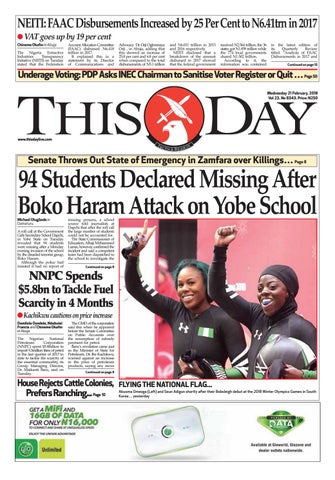
FLYING THE NATIONAL FLAG... Akuoma Omeoga (Left) and Seun Adigun shortly after their Bobsleigh debut at the 2018 Winter Olympics Games in South Korea… yesterday
2
T H I S D AY ˾ Ͱͯ˜ ͰͮͯͶ
T H I S D AY ˾ WEDNESDAY FEBRUARY 21, 2018
3
4
T H I S D AY ˾ Ͱͯ˜ ͰͮͯͶ
T H I S D AY ˾ WEDNESDAY FEBRUARY 21, 2018
5
6
T H I S D AY ˾ Ͱͯ˜ ͰͮͯͶ
T H I S D AY ˾ WEDNESDAY FEBRUARY 21, 2018
7
WEDNESDAY, ͺ˜ ͺ ˾ T H I S D AY
8
PAGE EIGHT
Senate Throws Out State of Emergency in Zamfara over Killings Misau: Security agencies lack capacity to stop carnage Damilola Oyedele in Abuja The Senate on Tuesday rejected a motion calling for the declaration of emergency rule in Zamfara State over the bloodletting in the North-west state of the country. The Senate also rejected a prayer urging the State Governor, Mr. Abdulaziz Yari, to sit back in the state to tackle its worsening security situation. Reviewing the recent killing of 41 persons in Zurmi Local Government Area of the state by bandits, the upper legislative chamber said the situation had not degenerated to warrant the suspension of a formal apparatus of state, choosing however to mandate its Ad-hoc Committee on the Review of Security Infrastructure to visit the communities affected by the bandits’ attacks, as part of the efforts to gather more information and proffer solutions to the deteriorating
security situation in the country. The motion was brought by Senator Kabiru Marafa (Zamfara APC) during a debate on the incessant killings in the state. Marafa, who has been at loggerheads with Yari, accused the governor of being 'fully aware' and being a part of the problem. "As we move on, the facts will emerge," Marafa said, adding that Yari claimed to have had intelligence reports on the impending attacks, but chose to travel out of the state at the time of the incident. An agitated Marafa pointed out that: "The governor said he reported to security agencies. I want this investigated. Who did he report to? And who gave him the report?" According to the senator: "By his admission, he was persuaded by one of his colleagues, to cut short the national assignment to pay condolence visit (to the Emir's
palace), but he did not even visit the affected communities. How can you say this man does not have a hand in it?" Marafa alleged that Yari travelled abroad after the condolence visit to the Emir, and was not on hand to receive the delegation from the federal government that came to commiserate with the victims of the attack. Senator Tijjani Kaura, who is also from Zamfara and a staunch supporter of the governor, however, frowned at Marafa's posture. Kaura, who sponsored the initial motion seeking more action on the killings, said Marafa was more interested in apportioning blames rather than seeking solutions to the problem. "We have passed that level of apportioning blames. All we are doing today is to look for solutions," he said, explaining that the governor had taken
necessary steps to enhance security, including spending over N15 billion for security and logistics. "All the security agencies are in Zamfara State. Let these people go and fight (the bandits). The governor is my master, and the master of everyone in the state; unless you want to denounce your citizenship of Zamfara," Kaura said. Senator Rabiu Kwankwaso (Kano APC) said it was necessary for the government to determine who the killers were, and why they were killing Nigerians. "First of all, we need to find out who these people are? Are they Boko Haram? Are they armed robbers? We need to find out why they are killing the good people of our great country," Kwankwaso said. He urged all tiers of government to allocate more resources and time to security.
Contributing to the motion earlier, Senator Isa Hamman Misau (Bauchi APC), expressed lack of confidence in the ability of the security agencies to stop the killings in Zamfara and other parts of the country. He said: "Our security agencies do not have the capacity to stop these attacks. For over six months, we have been talking about the same thing." Misau added that the police is completely incapacitated to provide security as most of its personnel have been deployed to cover private individuals. "The Chairman, Police Service Commission, Mike Okiro, said last week that 150,000 policemen are not serving the country, but private individuals. Do the maths, if we have 350,000. Also two weeks ago, a serving AIG (Assistant Inspector General) said only 20 percent of the entire personnel are serving the public," Misau
said. He stated that the leadership of the security agencies was incompetent to deal with the security challenges. "You cannot give a taxi driver an aircraft to fly and come out to say you have defeated Boko Haram. The following day, Boko Haram would kill 20 people. If you have defeated Boko Haram, we will know," he said. Several lawmakers contributed to the debate and called for more collaboration between the security agencies and politicians despite their political affiliations. Deputy Senate President Ike Ekweremadu, who presided, said the protection of the sanctity of the lives of Nigerians should be a top priority for the government. Any government that abdicated that responsibility, would have failed, Ekweremadu said.
call, 610 out of the total number of 704 students have returned. The school was still searching for the remaining 94 students,” adding: “We cannot really say if the students were abducted by the insurgents or fled.” According to the source: “One thing I can say is that they went into the students’ hostel and many of these students scaled the fence
to the bushes. For now we cannot say if they escaped home or have been abducted by the terrorists.” He said one of the reasons, the school could not yet tell of the whereabouts of the missing students, was because some parents had reported to the school authority that their children had reached their homes safely. He said the school was
currently calling on parents to help the school update its list by reporting cases of their wards reporting home. The insurgents had, during the attack, carted away food items from the government girls’ college. It was learnt that the sporadic firing had made many of the student to flee into the bushes around the school.
738, 086.4 as at 25th April, 2017. According to Senator Dino Melaye (Kogi APC), who sponsored the motion, there are several questions regarding the account, which needed to be determined. These include the objectives of the account, the signatories to the account, the sources of the fund and whether the account is known to the federal government.
make the sacrifices that are essential for these things to happen. “Sometimes, it is a pricing issue. We have got to get to a point where we got to deal with some of these issues in a manner that doesn’t hurt our people but at the same time create the level of efficiency as to remove arbitrages and patronages that are inbuilt in them.” He added: “Refineries and local production are key. We expect a 12 to 18 months corridor of construction and hopefully, at that point, we would get our refineries back. However, if we get refineries back by 2019, does that solve the problem? No, it doesn’t. You still have to deal with the pricing issues, because nobody is going to build a refinery and sell products at a loss.” Kachikwu, also disclosed that even with this in mind, the federal government would be setting parameters and incentives for building refineries in the country. According to him, this is to ensure that a typical producer, especially the small level producers are able to see enough incentives to be able to get some of their products refined in-country and then export if possible. “That is the major policy directive. There are going to be incentives for those who are doing the major practical investments in the refineries
for example. There is not a dearth of opportunities in this country. I do not know of any country with the vast opportunities that Nigeria possesses,” he explained. He argued that there was actually no reason why oil companies would do their business in Nigeria and take 100 per cent of the crude oil produced out of the country. According to the minister:
94 STUDENTS DECLARED MISSING AFTER BOKO HARAM ATTACK ON YOBE SCHOOL attack. He said: “The team is profiling the students to know those who are missing? And, how many of them were able to return or ran to their families at home.” But the Yobe State Police Command on Tuesday insisted that no case of abducted girls had been reported to it since the attack on the school. The Commissioner of Police,
Mr. Sunmonu Abdulmaliki, said he had, however, begun investigations into the matter. He said, three men were reportedly abducted by the insurgents in a remote community in Geidam Local Government Area after the attack on the girls’ school. “We are still collating the details on the attack, census of the girls and the general public,” he said, adding that
no casualty was recorded in the attack that involved sporadic gunshots into the air by the insurgents. The source that spoke to journalists on the attack said he was not able to say categorically if the missing students were abducted by the terrorists or fled as a result of the invasion of their school by the insurgents. He said: “After the roll
NNPC SPENDS $5.8BN TO TACKLE FUEL SCARCITY IN 4 MONTHS in that direction would have to be taken with utmost caution. Speaking on Tuesday at the ongoing Nigeria International Petroleum Summit (NIPS) in Abuja, the minister also said that while fixing the local refineries and encouraging private investors to build new ones would help to reduce the pressure around pricing of fuel, he explained that those alone would not solve the problem of scarcity unless the cost of production of crude was substantially reduced. But appearing before the Senate committee on Public Accounts, Baru, who was represented by the NNPC’s Chief Operating Officer (Finance and Accounts), Mr. Abdulrazaq Isiaka, said the corporation had resorted to massive importation of PMS, to ensure adequate supply to stop the lingering queues. He added that the NNPC had to embark on massive importation as oil marketers had been unable to fill their quota, due to the differentials between landing costs and the regulated selling price of PMS. He explained: “For one year, marketers avoided importing fuel because they incurred losses. The private sector cannot bring in the product because it does not make economic sense for them. They cannot land it at a price for which they are going to sell and cannot make profit. That is the main reason
they are not bringing in the product. “As a national oil company, the NNPC is that supplier of last resort and we must take that responsibility where the private sector that is profit driven runs away from a particular business. The economics is that if you bring in the product into Nigeria, you will make a loss, if there was profit in this business, the private sector would have been the ones bringing in this product. “NNPC was not designed to bring in the product 100 per cent; they have stepped out, but we have a national responsibility that Nigeria does not suffer and that is the role the corporation is playing by bringing in the product.” The Executive Secretary of the Major Oil Marketers Association of Nigeria (MOMAN), Mr. Obafemi Olawore, in his submission to the committee, however, said his members would resume importation of the product, as soon as the government pays their subsidy claims from 2013-2015. Olawore was silent on the actual debt owed to the marketers, but the claims had been put at about N800 billion. “Our members are incapacitated and cannot import fuel due to nonpayment of the arrears and interest on subsidy to banks
by the federal government. The banks are always adding their interest at the end of every month. We had a promise from the Central Bank of Nigeria (CBN) that the aspect of interest will be stopped at a certain period of 2017 but that did not come to pass, so the banks at the end of every month are charging us interest,” he said. He disclosed that two major marketers were able to import fuel into the country in 2017 for some specific customer needs, because they have foreign affiliates who could cover them in terms of dollar coverage. The Chairman of PAC, Senator Matthew Uroghide, said the committee was committed to helping to ensure accountability in the sector. He, however, queried the NNPC for inputting subsidies paid on PMS, into operating costs, instead of it being a line item. In another development, the Senate also mandated its Committee on Public Accounts to carry out a holistic investigation into the operation of an account bearing NNPC/ Nigerian Agip IPP security account. The account, which is allegedly domiciled with the First Bank Nigeria Plc with account number 2006367288, has an opening balance of N31, 704, 807, 979.2 with a closing balance of N34, 423,
Kachikwu Cautions on Price Increase of Petrol Speaking at the NIPS in Abuja, Kachikwu emphasised that Nigeria would have to urgently address extant issues surrounding the pricing of petroleum products in her downstream market, noting that unless that was done, it would be difficult to expect a comprehensive solution to the downstream sector challenges. The minister, however, stated that any attempt to review the prices of petrol or any other petroleum commodity in the country would require a lot of care to ensure that people were not made to suffer unduly. He said: “Ultimately, the greater challenge that this country would have and still have is that of pricing. Everybody wants power, available gas and freely delivered fuel with no queues, but people are not willing to
Continued on page 10
TOP GAINERS PZ CADBURY LIVESTOCK AIICO REDSTAR TOP LOSERS CONOIL UNITYBANK STERLBANK
NGN NGN 1.15 24.15 0.75 15.85 0.05 1.10 0.03 0.70 0.25 5.75 NGN NGN 3.80 35.50 0.15 1.48 0.18 1.81 DIAMOND 0.23 2.47 FBNHOLDINGS 0.85 10.85 HPE Nestle Nig Plc ₦1,30.00 Volume: 287.175 million shares Value: N4.631 billion Deals: 5,757 As at yesterday 20/02/18 See details on Page 39
% 5.0 4.9 4.7 4.4 4.3 % 9.6 9.2 9.0 8.5 7.2
T H I S D AY ˾ WEDNESDAY FEBRUARY 21, 2018
9
WEDNESDAY, ͺ˜ ͺ ˾ T H I S D AY
10
NEWS
House Rejects Cattle Colonies, Prefers Ranching James Emejo in Abuja The federal government’s policy of creating cattle colonies as the solution to the incessant bloody clashes between herdsmen and farmers suffered a major defeat in the House of Representatives on Tuesday as the lower chamber voted against it in preference for ranching. In a motion entitled: “Need to Educate and Encourage Herdsmen on the benefits of Ranching instead of the Proposed Cattle Colonies in every State of the Federation,” sponsored by Hon. Mohammed Ogoshi Onawo (Nassarawa State), members urged the federal government to work with interested states to establish ranches for the purpose of breeding cattle and other livestock. The House asked the Federal Ministry of Agriculture and Natural Resources to liaise with state ministries of Agriculture to also educate and encourage herdsmen on the benefits of ranching while mandating its Committee on Agriculture Production and Services to ensure the implementation of its motion. Following the incessant bloody clashes between herdsmen and farmers, states had considered outright
banning of open grazing by livestock. Specifically, Ekiti, Benue and Taraba States had promulgated laws outlawing open grazing and requiring livestock owners to ranch them. The law had been opposed by nomadic cattle breeders who complained that it would adversely affect their business. In Benue and Taraba States, for instance, there had been armed resistance to the law by militia herdsmen, leading the Minister of Agriculture and Rural Development, Chief Audu Ogbe, to propose the cattle colony policy. Faced with sustained opposition to the policy, the Vice President Yemi Osinbajo had clarified that the federal government had no intention of imposing the policy on the states, saying that only willing states would be approached for land for its implementation. Notwithstanding this clarification, Onawo still moved his motion on Tuesday, urging the House to ask the federal government to bury any thought of the cattle colony policy. Recalling that most of those clashes that had occurred between herders and farmers, particularly in Benue State were caused by the herdsmen's invasion of
farms in search of pasture for their herds, he called for appropriate measures to end the harmful nomadic practise. He said: “The House notes the incessant clashes between herdsmen and farmers that have presented serious security challenges in Nigeria; “Aware that the grazing practice of the herdsmen is not only exposing them to danger as they fall prey to cattle rustlers and kidnappers, but also results in conflicts with farmers whose crops are trampled upon by the cattle; “Also notes the Federal Government’s proposal to establish cattle colonies in every State in Nigeria to cater for the herdsmen and their cattle as a lasting solution to the continuous clashes which, in most cases, result in senseless and avoidable loss of lives and properties; “Concerned that the decision to establish cattle colonies in each State could be in violation of Section 42 of the Constitution of the Federal Republic of Nigeria, 1999 (as amended) and the Land Use Act as those colonies will remain the exclusive reserve of the individual State governments and as such, would not guarantee total freedom to the herdsmen; “Observes that cattle rearing is not an exclusive reserve
of the Fulanis as other tribes also engage in the business; “Determined to provide a lasting solution to the incessant conflicts between herdsmen and farm owners, hence modern breeding practices should be encouraged; “Convinced that ranching will offer longer lasting solution to the recurring conflicts between herdsmen and farmers, if the herdsmen would be fully sensitized and educated about the benefits of the program, as it would enable them assume full ownership of those ranches”. Members who contributed to the debate agreed with Onawo on the harmful nature of nomadism and suggested that ranching was the viable way out of the crises. “Ranching is the best practice all over the world. We cannot continue to witness these incessant killings,” Hon. Ezikiel Adaji (Benue State) said. Another member, Hon. Peter Akpatason (Edo State) argued that cattle rearing was a private business, which should adversely affect other people’s business, contending that it ought to be regulated by law. In his own contribution, Hon. Femi Fakeye (Osun State) called for a cultural
A cattle ranch shift, saying that herdsmen needed to be enlightened on the benefits of ranching, a position supported by Hon. Joan Onyemachi Mrakpor who warned that unless care was taken nomadism could divide the country. “Until we come to make ourselves know that this cattle business is another business, it is going to divide this country,” he cautioned, adding: “When there is a challenge in the homes, the best thing to do is to find solution.” He added: “All over the world, the solution is
ranching. We travel abroad, we see it. I don’t think ranching is the problem. It is the willingness to do ranching.” Not all the members supported ranching as Hon. Nasiru Ahmed (Kano State) opposed the motion, arguing that ranches would be more expensive for the herders as prices of feed were high. The House, however, passed the motion and asked its Committee on Agriculture Services to conclude its assignment and report back for further legislative action within eight weeks.
economic recession Nigeria got into. He said: “The standing view we have in Shell is that if we feel the asset is not safe then we shut it down. Sometimes at great economic cost that requires great discussions with our partners but we will shut it down. Through the years we have invested quite a bit in pipeline replacements, huge huge spending on asset integrity. “You and I living in that part of the world know that when you actually look at it is actually less than 10 per cent, maybe five per cent of these spills are as a result of operational failures well over 90 per cent of what we are seeing is as a result of theft and sabotage to facilities. This is this biggest issue that confronts us in the Delta today.” He added: “In 2016 many of us in this country saw what happened in the western Delta, when our export line was sabotaged, this is one of the biggest
reasons why this country went into recession, close to 300,000 barrels per day of oil was taken out at the time when oil prices were at historic lows and it cost us well over $100 million to actually replace that line. “This problem is real and we will not hide as operators in ensuring that we continue to operate in the best international standards.” Other panelsits at the session where Okunbor spoke were Jeffrey Ewing, Managing Director of Chevron Nigeria, Nicolas Terraz, Managing Director of Total E&P Nigeria Limited (TEPNG), Paul McGrath, Managing Director of Mobil Producing Nigeria (MPN) and Esso Exploration & Production Nigeria Limited (EEPNL), Olalekan Akinyanmi, Chief Executive Officer, Lekoil, Tony Attah, Managing Director, Nigeria Liquified Natural Gas (NLNG), and Massimo Insulla, Vice Chairman and Managing Director of Nigeria Agip Oil Copany (NAOC).
revenues of N464.5 billion in 2017, followed by N325.1 billion shared among the 774 local governments, while the federal government received the lowest share from VAT proceeds with N139.3 billion. It noted that this is on the account of the fact that states take 50 per cent of VAT, while LGAs and the federal government take 35 per cent and 15 per cent respectively. The NEITI review also attributed this development to increased revenues from oil and gas sector as a result of rising oil prices and improved crude oil production due to stability
in the Niger Delta. On Paris Club loan refunds, the review disclosed that the 36 states received N760.18 billion. “The refunds were released in two batches of N516.38 billion and N243.79 billion respectively. A breakdown showed that Rivers State got the highest amount of N44.925 billion while Gombe State received the lowest sum of N13.4 billion,” it said, adding that the quarterly review was designed to provide timely information and data on FAAC disbursements to the three tiers of government.
94 STUDENTS DECLARED MISSING AFTER BOKO HARAM ATTACK ON YOBE SCHOOL “What are they doing with it? They are going to take it to refineries; they are going to crack them somewhere. If there are incentives for them to crack them here, they would do so. Ultimately, Nigeria must aim to be the refining corridor for the whole of Africa. That is becoming very critical. “If we do all that concerning the planned investments in refineries, my position is that the business has got to change. It has got to change to taking your crude oil and been able to refine. It has got to change to be a major player in the power sector. It is got to change from oil, into gas and into clean energy. We have got to look into moving incentives away from oil, back into gas and back into cleaner energy.”
NBS: 17.31bn Litres of PMS Imported in 2017 Meanwhile, a total of 17.31 billion litres of petrol were imported into the country in
2017, the National Bureau of Statistics (NBS) has revealed in its Petroleum Products Import Statistics – 2017. It also emerged that Nigeria imported approximately 22.5 billion litres of refined petroleum products in 2017. Within the first three months of the year in review, Nigeria also spent $2.49 billion on the importation of refined petroleum products. The report also showed that 4.28 billion litres of automotive gas oil (AGO) or diesel, 340.33 million litres of household kerosene (HHK), 592.73 million litres of aviation turbine kerosene (ATK) and 15.61 million litres of low pour fuel oil (LPFO) were imported into the country in 2017. The months of July and August 2017 recorded the highest volumes of premium motor spirit (PMS) imported into the country at 1.88 billion litres while the highest volume of automotive gas oil (AGO) and household kerosene (HHK) were
imported in March and April 2017 respectively. The petroleum products importation statistics also reflected state wide distribution of truck-out volume for 2017 showing that 18.36 billion litres of premium motor spirits (PMS), 4.75 billion litres of automotive gas oil (AGO), 944.39 million litres of household kerosene (HHK), 554.61 million litres of aviation turbine kerosene (ATK) and 127.42 million litres of low pour fuel oil (LPFO) were distributed nationwide during the period under review. Nigeria is grossly challenged by refining capacity with 14 per cent average in-country refining capacity. Kachikwu had said on Monday that the government was considering a new move that would have the multinational oil and gas firms build refineries in Nigeria. He said in the not-toodistant future, multinational oil firms would no longer
be allowed to ship out all the crude oil they produce in Nigeria, adding that emphasis would then shift to local processing of a substantial amount of crude oil that is produced from oil fields in the country.
Shell: $100m Spent on Forcados Pipeline Repairs Meanwhile, the Managing Director for Shell Petroleum Development Company, Mr. Osagie Okunbor, has disclosed that the company spent $100 million to repair the Forcados crude oil pipeline in the Niger Delta region which was vandalised by militants in 2016. Okunbor, explained during one of the NIPS executive roundtable session at the titled: ‘Growth Outlook and Strategies for staying competitive after a Global Downturn’ at the NIPS, that the break on the pipeline resulted in the loss of 300,000 barrels per day (bd) of oil at that time, which according to him contributed to the
NEITI: FAAC DISBURSEMENTS INCREASED BY 25 PER CENT TO N6.41TRN IN 2017 Projections for 2018”. The review, it explained noted that despite the fact that FAAC disbursements increased in 2017 over the preceding years, they were still 34.1 per cent and 25.3 per cent lower than total disbursements of N9.742 trillion and N8.595 trillion in 2013 and 2014 respectively. The NEITI review attributed the revenue increase in 2017 to rising crude oil prices, improved oil production, and paying greater attention towards the development of non-oil revenue sectors. It projected brighter prospects in 2018
as a result of the current oil price which recently hovered around $70 per barrel, in addition to upsurge in oil production. A state-by- state breakdown of the FAAC allocations in 2017 by the review showed that Akwa Ibom State received the highest share of 143.6 billion, followed by Rivers State with a total allocation of N119.6 billion. Delta State came third with a total allocation of N111.2 billion in 2017 while Bayelsa State got N105.3 billion to take the fourth position. On the other hand, Osun State received N10.4 billion to take
the lowest position of FAAC within the year under review. “Another striking feature of the latest NEITI review of FAAC allocations is the disclosure that the third quarter of 2017 recorded highest revenues of N1.929 trillion, while second quarter recorded the lowest revenues of N1.377 trillion,” the statement added. It also revealed that revenue disbursements from Value Added Tax (VAT) have been on the increase since 2015. “The increase is an indication of a positive signal in recognition of the
government’s policy towards the development of non-oil sectors through sustained revenue generation from services. “VAT disbursements in 2017 were N967.7 billion and N811 billion in 2016. This represented an increase of 19.3 per cent in 2017 over the figures for 2016. Also, total VAT disbursements in 2015 were N778.7 billion. This represented an increase of N188.9 billion (24.3 per cent) over the 2015 figures,” said the NEITI. It explained that from the review, the 36 states received the highest share of VAT
T H I S D AY ˾ WEDNESDAY FEBRUARY 21, 2018
11
12
T H I S D AY ˾ Ͱͯ˜ ͰͮͯͶ
T H I S D AY ˾ WEDNESDAY FEBRUARY 21, 2018
13
14
T H I S D AY Ëž Ëœ Í°ÍŻËœ Í°ÍŽÍŻÍś
COMMENT
Editor, Editorial Page PETER ISHAKA Email peter.ishaka@thisdaylive.com
TRIUMPH OF HUMAN SOLIDARITY Let’s reach out to those in need, writes Sonnie Ekwowusi
O
ne of the greatest obstacles to human flourishing is the drifting apart of the rich and the poor into separate worlds. As we struggle to live with multiple perceptions of the truth, we should aim at building one world rooted in common humanity. We cannot have two worlds, one for the rich and another for the poor. We should seek to have one world. One love, as reggae legend Bob Marley is wont to sing. One humanity. Unfortunately we live in an age in which unbridled individualism and egocentrism have become statecraft. To rid our age of these, it is imperative that we establish a broader consensus about the meaning of humanitarianism, and about its role in the promotion of human welfare. To achieve this, there is need for identification of common values from which to erect an ethical framework for human solidarity. In identifying this ethical framework for human solidarity, the pitiable situation of the sick particularly merits top priority. We have to build a strong solidarity for the welfare of the sick. We must set out in earnest to set up formidable blocks of social institutions to alleviate the sufferings of the sick in our midst. No man is an island unto himself. We cannot live in our little cocoons unmindful of the plight of the sick in our midst. If man is said to be a social animal he should always socialise with his neigbours to hearken to their assistance in times of need. Is it not puzzling that despite all our material wealth and scientific mastery and technological breakthroughs we are still surrounded by hundreds of thousands of sick people? Therefore the sick in our midst should move us to pity to team up with others to alleviate their suffering. The successful kidney transplant surgery which Leonard Dibia underwent recently was the outcome of human solidarity. Leo is a public-interest litigation lawyer. He is a Director of Programmes in a justice advocacy organisation. Since qualifying as a lawyer, Leo has developed a certain irresistible likeness for public-interest litigations. Therefore he decided to build his professional career around public-interest litigations. Leo played a key role in bringing about reforms in the rules for the enforcement of fundamental rights, ensuring courts can respond more speedily to claims of abuses. Through various public-interest litigations, Leo fought impunity in the delivery of law enforcement services, winning several judgments for victims of human rights abuses in Nigeria. But unfortunately a few years ago Leo was diagnosed of a kidney failure. The doctors said that Leo needed a kidney transplant or replacement to stay alive. Therefore Leo was billed to go to India to undergo the transplant. But as things turned out, he could not rake up the huge amount of money needed for the transplant. Therefore he solicited for financial assistance from well-wishers to enable him travel to India to undergo the surgery. In response to the financial appeal, Leo’s professional colleagues, friends, acquaintances, relatives and alumni association and Nigerian Bar Association (NBA) hearkened to the assistance of Leo. The good news today is that
WE CANNOT LIVE IN OUR LITTLE WORLD UNMINDFUL THAT THERE ARE PEOPLE OUT THERE WHO NEED OUR ASSISTANCE IN ONE WAY OR THE OTHER
Leo has successfully undergone a kidney transplant in India and is back to Nigeria hale and hearty. This, in my view, is a triumph of human solidarity. Another demonstrated human solidarity took place at the Lagos University Teaching Hospital (LUTH), Idi-Araba, Lagos a few weeks ago. The Friends of the Sick International, a Lagos-based NGO that caters for the sick in hospitals, had invited me to accompany its members to pay a visit to the sick at LUTH. One of the wards which we visited was the Female Ward. Asked whether she was resting properly and sleeping well at night, one of the patients told us that rats that looked like rabbits had invaded the ward and robbing the patients of their sleep. I sat on one of the empty beds. But one of the nurses walked up to me and warned me that the patient who was previously occupying the bed I was sitting had died the previous night. I quickly got up and made the sign of the cross. As we were leaving the ward, a middle-aged patient occupying the bed opposite us, a stranger to me, beckoned me to come closer. After the initial hesitation, I summoned up the courage to approach her. When I got close to her she whispered to me that she was very hungry. She narrated how her husband who had promised to pay for her weekly meals at LUTH had absconded. After she finished unburdening her sorrow, tears rolled down my cheeks. I dipped my hand into my right pocket, unruffled a worn-out N1000 note which I placed on her palm. On sighting the money, her face lit up. She smiled. We left LUTH premises in silence after being exposed to the sufferings of the people. On February 8, 2018, I attended the Christian wake and Service of Songs organised in honour of the late Mrs. Nkiruka Justina Okeke (Nee Umeh) at the Eagle Club, Main Hall, Surulere, Lagos. On arriving at the hall, I noticed that it was brimming with men and women from different walks of life who had come to pay their last respect for Nkiru. This lady, I gather, lived a useful life. She lived for others. But she was felled by a breast cancer at age 45. The consoling aspect, however, is that shortly before her demise, her uncle quickly invited a Catholic priest who gave her Holy Communion as well as administered the last Sacrament on her. This is human solidarity par excellence. We cannot live in our little world unmindful that there are people who are out there who need our assistance in one way or the other. We cannot keep on bemoaning on Facebook, Instragram, WhatsApp and other social media that things are bad in Nigeria without lifting a finger to find a solution to the problems around us. The other day I saw a group of passers-by gathering up some sands and stones by the roadside and covering up a pothole on the road. The social service a government could not render, a group of conscienctious citizens rendered within the bat of an eyelid. This is impressive. We cannot allow the transcendence perception of our common humanity to be dulled by individualism. We have to open up. We have to reach to others especially the sick.
IGP, SECURITY AND JUSTICE Rabiu Garba argues that Ibrahim Idris book, Security and Justice, is a contradiction in terms ‘’He who must come to equity must do so with clean hands�
A
pparently basking in the euphoria of the large turnout of personalities at the launch of his book: “Security & Justice: The Pathway for Peace and Reconciliation in Nigeria’’, the Inspector-General of Police, Ibrahim Kpotun Idris, who was full of smiles and used the occasion to sermonise on the need for justice as a prerequisite for peace and national integration. While watching him on Channels Television pontificate on the concept of justice, I saw hypocrisy writ large. With all due respect, the records of the IGP’s service so far do not seem to be in conformity with the message he is trying to pass across to his readers in that book. It is more of, ‘do as I say, but not as I do’. When he was appointed as acting InspectorGeneral of Police and later confirmed as a substantive one, he appeared fulfilled, but not jubilant. As a matter of fact, considering some alleged issues underpinning his emergence, Idris cuts a pitiable picture of a bride or groom in the church who fears that the priest might call off the wedding because of a last minute objection from a former lover. Since he assumed office, the IGP has allegedly been behaving like the lord of the manor, waving his supposed moral credentials
like a talisman, even when it is patently clear that it is all a make-belief; probably hyped to bamboozle unwary members of the public. Even a few Nigerians who had initially invested their hopes on him that he has the wherewithal to positively turn things around in the Nigeria Police are today biting their fingers in considerable regret because he has allegedly disappointed them, so much so that his critics are already whispering in hushed tones that he has become a huge burden to the administration of President Muhammadu Buhari, a renowned anti-corruption crusader whose integrity is well known and respected worldwide. In that book that was launched with fanfare, the author, talked glowingly about reconciliation, stressing that justice is where there is the same application of standard or yardstick as stipulated by law to all, no matter their socio-cultural differences. He also went further in chapter three to review the contributions of justice to reconciliation. Wonders, it is often said, shall never cease. Is it this same IGP who has established a reputation for selective justice that is talking about justice, peace and reconciliation? Or has he forgotten that peace cannot thrive in the absence of justice? How can he be talking about justice when he chooses which court judgment to obey and which not to obey? Out of several court orders that the IGP has allegedly disobeyed, that of the Peace Corps of Nigeria (PCN) stands out like a totem pole.
A brief recap of the tango between the police under Idris and the PCN since last year will convince even a drooling imbecile that the IGP is not as upright as he claims to be and as such must be told in no uncertain terms to climb down from his moral high horse. It would be recalled that while the Nigerian Peace Corps (Establishment) Bill was receiving legislative attention, the IGP, allegedly in one off-the-cuff moment, disclosed that instead of the federal government to increase police allocation, it was considering taking over Peace Corps of Nigeria. Thereafter, he allegedly vowed to clamp down on the corps, a promise that was fulfilled on Tuesday, February 28, 2017, when the new corporate headquarters of the corps was sealed-off after a successful commissioning ceremony that was attended by the crème de la crème of the society. And the police have ensured that the office remained under lock and key till date. And the IGP who is now talking glibly about justice, peace and reconciliation has paid deaf ears to orders of Justices Gabriel Kolawole ( November 9, 2017) and John Tsoho ( January 15, 2018) that the office be immediately unsealed. Acting as if he is above the law, he has also thumbed up his nose at the series of letters written to him by the Attorney-General of the Federation and Minister of Justice to comply with the two court judgments. Another issue that has made the IGP’s continued stay in office irksome is his open
partisan role in the farmers and herdsmen clashes in Benue State, which he said was as a result of the implementation of the anti-open grazing law. The unfortunate claim by the IGP indicates that some of those saddled with the responsibility of protecting lives and property and maintaining law and order have abdicated their duty and become accomplices with those undermining the very existence of the country. Under Ibrahim Idris leadership, the Nigeria Police was rated as the worst Police in the World by the World Internal Security and Police Index (WISPI) last year. Surprisingly, Nigeria Police was rated behind countries like Rwanda, Zambia, Sierra Leone, Uganda, Congo DRC, etc. It is also under Idris leadership that a Public Relations Officer will have the audacity of calling a sitting governor names without been reprimanded. Yet, in spite of all his glaring failures, the police authorities have continued to offend the sensibilities of Nigerians through paid adverts, which are aired daily on prime time network of NTA on how the force has suddenly metamorphosed into an efficient institution under Ibrahim Idris leadership, which is falsehood elevated to power four. On the whole, the IGP Idris cannot be preaching the gospel of justice, peace and reconciliation on one hand, while recklessly abridging the fundamental rights of others with impunity on the other hand. Garba wrote from Minna, Niger State
15
T H I S D AY Ëž Ëœ Í°ÍŻ Ëœ Í°ÍŽÍŻÍś
EDITORIAL WHY INDIGENOUS LANGUAGES MATTER
Government must take concrete steps to protect indigenous languages by enforcing the national policy on education
A
s the world marks the 2018 International Mother Tongue Day, it is important for all stakeholders to pay attention to the growing extinction of many of our indigenous languages and the implication to the future of our country. It is all the more remarkable that this year, the day is being marked in the same week that the British Broadcasting Corporation (BBC) launches Igbo and Yoruba language services in Nigeria as part of an expansion in local languages aimed at more in-depth reporting of countries around the world. “It’s time for people to try to tell their own stories,â€? said Peter Okwoche of the BBC. To the extent that languages are the most powerful instruments of preserving and developing both tangible and intangible heritage, according to the United Nations, “all moves to promote the dissemination of mother tongues will serve not only to encourage linguistic diversity and multilingual education but also to develop fuller awareness of linguistic and cultural traditions throughout the world and to inspire solidarity based on understanding, tolerance and dialogueâ€?. ONE OF THE OMINOUS Incidentally, long SIGNS OF DANGER TODAY before the intervention IS THE INCREMENTAL LOSS by the United Nations OF OUR RICH ARTS FORMS, Educational ScientiďŹ c PARTICULAR IN MUSIC, and Cultural OrganisaDANCE AND FASHION tion (UNESCO) on AS OUR YOUTHS HAVE the promotion of TAKEN TO THE WESTERN indigenous languages, GENRE, THREATENING OUR the federal government CULTURAL IDENTITY AS had shown concerns AFRICAN PEOPLE for the plight of Nigerian languages when it sought to encourage their teaching and learning in our schools under the national policy on education. Section 1 (8) of the policy emphasises that “the Federal Government shall take ofďŹ cial interest in, and make policy pronouncements on the teaching of the indigenous languages, instead of concerning itself solely with English Language’’. Accordingly, the policy stipulates that every pupil must in the course of primary school education study two
Letters to the Editor
languages, namely, his/her mother tongue, if available for study, or any other indigenous language of wider communication in his/her area of domicile alongside English Language. The policy also requires that students in Junior Secondary School (JSS), (which is of three-year duration) must study three languages, namely, mother tongue, if available for study, or an indigenous language of wider communication in his/her area of domicile, alongside one of the three major indigenous languages in the country, namely, Hausa, Igbo, and Yoruba, provided the language chosen is distinct from the child’s mother tongue. In Senior Secondary School (SSS), which also lasts three years, a Nigerian child, according to the policy, must study two languages: an indigenous language and English Language.
A
T H I S DAY
EDITOR DEPUTY EDITORS ˜ MANAGING DIRECTOR DEPUTY MANAGING DIRECTOR CHAIRMAN EDITORIAL BOARD
EDITOR NATION’S CAPITAL
T H I S DAY N E W S PA P E R S L I M I T E D
EDITOR-IN-CHIEF/CHAIRMAN GROUP EXECUTIVE DIRECTORS ˜ ˜
˜ ˜
DIVISIONAL DIRECTORS ˜ DEPUTY DIVISIONAL DIRECTOR
SNR. ASSOCIATE DIRECTOR ASSOCIATE DIRECTORS ˜ CONTROLLERS ˜ ˜
DIRECTOR, PRINTING PRODUCTION TO SEND EMAIL: ďŹ rst name.surname@thisdaylive.com
TO OUR READERS Letters in response to speciďŹ c publications in THISDAY should be brief (150-200 words) and straight to the point. Interested readers may send such letters along with their contact details to opinion@thisdaylive.com. We also welcome comments and opinions on topical local, national and international issues provided they are well-written and should also not be longer than (9501000 words). They should be sent to opinion@thisdaylive.com along with the email address and phone numbers of the writer.
EL-RUFAI AND THE KADUNA APC CRISIS
T
he Kaduna State All Progressives Congress’ crisis has taken a new dimension with the opening up of new state office believed to have the support of Senator Suleiman Othman Sulaiman Hunkuyi. Prior to this unfortunate development,the state chapter of APC has been factionalised with the Akida group headed by Senator Shehu Sani and restoration group headed by Tijjani Ramalan who were at logger heads with the state governor.The APC aspirants forum formed by Senator Hunkuyi is the lattest one to emerge.The senator was quoted to have said,�They decided to form the forum to identify with the aspirants who are not candidates of the governor�. The deepening and worsening of political crisis in the state has come at a time Mr President constituted reconciliation committee under the national leader of the party, Asiwaji Bola Tunubu with clear mandate to tour all the APC-controlled states,reach out to aggrieved members and reconcile them.The Tinubu-led reconciliation committee will face an arduous task in Kaduna State in view of the balkanisation of the party and inability of the state governor to resolve the knotty political crisis right from the onset. The crisis as I have learnt emanated immediately governor Nasir el-Rufai picked Barnabas Bala Bantex as his running mate.Bantex was the state chairman of the party. After his nomination with other executives of the party into his admnistration, Governor El-Rrufai left the party in disarray. Even Bantex’s deputy who is supposed to fill the vacuum created by his elevation was conspicuously denied such right. Eversince, the state chapter of APC has been battling with different splitting groups with each group boosting or claiming
s we have consistently reiterated, several studies have shown a relationship between level of development and language with the attendant result that those countries that use their indigenous languages, called mother tongue, as their lingual franca have a faster rate of development than those that use a second (foreign) language. However, many schools are unable to offer these indigenous languages because of lack of teachers, a cumulative effect of several years of indifference. Obviously, the policymakers were aware of this acute shortfall when they used the phrase “if available for study� in the policy. This optional nature of the policy undermines its implementation. Since embedded in our indigenous languages is our rich culture, history, traditions, and values, government must take deliberate and concrete steps to protect them by enforcing the national policy on education with regard to learning and teaching of mother tongue. That must be the starting point because education is the base of the future of every society. One of the ominous signs of danger today is the incremental loss of our rich arts forms, particular in music, dance and fashion as our youths have taken to the Western genre, threatening our cultural identity as African people. What critical stakeholders must therefore never forget is that as our indigenous languages face extinction, so are other aspects of our culture, including history, traditions and values.
leadership of the party.Instead of resolving the crisis before it lingered, El -Rufai was busy fighting those he percieved as his political enemies. No wonder the crisis defied solution. To make matters worse, the factional chairman of the party, Alhaji Dalladi Wada, suspended three powerful El-Rufai boys from the party for alleged anti-party activities.The new leadership also slammed charges against the executive governor and queried him to answer all the charges within 48 hours. Having failed to respond to the query,the governor is said to have been suspended for six months.The governor’s suspension came barely three days the main factional leadership suspended Hunkuyi for six months.The crisis of this multi-dimensional nature demands expedient solution.From how things unfolded, if not fully resolved,the crisis would affect the party’s chance in 2019 general election.There is no way the party can win election with a divided house.The governor should take the blame because he has failed to convene reconciliation meeting at the instance of those who felt they are being sidelined. As a leader of the party in the state, the governor cannot stand aloof watching his party deeply enmeshed in crisis without offering quick intervention. The Bola Tinubu-led reconciliation committee should reach to the aggrieved factional leaders with a view to resolving the unending crisis in the leadership of the party.The governor should put his ego aside and act as an unbiased leader. He should know the success of the reconciliation lies on him. And, it can only be achieved if he accepts his mistakes and accommodate all party members without discrimination. Ibrahim Mustapha Pambegua, Kaduna State
ALMAJIRI EN MARCHE
E
mmanuel Macron’s political movement is known in France as “en marche,� meaning “On the Move.� It was that “move-along� mentality that swept young Macron to the French presidency. Over here in Nigeria, specifically in Kano State, we are witnessing a cascading movement of that sort underpinned by the street urchins known as “almajiri.� The Governor of Kano State, Abdullahi Ganduje, takes great pleasure in revelling in the fact that “three million school-age children� are not enrolled for the proper kind of education in Kano State yet this governor, a PhD holder, does not do anything about this state of affair. After the conclusion of the last ward and council elections in Kano State, we know the reason why this governor has not invested in compulsory, state-wide primary education. The video-shots of under-aged almajiri urchins gleefully thumb-printing blank ballot papers and screaming “sai APC, sai APC� are sickening indeed and this was the height of deceit and desperation by the APC corpus of Kano State and this is an indication of how the 2019 general elections could be decided. Yet it is the APC that go a-flaying and a-muzzling, creating the impression in the minds of illiterate and semi-literate Nigerians that the PDP is “corrupt.� Now, Gov. Ganduje of Kano State has found a good use to which he may put those three million out-ofschool almajiris. Sunday Adole Jonah, Department of Physics, Federal University of Technology, Minna, Niger State
16
T H I S D AY ˾ Ͱͯ˜ ͰͮͯͶ
T H I S D AY ˾ WEDNESDAY FEBRUARY 21, 2018
17
T H I S D AY ˾ WEDNESDAY, FEBRUARY 21, 2018
18
MIDWEEKPOLITICS
Group Politics Editor Tobi Soniyi Email tobi.soniyi@thisdaylive.com 07054786260 SMS ONLY
THE NEWSMAKER
Ikpeazu’s Silent Revolution in Abia Segun James looks at the efforts of Governor Okezie Ikpeazu of Abia State to make Aba the industrial hub of the nation
D
iversify or die is the current mantra among the states in the federation following the debilitating state of the Nigerian economy. To them, the season where the country continues to depend on oil money is over. Although many state executives in the country have pledged their readiness to diversify their states economy, only a few of them are taking concrete steps to achieve it. Yet, in the face of declining allocations from the federal government, diversification remains states’ best bet. But as it has always been the case in Nigeria, we know what to do, but doing it has always been the problem. Today, apart from Lagos and to some extent Ogun, Abia under Dr Okezie Ikpeazu, is one state that has taken concrete steps towards the realisation of the plan to reduce its dependency on the federal allocations. After many years of being mooted as the next big thing in global economy, (the country was listed among the MINT states – (Mexico, India, Nigeria and Turkey), the country has gone from grace to burst, all within the last four years. No thanks to the unsteady oil price with its debilitating effects on the economy. Poor management of the economy by successive governments has not helped matters too. It is in the midst of this general slowdown in the Nigerian economy, an industrial revolution is taking place east of the Niger; the effort by the Abia state government to make Aba, the industrial hub of the nation and the West Africa subregion. It is the dogged determination of Dr. Okezie Victor Ikpeazu, the Abia state governor to turn Aba into the Silicon Valley of Nigeria that is now propelling the revolution. The governor is determined to, within the next three years; generate 90 per cent of Abia’s revenue internally Abia State Governor, Dr Okezie Ikpeazu generated. Over 80 per cent of that he insisted Abia. Their remit will include ensuring that it would come from the Aba industrial hub. The efforts have begun to yield positive results. becomes easy to do business in our state and Mr. Eziuche Ubani, the state commissioner accelerate the rate of investment attraction.” Since most of the raw materials are agriculture for works, said that in his bid to ensure the realisation of this dream, the governor was not based, the government has created agric belt all leaving anything to chance. He said the governor over the state. In three years, the state is now had practically relocated to Aba from where he a major producer of cocoa, rubber and palm comes to the state capital, Umuahia every day. produce; in addition to cassava. The goveror said: “My government has actively According to Ubani, a two-term member of the House of Representatives and former editor engaged in and supported agricultural activities at THISDAY Newspapers, as part of efforts to especially in mechanised farming of cassava, rice ensure that the hub is serviced by the raw and palm oil; in line with the federal government’s materials needed to keep functioning,, the state programmes and our state’s areas of natural government has embarked on the construction advantage. This is in addition to the creation of of at least, 10 kilometres of roads in each of a Commodity Marketing System with which we the 17 local government areas of the state. In will support our small farmers through organised the last three years, over 53 roads in all parts cooperatives, agricultural extension services and of the states, but with majority linking Aba, partnerships with foreign donor agencies and have been constructed by the state government. development financial institutions.” Since industrial development and capacity have Ubani said that the industrial hub dream was already becoming a reality. This was corroborated a lot to do with level of education attainment by the governor who said that “our story as a by the people, not so surprising the government people is one of entrepreneurship, resourceful- has taken this into consideration by creating ness and diligence. This is our pride. We have an “education belt” which will concentrate on astounded the world with our home grown the study and teaching of science, technology, technical skills, especially during a period of engineering and mathematics (S.T.E.M). According pervasive adversity, and followed it up with to Mr. John Kalu, the commissioner for Informaour trade and commercial prowess elevating tion, already, two universities, a polytechnic, a one of our cities, Aba, into a prominent hub college of education and several technical colleges within the West African region.” He said that the time was ripe to use the over 110,000 shoemakers and 50,000 garment makers as a launching pad to enable Abia truly become the undisputed Small and Medium Enterprise Yet, in the face of declining (SME) capital of Nigeria. Ikpeazu said that to encourage increase in allocations from the private sector participation in the state’s economy, federal government, “we will constitute and empower an Investment Promotion Agency (a One-Stop-Shop) to streamline diversification remains processes and facilitate investment inflow into states’ best bet.
have either commenced operation or already licensed to admit students as part of the rapid industrialisation project of the government. This was corroborated by Ikpeazu who proudly stated: “Our people are our pride and strength; and building them will continually be a major thrust of my administration. Everyone, especially the youth will benefit from qualitative formal and informal education that develops knowledge, skills and competencies. “We will access all available intervention funds nationally and internationally to transform the educational sector in Abia; upgrade existing institutions and create new technical training programmes ranging from basic artisanship to advanced ICT skill and provide our young ones with employable capabilities, thus empowering them to uplift their standard of living through sufficiency.” Such stories as these are the same for every governor in the country who is desirous of a second term, the Ikpeazu was told, but he simply dismissed this. To him, when the final whistle for politicking is blown, he will surely be at the starting block, but he insisted that whatever he is doing today is for the benefit of the future when he surely will no longer be governor. He however reminded reporters that everything he had done was what he promised to do in his inaugural speech as governor in May, 2015. He insisted that he had a dream and goal and what he did is to steadfastly adhere to them. Also speaking on the achievements made by the government, Ubani said that since the coming of Ikpeazu, Aba, and by extension, Abia has become the commercial nerve centre of the east. The rise in trading has prompted the government to reconstruct, rebuild and embark on the construction of all road leading to the state from neighbouring states.
“Abia state has borders with seven states and people come from there to do business in Aba. We have constructed all roads leading to the state to ease movement and ensure business activities go on unhindered. Abia is the future.” According to Ubani, most of the projects embarked upon by the government are small scale and are designed to link small rural communities with urban centres. He said that the government had built over 10 kilometres of road in each of the 17 local government areas of the state in order to ease the evacuation of farm produce to the places where they are need. Besides this, the other thing that Ikpeazu is enthusiastic about is youth development and sports. He not only has completely rebuilt the Enyimba Stadium, he has resuscitated the Academicals Football competition among secondary schools in the state. The governor said: We will create a strong marketing arm to commercialise the iconic image of Enyimba and Abia Warriors. We are reactivating school sports and reigniting the Academicals; this government aims to work with educational visionaries to embolden people and prepare them to embrace local, national and global opportunities.” The next general election is but one year away, if achievements in office are anything to go by, surely Ikpeazu is heading for a second term. But as John Kalu the commissioner for information says, Aba is the new face of Nigeria, Ikpeazu has ensured this; Abians have no choice but to give him another opportunity to consolidate on it. At a time when his neighbour is busy spending tax payers’ money erecting statues and giving amnesty to criminals, the story of Ikpeazu and his commitment to making Aba an industrial hub deserves to be told.
T H I S D AY ˾ WEDNESDAY, FEBRUARY 21, 2018
19
PERSPECTIVE
MIDWEEKPOLITICS
Ugwuanyi: Making Enugu the Envy of Other States In less than three years into his tenure as the governor of Enugu State, Ifeanyi Ugwuanyi has proved himself a trailblazer, writes Uchenna Nwobodo
T
he Gburugburu narration is one that brings smiles to the faces of the broad spectrum of People of Enugu state. His name is Ifeanyichukwu which translates to “Nothing is Insurmountable to God”. Gburugburu is his alias. Close associates however, reveal Gburugburu is actually his chieftaincy title but has now almost subsumed his name. Gburugburu means “Every Where”. Indeed, since the quest to serve the people of Enugu state at a broader level made him leave the House of Representatives where he gave his constituency quality representation for 12 years, to seek election as governor, he has been living out his name and title. Ifeanyi Ugwuanyi’s victory at the 2015 Enugu state gubernatorial contest brought a new lease of life for the people of the state. Essentially, as his first name, Ifeanyichukwu, implies, Ugwuanyi, putting God first, has been able to surmount vagaries of office to wrought uncommon transformation on Enugu state. And as a Gburugburu, the enchanting Ugwuanyi story is a common refrain on the lips of Enugu people. The story of how he turned Enugu around just within two and half years of assumption of office has become a melodious song on the lips of the people. Ugwuanyi has solidly stamped his presence everywhere in the state in the mould of signatures projects of his three-year-old administration. The Ugwuanyi phenomena is emotionally and vividly captured here: There is a touching correlation between 1919, the governor and Amuri, a sleepy community in Nkanu West Local Government Area of the state. The British colonial administration had intervened on the community’s road in 1919 with a signpost to show for it.The signpost still stands till today as a nostalgic reminder of the ‘benevolence’ of the British colonial overlords to Amuri . As narrated by the people, since 1919, successive governments in the state have turned their backs on Amuri and treated its people as second citizens as no form of infrastructural development has taken place in their community. Hundred years later, Amuri has got a new ‘signpost’ courtesy governor Ugwuanyi- a road his administration constructed in the community- and the people are ecstatic. When the governor visited Amuri recently to inspect the road, his presence elicited wild excitement as the people enthusiastically trooped out to welcome him. Ugwuanyi’s intervention in Amurri is also true of other parts of the state. His state-wide people oriented socio- economic and infrastructural re-invention of Enugu resonates in all nooks and crannies of the state. Indeed, Ugwuanyi’s wondrous achievements within the two and half years he has been on the saddle speak for him. Avalanche of unsolicited 2019 second term endorsements he has received so far have their locale in his achievements. The people of Enugu are appreciative and want him back in 2019. Ugwuanyi is unassuming and has no airs around him. Unlike some of his brothergovernors; the Enugu state helmsman does not dance to the gallery. He is not a slave to media propaganda in terms of showing off his achievements. As a public relations guru, the governor knows that public deserve undiluted truth rather than pernicious propagandas, instead of hyping his government’s projects that dot the state’s landscape in the media or listing non existing projects as his, he delivers visible, verifiable projects and allow the people to do the trumpeting, cheering and clapping themselves. This has earned him unprecedented goodwill no governor of the state has ever enjoyed in the history of Enugu state.
Enugu State Governor, Ifeanyi Ugwuanyi
Primate of the Methodist Church in Nigeria, His Eminence, Dr.Kanu Uche , normally not one to heap effusive praises on politicians, says Ugwuanyi is exceptional and deserves a 2019 come back. To the Methodist Church leader, Ugwuanyi is a poster boy of good and purposeful governance. His words: “Any governor or politician who wants to be re-elected in 2019 must perform.” Then the clincher: “Governor Ugwuanyi has done very well…even those in graves, if they are allowed to vote will vote for you, the performing governor of Enugu state. This man is using the resources given to him very well to develop the state”. Like former President Goodluck Jonathan who in one of his famous speeches said: ‘I have no enemies to fight’, Ugwuanyi, evidently has no enemies to fight in Enugu politics. The state has in the past been the hotbed of octane political wrangling. In terms of peaceful political atmosphere and tolerance, Ugwuanyi’s Enugu is a clean break from the Enugu of his two immediate predecessors during whose tenures the state witnessed endless feuds among its political actors. However, the bi-partisan approach to politics which Ugwuanyi brought to bear on his relationship with politicians across parties in the state is largely responsible for the prevailing tranquillity in Enugu’s political turf.
Ugwuanyi is unassuming and has no airs around him. Unlike some of his brother-governors; the Enugu state helmsman does not dance to the gallery
Senator Gilbert Nnaji representing Enugu East describes Ugwuanyi in the following flowery terms: ‘The prevailing peace, political tolerance and bi-partisan disposition that defines his government rekindle hope that of a truth there can be dividends of democracy without necessarily deploying state resources to suppress dissenting voices. He has unified the leaders and elders of the state such that political parties in the state today merely exist in the books even as access to better life is no longer determined by political consideration or other illogical sentiments. His commitment to things that benefit the masses as against personal interests of the privileged few as it is unprecedented” Evidence of his harmonious relationship with the main opposition All Progressives Congress, APC in the state can be gleaned from praises often heaped on him by leaders of the party.APC National Vice Chairman, South east, Emma Eneukwu eulogises Ugwuanyi thus: “Governor Ugwuanyi has created a peaceful atmosphere that has made it possible for everybody to be one when it comes to issues concerning the state”. Other APC leader such as second republic governor of the old Anambra state, Jim Nwobodo, former Senate President, Ken Nnamani, Director-General of Voice of Nigeria,Osita Okechukwu and Foreign Minister, Geoffrey Onyema all have kind words for Ugwuanyi. Ugwuanyi’s shrewd management of financial resources of Enugu state in the face of debilitating economic challenges is one of the hallmarks of his administration. His judicious use of the Paris Club refund recently earned him commendation from Senator Abdullahi Gumel, Chairman of the Senate Committee on State and Local Government Administration who acknowledged the governor’s transparency and accountability in the application of the fund. He said: “We have gone through the
books and as far as the bailout funds are concerned, everything is in order .In fact, Enugu state has even gone further because we haven’t seen this in any other state”. It confounds many that Ugwuanyi executed the transformative projects without borrowing a dime unlike many of his counterparts. However, being an accountant, Ugwuanyi knows the benefits of financial discipline. Appreciative of their governor’s solid stamps on sands of time, outpouring of supports and endorsements for Ugwuanyi’s yet to be declared second term has been overwhelming. , For example traders in the state recently shut markets and poured into the famous Michael Okpara Square for a rally in support of his re-election in 2019. The traders are enamoured by his innovative human development and empowerment programme which ensures that 100 of them (traders) win #50,000 every month to help expand their businesses. Commercial tricycle riders, motorcyclists among many other groups and associations in the state have also organized rallies to thank him for his magical strides. Apart from his party, the Peoples Democratic Party, PDP which has since expressly given its nod for Ugwuanyi’s second term, various political parties in the state under the aegis of Inter Party Advisory Council, IPAC has also endorsed him for a second term. Prominent chieftains of the main opposition in the state, APC, agree Ugwuanyi is a good product that must be kept hence they are working for his re-election albeit secretly for the fear of being accused of anti-party activities by their party. Senator Nnaji wants fellow PDP members in the state nursing the ambition of jostling for the party’s 2019 guber ticket with Ugwuanyi to bury the idea because “in keeping faith with his electoral promises, he has radically changed the narratives and conspicuously raised the bar of good governance and service delivery .His people –oriented, all inclusive and responsive leadership has indeed entrenched a new order where everyone and every part truly belong” Workers in the state’s civil service say they have never had it so good as they applaud Ugwuanyi for paying them 13th month salary last December. Enugu retirees are also singing the governor’s adulation for not owing them. The Nigerian Labour Union says Enugu under Ugwuanyi comes top in the areas of minimum wage implementation. Apart from Primate Kanu, prominent clergymen in Enugu are equally bearing witnesses to the governor’s sterling performance. These include two priests, the Anglican Archbishop of Enugu Ecclesiastical Province, Emmanuel Chukwuma and Reverend Father Ejike Mbaka of the Adoration Ministry (AMEN) fame. While those who are awed by Ugwuanyi’s massive re-engineering of Enugu have endorsed him for a second term, others are already carving a role for him beyond 2019 and seeing him through the prism of 2023.One of such persons is Ebere Wabara, a columnist and social commentator. In a piece recently, he said: “I have the conviction that, at the opportune time, Ugwuanyi would be thinking of Igbo presidency and his robust prospects. He should begin to luxuriate on that presently since his re-election is a foregone matter on the ground of his leadership quintessence and currency exponential endorsements” With the massive state-wide goodwill he enjoys on the account of his trail blazing performance, 2019 guber contest in Enugu looks good to be one duel between Gburugburu and Ifeanyichukwu Ugwuanyi!. For as it is said in Nigeria’s local political parlance, there is no vacancy in Enugu State Government House! Nwobodo wrote in from Nike, Enugu
T H I S D AY Ëž Ëœ Í°ÍŻËœ Í°ÍŽÍŻÍś
20
FEATURES
Acting Features Editor Charles Ajunwa Email charles.ajunwa@thisdaylive.com
National Betrayal Patrick Oke served his country faithfully for more than two decades. Then its justice system was used to bring him down. Solomon Elusoji writes
O
n November 22, 2017, Patrick Oke was in Abuja when he received a message informing him that his house on 13, Cooper Road, Ikoyi, was set to be taken over. Some 14 years ago, he had leased the property from Daily Times of Nigeria (DTN) and transformed the piece of real estate into a sort of mini El dorado, adding a modern studio, cultivating gardens, and re-designing and retrofitting old buildings. “I built it to my taste,� Oke, who is one of the few surviving broadcasters of the Nigerian Television Authority’s golden age in the 70s and 80s, says. Quickly, on realising the imminent tragedy that was about to occur, he informed his lawyers and started to make preparations to return home, in a bid to halt the process. But it was too late. The next day, on November 23, officials from a local Magistrate Court and police officers bombarded Oke’s premises, brandishing a court notice directing Daily Times to cede the property to one obscure company, WIPRAQUET. One of Oke’s lawyers was already on ground, notifying the court officials that the current occupant of 13, Cooper Road was not Daily Times, but Mr. Patrick Oke, thus nullifying the veracity of the court order. The lawyer was brushed aside and the men proceeded to throw out Oke’s properties on the streets while hauling valuables into several vans commandeered from thin air. But the pillage was only the beginning. The following weeks after November 23 saw the downfall of every building structure on 13, Cooper Road, including a five room Boys-Quarters, one Office Complex housing 10 offices and a Radio Audio Studio, two Rotundas, one large ultra-modern television studio, one ultra-modern Guest House, one main building housing nine bedrooms and a well furnished terrace, and an ultra-modern chapel. Everything was reduced to rubble and dust. The questions on the lips of neighbours who witnessed the demolition over several weeks must have been ‘Why?’ An unfriendly visit One day last June, a onetime Nigerian Senator, Ikechukwu Obiorah visited Patrick Oke at 13, Cooper Road. “It was actually a friendly visit,� Oke says: his wife is quite friendly with a sister of Obiorah’s. However, during the meeting, Obiorah requested that Oke vacate the premises since he was the rightful owner. Nonplussed, Oke responded by reminding him that he was actually a legal occupant who had gotten a lease from Daily Times, which owned the property, some 14 years ago. The ex-senator did not pursue the matter further. Around the same time, Oke’s lease on the property was coming to an end, but after dialoguing with the apparent owners of Daily Times, Folio Communications, which is headed by Mr. Fidelis Anosike, a 10-year renewal was on the table. Then, the Economic and Financial Crimes Commission (EFCC) stepped in and directed Oke to withhold payment due to an ongoing investigation into the rightful owner of Daily Times. The government agency even visited 13, Cooper Road and painted walls as a deterrent to trespassers. The message was clear. Obiorah’s claim to 13, Cooper Road is tied to his claim as the rightful owner of Daily Times of Nigeria, a federal government asset which was auctioned off by the Bureau of Public Enterprises in 2004 and acquired by Folio Communications. However, sources who spoke to THISDAY say although Obiorah had bought some shares, his claim to be the company’s largest shareholder, and thus the rightful owner, was built on sinking sand. As 2017 wound down, Oke’s lawyers got wind of an impending order at a Magistrate Court in Ikoyi to evict Patrick Oke. A suit between an obscure company, WIPRAQUET Limited, and Daily Times of Nigeria was manufactured. Obiorah, of course, had interests in both companies, but they squared off against each other
One of the buildings on 13, Cooper Road before the demolition
When the demolition began, Patrick Oke and his lawyers tried severally to get the attention of the Magistrate, but they were led down a rabbit hole as the Magistrate refused to show up in court. Finally, in January, when their case was heard, the Magistrate said the court did not have jurisdiction to hear the issue‌ Weeks after the demolition, Oke remains in a kind of suspended shock Oke . . . seeking justice
in court as independent, legal entities. The suit, which was brought by WIPRAQUET against DTN, ended up with the latter relinquishing 13, Cooper Road, a property sitting on one of the most sought after real estates in Nigeria, as a settlement for a N3 million debt owed to the former. The judgement was delivered by one Magistrate M. Olubi. Still, before the court order took effect, Oke’s lawyers filed a stay of execution, to delay the process and allow his client defend his position. But the court allegedly ignored the document. When the demolition began, Patrick Oke and his lawyers tried severally to get the attention of the Magistrate, but they were led down a rabbit hole as the Magistrate refused to show up in court. Finally, in January, when their case was heard, the Magistrate said the court did
not have “jurisdiction� to hear the issue. “This man (Obiorah) has finished the judicial system,� Patrick Oke, a tall man with a deep, booming voice, tells THISDAY. “This is a country where people think money can buy anything, including justice.� Weeks after the demolition, Oke remains in a kind of suspended shock. “I did not lose my stuff in that demolition,� he says, “I lost my entire life. My entire life was thrown out.� A legal whirlwind Earlier this month, the Inspector General of Police, Ibrahim Idris, ordered the arrest of Ikechukwu Obiorah. On February 1, policemen stormed Obiorah’s Abuja residence, but the ex-senator had disappeared into thin air. The Police boss began to seek Obiorah after the
latter had secured the arrest of the Publisher of Daily Times, Fidelis Anosike and the newspaper’s Group Managing Director, Noel Anosike. On January 16, a Chief Magistrate’s Court in Abuja remanded the two brothers in prison for allegedly impersonating ownership of Daily Times based on a suit brought by Obiorah. He accused the brothers of opening bank accounts with which they allegedly used to receive billions of naira when they held an event in commemoration of the paper’s 91st anniversary, according to court filings seen by online news site, Premium Times. Obiorah also accused the brothers of receiving N100 million from him for a non-existing printing house in Abuja. The brothers denied the allegations, but the Magistrate Azubuike Ukagu, rejected their pleas and remanded them in prison for seven days. Out of prison, Fidelis Anosike, writing under
T H I S D AY Ëž Ëœ Í°ÍŻËœ Í°ÍŽÍŻÍś
21
FEATURES
Folio Communications, forwarded a letter petitioning President Muhammadu Buhari to intervene in the issue. In the letter, Anosike accused Obiorah of bribing judges at the Magistrate Court and senior police officials to subvert the course of justice. He also reiterated that Obiorah had no claim to Daily Times, as it was fully owned by Folio Communications. In the wake of the latter’s release, the IGP’s attention was drawn to the case and, on February 2, withdrew all criminal cases against the Anosikes at the kangaroo Magistrate Court in Abuja that had been used to imprison them for seven days. “Ikechukwu Obiora is only making a mockery of the judiciary while at the same time influencing the police to commit impunity,� Anosike has said. “But he cannot take Daily Times. It is not and will never be his property. When we bought Daily Times through our company Folio Communications Limited, there was nobody called Senator Ikechukwu Obiora anywhere in the picture. He was neither a director nor a staff of the company that bought minority shares in Daily Times.� However, the story soon took a new twist when, on February 14, several media outlets started to report that the Asset Management Corporation of Nigeria (AMCON) had taken over the assets of Daily Times. The source of the news was a statement signed by an AMCON Spokesman, Jude Nwauzor. The statement said Folio Communications Limited, owned by the Anosikes, had tendered a bid confirmed by the Bureau for Public Enterprises (BPE) in 2004. The BPE sold to Folio at the cost of N1.25 billion. “However, since the 2004 privatisation exercise, Folio Communications has been embattled with court cases following a loan of N750 million from Hallmark Bank Plc, which it secured to enable it pay the federal government for the newspaper company,� the statement read. AMCON went on to note that “according to reports, Folio also got DSV Limited promoted by Senator Ikechukwu Obiorah to invest the sum of N500 million in the purchase of the shares with the understanding that upon concluding the transaction, DSV would be entitled to 40 per cent of the shareholding of the media empire. “A year after the sale, 2005 to be precise, Hallmark Bank Plc (now defunct), Folio Communications Limited, promoted by the Anosike brothers/Daily Times of Nigeria Plc and DSV Limited, promoted by Senator Ikechukwu Obiorah commenced several legal battles over the real ownership of the newspaper.� Still searching for justice Patrick Oke is a national icon. He joined NTA in 1977 and, at some point, travelled round Nigeria reporting for Newsline. “For Newsline, we were travelling weekly, Oke says. “There is no village in Nigeria I don’t know.� “He was a very tall gentleman with a gentle demeanour who was very indepth and thorough in his reportage,� a Broadcast Professor at the University of Benin, Wilfred Oyegun, tells THISDAY. “In the 70s and 80s, he was one of those who defined broadcast journalism, added flavour and brought to it a new, modern, youthful dimension; viewers and listeners were glued.� In 1990, he left NTA and started his own production company while working, for a while, at Channels Television, pioneering legacy programmes such as Sunrise Daily. But his years of national service have failed to protect him against the venom of a broken justice system. Now, Oke, together with his wife and children, are homeless, dispossessed of all he has worked for in more than four decades.
His years of national service have failed to protect him against the venom of a broken justice system. Now, Oke, together with his wife and children, are homeless, dispossessed of all he has worked for in more than four decades
13, Cooper Road had a beautiful ambience
An aerial view of the demolition
Now, every structure on 13, Cooper Road has been brought down
“If this can happen to someone like Patrick Oke,â€? a renowned public affairs commentator and lawyer, Sonnie Ekwowusi, says, “then it can happen to anybody.â€? When this reporter met with Oke mid-February, he was incensed with how the country’s institutions had treated him. While the demolition was ongoing, he had gone to the EFCC who had told him to take a passive stand in the tussle for Daily Times, since his lease was not in dispute. But the agency refused to take any action until the demolition was complete. It was the same story with the police and the courts. But Oke’s hottest vitriol was reserved for Obiorah, the man who masterminded the entire plot. “Being a former senator, I thought he was a decent man‌,â€? Oke says, when discussing
Obiorah’s January visit to 13, Cooper Road. What Oke could not understand was why Obiorah had chosen to demolish the structures on the property. The court had given him, suspiciously of course, a right to occupy, but not to demolish. Throughout the hour-length interview with this reporter, Oke constantly wondered aloud how a man could be so destructive. “Immediately he entered the place, the first thing he started to destroy was my studio, a modern edifice which can house a 100 people,� Oke recounts. “I don’t understand that. Then he moved to my office complex, including my radio studio. Is that a human being? How can you just destroy another man’s properties, throw out his belongings and his wife and children to the streets. My wife was sitting on the few
things they could pack on the streets. Senator Obiora should not be working the streets of Nigeria free.� Obiora’s overarching goal appears to be the total annihilation of Oke’s emotional fortitude. If he had left the structures intact, Oke might have been able to move back in after the IGP personally waded into the issue. A graduate of Law from Obafemi Awolowo University, he understood the essence of timing in legal strategy. Sources who spoke to THISDAY say the ex-senator plans to sell off the property to offset some personal debt. But Oke has no plans of giving up his fight for justice. “His plan is that when I sue for damages, I will be frustrated by the slow-grinding wheel of justice,� he says. The retired broadcaster, however, says he is ready for war.
22
IMAGES
L-R: President, Oyo State Customary Court of Appeal, Justice Solomon Akinteye; State Governor, Senator Abiola Ajimobi; and Chief Judge of the state, Justice Munta Abimbola, during the inauguration of Akinteye by the governor, at the Governor’s OďŹƒce, in Ibadan...recently
L – R: Deputy Manager, HR/Admin, FSDH Merchant Bank Ltd,. Mrs. Olusola Taiwo; Manager, HR/Admin, FSDH Merchant Bank Ltd. Mrs. Olubukola Lanipekun-Lawal; Member, Lagos State House of Assembly, representing Lagos Island Constituency 2; Hon. Shola Giwa; Group Head, HR/Admin, FSDH Merchant Bank Ltd,. Mrs. Olufola Wiltshire; and Manager, Investment Banking, FSDH Merchant Bank Ltd. Mr. Taiwo Olatunji, during a courtesy visit by the honorable to FSDH head oďŹƒce in recognition of the bank partnering with Lagos State in the rehabilitation of schools. in Lagos...recently
L-R; Sta OďŹƒcer, Public Education OďŹƒce, Federal Road Safety Corps (FRSC), Mrs. Olabisi Shonusi; Corp Commander, Federal Road Safety Corp (FRSC) Lagos State Command, Mr Hyginus Omeje; Sustainable Development & AiS Manager, Mrs Titilola Alabi and Corporate Relations Director, Guinness Nigeria Plc, Mrs Viola Graham-Douglas, during the donation of breathalyzers to FRSC by Guinness in Lagos...recently
L-R;Group Head, Marketing and Corporate Communications, Ensure Insurance Plc, Tonte Ikiriko; Recipient of Cashback Reward, Mrs. Abimbola Jinadu and Communications Specialist, Ensure Insurance Plc, Kanma Ekpe during the presentation of Ensure Cash Back Accident free reward cheque in Lagos.. recently
T H I S D AY Ëž Ëœ Í°ÍŻËœ Í°ÍŽÍŻÍś
Photo Editor ĂŒĂ“Ă™ĂŽĂ&#x;Ă˜ ÔËÖË Email Ă‹ĂŒĂ“Ă™ĂŽĂ&#x;Ă˜Ë›Ă‹Ă”Ă‹Ă–Ă‹ĚśĂžĂ’Ă“Ă?ĂŽĂ‹ĂŁĂ–Ă“Ă Ă?Ë›Ă?Ù×
L-R: Lead Partner, Tax / Regulatory services, Deloitte, Mr. Yomi Olugbenro;Executive Chairman, Federal Inland Revenue Service, Mr. Babatunde Fowler;West Africa Chief Executive OďŹƒcer, Deloitte, Mr. Fatai Folarin;Director General, Budget OďŹƒce of the Federation, Mr. Ben Akabueze;and Executive Secretary/CEO,Nigerian Investment Promotion Commission, Yewande Sadiku, at the seminar on Nigeria economic outlook 2018 organised by Deloitte in Lagos... recently etop ukutt
L-R: Social Prefect Girl, Iganmode High School Ota, Akume Treasure; Group Public Relations and Events Manager, DuďŹ l Prima Foods Plc, Tope Ashiwaju; Chairman, Parents Teachers Association of the High School, Mayor Hakeem Amodu; and Assistant Head Boy, Ebhodaghe Benedict, during the presentation of Science Laboratory Equipment to the school by Indomie, at the school’s premises, Ota, Ogun State... recently
L-R:Production Manager, SuperSport, Niyi Oyeleke; Sir Emem Akpabio; SuperSport Let’s Play Ambassador, Victor Ikpeba; former Commissioner for Education, Akwa Iron, State, Hon. Aniekan Akpan and, Let’s Play Coordinator, Moji Ojo during the SuperSport Let’s Play Initiative held at Ikot Ekpene Township Stadium, Uyo, Akwa Ibom State...recently
Chairman, Public Policy Research and Analysis Centre (PPRAC), Prof. Pat Utomi (middle) anked by the General Manager, Mr. Ifeanyi Ejiofor (left) and Board Member, Mr. Henry Amnneh, during a media brieďŹ ng to unveil the 2017 winners of Zik in Leadership, at Ikeja GRA, Lagos..recently kola olasupo
23
T H I S D AY Ëž Ëœ Í°ÍŻËœ Í°ÍŽÍŻÍś
BUSINESSWORLD
Group Business Editor Chika Amanze-Nwachuku
Email chika.amanzenwachukwu@thisdaylive.com 08033294157
͡ Ëœ Í´ Ëœ Í° ÍŽ ÍŻ Íś MONEY MARKET OBB OVERNIGHT
REPO 45.50 % 43.33 %
CALL 1-MONTH 3-MONTH
S & P INDEX INDEX LEVEL 1-DAY MONTH-TO-DATE
41% 42.50 % 43.75%
339.47 % 0.22% -1.05%
S & P INDEX 1/4 TO DATE YEAR TO DATE
3.03 % 3.03 %
EXCHANGE RATE N305.85/1US DOLLAR* ĚŠ
Quick Takes IFAD Urges Focus on Rural Areas
STRATEGISING ON BDC OPERATIONS
L-R: MD/CEO, Centrifuge Consulting, Bayo Oladejo; Ag. President, Association of Bureaux De Change Operators of Nigeria, Aminu Gwadabe; Assistant Director, Trade & Exchange Department, Central Bank of Nigeria, O.A Olusoji; and Head Vertical Markets, Nigeria Interbank Settlement System, Samuel Oluyemi, at a technical meeting on automation of BDC operations held in Lagos...recently
Fintechs Eye Banks’ Deposit, Loan Segments Obinna Chima Some fintech firms have started targeting the deposit and loans segments of traditional banks, with a view to taking part of the market share of the financial institutions. The Financial Derivatives Company Limited (FDC), disclosed in its latest report sub-titled: “Is Fintech a threat to Traditional Banks?� It cited an example of PiggyBank, which uses recurring card payments to allow its customers create and fund a savings account on their mobile phone. This, according to the report, has proven popular among working class Nigerian youths as it offers an alternative to a traditional fixed deposit account which requires a number of visits to a physical branch to
ECONOMY set up. “A logical next step for Piggybank would be to start offering loans. In the same vein, technology can prove an advantage, as algorithms have enabled start-ups to assess credit worthiness and deliver loans quicker than traditional banks. “Even if a fintech firm does not successfully disrupt the banking industry, it has created cost-effective models that also provide quality financial services,� it added. In the last couple of years, there have been a rise of many fintech platforms; from payment solutions to online lending applications, while the older fintech players like Square, Ant Financial and Sofi continue to hold strong.
Traditional banks have so far, remained resilient to this disruption, mainly due to advantages built up through their branch networks and expertise in providing credit. The resilience also comes from their consumer base, which have been slow to adopt fintech their financial services partly due to a lack of urgency and a lack of awareness about the strategic benefits of the new tools, and partly due to concerns about privacy and security. But the report stressed that fintechs present a threat to traditional banks as their platforms tend to broaden the scope of available financing, offer customers bespoke services at a lower cost and reach previously unbanked populations. “While banks will adapt in the short term, the greater risk
is in the long term as the world becomes more automated. “The future of traditional banking in Nigeria will depend on how banks can quickly utilise technology to their advantage,� it added. Fintech refers to an evolving range of start-ups and companies leveraging technology to provide financial services. Fintech models provide consumers the convenience that banks cannot yet match. For example, you can request a loan from ‘Paylater’ and receive a credit alert in two hours. One can also get a new dollar debit card from ‘Get Barter’ and open a fixed deposit account with PiggyBank. “In short, fintech platforms offer customers a superior service, at a lower cost, through Continued on page 24
10 Stockbroking Firms Facilitate Trading of N254bn Shares in one Month Goddy Egene The Nigerian equities market is set for another impressive performance in terms of turnover value, as 10 stockbroking firms traded securities worth N254.4 billion in the month of January 2018. According to the NSE report, the value is 64.4per cent of the total transactions between January 2 and January 31, 2018. Market operators said considering the high value of trading recorded in the first month of the year, the Nigerian bourse would end up with an impressive performance. The NSE had recorded a jump of 120 per cent in terms of trading value in 2017, rising to N1.271
CAPITAL MARKET trillion from N573 billion in 2016. Meanwhile, an analysis of the top 10 performance in January showed that Stanbic IBTC Stockbrokers Limited, accounted for N67.1 billion or 17 per cent to lead the other stockbrokers in value terms. Also on the volume table, Stanbic IBTC Stockbrokers ended second position selling 3.97 billion shares or seven per cent of the total volume in the period under review. CSL Stockbrokers Limited accounted for N56.995 billion or 14.4 per cent, while Rencap Securities Limited traded N29.376 billion or 7.4 per cent. United Capital Plc traded N28.449 billion or 7.2
per cent, just as FBN Quest Securities Limited accounted for 20.646 billion or 5.2 per cent. Other top performers included: EFCP Limited (N19.755 billion or 5.0 per cent); Cardinalstone Securities Limited (N9.891 billion or 2.5 per cent); Chapel Hill Denham (N7.589 billion or 1.9 per cent); Investment One Stockbrokers International Limited (N7.463 billion or 1.9 per cent). In terms of volume, the 10 stockbrokign firms accounted for 23.764 billion shares or 54.7 per cent. Commenting on the performance, Chief Executive, Stanbic IBTC Stockbrokers Limited, Mrs. Titi Ogungbesan, said that the most important characteristics that have endeared the firm to
clients are integrity, professionalism and painstaking execution capabilities. “For us, ensuring optimal value to clients is the first consideration in our service delivery. We pride ourselves in the high quality of our equities research backed up by a dynamic sales team. We also leverage on the expertise and experience of Stanbic IBTC Group and the relationship with our parent company, the Standard Bank Group,� she said. According to Ogungbesan, the firm does not only seek to execute transactions, it builds quality relationships with clients and other stakeholders, which is why investors naturally gravitate Continued on page 24
The 41st Governing Council of the International Fund for Agricultural Development (IFAD) concluded recently, with a call from leaders to build stronger institutions and to improve capacity in rural areas to overcome fragility. A growing number of people around the world, approximately 1.6 billion, are living in fragile situations. Duringthetwo-dayannualevent,IFADMemberStaterepresentatives discussed how rural areas are increasingly aected and shaped by global issues such as climate change, conict, weak institutions, emerging technologies and limited natural resources. For example, kicking o the ďŹ nal day of the meeting, a former President of Nigeria, Chief Olusegun Obasanjo, talked about the growing threat posed by climate change.“For us in Africa climate change is no longer an abstract concept, it is our reality,â€? he said. As an example, he pointed to the current crisis in Cape Town, South Africa where the water supply in a city of about four million people is predicted to run dry by June. “If drought can aect such a city, one can only imagine the impact of drought on the rural areas. Frequent and extreme weather events continue to have negative eects on rural livelihoods, especially in Africa where agriculture is the mainstay of rural economies.â€? Obasanjo said that it is imperative that there is more investment in building the capacities of institutions – especially in rural areas – from all stakeholders.
Fintech Boosts Financial Inclusion
Fintech is boosting ďŹ nancial inclusion across Africa, according to Ecobank .It said in the report that although over 80 per cent of Africans have mobile phones, only around one quarter (28 per cent) of them have bank account.But mobile banking and e-wallets are helping to break the banking logjam, oering a range of alternative payment methods as well as lending and savings services. This has boosted the overall ďŹ nancial inclusion rate to 34 per cent and still growing each day. “However, there are many barriers to wider use of new technology where a step change is needed in attitudes and approaches towards innovation. “Ecobank’s work with e-commerce, small business, and consumers - through their mobile banking app and other e-products - is helping organisations and individuals to overcome these barriers and stimulate wider usage,â€? the report added. The Head of the UK representative oďŹƒce of Ecobank and Group Research, Dr. Edward George, was expected to give a keynote address at the summit, where he will look at the acceleration of disruptive technology in Africa – technological innovations that are causing a step change in the way we do business and transact – and describe some of the latest banking & tech innovations that are helping individuals and businesses to meet the challenges.
Lack of Rain Worries Cocoa Farmers
Hot weather and below-average rainfall in most of Ivory Coast’s cocoa-growing regions last week raised concerns about the quality of the April-to-March mid-crop, farmers said on Monday. The world’s top cocoa producer is the midst of a dry season that runs from November to March. A bout of rain earlier in the month caused many trees to blossom, but now regular rainfall is needed for the owers to survive and small pods to develop. According to Reuters, in the western region of Soubre, in the heart of the cocoa belt, farmers said the heat was sapping soil moisture. Data collected by Reuters last week saw just 2.3 mm of rain, 4.8 mm below average. “The mid-crop will yield small beans if it doesn’t rain a lot over the next few weeks,â€? said Lazare Ake, who farms in the outskirts of Soubre. However, in the southern region of Divo, farmers said light showers last week would still help crops resist the hot weather. “For the moment there have not been many losses.Trees are loaded with small pods and we hope the mid-crop will be as abundant as last year,â€? said Amadou Diallo, who farms near Divo. Data collected by Reuters showed rainfall in Divo was at 4.9 mm last week, 4.7 mm below average. Farmers in the southern regions of Adzope, Agboville and Tiassale also remained optimistic.
“In most countries, the Monetary Policy Committee is the engine room. If they cannot meet because of lack of quorum, it is very unfortunate.The National Assembly should realise that they are not attacking President Muhammadu Buhari as a person, but the economy� DG,WAIFEM,
Prof. Akpan Ekpo
T H I S D AY Ëž Ëœ Í°ÍŻËœ Í°ÍŽÍŻÍś
24
FINTECHS EYE BANKS’ DEPOSIT, LOAN SEGMENTS the efficiencies of technology,� it added. Banks are financial intermediaries: they take money from people looking to save (deposits) and give to people looking to borrow (loans). They generate interest on loans, and they collect fees and commissions on numerous value added services to the depositors, for example: money transfers, foreign exchange transactions, and bill payments. A significant portion of bank revenues come from net interest income – the difference between interest accrued and interest paid out. “Nigerian fintech platforms are yet to challenge this income stream. Nonetheless, banks have taken note. Wema Bank recently launched ALAT a digital only bank with a distinct feature – the ability to create and fund a savings account on your mobile phone. 10 STOCKBROKING FIRMS FACILITATE TRADING OF N254BN SHARES IN ONE MONTH towards it. Equally important, she stated, is the fact that the broker continues to deploy cutting-edge technology to provide innovative products and excellent services in a way to boost investor confidence in the market. In 2016, it launched an online stockbroking service, the Stanbic IBTC e-Trade, which provides investors with real-time market information to enable them act quickly to give real-time mandates to buy or sell shares on the NSE. And through its yearly Standard Bank West Africa Investors’ Conference, which connects both local and foreign institutional investors to leading corporates across the region, it continues to showcase investment opportunities in the capital market as well as in the economy. Ogungbesan assured that the company will continue to strive for excellence to create value for investors and rebuild retail investor confidence using technology to drive it.
N20bn Daily Loss: Dangote Vows Timely Completion of Apapa Road Jonathan Eze President of Dangote Group, Aliko Dangote, has pledged to ensure that the Apapa Port Wharf concrete road currently under construction by his company, AG Dangote is delivered on schedule to save the people and businesses the hassles of the traffic gridlock being experienced now. The Apapa Port road which is the artery of the country’s non-oil economy, has been in a state of disrepair over a long period of time with experts claiming that the country is losing about N20 billion daily owing to the state of dilapidation of the road as imports are trapped in the ports for days as a result of traffic gridlock generated by the bad road. Dangote gave the assurance when he visited the construction area with the Managing Director of the AG Dangote Construction Company, Mr. Ashif Juma, to assess the extent of work done. Dangote Group, a pan African Conglomerate and a major stakeholder at the ports brokered a tripartite arrangement with Flour Mills, a leading Nigerian Food Company and Nigerian Port Authority, (NPA), taking over the road from the federal government and undertaking the reconstruction of the road
into a lasting concrete pavement as part of their Corporate Social Responsibility. The road construction in which both NPA and Flour Mills have financial outlay as their contributions while AG Dangote Construction, a subsidiary of the Dangote Group, is undertaking the construction, is to cost the three partners N4.3 billion
Dangote said the road will be completed in few months’ time and that Nigerians would be surprised to see the project delivered even before scheduled, saying efforts are being redoubled by his company to ensure quality job and timely completion. According to him, “By the time the road construction is
completed, even some of the advanced countries would not be able to boast of the quality.� He explained that what actually delayed the take-off of the project was the gas pipeline that has to be relocated to pave the way for unfettered construction work “and having done that, you could see that the work is progressing at a very fast speed.�
The businessman while relying on the reports of the challenges encountered by the site engineers appealed to the authorities to help see to the disturbing issue of multiple check points being mounted by security agencies and which have been creating long queues of trailers and thus affecting free flow of work on the road project.
CAPACITY BUILDING
L-R: Media Relations OďŹƒcer of First City Monument Bank (FCMB), Mr. RaďŹ u Mohammed; Group Head, Corporate Aairs of the Bank, Mr. Diran Olojo; Chief Executive OďŹƒcer of RTC Advisory Services Limited and Guest Speaker, Mr. Opeyemi Agbaje; Head, Communications & Digital Marketing of FCMB, Mrs. Lola Egboh and Head, Media Relations of the Bank, Mr. Louis Ibe, during a media parley and capacity building programme organised by FCMB for journalists in Abuja ... recently
N5bn Debt: AMCON Takes Over Osigwe Foods Obinna Chima Hon. Justice Saliu Saidu of the Federal High Court Lagos Division has granted an injunction against Osigwe Foods and Agro Industrial Company Limited, owned by Chief Anselm Kayode Mohammed on the application of Asset Management Corporation of Nigeria (AMCON). The obligor owes AMCON nearly N5billion. According to a statement, AMCON purchased the huge debt during the first, second and third phases of purchase of Eligible Bank Assets (EBAs) from Union Bank, Unity Bank,
EcoBank and the defunct Fin Bank respectively. It explained that the order also affects Chief Anselm Kayode Mohammed’s massive private residence with tenants on No. 17, Sowemimo Street, Ikeja GRA, Lagos State. AMCON has since appointed Chief Robert Ohuoba as Receiver over the business ofOsigwe Foods and Agro Industrial Company Limited located at Iju Gudugba Village, along Agege Iju Water Works Road, Ifako-Ijaiye Local Government Area of Lagos State. “The enforcement took place at about 2.30pm on Tuesday February 19, 2018. The Receiver has taken effective possession of
Chief Anselm Kayode Mohammed’s residence and Osigwe Foods and Agro Industrial Company Limited respectively,� it added. The statement further explained that Hon. Justice Saidu in the order also sanctioned the appointment of Chief Robert Ohuoba as Receiver over the business and stock in trade and over all the fixed and floating assets of Osigwe Foods and Agro Industrial Company Limited wherever they may be found within the jurisdiction of the Federal High Court and granted AMCON through the Receiver, the possession of all that properties, moveable and immovable
comprising of buildings, fixtures, vehicles and any other chattels howsoever described belonging to the defendants – Osigwe Foods and Agro Industrial Company Limited and Chief Anselm Kayode Mohammed. “The court therefore directed the Inspector-General of Police and the Commissioners of police of all the state of the federation to assist the court Bailiff enforce the orders of the court pursuant to section 4 of the Police Act and 287(3) of the constitution of the Federal republic of Nigeria 1999 (As Amended) and arrest and bring before the Federal High Court, any person who disturbs the execution of the order or
the AMCON Receiver in the performance of his duties,� it added. AMCON under Ahmed Kuru, Managing Director/ Chief Executive Officer, had continually maintained that it would continue to engage top debtors of the Corporation because some 400 obligors of the AMCON account for more than N4.5 trillion, which is approximately 80 per cent of the total outstanding loan balance of the Corporation’s over twelve thousand accounts with obligors that have become recalcitrant over time despite the obvious efforts of the Corporation to resolve the issues amicably.
‘Multi-stakeholders Research Will Boost Africa’s Internet Policy’ Emma Okonji Group Business Editor
Ă’Ă“Ă•Ă‹ Ă—Ă‹Ă˜Ă¤Ă?Ě‹ ĂĄĂ‹Ă?Ă’Ă&#x;Ă•Ă&#x; AgriBusiness/Industry Editor
Ă™Ă˜Ă‹ĂžĂ’Ă‹Ă˜ äĂ? Comms/e-Business Editor
Ă—Ă—Ă‹ Ă•Ă™Ă˜Ă”Ă“ Capital Market Editor
ÙÎÎã Ă‘Ă?Ă˜Ă? Senior Correspondent
Ă‹Ă’Ă?Ă?Ă— Ă•Ă“Ă˜Ă‘ĂŒĂ™Ă–Ă&#x; (Advertising) Correspondents
Ă’Ă“Ă˜Ă?ĂŽĂ&#x; äĂ? (Aviation) Ă“Ă˜ĂŽĂ‹ ĂœĂ™Ă•Ă? (Labour) ĂœĂ™Ă—Ă™Ă?Ă?Ă–Ă? ĂŒĂ“Ă™ĂŽĂ&#x;Ă˜ (Cap Mkt) ÔÓÙĂ?Ă™Ăœ Ă–Ă“Ă•Ă? (Energy) Ă‹Ă—Ă?Ă? Ă—Ă?ÔÙ (Nation’s Capital) ĂŒĂ“Ă˜Ă˜Ă‹ Ă’Ă“Ă—Ă‹ (Money Mkt) Reporters
Ă&#x;Ă—Ă? Ă•Ă?Ă‘Ă’Ă? (Money Market) Ă™Ă?Ă‹ Ă–Ă?Ă•Ă’Ă&#x;ÙÑÓĂ? (Maritime)
Technology experts from the academia and civil society who gathered for the second colloquium on Internet Policy, organised by the African Academic Network on Internet Policy (AANoIP) in Ibadan recently, stressed the need for a concerted multi-stakeholder approach on research, that will boost internet policy and governance ecosystem in Africa. The colloquium, which was hosted by the Ibadan School of Government and Public Policy (ISGPP) in Ibadan, called on the academia to increase their research on internet policy, in order to equip Africa with a
robust internet policy and governance ecosystem. The African Academic Network on Internet Policy is a network for interdisciplinary scholarly engagement and discussion on the state of the internet, related policies and regulatory regime in Africa. As part of its mandate, the African Academic Network on Internet Policy hosts seminar series/colloquiums to bring into focus and foster discourse on crucial issues as it connects the digital economy. The guest lecturer, Dr. Lucienne Abraham, who is the Director of Learning Information Networking Knowledge (LINK) Centre, University of the Witwatersrand, Johannesburg,
South Africa, in her keynote presentation, identified issues such as limited academic input, outdated internet regulatory policies, power-play among industry regulators, and lack of innovative competition as some of the challenges confronting Africa’s digital ecosystem. Speaking on the topic, ‘Fostering Good Internet Governance in a Complex Ecosystem of the Digital Economy: A MultiStakeholder Perspective’, she called for a policy regime ‘that promotes shared participation in the provision of innovative solutions to local challenges that will help enhance Africa’s technological readiness in the current digital economy’. She noted that Africa has a
very complex internet ecosystem, and it becomes imperative for the players especially at the institutional level to be very adaptive. She challenged researchers particularly on the urgent need for a more evidence-based research in developing internal frameworks for technological readiness assessment. Executive Vice Chairman, Ibadan School of Government and Public Policy, Dr. Tunji Olaopa, acknowledged the contributions of African researchers and other actors in the digital space to the global digital revolution but also lamented the dearth of cross-disciplinary engagements for shaping policy design. He advocated for a multi-stakeholder
approach to internet governance issues in Nigeria. He said with over 2.5 billion Internet users today, it could become a “Wild Wide West� as against the safe “World Wide Web� if constructive engagement of multiple stakeholders is not taking place. A member of the AANoIP Steering Committee and a Research Partner at the Cyber Security Research Laboratory, Centre of Excellence in Software Engineering, Obafemi Awolowo University, Ile-Ife, while introducing the network to the participants, spoke on the objectives of the academic network to raise the level of public discourse, deepen academic research and training in internet policy and governance in Africa.
T H I S D AY Ëž Ëœ Í°ÍŻËœ Í°ÍŽÍŻÍś
25
BUSINESSWORLD
NEWS
Abuja Disco Donates N8m Boat to Market Women in Kogi Chineme Okafor in Abuja To ease movement of market women and their goods, the Abuja Electricity Distribution Company (AEDC) has handed over a 46-ton ferryboat worth approximately N8 million to the people of Idah community in Kogi State. The Discos disclosed in a statement from its head of corporate communications, Mr. Yinka Oyebode, at the weekend in Abuja, that it provided the ferryboat for use particularly by market women in the community, and other commuters travelling across the River Niger between Idah and Agenebode in Edo State, as well as between Idah and other parts of the country. It noted that about 300 life vests were also donated alongside the ferryboat to enhance safety of the commuters as they travel in it. According to the statement, the Chairman of Board of Directors of the Disco, Mr. Shehu Malami, handed over
the barge and safety vests to the Deputy Governor of Kogi State, Mr. Simon Achuba, at the harbour in Idah. Malami further explained that the gesture was part of the Discos’ corporate social responsibility (CSR) projects, and that it was meant to underscore its willingness to support communities within its franchise area, which comprises Kogi, Nasarawa and Niger states, as well as the Federal Capital Territory (FCT). “Electricity, no doubt, is very important for human comfort and development. But of greater importance to us in AEDC Plc is the safety of people who use the electricity to power their homes, offices, industries and other cottage businesses for socio-economic development. As a socially responsible corporate citizen therefore, AEDC Plc holds itself not just accountable for the safe use of electricity by her customers but to also contribute to the wellbeing of the customers within her franchise area,�Malami
was quoted to have said in the statement. He also advised the people of Idah to make optimum use of the facilities and ensure their sustainability, and urged them to reciprocate the Discos’ good gesture by paying their bills and protecting power facilities in their domain. The statement also had Achuba say in his acceptance speech that they would enhance the safety of travelers and reduce travel time in the beneficiary community. He added that the barge and other items would be put to judicious use, and the transport fares through the ferryboat would be highly subsidised to make it affordable for the people. The deputy governor also warned other boat operators in the area against any acts of sabotage, saying: “I want to warn all those who would want to thwart this effort, especially other operators who don’t want competition, that the state government will not take it lightly with them.�
Ahmed Vows 90per cent Implementation of Budget 2018 Hammed Shittu in Ilorin Kwara State Governor, Alhaji Abdulfatah Ahmed has promised that his administration remains resolute in achieving over 90 per cent budget implementation on capital projects. Governor Ahmed who disclosed this over the weekend during an inspection of ongoing projects in Ilorin also reaffirmed the government’s determination to bridging infrastructure deficit in the state. According to him, “the administration achieved 70% budget implementation last year and we are determined to achieve between 80% and 90% this year�. He explained that infrastructure is the key to facilitating socio-economic development,
promising that the government would not relent in providing critical infrastructure for the development of the state. Ahmed said that, the ongoing inspection of projects was to get value for money and promised prompt release of funds to contractors for timely completion of projects. The governor expressed satisfaction with the quality of works done on areas inspected, saying that the levels of the projects were commensurate with fund released so far. “My visit is largely to ensure that the tax payers’ money is judiciously expended and to confirm that the projects conform with actual approvals, and I can tell you there’s value for money on the projects. “With the funding window
arrangement we are putting in place, God’s willing, the projects will be put to use before the end of this year�, he added. At the Kwara State University Post Graduate School in Ilorin, the Consultant in charge of the Project, Mr. Jamiu Faworaja said the project is 75% completion and would be completed within the stipulated period. Faworaja explained that the circular building with lecture rooms, offices, library and seminar room would accommodate about three hundred students. Other projects inspected by Governor Ahmed were Coca Cola bridge and Omosebi bridge at Gaa Akanbi area where he promised immediate approval of variation funds for timely completion of the projects.
Advertising Icon, Shobanjo Tasks Nigerians in Diaspora on Local Business Investments Jonathan Eze Nigerians in the diaspora have been charged to domesticate their investments in order to uplift the economy and impact more lives in the country. The charge was made by Nigeria’s Advertising Czar and Chairman of Troyka Holdings Limited, Mr. Biodun Shobanjo, who also expressed confidence in Nigeria’s future at the Nigerian-American Business Forum held in Florida, United States. In a paper presentation at the event sent to THISDAY, he made it clear that while Nigeria currently battles infrastructural gaps, there are huge opportunities for Nigerians in the diaspora to invest in, in order to promote and accelerate economic growth as well as improve the standard of living of those living in the country. Drawing on his experience
as an entrepreneur, Shobanjo harped on the need to network with people who have experience within and outside the country. He also urged that a close watch be kept of current global trends and how they affect businesses in order to run a successful venture. “It is possible to make it in Nigeria. The work we’re doing with Troyka Holdings and its unit companies over the past three decades is testament to the fact that investing in Nigeria can be a wise decision.� Shobanjo highlighted the fact that every successful business is driven by the quality of people behind it. As part of his organisation’s drive to find, nurture and retain the best talents, the organisation has grown from an 18-man team in 1980 to an over 18,000 direct employees in the country today as the
largest Marketing Communications group in Nigeria and across West Africa. In the year 2015, the group signed an agreement with the world’s third largest communications group, Publicis Groupe, for the purchase of 25 per cent equity in the business. Others who spoke at the Forum include the former Governor of Anambra State, Mr. Peter Obi, Senators Ben Murray-Bruce and Shaaba Lafiaji, President of the Nigerian Stock Exchange Council, Abimbola Ogunbanjo, and Fela Durotoye. The Nigerian-American Business Forum is an international networking event for Nigerians in the United States of America designed to chart a way for Nigeria’s development, impact the wealth of experience of accomplished Nigerian Diasporas for the rapid development of their homeland.
ELEVATING TO THE NEXT LEVEL Marie-Therese Phido
Being Different Pays! Every day I ask myself how can I be different and how can the service I offer be different? It’s a question that keeps me awake many nights because being different is important to me and provides a huge advantage. I believe very much in Suzy Kassem’s quote that says, “being different and thinking differently makes a person unforgettable. History does not remember the forgettable. It honours the unique minority the majority cannot forget.� She also said: “To be successful, one has to be one of the three bees – the queen bee, the hardest working bee, or the bee that does not fit in.� At each given point in time, I have been one of the three bees and I’ve never really fitted into any crowd or set of people in my life. Not that I haven’t tried, but it’s not just me. I cannot think or be like everybody and it’s always made me different, if sometimes on the fringes, which I do not mind. I have found that being not one of the pack gives you unique perspectives on how to do everything – career, business, appearance, etc. Being different is also where disruption, innovation and creativity emerge. Imagine a world where everybody thought the same and we all allowed those who tell us “this is the way we have always done it� or “this is the way it must be� win. I have always questioned status quo and it is good to question status quo – but do it in a respectful manner. Many people find it uncomfortable when you do not accept why something is the way it was or the way they say it must be. I remember the first time my CEO said we should perform a particular task in a certain way, which was the norm at the time in the organization. I got up and asked him “why�. I saw the confusion on his face and then the affront he felt that a junior staff (I was quite junior) at the time was asking the question “why�. After he adjusted, because he realized that they had always encouraged us to think out of the box, which was what I was doing, he then asked me to expatiate. After listening to my reasoning my suggestion was adopted. The ability to ask “why� and to proffer solutions to my “why�, has been beneficial to my growth personally and career wise. I have been able to accomplish some audacious goals that others balked at because they limited themselves in their thinking. Every great idea took root because the person who conceived the idea decided to be different. This is how disruption germinates. Many people think disruption is only about technology; it is not just about technology. Technology is an enabler. The idea was the disruption not technology which is the tool that made it happen. Clayton M. Christensen, Harvard Business School professor, a disruption and innovation expert, argued that, “a disruptive product or service either addresses a market that previously could not be served (a new market disruption) or offers a simpler, cheaper or more convenient alternative to an offering that already exists (a low disruption). Such disruption innovations, have the power to upturn the market. Disruptive businesses in essence offer a product or service that challenges established patterns of behavior. Offering a much reduced price is a clear way of attempting low-end disruption, forcing incumbents to move upmarket. Providing a convenient and readily available service is another. Uber is a great example of a low end disrupter. Airbnb and Netflix are also low end disrupters. In Nigeria, GTB with *737# and Remita have disrupted e-payment. GTBank with retailers and Remita in the public sector with TSA. In your business there are various ways you can differentiate yourself and products. These are:
r 1SPEVDU PS TFSWJDF EJGGFSFOUJBUJPO UIF most visible because of the physical nature of your product or service but short- lived. It is extremely easy to duplicate almost any product or service innovation. In other climes especially the developed world, there are sophisticated intellectual property rights ethic and legal system that provides copyright and patent protection. This is not the norm in Nigeria. In Nigeria, as soon as an organization differentiates especially in the banking industry, others rush to copy this innovation. Despite the short-lived nature of success in differentiation, I am yet to see any bank achieve the success rate of Access Bank’s uniformity in customer service nor the same level of e-payment innovation in technology that GTBank provided to its customers in recent times. r %JTUSJCVUJPO EJGGFSFOUJBUJPO DBO BMTP CF BO effective means. Distribution can be in the realms of logistics, coverage or availability, immediate access to expertise, greater ease of ordering and higher levels of customer or technical support. r 3FMBUJPOTIJQ EJGGFSFOUJBUJPO PGUFO PWFSMPPLFE but to me one of the most important. I tell people every day, that especially in professional services that what differentiates one big firm from another at the end of a tendering process most times is the depth of relationship of the winning organization from its competitors, because many people believe they provide the same service. This same theory applies to other sectors and segments. It is how well you have connected with your customers on an emotional scale that determines how loyal they will remain with you and continue to seek your custom. r *NBHF 3FQVUBUJPO EJGGFSFOUJBUJPO 4PNF businesses have decided that their image and reputation is strategic to their growth. They control this differentiation with symbols used to communicate, advertising, media, events and the physical location where they interact with their customers. GTBank readily comes to mind. One of the reason customers are endeared to them is the architectural designs of their branches. Each one is aesthetically pleasing and well thought out. The Lagos Business School as well for its reputation, standard, ethics and physical environment. r 1SJDF EJGGFSFOUJBUJPO "DDPSEJOH UP .BSketresearch, “Companies that differentiate successfully within this parameter, recognize that every customer has a different price they will be willing to pay for a product or service. Segmentation allows a business to come close to maximizing potential revenue by offering each segment a differentiated product at a different price�. After all the variables are considered, to ensure lasting differentiation, we must ensure that we can tick off the following attributes in our quest for differentiation or disruption: valuable, important, distinctive, emotional, communicates, affordable and profitable. All successful disruptive innovation met each of these criteria before succeeding. So, going forward, ask yourself the question, am I doing my business or my work like everyone else or am I thinking differently and proffering solutions that will disrupt my business or my work positively. Blending into the background is the worst thing ever!
.– Marie-Therese Phido is Sales & Market Strategist and Business Coach Email: mphido@elevato.com.ng tweeter handle @osat2012 TeL: 08090158156 (text only)
T H I S D AY Ëž Ëœ Í°ÍŻËœ Í°ÍŽÍŻÍś
26
Ndegwa: We Should Diversify Our Economy and Add More Value The Managing Director/Chief Executive Officer of Guinness Nigeria Plc, Mr. Peter Ndegwa spoke to journalists on some initiatives of his company and on the Nigerian economy. Goddy Egene brings the excerpts: Recently the World Bank revealed that Nigeria has improved. You have been in the country for more two years. What areas of the economy do you think have actually improved? There is no doubt that a number of areas have improved. First will be the availability of liquidity on the foreign currency side especially for manufacturers who import raw materials and also spare parts for our plants. We have seen some level of stability both in terms of the expected range of price versus the volatility we have seen in the currency before. That is good because it improves predictability, ability to plan and even when costs are higher, it helps that we know what the price is, which is key. The second is the availability of gas. About 12 months ago we had fluctuations on the availability of natural gas that we use to power our plants. When we had shortages we had to go into the use of diesel, which is more expensive, less environmentally-friendly and more erratic. Previously, we had incredible delays in getting work permits or travel permits. However, in these areas, we have seen some level of improvements. Areas I feel we could improve further are the congestion at the seaports. Our exports have doubled in the last 18 months and one of the reasons why we are doubling exports is to get foreign currency, which is very helpful for us. But we have seen some level of delays as a result of the congestions at the ports, both in terms of outbound and inbound of raw materials. As a result, two things happen to the business eventually, we incur demurrage and more transport costs and also when we don’t get the materials on time, it is challenging to ensure continuity of production. However, it is good to see that government wants to spend more money on infrastructure. I know the company will like to be in Nigeria for a further 67 years and more; what initiatives are on going to drive that? Despite the challenges we have been seeing in the environment, we continue to grow our business. How have we been able to grow our business? We have invested in our production capacity to produce spirits locally and today we are producing Smirnoff, Gordons, and McDowells locally instead of importing. We are not only saving the country some foreign currencies, but this is also allowing us to price these brands at the right price so that consumers can afford them. Our investment in spirit shows that we are committed to the future. The second is we have also increased our local sourcing. We used to source about 40 per cent locally, now we are sourcing about 75 per cent of local materials like sorghum, glass, packaging materials like labels and crown corks. This reduces our cost of doing business. Innovation continues to be a core part of our business and we have come to be known as the business that innovates. One aspect of that is our spirits innovation however we have also expanded our participation in some of the other categories including beer and soft drinks. We are the only total beverage business which has spirits, beer and soft drinks, giving us a bit more opportunity to service consumers, compared to if we were specialists in a particular area. It is about expanding our portfolio through innovation and also through building existing brands. It is about lowering our costs both through local sourcing and locally produced brands instead of importing. We also continue to
Innovation continues to be a core part of our business and we have come to be known as the business that innovates. One aspect of that is our spirits innovation however we have also expanded our participation in some of the other categories including beer and soft drinks. We are the only total beverage business which has spirits, beer and soft drinks, giving us a bit more opportunity to service consumers, compared to if we were specialists in a particular area
Ndegwa
drive our productivity agenda, which is all about reducing waste and being more effective. Finally, it is being close to the consumer in terms of the way we go to market, our products being better distributed. As Africans, how can we look for ways to source alternatives for the things we depend on from countries outside the continent? On this topic, I like two things the government is saying, one is diversify from oil. The overdependence on oil is basically part of what you are speaking about, and then add more value locally rather than being an import country. So it is not just dependence on oil, but add more value. Let’s localize production, source locally, let us export. In particular ECOWAS is a big market for Nigeria. The regional blocks are within Africa, we can source more trade regionally within Africa. Part of the reason why our exports are increasing is because we have increased exports to Ghana and Cameroun to some of our sister companies. Certainly I think we should diversify our economy and also add more value. Guinness Nigeria Plc is associated with numerous initiatives and campaigns targeted at responsible drinking. What factors underscore your interest in this area? As you know, Guinness is a household name, it is a brand that is known for quality and it has been in Nigeria for 67 years. So, for us, it goes beyond just alcohol. The whole issue of alcohol in the society, and in particular, our response to the drinking agenda, is very important to us. While our commercial interest, investment and paying
dividends and returns to shareholders are very important, success for us is more than the commercial aspect. Reputation, trust and respect are also very important. What consumers, customers and society think about us is a big part of what makes us successful. As leaders in the alcohol industry, we want to make sure that we also lead the agenda in raising awareness about responsible drinking with stakeholders, not just consumers but communities, suppliers and the public. Alcohol has been part of the society for a long time and had been used in celebration for many centuries but if misused, it can cause harm, which is the primary basis of all the messaging on the responsible drinking campaigns that we do. The other context is at a global level. Diageo, our parent company, is a part of the global producers and marketers of alcohol. The chief executives (CEOs) of global companies that produce alcohol came together and made a commitment that across the countries they operate, they will ensure that they focus on efforts that reduce the harmful use of alcohol. So, as part of Diageo, the activities that we take part in locally are a part of that bigger commitment and global collective. Also in Nigeria, we are part of Beer Sectoral Group (BSG) for beer and for spirits, we are also part of the Spirits and Wine Association of Nigeria (SWAN) and we work with these groups to tackle the misuse of alcohol. Speaking about your initiatives, what else are you doing locally to enlighten the public about responsible drinking? The first one I would like to mention is the ember mother months campaign carried out in partnership with the Federal Road
Safety Corps (FRSC) across the country. It’s a responsible drinking campaign is targeted at commercial drivers and motorists, especially those using public transport. It aims to help them to understand the importance of not drinking when driving or about to drive. This year so far, we have launched one of the ember months campaign in Agege Motor Park here in Lagos and we will also be launching in other parts of the country, including Abuja, Kano, Benin and Onitsha, just to sensitize the commercial drivers on the risks of harmful misuse of alcohol especially when driving. We have partnered with the FRSC for the past 13 years on this campaign. In 2015, we gave them breathalyzers to enable them test drivers and this also provides a way to check that our education/awareness initiatives are working. Secondly, this year, we are starting a radio programme where we will be giving a lot of information about responsible drinking, making people aware of the various elements about responsible drinking, for example how they shouldn’t drink if driving and how much alcohol is permitted in your body according to regulation. Our overall message to drivers is ‘Don’t Drink and Drive’ and we have mostly focused on this campaign around the ember months. However, from 2018 we have decided to extend it through the year, from January to December. This is because accidents don’t just happen towards the end of the year, and drinking doesn’t stop at the end of the festive season, it goes throughout the year. Thirdly, for the first time ever, we will be organising structured trainings for new driver’s license applicants and fleet drivers across the country and this plays well into our education piece for responsible drinking. Some reports have suggested that issues around underage drinking may be more prevalent in developing countries. Do you have any programmes targeted at this group? As part of the global CEOs commitment, one of the areas we focus on is underage drinking. CONTINUED ON PAGE 27
T H I S D AY Ëž Ëœ Í°ÍŻËœ Í°ÍŽÍŻÍś
27
NDEGWA: WE SHOULD DIVERSIFY OUR ECONOMY AND ADD MORE VALUE It is a way of encouraging drivers, whether commercial or private, not to drink and drive. Individual companies do various things on their own but we also come together to create awareness and communicate the dangers of drink driving. We support FRSC in their initiatives, and we will continue to do so. We also do research on areas we should be focusing on as far as alcohol in the society is concerned. One of the issues we research on is underage drinking. We are interested in knowing which parts of the country are more prone to issues around drink driving; which parts of the country would be prone to underage drinking; which types of drinks should we be watching out for in terms of underage drinking; We do these researches because there are lots of perceptions about what alcohol does and doesn’t do. There are lots of misconceptions about alcohol and we try to educate consumers around that. Some people may believe that alcohol gives you more power to drive. So we make sure we remove that kind of misconception in our communication.
We need to make sure that young people understand the dangers of alcohol misuse from when they are younger rather than when they have already started to engage in drinking. We have a programme called “Smashed� which has been running in Diageo for about nine years. We are going to launch the programme in Nigeria in 2018. We will work with an agency to run this in schools, using drama to educate young people about the dangers of excessive drinking so that they understand what alcohol abuse means from the time they are young and understand the harmful impact this may have. We believe by doing this and doing it in an interesting way, in an environment where they are comfortable, they will respond to the message on the dangers of alcohol misuse. The second thing we are doing is to look for advocates within youth communities. We recently signed a partnership with the NYSC and we use that platform to recruit responsible drinking ambassadors amongst the Corp members who are then tasked with spreading the message of responsible drinking in their communities and places of primary assignment. These ambassadors will be chosen and trained to influence their colleagues not to engage in alcohol in harmful ways. You are a large multinational doing business with suppliers, vendors, wholesalers, retailers amongst others. How do you share this message with this group of people? Do you have any programmes targeted at them? Soon, we will be launching an initiative called Join the Pact. This is a global initiative that Diageo introduced over nine years ago. It is a global initiative for people to make a pledge not to drink and drive. Working with our trade partners and at every touch point where our brands are consumed and enjoyed, this will cut right across all our external stakeholder groups. We aim to collect 100,000 pledges from Nigerians not to drink and drive. When you drink, don’t drive. When you go out in a group to have fun, designate one of you to drive and that person should not drink. If you are going out alone, arrange for taxi to take you home after you have had something to drink We understand that one of your global online initiatives, the DRINKiQ, has been refreshed. Can you enlighten us on what DRINKiQ is all about? Drink IQ is just about increasing the knowledge we have about alcohol The Drink IQ website, www.DRINKiQ.com was first
Ndegwa
introduced in 2008 when Diageo led the industry in launching a responsible drinking website. Information on questions such as: What should I know about alcohol? How is alcohol harmful to my body? How much alcohol should I drink? Are made available on this website? The website has now been refreshed, it is now much more engaging and more user friendly and consumers can actually Ndegwa teach themselves. Like they say, ‘charity begins at home’, so our members of staff also have access to it. Very soon, it will be extended to professional bodies and at the end of the day it is about increasing awareness on alcohol. Following global news, I see that Diageo has launched a new campaign called ‘Drink Positive’, what is this campaign all about? The advantage of looking at alcohol in a positive way is to recognize that alcohol, if used in moderation is a part of a balanced lifestyle. Therefore, Drink Positive is asking employees to engage consumers in their jobs and personal lives about the positive role that alcohol can play in our lives. For example, I am talking to you as a journalist, this is
part of my role to create awareness about responsible drinking to the public through the media. As we go to the motor park for our rallies, that is another way of creating awareness on responsible drinking through various forums. We are saying that consumers should not abuse alcohol, they should drink positively. On one of our internal websites where employees collaborate and communicate, an employee said that every time he sees a behavior that is not positive he will use the knowledge he has to tell the individual to stop misusing alcohol and convince the person to drink positive. How have the initiatives of Guinness Nigeria rubbed off on the Beer Sectoral Group (BSG), of MAN, to which you belong? As I said at the beginning, we are part of the Beer Sector Group which comprises of alcohol beverage manufacturers who have come together to drive responsibility of alcohol in society, and drive awareness around responsible drinking. We have a programme that we normally run during the ember months, which is Drive Alcohol Free.
Power for All, USAID, Others Set Up Taskforce on Clean Energy Chineme Okafor in Abuja Top players in Nigeria’s Decentralised Renewable Energy (DRE) market have set up a multi-stakeholders taskforce to push through their target of providing access to modern, clean and affordable electricity to 20 million Africans, including Nigerians. The taskforce, which was recently inaugurated in Abuja, comprises the Power for All, US Global Development Lab, Power Africa, USAID-Nigeria, and FHI360 amongst others. They will be seeking to accelerate the deployment of modern energy sources to this number of un-electrified Africans. A statement issued to journalists after the launch explained that the taskforce has over 32 members drawn from amongst government, donors, renewable energy companies, development finance institutions, investors, civil society organisations, and trade associations. It added that the collaboration
was formed under the Scaling Off Grid Energy (SOGE) Grand Challenge for Development a partnership upon which the 20 million households in Sub-Saharan Africa countries could gain access to modern, clean and affordable electricity. According to the statement, DRE solutions which could be used to achieve this objective range from stand-alone systems to mini-grids and mobile solar farms. It noted that they have the advantage of being readily available, affordable and immediately deployable. “This allows the delivery of energy access in a number of days – versus the years it takes to site, permit, build and manage a traditional centralised fossil fuel grid system – and can be an important tool for Nigeria to better exploit the full range of its renewable energy resources, especially with delivering energy to last-mile communities,� it said. It further stated that the taskforce was a coordination
group formed to identify and implement a multi-stakeholder approach to accelerating the end of energy poverty in Nigeria, further adding that its goals include identifying priorities, supporting specific stakeholderled actions that will accelerate the expansion of off-grid energy in Nigeria. “This is in line with the goals and vision of the Nigerian government’s commitment towards increasing power access in Nigeria and increasing the rate of electrification to rural areas,� it added. It stated that the taskforce would also builds on Power for All’s Call to Action which was done in March 2017, and at which DRE stakeholders made individual credible commitments to take action in support of and to accelerate the DRE market. Speaking on the development, Roseann Casey, who is the Nigerian lead for Power Africa, said: “Power Africa’s approach is based on partnership. We value the opportunity to be part of
In terms of these initiatives that you have outlined, do you not think it will have a direct impact on your sales? Our objective is to be the best performing business, but also to be the most trusted and respected. We would not have been in this country for 67 years if we had taken a short cut in the way we drive our sales. The reason why we want responsibility in the way that consumers engage with alcohol is because we know that this is more sustainable, so people can have a balanced lifestyle that incorporates alcohol in their ways of celebrating or enjoying themselves. Abusing alcohol is harmful and we do not want harm in our society. Part of our responsibility is to ensure that there is increased awareness of the dangers of alcohol misuse and how to reduce related harm. And where we have carried out a number of these initiatives we have recorded a reduction in the incidences of abuse. This means that a lot of the work we have done around the “don’t drink and drive� initiative has had impact. So the level of awareness is much higher. It is like safety, when people are more aware of the need to stay safe, they wear seat belts. They know that when you are in the car and if we do not wear seat belt, you are likely to be injured if an accident occurs. We believe that we will create a better society if we have a better understanding about alcohol use and its role in a balanced lifestyle. That is why it is not in conflict with our commercial interest. In fact, it supports our ability to be in business because we will be a more respected organisation if we are seen to be responsible.
‘Ports Now More EfďŹ cient with Reform’ this important dialogue with diverse stakeholders who are eager to find both opportunities and solutions in the off-grid space.â€? Also, Christina Blumel of FHI 360, stated: “We are very happy to have the opportunity to work with Power for All in launching the Task Force, and to see the engagement and enthusiasm around DRE in Nigeria.â€? The statement also quoted Kristina Skierka, the CEO of Power For All to have said: “There are numerous barriers that have prevented the Nigerian DRE sector from growing to its full potential.â€? Skierka, added: “The launch of this taskforce is certainly the beginning of an energy revolution that gets partners and stakeholders in the industry, working together to unlock these barriers, accelerate the market and provide energy services to last mile communities trapped in energy poverty across Nigeria for years.â€?
The Infrastructure Concession Regulatory Commission (ICRC) has said that Nigerian ports are now witnessing more efficiency following the reforms of the federal government. The acting Director-General of the commission, Mr Chidi Izuwah, was quoted in a statement, to have made the remark during an inspection tour of facilities of the Nigeria Port Authority (NPA) in Rivers state. The acting DG said the policy of federal government on port reform was achieving its targets, which includes: increased efficiency, reducing cost of services to port users. Izuwah said that there is now more competition in the provision of services adding that Nigerian port was fast becoming the hub for international shipping trade in the west and Central African sub- region. He said that the aim of the inspection was to ensure that
the mandate of ICRC with the Public Private Partnership (PPP) was in compliance and to ensure competent execution of all PPP contracts. He said this was in line with the terms and conditions of such contracts. “We are here to know if the regulatory policies put in place by Federal Government is working or not, we want to know issues or challenges leading to the “not work’’, he added. The ICRC boss however harped on the need for more and better security, stressing that without security in the water ways and land, the set goals on those policies would not be achieved. “Investors can only go to cities or countries where their business will thrive, not where they are afraid of their lives and properties. Izuwah called on all Nigerian to join in the campaign for peace and security in all communities and states to make the economy grow.
28
T H I S D AY Ëž Ëœ Í°ÍŻËœ Í°ÍŽÍŻÍś
Fighting Tax Evasion with Renewed Vigour Obinna Chima writes on the Common Reporting Standards, an initiative expected to clamp down on tax evaders and raise revenue for public expenditure With a tax to Gross Domestic Product (GDP) of about six per cent, which is one of the lowest in the world, the federal government has continued to take concerted steps towards raising non-oil revenue in the country. The negative impact the decline in global oil prices had on the country’s revenue about two years ago also reinforces the need to pay greater attention to the non-oil sector, in order to provide to grow the economy. “We have the tax to GDP ratio of six per cent, one of the lowest in the world. And with all the cooperation of encouraging companies to pay tax, it will support what we are doing to increase our GDP, improve amount of debt to take and improve our ability to fund our projects and get our economy going. This is fundamental,� the Minister of Finance, Mrs. Kemi Adeosun explained recently. The drive to increase tax revenue made the federal government to introduce initiatives such as the tax amnesty programme – Voluntary Assets and Income Declaration Scheme (VAIDS)which is driven by the Federal Inland Revenue Service (FIRS). The scheme, which provides a time-limited opportunity for tax debtors to regularise their tax status by truthfully declaring, ends on 31 March, 2018. Owners of undeclared offshore assets are equally certain to be tracked through a variety of multi-jurisdictional agreements to which Nigeria is signatory. Among these are Automatic Exchange of Information (AEoI), which kicked off on January 1. Nigeria had entered into Automatic Exchange of Tax Information (AETI) with some foreign countries, including the United Kingdom (UK), particularly on overseas assets owned by Nigerians. This arrangement enables tax authorities in Nigeria to receive information, even without requesting, from tax authorities in other countries. In addition, the federal government has started working on modalities for the implementation of the Common Reporting Standards (CRS), which will deliver taxpayers’ information to government directly from commercial banks. The full implementation of the CRS, expected in the coming months, is expected to alsoenable the government receive information from accounts domiciled in countries by Nigerian tax residents. CRS Explained The CRS is a standard for automatic exchange of bank account information on individuals and certain types of entities. All countries that have implemented the standard will be required to automatically exchange this information on an annual basis. In August 2017, Nigeria took a step towards implementing the standard by signing the Multilateral Competent Authority Agreement (MCAA) on the CRS. Data from the Global forum suggests that information exchange can be a very effective tool in tackling tax evasion and avoidance. For example, 32 countries surveyed by the Global forum had reported additional tax revenues of up to $2 billion between 2012 and 2014 as a result of information exchange. Apart from catching tax avoiders, information exchange has also been reported to have a deterrent effect. This is where people start to disclose and pay tax on income that they would normally hide because they realise that they could be found out and penalised. The Global forum estimates that this deterrent effect has already increased tax revenues by $55 billion. Implementing the CRS, according to the Associate Director, Tax and Regulatory Services Unit, PwC, Seun Adu, will allow the country to automatically receive information on the bank accounts held in other countries by Nigeria tax residents. Presently, the list of countries Nigeria can obtain information on bank account held by its citizens under this arrangement are about 95. Some of them include the United Kingdom, Netherlands, Belgium, Japan, and China. It also includes several of the popular offshore financial centres such as Bermuda, Cayman Islands, Luxembourg, and Mauritius.
Adeosun
Ghana, Nigeria’s next door neighbour has fully implemented this policy. All the banks in each of these countriesare expected to collate the required information and send to their tax authorities. The relevant tax authorities will then collate the information that relates to Nigeria (and other countries that they have agreed to share information with) and share. Similarly, Nigerian banks will also be required to share information on the bank accounts held by individuals that are tax residents (and in some cases citizens) of other countries with the FIRS. The FIRS will then automatically share this information with these other countries. For this to happen, Nigeria should have implemented the CRS and activated exchange relationships with the relevant countries. The information to be shared include the details of the bank, the tax identification number of the owner of the bank account, the balance (or average balance depending on the rule in the country sharing the information) in the account as at the end of the period etc. In Hong Kong, under the CRS penalties vary from fines to imprisonment, from six months up to three years, theDirector Client Relationship at TMF Singapore, Sophia Lim disclosed. Lim confirmed that Singapore takes an equally stringent view on the policy. “If convicted they can be liable to a fine or imprisonment, depending on the seriousness of the breach.� Unofficial penalties can be just as severe.
Apart from catching tax avoiders, information exchange has also been reported to have a deterrent effect. This is where people start to disclose and pay tax on income that they would normally hide because they realise that they could be found out and penalised
FIRS Chairman, Babatunde Fowler
Non-compliance can tarnish a corporate reputation, and lead to loss of confidence amongst customers. Global exchange and access to information increases reputational risks from non-compliance of companies and financial institutions, as the information becomes public faster than ever before and it’s spread globally from day one, Lim pointed out Driving Tax Compliance To the Partner, Tax and Regulatory Services Unit with PricewaterhouseCoopers (PwC), Nigeria, Esiri Agbeyi, when the CRS is fully implemented in the country, all banks would have to submit information about their taxpayers’ information, identity numbers and bank verification numbers (BVN), among others to the tax authorities. With this, the tax authorities can then share such information with any other country that has signed up to the CRS.It is also expected to drive tax compliance in the country. She explained: “And if they share that information with that country, automatically, that country has to share that information with Nigeria. “So, it is exchange of information across borders. Nigeria signed up to it in August 2017 because they would need a lot of information to drive the Voluntary Assets and Income Declaration Scheme (VAIDS).� She explained that the next step required under this arrangement was for Nigerian banks to acquire the technology to drive the CRS for easy collection of data as well as for the tax authorities to have similar technology that they can use to submit such data. “One of the key requirements is security. So, Nigeria is not there yet. It will take some time to get there, because not all the banks are aware of CRS. “So, maybe in the next two years, we might have Nigeria fully take on the CRS. Ghana was among the first African countries to sign up to this. So, Ghana will be submitting information already to the authorities this year. “There is going to be that free flow of information and on the back of that, the tax authorities will come after those who have not taken advantage of the amnesty period provided by VAIDS to prosecute them.� She pointed out that the country’s low tax base was a major reason for the high interest rate in the country. “Government is looking to raise taxes from six
per cent tax to GDP ratio, to about 15 per cent, because ours is abysmally low when compared with other countries. “One of the ways they have thought of doing this is through VAIDS. We don’t have much people as we should have in the tax base. There are a lot of high net worth individuals who do not pay taxes. “That is the key target of the government and as we progress, it is going to go around to the entire informal sector,� she added. For Adeosun, Nigeria’s policymakers must set the benchmark against its peers, like Mexico and other oil producers with a diversified economic base. According to her, with initiatives such as the CRS, the aim of the federal government is to get the non-oil sector of the economy which accounts for around 90 per cent of GDP to contribute significantly to government revenues. “Improving non-oil revenues is something we are working hard on. We are rolling out measures to get more people into the tax net,� the minister said. “Our focus on infrastructure investment is essential to delivering an enabling environment for business, and our population. We cannot abdicate this responsibility. Our debt strategy (will) deliver the capital we need for infrastructure investment. “Achieving a full reset will take even longer, but we are seeing strong, green shoots of success. We must think long term to address the fundamental challenges facing our economy. “Establishing a 30-year financing portfolio provides the basis for long term infrastructure funding, which will, in turn, provide a benchmark for the private sector to extend its own financing tenures. Establishing long term funding will enable us to build the infrastructure that we, and our children, will benefit from for the next 50 years�, she added. To Adu, if the CRS becomes effective, the tax authorities will still need to develop the capabilities to analyse the information and identify real cases of tax evasion. “Without this ability, obtaining the information could very well be useless. It is likely that the tax authorities will need to use and develop data analytics capabilities to be able to analyse the large amounts of data that they would receive. They will need this to be able to deduce relevant insights very quickly,� he noted.
T H I S D AY Ëž Ëœ Í°ÍŻËœ Í°ÍŽÍŻÍś
29
BUSINESSWORLD
INSURANCE
Of Aviation Insurance and Passenger Awareness Ebere Nwoji reckons that aviation insurance claims often generate controversies due to ignorance on the part of the passengers on the limits of their claims or failure by airline operators to get their insurance policies right In Nigeria insurance market today, when one talks about taking insurance policy and making claims when the unforeseen happens, one class of business that has so much exposed insurance sector and its operators to public criticism erroneously or constructively is aviation insurance and its associated claims. This is because, aviation risk attracts much public concern and sympathy because the outcome is so appealing to people’s emotion that they feel like killing the airline operators and their insurers in terms of claims. But the truth remains that as emotional as any air mishap is, there are both local and international rules that guide aviation insurance contract just like every other contract and these rules cannot be violated in demanding for or paying for damages incurred during the course of air trip. However, the problem that often arises is that air passengers, neglect reading these aviation insurance rules and regulations written at the back of their passenger tickets and the result is that when the unforeseen happens, argument follows either because the victim or their relatives in case of death are making wrong claims or some mischievous airline operators and their insurers want to take advantage of the victims’ ignorance to short pay their claims. Apparently, aviation insurance is one of the technical classes of insurance business. It is so technical that insurance managers regard it as a business that requires well experienced, highly technical and thorough breed professionals, who specialise in the business to handle it. Being part of aviation business which is mainly international in nature, aviation insurance is effected in the international market more than any other branch of insurance. This is why knowledge of laws governing air transport and aviation insurance in various countries both locally (Nigeria) and internationally is important to keep abreast of changes in this class of business. People fly both locally and international and therefore the question now is, in the event of loss or death of a passenger, which law will be applicable for purposes of jurisdiction. Aviation insurance experts noted that after the first world war, there was very rapid advancement in Aeronautical engineering. According to them, today, the size and type of aircraft in operation is unimaginable. The recent advancement in aircraft manufactured today in terms of number of passengers, load carried and distances covered when compared to those in use 20 years ago, is also unbelievable. That also means that these aircrafts are high valued and therefore value at risk is quite high. Therefore, there is need for an insurer with a lot of financial strength to play in this class of business. Even locally, strict regulations by the insurance regulator are in place for any operator that wants to participate in aviation business. Here in Nigeria, among all the classes of insurance that are made compulsory for the protection of the third party’s interest, enforcement of aviation third party liability insurance is much more serious than any other of its sort. The regulators are alive to their duties in this regard while government is much more interested in seeing the law obeyed to the last. This is because of the risky nature of air transport and the high risk associated with air travels. In Nigeria, after the incidence of two major passenger bound air disasters in 2005, aviation industry regulators became much more critical in accessing insurance status of every aircraft that flies out of Nigerian airports. The situation became tougher since January 1st, 2013, when the National Insurance commission began enforcement of ‘no premium no cover’ policy among insurance underwriters. These have put airline operators in tighter corners insurance wise. Currently, due to huge premium involved in aviation insurance and the refusal by underwriters to grant cover on credit, airline operators buy their insurance cover monthly instead of annually. This has exposed them to the risk of
Chairman Nigeria Insurers Association(NIA), Mr Eddie Efekoha
being grounded by their regulators once there is little mistake or omission in their aviation insurance. This risk was almost suffered by Arik Air last year when on account of a public holiday that delayed renewal of its insurance by one day after expiration, the airline was stopped from flying and the passengers discharged by the officials of NCCA until NAICOM confirmed that it has put its insurance package in order. These strict regulations by both NCCA and NAICOM are put in place for security, safety and in the interest of passengers. Most air accidents claim lives of all the passengers on board including the cabin crew and at the same time cause damages to the ground. Insurance by its nature is a risk bearing mechanism that indemnifies victims of such huge losses which are usually so huge that no airline can bear it alone. Even among the insurers who bear the risk, no insurance firm alone carries any aviation risk. The risks are undertaken by the lead insurer who shares it among some other insurers, tagged co-insurers; each according to its retention capacity while the excess is insured abroad. Both the lead insurer and the co-insurers also reinsure the risk with indigenous and foreign reinsurers. These are done to ensure that in the event of risk, claims are contributed by all who participated in the
In Nigeria, after the incidence of two major passenger bound air disasters in 2005, aviation industry regulators became much more critical in accessing insurance status of every aircraft that ies out of Nigerian airports
business to ensure that victims are adequately indemnified. Most times, claims from air crash are of two folds as the insurance companies involved are not only paying for damages incurred by the passengers but also those of ground victims where the accident occurred. In the past, and even at present, where airlines fail to get their insurance policies right, they often cash in on the ignorance of the passengers to underpay their relatives because even the victims were ignorant of their insurance rights. This being the case, airline operators and their insurance companies take advantage of the ignorance of the passengers on their legal insurance rights to shirk the claims or poorly compensate the passengers. Indeed, most of the plane crashes that occurred in Nigeria in recent past, only few of the airline operators and their insurance companies adequate compensated the victims’ relatives. For instance, aviation insurance experts recently disclosed that relatives of 96 victims of the Sosoliso Airlines crash in 2005 were poorly compensated by the insurance companies concerned. Commenting on this, an aviation insurance expert,Sunny Adeda, who was also a former president of Chartered Insurance Institute of Nigeria(CIIN) blamed this on the failure by the airline to adequately insure the aircraft. He also blamed it on the regulator failure to ensure that the airline’s insurance certificate was up to standard. He however said that the situation has improved with the passage of the Nigerian Civil Aviation Act 2006 into law. The Act empowers airline passengers to boldly ask the operator about its insurance status. Also the enforcement of no premium no cover insurance law by NAICOM, has to a reasonable extent, helped to compel airline operators to get their insurance policies right. On its part, the NCCA, after the enactment of the 2006 act, which obviously was facilitated, following the uproar among aviation stakeholders after the two plane crashes in the country within two months in 2005. The regulatory agency, after the air crashes ensured that no aircraft lifts passengers from Nigerian Airports without adequate insurance cover.
Following this directive, no passenger bound plane crash involving such crowd of people has been recorded except the military helicopter, associated airline helicopter and Bristow helicopters that crashed few years back. As the regulators and airline operators try to put their houses in order regarding adequate regulations and insurance policies to ensure that passengers are adequately covered, the importance of passengers on board aircraft getting adequate information on their rights before embarking on any trip cannot be overemphasised. Information on passengers’ rights, conditions for travel including insurance cover and the insurance legislation under which the airline insured the aircraft is written at the back of the tickets including passengers’ cargoes and insurance liabilities but passengers hardly take time to read them. The result is that in the event of air mishap, some claims made by the passengers especially in case of misplaced or delayed luggage arrival are not covered by the contract stated at the back of passengers’ ticket. On the other hand, some airline operators insure their aircraft abroad in contravention of the local content law. The reason often given by such airlines is that aviation insurance premium in Nigeria is the highest in the world .What such airline does is to pay the claims half hazardly; and oftentimes they go free because NAICOM has no power to compel the foreign insurer to pay adequate claims to the victims’ relatives. Against this backdrop, it has become necessary for aviation passengers to know their rights before boarding any aircraft. They should also know the various insurance covers the airline operators supposed to put in place before leaving the shores of any country they are operating in. The basic covers in aviation insurance which every airline operator is supposed to put in place for its passengers are Passenger and Passenger baggage Legal Liability Insurance. This type of cover is effected by an airline to protect itself against any sum or sums, which they would be liable to pay in respect of any accidental bodily injury/Death/Loss of baggage to any person being a passenger and holding a ticket. Another one is Third Party Legal Liability. This is effected by an aircraft operator to indemnify himself against all sums the insured would become legally liable to pay in respect of accidental injury/Death or accidental Property damage to third parties or to the public caused directly by the aircraft or falling of objects there from. Others are Aviation Cargo, which indemnifies an operator for loss or damage (including delays) to goods shipped by him. These liabilities were established at various global conventions instituted by international aviation committees for international trip but have been adopted by various countries for their domestic operations some of the liabilities regimes were adopted from agreements at conventions such as Warsaw Convention 1929,the Hague Protocol 1955,Montreal Agreement 1966,Montreal Protocols 1,2,4 1975, IATA Inter Carrier Agreement, Montreal Convention 1999, European Legislation, National Law e.g. NCAA .The purpose of the regime/Convention is for the unification of certain rules of international carriage by Airline operators. In Nigeria, regulators mainly adopt the Montreal convention 1999 regime for international flights while currently, the NCCA Act 2006, is used as legislation regulating local flights. Under this, the minimum combined single liability insurance (CSL) for domestic operations is clearly stated by the insurers and their airline clients. For instance, the NCAA act prescribes for loss of baggage claim at US $20 per kilo. The total weight multiply by US $20 gives the maximum liability for unchecked luggage it is limited to 10kg Maximum liability. Usually, items of value e.g. cameras, telecoms equipment etc. are valued separately and an All Risk Insurance is taken to cover loss or damages. Insurers and their aviation clients should educate the public on their insurance rights.
30
T H I S D AY ˾ Ͱͯ˜ ͰͮͯͶ
T H I S D AY ˾ WEDNESDAY FEBRUARY 21, 2018
31
T H I S D AY Ëž Ëœ Í°ÍŻËœ Í°ÍŽÍŻÍś
32
EDUCATION How Land Speculators Marred LASU’s Chance for Expansion (II) Illegal landlords who had encroached into LASU lands through the deceit of land speculators, in a new twist, said they don’t want to be tenants to the institution but abide only by the state government’s policy on the issue at another stakeholders meeting aimed at reaching an amicable resolution to the matter. Funmi Ogundare, who has been following the development reports
LASU gate
Tension were heightened as thousands of tenants who had encroached on Lagos State University (LASU) Ojo land, recently stormed the Sports Centre of the institution for a stakeholders’ meeting with the management, designed to ensure an amicable joint decision that would promote peace between the management and the affected community members. The tenants from different communities, including Igboelerin, Great Challenge, Ojo Local Government Area, Iba LCDA, Surulere, among others, came with banners stating where their communities are located. THISDAY had reported two weeks ago that the level of encroachment at the Ojo Campus is approximately 75 per cent, a situation that is hindering the expansion of the institution. THISDAY also reported that LASU management had met with representatives of the affected houses at its first stakeholders’ meeting held in December when it was agreed that property owners on the institution’s land would pay an amount to the university for the procurement of certain documents that would qualify them as tenants to the institution and that the owners of properties in the communities cannot boast of a Certificate of Occupancy (C of O) and land survey documents. Present at the meeting, aside the illegal tenants, were the state Governor, Mr. Akinwummi Ambode, who was represented by the Deputy Governor, Dr. Oluranti Adebule, the Special Adviser to the Governor on Education, Mr. Obafela Bank-Olemoh, the Vice-Chancellor, Professor Lanre Fagbohun, the Nigerian police force, among others. Mounting the podium, Adebule made efforts to calm residents’ frayed nerves, saying that buildings encroaching on the LASU land will not be demolished and that the interest of members of the public would continue to be the current administration’s top priority. She however regretted that the tenants were
deceived by land speculators (omo onile) to encroach on the land belonging to the institution. According to her, “government will not demolish your houses; rather, we will find amicable resolution that will promote peace.� She advised the property owners to cooperate with government in acquiring the necessary documents, noting that the present administration does not intend to increase the hardship of the people but was poised to ensure that things were done right. “The governor is putting down this amicable measure because he is aware that you are the ones who voted for him. In truth the lands here are under acquisition and by the constitution belong to the government. “However, we will have to regularise and give you papers or else your properties are worthless. Therefore, all guidelines that will be released after this meeting should be followed. We also wish to reiterate that there is no wish to increase your burdens rather, we want to follow due process on the regularisation process,� she stressed. Speaking on behalf of the Ojo Community, the Baale of Igbo Elerin Town, Alhaji Aina Taofeek,
Government will not because of its power bring bulldozers here to demolish your houses because you are all our family members. Remember you voted us into power and we are to represent your interest
who had previously issued a death threat to the LASU familiarisation team to the communities, appealed to the state government to consider their poor economic condition while determining what to pay for the land to government as the original landowners. “Every discussion on the land should be between the state government and the landlords. We don’t want to be tenants to LASU,� he said, adding that they would want to cooperate and abide only by the state government’s policy on the matter. The Special Adviser to the Governor on Education, Mr. Obafela Bank-Olemoh, said despite the fact that available documents on land administration in the state clearly indicated that the lands in question are acquisition, many landlords in the Ojo area of the state have encroached into government lands through the deceit of land speculators. “Government will not because of its power bring bulldozers here to demolish your houses because you are all our family members. Remember you voted us into power and we are to represent your interest. Our government will not do anything that will bring hardship to any member of the public; rather we will go for an amicable resolution that will promote peace and harmony in our communities.� He affirmed that government white paper on the matter would soon be made public through its agency on land administration, while promising that as a listening government, the three demands put across to it would be taken into consideration while taking a decision on the matter in the interest of peace. Bank-Olemoh added that the government called the meeting to make a joint decision that would promote peace. Earlier, the Vice-Chancellor, Professor Olanrewaju Fagbohun said another stakeholders’ meeting was necessary to find an amicable solution to the problem, because the meeting
that was organised by the institution in last December was not well attended as many tenants did not turn up. He noted that despite the fact that the university has been in existence for years and people had encroached into its land, its authority and the concerned community members can still come together to resolve the matter amicably. “The beauty of democracy is that everybody is given the freedom to express his or her own opinion on every matter.� The Chairman of the landlords under the auspices of Iba New Town Stakeholders Association, Chief Eleodi Okwu had described the development as worrisome, saying that most landlords had bought their respective parcels of land over three decades before LASU came up with its claim of ownership of the area. He however, commended the move by the state government to intervene in the matter by calling for a meeting between both parties. “With the promise made at the recent LASU declaration by the deputy governor that our demand of not being LASU tenants would be conveyed to the governor, coupled with the promise that our investments and houses shall not be subjected to demolition are surely signs of good tidings to this town. “It is based on this that we are thanking the Lagos State government for its show of understanding and support. We are full of hope, trust and we passionately appeal for the complete excision of Iba New Town from government acquisition. We reject in totality the idea of making us LASU tenants. “After considering the unfortunate economic situation in the country, coupled with the vast number of houses involved, we appeal that a special rate of direct charge is evolved to enable us obtain our title documents from government. Presently Iba New Town comprises 5,000 houses, which owners are prepared to pay directly to the state government,� Okwu stressed.
T H I S D AY Ëž Ëœ Í°ÍŻËœ Í°ÍŽÍŻÍś
33
EDUCATION
Unemployment: FG Launches Skill Qualification Framework Kuni Tyessi in Abuja In its quest to tackle the problem of unemployment in the country, the federal government has launched the Nigerian Skill Qualification Framework (NSQF) and has called on the National Board for Technical Education (NBTE) to provide
a model for ensuring quality assurance and standardisation in the education sector. These bodies are responsible for developing standards for qualifications and quality assurance for the awards of certificates for qualified and competent candidates in various professions.
The Minister of Education, Malam Adamu Adamu, who launched the framework in Abuja, said the era when expatriates were engaged to do almost all skilled labour was over. He called on the NBTE to begin to look into quality, classification, brand and provide a model for
ensuring quality assurance and standardisation. “It is this skill gap that has helped make Nigerian graduates non-competitive in the global marketplace and in order to progress, Nigerians must produce the workforce that is skilled, efficient, highly mobile, adaptable and innova-
tive. “It is the desire of this administration to produce craftsmen, master craftsmen, technicians, technologists and professionals who do not only possess the required skills and competence, but also thoroughly know and have understanding of the complexities of the scientific
and technological world.� Adamu said in institutionalizing the skills qualifications framework, the ministry would prepare and pass the necessary legal framework to the Federal Executive Council for onward transmission to the National Assembly for enactment into law.
Ondo Begins Census of Schools James Sowole in Akure The Ondo State Government has begun census of all educational institutions within the state in order to gather data that would be used in planning policies in the sector. The Commissioner for Education, Mr. Femi Agagu stated this in Akure, where relevant stakeholders in the sector gathered to deliberate on the exercise. Agagu, who was supported by heads of boards and agencies in the state education sector, said the exercise which is in line with that of the federal government, would cover primary, secondary, technical and vocational and tertiary education that are public and privately owned. He said through the census, government would be able to know how many schools are in the state, the state of infrastructure, the school enrolment, categories and other data that would assist in policy planning. The commissioner also said data gathered from the census would be used when seeking assistance from development partners. “Without reliable data, planning will be difficult and when one cannot plan well,
failure will be the result. “Reliable data is a key instrument that development partners look for when seeking assistance. The exercise would enable the government vet entry of candidates for the senior secondary school certificate examination to avoid illegal/over-registration, to provide internal and external users of statistics with requisite educational data.� In order to get reliable data, Agagu said the 2018 exercise would be unique because rather than waiting for information from any school, enumerators would visit schools to see what is on ground. He explained that the state government would forward all data gathered from educational institutions to the Federal Ministry of Education for collation and analysis. “The exercise is to provide all necessary data for monitoring the sustainable development goals and internal efficiency of our education system, to populate the state statistical system and develop information templates from the report of the exercise and to determine the authentic and reliable students’ enrolment in the state.
Entrepreneur, Actors Partner to Support Lagos Schools Three Nollywood actors, Lateef Adedimeji, Bimbo Thomas and Aduni Adewale have expressed their commitment to the goals and objectives of a non-governmental organisation, Jandor Foundation, to impact the society. At a briefing in Lagos recently, the actors commended the founder of the foundation, Mr. Jide Adediran for what they described as his philanthropic activities, saying that his decision to invest in the education of indigent Lagos pupils deserves support from every right thinking individual. Speaking on behalf of his colleagues, Adedimeji said the decision to join Adediran’s moving train of philanthropy was based on his credibility, the genuineness of his intention and the longstanding relationship they have shared. Adediran, who doubles as the founder of Core Media, owner of Core Television News, expressed
delight at the successes recorded by the foundation over the years, saying that since 2010, he has been giving back to the society. He said as a son of trader, he had struggled to survive and that one the best ways to appreciate God is to lift the spirit of others, who may be finding it difficult to survive. “We have resolved that as long as we are alive, we will continue to thank God Almighty by giving our support to those in need. We are touching every part of Lagos and this time, it is the turn of Lagos East Senatorial District where schools in Ikorodu, Epe and Bariga, among others will receive writing materials and other relevant items.� Adediran said his decision to bring on board his friends in the movie industry was to provide mentorship for the younger generation and to influence other endowed Nigerians to take similar steps and help the needy in the society.
L-R:The Human Resources Director, Nigerian Bottling Company Limited, Olumide Sholanke; Registrar, Pan-Atlantic University, Lekki, Lagos, Rosemary Okolo; the Bursar, Chidi Nwagu and Dean, School of Media and Communication, Pan-Atlantic University, Ikechukwu Obiaya, during a career fair organised by the university‌ recently
Corona Trust Council Elects Justice Adebiyi as Chairman Hon. Justice Raliat Bukola Adebiyi has been elected Chairman of the Governing Board of Corona Schools’ Trust Council. Adebiyi was the immediate past Chairman of Corona Secondary School Board. The election took place during the 42nd annual general meeting of the council in December 2017. Adebiyi was appointed to the bench of the Lagos State judiciary in 2001. She is an alumna of Corona Schools, having attended Corona Primary School, Ikoyi. She attended Queen’s College, Yaba and proceeded to the University of Kent, Canterbury for her law degree followed by her Master’s degree in Law (LLM) from Queen Mary College, University of London, England in 1983. She joined the governing board of the trust council in 1992. It is worthy of note that membership of the board is by invitation of respected professionals with verifiable high level of integrity, and it is till date a voluntary non-remunerated service. Through the years and despite her demanding schedule, she has served on various committees of the board such as: Management Committee, Corona Transformation Committee, 50th Anniversary Committee Chairperson, Staff Awards and Recognition Panel, Lekki School Implementation Committee, Advancement Committee and
Corona Secondary School Board. Justice Adebiyi is married to Adedeji Adebiyi and they are blessed with children and grandchildren. She takes over the baton of leadership from Mr. Adedotun Sulaiman, who retired from his position as Chairman, having served two terms as provided by the council’s constitution. Sulaiman, a renowned management consultant and expert in business and organisation strategy, led the reformation and re-positioning of Corona Schools for a defining phase of accelerated development, which occurred during his tenure between 2010 and 2017. Prior to his chairmanship, he served as the treasurer of the council between 1993 and 2009. Sulaiman has devoted more than 24 years of service to Corona Schools’ Trust Council. He joined the governing board of the trust council in 1993 and in 2006, became a member of the Board of Trustees till date. He is the Chairman of the Financial Reporting Council of Nigeria. He also serves on the board of many companies, including Cadbury Nigeria Plc. “The governing board under the leadership of Adebiyi now has the mantle to define the next phase of development for this inimitable organisation, Corona, trusted by generations of parents! We congratulate her and wish her a most successful tenure.�
UNILORIN VC Seeks Partnership with International Agencies on Students’Talents Exposure Hammed Shittu in Ilorin The Vice-Chancellor of the University of Ilorin, Professor Sulyman Age Abdulkareem has solicited the support of relevant international organisations to partner the institution in all its endeavours to expose the students’ talents to the world. This, he said would assist the students to advance their course and fully achieve their potential and increase the internally generated revenue of the university. Abdulkareem made the call in Ilorin during the programme, ’FotoClique’ titled ‘The Convergence, a photography exhibition, organised by the Mass Communications Department of the university. Represented by Professor Gabriel Olatunji, the vicechancellor, who commended the ingenuity of the students as displayed in the various multi-talented photo displays, said nothing could be more rewarding than having international exposure for the students’ handiwork. The organiser of the event and Photo Journalism lecturer in the Dr. Khadijat Kadiri recalled her expertise and notable rewards her works attracted last year. Kadiri, who
said she was inspired by the experience of last year, added that she was motivated this year with the theme. “Photos are amazing sources of communication. They cannot but communicate. This led us to the theme of this edition of the exhibition ‘The Convergence’. Being the theme for this year’s exhibition would try to efficiently deliver as the melting points of pictorial ideas, themes and discourse, taking us through various lanes, deep within our anxious minds� “Once again, photography shall take the responsibilities of bridging the distance between the past and the present by presenting and creating a scene that would represent what we have hallucinated. This would be a window through which you can peep and see what beauties nature behold,� she said. The Head of Department, Dr. Saidat Abdulbaqi, who said the department trains students to realise their potential, extolled the virtues of the convener, which she stressed is worthy of emulation. “We are in the world of photography, nobody can do without it now, even inside the heavy human and vehicle traffic, people still take selfies.�
T H I S D AY Ëž Ëœ Í°ÍŻËœ Í°ÍŽÍŻÍś
34
Introducing Students to the Future Passion, diligence and time management no doubt will help in attaining career achievement. This was the focus at a one day seminar on Career Goals organised for its senior students by Crown Heights College, Ibadan. Funke Olaode reports Is Corporal Punishment
Important?
L-R: Mr. Salaman Olukayode, Mr. Jibola Ogundipe, Prof. Olabisi Adejumo and Mr. Gbadebo Adeyeye, with some students during a seminar on career goal organised by Crown Heights College, Ibadan... recently Self-discovery, right attitude to life and sound mind are considered as the factors that ginger human beings to succeed in life just as sound education pushes one to a greater high. Bearing this in mind, one of the foremost secondary schools in the Oyo State Capital, Ibadan, Crown Heights College, founded 21 years ago to address the falling standard of education has been at the fore front of shaping the lives of its students by organising various programmes that will have positive impact on them. In its third year, the programme which could be tagged ‘Preparing for the Future’ has a special focus on students, to assist them to realise and utilise their potential, be exemplary in their conduct and become change agents while is also determined to use the instrumentality of education and enterprise development to spur lives to overcome barriers and achieve meaningful social and personal academic goals. On February 13, 2018, all roads led to the school premises located at a serene Igbo-Oloyin area of Ojoo in Ibadan for a seminar on ‘Career Goals’, organised for its students and invited schools. Led by its Proprietor, Mr. Gbadebo Adeyeye, the event paraded important dignitaries who came with wealth of experience on issues affecting young people in secondary schools and how they can achieve academic excellence. Among the speakers were Lagos-based man of many parts, Mr. Jibola Ogundipe who is an engineer, lawyer and entrepreneur. Also in attendance was the first female professor of Nursing, University of Ibadan and Head of Department of Nursing, Prof. Prisca Olabisi Adejumo, Principal, Mr. Salaman Olukayode and students of Ogunsanya Girls Science Academy, Ibadan. In his opening remarks, Adeyeye said the pfoggramme was organised to introduce the students to the future. “We realise that most of the pupils even in the senior classes don’t even know how to prepare for the future. We need to encourage them beyond the four walls of classroom. They need to be told the truth about the future and what they will meet out there so that they can prepare their minds for what will come later in life. This is the third edition of the programme and we have recorded success in the past. Each time I am organizing this programme I always consider how it will be beneficial to all the stakeholders; the teacher, staff, students and non-teaching staff. We always look for right people and we are lucky to have great Nigerians as our guest speakers,� he said The first speaker, Mr. Jibola Ogundipe took the students on the journey to selfdiscovery in choosing a career. He posed some questions to them like: How do I choose a career? Again, in the pursuit of
self-discovery it is also important to find out what you love doing or what you are passionate about. This will give you an insight in choosing a career path. For Ogundipe, he is a man of many parts. He loved arguing as a child which led him to study Law. Again, what do you hate passionately? You hate seeing people being unjustly treated. You can become the voice of the voiceless. Citing the cases of many who pursued their passion and made success out of it, he spoke about the renowned girl-child advocate, Malala who is currently a United Nations Ambassador, who converted what she hates to become an international figure. “The current Minister of Trade in Nigeria is a medical doctor, a profession loved by his parents. He would later carve his own niche by veering into accounting. Today, he is more of business oriented figure than being a medical doctor. The popular CNN journalist, Richard Quest studied law but currently anchors Business News on the popular Cable Television.� This he said is what passion does. Ogundipe admonished the students that to pick a career, they need to go to their closet and talk to their inner voices. Speaking further on how one can make good of one’s career, he noted that it is good to know one’s talent but also warns that knowing talent is not enough but being diligent will have a great impact. Citing various Nigerian legends who had misused their God given talents, he stressed that talent is good but diligence is better. Going biblical, he cited I Samuel Chapter 17 which talked about David’s exploits as an armour bearer, a shepherd, and a leader. He diligently combined these responsibilities and later became a king. “It doesn’t matter how many talents you have but how you make use of them is important.� Advising them further, Ogundipe said they shouldn’t follow bandwagons in choosing a career but they should study hard and develop their talents. He also stressed that it has come to realization that those who didn’t do well in school ended up being the best in the business world. The reason is simple: proper application of knowledge no doubt will give them a head way in life. “Understanding the environment will help you not by having the best certificate. To be the best, you have to be consistent in application of facts,� he said. On the impact of opportunities and responsibilities as another path to success in life, Ogundipe said these two important are key as students embrace the larger world. “When you start your career, you have an opportunity to earn salaries and sell ideas. Remember that opportunities bring
responsibilities and now depends on how you handle it as individuals.� In the pursuit of career attainment, he noted that time is also important. “When you are alone, pursue your goal because there is no time. Your time is your life so spend it wisely. While rounding up an inspiring session, he advised all the participants to always set a new goal. They should also strive to be a good person by keeping promises because this is why integrity comes. He also advised them to always keep good friends and maintain a good relationship because it helps while climbing the ladder. He ended his session by going philosophical with a quote which says “a long life is not necessarily good enough but a good life is definitely significant.� Corroborating Ogundipe, another guest speaker, Prof. Olabisi Adejumo said this kind of gathering is important because it is good to talk to the children on the importance of coming to school. “Today’s children want things to be done for them but it is good to let them know that they are responsible for their life. The most important assignment for them now is their study and how to manage their time. If you ask them what they want to be in the future, they will mention big profession. It is vital to help them know how to get there. It is good to aspire big but what are they doing about getting there.� Talking extensively on time management, Adejumo said everyone has equal time but the most important thing to the students now is their education. “Time management concerns every aspect of our lives and the choices of how we spend it has great consequences.� “How do you utilize your time? She asked rhetorically. The journey of first class begins from the first class (attendance). To manage your time properly always learn how to say no to unnecessary commitment.� To be a genius and good student according to Adejumo is not an overnight job but being discipline, reading ahead of teachers, jettison what can constitute an impediment and always see classes and studies as a profession. Above all, they must be students that prioritise and do less of social media which is a time consumer. She enjoined them to be forward looking by setting academic goals. “Success is good but this lies in the ability to efficiently manage the time because the way ‘to control your time tomorrow starts today,� she added. Admonishing the participants, the Principal of the school, Mr. Salaman Olukayode advised them to dream big because “what you conceive in mind helps to nurture and bring the dream to reality.�
ĂĄĂœĂ™ĂžĂ? Ă?ĂšĂ?Ă?Ă“Ă?Ă“Ă?Ă‹Ă–Ă–ĂŁ Ă?Ù×Ă? ĂŁĂ?Ă‹ĂœĂ? Ă‹Ă‘Ă™ Ă‹ĂŒĂ™Ă&#x;Ăž ÞÒĂ? Ă&#x;ĂœĂ‘Ă?Ă˜Ăž Ă˜Ă?Ă?ĂŽ ÞÙ ĂŽĂ“Ă?Ă?Ă™Ă˜ĂžĂ“Ă˜Ă&#x;Ă? ÞÒĂ? Ă&#x;Ă?Ă? Ă™Ă? Ă?Ă‹Ă˜Ă?Ë Ă? ĂĄĂ? Ă‹Ă–Ă– Ă•Ă˜Ă™ĂĄ ÞÒËÞ Ă‹Ă–Ă– Ă?Ă’Ă“Ă–ĂŽĂœĂ?Ă˜ Ă—Ă“Ă?ĂŒĂ?Ă’Ă‹Ă Ă? Ă‹Ă˜ĂŽ Ă‹Ă?ĂžĂ&#x;Ă‹Ă–Ă–ĂŁ Ă‹Ă?Ăž ĂŒĂ‹ĂŽĂ–ĂŁ Ă?ĂœĂ™Ă— ÞÓ×Ă? ÞÙ ÞÓ×Ă?Ë› Ă?Ă‹Ă?Ă’Ă?ĂœĂ? Ă‹Ă˜ĂŽ ĂšĂ‹ĂœĂ?Ă˜ĂžĂ? ĂĄĂ‹Ă˜Ăž ÞÙ Ă?ÞË×Ú Ă™Ă&#x;Ăž ĂŒĂ‹ĂŽ ĂŒĂ?Ă’Ă‹Ă Ă“Ă™Ă&#x;Ăœ Ă‹Ă˜ĂŽ ĂŽĂ™ Ă?Ă™ Ă“Ă˜ ĂŽĂ“Ă?Ă?Ă?ĂœĂ?Ă˜Ăž ĂĄĂ‹ĂŁĂ?Ë› Ă?Ă‹ĂžĂ“Ă˜Ă‘Ëœ Ă?Ă–Ă‹ĂšĂšĂ“Ă˜Ă‘Ëœ Ă’Ă“ĂžĂžĂ“Ă˜Ă‘Ëœ ÞÒĂ&#x;Ă—ĂšĂ“Ă˜Ă‘Ëœ ĂšĂ“Ă˜Ă?Ă’Ă“Ă˜Ă‘ Ă‹Ă˜ĂŽ Ă?Ă’Ă™Ă Ă“Ă˜Ă‘ Ă—Ă‹ĂŁ Ă˜Ă™Ăž ĂŒĂ? Ă?Ă?Ă?Ă?Ă?ÞÓà Ă? ĂĄĂ‹ĂŁĂ? ÞÙ ĂŽĂ™ Ă?Ù˛ Ă’Ă?Ă?Ă? Ă‹Ă?ĂžĂ“Ă™Ă˜Ă? ĂŽĂ?Ă?Ă?ĂœĂ“ĂŒĂ? ÚÒãĂ?Ă“Ă?Ă‹Ă– Ă?Ă’Ă“Ă–ĂŽ Ă‹ĂŒĂ&#x;Ă?Ă?Ëœ Ă™Ăœ Ă—Ă™ĂœĂ? ĂšĂœĂ?Ă?Ă“Ă?Ă?Ă–ĂŁ Ă?Ă™ĂœĂšĂ™ĂœĂ‹Ă– ĂšĂ&#x;Ă˜Ă“Ă?Ă’Ă—Ă?Ă˜ĂžË› Ă™ĂœĂšĂ™ĂœĂ‹Ă– ĂšĂ&#x;Ă˜Ă“Ă?Ă’Ă—Ă?Ă˜Ăž Ă’Ă‹Ă? ĂŒĂ?Ă?Ă˜ Ă™Ă&#x;ÞÖËåĂ?ĂŽ Ă“Ă˜ ͲͲ Ă?Ă™Ă&#x;Ă˜ĂžĂœĂ“Ă?Ă? ÞÙ ĂŽĂ‹ĂžĂ?Ëœ Ă“Ă‘Ă?ĂœĂ“Ă‹ Ă“Ă? Ă˜Ă™Ăž Ă™Ă˜Ă? Ă™Ă? ÞÒĂ?Ă—Ë› Ă™Ă&#x; Ă—Ă‹ĂŁ Ă˜Ă™Ăž ĂŒĂ? Ă‘Ă&#x;ÓÖÞã Ă™Ă? Ă“Ă˜Ă?Ă–Ă“Ă?ĂžĂ“Ă˜Ă‘ Ă?Ă™ĂœĂ—Ă? Ă™Ă? Ă?Ă—Ă™ĂžĂ“Ă™Ă˜Ă‹Ă– Ă—Ă‹Ă–ĂžĂœĂ?ËÞ×Ă?Ă˜ĂžËœ Ă?Ă?âĂ&#x;Ă‹Ă– Ă‹ĂŒĂ&#x;Ă?Ă? Ă™Ăœ Ă˜Ă?Ă‘Ă–Ă?Ă?Ăž Ă™Ă˜ ĂŁĂ™Ă&#x;Ăœ Ă?Ă’Ă“Ă–ĂŽË›
Ăž Ă—Ă‹ĂŁ Ă”Ă&#x;Ă?Ăž ĂŒĂ? ÞÒËÞ ĂŁĂ™Ă&#x; Ă‹ĂœĂ? ÞÙÙ Ă?Ă™Ă˜ĂŽ Ă™Ă? Ă&#x;Ă?Ă“Ă˜Ă‘ ÞÒĂ? Ă?Ă‹Ă˜Ă?Ë
Ă˜ ĂŁĂ™Ă&#x;Ăœ Ă Ă“Ă?Ă“Ă˜Ă“ĂžĂŁËœ Ă‹ Ă?Ă‹Ă˜Ă? Ă“Ă? Ă?Ă&#x;ĂœĂ? ÞÙ Ă˜Ă?Ă?ÞÖĂ? Ă?Ù×Ă?ĂĄĂ’Ă?ĂœĂ? Ă‹Ă˜ĂŽ ĂŁĂ™Ă&#x; Ă’Ă‹Ă Ă? ÞÒĂ?Ă— Ă“Ă˜ Ă Ă‹ĂœĂ“Ă™Ă&#x;Ă? Ă–Ă?Ă˜Ă‘ĂžĂ’Ă? Ă‹Ă˜ĂŽ Ă‘Ă“ĂœĂžĂ’Ă?Ë Ă™Ă&#x; Ă—Ă‹ĂŁ Ă?Ă Ă?Ă˜ ĂŒĂ? ÞÒĂ? Ă?Ă‹Ă˜Ă?Ě‹ĂŒĂ‹Ă˜Ă• ĂĄĂ’Ă?ĂœĂ? ÙÞÒĂ?Ăœ ĂžĂ?Ă‹Ă?Ă’Ă?ĂœĂ? Ă™Ăœ Ă˜Ă?Ă“Ă‘Ă’ĂŒĂ™Ă&#x;ĂœĂ? ĂŒĂ™ĂœĂœĂ™ĂĄ Ă?ĂœĂ™Ă—Ë Ă™ĂœĂ? Ă™Ă?ĂžĂ?Ă˜ ĂžĂ’Ă‹Ă˜ Ă˜Ă™ĂžËœ ÞÒÓĂ? Ă—Ă?ÞÒÙÎ Ă™Ă? ĂŽĂ“Ă?Ă?Ă“ĂšĂ–Ă“Ă˜Ă? Ă™Ă˜Ă–ĂŁ ĂœĂ?Ă“Ă˜Ă?Ă™ĂœĂ?Ă?Ă? à ÓÙÖĂ?Ă˜Ă?Ă?Ë› Ăž Ă?Ă™Ă?ĂžĂ?ĂœĂ? ĂœĂ?ĂŒĂ?Ă–Ă–Ă“Ă™Ă˜Ëœ ĂŒĂ‹Ă˜Ă“Ă?Ă’Ă—Ă?Ă˜Ăž Ă‹Ă˜ĂŽ Ă’Ă&#x;Ă—Ă“Ă–Ă“Ă‹ĂžĂ“Ă™Ă˜Ë› ĂœĂ™Ă— Ă?Ă‹ĂœĂ?Ă?Ă&#x;Ă–Ă–ĂŁ Ă?Ă’Ă™Ă?Ă?Ă˜ Ă“Ă˜Ă?Ă™ĂœĂ—Ă‹ĂžĂ“Ă™Ă˜Ëœ Ă’Ă‹Ă Ă? Ă?Ă&#x;Ă–Ă–Ă?ĂŽ Ă™Ă&#x;Ăž ÞÒĂ? Ă?Ă™Ă–Ă–Ă™ĂĄĂ“Ă˜Ă‘ Ă?Ă&#x;Ă‘Ă‘Ă?Ă?ĂžĂ“Ă™Ă˜Ă? ÞÒËÞ ĂŁĂ™Ă&#x; Ă—Ă‹ĂŁ ĂĄĂ‹Ă˜Ăž ÞÙ ĂœĂ?Ă‹Ă?Ă’ Ă?Ă™Ăœ ĂœĂ‹ĂžĂ’Ă?Ăœ ĂžĂ’Ă‹Ă˜ ÞÒĂ? Ă?Ă‹Ă˜Ă?Ë› ÙÖĂ? ×ÙÎĂ?Ă– ÞÒĂ? ĂœĂ“Ă‘Ă’Ăž Ă?âË×ÚÖĂ?Ă? Ă‹Ă˜ĂŽ ĂŒĂ?Ă’Ă‹Ă Ă? Ă“Ă˜ ĂĄĂ‹ĂŁĂ? ÞÒËÞ ĂŁĂ™Ă&#x; ĂĄĂ‹Ă˜Ăž ĂŁĂ™Ă&#x;Ăœ Ă?Ă’Ă“Ă–ĂŽĂœĂ?Ă˜ ÞÙ ĂŒĂ?Ă’Ă‹Ă Ă?Ë› Ă’Ă“Ă–ĂŽĂœĂ?Ă˜ Ă‹ĂœĂ? ÑÙÙÎ Ă“Ă—Ă“ĂžĂ‹ĂžĂ™ĂœĂ?Ëœ ÞÒĂ?ĂŁËŞĂŽ Ă&#x;Ă?Ă? ÞÒĂ? Ă–Ă‹Ă˜Ă‘Ă&#x;Ă‹Ă‘Ă? ĂŁĂ™Ă&#x; Ă&#x;Ă?Ă? Ă‹Ă˜ĂŽ Ă‹Ă?Ăž ÞÒĂ? ĂĄĂ‹ĂŁ ĂŁĂ™Ă&#x; ÎÙ˛
Ă˜Ă Ă“ĂžĂ? ĂŁĂ™Ă&#x;Ăœ Ă?Ă–Ă‹Ă?Ă?ËšĂ?Ă’Ă“Ă–ĂŽ ÞÙ Ă?Ă?Ăž ÞÒĂ? Ă‘ĂœĂ™Ă&#x;Ă˜ĂŽ ĂœĂ&#x;Ă–Ă?Ă? Ă?Ă™Ăœ ĂŁĂ™Ă&#x;Ăœ Ă?Ă–Ă‹Ă?Ă?˚ÒÙ×Ă?Ë› Ă’Ă“Ă? Ă?Ă?Ă?Ă?Ă“Ă™Ă˜ Ă?Ă’Ă™Ă&#x;Ă–ĂŽ Ă‹Ă–Ă?Ă™ Ă“Ă˜Ă?Ă–Ă&#x;ĂŽĂ? ĂŽĂœĂ‹Ă?ĂžĂ“Ă˜Ă‘ ÞÒĂ? ĂšĂ?Ă˜Ă‹Ă–ĂžĂ“Ă?Ă? Ă?Ă™Ăœ ĂŒĂœĂ?Ă‹Ă•Ă“Ă˜Ă‘ ÞÒĂ? ĂœĂ&#x;Ă–Ă?Ă?Ë› Ă? Ă?Ă&#x;ĂœĂ? ÞÙ ĂšĂœĂ™Ă—ĂšĂžĂ–ĂŁ ËÚÚÖã ÞÒĂ? ĂšĂ?Ă˜Ă‹Ă–ĂžĂŁ ĂĄĂ’Ă?Ă˜ Ă?Ă’Ă“Ă–ĂŽ ĂŒĂœĂ?Ă‹Ă•Ă? ÞÒĂ? ĂœĂ&#x;Ă–Ă?Ă?Ë› Ă?ÓÞÒĂ?Ăœ ĂšĂ?ĂœĂ—Ă“Ă?Ă?Ă“Ă Ă?Ă˜Ă?Ă?Ă? Ă˜Ă™Ăœ Ă?ĂžĂœĂ“Ă?ĂžĂ˜Ă?Ă?Ă? ĂĄĂ™ĂœĂ•Ă? Ă“Ă˜ ×ËÞÞĂ?ĂœĂ? Ă™Ă? ĂŽĂ“Ă?Ă?Ă“ĂšĂ–Ă“Ă˜Ă“Ă˜Ă‘Ë› Ă?Ăž ĂŒĂ™Ă&#x;Ă˜ĂŽĂ‹ĂœĂ“Ă?Ă? Ă?Ă™Ăœ Ă?Ă’Ă“Ă–ĂŽĂœĂ?Ă˜ Ă?Ă™ ÞÒËÞ ÞÒĂ?ĂŁ Ă•Ă˜Ă™ĂĄ ÒÙå Ă?Ă‹Ăœ ÞÒĂ?ĂŁ Ă?Ă‹Ă˜ Ă?ĂžĂœĂ?ĂžĂ?Ă’ ÞÒĂ? Ă–Ă“Ă—Ă“ĂžĂ?Ë› Ă™Ăœ Ă“Ă˜Ă?ĂžĂ‹Ă˜Ă?Ă? ĂŁĂ™Ă&#x; Ă—Ă‹ĂŁ ĂŽĂ?Ă?Ă–Ă‹ĂœĂ? Ă“Ă˜ Ă™Ă&#x;Ăœ ÒÙ×Ă? ĂžĂ’Ă‹ĂžËœ ËŠĂ˜Ă™ Ă?Ă™Ăœ Ă—Ă™ĂœĂ? ĂžĂ’Ă‹Ă˜ ÞåÙ Ă’Ă™Ă&#x;ĂœĂ? Ă‹Ă˜ĂŽ ĂŒĂ?ĂŁĂ™Ă˜ĂŽ ͜Ú× Ă™Ă˜ ĂĄĂ?Ă?Ă• ĂŽĂ‹ĂŁĂ?ËŞË› ĂšĂ?Ă˜ĂŽ ÞÓ×Ă? åÓÞÒ Ă?Ă’Ă“Ă–ĂŽ ĂĄĂ’Ă?ÞÒĂ?Ăœ ĂŁĂ™Ă&#x;ËŞĂœĂ? Ă‹ ĂžĂ?Ă‹Ă?Ă’Ă?Ăœ Ă™Ăœ ĂšĂ‹ĂœĂ?Ă˜ĂžË› Ă™ ĂŁĂ™Ă&#x; Ă•Ă˜Ă™ĂĄ ĂŁĂ™Ă&#x;Ăœ Ă?ĂžĂ&#x;ĂŽĂ?Ă˜ĂžËŞĂ?ËšĂ?Ă’Ă“Ă–ĂŽËŞĂ? ĂšĂœĂ™ĂŒĂ–Ă?Ă—Ă?ËŁ Ă™ ĂŁĂ™Ă&#x; ĂœĂ?Ă‹Ă–Ă“Ă?Ă? ÞÒËÞ ÞÒĂ?ĂŁ Ă’Ă‹Ă Ă? Ă?Ă™Ă˜Ă?Ă?ĂœĂ˜Ă?Ëœ Ă?Ă?Ă‹ĂœĂ?Ëœ ĂŽĂ“Ă?Ă?Ă“Ă?Ă&#x;ÖÞÓĂ?Ă? Ă‹Ă˜ĂŽ Ă‹Ă˜Ă˘Ă“Ă?ÞÓĂ?Ă?ËŁ Ă™Ă&#x;Ăœ ËÎÙÖĂ?Ă?Ă?Ă?Ă˜Ăž Ă?ĂžĂ&#x;ĂŽĂ?Ă˜Ăž Ă™Ăœ Ă?Ă’Ă“Ă–ĂŽ Ă“Ă˜ ĂšĂ‹ĂœĂžĂ“Ă?Ă&#x;Ă–Ă‹Ăœ Ă’Ă‹Ă? Ă“Ă?Ă?Ă&#x;Ă?Ă?Ë Ă˜Ă?Ă™Ă&#x;ĂœĂ‹Ă‘Ă? ĂŁĂ™Ă&#x;Ăœ Ă?ĂžĂ&#x;ĂŽĂ?Ă˜ĂžËšĂ?Ă’Ă“Ă–ĂŽ ÞÙ Ă?ĂšĂ?Ă‹Ă• Ă?ĂœĂ?Ă?Ă–ĂŁ åÓÞÒ ĂŁĂ™Ă&#x;Ë› Ă? Ă–Ă“ĂŒĂ?ĂœĂ‹Ă– Ă‹Ă˜ĂŽ Ă‹Ă?Ă?Ă™Ă—Ă—Ă™ĂŽĂ‹ĂžĂ“Ă˜Ă‘ Ă™Ă? ÞÒĂ?Ă“Ăœ Ă?Ă’Ă?Ă?Ăœ Ă?Ă’Ă“Ă–ĂŽĂ“Ă?Ă’Ă˜Ă?Ă?Ă? Ă™Ăœ ĂŁĂ™Ă&#x;ÞÒĂ?Ă&#x;Ă–Ă˜Ă?Ă?Ă?Ë› Ă’Ă“Ă? ĂĄĂ™Ă&#x;Ă–ĂŽ Ă’Ă?Ă–Ăš ÞÒĂ?Ă— ÞÙ Ă?Ă?Ă?Ă– Ă?Ă?Ă?Ă&#x;ĂœĂ? Ă‹Ă˜ĂŽ ĂŒĂ&#x;Ă“Ă–ĂŽ ÞÒĂ?Ă“Ăœ ĂžĂœĂ&#x;Ă?Ăž Ă“Ă˜ ĂŁĂ™Ă&#x;Ë› Ă™Ă?Ă? ĂŁĂ™Ă&#x;Ăœ Ă?Ă’Ă“Ă–ĂŽ Ă?Ă?Ă?Ă– ÞÒËÞ ĂŁĂ™Ă&#x; Ă–Ă“Ă?ĂžĂ?Ă˜ ÞÙ ÒÓ×˚ÒĂ?ĂœËŁ Ă“Ă˜ĂŽ Ă™Ă&#x;Ăž Ă?ĂœĂ™Ă— ÞÒĂ?Ă— Ă“Ă? ÞÒĂ?ĂŁ Ă?Ă?Ă?Ă– ÞÒËÞ ĂŁĂ™Ă&#x; Ă’Ă?Ă‹Ăœ Ă‹Ă˜ĂŽ Ă Ă‹Ă–Ă&#x;Ă? ÞÒĂ?Ă—Ë›
Ăž Ă—Ă‹ĂŁ ĂŒĂ? Ă’Ă‹ĂœĂŽ Ă?Ă™Ăœ ĂšĂ‹ĂœĂ?Ă˜ĂžĂ? Ă‹Ă˜ĂŽ ĂžĂ?Ă‹Ă?Ă’Ă?ĂœĂ? ÞÙ Ă‹Ă–ĂĄĂ‹ĂŁĂ? Ă?Ă“Ă˜ĂŽ ÞÒÓĂ? Ă›Ă&#x;ËÖÓÞã ÞÓ×Ă?Ë› Ă™Ă&#x;ËŞĂŽ Ă’Ă‹Ă Ă? ÞÙ Ă?ĂœĂ?Ă‹ĂžĂ? Ă“Ă˜ĂžĂ?ĂœĂ–Ă&#x;ĂŽĂ?Ă? ĂŽĂ&#x;ĂœĂ“Ă˜Ă‘ Ă–Ă?Ă?Ă?Ă™Ă˜Ă?Ëœ Ă—Ă?Ă‹Ă–Ă? Ă‹Ă˜ĂŽ Ă?Ă’Ă™ĂœĂ?Ă? ÞÙ Ă?Ă™Ă?ĂžĂ?Ăœ Ă?Ù××Ă&#x;Ă˜Ă“Ă?Ă‹ĂžĂ“Ă™Ă˜Ë› Ă™Ă&#x;Ă˜Ă‘Ă?Ăœ Ă?Ă’Ă“Ă–ĂŽĂœĂ?Ă˜ Ă—Ă‹ĂŁ Ă?Ù×Ă?ÞÓ×Ă?Ă? Ă˜Ă?Ă?ĂŽ ˊÞÓ×Ă? Ă™Ă&#x;Þ˪ ĂĄĂ’Ă?Ă˜ ÞÒĂ?ĂŁËŞĂ Ă? Ă—Ă“Ă?ĂŒĂ?Ă’Ă‹Ă Ă?ĂŽË› Ă™Ăœ ÞÒÓĂ?Ëœ ĂŁĂ™Ă&#x;ËŞĂŽ Ă‹Ă?Ă• ÞÒĂ?Ă— ÞÙ ĂœĂ?Ă—Ă‹Ă“Ă˜ Ă“Ă˜ Ă‹ Ă›Ă&#x;Ă“Ă?Ăž Ě™Ă?Ă‹Ă?Ă?Ěš ÚÖËĂ?Ă? Ă‹ĂĄĂ‹ĂŁ Ă?ĂœĂ™Ă— ÙÞÒĂ?ĂœĂ? Ă?Ă™Ăœ Ă?Ù×Ă? ÞÓ×Ă?Ë› Ă’Ă“Ă? Ă‘Ă“Ă Ă?Ă? ĂŁĂ™Ă&#x; ÞÓ×Ă? ÞÙ Ă?ÙÙÖ Ă™Ă?Ă? Ă‹Ă˜ĂŽ ĂŁĂ™Ă&#x;Ăœ Ă?Ă’Ă“Ă–ĂŽ ÞÓ×Ă? ÞÙ ĂžĂ’Ă“Ă˜Ă• Ă‹ĂŒĂ™Ă&#x;Ăž ÞÒĂ?Ă“Ăœ ĂŒĂ?Ă’Ă‹Ă Ă“Ă™Ă&#x;ĂœË› Ă?ĂžĂ?Ăœ ÞÓ×Ă? Ă™Ă&#x;ĂžËœ ĂŽĂ“Ă?Ă?Ă&#x;Ă?Ă? ÞÒĂ? Ă“Ă?Ă?Ă&#x;Ă? åÓÞÒ ÞÒĂ? Ă?Ă’Ă“Ă–ĂŽË› Ă?Ă“ĂžĂ?ĂœĂ‹ĂžĂ? Ă™Ăœ ĂœĂ?Ě‹Ă?Ă?ĂžĂ‹ĂŒĂ–Ă“Ă?Ă’ ĂĄĂ’Ă‹Ăž Ă“Ă? ÞÒĂ? Ă‹Ă?Ă?Ă?ĂšĂžĂ‹ĂŒĂ–Ă? ĂŒĂ?Ă’Ă‹Ă Ă“Ă™Ă&#x;Ăœ Ă‹Ă˜ĂŽ ĂĄĂ’ĂŁË› ÚÚÖã ÞÒĂ? ĂšĂ?Ă˜Ă‹Ă–ĂžĂŁ Ă?Ă™Ăœ ÞÒĂ? ĂĄĂœĂ™Ă˜Ă‘ ĂŽĂ™Ă˜Ă?Ëœ Ă?Ă™Ăœ Ă?âË×ÚÖĂ? ĂŁĂ™Ă&#x; Ă—Ă‹ĂŁ ÞËÕĂ? Ă‹ĂĄĂ‹ĂŁ Ă‹ Ă?Ă‹Ă Ă™Ă&#x;ĂœĂ“ĂžĂ? ÞÙã Ă™Ăœ Ă‹Ă?ÞÓà ÓÞã˛ ĂœĂ‹Ă“Ă?Ă? Ă?Ă’Ă“Ă–ĂŽ ĂĄĂ’Ă?Ă˜ Ă’Ă?ËšĂ?Ă’Ă? Ă’Ă‹Ă? ĂŽĂ™Ă˜Ă? ĂĄĂ?Ă–Ă–Ë› Ă?ĂĄĂ‹ĂœĂŽ ÑÙÙÎ ĂŒĂ?Ă’Ă‹Ă Ă“Ă™Ă&#x;Ăœ Ă‹Ă˜ĂŽ ĂŽĂ“Ă?Ă?Ă&#x;Ă?Ă? åÓÞÒ ĂŁĂ™Ă&#x;Ăœ Ă?ĂžĂ&#x;ĂŽĂ?Ă˜Ăž Ă™Ăœ Ă?Ă’Ă“Ă–ĂŽ ÞÒĂ? ÚÙĂ?ÓÞÓà Ă? Ă?Ă—Ă™ĂžĂ“Ă™Ă˜Ă? ÞÒÓĂ? ĂŒĂœĂ“Ă˜Ă‘Ă? ÞÒĂ?Ă— Ă‹Ă˜ĂŽ ĂŁĂ™Ă&#x;Ë› ËÞÒĂ?Ăœ ĂžĂ’Ă‹Ă˜ ˊÞÓ×Ă? Ă™Ă&#x;ĂžËŞËœ ĂŁĂ™Ă&#x; Ă—Ă‹ĂŁ Ă?Ă“Ă˜ĂŽ ˊÞÓ×Ă? Ă“Ă˜ËŞ Ă—Ă™ĂœĂ? ĂŒĂ?Ă˜Ă?Ă?Ă“Ă?Ă“Ă‹Ă–Ë› Þ˪Ă? Ă‹ ĂšĂ‹ĂœĂžĂ“Ă?Ă&#x;Ă–Ă‹ĂœĂ–ĂŁ Ă&#x;Ă?Ă?Ă?Ă&#x;Ă– Ă—Ă?ÞÒÙÎ Ă?Ă™Ăœ ÞÒĂ? Ă—Ă&#x;Ă?Ă’ Ă—Ă™ĂœĂ? Ă?Ă?Ă˜Ă?ÓÞÓà Ă? Ă?Ă’Ă“Ă–ĂŽË› Ă“Ă—Ă? Ă“Ă˜ Ă“Ă? Ă?Ă‹Ă“ĂŽ ÞÙ Ă’Ă?Ă–Ăš ĂŁĂ™Ă&#x; ĂžĂ?Ă‹Ă?Ă’ ĂŁĂ™Ă&#x;Ăœ Ă?ĂžĂ&#x;ĂŽĂ?Ă˜Ăž Ă™Ăœ Ă?Ă’Ă“Ă–ĂŽ Ă?Ă—Ă™ĂžĂ“Ă™Ă˜Ă‹Ă– Ă?Ă?Ă–Ă?Ě‹Ă—Ă‹Ă˜Ă‹Ă‘Ă?Ă—Ă?Ă˜ĂžË› Ă“Ă—Ă? Ă“Ă˜ Ă“Ă? Ă Ă?ĂœĂŁ Ă?Ă?Ă?Ă?Ă?ÞÓà Ă? ĂŒĂ?Ă?Ă™ĂœĂ? Ă‹ Ă?Ă’Ă“Ă–ĂŽËŞĂ? Ă—Ă?Ă–Ăž ĂŽĂ™ĂĄĂ˜ ĂŒĂ?Ă‘Ă“Ă˜Ă?Ë› Ă™ ËÚÚÖã ÞÓ×Ă? Ă“Ă˜ ĂŁĂ™Ă&#x;ËŞĂŽ Ă˜Ă?Ă?ĂŽ ÞÙ ĂŒĂ? Ă Ă“Ă‘Ă“Ă–Ă‹Ă˜Ăž Ă‹Ă˜ĂŽ ĂšĂœĂ™Ă‹Ă?ÞÓà Ă?Ë› Ă’Ă?Ă˜ ĂŁĂ™Ă&#x; Ă?Ă?Ă? ÞÒĂ? Ă?Ă“Ă‘Ă˜Ă? Ă™Ă? ĂŽĂ“Ă?ĂœĂ&#x;ÚÞÓà Ă? Ă?Ă—Ă™ĂžĂ“Ă™Ă˜Ă? Ă™Ăœ Ă˜Ă?ÑËÞÓà Ă? ĂŒĂ?Ă’Ă‹Ă Ă“Ă™Ă&#x;Ăœ ĂŒĂœĂ?ĂĄĂ“Ă˜Ă‘Ëœ Ă?ĂžĂ?Ăš Ă“Ă˜ĂžĂ™ ÞÒĂ? Ă?Ă?Ă?Ă˜Ă? Ă›Ă&#x;Ă“Ă?ÞÖã Ă‹Ă˜ĂŽ ÞËĂ?ĂžĂ?Ă&#x;Ă–Ă–ĂŁËœ Ă‹Ă˜ĂŽ Ă”Ă&#x;Ă?Ăž ËŠĂŒĂ? ÞÒĂ?ĂœĂ?ËŞ Ă?Ă™Ăœ ÞÒĂ? Ă?Ă’Ă“Ă–ĂŽË› Ă?Ě‹Ă?Ă?Ă?Ă‹Ă–Ă‹ĂžĂ? ÞÒĂ? Ă“Ă?Ă?Ă&#x;Ă? Ă™Ăœ Ă?Ă™Ă˜Ă?Ă?ĂœĂ˜Ëœ Ă‹Ă˜ĂŽ ÞËÕĂ? Ă‹ĂĄĂ‹ĂŁ ÞÒĂ? Ă?ĂžĂœĂ?Ă?Ă?Ă™ĂœË› Ă—ĂšĂ–Ă™ĂŁĂ“Ă˜Ă‘ ÞÓ×Ă? Ă“Ă˜ Ă‹Ă?Ă?Ă&#x;ĂœĂ?Ă? ÞÒĂ? Ă?Ă’Ă“Ă–ĂŽ ÞÒËÞ ĂŁĂ™Ă&#x; Ă‹ĂœĂ? Ă˜Ă™Ă˜Ě‹ Ă?Ă™Ă˜ĂŽĂ?Ă—Ă˜Ă“Ă˜Ă‘Ëœ ÞÒËÞ ĂŁĂ™Ă&#x; Ă‹ĂœĂ? Ă&#x;Ă˜ĂŽĂ?ĂœĂ?ĂžĂ‹Ă˜ĂŽĂ“Ă˜Ă‘ Ă‹Ă˜ĂŽ ÞÒËÞ ĂŁĂ™Ă&#x; Ă Ă‹Ă–Ă&#x;Ă? Ă’Ă“Ă—Ë› Ù×Ă? ĂšĂ‹ĂœĂ?Ă˜ĂžĂ? Ă‹Ă˜ĂŽ ĂžĂ?Ă‹Ă?Ă’Ă?ĂœĂ? Ă?Ă?Ă?Ă– ÞÒËÞ ÞÓ×Ă? Ă™Ă&#x;Ăž Ă—Ă‹ĂŁ ĂŒĂ? Ă—Ă™ĂœĂ? Ă’Ă&#x;Ă—Ă“Ă–Ă“Ă‹ĂžĂ“Ă˜Ă‘ ÞÒĂ?ĂœĂ?Ă?Ă™ĂœĂ?Ëœ ÞÒĂ?ĂŁ ĂšĂœĂ?Ă?Ă?Ăœ ÞÙ Ă&#x;Ă?Ă? ÞÓ×Ă? Ă“Ă˜Ë› Ă?Ă—Ă‹Ă“Ă˜ ÚÙĂ?ÓÞÓà Ă? ĂŒĂ&#x;Ăž Ă˜Ă™Ă˜Ě‹ĂžĂ’ĂœĂ?Ă‹ĂžĂ?Ă˜Ă“Ă˜Ă‘ Ă‹Ă˜ĂŽ Ă˜Ă™Ă˜Ě‹Ă?Ă™Ă˜ĂŽĂ™Ă˜Ă“Ă˜Ă‘ Ă™Ă? ĂŒĂ‹ĂŽËœ Ă&#x;Ă˜Ă‹Ă?Ă?Ă?ĂšĂžĂ‹ĂŒĂ–Ă? ĂŒĂ?Ă’Ă‹Ă Ă“Ă™Ă&#x;ĂœË› Ă›Ă&#x;Ă“Ă?ĂžËœ Ă&#x;Ă˜ĂŁĂ“Ă?Ă–ĂŽĂ“Ă˜Ă‘ ĂŽĂ?Ă—Ă?Ă‹Ă˜Ă™Ă&#x;Ăœ Ă“Ă? Ă—Ă™ĂœĂ? ÚÙåĂ?ĂœĂ?Ă&#x;Ă– ĂžĂ’Ă‹Ă˜ Ă‹ ĂœĂ‹Ă˜ĂžĂ“Ă˜Ă‘Ëœ ĂžĂ’ĂœĂ?Ă‹ĂžĂ?Ă˜Ă“Ă˜Ă‘ Ă?ĂœĂ™Ă˜ĂžË› Ă™Ă&#x;Ăœ Ă?Ă’Ă“Ă–ĂŽ ĂĄĂ™Ă&#x;Ă–ĂŽ Ă?Ă™Ă™Ă˜ Ă?Ù×Ă? ÞÙ ĂœĂ?Ă?ĂšĂ?Ă?Ăž ĂŁĂ™Ă&#x;Ăœ Ă&#x;Ă˜ĂŁĂ“Ă?Ă–ĂŽĂ“Ă˜Ă‘ Ă?ĂžĂ‹Ă˜Ă?Ă? Ă™Ă˜ Ă?Ă™Ă&#x;Ă˜ĂŽ Ă?ÞÒÓĂ?Ă? Ă‹Ă˜ĂŽ ĂŒĂ?Ă’Ă‹Ă Ă“Ă™Ă&#x;ĂœË›
Ă? ĂŁĂ™Ă&#x;Ăœ Ă?Ă’Ă“Ă–ĂŽËšĂ?ĂžĂ&#x;ĂŽĂ?Ă˜Ăž ĂšĂœĂ™Ă Ă?Ă? ÞÙ ĂŒĂ? ÞÙÙ Ă?Ă’Ă‹Ă–Ă–Ă?Ă˜Ă‘Ă“Ă˜Ă‘Ëœ ĂŁĂ™Ă&#x; Ă—Ă‹ĂŁ ĂĄĂ‹Ă˜Ăž ÞÙ Ă?Ă?Ă?Ă• ĂšĂœĂ™Ă?Ă?Ă?Ă?Ă“Ă™Ă˜Ă‹Ă– Ă‹Ă?Ă?Ă“Ă?ĂžĂ‹Ă˜Ă?Ă?Ë› ÑÙÙÎ Ă?Ă?ÒÙÙÖ Ă?Ă™Ă&#x;Ă˜Ă?Ă?Ă–Ă–Ă™Ăœ åÓÞÒ ĂŁĂ?Ă‹ĂœĂ? Ă™Ă? Ă?âÚĂ?ĂœĂ“Ă?Ă˜Ă?Ă? Ă—Ă‹ĂŁ ĂŒĂ? Ă‹ĂŒĂ–Ă? ÞÙ Ă’Ă?ÖÚ˛ Ă‹Ă•Ă? Ă—Ă™ĂœĂ? Ă&#x;Ă?Ă? Ă™Ă? Ă?Ă?ÒÙÙÖ Ă?Ă™Ă&#x;Ă˜Ă?Ă?Ă–Ă–Ă™ĂœĂ?Ë - Omoru writes from the UK
T H I S D AY ˾ WEDNESDAY FEBRUARY 21, 2018
35
T H I S D AY Ëž Ëœ Í°ÍŻËœ Í°ÍŽÍŻÍś
36
CITYSTRINGS
Ă?ĂžĂ“Ă˜Ă‘ Ă?Ă‹ĂžĂ&#x;ĂœĂ?Ă? ĂŽĂ“ĂžĂ™ĂœË? Ă’Ă‹ĂœĂ–Ă?Ă? Ă”Ă&#x;Ă˜ĂĄĂ‹ Ă—Ă‹Ă“Ă– Ă?Ă’Ă‹ĂœĂ–Ă?Ă?˛ËÔĂ&#x;Ă˜ĂĄĂ‹ĚśĂžĂ’Ă“Ă?ĂŽĂ‹ĂŁĂ–Ă“Ă Ă?Ë›Ă?Ù×
Light for Rural Dwellers Ogun State recently inaugurated a pilot solar hybrid mini-grid rural electrification project in Gbamu-Gbamu community. Ehime Alex writes
Amosun oďŹƒcially switching on the installed solar mini-grid
F
ebruary 9, 2018 cannot be forgotten in a hurry by the people of Gbamu-Gbamu community. It was the day that witnessed the official inauguration of an 85 kilowatts solar hybrid mini-grid rural electrification project at Gbamu-Gbamu Village in Ijebu-East Central Local Council Development Area of Ogun State, by Governor Ibikunle Amosun. It is also going to be a day to be remembered and kept in the annals of achievements and landmarks development of rural electrification project in Ogun State as well as in Nigeria at large. Perched among other remote villages, a somewhat upland territory, and located off Lagos-Benin Expressway, by Ogbere Junction, Ogun State, Gbemu-Gbemu plays host to a handful of scrub groves, and has currently an approximated 760 houses with a population of about 4,000 dwellers who majorly are farmers producing cocoa, plantain, palm oil, kola-nut, cassava, yam and maize. There is no gainsaying the fact that Nigeria as a country needs to be delivered from the myriad of challenges befalling it. One of such problems has been the inability and lukewarmness of successive governments to provide the citizenry with availability, adequate and uninterrupted power supply across the state, whether in the most remote rural or most megacity urban settlements. It is worrisome, indeed uncivilised for the country to continue to hold that the current national grid network and centralised power production cannot serve both urban and rural Nigeria. Whilst the current reality posits that the country desires to have a steady and uninterrupted power supply, the need to deploy alternative technologies, especially renewable energy sources to power rural dwellers cannot be over-emphasised. Nigerians believe that time has come of essence for the government, at all levels, to channel unreserved efforts at executing rural electrification projects across the states, hence the unalloyed significance of the inauguration of the pilot phase mini-grid rural electrification project in Gbamu-Gbamu, Ogun State.
Gbamu-Gbamu solar mini-grid programme is one of the six projects implemented under the Nigerian Energy Support programme (NESP), a joint initiative of the European Union (EU) and German Government (through the Federal Ministry for Economic Cooperation and Development, BMZ). It was jointly financed by the EU and German Government, with the technical assistance of the USAID/Power Africa’s Renewable Energy and Energy Efficiency Project (REEEP) to reach financial closure through crowd-funding. The project is also apparently in consonant with the Ogun State’s Rural and Infrastructure
Welcoming this unprecedented development with unreserved excitements and jubilations, the people of Gbamu-Gbamu community had in their numbers trooped out en mass to witness the formal inauguration of the 85 kilowatts solar mini-grid project meant to provide them power supply through a planned pre-paid metered process. Their travail had been that, over the years, the dwellers would travel the long distance of about 45 minutes to the LagosBenin Expressway to get fuel or diesel to power their generators
Development/Employment Generation for the pursuit of rural electrification projects to generate and effect extension of transmission and distribution network facilities like High Tension (HT) and low Tension (LT) poles, transformers, electric conductors and other accessories to the communities living in the rural areas of the state for the purpose of providing constant electric power supply. The multiplying effect would be to open up the entire rural areas of Ogun State for socio-economic development on education, healthcare delivery, industrialisation, improved agriculture output, creation of employment, communication and information accessibilities. In a statement, the state government had stated that, “The project in Gbamu-Gbamu has been implemented by Deutsche Gesellschaftfr Internationale Zusammenarbeit (GIZ), in collaboration with Federal Ministry of Power, Works and Housing (FMPWH), the Ogun State Government and a private company, Rubitec Solar. It has additionally benefitted from U.S. technical support via REEEP. REEEP is funded by USAID/Power Africa and implemented by Winrock International. REEEP seeks to improve access to clean energy financing for project developers, provide technical assistance to financial installer. REEEP is designed to help mitigate climate change, reduce carbon emissions, increase economic opportunities, improve employment, and, ultimately, sustain development in Nigeria.â€? It was said that, when fully implemented, the pilot phase of the project would provide electricity to over 10,000 people across five states of Ogun, Niger, Plateau, Sokoto and Cross River through the NESP, EU and German Government support, Federal Ministry of Power, Works and Housing and other stakeholders in the country’s power sector in putting in place measures to ensure that energy solutions such as the mini-grid approach is replicated and scaled up. Additionally, about 100,000 rural inhabitants in several states across the country will receive support from the programme until 2020. It should be noted also that the NESP is a â‚Ź24.5 million technical assistance programme, launched to promote investments in renewable energy, energy efficiency and rural electrification.
Welcoming this unprecedented development with unreserved excitements and jubilations, the people of Gbamu-Gbamu community had in their numbers trooped out en mass to witness the formal inauguration of the 85 kilowatts solar mini-grid project meant to provide them power supply through a planned pre-paid metered process. The Baale of the community, Chief Fayomi Adekunle, who spoke exclusively with THISDAY, said Gbamu-Gbamu has been transformed since 1996 without electricity, and the hope of having power supply brought to it was not anticipated to come in the next 20-30 years. Their travail had been that, over the years, the dwellers would travel the long distance of about 45 minutes to the Lagos-Benin Expressway to get fuel or diesel to power their generators. Adekunle, who appraised the good gesture of Senator Ibikunle Amosun-led administration, on behalf of Gbamu-Gbamu people, assured that the community would work in collaboration with the development partners at safeguarding, maintaining and sustaining the project. He confirmed that pre-paid meters have been distributed to every house in the community. In an address, the Ogun State governor, Amosun, on behalf of the about 7.2 million people of Ogun State, stated that the inauguration of the solar mini-grid was of double significance to his administration. Firstly, because it symbolises the continued implementation of his mission to rebuild the state, more especially in area of rural infrastructure development that could lead to employment generation, and secondly, because it demonstrates the continued belief of other stakeholders in his-led administration. Appreciating the federal government for including Ogun State in the first phase of the NESP, Amosun said, “We believe that the provision of a stable power supply will boost economic activities of our people, promote employment generation by enhancing and scaling up our micro-small and medium scale enterprises. It will also promote the value-chain and reduce rural-urban migration.� Amosun, the architect of modern Ogun, who stated that there was no gainsaying the importance of energy to education, agriculture,
T H I S D AY Ëž Ëœ Í°ÍŻËœ Í°ÍŽÍŻÍś
37
CITYSTRINGS
health, commerce, industry and indeed to all economic activities, expounded that for any meaningful socio-economic activities to take place, the general populace must be provided with unhindered access to efficient and constant energy. “It is therefore trite to say that energy remains at the heart of the very survival of man. It is for this reason that every responsive and responsible government must explore ways of ensuring that it (energy) is available and accessible to the generality of its populace,� the governor said. Reassuring that it was imperative for the state to create an enabling environment for investment to thrive, he said, his administration has taken the initiative to approve and endorse three legacy documents, namely: Ogun State Rural Electrification Plan, Ogun State Strategy for Decentralised renewable Energy, and Guidelines for Mini-Grid PPP frameworks. Amosun however used the occasion to warn all traditional rulers in the state to allow development efforts of his government to thrive, adding that any unguided affront and confrontation against the good work of his administration in any community in the state would ordinarily put the government and its development partners to flight. He added that, nothing good comes free. In as much as the government does its bit, much is expected from the people to reciprocate the good gesture. “There is much to be done, we don’t have unlimited access to funds. Every day we see what is possible, but government alone can’t do it.� The groundbreaking inauguration was also an historic occasion for the deputy governor of Ogun State, Chief (Mrs.) Yetunde Onanuga, who supervised the Gbamu-Gbamu solar mini-grid project to stress that the provision of electricity supply for rural dwellers in the entire country, not connected to the national grid, was established to promote interest and investment in renewable energy with particular devotion to rural electrification. In a brief presentation, the Chief Executive Officer, Rubitec Nigeria Limited, Mr. Bolade Soremekun, whose company developed the mini-grid at Gbamu-Gbamu community, said his company was a bit skeptical when sometime in 2016 it received a call for proposal from NESP on the guided idea competition for the project. Stating that, the NESP and its development partners were aimed at creating business enabling environment for private sector-led market for rural electrification to provide access to reliable and affordable electricity services for rural households, businesses and public infrastructure, Rubitec CEO said, the company became more skeptical as a result of the funds needed in the financing of rural electrification for renewable energy which were not easy to come by in Nigeria. Soremekun said, “This is a private-led investment in solar hybrid mini-grid driven by profit and social responsibility. It is not a government contract; it is financed by loan, grant and equity. The loan must be paid back and the equity must yield it returns.� Technically, he explained, “Our mini-grid will serve 487 metered customers with 462 single-phased connections and 25 three-phased connections. “The Gbamu-Gbamu mini-grid comprises a system of 85KWp solar and 45Wp diesel generator, with the electricity distributed over a 5.2Km mini-grid with metering for payments, serving the whole rural community,� he added. Rubitec Nigeria Limited (Rubitec Solar) is a Nigerian Company specialising in Off Grid
We believe that the provision of a stable power supply will boost economic activities of our people, promote employment generation by enhancing and scaling up our microsmall and medium scale enterprises. It will also promote the value-chain and reduce rural-urban migration
Amosun (middle), his deputy, Mrs. Yetunde Onanuga and other dignitaries, at the oďŹƒcial inauguration of the 85 kilowatts solar mini-grid in Gbamu-Gbamu community...recently
The installed solar mini-grid
Villages witnessing the inauguration of the solar mini-grid
Solar Energy. In a chat with THISDAY, Rubitec, Lead Engineer, Mr. Alabi Abiodun regretted that the installed 85 kilowatts capacity in GbamuGbamu, housed in a containerised power-house, was under-estimated by its company going by the current population to be served in the community. Abiodun who however said that, prior to the inauguration, the people of Gbamu-Gbamu have been enjoying about 15 hours per day uninterrupted power supply during the past two weeks of test running the renewable solar installation, adding that the company has concluded plans to expand the mini-grid in no time. In the context of the importance of energy sector in the country, the European Union representative, Kurt Cornelius who opined that
about 45 per cent of the Nigerian population are still without access to electricity, said the country is fully in line with EU approach mechanism of access to electricity. To that end, he said “$150 million has been committed in the EU current programming phase for creation of access to electricity and to promote the use of renewable energy.� He added that, the EU is not only happy to have funded the NESP but also very proud of the partnership with the German Government, the federal government of Nigeria, Rubitec and other development partners. On his part, the U.S. Consular General, John Bray, noted that one of the priorities of U.S. Government in Africa is in power sector development. “Our programme to actualise this goal is called “Power Africa� which has the ambitious goal for power sector develop-
ment throughout the continent,� he said. “We want to add 30,000 megawatts of power and establish 60 million new connections. Part of that solution is what you are witnessing in Gbamu-Gbamu,� he added. In a remark, Minister of Power, Works and Housing, Mr. Babatunde Raji Fashola, ably represented by the Minister of State for Power, Works and Housing, Suleiman Hassan Zarma, said, the project underscores the importance the federal government attached to the provision of electricity to remote and under-served rural communities all over the states of the federation through distributed power generation using locally available resources such as solar, bio mat and wind. He noted that, a similar project of about 80 kilowatts off grid had already been inaugurated recently in a community in Sokoto.
T H I S D AY Ëž , FEBRUARY 21, 2018
38
BUSINESS/MONEYGUIDE
HoldCo Banks’ Investors Not Affected by Dividend Pay-out Policy Obinna Chima Investors in banks that operate under a holding company (holdco) structure can still expect dividends from the holdcos irrespective of the amendments to the dividend pay-out policy by the Central Bank of Nigeria (CBN), a report by CSL Stockbrokers Limited has stated. It explained: “Investors in banks that operate under a holding company structure such as FBN Holdings, FCMB, and Stanbic can still expect dividends from the holding companies irrespective of these directives.� The CBN had in a recent circular made some amendments to its October 2014 policy on internal capital generation and dividend payout ratio. Prior to the 2014 circular, dividend payout policy for banks had been as stipulated in Section 16(1) of BOFIA 2004 and Prudential Guidelines fordeposit money banks (DMBs) of 2010. However, the new policy among others stipulates that any DMB or Discount House (DH) that does not meet the minimum capital adequacy ratio shall not be allowed to pay dividend; DMBs and DHs that have a Composite Risk Rating (CRR) of “high� or a non-performing loan (NPL) ratio of above 10 per cent shall not be allowed to pay dividend; and that DMBs and DHs that meet
the minimum capital adequacy ratio (CAR) but have a CRR of “Above Average� or an NPL ratio of more than five per cent but less than 10 per cent shall have dividend payout ratio of not more than 30per cent. The central bank however pointed out that there shall be no regulatory restriction on dividend pay-out for DMBs and DHs that meet the minimum capital adequacy ratio, have a CRR of “low� or “moderate� and an NPL ratio of not more than five per cent. But it is expected that the Board of such institutions will recommend dividend pay-out based on effective risk assessment and economic realities. Continuing, CSL Stockbrokers Limited stated: “All the banks in our coverage universe as at September 2017 meet the minimum capital adequacy requirements and since we do not anticipate any loss forfull year 2017 and any significant loan growth, we expect the banks should be in a better position at the end of full year 2017. “We note that whilst systemically important banks were required to have a minimum capital adequacy ratio (CAR) of 16 per cent, the CBN had as at July 2015, postponed the effective date indefinitely. A change in the full year 2017 non-performing loan (NPL) ratios of the banks for better or for worse should also be noted.�
In a separate report, Afrinvest Securities Limited stated that only six banks, which it listed to include -Access Bank, FCMB, GTBank, UBA, Wema and Zenith Bank- simultaneously meet the CBN’s minimum requirement for CAR and NPLs, hence they are also excluded from the stated restrictions on dividend payment “Only FBN Holdings has an NPL ratio above 10 per cent, which should disqualify the entity from paying dividend. However, given the Holding company structure operated by FBN Holdings, we believe dividend can be paid from earnings of subsidiaries, other than the bank. “For the banks affected by the restrictions, we opine more attention will be turned towards improving NPL and shoring up capital buffers in order to ensure dividend payment. “Furthermore, given the premium Nigerian investors place on dividend paying stocks, we believe banks will strive to improve on dividend payment. “Nevertheless, we do not rule out the possibility of some kneejerk sell-off reactions by investors especially in stocks that are affected by the dividend payment restrictions. Hence, we advise that investors trade cautiously especially ahead of the release of full year earnings,� they added.
FG to Preserve $1bn FX with Inauguration ofAfrica’s Largest Egg Plant The Central Bank of Nigeria (CBN) Governor, Mr. Godwin Emefiele and the Ondo State Governor, Mr. Rotimi Akeredolu are expected to in the coming days, jointly inaugurate a new Egg Powder Plant in Emure-Ile, near Owo, Ondo State established through a Public Private Partnership (PPP) arrangement between the Ondo State Government and Greenfield Assets Limited soon. The plant is expected to create about 25,000 jobs, earn the country over $1billion in foreign exchange (FX) savings and boost increased incomes for poultry farmers in Nigeria. The acting Director, Corporate Communications at the CBN, Isaac Okorafor, disclosed this in a statement yesterday,
explaining that Greenfield Assets Limited, under the PPP arrangement, had commenced the utilisation of 150 Hectares of land for the establishment of 10 million broilers per annum farm with a 4,000 birds per hour meat processing plant; a 600,000 layers farm for the production 100 million eggs per annum; two 20 tons per hour Feed-mill and a 500,000 Eggs per day Egg Powder Plant. The Chief Executive Officer of Greenfield Asset Limited, Dr. Paul Obanua, who mobilised the investors, put the estimated value of the Nigerian poultry industry at N300 billion ($850 million), which he said comprised of approximately 220 million birds that produced over 770,000 MT of eggs and 340,000 MT of poultry meat
in 2017. According to Agriculture Nigeria, food processing industries in West Africa spend over $2 billion annually in importation of egg and milk powder products. Nigeria is said to spend$1billion annually in Egg Powder imports alone. The project with a capital requirement of N28,369,276,360 to be invested in capital equipment and working capital, will see Big Dutchman International providing technical and operational management of the project. Other parties to the project are Marel Food Processing Company BV, a leading global provider of advanced processing systems and services to the Poultry, Meat and Fish industries, and Actini SAS.
Treasury BillsYields Drop after Eurobond Issuance Nigerian short-term treasury bill yields fell 50 basis points yesterday on expectations that the government will sell less debt at auction in the second quarter after raising $2.5 billion from a Eurobond. The government has been working to lower its borrowing costs, particularly as inflation fell for the 12th time in a row in January. It sold Eurobonds last Thursday to pay off the bills rather than rolling over debt as it has done in the past. The federal government has been switching into dollar debt to lower costs. It intends to book more loans offshore before 2019 to increase its foreign loans to 40 percent
of total debt from 27 per cent now. The West African nation plans to source $2.8 billion abroad to help finance its 2018 budget, which is still under consideration with lawmakers. Finance Minister, Kemi Adeosun said this month that the country will redeem 762.5 billion naira ($2.5 billion) worth of treasury bills to reduce the government’s costs. Traders told Reuters that the short-dated bill with 60 days to maturity, traded at 14.3 percent on Tuesday, down from 14.8 percent in the previous session. Investors are waiting for the debt office to announce
which bills it intends to pay off and a reduction in auction volumes for second quarter, which could spur buying, traders said. The central bank, however, has been mopping up liquidity through open market bills to keep rates above inflation. The medium-term bills with 150-days to maturity, traded at 14.7 percent on Tuesday, down from 14.9 percent previously. The longer-dated notes were unchanged at 13.45 percent, traders said. Nigeria has a treasury bill portfolio of N2.7 trillion. It paid off N198 billion worth of bills in December, leading to rates dropping by around 300 basis points.
CBN building
MARKET INDICATORS MONEY AND CREDIT STATISTICS
(MILLION NAIRA)
AUGUST 2017 Broad Money (M2)
21,851,454.31
-- Narrow Money (M1)
9,890,813.10
---- Currency Outside Banks
1,523,239.91
---- Demand Deposits
8,367,573.19
-- Quasi Money
11,960,641.22
Net Foreign Assets (NFA)
9,732,990.89
Net Domestic Assets(NDA)
12,118,463.42
-- Net Domestic Credit (NDC)
26,821,446.81
---- Credit to Government (Net)
4,824,226.22
---- Memo: Credit to Govt. (Net) less FMA
7,834,536.74
---- Memo: Fed. and Mirror Accounts (FMA)
-3,010,310.52
---- Credit to Private Sector (CPS)
21,997,220.59
--Other Assets Net
-14,702,983.39
Reserve Money (Base Money)
5,486,804.65
--Currency in Circulation
1,868,735.07
--Banks Reserves
3,268,266.17 Ëž Ă™Ă&#x;ĂœĂ?Ă? Ě‹
MANAGED FUNDS Month
AUGUST 2017
Inter-Bank Call Rate
22.63
Minimum Rediscount Rate (MRR) Monetary Policy Rate (MPR)
14.00
Treasury Bill Rate
13.35
Savings Deposit Rate
4.08
1 Month Deposit Rate
8.86
3 Months Deposit Rate
10.14
6 Months Deposit Rate
11.51
12 Months Deposit Rate
11.40
Prime Lending rate
17.69
Maximum Lending Rate
31.20 Ëž Ă™Ă˜Ă?ĂžĂ‹ĂœĂŁ ÙÖÓĂ?ĂŁ Ă‹ĂžĂ? Ě‹ ͯ͹Ϲ
OPEC DAILY BASKET PRICE AS AT, WED, MON 19, 2018 The price of OPEC basket of fourteen crudes stood at $62.89 a barrel on Monday, compared with $62.41 the previous Friday, according to OPEC Secretariat calculations. The OPEC Reference Basket of Crudes (ORB) is made up of the following: Saharan Blend (Algeria), Girassol (Angola), Oriente (Ecuador), ZaďŹ ro (Equatorial Guinea), Rabi Light (Gabon), Iran Heavy (Islamic Republic of Iran), Basra Light (Iraq), Kuwait Export (Kuwait), Es Sider (Libya), Bonny Light (Nigeria), Qatar Marine (Qatar), Arab Light (Saudi Arabia), Murban (UAE) and Merey (Venezuela). SOURCE: OPEC headquarters, Vienna
T H I S D AY Ëž , FEBRUARY 21, 2018
39
MARKET NEWS
Non-interest Banks to Bear Customers’ Repayment Risk in CACS Goddy Egene and Nosa Alekhuogie
Bank’s website yesterday stated that as part of the investment terms under the CACS, non-interest financial institutions (NIFIs) shall bear the credit risk of repayment by an investor, adding that the collaterals pledged by the borrowers would be to mitigate that risk. Furthermore, it stated that a Restricted ProfitSharing Agreement (Restricted
The Central Bank of Nigeria (CBN) has amended the guidelines to the Commercial Agriculture Credit Scheme (CACS) which was set up to promote commercial agricultural enterprises in the country. Part of the amendment, which was posted on the
Mudaraba) shall be executed between the CBN and NIFI. “The CBN, as Capital Provider disburses the funds for investment by the NIFI as the Implementing Party, based on a Business Plan commitment to be signed by the NIFI committing itself to the following terms: Investment shall only be for financing of projects under the target activities, commodities and value chains; The financing
shall have an overall target profit rate of nine per cent; and that the profit distribution ratio between the CBN as Capital Provider and the NIFI as the Implementing Party shall be in the ratio of 2:7 (i. e. CBN 22% and NIFI 78%),� the amended guidelines stated. In addition, the NIFI is expected to commit itself to achieving a target profit rate oftwo per cent accruing to CBN.
PRICES FOR SECURITIES TRADED AS OF
“The NIFI finances the customer (Client) using CBN approved non-interest financial contracts appropriate with the type of financing requested, like Murabahah, Salam, Istisna’, Ijara, Wakalah, etc. Repayments Repayments under the facility shall be amortised,� it added. As part of its developmental role, the CBN in collaboration with the federal government had established the
CACS. Thisfund helps in complementing other special initiatives of the central bank in providing concessionary funding for agriculture such as the Agricultural Credit Guarantee Scheme (ACGS) which is mostly for small scale farmers, Interest Drawback Programme, Agricultural Credit Support Scheme and other similar development initiatives.
A S AT 1 3 / 0 2 / 2 0 1 8
Price List (Equities) PRICES FOR PREMIUM BOARD SECURITIES FINANCIAL SERVICES S/N 1
BANKING ZENITH INTERNATIONAL BANK PLC
MARKET CAP(Nm)
PRICE
%CHANGE
941,894.81
30.00
2.04
BANKING S/N 2 OTHER FINANCIAL INSTITUTIONS FINANCIAL SERVICES INDUSTRIAL GOODS S/N 3 BUILDING MATERIALS INDUSTRIAL GOODS PREMIUM BOARD TOTALS Price List (Equities) PRICES FOR MAIN BOARD SECURITIES AGRICULTURE S/N 4 5 6 CROP PRODUCTION S/N 7 FISHING/HUNTING/TRAPPING S/N 8 LIVESTOCK/ANIMAL SPECIALTIES AGRICULTURE CONGLOMERATES S/N 9 10 11 12 13 DIVERSIFIED INDUSTRIES CONGLOMERATES CONSTRUCTION/REAL ESTATE S/N 14 BUILDING CONSTRUCTION S/N 15 16 INFRASTRUCTURE/HEAVY CONSTRUCTION S/N 17 REAL ESTATE DEVELOPMENT S/N 18 19 20 REAL ESTATE INVESTMENT TRUSTS (REITS) CONSTRUCTION/REAL ESTATE CONSUMER GOODS S/N 21 AUTOMOBILES/AUTO PARTS S/N 22 23 24 25 26 BEVERAGES--BREWERS/ DISTILLERS S/N 27 BEVERAGES--NON-ALCOHOLIC S/N 28 29 30
OTHER FINANCIAL INSTITUTIONS FBN HOLDINGS PLC
MARKET CAP(Nm) 394,848.22
MARKET CAP(Nm) DANGOTE CEMENT PLC 4,408,379.27
BUILDING MATERIALS
TRADES
VOLUME
31
395
16,162,394
32
395
16,162,394
33 34
PRICE
%CHANGE
TRADES
VOLUME
11.00
-3.51
674
32,595,282
674
32,595,282
35 FOOD PRODUCTS
1,069
48,757,676
S/N
PRICE
%CHANGE
TRADES
VOLUME
258.70
-4.89
50 50 50 1,119
137,917 137,917 137,917 48,895,593
36 37 FOOD PRODUCTS--DIVERSIFIED S/N 38 39 HOUSEHOLD DURABLES
CROP PRODUCTION
MARKET CAP(Nm)
S/N PRICE
%CHANGE
TRADES
VOLUME
40
FTN COCOA PROCESSORS PLC OKOMU OIL PALM PLC. PRESCO PLC
968.00
0.44
-
1
2,000
69,158.48 70,000.00
72.50 70.00
-
12 22 35
92,247 65,950 160,197
FISHING/HUNTING/TRAPPING ELLAH LAKES PLC.
MARKET CAP(Nm) 511.20
PRICE
%CHANGE
TRADES
VOLUME
4.26
-
0
0
0
0
LIVESTOCK/ANIMAL SPECIALTIES LIVESTOCK FEEDS PLC.
MARKET CAP(Nm) 2,880.00
TRADES
VOLUME
44 45 46 47 48 49 50
DIVERSIFIED INDUSTRIES A.G. LEVENTIS NIGERIA PLC. JOHN HOLT PLC. S C O A NIG. PLC. TRANSNATIONAL CORPORATION OF NIGERIA PLC U A C N PLC.
PRICE 0.96
%CHANGE -4.00
40
2,673,257
40
2,673,257
75
2,833,454
41 PERSONAL/HOUSEHOLD PRODUCTS CONSUMER GOODS FINANCIAL SERVICES S/N 42 43
MARKET CAP(Nm)
PRICE
%CHANGE
TRADES
VOLUME
1,614.85
0.61
7.02
10
345,199
194.58 2,111.93
0.50 3.25
-
3 0
98,007 0
80,889.50
1.99
-2.45
211
29,223,367
S/N
32,654.69
17.00
-2.58
78 302 302
3,728,988 33,395,561 33,395,561
54
51 52 53 BANKING
55 56
ARBICO PLC.
MARKET CAP(Nm) 711.32
INFRASTRUCTURE/HEAVY CONSTRUCTION JULIUS BERGER NIG. PLC. ROADS NIG PLC.
MARKET CAP(Nm) 36,036.00 165.00
BUILDING CONSTRUCTION
PRICE
%CHANGE
TRADES
VOLUME
57
4.79
-
1 1
100 100
58
PRICE
%CHANGE
TRADES
VOLUME
59
27.30 6.60
-
13 0
136,592 0
60 61
13
136,592
62 63
REAL ESTATE DEVELOPMENT UACN PROPERTY DEVELOPMENT CO. LIMITED
MARKET CAP(Nm)
PRICE
%CHANGE
TRADES
VOLUME
7,795.19
3.00
-
23
6,740,186
23
6,740,186
66
REAL ESTATE INVESTMENT TRUSTS (REITS) SKYE SHELTER FUND PLC UNION HOMES REAL ESTATE INVESTMENT TRUST (REIT) UPDC REAL ESTATE INVESTMENT TRUST
MARKET CAP(Nm) 2,000.00
67
AUTOMOBILES/AUTO PARTS DN TYRE & RUBBER PLC
FOOD PRODUCTS DANGOTE FLOUR MILLS PLC DANGOTE SUGAR REFINERY PLC FLOUR MILLS NIG. PLC.
%CHANGE
TRADES
VOLUME
-
0
0
65
68 69
11,300.89
45.20
-
0
0
26,682.70
10.00
-
0
0
71
0
0
72
37
6,876,878
70
MARKET CAP(Nm) 2,386.33
BEVERAGES--BREWERS/ MARKET DISTILLERS CAP(Nm) CHAMPION BREW. PLC. 23,488.49 GOLDEN GUINEA BREW. PLC. 242.22 GUINNESS NIG PLC 229,990.20 INTERNATIONAL BREWER494,262.06 IES PLC. NIGERIAN BREW. PLC. 1,022,004.08 BEVERAGES--NONALCOHOLIC 7-UP BOTTLING COMP. PLC.
PRICE 100.00
64
MARKET CAP(Nm) 65,321.00 MARKET CAP(Nm) 75,500.00
73 74
PRICE
%CHANGE
TRADES
VOLUME
0.50
-
0
0
75 76
0
0
PRICE
%CHANGE
TRADES
VOLUME
77
3.00 0.89 105.00
-4.55
7 0 77
131,000 0 671,790
78
57.50
-4.17
13
80,229
127.80
-3.91
97
477,058
194
1,360,077
79 INSURANCE CARRIERS, BROKERS AND SERVICES S/N 80
PRICE
%CHANGE
TRADES
VOLUME
101.97
-
0
0
MICRO-FINANCE BANKS
0
0
S/N
PRICE
%CHANGE
TRADES
VOLUME
15.10
-4.73
208
5,159,179
252,000.00
21.00
1.45
80
1,054,116
82,663.47
31.50
-0.95
89
1,142,875
81
82 83 84
HONEYWELL FLOUR MILL PLC MULTI-TREX INTEGRATED FOODS PLC N NIG. FLOUR MILLS PLC. NASCON ALLIED INDUSTRIES PLC UNION DICON SALT PLC.
21,570.14
NIGERIAN ENAMELWARE PLC. VITAFOAM NIG PLC. PERSONAL/HOUSEHOLD PRODUCTS P Z CUSSONS NIGERIA PLC. UNILEVER NIGERIA PLC.
MICRO-FINANCE BANKS FORTIS MICROFINANCE BANK PLC NPF MICROFINANCE BANK PLC MORTGAGE CARRIERS, BROKERS AND SERVICES ABBEY MORTGAGE BANK PLC ASO SAVINGS AND LOANS PLC INFINITY TRUST MORTGAGE BANK PLC
80
3,209,686 65,000
0.50
-
2
1,015.74
5.70
-
2
6,185
55,638.21
21.00
-
66
4,848,783
3,676.41
13.45
-
0 527
0 15,485,824
PRICE
%CHANGE
TRADES
VOLUME
14.80 1,320.00
-2.94
37 31
121,636 67,757
68
189,393
MARKET CAP(Nm)
PRICE
%CHANGE
TRADES
VOLUME
1,767.74
23.25
-
1
448
3,377.28
3.24
1.57
31 32
950,375 950,823
MARKET CAP(Nm)
PRICE
%CHANGE
TRADES
VOLUME
99,261.93
25.00
-1.57
91
3,025,871
281,505.27
49.00
-
MARKET BANKING CAP(Nm) ACCESS BANK PLC. 347,135.66 DIAMOND BANK PLC 62,533.05 ECOBANK TRANSNATIONAL 360,568.68 INCORPORATED FIDELITY BANK PLC 90,980.86 GUARANTY TRUST BANK PLC. 1,342,061.77 JAIZ BANK PLC 30,642.82 SKYE BANK PLC 13,880.30 STERLING BANK PLC. 61,611.49 UNION BANK NIG.PLC. 221,317.72 UNITED BANK FOR AFRICA 381,323.55 PLC UNITY BANK PLC 22,209.74 WEMA BANK PLC. 50,146.81 INSURANCE CARRIERS, BROKERS AND SERVICES AFRICAN ALLIANCE INSURANCE COMPANY PLC AIICO INSURANCE PLC. AXAMANSARD INSURANCE PLC CONSOLIDATED HALLMARK INSURANCE PLC CONTINENTAL REINSURANCE PLC CORNERSTONE INSURANCE COMPANY PLC. EQUITY ASSURANCE PLC. GOLDLINK INSURANCE PLC GREAT NIGERIAN INSURANCE PLC GUINEA INSURANCE PLC. INTERNATIONAL ENERGY INSURANCE COMPANY PLC LASACO ASSURANCE PLC. LAW UNION AND ROCK INS. PLC. LINKAGE ASSURANCE PLC MUTUAL BENEFITS ASSURANCE PLC. N.E.M INSURANCE CO (NIG) PLC. NIGER INSURANCE CO. PLC. PRESTIGE ASSURANCE CO. PLC. REGENCY ALLIANCE INSURANCE COMPANY PLC SOVEREIGN TRUST INSURANCE PLC STANDARD ALLIANCE INSURANCE PLC. STANDARD TRUST ASSURANCE PLC UNIC DIVERSIFIED HOLDINGS PLC. UNITY KAPITAL ASSURANCE PLC UNIVERSAL INSURANCE COMPANY PLC WAPIC INSURANCE PLC
-4.23
1,861.25
FOOD PRODUCTS--DIVERMARKET SIFIED CAP(Nm) CADBURY NIGERIA PLC. 27,797.39 NESTLE NIGERIA PLC. 1,046,306.25
HOUSEHOLD DURABLES
2.72
39
222,921
130
3,248,792
951
21,234,909
PRICE
%CHANGE
TRADES
VOLUME
12.00 2.70
3.90 -4.26
188 356
6,319,346 67,697,424
19.65
-0.51
43
512,179
3.14 45.60 1.04 1.00 2.14 7.60
1.29 -0.33 -4.59 -6.54 -4.89 -5.00
370 306 53 215 68 75
42,775,666 8,699,033 5,187,900 23,282,676 3,616,497 1,995,951
11.15
-5.51
508
39,158,700
1.90 1.30
-1.04 -1.52
MARKET CAP(Nm)
PRICE
%CHANGE
TRADES
9,057.40
0.44
-
0
0
4,643.24
0.67
-
24
2,158,183
26,250.00
2.50
-2.72
6
296,885
47 4,537,294 55 4,227,360 2,284 208,010,026 VOLUME
2,170.00
0.31
-6.06
22
3,239,461
16,077.75
1.55
-4.32
10
550,370
6,333.69
0.43
-
0
0
5,880.00 2,411.47
0.42 0.53
-4.55 -
7 0
250,000 0
1,913.74
0.50
-
0
0
2,824.40
0.46
-
1
100
642.04
0.50
-
0
0
2,489.97
0.34
-2.86
86
15,705,500
3,265.21
0.76
-
2
112,046
7,360.00
0.92
4.55
20
2,244,900
3,840.00
0.48
-
0
0
10,032.96
1.90
0.53
20
8,427,910
3,869.74
0.50
-
0
0
2,869.51
0.52
-7.14
14
5,002,000
3,334.38
0.50
-
0
0
4,003.60
0.48
-
1
20
6,455.52
0.50
-
0
0
4,670.54
0.50
-
0
0
929.63
0.36
-
0
0
6,101.33
0.44
-
0
0
8,000.00
0.50
-
0
0
8,163.47
0.61
-
27
4,588,744
240
42,576,119
MARKET CAP(Nm)
PRICE
%CHANGE
TRADES
VOLUME
11,799.67
2.58
-
0
0
4,413.21
1.93
-1.03
17
1,271,512
17
1,271,512
TRADES
VOLUME
MARKET CAP(Nm)
PRICE
%CHANGE
5,460.00
1.30
-
0
0
7,370.87
0.50
-
0
0
6,005.46
1.44
-
0
0
˾ WEDNESDAY, FEBRUARY 21, 2018
40
Nigeria Daily Stock Market Report: Wednesday, February 21, 2018 dŚŝƐ ĂLJ ĨƌŝŶǀĞƐƚ /ŶĚĞdž ^ŚĞĚƐ Ϭ͘ϳй
THISDAY AFRINVEST 40 INDEX
dŚĞ dŚŝƐ ĂLJ ĨƌŝŶǀĞƐƚ ŝŶĚĞdž ƐŚĞĚ Ϭ͘ϳй LJĞƐƚĞƌĚĂLJ ƚŽ ĐůŽƐĞ Ăƚ ϭ͕ϳϯϯ͘ϲϰ ƉŽŝŶƚƐ͘ zĞƐƚĞƌĚĂLJ͛Ɛ ŶĞŐĂƟǀĞ ƉĞƌĨŽƌŵĂŶĐĞ ǁĂƐ ůĂƌŐĞůLJ ĚƌŝǀĞŶ ďLJ ƐĞůů ƉƌĞƐƐƵƌĞƐ ŝŶ 'h Z Edz;ͲϬ͘ϱйͿ͕ E/d, ;ͲϬ͘ϴйͿ ĂŶĚ E/' Z/ E Z t Z/ ^ ;ͲϬ͘ϳйͿ ǁŚŝĐŚ ĐƵŵƵůĂƟǀĞůLJ ĂĐĐŽƵŶƚ ĨŽƌ ϰϯ͘ϳй ŽĨ ƚŚĞ ŝŶĚĞdž͘ dŚĞ dŚŝƐ ĂLJ ĨƌŝŶǀĞƐƚ ŝŶĚĞdž ŚĂƐ ƌĞƚƵƌŶĞĚ ϭϮ͘ϰй zd ͘
Fundamental Performance Metrics for THISDAY AFRINVEST 40 Index
Ticker
THISDAY AFRINVEST 40
E' D ƌŝǀĞƐ WŽƐŝƟǀĞ DĂƌŬĞƚ WĞƌĨŽƌŵĂŶĐĞ͙ E^ ^/ hƉ ϯϴďƉƐ dŽĚĂLJ͛Ɛ ƚƌĂĚŝŶŐ ƐĞƐƐŝŽŶ ǁĂƐ ĐŚĂƌĂĐƚĞƌŝƐĞĚ ďLJ ƐĞůůͲŽīƐ ĂĐƌŽƐƐ ƐĞĐƚŽƌƐ͕ ŚŽǁĞǀĞƌ ƚŚĞ ŶĞŐĂƟǀĞ ŝŵƉĂĐƚ ǁĂƐ ŽīƐĞƚ ďLJ ďƵLJŝŶŐ ŝŶƚĞƌĞƐƚ ŝŶ ƐŽŵĞ ůĂƌŐĞ ĐĂƉ ƐƚŽĐŬƐ͘ dŚƵƐ͕ ƚŚĞ E^ ůů ^ŚĂƌĞ /ŶĚĞdž ; ^/Ϳ ŐĂŝŶĞĚ ϯϴďƉƐ ƚŽ ƐĞƩůĞ Ăƚ ϰϮ͕ϭϰϴ͘ϰϬ ƉŽŝŶƚƐ ǁŚŝůĞ zd ƌĞƚƵƌŶ ŝŶĐŚĞĚ ŚŝŐŚĞƌ ƚŽ ϭϬ͘Ϯй͘ ŽŶƐĞƋƵĞŶƚůLJ͕ ŝŶǀĞƐƚŽƌƐ ŐĂŝŶĞĚ Eϱϳ͘ϱďŶ ĂƐ ŵĂƌŬĞƚ ĐĂƉŝƚĂůŝnjĂƟŽŶ ŝŶĐƌĞĂƐĞĚ ƚŽ Eϭϱ͘ϭƚŶ͘ dŚĞ ƉŽƐŝƟǀĞ ƉĞƌĨŽƌŵĂŶĐĞ ĐĂŶ ďĞ ĂƩƌŝďƵƚĞĚ ƚŽ ŐĂŝŶƐ ŝŶ E' D ;нϯ͘ϱйͿ ĂƐ ƚŚĞ ďĞŶĐŚŵĂƌŬ ŝŶĚĞdž ǁŽƵůĚ ŚĂǀĞ ůŽƐƚ ϴϰďƉƐ ĞdžͲ E' D͘ ĐƟǀŝƚLJ ůĞǀĞů ƐƚƌĞŶŐƚŚĞŶĞĚ ĂƐ ǀŽůƵŵĞ ĂŶĚ ǀĂůƵĞ ƚƌĂĚĞĚ ƐƵƌŐĞĚ ϳϳ͘ϳй ĂŶĚ ϭϬϮ͘ϲй ƚŽ ϱϭϬ͘ϯŵ ƵŶŝƚƐ ĂŶĚ Eϰ͘ϲďŶ ƌĞƐƉĞĐƟǀĞůLJ͘ /ŶĚƵƐƚƌŝĂů 'ŽŽĚƐ /ŶĚĞdž ŵĞƌŐĞƐ >ŽŶĞ 'ĂŝŶĞƌ ^ĞĐƚŽƌ ƉĞƌĨŽƌŵĂŶĐĞ ǁĂƐ ůĂƌŐĞůLJ ďĞĂƌŝƐŚ ĂƐ Ăůů ŝŶĚŝĐĞƐ͕ ƐĂǀĞ ĨŽƌ ƚŚĞ /ŶĚƵƐƚƌŝĂů 'ŽŽĚƐ ŝŶĚĞdž ǁŚŝĐŚ ƌŽƐĞ ϭ͘ϲй ŽŶ ƚŚĞ ďĂĐŬ ŽĨ ŐĂŝŶƐ ŝŶ E' D ;нϯ͘ϱйͿ͕ ĐůŽƐĞĚ ŝŶ ƚŚĞ ƌĞĚ͘ dŚĞ Kŝů Θ 'ĂƐ ŝŶĚĞdž ĚĞĐůŝŶĞĚ ƚŚĞ ŵŽƐƚ͕ ĚŽǁŶ ϭ͘ϯй ĨŽůůŽǁŝŶŐ ůŽƐƐĞƐ ŝŶ dKd > ;Ͳϱ͘ϬйͿ ĂŶĚ KEK/> ;Ͳϵ͘ϳйͿ͘ ^ŝŵŝůĂƌůLJ͕ ƚŚĞ ĂŶŬŝŶŐ ŝŶĚĞdž ĚŝƉƉĞĚ ϭ͘Ϭй ĂƐ ďĞůůǁĞƚŚĞƌ ďĂŶŬŝŶŐ ƐƚŽĐŬƐ Ͳ E/d, ;ͲϬ͘ϴйͿ ĂŶĚ 'h Z Edz ;Ͳ Ϭ͘ϱйͿ ƚƌĞŶĚĞĚ ƐŽƵƚŚǁĂƌĚƐ͘ /Ŷ ƚŚĞ ƐĂŵĞ ǀĞŝŶ͕ ƚŚĞ ŽŶƐƵŵĞƌ 'ŽŽĚƐ ĂŶĚ /ŶƐƵƌĂŶĐĞ ŝŶĚŝĐĞƐ ĨĞůů Ϭ͘ϭй ĂŶĚ Ϭ͘ϰй ĐŽŶƐĞƋƵĞŶƚ ŽŶ ƉƌŝĐĞ ĚĞƉƌĞĐŝĂƟŽŶ ŝŶ /Ed Z t ;Ͳϱ͘ϬйͿ͕ E/' Z/ E Z t Z/ ^ ;ͲϬ͘ϳйͿ͕ t W/ ;Ͳϰ͘ϲйͿ ĂŶĚ >/E< ^^hZ ;Ͳϰ͘ϮйͿ͘
Current Price
Previous Current Price Weighting Change
Price Change YTD
Price Change Index to Date
ROE
ROA
P/E
P/BV
Divinden Earnings d Yield Yield
1,733.64
-0.67%
12.4%
73.4%
25.1%
7.9%
8.2x
1.1x
3.4%
1
Guaranty Trust Bank PLC
47.25
-0.5%
22.1%
16.0%
16.5%
26.0%
4.3%
9.8x
2.4x
4.3%
10.2% 10.2%
2
Zenith Bank PLC
31.05
-0.8%
14.0%
21.1%
19.7%
21.7%
3.2%
6.1x
1.3x
6.5%
16.3%
3
Nigerian Brew eries PLC
128.00
-0.7%
7.6%
-5.1%
-5.2%
18.9%
8.6%
31.5x
5.7x
3.2%
3.2%
4
Nestle Nigeria PLC
1,380.00
2.8%
6.4%
-11.3%
-11.3%
78.4%
19.0%
36.0x
23.8x
1.8%
2.8%
5
Dangote Cement PLC
260.00
3.5%
6.3%
13.0%
13.0%
30.4%
15.7%
17.9x
5.1x
3.3%
5.6%
-7.3%
6.1%
23.3%
23.4%
2.6%
0.3%
17.7x
0.6x
1.8%
5.7%
-1.2%
4.8%
19.6%
17.9%
15.1%
2.0%
5.1x
0.7x
5.2%
19.7%
5.4x
0.9x
6.1%
18.7%
0.7x
3.1%
-17.7%
6
FBN Holdings Plc
10.85
7
Access Bank PLC
12.50
8
United Bank for Africa PLC
12.20
1.7%
4.6%
18.4%
17.2%
17.2%
2.2%
9
Ecobank Transnational Inc
19.60
-0.8%
3.4%
15.3%
20.5%
-14.6%
-1.3%
10
SEPLAT Petroleum Development C
685.10
0.0%
3.0%
9.4%
9.4%
-12.4%
-6.7%
11
Stanbic IBTC Holdings PLC
46.00
0.0%
2.9%
10.8%
12.5%
28.7%
3.4%
10.6x
104.90
0.0%
2.3%
11.6%
11.6%
14.6%
5.6%
19.7x
2.8x
0.6%
5.1%
52.00
0.0%
1.7%
15.8%
15.8%
47.1%
9.8%
4.7x
7.9x
1.9%
21.5%
4.4%
0.9x 2.8x
12
Guinness Nigeria PLC
13
Lafarge Africa PLC
14
Fidelity Bank PLC
3.18
-3.0%
1.4%
29.3%
23.3%
8.0%
1.1%
2.8x
0.5x
Oando PLC
5.99
0.0%
1.2%
0.0%
0.0%
40.7%
4.2%
2.7x
0.6x
15
-15.3% 1.3%
9.4%
36.0% 37.0%
16
Dangote Sugar Refinery PLC
21.90
0.0%
1.1%
9.5%
7.6%
43.2%
19.8%
8.5x
3.3x
2.3%
11.7%
17
Okomu Oil Palm PLC
72.00
0.0%
1.0%
6.4%
6.4%
37.4%
25.9%
9.6x
3.1x
2.1%
10.4%
18
Unilever Nigeria PLC
48.70
-0.6%
1.2%
18.8%
21.1%
50.3%
8.4%
30.0x
11.4x
0.2%
3.3%
19
International Brew eries PLC
56.05
-5.0%
0.7%
2.8%
1.9%
24.6%
7.4%
58.7x
13.4x
20
Flour Mills of Nigeria PLC
32.00
-1.5%
0.6%
10.3%
10.3%
13.1%
3.0%
6.7x
0.8x
2.9%
15.0%
21
Transnational Corp of Nigeria
2.00
-3.4%
0.7%
37.0%
35.1%
19.6%
4.1%
8.0x
1.4x
/ŶǀĞƐƚŽƌ ^ĞŶƟŵĞŶƚ ZĞŵĂŝŶƐ hŶĐŚĂŶŐĞĚ
22
UAC of Nigeria PLC
16.85
0.3%
0.5%
-0.3%
-0.3%
6.3%
2.2%
10.8x
0.7x
DĂƌŬĞƚ ďƌĞĂĚƚŚ ;ĂĚǀĂŶĐĞͬĚĞĐůŝŶĞ ƌĂƟŽͿ ǁŚŝĐŚ ŵĞĂƐƵƌĞƐ ŝŶǀĞƐƚŽƌ ƐĞŶƟŵĞŶƚ ƐƚĂLJĞĚ ŇĂƚ Ăƚ Ϭ͘ϱdž ĂƐ ϭϴ ƐƚŽĐŬƐ ĂĚǀĂŶĐĞĚ ĂŐĂŝŶƐƚ ϯϳ ĚĞĐůŝŶĞƌƐ͘ >ĞĂĚŝŶŐ ƚŚĞ ŐĂŝŶĞƌƐ ƚŽĚĂLJ ǁĞƌĞ W ;нϱ͘ϬйͿ͕ hZz ;нϱ͘ϬйͿ ĂŶĚ >/s ^dK < ;нϰ͘ϴйͿ ǁŚŝůĞ KEK/> ;Ͳϵ͘ϳйͿ͕ hE/dz ;Ͳ ϵ͘ϮйͿ ĂŶĚ ^d Z>/E' ;Ͳϵ͘ϬйͿ ǁĞƌĞ ƚŚĞ ǁŽƌƐƚ ƉĞƌĨŽƌŵĞƌƐ͘ ĞƐƉŝƚĞ ƚŚĞ ƉŽƐŝƟǀĞ ƉĞƌĨŽƌŵĂŶĐĞ ƌĞĐŽƌĚĞĚ ƚŽĚĂLJ͕ ǁĞ ŽďƐĞƌǀĞĚ ƐĞůůͲŽīƐ ĂĐƌŽƐƐ ďĂŶŬŝŶŐ ƐƚŽĐŬƐ ǁŚŝĐŚ ĐŽƵůĚ ƉŽƐƐŝďůLJ ďĞ Ă ŬŶĞĞͲũĞƌŬ ƌĞĂĐƟŽŶ ƚŽ ƚŚĞ ƌĞĐĞŶƚůLJ ƌĞůĞĂƐĞĚ ŐƵŝĚĞůŝŶĞƐ ĨƌŽŵ ƚŚĞ E ŽŶ ĞƉŽƐŝƚ DŽŶĞLJ ĂŶŬƐ͛ ĚŝǀŝĚĞŶĚ ƉĂLJͲŽƵƚ͖ dŚŝƐ ŵŝŐŚƚ ĚƌĂŐ ŵĂƌŬĞƚ ƉĞƌĨŽƌŵĂŶĐĞ ŝŶ ƚŚĞ ƚƌĂĚŝŶŐ ƐĞƐƐŝŽŶ ĂŚĞĂĚ͘ EĞǀĞƌƚŚĞůĞƐƐ͕ ŽƵƌ ŶĞĂƌͲ ƚĞƌŵ ŵĂƌŬĞƚ ŽƵƚůŽŽŬ ƌĞŵĂŝŶƐ ƉŽƐŝƟǀĞ ĂƐ ǁĞ ĂƉƉƌŽĂĐŚ ƚŚĞ &z͗ϮϬϭϳ ĞĂƌŶŝŶŐƐ ƐĞĂƐŽŶ͘
23
Diamond Bank PLC
2.47
-8.5%
0.8%
64.7%
57.3%
2.5%
0.3%
10.0x
0.2x
24
Total Nigeria PLC
217.60
-5.0%
0.4%
-5.4%
2.41
-4.7%
0.7%
199.00
0.0%
0.5%
0.0%
0.4%
25
FCMB Group Plc
26
11 PLC
1.7%
12.5% 5.8%
9.3% 10.0%
-5.4%
37.3%
7.4%
8.1x
2.8x
2.8%
12.3%
52.5%
3.8%
0.6%
7.0x
0.3x
4.1%
14.3%
2.3%
2.3%
32.6%
12.0%
10.6x
2.9x
4.1%
9.5%
3.5%
7.1%
44.3%
3.7%
11.4x
5.0x
27
Forte Oil PLC
45.00
28
PZ Cussons Nigeria PLC
24.15
5.0%
0.4%
17.2%
14.2%
10.7%
5.0%
22.9x
2.3x
29
Cadbury Nigeria PLC
15.85
5.0%
0.4%
1.1%
1.6%
4.5%
1.6%
45.2x
2.7x
0.0%
8.8% 2.1%
4.4% 2.2%
30
Presco PLC
70.00
0.3%
2.2%
2.2%
42.9%
25.9%
3.4x
1.2x
2.1%
29.0%
31
NASCON Allied Industries PLC
20.00
-4.8%
0.3%
8.1%
4.1%
53.4%
18.1%
11.3x
5.2x
3.5%
8.9%
32
UPDC Real Estate Investment Tr
10.00
0.0%
0.3%
0.0%
0.0%
0.8x
7.2%
33
Union Bank of Nigeria PLC
7.15
-4.7%
0.3%
-8.3%
-4.8%
5.6%
1.2%
34
Julius Berger Nigeria PLC
27.30
0.0%
0.3%
-2.5%
-2.5%
-12.2%
-1.2%
ŽŵƉĂŶLJ /Ŷ &ŽĐƵƐ͗ WƌĞƐĐŽ WůĐ ;͞WZ ^ K͟Ϳ
35
Sterling Bank PLC
1.81
-9.0%
0.4%
67.6%
60.2%
6.1%
0.6%
36
Dangote Flour Mills Plc
16.00
0.6%
0.3%
31.7%
31.7%
61.6%
15.8%
5.2x
2.2x
37
GlaxoSmithKline Consumer Niger
20.15
-5.0%
0.2%
-6.8%
-6.8%
61.2%
23.6%
4.2x
1.5x
38
Chemical and Allied Products P
35.25
0.0%
0.2%
3.7%
-1.3%
84.3%
38.5%
15.4x
10.8x
6.2%
6.5%
Beta Glass PLC
72.10
0.0%
0.1%
40.5%
40.5%
18.4%
11.9%
10.2x
1.7x
1.4%
9.8%
7.55
0.0%
0.1%
4.7%
4.7%
4.7%
2.8%
22.4x
1.1x
5.3%
4.5%
WƌĞƐĐŽ WůĐ ;͞WƌĞƐĐŽ͟ Žƌ ͞ƚŚĞ ŽŵƉĂŶLJ͟Ϳ ŝƐ Ă ĨƵůůLJ ŝŶƚĞŐƌĂƚĞĚ ĂŐƌŽͲ ŝŶĚƵƐƚƌŝĂů ĞƐƚĂďůŝƐŚŵĞŶƚ ǁŝƚŚ Žŝů ƉĂůŵ ƉůĂŶƚĂƟŽŶƐ͕ ƉĂůŵ Žŝů ŵŝůů͕ ƉĂůŵ ŬĞƌŶĞů ĐƌƵƐŚŝŶŐ ƉůĂŶƚ ĂŶĚ ǀĞŐĞƚĂďůĞ Žŝů ƌĞĮŶŝŶŐ ĂŶĚ ĨƌĂĐƟŽŶĂƟŽŶ ƉůĂŶƚ͘ WƌĞƐĐŽ ŝƐ ĐƵƌƌĞŶƚůLJ ƚŚĞ ŵŽƐƚ ĐĂƉŝƚĂůŝnjĞĚ ĐŽŵƉĂŶLJ ŝŶ ƚŚĞ ĂŐƌŝĐƵůƚƵƌĂů ƐĞĐƚŽƌ ĂŶĚ ǁĂƐ ƌĞĐĞŶƚůLJ ĂĚŵŝƩĞĚ ŝŶƚŽ ƚŚĞ E^ ϯϬ ŝŶĚĞdž͘
39 40
Transcorp Hotels Plc T o p 10 G a i n e r s
/Ŷ ŝƚƐ ϵD͗ϮϬϭϳ ƌĞƐƵůƚ ǁŚŝĐŚ ǁĂƐ ďƌŽĂĚůLJ ƉŽƐŝƟǀĞ͕ ƚŚĞ ŽŵƉĂŶLJ ƌĞĐŽƌĚĞĚ Ă ϰϭ͘ϴй zͲŽͲz ŐƌŽǁƚŚ ŝŶ ZĞǀĞŶƵĞ ƚŽ Eϭϲ͘ϵďŶ ŝŶ ϵD͗ϮϬϭϳ ĨƌŽŵ Eϭϭ͘ϵďŶ ŝŶ ϵD͗ϮϬϭϲ ĂƐ ĚŽŵĞƐƟĐ ƉƌŽĚƵĐĞƌƐ ůĞǀĞƌĂŐĞĚ ŽŶ ǁĞĂŬ &y ƌĂƚĞ ĂŶĚ ŚŝŐŚ ĚĞŵĂŶĚ ƚŽ ƌĂŝƐĞ ƉƌŝĐĞƐ ĂŶĚ ŝŶĐƌĞĂƐĞ ŽƵƚƉƵƚ͘ ůƚŚŽƵŐŚ 'ƌŽƐƐ DĂƌŐŝŶ ĐŽŶƚƌĂĐƚĞĚ ϰ͘ϲ ƉĞƌĐĞŶƚĂŐĞ ƉŽŝŶƚƐ zͲŽͲz ƚŽ ϳϬ͘ϴй Ͳ ĚƵĞ ƚŽ ŽƐƚ ŽĨ ƉƌĞƐƐƵƌĞ͕ ƚŚĞ ŝŵƉĂĐƚ ŽŶ KƉĞƌĂƟŶŐ WƌŽĮƚ ǁĂƐ ƉĂƌƚůLJ ŽīƐĞƚ ďLJ ůŽǁĞƌ KW y ƌĂƟŽ͖ ŚĞŶĐĞ͕ KƉĞƌĂƟŶŐ WƌŽĮƚ ƌŽƐĞ ϰϬ͘ϰй zͲŽͲz ƚŽ Eϵ͘ϰďŶ͘ ,ŽǁĞǀĞƌ͕ ĂŐĂŝŶƐƚ ƚŚĞ ďĂĐŬĚƌŽƉ ŽĨ ŚŝŐŚ ďĂƐĞ ĞīĞĐƚ ŽĨ ďŝŽůŽŐŝĐĂů ĂƐƐĞƚƐ ƌĞǀĂůƵĂƟŽŶ ŐĂŝŶƐ ƌĞĐŽƌĚĞĚ ŝŶ ϮϬϭϲ ;Eϰ͘ϰďŶͿ͕ WƌĞ ͲƚĂdž WƌŽĮƚ ĨĞůů ϭϴ͘Ϯй zͲŽͲz ƚŽ Eϳ͘ϵďŶ ĂƐ ƚŚĞ ŽŵƉĂŶLJ ƌĞĐŽƌĚĞĚ Ă ĨĂŝƌ ǀĂůƵĞ ůŽƐƐ ŽŶ ŝƚƐ ďŝŽůŽŐŝĐĂů ĂƐƐĞƚƐ ;ͲEϬ͘ϯďŶͿ ŝŶ ƚŚĞ ƉĞƌŝŽĚ͘
T ic k er
WƌĞƐĐŽ͛Ɛ ƐƚĂŶĚĂůŽŶĞ Yϯ͗ϮϬϭϳ ƌĞƐƵůƚ ǁĂƐ ŚŽǁĞǀĞƌ ƌĞůĂƟǀĞůLJ ƵŶŝŵƉƌĞƐƐŝǀĞ͘ 'ƌŽƐƐ ƌĞǀĞŶƵĞ ĚŝƉƉĞĚ Ϯϴ͘ϭй YͲŽͲY ƚŽ Eϰ͘ϭďŶ ĨƌŽŵ Eϱ͘ϳďŶ ŝŶ YϮ͗ϮϬϭϳ͕ ǁŚŝĐŚ ǁĞ ƐƵƐƉĞĐƚ ŝƐ ĂƩƌŝďƵƚĂďůĞ ƚŽ ƐƚƌŽŶŐĞƌ &y ƌĂƚĞ ŝŶ Yϯ ĂŶĚ ĨĞĞĚďĂĐŬ ĞīĞĐƚ ŽŶ ůĞǀĞů ŽĨ ƉƌŝĐĞ ĐŽŵƉĞƟƟŽŶ ďLJ ŝŵƉŽƌƚĞƌƐ͘ KŶ ƚŚĞ ďĂĐŬ ŽĨ ƚŚĞ ǁĞĂŬĞƌ ƚŽƉůŝŶĞ͕ KƉĞƌĂƟŶŐ WƌŽĮƚ ĨĞůů ϳϮ͘ϭй YͲŽͲY ƚŽ Eϭ͘ϬďŶ ǁŚŝůĞ Ă ƉƌĞͲƚĂdž ůŽƐƐ ŽĨ EϬ͘ϯďŶ ǁĂƐ ƌĞĐŽƌĚĞĚ ĂŐĂŝŶƐƚ Ă ƉƌŽĮƚ ŽĨ EϮ͘ϲďŶ ŝŶ YϮ͗ϮϬϭϳ͘ ĞƐƉŝƚĞ ƚŚĞ ƐŽŌ Yϯ ƉĞƌĨŽƌŵĂŶĐĞ͕ ŝŶǀĞƐƚŽƌ ƐĞŶƟŵĞŶƚ ŚĂƐ ďĞĞŶ ůĂƌŐĞůLJ ŶĞƵƚƌĂů ƐŝŶĐĞ ƚŚĞ ƌĞůĞĂƐĞ ŽĨ ƚŚĞ ƌĞƐƵůƚ͘ tĞ ďĞůŝĞǀĞ ƚŚŝƐ ŝƐ ĂƐ Ă ƌĞƐƵůƚ ŽĨ ŝŶǀĞƐƚŽƌƐ͛ ƉŽƐŝƟǀĞ ŵĞĚŝƵŵͲƚĞƌŵ ŽƵƚůŽŽŬ ŽŶ WƌĞƐĐŽ͛Ɛ ĞĂƌŶŝŶŐƐ͕ ĂƐ ŵĂĐƌŽĞĐŽŶŽŵŝĐ ƉŽůŝĐŝĞƐ ĐŽŶƟŶƵĞ ƚŽ ĨĂǀŽƵƌ ĚĞŵĂŶĚ ĨŽƌ ůŽĐĂůůLJ ƐŽƵƌĐĞĚ Žŝů ƉĂůŵ ƉƌŽĚƵĐĞ͘
T o p 10 L o s e r s
(A Dealing Member of the Nigerian Stock Exchange)
9.5x
0.4x
11.0%
1.4x
-8.4%
0.5x
10.5% 19.3% 1.5%
23.9%
T o p 10 T r a d e s b y V o l u m e
P ric e
P ric e C hg %
T ic k er
Vo lum e
P ric e C hg %
PZ
24.15
5.0%
FB NH
115.5
-7.3%
C A D B UR Y
15.85
5.0%
J A P A ULOIL
97.3
0.0%
1.10
4.8%
D IA M ON D B N K
41.4
-8.5% -3.4%
LIVEST OC K A IIC O
0.70
4.5%
T R A N SC OR P
30.5
R ED ST A R EX
6.00
4.3%
FCM B
28.5
-4.7%
260.00
3.5%
SKYEB A N K
19.4
-4.6%
LA SA C O
0.32
3.2%
ST A N B IC
15.1
0.0%
ET ER N A
5.85
3.2%
D UN LOP
12.0
-4.0%
N EST LE
1380.00
2.8%
UB A
12.0
1.7%
0.38
2.7%
C A VER T ON
10.6
2.3%
T ic k er
P ric e
P ric e C hg %
T ic k er
Value
P ric e C hg %
C ON OIL
35.50
-9.7%
FB NH
1253.4
-7.3%
UN IT YB N K
1.48
-9.2%
ST A N B IC
693.0
0.0%
ST ER LN B A N K
1.81
-9.0%
N EST LE
346.5
2.8%
D IA M ON D B N K
2.47
-8.5%
D A N GC EM
266.9
3.5%
FB NH
10.85
-7.3%
F LOUR M ILL
228.0
-1.5%
IN T B R EW
56.05
-5.0%
GUA R A N T Y
175.2
-0.5%
D A N GC EM
F IR ST A LUM
T OT A L GLA XOSM IT H C H A M P ION N A SC ON
Afrinvest Securities Limited (RC 603 315)
9.1x
T o p 10 T r a d e s b y V a l u e
217.60
-5.0%
Z EN IT H B A N K
175.0
-0.8%
20.15
-5.0%
NB
173.2
-0.7%
2.70
-4.9%
UB A
145.6
1.7%
20.00
-4.8%
ET I
131.2
-0.8%
Investment Research
Brokerage Ayodeji Ebo | aebo@afrinvest.com
Robert Omotunde | romotunde@afrinvest.com
Bolaji Fajenyo | bfajenyo@afrinvest.com
Omotola Abimbola | oabimbola@afrinvest.com
Ëœ ÍşÍšËœ ͺ͸͚͜ Ëž T H I S D AY
41
MARKET NEWS
CIS Advises on Strategies to Acquire Specialised Qualifications Determined to grow the membership base as part of its on-going globalisation programme, the Chartered Institute of Stockbrokers (CIS) and its student members have dialogued on the strategy to acquire the Institute’s certification. Under the new regime, the CIS has opened three windows of certification by way of Diploma Programme, Specialised Certification and Omnibus Certification. As its March Professional Examination is approaching, CIS organised stakeholders forum
to address growing concern on difficulties faced by many student members in passing relevant examinations to acquire the Institute’s certification. Speaking at the forum, a consultant to the institute on professional examination, Mr. Ade Omolehinwa explained that many students do not make adequate preparation for examination. According to him, factors such as shallow knowledge of required concepts, failure to study the examination manual, poor techniques of answering questions and illegible handwriting among
A Mutual fund (Unit Trust) is an investment vehicle managed by a SEC (Securities and Exchange Commission) registered Fund Manager. Investors with similar objectives buy units of the Fund so that the Fund Manager can buy securities that willl generate their desired return. An ETF (Exchange Traded Fund) is a type of fund which owns the assets (shares of stock, bonds, oil futures, gold bars, foreign currency, etc.) and divides ownership of those assets into shares. Investors can buy these ‘shares’ on the
others have largely contributed to poor performance of students during professional examinations. Speaking in the same way, another consultant and associate professor of Finance, Lagos State University, Dr. Akin Onafalujo noted that students should identify the net asset value (NAV) of a professional examination before embarking on it in order to enhance its utmost dedication. Onafalujo advised student members who do not have quantitative background to acquire more knowledge of calculation before writing the CIS’ professional
floor of the Nigerian Stock Exchange. A REIT (Real Estate Investment Trust) is an investment vehicle that allows both small and large investors to part-own real estate ventures (eg. Offices, Houses, Hospitals) in proportion to their investments. The assets are divided into shares that are traded on the Nigerian Stock Exchange. GUIDE TO DATA: Date: All fund prices are quoted in Naira as at 19Feb-2018, unless otherwise stated.
examination aside from ensuring enough time for preparation as syllabus of such examinations are extensive. The Chairman, Pass Associate Limited, Dr. John Osuoha, who spoke extensively on the need for self-discipline on the part of the student members identified various techniques including studying past questions, leveraging on group discussion, time management and punctuality at the examination center as part of the strategy for successful performance in any examination. Speaking on the benefits of
CIS’ Professional Certification, the Chief Executive Officer, Stary Gold Academy, Mr. Tayo Stephen explained that apart from operating as a stockbroker, there are other ample investment opportunities in the financial markets saying that the primary benefit is the opportunity for self- employment even without capital. The Institute’s Head of Education and Training, Mr. Chukwudi Nga announced the new certification model called Specialised Professional Certification (SPC) which
provides an opportunity for specialising in some areas of finance and investment. Nga explained that the SPC, which is in line with global trends, covers commodity trading and derivatives, equities dealing, share registration and custodianship services, investment management and financial advisory. According to him, the new certifications which commence in March this year, the examination shall run concurrently with the Institute’s current professional examinations which hold in March and September annually.
Offer price: The price at which units of a trust or ETF are bought by investors. Bid Price: The price at which Investors redeem (sell) units of a trust or ETF. Yield/Total Return: Denotes the total return an investor would have earned on his investment. Money Market Funds report Yield while others report Year- to-date Total Return. NAV: Is value per share of the real estate assets held by a REIT on a specific date.
DAILY PRICE LIST FOR MUTUAL FUNDS, REITS and ETFS MUTUAL FUNDS / UNIT TRUSTS AFRINVEST ASSET MANAGEMENT LTD aaml@afrinvest.com Web: www.afrinvest.com; Tel: +234 1 270 1680 Fund Name Bid Price Offer Price Yield / T-Rtn Afrinvest Equity Fund 191.44 191.91 7.63% Nigeria International Debt Fund 245.80 246.28 6.15% ALTERNATIVE CAPITAL PARTNERS LTD info@acapng.com Web: www.acapng.com, Tel: +234 1 291 2406, +234 1 291 2868 Fund Name Bid Price Offer Price Yield / T-Rtn ACAP Canary Growth Fund 0.87 0.87 5.01% ACAP Income Funds 0.62 0.62 3.81% AIICO CAPITAL LTD ammf@aiicocapital.com Web: www.aiicocapital.com, Tel: +234-1-2792974 Fund Name Bid Price Offer Price Yield / T-Rtn AIICO Money Market Fund 100.00 100.00 16.10% ARM INVESTMENT MANAGERS LTD enquiries@arminvestmentcenter.com Web: www.arm.com.ng; Tel: 0700 CALLARM (0700 225 5276) Fund Name Bid Price Offer Price Yield / T-Rtn ARM Aggressive Growth Fund 20.18 20.79 10.43% ARM Discovery Fund 423.66 436.43 8.89% ARM Ethical Fund 30.45 31.37 11.45% ARM Money Market Fund 1.00 1.00 15.92% AXA MANSARD INVESTMENTS LIMITED investmentcare@axamansard.com Web: www.axamansard.com; Tel: +2341-4488482 Fund Name Bid Price Offer Price Yield / T-Rtn AXA Mansard Equity Income Fund 164.02 165.17 8.13% AXA Mansard Money Market Fund 1.00 1.00 15.29% CHAPELHILL DENHAM MANAGEMENT LTD investmentmanagement@chapelhilldenham.com Web: www.chapelhilldenham.com, Tel: +234 461 0691 Fund Name Bid Price Offer Price Yield / T-Rtn Chapelhill Denham Money Market Fund 100.00 100.00 N/A Paramount Equity Fund N/A N/A N/A Women's Investment Fund N/A N/A N/A CORDROS ASSET MANAGEMENT LIMITED assetmgtteam@cordros.com Web: www.cordros.com, Tel: 019036947 Fund Name Bid Price Offer Price Yield / T-Rtn Cordros Money Market Fund 100.00 100.00 15.42% CORONATION ASSEST MANAGEMENT investment@coronationam.com Web:www.coronationam.com , Tel: 012366215 Fund Name Bid Price Offer Price Yield / T-Rtn Coronation Money Market Fund 1.00 1.00 15.66% Coronation Balanced Fund 1.12 1.14 6.75% Coronation Fixed Income Fund 1.10 1.13 6.00% FBN QUEST ASSET MANAGEMENT LTD invest@fbnquest.com Web: www.fbnquest.com; Tel: +234-81 0082 0082 Fund Name Bid Price Offer Price Yield / T-Rtn FBN Fixed Income Fund 1,176.92 1,178.09 2.53% FBN Heritage Fund 149.57 150.97 7.32% FBN Money Market Fund 100.00 100.00 15.00% FBN Nigeria Eurobond (USD) Fund - Institutional $114.03 $114.70 1.05% FBN Nigeria Eurobond (USD) Fund - Retail $113.99 $114.66 1.11% FBN Nigeria Smart Beta Equity Fund 191.44 194.30 12.10% FIRST CITY ASSET MANAGEMENT LTD fcamhelpdesk@fcmb.com Web: www.fcamltd.com; Tel: +234 1 462 2596 Fund Name Bid Price Offer Price Yield / T-Rtn Legacy Equity Fund 1.41 1.44 8.04% Legacy Debt Fund 2.93 2.93 1.73% FSDH ASSET MANAGEMENT LTD coralfunds@fsdhgroup.com Web: www.fsdhaml.com; Tel: 01-270 4884-5; 01-280 9740-1 Fund Name Bid Price Offer Price Yield / T-Rtn Coral Growth Fund 3,149.77 3,191.77 5.66% Coral Income Fund 2,519.28 2,519.28 2.98% GREENWICH ASSET MANAGEMENT LIMITED assetmanagement@gtlgroup.com Web: www.gtlgroup.com ; Tel: +234 1 4619261-2 Fund Name Bid Price Offer Price Yield / T-Rtn Greenwich Plus Money Market Fund 100.00 100.00 14.56% INVESTMENT ONE FUNDS MANAGEMENT LTD enquiries@investment-one.com Web: www.investment-one.com; Tel: +234 812 992 1045,+234 1 448 8888 Fund Name Bid Price Offer Price Yield / T-Rtn Abacus Money Market Fund 1.00 1.00 15.00% Vantage Balanced Fund 2.19 2.22 3.80% Vantage Guaranteed Income Fund 1.00 1.00 17.49% Kedari Investment Fund (KIF) 116.58 116.92 1.36%
LOTUS CAPITAL LTD ďŹ ncon@lotuscapitallimited.com Web: www.lotuscapitallimited.com; Tel: +234 1-291 4626 / +234 1-291 4624 Fund Name Bid Price Offer Price Yield / T-Rtn Lotus Halal Investment Fund N/A N/A N/A Lotus Halal Fixed Income Fund N/A N/A N/A MERISTEM WEALTH MANAGEMENT LTD info@meristemwealth.com Web: http://www.meristemwealth.com/funds/ ; Tel: +234 1-4488260 Fund Name Bid Price Offer Price Yield / T-Rtn Meristem Equity Market Fund 16.54 16.68 17.33% Meristem Money Market Fund 10.00 10.00 13.23% PAC ASSET MANAGEMENT LTD info@pacassetmanagement.com Web: www.pacassetmanagement.com/mutualfunds; Tel: +234 1 271 8632 Fund Name Bid Price Offer Price Yield / T-Rtn PACAM Balanced Fund N/A N/A N/A PACAM Fixed Income Fund N/A N/A N/A PACAM Money Market Fund 10.00 10.00 N/A SCM CAPITAL LIMITED info@scmcapitalng.com Web: www.scmcapitalng.com; Tel: +234 1-280 2226,+234 1- 280 2227 Fund Name Bid Price Offer Price Yield / T-Rtn SCM Capital Frontier Fund 142.44 144.64 10.48% SFS CAPITAL NIGERIA LTD investments@sfsnigeria.com Web: www.sfsnigeria.com, Tel: +234 (01) 2801400 Fund Name Bid Price Offer Price Yield / T-Rtn SFS Fixed Income Fund 1.52 1.52 2.11% STANBIC IBTC ASSET MANAGEMENT LTD assetmanagement@stanbicibtc.com Web: www.stanbicibtcassetmanagement.com; Tel: +234 1 280 1266; 0700 MUTUALFUNDS Fund Name Bid Price Offer Price Yield / T-Rtn Stanbic IBTC Balanced Fund 2,351.95 2,370.93 4.84% Stanbic IBTC Bond Fund 177.87 177.87 0.80% Stanbic IBTC Ethical Fund 1.08 1.09 7.43% Stanbic IBTC Guaranteed Investment Fund 226.43 226.54 2.83% Stanbic IBTC Iman Fund 186.58 188.84 4.23% Stanbic IBTC Money Market Fund 100.00 100.00 14.85% Stanbic IBTC Nigerian Equity Fund 10,253.04 10,394.48 6.04% Stanbic IBTC Dollar Fund (USD) 1.07 1.07 0.94% UNITED CAPITAL ASSET MANAGEMENT LTD unitedcapitalplcgroup.com Web: www.unitedcapitalplcgroup.com; Tel: +234 803 306 2887 Fund Name Bid Price Offer Price Yield / T-Rtn United Capital Balanced Fund 1.37 1.38 15.60% United Capital Bond Fund 1.59 1.59 2.80% United Capital Equity Fund 1.01 1.03 13.90% United Capital Money Market Fund 1.00 1.00 13.71% United Capital Eurobond Fund 103.90 103.90 1.00% United Capital Wealth for Women Fund 1.12 1.13 16.30% ZENITH ASSETS MANAGEMENT LTD info@zenith-funds.com Web: www.zenith-funds.com; Tel: +234 1-2784219 Fund Name Bid Price Offer Price Yield / T-Rtn Zenith Equity Fund 13.47 13.68 8.57% Zenith Ethical Fund 13.83 13.99 5.90% Zenith Income Fund 19.44 19.44 2.77%
REITS NAV Per Share
Yield / T-Rtn
10.00 133.55
-11.35% 0.82%
Bid Price
Offer Price
Yield / T-Rtn
N/A 162.00 119.69
N/A 165.56 121.96
N/A 13.46% 9.57%
Fund Name FSDH UPDC Real Estate Investment Fund SFS Skye Shelter Fund
EXCHANGE TRADED FUNDS Fund Name Lotus Halal Equity Exchange Traded Fund SIAML Pension ETF 40 Stanbic IBTC ETF 30 Fund
VETIVA FUND MANAGERS LTD Web: www.vetiva.com; Tel: +234 1 453 0697 Fund Name Vetiva Banking Exchange Traded Fund Vetiva Consumer Goods Exchange Traded Fund Vetiva GrifďŹ n 30 Exchange Traded Fund Vetiva Industrial Goods Exchange Traded Fund Vetiva S&P Nigeria Sovereign Bond Exchange Traded Fund
funds@vetiva.com Bid Price
Offer Price
Yield / T-Rtn
N/A N/A N/A N/A N/A
N/A N/A N/A N/A N/A
N/A N/A N/A N/A N/A
The value of investments and the income from them may fall as well as rise. Past performance is a guide and not an indication of future returns. Fund prices published in this edition are also available on each fund manager’s website and FMAN’s website at www.fman.com.ng. Fund prices are supplied by the operator of the relevant fund and are published for information purposes only.
42
T H I S D AY ˾ Ͱͯ˜ ͰͮͯͶ
T H I S D AY ˾ WEDNESDAY FEBRUARY 21, 2018
43
44
T H I S D AY ˾ Ͱͯ˜ ͰͮͯͶ
T H I S D AY ˾ WEDNESDAY FEBRUARY 21, 2018
45
46
T H I S D AY ˾ Ͱͯ˜ ͰͮͯͶ
47
WEDNESDAY FEBRUARY 21, 2018 ˾ T H I S D AY
INTERNATIONAL
email:foreigndesk@thisdaylive.com
Russia Admits Dozens of Russian Casualties in Syrian Battle Russia’s foreign ministry has confirmed that “several dozen” Russian citizens - not regular soldiers - were killed or wounded in a recent battle in Syria, BBC reported. The statement did not give the date. Previously the Russian government said “probably five” Russians had died in a clash in Deir al-Zour province. Some reports have said more than 100 Russian mercenaries
were killed in US air strikes on 7 February. The latest Russian statement said no Russian regular forces were involved. Russian officials generally refuse to give details of Russian “volunteers” involved in the Syria conflict. Independent media have found evidence of Russian mercenaries fighting for the Syrian government side.
Russia’s official military role mainly takes the form of air strikes, helping President Bashar al-Assad’s forces. The foreign ministry, quoted by the RIA news agency, described the Russian casualties as “Russian citizens who went to Syria of their own accord for various reasons”. Some were also from other ex-Soviet republics. The statement did not specify the numbers of dead or wounded, but
spoke of “several dozen” casualties, and said the wounded were being treated now in hospitals in Russia. The US military said US air strikes were launched on 7 February against an attacking force of about 500 fighters, about 100 of whom were killed. It said the attack was by pro-Syrian government fighters, who were targeting a base held by US-backed Kurdish forces.
Hazardous Effort to Recover Bodies from Plane Crash in Iran Mountains Iranian rescue teams struggled to recover bodies on Tuesday from the wreckage of a plane that crashed in hazardous terrain near a mountain peak two days earlier with 66 people on board, AFPreported. “Deep and dangerous crevices in the area of the crash have made it impossible for helicopters to land,” Ghafoor Rastinrooz, director of the regional medical centre, told official news agency IRNA. “The bodies must be transferred by hand to the foot of the mountain which will be time-consuming,” he said. Aseman Airlines flight EP3704 disappeared from radar as it flew
over the Zagros mountain range on Sunday morning, around 45 minutes after taking off from Tehran on a domestic flight. After two days of heavy snow and fog, the weather finally cleared on Tuesday morning, allowing a helicopter crew to spot a piece of the wreckage with the company’s logo. A pilot told state broadcaster IRIB he had seen “scattered bodies around the plane” and that it was located on one of the Dena mountains at a height of around 4,000 metres (13,000 feet). Footage from the helicopter showed the wreckage almost entirely buried in snow on a sheer mountain face, while officials
warned that bad weather was expected to return and could last for days. Around 100 mountaineers
have been making their way up the mountain since Monday and teams were being choppered to near the crash site.
Zimbabwe’s Morgan Tsvagirai Buried amid Rivalry in MDC More than 5,000 people have attended the burial of Zimbabwe’s opposition leader Morgan Tsvangirai in his home village after he died of colon cancer, according to BBC. The burial was marred by divisions in the party he formed and led, the Movement for Democratic Change (MDC). Crowds booed two leaders challenging the appointment of
Nelson Chamisa as the party’s acting president. Mr Tsvangirai, a fierce opponent of Zanu-PF’s 37-year rule, died of colon cancer on 14 February aged 65. Kenya’s main opposition leader Raila Odinga attended the burial, having previously hailed Mr Tsvangirai as someone who fought for “justice for his country and his
48
T H I S D AY ˾ Ͱͯ˜ ͰͮͯͶ
WEDNESDAY FEBRUARY 21, 2018 ˾ T H I S D AY
49
NEWS
News Editor Davidson Iriekpen Email davidson.iriekpen@thisdaylive.com, 08111813081
Dana Aircraft Overshoots Runway, Runs into Bush at Port Harcourt Airport Chinedu Eze Just after the embarrassment of an emergency door falling off on
landing in Abuja, Dana Airlines was yesterday enmeshed in another aviation near mishap, this time in Port Harcourt.
Review Anti-Open Grazing Law, Osinbajo Committee Tells Ishaku Wole Ayodele in Jalingo The committee set up by the National Economic Council to end the protracted herdsmenfarmers crisis has asked Taraba State Governor, Darius Ishaku, to review the state’s anti open grazing law. The committee, which is headed by Vice President Yemi Osinbajo, said the review has become imperative in order to accommodate all parties to the crisis. Briefing journalists at the end of a three-day meeting with stakeholders in Jalingo yesterday, the Chairman of the Committee’s Technical Subcommittee, Governor Dave Umahi of Ebonyi State, stated that the committee resolved that sections 23, 24 and 25 of the state antiopengrazinglawshouldberevisited. Umahinotedthatthecommitteetook thedecisionfollowingcomplaintsbythe leadershipofMiyyetiAllahCattleBreeders Association of Nigeria (MACABAN) overthe particular sections of the law. He, however, revealed that Ishaku and other stakeholders had agreed to the committee’s resolution in the interest of peace even though MACABAN had refused to participate in the public hearing conducted before the passage of the law in the interest of peace.
“Ishaku with other stakeholder have graciously agreed to review the state anti-open grazing and ranches establishment law to accommodate all parties. “We discover that MACABAN refused to participate in the public hearing that ushered in the law, but now that they are ready to do so, we are sure of a peaceful resolution,” he said. Umahi further stated that the committee resolved that all court cases filed regarding the law should be suspended forthwith to enable the committee carry out its assignment. He, however, noted that it was resolved and agreed by all the stakeholders at the end of the meeting that ranching would help to resolve the lingering crisis as he revealed that the Deputy Governor of Taraba State, Mr. Haruna Manu, would chair the state peace and reconciliation committee he inaugurated at the end of the meeting. Stakeholders represented in the state peace committee which would continue with the peace efforts and report to the national committee, according to Umahi, include farmer associations, MACABAN, security agencies and representatives of government.
Reports said the airline’s plane, coming from Abuja, overshot the Port Harcourt runway night and ended up in the bush. The Federal Airports Authority of Nigeria (FAAN) confirmed the incident. Reports indicated that the 44 passengers on board the flight were petrified by the incident but were evacuated from the bush when the pilot was able to stop the aircraft. FAAN’s Head of Corporate
Affairs, Mrs. Henrietta Yakubu, said no one sustained any injury in the incident. The incident was suspected to have been caused by torrential rain and heavy wind and storm which occurred in Port Harcourt but it was yet to be confirmed whether the pilot defied report indicating bad weather on the route. The statement from the airline, which was signed by its spokesman, Kingsley Ezenwa,
said the aircraft overshot the runway on landing when pressure caused by slippery runway or technical deficiency forced it to get out of the pilot’s control and skided out off the runway. Ezenwa said the incident was caused by torrential rainfall and bad weather at the time of landing, but the passengers on-board disembarked from the flight unharmed.
“No casualty was recorded and all passengers and crew disembarked safely,” the statement said. The airline also said: “We commend the Pilot-in -command who was able to control the aircraft to a complete stop, before passengers and crew disembarked. We also wish to applaud the Captain for exhibiting the highest safety standards and handling the situation professionally.”
PETROLEUM EXPERTS
L-R: Group Managing Director Nigeria National Petroleum Corporation, Alhaji Maikanti Baru; Secretary General, Organisation of Petroleum Exporting Countries (OPEC), Mr. Mohammed Bankindo; Secretary to the Government of the Federation, (SGF), Mr. Boss Mustapha; and Minister of State for Petroleum Dr. Ibe Kachikwu, during the Nigeria International Petroleum Summit and African Petroleum Technology and Business Conference in Abuja...yesterday Kingsley Adeboye
Buhari: I Have Fulfilled on My Major Promises Daji Sani inYolawithagency report President Muhammadu Buhari has declared that his fight against corruption and the Boko Haram terrorism bedeviling the North-east region have achieved a significant landmark. This came as the former Catholic Archbishop of Lagos, Cardinal Olubunmi Okogie, has asked the government of President Buhari to “admit that it has failed.” Buhari, who paid homage to Lamido of Adamawa, Alhaji Muhammadu Barkindo at his palace yesterday, said the fight against corruption and maintaining peace and security were among the priorities of his administration. “We appreciate security progress in the North-east and the country at large. He explained also that economic development has improved, especially in the area of agriculture. “We are lucky that for the past two years farmers across the country experienced excellent harvests,” Buhari said. He said the Federal Ministry of AgricultureandCentralBankofNigeria (CBN) would continue to support famers in years to come in order to sustain sufficient national food production and economic growth. He said he was aware of the abandoned Chochi water and irrigation project in Yola South Local Government Area and explained that no one should be
blamed for it. Barkindo had advised Buhari not to listen to the call by some “empty barrel Nigerian elite’’ that he should not seek for a second term. “I am calling you to remain focus, stand firm and don’t listen to the empty barrels Nigerian elites who are calling you not to re-contest for 2019 presidential election. “They are burying their heads in shame and telling people that Buhari’s led government has done nothing,” Barkindo noted. He noted that the elite had forgotten that Buhari introduced Treasury Single Account where tens of trillions of naira belonging to Nigerian people was saved. He listed some of the visible achievements of Buhari to include security, economy and fight against corruption. He appealed to the federal government to look into the Chochi water and rice irrigation project which he said was abandoned for over 20 years. The monarch appealed to the president to intervene and reconsider the upgrading of Moddibo Adama University of Technology, Yola into full fledge conventional university with schools of management, information technology, health among others. Meanwhile, Cardina Okogie has asked the government of President Buhari to “admit that it has failed. The vocal cleric made the statement six weeks after he advised Buhari to “respect himself and retire.”
Lamenting the high rate of insecurity and the level of unemployment, the fiery priest said the president should dedicate efforts towards finding a lasting solution rather than focusing on his re-election. Okogie, according to The Cable, also wondered why Buhari was more interested in resolving the crisis within the All Progressives Congress (APC) and not the problems being faced by Nigerians. “The truth is: Nigerians are not happy; Nigerians are hungry and angry. They are not happy because their lives and their belongings are not safe. They work so hard while the value of the money they earn cannot make them enjoy basic things of life,” he said in a statement. “Nigerians are unhappy because the economy has been so mismanaged that some cannot pay the school fees of their children. Nigerians are unhappy because they have not got jobs. Nigerians are unhappy because, instead of hope, they are offered propaganda and insults by the president’s men. Nigerians are angry because their loved ones are butchered by herdsmen while the response of government is woeful. “The issue at hand is more serious than getting re-elected. It cannot be resolved by way of a facile intra-party reconciliation. Before it can succeed, this government must admit it has failed. Before it can retrace its
steps, this government must admit that it has strayed from the path of keeping the promises it made, promises that made Nigerians to vote as they did in 2015. “Apart from seeking intra-party reconciliation, this government must first reconcile with Nigerians by treating them with respect.” He added that the criticisms of former Presidents Olusegun Obasanjo and Ibrahim Babangida must not be dismissed. The elder statesmen had asked Buhari to forget about the 2019 election. Going historical, Okogie said the late football commentator, Ernest Okonkwo, was fond of using an Igbo proverb while giving a minute-by-minute description of football matches on the radio. “Anytime there was an infringement that escaped the attention of the referee, he would ask his colleagues, Sebastian Ofurum or Tolu Fatoyinbo, if they too saw the infringement. If they confirmed what he saw, he would say in Igbo, ‘What two persons have seen and confirmed to be a boa must not be mistaken for a piece of diamond,’” Okogie said. “One may apply that maxim to the situation in our country right now. There is anger in the land. Many voices are echoing it. These voices of anger are so deafening that it can no longer be denied. The level of discontent in Nigeria at this point in time is
like the proverbial boa sighted by even more than two persons. It would be unwise to mistake it for a piece of diamond. “It has been sighted by Obasanjo and Babangida, who have spoken of the anger in the land in clear and unmistaken terms. It has been sighted by traditional rulers, who have called the attention of government to it. It has been sighted by the Catholic Bishops’ Conference of Nigeria when the bishops went to the corridors of power to speak to power in the way Biblical prophets directly confronted kings in Israel. “This can no longer be treated as the cry of wailers. Even leading members of the party ruling at the centre have demonstrated commendable candour by openly acknowledging that the hopes of 2015 have been shattered by the disappointment of 2019.” Quoting the late Raggae legend, Bob Marley, as saying ‘your worst enemy could be your best friend, and your best friend your worst enemy,’ Okogie said: “But presidential aides in our country do not seem to grasp the wisdom in those words. “By their own reckoning, anyone who raises doubts as to the rightness of government policies, actions and statements is an enemy of government. He or she is ridiculed as speaking because there is no more access to ill-gotten wealth,” he said.
“A police officer, appointed to his office, demonstrated unspeakable insolence on television, calling an elected state governor a ‘drowning man.’ In other climes, he would lose his job. In Nigeria, he keeps it.” He did not also spare Yahaya Bello, governor of Kogi State, who taunted the Catholic bishops who visited Buhari recently. The bishops had told the president that some Nigerians were not happy with him and that his goodwill was being depleted by “glaring failures.”. Responding to their statement a few days later, Bello jocularly said the unhappy ones are those who could no longer steal money which they use to pay tithe. But Okogie lambasted the governor, saying he is known for being “notorious”. “The bishops did the same thing a few days ago, calling the attention of the president to the anger and disappointment in the land. At the end of their friendly exchange with the president, some of his aides and friends resorted to name calling and gratuitous accusations,” he said. “Anyone who has a faint idea of how the Catholic Church is run would know that the Catholic Church does not run on tithes. It has never taught that God’s blessings depend on tithes. No Catholic bishop in this country has a private jet. Not even the Pope has one.
50
WEDNESDAY FEBRUARY 21, 2018 ˾ T H I S D AY
NEWSEXTRA
Underage Voting: PDP Asks INEC Chairman to Sanitise Voter Register or Quit Party alleges plot by APC, FG to lie on achievements Onyebuchi Ezigbo in Abuja The Peoples Democratic Party (PDP) has asked the Independent National Electoral Commission (INEC) to immediately carry out an open review of the country’s voter register in order restore confidence on the electorate ahead of the 2019 general election. The party frowned at the statement credited to an INEC official to the effect that staff of the commission were forced to register under-aged persons, adding that the Chairman of INEC, Prof. Mahmood Yakubu, should either stand firm and ensure the integrity of the electoral process or quit his job. In the wake of concerns over video clips showing under-aged kids lining up to cast their votes during election in Kano State, INEC said last week that it had dispatched a team of officials to the state to commence investigation. However, the country’s main opposition party has accused the commission of being reluctant to take decisive step on the issue of under-age voters. The party also came down heavily on the ruling All Progressives Congress (APC)led administration, accusing it of mobilising its agents to commence the falsification of economic and development indices across all sectors, with a view to creating a false sense of performance. PDP’s National Publicity Secretary, Kola Ologbondiyan, who addressed a press conference in Abuja yesterday, said the recent revelation had shown that a substantial part of millions of voters registered in Kano and Katsina States were mostly under-aged persons He said the report on the prevalence of large number of underaged voters in states like Kano and Katsina has greatly affected
the credibility of the INEC voters’ register and indirectly cast doubt on the ability of the commission to conduct free and fair election in 2019. The PDP spokesman said it took its outcry and other concerned Nigerians before the commission reluctantly accepted responsibility for what he called ‘illegality’. However, he said INEC has refused to take decisive steps to restore the sanctity of its register, particularly in Kano and Katsina States. According to him, “As you are aware, the INEC has been indicted for registering and issuing permanent voters card (PVCs) to millions of under-age persons, particularly in Kano and Katsina States respectively.” He stated that PDP is also concerned about the statement made by the INEC Chairman, Yakubu, that the commission would ask the Economic and Financial Crimes Commission (EFCC) to monitor politicians and political parties’ compliance over campaign expenditure. Ologbodiyan said the move by INEC amounted to delegating the constitutionally assigned duty of the commission to another agency. “Nigerians have completely lost confidence in INEC under Yakubu, and we urge him to take the path of honour and do the needful before it becomes too late,” he said. While demanding the revalidation of voters’ register in Kano and Katsina States, Ologbondiyan said the incidence of under-aged voting has caused loss of credibility of the electoral process under the current INEC. The party spokesman said: “By this alarming and unpatriotic statement, INEC, under Yakubu, has completely discredited and disqualified itself, and cannot be
Ohanaeze Decries EFCC’s Charges against Innoson Chairman Christopher Isiguzo in Enugu The apex Igbo socio-cultural organisation, Ohanaeze Ndigbo, yesterday in Enugu expressed dismay at the court action instituted against the Chairman of Innoson Vehicle Manufacturing (IVM), Chief Innocent Chukwuma by the Economic and Financial Crimes Commission (EFCC). The organisation said the court action in which Chukwuma is being charged, for obtaining customs documents through fraudulent means was diversionary and intended persecute the automobile manufacturer. In a statement by the Special Adviser to the President-General of Ohanaeze Ndigbo, Chief Emeka Attamah, the apex Igbo organisation insisted to that the action was yet another attempt at hounding another son of Igboland. “Cognisant of the matter in court and without any pretense to the veracity of the case or otherwise, Ohanaeze Ndigbo views the current travails of Chukwuma as
yet another attempt at hounding another son of Igboland who, out of personal enterprise and dint of hardwork, has helped in shaping the economic and industrial fortunes of Nigeria. “Ohanaeze frowns at this recent attempt to obfuscate the clear court victory won by Innoson’s Group in a crucial suit against a leading bank in the country,” Attamah noted. The organisation said the current twist in the whole affair was a deliberate attempt to put Chukwuma on the defensive in a matter that clearly vindicates him and confers a lot of financial advantage on him and taint his reputation by introducing a criminal angle to an already settled civil proceedings. “Ohanaeze is carefully studying this discriminatory treatment of his adversaries and the law enforcement agents with a view to reviewing the patronage of our people to any economic establishment found to be associated in this new criminal assault of Chukwuma. “We will no longer be prepared to do business with any organization that denigrates the best of our people,” the organisation stated.
trusted to conduct a credible, free and fair general election in 2019. “The import of this statement is that INEC under Yakubu is not firm in its acts and will consequently cave in and accept any form of irregularities once it is put under pressure by members of a voting community. It goes to say that this INEC can readily announce false results, cancel elections, alter polling procedures and allow any irregularities during the 2019 general election once it is threatened by the APC or any other group for that matter. “If INEC is afraid of a voting community so much that after registering minors, it still went ahead to process their data and issue them with valid voters’
card, then there is no way it can withstand the pressure and threat that we all know will be exerted by desperate APC forces, whose electoral strength, particularly in Kano and Katsina States, is now exposed to be based on under-age voters. “Consequently, the PDP demands an immediate review of voters’ register, particularly in Kano and Katsina States; we demand the revalidating of the voters’ register to eliminate all the minors, and insist that no election must hold in these states until the register is sanitised. “In order to achieve this, we demand that the revalidation/ sanitisation by INEC must be carried out under the supervision of all political parties, credible associations, reputable NGOs
as well as the international community.” Also, the PDP spokesman said he party is suspicious of the plan by INEC asking EFCC to help them monitor campaign funds, adding that such a move “is clearly an illegal and Machiavellian way of suppressing opposition’s financial contribution and spending.” He said the PDP suspects that the INEC’s move is part of APC-led administration’s plot to detain, defame, intimidate and illegally block bank accounts of opposition members under the pretext that they have been mandated by INEC to monitor campaign funds. “It is trite law that ‘delegatus non potest delegare’. INEC, and only it has the statutory duty to monitor campaign funds. The commission cannot delegate this function to any
other government agency. As part of strategies for the 2019 general election, PDP further accused the APC administration of plot to manipulate performance indices and use it to deceive Nigerian electorate. Ologbodiyan spoke of the act of intolerance being exhibited by APC and its government in some states where they are now demolishing property belonging to opposition, members and perceived opponents of their 2019 re-election bid. “We want to alert Nigerians and the international community of a heinous design now hatched by the desperate APC-controlled federal government to delude Nigerians on the true state of affairs of our country, particularly on security and the comatose economy.
DIPLOMATIC VISIT
L-R: Permanent Secretary, Ministry of Mines and Steel Development, Dr. Muazu Abdulkadir, Minister of Mines and Steel Development, Dr. Kayode Fayemi, Canadian High Commissioner to Nigeria, Christopher Thorney; and Deputy High Commissioner, James Christoff, during the High Commissioner’s visit to the minister’s office in Abuja…. yesterday
Electoral Act: Senator to Face Ethics C’ttee over Comments on Election Order Damilola Oyedele in Abuja The furore in the Senate over the recent amendment to the Electoral Act is far from over as the upper legislative chamber yesterday directed its Committee on Ethics, Privileges and Public Petitions to investigate allegations made by Senator Ovie Omo-Agege (Delta APC) that the adoption of the change in order of elections, is targeted at President Muhammadu Buhari. Following last week’s passage of the Electoral Act 2010 amendment which provided that the presidential election be conducted last, OmoAgege and nine other senators had alleged that the amendment was targeted at the president. It is however unclear if the other senators would also face the ethics committee. The amendment to Section 25 of the Electoral Act provides that the National Assembly election holds first, followed by the state Houses of Assembly and governorship elections, while the presidential election comes last, instead of the current order where the presidential
poll holds first. Senator Dino Melaye (Kogi APC) who raised a point of order at plenary yesterday, said the allegation was a weighty one. “I am heavily worried. President Muhammadu Buhari is not only my party man, he is a president we all laboured to vote for. My colleague, Senator Ovie OmoAgege addressed the media last week where he said the decision taken by this Senate is targeted at President Buhari. I cannot be part of any group of persons to move against the president. The allegations are weighty. I followed president Buhari to 36 states of the Federation during the campaigns,” Melaye said. “When I was following the President round the country, Omo-Agege was in the Labour Party. To now allege and put the integrity of the Senate under check, that the amendment was tailored towards the president, is unheard of. It is in bad taste,” Melaye added. He also pointed out that apart from briefing the press last Wednesday on the development, Omo-Agege also granted another
interview to the press. It should be recalled that OmoAgege had last week opposed the change in election order, and staged a walk out from senate proceedings. They complained about what they called the irregular procedure applied by Senate President Bukola Saraki during the passage of the report, claiming that the amendment was targeted at the president. The lawmakers were Senator Adamu Abdullahi (Nasarawa APC); Ovie Omo-Agege, (DeltaAPC) Binta Garba, (AdamawaAPC) Ali Wakili, (Bauchi-APC) Kurfi Umaru, (Katsina-APC ), Andrew Uchendu, (Rivers-APC ), Yahaya Abdullahi, (Kebbi-APC) and Abu Ibrahim, (Katsina-APC). Omo-Agege claimed that there were at least 59 senators who were opposed to the amendment. He claimed further: “When this bill was passed in the House of Representatives, only 36 members were present. This cannot stand in a House of 360 members.” According to him, “This amendment needs to be debated
before it is passed. There is a section in our standing rules that if a bill is sent to the House of Representatives and it makes any inputs, the Senate shall dissolve into a committee of the whole. “We are supposed to determine if the decision of the House is in tandem with what the Senate passed. That was not done. We are 59 senators who are opposed to Section 25 of the Electoral Act. We cannot stand and allow a law passed against Mr. President to stand.” Former Senate Leader, Senator Ali Ndume (Borno APC) was suspended for six months after he faced the ethics committee in March 2017. Ndume had appeared before the committee after urging the Senate to investigate allegations that Melaye did not graduate from the Ahmadu Bello University (ABU) as he claims, and that a bulletproof Range Rover with fake documents belonging to Senate President Bukola Saraki, was at the root of the Senate’s feud with the Customs boss, Col. Hameed Ali.
WEDNESDAY FEBRUARY 21, 2018 ˾ T H I S D AY
51
NEWSEXTRA
Military to Comb Benue, Nasarawa, Kogi and Taraba for Killer Herdsmen, Says Buratai George Okoh in Makurdi The Chief of Army Staff, Lt General Tukur Buratai, yesterday said the exercise Cat Dance otherwise known as “Ayem Akpatuma” being
launched in Benue State will give the army the opportunity to fish out those behind Benue killings and killings in other neighbouring states. Buratai who made this known
N5.3bn Fraud: Court Strikes Charges against Ex-Enugu Gov, Nnamani, Others Davidson Iriekpen Justice Chuka Obiozor of a Federal High Court in Lagos yesterday struck out the new charges filed by the Economic and Financial Crimes Commission (EFCC) against former Enugu State Governor, Dr. Chimaroke Nnamani, over alleged N5.3 billion fraud. The judge also struck out the entire proceedings leading to the warrant of arrest issued against the former governor. The decision to strike out the proceedings was at the instance of the prosecutor, Mr. Kelvin Uzozie, who had earlier told the court of the intention of his client, the EFCC, to file new charges with new number against Nnamani, and his former aide, Sunday Onyekazor Anyaogu. Both Nnamani and Anyaogu, were being tried before the court by the EFCC on charges bordering on alleged N5.3 billion fraud. But the former governor had challenged the re-arraignment on the grounds that the court lacked the competence to try him and determine the offences against him, especially as a plea bargain agreement had been reached between him, the other defendants and the EFCC. When the matter came up yesterday, counsel to the former governor, Mr. Rickey Tarfa, said when the matter came up last time, they had filed an affidavit for the termination of the charge of FHC/L/09c/07 which he said had been conceded to by the prosecution. He informed the court that the affidavit was as a result of the plea agreement which according to him, led to the institution and
determination of the charges against the defendants before Justice Mohammed Yinusa of the same court back in July 2015. The lawyer said in view of the plea bargain agreement entered into by parties, there is no longer any valid charge pending before the court as the matter had been resolved and settled. He added that the presiding judge, Justice Obiozor, cannot sit on an appeal of his learned brother, Justice Yunusa. Tarfa also stated that in fairness to the prosecution, as at the time the matter was reassigned, “there was no case to be reassigned” because the case had been settled and resolved. The EFCC prosecutor, Uzozie, in his response, said after looking at the affidavits filed by the defendant, he was of the view that the entire proceedings should be struck out to enable the prosecution file fresh charges against the defendants. Ruling on the submissions of the parties, Justice Obiozor held that in view of the plea bargain judgment of the court delivered on the July 7, 2015, there was no valid charge before the court . He therefore expunged the entire proceedings. “As the learned prosecutor has said, in effect, proceedings with this case will be exercise in futility. I shall order under the Act of this court that I shall expunge the entire proceedings before this court, as there was never a charge before this court. All proceedings before the court is hereby expunged and struke out.” With the court order, it means that the bench warrant earlier issued by the court against the former Governor, Nnamani, has been discharged, and become null and void.
Adesanya 10th Memorial Anniversary for May Activities to mark the 10th anniversary of the death of the late elder statesman and pro-democracy activist, Chief Abraham Adesanya, will take place in May. The organisers said the remembrance would feature a lecture on the state of the nation, the launching of a book of tributes and a memorial service. A statement by the Chairman of the Publicity Committee, Prof Adebayo Williams, described Adesanya as “a great Nigerian nationalist, exemplary Yoruba patriot and leader, statesman, philosopher, moral avatar and illustrious chairman of the Afenifere and National Democratic Coalition (NADECO).”
The publicity committee called for “contributions to the book of tributes from the public as well as friends, associates, acquaintances, admirers, well-wishers and fellow travellers of Senator Abraham Adesanya.” The contributions, expected to reach the committee not later than March 6, are to include “scholarly expositions, reminiscences, tributes, eulogies, poetry, memorabilia and rare pictures and other exotica,” and should be between 500 and 1,000 words. All contributions should be sent to adebayow@hotmail. com or the Chairman, Abraham Adesanya 10th Memorial Committee, 27 Lawani Street, Abule-Ijesha, Yaba, Lagos.
while launching the exercise in Gbajimba, Guma Local Government Area of Benue State said the exercise would help familiarise the military troops to the challenge of internal security. He disclosed that training exercise would cover the entire Benue State, Nasarawa, Taraba and Kogi State adding that it is been conducted with other services of the armed forces as well as other security services especially the police, SSS and other paramilitary organisations. “I am not going to trace the history of the challenge that parts of the country is facing, it is our hope and expectations that at the end of the exercise, things
will be normalised. This is a way of contributing our own quota to ensure that we support the civil authority and ensure that peace is restored in the country”, Buratai stressed. He disclosed that Ayem Akpatuma has become more expedient due to upsurge in cases of armed banditry, kidnapping and herdsmen and farmers clashes. He solicited for the cooperation of the Benue people so that the aim and objectives of the exercise would be achieved at the end. In his remark, Benue State Governor, Samuel Ortom, thanked President Buhari for the deployment of soldiers to help address the security challenges
facing the state. He said he was happy with the deployment of the exercise to curb the incessant crises. He expressed optimism that the exercise would help restore peace and normalcy to the areas affected in the state that would enable the IDPs return to their various abode. According to the governor, there are over a hundred and sixty thousand IDPs scattered across various camps in the state as a result of the recent attacks on Benue communities by suspected fulani herdsmen. “ Let me state clearly here that the law on anti -open grazing is a win-win thing, not targeted at
any particular group but meant to protect both farmers and herdsmen” “It is our believe that the army will use the Ayem Akpatuma dance exercise to bring peace to the state just as they have used operation python dance and other exercises to restore peace and normalcy in some parts of the country that had similar security challenges”, Ortom stated. In his remark, the Governor of Kogi State, Alhaji Yahaya Bello, called on the people of the state to remain calm as he said President Muhammadu Buhari has deployed the country’s best security to stop the crises and return peace to the state. He called on Benue people not to politicise the crises.
CORPORATE VISIT
Vice Chancellor, Usmanu Danfodiyo University, Sokoto (UDUS), Professor Abdullahi Abdu Zuru; GMD/CEO, United Bank for Africa (UBA) Plc, Kennedy Uzoka; Sultan of Sokoto, Sa’ad Abubakar III; and Executive Director, North, UBA Plc. Ibrahim Puri, when the UBA GMD paid a courtesy visit to the palace of the Sultan ahead of the inauguration of a pedestrian bridge built and donated to the university by the UBA Foundation in Sokoto....Monday
Bill to Establish Excess Revenue Fund Account Scales Second Reading House probes NSITF over alleged diversion of N62.3bn, failure to inaugurate board James Emejo in Abuja A bill for an Act to amend the Allocation of Revenue (Federation Account, Etc.) Act, 2004 to establish the Excess Revenue Fund Account, and for Related Matters yesterday passed second reading in the House of Representatives. The House also passed a motion mandating its Committee on Labour, Employment and Productivity to conduct an investigative hearing into allegations of diversion of funds amounting to N62.3 billion by the past board of the Nigeria Social Insurance Trust Fund (NSITF). The bill, sponsored by Hon. Lovette Ederin Idisi (PDP, Delta). seeks to amend the Allocation of Revenue (Federation Account) Act 1982 to among other things, establish the Excess Revenue Fund Account which shall consist of all revenues or other monies raised or received by the federation above the revenue targets set out for the purpose of funding the budget in a fiscal year (not being revenues or other monies payable under the constitution or any Act of the National Assembly into any other public fund of the federation
established for a specific purpose). It stipulates that no monies shall be withdrawn from the Account except to meet expenditure that is charged upon the fund monies as authorised and or prescribed by the National Assembly pursuance of Section 81 of the constitution. Idisi added that expenditure from the proposed account shall be in accordance with Section 2 and 3 of the Principal Act; provided that the Federation Account Committee shall prescribe the manner of distributing such monies to the Consolidated Revenue Fund for the purpose of the bill and the Sovereign Wealth Fund. Apparently, the proposed bill represented a frantic effort on the part of the lower chamber in trying to exert some indirect influence over the administration of the Excess Crude Account (ECA) which the National Assembly clearly lacks powers to appropriate on. Hon. Femi Gbajabiamila, who had even instituted legal actions over the alleged illegality in the operation of the ECA by both the federal and state governments, however, in supporting the bill, said the House could at least, legitimise the ECA “since we
can’t order it’s closure.” He had repeatedly referred to the ECA as illegal. The House Speaker, Hon. Yakubu Dogara, said it was pertinent for the ECA to have a legal backing whether its operation or management is being done rightly or otherwise- a clear reference to the fact that the ECA doesn’t have constitutional backing as the National Assembly currently do not appropriate on it. The Deputy Speaker, Hon. Yussuff Lasun, sought to know if revenue from crude alone could determine sources of accruals to the proposed account. Meanwhile, NSITF probe will further determine the true financial position of the Fund from 2011 till date. Furthermore, it will x-tray the circumstances which had led to the non-inauguration of the NSITF Board long after its composition and by extension, other boards constituted and not inaugurated. The cmmittee has six weeks to conclude its investigation and report back to the House. The resolution followed a motion sponsored under matters of urgent public importance by Hon. Prestige Ossy (APC, Abia) on the need to
investigate the non-inauguration of the NSITF Board and the alleged fraudulent diversion of N62.3 billion by its past board. He said the perpetuation of the alleged fraud and non-inauguration of the board had thrown the agency into a state of confusion, leaving it dead to its responsibilities to the public. Ossy added that the public including several stakeholders such as the Nigeria Labour Congress (NLC) had called for quick intervention into the issues at stake. Other lawmakers condemned the development and backed an immediate intervention. They said the lower chamber owes it a duty to restore confidence in NSITF and avert the massive looting. Hon. Uzoma Abonta (PDP, Abia) said the situation tended to create a conducive environment for corruption to thrive amid efforts to curb corruption by the present administration. He said the executive should be reminded to urgently inaugurate the NSITF Board so as to hold it accountable for any misappropriation.
52
WEDNESDAY FEBRUARY 21, 2018 ˾ T H I S D AY
NEWSEXTRA
Kaduna Govt Demolishes Factional Party Secretariat Senate condemns action
John Shiklam inKadunaand Damilola Oyedele inAbuja The secretariat of a faction of the All Progressives Congress (APC) led by Senator Suleiman Hunkuyi has been demolished by the Kaduna State Urban Planning and Development Agency (KAPSUDA). The demolition was said to have taken place around 4a.m. yesterday. Hunkuyi represents Kaduna North senatorial district in the senate. His faction of the APC and Governor Nasir El-Rufai’s faction have been engaging in political brickbats with one faction suspending the other. Last Thursday, the Hunkuyi faction queried El-Rufai and suspended two of his aides for 18 months for alleged anti-party activities. The faction which claimed to be the authentic faction had also announced the relocation of the state secretariat of the party from Ali Akilu road in Kaduna to No. 11B Sambo road also in Kaduna. El-Rufai was later to be suspended by the faction for six months for alleged anti-party and “anti-human activities.” However, last Friday, the governor’s faction swiftly responded by suspending Hunkuyi and 28 of his supporters for six and 18 months respectively for creating a parallel secretariat “with intention to factionalise the party...” An aide of Hukunyi, Dr. Abdulrahman Usman, told THISDAY in a telephone interview that soldiers blocked the two entrances leading to the building while the demolition was going on. However, in a statement, KAPSUDA said the building was demolished for alleged flagrant violation of land use and nonpayment of ground rent since 2010. The statement signed by the Director-General of Kaduna Geographic Information Service (KADGIS), Ibrahim Husseini, said people in the neighbourhood who
were distressed were being forced to endure an influx of thugs and blockage of the road. He disclosed that the statutory right of occupancy of the land has been revoked and re-allocated to KASUPDA for developing and maintaining a public park for recreation in the area. Husseini said KAPSUDA and other sister agencies were currently undertaking operations across Kaduna metropolis in compliance with its mandate by clearing illegal structures, tackling street hawking and restoring order across Kaduna. According to the agency, “This morning, a building on 11B Sambo Close was removed for flagrant violations of land use and nonpayment of ground rent since 2010 “This illegal violation of use had begun to distress neighbours who were being forced to endure an influx of thugs and blockage of the road. “The KADGIS issued a revocation notice of statutory right of occupancy No. KD. 16712, that covers 11B Sambo Close in the Ungwan Rimi area. “The appropriate notice of revocation was delivered at 28 Inuwa Wada road, the registered address of the company that held the title to the property “The notice was also delivered to the building in question, and sent by post to the registered address of the previous title holder. “The land has now been allocated to KASUPDA for the purpose of developing and maintaining a public park that will provide a green area and a serene place for recreation in that residential neighbourhood. “KADGIS wishes to remind all title owners to be serious in complying with the terms of their allocation. The purpose of allocation of land cannot be willfully altered; neither can title holders lawfully neglect to pay their ground rents.” Husseini said: “Since 2016, the government has been taking action
on various land related matters, including revoking all undeveloped land titles in the state and directed that all abandoned buildings be developed within three months of the notice.” He said further that the KADGIS, as the government agency charged with the responsibility of handling land matters in the state, is calling on members of the public for maximum cooperation with all the agencies. Although Hunkuyi could not be reached on telephone, however in his reaction to the incident on his twitter handle, he said El-Rufai “cannot stand political pressure without resorting to being a ruthless dictator. He alleged that the governor personally drove the bulldozer that pulled down the house. Hunkuyi alleged further that El-Rufai had months ago marked his residence in Hunkuyi town, Kudan Local Government Area of the state for demolition. Hesaidresidentsoftheareaprevented officialsfromcarryingoutthedemolition. The senator said El-Rufai has descended to such low level of pettiness and fighting dirty. “In the early hours of today, the governor of Kaduna State, El-Rufai, personally drove a bulldozer
accompanied by armored tanks to destroy my house at 11B Sambo Road. This is a new low and fighting dirty with such low level of pettiness is indeed unprecedented in the state. “It is on record that few months back, El-Rufai marked another property of mine in Hunkuyi town for demolition but residents of the area prevented the officials from demolishing it. “Today, he came well prepared with military men to destroy my house at Sambo Road. “This is also the same way El-Rufai destroyed the house of the APC Deputy National Chairman Northwest, Alhaji Inuwa Abdulkadir, months back, which tells you that the governor is reckless, petty and can’t stand political pressure, without resorting to being a ruthless dictator,” Hunkuyi said on his twitter handle Meanwhile the Senate yesterday condemned the demolition of the APC secretariat in Kaduna, over the feud between El-Rufai and Hunkuyi. The building owned by Hunkuyi, was demolished in the early hours of yesterday for being in contravention as a residence converted to other purposes (as a party secretariat).
Senator Shehu Sani, raising a point of order, said the demolition of the building allegedly on the orders of the el-Rufai, is meant to silence anyone who opposes the governor. Sani, who represents Kaduna Central is also engaged in a running battle with el-Rufai, and has been a very vocal critic of the governor and his policies. He accused the governor of being dictatorial, and fond of deploying police and military personnel to harass and intimidate dissenting voices. “How can a governor, a democratically elected governor, demolish a house without notice, simply for the fact that we have set up an office different from the one he had personalised himself as a so-called party man,” Sani said. He further alleged that el-Rufai is taking advantage of his perceived closeness to President Muhammadu Buhari, to unleash a reign of terror on the people of the state in a despicable and irresponsible manner. “Governor Nasir el-Rufai is an infliction to the people of kaduna state and a curse to us,” Sani said. The senator called on the president to “caution his beloved son” and nip the crises in the bud,
before it metamorphoses into bigger crises. The point of order was not subjected to debate as is legislative practice. Presiding, the Deputy Senate President, Ike Ekweremadu, said the development is condemnable, adding that the rule of law must be followed in a democracy. “If we have any kind of grievance, that grievance should be settled in the law court and not using force or the weight of our office. I believe this is one of the reason why Nigerians are opposed to issue of immunity especially for chief executives. “This is something we need to watch, as we head toward 2019, we must appeal to politicians not to over heat the system and then imperil our democracy. There is a limit to the patience of our people. “This should be the last of this kind of incidence in any part of Nigeria, if people have grievances, they have the court to settle it, and our courts can be trusted to ensure that justice is delivered to whoever justice is due,” Ekweremadu said. He expressed hope that the governor would rebuild the building or pay adequate compensation to the senator.
ECOWAS to Open Regional Surveillance, Disease Centre in Nigeria Today Martins Ifijeh The West African Health Organisation (WAHO) will today open its regional Surveillance and Disease Control Headquarters in Abuja for coordination of health security of the region. The decision to establish the centre in Nigeria was approved in May 2015 by the 47th Session of the Authority of Heads of State and Government of the Economic Community of West African States (ECOWAS), and it fits into the framework of the African Union’s initiative of establishing a Centre for Disease Control and Prevention in Africa. In a statement made available to THISDAY by the Head of Communications, WAHO, Harvey De-Hardt, he said the centre would serve a specialised agency of ECOWAS under the authority of WAHO and its main goal is to strengthen member states’ healthsystemsand enhancetheregion’scapacityforepidemic prevention, detection and control. “The establishment of this new centre was further driven by the lessons from the Ebola outbreak between 2014 and 2015, which affected countries in West
Africa. “WAHO has worked with the Government of Nigeria through NCDC to expedite the implementation and operationalisation of the ECOWAS Regional Centre for Surveillance and NCDC has hosted the RCSDC since its establishment, and will continue to support this transition process. “In a bid to fully operationalise the centre, WAHO has embarked on series of actions, with significant progress made. These include the establishment of the centre’s Headquarters together with the Government of Nigeria, the recruitment of staff and the development of its 2018 work plan. Over the week, technical partners from ECOWAS countries will meet in Abuja to facilitate the joint implementation of the 2018 work plan,” he said. The Minister of Health of Togo who is the current Chairman of the ECOWAS Assembly of Health Ministers, the Nigerian Minister of Health, Director General of WAHO and technical partners and stakeholders from the ECOWAS countries would witness the launch of the RCSDC Headquarters in Abuja.
WHY IS THERE FUEL SCARCITY?
L-R: MD, PPMC, Umar Ajiya; COO, Petroleum Downstream, NNPC, Ikem Obih; Chief Financial Officer, NNPC, Isiaka Abdulrazaq, when the management of NNPC appeared before the Senate Committee on Public Accounts on the lingering fuel crises accross the country in Abuja....yesterday Julius Atoi
Justice Ngwuta to Know Fate March 21 The Code of Conduct Tribunal (CCT) will on March 21 deliver ruling on the competence of the criminal charge brought against the Supreme Court Justice, Sylvester Ngwuta, by the federal government on charges of false assets declaration. The tribunal fixed the date after taking arguments from counsel to the apex court justice and that of the federal government on the propriety or otherwise of the charge. Justice Ngwuta through his counsel, Kanu Agabi, had in a motion on notice filed on January 9 prayed the tribunal to invoke section 158(1) of the 1999 Constitution to dismiss the 10-count criminal charges against him. His reason was that as at the time the alleged offence was committed, he was a serving justice of the Supreme Court, hence a serving judicial officer within the purview of section 318 of the constitution. The apex court justice, according
to Premium Times, insisted that by the combined effects of section 158 of the constitution and paragraph 21 of the third schedule to the constitution, any complaint or allegation of misconduct against him must first be referred to the National Judicial Council (NJC) empowered by law to exercise disciplinary control over him. He maintained that the allegations which brought about the criminal charge against him were never referred to the NJC as required by the constitution, hence, the charge not competent in law. Justice Ngwuta cited the decision of the Court of Appeal in Justice Nganjiwa versus Federal Republic of Nigeria where the appellate court held that no criminal investigation or prosecution can be initiated or instituted in any court of law or tribunal against a serving judicial officer for judicial misconduct without first presenting
the allegation to the NJC and a determination made. Maintaining that the allegations against him were never made available to the NJC as required by law, the defendant said that the charge was incompetent and that the tribunal lack jurisdiction to entertain it. However, counsel to the federal government and a Senior Advocate of Nigeria, Abeni Mohammed, vehemently opposed the application and urged the tribunal to dismiss it in its entirety. The senior counsel submitted that the claim of judicial officer was misconceived by the defendant adding that Mr. Ngwuta was put on trial at the CCT as a public office holder and not as a judicial officer. Beside, Mohammed said the finality of the Appeal Court decision relied upon by the defendant has not been tested at the Supreme Court. “The defendant is here as a
public officer to face charges against him and not as a judicial officer. He is here as Sylvester Nwali Ngwuta and not as Justice Sylvester Nwali Ngwuta. It is not derogatory, that is what the law says,” the counsel argued. Mohammed insisted that the decision of the appeal court on the judicialofficersinrelationtosection158of the1999constitutionwasnotapplication to the trial of the defendant because of peculiar circumstances and asked the tribunal to assume jurisdiction. The Chairman of the tribunal, Danladi Umar, later fixed March 21 for ruling in the motion. The federal government had last year slammed a 10-count charge against the Supreme Court justice for false assets declaration. The charge has, however, suffered series of adjournments at the instance of the federal government due to non-availability of witnesses to establish the case.
WEDNESDAY FEBRUARY 21, 2018 ˾ T H I S D AY
53
NEWSEXTRA
Treasonable Felony: Court Orders Separate Trial of Nnamdi Kanu Abaribe, others to explain IPOB leader’s whereabouts March 28 Alex Enumah in Abuja A Federal High Court in Abuja yesterday ordered the separation of trial of the self-acclaimed leader of the proscribed Indigenous People of Biafra (IPOB), Nnamdi Kanu, from that of his three other co-accused. Kanu, Chidiebere Onwudiwe, Benjamin Madubugwu and David Nwawuisi are currently facing an amended sixcount charge bordering on treasonable felony, terrorism and illegal possession of firearms, preferred against them by the federal government. The separation order was sequel to an application brought by Prosecution Counsel, Shuaibu Labaran. The counsel had at the resumed trial yesterday sought the guidance of the court as regards further proceedings of the trial taken into consideration the presence of only three of the defendants in court. According to him, the absence of the 1st defendant (Kanu) having granted bail since April last year has frustrated progress in the case.
“We shall be asking for the indulgence of the court to separate the charges so that progress can be made in the matter,” he pleaded. However, counsel to the 1st to 3rd defendants did not object to the separation of the trial. Ruling on the application, the trial judge, Justice Binta Nyako, agreed with the prosecution that Kanu’s absence since when he was granted bail last year had actually stalled trial of the case and consequently ordered that the trial of Kanu be separated from the rest. Following the ruling of the court, Labaran requested for a short adjournment to enable the prosecution amended the charges to reflect the current position of the trial. “We need to do the needful to make the record of the court neater,” he added. Responding, counsel to the 2nd defendant, Eric Ifere, asked the court for a definite trial window and how the case will be conducted to guide counsel in the matter. Similarly, counsel to the 3rd defendant, P.A.N Ejiofor, urged the court to prevail on the prosecution to ensure
the amendment and service is done on time to enable them adequately prepare their response. The court consequently adjourned till March 20, 21, and 22 for the amended charge to be read to the defendants and continuation of trial. The court, however, adjourned till March 28 for the 1st defendant to be produced in court or his sureties appear in court to explain the whereabouts of Kanu. Earlier, prosecution counsel had told the court that the business of the court yesterday was for Abaribe and two other
sureties to give reason why they would not forfeit the bond for Kanu’s bail or for the court to take necessary action provided by the law. He however informed the court of a letter from Abaribe’s counsel seeking adjournment of the matter on grounds of a matter at the Supreme Court. The court had on April 25, 2017, granted Kanu bail in the sum of N100million. The bail was to enable him attend to his ailing health condition. The judge in addition ordered that the defendant produces three sureties with N100million each.
The court however noted that the sureties to be provided by Kanu should include a highly respected Jewish leader, since according to her, the defendant claimed Judaism as his religion. Another of the sureties, according to the judge, should be a senior and highly placed individual of Igbo extraction and in the ranking of a senator, while the last is expected to be a respected individual resident in Abuja with proof of ownership of landing property. In addition Justice Nyako said Kanu must never be seen in a crowd of more than 10 people. “No interviews and no rallies,” said Nyako.
Also Kanu was ordered to deposit his international passport including his British passport with the court, adding that the court should on a monthly basis be furnished with a progress report on the health of the defendant. But Kanu has not been seen or heard of since September 12, 2017, when his home in Abia State was said to have been attacked by Nigerian soldiers. It can equally not be said that he is alive or dead after the attack but his counsel has continued to claim that he is in the custody of the agents of the federal government.
Azikel Refinery: NNPC GMD Calls for Encouragement, Lauds Eruani The Group Managing Director of the Nigeria National Petroleum Corporation (NNPC), Maikanti Baru, has called for sustained encouragement owing to the remarkable pace of work at the Azikel Refinery site, even as it lauded the President of Azikel Group, Dr Azibapu Eruani, for having achieved 65 per cent completion on the phase I, II and III stages. This, the Group Managing Director, represented by Shehu Malami, Managing Director of the Port Harcourt Refining Company, said at the foundation laying of the Azikel Refinery performed by former President Olusegun Obasanjo in Yenagoa. He shared the optimism that the refinery construction would be completed soon to begin onward dispensing of refined petroleum product to the public. According to him, works on the perimeter fencing, loading gantry, security unit and the administrative building has attained appreciable level of completion; the core refining modules of the ISBL fabricated in Houston, USA would be freight on skid and coupled at the refinery site. He pointed that the 12, 000 barrel per stream day (bpsd) hydro-skimming refinery would produce petrol, diesel, aviation fuel, LPG and heavy fuel oil. The GMD, however, lauded the signing of the certificate of occupancy of the Azikel Refinery and Azikel Power Project acquired land by state Governor, Hon. Seriake Dickson witnessed by former President Olusegun Obasanjo and his humble self. He noted that of the 22 refinery
licences granted by President Muhammadu Buhari, Azikel Refinery is in the forefront of ensuring that Nigeria attains selfsufficiency in petroleum products. The GMD pledged that NNPC will continue to support the project towards completion and lauded President Muhammadu Buhari for the policy towards improving production of refined petroleum product to ensure availability in all parts of the country. “I am optimistic that the combine effort of the NNPC and output from private refineries would impact positively on capacity and improved production of petroleum product in the country.” Malami emphasised that the Azikel refinery is well poised to meet the mandate of increase refining capacity, even as he noted that Nigeria stands to benefit a lot from the initiative. He reasoned that net exportation of petroleum product target would be met in 2019; and that more Greenfield refinery would make Nigeria a dependable economy, even as he noted that sequel to the synergy with the private refineries, particularly the Azikel Refinery Nigeria the hydra-headed problem of fuel scarcity, long vehicular queues and importation, as well as unemployment would end soon. To this end, he however congratulated the Group President of Azikel Group for building a new private refinery and prayed that the laudable steps taken and work done would motivate and serve as a veritable roadmap for others to join in the onerous task of industrializing the nation on the part of economic recovery.
PETROLEUM SUMMIT PARTICIPANTS
L-R: Managing Partner, Brandzone Consulting LLC, Chizor Malize; Managing Director, Falcon Corporation Limited, Prof Joseph Ezigbo; President, Nigeria Gas Association/Managing Director, Frontier Oil Ltd, Dada Thomas; Co-Founder/Executive Director, Falcon Corporation Limited, Mrs. Audrey Joe-Ezigbo; and Chairman, Independent Petroleum Producers Group/ Managing Director, First E & P Ltd, Mr. Demola Adeyemi-Bero, at the Nigeria International Petroleum Summit Abuja....yesterday
IjawYouths Give FG, Oil Multinationals 2020 Deadline to Stop Gas Flaring Demands formal take-off of Brass LNG project Emmanuel Addeh in Yenagoa The leadership of the Ijaw Youth Council (IYC) Worldwide, yesterday demanded a halt to the incessant flaring of gas by oil multinationals operating in the Niger Delta by 2020 as well as the immediate implementation of the National Gas Policy approved in June, 2017. While blaming much of the problem on inadequate regulation and poor oil field practices, the IYC, however noted that the federal government’s ratification of the Paris Climate Change Agreement which included gas flaring reduction and the Global Gas Flaring Partnership (GGFR) principles for global flare-out (Zero Routine Flaring Reduction) should be applauded. In a statement signed by the group’s spokesman, Daniel Dasimaka, the IYC reminded the government not to play
politics with the legal framework which stipulates how issues of flaring should be dealt with and urged President Muhmmadu Buhari to quickly sign into law the “Flare Gas (Prevention of Waste and Pollution) Regulation 2017.” The group asserted that it will henceforth monitor the federal government’s gas flare programme and in particular how much support and cooperation the oil producing companies were giving the programme and vowed to mobilise against any oil company found to be sabotaging the framework. According to the IYC, there are over 178 gas flare sites in the country, mainly Niger Delta, that flared over 800 million standard cubic feet (mmscuf/d) of gas daily, maintaining that it constitutes a huge loss of revenue, employment generation opportunities and power generation inputs to Nigeria.
“The country needs less than $4 billion worth of investment to stop gas flaring and meet its gas commercialisation targets by 2020. This is why we are calling on the federal government to make the investment to stop Gas flaring in Nigeria in pursuit of our national interest. “It is unthinkable that majority of households in Nigeria and the Niger Delta in particular still use kerosene and/or firewood for their cooking needs when we waste this amount of gas daily. “Undoubtedly, the bulk of gas flaring is substantial, and is capable of powering hundreds of thousands of Nigerian homes as well as industrial areas with electricity access yearly,” it added. The IYC also called on the federal government to commence the Brass NLNG project to utilise the gas it is wasting today to the detriment of both the government and the people of the Niger Delta. “Our research has also shown
that with just an investment of $3.5 billion, the government could create over 300,000 direct and indirect new jobs, reduce environmental degradation by eliminating 20 million tonnes of CO2 emissions annually and generate 2.5 MGW of power and unlock 600,000 Metric Tonnes of LPG a year. “This investment could also improve the quality of life of Nigerians by providing clean energy to six million households. So, it is a huge win for the government. Not only would stopping gas flaring improve the government’s revenue streams, it would also enhance industrialisation by improving power supply,” the statement added. IYC said it had established a high-powered delegation to pay a visit to President Buhari, the Senate President, the Speaker of the House of Representative and the Minister of State for Petroleum Resources once the ‘Flare Gas Regulation 2017’ is signed by the president.
54
T H I S D AY ˾ WEDNESDAY, FEBRUARY 21, 2018
WEDNESDAYSPORTS
Group Sports Editor Duro Ikhazuagbe Email duro.ikhazuagbe@thisdaylive.com
Aiteo Thumbs-up Eagles’ World Cup Programme Redeems contractual obligations to NFF on coaches’ wages Duro Ikhazuagbe Deputy Managing Director of Aiteo Group, Mr. Francis Peters, revealed on Monday night that the energy giant has redeemed its contractual obligation of providing support to the technical crew of all the Nigerian national teams for the whole of 2018 and beyond. Speaking at the inaugural edition of the Aiteo/NFF Football Awards which held at Eko Hotel & Suites in Victoria Island, Lagos, Mr Peters commended the Amaju Pinnick-led board for the good World Cup 2018 preparations laid out for Super Eagles. “We are particularly delighted by NFF’s preparation for the tournament, as is evident in their World Cup plans recently publicised. For the Super Eagles, our wish is that the team matches our expectation. “AITEO - as the team’s Official Sponsor - will certainly be in Russia to offer support and encouragement in our usual way. “To demonstrate our commitment to achieving a successful World Cup outing, we have paid the sum of $600,000 and N320 million to cover our contractual obligation of providing support to the technical crew of all the teams for the whole of 2018, well beyond the World Cup,”
observed the Aiteo deputy managing director. While wishing all the five countries flying Africa’s flag at the World Cup next summer the very best, Mr Peters insisted that Aiteo is an organisation that is committed to the vision of every African, particularly the youth. “Our business principle is framed around encouraging and empowering the teeming youth population in Nigeria and Africa to realise its potential whether in sport or any other chosen endeavour. This is the reason Aiteo, Africa’s leading energy solution company, is investing in the game and rewarding excellence. “To us as Nigerians, football is a uniting factor. It is one of the major things that blurs social, economic and ethnic lines and brings us together to the same table to cheer our legends. This event is a celebration of that unity that electrifies us when we play. Mr Peters described the past few months as very rewarding for Nigerian football. “The past few months have been richly rewarding for Nigerian football. Qualification for the Russia 2018 FIFA World Cup, added to the home-based professionals finishing second place in the recently concluded African Nations Championship (CHAN) Competition in Morocco, have created a lot
of excitement. “These performances have fueled our expectations for the country at the forthcoming World Cup,” enthused the Aiteo deputy CEO. He however insisted that the positive changes and accomplishments that have occurred in African Football, over the past 11 months, have not been accidental.
“We are truly impressed by the direction and vision of the CAF President, Mr. Ahmad Ahmad and his new team, which includes our own Amaju Pinnick, in their quest to elevate African football to a deserved higher level. “We further convey our highest admiration to FIFA, the organisation at the apex of the organogram of the world
game. Its leadership, under the direction of its President, Mr. Gianni Infantino, continues to astutely pilot the growth and development of the game in a manner that most positively impacts the widest reach of the population of the planet,” he further observed. He also commended the Executive Governor of Lagos State, Mr. Akinwunmi Ambode,
for his abiding love for sports, which has seen him supporting and encouraging several football, and other sporting projects. “For us at Aiteo, His Excellency’s presence at the AITEO-CAF Awards in Accra early last month, along with his impressive entourage, conferred immeasurable dignity on the occasion.
Messi (centre) scored last night in Barcelona’s 1-1 draw with Chelsea at Stamford Bridge
Higher Institutions Moses, Oshoala Win at Maiden Aiteo/NFF Awards Football League Gets July Kick off Date The Nigeria University Games Association (NUGA) in conjunction with Pace Sports Entertainment Limited has concluded arrangements to stage a football competition for universities registered with NUGA. Both parties signed a Memorandum of Understanding (MoU) yesterday in Lagos to kickstart the competition tagged Higher Institution Football League (HIFL) The event is billed to take place between July 28 and October 27, 2018 in eight zones and for the period of 14 weeks, 30 matches will be played. Already, the institutions have been divided into the two groups- the Atlantic (South) and Savannah (North) groups- for logistics reasons. According to Head Strategy at Pace Sports Entertainment and Marketing, Olamide Adeyemo, the competition will be on home and away basis while the final four matches will take place at the Teslim Balogun Stadium in Lagos. “We have been on this project for over one year and so we have held many meetings to look at all areas to make the event a huge success. We are committed to engage the students and use this platform to help in the development of sports facilities across the
institutions in the country,” Adeyemo said. NUGA President, Stephen Sana’ah Hamafyelto, expressed delight on the forthcoming competition which has the endorsement of the Nigeria Football Federation (NFF). “We will always ensure the provision of sporting facilities as well as supervise and encourage the organisation of sporting activities in Nigeria. We are ready to inspire students to be the next generation of leaders through excellence in sports and academics,” the NUGA boss said. The Technical Partner of the Project, and Chief Executive Officer of Green White Green outfit, Alhaji Shuaibu GaraGombe, said the project will be a good platform for students to exhibit their talents to the world. Gara-Gombe said: “The HIFL is aimed at filling a vacuum that has been created a long time in the Nigerian sports landscape. We are faced with a motion and no movement situation because government is in front but we cannot continue like that in sports. “Government cannot do everything. There is a big platform for the private sector in this initiative and this time we want to use this competition to make a big statement and set a standard.”
Chelsea of England and Super Eagles’ ace Victor Moses and reigning African Woman Player of the Year, Asisat Oshoala, emerged Nigeria’s best male and female players of the year respectively at the inaugural edition of the AITEO-NFF Football Awards at the Eko Hotels and Suites, Victoria Island, Lagos on Monday night. Present at the award included; NFF President Amaju Pinnick, First Vice President Seyi Akinwunmi, FIFA President Gianni Infantino, FIFA Secretary General Fatma Samoura, CAF President Ahmad Ahmad and Governors of Lagos and Delta states, Akinwunmi Ambode and Ifeanyi Okowa. Two former governors of Delta State, Emmanuel Uduaghan and James Ibori were also among the A-list guests at the event. Former Nigeria internationals Segun Odegbami, Austin Okocha, Friday Ekpo, Christian Chukwu, Mutiu Adepoju, Daniel Amokachi, Garba
Lawal, Emmanuel Okala, Felix Owolabi, Wilson Oruma, Femi Opabunmi, Ann Chiejine, Rita Nwadike were present at the awards, with some of them presenting awards to winners. The award for the Young Player of the Year for Men went to 2018 CHAN defender Ikouwem Udoh while the Young Player of the Year for Women went to Super Falcons forward Rasheedat Ajibade. Plateau United coach Kennedy Boboye was presented with the Men’s Coach of the Year award, while former Super Falcons goalkeeper and assistant coach Ann Chiejine went home with the Women’s Coach of the Year award. MFM FC forward Sikiru Olatunbosun got the award for the Goal of the Year for his wonder strike against Rangers last season. In other categories, the Fair Play award went to Nigeria National League club Remo Stars, the Fans of the Year award was presented to ElKanemi Warriors supporters.
Channel TV Sports got Sports Station of the Year while Infantino was presented with the Platinum award. Also awards were given to a selected Nigerian Legends both men and women. Speaking shortly after the event, former Nigeria Captain Olusegun Odegbami declared: “This is highly fulfilling. An Awards ceremony of this nature has been long overdue, but it is not surprising that the present NFF administration that has been taking giant strides and instituting a level and scope of development never before seen in Nigerian Football is the one to finally make this happen. “On behalf of all generations, male and female, young and old, I salute the NFF and wish them the very best in their journey to take Nigerian Football to new levels of excellence.” Top Nigerian artistes like Simi, Tiwa Savage, Kiss Daniel, Reekado Banks, Pato Ranking and Falz were on hand to thrill audience a the awards.
WINNERS AT A GLANCE Player of the Year (Men): Victor Moses Player of the Year (Women): Asisat Oshoala Coach of the Year (Men): Kennedy Boboye Coach of the Year (Women): Ann Chiejine Young Player of the Year (Men): Ikouwem Udoh Young Player of the Year (Women): Rasheedat Ajibade Fairplay Award:Remo Stars FC Goal of the Season: Sikiru Olatunbosun Fans of the Season: El-Kanemi Warriors Platinum Award: Gianni Infantino Sports Station of the Year: Channels Sport Legends Eleven: Ann Chiejine Austin Eguavoen Okechukwu Uche Christian Chukwu Segun Odegbami Nwankwo Kanu Felix Oowlabi Thompson Usiyen Mercy Akide Adokiye Amiesimaka Austin Okocha
Lagos Polo: Final Week Gallops off with Four Matches The final week of the 2018 Lagos Polo International Tournament will commence today with four matches to be decided in the Low Cup. Lagos Optima Energy and Lagos A Plus/DDSS will start proceedings in the GTBank sponsored polo extravaganza and thereafter, it will be the turn of Ibadan Bodija and
Kano Dantek/YBL. Port Harcourt Elchcon and Kaduna YY Sublime will face off in the penultimate clash of the day while Kaduna Trappco will face Lagos Agad to round off the day’s action. Seven teams from Lagos and another seven from other parts of Nigeria will compete for two final tickets.
The Handicap 3-7 event has Lagos Plug, Lagos Mansuri, Lagos Optima Energy, Lagos A Plus/DDSS, Ibadan Bodija, Kano Dantek/ YBL, Port Harcourt Eschlon and Kaduna YY Sublime competing in League 1 while Kaduna Trappco, Lagos Agad, Lagos STL, Lagos Caverton/Sao Polo,
Kano Hamdan and Ibadan Mapo are in League 2. The League winners will slug it out in the final billed for Sunday. The Majekodunmi Cup, regarded as polo’s top prize in West Africa will hold on Thursday with Lagos Fifth Chukker/Access Bank confront Kaduna Keffi Ponys.
WEDNES ˜ Ͱͯ˜ ͰͮͯͶ ˾ T H I S D AY
55
WEDNESDAYSPORTS W I N T E R O LY M P I C G A M E S
Adigun, Omeoga Make History as First Africans to Compete on Ice
Seun Adigun (right) and Akuoma Omeoga shortly after making their debut in the Bobsleigh event of the 2018 Winter Olympic Games in South Korea on Tuesday The Nigerian pair of Seun Adigun and Akuoma Omeoga may have been the slowest of 20 sleds after Tuesday’s first two heats, but they became the first women to represent an African nation in the sport. Speaking shortly after the race, Adigun was unfazed by the result. “It was every bit as special as we hoped it would be,” Adigun told BBC Sport. “With more time and more preparation and funding I think we’re proving that we can be as competitive as everyone else,” stressed the former Nigerain hurdler. No African nation has won a winter medal and after the first two heats the pair were last, 3.5sec behind the German leaders in a sport that measures success and defeat in hundredths of a second. But that was not the victory they were looking for. “I don’t think it’s hit us how impactful
this whole process will be in the long run,” Adigun, the pilot, said after the race. “You don’t have to quantify things by just the result of first place, second place or any time. You can actually quantify it by your ability to be selfless, your ability to drive and your ability to be innovative. This was just meant to be.” That does not mean they were giving up and Adigun noted they had shaved a second off their training times. “That goes to show how dedicated and how resilient we’ve been on this whole journey,” she said. After the first two heats Germany and the US were jockeying for the medal podium. Great Britain, piloted by Mica McNeill, were sixth and within striking distance of a medal. The winner is determined by the lowest cumulative time over four
runs. The Nigerians were not the only women making history. In the Cool Runnings Redux that almost did not happen, the Jamaica women’s bobsled team came in third from last. Their time was an improvement from their training runs but still left them 1.53sec behind the leading Germans. The Jamaica pair’s debut was thrown into chaos last week when a coach unexpectedly quit and said she was taking the sled with her. That led to an offer from the brewers Red Stripe to buy a new ride. In the end there was no new sled. The team purchased the same one they had rented from a club in Winterberg, Germany after the beer company provided £35,000, according to Jamaica bobsleigh team spokeswoman Kathleen Pulito.
U E FA C H A M P I O N S L E AG U E
Messi’s Equaliser Earns Barca Draw at Stamford Bridge Barcelona’s Lionel Messi scored an equaliser to deny Chelsea a famous victory in the first leg of their last-16 Champions League tie at Stamford Bridge. Willian, who had twice hit the post in the first half, put the Blues ahead with another low strike from outside the penalty area. However, Antonio Conte’s side were only ahead for 13 minutes before Andreas Christensen played a loose pass and Andres Iniesta
linked up with Messi, who slotted it past Thibaut Courtois. The second leg takes place at the Nou Camp on Wednesday, 14 March and La Liga leaders Barcelona, with the benefit of an away goal, will be favourites to advance. The result at Stamford Bridge does mean that none of the English teams have lost in their last-16 first-leg ties so far. Liverpool beat Porto 5-0,
Manchester City defeated Basel 4-0, Tottenham drew 2-2 at Juventus and Manchester United play away at Sevilla on Wednesday, 21 February. In last night’s other Champions League match, German champions Bayern Munich thrashed Besiktas 5-0 after the Turkish side had Domagoj Vida sent off in the 16th minute.
TODAY (8.45pm) Sevilla v Man Utd Shakhtar v Roma
TR
Wednesday February 21, 2018
UT H
& RE A SO
N
Price: N250
MISSILE Babangida to Secondus “Today, our nation is drifting and as leaders, you cannot aord to keep quiet and watch on the sides. Leaders like you must come together and take a ďŹ rm position on how to save our nation from the precipiceâ€? – Former military president Ibrahim Babangida challenging the new Peoples Democratic Party (PDP) to save the country from sliding into anarchy when the party’s national chairman, Uche Secondus and members of the National Working Committee (NWC) visited him in Minna.
ISSAAREMU NLC: Reflections on 40 Years of Struggle GUEST COLUMNIST
“T
oday, we are conscious of the necessity for the workers of Nigeria to come together and to remain under one
umbrella�. Mr. Okon Eshiett’s 1975 graveside oration at the burial of the late Chief J.A. Oduleye at Apena Cemetery in Lagos also known as the Apena Declaration. Institution building is today globally acknowledged as the hallmark of nation building. But public focus is on the state institutions. The Nigeria Labour Congress (NLC) is a non-state institution that has come of age in defence of the interests of its working and retired members in line with the objectives of its constitution. Barack Obama, the 44th President of United States of America, admonished Africans during his historic visit to Ghana in 2009 to build “strong institutions� in place of strong men. If Obama was conversant with the history of labour movement in Africa including that of the NLC, he would have known that African workers despite the enormous challenges of organising have been building strong organisations with strong working women and women. It is precisely because I am involved that I see the justification in the position that it was commendable that the national executive council of the NLC unanimously adopted the resolution to celebrate the strong labour centre at 40. The NLC has commenced a number of activities to mark its 40th anniversary this week. The historic celebration starts with the state councils’ events scheduled to end on Sunday 25th February 2018. The national level events include prayers in the mosque next Friday and in the church on Sunday which would climax on Monday February 26 with a Public Lecture on NLC at 40: Yesterday, Today and Tomorrow, National Unity and Social Justice. The second public lecture takes place on Tuesday. Mr. Guy Ryder, the 10th Director General of the International Labour Organisation (ILO) is expected to deliver the lecture on The Future of the World of Work. The topic aptly coincides with the theme of the centenary celebration of the ILO. The ILO is the oldest United Nations specialized institution dedicated to regulating the World of work formed in 1919! The final activity is another Public Lecture on “Labour, Politics and Governance.� Unarguably, the NLC remains the biggest labour centre in Nigeria and indeed in Africa with over seven million organised and potential 40 million members! Indeed the NLC with seven million worker- members from 52 affiliate industrial unions is the biggest independent trade free union movement in Africa followed by the Congress of South African Trade Unions (COSATU). There is also the Trade Union Congress
NLC President, Comrade Ayuba Wabba
(TUC) with a significant number of members. Today, the NLC is a mega labour centre in Africa. The NLC is only rivalled in terms of independence and self-assertion by the COSATU, with which it maintains robust bilateral engagement on organising, collective bargaining and international solidarity campaigns. The Congress is also an activist affiliate of the Accra-based Organisation of Africa Trade Union (OATUU) and Geneva -based global union, the International Trade Union Confederation (ITUC), representing 176 million workers in 156 countries and national territories with other 311 affiliate union’s world wide. The NLC, therefore, acts national and global. At the 2017 ILO conference the NLC was re-elected back to the ILO governing council as a key player in International
There has been deďŹ nitely a long walk to NLC at 40. With documented struggles spanning four decades, the NLC has truly “come of ageâ€? as a pan -African (and indeed global) strong institution...
Labour Organization (ILO). Nigeria joined the almost 100 years old ILO in 1960 after independence. Organisational birthdays are occasions to celebrate the past achievements and set the agenda for the future. The 40th anniversary celebration offers the opportunity to represent NLC to workers- members, more than 40 affiliate unions, the veterans, allies, friends and the beginners alike. So what are the achievements of NLC four decades after? First is the question of history. Anniversary celebrations obviously raise the question of institutional memory. The point must be made that the NLC at 40 is the “third NLC� in history. Capitalists, employers and owners of means of production do concentrate power and form transnational organisations to maximize profits. Conversely workers and their unions saw the need to form inclusive national and international organisations aimed at maximizing labour’s welfare and curtail exploitation by capital. Under British colonialism, the first generation of unionists not only formed trade/house unions but also tirelessly worked to form central national labour organisations that could confront colonial capital with its exploitation and oppressions. The iconic visionary labour leaders and drivers of this historic organising effort included Labour Leader Number One Michael Imoudu, H.P. Adebola, Wahab Goodluck, S.U. Bassey, J.O. James, N.F. Pepple, A.I. Okwese, E.A.O Odeyemi, J.U. Akpan, R.A. Ramos, Okon Esshiett and Vincent Igwe Jack. The first Nigeria Labour Congress was formed in 1950. The inaugural conference of the second NLC was on December 18, 1975 at the Banquet Hall of the Lagos City Council hall, formed on the ashes of the then existing four labour centers, namely United Labour Congress (ULC), Nigeria Trade Union Congress (NTUC), Nigeria Workers’ Council (NWC) and Labour Unity Front (LUF). The second NLC was inspired by the great oration delivered by the late Okon Esshiett, who was then Director of Trade Union Institute (TUI), at the burial of the late Chief J.A. Oduleye at Apena Cemetery in Lagos in 1975. The speech is also known as the Apena Declaration. I suggest that NLC should make that historic oration a compulsory read for all the current labour leaders if we wmust sustain the historic efforts at a strong united labour centre. Words from the heart could touch the hearts to ensure necessary compromises for labour unity. The efforts at new NLC were successful until the then Federal Commissioner for Labour in the Administration of General Murtala Mohammed, Major General Henry Adefope, announced the new Federal military Government’s Labour Policy of limited Government
Intervention and Guided Democracy in Trade Union matters which eventually led to the wholesale restructuring of the then existing hundreds of house unions into national industrial union. In 1978, despite military intervention NLC re-emerged as a product of the independent efforts of comrades to forge a common front in advancing workers’ interests. This year is, therefore, also a year of celebration of all 43 industrial unions in both private and public sectors affiliated to the restructured NLC in 1978? There has been definitely a long walk to NLC at 40. With documented struggles spanning four decades, the NLC has truly “come of age� as a pan -African (and indeed global) strong institution in spite of the dissolutions of its duly democratically constituted organs by military regimes of Murtala/Obasanjo (1975), Ibrahim Babangida (1988) and Sanni Abacha (1994) (in-that-order-of undemocratic meddlesomeness in labour affairs!). The presidents of NLC to date are comrades Hassan Sunmonu (19791984), Ali Chiroma (1984-1988), Paschal Bafyau (1988-1994), Adams Oshiomhole (1999-2007), and Omar Abdul Waheed. (2007-2015) And Ayuba Wabba up to date. Undoubtedly, every serious labour leader brings to bear his determination, knowledge and courage to improve members’ working and living conditions. But a leader-centred analysis says little about the logic of collective actions or inactions that characterise the daily struggles of ordinary men and women in the trade unions. With negotiated four national minimum wages since 1981, NLC has commendably provided minimum pay standard for workers. The South Africa’s labour centre, COSATU, just won the battle for minimum wage in South Africa. However with the neoliberal policies of naira devaluation and deregulation it is clear that Nigerian workers on N125 (about $200 in 1981!) in real terms were better than workers on N18, 000 (less than $50) in 2018! The NLC in the years must contend with macro economic instability in Nigeria’s foot loose crony capitalism. Furthermore, with 11 delegates’ conferences of NLC in 40 years, notwithstanding the challenges that trailed the last one in 2015, it is selfevident that the NLC exhibits democratic traditions and experiences than the Nigerian politicians itself. The anniversary offers a platform for a critical and constructive engagement among comrades for a better, repositioned NLC. Forward Ever! Backward Never! t $PNSBEF "SFNV NOJ JT B NFNCFS PG UIF $FOUSBM 8PSLJOH $PNNJUUFF $8$ PG UIF /-$
Printed and Published in Lagos by THISDAY Newspapers Limited. Lagos: 35 Creek Road, Apapa, Lagos. Abuja: Plot 1, Sector Centre B, Jabi Business District, Solomon Lar Way, Jabi North East, Abuja . All Correspondence to POBox 54749, Ikoyi, Lagos. EMAIL: editor@thisdaylive.com, info@thisdaylive.com. TELEPHONE Lagos: 0802 2924721-2, 08022924485. Abuja: Tel: 08155555292, 08155555929 24/7 ADVERTISING HOT LINES: 0811 181 3086, 0811 181 3087, 0811 181 3088, 0811 181 3089, 0811 181 3090. ENQUIRIES & BOOKING: adsbooking@thisdaylive.com