Multiple Suicide Bombings Kill 18 in Borno Market Michael Olugbode At least, 18 persons and three suicide bombers died on Friday night as a result of multiple suicide bomb attacks on Konduga, Borno State, the police have confirmed. The Borno State
Commissioner for Police, Damian Chukwu, told journalists in Maiduguri that three suicide bombers launched the attacks on Konduga and 18 persons were killed. The attacks, which were launched between 8.30 pm and 9 pm, he said also led to
22 others sustaining various degrees of injuries. He however said those injured in the attacks were immediately rushed to the University of Maiduguri Teaching Hospital (UMTH) for treatment. According to him, the three
suicide bombers (two females and one male) had accessed the Konduga Park along the road, passing through the town, where people usually gather to relax and buy things in the night and sometimes watch films. Immediately, they accessed
the park, the suicide bombers, he claimed, detonated their IEDs killing themselves and 18 innocent others, while 22 injured persons were rushed to the teaching hospital. Normalcy, he maintained, has since been restored to the town with everybody going about
their businesses. An eyewitness, Abba Ali, who spoke to THISDAY from Konduga, said the attack was on a fish market at about 8:30pm on Friday, even as he confirmed that it was executed Continued on page 9
Buhari, Ajimobi Mourn Literary Icon, Prof. Ishola … Page 9 Sunday 18 February, 2018 Vol 23. No 8340
www.thisdaylive.com TR
UT H
& RE A S O
N400
N
APC Reconciliation: Tinubu Meets Saraki, Kwankwaso, Tambuwal, Wamakko Onyebuchi Ezigbo in Abuja, Mohammed Aminu in Sokoto, and Yekini Jimoh in Lokoja The ruling All Progressives Congress’ efforts at facilitating reconciliation among feuding members began earnestly at
the weekend with consultative visits to key members by the party’s national leader, Asiwaju Bola Tinubu. Tinubu, a former governor of Lagos State, heads a consultation, reconciliation, and confidence-building committee set up by President Muhammadu Buhari on
February 6 in an attempt to foster unity in APC. Tinubu was said to have promised to use the next 10 days to consult with party leaders over his assignment and, then, constitute a full reconciliation team at the end of the consultations. Last Thursday in
Abuja, he held separate meetings with Senate President Bukola Saraki and former Governor Rabiu Kwankwaso of Kano State, who is now senator for Kano Central. THISDAY gathered from a reliable source, who was privy to the meetings, that Tinubu first
visited Kwankwaso and they held discussions for about two hours, before he left for Saraki’s official residence, where they met till late hours of Thursday. The source said the main subject of the two meetings was how to settle the differences between the party leaders and reunify
political forces ahead of the 2019 general elections. Although the outcome of the meetings was not publicised, it was learnt that Tinubu, Kwankwaso and Saraki agreed in principle to pursue peace Cosntinued on page 9
Cows on Runway Delay Landing of Air Peace Flight at Akure Airport Aircraft hovered for several minutes before runway was cleared to airline, passengers
FAAN apologises
Chinned Eze An Air Peace plane was delayed from landing at the Akure Airport on Saturday as cows took over the runway. What could have been a tragedy was averted when the pilot of the Air Peace Flight P4 7002, which flew in from the Murtala Muhammed International Airport (MMIA), Lagos to Akure, capital of Ondo State, sighted the cows on the runway while approaching the airport. The aircraft had to hover for seven minutes so that cows that took over the runway could be dispersed for the plane to land. Confirming the incident, Air Peace Corporate Communications Manager, Mr. Chris Iwarah, said, "We confirm that flight P4 7002 from Lagos had to delay landing into Akure Airport today (Saturday) when the pilot-in-command sighted cows on the runway at about 12.15pm. "On being alerted by control tower, aviation security personnel of the Federal Airports Cosntinued on page 9
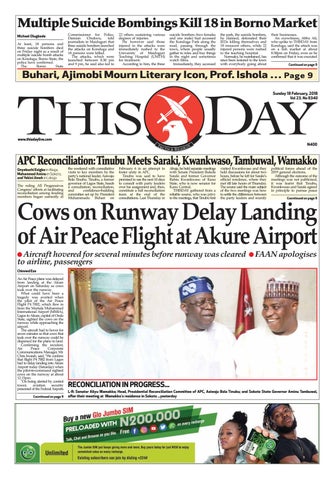
RECONCILIATION IN PROGRESS... L-R: Senator Aliyu Wamakko; Head, Presidential Reconciliation Committee of APC, Asiwaju Bola Tinubu; and Sokoto State Governor Aminu Tambuwal, after their meeting at Wamakko's residence in Sokoto ...yesterday
2
T H I S D AY ˾ ͯͶ˜ ͰͮͯͶ
T H I S D AY ˾ SUNDAY FEBRUARY 18, 2018
3
4
T H I S D AY ˾ ͯͶ˜ ͰͮͯͶ
T H I S D AY ˾ SUNDAY FEBRUARY 18, 2018
5
6
T H I S D AY ˾ ͯͶ˜ ͰͮͯͶ
T H I S D AY ˾ SUNDAY FEBRUARY 18, 2018
7
8
T H I S D AY ˾ ͯͶ˜ ͰͮͯͶ
9
˜ ͺ ˾ T H I S DAY, T H E S U N DAY N E W S PA P E R
PAGE NINE
Buhari, Ajimobi Mourn Literary Icon, Prof. Ishola Omololu Ogunmade in Abuja be forgotten. "He calls on other and Ademola Babalola in Ibadan academicians to follow President Muhammadu Buhari the sterling qualities of yesterday mourned the passing the National Merit Award of renowned author, playwright Winner and Fellow of the and literary icon, Professor Nigerian Academy of Letters who was more focused Akinwumi Ishola. The renowned scholar on the development and died yesterday at his Ibadan transformation of minds as residence. He was aged 79. opposed to material gains. "The President prays that In a statement by his media adviser, Mr. Femi Adesina, Almighty God will grant the Buhari said the literary soul of Professor Ishola eternal world would surely miss rest," the statement added. Also, Oyo State Governor, the cultural activist whose steadfastness and dedication Senator Abiola Ajimobi, to the promotion of the described the death of the native language as a means renowned playwright and of sustaining the culture and literary giant as a colossal tradition of Africans is worth loss not only to his immediate family but to Oyo State, the emulating. Buhari noted that the love Yoruba race and the world of the departed academician at large. The governor, in a statement for the Yoruba language was by his Special Adviser, never in doubt as he exhibited this through all his published Communication and Strategy, works and speeches even as Mr. Yomi Layinka, said that he a student and throughout his received the news of the death of the Ibadan-born culture academic life. "The President joins the ambassador and progenitor of entertainment industry Yoruba literature with disbelief in mourning the loss of and utter shock. By his death, the governor a producer and director whose contributions to the said that the state had lost evolution and transformation a venerated son of the soil, of the entertainment industry who devoted his life to the from a disparaged genre into promotion of Yoruba culture a major contributor to the through his creative works and nation’s economy will never huge contributions to the global
body of knowledge. As a student at the University of Ibadan, Isola wrote ‘Efunsetan Aniwura,’ a play the governor said had remained a timeless piece in teaching lessons on abuse of power and retribution, while he said that his epic novel, ‘O leku,’ was also evergreen. Quoting from William Shakespeare’s book, ‘As You Like it,’ the governor said that the world was a stage, where Isola had played his part meritoriously and had gloriously exited to be with his maker. Ajimobi said, “The late Prof. Ishola was also a blessing to his Alma Mata, Wesley College, Ibadan, because he composed the school anthem, which is still in use till date. “He was a man of many parts. Not only was he a prolific writer, but he was also a talented actor and astute broadcaster who churned out many plays, drama series and box office films. “Prof Akinwumi Isola was an unabashed believer in the promotion of the Yoruba language, which he once demonstrated by being the first person to deliver a university convocation lecture in Yoruba at the Adekunle Ajasin University, Akungba-
Akoko, Ondo State, which was very unconventional. “But, in the words of William Shakespeare ‘All the world’s a stage, And all the men and women merely players; They have their exits and their entrances; And one man in his time plays many parts.’ Baba has played his parts and he has exited gloriously.” The governor sympathised with the family of the late icon, whom he eulogised as a worthy son of Ibadanland, and prayed that the Lord would grant his soul a peaceful rest and his family, as well as the creative and literary communities, the fortitude to bear the irreplaceable loss. Isola, who wrote the popular play, Efunsetan Aniwura, when he was a student of the University of Ibadan in 1961, died after age-related ailment according to a family source. “Baba has gone,” said the source, who preferred anonymity because he was not authorised to speak on behalf of the family. “He had been sick for some time and was getting better. But this morning, he died peacefully. He left a good legacy and his life was a good example for mankind.” A friend of the deceased
and chairman of Kakanfo Inn and Conference Centre, Dr Lekan Are, who also confirmed the demise of the professor of Yoruba and writer of several Yoruba plays, praised Akinwumi for his passion for Yoruba culture, language and tradition, adding the deceased’s wife called him early on Saturday to inform him of the actor’s death. Are said, “When his wife called me this morning, and told me that Isola had died, I was shocked because I had visited him two weeks ago, he told me that he was getting better. We had a vibrant discussion. He was excited to see me again. “This is why I was taken aback by his death. He was a brilliant individual who made Yoruba history popular beyond Africa. He delivered lectures in Yoruba language. He wanted the language of Yoruba to feature prominently in our education system but unfortunately, this did not happen in his life time. May his soul rest in peace.” Also, a very close associate of the deceased, a foremost cinematographer, Tunde Kelani, confirmed the departure of the famous playwright . “Yes, Prof Ishola died this morning in Ibadan. He has
been down for about two years now,” Kelani said over the phone. Ovation Publisher, Dele Momodu, also confirmed the death in a Facebook post. “Sad to receive the news that Nigeria has lost the legendary writer Prof Akinwunmi Isola, my former lecturer & supervisor; author of O Le Ku and Efunsetan Aniwura and others… Rest in Peace Sir…,” Momodu wrote. Born in Ibadan in 1939, Prof Ishola attended Labode Methodist School and Wesley College in the capital of the old Western Region of Nigeria. He studied at the University of Ibadan, earning a B.A. in French. He also earned an M.A. in Yoruba Literature from the University of Lagos in 1978 before commencing academic work as a lecturer at Obafemi Awolowo University where he was appointed a professor in 1991. Among his most popular plays are Efunsetan Aniwura, Madam Tinubu, Oleku and Olu Omo . His works, Oleku, Koseegbe, Saworoide, Agogo Eewo and Campus Queen were adapted to film by Kelani. He worked with Kelani as a member of a trio which also had Late Adebayo Faleti and Larinde Akinleye.
ready to support his re-election. He said APC was the strongest and most viable and party in Kogi State, and alleged that PDP was no more in the state’s political map. The governor stressed that all PDP members that mattered had all defected to
APC because they had seen the light and realised that APC has a better programme for the people of the state and Nigeria, in general. Other national officers of APC who attended the rally included the national secretary, Mala Buni.
APC RECONCILIATION: TINUBU MEETS SARAKI, KWANKWASO, TAMBUWAL, WAMAKKO and dialogue as a means of strengthening the party. Kwankwaso had come second, after Buhari, at the APC presidential primary ahead of the 2015 general election, and it was widely believed that Tinubu’s support for Buhari was what cost the former Kano State governor the presidential ticket. It was also learnt that the former Lagos State governor had prioritised efforts to mend relations with his own political enemies in the party as a first step towards the badly needed reconciliation among APC members. During a recent meeting with the National Working Committee, one of the members was alleged to have suggested that in order to engender trust and confidence, it was better for Tinubu to first reconcile with those he had issues with. “Tinubu requested to be provided with a dossier of all areas of cracks within the party, including what the problems were and the level of reconciliation so far achieved,” the source added. Tinubu, the source said, agreed with the suggestion of the NWC member and explained that he had already embarked on fence-mending measures with his kinsmen in the South-west, where a stakeholders’ meeting was held, with most of the leaders in attendance. Though the stakeholders' meeting was held a year ago, it was attended by Minister of Power, Works and Housing Babatunde Fashola, Minister of Solid Minerals Kayode Fayemi, governors elected on the APC platform in the zone, and other party chieftains. Tinubu had come out to seek settlement with those he had difference with. THISDAY gathered that the APC South-west stakeholders’ meeting held in Ibadan was a full and frank discussion, where members vented their grouses and sought reconciliation. Last Thursday's meeting with Saraki was seen as an attempt to not only resolve longstanding supremacy battles between some members of the National Assembly and their governors, but to also restore
good relations between the former governor and the senate president. Tinubu had fiercely opposed Saraki’s emergence as senate president in 2015 and the frosty relationship between them had subsequently manifested in a serial rejection of principal officer nominees favoured by the APC national leader. Tinubu visited Sokoto yesterday, where he met with Governor Aminu Tambuwal and his predecessor, Senator Aliyu Wamakko. The former Lagos State governor, who was accompanied by APC chieftain, Alhaji Idi Farouk, held a two-hour closed-door meeting with his hosts at both the Government House and Wamakko's residence in Gawun Nama area of the state capital. The meeting was later expanded to include Deputy Governor Ahmed Aliyu and APC National Vice Chairman for North-west, Malam Inuwa Abdulkadir. In a brief speech after the meeting, Tinubu told reporters he was in Sokoto for a family meeting. “Family members meet regularly to talk to each other and I'm here for that purpose,” he said. “This is a family meeting for today, tomorrow, for the good of Nigeria and the APC.” After the meeting, a prominent cleric in the state, Malam Bashir Gidan Kanawa, prayed for peace and stability of the country. He called on Nigerians to continue to pray for the leadership of the country. APC rejects dissolution of Kogi executive committee Meanwhile, the crisis rocking the APC in Kogi State assumed a new dimension weekend, as Governor Yahaya Bello yesterday announced the composition of a new executive committee to pilot the affairs of the party in the state. This followed an alleged dissolution of the state working committee on Thursday by the North-central zonal executive of the party. The zonal leadership had, allegedly, found the Hady Ametuo-led state executive guilty of anti-party activities, which the governor had accused them of. However, in a swift reaction by the national secretariat of the party on Friday, the APC
spokesman, Bolaji Abdulahi, said in a statement that the National Working Committee had nothing to do with the purported dissolution. Abdulahi said no recommendations were received from the committee earlier set up to look into the crisis in the state. The APC spokesman stated, “Our attention has been drawn to a story on a national television that the State Executive Committee of the All Progressives Congress in Kogi State has been suspended. We want to state that this action does not emanate from the National Working Committee of the party or any of its organs so empowered to do so.” Abdulahi stressed, “Although there are issues within the party in Kogi State and the NWC has empowered a committee to investigate the issues and make recommendations. The NWC has not been appropriately briefed on the outcome of the committee's work and, therefore, has not taken any decision. “In this wise, we affirm that the State Working Committee of APC in Kogi State led by the chairman, Alhaji Haddy Ametuo, remains the only recognised executive committee of the party in the state until the appropriate organ of the party decides otherwise in accordance with the procedure laid down by the party constitution. “We wish to affirm that whether in Kogi or elsewhere, the NWC will ensure that justice is done to all concerned and will be guided by the constitution of the party and the best interest of the party. At the moment, we believe this action, purportedly sacking the Kogi executive, is prejudicial and incongruous with the party's desire for reconciliation. “We enjoin all party members at all levels to desist from taking unilateral actions that are likely to further jeopardise the on-going peace process.” Kogi is among the states where APC has internal dissensions that the Tinubu presidential reconciliation committee would be trying to resolve. Others include Kaduna, Zamfara, and Oyo states. In Kogi State yesterday also, the APC national chairman,
Chief John Odigie-Oyegun, received a large number of defectors from other political parties, particularly the main opposition Peoples Democratic Party. “With what I have seen here today, Kogi State APC will continue to be victorious in 2019 and future election. I will go back to Abuja and tell them that Kogi APC is very much in charge and ready to maintain its position as the most acceptable party,” OdigieOyegun said at the reception for the new members held at the main bowl of the Confluence Stadium, Lokoja. Among the prominent persons who defected from PDP were Senator Smart Adeyemi, Alhaji Jibril Isah Echocho, Alhaji Yahaya Karaku, and Alhaji Idris King. Odigie-Oyegun also praised the Buhari government’s achievements at the rally to receive the defectors. He said the coming of Buhari had helped to liberate the country from an impending economic doom. According to the national chairman, “Today Nigeria under Buhari no longer depends on oil to survive, today; Nigeria under Buhari has taken the lead in the agricultural production. “Today, Nigeria under Buhari is operating on a stable economic progression, so let those who are saying the Buhari-led government has failed go back to their holes and keep quiet while we continue in delivering dividends of democracy to Nigerians.” Odigie-Oyegun said, “Kogi State will be among the first states that will endorse President Muhammadu Buhari after he has declared for re-election next year. “Kogi people, I want to congratulate you for having an energetic governor in Yahaya Bello. This is a governor that is a good organiser at any time the party needs him. He is always energetic and full of ideas. I can feel a new energy in Kogi State.” 24 APC governors ready to support Buhari's re-eection In his remarks, Governor Yahaya Bello said Buhari must contest for a second term, saying all the 24 APC governors are
COWS ON RUNWAY DELAY LANDING OF AIR PEACE FLIGHT AT AKURE AIRPORT Authority of Nigeria (FAAN AVSEC) quickly intervened and cleared the runway. "The flight was eventually cleared to land after about seven minutes. Our guests (passengers) on board were all calm while the delay lasted. The aircraft departed for Lagos at about 1.06 pm with full escort from FAAN security personnel." Writing via his twitter handle, Governor of Ekiti State, Mr. Ayodele Fayose, who was at the airport to board a flight at the time of the incident, said, “Today, while at the Akure Airport to board Air Peace commercial flight to Lagos, I witnessed cows taking over the airport runway and preventing aircraft No. 5NBQQ from landing for more than 15 minutes.” He commended the pilot of the flight, Captain Inyang, for saving the lives of the passengers. In a quick reaction to the incident, Federal Airport Authority of Nigeria (FAAN) apologised to the airline and passengers for the incursion. A statement signed by the agency’s General Manager, Corporate Affairs, Mrs. Henrietta Yakubu, FAAN said, “The Federal Airports Authority of Nigeria wishes to apologise to Air Peace Airlines and our esteemed passengers for a runway incursion incident that prevented an Akure airport bound flight from landing for some minutes. The Air Peace flight, which left Lagos for Akure could not land immediately as some cows had strayed into the runway of the airport. “However, normalcy was restored quickly, as officers of the aviation security department quickly dispersed the cows from the runway and the aircraft was cleared for landing. The
Authority will like to assure travellers and the general public that efforts are already ongoing to close the gap that aided this incident.” THISDAY learnt from a source at the Akure airport that cattle invasion of the airport runway was a regular occurrence because the airport did not have perimeter wall, which was one of the required security facilities to prevent access to the airside of the airport by unwarranted persons, livestock or wild animals. Recently, it was reported that a headstrong cow found on the Benin airport runway was removed with the assistance of a herdsman. About two years ago, an Arik Air aircraft killed an antelope at the Port Harcourt International Airport runway as it landed on the animal. FAAN said it had concluded plans to erect perimeter and security wall at those airports that presently do not have the facility. The Managing Director of the agency, Saleh Dunoma, said the most urgent development programme FAAN had embarked on now was to provide those safety and critical security facilities at the airside of the airports.
MULTIPLE SUICIDE BOMBINGS KILL 18 IN BORNO MARKET by three suicide bombers, who also died in the attack. Ali further corroborated the police narrative, when he said the suicide bombers were two females and a male, adding that among those killed was a soldier, who went to the market to buy tea from the local seller.
10
FEBRUARY 18, 2018 ˾ T H I S D AY, T H E S U N D AY N E W S PA P E R
SUNDAY COMMENT
Editor, Editorial Page PETER ISHAKA Email peter.ishaka@thisdaylive.com
THE EXIT OF JACOB ZUMA The resignation of Jacob Zuma as President of South Africa holds lessons for Nigeria
T
he resignation, last Wednesday, of President Jacob Zuma clearly demonstrates the limits of individual absolutism and its attendant corrupting influence. Until his dramatic ouster, Zuma had virtually converted the presidency of South Africa into a private oligarchy of himself and his business associates. In the process, he became an embarrassment to the illustrious African National Congress (ANC) and the anti-apartheid movement. At the end, it required spirited pressure to drive home to Zuma the rage of ordinary South Africans before he finally realised that the market was over. The relevance of the Zuma episode to Nigeria is perhaps first The relevance of the to underline how Zuma episode to impossible it would Nigeria is perhaps be to achieve such first to underline how leadership change impossible it would in the context of our be to achieve such present political leadership change party architecture in the context of our and ethno-religious present political politics. While the party architecture entire drama lasted, and ethno-religious neither Zuma nor politics. While the members of his inner entire drama lasted, circle mobilised neither Zuma nor supporters/kinsmembers of his inner men to stage rallies circle mobilised on his behalf and supporters/kinsmen whatever may be the to stage rallies on his religion he practices behalf and whatever may be the religion he or the denomination/ sect he belongs; that practices; that never never mattered. If mattered it were Nigeria, the secretariat of the ANC would have been sealed up by some overzealous police and security personnel with possible arrests and harassment of those asking the president to resign. In South Africa, the institutions work and that made all the difference. On the face value, comparing the political party system in Nigeria with that of South Africa may seem incongruous given that the ANC representation and struggle transcend the entire Southern Africa region. But to the extent that we have unconsciously built a
Letters to the Editor
P
brand of political culture that is not exactly edifying, the current situation of mayhem in the name of party politics in Nigeria is what attracts unfair comparison with the South African situation.
A
S U N DAY N E W S PA P E R EDITOR TOKUNBO ADEDOJA DEPUTY EDITORS VINCENT OBIA, OLAWALE OLALEYE MANAGING DIRECTOR ENIOLA BELLO DEPUTY MANAGING DIRECTOR KAYODE KOMOLAFE CHAIRMAN EDITORIAL BOARD OLUSEGUN ADENIYI EDITOR NATION’S CAPITAL IYOBOSA UWUGIAREN
T H I S DAY N E W S PA P E R S L I M I T E D EDITOR-IN-CHIEF/CHAIRMAN NDUKA OBAIGBENA GROUP EXECUTIVE DIRECTORS ENIOLA BELLO, KAYODE KOMOLAFE, ISRAEL IWEGBU, IJEOMA NWOGWUGWU DIVISIONAL DIRECTORS PETER IWEGBU, ANTHONY OGEDENGBE DEPUTY DIVISIONAL DIRECTOR OJOGUN VICTOR DANBOYI SNR. ASSOCIATE DIRECTORS ERIC OJEH, PATRICK EIMIUHI ASSOCIATE DIRECTOR SAHEED ADEYEMO CONTROLLERS ABIMBOLA TAIWO, UCHENNA DIBIAGWU, NDUKA MOSERI DIRECTOR, PRINTING PRODUCTION CHUKS ONWUDINJO TO SEND EMAIL: first name.surname@thisdaylive.com
s things stand today, political parties in Nigeria shamefully lack any connection with either national history or political tradition. Their leadership changes with the whims of every passing administration and are literally summoned to do the bidding of political leaders that rode on their emblem to power. They come into life at election season and fade into pitiable insignificance and irrelevance soon afterwards. Yet, emblematic seasonal parties cannot bring about much political or economic change because they lack the internal structural resilience to whip incumbent power merchants into line. The ANC was able to eventually force the beleaguered Zuma to resign because it possesses an impeccable historical memory and internal structural integrity. It is these strengths of the ruling party that were fully deployed to advance the will of the people and restore social and constitutional order to the larger South African nation. As we stated in a recent editorial, in a truly organic party like the ANC or the two major parties in either the United States or the United Kingdom, the line of power succession is fairly predictable just as the ideological tendencies are known. A situation such as we have in Nigeria where parties come into existence or die off depending on their electoral advantages can hardly contribute to national development. Nor can such seasonal parties that come alive only on the eve of elections become instruments of national stability let alone tolerable governance. Indeed, in our peculiar circumstance in Nigeria, especially as we reflect on what has just happened in South Africa, what is particularly disturbing is that we are gradually arriving at a juncture where there is neither nation nor political party culture to talk about. Therefore, collective self-retrieval remains an urgent responsibility for all the stakeholders, including those who take pride in saying they are not interested in politics. What these citizens forget is that when nations fail, good apolitical citizens are not spared the calamity that follows. A failed state is a driverless train off the track, an irrational force in rapid progression that would destroy anything and everything on its path. While we wish President Cyril Ramaphosa well as he takes over the leadership of his country, we hope that members of the Nigerian elite will learn useful lessons from the seamless political transition in South Africa.
TO OUR READERS Letters in response to specific publications in THISDAY should be brief (150-200 words) and straight to the point. Interested readers may send such letters along with their contact details to opinion@thisdaylive.com. We also welcome comments and opinions on topical local, national and international issues provided they are well-written and should also not be longer than (950- 1000 words). They should be sent to opinion@thisdaylive.com along with the email address and phone numbers of the writer.
ATIKU AND THE PRESIDENCY
ermit me to add my voice to those already clamouring for Atiku Abubakar’s candidacy in the upcoming 2019 general election. A poorly-handled search for a presidential standard bearer by a discordance of characters over the years has led the nation to an unfocused and unmitigated democratic debacle. Many Nigerians have ignored the essence of our failing egalitarianism. We must acknowledge that we are the instigators of our bad leadership, since we have accepted and allowed
mediocrity to shine over merit – as if it is normal – and naturally, we are left with no one to blame but ‘we, the people’. We have been constantly reminded by the political hegemony that they know what our problems are and that they have the solutions, but they have never revealed how the solutions they proffer will fix the pervasive malady and incompetence of Nigeria’s leadership. It is in this vein that I have decided to help amplify the calls for the former Vice President Atiku Abubakar to be given a chance.
I make bold to say that each time he threw his hat into the political ring to contest for the highest political office in the land, he had done so fully prepared and armed with a manifesto detailing his policies vis-a-vis the implementation strategies from experts coming together from different strata of our economic, security and social endeavours. Need I say, he has the intellectual capacity to select persons who can execute these tasks – even to the admiration of his political opponents. Evidently, his philanthropic
lifestyle, his chains of businesses across Nigeria with thousands of employees, have lent credence to the purposeful leadership he is equipped to provide. One must also salute the boldness of those individuals and group of persons, who have shown maturity of political awareness as they speak up in support of Atiku Abubakar’s candidacy for the 2019 presidential election. Nigeria, due to its heterogeneous nature, is not a nation that can or should be governed by mere intentions and dreams. It must be governed with genuine and sound ideas in tune with the yearning and general aspirations of our
middle class and the teeming youths. The myriad of problems facing the nation at the moment cannot be wished away by mere lamentation and teethgnashing. There’s need for concerted effort by able-bodied and intellectually-gifted men and women of this nation, led by a strong, dependable and reliable leadership, to take us out of this self-imposed journey into the doldrums, and Atiku Abubakar will do that. He has passed the test of leadership at all given times. Therefore, this is not a misplaced outburst. ––Lami Ladan, Gwarinpa Estate,Abuja.
T H I S D AY ˾ SUNDAY FEBRUARY 18, 2018
11
12
T H I S D AY, T H E S U N D AY N E W S PA P E R ˾ EBRUARY 18, 2018
SUNDAYNEWS
News Editor Abimbola Akosile E-mail: abimbola.akosile@thisdaylive.com, 08023117639 (sms only)
Obasanjo Opposes N’Delta Leaders’ Call for Resource Control
t Insists all resources within Nigeria belong to every part Emmanuel Addeh in Yenagoa
Former President, Chief Olusegun Obasanjo again opposed the agitation for resource control for the people of the Niger Delta region yesterday, insisting that all resources within the Nigerian space belong to all parts of the country. Obasanjo argued that if God wantedeachstateandeachregion
to control what is found in their land, he wouldn’t have brought theentitycalledNigeriatogether. The former President, who was in Obunagha, Gbarain community in Yenagoa, to inaugurate a modular refinery owned by Azikel Group of Companies, promoted by the group’s president, Dr. Azibapu Eruani, maintained that the federal government should be
allowed to “manage” the oil resource in the region for the good of all. He explained that though it wasnotwrongfortheNigerDelta people to derive more benefits from the crude oil in the area, it was only right to ensure that all Nigerians, irrespective of the partofthecountrytheyhailfrom, alsoenjoytheGod-givennatural resource.
The ex-Nigerian leader who was reacting to a speech by the Secretary General of the Ijaw YouthCouncil(IYC)Worldwide, Mr. Alfred Kemepado, who had earlier maintained that the demandforresourcecontrolwill be achieved by all means possible, also stated that he wasn’t sure what the marginal fields he awarded to the states in the region, including Bayelsa, had been used for. “I won’t argue with him, but
FREE AT LAST!
R-L: Senior Special Assistant to the President on Foreign Affairs and Diaspora, Hon. Abike Dabiri-Erewa, and Head of Chancery, Nigerian Embassy, South Korea, Mr. Eze Thomas, receiving a 14-year-old girl trafficked to South Korea and returned home by the Nigerian Ambassador to South Korea, Ambassador Amin Dalhatu, in Abuja...recently
whenIwasingovernment,Isaid I won’t join you people to control resource, just let me manage it. I talk of resource management and that is good enough for me. Because if we manage our resources well, not controlling, wherever I am let me manage it forthegoodofall,notcontroland that is my belief. “God,whocreatedNigeria,decidedtobringustogetherbecause without God we wouldn’t have been born. If we are one country, all the resources in Nigeria, people in the country should benefit; but first of all people in the locality should benefit, after that all Nigerians. “The governor was right. I personally drove the policy on marginal fields to benefit the people of this area, and they were the major beneficiaries of those marginal fields. “But I don’t know what they did with it. And Governor just as I do not know what happened to your two oil blocs, (given to Bayelsa)afteritwasgiventoyour state; whodo we blameforthat?”, he queried. He decried the inability of the 18 companies he gave licences to begin operation even after he exited power, arguing that what Eruani had done should be emulated by all high net worth individuals in the region. “The MRS lady said this is not thefirsttimewearegivingpeople licences. I understand President Buhariandhisgovernmentgave 22 licences and only Azikel is the onlyoneoutofthe22thatisbeing actualised. Before then, we gave
18, not one was actualised. You can see the reason why on an occasion like this, we should pay special tribute to you, Dr. Eruani”, Obasanjo noted. He stated that if the people of the Niger Delta continue to look backat1956andalltheissuesthat happenedsincethen,theywould not move forward. Obasanjo thanked President Muhammadu Buhari for grantingmorelicencesforthebuilding ofrefineries,stressing thatothers should follow in the footsteps of the investors who have broken the jinx. “I join all of you in thanking PresidentBuhariandhisgovernmentforgivingfourmorelicences than we gave. Hopefully others will follow your footsteps. They gaveallsortsofreasonswhythey couldn’t start, including security and the fixed price of oil. “All the reasons they gave are still there today. But you are a genuine entrepreneur, the rest were not genuine, they were only there to take”, the former president added. Obasanjo urged Eruani to continue to bring more investments into the Niger Delta and counselled the traditional rulers to ensure that the right environment was created for businesses to flourish. On his part, Governor Seriake Dickson applauded President Buhari but urged him to go beyond granting of licences to ownership of oil blocs for the people of the area. (See concluding part on www.thisdaylive.com)
Secondus,OthersVisitIBB,ExpressReadinessfor2019GeneralElections Laleye Dipo in Minna
NationalChairmanoftheopposition Peoples Democratic Party (PDP),ChiefUcheSecondusyesterday led some members of the National Executive committee of the party on a courtesy visit on former military president General Ibrahim Badamasi
Babangida, during which he told the former Nigerian leader that “the PDP is ready for the 2019 general elections.” Secondus was accompanied on the visit by the National Secretary, Alhaji Umar Ibrahim Tsauri; National Publicity Secretary, Alhaji Abdullahi Maibasira; National Financial
We Need Private Sector for Infrastructure Development, Says NDDC MD Sylvester Idowu in Warri
The Managing Director of the Niger Delta Development Commission (NDDC) Mr. Nsima Ekere, has said the Commission has embraced the Public-Private Partnership (PPP) option to galvanise the infrastructure delivery drive in the Niger Delta region. The NDDC Chief Executive Officer made the disclosure weekendduringacourtesyvisitby adelegationfromtheInfrastructure ConcessionRegulatoryCommission (ICRC) at the Commission’s headquarters in Port Harcourt. Ekere, who was represented by the NDDC Executive Director Projects, Engr. Samuel Adjogbe, remarked that the NDDC was urgentlyseekingwaystostimulate industrialgrowthintheregion,not-
ing that it was adopting the PPP option in the execution of a Niger DeltaRegionalPowerPoolProject. Accordingtoastatementsigned byDirector,CorporateAffairs,IbitoyeAbosedeandsenttoTHISDAY, Ekere remarked that the power projectwasoneofthecriticalareas whereprivatesectorparticipation was required to encourage investorstosetupindustriesintheNiger Delta,lamentingthatthehighcostof powerintheregionwasincreasing the operational cost of industries andthusservingasadisincentive. Henotedthattherewasneedto make a deliberate effort to set up projectsthatcanboostpowerand attractinvestorstotheregion,adding“Wehaveidentifiedindustrial parksindifferentpartsoftheregion andweintendtosupportthemwith the power project.”
Secretary, Austin Akobundu; National Organising Secretary Ambassador Ibrahim Kazaure; National Vice Chairman North, and the party’s Spokesman, Mr. Kola Ologbondiyan. A source close to the meeting informed THISDÀY that Secondus also briefed Babangida about the efforts being made
by the leadership to “reposition the party for the tasks ahead.” It was gathered that the National Executive committee also expressed gratitude to IBB for what was described “as the role he played before and after the crisis” and especially during the national convention of the party.
“We briefed him on developmentinthepartyespeciallyhow we are trying to reposition the party. We also briefed him on development in the country and preparation for the 2019 general elections”, the source added. It was learnt that General Babangida “received the delegation warmly” and assured
the members of his support at all times. According to the source, who also attended the Minna meeting, the former Nigerian military ruler restated his belief in the PDP and assured the visiting team that he would always give the party the necessary support.
Family Quarantined after Lassa Ten Years After, Family, Friends Fever Kills Three Persons in Benue Pay Tributes to Late Giwa-Amu George Okoh in Makurdi
The Benue State Government Ministry of Health has quarantined an entire family in Adoka, Otukpo Local Government, Benue State, over the outbreak of Lassa fever and the death of a family member. The State Commissioner for Health, Mrs. Cecilia Ojabo, who confirmed that two pregnant women and a man died in Makurdi of Lassa fever, said the ministry is putting the family under close monitoring so as to ensure that the fever does not spread to others. She said one of the pregnant women was confirmed positive when her blood sample was sent to a specialist hospital in Irua in Edo State. She said the other patient commenced treatment for Lassa fever at
the designated centre located at the Benue State University Teaching Hospital, Makurdi but died in the process. “There was another instance of a young man, an indigene of Benue State who had Lassa fever and died in Lagos State. We were duly informed about his death and the corpse was thereafter transmitted back to Benue State for burial,” she said. Ojabo also disclosed that a patient from the Guma Local Government Area of the state manifested late symptoms of Lassa fever when he started bleeding from the nose, ears and mouth. According to her, the victim was admitted to the Benue State University Teaching Hospital but before doctors could obtain his blood sample for the test at Irua, he died.
Paul Obi inAbuja TheNigerianArmy,formerCross River State Governor, Sen. Liyel Imoke, former Head of Service oftheFederation,SteveOronsaye andformerManagingDirectorof GuarantyTrustBankPlc,Mr.Fola Adeola, Mr. Segun Adeniyi and othersyesterdaypaidglowingtributestolateBrig.-GeneralSolomon Giwa-Amu,formerAide-de-Camp (ADC)toformerPresidentOlusegun Obasanjo. TheChiefofArmyStaff,Lt.GeneralTukukBuratai,representedby theChiefofCivilMilitaryRelations, Major General Nuhu Angbanso stressedthat“theNigerianArmy will continue to appreciate late Giwa-Amu for the services he rendered to the Army and the nation at large.” Angbazo added that “the Nigerian Army looks forward
to working with the Solomon Giwa-AmuFoundationforgreater collaboration in the area of skill acquisition.” Imoke, who chaired the 10th Anniversary of Solomon Giwa Amu at the Sheraton Hotel, Abuja,describedthelateADCto ex-PresidentObasanjoascompassionate, generous, discipline and downtoheart,sayingthelateADC gave his best to his fatherland. He also lauded the resilient of thefamily,particularlyhiswife,Dr. JudithGiwaAmuandfriendsfor puttingtogetherseriesofeventsin memoryofthelateADCaspackagedbytheSolomonGiwa-Amu Foundation. Former Managing Director of GTB,AdeolasaidSolomonGiwaAmuasafriendandbrotherwasa manofintegrity,highlydisciplined, professional in his calling and generous.
T H I S D AY, T H E S U N D AY N E W S PA P E R ˾ ˜ ͺ
13
NEWS 2019 Polls: Catholic Bishops’ President Backs Reordering of Election Sequence Paul Obi in Abuja The president of the Catholic Bishops Conference of Nigeria (CBCN) and Archbishop of Jos, Ignatius Kaigama yesterday supported the clamour for a reordering of the sequence of the
2019 general elections, with the presidential elections holding last. The National Assembly, the Presidency and President Muhammadu Buhari’s supporters have been involved in an ongoing tussle over the order of sequence of elections ahead of the 2019
general elections. The Senate and House of Representatives last week amended the 2010 Electoral Act reordering the sequence of the 2019 elections to commence with the National Assembly polls, followed by state assembly and gubernatorial,
with the presidential elections coming last. The lawmakers had argued that reordering the sequence of elections will bring about transparency and foster credible elections, candidates and democracy, without the influence of
the presidential elections having impact on the other elections. The Presidency and Buhari’s staunch supporters believed the reordering of the sequence of elections is targeted at President Buhari. But speaking to THISDAY, CBCN President Kaigama said it
EXPANSION IN PROGRESS L-R: Representative of President of Nigerian Council of Registered Insurance Brokers (NCRIB), Mr. Fatai Adegbenro; CEO/President, Standard Insurance Consultants
Limited, Dr. Ahmed Salawudeen, Olori Kafilat Iyabode Ajilese and Aseyin of Iseyin, Oba Abdulganiu Adekunle Salaudeen Ajilese at the grand opening of the new Standard Insurance Consultants Limited Corporate Office at Lekki Phase 1, Victoria Island, Lagos…recently
was more logical for the elections to be in an ascending order rather than having the presidential elections first. “If they have to reorder the sequence of elections, what happened to the order where elections were done in an ascending order, namely, local government, state house of assembly, National Assembly, governorship and presidential elections? Why do they have to utter that?” he asked. The Archbishop stated that “I prefer to see a return to that order of elections which is more logical. No one election will influence the other very seriously. “That is just what I want to see, let us go back to what it was before, let us go back to the ascending order,” Kaigama added. Meanwhile, the bishops are also billed to commence their plenary session for the year for the biennial conference in Abuja with the theme, ‘The Church and Entrepreneurship.’ Kaigama told THISDAY that the problem of youth unemployment in the country has become worrisome and a critical challenge to the Catholic Church, adding that, there was need to look for strategic ways in tackling the problem. To that end, he said the bishops at the conference would be focusing on entrepreneurship, youth unemployment and recent herdsmen killings and clashes with farmers around the country.
Lagos APC Reps Endorse Ambode for Second Term Abimbola Akosile Members of the All Progressives Congress (APC) in the House of Representatives from Lagos State yesterday endorsed the State Governor, Mr. Akinwunmi Ambode for a second term in office, citing the massive infrastructural development and giant strides in all sectors and sections of the State. The APC Caucus in the House led by the Majority Leader, Hon Femi Gbajabiami-
la, who presented a letter to the Governor at Lagos House in Alausa, Ikeja asking him to re-contest in 2019, said the decision to unanimously endorse Ambode for a second term was as a result of his performance in office in the last two and half years. Speaking to the media after a closed-door meeting with the Governor, Gbajabiamila said the lawmakers were indeed proud to associate with the achievements of the Governor so far, and would be support-
ing him all the way for another term in office. “We are members of the House of Representatives APC Caucus from Lagos State. We all came into Lagos today to perform a very unique and sacred duty; something we did not take very lightly at all; something we deliberated over a couple of days ago and we spoke with one voice. “Because of the giant strides of our amiable Governor, Mr. Akinwunmi Ambode in the last two and a half years in
governing the State; because of the things he has done across board, across all the Local Government Areas, across different sectors, we sat together and we decided without a dissenting voice to seek his audience and endorse him for re-election in 2019 as the Governor of Lagos State,” he said. The House Leader, who described the endorsement as history repeating itself as the Caucus was the first to endorse the Governor for election in 2015, said it was instructive
that there was not a single dissenting voice in the decision to support the governor for re-election. “This is a very unique occasion because we have said all we need to say behind closed doors but they are worth repeating. Ordinarily, some of us have been in this business for long time and when you have endorsements, there are always dissenting voices maybe one or two but among every single member, there was not one dissenting voice and I think that is
very important. “So, we are here today as stakeholders across all the Local Governments and federal constituencies of the State to present a very unique letter to our Governor seeking for him to run again in 2019. We will give him unflinching support and have him re-elected overwhelmingly as Governor in 2019,” Gbajabiamila said. He urged the Governor to see the endorsement as a call to do more for the people of the State come 2019.
PDP Bemoans Failure of FG to Stop Killings in Zamfara
Standard Insurance Opens another Shop in Lekki
Dabiri, Adebutu, Runsewe, Others to be Honoured by OOUA
Onyebuchi Ezigbo in Abuja
Bamidele Famoofo
Senior Special Assistant to the President on Foreign Affairs and Diaspora, Hon. Abike DabiriErewa, Business Mogul and Philanthropist, Sir (Dr) Kessington Adebutu and Director-General, Nigerian Council for Arts and Culture, Otunba Olusegun Runsewe will among others on Thursday receive Awards of excellence from the Association of Nigerian University Professional Administrators chapter of Olabisi Onabanjo University, Ago-Iwoye, Ogun State. The award which is part of the annual Registry Lecture/Awards of the University is to
The Peoples Democratic Party (PDP) has condemned the gruesome murder of 41 Nigerians by marauders in Zamfara State. The party lamented the continued failure of the All Progressives Congress (APC)-controlled Federal Government to take decisive steps to end the incessant killings in various parts of the country, the latest being Wednesday’s massacre of 41 defenceless Nigerians in Zamfara state. The PDP called on all Nigerians, irrespective of religion, ethnicity and political affiliations, to join forces in “praying for the nation as well as supporting one another at this critical time in our national life.” The party, in a statement issued by its National Publicity Secretary, Kola Ologbondiyan, yesterday, said
“it is heartbreaking that Nigerians are daily slaughtered by marauders while those elected to protect our people are only concerned with their selfish re-election bid in 2019 and meaningless photo opportunities in the media. “In the last two months, hundreds of helpless citizens have been murdered by bandits in various parts of the country and nothing concrete has been done by the federal government to end the butchery and bring the perpetrators to book. “Hardly have tears dried over the gruesome killings in Benue, Taraba, Kaduna, Nasarawa and other states when marauders hit Zamfara, a state known for peace, killing 41 citizens in cold blood, yet all we get is mere lip service from the APC-controlled Federal Government.”
Standard Insurance Consultants Limited (SICL), a leading insurance broker in Nigeria, has added another feather to its cap, as it inaugurated its Lagos ultramodern office in Lekki. The two-storey edifice located at Victoria Arobieke Street, off Admiralty Way, Lekki Phase 1, Victoria Island, Lagos boasts of modern day facilities to serve its numerous customers better. Chief Executive Officer/ President, SICL, Dr. Ahmed Olaniyi Salawudeen, said the movement of the group’s head office in Lagos to its permanent site, did not only symbolise expansion, but positioning it to render better quality services to its numerous corporate clientele base locally and internationally.
“As you know that we (the firm) have international affiliations as we operate in the United Kingdom, United Arab Emirates, Gambia, China and so on. The spacious mega office will give us opportunity to discharge our duty better,” said Salawudeen. The award-winning Standard Group’s President attributed the success of his company in the last 37 years to honesty, transparency and integrity. Founded some 37 years ago, the aim of the group was to provide insurance solutions to the teeming population of Nigerians. “The company has consistently committed itself to the duty of ensuring that its customers gets their claims as at when due”, Salawudeen boasted.
recognise and celebrate prominent Nigerians who have contributed to nation building. Others to be honoured include Oba Sosanya Emmanuel-King (Adron Homes), Iyalode of Remo, Mrs. Ogunbiyi, Chief Samson Disunmu, Hon. Yomi Akinruntan, and Mr. Gbadega Adedapo, and Mr. Afolabi Ajayi. Former Head of Service to the Federation, Prof. Afolabi Oladapo, according to a statement from the office of the Registrar Mrs. Omolara Osunsanya will deliver a lecture titled ‘Reflections on the Nigerian University System and Quest for National Developments: Problems and Prospects’ at the event.
14
ͯͶ˜ Ͱͮͯ ˾ THISDAY, THE SUNDAY NEWSPAPER
OPINION Ramaphosa as Millionaire Soweto Revolutionary The job of the new South African president is already cut out, writes Okello Oculi
I
n 2005, while at a conference in Maputo, Mozambique’s capital, I was treated to a thesis about a Pan-African diplomatic conspiracy by Nigeria to gain dominance over post-Mandela South Africa. A passionate supporter of President Thabo Mbeki asserted that Nigeria was buying voters in key provinces to elect Jacob Zuma at the impending conference of the African National Congress (ANC). Fear of Mbeki’s brilliance, as a Sussex-trained economist, was, allegedly, egging Nigerian leaders into favouring a famously illiterate Jacob Zuma whom they would bully at African international policy discourses. Zuma had never sat inside a classroom; and never hid this badge. The death of his father when Zuma was only five years old was to blame. However, lawyers, doctors, trade unionists in Roben Island prison – where teenage Zuma served 10 years in jail – ran a secret school, which graduated Zuma as a brilliant product. In colonised African countries, colonial authorities often targeted an ethnic or racial minority group with attendance of schools and subsequent monopoly of jobs in the civil service. This was accompanied by brewing attitudes of contempt against those denied access to colonial schools. In Kenya, Kikuyu leaders beat this trap by starting their own community schools. In Togo, Nigeria, Congo, and Uganda, ethnic groups in the north were denied education, but were made dominant in security services. An “ingrained hostility’’ about being ruled by “illiterates” followed Jacob Zuma from beginning to his resignation. Cyril Ramaphosa is a graduate of law, political agitation, and prison walls – including solitary confinement. He earned a ‘Master’s degree’ by forming a trade union and being Mandela’s chief negotiator with racist officials on the road to democratic rule in 1994. His ‘doctorate degree’ is owning $546 million. He should not, however, ignore the geography of poverty and no access to education. The “Soweto rebels” against being taught only in Afrikaans language remained dancing on streets; throwing stones at murderous police; setting fire to cars and official buildings; bleeding and carrying their wounded and dead colleagues. Illiteracy became fungi around their brains as government was hostile to their wounded route to education and capacity for jobs. This wounded education has been manipulated into
xenophobic violence against economic refugees from Mozambique, Zimbabwe, and Zambia, as well as West Africans and Somalis. Migrants from rural provinces of South Africa into Johannesburg, Durban, Cape Town, are also attacked and set ablaze by angry unemployed men. Ramaphosa should push multinationals and politicians to turn the alarm value of youth unemployment statistics into a weapon for prioritising economic production creatively grounded on the doctrine of “UBUNTU”. Dutch immigrants are animated by Calvinism and its injunctions for work and living upright lives. The Dutch Reformed Church damned all black people as those to be redeemed with torture, ruthless exploitation of their labour and permanent poverty on this side of heaven. Colonial Catholicism, Methodist and other Christian churches dared not preach rebellion as the route to salvation. Ramaphosa, the intellectual leader, must correct this theological imbalance. It remains a prop to unemployment and alcoholism in the absence of pegs on which to hang personal and collective aspirations. Jacob Zuma was widely acknowledged as a brilliant spy
The late Professor Ali A. Mazrui mocked Africa’s leaders for hanging their inferiority complexes on tips of their tongues by being proud of speaking languages of colonial domination. Just as Ramaphosa has been on the board of Coca Cola, he can borrow from the American inventiveness and promote vernaculars across Africa
and recruiter of fighters for Mkhonto we Sizwe – the military wing of the ANC. This institution must not be left to fade away. It could borrow from Cuba’s export of doctors, nurses, ICT and agricultural extension workers. The over 48 per cent of South Africa’s youths that are unemployed could be sent for training in Cuba for transformation into socio-economic development version of Mkhonto We Sizwe. Wars inside Central African Republic, Democratic Republic of Congo, Nigeria, Uganda, Sudan, Southern Sudan, Mali, and Libya cry out for a ‘Third Independence’ led by South Africa. If the 20th Century saw Pan-African brotherhood surging from Africa’s north as a determination to wage liberation war across Southern Africa, the new liberation from the South must bring out a Pan-Africanism of healing wounds inflicted by bad governance beyond the Limpopo. Ramaphosa has walked on blood-soaked mud in South Sudan. Ramaphosa was sworn in as President of South Africa, without invocations of warriorhood – with chants and leopard skin garments. An Afrikaner Member of Parliament, however, spoke in his tribal language. Ramaphosa and several other MPs threw out brief winds of their mother tongues. For a ritual to mark a return to sources of Liberation Struggle; affirming, as the Pan-African Congress delegate did, that it is “Not Yet Uhuru” and “Aluta Continua”, the emphasis on English and suits-and-ties was incongruous. The rotten womb of apartheid (1948 – 1994) produced a policy of developing 11 national languages: seedlings coming out of a rotting fruit. Similarly, 30 years of tribal warfare across Europe yielded “nations” based on common languages. Leaders of those nations have held onto those languages, with Swedes, Norwegians, Fins, Dutch, Germans, etc., teaching their youths up to university level in vernacular. The late Professor Ali A. Mazrui mocked Africa’s leaders for hanging their inferiority complexes on tips of their tongues by being proud of speaking languages of colonial domination. Just as Ramaphosa has been on the board of Coca Cola, he can borrow from the American inventiveness and promote vernaculars across Africa. He imported 43 embryos of Ankole Cattle and transplanted them into local cows on his farm. That creativity could also transplant Nigeria’s ZOBO and a Senegalese beverage into South African appetites.
OGP And Niger Delta Development Bob MajiriOghene Etemiku canvasses openness and accountability in the conduct of government business
I
n 2016, just before the UK Anti-corruption Summit, former British Prime Minister David Cameron said Nigeria was a fantastically corrupt country. He made the statement on the basis of the fact that in spite of the enormous wealth accruing to Nigeria from crude oil sales, her people were ranked among the poorest in the world. There are no good roads and power is often epileptic. Health facilities are non-existent to the extent that most public officials with a headache would more often hop on a plane to get treatment abroad. We all know the drill, with respect to the very low quality of life of the average Nigerian and so I am not going to bore you with that gripe. Now, while it can be said unequivocally that Nigerians across board are like people who live by the banks of a river, yet wash their hands with spittle, that for the people of the nine oil producing states is even worse. Take a look at it: how do you explain that the region which provides the economic mainstay of Nigeria itself has no good roads, health facilities, good schools and regular electricity? It was in the light of this (but more to stem the tide of unrest and militancy over the underdevelopment of and in the Niger Delta) that Umaru Yar’Adua created the Ministry of the Niger Delta. Even though the Niger Delta Development Commission (NDDC) together with a plethora of other development commissions were established as well to complement the work/activities of the Ministry of the Niger Delta and bring development closer to the people, there isn’t much to write home about in terms of concrete development. That is why it is very sad today that very little of the objectives behind the establishment of these development commissions are actually being felt. Apart from government interference in the activities of these development commissions, what has been apparent is the gale of abandoned projects which dot the Niger Delta. In April of 2017, then Acting President, Professor Yemi Osinbajo, said what he felt was responsible for
the spectre of abandoned projects in the Niger Delta was the complicity of the elite. What he was referring to, perhaps, is the generally held view in the Niger Delta that the development commissions are basically the ATMs of the chief executive officers of the states wherein these development commissions are domiciled. But I think there is something more than that. There seems to be a pervasive culture of opaqueness surrounding the financial dealings of the development commissions. Apart from the Ministry of the Niger Delta and the NDDC, which have functional websites, and sometimes social media identities for engagement with the public, most of the other development commissions are usually inaccessible to the grassroots. I remember a certain time I read about a road which the DESOPADEC had constructed in my hometown. To ascertain if this was indeed true, I put a call through to my kinsman to congratulate him. But no road had been constructed. It is the same thing with the Citizen Report Card – a monitoring and evaluation document which two NGOs in the Niger Delta, the Africa Network for Environment and Economic Justice (ANEEJ) and Leadership Initiative for Transformation and Empowerment in Africa (LITE-Africa) – carried out. Its executive summary revealed that there was poor planning and lack of consultation with the communities in the decision-making process. Therefore, after President Muhammadu Buhari signed Nigeria on to the Open Government Partnership (OGP) two years ago, it went on to develop a National Action plan along four thematic areas – fiscal transparency, zero tolerance to corruption, citizen engagement and access to information. The underlying principle behind these themes is that if a government opens its books to public scrutiny, it engenders citizen participation in the governance process and makes it very hard for snakes to swallow monies. So far, the federal government of Nigeria has shown a willingness
to be transparent and accountable, even though there are several instances wherein even its own people have been less than transparent and accountable. There are already plans by other states in Nigeria to embed the thematic areas of the OGP into their governance processes. In October 2017, I was at the OGP/Open Alliance Stakeholders meeting in Kano. A similar one had already taken place in Kaduna prior to the Kano meet. Part of the discussions involved an outlining of the roles, which civil society organisations will play in the designing, monitoring and reporting of the OGP process, when eventually put in place. Participants were interested in finding out what key structures they would need to put in place for a successful and strategic engagement. Are there challenges, which might work against the execution and delivery of the sub-national plan? From the way things stand now, most states in the Niger Delta are behind those in the North concerning the OGP sub-national plans, but this should not be so. Even though some states in the Niger Delta are run along different political platforms, the need for transparency and accountability in the conduct of government business, and, particularly, with the development commissions transcend partisan considerations. Let me be clear. There are already insinuations that most contracts being awarded in most of the Niger Delta states somehow can be traced to companies owned by public officials. Therefore, by having the OGP thematic areas of fiscal responsibility, anti-corruption, citizen participation and access to information embedded in the procurement processes in the Niger Delta region, we might begin to checkmate the snakes in the system and thereby see real development in the Niger Delta and its development commissions begin to take place. –– Etemiku is Manager Media & Communications, Africa Network for Environment and Economic Justice, Benin City.
15
T H I S D AY, T H E S U N D AY N E W S PA P E R ˾ FEBRUARY 18,2018
LETTERS
TSVANGIRAI: AN AFRICAN HERO
Z
imbabwean’s political horizon has a striking resemblance to that of Nigeria in the sense that there are individuals who by merit ought to have become president of their nation at different epochs but never emerged due to centripetal and centrifugal political forces. Kenya has same scenario. The Kenyan opposition figure, Raila Odinga, recently made himself president after he was rigged out of another presidential race by Uhuru Kenyatta, the scion of the Jomo Kenyatta’s political leadership. In Nigeria, Chief Obafemi Awolowo, who for a long time was the political leader of the Yoruba race in western Nigeria, could not become Nigerian president even when he worked, dreamt and played active politics all his life to attain this lofty height. Awolowo is reputedly the only Nigerian political force who successfully administered free and qualitative education to his people whilst holding elective office as the Premier of Western Region. Awolowo was the man who first introduced a television station that later metamorphosed into Nigerian Television Authority
Tsvangirai
(NTA). Awolowo’s Tribune newspaper is a monumental institution in Nigeria. Chief Awolowo is generally referred to by some political historians as the best president that Nigeria never had. He was urbane, educated and cerebral. In the Southern African nation of Zimbabwe, there is also a man who worked and rose through the ranks as a unionist and contested
to become the president of Zimbabwe, but was rigged out in his last attempt in 2008. That man who can be called the best president that Zimbabwe never had is Mr. Morgan Tsvangirai, who died in a South African hospital on Valentine’s Day. He was urbane, sophisticated, welltravelled, and cerebral. An online news blog, News24.com, has only but beautiful words on this states-
man as one of the few rare men out of Africa who gave his best to salvage his nation from the oppressive hold of the then dictator, Mr. Robert Mugabe. Born in 1952 to a bricklayer father in drought-prone Buhera, in the southeast of Zimbabwe, Tsvangirai prematurely ended his studies at Gokomere Mission to support his siblings. The eldest of nine children, Tsvangirai worked at a textile mill in Mutare in the country’s east, and later joined a nickel mine in Bindura, a town in the north. After Zimbabwe gained independence from Britain in 1980, Tsvangirai became branch chairperson of the National Mine Workers Union, rising through the ranks to become secretary general of the Zimbabwe Congress of Trade Unions (ZCTU) in 1988. Under his leadership, the labour federation challenged economic policies and a lack of democracy in the 1990s in Zimbabwe. As reported then about the well-coordinated and crippling national strikes he led, workers staged street protests against meagre salaries, rising inflation, rampant corruption and deepening poverty. He relinquished that post when he formed the Movement for Democratic
When VAIDS Campaign Berthed in Enugu
T
he ambience spoke loudly of the purpose of the august gathering. The occasion was the hosting of the Voluntary Assets and Income Declaration Scheme (VAIDS) by the Enugu State government, which held on February 8 at the prestigious Base Centre in Enugu. In attendance was the governor of the state, Mr. Ifeanyi Ugwuanyi, who was accompanied by members of the state Executive Council, Speaker and Deputy Speaker of the House of Assembly, other top government functionaries and traditional rulers in the state. Also present was the Finance Minister, Mrs. Kemi Adeosun, whose ministry conceived VAIDS as a panacea to the country’s many tax defects. Mr. Tunde Fowler, Chairman of the Federal Inland Revenue Service (FIRS), was represented by Sir Oseni Elamah, Executive Secretary, Joint Tax Board (JTB). The business community in the state made its presence felt with large number of representatives from across the sectors. They included members of Enugu Chamber of Commerce, Industry and Agriculture, Nsukka Chamber of Commerce, Industry, Mines and Agriculture, bank executives, lawyers, accountants market traders, electronic dealers, hospital owners, school owners and transport owners associations among others. In her speech at the event, Adeosun said the Federal Government had compiled data on property, bank accounts, shareholdings and other income
sources of individuals and corporate entities. According to her, VAIDS was conceived to allow Nigerian companies and individuals to do what is right for the country, right for Enugu State and right for one another. “From our records, there seems to be a few big men and big women from this part of the country, who may need to think very carefully about making a VAIDS declaration. We have been compiling data on property, bank accounts, shareholdings and other sources that suggest that many people have not been paying the right taxes. VAIDS is an opportunity to regularise,” she stated. The minister added that huge sums of money had been moved out of Nigeria without the owners paying a kobo in tax. She warned those who had taken money out of the country without paying taxes would be found out. “The good news for government, which is bad news for the tax evaders, is that globally, nations have agreed to share data under the Automatic Exchange of Information. This means that sitting at our desks in Abuja, we are getting information about assets that the owners thought were well hidden from the tax authorities. “As you know, Nigerians are entitled to keep their wealth anywhere in the world, including under their mattress, but what the law requires is that they pay tax on their income as they earn it,” stated Adeosun. While stating that the country is proud of her millionaires and billionaires and want many more to emerge, she stated that
the government wants everyone to pay the right taxes for the development of the country, which currently has a very poor scorecard in tax compliance because of her obsession with oil revenue. “When oil came, we abandoned the old systems of tax collection that provided most of our infrastructure since colonial days. Currently, we have just 14million taxpayers out of 70million, who are economically active. So, many who should be paying are not paying anything. Incidentally, we have 74million registered voters. “Also, some who are paying something are not paying the correct amount. It may seem smart for a businessman to go and get a tax clearance certificate for N200,000 when he earns millions, but I can tell you without fear of contradiction, that not only is this illegal, but such people are cheating themselves and future generations,” she said. The minister explained that with the payment of regular taxes, the country will be shielded from the type of difficulty that the collapse in oil prices and the recession inflicted on her. Payment of taxes, she explained, is a fundamental requirement for the economic revival of the country. “How many of us would love to switch off our generators if there was constant power from the grid? And how many new businesses could we start if we had more power? How much longer would our cars last if all our roads were in perfect condition? How many of us would love to sack the landlord
and buy a home if government housing programmes could be expanded?” she asked. She stated that there was so much more that government could and would do if everyone would pay the right taxes. “I note that Enugu State is part of the N-Power scheme, it might interest you to know that one man or better still, one woman paying tax of N1.2 million per annum, would finance 40 graduates in a month on the N-Power scheme. Maybe you don’t like young unemployed graduates and the fact that we have many thousands waiting to join the labour market does not worry you, so, let’s look at the School Feeding Programme. That same N1 .2million will feed 17,143 primary school students for a day. That same N1.2million will allow us to transfer N5000 to 240 of the poorest Nigerians for a month. You will be amazed at what just N5000 can do in the lives of some of the widows, disabled, destitute and downtrodden in our society. So, there is a direct link between payment of taxes and quality of life for Nigerians. The more people co-operate with government, the more government will be able to do,” she said. VAIDS, which provides a time-limited opportunity for tax defaulters to declare their indebtedness, ends on 31 March. Declarers will be free of tax audits, payment of interests and penalties on owed taxes as well as prosecution. Failure to declare at the expiration of the window will attract severe penalties and prosecution. –Ugo Aliogo writes from Lagos.
Change in 1999. “The life and times of Morgan Tsvangirai remains one of the most intriguing and inspiring personal stories of our generation,” wrote an analyst. The writer said his courage and tenacity brought the unprecedented advent of open opposition and defiance against the once feared Robert Mugabe regime. Indeed, this fast-talking former union leader stood firm at a time when no one else could dare to do so. Political commentators say that Mr. Tsvangirai’s most illustrious contribution to Zimbabwe was when he gave up his 2008 victory for the sake of peace and stability of this great and beloved nation. According to media reports, the opposition leader, who actually won the election but was denied, said he will not walk to power over the heads and dead bodies of his supporters. In 1998, Tsvangirai became chairman of the National Constitutional Assembly, a position largely seen as recognition for his leadership. He became a household name and a symbol of resistance in Zimbabwe with considerable global media focus. When hired men unsuccessfully tried to throw him from the ninth floor of his Chester House office in central Harare, the capital, in December 1998, Zimbabwean workers spontaneously downed their tools. A powerful public speaker, Tsvangirai had six children with his late wife Susan, who died in a 2009 car accident. The tabloids reported that his social life at a time posed significant drawbacks to his political profile. The media
recounted that erstwhile Zimbawean President Robert Mugabe, who stepped down in November last year, had campaigned against Tsvangirai’s alleged “immorality”, saying he was not fit to be president. However, those who should know said his relentless push for democratic change won Tsvangirai several awards, including an honorary Doctor of Laws from Pai Chai University in South Korea and Solidar Silver Rose award. Tsvangirai emerged as a powerful public speaker and opposition leader, organising protests to try to push Mugabe out. He was jailed several times, charged with treason, and labelled a traitor by Mugabe supporters. His illustrious democratic credentials are well documented. Specifically, reports have it that in the 2008 presidential elections, Tsvangirai was the main challenger to Mugabe and the long-time president’s ZANU-PF party. Tsvangirai secured 47 per cent of the vote in the first round, compared to Mugabe’s 43 per cent. But because his victory fell short of the threshold needed to avoid a second round, a runoff was organised. This fallen African democratic hero has left formidable footprints on the sands of time. He came; he saw and he conquered; even without enjoying the political fruits of his labour, his position in the political annals of the African continent is already written in gold. –Emmanuel Onwubiko, Head of the Human Rights Writers Association of Nigeria.
MUST JAMB GENERATE REVENUE?
I
congratulated Dr. Robert Okwori here at the Federal University of Technology, Minna, when he mentioned to me that he was an annual participant at the national-grade policy forum that charts the course forward for technical education for Nigeria. If a parent is so impressed by one such policy statement for tertiary-level education and he wants his son enrolled for study at a university, it then becomes really sad to realise that that youngster must pay a comparatively hefty financial token as “registration fees” to the Joint Admissions and Matriculation Board (JAMB). JAMB then gleefully “remits” the sum total of all such registration fees from a largely indigent population to the federal government as “revenue generation” whilst the henchmen at JAMB invites the EFCC over to probe the “non-
remittance” habits of their predecessors. The henchman at JAMB so terribly desires to please his boss’ boss (the President of Nigeria) that he sets a high bar of revenue generation target for himself. At the end of the chain, it is parents who have been whacked by poor economy and insecurities who bear the burdens of initial and multiple registrations (where there is “network” glitch), the cost of transportation and hotel, the cost of scratch cards, the cost of a secondround of examination called “post-UTME,” etc. But, by charging poor folks for registration fees and claiming points for revenue generation, hasn’t JAMB lost its true mandate and outlived its usefulness? ––Sunday Adole Jonah, Department of Physics, Federal University of Technology, Minna, Niger State.
16
T H I S D AY ˾ ͯͶ˜ ͰͮͯͶ
T H I S D AY ˾ SUNDAY FEBRUARY 18, 2018
17
18
THISDAY, THE SUNDAY NEWSPAPER ˾ ͯͶ˜ͰͮͯͶ
INTERNATIONAL Africa’s New Pattern of Leadership Succession: The Case of Zimbabwe, South Africa and DRC
A
new pattern of leadership succession is gradually emerging in the political governance ofAfrica, and therefore, further strengthening the peculiarities of democracy inAfrica. Democracy inAfrica is sometimes operated differently. For instance, if election is rigged in any developed country, it is always scientifically done. The United States has provided several examples. The most recent example is the ongoing investigations into the involvement of Russia in the election of Mr. Donald Trump. Rigging is digitised and decent. But in Nigeria, rigging does not follow any scientific or electronic methodology. It only responds to the law of the jungle: ballot box snatching, kidnapping of election officers, hijacking of ballot boxes, thuggery, etc. Another peculiarity of democracy inAfrica is sit-tight politics within the framework of democratic governance.An incumbent president hardly lose election, no matter the number of times elections are organised.And true,African leaders love power and hardly show any readiness to quit unless they are compelled for reasons of force majeure. Zimbabwe’s Robert Mugabe is a case in point. Robert Mugabe ruled Zimbabwe from the time of its independence in 1980 until he was compelled to step down in 2017. In this regard, it is useful to differentiate between two categories of sit-tight leaders inAfrica: non-elected monarchical leaders and elected political leaders. Swaziland’s king, Mswati the III, has spent 29 years on the throne uninterruptedly. He cannot be succeeded unless he dies. While tradition and culture of inheritance can explain sit-tightism at the level of monarchs, the same cannot be tenable at the level of elected people and particularly in light of periodic elections that are well regulated. Elected leaders also make efforts to review the constitution in order to prolong their stay in power. This is another major peculiarity of democracy inAfrica. In this regard, Denis Sassou Nguesso of Republic of Congo (Congo Leopoldville) has stayed in power for about 30 years. José Eduardo Dos Santos ofAngola has been in power for more than 33 years. President Paul Biya of Cameroon has spent not less than 31 years in power. Yet, all these leaders are yet to do their best for their countries. When will they be able to do their best for their countries? If Theodoro Obiang Nguema Mbassogo has also done more than 33 years in power and is still looking for how best to serve his country, Equatorial Guinea, then the need to seek a special understanding of the new pattern of leadership succession in Africa cannot but be a desideratum. Political leadership succession inAfrica is a resultant of many factors: election, death, coup d’état, manu militari persuasion, persuasive diplomacy which is largely predicated on negotiated mutual gains as it was the case in the exit of Charles Ghankay Taylor in Liberia and President Jammeh in The Gambia, etc. In both cases, the two leaders did nnot want to leave power. In The Gambia, the president lost election and initially accepted defeat. Later, on discovering that there were some electoral miscalculations in some voting centres, he reneged. In the Côte d’Ivoire, there was a political lull in which neither Charles Taylor nor the opposition elements could not win the war nor the peace. The Economic Community of WestAfrican States (ECOWAS), particularly with the mediation efforts of Nigeria, Charles Taylor accepted to come to Nigeria on political asylum. He was given a befitting residence in Calabar. This paved the way for reconciliation and peacemaking in Liberia, and eventually to democratic governance in the country. While the pressure to compel a regime change in Liberia and The Gambia came from outside of the two countries, it was more of the internal dynamics in the cases of Zimbabwe and South Africa.
ResignationofRobertMugabe
The very case of Zimbabwe is of particular interest for two reasons. First, President Mugabe’s resignation letter is quite short: it contains only three short paragraphs. The observation of protocol was restricted to the Speaker of the Parliament, Honourable Jacob Mudenda. In the words of President Mugabe, in terms of Section 96(1) of the Constitution of Zimbabwe, ‘I formally tender my resignation as the President of the Republic of Zimbabwe with immediate effect.’ As clearly provided in Section 96(1) referred to, ‘the President may resign his or her office by written notice to the Speaker, who must be given public notice of the resignation as soon as it is possible to do so, and, in any event within twenty-four hour.’ President Mugabe had earlier verbally informed the Speaker of his intention to resign.
VIE INTERNATIONALE with
Bola A. Akinterinwa Telephone : 0807-688-2846
e-mail: bolyttag@yahoo.com
sensu, de jure In any case, this is the emergence of a new approach to change of government inAfrica, which consists of pressuring the incumbent president to the extent of compelling him or her to resign from power, and failure to do so often leads to the passing of vote of no confidence and impeachment. In this regard, no elected president wants to be pushed out shamefully. The ruling party also does not want to be ashamed. Therefore, it always finds compromises and measures for soft landing for unwanted leaders. This was the case with President Robert Mugabe in Zimbabwe and, most recently, with President Jacob G. Zuma in SouthAfrica. These two cases are important to the extent that they send special signals to other countries like the Democratic Republic of Congo (Congo Kinshasa) where the opposition elements are also agitating for the resignation of President Joseph Kabila who took over the reins of power, following the assassination of his father, Laurent-Désiré Kabila. Additionally, SouthAfrican and Zimbabwean examples also have lessons for Nigeria from which to learn. Even though Nigeria’s case is not about sit-tight leaders, the message from Zimbabwe and South Africa is essentially about how to deal with the intransigence of leaders. It is the intransigence of the individual leaders, to begin with, that often lead to the hardening of position of the people and the eventual mounting of pressure on their leaders to resign. In Nigeria, for example, it is the wind of quest for restructuring that is currently blowing from the South to the North and from the East to the West, but President Muhammadu Buhari is giving the impression that there is no big deal with the quest, that he is another Rock of Gibraltar that cannot be shaken, and that he cannot listen to the wishes of the people. This is why it is useful at this juncture to investigate further the foregoing empirical cases to determine the likely prospects of the new leadership pattern and lessons for other African countries.
ResignationofJacobZuma
Zuma
Verbal indication of intended resignation was not enough. It has to be in written form for it to be valid. Section 96(2) has the same provision, but only applies to the Vice President who is required to submit his or her own resignation letter to Mr. President and not to the Speaker as required in the case of the President. What is noteworthy about the Zimbabwean Constitution is that, it says ‘the president ‘may resign.’ This means that President Mugabe had the option of not resigning in spite of whatever pressure he might have been faced with. However, the situational reality on the ground was that he was compelled, and he had to resign and the resignation was ‘with immediate effect.’ The pressure came from the military which actually put President Mugabe under HouseArrest. The mere fact of putting an elected president, Robert Mugabe, under HouseArrest necessarily breaches what can now be described as a peremptory norm of theAfrican Union, which is that, under no circumstance shall there be a regime change by non-democratic means. Removal of President Mugabe from power is a coup d’état per excellence and by other means but it is condoned and now being celebrated. For another reason, President Mugabe’s resignation was quite significant. President Mugabe agreed to resign, and true enough, he did resign, but in the same letter of resignation he also neutralised his resignation by restating his presidential title. Put differently, he reclaimed the title by signing his letter of resignation again in the capacity of President of Zimbabwe. The moment he declared, not only his intention to resign but actually formally resigned, he can no longer answer the title of a President, especially that his resignation took immediate effect. He should have therefore included the word, ‘former,’ at the end of his letter of resignation. If, procedurally, his resignation was still subject to the approval of another authority, the self-description as President of Zimbabwe could be tenable. In sum, by signing his letter of resignation, after clearly stating that he had formally resigned the office of the President and that the resignation took immediate effect, the resignation was de facto and not stricto
One main lesson to be learnt from compelling leaders to leave presidential office is that the arrogance of power often exhibited by elected leaders is necessarily limited by the impatience of the people. No matter how strong a leader is, and no matter for how long such a leader remains in power, no law can prevent the people from reacting against unwanted policies. And true enough, the law exists to control the impatience of people, but people respect law when it is seen to be also respected by the law enforcement agents and their principals
Unlike President Mugabe’s letter of resignation, which was short, that of President Jacob Zuma was long. But like Mugabe who tried to pave the way for his wife to succeed him as President of Zimbabwe, but to no avail, Zuma would have also preferred his ex-wife to succeed him if he had the opportunity. But again, the opportunity was not there. The opportunity he had was that of expression of gratitude to all those who enabled his nomination and election as president, especially the ruling party,African National Congress (ANC). He also had the opportunity to loge complaints about his recall by the ANC, as well as to reaffirm his loyalty and commitment to theANC in spite of his grievances. Without doubt, his letter of resignation was more interesting than that of Robert Mugabe. First, Zuma put the media as the priority of priorities in his order of acknowledgements. He first mentioned the media before all others. Thereafter, he showered praises to his party, which he admitted made him and cannot take the bad end of the stick with the party.As he explained it, he would continue to serve the National Democratic Revolution as outlined by theANC. Secondly, President Zuma noted that ‘we (SouthAfricans) tend to place the political party above the Supreme Law of the country.’ The implication of this, interpretatively, is that politics in SouthAfrica surely has one of its pillars built on sacred cows or untouchables, or simply put, political lawlessness. This is not peculiar to SouthAfrica alone, In Nigeria, the ruling party is the god that everyone worships. The cardinal objective is to make the god enable the election or re-election of the worshipers in the next round of elections. Emphasis is never put on how to protect the common patrimony or the national interest in all its ramifications. Emphasis is always on the party. And perhaps more significantly, President Zuma expressed his concerns and anger about his recall. He is looking forward to know his real offences or what really informed his replacement. This concern of Zuma is unfortunate because President Zuma is on record to have been tried for various offences, though discharged and acquitted in some of them. there are not less than 900 allegations preferred against him. These allegations directly and indirectly impact on theANC positively and negatively. What should be noted about the grievances of Zuma concerning his recall is that he drew attention to one observation: that ‘the oppressors of yesteryears are happy to celebrate as we lynch one another.’ This observation is thought-provoking. Is it not true that Africans do lynch one another? Is SouthAfrica not one of the terra cognita of the lynching? Is Zuma not directly telling the world that he too is being lynched by his compatriots to the joy and admiration of the oppressors of yesteryears? Whatever is the case, President Zuma did not want to quit the State House. He requested for some months to put things right before leaving but it was rejected. In fact, he initially refused to resign, but when faced with the threats of passage of vote of no confidence, and eventually impeachment, he bowed to the superior power of the people. He claimed to be a president with charm. True, but what has charm got to do with allegations of corruption and indecency? While President Zuma was facing various allegations of incivility back home in SouthAfrica, a Governor Okorocha in Nigeria, opted to honour him with a very costly statue in his state. Governor Okorocha did not see anything wrong with the accusations levied against Zuma back home. (See concluding part on www.thisdaylive.com)
19
T H I S D AY, T H E S U N D AY N E W S PA P E R ˾FEBRUARY 18, 2018
BUSINESS
Business Editor Vincent Obia Tel: 08054681757 Email vincent.obia @thisdaylive.com
Packets of US dollars
With Foreign Reserves Rising 86% in 17 Months, Analysts Credit CBN’s FX Policy, Oil Prices Kunle Aderinokun and Bamidele Famoofo In 17 months, Nigeria’s foreign reserves have recorded $19.8billion increase from $23billion in October 2016 to $42.8billion on February 13, 2018, representing some 86 per cent growth. The Central Bank of Nigeria (CBN) had announced on January 5, 2018 that the nation’s external reserves recorded its highest growth in four years at $40.4billion, but the figure on February 13, 2018, has exceeded that by 5.94 per cent. Foreign exchange reserves (also called forex reserves or FX reserves) are monies or other assets held by a central bank or other monetary authority so that it can pay, if need be, its liabilities. The quantum leap in Nigeria’s foreign reserves portfolio has remained a subject of discourse among multilateral organisations like the World Bank and local institutions. While the former have linked the growth to a favourable commodity price in the world market, the Central Bank of Nigeria and some analysts maintain that the policies on foreign exchange management have been a major boost to the growth in external reserves. The World Bank disclosed in its January 2018 Global Economic Prospect report launched in February in Washington DC, that an upward revision to Nigeria’s growth forecast is based on expectation that oil production will continue to recover and that reforms will lift non-oil sector growth. A report from the Organisation of Petroleum Exporting Countries (OPEC), corroborated the position of the World Bank that Nigeria’s economy growth, which also has impacted its external
Capital Market reserves, is in no way disconnected with an increase in crude oil prices which is particularly favourable to Nigeria. “Apart from Bonny Light crudes, other Nigeria’s oil grades such as Brass River and Qua Iboe also appreciated in value to sell at $65.32 and $61.22 per barrel respectively on Tuesday, January 2, 2018, at the international market”. The OPEC basket however declined to $60.62 a barrel on Wednesday, February 14, 2018 from $61.22 per barrel recorded as at January 2, 2018. Nigeria’s Central Bank Governor, Godwin Emefiele, had in November last year at a gathering of bankers, economists and key stakeholders in the economy in Lagos predicted that the nation’s foreign reserves which has witnessed a positive growth over the last 12 months, from just over $23 billion in October 2016 to over $33 billion in October 2017, will hit the $40billion mark in 2018. He said the feat was achieved largely due to the policy direction of the bank on foreign exchange. His words: “The accretion in reserves does not only reflect increased inflow but also our shrewd forex demand management strategy. When we introduced a policy restricting 41 items from our forex markets, we were called all manner of names.” Apart from its restriction policy on import, Emefiele disclosed in December last year that the nation’s foreign reserves rose to $38.2billion with the issuance of Eurobonds by the Federal Government. He said the external reserves figure was the highest in 39 months. In November, the federal government raised $3billion through Eurobonds, which was oversubscribed by about $11billion and split across 10-year and
30-year tranches at issuance yield of 6.5 per cent and 7.625 per cent, respectively. Some financial experts could not agree less with Nigeria’s number one banker as they said the positive growth witnessed in the economy in recent times could be traced to the forex management policy of the CBN and rising oil prices. They identified the source of resurging forex liquidity and stability in the sectors as the emergence of the popular Investors’ & Exporters’ (I&E) FX Window, which has been operational for about 11 months and stable oil prices. Specifically, financial experts at Afrinvest Securities Limited, in one of its weekly market update in February said the improved liquidity in the FX market remained a key determinant of the performance of the broader The accretion in reserves does not only reflect increased inflow but also our shrewd forex demand management strategy
economy, as recent developments in manufacturing and non-manufacturing sectors has indicated. They, however noted that despite improvements recorded in 2017, gains still remained “fragile” as the impact was yet to be reflected in the non-oil sector growth figures, which was unimpressive in third quarter data as provided by the Purchasing Managers Index (PMI) for December, released by the CBN. Under the renewed forex intervention and management policy of the Central Bank of Nigeria since February 2017,
these sectors were given opportunities to obtain the much-needed forex liquidity to sustain activities amid dwindling forex earnings by the country. Mr. Isaac Okoroafor, Acting Director, Corporate Communications, CBN, reiaterated that restricting access to official market against importers of the 41 items was the major turning point that helped to stop the haemorrhaging of the country’s external reserves, which hitherto witnessed heavy depletion due to huge import bills and other debt obligations. According to him, the CBN policy had ensured a decline in Nigeria’s import bills from over $5.0 billion monthly in 2015 to about $1.5 billion in 2017. He expressed optimism that with the determination of the apex bank and the cooperation of the fiscal authorities, the external reserves would continue to enjoy more accretion in the course of 2018. Investment Researcher at WSTC Financial Services Limited, said, it was expected that the fiscal authorities will be more inclined to managing the nation’s resources giving lessons learnt from the economic disruptions in the last few years. Nevertheless, Director, Union Capital Markets Ltd, Egie Akpata, believed the rapid growth in reserves was largely due to rising oil price and FX inflows by foreign portfolio investors. He, however, added that, “Given the recent pullback in the oil price, it is possible that the rate of accretion will slow down. However, the recent $2.5b Eurobond issuance would likely show up as a short term spike reserves in the next week or two.” Noting that, “Rising reserves gives comfort to foreign portfolio investors that the Naira is likely to hold at these levels in the near term,” Akpata said, “It
also gives the CBN some ammunition to defend the Naira later in the year when election jitters could impact FPI flows.” Going forward, the director expressed the hope that, “Given the impact of FX scarcity on GDP growth in 2016, I would expect this healthy reserves to keep the FX market liquid and boost GDP growth.” “A lot however depends on the oil price which is outside the control of CBN. If oil falls much below $60, we might not see reserves grow much except when Nigeria issues new Eurobonds,” he, however, added. In his own analysis, the CEO, Global Analytics Consulting, Tope Fasua, argued that, “The rise in the price of Crude Oil is responsible for the recent accretion given that the Minister of Finance recently spoke about ‘balancing’ the budget around $45 as price of the commodity.” Suggesting that, “This accretion needs to be weighed against our increasing dollar exposure in the debt markets as well, as noted by Agusto and Co, among others,” he noted that, “The tempo can be sustained for as long as crude oil prices keep rising or maintains a relatively high level.” “But the tempo can be halted if for any reason we experience another dip. This again brings to the fore the dependency problem,” he added. Be that as it may, Fasua submitted that, “It’s a good development for the economy, but those expecting a strengthening of the Naira will have longer to wait because $42billion is not really a lot of cushion still. Countries like Algeria - also a crude oil exporter - are sitting on as much as $150billion. Our years of waste still haunt us, and we are yet to kick a lot of our bad spending habits.”
20
T H I S D AY, T H E S U N D AY N E W S PA P E R ˾FEBRUARY 18, 2018
BUSINESS/BANKING
BOFIA: Will New Sanctions Restore Sanity to Banking System? James Emejo assesses the potential implications of the proposed amendments to the Banks and Other Financial Institutions Act (BOFIA), particularly the financial penalties on individuals rather than the institutions only
D
isturbed by the increasing level of non-performing loans (NPLs) in the banking industry, occasioned by lax corporate governance, including rising incidences of insider abuse, there had been growing agitation for the amendment of the Banks and Other Financial Institutions Act, BOFIA, to address perceived loopholes, which bank officials exploit to perpetrate unwholesome practices. The banking sector crisis, which had to the now famous banking sector consolidation, was largely as a result of lack of compliance to banking regulations that weakened some of the financial institutions, leading to mergers and acquisitions. But, in a determined resolve to rid the industry of identified excesses, and forestall future systemic challenges, as well as erosion of public confidence in the industry, the National Assembly finally took a bold step to amend the BOFIA, which is the operational manual for banks and other financial institutions. The proposed amendment is introducing more stringent penalties on top management staff, who violate sections of the Act. It specifically targeted individuals, including chief executive officers, managers and directors of banks, rather than the institutions. The Chairman, House of Representatives Committee on Banking and Currency, Hon. Jones Chukwudi Onyereri, had during a two-day public hearing on an Act to repeal and re-enact the BOFI Act, 2004, reeled out sweeping sanctions on individuals, because past penalties on institutions had only encouraged the violation of the Act, given that nobody was often held liable. According to him, the bill therefore, seeks to amend the BOFIA to, among other things, regulate banking and other financial institutions by prohibiting the carrying on of banking businesses in Nigeria except under a licence and by a company incorporated in the country. “The bill seeks to further increase the penalties for any contravention of any provisions of the bill; to streamline the operations of banks and other financial institutions in Nigeria to conform to best practices as obtainable in other climes.” Proposed Amendments Specifically,“Section 2 (2) of the bill imposes a penalty of not less than N50 million and imprisonment of a term of not less than 10 years or both against any person that transacts a banking business without a banking licence. This is particularly aimed at curbing the activities of “Shell Bank”, which operates in jurisdictions without a licence. Also, Section 5 (3) of the bill“imposes a fine of not less than N20 million against any bank that fails to comply with the conditions of its licence. Although the extant law provided for a fine of N20,000.00, Section 5(4) provides for a fine of not less than N20 million against any director, manager or officer of any bank that fails to take reasonable steps to ensure compliance. With any of the conditions of the licence.” “Section 16 (2) imposes a fine of N20 million against any manager or officer of any bank who fails to disclose any personal interest in any loan or credit advance. “Section 16 (11) imposes a fine of N50 million against any director that fails to disclose any interest in any property whether directly or indirectly owed that conflicts with his duties or interests as a director of a bank. “Section 18 (8) provides for a fine of N50 million and five years imprisonment or both fine and imprisonment upon conviction of any bank officer that grants facilities exceeding 20 per cent of the bank’s paid-up capital to persons/organisations without authority of the board.” “Section 22 (2) provides for a fine of N10 million against any director, manager or officer of a bank, who fails to take reasonable steps to ensure that the bank keeps proper books of accounts with respect
Customers transacting business inside a banking hall to all transactions of the bank and imposes a fine of N20 million on any director, manager or officer of a bank that willfully caused a default by the bank in respect of the provisions of this section. “Section 25 (6) imposes a fine of N2 million for every day a bank fails to publish on two daily newspapers, its detailed financial statements. “Section 27 provides for the appointment, power and return of auditors and further imposes a fine of N50 million against any auditor approved under this section that contravenes the provision of this section and a term of imprisonment not exceeding five years on the partners if the auditor is a firm. “Section 28 (5) imposes a fine of not less than N20 million on a bank that fails to provide the required books, documents or information required by a CBN appointed examiner and an additional fine of N2 million for everyday the offence continues. “Section 44 makes provisions for the disqualification and exclusion of any individuals from management of banks and further provides that chief executive officers and chairman of a bank appointed by board of directors under such terms and conditions approved at the annual general meeting (AGM) shall not serve as a CEO or a chairman for a cumulative period of more than 10 years.” “Section 44 (6) imposes a fine of not less than N50 million on any bank that contravenes the provisions of this section and a fine of not less than N50 million or imprisonment for a term not less than three years or both on any director, manager or any other officer of the bank, who contravenes the provisions of this section. “Section 47 imposes a fine of not less than N50 million on any bank that contravenes any provisions of the Act for which an offence or penalty is not expressly provided. “Section 51 provides a fine of not less than N50 million on anybody corporate that operates a specialised bank without a license and in any other case a fine not exceeding N20 million or
imprisonment not exceeding 10 years or both imprisonment and fine.” Objective Essentially, the BOFI Bill is designed by lawmakers to instill discipline in the banking and other financial services sector to protect public deposits, particularly against the backdrop of banking failures occasioned by insider abuses, corporate governance breaches and other unethical practices. Endorsements The proposed amendments, however, drew commendations from critical stakeholders. The Governor of the Central Bank of Nigeria (CBN), Mr. Godwin Emefiele and the Managing Director, Nigeria Deposit Insurance Corporation (NDIC), Alhaji Umaru Ibrahim, both described the proposed amendments to BOFIA as apt and long overdue, particularly in the incremental sanctions directed mainly at individuals rather than the institutions. Emefiele said operators were often ahead of regulators, partly because of the sheer financial resources at their disposal and had often exploited loopholes in the BOFIA to perpetrate unwholesome activities. He said small monetary penalties no longer served as deterrence to banks, knowing they could break laws and get away with payment of fines, which are nothing compared to what they stand to achieve by refusing to comply with established rules. He gave an instance of banks engaging in round tripping deliberately knowing that the profit it stands to make far outweighed the regulatory fines. While cautioning, however, that increases in fines may not necessarily deter the banks from breaching regulatory guidelines, the governor expressed hope that the monumental increment in money penalties in the proposed alteration would ameliorate the situation. Represented by CBN Director, Legal Services,
Mr. Johnson Akinkunmi, the governor, also asked that the apex bank be granted reserved powers in the amendments to be able to take decisions to manage banks in times of crisis. He pointed out that the reserve power would further give the CBN powers to revoke licences of non-compliant financial institutions where necessary, while any challenge of such powers by affected banks, in a law court will be penalised. He noted that, even if affected banks go to court, its claims should be limited to damages, if it felt the revocation was done in bad faith, and not ask for reversal or restoration of the revoked licence. Citing the case of Savannah Bank, he said though the bank’s licence had been restored as directed by the court, the bank is still unable to find its ground, because of the public confidence already lost, while depositors were yet to get their deposits. He argued that such legal tussle was not in the best interest of bank customers and investors. But, lawmakers feared that granting such express powers to the CBN could lead to abuses, a claim which Emefiele strongly denied, giving practical examples where though it could have taken harsh measures against some banks, but restrained itself in order not to send the wrong signal to bank customers. The governor said there were currently legislative brick walls, which bank operators capitalised on to perpetrate breaches. Nevertheless, Onyereri said the incremental sanctions particularly where a bank pays N2 million each day a penalty stays, could be enough to serve as deterrence. Onyereri said the mandate of the House was to provide a financial system anchored on a viable, strong, accountable, reliable and transparent banking and currency regime. Expectedly, the proposed amendments had caused great unease among industry players who never saw it coming.
21
T H I S D AY, T H E S U N D AY N E W S PA P E R ˾FEBRUARY 18, 2018
BUSINESS/CAPITAL MARKET
Nigerian Stock Exchange building, Lagos
Investors Upbeat as MTN Finalises Plans to Raise $500m Capital on NSE
MTN, Nigeria’s leading telco, has dropped a hint that it would soon offload 30 per cent of its shares to Nigerian investors, after 16 years of making handsome profit in the economy. Though proceeds from the listing will be spent on paying fines slammed on the firm by the federal government, investors, who said the planned action was overdue, await the dawn of a new era on the Nigerian Stock Exchange. Bamidele Famoofo reports
P
ressured by the need to pay off its debt to the federal government, which came as a result of operational default in 2016, MTN, the largest telecommunications company in Nigeria, may soon sell 30 per cent of its shares to individual and institutional investors in Africa’s most populous nation in the first half of 2018. Stock market analysts have disclosed that the proposed capital raise by MTN, if successfully executed, will be the second largest after Starcomms Plc, which raised $796 million when it listed in 2008. MTN, Nigeria’s biggest mobile-phone company with just over 50 million subscribers as of end September, 2017, slumped to a loss in 2016 as it absorbed the financial impact of the fine. Report from the company, however, showed that it has since returned to profitability. Analysts/Shareholders “It is a big break as MTN plans to raise $500million (about N153billion) in the capital market,” said Chief Executive Officer, Financial Derivatives Company Limited, Bismarck Rewane. Rewane, who made the comment at a the Lagos Business School (LBS) Executive Breakfast Session on February 7, 2018, also said the listing of the shares of MTN on the Nigerian bourse, adjudged the 2nd best Stock Exchange in Africa and 11th best in the world in 2017, in terms of returns on investment, will help elevate the value and traders interest in African’s 2nd largest economy. He mentioned in its outlook projections for the Nigerian market in 2018, that capitalisation will spike by 42 per cent. “This move is overdue. It needed to have been done before now,” said a registered Nigerian Stockbroker who did not
want his name to be mentioned. He, however, believed the listing of the shares of the multi-billion dollar company would boost liquidity in the Nigerian stock market. “Market capitalisation will soar and the interest of more foreign investors will be kindled for the Nigerian bourse.” Erstwhile President of the Independent Shareholder Association of Nigeria (ISAN), Sir Sunny Nwosu, said the fulfilment of the promise made by MTN recently would cause a turnaround in the outlook of the Nigerian stock market. While Nwosu was optimistic about the ability of MTN to change the face of stock investment in Nigeria, he was worried if the shares to be listed would be at the reach of ordinary investors in Nigeria, given the antecedent of the company.“Will it be attractive to the retail investors? The reason was that they have done a private placement in the past, which was not reachable to the retail or small holders.” Nwosu urged the company to ensure that the stock should be reachable to small investors because this would make people to buy. “Although, the capital market is for the capitalists but the more we are the merrier,” he added. Nevertheless, Nwosu noted that, the listing would deepen the capitalisation of the market and expose it to the international market as it then means that the profile of the market would move up a little bit and that will encourage other multinationals to come into the market. In the same vein, a stockbroker, Mr. Matthew Ogagavouria, said, the investing public would be thrilled to see the shares of MTN listed on the floor of the Nigerian Stock Exchange, a development, he also stressed, had been long overdue. “It is good news to the market and it is also a commendable one. This will also give hope
for better inclusion because as at today, MTN is still sold at over the counter market and what it means is that only a few big boys with big pocket will benefit from it as shareholders.” Ogagavouria noted that listing of MTN on NSE means that money making by stockbrokers will expand as they (stockbrokers) will now be able to trade MTN stocks on daily basis and make money in terms of commission. “MTN will also be able to attract finance from the market to expand its business. It will become much stronger. It will support capital formation; it will also support wealth distribution and creation. Corporate governance issue will be improved upon and it will lead to more transparency in their operations and pay more in taxes to the government”, he added. The Deal A report on the deal by Bloomberg disclosed that Standard Bank Group and Citigroup have been advising MTN on the disposal of as much as 30 per cent of the Lagos-based unit on the Nigerian Stock Exchange. According to Bloomberg’s findings, “most of the shares will be sold to local institutions and individuals, though foreign investors could be brought in to ensure the process is a success.” MTN agreed to list the Nigerian unit as part of a June 2016 agreement to pay a $1 billion fine for missing a deadline to disconnect unregistered subscribers amid a security crackdown. The penalty, originally set at $5.2 billion, led to the resignation of the Johannesburg-based company’s then chief executive officer and a slump in the share price that’s yet to be clawed back. The stock extended gains on Wednesday, and traded 4.5 per cent higher at R128.83 as of the close in Johannesburg, giving a market value of
R243 billion ($20 billion). Regulator Meanwhile, Chief Executive Officer, NSE, Mr. Oscar Onyema, told journalists sometime in January 2018, that the exchange would not comment on the planned listing of MTN as it was not in the right position to speak for the telco. “MTN has to tell its own story, and not us doing so for it,” Onyema stated. About MTN IHS Towers (IHS), the largest independent tower operator in Africa, Europe and the Middle East by tower count, said MTN Group is Africa’s leading mobile telephony company, with operations in 24 countries in Africa and the Middle East and over 230 million subscribers. With over 53 million subscribers and counting, MTN Nigeria Communications Limited is the largest subsidiary in the MTN Group. Since inception in 2001, MTNN has led the growth in the voice market to become the biggest mobile operator in Nigeria and West Africa. It is now pursuing new growth opportunities in the data and ICT space. This lead position is evident in a differentiated and attractive array of product and service offerings, as well as a growing bouquet of ICT products. With 15 service centres, 144 connect stores and 247 connect points located in every state of the federation, MTN is poised to lead the delivery of a bold, new digital world to the Nigerian market. MTNN is 75.81 per cent owned by MTN International (Mauritius) Limited (MTNI); 18.7 per cent held by Nigerian shareholders through special purpose vehicles; 2.78 per cent owned by Mobile Telephone Networks NIC B.V and 2.71 per cent owned by Shanduka Telecommunication
22
T H I S D AY, T H E S U N D AY N E W S PA P E R ˾FEBRUARY 18, 2018
BUSINESS/POWER
Stakeholders Move to Implement Eligibility Customers’ Policy
Last week, the federal government and stakeholders in Nigeria’s electricity market started a process for the implementation of the eligible consumers’ regulation, which the Nigerian Electricity Regulatory Commission initiated in 2017. Chineme Okafor, who witnessed the early parts of the dialogue, reports
Minister of Power, Works and Housing, Babatunde Fashola (middle);Managing Director/Chief Executive Officer, Transmission Company of Nigeria, Usman Gur Mohammed(second left); NERC Commissioner in charge of Legal, Licensing and Compliance, Dafe Akpeneye (second right); President, Manufacturers Association of Nigeria, Frank Udemba-Jacobs (right); and President, Nigerian Society of Engineers, Engr. Adekunle Mokuolu (left), during the First Stakeholders Workshop on Off-taking 2000MW Unutilised Power for Eligible Customers, organised by the Ministry of Power, Works and Housing at the Setraco, Cedar Estate, Gwarimpa II, Abuja
O
n May 15 last year, power generation companies in Nigeria’s electricity market were given the go-ahead by the industry regulator, Nigerian Electricity Regulatory Commission, to procure new capacities, generate more electricity, and sell them directly to end-users across the country with very minimal interference from the 11 electricity distribution companies. NERC called the new arrangement the eligible customers’ regime. It stated in a statement, then, signed by its head of public affairs, Dr. Usman Arabi, that the Minister of Power, Works and Housing, Mr. Babatunde Fashola, had approved the declaration, and that it was now legally fine for the Gencos to expand their business coverage using the regulation. The Gencos were then free to seek and invite large power users, which are usually found within cluster settings, to competitively procure the electricity they need directly from them if it was cost-effective for them to do so, instead of going to the Discos. Discos had reportedly failed to satisfy this class of consumers. Categorisation To make for easy understanding of the arrangement by stakeholders, NERC categorised the consumer classes covered by the regulation. It further clarified that the regulation was legally backed by the provisions of Section 27 of the Electric Power Sector Reform Act 2005. NERC explained that in activating this part of EPSRA, it had pushed forward a major policy drive to grant electricity consumers unhindered rights to buy power directly from Gencos, and that four categories of eligible customers were approved. The first category of eligible customers comprised a group of end-users registered with NERC whose consumption was not less than two megawatts and who were connected to a metered 11kV or 33kV delivery point on the distribution network. NERC said this group would be subjected to a distribution use of system agreement for the delivery of power. The second category of eligible customers were those connected to a metered 132kV or 330kV delivery point on the transmission network under a transmission use of system agreement for connection and delivery of energy. The third category of customers under the declaration consisted of those with consumption in excess of two megawatts on monthly basis and who were
connected directly to a metered 33kV delivery point on the transmission network under a transmission use of system agreement. NERC added that eligible customers in this category must have entered into a bilateral agreement with the distribution licensee licensed to operate in the location, for the construction, installation and operation of a distribution system for connection to the 33kV delivery point. The fourth category were eligible customers whose minimum consumption was more than two megawatts over a period of one month and who were directly connected to the metering facility of a generation company, and had entered into a bilateral agreement for the construction and operation of a distribution line with the distribution licensee licensed to operate in the location. Regulation NERC said the eligible consumers’ regime was in line with the dictates of EPSRA. It said the initiative was timely considering the increasing volumes of stranded power from the Gencos, which the Discos do not have the capacity to evacuate. NERC explained that it was looking forward to the new policy quickly helping to put into use new and stranded power generation capacities, which might be contracted between Gencos and eligible customers. It added that this could introduce some level of healthy competition in the market, in addition to giving the Gencos viable outlets to channel their stranded capacities, which the Discos have been unable to take on account of inadequate distribution infrastructure. According to NERC,“The declaration further provides that at least 20 per cent of the generation capacity added by the existing or prospective generation licensee to supply an eligible customer must be above the requirement of the eligible customer and is supplied under a contract with a distribution or trading licensee at a price not exceeding the average wholesale price being charged electricity distribution companies by the Nigerian Bulk Electricity Trading Plc. “The conditions for the declaration of eligible customer are subject to review by the Nigerian Electricity Regulatory Commission from time to time.” Reactions But despite the justifications offered by NERC, the eligible customers’ initiative was greeted with mixed reactions. While the Gencos and manufacturing
outfits in clusters across the country welcomed it as a win-win regulation for the electricity industry, the Discos perceived it as an untimely attempt to take away their most viable customer base. The Discos considered the regulation as harsh and insensitive to their struggles within the market, especially, as it relates to the low revenue collection rates. They also noted that the large power users were consistent with their payments for electricity they used and that taking them away was akin to taking away more than one-third of their revenue sources. However, in reacting to the new policy, the Gencos, who are among the direct beneficiaries of the regime, did not hide their appreciation of the move. Their trade association – Association of Power Generation Companies – the Gencos said it was a welcome development. They also noted that they had consistently pushed for it, adding that it would eventually become a life-saver to them and the industry. They called for an effective implementation of the regime to put an end to alleged unhealthy market practices by the 11 Discos, which have been accused of dishonesty in the management of monthly revenues collected by them.These acts are said to have contributed significantly to the market’s financial troubles wherein the Gencos are unable to pay their gas debts to gas suppliers as well as meet other operational obligations. The Gencos said the declaration was done in good faith. They said it was made after the government had consulted with operators in the sector, adding that the Discos are clearly unable to take as much power as the Gencos would generate in a long time. APGC’s Executive Secretary, Dr. Joy Ogaji, stated then that with the declaration, bulk electricity consumers, who were willing and had the capacity to procure power directly from the Gencos, could now deal with them without the Discos. Ogaji explained that the trading agreements to be adopted in the new provision would be without the usual loopholes, which operators in the sector often capitalised on to shirk their responsibilities. According to her, this would include, “water-tight contractual agreements because this is not going to be about any national cake.” Manufacturers The electricity market set up a meeting of stakeholders last week in Abuja to facilitate the implementation of the eligible customers’ regime. At the meeting, the Manufacturers Association of Nigeria again highlighted
the need for a quick take-off of the regulation. MAN said the amount of electricity required by its members to carry out their respective manufacturing operations every day had risen to 14,882 megawatts, saying most of this is self-generated. The association said it found it uneconomical that up to 2000MW of the power Gencos could generate was stranded because Discos were unable to evacuate them to points of need. MAN said it looked up to the new eligible customers’ regulation to cut down its expenses on self-generated power. President of MAN, Dr. Frank Udemba-Jacobs, stated that members of the association were ready to take up the 2000MW of stranded generation capacity using the eligible customers’ regulation. He called on Discos to shelve their opposition to the eligible customers’regulation and, instead, consider the overall economic interest of Nigeria, adding that poor grid power supply has impeded the growth of the country’s manufacturing sector. Udemba-Jacobs stated regarding the eligible customers’ regulation,“It is a welcome development. We have been complaining about power as one of the infrastructure that has been impeding our progress as manufacturers, and when we heard about government coming up with the eligible customer guidelines, we thought it was a wonderful idea because at present, we know that 2000 megawatts are stranded and not been utilised because the Discos couldn’t buy them. These are wasting away while we need power.” He stressed,“This is an opportunity for us to key in and take that 2000 megawatts that are wasting. MAN members alone consume 14,882 megawatts per day, and this we cannot get (from the grid). Most of them are self-generated. We believe that this eligible customer initiative will make it possible for us to get some of those power that are wasted and convert to our own use.” Further appealing to the Discos, Udemba-Jacobs said, “The opposition we expect may be from the Discos, but we are hoping that they will understand that what we are doing is for the interest of the country and the economy of Nigeria at large.” Speaking at the meeting also, Fashola said NERC’s declaration of the regulation was in line with EPSRA, and that opposing it was not in the interest of Nigeria and the power sector. He explained that the country needed to channel all the power it was able to generate to major economic points and users to support its industrialisation efforts.
T H I S D AY, T H E S U N D AY N E W S PA P E R ˾FEBRUARY 18, 2018
23
BUSINESS/AVIATION
Brazen Banditry at Lagos Airport and Regulatory Agency’s Denial Although concerned authorities continue to deny the poaching that is going on at the runway of the Murtala Muhammed International Airport, Lagos, the nefarious activities of daring thieves have drawn attention to the consequences of security breaches at the nation’s busiest airport, Chinedu Eze writes
R
ecent incidents of attempted robbery of taxiing aircraft have left no one in doubt that unauthorised individuals have been accessing the airside of the Murtala Muhammed International Airport (MMIA), Lagos. This is usually a highly restricted area, where airlines board passengers and take off and land. It is the area that is equipped with navigational aids and other sensitive facilities and it is an area that is very dangerous for unscrupulous people to roam. This is dangerous in many ways. When urchins and other dangerous characters are allowed to access such sensitive places, the belly of an airport is exposed to danger. But the most dangerous thing is that accessing such sensitive area of the airport could expose aircraft to terrorist activities. Incidents In early December 2017, there were reports that a private jet was attacked on the runway18R of the airport by unknown bandits when taxiing to the hangar of Evergreen Apple Nigeria (EAN) Ltd. The jet was said to be arriving from Istanbul between 2110 and 2130hrs after landing in Lagos. The pilot of the flight was Captain Emma Heering, who reportedly discovered that the rear door of the aircraft was opened while taxiing to the hangar. About two weeks later, another theft was reported on the airport’s runway, and this time, it involved two known Nigerian musicians, Tiwa Savage and Wizkid. A private jet conveying the two artistes from Uyo, the Akwa Ibom State capital, was allegedly robbed while taxiing on the runway. Sources at the airport informed THISDAY that the aircraft, a Bombardier Challenger 605 jet with registration number T7-A00, arrived Lagos about 8:33pm on December 26 and was slowly taxiing to the arrival hangar when the cargo compartment was burgled. Reports said the jet had slowed to allow an Ethiopia Airlines cargo plane with registration number ET-ARH to push back for takeoff. “The pilot of the business jet, Captain Cloud Cote, noticed the cargo door had been opened by burglars and promptly notified the Federal Airports Authority of Nigeria security. But the burglars had disappeared before FAAN officials could make it to where the attack took place,” a source said. On Thursday, February 8, 2018, the pilot in command of Air Peace Flight 7138 noticed that the cargo hold door light of the aircraft showed for 15 minutes in the cockpit, which indicated that somebody might have tampered with the door and the pilot decided to investigate and sent his crew members to do so. The aircraft was at the holding point of Runway 18R of the Lagos airport, waiting for signal from the control tower to take off. Also, on Tuesday, February 13, 2018 pilot of African World Airlines (AWA) scared away suspected bandits, who opened the cargo hold of his aircraft at about 6:45 pm, Nigerian time. The aircraft was on holding point of Runway 18R, waiting for signals to take off, on its way to Accra, Ghana. Although THISDAY learnt about the incident from an insider, who works at the airside of the Lagos airport, but the incident was given credence by report from The Ghana Guardian, a major Ghanaian newspaper. According to ghanaguardian.com, a Ghanaian pilot of Africa World Airlines unleashed hot gas to foil an armed robbery attempt by thieves in Nigeria as they attempted to burglarise the Accra-bound CRJ jet. “Robbers operating within the perimeter fence of the Murtala Muhammed International Airport in Lagos on Tuesday evening sought to break into the aircraft and steal the luggage of passengers. “The brazen attack and attempt to burglarise a Ghana-bound CRJ jet was the latest attack upon an aircraft preparing for take-off from Nigeria’s biggest city. The burglars opened a cargo door
Cargo being loaded into an aircraft
of the CRJ aircraft, tore up the cargo hold bag holders and tried to steal passenger bags. “But the experienced Ghanaian pilot, recognising what was happening, unleashed hot gas on the thieves, scaring them away.” Denial Since the incidents were first reported, the Federal Airports Authority of Nigeria (FAAN) has doubted the possibility of such happening. But records indicate that over the years, similar incidents have been happening, coming to a climax in the 1990s, which prompted the then Head of State, the late General Sani Abacha, to give a shoot at sight order on anyone seen on the runway of the Lagos airport. But the denial that caught the attention of the public was the recent one given by the Nigerian Civil Aviation Authority (NCAA), which poohpoohed Air Peace report, alleging that somebody might have opened the cargo hold of its aircraft. That report was dismissed by NCAA as raising a false alarm. “The Nigerian Civil Aviation Authority has declared the alleged and reported Runway 18R burglary attempt on the Cargo Hold of Air Peace as unfounded. “This conclusion was arrived at after the Regulatory Authority reviewed all the reports from the relevant agencies concerning the incident and it was unproven.” NCAA said in a statement. But despite the denial, FAAN has fortified security at the Lagos airport airside and deployed more vehicles to escort departing and landing aircraft, but from all indications, the alleged theft has continued. On Thursday, FAAN announced that it had deployed 10 additional Toyota Hilux patrol vehicles to the Lagos airport and explained that the deployment of these vehicles was one of the measures being adopted by the authority to enhance operational efficiency and also boost
security procedures at the airport. “The authority will like to assure airport users and the general public that we will continue to upgrade our facilities, processes and procedures, in consonance with our core values of security, safety and comfort,” the General Manager, Public Affairs, FAAN, Mrs. Henrietta Yakubu, said in a statement.
in front not behind the aircraft. When poaching started in early 90s at MMIA, the concept of the follow-me vehicle was to have a vehicle to follow the aircraft behind not as a guide or pilot, but as a security and surveillance vehicle. Unfortunately, emphasis has since shifted the vehicle more as a pilot vehicle than a surveillance/security vehicle,” Ojikutu said.
Implications The CEO of Centurion Securities Group, aviation security company, and Secretary of Aviation Round Table (ART), Group Captain John Ojikutu (rtd), told THISDAY that poaching at the airside of the Murtala Muhammed International Airport has been an old story and that when it was rife in the 1990s drastic action was taken to stop it. Ojikutu alleged that security breach at the airports must be the handiwork of insiders, which is known as insider threat. “Poaching in the aircraft baggage hold compartment at MMIA should not be new happening to older FAAN and other airport staff. What is probably new is the poaching of general aviation aircraft. In all the cases however, it always had the hands of insiders, which FAAN and NCAA should investigate within the airport and airlines security programmes. “Secondly, NCAA should review or survey the security programmes of the aircraft operators and FAAN. FAAN and NCAA should begin the review of the background checks on all airport staff working in the airport restricted security-controlled areas. Audit all operators’ staff to determine those that have been disengaged or retired, but still with on duty cards or companies IDs that still give them access into the airside and the security controlled areas. “Lastly, the concept of follow-me vehicle is to guide aircraft to its parking bay or guide visiting irregular flight through unfamiliar airport maneuvering areas. In this case, a vehicle not two is provided
Drastic Measures Reacting to the spate of recent attempted thefts and the incident concerning Air Peace flight, a seasoned pilot and a senior official of a major airline told THISDAY that what NCAA should have done was to demand for the flight recorder of the aircraft involved and from the flight recorder, the authority would get the details of what really transpired. “The truth is that the cargo compartment of an aircraft can be opened and the issue of dismissing it as false alarm does not indicate that it has not happened because efforts were not exhausted to ensure that bandits were not lurking somewhere at the airside of the airport. NCAA can ask for the flight recorder. Covering it will allow the criminal act to continue and this could be dangerous because somebody can put a very dangerous object into an aircraft and it would lead to tragic consequences. NCAA can withdraw the certification it gave to MMIA in order to make FAAN sit up. We don’t want the Lagos airport to be closed but we want to operate safely,” he said. The official noted that when there was continuous security breach, which remains unchecked, it would lead to security threat. There are indications that the authorities would no more play the ostrich with the latest evidence of alleged poaching at the Lagos airport runway. They are expected to come out and admit the reality and then take drastic action to end what could become a disaster, if the authorities continue to live in denial.
24
T H I S D AY, T H E S U N D AY N E W S PA P E R ˾FEBRUARY 18, 2018
WOMEN IN MEDIA Kolapo: Venturing into Media Profession One of My Best Decisions Her foray into journalism was accidental, but she has made the best out of the unintended career. Looking back at her professional journey, Yemi Kolapo, founder and Managing Director of The Point Newspaper, feels fulfilled and happy plying her newspapering business. She talks about her life and profession, in this encounter with Raheem Akingbolu
U
nlike most graduates in Nigeria, who are usually unsure of what the future holds after graduation,Yemi Kolapo knew her future was bright in terms of employment when she was leaving the University of Lagos two decades ago. As a result of her outstanding performance, the Department of Economics, where she graduated from, had written to the National Youth Service Corps to request that Kolapo and another student be posted to the department for their national service. The implication was that the two would eventually become lecturers in the department. Kolapo grabbed the opportunity and remained in the department after the compulsory one year national service. Within two years, young Yemi Sowunmi, as she was then known, completed her Master’s degree, and just as she picked the form for a PhD programme, the urge to change environment set in. Change of Course “I felt the urge to explore other things and pursue my PhD on a part-time basis; It was like my whole life was built around UNILAG, and I had become so popular in the department,” Kolapo said. “So, I decided to test my brain outside the university. Perhaps, if I had served outside the school and only came back to pursue my Master’s and PhD programmes, I would have been more comfortable.” She explained,“It was around this time that Punch was planning to recruit business reporters. I had known the managing director of Punch as a little girl even before I went to the university. He was fascinated by the number of distinctions I made in my WAEC and encouraged me to hang in as a trainee in Punch while I awaited my JAMB result. Then, he was Editor. “I resolved to leave UNILAG; he dropped the hint about the recruitment and also said the pay was worthwhile. I grabbed the opportunity with both hands. I went in for the test, performed very well and got the job. The rest is history.” Professional Progress According to Kolapo,“Within a few months of joining the newspaper my interest in journalism blossomed and I was putting in my best. I started writing a relationship column, ‘Eve’s World’ that soon became a must-read for many Nigerians, especially young ladies and men who were interested in matters of the heart. In fact, I still have the record of how the column helped some people to get their preferred spouses. “Along the line, I was given greater responsibilities in Punch, including the handling of a back page column on the economy, called ‘COMPASS,’ every Monday. When the then Chairman of Punch, Chief Ajibola Ogunshola, a stickler for excellence, saw that ‘Eve’s World’ was interfering with my primary beat, he directed that I should concentrate on my back page column and the business/banking beat.” Speaking about the feedback she got from readers of her back page column, Kolapo said she was shocked that within a short time, COMPASS had become like a Bible to economic policy makers and analysts because of its incisiveness, style and depth. She rose to become the first female Group Business Editor of Punch. It was a bigger responsibility, a challenge that put her on her mettle. She acquitted herself well. Appointment It was, therefore, not surprising that the then Minister of Industry, Trade and Investment, Mr. Olusegun Aganga, appointed Kolapo Senior Special Assistant on Communications and Strategy. Though the job took her away from mainstream journalism, she remained in good touch with the profession and
Kolapo her colleagues. Perhaps, this was why she was able to write and launch a book while in office. She said regarding her appointment, “I won’t say the decision to serve under the Honourable Minister took me away from the media business because, as I used to say while in office, I was a journalist in the ministry as well as a go-between the ministry and media professionals. In fact, it was also a good opportunity for me to serve my colleagues in another capacity, as they relied on me for accurate information and, sometimes, scoops that enhanced their reports. “You could only have worked as hard as I worked in Punch to have been able to work successfully with former Minister Aganga. He was a workaholic. I put in my very best, like I have always done, and that was why the ministry, which had, hitherto, been almost irrelevant, became like the main ministry, during Aganga’s tenure. “Besides, I had always wanted to have the experience of the other side before settling down in media business. I remember that in the farewell card we signed for Chief Ogunshola, I had dropped the hint that I would one day start a newspaper, and he remembers this.” Newspaper Proprietorship In December 2014, Kolapo made good on her dream to start a newspaper, though she began with media consultancy. She had built a formidable media team in the ministry, which continued with the handling of the minister’s media needs under her supervision until Aganga left office in May 2015. Then, Kolapo returned to her base in Lagos. Though, her father, Alhaji Tayo Sowunmi, was National Vice Chairman of All Progressives Grand Alliance, Kolapo did not join politics. She went into the tough terrain of newspaper publication. This led to the birth of The Point Newspaper. As at August 2016, when she started the paper and called one of the daughters of the late Chief Moshood Abiola, Hafsat Abiola-Costello, and Alhaji Nojeem Jimoh, a former editor of Punch, to join
her, the newspaper publication business looked unreasonable. Economic recession was at its peak and was already affecting the fortunes of many businesses in the country. Another challenge was that the paper came at a time many Nigerians had started embracing the social media as their preferred platform for news. “Agreed, print media is a tough terrain, considering the challenges facing the industry,” she said. “But almost three years after, I still believe my decision to start The Point when I did was one of the best decisions I have ever made. Unlike when people just come in, pump in the money and expect returns immediately, ours was driven by passion and that’s why we will always remain in business by the grace of God. It was a tough time in1995 when THISDAY was established because it was a period when the military was suppressing the media and clamping down on media houses. But because he has the passion, Prince Nduka Obaigbena, damned the consequence and came into the business. As a professional that is full of ideas and innovation, he used his creativity to drive all the THISDAY titles and they all became a success story.” Kolapo said, “Anyone who has followed the story of Punch would know that it takes passion, commitment to integrity and a sound business plan to remain in business successfully. Those who turned the story of Punch from grass to grace are my role models any day.” She said, “Though the indications had always been there, even under former President Jonathan, that there would be recession, we never expected it to last as long as it did. That aside, one thing that I knew when we started The Point was that the gap was there. There was market and there were opportunities, which we thought we could key into and that was what we did.” Kolapo said “exclusivity” was the attribute that had kept The Point newspapers going. “From the word go, we set a goal and the goal was to break news and this has not only helped
us to grow, it has helped us to command respect in various quarters,” she said.“We know that the sky is big, but we were committed to fly faster and farther, hence the need for originality and exclusivity. Overtime, newspapers like THISDAY, Punch and Guardian, to mention a few, have excelled in the market place because of the exclusivity of particular stories. “Let me cite two recent examples of how filing in exclusive stories can reposition a newspaper brand. Our edition on, ‘Herdsmen Attack: Benue Goes for State Police’, changed the conversation around the recent herdsmen attacks in Benue. Some of our previous exclusives, like ‘I won’t beg OBJ again – Atiku’, almost crashed our website. Copies sold were also very impressive. We have also broken many business stories that kept companies’ media handlers running helter-skelter every Monday. “Outside The Point, the other recent example was the THISDAY cover of Monday 5, February, 2018; ‘IBB Speaks to THISDAY, Affirms Statement, Says Nigeria Needs New Breed of Leaders’. As a result of that exclusive story by THISDAY, the controversy over whether Babangida issued a statement or not on the leader Nigeria needs was laid to rest.” Asked why The Point has not gone daily, despite crossing initial hurdles, Kolapo explained,“Let me answer your question by borrowing some words of wisdom from my big brother and one of my advisers, Pastor Tunde Bakare, who told me during one of our discussions that ‘big masquerades don’t come out daily’. “I had gone to Pastor Bakare on a visit and I mentioned to him our decision to go daily and he asked me why. In a few minutes, he convinced me on why we should continue with our weekly publications. We have since found out that the weekly publication strategy has somehow become a winning strategy. We will, however, soon roll out our daily plans, different from what obtains in the market.” Kolapo does not believe digital media poses a big threat to the traditional media. She sees online publications, instead, as playing a complementary role, saying print media still remains the most credible and trusted source of information to readers. But she said the Newspaper Proprietors’Association of Nigeria and other promoters of print media platforms should buckle up and encourage newspaper owners to“provide robust online versions of their newspapers that would complement the hard copies.” According to her,“My friend, the publisher of the 100-year-old Gongwer News in Michigan, once told me that information is key and should not be received free. NPAN still needs to go back to the drawing board to reassess the issue of free news online with a view to arriving at a win-win position. There is a need for all stakeholders to pursue a common goal that would further make newspaper business profitable. “Though there are many challenges, the print media is definitely more respected, especially when you do it right. No discerning reader will give regard to a story posted at the corner of the room of an unknown blogger more than the one written by a trained journalist and produced through a standard process. Even at that, newspapers must follow the emerging trend and compete on the social media.” Home Front Speaking on how she combined her responsibilities at home with her business, Kolapo stated,“A hard working journalist or any full time female employee should be able to strike a balance between her job and her family. There are full time housewives who have not been able to manage their homes. So it is really about striking a balance. Personally, I’m happy my job has not in any way impacted negatively on my family. “Let me add this, I was further inspired recently when my undergraduate daughter innocently declared that she wanted to be like me in every way.”
25
T H I S D AY, T H E S U N D AY N E W S PA P E R ˾FEBRUARY 18, 2018
& ( #& #( &'E ŶŶŽƵŶĐĞƐ WƌŝĐŝŶŐ ŽĨ h^ΨϮ͘ϱďŝůůŝŽŶ ƵĂů dƌĂŶĐŚĞ ƵƌŽďŽŶĚ ŵŝĚƐƚ ,ŝŐŚ ĚĞŵĂŶĚ
z Ž z &ŽŽĚ /ŶŇĂƟŽŶ ĞĐůŝŶĞƐ ƚŽ ϭϬ DŽŶƚŚ >Žǁ ĂŐĂŝŶƐƚ &ůĂƫƐŚ ŽƌĞ /ŶŇĂƟŽŶ ŽƌĞ /ŶŇĂƟŽŶ ǁŚŝĐŚ ƚƌĂĐŬƐ ŵŽǀĞŵĞŶƚƐ ŝŶ ƉƌŝĐĞƐ ŽĨ Ăůů ŝƚĞŵƐ ůĞƐƐ ĨĂƌŵ ƉƌŽĚƵĐĞ ƐƚĂLJĞĚ ŇĂƚ z'Ž'z ŝŶ :ĂŶƵĂƌLJ Ăƚ ϭϮ͘ϭй ĚƵĞ ƚŽ ƉƌĞƐƐƵƌĞƐ ŽŶ ĞŶĞƌŐLJ ƉƌŝĐĞƐ ǁŚŝĐŚ ĚƌŽǀĞ ƚŚĞ /ŶĚĞdž D'Ž'D ŐƌŽǁƚŚ ƚŽ Ϭ͘ϳй͕ ϭϳďƉƐ ŚŝŐŚĞƌ ƚŚĂŶ Ϭ͘ϱй ŝŶ ĞĐĞŵďĞƌ͘ dŚĞ ŚŝŐŚĞƐƚ ŝŶĐƌĞĂƐĞƐ ŝŶ ƚŚĞ ŵŽŶƚŚ ǁĞƌĞ ƌĞĐŽƌĚĞĚ ŝŶ ĨƵĞů ĂŶĚ ůƵďƌŝĐĂŶƚƐ ĨŽƌ ƉĞƌƐŽŶĂů ƚƌĂŶƐƉŽƌƚ ĞƋƵŝƉŵĞŶƚ͕ ǀĞŚŝĐůĞ ƉĂƌƚƐ͕ ĂĐĐŽŵŵŽĚĂƟŽŶ ĂŶĚ ƉƌŽĚƵĐƚƐ ĨŽƌ ƉĞƌƐŽŶĂů ĐĂƌĞ͕ ŚŽƚĞůƐ ĂŶĚ ƌĞƐƚĂƵƌĂŶƚƐ͘ Ɛ ŵĂŝŶ ƐĞĂƐŽŶ ŚĂƌǀĞƐƚ ŐƌĂĚƵĂůůLJ ĐŽŵĞƐ ƚŽ Ă ĐůŽƐĞ͕ ĂŶĚ ǁŝƚŚ ƚŚĞ ďĞŐŝŶŶŝŶŐ ŽĨ ƉůĂŶƟŶŐ ƐĞĂƐŽŶ͕ &ŽŽĚ /ŶŇĂƟŽŶ ;ĨĂƌŵ ƉƌŽĚƵĐĞ ĂŶĚ ƉƌŽĐĞƐƐĞĚ ĨŽŽĚͿ ŵĞĂƐƵƌĞĚ D'Ž'D ƌŽƐĞ ϮϵďƉƐ ƚŽ Ϭ͘ϵй ŝŶ :ĂŶƵĂƌLJ͖ LJĞƚ͕ ƚŚĞ /ŶĚĞdž z'Ž'z ŵĞĂƐƵƌĞ ĚĞĐůŝŶĞĚ ϱϬďƉƐ ƚŽ ϭϴ͘ϵй ŵĂŝŶůLJ ĚƵĞ ƚŽ ŚŝŐŚ ďĂƐĞ ĞīĞĐƚ͘ dŚĞ ŚŝŐŚĞƐƚ ŝŶĐƌĞĂƐĞƐ ǁĞƌĞ ƌĞĐŽƌĚĞĚ ŝŶ ƌĞĂĚ Θ ĞƌĞĂů͕ sĞŐĞƚĂďůĞƐ͕ DĞĂƚ͕ WŽƚĂƚŽĞƐ͕ zĂŵƐ Θ KƚŚĞƌ ƚƵďĞƌƐ͘
/ŶŇĂƟŽŶ ƚŽ DĂŝŶƚĂŝŶ ŽǁŶǁĂƌĚ dƌĞŶĚ ĞƐƉŝƚĞ &ŽŽĚ ^ĞĂƐŽŶĂůŝƚLJ &ĂĐƚŽƌ ĂŶĚ ŶĞƌŐLJ WƌŝĐĞ /ŶƐƚĂďŝůŝƚLJ KƵƌ ŶĞĂƌ'ƚĞƌŵ ŝŶŇĂƟŽŶ ŽƵƚůŽŽŬ ƌĞŵĂŝŶƐ ďĞŶŝŐŶ ĚĞƐƉŝƚĞ ƚŚĞ ĞŶĚ ŽĨ ĨĂǀŽƌĂďůĞ ĨŽŽĚ ŚĂƌǀĞƐƚ ƐĞĂƐŽŶ ʹ ǁŝƚŚ ĂŶƟĐŝƉĂƚĞĚ ŶĞŐĂƟǀĞ ĨĞĞĚďĂĐŬ ŽŶ ĨŽŽĚ ƉƌŝĐĞƐ ŐŽŝŶŐ ĨŽƌǁĂƌĚ ʹ ĂƐ ǁĞůů ĂƐ ƐƵƉƉůLJ'ƐŝĚĞ ĐŽŶƐƚƌĂŝŶƚ ŝŶ ĨƵĞů ĚŝƐƚƌŝďƵƟŽŶ͘ Ɛ ƐŚŽǁŶ ŝŶ ůĂƚĞƐƚ W/ ƌĞƉŽƌƚƐ͕ ƚŚĞ ŝŵƉĂĐƚ ŽĨ ƌŝƐŝŶŐ ĨƵĞů ƉƌŝĐĞƐ ŝƐ ƐƟůů ŝƐŽůĂƚĞĚ ǁŝƚŚŝŶ hƟůŝƟĞƐ ĚŝǀŝƐŝŽŶ ǁŚŝůĞ ƌŽďƵƐƚ &y ůŝƋƵŝĚŝƚLJ ĞŶǀŝƌŽŶŵĞŶƚ ǁŝůů͕ ƚŽ Ă ůĂƌŐĞ ĞdžƚĞŶƚ͕ ďĞ ĨĂǀŽƌĂďůĞ ĨŽƌ ŽƚŚĞƌ ŽƌĞ ŝƚĞŵƐ͘ &ƵƌƚŚĞƌŵŽƌĞ͕ ǁĞ ĞdžƉĞĐƚ D'Ž'D &ŽŽĚ ƉƌŝĐĞ ŐƌŽǁƚŚ ŝŶ ϮϬϭϴ ƉůĂŶƟŶŐ ƐĞĂƐŽŶ ƚŽ ďĞ ďĞůŽǁ ϮϬϭϳ ůĞǀĞů ĚƵĞ ƚŽ ƌĞƉŽƌƚĞĚ ĂďŽǀĞ'ĂǀĞƌĂŐĞ ŚĂƌǀĞƐƚƐ ŝŶ ŵŽƐƚ ĂƌĞĂƐ͖ ŚŽǁĞǀĞƌ͕ ŝŶĐƌĞĂƐŝŶŐ ƉĂƐƚŽƌĂůŝƐƚƐ'ĨĂƌŵĞƌƐ ĐŽŶŇŝĐƚ ŝŶ ƚŚĞ ĂŐƌŝĐƵůƚƵƌĂů ďĞůƚ ĂŶĚ ĚƌLJ ƐĞĂƐŽŶ ĚĞŵĂŶĚ ĨŽƌ ůŽĐĂůůLJ ƉƌŽĚƵĐĞĚ ŐƌĂŝŶƐ ĨƌŽŵ ŶĞŝŐŚďŽƌŝŶŐ ĐŽƵŶƚƌŝĞƐ ĂƌĞ ĚŽǁŶƐŝĚĞ ƌŝƐŬƐ ƚŽ ǁĂƚĐŚ ŽƵƚ ĨŽƌ͘ KŶ Ă ďĂůĂŶĐĞ ŽĨ ĨĂĐƚŽƌƐ͕ ǁĞ ĞdžƉĞĐƚ ,ĞĂĚůŝŶĞ /ŶŇĂƟŽŶ ƚŽ ĨƵƌƚŚĞƌ ŵŽĚĞƌĂƚĞ ƚŽ ϭϰ͘ϴй ŝŶ &ĞďƌƵĂƌLJ ĂŶĚ ƌĞƚĂŝŶ ŽƵƌ LJĞĂƌ'ĞŶĚ ƚĂƌŐĞƚ ŽĨ ϭϮ͘ϯй͘ /Ŷ ƚŚĞ ƐŚŽƌƚ ƚĞƌŵ͕ ǁĞ ĞdžƉĞĐƚ ƚŚĞ ƉŽƐŝƟǀĞ ƉƌŝĐĞ'ůĞǀĞů ĚĞǀĞůŽƉŵĞŶƚ ŝŶ :ĂŶƵĂƌLJ ƚŽ ŚĂǀĞ Ă ŵƵƚĞĚ ŝŵƉĂĐƚ ŝŶ ƚŚĞ ĮdžĞĚ ŝŶĐŽŵĞ ŵĂƌŬĞƚ ĂƐ ƟŐŚƚĞŶŝŶŐ ŐůŽďĂů ůŝƋƵŝĚŝƚLJ ǁŝůů ůŝŬĞůLJ ŽīƐĞƚ ŶĞĂƌ ƚĞƌŵ ĚŽǁŶǁĂƌĚ ƉƌĞƐƐƵƌĞ ŽŶ ŝŶŇĂƟŽŶ ĂŶĐŚŽƌŝŶŐ LJŝĞůĚ ĞdžƉĞĐƚĂƟŽŶ ůŽǁĞƌ͘
/Ŷ ƚŚĞ ƐĂŵĞ ǀĞŝŶ͕ ŵĂƌŬĞƚƐ ŝŶ ƚŚĞ Z/ ^ ĐůĂƐƐŝĮĐĂƟŽŶ ƌĞďŽƵŶĚĞĚ ŝŶ ƚŚĞ ǁĞĞŬ ĂƐ Ăůů ŝŶĚŝĐĞƐ ƚƌĞŶĚĞĚ ŶŽƌƚŚǁĂƌĚƐ͘ ^ŽƵƚŚ ĨƌŝĐĂ͛Ɛ &d^ ͬ :^ ůů ^ŚĂƌĞ ĐůŽƐĞĚ ϲ͘Ϯй ŚŝŐŚĞƌ t'Ž't ĂƐ ƉŽůŝƟĐĂů ŐƌŝĚůŽĐŬ ŝŶ ƚŚĞ ĐŽƵŶƚƌLJ ǁĂƐ ďƌŽƵŐŚƚ ƚŽ Ă ĐůŽƐĞ ĨŽůůŽǁŝŶŐ ƚŚĞ ƌĞƐŝŐŶĂƟŽŶ ŽĨ :ĂĐŽď ƵŵĂ ĂƐ WƌĞƐŝĚĞŶƚ ĂŶĚ ĞůĞĐƟŽŶ ŽĨ WƌĞƐŝĚĞŶƚ ZĂŵĂƉŚŽƐĂ͘ ^ŝŵŝůĂƌůLJ͕ ZƵƐƐŝĂ͛Ɛ Zd^ ŝŵƉƌŽǀĞĚ ϲ͘Ϯй t'Ž't ŽŶ ƚŚĞ ďĂĐŬ ŽĨ ƌŝƐŝŶŐ Žŝů ƉƌŝĐĞƐ͘ dŚĞ ƌĂnjŝů / Ks ^W ĂŶĚ ŚŝŶĂ͛Ɛ ^ŚĂŶŐŚĂŝ ŽŵƉŽƐŝƚĞ ;ǁŚŝĐŚ ĐůŽƐĞĚ ŵŝĚǁĞĞŬ ĨŽƌ >ƵŶĂƌ ŶĞǁ LJĞĂƌ ĐĞůĞďƌĂƟŽŶƐͿ ĂĚǀĂŶĐĞĚ ϰ͘ϭй ĂŶĚ Ϯ͘Ϯй t'Ž't ƌĞƐƉĞĐƟǀĞůLJ͘ ,ŽǁĞǀĞƌ͕ ǁĞ ƐĂǁ ŵŝdžĞĚ ƐĞŶƟŵĞŶƚ ŝŶ ƚŚĞ ĨƌŝĐĂŶ ŵĂƌŬĞƚƐ ĂƐ ƚŚĞ EŝŐĞƌŝĂŶ ^/ ĂŶĚ <ĞŶLJĂ͛Ɛ E^ ϮϬ ĚĞĐůŝŶĞĚ ϭ͘ϭй ĂŶĚ ϭ͘Ϭй t'Ž't ƌĞƐƉĞĐƟǀĞůLJ ŽŶ ƚŚĞ ďĂĐŬ ŽĨ ĐŽŶƟŶƵĞĚ ƐĞůů'ŽīƐ ĨƌŽŵ ƚŚĞ ƉƌĞǀŝŽƵƐ ǁĞĞŬ͘ 'ŚĂŶĂ͛Ɛ '^ ŽŵƉŽƐŝƚĞ ƐƵƐƚĂŝŶĞĚ ŐĂŝŶƐ ĨƌŽŵ ƚŚĞ ƉƌŝŽƌ ǁĞĞŬ͕ ĂĚǀĂŶĐŝŶŐ Ϯ͘ϱй t'Ž't ǁŚŝůĞ ŐLJƉƚ͛Ɛ 'y ϯϬ ŐĂŝŶĞĚ Ϭ͘ϯй͘
ŽŵĞƐƟĐ ƋƵŝƚLJ DĂƌŬĞƚ͗ E^ ^/ ^ŶĂƉƐ ϳ ĂLJ >ŽƐŝŶŐ ^ƚƌĞĂŬ ĚƵƌŝŶŐ ƚŚĞ tĞĞŬ͕ ďƵƚ ĞĐůŝŶĞƐ ϭ͘ϭй t Ž t dŚĞ ďĞĂƌŝƐŚ ƚƌĞŶĚ ŝŶ ƚŚĞ EŝŐĞƌŝĂŶ ĞƋƵŝƟĞƐ ŵĂƌŬĞƚ ĞdžƚĞŶĚĞĚ ƚŽ ƚŚĞ ƐĞĐŽŶĚ ǁĞĞŬ ĂƐ ƚŚĞ E^ ůů ^ŚĂƌĞ /ŶĚĞdž ; ^/Ϳ ĚĞĐůŝŶĞĚ ϭ͘ϭй t'Ž't ƚŽ ƐĞƩůĞ Ăƚ ϰϮ͕ϲϯϴ͘ϴϯ ƉŽŝŶƚƐ ǁŚŝůĞ zd ƌĞƚƵƌŶ ŵŽĚĞƌĂƚĞĚ ƚŽ ϭϭ͘ϱй͘ ĐĐŽƌĚŝŶŐůLJ͕ ŝŶǀĞƐƚŽƌƐ ŐĂŝŶĞĚ EϭϮ͘ϰ ŝŶ
+ , . / 0 1 2 3 +*
'ůŽďĂů ƋƵŝƚLJ DĂƌŬĞƚ͗ 'ůŽďĂů DĂƌŬĞƚƐ ZĞďŽƵŶĚ &ŽůůŽǁŝŶŐ Ϯ ǁĞĞŬ ŽǁŶƚƌĞŶĚ /ŶǀĞƐƚŽƌƐ ƐĞĞŵ ƚŽ ŚĂǀĞ ƐŚĂŬĞŶ Žī ƚŚĞ ŝŵƉĂĐƚ ŽĨ ƚŚĞ ĞdžƉĞĐƚĂƟŽŶ ŽĨ Ă &ĞĚ &ƵŶĚ ƌĂƚĞ ŚŝŬĞ͕ ǁŚŝĐŚ ǁĂƐ ƐƚŽŬĞĚ ďLJ ƌŝƐŝŶŐ ŝŶŇĂƟŽŶ ŝŶ ƚŚĞ h^͕ ĂƐ ĨŽĐƵƐ ƚƵƌŶĞĚ ƚŽǁĂƌĚƐ ƉŽƐŝƟǀĞ ĞĂƌŶŝŶŐƐ ĞdžƉĞĐƚĂƟŽŶ ĨƌŽŵ ĐŽƌƉŽƌĂƚĞƐ͘ ŽŶƐĞƋƵĞŶƚůLJ͕ ƚŚĞ Ϯ'ǁĞĞŬ ƐĞůů Žī ƌĞĐŽƌĚĞĚ ĂĐƌŽƐƐ ŐůŽďĂů ŵĂƌŬĞƚ ŚĂůƚĞĚ ƚŚŝƐ ǁĞĞŬ ĂƐ ŝŶǀĞƐƚŽƌ ƐĞŶƟŵĞŶƚ ƐƚƌĞŶŐƚŚĞŶĞĚ ǁŝƚŚ ϭϰ ŽĨ ƚŚĞ ϭϲ ŝŶĚŝĐĞƐ ƵŶĚĞƌ ŽƵƌ ĐŽǀĞƌĂŐĞ ĐůŽƐŝŶŐ ƉŽƐŝƟǀĞ t'Ž't͘ ůƐŽ͕ Žŝů ƉƌŝĐĞƐ ƚƌĞŶĚĞĚ ƵƉǁĂƌĚƐ
+ , . / 0 1 2 3 +*
+*&-/ 1,&+ +,&0 *&0 ,+&, 1&// *&01 ,/ / -,
.,/** .*/** -2/** -0/**
+/&*6 +*&,6 /&.6 /&-6 /&*6 .&36 .&16 .&,6 .&,6 -&06
*&-/ *&.0 *&.0 *&., *&/0 *&.. *&. *&.2 ,&-0
',,&36 '+3&06 '+1&.6 '+.&-6 '+.&-6 '+-&06 '+,&/6 '+,&/6 '++&16 '++&.6
+0' '+2
*.' '+2
,-' '+2
++' '+2
-*' '+1
+2' '+1
*0' '+1
^ŝŵŝůĂƌůLJ͕ ƚŚĞ ŽŶƐƵŵĞƌ 'ŽŽĚƐ /ŶĚĞdž ĚĞĐůŝŶĞĚ Ϭ͘ϵй t'Ž't ŽŶ ƐƵƐƚĂŝŶĞĚ ƉƌŽĮƚ ƚĂŬŝŶŐ ŝŶ 'h/EE ^^ ;'ϰ͘ϱйͿ ĂŶĚ E/' Z/ E Z t Z/ ^ ;' ϰ͘ϯйͿ͘ ZĞůĂƚĞĚůLJ͕ EŝŐĞƌŝĂŶ ƌĞǁĞƌŝĞƐ ƌĞůĞĂƐĞĚ Ă ůĂƌŐĞůLJ ƉŽƐŝƟǀĞ &z͗ϮϬϭϳ ƌĞƐƵůƚ ĚƵƌŝŶŐ ƚŚĞ ǁĞĞŬ ǁŝƚŚ 'ƌŽƐƐ ZĞǀĞŶƵĞ ĂŶĚ W d ĂĚǀĂŶĐĞĚ ϲ͘ϲй ĂŶĚ ϭϲ͘ϯй z'Ž'z ƚŽ Eϯϯϰ͘ϲďŶ ĂŶĚ Eϯϯ͘ϬďŶ ƌĞƐƉĞĐƟǀĞůLJ ŝŶ ƚŚĞ ƉĞƌŝŽĚ͘ dŚĞ ĂŶŬŝŶŐ ĂŶĚ Kŝů Θ 'ĂƐ ŝŶĚŝĐĞƐ ůŽƐƚ Ϭ͘ϲй ĂŶĚ ϭ͘Ϭй t'Ž't ƌĞƐƉĞĐƟǀĞůLJ ĚƵĞ ƚŽ ƉƌŝĐĞ ĚĞƉƌĞĐŝĂƟŽŶ ŝŶ h E ;' ϵ͘ϭйͿ͕ / DKE ;'ϱ͘ϴйͿ͕ &KZd ;'ϲ͘ϲйͿ ĂŶĚ dKd > ;'Ϭ͘ϰйͿ͘
dŚĞ ůů ^ŚĂƌĞ /ŶĚĞdž ĚĞĐůŝŶĞĚ ŽŶ Ϯ ŽĨ ϱ ƚƌĂĚŝŶŐ ƐĞƐƐŝŽŶƐ ĚƵƌŝŶŐ ƚŚĞ ǁĞĞŬ͕ ǁŝƚŚ ŵĂƌŬĞƚ ŝŶŝƟĂůůLJ ƚƌĂĚŝŶŐ ďĞĂƌŝƐŚ ŽŶ ƚŚĞ ĮƌƐƚ ƚǁŽ ƚƌĂĚŝŶŐ ĚĂLJƐ ĚƵĞ ƚŽ ƐĞůů ƉƌĞƐƐƵƌĞƐ ŝŶ ďĞůůǁĞƚŚĞƌ ĂŶŬŝŶŐ͕ /ŶĚƵƐƚƌŝĂů ĂŶĚ ŽŶƐƵŵĞƌ 'ŽŽĚƐ ƐƚŽĐŬƐ͘ dŚĞ ŝŶĚĞdž ƐŶĂƉƉĞĚ Ă ϳ'ĚĂLJ ůŽƐŝŶŐ ƐƚƌĞĂŬ ŽŶ tĞĚŶĞƐĚĂLJ ĂƐ ŝŶǀĞƐƚŽƌƐ ďŽƵŐŚƚ ĚŝƉƐ ŝŶ ƚŚĞ ĂŶŬŝŶŐ ĂŶĚ ŽŶƐƵŵĞƌ 'ŽŽĚƐ ƐĞĐƚŽƌƐ ' E/d, ;нϱ͘ϬйͿ͕ h ;нϲ͘ϯйͿ ĂŶĚ E ^d> ;нϭ͘ϵйͿ͘ dŚŝƐ ƉŽƐŝƟǀĞ ƚƌĞŶĚ ƉĞƌƐŝƐƚĞĚ Ɵůů ƚŚĞ ĞŶĚ ŽĨ ƚŚĞ ǁĞĞŬ ǁŝƚŚ ƚŚĞ ^/ ĂƉƉƌĞĐŝĂƟŶŐ ϭ͘Ϭй ĂŶĚ Ϭ͘ϭй ŽŶ dŚƵƌƐĚĂLJ ĂŶĚ &ƌŝĚĂLJ ƌĞƐƉĞĐƟǀĞůLJ
ĞƐƉŝƚĞ ƚŚĞ ŶĞŐĂƟǀĞ ƉĞƌĨŽƌŵĂŶĐĞ͕ ƐĞŶƟŵĞŶƚ ŝŶ ƚŚĞ ŵĂƌŬĞƚ ƐƚƌĞŶŐƚŚĞŶĞĚ ĂƐ ƌĞŇĞĐƚĞĚ ŝŶ ƚŚĞ ŵĂƌŬĞƚ ďƌĞĂĚƚŚ ǁŚŝĐŚ ŝŵƉƌŽǀĞĚ ƚŽ Ϭ͘ϲdž ĨƌŽŵ Ϭ͘ϯdž ŝŶ ƚŚĞ ƉƌĞǀŝŽƵƐ ǁĞĞŬ ĂƐ Ϯϵ ƐƚŽĐŬƐ ĂĚǀĂŶĐĞĚ ǁŚŝůĞ ϰϳ ƐƚŽĐŬƐ ĚĞĐůŝŶĞĚ͘ dŚĞ ŐĂŝŶĞƌƐ'ĐŚĂƌƚ ǁĂƐ ƚŽƉƉĞĚ ďLJ Z' Z ;нϭϱ͘ϬйͿ͕ d '> ^ ;нϭϬ͘ϮйͿ ĂŶĚ ^^ ;нϱ͘ϰйͿ ǁŚŝůĞ ,D Z</E^ ;'ϮϮ͘ϵйͿ͕ &/Z^d >h ;'ϭϵ͘ϲйͿ ĂŶĚ KhZds/> ;'ϭϳ͘ϰйͿ ĚĞĐůŝŶĞĚ ƚŚĞ ŵŽƐƚ͘ &ŽůůŽǁŝŶŐ ϯ ƐƵĐĐĞƐƐŝǀĞ ǁĞĞŬƐ ŽĨ ĚĞĐůŝŶĞ ŝŶ ƚŚĞ ďƌŽĂĚĞƌ ŝŶĚĞdž͕ ǁĞ ĂŶƟĐŝƉĂƚĞ Ă ƌĞďŽƵŶĚ ŝŶ ƚŚĞ ĐŽŵŝŶŐ ǁĞĞŬ ĂƐ ŝŶĚŝĐĂƚĞĚ ďLJ ƚŚĞ ƐƚƌĞŶŐƚŚĞŶŝŶŐ ŵĂƌŬĞƚ ďƌĞĂĚƚŚ͘ &ƵƌƚŚĞƌŵŽƌĞ͕ ǁĞ ďĞůŝĞǀĞ ŝŶǀĞƐƚŽƌƐ͛ ďĂƌŐĂŝŶ ŚƵŶƟŶŐ ĂŚĞĂĚ ŽĨ ƚŚĞ ĨƵůů LJĞĂƌ ĞĂƌŶŝŶŐƐ ƐĞĂƐŽŶ ǁŝůů ĂůƐŽ ĚƌŝǀĞ ŵĂƌŬĞƚ ƉĞƌĨŽƌŵĂŶĐĞ͘
WĞƌĨŽƌŵĂŶĐĞ ĂĐƌŽƐƐ ƐĞĐƚŽƌƐ ǁĂƐ ůĂƌŐĞůLJ ďĞĂƌŝƐŚ ƚŚŝƐ ǁĞĞŬ ĂƐ Ăůů ƐĞĐƚŽƌƐ ĚĞĐůŝŶĞĚ͘ dŚĞ /ŶƐƵƌĂŶĐĞ ŝŶĚĞdž ĚĞƉƌĞĐŝĂƚĞĚ ƚŚĞ ŵŽƐƚ͕ ůŽƐŝŶŐ ϭ͘ϳй t'Ž't ŽŶ ƚŚĞ ďĂĐŬ ŽĨ ůŽƐƐĞƐ ŝŶ ,D Z</E^ ;'ϮϮ͘ϵйͿ ĂŶĚ WZ ^d/' ;'ϭϰ͘ϯйͿ͘ &ŽůůŽǁŝŶŐ ĐůŽƐĞůLJ͕ ƚŚĞ /ŶĚƵƐƚƌŝĂů 'ŽŽĚƐ ŝŶĚĞdž ĨĞůů ϭ͘ϭй t'Ž't ĚƵĞ ƚŽ ůŽƐƐĞƐ ŝŶ W ;'ϵ͘ϯйͿ ĂŶĚ E' D ;'Ϯ͘ϱйͿ͘
.&*6 +/&06 ',&16 *&*6 ++&06 .&36 '+*&16 ++&06 ,&*6 -&,6
,+&36 .*&/6 ,*&06 '+.&-6 '+&36 .&16 -.&*6 ,+&.6 +2&/6 ,.&26
+-&.% +*&,% /&+% .&.% ,,&.% +2&/% ,-&1% 3&2% 0&-%
!" #" # !# %! $ !# %
*&,1 *&-1 *&-2 *&-0 *&.2 *&-2 *&-/ *&., ,&0/ ,&*3
,.' !$'+1
ǀĂůƵĞ ĂƐ ŵĂƌŬĞƚ ĐĂƉŝƚĂůŝnjĂƟŽŶ ĨĞůů ƚŽ Eϭϱ͘ϯƚŶ͘ >ŽƐƐĞƐ ƐƵƐƚĂŝŶĞĚ ŝŶ ďĞůůǁĞƚŚĞƌƐ ĂĐƌŽƐƐ ƐĞĐƚŽƌƐ ' E' D͕ E/' Z/ E Z t Z/ ^ ĂŶĚ 'h Z Edz ǁĞƌĞ ƚŚĞ ŵĂũŽƌ ĚƌĂŐƐ ƚŽ ƉĞƌĨŽƌŵĂŶĐĞ͘ ,ŽǁĞǀĞƌ͕ ĂĐƟǀŝƚLJ ůĞǀĞů ǁĂƐ ŵŝdžĞĚ ĂƐ ĂǀĞƌĂŐĞ ǀŽůƵŵĞ ƚƌĂĚĞĚ ĨĞůů ϯϴ͘ϭй ĨƌŽŵ ϴϴϱ͘ϭŵ ƚŽ ϱϰϴ͘ϭŵ ƵŶŝƚƐ ǁŚŝůĞ ĂǀĞƌĂŐĞ ǀĂůƵĞ ƚƌĂĚĞĚ ƌŽƐĞ ϭϰ͘ϲй ĨƌŽŵ Eϰ͘ϴďŶ ƚŽ Eϱ͘ϲďŶ͘ dŚĞ ƚŽƉ ƚƌĂĚĞĚ ƐƚŽĐŬƐ ďLJ ǀŽůƵŵĞ ǁĞƌĞ ^<z ;Ϯϳϱ͘ϮŵͿ͕ & D ;ϭϴϱ͘ϳŵͿ ĂŶĚ & E, ;ϭϴϱ͘ϬŵͿ ǁŚŝůĞ 'h Z Edz ;Eϰ͘ϮďŶͿ͕ E/d, ;EϮ͘ϰďŶͿ ĂŶĚ & E, ;Eϭ͘ϴďŶͿ ǁĞƌĞ ƚŚĞ ƚŽƉ ƚƌĂĚĞĚ ďLJ ǀĂůƵĞ͘
!" &%" # !# %! $ !# %
3 0/&./ ++&3/ *&/1 ,*&, 1&, *&0. ,. .&2 -*&3
+,' !$'+1
-./** -+' #'+1
ĐƌŽƐƐ ŵĂƌŬĞƚƐ ŝŶ ƵƌŽƉĞ ĂŶĚ ƐŝĂ͕ ƚŚĞ ,ŽŶŐ <ŽŶŐ , E' ^ E' ǁĂƐ ƚŚĞ ƚŽƉ ŐĂŝŶĞƌ ;ƵƉ ϱ͘ϰйͿ ĚƵĞ ƚŽ Ă ƌĞďŽƵŶĚ ŝŶ ĞŶĞƌŐLJ ĂŶĚ ĮŶĂŶĐŝĂů ƐĞƌǀŝĐĞƐ ƐƚŽĐŬƐ ǁŚŝůĞ :ĂƉĂŶ͛Ɛ EŝŬŬĞŝ ϮϮϱ ũƵŵƉĞĚ ϭ͘ϲй t' Ž't͖ ^ŽŵĞ ƐŝĂŶ ŵĂƌŬĞƚƐ͕ ǁŚŝĐŚ ĐůŽƐĞĚ LJĞƐƚĞƌĚĂLJ ϭϱƚŚ ŽŶ ĂĐĐŽƵŶƚ ŽĨ ƚŚĞ >ƵŶĂƌ ĂLJ ĐĞůĞďƌĂƟŽŶƐ ĂƌĞ ƚŽ ŽƉĞŶ ϮϮŶĚ &ĞďƌƵĂƌLJ͘ dŚĞ ƉŽƐŝƟǀĞ ƐĞŶƟŵĞŶƚ ĮůƚĞƌĞĚ ŝŶƚŽ ƚŚĞ ƵƌŽƉĞĂŶ ŵĂƌŬĞƚƐ ǁŝƚŚ 'ĞƌŵĂŶLJ͛Ɛ y ĂŶĚ &ƌĂŶĐĞ͛Ɛ ϰϬ ŝŶĐƌĞĂƐŝŶŐ Ϯ͘ϲй ĂŶĚ ϯ͘ϴй t'Ž't ƌĞƐƉĞĐƟǀĞůLJ͘
../**
+3' #'+1
/Ŷ ƚŚĞ ĚĞǀĞůŽƉĞĚ ŵĂƌŬĞƚƐ͕ Ăůů ŝŶĚŝĐĞƐ ƚƌĞŶĚĞĚ ŶŽƌƚŚǁĂƌĚƐ t'Ž't͘ /Ŷ ƚŚĞ h^͕ ƚŚĞ ^ΘW ϱϬϬ ĂŶĚ E ^ Y ĂƉƉƌĞĐŝĂƚĞĚ ϰ͘ϯй ĂŶĚ ϱ͘ϲй t'Ž't ƌĞƐƉĞĐƟǀĞůLJ ĂƐ Ă ƌĞƐƵůƚ ŽĨ ďĂƌŐĂŝŶ ŚƵŶƟŶŐ ĂƐ ǁĞůů ĂƐ ŝŵƉƌĞƐƐŝǀĞ ĐŽƌƉŽƌĂƚĞ ĞĂƌŶŝŶŐƐ ǁŚŝĐŚ ƐƵƌƉĂƐƐĞĚ ĂŶĂůLJƐƚƐ͛ ƉƌŽũĞĐƟŽŶƐ ĨŽůůŽǁŝŶŐ ƐƵĐĐĞƐƐŝǀĞ ǁĞĞŬƐ ŽĨ ĚĞĐůŝŶĞ͘ ^ŝŵŝůĂƌůLJ͕ ƚŚĞ h< &d^ ϭϬϬ ĂůƐŽ ƌĞďŽƵŶĚĞĚ ĨƌŽŵ ƚŚĞ ŶĞŐĂƟǀĞ ƉĞƌĨŽƌŵĂŶĐĞ ŽĨ ƚŚĞ ƉƌŝŽƌ ǁĞĞŬ ĂƐ ŝƚ ĂĚǀĂŶĐĞĚ Ϯ͘ϲй t'Ž't͘
# ' $%!# # # %!#(
*1' #'+1
dŚĞ ŽŶƐƵŵĞƌ WƌŝĐĞ /ŶĚĞdž ; W/Ϳ ĚĂƚĂ ĨŽƌ :ĂŶ'ϮϬϭϴ ǁĂƐ ƉƵďůŝƐŚĞĚ ĞĂƌůŝĞƌ ƚŚŝƐ ǁĞĞŬ ďLJ ƚŚĞ EĂƟŽŶĂů ƵƌĞĂƵ ŽĨ ^ƚĂƟƐƟĐƐ ĂŶĚ ŝŶ ůŝŶĞ ǁŝƚŚ ĞdžƉĞĐƚĂƟŽŶ͕ ,ĞĂĚůŝŶĞ /ŶŇĂƟŽŶ ŵŽĚĞƌĂƚĞĚ ĨŽƌ ƚŚĞ ϭϮƚŚ ĐŽŶƐĞĐƵƟǀĞ ŵŽŶƚŚ ƚŽ ƉƌŝŶƚ Ăƚ Ă Ϯϭ'ŵŽŶƚŚ ůŽǁ ŽĨ ϭϱ͘ϭй z'Ž'z ĨƌŽŵ ϭϱ͘ϰй z'Ž'z ŝŶ ĞĐ'ϮϬϭϳ͘ dŚĞ ϮϰďƉƐ ĚĞĐůŝŶĞ ŝŶ z'Ž'z ŝŶŇĂƟŽŶ ǁĂƐ ŚŽǁĞǀĞƌ ŵĂũŽƌůLJ ĚƌŝǀĞŶ ďLJ ŚŝŐŚ ďĂƐĞ ĞīĞĐƚ ĂƐ D'Ž'D ,ĞĂĚůŝŶĞ /ŶĚĞdž ƉƌŝĐĞ ŐƌŽǁƚŚ ĂĐĐĞůĞƌĂƚĞĚ ϮϭďƉƐ D'Ž'D ƚŽ Ϭ͘ϴй ĨƌŽŵ Ϭ͘ϲй ŝŶ ĞĐ'ϭϳ ĂŐĂŝŶƐƚ ƚŚĞ ďĂĐŬĚƌŽƉ ŽĨ ŝŶĐƌĞĂƐĞƐ ŝŶ &ŽŽĚ ĂŶĚ ŽƌĞ /ŶĚŝĐĞƐ D'Ž'D ŐƌŽǁƚŚƐ͘ dŚĞ ŝŶĐƌĞĂƐĞ ŝŶ D'Ž'D &ŽŽĚ /ŶŇĂƟŽŶ ƌĞŇĞĐƚƐ ƐĞĂƐŽŶĂů ƌŝƐĞ ŝŶ ĨŽŽĚ ƉƌŝĐĞƐ ĂƐƐŽĐŝĂƚĞĚ ǁŝƚŚ ƚŚĞ ĞŶĚ ŽĨ ŵĂŝŶ ƐĞĂƐŽŶ ŚĂƌǀĞƐƚ ;ƉĂƌƟĐƵůĂƌůLJ ŝŶ ƚŚĞ ^ŽƵƚŚĞƌŶ ƉĂƌƚ ŽĨ ƚŚĞ ĐŽƵŶƚƌLJͿ ǁŚŝůƐƚ ŽƌĞ /ŶŇĂƟŽŶ ƉƌĞƐƐƵƌĞƐ ǁĞƌĞ ĚƌŝǀĞŶ ďLJ ŶŽƟĐĞĂďůĞ ƐƉŝŬĞƐ ŝŶ hƟůŝƟĞƐ ƐĞŐŵĞŶƚ ;,ŽƵƐŝŶŐ tĂƚĞƌ͕ ůĞĐƚƌŝĐŝƚLJ͘ 'ĂƐ ĂŶĚ KƚŚĞƌ &ƵĞůͿ͘
ĚƵƌŝŶŐ ƚŚĞ ǁĞĞŬ ƚŽ ƐĞƩůĞ Ăƚ h^Ψϲϰ͘ϴϭͬď ĂƐ h^ ƉƌŽĚƵĐƟŽŶ ǀŽůƵŵĞƐ ĚĂƚĂ ĨƌŽŵ ƚŚĞ ŶĞƌŐLJ /ŶĨŽƌŵĂƟŽŶ ĚŵŝŶŝƐƚƌĂƟŽŶ ; / Ϳ ƌŽƐĞ Ăƚ Ă ƐůŽǁĞƌ ƉĂĐĞ ƚŚĂŶ ĨŽƌĞĐĂƐƚ͘
,/' "'+1
^ƚĞĂĚLJ
+-' "'+1
,ĞĂĚůŝŶĞ /ŶŇĂƟŽŶ ^ƵƐƚĂŝŶƐ ĚĞĐůŝŶĞ ŽŶ ,ŝŐŚ ĂƐĞ īĞĐƚ
'.0&*6 ',2&26 ',.&*6 ',2&*6 .&-6 ',.&*6 ',1&+6 '+0&*6 +,&-6 '*&/6
'.0&*6 ',0&*6 ',.&*6 ',2&*6 '.&*6 ',.&*6 '-*&*6 '+0&*6 +*/&.6 3-&/6
+&,% +&1% *&1% *&-% +&0% +&+% *&/% ,&.% ,&,% +&-%
2&-% .&2% ,/&1%
*&.% *&,% *&.%
++&0% +,&1%
*&.% *&/% +&-% +&+% *&0% *&0%
-&,% ++&*%
+&,% +&3% *&2% *&+% .&,% +&+% +&+% 3&2% +&/%
*&.% *&+% +&*% *&1% +&-% +&*% ,-1&2% +&*% *&/% *&/%
DŽŶĞLJ DĂƌŬĞƚ ZĞǀŝĞǁ ĂŶĚ KƵƚůŽŽŬ͗ ZĂƚĞƐ ƚŽ dƌĞŶĚ ^ůŝŐŚƚůLJ ,ŝŐŚĞƌ ŽŶ džƉĞĐƚĞĚ KDK DŽƉ hƉƐ dŚĞ DŽŶĞLJ ŵĂƌŬĞƚ ƌĂƚĞƐ ƚƌĞŶĚĞĚ ĚŽǁŶǁĂƌĚƐ ƚŚƌŽƵŐŚŽƵƚ ƚŚĞ ǁĞĞŬ ŝŶ ůŝŶĞ ǁŝƚŚ ƐLJƐƚĞŵ ůŝƋƵŝĚŝƚLJ ĚĞƐƉŝƚĞ ƚŚĞ KDK ;KƉĞŶ DĂƌŬĞƚ ŽƉĞƌĂƟŽŶƐͿ ŵŽƉ 'ƵƉ͕ tŚŽůĞƐĂůĞ &y ^ĞĐŽŶĚĂƌLJ DĂƌŬĞƚ /ŶƚĞƌǀĞŶƟŽŶ ^ĂůĞƐ ;^D/^Ϳ ĂŶĚ ƚŚĞ d'ďŝůůƐ ƉƌŝŵĂƌLJ ŵĂƌŬĞƚ ĂƵĐƟŽŶƐ ďLJ ƚŚĞ ƉĞdž ďĂŶŬ͘ dŚĞ ĞŶƚƌĂů ĂŶŬ ŽĨ EŝŐĞƌŝĂ͛Ɛ ; EͿ ĂĐƟǀŝƟĞƐ ŝŶ ƚŚĞ ƉĂƐƚ ǁĞĞŬƐ ŚĂǀĞ ĨƵƌƚŚĞƌ ƐŚŽǁŶ ŝƚƐ ĐŽŵŵŝƚŵĞŶƚ ƚŽ ƐƚĂďŝůŝnjĞ ƚŚĞ ĮŶĂŶĐŝĂů ƐLJƐƚĞŵ͕ ŬĞĞƉ ůŝƋƵŝĚŝƚLJ ůĞǀĞůƐ ŝŶ ĐŚĞĐŬ ǁŚŝůĞ ĂůƐŽ ƐƵƐƚĂŝŶŝŶŐ ƚŚĞ ƌĞĐĞŶƚ ŐĂŝŶƐ ŝŶ ƉƌŝĐĞ ĂŶĚ ĞdžĐŚĂŶŐĞ ƌĂƚĞ ƐƚĂďŝůŝƚLJ͘ KƉĞŶ ƵLJ ĂĐŬ ;K Ϳ ĂŶĚ KǀĞƌŶŝŐŚƚ ;KsEͿ ƌĂƚĞƐ ƚƌĞŶĚĞĚ ůŽǁĞƌ ƚŽ ϭϴ͘Ϭй ĂŶĚ ϮϬ͘Ϭй ŽŶ DŽŶĚĂLJ ĨƌŽŵ ůĂƐƚ ǁĞĞŬ͛Ɛ ĐůŽƐĞ ŽĨ ϰϯ͘ϯй ĂŶĚ ϰϱ͘ϱй ƌĞƐƉĞĐƟǀĞůLJ ĚĞƐƉŝƚĞ ůŽǁĞƌ ƐLJƐƚĞŵ ůŝƋƵŝĚŝƚLJ ŽĨ Eϯϱ͘ϱďŶ ;ĨƌŽŵ &ƌŝĚĂLJ͛Ɛ ůĞǀĞů ŽĨ Eϰϲ͘ϰďŶͿ ĂŶĚ &y ƐĂůĞƐ ŽĨ h^ΨϭϬϬ͘Ϭŵ Ăƚ ƚŚĞ ^D/^ ǁŝŶĚŽǁ͘ KŶ dƵĞƐĚĂLJ͕ ƌĂƚĞƐ ĐŽŶƟŶƵĞĚ ŽŶ Ă ĚĞƐĐĞŶƚ ĂƐ K ĂŶĚ KsE ƐĞƩůĞĚ Ăƚ ϭϰ͘ϯй ĂŶĚ ϭϱ͘ϯй͕ ĨŽůůŽǁŝŶŐ Ă EŽ'^ĂůĞ KDK ĂƵĐƟŽŶ ĐŽŶĚƵĐƚĞĚ ďLJ ƚŚĞ E͕ ŽŶ ƚŚĞ ďĂĐŬ ŽĨ ŝŵƉƌŽǀĞĚ ƐLJƐƚĞŵ ůŝƋƵŝĚŝƚLJ ǁŚŝĐŚ ŽƉĞŶĞĚ ƚŚĞ ĚĂLJ Ăƚ Eϯϱ͘ϭďŶ͘ K ĂŶĚ KsE ĐŽŶƟŶƵĞĚ ŝƚƐ ƐƚĞĂĚLJ ĚĞĐůŝŶĞ ŽŶ tĞĚŶĞƐĚĂLJ ƐĞƩůŝŶŐ Ăƚ ϴ͘ϳй ĂŶĚ ϵ͘Ϭй ĂƐ ƚŚĞ ƚŽƚĂů d'ďŝůůƐ ŝƐƐƵĂŶĐĞ ŽĨ Eϭϳϲ͘ϬďŶ ĚǁĂƌĨĞĚ ƚŚĞ ŝŵƉƌŽǀĞĚ ƐLJƐƚĞŵ ůŝƋƵŝĚŝƚLJ ǁŚŝĐŚ ŽƉĞŶĞĚ Ăƚ EϮϲϬ͘ϳďŶ͘ LJ dŚƵƌƐĚĂLJ͕ ƚŚĞ E ŵŽƉƉĞĚ ƵƉ
T H I S D AY, T H E S U N D AY N E W S PA P E R ˾FEBRUARY 18, 2018
26
EϱϬ͘ϳďŶ ĨƌŽŵ ƚŚĞ ƐLJƐƚĞŵ ďƵƚ ƚŚĞ ĞīĞĐƚ ŽŶ ƐLJƐƚĞŵ ůŝƋƵŝĚŝƚLJ ǁĂƐ ŶĞŐůŝŐŝďůĞ ĨŽůůŽǁŝŶŐ ƚŚĞ EϵϬ͘ϬďŶ KDK ŝŶŇŽǁ ŽŶ ƚŚĞ ƐĂŵĞ ĚĂLJ ǁŚŝĐŚ ƚŽŽŬ ƐLJƐƚĞŵ ůŝƋƵŝĚŝƚLJ ƚŽ EϰϵϮ͘ϯďŶ͘ Ɛ Ă ƌĞƐƵůƚ͕ K ĂŶĚ KsE ĨĞůů ĨƵƌƚŚĞƌ ƚŽ ϲ͘ϳй ĂŶĚ ϲ͘ϵй ƌĞƐƉĞĐƟǀĞůLJ͘ KŶ &ƌŝĚĂLJ͕ K ĂŶĚ KsE ĐůŽƐĞĚ ƚŚĞ ǁĞĞŬ Ăƚ ϲ͘ϳй ĂŶĚ ϲ͘ϵй ŝŶĚŝĐĂƟŶŐ Ă ϯϲ͘ϲƉƉƚƐ ĂŶĚ ϯϴ͘ϲƉƉƚƐ ĚĞĐƌĞĂƐĞ t Ž t ƌĞƐƉĞĐƟǀĞůLJ͘ /Ŷ ƚŚĞ dƌĞĂƐƵƌLJ ŝůůƐ ;d ďŝůůƐͿ ŵĂƌŬĞƚ͕ ĂǀĞƌĂŐĞ ƌĂƚĞƐ ĂĐƌŽƐƐ ŵŽƐƚ ŝŶƐƚƌƵŵĞŶƚƐ ŚŽǀĞƌĞĚ ƌŽƵŶĚ ƚŚĞ ƐĂŵĞ ůĞǀĞůƐ ƚŚƌŽƵŐŚŽƵƚ ƚŚĞ ǁĞĞŬ ĚĞƐƉŝƚĞ ƚŚĞ WƌŝŵĂƌLJ DĂƌŬĞƚ ƵĐƟŽŶ ŽĨ Eϭϳϲ͘ϬďŶ ďLJ ƚŚĞ E͘ dƌĞĂƐƵƌLJ ŝůůƐ ŵĂƚƵƌŝƚLJ ŽĨ ϵϭ ĚĂLJ ;Eϲ͘ϬďŶͿ͕ ϭϴϮ ĚĂLJ ;EϯϬ͘ϬďŶͿ ĂŶĚ ϯϲϰ ĚĂLJ ;EϭϰϬ͘ϬďŶͿ Śŝƚ ƚŚĞ ƐLJƐƚĞŵ ŽŶ dŚƵƌƐĚĂLJ ǁŝƚŚ ƚŚĞ ƐĂŵĞ ĂŵŽƵŶƚ ƌŽůůĞĚ ŽǀĞƌ Ăƚ ϭϭ͘ϵϱй͕ ϭϯ͘ϳй ĂŶĚ ϭϱ͘ϵй ŵĂƌŐŝŶĂů ƌĂƚĞƐ ƌĞƐƉĞĐƟǀĞůLJ͘ ƚ ƚŚĞ ƐƚĂƌƚ ŽĨ ƚŚĞ ǁĞĞŬ͕ ƌĂƚĞƐ ǁĞƌĞ ďƌŽĂĚůLJ ƵŶĐŚĂŶŐĞĚ ƐƚĂLJŝŶŐ ŇĂƚ Ăƚ ϭϰ͘ϰй ŽŶ DŽŶĚĂLJ͘ KŶ dƵĞƐĚĂLJ ŚŽǁĞǀĞƌ͕ ƐĞůů ŽīƐ ǁĞƌĞ ǁŝƚŶĞƐƐĞĚ ĂĐƌŽƐƐ ŵĂƚƵƌŝƟĞƐ͖ ŚĞŶĐĞ ƌĂƚĞƐ ŝŶĐŚĞĚ ϭϬďƉƐ ŚŝŐŚĞƌ ƚŽ ϭϰ͘ϱй Ăƚ ƚŚĞ ĐůŽƐĞ ŽĨ ƚƌĂĚĞ͘ LJ tĞĚŶĞƐĚĂLJ͕ ĂǀĞƌĂŐĞ ƌĂƚĞ ĨĞůů ϯďƉƐ ďƵƚ ƌĞĐŽǀĞƌĞĚ ƚŽ ϭϰ͘ϱй ŽŶ dŚƵƌƐĚĂLJ ƚŽ ĞǀĞŶƚƵĂůůLJ ĐůŽƐĞ ƚŚĞ ǁĞĞŬ Ăƚ ϭϰ͘ϱй ďLJ &ƌŝĚĂLJ͘ /Ŷ ƚŚĞ ĐŽŵŝŶŐ ǁĞĞŬ͕ ĚĞƐƉŝƚĞ ƚŚĞ ůĞǀĞů ŽĨ ƐLJƐƚĞŵ ůŝƋƵŝĚŝƚLJ Ăƚ Eϯϳϭ͘ϱďŶ ĂƐ ŽĨ &ƌŝĚĂLJ͕ ǁĞ ĞdžƉĞĐƚ ŵŽŶĞLJ ŵĂƌŬĞƚ ƌĂƚĞƐ ƚŽ ƚƌĞŶĚ ƐůŝŐŚƚůLJ ŚŝŐŚĞƌ ŽŶ ƚŚĞ ďĂĐŬ ŽĨ ĞdžƉĞĐƚĞĚ KDK ŵŽƉ ƵƉƐ ĂŶĚ ƚŚĞ ƉůĂŶŶĞĚ tĞĚŶĞƐĚĂLJ DK ďŽŶĚ ĂƵĐƟŽŶ ŽĨ EϭϬϬ͘ϬďŶ ŶŽƚǁŝƚŚƐƚĂŶĚŝŶŐ dŚƵƌƐĚĂLJ KDK ŵĂƚƵƌŝƚLJ ŽĨ Eϯϳ͘ϵďŶ͘
ƚŽƚĂů ŽĨ h^Ψϱϱ͘Ϭŵ ǁĂƐ ĂƵĐƟŽŶĞĚ Ăƚ ƚŚĞ ^ŵĂůů ĂŶĚ DĞĚŝƵŵ ŶƚĞƌƉƌŝƐĞƐ ;^D ƐͿ ƐĞŐŵĞŶƚ ǁŚŝůĞ h^Ψϱϱ͘Ϭŵ ǁĂƐ ƐŽůĚ ƚŽ ƐĂƟƐĨLJ ƌĞƚĂŝů ŝŶǀŝƐŝďůĞ ĚĞŵĂŶĚ ;dƵŝƟŽŶ ĨĞĞ͕ ŵĞĚŝĐĂů ƉĂLJŵĞŶƚƐ ĂŶĚ d Ϳ͘ dŚƵƐ͕ &y ƌĂƚĞƐ ƚƌĂĚĞĚ ǁŝƚŚŝŶ Ă ƟŐŚƚ ďĂŶĚ Ăƚ Ăůů ƐĞŐŵĞŶƚƐ ŽĨ ƚŚĞ ŵĂƌŬĞƚ ǁŝƚŚ ƚŚĞ E ŽĸĐŝĂů ƐƉŽƚ ƌĂƚĞ ƚƌĂĚŝŶŐ ŇĂƚ Ăůů ǁĞĞŬ ĂŌĞƌ ĂŶ ŝŶŝƟĂů ϱŬŽďŽ ĚĞƉƌĞĐŝĂƟŽŶ ŽŶ DŽŶĚĂLJ ;ƚŽ EϯϬϱ͘ϵϬͬh^Ψϭ͘ϬϬͿ͘ ^ŝŵŝůĂƌůLJ͕ Ăƚ ƚŚĞ ƉĂƌĂůůĞů ŵĂƌŬĞƚ͕ ƌĂƚĞ ŽƉĞŶĞĚ Ăƚ ƐŝŵŝůĂƌ ůĞǀĞůƐ ĨƌŽŵ ƚŚĞ ƉƌŝŽƌ &ƌŝĚĂLJ ;Eϯϲϯ͘ϬϬͬ h^Ψϭ͘ϬϬͿ ĂŶĚ ƚƌĂĚĞĚ ŇĂƚ Ăůů ǁĞĞŬ͘ ƚ ƚŚĞ /ŶǀĞƐƚŽƌƐ Θ džƉŽƌƚĞƌƐ͛ ;/Θ Ϳ ǁŝŶĚŽǁ͕ ƚŚĞ E & y ƌĂƚĞ ƐŚĞĚ ϰϵ ŬŽďŽ ŝŶ ƚŚĞ ĮƌƐƚ ƚǁŽ ƚƌĂĚŝŶŐ ƐĞƐƐŝŽŶƐ ƚŽ ĐůŽƐĞ Ăƚ EϯϲϬ͘ϱϴͬh^Ψϭ͘ϬϬ ŽŶ dƵĞƐĚĂLJ ĨƌŽŵ EϯϲϬ͘Ϭϵͬh^Ψϭ͘ϬϬ ƚŚĞ ƉƌĞǀŝŽƵƐ &ƌŝĚĂLJ͘ dŚĞ ůŽƐƐĞƐ ǁĞƌĞ ĨƵůůLJ ƌĞĐŽƵƉĞĚ ŝŶ tĞĚŶĞƐĚĂLJ͛Ɛ ƚƌĂĚŝŶŐ ƐĞƐƐŝŽŶ ĂƐ ƚŚĞ EĂŝƌĂ ƐƚƌĞŶŐƚŚĞŶĞĚ ϱϰ ŬŽďŽ ƚŽ ƐĞƩůĞ Ăƚ EϯϲϬ͘Ϭϯͬh^Ψϭ͘ϬϬ ďƵƚ ƐůŝŐŚƚůLJ ƉĂƌĞĚ ŐĂŝŶƐ ŽŶ dŚƵƌƐĚĂLJ͕ ƐŚĞĚĚŝŶŐ ϳ ŬŽďŽ ďĞĨŽƌĞ ƐĞƩůŝŶŐ Ăƚ EϯϲϬ͘ϬϬͬh^Ψϭ͘ϬϬ ŽŶ &ƌŝĚĂLJ͕ ƚƌĂŶƐůĂƟŶŐ ƚŽ Ă ϭŬŽďŽ t Ž t ĚĞƉƌĞĐŝĂƟŽŶ͘ ^ŝŵŝůĂƌůLJ͕ ĂĐƟǀŝƚLJ ůĞǀĞů ǁĞĂŬĞŶĞĚ Ăƚ ƚŚĞ tŝŶĚŽǁ ƌĞůĂƟǀĞ ƚŽ ƉƌĞǀŝŽƵƐ ǁĞĞŬ ĂƐ ĐƵŵƵůĂƟǀĞ ǁĞĞŬůLJ ƚƵƌŶŽǀĞƌ ĂƐ ŽĨ dŚƵƌƐĚĂLJ ;h^ΨϲϬϴ͘ϵŵͿ ǁĂƐ ϭϱ͘Ϭй ǁĞĂŬĞƌ ƚŚĂŶ h^Ψϳϭϲ͘ϲŵ ƌĞĐŽƌĚĞĚ ŝŶ ƚŚĞ ƐĂŵĞ ƉĞƌŝŽĚ ƚŚĞ ƉƌŝŽƌ ǁĞĞŬ͘
&ŽƌĞŝŐŶ džĐŚĂŶŐĞ DĂƌŬĞƚ ZĞǀŝĞǁ ĂŶĚ KƵƚůŽŽŬ͗ EĂŝƌĂ KƵƚůŽŽŬ ZĞŵĂŝŶƐ ^ƚĂďůĞ ĂƐ džƚĞƌŶĂů ZĞƐĞƌǀĞƐ ,ŝƚ ϰϴ ŵŽŶƚŚ ,ŝŐŚ ŽĨ h^Ψϰϭ͘ϱďŶ
ƚ ƚŚĞ &D Y Kd ĨƵƚƵƌĞƐ ŵĂƌŬĞƚ͕ ƚŚĞ ƚŽƚĂů ǀĂůƵĞ ŽĨ ŽƉĞŶ ĐŽŶƚƌĂĐƚƐ ŽĨ ƚŚĞ EĂŝƌĂ ƐĞƩůĞĚ Kd ĨƵƚƵƌĞƐ ĐůŽƐĞĚ ƚŚĞ ǁĞĞŬ Ăƚ h^Ψϯ͘ϯďŶ͕ h^ΨϭϬ͘ϱŵ ŚŝŐŚĞƌ ƚŚĂŶ h^Ψϯ͘ϯďŶ ƚŚĞ ƉƌŝŽƌ ǁĞĞŬ͘ dŚĞ ϮϬϭϴ ŝŶƐƚƌƵŵĞŶƚ ;ĐŽŶƚƌĂĐƚ ƉƌŝĐĞ͗ EϯϲϮ͘ϴϰͿ ƌĞĐĞŝǀĞĚ ƚŚĞ ŵŽƐƚ ďƵLJŝŶŐ ŝŶƚĞƌĞƐƚ ŝŶ ƚŚĞ ǁĞĞŬ ǁŝƚŚ ĂĚĚŝƟŽŶĂů ƐƵďƐĐƌŝƉƟŽŶ ŽĨ h^ΨϭϬ͘Ϭŵ ǁŚŝĐŚ ƚŽŽŬ ƚŽƚĂů ǀĂůƵĞ ƚŽ h^Ψϭϴϵ͘ϲϯ͘ E'h^ WZ ϮϬϭϴ ;ĐŽŶƚƌĂĐƚ ƉƌŝĐĞ͗ ϯϲϬ͘ϵϮͿ ŚŽǁĞǀĞƌ ƌĞŵĂŝŶƐ ƚŚĞ ŵŽƐƚ ƐƵďƐĐƌŝďĞĚ ǁŝƚŚ Ă ƚŽƚĂů ǀĂůƵĞ ŽĨ h^Ψϲϱϳ͘ϵŵ ǁŚŝůĞ ƚŚĞ E'h^ : E ϮϬϭϵ ŝŶƐƚƌƵŵĞŶƚ ;ĐŽŶƚƌĂĐƚ ƉƌŝĐĞ͗ EϯϲϮ͘ϮϳͿ ŝƐ ƚŚĞ ůĞĂƐƚ ƐƵďƐĐƌŝďĞĚ ǁŝƚŚ ƚŽƚĂů ǀĂůƵĞ ŽĨ h^ΨϭϬ͘Ϭŵ͘
/Ŷ ůŝŶĞ ǁŝƚŚ ƚƌĞŶĚ͕ ƚŚĞ E ĐŽŶƟŶƵĞĚ ŝƚƐ ǁĞĞŬůLJ &y ŝŶƚĞƌǀĞŶƟŽŶƐ͕ ŝŶũĞĐƟŶŐ h^ΨϭϬϬ͘Ϭŵ ŽŶ DŽŶĚĂLJ ǀŝĂ ǁŚŽůĞƐĂůĞ ^D/^ ŝŶƚĞƌǀĞŶƟŽŶ͘
&ŽůůŽǁŝŶŐ Ă ƐƵĐĐĞƐƐĨƵů ƵƌŽďŽŶĚ ŝƐƐƵĂŶĐĞ ďLJ ƚŚĞ &ĞĚĞƌĂů 'ŽǀĞƌŶŵĞŶƚ ƚŚŝƐ ǁĞĞŬ ŝŶ ǁŚŝĐŚ h^ΨϮ͘ϱďŶ ǁĂƐ ƌĂŝƐĞĚ ƚŽ ƌĞĮŶĂŶĐĞ ŵĂƚƵƌŝŶŐ ƐŚŽƌƚ ƚĞƌŵ ůŽĐĂů
ĚĞďƚ ƐĞĐƵƌŝƟĞƐ͕ ǁĞ ĞdžƉĞĐƚ ĨƵƌƚŚĞƌ ĂĐĐƌĞƟŽŶ ƚŽ ĞdžƚĞƌŶĂů ƌĞƐĞƌǀĞƐ ;ĐƵƌƌĞŶƚůLJ Ăƚ Ă ϰϴ ŵŽŶƚŚ ŚŝŐŚ ŽĨ h^Ψϰϭ͘ϱďŶͿ ǁŝƚŚ ƉŽƐŝƟǀĞ ĨĞĞĚďĂĐŬ ŽŶ ƚŚĞ E͛Ɛ ĂďŝůŝƚLJ ƚŽ ƐƵƐƚĂŝŶ &y ŝŶƚĞƌǀĞŶƟŽŶ ƐĂůĞƐ͘ ,ĞŶĐĞ͕ ĚĞƐƉŝƚĞ ĚŽǁŶƐŝĚĞ ƌŝƐŬƐ ŽĨ ǀŽůĂƟůŝƚLJ ŝŶ ƚŚĞ Žŝů ŵĂƌŬĞƚ ĂŶĚ ƉŽůŝƟĐĂů ƵŶĐĞƌƚĂŝŶƚLJ͕ ǁĞ ƌĞƚĂŝŶ ŽƵƌ ŶĞĂƌ ƚĞƌŵ ƉŽƐŝƟǀĞ ŽƵƚůŽŽŬ ŽŶ &y ŵĂƌŬĞƚ ƐƚĂďŝůŝƚLJ ĂŶĚ ůŝƋƵŝĚŝƚLJ͘
ŽŶĚ DĂƌŬĞƚ ZĞǀŝĞǁ ĂŶĚ KƵƚůŽŽŬ͗ ^ĞŶƟŵĞŶƚ ZĞďŽƵŶĚƐ ŝŶ >ŽĐĂů Ğďƚ DĂƌŬĞƚ ďƵƚ ^ƚĂLJƐ ĞĂƌŝƐŚ ŽŶ ^^ ƵƌŽďŽŶĚƐ ŽŶƚƌĂƌLJ ƚŽ ƚŚĞ ƐĞůů ŽīƐ ƌĞĐŽƌĚĞĚ ŝŶ ƚŚĞ ůŽĐĂů ďŽŶĚ ŵĂƌŬĞƚ ƚŚĞ ƉƌĞǀŝŽƵƐ ǁĞĞŬ͕ ƐĞŶƟŵĞŶƚ ǁĂƐ ďƵůůŝƐŚ ƚŚŝƐ ǁĞĞŬ ĂƐ LJŝĞůĚƐ ƚƌĞŶĚĞĚ ϭϮďƉƐ ůŽǁĞƌ t Ž t ƚŽ ĂŶ ĂǀĞƌĂŐĞ ŽĨ ϭϯ͘ϴй ĂĐƌŽƐƐ ƚĞŶŽƌƐ Ăƚ ŵĂƌŬĞƚ ĐůŽƐĞ ŽŶ &ƌŝĚĂLJ ŽŶ ƚŚĞ ďĂĐŬ ŽĨ ŝŵƉƌŽǀĞĚ ŝŶǀĞƐƚŽƌ ĂƉƉĞƟƚĞ ĨŽůůŽǁŝŶŐ ƐƚĂďŝůŝƚLJ ŝŶ ŐůŽďĂů ĮŶĂŶĐŝĂů ŵĂƌŬĞƚƐ ŽŶ ŽŶĞ ŚĂŶĚ ĂŶĚ ƚŚĞ ƐƵƉƉůLJ ŽĨ ŶĞǁ &'E ƵƌŽďŽŶĚ ĚĞďƚ ƐĞĐƵƌŝƟĞƐ ;dŚƵƌƐĚĂLJͿ ŽŶ ƚŚĞ ŽƚŚĞƌ ŚĂŶĚ͘ dŚĞ ǁĞĞŬ ƐƚĂƌƚĞĚ Žī ŽŶ Ă ƋƵŝĞƚ ŶŽƚĞ ǁŝƚŚ LJŝĞůĚƐ ĨĂůůŝŶŐ Ă ŵĂƌŐŝŶĂů ϭďƉ ŽŶ ĂǀĞƌĂŐĞ ĂƐ ŵŽŵĞŶƚƵŵ ǁĂƐ ƐƵƐƚĂŝŶĞĚ ŽŶ dƵĞƐĚĂLJ ǁŝƚŚ ĂǀĞƌĂŐĞ LJŝĞůĚ ŵŽĚĞƌĂƟŶŐ ϴďƉƐ ƚŽ ϭϯ͘ϴй ĚƵĞ ƚŽ ďƵLJŝŶŐ ŝŶƚĞƌĞƐƚƐ ŝŶ D Z ϮϬϮϳ ; ϯďƉƐͿ ĂŶĚ WZ ϮϬϯϳ ; ϴďƉƐͿ ďĞŶĐŚŵĂƌŬ ďŽŶĚƐ͘ ^ĞŶƟŵĞŶƚ ĨƵƌƚŚĞƌ ŝŵƉƌŽǀĞĚ ŝŶ ƐƵďƐĞƋƵĞŶƚ ƚƌĂĚŝŶŐ ƐĞƐƐŝŽŶƐ ĂƐ LJŝĞůĚƐ ĨĞůů ϯďƉƐ ŽŶ tĞĚŶĞƐĚĂLJ͕ ϭďƉƐ ŽŶ dŚƵƌƐĚĂLJ ĂŶĚ ƐƚĂLJŝŶŐ ŇĂƚ ŽŶ &ƌŝĚĂLJ ĂŐĂŝŶƐƚ ƚŚĞ ďĂĐŬĚƌŽƉ ŽĨ ĞdžƉĞĐƚĂƟŽŶƐ ŽĨ ůŽǁĞƌ ǀŽůƵŵĞ ŽĨ ƉƌŝŵĂƌLJ ŵĂƌŬĞƚ ŝƐƐƵĂŶĐĞƐ͘ KŶ dŚƵƌƐĚĂLJ͕ ƚŚĞ EŝŐĞƌŝĂŶ 'ŽǀĞƌŶŵĞŶƚ ĂŶŶŽƵŶĐĞĚ ƚŚĞ ƉƌŝĐŝŶŐ ŽĨ ŝƚƐ h^ΨϮ͘ϱďŶ ĚƵĂů ƚƌĂŶĐŚĞ ƵƌŽďŽŶĚ ŽīĞƌŝŶŐ ƚŽ ĐŽŵƉůĞƚĞ ƚŚĞ h^Ψϱ͘ϱďŶ ĞdžƚĞƌŶĂů ĚĞďƚ ƉƌŽŐƌĂŵŵĞ ĂƉƉƌŽǀĞĚ ďLJ ƚŚĞ EĂƟŽŶĂů ƐƐĞŵďůLJ ŝŶ ϮϬϭϳ͘ dŚĞ ƉƌŝĐŝŶŐ ǁĂƐ ůĂƌŐĞůLJ ƐƵĐĐĞƐƐĨƵů ĂƐ ďŽƚŚ ŝŶƐƚƌƵŵĞŶƚƐ ŽīĞƌĞĚ ;ϭϮ LJĞĂƌ ĂŶĚ ϮϬ LJĞĂƌ ƐĞƌŝĞƐͿ ŐĂƌŶĞƌĞĚ ŝŵƉƌĞƐƐŝǀĞ ďƵLJŝŶŐ ŝŶƚĞƌĞƐƚ ĨƌŽŵ ůĞĂĚŝŶŐ ŐůŽďĂů ŝŶƐƟƚƵƟŽŶĂů ŝŶǀĞƐƚŽƌƐ ǁŝƚŚ Ă ƉĞĂŬ ŽƌĚĞƌ Ŭ ŽĨ ŽǀĞƌ
h^Ψϭϭ͘ϱďŶ͘ ŽƚŚ ŝŶƐƚƌƵŵĞŶƚƐ ŚĂǀĞ ŽīĞƌŝŶŐƐ ŽĨ h^Ψϭ͘ϮϱďŶ ĂƉŝĞĐĞ͕ ǁŝƚŚ ƚŚĞ ϭϮ LJĞĂƌ ƐĞƌŝĞƐ ƉƌŝĐĞĚ Ăƚ Ă LJŝĞůĚ ŽĨ ϳ͘ϭй ǁŚŝůĞ ƚŚĞ ϮϬ LJĞĂƌ ƐĞƌŝĞƐ ǁĂƐ ŝƐƐƵĞĚ Ăƚ ϳ͘ϳй͘ dŚĞ ƉƌŽĐĞĞĚƐ ĨƌŽŵ ƚŚĞ ƵƌŽďŽŶĚ ŝƐƐƵĂŶĐĞ ǁŽƵůĚ ďĞ ƵƐĞĚ ƚŽ ƌĞĮŶĂŶĐĞ ƌĞůĂƟǀĞůLJ ĞdžƉĞŶƐŝǀĞ ƐŚŽƌƚ ƚĞƌŵ ĚŽŵĞƐƟĐ ďŽƌƌŽǁŝŶŐƐ ĂƐ ƚŚĞ &'E ƉůĂŶƐ ƚŽ ĂĐŚŝĞǀĞ ĂŶ ŽƉƟŵĂů ŵŝdž ŽĨ ĚŽŵĞƐƟĐ ĂŶĚ ĨŽƌĞŝŐŶ ĚĞďƚ ĂŶĚ ƌĞĚƵĐĞ ŽǀĞƌĂůů ĚĞďƚ ƐĞƌǀŝĐŝŶŐ ĐŽƐƚ͘ dŚĞ ŝŵƉĂĐƚ ŽĨ ƚŚĞ ĚĞďƚ ƌĞĮŶĂŶĐŝŶŐ͕ ĐŽƵƉůĞĚ ǁŝƚŚ ĚĞĐůŝŶŝŶŐ ŝŶŇĂƟŽŶ ƌĂƚĞ ĂŶĚ ƐƚĂďŝůŝƚLJ ŝŶ &y ƌĂƚĞ͕ ŝƐ ĂŶƟĐŝƉĂƚĞĚ ƚŽ ĐŽŶƟŶƵĞ ƚŽ ĂŶĐŚŽƌ LJŝĞůĚ ĞdžƉĞĐƚĂƟŽŶ ůŽǁĞƌ ŝŶ ƚŚĞ ŶĞĂƌ ƚĞƌŵ ĂŶĚ ƌĞĚƵĐĞ ĐƌŽǁĚŝŶŐ ŽƵƚ ŽĨ ƉƌŝǀĂƚĞ ƐĞĐƚŽƌ ďŽƌƌŽǁĞƌƐ͘ ĐƌŽƐƐ ƚŚĞ ^Ƶď ^ĂŚĂƌĂŶ ĨƌŝĐĂ ƵƌŽďŽŶĚƐ͕ ƉĞƌĨŽƌŵĂŶĐĞ ƌĞŵĂŝŶĞĚ ďĞĂƌŝƐŚ ĂƐ LJŝĞůĚƐ ƚƌĞŶĚĞĚ ŚŝŐŚĞƌ t Ž t ŽŶ Ăůů ŝŶƐƚƌƵŵĞŶƚƐ ƵŶĚĞƌ ŽƵƌ ĐŽǀĞƌĂŐĞ ƐĂǀĞ ƚŚĞ ', E ϮϬϮϲ ; ϭϬďƉƐͿ ĂŶĚ < Ez ϮϬϭϵ ; ϭϬďƉƐͿ ďŽŶĚƐ͘ dŚĞ ĞdžƚĞŶĚĞĚ ďĞĂƌŝƐŚ ƐĞŶƟŵĞŶƚ ŝƐ ŽŶ ƚŚĞ ďĂĐŬ ŽĨ ŽŶŐŽŝŶŐ ŐůŽďĂů ďŽŶĚ ŵĂƌŬĞƚ ƌŽƵƚ ĂƐ ŝŶǀĞƐƚŽƌƐ ĐŽŶƟŶƵĞ ƚŽ ƉƌŝĐĞ ŝŶ ŝŵƉĂĐƚ ŽĨ ƌĞŇĂƟŽŶ ƚŚƌĞĂƚ ŝŶ ĂĚǀĂŶĐĞĚ ĞĐŽŶŽŵŝĞƐ ʹ ĂŶĚ ĐŽŶƐĞƋƵĞŶƚ ŶŽƌŵĂůŝnjĂƟŽŶ ŽĨ ŵŽŶĞƚĂƌLJ ƉŽůŝĐLJ ʹ ŝŶ ƚŚĞ ǀĂůƵĂƟŽŶ ŽĨ ĮdžĞĚ ŝŶĐŽŵĞ ĂƐƐĞƚƐ͘ ŽŶƐĞƋƵĞŶƚůLJ͕ ĂǀĞƌĂŐĞ LJŝĞůĚ ĂĐƌŽƐƐ ƚŚĞ EŝŐĞƌŝĂŶ͕ /ǀŽƌŝĂŶ͕ ĂŵďŝĂŶ͕ ^ĞŶĞŐĂůĞƐĞ ĂŶĚ ^ŽƵƚŚ ĨƌŝĐĂŶ ŝŶƐƚƌƵŵĞŶƚƐ ƌŽƐĞ ϮϬďƉƐ͕ ϭϬďƉƐ͕ ϳϬďƉƐ͕ ϭϬďƉƐ ĂŶĚ ϯϬďƉƐ ƌĞƐƉĞĐƟǀĞůLJ͘ ŌĞƌ ƚŚĞ ŝŶƚĞŶƐĞ ƐĞůů ŽīƐ ŝŶ ƚŚĞ ůĂƐƚ ƚŚƌĞĞ ǁĞĞŬƐ͕ zd ƉƌŝĐĞ ƉĞƌĨŽƌŵĂŶĐĞ ĂĐƌŽƐƐ Ăůů ŝŶƐƚƌƵŵĞŶƚƐ ŚĂǀĞ ƚƵƌŶĞĚ ŶĞŐĂƟǀĞ͘ ^ŝŵŝůĂƌ ƚŽ ƚŚĞ ƉĞƌĨŽƌŵĂŶĐĞ ŽĨ ^^ ^ŽǀĞƌĞŝŐŶ ďŽŶĚƐ͕ ƐĞŶƟŵĞŶƚ ǁĂƐ ďĞĂƌŝƐŚ ŽŶ EŝŐĞƌŝĂŶ ŽƌƉŽƌĂƚĞ ƵƌŽďŽŶĚƐ ĂƐ LJŝĞůĚƐ ƌŽƐĞ ŽŶ ϳ ŽĨ ϭϮ ŝŶƐƚƌƵŵĞŶƚƐ t Ž t͘ dŚĞ &/ >/dz ϮϬϭϴ ;ĚŽǁŶ ϰϬďƉƐ ƚŽ ϯ͘ϰйͿ ƌĞĐĞŝǀĞĚ ƚŚĞ ŵŽƐƚ ďƵLJŝŶŐ ŝŶƚĞƌĞƐƚ ĂƐ ŝŶǀĞƐƚŽƌƐ ĐŽŶƟŶƵĞ ƚŽ ĂŐŐƌĞƐƐŝǀĞůLJ ƉŽƐŝƟŽŶ ŝŶ ƚŚĞ ƐŽŽŶ ƚŽ ŵĂƚƵƌĞ ďŽŶĚ ǁŚŝůĞ h ϮϬϮϮ ŝŶƐƚƌƵŵĞŶƚ ;ƵƉ ϯϬďƉƐ ƚŽ ϲ͘ϴйͿ ƌĞĐŽƌĚĞĚ ƚŚĞ ŵŽƐƚ ƐĞůů Žī͘
" ! & $ !" % 3.%#-&.2#, &0'/0-#.$& &20*$1 '/0 " .%&5
300&.2 0*$&
0&4*/31 0*$& )#.(&
300&.2 !&*()2*.(
" :(7(49> "7:89 (41
',409/ (41 0.,70(4 7,<,70,8 ,892, 0.,70( (4.59, ,3,49 52+04.8 2* **,88 (41 #409,+ (41 -57 -70*( *5)(41 "7(484(9054(2 4* ! " ,9752,:3 ,;,2563, !9(4)0* " 52+04.8
:044,88 0.,70( (-(7., -70*( 0+,209> (41 (4+5 (4.59, !:.(7 ,-04,7> 153: 02 (23 #402,;,7 0.,70( 49,74(9054(2 7,<,70,8 25:7 0228 5- 0.,70( "7(484(9054(2 576 5- 0.,70( # 5- 0.,70( 0(354+ (41 "59(2 0.,70( 75:6 2*
579, 02 ' :88548 0.,70( (+):7> 0.,70( 7,8*5 ! 220,+ 4+:8970,8 # ,(2 89(9, 4;,893,49 " #4054 (41 5- 0.,70( :20:8 ,7.,7 0.,70( !9,7204. (41 (4.59, 25:7 0228 2* 2(=5!309/ 204, 548:3,7 0. /,30*(2 (4+ 220,+ 75+:*98 ,9( 2(88 "7(48*576 59,28 2*
*$+&0
$ ,(* *)+% $ ! %
0*$& )#.(& "
0*$& )#.(& .%&5 2/ #2&
ƌŽŬĞƌĂŐĞ
5 =
= = = = = = =
=
= =
= = = = = =
=
= = = = = = = = =
= = =
= =
= = = =
5 = = = = = = = = = = = = = = = = = = = = = = = = = = = = = = = = = = = = = = = =
*4*.%&.% "*&,%
#0.*.(1 "*&,%
" & ' #
/ŶǀĞƐƚŵĞŶƚ ZĞƐĞĂƌĐŚ & ' #
" & " ' #
& ' #
T H I S D AY, T H E S U N D AY N E W S PA P E R ˾ ˜ ͺ
27
MARKET NEWS
SEC Director Advises Shareholders on Electronic Dividend Goddy Egene Shareholders have been advised to embrace the electronic dividend(e-dividend) because of its numerous benefits. The Securities and Exchange Commission(SEC) introduced the e-dividend as part of efforts to reduce unclaimed dividends in the nation’s capital market. e-Dividend is a secure on-line means of paying dividends directly to the shareholder’s account instead of printing and mailing dividend warrants, as currently practiced.
Speaking on the need for shareholders to key into the e-dividend, Director, External Relations, SEC, Mr. Henry Adekunle Rolands said with e-dividend, shareholders’ accounts are credited within 24 hours of the dividend declaration. “It enables the shareholders’ accounts to be credited directly within 24 hours of the dividend declaration; thus, curbing the growth of unclaimed dividend. It eliminates the problem of returned dividend warrants where a shareholder changes address without notifying the
A Mutual fund (Unit Trust) is an investment vehicle managed by a SEC (Securities and Exchange Commission) registered Fund Manager. Investors with similar objectives buy units of the Fund so that the Fund Manager can buy securities that willl generate their desired return. An ETF (Exchange Traded Fund) is a type of fund which owns the assets (shares of stock, bonds, oil futures, gold bars, foreign currency, etc.) and divides ownership of those assets into shares. Investors can buy these ‘shares’ on the
company. It provides a reliable means of identity management for investors using the BVN; It provides a platform for the payment of all outstanding unclaimed dividends directly to the shareholders’ accounts, thereby reducing the quantum of unclaimed dividends,” he said. He added that e-dividend engenders increased transparency in administration of dividend payment. “ Companies no longer need to print/write cheques, use envelopes, or buy postage stamps; thus translating into
floor of the Nigerian Stock Exchange. A REIT (Real Estate Investment Trust) is an investment vehicle that allows both small and large investors to part-own real estate ventures (eg. Offices, Houses, Hospitals) in proportion to their investments. The assets are divided into shares that are traded on the Nigerian Stock Exchange. GUIDE TO DATA: Date: All fund prices are quoted in Naira as at 15-Feb-2018, unless otherwise stated.
savings in overhead costs and, ultimately, more money is available to be paid as dividends,” Rolands added. The SEC director said the huge amount of unclaimed dividends could discourage foreign investment as well as discourage members of the public from staking their funds in the market. According to him, non-receipt of dividends discourages investors in stock market and encourages them to search for alternative investment outlets such as the real sector and
money market. This development, he said denies public companies the opportunity of cheaper source of finance. While acknowledging the high level of unclaimed dividends in the market, the SEC chief cited some of the causes of unclaimed dividends. According to him, a careful assessment of the current practice of printing and mailing dividend warrants as means of paying dividends revealed that, some of the causes of unclaimed dividends are
associated with shareholders, while others are associated with registrars, stockbrokers and postal system. He said causes associated with shareholders include: incomplete or wrong mailing address when completing application forms, thus making it difficult to deliver dividend warrants; non or late communication to the Registrars, when change of address occurs, thus making the dividends warrant returned when posted; provision of an address in a place that cannot be accessed.
Offer price: The price at which units of a trust or ETF are bought by investors. Bid Price: The price at which Investors redeem (sell) units of a trust or ETF. Yield/Total Return: Denotes the total return an investor would have earned on his investment. Money Market Funds report Yield while others report Year- to-date Total Return. NAV: Is value per share of the real estate assets held by a REIT on a specific date.
DAILY PRICE LIST FOR MUTUAL FUNDS, REITS and ETFS MUTUAL FUNDS / UNIT TRUSTS AFRINVEST ASSET MANAGEMENT LTD aaml@afrinvest.com Web: www.afrinvest.com; Tel: +234 1 270 1680 Fund Name Bid Price Offer Price Yield / T-Rtn Afrinvest Equity Fund 192.75 193.20 8.36% Nigeria International Debt Fund 245.65 246.11 6.08% ALTERNATIVE CAPITAL PARTNERS LTD info@acapng.com Web: www.acapng.com, Tel: +234 1 291 2406, +234 1 291 2868 Fund Name Bid Price Offer Price Yield / T-Rtn ACAP Canary Growth Fund 0.86 0.87 4.72% ACAP Income Funds 0.62 0.62 3.70% AIICO CAPITAL LTD ammf@aiicocapital.com Web: www.aiicocapital.com, Tel: +234-1-2792974 Fund Name Bid Price Offer Price Yield / T-Rtn AIICO Money Market Fund 100.00 100.00 16.10% ARM INVESTMENT MANAGERS LTD enquiries@arminvestmentcenter.com Web: www.arm.com.ng; Tel: 0700 CALLARM (0700 225 5276) Fund Name Bid Price Offer Price Yield / T-Rtn ARM Aggressive Growth Fund 19.82 20.42 8.48% ARM Discovery Fund 417.75 430.34 7.37% ARM Ethical Fund 30.19 31.10 10.49% ARM Money Market Fund 1.00 1.00 16.00% AXA MANSARD INVESTMENTS LIMITED investmentcare@axamansard.com Web: www.axamansard.com; Tel: +2341-4488482 Fund Name Bid Price Offer Price Yield / T-Rtn AXA Mansard Equity Income Fund N/A N/A N/A AXA Mansard Money Market Fund 1.00 1.00 N/A CHAPELHILL DENHAM MANAGEMENT LTD investmentmanagement@chapelhilldenham.com Web: www.chapelhilldenham.com, Tel: +234 461 0691 Fund Name Bid Price Offer Price Yield / T-Rtn Chapelhill Denham Money Market Fund 100.00 100.00 14.00% Paramount Equity Fund 12.92 13.25 4.51% Women's Investment Fund 101.96 104.55 1.31% CORDROS ASSET MANAGEMENT LIMITED assetmgtteam@cordros.com Web: www.cordros.com, Tel: 019036947 Fund Name Bid Price Offer Price Yield / T-Rtn Cordros Money Market Fund 100.00 100.00 15.75% CORONATION ASSEST MANAGEMENT investment@coronationam.com Web:www.coronationam.com , Tel: 012366215 Fund Name Bid Price Offer Price Yield / T-Rtn Coronation Money Market Fund 1.00 1.00 15.56% Coronation Balanced Fund 1.12 1.14 6.52% Coronation Fixed Income Fund 1.10 1.13 6.00% FBN QUEST ASSET MANAGEMENT LTD invest@fbnquest.com Web: www.fbnquest.com; Tel: +234-81 0082 0082 Fund Name Bid Price Offer Price Yield / T-Rtn FBN Fixed Income Fund 1,173.34 1,174.50 2.22% FBN Heritage Fund 150.01 151.40 7.63% FBN Money Market Fund 100.00 100.00 15.40% FBN Nigeria Eurobond (USD) Fund - Institutional $113.87 $114.43 0.86% FBN Nigeria Eurobond (USD) Fund - Retail $113.84 $114.39 0.92% FBN Nigeria Smart Beta Equity Fund 192.09 194.95 12.48% FIRST CITY ASSET MANAGEMENT LTD fcamhelpdesk@fcmb.com Web: www.fcamltd.com; Tel: +234 1 462 2596 Fund Name Bid Price Offer Price Yield / T-Rtn Legacy Equity Fund 1.41 1.44 8.04% Legacy Debt Fund 2.93 2.93 1.69% FSDH ASSET MANAGEMENT LTD coralfunds@fsdhgroup.com Web: www.fsdhaml.com; Tel: 01-270 4884-5; 01-280 9740-1 Fund Name Bid Price Offer Price Yield / T-Rtn Coral Growth Fund 3,120.27 3,161.36 4.67% Coral Income Fund 2,515.21 2,515.21 2.82% GREENWICH ASSET MANAGEMENT LIMITED assetmanagement@gtlgroup.com Web: www.gtlgroup.com ; Tel: +234 1 4619261-2 Fund Name Bid Price Offer Price Yield / T-Rtn Greenwich Plus Money Market Fund 100.00 100.00 14.54% INVESTMENT ONE FUNDS MANAGEMENT LTD enquiries@investment-one.com Web: www.investment-one.com; Tel: +234 812 992 1045,+234 1 448 8888 Fund Name Bid Price Offer Price Yield / T-Rtn Abacus Money Market Fund 1.00 1.00 15.02% Vantage Balanced Fund 2.19 2.22 4.01% Vantage Guaranteed Income Fund 1.00 1.00 17.83% Kedari Investment Fund (KIF) 116.54 116.88 1.32%
LOTUS CAPITAL LTD fincon@lotuscapitallimited.com Web: www.lotuscapitallimited.com; Tel: +234 1-291 4626 / +234 1-291 4624 Fund Name Bid Price Offer Price Yield / T-Rtn Lotus Halal Investment Fund 1.17 1.19 1.31% Lotus Halal Fixed Income Fund 1,044.93 1,044.93 1.37% MERISTEM WEALTH MANAGEMENT LTD info@meristemwealth.com Web: http://www.meristemwealth.com/funds/ ; Tel: +234 1-4488260 Fund Name Bid Price Offer Price Yield / T-Rtn Meristem Equity Market Fund 16.76 16.91 18.90% Meristem Money Market Fund 10.00 10.00 14.18% PAC ASSET MANAGEMENT LTD info@pacassetmanagement.com Web: www.pacassetmanagement.com/mutualfunds; Tel: +234 1 271 8632 Fund Name Bid Price Offer Price Yield / T-Rtn PACAM Balanced Fund 1.29 1.31 8.31% PACAM Fixed Income Fund 11.28 11.36 2.28% PACAM Money Market Fund 10.00 10.00 13.70% SCM CAPITAL LIMITED info@scmcapitalng.com Web: www.scmcapitalng.com; Tel: +234 1-280 2226,+234 1- 280 2227 Fund Name Bid Price Offer Price Yield / T-Rtn SCM Capital Frontier Fund 142.80 145.02 10.77% SFS CAPITAL NIGERIA LTD investments@sfsnigeria.com Web: www.sfsnigeria.com, Tel: +234 (01) 2801400 Fund Name Bid Price Offer Price Yield / T-Rtn SFS Fixed Income Fund 1.51 1.51 1.80% STANBIC IBTC ASSET MANAGEMENT LTD assetmanagement@stanbicibtc.com Web: www.stanbicibtcassetmanagement.com; Tel: +234 1 280 1266; 0700 MUTUALFUNDS Fund Name Bid Price Offer Price Yield / T-Rtn Stanbic IBTC Balanced Fund 2,352.29 2,370.97 4.85% Stanbic IBTC Bond Fund 176.70 176.70 0.14% Stanbic IBTC Ethical Fund 1.08 1.09 7.43% Stanbic IBTC Guaranteed Investment Fund 226.07 226.17 2.67% Stanbic IBTC Iman Fund 187.92 190.19 4.97% Stanbic IBTC Money Market Fund 100.00 100.00 14.83% Stanbic IBTC Nigerian Equity Fund 10,299.40 10,441.47 6.52% Stanbic IBTC Dollar Fund (USD) 1.07 1.07 0.94% UNITED CAPITAL ASSET MANAGEMENT LTD unitedcapitalplcgroup.com Web: www.unitedcapitalplcgroup.com; Tel: +234 803 306 2887 Fund Name Bid Price Offer Price Yield / T-Rtn United Capital Balanced Fund 1.38 1.39 16.20% United Capital Bond Fund 1.58 1.58 12.21% United Capital Equity Fund 1.01 1.03 11.59% United Capital Money Market Fund 1.00 1.00 14.38% United Capital Eurobond Fund 102.98 102.98 0.74% United Capital Wealth for Women Fund 1.12 1.13 16.30% ZENITH ASSETS MANAGEMENT LTD info@zenith-funds.com Web: www.zenith-funds.com; Tel: +234 1-2784219 Fund Name Bid Price Offer Price Yield / T-Rtn Zenith Equity Fund 13.42 13.63 6.52% Zenith Ethical Fund 13.91 14.07 5.08% Zenith Income Fund 19.41 19.41 2.62%
REITS NAV Per Share
Yield / T-Rtn
10.00 133.45
-11.35% 0.75%
Bid Price
Offer Price
Yield / T-Rtn
12.39 163.97 121.12
12.49 167.58 123.42
2.22% 14.84% 10.88%
Fund Name FSDH UPDC Real Estate Investment Fund SFS Skye Shelter Fund
EXCHANGE TRADED FUNDS Fund Name Lotus Halal Equity Exchange Traded Fund SIAML Pension ETF 40 Stanbic IBTC ETF 30 Fund
VETIVA FUND MANAGERS LTD Web: www.vetiva.com; Tel: +234 1 453 0697 Fund Name Vetiva Banking Exchange Traded Fund Vetiva Consumer Goods Exchange Traded Fund Vetiva Griffin 30 Exchange Traded Fund Vetiva Industrial Goods Exchange Traded Fund Vetiva S&P Nigeria Sovereign Bond Exchange Traded Fund
funds@vetiva.com Bid Price
Offer Price
Yield / T-Rtn
5.62 9.61 19.28 22.72 152.49
5.66 9.69 19.38 22.92 154.49
18.45% 0.38% 8.51% 15.45% 2.62%
The value of investments and the income from them may fall as well as rise. Past performance is a guide and not an indication of future returns. Fund prices published in this edition are also available on each fund manager’s website and FMAN’s website at www.fman.com.ng. Fund prices are supplied by the operator of the relevant fund and are published for information purposes only.
28
T H I S D AY ˾ ͯͶ˜ ͰͮͯͶ
A
WEEKLY PULL-OUT
1 8.02.2018
SOPE ALUKO
PROUD OF HER NIGERIAN HERITAGE
54
T H I S DAY, T H E S U N DAY N E W S PA P E R ˾ ͯͶ, ͰͮͯͶ
COVER
SOPE ALUKO
PROUD OF HER NIGERIAN HERITAGE Vanessa Obioha writes on Hollywood actor of Nigerian heritage, Sope Aluko, who shines brilliantly in her role in ‘Black Panther’, the latest Marvel Studios movie
T
here is always this patriotic fervour that accompanies the news of a Nigerian actor featured in a top Hollywood movie. It’s like a badge of honour. And Nigerians wear it with a haughty gait each time there is a movie with a global fame with one of them in it. Of course, such news deserves accolades. After all, it’s not every day that Nigerians enjoy such positive mention from the Western media. Often, news coming out of Nigeria in the international space is derogatory. So, at times like these, there is a loose feeling of triumph to bask in the glory that something good can come out of Nigeria. The attendant result of such buzz is an overload of information on the said artiste mostly provided by online and mainstream media. The public response immediately confers a celebrity status on the act irrespective of the fact that his or her role in the movie may be minor. Nonetheless, some of these actors had already acquired a celebrity status before their achievements filtered back home. For instance, Chiwetel Ejiofor was a celebrated British actor before his awardwinning performance in ‘12 Years a Slave’ the film that drew the attention of the Nigerian public to him. Over the years, Nigeria has churned out quite an impressive list of artistes who have an admirable reputation in the international film industry. They include Nonso Anozie, a Nigerian born British actor who featured in the popular HBO series “Game of Thrones”. Nigerian British actor, John Boyega is also making his country proud by featuring twice in the popular Star Wars series. Chiwetel Ejiofor, an English-Nigerian actor stole the spotlight when he took the lead role in Steve McQueen’s period drama ‘12 Years a Slave‘ in 2013. His fame in Nigeria was so widespread that the following year, he was, again, the star in Biyi Bandele’s film adaptation of critically acclaimed historical fiction book about the Nigerian Civil War, ’Half of a Yellow Sun’ by Chimamanda Adichie. In 2014, David Oyelowo a British-Nigerian actor was the man of the moment for playing the legendary role of Martin Luther King Jr. in Ava DuVernay’s award-winning historical drama movie ‘Selma’. He received a standing ovation at Pastor Paul Adefarasin’s headquarters church, House on the Rock, The Rock Cathedral, Lekki-Lagos where the movie premiered to a Nigerian audience. Uzoamaka Nwanneka Aduba, an American-born Nigerian actress and singer is another favorite of the locales for her lovable character, Suzanne “Crazy Eyes” Warren, in the popular series ‘Orange is the New Black’. At the moment, all eyes, as they say, are on Sope Aluko, a Hollywood actor of Nigerian heritage whose feature in the latest Marvel Studios movie ‘Black Panther’ is fetching her some fame back home. To be sure, the multilinguist has featured in other Hollywood movies and TV drama such as ‘Identity Thief’ which starred Melissa McCarthy and Jason Bateman. However, the cultural significance of the film that earned it great accolades even before its theatrical release inadvertently placed Aluko in the spotlight as the only credited Nigerian in the movie. Expectedly, her persona instigated curiosity
but unfortunately Aluko is yet to have her own Wikipedia page. Even the Black Panther page on Wikipedia does not have her name on the list of characters in the film. Her new fans were compensated with the short bio about her on the International Movie Database (IMDb). All that however changed within a twinkle of the eye as Aluko and her PR team latched on the opportunity to sell the actor to her Nigerian audience. As she is yet to visit Nigeria, this writer put across a couple of questions to which she responded by email. Aluko modestly refused to accept that the movie has fetched her more fame until boxoffice grossing suggest so. However, she hopes her performance will land her larger roles in the future. Starring in a Marvel Studio film has been a secret desire of Aluko. With two teenage sons who are die-hard fans of the Marvel series, it was only a matter of time before she imagined herself as one of the characters in the movie. Apart from that, Aluko also secretly longed to act in a movie that rightly celebrates her cultural heritage. “First and foremost, I wanted to be in a film that truly reflected my African heritage in a respectful way, coupled with the fact that I really wanted to work with Ryan Coogler, the director, as I am a huge fan of his work. Additionally, I wanted to work on a Marvel film. So when the opportunity of Black Panther came along, I just had to audition for it.” After four auditions, Aluko finally landed a role which was specifically created for her. She played Shaman, a spiritual leader and Zuri’s (Forest Whitaker) second-in-command. Of her character she writes: “I like the fact that she’s regal in her own right and operates with grace and fortitude. As an actor, it was a joy to play this strong female role.” The timing couldn’t have been more appropriate for the Nigerian actor who has dual citizenship in US and UK as the latest production from The Marvel Cinematic Universe enjoyed massive positive reviews before its theatrical release over the weekend. Right from the inception, Black Panther had the markings of success but no one anticipated the ecstatic frenzy that accompanied it. The trailer teaser alone had about 89 million views in 24 hours. That was not all. Fandango’s managing editor, Erik Davis, reported on January 10, 2018 after pre-sale tickets were made available that the movie’s first 24 hours of advance ticket sales exceeded those of any other movie from the Marvel Cinematic Universe. It was also the most tweeted film of 2017. Much of the ado about Black Panther does not stem from the lead character being a black man. No! There have been other Marvel productions that paraded a black hero such as ‘Blade’ that featured Wesley Snipes as the lead character. Black Panther’s hat-trick was the ability of the director, Ryan Coogler to tell a story that is deeply-rooted in Africa, the real origin of most blacks in the world. Coogler who is renowned for his 2015 film ‘Creed’ is highly applauded for unfollowing the Africa stereotypes depicted in Hollywood and portrayed an Africa which is advanced in technology and very brave. He didn’t chart the familiar route of slavery and white supremacy. His portrayal features a black race that is successful without the intervention of the Western world. The movie is interpreted
I INSISTED ON WEARING A NIGERIAN DESIGNER TO THE BLACK PANTHER WORLD PREMIERE IN LOS ANGELES LAST MONTH TO SHOW OFF MY CULTURAL HERITAGE. I WAS BLESSED TO HAVE DEOLA SAGOE DESIGN A CUSTOM-MADE DRESS FOR ME. MY HOPE IS TO SHOW OFF MY NIGERIAN DESIGNERS ANY TIME I AM ON A WORLD PLATFORM Sope in Nigerian designer, Deola Sagoe’s outfit at the world premiere of Black Panther
55
FEBRUARY 18, 2018 ˾ T H I S DAY, T H E S U N DAY N E W S PA P E R
COVER
L-R Amy Poehler, Heidi Klum, Sope Aluko and Aubrey Plaza on set of ‘Parks & Recreation’
by African-Americans although there are some critics who argue that an African actor should have taken the lead role to really drive home the point. Coogler’s African country is called Wakanda, a fictional nation originally created by Stan Lee and Jack Kirby, two Jewish New Yorkers in 1966. Wakanda a tiny country has, for centuries, been in nearly sole possession of vibranium, an alien element acquired from a fallen meteor. The element is said to be very powerful and nearly indestructible and can be found in the special alloy Captain America’s shield is made of. Coogler painted a picture of an African nation that is not plagued by hunger, floods or epileptic power supply. Rather, a rich nation with abundance of natural resources as well as technological devices. The setting and costumes used in this production were very steeped in the African culture, a real boost to black race. In fact, Aluko admitted that this was one of the beauties of the movie. “I absolutely believe the film, Black Panther portrayed the beauty and culture of Africa. I can go as far as saying that this is the first time a Hollywood film has truly done its research and honored the African continent in the most just way. I hope this film sets the standard for any TV or film production in Hollywood wanting to portray a country in the African continent or Africa itself,” she writes in an email. Regarding the costumes, she added: “I know for a fact that the Costume Designer of Black Panther, Ruth E. Carter, did extensive research from various countries in Africa. She has talked of how the inspirations for each costume came from specific tribes in countries like South Africa, Nigeria etc. I believe African designers including Nigerian designers are clearly on the map and doing so well. I insisted on wearing a Nigerian designer to the Black Panther world premiere in Los Angeles last month to show off my cultural heritage. I was blessed to have Deola Sagoe design a custom-made dress for me. My hope is to show off my Nigerian designers any time I am on a world platform.” Coogler’s Black Panther narrative follows after the events of ‘Captain America: Civil War’ where King T’Challa returns home to Wakanda following the death of his father. But when two enemies conspire to bring down the kingdom, T’Challa must team up, as the Black Panther, with CIA agent Everett K. Ross and members of the Dora Milaje —Wakanda’s all-female special forces—to prevent a world war. The portrayal of a black superhero in the movie inspired a marketing consultant and activist from New York, Frederick Joseph to kick off ‘The Black Panther Challenge’, an initiative to sponsor young black children to watch the film. Though it started as a GoFundMe Campaign called ‘Help Children See Black Panther’, the campaign expanded into a global empowerment tool for race and identity that caught up with some celebrities such as TV Show host and actor
Army Wives Director, Anna Foerster and Sope Aluko
Ellen DeGeneres who sponsored the children of the Boys and Girls Club of Harlem, and their chaperones, to see the movie. Perhaps, the most astounding success of Black Panther was the all-black-cast-ensemble which addresses the diversity issues that Hollywood has been grappling with in recent times. Its message resonated more with the black race particular at a time when racial rhetorics are loudest in America, particularly with the Donald Trump presidency. Aluko calls it the ‘perfect retort’. ‘It is quite uncanny how the timing of this film’s release coincides with the political climate here in the US and the government’s clear disdain for the African continent. I am very proud that this film portrays Africa from a position of strength, wealth and technological advancement. What a perfect retort!” Interestingly, the film is strategically released during the black history month, giving the black race more reasons to jubilate. Like Aluko pointed out, the movie is layered with so many messages that speak to the African ancestry. Describing herself as a devout Christian, proud wife and mother, Aluko’s passion for acting suffered a setback when her ambassador
parents insisted she studied Medicine instead of going for a career in the film industry which according to them was not financially supportive. However, Aluko opted to study Engineering instead. “During my secondment year of my engineering degree in Nottingham Trent University where I had my undergraduate (BEng Hons) Degree in Manufacturing Engineering, I got the opportunity to work for a few months in the marketing department of Lipton, a Unilever company. I really enjoyed my post there and as a result decided to change course and pursue a Masters in Marketing and Product Management at Cranfield University after completing my Engineering degree. Even though I worked in corporate America for some years, I continued to take Acting classes privately, until nine years ago when I gave up my corporate career and decided to pursue acting in TV & Film full time as a career.” She was a wreck of nerves for her first audition in Hollywood movie: ‘Identity Thief’. “I was quite nervous for my first major film audition (Identity Thief) because I remember watching Jason Bateman on TV while growing up in the UK, and wanting so badly to work with him. I know God played a big role because
RIGHT FROM THE INCEPTION, BLACK PANTHER HAD THE MARKINGS OF SUCCESS BUT NO ONE ANTICIPATED THE ECSTATIC FRENZY THAT ACCOMPANIED IT. THE TRAILER TEASER ALONE HAD ABOUT 89 MILLION VIEWS IN 24 HOURS… THE MOVIE’S FIRST 24 HOURS OF ADVANCE TICKET SALES EXCEEDED THOSE OF ANY OTHER MOVIE FROM THE MARVEL CINEMATIC UNIVERSE. IT WAS ALSO THE MOST TWEETED FILM OF 2017 the Casting Director, Mark Fincannon, is a Christian and was very welcoming, warm and kind. That really helped me deliver the best performance I could and I walked away with confidence. My experience on set was wonderful. I got the opportunity to observe firsthand a Master Class of improvisation acting between Jon Favreau and Jason Bateman. You can never stop training and learning as an actor!” She honed her acting skills at the London Academy of Music and Dramatic Arts (LAMDA) and extended her study into dance. Her TV and movie credits include Netflix’s ‘Bloodline’, NBC’s ‘Law & Order SVU’, ‘Pitch Perfect 2’, ‘96 Minutes’, and ‘Grass Stains’. For Sope, the future is already here. She is looking forward to projects like ‘Counterpart’, opposite J.K. Simmons, ‘The Best of Enemies’, alongside Sam Rockwell and Taraji P. Henson, releasing in 2019 and ‘Venom’ with Tom Hardy. Aluko’s Hollywood goal is simple: To have a sustaining, fulfilling, thriving career as an actor. But for now, she is back home in Miami, performing her duties as a mother.
56
T H I S D AY, T H E S U N D AY N E W S PA P E R Ëž ÍŻÍśËœ Í°ÍŽÍŻÍś
Ě“ ÍŽÍśÍŻÍŻÍ˛Í˛ÍˇÍłÍąÍ°Í˛Ëœ nseobong.okonekong@thisdaylive.com
Harrysong performing
Real Deal Returns with Exciting Performances from Harrysong Nseobong Okon-Ekong olo Park in Enugu was electrified last weekend when popular Afro pop and highlife singer, Harrysong kicked off the Legend’s signatory music tour, the Real Deal Experience. The Delta state born entertainer was at his superb best, switching up the tempo as he delivered many of his hit songs from “Arabanko� to “Samankwe� which kept the fans grooving all along. The audience also not wanting to be outdone by the music star, took him on in an unending sing-along with some members of the audience even coming on stage to dance with the self-acclaimed Mr Songz.
There was also a live simulation event wherein members of the audience got to experience the unique elements of Legend Extra stout, while many loyal consumers of the brand also won exciting gifts like flat screen TVs, generators, refrigerators, among other household items on the night. Valentine’s also came early as Legend Extra Stout celebrated the season of love with a special valentine’s cake at the concert. Also, 500 cupcakes were given out to couples that attended. “As a consumer-focused brand, we go the extra mile to ensure our consumers are happy. That’s why we are always keen on creating multiple opportunities to ensure we delight them,� said Portfolio Manager
- Mainstream, Lager and Stout brands of the Nigerian Breweries, Emmanuel Agu. “The Real Deal Experience is unique because it allows us as a brand to get closer to our local market and better understand the needs of our market while at the same time rewarding our loyal customers.� He added. The Legend Real Deal Experience is a nationwide brand engagement exercise that features brand education, comedy, real life games and energetic performance from some of Nigeria’s biggest music stars. The multi-layered stream of experiential activities is designed to attract, reward and engage Stout drinkers like never before. The platform is also aimed at bringing the brand closer to the
grassroot fans. The practice is also to take the headline act to perform in the city in which they have a massive base of loyal followers thereby creating an avenue for fans in the local community to connect with their favorite celebs in ways almost impossible if the show had been held in Lagos or Abuja or any other major city as is usually the case with other brand events. The show also features other attractions like a live simulation event where the audience gets to experience the unique elements of Legend Extra stout, while loyal consumers of the brand also get to go home with exciting gifts and cash prizes won in games and raffle draws.
ROUSING APPLAUSE AT BLACK PANTHER PRE-SCREENING One of the most anticipated movie of the year, Black Panther premiered for the first time in Nigeria, recently at the Genesis Cinemas, The Palms LekkiLagos. What makes Black Panther such a magnificent movie more than its stunning visuals or the fascinating performance by its ensemble cast is that it is more than just a superhero movie. The event which was organized by one of Nigeria’s biggest distribution companies, Blue Pictures and held by Nairabox was witnessed by excited lovers of cinema dressed in different classy and sophisticated traditional attire to signpost the theme of the movie ‘African Royalty’. In attendance were celebrities like Debola Williams, Alexx Ekubo, Ik Ogbonna, Stephanie Coker, Lola OJ, Timini Egbuson, Ayoola Ayola, Kas Beats, Adunni Ade, Jumoke Aderonmu and others who stepped out in style for the event. Black Panther follows T’Challa’s actions after the death of his father in Captain America: Civil War as he returns to Wakanda as the new king. Williams said; “No matter how much the world tries to strip the movie of its political coloration and treat it as just another Marvel superhero fest, it is what
it is; and director, Ryan Coogler, does not shy away from making Black Panther the blackest black movie he could make.� Actor Timini Egbuson said; ““I have been looking forward to this movie. A black super hero movie, with black casts and directors, I’m really excited that I get to be among the first people to see this movie in Nigeria. It was totally worth the wait.� Black Panther is the latest installment in
the Marvel Cinematic Universe’s lineup of movies. The movie is directed by Ryan Coogler--director of Creed-- and stars Chadwick Boseman, Lupita Nyong’o, Andy Serkis, Martin Freeman and other stellar actors. Black Panther follows T’Challa’s actions after the death of his father in Captain America: Civil War as he returns to Wakanda as the new king. The movie is in the cinemas nationwide.
artiste, Adegboyega Ogunlesi, popularly known as Adey has released a new hot song titled Slender to his fans. The self-produced mid-tempo jam sees Adey flirting freely with his muse, ‘Slender Baby.’ Slender is another hot follow-up to his hit song entitled ‘Oluwa Wavy’ where the talented musician collaborates with wavemaking rapper, Olamide and Grammy Award nominee and Afrobeat king, Femi Kuti.
P
ADEY RELEASES SLENDER Temple Music talented producer cum
Adey Slender Liz John-Black and Timini Egbuson
(See more entertainment stories on www. thisdaylive.com)
57
T H I S DAY, T H E S U N DAY N E W S PA P E R ˾ FEBRUARY 18, 2018
ACHIEVERS’ CORNER
First Class Graduate, Asmah Mansur-Williams, Speaks on Hard work, Individuality and Importance of Faith Ugo Aliogo
A
smah Mansur-Williams was born in Lagos, Nigeria. She attended FIEF Academy, Lagos for all her elementary, primary and secondary education. Looking back, Asmah’s amiable achievements came as no surprise as she held various notable positions while in school, including reviving the academy’s press club as its editor-in-chief as well as her role as head girl. Her education in the UK saw her attend Boston College for the Access to Higher Education Diploma and afterwards, Bournemouth University where she studied International Business Studies and earned a First Class (Honours) degree and a Level 5 CMI Diploma in Chartered Management. This is apart from her knowledge of the Marketing and PR industry gained during her placement year thus making her fully equipped with employability skills required for real-life work “Initially, my decision to study Business Studies was a vague one based on seeing the achievements of my parents but as the course went on, I realised the importance of developing a broader knowledge of the business environment while also gaining an understanding of specific field peculiar to the business sector,” she said. Asmah advises future students to seek opportunities and have faith. She adds, “most importantly if there’s anything I’ve learnt, it is the importance of believing in oneself, something my parents always advise. Hold on to faith. Notice the patterns and the pieces will eventually fall in. I feel a lot better, there is still a lot to be done, particularly as I am now preparing for my Masters in Digital Media Management. At this stage, I am more than excited to see how life unfolds”. Altruistic at heart, Asmah spent her early university years volunteering within the university and the local community, an activity that saw her rise to becoming a volunteer leader in her second year and won awards both within her role and in recognition of her contribution to the wellbeing of society. During her time, she also self-taught herself
Asmah in a group photograph with the Pro-Chancellor, Dr Jennifer Coombs (Standing left), Vice-Chancellor, Prof. John Vinney (Standing right); her parents Sheikh and Olori Mansur-Williams; and her sister, Aisha (Standing 2nd right) at the Bournemouth University graduation ceremony in United Kingdom where she bagged First Class Honours in International Business Studies
photography and graphic design, and went ahead to create contents that have seen her gain worldwide recognitions. Alongside, furthering her editorial passion she first picked up in FIEF Academy, she is the editor of Bournemouth University’s online magazine, where she also won an award for best fashion writer. Combining all these activities with her studies, Asmah believes in creating the life you want. She adds, “I never shied away from learning but I knew to make the most impact of my years studying here I had to engage with the community, to learn from people and to improve myself personally. The world is a big place and these days, success is much more than degrees but how well versed you are. There is so much to learn that the lecture room doesn’t lend, so I resorted to a lot of selflearning. I just had to learn, it kept me going knowing there was more the world had to offer”. A decision that paid off as she was awarded the coveted Student Development Award in recognition
of her hard work and commitment showed by involving in extra-curricular activities. The award came a year after honing her photography skills at the event as the official photographer. Asmah hinged her success on a lot of hard work, self-discipline, and having faith. “It felt easy to pray to Allah for success because I’d put in all the work and all I needed was His blessings. It’s beautiful how far prayers can take you. I came here knowing I wanted nothing less than a first class so I aligned my mindset to that goal vis-a-vis having my family and close friends for moral support. I always made sure to keep in touch with my parents, informing them of every achievement as I went. It was rewarding seeing their positive reaction that I had no other ‘goal’ than to make them even more proud.” Amidst positive feedback from her recent speech at the British Conference of Undergraduate Research where she explored the influence of
religion on consumer’s fashion choices, Asmah plans to continue pursuing her interest in a sector that is highly important to her, the modest fashion industry particularly in Nigeria. “There is a lot of confidence that comes when you wear clothing that resonates with you and for some Muslim girls, that confidence is still far-fetched due to the lack of significant brands catering to this segment. It’s no secret that as a Muslim girl, to get fully recognised and respected especially in the West, you need some kind of authority. Fashion for Muslim girls has gone beyond the cliché drapery and plain colours and the industry can no longer afford to ignore Muslim women. For me, it’s also about creating opportunities for Muslim girls and myself to realise dreams in any industry including fashion as far-fetched as that may seem.” For her, gaining a first-class degree is a validation that at the end, dreams do come true and Allah’s listens if you truly put your heart to it.
FOCUS
When Old Students Give Back to MayFlower Tunde Bodunrin
M
ayflower School Ikenne, in Ogun State is arguably one of the renowned secondary school in Nigeria. And this is due to Dr. Tai Solarin, the founder of the school. An educator, humanist and civil rights activicist, Solarin’s insistence on an educational philosophy grounded in self-reliance, self-sacrifice, public service and physical toughness accounts for this. The school recently clocked 62 years and members of 93 set decided to celebrate the 62nd anniversary with the donation of a biology laboratory to their alma mater. Commissioning the laboratory, the chairman of the anniversary, an Ex-May and former head of service of the federation, Prof. Oladapo Afolabi, challenged stakeholders and communities to be more involved in the management and co-ownership of public schools in order to help schools in the country to an enviable status. Professor Oladapo while emphasising that government must play its constitutional role of educating its citizens decried it inability to maintain good standard in both secondary and primary schools education. He then called on communities and stakeholders i.e. parents,
old students and PTA to help and, work with government to get schools to proper standard. Reminiscing about his time as a student in the school, Professor Afolabi said coming to Mayflower was an achievement at the time.“Dr Taye Solarin was building a model school and they had very good teachers, we were allowed to do all the physical things we could do and enjoy it”. He said students were also inspired to believe in them selves and the principles of self determination, self actualisation and great confidence right from that young age were things one should be proud of in a school like this. Lamenting the state of infrastructure within the school, Professor Afolabi said “if in 1970, the facilities that we had were superior to what we have today, then it speaks volume, it means that we have a lot to do”. He commended the sense of responsibilities and nostalgia of the old students in their efforts to bring back the school to its old glory and also encouraged other old students to do same in many schools in Nigeria that are getting run down. The acting chairman of Ex-May, 93 set, Yewande Ogunnubi, while speaking at the occasion said the set was celebrating a milestone of 25 years of graduation from the school with the project. According to Ogunnubi, although the set have been meeting and had reunions at different
times, in terms of contributing to projects within the school, it started two years ago when the set donated a fully functional newly built toilet for the school. “And because this is our 25th anniversary, we thought that we needed to continue some of the works that we are doing. And for that reason, we put heads together, visited the school to find out what were the needs of the school”. Ogunnubi who said absolutely nothing in the laboratory existed before now doubted if the students were being taught any practical. ”So what we have done was to do civil works of the building itself, we had to change tiles, the tables, the work benches etc. All the laboratory equipments have all been purchased”, she added. To ensure the project is sustained, Mrs. Ogunnubi disclosed that there is a budget plan in place that ensures the school is visited twice a year for necessary restocking and, working closely with teachers in charge to ensure some level of maintenance”. She added that her set would take responsibilities of training the teachers from time to time by registering them for ongoing trainings. Also the set has put up a yearly scholarship plan for the best student in biology to encourage the students. The national president of Mayflower Old student Association (MOSA), Chief Abiodun
Shonibare, expressed his gratitude to all the Ex-Mays for ensuring the development of the school, noting that “government itself has said that you have to work on your school yourself”. A biology teacher in the school, Mr Kayode Ogunlana, said words would not be enough to describe his joyous mood. According to him, “I’m highly impressed by what MOSA 93 has done to our biology laboratory. In fact, it is something we have been expecting for the past five years that I have been in this school but, we thank God that our expectations have become a reality today.” Mentioning the items newly bought for the laboratory, Mr Ogunlana said “they are numerous, for instance, we have giant human skeleton, and we have the prototype, high power binocular microscope, monocular microscope, skull models and other skeletal models like the ears, hearts, eyes, skin, kidney, brain and many more. So also, we have more than enough charts that cover most of the topics to be taught. Also, we have the lab coats being supplied and some specimen for us preserved in the bottles, we also have some chemicals like ethanol, chloroform, benedict solution, glucose etc. and above all we have the first aid kit, we have goggle to protect our eyes when mixing chemicals etc”. Other projects commissioned by Professor Afolabi included a block of two classrooms, wall of fame and a decent canteen.
58
T H I S DAY, T H E S U N DAY N E W S PA P E R ˾ ͯͶ, ͰͮͯͶ
TRIBUTE
For the First Time, Udy Umondak, Former First Lady of Akwa Ibom State Speaks About Her Dead Daughter,Vicky Nseobong Okon-Ekong
F
ollowing the trauma of losing her only child, Victoria NkangaHerman, former first lady of Akwa Ibom State, Udy Umondak has returned to Nigeria from the obsequies of the 40 year-old, licensed skincare therapist and makeup artist who was better known as Vicky by friends and family members. At her Ikeja-Lagos home, she told this reporter that though she may have overcome the initial shock of the sudden loss of her only child, “there are many reasons her memory will live forever. We thank God that He blessed us with a grandson, Aiden (through her), who I fondly call ‘Tanese’. Our birthdays are close. Vicky was born on December 21 and I on December 23. This year is my 60th and was supposed to be her 40th, but she passed on September 28. Of course that changed my plans for my 60th birthday celebration. From now, every December is going to be a challenging period for me. My heart has been broken into pieces in places I never knew existed. Losing Vicky is like losing your breath and never catching it again. It’s been a forever panic attack.” Carefully arranged on a coffee table nearby were photos of the life and times of Vicky and memes from her funeral with heart touching messages like, “those we have held in our hands for a short while, we keep in our hearts forever.” The funeral arrangements were handled by Bianchi Funeral Services LLC in Washington DC. Church service for the repose of her soul was conducted at Capital Christian Fellowship at 10411, Greenbelt Road, Lanham, MD with Bishop Glenn Kauffman officiating; while her
Georgina Oyegun, Bassey Effiong, Alero Edu, Patience Ude-Umanta and Inyang Joy-Ntekim
remains were interred at the National Harmony Memorial Park Sheriff Road, Landover, MD on October 9. Victoria, owner of NuYou Skin & Wellness Studio was born in Kano, Kano State, Nigeria to Udy and Retired Air Commodore Idongesit Nkanga, former Governor of Akwa Ibom State. She attended primary schools both in
Lagos, Nigeria and Alabama, USA. She had a Bachelors in Liberal Arts from Queens College of the City University of New York with a major in Psychology. She also had a certificate from The Elizabeth Grady School of Esthetics and Message Therapy in Massachusetts. Udy, host of an increasingly popular self-styled talk show, ‘The Udy Factor’,
whose company, Gooseberry Media, is the buying agent for some international broadcast companies, plans to return to work with the recording of an edition of her programme which will feature people who lost their only child. Her reason sounds acceptable: “It will be a tribute to the departed ones and also help with the healing process for parents like me.”
Ibiom Umondak and Uyi Omokaro (r)
Udy Umondak with grandson, Aiden and her sister, Dr. Emem Omokaro (l)
Air Commodore Idongesti Nkaga (rtd-2nd left), with Vicky’s brother and cousins
(l-) Vicky’s father, Air Commodore Idongesti Nkanga , mother-Udy Umondak and aunties
ARTS & REVIEW A
PUBLICATION
INVERTED PYRAMID PAGE 61
18.02.2018
TWO DECADES OF ACCOLADES An installation by Bruce Onobrakpeya
EDITOR OKECHUKWU UWAEZUOKE/ okechukwu.uwaezuoke@thisdaylive.com
60
FEBR ͯͶ˜ ͰͮͯͶ ˾ THISDAY, THE SUNDAY NEWSPAPER
ARTS & REVIEW\\HARMATTAN WORKSHOP
TWO DECADES OF ACCOL
This Harmattan Workshop in Agbarha-Otor focus on the environment this year gives its partic acknowledge its host community Agbarha-Otor in a unique way, says Okechukwu Uwaezuoke
J
ust for being consistent, the Harmattan Workshop has wormed its way into reckoning as one of the local art scene’s top-notch events. Kudos to its founding patriarch Bruce Onobrakpeya for conceiving this long-running annual harvest of local talents. Besides, plodding on for 20 years is a rare feat for any privately-funded creative endeavour in this Mammon-worshipping wasteland. A celebration of the annual workshop’s 20th edition is also an affirmation of the organisers’ resilience and hopes for greater artistic strides. But what indeed would the event have been like without its rural Delta State-based host community, Agbarha-Otor? An acknowledgement of the rustic town’s role would, therefore, chime so well with this year’s theme “Conservation of Natural Environment through Creativity”. Surely, sensitising the workshop participants to the environment could pave a way to bequeathing lasting values to Agbarha-Otor. Hence the organisers urged: “We encourage participants to produce works that will reflect the theme and hope that the art works they create will proffer solutions to solve challenges of plants and animals in extinction.” The participating artists would be expected not only to complement the workshop complex landscape by creating outdoor sculptures, but also to replicate known ones of the Niger Delta in largerthan-life sizes. This annual workshop has for sometime now been split into two sessions. The first in the year usually holds in February while the other, which is tailor-made for professionals, holds in August (hence, it is called the “August Retreat”). This year, the February segments officially opens today (February 18) with the arrival of participants and facilitators at the workshop venue, the Niger Delta Arts and Cultural Centre in Agbarha-Otor, and closes on Saturday, March 3, when everyone would depart. But a series of build-up activities that included the launch of the last year’s edition’s catalogue on Saturday, January 24 and a thanksgiving church service at the Ibru Ecumenical Centre the following day have so far paved the way for the workshop. About a week into the workshop, on Monday, February 26, there will be a lecture on “Art Conservation” by Dr. Nics Nbogu and Professor Ben Ezeohagwu, who is a professor of comparative cultural studies at the British America University in Porto Novo, Benin Republic. On Wednesday, February 28, there will be an open day and an exhibition from 10 am to 5 pm. A gala/ award night on Friday, March 2 draws the curtains on the workshop’s first session. The February workshop programmes only offer a flag-off platform for the 20th anniversary celebrations, which the organisers hope to keep in the collective consciousness of art aficionados for the rest of the year. Close up on the workshop. It has traditionally always been split into departments, which are managed by facilitators. This year, the participants are expected to enrol for one of the following departments: Painting/Mixed media (with Yves Midahuen from Benin Republic as facilitator), Drawing (to be led by Medjeva Ayeva from Togo), Printmaking (to be led by Pius Emorhokpor), Fashion/Textiles (to be led by Dr Pamela Cyril-Egware), Metal Construction (to be led by Muraina Akeem), Computer Graphic (to be led by Ademola Tajudeen), Stone-carving (to be led by Moses Afeso Monday), Machine-knitting (to be led by Lilian U. Ikogho), Weaving (to be led by Dr Margaret Ajiginni), Wood-carving
Bruce Onobrakpeya beside his installation work, Akporode (to be led by Friday Ighomor), Jewellery (to be led by Okiemute Ejoh), Photography (to be led by Timothy Ukuta), Leather Craft (to be led by Sade Thompson), Cement Sculpture (to be led by Philip Nzekwe) and Pottery/Ceramics (to be led by Dr Emmanuel K. Mordi). It is expected that the workshop participants would leverage on the visual interpretation of the theme to depict images of plants, animals, landscapes, seascapes as well as artistic and cultural legacies. “The theme may be stretched to reflect on changing climatic conditions,” the organisers had advised. But those intending to make presentations based on either the above themes or themes of his or her choice had been advised to inform the Harmattan workshop secretarial at least 24 hours before presentation. During the workshop, there will be an exhibition of photographs, titled SM- Art: Smart Phone Art. This exhibition will feature a collection of works by Tim Ukuta taken during the 19th Harmattan Workshop last year, using the INFINIX HOT 4 Smartphone. “Smartphones are ubiquitous, nevertheless... like the human brain [they are] underutilised,” the organisers opined. “SM- Art’s objective is to maximise the use of Smartphones as a tool for cultural, historic and artistic documentation.” The SM-Art exhibition only complements the workshop venue’s permanent exhibition, featuring: Perkins Foss’s “Where Gods and Mortals Meet”, “Akporode”, a mixed-media installation by Bruce Onobrakpeya and “Totems of the Delta”, installation and paintings by Bruce Onobrakpeya. There are also panels of “Jewels of Nomadic Images” and “Sahelian Masquerades”
The Harmattan workshop by Bruce Onobrakpeya as well as works by such contemporary and modern African Artists as Uche Okeke, Olu Amoda, Yves Midahuen and Monica Sellolo, among others. There are, in addition, a wide selection of paintings, prints, mixed-media, textiles, jewellery, pottery, ceramics, stone carvings, and wood sculptures) produced during previous Harmattan Workshops,
a display of traditional African art bronzes and metal works, staffs, bangles, ornaments, wood and calabash carvings, textile, leather and baskets, posters and banners of modern African art as well as the recent works of Onobrakpeya. Among the foreign participants, who have graced the workshop premises in the past, are: a French doctoral candidate Emmanuelle S. Fourchard (in 2002) and a Fulbright scholar
THISDAY, THE SUNDAY NEWSPAPER Ëž RUARY 18, 2018
61
ʜ ˺˺
LADES
Ă?Ă“ĂšĂ‹Ă˜ĂžĂ? ÞÒĂ? Ă™ĂšĂšĂ™ĂœĂžĂ&#x;Ă˜Ă“ĂžĂŁ ÞÙ
from the US, Dr. Jean Borgatti (in 2003) and the US-born art historian and a specialist in Urhobo Studies, Dr. Perkins Foss (in 2005). The Beninese artist Midahuen, whose first visit was in 2005, returned in 2006 with his compatriot Thierry Gansa Adebayo. More recently, a Belgian academic Professor Dunja Hersak and a former Time Magazine staff-member Marguerite Michael attended the workshop in 2010. These and other visits were opportunities for imparting new skills as well as for the cross-fertilisation of ideas among the participants. They were, for instance, presentations in 2000 by Professors Egonwa from Delta State University and G.G. Darah, Chief of Staff, Delta State Government, who was then the Chairman of the Editorial Board of the Guardian Newspaper, Lagos. Interactions with such artistic luminaries as the late Professor Uche Okeke and Demas Nwoko in 2006 as well as with the likes of Kolade Oshinowo, Chief Jimoh Buraimoh, Ndidi Dike and Jide Adeniyi-Jones, Sam Ovraiti, Dr. Peju Layiwola, Dr. Nelson Edewor, Roland Ogianmwen, Oladapo Afolayan, Jerry Buhari, Duke Asidere and Professor John Godwin further enriched the experiences of the participants. Among the other distinguished guests of the workshop were the one-time US Ambassador to Nigeria, Robin Renee Sanders, the Ford Foundation’s Dr. Adiambo Odaga and Smithsonian Institution’s Janet Stanley as well as Professor Alagoa, the literary icon J.P. Clark, Wanda Ibru and former Governor Felix Ibru.
The Inverted Pyramid; Adapted from a novel by Emeka Dike
62
T H I S D AY ˾ ͯͶ˜ ͰͮͯͶ
63
T H I S D AY, T H E S U N D AY N E W S PA P E R ˾ FEBRUARY 18, 2018
CICERO
Editor Olawale Olaleye Email wale.olaleye@thisdaylive.com, SMS: 08116759819
IN THE ARENA
Tambuwal, Yari and Ambode
Now, the Governors are Talking! A recent shift in the position of the Nigerian governors to embrace multi-level policing is a very positive development, writes Olawale Olaleye
T
he idea of a multi-level policing otherwise known as state police is as old as the advent of democracy itself in Nigeria.Although every attempt to bring it up had always met with stiff opposition especially the thinking that some of the governors could abuse it by deploying it more as a tool of oppression, it however appears the positive slant to the initiative is beginning to sink better and more so with the key
actors. It was particularly shocking that a majority of the governors had opposed the establishment `of state police, an idea which required an amendment to the 1999 Constitution for it to fly, during the recent attempt at constitution amendment. Thus, the bill seeking to establish it was killed as a result in both chambers of the NationalAssembly during the amendment votes which held last year. But the tide is fast changing especially with the deteriorating security situation in the country. It was no wonder, therefore, that the idea gained some support recently, when the Nigerian Governors’ Forum (NGF) threw its weight behind it as the panacea for the worsening insecurity in the country. Expectedly, the support was conditional as the forum said only states that could afford to establish their own police should be allowed to do so, while the federal police would continue to secure the others. Curiously, this shift in the position of the governors’ forum came about the same time President Muhammadu Buhari at a meeting with security chiefs at the Presidential Villa,Abuja, admitted that the security situation was a challenge and vowed to tame it. The meeting between the president and the security chiefs, which lasted about two and a half hours, last Monday, had no one to speak on the outcome. But a tweet by the president would later read: “Today I presided over a meeting of the Security Council. We fully under-
stand the seriousness and urgency of Nigeria’s security issues, and are determined to implement carefully considered solutions that will not only earn the confidence of Nigerians, but also stand the test of time.” Speaking on the new position of the NGF on the sidelines of the National Security Summit convened by the Senate, which ended in Abuja Monday, GovernorAbdul-AzizYari of Zamfara State, who is also the chairman of the forum, said the governors had agreed to find a way to fine-tune the policy. Although the hope that the issue was beginning to gain grounds stemmed from the position of Vice PresidentYemi Osinbajo, who at the opening of the security summit, made a strong case for states to establish their own police, which according to him, holds the key to reducing the high level of violent crimes and insecurity in the country, it is now the way to go as far as the governors are concerned. It was as a result of this thatYari rekindled the hope, when he announced the shift in the stand of the NGF, which allows states that could afford it to have their way, thereby reducing the pressure on the current federal police structure. “That is why we are saying that it is not all the states that are supposed to have state police. Those that can should have it. For instance, Lagos State, as rich as they are, can have state police. The number of federal police in Lagos can then be reduced (and deployed) to Osun, Ogun and other states that cannot afford it. “If Rivers State can afford it, more federal police can be redeployed to Cross River and other neighbouring states like Enugu that cannot do it. If Kano State can do it, they can take to my state (Zamfara) that is not all that rich. It is something that we can’t take up at the same time.” There is no doubting the fact that some people are beginning to think positive, albeit challenged by the desperate times the nation has suddenly found itself. While the arguments against the idea of multi-level policing could not be totally ignored at the time especially
that the nation had just begun to find its feet at the start of the return to democracy, it is clearly the most effective solution to the nation’s security challenges given Nigeria’s heterogeneous nature. The best case scenario is what the governors’ forum is thinking now by not just modulating the approach, but doing so to suit the nation’s complex nature in a way that allows the respective federating unit develop at their own pace. Indeed, the idea of multi-level policing is one of the beautiful characters of democracy in a presidential system of government, the United States ofAmerica being a handy example. When people travel from states to states inAmerica with different police officers adorning distinguishing uniforms and applying different rules as passed by the respective states, it typifies not just the beauty of their culture and disposition but particularly and most instructively, the constitutionalism of their democracy. What the governors’ forum had suggested is just one of the many tweaking that would be required of the law eventually setting up multi-level police. It is also important that everyone is on the same page as far as the matter is concerned especially the presidency. Development cannot be stalled on account of sheer sentiments or primitive assumptions, which had been the lot of the idea of multi-level policing in the last few years. But now that the governors had learnt or still learning their lessons in a rather difficult way, it is no longer a question of anyone forcing an idea down their throats but a necessity they have all come to see and embrace, moving forward. From kidnapping to armed robbery, terrorism, herdsmen attacks, cultism, ritual killings, communal clashes and other related vices, multi-level policing is sure the way to go so that states can sit back with their respective security teams and put down a functional structure that would effectively contain the growing menace in their states. This latest move by the governors and the presidency is commendable.
P O L I T I CA L N OT E S
From South Africa, Lessons in Party Supremacy
A
Zuma
fter pussyfooting for days despite mounting pressure, South African president Jacob Zuma last Wednesday resigned from office as president, paving the way for a new leadership in the
country. While Zuma reluctantly announced his resignation after nearly the whole of the party leadership moved against him, his exit from power was yet another indication of the supremacy of political party in politics. Zuma’s tenure was riddled with corruption scandals, including an indictment by the high-
est court in the land for deploying public funds for private use. His nine-year reign presented a disturbing picture of a country with a helplessly inept leadership. But he was in power for as long as his party stood by him, a support that saw him survive votes of no confidence raised in the parliament. When his continued stay in office eroded the party’s goodwill among the people and endangered his country’s democracy, ANC acted quickly and recalled him. His demand for a transition process that could take months was rejected by party leaders. But there are three takeaways from Zuma’s resignation. One is the fact that ANC has a breed
of leaders that could speak truth to power, the kind that is lacking in most African democracies. Also, the party is imbued with discipline such that it could demand for the resignation of a President and he would be left with no option than to heed his party’s call. And thirdly, that a political party should not just serve as a vehicle for seeking political office, but also a guide and a check on those elected on its platform, and when such elected officers deviate from the party’s manifesto, undermine the offices they occupy or endanger democracy, it should not hesitate to impose sanction. Other African countries have lessons to learn from Zuma’s resignation.
T H I S D AY, T H E S U N D AY N E W S PA P E R ˾ FEBRUARY 18, 2018
64
BRIEFINGNOTES
Vehicles waiting for fuel at a Petrol Station in Abuja
Addressing Lingering Fuel Shortage With the Nigerian National Petroleum Corporation assuming the sole importer of petrol since October 2017, Nigeria has continued to face supply challenges, which can only be resolved by the resumption of importation by the private oil marketers, writes Ejiofor Alike
T
he issue of perennial scarcity of petrol in the country appeared to have been permanently resolved in May 11, 2016, when the federal government introduced a new pricing regime that increased the pump price of petrol from N86 per litre to N145 per litre. The new pricing regime effectively eliminated the old subsidy regime as the N145 per litre expected open market price (EOMP) was a true reflection of the market dynamics of the forces of demand and supply. At the N145 per litre, marketers were able to recoup the landing cost of imported product and make profit, unlike during the subsidy regime when the product was sold below the market price. With the price of crude oil at about $48 per barrel and exchange rate of N285 per dollar as at then, the private marketers were able to bring in fuel cargoes from the international market and sell at N145 without demanding subsidy. At a point, healthy competition among the oil traders forced some marketers to even sell at N142 per litre, which was still within the retail price band of N135-145 provided by the Petroleum Products Pricing Regulatory Agency (PPPRA) in May 2016. However, as exchange rates soared, coupled with the rising price of crude oil at the global oil market, the high cost of refined products led to tightening supply of petrol. And when the parallel market rate hit N400 per dollar, the marketers could not access dollar to import product even though the crude oil price was still low. The situation however improved, when the Minister of State for Petroleum Resources, Dr. Ibe Kachikwu, secured the intervention of the international oil companies (IOCs), which provided foreign exchange to the marketers at affordable rates but this intervention was not sustained. The high cost of dollar, coupled with the recovery of crude oil prices, made it uneconomic for the private marketers to import petrol and break even at N145 official price. Since the federal government did not provide for subsidy payment in the 2017 budget, nobody could guarantee payment of subsidy claims to the fuel importers. Thus, by October 2017, the private marketers shunned
importation of petrol and concentrated on diesel and kerosene, which are deregulated products. With this development, the NNPC became the sole importer of petrol. Before the NNPC became the sole importer of petrol, the corporation had accounted for 45 per cent of imported petrol, while the private marketers accounted for 55 per cent. But since the private marketers shunned importation, the NNPC has been struggling to bridge the gap and account of 100 per cent of the country’s fuel supply.
Facts of Supply Shortages
With the NNPC as the only importer of petrol, it was not surprising that the country started experiencing shortages in the fourth quarter of 2017. To ensure that the country was wet with refined fuel, the NNPC had in April 2017 signed about $6 billion worth of deals with local and international traders to exchange about 330,000 barrels per day (bpd) of crude oil for imported petrol. Before the administration of President Muhammadu Buhari assumed office, the DSDP agreements were previously referred to as offshore crude oil processing agreements (OPAs) and crude-for-products exchange arrangements. Under these deals, the oil traders engaged by the NNPC were supposed to bring back petrol into the country after taking NNPC’s crude oil to the international refiners. But in the months of October/November/ December 2017, some of these companies converted their DSDP contracts into diesel and imported diesel for NNPC as they could not bring back petrol as a result of the high cost of the product in the international market. With this development, the Nigerian market was flooded with diesel, which is also imported by the other private marketers as a deregulated product, while petrol for which the marketers relied on NNPC for supply, became a scarce product, leading to the crisis, which is yet to be resolved. Vice President Yemi Osinbajo had alluded to this fact, when he visited some depots in Lagos to monitor the fuel situation on Christmas Day. “I think that going by what we have seen, there is what is called winter deliveries. Towards the end of the year, the premium goes up – the cost of fuel goes up in many parts of the world. Obviously, that gave rise to problems for those, who are bringing in products. We had one or two short deliveries by the importers and that accounted for some
of the problems,” Osinbajo had said. Kachikwu also told THISDAY that the federal government would review the DSDP contracts of the NNPC to blacklist some oil traders whose failure to meet their petrol supply obligations plunged the country into the fuel crisis. He said some of the oil traders failed to deliver petrol to NNPC due to either lack of capacity to deliver or for profiteering reasons. According to him, the failure of the companies to meet their contractual obligations caused the fuel crisis, which was aggravated by the high cost of crude oil in the international market. “I think the immediate cause of this (fuel crisis) is the increase in the price of crude, and then a lot of deliveries at obviously a loss that NNPC is doing just to keep the nation going – also not the fault of NNPC. That is what caused it. So, we need to do better planning obviously in terms of foreseeing this and trying to provide for this. And there were a lot of people, who took the DSDP programme to deliver products that failed in their deadlines – some for profiteering reasons, some for just sheer lack of capacity,” Kachikwu had explained.
Understanding the Lingering Scarcity
The Independent Petroleum Markers Association of Nigeria (IPMAN) was the first to raise the alarm on the looming petrol scarcity, when it threatened to shut down over 900 filling stations in Lagos and Ogun stations by December 11 2017. IPMAN’s grouse was that the NNPC was undersupplying petrol to its members. Though the NNPC had debunked the IPMAN’s claims, insisting that the country had enough petrol, the scarcity of the product not only marred Christmas and New Year celebrations but has also remained unresolved, despite what seems to be the best efforts of the NNPC to boost imports. With the private marketers shunning importation, it is increasingly evident that the NNPC alone cannot meet the supply needs of the country. During the subsidy regime, the country suffered frequent fuel crisis over the inability of the federal government to pay the marketers’ subsidy claims. Each time the federal government defaulted in the payment of subsidy claims, the marketers would leave petrol importation for only the NNPC, thus
plunging the country into fuel crisis. Even when the NNPC has the capacity to import many cargoes, the corporation lacks facilities to store the imported petrol for distribution across the country. The corporation engages the private depots on arrangement to store its imported products but this measure is not enough to effectively resolve the distribution challenges. With the abrogation of subsidy regime, the current crisis largely emanated from the inability of the marketers to import and sell at N145 as a result of the high cost of crude oil and foreign exchange. It is only the NNPC that has the capacity to absorb the losses arising from the sale of petrol at N145, which is below the market price. The federal government should address these challenges by either deregulating the market to allow the forces of demand and supply to dictate the price or providing incentives to marketers to import and sell at N145. A medium/long term solution would require building refineries that would at least cater for local consumption. Kachikwu recently told the National Assembly Joint Committee on Petroleum Resources (Downstream), Kachikwu that the federal government had mandated a committee chaired by him to find urgent solution to the crisis, pending when the local refineries would be in good shape in the next 18 months. He said three solutions were being considered. “One, is for the Central bank of Nigeria (CBN) to allow the marketers access forex at the rate of N204 to a dollar as against the official rate of N305 to keep the pump price of fuel per litre at N145. Two, is to give room for modulated deregulation, where the NNPC would be allowed to continue selling at N145 per litre in all its mega stations across the country while the independent marketers should be allowed to sell at whatever price that is profitable to them in all their outlets. Three, to look at the direction of blanket subsidy for all the importers in bridging the gap which would be like going back to a problem that had earlier been solved,” Kachikwu explained. With no end in sight to the rising price of crude oil at the international market, the earlier the federal government deregulates petrol price and allow the market forces to dictate the price, the better for the country.
65
T H I S D AY, T H E S U N D AY N E W S PA P E R ˾ FEBRUARY 18, 2018
SUNDAYINTERVIEW Ibikunle Amosun
Amosun
It is Whoever We Present that Will Win Ogun Governorship Election Ogun State Governor, Senator Ibikunle Amosun, in this interview with ARISE NEWS CHANNEL Anchor, Modele Sarafa-Yusuf, speaks on Ogun gubernatorial race, the call on President Buhari not to seek re-election, efforts by the state to get Lagos State to refund income tax collected from residents of Ogun working in Lagos, his vision and how he wants to be remembered after leaving office. Excerpts:
O
gun is positioning itself as a manufacturing hub in Nigeria. Tell us about the recent reforms aimed at boosting industrialisation in the state. For any development to happen, either in the state or at the national level, infrastructure must be in place. Infrastructure had been proven as the enabler for development. Without infrastructure, there can be no development. For me, infrastructure may start from security. Nothing good can happen in an atmosphere that is insecure. For me, once you are secured, that will be the starting point for me. So, we made sure that Ogun State is secured. Even the few companies that are here used to do only one shift because they were not secured. Since we have been in the saddle of administration in Ogun State, that has changed. The first few years, we had security issues but the years down the line, many companies now run two to three shifts. Clearly, without us knowing it, everybody agreed that this is the destination of choice where everybody must be. We thank God. We have positioned ourselves as the industrial hub of Nigeria. The report that you were referring to were perhaps conducted by Commonwealth and British Council or so. We didn’t know about it. We just learnt that PWC did a study for them and the result showed that 75 percent of FDI Foreign Direct Investment in the area
of manufacturing was attracted to Ogun State. That was in 2016 and maybe 2015. I have been told that it is probably over 80 percent at the moment. For me, once the infrastructure is there, businesses will grow. As governors, that is what we should do. Ours is not to compete with the private sector by doing businesses by ourselves but to create that enabling environment. The roads are good. You can plan to move from one point to another in a given time. We are improving on our electricity. We now have our own power plants. Another area we have improved on is our land management. On the ease of doing business, we are getting better. When we came in 2011, we were number 35 in the ease of doing business in Nigeria. Two years down the line, we were rated among the top four. We are working towards the next report which will be released by the World Bank. Ogun State will probably be the best in Nigeria. You mentioned infrastructure development now. Ota and Agbara are two of your industrial cities but I know the roads in those areas are crying for attention Let’s look at how Nigeria is structured. I am for restructuring that will not tamper with the existence of Nigeria as a nation. Anything we want to do should not affect the indivisibility of Nigeria as a nation. That said, I will say we need to look at certain things. That road that you are talking about is a federal road. Companies along that express pay 35 percent of the income
tax to the federal government. We, the state that is providing the infrastructure, in terms of road, security carry the burden. Federal government gets 35 per cent and Ogun state does not get anything. I mean when they are distributing revenue from non- oil, we will fall to number 26 whereas other states get more than we do. For me something is wrong. And for me, the companies there, I challenge them too, they should collaborate with us. They make money everyday and we are happy that they make money. Some declare billions in profit during their first or second quarter of the year. But they will make money too, if they invest in what we are doing as a state. Look at what we are doing with the road. Initially, we wanted just asphalt but we were advised to do concrete road and due to that the budget increased to about 27 billion naira. Where are we going to get that as a state? The only thing we can do is to get the money back to Ogun State. Meanwhile the federal government is holding on to the road as their own. Before 2011. I think it is the corridor that generated the highest for us in Ogun State. The corridor is still there but it may have been pushed to the third or fifth. We are now creating different corridors. That corridor is so important to us and in those days, there are probably no other corridor as good as that, bringing huge money to us. You can see what we did at that Ota axis, at Agbara road. One day we were coming through Alapoti junction, we were there for
five hours. We reckoned that when the trailers arrive, that is usually the stopping point for them. We put a grid separator there while we fixed the road. But as I told you, we have awarded the road but there is no money to fund it. It is not just that place alone. Look at Ogijo axis. Look at Lagos-Ibadan Expressway, of course they are attempting to do that. We want to appreciate President Mohammadu Buhari for that. If you go to Lagos-Abeokuta Expressway, which is also a federal road, it has been neglected for several years. If the infrastructure is not there, nobody will come and invest. Look at what we did in Ota, Shoprite is there. Every time it rains, we spend about half a billion on the roads. What the federal government has done with oil-producing states, they should also do with non-oil producing states. For me, that is the kind of restricting that I want to fight for. I am for every state and there is no state that is not viable in Nigeria. All in all, I think we are doing well. I am happy for the progress that we have made and yet to make. A while ago, you talked about Lagos State, and that Ogun State share common boundaries with the state. How do you continue to manage that special relationship that you have with Lagos State? I think it is a mixed bag. It is like what happens between New Jersey and New York. But
Continued on Pg. 66
THISDAY, THE SUNDAY NEWSPAPER ˾ FEBRUARY 18, 2018
66
SUNDAY INTERVIEW t ‘IT IS WHOEVER WE PRESENT THAT WILL WIN OGUN GOVERNORSHIP ELECTION t Continued on Pg.65 What do you think is responsible for the increase in the number of disgruntled and criminal groups in different parts of the country? What I think has happened is that something is wrong. These are people who have been living for ages together. The Seriki Hausa Fulani was born here. This is probably someone who is 60 years old. Everyone lived in peace. All of a sudden, it changed. My solution to this, in my view, is to have ranches, that is my position. In all the places where we have the Hausas settled in Ogun State, I have never lost any election there. We play together and there is no problem. But these days, we don’t know what is happening. We meet monthly, sometimes bi-monthly because there is need for us to continue to dialogue. We don’t want this crisis again in our state and in Nigeria. We have told the Hausas and the Fulanis here that it is unacceptable for anyone to just go and destroy someone’s farm. Same way we don’t want anyone to go and kill their cows as well. We do not usually have those crises perhaps because of the regular engagement that we have with them. Will the ranches be constructed by the government or privately built? Herdsmen make money so they must pay for the ranches. It is not the one that government will give.
then it comes with its challenges. The last time, it was 64 percent of people that work in Lagos that live in Ogun State. And the law says you should pay your taxes where you live. Right now, we are urbanizing our places. If we are going to attract people here, it must come from the urban and later the rural. It is the money that we are getting from the urban that we are using to develop the rural. One day we should collaborate with them. When they were creating the mega-city status, they realised that Ogun State needed to be carried along for it to be very effectively and functional. Eti-Osa now is almost touching Epe. Everybody is now coming to this axis. In some places, you can’t even tell where the border is. Look at Akute-Alagbole. People vilify us that we are not doing anything. But most of the people living there pay their taxes to Lagos. As we speak, we have made this arrangement with Lagos State, that they should be paying back all of these taxes that they are collecting erroneously that belongs to Ogun State. Most of them have their families in our state, they use our hospitals, we clean the road for them. But I am sure good reason will prevail and Lagos State will begin to pay us back our money. I get the impression that that arrangement was because you had a good personal relationship with former Governor Fashola. Why didn’t you institutionalize it? We have started this with Governor Ambode. We have met with Governor Fashola and he even came here twice. We all agreed that they will make that payment because we showed them documented evidences that these are people that live in Ogun and work in Lagos. They said they wouldn’t want us to do back duty. They said we should forget the past and look at the future. We agreed and I think we met sometime in April and they said let it commence next year, January precisely. That was to be 2013. We didn’t hear anything in 2013 until a few months before Governor Fashola left office. He paid about seven months. Again, when Governor Ambode came, I complained to him and he promised to pay what is left between January 2014 and sometime in 2014. He paid for about three months and he stopped. I don’t know why he stopped. I have been asking him. The last time I asked him, he said his state too has financial challenges. This is money collected on a monthly basis. In fairness to him, he paid the ones that Governor Fashola was unable to pay. But I am sure that these are things that we will resolve. How does Ogun State determine what is due to her? Once you live here, the law states that you must pay to the state in which you live. We made a gentleman’s agreement. If we want to verify the actual figure, it will cause a lot of bottlenecks. We let Lagos do it for us. What they are giving us is perhaps a quarter of what they should give us. But it is a good starting point. We see Lagos as their buses come to our state to take their workers to work. But people abuse us, not knowing what we are going through. Apart from manufacturing, agriculture is another area where your administration seems to have some bragging rights. I have hints that something big is about to happen. Tell me about it.
When we were coming to serve the people of Ogun State, we have our five cardinal points. Education, Health, Agriculture which will lead us to industrialization, closely followed by housing and urban renewal and infrastructural development that will lead us to massive employment generation. Education and health belong to what I will call the social service related issues that we have to face. Those are sectors that do not necessarily give you money. The fulcrum that all of these gigantic ideas that we have will be premised on will be agriculture that will industrialize our state. We will not just grow but process our produce. We must package and we must market and transport to the final consumer. So everybody gets to do something. We want to do what is called backwards integration, import substitution so that the companies can get raw materials within the state. If nestle needs cassava, they don’t need to go out of the state to get it. It is paying off. Rice, Cassava, vegetables; we have a lot of these green houses. We are having open houses. In the area of poultry, you will see what we are doing. We don’t have enough foreign exchange to import rice. It is no brainer to any serious government to see that the market is there. We have our farms, but the farms that government owns is not up to 20 percent of the total farm that private farmers own. And we have to give kudos to those who deserve it. World Bank, CBN did wonderfully well in cooperating with us. They are supporting the small-scale farmers. We are not Kebbi, Taraba or other northern state with big expanse of land, no forest or big trees. But in this part of Nigeria, South-west in particular, you can’t do any farming alone. We invested heavily on bulldozers and other land clearing equipment. We started clearing land. Lagos State came to us through Governor Fashola that they needed land. They wanted to cultivate rice so we gave them the land. We insisted that they should set up a rice mill not too far away from Egua. We started Sawonjo. This is one of the old farm estates from the time of Baba Awolowo. It is a big farm settlement. We told them and they agreed so we signed. They are doing theirs on the left, we were doing ours on the right. We moved to other areas. We were in Ewekoro and Ofada. We have about 29 rice growing areas in Ogun State. We encourage the small holders-farmers. We started planting. Later, we started processing. Indeed now, we have pleasant surprise for those that doubted our efforts. To the glory of God, we are putting together a state of the art mill; we are collaborating with experts on this field of rice, by April, we will start planting. We will bring to shame all those saying what can we do in Ogun State. The best way to tell people what you can do is by performance. If we can do up to 10 or 15 or 20 percent of what Nigeria needs, that will be good for us. We work in Sawonjo 24hrs. The same thing in Asero here. We are putting another one in Ijebu North-east. I was going to Ipokia last two weeks, and we saw the women working really hard. They don’t need to run round to sell it since someone will be waiting to collect it. We are collaborating with other states. Lagos now wants their land from us once more. You know they went to Kebbi for Lake Rice. They can continue to grow here and there will be healthy competition between the two states. One of the threats to agriculture and security is the herdsmen/ farmers crises across the country. Your state has not been spared:
If we do the primaries one million times, it is whoever we bring that will win. We are preparing the place where we are going to do the hand over ceremony. We are building a convention centre and I will hand over to the person
23 percent of your 2018 budget, is dedicated to education. That’s as close to the 26 percent UN recommendation as possible. What did you have to give up to be able to give this much money to education seeing that the federal government, for example, allocated just about 7 percent to education? We are Ogun State. We were the first to have access to western education. Free education was first introduced to the western region. Beyond all of these, we are the education capital of Nigeria. We are doing all sorts to be the Agric capital of Nigeria. But you can’t compare anything with education. For me, an educated citizen is easily governed, in sync with your ideas and in turn they will fix the other sectors. I don’t look at the money as huge, I think that is the way we have to pay for our future development. It is the education that I have that has enabled me to do the little that I can for my state. The crisis we are having is due to lack of education because if you are educated we can sit and dialogue. If you have superior argument we will look at it and make decisions. For us, such money that we are spending on education is what we should do. We are not talking about having graduates that are unemployable. I am talking about qualitative education that the products can be acceptable in any part of the world. We are forgoing a lot of things no doubt. Other sectors will be transformed. By the way, education is free in Ogun State. The early learning that is creche is free, primary and secondary schools are free but the tertiary will not be totally free. We are subsidizing heavily. The foundation is being laid. We are now creating graduates that will be employable. All the industries that are here can now have ready made work force. We are going digital. We are not leaving ICT behind. we are investing heavily in vocational training. We are getting collaborations from people of like minds. The Germans and DFID are supporting us. We are getting it right. It has been described as a season of open letters. First it was former President Obasanjo and now we have former President Babangida. Do you think correspondences such as these do any good for the polity? I think that is one area that you will probably excuse me (Gasps) I think we are different. We have different ways of presenting things. Probably I would have done the same things differently. I probably would not have done that. But it will be out of place for me to say that what they did was right or wrong. If I have my way with either of them, I probably will tell them what I think. The bottom line is that his peers are mounting pressure on President Buhari not to run for another term. To be fair, he has not made his intentions known in that regard. You are reputed to be a very close associate of the president. Will he run? Should he run? Well, I can’t answer the will he run or is he running question. Yes, I am close to President Buhari. I will be in the front of the vanguard to say he should not run. And that will be on one condition- health ground. For me, no office can be bigger than one’s life and one’s health. When he took ill, everybody was worried including me. We were praying and he came back better. Somebody even joked about it that if sickness could do this to him, he should stay the same. But we said no way. He has bounced back and for that I can say yes he should run again. But I will disagree with him if I realise that his health will not take it. It is only someone who is inhuman that will say go ahead and run. I think he has constitutional right to run if he wants. What has age got to do with running the presidential race? Sometimes you see somebody that is probably 90 years old and still active. It is the way God works, the grace of God. And sometimes you see even a 50 year-old that finds it difficult to walk, he cannot even do anything; that is the way God walks. Wisdom they say comes with age but that does not mean that a 40-year old cannot be. Yes he can. But clearly we won’t lose anything if maybe a 70 year old, just like President Buhari is 74, 75 years old and he is still active and he has the strength to run round to govern, I don’t see anything wrong with it. But clearly, of course, there is nothing wrong with a 40 year old to
67
THISDAY, THE SUNDAY NEWSPAPER ˾ FEBRUARY 18, 2018
SUNDAY INTERVIEW t ‘IT IS WHOEVER WE PRESENT THAT WILL WIN OGUN GOVERNORSHIP ELECTION t Continued on Pg. 66 say ‘I want to run’. Indeed, I challenge all our young graduates to begin to think about it. They shouldn’t sit on the sideline and be complaining. But we can’t say now that all those who want to govern us must be 40 years or under 50. Yes, we have seen bigger nations, you will see a 42 year old, you will see a 44 year old, as you will see a 70, a 75 year old still governing them. Look at Baba Obasanjo, he is healthy, he runs round and look at his age. Again, like I said, it is not age, it is the fitness. If your health will not take it, for me that is primary. If you are not well, so what can you do? Look at President Yar’Adua of blessed memory. President Yar’Adua was not 70 year old. He was young, he wasn’t that old. Yet he couldn’t rule, he was totally ineffective because he was ill. Even Obasanjo was older than Yar’Adua when he was leaving office; but look, he can still run around even now. I am 60 to the glory of God. But I have younger commissioners that cannot cope with me, they can’t keep up with my tempo. I have commissioners that are forty something, early firties, they can’t run round, they will just be ‘saying this man should just go and rest, we cannot come again, we are tired.’ Clearly, it is not age. Former Governor Donald Duke once told me that the constitution ensured that even when the body of an incumbent leaves Government House, only that man can ensure that his soul follows. How are you preparing for when you will leave office? Mine has left since. I am just sitting here. I have left since. The position is transient. When you are in office like this, don’t get too used to those things that you will likely miss when you leave the office. That is why I always tell my assistants to let me be sometimes. That is why most of us in government do not want to leave. I want to leave. I am enjoying it because our people are appreciative of what we are doing. Beyond that, governance is a serious business. It has taken its toll on me and my relationship with my family. I have down moments when I worry about how people perceive our work. But one of our elders told me that people that will not like you, there is nothing you can do to impress them. Even when they stand in front of the tallest building that you have built, they will say I can’t see any building o. Ordinarily, people you need not talk to, you become answerable to them because you are the governor. But I love it because our people love what we are doing and I appreciate it. I am not losing anything. I will work till the last moment. I want to be remembered for all the things I have done. The Almighty God has been kind to me. I don’t let people praise sing me. I go on my own. As the party leader in the state, how is Ogun going to handle the simmering feud among party members over which senatorial district should produce the next governor? Who tells you that there is problem? We have been hearing things. There is no problem. Everybody has agreed that it will come to Ogun West. Some people will be reluctant. Just yesterday we read it in the news that 30 schools were closed in the state because of herdsmen. We were shocked. When we called the people behind it, we found out that they did it to get our attention. Can you imagine that? I want to say 90 percent agreed. Quote me that I said that. Let them say something else. Why do we need to zone positions such as this? What if the best candidate is not from Ogun West? Why are you asking this type of question? Even God himself wants resources to go around. Nobody from Ogun West can be governor without support from the people even outside your senatorial zone. We need to be fair to ourselves. Let us allow someone from Ogun West senatorial district for the next election. After that we can base it solely on merit. Let me tell you what happened to me in 2011. Ijebu Ode alone had five representatives. When there was this sovereign national conference under Goodluck Jonathan, someone just called and told me what are you doing? You sent 19 people from your state and not one of them is a Muslim. I am a Muslim anyway. I was just picking and I didn’t know. So it was for political correctness. You need to understand what to do. I was just doing my work. When people say I am favouring Muslims, I just keep quiet. So now, I consider that even in appointing permanent secretaries. Even in the executive meeting, we do prayers both in Christian and Muslim way. That is for equity and fairness. So that no zone will say they have not be included in governance. I am happy that most of our candidates support this decision. After this election, we can go back to using purely merit. Do you have a candidate in mind? If you are a governor, will you not have? Look, I have. I have not just one. I have several; you know you have to look at them very well. After sometime, as the election approaches you can decide. People that matter like the party leaders, you will approach them and tell them what you are looking for in each one. So, we will consult widely. I meet with traditional rulers. Those that I respect may also agree. But I am not the only one to decide. Why is it important for an outgoing governor to have a say in choosing the next governor? Hey, you wait for your time and don’t care about who succeeds and someone will just come and make a rubbish of what you have done. It is not from me. What money or house will anyone give me? What car? Even before going to the office of the senate, or venturing into politics, God has been kind to me. I have gigantic ideas for the state. I wanted Ogun State to be like Dubai. Those people in those countries, do they have three heads? I am just like
my father, if you get the second position in school, don’t rejoice o. he will give dirty slap and ask, who came first? Did he have three heads? But if you have the first position, he can shake your hand or hug you. If you are second just say it lightly. Don’t be excited. I was in Dubai in 1991, we were waiting for flights. But go there now and look at their skyline. Look at what they are doing. Look at their economy. We wanted to have an investors’ meeting and I wanted to wear native and someone said I shouldn’t. In Dubai, they wear their traditional outfits. Go to Indonesia, they will wear their wrapper. Very soon, it will not matter what you wear. I may wear our Adire if I want. But someone will say I should wear suit. There is a lot in my brain that I want to do. But maybe it is an APC government that will do it. Each one has a special talent. We will all have a consensus as a party. The candidate will go to the primaries and he will win. Maybe I will invite you to our campaign. All the people know that we must do it how it should be done. There is nothing wrong for me to canvass or lobby for anyone. You know why we have so many people in APC that want to be governor? They know who is performing. Whoever APC presents has won. I have warned them to go and prepare against the second term election if they want anything for them. As an interviewer, I know you have to have an inquisitive mind. In politics, you need the ability to be able to get along all kinds of people. What skills do you require in politics? You will be a good politician o. even me, when I see people, and I am sure they are still alive, who feel genuinely about me, and they ask me, ‘what do you want to do with politics in Nigeria?’ I always tell them that I just want to serve. Politics is the most
So help me forewarn those people that it is whoever we put down that will win the elections. It is our people that will do it. All the market women are ready. But we are not taking them for granted. We just must work till the very end. The next person will also be like Amosun and people will ask who is this Wizkid?
potent avenue if you truly want to serve your people. It is for altruistic reasons. I don’t know about any other platform. What did Baba Awolowo use to serve his people? Politics. He said you have to be inside there for you to be able to change anything. I have been there criticizing too. But talk is cheap. Come and do it. I have the opportunity. And I think I have not let my people down. Even people that are abusing us, in their quiet moment they cannot deny what we have done. It is not that they are not happy with what we are doing. They are very happy. But totally unhappy that it is Amosun that is doing it. You know my prayer every day? That they will continue to be very unhappy about what we are doing. When they are abusing you, that means you are doing wonderfully well. When we started they were abusing us that we were demolishing houses. But now I laugh and say God, thank you. Now they are saying, he is only going this place, he is not doing my place. Now they know that we have a way of doing this thing. People now come to appeal to me to come and do their own place too. Now, they believe I can do it. I am grateful to God. Now the narrative has changed. Go to Ijebu Ode and Ikangba, go and see what we are doing there. Amazing work! I tell them that when we get to where we are going, we will leave nobody in doubt as to our true intention. The limiting factor is just the money. Why will I not want to go to Ijebu ode when I leave office? I pray to God that I want to be 90 years and above before I die. You will see, when I am walking the street of anywhere in this state, people will say that is Amosun. Let them see any of my generation, they will say, “ which Amosun is your own. The Ibikunle Amosun?’’ They will have kind words for them. The sleepness nights won’t be for nothing. Baba Awolowo died some 30 years ago, people still talk about him. I want to be remembered. I have my eyes on the ball; I know where I want to be. My airport must be ready. I want to fly there. I want to call president and we will fly there together before I go. Every day, we are working round the clock. In fact, we are starting new projects. And it will be completed by the special grace of God. People are saying some of the projects are 30 years work. I just want to do them. By the way have I mentioned that OGBC is on DSTV? You are watching it? Watch it. You will see what we are doing there. I am running round and there is so much that we want to do. We will finish it. The joy from our people is spontaneous everywhere we go. So help me forewarn those people that it is whoever we put down that will win the elections. It is our people that will do it. All the market women are ready. But we are not taking them for granted. We just must work till the very end. The next person will also be like Amosun and people will ask who is this Wizkid? There will be money for him to spend not like when we came in. we are going to push the frontiers of our IGR and push it to maybe 10 billion. Look at what comes from the federal purse now. Ogun State would not have done anything. My wage bill was 2.9 billion but now my wage bill is 9.2billion and we have been paying salaries. It is only 1.1 billion deductions that we have. If out of 9.2billion, I pay 8.1 every month, then they should be happy with us. You can’t give what you don’t have. That is why we must be ingenious in our thinking. Yes, if it comes from Abuja, good, if doesn’t come, I care less. You see those characters are just writing rubbish. They are totally confused. Ogun State is only owing 103 billion. My predecessor signed that he was leaving a debt of 49.8billion for me. Take that 50billion. We called international facts to come and look at our book when we came. 87 billion was the debt we discovered from my predecessor. Let us assume that he left 50 billion, which means the total debt that we have pilled in is 53 billion. Let us say we agree with his own 50 billion. When we wrote to the federal government to say that governors should refund our money and put in the bill of 145 billion project that we have done, they said they can only certify 123 billion. If someone out there is still talking about this, they should get a third party to look at all that we have done. We have paid salaries that could not be paid when they were still 2.9 ad 3.1 billion. But our people are very steadfast. God says Amosun must stay and some characters say Amosun must go. Which one will you take? Amosun is still here and he will do well and the next person will be governor. If we do the primaries one million times, it is whoever we bring that will win. We are preparing the place where we are going to do the hand over ceremony. We are building a convention centre and I will hand over to the person and tell him that, ‘yes, you are the governor but do better than me. Just put it in mind that you want to serve and you must serve well. It is a thankless job, a difficult job. People will call you anytime.’ But I am at ease with everybody. No airs around me. No pretension. Not all these armchair people. Go and do it too. Make your poster. You should come and join. Several of your people are there, Abike is there. I will tell the chairman of our party to come and give you card and you will get my support too.
T H I S D AY, T H E S U N D AY N E W S PA P E R ˾ FEBRUARY 18, 2018
68
CICERO/TRIBUTE
Transforming Self, State and Society Fola Adeola
I
have the privilege to speak this morning on the Solo I knew. For those who did not have the opportunity of meeting the late Brigadier-General Solomon Giwa-Amu during the brief time he was with us on this side of the divide, you missed knowing a good man. And while he may have been a few years younger than me, he was my friend. But let me preface my brief remark this morning with a story that says so much about the man in whose memory we are all gathered here today as well as our society. A traveller came upon three men working at a construction site. He asked the first man what he was doing and the man said he was laying bricks. He asked the second man the same question and he responded that he was putting up a wall. When the traveller got to the third man and asked him what he was doing he said he was building a cathedral. They were all doing the same thing yet had different perspectives. The first man had a job. The second man had a career. The third man had a calling. The challenge of the present generation of Nigerians is that many are looking for jobs; and of those who already have, majority of them are dissatisfied. Fewer still are searching for career. Yet, as we reflect on the state of our nation and the role of individuals, the message here is simple: It is good to have a job or career but good societies are built by people with a calling. There was no doubt that Solo found his purpose and he made the most of the resources that life gave him at the time. That was because he treated every assignment as a calling and he left lasting legacies for which he would forever be remembered. Solo was a very interesting person, with very clear character and values. As I think of the time when we related with each other, some attributes stood him out. Let us start with the easiest and most obvious. While I do not know whether the discipline pre-dated his military career, the man I met was extremely disciplined. That also reflected in his family life. I remember visiting his home once and his son didn’t greet me properly. I saw the father transform into a military man and quickly, the son realizing this was a serious matter, accorded me due respect. It would be foolish to ignore the ADC to the President under normal circumstances, but with Solo, there was no way he could be taken for granted. He was not a man that could be ignored, even though he wasn’t the loudest voice in the room. He was a professional military man in every sense of the word and he proudly carried the nobility of that role. He was an officer’s officer. He was disciplined in the mind, an avid reader and well abreast of current affairs both domestically and internationally. He was also disciplined in body. I never saw him indulge excessively in food, alcohol, or any other vices. He played sports and kept fit despite the rigors of his job. Since we are talking about the role of both the individuals and the state as we seek to transform our society, let me borrow from the “Broken Windows” theory in urban policy, made famous in the case of crime reduction in New York City under Mayor Rudy Giuliani. In the 1980s, New York was a very scary place. Crime was rampant almost everywhere. Two American social scientists: James Q Wilson and George Kelling came up with the theory. The title comes from the following example: Consider a building with a few broken windows. If the windows are not repaired, the tendency is for vandals to break a few more windows. Eventually, they may even break into the building, and if it’s unoccupied, perhaps become squatters or light fires inside. Or consider a pavement. Some litter accumulates. Soon, more litter accumulates. Eventually, people even start leaving bags of refuse from take-out restaurants there or even break into cars. The premise of the writers is very simple: When people get away with small crimes and misdemeanors, it is not a huge leap to the bigger ones. If I can get away with traffic
Late Giwa-Amu violation by giving money to the traffic management officer, I can certainly get away with theft and kidnapping by bribing the police. What’s to stop me there? Why not buy my way into political offices or bribe to get big contract. But where did such individuals get the idea that they could commit such big crimes? Even in Nigeria, they usually start small. Your children tell you their teachers are making monetary demands that you know to be wrong but consider insignificant and you oblige with no questions asked. The next time, you are asked to pay for ‘expo’ for those children and you rationalize it. You pay for the questions ahead of examinations and your children pass without efforts. The foundation for fraud is gradually being built as you destroy the future of those children and that of the larger society. But how many people see it that way? In New York City, to turnaround rampant crime and make the city safe, the police officers went hard on the petty crimes. The logic being that if you stop the smaller crimes from happening, the perpetrators wouldn’t graduate to bigger criminal activities. Despite its downsides, it proved to be an effective strategy in bringing down crime. In banning chewing gum and setting a $700 fine for spitting gum on the streets in Singapore, it was the same principle and the result was the same. The question most frequently asked is: How do we instill order and engender integrity in our society? The answer is simple: It starts with us as individuals and in our homes with our families. And it all boils down to discipline which is an act of imposing will over feelings, emotions, convenience. When you choose to do what is right, over what feels good, easy or convenient, you are helping to build a good society. It is not easy, but it is doable. Solo did it. Another virtue for which Solo was well known is
...I have saved my favourite attributes for last, his kindness and generosity. By Nigerian economic measures, and as a BrigadierGeneral in the Nigerian Army, he was above average, but he lived modestly and gave generously. Solo adopted his primary school in his village: Sabongida-Ora in Edo State and donated hardware, software, subsidized teacher salaries, and did a lot of fundraising for the school. That school is a beneficiary of many of us that are in this room today. Solo used his position for the good of others
Integrity which is the quality of being honest (another value) and having strong moral principles. Integrity also means to be whole and undivided, for it shares the same root as the word “integer” or whole number. In addition to honesty, integrity is about the consistency of actions, values, methods, measures, principles, expectations and outcomes. We hear the word integrity so much in our society that it has lost its meaning. Almost every corporate organization’s core values use the word integrity. Yet that does not stop them from bending the rules to make a profit. With Solo, he was undivided in his principles. He was honest, he was fair and he was disciplined. He was truly a man of integrity. Let me share a funny anecdote that exemplifies this trait: I remember the first day I met him. I had a meeting with President Olusegun Obasanjo at the Villa, and the President was returning from a game of squash with his aides. Everyone looked gloomy and I asked what was going on. Apparently, Solo had dared to play a match against the Commander-in-Chief, which he (Solo) had won. I understand that in the military, it was not appropriate for a junior ranking officer to defeat his superior. But Solo said to me, ‘What’s the point of playing the game if not to give your best’. Fair point! But, I am not sure such an event repeated itself during the rest of his tenure as ADC. This is to show you the kind of man he was. What would Nigeria be if everyone lived and operated in accordance to their convictions! What we can take from the foregoing is that there is a strong connection between the individuals and the society. We may not all have the same moral principles, but if Christians were really Christians, if Muslims were really Muslims, we would not have such moral decay in our society. Even without religion, if we simply followed and enforced the rule of law, life would be better for everyone. An orderly society is a progressive one. It is in a place of order where man can think, and dream. When a BBC reporter suggested that the Chewing Gum ban and other draconian laws (such as mandatory flushing of public toilets) would stifle the people’s creativity in Sinagpore, Lee Kuan Yew retorted: “If you can’t think because you can’t chew, try a banana.” In Nigeria, we must have heard people say, ‘we travel abroad, we can stand in a queue, we can wait our turn, why do we behave like animals when we return home?’. People out there are not more patient than Nigerians; they have to behave because they are well aware that there are consequences for breaking the rule. Unfortunately, on our shores, the pact between the State and Society has been broken – there is mutual distrust. For this country to truly transition from developing to leading, we need our leaders to be like Solo or put in another way, we need more people like Solo in leadership positions.
THISDAY, THE SUNDAY NEWSPAPER ˾ FEBRUARY 18, 2018
69
CICERO/ TRIBUTE
Exit of a Galant Soldier
With the tragic death of General John Nanzip Shagaya (rtd), Nigeria lost an officer and a gentleman, who promoted national unity in his life time, writes Shola Oyeyipo
N
othing will better showcase the late General John Nanzip Shagaya (rtd) as a truly patriotic Nigerian, who contributed his quota to national development, than the content of the tributes that poured in when the news broke that he died on Sunday, February 12, 2018, in a ghastly motor accident. Shagaya, a retired military Brigadier-General, was former Minister of Internal Affairs and Senator, Federal Republic of Nigeria, who represented Plateau Southern zone. He died last Sunday in an auto crash along Langtang-Pankshin Road in Plateau State on his way to Jos. On hearing the tragic news of the accident that claimed Shagaya’s life, President Muhammadu Buhari, in a statement by his Special Adviser on Media and Publicity, Femi Adesina, described Shagaya as “A great Nigerian, whose legacies will live on in the patriotic work he did as a military officer, who rose to the position of a General, and a distinguished Senator. According to President Buhari, “At each step of his distinguished career in national service and politics, Senator Shagaya brought his deep convictions and discipline to national, regional and community assignments and was ready to always offer his best to the development and stability of the country.” The president said Shagaya’s legacies, especially in the area of nation-building and unity would live on in the patriotic work he did. Former military ruler, General Ibrahim Babangida (rtd), shared similar perspective on the late Army General-turned politician, when he expressed shock at Shagaya’s sudden death. He called him one of the brilliant retired military officers in Nigeria. “General Shagaya until his death had been an ardent supporter of the unity of Nigeria as a nation and a peace builder,” Babangida said. Tributes coming from well-meaning Nigerians are almost endless. For instance, the Arewa Consultative Forum (ACF), where he was vice chairman, Board of Trustees (BoT), in a statement by its spokesman, Alhaji Mohammed Biu, also described Shagaya, as an elder statesman, who would be remembered for his commitment to national unity. Biu said, “The late elder statesman, Shagaya, would be remembered for his commitment to national unity, selfless service to his fatherland, vision and intellect,” adding, “Nigeria has lost one of its finest politicians, a bridge-builder and a leader, who lived a simple and humble life.” Former President of the Nigerian Senate, Senator David Mark, also said Shagaya was among the best and fertile minds in the armed forces. “He believed in the sanctity of our unity. He believed in the rule of law and in a society, where every citizen is free to pursue his or her legitimate ambition in any part of the country without fear of molestation or intimidation,” he said. Shagaya, who was recently named Chairman, Board of the National Institute for Policy and Strategic Studies (NIPSS) by President Buhari, had held various sensitive positions in Nigeria and had used the opportunity to exemplify himself as a true nationalist. After graduation, Shagaya was posted to the Nigerian Army Corps, then to 3 Marine Commando, when he gained his commission as Second Lieutenant. He was part of the Marine
Late John Shagaya Commando in the Nigeria Civil War (1967–1970). He was subsequently given appointments as Grade Three staff officer, Nigeria Army School of Infantry, Jaji; Director of Cadets, Nigerian Defence Academy; Director of the Armed Forces Command and Staff College, Jaji; Brigade Commander, 9 Mechanised Infantry Brigade; Military Secretary, Army Headquarters, and General Officer Commanding, 1st Mechanised Infantry Division. During the Babangida era, Shagaya was Federal Minister of Internal Affairs, a member of the Armed Forces Ruling Council and a member of the Police Council. He also served as chairman of the committee set up in 1987 to decide on Nigeria’s membership of the Organisation of the Islamic Conference. He was also
a member of the Armed Forces Ruling Council (AFRC). Not only was he involved in the drafting of the main protocols for the Economic Community of West African States, he was appointed Field Commander in the ECOMOG Peacekeeping Force in Liberia in September 1993, taking over from Major General Tunji Olurin and as a member of the National Boundary Commission, he helped resolve disputes with Benin and Chad. As a non-commissioned officer (NCO) with the 2nd Reconnaissance Squadron in Abeokuta, he participated in the Nigerian Counter-Coup of 1966. But when General Sani Abacha became head of state after a military coup 1993, tagging him as “one of the IBB boys” he was recalled from Liberia, demoted from Major General to Brigadier General and even retired from the army. Born on September 2, 1942, Shagaya was elected senator in April 2007, on the platform of the Peoples Democratic Party (PDP). He sought reelection in April 2011 on the Labour Party (LP) platform, but was defeated by Victor Lar of the PDP. Certain that he had written his name in gold in the sand of time in Nigeria, the Senate, last Wednesday, urged the federal government to immortalise Shagaya, by naming a national monument in his honour. The Senate resolution followed a motion by Senator Jeremiah Useni (PDP Plateau South), titled: “Demise of Senator John Nanzip Shagaya (OFR) (2nd September, 1942 - 11th February, 2018), which was co-sponsored by Senators Jonah David Jang (Plateau North), Joshua Dariye Chibi (Plateau Central); Theodore A. Orji (Abia Central); Barnabas Gemade (Benue North-East: Akume George (Benue North West) and Shuaibu Lau (Taraba North). After underscoring many of his outstanding attributes, the lawmakers canvassing for his immortalisation noted that the late Shagaya was a proud awardee of national and several prestigious military awards such as Officer of the Federal Republic (OFR), ECOWAS Distinguished Service Medal, Republic of Liberia’s Distinguished Service Star, Nigerian Armed Forces Medal and Distinguished Service Star. As Chief of Army Staff, he was known to have canvassed and undertaken reforms aimed at preserving apolitical Army with a deep sense of professionalism. He would go down in the annals of the Nigerian history as someone, who was committed to national unity, selfless service to his fatherland, vision and intellect. There is no doubt that Nigeria lost one of its finest politicians, a bridge builder and a leader, who lived a simple and humble life.
t 53"/4'03.*/( 4&-' 45"5& "/% 40$*&5: t Continued on Pg. 68 However, even as we celebrate Solo, I do not mean to paint the picture of a saint. In his position as ADC, it is fair to assume that many people approached him to curry favour. The ADC is a man who has access to the president and in a milieu where there is a strong system of patronage; he must have exercised the authority of his rank. To my knowledge, Solo did not abuse the system, even when he did take advantage of it but for public good. Let me give one example here and it was something I observed: a senior officer was redeployed into a lower position and a junior officer promoted into a position that gave him seniority over the former, based on the Nigerian factor, as we call it. The moment Solo heard about it, he used his influence to redress the injustice. Whether in military matters, issues pertaining to the office of the President, and even in matters of Federal policy, Solo pursued justice and fairness. While his loyalty to his boss, as a military man, was unquestionable, there were also moments of sharp disagreement such that with time, he earned the respect of the President and everyone else. I can recall several interactions with Solo while he was alive, that had to do with reflections on the alternative. We would ponder on the question, ‘What if we had gone this way instead of that’. Some may consider this as nothing but fruitless musings but the whole point of history is to learn from it, so we can do better in the future. Solo didn’t just argue or disagree based on his personal
opinions or ideas. Solo would keep himself informed of all matters on the President’s desk. I believe he went above and beyond what was required in his job, to be the most effective ADC to the sitting President that he could be. He read widely, broadened his mind and educated himself in matters that he was not originally trained in. A reflective thinker, Solo sought wisdom and knowledge that could be applied to the betterment of this country, through his own position. We may say he was the ADC and given his proximity to the President, of course he could influence change. But what got him there? Values don’t materialize overnight, they are an expression of what you hold dear as a person. He didn’t become this person when he served as ADC. He was already the person I have described, and used the opportunity of being an ADC to make a difference. As I round up my speech, I have saved my favourite attributes for last, his kindness and generosity. By Nigerian economic measures, and as a Brigadier-General in the Nigerian Army, he was above average, but he lived modestly and gave generously. Solo adopted his primary school in his village: Sabongida-Ora in Edo State and donated hardware, software, subsidized teacher salaries, and did a lot of fundraising for the school. That school is a beneficiary of many of us that are in this room today. Solo used his position for the good of others. These days, we read in the papers that many states owe
teacher salaries for as many as 28 months! How many of us attended government schools? These are your teachers, these are your schools. How much does a teacher earn? You mean we cannot find it in us to sponsor a teacher? In your hometown or village, what would it take to adopt a school, and do one thing for that school annually? How many lives would be touched? Solo taught many of us to remember the schools from where we emerged and the teachers who taught us in our early days. In a society that cares so much about public acclaim and confirmation, Solo did all he did quietly. He was who he was and he had nothing to prove to anyone. He left us too soon. But he left behind a legacy of enduring values, which I have shared with you today. It is my hope that Solo’s life would inspire us all to be better. When we die, as we all shall one day, we will have to give account for how we lived. I have given my recollection of Solo’s life, the little I knew of him. Only God knows how his life balanced out. May we all be remembered for our values and the impact we had on people and our society. While I thank his wife, Judith for sustaining both his memory and legacy, it is comforting that his children are doing very well. May Solo’s legacy endure forever through his primary school, his family and the many people whose lives he touched. An homage by Fola Adeola, OFR, mni, on the occasion of the 10th year memorial of Solomon Giwa-Amu, in Abuja on 17th February 2018.
70
T H I S D AY, T H E S U N D AY N E W S PA P E R ˾ FEBRUARY 18, 2018
CICERO/ISSUE
Senate President Bukola Saraki, President Muhammadu Buhari, Vice-President Yemi Osinbajo and Speaker Yakubu Dogara, shortly before the president left for his medical check-up the second time
Much Ado about Change of Election Order The decision of the National Assembly to change the order of elections for the presidential polls to be conducted last is heating up the polity and the development may finally pitch the legislature against the presidency, writes Damilola Oyedele
L
ast week was an interesting one at the National Assembly. As expected, the decision by the Senate conference committee on Electoral Act to concur with the amendment by the House of Representatives to Section 25 of the Electoral Act caused some rancour. The amendment provides that elections shall be held in the following order: (a) National Assembly elections (b) State Houses of Assembly and Governorship elections and (c) Presidential election, on separate days. THISDAY already reported that anticipation of the adoption was causing discomfort in the presidency and the Independent National Electoral Commission (INEC). On Wednesday, at least nine Senators walked out of Senate proceedings after the recommendation was adopted.
Contentiousamendment Although Section 25 of the principal act was not the only portion of the Electoral Act 2010, that was amended, it has garnered more attention and debate in the polity. The National Assembly however included a new Section 25 (1). According to the amended version, the elections shall be held in the following order: (a) National Assembly elections (b) State Houses of Assembly and Governorship elections (c) Presidential election. For INEC, the amendment throws a spanner in its already released timetable. Going by the schedule, the presidential and National Assembly elections were slated for February 16, 2019, to be conducted first, while the state assembly and governorship elections have been scheduled for March 2, 2019. But at the presidency and state executive levels, the amendment is considered a ploy by the lawmakers, to influence the 2019 general election. The fear in the presidency is that the bandwagon effect of the first set of elections into the National Assembly could affect the other elections. Under the current order, the reverse is the case as the outcome of the presidential elections, in particular, has a bandwagon effect on the governorship and state assembly elections. With the re-ordering of the political parties’ primaries in Section 87 of the principal act, the National Assembly has also made sure that the state governors minimise their influence on the conduct of primaries for the state and national
legislatures, so that candidates vying for seats in the assemblies can in turn back them (governors) at their own primaries. According to several lawmakers, who spoke on the issue, the amendments would add more credibility to the electoral system, as candidates would vie for, and win seats based on their own popularity with the electorate, and not just riding on the back of another popular candidate vying for a higher office.
OtherAmendedSections Section 87 of the Electoral Act was amended by adding a new Subsection (11) on the order and timing for the conduct of primaries of political parties. “The primaries of political parties shall follow the following sequence: (i) State Houses of Assembly (ii) National Assembly (iii) Governorship, and (iv) Presidential. “The dates for the above stated primaries shall not be held earlier than 120 days and not later than 90 days before the date of elections to the offices.” The National Assembly also amended Section 36 to allow the running mates of candidates, who die before the conclusion of elections to inherit the votes of the dead candidates and continue with the process.
DramaattheAdoptionSession While the harmonised version of the amendment was adopted without any dramatic incident in the House of Representatives, it scaled through under a drama-filled atmosphere in the Senate. Nine senators led by Senator Adamu Abdullahi (Nassarawa APC), considered an anti-Bukola Saraki lawmaker, walked out of the session to address newsmen. The dissenting lawmakers are Abdullahi Adamu (Nasarawa), Abu Ibrahim (Katsina), Abdullahi Gumel (Jigawa), Ali Wakili (Bauchi), Binta Masi Garba (Adamawa), Ovie Omo-Agege (Delta), Umar Kurfi (Katsina), Andrew Uchendu (Rivers), Benjamin Uwajumogu (Imo), and Abdullahi Yahaya (Kebbi). They accused Saraki of not following the procedure, during the passage of the report and also claimed that the amendment was targeted at President Buhari. Abdullahi said only INEC was constitutionally mandated to outline election sequence, and also queried the haste in passing the amendment, if it was without ulterior motive. “Considering the strategic importance of
the bill, it does not need to be rushed. So many members of the committee did not sign. We need to know why they did not sign. I believe that the content of the bill is not fair. We need to be fair. Why the rush? We will all pass out one day. Why do we want to pass a law? I will not be part of it,” he said. Despite the protests by the group, which claimed to have 59 senators, an order of elections where the presidential poll is conducted last, is however not a new thing. Defending the passage of the amendment, Senate spokesman, Senator Aliyu Sabi Abdullahi, at a separate press briefing said there was nothing unusual about the election order in Nigeria’s history. “This sequence of election in which the presidential election was held last had been adopted in past elections particularly in 1979, when election to the Senate was conducted on the 7th of July followed by House of Representatives election on 14th of August. “Also, in 1992, the Senate and House of Representatives elections were held on the 4th of Jule, while the presidential election was held later on 12th of June, 1993. In 1999, elections to the Senate and House of Representatives were held on the 20th of February, while the presidential election was held on the 27th of February. “In 2003, the National Assembly election was held on the 12th of April while the presidential election held on 19th of April. Similarly, in 2011, National Assembly elections held on the 9th of April while the Presidential election held on the 16th of April,” Abdullahi explained.
TheCatandMouseRaceContinues From the beginning of the Buhari-led administration, there has been no love lost between the Executive and the Legislature. Even at times when both arms of government act like they were working in harmony towards a cause, events always occur to burst the bubble and lay the real status of their relationship bare to the world. With the latest development, there are already talks on the readiness of the lawmakers to override the president, if he vetoes the bill. Sources told THISDAY that several factors, including Buhari’s fast declining popularity among the political class, and the masses have emboldened the lawmakers. It is however necessary to state that indeed not all lawmakers are comfortable with the amendment, as many of them rode on Buhari’s
APC bandwagon effect to emerge in their constituencies. For the amendment to pass means they would therefore have to test their own popularity. It therefore remains to be seen, if the National Assembly can get the numbers (two thirds) required in each of the two chambers for the needed override.
ABeneficialAmendment Hon. Kingsley Chinda (Rivers PDP), in a telephone interview, said the amendment changing the order of elections has numerous benefits for the system, which should be the ultimate goal for any patriotic politician. For starters, it allows the candidates to stand on their own and be voted on their individual capacity and merit, without the bandwagon effect. “Some legislators won election especially in the North, because of the Buhari factor,” he said, adding that the amendment would reduce voters’ apathy after the presidential election as people, whose party failed to produce the president feel discouraged and either decide not to participate further in the elections while some change position. “The campaign after presidential election for the party that produced the President usually changes as campaigns target to be in the mainstream, and not the opposition. It also reduces the clumsiness of voting for party, instead of candidate, when the voters get presented with two ballots, which do not specify the name of the candidates,” he added. The amendment, Chinda further explained, curbs undue advantage by any party as all elections will be more keenly contested and the new order will promote better democracy and independent choice. “Those who are afraid of the new order are people who are not sure of their ability without being aligned to others,” he said. Other benefits in the other amendments include instant transmission of results thus reducing human interference, online publication of voters register 30 days before election to stop manipulation and full biometric accreditation. It also restricts arbitrary qualification imposition by political parties, provides quick conflict resolution mechanisms, and sets out maximum expenses that can be incurred by every politician, who is seeking election, as well as designates the fees that aspirants will pay to political parties to purchase forms.
T H I S D AY, T H E S U N D AY N E W S PA P E R ˾ FEBRUARY 18,2018
71
CICERO/REPORT
As Criticisms Continue to Trail Yusuf’s Recall... The controversy generated by the reinstatement of embattled Executive Secretary of the National Health Insurance Scheme, Usman Yusuf is yet to abate, writes Omololu Ogunmade
T
he controversial February 7 reinstatement of the Executive Secretary of National Health Insurance Scheme (NHIS), Usman Yusuf, by President Muhammadu Buhari, shocked many to their marrows. Yusuf had been accused of gross negligence, corrupt practices and abuse of office. Such a decision by the president, who was noted for his remarkable statement, “if we don’t kill corruption, corruption will kill Nigeria,” generated hues and cries in the polity and resulted in the loss of confidence in the current war against corruption by the Buhari administration. Yusuf had initially been suspended by the Minister of Health, Prof. Isaac Adewole, on July 6, last year following petitions addressed to both the presidency and the Ministry of Health by a group, which listed 12 allegations of misconduct and corrupt practices against him. Among others, Yusuf was reportedly accused of fund misappropriation, nepotism, misconduct, insurbodination and ill manners. And consequent upon this, then acting president Yemi Osinbajo approved the investigation as demanded by the minister. In clear terms, he was accused of mismanaging N860 million meant for training of NHIS staff in 2016; violation of procedure for award of contracts on the supply of e-library equipment and approval of N210 million for electronic media operations; award of media consultancy contract to his brother as well as the payment of money to contractors ahead of supply in connivance with heads of finance and audit of the NHIS. He also allegedly exceeded N2.5 million expenditure ceiling placed on his office without a recourse to the Ministry of Health, promoted the supply of fake and substandard products to the agency, inflated contract cost above 100 per cent, used Buhari’s name as an excuse for disregarding instructions from the Minister of Health, engaged in fraudulent practices in the selection of an insurance broker for NHIS and collection of a flat rate of N7.2 million for registration of health management organisations, among others.
Now, the Findings Following receipt of the petitions, the presidency, then under the headship of Professor Yemi Osinbajo as acting president, directed the Head of Service, Winifred Oyo-Ita, to constitute a committee to probe the allegations. The investigative committee, however, reportedly found that Yusuf allegedly spent more than N860 million stated by the petitioners for staff training without due process. The committee said the actual amount spent by Yusuf was N919, 644,800.00. Besides, the committee found that N508, 036,096.00 that Yusuf spent on foreign trips, engagement of consultants and recording of payment process for the training violated due process. The committee also discovered that Yusuf allegedly manipulated names and numbers of staff said to have been controversially trained why some staff, who did not attend the training programme were said to have been paid course fee and staff allowances.
What the Committee Recommended The committee found Yusuf guilty and recommended the recovery of funds expended on the training and hiring of consultants by the NHIS.
The Controversial Reinstatement Although Yusuf was initially suspended for three months in July 2017, the Health minister, in another letter dated October 6, extended the suspension indefinitely and asked him to await presidential directive on his fate. When the presidential directive eventually came eight months later, Yusuf’s alleged brandishing of Buhari’s
Usman Yusuf name as the cause of his audacity to flout Adewole’s directive appeared to have paid off as the president ordered his immediate reinstatement. A report said the president’s decision was predicated on a belief that the allegations against him were unsubstantiated. The reinstatement which was contained in a letter signed by the Chief of Staff, Abba Kyari, with reference number SH/COS/106/6A/29, only charged Yusuf to work harmoniously with the Minister of Health.
Anger, Disappointment Trail His Reinstatement The president’s decision sparked anger across the polity. While the staff of NHIS, who saw themselves as victims of Yusuf’s actions before his suspension staged a protest against his return, others who might be beneficiaries of his leadership staged a counter protest. Besides, Nigerians including Nobel Laureate, Prof. Wole Soyinka, some senior advocates of Nigeria, among others, condemned the reinstatement with some of them accusing the president of approbating and reprobating on issues of corruption. Others, who questioned the president’s sincerity on his anti-graft campaign, recalled that the president was allegedly fingered in the earlier similar reinstatement of former Chairman of Pension Reform Task Team (PRTT), Abdulrasheed Maina, who had been declared wanted over alleged embezzlement of N195 billion pension fund. The Head of Service, Oyo-Ita, had in her leaked response to a query issued by Buhari last year over Maina’s reinstatement, said she drew the president’s attention to the move to recall him and warned against the implications. Notwithstanding, Maina’s recall process was followed through and he resumed work until the media blew open
the secret reinstatement. This latter reinstatement of Yusuf, who is also reportedly being probed by both the Economic and Financial Crimes Commission and the Independent Corrupt Practices (ICPC) and Other Related Offences Commission raised a number of rhetorical questions in the minds of concerned Nigerians as many wondered if the agency under Yusuf in the current questionable circumstances has prospects of sanity and transparent leadership which Buhari’s government promised to entrench. Soyinka, who was one of those notable Nigerians that asked rhetorical questions over the reinstatement, believed that the president’s decisions in recent times were strange and portrayed him to be in the world of trance and not of reality. He accused the president of committing a number of unforced errors in recent times. “I don’t know; so many unforced errors. Take for instance, the reinstatement of the fellow who was sacked from NHIS. He was reinstated by the President. What is that about? What is going on? It is a certain kind of alienation from reality going on,” Soyinka stated. Asked what he would tell the president should he meet him, Soyinka did not mince words to say: “I will say Mr. President, you are in a trance. Too many things are happening now which made me say that. I think he is under a trance.” Also reacting, the leader of United Youths Against Acts of Corruption (UYAAC), Solomon Agbo, recalled some of Yusuf’s alleged misdeeds before the suspension. “Immediately Yusuf was appointed, he brought in some people (mostly family members) on secondment and placed them in strategic locations. The agency became a business venture. He spent above his approval limit. He handled the agency as if it was a private business,” he added.
NOTES FOR FILE
The Crisis of Electoral Confidence in Kano
Governor Ganduje
Kano State, last week, held its local government elections and soon after the exercise, pictures of some underage voters, who had flooded some centres to cast their votes, went viral. This, naturally, had also created an outrage among the observing public about Kano’s tendency to churn out ridiculous number of votes in general elections. To think that most presidents of the country had benefitted from this anomaly in each election year and none had taken the time to either speak against it or made any conscious move to halt the trend speaks to the level of dishonesty that typifies the Nigerian leadership. Clearly, the council polls are a precursor to what would
come up next year, when the main election would hold. Remember, there is a serious and intense political rivalry going on between Governor Abdulahi Ganduje and his predecessor, Senator Rabiu Kwankwaso, a development that stoke an upswing in the manipulations of the process in next year’s election, in addition to the fact that Kano is a potential flashpoint. The criminality that strewn Kano council polls is condemnable and not just that, the authority must start to address some of these issues, not only because they confer undue advantages on the state at the expense of the others, but more importantly because they tend to undermine the nation’s democracy.
72
T H I S D AY, T H E S U N D AY N E W S PA P E R ˾ BRUARY 18, 2018
PERSPECTIVE
President Buhari (left) Playing host to Catholic Bishops at the Council Chamber, State House Abuja recently
BuhariandtheBishops:LettheFrankTalksContinue Emma Agu
T
hese are very challenging times for Nigeria and Nigerians.And if there is one man who should feel the pinch more than the rest of us, it is President Muhammadu Buhari, PMB, for short. Why, you would ask? Simple: Uneasy, the saying goes, lies the head that wears the crown. Of course, he should have expected it. He is not an accidental president. Don’t forget that, unlike Julius Caesar who was entreated by the Romans to take the crown, PMB’s was by personal choice. Not only did he offer his head for the crown, he did so on four occasions, spanning a period of twelve years. PMB’s case reminds one of a story told about the late Dr. K.O. Mbadiwe, unarguably one of the most flamboyant politicians that passed through these climes; the man who had the audacious dexterity to twist the English language in a manner that defied the adroitness of even Nobel winners in English. When reminded that uneasy laid the head that wore the crown and that he should tread gently in the pursuit of his political ambition, K.O. was reported to have blurted out: “Place the crown on my head, let me bother about the weight!” That was quintessentially the magisterial K.O. the coiner of jargons like men of “timber and calibre”, of “caterpillar and bulldozer”, the ambassador extra-ordinary and plenipotentiary of the Second Republic! With politicians like K.O, Maitama Sule, M.K.O. Abiola, Ibrahim Tahir and Chuba Okadigbo, the political space never had a dull moment. They had a way of making even the most contentious disagreements look like friendly contests, the end of which left little or no bitterness. They had the uncanny ability to tell someone to go to hell, and the person would proceed gladly. But those days are gone. Today, tempers rise at the shortest provocation and political gladiators throw verbal scuds that rip through the psyche and short fuses of opponents with unquenchable anger. That is why the recent meeting between the Catholic bishops and President Muhammadu Buhari should be defrocked of the antagonistic garb in which some commentators and political opportunists have tried to dress it, in a bid to pigeon-hole it into a preconceived narrative, thereby fuelling the climate of disharmony. I am an ardent Catholic. I know that the real Catholic cleric is a forthright messenger of God who fears neither man nor the elements. I also know that Catholic clerics are humble, respectful and peaceful people who shun the limelight. I suspect that if the Bishops had their way, they would have preferred a quiet visit to the President, away from the klieg lights, unnoticed by news hounds and angry politicians baying for the blood of their compatriots. That is why it is important to place the visit in its proper context. First, the bishops showed predictable maturity by taking advantage of the access they had to the President. It would have been totally out of character if they had taken to the streets or any other public forum when they could look the man in the face, eye-ball to eye ball and tell him the unvarnished truth. And the truth, they told him. They told him that all was not well, that people were suffering. They commended him for the degradation of Boko Haram but wondered why his stoic resolve against terror was failing him in the area of the herdsmen/farmers crisis; they reminded him that his constituency was all of Nigeria and that the feeling of alienation by some groups needed to be addressed in appointments to political offices. From the photographs of the event, you did not need anybody to tell you that there were tense moments; but it was also obvious that there was mutual respect. That is the way it should be. Did the bishops achieve any results? It is too early in the day to conclude.
But a few things have happened to suggest that PMB actually learnt some lessons from the frank talks. By the same token, going by their confessions to some of their friends in government, it will appear that the bishops equally learnt some lessons by the visit. Therefore, it is apposite to conclude that some of the instantaneous visible changes were the salutary effects of the frank talks. For instance, at the diplomatic level, two days after their visit, the Papal Nuncio, that is, the Vatican’s ambassador to Nigeria, was able to present his letters of credence. Why he could not do so for over three months is open to question but it needs be observed that it is not unusual for such accreditation to await certain clarifications. For another, the presidency issued a mild but reassuring rebuttal of the accusation that PMB was indifferent to the insecurity posed by the herdsmen crisis. For once, PMB who is not given to brandishing his antecedents reminded Nigerians that he had been in the theater of battle and that, during his time in the military, commanded three out of the four divisions of the Nigerian Army, at the time in Lagos, Jos and Ibadan. That’s not a swagger; it was like saying: “trust me, I know what to do, I know what I am doing”. What one deduces from that is that PMB felt sufficiently concerned by the visit of the Bishops that he decided that a response was appropriate. Actually, there are speculations that PMB felt so concerned that he confidently leaked to the bishops some inner security issues he believed were not for public consumption as these could inflame passions and lead to escalation of tensions. Now this: All along, the attitude of PMB and his aides had been to shrug off any accusation of lopsidedness in appointments. But in a marked departure from the trend, PMB assured the bishops that he would look into their complaint about lopsided appointments, perhaps now that people who are not prone to telling lies or making statements to score cheap political points have weighed into the matter. What I deduce from this is that, upon reflection, it is beginning to dawn on the President that there is need to address the feeling of alienation and exclusion. To be sure, one area where the stark lopsidedness stares everyone in the face is the exclusion of the South-east from headship of any of the nation’s security agencies. wThat wouldn’t be considered fair, by any standard. Such exclusion only strengthens the argument and, perhaps, the resolve, of those who are regarded as trouble makers. Now, it is possible that hierarchically, the system cannot find anybody of sufficient rank, from the South-east, to fill the quota of the zone. If that were to be the case, the nation is not devoid of precedents to fall back to. I am told of the dilemma faced by the military following the unfortunate assassination of former Head of State, General Murtala Mohammed on February 13, 1976. With General Matthew Olusegun Obasanjo, OBJ, succeeding him as head of state, the natural thing was for the next most senior officer, in the person of Lt-General T.Y. Danjuma, to take over from OBJ as Chief of Staff, Supreme Headquarters. But the tension in the army wouldn’t allow for such indiscretion as both OBJ and Danjuma are Christians while Murtala Mohammed was a Moslem. What did the military do? They fished out an officer who, though junior in rank, fit the political profile enunciated by the kingmakers. That was how then Colonel Shehu Musa Yar’Adua was overnight promoted to Brigadier-General to become second in command as Chief of Staff, Supreme Headquarters. What that showed was that the military, when challenged, could be trusted to exhibit the required political sensibilities to drive the process of nation building and political stability. We are not in a military government but the president, as commander-in-chief, can make necessary adjustments aimed at addressing the issue of diversity. In this, he has the full weight of Section 14, sub-section 3 of the 1999 constitution of the Federal Republic of Nigeria to support any action he takes to achieve an inclusive
arrangement. For the avoidance of doubt, here is the provision of Section 14, Sub-section 3 of the constitution, otherwise known as the “Federal Character Principle”: The composition of the Government of the Federation or any of its agencies and the conduct of its affairs shall be carried out in such a manner to reflect the federal character of Nigeria and the need to promote national unity, and also to command national loyalty thereby ensuring that there shall be no predominance of persons from a few states or from a few ethnic or other sectional groups in that government or in any of its agencies”. In not so many words, the bishops conveyed to PMB the need to re-enact the political sagacity and flexibility of the past; that the polity is usually more stable when leaders show greater understanding of the complex reality of the pluralities that define our unity in diversity. One more example will suffice: confronted with a similar crisis after the 1979 general elections, the victorious National Party of Nigeria (NPN) went into an alliance with the Nigerian People’s Party (NPP), to stabilise the polity. Granted that the alliance collapsed after sometime, it no doubt provided some breathing space to re-engineer the political architecture of the country hence allowing President Shehu Shagari’s administration the leeway to record some landmark achievements. The bishops’ visit also showed that given a different approach, a sober PMB can come out of his shell and reveal his real position on issues. Arising from that visit, the usually taciturn PMB stated unequivocally that land was reposed in state governments; that it was never the intention of the Federal Government to impose “colonies” on the states. And so, it became unequivocally clear that the issue of opening up livestock development centres or group of ranches to make up what is called agric colonies is completely at the discretion of the state governors. What emerges from the meeting between PMB and the bishops is that much can be achieved when deliberations are not adumbrated by subterranean political motives. After all, there wasn’t much difference between the message of the bishops and those of former Presidents’ Olusegun Obasanjo and Ibrahim Babangida and of late, Wole Soyinka except that in the case of the earlier two, there was the hint of magisterial inquisition and, I regret to say, denigration of the personality of the President. Again, by publicly admonishing him not to run for a second term, the two great Nigerians had exposed themselves, rightly or wrongly, to the charge of partisanship and political high-handedness, and, if you may, denial of the fundamental right of the President. It is only proper that the bishops should be commended for the visit to PMB. The President in turn deserves to be commended for not only giving a listening ear to the bishops but setting out to immediately address the issues raised. We commend their maturity, forthrightness and candour to all those who genuinely seek a resolution of the current national imbroglio. More of such interactions are required at all levels as we navigate the twists and turns of nation-building, in the hope that, ultimately, some consensus can be reached on how to guarantee the peaceful co-existence and prosperity of all Nigerians irrespective of ethnic group, belief system, gender or age. Finally, it goes without saying that PMB cannot be expected to be a perfect human being. Like every mortal, he makes his mistakes. But that does not lend him culpable for the indiscretions of the past many years nor should that deny him his right to run for a second term. As a Catholic, I am satisfied that the bishops did not arrogate to themselves the prerogative of dictating the President’s political life. That is solely in the hands of God who, if PMB decides to run, will speak through the people, at the ballot box. - Agu is former MD of Champion Newspaper––– Monguno, a public affairs analyst, writes from Bauchi.
T H I S D AY ˾ SUNDAY FEBRUARY 18, 2018
73
74
T H I S D AY ˾ ͯͶ˜ ͰͮͯͶ
T H I S D AY ˾ SUNDAY FEBRUARY 18, 2018
75
76
T H I S D AY, T H E S U N D AY N E W S PA P E R ˾ FEBRUARY 18, 2018
SUNDAYSPORTS
Edited by Demola Ojo Email demola.ojo@thisdaylive.com
FA Cup: United Beat Huddersfield, to Play Brighton in Q/Finals as Leicester Host Chelsea
R
o m e l u Lukaku scored twice as Manchester United beat fellow Premier League side Huddersfield to progress to the FA Cup quarter-finals. Lukaku opened the scoring after just three minutes, racing onto Juan Mata’s through ball before finishing at the near post. The Belgium striker then got his 21st goal of the season early in the second half as he again broke clear of the Huddersfield defence, this time picking up Alexis Sanchez’s pass before calmly slotting beyond Jonas Lossl. Juan Mata had a goal ruled out just before half time by the video assistant referee (VAR),
although there was some confusion over whether the decision was a correct one. But ultimately it did not matter as Manchester United set up a quarterfinal tie with Brighton at Old Trafford. Brighton beat League Two Coventry 3-1 yesterday to set up a repeat of the 1983 final after yesterday night’s draw. In other fixtures, the winner of Tottenham’s match at Rochdale today will meet Sheffield Wednesday or Swansea, who will go to a replay after yesterday’s 0-0 draw. Southampton travel to the winners of tomorrow’s match between Manchester City and Wigan, while Leicester and Chelsea meet in another all Premier League tie. The ties take place from March 16-19.
Romelu Lukaku (in red) fired a brilliant brace for United yesterday
Infantino, Hayatou, others to Grace NFF/AITEO Awards Demola Ojo TheinauguraleditionoftheNFFFootball Awards, supported by partners AITEO and host city Lagos, will hold tomorrow at the Eko Hotels & Suites, Victoria Island. The awards will be the first time that the NigeriaFootballFederationwillorganizea ceremony to reward and inspire the major actorsandactressesintheNigerianfootball space. Awards will be presented to winners in numerous categories including Player of theYear(men),PlayeroftheYear(women),
Coach of theYear (men), Coach of theYear (women),Young Player of theYear (men), YoungPlayeroftheYear(women),Teamof theSeason,FairplayAward,GoaloftheSeason,FansoftheSeason,NFFDevelopment Award and Platinum Award categories. There will also be special recognition of a ‘Legends Eleven,’ a squad of outstanding former Nigeria international players. FIFAPresident Gianni Infantino, due to open the FIFAExecutive Football Summit in Lagos the next day, is expected to grace the ceremony alongside CAF President Ahmad, FIFA Secretary General Fatma
Lagos Polo: Leighton Kings Retain Oba of Lagos Cup Lagos Leighton Kings defeated Lagos STL 8 - 4 1/2 to clinch the Oba of Lagos Cup as the first phase of the GTBanksponsored 2018 Lagos International Polo Tournament enters the final day of action with two more titles up for grabs today. The win also guaranteed the Kings formed by Bowale Jolaoso (0), Yemo Alakija (1), Martin Juaregi (4) and Juan Cruz Guebera (4) their place in the Chapel Hill and Denham-sponsored Open Cup where they will battle Lagos A Plus Bluechip who edged Lagos Twinwaters to second place in the four-team event. In yesterday’s game which had, among other dignitaries, Oba of lagos, Oba Rilwan Akiolu in attendance, Argentine hitman Martin Juaregi (4) was the star man scoring five of his side’s total haul while his compatriot Juan Cruz, a five-goaler, also scored twice. Yemo Alakija, with his dad among the huge crowd, got on the scoresheet in the ding minutes to kill off the faint hope of STL who were closing in at the penultimate chaukka with goals from Sadiq Dantata and Khalifa Ibrahim. Kano BUA formed by Abdsamad Rabiu,Murtala Dankaka, Abba Dantata, Selim Dantata will confront Lagos NRT, formed by Tomi Ojora( -1),YasinAmusan( -1) Dantala Ibrahim (2) ,Tata Ali.(2) for the Silver Cup title after the latter’s went on goalscoring spree against Lagos Aragon by 13 - 6 1/2 yesterday. The high-margin triumph by NRT
proved decisive leaving Ibadan Eleyele ruing their calaogue of missed chances in their 8-2 win over Lagos United on Friday. Port Harcourt Stratabase were also unlucky as they missed out of the final despite getting two wins in the preliminaries following their 6 - 4 1/2 win over Lagos Lameana. Kaduna Dattaku, who had lost their first game and are no more in contention, salvaged their pride as they defeated Lagos Anglestone 10 - 5 1/2. Today’s programme will get underway with the Chagouri Bowl Selected Cup which will be contested by Lagos.
Samoura, the CAF top hierarchy and presidents of about 20 Member Associations of FIFA. Inattendancewillalsobealargeselection of Nigeria’s football legends, including former captains Christian Chukwu, Olusegun Odegbami, DanielAmokachi, MutiuAdepoju,UcheOkechukwu,Garba Lawal,Austin Jay Jay Okocha, Nwankwo Kanu and Joseph Yobo. NFF 1st Vice President, Barrister Seyi Akinwunmi, who is also Chairman of the OrganizingCommitteeoftheAwards,told thenff.com during the week that voting
by selected voters is going on across the country, after nominations were compiled forthevariousawardcategoriesbyascreening committee. “I can tell you that all arrangements have beentidiedupandwearelookingforward to a truly big day. The NFF decided it was therighttimetolaunchaprojecttorecognize andrewardexcellenceinNigerianFootball. “Fortunately, we found a worthy partner in the Government of Lagos State and also our major partner, AITEO,” he said as he revealed that the NFF Awards will be an annual event.
Moses is one of those nominated for an award
Enugu Set for IkeohaYouth Sports Championship Finals Enugu State is now agog for the finals of the 2018 edition of the Ikeoha Youth Sports Championship sponsored by the Deputy President of the Senate, Senator Ike Ekweremadu. The championship, which kicked-off a fortnight ago at the Awgu Township Stadium, has seen the youth from the five Local Government Areas, LGAs, of Enugu West Senatorial District, namely Aninri,Awgu, Udi, Oji River, and Ezeagu, compete in football, basketball, and athletics. The final, which takes place at the Nnamdi Azikiwe Stadium, Enugu, will witness the third place football match between Awgu LGAand Oji River LGA at 1pm, while Aninri will square up to
Ezeagu LGA in the final football match at 4pm. The day will also witness women’s basketball final match between Awgu LGA and Aninri LGA, while Oji River and Udi LGAs will slug it out in the men’s basketball final. In the same vein, winners in the sprint, namely 100m, 200m, and 400m for men and women as well as the 4x100m and 4x400m relay will be decided. The finals of the sports fiesta will be witnessed by the Governor of Enugu State, Rt. Hon. Ifeanyi Ugwuanyi, federal and state legislators, Chairpersons of the nation’s sports federations, and Nigeria’s ex-international, Kanu Nwankwo, among other stakeholders.
ISenator Ekweremadu had, while declaring the annual Championship open, explained that the sports fiesta was intended to imbibe in the youth the spirit of sportsmanship, healthy competition, friendship, and to provide opportunities for the youth to flourish in sports. He added: “Nigeria’s sporting might has declined significantly because the nation has neglected grassroots sports over the years. All hands must get back on deck to reverse the trend and bring back the glorious days. “It is also my hope that participants in this Championship will play for club sides in and outside the country and also represent Nigeria in the near future”.
Qatar Open: Kvitova Downs Wozniacki to Reach Final Petra Kvitova recovered from losing the first set to shock world number one Caroline Wozniacki and reach today’s Qatar Open final. The Czech won 3-6 7-6 (7-3) 7-5 to earn her 12th successive win and set up a final against Spain’s Garbine Muguruza. It was the world number 21’s third win over a top-10 player in Doha. Kvitova, who won in St Petersburg two weeks ago, is continuing her comeback following six months out after a knife attack at her home in December 2016. “I don’t know what happened,” she said. “I just came to play and I was crazy a little bit in
my mind and I was playing it everywhere.” After losing the first set, Kvitova appeared set to become the latest player to lose toAustralian Open champion Wozniacki amid her impressive start to the season. However, she took the second set to a tie-break, then won six consecutive points to clinch it 7-3. “At 3-1 down, I was just really angry with myself so I just tried to hit some winners. That’s how that ended,” she said. Kvitova then edged the final set 7-5 to set up a meeting with Muguruza, who advanced after Simona Halep withdrew on
Friday with a foot injury. Wozniacki, who has reached finals in Melbourne andAuckland this season, had the consolation of becoming only the fourth woman to earn $30m in career prize money. “I think we played both really well and I can take a lot out of that,” the Dane said. “I just need to live and learn and try not to make the same mistake when I play her next time.” Meanwhile,newworldnumber one Roger Federer reached the final of the Rotterdam Open with a straight-set win over Italian Kvitova prevailed over world no 1 Wozniacki Andreas Seppi.
T H I S D AY, T H E S U N D AY N E W S PA P E R Ëž ÍŻÍśËœ Í°ÍŽÍŻÍś
High Life
77 ͎͎͜;ʹ͜͜ͳ;ͳͰ
...Amazing lifestyles of Nigeria’s rich and famous
Mother of allWeddings...Vice PresidentYemi Osinbajo’s Daughter, Damilola , Marries Bola Shagaya’s Son, Oluwaseun
T
here is unprecedented thrill in high society. Nigeria’s circle of the rich and famous is agog like medieval Rome in the throes of Caesar’s wedding party. News of an epic wedding courses through the social arena like a comet garnishing New Year’s Eve with akes of gold. Next Month, March 15th and 17th, Damilola, the beautiful daughter of Vice President Yemi Osinbajo, is set to marry Oluwaseun, the handsome son billionaire businesswoman, Hajia Bola Shagaya, in grand style. Thus as you read, there is excitement in the house of the Osinbajos and palpable exhilaration amongst the high-society. The prospect of Damilola Osinbajo’s wedding to Oluwaseun Bakare is delicious, like the luscious little apples that grow in the orchards of Winesburg. And promises to be the mother of all weddings. It is a marriage made in heaven and signed to be actualised on earth, according to friends and families of the couple. Besides the apparent love and unwavering loyalty of the duo to each other, friends and family enthuse that there couldn’t be a greater match of equals and beloveds; from the moment Damilola’s courtship began by her beau, Oluwaseun, families and friends of the duo embarked on fervent prayers, hoping that their attraction and love withstand the test of time. The details are both in the telling and the seeing in respect of Seun and Dami’s budding love; the magnetism that binds them resonates very loudly and exhilaratingly, arousing feelings of envy and desire among
Hilda Williams
AS HILDA WILLIAMS STAYS OFF POLITICS... To say Hilda Williams, the widower of former Lagos State gubernatorial
Damilola Osinbajo and Oluwaseun Bakare
friends and family, wishing that they are blessed with something similar. They have a lot working for them; both their parents are ďŹ lthy rich and eager to fulďŹ l their ultimate yearnings and they are aspirant, late Engineer Funso Williams, swims in a pool of uncontrollable happiness is to say the least. She is a very happy woman now. Her happiness is not in any way connected to a mega lottery win or linked to the handsome rewards from her daily labour. Hilda’s joy stems from her eventual separation from Nigerian politics. How did we know? She has been telling who cares to listen. For her, many years after her husband’s demise, the emptiness and inanity of human words must be staring her in the face. At the early stage of the unfortunate incident, many of her late husband’s political and business associates made empty vows and pledges which till tomorrow remains at the realm of promise. They even succeeded in persuading the peaceful light-
equally blessed with towering grace, humility and desire to unite in a lifetime of love and commitment. Oluwaseun who was born a muslim has turned Christian and he attends Redeemed Christian Church, where his lover, complexioned woman to join politics, an art reserved for shrewd and sly elements among the human race. One had expected she would read between the lines and refused the Greek gift but she was swayed by the then powerful backing of a PDP chieftain. She later defected from the party after she could not secure the party’s ticket due to high-wired intrigues that characterised the party primaries, from which Senator Musiliu Obanikoro emerged as the PDP governorship candidate. At her defection ceremony, many pledges were also made to make her relevant in Lagos politics but no sooner had the promise been made than the widow of the late former commissioner of works, was left in the lurch. Many of her husband’s friends and political associates bragged and bayed that they
Damilola’s father is a pastor. Oluwaseun works with Forte Oil and Gas. Thus as the wedding bells toll for the couple, their families are planning to spare no expense in giving them the treat of a grand wedding celebration. would always be there for the family come rain or shine. They promised to reduce the sky to a skyscraper accessible by humanity. Today, she has learnt her lesson and has decided to give politicians a very wide berth.
FAMILY AND FRIENDS REMEMBER JENNIFER MADIKE ON VALENTINE’S DAY
Nothing lasts forever; as the seasons turn, so does human life wither to age and disease, everything vanishes like morning dew. This grim reality currently benumbs the hearts of Jennifer Madike’s family members. Jennifer died a year ago. But tragic as her demise is, her family, friends and other loved ones may seek consolation in the fact that even in death, the infinitely generous woman has gone on to join the heavenly choir invisible of the immortal
T H I S D AY, T H E S U N D AY N E W S PA P E R Ëž ÍŻÍśËœ Í°ÍŽÍŻÍś
78
HIGHLIFE
Seplat Boss, Austin Avuru’s Love for Good Life
T
o every man his favorite whim: to some, its girls in white dresses, many more have a thing for damsels in blue satin sashes, and others crave for silver white winters that melt into springs, but for Austin Avuru, the MD of Seplat Group, the world revolves around good life. Forget the private jet, Nigeria’s super-rich have other means by which they pay homage to elegance and elitistconsumption, and there’s no better way to flaunt their wherewithal than by buying a brand new European sports car. The sense of deprivation felt by most Nigerians is closely related to the phenomenon of luxury fever. The desire to emulate the lifestyles of the superrich has led to booming sales of trophy homes, luxury cars, pleasure craft, cosmetic surgery and professional quality home equipment. The scaling up of ‘needs’ often outpaces the growth of incomes so that many people who are wealthy by any historical or international standard actually feel poor. Austin lives big and collects expensive cars same way he collects wrist watches. He exudes an
uncanny mÊlange of zeal and fervor that becomes his charm. Intellectually, he flaunts a visceral approach that only a few of his contemporaries can rival. Hard work has designed him a wide-grin and leads him across the lane of fame to the realisation of his dreams. That is why men are talking about him excitedly while many a woman drool excitably and gesticulate animatedly while describing him. That’s the magical effect Austin has on people these days. His popularity rose notches higher when he won, recently, the highly prestigious and coveted Ernst & Young Entrepreneur of the Year award in the Master Category for the Nigeria and West African subregion. He, therefore, joins the league of globally recognised entrepreneurs like Aliko Dangote who won in 2012. A vocal advocate of indigenous participation in the exploration and production sectors of the Nigerian oil industry, Avuru is a 1980 graduate of Geology from the University of Nigeria, Nsukka. An avid speaker and author, he worked at the Nigerian National Petroleum Corporation (NNPC) for 12 years.
dead; the souls who pass on but continue to live in minds and lives made better by their presence. Life deserted the beautiful garden of Madike, leaving it a wretched sand strip a year ago. Yes, the same old Jennifer Madike, who was involved in drug scandal. No one would forget so easily Madike the popular socialite who was arrested for drug related issues in the 80s. She was once notable for living out loud but soon
Jennifer Madike
after the NDLEA started querying and clamping down on moneybags whose sources of money seemed suspicious, Jennifer beat a hasty retreat from the fast lane and social arena. It would be recalled that she painted the town red and rocked every city she visited to the hilt back when she traversed the fast lane in the ‘80s. Jennifer partied hard and wild at home and abroad. She remained prime favourite of high society as the society courted her and local artistes sang her praises endlessly. Party planners and celebrants sought her presence at their parties as her presence always assured all and sundry that crisp notes in foreign and local currency would be sprayed extravagantly. Jennifer was indeed a newsmaker. Besides her drug scandal, few people would forget the riveting tale of lovegone-sour between the then chairman of National Drug Law Enforcement Agency (NDLEA), Fidelis Oyakhilome, and Jennifer. Their relationship generated interest nationwide between 1990 and 1991. In fact, the incident that felled Oyakhilome from his Olympian height was his alleged complicity with Jennifer, in offering bailout to drug barons under
Austin Avuru
the influence of Jennifer ’s undue closeness to him. The specific banana peel upon which Oyakhilome stepped and slipped, as it were, was the case of a suspected drug baron, Gregory Odilibe, whom the NDLEA had declared wanted over drug offences. But before then, series of events had thrown up delicately pretty, suave and charming Jennifer as a special friend of the NDLEA boss. But alas, nothing lasts forever. By a radical twist of fate, Jennifer became a Pastor at Spirit and Life Bible Church with headquarters in Benin City, until she passed away.
makes it too easy for her to be a public figure. While she goes about her work, her beloved husband chooses to play house husband, babysitting their children. While Uju witnesses great turnover from her works, her husband, Emmanuel, is content with the little he makes from his small office in Lagos Island. Uju is no doubt a lucky woman, unlike too many of her peers who dissipate much of their energy working to provide
A HUSBAND TO DIE FOR...THIS IS WHY UJU IFEJIKA LOVES HER HUSBAND, EMMANUEL
˞ ˪ Many women would kill to have Emmanuel, Uju Ifejika’s husband, for keeps. Emmanuel is the husband of billionaire oil and Britannia U boss businesswoman and among other things, he illumines her world with the bliss and charm of a fairy god. She loves to think of him as her personal genie, heaven’s best gift to her since she got married. Uju feels blessed and extremely lucky because her husband, Emmanuel,
Uju Ifejika
T H I S D AY, T H E S U N D AY N E W S PA P E R ˾ ͯͶ˜ ͰͮͯͶ
79
HIGHLIFE
O
Jimoh Ibrahim at 51...The Perennial Guber Hopeful Rocks Dubai
n February 24, Jimoh Ibrahim will clock 51 with mixed feelings. While the loved ones of the controversial businessman rue his misfortunes in the political and business terrains, his detractors blame him for the series of tragic spells he suffered in his race for acclaim and selfactualisation. Jimoh has been through a lot. Now Jimoh is on a roll. The billionaire magnate floats on an epic blaze of glory even as you read, like the fabled titan whose exploits dwarfs the attainments of peers. Jimoh Ibrahim, who completed two Masters degrees from Oxford and Cambridge Universities decided to globalise his business. To this
end, he established an investment bank in Hong Kong to open up business opportunities in the Asian market. He paid about $47 million to acquire the bank license to operate it. That brings the number of banks in the group to three with one in Ghana and another in Sao Tome. Jimoh also opened a new corporate office in Dubai, last year, to oversee his overseas operations. With his level of investment in Dubai he has been given the status of an Investor. In Dubai, he owns a five-star hotel and a few commercial properties. He is also big in the real estate business of Dubai. He also owns a lovely mansion in an exclusive area of Dubai where all their super rich citizens live.
for the family with no one to support them at the home front. Loneliness soon begins to afflict them; and they face even greater challenges as they are frequently involved in squabbles with their husbands who persistently detest their inability to fulfill their marital obligations due to the demands of their high offices. Thus it is always lonely nights of agonies day after day, until time permits them to take a quick break to fulfill other crucial obligations in their lives. But it is often the case that when they take time off to attend to other pressing obligations, it is always too late. While Uju witnesses great turnovers from her works, her husband, Emmanuel, is content with the little he makes from his small office in Lagos Island. But very close buddies and apologists of Uju argue that she is such a dutiful wife and lover to her husband. They dismissed claims that female oil magnates have domesticated their men as the figment of imagination of rabble rousers who are intent on destroying the love and tranquillity in their marriages.
activities especially through her Family Re-orientation Education and Empowerment (FREE), an NGO designed to help the women of the Niger Delta region resolve the development dilemma confronting them and also help them become literate and empowered. Last January was no less a sad reminder of her passing for Timi. But friends and family members who are strongly advocating that he remarries especially now that his kids are becoming adults constantly console Timi. In fact, his eldest daughter got married not quite long ago. However, the Faculty of Management Sciences, Rivers State University, has unveiled a 500-capacity library built in honour of Augustina Alaere Alaibe, the late wife of Alaibe. The facility located inside
NINE YEARS AFTER... TIMI ALAIBE REMEMBERS WIFE, ALAERE
Every January brings back sad memories for the former Managing Director of the Niger Delta Development Commission (NDDC), Timi Alaibe, who lost his wife, Alaere, to lung cancer in January 2009. She left behind five kids, her husband and thousands of women who benefitted from her benevolence and philanthropic
Timi Alaibe
Jimoh Ibrahim
the newly built faculty building, was unveiled exactly on the ninth anniversary of the death of Alaere, an alumnus of the faculty, who graduated from the Department of Banking and Finance. The Dean, Faculty of Management Sciences, Prof. Donald Hamilton, said the project was in recognition of the legacies of Mrs. Alaibe, demonstrated through “her selfless efforts to touch lives through her nongovernmental organisation, the Family Reorientation, Education and Empowerment (FREE) program.” In his remarks, Timi said he was humbled by the decision of the university to honour his late wife, adding that touching humanity and the society is what man was made for.
POPULAR JINGO…GUMSU ABACHA COMES INTO HER OWN ON SOCIAL MEDIA
Long before the phenomenon of social media, especially the micro-blogging site, Twitter, took root in Nigeria; no member of the late Sani Abacha family dared court public attention. The late despot’s kids were virtually a social anathema, and thus, were anonymous and even went about incognito. They were neither seen nor heard from. However, since twitter, with its extensive platform, became the desired medium of communication and interaction for all and sundry, some of the Abacha kids are retracing their steps back to the limelight notably Gumsu. Active twitter users obviously first took notice of Gumsu with the hash tag, @G_sparking, when she took
on Nobel Laureate, Prof. Wole Soyinka, calling him unprintable names several months ago. Incidentally, the consequent onslaught of cyber attacks on Gumsu, with many questioning her rationale and effrontery to call out Soyinka, while others acerbically reminded her of her father ’s inglorious reign, were not enough to deter Gumsu from lashing out at the people she said were unjustly crucifying her father. In the last few years, Gumsu has been the object of no less than five trending twitter fights and she is not relenting in her staunch defence of her family’s name and whatever is left of its integrity. Gumsu is married to Cameroonian billionaire, Mohamadou Bayero Fadil. They are blessed with kids.
Gumsu Abacha Fadil
23
Sunday February 18, 2018
TR
UT H
& RE A S O
N
Price: N400
SHAKAMOMODU THIS REPUBLIC
shaka.momodu@thisdaylive.com
F
O
MISSILE Atiku to FG “When human beings are falling like flies repeatedly, ambushed by savage mass murderers and killed in cold blood, I wonder what becomes of the sanctity of life.” – Former Vice President Atiku Abubakar bemoaning the spate of killings across the country
RO
UT H
& RE A S O
N
years
B US
T JOURN
M
TR
IS AL
SINCE 1995
0811 266 1654
IG Idris’ Follies
I
t is no longer news that the police high command had in the aftermath of the General Ibrahim Babangida bombshell, declared wanted, Kassim Afegbua, spokesman to former military president Ibrahim Babangida. When I first saw the news trending online, I ignored it thinking it was a joke. But alas, it was not after all. There was an actual statement issued by the Force Public Relations Officer, Jimoh Moshood, wherein the IG Ibrahim Idris declared Afegbua wanted. His offence? “For making false statements, injurious falsehood, defamation of character and for acts capable of inciting public disturbance throughout the country,” said the statement. My first reaction when I saw the official statement was shock, disbelief and indignation. Then I burst into a fit of laughter. Don’t mind me. Since strange things started happening in our country in the last three years, I have learnt to laugh off our troubles to maintain my sanity. The magic spell cast on Nigerians that saw even educated and otherwise intelligent people behave like jellies was taking too long to wear off. By the way, here are some posers: did Babangida send a petition to our overzealous Inspector General of Police to complain that his spokesman had issued a statement he did not authorise, demanding an investigation? Did Idris even contact the former president to ascertain whether he authorised issuance of the statement by his spokesman? He could have done that so easily either by calling the former president on the phone or better still, sent the Niger State Commissioner of Police to go straight to the former president’s Hilltop mansion to ascertain the veracity of the statement. Rather, our busybody IG rushed to issue an arrest order against Afegbua and went further to declare him wanted without even the courtesy of inviting him for a chat. Did the IG’s men even think it necessary to contact Afegbua at all? Why the rush to declare wanted, someone that was obviously not a fugitive from justice? There seems to be somewhat of an erotic glee on the part of this IG to stir up a needless controversy, which in a way seemed to fuel his hubris. He strikes me as someone who acts before he thinks. Come to think of it, what was the false statement and injurious falsehood that Idris alleged against Afegbua? Does this IG not have anything serious to do? I would have thought that he would be more preoccupied taming the killer herdsmen wreaking havoc on lives and properties in Benue, Taraba and other parts of the country, than concern himself with a harmless spokesman to a former president. Folks, Nigeria has become such a joke in recent times, it is frightening how quickly we have turned back the hand of the clock. Dimwits now head important sensitive institutions across the land. Their utterances and actions betray their pervasive ignorance; their medieval world view and feudal instincts have become front and centre of our national tragedy. We are now force-fed daily doses of poisonous comedy and outright disdain to the structures that keep our fragile unity as a country. If it had stopped at that, it would not have looked so bad, but we are now told bluntly to our faces that our lives are worth less than the lives of cows; that herdsmen can take the lives of humans as recompense for stolen or lost cows has now been given an official imprimatur by both IG Idris and Nigeria’s Defence Minister, Mansur Dan-Ali. Idris’ conduct – a mixture of folly and overzealousness – since assuming office is no doubt troubling, and constitutes sufficient due process violation on many grounds. His recent contradictory statements on the security situation in Benue State ravaged by Fulani herdsmen were so pervasive, unfair and did little to engender confidence in an impartial resolution of the crisis – a process the
Idris police is a vital part of. First, he claimed it was communal clashes and not herdsmen, but later on, he reversed himself saying that it was the state’s Anti-Open Grazing Law that caused the killings. Idris was merely re-echoing the official position of the Buhari government as stated by Dan-Ali while briefing journalists at the end of a security council meeting mainly populated by a particular ethnic stock and presided over by the president. According to him, “You see, whenever a crisis happens at any time, there are remote and immediate causes. Look at this issue (of killings in Benue and Taraba)… Since the nation’s Independence, we know there used to be routes that the cattle rearers took because they are all over the nation. If those routes are blocked, what do you expect will happen? It is just like going to block the shoreline, does that make sense to you? These are the remote causes of the crises. But the immediate cause is the grazing law. These people are Nigerians and we must learn to live together with each other. Communities and other people must learn how to accept foreigners within their enclave, finish!” Did you hear that? “If those routes are blocked, what do you expect will happen?” I was literarily left speechless. Fellow Nigerians, we are in big trouble, if people with this mindset are the ones presiding over our affairs. How do these people sleep at night? The defence minister spoke so casually to us about premeditated killings of fellow Nigerians? Clearly, this man took the side of the Fulani herdsmen and their cows. Oh my God! Who are these strange people in public offices? Such a statement would have been funny, if it weren’t so stupid, reckless and murderous or perhaps at best, made some sense if Dan-Ali was the Minister of Defence of Fulani herdsmen. But he is the Defence Minister of Nigeria! The haughtiness and official justification of the killings was unmistakable and requires a strong denunciation! This blurs all the distinction between organised criminality and a mere protest over an anti-grazing law. It is more so shameful that those appointed to uphold the law of the land have shown a remarkable willingness to aid and abet those breaching it. As provocative as this irresponsible analysis by Dan-Ali and Idris maybe, let us pose this officialdom some questions: If the immediate cause of the killings was the Anti-Open Grazing Law, was it the same law that was only just enacted in October 2017 also responsible for the Agatu killings in 2016? Hundreds of innocent people were massacred in an unprovoked violence by herdsmen in Agatu and other communities across different states of the federation. By the way, how many states have Anti-Open Grazing
Laws in the country? Is a non-existent Anti-Open Grazing Law responsible for the killings in Enugu, Anambra, Imo, Abia, Plateau, Kwara, Bayelsa, Ondo, etc? Is a non-existent Anti-Open Grazing Law responsible for the kidnapping and torture of Chief Olu Falae and the several attacks on his farm in Ondo State? Is it Anti-Open Grazing Law that led to the sacking of Akure South Local Government secretariat just a few days ago? C’mon, please give me a break! To put it mildly, the enablement that the state apparatuses provide these herdsmen has made them so pompous, lawless and perplexingly daring. It is now such that the association of herdsmen, Miyatti Allah has the temerity to threaten the government of Benue State. Apart from the danger in the insane logic of comparing humans to cows and placing a higher premium on cows than the lives of fellow humans, the gleeful display of violence and savagery towards people deemed to have committed any infraction against their cows by their warped logic is befuddling. Watching videos of dead bodies – all victims of herdsmen, drove me numb. How can this be happening in Nigeria of the 21st century? And of course, the sheer audacity and brazen effrontery of the leadership of the association of the marauding herdsmen - Miyetti Allah, beggars belief. For God’s sake, how can the life of a cow be more precious than the life of a human being? They justified the killings as if they were in the right; and with such condescending callousness and casual cruelty that leaves you at a loss for words. They even exhibited this provocative attitude in the presence of the IG, with all his accoutrements backed by the force of office and other security operatives who have so far done absolutely nothing to enforce the law – call it unbelievable abdication of responsibility and scandalous betrayal of the oath of office. It is this reluctance to act and apply the full weight of the law against these killers and the cold silence of government officials that is raising articulable suspicion of official connivance. And buoyed by this official enablement, there is now a constant contemptuousness to the behaviour and attitude of the herdsmen that give one a chilling feeling of unease that danger lurks even more and more menacingly by the day. I first noticed Ibrahim Idris in March 2015, a few days after the presidential election when he was the Kano State Commissioner of Police. It was not for his investigative skills or valour in the battle with criminal elements, it was not for his erudition and grasp of policing, neither was it for his observance of due process, nor respect for the professional ethics of his job. It was the manner he handled the investigation into the death of the then Kano State Resident Electoral Commissioner, Alhaji Munkaila Abdullahi, his wife and two daughters in a “mysterious” fire incident. Idris “ruled out sabotage” almost immediately the incident occurred, even before investigations were concluded. I was alarmed by the ease with which he foreclosed any foul play. He captured my attention again when he was unmeritoriously appointed the IG of police in June 2016. Several senior officers trained with huge public funds had to be retired to pave the way for Idris. Since then, he has remained a nightmare to the nation. An ex-cop and now a serving senator, Isah Misau had made serious allegations of corruption, clannishness, overzealousness, abuse of office and professional misconduct (romantic relationships with junior officers) against him. What was the IG’s response? He immediately declared Misau wanted for forgery and the federal government filed fraud charges against the senator. Until now, nothing had been heard of those allegations; he was obviously given the deodorant treatment
by Buhari. Also, his overzealousness and tendency to court controversy were on display when a few days to the Anambra governorship election last year, he suddenly withdrew Governor Willie Obiano’s security detail. It took the intervention of the president for Idris to restore Obiano’s security. That singular action was particularly revealing of the partisan motivation of this IG. Now compare Idris’ deafening silence on Governor Rochas Okorocha’s assault on the rule of law with his zeal to declare Afegbua wanted over a harmless statement. Some guys who allegedly slaughtered 23 innocent people in Rivers State on New Year’s Day were declared wanted by the Rivers State government. They reportedly fled to Imo State to take refuge and were curiously granted amnesty by Governor Okorocha. Please remember that these suspects opened fire on innocent people returning from Church in a totally unprovoked attack. Okorocha’s amnesty to these suspects is one of the most egregious assaults on the rule of law and the people’s quest for justice. We now have a situation where a state government knows the whereabouts of suspected murderers, and is frustrating the quest for justice by its connivance with these suspects to evade justice. It is simply inconceivable that a governor would do what this unconscionable Okorocha has just done. It is beyond satire, and beggars belief. And the repercussions are simply too frightening to contemplate. I tremble at the thought of what these leaders are turning this country into. Is this the change they talked about? Where is the APC leadership? Where is President Buhari? Where is the human rights community? This should outrage any normal civilised society. Where is Rotimi Amaechi? In the aftermath of the killings, he didn’t hesitate to play up the incident by calling on Governor Wike to resign. Why has he not condemned Okorocha and asked him to resign for granting amnesty to the suspected killers of those same innocent people? Is it now okay to do this? What is the value of human life to Governor Okorocha and his ilk? If the Governor’s family members were among those killed, would he had given the suspected killers amnesty? Would Nigerians now accept this as the new normal? Is this the meaning of progressivism? Where is Bola Ahmed Tinubu? Is this his idea of moving Nigeria forward, where suspected murderers and kidnappers are shielded and protected from prosecution with state amnesty? I am surprised that this has not provoked public outrage in the media. Is it because Okorocha is an APC governor? We should never see issues like this through the coloured lenses of partisan politics. Imagine for a moment that the lad who just massacred 17 people in Florida, fled to New York to take refuge, and the governor of New York for whatever reason granted him amnesty. Is that ever going to happen in America or any other sane society in the world? The answer is NEVER! But here in Nigeria, strange and bizarre things are happening with grim regularity. The cold irony here is that those on the run for killing 23 people in Rivers were not declared wanted by Idris while a man who was not on the run was declared wanted over a statement he issued on behalf of his principal. Why didn’t Idris consider Okorocha’s action a threat to peace and justice which is “capable of inciting public disturbance”? Under Idris’ watch, kidnappings, incessant killings and other forms of lawlessness have become the new normal. Who knows, perhaps, he idles away the time watching television and reacts impulsively when he sees bad news about himself or the president like he did on the IBB/ Afegbua statement.
Printed and Published in Lagos by THISDAY Newspapers Limited. Lagos: 35 Creek Road, Apapa, Lagos. Abuja: Plot 1, Sector Centre B, Jabi Business District, Solomon Lar Way, Jabi North East, Abuja . All Correspondence to POBox 54749, Ikoyi, Lagos. EMAIL: editor@thisdaylive.com, info@thisdaylive.com. TELEPHONE Lagos: 0802 2924721-2, 08022924485. Abuja: Tel: 08155555292, 08155555929 24/7 ADVERTISING HOT LINES: 0811 181 3086, 0811 181 3087, 0811 181 3088, 0811 181 3089, 0811 181 3090. ENQUIRIES & BOOKING: adsbooking@thisdaylive.com