NNPC Clears JV Cash Call Debts by April 2018 Estimates $30bn revenue from four upstream investments Niger line Raises oil output by 150,000bpd Chineme Okafor in Abuja The Nigerian National Petroleum Corporation (NNPC)
has indicated that it would clear its cash call debts to its Joint Venture (JV) partners in oil production before the
anniversary of the first $400 million payment it made to them in April this year. NNPC’s Group Managing
Completes repair of sabotaged trans
Director, Dr. Maikanti Baru, disclosed this in a statement from the Group General Manager, Public Affairs of
the corporation, Mr. Ndu Ughamadu, on Monday in Abuja. Baru, also said at the
inauguration of the reconstituted NNPC AntiContinued on page 8
Court Orders Permanent Forfeiture of Alison-Madueke’s $37.5m Banana Island Mansion… Page 8 Tuesday 8 August, 2017 Vol 22. No 8146. Price: N250
www.thisdaylive.com TR
UT H
& RE A S O
N
Genocide Looms, Atiku Warns as Igbo Leaders, NorthernYouths’ Meeting Over Quit Notice Ends in Deadlock Onyebuchi Ezigbo in Abuja and Ibrahim Shuaibu in Kano Former Vice President Atiku Abubakar has condemned peddlers of a trending hate song denigrating Igbos, warning that the country risks relapsing into genocidal war, akin to what occurred in Rwanda in 1994. The former vice president’s warning coincided with the failure of a 10-man committee
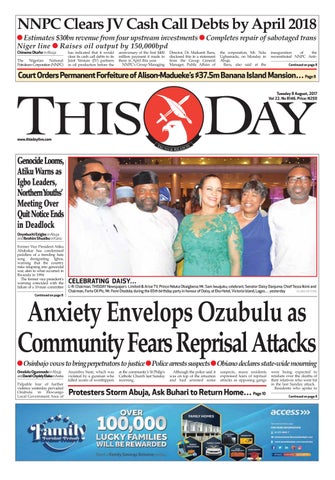
CELEBRATING DAISY…
L-R: Chairman, THISDAY Newspapers Limited & Arise TV, Prince Nduka Obaigbena; Mr. Sam Iwuajuku; celebrant, Senator Daisy Danjuma; Chief Tessa Ikimi and Chairman, Forte Oil Plc, Mr. Femi Otedola; during the 65th birthday party in honour of Daisy, at Eko Hotel, Victoria Island, Lagos… yesterday m ubo peters
Continued on page 8
Anxiety Envelops Ozubulu as Community Fears Reprisal Attacks Osinbajo vows to bring perpetrators to justice Police arrests suspects Obiano declares state-wide mourning Omololu Ogunmade in Abuja andDavid-Chyddy Eleke inAwka Palpable fear of further violence yesterday pervaded Ozubulu in Ekwusigo Local Government Area of
Anambra State, which was violated by a gunman who killed scores of worshippers
at the community’s St Philip's Catholic Church last Sunday morning.
Although the police said it was on top of the situation and had arrested some
suspects, many residents expressed fears of reprisal attacks as opposing gangs
Protesters Storm Abuja, Ask Buhari to Return Home… Page 10
were being expected to retaliate over the deaths of their relatives who were hit in the last Sunday attack. Residents who spoke to Continued on page 8
2
T H I S D AY TUESDAY AUGUST 8, 2017
T H I S D AY TUESDAY AUGUST 8, 2017
3
4
T H I S D AY TUESDAY AUGUST 8, 2017
T H I S D AY TUESDAY AUGUST 8, 2017
5
6
T H I S D AY TUESDAY AUGUST 8, 2017
T H I S D AY TUESDAY AUGUST 8, 2017
7
ŽŶƟŶƵĞĚ ŽŶ WĂŐĞ Ϯϵ
8
TUESDAY, ˜ ͺ͵ ˾ T H I S D AY
PAGE EIGHT
Court Orders Permanent Forfeiture of Alison-Madueke’s $37.5m Banana Island Mansion Davidson Iriekpen Justice Chuka Obiozor of the Federal High Court in Lagos yesterday ordered the permanent forfeited of a $37.5million mansion on Banana Island, Lagos linked to a former Minister of Petroleum, Mrs. Diezani Alison-Madueke, to the federal government. The court also ordered that $2,740,197.96 and N84,537,840.70 realised as rents on the property should equally be forfeited to the federal government. The judge made the orders following a motion on notice argued before him by the Economic and Financial Crimes Commission (EFCC). The EFCC had on July 19, 2017, obtained a court order to temporarily seize the property, Building 3, Block B, Bella Vista Plot 1, Zone N, federal government layout, Banana Island Foreshore Estate, which is said to have 24 apartments, 18 flats, and six penthouses. The court had directed that the temporary forfeiture order be published in a newspaper and
then adjourned till yesterday for anyone interested in the property and funds to appear to convince the court why they should not be permanently forfeited to the federal government. When the case came up yesterday, the counsel to the EFCC, Mr. Anselem Ozioko, told the court that the publication order had been complied with. Ozioko noted that despite going the extra length to personally serve the second and third respondent in the case, a legal practitioner and a company, Rusimpex Limited, they did not show up in court to contest the forfeiture order. "In summary, it appears as if they are not willing to contest this application," Ozioko said, urging Obiozor to go ahead and order the permanent forfeiture of the property and the funds. In a short ruling, Obiozor granted the orders. The judge held: "In the face of the publication, which I find in exhibit B of the affidavit of compliance before me, and there being no responses from any interested party, I have no other
option but to grant the orders as prayed." The EFCC had earlier told the judge that the Banana Island mansion was reasonably suspected to have been acquired with proceeds of unlawful activities by Alison-Madueke. The anti-graft agency said its investigations revealed that Alison-Madueke purchased the property sometime in 2013 at the price of $37.5million, which she paid in cash. According to the EFCC, the $37.5million was moved straight from Alison-Madueke's house in Abuja and paid into the seller's First Bank account in Abuja. "Nothing could be more suspicious than someone keeping such huge amounts in her apartment. Why was she doing that? To avoid attention. "We are convinced beyond a reasonable doubt because as of the time this happened, Mrs. Alison-Madueke was still in public service as the Minister of Petroleum Resources," the EFCC lawyer, Ozioko, had told Justice Obiozor. Listed as respondents in
the forfeiture application were Alison-Madueke, a Lagos-based legal practitioner, and a company, Rusimpex Limited. In a 41-paragraph affidavit attached to the application, an investigative officer with the EFCC, Abdulrasheed Bawa, explained that the legal practitioner, in connivance with Alison-Madueke, purposely incorporated the company, Rusimpex Limited, on September 11, 2013, to facilitate the alleged fraud scheme. According to Bawa, when the lawyer was questioned by the EFCC, he explained that he had approached Alison-Madueke for opportunities in the oil and gas industry but the ex-minister told him that being a lawyer, she did not have any such opportunity for him and asked him whether he could in the alternative manage landed properties, an offer which he accepted. Bawa said the lawyer later registered Rusimpex Limited at the Corporate Affairs Commission (CAC), wherein a lawyer in his law firm, Adetula Ayokunle, and a Russian, Vladmir Jourauleu,
were listed as the directors of the company, while the address of the lawyer's law firm in Ikoyi, Lagos was registered as the business address of Rusimpex Limited. The investigator added that when Ayokunle was questioned by the EFCC, he explained that he only appended his signature on the CAC documents at his boss' instruction, while Jourauleu denied knowledge of the company. The investigator explained, "Sometime in 2013, the former Minister of Petroleum Resources, Alison-Madueke, invited the lawyer, to her house in Abuja for a meeting where she informed the said lawyer to incorporate a company and use same as a front to manage landed properties on her behalf without using her name in any of the incorporation documents. "She further directed the lawyer to meet with Mr. Bisi Onasanya, the Group Managing Director of First Bank of Nigeria Plc for that purpose. "Onasanya was invited by the commission and he came and volunteered an extrajudicial
statement wherein he stated that he marketed a property at Bella Vista, Banana Island, Ikoyi, Lagos, belonging to Mr. Youseff Fattau of Ibatex Nigeria Limited to AlisonMadueke and Alison-Madueke later bought the property from Mr. Youseff Fattau, through her lawyer, (who she introduced to him) and that payment for the said property was made through the Abuja office of First Bank of Nigeria Plc. "First Bank of Nigeria Plc, through Mr. Barau Muazu, wrote to the commission and also volunteered an extrajudicial statement in writing that they made the payments totalling US37,500,000 to Ibatex Nigeria Limited & YF Construction Development and Real Estate Limited on behalf of AlisonMadueke and that they collected the entire cash from Alison-Madueke at her residence of No. 10, Fredrick Chiluba Close of Jose Marti Street, Asokor, Abuja and paid into the First Bank of Nigeria Plc accounts of Ibatex and YF Construction Development and Real Estate Limited on her instruction," he explained.
of a family have been confirmed to be among those killed during the church attack. Chairman of Ekwusigo Local Government Area, Mr. Ikenna Ofodeme, who spoke to THISDAY in his office at the council headquarters, said one family, which was later identified as Obunadike family were also involved in the incident. Ofodeme said the unidentified man from the Obunadike family who was among those shot dead also lost his wife and new born child. "The Lady was carrying her new born child when the bullet pierced her back, came
out through her chest and also pierced her baby and they both died," Ofodeme said. The council chairman also said that after analysis, it had been ascertained that a total of 12 persons lost their lives in the attack and that they consisted of nine women, one baby, and two men. He said that he had also written an official letter to the hospital authority for proper identification of the dead and injured persons for record purposes. Most of those who were hospitalised were also said to have been discharged, while
ANXIETY ENVELOPS OZUBULU AS COMMUNITY FEARS REPRISAL ATTACKS THISDAY were worried that a gang war might break out, further endangering their lives. But soothing assurances came from Acting President Yemi Osinbajo yesterday, asking the people to remain calm as the long arms of the law would surely rein in the perpetrators of the dastardly act. The acting president in a statement by his Senior Special Assistant on Media and Publicity, Mr. Laolu Akande, said he had been receiving regular updates on the incident, which the police put the deaths at 11 and the injured, 18. He condemned it as a
despicable act of violence and commiserated with families, relatives and friends of the victims, and the entire people and the government of Anambra State. He said he had been in touch with the Anambra State Governor, Chief Willie Obiano, police authorities and other security agencies on the killings and rest assured the public that those behind it would be brought to justice. Preliminary investigations, according to the Commissioner of Police, Anambra State Command, Mr. Garba Umar, showed that the incident arose from a disagreement between two drug lords from the
community but residing outside the country. He said some arrests had been made and promised to give further information in due course. THISDAY arrived the community about 12 pm to behold a very quiet community, with indigenes wearing long faces and going about their daily activities. Ugwu Oye junction, a popular junction that also has a market, which is the first point on coming from Nnewi to Ozubulu was not the usual bubbly junction it had always been. The loud music from the public address system owned by those who sell music discs was obviously absent.
Commercial activities, however, went on normally, but it was clear that all was not well in the community. The church where the incident happened was deserted unlike Sunday afternoon when the church was besieged by sympathisers. An indigene of the community, Mr Calistus Ndukamma, who lives close to the church premises said: "Those who witnessed what happened yesterday are still in shock, and we are still living in fear. Do you know that if you throw a knockout here, people will take to their heels?" Meanwhile, three members
Continued on page 9
GENOCIDE LOOMS, ATIKU WARNS AS IGBO LEADERS, NORTHERN YOUTHS' MEETING OVER QUIT NOTICE ENDS IN DEADLOCK of a coalition of Northern Youths and Igbo leaders, over the expulsion notice given by some Northern youths to Igbos to leave the North by October 1, 2017, to reach an agreement yesterday. The committee had been set up to find a common ground between the feuding groups and make peace. But while it set about its task, hate speeches persisted with a song in Hausa targeted at instigating resentment of Igbos circulating in the Northern part of the country. Atiku intervened against this trend yesterday, asking security agencies to swing into action immediately and thoroughly investigate, apprehend and severely punish those behind the hate song. "It has come to my attention that a song disparaging people of Igbo origin, and which wishes them dead, is circulating in some parts of the nation. I totally and unequivocally condemn this development, and I call on all men of goodwill to rise up against this evil," he said in a statement.
According to him: "This song is reminiscent of the beginning of the Rwanda genocide. Nigerians need to be aware that the Rwanda genocide was believed to have been ignited by a song titled ‘Nanga Abahutu (I hate Hutus)’ sung by Rwanda's then most popular musician, Simon Bikindi. God forbid that we should have such a déjà vu in Nigeria. "I call on the security agencies to thoroughly and decisively swing into action and apprehend, try, convict and severely punish those behind this ungodly song which incites racial hatred,” the statement read. Explaining further what happened in the Southern African country, Rwanda, the Waziri Adamawa said: "Simon Bikindi was convicted by the International Criminal Tribunal for igniting and aiding the Rwandan genocide. Thus, let those who think they can treat their fellow citizens so unjustly know that within and outside Nigeria exist mechanisms that will ensure they answer to their crimes.”
He called on all men of goodwill to remember the immortal lines from Nigeria’s former National Anthem: "Though tribe and tongue may differ, in brotherhood we stand." Atiku said the effects of hate in any shape or form were made even more evident over the weekend, in a shooting incident that left many Nigerians reeling with shock; and commiserated with the people of Ozubulu in Anambra State, who lost family members in the fatal shooting that also left scores dead and many others injured. "I pray that peace will return to their minds and their community soon, even as the police work hard to get to the bottom of the matter. May God comfort them as no man can,” he said. But a meeting held in Kano yesterday between representatives of Northern youths and Igbo leaders over the former’s expulsion order notice to the latter ended in a stalemate, warranting an extension of discussions by 10 days for wider consultations.
The committee in a statement made available to THISDAY in Kano said there was the need for more time to enable it to do a thorough job. The statement signed by Chief Chi Nwogu (representative of Igbo leaders), Alhaji Dauda Shamakiri (representative of the Coalition of Northern Groups) and Mr. Isa Tijani (convener of the peace parley), said: “The Committee sat and deliberated extensively and agreed that there is the need for further consultations from both sides. “Accordingly, the meeting adjourned to reconvene in the next 10 days where a final resolution on issues will be achieved,” it stated. Meanwhile, the Coalition of Northern Groups has accused the leader of IPOB, Mr. Nnamdi Kanu, of sowing the seed of discord in the corporate existence of Nigeria as a country. It said in a statement yesterday: “His (Nnamdi Kanu) recent action of forcefully grounding movement of people, including those from other regions by shutting down most South-east cities,
notwithstanding the mild and ineffective condemnation by some Igbo political, cultural and religious leaders, has foreclosed the avenues for an expected early peaceful resolution. “It is a further justification of our concern expressed in the Kaduna Declaration and subsequent correspondence with the Acting President of the Federal Republic of Nigeria and the International Community. “These renewed threats contained in Kanu’s unwarranted utterances and actions compel us to push further for definite national and international action that would decide the Biafran matter to a conclusion once and for all. “In our usual truly patriotic aim to forestall the drift towards anarchy in Nigeria, and also to alert the international community as to where responsibility would ultimately lie if such momentous events ever came to pass, we have followed up our earlier efforts by another round of initiatives of extending similar communications to relevant authorities.
“Accordingly, we have met with many leaders and groups with positive developments while our doors remain open for discussions with more groups, leaders, and agencies genuinely interested in addressing the separatist issues with a view to finally achieving a peaceful and stable Nigeria,” the group stressed.
TOP GAINERS NGN NGN % CCNN 1.00 10.84 10.0 C & LEASING 0.10 1.10 10.0 DANGFLOUR 0.41 5.80 7.6 LIVESTOCK 0.07 1.00 7.5 CADBURY 0.59 12.39 5.0 TOP LOSERS NGN NGN % AXAMANSARD 0.10 2.07 4.6 CONTINENTAL 0.06 1.33 4.3 A.GLEVENTIS 0.03 0.69 4.1 AFRIPRUD 0.14 3.23 4.1 FIDSON 0.13 3.02 4.1 HPE Nestle Nig Plc ₦1,060.00 Volume: 254.485 million shares Value: N5.797 billion Deals: 4,600 As at yesterday 7/08/17 See details on Page 31
9
˾ TUESDAY, AUGUST 8, 2017
PAGE NINE
Again, Aisha Buhari Returns to London Omololu Ogunmade in Abuja First Lady, Mrs. Aisha Buhari, at the weekend again returned to London to join her husband, President Muhammadu Buhari, who had been on medical vacation since March 7. Aisha who only returned from London to Nigeria on Thursday, August 2, and proceeded to Owerri, the Imo State capital, was
received by the state Governor, Rochas Okorocha, on Thursday and went back three days later. Confirming her trip to THISDAY yesterday, Special Assistant to the First Lady, Media, and Publicity, Mrs. Adebisi Olumide-Ajayi, said the First Lady returned to London on Sunday but added that there was no information about her return date. The trip marked the third
time Mrs. Buhari would be visiting her husband in London, since May 7, when the president left the country on an indefinite medical vacation. She had first left the country for London on May 31 and returned on June 6. On July 2, three weeks later, she returned to London and did not come back until August 3, only to return on August 6.
Mrs. Buhari
ANXIETY ENVELOPS OZUBULU AS COMMUNITY FEARS REPRISAL ATTACKS 27 others who were still in the hospital were in stable conditions. The council boss said it was not true that the killing was motivated by a feud between two drug lords, saying that the said suspected drug lord, Mr. Aloysius Ikegwuonu, who was allegedly targeted by the gunman left the community on Saturday. "Ikegwuonu was here, and for two days he played football with youths in the community and even gave out football boots to people. If it was he they needed, they would have come then and taken him. "What I can say is that there may be a political undertone to this attack. Why is it coming now that election is coming? Remember that security is the biggest achievement of our governor and some politicians may be seeking to discredit him by doing this. "I believe that in the fullness of time the true
story will be unveiled. The police are working and I believe they can do it. Saying that drug barons did this or did that is wrong because if it is true, then the police will just work on that, but it is not true," the council chairman affirmed. At the Nnamdi Azikiwe University Teaching Hospital where several victims of the attack were being treated, Mr. Samuel Ndulue, who sustained two broken legs, while speaking to our reporter recounted how he was saved from the bullets sprayed in the church by the gunman. He said: "I was sitting in the third row of the seat, right in front of the church when it started. It was only one man that entered the church, but I suspected that their members may be in a car outside. The man was dressed in all black attire, with a fez cap. Immediately he entered, he neither said a word nor made any enquiry, I was in front and he was
behind. So, he stood close to one of the three doors of the church. He started immediately, shooting at everyone. "I took cover, lying on the ground, but as the man continued to kill people, I decided to stand up and run towards the door because my thought is that the man may have enough bullet to finish everybody. It was while rushing towards the door that I sustained broken legs because the man was standing close to one door, leaving us with just two doors to use," he narrated. He said most of the people that sustained injuries were those who tried to escape through the door, but because too many people were using it at the same time, they sustained injuries. The state police boss, Umar, said his men had made some arrests but would not give details because disclosing further information on the arrested suspects might jeopardise
the investigation. In a state-wide broadcast yesterday, Governor Obiano declared a day's mourning in honour of those killed. He said: "We shall observe a minute of silence in their honour at 12 noon today and special prayers shall be offered for them in churches and prayer houses across Nigeria and in the Diaspora. We have also opened a condolence register for them in the Government House." Members of Indigenous People of Biafra (IPOB) joined in condemning unequivocally the barbaric attack, saying it was untrue that the killing was caused by a business deal between brothers that went bad. A statement by the media and publicity secretary of the group, Mr. Emma Powerful, said the conclusion by the police that the killing was a result of a business deal gone wrong in faraway South Africa was a hasty one and could not be said to be true.
It said: "It is unfortunate that the Nigeria police who are required to enter into a detailed investigation with the view to apprehending the culprits, merely concluded within an hour that they knew the cause and the perpetrators of the crime. "We don't know when Nigerian Police acquired this level of efficiency and excellence that enabled them to conclude their investigations within an hour. Does it mean they had prior knowledge of the crime and if so, why weren't measures put in place to pre-empt it?" he queried. The group wondered why with all the countless Police and Army check points along the roads in Anambra State, especially along Onitsha-Owerri Road leading to Ozubulu, the killer was not intercepted, given that crime detection and prevention was often cited as the main reason
why AK47 brandishing police and army recruits littered the roads. It said: "We are alerting the international community, men and women of good conscience to prevail on the Nigerian and Anambra State Governments to constitute an independent and transparent panel of inquiry to ascertain what actually happened because this level of brutality is unheard of in Anambra State and entire Biafran land before now. "This massacre of our people in Ozubulu as with other indiscriminate slaughter of our people around Nigeria is a constant reminder to us all of the threat we face each day we delay our exit from Nigeria. Unfortunately for us, these heinous crimes will be visited upon us at predictable intervals until we collectively summon the courage to demand for our right to a referendum that will settle this once and for all time," he stated.
its mission of eradicating corruption in the NNPC by organising sensitisation campaigns; workshops; seminars; and government’s publications on issues concerning corruption and economic crimes. He equally emphasised that with the prevailing global economic reality, the only survival strategy for the NNPC was to change from its old ways of doing business and embrace the best practice of transparency, accountability, and honesty with integrity. The statement said the reconstituted anticorruption committee of the corporation would be headed by Mr. Mike Balami, a Group General Manager in the Finance and Account Directorate. Meanwhile, Nigeria’s daily oil production is expected to rise again by 150,000 barrels per day (bpd) following indications that the Trans Niger Pipeline (TNP), which was broken by unidentified hoodlums some weeks ago had been repaired and currently undergoing some technical tests. The sabotage on the line according to Baru, had cut Nigeria’s oil production by
150,000bpd. However, THISDAY on Monday gathered from the NNPC that the broken parts of the line which crisscrossed the Ogala; Alakiri; Cawthorne Channel; and Bonny areas of the Niger Delta, transporting around 180,000bpd to the Bonny export terminal had been fixed by a team of engineers. Baru had on July 24 disclosed on the side-lines of the extraordinary session of the council of ministers of the African Petroleum Producers Organisation (APPO) held in Abuja, that a fresh militant attack on the Trans-Niger crude oil pipeline was recorded in the early hours of that day. “Unfortunately, we have not been able to sustain it (oil production) because we get challenges. As I am talking to you, this morning, the Trans-Niger pipeline has been breached in Ogoniland, and that is 150,000 barrels of oil that have been knocked off. That has been fairly an issue with that area,” said Baru when he was asked about Nigeria’s oil production then. He also stated: “We hope we can continue our dialogue and this would return to what it should be.”
But Ughamadu confirmed to THISDAY that repair of the line had been completed and undergoing a test-run. “It has been put back, and so they are test-running at the moment. It will resume production any moment from now,” Ughamadu explained. The TNP is 30 per cent owned by Shell Petroleum Development Company (SPDC); the NNPC which has 55 per cent shares of it; Total E&P Nigeria Ltd - 10 per cent; and Nigerian Agip Oil Company (NAOC) - 5 per cent, and is part of the gas liquids evacuation infrastructure critical for continued domestic power generation (Afam VI power plant) and liquefied gas exports. Also, as a result of militancy in the Niger Delta region which resumed in 2015, Nigeria suffered a huge drop in her oil production and was exempted by the Organisation of Petroleum Exporting Countries (OPEC) and non-OPEC members from participating in a freeze arrangement to stabilise prices of oil. But the country recently submitted a plan to the coalition to participate in the arrangement at a production cap of 1.8mbpd.
NNPC CLEARS JV CASH CALL DEBTS BY APRIL 2018 Corruption Committee, that the four upstream investments it recently entered into with its JV partners would provide incremental revenue worth $30 billion to the national treasury in the next 10 years. The NNPC in December 2016 got a discount of $1.7 billion from the $6.8 billion it owed its JV partners as cash call obligations and was asked to pay $5.1 billion instead. This is however in addition to the $1.2 billion cash call debt owed the partners in 2016, for which $400 million was paid in April. Baru, however, explained in the statement that the NNPC would seek to balance the outstanding debts before April 2018. He said: “These four projects alone are going to raise incremental revenues to Nigeria of over $30 billion over the life of the projects in less than 10 years. They will also serve as part of the vehicle for exiting JV cash calls. “We have to pay our arrears of about $6 billion that were incurred pre-2016 and we are also paying up a tranche of about $1 billion 2016 arrears. We started in
April 2017 with the payment of $400 million and we will pay the balance before the anniversary of the first payment,” he declared. According to him, the upstream investments which the corporation signed with multiple partners attracted about $3.8 billion in foreign direct investments to it. He said this would serve as the means to fast-track its exit from the cash call era of funding oil and gas production in the country. Baru, listed the signed alternative financing arrangements to include the $1.2 billion multi-year drilling for 36 offshore and onshore oil wells under the NNPC/ Chevron Nigeria Limited JV which is codenamed project Cheetah; and the $800 million NNPC and First E&P JV and Schlumberger tripartite alternative funding agreement for the development of the Anyalu and Madu fields in the Niger Delta. He also said the $1 billion NNPC/SPDC JV Project Santolina; and the $780 million NNPC/Chevron JV Project Falcon on Sonam, were the other two. He commended the finance and technical teams of the corporation for attracting the
investments at a period, he said, was difficult to attract foreign credit facilities. He also explained that the arrangement would allow the corporation to subsequently operate from the production revenue less the first line charge to the government which is the royalties and petroleum profit tax. According to him, whatever profit that accrues afterward would be remitted to the government after deduction of production cost. Drawing a correlation between the quest for revenue and the federal government’s anti-corruption campaign, Baru, said the corporation’s staff must never allow corrupt practices to distract them from their tasks. He said the NNPC was the first government agency in 2000 to get involved in government’s anti-corruption campaign when the government mandated all its Ministries, Departments and Agencies (MDAs) to establish in-house anti-corruption committees. “NNPC was the first to put one in place within a month, precisely on October 2000,” he noted, while stating that the committee had consistently carried out
TUESDAY, AUGUST 8, 2017˾ T H I S D AY
10
NEWS
ÏáÝ ÎÓÞÙÜ Davidson Iriekpen ×ËÓÖ davidson.iriekpen@thisdaylive.com, 08111813081
Protesters Storm Abuja, Ask Buhari to Return Home Calls for return, resignation wrong, says presidency Omololu Ogunmade ËØÎ Olawale Ajimotokan ÓØ ÌßÔË Controversial entertainer, Charles Oputa (Charley Boy), yesterday led a group of protesters, composed mainly of youths, to demand the immediate return of President Muhammadu Buhari to the country. Buhari has been in London for almost three months where he is receiving treatment for an undisclosed ailment. The ranks of the protesters swelled by members of civil rights activists who defied the morning rain when they marched on the National Assembly from the Unity Fountain by Shehu Shagari Way. There was a heavy presence of policemen who mounted horses and other security personnel at the protest to ensure it did not turn violent. The protesters, who tagged themselves ‘Union of All Angry, Vexed and Frustrated Nigerians’, distributed fliers and carried a huge banner with ‘Our Mumu Don Do’ conspicuously written on it. Some of the fliers urged the members of National Assembly to trigger Section 144 that will lead to the impeachment of the president on medical ground. They said they wanted to take back Nigeria so that the
country can work again. The group urged Buhari to either resume or tender his resignation, saying he can not continue to remain in London indefinitely. They raged that acting President Yemi Osinbajo was not fully in charge of the country. Charley Boy said he turned up at the protest to support the youths, who were demanding accountability and transparency from their leaders. He vowed that they would resume today with their protests, adding that the coalition would picket the State House until Buhari returns or resigns. “Our Mumu don do. Things must not continue like this. This country must not be perpetually left in auto- mode. We will resume here tomorrow (today) and will march on the Presidential Villa until we see the president,” he flared up. However, the presidency described the protest as unnecessary, noting that there is no vacuum in government. A statement by the Senior Special Assistant to Buhari on Media and Publicity, Malam Garba Shehu, said whereas the protesters reserved the right to embark on peaceful protests, they erred by making such demands because the president had already complied with constitutional requirement
by transmitting power to his deputy. According to him, in view of power transfer, governance activities are running unhindered, pointing out that such calls violate the constitution and hence, should be ignored. He insisted that the government would not be distracted by the group’s action. “I wish to respond to media enquiries following demonstration by a few citizens this morning in Abuja. The demonstration is in the exercise of their freedom under the
constitution, which guarantees their right to embark on peaceful protests. So long as they remain peaceful, we have no problem with them. What is democracy if citizens can’t peacefully demonstrate? On the second preturn, or resignation or certain explanations, I would say that they have over stepped their bounds. “The president has complied 100 percent with the constitution by handing over power to the vice-president before proceeding on his vacation. He has not breached
any law or the constitution by staying away from office to take care of his health. “Equally, there is nothing like a power vacuum in the country given the competence and general harmony with which the whole government is running. Any such calls as being made by this or any other group represent an irrational assault on the constitution and should be ignored by well-meaning members of the public. “The need of the hour for this country is to rid it of corruption, reform and
reinvigorate the economy and to fight crime and insurgency. The government is busy with the reconstruction and rehabilitation of infrastructure all over the country. It is creating jobs for the unemployed. “It has set its sights on the larger picture of the country’s development; investing in rail and power projects and redeeming the country’s image from the mountains of corruption scandals that have marred it. We will not, therefore, be distracted by this or any other groups,” he said.
Addax Petroleum Shuts Offices MEETING MACROECONOMIC REVIEW L-R: Chief Operating Officer/Executive Director, Sterling Bank Plc, Mr. Yemi Odubiyi; Managing Director/CEO, Financial Derivatives after Swiss Bribery Case Company Limited, Mr. Bismarck Rewane; Managing Director/CEO, Sterling Bank, Mr. Yemi Adeola; and Executive Director, Retail & Ejiofor Alike áÓÞÒ ËÑÏØÍã ÜÏÚÙÜÞÝ Chinese-owned oil firm, Addax Petroleum, is shutting its offices in Geneva, Houston and Aberdeen, a month after it agreed to pay 31 million Swiss francs ($31.85 million) to settle charges of suspected bribery of Nigerian and other foreign officials. Addax Petroleum had agreed to pay the fine in Geneva, Switzerland, thus ending a four-month old investigation, which uncovered the illegality in the payments. Confirming a report in the Tribune de Geneve newspaper, Addax said its parent firm, Sinopec International Petroleum Exploration and Production Corporation (SIPC), would integrate the three offices into a new technical centre in Beijing. SIPC was streamlining its business model in response to low oil prices, the Addax statement said. “This rationalisation designed to reduce management duplication, improve efficiency and secure longterm business sustainability will see Addax Petroleum’s Geneva office integrated with SIPC’s headquarters in Beijing, and the Geneva office closed by the end of this year,” Reuters quoted the company as saying. Addax’s operating companies will start reporting directly to SIPC headquarters from August 9, and Addax will run a consultation process for its 174 affected staff in
Geneva to mitigate the impact of the organisation change, it said. The newspaper said Genevabased staff were informed of the closure yesterday afternoon. The company’s website shows that it has more than 1,000 employees, and operations in Nigeria, Gabon and Cameroon, as well as joint ventures with Genel in Iraqi Kurdistan and with Repsol in the British North Sea. The Geneva’s Prosecutor’s Office investigated Addax Petroleum, which had also confirmed the criminal investigation into allegations concerning its operation in Nigeria. The investigation had led to the arrest of the company’s Chief Executive Officer of its Geneva Office, Zhang Yi, and the Legal Director, who were also charged for several millions of dollars in payments to an unnamed company and several lawyers in Nigeria. A four-month investigation found that the payments were not sufficiently documented and doubts remained on their legality, but no criminal intent was established, the prosecutor’s office said. With that settlement, cases against the CEO and legal director were also closed, a spokesman for the prosecutor said at the time.
Consumer Banking, Mr. Grama Narasimhan, during the bank’s monthly macroeconomic review meeting at its headquarters in Lagos ...yesterday
Osinbajo: Investors Who Fail to Invest in Nigeria in 10 Years will Miss Out Says largest refinery, single fertilizer plant under construction here Omololu Ogunmade ÓØ Abuja Acting President Yemi Osinbajo yesterday persuaded Nigerians in Diaspora to take advantage of the numerous opportunities available in Nigeria to invest in the country, arguing that any investor who fails to invest in Nigeria in the next 10 years would be queried by his organisation. Osinbajo made this remark while delivering a speech at an event organised for Nigerians in Diaspora under the aegis of “Nigeria Initiative for Economic Development,” who want to return to Nigeria to invest in the country at the Banquet Hall of the Presidential, Abuja. At the event which was attended by Diasporans in the United States, Osinbajo described Nigeria as fruitful investment destination, citing the huge breakthrough which MTN has recorded
within a short period of its investment in the country as an attestation. “I like the idea of investors knowing that the reason why you are coming to Nigeria is not to help Nigeria. You will ultimately end up helping Nigeria, but the reason why you are coming here is because this is a good place to do business,” he said. He echoed the DirectorGeneral of the Nigerian Investment Promotion Commission (NIPC), Mr. Segun Awolowo, that any investor who does not take advantage of Nigeria’s fertile ground would have lost out. “The world is a much, much smaller place and gets smaller by the day. So I think that there is very little today and I like the point that was made by the DG of the Nigerian Investment Promotion Commission, NIPC that anyone who doesn’t invest in Africa or Nigeria in 10 years’ time,
they would be queried by their establishment, by their businesses that ,you just missed out on the best possible opportunity’and you know that it is easy to miss out on the best possible business opportunity,” he added. Osinbajo disclosed that the biggest refinery in the world with 650,000 barrel per day capacity was under construction in Nigeria adding that the largest single fertilizer plant was also being cited in the country as he compared Nigeria with another African country, saying the opportunities in Nigeria were enormous. “But we have private sector investments that challenge that size. For example, the largest single line refinery in the world is a private sector investment and it’s going to be doing 650,000 barrels of oil every day. That refinery is purely private sector driven. Also, the largest single line
fertilizer plant in the world is being set up here. All of these will be ready by the end of 2018, some early 2019. They are huge private sector investments that completely belie the size of the federal budget and belie everything else. “So, really what we intend to do is to push private sector and that’s why we are doing everything that we are doing to ensure that the private sector can come in and invest. Look at the power sector for example; the power sector is almost completely privatized. But we have had difficulties because of tariffs, for example. Many times you look at our power sector, we have an installed capacity of about 12,000 megawatts today but we are only able to put on the grid under 5,000, a little above 4,000 megawatts. But we know that the potential is way beyond that maybe four or five times that,” he said.
T H I S D AY TUESDAY AUGUST 8, 2017
11
TUESDAY, AUGUST 8, 2017˾ T H I S D AY
12
NEWS
Presidency: ICPC Set to Commence Trial of Dropped Nominees Confirms initial security checks cleared them Omololu Ogunmade ÓØ ÌßÔË The Independent Corrupt Practices and Other Related Offences Commission (ICPC) is set to charge to court, two of the 14 nominees into the board of the commission, who were dropped at the weekend by the presidency to face corruption charges. A senior official in the presidency who did not want to be named, told THISDAY yesterday that it was upon learning that the commission had prepared charges against them that it quickly cancelled their appointments. The two nominees, Ms Maimuna Aliyu and Dr. Sa’ad Alanamu, were accused of fraud to the tune of about N1 billion when they served different institutions in Kwara State and Abuja respectively. Alanamu was said to have been caught in corrupt practices when he headed various institutions in Kwara State while Aliyu was accused of abuse of office and misappropriation and diversion of funds when she served as the Executive Director of Aso Savings and Loans. THISDAY investigation
revealed yesterday that contrary to beliefs that the names of the dropped nominees were never sent to a relevant agency for security check, they were actually screened by a security agency and cleared before their appointments by acting President Yemi Osinbajo on August 1. However, the source was quick to add that they were nominated in view of the security agency’s report that there were no records of criminal convictions against them, adding however, that the agency noted that there were questions about their past records. He explained that the basic idea behind security checks was to find out if a particular nominee had hitherto been convicted of criminal offences, explaining that it would not be fair to drop a nominee on the basis of mere petitions and accusations in view of frivolous petitions that might be brought against him by his traducers. The source recalled how a number of accusations were leveled against the Minister of Power, Works and Housing, Mr. Babatunde Raji Fashola, following his nomination as
minister in 2015, observing that if mere accusations or petitions were the basic requirements to withhold an appointment, Fashola, like some of his colleagues, would not have been a minister today. He added that when the presidency got to know about the allegations, it reached out to ICPC to confirm its veracity, disclosing that indeed, the commission did not only confirm the allegations but also revealed that it had already prepared charges against them. The senior official said it was at this level that it became imperative for them to be dropped to stand trial for charges of corruption against them, moreso that it is the same commission they were nominated to serve that also had corruption cases against them. “The basic security check is is to know if there were criminal convictions against them but checks done by the agency
revealed that there was none but there were questions and when ICPC was contacted, it confirmed that it was true and it were already preparing charges against them. It was at this level that we said ‘we cannot go beyond this level.’ “We cannot drop people on the basis of petitions because if you are nominated for an appointment and a petition is written against you, l will not be fair to you, if l drop you on the basis of that petition, there will always be petitions,” he said. Last Sunday, the acting president, through his spokesman, Mr. Laolu Akande, announced the withdrawal of the nominees, Aliyu and Alanamu, citing conflict of interests on their appointments. He had earlier on Tuesday last week appointed Professor Bolaji Owasanoye as the new Chairman of ICPC and redeployed the former chairman, Ekpo Nta, to National Salaries, Wages and Income
Commission. He also named 13 others, including Alanamu and Aliyu, as board members of the commission. The withdrawal followed media reports that Aliyu and Alanamu were being investigated for alleged fraud which was believed would bring credibility crisis into the commission set up to fight such fraudulent acts. Against this background, Akande had noted in a tweet that whereas allegations against the duo had not been established via convictions in a law court, the government still had the responsibility to ensure that the right thing was done when weighty allegations were made. “We are stepping down two of the new ICPC board nominees who have ongoing investigation issues with the commission as this presents a conflict. “While existence of allegations or petitions against someone shouldn’t necessarily disqualify them from considerations for appointments, this case presents a
peculiarity as we have confirmed that the agency in which they are to serve is indeed investigating the two of them. “A basic check showed no court convictions against them. But when weighty petitions come up, this administration will always do the right thing,” Akande tweeted. Owasanoye, who was hitherto a member of the Presidential Committee on Anti-corruption headed by Professor Itse Sagay, will serve for a renewable term of five years while other members will serve for four years. Other nominees into the board are: Dr. Grace N. Chinda, Okolo Titus M., Obiora Igwedebia, Mrs. Olubukola Balogun, Group Capt. Sam Ewang (rtd.), Justice Adamu Bello, Hannatu Mohammed and Abdullahi Maikano Saidu. Also nominated are Yahaya Umar Daud, Khamis Ahmed Mailantarki and Prof. Musa Usman Abubakar as the board secretary.
70 Lecturers to Quit UNIMAID for Fear of Attack At least 70 lecturers have resigned from the University of Maiduguri Botno State since 2009 owing to the Boko Haram insurgency in the North-east. The Chairman of the Academic Staff Union of Universities (ASUU) Maiduguri chapter, Dani Mamman, who disclosed this to the BBC, said the number of students enrolling had dropped significantly since the insurgency started in Maiduguri. He also said the university had employed lecturers to replace those who left. The university has recently been targeted by suicide bombers, most of whom are young women. In July, authorities in Borno State began digging a 27 kilometre
(17 miles) trench around the university to prevent attacks by militants. Two weeks ago some staff of the university, who were hired by the Nigerian National Petroleum Corporation (NNPC) to explore the Lake Chad basin for oil, were killed in an ambush by Boko Haram. The Cable reported that three members of the exploratory contingent, who are staff of the university, are still in captivity. But the Vice-Chancellor of the University of Maiduguri (UNIMAID),Ibrahim Njodi, has said the search for oil in the Lake Chad basin would continue despite the attacks.
APDA NEC Meets Today The leadership of the Advanced Peoples Democratic Alliance (APDA), the party recently registered by some members of the Peoples Democratic Party (PDP) as a fall-back option during the recently resolved leadership crisis in the party will hold a National Executive Committee (NEC) meeting on today to ponder its future. APDA was believed to have been registered to help protect the interests of members of the PDP in anticipation that the judgment could go in favour of Senator Ali Modu Sheriff. Astatement issued by the interim deputy national chairman of the party, Dr. Ayodele Fijabi-Adebo, and the interim national organising secretary, Saleh Barde said today’s NEC would discuss the party’s plans towards the forthcoming governorship election in Anambra
State, among other pressing issues. “Following recent developments in the country, particularly the judgment of 12th of July 2017, delivered by the Supreme Court in the leadership tussle within the PDP, the INEC timetable for elections including the November 2017 Anambra State governorship election and APDA’s interest in being a viable opposition and participant in the 2019 election, it was resolved that as a matter of urgent national importance, we, the undersigned NEC members, having regards to the issues raised by stakeholders, agree to convene a meeting which will give direction to future developments affecting APDA. We, therefore, set out the agenda for the NEC meeting as empowered by Sections 77 (d, e, o, q, s, and \/) & 78(1) of the Constitution of APDA.”
WHERE IS OUR PRESIDENT?
Members of Our Mumu Don Do Movement during a protest demanding the resumption or resignation of President Muhammadu Buhari at the entrance of Presidential Villa in Abuja....yesterday
Two Soldiers Dead, Scores of Boko Haram Terrorists Killed in Ambush Paul Obi ÓØ ÌßÔË Troops of the 151, 21 Brigade of Nigerian Army, components of the Operation Lafiya Dole, at the weekend ambushed suspected Boko Haram terrorists and neutralised 12 of them. Different items including 18 bicycles were recovered from the insurgents. But two soldiers were killed by Improvised Explosive Devices (IEDs) hidden along the road by terrorists. The Director of Information, Nigerian Army, Brig. Gen. Sani Usman, disclosed these in a statement yesterday. The statement said: “On Saturday, August 5, 2017, troops of 151 Battalion, 21 Brigade
Nigerian Army, Operation Lafiya Dole, sprang an ambush on suspected Boko Haram terrorists along Miyanti-Banki Junction. “The gallant troops neutralised 12 Boko Haram terrorists and recovered 18 bicycles, 30 bags of flour, one bag of groundnut, two bags of salt, two baskets of kola nut and five torch lights. Other items recovered a carton of mixed juice sachets, four rolls of brocade material, two packets of sweet, one carton of washing soap, five packets of cold patch, two packets of Maggi cubes, two pairs of bathroom slippers, two packets of yeasts, four packets of Vedan, two rolls of sewing thread, two kegs of herbicide,
14 packets of insecticide, one keg of groundnut oil, a bag of pepper and N4,000.00 cash. “Similarly, troops of 81 Task Force Battalion of 22 Brigade, Nigerian Army, on Operation Lafiya Dole, August 5 2017, while on patrol cleared Boko Haram terrorists ambush along Dukje-Mada road near Gulumba Gana village. “The troops neutralised quite a number of the terrorists’ ambush party and recovered weapons. Unfortunately two soldiers lost their lives when their vehicle stepped on an Improvised Explosive Device (IED) buried along the road, while four others sustained injuries. The remains of the gallant soldiers that paid the supreme price and the wounded have been evacuated
to Maiduguri. “On the day same too, troops of 22 Brigade Garrison Nigerian Army on patrol to Abdiri recovered nine primed cylinders from the terrorists’ Improvised Explosive Devices (IEDs) making factory at the area. They destroyed the factory along with the materials. “In addition, on Sunday, August 6, 2017, troops of 28 Task Force Brigade Nigerian Army, also sprang an ambush against suspected Boko Haram terrorists at Kafin Hausa, Madagali Local Government Area of Adamawa State. They neutralised one Boko Haram terrorist and recovered an AK-47 rifle with registration number 02527 MTD and a magazine.”
T H I S D AY TUESDAY AUGUST 8, 2017
13
14
T H I S D AY TUESDAY AUGUST 8, 2017
COMMENT
Editor, Editorial Page PETER ISHAKA Email peter.ishaka@thisdaylive.com
IMAGINING PRISONS IN AFRICA
It is time Africa adopted a creative and humane culture for their prison inmates, writes Okello Oculi
A
joke circulated by Social Media goes as follows: “Jacob Zuma yesterday stated, ’I want the people of South Africa to treat me the same way they treated Nelson Mandela’”. Julius Malema immediately responded, ‘’What a great idea. Let’s start with the 27 years in jail!’’ !t is a sadistic joke considering that it recalls how European tribal immigrants into South Africa protected their monopoly of political and economic power by wasting the most vigorous and potentially productive years of a most talented political actor. It is also a disguised vindictive stab at Jacob Zuma who had been such a brilliant and successful intelligence operative of the liberation struggle that President Piet Botha had to beg President Samora Machel to urge Zuma to relocate his base to Zambia – some distance away from the common border between Mozambique and South Africa. The joke, nevertheless, illustrates a long history of the political value of prisons as a social tool. Prisons were created to protect rulers against consequences of crimes they inflict against major groups in society. Dr Caruthers wrote in the 1920s that inmates of prisons in newly colonised Kenya were those vigorously against land robbery by European invaders armed with guns. British officials and land-grabbers labelled these protests as evidence of mental illness. President Jomo Kenyatta is assumed to have signed a deal against land-redistribution with Britain while he was imprisoned at Kapenguria. After winning power, he insulted Bildad Kagia as a mad man for insisting that lands acquired from departing European farmers, be distributed to landless fighters in the Mau Mau war. South Africa’s Boers tagged ANC leaders as ‘’terrorists and communists’’. These were earlier examples of what, in contemporary Bayelsa State, is mocked as imagination ‘’for self development’’ by Africa’s political classes. Following similar land-robbery by the aristocracy in Britain, impoverished losers who fled into urban shacks were regarded as menacing beggars and potential snatchers of handbags of high class ladies sauntering along shopping lanes. To protect this starving class against temptations to resort to robbery to meet their hunger, the police threw them into overcrowded ‘’safe houses’’ or prisons. It was a case of defensive imagination. To meet demands by coffee growers in Brazil; European farmers in racist South Africa, and farmers in North American states, the police both seized the poor along streets, or from prisons, and handed them over. The most adventurous vision loaded prisoners into ships and set them out on a blind hope to survive ocean hazards and reach a new land to be known IN NIGERIA, PICTURES OF EMACIATED as ‘’Australia’’ and ‘’New Zealand’’. This linkage of prison inmates to agricultural and manufacturing labour BODIES FROM SEVERE MALNUTRITION flourishes in the United States: where companies influence the location of AND SKINS COVERED WITH SCABIES AND prisons near their farms and manufacturing plants. It has been suggested OTHER SKIN DISEASES HAVE CONTINUED TO that the incarceration of over three million young African-American males CHARACTERISE ‘PRISON TERRORISM’ BOTH inside prisons is linked to this demand for cheap labour and the profits UNDER MILITARY AND CIVILIAN REGIMES that accrue to beneficiary companies.
African opposition to colonial administrative practices by highly educated African critics – notably after President Woodrow Wilson’s doctrine of self-rule by oppressed peoples – provoked a resort to imprisonment on account of committing ‘’felony’’. The most notable victims were: Kwame Nkrumah (in the Gold Coast, now Ghana); Jomo Kenyatta (in Kenya), Patrice Lumumba (in Congo) and Nelson Mandela (in apartheid South Africa). They shared traits of being extraordinarily brilliant, charismatic and courageous. These so-called ‘’prison graduates’’ had their popular support raised nationwide by their being seen as victims in defence of the welfare of the people. Prisons, unwittingly, became maternity homes for the birth of political independence. Robert Mugabe and Malcolm X added to this narrative the element of using prison resources to increase their level of education; in Malcolm X’s case evolving from a semi-literate street hustler to a most formidable intellectual warrior against Euro-American racial empire and advocate for violent political combat. Mugabe earned a total of eight academic qualifications from correspondence education. In contrast, the notorious murder of ‘’Black Consciousness’’ advocate Steve Biko in apartheid South Africa; numerous deaths of opposition activists and critics in Morocco’s jails and in Egypt under Hosni Mubarak’s regime, show the violent legacy of prison hospitality. In Nigeria, pictures of emaciated bodies from severe malnutrition and skins covered with scabies and other skin diseases have continued to characterise ‘prison terrorism’ both under military and civilian regimes .Media accusations against prison staff have ranged from allegations of fraudulent diversion of budgets for ‘’self enjoyment’’; taking bribes from rich convicts who then hire poor people to serve their term, to rape of inmates. Calls for reform have remained loud. What have not been loud are creative proposals for roads to freedom and personal development for youths ‘’detained without trial’’ for often over 10 years. As examples, appeals could be made to African countries with vast lands but sparse population to rent out land for productive labour by convicts. Niger, Mali, Botswana, Congo D.R., Namibia, Tanzania and Kenya can wear this cap. Gaddafi had created panic across Euro-America by importing hundreds of thousands of workers for productive venture -from lands as far between as China, Philippines, Ghana and Senegal. He had already planted over 21 million trees across his Sahara. None were drowning in the Mediterranean Sea in scrambles to be part of a new slave trade by Europe. Instead of rotting inside over-crowded dungeons, inmates could be awarded contracts to build roads linking villages to local government and state capitals, with their incomes being invested for them in government bonds. In this sector of imagination for human development, ‘ALUTA must Continua!’ Norway has an example of creative and humane prison culture that deserves close study if colonial and feudal barbarism is to be cleansed out of African prisons. Prof. Oculi is a member of THISDAY Editorial Board
THE SENATE, PORTS AND REVENUE LEAKAGES Yahaya Sadique argues that the public hearing by the Senate on revenue leakages at the ports is in order
T
he unrelenting media trial being conducted by the leadership of the Nigerian Ports Authority (NPA) and its obdurate supporters in order to obfuscate the culpability of the NPA in the ongoing investigation of infractions by the Senate’s Joint Committee on Customs, Excise & Tariff and Marine Transport reached an unprecedented low over the weekend. A former governor of Kaduna State, Col. Abubakar Dangiwa Umar (rtd.), in a statement was quoted to have serially described the institution of the Senate of the Federal republic of Nigeria as corrupt and self-serving with a sinister motive to truncate the current administration’s war on corruption. This view, coming from a senior citizen of the country, who had held various sensitive posts in government at various times is alarming and thus, must be interrogated factually to forestall unnecessary build-up of tension in the polity. To put the issues in their right perspectives, I did a discreet investigation into the allegations by the Colonel and some startling revelations came to the fore. First, Masters Energy Limited, a corporate citizen of the Federal Republic of Nigeria, had imported 30 containers of rice which were seized on arrival in the country by the Nigerian Customs Service (NCS). The company petitioned the Senate Committee on Customs Excise and Tariff on its experience and attached various importation documents to multiple government agencies wherein the said consignment was duly declared as rice. On November 17, 2016, the Chairman, Senate Committee on Customs, Excise & Tariff, Senator Hope Uzodimma wrote to the Comptroller General of the Nigerian Customs Service urging him to look into the petition in line with the NCS internal mechanism and advise the committee. The Comptroller General of Customs after deliberation on the matter on November 25, 2016 replied to the Senate Committee’s request by cordially explaining that the matter cannot be reversed as “the
actions of the agent is deemed as being the actions of the importer” quoting Section 155 of the CEMA Act. The CG concluded that the Importer failed to excise due diligence and is thus liable. The Chairman, Senate Committee on Customs, Excise & Tariff, Senator Hope Uzodimma then wrote an appreciation letter on the same day (November 25, 2016), thanking the CG for his prompt response and informing him that the same “self-explanatory” letter has also been conveyed to the complainant. And the matter was brought a closure. Going by the communication between the CG and the Chairman of the Senate Committee on Customs, Excise & Tariff, it is obvious that at no point was the Nigerian Customs or the Comptroller General put under pressure to release any consignment. In any civil society, the right of appeal is guaranteed to every citizen in tandem with their presumption of innocence. Col. Umar alleged that, “He is the leader of the Senate Committee on Customs, Excise and Tariff. He is the owner of both the Niger Global & Engineering Co. Technical Ltd; as well as the rice smuggling giant, Master Energy Commodities Trading Ltd”, in apparent reference to the Senate Committee Chairman on Customs, Excise &Tariff, Senator Uzodimma. One had expected Col. Umar would have made investigations into the matter before going public. His allegations are patently false and perhaps he was falsely informed. Col. Umar had also claimed that “Both the NPA subsidiary, called Calabar Channel Management (CCM) and the private company, Niger Global Engineering & Technical Co. Ltd, were incorporated together in 2014, just for this deal.” This is false as the company- Niger Global was in existence before the advent of democracy in 1999 and the Calabar Channel Contract was advertised and procured in 2004. This lack of concise information on the subject matter makes a mockery of the position of Col. Umar. For the records, the Calabar Channel Management
(CCM) Company is a joint venture with the NPA on 60-40 per cent equity basis and the current Managing Director of the NPA had on resumption of duties, set up a panel to advise her on the status of the Calabar Channel dredging contract and the report that was given to her was quite revealing. In defending the MD of the NPA, Col. Umar would be better served to factually ask for the report from her so as to avoid the dangers of a single narrative. Similarly, people representing the views of the MD of the NPA had in the Nation Newspaper of August 3, 2017, indicated that the Senate Committee on Customs, Excise & Tariff probe on the missing 282 ships was a ploy to distract the on-going investigation into the Calabar Channel dredging contract. To support this position, which Col. Umar seemed to align with, the same publication stated more than four instances where vessels had come to Calabar Port and exited the port without any proper documentation. On November 12, 2014, a survey boat ‘MV Hurricane arrived Calabar and anchored mid-stream for a while then left without recourse to the port management. ‘MV Waterway’ arrived Calabar on November 19, 2014 and subsequently disappeared without any recourse to Calabar Port Control/Management and without applying or obtaining the requisite sailing clearance and till date, there is no communication on the whereabouts of the dredger. On August 29, 2015, the dredger ‘MV Atlantico Due arrived Calabar Fairway Buoy but was not allowed to enter the port for security reasons pending completion of necessary documentation. However, no documentation has been done in that regard till date. On September 1, 2015, ‘MV Hurricane’ arrived Calabar without any documentation. The port signal station directed the vessel captain to ensure necessary documentation with the port was done but the vessel left without responding. If these are true, then the NPA has tacitly admitted
that indeed vessels enter the Nigerian waters and disappear without documentation. This tacit admission validates the position of the Senate that indeed, vessels do enter Nigeria’s territorial waters under the watch of the NPA and exit without documentation, hence the public hearing by Senate to look at the revenue leakages in the ports. This tacit admission by the NPA therefore explains the aversion of the managing director of the NPA to honouring the invitation of the Senate Committee and testify at the public hearing. The Chairman of the Committee, Senator Uzodimma had stated that “We have invited her four times. The first time she did not come, the second time she sent an ED to represent her. We delivered the documents to the ED, we delivered the documents to the Shippers’ Council, the council has worked on the documents and came back to us with some confirmation. What is wrong in inviting the managing director of NPA to appear before a Senate committee to explain why revenues that were supposed to accrue to government did not accrue? It is thus curious that Col. Umar would hold brief for someone that has deliberately, flagrantly and disrespectfully ignored summons from the hallowed institution of the senate. He even joins in ridiculing the Senate by introducing salacious details as regards the aversion of senators to the appointment of the MD of NPA saying, “They want her out because, they now claim, she is ‘too young’ to manage a complex organisation such as NPA – though she is past 40 years of age. Unashamed, they question the wisdom of appointing a woman to such a post – her training and experience counting for nothing; apparently.” This puerile sexist position should not be entertained by any serious minded individual. Suffice to state that the MD of the NPA has a good number of her peers (gender wise) in the National Assembly and they all stand resolutely firm as equals.
Sadique wrote from Kaduna
16
T H I S D AY ˾ TUESDAY, AUGUST 8, 2017
POLITICS
Group Politics Editor Tobi Soniyi Email tobi.soniyi@thisdaylive.com 08033146139 SMS ONLY
EXECUTIVE BRIEFING
The Avoidable Face-off Between AGF and EFCC Although both the Office of the Attorney General of the Federation and the Economic and Financial Crimes Commission have played down their differences over the prosecution of high profile corruption cases, there is a mutual suspicion between them, writes Tobi Soniyi
A
government that came to power with a promise to fight corruption can ill-afford a bickering between the office of the Attorney General of the Federation and the Economic and Financial Crimes
Corruption. Unfortunately however, the crack in relationship between Mr Abubakar Malami, SAN and the EFCC became a public knowledge when on Monday August 26, the representative of the AGF who is also the Special Adviser to the President on Prosecution, Mr. Okoi Obono-Obla at a forum in Lagos told the gathering that EFCC and the Independent Corrupt Practices Commission (ICPC) were not co-operating with the ministry in the prosecution of high profile cases. EFCC and ICPC not cooperating with the AGF? That sounded unbelievable! According to him, about 31 pending corruption cases might have been compromised, because the anti-graft agencies have refused to furnish the AGF’s office with the particulars of the cases. He therefore called for a collective approach against corruption in the country. However, EFCC’s Head of Legal and Prosecution, Gbolahan Latona, who represented the EFCC Chairman, Ibrahim Magu at the event refuted the allegation. He said: “We are not working at cross purposes with the office of the attorney general of the federation; we are co-operating with them. We have a wide range of corruption cases in concert with state agencies.” He said the AGF’s office did not need to wait for the EFCC before it could fight corruption, adding that it had the power to prosecute without waiting for the EFCC’s investigation. That response, many believe, is insulting to the AGF. Perhaps, in an attempt to play down the rift, On Thursday, August 3, the justice minister while speaking at a press briefing in Abuja said there was no rift between his office and the EFCC. The denial is understood. There ought to be no rift between a supervisor and the office he supervises. But the exchanges between Obono-Obla and the EFCC’s head of legal clearly showed that there was indeed a rift. Insiders too knew of the existence of the rift. The existence of a rift was further confirmed by a publication of The Cable. Citing an EFCC official, the online publication reported that Ibrahim Magu, the acting chairman of the EFCC, was served with a letter from the office of the AGF seeking compliance with the regulation on the prosecution of serious cases, usually understood to mean high-profile investigations. Malami was said to have accused Magu of breaching section 10(1) of the Economic and Financial Crimes Commission (Enforcement) Regulations 2010. The report said: “The regulation mandates the EFCC to forward the outcome of investigations along with its recommendations to the AGF in cases or complaints that are “serious or complex”. “A case is considered “serious or complex” if it has significant international dimension, involves money or assets of a value exceeding N50 million or requires specialised knowledge of financial, commercial, fiscal or regulatory matters such as the operations of the markets, banking systems, trusts or tax regimes. “It is also considered serious if it involves allegations of fraudulent activities against numerous victims, involves a significant loss of money by a ministry or department or public body, is likely to be of widespread public concern or involves an alleged misconduct which amounts to economic sabotage. “After the EFCC must have conducted the investigations, it is then left to the office of the AGF to decide whether or not there are sufficient grounds to initiate prosecution, according to
Malami.. denies a rift with EFCC
the regulation.” The Cable further reported that EFCC officials believed Malami is seeking to take over the prosecution of cases handled by the commission in order to water down the anti-graft war, “but sources at his office said he is trying to reassert himself ‘having been persistently sidelined by the anti-graft agencies under his supervision’”, the online publication added. No doubt, the AGF has a supervisory role over EFCC. Besides, as the nation’s Chief Law Officer, the AGF has powers to take over cases
The existence of a rift was further confirmed by The Cable, an online publication. Citing an EFCC official, the online publication reported that Ibrahim Magu, the acting chairman of the EFCC, was served with a letter from the office of the AGF seeking compliance with the regulation on the prosecution of serious cases, usually understood to mean high-profile investigations
Magu.. says commission co-operating with AGF
and can discontinue cases already pending in courts subject to the relevant provisions of the constitution. Sections 150 and 174(1) of the constitution are very instructive in this regard. Senior lawyers believe that the AGF should take the blame for the situation he found himself. He has woefully failed to assert himself. One senior lawyer said: “Nobody can try this with Mohammed Adoke, SAN. He will not take it. They know that the AGF is weak. That is why they are undermining him.” Apart from that, many have had to doubt the AGF’s commitment to the fight against corruption. Even people within the cabinet. Not long ago, precisely after the Code of Conduct Tribunal had discharged and acquitted the Senate President of corruption charges, the Chairman of the Presidential Advisory Committee Against Corruption, Prof. Itse Sagay, SAN and a member of the committee, Prof. Femi Odekunle queried the commitment of the AGF to the corruption crusade. Odekunle had said: “Is the Attorney-General of the Federation, who is to lead the anticorruption fight, going by the way things have been going in the past two years, as committed as others who could have done the job better? The AGF was forced to issue a statement saying that he was committed to the anti-corruption war. He said he expected Sagay and others to know better. The perception that the AGF is weak and uncommitted to the anti-corruption war might have strengthened the EFCC in its decision not to cooperate with the AGF. If that is the case, the proper step to take would be to relieve the AGF of his appointment. As long as he remains the AGF, the EFCC is answerable to him. Also, the EFCC must have found the minister’s decision to set up a National Prosecution Coordination Committee on High Profile Cases, unnecessary. Obviously, it will be difficult for the EFCC to trust a committee that is made up of twenty members. Besides the Attorney-General, who is the Chairman of the Committee, the members are: Mr. Taiwo Abidogun-Solicitor-General/ Permanent Secretary, Ministry of Justice, Mr. Dipo Okpeseyi, SAN, Mr. Chukuma
Machukwu, SAN, Professor Bolaji Owasanoye, the Executive Secretary of the Presidential Advisory Committee on Anti-Corruption (just nominated as ICPC chairman), Mr. M.S. Diri, Ministry of Justice, Mr. Pius Oteh, Esq., Okoi Obono-Obla Esq., Mrs Juliet Ibekaku, Mr. Abiodun Aikomo, Esq., Mr. Kehinde Oginni, Esq,, Mr. Salihu Othman Isah-Special Adviser, Media & Publicity to the Attorney-General, Al-Amin Ado Ibrahim, from the Office of the National Security Adviser, Nafiu Yakubu, Tunji Oluborode, Esq., Eric Onokif Ifere Esq., Mrs Diane Okoko, Temitope Adebayo, Esq., DIG Abdulrahman Yusuf, rtd, and Mr Sylvester Imhanobe, Esq, Secretary to the committee. Alas, why should EFCC handover sensitive investigation reports to such an incongruous committee? There is no way the committee can further the fight against corruption. The committee has been in existence for a while now and barely has anything to show to justify its existence. Perhaps, the EFCC would not have hesitated to handover the files to the AGF if there is no such committee. To restore confidence and re-invigorate the anti-corruption war, the AGF should disband the committee. To save this administration further embarrassment in the anti-corruption war, there is an urgent need for the Acting President, Yemi Osinbajo to summon a meeting of the agencies involved in the anti-corruption war and give opportunity for everyone to express his or her views with the aim of reconciling their differences. The administration was built on a tripod: the fight against corruption, building a strong economy and ensuring security. With the biting economic condition in the country, it is difficult for the government to claim success in this regard. Although, this government refocused the fight against Boko Haram terrorists and achieved some level of success, there has been a resurgence in terrorists activities in recent times. Lastly, with the catalogues of failures recorded in the anti-corruption war, claiming success in the anti-graft war will be difficult. Since the government can not afford to allow the fight against corruption to fail, there is an urgent need for a radical restructuring of the fight against corruption. The time is now.
16
T H I S D AY TUESDAY AUGUST 8, 2017
17
T H I S D AY ˾ TUESDAY, AUGUST 8, 2017
POLITICS
Why Governors Continue to Undermine Councils Davidson Iriekpen examines the reasons state governors continue to appoint caretaker committees to run local governments in defiance of the constitution and judicial pronouncements But since the enthronement of democracy in the country in 1999, local government administration has been hijacked by state governors, who have perfected plans to strangulate the system
F
or the umpteenth time, an Akwa Ibom State High Court sitting in Abak last week sacked the transition/caretaker committee members appointed by Governor Udom Emmanuel to run the affairs of the 31 local governments in the state. The trial judge, Justice Ezekiel Enang, in a judgement, declared as illegal and unconstitutional, the administration of local government councils in the state by the caretaker committee members. Justice Enang said the setting up of the caretaker committees was unlawful because there were no provisions for such within the 1999 Constitution. He reasoned that any law or resolution purportedly made by the state’s house of assembly empowering the governor to appoint persons through undemocratic means to occupy local government offices was null and void for being inconsistent with the constitution. The judge accordingly ordered the governor to dissolve the caretaker committees immediately. In the suit instituted by an Abak-based lawyer, Nsikak Akai, against the state government, he said that he checked through the Nigerian constitution but could not find any provision that empowered the governor to set up caretaker committees to run the local governments in the state. But the state’s Attorney-General and Commissioner of Justice, Uwemedimo Nwoko, who stood in for the state government during the trial, said the inability of the state government to conduct the local council election was because the Independent National Electoral Commission (INEC) failed to make available to the Akwa Ibom State Independent Electoral Commission (AKISIEC) the voters’ registers in the state. He equally argued that it would have been improper and thousands of people in the state would have been disenfranchised “if we had gone back to use the 2012 voters’ registers which INEC itself has discarded.” He added that the caretaker committees were established after a law to that effect was duly passed by the house of assembly. After the verdict, Akai while fielding questions from journalists, said he was happy with the judgment, describing it as a victory for democracy and the people of the state. However, the state government through Nwoko expressed shock over the verdict. He explained that there were certain circumstances that made the setting up of transition committees applicable in the matter. He posited that the appointment of caretaker committees for the administration of councils in the state was supported by law duly passed by members of the state assembly. He announced the readiness of the government to appeal the verdict. The tenure of the local government officials in the state had expired in 2015 but rather than quickly organised elections, the governor said the state lacked funds, adding that the prevailing economic situation was not conducive for the state to conduct local government elections. Instead, he set up caretaker committees to run the affairs of the 31 local governments until about two months ago when he announced plans to conduct election into the councils in November this year. The judgment by Justice Enang is not the first in recent times on dissolution of democratically-elected local ocal councils or appointing of sole administrators or caretaker/ transition committee members to run their affairs. In the past, the courts across the country, up to the Supreme Court, have had cause to declare as illegal and unconstitutional either the removal of democratically-elected officials in the local governments or the appointment of sole administrators, caretaker/transition committee members to run the affairs of the councils by governors yet, the impunity is not abating. For example, last year the Supreme Court voided laws enacted by the states’ houses of assembly, which give governors the powers to sack democratically-elected local governments’
Ibrahim Khaleel, National President, National Union of Local Government Employees
chairmen and councillors and replace them with caretaker committees or sole administrators. While delivering judgment in the appeal in relation to the dissolution and sacking of the 16 local government executives in Ekiti State during Kayode Fayemi’s administration, a five-man panel of justices led by Justice Olabode Rhodes-Vivour, in a unanimous judgment, described the practice as “executive recklessness,” which must not be allowed to persist. Just like Akwa Ibom and other states, where this arbitrariness frequently occurs, Fayemi had relied on Section 23(b) of the Ekiti State Local Government Administration (Amendment) Law, 2001, which empowered him to dissolve local government executives. But the Supreme Court in its judgment, faulted his reliance on the law, saying it was a violation of section 7(1) of the constitution from which the state’s house of assembly derived the power to enact the local government law. Justice Centus Nweze who read the lead judgment, said Fayemi’s reliance on the state law was in conflict with section 7(1) of the constitution, hence it was bound to suffer the fate of all laws which are in conflict with the constitution, section 1(3) thereof. He said section 7(1) of the constitution seeks to guarantee “the system of local government by democratically-elected local government councils and conferred “sacrosanctity on the elections of such officials whose electoral mandates derived from the will of the people freely exercised through the democratic process.’ In 2012, the same apex court had equally held that state governors did not have the powers to sack their elected officials. While delivering judgment in the case challenging the removal of 148 elected local government officials by the Abia State Government in 2006, the court unanimously held that the action was illegal and amounted to “official recklessness” by the governor.
The five-member panel of justices led by Justice Walter Onnoghen held that no state governor in the country had the right to remove democratically-elected local government officials. The court then ordered the state government to pay the sacked officials their salaries and entitlement for the remaining 23 months of their tenure before they were kicked out. Besides the two landmark judgments, other lower courts across the country had at different times, condemned the frequent habit of governors to use caretaker committees to run the affairs of local government councils. Unfortunately, despite the judgments, nothing has changed. As soon as a new governor particularly from a different political party is sworn in, his first engagement will be to dissolve the local government system in the state under a very flimsy excuse. There are also instances where instead of conducting elections into local governments when the tenures of the incumbent officials expire as it is being done for the governors, the governors would prefer to appoint caretaker/ transition committees to run the affairs of the councils. There is no doubt that the local government is the third tier of government in Nigeria. It is the closest to the people and intended to take development directly to them. The wisdom of the framers of the country’s constitution to accord the local government system its due recognition and properly equip it to discharge its responsibilities was based on the belief that it would bring governance and popular democracy to the people at the grassroots level and act as a catalyst for rapid socio-economic development of the country. But since the enthronement of democracy in the country in 1999, local government administration has been hijacked by state governors, who have perfected plans to strangulate the system. Part of the plans is
to regularly hand-pick their cronies as sole administrators or caretaker/transition committee members as the case may be rather than allow for the election of chairmen and councillors. Currently, virtually all the states of the federation are running their local governments with individuals handpicked by the governors. The practice cuts across political parties with a predominant number of state governments regarding the third tier of government as mere administrative appendages placed under commissioners for local government and chieftaincy matters. Though section 7 (1) of the constitution is very clear on how the local government should be run, subsisting practices from across the states confirm the absolute reluctance of the state governors to accept the existence of the system as a separate arm of government. To them, the thought of having independent council chairmen with huge funds is a threat. One way they have successfully done this over the years is through the houses of assembly. They have enacted their own laws empowering them to selfishly take over the running of the local government and their revenue. To a lot of Nigerians, it is an open secret that governors have been dipping their hands into local governments’ funds. Any elected chairman seen to be offering any form of resistance to such a practice can be removed on the basis of some spurious allegations. Though, the administration of local governments is within the purview of the state governments, many analysts have argued that the manner in which this control is being exercised in Nigeria is antithetical, not only to the principles of federalism but also to the basic tenets of democracy. Not only has the council system lost its financial independence but its operational autonomy, thereby rendering them redundant and incapable of rendering even the simplest of social services to the grassroots. The situation is said to be a major factor to contributing to poverty and under-development at the local government levels. Governors prefer caretaker committees to run the local government areas because they take undue advantage of the joint accounts with the local governments to determine how much should go to the councils, contrary to the actual amount allocated to them by the federal government. It is because of the blunt refusal of state governors to obey these judgments over the years that has fuelled the current agitation for a complete autonomy for the local government at the ongoing constitution review process. Though it is not certain how the proposal for the autonomy which was recently considered by the National Assembly would go, many analysts believe that the solution is to totally delete the local government from the constitution as the third tier of government and hand them over to the states.
18
TUESDAY, AUGUST 8, 2017 ˾ T H I S D AY
FEATURES
Acting Features Editor Charles Ajunwa Email charles.ajunwa@thisdaylive.com
Should Happiness in Animals Matter? Solomon Elusoji recently visited the University of Ibadan’s Zoological Garden and writes about the ethics of animals in captivity
A tourist and a giraffe at the University of Ibadan’s Zoological Garden
H
er name is Mercy. She sits quietly in her cage, stealing glances at onlookers, a long face contorted in a pity-grimace; her eyes are full of longing. At a point, she buries her face within her torso, curving into a ball in an expression that screams: I want to go home. Mercy is a female Anubis Baboon within the premises of the University of Ibadan’s (UI) Zoological Garden, which boasts of a variety of primates, reptiles, birds and cats. The question that ran through this reporter’s mind as he went around the cage, observing Mercy’s movements and non-movements was whether she could have looked happier outside captivity. “Of course no one is happy in captivity,” the zoo’s Director, Dayo Sowunmi, told THISDAY, “they are happier in the wild.” But, he pointed out, zoos are important because they help scientists study animals in a controlled environment and help to extend their well-being. “How do you manage what you don’t know about?” He has a point. Take, for example, the case of giant pandas. As at the 1970s, these animals were gradually shifting towards extinction, with a wild population of about a thousand individuals, due to a poor culture of low sexual activity – females are only in estrus (a regularly recurrent state of sexual excitement during which they accept males and are capable of conceiving) for 24 to 72 hour a year, and even during this short window, both genders don’t always get it on. Then, scientists stepped in, bringing a number of the pandas into captive breeding centres and trying to get them in the mood by giving them toys, water features,
fruitsicles and playing recordings of giant pandas mating; they also collected sperm and
Mercy is a female Anubis Baboon within the premises of the University of Ibadan’s (UI) Zoological Garden, which boasts of a variety of primates, reptiles, birds and cats. The question that ran through this reporter’s mind as he went around the cage, observing Mercy’s movements and nonmovements was whether she could have looked happier outside captivity
artificially inseminated females, a technique which has been largely responsible for a recent panda baby boom. According to the newscientist.com, “there are now more than 300 giant pandas living in zoos and breeding centres in Europe, North America, South-East Asia, Japan, China and Australia. The panda programmes were so successful that captive pandas were released into the wild in 2007. There are now more than 1,800 giant pandas in Central China.” There are arguments, too, that suggests that animals in captivity are better off because they do not have to worry about basic necessities like food, shelter and protection. Is a captive giraffe that does not spend its days looking out for hungry lions necessarily suffering? Of course not. But, when psychological and behavioural needs are factored into the equation, the idea of keeping animals in captivity might begin to look inhuman. An important question, as posed by a Professor of Wildlife Conservation at the University of Salford, Robert John Young, is whether an animal can be kept without significant psychological suffering? But a more important question might be whether animals, especially nonhuman primates, have, as Young put it, “highly developed cognitive abilities such as autonoetic consciousness – the ability to see their life as a continuous story.” In the Foundations of Metacognition, a book published by Oxford University Press in 2012, Janet Metcalfe (Columbia University) and Lisa Son (Barnard College) wrote a paper on Ascetic, Noetic and Autonoetic Metacognition, exploring self-awareness in computers and animals. “At present, we know nothing about self-awareness in non-human primates and other animals,” they wrote. “The question has not been
posed yet. But, if someone were able to convincingly devise a method of asking a monkey whether he was the agent or someone else was, he might be able to answer it correctly. And, it would not be too far-fetched to suppose that – in the complex social world in which primates in the wild live, in which keeping track, over time, of exactly who did what to whom might enhance one’s chances of survival – a self might be a valuable thing to have.” This lack of scientific clarity, however, has not stopped campaigns pushing for the recognition of equal rights between humans and animals. Back in the 1990s, the Great Ape Project set about trying to give apes equivalent rights to human, which would technically mean that they could not be held in captivity, as this would count as unlawful imprisonment. In 2014, a judge ruled than an orangutan called Sandra at a Buenos Aires zoo in Argentina was being unlawfully deprived of her freedom. But Sandra’s victory did not open a floodgate of similar successful lawsuits. That same month in 2014, an American court tossed out a similar bid for the freedom of Tommy the chimpanzee, who was privately owned in New York state, ruling the chimp was not a “person” entitled to the rights and protections afforded by habeas corpus, an instrument which had proved pivotal to Sandra’s case. Obviously, human’s evolutionary cousins still have a long way to go in proving their cognitive abilities. In Nigeria, equating animal and human rights is an absurd proposition. There are two main reasons for this. One is the people’s love of meat. There is an healthy correlation between vegetarianism and response to animal welfare. People who don’t eat meat are likelier to see animal life as sacred
19
˾ T H I S D AY TUESDAY˜ Ͷ˜ Ͱͮͯ͵
FEATURES and ‘human’ than those who do. Second, Nigerians are one of the most religious peoples on earth with entrenched beliefs in creation myths which validate the status of man as superior to other life forms. This, of course, means not a lot of people put much stock in Darwin’s theory of evolution. “As a scientist, I understand that Darwin’s theory is important,” a Zoologist, Nafisat Olaoti, told THISDAY, “but I don’t fully subscribe to it due to my religious views.” This does not mean that animal conservation efforts in Nigeria is doomed, but it raises questions on the quality of animal welfare. At UI’s Zoological Garden, Sowunmi said all the animals were well taken care of, including the Anubis Baboon this reporter sighted looking gloomy. “We kill two cows a week for our lions,” he said, “and all our primates are fed regularly with fruits, boiled beans, yam and all sorts of edible things.” But food, alone, is not a ticket to happiness. What about the environmental conditions? Can Nigerian zoos afford to replicate the wild wonders of the forest, an area where even modern, sophisticated zoos struggle? UI’s Zoological Garden has come a long way. Established in 1948 primarily as a menagerie (a collection of animals kept to be shown to the public) to support teaching and research at the University’s Department of Zoology. And, as the animal collection grew in number and diversity, the menagerie was converted into a full-fledged zoo in 1974. But, around the early 2000s, the zoo slipped into a mud of decadence, only to be resurrected under the administration of Dr. Olajumoke Morenikeji at the turn of the 21st century’s first decade. When this reporter visited in July, he observed what was a beautiful, serene atmosphere. Groups of people – families, tour parties, lovers – streamed in and let out delightful squeals and gasps as they inspected the rows of cages for the assorted species on show. One woman, though, complained that she could not find an elephant. Sowunmi, who was on the grounds donning a simple t-shirt and shorts, asked her to donate 28 million to the zoo, and he would see to it that one was brought in. “Nigerians are very funny,” he told this reporter, “we want to go to heaven but we don’t want to die; we want all these things – elephants, gorillas – but we don’t know how these things are funded,” highlighting a dire need for more funding if animal welfare is to be taken seriously in the country. (The Ibadan zoo gets its funding from federal government
University of Ibadan’s Zoological Garden was established in 1948
A group on excursion watching the UI zoo's crocodiles
But food, alone, is not a ticket to happiness. What about the environmental conditions? Can Nigerian zoos afford to replicate the wild wonders of the forest, an area where even modern, sophisticated zoos struggle?... In a country where workers are owed for months, where human hunger is still a problem, more funding will be difficult to come by. These animals – cue in Mercy’s sad face – will have to, like their human tenders, find a way to get by. Happiness is still an expensive commodity
An Anubis Baboon
subventions, donations from private and public bodies, and gate-fees.) But, in a country where workers are owed
for months, where human hunger is still a problem, more funding will be difficult to come by. These animals – cue in Mercy’s
sad face – will have to, like their human tenders, find a way to get by. Happiness is still an expensive commodity.
20
IMAGES
T H I S D AY ˾ ˜ Ͷ ˜ Ͱͮͯ͵
Photo Editor ÌÓÙÎßØ ÔËÖË Email ËÌÓÙÎßØ˛ËÔËÖË̶ÞÒÓÝÎËãÖÓàÏ˛ÍÙ×
L-R: Deputy Governor, Borno State, Alh. Usman Mamman Durkwa; Managing Director, Abacus Building Services, Ibrahim Atta; Executive Chairman, Oriental Energy Resources, Dr Muhammadu Indimi; and Speaker, Akwa Ibom State House of Assembly, Hon. Onofiok Luke, at the Groundbreaking Ceremony of Oriental Village, in Enwang Mbo Local Government Area of Akwa Ibom State ..recently L-R: L-R: Non-Executive Director, ChamsAccess Limited, Sir Demola Aladekomo; Managing Director, CAL, Mrs. Funke AlomoOluwa; and Chairman, CAL, Dr. Evans Woherem, at ChamsAccess Limited Annual General Meeting in Lagos...recently
L-R: Honourable Minister of Industry, Trade and Investment, Dr Okechukwu Enelamah; Chief Financial Officer, Fidson Healthcare Plc, Mr Oludare Adanri and MD/CEO Fidson Healthcare Plc, Dr Fidelis Ayebae during the familiarisation tour of Fidson State-of-the-art facility by the minister at Sango Ota, Ogun State...recently
L-R; Regional Head, Member and External Relations, Africa and Middle East, International Air Transport Association, (IATA), Mrs. Adefunke Adeyemi, Vice President, Africa, Mr. Raphael Kuuchi, Regional Vice President, Africa and Middle East, Mr. Mohammed Ali Albakri, Area Manager, South West Africa, Dr. Fatokun Samson and Head, Regionla Vice Presidentís Office, Africa and Middle East, Mr. Alexandru Stancu during the IATA briefing on the state of Aviation in the Country held at the Murtala Mohammed International Airport, Ikeja, Lagos on
L-R; President, Institute of Chartered Accountants of Nigeria (ICAN), Alhaji Ismaíila Muhammadu Zakari; former Minister of Finance/Chairman of the Occasion, Dr. Tony Asuquo Ani; and Guest Speaker, Dr, Biodun Adedipe, at the ICAN Economic Discourse Seminar in Lagos...recently SUNDAY ADIGUN
(l-r)CEO Vanguard Pharmacy ltd, Ladi Odukoya; Social Media Strategist, Subomi Plumptre, Lagos Coordinator, SMEDAN, Yinka Fisher, Senior Manager, Enterprise Business Unit, MTN Nigeria, Sharafadeen Mohammed and Executive Director, TricomXPL, Habeeb Adeleye at the MTN SME Motivation Series organised by Tricomxpl in Ibadan, Oyo State...recently
Ondo State Governor, Chief Rotimi Akeredolu (left), with the Group Managing Director, John Holt Plc, Dr Christopher Ezeh when the latter paid courtesy visit to the Governor at the government house in Akure recently.
L-R: Director of Procedure, National Assembly, Mr. Andy Gabriel; Midwifery Program Officer, Mrs. Eunice Akhigbe and Communication Officer, Precious Ajunwa, during the demonstration of Breastfeeding to the nursing mothers in commemoration of World Breastfeeding week by Wellbeing Foundation at 9th Brigade Medical Centre, Ikeja Army Cantonment, Lagos...recently KOLAWOLE ALLI
21
T H I S D AY ˾ ˜ Ͷ˜ 2017
BUSINESSWORLD R A T E S NIBOR OVERNIGHT 1-MONTH
Ͱͯ˛ͱ͵ͳͮ Ͱͯ˛ͮͮͱͶ
3-MONTH 6-MONTH
A S
A T
ͰͰ˛ͳͱͱͯ ͰͲ˛ʹͶͳʹ
NITTY 1-MONTH 2-MONTH 3-MONTH
Group Business Editor ChikaAmanze-Nwachuku Email: chika.amanzenwachukwu@thisdaylive.com 08033294157, 08057161321
A U G U S T Ͱͮ˛ͯͶͰ͵ ͯͷ˛ͮͰͶʹ ͯͷ˛ͱͶͳͳ
6-MONTH 9-MONTH 12-MONTH
4 , Ͱͯ˛ͱͶʹͯ Ͱͯ˛ͳͮͳͶ ͰͰ˛ͳͱͷͰ
2 0 1 7 EXCHANGE RATE ͱͮͳ˛ͱͳ˹
Quick Takes Surfwella Provides Varsities Free Wifi Surfwella, a free wifi facilities will be made available in Nigerian universities to give a boosts to tertiary education in the country. The Chief Marketing Officer, Surfwella, Olusola Bankole, who made the disclosure, said the free internet wifi would be launched across the length and breadth of the university campuses in Nigeria. Surfwella is a Corporate Social Responsibility (CSR) Initiative of indigenous 4G operator, Cyberspace Network Limited and a veritable platform for social and cognitive computing. According to Bankole, the University of Abuja would be the first beneficiary, with the service, scheduled for launch on the campus on Wednesday, August 9, 2017. Bankole explained that the firm is building and would soon unveil the Internet infrastructure they have been diligently working on for the use of the university communities. aid the service would be free, “no payment, no subscription, no data purchase, and no need for modems. Free internet in the most useable form, on wifi,” he stated. He further disclosed that the company is planning to build another free internet infrastructure for Lagos State University (LASU), which will be ready in the next few weeks, followed in quick succession by College of Agric, Lafiaji, and University of Lagos (UniLag).
Nigeria Holds Digital Currency Confab
UNVEILING OF INDORAMA’S FERTILIZER PLANT
L-R: Chairman of Indorama Corporation, Mr. Sri Prakash Lohia; Acting President, Prof. Yemi Osinbajo; Governor Nyesom Wike of Rivers State; and the Director General of BPE,Mr. Alex Okoh, at the inauguration of Indorama’s fertiliser plant...recently
FG May Sell NNPC’s Refineries as Scrap Metals, Says Kachikwu Stories by Ejiofor Alike The Minister of State for Petroleum Resources, Dr. Ibe Kachikwu has stated that the federal government might sell the country’s refineries as scrap metals in few years’ time if the Nigerian National Petroleum Corporation (NNPC) did not sit up and make the refineries to be functional. As the then Group Managing Director of NNPC, Kachikwu had in September 2015 given a 90-day ultimatum to the Warri Refining and Petrochemicals Company (WRPC), to commence operation at its full
ENERGY 125,000 barrels per day capacity. “So, whatever you need to do to get your refinery back on track please do it now because this is the time. It’s a 90-day fast-track programme and whatever you need me to do to make that happen, let me know,’’ Kachikwu reportedly said at the end of a facility tour of the plant. But nearly two years after the expiration of the ultimatum, the refinery has continued to operate epileptically. For instance, the NNPC’s latest financial report for May 2017
showed that the consolidated capacity utilisation of the three refineries declined from 24.59 per cent in April 2017, to 23.09 per cent in May. In fact, the Warri Refinery, which got the ultimatum to operate at full capacity, had operated at zero capacity utilisation in May as it did not refine any crude in May, compared to the 9.92 per cent capacity utilisation it recorded in April. Also the capacity utilisation of the Kaduna Refinery dropped to 27.59 per cent in May 2017, down from 31.3 per cent in April. In a remark during a facility
tour of Dangote Refinery in Ibeju-Lekki area of Lagos, Kachikwu disclosed that the country might end up selling the refineries as scrap metals in a matter of years if the NNPC did not sit up to rehabilitate the plants. Kachikwu noted that apart from the savings in foreign exchange for Nigeria, Dangote Refinery has brought hope in a country where the people have lost hope in the ability of the country to do things right. According to him, the foreign exchange savings is minute compared to what Continued on page 22
NNPCTargets5bcfofGasforDomesticMarket By 2020 The Nigerian National Petroleum Corporation (NNPC) targets to deliver five billion cubic feet (5bcf) of gas per day to the domestic market by 2020, the Group Managing Director of the corporation, Dr. Maikanti Baru has said. In his industry address titled ‘Riding the Waves of Boom and Bust: Common Objectives, Diverse Perspectives,’ Baru told participants at the 2017 conference of the Nigeria Council of the Society of Petroleum Engineers (SPE) that the recent drive by the Ministry of Petroleum Resources and NNPC to create an enabling environment for growth of the domestic gas market cannot be over emphasised
ENERGY The GMD noted that based on the presidency’s intervention, the industry has been witnessing a calm operating environment in the Niger Delta. “We are very appreciative of government’s efforts and urge other stakeholders to join hands towards ensuring a peaceful, environmental-friendly, profitgenerating industry,” he said. He said the NNPC’s strategic plan for gas was to deliver five bscfd to the domestic market by 2020, adding that the corporation does not intend to lose focus on retaining and expanding Nigerian share of the global market. According to him, over
1,000 kilometres of major gas pipelines have been laid and commissioned, while an additional 470 km is currently in construction phase. He added that anothe 1400km is intended for construction before the end of 2017. “Also, along with the development of physical infrastructure, commercial frameworks are being put in place to support the growth of the domestic gas market. Progress has also been made in the reduction of flared gas volumes from a peak of 2.5bscf/d a couple of years ago to about a current volume of 700 million standard cubic feet per day (MMscf/d). We envisage a near zero flare in
the not too distant future as adequate infrastructure and frameworks are being put in place,” Baru added. He also disclosed that the government’s intentions to develop this market will be made clear to the prospective investors. The NNPC boss further stated that based on a projected domestic gas supply deficit of 3bscf/d, the corporation had identified seven critical gas development projects, which can be delivered in the short and medium-term to bridge the impending gas supply shortfall. “I held a stakeholder forum Continued on page 22
Nigeria is set to hold the first blockchain and cryptocurrency conference in Lagos, designed to bring together enthusiasts, practitioners, entrepreneurs, startups and software developers playing in the blockchain and virtual currency community, under one roof to share ideas. The purpose among other things is to spur a wave of startups in the blockchain and digital currency ecosystem. It will also be an eye opening event for those interested in leveraging digital currency revolution as an alternative hedge in an economy struggling to get out of recession. The conference theme: ‘Learning to Glow with The Flow’, is scheduled to hold between August 14-15, 2017 at The Civic Center, Lagos. The event will be honored by the presence of key industry players from the National Information Technology Development Agency (NITDA); Central Bank of Nigeria (CBN), among others as a guest speakers. The conference is being put together by sponsorships from Paxful, SuperDAO, and Humaniq, with partnership support from CEX.io and StartUP Bits.
Ex-CIBN Boss Now GBEStB Chair The Chartered Institute of Bankers of Nigeria (CIBN) has disclosed that its Past President, Dr Lawrence Olusegun Aina has been elected the pioneer Chairman, Global Council of the Global Banking Education Standards Board (GBEStB). The institute said the appointment was in line with its vision, mandate and strategic plan to be a global reference point for professionalism and ethics in the banking and finance industry. Aina emerged the Chairman after the election conducted at the Joint meeting of the Global Council and Task force of GBEStB coordinated by CIBN National Secretariat recently. The GBEStB is a voluntary, industry-led initiative founded with the aims and objectives to develop clear internationallyagreed standards for the education of professional bankers worldwide, develop and publish global education standards for banking Institute and similar bodies, promote and disseminate global education standards for banking institutes, and facilitating the sharing of global best practice in banking education between banking institutes regulators and other stakeholders.wo years.
“I am ashamed to say what I have in my reserves because when I am celebrating $30 billion, they are celebrating reserves in excess of a trillion dollars in some countries” Minister of State for Petroleum Resources, Dr. Ibe Kachikwu
22
T H I S D AY ˾ ˜ Ͷ˜ Ͱͮͯ͵
BUSINESSWORLD FG MAY SELL NNPC’S REFINERIES AS SCRAP METALS, SAYS KACHIKWU
Baru: NNPC’s Audited Account for 2016 Ready by Year End Chineme Okafor in Abuja
the refinery “is doing in terms of the hope that the future portends because we are in a country where increasingly people are losing hope in our ability to do anything right.” “I said it in very many speeches that if our own refineries do not sit up, we probably, would be selling scrap metals in a matter of years and that is the reality. So, what this project has also done is motivated substantially, the NNPC because to take very seriously my drive to repair the refineries and get them working. It is not anything compared to the sheer size of what you are doing here, but at least, it complements. I think Nigeria should be the citadel of petroleum exports in Africa. We have wasted this opportunity when we would have done it cheaper. But the time is never too late. If you could do a project of $12 billion to $14 billion at the private sector basis, it goes to say that the private sector is really the answer to Nigeria’s problems,” Kachikwu explained. Kachikwu said Nigeria’s oil and gas industry had in the past destroyed itself in terms of practices and policies and habits.
NNPC TARGETS 5BCF OF GAS FOR DOMESTIC MARKET BY 2020
with the seven project owners in Abuja on May 9, 2017 where I made it clear that funding for the identified projects will not be an impediment to their successful completion. In the event that Joint Ventures or NPDC as the case may be fail to raise the required funds, opportunities may be extended to third party investors to help finance the projects,” he explained. In his welcome remarks, the 2017 Chairman of SPE Nigeria Council, Dr. Saka Matemilola noted that he petroleum sector remains pivotal in shaping the economic development globally.
Group Business Editor
Chika Amanze-Nwachuku AgriBusiness/Industry Editor
Jonathan Eze
Comms/e-Business Editor
Emma Okonji
Capital Market Editor
Goddy Egene
Senior Correspondent
Raheem Akingbolu (Advertising) Correspondents
Chinedu Eze (Aviation) Linda Eroke (Labour) Eromosele Abiodun (Maritime) Ejiofor Alike (Energy) James Emejo (Nation’s Capital) Obinna Chima (Money Mkt) Chineme Okafor (Energy) Reporters
Nume Ekeghe (Money Market) Nosa Alekhuogie (Cap Mkt)
NEWS
The Nigerian National Petroleum Corporation (NNPC) has disclosed that an audited financial account containing details of its operations in 2016 would be ready by the end 2017, while that of 2015 would be out by the end of August 2017. Though the NNPC had lately begun to publish a monthly report of its operations in Nigeria’s oil industry, it has, however, not published annual audited account of its operations for a very long time. While the office of the Auditor General of the Federation (AGF) had stated that the NNPC last submitted its audited account in 2014, the Fiscal Responsibility Commission (FRC) in 2016 carpeted it for allegedly failing to provide its audited financial statements to it since 2011. FRC said the corporation’s last audited financial statement was that of 2009, adding that the development was a blatant violation of section 23 (3) of the Financial Responsibility Act (FRA) 2007. But the Group Managing Director of NNPC, Dr. Maikanti Baru, stated in a recent statement from the corporation that its 2015 and 2016 audited financial accounts would be ready in 2017. The statement was signed by NNPC’s Group General Manager Public Affairs, Mr. Ndu Ughamadu, in Abuja. It explained Baru made this pledge when the AGF, Mr. Anthony Ayine, paid him a visit. Baru said the NNPC was
becoming a lot more transparent and accountable in the way it did business in the industry, adding that its management and staff had also embraced the new changes. He stated that the corporation would no longer defer audits of its accounts, adding that the era of unpublished or accumulated audit accounts in the NNPC was gone.
“This explains why we publish our operations and financial reports every month so that not only your office but the general public could follow the trail. I don’t think there is any government institution that has demonstrated this level of transparency,” said Baru in the statement. He reportedly said the corporation hopes to conclude
on the 2015 audited account latest by the end of August 2017, while preparation of the 2016 audited account which began about a month ago would be concluded by the end of 2017. The GMD noted that as an entity, the NNPC had a mandate to ensure that Nigeria reaped bountifully from the proceeds of its vast hydrocarbon resources.
According to him, its management would be willing at all times to adopt measures to realise this objective Ayine, who led his team to the corporation, stated that it had become imperative to acknowledge NNPC’s recent efforts at keeping up with probity; accountability; and transparency in its operations and processes.
SEALED AND SIGNED
L-R: Dean of the Medical Faculty of the University of Hamburg (UKE), Prof. Dr. Dr. med. Uwe Koch-Gromus; CEO of RES Public Affairs, Corporate Affairs, Berlin, Germany, Mr. Armin Huttenlocher; German Ambassador to Nigeria, Ambassador Bernhard Schlagheck; and President/CEO of Thompson & Grace Investment Ltd (TGIL), Dr. Isaac Thompson Amos, during the signing of MoU between TGIL and UKE, Germany to design and operate the proposed Thompson & Grace Medical University and Thompson & Grace Specialty Hospital, sited in Uyo, Akwa Ibom State... at the office of the German Ambassador, Abuja...recently
Dangote to Commence Operations in Fertiliser Plant in First Quarter 2018 Ejiofor Alike The construction of the fertilizer plant in Dangote Refinery and Petrochemical Complex will be completed in January and March 2018, Africa’s richest man and President of Dangote Group, Alhaji Aliko Dangote has said. Speaking when the Minister of State for Petroleum Resources, Dr. Ibe Kachikwu visited the refinery complex in Lagos, recently, Dangote stated that the first train of the fertiliser plant will commence operations in January next year, while the second line will be completed in March next year. Dangote said his company was committed to playing its part in the efforts of the minister and the federal government to comprehensively address the energy crisis in the country. “As you are aware, we are currently building the world’s largest single line Refinery, Petrochemical Complex and the world’s second largest urea fertiliser plant. The Refinery will have the capacity to refine 650,000 barrels of crude oil per day. The petrochemical plant will produce 780,000 metric tonnes of polypropylene yearly, 500,000 metric tonnes of polyethylene while the fertiliser project will produce 3.0 million metric tonnes per annum (mmtpa) of urea,” Dangote said.. Dangote added that his company is also building
the largest sub-sea pipeline infrastructure in any country in the world, with a length of 1,100 kilometres, to handle three billion standard cubic feet of gas per day. According to him, the company also plans to construct a 570 megawatt-capacity power plant in this complex. “As a matter of fact, gas from our gas pipeline will augment the natural domestic gas supply and we estimate an additional 12,000MW of power generation can be added to the grid with the additional gas from our system,” he said. “We will be adding value to our economy as all these projects will be creating about 4,000 direct and 145,000 indirect jobs. We will also save over $7.5billion for Nigeria annually, through import substitution and generate an additional $5.5billion per annum through exports of the refined petroleum products, fertilizer and petro chemicals. We envisage that these projects, which would cost over $18billion, would be completed in 2019,” he explained. Dangote solicited the support of the federal government to enable his company to achieve these targets. Dangote commended the minister for the effort he has put into ensuring availability of petroleum products in the country, as well as his present ongoing efforts at revamping our ailing refineries.
“In addition, the minister has been championing a comprehensive overhaul of
the energy sector in Nigeria, with a view to making us a self-reliant nation. I have no
doubt that he will succeed in this quest, given his enviable profile,” Dangote added.
NAPTIN Taps into €13m Fund to Train African Power Firms Chineme Okafor in Abuja The National Power Training Institute of Nigeria (NAPTIN) has been endorsed by the Association of Power Utilities in Africa (APUA) as a priority centre for training of workers in Africa’s power industry. By APUA’s endorsement, NAPTIN has also been admitted as a member of the African Network of Excellence in Electricity (ANCEE), and as a Centre of Excellence (CoE) in training for the power sector in Africa, be eligible to tap into a €13 million training fund set aside by the African Development Bank (AfDB) and French Development Bank for capacity development of power firms in African countries. Currently, ANCEE has only eight training centres across Africa, including NAPTIN which is the only training institute from West Africa. Following an assessment process by APUA, NAPTIN’s training centres and its faculties were pre-qualified and its trainers made to share their methodology of training delivery to the satisfaction of the association at a workshop
in Abidjan, Ivory Coast. As a member of ANCEE, NAPTIN shall have the benefit of sharing knowledge and best practices with other training CoE in Africa, expand its course offerings; attract foreign direct investment through training patronage from other African countries; upgrade its training facility, and increase the quality of its training in harmony with international best practice standards expected from all CoEs. Speaking at the signing of a memorandum of understanding (MoU) on the development, the Director General of NAPTIN, Mr. Bolaji Nagode, explained that some of the immediate benefits of the rating by APUA was a request from APUA for it to design selected training programmes for some 42 staff of the utility companies in Ghana, as well as an opportunity for NAPTIN to select one if its staff to facilitate a training for the power utility company of Mali (Energie Du Mali – EDM). “This admission as a Centre of Excellence didn’t come as a gift, it is like a reward for the number of years and efforts we had put in to get us to this
level in terms of infrastructural development. We have world class state of the art equipment in all the various programmes for capacity development in the power sector, we equally have demonstration plants and we will definitely sustain standards because that is the basis of our election as a Centre of Excellence in the first place,” Nagode explained. Speaking on what NAPTIN would benefit from its validation as a CoE in power training, Nagode stated: “This is epoch making because NAPTIN is moving into the next level of its mandate in the power sector. We have the opportunity to train workers in power utility companies of other African countries, and this will bring in lots of opportunities for us and Nigeria”. “There is no doubt we will also get foreign exchange in terms of payments that would be made to us for selling our services. APUA will sponsor and pay for this. We have programmes that will target all African countries with standard syllabus and well trained faculty,” Nagode added.
T H I S D AY ˾ ˜ Ͷ˜ Ͱͮͯ͵
23
BUSINESSWORLD
ENERGY
Setback for Frontier Basin Oil Search The recent attack on a team of the Nigerian National Petroleum Corporation prospecting for crude oil in the Borno axis of the Chad Basin by Boko Haram, is a major setback in Nigeria’s frontier basin exploration efforts, writes Chineme Okafor
Baru
NNPC Towers, Abuja
Penultimate week, 48 people comprising 18 military personnel, 15 civilian Joint Task Force operatives, five university workers with the University of Maiduguri, and four drivers of the NNPC involved in corporation’s search for oil in the Chad Basin were ambushed and killed by terrorist group, Boko Haram, on their way back to Maiduguri from their exploration works. The team, which reportedly went back to the basin in November 2016, to conclude its seismic data acquisition task, were following through instructions given to the NNPC by President Muhammadu Buhari, to pick up from where it stopped the oil search in the basin, to grow Nigeria’s oil reserves; diversify her oil sources; and guarantee the country some level of energy security. Unfortunately, the team, which relied greatly on security provided by the Nigerian military - having got adequate clearance, went back to continue its work in the terrorism hotbed, only to be cut-off and decimated by Boko Haram, thus derailing the corporation’s hopes of new oil discoveries for the country. Indeed, past reports on Nigeria’s oil exploration in the frontier basins had indicated that between 1977 and 1996, the NNPC commenced exploration activities in the Chad Basin. A total of 23 wells were drilled and only two wells - Wadi-1 and Kinasar-1, recorded noncommercial gas discoveries before exploration was suspended in the Chad Basin in 2000 for lack of commercial finds. Similarly on the Gongola Basin, the federal government had between 1993 and 2000 reportedly awarded blocks in the basin to Chevron, Total and Shell Nigeria Exploration and Production Company (SNEPCo), and they acquired 3,153km of 2D seismic data, drilled one well each and made a non-commercial gas discovery in one of the wells - Kolmani River-1, before they suspended and abandoned the blocks. Nevertheless, the government did not give up on the venture, but rather continued in 2010 when the NNPC reportedly acquired 3D Seismic data for processing and interpretation of oil exploration in the Chad Basin. At that time, a former Minister of Petroleum Resources, Mrs. Diezani Alison-Madueke, reportedly insisted on an aggressive oil exploration in the Chad Basin even though she acknowledged there were inherent challenges to the venture in the basin. Alison-Madueke had buttressed government’s commitment to the venture when she stated then at a meeting in Lagos, that the fact that neighbouring countries such as Chad, and Niger, with similar topography and who share the basin with Nigeria, could find and mine oil from there, meant that Nigeria could also explore and mine oil from the basin to augment her reserves. Coming back to the venture, Buhari,
in 2016, renewed his government’s desire to grow Nigeria’s oil reserves, and thus asked the NNPC to go back to the Chad Basin, and Benue Trough. As part of the renewed move, the NNPC subsequently announced it was stepping up measures to ensure a successful search for crude oil in the Chad Basin and other parts of the inland sedimentary basins. It explained that Buhari had directed it to explore deeper into the prospectivity of some hitherto neglected finds in some areas in the North Eastern part of Nigeria with a view to taking them up for further development. “You know that very close home, we have exploration activities on the frontier basin in the Chad and some areas close to the Kolmani River where Shell had made some indicative discovery of hydrocarbons and Mr. President has directed me to go into that area to reprove and further explore the magnitude and prospectivity of those finds. “We are taking steps to re-strategise and get into those regions. We will re-invigorate the frontier exploration and see how they collaborate with NNDC (Northern Nigeria Development Commission) that is holding oil block 809 where some of the finds have been made and also Department for Petroleum Resources (DPR), for the other blocks that have not been assigned,” the Group Managing Director of NNPC, Dr. Maikanti Baru had told the Governor of Bauchi State, Mohammed Abubakar, when he visited his office in Abuja in 2016. Baru had made it clear to the governor that the renewed search was for real, and based on this, the NNPC subsequently mandated the Integrated Data Services Limited (IDSL), its subsidiary which undertakes seismic data procession and interpretation, as well as reservoir management services in Nigeria’s oil and gas industry, to lead on the renewed search for oil. IDSL was reportedly given the job to acquire over 500 square kilometers of 3D seismic data acquisition in the first instance from the basins.
November 2016. Despite the financial costs to the NNPC, there were also reservations shared by industry experts about the security challenges in the North East, - yet, the corporation stated that it was in constant conversation with the military on when it was safe to move in. During one of his meetings in Borno, Baru reiterated that exploration activities in the Chad Basin would commence whenever the military gave it clearance. He added however that there were signs of improvement in the security situation of the North East. According to him, increasing Nigeria’s oil production to 3 million barrels per day (mbpd) by 2020, as well as its reserves were chiefly responsible for the continued search in the Chad Basin. “We have been discussing with military authorities in the area and they have assured us of improved security. Once they give us the green light, we would resume operations in the area within six weeks,” Baru had stated. But, notwithstanding NNPC’s commitment to commercial oil finds in the Chad Basin, which ordinarily should be good for Nigeria’s economy, and its energy security going by the constant disruptions in oil production in the Niger Delta region by militants, experts in the industry still felt it was an expensive and risky venture. Arguing on the basis of production costs, these experts stated that finding and producing oil from new oil fields in the Chad Basin was slightly uneconomical with the current conditions in the global oil market, and security pressures from Boko Haram, which has brutally held sway in the North East since 2011. These experts equally added that Niger Republic, which has made some discoveries in the basin, currently has an estimated reserve of about one billion barrels, and a daily production of 20,000 barrels, indicating that it may not be strategically viable in the long-term for Nigeria to spend so much in search of oil there than it could have spent in the search in other more promising frontier basins.
Cost implications While on the venture, the corporation had in November 2016, however, reported that Nigeria’s renewed search for crude oil in the frontier inland basins had impacted on its monthly trading financials. It reported in one of its monthly financial report for November 2016, that the IDSL had witnessed an increase in its operating costs following its oil search activities in the frontier basins. The NNPC report stated then that despite an improved revenue generation profile which the corporation had for that period, upholding its oil finds in the frontier basins had contributed to the deficits it recorded in
Boko Haram’s huge blow As the debate on the economic advantage of NNPC’s resumed search for oil in the Chad Basin went on, the corporation quietly moved into the basin in November 2016 to continue its exploration works activities in Gubio, Magumeri, Monguno, Kukawa, Abadam, Guzamala, and Mobar, after getting security advice from the military. However, on July 25, 2017, its Frontier Exploration Services (FES) and Surface Geochemistry Sampling crew comprising of three consultants attached to FES and the Integrated Data Services Limited (IDSL); nine external consultants from the University of Maiduguri; military personnel
and members of the Civilian Joint Task Force (JTF) were ambushed by Boko Haram, as they returned to Maiduguri town after conducting survey mapping and geological study. The incident was, perhaps, the first real challenge to oil search in the Chad Basin. Addressing journalists on this, the Minister of State for Petroleum Resources, Dr. Ibe Kachikwu, said in Abuja, that NNPC was sufficiently cleared by the military to resume oil search in the Chad Basin. He also stated that the NNPC recognised the risks of going to search for oil in the region as directed by Buhari, to grow Nigeria’s reserves, and then sought the military to clear it in 2016 to undertake the tasks. According to him, unless sufficient clearance was again obtained from the military, the corporation will suspend the oil search, and would while waiting on the military to determine its next move, take care of the families of the people it lost in the Boko Haram ambush. “I would ordinarily have opted against answering that for the simple reason that it is not respectful to the souls of those who died to be discussing going back or not, but for specifics, the reality is that anytime NNPC decides to go into a terrain, they first get the privilege of security advise and that security advise I can say was sufficiently cleared,” said Kachikwu in his response to a question on what next. He further explained: “They’ve (NNPC) been on this work for almost six months and that goes to show that at least there was some level of stability in security in that area. It wasn’t a misguided entry into this area. “Whether we will resume obviously will depend again on what security clearance is given. If we take a position that we are not going to do things because of criminality in certain areas, literally every part of Nigeria will stop answering to our economy; we will stop producing oil in the Niger Delta, and I think my simple answer will be that provided there is sufficient security clearance, I don’t see why we will not continue to push that experience,” he added Useful lessons learnt. Admitting that it was a blow on the corporation, the minister, however, stated that the incidence would provide the NNPC and the military very useful lessons in future entry into the region for oil search. “I would imagine that the security operatives will take a second look at what has happened and like the lessons they take from every area where Boko Haram has operated, they will look to see more protection they can put in place, but certainly, we will not go back unless they give us a clearance just like we didn’t go in before they gave us a clearance,” he noted.
24
T H I S D AY ˾ ˜ Ͷ˜ Ͱͮͯ͵
Achieving Self-sufficiency in Rice Production Jonathan Eze examines the positive impact the commissioning of the WACOT Rice Mill in Kebbi would have on food sufficiency The recent commissioning of the WACOT Rice Mill in Argungu, Kebbi State is undoubtedly a major boost to the federal government’s determination supported by the private sector to ensure that enough rice is produced in Nigeria to meet the needs of the country. The WACOT Rice Mill, which is currently the largest in the West African sub-region, has the capacity to produce top-quality rice comparable to imported rice from Thailand and India. President Muhammadu Buhari, through the Central Bank of Nigeria had launched an Anchor Borrowers Programme for rice and wheat farmers to advance their status from small holder farmers to commercial or large growers in Kebbi state. At the launch in 2015, Buhari expressed optimism that the Programme had a potential of creating millions of jobs and lifting thousands of small holder farmers out of poverty. Under the programme, CBN had set aside 40 billion Naira out of the N220billion Micro, Small and Medium Enterprise Development Fund (MSMEDF), to be given to farmers at single digit interest rate of maximum nine per cent per annum. Buhari told the gathering of farmers and some Governors of rice and wheat producing states in Nigeria that the federal government would favour the programme because it squarely aligned with the government’s aspiration to achieve food security for Nigeria. In line with the federal government food sufficiency goal, acting President, Prof. Yemi Osinbajo recently unveiled the state-of-the-art WACOT Rice Processing Mill in Argungu, Kebbi State. According to available statistics, about 7million metric tonnes of rice is consumed annually in Nigeria while local production now stands at about 3.9 million metrics tonnes annually leaving a gap of about 3million tonnes. It is however pertinent to mention that local paddy production by Nigerian farmers has increased by about two million metric tonnes in the last
WACOT Rice factory mill two years as a result of the renewed support the farmers are receiving from various private sector organisations. Speaking at the event, the Group Managing Director of TGI Group, the parent company of WACOT Limited, Mr. Rahul Savara said that the company is empowering farmers through its out growers scheme and that more than 5,000 farmers in the state have benefited from the initiative. “WACOT has trained about 5,000 farmers on good farming practices. The farmers are engaged on multiple levels such as the field and demonstration farms. We also set up farmers’ business school to teach them financial management, cost of production, and best ways of investing their money. “We have also worked with a lot of female-led organisations to create self-sustainable groups
and make them economically viable.” On quality, Savara said WACOT Rice Limited has the capacity to produce world class rice that could be compared with those produced in Thailand and India because it has the required machines, boilers and other equipment needed to produce high quality rice. “We need to change the notion that Nigerian rice is inferior to Thai rice. Our rice has passed through food safety standards and control and we are set to meet our targets. Commending TGI Group for supporting and investing in the food security vision of the federal government, Osinbajo restated that the federal government will in the next two years concentrate its attention on agriculture and food security, energy, (power and petroleum), industrialisation and transport infrastructure. He also disclosed that the government will continue to work closely with the private sector, giving them the necessary incentives and creating an enabling environment for them to invest and do business. “This mill is important for several reasons. First, it underscores the policies of the federal government that it is the private sector that must be the engine of development. The private sector being the engine of development is not just having the sector grow but the growth must be growth with jobs, the development we are talking about is growth with jobs. We have seen a lot of jobless growth in some sector of the economy with a lot of revenue coming in but with very few jobs. With this Rice Mill, Several thousands of our farmers have been engaged in farming, this is a growth with job and the Group Managing Director has assured that in a couple of years, they expect to have engaged 50,000 more farmers. This is the kind of private sector led growth that we want to see”, Osinbajo added. Many Nigerians including Buhari have emphasised the need to move the nation away from
over-dependence on crude oil. The situation in the international oil market calls for an urgent need to diversify both the productive and revenue base of the nation’s economy and conserve foreign reserve by limiting the importation of goods that could be produced locally. The plummeted price of crude oil means that there are limited resources available to governments at all levels. Therefore, the diversification of the economy is no longer an option for the nation. It is the only way to reclaim economic momentum and drive to prosperity. The only way to do this is to go back to the land and develop our agricultural production. If the current momentum is sustained, the economic diversification goal of the Federal government may be achieved in the shortest possible time going by the revelation by Savara that the current phase of the Rice Mill has a production capacity of 120,000 metric tonnes per annum and that the company intends to increase its rice milling capacity in Nigeria to 500,000 metric tonnes per annum in the next few years. He appreciated the effort of the federal government for its various initiatives in support of agriculture through the CBN and other mediums, which has impacted the growth of the sector positively, and has also served as a motivation for private sector players in the sector. “Therefore, for us this is just the beginning. We have plans to invest over N100 billion over the next years in various agricultural value chains.” It is worthy of note that the rice processing plant is the first rice mill to be conceptualised, executed and commissioned during the Buhari administration. The construction of the mill was first announced by the Governor of Kebbi State in November 2015, when Buhari launched the CBN’s Anchor Borrowers Programme in BirninKebbi. Work started on the mill in February 2016 and it has now commenced operations.
Yam Flour Producing & Packaging In this article, Uba Godwin highlights the requirements for producing and packaging yam flour for export The Minister of Agriculture, Chief Audu Ogbeh recently disclosed that Nigeria would begin the export of raw yam to other parts of the world, beginning from the 29th June, 2017. According to the Minister, this will serve as the possible means of economic diversification and also serve as a way of generating foreign exchange. Ogbe noted that Food & Agricultural Organisation (FAO) statistics revealed that, Nigeria accounts for 61% of the total yam output in the world. On June 30, it was disclosed that 70metric tons fresh yam had been prepared for export. From research carried out, you will even make more money from processing agricultural products such as yam. Establishing yam processing plants to produce yam flour, yam chips and yam flakes to mention but few will create more value, employ more hands(both direct and indirect), develop more small and medium scale industries as well as encouraging rural development. There is need to add value to primary product like yam. When yam is processed, more value is added, local industries established, more jobs created and farmers produce more. The world all over are reducing the export of primary products to processed products (add values). There is need to add value to primary Agricultural product instead of exporting them in raw form. When yam is processed, more value is added, local industries established, more jobs created and farmers produce more. One of the more acceptable means of preserving yam is to convert it to yam flour, yam chips and yam flakes. The traditional processing method is out modelled and laborious and grossly inefficient for mass production to satisfy the teeming population and local demand and make room for the export market to earn foreign exchange. Yam flour is a cherished delicacy among
Africans and other parts of the world. Its processing increases its shelf life, adds value to the tuber (from where it is processed) before being exported to enhance its economic value, reduces waste and cuts down the cost of transporting the product to longer distances compared with the heavy wet tubers that are unprocessed. The fact that this can be preserved helps to stabilize prices during off harvest season. The setting up of this project is seen to be feasible, considering the following Technical considerations The plant aimed here will be able produce and package quality finished products for export. Its rated capacity is 1,250 metric tons of well packaged yam flour per year (8hours per day of 250 days in a year after allowing about 2.5% waste).this implies capacity of about 20tones per day. The conversion ratio of raw yam tubers to yam flour is 3:1. This means that about 1,500MT of raw yam tubers will be needed per day, working at full capacity. The machinery and equipment needed to process yam flour are:Yam Peeler (could be done manually); Boiler; Dryer; International Standard Scale; Automatic Sealing Machine and Packaging Machine The above machines and processing technology can be obtained locally. The machines can also be imported. The addresses of where to obtain both locally made machines and imported ones will be given to prospective investors on reaching to the writer. Raw materials The raw materials needed are yam tubers. These are obtainable from farms cultivated by plantations, small holders and co-operative farmers. There is abundant yam grown in this country. Nigeria
is the world’s largest producers of yams with over six million metric tons per annum of this output; only about 5% is put into industrial use by way of chips and flour. Almost all states of federation grows yam. Location The best place to locate this project is the area where yam tubers are obtained in abundance. Yam tubers are heavy and so transport expenses would be reduced if the project is located in areas where the tubers are grown in abundance, hence it can be sited in any part of the country. Other factors to consider include: Availability of labor and raw materials in commercial quantity; Availability of infrastructural facilities (water, power, access road etc). Export processing zones will be most ideal for setting up this project, if it is basically for export; Ease or otherwise of the accessibility of the plant site to urban areas/ markets both for local consumption and export. To accommodate the plant, one needs a large building with an area of about 1,500M2. The market for yam flour The market is both local and international. The later should be targeted where there is preponderance of inhabitants of Africans in Europe, America and Asian countries. Based on research, some marketing points internationally have been established and would be given to prospective investors. The factors that have positively affect the demand for this product include the prevalence of foreign exchange crunch, habit/culture, the increase in population of the country, the fact that its consumption cuts across demographic classes, income levels and religious boundaries.
Production process Briefly the processes involved in yam flour production are: Procurement of good quality tubers, weighing and washing of them; Peeling the washed tubers; Grinding of the peeled tubers into pulp; Drying of the ground yam pulp; Milling of the dried pulp; Sieving to avoid having lumps when being prepared for eating and Bagging and Packaging (2kg, 5kg, 10kg, 25kg and 50kg). Details of the standard required in the international market will be given to prospective investors. Cost and funding The project can be set up with minimum of N8.0 million using locally made machines. It will be more if imported machines are to be applied. In terms of funding there are some institutions in Nigeria that are interested in the funding of this type of projects. Details will be given to prospective investors Investment analysis The project is very profitable. With good marketing strategies, good management and export oriented, the payback period would be less than 2 years. The return on investment is very encouraging at over 58%. Details will be given to prospective investors. For detailed information on export market, comprehensive and bankable feasibility studies/ report, sourcing of the required funds, please contact the writer Uba Godwin Global Trust Consulting,56, Ishaga Road, (1st floor), Surulere, Lagos. Tel: 08023664368, 08034494437, 08171555133. Email: ubagodwin@ yahoo.com
28
T H I S D AY ˾ TUESDAY, AUGUST 8, 2017
PROPERTY & ENVIRONMENT Networking Opportunities Open at Fine and Country’s Real Estate Investors Confab in London Fine and Country is presenting Nigerians in the Diaspora a unique opportunity to meet promoters of credible real estate development companies in Nigeria at this year’s Refined Investors Series, a platform for accurate, current and expert real estate insight, which will hold in London in October. Bennett Oghifo reports ‘Taking Nigeria to the World’ is the theme of the diaspora edition of the unique Refined Investor Series, a platform for accurate, current and expert real estate insight. This year’s congregation in London of seasoned real estate companies in Nigeria, led by Eko Atlantic City and prospective investors of Nigerian descent and those from other climes promises to break barriers, according to Fine and Country’s Business development and Sale consultant, Nonye Mike-Nnaji. “The Refined Investor Series hosted by Fine and Country and viewed as the leading Premium Real Estate forum for astute and aspiring investors to receive accurate and current market insight, will this year lead conversations addressing the myths and misconceptions about investing in Nigeria while exposing, and connecting investors with safe, pre-qualified real estate opportunities from the leading and most reputable Nigerian developers. “This 2 day international edition will attract leading Nigerian Diaspora professionals, sports stars, entrepreneurs, family office administrators, wealth advisors, and real estate enthusiasts,” Nonye Mike-Nnaji said at a press conference in Lagos, recently. The Refined Investor Series, she said would showcase current and upcoming projects in the residential and commercial segment, at both the luxury and mid-market segments. She said guests would have an opportunity to network and access early bird real estate opportunities through ‘RIS Deal Rooms’ setup for investors. The RIS UK is designed to inspire confidence and connect investors, and to kick-off the 2-day Series, the firm would host an exclusive dinner, music and recognition on October 6th Friday evening, to celebrate Nigeria’s 57th
L-R: Babajide Ajorin, Funmi Ekpenyong, David Mbah, Nonye Mike-Nnaji, Dennis Aribido, all of Fine and Country
independence, visionary leaders, projects and the current advancements shaping the Nigerian Real Estate sector. The dinner will encourage networking with private wealthy clients, said Nonye Mike-Nnaji. Next, they would talk the distinguished guests through, ‘Navigating Investments in Nigeria. A Highlight of the latest developments in the Ease of Doing Business Policy Framework; a spot light on Lagos at 50; ease of investing in Lagos; property registration; construction permits; and transparent processes.
Safetrust Posts N76.8M Profit Before Tax Safetrust Mortgage Bank Limited has declared a modest profit before tax (PBT) of N76.8 million for the financial year ended December 31, 2016. Chairman of the bank, Mr. Akin O. Opeodu stated this at their 2017 Annual General Meeting, held recently at the Eko Hotels & Suites. The AGM had in attendance directors of the Bank, investors, customers and staff of the Bank, among others. The Bank closed the year with over N1.5billion in interest earnings, N8.1billion in total assets while the capital base/ shareholders fund stood at N2.77billion. Opeodu reiterated that the financial year under review was a very challenging period during which the country’s economy declined into recession. According to him, “The situation was further heightened by increased volatility and uncertainty in the global economy, persistent decline in crude oil prices and incessant damages to oil installations in the Niger Delta that resulted in low levels of oil production with impact on foreign currency availability for business.” A major development during the financial year was the appointment of Mr. Akintayo Oloko as the new Managing
They would showcase residential property opportunities, security, value, and growth. It aims at ‘Simplifying Nigerian Residential Real Estate for the International and Diaspora Investors, specifically what you must look out for; the Who, What, When, Where and How. Discussions would also focus on land investment. The idea is to determine what they are; Acres of Opportunities? Or Landscape of Risks? Where are the hot spots? Where are the sour spots? What are the emerging trends, threats (ownership, title, communal)
Lagos Evacuates 12,600 Tonnes of Waste from Streets, Drains in Operation Deep Clean Fadekemi Ajakaiye
L-R: Former Managing Director/CEO, Safetrust Mortgage Bank Limited, Yinka Adeola; Chairman of the bank, Akinmolu Opeodu; and Legal Consultant, Stanley Adeyemi, at the Annual General Meeting of Safetrust Mortgage Bank Limited in Lagos… recently
Director/Chief Executive Officer, after the retirement of Mr. Yinka Adeola who had served the maximum period of two terms of five years each. Another highlight of the financial year was the total dividend payment of N33,735,000.00 at 2k per share, which represents 86 per cent of the group’s profit for the year ended 31st December, 2016. Subsequent to the financial year end of 31st December 2016, the capital base of the Bank was increased from N2.77Billion to N5.3 billion following the issuance of 2.5 billion fully paid
ordinary shares of N1 each to Colebrook Investment Limited via Synergy Capital, a private equity fund manager. With this, the Bank has surpassed the minimum capital/ shareholders fund of N5 billion for a National operating licence. Consequently, the Bank has obtained Central Bank of Nigeria (CBN) approval for both the capital injection and National mortgage licence. Safetrust is managed by a nine-man board of directors, with branches at Ikoyi, Ikeja and Agent Banking services in FCT Abuja.
and growth locations to watch out for when investing in land? Nonye Mike-Nnaji said there would be talks on ‘Office Trend: Follow the LEED or Be LED’. LEED-certified buildings are resource efficient. They use less water and energy and reduce greenhouse gas emissions. As an added bonus, they save money. The trend in office buildings is that based on the number of points achieved, a project would receive one of four LEED rating levels: Certified, Silver, Gold and Platinum. This may be used in benchmarking local office projects; Measuring Local versus International Demand; A look at the future of the office market in Nigeria and connecting with international tenants; Comparative Studies with International Markets. There would be an unveiling of new cities, as they provide new realities; Urban Re-Generation versus Escape Havens. This is to make “An in-depth review of real estate regeneration opportunities and a look at new suburban cities that will shape Nigerian Residential Real estate in 10-20 years. Also, there is ‘The Real Deal! A Sneak Peek into Diaspora mindset, taste and requirements. An in-depth conversation with Nigerians in Diaspora and what really matters to them, what they truly want to invest in. “This is what developers should watch out for,” said Nonye Mike-Nnaji. Some Nigerian banks are expected at the unique meeting to showcase their “Creativity in Financing Diaspora Investors; harnessing the untapped potential of High Net-worth Diaspora investors. What are the opportunities and challenges? And why this is the right time to connect Diaspora investors with Nigerian opportunities.
The Lagos State Ministry of the Environment in collaboration with Visionscape has swung into action and cleared over 12,600 metric tonnes of solid waste from over 80 locations across the state within 10 days in an exercise tagged ‘Operation Deep Clean’. The cleanup of refuse dumps all over the State began in July with Visionscape clearing up black spots - illegal waste dumpsites. Commissioner for the Environment, Dr. Babatunde Adejare, in a statement, affirmed the government’s resolve to rid the state of refuse heaps and solicited the support of all residents for the soon-to-be fully launched Cleaner Lagos Initiative. “Since the exercise began, over 80 locations across the State have been covered and we are building momentum in spite of the heavy rainfall this season. We are building a new culture of waste management in Lagos State. We are optimistic that all communities in Lagos State will see overall benefits of
this drive to put an integrated waste management system in place,” he said. Many Lagosians have commended Operation Deep Clean, positing that the impact would be phenomenal once it spreads to all parts of the state. Speaking in an interview, Mrs Abiodun Yusuff, a shop owner in Egbeda area of the state, said the good job being done by the government deserved commendation, adding that the government was silently revolutionizing waste management in the state. She said the positive impact of the Cleaner Lagos Initiative is being felt in the state. “I was getting worried about the seriousness of the State Government to address waste management because at some point and even in some areas now, you still find heaps of refuse on the road. But I commend the government officials for the good job they did in our area. My only charge to them is that they should not relent but keep on cleaning everywhere and ensure that the state is free of waste,” she said. A chieftain of the Peoples’
Democratic Party (PDP) in Lagos State, Prince Yakub Abiola Aromasodu has also commended the Lagos State Government for the prompt evacuation of debris from Akobi Crescent in Surulere, saying that the development attests to the commitment of the Governor Akinwunmi Ambodeled administration to address waste management in line with international best practices. Following the torrential rain in the state last week, many areas including Akobi Crescent were flooded and overtaken by debris, with people unable to access their streets and homes. Within hours, officials of the Ministry of Environment including the Commissioner were on site and the new waste management partner of the State Government, Visionscape, moved to the area and cleaned it up. Responding to the development, Aromasodu, who also resides in Surulere, said the fact that the debris was evacuated within few hours speaks volumes about the ability of the State Government to appropriately respond to issues affecting the state.
29
T H I S D AY ˾ TUESDAY, AUGUST 8, 2017
PROPERTY & ENVIRONMENT
NatanelFlorens’ Rent-to-Own Targets 250,000 Housing Units Per Annum Bennett Oghifo NatanelFlorens, the pioneer of the rent-to-own model of homeownership, plans to provide 250,000 homes annually when the system gets to its peak. The Executive Director, Fund and Investment, NatanelFlorens, Mr. Oguche Agudah said to achieve this they plan to work with 50 developers who, on their own, could build about 5,000 to 10,000 housing units per annum. But as things stand, they are looking for developers who can build 500 housing units annually. He said the company believes it could achieve this in the next three years, saying “The volume will justify for everybody what the value is.” Agudah said, “NatanelFlorens is a purpose-driven company that was set up with the primary aim of ensuring that every Nigerian has opportunity to own a home.” The company’s flagship project is Rent-to-Own, a homeownership product that seeks to enable people own homes simply by paying their rent, and without equity contribution. Rent-to-Own, he said would reduce homeownership deficit and make the property market more efficient, particularly in driving demand. “Our proposition is beyond rent-to-own. What we are trying to do is to reshape the market for efficiency. The market today is distorted and that is why people can’t have homes. If you give Nigerians an opportunity to pay their rent and own their homes, they will embrace it.” NatalenFlorens, he said had demonstrated this in the last two and half years to see that Nigerians actually embrace rent-to-own, after which they would define the roles of developers, banks, capital market, investors play in the proposition.
“It is about effective demand.” According to him, the first thing they have been able to do “is to show that rent-to-own is the way to go; an alternative system for owning homes, adding that they have been able to create effective demand. “Another thing we have been able to do is to engage local and international investment banks on alternative instruments for real estate and we have been able to create that effective demand.” He said currently, they had a long waiting list of people that are hoping to get their homes through rent-to-own. “We have been able to stimulate the market and whet people’s appetite to know that they don’t have to continue on rentals and live without owning a home.” He said once the system became efficient, government would not need to fund real estate, explaining that “the money that they will use to fund real estate will be diverted to more critical areas.” He said it was not about figures but to recreate the market to be more efficient, to show to people that there are other ways they could own homes without the typical mortgage, “to show to the banks that there is a way to lend to this market without taking risks, to show government that there is another way to support homeownership without putting money on the table and these are the impacts that you will see resonating in the economy itself.” He said the impact of the system on the economy is enormous, particularly in reducing corruption, stating that the first thing people who steal buy is a house or other types of real estate. “If I know that I can own a home just by paying my rent every year through my salary, then why should I steal?” The rent-to-own initiative is slowed by low housing
stock but that would soon be addressed, Agudah said. “Demand outweighs supply because we are not producing as quickly as possible. “We are now moving to the next phase of our business model which is to partner with developers and start rolling out homes. “We are developing the market and what you have seen us do in the last two and a half years is to show the way out of the problem and the next stage is to jerk up the supply and for us to do that 50,000 units annually the funding requirement is about N4 trillion. “Nigerian banks can conveniently find N4 trillion for real estate but they want to be sure that the market has
Agudah
low risk, so rent-to-own takes
care of the demand end of it.”
The system, he said is attracting investors from off-shore, adding that “today we have a developer with us from Turkey that will build a minimum of 5,000 housing units per annum and they are looking for more to develop. We also have a partner from South Africa that is willing to develop some housing units.” “All we are trying to do is to increase the supply end,” adding that they would sign an agreement with Real Estate Development Association of Nigeria (REDAN) to improve the supply end, and once this was done housing deficit would decrease.” An interesting aspect of the rent-to-own is that people can sell their option if they want to relocate to another city.
L-R: Special Adviser to Lagos State Governor on Urban Development, Mrs. Yetunde Onabule; Secretary to the State Government, Mr. Tunji Bello; and Commissioner for Physical Planning and Urban Development, Mr. Wasiu Anifowoshe, at a seminar on urban thinkers, in Lagos….recently
OPIC, Mortgage Banks Sign Pact to Boost Home Ownership Bennett Oghifo The Ogun State Property & Investment Corporation (OPIC) has signed a Memorandum of Understanding (MOU) with some Primary Mortgage Banks (PMBs), and the Nigeria Mortgage Refinance Company (NMRC), the key driver of mortgage policy designs in Nigeria, to build standard homes at affordable prices. The tripartite agreement between OPIC, PMBs and NMRC was signed in Abuja recently to seal the existing operational relationship among the parties in fulfillment of a common goal of offering quality housing under a mortgage system with no accessibility barriers to prospective home owners who crave for ease of purchasing houses. The MOU, recognised by NMRC as a ‘landmark’ partnership agreement with the Ogun State Property & Investment Corporation (OPIC) and Imperial Homes, TrustBond and Homebase mortgage
banks was in continuation of its mandate to stimulate housing development in the country. The NMRC, the CBN licenced mortgage refinance company, was set to provide liquidity required for developing the primary and secondary mortgage markets through the raising of long term funds from the capital markets for refinancing ‘Eligible Mortgage Loans’ of its member mortgage lending banks. OPIC, however, was confined to her business of developing, constructing and managing residential and industrial estates in any part of Nigeria for commercial purposes, while the participating mortgage banks are to provide mortgage loans to applicants who meet NMRC’s strict underwriting standards for the purchase of the houses built by OPIC in line with strict provision empowering the three PMBs to ‘administer loan and mortgage facilities for persons or companies involved in any building construction project deemed viable and approved
by the banks’. Authorities at the Refinance company stated that the new partnership with Ogun state had resonated the readiness and availability of effective demand for properties being developed by OPIC. This offered assurances that the refinancing funds invested can be quickly recovered and ploughed back into the construction of more houses. It was also established that prior the signing of this pact, OPIC had commenced construction, building and development of quality housing units at Orange Valley Estate, Abeokuta, MTR Gardens, Isheri, New Makun City, Sagamu and other locations in Ogun State, capable of being sold to interested subscribers with requisites to obtain mortgage loans from the PMBs for the purchase of the housing units. The agreement also acknowledged OPIC’s appointment of the PMBs not only for provision of mortgage loans to compliant with the NMRC
Uniform Underwriting Standards subscribers but also for marketing, securing sale of housing units; and providing financial advisory services on the projects as might be required from time to time. Speaking at the signing of the Memorandum of Understanding (MoU), Charles Inyangete NMRC Managing Director/ Chief Executive Officer, said he was delighted at the consolidation of the partnership because of the positive impact it will have on housing development in the area. He added that the “partnership with OPIC in collaboration with Imperial Homes, Trust Bond and Homebase mortgage banks marks an important milestone in NMRC’s effort to develop the mortgage market. It is our belief that the business financing model that we have developed will significantly strengthen OPIC’s positioning as a potent catalyst for housing development in Ogun state.” The Managing Director,
OPIC, Mr. Babajide Odusolu said, “The partnership holds great promise for the achievement of the corporation’s plans to hit the target of being the dominant provider of quality and affordable housing in Ogun state. “This partnership gives a big boost to the plans of OPIC to build and offer quality houses under a mortgage system that is affordable and convenient for aspiring home owners to take. We commend NMRC for facilitating the consolidation of this partnership and the Imperial Homes, TrustBond and Homebase mortgage banks for their willingness to be our partners on this project. “These institutions have come to terms with OPIC to make housing affordable through highly subsidized mortgages by the government, enabling the general populace to explore the single digit interest mortgage loans spread over a long period of time, in line with the OPIC/NMRC/Family Homes Funds (FHF) mortgage
plans,” Odusolu said. He added that opportunities now abound for average income earners to own houses through a special mortgage scheme designed to fulfill a key cardinal objective of the present administration. Also, the Director, Business Development, OPIC, Mr. Dehinde Boye, said Ogun State was found worthy, not only to partner with NMRC, but to model other upcoming States while exposing the generality of its citizenry to maximal benefits of NMRC’s mission of providing standard housing of international standard for all. Ogun State Property & Investment Corporation (OPIC) is a statutory corporation with a focus on the development of residential, commercial and industrial real estate hubs and new cities in Nigeria. OPIC was established by Edict 10 of 1984 laws of Ogun State, Nigeria and by its mandate, it is empowered to create new towns and cities across Ogun state and beyond.
T H I S D AY TUESDAY AUGUST 8, 2017
25
26
T H I S D AY TUESDAY AUGUST 8, 2017
T H I S D AY TUESDAY AUGUST 8, 2017
27
T H I S D AY TUESDAY AUGUST 8, 2017
29
A
08.08.2017
WEEKLY PULL-OUT
‘NASS SHOULD FOCUS ON LAW MAKING AND OVERSIGHT FUNCTIONS’
Professor Taiwo Osipita Osipitan, SAN
10/COVER
08.08.2017
‘NASS SHOULD FOCUS ON LAW MAKING AND OVERSIGHT FUNCTIONS’ CONTINUED FROM PAGE 9 for the former. He should interact more with the BAR and the BENCH, than with politicians. Insulating the Attorney-General from party politics, ensures even handed prosecution of suspects regardless of political party affiliation. The Attorney-General’s loyalty must be to the Legal Profession, and not to Mr President or government that appoints him/her. The Minister of Justice should focus on and attend political meetings and Executive Council Meeting. The same arrangement is recommended at the State level. There should be a State Attorney- General and another person should function as the Commissioner for Justice. It has been said that the legal profession in Nigeria is not only overpopulated, the quality of lawyers being churned out in recent times, seems to have lowered. Do you agree? Do you believe that having a 1st degree in another discipline before being able to study law, like what obtains in the United States of America, should be introduced to Nigeria? Will this improve the quality of the legal profession in Nigeria? There is evidently a general decline in the Educational Standard in Nigeria. The decline is not peculiar to the legal profession. The quality of students admitted to the various Faculties of Law in Nigeria, is not unaffected by the decline in Standard of Education in Nigeria. There are many Faculties of Law. However, there is no remarkable increase in the number of available Law Lecturers. This has resulted in the employment of some Lecturers as full time and part-time lecturers, in two or more Universities. In some cases, these lecturers travel across States, in order to lecture in different Faculties of Law. Apart from the risks associated with long distance travelling, the quality time spent on the road negatively impacts on the lecturers’ productivity. I do not support the view, that Law should be studied as a second Degree. There is no assurance that, holders of first degrees will be better Lawyers than non-graduates. The likelihood of degree holders working during their studies as Law Students, should not be ignored. We are likely to see more of part-time students and full time workers, if law is made a second degree. This will further negatively impact on the quality of lawyers produced by our Faculties of Law, and the Nigerian Law School. You played a major role as counsel in the privatisation and unbundling of PHCN, and today Nigerians are still groping in darkness. The DISCOs and GENCOs, have not run short of excuses, as to why they cannot meet the power needs of Nigerians. Did you envisage this situation when your Committee was working on this? As part of the power sector reforms, the Generating Companies (GENCOS) and Distribution Companies (DISCOS) that emerged from the unbundling of PHCN, were sold to core investors who emerged as preferred bidders in the privatisation exercise. We had then hoped, that supply of electricity, would be steady and readily available to Nigerians. Few years after the privatisation exercise, these expectations have not been met. Core investors borrowed funds from Banks that charged, and are still charging them, high interest rates. Funds that should have been channelled towards improving their facilities, are being utilised to service various Bank Loans. The owners of Discos and Gencos, need experienced and understanding partners, who will patiently see them through these problems, without demanding immediate returns on their investments. Nigeria’s antiquated Evidence Act, finally saw some amendment in 2005, but there apparently seems to be a lot more to be desired, as the new Act hasn’t addressed the major issues, especially with relation to electronically generated evidence. As the leading expert in this field, what would you suggest as a lasting panacea to this problem? You will recall, that the Evidence Act, is one of our Colonial legacies, which was introduced in 1945 during colonial rule. Incidentally, there was no major review of the Act until 2011. The 2011 Act, has
evidently solved some problems in our Law of Evidence. It has also provided the platform for new problems. The removal of Section 5(a) of the old Evidence Act from the 2011 Act, has created problems in cases where there are gaps in the Law. The jettisoned provision, had always provided the platform, for aligning our Evidence Law, with developments in other Jurisdictions when there were lacunae in our Law of Evidence. Today, any rule of Evidence not incorporated in the Evidence Act, or any statute with a flavour of Evidence, is irrelevant and not recognised by our Courts. Given the slow pace of Legislative response to new global developments, the removal of Section 5(a) of the old Evidence Act from the 2011 Act is very unfortunate, because of its suffocating effect on the development of our Evidence Law. Electronic/Computer generated evidence, stands tall as the greatest achievement of the 2011 Evidence Act. However, on account of the tradition of importing rules/Laws from other Jurisdictions hook, line and sinker, the framers of the Evidence Act have created more problems than they set out to solve. Admissibility of Electronic evidence under the 2011 Act, is evidently a welcome development. However, the conditions attached to admissibility and evaluation of electronic evidence under the 2011 Act, create avoidable controversies. A party, cannot just tender electronic generated documents, the way other documents are tendered in Court. The message from the apex court, in the case of KUBOR v DICKSON (2013) 4 NWLR (Pt.1345) page 534, is that the proponent of the Electronic generated document, is expected to give foundation evidence, on the status of the computer/device which was utilised in producing such document. It must be stated that, at the time the document was produced, the device was in good condition and did not malfunction. The foundation evidence, is expected to be given by a regular user of the computer, or a person who is familiar with the condition of the computer. The question is, can a user who is not an expert in Electronic Engineering, attest to
"THE LIFE OF LAW IS NOT BASED ON LOGIC, BUT ON EXPERIENCE. THEREFORE, THERE IS THE NEED FOR PERIODIC AMENDMENT OF THE CONSTITUTION"
the good state of the device at the time it produced the documents, without running foul of the rules on expert evidence. What if the device/computer which produced the document, is located abroad? How do we obtain the foundation evidence, from the regular user who is abroad? What is the weight to be attached to such foundation evidence, where the person who issues the Certificate of worthiness of the device is abroad and unavailable for Cross-examination? Who certifies soft copies of public documents, that are in the public domain? Which of the devices is to be certified? Is it the device used in producing the document, or the device used in copying the already produced document? And what if the device is the opponent’s device? From experience, it is easier for a camel to pass through the eye of the needle, than for an opponent to certify the state of his/her device that produced the document, if he/she realises that the document will be used against him or her. Few litigants will assist their opponents to establish a case against them, by certifying documents produced by their devices only for the documents to be used against them. These are two out of the problems of the 2011 Evidence Act. The need to take a second look at the Act is evident. Last year the news broke that your law firm was going into a strategic collaboration with the law firm of
Odujirin & Adefulu. Kindly, shed some light on this, as it was not quite clear whether it was a partnership between the firms or just a loose professional alliance? This is a strategic alliance, of two Law Firms that appreciate each Firm’s area of interest and strength. Each Firm retains its identity, but collaborates in various ways, in order to ensure efficient and prompt service delivery to Clients. The overall objective, is to utilise each firm’s expertise to achieve Clients’ satisfaction. The arrangement, has been fruitful and/beneficial to our firms and Clients respectively. You are a distinguished academic, but you were called into the Inner Bar based on your performance in litigation. Why did you choose the route of practice instead of academics? What informed your path to the rank of Silk? I elected not to utilise my academic status, as the platform for my elevation to the inner BAR. Prior to my elevation in 2002, and to the best of my knowledge, there was no Professor of Law, who was still in active service of his/her University, that had been conferred with the rank on account of his/her Court appearances. Most of my senior colleagues were elevated to the rank of Senior Advocate of Nigeria, on account of their academic exploits or as legal practitioners, after they had ceased to be in the University system. The desire to be the first serving Professor, to be conferred with the rank through the route of Legal Practice, informed my decision. Luckily, my Dad, Chief Bayo Osipitan has a thriving Law Firm, with very keen interest in advocacy. It was easy for me to utilise the cases in Chambers, as the platform for my elevation to the Inner Bar, through the route of legal practice. On a lighter note, although equity leans against double portion, however, equity excepts twins from the general rule, by way of a departure from the rule. Equity supports double portion in matters affecting twins. Hence, my recognition as a Professor and my elevation to the rank of Senior Advocate of Nigeria, through the route of Legal Practice.
08.08.2017
/11
Public-Private Partnership from the Nigerian Perspective Janet Oyelade, in this article, does a brief overview of some models of Public Private Partnership (PPP), as a form of infrastructural development, highlighting the differences between the various models, while also discussing the inadequacies of the legal and regulatory framework governing PPPs in Nigeria, which may be seen as a stumbling block, by potential investors
P Introduction
ublic-Private Partnership (PPP), can be defined as a business relationship between a private- sector company and a government entity, for the purpose of establishing a project that will serve the public, such as: public transportation networks, power plants, highways, seaports, airports, canals, dams hydroelectric power projects, water supply, irrigation, telecommunication, railways etc. PPPs are commonly used to accelerate economic growth and development. They enable the public sector to harness the efficiencies, expertise and finances of the private sector, to provide certain facilities and services traditionally provided by the public sector. Some Types of PPP: Build–Operate–Transfer (BOT) is a form of PPP project financing, wherein, a private entity receives a concession from the government to construct, and operate a facility and thereafter, transfers the ownership to the government after the time stipulated in the contract. The concessionaire's revenue in a BOT project, comes from managing and marketing of user facilities (for example, toll revenue in a toll road project) and renting of commercial space where possible. This enables the private investor to recoup its investment during the operation of the facility, before transferring ownership to the government at the agreed future date. BOOT (Build–Own–Operate–Transfer) – This is very similar to BOT, but differs in that, the private entity has ownership of the project during the period of the concession. BOOT therefore, is a PPP in which the private investor builds the project or facility, owns and operates it as a business for a specified period, after which it transfers it to the government, as a previously agreed-upon or for a market value. The specific characteristic of BOOT makes it suitable for infrastructure projects like highways, roads, mass transit, railway transport and power generation. BOO (Build–Own–Operate) – Under a BOO arrangement, the private sector partner owns the project outright, and retains the operating revenue risk and all of the surplus operating revenue, subject to depreciation. This scheme is used, when the physical life of the project coincides with the concession period. A BOO scheme involves large amounts of finance and long payback period. Some examples of BOO projects come from the water treatment plants and mobile phone networks. Lease, Operate and Transfer (LOT)) – Under this type of PPP, an existing facility is entrusted to the private sector partner for efficient operation, subject to the terms and conditions decided by mutual agreement. The contract will be for a given but sufficiently long period, and the asset will be transferred back to the government entity at the end of the contract. Leasing a school building or a hospital to the private sector, along with the staff and all facilities, by entrusting the management and control, subject to pre-determined conditions, comes in this category.
Lekki-Epe Toll Gate
DBFO (Design–Build–Finance–Operate) – DBFO is a project delivery method very similar to BOOT, except that there is no actual ownership transfer. Moreover, the contractor assumes the risk of financing the project till the end of the contract period. This model is extensively used in specific greenfield infrastructure projects, such as toll roads. The government has the advantage that it remains the owner of the facility, and at the same time avoids direct payment from the users. DCMF (Design–Construct–Manage– Finance) – Under this arrangement, the private party assumes the entire responsibility for the design, construction, financing, and operation or operation and maintenance of the project, for the period of concession. These are also referred to as “Concessions”. The private participant to the project, will make returns on investments (ROI), through the concessions granted or through annuity payments etc. The public sector may provide guarantees to financing agencies, help with the acquisition of land, and assist to obtain statutory and environmental clearances and approvals, and also assure a reasonable return as per established norms or industry practice etc., throughout the period of concession. The Legal and Regulatory Framework for PPP in Nigeria The Infrastructure Concession Regulatory Commission (Establishment) (ICRC) Act 2005, provides the legal and regulatory framework for PPPs in Nigeria. The Act established the Infrastructure Concession
Regulatory Commission (ICRC) as the regulator of PPPs at the federal level, and provides that any Federal Government Ministry, Department or Agency (MDA) involved in the financing, construction, operation or maintenance of infrastructure, by whatever name called, may enter into a contract with or grant concession to any duly pre- qualified project proponent in the private sector, for the financing, construction, operation or maintenance of any infrastructure that is financially viable or any development facility of the Federal Government. Advantages of PPPs PPPs have become attractive to governments, as an off-budget mechanism for infrastructure development, as they can enhance the supply of the much-needed infrastructure services. They may not require any immediate cash spending, and they provide relief from the burden of the costs of design and construction. PPPs also allow for the transfer of many project risks to the private sector, as they also promise better project design, choice of technology, construction, operation and service delivery. Challenges There are serious challenges associated with PPPs in Nigeria. The precocious legal and regulatory framework, is yet to step up to the table. The ICRC Act, which provides the legal framework for PPPs in Nigeria, is inadequate in terms of coverage and currency. For instance, the Act applies to
"THERE HAVE BEEN COMPLAINTS ABOUT LACK OF FINANCIAL ACCOUNTABILITY AND TRANSPARENCY, IN THE EXECUTION OF PPP PROJECTS. THE 49 KILOMETRE LEKKI-EPE EXPRESSWAY PROJECT IN LAGOS, CONTINUES TO CONFOUND BOTH USERS AND PPP ENTHUSIASTS IN NIGERIA, AS THE ROAD IS YET TO BE COMPLETED, AFTER MORE THAN SEVEN YEARS OF COLLECTING TOLLS, ON THE FIRST QUARTER OF THE ROAD"
only Federal Government projects, leaving PPPs at the State and Local Government levels, largely inchoate. Also, the provisions of the Act, are inadequate in addressing some peculiar conflicts and disputes that could arise under PPPs. There is therefore, need to review the Act in order to provide for more aspects of PPP in Nigeria. There have been complaints about lack of financial accountability and transparency, in the execution of PPP projects. The 49 kilometre Lekki-Epe Expressway project in Lagos, continues to confound both users and PPP enthusiasts in Nigeria, as the road is yet to be completed, after more than seven years of collecting tolls, on the first quarter of the road. It is commonplace that, every change in government affects some contracts and agreements signed by previous office holders. The adverse effect of modifications in governmental policies, serves as a disincentive for private sector partnership in infrastructural development and financing in Nigeria. In a recessed economy where there is paucity of funds, the private investor may not be enthusiastic about investing in PPPs, which typically take long periods of time to mature. Likewise, with the inadequacy of basic amenities like power, good roads, water, etc., investors have to spend more in order to run efficiently, like having to source for alternative means of generating power. It is therefore, imperative for government to establish a stronger legal and regulatory framework, that will facilitate the success of PPP arrangements. Such framework will ensure that PPP projects are well implemented, in accordance with specified terms and conditions. Also, government should propose the amendment of existing legislation or legal framework, that will ensure that public authorities are empowered to enter into agreements for the implementation of privately financed infrastructure projects, and also ensure that the regulation or legal framework is transparent, and effective, as this will facilitate the success of PPP arrangements in Nigeria. Janet Oyelade, Legal Practitioner, Associate, Austen-Peters & Co., Abuja
12/
08.08.2017
Superior Courts: Recesses Too Lengthy Dr. Adenike Aiyedun, in this article, opines that the 12 weeks vacation period given to the Superior Court judges in Nigeria, is too lengthy, and is partly responsible for not only the problem of court congestion, but that of prison congestion too; concluding with a recommendation that, the court vacation period be reduced to 9 weeks cumulatively
T
here is no doubt that our courts are overloaded with cases, and that Judges in some States are overworked, but could the problem actually be caused partly by the Judiciary itself? If cases are filed at a faster rate than cases are disposed off, there will be a negative case clearance rate, and this itself compounds problems of court congestion. A recent article revealed that superior court Judges in Nigeria sit for about 104 days, with staggered recesses throughout the year, including Easter and Christmas holidays. Is this enough time, to ensure that courts are dealing efficiently with cases in their dockets?
does not collapse. Instead, criminal cases are heard on a regular basis, with no breaks, because of the implication of the continued detention of crime suspects. Some other countries ensure that holidays are staggered and not cumulative, to make sure that the justice system remains functional. Arguably, there are better working conditions for Judges in the first world countries, but not necessarily so in second and third world countries. In India, for instance, High Court Judges go on recess for only 9 weeks, to accommodate the huge traffic in their courts, as well as their high population. Alternatively, High Court recesses in South Africa accumulate to 12 weeks, which is amongst the lengthiest in the world as well. The grave distinction between Nigeria and South Africa, is that their population is a third of ours, creating less pressure on their justice system. In the United Kingdom, High Court Judges go on recess, for approximately 12 weeks (3 months) a year. In Australia, the maximum amount of recess is also 12 weeks (3 months) a year for High Court Judges. In New South Wales, a portion of judicial official leave is actually assigned for writing judgments, to maximise time. Meanwhile, in Germany, court vacations were abolished in 1997 and all matters are heard on a continuous basis.
Court Recess Periods Court recess period vary across the States; they are generally expected to last for about 8 weeks (2 months). This recess is, however, not the only vacation superior court Judges are entitled to. They also go on recess for 2 weeks at Easter and 2 weeks at Christmas time. In total, Nigerian courts are generally closed for vacation for about 12 weeks (3 months). Is a three- month judicial vacation period, sustainable for Nigeria’s efforts to achieve access to justice for its people, and end the chronic and widespread delays found in the trial system? We think, respectfully, that the status quo requires immediate review, for the prosperity and efficiency of our justice system. Are Long Court Recesses Sustainable in the face of Long Court Delays? Nigeria has huge problems with court delays, and any efforts to reduce prolonged delays, must address the availability of Judges to sit in courts. The problem of effective access to courts and of user satisfaction with court services in Nigeria, is widespread, and, requires particular attention if the Judiciary wants to win back public confidence. Nigeria has an estimated population of 180 million people, so it is expected that her courts will have considerable traffic, particularly since we have less than 1500 superior court judges in total, to attend to cases filed in the high courts and
Chief Justice of Nigeria, Hon. Justice Walter Onnoghen
specialised courts, the various divisions of the Court of Appeal and the Supreme Court. This will put considerable pressure on Judges in some jurisdictions, and so, the crucial question is: should we, in the face of our congested trial dockets insist that a three-month vacation is ideal for our circumstances and will help us achieve the goals of speedy trial? Perhaps not! As we argue below, Nigeria’s Judiciary has one of the lengthiest recess periods in the world. We must recall that 70 per cent of our prison population, consists of awaiting trial inmates, and this ratio has been the norm for many years
"A RECENT ARTICLE REVEALED THAT SUPERIOR COURT JUDGES IN NIGERIA SIT FOR ABOUT 104 DAYS, WITH STAGGERED RECESSES THROUGHOUT THE YEAR, INCLUDING EASTER AND CHRISTMAS HOLIDAYS. IS THIS ENOUGH TIME, TO ENSURE THAT COURTS ARE DEALING EFFICIENTLY WITH CASES IN THEIR DOCKETS?""
now. Are lengthy judicial recesses not a part of this problem? Do long court vacations, not jeopardise the fair trial rights of persons who are undergoing trial in prison custody? We think that there is something not quite right in having someone who is undergoing a trial and could very well be innocent of the crime, waiting in prison for 3 months each year while the trial court vacations. In addition, long court recesses, negatively impact on the trial of corruption cases, and are also partly responsible for the tardiness in the conclusion of those cases. Significant delays in concluding cases, can be disruptive to case flow management, and the availability of witnesses, all of which can have a serious impact on the outcomes of those trials. Given the public interest in the timely disposition of corruption cases, there is an urgent need to reform how Judges handling corruption cases, should break for vacation. Comparative Analysis of the Nigerian Problem with Other Jurisdictions In most Western countries, superior court Judges go on leave for between 4 to 12 weeks a year (1-3 months). During these vacation periods, however, the criminal justice system
Conclusion and Recommendations Based on the comparative analysis above, clearly, our courts enjoy one of the lengthiest vacation periods in the world. While the difficulties encountered by Nigerian Judges cannot be overstated, with particular reference to the lack of sufficient financial and infrastructural support accorded to their counterparts across the world, however, the Nigerian judiciary is in an undeclared state of emergency, and never before has public confidence in the Judiciary been put to the test as it is now. Winning back this confidence requires some reforms, and, we dare say, sacrifices too by members of the Bench. Their oath of office to uphold the rule of law, ought to translate into considerable dedication to serve, and empathise with the masses, which some Judges already do, by extending their official working hours into their private time to meet the exigencies of their respective dockets. With the foregoing, we would urge the National Judicial Council, as part of its reform agenda, to re-enliven public trust and confidence in the Judiciary by immediately adopting policies limiting the amount of vacation time of Judges to 9 weeks cumulatively, and changing court vacation procedures so that all criminal courts run continuously throughout the year (with exceptions being made for staggered vacation for criminal court Judges). Dr. Adenike Aiyedun, Lawyer, Deputy Director, Access to Justice
08.08.2017
THE LIGHTER SIDE/13
LEGAL HUMOUR
We Hold Your Brief JUDE IGBANOI jude.igbanoi@thisdaylive.com Dear Counsel, This warrants your urgent attention. Everyone knows the economic situation in the country, and we have all been striving hard to survive the hardship. Sometimes, some government agencies are just unreasonable in the way they go about their duties. I operate a lotto machine on behalf of my step-mother, where I sell lottery tickets. We are mainly patronised by low income earners around Apapa and its environs. I have been doing this without any problem, for the past two years. But recently, some officials who claim to represent Lagos State Government, came and seized my machine. They now require us to come and pay heavy levies and fines to have our machines released. Their complaint is that, we did not pay tax. My step-mother insists that for every lotto ticket bought, the government collects a stipulated amount as tax. The whole thing is so confusing. Kindly, clear the air on this. I wanted to come to your office to present this complaint personally, but someone advised that I should send an e mail. Thanks. Godson Ogbemi, Apapa.
Dear Mr. Ogbemi, I have taken time to study the law governing lotteries and lotto in Lagos State, and I can tell you in clear terms what the provisions are. I believe you are not well informed, about what is expected of operators of lotto and lottery services in Lagos State. One of the most fundamental provisions is that, anyone who desires to operate lottery in the State must first be licensed. I have no doubt that if the organisation you represent is officially licensed to operate a lottery, you wouldn’t be subjected to such harassment by law enforcement agents. The law provides thus “No person, individual, corporate organisation etc, shall operate a lottery in Lagos State unless it has been issued a licence under the Lagos State Lottery Law 2004”. “Any retailer, distributor, shop keeper, independent contractor or agent, by any name whatsoever that has intention to sell and does sell lottery tickets to the general public in Lagos State shall be guilty of a criminal offence under Section 240 of the Criminal Code Law Cap C. 17 Laws of Lagos State 2004.” I advice that you urge your step-mother, to take the appropriate steps to fulfill this statutory requirement, to avoid further embarrassment.
A lawyer’s dog, running around town unleashed, heads for a butcher shop and steals a roast. The butcher goes to the lawyer’s office and asks, “if a dog running unleashed steals a piece of meat from my store, do I have a right to demand payment for the meat from the dog’s owner?” The lawyer answers, “Absolutely.” “Then you owe me $8.50. Your dog was loose and stole a roast from me today.” The lawyer, without a word, writes the butcher a check for $8.50. The butcher, having a feeling of satisfaction, leaves. Three days later, the butcher finds a bill from the lawyer: $100 due for a consultation. ˾˾˾ A local United Way office, realised that the organisation had never received a donation from the town’s most successful lawyer. The person in charge of contributions, called him to persuade him to contribute. “Our research shows that out of a yearly income of at least $500,000, you did not give a penny to charity. Wouldn’t you like to give back to the community in some way?” The lawyer mulled this over for a moment and replied, “First, did your research also show that my mother is dying after a long illness, and has medical bills that are several times her annual income?” Embarrassed, the United Way rep mumbled, “Um, no.” The lawyer interrupts, “Or that my brother, a disabled veteran, is blind and confined to a wheelchair?” The stricken United Way rep began to stammer out an apology, but was interrupted again. “Or that my sister’s husband died in a traffic accident,” the lawyer’s voice rising in indignation, “leaving her penniless with three children ” The humiliated United Way rep, completely beaten, said simply, “I had no idea.” On a roll, the lawyer cut him off once again, “So if I don’t give any money to them, why should I give any to you?” ˾˾˾ Why was the lawyer skimming the Bible right before he died? He was looking for loopholes. ˾˾˾ The devil visited a lawyer’s office and made him an offer. “I can arrange some things for you, ” the devil said. “I’ll increase your income fivefold. Your partners will love you; your clients will respect you; you’ll have four months of vacation each year and live to be a hundred. All I require in return is that your wife’s soul, your children’s souls, and their children’s souls rot in hell for eternity.” The lawyer thought for a moment. “What’s the catch?” he asked.
FCT Chief Judge Endorses ‘Lawyers v Cancer’ Project Akinwale Akintunde The Chief Judge of the Federal Capital Territory (FCT) High Court, Hon. Justice Ishaq Bello, has endorsed a project, ‘Lawyer v Cancer’, an initiative of an Abuja based legal practitioner, Mr. Jude Ezeobi. Justice Bello in his endorsement letter signed by Alhaji Babangida Hassan, Chief Registrar of the FCT High Court, noted that the project is a noble one, and promised that the FCT High Court will be fully involved. According Ezeobi of the Chhambers of Chief T.A Ezeobi, SAN, the ‘Lawyers v Cancer’ project, is a platform for lawyers in government agencies/corporations and in private practice, to have a quasi-social contact hub, where they can interact and exchange ideas in the best interest of the legal profession and the general public, while engaging in sporting activities that help them stay healthy and create the needed awareness against cancer and other health challenges. “The pertinent call for Lawyers and the general
public, to take matters of their health serious cannot be overemphasised, cognisant of the fact that, almost every individual has had a loved one or colleague bow reluctantly to a health challenge, that could perhaps have been avoided with a healthier lifestyle or better managed, if the right information was available. “The emphasis on legal practitioners, stems from the understanding that their exposure to high stress levels and sedentary work environments, predisposes them to a variety of greater health risks. Some studies have linked sedentary behavior, defined as activities carried out without whole body movements, to colon and endometrial cancers. While the jury is still out on the correlation of inactivity to other types of Cancer, the Lawyers v Cancer tournament, seeks to be ahead of cancer by promoting physical activity amongst legal practitioners whose work favours the sedentary lifestyle. “The Lawyers v Cancer Project, comprises four key component events: the Hashtag Campaign, an Awareness Walk and a Health Seminar, both of which will build up to the finale which is the Five-a-Side
Football Tournament. It is apposite that football, as the universal beautiful game, is used to achieve these goals. We hope that the project, will cause the development of a culture of physical exercise among the participating lawyers, even post-tournament. “Against the backdrop of the fore-going, we therefore, invite you to lend your support to this noble cause. Your participation will impact on participants, helping them to better understand the seriousness of the cause, and places you in a good position to pioneer the establishment of a platform for healthy international competition amongst lawyers within Nigeria. “It is apposite to mention that the project has received a number of endorsements, including one from the Chief Judge of the Federal Capital Territory, High Court. “As the project is premised on Awareness creation and notwithstanding the foregoing, we also intend to take advantage of every gathering of lawyers, to wit, the approaching annual Nigerian Bar Association Conference and the New Legal Year activities, to create the much needed awareness”, Ezeobi added.
14/
08.08.2017
THE CANVASS MICHAEL NUMA
michaelnuma@thecanvasscolumn.com
Malabugate: Scope and Limitations of Legislative Investigation
I
Introduction n a bid to exercise its constitutional powers in ensuring checks and balance in the democratic system, the National Assembly has made some provocative demands which include issuance of summons to some highly placed individuals and corporations. Prevalent amongst the controversial recipients of these summons, include the CG of Customs, Professor Itse Sagay, SAN and President Jonathan respectively, on different occasions. This is an attempt to give a perspective on the scope and limitations of these powers, with specific reference to the Malabugate investigation by the House of Representatives. The Scope The combined effect of Sections 88 and 89 of the Constitution, empowers the National Assembly to cause investigation into any matter with respect of which it has powers to legislate, the conduct of affairs of any person, authority, ministry or government department charged, or intended to be charged with the duty of or responsibility for, executing or administering laws enacted by National Assembly, and disbursing or administering monies appropriated or to be appropriated by National Assembly only for the purpose of enabling it to make laws with respect to any matter within its legislative competence and to expose corruption, inefficiency or waste in the execution or administration of laws within it’s legislative competence and in the disbursement or administration of funds appropriated by it. It can also issue summons on persons, and ask for documentary evidence, where necessary, in the course of these exercises. Several controversies have arisen, as to the legality of the nature of the exercise of these functions, especially as it relates to private individuals not contemplated under the said sections. Opinions are divergent, depending on the school of thought. It is my opinion that, investigation pursuant to Section 88, is only to the extent of its law making function, hence, not at large. Relevant Background on the Malabugate Without delving into the nitty-gritty of these cases, there have been cocktails of investigations, suits, countersuits, arbitration proceedings (ICSID and non-ICSID) involving the award, ownership and subsequent divestment of OPL 245, and the propriety or otherwise of same, has continued to make the rounds. The rationale is not far fetched, as the block is acclaimed to be the largest deposit of crude oil in the West African Sub- region, which comprises of the Zabazaba Deepwater field with an estimated deposit of about 560 Million Barrels as a standalone development, and the Etan field as a tie-back to Zabazaba. The contending interests are huge, including some “ supra-natural” entities. Owing to the concerns raised by stakeholders vide petitions and revelations from litigation in Nigeria and abroad, the 6th Assembly of the House of Representative, caused an investigation through its Adhoc Committee on Transactions involving FGN, SHELL, Agip and Malabu Oil in respect of OPL 245 chaired by Hon. Leo Ogor (presently serving as the House Minority leader). The investigation ended with a report which was adopted by the House on the 18th February, 2014. The resolution is now subject to a challenge by Malabu Oil in FHC/ABJ/CS/316/2014 Coram: Tsoho J.
Dan Etete
Mohammed Bello Adoke, SAN
On the 28th day of January, 2016 the 8th Assembly purporting to conduct yet another investigation, set-up an Adhoc Committee Chaired by Hon Razak Atunwa, this time with the title “ Need to investigate the alleged Corruption, Malpractices and Breach of Due process in the award of OPL 245 and recover looted funds”. The mandate of the committee include: i. Examine the process leading to, and circumstances surrounding, the award of OPL 245; ii. Identify culpability of any persons, groups, companies or organisations in relation to OPL 245; iii. Consider what legal actions should be taken locally and internationally, for the recovery of monies due to Nigeria. The preliminary questions agitating my mind are thus: (i) within the context of Section 88 of the Constitution, can the House validly examine “the award” which is clearly outside its legislative function, (ii) can the House under the guise of an investigation, identify culpability of any person, including private persons not contemplated under Section 88. (iii) Can they recommend legal actions to be taking to recover funds? These beg for serious answers. By way of background, at least three separate but related criminal charges have been filed against principal players in the Malabugate. Equally, was an attempt by the Chairman of EFCC vide an ex parte originating summons, to forfeit the block back to the Federal Government to be managed by DPR. That attempt was vehemently resisted by the IOCs in FHC/ABJ/CS/1/2016, which resulted in the setting aside of the earlier forfeiture order made by Tsoho J. Consequent upon that, some acclaimed shareholders of Malabu challenging the purported divestment to the IOCs, have filed two different suits, while Mr Adoke, SAN has joined the bandwagon in filing
his own action challenging the FGN from prosecuting him on the basis of the role he played in the course of the divestment vide FHC/ABJ/CS/446/2017 before Kafarati J. The IOCs are not left out in the avalanche of litigation, as both SNEPCO and AGIP (who are presently exploring the block), have filed separate lawsuits vide FHC/ ABJ/CS/ 1007/2016 and FHC/ABJ/ CS/443/2016 respectively, challenging the House from conducting any fresh investigation whatsoever in respect of the OPL 245. In the face of this litany of litigation bordering on the same subject-matter, can the House validly proceed with its planned investigation? The writer’s opinion is simply in the negative vide an elementary principle of law enunciated in the case of GOVERNOR OF LAGOS STATE v OJUKWU (1986) 1 NWLR (pt 18) 621 per Obaseki JSC thus: “Once a dispute has arisen between a person and the government or authority, and the dispute has been brought before the court, thereby invoking the judicial powers of the state, it is the duty of the government to allow the law take its course or allow the legal and judicial process to run it full course” The Limitations Conceivably, the legislature has powers under section 88(1)(2)(b) of the Constitution, to conduct investigations, however, that provision does not vest on the legislature, the general investigative powers akin to that donated to the executive. The exercise of the powers, is limited only to investigations for the purposes prescribed under Section 88(2). The mandate of the House in this instant investigation under reference as circumscribed from their resolution of January, 2016, tends to suggest both an executive and a quasi- judicial function. For example, the premise the House gave in inviting President Goodluck is
"THE RATIONALE IS NOT FAR FETCHED, AS THE BLOCK IS ACCLAIMED TO BE THE LARGEST DEPOSIT OF CRUDE OIL IN THE WEST AFRICAN SUB-REGION, WHICH COMPRISES OF THE ZABAZABA DEEPWATER FIELD WITH AN ESTIMATED DEPOSIT OF ABOUT 560 MILLION BARRELS AS A STANDALONE DEVELOPMENT, AND THE ETAN FIELD AS A TIE-BACK TO ZABAZABA"
self-defeating, as same is riddled with several jurisdictional divesting features. First, the singular fact that the House is privy to the pendency of the matter in various courts, home and abroad, as stated by the esteemed Chairman, in itself bars them from any further inquest in that regard. More fundamentally, in FHC/ABJ/CS/443/2016 SNEPCO v HOUSE OF REPRESENTATIVES Coram Abang .J. granted an injunction, specifically restraining the House from further action on the issue of breach of due process, in the award of OPL 245. On the inference of the English Court proceedings, if my understanding of the inference drawn by the House is anything to go by, a sober reading of Steel .J’s comment made on the 22nd July, 2011 in passing in ENERGY VENTURE PARTNERS LTD v MALABU which the House relied on, the comment was with respect of the contract between the Malabu and the FGN signed in 2006, reinstating the Block to Malabu. The Judge decried why the Nigeria Government would do that, based on the facts and circumstances presented to him by the EVPL, who was seeking to enforce an oral variation agreement between it and Malabu with respect to finding buyers for the sale of OPL245. The Court further suggested some explanations from the Nigerian State, giving the huge amount of monies involved. These agreements obviously preceded President Jonathan’s tenure in office, therefore, forming no basis for his impute in that regard. The Italian proceedings equally alluded to, does not help their request, as it is a judicial proceeding which President Jonathan, according to the House’s own narrative, “might” become a material witness or co-defendant, he certainly has a right against self incrimination, making him not a compellable witness under the circumstance. Finally, Adoke’s lawsuit alluded to by the House, is equally unhelpful. A careful perusal of same vide the questions for determination and reliefs sought, circumscribed in the originating summons in FHC/ABJ/CS/446/2017, did not suggest that President Jonathan was complicit. He (Adoke) simply reiterated in his affidavit evidence, that he acted in the best interest of Nigeria giving the facts and circumstances involved in the very complex dispute, which would have exposed the country to a much greater liabilities, from the numerous litigation and ICSID arbitrations. Above all, he ultimately acted on Presidential approval, which often is the last in the transaction sequence. Conclusion While legislative investigation cannot be underestimated in appropriate circumstance, the powers are not at large, as the House cannot arrogate unto itself, power exclusive to the Executive or the Judiciary. It will amount to taking the wind out of the sail, if the exercise is further embarked on in the House, in the face of these glaring legal impediments discussed above, the motive will safely be construed as a fishing expedition aimed at trivialising the pending court proceedings. It is further submitted that the law is clear, that such exposition of corruption can only validly be done with regard to the disbursement or administration of funds appropriated by the National Assembly. SENATE v MOMOH (1983) 4 NCLR 269 at 295.
08.08.2017
/15
INSIGHT ABUBAKAR D. SANI
xL4sure@yahoo.com
Widening the Tax Net: Is Osinbajo’s Executive Order Correct?
T Introduction
he recently launched Voluntary Assets and Income Declaration Scheme (VAIDS) is a welcome attempt to deepen the pool of taxable income – and therefore actual tax revenue - accruable to the three tiers of Government. At the flag-off ceremony attended by a number of State Governors, the Acting President, Professor Yemi Osinbajo, SAN, declared that tax defaulters who regularised their status by voluntarily declaring their income within a nine-month window – between July 1st, 2017 and March, 31st , 2018 – would be granted immunity from prosecution, as well as waiver of penalties and interest for late payment. The initiative was reportedly backed by an ‘Executive Order,’ signed by the Acting President, purportedly giving legal backing to the Scheme. The obvious question is: Is that Scheme valid? Does the Acting President (or even the substantive one presently away on medical vocation) have the vires to issue that Order? Who is competent to exercise that function under the law? In other words, who may regulate the collection of taxes in Nigeria? The issues are examined below. Collection of Taxes under the Law By virtue of Section 4(3) and Item 59 of the Exclusive List of the 1999 Constitution, the taxation of incomes, profit and capital gains, is the exclusive preserve of the National Assembly. Item 7 of the Concurrent Legislative List, however, qualifies this by providing that in the exercise of its aforesaid powers, the National Assembly may empower State Governments to collect such taxes, but only from individuals, i.e. with the exception of limited liability companies. A similar power is conferred on State Houses of Assembly, this time, in favour of local governments, vide Item 9 of the Concurrent Legislative List. In pursuance of the aforesaid provisions, the National Assembly enacted the Federal Inland Revenue Service (Establishment) Act 2007. In addition, the Taxes and Levies (Approved List for Collection) Act 1998, as well as the amendment thereto, the Taxes and Levies (Approved List for Collection) (Amendment) Order 2015 define the scope of the powers of the three tiers of government to collects taxes in Nigeria. The Federal Inland Revenue Service (F. I.R.S), is the operational arm of the Federal Board of Inland Revenue, and they are both empowered by the F.I.R.S. Act 2007 to administer the 7–odd tax legislations listed in the First Schedule to the Act, including the Companies Income Tax Act, Petroleum Profits Tax Act, Personal Income Tax Act, Capital Gain Tax Act, Value Added Tax Act, Stamp Duty Act and the aforementioned Taxes and Levies (Approved List for Collection). The Tax Administration (Self Assessment) Regulations 2011 Section 61 of the F.I.R.S Act empowers the Federal Inland Revenue Board to make rules and regulations, for giving full effect to the provisions of the Act and for the due administration of its provisions. Pursuant to these provisions, the Board of the F.I.R.S. made the Tax Administration (Self- Assessment)
Acting President, Professor Yemi Osinbajo, SAN
Regulations 2011 which took effect from the 12th day of December, 2011. These Regulations are apposite for our purposes, because, in my view, they amply cover the scope and purpose of the said Executive Order, which the Acting President recently issued in respect of tax defaulters. Regulation 1 of the Regulations expressly state that they were designed “for the implementation of the established self–assessment regime in support of an efficient tax administration system in Nigeria”. This clarification is important, because of the impression given by the Order – not least by its title – that it was made to fill something of a legal vacuum in the self–assessment of tax in Nigeria. It did not. The Regulations had laid down that framework for at least six and a half years, prior to the issuance of the Acting President’s Executive Order. To illustrate this point, I will briefly mention the provisions of Regulations 12 – 30 thereof, which, in my view, contain virtually all the elements of the Acting President’s Executive Order. Specifically, - Regulation 12 provides that the due date for filing self–assessment returns in respect of Personal Income Tax shall be on or before the 31st day of March every year; different dates, however, apply in respect of Companies Income Tax; Petroleum Profit Tax and Value Added Tax; - Regulation 13 provides that the taxpayer may apply in writing to the Board of the relevant tax authority for extension of time to file returns as long as such an application is made before the due date; - Regulation 15, which provides that where an extension is granted, any late filing outside the period of extension shall not be penalised; - Regulation 18, which entitles a tax-payer to make installmental payments of tax due, which shall however, not exceed three installments. - Regulations 27 and 30 which provide that where a tax-payer fails to file the relevant tax returns on the
due dates specified in Regulation 12, he or she shall be liable to such fines, penalties and interest as provided in the applicable tax laws; - Regulation 34, which confers confidentiality on all information and documents obtained from the tax-prayer in connection with the provisions of the relevant laws. Status of the Executive Order As previously stated, the Constitution confers the exclusive power of regulating the collection of taxes on the National Assembly. It is clear that the National Assembly has exercised that power vide the Federal Inland Revenue Service Act 2007, and that this law - vide Section 61 thereof - empowered the Board of the F.I.R.S to make the aforesaid Self– Assessment Regulations 2011. It follows, in my view, that there is no room for the intervention of the Acting President on the subject, the way he purportedly did through his so called Executive Order. This is all the more so, in my view, because not only does the Order differ markedly from the said Tax Administration (Self–Assessment) Regulations 2011(as is manifest from some of its
"TO THAT EXTENT, EXECUTIVE ORDER NO. 4 RECENTLY MADE BY ACTING PRESIDENT YEMI OSINBAJO, WELLINTENTIONED AS IT UNDOUBTEDLY IS, IS MANIFESTLY ULTRA VIRES, INVALID, NULL AND VOID"
provisions discussed above), more importantly, by virtue of the Federal System of Government which we practice in Nigeria vide Section 2(2) of the 1999 Constitution, the Acting President cannot dictate to the States and Local Governments, in the manner which he purportedly did through the said Executive Order. In making this submission, I concede that by virtue of Sections 5 & 130 of the Constitution, all the Executive Powers of the Federation are vested in the President (or, the Acting President). However, these are general provisions. To the extent that the same Constitution specifically empowers the National Assembly to regulate the collection of taxes (vide Items 59 & 7 of the Exclusive Legislative List and the Concurrent Legislative List respectively, as aforesaid), the latter provisions prevail over the former, because special things derogate from general things: generalia specialibus non derogant. See ATT–GEN. OF THE FEDERATION v ABUBAKAR (2007) All FWLR pt. 375 pg. 405 @ 472E & 524, per Onu & Tabai, JJSC. I believe that, to construe these constitutional provisions otherwise, would be to imply that the makers of the Constitution, gave the right to regulate the collection of taxes to the National Assembly with one hand, and then took it away with the other. The Supreme Court has repeatedly held that, such a presumption is not to be made: OSADEBAY v ATT–GEN. OF BENDEL STATE (1991) 1 NWLR pt. 169 pg. 525, per Nnaemeka–Agu, JSC; ATTGEN. OF THE FED. v ABUBAKAR, supra, at page 472, per Onu, JSC. Conclusion The State Governors who witnessed the signing of the Executive Order by the Acting President, apparently regarded it as something of a photo opportunity to emphasise the importance of paying taxes. Unfortunately, in my view, by so doing, they undermined their status as separate federating units, which the Constitution has conferred with autonomy for the purposes of the collection of taxes. By virtue of Section 61 of the Federal Inland Revenue Service Act 2007, the Tax Administration (Self–Assessment) Regulations 2011, as well as Items 7 & 9 of the Concurrent Legislative List of the Constitution, only the Federal Inland Revenue Service and its State counterparts are competent to stipulate a regime (or regimes) of self- assessment for the purposes of payment of taxes, in the manner which the Acting President’s Executive Order clearly did. Under a Constitution conferring specific powers, a particular power must be granted, otherwise it cannot be exercised: ATT–GEN. OF BENDEL STATE v ATT–GEN. OF THE FED. (1981) 12 NSCC 314, per Obaseki, JSC. The 1999 Constitution specifically confers a plenitude of powers on the President, or in his absence, the Acting President. The regulation of the collection of taxes, is simply not one of such powers. To that extent, Executive Order No. 4 recently made by Acting President Yemi Osinbajo, well-intentioned as it undoubtedly is, is manifestly ultra vires, invalid, null and void. This because, as the Supreme Court held in KNIGHT, FRANK & RUTLEY v ATT–GEN. OF KANO STATE (1998) 7 NWLR pt. 556 pg. 1 @ 19, per Uwais, CJN, “where a party acts contrary to, infringes or violates any provision of the Constitution, such action is null and void of no effect whatsoever.”
16/
08.08.2017
LIFE GOES ON!
2/DASHBOARD
08.08.2017
Locus Standi of Garnishee to Challenge Main Judgement PAGE 4
Lagos State House of Assembly’s Competence to Legislate on IntraInland Waterways PAGE 5
Lagos Sensitises Ikeja, Agege, Alimosho Residents on Free Legal Services PAGE 6
Lawbreed to Introduce New Electronic Publishing Platform at NBA Conference PAGE 6
QUOTABLES ‘The 1999 Constitution is a Constitution that has been imposed on us by the military.That 1999 Constitution is a rotten Constitution, and there is no amendment that will solve anything in it. The 1963 Constitution, is the best Constitution that this country has ever had. All that we are talking about today that needs amendment, are all in that Constitution.’ – Robert Clark, Senior Advocate of Nigeria
‘In Law Profession, Be Ready to Work’ PAGE 7
‘The 7th Assembly chopped up up to 62 or thereabouts amendment proposals. If a Constitution should engender such numerous amendments, sort of ‘panel beating’, I think Nigerians would prefer a brand new car, than a thoroughly panel beaten car with so many amendments.’ – Professor Akin Oyebode, Professor of International Law & Jurisprudence, University of Lagos
Banwo & Ighodalo Law Firm Wins Young Lawyers Arbitration Moot Competition PAGE 7
COLUMNISTS MICHAEL JONATHAN NUMA The word “Canvass” in legal parlance means to discuss thoroughly, to advance an issue, to examine a question in detail. This column attempts to critically analyse trending legal issues across several jurisdictions bordering on topics making the rounds at the material time, ranging from judicial decisions, to policy statements, guided political simulations, and socio-economic matters to statutory interpretations by commentators within and outside the legal profession, proffering constructive criticism based on different well thought out perspectives. The writer, Michael Numa obtained his LL.B (Hons) and LL.M (Hons) from Delta State University and Queen Mary College, University of London respectively. He is a member of the School of International Arbitration London, Member of the Chartered Institute of Arbitration UK, Member of the Chartered Institute of Patent Attorneys U.K. He is the Managing Associate of Messrs Karina Tunyan (SAN) & Co in the FCT, Abuja, Nigeria. He is an Intellectual Property and Private International Law Practitioner.
ABUBAKAR D. SANI Abubakar D. Sani holds a Bachelors degree from the University of Maiduguri, and has been in active private legal practice since he was called to the Nigerian Bar in 1987.He is the Principal of Abubakar D. Sani & Co., which has offices in Abuja and Kano. " INSIGHT" aims to unravel, analyse and proffer solutions to numerous anomalies in Nigerian law and practice, particularly statutes, vis-a-vis the Constitution, International Treaties and Conventions to which Nigeria is a signatory, Judicial Precedent and other relevant statutes and issues.
ONIKEPO BRAITHWAITE EDITOR JUDE IGBANOI DEPUTY EDITOR AKINWALE AKINTUNDE REPORTER TUNDE BUSARI GROUP HEAD OCHI OGBUAKU II ART DIRECTOR
/3
With the 1999 Constitution, the People Don’t Exist
“A
Definition of a Constitution Constitution is a set of fundamental principles or established precedents according to which a State (or other organisation) is governed. These rules together make up, that is, constitute, what the entity is.” “A Constitution helps serve as a set of rules and principles that all persons in a country can agree upon, as the basis of the way in which they want the country to be governed. The Constitution also spells out the ideals the citizens believe that their country should uphold.” 1999 Constitution From the above definition of a Constitution, it is obvious that the 1999 Constitution of the Federal Republic of Nigeria (as amended) (1999 Constitution) does not fit the bill! The 1999 Constitution, is a creation of the military regime that was in power at the time. The opinion of the people, was not taken into consideration, and so it may be safe to say that the 1999 Constitution, is the basis of the way the ruling military at the time, and not the people, wanted Nigeria to be governed. Choosing a few people that you like from the different parts of the country, to participate in a Constitution Drafting Committee or Constitutional Conference, can never be a reflection of how most Nigerians want their country to be governed! For instance, “in a democracy, the Constitution has the role of ensuring that a dominant group does not use its power against other less powerful people or groups”. Clearly, the 1999 Constitution, has given one geographical section of the country, less power than the others, as opposed to all the sections of the country having equal strength. We recently saw this play out, in the issue of devolution of powers in the National Assembly’s Constitution Amendment Exercise, where those that wanted it, were frustrated by the dominant group who did not desire it. For the military, being an authoritarian type of government, an extremely strong centre, where the leader dictates all the policies and procedures and directs all the activities, was the way to go. In this
type of system, full control resides in the leader, with little or no room for autonomy/ independence for any other person or body. This mentality was simply translated into the 1999 Constitution, via some of its provisions and the Exclusive Legislative List, which has 66 items on it, relating to practically everything under the sun, and 2 other omnibus type clauses, just in case anything was left out! One of the most important elements of writing a Constitution, is its purpose. The Preamble of the 1999 Constitution, states its purpose thus: “...a Constitution for the purpose of promoting the good government and welfare of all persons in our country on the principles of freedom, equality and justice, and for the purpose of consolidating the unity of our people”. We need not be Einstein, to be aware that the 1999 Constitution has not achieved its purpose, whether in terms of good governance or equality and justice. Brilliance and Ingenuity, for instance, have been sacrificed on the altar of the Federal Character provisions of the Constitution, which have been bastardised into Tribalism and other enemies of progress. Government Agencies flout constitutional provisions with gusto and aplomb, while Government cannot be held accountable for bad governance, and for not fulfilling the fundamental objectives of the 1999 Constitution contained in Chapter 2. Our people are far from united. I was surprised to read a few days ago, that the Arewa Youth Coalition Forum is still insisting on the ‘Kaduna Declaration’, that is, the October 1st Quit Notice issued to the Igbos to leave Northern Nigeria, while the Biafran Agitators, do not seem to be relenting (though the Youths on both sides are presently having talks). If anything, the 1999 Constitution, seems to have fostered confusion (even between the various arms of government and between government agencies), disunity and bitterness among the people. I gave an example a couple of weeks ago, about the television interview of a young man of Igbo extraction, and what he said about Section 48 of the 1999 Constitution, which provides for 3 Senators per State, so where other zones have 18 Senators, North Central 19 (including 1 from the Federal Capital Territory, Abuja), North
David Cameron, Former British PM, campaigning for 'Bremain' before the June 23, 2016 Referendum
West has 21, the South East has only 15. This is not equitable. Referendum So the question is, what is the best way forward? Some months ago, there was a comedy video that made the rounds on social media, in which the comedian said that we should sell the country and start again! President Trump even suggested that some of the African countries, should be re-colonised. Realistically, I believe that prior to the recently concluded Constitution Amendment Exercise, the National Assembly should first have amended the Constitution, to include a new provision to allow for Referendum. A Referendum is “a general vote by the electorate on a single political question which has been referred to them for a direct decision”. It is indeed, an effective way of increasing participation at the most basic local level. The truth of the matter is, the representative of the average Nigerian in the National Assembly, does not really know what his/her constituents want. How many times do they even come round to feel the pulse of those that they represent? My Representative certainly cannot speak for me. I don't know what he or she wants for Nigeria, and I can say for certain, its vice versa. Referendums are used, mostly to agree changes to Constitutions. They help to settle controversial issues, in a way that a normal general election cannot. They are also a way of ensuring that major changes in a polity, can only occur with popular support. If not, major decisions will be left in the hands of only Government, Legislators, and Powerful Interest Groups, who form only a minute part of the population. In recent times, there have been many agitations, devolution of powers, resource control, creation of at least one more State in the South East Zone, more equitable distribution of Federal Appointments among the different tribes, State Police and so on. Government, Members of the National Assembly, NGOs, and whoever is necessary for the task, should go on a mass education of the electorate, explaining all these issues to Nigerians, in the most simplistic and basic terms, to enable Nigerians make informed decisions. Brexit v Bremain
O N I K E P O B R A I T H WA I T E
THE ADVOCATE onikepo.braithwaite@thisdaylive.com
""REALISTICALLY, I BELIEVE THAT PRIOR TO THE RECENTLY CONCLUDED CONSTITUTION AMENDMENT EXERCISE, THE NATIONAL ASSEMBLY SHOULD FIRST HAVE AMENDED THE CONSTITUTION, TO INCLUDE A NEW PROVISION TO ALLOW FOR REFERENDUM"" Following that, there should be a Referendum. Just like the UK did for Brexit. Before the Referendum, people thought that Brexit would most likely fail. The then British Prime Minister, David Cameron, and his cabinet, except for 6 Ministers, all wanted Britain to remain in the European Union. They spent millions of pounds on pro-Remain (Bremain) leaflets, which were distributed to over 25 million homes. No one, was in doubt as to where they stood. If it was Nigeria, David Cameron would simply have ignored the cries of those that wanted Brexit. But democracy is government of the people by the people for the people, not government of the Executive and the Legislature by the ‘people’ (do not let us debate here whether most Nigerian elections are by the people or candidates are imposed on the people, or the issue of election rigging etc here), for the benefit of a privileged few. So instead, Cameron undertook a high stakes gamble, which he lost. The last time there was a similar Referendum in the UK, it was held by the Labour Party in 1975, and the British voted overwhelmingly to stay in the then European Economic Community (EEC). With about a 64% voter turnout, the vote was 67% Remain to 33% Exit. Alas! to the shock of everybody, this time around, by a slim majority of 52% to 48%, the British people voted to leave the European Union. Let Nigerians Decide My point? Let the people decide. The fact that I may (or may not) have voted you in as my Representative, does not mean that you know my stand on the important issues that have plagued the recent agitations. Even if I voted you in on your campaign promises, your campaign promises, most likely did not include your panacea to any of these current agitations. The results of the Referendum, should then be used as the basis for some of the major constitutional amendments. This is the essence of Democracy.
4/LAW REPORT
08.08.2017
Locus Standi of Garnishee to Challenge Main Judgement
T Facts
he Respondent herein, Innoson Nigeria Limited, as the Plaintiff, filed a suit against the Nigeria Customs Service and the Attorney-General of the Federation as Defendants at the Federal High Court, Ibadan. In its judgement, the Court ordered the Defendants (Judgement Debtors) to pay the sum of N700,220,000.00 with 22% prejudgement and post-judgement interest per annum to the Respondent. The Appellant (Guaranty Trust Bank Plc), was one of the five banks in which moneys belonging to the Nigeria Customs Service (1st Judgement Debtor), was traced to. The Order Nisi issued by the Court, was served on the Appellant as the 5th Garnishee on 2nd March, 2011. In its Affidavit to show cause, the Appellant attached the Statement of Account of the 1st Judgement Debtor for the period of 5th January, 2010 to 12th May, 2010 to support its averment on oath that the credit balance with it was in the sum of N468.50. The Respondent filed a Counter-affidavit, to debunk the averments of the Appellant. This prompted the Appellant to file a Further Affidavit, wherein it admitted that the 1st Judgement Debtor maintained a Revenue Account with the Bank, which had a Credit balance of N4,238,514.64. The Further Affidavit of the Respondent, disclosed that the 1st Judgement Debtor had about N10,000,000,000,.00 in its account with the Appellant, as at when the Order Nisi was served on it. The amount had been depleted to about N5,000,000,000.00, as at when the Appellant filed its Further Affidavit. The trial Court concluded that, the Appellant had engaged itself in material non-disclosure, and that the Bank did not display utmost good faith in relation to the proceedings; the Court thereby, disregarded the Statement of Account filed by the Appellant. The Court of Appeal also found the Appellant to be ambivalent on the state of the account of the 1st Judgement Debtor, and thus, affirmed the Garnishee Order Absolute made by the trial Court. This prompted the further appeal to the Supreme Court, whereat the Appellant filed an application seeking inter-alia, leave to raise fresh issues and leave to adduce further evidence on appeal. The Respondent filed a Counter-affidavit and written address, which the Counsel for the Appellant challenged as being incompetent, as the identity of the person who signed the processes was unknown. Issue for Determination Whether the Supreme Court would exercise its discretion in favour of the Appellant, by granting its application to raise fresh issues and adduce further evidence on appeal. Arguments The Appellant relied on the provisions of Order 2 Rule 12, Order 8 Rules 1 and 4 of the Supreme Court Rules (as amended) and Section 22 of the Supreme Court Act, to submit that the Court can rightly grant the prayers sought in the application in the interest of justice. The Respondents on the other hand, vehemently opposed the application, on the ground that it is overreaching. It was submitted that, the mischievous purpose of the leave sought, to raise fresh issues through the additional grounds of appeal, was the use of the appeal against the Garnishee Order Absolute, to secure a downward review of the judgement debt. Court’s Judgement and Rationale On the issue of competence of the processes filed by Counsel for the Respondent, which were signed by persons whose identity is unknown, the Supreme Court held that indeed, it is the seal or signature of the author of a document that authenticates it. A legal process must be signed or settled either by the Legal Practitioner of the choice of the litigant, or the litigant. A Court process which purports to be settled by a Legal Practitioner must contain the signature of the Legal Practitioner and his name clearly shown and indicating that the signature is his. SLB CONSTRUCTION LTD v NNPC (2011) 9 NWLR (PT. 1252) 317 AT 336-337. In this case, the signature on the written address filed could not be verified or traced to a Legal Practitioner; they were incompetent and accordingly, struck out. This notwithstanding, the Court went ahead to decide the application on its merits, on the basis of the Affidavits and Counter-affidavits before the Court. Deciding the main application before the Court, seeking leave to raise fresh issues on appeal, and leave to adduce further/additional evidence on appeal, Their Lordships prefaced the discourse, with an explanation
Hon. Ejembi Eko, JSC
In the Supreme Court of Nigeria Holden at Abuja On Friday, the 12th Day of May, 2017 Before Their Lordships Musa Dattijo Muhammad Clara Bata Ogunbiyi Kudirat Olatokunbo Motonmori Kekere-Ekun Ejembi Eko Sidi Dauda Bage Justices, Supreme Court SC.694/2014 Between Guaranty Trust Bank Plc........ Appellant And Innoson Nigerian Limited........Respondent Lead Judgement delivered by Hon. Ejembi Eko, JSC
"IT IS NOT FOR THE GARNISHEE TO FIGHT THE CAUSE OF A JUDGEMENT DEBTOR, WHO EITHER ACCEPTS THE JUDGEMENT AGAINST HIM AND DOES NOTHING ABOUT IT, OR WHO MAY BE INDOLENT TO FIGHT HIS CAUSE. NO POWER IN LAW INHERES IN THE GARNISHEE, TO MAKE HIMSELF A BUSYBODY AND PROCEED LIKE DON QUIXOTE, THE KNIGHT ERRANT, TO FIGHT THE CAUSE OF THE JUDGEMENT DEBTOR WHO IS HIS CUSTOMER"
of what a garnishee proceeding is in law. A garnishee proceeding, is a process of enforcing a money judgement, by the seizure or attachment of the debts due or accruing to the Judgement Debtor, which form part of his property available in execution. The third party holds the debt or property of the Judgement Debtor, and by this process, the Court orders the third party to pay direct to the Judgement Creditor or to the Court, the debt accruing from him to the Judgement Debtor, as much as may be sufficient to satisfy the amount of the judgement debt, and the cost of the garnishee proceedings. UNION BANK OF NIGERIA PLC v BONEY MARCUS INDUSTRIES LTD (2005) 13 NWLR (PT. 943) 654 AT 666. The essence of the detour embarked on by the Court, was to show that garnishee proceedings are not available to the Garnishee, to fight a proxy war against the Judgement Creditor on behalf of the Judgement Debtor. It is not for the Garnishee to contest the merits of the judgement, resulting in the judgement debt. The Garnishee lacks the power or right to attack the main judgement which the Judgement Debtor and Judgement Creditor have submitted themselves to and/or deemed to have accepted. AKERE v THE GOVERNOR, OYO STATE & ORS. (2012) 50 NSCQR 345 AT 394. In the words of Kekere-Ekun, JSC – The only duty of a Garnishee in garnishee proceedings, is to satisfy the Court why the funds in its possession belonging to the Judgement Debtor, should not be garnished to pay the judgement debt. It is neither the duty of the Garnishee to play the role of advocate for the Judgement Debtor, nor to protect the debtor’s money in its possession. Though the prayers sought by the Appellant seem innocuous on the surface, the intendment was to attack the main judgement, which the Appellant was not a party to and which the original parties (Judgement Debtor and Judgement Creditor) were not complaining of. Grounds of appeal must relate to the judgement of Court complained of, and challenge the ratio decidendi. SARAKI v KOTOYE (1992) 11-12 SCNJ 26. The fresh issues sought to be raised by the Appellant, if allowed, would alter the character of the case fought at the trial Court and appealed to the Court of Appeal. Their Lordships held further that the Supreme Court would ordinarily not entertain fresh issues, where the Court does not have the benefit of the views of the Court below. From the long line of cases where the Supreme Court had been liberal to entertain new issues not taken at the lower Court, it did so on the condition that, no further evidence would be needed for the resolution of the new issues, unlike the instant case where the Appellant was seeking to raise new issues and leave to adduce further evidence, in relation to the new issues sought to be raised. The Court opined that the mischievous purpose of the leave sought, to raise fresh issues through the additional grounds of appeal, was the use of the appeal against the Garnishee Order Absolute to secure a downward review of the judgement debt against the Judgement Debtor. Questioning the locus standi of the Appellant to attack the main judgment, the Court reiterated neither the Nigeria Custom Service nor the Attorney-General of the Federation (Judgement Debtors), have appealed the judgement in question. It is not for the garnishee to fight the cause of a judgement debtor, who either accepts the judgement against him and does nothing about it, or who may be indolent to fight his cause. The cause of action accruable to a Garnishee in a garnishee proceeding, is quite limited. It does not include his usurping the cause of action of the Judgement Debtor. Based on the foregoing, the Court refused the prayers sought in the application, except for the first prayer seeking leave to make corrections in the original grounds of appeal. Costs assessed in the sum of N500,000.00, was awarded in favour of the Respondent against the Appellant. Application Refused. Representation: O.I. Olorundare, SAN with O. Olasope; A. Kamoru; C.U. Ugwunebo; A.T. Balogun; A. Ogbontolu; J. Agoro and O. Adeyemi for the Appellant. Prof. Joseph N.M. Mbadugha with Rita Nwaokenye and Patience Patrick Udoh for the Respondent. Reported by Optimum Publishers Limited (Publishers of the Nigerian Monthly Law Reports (NMLR))
08.08.2017
LAW REPORT/5
Lagos State House of Assembly’s Competence to Legislate on Intra-Inland Waterways
T Facts
he 1st and 2nd Respondents who are representatives of the Boat Operators, Water Transporters and Dredgers Association via an Originating Summons dated 22nd May, 2012, instituted an action at Lagos Division of the Federal High Court seeking direction, among other things, from the Court on the appropriate authority to which they are to make payment, obtain and renew Permit or Licence for their operational activities on the inland Waterways and Jetties under the Constitution of the Federal Republic of Nigeria. The Appellants and 3rd - 4th Respondents filed written responses to the 1st and 2nd Respondents Originating Summons. On 28th March, 2014, Honourable Justice Tsoho of the Federal High Court, delivered his judgement in favour of the 3rd Respondent. Dissatisfied with that decision, the Appellants filed a Notice of Appeal, contending among other things, that the Learned Trial Judge erred in law, when he held that the Federal Government had exclusive jurisdiction to make laws and regulate all inland waterways within the territorial jurisdiction of Lagos State to the exclusion of the Appellants, that the Federal Government and its agencies are the competent authorities to licence, register and regulate transportation and tourist boat operators on the inland waters, waterways and waterfronts within Lagos State, to the exclusion of State Government. Issue for Determination Whether the Constitution vests on the National Assembly, the power to make laws/ regulate intra State waterways/inland waterways by virtue of the provisions of sections 4(2), 4(4)(a), Sections 315 and Items 36 and 64 of the Exclusive List of the Constitution Arguments Parties filed and exchanged their briefs of argument. The Learned Attorney-General of Lagos State (AG) representing the Appellants, argued that the Federal Republic of Nigeria as the name implies, operates a Federal structure and arrangement of governance, and that the Federal nature of the Nigerian structure of government is enshrined in the Constitution of the Federal Republic of Nigeria, 1999 (as amended). In expounding the concept of federalism within the context of the Constitution, the AG relied on the case of A. G. OGUN STATE v ABERUAGBA & ORS (1985) LPELR-3164(SC) where the Supreme Court concluded on the respective powers of the Federal Government viz-a-viz State Governments, that a proper construction of section 4 would reveal that the residual legislative powers of government, were vested in the States. He submitted that, the Constitution does not bestow on the National Assembly, the power to legislate on intra State waterways/inland waterways. The AG posited that, in the absence of any express provision vesting on the National Assembly the legal competence to legislate on inland waterways or intra State waterways, the Lagos State House of Assembly is therefore, competent to legislate on intra State waterways/inland waterways, as the subject-matter consequently falls under the residual list. Conversely, the Counsel for the 3rd Respondent, argued that the National Inland Ways Act (NIWA Act), cannot absolve the Appellants seeking to justify the creation of the 1stAppellant, without making sure that their actions are intra-vires and in accordance with the Constitution. It was further submitted that, though the NIWA Act was a product of the Military Government Decree, it has become an existing law by virtue of Section 315 of the Constitution being an Act of the National Assembly, now referred to as NIWA Act CAP N.47LFN 2004. It was finally submitted that, without doubt, the Lagos Waterways Authority Law enacted by the Lagos State House of Assembly, is illegal and should be declared null and void, being materially and substantially inconsistent with NIWA Act CAP N47 LFN 2004 and the Constitution. The 4th Respondent submitted that items 36 and 64 in the Exclusive Legislative List of the Constitution, vests in the National Assembly the exclusive legislative competence to make laws in respect of all inland waterways in the Federal Republic of Nigeria and that, Nigeria has only national waterways, not intra-State water ways as advocated by the Appellants. It was further submitted that, item 36 in the Exclusive Legislative List set out in Part I of the Second Schedule to the Constitution, has empowered the National Assembly to make rules/regulations for the navigation of "tidal waters" in the Federal Republic of Nigeria, that includes all waterways in Lagos State. Court’s Judgement and Rationale The Court of Appeal stated that it was glaring that this case, turns on the core issue of interpretation of Part 1 of the 2nd schedule to the Constitution, especially items 29, 36 and 64 and whether the Intra-State Inland Waterways in Lagos State are incorporated under the Exclusive Legislative List. According to the Court, a community reading of the provisions of items 29, 36
Hon. Hussein Mukhtar, JCA
In the Court of Appeal In the Lagos Judicial Division Holden at Lagos On Tuesday the 18th Day of July, 2017 Before Their Lordships Hussein Mukhtar M L Shu’aibu Frederick O. Oho Justices, Court of Appeal CA/S/886/2014 Between 1. Lagos State Waterways Authority 2. Hon Commissioner Ministry of Waterfront Infrastructural Development 3. Hon. Attorney-General of Lagos State 4. Governor of Lagos State ........ Appellants And 1. The Incorporated Trustees of Association of Tourist Boat Operators & Water Transportation in Nigeria 2. The Incorporated Trustees Dredgers Association of Nigeria Transport 3. National Inland Waterways Corporation 4. Nigeria Maritime Standard and Safety Agency 5. Hon. Minister of Mines & Steel Development 6. Hon. Minister of Transport........Respondent Lead Judgement delivered by Hon. Hussein Mukhtar, JCA
"....THE LAGOS STATE HOUSE OF ASSEMBLY IS COMPETENT TO MAKE LAWS IN RESPECT OF THE INTRA-INLAND WATERWAYS IN LAGOS STATE, EXCEPT THE INTER-STATE WATERWAY DECLARED AS INTERNATIONAL OR INTERSTATE WATERWAYS UNDER ITEM 5 IN THE 2ND SCHEDULE TO THE NATIONAL INLAND WATERWAYS ACTR"
and 64 of the Schedule, give the impression that the Exclusive Legislative list aims at preserving navigable rivers or inland waterways designated as international or interstate by a law promulgated by the National Assembly. The Court expressed no doubt that the common radical denominator is the scope of waterways cutting across international and state boundaries coupled with a declaration by the National Assembly that such waterways are international or interstate respectively. The more obvious area of coverage under the exclusive list are the sea tidal waters and maritime ports, declared by the National Assembly to be Federal Ports. Their Lordships held that there is nothing in the Exclusive List dealing with intra-State water ways either in Lagos, or any other State in the Federation, and that the burden was on the Respondents to show that any of the Lagoons, creeks or water ways used for intra-State navigation, has run across the parameters of Lagos State into international or interstate boundaries, and is so declared in a law promulgated by the National Assembly. The Court held that Item 64 is couched in no narrower scope, as it deals with water from such sources declared by the National Assembly to be sources affecting more than one State. The inland waterways within Lagos State are not and cannot by any stretch of interpretation, be covered by any item on the Exclusive Legislative list under Part 1 to the Second Schedule of the Constitution. The Court further held that, the glaring absence of the Lagos State intra-waterways in the Exclusive Legislative list under Part 1, as well as the Concurrent Legislative list under Part 2 of the Second Schedule to the Constitution, means that it is automatically a residuary item that falls within the legislative competence of the Lagos State House of Assembly. It further held that, the required declaration for inland waterways under the exclusive legislative list is made under section 10 of the National Inland Waterways Act, which includes rivers and their tributaries, distributaries, creeks, lakes, lagoons and intra- coastal waterways specified in the Second Schedule to the National Inland Waterways Act, which have been declared as Federal navigable waterways. Section 11 thereof provides that all navigable waterways, inland waterways, river-ports and internal waters of Nigeria, excluding all direct approaches to the ports listed in the Third Schedule to this Act and all other waters declared to be approaches to ports under or pursuant to the Nigerian Ports Authority Act, up to 250 metres beyond the upstream edge of the quay of such ports, shall be under the exclusive management, direction and control of the Authority. Item 5 in the Second Schedule to the National Inland Waterways Act is the relevant provision for the navigable route that falls under the exclusive legislative list and it provides thus: The Intra-coastal route from Badagry. along the Badagry Creek to Lagos through Lagos Lagoon to Epe, Lekki Lagoon to Iwopin. Along Omu Creek, Talifa Kivei to Atijere, Akata. Aboto. Oluwa River to Okitipupa and onto Gbekebo. Arogbo. Ofunama. Benin Creek to Warri. Also the canal running from Araromi through Aiyetoro. Imelumo to Benin River and from Aiyetoro through Mahin Lagoon to Igbokoda. This route runs through international and States’ boundaries and is therefore, consistent with the provisions of the Constitution being an item on the exclusive legislative list. Revenue accruable from this Federal route is payable to the Federal Waterways Authority. The Court held that the inland waterways within Lagos State are not, and cannot by any stretch of interpretation, be covered by any item on the Exclusive Legislative list under Part 1 to the Second Schedule of the Constitution, and the authority of the Lagos State House of Assembly to legislate in respect of all intra- State inland water ways is not in doubt and all other inland waterways within Lagos State are within the legislative competence of the Lagos State House of Assembly and any revenue accruable therefrom, is payable to the Lagos State Waterways Authority. On the whole, the Court held that the Lagos State House of Assembly is competent to make laws in respect of the intra-inland waterways in Lagos State, except the inter-State waterways declared as International or Interstate Waterways, under item 5 in the 2nd Schedule to the National Inland Waterways Act. Appeal Allowed. Representation: Adeniji Kazeem Esq. (Honourable A-G, Lagos State) with H. O. Oyenuga Esq. (DCL MOJ, Lagos) and O. O. Olanrewaju Esq. (SSC MOJ, Lagos) for the Appellants Dr. Charles Mekwunya with Desiree Erugoh Esq. for the 4th Respondent
6/NEWS
08.08.2017
FUNERAL MASS L-R: Beatrice Daudu, Maria Daudu, Benedict Daudu, Paul Daudu with their father J.B. Daudu, SAN at their mother’s funeral service at the Holy Family Catholic Church, Kaduna
L-R: Chairman, Section on Business Law of the Nigerian Bar Association (NBA-SBL), Mr. Olumide Akpata, former NBA President, Mr. Augustine Alegeh, SAN, former NBA President and Widower, J.B Daudu, SAN and former NBA General Secretary, Mr. Rafiu Lawal-Rabana, SAN at the funeral service for J.B Daudu's late wife, at the Holy Family Catholic Church, Kaduna
Mirabel: Breaking the Silence On Rape
Lawbreed to Introduce New Electronic Publishing Platform at NBA Conference
Jude Igbanoi
Akinwale Akintunde
2,367 sexual assault cases, have been reported in Lagos since last year. These were the startling statistics revealed by the Mirabel Centre, an NGO that defends and counsels victims of rape in Lagos. Mirabel which is situated at the Lagos University Teaching Hospital, Ikeja, marked its 4th anniversary last Wednesday, with the launch of a documentary film and book, 'Rape: Breaking the Silence and Saving Lives'. The event which held at the Ibis Hotel in Ikeja, had in attendance eminent professionals, academics, medical practitioners and government functionaries. On hand to give the
Goodwill Messages of the Lagos State Governor, Mr. Akinwunmi Ambode, were the Hon Commissioner of Women and Children’s Affairs, Mrs. Lola Akande, and the Director of Public Prosecutions, Mrs. Titilayo Ibirogba. Mrs. Akande said the Lagos State Government supports the Mirabel initiative with funding, because of the Government's concern over the rising incidents of rape and domestic violence in the State, and expressed hope that with the takeoff of the DNA lab in Lagos, investigating the crime of rape and sexual assault, would receive a boost. While unveiling the book, the Executive Director of Partnership for Justice, Prof
Ayo Atsenuwa, said that it is only when victims of sexual assault pick up the courage to come out, that the perpetrators can be brought to justice, to ensure a saner society and safety of the girl child and other vulnerable members of the society. The report revealed that, majority of sexual assault victims, are mainly between the age group of 9 – 14 years, but surprisingly, a case of a 4 months old girl and other babies below the age of one year, were reported this year. Prof Atsenuwa said, in the battle against rape, the Government, NGOsAnd Religious Institutions, must be ready to partner with the entertainment sector, student bodies and
traditional institutions, stating that increasing criminality has brought about increasing vulnerability. The Mirabel Report, also clearly identified a strong link between poverty and sexual assault, and an astronomical growth in rape. The Executive Director of Mirabel Centre, Mrs. Itoro Anaba, a Legal Practitioner, told the rapt audience that that contrary to hitherto held views that male children are unlikely rape victims, the Centre has recorded 61 cases of sexual assault against male children this year alone, and that the Centre now records on the average over 100 cases of rape every month.
Lagos Sensitises Ikeja, Agege, Alimosho Residents on Free Legal Services Akinwale Akintunde Lagos State Government, through the Public Advice Centre (PAC), last Tuesday, continued with the enlightenment of the public on the enforcement of its rights in order to get succour during distress. The enlightenment, which had held in some other Local Government Area previously, took place at Ikeja, Agege and Alimosho Local Government Areas last week, with staff of the Public Advice Centre (PAC) holding road shows in some markets. Speaking during the roadshow, PAC Director, Mrs. Tola Akinyemi, said the program, is in fulfillment of the State Governor's promise to alleviate the difficulties that indigents in the State face, while trying to access justice. According to Mrs.
Akinyemi, Governor Akinwunmi Ambode, has promised that his administration will ensure that all residents, irrespective of religion, sex, tribe, rich or poor, have equal access to justice. She therefore, advised all residents of Lagos state to take full advantage of the free legal service offered by the Government, for the resolution of their problems. The PAC Director disclosed that the agency handles an average of 8,000 complaints monthly, which are referred to different agencies of the Government for resolution. She cited the case of a lady, who experienced acid bath from her boy friend, for breaking up their relationship. She said the Centre got the police to investigate the matter, and that the suspect will soon face trial at the
Lagos High Court. Akinyemi stressed that PAC is the first port of call to the State Government, for those seeking solutions to problems confronting them, including domestic and sexual problems. She said that the State is ready to give them assistance on any issue brought to the attention of the Centre. According Akinyemi, the Centre has a wide range of services to offer those who seek their services. “PAC has jurisdiction on all matters. When you bring your complaints, we advice and refer you to the agency that would better handle your complaints." She enjoined couples being violated by their spouses, to bring their complaints to the Centre for resolution. She listed other areas where the Centre could be
of assistance to the people, to include family and inheritance, social exclusion and discrimination, works compensation, land matters, rights violation, social welfare and child rights among others. Vice Chairmen of Ikeja and Agege Council areas, Messrs Yomi Mayungbe and Abiodun Ogunji respectively, commended the State Government for the initiative, which they said, would make Lagos work well. Since they are new in office, Mayungbe expressed conviction that, the activities of the Centre would assist them succeed in office. Ogunji on the other hand, advised members of the Lagos Communities, to take advantage of the initiatives offered by the Centre, to improve their well-being.
As part of its contribution to this year’s Annual General Conference of the Nigerian Bar Association (NBA), the Lawbreed Limited, publishers of the Supreme Court Judgements, is set to introduce a new electronic publishing platform. The new product, according to Lawbreed, will be available directly from the Conference Tablets to be provided by the NBA, to all those registered for the Conference, which is scheduled to to commence on August 18, 2017, at Landmark Events Centre Plot 2&3 Water Corporation Road, Victoria Island, Lagos State. “Lawbreed Limited, publishers of the Supreme Court Judgements and a leading law publications firm congratulates all legal practitioners in Nigeria, on the event of another opportunity to assemble and discuss the development of our noble calling at the 2017 Annual General Conference (AGC). “Lawbreed announces its partnership with the NBA towards enhancing the benefits for members attending its Annual general conference commencing on the 18th of August 2017 in Lagos. This opens the gateway for delegates to enjoy six months cost free use of our on line resources, epitomized by our latest effort - MY S.C EXTRA. “MY S. C Extra which is the exclusive platform created for our online library will be debuted on the conference tablets provided by the NBA. MY S.C EXTRA opens a new, fast and authoritative window to access the official Law report of the Supreme Court. We will therefore place in your palms a formidable Legal resource that epitomizes the final word in every courtroom battle. “MY S.C Extra parades easy to use features that
enhance your practice especially as the pagination, paragraphing and other features in the on-line resource is the same as in the, hard copies. We have simply made it possible for you, to move your chamber’s library with you wherever you go. “Since we publish in both hard and soft copies, users have an unprecedented advantage, given that the pagination of the electronic reports is the same as the hard copies. Mr. Layi-Babatunde SAN, Editor-in Chief at Lawbreed limited said “We are delighted to be partnering with the NBA this year continuing with our tradition of almost two decades of partnership for the success of her Annual General Conference. This year we are delighted to offer electronic copies of our authoritative S. C reports for the enhancement and advancement of Legal practice in Nigeria. It is my hope that this Synergy between the Bar and Lawbreed will be an added advantage to our colleagues attending the conference. “As an organisation at home with the business of law reporting, we have gone all the way to provide this notch beyond adaptive technology offer, which, we assure, is the final and authentic word in your palm, the silver bullet in your legal arsenal ! Get it ! Use it ! “We welcome all NBA members to the Conference and wish you a memorable AGC!”, Babatunde stated.
Layi Babatunde, SAN
08.08.2017
/7
Banwo & Ighodalo Law Firm Wins Young Lawyers Arbitration Moot Competition Akinwale Akintunde The law firm of Banwo and Ighodalo, has emerged the winner of the maiden edition of the Lagos Court of Arbitration Young Arbitrators Network (LCA-YAN) Moot Competition. The commercial arbitration moot competition, which held at the Lagos Court of Arbitration, Lekki, Lagos, was organised by the LCA-Young Arbitrators Network, and had 12 law firms, each represented by a team of four young arbitrators, competing. The LCA-sponsored inaugural international commercial arbitration Moot Competition, was aimed at boosting practitioners’ interest in arbitration, and equally improving arbitration skills and proficiency, amongst young practitioners. Strachan Partners was runner-up of the competition, which had participants from the law firms of AELEX, Aluko & Oyebode, Babalakin & Co., SPA Ajibade & Co., Streamsowers & Köhn, Punuka, Perchstone and Graeys; Dikko & Mahmoud, Moshood Shehu & Associates, and Sterling Partnership amongst others. The competitors comprised a four-man team of three lawyers of between one and three years post-call, and a senior law student from higher institutions including Lagos State University and Obafemi Awolowo University, among others.
Speaking at the event, the President, Lagos Court of Arbitration (LCA), Mr. Yemi Candide-Johnson, SAN, said there is bright hope for the future of arbitration in Nigeria, judging from the performance of the young arbitrators and students who participated in the moot competition. Candide-Johnson, whose law firm, Strachan Partners, emerged the first runner-up behind Banwo & Ighodalo, said he was excited at the performance of the young arbitrators, and the future of arbitration in Nigeria. He said for Nigeria to improve its ranking among arbitration-friendly jurisdictions around the world, efforts must be geared towards the training of young arbitrators. “I’m extremely impressed that I had to excuse myself, since one of the teams that made the final was from my own law firm. “So, it’s what I expect. I expect that if you put young people through, you tell them what to do, if you guide them, they can make tremendous success. This has been missing in many professions in Nigeria. The older ones, don’t pass on their skills and experience to the younger ones. It is fundamental to the growth of our country, and that’s what we are trying to do here”, he added. Also speaking, a Senior Advocate of Nigeria and Head, Litigation, Arbitration and ADR Practice Group in Aluko & Oyebode, Mr. Babatunde Fagbohunlu, SAN, who was on
Mrs. Obasa Akpata and President, Lagos Court of Arbitration (LCA), Mr. Yemi Candide-Johnson, SAN at the event
Mr. Babatunde Fagbohunlu, SAN, Mrs. Obasa Akpata and young lawyers from Banwo & Ighodalo Law firm, receiving the prize for winning the Moot Competition
the panel of judges at the competition, said the young arbitrators impressed him. Fagbohunlu said he was amazed at the quality of the young lawyers and students' deliveries, given their age at the Bar and experience in arbitration, and in particular, the students. While acknowledging that there are areas where a little mentoring still needs to be done, he said “but I think that the LCA-YAN, has
Cross section of participants at the event
done a very good job putting this together and I think the more this continues, the more we are likely to see significant improvement in the skills of our young arbitrators". Other winners were Chioma Duru of Strachan Partners, who won the prize of best advocate at the LCA-YAN Commercial Arbitration Moot 2017. John Ojelabi of the Lagos State University, emerged Best Student Advocate.
Legal Personality of the Week Abiodun Baiyewu-Teru
‘In Law Profession, Be Ready to Work’ My name is Abiodun Baiyewu-Teru, I am a Human Rights Lawyer and an accredited Mediator. I am the Country Director at Global Rights in Nigeria. I currently serve as Co-Chair of the African Coalition for Corporate Accountability (a Pan-African coalition of about 150 civil society organisations working at the intersection of business and human rights); Chair, Justice & Empowerment Initiative; a member of the Board of Annie’s Place CDI; I also sit on Civil Society Steering Committee of the NEITI, and the Mineral Implementation Strategy Team. Have you had any challenges in your career as a Lawyer and if so, what were the main challenges? I guess my core challenge in my career as a Lawyer, was right after my call to the Bar. I had experienced a career/ personality crisis. I knew I was not cut out for “mainstream” legal practice, and had to define my path – away from the trend of gleaning experience at a Law Firm. I am eternally grateful, that I stuck to my ‘unconventional’ path. What was your worst day as a Lawyer? My call to the Bar actually. I was so
has afforded me cameo moments, in transforming the stories of individuals and communities. That’s what I live for. My most recent was when we launched www.rapeisacrime.org a few months ago, and actually seeing a sexual violence victim, being able to access holistic help with ease just from that resource. Who has been most influential in your life? My faith in Jesus, is my life compass. But in contemporary human terms – my Mum, even though she has been gone for almost 25 years, she left indelible principles etched in my heart. She was a bold woman, who paved unconventional paths and lived life on her own terms. Abiodun Baiyewu-Teru
unaware of the vast options and the flexibility legal practice afforded me, that I spent the day completely depressed. I can afford to laugh at my younger self now. What was your most memorable experience? I have had many. Human Rights practice
Why did you become a Lawyer? I did not plan to become a Lawyer, actually. I had in fact gone to school, all pumped up and ready to study International Relations. How within months, I found myself as a student at the Faculty of Law, is an intricate serendipitous adventure, that reminds you that real life is sometimes stranger than fiction. But in all, I have found deep purpose in the paths a legal background has afforded me to tread,
first in alternative dispute resolution, and subsequently, Human Rights. What would your advice be to anyone wanting a career in law? It’s a clean and broad slate. You can afford to write any story on it. Write a story, that will be true to you, to your passions and interests. Whether its corporate practice, human rights law, reproductive health law, international law, entertainment law, cyber law, sports law, alternative dispute resolution, development law, international law, litigation, - name it, claim it, live it – but be ready to work for it. If you had not become a Lawyer, what career would you have chosen? I had hoped to become a career diplomat when I was much younger. I’m glad that I didn’t. There is still a part of me that dreams of becoming a writer someday. In an alternate universe, I would likely be a cardiologist. Where do you see yourself in ten years? I will still be a Human Rights Lawyer, possibly with a foot in the academia as well.
8/COVER
08.08.2017
Professor Taiwo Osipitan, SAN PHOTOS: Kolawole Alli
‘NASS Should Focus on Law Making and Oversight Functions’ Getting to the top of the legal profession in Nigeria, is a daunting and Herculean task. Reaching the pinnacle however, as an academic through litigation, may even be harder. Professor Taiwo Osipitan, SAN, the son of distinguished Legal Practitioner, Chief Bayo Osipitan, was the first Academic to be elevated to the rank of Senior Advocate of Nigeria in 2002, based on his performance as a Litigator. In a chat with Onikepo Braithwaite and Jude Igbanoi, he expressed his views on burning issues in the polity, including Nigeria’s seemingly unending fight against corruption, constitutional amendment and the much-desired review of the Evidence Act
P
rof, Many are protesting that it is not only unconstitutional, but immoral that former Governors that are now members of the National Assembly and also serving as Ministers, should be earning exorbitant pensions from their old roles and fat salaries in their new ones, when old pensioners are being owed their pittance pensions (having served the country for many years in their youth), and many Nigerian workers are not only being
paid less than a living wage, but have been owed salaries for several months. Do you agree with this protest? What is the position of the law on this issue? There is a fundamental distinction, between Law and morals. A Law does not cease to exist, merely because it is considered immoral or unjust. The recent protests are off shoots of non-payment of pensions and salaries of retired Civil Servants and serving Public Officers respectively. Prior to the protests, political office holders who had served in the public sector, were paid their pensions as retirees and salaries and allowances as serving political office holders without protests. I am not aware
"I AM NOT AWARE OF ANY LAW, WHICH DEPRIVES A PERSON OF EARNED PENSION, MERELY BECAUSE SUCH A PERSON SUBSEQUENTLY BECOMES A POLITICAL APPOINTEE, OR HAS BEEN ELECTED TO SERVE AS A LEGISLATOR OR STATE GOVERNOR"
of any Law, which deprives a person of earned pension, merely because such a person subsequently becomes a political appointee, or has been elected to serve as a Legislator or State Governor. Section 173 of the 1999 Constitution for example, guarantees and protects pension rights of retired public officers. The Pension Reform Act, also transfers pension related issues to Pension Fund Administrators. It further introduced contributory pension scheme. Employers and Employees are obliged to contribute to pension funds. The issue here is purely legal. Are we saying those retirees who contributed to pension funds whilst in
08.08.2017 employment, should be deprived of their pension rights because of their decision to serve as political office holders? In order to prevent simultaneous collection of pensions, salaries and emoluments by political office holders, relevant Laws will have to be amended, in such a way that Political office holders are made to elect between payment of their pensions and salaries/allowances during the period that they occupy political offices. Alternatively, some of the political offices should be part time and only sitting allowances should be paid to holders of such offices. We must however, be careful and avoid creating the impression that it is an offence to serve the Nation in the capacity of political office holders, through arrangements which short change our retirees turned political office holders. The debate as to whether the appointment of the EFCC Chairman requires Senate confirmation still rages on. What is your opinion on this matter? The controversy centres on the conflict between Section 2(3) of the EFCC Act, which prescribes that appointment of Chairman of EFCC is subject to Senate confirmation and Section 171(1) (d) of the 1999 Constitution (as amended) which dispenses with Senate confirmation of appointments of Heads of extra Ministerial Departments. By virtue of Section 171(1) (d) of the 1999 Constitution (as amended) Mr. President does not require Senate confirmation, in order to appoint Head of an extra Ministerial Department. The words “extra Ministerial” are not defined in the Constitution. Extra Ministerial Departments, are Government Departments which function without ministerial oversight/control. They are also Government Departments, whose activities/functions overlap more than one Ministry. EFCC is not placed directly under the control of a particular Ministry. It (EFCC) co-ordinates various Laws and relevant agencies with respect to corruption, financial and economic crimes related issues. It has liaison offices in various agencies, and financial supervisory institutions that are involved in the eradication of Economic and Financial Crimes. EFCC is therefore, an extra ministerial body. Evidently, there is a conflict between the EFCC Act and the Constitution, on the issue of Senate confirmation of appointment of the Chairman of EFCC. Whereas, the former prescribes Senate confirmation of the appointment of EFCC Chairman, the latter dispenses with Senate confirmation. EFCC Act is an existing Law by virtue of Section 315 and 318 of the 1999 Constitution. The Constitution is the Nation’s supreme Law/grundnorm. All existing Laws must be in harmony with Constitution, in order to be valid. Section 1 (3) of the Constitution, stipulates that where there is a conflict between the Constitution and an existing Law, the provisions of the Constitution will prevail, and the existing Law shall be null and void to the extent of its inconsistency with the Constitution. Therefore, Section 2(3) of EFCC Act which prescribes Senate confirmation of the appointment of EFCC Chairman, must on the strength of supremacy of the Constitution, give way to the Constitutional provision on non-confirmation by Senate. The appointment of EFCC’s Chairman consequently, does not require Senate confirmation. In the event of a law suit at the instance of either the Senate or Mr. President, I do not see the Supreme Court exercising original Jurisdiction. The expanded original Jurisdiction of the Supreme Court, is limited to disputes between Mr President and the National Assembly, in so far as the disputes relate to the right of the aggrieved party. National Assembly consists of Senate and House of Representatives. Therefore, the dispute must involve the two Legislative bodies, which jointly make up the National Assembly, as opposed to a dispute with one Legislative body, (Senate). Under Section 318 of the Constitution, National Assembly is defined as “the Senate and the House of Representatives established by this Constitution”. A dispute between the Senate and Mr. President, is obviously not a dispute within the expanded original jurisdiction of the Supreme Court. Again, the cause of action in such a case, will deal with the confirmatory powers of Senate with respect to the appointment of
COVER/9 EFCC Chairman, and the right of EFCC Chairman to be appointed and to function in office without Senate confirmation. Such dispute deals with control and management of EFCC, which is an agency of Federal Government. Interpretation of the Constitution as it affects an agency of the Federal Government of Nigeria, will occupy the centre stage in such dispute. These causes of action are within the exclusive original jurisdiction of Federal High Court by virtue of Section 251(1) (p)(q) & (r) of the Constitution. May I counsel that the National Assembly should concentrate on its Law making and legitimate oversight functions, instead of attempting to expand its authority beyond its constitutional powers. Is the Government losing the fight against corruption? The EFCC has been criticised even by the Presidency, for losing so many of its cases. As one who has handled many cases against the EFCC, would you say this is fair criticism? How can the Commission be better placed to perform its duties of fighting corruption? What steps must be taken to make this fight effective? In every case, there is usually a winner and a loser. I do not agree that EFCC is losing most of its cases. It has won and lost cases. EFCC cannot and is not expected, to win every case. EFCC fights corruption, Economic and Financial Crimes. These crimes are like cancer, which has eaten so deeply into the fabric of our society. These crimes cannot be uprooted over-night. When you fight these crimes, their perpetrators will fight back. Persons who are neck deep in corrupt practices and economic crimes, have very deep pockets. They can afford to hire the best brains, in the legal profession. Admittedly, EFCC has few good and dedicated prosecutors. Rotimi Jacobs, SAN, Wahab Shittu, Saidu Atteh and Rotimi Oyedepo readily come to mind, as EFCC’s prosecutors in this class. They are however, overworked and evidently fatigued, because they prosecute EFCC’s cases across the Federation and render advisory legal services to prosecuting agencies. Experienced and committed Legal Practitioners should be brought on board, in order to lead other young and upcoming members of the EFCC
prosecuting team. The choice of prosecutors, should not be based on friendship and political affiliations with decision makers. It must be based on their track record of performance. We must acknowledge that, hiring experienced Counsel is not a cheap exercise. Government must therefore, be prepared to adequately remunerate such private prosecutors in order to make the exercise attractive and worthwhile. Lack of deep knowledge by Investigators, of the dynamics of the cases they are investigating also account for loss of some cases. Some of the Investigators are quick to conclude on the culpability of suspects. Some investigators against legal advice, insist on prosecuting obviously bad cases. These investigators blackmail prosecutors. Judges are also not spared of blackmail, by incompetent prosecutors. The Law presumes a Defendant innocent, until his guilt has been established beyond reasonable doubt by the prosecution. There are cases of investigators, who presume the Defendants guilty, and insist that the Defendant should prove his/her innocence. Some Prosecutors do not know the type of evidence to adduce, in order to prove a crime. They insist on filing of many counts in a charge/information, as if prosecution is a gambling exercise. They also line up many witnesses who, at the end of the day damage the prosecution’s case, through materially contradictory evidence given by them. We also have investigators and prosecutors, who pride themselves with needless publicity in print and news media. They fail to appreciate the fact, that cases are won or lost in Court, on the strength
"PERSONS WHO ARE NECK DEEP IN CORRUPT PRACTICES AND ECONOMIC CRIMES, HAVE VERY DEEP POCKETS"
of adequate preparation, gathering and tendering of relevant evidence and insightful final addresses, as opposed to media trial. Prosecutors and Investigators must avoid media trial, and be more thorough in their investigations and prosecution of cases. It is obvious that the Constitution of Nigeria requires a complete overhaul. What major areas have you identified that require amendment or outright expunging from the Constitution? Some are saying that those that are agitating for the restructuring of Nigeria, do not seem to have a coherent plan as to how Government should go about it. What ideas do you have with regard to how Nigeria can be restructured? The Constitution is evidently not a perfect document. It cannot be so, because it was drafted by mortals who are themselves imperfect. Perfection is the exclusive preserve of the Almighty God. As we operate a Constitution, the need to amend same to cater for identified defects are revealed. The life of Law is not based on logic, but on experience. Therefore, there is the need for periodic amendment of the Constitution. Undoubtedly we need to amend the Constitution. We however, need good operators of the Constitution whose focal point is on the welfare of Nigerians. We do not need operators with selfish personal agenda. Good followership is also essential, in order to move the Nation forward. We all must be faithful to Nigeria as a Nation, and down play ethnic and tribal sentiments. I believe that, there is need for restructuring the political and financial affairs of the Nation. The starting point is devolution of powers to the States and Local Governments. However, so much depends on whether we want a very weak centre, in the process of devolution of powers to the States. We cannot afford to balkanise Nigeria, to the point where the centre is weak and defenceless. We must be faithful to Nigeria as a Nation. We need to put Nigeria first, over and above ethnicity. If the centre is weak, we will be unable to curtail internal civil strife and external aggression. The centre should however, not be too strong as to relegate the State and Local Governments, to the point of irrelevance in the scheme of things. Today, the centre in terms of resources, appointment into offices and distribution of favours, is evidently too strong and attractive. Hence, the clamour for its restructuring. Items in the exclusive legislative list of the Federal Government, such as prison, pensions, stamp duties, Marriages, Evidence Law and Police, should not be exclusive to the Federal Government. It is easier to effectively police a state, using state controlled police force populated by Police Officers from the geographical zone, than sending an officer to police a State outside his/her geographical area. A State Government has no business collecting Tenement rate using Land Use Charge as its platform, or to Control open spaces. These are local matters reserved for Local Governments, under the Constitution. Autonomy of Local Government Council, should be respected and protected in the restructuring exercise. We need to appreciate the fact that, the restructuring exercise will only achieve the desired results, if those who operate the Constitution and administer resources, are not self-centred. Access to resources and political powers within a restructured zone, must be based on equity and fairness to residents of each zone. We cannot afford domination of the minority by the majority in each zone. Do you believe that the office of the Attorney-General of the Federation and the Minister of Justice, should be separated? I do not support the fusion of the Offices of Attorney-General of the Federation and Minister of Justice. The enormity of Attorney- General’s responsibilities, require the separation of the two offices. The Attorney-General is first and foremost, the leader of the BAR throughout the Federation. The office of the Attorney-General of the Federation, should be occupied by a core professional, with keen interest in prosecuting and defending cases in Court on behalf of the Government. Where his presence is required in Court and at Federal Executive Council meeting at the same time, he should step down the latter CONTINUED ON PAGE 10
T H I S D AY ˾ ˜ Ͷ˜ 2017
30
BUSINESS/MONEYGUIDE
Emuwa: Union Bank Has Sufficient Cover for Loans to Telecoms Group 9mobile Union Bank of Nigeria Plc has sufficient cover for its N3.9 billion ($10.69 million) loan to telecoms group, 9mobile and will focus on lending to agricultural and real estate businesses, its chief executive Emeka Emuwa said on Monday. Lenders have agreed to extend a $1.2 billion loan which mobile operator 9mobile, formerly known as Etisalat Nigeria, took out four years ago but struggled
to repay due to a currency crisis and a recession in Nigeria, Reuters reported. Union Bank plans to raise N50 billion in fresh capital from existing shareholders by the end of the year to boost lending. The mid-tier bank has said it planned to raise fresh funds to boost its capital adequacy and tap opportunities to lend to agribusinesses. Emuwa, recently said in
preparation for the future, the bank recently upgraded several of its branches nationwide as well as our digital banking platforms in a bid to provide simpler, smarter banking services to our customers. “Our aim is to make banking as simple as possible so customers spend less time carrying out their banking transactions and more time doing what matters to them.” he said.
Heritage Bank Partners Oyo on N50bn Healthcare Fund As part of its corporate social responsibility, Heritage Bank Plc has partnered Oyo state government in transforming the healthcare sector through a N50 billion Healthcare Endowment Fund. The move is to make healthcare delivery affordable and accessible to all. The MD/CEO of the bank, Mr. Ifie Sekibo at the inauguration of the endowment fund for restoration and transformation of government hospitals and health centres in Oyo State, said as part of support, Heritage bank would adopt a health and maternity centre at the state teaching hospital, thereby expanding its capacity from 45 to 60 beds. He also stated that apart from the existing structure that Heritage Bank would improve on, it would furnish the adopted hospital unit with necessary equipment required for efficient healthcare delivery to the people. A statement quoted him to have stressed that for every business relationship to be meaningful,
it must be mutually beneficial to the parties involved; otherwise such partnerships would not last. Sekibo said Heritage Bank would support the state in its bid to renovate the facilities available in all the health institutions in Oyo state. He said, over the years, Oyo State had been one of the key customers of Heritage Bank; hence the need for the support for the State now that it wants to add value to all its health institutions. “At Heritage Bank, we believe in this project and that is why we have come to associate with it even from inception. No doubt, the motive behind it is laudable and, on completion it would make resourceful to the health of the citizens as well as other residents of the Oyo State.” Earlier speaking at the occasion, the state governor, Senator Abiola Ajimobi, who commended Heritage for their continuous support said the proceeds from the Endowment Fund would be used to further boost the healthcare delivery in
the State. He added: “Today marks a turning point in the history of healthcare delivery in Oyo State. Preservation of healthcare is a duty of everybody – the government and the governed. “Our duty as a government is not only to preserve the healthcare infrastructure available but to also improve on and expand the existing facilities. Through doing this, the sector would be able to effectively meet the demand of the day.” The governor mandated that the healthcare scheme is accessible by all, even as he noted that every residents, including parents of pupil in public schools before their wards can be admitted and civil servants must register with the sum of N650 being part of their contribution. The governor noted that to some people, the state may appear too ambitious with the Endowment Fund. However, he explained that Oyo State was ambitious because it has what it takes a state to be the medical hub of the whole nation.
MARKET INDICATORS MONEY AND CREDIT STATISTICS (MILLION NAIRA) DECEMBER 2016 Broad Money (M2)
23,840,392.42
-- Narrow Money (M1)
11,520,166.67
---- Currency Outside Banks
1,820,415.90
---- Demand Deposits
9,699,750.76
-- Quasi Money
12,320,225.75
Net Foreign Assets (NFA)
9,353,504.03
Net Domestic Assets(NDA)
14,486,888.39
-- Net Domestic Credit (NDC)
26,774,684.47
---- Credit to Government (Net)
4,595,579.89
---- Memo: Credit to Govt. (Net) less FMA
7,436,917.79
---- Memo: Fed. and Mirror Accounts (FMA)
-2,841,337.90
---- Credit to Private Sector (CPS)
22,374,718.08
--Other Assets Net
-12,483,409.58
Reserve Money (Base Money)
5,837,322.41
--Currency in Circulation
2,179,174.28
--Banks Reserves
3,318,344.71 ˾ ÙßÜÍÏ ̋
Sterling Bank Opens Summer Camp on Coding Language As part of an effort to improve digital literacy among children, Sterling Bank Plc, the one-customer bank, has opened a summer camp in Lagos to expose kids to coding language during the summer holidays. The fun-filled summer camp, which is being organised in collaboration with Audax Code School is aimed at improving digital literacy through coding among primary and secondary school students in Nigeria. The camp, which commenced on August 7 will end on the 18th. Speaking on the summer camp initiative, Chief Marketing Officer, Sterling Bank, Mr. Henry Bassey said that the Bank is keen to play a significant role in bridging any gap in the digital skills of Nigerian children and to
empower them and their teachers in the science of coding because coding is the language of the future. Bassey said: “At Sterling Bank we are interested in activities that will foster creativity and critical thinking. We have ensured that learning at the summer camp will take place in a fun and collaborative environment so as to encourage many of them to take up careers in information and communications technology (ICT). “The children will also be exposed to aspects of our Sterling Environmental Makeover (STEM) programme which seeks to promote environmental sustainability, good sanitation and hygiene, among others.” He listed some of the modules to be covered at the camp as: introduction to program-
ming with python, web application development with python, beginner web development, basic computer fundamentals and digital marketing/ social media. Sterling Bank is at the forefront of educating young Nigerians on the importance of saving and investing. In 2016, the Bank organised financial literacy trainings for children by staff volunteers across its network under the Employee Volunteer Programme. In addition, 1,500 students were taken through the rudiments of financial literacy during the Financial Literacy Day on March 12, 2016. Sterling Bank also distributed 4,000 copies of a book: My Little Money Book to about 600 schools pan- Nigeria.
MONEY MARKET INDICATORS (%) December 2016 Inter-Bank Call Rate
10.39
Monetary Policy Rate (MPR
14.00
Treasury Bill Rate
13.96
Savings Deposit Rate
4.18
1 Month Deposit Rate
8.53
3 Months Deposit Rate
8.80
6 Months Deposit Rate
10.23
12 Months Deposit Rate
10.76
Prime Lending rate
17.09
Maximum Lending Rate
28.55
˾ ÙØÏÞËÜã ÙÖÓÍã ËÞÏ ̋ ͯͲϱ
OPEC DAILY BASKET PRICE AS AT FRIDAY, 4 AUGUST 2017
The price of OPEC basket of fourteen crudes stood at $49.94 a barrel on Friday, compared with $50.24 the previous day, according to OPEC Secretariat calculations. The OPEC Reference Basket of Crudes (ORB) is made up of the following: Saharan Blend (Algeria), Girassol (Angola), Oriente (Ecuador), Zafiro (Equatorial Guinea), Rabi Light (Gabon), Iran Heavy (Islamic Republic of Iran), Basra Light (Iraq), Kuwait Export (Kuwait), Es Sider (Libya), Bonny Light (Nigeria), Qatar Marine (Qatar), Arab Light (Saudi Arabia), Murban (UAE) and Merey (Venezuela).
31
T H I S D AY ˾ ˜ Ͷ˜ 2017
MARKET NEWS
Nestle Nigeria Records N16.5bn Profit on Reduced Finance Cost Goddy Egene Leading food manufacturing company, Nestle Nigeria Plc has announced a profit after tax (PAT) of N16.5 billion for the six months ended June 30, 2017, showing a jump of 2,987 per cent compared with N536 million in the corresponding period of 2016. However, the company got a boost from a significant reduction
in finance cost made possible by the stable foreign exchange witnessed in that period. Details of the results show that a revenue of N121.919 billion, up 51 per cent from N80.442 billion in 2016. Cost of sales rose from N47.712 billion to N73.576 billion, while gross profit grew by 47 per cent to N48.343 billion, compared with N32.731 billion. Marketing and distribution expenses trended upwards,
T H E
standing at N16.863 billion, from N12.731 billion in 2016. Administrative expenses declined marginally to N4.780 billion, from N4.9177 billion. Nestle Nigeria recorded a finance income of N5.145 billion in 2016, showing an increase of 529 per cent from N817 million in 2016, while finance cost fell by 50 per cent from N14.891 billion to N7.385billion in 2017. As a result, net finance cost
N I G E R I A N
dipped by 84 per cent from N14.074 billion in 2016 to N2.239 billion in 2017. A further analysis of the net finance cost show that net foreign exchange loss improved from N13.1 billion to N5.175 billion, while finance cost expenses improved from N14.891 billion to N7.385 billion. Hence, net finance cost stood at N2.239 billion in 2017, as against N14.074 billion in 2016. Consequently, Nestle Nigeria
STO C K
ended the H1 of 2017 with a profit before tax of N24.459 billion, up by 2,629 per cent from N896 million in 2016, while Pat grew faster by 2,987 per cent to N16.547 billion, from N535 million in 2016. Speaking on the results, Managing Director/Chief Executive Officer of Nestle Nigeria, Mr. Mauricio Alarcon said: “We are particularly pleased with the growth which is an affirmation of the loyalty and trust of our
E XC H A N G E
consumers in our brands. The result is also due to the hard work of our people, and our distribution network.” “The Board and the management remain confident that our strategic roadmap will continue to leverage on the potential of the business and the company will further increase investments behind brand and route-to-market activities while proactively managing input cost pressures.”
32
TUESDAY, ˜ ͺ͵ ˾ T H I S D AY
MARKET NEWS
FMDQ Launches Investor Protection Fund to Compensate Investors Goddy Egene FMDQ OTC Securities Exchange (FMDQ) has formally established its Investor Protection Fund (IPF) in compliance with the provisions of Part XIV of the Investments and Securities Act 2007. FMDQ said in a statement yesterday that the launch of the IPF and inauguration of its Board of Trustees (BoT) is a significant milestone in the achievement of the OTC exchange’s mandate to provide a secure and credible platform supported by global best practices, and serves as a catalyst
for sustaining investor confidence in the Nigerian financial markets. According to the exchange, the FMDQ-IPF was established for the purpose of compensating investors who suffer pecuniary losses arising from insolvency, bankruptcy, or negligence of a Dealing Member (DM) of the OTC Exchange, as well as defalcation committed by a DM or any of its directors, officers, employees, or representatives in relation to securities, money or any property entrusted to, received, or deemed received by the dealing member in the course of its capital market
A Mutual fund (Unit Trust) is an investment vehicle managed by a SEC (Securities and Exchange Commission) registered Fund Manager. Investors with similar objectives buy units of the Fund so that the Fund Manager can buy securities that willl generate their desired return. An ETF (Exchange Traded Fund) is a type of fund which owns the assets (shares of stock, bonds, oil futures, gold bars, foreign currency, etc.) and divides ownership of those assets into shares. Investors can buy these ‘shares’ on the
activities. FMDQ said that at its interactive meeting, the members of the BoT of the fund deliberated on its leadership and other modalities towards the successful achievement of the mandate of the fund. “Mrs. Titi Helen Lawani representing the Pension Fund Operators Association of Nigeria and Ms. Tokunbo Ajayi, representing the Association of Corporate Trustees emerged as Chairperson and Vice Chairperson, respectively, following a unanimous resolution that both,
floor of the Nigerian Stock Exchange. A REIT (Real Estate Investment Trust) is an investment vehicle that allows both small and large investors to part-own real estate ventures (eg. Offices, Houses, Hospitals) in proportion to their investments. The assets are divided into shares that are traded on the Nigerian Stock Exchange. GUIDE TO DATA: Date: All fund prices are quoted in Naira as at 4-August-2017, unless otherwise stated.
being representatives of the investors and trustees, respectively, possess the requisite experience to provide the necessary leadership to ensure that the fund is adequately governed and that the best interests of the investors are appropriately protected,” FMDQ said. It added that other members of the BoT are: “Mr. Chuka Eseka serving as a person of proven integrity, knowledgeable in capital market matters; Mr. Adedapo Olagunju, representing the Financial Markets Dealers Association; Mr. Joe Mekiliuwa,
representing the Central Securities Clearing System Plc; Mr. Amos Azi, representing the Securities and Exchange Commission; Chief Anthony Idigbe, SAN, representing the Capital Market Solicitors Association; Mrs. Taiwo Sonola, representing the Association of Assets Custodian of Nigeria; and Mr. Bola Onadele. Koko, representing FMDQ.” FMDQ, explained that through the collaborative efforts of its management and the BoT of the fund, is committed to its mandate to drive transparency, governance, market oversight,
credibility and ultimately to preserve the integrity of the Nigerian capital markets. “Through this landmark achievement, the OTC Exchange is positioned to support the investor protection mandate of the SEC, which guided by the 10-year Nigerian Capital Market Master Plan, launched the National Investor Protection Fund (NIPF) in 2015 for the purpose of compensating investors whose losses are not covered under the Investor Protection Fund administered by securities exchanges.
Offer price: The price at which units of a trust or ETF are bought by investors. Bid Price: The price at which Investors redeem (sell) units of a trust or ETF. Yield/Total Return: Denotes the total return an investor would have earned on his investment. Money Market Funds report Yield while others report Year- to-date Total Return. NAV: Is value per share of the real estate assets held by a REIT on a specific date.
DAILY PRICE LIST FOR MUTUAL FUNDS, REITS and ETFS MUTUAL FUNDS / UNIT TRUSTS AFRINVEST ASSET MANAGEMENT LTD aaml@afrinvest.com Web: www.afrinvest.com; Tel: +234 1 270 1680 Fund Name Bid Price Offer Price Yield / T-Rtn Afrinvest Equity Fund 176.29 176.64 38.68% Nigeria International Debt Fund 231.90 232.27 9.07% ALTERNATIVE CAPITAL PARTNERS LTD info@acapng.com Web: www.acapng.com, Tel: +234 1 291 2406, +234 1 291 2868 Fund Name Bid Price Offer Price Yield / T-Rtn ACAP Canary Growth Fund 0.80 0.81 14.38% AIICO CAPITAL LTD ammf@aiicocapital.com Web: www.aiicocapital.com, Tel: +234-1-2792974 Fund Name Bid Price Offer Price Yield / T-Rtn AIICO Money Market Fund 100.00 100.00 18.44% ARM INVESTMENT MANAGERS LTD enquiries@arminvestmentcenter.com Web: www.arm.com.ng; Tel: 0700 CALLARM (0700 225 5276) Fund Name Bid Price Offer Price Yield / T-Rtn ARM Aggressive Growth Fund 17.50 18.03 41.74% ARM Discovery Fund 366.91 377.97 27.77% ARM Ethical Fund 25.87 26.65 15.78% ARM Money Market Fund 1.00 1.00 18.17% AXA MANSARD INVESTMENTS LIMITED investmentcare@axamansard.com Web: www.axamansard.com; Tel: +2341-4488482 Fund Name Bid Price Offer Price Yield / T-Rtn AXA Mansard Equity Income Fund 144.07 145.08 36.97% AXA Mansard Money Market Fund 1.00 1.00 17.95% CHAPELHILL DENHAM MANAGEMENT LTD investmentmanagement@chapelhilldenham.com Web: www.chapelhilldenham.com, Tel: +234 461 0691 Fund Name Bid Price Offer Price Yield / T-Rtn Chapelhill Denham Money Market Fund 100.00 100.00 18.81% Paramount Equity Fund 11.34 11.63 21.15% Women's Investment Fund 93.53 95.92 10.56% CORDROS ASSET MANAGEMENT LIMITED assetmgtteam@cordros.com Web: www.cordros.com, Tel: 019036947 Fund Name Bid Price Offer Price Yield / T-Rtn Cordros Money Market Fund 100.00 100.00 18.93% FBN CAPITAL ASSET MANAGEMENT LTD invest@fbnquest.com Web: www.fbnquest.com; Tel: +234-81 0082 0082 Fund Name Bid Price Offer Price Yield / T-Rtn FBN Fixed Income Fund 1,105.22 1,106.32 9.13% FBN Heritage Fund 140.34 141.57 25.90% FBN Money Market Fund 100.00 100.00 18.62% FBN Nigeria Eurobond (USD) Fund - Institutional $109.32 $110.26 6.29% FBN Nigeria Eurobond (USD) Fund - Retail $108.68 $109.63 6.41% FBN Nigeria Smart Beta Equity Fund 157.08 159.29 39.48% FIRST CITY ASSET MANAGEMENT LTD fcamhelpdesk@fcmb.com Web: www.fcamltd.com; Tel: +234 1 462 2596 Fund Name Bid Price Offer Price Yield / T-Rtn Legacy Equity Fund 1.34 1.37 44.15% Legacy Short Maturity (NGN) Fund 2.82 2.82 9.57% FSDH ASSET MANAGEMENT LTD coralfunds@fsdhgroup.com Web: www.fsdhaml.com; Tel: 01-270 4884-5; 01-280 9740-1 Fund Name Bid Price Offer Price Yield / T-Rtn Coral Growth Fund 2,821.50 2,870.88 28.08% Coral Income Fund 2,312.87 2,312.87 9.91% GREENWICH ASSET MANAGEMENT LIMITED assetmanagement@gtlgroup.com Web: www.gtlgroup.com ; Tel: +234 1 4619261-2 Fund Name Bid Price Offer Price Yield / T-Rtn Greenwich Plus Money Market Fund 100.00 100.00 14.36% INVESTMENT ONE FUNDS MANAGEMENT LTD enquiries@investment-one.com Web: www.investment-one.com; Tel: +234 812 992 1045,+234 1 448 8888 Fund Name Bid Price Offer Price Yield / T-Rtn Abacus Money Market Fund 1.00 1.00 18.31% Vantage Balanced Fund 2.09 2.11 24.28% Vantage Guaranteed Income Fund 1.00 1.00 18.46%
LOTUS CAPITAL LTD fincon@lotuscapitallimited.com Web: www.lotuscapitallimited.com; Tel: +234 1-291 4626 / +234 1-291 4624 Fund Name Bid Price Offer Price Yield / T-Rtn Lotus Halal Investment Fund 1.11 1.13 12.58% Lotus Halal Fixed Income Fund 1,028.66 1,028.66 7.05% MERISTEM WEALTH MANAGEMENT LTD info@meristemwealth.com Web: http://www.meristemwealth.com/funds/ ; Tel: +234 1-4488260 Fund Name Bid Price Offer Price Yield / T-Rtn Meristem Equity Market Fund 13.37 13.47 38.30% Meristem Money Market Fund 10.00 10.00 19.10% PAC ASSET MANAGEMENT LTD info@pacassetmanagement.com Web: www.pacassetmanagement.com/mutualfunds; Tel: +234 1 271 8632 Fund Name Bid Price Offer Price Yield / T-Rtn PACAM Balanced Fund 1.14 1.17 15.38% PACAM Fixed Income Fund 10.69 10.75 2.88% PACAM Money Market Fund 10.00 10.00 14.73% SCM CAPITAL LIMITED info@scmcapitalng.com Web: www.scmcapitalng.com; Tel: +234 1-280 2226,+234 1- 280 2227 Fund Name Bid Price Offer Price Yield / T-Rtn SCM Capital Frontier Fund 124.44 130.09 24.49% SFS CAPITAL NIGERIA LTD investments@sfsnigeria.com Web: www.sfsnigeria.com, Tel: +234 (01) 2801400 Fund Name Bid Price Offer Price Yield / T-Rtn SFS Fixed Income Fund 1.34 1.34 7.97% STANBIC IBTC ASSET MANAGEMENT LTD assetmanagement@stanbicibtc.com Web: www.stanbicibtcassetmanagement.com; Tel: +234 1 280 1266; 0700 MUTUALFUNDS Fund Name Bid Price Offer Price Yield / T-Rtn Stanbic IBTC Balanced Fund 2,160.77 2,172.99 18.00% Stanbic IBTC Bond Fund 161.32 161.32 4.78% Stanbic IBTC Ethical Fund 0.99 1.00 29.22% Stanbic IBTC Guaranteed Investment Fund 205.17 205.17 9.78% Stanbic IBTC Iman Fund 176.58 178.94 36.04% Stanbic IBTC Money Market Fund 100.00 100.00 18.55% Stanbic IBTC Nigerian Equity Fund 9,528.96 9,637.15 25.64% UNITED CAPITAL ASSET MANAGEMENT LTD unitedcapitalplcgroup.com Web: www.unitedcapitalplcgroup.com; Tel: +234 803 306 2887 Fund Name Bid Price Offer Price Yield / T-Rtn United Capital Balanced Fund 1.28 1.30 14.83% United Capital Bond Fund 1.37 1.37 12.26% United Capital Equity Fund 0.81 0.83 20.94% United Capital Money Market Fund 1.14 1.14 3.51% ZENITH ASSETS MANAGEMENT LTD info@zenith-funds.com Web: www.zenith-funds.com; Tel: +234 1-2784219 Fund Name Bid Price Offer Price Yield / T-Rtn Zenith Equity Fund 12.33 12.54 27.08% Zenith Ethical Fund 13.12 13.28 19.85% Zenith Income Fund 18.42 18.42 11.43%
REITS NAV Per Share
Yield / T-Rtn
11.41 129.43
1.01% 4.40%
Bid Price
Offer Price
Yield / T-Rtn
10.93 106.90
11.03 108.91
26.61% 41.07%
Fund Name FSDH UPDC Real Estate Investment Fund SFS Skye Shelter Fund
EXCHANGE TRADED FUNDS Fund Name Lotus Halal Equity Exchange Traded Fund Stanbic IBTC ETF 30 Fund
VETIVA FUND MANAGERS LTD Web: www.vetiva.com; Tel: +234 1 453 0697 Fund Name Vetiva Banking Exchange Traded Fund Vetiva Consumer Goods Exchange Traded Fund Vetiva Griffin 30 Exchange Traded Fund Vetiva Industrial Goods Exchange Traded Fund Vetiva S&P Nigeria Sovereign Bond Exchange Traded Fund
funds@vetiva.com Bid Price
Offer Price
Yield / T-Rtn
4.46 8.68 17.13 22.21 131.64
4.50 8.76 17.23 22.41 133.64
61.07% 23.34% 43.28% 39.00% 2.11%
The value of investments and the income from them may fall as well as rise. Past performance is a guide and not an indication of future returns. Fund prices published in this edition are also available on each fund manager’s website and FMAN’s website at www.fman.com.ng. Fund prices are supplied by the operator of the relevant fund and are published for information purposes only.
33
TUESDAY, AUGUST 8, 2017 ˾ T H I S D AY
INTERNATIONAL
email:foreigndesk@thisdaylive.com
North Korea Vows to Retaliate against US over Sanctions North Korea has vowed to retaliate and make “the US pay a price” for drafting
fresh UN sanctions over its banned nuclear weapons programme.
Venezuela Army Repels Attack on Base, Hunts Assailants Venezuela’s military was hunting a group of “mercenaries” on Monday who made off with weapons after an attack on an army base carried out against what they called the “murderous tyranny” of President Nicolas Maduro. Around 20 men led by an army officer who had deserted battled troops in the base in the third city of Valencia for three hours early Sunday, officials said. The raid ended with two of the attackers being killed and eight captured, Maduro said on state television. The other 10 escaped with weapons taken from the facility, according to officials who said an “intense
search” was underway for them. Maduro claimed the “terrorist” group had ties to Colombia and the United States. The incident heightened fears that Venezuela’s deepening political and economic crisis could explode into greater violence, perhaps open armed conflict. Officials insisted afterward that all was normal across the country. Military helicopters flew overhead and tactical armored vehicles patrolled the streets in Valencia, a major northwestern city, in a climate of tension on Sunday after the attack.
Kenya Holds Its Breath before Tight Poll Kenya is holding its breath as the blaring speakers of the election campaign cars finally fall silent ahead of Tuesday’s vote. Ten years ago there was terrible post-election ethnic violence in the country, which nobody here wants to see repeated. But with opinion polls predicting a very close race between incumbent president Uhuru Kenyatta and opposition leader Raila Odinga, there are fears there could be trouble ahead. What happens to Kenya is less about who wins the elections and more about how those who lose take their defeat. The success of the Independent Electoral and Boundaries Commission (IEBC) computerised voting system is key to the process being considered free and fair. If it fails - as it did in 2013 - the votes will be counted manually, and in a country where voterigging has been alleged in the past, the loser will no doubt
challenge the result. In 2013, Raila Odinga turned to the courts claiming electoral fraud, and lost. This time - his fourth and probably last attempt to become president - he may turn to the streets if he considers the election to have been stolen. In theory, the voting system is a good one: t &MFDUSPOJD identity verification should not allow people to vote more than once or the many dead people on the roll to vote at all t 3FTVMUT XJMM CF announced at the constituency level t 1VCMJTIFE counts will be sent digitally to Nairobi to be added up t & M F D U J P O observers will be at thousands of polling stations But if the computer system goes down, verifying the voters’ roll will be a lot harder, and may raise suspicions.
The sanctions, which were unanimously passed by the UN on Saturday, were a “violent violation of our sovereignty,” the official KCNA news agency said. Separately, South Korea says the North has rejected an offer to restart talks, dismissing it as insincere. The sanctions will aim to reduce North Korea’s export revenues by a third. The UN Security Council decision followed repeated missile tests by the North which have escalated tensions on the peninsula. In its first major response
on Monday, North Korea insisted that it would continue to develop its controversial nuclear weapons programme. The state-run KCNA news agency said Pyongyang would “not put our selfdefensive nuclear deterrent on the negotiating table” while it faces threats from the US. It threatened to make the US “pay the price for its crime... thousands of times,” referring to America’s role in drafting the UN sanctions resolution. Speaking to reporters
at a regional forum in the Philippine capital, Manila, North Korean spokesman Bang Kwang Hyuk said: “The worsening situation on the Korean peninsula, as well as the nuclear issues, were caused by the United States. “We affirm that we’ll never place our nuclear and ballistic missiles programme on the negotiating table, and won’t budge an inch on strengthening nuclear armament.” The remarks come after reports emerged that the North and South Korean
foreign ministers had met briefly on Sunday evening on the sidelines of the Association of Southeast Asian Nations (Asean) summit in Manila. South Korean media reported that its Foreign Minister, Kang Kyungwha, shook hands with her North Korean counterpart, Ri Yong Ho, in a brief and unarranged meeting at an official dinner event. A South Korean official told the BBC that Mr Ri had dismissed Ms Kang’s offer of talks as “insincere”.
34
TUESDAY, AUGUST 8, 2017˾ T H I S D AY
NEWSXTRA
FEC Lifts Moratorium on Pioneer Status Incentives Releases list of 27 pioneer industries, products, sets out new guidelines Olawale Ajimotokan ÓØ ÌßÔË After concluding the critical reforms to the incentive regime, the Federal Executive Council (FEC) has lifted the administrative suspension on the processing of Pioneer Status Incentives (PSI) applications. The Minister of Industry, Trade and Investment, Dr. Okechukwu Enelamah, made this disclosure yesterday at a parley co-addressed with the Executive Secretary, Nigeria Investment Promotion Council (NIPC), Ms. Yewande Sadiku. The federal government also released the new guidelines for PSI applications as well as a revamped list of pioneer industries and products. Enelamah said FEC took the decision at its last meeting on August 2. Aside the revamped pioneer list, there was the addition of 27 key industries, deletion of two industries and a biennial review of the list going forward. FEC, which last revised the list in 2006, also approved the immediate deletion of mineral oil prospecting as its now subject to Petroleum Tax Act and the
deletion of manufacture of cement, three years from first approval, as Nigeria is now a net exporter of the product. The pioneer list comprises mining and processing of coal, poultry/meat processing and preservation, manufacture of starch, cocoa processing, animal feeds, tanning, footwear production, luggage and handbags, household and personal hygiene paper products, paints and printing ink, plastic products, batteries and accumulators, steam generators and railway locomotives, wagons and rolling stock. Other items include metalforming machinery and machine tools, machinery for metallurgy, machinery for food and beverage processing, machinery for textile, apparel and leather production, machinery for paper and paperboard production, plastics and rubber machinery, waste treatment, e-commerce services, software development and publishing, motion picture production, distribution, exhibition and photography; music production, publishing and distribution, real estate investment vehicles under
the Investments and securities act, mortgage backed securities under the Investments and Securities Act; and outsourcing. In line with the reform provisions, all additions will be added to the list immediately, while all deletions will be removed in three years. Enelamah said the review of the list of pioneer industries and products was done to bring it in line with the
economic realities of Nigeria and the Economic Recovery and Growth Plan (ERGP). In accordance with the Industrial Development Income Tax Relief Act, the administration of PSI is the responsibility of different arms of government. While FEC is responsible for amending the qualifying list for products, NIPC will process the applications, including granting
approvals and extensions for applicant companies. The inspectorate department of the Ministry of Trade will determine the date of commencement of production of applicant companies, while the Federal Inland Revenue (FIR) is responsible for implementation of tax holiday incentives. “Government is committed to encouraging and attracting
investments into critical sectors of the economy which will significantly impact development and deliver key benefits to the country. These benefits include economic growth and diversification, industrial and sectorial development, employment, skills and technology transfer; export development and import substitution,” Enelamah said.
Court Adjourns Hearing on Dino’s Recall Suit to Aug 11 Alex Enumah ÓØ ÌßÔË Justice Nnamdi Dimgba of the Federal High Court sitting in Abuja yesterday adjourned hearing on the suit seeking to stop the Independent National Electoral Commission (INEC) from initiating the process of recalling Senator Dino Melaye to August 11,2017. The judge adjourned to the said date after he ruled on the application seeking the consolidation of two different suits to stop INEC from going ahead with the planned recall of Melaye, who represents Kogi West senatorial district in the National Assembly. At the resumed hearing yesterday, Justice Dimgba before hearing the application brought by Olatunji Atoyebi, seek to consolidate a suit filed by the All Progressives Congress (APC), Kogi chapter against INEC, had joined some interested parties to the suit. In the suit filed by the Kogi State APC, the party is praying the court to declare that the recall process initiated vide a purported petition against its sponsored member of the Senate by some of his constituents, pursuant to Section 69 of the 1999 Constitution, is illegal, unlawful and of no effect whatsoever for being contrary and in contravention to the rules of natural justice and constitutionally guaranteed right to fair hearing under section 36 of the 1999 Constitution. Chief Olowo Cornelius, John Ajorin and Mallam Yusuf Adamu (the petitioners)
had sought to be joined as co-defendants, while Michael Olowoleyemo, Afolabi Lydia Olufunke, Mrs. Iyabose Owolabi, Sanya Grace Folake, Salihu and Abubakar Abdullahi, who identified themselves as registered voters from Kogi West, applied to be joined as co-plaintiff. However, delivering ruling on the applications argued by Anthony Adeniyi for parties to be joined as defendants and Ponsak Bigun representing co- plantiff, the court held that joining the parties was for “effectual and complete” adjudication of the matter. The court held that it was in the interest of justice that the parties be joined since the issue at stake affects their interests. However, the court dismissed Melaye’s contention that the applicants did not exhibit their voters card to show that they were authentic electorate from Kogi West. On the application by APC’s lawyer, which was formerly before Justice John Tsoho, the court said it was minded to accept the case file in order to avoid conflicting judgments, since the reliefs are the same. Also, the court granted Melaye’s request to amend his originating summons, while directing all parties to file and exchange processes. The embattled senator had approached the court to declare that the petition presented by his constituents to INEC to recall him was illegal, unlawful, wrongful, unconstitutional, invalid, null and void and of no effect in law.
AWARDS FOR SERVICE TO HUMANITY
L-R: Borno State Gorvernor Kashim Shettima; National President, Nigeria Union of Journalists (NUJ), Abdulwaheed Odusile; Managing Director /CEO, Dangote Foundation, Zouera Youssoufou; and Minister of Defence, Brig. Gen. Mansur Dan Ali (rtd), as the NUJ Borno State Council honors Dangote Foundation in Maiduguri .....yesterday
House C’ttee Orders IG to Show Evidence in Missing Ammunition Probe Drama as documents suggest IPO refunded money in death James Emejo ÓØ ÌßÔË The House of Representatives Committee on Public Accounts yesterday ordered the Inspector General of Police (IG), Mr. Ibrahim Idris, to provide within seven days, evidence to counter allegations of missing ammunition since 2010 or face the full wrath of the law. The committee, chaired by Hon. Kingsley Chinda (PDP, Rivers) is probing the missing of four rifles including cash exhibits, coupled with 55 queries raised against the Nigeria Police Force during the review period, based on the report of the Auditor General for the Federation (AuGF) between 2010 and 2013. During the investigative hearing, attended by the Director of Finance of the Police, Mr. Aliyu Oba and Chief Superintendent of Police (CSP) J.O.Egbunike, a mild drama played out when the police submissions indicated a late police officer recently refunded money exhibit totalling about N1.9 million as earlier directed by the committee. Committee members had queried how a dead police
officer, (names withheld) refunded exhibit money of N1.9million only last Novemberwhen his death preceded events. In response, Oba, who was obviously frustrated by seeming lack of coherence in the force’s presentation said “I thought the bottom line is that the money was returned. I want to plead for understanding so that I can withdraw the first set of forms and do a tidier job in the next hearing.” He said the police had substantially complied with the directive of the committee by furnishing the secretariat with relevant documents. But Chinda insisted most of the information by the police were not in order and advised the latter to liaise with the secretariat and make relevant corrections. He said: “For instance, you claimed that the IPO in charge had refunded the exhibit cash that AuGF demanded for and he also responded to the forms we asked you to fill. “One Mr. Nasir Musa who replaced the late IPO- could he have gotten the money from the late IPO as you reflected in your report?”
The committee had rhetorically asked if the new IPO had visited the grave yard of the dead IPO to collect the money. Meanwhile, the rather damming AuGF report had alleged that during the audit examination of arms and ammunition in 2012, it was observed that four different
brands of pistol were missing. It further alleged that cash exhibits of N928,000 in 2011; N100,000 in 2012 and N720,000 in 2013 as well as a laptop worth N250,000 were no where to be found. The police will also be defending issues bothering on finance utilisation at its next hearing on a fortnight.
Saraki, Atiku, S’West Govs Storm Lagos for Ooni Senate President, Dr. Bukola Saraki, a former Vice-President, Alhaji Abubakar Atiku, and some governors from the South-west geo-political zone are expected today in Lagos at the public presentation and launch of a book titled “O ti Ssee See’: It is S Done”, in honour of the Ooni of Ife, Oba Adeyeye Enitan Ogunwusi, holding at the Nigeria Institute of International Affairs, Kofo Abayomi Street, Victoria Island, Lagos. Spokesman for the launch committee, Babajide Macauley, who hinted that the event would
be chaired by Atiku, also said members of the diplomatic corps, traditional rulers and other top government functionaries are expected to grace the occasion, including, corporate Nigeria, civil society groups and the media. Governor of Lagos State, Mr. Akinwunmi Ambode, is the chief host, the spokesman said, noting that the book is “a compendium of select accolades and goodwill messages in honour and commemoration of the installation of Oba Adeyeye Enitan Ogunwusi, Ojaja II, the 51st Ooni of Ife and Arole Oodua.
T H I S D AY TUESDAY AUGUST 8, 2017
35
36
TUESDAY, AUGUST 8, 2017˾ T H I S D AY
NEWSXTRA
APGA Asks Police to Arrest Agbaso for Burglary Faction denies allegation of theft Onyebuchi Ezigbo ÓØ ÌßÔË The All Progressives Grand Alliance (APGA) has urged the Inspector General of Police to order the immediate arrest of factional National Chairman, Chief Martins Agbaso, for allegedly breaking into the national secretariat and making away with money and some sensitive documents of the party. The embattled National Chairman of the party, Chief Victor Oye, who addressed state chairmen of the party from the 36 states of federation yesterday at the national secretariat, said APGA would win the forthcoming Anambra governorship election 100 per cent despite the instigated crisis. When asked what the leadership would do about the alleged stolen items and money, Oye said: “The case is before the police, they will surely appear before police and we will get back our N19million and other sensitive documents they stole,” he said. In a show of solidarity, Oye took turns to introduce all the state chairmen of the party including members of the National Working Committee
(NWC) to journalists. He denied ever being suspended by the party, adding: “The judgment (Agbaso) is parading was granted fraudulently and in error and I was not joined. The court in Nnewi made clear it that Agbaso will not organise the primary anywhere, anytime in Anambra State because that judgment is localise because if you want to organise primary, the court must be in that state.” Speaking on last Thursday’s attempt to occupy the national secretariat of the party, Oye alleged that Agbaso’s group illegally broke into the secretariat and stole N19million and other sensitive documents from his office when they visited last week Thursday. “The real owners of the party are here. We have come to consolidate on the gains we have achieved. What happened on Thursday last week was shameful, intolerable, wicked and illegal. “But for us, they came when we were not there because we had closed from the office. They broke into my office and took away N19million which was saved to conduct primary and
other important documents. “These people are nothing but hoodlums and their actions are intolerable. We are the real owners of APGA,” Oye said. However, Agbaso’s group said there was no truth in the allegation by Oye. In a statement signed by the spokesman of the group, Onapuruagu Prince Ukaegbu, they said it was not possible
to commit such act under the nose of officers of the Nigerian Police. “The attention of APGA has been drawn to a delirious rant by the former national chairman of APGA, Oye, alleging the theft of the sum of N19 million from the national secretariat and impugning the person and character of the current national chairman,
Agbaso in the process. “As humourless and wild as these allegations are, we are mindful of Oye’s background as a failed Nollywood scriptwriter and his predisposition to mix up facts with fiction. The group said its move against Oye was based on breaches against the provisions of APGA constitution.
“Article 13(7)(a) of APGA Constitution stipulates the way and manner in which party funds ought to be handled. Leaving party funds in an imaginary safe in the party office is clearly outside the scope of APGA law; flaunting this provision is not only reprehensible but criminal and Oye will face the full weight.
Gunmen Hijack Commercial Bus, Abduct 15 Passengers Ernest Chinwo ÓØ ÙÜÞ ËÜÍÙßÜÞ Yet-to-be-identified gunmen yesterday hijacked a Lagosbound commercial bus belonging to one of the private transport companies in Port Harcourt, taking with them about 15 passengers that were on board. THISDAY gathered that the incident happened at about 7a.m. around Elibrada community, Emohua Local Government Area of Rivers State on the East-West Road. The bus, which had loaded in Port Harcourt and was travelling to Lagos, was said to have been ambushed by
armed men who riddled the bus with bullets before taking the occupants passengers and the driver away. A source, who pleaded for anonymity, said the armed men used trunks to block the highway and that when the bus got to the point it slowed down without knowing the danger that was lurking around. The source further added that the hoodlums had shot directly at the bus, but stated that no dead body was found in the abandoned bus after the incident. When THISDAY visited the premises of the transport
company, no staff or official was willing to confirm or comment on the incident. Normal activities were proceeding smoothly as booking and other staff of the transport company were busy at their duty post as if nothing happened. Booking was going on for movement against the next day to the several routes plied by the inter-state bus service company. An insider source however said top executives of the company had gone to the site of the incident and were working with security agencies
to handle the situation. When contacted, the state Police Public Relations Officer (PPRO), Nnamdi Omoni, confirmed the incident but said only five passengers and the driver of the bus were kidnapped. Omoni said: “Five passengers were kidnapped on the East-West this morning (yesterday). Three of them have been rescued already and the police have also gone on the trail of the criminals to rescue the remaining two people. At no time, they will be released. The CP has made deployment in the area to ensure they are released unconditionally.”
37
T H I S D AY ˾ TUESDAY, AUGUST 8, 2017
TUESDAYSPORTS Transfer: Amuneke Backs Neymar’s PSG Switch
Group Sports Editor Duro Ikhazuagbe Email duro.ikhazuagbe@thisdaylive.com
Femi Solaja Former Super Eagles winger and ex-Barcelona player, Emmanuel Amuneke, has thrown his weight behind Neymar Jr’s world record switch from Barcelona to French club Paris Saint Germain (PSG). Amuneke was a regular member of the Barcelona team in the late 1990s when Lius Figo made a switch to bitter rival Real Madrid and witnessed the buzz the transfer caused at Camp Nou. But speaking with THISDAY about the move of the influential Brazilian forward to PSG, Amuneke insisted that the controversy trailing Neymar Jr’s move is just a reenact of what happened when Figo left Barcelona. “As a former footballer, I think it is rational that everybody must respect the player’s wish to move on in life most especially after giving his best to Barcelona. Neymar has a right to choose where to go to. “The transfer market and endorsements in sports today have made players to be vulnerable to movements like this. The ‘cult hero’ stature is now in past tense. Although the €222million transfer fee looks outrageous to me, we have to come to terms with the fact that the record will even be broken within
the next few years,” remarked the former Super Eagles winger in a telephone interview with THISDAY at the weekend. Amuneke recalled that the Figo saga happened when all players were on vacation and it was difficult for them (Barcelona players) to rally round and convince him not to move to the other side of La Liga El Clasico. “We were shocked when on resumption for the new season to learn that our hero, Figo, will be leaving the club for Real Madrid. “He did not come around to see us at Camp Nou but his agents were on hand to facilitate his transfer hence there was little the players could do to convince him to stay. However, we all respected his wish,” Amuneke recalled. But in the Neymar saga, the episode came into public domain during the pre-season tour of America and it afforded the players to try and convince him to stay and at a time reports claimed the player may have a change of mind until the release clause of €222million was paid. “No club will want to lose any of the best players in its fold. However, to many big players, switching to others clubs is either for financial reasons or to win laurels with the new big clubs,” the former African Footballer of the Year winner noted.
2017/2018 Bundesliga: Fans, Subscribers Party with StarTimes Subscribers of Pay TV Company, StarTimes, were at the weekend hosted at a party organised to usher in the 2017/2018 Bundesliga season during theSuperCupMatchbetweenBorussia Dortmund and Bayern Munich which ended 4-5 in penalties after a fierce 90 minutes 2-2 draw. The event comes ahead of the 2017/2018 German Bundesliga season, a competition which StarTimes boasts of an exclusive broadcast rights in Africa. According to the company, this is an opportunity to preview the new Bundesliga sporting season and also unveil the StarTimes offerings in the coming months
to subscribers and media partners drawn from different parts of the country. StarTimes Brands and Marketing Director, Mr. Qasim Elegbede said at the occasion that the decision “to host our football loving customers serves as an opportunity for a face to face interaction and feedback with stakeholders in a very relaxed and informal atmosphere” “The Pay TV industry is a high technology driven sector therefore there is the need to constantly engage with our consumers and business partners. There is no better way to do this than while watching the games they love, football and
Jamaican Omar McLeod (2nd left) ran 13.04 secs to win the men’s 110m hurdles last night leaving the silver and bronze medals for Sergey Shubenkov (right) an autonomous athlete and Belazs Baji (left) of Hungary respectively at the ongoing IAAF World Championships in London
IAAF WORLD CHAMPIONSHIPS
Tosin Oke, Quarter mile Trio Fail to Make Final Nathaniel qualifies for 400m hurdles semis Duro Ikhazuagbe Apart from Glory Onome Nathaniel who ran a new personal best of 55.30secs to qualify for the women’s 400m hurdles, there was nothing to cheer for all Nigerian athletes who were in action on Day 4 at the ongoing 16th IAAF World Championships at the Olympic Stadium in London. Reigning African triple jump champion, Tosin Oke, failed to make the final of the men’s triple jump event at the Championships. The dismal 16.17m he jumped in
yesterday’s qualification round was the worst performance from the former British junior international. Oke, finalist at the 15th edition of the championships two years ago in Beijing, China will now watch the final as a spectator on Thursday night. Also yesterday, the trio of Patience Okon George, Yinka Ajayi and Margaret Bamgbose all failed in their bids to make the final of the women’s 400m event. While George ran 52.60secs to place 7th in the first semi final, Ajayi clocked 52.10 to place
6th in the second semi final. Bamgbose’s 52.23 placed her in the eight spot to complete a trio of bad outing for Team Nigeria in the women quarter mile. The 400m that was predicted to raise another dust-up between Shaunae Miller-Uibo and Allyson Felix in the 400m final but 19-year-old Salwa Eid Nasser from Bahrain has put herself into medal contention after running down Felix in the home straight in the second semifinal, 50.08 and 50.12. Olympic champion Shaunae Miller-Uibo won the first semifinal in 50.36, switching
NCC Tennis League: Joseph Imeh Gets His Revenge Fast rising tennis youngster Joseph Imeh got the revenge he promised by beating Abdulmumuni Babalola 6-3, 6-3 in the first singles of the NCC Tennis League opener in Abuja over the weekend. Imeh playing for Lagos based Team Muller had lost in the finals of the 2017 CBN Senior Championships to Babalola also in straight sets. The rising star who had a winning Davis Cup debut for Nigeria last month in Egypt also
played a major role in securing an upset victory against Team Civil Defence, winners of the inaugural edition in 2015. Imeh beat Clifford Enosorogbe 6-4, 6-3 in the reverse singles and paired Mohammed Mohammed to win the doubles against Enosoregbe and Nonso Madueke 7-5, 2-6, 10-6. Emmanuel Idoko, playing the No.2 singles for Team Muller also did his bit by upsetting Babalola in the second singles
6-7, 7-6, 6-4. The three points for Team Civil Defence came from national ladies’ champion, Christie Agugbom who defeated Ronke Akingbade 6-2, 6-3; Enosoregbe who beat Idoko 7-5, 6-3 in the first singles and the mixed doubles where Babalola and Agugbom triumphed over Idoko and Akingbade 6-3, 6-2. The pulsating tie which has set a very good tone for
the 2017 tennis league was preceded by a well attended opening ceremony which had the Minister of Budget and National Planning, Senator Udo Udo-udoma, a tennis player and multi talented sports person in his hay days, serve off the event. The Minister of Youth and Sports, Solomon Dalung, who served off the event last year was away in Uganda attending the African Union ministerial conference.
Manchester United’s Jose Mourinho can collect the one European trophy he lacks when his side face Real Madrid in the Uefa Super Cup today in his first competitive meeting with the Spanish giants since an acrimonious split in 2013. Mourinho, whose team won the Europa League last season to salvage an otherwise disappointing first campaign under the Portuguese, led Real to the Liga
title with a record 100 points and won a King’s Cup in an eventful stay between 2010 and 2013. His achievements at the Santiago Bernabeu were overshadowed, however, by his falling out with key dressing room figures such as Sergio Ramos and Iker Casillas as well as confrontations with referees and opponents plus a failure to win the Champions League, as Real lost in the semifinals each year.
Mourinho’s legacy has been upstaged by the Spanish club’s three Champions League triumphs in the four years since his departure, although in a recent interview the Portuguese claimed he had “to beg” Real’s board to let him leave for Chelsea. Champions League holders Real will be without talisman and former United forward Cristiano Ronaldo in Skopje, Macedonia, as
the Portugal international was allowed to report late for preseason training after he played in the Confederations Cup. Zinedine Zidane’s side beat Sevilla 3-2 in extra-time last year to win the showcase match and the French coach is targeting a fourth European trophy in less than two years in charge of Real, which would match Mourinho’s tally of continental titles.
UEFA Super Cup Live on GOtv as New Season Kicks off Mourinho Eyes First Super Cup Win Pay-television service provider, GOtv, has assured its subscribers exciting football action, as the new European football season kicks off this week. A statement by the company disclosed that subscribers will have access to select games of the Premier League, Spanish La Liga, UEFA Champions League, Emirates FA Cup and UEFA Europa League. The Premier League will kick
off on Friday, 11 August, while the Spanish La Liga will start on Friday, 18 August, with the new season promising plenty of excitement following the conclusion of major transfer deals by clubs. Starting from today at the Philip II Arena in Skopje, Macedonia, Jose Mourinho will take his Manchester United team to battle former side, Real Madrid, in the UEFA Super Cup. The match will be broadcast live on Select 2 at 7:30pm.
off in the home straight. Despite the poor outing for the quarter milers, the performance of Nathaniel in the 400m hurdles however raised some hope for the Nigerian officials at the championships. Nathaniel thus has thus become the fifth Nigerian woman after Maria Usifo (1987), Omolade Akinremi (1995), Muizat Ajoke Odumosu (2009 and 2011) and Amaka Ogoegbunam (2009) to qualify for the semi-final of the event. No Nigerian has made it to the final of the event in the history of the championships.
38
T H I S D AY TUESDAY AUGUST 8, 2017
T H I S D AY TUESDAY AUGUST 8, 2017
39
Tuesday August 8, 2017
TR
UT H
& RE A S O
N
Price: N250
MISSILE Justice Nyordee to Security Agencies “The killing of the four victims is a combination of several societal ignorance and shameful failure of security institutions to protect lives as shown in the statement of the defence” – Rivers High Court Judge, Letam Nyordee, carpeting men of the JTF and the Aluu Police station for their refusal to rescue the ‘Aluu Four’ while being subjected to jungle justice by a mob that eventually set them ablaze for a crime they didn’t commit.
TUESDAY WITH REUBENABATI abati1990@gmail.com
Osinbajo’s Vision and the Climate of Fear
“W
here have you been?” “I have been around” “I was just wondering why you have not said anything since the Acting President proclaimed that those of you who are asking for the restructuring of Nigeria are a bunch of government appointment seekers.” “So?” “Yes, so?” “Well, if you must know, I actually think that the Acting President is right.” “Chei. I don’t believe you. Ekwetaghi m gi!” “He is the Acting President. He should know what he is talking about. He has access to security reports. The intelligence agencies would have monitored all the persons asking for restructuring and they would have been able to decipher the truth.” “Which security agencies? Are you talking about the same intelligence agencies that have not been able to stop kidnapping, Boko Haram and other crimes in the country? I beg, if you don’t have anything serious to discuss, let’s discuss pepper-soup and jollof rice.” “I am tempted to believe the Acting President” “Really? So who amongst the pro-restructuring persons is looking for a government job? What appointment is Papa Ayo Adebanjo looking for?” “Dey there” “Or Generals Yakubu Gowon and Ibrahim Babangida?” “I say dey there” “Olu Falae, Chief E.K. Clark, Chief Emeka Anyaoku, Ike Nwachukwu, Pa Reuben Fasoranti, Baba Bisi Akande” “You don’t know this country.” “How?” “See, I am telling you the Acting President knows what he is talking about. Look at it this way, if tomorrow the Federal Government decides to address the issue of restructuring, it would have to set up another forum for dialogue, a national conference, it is these same people who are asking for restructuring that will be appointed to that conference. Is that not a job? Is that not an appointment? Most of these people asking for restructuring are old people. They want another opportunity to be relevant, so they can collect sitting allowances from government.” “You are oversimplifying a serious national matter. Many of the elderly people asking for restructuring have nothing to gain from it.” “Dey there. What have we not seen in this country, in this same country where dead people were once announced as government appointees until someone pointed out that the appointees had died a few years ago?” “I don’t believe that.” “I hope you know that the Acting President is a Pastor. Pastors see visions. I believe he may have seen the vision that all this talk about restructuring is just an opportunity to make money. If the old men clamouring for restructuring do not get appointments, they will recommend their sons and daughters, and pretend that they want to save Nigeria. That may be Pastor Osinbajo’s vision.” “God Almighty. Let me ask you, does a man like Professor Ben Nwabueze look like a man who still wants a government appointment?” “Let me ask you, does Nnamdi Kanu look like a man who will jump at government patronage?” “I asked you a direct question” “And I answered you.” “What of Atiku? He has been Vice President. He can’t possibly be looking for government appointment.” “What if I tell you he is in fact looking for government
Osinbajo appointment?” “And what if I accuse you of blackmail?” “My answer is that you’d be surprised, otherwise why do old men struggle for offices and even threaten to remain relevant by force? You see, the man of God knows what he knows. Even the secessionists are looking for appointment. They are even already sharing appointments. Were you not in town when they named the Cabinet of a Republic of the imagination.” “Biafra exists. It lives. It is not a Republic of the imagination.” “I see you are also looking for an appointment too. If they offer you one, you’d jump at it. If they invite you to Aso Rock to come and discuss certain matters, you’d wear your bottom box and pose for photo like those Niger Delta elders did last week.” “Osinbajo doesn’t know what he is talking about. He should read history books. Restructuring is not about appointment. Only politicians talk about power and positions. Restructuring Nigeria is about justice, equity and national progress. In 2014, we had a national conference, but some people said the appointees were chosen in darkness. Were they ghosts? Did they not collect sitting and accommodation allowances? Were they not Nigerians? But they said it was job for the boys, instead of addressing the issues. “So, you want this government to create another job for the boys?” “I don’t want this government to sweep important matters under the carpet. There are unresolved issues already well identified by the 2005 and 2014 National Conferences. Those issues must be addressed.” “Ha. Nigeria! Only God knows the number of persons who have submitted CVs and proposals to the Federal Government over this restructuring matter. All kinds of experts seeking to profit from Nigeria’s agony, for whom every national matter is an opportunity for private profit. Osinbajo would know. He knows.” “I see you are determined to trivialize this subject. May be we should return to it some other day when the Acting President sees another vision.” “The man prays and fasts a lot. I am tempted to believe him.” “He fasts and prays. I understand then. He may have spoken out of hunger and anger. When you fast, hunger sets in, and when you are hungry, you are angry and you see visions. That is how it works! That explains for sure, why he would dismiss his grandfather-in-law who described Nigeria as a mere geographical expression. Power is such an aphrodisiac. If Papa Awo were alive, the Awo I know would have asked his granddaughter to leave the Acting President’s house right-away.” “Forget matter. The grand-daughter will not go
anywhere. She will tell Papa Awo not to politicize her home. She will stand by her husband. Na so e easy to get better husband?” “Are you drunk? Awo will say something, Osinbajo will say another thing and you will say you stand with Osinbajo?” “Yes. Awo was never Vice president of Nigeria. He didn’t act as President. What Osinbajo knows, Awo did not know it. Osinbajo is acting President of Nigeria, not acting President of a mere geographical expression. Nigeria is a legal entity. Osinbajo is speaking as a lawyer.” “And Awo?” “Awo was a politician. He was a lawyer too. But he didn’t run Nigeria.” “I see you will defend anything. This your Osinbajo that you says sees visions, he didn’t see the vision that two of the persons he appointed to the ICPC board had been indicted by the same ICPC? How did that escape him?” “He is not God. Only God is all-knowing.” “Power is dangerous. I can see that. It imbues you with the power to have an explanation for everything. I pity your likes because when Nigeria implodes, it will fall on your head.” “Nothing is going to implode. The government will give the people what they need and matter will settle”. “The same way they have settled the Boko Haram matter” “The Acting President has asked all service chiefs to relocate to Maiduguri and produce Ibrahim Shekau, the Boko Haram leader, dead or alive, within 40 days.” “And I guess the Acting President is also fasting for 40 days and 40 nights, to make that happen. I hope he knows Shekau is a cat with nine lives.” “He won’t have the tenth life in Jesus mighty name. He will be captured.” “I know. The same way government captured his flag and Koran. I hope they will capture his wives too. I hope you know some parents are now donating their daughters to Boko Haram.” “Why would any parent do that?” “Clear evidence that Boko Haram is becoming a kind of revolution. Scary. But what I don’t understand is why Boko Haram has suddenly grown new teeth now that Professor Yemi Osinbajo is in charge. Is there something else, religious and ethnic and political to this whole thing?” “You are a useless cynic. You always find a way of turning things upside down. People like you are the problem.” “Me?” “Yes, you” “I am a man of peace. Afterall, I am not one of those persons protesting that President Buhari must resign having stayed away from office for 91 days at a stretch, contrary to public service rules.” “This democracy sef. What impudence!” “The people involved are Charly Boy, Deji Adeyanju and the #OurMumudonDo movement. They say 90 days is more than enough for any medical vacation.” “There is no such express provision in the Nigerian Constitution. Those who protest do so in vain. The Constitution is supreme. If the President likes, he can choose to remain in medical exile till 2019, and for your information there are people who are already campaigning for President Buhari’s second term. They say he will even win the 2019 election in absentia, if necessary.” “Toh” “In any case, the Minister of Information Alhaji Lai
Mohammed has made it clear that there is no substitute for President Buhari in Aso Villa and he doesn’t’ see the hoopla. That is our position.” “Toh. I don’t see any hoopla either but Nigerians see it. They know that there is something worse than hoopla going on in this country.” “What can be worse than hoopla?” “Tragedy all around. Uncertainty. Widespread anxiety and poverty; and a tomorrow flying on the wings of fear.” “I see a bright future instead” “I don’t. I see a cloud of danger, particularly with what happened at St Phillip’s Catholic Church, Ozubulu. The Pope must be seriously worried about the situation of the Catholic Church in Nigeria. What kind of people are we?” “The Almighty God himself must be worried.” “I am worried too. You go to church only to get caught in a war between drug lords; eleven people died, my brother, inside church!” “The love of money is destroying our lives. Not even holy places are spared.” “Sad” “Sad” “We agree on this one” “We do. If we must do any restructuring, we must start with the church and the people’s minds.” “What is bad is bad. Look at what happened in Ikorodu last Saturday. Members of the Badoo cult went to a Cherubim and Seraphim church, joined the church’s night vigil, and killed a woman. Her head was smashed with a stone.” “Jesus of Nazareth!” “When human life no longer means nothing in any country, that country is in trouble.” “I don’t like violence in any shape. I fear for Nigeria, with all the hate speech and the violence. There is even an anti-Igbo song in the North calling for genocide against Igbos. I am afraid, but I fear more for Kenya even now as that country goes to the polls today.” “I know. The general election in Kenya looks like a do-or-die affair.” “It is ethnic warfare and a battle of the dynasties. I hear people are already fleeing. There is even greater anxiety in the neighbouring countries especially Uganda. Uganda started stockpiling fuel more than a month ago because if violence breaks out in Kenya, Uganda which depends on Kenya for fuel may be stranded.” “Without meaning to sound racist, I’ll like to say we Africans don’t know how to manage power.” “It is not an African thing. See what they have in America as President, for example.” “I dare say Africa is peculiar. Look at Rwanda. Paul Kagame has rigged himself into power for a third term in office. I just hope he doesn’t end up like Robert Mugabe who at 93 insists on running for election again in 2018.” “That man must be over 100 years.” “One of these days, one African country will elect a corpse as President, and some people will manage the country on his behalf.” “I just hope the general elections in Kenya today will be peaceful. The threat of violence has never been this high, much higher than was the case in 2007. Today in Kenya, all the 47 counties are divided along ethnic lines and with the fear of rigging, anything can happen in that country. ” “It is not the election itself, but what happens after.” “You are right. It is always what happens after. As a Nigerian, I should know that. What happens after is not always the best.”
Printed and Published in Lagos by THISDAY Newspapers Limited. Lagos: 35 Creek Road, Apapa, Lagos. Abuja: Plot 1, Sector Centre B, Jabi Business District, Solomon Lar Way, Jabi North East, Abuja . All Correspondence to POBox 54749, Ikoyi, Lagos. EMAIL: editor@thisdaylive.com, info@thisdaylive.com. TELEPHONE Lagos: 0802 2924721-2, 08022924485. Abuja: Tel: 08155555292, 08155555929 24/7 ADVERTISING HOT LINES: 0811 181 3086, 0811 181 3087, 0811 181 3088, 0811 181 3089, 0811 181 3090. ENQUIRIES & BOOKING: adsbooking@thisdaylive.com