Again, CBN Intervenes in FX Market with $195 Million Obinna Chima The Central Bank of Nigeria (CBN) yesterday intervened in the foreign exchange market with a total of $195 million. A breakdown of this showed that while it offered $100 million in wholesale auction
at the interbank foreign exchange market, it also intervened in the Small and Medium Enterprises (SMEs) and invisible segments, with the sum of $50 million and $45 million, respectively. Confirming the figures, the CBN Acting Director,
Corporate Communications, Mr. Isaac Okorafor, reiterated that the bank’s intervention was in line with its commitment to sustain liquidity in the market to meet genuine requests as well as deepen flexibility in the foreign exchange market.
Monday’s sale followed the major intervention, last Friday, to the tune of $462,336,426.74, comprising $267,336,426.74 for the Retail Secondary Market Intervention Sales (SMIS), $100,000,000 for wholesale interventions, $50,000,000 for the SMEs forex window
and $45,000,000 for invisibles. Okorafor had said last week that the CBN leadership was quite impressed by the positive impact its current foreign exchange management was having on the manufacturing sector, agriculture and economic activities in general
across the country. He said the CBN would continue working on achieving the objective of convergence between the exchange rates at the Nigeria Autonomous Foreign Exchange (NAFEX) Continued on page 10
Aluu Four: Court Sentences Ex-Police Sergeant, 2 Others to Death… Page 10 Tuesday 1 August, 2017 Vol 22. No 8139. Price: N250
www.thisdaylive.com TR
TODBVAY'S WEATHER
ABUJA 16°C-33°C
MAIDUGURI 15°C-35°C
UT H
& RE A S O
ENUGU 22°C-34°C
N
KANO 11°C-33°C
LAGOS 23C-31°C
PORT HARCOURT 20°C-30°C
Trouble Looms in N’Delta as PANDEF Gives Ultimatum on 16-Point Agenda Clark berates rejection of devolution of powers Militant group threatens bombing from September 31 Ekweremadu urges restraint Damilola Oyedele in Abuja Resurgence of hostilities in the Niger Delta became palpable yesterday as the Pan Niger Delta Forum (PANDEF), a coalition of elders and leaders of the region, asked the federal government to meet its 16-point agenda by November 1, 2017, or risk its
withdrawal from ongoing negotiations that had calmed nerves in the oil-rich zone in the last one year. The forum also expressed regrets over the National Assembly’s rejection of the constitution amendment bill on the devolution of powers Continued on page 8
FEC Approves New Petroleum Policy Removes NAPIMS’ control over oil projects costing Crude Oil Price Hits Two-month High at $52.33 Dangote Refinery to save Nigeria $7.5bn yearly Chineme Okafor in Abuja The Federal Executive Council (FEC) has approved a new petroleum policy, restructuring the Nigerian Petroleum Investment Management Services Limited (NAPIMS) and stripping it of its responsibility of regulating costing of projects. Projects costing would now
be done by an independent regulator, which would emerge from the restructuring of the Department of Petroleum Resources (DPR). NAPIMS would now be a pure asset management agency while cost regulation would reside with the sector regulator. The content of the new Continued on page 8
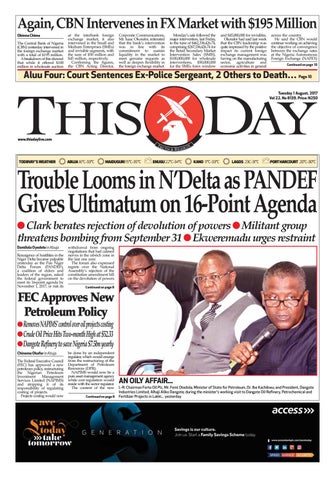
AN OILY AFFAIR... L-R: Chairman Forte Oil Plc, Mr. Femi Otedola; Minister of State for Petroleum, Dr. Ibe Kachikwu; and President, Dangote Industries Limited, Alhaji Aliko Dangote; during the minister's working visit to Dangote Oil Refinery, Petrochemical and Fertilizer Projects in Lekki... yesterday
8
TUESDAY, ˜ ͺͿ ˾ T H I S D AY
PAGE EIGHT TROUBLE LOOMS IN N’DELTA AS PANDEF GIVES ULTIMATUM ON 16-POINT AGENDA from the federal government to the states, saying it was antagonistic to the interest of the Niger Delta. The Niger Delta leaders spoke at a press conference addressed by the forum’s National Leader/Convener, Chief Edwin Clark, in Abuja where they added that the killing of the bill had reduced the possibility of restructuring the country along fiscal federal lines that could eliminate the persistence of tension and strife that had bedevilled the country for a long time. The forum said in the circumstances, it would have to insist that the federal government returned to the table with it to trash out the outstanding issues arising from the need to implement its 16-point demand for the development of the region. Already, a militant group, the Niger Delta Revolutionary Crusaders (NDRC) has threatened to resume attacks on oil facilities on September 31, 2017. The group, in a statement yesterday by its spokesman, Mr. Izon Ebi, also urged PANDEF to stop all talks with the Federal Government. “We have resolved and are more determined to use all necessary means to take back our heritage by stopping all oil and gas exploration and exportation in Niger Delta come September 31, 2017. And when that time comes, heaven will not fall,” it said. It added: “We have resolved that resource control, fiscal federalism and devolution of powers are the only panacea. Anything short of that will not be acceptable to NDRC and the 21st-century agitators of the Niger Delta. “Our elders and distinguished personalities of PANDEF have tried in their advocacy. We realize that the balancing act of being elder statesmen and resource control advocates can be a very touchy act. That is why our goal is in consonance with the vision of Niger Delta’s emerging youth leaders in the clamour for resource control," the group stated.
Following the resurgence of militancy in the region, spearheaded by the Niger Delta Avengers and a couple of other militant groups, the federal government set up a committee under the leadership of the National Security Adviser, Maj-Gen Babagana Monguno, to reach out to the region's leaders and seek peace. Coordinated by the Minister of State for Petroleum, Dr. Ibe Kachikwu, the committee reached out to the region’s elders and leaders massed in PANDEF, who eventually reined in the youths that had taken up arms and had inflicted so much damage to the oil industry’s capacity to meet Nigeria’s quota for crude exports. PANDEF intervention enabled the visit of Acting President Yemi Osinbajo to the region where he was presented with the 16-point demand as the basis for peace. The acting president who went to the region on the instruction of President Muhammadu Buhari promised that the federal government would act on the demands. With the promise, calm returned to the region to the relief of a nation that had slipped into economic recession partly due to the militants’ activities in the oil-rich zone. This enabled the federal government to fix the damaged pipeline and hinged closer to its crude export quota, helping the country to move towards economic recovery. Niger Delta leaders said yesterday that the federal government might have taken their understanding for granted as it had failed to fulfil its promise to respond to the region’s demands for development. Clark noted that despite the assurances of the Buhari administration to address the agitations of the people of the Niger Delta, the government had refused to take any visible steps. This, he said was in spite of efforts by PANDEF to calm restiveness in the region and help to stabilise oil production,
thus assisting the country to get out of recession. He said: "I wish to urge the Federal Government to, as a matter of urgency, implement the pronouncements made by the Acting President, His Excellency, Professor Yemi Osinbajo, SAN, GCON, during his fact-finding visits to the Niger Delta Region, and to set up, without delay, the Federal Government Dialogue Team to engage PANDEF towards resolving the pending issues contained in the forum's 16-Point Demands on behalf of the people of the Niger Delta Region, by, or before, November 1, 2017 (one year anniversary of our meeting with His Excellency, President Muhammadu Buhari),” He said the endurance of the people was not inelastic and that should their patience snap, no one could predict the outcome. He added: “We submitted a 16-point Demand to Mr. President on November 1, 2016, and we had expected that by its next anniversary, the 16-Point Agenda would have been comprehensively sorted out,” warning: "If at the expiration of November 1, 2017, ultimatum, the Federal Government either fails or refuses to accede to these lawful and legitimate demands of the Niger Delta people, PANDEF may consider pulling out of the ongoing peace process in the Niger Delta.” He complained about the alienation of the people of the Niger Delta citing appointments at the Nigerian National Petroleum Corporation (NNPC) and discrimination against indigenes of host communities in the area of indigenous oil and gas concessions. The forum also rejected the decision of the National Assembly to kill the bill on the devolution of power with Clark lamenting that the word restructuring was painful to the champions of a bad hegemony, and called for a return to the 1960 Constitution. He said: "Suddenly, the word 'Restructuring' has become a pain in the ears of
a few champions of wicked hegemony. All we are saying is, let us go back to the negotiated 1960 Independence Constitution, on which the 1963 Republican Constitution was moulded. If there be anything wrong with that Constitution, it can become an issue to ameliorate, by amicable negotiations and consensus. "Anything else is most obnoxious and totally unacceptable to the peoples of the entire Southern and Middle Belt areas of Nigeria, as well as the growing numbers of well-meaning Nigerians from the Northern parts of the Country. All we are saying is, 'No Restructuring, no Nigeria.” Flanked by several members of PANDEF, including King Alfred Diete- Spiff, Senator Stella Omu, Senator Henshaw and Mr. Kayode Ajulo, Clark stated that the demand for restructuring did not mean the people of the region did not believe in the corporate existence of Nigeria. According to him: "You can therefore understand why some Northern elements are constantly opposed to any increase in the Derivation Formula of 13 percent under Section 162 of the 1999 Constitution (as amended) during the Political Reform Conference of 2005, and also the National Conference in 2014, where the Northern delegates vigorously opposed any increase in the derivation provision, and this was responsible for our staging a walk-out from the Conference,” "It is on record that, during the 2014 National Conference, prominent Northern delegates, again, opposed the increase of derivation revenue from 13 percent to 25 percent. But the conference eventually recommended 18 percent derivation revenue for oil producing states, and also recommended five percent for rebuilding the North-east that has been devastated by the insurgent activities. "Some Northern delegates were opposed to it because Kano and Kaduna were not included,” Clark lamented.
Ekweremadu Urges Restraint
the organisational structure is fractured.” It noted on the proposed reform: “The petroleum policy considers that NAPIMS is incapable of reforming itself because of the internal organisation. Effective NAPIMS reform can only come from fundamental restructuring with commercial discipline, and reform must come from outside NAPIMS. “NAPIMS will be substantially restructured and may ultimately become independent and with full autonomy from the (National Oil Company of Nigeria) NOCN,” the document outlined. “The restructuring and reform process, to be led jointly by the Ministry of Petroleum Resources and the Ministry of Finance will include: a global level management consultancy to be hired to help with the restructuring; a value-for-money audit; enable faster contracting cycles (3-6 months); priority focus on low-cost oil operations ($9-10/bbl); NAPIMS will be limited to a pure asset management function whilst cost regulation will reside with the sector regulator,” it stated. It also explained that NAPIMS would be made to
share data with other relevant sector agencies to ensure transparency and efficiency. Meanwhile, the Vice Chancellor of the University of Maiduguri (Unimaid), Prof. Ibrahim Njodi, has described as an act of God, the recent ambush and murder of a team of explorers involved in NNPC’s search for commercial hydrocarbon deposits in the Bornu axis of the Chad Basin. Njodi also stated that the 48-man team, comprising of staff of the university and NNPC; military and civilian security personnel sacrificed their lives for the economic well-being of Nigeria. He added that while the University grieved its deaths, it would not give up on NNPC’s search for oil in the basin. He said these in a statement in Abuja by the Group General Manager, Public Affairs of the NNPC, Mr. Ndu Ughamadu, which explained that a delegation of the Minister of State for Petroleum Resources, Dr. Ibe Kachikwu, and the NNPC led by its Chief Operating Officer, Gas and Power, Mr. Saidu Mohammed, were in Maiduguri, capital of Bornu, at the weekend to sympathise with the state and the University over the
development. Njodi, said the university was distraught by the incident, but could not ‘chicken out’ from doing what it was supposed to do when eventually the NNPC re-organises and returns to exploration work in the area. He said the school’s partnership with NNPC started some 12 years back when the corporation restarted the Chad Basin exploration activities, adding: “The situation, painful as it might appear, must be seen as a necessary sacrifice for the development of the country.” He also called on the NNPC to stand firm with the university and families of the bereaved and provide support to overcome the setback. Responding, the statement quoted Mohammed, to have told Njodi, that the corporation would support the university and the families of the victims of the attack. “We have been great partners with the University of Maiduguri for many years and certainly when losses like this happen and under these circumstances, we cannot abandon our partners to their fate,” Mohammed said.
Meanwhile, the Deputy Senate President, Senator Ike Ekweremadu, has said the rejected bills proposing certain amendments to the 1999 Constitution, could still be revisited, following further consultations and understanding of the issues. This is as he reiterated that devolution of more powers to the states from the Exclusive List, would accelerate infrastructure development. Ekweremadu said these during a consultative meeting on South East infrastructural development with a delegation of the Partnership to Engage, Reform, and Learn (PERL) and the United Kingdom’s Department for International Development (DfID) led by PERL’s Team Leader, Dr. Adiya Ode in Abuja recently. Details of the meeting were made available by his Special Adviser, Media, Mr. Uche Anichukwu. Ekweremadu’s position echoed that of Senate President Bukola Saraki who recently stated that the National Assembly had not yet foreclosed some constitution amendment bills that were not approved by the federal legislature. Ekweremadu, who is the Chairman of the Joint Committee on the Review of the 1999 Constitution, however, commended his colleagues for ensuring that 95 percent of the alteration bills scaled through. “We are also conscious of the fact that Nigerians are worried about some of the recommendations that did not pass. Let me use this opportunity to further appreciate and reassure Nigerians that we are sensitive to their feelings and that we are likely going to revisit some of the issues they are concerned about when we return from our vacation,” “Some of the issues did not scale through because there is the need for fuller understanding as well as more consultations and consensus
FEC APPROVES NEW PETROLEUM POLICY policy christened the National Petroleum Policy, which is awaiting gazetting by the federal government, indicated that the Ministries of Petroleum Resources and Finance had been given the nod to restructure NAPIMS using a competitively procured global level consultant. NAPIMS, a subsidiary of the Nigerian National Petroleum Corporation (NNPC), was established to manage the federal government’s investments and interests in the upstream sector of the country’s oil industry. It specifies minimum expenditure during oil exploration; reviews and approves contractor’s annual work programme, budgets, and costs; as well as creates the data bank for benchmarking and cost estimation in hydrocarbon projects in Nigeria. However, it has been repeatedly fingered as being corrupt; inefficient; and easily manipulated by political influences, especially at its tasks. For instance, the agency told the Senate in March 2017, that it spent $9 million to transfer and resettle its staff within a year. It was similarly fingered in the $289,202,382 allegedly collected in 2015 and housed
in Ikoyi by the National Intelligence Agency (NIA). Investigations into the cash deposit had subsequently resulted in the suspension of NIA’s Director-General, Ambassador Ayodele Oke. Buttressing these claims against NAPIMS, the petroleum policy in its description of the agency and need for its shake-up, stated that: “NAPIMS' cost of managing government’s interest is significantly higher than it ought to be. An expenditure of over $200 million per year is unjustifiable in the current oil price environment. These costs, when applied across the JVs and PSCs, make some of the government equity interests in the joint venture unprofitable.” It added that: “NAPIMS has 10 divisions but only three are operational (JVs, PSCs, Gas). There are no written rules, procedures or policies to guide its activities; institutional capacity (management and staff capability) is weak; there is no compliance unit, which should be a given; costs per barrel within operations under its supervision are unacceptably high; there is poor data management, information asymmetry both internally and with NNPC Corporates and
Continued on page 10
building on them and their implications for our people,” he said. Speaking on the devolution of powers, Ekweremadu said the South East region has serious infrastructure deficiency. “No doubt, your studies on South East were right because the region is indeed highly challenged, especially in the areas of transport infrastructure such as roads, railway, seaport. We are also challenged in the areas of power,” “That is why we in the Committee on Constitution Review believe we mean well when we talk about things like devolution of power. Our view is that some of these things should be moved from the Exclusive List to the Concurrent List so that while the Federal Government is making efforts, the States too will be making efforts either individually or in clusters or partnership with one another. “That was why we took things like power to the Concurrent List so that States can generate power, transmit, and distribute power. The same goes for the railway, which is still the exclusive preserve of the Federal Government. That way, Nigeria can effectively speed up socio-economic development in all parts of the country. “Unfortunately, some of these issues were misunderstood. But it is not the end of the road. We believe that with more engagements, the issues will be better appreciated and we are positive about more favourable dispositions when we revisit them. As leaders, we all have our eyes on the future and are committed to building a better Nigeria for posterity”. Speaking earlier, Ode, commended the National Assembly for voting in favour of autonomy for Local Governments and State Houses of Assembly, while also calling for greater support for gender mainstreaming and other amendments that would speed up national development. She disclosed that PERL and DfID were currently working to address infrastructural deficits that impede the business environment in the South East and sought the support of the Deputy President of the Senate towards convening political leaders of the region to discuss issues that would aid the development of the region.
TOP GAINERS DANGSUGAR NASCON C&I LEASING OKOMUOIL HONEYWELL TOP LOSERS CCNN DANGCEMENT GTBANK
NGN NGN % 1.11 11.97 10.2 0.96 10.42 10.1 0.06 0.75 8.7 5.62 80.03 7.5 0.15 2.20 7.3 NGN NGN % 0.89 8.33 9.6 11.76 223.75 4.9 2.05 39.05 4.9 LAFARGE 3.03 57.72 4.9 ZENITHBANK 1.29 24.61 4.9 HPE Nestle Nig Plc ₦ 1,003.70 Volume: 490.164 million shares Value: N5.265 billion Deals: 5,558 As at yesterday 31/7/17 See details on Page 32
10
TUESDAY, ˜ ͺͿ ˾ T H I S D AY
NEWS
Aluu Four: Court Sentences Ex-Police Sergeant, 2 Others to Death Ernest Chinwo in Port Harcourt A Rivers State High Court, sitting in Port Harcourt has sentenced three persons to death for the murder of four undergraduate students of the University of Port Harcourt on October 5, 2012. The court also discharged and acquitted four other persons, whose cases were not proved "beyond all reasonable doubt" by the prosecution. The four students, popularly referred to as the UNIPORT or Aluu Four, Lloyd Toku Mike, Ugonna Obuzor, Tekena Elkanah and Chiadaka Biringa, were murdered by a mob, said to be a vigilante group in Omuokiri Village in Aluu, a neighbouring community to the university on Friday, October 5, 2012. Delivering judgment that lasted about two and a half hours yesterday, the trial judge, Justice Letam Nyordee, convicted ex-Sergeant Lucky Orji, Ikechukwu Louis Amadi (aka Kapoon) and Chinasa David Ogbada, for their active involvement in the murder of the four students. Nyordee, however, freed Abiodun Yusuf, Joshua Ekpe, Abang Cyril and John Awuru, whose cases were not proved
beyond all reasonable doubt by the prosecution. Twelve suspects were arraigned before the state high court on August 1, 2013, over the crime, and based on the advice of the Director of Public Prosecution (DPP), five of the suspects, including the traditional ruler of Umuokiri, Alhaji Hassan Welewa, were discharged and acquitted on January 27, 2017. The remaining seven of the suspects, Saviour Johnny, Lucky Orji, Ikechukwu Louis Amadi (aka Kapoon), David Chinasa Ogbada, Abiodun Yusuf, Joshua Ekpe and Cyril Abang, were denied bail based on the fact that their case carried a capital punishment upon conviction. Nyordee, while delivering judgment yesterday, noted that the prosecution counsel was able to prove the involvement of the three persons in the video evidence presented to the court. He held that the evidence against the first (Orji), second (Amadi) and third (Ogbada) defendants in the matter were overwhelming, adding that their statements in the murder of the deceased, were confirmed in the video evidence obtained from Youtube and tendered by
Chief Justice of Nigeria, Justice Walter Onnoghen the prosecution. He ruled that the evidence of the fourth (Yusuf), fifth (Ekpe) sixth (Cyril) and seventh (Awuru) defendants in the matter, justified their position that they were not involved actively in the murder, adding that it was corroborated by the video evidence of the Prosecution, which only captured the presence of the suspects at the scene of the incident. The trial judge insisted that the roles played by the three convicted persons in the murder were unjustifiable, pointing out that their actions were intended to terminate the lives of the victims, stressing that first, second and third defendants were guilty of murder. Making reference to Section
319 (1) of the Criminal Code, Cap. 37, Vol. 2, Laws of Rivers State of Nigeria, 1999, he sentenced the three to death for taking the lives of other persons unjustifiably. Nyordee maintained that the deaths of the four students were the most condemnable and could not be justified, saying that the victims had great hope and future for their families and the society. He declared: "I hereby sentence ex-sergeant Lucky Orji to death; I hereby also sentence Ikechukwu Louis Amadi (aka Kapoon) to death, and I hereby also sentenced David Chinasa Ogbada to death". The judge berated security agencies for their failure to play their role of protection of lives and upholding of the law seriously, regretting that the security personnel at the scene of the crime could not save the situation and described the situation as "the sorry state of the society.” He said no explanation would ever be valid on why the Joint Military Task Force (JTF), the Aluu Police Post, Isiopko Divisional Police Headquarters and C4I security outfits, which were beckoned and were present, could not mobilise to rescue the victims,
whose allegation of robbery could not be proven during the unlawful prosecution. His words: "The death of the victims is most condemnable and cannot be justified. The victims had great hopes for their families and society at large. The candles of their lives were put out. The law is unmindful to hand down a sentence in a clear case of murder. The killing of the four victims is a combination of several societal ignorance and shameful failure of security institutions to protect lives as shown in the statements of the defence.” He expressed regrets that none of the operatives from the patrol team, reinforced the team. He, however, added that the decision of the court would serve as a deterrent to those who take human lives without recourse to law, adding that human life should be protected. The murder trial lasted for about five years following the closure of the state judiciary by the administration of the immediate past governor, Mr. Chibuike Amaechi. The trial commenced on the assumption of office by the current Governor, Chief Nyesom Wike, who ordered
the opening of the judiciary complex on June 1, 2015. Reacting to the judgment, the parent of one of the victims, Mr Toku Mike, expressed gratitude to the court for clearing the case of armed robbery tagged on the victims. Mike, who spoke with journalists shortly after the judgment, said: "I am partially happy in the sense that the garment of armed robbery, the garment of criminality has been erased from the four children that were murdered in Aluu. It is clear that they (the victims) are innocent. They didn't kill, they didn't rob, they only went there to demand money they were owed. I would have been happier if the 12 of them were convicted and sentenced. But the court did not see it that way, only three were convicted and sentenced." The counsel to the convicted persons, Mr Chukwueze Kingdom, said they would appeal the sentence while the lead prosecution, Mr Inikiri Otorubio, who is Director of Prosecution, in the state Ministry of Justice said he was happy that the matter had come to an end and that they would study the judgment to know the next course of action.
all the parastatals to loosen the grip in the industry,” Kachikwu said.
will have the capacity to refine 650,000 barrels of crude oil per day while the Petrochemical Plant will produce 780 KTPA Polypropylene, 500 KTPA of Polyethylene while the Fertiliser project will produce 3.0 million metric tonnes per annum (mmtpa) of Urea,” Dangote explained. Dangote added that the company will also be building the largest sub-sea pipeline infrastructure in any country in the world, with a length of 1,100km, to handle three billion SCF of gas per day. According to him, the company also plans to construct a 570 MW power plant in the complex, adding that gas from its gas pipeline will augment the natural domestic gas supply with an additional 12,000MW of power generation added to the grid from its gas system. In his speech, the minister urged Dangote to task his engineers to go back to the drawing board and complete the refinery before the scheduled December 2019 to make his dream of ending importation in the same year a reality. He said he was overwhelmed by the dimension of the project, adding that the present government has always believed that the private sector holds the ace in industrialisation efforts of the government, noted that that belief has been reinforced by what the Dangote Group is doing. "It is good to say that the private sector is the answer to Nigeria’s problems with a project as big as this. The challenge I will give you today is that of time, I see your time for completion is 2019 December but I am sure you will understand my greed if I tell you that the refinery
component of this project should come earlier than the set date. "I have made a very firm commitment to Nigerians that I must stop the importation of petroleum products by 2019 and I am going to keep to it. It is absolutely important that we do this early and given the feat that we have achieved in terms of speed of construction and I urge you to do all within you to achieve its completion before the due date. "I am sure His Excellency, President Buhari will be absolutely enthused if he were to find himself, not only crystalizing the policy position we have taken so far but also coming here himself to come and open a facility as big as this before the end of his first term. Whatever configurations your engineers have come up with, I urge that they go back to the drawing board and get me my refined products before your said date," Kachikwu explained.
FEC APPROVES NEW PETROLEUM POLICY
Crude Oil Price Hits Two-month High Meanwhile, crude oil prices were near two-month high yesterday, putting July on track to become the strongest month so far this year, as news of oil producers' meeting next week added to bullish sentiment driven by the threat of United States sanctions against Venezuela. This is coming on the heels of the Minister of State for Petroleum Resources, Dr. Ibe Kachikwu's charge to oil companies operating in Nigeria to cut down the cost of production or shutdown operation, stressing that it is better to leave the oil in the ground than to produce at the current $27 per barrel, which according to him, does not make sense. Also, Africa’s richest man and President of Dangote Group, Alhaji Aliko Dangote, has said that the Dangote Refinery will save the country over $7.5 billion yearly through import substitution. The global benchmark Brent crude traded at $52.33 per barrel yesterday, after hitting $52.92 a barrel earlier in the day, its highest since May 25. The US light crude oil traded down at $49.31 a barrel, after jumping above $50 a barrel for the first time in two months early in the session. This followed threats by US officials that sanctions on Venezuela could be announced as early as Monday. Reuters reported that the United States is considering imposing sanctions on the country's oil sector in response to Sunday's election of a constitutional super-body, which
Washington has denounced as a "sham" vote. Even though the White House has said that "all options are on the table," the most likely action, banning Venezuela from importing US oil, could come as early as Monday. US production has hampered efforts to rebalance the market but signs that the market is tightening have emerged after heavy inventory falls and slower new oil rig additions last week. But drilling for new US production is also slowing, with just 10 rigs added in July, the fewest since May 2016. However, some OPEC and non-OPEC members will meet on August 7-8 in Abu Dhabi to assess how the group can increase compliance with production cuts that began on January 1. Speaking yesterday at the annual conference of the Nigerian Council of the Society of Petroleum Engineers (SPE) in Lagos, Kachikwu said that the cost of oil production in Nigeria has remained high, despite efforts to cut costs. He noted that while Saudi Arabia produces oil at a cost of $9 per barrel, Nigeria produces at $27 per barrel. “When you look at the cost of production in Nigeria, it remains blatantly high, and even though we have been singing over the last two years that we need to drive cost down, the current figure that I still have showing me the numbers of last year have not shown me a major dramatic reduction in the cost of production. So, we are going to not just force this, we are going to compel it because there is no way this country will produce oil at this sort of swelling prices that we see, there will be no margins left for this country.
Only oil companies who are able to be efficient, who are able to drive down costs will have a footage in Nigeria. For me, you rather leave the oil in the ground than produce at a cost that doesn't make sense. So, the cost is going to be a very high driver. So that is certainly one area we are focusing on; we are working collaboratively with oil companies. But let's make no mistake about it: If we cannot negotiate it down, we will compel it or we will stop the production; it does not make any sense”, Kachikwu explained. Kachikwu also dismissed claims by the producing companies that security is a major component of the production, stressing that the cost of security is only $2 - $3 per barrel. “It is no longer sufficient to say, 'You know Nigeria is unique, security consideration. But what is the security component in the cost of production? $2 to $3 per barrel. Collaborative means of addressing security problem must begin to take place so that those costs must be driven down. If there is any single item that is required to be dealt with yesterday is the issue of cost,” the minister added. “The other thing we need to do is focus on our infrastructure. We have a huge infrastructural gap, and we need to begin to address that. We need to begin to set incentives for Nigerian companies who are willing to fund and invest in infrastructure. We need to take away government's monopolies in infrastructure so that the industry can grow. There is too much monopoly in the industry. I am going to be working with the NNPC and
Dangote Refinery to Save Nigeria $7.5Bn In a related development, Africa’s richest man and the President of Dangote Group, Alhaji Aliko Dangote, has said that the Dangote Refinery will save the country over $7.5 billion annually through import substitution. Speaking yesterday when Kachikwu visited the refinery complex at the Lekki Free Trade Zone in Ibeju Lekki, Lagos, Dangote said the foreign exchange spent in fuel importation would be saved by the refinery when completed in December 2019. ‘‘We will be adding value to our economy as all these projects will be creating about 4,000 direct and 145,000 indirect jobs. We will also save over $7.5billion for Nigeria annually, through import substitution,’’ he said. Dangote praised Kachikwu for his efforts towards ensuring availability of petroleum products and championing a comprehensive overhaul of the energy sector in Nigeria. According to Dangote, the efforts of the minister would make the country a self-reliant nation, adding that his company is committed to playing its part in the efforts of the minister and the federal government to comprehensively address the energy crisis in the country. ‘‘As you are aware, we are currently building the world’s largest single line Refinery, Petrochemical Complex and the world’s second largest Urea Fertiliser plant. The Refinery
AGAIN, CBN INTERVENES IN FX MARKET WITH $195 MILLION and the Bureau-de-Change segments of the market, even as he assured of proper surveillance of the forex market to guarantee transparency in the sale of foreign exchange. Okorafor also urged those who genuinely required foreign exchange for their transactions to approach their banks, noting that the banks had enough forex to meet the demands for foreign exchange within the time frame stipulated by the CBN. Meanwhile, the naira hovered at between N360 and N362/$1 in the BDC segment of the market yesterday.
12
TUESDAY AUGUST 1, 2017 ˾ T H I S D AY
NEWS
News Editor Davidson Iriekpen Email davidson.iriekpen@thisdaylive.com, 08111813081
Military Strategises to Curb Security Challenges Air force invites Israeli military to train special force Use negotiation strategy to release our members, mining association appeals to FG
Omololu Ogunmade, Paul Obi in Abuja, Hammed Shittu inIlorin and Daji Sani inYola The Chief of Army Staff (COAS), Lt. General Tukur Buratai, yesterday revealed that apart from the fight against insurgency in the Northeast region, the Nigeria Army was strategising to curb the rate of kidnapping, herdsmen/farmers crisis, pipeline vandalism and crude oil theft bedeviling the country. Buratai disclosed this in Yola, Adamawa State, during Combat Support Arms Training Week (COSAT) for 2017, saying the army would continue to sustain efforts towards adequately equipping units and formations to enhance military capacity to eliminate contemporary challenges and threats in the country. “We all know that the contemporary challenges Nigeria is trapped with include insurgency, kidnapping, herdsmen crisis, pipeline vandalism which have made it imperative for all agencies to synergise and find solutions,” he stated. The COAS pointed out that to bring to an end the destruction by terrorists in the country, the Nigerian army has held the Small Arms Combatmanship at the newly constituted Abu Ali shooting range in Sambisa forest, the proposed headquarters of the terrorists. The Nigerian Army COMBAT support arms training in an annual event organised on rotational bases
among artillery, engineers, signals and intelligence corps to review and restrategise on operations as well as demonstration on constabulary. He, however, attributed the successes of the military in degrading Boko Haram insurgency in the North-east region to adequate funding by President Muhammedu Buhari administration. Buratai further explained that the financial support was responsible for the remarkable improvement in the operation capacity of the troops. The army boss also said improved funding as well as logistic planning and execution in the operation have boosted the morale of troops which resulted in forcing the insurgents to flee their hide out and surrender on a daily basis. The state Governor, Muhammadu Jibrilla Bidow, assured the army that his government would give necessary supports to the military in the state and neighboring state as well. Bindow lauded the resilience demonstrated by the COAS in fighting the terrorists, describing it as commendable and worth national and international awards. Meanwhile, following the resurgence of Boko Haram attacks, where scores have been killed by the terrorists in the North-east, the Nigerian Air Force (NAF) has invited Israeli military to train special forces to combat terrorism in the country.
NAF Director of Public Relations and Information, Air Commodore Olatokunbo Adesanya, explained that the Chief of the Air Staff, Air Marshal Sadique Abubakar, approved the training of 450 carefully selected Regiment personnel as NAF Special Forces to be trained in three batches. Adesanya stated that the first batch had been flagged off formally last weekend. He said: “The training is taking place at the NAF Regiment Training Centre in Kaduna but is being conducted by Four-Troop, a reputable foreign military training organisation from Israel. “It is aimed at further developing the capacity of the personnel to fight under all types of terrains and weather conditions. “At the end of the nine-week course, successful participants would be deployed to defend NAF air assets and bases as well as critical national infrastructure and assets like airports and oil installations among others.”
Adesanya explained that “the Special Forces would also be required to take the battle to the adversaries whenever necessary.” Earlier, the Commandant of the NAF Regiment Training Centre, Group Captain Isaac Subi, had disclosed that the NAF Regiment Specialty was a blend of the Army Infantry and Artillery Corps. He also described the Special Forces as an invaluable adjunct to conventional forces and that they are capable of sophisticated, specialised and measured response in a complex air-ground environment covering both land and sea areas. The decision to invite the Israelis to conduct the training in Nigeria, in conjunction with other Nigerian instructors, rather than conducting the training overseas, is aimed at further developing the instructional capacity of NAF personnel while also saving the nation additional expenses in foreign currency. While flagging off the training of the first batch of 150 personnel, the Air Officer Commanding Ground
Training Command, Air Vice Marshal Samson Akpasa, stated that a robust counter-force to respond to any contingency was vital in Nigeria’s contemporary security environment, which was characterised by insurgency, militancy, oil theft, cattle rustling, kidnapping and other vices. In another development, the Nigerian Mining and Geosciences Society (NMGS) yesterday appealed to the federal government to make use of negotiation strategy towards meeting the demands of the Boko Haram sect in order to ensure the quick release of its members recently abducted by the sect. Some members of the association, working with the Nigerian National Petroleum Corporation (NNPC), among other professionals, were killed and others abducted by the Boko Haram members last Tuesday during an oil exploratory work near the shores of Lake Chad. Since then, the affected members of the association are yet to be
released by the sect. Speaking with journalists in Ilorin, the National President of the association, Professor Silas Sunday Dada, said negotiation method had shown to be more effective and life saving than use of force. Dada, who commended efforts of the present administration and its renewed confidence in tackling the Boko Haram issue once and for all, said that the recent sustained offensive by the Boko Haram group was to openly challenge and contest the government’s story on their degradation. According to him, “It is saddening to observe that the celebrated claim by the Nigerian military for about a year now, over the ‘degradation of Boko Haram’ which created the flippant impression that the rebellious group has been demoralised, demobilised, defeated, and vanquished, was far from being true after all, as recent happenings have proved otherwise.”
Insurgency: AU Peace CouncilVisits Osinbajo on Fact-finding Mission Omololu Ogunmade in Abuja Probably concerned by the upsurge of terrorist attacks in North-eastern Nigeria in recent times, African Union (AU) Peace and Security Council (PSC), yesterday visited Acting President Yemi Osinbajo in the State House, Abuja. The delegation, led by its Chairman for the month of July, Ambassador Bankole Adeoye, who is also Nigeria’s Ambassador to Ethiopia and AU, visited Nigeria on a fact-finding mission on the crisis as part of its mandate. Adeoye, according to a statement by acting President Yemi Osinbajo’s media aide, Mr. Laolu Akande, the PSC delegation had been visiting the four countries in the Lake Chad Basin in the past five weeks, disclosing that it had specifically visited seven cities in Nigeria, Niger, Chad and Cameroon. “This visit is the high point of our mission,” Adeoye stated, adding that Nigeria’s commitment to peace in Africa had been well demonstrated. The PSC of the AU is the standing organ of the union for prevention, management and resolution of conflicts. Membership of the 15-member council comprises three members each from central, eastern, northern, southern and western Africa. In his submission, Osinbajo, while receiving a delegation, said: “The Lake Chad Basin
collaboration is one we are extremely proud of, where we as Africans are working together on our own issues. I am pleased to say the countries have worked greatly together.” He cited the progress of the Multi-national Joint Task Force (MNJTF) set up to address the insurgency. Osinbajo noted that unlike in the past when there were difficulties over attempts by the militaries of the four countries to work together, the MNJTF surmounted the challenges and has succeeded. The acting President said the President Muhammadu Buhari administration was “extremely pleased with what we have seen, and we like to see more.” However, he observed that the humanitarian consequences of the insurgency are compounded by deep poverty, thus making the costs of dealing with the situation “huge and enormous.” He recalled that there are about 2.4 million displaced persons; extensive destruction of property, infrastructure, schools, homes and farmland. In some cases, he said the situation required the “rebuilding of whole societies.” But he expressed satisfaction with the work of the Peace and Security Council of the AU. “I am extremely pleased and encouraged by the work of the PSC as well as the time and attention paid to this issue. These are matters we must address now and in the future.”
AU SECURITY COUNCIL MEMBERS
R-L: Minister of Defence, Brig Gen Mansur Dan Ali (rtd); Minister of Foreign Affairs, Geoffrey Oyeama; Acting President Yemi Osinbajo; Nigeria’s Ambassador and Permanent Representatives to the African Union and Chairperson of AU Peace and Security Council for Month of July, Ambassador Bankole Adeoye and others, during a meeting with AU Peace and Security Council held at the State House in Abuja.... yesterday State House.
Oando Posts N4.6bn PAT in H1, 2017 Goddy Egene
Oando Plc, one of the Nigeria’s leading oil and gas companies, has declared a profit after tax (PAT) of N4.6 billion for the half year ended June 30, 2017, as against a loss of N26.9 billion in the corresponding period of 2016. A review of Oando’s financials show that turnover increased by 26 per cent to N267.1 billion from N212.3 billion in 2016 while gross profit increased by 76per cent to N33.4 billion from N19 billion. Net finance costs reduced from N35.3 billion to N16.4 billion, leaving the firm with a PAT of N4.6 billion compared with a loss of N26.9 billion in H1 2016. For the third time in a row, Oando has posted positive financials defying speculations and bolstering confidence in the oil and gas sector. In its final year-end, 2016 results the company declared N3.5 billion
PAT, in the first quarter of 2017 it posted N1.7 billion PAT and the N4.6 billion PAT for H1 2017. These numbers are indicative of the company’s ability to manoeuvre the cyclical nature of the sector by adapting quickly to continued low oil prices. Oando has done this through the successful implementation of its corporate strategic initiatives of growth, deleverage and profitability alongside its renewed focus on its dollar earning businesses. Commenting on the results, Group Chief Executive, Oando Plc, Mr. Wale Tinubu, said: “With security concerns in the Niger Delta receding, Nigeria’s economic recovery has been buoyed by a boost in oil output, while the legislative approval of certain segments of the Petroleum Industry Bill (PIB) provides greater long-term policy certainty for the sector. Our returns underline our
continued successful foray into the Upstream.” According to him, Oando scored significant operational highlights in the first half of 2017. The company through its upstream business, Oando Energy Resources, successfully realised N3.2 billion in net cash from the crystallisation of the corporate facility hedges (1,590 bbls/day) while in the second quarter of 2017, it successfully completed the sale of its interest in OMLs 125 and 134 to Nigerian Agip Exploration Limited for a profit of N4.6 billion. In its Downstream business, Oando Trading (OTD), the company witnessed a 40 per cent growth in traded volumes and a commendable 147 per cent increase in turnover to N217.5 billion compared to N88.1billion for the comparative period of 2016. The trading business lifted
volumes exceeding 7.5mmbbls of crude and imported 610,000metric tonnes of refined petroleum products, a 72 per cent and 20 per cent increase respectively. The Structured Trade Finance lines in its downstream business increased by N76.5 billion to N214.1 billion in total, from a total of five International and African banks, are further validation that Oando is still a good business investment. According to the company, this increase in financing allows the company to achieve greater trading capacity and in turn more volumes. Speaking on the outlook for the company in the second half of 2017, Tinubu said: “We remain committed to optimising our overall production base, seeking unique profit-driven opportunities to further partner with international oil companies, while firming up our balance sheet to provide greater shareholder value.”
14
T H I S D AY TUESDAY AUGUST 1, 2017
COMMENT
Editor, Editorial Page PETER ISHAKA Email peter.ishaka@thisdaylive.com
THE PRESIDENCY AND AREWA AGENDA The north should go for much younger politicians in the forthcoming election, writes Zubairu Jakara
W
ho is Arewa’s most suitable candidate for the 2019 elections? This question may seem premature or even unnecessary depending on your concern for Arewa 2019. But when we observe the alarming level of discord within the region, especially since the outbreak of Biafra’s belligerence fuelled the embers of geo-ethnic intolerance across Nigeria, the prospects for Arewa getting a smooth and easy transition to a second tenure in 2019 get beclouded. It is now not so heretical to doubt or even rule out another presidential bid by ailing President Muhammadu Buhari, whether the so-called cabalists like it or not. The combination of dashed hopes for “change”, progressive disintegration of the All Progressives Congress (APC) and Buhari’s diminishing stamina for the stress and rigour of electioneering is just too forbidding. A change of candidate is therefore beyond contention if Arewa 2019 is to be a realistic venture! Another necessary change in Arewa’s agenda for retaining its secured second term entitlement must be the immediate and uncompromising dumping of all “old brigades” from consideration as potential standard-bearers. The sentimental obsession with “elders” and allied political patrons in the search for presidential candidates has become a liability for Arewa. Even without Buhari’s age-inflicted political mishap, the profile of post-Sardauna Arewa politicians in terms of following the legacies of selflessness, popular father-figure leadership style and tangible development strides has been utterly repelling. Unfortunately, the domineering presence of the old brigade politicians on the Arewa arena has constituted a stumbling block against younger and more credible politicians moving onto the national scene. This is a major issue that must be confronted and resolved in the interest of the region’s future. The presidential ambition of former Vice-President Atiku Abubakar is today regarded as the next liability for Arewa’s stake in 2019 elections because since 2007 when it was the region’s turn to produce a president under the unofficial rotational arrangement, we have been bedevilled by serious dilemma linked to the age and health status of our candidates. Both Umaru Yar’Adua and Buhari have afflicted Arewa’s legendary political resilience in national leadership with a debilitating deficit. While Yar’Adua’s age was not cause for concern, definitely his health status effectively crippled the North’s power expectancy with ripples of rancour across the nation triggered by the hanky-panky handling of his last days. President Buhari has added to the Arewa baggage of bungled presidencies with his age and health hang-ups, not to mention the queer paralysis of
THE DOMINEERING PRESENCE OF THE OLD BRIGADE POLITICIANS ON THE AREWA ARENA HAS CONSTITUTED A STUMBLING BLOCK AGAINST YOUNGER AND MORE CREDIBLE POLITICIANS MOVING ONTO THE NATIONAL SCENE. THIS IS A MAJOR ISSUE THAT MUST BE CONFRONTED AND RESOLVED IN THE INTEREST OF THE REGION’S FUTURE
power that eclipsed his “tsunami” election victory. For the avoidance of doubt Atiku will be in the mid-seventies by 2019 and there is nothing else about his presidential ambition to mitigate the ominous implications of this on Arewa’s 2019 secured entitlement to a second tenure in Aso Villa. It is worth recalling that Atiku Abubakar himself never thought of being a presidential politician in the first instance, limiting his horizon to the governorship gamble in his native Adamawa State. Even with a fortunate twist of political fate, he ended up as a vice-president in 1999. If that unexpected elevation also raised his ambition level, he was incapable of tailoring it to suit the terms of transition, especially under Olusegun Obasanjo, the father of presidential ambition. Thus Atiku ambitiously succumbed to the vice of presidential politics by heedlessly seeking to hound his benefactor out of the Villa, getting his babanriga burnt in the process. Not surprisingly, since then he has been changing his political costumes to reflect the resilience of his presidential ambition as well as the varieties of guise at his disposal, waltzing from right-wing conservatism to “progressive” posturing with chameleonic chicanery. Predictably, every failed bid has fuelled his ambition further, all the while obsessed more with his own tortuous trajectory than the political misfortunes of Arewa. Surely Atiku must be living under the illusion of thousand-year lifespan of the days of Prophet Noah, not our70-year expectancy, for him to be seriously warming up for Nigeria’s Presidency, when he should be retreating into terminal thanksgiving for a life well spent in selfadvancement as Baba Atiku! When you consider the jinx of age and ill-health that has been haunting Arewa’s presidential tenures since 2007 with Atiku Abubakar’s uncompromising determination to be the next septuagenarian northern President in 2019, you don’t have to be a sadist to anticipate another round of national hysteria over elderly northern leaders and outright rejection of a third encounter with an ailing president, a cabal and a “coordinating” vice-president. Rather than trying to dissuade an uncompromisingly determined veteran presidential bidder like Atiku Abubakar, it is far more realistic for Arewa youths and selfless political leaders to be proactive, pragmatic and persistent in promoting and empowering a new generation political leader like Rt. Hon. Governor Aminu Waziri Tambuwak to break the jinx of old age, ill-health and truncated tenures that has almost turned northern presidency into political abomination in Nigeria. Jakara wrote from Zaria, Kaduna State
ERDOGAN AND THE JULY 15 COUP Nurudeen Sani argues that the coup is contrived
J
ust few days ago, a chilling footage in one of the international television stations brought to the fore the ugly memories of the July 15, 2016, aborted coup in Turkey. It was during the one year commemoration of the coup, which saw to President Recep Tayyip Erdogan vowing to “rip the heads off “terror groups and plotters who tried to put an end to his more than a decade-long dictatorial rule. More than 250 innocent Turks paid with their lives to ensure that Erdogan rule was not truncated by the coup plotters on that fateful July date while the president hibernated in an unknown destination. Like many autocratic leaders, Erdogan was quick to blame members of opposition and sympathisers of Gulen Movement for the coup attempt. He particularly singled out the United States-based Turkish cleric, Fethullah Gulen as the mastermind of the coup, even when it is on record that the highly respected cleric publicly condemned the coup when it was still on. Though the July 15 failed coup was not the first in that country, the many conspiratorial theories and the Turkish government heightened brutality aftermath of the coup has continued to tilt my belief that the coup was just a well-crafted master script which was activated by Erdogan to silence critics
and any finger of opposition in Turkey. Yes, many leaders in the past have used phantom coups to consolidate their grip on power by jailing perceived political enemies and sometimes send them to the hangman’s noose. During the dark days of military regime in Nigeria in the mid-1990s, many influential figures like General Olusegun Obasanjo, who later became president, General Shehu Yar’Adua, and a host of other critics of government were all sent to jail over a coup that was believed to be designed to topple the government of late General Sani Abacha. Hence, the recent revelation by Sweden-based Stockholm Centre for Freedom (SCF) on the Turkey coup has further cemented my belief that some power-drunk leaders can go to any length to perpetrate themselves in office. According to the international Centre, last year’s failed coup attempt in Turkey is nothing but a false flag orchestrated by Turkey’s autocratic President Recep Erdogan and his henchmen to create a pretext for a mass persecution of critics and opponents in a state of perpetual emergency. The centre in a new detailed study titled ‘July 15: Erdogan’s Coup,’ said from available data, the coup indictments, testimonials in court trials, private interviews, reviews of military expert opinions and other evidence collected by
researchers, it is fairly confident that this attempt did not even qualify as a coup bid in any sense of military mobilisation which was unusually limited in numbers, confined in few cities, poorly managed, defied the established practices, tradition, rules of engagement and standard operating procedures in Turkish military. “This was a continuation of a series of false flags that were uncovered in the last couple of years under the authoritarian rule of Erdogan regime and it was certainly the bloodiest one,” it said.“Erdogan appears to have tapped on widely circulated coup rumours in Turkish capital and staged own show to steal wind and set up his opposition for a persecution,” the President of SCF, Abdullah Bozkurt was quoted to have said. Judging by Erdogan antecedents on how he had blatantly used the term ‘parallel state’ to badmouth and demonise sympathisers of the Gulen movement in Turkey but without getting the desired result of suppressing them, the coup could as well be the best bet and the smokescreen of his government to silence the group and other opposition elements. This was what played out during the referendum in Turkey which was carried out under the emergency power of the president. Erdogan won big time by securing imperial presidency,
consolidating his gains, stifle the opposition and even launching cross- border military incursion into Syria for which he had been itching for too long. The Turkish president, who appears to have unquenchable penchant for brutalising and detaining those who dare have a different political orientation from the one he shares by the ruling Justice and Development Party (AKP), reportedly called the July 15 , 2016 coup attempt as “a gift from God, as he now wields absolute power to do and undo anything he wishes to the detriment of the freedom of the Turkish people. Today in Turkey, most media organisations and private schools have been shut down, thousands of public servants kicked out from government service, thousands of judges, teachers, doctors, military officers all thrown out from work. Many more who are not so lucky, including journalists, members of the opposition, among others, are now in detention without trial for allegedly taking part in the coup without concrete evidence linking them to it. Erdogan may have succeeded in silencing his opponents by carefully reaping the political capital of the July 15 coup attempt, but surely, he cannot come clean of involvement in the coup no matter how black he would paint those he accused of being behind it. Sani wrote from Kano
15
T H I S D AY Ëž Ëœ ÍŻËœ Í°ÍŽÍŻÍľ
EDITORIAL LET THE SUPREME COURT DECIDE
The executive should table its disputes with the legislature over the interpretation of the constitution to the apex court for resolution
R
ight from the beginning of President Muhammadu Buhari’s administration, there has been a discord between the executive and the legislature over sundry issues. Most of the issues arose largely from the inďŹ delity of the feuding parties to the 1999 Constitution as amended. For instance, in the past two years, the executive has bickered with the legislature over the extent of the constitutional powers of the latter on appropriation. Added to that is the disagreement with the power of the legislature to conďŹ rm some of its appointees. The executive contends that the discretion granted the legislature by sections 59, 80 and 81 of the constitution to approve federal budget does not include the power to alter estimates or insert new projects in the appropriation act. Meanwhile, the executive has, over the years, persisted in the act of haphazard implementation of the appropriation law, ignoring, most times, aspects introduced by the legislature. That has continued to generate tension in the polity, with the effect that valuable ONCE THERE WERE time that should have DIFFERENCES OF OPINION been spent on the task of governance is OVER THE PROVISIONS expended on settling OF THE CONSTITUTION, quarrels and cutting THE APPROPRIATE political deals. THING TO DO WAS TO However, if political SUBMIT THE DISPUTE dealing adumbrated TO THE JUDICIARY FOR the debilitating effect RESOLUTION of the squabbles over appropriation, it has failed to douse the dust raised by the executive’s elastic interpretation of section 171 of the constitution. The executive contends that the section allows it to override non-conďŹ rmation, by the Senate, of nominees for certain positions even when extant laws establishing such bodies expressly provide for legislative approval of the nomination. The executive argues that such laws, including the Economic and Financial Crimes Commission (EFCC) establishment act, 2006, which requires senate conďŹ rmation of chair-
Letters to the Editor
T H I S DAY EDITOR DEPUTY EDITORS ˜ MANAGING DIRECTOR DEPUTY MANAGING DIRECTOR CHAIRMAN EDITORIAL BOARD
EDITOR NATION’S CAPITAL
T H I S DAY N E W S PA P E R S L I M I T E D EDITOR-IN-CHIEF/CHAIRMAN GROUP EXECUTIVE DIRECTORS ˜ ˜
˜ GROUP FINANCE DIRECTOR DIVISIONAL DIRECTORS ˜ ˜ DEPUTY DIVISIONAL DIRECTOR
SNR. ASSOCIATE DIRECTOR ASSOCIATE DIRECTORS ˜ CONTROLLERS ˜ ˜
GENERAL MANAGER
GROUP HEAD DIRECTOR, PRINTING PRODUCTION TO SEND EMAIL: ďŹ rst name.surname@thisdaylive.com
man and members of its board, conict with section 171 of the constitution and therefore, void to the extent of its inconsistency. It is on this ground that Mr. Ibrahim Magu has been sustained in ofďŹ ce as the acting chairman of the EFCC despite his rejection on two different occasions by the senate. Apparently in disagreement with the disposition of the executive interpretation on the issue, the senate has since ďŹ libuster further conďŹ rmation of executive nominees that are not listed in the constitution but are required by extant laws to be conďŹ rmed by the upper chamber. There is nothing wrong with having perceptive differences over the provisions of the constitution or public policy. The constitution indeed envisages these disagreements and has made adequate provisions for their resolution. This is why the functions of the three arms of governments have been clearly delineated with the legislature making laws, the executive executing the laws and the judiciary interpreting the laws. And the constitution frowns on one arm of government infringing on the power of the other. In the instant cases, once there were differences of opinion over the provisions of the constitution, the appropriate thing to do was to submit the dispute to the judiciary for resolution. This had been done on many occasions in the past. In 2002, the federal government sued the 36 states over its dispute with the eight littoral states of Akwa Ibom, Bayelsa, Cross River, Delta, Lagos, Ogun, Ondo and Rivers on the seaward boundary of each of the littoral states. That was because the determination of the issue would resolve whether or not the states were entitled to a minimum of 13% of all revenue accruing to the Federation Account on the basis of the derivation of natural resources from each of these littoral states. More recently, a couple of cases have been instituted at the apex court by governors of the 36 states against the federal government over Federation Accounts issues. Therefore, rather than resort to self-help, the executive should submit its disputes with the legislature over the interpretation of the constitution to the Supreme Court for adjudication.
TO OUR READERS Letters in response to speciďŹ c publications in THISDAY should be brief (150-200 words) and straight to the point. Interested readers may send such letters along with their contact details to opinion@thisdaylive.com. We also welcome comments and opinions on topical local, national and international issues provided they are well-written and should also not be longer than (9501000 words). They should be sent to opinion@thisdaylive.com along with the email address and phone numbers of the writer.
SUCCESSION POLITICS AND THE LIMIT OF IGNORANCE
O
sun West Senatorial bye-election has come and gone, not unexpectedly, with its twists and turns; sounds and bites. Victors have since July 8, 2017 been counting their blessings while losers have also been unrelenting in licking their wounds with threatening affection! On the whole, June 21, 2014 has again happened to the progressive camp in the State of Osun and one can only pray that appropriate lessons from whatever remains of its wacky outcome would not be wasted on the altar of ego and sycophancy. It is also believed that ingrates and renegades who have turned the misfortune brought upon the state by Isiaka Adeleke’s sudden death into a ‘Us’ versus ‘Them’ personality clash will ‘sheathe’ their swords for the good of the party and country. Except we want to be economical with the truth, what played out on July 8 was the opposition’s way of telling Nigerians that, given the opportunity, it can still use the weapons of rice, money and other instruments of ‘stomach infrastructure’ to spring surprises on soft targets. Unfortunately, the ruling party’s inability to keep its house in order nationally, plus economic reforms that have, for want of a better expression, been struggling to put food on the table of the common man are rubbing off on the states and may affect the party’s fortunes in future elections if concrete steps are not taken to address the situation. The All Progressives Congress (APC) needs to wake up from its slumber, cut off the pretence and carry out clearance operations before it is too late. Nigeria is in tough times and all eyes can see it. The political turf is heating up as we gradually approach another election year and it is as
if those who never wished Muhammadu Buhari and his government well have now had their prayers answered. The economy is bleeding and it seems as if the national government is satisfied with snoring on a mattress overstuffed with excuses as a way out of the socio-economic logjam. In politics, little things count. Taking refuge in short-term measures, even when they are energy-sapping or funds-demanding, go a long way in addressing the nasty tragedies, extant confusions and conceptual impressions that have been threatening the fragility of the egg called Nigeria. Behaving as if 2018 is 1000 years away, or as if 2019 will never come, will not help a ruling party that is already being derided as ‘can do better as an opposition party.’ At a time like this, Osun comes to mind. The APC must do all it takes, lawfully, to remain in power so as to prevent a reversal of the gains of the last seven years. Osun cannot withstand a repeat of the disaster of the years eaten by the locust, when our common patrimony was used to cater to the needs of some selfish few. It is common knowledge that all the gratuitous attacks, barefaced lies and harebrained fabrications against the Rauf Aregbesola-led government are mere samples of what to expect in next year’s governorship election. To be honest with ourselves, APC’s defeat in the last bye-election was facilitated from within by the Judas Iscariot who embraced coded languages to give performance a new meaning. The challenge of change, salary quagmire, even pensioners’ palaver played secondary roles. With regard to 2018, all I see for the progressive in Osun is victory; and Aregbesola’s outstanding performance in office is an indication that the battle has already been won! But this is not to say that there won’t be challenges on the road to this assured victory.
In any case, that’s the beauty of democracy. Anything short of that is a recipe for chaos! For instance, while no government has ever done a quarter of what this administration has done for Osun since its creation, it is rather unfortunate that Aregbesola is seen out there more as a ‘salary unpaying’ government than one that has turned the state into ‘construction site’. Sadly, too, while issues surrounding the salary challenge point in the direction of a national crisis, that some ‘food-for-the-stomach’, false democrats are insisting that Osun’s should be treated as a case in isolation is a mystery for students of political history to unravel. So much has been said about democracy described by Abraham Lincoln as “the government of the people, by the people, and for the people.� But if this system of government thrives in a society characterised by formal equality of rights and privileges, why do Nigerians continue to suffer, irresistibly, from what Pius Adesanmi once referred to as “acute malaria�? When, for instance, Kunle Ologundudu accused Kayode Fayemi of using state funds to build mansions as well as run a private university, why did the electorate gullibly subscribe to the untruth without raising a finger? Similarly, why has Osun suddenly become the rumour capital of Nigeria and what’s being done to present issues as they are? When has it become a crime to democratically avoid the resurrection of a deadly Wike/Amaechi crisis or the replication of a ‘Tarka-me-I-Daboh-you’ Kwankwanso/Ganduje face-off in Osun? Apart from other laudable programmes undertaken by this administration, have we forgotten its noble contributions to the triumph of no fewer than 50 of our medical students in Ukraine? Abiodun Komolafe, Ijebu-Jesa, Osun State
16
T H I S D AY ˾ TUESDAY, AUGUST 1, 2017
POLITICS
Group Politics Editor Tobi Soniyi Email tobi.soniyi@thisdaylive.com 08033146139 SMS ONLY
EXECUTIVE BRIEFING
Politics of Amending the Land Use Act In rejecting the proposal to expunge the Land Use Act from the constitution, the National Assembly may have succumbed to pressure from state governors who do not want their powers over land whittled down, writes Davidson Iriekpen
L
ike previous attempts, another effort to delete the Land Use Act from the 1999 Constitution suffered another setback in the Senate and the House of Representatives last week when the proposal was rejected. The Act is seen as one of the biggest impediments to converting land resources into individual wealth in the country as it hinders transferability of ownership rights in landed property without government interference. Many are of the views that making the Act easy for amendments will lead to alteration that will eventually revolutionise accessibility to one of the world’s valued resources. The hope is that the legislature would change the way land is administered and owned across the country with analysts saying it will boost the development of the mortgage industry and commercial agriculture. The Land Use Act was promulgated as Land Use Decree in 1978 by the then military government under General Olusegun Obasanjo. In a bid to retain the law in the statute books even after he had left office, the Obasanjo-led Supreme Military Council (SMC) made the Land Use Decree an integral part of the Constitution which he handed over to the Alhaji Shehu Shagari-led federal government. At that time, some land owners were holding the government to ransom by refusing to give up thier land for development. In making the law, government replaced one tyrant with another. Since then, subsequent constitutions particularly the 1989 and the current 1999 Constitutions have the law duly recognised. The Act vested all land in each state (except land vested in the federal government or its agencies) solely in the governor of the state, who would hold such land in trust for the people and be responsible for allocation of land in all urban areas to individuals resident in the state and to organisations for residential, agriculture, commercial and other purposes, while similar powers with respect to non urban areas are conferred on local governments. Before the Act, control over land was vested in families, clans, villages and communities in Southern Nigeria. Under the traditional or customary agrarian land tenure system, individuals did not have complete control over the land and the sale of land was hardly possible. Individual occupants of land were identified by the right they hold rather than by actual possession of land. In Northern Nigeria, the ownership and control of land was vested in the state government under the Land Tenure Law of 1962. However, the methods of agricultural organisation and production were similar to the system prevailing in the south. But the Act was to abolish all these as it vested all lands in a state in the governor and in the hands of a few people who are well connected with government, while depriving the small-scale farmers of land; causing delays in securing Certificate of Occupancy (C of O) from government. Lofty as its intentions were, however, it was a matter of time before the Act became a piece of dysfunctional legislation. Certain obstacles, probably not foreseen by formulators of the law, invariably cropped up during its implementation. These obstacles, including tenureship complexities, limited access to land by federal and local governments as well as foreigners, non-implementation of land ceiling, insecurity of certificate of occupancy, inhibiting consent provisions, high cost of land transactions and non-enforcement of development permission, are the kernel of sections 5, 7, 15, 21, 22, 23, and 28 of the Act that are slated for review. Under the Act, the overwhelming powers
Senate President, Dr. Bukola Saraki
granted the governors over land have been blamed for the country’s seemingly insurmountable housing problems. Most of the time, C-of-O which confers ownership of land on individuals are given to the highest bidder instead of those that actually need the land. In some states, obtaining a certificate of occupancy has become a herculean. Some state governments have even given and cancelled certificates of occupancy on flimsy excuses. Many analysts believe that most of the state governors in whose care the “people’s land” is entrusted by this Act have demonstrably failed to make the land easily accessible to the people for their “use and common benefit.” Instead, people in government have merely upstaged the local land speculators and assumed that same pernicious role as most governors and officials in charge of land dispensary have suddenly become multiple landowners by virtue of their offices.
The Act is seen as one of the biggest impediments to converting land resources into individual wealth in the country as it hinders transferability of ownership rights in landed property without government interference
They have argued that the Act also concentrates too much power in the hands of state governors, who often exploit this for economic and political reasons to the detriment of other stakeholders, including even the federal and local governments as well as individuals who might require lands for industrial and agricultural developments. Sections 21 and 22 of the Act prescribe the requirement of a governor’s consent for the alienation of customary and statutory rights of occupancy, the procurement of which is however characterised by long and frustrating delay. For this reason, most holders of right of occupancy evade the consent provisions, leading to multiplicity of imperfect titles. Over time, the Act has remained a sore point in Nigerians quest to acquire land for development. This is because development experts see it as one of the biggest impediments to development. Recently, Nigeria was ranked 185th out of 185 countries assessed by the World Bank on the difficulty of registering properties. This is a major impediment to business transactions, which adversely affects all sectors of the economy. The general effect of all this is that “land” which should be an asset or capital for economic development has not played that role in Nigeria as lack of title and rigidity in the land market had left most of the vast land of Nigeria as dead capital, contrary to what obtains in developed countries. It is for this reason that there has been a clamour for the Act to be amended. At every constitutional conference or constitution review debate, the clamour for the deletion of the Act from the constitution often generated heated debate. At the end, the proposals would be rejected. Even the late President Umaru Musa Yar’Adua whose seven-point agenda included land reforms and home ownership, in 2009 attempted to amend the Act when he dispatched an executive bill to the National Assembly to that effect. But due to his lingering illness and his eventual death, the bill suffered one of the well-known administrative deficiency
in the country – lack of continuity. Many analysts see the rejection of the proposal as a major blow to economic reforms and wealth creation in the country. Checks by THISDAY revealed that the the proposal for the deletion of the Act from the constitution was rejected because of the high powered lobby and influence by most governors who are known to be highly opposed to its removal because land allocation is now one of the biggest revenue earners for many states and also provides a platform for governors and public officers to corner choice land for themselves and their cronies. It was gathered that the governors mandated their various houses of assembly to reject the deletion of the Act from the constitution. “The Land Use Act creates uncertainty around property ownership and rights. We have seen situations where governors just wake up and revoke land allocations just because they do not like the person or because they have other interests. That creates significant uncertainty on land as a store of long term value in Nigeria. Also the fact that any time you transfer land, you need the consent of the governor makes the process cumbersome and reduces the bankability of land,” said a legal analyst. A former president of the Nigerian Institution of Estate Surveyors and Valuers, Mr. Emeka Eleh, feels that the lawmakers rejected the proposal owing largely to a lack of understanding of what the benefits were. Eleh argued that the removal of the Act from the constitution would not only make the processes for its implementation easier, but business friendly. He further identified other drawbacks of the inclusion of the Act to include difficulty in accessing land which has been a key hindrance to economic development. Also listed are wide spread controversies over ownership rights, low level of land rights’ infrastructure resulting to only about three per cent of land mass having legal title and lack of fluidity in land market arising from the requirement of governor’s consent for all transfer transactions. Justifying why they want the Act expunged from the constitution and placed on the concurrent list, Eleh said: “It is for the reasons earlier stated that there has been a clamour since 1978 when the Act was promulgated for its amendment and every effort in this regard has failed including the one made by the late Yar’Adua through an executive bill sent to the National Assembly.” For real estate developers, Land Use Act is a clog in the wheel of their progress and Adetokunbo Ajayi, Chief Executive Officer, Propertygate Development and Investment Company explained that it could kill business opportunity. He pointed out that the inability of the National Assembly to review the Act would affect a major factor of production, which is land, thereby slowing major economic development in the country. “As a developer, when you acquire land for development, you need to register it in order to obtain the title. But you cannot get title for the land without first getting governor’s consent, which takes a long time to get. You also need land title in order to have access to capital and you cannot get this access if you don’t have the title,” he said in a telephone interview. MKO Balogun, CEO, Global Property and Facilities International, agrees, saying it really slows development activities and rate of turnover. “But this is government policy instrument aimed to regulate land use and checkmate land grabbers. So, despite its drawback in slowing business, it is a worthwhile government instrument,” he said.
17
T H I S D AY ˾ TUESDAY, AUGUST 1, 2017
POLITICS
Ogun PDP Crisis Deepens The Supreme Court’s judgment which gave the leadership of the Peoples Democratic Party to the Ahmed Makarfi-led caretaker committee, appears to have deepened the party’s crisis in Ogun State, writes Femi Ogbonnikan
P
rior to the judgment of the Supreme Court which found in favour of the Ahmed Makarfi-led caretaker committee, the Peoples Democratic Party had two factions in Ogun state just like it was in many states. While one faction was loyal to the Makarfi group the other held allegiance to the Ali Modu Sheriff’s faction.The faction led by Mr Adebayo Dayo supported Sheriff faction while Alhaji Sikirulai Ogundele group owed allegiance to the Makarfi-led group. After the apex court’s judgment, those expecting one group to fizzle out were disappointed as the two groups continued to lay claim to the party’s leadership of the party in the state. While the group led by Dayo enjoys the support of the senator representing Ogun East Senatorial District at the Upper Chamber of the National Assembly, Buruji Kashamu, the other faction is ably supported by a former governor of the state, Gbenga Daniel and a member of the House of Representatives, Oladipupo Adebutu. The group led by Dayo which is firmly in control of the party’s secretariat in Abeokuta was jolted by the Supreme Court’s decision that gave the victory to Makarfi. Expectedly, the decision strengthened the Ogundele group’s position. Shortly after the judgment, Dayo, whose group was loyal to Sheriff deemed it necessary to issue a press statement to defend his position. He said: “We respect the decision of the Supreme Court over national leadership tussle and congratulate Senator Ahmed Makarfi on the landmark judgement. “The Peoples Democratic Party in Ogun State under my leadership has taken cognizance of the judgement of the Supreme Court which affirmed the Ahmed Makarfi caretaker committee as the authentic national leadership of the party. The apex court has ruled in its wisdom and it is binding on all, suffice to say that for us in Ogun State, we accept the verdict and hereby congratulate Makarfi on this landmark judgement. “However, it is very important we state that the Supreme Court judgement this morning, has no congruence with the state of the party in Ogun State as the state’s executive under my watch, remains constitutionally valid and judicially sacrosanct. We will recall that the last NWC/NEC meetings before the first aborted national convention, approved the congresses in 31 (Ogun state inclusive) out of the 36 states with the exception of 5 states that had their congresses queried. “After the congresses, there are two subsisting judgements of the federal high courts that validated the congresses and as today, remain unappealed. More importantly, INEC, the only body with such powers, in its status report on Ogun state, recognised our executive - in line with the congress committee reports and security reports. Consequently, the status quo in ogun state is sustained irrespective of Supreme Court pronouncement - in a case that is purely a national leadership acrimony.” Realising that the other faction would want take advantage of the Makarfi’s victory, Dayo also said: “Ogun PDP is also using this medium to warn any person, groups and impostors with pretentious claims to leadership in Ogun State and who had the illusionary hope that a Makarfi victory will confer legitimacy on them, not to take actions that will be contemptuous and illegal. Such hope is vague and a wild goose chase which cannot stand. We shall continue to use all lawful means to assert the authority of our executive and resist anti-democratic elements that covet party control through the back door.” He also said entreaty made by his executive to Ogundele’s faction was not appreciated even as he accused the faction of refusing to dialogue on the way forward. He predicated his claims on a letter, ‘Harmonisation of the State PDP Executives’, written by the National Caretaker Committee
Adebutu...wants the PDP ticket
of the party and dated July 27, 2016. According to him, before the October 2016 Ogun State local government elections sharing formulas were proposed and approved between Dimeji Bankole of the Ogun Central Senatorial district who was to take 20 percent of the executive council members and nominees and Oladipupo Adebutu from Remo Federal Constituency who should take 25 percent for the October 2016 Ogun State local government election. “This was the decision of the National Caretaker Committee in Abuja last year. Now, I have written letters to all these groups, telling them to come forward and let us give them their own shares of the executives but we have not seen them. I called a meeting of the State Working Committee on Wednesday to brief them about this letter and we have resolved to write them another letter, as a follow-up to the previous ones. And that is where we are starting our unification. We want to unite the party and we are starting from the letter written to us by the National Caretaker Committee”, he said. In his own reaction, the factional chairman, Ogundele, dismissed the purported harmonisation letter and described it as
Meanwhile, Kashamu, a principal actor and an influential factor in Ogun state PDP, remains in the background. Whoever wants the party’s ticket in the state will have to make peace with him or fight him to a standstill
Isiaka..hoping for PDP ticket
forged. “These people in that group started the fraud. The letter allegedly emanating from the National Caretaker Committee was forged, including the signatures. Because if you want a genuine reconciliation, other parties to the crisis ought to be involved. They ought to seek the consent and agreement of other parties. This issue started in April last year, shortly after the expiration of office the Adebayo Dayo-led executives in February. And that was when we were planning to go for the conduct of the state and local Congresses. So, we have got nothing to do with the Dayoled group. You could imagine also that they have lost almost 80 percent of the chieftains, including the state’s vice chairman of party to our side.” He however, added that the matter was in court. “When we noticed that the Dayo-led executives were not ready to conduct congresses and vacate office after the expiration of their tenure last year February, we headed to the State High Court. We won two verdicts and we set up a committee of elders headed by Chief (Mrs) Iyabo Apampa and organised our own congress. And our congress was supervised by the officers from the National Secretariat, Abuja. The Dayo-led faction too went to court and won two verdicts but we have appealed the judgements while they have not appealed the two verdicts that were given in our own favour”, he said. But Dayo was optimistic that the crisis would soon be a thing of the past, while optimistic that the party will soon rise up and wax strong to provide a formidable opposition platform against the ruling APC in the Gateway State, come 2019. Despite his optimism, however, the hope that the crisis rocking the party in the state would be resolved soon is forlorn. Besides, those scheming to contest the state governorship election in 2019 will have their chances deemed or brightened by which faction eventually previals. There are three strong contenders, each drawn from the three senatorial districts have signified their intention to slug it out in the 2019 governorship election in the state on the platform of the party. They are Gboyega Nasir Isiaka from Ogun West, Oladipupo Adebutu from Ogun East nd Dimeji Bankole, from Ogun Central. All the three had hoped that their factions
would previal at the national level. Before the apex court’s verdict, there existed Kashamuled PDP faction, with Adebayo Dayo as the chairman and affiliated to Sheriff; Adebutu-led faction chaired by Ogundele and loyal to Makarfi; and Dimeji Bankole’s group which had dissolved to form ADP, a fallout of the intractable crisis. Isiaka, a two-time governorship candidate, both in the Peoples Party of Nigeria (PPN) in 2011 and PDP in 2015, maintains a stronghold in Ogun West senatorial district. The 55-year-old Imeko-born politician, a chartered accountant and a-1986 first class graduate from the University of Ife (now, Obafemi Awolowo University), Ife, is leaving no stone unturned as he declared his intention to take another shot at the governorship seat. He came from the zone that has yet to produce a governor for the state and to which the incumbent governor, Ibikunle Amosun, had promised to hand over to. The problem is; they are in different political parties. However, Isiaka enjoys the support of his former boss and a former governor of the state, Gbenga Daniel. Dimeji Bankole, a one-time Speaker of the House of Representatives and an indigene of Abeokuta, is unrelenting in his gubernatorial ambition. He seems unfazed by the fact that the incumbent, Amosun, his kinsman from Abeokuta is from the same Senatorial district and had pledged his commitment to handover the state to an Ogun West candidate. Oladipupo Adebutu, who is currently representing Sagamu, Ikenne and Remo Federal Constituency at the National Assembly, is also a force to reckon with. He is the heir apparent of the billionaire business mogul, Sir Adebukola Adebutu-Kessington (aka Baba Ijebu) and wields perceptible influence within the leadership of the party in the state. A native of Iperu-Remo, in Ikenne Local Government Area of Ogun state, he is banking on philanthropy to push through his ambition. Meanwhile, Kashamu, a principal actor and an influential factor in Ogun state PDP, remains in the background. Whoever wants the party’s ticket in the state will have to make peace with him or fight him to a standstill. An inchoate party, groping for a truce, the future of the PDP in Ogun State depends largely on the ability of the warring factions to bury the hatchet and work together as a team otherwise the party’s hope of staging a come back will not materialise soon.
18
TUESDAY, AUGUST 1, 2017 ˾ T H I S D AY
FEATURES
Acting Features Editor Charles Ajunwa Email charles.ajunwa@thisdaylive.com
The World Changers With landmark achievements that have continued to define the products of Bridge House College, the 2017 set at their graduation ceremony was charged to go and change the narrative on the African continent. Peace Obi who was at the event, reports
A cross section of Class of 2017 with the Executive Director, Mrs. F.K Abdul-Razaq (Middle on third line), during the 13th annual graduation ceremony of Bridge House College at Muson Centre, Lagos..recently
I
n the words of William Shakespeare, "some are born great, some achieve greatness, while some have greatness thrust upon them." And for every speech, presentation or charge made at the graduation ceremony for the 2017 set of Bridge House College, there is a common conclusion - that a class of great men and women who have what it takes to be the face of Africa in the international space has been raised and released by BHC. And as though reading from a master script, all agreed that Nigeria through the foremost sixth form college has produced another league of great leaders - the world changers. Parents, old students and speakers, sharing their 'Bridge' experiences enthused that every contact with BHC leaves no one in doubt of being truly a home of knowledge that is committed to building a nation and her pride. Convinced that the graduates are well kitted with the necessary knowledge, experience and capacity to excel as students, leaders and as well as to serve as great voices of change for Africa, that will translate the 'Africa of our dream' to a realisable dream; at the graduation ceremony, they were told to "go and continue to fly the flag and bridge the gap wherever you find yourself." And that having been placed on the pedestal of leadership, Nigeria, Africa and the world depends on them to provide genuine leadership and solution to the myriad of problems confronting them. Nigeria's best export Congratulating the outgoing students, the chairperson for the day's event, Dr. Taibat Lawanson told the graduates that coming from the 'Bridge' where the ordinary is transformed to extraordinary, that nothing short of greatness has nature, man and God made them to be and that they are Nigeria's best export to the world.” Speaking against the backdrop of BHC's training renowned for being far beyond academics, the Associate Professor of Urban and Regional Planning, University of Lagos called on the youths to rise as a formidable force that will drive 'The Africa We Want'
agenda as endorsed by the United Nations. Stating that the young adults possess the capacity to make Africa realise her dreams of becoming 'an integrated, prosperous and peaceful continent driven by her own citizens and representing a dynamic force in the international arena,' the chairperson said, "I say that you are those citizens! You are the best of Nigeria and you are our exports to the world. I see your profiles that you have been accepted in very good institutions. I congratulate you for that, but beyond that I want to charge you that you are our representatives to the world. Go out there and show the best of Africa." Rewrite the narrative Calling on the students to recognise the important role and place of the youths in both national development and global integration, Lawanson urged them to work with that sense
You are the best of Nigeria and you are our exports to the world. I see your profiles that you have been accepted in very good institutions. I congratulate you for that, but beyond that I want to charge you that you are our representatives to the world. Go out there and show the best of Africa
of responsibility and give Africa a quality of representation wherever they may find themselves. Restating that the youths have been armed with the capacity and privilege to rewrite the African narrative, the university Don said they could achieve that by sustaining excellent performance, good character, right attitude and by bringing to bear a combination of right principles they have learnt from home and school. And according to her, their successes would pave the way for more opportunities for Africa as well as facilitate the continent's stepping up on the ladder of progress. "You need to reach beyond yourselves because you are representing more than yourselves; more than your families, more than your college. For the women amongst you, you are representing so many women that don't have the opportunity that you have. And by doing well, you pave the way for more to come in. For the men amongst you, you are representing the good of Africa, the good of Nigeria and it is your responsibility to change that narrative by excelling. You need to be open to learn, open to new opportunities, open to new experiences, open to new cultures, so that you can take these things which are blessings in and of themselves and change our continent. I congratulate you and I challenge you to go out there, show leadership. It is interesting that the theme of today's celebration is ‘Crossing the Bridge of Challenges’. And by crossing over to this next stage in your life, you take over the responsibility to represent Africa in its greatness, to build a future we can all be proud of,” Lawanson advised.
of Honour disclosed that good governance and quality leadership remain the antidote. "We have big problems in Nigeria and Africa. And we are not lacking in the number of people that know about these problems. We are also not lacking in the number of people complaining about these problems. The reason why you are different, why you are called out, why you are different and not the norm is because you are the ones that are going to solve these problems." Speaking further, Omojuwa said, "I believe that a lot of you will leave Nigeria very soon to go to your universities. That is beautiful! It is okay to go anywhere and thrive but never forget home; never forget where you come from, never forget the fact that there are things you need to solve. If those of us who are privileged, who are educated differently don’t solve them, who will? And if you don’t solve them, who are the people that will solve them? And we need to start solving them from today,” he said. Preparing their minds for some of the challenges, the Guest of Honour told the youths to prepare to solve the problem that will be created by some children who are denied access to education in the country. Putting the current figure of out of school children to about 14 million, he reminded them, "it is your generation that has to solve the problems those kids are going to create, if somebody doesn’t get them into school. So, from now, from today, from your school, start thinking of the solution – how to reform them and put in place adult education that is productive, criminal justice system."
Nigeria, Africa depends on you The Guest of Honour and CEO, Omojuwa Foundation, Mr. Japheth Omojuwa, delivering his speech on the theme, ‘Crossing the Bridge of Challenges’, took the graduates through some essential life lessons and tips to success. And speaking on the premise of their background, Omojuwa called on the youths to rise up to the challenge of quality leadership in the country. Stating that as pronounced as the problems confronting the country might be, the Guest
Life has started already, no delay Taking cognisance of the route and path they had travelled in to arrive at their present destination - coming from a sixth form college where success is better defined by students' brilliant performances, the privilege and opportunities it offers, Omojuwa urged the celebrants to nudge higher and to thread the path to greatness with every sense of responsibility and hard work. "We can’t wait! We have too many things to deal with and
19
˾ T H I S D AY TUESDAY˜ ͯ˜ Ͱͮͯ͵
FEATURES these things are not rocket science." Adding that people have solved similar problems in the past and that all they needed to do is ask what people did differently to achieve results, adopt some of the solutions, tweak and "make them work for our people. You are not going to school because of yourself, your future family and children, you are going to school because of this country and this continent. You are called out and set out for Africa and of course for the world." The most powerful generation Describing the present crop of students to be the best and most powerful generation ever, the Guest of Honour said that learning has been made a lot easier with the help of technology. And that students' success or otherwise depends how positively, they can employ and deploy technology to their studies. "This is one generation that will go into class, really and truly could possibly know more than their lecturers. Now, it just depends on how many times they go to the internet to search and the kinds of things they look for. Because in your lecturers' own time, they had to walk miles or get on buses to the libraries to read two, three or four books and then go back home.” Speaking further, Omojuwa said that the youths need to understand that the essence of power is not with the title of the office occupied but the ability to make things happen; to bring about functional leadership. "And you already have that power with the privileges as I already mentioned,” he said. Keep your child on radar Calling on parents to pay adequate attention to their children's welfare while in tertiary institutions, the Special Guest of Honour, Prof. Peter Okebukola warned that failure in their supervisory role over their children may not augur well for both the children and their parents. According to him, in spite of the distance or the geographical location of their children's school, parents should endeavour to keep their children under their radar. Speaking from experience, the Pro-Chancellor, Crawford University, told parents that beyond providing for their children's needs, they should speak with them regularly as well as get other means of checking on the children including paying them an impromptu visit. "Please ensure that on weekly basis, you ask about their welfare and monitor them. But I tell you that 99 per cent of the time, they are not telling you the truth. Get a friend of your son or somebody who lives with or near him and discreetly ask about the welfare of your son or daughter. You must get another means of checking on your child and keep praying for them,” he said. Speaking to the students, the Pro-Chancellor told the students to prepare for the changes that will be coming their way in the area of curriculum and its delivery, social life among others. "You are going to be meeting the good, the bad and the ugly. But here are three filters that will enable you filter things that will be coming from these sources and everything you have in the university environment. "Let all the religious principles and tenets you have been taught be the first filter. You need to have a filter that filters off all the bad elements. The second is your family background (home training). Remember the son of whom you are. All of the things your wonderful parents taught you will come into play. And the third is what you have learnt in this Bridge House College. You have been taught well, so be great ambassadors of this college,” Okebukola said. Travel the bridge over and again Standing with his son, Ifeanyi Nwachukwu who could be described as the artiste of the day, Mr. Gambo Michael Nwachukwu whose son (Ifeanyi) apart from his good music presentation also won a number of laurels for his academic performance, said that the college at a point became the solution to his fears over harmonising his children's talents and their academics. Accompanied to the podium was also his daughter, alumni of BHC. Narrating how each of his three children presented his family with some peculiar challenges, Nwachukwu said that BHC turned up to be the perfect solution to their individual needs. According to him, just like a refining instrument, BHC reformed, reshaped and presented to him at different times, children who have remained focused after completing their studies at BHC with
L-R: Executive Director, Bridge House College, Mrs. Foluke Abdul-Razaq; Chairperson, Associate Professor, Department of Urban and Regional Planning, UNILAG, Dr. Taibat Lawanson and Overall Best Outstanding Student, Oluwalana Daniel; his Mother, Mrs. Abioye Oluwalana and Marketing Consultant, BHC, Mrs. Mowunmi Fatodu, during the 13th annual graduation ceremony of Bridge House College at Muson Centre, Lagos
L-R: Chairperson/Associate Professor, Department of Urban and Regional Planning, UNILAG, Dr. Taibat Lawanson; College Ambassador, Fareeda Amao, her mother, Mrs. Olaide Amao and Executive Director, Bridge House College, Mrs. Foluke Abdul-Razaq;during the 13th annual graduation ceremony of Bridge House College at Muson Centre, Lagos
excellent results and have subsequently maintained same in their further studies. "Each child presented me and my wife some peculiar challenge. And of course, I know the old way, the way my mother and father raised me. And when I wanted to apply my old way, BHC did not allow me to do so. BHC keep saying ‘communicate, communicate, communicate’. And by communication, I followed the first one through Nottingham University and she did very well. And I saw that most of the things that were taught here were what she applied. The first year was very easy for her because of the background from BHC. “Then, of course, the second one, Nonso being a socialite, somehow, BHC managed to keep him focused in his education. But the amazing thing is that BHC did not take away his social life from him, instead they presented him a platform to marry the baggage he has along with his education and come out to be the best. And he told me the same thing my daughter told me that ‘it would have been tough for me in the first year, but BHC prepared us in the presentation, how to study and many more’. I said that God that people’s man is now telling me that he is focused. “And of course, this gentleman standing beside me here – my singer, my artiste presented something different from the first two and I didn’t know how to go about it. It has been a running battle through the year. But I thank the BHC family. I know I am speaking for some of the fathers here. In the past three months, I have noticed that BHC has done a proper marriage between the baggage he carries and his education. I can see a changed man standing with me and now the young man is telling me that he wants to be a lawyer. But I think he is going to be a singing lawyer. And you know he is
not alone, Faz is already there as a singing lawyer.” Nwachukwu concluded by saying that those who have travelled through the Bridge House College, the transforming experience academically, morally and socially that leaves the children so fit to face the world would make any parent to want to go the 'Bridge' over and again. Also sharing her experience as a parent, Mrs. Toyin Bawala, whose daughter graduated three years ago, said that it has been a very satisfying experience. According to Bawala, the quality of instruction and dedication of staff, the quality of education in the college cannot be compared to any. "In fact, the school is far well above others. And staff are devoted and committed; the environment is conducive for learning. BHC has maintained a reputation of excellence, success and these are shown by the results of their students both far and near. I will enjoin them to keep the flag flying wherever you find yourself because this is just the beginning of the journey.” Thanking God for thus far in the journey, the Executive Director, BHC, Rasaq said that the college has in its thirteen years of existence through dedication of teaching and non-teaching staff, turned out exemplary scholars who have taken their place in all walks of life and professions in various corners of the globe. According to her, "Our over 28 partner universities in the UK and more recently in the USA and Canada, have admitted and graduated some of the most knowledgeable and intellectually competent scholars from among our former students. Reaffirming the College's outstanding performance, the Executive Director said, "2016 has been our most remarkable year, not only did one of our students score 98 per cent (Distinction), in all external examination, but four amongst them received the British Council
Recognition and Outstanding Cambridge Learner Awards for the best performance in Physics, Business and Economics. In a chat with THISDAY, the Best Graduating Student and the Deputy College Ambassador, Oluwalana Daniel who attributed his success to God said the feat would not have been possible without his parents’ support as well as his friends. The talented saxophonist who played to the admiration of guests disclosed that he has been playing saxophone for seven years now. According to him, it wasn't difficult for him to combine his studies (accelerated A Level programme), his role as the assistant college ambassador because playing saxophone has been part of his life. Talking about his time at BHC, Daniel said, “Bridge House College is where everything about you receive some refining touch. Your academics are nurtured along with your talent. I have some friends who can play guitar, piano and saxophone as well, yet doing excellently well in their studies. Among them also, are some creative minds, writers and great speakers I met here at the Bridge House. "I want to say that BHC is the most prominent and best sixth form college in Nigeria. I will recommend Bridge House to anyone and everyone that intends going through university education especially for those going outside the shores of this country. It is a place where you learn a lot of things that will make your first year in the university a work over.” In his words to the Nigerian youths, Daniel said, "whatever card you are dealt with, you have to use them properly. It doesn't matter if your parents are rich or not. Just continue to work hard. I have some friends who are from not so well to do families but they worked hard and were able to secure scholarship,” he counselled.
21
T H I S D AY Ëž Ëœ ÍŻËœ Í°ÍŽÍŻÍľ
BUSINESSWORLD R A T E S NIBOR OVERNIGHT 1-MONTH
3-MONTH 6-MONTH
Ͱͯ˛͹;ͳ͎ Ͱͯ˛͎͎͹͜
A S ͰͰ˛ͳ͹͹ͯ ͰͲ˛ʹ͜ͳʹ
A T NITTY 1-MONTH 2-MONTH 3-MONTH
J U L Y Ͱ͎˛ͯ͜Ͱ; ͯ͡˛͎Ͱ͜ʹ ͯ͡˛͹͜ͳͳ
Group Business Editor ChikaAmanze-Nwachuku Email: chika.amanzenwachukwu@thisdaylive.com 08033294157, 08057161321
2 8 , 6-MONTH 9-MONTH 12-MONTH
2 0 1 7
Ͱͯ˛͹͜ʹͯ Ͱͯ˛ͳ͎ͳ͜ ͰͰ˛ͳ͹͡Ͱ
EXCHANGE RATE ͹͎ͳ˛͹ͳ˚
Quick Takes Kachikwu, Fashola for NAEC Conference The Minister of State for Petroleum Resources, Dr. Ibe Kachikwu and his counterpart in the Ministry of Power, Works and Housing, Mr Babatunde Raji Fashola, are expected to make policy statement on government’s plans for the economy, especially in the oil, gas and power sectors, respectively at the Association of Energy Correspondents of Nigeria’s (NAEC) Annual Conference 2017. The Keynote address and the Lead paper will be delivered by Kachikwu, with the Group Managing Director (GMD), AITEO Production and Development Company Ltd., Dr. Chike Onyejekwe as the chairman of the conference. Fashola and the Group Managing Director, Nigerian National Petroleum Corporation (NNPC), Dr. Maikanti Kachalla Baru will be guest speakers. The conference, with the theme� PIGB: Prospects and Challenges to Nigerian Oil and Gas Industry,� will hold at the banquet hall of Eko Hotel and Suites, Lagos, on Thursday 17th August 2017. This year’s conference has three panel sessions, with the first session is titled: “Optimimising Local Refining Capacity: Opportunities and Challenges.� The second panel session is titled: “Implications of the Bill to Amend NLNG Act�, while the third panel session is titled: “Power Sector and Liquidity Challenge.�
NNPC Partners CypherCrescent
MERITORIOUS AWARD
L-R: Managing Director, Rack Centre, Mr. Ayotunde Coker; President, Lagos Chamber of Commerce and lndustry, Dr. Nike Akande, presenting the Entertainment Company of the Year award to CEO, Terra Kulture, Mrs. Bolanle Austen-Peter at the 2017 Commerce & lndustry Awards by the Chamber in Lagos ‌ recently ABIODUN AJALA
HSE Violations: FG Seeks Jail Terms for Directors of Defaulting Oil Companies Stories by Chineme Okafor in Abuja The federal government is considering jail terms for directors of oil and gas companies and other entities involved in hydrocarbon activities in the country, found guilty of abusing industry’s safety standards, the new National Petroleum Policy recently approved by the Federal Executive Council (FEC) has disclosed. Obtained recently in Abuja, the policy showed that health, safety and environment (HSE) practices of the operators in Nigeria’s oil and gas industry
ENERGY is quite poor, and needed to be improved on. The policy seeks to push for a robust adherence to standard health and safety practices, by ensuring that individuals found culpable of breach of safety standards, which result to accidents, is brought to criminal justice to serve as a deterrent to people who may consider acting in a similar fashion in the future. “The current system in Nigeria regarding maintenance, health and safety in the Nigerian petroleum sector is not accept-
able. Major safety incidents go without proper investigation and without sufficient responsibilities being apportioned,� said a section of the policy. There are two important roles for safety management in Nigeria (and as indeed anywhere): prevention and investigation. Prevention is of course the best approach. Setting good standards and ensuring they are followed help prevent incidents. Incidents and accidents may however still occur (although increasingly rarely as the safety regime becomes embedded) and it is the role of investigation to find out what happened and
to learn the lessons for the future,� the policy explained. On the actions to be adopted to cut down on accidents in the industry, the policy said: “Rigorous investigation is important because lessons should be learned, changes made and similar incidents avoided in the future; if individuals are culpable, the guilty are brought to criminal justice, setting a deterrent to people who consider acting in a similar fashion in the future�. “The safety record in Nigeria is unlikely to significantly improve without establishing Continued on page 22
PEF, Bureau of Statistics Collaborate to Determine Nigeria’s Petrol Consumption The Petroleum Equalisation Fund (PEF) and the National Bureau of Statistics (NBS) have initiated a research partnership to find out the exact volume of petrol consumed daily across Nigeria. The partnership, according to both agencies, would put to an end to inaccurate and conflicting estimates of the daily petrol consumption in the country released by most government agencies involved in the downstream petroleum sector. PEF and NBS stated at a recent event in Abuja to announce the partnership that the 35 or 40 million litres daily petrol consumption figures that were often quoted by these govern-
ENERGY ment agencies were inaccurate estimates, adding that they have denied the country of adequate data to plan sustainable petrol consumption policies for her citizens. The two agencies subsequently selected members from each side to undertake the research, which should give out accurate daily petrol consumption figures of the country. Speaking to journalists, the Statistician-General of the Federation and Chief Executive of the NBS, Dr. Yemi Kale, explained that several cases of fuel scarcity in the past were due to the lack of data on the
exact number of consumers that needed the product in the country. Kale noted that bankable data on Nigeria’s petrol consumption was necessary to help the government and private investors make clear-cut decisions on how best to meet the demands in the market. “This is all about getting data to make decisions. I’ve said many times that for us to take decisions, whether policy or any other kind of decision, you have to understand what the problem is, you have to know what the data says. The information on what the problem is and how to tackle it lies with data. So, this is our attempt to get accurate data
about the actual consumption of petrol by Nigerian consumers. It is only when we know what the consumption of petrol is that we know exactly how much petrol we need in the country. This is because we have had problems in the past when people made assumptions on what this is,� Kale stated. “But this time around we want to get the actual numbers to help us plan. When we have the actual numbers of petrol consumption today we can plan what the numbers will be by next year, in five years’ time and so on. When this is done, the issues we had in the past of petrol scarcity and petrol Continued on page 22
The Nigerian National Petroleum Corporation Research & Development Division (NNPC R&D) and CypherCrescent Limited have sealed a strategic technical partnership to enhance oil and gas production using innovative technologies and optimised workflows. The partnership is focused on the areas of petroleum engineering research and development (R & D), hydrocarbon fluid characterisation and production improvement through well reservoir management (WRM) data democratisation. NNPC’s Group General Manager in charge of R&D Division, Dr. Bola Afolabi said the partnership would improve production well activities. “With minimal cost, remarkable additional production potential was discovered. We are talking about a digital approach to well and reservoir management. We are applying a first of its kind technology to easily reveal hidden opportunities and propose realistic well intervention programmes,� Afolabi said. The Managing Director of CypherCrescent Limited, Mr. ThankGod Egbe also noted that by harnessing the expertise of world-class professionals in petroleum engineering, geosciences, computing and applied mathematics, CypherCrescent is poised to continually add values to the global oil & gas industry through creative and unconventional solutions.
Four Countries Ready for Qatar Talks The four Arab countries which have cut ties with Qatar said on Sunday they were ready for talks to tackle the dispute if Doha showed willingness to deal with their demands The foreign ministers of Bahrain, Saudi Arabia, Egypt and the United Arab Emirates (UAE) met in the Bahraini capital Manama to discuss the crisis that has raised tensions across the region. Diplomatic efforts led by Kuwait and backed by Western powers have failed to end the dispute, in which the four states have severed travel and communications with Qatar. “The four countries are ready for dialogue with Qatar with the condition that it announces its sincere willingness to stop funding terrorism and extremism and its commitment to not interfere in other countries’ foreign affairs and respond to the 13 demands,� Bahrain’s foreign minister, Sheikh Khalid bin Ahmed al-Khalifa, told a joint news conference after the meeting. They announced no new economic sanctions on the Gulf state.
“Certainly, we will not go back (to Chad Basin) unless they (military) give us a clearance, just like we didn’t go in before they gave us a clearance� Minister of State for Petroleum Resources, Dr. Ibe Kachikwu
22
T H I S D AY ˾ ˜ ͯ˜ Ͱͮͯ͵
BUSINESSWORLD HSE VIOLATIONS: FG SEEKS JAIL TERMS FOR DIRECTORS OF DEFAULTING OIL COMPANIES
and empowering the regulator to carry out forensic investigations and to lay criminal prosecutions on company directors in cases of proven gross negligence. A strong robust safety regulator will be established, with powers of inspection and investigation, and working with law enforcement agencies as necessary for entry into premises without owner’s permission, removal of evidence, questioning under caution and detention, in accordance with the law,” the policy added. “The policy is for safety regulations to include robust penalties for breaches of regulations and safety standards. There also need to be criminal prosecutions for instances of gross negligence which lead to a serious breach of health and safety or serious incidents that lead to loss of life. They should carry a potential jail sentence for directors of offending companies,” the policy said.
PEF, BUREAU OF STATISTICS COLLABORATE TO DETERMINE NIGERIA’S PETROL CONSUMPTION
numbers that we are not sure of can become factual. Until we get the actual numbers, it will be difficult to take policy decisions and get actual facts,” Kale added. When asked if it was right to conclude that the government does not have an accurate figure of petrol needed daily in the country, the Executive Secretary of PEF, Ahmed Bobboi, said: “Different agencies have their own figures.” “But we feel it is embarrassing to us in the same ministry and country for different agencies to be brandishing different figures. And that is the basis why we decided to work collaboratively to be able to get a figure that will be accepted by everybody,” he said
Group Business Editor
Chika Amanze-Nwachuku AgriBusiness/Industry Editor
Jonathan Eze
Comms/e-Business Editor
Emma Okonji
Capital Market Editor
Goddy Egene
Senior Correspondent
Raheem Akingbolu (Advertising) Correspondents
Chinedu Eze (Aviation) Linda Eroke (Labour) Eromosele Abiodun (Maritime) Ejiofor Alike (Energy) James Emejo (Nation’s Capital) Obinna Chima (Money Mkt) Chineme Okafor (Energy) Reporters
Nume Ekeghe (Money Market) Nosa Alekhuogie (Cap Mkt)
NEWS
‘Why Cooking Gas Price Has Not Crashed in Nigeria’ Ejiofor Alike The President of the Nigerian Liquefied Petroleum Gas Association (NLPGA), Mr. Dayo Adeshina has explained that the price of Liquefied Petroleum Gas (LPG), better known is cooking gas has not crashed to the expectations of Nigerians because infrastructural challenges have hindered the plan by the Nigeria LNG Limited to bring one LPG vessel from its Bonny Island plant in Rivers State and discharge in Lagos every week. Adeshina has also explained the use of ‘Mont Belvieu’ international pricing model for LPG by the NLNG, saying that when the Bonny Island plant was set up, the project economics was based on export LNG market as LPG is only a by-product. He, however, clarified that Nigerians pay lower price for LPG than gas consumers in Germany, United States and elsewhere, since shipping LPG from Bonny to Lagos is cheaper than shipping it from Bonny to Germany or Bonny to the US. “That freight is at a discounted price. That is why I said that you are not paying the same price with people in Germany because if you are paying the same price as Germany, the LPG price in Nigeria will be much higher,” he said. Adeshina told THISDAY in Lagos at the weekend that despite the efforts by
the NLNG to increase the volume of LPG allocated to the domestic market from 250, 000 metric tonnes yearly to 350,000 metric tonnes, the retail price is yet to crash to the bottom because only one vessel was being discharged in a monthly basis as a result of lack of berthing space. He noted that it was only recently that NLNG was able
to discharge two vessels in a month, adding that this feat is still below the one dischargeper week target. “The infrastructure challenge I am talking about is in the area of discharge of LPG. When NLNG designed this programme, it was designed in such a way that there would be one discharge in a week. Now, at best in the past, we
have one discharge in a month. It was only recently that they were able to do two discharges in a month but we need to go back to one discharge in a week or even two discharges in a week, if it is possible. That is when we can achieve that price reduction that we are looking at because with that, there will be more players will come into the business;
more coastal terminals will be required,” Adeshina explained. He said with the new LPG terminals that would soon come on stream in Calabar, Lagos and Port Harcourt, coupled with the efforts being made by stakeholders to rehabilitate the BOP and PWA jetties in Lagos to complement the NOJ jetty, the infrastructural challenges would soon disappear.
ECONOMY ON THEIR MINDS
L-R: Executive Director, Sterling Bank Plc, Abubakar Suleiman; Service Manager, `Adeola Odeku Branch, Sterling Bank Plc, Funmi Alex-Odunsi; Sterling Bank Customer, Iniomor Imokhai; Business Executive, Lagos Victoria Region, Remi Oyinloye; Branch Manager, Odeola Odeku, Sterling Bank Plc, Godwin Ibeabuchi and Regional Service Manager, Amenahon Sidahome, during the bank’s Senior Management Hour in Lagos…recently
Obiano: Anambra Has Been Strategically Refocused to Attract Investments Jonathan Eze Governor of Anambra State, Willie Obiano, has said that his state represents Nigeria’s biggest hope, in terms of attracting substantial investment. Obiano who was represented by his deputy, Dr. Nkem Okeke, made the remark at a breakfast meeting of the Nigerian American Chamber of Commerce held at the Intercontinental Hotel in Lagos. “Indeed, I have absolutely no doubt that any objective assessment of all the 36 states of the federation would put Anambra as the state that has the greatest chances of producing the most surprising development results in the next five years,” the governor said. Obiano said he inherited a state “with an average ambition but through a strategic re-focusing and a commitment to excellence”, his administration has been able to transform Anambra into a giant investment magnet. “What is widely accepted today as the Anambra investment success story is essentially driven by the resolve of my administration to open a new vista of excellence for Anambra people,” Obiano said. He added: “It is a product of a bold determination to change the story of our people and to replace our single story with multiple stories. To the grace of Almighty God, our story has become multi-textured and multi-layered today. Essentially our exploits in this regard can be broken down into the four pillars of our blueprint.
Thus, we have investments covering the broad areas of agriculture, industrialisation, trade and commerce and oil and gas.” Meanwhile, the President, Nigerian-American Chamber of Commerce, Olabintan Famutimi, commended Obiano’s administration for setting up the Anambra State Investment Promotion and Protection Agency (ANSIPPA), which he credited for “creating the desired enabling environment in the State to attract the huge investments so far recorded and potentially to be recorded across diverse economic sectors and value chains, particularly in agriculture. This is worthy of emulation by other States.” However, he urged the governor to embrace the free-duty export to America programme of the US Government called African Growth and Opportunities Act (AGOA),which will exponentially grow the businesses of MSMEs in the State, increase export of madein-Anambra goods, and the IGR for the government. “The US Commercial Service and USAID are in full cooperation with the NACC to train your State entrepreneurs to become AGOA eligible countries -and to this effect, the NACC has been declared an AGOA Resource Centre by the US Government, qualifying the chamber to undertake the trainings”, he added. In the same vein, the Managing Director of Fidelity Bank, Mr. Nnamdi Okonkwo, described Anambra as unique
state that boasts of commercial cities like Nnewi and Onitsha among others.
He noted that the bank was well positioned to provide support and partnership to busi-
nesses that further empower the people and boost the economy of the state.
Stakeholders: Tax Holidays to Minerals’ Miners Impoverish Nigeria Chineme Okafor in Abuja Stakeholders tracking regulatory and process issues in Nigeria’s solid minerals sector have said that tax holidays and other tax related incentives often given to mining firms in the sector by the federal government have continued to impoverish the country, and have also failed to lift the sector’s productivity to contribute more to the country’s national Gross Domestic Product (GDP). They explained that despite the many tax reliefs given to mining firms, the sector has also not contributed more than one per cent to Nigeria’s GDP, adding that over 80 per cent of commercial mining in the country are still unregulated and their revenue unaccounted for. Rising from a recent two-day workshop where issues relating to transparent and accountable governance of Nigeria’s solid minerals sector were discussed, the stakeholders, which included civil society organisations; government agencies; miners group; and development partners, stated that more than 50 varieties of solid minerals were available in commercial quantities across Nigeria, but the sector has done very poorly in its contribution to national GDP.
The workshop was organised in Abuja by Global Rights, in partnership with the Nigeria Extractive Industries and Transparency Initiative (NEITI) and Civil Society Legislative Advocacy Centre (CISLAC). They said in a communiqué which was ready out to journalists by the Country Director of Global Rights, Abiodun Baiyewu, that: “More than 80 per cent of mining activities (in particular artisanal mining) are unregulated and their revenue unaccounted for.” “Mining host communities inordinately bear the burden of the resource curse with seemingly little or no benefits from the wealth that is exploited from their vicinity. The fact that Nigeria’s mining sector is in its nascent stage presents an excellent opportunity to strengthen its governance framework and adopt best practices in order to avoid a repeat of the mistakes Nigeria made in the oil and gas industry,” they added in the communique. “Contrary to long held beliefs, tax holidays have not incentivised investments in the mining sector but rather have deprived the nation of essential revenues,” the communiqué added. They equally
explained that in contradiction to government’s expectations that tax relief regimes would help grow the sector, it has rather failed to grow because of the dearth of technological innovation in mining operations. The stakeholders also noted that despite efforts by the NEITI to open up the sector’s operations for public scrutiny, the level of transparency in its activities and governance has remained insufficient, and was thus keeping it from meeting Nigeria’s expectations that it would contribute to her national developmental aspirations. While making recommendations that could be adopted by the country to grow the sector, the stakeholders said in the communiqué that: “The government should implement a more efficient fiscal and regulatory regime to govern the extractive sector’s value chain.” They further noted: “Given the size of unregulated artisanal mining activities within the country and the inherent loss of revenue, government must urgently embark on and incentivise their immediate mobilisation into mining cooperatives, provide extension services and ensure adequate oversight of their activities.
T H I S D AY ˾ ˜ ͯ˜ Ͱͮͯ͵
23
BUSINESSWORLD
ENERGY
As EFCC Goes Tough on Major Oil Marketers Ejiofor Alike takes a look at the EFCC’s recent recovery of the N329 billion debt owed the Nigerian National Petroleum Corporation by eight major oil marketers and NNPC Retail Limited Concerned about the failure of some oil marketers to remit the monies realised from the sale of petroleum products allocated to them by the Nigerian National Petroleum Corporation (NNPC) between 2010 and 2016, an anonymous petitioner had alerted the Economic and Financial Crimes Commission (EFCC), which immediately swung into action and recovered the several billions of naira belonging to the federal government. The petitioner had also alleged that about N40 billion had been diverted by the oil firms in connivance with the leadership of the NNPC. In the course of investigation, the anti-graft agency said it discovered that the eight major marketers were actually indebted to the federal government to the tune of N329billion and had continued to obtain petroleum products from the government without proper payment, in violation of the NNPC/PPMC credit facility regulations. The indicted oil firms are Oando Plc, NIPCO Oil Plc, OVH Energy Plc, MRS Oil Plc, Forte Oil and Gas Plc, Mobil Plc, Total Plc, NNPC Retail Ltd and PPMC. The managing directors of the eight oil trading firms were consequently invited to the Kano Zonal Office of the EFCC several months ago and were confronted with the allegations. They were said to have made an undertaking that the monies would be remitted within an agreed period. So far, N329 billion have been recovered, bringing the outstanding indebtedness to about N20.7 billion. THISDAY’s investigation revealed that by the terms of the commercial transactions between the marketers and the NNPC, the oil traders get product supply from the corporation with commitment to pay within a specified period. It was, however, gathered that the marketers breached the agreement by not remitting the monies to the NNPC as stipulated in their agreement, thus leading to the accumulation of the huge debt, spanning over a period of six years. Though the federal government also failed to pay subsidy claims within the stipulated 45 days as contained in the Petroleum Support Fund (PSF), leading to about $2 billion indebtedness to the marketers that accumulated during the subsidy regime, the inability or outright refusal of the marketers to pay for the product allocated to them by the NNPC raised suspicious that the oil traders intended to defraud the federal government. This suspicion might have also fueled the petition to the anti-graft agency. An official of one of the affected companies told THISDAY at the weekend that before the intervention of EFCC, the NNPC and the marketers had carried out account reconciliations. The results of the reconciliations, according to the official, showed that the NNPC is equally indebted to the marketers as the corporation has not supplied the marketers with kerosene, which they paid for between 2010 and 2016. “You can confirm from your sources among the depot owners – some major marketers and depot owners paid several billions of Naira three to four years ago for kerosene allocations but were not given product. When they asked the NNPC to convert the money they paid for kerosene to petrol, NNPC said that their official policy is against such conversion and they don’t also refund money. So, the companies should continue to wait until anytime their allocations are ready. That means they should continue to pay interest on bank loans that are tied down with the NNPC,” the official added.
Mobil petrol station and should net off their money from the debt they owe us. But the EFCC officials told us that they have a mandate to recover government’s money because there is a petition alleging that over N400billion of government’s money was in private hands,” the CEO alleged.
Ibrahim Magu an oil industry stakeholder. He added: “The oil firms claimed the NNPC failed to supply products they paid for. Why did they wait until their indebtedness was exposed, before they started making counterclaims; how much was the value of the products not supplied by the corporation. By failing/refusing to remit the monies six years after, I put it to you they had no intention to repay the debts more so when they were getting allocation from the corporation. These marketers and their cohorts in NNPC should be thoroughly investigated.”
Intervention of Presidency Apparently frightened by alleged threat by the EFCC to expose their wrong doings, the marketers were said to have approached the acting President, Prof. Yemi Osinbajo and the Chief of Staff to the President, Alhaji Abba Kyari, to prevail on the Commission not to smear their corporate names. They claimed that the debt that arose in the course of normal business transactions. “The EFCC chairman was not at the meeting but the acting President and the Chief of Staff gave us their words that nobody will smear our names,” an unnamed CEO of one of the indicted firms said. However, THISDAY could not confirm independently, if the said meeting between the oil marketers and the Presidency actually Counterclaim But some industry stakeholders faulted the took place. But the unnamed CEO told THISDAY at the marketers’ claims at the weekend, pointing out that diversion of petroleum products and weekend that when they informed officials of non-remittance of monies realised from sale of the agency that the NNPC was owing them products have been a common occurrence for higher amount of money for products paid for but were not supplied, the officials of the oil marketers in the country. “You would recall that this was not the first agency told them pointedly that the EFCC’s time oil marketers were indicted for one form of mandate was to recover government’s money in infraction or the other. A few years ago, most of the hands of the marketers and not to recover them were linked to subsidy fraud. The anti-graft the money owed them by the NNPC. “This thing has been on for up to one year. It agency should conduct a thorough investigation into the activities of these oil firms, with a view was over six months ago that EFCC invited us to uncovering their fraudulent practices”, said to Kano. We told them that NNPC also owe us
EFCC’s sledge hammer Last week, the anti-graft commission announced that it had recovered a total of N328.9 billion from the major oil marketers in one year. Spokesperson of EFCC, Wilson Uwujaren, who made the revelations, acknowledged that the commission had acted on a petition, alleging that N40 billion had been diverted by the major oil marketers in connivance with the leadership of the NNPC and PPMC. “The EFCC, in a swift reaction, referred the petition to a special task force which swung into action by conducting discrete investigation. Findings by the operatives of the EFCC revealed that the oil marketers were actually indebted to the federal government of Nigeria to the tune of N91.5 billion between 2010 and 2016. Further investigation into the allegation also revealed that the oil marketers had continued to obtain petroleum products from the government
Though the federal government also failed to pay subsidy claims within the stipulated 45 days as contained in the Petroleum Support Fund (PSF), leading to about $2 billion indebtedness to the marketers that accumulated during the subsidy regime, the inability or outright refusal of the marketers to pay for the product allocated to them by the NNPC raised suspicious that the oil traders intended to defraud the federal government
without proper payment, in violation of the NNPC/PPMC credit facility regulations. “A probe of which further led to the discovery of N258.9 billion,” Uwujaren said. He revealed that a sum of N328.9 billion has been recovered from the major oil marketers out of a total debt of N349.8 billion, adding that the outstanding debt now stands at N20.7 billion. Some officials of the eight private marketers involved told THISDAY at the weekend that the manner the EFCC went about the announcement had confirmed their worst fears that the commission would smear their corporate reputations by giving the world the impression that they “refunded money that was fraudulently taken from the federal government.” “They (EFCC) want to kill private sector investment in the downstream sector. They want to stifle the private sector because they know that none of the CEOs or NNPC leadership invited to Kano will speak publicly against them, otherwise why shouldn’t they also consider the money owed the marketers by the NNPC and net it off? One of the marketers paid back less than N20 billion and NNPC is indebted to it to the tune of over N35 billion. Why is EFCC silent on this? The marketers are indebted to the banks because government refused to pay outstanding subsidy claims within 45 days as stipulated in the subsidy scheme. Unfortunately, the marketers don’t have the machinery to go after the NNPC. Investments are going down and most of the tank farms are empty because of these huge debts. Jobs are being lost,” one of the officials explained. One of the officials also told THISDAY that by not stating the amount owed by each major marketer, the EFCC gave the impression that the eight private marketers refunded a large chunk of the N328.9 billion, when it was the NNPC Retails Limited that allegedly coughed out almost 80 per cent of the N328.9 billion refunded to the federal government. “The industry works on credits. Even importers import on credit and that is why they are at the mercy of the banks. Both the major marketers, depot owners and the NNPC Retails get supply from NNPC on credit. Accounts reconciliations are done periodically to update the accounts and know who owes who. Why did they refuse to publish the figures paid by each marketer? They should have told the world how much each company refunded so that everybody will know that it was insignificant compared to what NNPC Retails refunded and also compared to what the NNPC owes the marketers,” the official explained.
24
T H I S D AY ˾ ˜ ͯ˜ Ͱͮͯ͵
BUSINESSWORLD
ENERGY
NCDMB Targets 100% Local Integration of FPSOs By 2027 Community contractors to access fund at 5% Ejiofor Alike The Executive Secretary of the Nigerian Content Development and Monitoring Board (NCDMB), Mr. Simbi Kesiye Wabote has stated that the Nigerian oil and gas industry will domesticate the full capacity and capability required for the integration of Floating Production Storage and Offloading vessels (FPSO) by 2027. Wabote has also disclosed that community contractors in the oil and gas industry will only pay five per cent interest rate when they access the Nigerian Content Intervention Fund (NCI Fund). Speaking during the recent public hearing conducted by the Joint Senate Committee on Petroleum Upstream and Gas in Abuja, with the intent to determine the extent of compliance with the Nigerian Content Act and utilisation of the Nigerian Content Development Fund (NCDF), Wabote noted that the new target for the industry follows from the successful in-country fabrication of six modules of the Total Egina FPSO, which will be integrated into the FPSO at the SHI-MCI yard
in Lagos in September 2017, stressing that this is the first time these feats were achieved in Nigeria. The FPSO is the biggest component of the deepwater oil and gas project and the fabrication and integration of the modules at any location spurs multi-dimensional development and creates thousands of jobs. Wabote stated that aother major target of the Board is to establish a Local Content Bank of Nigeria “to focus on establishment of facilities for domiciliation of services with emphasis on optimal use of local resource input.” He disclosed that Nigerian Content activities recorded six million training man hours and is now able to retain$5 billion in the local economy from the annual $20 billion industry expenditure, which ended up in foreign economies in the past. He stated that 36 per cent of the marine vessels operating in the Nigerian Oil and Gas Industry were now owned by indigenous players, a marked improvement from total foreign domination of the industry before the implementation of the Act.
On the NCDF, Wabote informed the law makers that international oil companies comply reasonably in remitting one per cent of the value of their contracts but some service companies and indigenous operating firms default in their payment. He noted that the impact of Local Content in the oil and gas sector had not been sufficiently linked to other
sectors of the economy and canvassed for the support of key government agencies in deepening Local Content in the country. Speaking during an interactive session organised in Abuja for civil societies organisations (CSOs), Wabote stated that community contractors in the oil and gas industry will only pay five per cent interest rate when they access the Nigerian
Content Intervention Fund (NCI Fund). According to him, community contractors execute small scale projects and should not pay the same interest rate like conventional oil and gas service companies. Wabote added that the concession for community contractors is in line with the Board’s Community Content Guideline and the provisions
of the Nigerian Oil and Gas Industry Content Development (NOGICD) Act. “The intent is to promote the participation of genuine community contractors in oil and gas projects and integration of communities in the industry value chain as part of the strategy to grow the local economy and promote peace and tranquility in the communities,” he added.
TCN Increases Electricity TOWARDS EFFECTIVE SOCIAL SERVICES President Elect, Rotary Club of Lagos, Mr. Ehi Braimah, President, Rotarian Soboma Ajumogobia, District Governor of District 9110, Supply Capacity in Ajah Area L-R: Nigeria, Dr. Adewale Ogunbadejo, when the DG paid a courtesy visit to the Rotary Club of Lagos in Ikoyi...recently of Lagos Chineme Okafor in Abuja The Transmission Company of Nigeria said that it has increased the ability of Eko electricity distribution company (Disco) to take more electricity from its transmission network to supply its customers. TCN said in a statement from its General Manager, Public Affairs, Mrs. Seun Olangunju, that its transformer capacity in its Ajah substation has been upgraded with an additional 60 megavolt amperes (MVA) 132/33kV power transformer. It explained that the transformer was successfully refurbished, installed and commissioned into service on July 11, 2017, to improve the station transformer capacity at 132kV level to 220MVA. Olagunju, said in the statement that the newly installed 60MVA 132/33kV power transformer replaced an old 60MVA transformer which failed in the substation in August, 2016. She added that the TCN has also commenced installation of a 60MVA 132/33kV mobile power transformer in the same station to further increase transmission capacity in the area. “Installation works have reached advanced stage and on completion, the mobile transformer would increase the transmission capacity in the substation to 280MW, which is above the distribution load requirement in the area. “The increased capacity of the Ajah transmission substation means that additional power is now available to be wheeled to distribution load centers supplying electricity to Ajah
and environs. TCN pledges to continue to work towards expanding and ensuring the nation’s grid stability,” Olagunju explained. The TCN also said that it has successfully restored electricity supply to Birinin Gwari and Yauri in Kaduna, and Kebbi States respectively, after the collapse of a transmission tower that conveys power to the states. It said that its 132kV transmission tower no 183, between Tegina and Kontagora in Niger State, had recently collapsed from severe flashflood caused by heavy rainfall which eroded the base of the transmission tower, despite remedial works carried out to fortify its foundation. TCN noted that its engineering crew were immediately mobilised to the site to construct transmission line by-pass towers that would ensure supply of electricity to the areas affected by the incident. The transmission line by-pass towers, were successfully erected and power supply restored to Birinin Gwari and Yauri. It further stated that its engineering crew were still working to restore its primary circuit breaker damaged by angry youths in Tegina substation, to enable it supply from the substation, adding that power supply to Kontagora substation would also be restored as soon as it completes repairs on the stations circuit breaker. With the transmission line by-pass tower, TCN said that it has resumed normal transmission of electricity to Yauri and Birnin Gwari Emirates under Kaduna Disco.
Chevron Reverses Losses, Nets ExxonMobil Earns $3.4bn in $1.5bn in Q2 2017 Half-year Stories by Ejiofor Alike The recent recovery of crude oil prices and the cost reduction measures embarked upon by Chevron Corporation have yielded positive results on the company’s performance as it reported earnings of $1.5 billion for second quarter 2017, compared with a loss of $1.5 billion in the second quarter of 2016. Included in the quarter were impairments and other non-cash charges totaling $430 million, partially offset by gains on asset sales of $160 million. Also foreign currency effects increased earnings in the 2017 second quarter by $3 million, compared with an increase of $279 million a year earlier. According to the results released at the weekend, sales and other operating revenues in second quarter 2017 were $33 billion, compared to $28 billion in the year-ago period. “Second quarter results improved substantially from a year ago and year-to-date net cash flow is positive,” said Chairman and Chief Executive Officer, John Watson. “We are delivering higher production with lower capital and operating expenditures. Oil and gas production was up 10 percent in the second quarter from a year ago,” Watson added. “Our Gorgon LNG Project in Australia closed the quarter running above nameplate capacity and we had record
production from our shale and tight resource in the Permian Basin. First production from the Wheatstone LNG Project is expected next month. Operating expenses were down 10 percent and capital spending was down 25 percent in the first six months of the year versus 2016,” Watson commented. The second quarter results showed that worldwide net oil-equivalent production was 2.78 million barrels per day in second quarter 2017, compared with 2.53 million barrels per day from a year ago. According to the company, production increases were noted from major capital projects, base business, and shale and tight properties, and lower maintenance-related downtime. “These impacts were partially offset by normal field declines, production entitlement effects in several locations and the effect of 2016 asset sales,” said the results. The company’s average sales price per barrel of crude oil and natural gas liquids was $41 in second quarter 2017, up from $36 a year earlier. The average sales price of natural gas was $2.32 per thousand cubic feet in second quarter 2017, compared with $1.21 in last year’s second quarter. International upstream operations earned $955 million in second quarter 2017 compared with a loss of $1.35 billion a year ago.
With the gradual recovery of crude oil prices, Exxon Mobil Corporation at the weekend announced estimated second quarter 2017 earnings of $3.4 billion, compared with $1.7 billion earned in the second quarter of 2016. In the second quarter of 2017, upstream earnings rose substantially to $1.2 billion as realisations increased. However, upstream volumes declined one per cent to 3.9 million oil-equivalent barrels per day compared with a year ago largely due to lower entitlements, while increases from projects and work programmes more than offset the impacts of field decline. “These solid results across our businesses were driven by higher commodity prices and a continued focus on operations and business fundamentals,” said Chairman and Chief Executive Officer, Darren W. Woods. “Our job is to grow long-term value by investing in our integrated portfolio of opportunities that succeed regardless of market conditions,” Woods added. Highlights of the second quarter include: earnings of $3.4 billion, which increased 97 per cent from the second quarter of 2016; cash flow from operations and asset sales was $7.1 billion, including proceeds associated with asset sales of $154 million and capital and exploration expenditures, which were $3.9 billion, down 24 per
cent from the second quarter of 2016. Oil-equivalent production was 3.9 million oil-equivalent barrels per day, was also down one percent from the prior year. Excluding entitlement effects and divestments, oil-equivalent production was up one per cent from the prior year. The corporation also distributed $3.3 billion in dividends to shareholders. According to the results, upstream earnings were $1.2 billion in the second quarter of 2017, up $890 million from the second quarter of 2016. The results showed that higher liquids and gas realisations increased earnings by $890 million. On an oil-equivalent basis, production decreased one per cent from the second quarter of 2016. Liquids production totaled 2.3 million barrels per day, down 61,000 barrels per day as field decline and lower entitlements were partly offset by increased project volumes and work programmes. Natural gas production was 9.9 billion cubic feet per day, up 158 million cubic feet per day from 2016 as project ramp-up, primarily in Australia, was partly offset by field decline and lower demand. Downstream earnings were $1.4 billion, up $560 million from the second quarter of 2016. Higher margins increased earnings by $220 million, while favourable volume and mix effects increased earnings by $90 million.
25
T H I S D AY Ëž Ëœ ÍŻËœ Í°ÍŽÍŻÍľ
Udoh: We Have Created an Enabling Environment for Investors Akwa Ibom State Commissioner for Information and Strategy, Mr. Charles Udoh spoke with Jonathan Eze on how Governor Emmanuel Udom is diversifying the state’s economy with special focus on Industry and agriculture. Excerpts: Akwa Ibom State government is attaching so much importance to agriculture and building industries. Is that the focus of the administration? The Akwa Ibom state government has been pursuing a goal of ensuring that the state becomes the next industrial hub in Nigeria and for the state to become the preferred destination in terms of tourism. If we add agriculture to that, we have a dream of ensuring that at some point, the state becomes an agricultural hub. Therefore, we focus mainly on driving these initiatives. You will recall that when we took over office, the governor of Akwa Ibom State, Mr. Emmanuel Udom introduced a five-point agenda, which talked about poverty alleviation, job creation, wealth/economic empowerment, political inclusion, infrastructural consolidation and expansion. All these are geared towards ensuring that we diversify the state economy from its originally public sector driven economy to private sector driven economy. Therefore, everything we have done in the last 24 months is geared towards realising these goals. What are the attractions or what has the state been promising investors that is making them prefer or see it as choice destination? We have and still creating an enabling environment which is investor friendly. Also, we are building infrastructure. In 24 months, we have built 700 kilometers of roads and people are asking us why we are focused on building only roads, our response to them is that if we succeed in the dream of industrialsation, we need good roads. Today, we are looking at Ikot-Abasi as the industrial hub of the state. It has a single carriage road, if we don’t make it dual carriage way and start the industrial dream in that locality, it’s going to be chaotic. So we are doing everything to create an enabling environment to realise that industrialisation dream. Again, people have been asking why we are spending so much resources building a second runway at the airport, our response to them is that, look, few months ago, we all woke up to the reality that Abuja airport needed to be closed to overhaul its runway for improved service delivery. Now if we look at our state, we are surrounded by few states and the road linking Akwa Ibom State to these states are federal roads which are in deplorable conditions. Therefore, if the airport in Uyo is shut down, it will adversely affect the economic life of people in the state as a result we are spending that huge sum. We also believe that to bring down food prices, agriculture is the way to go. By simply applying the basic law of demand and supply, agriculture is the way to go. Years ago, Nigeria was an agricultural driven economy. However, with the advent of oil meant that people abandoned the farms and went in search of white collar jobs. What has happened is that the agricultural sector has suffered greatly and over the years, the prices of food stuff have continuously been on the rise. Now nobody can build a sustainable economy with that kind of vision. So today in Akwa Ibom state, we are driving agriculture; industrialisation and we are driving towards making the state the preferred tourist destination. Not just the generalised tourism but we are focusing on different sectors of tourism. We can say proudly say that we are experiencing educational tourism. What do I mean by that? Akwa Ibom State is one of the states where basic education is free and compulsory in primary and secondary schools? The state is also probably one of the few states, which pays WAEC Enrolment fees for its indigenes. The state spends N600 million yearly. We believe the future is in educating people especially the young ones, therefore
Meter Production Company is ongoing now, in another few months that should also be ready for commissioning. Remember that in May, we also inaugurated the Flour Mill and the Coconut Refinery. We also have the tooth picks and pencil industries functioning. Today, we supply two states of the federation pencils. The interesting thing about the pencils we produce is that we are not degrading the environment, we are using old (recycled) newspapers to produce pencils in order reduce production waste. Therefore, a vendor who doesn’t finish his sales for the day has where to sell it. For those of us who have piles of old newspapers in our homes, they have where to sell it. Consequently, the value chain is enormous. You realise that if you link that to the five point agenda, all these are lined up to ensure that we diversify the economy of the state from the public sector orientation to a private sector driven economy. Today, we have the best Hospital in Nigeria. Our dream is to come with the best Hospital in the World. We are the best in Nigeria in terms of facility and equipment, but we don’t want to stop there. Our original plan is to compete with the best in the world. We want to stop Nigerians from going to India and other places, instead come to the state seeking for advanced medical treatment because it will be cheaper for an average Nigerian. That’s the direction we are heading to. We are also focused on the deep seaport. When all these achievements are put together, the state will be the number 1 industrial hub in Nigeria.
Udoh we are providing them with the academic environment. We also discovered that if you train your children and you abandon your neighbours’ kids, they will turn out to be problems to them. So now we are having inflow of children from neighboring states and we’re training them too. Apart from factors you have discussed, are there other attractions? What attracts investor is that first the investor must have confidence in your integrity. Second, the investor should see the transparency and accountability in you. If you look at the state governor, Mr. Udom Emmanuel, he is someone who has an impeccable track record in the financial service industry and rose to the top. He has interacted with the top players in the world economy and they have built that mutually beneficial relationship which has translated into transparency and integrity. He has brought that to the public sector by ensuring that he is running a transparent and accountable government with integrity as the focus. This is the first time in Akwa Ibom that state budget is been published online for people to look at. When you have that type of leadership, people will be willing in coming to do business with you. The things that attract investors are basic infrastructures, good road network and transparency. But note that we are not just building roads. We are building economy roads which will connect all the economic nerve centres of the state. From Agriculture we are trying to apply the basic laws of demand and supply to ensure that we drive down the prices of food stuffs, now if the farmers in those localities were given free seedlings, fertilizers, if those farm produce are ready and there is no access road
to evacuate them, they will go bad. This is why we are providing the access road to evacuate those products and services to where they can be harnessed and used. We also know that the dream of industrialisation is being impacted by good network. Why do you need an industrial city? because of the huge cost of creating infrastructure from power to water to everything you need to take advantage of the share services? If you aggregate all these within an area, it means that you can have one power substation that meets everybody’s needs, and one sewage plants serving everyone. It is cheaper to secure in an environment you have all these. With things we have done, it encourages people to know that there are prospects. Beyond that, investors still show interest. Tell us about the state industrialisation project? Today, we are building Africa’s biggest syringe factory. That is not Akwa Ibom state project; we attracted investors who brought in finances 100 per cent. The only participation that the state government has is the provision of land free. Therefore, we are telling investors who have viable projects to come because we will provide the enabling environment free with security. Few weeks ago, the Commissioner of Police made a statement that from police record Akwa Ibom State is one of the safest states in Nigeria in terms of crime rate. He also added to the fact that the national bureau of statistic recently published a report that Akwa Ibom state is the second state to attract foreign direct investments into Nigeria behind Lagos State. For me, we are number 1 because Lagos state is in a league of its own. We have between four to five factories that are springing up. The syringe factory is one of them. The Electric
How can government make agriculture attractive to youths? In the state, we have over 4,000 registered rice farmers. In every part of the state, you will see farm springing up so much that people are beginning to go back to that consciousness. What we do on our part to encourage people is that we give out free seedlings and fertilizers. Now, we also encourage people to go back to farmland because people have realised that if we don’t go back to farm, we cannot force down the prices of food stuffs, for instance garri. Today, we have over 800,000 hectares of cassava plantation cutting across 16 Local Government Areas. We are also setting cassava processing plants all over the place. When you have all these put in place it will cut the price of garri in the market because the forces of demand and supply will come into play. Therefore, these are the things government has put in place to make sure that agriculture becomes the economic mainstay of the state. What is your take on the executive bill on ease of doing business signed by the federal government? If the bill will create the enabling environment and match word with actions, it means the future is bright for the entrepreneur. It also means that those in business can then raise the standard of their business to compete with the rest of the world. Therefore, if words are matched with action, it will be good for us as a nation. How will you appraise this administration so far? The governor has worked beyond his promises. He came into power committed to run the government based on his five point agenda. If you check his five point agenda, you will notice that he has made bold steps towards keeping those five point agenda. We are running a government that is all inclusive. This is why people from the other side of the divide are applauding the efforts of this administration.
28
T H I S D AY ˾ TUESDAY, AUGUST 1, 2017
PROPERTY & ENVIRONMENT Managers of Nigeria’s Environment Focus on Personal Fortunes, Says Adegoroye Managers of Nigeria’s environment make huge personal gains to the detriment of the nation, says Dr. Goke Adegoroye, a retired Federal Permanent Secretary and former Director General of the defunct Federal Environmental Protection Agency (FEPA), a fore-runner of the present Federal Ministry of Environment and its agencies. Bennett Oghifo reports Dr. Goke Adegoroye said he undertook a soul-searching journey intended to figure out what was actually wrong with environmental management in the country and that he came up with a harrowing conclusion that it was man-made. The verdict... According to Adegoroye, “in line with the normal expectation of career and business progression, while the operators of environmental management in Nigeria, from researchers to consultants, managers, contractors and political heads, have all seen their respective fortunes rise, the environment has been left poorer, depleted, filthier, more toxic and less safe than before the commencement of their respective professional journeys through its portals.” The former manager of FEPA reached his conclusion in a 51-page paper, titled ‘From Research to Policy and Vision to Action, The Challenge of Environmental Management in Nigeria’, which he delivered, recently, at the 2017 Annual Lecture of the School of Environmental Technology, Federal University of Technology Akure (FUTA). He said it was the result of his “three-month study of the current state of our nation’s environmental management, what is amiss and what needs to be done to move it forward.” He stated that after carrying out a critical analysis of what has happened in environmental management over the past 25-30 years, including the notable increase in institutional establishment from one agency in 1989 to a full-fledged Ministry and four agencies in 2017 and the plethora of regulations that have been churned out by those agencies, his conclusion is that the environment sector has been grossly short-changed. Ineffective institutions...
has been lost through human activity. Close to 96 per cent of the original 20 per cent forest cover has been cleared and only two per cent of what remains is undisturbed. The number of threatened and endangered species has also been on the increase. In addition, about 10-12 species of primates are now threatened.” He identified 10 key challenges that have been the bane of environmental management in Nigeria over the past 25-30 years, as: Intra-Agency Establishment Crisis; Unstable Institutional Arrangement; Leadership Instability; Inter-Agency Role Conflicts; Intra-Ministerial Role Conflicts; Federal-State Role Conflicts; Enforcement Infrastructure; Funding; Integrity of Enforcement Officer; and Effective Judicial Process.
Adegoroye
Minister of Environment, Mallam Ibrahim Usman Jibril
He noted that “increasing the numbers of our environmental management institutions and regulations has not produced marked improvement in compliance monitoring and enforcement and by inference our environmental management, as investments in environmental enforcement infrastructure have been grossly lacking.” The result in many cases, he noted has been a downward trend, explaining that “Nigeria committed to the establishment of Integrated Waste Management Facilities (IWMF) as far back as 1997 and 20 years later in 2017, not one has been built; The once thriving Government Reference Laboratory for environment in Lagos has been pilfered and rendered a carcass of its old self; Nigeria was celebrated in 1997 for repatriating from the Philippines to Nigeria drill monkeys earlier stolen from Nigeria through the
Kano Airports in 1995 but in 2005 the country had to be banned for the next six years by the CITES secretariat for several infractions, including the granting of official permit to take out of Nigeria two primates that were smuggled out of the University of Ibadan Zoological Garden.” CITES (the Convention on International Trade in Endangered Species of Wild Fauna and Flora) is an international agreement between governments. Its aim is to ensure that international trade in specimens of wild animals and plants does not threaten their survival. Adegoroye said, “If anyone is in doubt as to the impact of this down ward trend on the environment itself, our 2012 County Report to Rio+20 is an eye opener. Quoting directly from the report, here is the verdict: “Within the last 30 years, about 43 percent of our forest ecosystem
Way forward... Adegoroye made 18 recommendations as the way forward, which include among others that: Nigerian academics and researchers must abandon the regimentation of knowledge that has continued to subsist in our institutions of higher learning and adopt the new global method of appreciating and deploying knowledge within the holistic and inter-disciplinary practical approach of providing solutions to societal problems, as that is the only way of assuring the national relevance of knowledge in the 21st century; Governments at all levels should endeavor to make concrete investment in the development of infrastructure for environmental management as the only viable and indispensable insurance against looming disasters as exemplified in such hidden benefits as healthcare costs saved, natural and man-made disasters avoided, as well as the human and natural resource productivity improved, all of which with their multiplier effects are in the order of magnitude that are better imagined than suffered;
Lagos Plans Sanitary Landfills, Flood Control Systems
Building Collapse: SON DG Advises Selfregulation in Construction industry
Fadekemi Ajakaiye
Fadekemi Ajakaiye
Lagos State Governor, Mr. Akinwunmi Ambode has revealed that the integrated waste management services contract recently sealed by the State Government with a leading environmental utility group, Visionscape, is targeted at ending the perennial flooding confronting the State and ensuring a clean and livable environment. Speaking at a sensitisation workshop on 2017 Water Technology and Environmental Control Conference and Exhibition (WATEC) held at Ikeja, Governor Ambode said the overall objective of the new environmental policy of his administration encapsulated in the Cleaner Lagos Initiative (CLI), was basically to capitalize on the vantage position of Lagos as the world’s highest producer of waste by adopting a wasteto-wealth programme with the view to tackling environmental challenges and growing the State’s Gross Domestic Product (GDP). According to the contract
spanning 10 years, Visionscape which specializes in providing turnkey solutions in areas of sanitation, energy and wastewater treatment, will be responsible for door-to-door waste collection services to households in the State. While clarifying issues raised by some of the participants at the workshop, Governor Ambode expressed excitement at the decision of Visionscape to key into the vision of his administration to revolutionize waste management in the State. He said: “Lagos is generating the highest waste per day in the world more than New York. Documented statistics show that Lagos is generating 13,000 metric tonnes of waste every day. New York is generating 10,000. So, if Lagos is generating 13,000 waste per day and you factor in the unmanned areas in Ayobo, Ijede and all that combined, Lagos will be generating maybe 16,000 tonnes per day. The business part of it is that we can easily turn the waste to wealth and so there is an unchartered economy in the waste business in Lagos.
“From our own vision, we believe strongly that this is one sure bet way to grow our GDP but there has been a total mismanagement of waste which has led us to review our legislation and introduce waste management reform in the State and that is why we have gone into the Cleaner Lagos Initiative (CLI). “Through the initiative, one of the best known private sector companies in waste management is Visionscape and they are everywhere in the world. We have attracted them to Lagos and for us to do that in a period of recession speaks volume about how we are managing the State because for them, they believe that if they can conquer Lagos, it means that there is nothing about waste management that they cannot conquer, which is our own selling point also.” He said once the waste is properly evacuated, the firm would also facilitate the second level of waste management which is the turning of waste into wealth and other beneficial uses.
The Director General of the Standard Organisation of Nigeria, (SON), Mr. Osita Aboloma has said there was a need for self-regulation in various sub-sectors of the construction industry to ensure consistent quality products, processes and services. Aboloma stated this as a solution to the incessant collapse of buildings in the country, as he discussed ‘The Importance of Quality Flat Sheets & Steel Reinforcement Materials in the Construction Industry’, at a seminar by the Building Collapse Prevention Guild (BCPG), Ikorodu Cell, in Lagos, recently. He said self-regulation in various sub-sectors of the construction industry, “therefore calls for greater attention to be given to compliance/adherence to standards/codes by all stakeholders. “Let us continue to work together to ensure lasting solutions to the incessant collapse of buildings in our country and the attendant avoidable loss of lives and properties.”
Aboloma said The Standards Organisation of Nigeria through its State offices spread across the 36 states of the federation ensures compliance to relevant standards by conducting factory inspection for locally produced steel products, certifying the products that comply with the relevant standards under the Mandatory Conformity Assessment Progamme (MANCAP) using Nigerian Industrial Standards (NIS), carrying out market survey and surveillance on steel products offered for sale in the markets and carrying out standards enforcement operations on substandard steel products. He said SON also ensures that imported flat sheets and steel reinforcement materials meet the relevant standards through the SONCAP (SON Conformity Assessment Programme) which is carried out offshore. “A National task force on steel products used in the construction industry was set up to monitor the products of the rolling mills in Nigeria as well as imported steel bars to
ensure that Nigerians get value for their money in purchasing quality steel products. “As at date, there were 41 registered rolling mill plants that produce reinforced steel bars but seven of them currently have shut down due to various reasons. In its efforts to continue to ensure quality of products, all steel reinforcement bars produced locally have suitable identification marks for ease of traceability. These identification marks can be checked on our website for guidance. SON will continue to work with various stakeholders in the development of standards and compliance monitoring,” Aboloma said. He challenged building professionals to come up with some practicable solutions that would address the menace of building collapse to minimise wastages and losses. President, Building Collapse Prevention Guild, Bldr. Kunle Awobodu stated the challenges experienced in the building and construction industry in his presentation, ‘In Pursuance of Quality Improvement in Construction Steel Products’.
A
WEEKLY PULL-OUT
01.08.2017
'GOVERNMENT SHOULD NAME AND SHAME TREASURY LOOTERS' Chief Ladi Taiwo
'EX-GOVERNORS IN SENATE SHOULDN’T BE ALLOWED TO EARN DOUBLE SALARIES Mr. Akin Osinbajo
2/DASHBOARD
01.08.2017
Propriety of Court Decision on Application Without Hearing the Parties PAGE 4
Lagos LG Polls: CJ Inaugurates Election Petition Tribunals PAGE 5
NBA Constitutes Justice Reform Committee PAGE 5
‘LawPavilion has Succeeded in Preaching Gospel of Technology Adoption in Nigerian Legal Practice’
QUOTABLES 'If we devolve powers to the States, and we shrink the Exclusive Legislative List and send these things back to the Residual List, not even the Concurrent, and give the States the powers and constitutional authority to do some of these things that the Federal Government is doing, I think it would have done a lot. This is Restructuring in itself.' – Honourable Olufemi Gbajabiamila, Lawyer, Majority Leader, House of Representatives, Federal Republic of Nigeria 'If it was desirable to consolidate these States as we consolidated the Banks in 2005, who will give up his own State within the structure of the National Assembly, that claims that there are many constituents? Who is that Senator that wishes his State will be wiped off and consolidated with another State, so that he will no longer be a Senator? Selfishness will not permit noble outcomes.' – Jiti Ogunye, Legal Practitioner, Lagos
COLUMNIST
PAGE 6
‘A Lawyer Can Never be Unemployed’ PAGE 6
Courts and Internal Democracy in Nigerian Political Parties PAGE 7
ADERINSOLA FAGBURE Aderinsola Fagbure is a keen writer having written her first article which was published by the junior section of a national daily, at the age of five. She is a graduate of Igbinedion University Okada and has just completed a Master’s degree in Corporate Law at the University College London. Her column, “In black and white” discusses the need for innovation on the Nigerian legal scene particularly in the fields of Mergers and Acquisitions, Corporate Finance, Corporate Governance and Energy Law.
ONIKEPO BRAITHWAITE EDITOR JUDE IGBANOI DEPUTY EDITOR AKINWALE AKINTUNDE REPORTER TUNDE BUSARI GROUP HEAD OCHI OGBUAKU II ART DIRECTOR
/3
Constitution Amendment: Where the Roofs Leak
A
Disgrace!
s I was walking through the Murtala Muhammed International Airport to board my flight last week, I noted with a deep sense of shame, the different buckets and basins, that were being used to collect water dripping from the leaking roofs and ceilings. It was so bad at passport control, that not only was the fast track lane completely wet and closed, several of the black plastic trays used for carrying laptops and other items through the screening device going through security, were placed on the ground to serve as receptacles for dripping water! Of course, the moving walkways (flat escalators) on the way to board the aircraft, stopped functioning about 20 years ago. Also boarding the aircraft, the avio-bridge, that is, the tunnel like contraption that takes you into the aircraft, was not left out of the leaking fiesta. There was also a bowl for the collection of rain water, placed in the corner. The Minister of Aviation, FAAN, and Zenith Bank, please, take note and do something about it fast. I have been to several airports in Africa, countries that have never had the type of resources that Nigeria has, and they are in much better condition than ours. Recently, we travelled to Cameroon, it was raining cats and dogs on our arrival, but there was certainly no leakage in the airport. Accra Airport is always quite immaculate, while ours has this permanent appearance of filth. It is extremely embarrassing for our country. People make their first impressions of a country, starting from its airport. Governors London Trip to Visit the President I must also make mention, of the Governors’ trip to London to visit the President. Very thoughtful and compassionate of them, isn’t it? When many of them have not paid their workers salaries and pensions in many months. Their time would certainly have been better spent, trying to generate revenue to pay their workers, instead of junketing around the world. Only the Governors that are not owing their workers, should have been selected to go on the trip! That is, if the trip was actually necessary. Constitutional Amendment Now to the business of the day. The issue of constitutional amendment. There are so many provisions in that supreme document, that certainly need working on. I have mentioned a few of them in the past, but today, I will comment on two aspects, which, incidentally, have taken centre stage recently, but which I do not think were properly treated in this
National Assembly in session
exercise. However, I must at least give this 8th National Assembly some marks for effort, even though I do not think that its constitution amendment drive, was comprehensive enough. Section 144 Remember the saying that goes something like, “you don’t talk about dry bones when old women are around”? Unfortunately, some things just have to be said. I believe that Section 144 of the Constitution of the Federal Republic of Nigeria (the Constitution), should be amended to include a time frame in which the President or Vice President can be ill, before the process for the declaration of incapacity in the discharge of duties, must kick in. It is imperative, that this lacuna in the Constitution, be addressed. This is the second time in less than 10 years, that Nigeria has been faced with a President plagued with serious health issues. In the present circumstances, we may be lucky that President Buhari has an able Vice President to take up the mantle in his absence, and so governance has continued fairly smoothly, but in the past, this has not been the case, and may not always be the case. So to protect the interest of Nigerians, it may be necessary to make this amendment, so that effective governance remains uninterrupted in such a situation, and also if the Vice President turns out to be incompetent during the acting period, at least there will be a chance to select a new capable Vice, so as not to put the country in needless jeopardy. I’m not so sure whether the responsibility provided for in Section 144(1)(a) of the Constitution, should be in the hands of the members of the Executive Council; that is, that 2/3 majority of all the members of the Executive Council declaring that the President or the Vice President, is incapable of discharging his or her functions. Though some may argue that, if the Constitution provides a time constraint for illness, say for example, 90 or 120 days, then this constitutional provision can be made mandatory, to take effect once the 90 or 120 days expires, and the Executive Council will be left with no option, but to commence the declaration of incapacity process. Some have also argued that, the Executive Council are “All the President’s Men”, and so putting this role into their hands, is a waste of time. But this may not necessarily be true, since many of the Ministerial nominations, are said to come from the Governors and other Party Stalwarts, and not just the President. I certainly acknowledge the fact, that no normal person wishes illness upon his or herself, and I do wish Mr President a speedy recovery. However, the truth of the matter is, if most of us are ill for that length of time (apart from maternity leave for women), we may probably have lost
our jobs by now! Section 4 Fifth Schedule There has also been a recent outcry against ex-Governors, who have accorded themselves fat pensions after only 4 or 8 years in office, and are now members of the National Assembly, also receiving purportedly fat salaries (mysterious, since the public is not aware of how much they actually earn), or Ministers, receiving not as fat salaries as the National Assembly. This is happening, at a time when workers who have served Nigeria with their youth for up to 35 years, are living in penury and discomfort in their old age, receiving a pittance in pensions, which they are mostly owed, and workers all over Nigeria, also being owed their salaries. Unfortunately, what we were taught in the basics of law, is that something that may be immoral, may not necessarily be unlawful or criminal. So, for instance, if a man is married to 2 sisters, society may frown upon it, and see it as unacceptable and immoral, but I do not believe that it is a criminal offence. Section 4(1) & (2) Fifth Schedule to the Constitution Part 1 Code of Conduct for Public Officers, seem to permit a retired public officer to accept one more remuneration from Government work, in addition to receiving a pension from public funds. So as unpalatable and insensitive as this may be, it does not seem to be unconstitutional. This provision should be amended as a matter of urgency, to provide that such public officials, can only be entitled to one remuneration from public funds. However, in all the different discussions about the provisions that the National Assembly are seeking to amend, I did not hear that this issue of ‘pension plus remuneration’ was raised. That it is not to say, however, that there were no meaningful amendments. I thought that the National Assembly would feel the pulse of the people more, and the matters to be addressed accordingly in the constitutional amendment exercise, would also include the topics which have been a cause of concern for Nigerians; resource control, devolution of powers which is an integral part of Restructuring, justiceability of Chapter 2 of the Constitution and so on. Sadly, devolution of powers did not fly. This seems to be an indication that, for now, the agitation for Restructuring is going
ONIKEPO BRAITHWAITE
THE ADVOCATE onikepo.braithwaite@thisdaylive.com
"REMEMBER THE SAYING THAT GOES SOMETHING LIKE, “YOU DON’T TALK ABOUT DRY BONES WHEN OLD WOMEN ARE AROUND”? UNFORTUNATELY, SOME THINGS JUST HAVE TO BE SAID. I BELIEVE THAT SECTION 144 OF THE CONSTITUTION OF THE FEDERAL REPUBLIC OF NIGERIA (THE CONSTITUTION), SHOULD BE AMENDED TO INCLUDE A TIME FRAME THAT THE PRESIDENT OR VICE PRESIDENT CAN BE ILL" nowhere, as a section of the National Assembly was said by other members, to not be in support of it. There is still much work to be done on the Constitution. "A luta continua, vitória é certa" meaning, "The struggle continues, victory is certain".
Dear Editor Re: EFCC: The Tax of the Matter Dear Editor I read your piece titled "EFCC: The Tax of the Matter", and I must appreci-
ate your views, on the lack of federal character in the appointment of the helmsmen of the EFCC. I also noticed your unwillingness to take sides, but instead, analysed the issue objectively, after all, it is only Apex Court that can permanently resolve the matter. While I consider the position of the Executive as valid, I also believe that the Executive in their "Magu is the only man for the job" approach, have not fully considered the effect of S.171 CFRN on an agency like the EFCC. S.171(6) CFRN ties the tenure of persons to which the section applies, to that of the President. That is, in this case, whenever the Buhari/ Osinbajo tenure ends, Magu's tenure as EFCC chair elapses. This makes him responsible alone to the President, and is like a personal staff of the President. Is the independence of the EFCC not going to be affected which such an arrangement? I doubt that such an arrangement, is what we need to win the fight against corruption. But let's wait for the Apex Court. Best Regards, Philip Anietie
4/LAW REPORT
01.08.2017
Propriety of Court Decision on Application Without Hearing the Parties
O Facts
n 17th July, 2000, a violent demonstration occurred in University of Nigeria Nsukka, to which an adhoc committee was set up by the Governing Council. The Appellant as Chairman of the Academic Staff Union of Universities (‘ASUU’), University of Nigeria Nsukka, found the composition of the committee uncomfortable. It was perceived that the committee was set up, to do a hatchet job against some members of the executive of ASUU. He therefore, took out a judicial review at the Federal High Court and was granted an interim order, restraining the authorities of the University, from further actions on the violent student demonstration. The Governing Council, however, went ahead to set up a committee of investigation, to perform similar role as that of the adhoc committee whose activities had been restrained. In reaction, the Appellant instituted a committal and disciplinary proceeding, against the Chairman of the Governing Council. However, as a result of the continuous proceeding of the Chairman of the committee of investigation (who was not made a party in the initial suit), the Appellant instituted the extant praying inter alia, that the activities of the committee of investigation flouting the initial Order of Court in the earlier suit was ultra vires, and sought an Order prohibiting or restraining further proceedings of the committee. The Respondents filed a motion on notice in the latter suit, praying for its dismissal on the ground that it constitutes an abuse of court process, and that the Court lacks the jurisdiction to entertain it. On the hearing date and prior to allowing the parties move the Objection, the learned trial Judge delivered a bench ruling, striking out the suit for being an abuse of court process in view of the initial suit between the “same parties” and same subject matter. The Appellant, being dissatisfied with the decision of the trial Court, appealed to the Court of Appeal. The grouse of the Appellant, was that the trial Court failed to hear them before striking out the suit, for being an abuse of court process. The Court of Appeal, though agreed that the Appellant was neither heard nor given an opportunity to be heard, it nevertheless, dismissed the appeal for lacking in merit and awarded costs of N5,000,000.00 against the Appellant. The Appellant further appealed to the Supreme Court. At the Supreme Court, the Respondents filed respectively, Notice of Preliminary Objection to the competence of the six grounds of appeal, on the ground that they were filed contrary to the provisions of Section 233(2) and (3) of the Constitution of the Federal Republic of Nigeria, 1999, which mandates the Appellant to seek and obtain leave of Court. Issue for Determination The core issue for determination by the Court was: Whether the Court of Appeal was right in affirming the decision of the trial Court which it held had breached the right of the Appellant to fair hearing? Arguments The Appellant submitted that proceedings conducted in breach of fair hearing rules, contained in the mandatory provisions of Section 36(1) of the 1999 Constitution, are null and void. He relied on copious judicial authorities in support of his submission – OTAPO v SUNMONU (1987) 2 NWLR (PT. 58) 587 at 605; NDUKANBA v KOLOMO (2005) 124 LRCN 479 at 502. For the Respondents, it was submitted that, the issue to be addressed is not whether the trial Court has the power or not, to stop an abuse of its process. Rather, the concern is, where a Defendant has raised an objection to the conduct of the Plaintiff as being an abuse of court process, is the Court obligated in such circumstance, to give the Plaintiff an opportunity to be heard before coming to its decision? Court’s Judgement and Rationale On the Preliminary Objection raised to the grounds of appeal, the Supreme Court called in aid, the provisions of Section 233(2) of the 1999 Constitution, on the circumstances under which appeals from the Court of Appeal lie to the Supreme Court as of right. The Court noted that any ground of appeal, which does not come within the parameters of the provisions, falls within the application of Section 233(3) of the 1999 Constitution, by which Leave of Court
In the Supreme Court of Nigeria Holden at Abuja On Friday, the 12th Day of Mayl, 2017 Before Their Lordships Musa Dattijo Muhammad Clara Bata Ogunbiyi Kudirat Olatokunbo Motonmori Kekere-Ekun Ejembi Eko Sidi Dauda Bage Justices, Supreme Court SC.491/2014 Between Dr. H.M.G. Ezenwaji ........ Appellant And University of Nigeria & 4 ors........Respondent Lead Judgement delivered by Hon. Ejembi Eko, JSC
"THE COURT HELD THAT IF LACK OF FAIR HEARING IS ESTABLISHED AS IN THIS CASE, THE RESULTANT EFFECT IS THAT, IT VITIATES THE AFFECTED PROCEEDINGS AND THE DECISION REACHED THEREBY, IS NULL AND VOID"
must be first sought and obtained, before the appeal can be filed. Their Lordships scrutinised the six grounds of appeal filed, and came to the conclusion that they all raised legal questions and so, Leave of Court was not required to file the appeal. The objection was thereby, overruled. Determining the issue raised in the main appeal, the Apex Court posed a question thus: what is the appropriate Order to make, or to be made, when it is indubitably clear that the proceedings of a Court or Tribunal established by law, were conducted in gross violation of the rules of fair hearing? Their Lordships observed that the Court of Appeal rightly held that, if lack of fair hearing is established, the resultant effect, is that it vitiates the proceedings affected and the decision reached in such circumstance is null and void. SALEH v MONGUNO (2003) 1 NWLR (PT. 801) 221. Relying on case of SALU v EGEIBON (1994) 6 SCNJ 223, the Court also restated that hearing could not be said to be fair if any of the parties is refused a hearing or denied the opportunity to be heard. Guided by the foregoing apt principle of law, the Court of Appeal, nevertheless, veered off the established templates. The Supreme Court pointed out that rules of fair hearing are not intended to achieve another rule which says that the end justifies the means. On the contrary, the rules of fair hearing are procedural, but fundamental rules which every court established by law, is enjoined to observe in the determination of the civil rights and obligations of every person appearing before it in litigation. Every Court is enjoined before arriving at a decision in every dispute inter parties, to observe the rules of fair hearing. It was noted that Section 36(1) of the 1999 Constitution provides the procedure or means to attain the ends of justice. The requirement of audi alteram patem which enjoins the decision maker to hear both sides before coming to a decision, means that he must not take a decision that will affect a party, without first giving such a person an opportunity to be heard. The test of fair hearing is objective. In ISIYAKU MOHAMMED v KANO N.A (1968) All NLR 424 at 426, it was held that a fair hearing must involve a fair trial which consists of the whole hearing; the test of a fair hearing is the impression of a reasonable person who was present at the trial whether, from his observation, justice was done and seen to have been done in the case. The Court held that if lack of fair hearing is established as in this case, the resultant effect is that, it vitiates the affected proceedings and the decision reached thereby, is null and void. Further, if the proceedings were null and void as observed by the Court of Appeal, it necessarily follows that they cannot bind anyone. They are incapable of giving rise to any rights or obligations, under any circumstance. ADEFULU v OKULAJA (1996) 9 NWLR (Pt. 475) 668. Further, Their Lordships opined that from the moment the Court of Appeal declared the proceedings of the trial Court null and void, having been conducted in violation of the rules of fair hearing, the said proceedings were deemed wiped out. There was no cross-appeal to warrant a contrary posture of the Court of Appeal to the effect that “there cannot be a breach of fair hearing where a litigant has adopted the wrong procedure in pursuit of justice”. Having nullified the proceedings of the trial Court, the Court of Appeal had become functus officio and incapable in law, to render Orders to the contrary in the same judgement. It lacked the jurisdiction to hold contrariwise that, because the Appellant had adopted a wrong procedure, amounting to abuse of process, they could not be heard to complain that their right to fair hearing had been violated. On that note, the Supreme Court consequently, resolved the issue formulated in favour of the Appellant. The proceedings of 20th November, 2000 as well as the Orders made, were set aside. The status quo existing immediately before the proceedings and Orders therein were restored, and the suit was remitted to the Federal High Court, Enugu, to be heard by a Judge other than the trial Judge. Appeal Allowed. Representation: Ejike Ezenwa, Esq. with Jacinta Okafor (Mrs.) for the Appellant Nwachukwu Ibegbu, Esq. for the Respondents. Reported by Optimum Publishers Limited (Publishers of the Nigerian Monthly Law Reports (NMLR))
01.08.2017
NEWS/5
NBA Constitutes Justice Reform Committee
ANNUAL LECTURE L-R: Dean, Law Faculty, University of Lagos, Professor Ayo Atsenuwa, Mrs. Funke Adekoya, SAN, former Director General, Nigerian Law School, Dr. Kole Abayomi, SAN and Professor A.B. Kasunmu, SAN at the Annual Professor A.B. Kasunmu Lecture held at the University of Lagos, last week Photo: Kola Alli
Lagos LG Polls: CJ Inaugurates Election Petition Tribunals Akinwale Akintunde Lagos State Chief Judge, Hon. Justice Oluwafunmilayo Atilade, has inaugurated two Election Petition Tribunals, to adjudicate on petitions that might arise from the recent July 22, 2017 Local Government Councils and Local Councils Development Areas (LCDAs) polls in the State. Swearing in the panel last Friday, at the conference room of the Ikeja High Court, Justice Atilade stated that the local government election held on July 22, 2017 in Lagos
State, remains inconclusive without providing a platform as prescribed by the Electoral law, for aggrieved parties or individuals to seek redress through seamless legal process. The Chief Judge appointed Justice Olateru Olagbegi as Chairman of the first tribunal, while Mrs. Folashade Adetiba, was named Chairman of the second tribunal. Members of the first tribunal are Mrs. Aigbokhavio, Miss Badejo Okunsanya, Mr. Fadeyi and Abdulazeez Jimoh, while members of the second tribunal are; Mrs. D.T Olatokun, Mr.
Paul, Mrs. Olajuwon and Mr. O. Olaibi. Justice Atilade said members of the Committee, comprise of men and women of proven integrity who are vast in relevant laws, and are sure to deliver on the assignment and give justice accordingly. She however, charged the Committee members to see their new task as a call to service, and ensure that the oath of office remains their guide. "I urge you to see this as a call to service, and to know
that people are watching, all eyes are on you. Your oath of office should remain your guide", she said. Justice Atilade further urged them to be wary of people especially family members, school mates and church members, who at this time will be calling and texting them for favours with regards to their new duties. "Like Ceasar's wife, you should be above board. Friends, schoolmates, church members etc, will approach you. Please stay away from them", she admonished.
and confidence in the Judiciary, by immediately adopting policies limiting the amount of vacation time of Judges to 9 weeks cumulatively. "Last week, many courts, including the Federal High Court and many State Courts, went on recess. Although the recess period varies from jurisdiction to jurisdiction, they are generally expected to last for about 8 weeks (2 months). "Most cases before courts will recommence after the vacation period, even if provisions are generally made for a few vacation judges to handle emergencies, who will sit throughout the vacation period. This recess is, however, not the only vacation Superior Court Judges are entitled to. "They also go on recess for 2 weeks at Easter and 2 weeks at Christmas time. In total, Nigerian courts are generally closed for vacation for about 12 weeks (3 months). The status quo requires immediate review for the prosperity and efficiency of our justice system, particularly given the many frustrations that litigants have expressed with court delays, and the overall
performance of the Judiciary. "From the outset, we acknowledge that Nigerian Judges face enormous challenges, as with many other Nigerians, with regards to a lack of proper infrastructure and difficult working conditions, and also understand that many Judges often extend their official working hours into their private time, in order to meet the exigencies of their respective dockets. Yet, in spite of these challenges, there are also important countervailing considerations. "So much of what the public and the country expects of the Judiciary, is not being met at this time, and this has created significant agitation among court users and Nigerians in general, ultimately reducing the level of trust placed in this arm of government. "The Nigerian (Superior Court) Judiciary, enjoys one of the lengthiest vacation systems in the world. Even though, Nigeria has some of the most intractable problems of court delays, among its peers around the world. As such, any efforts to reduce prolonged
trial delays, must address the availability of Judges to sit in courts, at all times. "The conundrum of access to courts in Nigeria is widespread, and requires urgent attention, and the Judiciary has never quite been able to surmount this problem, in spite of some modest efforts to do so. Systematic court delays, however, deny citizens effective access to justice, and indeed derail justice, and this must be combatted, in order to re-inspire public confidence in the justice system. "Court delays partly account for the excessively high awaiting trial prison population, with roughly 70 per cent of prison inmates, in this category. Long court vacations also jeopardise the fair trial rights of persons who are in prison custody and are undergoing trial, or persons who are not entitled to bail, or have not been able to meet bail terms. Furthermore, long court recesses negatively impact on the trial of corruption cases, and are also partly responsible for the tardiness in the conclusion of those cases.", the group stated.
The President of the Nigerian Bar Association, Mr. Abubakar Mahmoud, SAN, has Chief Arthur Obi-Okafor, SAN as the Chairman of the NBA Criminal Justice and Law Reform Committee. Also appointed to the crucial Committee, is the outgoing NBA Lagos Branch Publicity Secretary, Mr. Emeka Nwadioke. The Committee, has since been inaugurated by Mahmoud. Others who made the list include former NBA Third Vice President, Mr. Reuben James, who will act as Alternate Chairman; NBA National Treasurer, Aisha Mohammed, and senior lawyer, Mr. John Duru. Other appointed members of the Committee are Alfred Akinjo, Yakubu Orlando, Geraldine Wey, Tope Ogunride, Joy Gbanigo, Foluke Abaniwonda, Gerty Nkechi Iloegbunam, Damien Nosike, E D Ukoh, Oge Eyindah, Nkoyo Amah, George Fortune, Anthonia Eke, Philomena Omorodion and Samuel Etuk. According to Mahmoud, “The Committee is mandated to ensure that law enforcement policies and practices employed to investigate, charge and prosecute individuals, are appropriate and accurate; to organise conferences, colloquiums, workshops and roundtables, that will ensure an effective system by making policy makers evaluate and propose recommendations for a better criminal justice system in Nigeria". Other objectives are: “To study and come out with recommendations on the Administration of Criminal
Justice Bill, worked upon by the Panel on Implementation of Justice Reform, set up by the Honourable Attorney- General of the Federation. “To redefine the roles of Security and Anti-Crime Agencies in the attainment of criminal Justice; To unify, harmonise and modernise the criminal code and the penal code, and keep them relevant to the needs of our contemporary society. “To identify obstacles in the apprehension and prompt prosecution of offenders, and to formulate practice directions for prosecutors, and a total revamp of criminal trials, with a view to enhancing the speedy dispensation of justice.” Speaking further, the NBA President said: "This Committee, will also conduct an audit of certain laws, with a view to identifying those that need reform. So, law reform is a key part of this Committee's assignment. This Committee, is expected to work in consultation with government institutions and Civil Society Organisations. A Fellow of the Chartered Institute of Arbitrators (UK), Obi-Okafor is also the Leader of the Onitsha Bar. On his part, Nwadioke was an Ex-officio Member of NBA Lagos Branch. A member of the Lagos Court of Arbitration (LCA), he was recently appointed Notary Public by the Chief Justice of Nigeria, and elected Publicity Secretary of the influential League of Anambra Professionals (LAP). He is also a member of the Local Organising Committee (LOC) of the 2017 NBA Annual General Conference (AGC).
Olisa Agbakoba Legal Partners, RIMAN, PAL Group: Nigerian Judges’ Vacation too Host Discourse on Management Lengthy, Contributes to Justice Delay Risk building, knowledge sharing, Akinwale Akintunde
Akinwale Akintunde
Human Rights Advocacy group, Access to Justice, has called for immediate review of the yearly recess period for Nigerian courts, which lasts between 8 and 12 weeks. The group, in a statement signed by its Deputy Director, Adenike Aiyedun, stated that the courts’ vacation is too lengthy, thereby contributing to the delay of trials. According to Access to Justice, the Nigerian judiciary enjoys one of the lengthiest vacation systems in the world, despite the country having some of the most intractable problems of court delays among its peers around the world. Many Federal and State High Courts, embarked on long vacation last week, and will resume in September and October. The group said, in most western countries, Superior Court judges go on leave for between four to 12 weeks every year. Access to Justice, also urged the National Judicial Council (NJC) to as part of its reform agenda, re-enliven public trust
Olisa Agbakoba Legal, a top Nigerian law firm, which specialises in commercial and maritime law in collaboration with Risk Managers Association of Nigeria (RIMAN) and PAL Pensions, last week hosted the 2017 RIMAN quarterly round-table to discuss the Nigerian financial sector and its regulatory issues with regards to the International Basel Committee on Banking Supervision BASEL and IFRS frameworks. The roundtable, comprising risk practitioners and stakeholders including service providers in the financial and non-financial industries in Nigeria, which examined the nexus between IFRS9 and risk management in the Nigerian financial sector was held at the Oriental Hotel, Lekki Expressway, Victoria Island, Lagos. RIMAN President, Mr. Jude Monye, said that the round-table is a free quarterly event, which is aimed at consistently delivering on RIMAN’s mandate of capacity
and professional networking. Monye noted that the mission of RIMAN, is to facilitate the creation and sustenance of credible risk management practices; through proactive advocacy, capacity building, knowledge sharing, promotion of high professional standards and corporate governance. Speaking at the event, Alhaji A. Abdullahi, Director, Banking Supervision, Central Bank of Nigeria (CBN), said the need for changes in loan loss provisioning standards and practices, was one of the reform areas identified in the aftermath of the global financial crises (GFC). Abdullahi, who was represented at the event by Mr. Chibuike Nwaegerue, Project Manager CBN, said deficiencies in credit risk assessment and measurement practices was a key factor underlying the bank failures that occurred during global financial crises. The Guest Speaker in his presentation titled “Implementation of IFRS 9 (Financial Intruments) in the CONTINUED ON PAGE 13
6/
01.08.2017
‘LawPavilion has Succeeded in Preaching Gospel of Technology Adoption in Nigerian Legal Practice’ Akinwale Akintunde The Managing Director of LawPavilion, Mr. Ope Olugasa, has said his company’s IT research tools, has helped to change legal practice in Nigeria, by traversing the length and breadth of the country, to preach the “gospel “of technology adoption in legal practice. Olugasa said LawPavilion takes a special sense of pride that the Nigerian judiciary is now at the forefront of the drive for using technology in the adjudication process in courts. LawPavilion is a leading legal IT Research Tools provider, whose existence serves to help Lawyers, Judges and Law firms make the most of their legal practice through the provision of cutting edge IT Solutions for the Legal Industry. Speaking at a media briefing to commemorate the 10th Anniversary of LawPavilion last week, Olugasa said, “we are very excited to be celebrating our 10th year of being at the forefront of Electronic Law Reporting in Nigeria. We count ourselves highly favoured, to have been able to sustain our business over the past 10 years that we have been in the legal services industry. Our first commercial outing was the 2007 NBA-AGC at Ilorin, Kwara State. It is heart-warming and deeply gratifying, that we have taken giant strides upon giant strides since then, and we are truly grateful to God”, he said. On the achievements in the last ten years, LawPavilion Managing Director said, “looking back, our achievements are so numerous, however, I will highlight a few. From available statistics, the average Nigerian business usually fails within the first 5 years, so we are pleased that we are not part of that statistic, celebrating our 10th year in business is definitely a
significant milestone. “In terms of our achievement in the legal services industry in Nigeria, oh it has been quite an adventure. I can never forget our first outing at the NBA 2007 Conference in Ilorin, where lawyers came to our exhibition stand and laughed at us, that no Nigerian court would permit a counsel to cite electronic law reports in open court or in written submissions. In fact, a particular judge was mentioned as not being receptive to such “disruptive practices”. Well, our testimony is that this particular Judge is one of our subscribers today, with electronic law reports being a permanent fixture on the landscape of legal practice in Nigeria. “As you may already be aware, for several years we have traversed the length and breadth of Nigeria, preaching the “gospel “of technology adoption in legal practice. So we feel immense satisfaction, to see the wide acceptability from the industry now. “More recently, we have been focusing on using technology to solve local problems, especially within the legal services industry. For example, a couple of years ago, we got the opportunity to work with the leadership of the NBA, to re-introduce online registration for the biggest gathering of lawyers in the world, that is the Annual General Conference of the NBA. Using software developers trained in Nigerian Universities and Polytechnics, we were able to design, develop and deploy a registration portal, which contained the list of all legal practitioners called to Bar in Nigeria, and particularly those who have been verified. Deploying that solution has helped the leadership and administration of the NBA, to better plan and prepare for this annual gathering. Furthermore, deploying technology as we did,
checkmated the incidents of a handful of Legal Practitioners not paying the correct fees for the Conference, as was obtainable before our involvement. “We derived a great sense of pleasure, from making that enormous contributions to NBA Conferences since 2014. It is important to state that, the registration portal and overseeing the registration process including printing the name tags, were our small contributions as part of our sponsorship towards the NBA Conferences, we never billed or charged a penny for it. Although a number of participants had erroneously thought we failed to make conference materials available, I think its important to clarify at this juncture, that we were never in charge of production of conference materials, NBA handled it themselves. We always seek for ways to add value to the legal services industry in Nigeria, and we do not intend to relent anytime soon, in spite of previous mistakes and challenges. We are a value-oriented and value-driven company, and it has been working for us from inception till date. “Based on the success recorded with online registration for the NBA-AGC, we feel a sense of elation that the industry has now also recognised electronic voting, which was the means of voting used for last year’s election into the National Executive Officers of the NBA, and which we were opportuned to have worked in conjunction with the leadership of the NBA, to provide the portal and voting mechanisms in 2016. “Moreover, we take a special sense of pride, that even the judiciary is now at the forefront of the drive for using technology in the adjudication process in our courts. Nowadays, it is commonplace to hear “electronic filing and service”,
Ope Olugasa
“electronic case management”. We have truly moved forward from campaigning for adoption of technology, now we are using technology to solve salient and lingering problems. We feel so blessed and grateful indeed, for what we have been able to accomplish in the industry. “Today, you will find subscribers to LawPavilion electronic legal research software in the Judiciary, in big and small Law Firms, in Faculties of Law, among law school students, and more recently, in neighbouring countries and outside the shores of our great country. Indeed, we can say that we have started exporting technology. It is now acceptable, to see the citation of “LPELR” in judgements,
CONTINUED ON PAGE 15
Legal Personality of the Week Lekan Oni
‘A Lawyer Can Never be Unemployed’ My name is Lekan Oni. I was born in Lagos. I studied law at the University of Benin. I graduated in 1987 and was called to the Nigerian Bar in 1988. I did my Masters Degree in Law at the University of Lagos. I am also a Chartered Secretary. I did my NYSC in Benin at the Ministry of Justice, Legal Drafting Department. The Department was not very busy, so I attached myself to the law firm of C. O. Idahosa & Co. My principal then, Mr. C. O. Idahosa, who later became the Chief Judge of Edo State. My law practice experience in Benin, was mainly in litigation, mainly criminal and land matters. After NYSC, I registered my first law firm and went into practice. I had friends (some of whom were my seniors at the bar), who worked for law firms and I was opportune to have been able to call on them, when I needed advice on any matter. I later became a part of the Regal Partners, which expanded my horizon into area of maritime and corporate law practice. Thereafter, I had a brief stint in the corporate world, as legal counsel in African Petroleum Plc from 2000 to 2005. On leaving AP, I went back into active private legal practice, which is what I do to date. I am married with three lovely children. Have you had any challenges in your career as a Lawyer and if so, what were the main challenges? There have been several challenges in my career as a Lawyer. The first was starting off as young lawyer. We were taught that your first clients are friends and family. In my early days I relied not only on the patronage of family members, but also on their contacts to build a practice. What I mainly got then was “exploitation”. Some people felt that because there is a lawyer in the family, they were entitled to free legal service. They expect you to
Lekan Oni
have money being a lawyer, but they were not ready to pay for service. Meanwhile I had bills to pay! There was a particular instance, where I did tenancy agreements for a relation. He collected the fees for preparing the agreements from the tenants, and refused to pay me. What was your worst day as a lawyer? There have been some bad days as a lawyer, especially in litigation when you feel certain that a case you have worked on so hard, and the trial process appears to be in your favour and at the end, judgement or a ruling is delivered against you. It is depressing. There is a particular day I never seem to forget. It was during my youth service days in Benin. I was asked by my principal, to represent a young man charged with a criminal offence in the magistrate court. I applied for bail and it was granted. The man was to be taken into custody, pending perfection of his bail. Outside the
court premises the Police insisted on taking him back to the station, and not into prison custody. It was then the man cried out to me, that he had been tortured by the Police. He said he was hung upside down and tortured. An officer told me that they were going to torture him at the station. I was young then. I got involved by trying to physically restrain them from taking him away, hoping to get the court's attention. Then someone called me, and said that I should remember that I am a lawyer and that my brief had ended in court. If I got involved, I might end up with him at the station. Benin was notorious for crime in those days, and the Police had a way of handling suspects.
will not like to mention names. There was a time I was in business partnership, and things were not going well. I had wanted to pull out but I had no alternative. A friend who is currently a banker in Benin, and another friend, a lawyer based in Ikeja, would quietly hear my woes and prod me to hang in there until things changed for the better. There was another friend currently in Victoria Island, who gave me a place to operate from, when I was down on my luck.
What was your most memorable experience as a Lawyer? Immediately after my NYSC, I returned to Lagos to find that a senior lawyer, had commenced action against my father at the High Court to recover premises. No rent was owed, and we were not served with the originating process. We were served with a motion for summary judgement in default of pleadings, a day before the date for hearing the application. I went to court on that day and told the lawyer that we had only just been served with the motion, and would be asking for a date. He told me not to worry, that I should let him move his application and that he would not enforce judgement. I gave him a piece of my mind, and eventually had the case thrown out. That was the first time I received a compliment from my father, on my professional competence.
What would your advice be to anyone wanting a career in law? My advice to anyone wanting to study law is to do it. I do not believe that a lawyer can ever be unemployed. Even if you are not in paid employment, there would always be someone seeking your service. To me law is a trade; it’s a skill that once you learn, can never be taken away from you. The law is in you, and wherever you go people would notice that you are different. That is why as a lawyer, integrity is of the most importance. It takes hard work and commitment.
Who has been most influential in your life? My father has been a major moral support in times of trials. I have also had friends who have supported me, not financially, but have prompted me in trying times. I
Why did you become a Lawyer? My father was my major influence in becoming a lawyer. He sowed the seed in me, right from my youth.
If you had not become a lawyer, what career would you have chosen? I honestly cannot think of any other profession, apart from the law profession. It’s all encompassing. It requires you to have knowledge of just about everything and every profession. Where do you see yourself in ten years? In the next ten years I see myself semiretired. Then I would like to have authored some articles and books on law.
01.08.2017
/7
Courts and Internal Democracy in Nigerian Political Parties This article by learned Senior Advocate, Dr. Muiz Banire, discusses the party hierarchy's penchant for non-observance of internal democracy as provided for by Section 87 of the Electoral Act, and the attitude of the Supreme Court, which naturally frowns upon this defiance, and seeks to enthrone internal democracy
I
Non-Observance of Internal Democracy Within Political Parties n Nigeria, the biggest and most constant headache that confronts the legal adviser of any political party in Nigeria, is the non-observance of internal democracy by the party hierarchy. In the Nigerian political landscape, until recently, internal democracy is a mere tag that only existed in the imagination of politicians. In this vein, any electoral position within the structure of a political party is a subject of conferment, without any consideration of the electability of the beneficiaries of the conferment. In other words, only those that the political kingmakers consider worthy, are conferred with the “honour” of being the party’s candidates; the process of engaging a method that includes the members of the party in the decision making generally, and nomination of the flag bearers of the party, is considered alien by both the party oligarchy and their suitors. Without mincing words, minority will have both their way and say. The few occasions where the majority get to have their say (when purported primary elections are held), the minority still retain the ultimate power of having their way, by superimposing their decisions on the outcome of such internal elections. Internal democracy, is slaughtered on the altar of imposition. By my calling as a legal practitioner, I have the hallowed responsibility of ensuring the observance of the rule of law and the tenets of democracy. My duty here extends to political institutions, particularly, with regard to compliance with the applicable laws and the rules of the game. This easily brings to mind the sacred words of the Chief Justice of Nigeria, Hon. Justice W. S. N. Onnoghen, GCON, at the Call to Bar Ceremonies held on July 13, 2017. His Lordship, in his speech, admonished thus: “As legal practitioners, you cannot close your eyes to the social, political and economic problems of our time, therefore, you have a duty to help rescue our society from pervasive lawlessness, corruption and anti-social activities.” At this juncture, it must be noted that, internal democracy transcends the internal affairs of a political party. This is because the Nigerian legal framework, duly recognises it and commands compliance with it. In this regard, section 228(a) of the Constitution of the Federal Republic of Nigeria, 1999 (as altered), confers on the National Assembly the power to make laws providing for: “...guidelines and rules to ensure internal democracy, within political parties, including making laws for the conduct of party primaries, party congresses and party convention....” Section 87 of the Electoral Act It was in the exercise of this power, that the National Assembly enacted section 87 of the Electoral Act, 2010 (as amended). It clearly sets out the guidelines, rules and steps that a political party must follow in the nomination of its candidates for elections. Here, section 87(1) of the Act is instructive, clear and unambiguous. It provides thus: “A political party seeking to nominate candidates for election under this Act shall hold primaries for aspirants to all elective positions” Section 87 of the Act is so elaborate, that it states the types of primaries that a political party may adopt (direct or indirect), and the procedural steps a political party must follow, where it adopts either of the two types of primary election in case of each election mentioned therein. Emphasising the purpose of section 87 of the Act, in PDP v SYLVIA [2012] 13 NWLR (part 1316) 85 at 148, paras. A-B, Chukwuma-Eneh, JSC opined thus: “The clear object the provisions of section 87 is intended to achieve besides the inculcation of internal democracy in the affairs of political parties in this country moreso in the conduct of their party primaries includes thus making them transparent and providing level playing ground for their contestants in party primaries....” Despite the foregoing, it gladdens my heart to say that the Supreme Court, under the leadership of the
current Chief Justice of Nigeria, the Hon. chief Justice Onnoghen, has taken the courageous step of ensuring that the political oligarchy do not succeed in casting internal democracy into the refuse bin. Now, political parties are faced with the fact that the erosion of internal democracy, will not go unpunished. A case worthy of consideration is the very recent and yet to be reported decision of the Supreme Court in MATO v. HEMBE & 2 ORS. SC.733/2016 (delivered on 23rd day of June, 2017), amongst others. Supreme Court Decisions Before delving into the recent landmark decisions of the Supreme Court on this issue, it is necessary to note that, the Supreme Court has always made pronouncements on the importance of internal democracy and the need for a political party to obey its own constitution, as well as the jurisdiction of the courts to intervene in this regard. In the case of SHINKAFI v YARI [2016] 1 SC (Part II) 1 at 31, line 13 to line 23, the Supreme Court held thus: “... it is now trite that where a political party conducts its primary and a dissatisfied contestant at the primary election complains about its conduct of the primaries, the Courts have jurisdiction by virtue of the provision of Section 87(9) of the Electoral Act 2010 (as amended), to examine if the conduct of the primary was in accordance with the party's Constitution and Guidelines. The reason is that, in the conduct of its primaries, the Courts will never allow a political party to act arbitrarily or as it likes. A political party must obey its Constitution.” The Supreme Court made a similar stance in TARZOOR v IORAER [2016] 3 NWLR (part 1500) 463 at 529, para. G. In the leading judgement of RhodesVivour, JSC in PDP v SYLVIA (supra) at 125, paras. D-E, the Supreme Court held thus: “...where the political party conducts its primary and a dissatisfied contestant at the primary complains about the conduct of the primaries, the courts have jurisdiction by virtue of the provisions of section 87 (9) of the Electoral Act, to examine if the conduct of the primary elections was conducted in accordance with the party’s Constitution and
"....THE ELEMENTS BEHIND IMPOSITION, ALWAYS RELY ON THE FACT THAT, IT WOULD TAKE YEARS BEFORE THE MATTER WOULD BE DECIDED BY THE SUPREME COURT, IN THE COURSE OF WHICH THEIR IMPOSED CANDIDATE, WOULD HAVE ENJOYED A SUBSTANTIAL PORTION OF THE TENURE OF OFFICE"
Guidelines. This is so because in the conduct of its primaries, the courts will never allow a political party to act arbitrarily or as it likes. A political party must obey its own constitution.” Beyond doubt, by this singular pronouncement, His Lordship seeks to enthrone internal democracy in the affairs of political parties. In the same vein, Kekere-Ekun, JSC asserted that where political parties appear to violate the principles of internal democracy, the courts will not hesitate to whip them into line by wielding the big stick. In MATO v HEMBE (supra) at page 2-3 of His Lordship’s judgement, Kekere-Ekun, JSC At page 4 of Eko, JSC’s judgement in Mato v. Hembe, His Lordship did not mince words in calling the 1st Respondent an impostor. Another very recent decision of the Supreme Court is between ALHAJI SHUAIBU ISA LAU v SEN. SANI ABUBAKAR DANLADI regarding the Taraba North Senatorial District (delivered on June 23, 2017). The Punch Newspaper, under the caption: Harsh verdicts await unqualified candidates, S’Court tells political parties, quoted, Augie JSC thus: “This is a hard and very bitter lesson for political parties to learn. They may have chosen candidates or eminent personalities they want to present as candidates to INEC, but they have to play by the rules. “The chosen candidates must comply with requirements of the law; they must abide by the provisions of the Electoral Act, which creates a level playing field for all aspirants who seek to contest elections. “So, the political parties and their candidates must obey the rules.” In the recent decision of the High Court of Lagos State (per Okuwobi, J.) in Suit No. ID/1838/ GCM/2017: HAKEEM ABOLAJI SAKA v ALL PROGRESSIVES CONGRESS & ANOR (delivered on July 7, 2017), the court did not hesitate to nullify the nomination of the candidate, without the conduct of primary election in accordance with the stipulation of the Lagos State Independent Electoral Commission Law and the Constitution of All Progressives Congress. Consequently, the Court, inter alia, made and order restraining the Lagos State Independent Electoral Commission from recognising, relying on or using any list of chairmanship candidates submitted by the All Progressives Congress for the Local Government elections in Odi-Olowo Local Council Development Area. Without a doubt, the foregoing is commendable, as it shows that parties do not have to get to the Supreme Court, before the judiciary wields the figurative ‘big stick’, where a political party jettisons internal democracy in the conduct of its affairs. This is, particularly, instructive because the elements behind imposition, always rely on the fact that, it would take years before the matter would be decided by the Supreme Court, in the course of which their imposed candidate, would have enjoyed a substantial portion of the tenure of office. The good news however, now, is that not only are pre-election cases on fast track now, impostors are now sanctioned by both removal and restitution of illegally gotten dues. With the proactive pronouncement of the High Court of Lagos State, the erosion of internal democracy, will be nipped in the bud and good things will not suffer irreparable injury before salvation comes. Good governance, is the desire of every sane society. In order for any society to have good governance, there must be good leadership. For there to be good leadership in a democratic setting, internal democracy must be effectively and effectually practiced. One can only hope that political parties see the writing on the wall, and behave accordingly. Role of the Courts In conclusion, I believe that the role of Courts in contemporary times in the strengthening of internal democracy, is not only commendable but proactive. It is only hoped that more of our courts will see the wisdom in this approach, and political parties will learn the art of respect for the rule of law. Dr. Muiz Banire, SAN, National Legal Adviser of the APC
8/COVER
01.08.2017
01.08.2017
COVER/9
‘Government Should Name and Shame Treasury Looters’ Unlike some other countries, partnerships in the legal profession, perceptibly do not seem to thrive as well in Nigeria. There have been many big partnerships with distinguished lawyers in the past, but most never withstood the test of time. Many therefore, find it remarkable to find a law partnership that has for over 40 years, not only succeeded, but also defied and broken out of this stereotype. The law firm of Abdulai, Taiwo & Co., which kicked off in 1976, has continued to defy all odds and grown strong, despite the demise of one of the founding partners, Dr. Ahmed Abdulai. Onikepo Braithwaite and Jude Igbanoi took on the firm’s partners, the duo of Chief Ladi Taiwo and Akin Osinbajo, who has just been accorded with the rank of Senior Advocate of Nigeria, and they bared their minds on a wide range of professional and national issues
Y
ou co-founded your law firm in 1976, 3 years after your Call to the Bar with your partner, Dr. Ahmed Abdulai. In over 40 years of Abdulai, Taiwo & Co., your firm has made its mark as specialists in several areas of legal practice including Commercial Law and the Capital Market. How would you say that the Capital Market in Nigeria has evolved over the past 40 years? The growth of the Capital Market in Nigeria over the years, was largely spiked by Governmental actions, notably the Indigenisation Act, Privatisation Act and the consolidation of Banks and Insurance companies. By the nineties, the Capital Market regulatory law had become largely inadequate to cope with the market developments. The “Odife Review Panel”, was set up to review the system. A.T. & Co. was mandated by the Federal Ministry of Finance, as Consultants for the formulation of appropriate legislation and regulatory guidelines, for a new Capital Market framework for Nigeria, and the report eventually metamorphosed into the “Investments and Securities Act of 1999”, guiding all securities and capital market transactions in Nigeria. This also introduced the “Investments and Securities Tribunal”, as a novel dispute resolution forum of first call, and empaneled with specialist professionals (from all sectors of the capital market), to ensure the speedy resolution of Capital Market disputes. The Capital Market has dithered in the last decade, but fortunately, Mounir Gwarzo, current D.G. of SEC, is drawing on his broad market experience to drive and improve the market. Some lawyers have complained that the
role that lawyers play in the Nigerian Capital Market, is rather limited in comparison to that of our counterparts in other countries like the UK and South Africa. Do you agree? Is this a disadvantage? If so, what should Nigeria do to change this state of affairs? The comparison of lawyers' role in Nigeria is relative. In the jurisdictions that you mention, all the parties to an Issue work as a team, and the cognate experience of each team member is a given. In years past, the Issuer sought the recommendation of the Issuing House, to suggest the team members it felt adequately competent to work with as a transaction team. About 15 years ago, SEC recommended that because Issuers are responsible for settling all fees, they have the absolute right to determine all the team members. Issuing Houses now tend to undermine the inputs of the lawyers. I will give you a first-hand illustration of this. Albeit that the Issuing Houses assume its ownership, the prospectus is a legal document, and the lawyers are responsible for the accuracy of its contents. At the completion meeting before an Issue opens, Consent Letters of parties to the Issue should ideally be re-validated, and if you disagree with any aspect of the Prospectus, you should be at liberty to withdraw your consent to be named in the prospectus, until the nagging issue has been put right to your satisfaction. The fallacy of not observing such practice, occurred during the capital raising exercise of a Bank, preparatory to a consolidation merger. As Solicitors to the Issue, we wrote to the Issuing House that ATC needed to review all pending litigation to render our opinion. We were rebuffed on the grounds that the Solicitor to the Bank had rendered its opinion, and they were satisfied. That could have been grounds to withdraw Consent, but the Issuing House insisted that the
Chief Ladi Taiwo PHOTOS: Kolawole Alli
Issuer was happy, and we are just being “over sabi”. By the time the Issue opened, an aggrieved shareholder complained to SEC that it had a pending litigation for a substantial claim, which was not disclosed. SEC imposed penalties on all parties to the Issue for non-disclosure, regardless of the 2 letters exhibited by ATC of the complaints made to the Issuing House, nobody was exonerated. The Issuer paid for all the fines and penalties. SEC insisted that it was a situation that called for “Whistle Blowing” that should be reported to SEC before the issue opened. You tell me, if ATC was denied the opportunity to review files, could we know in advance and ascertain that there was a deficiency? The compliance pressure could have been adequately exerted on the Issuer, by threatening to withhold our Consent to the Prospectus. Consent Letters of parties are submitted to the Issuing House on their appointment, without revalidation as at the Completion meeting before the Issue opens. I believe the situation needs a review, back to basics. With 44 years of legal practice and experience, you have been described as “a reliable all-round lawyer” and “a leader in Capital Market and Corporate Finance; Intellectual Property and Corporate/ Commercial Law”. How were you able to achieve this? What would your advice be to young lawyers who would like to follow in your footsteps? Self-esteem is very important! Building and retaining self-esteem, is what propels
your work ethics to build your knowledge base and other attributes. Within 5-10years after the Law School graduation, you can already see a “pyramid” developing, and your ambition should drive you to fit into the top echelon of the pyramid. Nobody can lecture you on how hard you need work. What can Government do to be more effective and efficient in the recovery of stolen loot from corrupt government officials? First thing, is to plug the loopholes that create the avenues for looting, and I believe Government is doing well on that score. As to recovery, my personal opinion is that we “name and shame looters”, and set up a plea deal system that would allow for speedy recoveries of loot discovered in Nigeria and other countries abroad. The protracted legal processes currently employed (locally and abroad), seem to consume lots of legal energy and costs without quick access to the loot. Furthermore, as for the loot discovered abroad, we are yet to compute how far we have
"FIRST THING, IS TO PLUG THE LOOPHOLES THAT CREATE THE AVENUES FOR LOOTING, AND I BELIEVE GOVERNMENT IS DOING WELL ON THAT SCORE"
enriched the lawyers in those jurisdictions and on what conditionalities the loot will be repatriated to Nigeria, if at all. India recently granted amnesty to tax defaulters on tax arrears if they paid within a specific deadline date, and the exercise yielded massive fruit. FIRS in Nigeria seems to have realised “quick gains” of almost 2 trillion Naira, from a similar amnesty approach. You have been involved in writing several publications, and even co-authored some books including “Establishing a Business in Nigeria”. Many are complaining that establishing a business in Nigeria is an uphill task. Do you believe that this Government’s new ‘Ease of Doing Business’ drive will make any significant difference? Government’s initiative on the “Ease of Doing Business” is a positive beginning and should be a continuous one. I recall that the Nigerian Investment Promotion Commission (NIPC) was established for such a purpose. Quite often, “the fault is not with the stars, but in ourselves”. A massive and continuous national orientation, is required to change the attitude of the human beings who process things at governmental agencies. For over a decade, the World Bank/IFC have been engaging the services of A.T. & Co. to conduct aspects of the inputs required for their annual “Doing Business” and “Investing Across Borders” series. People at the top of the governmental agencies, always present us with Circulars and Notices which assert positive turnaround times to conduct business.
However, by the time you conduct actual field studies, the findings are different. Field and desk officers, look for every opportunity to frustrate and slow down the process, for “rent collections” along the transaction “toll road”! Businesses increasingly operate in a global marketplace; selling their products, or licensing and franchising their Intellectual Property (IP) rights, beyond their national borders. Since the principle of territoriality requires that IP protection be sought in the place where goods are sold, a large number of foreign companies apply to protect their patents and trademarks in Nigeria, a major importer of technology and finished goods. Indeed, evidence of trademark registration, is a condition precedent for NAFDAC product registration. Unfortunately, the reputation of Nigeria for prompt registration of IP rights at the moment, is not great. The Patent and Trademarks office in Nigeria, has been severely impeded due to lack of budget for printing and producing official Journal Publications and Certificates, IP data storage, and Power to operate an automated office. Hopefully, the compilation of “misery points” by the Government’s new “Ease of Doing Business” drive, will make a difference. What can Government do to attract Foreign Direct Investment into the country? Every serious investor, conducts its business feasibility studies before making investment commitments; and will not rely on “lip service” propaganda of a country. The issues of Power and infrastructure are of cardinal importance, because it is a matter of economics to control the cost to manufacture, and transport goods to consumers at affordable prices. A very important investor consideration, is the consistency of Government policies; to give adequate comfort assurance that the assumptions in their pre-establishment feasibility study, is not likely to be somersaulted mid-stream. For about 18 months in 2016/2017 when the CBN was rallying round the Naira, CBN was on a weekly basis churning out new FX circulars with each one “shifting the goalpost”! In the midst of that, some legislators were already sponsoring private Bills that would have the implications of somersaulting Nigeria’s exchange control system in one fell swoop. Information Technology doesn’t appear to have been well ingrained in the older generation of lawyers and judges in Nigeria. Is the legal profession in Nigeria not being left behind other jurisdictions? How can the gap be bridged? I am not so sure if this observation is of general application. Most Law offices that I know in Lagos today, are automated. I see many Judges who hold their pens in unusual styles, which I understand is due to
arthritis or its avoidance. A Judge informed me recently that to avoid arthritis, a lot of his/her colleagues now type their judgements on laptops and have become more IT savvy. In all Law offices that I know of in Lagos, any lawyer lacking in IT-literacy cannot be employed, because on-line research is a key tool. Many of us do not engage in frivolous applications of IT-use like “the Donald”, and I am quite sceptical that serious business can be generated through twitters. After 43 years of practice, what legacies can you say that you have built? I am naturally self-effacing, so I don’t tend to “make a meal” of it. I will mention the role I played as the architect and prime visioner of some key programs. During the Presidency of T. J. Okpoko, SAN when I was coopted as Ex-officio Exco. Member of the NBA; I recommended how Business Lawyers, could be made more inclusive in NBA affairs. That sowed the seeds for the ultimate concept of NBA/Section on Business Law. I also recommended the introduction of Annual Practicing Licence (compulsory for ALL Lawyers) to provide a basis for statistics of the number of Lawyers in existence. Hitherto, recourse was only to the Supreme Court records of lawyers admitted and their dates of call-giving no guide as to the number of Lawyers currently alive. Furthermore, I noted that the discipline of erring lawyers, would be more readily achievable through suspension or withdrawal of practicing licence. The analogy in the Accounting Profession, readily came to mind. I quite clearly postulated that this process of licensing All Lawyers, would attract and enhance the lawyers’ subscriptions accruing to the NBA as income. The erstwhile system of random checks at Court appearances, was very inadequate for encouraging NBA subscription fees collection, because the “net” did not actively apply to In-House Counsel, Government Lawyers and lawyers engaged primarily in non-contentious matters. At the time, the frequency at which retired Generals and others were registering for Evening Studies of Law (as “Mature Students”), was alarming. Moreso, as they were not entering to other professions like Engineering, etc. That portrayed that LAW was being trivialised. Glad to note that, as at now, such graduates are precluded from being called to Bar. I also observed that with the rapidly increasing number of Universities establishing, there is a corresponding diligence required to monitor and control the number of LAW students accredited to each institution. Primarily for statistics, but also for Quality Control purposes because there are not enough experienced Law Teachers to go round. That may be a remote cause for dwindling standards. As part of the activities marking the 20th anniversary of the firm, we endowed in
"THE PATENT AND TRADEMARKS OFFICE IN NIGERIA, HAS BEEN SEVERELY IMPEDED, DUE TO LACK OF BUDGET FOR PRINTING AND PRODUCING OFFICIAL JOURNAL PUBLICATIONS AND CERTIFICATES, IP DATA STORAGE, AND POWER TO OPERATE AN AUTOMATED OFFICE" perpetuity at the Nigerian Law School, the “Abdulai, Taiwo & Co. COMPANY LAW Library Shelf”, to be stocked annually with contemporary law reference books. Also, our publications were always donated to all the law libraries available. A particular publication undertaken as a service to the profession is the book titled: “Privatisation of Government Enterprises By Tender and Public Offer – Legal Advisory Functions.” In 2002, we observed that the combined novelty of the Privatisation and World Bank Bidding process for selection of Consultants, was a bit of a challenge to Consultants such as lawyers and law firms, to understand the process. Apart from the guidelines which were diligently prepared and disseminated by the Bureau of Public Enterprises (BPE), as authorised agency of the National Council on Privatisation, there were no local publications to guide legal practitioners in this new but major development on the Nigerian economic scene. As soon as we informed Mallam Nasr El-Rufai, then D.G. of the BPE about the publication, and that we had donated some of the books to the Nigerian Law School, he took it upon himself to conduct Privatisation lectures at the Nigerian Law School, Abuja. The BPE also deployed one of its Directors, Mrs. Abiodun- Wright, to conduct zonal town-hall meetings, and enlighten Consultants on the process. BPE thanked us for the initiative, which opened the eyes of the BPE, that Nigerian Consultants were not responding properly to bids because they did not understand the process; and kept accusing BPE of giving out the jobs to foreign lawyers only. An accusation which compelled BPE to debunk it, by publishing names of the Consultants engaged in various enterprises, in national newspapers to prove that they were mostly Nigerian firms.
10/COVER
01.08.2017
‘Ex-Governors in Senate Shouldn’t Be Allowed to Earn Double Salaries’
Mr. Akin Osinbajo PHOTOS: Kolawole Alli
F
irst, we congratulate you on your taking silk. You have been Joint Managing Partner at A. T. & Co, a firm that you joined as an Associate in 1987. You were also Attorney-General and Commissioner for Justice in Ogun State for 8 years. What innovations did you introduce to the Ogun State Legal System during your tenure? Many thanks for your felicitations. I owe the award of the Silk to God, hard work and perseverance. To answer your question, I believe I must start by acknowledging that a lot of the milestones we were able to achieve in our broad-based reform of the Justice system in Ogun State, were greatly accelerated by the fact that we had a forward looking and very dynamic Governor, Otunba Gbenga Daniel, who really was focused on transforming Ogun State from a sleepy Civil Service State, to an economically vibrant investment destination of choice. As you well know, Ogun State prides itself quite justifiably, on its enviable heritage as the cradle of the Legal Profession in Nigeria. So what I did as
Attorney-General was to enhance and build on our contributions to judicial history. During my first four years, emphasis was primarily on laying a foundation for a new kind of administration of justice geared towards improvement in infrastructural facilities, provision of meaningful access to justice for all our citizens, as well as a re-orientation of the perception of Government from an enforcer of the law to a protector of the rights of all citizens. We also paid very particular attention to the welfare of our Judges, Magistrates and our law officers. Some of the key interventions we achieved over the 8 years are:
- Creation of more Judicial divisions and Magisterial districts, to bring justice closer to the people. - Establishment of a Criminal Justice Fund, through which funds were made available to (a) Witnesses to enable them attend Court Sessions (b) process servers. - The publishing of the 2006 Revised Laws of Ogun State in 6 Volumes, 28 years after the last revision of all our laws. - Provision of brand new vehicles for all our Judges and Magistrates (first time in the history of the State that Magistrates got brand new cars). - Establishment in 2004 of the Department of Citizens Rights – consisting of
"THE EXAMPLE OF THE POWER SECTOR PRIVATISATION, IS A CURRENT EXAMPLE, AS IT APPEARS THAT SOME OF THOSE WHO BOUGHT THE ASSETS, DO NOT HAVE THE FINANCIAL CAPACITY AND SOMETIMES TECHNICAL EXPERTISE, TO OPERATE OPTIMALLY THESE ASSETS. LEADING TO OUR BELIEVING PRIVATISATION IS NOT WORKING"
the Office of the Public Defender and Citizens’ Mediation Centres, offering free legal advice and representation in Court to Indigent Citizens. - Partnership with the British Department for International Development (DFID) in our prison decongestion efforts and funding of offices of the Public Defender all over the State. - The Hosting of first ever stakeholders’ conference on the Reform of the Administration of Criminal Justice in the State. -Setting up of the first ever State Law Reform Committee as a standing Committee headed by a retired Judge, to continually oversee the comprehensive reform of all State laws. - Inauguration for the first time in Ogun State of the Administration of Justice Committee chaired by the State Chief Judge with the Attorney-General, Commissioner of Police, Comptroller of Prisons and Bar Association Chairmen as members. - Provision of Owner-Occupier houses in choice areas of the State for all Judges. - Allocation of prime land to the Bar Association, for the Construction of a befitting Bar Centre in the State Capital. CONTINUED ON PAGE 11
01.08.2017
COVER/11
‘EX-GOVERNORS IN SENATE SHOULDN’T BE ALLOWED TO EARN DOUBLE SALARIES’ CONTINUED FROM PAGE 10 - Establishment of a victims compensation fund, for victims of crimes of violence within the State. - Computerisation of the judiciary towards its modernisation - Strengthening of the Customary Court System through regular training etc. - Creating two new departments in the Ministry of Justice viz. Commercial Law Department and Law Development Department. I could go on and on, but let me stop so you can ask other questions. Arbitrary arrests, torture and Extra-judicial killings have become so common place in Nigeria, that some have continued to wonder if our law enforcement agencies have become a law unto themselves. Amnesty International recently reported very worrisome and staggering figures of death of Nigerians in the hands of law enforcement agencies, well over 2,000. How can the law be brought to bear in stemming this tide of killing? Really? 2,000 deaths over what period? Be that as it may, we have existing laws that cover these horrible killings. Brutalisation of one human by another, is not excusable. Under our laws, all life is sacred and every human life has an intrinsic and infinite worth. So any security agent who unlawfully causes the death of any citizen, must be made to face the consequences of his/ her action, as provided under our laws. The fact that despite these extant laws that carry the maximum sentence of death or life imprisonment (depending on circumstances), we still have all these killings show that we have a myriad of problems from impunity, lack of training of security agents, and a general systemic failure which has been in existence for decades. Also, general uniform mentality in our society, where anyone in any type of uniform believes he is above the law. Weapon handling skills are very low. I heard recently of a policeman guarding a VIP, who mistakenly fatally shot his colleague. I think the heads of various military and para- military agencies, must focus on training and retraining on a constant basis, as well as reorientation from uniform mentality. Do you think that Nigeria’s Privatisation Program has been successful so far? Many believe that it has been unsuccessful, especially as regards the Power Sector, as there has been no marked improvement in electricity supply in the country. Kindly, comment on this.
We are generally, very cynical as a people, but I guess that is the result of so many frustrations. I like to be positive and look for solutions, not recrimination. Privatisation is a good policy, because I don’t believe Government must own and run businesses, but must facilitate an enabling environment for businesses to thrive maximally. What we find, is that some Nigerians bastardise the process, thereby, skewing the results and making it seem that the policy is not working. The example of the Power Sector Privatisation is a current example, as it appears that some of those who bought the assets, do not have the financial capacity and sometimes technical expertise, to operate optimally these assets. Leading to our believing Privatisation is not working. Personally, I think the power sector like many other sectors, suffers from decades of total neglect and ill planning, such that it is difficult even with the best of intentions, to reverse the rot in a short period of time. I believe we have an extremely hard working Minister of Power, who has applied himself thoroughly to studying the problems, simplifying them so we can understand what they are, and proffering solutions which he has often told us will take some time and of course, a lot of resources. We are in a hurry for results expectedly, and my only advice as a layman in these matters, is to try and employ high tech/modern solutions to solving our power challenges. Power from gas, wind, solar, hydro dams, coastal waves, bio and nuclear mass. I do believe however, that I have definitely seen some improvement in electricity supply in the last year, and I hope it continues to get better, to a point where we have uninterrupted power supply. Do you think that Nigeria should be restructured? Should we have a weak centre and stronger regions/states? How do you think we should go about it? What Restructuring is, depends on who is talking. Some people think Resource control is, for some, having more States, eg. the recent National Conference advised that we should have 56 more States, some think its more resources from National cake. Anyaoku said lets go back to Regions - our current Geo Politician Zones. Some think Parliamentary not Presidential system, is restructuring. Some believe we are already restructured, having started from parliamentary, to military, to presidential systems of Government. Some think we should get a clear definition of what we mean by Restructuring first. Is it Stronger
States/Fiscal Federalism, Resource Control? I think what is most important, is let’s make the country work well for all. Have an economy that is prosperous, and able to sustain life for all. Some people just want to vent their frustration on Governance and economy, by asking for Restructuring. I am sure when the economy is fully accommodating of all, agitations will reduce and calls for restructuring will fade. Last year, the Federal Government set up a National Prosecution Coordination Committee, NPCC. It was received with enthusiasm and excitement by Nigerians. Despite the optimism, the EFCC, ICPC, Code of Conduct Tribunal and other agencies have continued to lose virtually all the high profile corruption cases. What is the justice sector not doing right in Nigeria? Even though the NPCC was setup with very laudable intentions, it seems not to have been very effective. My casual enquiries as a concerned stakeholder, showed that there has been a lack of enthusiasm or leadership in this regard. The NPCC is meant to coordinate and track high profile cases, push for thorough investigations, and ensure diligent prosecution and case management, but I understand it is not meeting enough to
"WHAT RESTRUCTURING IS, DEPENDS ON WHO IS TALKING. SOME PEOPLE THINK RESOURCE CONTROL IS, FOR SOME, HAVING MORE STATES, EG. THE RECENT NATIONAL CONFERENCE ADVISED THAT WE SHOULD HAVE 56 MORE STATES, SOME THINK, ITS MORE RESOURCES FROM THE NATIONAL CAKE"
play that role, and it may not be adequately funded. Whilst I do not agree that all high profile cases have been lost, a couple that were lost due to no case submissions being upheld, have been appealed against, as the Government I believe, felt the cases ought to have proceeded to full trial on the merit. We await the decision of the Appeal Courts. Generally speaking, I believe the NPCC, is itself contending with the existing culture of impunity, with all Agencies doing their own thing in their own way, and the difficulty in coordinating effectively. There is also the problem of the seeming lack of ethics within the justice system itself, especially amongst some of the stakeholders, for instance the delay tactics employed by practitioners on all sides, despite laws and rules which try and prevent this. There has been an outcry in many States by concerned citizens, that Governors who have served their eight-year tenures, should be stopped from rushing to take up senatorial seats or any other political appointments, especially as many of them have placed themselves on salaries for life. Would you support such calls? I believe in the freedom of persons to pursue political ambitions, as long as this is within the law. If you are earning a salary from a State Government, it is unlawful to be earning another from the Federal Government. It is ultimately a matter for the electorate to decide however, who they elect to positions of authority. I don’t think it would be right to prevent people who have served in one capacity or the other, from serving again, especially if they would add value. What I am fundamentally against, is where people who clearly have not performed well or are tainted by proven corrupt practices, are reelected into office, or where they are earning pensions and go back to earn salaries at the same time.
12/
01.08.2017
01.08.2017
THE LIGHTER SIDE/13
LEGAL HUMOUR
We Hold Your Brief JUDE IGBANOI jude.igbanoi@thisdaylive.com Dear Counsel, I am a serving officer in the Nigeria Police Force, and this is the only way I can air my frustration and complaints over some of the injustices that we suffer in the Force. About three years ago, we were briefed and given adequate information about the National Health Insurance Scheme of the Federal Government. We were made to understand that, all police and military personnel and their family members, would benefit from the Scheme. We collected registration forms which we filled and returned. Up till date, we have not received any medical services under this Scheme. We were not assigned to any hospital, neither were we given any alternative provisions. We are still left with no alternative, other than the Police Clinic, which lacks even basic medical facilities. I write to inquire whether what I have been told is true, that all police personnel are legally entitled to free medical services under the Health Scheme. Please, what is the position? A.B. Makurdi, Benue State. Dear A.B., I must confess, that I am surprised at the
level of misinformation in the Nigeria Police Force. There appears to be a major lack of information as to the good intentions of the Federal Government in providing cheap and accessible health care for the needs of its citizens. The law which established the Scheme, makes it very clear in relation to uniformed services. The National Health Insurance Scheme Decree No 35 of 1999 Laws of the Federation of Nigeria provides at Part IX of its Miscellaneous Provisions Section 44: "The Federal Government shall be responsible for payment of the contributions in respect of members of the Armed Forces, the Nigeria Police Force, Nigerian Customs Service, Nigeria Immigration Service, Nigeria Prisons Service and such other Federal uniformed services as the Minister may by order in the Gazette, specify". It is therefore, clear from the above provisions, that you are indeed entitled to qualitative health care services under the Scheme. Bring this to the attention of your superior officers. They too, may not be aware of this. I am sure the Force has a formal channel of complaints, which you can take advantage of, in dealing with this matter.
Three doctors are discussing which types of patients they prefer. Doctor Watson says, ”I prefer librarians. All their organs are alphabetised.” Doctor Fitzpatrick says, ”I prefer mathematicians. All their organs are numbered.” Doctor Ahn says, ”I prefer lawyers. They’re gutless, heartless, brainless, spineless, and their heads and rear-ends are interchangeable.” ˾˾˾ Lawyer: “Would you mind telling the jury why you shot your wife with a bow and an arrow?” Defendant: “I didn’t want to wake up the children.” ˾˾˾ A driver caught speeding was brought before a judge. The judge asked: “Will you take thirty days or a hundred dollars?” The defendant replied: “I think I’ll take the money.” ˾˾˾ A lawyer is standing in a long line at the box office. Suddenly, he feels a pair of hands kneading his shoulders, back, and neck. The lawyer turns around. “What the hell do you think you’re doing?” “I’m a chiropractor, and I’m just keeping in practice while I’m waiting in line.” “Well, I’m a lawyer, but you don’t see me screwing the guy in front of me, do you?” ˾˾˾ A Polish man married a Canadian girl after he had been in Canada a year or so, and although his English was far from perfect, the couple got on very well. One day, though, he rushed into a lawyer’s office and asked if he could arrange a divorce for him, “Very quick!” The lawyer explained that the speed of getting a divorce would depend on the circumstances, and asked these questions: LAWYER: “Have you any grounds?” POLE: “An acre and half, and a nice 3 bedroom house.” LAWYER: “No, I mean what is the foundation of the case?” POLE: “It is made of concrete, bricks & mortar.” LAWYER: “Does either of you have a real grudge?” POLE: “No, we have a carport and don’t need a grudge.” LAWYER: “I mean, what are your relations like?” POLE: “All my relations live in Poland.” LAWYER: “Is there any infidelity in your marriage?” POLE: “Yes, we have hi-fidelity stereo set & DVD player with 6.1 sound.” LAWYER: “No, I mean does your wife beat you up?” POLE: “No, I’m always up before her.” LAWYER: “Why do you want this divorce?” POLE: “She going to kill me!” LAWYER: “What makes you think that?” POLE: “I got proof.” LAWYER: “What kind of proof?” POLE: “She going to poison me. She buy bottle at drug store and I read label. It say Polish Remover.”
OLISA AGBAKOBA LEGAL PARTNERS, RIMAN, PAL HOST DISCOURSE ON RISK MANAGEMENT CONTINUED FROM PAGE 5 Nigerian Banking Sector: Significance for Risk Management and Financial Stablity”, noted that Expected Credit Loss (ECL) approach, provides incentives for banks to follow sound risk management practices, adding that delays in identifying, measuring and recognising increase in credit risk, can aggravate and prolong bank problems. According to him, inadequate impairment polices hamper credit risk management, as it leads to delayed recognition and measurement of increases in credit risk, with sudden impact on capital adequacy, when the risk crytallises. Abdullahi noted that IFRS 9 addresses some supervisory concerns, because it requires early recognition of loan loss allowances, thus, reducing the build-up of losses and overstatement of regulatory capital during boom times. He however, stated that IFRS 9 would not bring the desired benefits, if not effectively implemented and applied consistently. Mrs. Bisi Akodu, Partner, Corporate/Commercial Group, Olisa Agbakoba Legal, in her presentation, stated that the banking industry’s stability has been under threat, posed by the huge amount of non-performing loans. Akodu said CBN has warned that the industry does not have the capacity to withstand the effect of bad loans, adding that despite Asset Management Corporation of Nigeria (AMCON)’s mandate to purchase eligible bank assets from banks, the toxic assets still impede the banks’ balance sheets, and impact negatively on the economy. She noted that the CBN recently circulated to all banks and other financial institutions a draft legal framework for licensing, regulation and supervision of PAMCs. Akodu urged institutions to scrutinise the draft and not be afraid to make comments and suggestions which will protect the industry. She observed that asset recovery by judicial means faced legal constraints relating to laws dealing with the disposal of assets and transfer of title. “Over the years AMCON has been impeded by various challenges in the recovery process of Non-Performing Loans (NPLs), due to the slow nature of our judicial system where obligors often try to frustrate the recovery effort, lack of
L-R: Regional Manager, PAL Pensions, Lagos, Mr. Olusegun Obende, Project Manager, CBN, Mr. Chibuike Nwaegerue, Partner, Corporate/ Commercial Group, Olisa Agbakoba Legal, Mrs. Bisi Akodu, President, Risk Managers Association of Nigeria (RIMAN), Mr. Jude Monye, 1st Vice President, RIMAN, Mr. Joshua Uwedinisu, ED, Risk Management, Access Bank Plc, Mr. Gregory Jobome at the Round-Table
crucial collateral documents, and sometimes, interference by the Executive. “The recent decision made by AMCON that it would no longer purchase EBA’s from banks, has once again left banks to grapple with the insurmountable problems posed by NPLs, and devise their own means of dealing with these toxic assets. “The CBN as regulator by its Prudential Guidelines, mandates banks to continuously review their credit portfolio with a view to assessing the risk of default. As risk managers, you have the duty to develop strategies to manage risks. This can be done by avoiding the risk, reducing the negative effect or probability of the risk or by transferring all or part of the risk to another party”, she stated. Akodu said amid the sharp rise in NPLs, with stressed assets in most banks exceeding 20 percent, talks have been going on about the need for the establishment of Private
Asset Management Companies (PAMCs). “CBN recently circulated to all banks and other financial institutions, a draft legal framework for licensing, regulation and supervision of PAMCs”, she added. Akodu said that whilst the use PAMCs have been used in a few countries to stem the rise of NPAs, the crisis continues to afflict most banks, especially those holding a high number of illiquid and difficult to sell assets. “Despite the fact that regulators are constantly reviewing and raising capital adequacy requirements for banks, NPAs continue to rise. The truth is that capital is scarce, the banks are over-leveraged, and unsalable assets carry too much risk”, she stated. The Round-Table also saw the inauguration of a WorkGroup on Non-Performing Loans comprising members from RIMAN, OAL, Central Bank of Nigeria (CBN) and other stakeholders.
14/
01.08.2017
Magu Has Become a Moral Burden to Anti-Graft War Onyema Omenuwa discusses the seemingly never-ending issue of the appointment of Ibrahim Magu as EFCC Chairman, concluding that Government may not only be making the wrong decision by insisting on Magu or no one else, but also be sending a wrong signal to the world in so doing
I
Purpose of Section 2(3) of the EFCC Act t is not strange for a government to commit the kind of inadvertence that has happened, in respect of adherence to the legal provisions for appointment of substantive chairman of the Economic and Financial Crimes Commission (EFCC). After all, a government depends on human beings as a vehicle to actualise its programmes and human beings are prone to mistakes. Under the EFCC Act, specifically section 2(3), ‘the Chairman and members of the Commission, other than ex officio members, shall be appointed by the President and the appointment shall be subject to confirmation of the Senate.’ Ordinarily, this provision is crystal clear and the reason for such a double- barreled pre-appointment requirement, as in many other statutes, is obviously to guard against the President pushing his lackey to the headship of such a critical agency. Significantly, the establishment of the Commission in 2003, by the Obasanjo administration had been hailed as a positive and patriotic response, to the country’s yearning for a strong and purposeful structure, to stem the tide of corruption and concomitantly accelerate economic growth. The jury is still out on whether the requirement, stringent as it seems, has achieved its purpose of securing the EFCC from presidential manipulations or even discouraging the successive chairmen from an obscene display of loyalty to the President, rather than engage in an unbiased discharge of their mandate. However, successive Presidents have always observed the requirement for appointment and in accordance with it, Mallam Nuhu Ribadu was appointed and served from 2003 to 2008; followed by Mrs. Farida Waziri, from 2008 to 2011, and Mr. Ibrahim Lamorde, from 2012 to 2015. Damning DSS Report Presently, the Commission has an acting chairman, Mr. Ibrahim Magu, who has remained in that acting capacity since 2015, because President Muhammadu Buhari’s proposal for his eventual appointment has got entangled in a web of controversies. The Senate has twice denied him confirmation, on 15th December, 2016 and 15th March, 2017, on the strength of a damning report on him by the Department of State Security (DSS), Nigeria’s integrity watchdog, whose hurdle certain categories of nominees for public office must scale, to be qualified. At the last rejection of Magu, the Senate was blunt on its seriousness with the DSS report, which, among other things was categorical that “Magu has failed the integrity test and will eventually constitute a liability to the anti-corruption drive of the present administration”. Though, it wouldn’t be the first time in our political history that a President’s nominee would be rejected by the Senate, but the embarrassment associated with Magu’s, considering his DSS-cited deficiency in the very attribute that matters most for such appointment, has the potential to humble even the most arrogant government. Government has been left in quandary ever since: Should it re-present Magu to the Senate for the third time, or discard his nomination? The latter option would be tantamount to eating the humble pie and so, a very difficult one, in view of the obvious supremacy battle between the
[who] will eventually constitute a liability to the anti-corruption drive of the present administration”? For sure, it has not been forgotten, that the administration was propelled to electoral victory, majorly on its promise to deal corruption a deathly blow. Again, the jury is still out on the extent and commitment of the administration to this fight. But adding the Magu conundrum to its near-bulging baggage, would be ill-advised for the administration.
Acting Chair of the EFCC, Ibrahim Magu
Buhari-led Executive arm of government and the National Assembly, particularly the Senate leadership. Intervention of Femi Falana, SAN With this development, analysts, legal and otherwise, on both pro- President/ Magu and pro-Senate leadership divides, have inundated the discourse with multifarious views, with each and every view, of course, advancing support for the divide it inclines towards. But rather than abate, such inconsistencies would rather intensify the logjam, until the intervention by Femi Falana, SAN. Very much reminiscent of the late Gani Fawehinmi, SAN, Falana’s brilliant view would provide a decider, or so it seemed. The learned Senior Advocate has unravelled the inconsistency of the EFCC Act, with the 1999 Constitution, on the provision for appointment to public office, in the category where Magu falls. Section 2, subsection (3) of the EFCC Act is at variance with section 171 of the 1999 Constitution on presidential appointments. The section provides: ‘(1) Power to appoint persons to hold or act in the offices to which this section applies and to remove persons so appointed from any such office shall vest in the President. (2) The offices to which this section applies are, namely – (d) Permanent Secretary in any Ministry or Head of any Extra-Ministerial Department of the Government of the Federation howsoever designated...’
Anybody that has primary knowledge of law, would know that any law or provision of any law that is in conflict with the Constitution or a constitutional provision, is a nullity and of no effect. Strangely, this obvious conflict seems to have escaped every lawyer’s notice, since the inception of the EFCC Act in 2003! And with such oversight, every EFCC Chairman that was appointed subsequent to the enactment of the Act, has had to be subjected to Senate confirmation. A Moral Issue Yet, if it was thought that with Falana having solved the problem, as it were, Magu would now have a smooth sail to substantive headship of the EFCC, the persistence of the controversy has proved otherwise. However, this state of affairs would be understandable, when viewed from the broader perspective of the DSS report, which originally posed a clog in the wheel of Magu’s ascendancy to the EFCC chair. In fact, with the Falana eye-opener, it has ceased to be a legal or constitutional issue whether or not Magu is qualified to head the EFCC. It has become a moral issue. But would the Buhari administration, even when it has in many instances, demonstrated a condonation of overt acts of official misconduct on the part of its appointees, be comfortable showcasing a man who “has failed the integrity test and
"THEN THE QUESTION WILL INVARIABLY PERSIST, WHETHER NIGERIA, OF APPROXIMATELY 170 MILLION CITIZENS, IS SO TERRIBLY LACKING IN PERSONNEL THAT CAN SUPERINTEND ITS ANTI-CORRUPTION BODY, THAT THE MOST QUALIFIED PERSON, HAS TO BE ONE THAT A RELEVANT AGENCY OF GOVERNMENT, HAS ROUNDLY AND CRITICALLY PLACED A CAVEAT ON"
Repercussions of 'Magu or No One Else Syndrome' If the Buhari administration is dispassionately committed to the fight against corruption, its arrowhead for such should be perceptively squeaky clean. Disappointingly, the statement attributed to Acting President Prof Yemi Osinbajo, SAN, that it is either Magu or no one else, gives the impression that the administration has not taken cognisance of the fact that its best man for the job, in view of the DSS report, has been adjudged as an embodiment of some moral blemishes. With the unabated controversy that has trailed his nomination, and the emphatic double rejection by the Senate, the wide world would have already taken notice of Magu, albeit in a negative light, and his appointment, despite such recognition, would be greeted with outright cynicism; that here comes the morally bankrupt Nigeria’s anti-corruption 'Czar'. Then the question will invariably persist, whether Nigeria, of approximately 170 million citizens, is so terribly lacking in personnel that can superintend its anticorruption body, that the most qualified person, has to be one that a relevant agency of government, has roundly and critically placed a caveat on. Ultimately, if the President disregards the negative attributes that Magu has been associated with, and goes ahead to appoint him as substantive head of the EFCC, chances are that he would clearly strive to outdo himself in the course of the job, but in doing so, he would have scant regard for due process. Such a predilection, would logically be his hallmark, because he would be out to eternally please the government that insisted on his appointment, in defiance of rational thinking. Though the EFCC, right from inception, has always been accused of being the attack-dog of any government in power, the incumbent administration, with its perceived clampdown on the opposition, while allegedly sparing those who ditch the opposition to pitch tent with it, appears to be more impervious to whatever criticism in that regard than others before it. In all, it is left for the government to make a decision as to what to do with Magu. With an acting President, who had already attained the height in the legal profession, both as an academic and a practitioner, before assuming political office, the knowledge that there is a difference law and morals should not be lost on him, having even taught it himself. However, he should, expectedly, also know very well that, morality interacts with and has defining effects on law. If his position remains that nothing denudes Magu of legal qualification for appointment, and it prevails, he should equally know that the DSS report remains, to always introspectively jab the government to the consciousness that it lacked or failed to exercise some sense of moral judgement, when it mattered most. Onyema Omenuwa, Legal Practitioner, Abuja
01.08.2017
/15
IN BLACK AND WHITE ADERINSOLA FAGBURE
afagbure@yahoo.com
Banks, Loans and Bad Debts
I
NPLs n the past few weeks, the business columns have been awash with articles discussing the takeover of Etisalat by the management of the Asset Management Corporation of Nigeria (AMCON), because of the telecommunications operator’s inability to service its dollar denominated loans. It was said that the debtor company began to experience cash flow challenges following the steep devaluation of the Naira, resulting in its inability to pay its $1.2billion loan. It is no news, that our banks are heavily burdened by Non- Performing Loans (NPLs), with figures nearing N15trillion. Reports further indicate that the huge loans borrowed from local banks by investors that acquired oil and gas and power sector related assets, have further burdened bank loan portfolios. Unanswered Questions The Etisalat saga, leaves several questions unanswered. One wonders whether the consortium of banks involved in the transaction, had been risk conscious enough to adequately provide for the debt. The question as to whether Nigerian banks, have concentrated only on a select set of customers in giving out some of these large loans, cannot be swept under the carpet. This is because, often, when the list of bank debtors is made public, the same set of high net worth individuals and industries, run through all the bank debtor lists. An unhealthy emphasis, seems to have been placed on large players, as opposed to small businesses. A promoter of an SME like my “Ore” (friend) down the road, who runs a hairdressing salon and needs to buy an inverter because of the erratic power supply, will be found ineligible for a loan with most commercial banks. In the event that she is considered, she will be asked to present her great grandmother’s grave as collateral. Hurdles in Loan Recovery: In the cause of practice, I get to review loan documents and settle disputes between lenders and borrowers, and the recovery rate is usually low because of securitisation challenges, faulty procedures for granting loans, as well as defective recovery strategies. Establishing Amount of Debt The hurdles, begin with the process of establishing the exact amount of the debt. Establishing the debt from the records of the bank is usually difficult, with the creditor and debtor often being in dispute over the debt sum. The services of a financial expert is usually
Banking Hall
sought to iron out issues, at additional cost to both parties. This is worsened by the fact that, quite a number of the relevant and required bank documents including the originals or duly executed copies, may not be found. Poor Credit Administration of Financial Institutions The credit administration process of these institutions, is many times very poor, leading to low quality credit facilities being disbursed. Many a time, the project being financed may not have been properly appraised, and the facility not effectively managed, such that sources for repayment, are not adequately secured. Banks and their regulators, may need to discuss new approaches, to conducting effective due-diligence and promoting the early detection of bad debt tell-tale signs including defective security and feasibility reports. It is not unheard of, to find that the administration of collateral for a credit facility, is usually below standard, giving rise to legal impediments in enforcement. There have been instances where multi-million dollar facilities, have been given with the personal guarantee of the relatively unknown directors, as the only form of security. It is ridiculous to find that sometimes the personal guarantee requirement, is waived at some point by the bank upon disbursement of the loan, due to
unclear reasons. Attitude of Debtors Another challenge is the attitude of the debtors, most of whom are very unwilling to meet their obligations, even when they are capable. Some big players take loans with the intention of never repaying them, while others divert business loans for personal use. Imagine a bank disbursing a loan for the purpose of purchasing machinery for a tomato factory, and the director decides to buy a mansion on some exotic island. Your guess is as good as mine, the loan is bad, ab initio! Efficiency of Regulators By regulatory standards, banks are expected to operate a Credit Portfolio Classification system. This implies that these financial institutions, are expected to review their credit portfolio continuously (at least once every a quarter), with a view to recognising any deterioration in credit quality. Such reviews should systematically and realistically classify banks’ credit exposures, based on the perceived risks of default. The assessment of risk default is based on criteria which should include, but are not limited to, repayment performance, borrower’s repayment capacity on the basis of current financial condition,
‘LAWPAVILION HAS SUCCEEDED IN PREACHING GOSPEL OF TECHNOLOGY CONTINUED FROM PAGE 6 from the highest courts in our country, to the pages of treatise by erudite scholars and authors. It certainly has been a very rewarding and gratifying journey for us, as a corporate organisation operating in this space”. According to Olugasa, in celebrating the ten years of achievements, apart from several events lined up towards the 2017 NBA-AGC, his company will be giving back to the subscribers and the country as a whole. “As part of our celebrations, we will be making our latest product – a legal analytics software which we have named “LawPavilion Prime”, commercially available for our teeming subscribers. We had unveiled the prototype of LawPavilion Prime containing only about 5,000 Supreme Court Judgements sometime last year, along with our Judicial Appreciation Awards Ceremony – the Words in Gold Awards, where we recognised and celebrated Justices of the Supreme Court of Nigeria, through a compilation of their pronouncements through the years. We went as far back as the very first set of Justices, who sat in the hallowed Chambers of the Supreme Court and we enjoyed the
rare privilege of having the Keynote Address delivered by his Excellency, the Acting President of the Federal Republic of Nigeria, Prof. Yemi Osinbajo, SAN. “But we felt our subscribers deserved the very best at all times, so we went back to the drawing board to ensure that we included Court of Appeal judgements into LawPavilion Prime, to give it the edge over mere electronic law reports. We are pleased to announce that, work is now complete on the software for PC and Android versions with iOS following very quickly, and we are poised to deploy this solution commercially at the 2017 NBA Conference. Through our patented technology for analytics, we are set to provide Legal Practitioners with over 13,000 reported cases with analytical ratings to ensure that at all times, a LawPavilion subscriber is relying on the best and highest ranked authority, on a principle of Law. “The LawPavilion Prime, remains the most sophisticated product on legal analytics in Nigeria or dare I say, African legal services market, today. With the introduction of Legal
Analytics, what we are providing for legal practitioners, is not just a compilation of reported cases. “Moreover, we also have amazing discounts and loads of freebies for our teeming subscribers at the NBA Conference holding between the 18th -24th of August, 2017 at the Landmark Event Centre, Oniru Lagos. We look forward especially, to welcoming our subscribers who live and practice outside Lagos State to the Centre of Excellence. It is going to be a beautiful celebration, with lots and lots of gifts and prizes. “On the other hand, we will also be celebrating with Nigerians, as we have developed a new Android App called “Know My Rights”. As a company that invests heavily in research and development, we observed that people are reluctant to consult legal practitioners due to a myriad of factors such as ignorance, perception that legal services are expensive and time-consuming, amongst others. But we know that the services of lawyers are indispensable for us to have a sane society where the rule of Law prevails”, Olugasa said.
"THE QUESTION AS TO WHETHER NIGERIAN BANKS, HAVE CONCENTRATED ONLY ON A SELECT SET OF CUSTOMERS IN GIVING OUT SOME OF THESE LARGE LOANS, CANNOT BE SWEPT UNDER THE CARPET. THIS IS BECAUSE, OFTEN, WHEN THE LIST OF BANK DEBTORS IS MADE PUBLIC, THE SAME SET OF HIGH NET WORTH INDIVIDUALS AND INDUSTRIES, RUN THROUGH ALL THE BANK DEBTOR LISTS" and net realisable value of collateral. This forms the basis for the use of the terms performing and non-performing. In the light of the Etisalat and other related cases, one wonders at the level of proactivity of the banks, and the level of efficiency of the regulators. Cumbersome and Unreliable Legal Regime In my view, one of the most significant challenges is the legal regime for debt recovery in Nigeria, which is very cumbersome and unreliable. The process of recovery through litigation is costly, time consuming, and fraught with unreasonable technicalities. Various factors such as, delay in court proceedings, abuse of the constitutional rights to fair hearing which allows a debtor his day in court, third party claims among others, have posed serious challenges in recovering bad debts. Even where judgement is obtained, execution is also fraught with similar legal complications. There is an urgent need to encourage the incorporation of ADR methods, into the debt resolution process. This way debtors and creditors, can have access to private tribunals that can resolve issues speedily. In my previous articles I mentioned the advantages of having efficient credit rating systems and debtors’ information sharing platforms. It cannot be overemphasised that, it is important to have a comprehensive registry of all bank debtors within the country. This will also encourage collaboration among private and public actors, in order to promote stable monetary and economic policies, which often lead to uncompetitive credit terms.
16/
01.08.2017
T H I S D AY Ëž Ëœ ÍŻËœ 2017
30
BUSINESS/MONEYGUIDE
FIRS Restates Commitment to Youth, Entertainment Industry Nume Ekeghe The Federal Inland Revenue Services (FIRS) has reiterated its support for youth, entertainment and sports industry. The revenue generating agency cited the entertainment and youth sector as a major income earner. The National Coordinator for awareness on tax reforms, Mr. Kunle Oseni, said this yesterday at the ‘Feet ‘N’ Tricks,’ freestyle football championship prize presentation in Lagos, sponsored by the agency. Oseni said as much as FIRS job was to generate income for the government; it would also strive to support initiatives to encourage the country’s vast
youth population. He added: “Ordinarily, FIRS was created to generate revenue and account for the same revenue for the Federal Republic of Nigeria. What that means is that we are responsible for the three tiers of the government; the federal, state and the local government. “Recently, we found ourselves in a recession mode but we didn’t go to sleep. We had to wake up, mitigate and enlighten the public so that they can know their social responsibility to their government. We believe in Nigeria and the future of this country and the youths are the future of Nigeria.� Oseni further added: “We support the youths in all sec-
tors, from educational sector we have supported what we call tax clause in 11 universities across the six geo political zones and we support them in the sports activities and others were we gladly support them. “In the entertainment world also, we have been showing support in the last two years because we are diversified. “All our entertainers are now of international standard and that is because they get support from agencies like the FIRS to stage their shows. “If you have attended any major show in the last couple of months you would have noticed our support and also you would see use that means to enlighten people of FIRS.�
Keystone Bank Launches Mobile Banking Solution Obinna Chima Keystone Bank Limited yesterday officially launched a new mobile banking solution to make banking simpler and interesting for its customers. The bank’s *553# Unstructured Supplementary Service Data (USSD) banking solution would enable its customers to perform financial transactions on all known mobile phones (Feature, Smartlite or Smart), without having to go on the net or download a mobile app. Speaking at the launch of the product in Lagos, the acting Managing Director, Keystone Bank, Mr. Hafiz Bakare, said following the successful divestment of the Asset Management Corporation of Nigeria’s shareholding in the bank which culminated in the change in ownership and management, the bank has witnessed series of positive developments. These he said included but not limited to, the face-lifting of our branches; renewed energy and
motivation amongst members of staff. According to Bakare, some of the bank’s products have been revised to align with market trends and our continued passion for service excellence. However, the bank CEO explained that the new banking solution was introduced considering the over 100 million non-internet users as well as the need to promote financial inclusion. “This gap made our next move a no-brainer, especially since it has become a competitive tool in the industry. We appreciate that a key success factor for any commercial bank in today’s competitive market is electronic banking which helps to drive the retail banking strategy, and we are focusing extensively on this to achieve our objective. “We have worked assiduously on the electronic support platform over the last couple of months and subsequently secured relevant regulatory approval for our own USSD
or short code. “As we launch this product, we stand to be counted in the industry to ensure our customers continue to have confidence in the bank and have every reason to improve patronage as we offer them convenient service comparable to, and even better than what is offered by competitors,� Bakare said. According to him, a preliminary market testing of the product last Friday resulted in 2,631 customer enrolment on that day alone. “The *553# product is Keystone Bank’s solution to facilitate customers’ access to their accounts anytime of the day. “Our *553# makes it possible for a Keystone Bank account to be viewed and transacted upon using any type of functional phone. It allows the subscriber to check balances real time; airtime top-up for self and third parties; fund transfers for self and third party to any Nigerian bank account. It is easy, fast and reliable.
MARKET INDICATORS MONEY AND CREDIT STATISTICS Broad Money (M2)
23,840,392.42
-- Narrow Money (M1)
11,520,166.67
---- Currency Outside Banks
1,820,415.90
---- Demand Deposits
9,699,750.76
-- Quasi Money
12,320,225.75
Net Foreign Assets (NFA)
9,353,504.03
Net Domestic Assets(NDA)
14,486,888.39
-- Net Domestic Credit (NDC)
26,774,684.47
---- Credit to Government (Net)
4,595,579.89
---- Memo: Credit to Govt. (Net) less FMA
7,436,917.79
---- Memo: Fed. and Mirror Accounts (FMA)
Kuru Now Institute of Directors Fellow The Managing Director/Chief Executive Officer of the Asset Management Corporation of Nigeria (AMCON), Mr. Ahmed Kuru has been admitted as a Fellow of the Institute of Directors (IoD). The award was conferred on him at the institute’s 2017 5th biennial presidential lecture in Lagos recently. The topic of this year’s lecture, which was delivered by the Chairman of Nigerians Breweries Plc, Chief Kola Jamodus, was: “The role of corporate leaders in accelerated economic revival of Nigeria today.� Speaking at the event, which was also attended by the Ondo State Governor, Mr. Oluwarotimi
Akeredolu, the President and Chairman of Council, Institute of Directors, Mr. Samuel Yemi Akeju, said the IoD was very meticulous in the selection of top corporate players admitted as Fellows, which is the apex on the scale of the three categories of the membership for which Kuru eminently qualified for admission. He said the institute had watched Kuru’s stewardship over the years in the different firms he had led and saw track records of outstanding leadership criteria without blemish, which was why Kuru’s membership as a Fellow of IoD was unanimously approved by the council when it came up for discussion.
Kuru, according to a citation is a career banker with professional experience spanning over three decades across investment banking, risk management, operations, human capital management and marketing amongst others. Prior to his appointment as the Chief Executive of Asset Management Corporation of Nigeria (AMCON) by the Presidency on August of 2015, Kuru served as the Managing Director/ CEO of erstwhile Enterprise Bank Limited. His ingenuity at turning the then beleaguered bank around and returning it to profitability earned him the famous name in the financial sector as the turn-around-agent.
Bank of England Staff to Strike First Time in 50 years The first strike by Bank of England workers in more than 50 years is to go ahead from today after last-ditch talks broke down. Members of Unite working in departments including maintenance and security will walk out for three days in a dispute over pay. The theguardian.com reported that the union, which is protesting at the imposition of a belowinflation pay offer, blamed the Bank of England Governor, Mark Carney, for the failure of
the talks, held at the conciliation service Acas. A protest will be held outside the Bank’s headquarters in the City of London on Tuesday, when staff will wear Carney masks. Unite accused the Bank of imposing a “derisory� below-inflation pay increase for the second year running. Up to a third of staff will get no pay rise this year, according to the union. Unite official Peter Kavanagh said: “The governor of the Bank of England must take responsibility for the fact
that his dedicated workforce is having to make their concerns heard from a picket line. “The result of the Bank’s failure to negotiate with staff is that the Bank of England now faces its first strike action in over 50 years. “Unite members from the maintenance, parlours and security departments have been left with no choice but to take industrial action because they are facing another year of having to endure a pay cut imposed upon them.�
(MILLION NAIRA)
DECEMBER 2016
-2,841,337.90
---- Credit to Private Sector (CPS)
22,374,718.08
--Other Assets Net
-12,483,409.58
Reserve Money (Base Money)
5,837,322.41
--Currency in Circulation
2,179,174.28
--Banks Reserves
3,318,344.71 Ëž Ă™Ă&#x;ĂœĂ?Ă? Ě‹
MONEY MARKET INDICATORS (%) December 2016 Inter-Bank Call Rate
10.39
Monetary Policy Rate (MPR
14.00
Treasury Bill Rate
13.96
Savings Deposit Rate
4.18
1 Month Deposit Rate
8.53
3 Months Deposit Rate
8.80
6 Months Deposit Rate
10.23
12 Months Deposit Rate
10.76
Prime Lending rate
17.09
Maximum Lending Rate
28.55
Ëž Ă™Ă˜Ă?ĂžĂ‹ĂœĂŁ ÙÖÓĂ?ĂŁ Ă‹ĂžĂ? Ě‹ ͯͲϹ
OPEC DAILY BASKET PRICE AS AT FRIDAY 28, JULY 2017
The price of OPEC basket of fourteen crudes stood at $49.46 a barrel on Friday, compared with $48.88 the previous day, according to OPEC Secretariat calculations. The OPEC Reference Basket of Crudes (ORB) is made up of the following: Saharan Blend (Algeria), Girassol (Angola), Oriente (Ecuador), ZaďŹ ro (Equatorial Guinea), Rabi Light (Gabon), Iran Heavy (Islamic Republic of Iran), Basra Light (Iraq), Kuwait Export (Kuwait), Es Sider (Libya), Bonny Light (Nigeria), Qatar Marine (Qatar), Arab Light (Saudi Arabia), Murban (UAE) and Merey (Venezuela)
T H I S D AY TUESDAY AUGUST 1, 2017
31
32
T H I S D AY ˾ ˜ ͯ˜ Ͱͮͯ͵
MARKET NEWS
Dangote Sugar Declares 50 kobo Dividend as Profit Grows by 132% Goddy Egene The current earning season for listed company has favoured shareholders of Dangote Sugar Refinery (DSR) Plc as the company has declared an interim dividend of 50 kobo per share for the half year ended June 30, 2017. The dividend will be paid out of the 285 earnings per share (EPS) recorded for the period
to shareholders whose names will appear on the register of the company as at August 11, 2017. The unaudited results for the 2017 show improved performance indicators. Specifically, DSR recorded a revenue of N118.68 billion in 2017, up by 68 per cent from N 70.47 billion in the corresponding H1 of 2016. In line with high inflationary trend and general high cost of doing business, the company’s
T H E
cost of sales rose from N56.5 billion to N91.7 billion. But the company reduced selling and distribution costs, which fell from N488 million to N411 million. DSR ended the H1 with profit before tax of N25.25 billion, up by 126 per cent from N11.16 billion, while profit after tax jumped by 132 per cent to N17.10 billion, up from N7.38 billion. EPS per share grew to 287 kobo compared with 123
N I G E R I A N
kobo. Hence, the directors have recommended an interim dividend of 50 kobo per share. Looking ahead, the acting Managing Director of DRS, Abdullahi Sule said: “The outlook for the remaining quarters of the year remains promising despite the various economic challenges in the country. Our focus remains increasing our local market share to reinforce Dangote Sugar’s position as
STO C K
Nigeria’s leading producer, and achieving our backward integration sugar production plans, as Nigeria continues in its quest to achieve self-sufficiency.” “Our greater growth strategy “Sugar for Nigeria” continues to gain momentum; the rehabilitation and expansion of Savannah Sugar is well underway, while the Memorandum of Understanding (MoU) for the 60,000ha Tunga Sugar Project has been
E XC H A N G E
signed. We have continued towards overcoming every challenge we are being faced with in the realisation of our backward integration plans.” Although investors received a dividend of 60 kobo per share for 2016, the Chairman of DSR, Alhaji Aliko Dangote assured shareholders that the company remained committed to the delivery of superior returns to shareholders.
33
˾ TUESDAY, AUGUST 1, 2017
MARKET NEWS
Forte Oil’s Profit After Tax Rises 84% on Reduced Tax Goddy Egene Forte Oil Plc yesterday announced a profit after tax of N4.109 billion for the half year ended June, showing an increase of 84 per cent compared with PAT of N2.233billion recorded in the corresponding period of 2016. However, the improved bottom-line was achieved following a reduction in income tax payment by 69 per cent to N628million in 2017 from N2.029 billion in 2016.
According to the unaudited results released yesterday, Forte Oil recorded a revenue of N65.64 billion in 2017, down 22 per cent as against N84.4 billion in 2016. In line with its cost management strategy, the company reduced cost of sales from N72 billion in 2016 to N53.4 billion in 2017. Gross profit remained flat at N12.1 billion in 2017, compared with N12.3 billion in 2016. Other income fell from N1.614 billion
A Mutual fund (Unit Trust) is an investment vehicle managed by a SEC (Securities and Exchange Commission) registered Fund Manager. Investors with similar objectives buy units of the Fund so that the Fund Manager can buy securities that willl generate their desired return. An ETF (Exchange Traded Fund) is a type of fund which owns the assets (shares of stock, bonds, oil futures, gold bars, foreign currency, etc.) and divides ownership of those assets into shares. Investors can buy these ‘shares’ on the
to N1.008 billion. But the company strived and reduced distribution expenses by almost half to N953 million, from N1.822 billion. Similarly, administrative cost declined from N5.308 billion to N4.6 billion, while net finance cost stood at N2.89 billion, as against N2.58 billion in 2016. Forte Oil ended the period with a profit before tax (PBT) of N4.7 billion, showing a rise of 11.9 per cent. However, a lower income tax payment lifted the PAT from N2.233
floor of the Nigerian Stock Exchange. A REIT (Real Estate Investment Trust) is an investment vehicle that allows both small and large investors to part-own real estate ventures (eg. Offices, Houses, Hospitals) in proportion to their investments. The assets are divided into shares that are traded on the Nigerian Stock Exchange. GUIDE TO DATA: Date: All fund prices are quoted in Naira as at 28Jul-2017, unless otherwise stated.
billion to N4.109 billion. In a bid to further reduce finance cost and improve its bottom-line, Forte Oil is currently making arrangements to inject more equity capital in its operations. In this regard, shareholders of the company early June authorised the board of directors to raise, by way of public offering, right issue or any other method they deem fit, additional N20 billion, whether locally or internationally
or a combination of both through the issuance of shares, convertible securities, and/ or any other instrument(s) at such dates and time on such terms and conditions, including through a book building process or other process(s) all of which shall be determined by the directors subject to the approval of relevant regulatory authorities. The Group Executive Director, Finance and Risk, Forte Oil, Mr. Julius OmodayoOwotuga, had said the
proceeds realised from the fund raising exercise would be used for business expansion, enhancement of working capital and downstream businesses, among others. According to OmodayoOwotuga, the company has the mandate of the shareholders to raise N100 billion fresh capital. He stated that the company had already raised N9 billion through debt capital in 2016, noting that the capital raising would be in tranches as the need arises.
Offer price: The price at which units of a trust or ETF are bought by investors. Bid Price: The price at which Investors redeem (sell) units of a trust or ETF. Yield/Total Return: Denotes the total return an investor would have earned on his investment. Money Market Funds report Yield while others report Year- to-date Total Return. NAV: Is value per share of the real estate assets held by a REIT on a specific date.
DAILY PRICE LIST FOR MUTUAL FUNDS, REITS and ETFS MUTUAL FUNDS / UNIT TRUSTS AFRINVEST ASSET MANAGEMENT LTD aaml@afrinvest.com Web: www.afrinvest.com; Tel: +234 1 270 1680 Fund Name Bid Price Offer Price Yield / T-Rtn Afrinvest Equity Fund 177.06 177.31 39.24% Nigeria International Debt Fund 231.74 231.99 8.97% ALTERNATIVE CAPITAL PARTNERS LTD info@acapng.com Web: www.acapng.com, Tel: +234 1 291 2406, +234 1 291 2868 Fund Name Bid Price Offer Price Yield / T-Rtn ACAP Canary Growth Fund 0.80 0.81 14.38% AIICO CAPITAL LTD ammf@aiicocapital.com Web: www.aiicocapital.com, Tel: +234-1-2792974 Fund Name Bid Price Offer Price Yield / T-Rtn AIICO Money Market Fund 100.00 100.00 18.79% ARM INVESTMENT MANAGERS LTD enquiries@arminvestmentcenter.com Web: www.arm.com.ng; Tel: 0700 CALLARM (0700 225 5276) Fund Name Bid Price Offer Price Yield / T-Rtn ARM Aggressive Growth Fund 17.09 17.61 38.43% ARM Discovery Fund 362.33 373.26 26.17% ARM Ethical Fund 25.66 26.43 14.83% ARM Money Market Fund 1.00 1.00 17.79% AXA MANSARD INVESTMENTS LIMITED investmentcare@axamansard.com Web: www.axamansard.com; Tel: +2341-4488482 Fund Name Bid Price Offer Price Yield / T-Rtn AXA Mansard Equity Income Fund 140.50 141.49 33.58% AXA Mansard Money Market Fund 1.00 1.00 17.28% CHAPELHILL DENHAM MANAGEMENT LTD investmentmanagement@chapelhilldenham.com Web: www.chapelhilldenham.com, Tel: +234 461 0691 Fund Name Bid Price Offer Price Yield / T-Rtn Chapelhill Denham Money Market Fund 100.00 100.00 0.00% Paramount Equity Fund 10.97 11.25 17.19% Women's Investment Fund 92.36 94.73 9.18% CORDROS ASSET MANAGEMENT LIMITED assetmgtteam@cordros.com Web: www.cordros.com, Tel: 019036947 Fund Name Bid Price Offer Price Yield / T-Rtn Cordros Money Market Fund 100.00 100.00 18.57% FBN CAPITAL ASSET MANAGEMENT LTD invest@fbnquest.com Web: www.fbnquest.com; Tel: +234-81 0082 0082 Fund Name Bid Price Offer Price Yield / T-Rtn FBN Fixed Income Fund 1,102.05 1,103.15 8.84% FBN Heritage Fund 140.15 141.38 25.73% FBN Money Market Fund 100.00 100.00 18.10% FBN Nigeria Eurobond (USD) Fund - Institutional $109.07 $110.07 6.08% FBN Nigeria Eurobond (USD) Fund - Retail $108.32 $109.31 6.08% FBN Nigeria Smart Beta Equity Fund 153.83 155.86 36.54% FIRST CITY ASSET MANAGEMENT LTD fcamhelpdesk@fcmb.com Web: www.fcamltd.com; Tel: +234 1 462 2596 Fund Name Bid Price Offer Price Yield / T-Rtn Legacy Equity Fund 1.33 1.35 42.55% Legacy Short Maturity (NGN) Fund 2.81 2.81 9.28% FSDH ASSET MANAGEMENT LTD coralfunds@fsdhgroup.com Web: www.fsdhaml.com; Tel: 01-270 4884-5; 01-280 9740-1 Fund Name Bid Price Offer Price Yield / T-Rtn Coral Growth Fund 2,757.63 2,805.80 25.18% Coral Income Fund 2,305.53 2,305.53 9.56% GREENWICH ASSET MANAGEMENT LIMITED assetmanagement@gtlgroup.com Web: www.gtlgroup.com ; Tel: +234 1 4619261-2 Fund Name Bid Price Offer Price Yield / T-Rtn Greenwich Plus Money Market Fund 100.00 100.00 14.33% INVESTMENT ONE FUNDS MANAGEMENT LTD enquiries@investment-one.com Web: www.investment-one.com; Tel: +234 812 992 1045,+234 1 448 8888 Fund Name Bid Price Offer Price Yield / T-Rtn Abacus Money Market Fund 1.00 1.00 18.31% Vantage Balanced Fund 2.08 2.11 24.14% Vantage Guaranteed Income Fund 1.00 1.00 18.41%
LOTUS CAPITAL LTD fincon@lotuscapitallimited.com Web: www.lotuscapitallimited.com; Tel: +234 1-291 4626 / +234 1-291 4624 Fund Name Bid Price Offer Price Yield / T-Rtn Lotus Halal Investment Fund 1.10 1.12 11.50% Lotus Halal Fixed Income Fund 1,025.36 1,025.36 6.72% MERISTEM WEALTH MANAGEMENT LTD info@meristemwealth.com Web: http://www.meristemwealth.com/funds/ ; Tel: +234 1-4488260 Fund Name Bid Price Offer Price Yield / T-Rtn Meristem Equity Market Fund 12.48 12.56 29.04% Meristem Money Market Fund 10.00 10.00 19.18% PAC ASSET MANAGEMENT LTD info@pacassetmanagement.com Web: www.pacassetmanagement.com/mutualfunds; Tel: +234 1 271 8632 Fund Name Bid Price Offer Price Yield / T-Rtn PACAM Balanced Fund 1.14 1.16 14.89% PACAM Fixed Income Fund 10.67 10.73 2.65% PACAM Money Market Fund 10.00 10.00 15.30% SCM CAPITAL LIMITED info@scmcapitalng.com Web: www.scmcapitalng.com; Tel: +234 1-280 2226,+234 1- 280 2227 Fund Name Bid Price Offer Price Yield / T-Rtn SCM Capital Frontier Fund 123.65 125.97 22.09% SFS CAPITAL NIGERIA LTD investments@sfsnigeria.com Web: www.sfsnigeria.com, Tel: +234 (01) 2801400 Fund Name Bid Price Offer Price Yield / T-Rtn SFS Fixed Income Fund 1.34 1.34 7.60% STANBIC IBTC ASSET MANAGEMENT LTD assetmanagement@stanbicibtc.com Web: www.stanbicibtcassetmanagement.com; Tel: +234 1 280 1266; 0700 MUTUALFUNDS Fund Name Bid Price Offer Price Yield / T-Rtn Stanbic IBTC Balanced Fund 2,157.48 2,170.68 17.85% Stanbic IBTC Bond Fund 161.05 161.05 4.61% Stanbic IBTC Ethical Fund 0.99 1.00 29.22% Stanbic IBTC Guaranteed Investment Fund 204.32 204.32 9.33% Stanbic IBTC Iman Fund 171.85 174.21 32.42% Stanbic IBTC Money Market Fund 100.00 100.00 18.29% Stanbic IBTC Nigerian Equity Fund 9,503.37 9,615.75 25.33% UNITED CAPITAL ASSET MANAGEMENT LTD unitedcapitalplcgroup.com Web: www.unitedcapitalplcgroup.com; Tel: +234 803 306 2887 Fund Name Bid Price Offer Price Yield / T-Rtn United Capital Balanced Fund 1.28 1.30 14.83% United Capital Bond Fund 1.37 1.37 12.26% United Capital Equity Fund 0.81 0.83 20.94% United Capital Money Market Fund 1.14 1.14 3.51% ZENITH ASSETS MANAGEMENT LTD info@zenith-funds.com Web: www.zenith-funds.com; Tel: +234 1-2784219 Fund Name Bid Price Offer Price Yield / T-Rtn Zenith Equity Fund 12.44 12.65 28.15% Zenith Ethical Fund 12.99 13.14 18.65% Zenith Income Fund 18.38 13.38 -3.80%
REITS NAV Per Share
Yield / T-Rtn
11.41 128.78
1.01% 3.88%
Bid Price
Offer Price
Yield / T-Rtn
10.82 105.59
10.92 107.58
23.10% 39.35%
Fund Name FSDH UPDC Real Estate Investment Fund SFS Skye Shelter Fund
EXCHANGE TRADED FUNDS Fund Name Lotus Halal Equity Exchange Traded Fund Stanbic IBTC ETF 30 Fund
VETIVA FUND MANAGERS LTD Web: www.vetiva.com; Tel: +234 1 453 0697 Fund Name Vetiva Banking Exchange Traded Fund Vetiva Consumer Goods Exchange Traded Fund Vetiva Griffin 30 Exchange Traded Fund Vetiva Industrial Goods Exchange Traded Fund Vetiva S&P Nigeria Sovereign Bond Exchange Traded Fund
funds@vetiva.com Bid Price
Offer Price
Yield / T-Rtn
4.61 8.38 17.29 22.84 130.51
4.65 8.46 17.39 23.04 131.51
66.43% 19.09% 44.59% 42.93% 0.86%
The value of investments and the income from them may fall as well as rise. Past performance is a guide and not an indication of future returns. Fund prices published in this edition are also available on each fund manager’s website and FMAN’s website at www.fman.com.ng. Fund prices are supplied by the operator of the relevant fund and are published for information purposes only.
TUESDAY AUGUST 1, 2017 ˾ T H I S D AY
34
INTERNATIONAL
email:foreigndesk@thisdaylive.com
IS Claims Attack on Iraq Embassy in Kabul A suicide bomber blew himself up outside the Iraqi embassy in Kabul Monday and militants breached the compound, Afghan officials said, in a complex hours-long attack claimed by the Islamic State group. All the attackers had been killed and the compound secured roughly
four hours after the assault began, Afghanistan’s interior ministry said, adding that all embassy staff were safe and only one policeman wounded “slightly”. Earlier, black smoke billowed into the air above the neighbourhood in northwestern Kabul as the sound
Israeli Soldier Who Killed Wounded Palestinian Attacker Loses Appeal An Israeli military court has rejected the appeal of a soldier who was jailed for 18 months for killing a wounded Palestinian attacker. Elor Azaria was found guilty in January of manslaughter over the March 2016 shooting of Abdul Fatah al-Sharif, 21, in Hebron, in the occupied West Bank. Azaria had told a colleague that Sharif, who had stabbed another soldier, “deserved to die”. Israeli military chiefs condemned his actions, but others praised them. After the hearing, Prime Minister Benjamin Netanyahu and Defence Minister Avigdor Lieberman said the soldier should be pardoned. Lt Gen Gadi Eisenkot, the chief of staff of the Israel Defense Forces, said the verdict was “loud and clear” but that he would consider a pardon carefully if a request for one were made. Azaria - a sergeant and military medic - had appealed against the verdict, while the prosecution was
demanding an increased sentence. As well as rejecting his appeal, the court decided Azaria’s 18-month sentence should stand, saying that his version of events had been unreliable. His “original reason” for killing Sharif was revenge, the Times of Israel reported, quoting the judges. Azaria had said he acted out of fear that Sharif might have been wearing an explosive vest. However, “Azaria’s shooting [of the Palestinian assailant Abdel Fattah al-Sharif] was not motivated by fear of the terrorist’s future action”, the judges said. The judges were also critical of the 21-year-old who, they said, “decided to question the character of nearly everyone who questioned his character, and never expressed remorse or questioned his actions”. He was, however, “a devoted and excelling warrior until the incident”, the judges said, according to the Times of Israel.
of gunfire, blasts and ambulance sirens could be heard. Panicked residents, including women and children, could be seen fleeing the area. The interior ministry said at least four militants had attacked the embassy, beginning with a suicide bomber who detonated
princess’s privacy. Mrs Monckton is writing to the broadcaster to ask them not to air the tapes. She told The Guardian: “This doesn’t belong in the public domain. “It is a betrayal of her privacy and of the family’s privacy.” The footage was recorded by Peter Settelen, who was hired by the Princess of Wales between 1992 and 1993 to help with her public speaking voice. She was filmed at Kensington Palace and is seen talking about
Moscow on Monday justified its decision to purge US diplomatic personnel in the country, as the Kremlin appeared to give up on hopes of improving ties anytime soon under Donald Trump. President Vladimir Putin announced Sunday that the US will have to slash its diplomatic staff in Russia by 755 after Moscow struck back against new sanctions passed by the US Congress. The move represents one of the biggest single reductions of
“spectacular job.” And the president chose to highlight the rising stock market and positive jobs outlook rather than talk about how things might need to change in his White House under Kelly. Trump on Friday ousted Reince Priebus as chief of staff and turned to Kelly, who he hopes will bring military discipline to an administration weighed down
Iraq’s influential Shia leader Muqtada al-Sadr has made a rare visit to Suadi Arabia, where he met Crown Prince Mohammed bin Salman and other officials. Sadr’s office released a statement on Sunday, saying he had been invited to the kingdom. He was greeted by Thamer
her marriage to the Prince of Wales, their sex life and how she confronted him about his affair with Camilla Parker Bowles, now the Duchess of Cornwall. ‘Obscene and immoral’ Former royal spokesman Dickie ArbitertoldtheBBC’sVictoriaDerbyshire programme that Channel 4 was “laughing all the way to the bank”. He said: “These tapes were recorded in private as part of a training session. Anything done behind closed doors remains private.”
by a stalled legislative agenda, infighting among West Wing aides and a stack of investigations. While Trump is looking for a reset, he pushed back against criticism of his administration with this tweet: “Highest Stock Market EVER, best economic numbers in years, unemployment lowest in 17 years, wages raising, border secure, S.C.: No WH chaos!”
Kenyan Election IT Head Chris Msando Found Dead The man in charge of Kenya’s computerised voting system has been found dead just days before the 8 August elections. Chris Msando, an electoral commission IT manager, had gone missing on Friday. “There was no doubt he was tortured and murdered,” said IEBC chairperson Wafula Chebukati.
Tension is high as the presidential election is expected to be a close race between incumbent Uhuru Kenyatta and long-time opponent Raila Odinga. Police said on Monday that the bodies of Mr Msando and an unidentified woman had been found in the Kikuyu area on the
members “attacked the Iraqi embassy building in the Afghan city of Kabul”. The embassy is located in northwestern Kabul, in a neighbourhood that is home to several hotels and banks as well as large supermarkets and several police compounds.
US personnel by Moscow, with Putin warning he could retaliate further even if he plans to hold off for now. “We have waited long enough, hoping that the situation would perhaps change for the better,” the Kremlin strongman said. “But it seems that even if the situation is changing, it’s not for any time soon.” Putin’s spokesman Dmitry Peskov on Monday insisted that any hopes of mending
Russia-US ties rest on “curing the worsening political schizophrenia” in Washington, but admitted the two sides appeared “far away” from any improvement. But he did insist Russia remained keen on “continuing cooperation in the areas that correspond to our interests”, suggesting Moscow remains open to working together on Syria after agreeing a ceasefire with the US in the south of the war-torn country. The US State Department earlier called Moscow’s move “regrettable
and uncalled for” and said it was “assessing the impact of such a limitation and how to respond.” US Vice President Mike Pence while on a visit to Estonia on Monday said: “We hope for better days, for better relations with Russia. He stressed that “recent diplomatic action taken by Moscow will not deter the commitment of the United States of America to our security, the security of our allies.”
Iraq’s Muqtada al-Sadr Makes Rare SaudiVisit
‘No Chaos,’ Trump Insists as He Swears in New Chief of Staff Hoping to turn the page on a tumultuous opening chapter to his presidency, President Donald Trump insisted on Monday there is “no chaos” in his White House as he swore in retired Marine Gen. John Kelly as his new chief of staff. In an Oval Office ceremony, Trump predicted Kelly, who previously served as Homeland Security chief, would do a
Baghdad said the charge d’affairs was among those evacuated and that it was monitoring the situation with Afghan authorities, without giving further details. The Islamic State’s propaganda agency Amaq released a statement claiming responsibility for the attack, saying two
Russia Defends Slashing US Diplomats as Hope Fades of Better Ties
Princess Diana’s Friends Urge Channel 4 Not to Show ‘Private Tapes’ Friends of Princess Diana have urged Channel 4 not to broadcast controversial video tapes of her talking about her troubled marriage. The documentary, Diana: In Her Own Words, is due to be aired ahead of the 20th anniversary of her death. The tapes, recorded by her speech coach, have never been seen in the UK. Channel 4 said they “provide a unique insight” - but Diana’s close friend Rosa Monckton said they were a betrayal of the late
his vest at the compound entrance. “The quick-response police forces arrived in time and evacuated the Iraqi diplomats to safe place. No embassy staff have been harmed, only one policeman was wounded slightly,” a ministry statement said. The Iraqi foreign ministry in
outskirts of Nairobi and taken to the city mortuary. “The only question in our mind is who [killed him] and why he was killed a few days to elections,” the AFP news agency quotes Mr Chebukati as saying. Kenyan newspaper The Star reports that Mr Msando’s body was found with one arm missing.
al-Sabhan, Saudi Arabia’s former ambassador to Iraq, on his arrival in the kingdom on Sunday. Sadr, who last visited Saudi Arabia in 2006, attended “discussions of common interest” during his trip to the Red Sea
port city of Jeddah, Saudi state news agency SPA reported. “We have been very pleased with what we found to be a positive breakthrough in the Saudi-Iraqi relations, and we hope it is the beginning of the retreat of sectarian strife in the
Arab-Islamic region,” a statement from Sadr’s office said. Iraq and Saudi Arabia agreed last month to set up a coordination council to upgrade strategic ties as part of an attempt to heal troubled relations between the Arab neighbours.
TUESDAY AUGUST 1, 2017 ˾ T H I S D AY
35
NEWSEXTRA
Save Our Party from Dying, Kaduna APC Leaders Tell Oyegun Reject result of state congress Party spokesmen clash over Banire’s suspension saga Onyebuchi Ezigbo in Abuja Some top leaders of the All Progressives Congress (APC) from Kaduna State yesterday stormed the national secretariat of the party in Abuja to register their displeasure over the alleged infractions witnessed at last weekend congress held in the state. The aggrieved stakeholders led by two serving senators, Shehu Sani and Suleiman Hunkuyi, met with the National Chairman of the APC and the National Working Committee (NWC) behind closed doors where they submitted a petition demanding the cancellation of the exercise in Kaduna State. The congress was meant to produce adhoc delegates from each local government areas to act as delegate at the yet-to-be scheduled APC convention. Addressing journalists after the meeting, Hunkuyi said the APC in the state was gradually collapsing, adding that unless the national leadership intervened urgently, the party might die. “We the leaders of the APC from Kaduna State have come to the national secretariat to lay our complaint to the national leadership on the just concluded congress to elect adhoc delegates for the national convention. Unfortunately, elections did not hold in Kaduna, this culminated in the manufacturing of results that was presented to the election committee chosen to conduct the exercise,” he said.
First, he said there was a planned stakeholders’ meeting in the state meant to herald the Saturday’s congress which failed to hold. He said rather than going ahead with the elections last Saturday, a list was presented which was manufactured by the team led by the state governor’s Political Adviser. Hunkuyi decried the orchestrated violence which he said did not spear journalists as sponsored thugs invaded the state secretariat of the Nigerian Union of Journalists (NUJ) destroying and maiming innocent journalists. “We are concerned that elections should be transparent and not by appointment. We have seen the NWC and they have accepted our petition and we have made it very clear that APC in Kaduna State is undergoing very serious hemorrhage and there is the need to quickly move in with expert medical attention to arrest that hemorrhage to avert the inadvertent, untimely and selfish death of our very beloved party,” he said. On his part, Senator Sani accused the state government of compiling the names of delegates which it sent to the national secretariat. “We are here to register our rejection of the move by the Kaduna State Government which went into the room and wrote the names of delegates and sent them to the national secretariat to represent the state as delegates to the national convention. We are opposed to that,” he said
While accusing the state police of working with close associates of the state governor, Sani said such impunity that the APC campaigned against must not be given a place under the watch of the leadership. He painted a gory picture of attack by thugs at the NUJ secretariat in Kaduna last Sunday, and demanded that the party conduct a thorough probe on the incident and sanction the culprits. In the petition, the leaders demanded that a special committee to be set up to probe last weekend’s alleged infraction with a view to preventing a reoccurrence of such incident in the future. The petition which was signed by Senator Hunkuyi, Shehu Sani and Alhaji Tijjani Ramallah demanded that the result of the congress be cancelled and a fresh one held. “We therefore ask the state congress committee and APC leadership to do the obvious and declare the Kangaroo process a nullity; reappoint a very credible team of state congress committee
for the state, “To convene a briefing of the stakeholders at the proper venue on a date to be appointed by the NWC and follow strictly all the guidelines as provided by the NWC of the party for the purpose of local government congress delegates election at all the 23 local government areas of Kaduna State.” Meanwhile, fresh crisis has originated within the ranks of spokespersons of the party over the recent reversal order of the NWC of the party annulling the purported expulsion of the party’s Legal Adviser, Muiz Banire. The party’s spokesman in Lagos State, Mr. Joe Igbokwe, had in his response to the NWC’s position alleged that the National Publicity Secretary, Mallam Bolaji Abdullahi, was not validly elected and as such could not speak for the party. However, the matter took another dimension yesterday as the Federal Capital Territory (FCT) chapter of the party expressed dissatisfaction with a statement
credited to Igbokwe. In the statement signed yesterday in Abuja by the spokesman of FCT chapter of the ruling party, Adaji Usman, the party described Igbokwe’s allegation as “absurd and without basis.” He said Abdullahi was validly elected in line with provisions of the party’s constitution on filling vacancies in the NWC. “As the spokesperson of the APC in the FCT, which is in the North-central zone, I participated fully in the North-central convention through which Abdullahi was elected as the substantive National Publicity Secretary of the APC. “The election had delegates and key stakeholders from the zone, including four state governors, and was supervised by relevant bodies saddled with such responsibilities, including the Independent National Electoral Commission (INEC),” Usman said. While calling for a serious sanction against the Lagos spokesman, Usman said: “Igbokwe has definitely stepped out of his
bounds by issuing such a reckless statement attacking a highly-placed and reputable national officer of our party. He should retract this obnoxious statement or face disciplinary actions from the party. “It is surprising that Igbokwe who attended a workshop in Abuja organised by Abdullahi in his capacity as the National Publicity Secretary will turn around to cast aspersion on Abdullahi. If he had doubts about Abdullahi’s position in the party, on what basis then did he attend the conference in Abuja?” The statement said that Igbokwe would have been removed as the chairman of APC spokesmen forum if not for prompt intervention of Abdullahi. “Igbokwe’s penchant for insulting party leaders must stop. Our job as spokespersons for the state chapters of our great party requires temperance, moderation and decorous use of language. Qualities that Igbokwe obviously lack.”
FG Begins Training for MDAs on 2018 Budget Ndubuisi Francis in Abuja The federal government has commenced the training of 4,250 top officers drawn from 800 ministries, department and agencies ( MDAs) on the 2018 budget preparation. The training, which is anchored on real-time online platform, is scheduled for two weeks and will hold in six cities across the six geo- political zones of the country including the Federal Capital Territory (FCT). The Director General, Budget Office of the Federation, Mr. Ben Akabueze, who spoke yesterday while declaring open training of
MDAs on the 2018 budget using the Government Integrated Financial and Management Information System (GIFMIS), said over 1,830 participants would be trained in the first week one in Abuja. He added that participants being trained in Abuja were drawn from FCT and all the North-central geo- political zones except Kwara State whose participants, will be trained in Ibadan, Oyo State due to the state’s proximity to the city. Akabueze stressed that participants from other zones will be trained in Kaduna, Gombe , Uyo, Enugu, Lagos and Ibadan. “You will recall that the current
Presidency Commends CAN over Goodwill Message to Buhari Omololu Ogunmade in Abuja The presidency last night described as touching and thoughtful, a message received from the Christian Association of Nigeria (CAN) which expressed joy over the news of President Muhammadu Buhari’s recovery from illness. A statement in Abuja by Garba Shehu, Senior Special Assistant on Media and Publicity to President Buhari, said the president had received the goodwill message from Dr. Samson Ayokunle, the CAN President. “The CAN president referred to the news of President Buhari’s recovery from sickness
as a ‘rejuvenation of hope’, and congratulated Nigerians on the joy of having their President back soon,” Malam Shehu said. Shehu added that such messages of goodwill from CAN meant so much at the time people with ill intentions were struggling to divide the country along religious lines. He also thanked CAN for its continued prayers for the President’s health. “The presidency looks forward to further collaborations with CAN to ensure that Nigerians of all ethnic and religious groups benefit from the policies of the President Buhari administration which are aimed at improving the welfare of every single citizen of our great country,” Shehu said.
HONOURING OSUNTOKUN
L-R: Chairman, Juli Pharmacy, Mr. Adeluyi Adelusi; Chairman, Honeywell Plc, Mr. Oba Otudeko; Emeritus Prof. Jide Osuntokun; former Commonwealth Secretary General, Chief Emeka Anyaoku; and former Governor of Ondo State, Dr. Olusegun Mimiko, at a reception dinner in honour of Osuntokun in Lagos ....weekend Kolawole Alli
Abductors of Lagos Students Threaten Fresh Strike, Seek Amnesty James Sowole in Akure Kidnappers of the recently released students of Model Secondary School, Igbonla, Epe in Lagos State yesterday threatened to strike again if the federal government does not include them among the beneficiaries of the Amnesty Programme. The militants claimed that they are indigenes of Eseodo Local Government Area of Ondo State. They threatened that the impending strike would be deadlier than ever unless the federal government meets their demands of including them as parts of beneficiaries of Amnesty programme. Speaking through its Public Relations Officer, Bossman Konowei, the militants under the auspices of Niger Delta Forest Army, said the present Amnesty Programme of the government was granted only
members of the Peoples Democratic Party (PDP) to the exclusion of other militants who surrendered their arms to the government. Konowei whose gang claimed responsibilities for the violent crime, including kidnapping in Lagos/ Ogun axis, said it was only the PDP supporters that were benefitting from the Amnesty programme after they had agreed to lay down their arms. According to Konowei, the students kidnapped from Lagos State were released to the Deputy Governor of Ondo State, Agboola Ajayi, after 64 days in the kidnappers’ den. Ajayi and his Chief of Staff, Mr. Donald Ojogo, and an ex-militant took custody of the children at the creek between Ajakpa in Eseodo and Ugbonla in Ilaje Local Government Area of the state. Konowei in a statement said they decided to release the student to
Ajayi because they want to enjoy the amnesty from the federal government. “We wish to bring to the notice of all Nigerians that the recent release of the six Igbonla College students who were in our custody was done for specific reasons. It is out of respect for our state, especially the Deputy Governor, Ajayi, and his Delta State counterpart, Mr. Kingsley Otuaro. “For years, the then PDP government’s Amnesty programme has been handled as a baby for PDP boys to the exclusion of others, especially in Ondo State. None of our pleas was heeded by the authorities. That is the reason we embarked on our Lagos/Ogun violent campaigns to attract attention. “We had done this for years and we are satisfied that we have made our points known. The Igbonla College raid was an operation we
carried out as a sign of our last violent campaigns if government takes the issue of amnesty for us with all seriousness. “Is it not laughable that after dropping our guns for the government, only few PDP youths benefitted to our exclusion? We hope the federal government will not allow our period of grace to get to another level of Ondo crisis,” he said. The militants denied the claims that some of them were killed in the effort to free the students, saying the police were only trying to reap where it did not sow. Konowei said they would be ready to face any force if their plea for amnesty is ignored by the federal government. “This is the last chance for permanent peace. We shall return deadlier if nothing is done” Konowei added.
36
TUESDAY AUGUST 1, 2017 ˾ T H I S D AY
NEWSEXTRA
DHQ Urges N’Assembly Not to Politicise Military Affairs Dogara insists on demilitarisation, proper funding for police James Emejo in Abuja The military authorities yesterday cautioned the National Assembly against politicising military affairs. The Chief of Defence Staff (CDS), represented by Air Vice Marshall Ibrahim Shafi, told the lawmakers that issues bordering on defence should not be subjected to political considerations. His submission came on a day the Speaker of the House of Representatives, Hon. Yakubu Dogara, called for proper equipping, staffing and training of the Nigeria
Police, which he said is the civil authority designed to protect Nigerians in a democracy in the ordinary course of events. He said the armed forces are currently doing a great job, assisting in maintenance of internal security as the police is ill equipped, improperly manned and too weak financially to perform its duties. Both spoke at a public hearing organised by the House Committee on Defence, chaired by Hon. Muktar Betara Aliyu on six bills which are aimed at amending the Armed Forces Act to correct
NBS: FCT Tops List as 1,279 Killed, Another 8,270 Injured in Road Crashes Ndubuisi Francis inAbuja No fewer than 1,279 persons were killed and another 8,270 injured in 2,503 road crashes, which occurred in the second quarter (Q2) of 2017. The Federal Capital Territory (FCT), in spite of its obvious better road network, recorded the highest number of road crashes in Q2 2017, closely followed by Kaduna and Niger States while Borno and Bayelsa States recorded the least. According to the road transport data released by the National Bureau of Statistics (NBS), speed violation is reported as the major cause of road crashes and accounted for 44.44 per cent of the total road crashes reported. Loss of control and dangerous driving followed closely as they both accounted for 12.92 per cent and 8.06 per cent of the total road crashes recorded. A total of 8,270 Nigerians got injured in the road traffic crashes recorded. 7,805 of the 8,270 Nigerians who got injured, representing 94 per cent of the figure, are adults while the remaining 465 Nigerians or six per cent of the figure are children. The demographics also showed
that 6,217 male Nigerians, representing 75 per cent got injured in road crashes in Q2 while 2,053 female Nigerians representing 25 per cent were injured. Similarly, a total of 1,279 Nigerians got killed in the road traffic crashes recorded in Q2. 1,207 of the 1,279 Nigerians who died, representing 94 per cent of the figure, are adults while the remaining 72 Nigerians, representing six per cent of the figure are children. Also, 1,022 male Nigerians, representing 80 per cent were killed in road crashes in Q2 while 257 female Nigerians, representing 20 per cent got killed. Estimated vehicle population in Nigeria as at Q2 2017 was put at 11,506,863 with the total population of the country at 193,392,517 in 2016. Nigeria’s vehicle per population ratio is put 0.06. According to the NBS, data on the category of vehicles involved in road crashes in Q2 2017 reflected that 58.59 per cent of vehicles are commercial (2,363), 40.22 per cent (1,622) are private, 1.14 per cent (46) are government and the remaining are diplomatic (2).
perceived lacuna and strengthen the forces among other things. Aliyu said the committee’s report would aid legislations towards repositioning the armed forces and other security agencies for efficient and effective service delivery, especially in the fight against insurgency in the north, Niger Delta militancy and kidnappings in various parts of the country. The proposed amendments include a bill for an Act to amend the Armed Forces Act, Cap.A20, Laws of the Federation, 2004 to make the appointment of service chiefs subject to confirmation by the National Assembly; a bill for an Act to establish the Security Services Welfare Infrastructure Development Commission to provide among other things, management and review the state of welfare infrastructure of the security services and for other matters connected therewith as well as a bill for an Act to amend the Armed Forces Act, Cap.A20, Laws of the Federation, 2004 to provide for the appointment of Chief of Defence Staff. Other are: A bill for an Act to repeal the Defence Industry Corporation of Nigeria Act, Cap. D4, Laws of the Federation, 2004 and enact the Defence Industry Corporation of Nigeria and for other related matters connected therewith, Bill, 2016; a bill for an Act to amend the Armed Forces Act,
Cap.A20, Laws of the Federation, 2004 to among other things, provide for specific duties for the Armed Forces Reserve in order to serve as a Rapid Response Mechanism with capacity to intervene in Emergency and Internal Security where the Nigerian Police is overwhelmed as well as a bill for an Act to amend the Armed Forces Act, Cap.A20, Laws of the Federation, 2004 to provide for the Retirement age of Officers of the Nigerian Armed Forces and for other matters connected therewith. However, the DHQ’s concerns bordered among other things around moves by the House to subject the appointment of the CDS and members of the board of the Defence Industry Corporation of Nigeria (DICON) to the confirmation of the National Assembly. Shafi had argued that an appointment by the president ought to be finite, and requiring no further confirmation except where it’s merely a nomination that needs a confirmation. Also, he said Section 18 of the Armed Forces Act should be entirely deleted as it’s currently in direct collision with the Section 218 of the constitution. Part of the proposed amendments to DICON further required that membership of its board be constituted from the six geo-political zones in the country. But Shafi whose presentation was
largely adopted by other forces, said DICON had always been an army affair since its inception, adding that its management should be left to the army. The defence ministry however, said it was happy with the proposed bills and that the ministry would fully cooperate with the committee on the laudable objectives. Nevertheless, Dogara, said the lower chamber was ready to play its part working in concert with the executive towards proper funding and support of the police to play its role. He said: “It has also become necessary and urgent to re-examine the current architecture of policing in Nigeria to make it structurally strong and effective. The spate of insecurity, rampant kidnappings, terrorism, civil strife and threats to our corporate existence as a nation are too weighty and too important to be left unaddressed or to continue to be treated in a business as usual manner.” He said: “As a government, we owe it a duty to ensure that Nigerians do not continue to die in their numbers since the most important constitutional duty of the state is the security and welfare of the people. “The armed forces also need to be strengthened to face the numerous security challenges faced by the country with adequate funding and necessary policy frameworks. “Officers and men of the armed
forces are doing their best in the fight against Boko Haram and other security challenges facing the country. There is no doubt that welfare and equipping of the armed forces with modern tools of war aided by technology is being undertaken by the current administration, but we need to do much more. “The House of Representatives will continue to do its part to support the repositioning of the Armed Forces of Nigeria to stem the tide of insecurity.” Meanwhile, the planned creation of Armed Forces Reserve is intended to serve as a rapid response mechanism with capacity to intervene in emergency and internal security where the Nigeria Police is overwhelmed. The supporters of the bill argued that a reserve corps will address situations whereby fresh army intakes are killed in battle fronts partly because they lacked the experience and skills of war. But the reserve corps to be made up of largely retired army personnel would provide buffers for internal security, allowing them to take charge of entities liberated by the regular forces. They said the military is currently overstretched and lacked the time to refresh against future battles as they have had to also watch over liberated areas- a task which could best be supported by the police and the reserve force.
Police Parade 32 Suspected Kidnappers along Abuja-Kaduna Highway Paul Obi in Abuja The Nigerian Police yesterday paraded 32 kidnappers terrorising citizens along the Abuja-Kaduna Highway. This came as the Inspector General of Police (IG), Ibrahim Idris, expressed concern on the occurrence of cases of Kidnappings in the recent times on Abuja-Kaduna Highway. According to Police Public Relations Officer, Jimoh Moshood, has deployed a Joint Police Team comprising Special Police Force, Police MobileForce,CounterTerrorismSquad, Anti-Kidnapping Units, Intelligence Response Team, Special Tactical Squad, the Force Intelligence Branch, the Police Mobile Force with Headquarters at Rijanah, Kaduna State. The Joint Police Team are under specific and definite mandate to rout out the kidnap for ransom gangs and armed robbery gangs that have being terrorising the Abuja-Kaduna Highway in the recent times. The operation is to complement and augment the on-going joint
police/military operations on the ground. Within the first week of the commencement of the operation Absolute Sanity, the above mentioned suspects were arrested in their hideouts and the exhibits listed above were recovered from them. They have made confessional statements indicating the various criminal roles they played in the commission of the crime. Most of them have been identified by some of their victims. They will soon be charged to court on completion of investigation. Meanwhile the IG has commended and appreciated the communities and people in the towns and villages along Abuja –Kaduna highway for their cooperation with the police personnel deployed for the operation. He, however, implored commuters, travelers and other road users to support the police personnel in the discharge of their responsibilities and in the implementation of other crime prevention and control strategies of the force.
EDITORS ON STUDY TOUR
L-R: Nigerian Guild of Editors (NGE) delegate, Charles Kalu, Victoria Ibanga, General Secretary, Fred Fabor, Vice President (East), Funke Egbemode, President and leader of delegation, Liu Shijia, Deputy Director West Asia and African Broadcasting Service and Persian Service of China Radio International (CRI), Hussaina Kila Banshika; and other members of staff of CRI during the NGE visit to China....
Ex-President Jonathan’s House Burgled An Abuja residence of former President Goodluck Jonathan has been burgled. However, in what appears a curious twist, the house was not burgled by known thieves, but by police officers assigned to guard the house. The Nigeria Police have thus arrested three of its officers for stealing items valued at several millions of naira from the Abuja residence of the former president. The items were alleged to have been stolen by the officers from the residence located at No. 89,
Fourth Avenue in the Gwarimpa district of Abuja. They include sets of furniture, dozens of plasma television sets, refrigerators, air-conditioner units and box-loads of clothes such as designer suits imprinted with the former president’s name, male and female Ijaw traditional attires, lace materials and bowler hats. Premium Times gathered that the three mobile police officers conducted a systematic looting over a period of three months beginning from around March
2016, until they totally stripped the house of all movable items, which they sold piecemeal to dealers at the Panteka secondhand materials market in Tipper Garage, Gwarimpa. Jonathan’s spokesperson, Ikechukwu Eze, confirmed the theft. He also confirmed that the affected officers had been arrested. According to a security source involved in the investigation, by the time family members of the former president were made aware of the looting early
this month, the house had been stripped bare. On getting wind of the arrest of the policemen, two dealers who had been the main recipients of the stolen items were said to have closed down their shops at Panteka market and have since remained at large. Jonathan had lived in the house for about a year when he was vice president. His mother was said to have assumed residence there after Jonathan moved to the Aso Rock Villa upon becoming Acting President in 2010.
TUESDAY AUGUST 1, 2017 ˾ T H I S D AY
37
NEWSEXTRA
Lagos Police Unearths Badoo Shrine in Ikorodu Traditional ruler of Ipakodo, three others arrested Chiemelie Ezeobi As fallout of the resurgence of the deadly acts by the Badoo gang, a notorious ritual sect, terrorising the Ikorodu area of Lagos State and its environs, the state police command yesterday went all out to stop the menace by unearthing their shrine. After a long lull in their nefarious activities, the ritualist gang had struck again last Sunday at the Ikorodu area of the state and killed four out of an entire family of five. The deceased persons identified as the patriarch of the family, his wife and two children, were murdered right in their residence at no 4, Ile Baba Shade Mosque, Oke Otta, Ajose in Ibeshe, Ikorodu. It was gathered that two of the three children, who were minors, were raped before their brains were
smashed by the suspects. Although one member of the family simply identified as Feyin survived the attack and was being treated at an undisclosed hospital, it was gathered that she was in critical condition. When the neighbours discovered what happened, it drew their ire and they stormed the palace of the monarch to protest. The palace was forced to invite the police to evacuate the corpses because the youths in the community were already spoiling for war. Based on the clamour by the residents for the police to live up to their responsibilities, the command deployed its undercover agents to get intelligence report. Acting on a tip off, the policemen stormed the shrine located at the outskirts of Ikorodu town, and
40 UN Officials in Anambra for Development Partnership Summit David-Chyddy Eleke in Awka A 40-man delegation of the United Nations has arrived Awka, the Anambra State capital for the first development partnership summit billed for today. The state Commissioner for Economic Planning, Budget and Development Partners, Mr. Mark Okoye, disclosed this to journalists at a press conference to herald the commencement of the summit. Okoye said 23 resident coordinators who are heads
of various UN agencies in the country had also arrived the state, saying the summit would provide opportunity for incisive discussions and far-reaching decisions on how best to sustain the current tempo of development in the state. The summit which would be declared open would open a new vista in the development of the state, Okoye added. He said: “The state government decided to leverage on the unique opportunity provided by the United Nations Country Team (UNCT) retreat to organise a
while there, the head of the shrine was forced to take them around. The owner of the shrine, one Alhaji Alaka Abayomi, was said to have led the police team through all the rooms in the building which was dedicated as a shrine. Led by the state Deputy Commissioner of Police in charge of Operations, DCP Edgal Imohimi, with backing from the Inspector General of Police Special Tactical Squad (STS), the policemen drove miles away from Ikorodu to get to the shrine. Driving across rough and untarred road, which was cut through a bush path, the sources led the policemen right through to the den of the ritualists. Located on a large expanse of land surrounded by thick foliage, it was gathered from police sources that five graves were found in the compound. On viewing the building from outside, one wouldn’t have inkling to the devilish acts going on beyond the walls, as the house seemed obnoxious enough. But unknown to majority of
people, the unpainted bungalow was indeed a house of horror and terror where ritualists meet to sacrifice the blood of their victims to their gods. To access the house, it was quite easy as there was no door rather, a bulk of dried leaves turned to thatch were hung on the door. A quick glance into the different rooms in the building showed the depth of depravity the ritualists had sunk into as big-horned figurines and ash-colour molded images were stacked in practically all the rooms. In the unpainted building were also baskets, broken eggs and left over sacrifices as well as metal gongs, which was probably used to praise-sing the numerous deities placed in the rooms. In another room held the major deity, which unlike others, was clothed in red and white cloth and was propped on a seat. Confirming the incident, the state police command spokesman, Olarinde Famous-Cole, an Assistant Superintendent of Police (ASP), promised more details later. Already, the police have arrested
the Baale of Ipakodo, Alhaji Tijani Awoyemi, for allowing his domain to be used as a den for ritual shrines despite the gruesome deaths caused by the ritualists. Also arrested were Alhaji Alaka Abayomi, who owns and operates the shrine and two other suspects, Junior Christian and Owoyemi Bamidele. It was gathered that about five graves were seen inside the compound with one still showing signs of being freshly dug. According to the police, “We have arrested the owner of the shrines in the thick forest of Agboowa, Ikorodu. We have also arrested three others, including the operator of the shrines. They are the major suspects in last Sunday’s incident. “The Obas in Ikorodu area should know that their exalted offices have privileges and responsibilities. They have subjects within their domain. “They should compel their subjects to know about new people moving into their area. The activities of Badoo gang is an internal crime.
No one would come from outside to wreak havoc in Ikorodu because the area has been cordoned off by the police. “The traditional rulers would sit down and watch people being killed in their domain and won’t say anything. They should discourage their subjects from building inside the bush and living there.” The police operatives also accused the Oba of Imota of opposing the plan by the police to engage local vigilante in the area that would be the eyes and ears of the police especially in the interior parts. This is just as the state Commissioner of Police, Fatai Owoseni, reiterated his earlier warning to Lagos residents against living in isolated and unsafe areas where they might be vulnerable to attacks by hoodlums and cultists. He said the warning was necessary in view of hoodlums who might take advantage of such isolated areas to attack innocent people, like what happened last Sunday.
Taraba LG Polls: PDP Wins all Cases at Tribunal The ruling Peoples Democratic Party (PDP) has won all local government elections cases at the appeal tribunal, proving yet again that it is the dominant party in the state. Speaking on the victory, John Okezie, who led the party to victory at the tribunals, said the verdicts showed that democracy is still the best system of government. He said the victory did not come as a surprise as the appellants had no concrete case. He said: “In dismissing their cases, the Chairman of the tribunal, Justice Joel Agya, said they lack merit and are incompetent.” The cases involved 4 local governments chairmanship and 12 councillorship. In a related development, Chairman of the Peoples Democratic Party (PDP) in Taraba State, Hon. Victor Bala Kona, has said the APC was dead in the state. He was reacting to the recent victory of the PDP at the Supreme Court. He said that opposition is in disarray and does not have a place
in the state politics. He mocked those with federal appointments, noting that they are merely seeking relevance. He said: “Even you as a journalist knows that we can’t have opposition in this state. They are dead. Those who are there are gasping for breath. I said it before and I’m repeating it, APC is dead and there is no vacancy in Government House. I challenge you to show me who can upstage us. The governor is now one of the most popular politician in Nigeria. In Taraba, he is the most popular politician ever now because of his populist stance.” Okezie gave insights into the PDP victory at the appeal tribunal. He noted that the tribunal was inaugurated on June 1, 2017. It held its inaugural sitting on the June 20, 2017. By May 19, 2017, all its ruling had been delivered. Members of the appeal tribunal included Justice Joel Agya of the High Court of Justice who served as Chairman, Justice Nuhu Adi, Justice Alfred Yakubu, Justice Musa Babajo and Mike Tyonongo.
Obasanjo to Deliver Lecture at AVMCC Former President Olusegun Obasanjo, will deliver a lecture titled: ‘God in my Life’ at the Archbishop Vining Memorial Church Cathedral (AVMCC) Ikeja, Oba Akinjobi Road, GRA, Lagos State. The event which is being organised under the auspices of
Torchbearers Society will be held at the Main Church Sanctuary, on August 6, by 4p.m. According to a statement issued to THISDAY by the Host, Ven. Adegoke Agara, Obasanjo would deliver the lecture on the invitation of Torchbearers Society.
ANOTHER AWARD FOR FIDELITY BANK
L-R: Divisional Head, Brand and Communications, Charles Aigbe; and Manager, Export Desk,Fidelity Bank Plc, Isaiah Ndukwe (right), receiving the SME Friendly Bank award from the Chairman, Sabita Nigeria, Rear Admiral Toye Sode (rtd); and President, Lagos Chamber of Commerce and Industry (LCCI), Mrs. Nike Akande, during the 2017 LCCI Awards ceremony in Lagos....weekend
Biafra: Onwuka Names Self President, Appoints Utomi, Soludo, Gana as Ministers Christopher Isiguzo in Enugu The ongoing agitation for the Republic of Biafra yesterday assumed a new dimension as the Leader of the Biafra Zionist Federation (BZF), Mr. Benjamin Onwuka, declared himself as the new Biafran President as he announced an interim government to run the affairs of the Republic. Onwuka was recently released from prison after being incarcerated for almost two years following his arrest when he attempted to take over Enugu Broadcast Station to declare the Republic. Apart from declaring himself the President of Biafra Republic, Onwuka who briefed journalists in Enugu also named Professor Pat Utomi as the Foreign Affairs Minister. “We have formed an interim government that will be in place
till the next 30 days. The interim government will take off on August 1 and last till August 31, 2017. “America is behind the Biafra people because former President Barrack Obama already endorsed Biafra before he left office and President Donald Trump will not go against it considering that it has formed part of America’s foreign policy,” He named other members of the cabinet to include Prof. Chukwuma Soludo, Governor of Central Bank of Biafra (CBB); Mrs. Aruma OtehFinance Minister; former Personal Secretary to Late Dim Chukwuemeka Odumegwu Ojukwu Petroleum Minister. Others are Amarachi UbaniInformation; Ohanaeze President, Chief Nnia Nwodo, Ambassador to US; Prof. Jerry Gana, Transport; Labaran Maku, Aviation; a lecturer at the University of Nigeria, Nsukka, Mrs. Mary Okafor, Trade and
Industry; Benny Lar, Secretary to the Government of the Republic; Gabriel Oluwole Osagie, Education; Prof Barth Nnaji, Energy; Philip Effiong Jnr., Health. Onwuka equally announced that the Israelis would hold the positions of Defence, Agriculture, Internal Affairs, Inspector General of Police (IG) and Air Force, adding that they would also take 25 per cent of the civil service jobs in Biafra. He said: “Israel will be key players in this government because there is so much corruption in Nigeria; so, they are coming to help us clean the system. They are coming to sweep the system. They will come up with agro-revolution and also abolish corruption very easily. “Same goes for America; their companies will be in control of our oil industry. This is to reward them for what Obama did for us; Obama saved us even when we were in detention; they already
passed death sentence on us even without our knowledge, but Obama’s intervention saved us.” Onwuka called for full mobilisation of “Biafra security forces,” stressing that “all our security personnel in the army, police, air force, navy and others are hereby called upon to withdraw from Nigeria and join the Biafra Government. “I am also calling on the avengers, the militants to come out from the creeks and join us to defend and protect Biafra. I’m beckoning on Asari Dokubo, Tompolo, Ateke Tom to come out and join us. I am calling on all our boys in Biafra land to come out. I’m not afraid, the US is with us.” He equally slammed the Federal High Court sitting in Owerri, the Imo State capital, for allegedly refusing to free 10 of his members who were granted bail by the same court.
38
T H I S D AY ˾ TUESDAY, AUGUST 1, 2017
TUESDAYSPORTS
Group Sports Editor Duro Ikhazuagbe Email duro.ikhazuagbe@thisdaylive.com
IAAF WORLD CHAMPIONSHIPS
Team Nigeria Stranded in Lagos over UK Visas Duro Ikhazuagbe Nigeria’s athletes and officials to the 2017 IAAF World Championships scheduled to begin on Friday in London are still stranded in Lagos as the delegation is yet to be issued travel visas by the United Kingdom High Commission. The contingent was originally scheduled to depart for the 16th Worlds this evening. Just last week, Nigeria’s delegation to the Commonwealth Youth Games in Bahamas failed to make the trip as the team was denied both UK and USA transit visas. As at yesterday, 2017 America NCAA champion, Tobiloba Amusan who came into the country for the Worlds Trials in Abuja was yet to get her visa. Amusan, the second fastest Nigerian female sprint hurdler at 12.57 seconds, is the country’s next biggest star after Blessing OkagbareIghoteguonor. Amusan is billed to make her Worlds debut at London 2017. Okagbare is not affected by the visa hassles as she has been in and out of UK this year for competitions. All the other home-based athletes like reigning Commonwealth Games long jump queen, Ese Brume, who will be hoping to leap at least two steps higher than
her fifth place finish at the 2016 Rio Olympics, Glory Onome Nathaniel (400m hurdles), and quarter-mile trio of Patience Okon-George, Margaret Bamgbose and Yinka Ajayi are all waiting for the travel documents to the British capital. Two years ago, OkonGeorge was a semi finalist at the World Championship in Beijing. She is to lead Nigeria’s 1600m relay quartet that also have Ajayi, Bamgbose, Emerald Egwin and Abike Egbeniyi. Listed to compete in the 4x100m relay team for Nigeria at the Championships is Alphonsus Ejikeme, Isoken Igbinosun and USA-based Jennifer Madu. Home-boy Samson Nathaniel will compete in the 400m while the USAbased duo of Chukwuebuka Enekwachi and Edose Ibadin will also be making their first appearances at the championships. Nigeria’s top track and field writer who was last week inaugurated as a member of the Athletics Federation of Nigeria (AFN) board, Oludare Esan, confirmed to THISDAY last night that the federation has asked both the IAAF and the Local Organising Committee (LOC) of the London 2017 to intervene on behalf of the Nigerian
contingent. “We remain hopeful that we are going to be issued with the visas with the intervention of the IAAF and the LOC of the London 2017. The only problem now is that our athletes are going to be under
pressure getting to London few hours to their events,” observed the new AFN board member. He debunked claims that the passports may have been submitted late. “ Contacts were made with the embassy
officials because of the delay in conducting the Nigerian Trials for the Championships. The only addition to the list earlier sent to the embassy was the 4x100m relay quartet that was initially dropped.” Nigeria qualified for the
women’s 4x100m relay at the Trinidad and Tobago Trials but because officials were not sure if those to join Okagbare to run the event could make it to the podium, there was initial plan not to enter Nigeria for the sprint relay.
A
FREESTYLE FOOTBALL WINNER...
L-R: Overall Winner, Nigeria Freestyle Football Championship, Mr McCarthy Obanor and Chairman of Feet ‘n’ Tricks Limited, Valentine Ozigbo, at the presentation ceremony of saloon car donated by GAC Motors to 1st prize winner among other prizes in Lagos…yesterday
Pentathlon Federation Sets NPFL: George Nets Brace as Rangers Sink Rivers Utd up LOC for Youth Olympic Christopher Isiguzo in Enugu
Nigeria Modern Pentathlon Federation has set up LOC for hosting of Youths Olympic qualifier for Africa and Senior Africa Champions scheduled to hold in Lagos between December 4th and 11th, 2017. The LOC was set up yesterday and held its inaugural meeting at the NOC boardroom at the National Stadium in Lagos. In his opening address, the President of the Nigeria Modern Pentathlon Federation, Dr. Jonathan Nnaji, said that the Youth Olympic qualifier will consist of four modern pentathlon disciplines of laser shooting and running, swimming and fencing while the senior championship will
have in addition to the four disciplines, horse riding which is the fifth sport of modern pentathlon. He said as condition for hosting, the federation has signed a cooperation protocols agreement for technical and equipment support with the five sports of modern pentathlon in Nigeria namely AFN, Aquatic, Shooting, Fencing and Polo Federation. Nnaji used the opportunity of the first meeting to appeal to the Lagos State government, Corporate Nigeria, philanthropic organisation and the general public to partner them and also provide the needed financial resources to enable them host a remarkable championship.
Ex-Boxer Hogan Jimoh Dies at 62 A former Nigerian boxer, Hogan “Atomic Bomb” Jimoh, is dead. He was aged 62 years. The former Lightweight boxing champion died in the early hours of yesterday in his Lagos Island residence. Jimoh was born in Ilorin, Kwara State in 1955. GeneralSecretary of the Nigerian Boxing Board of Control (NBB of C), Remi Aboderin, confirmed
the news of the death of the boxer who made his mark in the sweet science of boxing in the country. Jimoh debuted as a professional boxer in 1974. He was the doyen of boxing aficionados in the 1970s and 1980, winning the Nigerian lightweight title, West African and the Commonwealth lightweight title.
Rivers United’s hope of keeping their Nigeria Professional Football League (NPFL) status intact suffered yet another slip yesterday as champions Rangers defeated the ‘Pride of Rivers’ 2-1 at the Cathedral Enugu. United is now in 16th place on the log with 41 points from 31 matches while Rangers climbed to 13th with 42 points from 32 matches. The game was pushed forward by 12 hours after heavy down pour disrupted the Match-day 32 earlier billed for Sunday evening at the Nnamdi Azikiwe Stadium.
Ifeanyi George profited from a sumptuous team move that completely carved the Rivers United defence open. Tope Olusesi provided the assist from the flowing move only for George to merely tap into an unguarded net from close range for the first of his brace of the day. Rangers continued to dominate and won a penalty soon after the referee adjudged that Ifeanyi Nweke had handled the ball inside the box. George stepped up and converted in nerveless fashion as he sent Femi Thomas, the Rivers United goalkeeper, the wrong way much to the
delight of the home faithful. The game earlier billed to be a dog fight between the top two teams of last season was a little easier for the Flying Antelopes at their fortress in the Coal City. United were reeling and could have conceded a third had Godwin Aguda not lost his footing at the opportune moment with the visitors’ defence in sixes and sevens. Rivers United’s Technical Manager, Stanley Eguma seemed to have delivered a rousing team talk as United looked a completely different side from the previous day. They pushed the champions back more into their half in the
second period and deservedly pulled a goal back in the 74th minute. Nweke was brilliant in the build-up as he intercepted a dangerous Osas Okoro pass into the United half before playing a brilliant pass to Lukman Mohammed. Mohammed raced all of 40 yards before passing deftly to the overlapping Nweke who coolly picked out Ogbugh with an inch-perfect low cross that the attacker stabbed home from close range. It was Ogbugh’s third goal in as many matches in the NPFL and underlines his status as one of the division’s most potent marksman.
Police Win IGP National Open Taekwondo Championship The 2017 edition of the Inspector General of Police National Open Taekwondo Championship has ended in Lagos with Nigeria Police taekwondo team emerging the overall champions while Team Lagos and Team Kebbi finished second and third respectively. The competition which took place at the Rowe Park Sport Centre in Yaba attracted all
the Zonal Commands of the Nigeria Police formations across the country and saw Zone 11 emerging as the best zone of the championship. Speaking at the occasion, the Inspector General of Police, Ibrahim K. Idris, who was excited with the organisation of the event, commended the work force of the Nigeria Police Sports unit for keeping faith with
this year’s edition of the championship which is the 6th in the series. Spurred by the outcome of the championship which was also used as part of the celebration of the IGPs one year in office, Idris promised to continue the sponsorship of the annual tournament. The IGP who was represented at the grand finale by a Deputy Commissioner
of Police, Anderson Bankole, charged officers and men of the Nigeria Police Force to make fitness their watch-word since it not only promote healthy living but goes a long way in ensuring their combat readiness at all time. Idris promised to continue to promote and encourage anything that will ensure fitness of his rank and file and officers.
T H I S D AY TUESDAY AUGUST 1, 2017
39
TR
Tuesday August 1, 2017
UT H
& RE A S O
N
Price: N250
MISSILE US Govt to FG “Despite gains made by the Multi-National Joint Task Force (MNJTF), much of its reported progress was merely the duplication of failed efforts carried over from the end of last dry/fighting season. The Nigerian military was unable to hold and rebuild civilian structures and Institutions in those areas it had cleared” – United States’ Bureau of Counter-terrorism and Countering Violent Extremism returning a damning observation in a 2016 country report on Nigeria’s war against the Boko Haram insurgency in the North-east.
TUESDAY WITH REUBENABATI abati1990@gmail.com
Of Herbal Healing, Spirituality and Public Health
T
he other week, July 20 to be precise, I was the reviewer of an important book on herbal healing. Herbal healing is often dismissed as a form of sorcery and in these days of obsession with Pentecostalism, many Africans still consider traditional medicine a taboo. To disprove this, a Catholic monk, Fr. Anselm Adodo began an experiment in 1996 when he set up in Ewu, Edo state, an institution titled Pax Herbal Clinic and Research Laboratories “to serve as a centre for genuine African holistic healing that blends the physical and spiritual aspects of the human person, and to serve also, as a research centre for scientific identification, conservation, utilization and development of African medicinal plants.” Pax Herbal since then has produced over 32 products, listed and certified by NAFDAC. These include Pax Beauty Cream, Bitter Tea (an antibiotic), Diatea (for the treatment of diabetes, cholesterol, and hypertension), blood tonic, BK caps, cough syrup, herbal soap, potensine capsules, logotine caps, kilodine, pain cream, skin ointment, and Pax herbal colour therapies. Many of these products can be found and purchased at Catholic churches across the country. Fr Anselm has been able to establish that traditional medicine is a viable business and that alternative medicine, properly modernized can indeed be a useful contribution from Africa to the world and a major source of constructive engagement. In this book: Anselm Adodo, Integral Community Enterprise in Africa: Communitalism as an Alternative to Capitalism (London and New York: Routledge, 2017, 172 pp). the author provides an intellectual justification for his enterprise. I find this, a far more interesting subject at this moment, away from politics and the increasing stupidity of Nigerian professional politicians. I consider Dr Adodo’s book a work of significant scholarly insight and interest. Much of the global discourse on issues of development, history, economy and culture has been governed by a tendency to inferiorise the poor and the seemingly underdeveloped, “the other” as it were, thus extending a colonial, imperialist rhetoric in new forms. Africa has in particular been a victim of this negative rhetoric, with unanalytical presumptions, which project Africa as the dark, unproductive, continent, without culture, history, civilization, medicine or any indicators of modernity or human advancement. Whereas this old presumption had been tackled by a generation of African scholars in different fields, the snobbery continues to exist, it is back in fashion as it were, evident in a sense in the notion that Western countries are rich because their culture is superior and Africa and other countries of the world are poor because they are governed by a culture that permits indolence and waste. The effect is the dominance of the Western, neo-liberal, capitalist perspective, a kind of epistemological terror, which makes race, identity or wealth the core of geo-politics, and creates unfair advantages and a regime of inequity. The poor are left unprotected, groups are marginalized, and the bottom billion suffers not only from the imbalances in the world but also from an identity crisis. It seems to me that Anselm Adodo’s most compelling argument is that “the world needs a new model of development”, and that new model may not come from the centre, but from the periphery.
Minster of Health, Prof. Isaac Adewole The problem however with that periphery, is that the leaders and the people themselves seem to have bought into the inferiorisation project, into one way of seeing the world, a kind of slave mentality co-optation which violates the people’s identity and pushes them willy-nilly into an identity and self-authentication crisis. This predominance of an emerging unitarist view of reality robs the world of the advantages of inclusiveness, also of a broad range of useful knowledge. We live then, in a divided world that is in urgent need of transformation, innovation and a new paradigm of thinking. This transformation would require new modes of doing, of action, of being, of learning and understanding. Adodo, in seeking this new reality offers a humanistic paradigm that is rooted in his own local context but which nevertheless constructs the world as an integral entity and essence, a new system where the purpose and the overriding objective is the common good. Put differently, he recommends a development model that is cognitive, spiritual, and cultural, based on the integration of four worlds: the North, the West, the South and the East or what he calls the four PAXes – community, the spiritual, science and enterprise, or the 4Cs: call, context, co-creation, contribution or CARE defined as Community Activation, Awakening of Consciousness, Research to innovation and Embodiment via transformative education and transformative enterprise –a movement away as it were from a limited, biased Western-oriented model that ignores and negates other axes of development. Adodo’s paradigm is about balance, and harmony, the unity of man and nature and his environment, a world that is driven by value and higher ideals, rather than the venal pursuit of individual interests and capital for selfish gain. The alternative he offers is what he calls “communitalism”, as different from communism or communalism, an Afrocentric development model built on the integration of the indigenous and the exogenous, nature, culture, the community and the spiritual, to lead towards the decolonization of knowledge and the release of the individual’s genius and capabilities, an empowering, liberative model of social and economic enterprise. Adodo comes across as an Africanist, and an Afro-optimist, without relapsing into the self-adulatory constraints of negritude, but he provides an ample illustration of the viability of his thesis through a voyage into his own cultural background, the cosmology of the Yoruba and the African, the rules of the Benedictine
monastery to which he belongs, his work and exploits as a monk, priest, scholar and herbalist, and his efforts in promoting integral healing, closing the gap between allopathic and herbal medicine, and his community-oriented approach to healing, and how that provides a useful model for an integral, inclusive, transformative approach to health, politics, economics and education. Adodo dwells heavily on context, integration, and essence. Readers will find his submissions useful and enticing, particularly the originality of the work that he and others have done with an enterprise-incommunity project in Ewu community, Esanland, Edo state, supported by both the community and the St Benedict Monastery. Adodo’s context is herbal healing and the transcendental, transcultural, transpersonal, transdisciplinary nature of health and healing, the limits of profit-driven medicine and the troubling reductionism of neo-liberal capitalism and biohealth. In this regard, he had established in 1996, the Pax Herbal Clinic and Research Laboratories at the Benedictine Monastery in Ewu, Nigeria, to preserve, and integrate indigenous medical knowledge into the mainstream of healthcare service. Twenty years later, this experiment in herbal medicine is a major provider of jobs, the source of 33-certified products, and a thriving research and training centre, with established partnerships with related institutions. In this book, as in two others before it, Herbs for Healing: Receiving God’s Healing Through Nature (2011), and Nature Power: Natural Medicine in Tropical Africa (2013), the author makes a case for the value of traditional African medical practice, and the effort of the Paxherbal project and the African Centre for Integral Research and Development (ACRID) in Edo State, Nigeria, to discredit the misconception that herbal medicine is no better than witchcraft and sorcery. The synergy that he urges between the indigenous and the exogenous is sensible and understandable, and the case that he makes is already, notably, well-exemplified by the countries of Asia where culture has remained resilient in the face of the forces of globalization, and cultural neutralization. What is the difference between Asia and Africa? Why is Africa still lagging behind in the global context for power, authority, and space? I am particularly intrigued by Anselm Adodo’s phenomenological critique of feminism in an African context and his argument that nature, community and culture matter. Yes, they do, but no one should be under any illusion that African cultures and communities are necessarily idyllic, and it is reassuring that this is not Adodo’s eventual conclusion. His concept of communitalism is also not as easy as it sounds, for as he himself admits, research is useful only when it results in innovation, and action, that is, research must become a perspective in action, for the realization of essence and the move from theory to praxis. Here is the catch: This can only happen nevertheless in the context of objective conditions, many of which are problematic in Africa and other developing parts of the world. I agree with the author’s view that “transformational knowledge is a process, a continuum: always evolving, becoming, flowing. It cannot be monopolized, blocked, tied down, or controlled…” The problem with capitalism, however, is that the greed at the heart of it is more
in keeping with the nature of man, rather than the connection with spirit, nature and community that the author recommends. His prescriptions are therefore idealistic at best, despite the success of Paxherbal and ACRID. In a market-dominated global village, human beings are cynically attracted by profit and self-interest, and a binary relationship with others. Perhaps they may not be easily persuaded, changed or transformed, by philosophy, ethics, or by proven and tested models of being-ness, and/ or the exposure of established nothingness. The author should remember as the Bible tells us, “… not all men have faith.” Adodo recommends “the way of a true Pax Africana”, a reinvention of the way we live and a reconnection with nature, culture and spirit, a role for the African voice, and a Southern theory in the intellectual space, an echo of the call elsewhere for African aesthetics, but Africa’s dilemma within the global space is, remains and still is, the crisis of leadership. For Africa to transform and innovate, it must build and develop a different breed of leadership, a knowledge-driven leadership that is committed to the same ideals that this author defines. The arrogance of the neo-liberal framework is not a Big Bang phenomenon, it is an orchestrated cultural and leadership invention. For Africa to project its value in the global context and to transform itself economically, educationally and developmentally as it were, its leaders must be prepared to raise standards. Anselm Adodo’s Integral Community Enterprise in Africa is a product of much erudition and quality, practical, lived and felt the experience. What he describes is noteworthy. His promotion of herbal healing is especially commendable. He recommends in this regard, a departure from a germ theory of disease, to focus on the psychosocial and spiritual existence of the patient, and a cost-effective model of ensuring the well-being of the populace. It is in the enlightened self-interest of governments in Africa, and perhaps elsewhere, seeking economic diversification and renewal, and more open and democratic access to affordable healthcare to understudy and promote this model. The originality of the case study that the author offers is in addition, a useful contribution to development economics and an advertisement for the value of indigenous African knowledge systems. What remains is for the Nigerian government to develop a much keener interest in Traditional medicine. There is in Lagos, The Federal College of Complementary and Alternative Medicine, established for the purpose of training herbalists, and an umbrella body of herbalists, the National Association of Nigerian Traditional Medicine Practitioners. But with the increasing cost of healthcare in the country and the restriction of access to regular hospitals, given the out-of-pocket mode of health financing in the country, many Nigerians are compelled to resort to herbal and traditional medicine. Fr. Anselm Adodo’s experiment and effort should be encouraged, for viable as that example is, there are as well in Nigeria, many quacks dabbling into the business and causing avoidable health complications. Perhaps the most popular herbal products would be burantashi, alomo, aleko, agbara, dorobucci, orijin, opa eyin, jedijedi, striker, bajinotu, baby pull over, apiah –body energizers and libido enhancers which advertise the popularity of herbal medicine. It is important, however, to monitor and raise standards.
Printed and Published in Lagos by THISDAY Newspapers Limited. Lagos: 35 Creek Road, Apapa, Lagos. Abuja: Plot 1, Sector Centre B, Jabi Business District, Solomon Lar Way, Jabi North East, Abuja . All Correspondence to POBox 54749, Ikoyi, Lagos. EMAIL: editor@thisdaylive.com, info@thisdaylive.com. TELEPHONE Lagos: 0802 2924721-2, 08022924485. Abuja: Tel: 08155555292, 08155555929 24/7 ADVERTISING HOT LINES: 0811 181 3086, 0811 181 3087, 0811 181 3088, 0811 181 3089, 0811 181 3090. ENQUIRIES & BOOKING: adsbooking@thisdaylive.com