Agusto Upgrades Access Bank’s Rating to AaObinna Chima Foremost Nigerian rating agency, Agusto & Co. has raised Access Bank Plc’s rating from “A+” to “Aa-”, with stable outlook, in its recent rating review of the bank. The upgrade reflected Access Bank’s strong
financial profile, resilient profitability levels, and solid capital position, a statement from the bank said at the weekend. Agusto & Co. also recognised Access Bank as an institution of a very
good financial condition and strong capacity to meet its obligations. The rating was further supported by the bank’s strong domestic presence, supported by an extensive branch network, good
liquidity profile as well as experience and skills of its management team. Speaking on the new rating, Group Managing Director/CEO, Access Bank, Herbert Wigwe, said: “The rating only goes to confirm
our consistency over the years in delivering superior value to our stakeholders, in line with our vision to be the world’s most respected African bank. “The upgrade in the bank’s outlook reflects
Again, Aisha Buhari Visits Ailing Husband in London… Page 55
our commitment to the core values of innovation, professionalism and devotion to excellence in our operations and service delivery.” The rating upgrade reflected Agusto & Co.’s view that Access Bank has Continued on page 12
Monday 3 July, 2017 Vol 22. No 8110. Price: N250
www.thisdaylive.com TR
UT H
& RE A S O
N
Elumelu Lauds Afrexim Bank for Contributions to Cross-border Trade Urges other DFIs to support African businesses
Nume Ekeghe
At the just concluded Annual General Meeting of the African Export-Import Bank (Afreximbank) held in
Kigali, Rwanda, the Chairman of Heirs Holdings and the Tony Elumelu Foundation, Mr. Tony Elumelu congratulated Afrexim for the critical support that the bank,
led by the President, Dr. Benedict Oramah, provides for African businesses and its significant contribution to the development of cross-border trade and investment in Africa.
Elumelu highlighted the role of African institutions, such as Afrexim, commenting that the bank’s mission was further evidence of Africa’s own ability to provide long-
term, strategic financing to Africa’s economic and social development, said a statement from Heirs Holdings at the weekend. “Afrexim brings a unique
and highly relevant perspective to the challenge of supporting intra-African trade flow and ensuring value is created in Continued on page 12
Igbo Leaders Meet, Back a United Nigeria, Restructuring Tobi Soniyi in Lagos, Onyebuchi Ezigbo in Abuja and Christopher Isiguzo in Enugu Igbo leaders from the Southeast zone, including its governors, National Assembly members and leadership of Ohanaeze Ndigbo, rose from a closed-door meeting early yesterday in Enugu, restating the zone’s commitment to a united Nigeria. The Igbo leaders also formally declared their support for the restructuring of the country, insisting that the process must be on the basis of fairness and equality. The meeting was the first by the zone since some separatist groups, including the Indigenous People of Biafra (IPOB) Continued on page 12
TOP GAINERS NGN NGN % CAP PLC 3.28 35.33 10.2 CONOIL 3.45 37.35 10.1 FBNHOLDINGS 0.59 6.42 10.1 CADBURY 1.00 10.89 10.1 LEARNAFRICA 0.08 0.88 10.0 TOP LOSERS NGN NGN % LAWUNION 0.08 0.90 8.1 UNIVERSITY 0.20 3.83 4.9 PRESS C & I LEASING 0.03 0.66 4.3 LINKAGEASSURANCE 0.02 0.55 3.5 MOBIL 8.87 290.00 2.9 HPE Nestle Nig Plc ₦918.76 Volume: 708.411 million shares N8.256 billion Value: 6,039 Deals: As at 16/6/17 See details on Page 39
Ranch Your Cattle or Leave Benue Before November, Ortom Tells Herdsmen… Page 56
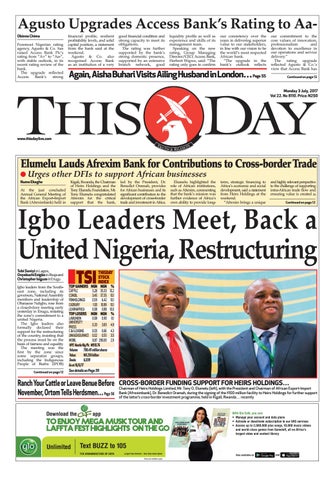
CROSS-BORDER FUNDING SUPPORT FOR HEIRS HOLDINGS…
Chairman of Heirs Holdings Limited, Mr. Tony O. Elumelu (left), with the President and Chairman of African Export-Import Bank (Afreximbank), Dr. Benedict Oramah, during the signing of the $100 million facility to Heirs Holdings for further support of the latter’s cross-border investment programme, held in Kigali, Rwanda… recently
2
T H I S D AY MONDAY JULY 3, 2017
T H I S D AY MONDAY JULY 3, 2017
3
4
T H I S D AY MONDAY JULY 3, 2017
T H I S D AY MONDAY JULY 3, 2017
5
6
T H I S D AY MONDAY JULY 3, 2017
T H I S D AY MONDAY JULY 3, 2017
He started a maize farm in 1993 Today he exports grain across the world
We support the people who see a million opportunities where others don’t We have long understood the importance of agribusiness. That is why we have been providing advisory services and financial support to the visionaries writing the story of tomorrow’s economy. For more information visit: sme.firstbanknigeria.com
7
8
T H I S D AY MONDAY JULY 3, 2017
T H I S D AY MONDAY JULY 3, 2017
9
10
T H I S D AY MONDAY JULY 3, 2017
11
T H I S D AY MONDAY JULY 3, 2017
alat_ng
alat_ng
alatng
12
monDAY, july 3, 2017 • T H I S D AY
page TWELVE
Again, Nigeria’s Manufacturing Index Expands in June CBN mulls measures for banks’ balance sheet repair to spur lending Obinna Chima The Manufacturing Purchasing Managers’ Index (PMI) increased to 52.9 index points in June 2017, showing expansion in the manufacturing sector for the third consecutive month. The Central Bank of Nigeria (CBN) revealed this in its PMI report for June 2017, obtained yesterday. The PMI is an indicator of the economic health of the manufacturing sector, and is based on five major indicators: new orders, inventory levels, production, supplier deliveries, and the employment environment. A composite PMI above 50 points indicates that the manufacturing/ non-manufacturing economy is generally expanding, 50 points indicates no change and below 50 points indicates that it is generally declining The latest PMI report showed that 12 of the 16 sub-sectors reported growth in the review month in the following order: computer & electronic products; paper products; plastics & rubber products; primary metal; transportation equipment; petroleum & coal products; appliances & components; textile, apparel, leather & footwear; furniture & related products; electrical equipment; food, beverage & tobacco products; and fabricated metal products. On the other hand, four other sub-sectors declined in the order: non-metallic mineral products; cement; chemical & pharmaceutical products, and printing & related support activities. Just in the same manner, the production level index for the manufacturing sector grew for the fourth consecutive month in June 2017. The index at 58.2 points indicated an increase in production but at a slower rate, compared to the previous month.
Fourteen manufacturing sub-sectors recorded increases in production levels during the review month in the following order: computer & electronic products; plastics & rubber products; transportation equipment; primary metal; appliances & components; paper products; textile, apparel, leather & footwear; electrical equipment; petroleum & coal products; fabricated metal products; furniture & related products; food, beverage & tobacco products; cement; and printing & related support activities. Non-metallic mineral products and chemical & pharmaceutical products sub-sectors recorded declines in production. Also, at 51.0 points, the new orders index grew for the third consecutive month. Under this, eight sub-sectors reported growths in new orders in the following order: paper products; primary metal; plastics & rubber products; computer & electronic products; petroleum & coal products; furniture & related products; textile, apparel, leather & footwear; and food, beverage & tobacco products. The fabricated metal products and transportation equipment subsectors remained unchanged, while the non-metallic mineral products; cement; chemical & pharmaceutical products; appliances & components; printing & related support activities; and electrical equipment sub-sectors recorded declines. The supplier delivery time index for the manufacturing sector at 50.3 points in June 2017 also rose from its contractionary level in the previous month. Seven sub-sectors recorded improvement in suppliers’ delivery time in the following order: computer & electronic products; electrical equipment; furniture & related products; cement; primary metal; food, beverage & tobacco products; and chemical &
pharmaceutical products. The non-metallic mineral products; textile, apparel, leather & footwear and transportation equipment remained the same, while six sub-sectors recorded delayed supplier delivery time in the following order: plastics & rubber products; appliances & components; petroleum & coal products; fabricated metal products; printing & related support activities and paper products. The employment level index in June 2017 stood at 51.1 points, indicating growth in employment levels for the second consecutive month. Of the 16 sub-sectors, 10 recorded growth in employment in the following order: computer & electronic products; plastics & rubber products; transportation equipment; appliances & components; paper products; petroleum & coal products; primary metal; fabricated metal products; textile, apparel, leather & footwear; and food, beverage & tobacco products. Six sub-sectors recorded contractions in employment in the following order: cement; non-metallic mineral products; electrical equipment; furniture & related products; printing & related support activities; and chemical & pharmaceutical products. Meanwhile, CBN’s Deputy Governor, Corporate Services, Alhaji Suleiman Barau, has stressed the need to provide the necessary support that could improve the balance sheets of Nigerian banks, in order to help them resume credit delivery to critical sectors of the economy. This formed part of Barau’s contribution at the last CBN’s Monetary Policy Committee (MPC) meeting, a copy of which was posted on the central bank’s website at the weekend. He pointed out that net domestic credit on an annualised basis grew
by a mere 4.2 per cent at the end of the first quarter, significantly lower that the target of 32 per cent. This low level of growth in credit, obviously, cannot drive the anticipated recovery process, Barau said, adding that the abysmal performance was largely due to the strains on the banking sector from the imbalances in the macroeconomic environment. “The central bank, under its developmental mandate, has put in place a number of credit initiatives to support the recovery process but it needs to be borne in mind that the task of channeling financial resources to the private sector lies primarily with the commercial banks,” the CBN deputy governor said. According to Barau, the banking sector has been highly challenged by the adverse developments in both the financial and real sectors of the economy. He noted that the contraction in real Gross Domestic Product (GDP) contributed substantially to the elevated non-performing loans (NPLs) in the industry, which invariably elicited cutbacks in the level of credit exposure by the banks since the latter half of 2016. Banks’ non-performing loans rose to 11.7 per cent in 2016, up from 5.3 per cent the previous year. “From the financial sector development, the depreciation of the domestic currency has reduced the value of banking assets in real terms. “Recent statistics showed that total banking assets denominated in U.S. dollars reduced by 27.4 per cent in 2016, compared to the level in 2015 on account of currency depreciation of about 55 per cent during the period. “The reduction in assets in real term, coupled with the elevated NPLs would, therefore, weighed on the capacity of the banks to support the recovery
Igbo Leaders Meet, Back a United Nigeria, Restructuring and the Movement for the Actualisation of a Sovereign State of Biafra (MASSOB), intensified their agitation for the creation of the Republic of Biafra. Though the meeting avoided mentioning any of the separatist groups, their resolutions may have foreclosed any possible support for the Nnamdi Kanu-led agitation for the break up of Nigeria. The five governors – Ifeanyi Ugwuanyi of Enugu, Okezie Ikpeazu of Abia, Rochas Okorocha of Imo, Willie
Obiano of Anambra and Dave Umahi of Ebonyi – had earlier met at the Government House, Enugu, to harmonise their position before moving to the Nike Lake Resort, Enugu, for the enlarged stakeholders’ meeting.
Apart from the governors, other notable persons that attended the meeting included Deputy President of the Senate, Senator Ike Ekweremadu and other members of the National Assembly, former Senate Presidents, Senators Adolphus Wabara and Ken Nnamani, the President General of Ohanaeze Ndigbo, Chief Nnia Nwodo and his predecessor, Enwo
Igariwey, former Chief of General Staff, Admiral Ebitu Ukiwe, former Inspector General of Police (IGP), Ogbonna Onovo and a former Deputy Inspector General of Police, Hillary Opara. Others were deputy governors, state assembly speakers, religious leaders and traditional rulers from the zone. However, political appointees from the South-east currently serving in the administration, especially the ministers, were conspicuously absent from the meeting and no reason was given for their absence. In a seven-point communiqué read by the Chairman of the South-east
Governors’ Forum and Ebonyi governor, Umahi, to newsmen at about 1 a.m. when the meeting ended, the Igbo leaders called on the federal government and all Nigerian leaders to immediately commence a process of dialogue among Nigerians on the modalities of restructuring the country within a reasonable time frame. They also threw their weight behind the report of the 2014 National Conference and asked the federal government to set up structures that will enable its implementation within a reasonable time. Continued on page 54
process,” he added. In his contribution, the Deputy Governor, Operations, CBN, Mr. Adebayo Adelabu, pointed out that there was the issue of rising economic nationalism and waning support for global trade in advanced economies. This, Adelabu said, was further complicated by heightened uncertainty in the euro area. He argued that it was becoming clearer that inward looking economic strategies could become the preferred global framework as the rebalancing model was gaining momentum in China, while the U.S., under the new dispensation, was shifting towards protectionism. The point here is that net exports may still be driving the growth process but the prospect over the long term appears diminished, Adelabu added. “For Nigeria, the balance of payment account witnessed considerable challenges from mid-2014 to the end of first half of 2016. The improvement in the latter half of 2016 resulted mainly from a drastic reduction in imports, which initially was due to foreign exchange constraints but later due to the substitution of some imported items with domestically produced ones. “Viewed within this prism, emerging economies such as Nigeria should start re-examining their economic model to avoid being caught napping. It is commendable that the country has recorded significant milestones in rice production such that it has taken over imported rice within a space of two years. “This initiative should be sustained by extending the success story on rice to other critical products like refined petroleum products. Put succinctly, there is a compelling need to strengthen structural policies, particularly in the area of encouraging the consumption of homemade goods in line with the thrust of economic recovery and growth plan,” he said. Deputy Governor, Financial System Stability, CBN, Dr. Okwu
Joseph Nnanna was cautiously optimistic that further inve stments in critical sectors through the implementation of the Economic Recovery and Growth Plan would shore up economic activity and reduce unemployment. According to Nnanna, it was apparent that the flexible exchange rate policy supported by improved crude oil export receipts was yielding relative stability in the foreign exchange market. “Despite the distortions in the foreign exchange market caused by multiple rates, a near-term convergence in the rates and gradual normalisation is being achieved. “Noticeably too, from the sharp depreciation of the exchange rate to near N500/US$ towards the end of 2016, it appreciated by about 28.94 per cent to N380/US$ (BDC segment of the market) as of May 19, 2017. “At that level, the rate shows some degree of undervaluation, compared with the relative purchasing power parity exchange rate estimate of about N350/US$. In my opinion, the current exchange rate policy regime including all the access windows to foreign exchange should be retained. “Despite the rebound in global growth, the outlook remains uncertain. Uncertainty surrounds the stability of commodity prices and effects of monetary normalisation in the United States. “I anticipate the pass-through impact on domestic economic conditions to remain benign as the economy has self-corrected the distortions from recent portfolio capital reversals,” he said. He stressed the need for reforms to be expedited in areas such as the building of fiscal buffers, just as he urged the authorities to cautiously execute its planned fiscal deficit in the 2017 budget, in order not to spike inflation and significantly crowd-out private sector credit. Nnanna further noted that effective reforms would trigger inflation deceleration and a lowinterest rate regime.
Agusto Upgrades Access Bank’s Rating to Aastrengthened its risk profile, deepened its retail banking drive by creating a digital business through its digital strategy, embraced a cost reduction programme, and the use of value chain strategy to capture small businesses in the retail segment of the market. This was further supported by the bank’s five-year strategic
plan to rank among the top three banks in its chosen markets and across financial metrics by the end of 2017. It has translated to a growth in market share for Access Bank with the bank becoming the third largest bank on the basis of its total assets and contingents of N3.3trillion as of 31 December 2016, said the statement.
countries, in key sectors of the African economy comprising energy, financial services, real estate and hospitality. Elumelu commented further that support from African Direct Foreign Investments (DFIs) like the Afreximbank was often symbolic – being less about the size of the cheque and more often because such support acts as a catalyst to other providers of investible capital. He concluded by calling for African leaders doing businesses across borders to build legacies and focus on corporate governance while building businesses that last. “It’s all about the legacy. We need to think about how history
will judge us,” he stated. Themed “Trade and Economic Transformation”, this year’s Afrexim AGM gathered top level leaders from the public and private sectors, African Ministers of Finance, Trade and Investment, central bank governors and senior government officials in a series of panel discussions to grow intra and extra-regional trade in Africa. The meeting was opened by the Rwandan President, Mr. Paul Kagame, who invited Africans present to invest in Rwanda. Other guests at the event included former President Olusegun Obasanjo and President of the African Development Bank (AfDB), Dr. Akinwumi Adesina.
Elumelu Lauds Afrexim Bank for Contributions to Cross-border Trade and exported from our continent,” said Elumelu. “I urge other development finance institutions, particularly the bank’s African peers, to follow its example in providing transformational forms of funding to African businesses.” Elumelu, who spoke at the 24th AGM of the bank on “Cross-Border Investments as a Driver of IntraAfrican Trade and Industrialisation: Reflections from a Continental Business Leader”, championed the agenda of the private sector, as the key contributor to Africa’s ability to attract and implement sustainable investment. The founder of Heirs Holdings cited his own approach to long-term investment in critical
sectors such as power, finance and resources, across twenty African countries. According to him, Africa must grow cross-border trade and investment and attract both local and international investors. “Investment is not just about profit and returns. It is also about sustainability,” he explained. “What I want to see is Africans investing in Africa. “We appreciate and welcome partnerships, but there is a generation of African businessmen and women, who have the capability and ambition to lead and transform Africa’s future. Let your money work in Africa,” he said.
Elumelu also highlighted the importance of entrepreneurship. “We know the challenge and potential of Africa’s demographic explosion. That is why the Tony Elumelu Foundation is catalysing 1,000 entrepreneurs each year, with the objective of assisting 10,000 entrepreneurs over 10 years. Invest in the future, our youths,” he told delegates. The meeting also witnessed the signing of a $100 million facility between Afrexim and Heirs Holdings. This initial transaction between Heirs Holdings and Afrexim, said Elumelu, “is just the beginning and a clear indication of the intent and capacity of both parties to
identify means to grow Africa’s wealth and create sustainable business opportunities over time. We welcome this and hope this serves as an example to others”. Elumelu tasked more African Development Institutions to fund intra-Africa trade and businesses in a manner that will boost and embolden African business leaders and facilitate further development of Africa’s economy. The $100 million facility is meant to further support Heirs Holdings’ cross-border investment programme. Heirs Holdings is a pan-African investment proprietary holding company with a portfolio of investments in 20 African
T H I S D AY MONDAY JULY 3, 2017
13
14
T H I S D AY MONDAY JULY 3, 2017
COMMENT
Editor, Editorial Page Peter Ishaka Email peter.ishaka@thisdaylive.com
Issues With The 2017 National Budget
W
Boniface Chizea argues the need for the executive to present budget estimates to the legislature on time
hen after so much delay the Acting President eventually signed the 2017 budget, it was clear to the discerning that there were lingering issues. But wise counsel must have informed the decision to sign the budget and get on with it at least to take the budget beyond awaiting approval. But if what has come to light lately is as serious as it appears, then one might be inclined to enquire why the budget was signed after all. If as the Minister of Works, Power and Housing has alleged that the allocations to the various budget heads have been tampered with as to make nonsense at meaningful implementation of any of the big ticket items on the budget such as the Second Niger Bridge and the Mambilla Power project, then you ask whether it should not have been better to tarry a while to have matters straightened out before signature was appended. But on the other hand some have argued that after considering the record of the country with the implementation of capital projects that it is better to get on with it to see if even some tentative progress could be made in the implementation of capital projects so badly needed for the rapid growth and development of the economy. We would not allow the name-calling, accusations and counter accusations that have been traded between the Minister and the National Assembly to delay us here, but only to observe that as a country we could certainly do better. We are talking of the welfare of Nigerians and there are no misunderstandings that could not have been ironed out amicably instead of the grandstanding and circus show we have all witnessed. But as the minister lamented, it is worrisome and certainly tantamount to dissipation of executive energy if after presentations have been made to the various committees, the National Assembly turned around to begin to mutilate the budget through the addition of boreholes and dispensaries projects. Certainly something is not quite right with this procedure. And it brings to the fore the need to settle once and for all who does what with the national budget. We read that the court recently gave a ruling to the effect that the National Assembly could do almost anything it likes with the budget and when you read such judgments you sympathise because we do not know how much of what goes on with the budget is understood by the presiding officers at our temple of justice. If the legislature could do almost what it likes with the budget, it begs the question regarding whose responsibility it is to prepare the budget. Most certainly we cannot have joint and equal role for the preparation of the national budget as that would be a recipe for confusion. The budget is the only instrument which is available to the executive for the implementation of the many promises it had made to the electorate and therefore the ownership of this instrument should not be in any doubt. Yes the legislature as joint stakeholders and in keeping with the legislative mandate for the performance of oversight functions should
The budget is the only instrument which is available to the executive for the implementation of the many promises it had made to the electorate and therefore the ownership of this instrument should not be in any doubt
have an input in the preparation of the budget but not of the nature of what we are currently witnessing. And what is obviously missing is the lack of adequate consultation and cooperation during the budget preparation phase. We had advocated that the legislature should have its own budget office which would liaise on an on-going basis with the Budget Office of the Federation so that by the time the budget details are finalised the various interests could have been accommodated instead of what is happening now when after budget details have been presented and discussed. To facilitate the process of budget preparation and to ensure that we transcend beyond this unusual practice of commencing the budget year whenever the budget was approved which most certainly is not best practice, there is the need for the executive to keep fidelity with the Fiscal Responsibility Act by ensuring that the budget estimates are ready for presentation to the legislature as prescribed by the end of August and for us to achieve this, it is imperative for timelines to be worked out to ensure that the budget is ready to be presented on the first day of the calendar year as it is the practice in matured economies. It would be salutary for the budget preparation process and have the distinct effect of not allowing project still under implementation to be left out if we revisit the three-year rolling plan approach so that subsequent budget details within the plan period could be anticipated in advance thereby minimising the dispute which now characterises the process. Ordinarily one should have expected that the four-year Economic Recovery and Growth Plan would have bridged the gap as we discuss. And that makes one ask what is happening to the plan and when and how are we going to commence its implementation! There are already some worrying developments with the implementation of the budget so far. One is concerned about the extent of borrowing. It appears that loan is now being sought from any source for that matter. And one is somewhat concerned that the distinct impression one gets is that the borrowings are no longer project tied and we might not have adequately referenced the budgeted amount as specified in the approved budget in our rush and hurry to exit the recession. The obvious pitfall here is that we could be rapidly drifting to the problem of debt overhang of the recent past which would have the effect of impacting negatively the credit worthiness of the country as the inevitable defaults are witnessed. It is also not reassuring that nobody hears anything about the state government budgets. This country cannot record the extent of commensurate growth and development which most compatriots would wish to witness if the state governments do not come on board with a different and serious mindset regarding the preparation, adoption and implementation of their respective budgets. This is a situation which tantamount to attempting to clap with one hand which is not possible. The National Economic Council to which the state governors are members should be leveraged upon to mount peer pressure on the state governments to begin to take matters relating to the budget seriously. Dr. Chizea is a management consultant
It Is All A Game
S
ome will even say football is politics. Football is a game. Politics is a game. Some will say like football, there are some ground rules to it. But then, are there? Like FIFA, like INEC? But we must admit that there is indeed a bit of more leeway with politics than football in fiddling with the rules. There is really no friendly match in football. It is almost always about winning, no matter how disguised that objective is. No friendly match in politics, it is almost always about winning. It is always about getting hold of power, determining who gets what, where, when and how. But in politics, just as in football, even as you want to win, you do not always play the game with a zero-sum mind-set. Except it is a cup game. And even at that, sometime you have to play to lose, as this momentary win might not help your long-term objective. Winning that cup game might just tie you down in one backwater competition you can do without, if your focus is on the league title or something loftier. You must understand the game and the competition you are in. A draw here and even a loss there might not be that bad, at the end of the day, as long as the overall objective is kept in sight. You must know when not to deploy maximum resources for the sake of a more important game in the near future. You might need to rest some members of the troop to keep them fresh for a future game. Like football, politics is only re-played on the arena. It is first played in the mind of the tactician, the master-strategist, long before the game itself. The game is half-won at the stage of planning and strategising. The tactical only comes later, with the manager, thinking on his feet, effecting changes as he might so desire to affect the game, out-think and outwit the plans and changes as become
Politics is like football, writes Simbo Olorunfemi manifest on the part of the opponent. It all starts in the mind. What are we here for? What are the objectives? What do we need to get to where we are headed? Who do we need to help us get there? In football, just as in politics, there are no permanent friends or enemies. You draw your template. You go for players that can help you realise your objective. You build your team carefully. In buying players, you must leave out sentiment. A Buhari is available, why not buy him? What does he offer your team? The heart? The head? Some 12 million goals? Pedigree? Why not buy an Okorocha or an Amaechi? Will it not make your team to be more balanced? You go for the players that will help achieve your objective. Just as you must buy with wisdom, you must also select players to offload carefully. Do you need a Sheriff in this team with his rich history of scoring own goals? What role can a Fani-kayode play in the team? You must ask yourself, way ahead of time. You must not be afraid to make the hard choices. You can send out players on loan and recall them when the need arises? If you are Chelsea, you can loan out your Ake to Bournemouth to help you destroy other teams from there. You can even sell a player and put in a buyback clause, just in case he gets better at the game and you now have need for his services. You must know when there might be a need to allow an Obanikoro back into the team. It is all part of the game. You need not get unduly sentimental. You must have the ability to let go, forgive, even if you do not forget. That is a virtue that will serve you well. For as you make progress, become more successful, some of those who left, for all sorts of reasons, will want to come back. You will have to accept some back into the fold. Remember, you now have one on them to hold them down. You own them in a way. That you
sold a player today does not mean you cannot buy him back tomorrow, if the need arises. Pogba was old for peanuts by Manchester. Last season, they broke the back to buy him back. It is all a game. It is all about how the need arises. Every player has his use. You are not going to select a team of eleven strikers. If every player wants to be a governor, who will go to the Senate? Who will man the ministries as ministers or commissioners? Who will do the dirty work? Who will be your Mikel Obi? Who will sacrifice himself for the team? Where is your destroyer who will break things up in the middle? Where is the player who will willingly wear the jersey of anonymity while the Ronaldos take the credit? That a player is in the team does not mean he has to play, all the time. He might not even get to play at all. Yet, that does not make him a lesser member of the team. It is always about the team and the objective. Some will only be squad players. You must buy and sell players on purpose. You must be deliberate in all that you do. Even more importantly, you must select the team to play, at any point, in time with a clear objective in mind. Everything must be deliberate. You must take into account form, pedigree, fatigue and injury before putting down every name. You must think about the formation to play. You must consider the balance of the team. You must consider how you want the team to play. How much of flair do you want? You must strike a balance between form and function. You will have to consider the opposition - strengths and weaknesses. You must consider the competition you are in, the objective for the season, the place of the match at hand. Like football, like politics, you must think, think and think. You start thinking about 2019 in 2014. In selecting your team for 2015, you are not only thinking
of then and now, but also thinking of 2019, 2023. Will a Gary Cahill be a worthy successor to a John Terry, down the line? Or should we be bold, drop Terry now and pair Cahill with Ake? Or do we go to France to bring back a David Louis we sold years back? In selecting the strikers, how will an Osinbajo complement a Buhari up-front? How deadly will such a strike force be in confronting the Jonathan team? How do we manage a Diego Costa with his temper? How will he fare as president? But we are talking about winning here and this is Arsenal on the other side, can we afford to leave out a Drogba from the side given his record in dealing with Arsenal? Do we go with form or pedigree? How do we justify picking an Iheanacho ahead of an Aguero? Only you will understand why you might not want a Saraki as a support-striker for your team. Only you can tell why a Lukaku is not good enough. Some strikers are good at goal-scoring but too greedy to see how their personal ambition to become the top goal-scorer might be hurting the interest of the team. Like football, like politics. Like Mourinho, like Jagaban. Like football, like politics. Only you will know the reasons you sold Mata in Chelsea. Only you know why you are playing him now in Manchester United. Only you know why you have opted for an Ibrahimovic to carry the team on his back for this season, when many thought he had gone past his prime. Only you know why you would have gone for a Fashola or Ambode when there were more popular players on the bench. Only you can see ahead of time what you are trying to do. Time only gets to prove you right or wrong in the eyes of the public. Olorunfemi works for Hoofbeatdotcom, a Nigerian Communications Consultancy and publishers of Africa Enterprise
15
T H I S D AY Ëž ÍąËœ 2017
EDITORIAL READING CULTURE AND PUBLIC LIBRARIES Libraries are agents of development
T
he National Librarian, Professor Lenrie Olatokunbo Aina, last week, called on stakeholders in the education sector to go to the grassroots and inculcate in children the reading habit. “When a reader develops the various reading skills needed for successful reading, he is then inclined to read and a reading culture evolves through getting involved in daily reading activities,� he said. While we endorse Aina’s campaign, we also reiterate our earlier call for the resuscitation of public libraries across the country so that those who want to read would know where to access such relevant materials. There is a connection between the reading culture of a people and the development of their society. In our country today, majority of the children, just like many adults, have limited exposure to quality reading materials. And that is very telling on the state of our nation. In most countries, public libraries are a serious component of the education curricular based on the recognition that withIN A KNOWLEDGE-DRIVEN out such resources, it WORLD, THE AUTHORITIES is practically imposWILL DO WELL TO INVEST sible to improve on IN PUBLIC LIBRARIES literacy. But we have AND MAKE THEM neglected this vital ATTRACTIVE TO MEET aspect that can help extend knowledge to THE INFORMATIONAL, a vast majority of our EDUCATIONAL AND THE RECREATIONAL NEEDS OF people. It is rather ironic THE PEOPLE that in an information and knowledge-driven world, those in position of authorities in our country are still not conscious of the importance and the need for libraries in our public space. A functional library helps in providing information to the society in different formats in the bid to encourage and promote a good reading culture which is a sine-qua non to personal and indeed national development. A functional library is expected to stock all kinds of items that add to knowledge - from books to audio
Letters to the Editor
I
and visual materials, internet through computers and artifacts that advance the cultural and recreational needs of the society. Ironically, most public libraries in the country--from those established in the states and run by the state governments to those in the universities--are largely neglected. In Nigeria, public libraries, often named “the poor man’s university,� are kept unattractive and poorly maintained while in most cases, the infrastructural facilities are inadequate. Besides, the books in stock are dated just as it is a rarity to stumble on new and current journals. Indeed, reference materials, where they exist, are old and dusty. Audio-visual materials are hard to come by. The quality of manpower is another story altogether.
F T H I S DAY
EDITOR DEPUTY EDITORS ˜ MANAGING DIRECTOR DEPUTY MANAGING DIRECTOR CHAIRMAN EDITORIAL BOARD
EDITOR NATION’S CAPITAL
T H I S DAY N E W S PA P E R S L I M I T E D
EDITOR-IN-CHIEF/CHAIRMAN GROUP EXECUTIVE DIRECTORS ˜ ˜
˜ GROUP FINANCE DIRECTOR DIVISIONAL DIRECTORS ˜ ˜ DEPUTY DIVISIONAL DIRECTOR
SNR. ASSOCIATE DIRECTOR ASSOCIATE DIRECTORS ˜ CONTROLLERS ˜ ˜
GENERAL MANAGER
GROUP HEAD DIRECTOR, PRINTING PRODUCTION TO SEND EMAIL: first name.surname@thisdaylive.com
our years ago, the National Universities Commission (NUC) panel led by Professor Mahmood Yakubu on challenges of public universities (otherwise called the Needs Assessment Panel) reported that university library resources were mostly outdated and manual; and that no library in the public university system was fully automated. Unfortunately, not much has changed since then. On many occasions, the Nigerian Library Association has drawn attention to the poor funding of public libraries, all to no avail. Indeed, about the same time the contract for the National Library headquarters was awarded some years back, the United Nations in its Human Development Report harped on the essence of investing in the knowledge of an individual. According to the report, “a well-read mind is assertive, articulate and seeks information to help solve daily challenges.� Again and again, UNESCO has harped on the fact that functional libraries are very important to the development of any society. This is because people who read are more alert and empowered while a good reading culture improves the academic performance of children and students and also helps their mental development outside the classroom environment. In a knowledge-driven world, the relevant authorities in Nigeria will do well to invest in public libraries and make them attractive to meet the informational, educational and the recreational needs of the people.
TO OUR READERS Letters in response to specific publications in THISDAY should be brief (150-200 words) and straight to the point. Interested readers may send such letters along with their contact details to opinion@thisdaylive.com. We also welcome comments and opinions on topical local, national and international issues provided they are well-written and should also not be longer than (9501000 words). They should be sent to opinion@thisdaylive.com along with the email address and phone numbers of the writer.
WALE TINUBU: TRIBUTE TO A BUSINESS ICON
n 2001, the business pages of Nigerian newspapers were awash with the face of a young, cute business executive. He had led a group of equally young folks (all in their early- to mid-30s) to buy federal government’s share in one of the state-owned downstream oil companies, UNIPETROL. Few months later, these young men also acquired the Nigerian downstream business of the Italian oil giants, AGIP, consolidated the two petroleum marketing companies and rebranded the new, enlarged company OANDO. They brought private touch to this mismanaged government asset and turned it to, arguably, the most successful privatised government enterprise in Nigeria. Earlier, in 1994, the youngsters, Wale (27), Mofe Boyo (27) and Jite Okoloko (c.29), had started an oil trading company, Ocean and Oil, after sniffing opportunities in the oil and gas sector, the first two being young lawyers (Wale practicing in his father, Karimu Tinubu’s law firm and Mofe working in Rotimi Williams chambers) who had drafted oil and gas contracts and noticed untapped business mine in the industry. Both had been friends from their school days in the United Kingdom. They got on board the third, Jite, who was working in the oil and gas industry and had more practical knowledge, to join them to birth Ocean and Oil in 1994. That was the beginning of what is today an integrated oil and gas business empire. Wale had actually always been businessminded. He recalled in an old interview with Forbes how he
used to quickly use his school fees in the UK to buy and sell cars, make small margin, before paying the fees. And for the execution of their first oil trading contract to Unipetrol (a company they would later acquire) when they set up Ocean and Oil in 1994, he personally rode inside the jalopy ferry, beaten by rain, to ensure delivery/performance of the contract. Although I heard of only the name Wale Tinubu in the 2001 media frenzy, he was only the external face of the company, Mofe and Jite were quietly running the internal operations. Jite would later quit to venture into other business interests - Notore fertilisers, and oil and gas business (Mid-Western Oil & Eroton). I admired Wale’s courage from distance. Then in May 2008, two weeks after returning from my mandatory NYSC programme, the first job offer I had was from Oando, which I joyously took. That was how the men I observed from afar seven years earlier would later become my employer for four years, until I moved on in 2012. I have never ceased to tell people that I’m a big fan of Wale Tinubu and this predates my working in his company. There have been a lot of controversies about the man, but most of them were actually fed by ignorance. One of them, that the young men were fronting for ex-President Olusegun Obasanjo and that Oando means Obasanjo and Others. That should not make sense to any informed person, as when they formed their flagship company, Ocean and Oil (from where they derived O & O in 2001) in 1994, Obasanjo was in prison, not known to be wealthy
and never even knew he would later become civilian President of Nigeria. Two, that they were fronting for Bola Tinubu. Well, to the best of my knowledge, Obasanjo and Bola were not in good terms when JAT acquired FG’s Unipetrol in 2001. I don’t think Obasanjo would approve sale of a FG asset to a Tinubu front. In any case, these guys had been doing business far back in 1994 before Tinubu became a powerful politician. I have learnt not to vouch for any personality, but this just doesn’t add up. Three, that they had a headstart being from wealthy homes. True, but where are the children of the rich people of yesteryears? Where are the children of other big men that voyaged into business? Look, give credit to these guys’ business and management acumen. Having access to money is never enough to build a successful business. Whichever way you look at it, Oando story is a success in indigenous entrepreneurship and turnaround of a badly-run government business by private businessmen. On this score, you have to give credit to the men behind this success. I’m a little worried about the turn of things for them in the last four years, especially with their upstream business foray where they are still learning the rope, but you have to give it to these guys. JAT clocks 50 recently; Mofe will be 50 this month. At golden jubilee, the young businessmen of 1994, of 2001, of 2008, are probably dropping the youthful toga. Suraj Oyewale, Lagos
16
T H I S D AY MONDAY JULY 3, 2017
17
T H I S D AY • MONDAY, july 3, 2017
politics
Group Politics Editor Tobi Soniyi Email tobi.soniyi@thisdaylive.com 08033146139 SMS ONLY
M o n d ay D i s c o u r s e
Restructuring: A Headache That Won’t Go Away
As the call for restructuring becomes more strident, Segun James identifies those behind the clamour and why many people seem to be buying into it
Akinrinade....time to restructure is now
I
f there is anything those in power today would wish for, it is for the agitation for restructuring to disappear. Unfortunately however, the reality is that the clamour for the country to be renegotiated isn’t going to just disappear, at least not very soon. The problem, however, is that while many agree that the country should be restructured, they are wide apart on how to go about it. This is because the word ‘restructure’ in Nigeria context is not a term that is very simple to understand. Its meaning may depend on who you ask. Nigeria, in the surface does not look like a country that is about to implode nor is it about to suffer any upheaval that threatens its corporate existence as it was in 1967, a situation that led to a civil war. For better and for worse, the corporate existence of the country has been an exception to the rule. After all, some other mishmash behemoths created by the colonial British Empire at the height of her power, have been broken into different countries. India split into Pakistan, India and Bangladesh while Sudan recently divided into two. But so far, Nigeria has remained one. Now the situation appears to be changing. The oil money is dwindling; the people of
the Niger Delta are becoming uncomfortable with others taking advantage of their resources and agitating for resource control while the other component parts of the nation are jostling to take control of the leadership of the nation. It is while this is going on
The problem, however, is that while many agree that the country should be restructured, they are wide apart on how to go about it. This is because the word ‘restructure’ in Nigeria context is not a term that is very simple to understand. Its meaning may depend on who you ask
that the call to restructure the country has suddenly become strident. There are threats that if the call for restructuring is not heeded, the country may implode. But will it? Today, several reasons are responsible for the clamour for restructuring. Why should one part of the country believe it is more superior to the others? Why should revenue derives from a region be used to fund other regions? Does each region stand an equal chance of producing the leadership of the country? Why should the security agencies be concentrated in the hands of one tribe and same religious group? These and other questions are what are fuelling the call for the immediate restructuring of the country. Livinus Okeke has lived in over 10 countries and has visited 30-odd more, in most, any discrimination he might have experienced would be because of his skin, a feeling which was deflected by his status as an honest businessman who has contributed to the growth of economic relationship between Nigeria and those countries. But in Nigeria his own country, Okeke laments that he is made aware at every turn that he is not from Kano state where he was born over 40 years ago. Okeke said that his look, his dressing, his
intonation and his physical future automatically makes him an “outsider” on the streets of Kano even though he speaks the language fluently. He is an outcast even though he considers Kano his home as he had never leaved anywhere in the southeast where his parents hailed from. Now he has up to the 1st October to determine his fate or he might face the wrought of Arewa youth who have given Igbo people three months to leave the north. “I am still contemplating where to move to. I cannot say it is a lie only for them to invade us. Immediately when the children vacate for the summer, I will send them with my wife to Lagos while I will take the risk alone. Kano is my home town. I have my business here. I have houses here and God has blessed me here. Now they say I should go back to the east when my home is here.” Okeke said that he does not believe in the call for a Biafra which according to him is unnecessary. “My wife is from Adamawa state. Where will I keep her if the country is divided along ethnic lines? We have inter married so much that breaking the country CONT’D ON NEXT PAGE
18
T H I S D AY • MONDAY, july 3, 2017
politics
Monday Discourse
R e s t r u c t u r i n g : A H e a d a c h e Tha t W o n ’ t G o A wa y
Adebanjo... a map of Oduduwa Republic now in existence
will be impossible.” He however believes in the call for restructuring. To him, “if the country is restructured and the centre is no more as powerful, the people of the country will appreciate each other. We have practically taken each other for granted.” For Alhaji Ibrahim Olawepo, a Lagos based businessman from Kwara state, those calling for a break-up of the country do not see beyond their nose. He said that Sudan should have taught Nigerians the lesson that a break-up does not necessary means peace. He said that since the break-up of the Sudan into two nations, the South Sudan has still not known peace as the former ethnic groups that came together to fight for a separate nation are now feuding among themselves. He said that even if Nigeria breaks into north and south, there will still be calls for further break ups. If you look at the future from this frightening perspective, then you are welcome to the world of General Alani Ipoola Akinrinade retired who is a leading voice among those calling for the country to be restructured. He wants the unity of Nigeria to be discussed and a better nation rising from the ashes of the present system which he says has failed the people. That a retired general of the calibre of Akinrinade would make an urgent call for the country to be restructured is an indication that the agitation should be taken serious. Left to Akinrinade, an otherwise taciturn former Chief of Defence Staff and commander of the Nigerian Armed Forces and civil war hero, the nation is already overheating and an implosion is imminent, a situation which may lead to a break-up of the country called Nigeria. Almost 50 years after the Nigerian civil war ended, the general now regrets his participation in the war to keep Nigeria one. He reasons that the nation and its political leadership had refused to learn from history; and that from all indications, the labour of our heroes’ past are now in vain. In politics, people generally recoil from the idea of learning from the past. To them, every situation is unique and should be handled differently. This is where Akinrinade differs from the politicians. To him, in politics and in war, history has been found to repeat itself severally. To him, the adage that when you open a window both fresh air (the good) and the flies (the bad) will come in is apt.
Hence there is the need to constantly be on the lookout to kill the flies each time you can. He says that it is the refusal to do this that has led to the pollution in the national polity. Akinrinade said the current Nigeria structure is a mockery of a united country united; and that the Igbos agitating for Biafra should be allowed to go. He said that although he still believes a true federal system is good for the country, the current structure makes the war to keep the country as one looked like a futile exercise. “Good, you allow people to make choices. And you also said it is good to allow people decide their fate. This present agitation by the Igbos, garbed in the Biafra movement, in retrospect, wouldn’t we now begin to admit that the fight to keep Nigeria one, based on contemporary realities, was futile, a fool’s errand, that was not worth it?
Maybe because some of us have served everywhere and we have friends everywhere and we talk and discuss and share views. As far back as 1983 when I went to Ife to deliver a lecture, I suggested that we would do much better with a confederation. There were quite a number of things I also said there. Because, there, I made it clear that the way free education was being continued, it was not going to survive or give quality education, that it needed remodeling
“Those ideals that people had, in keeping the nation one, appeared to have been thrown out of the window. Well, I think as far back as the early 1980s, I’d alluded to the fact that it is still possible to keep a country like Nigeria one. I still have that belief. “Maybe because some of us have served everywhere and we have friends everywhere and we talk and discuss and share views. As far back as 1983 when I went to Ife to deliver a lecture, I suggested that we would do much better with a confederation. There were quite a number of things I also said there. Because, there, I made it clear that the way free education was being continued, it was not going to survive or give quality education, that it needed remodeling. “Those who had made good and were expected to pay back to society were still hinging their hopes on free education. That was not fair. When you have benefited and can afford to offer at least 20 scholarships, you still want to keep your wealth made through free education and you want your children to also participate? On top of that, you add bursary. Are you going to give bursary to children of people in my social category? It would be unfair on the farmers and those in dire need of the bursary. “So, because my father married five women, I should now marry six because I appear to be a bit more comfortable? The society will not grow like that. Somebody has to apply the brakes and fine tune things. “I believe a confederal system is more manageable. When the people are pushed and there is no other way, we would become reasonable because what is going on now, the governance structure cannot continue forever.” To Mr. Akin Osuntokun, a lot of people misconstrue the call for restructuring as a call for a break-up of the country. He insisted that this is far from the truth. According to him, the 36 state structures and a very powerful centre federal system now being practised in the country is not sustainable. He noted that only a few states can sustain themselves under the present arrangement. Even the federal government is depended on one commodity that is no longer bringing in as much money as in the past, hence the economic depression that is facing the nation. Osuntokun said that the 36 states could be collapsed into six regions, a situation that would reduce the huge spending on payment on civil service salaries and taking care of several governors and legislators.
He emphasised that unless something was done about the structure of the country the people might rise someday against the ruling class. Elder statesman and leader of the Afenifere, Chief Ayo Adebanjo is another proponent of restructuring. To him, the call for restructuring is urgent and the opportunity for it to happen is now. He insisted that Nigeria would likely collapse unless we embark upon restructuring now. Adebanjo also disclosed that some radical Yoruba people have already drawn up the map of the Oduduwa republic. He noted that the Yoruba people cannot be suppressed from demanding for a Yorubacentric republic for long unless restructuring takes place. Restructure now, or Yoruba will break away, he warned. Adebanjo said the call for the restructuring of Nigeria should be seen as a matter of urgency because all factors in the country ‘point to disintegration.’ “We are going for disintegration. That is what I am sorry about. You cannot keep the country together like this. You would continually be suppressing here and suppressing there. The Southern Kaduna affair, the people there shouted against regionalism, because of the oppression there. “They said the Fulani were oppressing them. If you look at the recommendations of the 2014 National Confab, we said any area that has economic interests is free to stay together after a referendum of 71 per cent. That was how we brought in regionalism. We did all that to make sure we stay together. “If you look at the agitation from the South-south, South-east, they are not even insisting on restructuring; it is restructuring within Nigeria or outside of it. We even understand that some radical Yoruba have drawn the map of the Oduduwa Republic and all that, but we are keeping them down. “There is an advantage in the economy of scale but we cannot keep them down for too long when we know that they are being cheated. We say those areas that they feel they are being cheated; let us iron it out so that we can stay together. What is wrong with that?” Today, the nation is now at a crossroads. What is the way forward? But with the northern youths having given an ultimatum that is now heating the polity and the people of the south-east calling for a Republic of Biafra, will the centre ever holds for the country again? Only time will tell.
19
T H I S D AY • MONDAY, july 3, 2017
politics
Early Signs of Epic Battle in Oyo The gladiators are many and the battle promises to be explosive. Ademola Babalola identifies some of the criteria that will shape the next governorship election in Oyo State
Ladoja
T
he stake is high. The sky is so unclear. The future of a potentially boisterous and prosperous state looks uncertain. Yet the gladiators are many and the battle ahead promises to be explosive. The coming 2019 race is one gubernatorial election that will shape so many things and indeed the future of the Pace-Setters state. Not only will it sign a death knell for many traditional politicians to go into early extinction, it also appears one race that will change the course of events as time tickles towards 2019. There is an overall inclement atmosphere of fear, trepidation, deceit, blackmail and possible wanton attacks and mindless destruction of opponent’s credibility and pedigree. For observers, all these are not new in the body politic of a politically sophisticated state as Oyo with many of its shortcomings! The charge to all aspirants is to brace up in earnest for the epic battle ahead. For a state well blessed with many firsts in education, agriculture, infrastructures of pre and post colonial era; giant politicians in the moulds of notable nationalists that dotted the landscape of Ibadan, Ogbomoso and other parts of the state, to its centre point as the rallying state of the west, can Oyo sustain some worthy legacies of the past and more importantly, relics of the moment under the incumbent administration of Senator Abiola Ajimobi? With benefits of hindsight, there are many wonderful things so far put in place by the Ajimobi administration which a credible successor must strengthen and nurture. Few of these are the enduring peace across the length and breadth of Oyo state; quality roads rehabilitation and reconstruction; environmental face-lift, promising commerce and industrial growth as a number of Chinese and other notable investors are dotting the landscape of the state, sustainable leap in agricultural revolution and educational reforms. But with its not too inspiring growth, lack of visionary leadership in recent past and profligate economy to the corruption of many in power, many wonder why a state as Oyo with rich history of great men in the corridor
Alao-Akala
of power like the late sage, Chief Obafemi Awolowo, Chief Samuel Ladoke Akintola, stormy petrel of the west, Adegoke Adelabu Penkelemesi, Bola Ige, and their ilks, is still struggling to entrench sustainable legacies of long lasting quality governance in the mould of Lagos. And as early as June, 2017; which is about midway into the termination of the incumbent’s tenure, debates are on in many quarters on who will be the possible candidates of existing political parties and impending mega party being touted around the political circles? The questions arising therefrom are; First, will the much vaunted generational shift in who occupies Agodi government house takes its root in Oyo by 2019? Secondly, can a new entrant and relatively unknown aspirant spring a surprise? Thirdly, will there be power shift as being agitated by a section of Oke-Ogun patriots who see 2019 as a divining year for a deservedly end to playing a second fiddle in Oyo politics? Finally, will the people of Oyo be more concerned
Grapevine also has it that the duo of Ajimobi’s predecessors; Senator Ladoja and Alao Akala are also oiling their political machinery. However, credible sources have it that they are likely to superintend the process leading to the election of Ajimobi’s successor rather than themselves vying for the available governorship tickets
about post election positive turn around and engendering developments than the perks that come handy during electioneering and booty to be shared on election day alone? In attempting answers to the posers above, a number of underbelly issues must be taken into the account but for the space constraint here. However, there is growing concern across the state that now is the time for generational shift in leadership. Reason: From Alhaji Lam Adesina to Senator Rashidi Ladoja, Otunba Adebayo Alao-Akala and Ajimobi, age brackets of successive governors have always ranged from 59-65years! This in itself continues to leave tongues wagging on when a relatively younger person who is dynamically attuned to modern realities, well exposed with verifiable background/ means of livelihood with penchant only for service and not for self aggrandisement or ulterior motives, will mount the saddle for the sole purpose of good governance and evenly distribution of resources to better the lots of the greatest number of the people? The answer to this lie on how well the people prepare to put forward their “best 11s” in the 2019 race. Also, that successive governors of the state had never been green horns in politics and by the pedigree of those who had governed the state so far, there has never been a time that a relatively new entrant comes and breaks the odds to be so elected pronto as governor! Records are abound. It remains to be seen if 2019 will present a new development where a ‘first timer’ can possibly upstage the course and make the impossibility possible! The ‘first timers’ in this category include but certainly not limited to the current Deputy Governor of Central Bank of Nigeria, Mr. Bayo Adelabu, Professor Adeolu Akande, Mr. Debo Adesina of the Guardian, Chief Niyi Akintola, SAN, Mr. Muyiwa Gbadegesin, Mr. Zacch Adelabu, Hon. Ajiboye Omodewu, Hon. Mojeed Olaoya, Barrister Kola Thomas, Ahmed Raji, SAN, Hon. Temitope Olatoye Sugar and Remi Olaniyan. Instructively, these personalities are people of means, who are doing well in their professional callings as men who can be entrusted with the exalted position of the state governor but time will certainly tell how any of them can muster
enough support from the political parties and generality of the people of the state as potential occupant of Agodi government house and be so elected as Ajimobi’s successor. These personalities above will have to work on how they can beat the following formidable and established frontiers who are becoming veterans in the game and are not hiding their preference for the number one seat especially since about 2007 or thereafter. In this category are Seyi Makinde, Professor Taoheed Adedoja, Elder Wole Oyelese, Professor Soji Akanbi, Alhaji Hazeem Gbolarumi, Senators Teslim Folarin, Femi Lanlehin, Fatai Buhari, Alhaji Yunus Akintunde, Soji Akanbi, Ayoade Ademola Adeseun, Mr Sharafadeen Abiodun Alli, Mr. Adebayo Shittu, Femi Babalola Jogor, Mr. Dele Adigun and Dr. Azeez Adeduntan. Grapevine also has it that the duo of Ajimobi’s predecessors; Senator Ladoja and Alao Akala are also oiling their political machinery. However, credible sources have it that they are likely to superintend the process leading to the election of Ajimobi’s successor rather than themselves vying for the available governorship tickets. Whatever is the true position, it will soon go out of the realm of conjecture! The call for power rotation and current struggles by a section of Oke-Ogun axis of the state to have one of their own as the governor of the state come 2019 is also on the front burner. It however, remains to be seen if such request is timely and would receive the blessings of the other geopolitical zones of the state of Oyo, Ibarapa, Ogbomoso and more importantly Ibadan, which appears not leaving anything to chance in retaining the seat. This much is understandable when one considers the undercurrent playing out across political divides and in the number of aspirants from Ibadan extraction alone, infiltrating all political parties. As the march to 2019 gets underway, questions are many for only the discerning minds to fathom. However, what are the indices and yardsticks for a promising and enduring quality leadership that can midwife good governance that people should yearn for post Ajimobi’s tenure? This should shape the contest and choice of the next governor.
20
monDAY, JULY 3, 2017 • T H I S D AY
features
Acting Features Editor Charles Ajunwa Email charles.ajunwa@thisdaylive.com
Iranloye (left) at work
An Entrepreneur of Note Solomon Elusoji tells the story of how Yemisi Iranloye built a billion naira business, just years after leaving paid employment
I
n 2005, the year Hurricane Katrina devastated the United States’ Gulf Coast and Dele Olojede became the first African journalist to win the Pulitzer Prize, Yemisi Iranloye purchased a piece of real estate in Ado Awaiye, a community 112km away from Ibadan, Africa’s third largest city. At the time, Yemisi was with Ekha Agro Processing, an agricultural processing firm based in Lagos, leading its transformation from a marketing outfit to manufacturing. Although she didn’t have a solid grasp of what she would be doing with the real estate, she also incorporated a company that year, Psaltry International Limited. After the incorporation, she started to ask herself what kind of business she would love to do when she left paid employment. She found her answer when she observed the pain of the farmers who supplied raw cassava to her company. The farmers lived in the hinterlands and had to transport their goods to distant cities like Lagos and Akure to sell their cassava for processing. But due to poor roads, outdated trucks, and the time-gap between harvesting and sales, they faced frequent product degradation. “Sometimes when we did starch analysis, cassava that actually left the farm with about 17 per cent starch content, would have dropped to about five per cent, and that meant less money for the farmers,” Yemisi said one afternoon in June, during an interview held inside an office
building on Psaltry premises. “Sometimes we rejected the cassava, because they are already rotten.” From this observation of the farmers’ misery, she decided to, upon leaving paid employment in 2011, to set up a cassava processing plant in Ado Awaiye. It was a
In 2012, after a brief stint with Nigerian Breweries, Yemisi relocated to Ado Awaiye and started the journey of building Psaltry from scratch, a company that milks food-grade starch from raw cassava. Her business model was to get small-holder farmers and transform them into commercial farmers. Although a lot of people told her it was not going to work, she was ready to find out
Iranloye...an entrepreneur of note bold, brash move. There was no power, no connecting roads into the community and no water. At Alayide Village, Psaltry’s host community, Yemisi built the community’s first hand-pumped well-water. “I told myself I wanted to do cassava differently than it was being done at the time, so I decided to meet the farmers where they are, to close the gap,” she said. “I believed I could surmount the challenge of road, power, and human resource.”
In 2012, after a brief stint with Nigerian Breweries, Yemisi relocated to Ado Awaiye and started the journey of building Psaltry from scratch, a company that milks foodgrade starch from raw cassava. Her business model was to get small-holder farmers and transform them into commercial farmers. Although a lot of people told her it was not going to work, she was ready to find out. “I was ready to take the pain,” she said, “it meant no party, no wedding-attending, no aso-ebi; I was just trying to grow the business.” The first major hurdle the business had to leap was attracting funding from financial institutions. But Yemisi was a visionary. When First Bank asked her to write a business plan, she wrote down her vivid thoughts for the business and plans for growth. The bank executives were impressed. The lady who approved her loan request drove from Victoria Island to Ado Awaiye on the eve of the approval and told her they were investing, not because she had provided collateral, but because she had left everything behind to start the business. “You can’t afford to let it die,” the banker said. Out of the money she got from the bank, Yemisi decided to take a risk on her local farmers. Psaltry started to buy tractors, herbicides and clustering the farmers into groups to provide them with training. The idea was to help the farmers grow and increase yield, thereby ensuring that the factory has access to enough raw materials
21
T H I S D AY • monDAY, JULY 3, 2017
features
Psaltry factory
Mechanise planting on Psaltry farm
A woman using the hand-pumped well water Iranloye built for the community when she first arrived for business to keep its end of the bargain with buyers. It worked. A farmer who was cultivating one acre of farmland started doing 15 acres. About 2,000 small-holder farmers are now cultivating about 4,000 hectares of land, producing about 60,000 tonnes of cassava per annum. “Before Psaltry, we were only farming to survive,” the Baale of Alayide, Psaltry’s host community, Busari Dauda, told THISDAY. “We had no tractors, but our hands and hoes. She encouraged us to farm in commercial quantity. She bought us improved cassava seeds and we started to farm and see the difference. She dug us a borehole, even before the company started. She also helped us gain government funding. Farming was suffering, but when we started selling to Psaltry, I bought a car the second year. That’s what has encouraged many of us to go into commercial farming.” Today, Alayide has been electrified, has a water source and has witnessed a significant population surge. The community currently cultivates about 500 hectares of cassava and enjoys the availability of a ready market for its products. “The farmers have come to trust us,” Yemisi said, “they also see this factory as their own and we have received loyalty from them. That’s one of the major ways we have been able to get raw materials for the factory.” Although Nestle was Psaltry’s first major customer, it was Nigerian Breweries which helped take the young processing company to the next level. Following the cassava In 2016, Nigerian Breweries, the pioneering brewing company in the country, turned to cassava as a source for starch, an ingredient critical to the production of its varied brands of beer and malt, including Heineken.
The brewing company is looking for innovative ways to locally source for its production inputs and the food grade starch gotten from local cassava is helping it achieve just that. “We are growing and looking for opportunities,” the company’s Corporate Communications and Brand Public Relations Manager, Mr. Patrick Olowokere told THISDAY, “the quantities of imported barley are decreasing and Cassava boosts
Before Psaltry, we were only farming to survive. We had no tractors, but our hands and hoes. She encouraged us to farm in commercial quantity. She bought us improved cassava seeds and we started to farm and see the difference. She dug us a borehole, even before the company started. She also helped us gain government funding. Farming was suffering, but when we started selling to Psaltry, I bought a car the second year. That’s what has encouraged many of us to go into commercial farming
the local content.” In 2013, Nigerian Breweries began to partner with Psaltry to help develop the capacity of the firm and the farmers supplying the raw materials. They linked up Psaltry with 2scale, a Dutch funded non-profit with the objective of accelerating inclusive businesses in the agri-food industry. 2scale took the burden of training local farmers off Psaltry shoulders and helped the latter free its cash-flow. “They hired one of the best agronomists in the country to train our farmers,” Yemisi said, “and the farmers started to imbibe higher degrees of agronomic practises, compared to their counterparts.” Also, Nigerian Breweries committed to buying 60 per cent of Psaltry’s output and facilitated a seven-day receipt process, to improve the processing company’s cash-flow and allow them take more products from farmers. It was a win-win situation for both sides. Last year, when the foreign exchange crisis deepened, Yemisi said her company received a deluge of requests from firms who could not import their starch. They struggled to meet up with demand, but successfully saved Nigeria about $4 million, she said. The land is green Today, four years after starting production, Psaltry has emerged as one of the biggest cassava processing companies in the country, with two lines that each produce between 20 to 30 tonnes of food grade starch per day; that’s about 10,000 metric tonnes per annum. “We are looking to grow bigger and trying to increase capacity,” Yemisi said. “We have about 300 staff and run this plant non-stop, except when we shut down to clean and do maintenance. We have staff quarters that house about 40 per cent of our total staff.
Alayide’s Baale, Dauda...Psaltry changed our lives We have a clinic and a canteen that offers employees one free meal per day and we have a small gym where workers can exercise.” Yemisi, who studied Bio-Chemistry at the Federal University of Technology, Minna, before obtaining a Masters Degree at the University of Ibadan, pointed out that the key to her success was the ability to stay motivated when the odds did not look good. “It’s a business for someone who is tough,” she said, “one must be resilient and be ready to sacrifice at least three years of the business to grow the structure. The structure is not something that can be done in nine months; but if you are patient enough to grow the structure, it is something that can be here for a century.” The ability to build a structure is a virtue she quietly harps on. Most Nigerian entrepreneurs, she said, want to start a “project 100 per cent”. But it does not work that way. “We are in the process of generating our own power, but I started with generator. So entrepreneurs should learn to start gradually.” She has also been able to build a company with Nigerian colouration. “Everyone here is Nigerian,” she said. “We have taken the pain to train our people because we want continuity. We can repair our own machines.” And a gender-sensitive farming population, too. “When we started, we had more old men. But we had a policy to have 40 per cent women. Now, we have about 40 per cent.” Perhaps, the most fascinating aspect of Yemisi’s vision for Psaltry is to allow the farmers, who are growing wealthier, to own at least 10 per cent of the company. She says she wants them to feel part of the project. And it’s a brilliant move. After gaining the trust of its bankers, its clients and its farmers, Psaltry’s future is sparkling, and the woman behind it makes it look so easy.
22
images
T H I S D AY • MONDAY, juLY 3, 2017
Photo Editor Abiodun Ajala Email abiodun.ajala@thisdaylive.com
L–R: Chairman Crown Realities Plc, Chief Ferdinand Alabraba; representative of minister of Federal Capital Territory Alh. Umaru Jubril; Executive Director Commercial and investment Banking Stealing Bank, Mr. Lanre Adesanya; and Managing Director Crown Realities Plc, Mr. Chibuzor Dari- Uzu, during the inauguration of crown court estate, Durumi in Abuja....recently
R-L: Second Vice District Governor elect, Lion Wesley O. Kafidiya; former Minister of Aviation, Lion (AVM) Anthony Okpere (rtd); Lion Ololade Adewunmi; District Governor 404B2 Nigeria, LionTaiwo Adewunmi and Chairperson award committee, Lion Mariam Kareem, during Centennial District Governor’s Report of stewardship and awards of excellence by the International Association of Lions Clubs District 404B-2 Nigeria in Lagos...recently. KOLAWOLE ALLI
L-R; Acting Sales & Distribution Executive, MTN Nigeria, Adekunle Adebiyi; Director ,Transport Coordination and Policy , Lagos State, Dr. Taiwo O. Salaam; Merchandising/Project Manager, MTN Nigeria, Olaleke Fakeye and Commissioner for Transportation, Lagos State, Prince Olanrewaju Elegushi, during the launch of MTN Bus Shelter Kiosk Initiative at Saka Tinubu bus-stop, Adeola Odeku Street, Victoria Island, Lagos...recently
L-R; Operation Manager, OLX, Patricia Duru; Group Head, lndustry and Retail Chains, lnterswitch, Paul Ohakim; Senior Manager, Business Development, OLX, Mayokun Fadeyibi and Unit Lead, sme/Online, Olx, Esther Ransome-Kuti at the olX lnterswitch press conference on Business Partnership n Lagos...recently Abiodun Ajala
Ooni of Ife, Oba Adeyeye Enitan Ogunwusi(middle) receiving the Man of the Year’s Award from both Governor of Borno, Alhaji Kasim Shettim (right) and Deputy Governor of Cross Rivers State, Professor Ivara Esu, during the maiden edition of TELL Awards for Execellence 2016 in Lagos...recently Yomi Akinyele
L-R: Course Facilitator, Mr. Akif Naqvi; Proprietress of the Regent Schools, Mrs. Amsa AbdulRazaq; and Minister of State for Foreign Affairs, Khadija Bukar Ibrahim, at the graduation ceremony of the Teachers of Regent Schools in Abuja…recently
L-R; District 9110 Rotary International Public Relations Chairman, Mr. Bismal Ramesh; President, Rotary Year 2017/2018 Rotary Club of Lagos Island, Mr. Sanjeev Tandon; Club’s Charter President,Mr Vinod Garg and President, Rotary Club of Palm Groove Estate, Mr. Atul Kshetry, at the District 9110 end of the 2016/2017 tenure reception for Rotarians, at the Ikeja GRA, Lagos Secretariat....recently.
L-R: Former Governors, Liyel Imoke of Cross-River State, Olusegun Mimiko of Ondo State and United States Ambassador to Nigeria Stuart Symington. at the 241st United State of America (USA) post Independent Anniversary in Lagos,..recently
23
T H I S D AY • monDAY, july 3, 2017
BUSINESSWORLD NIBOR Overnight 1-month
R A T E S 166.7500 18.5671
3-month 6-month
A S 21.6018 23.0226
A T
NITTY 1-month 3-month 6-month
Group Business Editor Chika Amanze-Nwachuku
Email chika.amanzenwachukwu@thisdaylive.com 08033294157
j u n e 16.2494 19.6985 20.3309
2 0 , 9-month 12-month
2 0 1 7 21.7643 22.5784
EXCHANGE RATE N306.35/ 1 US DOLLAR* *AS AT LAST FRIDAY
Quick Takes Arik Resumes Abuja-Accra Operation
Nigeria’s major airline, Arik Air, has announced that it would resume daily flight operations between Abuja, Nigeria and Accra, Ghana from Monday, July 17, 2017. According to a statement by the airline, flights between Abuja and Accra were suspended in March following the closure of Nnamdi Azikiwe International Airport, Abuja for runway repairs. The Abuja-Accra flight would operate daily with a 5:30pm (local time) departure out of Abuja and 7:40pm (local time) departure out of Accra. Speaking on the resumption of Abuja-Accra service, Arik Air’s Chief Executive Officer (CEO), Captain Roy Ilegbodu said: “The reintroduction of the Abuja-Accra operation is part of the management’s strategy to optimize flight schedule and respond to the needs of our valued customers.’’ “Arik Air has been at the forefront of providing customer-centric services since our inception and we will continue to respond to the needs of our customers at all times”. Customers are advised to visit www.arikair.com for best fares or go to any Arik Air City Office or Airport Ticketing Office for their ticket reservation.
Unity Bank Donates Relief Materials to IDPs
CELEBRATING THE SEAFARERS
L-R: Executive Director, Maritime Labour & Cabotage Services, Nigerian Maritime Administration and Safety Agency (NIMASA), Mr. Gambo Ahmed; Director General, NIMASA, Dr. Dakuku Peterside; General Manager, INTELS Nigeria Limited, Mr. Silvano Bellinato; Assistant General Manager INTELS, Mr. Chibuike Oyebuike, and Deputy Director, Compliance Monitoring and Enforcement, Nigeria Shippers’ Council Mr. Chukwuemeka Agu, at the celebration of the ‘Day of the Seafarer’ in Onne, Port Harcourt Rivers State … recently
Etisalat Nigeria Crisis: ALTON Rules Out Bailout Option Emma Okonji As the financial management crisis rocking Etisalat Nigeria deepens, following the resignation of its Board Chairman, Mr. Hekeem Bello-Osagie at the weekend, the Association of Licensed Telecommunications Operators of Nigeria (ALTON), has ruled out the bailout option, which many industry stakeholders had suggested as the best option to salvage the telecoms company. The stakeholders had earlier called on the federal government to intervene in the Etisalat crises by releasing funds as bailout. But ALTON, at the weekend, kicked against the suggestion, insisting that what the government should do is to address its policy formulation and
ECONOMY implementation, which ALTON said, were adversely affecting telecoms development in the country. Chairman of ALTON, Mr. Gbenga Adebayo, who spoke at a breakfast meeting organised by the Nigeria Information Technology Reporters’ Association (NITRA) in Lagos, said policy somersault in the current administration pose serious threats for the telecoms industry, and warned that the collapse of any telecoms operator as a result of harsh government policy, would spell doom for the entire telecoms industry. He said none of the existing telecoms operators has sufficient headroom to accommodate the subscribers of a collapsed network.
Adebayo said the bailout option would further deepen Etisalat’s crises, since bailout money does not come free and must be repaid. Speaking on the theme, ‘Challenges of Telecoms Operators in a Recessed Economy’, Adebayo advised the federal government to revisit its policies, especially the aspects that are hampering telecoms industry growth. Citing government’s foreign exchange (Forex) policy, Adebayo said: “The telecoms industry is facing major challenges in purchasing forex to fulfil contractual obligations to equipment suppliers and foreign vendors. This situation is adversely impacting our network operations and also some recent developments in the industry have alluded very clearly to the risks at hand. The
prevailing scarcity of forex has occasioned a situation where the banks are unable to obtain forex for an upward period of six months.” Adebayo, who expressed the dissatisfaction of telecoms operators over policy on forex allocation, said that the exemption of telecommunications equipment and services from items to be accorded priority in the allocation of forex by the banks has adversely impacted the telecoms industry in many ways. He therefore called on the federal government and the Central Bank of Nigeria (CBN), to include telecommunications equipment and invisibles in the list of items/sectors to be allocated from the 60 per cent Continued on page 24
Oramah: Intra -African Trade Will Rise to $400bn if Hindrances are Removed Ebere Nwoji Achieving economic integration among African countries which will give way to the continent’s economic growth is capable of growing the size of intra-African trade from its current level of $170billion to $400billion, if impediments are removed, president and Chairman, African Import Export (AFREXIM) Bank, Dr. Benedict Oramah has said. Oramah, who stated this at the 24 annual general meeting of the bank held in Kigali, Rwanda, identified the growth factors as enabling environment such as political will, market knowledge, conducive environment and right
economy policies combined with adequate financial resources. He said there is urgent need to address the existing problem of trading information gap among the member countries. Speaking on the topic, ‘Expanding African Trade in a World of Rising Protectionis’, Oramah noted that the rise of anti-globalisation, protectionism and nationalism has got direct attack on capital mobility, from advanced to developing countries, despite the fact that this is the hallmark of globalisation. He observed that advanced countries, who have been the
apostles of globalisation are now building anti trade walls against developing countries. “During the last one and half decades, foreign direct investment flows into developing economies grew by more than 200per cent from $230billion in 2001 to over $760 billion in 2015. “The capital flow was accompanied by movement of technology and jobs. Industrial and manufacturing activities moved from Europe and North America to Asia where return to capital was highest. As Asian developing economies narrowed their technological gap and became more competitive, accumulating trade surpluses, many advanced economies had
resorted to subtle “anti-market” policies to contain rising external imbalances,” he observed. Oramah, quoted the World Trade Organisation (WTO) as saying: “The stock of trade restrictive measures increased from 424 in 2010 to 2,238 measures in 2016; between October 2015 and October 2016, 182 new trade-restrictive measures were put in place mostly by advanced economies; G20 countries introduced an average of 19 trade-restrictive measures per month during 2016.” He however expressed optimism that despite these, Africa as a continent, has all Continued on page 24
Unity Bank has donated relief materials to The Praxis Catholic School for Internally Displaced Persons (IDP) and Vulnerable Children during an excursion of the students to the Bank’s Regional office in Abuja recently. A delegation of the school led by the proprietor, Mr. Ben Onwujifor, received the items. In a statement issued by the Bank, the Head, Corporate Communications, Matthew Obiazikwor, explained that the gesture was part of the Bank’s Corporate Social Responsibility (CSR) aimed at partneringgovernment,Institutions,DonorAgencies,non-governmental organisations and humanitarian agencies for North East rehabilitation, particularly by reaching out to IDPs in every way to ameliorate the sufferings caused by the insurgency in the North East. “Beyond our CSR and the Bank being in the forefront of private sector intervention initiative in the North East, the Bank has equally kept faith in the North East being the only Bank that did not close operations to its teeming customers even in the thick of the insurgency experienced in Borno state”, he stated. Commending the Bank for hosting Praxis School for the IDPs, The Proprietor, Mr. Onwujiofor, urged Unity Bank to open a dedicated IDPs account in order to assist in collecting voluntary donations from other public spirited individuals and organizations wishing to support the course of the IDPs. He noted that Praxis Catholic School for the IDPs has an ambitious educational programme for its students and this can be sustained if there is increased assistance and inflow of donations to execute outlined initiatives to fully reintegrate the IDPs into the mainstream of activities in the society.
Up In The Sky Wins International Awards
Out of more than 5,000 submissions from 21 countries, Up In The Sky, an upcoming agency, has been announced as Best of Show and Silver prize winners in the 2017 Summit Creative Award® competition for its creative work for World HIV AIDs Day 2016. The exclusively online campaign won a Best of Show award in the Public Service category and consisted of a short film called ‘Tick Tock’ and a series of 4 impactful visuals. A standalone visual titled ‘’Condom’’ won Silver in the Online Advertising/Marketing Category. “We are delighted to receive these awards as they are a testament to our belief that creativity can be a force for good” said Oje Ojeaga, CEO Up in The Sky Ltd. ‘’ We took on this brief to engage the minds and hearts of young people on the need to know their HIV status and that there is a life worth living if they are HIV positive. Though Nigeria has the 2nd highest incidence of HIV AIDs in the world, it is not a death sentence’’. The Summit Creative Award (SCA) recognises and celebrates the creative achievements of small and medium sized advertising agencies worldwide with annual billings under $30 million. Celebrating its 22nd year, the SCA has firmly established itself as the premier arbiter of creativeexcellenceforfirmsofthissizeandhasbecomeacovetedhonor.
“I think sometimes the narrative on Africa is often in the wrong direction. People think Africa is sinking, I don’t think Africa is sinking at all” President of the Africa Development Bank and erstwhile Minister of Agriculture and Rural Development,
Dr. Akinwumi Adesina
T H I S D AY • monDAY, july 3, 2017
24
BUSINESSWORLD Etisalat Nigeria Crisis: ALTON Rules Out Bailout Option
forex availability by the banks. This is to ensure the continued provision of world-class telecommunications services to the consumers, he added. “Telecommunications service providers are similar to manufacturing firms and deserve to be treated in the same manner. The core network equipment and other auxiliary equipment procured for providing voice and data services are equivalent to plant and machinery acquired by the manufacturing firms for the production of goods and services in the country,” Adebayo said. He queried the rationale behind government’s policy to exclude telecoms facilities from priority list for forex allocation, yet it included that of the manufacturing firms. Oramah: Intra -African Trade Will Rise to $400bn if Hindrances are Removed
the ingredients required for a big economic push and to accelerate its trade, adding that relative low intra-African trade provides room for growth in a context of contraction of global trade and creeping protectionism. According to him, Political will, market knowledge, conducive environment and right policies combined with adequate financial resources are the ingredients that will put the continent on the path to industrial transformation and a quantum leap in intra-African trade. He said due to lack of knowledge of the African continent and limited access to trade information among African businesses, a number of African countries are spending their foreign exchange in importing what they produce at home from abroad. Giving analysis of this, the AFREXIM Bank boss said: “Australia, is the main source of tanned hides and skins for Southern Africa, while Zambia, globally exports this same input at a lower cost and its exports are higher than South Africa’s imports. Again he said: “South Africa imports leather further prepared after tanning from India at a price which is double the price at which Ethiopia exports the input to the world.
Group Business Editor
Chika Amanze-Nwachuku AgriBusiness/Industry Editor
Jonathan Eze
Comms/e-Business Editor
Emma Okonji
Capital Market Editor
Goddy Egene
Senior Correspondent
Raheem Akingbolu (Advertising) Correspondents
Chinedu Eze (Aviation) Linda Eroke (Labour) Eromosele Abiodun (Maritime) Ejiofor Alike (Energy) James Emejo (Nation’s Capital) Obinna Chima (Money Mkt) Chineme Okafor (Energy) Reporters
Nume Ekeghe (Money Market) Nosa Alekhuogie (AgriBusiness)
NEWS
‘Nigeria Will Surpass Africa’s 2020 Renewable Energy Target’ Emma Okonji Following the increased adoption rate of solar and inverter technologies in Nigeria in recent times, the Managing Director, Cloud Energy Photoelectric Limited, Theophilus Nweke, has predicted that the country would surpass Africa’s renewable energy target by 2020. In 2016, the New Partnership for Africa’s Development (NEPAD), in collaboration with other international agencies that focussed on renewable energy, had set a target of 2020 for Africa to expand the renewable energy capacities as well as achieve universal access. In Nigeria the target was accepted with major doubts given the nations failures to meet all set development targets. But given the increased adoption rate of renewable energy technologies across the country, Nweke said Nigeria would likely surpass NEPAD’s target for Nigeria before 2020. “Nigeria looks set to spring a surprise according to a survey, by a team of market monitors that led to the launch of the Cloud Energy Solar Access Program. Nigerians, according to the survey, were already adopting solar and inverter technologies in large numbers,” Nweke said. He added that the current trend showed that more young and middle aged professionals, spurred by necessity and without any nudging from the government, are getting over the frustrations of electricity supply
by switching to solar just as in portable water where every other home owns a treated borehole. According to Nweke, the Cloud Energy Solar Access Programme supports this trend by removing the barrier of high costs with up to 12-month payment plan for Solar and Inverter bundles designed to create easier and effective access to solar energy. The Cloud Energy boss explained that the solar access program is for all Nigerians, employed and self-employed
who own homes or live in a rented apartment, for big and small offices, schools, cooperatives, churches, mosques, banks, military and para-military institutions. He said that everyone who wish to participate in the program need to produce valid identification, evidence of gainful or self-employment, evidence of responsible citizenship like utility bills, and a reference letter from a bank. “With an initial payment of
The Seme Area Command of the Nigeria Customs service (NCS) said that it has intensified its anti-smuggling operations against trans-border crimes of illicit drugs trafficking and other vices. This is as the Command has handed over a dismissed officer caught in the illegal act of drug trafficking to the National Drug Law Enforcement Agency (NDLEA). A statement signed by the Customs Public Relation Officer, Seme Area Command, Taupyen Selchang said its renewed commitment in intelligence driven operations and collaborations with other relevant agencies for effective border management cannot be over emphasised. The Customs Area Controller, Mohammed Aliyu while handing over a dismissed officer caught in the illegal act of drug trafficking, and the three hundred and ninety one kilograms (391 kg) of tested Cannabis sativa (Marijuana) to the commander NDLEA, disclosed that a lot of strategies have been adopted by the command to ensure that the busiest land border will be a “no go” area for trans-border miscreants/ traffickers of any kind including small and light weapons. He disclosed that the 391kg of Marijuana handed over to the NDLEA has a street value
programme contributes to the fight against climate change and would create thousands of jobs in the clean energy sector, Nweke said. Other benefits include a substantial reduction on electric bills even if they are estimated, increased productivity and 24/7 entertainment. He urged Nigerians, individual and corporate to key into the Cloud Energy Solar Access Programme to become active participants in nation building.
MEDIA PARLEY
L-R: GOtv Marketing Manager, Johnson Ivase; General Manager, GOtv, Akinola Salu and General Manager, Marketing and Sales, MultiChoice Nigeria, Martin Mabutho, during the GOtv media roundtable in Lagos...recently
Customs Tightens Security against Trans-border Crimes Eromosele Abiodun
30 per cent of total cost and a plan that spreads the balance over 12 months, the solar or inverter bundle is installed. All products in the bundle enjoy manufacturers’ warranty up to 25 years,” Nweke added. He informed that the Cloud Energy Solar Access Programme was also designed to educate the public on the benefits of using solar as a means of quickening the pace of the nation towards the attainment of the renewable energy goals of 2020. The
of N8 million. He added that all necessary conditions were explored in line with the public service rule and the Customs and Excise Preventive Service Regulation before the officer was relieved of his appointment. The comptroller further noted that the punitive measures for gross misconduct of unruly behavior meted out to the dismissed officer was to serve as a deterrent to other bad eggs in the service that may choose to be recalcitrant to warnings. Commenting further, the Command’s helmsman frowned on the alarming and disturbing rate at which illicit substances are being apprehended by officers and men of the command in an attempt to be smuggled through the waterways or land borders. He reiterated that the leadership of the service will not relent on purging it from all unscrupulous elements who delight in “dragging the image of the service in the mud; hence portraying the service subservient to other organisations because of criminal and irresponsible acts that are inimical to the ideals of the service.” He affirmed that Seme Command will continue to protect the nation’s territorial integrity through the scanning of all imports and aggressive anti-smuggling operations of all illegal routes. He stated that this measure must be taken because
there is a lot of security threat and opportunities arising from international trade growth and global migration. In a related development, the Customs Area Controller while delivering the welcome address at the Customs Community Consultative Forum (CCCF) stated that the core mandate of the service can only be achieved under a peaceful atmosphere devoid of rancor. He sought the cooperation of all the stakeholders in the host communities (Baales, Youth and Opinion leaders), Bankers and Licensed Agents as he enforces Federal Government policies. The Area Comptroller said that by hosting different communities under the CCCF platform, the command has consciously differentiated the actual stakeholders based on their position of influence and location to the border command. The continuous mutual consultations always give rise to effective relation management whose benefit is reciprocal and symbiotic. In the same vein, the Comptroller while hosting the recent Joint border security meeting, dwelled extensively on the need for inter-agency collaboration for effective border management, intelligence sharing and strict compliance with the ECOWAS Protocol along the Lagos-Abidjan Corridor; which will facilitate legitimate trade and enhance ease of doing business.
NBRRI: Nigeria Should Embrace Global Innovation Trends in Infrastructure Adedayo Akinwale in Abuja The Nigerian Building and Road Research Institute (NBRRI), has stated the need for Nigeria to be up-to-date with the latest in construction technology in order to make informed decisions about how to work smarter, cut costs, improve productivity and deliver superior final products. Its Director General, Prof. Danladi Matawal disclosed this while presenting a paper titled; ‘Visible Global Technological Innovation Trends in Building and Road Infrastructure’, at the 2017 NBRRI international conference, with the theme, ‘Emerging Materials and Technologies for Sustainable Building and Road Infrastructure.’ According to him, “Given the rapid development of emerging construction opportunities, owners should demand faster projects, lower costs and better roads and building. One aspect that affects humans directly is that as technology moves workers further away from the most dangerous tasks, construction should get safer.” The Director General emphasised that each year, workers die or sustain injuries from preventable jobsite accidents, which was one of the biggest problems in construction, adding, “the industry has
well known safety practices that need more emphasis in Nigeria and combined with technology, should make jobs less dangerous while new innovative materials and equipment should lower costs, make construction faster, safer and economical.” Continuing, Matawal said: “If we should become industry leaders, it is important to keep an eye on these construction technology trends and learn more about how they have an impact on the industry. By staying up-to-date with the latest in construction technology, we can make more informed decisions about how to work smarter, cut costs, improve productivity and deliver superior final products. “ The DG also revealed that modular construction of roadways, bridges and peripherals with advanced materials would be expanded in the next century to reduce cost and minimise traffic disruption through the rapid assembly of lighter, more durable Nano technological and similar components. He explained that the most significant benefit of modular construction is shorter users to the safety hazards of construction times, which reduce traffic disruption and exposure of workers and highway users to the safety hazards of construction zones.
T H I S D AY MONDAY JULY 3, 2017
25
26
T H I S D AY MONDAY JULY 3, 2017
Honour Well Deserved ENGR. CHARLES C. ODITA
CONGRATULATIONS We rejoice with And Congratulate you on your fully merited Conferment of FELLOWSHIP by the Nigerian Society of Engineers (NSE) Your contributions and influence to the growth and development of the Engineering Profession in Nigeria has been immense and truly outstanding. Okey Onwuka & The EPCM Engineers Team
27
T H I S D AY • monDAY, july 3, 2017
BUSINESSWORLD
INTERVIEW
Adesina: I Will Not Rest until Africa Breaks out of Hunger President of the Africa Development Bank and erstwhile Minister of Agriculture and Rural Development, Dr. Akinwumi Adesina, recently emerged the 2017 World Food Prize Laureate. The prestigious $250,000 prize is given annually to a person who has worked to advance human development by improving the quality, quantity or availability of food in the world. In this interview with former presidential aide and THISDAY columnist, Reuben Abati, Adesina said the global recognition will spur him to do more to end hunger and poverty in Africa and the world. Excerpts:
Adesina Congratulations on the award of the World Food Prize, known as the ‘Nobel Prize for Food and Agriculture’. It is a great moment for you and also for Nigeria, and for in fact the whole world. What does your recognition as the 2017 laureate mean to you? Well, first and foremost I am very excited, what a great honor, what a global recognition, truly overwhelming, to be awarded the World Food Prize which as you know is seen as the Nobel Prize for Agriculture. I am humbled by the recognition you know, for my life-long work in helping to feed Africa and also to reduce poverty. It is a great honour for Nigeria where I come from; and a great honour for Africa as well. But I think to me the most important part of it is what it really means for the future, because I feel greatly inspired, I feel greatly motivated to go out and do even more. The World Food Prize offers me a global platform to continue to push my drive to end hunger and poverty, in Africa, and globally. Frankly, I will not rest until Africa breaks out of hunger and can feed itself and we end global hunger and poverty. For those
two things I have actually dedicated my life, so there’s still much more work ahead to be done. This is not a job; it is a mission. You are a great optimist about the future of Africa but in spite of all the best intentions and all that, Africa seems to be sinking more and more into the abyss of poverty and hunger. What is the way forward in real terms? I think sometimes the narrative on Africa is often in the wrong direction. People think Africa is sinking, I don’t think Africa is sinking at all. I think Africa is making great progress; it’s just that it is difficult to end hunger. If you take for example the case on economic growth, Africa’s GDP today is growing at 3.4 percent, which is above the 2.2 percent from last year and next year we project that Africa’s GDP growth rate will be 4.3 percent. Bear in mind that those growth rates are much higher than the global growth rate so Africa is doing well. It’s just that Africa needs to grow much faster than it is growing. And that growth
must be inclusive. We’ve got to create jobs for millions of youth; transform rural economies and turn them from zones of economic misery to zones of economic prosperity. We’ve got to create hope, drive down poverty, because nobody eats GDP. Now to your question about what is required in terms of feeding Africa, first and foremost I believe is the need for political will. Political will is the currency of development. When you have political will, things happen and when leaders rise up things happen. Look at Asia, their leaders stood up and decided it was time to rapidly develop. Asia fed itself and today is a global powerhouse. African leaders must do the same. Second, we must change the lenses with which we look at agriculture. We must treat agriculture as a business. Africa must use agriculture to industrialize, add value to all of what it produces and end the exports of just raw materials. Africa produces 75% of the world’s cocoa beans but earns only 2% of the $100 billion annual global market for chocolates. The secret of the wealth of nations is clear:
rich nations export finished products; poor nations export raw materials. Africa must get off the bottom of the value chains and get to the top of global value chains. Third, we must realize that getting agriculture right is central to macro-economic and fiscal stability of African nations. If you look at what is happening today, Africa is spending 35 billion dollars a year importing food and if we don’t do anything about that, the bad trajectory will definitely continue till 2025, when Africa will be spending 110 billion dollars a year importing food. It makes no sense because it means that Africa is spending hard earned foreign currency to buy what it can produce, what it should produce and what it should be exporting. Agriculture is not something that we can leave just to the Ministry of Agriculture or just treat as a social sector. It is critical to how we achieve macro-economic and fiscal stability of our nations, it drives down inflation, it creates a lot of jobs, particularly in CONTINUED ON NEXT PAGE
28
T H I S D AY • monDAY, july 3, 2017
BUSINESSWORLD
INTERVIEW
Adesina: I Will Not Rest until Africa Breaks out of Hunger our rural areas. The critical things that have to be done are: first ramp up access to high yielding technologies to millions of farmers so they can produce more. Then get the financial markets to work for farmers and agribusinesses. Support rural economies with massive infrastructure to make it attractive for the private sector agribusinesses to locate in those zones – what I call ‘Staple Crop Processing Zones’. Just like China used Special Economic Zones to totally transform its economy, so must Africa use Staple Crop Processing Zones to transform its rural economies, and create wealth and jobs at scale. Then we must get the young people to move into agriculture as a business. The youths are the future, and they will take agriculture and food business to a global level. These are some of the key things we did while I was Minister of Agriculture, which helped Nigeria to trigger a revolution of its agriculture sector. We need to keep pushing and expanding those frontiers. But at the end of the day, it is all about political will. Let’s put it like this, since you assumed office as the President of the African Development Bank, what’s your take with regard to the political will, the commitment, the leadership in Africa with regard to all these issues you just outlined? For example, we just held our annual meeting of the African Development Bank in India just last month, in Ahmedabad and the choice of this was particularly important given the experience of India in feeding itself. India used to be very poor with more than a billion mouths to feed. It looked impossible that at one point a Nobel Prize economist that said India is the number one problem of the world, it would never be able to feed itself, would never be able to drag down the high level of poverty that they have. But I wish that Nobel Prize economist was alive today because India turned itself around not in 15 years, not in 20 years, but in three years. Now India is a global powerhouse in food and agriculture. So I think that the critical area of political will that I have seen is that since I took over as President of the African Development Bank, I have been helping African Presidents to understand that agriculture must be taken seriously as a business and I am beginning to see quite a lot in terms of interest from the many Presidents that I talk to. Since I took over as President of the African Development Bank, I have put agriculture, investment in agriculture, as one of the top five priorities of the bank, so we can feed Africa, and I have committed the bank that we are going to put 24 billion dollars in the agriculture sector over the next 10 years -that is 400% increase in investment of the Bank in the sector. I think people are beginning to realise that agriculture now is not a development activity, it is something that can really help the economy to turn around and to achieve inclusive growth for them and to create a lot of jobs and to transform the rural areas. I have seen Heads of State telling me that now we are going to invest more in the agriculture sector because we now see that it’s going to be a huge revenue earner. What I tell them is if agriculture is not going to be a huge revenue earner; just take a look at the market, by 2030 the size of the food and agribusiness markets in Africa would be one trillion US Dollars. They are beginning to get that. And I am quite optimistic from what I’ve seen that agriculture in Africa has a bright future. You are very passionate about the subject of child nutrition, what is your assessment of the condition of the African child today vis-à-vis the challenge of malnutrition? Malnutrition is challenge in Africa. Today we have 58 million African kids that are malnourished and stunted. We’ve got 14 million kids that are wasted, in other words, with low weight for their age. We have another 10 million African kids that are also obese. Now what we don’t really understand about malnourishment and stunting is the fact that it is not a social issue, it is an economic issue. And that’s why I have raised it globally. And what I’ve said is that we can repair roads, we
Adesina can repair rails, we can repair ports when they are damaged, because they are infrastructure, which of course you need to grow. But the brain is the most important infrastructure, which I call grey matter infrastructure. Now when the brain cells are damaged because of malnutrition of children you can never repair that for the rest of their lives. That’s lost earning, lost potential. When you have stunted children today you are going to have stunted economies tomorrow. It is very important therefore to see the investment in ending malnutrition as an investment in the economy. Today, malnutrition and stunting alone cost Africa 25 billion dollars a year. And so it makes absolutely every sense to invest in making sure that our kids are well fed and that we reduce and eliminate the level of stunting. That is why we have put together at the global level what is called the African Leaders for Nutrition. This includes, myself, former President of Ghana, John Kufour, Aliko Dangote in Nigeria, Jamie Cooper of the Big Win Philanthropy, Bill Gates, and his wife Melinda Gates, Kofi Annan, the former UN Secretary General and the President of Madagascar. We are creating a movement to be able to draw attention to the need to end this malnutrition and stunting in Africa. The worst thing you can ever witness is a hungry child. No child should ever go to bed hungry. We must ensure that babies are well nourished in the first 1000 days, when full breastfeeding is crucial. We need to empower our women. Healthy mothers help birth healthy nations. And so, it is very important to invest a lot in women. I am very passionate about this and that’s why at the African Development Bank, we have launched an initiative that is called the Affirmative Finance Action for Women in Africa to leverage three billion dollars for the women in Africa. I have never seen any bird that flies with only one wing, every bird flies with two wings. I feel that Africa will grow much faster, our economy will move faster when we actually give equality to women. And so this Affirmative Finance Action for Women in Africa is designed exactly to do that because when you empower the woman, you empower the home. When you empower women, you empower nations. The world seems to have missed the Millennium Development Goal target on poverty and hunger more or less, and with
world population projected to reach about 11 billion in 2050, are we not really losing the battle against food insecurity? Do you think that we can meet the target of ending hunger by 2030? I absolutely think that we can. You think that target is realistic? I think it is realistic. Let’s get a number of things right. First and foremost, if you take a look at the amount of wastage that we have in the world today, the food wastage in the developed countries alone can feed probably about 600 million people. The food wastage in Africa alone every year is enough to feed 300 million people. And we have in Africa today 250 million people that are malnourished. So first thing is that we simply need to prevent a lot of the food wastage, the losses on the farm, in storage, in transport and all along the value chain. Secondly, is that technology exists today to feed Africa and to feed the world. One of the things that I got excited about when I worked in Nigeria as Minister of Agriculture was what we did with regard to rice. When I worked at the West African Rice Development Association in the 90s, I was part of a team that worked to develop varieties of rice called the New Rice for Africa (NERICA). They are great varieties. So when I became Minister we introduced those varieties to Nigeria and they were giving farmers five to six tons per hectare and that is what actually triggered the rice revolution in Nigeria. I got so excited that we distributed these varieties to six million farmers over four years. Everywhere we went, we saw rice farmers excited. The governor of Kebbi state told me they no longer counted rice in hectares but in kilometers. I went to Suru village and could not believe my eyes. Oh, the joy of those farmers! The rice revolution started, millers started growing in large numbers and local processed rice began to enter the market and even preferred to imported rice. We did the same for maize, rice, cassava, cocoa, cotton and other crops, as well as fish and livestock. So the technologies are there, we just have to get them into the hands of farmers out there. Now third, we have got to realise that Africa is where the land left to feed the world would be. You see, 65% of all the remaining, uncultivated arable land in the world to feed people in the future is actually not
in America, not in Japan, it’s not in China, not in Mexico, it is in Africa and so what Africa does with agriculture, what Africa does with food, is going to determine the future of food in the world. And that is why we must do everything possible to fully unlock the potential of agriculture in Africa. You were Minister of Agriculture in Nigeria, what is your assessment of the current administration’s agricultural programme because it would look like some of the policies you introduced have not been sustained. I don’t want to put words in your mouth, what is your assessment? You know I never play politics with food and agriculture, never did and never will. I just want Nigeria to be great. Some of the policies are being continued, which makes be pleased, but there are still challenges and a lot of work is still needed until we fully unlock the great potential of Nigerian agriculture. It is always work in progress. I think, for example, some of the things that we have done in Nigeria while I was there have now gone global. Take for example the e-wallet system that we developed in Nigeria to get access to seeds and fertilizer for farmers through vouchers on their mobile phones. That system allowed us to end corruption within the fertilizer and seeds sector in Nigeria. It put farmers at the center and boosted the private sector. We also were able to reach over 15 million farmers within a period of 4 years and it allowed us to increase the food production in the country, by an additional 21 metric tonnes. Today, Afghanistan is now using the same e-wallet to be able to get to their farmers, with the support of the World Bank. Now we have started to roll out the e-wallet system in Africa through the African Development Bank, we are going into 30 countries working with Ministers of Finance and Governments.. Another great innovation from Nigeria which is rapidly taking off across Africa, is how to accelerate access to finance for farmers and agribusinesses, how to get commercial banks excited about agriculture. While I was Minister in Nigeria, we developed the NIRSAL initiative to reduce the risk of lending by banks to the agriculture sector. It worked with huge success and it continues to be a huge success. I am very proud about the work that we were able to do there, myself CONTINUED ON NEXT PAGE
T H I S D AY • monDAY, july 3, 2017
29
BUSINESSWORLD
INTERVIEW
Adesina: I Will Not Rest until Africa Breaks out of Hunger and Sanusi Lamido, who is now the Emir of Kano to get all that started. That has now been moved into Uganda, Kenya, Tanzania, Benin, Togo, Liberia, Ghana and we are expanding to some 30 countries. So you can see that the great work in Nigeria is inspiring more of the other countries and I think the most important thing is to have continuity of policies and continue to scale up from what has been done. The ADB supported Nigeria with about a billion dollars for budget 2016 and there is a promise to provide more funds in the area of infrastructure development, security in the northeast and food security in the country generally. The ADB asked for some reforms and some have been carried out, how soon are you providing the other tranche of that1 billion dollars? Well, first and foremost, is that I want to commend the government for the economic recovery reform framework that they have put forward. I think that that is something that I can really commend and I think you can’t go far unless you have macro-economic stability. As you know, we committed to provide a billion dollars and we provided already 600 million dollars and it is remaining 400 million dollars, contingent of course on necessary reforms on the monetary policy side, and on the fiscal policy side. I think we are quite enthusiastic that all the policy commitments will be finalised, so that us, and the World Bank, IMF and others that are committed to supporting Nigeria can go along, for the next steps that need to be done. It is a well-coordinated effort between us. We look forward to the conclusion of these policy reforms so that we can get the rest of what needs to be done started. In many of your speeches since you assumed office as President of the African Development Bank you have been asking not for aid for Africa but investment but where should the push come from given the various challenges with power and other infrastructure in Africa? I want the world to stop seeing Africa from the aid or development perspective, but to see Africa as the next growth frontier in the world. There is some 5 trillion dollars annually in global savings pool, but fixing Africa’s infrastructure gap especially for power and transport requires $50 billion annually. If Africa simply attracts 1% of this, it will fill its infrastructure investment gap. That’s why I am focused on how we can leverage global pension and sovereign wealth funds, and those in Africa, towards more investments in infrastructure in Africa. At the top of the list is fixing the power problem. Today, 645 million Africans do not have access to electricity. It makes no sense. How can it be that 138 years after Thomas Edison developed the light bulb, we are struggling to light the bulb in many parts of Africa? We have committed at the African Development Bank that over the next 10 years we are going to help African countries to solve this particular problem of power to achieve universal access to electricity. And so we have committed to investing 12 billion dollars over the next 5 years in the power sector and to leverage anything between 45 and 50 billion dollars from the private sector. Africa is the place to be. Think of the continent where household consumption will rise to 1.4 trillion dollars in the next 4 years. Think of the continent where business-tobusiness expenditure will rise to 3.5 billion dollars in the next 8 years. Think of the continent where the population of the youths will reach 840 million by 2050. They will all be demanding consumer goods and services. Don’t think far, think Africa! I know that the ADB is investing a lot in climate change issues to support African countries particularly the ones most affected by drought and famine. What do you think of the decision of the United States under the Trump administration to pull out of the Paris agreement on climate change and the implications for African countries which seem to be most affected by the issues of
Adesina hunger, climate change, drought and natural disasters? You know climate change is not theory for Africa; climate change is not some nebulous concept as far as Africa is concerned. Climate change is real and Africa lives with it every single day. Africa contributes only 2% of global greenhouse gas emissions but suffers its consequences more. And my position here and it has always been that Africa which has been short-changed by climate change should not be short-changed by climate finance, because it needs finance to be able to adapt to the consequences of climate change. Developed countries are growing fast, emitting huge amounts on greenhouse gases and Africa is suffering the consequences of it. I think that the huge amount of greenhouse gas emissions from developed countries is choking the lungs of growth of African economies. Some African countries are facing droughts and risks of famine, including Nigeria, Kenya, Ethiopia and Sudan, and we must move fast so that droughts do not lead to famine. Africa needs a lot of finance to adapt to climate change and developed countries should meet their promised financial obligations to help support developing countries, especially Africa, to adapt to climate change. It’s been quite a journey for you; your personal experience has been quite exciting from a humble background to the world stage and now a global prize. What motivates you? My motivation actually comes always from God because I have always felt that the most important thing I could do in my life is to support the poor and to help lift millions of people out of poverty. I have always said that life is not about me, but about how I use the gifts God has given me to serve others. I am simply an instrument in God’s hands. That has always been my motivation. So when I picked agriculture, I saw it as something that inspires and can help resolve many things by changing the fortunes of people in rural areas especially the poor. It comes out of my own life. I come from a poor background. My father grew up
as a poor farmer and was fortunate to have made it out of the village, went to school at an old age and joined the bottom ranks of the public service. We grew from there. For me, poverty was real and so when I went on to study agriculture in the university, it was not my Dad’s choice. I was 14 years old and my father always filled my forms for me. Everything had to be medicine, first choice, veterinary medicine, second choice, third choice, dentistry, so one way or the other for him, I had to be a doctor. But the university always offered me agriculture, and not medical school. This happened three times in a row. The third time my father said “God must really want you in agriculture.” And so I studied agriculture and went on to complete my Ph.D in agricultural economics at Purdue University in the United States, so my Dad always called me Doctor. But when our son graduated from medical school in the US, my Dad who was 90 years old at the time came for the graduation ceremony. While my son and I were speaking, my dad said Doctor. I said Yes Dad, but he said “I don’t mean you, I mean your son, the real doctor”. Oh well, I told my Dad, even medical doctors will tell you to take your tablets, three times a day, but only after food, so agriculture is more important than medicine! When you got the Green White Life Achievement award in Washington DC you dedicated that award to your son whom your dad described as the real doctor because he studied medicine, which your dad originally wanted you to study. So who are you likely to dedicate this particular award to, the World Food Prize? You know, honestly, when I think of my life, I really wouldn’t be who I am today without so many people. My father and mother sacrificed so much to give me education. I am grateful to my late father-in-law Dr. Oloruntoba who was a great inspiration and mentor. I won’t be where I am today without my wife, Yemisi. You know, she is my supporter, she’s been a counselor, an inspiration, and even when I was in Nigeria, she was the pillar of
strength. So my wife is number 1 and that’s for sure. But I want to also say that I am also so grateful for the amount of support I have received from so many people, a lot of people in Nigeria. I am very grateful to President Jonathan who actually picked me from out of nowhere and made me Minister and strongly supported me. I am very grateful to President Obasanjo who actually nominated me to be a Minister and Sanusi Lamido, the then Governor of the Central Bank, now Emir of Kano, who passionately supported me. I am very grateful to the farmers of Nigeria, the dedicated members of the Agricultural Transformation Agenda team, my former staff in the Ministry of Agriculture, the members of the press, the Governors and National Assembly members in Nigeria, who supported me, the youths, the banks and the private sector. And Nigerians supported strongly. It was such a huge collective effort. I did not get here alone. I am also grateful as well I must say to the others whose support actually got me to where I am today, where I can do more for Africa and do more for the world. You know, when I was gunning for the Presidency of the African Development Bank, I got support and encouragement from former President Jonathan, from General Gowon, General Abdusalam, President Obasanjo, former Vice Presidents Atiku Abubakar and Namadi Sambo, my state Governor, Governor Amosun and most of all I got such strong support from President Buhari. I am proud to be a Nigerian and as President of the African Development Bank, I want to see that Africa shines and Nigeria shines. At the global level, Kofi Annan, former UN Secretary General, Bill and Melinda Gates, my former bosses and colleagues at the Rockefeller Foundation and the Alliance for a Green Revolution in Africa (AGRA) played major roles in my career. My thanks also go to my many teachers who lectured me and guided me to find my passion. To God, who is my helper, I dedicate all I have and ever hope to be. Congratulations, Dr. Adesina, all the best. Thank you for making Nigeria and Africa proud.
30
T H I S D AY MONDAY JULY 3, 2017
FIRST CITY MONUMENT BANK
RETURNS ON UTILIZATION OF FUNDS SOLD TO CUSTOMERS FOR WEEK ENDED FRIDAY JUNE 30, 2017 SN CUSTOMER
ITEM OF IMPORT
DATE OF FUND PURCHASE
EXCHANGE RATE
AMOUNT
1
IGE OLUTUNDE GIDEON/PTA
PTA
28-Jun
360
257.81
2
OLONADE SEGUN/PTA
PTA
28-Jun
360
4,000.00
3
RAGUS ASSOCIATES LIMITED/BTA
BTA
28-Jun
360
5,000.00
4
ALI NAIMA MOHAMMED/PTA
PTA
28-Jun
360
1,800.00
5
AKINWUMI KOLAPO/PER DIEM
PER DIEM
28-Jun
315
7,380.00
6
AKINWUMI KOLAPO/PTA
PTA
28-Jun
360
4,000.00
7
TOPE WILCOX/PERDIEM
PER DIEM
28-Jun
357
3,735.00
8
TOPE WILCOX/PTA
PTA
28-Jun
360
4,000.00
9
EFE OFOBRUKU FOLASHADE/PTA
PTA
28-Jun
360
4,000.00
10
ADEWALE ADEDAPO
SCHOOL FEES
28-Jun
360
20,391.58
11
OLADIPO ENIOLA ELIZABETH/PTA
PTA
28-Jun
360
1,000.00
12
KESTER CHRISTIANA OLUBOWALE/PTA
PTA
28-Jun
360
4,000.00
13
ANTHONY IBEKWE
MEMBERSHIP FEE
28-Jun
357
1.30
14
JINADU FOLASADE FUNMILAYO/PTA
PTA
28-Jun
360
837.87
15
JOSHIYKE KONCEPT/PTA
PTA
28-Jun
360
4,000.00
16
NWAEZE SLYVESTER U/PTA
PTA
28-Jun
360
4,000.00
17
OKONWANJI CORDELIA ISIOMA/PTA
PTA
28-Jun
360
1,350.00
18
ONI YEWANDE OLUWASEUN/PTA
PTA
28-Jun
360
4,000.00
19 20
NWOSU MARTINS UZOMA/BTA
BTA
28-Jun
360
5,000.00
NWIBE AMARACHUKWU T/PTA
PTA
28-Jun
360
21
CENTRAL BANK OF NIGERIA
IMTO FUNDS
28-Jun
357
27,111.65
22
CENTRAL BANK OF NIGERIA
IMTO FUNDS
28-Jun
357
50,000.00
4,000.00
23
CENTRAL BANK OF NIGERIA
IMTO FUNDS
28-Jun
357
250,237.63
24
CENTRAL BANK OF NIGERIA
IMTO FUNDS
28-Jun
357
286,251.83
25
CLEAN LINE PAYABLE A/C
LC CHARGES
28-Jun
331
13,805.20
26
EURO WAF SHIPPING LINE LTD
MT ACE HIRE
28-Jun
357
56,000.00
27
CU UZO INVESTMENT NIG LTD/BTA
BTA
28-Jun
360
5,000.00
28
DIWUOHA CHIBUZOR BATH/PTA
PTA
28-Jun
360
4,000.00
29
IWUAJOKU OBED IFEANYI/PTA
PTA
28-Jun
360
4,000.00
30
ELUE JUDE ONYEMA/PTA
PTA
28-Jun
360
4,000.00
31
OJEDOKUN OLUWASEYI/PTA
PTA
28-Jun
360
4,000.00
32
ENEH STEPHENSON/PTA
PTA
28-Jun
360
4,000.00
33
EZULU ELONNA/PTA
PTA
28-Jun
360
1,289.00
34
OKESANJO MOSOPEFOLUWA/PTA
PTA
28-Jun
360
4,000.00
35
FOLAKE FAJEMISIN/MASTER CARD
MASTERCARD
28-Jun
357
3,000.00
36
ADAM NURU/PERDIEM
PER DIEM
28-Jun
316
6,000.00
37
ADAM NURU/MASTER CARD
MASTERCARD
28-Jun
357
10,000.00
38
ADEWUYI ELIZABETH O/PTA
PTA
28-Jun
360
2,500.00
39
DADA AYODELE OLUWAFEMI/PTA
PTA
28-Jun
360
1,400.00
40
AKINWUMI OMONIYI O/PTA
PTA
28-Jun
360
41
ADEBIYI OLUFEMI ADEBUKOLA/PTA
PTA
28-Jun
360
2,300.00
42
BOLANLE AMOO VENTURES/PTA
PTA
28-Jun
360
4,000.00
4,000.00
43
OKUOBI SIMILOLUWA YOMI/PTA
PTA
28-Jun
360
4,000.00
44
BEBA JOSEPH TERFA/PTA
PTA
28-Jun
360
518.13
45
ADEOYE SUNDAY M/PTA
PTA
28-Jun
360
4,000.00
46
PATYBRA INVESTMENT NIG LTD/BTA
BTA
28-Jun
360
5,000.00
47
OLANIYAN NANCY
SCHOOL FEES
28-Jun
360
1,541.10
48
FREE-ELEC-TRIX SERVICES/PTA
PTA
28-Jun
360
4,000.00
49
ABDULLAHI LUKUMAN ADE/PTA
PTA
28-Jun
360
1,400.00
50
PASEDA EGNES OLABISI/PTA
PTA
28-Jun
360
4,000.00
51
IMBAZI OYEINTONBRA/PTA
PTA
28-Jun
360
4,000.00
52
UZU CHIBUZOR DARLINGTON
SCHOOL FEES
28-Jun
360
15,000.00
53
VIK INDUSTRIES LIMITED
RAW MATERIALS
28-Jun
315
66,741.53
54
AYENI PHILIPS OLUSEGUN/PTA
PTA
29-Jun
360
4,000.00
55
YUSUF TEMITOPE ADETOUN
SCHOOL FEES
29-Jun
360
3,000.00
56
NEXUS FOR LIFE
RAW MATERIAL
29-Jun
309
50,000.00
57
JOHANAN WORLD LTD
CHARGE INDUCTOR.
29-Jun
319
85,126.80
58
PERSIANAS PROPERTIES LTD
LOAN REPAYMENT
29-Jun
319
3,703,196.66
59
AMOLI EXIM WEST AFRICA LTD
PARACETAMOL POWDER
29-Jun
326
112,880.00
60
GMT NIGERIA LIMITED
FUNGAMYL BREW Q
29-Jun
326
47,916.44
61
MONTANA INDUSTRIES NIGERIA
PP COPOLYMER
29-Jun
326
253,294.34
62
DENNA ROSSI LIMITED
SODA ASH
29-Jun
326
12,500.00
63
DENNA ROSSI LIMITED
SODA ASH
29-Jun
326
4,166.67
64
DANGOTE INDUSTRIES LIMITED
LOAN REPAYMENT
29-Jun
326
25,000.00
65
BHOJRAJ INDUSTRIES PLC
LLDPE
29-Jun
326
180,200.00
66
BIFON INTERNATIONAL CO LTD
HYDROXYPROPYL
29-Jun
326
19,000.00
67
EMERGING MARKETS TELECOM SERVICE
INTERCONNECTION FEES
29-Jun
326
50,000.00
68
ERRAND PRODUCTS LIMITED
NEW SPARE PARTS
29-Jun
326
9,375.00
69
DANGOTE INDUSTRIES LIMITED
LOAN REPAYMENT
29-Jun
326
70
FLOUR MILLS NIG PLC
HARD WHITE WINTER WHEAT
29-Jun
326
75,000.00 1,360,000.00
71
EMERGING MARKETS TELECOM SERVICE
LOAN REPAYMENT
29-Jun
326
50,000.00
72
AGARY PHARMACEUTICAL LIMITED
HOSPITAL SUPPLY
29-Jun
326
166,460.00
73
GLOBAL APPLIANCES NIGERIA LIMITED
DRY IRON
29-Jun
326
74
GREEN ENVIRONMENT PRODUCT VENTURE LTD
MACHINERIES FOR OIL MILL
29-Jun
326
12,500.00
75
BLUEPRINT BUSINESS TECHNOLOGIES LIMITED
FRACTURE APPLIANCES
29-Jun
326
500,000.00
46,504.00
76
WAYNE WEST AFRICA LIMITED
PETROL DISPENSING PUMPS
29-Jun
326
9,583.33
77
HYUNDAI MOTORS NIGERIA LIMITED
VEHICLES SKD
29-Jun
326
463,849.44
78
KARAMU PLASTIC INDUSTRIES COMPANY LTD
PET RESINS CZ-328
29-Jun
326
53,680.00
79
TUYIL PHARMACEUTICAL INDUSTRIES LTD
WRAPPING MATERIAL
29-Jun
326
15,000.00
80
GREEN ENVIRONMENT PRODUCT VENTURE LTD
MACHINERIES FOR OIL MILL
29-Jun
326
58,333.33
81
ZUMAC EXCEL GLOBAL COMPANY LIMITED
NEW SPARE PARTS
29-Jun
326
5,333.33
82
JUBAILI AGROTEC LIMITED
AGRICULTURAL INSECTICIDES
29-Jun
326
12,500.00
83
GEE DEE ENTERPRISES LIMITED
MILK POWDER PACKED IN 25KG
29-Jun
326
18,750.00
84
AFRICAN CONSUMER CARE LIMITED
RAW MATERIAL
29-Jun
326
118,491.46
85
FLOUR MILLS NIG PLC
HARD WHITE WINTER WHEAT
29-Jun
326
1,780,100.00
86
INTERSWITCH LIMITED
PAX S90 TERMINALS
29-Jun
326
87
MONTANA INDUSTRIES NIGERIA
PP COPOLYMER
29-Jun
326
41,004.29
88
HALMAR EUROPEAN PROJECT TOOLS LTD
CYLINDER, FLY WHEEL
29-Jun
326
350,000.00
155,254.00
89
MAPLELEAF PRESS LTD
EXERCISE BOOK PRODUCTION,
29-Jun
326
76,208.06
90
MAY & BAKER NIG LTD
PVC THERMOFORMING FILM
29-Jun
326
31,000.00
91
NEXUS FOR LIFE
RAW MATERIAL
29-Jun
326
559,788.54
92
NATURAL PRIME RESOURCES NIGERIA LTD
SODIUM SULPHATE
29-Jun
326
49,919.00
93
WORLD WIDE COMMERCIAL VENTURES LTD
ALCON PHARMACEUTICAL
29-Jun
326
13,650.00
94
SWEETCO FOODS LIMITED
SWEETENED SOLID MILK
29-Jun
326
342,239.00
95
SHANDOR CHEMICALS LTD
PALMITIC ACID
29-Jun
326
200,000.00
96
VIK INDUSTRIES LIMITED
RAW MATERIALS
29-Jun
326
97
KONCEPT AUTOCENTRE LIMITED
MOTOR VEHICLES
29-Jun
326
167,375.00
98
VIK INDUSTRIES LIMITED
RAW MATERIALS
29-Jun
326
255,000.00
99
JM PROPERTIES AND INVESTMENTS LIMITED
HDPE FILM
29-Jun
SCHOOL FEES
29-Jun
360
SCHOOL FEES
29-Jun
360
4,650.00
151
PTA
29-Jun
360
4,000.00
152 OBITEC INTERGLOBAL AUTO LTD/BTA
BTA
29-Jun
360
5,000.00
NWEKE ALOY CHIKA/PTA
2,000.00
153 MIGFO NIGERIA LTD/BTA
BTA
29-Jun
360
5,000.00
154 OLUFEMI ADEDAPO/PTA
PTA
29-Jun
360
4,000.00
155 OKEKE UCHENNA NWACHUKWU/PTA
PTA
29-Jun
360
4,000.00
156 ONUNKWO EMELIE AUSTINE/PTA
4,000.00
PTA
29-Jun
360
157 GBADAMOSI ADEYINKA THERESA
SCHOOL FEES
29-Jun
360
1,200.00
158 ABODERIN TOLUWALASE/PTA
PTA
29-Jun
360
2,000.00
159 LAWAL ADEMOLA AJIBADE/PTA
PTA
29-Jun
360
2,000.00
160 OYELEKE BOSAYO UMMUHANI/PTA
4,000.00
161
PTA
29-Jun
360
SUMARUS LTD/BTA
BTA
29-Jun
360
162 SUMARUS LTD/BTA
BTA
29-Jun
360
3,700.00
163 TAMTAM PROJECT LIMITED/BTA
BTA
29-Jun
360
5,000.00
164 ALADEGBOHUNGBE ADETOYE/PTA
1,298.06
PTA
29-Jun
360
4,000.00
165 O.K CHIDOFF INTL STANDARDS LTD/BTA
BTA
29-Jun
360
5,000.00
166 LAGETRONIX LTD/BTA
BTA
29-Jun
360
167 FAZSAL NIG LTD /BTA
BTA
29-Jun
360
5,000.00
168 UKOZOR OLIVIA CHINONSO/PTA
PTA
29-Jun
360
4,000.00
169 TIJANI HALIMAT ADETEJU/PTA
PTA
29-Jun
360
3,000.00
170 JAY AND GEE INTL LTD/BTA
BTA
29-Jun
360
171
PTA
29-Jun
360
1,000.00
172 AHOLU CHIBEOSO /PTA
PTA
29-Jun
360
4,000.00
173 ATIMAH RUPHINA/PTA
PTA
29-Jun
360
174 ADEYEMI ADEBAYO ALEX/PTA
PTA
30-Jun
360
1,000.00
175 CHIJIOKE LIVNUS ANAYO/PTA
PTA
30-Jun
360
4,000.00
WOKOMA DONALD CHARLES/PTA
5,000.00
5,000.00
1,947.08
176 HABIB HALIMA/PTA
PTA
30-Jun
360
2,000.00
177 BALOGUN ABDURRAZAQ M/PTA
PTA
30-Jun
360
4,000.00
178 ADAMU LAWAN KHALID ENT/PTA
PTA
30-Jun
360
4,000.00 4,000.00
179 ADEBIYI ADEWALE SAMSON/PTA
PTA
30-Jun
360
180 SANWO-OLU CLAUDIANA IBIJOKE/PTA
PTA
30-Jun
360
1,000.00
181
PTA
30-Jun
360
4,000.00
182 OYEGUNLE TAIWO/PTA
PTA
30-Jun
360
4,000.00
OYEGUNLE GLORIA/PTA
183 ANBEEZ SERVICES LTD/PTA
PTA
30-Jun
360
184 UKAGA-EMMANUEL O/PTA
PTA
30-Jun
360
801.22
185 ALHASSAN SUNDAY YAKUBU/PTA
PTA
30-Jun
360
4,000.00
186 ONILEOLA VENTURES/PTA
PTA
30-Jun
360
3,283.68
187 IHEJI IKENNA JOHN/PTA
360
4,000.00
188 OKWUOSA EUNICE OBIANUJU/PTA
PTA
30-Jun
360
4,000.00
189 OYEMADE ADEFUNKE/PTA
PTA
30-Jun
360
2,000.00
190 OKEZIE AMACHUKWU CHIBUZO/PTA
PTA
30-Jun
360
4,000.00
191
PTA
30-Jun
360
192 ACHIOYA OLUSEYI PAUL
CREDIT CARD
30-Jun
357
1,850.40
193 TUYIL PHARMACEUTICAL INDUSTRIES LTD
FERRIC AMMONIUM CITRATE
30-Jun
326
40,380.00
194 AFRICA CONTINENTAL GBF TRADING NIG LIMITED
GINO SAFETY MATCHES
30-Jun
316
36,335.15 83,540.99
OKORIE LINUS A/PTA
195 SHALINA HEALTHCARE NIGERIA LIMITED
PTA
30-Jun
5,000.00
IBUCAP CAPSULES
2,500.00
30-Jun
326
196 ADEEKO ADEBOLA
MORTGAGE
30-Jun
357
197 ALLEN OLUREMI ADEKEMI
MORTGAGE
30-Jun
357
1,195.75
198 EURO WAF SHIPPING LINE LTD
MT ACE HIRE
30-Jun
357
100,000.00
199 ADEROJU OLUSOLA ADEBAYO
SCHOOL FEES
30-Jun
360
3,312.50
200 MAY & BAKER NIG LTD
3,011.03
SPARE PARTS
30-Jun
341
23,804.70
201 TUYIL PHARMACEUTICAL INDUSTRIES LTD
WRAPPING MATERIAL
30-Jun
326
62,451.00
202 TUYIL PHARMACEUTICAL INDUSTRIES LTD
WRAPPING MATERIAL
30-Jun
326
203 CENTRAL BANK OF NIGERIA
IMTO FUNDS
30-Jun
357
53,347.78
204 CENTRAL BANK OF NIGERIA
IMTO FUNDS
30-Jun
357
150,053.25
205 CENTRAL BANK OF NIGERIA
IMTO FUNDS
30-Jun
357
450,000.00
206 CENTRAL BANK OF NIGERIA
13,075.50
IMTO FUNDS
30-Jun
357
10,589.81
207 CENTRAL BANK OF NIGERIA
IMTO FUNDS
30-Jun
357
61,098.84
208 ADEWOYE ADEGBOYEGA/MASTERCARD
MASTERCARD
30-Jun
357
209 CENTRAL PARK GLOBAL VISION LTD/BTA
BTA
30-Jun
360
5,000.00
210 CROWN MEN LTD/BTA
BTA
30-Jun
360
4,000.00
211
3,940.42
DE-MOSHADEK &COMPANY LTD/BTA
150.00
BTA
30-Jun
360
212 OGBONNA UCHE CHIDIEBERE
SCHOOL FEES
30-Jun
360
556.55
213 BOHAM TONYE
SCHOOL FEES
30-Jun
360
1,700.00
214 REV UGO UNACHUKWU
SCHOOL FEES
30-Jun
360
1,805.30
215 REV UGO UNACHUKWU
SCHOOL FEES
30-Jun
360
216 SOUNDRAX ALLIED DIGITAL LTD/BTA
BTA
30-Jun
360
5,000.00
217 STARGATE LOGISTICS LTD/MASTERCARD
MASTERCARD
30-Jun
357
10,000.00
1,805.30
218 ELDER CHIMA AND SONS TRADING COMPANY
SHOE PARTS
30-Jun
360
20,000.00
219 MOREGATE INDUSTRIES LIMITED
FREIGHT CHARGE
30-Jun
360
20,000.00
220 MOOREFRANK INVESTMENT LIMITED
SPONGE COVERING
30-Jun
360
20,000.00
221 DON WILLIAMS GLOBAL SERVICES LTD
PAYMENT FOR PATENT LEATHER
30-Jun
360
20,000.00
222 JONES BEST WISHES INTERNATIONAL NIGERIA
PAYMENT FOR GOODS
30-Jun
360
20,000.00
223 EDDY J MOBILE ACCESSORIES LIMITED
PAYMENT FOR GOODS
30-Jun
360
20,000.00
224 LEXHUMMER COMMUNICATION
PAYMENT FOR GOODS
30-Jun
360
20,000.00
225 PROF CHUKS INTERNATIONAL LIMITED
PAYMENT FOR GOODS
30-Jun
360
20,000.00
226 CHRISTUS REX INV LTD
PAYMENT FOR GOODS
30-Jun
360
20,000.00
227 STANGRACE INVESTMENT LTD
PAYMENT FOR GOODS
30-Jun
360
20,000.00
228 TOPTECH COMMUNICATION LIMITED
ALUMINIUM DRILLING
30-Jun
360
20,000.00
229 C PAUL INT L RESOURCES LTD
PAYMENT FOR GOODS
30-Jun
360
20,000.00
230 ROYAL BRAND NIGERIA LIMITED
ALUMINIUM DRILLING MACHINE
30-Jun
360
231 ROYAL BRAND NIGERIA LIMITED
ALUMINIUM DRILLING MACHINE
30-Jun
360
6,738.00
232 JK SECURITY LOGISTICS SERVICES LTD
ALUMINIUM DRILLING MACHINE
30-Jun
360
20,000.00
233 MAC AKUDIUFU NIG. LTD
POLYESTER SEWING THREAD
30-Jun
360
20,000.00
234 I F JOHNSON LTD
20,000.00
13,262.00
MEDICAL EQUIPMENT
30-Jun
360
235 SILVER INDUSTRIES NIG. LTD
RAW MATERIAL
30-Jun
360
236 EUGIC RACO NIG LTD
PAYMENT FOR GOODS
30-Jun
360
20,000.00
237 BENVIC INTEGRATED SERVICES
PAYMENT FOR GOODS
30-Jun
360
20,000.00
238 GEZKEN TRADE NIG LIMITED
INSTANT DRY YEAST
30-Jun
360
20,000.00
20,000.00
239 NSUKKA AMAKA INDUSTRIES LTD
AUTO SPARE PARTS
30-Jun
360
20,000.00
240 GILSON ENTERPRISES LTD
INSTANT DRY YEAST
30-Jun
360
20,000.00
241 MAGNUM CONSOLIDATED SERVICES LTD
CAR FILTER
30-Jun
360
20,000.00
242 IN SHAPE INTEGRATED MARKETING COMPANY
FITNESS OF EQUIPMENT
30-Jun
360
20,000.00
243 JUVEC ALLIANCE NIG LTD
PAYMENT FOR POLISHED GRANITE
30-Jun
360
10,000.00
244 HERO SAFETY NIGERIA LIMITED
WEIGHING SCALE
30-Jun
360
245 EDIKSON BROTHERS AND COMPANY LIMITED
PURCHASE OFELECTRICAL GOODS
30-Jun
360
7,500.00
246 GRACEMART INTERNATIONAL LIMITED
FOR PURCHASE OF PVC CEILING
30-Jun
360
20,000.00
247 UZOMACO AND SONS TRADING CO
PAYMENT FOR TYRE
30-Jun
360
20,000.00
248 CHINACO GLOBAL RESOURCES LIMITED
2,000.00
SPARE PARTS
30-Jun
360
20,000.00
249 OWULU TRADING STORES LIMITED
PAYMENT FOR AUTO SPARE PARTS
30-Jun
360
20,000.00
250 BLESSED EMMA AND SONS LTD
PAYMENT FOR GOODS
30-Jun
360
20,000.00
251 RIMA RECYCLEDS
ROOFING TILES PURCHASE
30-Jun
360
20,000.00
252 BISYEM FASHION AND THREADS LIMITED
PAYMENT FOR THREAD(METALLIC
30-Jun
360
10,000.00
253 OLAK NIGERIA LIMITED
ELECTRICAL ACCESSORIES
30-Jun
360
20,000.00
254 WESCOTT INTEGRATED INVESTMENT LTD
ELECTRICAL ACCESSORIES
30-Jun
360
20,000.00 10,000.00
255 DE-UNITED FOODS IND LTD
PRINTED LAMINATE IN ROLL FORM
30-Jun
326
256 DE-UNITED FOODS IND LTD
PRINTED LAMINATE IN ROLL FORM
30-Jun
326
14,000.00 40,225.00
257 SHALINA HEALTHCARE NIGERIA LIMITED
MEDICINES
30-Jun
326
258 SHALINA HEALTHCARE NIGERIA LIMITED
HEMOFORCE PLUS
30-Jun
326
96,677.00
259 MARIBO AND HARIBO VENTURES LIMITED
MARBLE WALL
30-Jun
306
50,000.00
260 SHALINA HEALTHCARE NIGERIA LIMITED
POLYGEL SUSPENSION
30-Jun
326
75,926.00
261 PARAMOUNT TRADING
INDUSTRIAL BATTERIES
30-Jun
341
30,000.00
262 NESTLE NIGERIA PLC
MILK SKIMMED PWDR MH 25KG HAL
30-Jun
368
808,662.49
263 NESTLE NIGERIA PLC
MILK SKIMMED PWDR MH 25KG HAL
30-Jun
368
358,920.66
316
50,000.00
264 O M OLAREWAJU ENTERPRISES
HOUSEHOLD SEWING MACHINE
30-Jun
265 MAY & BAKER NIG LTD
FUROXETIL ( CEFUROXIME AXETIL
30-Jun
341
266 TUYIL PHARMACEUTICAL INDUSTRIES LTD
WRAPPING MATERIAL
30-Jun
326
62,451.00
267 TUYIL PHARMACEUTICAL INDUSTRIES LTD
PHARMACEUTICAL
30-Jun
326
49,642.50
268 MAY & BAKER NIG LTD
HIGH SPEED AUTOMATIC
30-Jun
341
129,850.00
10,462.95
42,638.00
326
96,360.00
100 NIPCO PLC
METRIC TONNES
29-Jun
326
449,655.74
101 NIPCO PLC
METRIC TONNES
29-Jun
326
901,047.91
102 JM PROPERTIES AND INVESTMENTS LIMITED
HDPE FILM
29-Jun
326
158,400.00
103 VOLTAMP EQUIPMENT NIGERIA LIMITED
RING MAIN UNITS (RMU)
29-Jun
326
6,829.92
104 SHALINA HEALTHCARE NIGERIA LIMITED
EPIDERM CREAM
29-Jun
326
105 SAM-ACE LIMITED
PHARMACEUTICAL
29-Jun
326
15,000.00
106
ALUMINUM COMPOSITE
29-Jun
326
20,000.00
INTERNATIONAL MARITIME AGENCIES LIMITED
149 OSEMEKE NEVILLE NGOZI 150 JIDEOFOR CHRISTIANA CHIDINMA
RETURNS ON SOURCES OF FUNDS FROM CUSTOMERS FOR WEEK ENDED FRIDAY JUNE 30, 2017
34,585.99
6,250.00
SN SOURCE
DATE OF FUND PURCHASE
EXCHANGE RATE
AMOUNT
107 GEE DEE ENTERPRISES LIMITED
FILLED MILK POWDER
29-Jun
326
108 RICHYGOLD INTERNATIONAL LTD
RAW MATERIALS
29-Jun
326
6,250.00
109 SWEETCO FOODS LIMITED
CREAM CONCENTRATE
29-Jun
326
18,750.00
1
IMTO
6/28/17
305.75
110 SUPERFIT INTERNATIONAL CO. LTD
SPARE PARTS
29-Jun
326
9,375.00
2
OTHERS
6/28/17
314.50
155.72
111
JUBAILI AGROTEC LIMITED
INSECTICIDES
29-Jun
326
4,166.67
3
IMTO
6/28/17
314.50
286,251.83
112
SHALINA HEALTHCARE NIGERIA LIMITED
EPIDERM CREAM
29-Jun
326
68,139.00
4
IMTO
6/28/17
355.00
1,000.00
113
WAYNE WEST AFRICA LIMITED
DISPENSING PUMPS
29-Jun
326
5,000.00
114
SWEETCO FOODS LIMITED
CREAM CONCENTRATE
29-Jun
326
571.60
115
SAM-ACE LIMITED
PHARMACEUTICAL
29-Jun
326
3,750.00
116
SWEETCO FOODS LIMITED
CREAM CONCENTRATE
29-Jun
326
5,678.40
27,111.65
5
IMTO
6/28/17
6
OTHERS
6/28/17
315.00
101.25
7
INTERBANK
6/28/17
305.80
50,000.00
8
IMTO
6/28/17
306.30
250,237.63
IMTO
6/28/17
357.00
50,000.00
9
355.00
44.99
117
GREEN ENVIRONMENT PRODUCT VENTURE LTD
MACHINERIES
29-Jun
326
4,166.67
10
118
MAPLELEAF PRESS LTD
RAW MATERIAL
29-Jun
326
45,545.62
IMTO
6/29/17
314.50
33.86
11
119
MULTIPRO CONSUMER PRODUCTS LTD - S&D DIVISION
MILK POWDER
29-Jun
326
6,183.00
OTHERS
6/29/17
357.00
340.00
12
OTHERS
6/29/17
314.50
78.68
120 NATURAL PRIME RESOURCES NIGERIA LTD 121
PEACE STANDARD PHARMACEUTICAL
122 SHALINA HEALTHCARE NIGERIA LIMITED
326
290,257.06
13
IMTO
6/29/17
355.00
11,140.00
CODEINE PHOSPHATE
29-Jun
326
228,000.00
14
IMTO
6/29/17
315.00
277,000.00
EPIDERM
SODIUM SULPHATE
29-Jun
29-Jun
326
97,438.00
15
IMTO
6/29/17
355.00
72,996.04
123 SHALINA HEALTHCARE NIGERIA LIMITED
EPIDERM CREAM
29-Jun
326
96,206.00
16
IMTO
6/29/17
355.00
124 MANTRAC NIGERIA LIMITED
DIESEL GENERATOR
29-Jun
326
500,000.00
17
IMTO
6/29/17
355.00
179,987.82
125 MULTICHEM INDUSTRIES LIMITED
CORN STARCH
29-Jun
326
176,000.00
18
IMTO
6/29/17
325.50
104,541.45
126 MULTICHEM INDUSTRIES LIMITED
INDUSTRIAL CORN STARCH
29-Jun
326
127 BLACK HORSE PLASTIC INDUSTRY LIMITED
PP HOMOPOLYMER HNR100
29-Jun
326
203,785.00
128 CHANRAI NIG LTD
NEW MITSUBISHI VEHICLES.
29-Jun
326
500,000.00
111,900.60
129 FOLAY LOGISTICS SERVICES LIMITED
POLYVINYL
29-Jun
326
156,330.00
130 CHINKE CHIDI JOHNSON
MORTGAGE
29-Jun
357
4,377.95
131
87,944.67
19
CENTRAL BANK OF NIGERIA
6/29/17
325.50
10,360,522.41
20
CENTRAL BANK OF NIGERIA
6/29/17
325.50
4,921,916.46
21
CENTRAL BANK OF NIGERIA
6/29/17
360.00
125,000.00
22
CENTRAL BANK OF NIGERIA
6/29/17
360.00
375,000.00
23
IMTO
6/29/17
314.50
102,558.22
24
1,000,000.00
BAKARE OLAJUMOKE P
MORTGAGE
29-Jun
357
1,863.86
CENTRAL BANK OF NIGERIA
6/29/17
355.00
25
132 CENTRAL BANK OF NIGERIA
IMTO FUNDS
29-Jun
357
277,000.00
OTHERS
6/30/17
314.50
210.00
26
IMTO
6/30/17
355.00
53,347.78
133 CENTRAL BANK OF NIGERIA
IMTO FUNDS
29-Jun
357
104,541.45
27
IMTO
6/30/17
314.50
63.59
134 CENTRAL BANK OF NIGERIA
IMTO FUNDS
29-Jun
357
72,996.04
28
IMTO
6/30/17
355.00
150,053.25
135 CENTRAL BANK OF NIGERIA
IMTO FUNDS
29-Jun
357
87,944.67
29
OTHERS
6/30/17
315.00
31,250.00
136 CENTRAL BANK OF NIGERIA
IMTO FUNDS
29-Jun
357
179,987.82
30
OTHERS
6/30/17
315.00
55,085.15
137 CENTRAL BANK OF NIGERIA
IMTO FUNDS
29-Jun
357
11,140.00
31
OTHERS
6/30/17
314.50
100.00
138 FASINRO MORONFOLU OLASENI
MORTGAGE
29-Jun
357
5,390.63
32
OTHERS
6/30/17
314.50
139 ROBERT GRANT
PHR
29-Jun
357
6,000.00
33
OTHERS
6/30/17
314.50
56.33
140 HOB BRANCH
BTA
29-Jun
357
1,360.00
34
IMTO
6/30/17
355.00
450,000.00
141
100PCT IMTO
29-Jun
357
102,558.22
35
IMTO
6/30/17
355.00
10,589.81
36
CENTRAL BANK OF NIGERIA
INTERBANK
6/30/17
305.90
37
IMTO
6/30/17
355.00
61,098.84
38
OTHERS
6/30/17
325.50
228,000.00
39
OTHERS
6/30/17
325.50
97,438.00
40
OTHERS
6/30/17
325.50
96,206.00
41
OTHERS
6/30/17
360.00
20,000.00
42
OTHERS
6/30/17
325.50
68,139.00
OTHERS
6/30/17
325.50
34,585.99
142 EURO WAF SHIPPING LINE LTD
MT ACE HIRE
29-Jun
357
24,000.00
143 BALOGUN DANIEL O
SCHOOL FEES
29-Jun
360
5,543.31
144 OKWUDINMA CHINEDU SAM-FABIO
SCHOOL FEES
29-Jun
360
6,944.44
145 ONI ORISAN MAYOWA OLUWATOYIN
SCHOOL FEES
29-Jun
360
146 UKACHUKWU UZOAMAKA
SCHOOL FEES
29-Jun
360
2,627.00
147 UBU SCHOLASTICA CHINYERE
SCHOOL FEES
29-Jun
360
12,325.00
148 MUDASHIRU MODINAT
SCHOOL FEES
29-Jun
360
6,790.55
43
1,398.00
50.00
50,000.00
T H I S D AY MONDAY JULY 3, 2017
31
32
T H I S D AY MONDAY JULY 3, 2017
T H I S D AY MONDAY JULY 3, 2017
33
34
T H I S D AY MONDAY JULY 3, 2017
T H I S D AY MONDAY JULY 3, 2017
35
36
T H I S D AY MONDAY JULY 3, 2017
T H I S D AY MONDAY JULY 3, 2017
37
38
MONDAY, july 3, 2017 • T H I S D AY
business/MOnEYGUIDE
Report: Nigeria’s Shadow Economy to Shrink by 2025 Obinna Chima Nigeria is on course to reduce the size of its shadow economy by 2025, according to a new study by the Association of Chartered Certified Accountants (ACCA). A shadow economy is best described as the production of and trade in legal goods and services that are deliberately and often illegally concealed from public authorities, for example, black market transactions and undeclared work. The report titled: “Emerging from the Shadows: the shadow economy to 2025,” estimated that the shadow economy in Nigeria represented 48.37 per cent of the country’s Gross Domestic Product (GDP) in 2016. This was forecast to fall to 46.11 per cent of GDP by 2025. Also, the global average was
expected to fall from 22.5 per cent to 21.39 per cent of GDP over the same period. “The prevalence of shadow economy activity creates considerable practical and ethical issues for both business and government,” the Market Head for Nigeria at ACCA, Tom Isibor said. “The fall in the shadow economy’s overall share of Nigeria’s GDP is a very positive sign that efforts to curb its impact have been implemented in recent years. But there‘s still a long way to go “Our research estimates that the current factors that will determine Nigeria’s shadow economy are: corruption control, GDP per capita and bureaucratic quality. “There are steps that government, business and society can take to curtail the shadow
economy, ensuring that all workers and businesses retain the rights associated with the legal trade of goods and services,” the report added. On her part, the Regional Head of Policy for subSaharan Africa at ACCA, Jane Ohadike stated that the shadow economy presents an enormous challenge for society and a huge potential opportunity for the profession to play an active role across the entire value chain from measurement and monitoring through to helping shadow firms and individuals manage their financial affairs and possibly make the transition from informal to formal. “Effective management of the shadow economy requires action at all levels – government, cities, local communities and individuals,” she added.
KPMG Partners Central Bank of Singapore on FinTech
Ugo Aliogo
KPMG Nigeria in collaboration with the Monetary Authority of Singapore (MAS) will be sponsoring a Global FinTech Hackcelerator programme as part of the annual Singapore FinTech Festival which will take place from November 13-17. Speaking at a press briefing in Lagos at the weekend, the Senior Manager Fintech Practice, KPMG, Ladi Asuni, said the festival was expected to bring over 30,000 people from the global financial community together for a week-long expose of financial technology. He stated that the Global Financial technology Hackcelerator 2017 is powered by KPMG Digital Village. He added that it was aimed at
looking for the most innovative start-ups from all over the world, who can address challenges in the areas of customer engagement, lending, insurance, asset management, and financial inclusion. Asuni explained that the programme aims to get 1,000 applications from FinTech start-ups across the globe, adding that the top 20 teams would be selected for a 12-week Hackcelerator programme in Singapore. He stressed that each team would receive a stipend of $20,000 and they would be matched with industry champions to customise their prototypes into market-ready solutions for adoption. “The top three teams would receive an additional cash prize
of S$50,000 each. Financial Technology outfits across Nigeria have been asked to apply for the ‘Hackcelerator’ programme, and demonstrate how they can innovate to address the highlighted problem statements. “The 20 shortlisted Fintechs will have the opportunity to work with KPMG as well as industry experts to further conceptualise and develop workable pro-types ready for the market. “Last year 700 applied. For this year, we are expecting 1,000 applications. Out of the 1,000, the top 20 will be selected for the hackcelertor programme which will be beginning from August 28 to 16 November, where the three finalists will be selected. ”
MSMEs Crucial to Ending Poverty By 2030,Says ITC The International Trade Centre (ITC) has reiterated that micro, small and medium-sized enterprises (MSMEs) will be crucial to end extreme poverty by 2030. Members of the United Nations family under the Sustainable Development Goals had also set this target. To this end, the ITC stressed the need for all – in the public and private sectors- to support MSMEs to generate decent jobs, innovate, and promote growth by making it easier to do business, at home and across borders.
ITC Executive Director, Arancha González, made this call in a report to market the world MSME Day, recently. González added: “Today is an occasion to recognise the impact of micro, small and medium-sized enterprises across the world – and to celebrate the men and women behind these businesses. “From the coffee you drink in the morning, to the bed you lie down in at night, a micro, small or medium-sized enterprise was almost certainly involved in its production.
“Even your phone likely contains technology or components delivered by an MSME. And let’s not forget: some of the biggest companies – like Alibaba, eBay and Facebook – started small. Every day, hard-working entrepreneurs from Manila to Abidjan to Medellin are working hard to turn their ideas into viable businesses.” According to González, MSMEs, whether registered or informal, are central to livelihoods, saying that they are responsible for more than 70 per cent of all jobs.
Ecobank Pledges Commitment to FX Sale to SMEs Ecobank Nigeria has called on operators of small and medium enterprises (SMEs) in the country to approach it for their foreign exchange (forex) needs for importation. This, the bank said was line with Central Bank of Nigeria (CBN)’s recent directive to banks support the SMEs with forex for import. Head, SME, Commercial Banking, Ecobank Nigeria, Sunkanmi Olowo, said apart from several initiatives to support the sub sector, SMEs business can now access foreign
exchange up to CBN’s approved limit per quarter to cater for their import needs. “As an SME friendly bank, we are again involve in the current regulator’s effort to make forex available to the operators to meet their import needs. We believe this will once again boost activities in the sector. We encourage SME promoters to approach our bank for their need. ” He explained that to qualify for forex allocation, the SME operator is expected to present
to any of its branches a duly completed Form Q; application letter to purchase forex through the scheme; foreign bank transfer details and proforma invoice from offshore supplier/ beneficiary. The CBN recently opened a special forex window for SMEs. This, according to the central bank, would enable small and medium-sized businesses import eligible finished and semi-finished items, not exceeding $20,000 per operator each quarter.
Acting President, Yemi Osinbajo
MARKET INDICATORS MONEY AND CREDIT STATISTICS
(MILLION NAIRA)
December 2016 Broad Money (M2)
23,840,392.42
-- Narrow Money (M1)
11,520,166.67
---- Currency Outside Banks
1,820,415.90
---- Demand Deposits
9,699,750.76
-- Quasi Money
12,320,225.75
Net Foreign Assets (NFA)
9,353,504.03
Net Domestic Assets(NDA)
14,486,888.39
-- Net Domestic Credit (NDC)
26,970,297.97
---- Credit to Government (Net)
4,595,579.89
---- Memo: Credit to Govt. (Net) less FMA
7,436,917.79 -2,841,337.90
---- Memo: Fed. and Mirror Accounts (FMA) ---- Credit to Private Sector (CPS)
22,374,718.08
--Other Assets Net
-12,483,409.58
Reserve Money (Base Money)
5,837,322.41
--Currency in Circulation
2,179,174.28
--Banks Reserves
3,318,344.71 • Source - CBN
MANAGED FUNDS Month
December 2016 10.39
Inter-Bank Call Rate Minimum Rediscount Rate (MRR) Monetary Policy Rate (MPR)
14.00
Treasury Bill Rate
13.96
Savings Deposit Rate
4.18
1 Month Deposit Rate
8.53
3 Months Deposit Rate
8.80
6 Months Deposit Rate
10.23
12 Months Deposit Rate
10.76
Prime Lending rate
17.09
Maximum Lending Rate
28.55 • Monetary Policy Rate - 13%
OPEC DAILY BASKET PRICE As At 29 June 2017 The price of OPEC basket of fourteen crudes stood at $45.36 a barrel on Thursday, compared with $44.48 the previous day, according to OPEC Secretariat calculations. The new OPEC Reference Basket of Crudes (ORB) is made up of the following: Saharan Blend (Algeria), Girassol (Angola), Oriente (Ecuador), Rabi Light (Gabon), Minas (Indonesia), Iran Heavy (Islamic Republic of Iran), Basra Light (Iraq), Kuwait Export (Kuwait), Es Sider (Libya), Bonny Light (Nigeria), Qatar Marine (Qatar), Arab Light (Saudi Arabia), Murban (UAE) and Merey (Venezuela).
Source: OPEC headquarters, Vienna
39
MONDAY, july 3, 2017 • T H I S D AY
mARKET NEWS
Honeywell Flour Recovers from Loss, Posts N5.5bn Profit Goddy Egene and Nosa Alekhuogie
Honeywell Flour Mills Plc has recorded a profit before tax of N5.5 billion for the year ended March 31, 2017, compared with a loss of N2.8 billion in 2016. According to the audited results, the company posted revenue of N53.2 billion, up by
about five from N50.9 billion recorded a year ago. This increase in turnover was achieved despite the general squeeze on consumer spend due to macroeconomic headwinds experienced nationwide in 2016. The company explained that it implemented forward looking strategies aimed at input cost management and efficiencies in the overall
T H E MaiN Board Activity Summary on Board DEBT Federal Bond Name 15.54% FGN FEB 2020 16.00% FGN JUN 2019 Federal Totals DEBT Board Totals Bond Activity Totals Daily Summary (Equities) Activity Summary on Board EQTY AGRICULTURE Crop Production OKOMU OIL PALM PLC. PRESCO PLC Crop Production Totals Livestock/Animal Specialties LIVESTOCK FEEDS PLC. Livestock/Animal Specialties Totals AGRICULTURE Totals CONGLOMERATES Diversified Industries A.G. LEVENTIS NIGERIA PLC. JOHN HOLT PLC. S C O A NIG. PLC. TRANSNATIONAL CORPORATION OF NIGERIA PLC U A C N PLC. Diversified Industries Totals CONGLOMERATES Totals CONSTRUCTION/REAL ESTATE Building Construction ARBICO PLC. Building Construction Totals Infrastructure/Heavy Construction JULIUS BERGER NIG. PLC. Infrastructure/Heavy Construction Totals Real Estate Development UACN PROPERTY DEVELOPMENT CO. LIMITED Real Estate Development Totals CONSTRUCTION/REAL ESTATE Totals CONSUMER GOODS Automobiles/Auto Parts DN TYRE & RUBBER PLC Automobiles/Auto Parts Totals Beverages--Brewers/Distillers CHAMPION BREW. PLC. GUINNESS NIG PLC INTERNATIONAL BREWERIES PLC. NIGERIAN BREW. PLC. Beverages--Brewers/Distillers Totals Beverages--Non-Alcoholic 7-UP BOTTLING COMP. PLC. Beverages--Non-Alcoholic Totals Food Products DANGOTE FLOUR MILLS PLC DANGOTE SUGAR REFINERY PLC FLOUR MILLS NIG. PLC. HONEYWELL FLOUR MILL PLC NASCON ALLIED INDUSTRIES PLC Food Products Totals Food Products--Diversified CADBURY NIGERIA PLC. NESTLE NIGERIA PLC. Food Products--Diversified Totals Household Durables VITAFOAM NIG PLC. Household Durables Totals Personal/Household Products P Z CUSSONS NIGERIA PLC. UNILEVER NIGERIA PLC. Personal/Household Products Totals CONSUMER GOODS Totals FINANCIAL SERVICES Banking ACCESS BANK PLC. DIAMOND BANK PLC ECOBANK TRANSNATIONAL INCORPORATED FIDELITY BANK PLC GUARANTY TRUST BANK PLC. JAIZ BANK PLC STERLING BANK PLC. UNITED BANK FOR AFRICA PLC UNION BANK NIG.PLC. UNITY BANK PLC WEMA BANK PLC. Banking Totals Insurance Carriers, Brokers and Services AIICO INSURANCE PLC. CONTINENTAL REINSURANCE PLC CORNERSTONE INSURANCE COMPANY PLC. AXAMANSARD INSURANCE PLC N.E.M INSURANCE CO (NIG) PLC. NIGER INSURANCE CO. PLC. STANDARD TRUST ASSURANCE PLC STANDARD ALLIANCE INSURANCE PLC. UNITY KAPITAL ASSURANCE PLC UNIVERSAL INSURANCE COMPANY PLC WAPIC INSURANCE PLC Insurance Carriers, Brokers and Services Totals Micro-Finance Banks FORTIS MICROFINANCE BANK PLC NPF MICROFINANCE BANK PLC Micro-Finance Banks Totals Mortgage Carriers, Brokers and Services INFINITY TRUST MORTGAGE BANK PLC Mortgage Carriers, Brokers and Services Totals Other Financial Institutions AFRICA PRUDENTIAL REGISTRARS PLC CUSTODIAN AND ALLIED PLC DEAP CAPITAL MANAGEMENT & TRUST PLC FCMB GROUP PLC. STANBIC IBTC HOLDINGS PLC UNITED CAPITAL PLC Other Financial Institutions Totals
DEALS
Market Price
supply chain management process. As a result of this, cost of sales declined by 13 per cent to N40.5 billion compared to N46.5billion recorded in the previous year. The company’s operating profit grew to N8.3 billion following management’s execution of tactical initiatives in the company’s supply chain, sales and marketing functions
N I G E R I A N quantity traded
value traded ( N )
No. of Deals 1 1 2 2 2
Current Price 98.7 135
Quantity Traded 105 100 205 205 205
Value Traded 103,815.41 137,197.80 241,013.21 241,013.21 241,013.21
No. of Deals 11 4 15 No. of Deals 5 5 20
Current Price 44.18 46
Quantity Traded 41,208 5,201 46,409 Quantity Traded 153,470 153,470 199,879
Value Traded 1,887,024.20 240,161.40 2,127,185.60 Value Traded 119,266.60 119,266.60 2,246,452.20
No. of Deals 1 1 4 56 48 110 110
Current Price 0.78 0.66 3.77 0.78 15.1
Quantity Traded 100 500 10,000 4,840,952 350,363 5,201,915 5,201,915
Value Traded 78 315 35,900.00 3,807,735.66 5,054,510.34 8,898,539.00 8,898,539.00
No. of Deals 1 1 No. of Deals 5 5 No. of Deals 65 65 71
Current Price 4.79
Quantity Traded 200 200 Quantity Traded 10,272 10,272 Quantity Traded 1,656,711 1,656,711 1,667,183
Value Traded 958 958 Value Traded 375,647.04 375,647.04 Value Traded 3,493,667.49 3,493,667.49 3,870,272.53
No. of Deals 1 1 No. of Deals 3 64 7 208 282 No. of Deals 18 18 No. of Deals 33 22 32 15 11 113 No. of Deals 25 98 123 No. of Deals 14 14 No. of Deals 26 17 43 594
Current Price 0.5
Quantity Traded 100,000 100,000 Quantity Traded 5,160 288,915 51,123 1,386,914 1,732,112 Quantity Traded 6,947 6,947 Quantity Traded 616,050 345,909 84,482 1,028,600 117,500 2,192,541 Quantity Traded 136,880 133,592 270,472 Quantity Traded 140,811 140,811 Quantity Traded 203,505 43,451 246,956 4,689,839
Value Traded 50,000.00 50,000.00 Value Traded 11,558.40 17,613,098.61 801,955.76 156,078,414.27 174,505,027.04 Value Traded 675,390.11 675,390.11 Value Traded 2,410,595.00 2,125,832.90 1,491,827.07 1,128,310.00 833,010.00 7,989,574.97 Value Traded 1,172,206.13 79,110,103.35 80,282,309.48 Value Traded 289,850.97 289,850.97 Value Traded 2,596,373.80 1,424,799.57 4,021,173.37 267,813,325.94
Quantity Traded 11,476,994 1,149,393 58,189 8,142,068 20,039,315 1,081,695 25,994,229 5,772,233 251,225 350 800 73,966,491 Quantity Traded 214,682 503,100 200 3,000 44,144 900 5,100 1,000 401,000 1,000 384 1,174,510 Quantity Traded 1,000 25,100 26,100 Quantity Traded 1,000 1,000 Quantity Traded 450,576 325,400 1,000 3,530,043 12,830 8,474,959 12,794,808
Value Traded 76,018,367.81 990,711.98 560,377.50 6,806,919.19 477,105,071.95 1,417,729.20 18,222,090.30 27,705,413.04 1,185,050.41 276.5 408 610,012,415.88 Value Traded 126,611.20 530,295.00 100 4,770.00 36,196.64 450 2,550.00 500 200,500.00 500 192 902,664.84 Value Traded 2,700.00 27,111.00 29,811.00 Value Traded 1,440.00 1,440.00 Value Traded 1,399,304.19 1,084,759.00 500 4,689,332.14 211,696.60 31,174,405.94 38,559,997.87
No. of Deals 167 26 27 69 219 24 1,530 73 33 1 1 2,170 No. of Deals 9 6 2 2 5 1 2 1 2 1 2 33 No. of Deals 1 2 3 No. of Deals 1 1 No. of Deals 31 16 1 68 6 132 254
Current Price 0.78
Current Price 34.83 Current Price 2.12
Current Price 2.35 60.92 16.15 117.5 Current Price 106.5 Current Price 4.1 6.1 18 1.1 7.03 Current Price 9 600 Current Price 2.08 Current Price 12.16 34
Current Price 6.6 0.86 9.8 0.84 23.8 1.31 0.7 4.8 4.9 0.83 0.5 Current Price 0.59 1.05 0.5 1.59 0.79 0.5 0.5 0.5 0.5 0.5 0.5 Current Price 2.58 1.08 Current Price 1.47 Current Price 3.05 3.32 0.5 1.31 17 3.7
to improve cost-to-serve metrics across modern trade and informal market channels in all business segments of the company. This led to a 23 per cent reduction recorded in selling and distribution costs in 2017. However, there was a significant increase in net finance costs borne by the company in the period amounting to about
STO C K
N2.0 billion when compared to the previous period. According to the company this was reflective of the increased cost of doing business in an environment characterised by uncertainty and more conservative banking industry. Commenting on the results, the Managing Director of Honeywell Flour Mills, Mr. ‘Lanre Jaiyeola, said: “These
results were achieved as a result of our determination to exceed the expectations of all stakeholders. Despite a challenging environment, we focused on delivering superior quality products to our wide-ranging customers in the retail and wholesale segments whilst leveraging our route to market capabilities which we continue to invest in.
E XC H A N G E
MaiN Board FINANCIAL SERVICES Totals HEALTHCARE Healthcare Providers UNION DIAGNOSTIC & CLINICAL SERVICES PLC Healthcare Providers Totals Pharmaceuticals FIDSON HEALTHCARE PLC GLAXO SMITHKLINE CONSUMER NIG. PLC. MAY & BAKER NIGERIA PLC. NEIMETH INTERNATIONAL PHARMACEUTICALS PLC PHARMA-DEKO PLC. Pharmaceuticals Totals HEALTHCARE Totals ICT IT Services TRIPPLE GEE AND COMPANY PLC. IT Services Totals Processing Systems CHAMS PLC Processing Systems Totals ICT Totals INDUSTRIAL GOODS Building Materials ASHAKA CEM PLC BERGER PAINTS PLC CAP PLC CEMENT CO. OF NORTH.NIG. PLC MEYER PLC. LAFARGE AFRICA PLC. Building Materials Totals Electronic and Electrical Products CUTIX PLC. Electronic and Electrical Products Totals Packaging/Containers BETA GLASS PLC. GREIF NIGERIA PLC Packaging/Containers Totals INDUSTRIAL GOODS Totals NATURAL RESOURCES Metals ALUMINIUM EXTRUSION IND. PLC. Metals Totals NATURAL RESOURCES Totals OIL AND GAS Energy Equipment and Services JAPAUL OIL & MARITIME SERVICES PLC Energy Equipment and Services Totals Integrated Oil and Gas Services OANDO PLC Integrated Oil and Gas Services Totals Petroleum and Petroleum Products Distributors CONOIL PLC ETERNA PLC. FORTE OIL PLC. MOBIL OIL NIG PLC. MRS OIL NIGERIA PLC. TOTAL NIGERIA PLC. Petroleum and Petroleum Products Distributors Totals Exploration and Production SEPLAT PETROLEUM DEVELOPMENT COMPANY LTD Exploration and Production Totals OIL AND GAS Totals SERVICES Advertising AFROMEDIA PLC Advertising Totals Courier/Freight/Delivery RED STAR EXPRESS PLC TRANS-NATIONWIDE EXPRESS PLC. Courier/Freight/Delivery Totals Hotels/Lodging TOURIST COMPANY OF NIGERIA PLC. TRANSCORP HOTELS PLC Hotels/Lodging Totals Printing/Publishing LEARN AFRICA PLC STUDIO PRESS (NIG) PLC. Printing/Publishing Totals Transport-Related Services NEWREST ASL NIGERIA PLC NIGERIAN AVIATION HANDLING COMPANY PLC Transport-Related Services Totals Support and Logistics CAVERTON OFFSHORE SUPPORT GRP PLC C & I LEASING PLC. Support and Logistics Totals SERVICES Totals EQTY Board Totals Daily Summary (Equities) Activity Summary on Board ASeM FINANCIAL SERVICES Mortgage Carriers, Brokers and Services OMOLUABI MORTGAGE BANK PLC Mortgage Carriers, Brokers and Services Totals FINANCIAL SERVICES Totals ASeM Board Totals Daily Summary (Equities) Activity Summary on Board PREMIUM FINANCIAL SERVICES Banking ZENITH INTERNATIONAL BANK PLC Banking Totals Other Financial Institutions FBN HOLDINGS PLC Other Financial Institutions Totals FINANCIAL SERVICES Totals INDUSTRIAL GOODS Building Materials DANGOTE CEMENT PLC Building Materials Totals INDUSTRIAL GOODS Totals PREMIUM Board Totals Equity Activity Totals
DEALS
Market Price
2,461
quantity traded
value traded ( N)
87,962,909
649,506,329.59
Quantity Traded 738,000 738,000 Quantity Traded 5,177,490 110,135 5,015 11,000 900 5,304,540 6,042,540
Value Traded 369,000.00 369,000.00 Value Traded 5,178,570.00 1,551,318.88 4,770.10 7,063.20 1,836.00 6,743,558.18 7,112,558.18
Quantity Traded 2,438 2,438 Quantity Traded 100,000 100,000 102,438
Value Traded 3,023.12 3,023.12 Value Traded 50,000.00 50,000.00 53,023.12
Quantity Traded 11,405 2,997 1,215,127 141,429 300 23,390 1,394,648 Quantity Traded 792,168 792,168 Quantity Traded 70,030 100 70,130 2,256,946
Value Traded 130,100.00 17,322.66 35,970,022.30 604,431.24 249 987,177.40 37,709,302.60 Value Traded 1,142,840.30 1,142,840.30 Value Traded 2,552,593.50 1,016.00 2,553,609.50 41,405,752.40
No. of Deals 1 1 No. of Deals 13 12 4 6 2 37 38
Current Price 0.5
No. of Deals 1 1 No. of Deals 1 1 2
Current Price 1.3
No. of Deals 7 2 7 11 1 20 48 No. of Deals 15 15 No. of Deals 3 1 4 67
Current Price 11.25 6.08 29.6 4.28 0.87 42
No. of Deals 1 1 1
Current Price 9.75
Quantity Traded 2,000 2,000 2,000
Value Traded 18,540.00 18,540.00 18,540.00
No. of Deals 2 2 No. of Deals 76 76 No. of Deals 16 20 229 20 1 16 302 No. of Deals 2 2 382
Current Price 0.5
Quantity Traded 18,000 18,000 Quantity Traded 1,722,434 1,722,434 Quantity Traded 35,100 284,436 905,220 12,017 100 8,826 1,245,699 Quantity Traded 5,150 5,150 2,991,283
Value Traded 9,000.00 9,000.00 Value Traded 8,234,046.51 8,234,046.51 Value Traded 1,190,988.64 886,497.72 56,399,639.77 3,215,511.70 3,708.00 2,400,901.12 64,097,246.95 Value Traded 2,045,501.50 2,045,501.50 74,385,794.96
No. of Deals 1 1 No. of Deals 2 3 5 No. of Deals 1 3 4 No. of Deals 1 1 2 No. of Deals 7 6 13 No. of Deals 14 1 15 40 3,786
Current Price 0.5
Quantity Traded 55,000 55,000 Quantity Traded 575 29,090 29,665 Quantity Traded 1,000 13,000 14,000 Quantity Traded 500 1,000 1,500 Quantity Traded 101,050 46,801 147,851 Quantity Traded 274,973 1,000 275,973 523,989 111,640,921
Value Traded 27,500.00 27,500.00 Value Traded 2,645.75 26,607.80 29,253.55 Value Traded 3,550.00 61,623.60 65,173.60 Value Traded 355 2,190.00 2,545.00 Value Traded 275,866.50 114,662.45 390,528.95 Value Traded 242,233.86 500 242,733.86 757,734.96 1,056,068,322.88
No. of Deals 1 1 1 1
Current Price 0.9
Quantity Traded 100,000 100,000 100,000 100,000
Value Traded 90,000.00 90,000.00 90,000.00 90,000.00
No. of Deals 279 279 No. of Deals 140 140 419
Current Price 15.01
Quantity Traded 48,467,690 48,467,690 Quantity Traded 1,684,690 1,684,690 50,152,380
Value Traded 727,624,234.12 727,624,234.12 Value Traded 5,345,599.68 5,345,599.68 732,969,833.80
No. of Deals 10 10 10 429 4,216
Current Price 169
Quantity Traded 45,766 45,766 45,766 50,198,146 161,939,067
Value Traded 7,736,239.30 7,736,239.30 7,736,239.30 740,706,073.10 1,796,864,395.98
Current Price 1.01 14.75 1 0.66 1.95
Current Price 0.5
Current Price 1.45 Current Price 36.45 9.69
Current Price 4.71 Current Price 35.49 3.24 62.5 275.99 39.03 270 Current Price 380
Current Price 4.4 0.91 Current Price 3.65 4.98 Current Price 0.68 2.19 Current Price 2.73 2.57 Current Price 0.9 0.5
Current Price 3.2
40
monDAY, july 3, 2017 • T H I S D AY
mARKET NEWS
Linkage Assurance Grows Q1 PAT by 167% Ebere Nwoji Linkage Assurance Plc has reported improved performance for the first quarter ended March 31, 2017. The results released at the Nigerian Stock Exchange (NSE) at the weekend showed a 167 per cent growth in profit before tax (PBT), which rose from N665.68 million in 2016 to N1.78 billion, while profit after tax (PAT) also inched up by the same margin to N1.42 billion in the review period against
N532.55 million in 2016. Linkage Assurance also grew its investment income by 993.5 per cent from N125.01million in 2016 to N1.37 billion in 2017. The company’s gross premium written rose by 9.3 per cent from N1.61 billion in the previous year to N1.76 billion at the end of first quarter 2017, while shareholders fund moved up by 8.07 percent from N17.57 billion in2016 to N19.0 billion in 2017 and the company’s assets rose by 1022
A Mutual fund (Unit Trust) is an investment vehicle managed by a SEC (Securities and Exchange Commission) registered Fund Manager. Investors with similar objectives buy units of the Fund so that the Fund Manager can buy securities that willl generate their desired return. An ETF (Exchange Traded Fund) is a type of fund which owns the assets (shares of stock, bonds, oil futures, gold bars, foreign currency, etc.) and divides ownership of those assets into shares. Investors can buy these ‘shares’ on the
per cent from N20.62 billion in 2016 to N23.14 billion in the review period. Thus, the company is optimistic that this growth would be sustained for the remaining part of the year and hopes for good returns on investment to its shareholders. Managing Director/CEO of Linkage Assurance Plc. Dr Pius Apere, said: “The company will continue to refine its strategy in line with the political, economic, sociological and technological
floor of the Nigerian Stock Exchange. A REIT (Real Estate Investment Trust) is an investment vehicle that allows both small and large investors to part-own real estate ventures (eg. Offices, Houses, Hospitals) in proportion to their investments. The assets are divided into shares that are traded on the Nigerian Stock Exchange. Guide to data: Date: All fund prices are quoted in Naira as at 29-June-2017, unless otherwise stated.
changes in the industry. Also, we will continue to develop innovative products, alternative channels of distributions and strategic initiatives that will enable us achieve our corporate goals and objectives. With a medium-to-long term perspective, we believe that we will benefit from growth in these initiatives.” According to him, the company will consolidate on the going initiatives to improve its operational efficiency so as to reduce
the cost of doing business, improve business processes, eliminate wastages and achieve higher margins in core business. He said that Linkage Assurance, recently launched a number of retail products which include Linkage Third Party Plus, which is a budget friendly motor insurance that provides not only the compulsory third party protection but an additional own damage protection to the tune of N250,000.
He highlighted other products in the company’s kitty as the Linkage SME Comprehensive, Citadel Shield -which provide compensation to pupils and students in recognised academic establishments for injuries sustained from accident; Linkage Events Xclusive Insurance; Linkage Shop Insurance; Purple Motor Plan – a comprehensive motor cover exclusively for women, and the Linkage Estate Insurance.
Offer price: The price at which units of a trust or ETF are bought by investors. Bid Price: The price at which Investors redeem (sell) units of a trust or ETF. Yield/Total Return: Denotes the total return an investor would have earned on his investment. Money Market Funds report Yield while others report Year- to-date Total Return. NAV: Is value per share of the real estate assets held by a REIT on a specific date.
DAILY PRICE LIST FOR MUTUAL FUNDS, REITS and ETFS MUTUAL FUNDS / UNIT TRUSTS AFRINVEST ASSET MANAGEMENT LTD aaml@afrinvest.com Web: www.afrinvest.com; Tel: +234 1 270 1680 Fund Name Bid Price Offer Price Yield / T-Rtn Afrinvest Equity Fund 162.11 163.26 27.85% Nigeria International Debt Fund 224.19 225.72 5.76% ALTERNATIVE CAPITAL PARTNERS LTD info@acapng.com Web: www.acapng.com, Tel: +234 1 291 2406, +234 1 291 2868 Fund Name Bid Price Offer Price Yield / T-Rtn ACAP Canary Growth Fund 0.74 0.75 6.47% AIICO CAPITAL LTD ammf@aiicocapital.com Web: www.aiicocapital.com, Tel: +234-1-2792974 Fund Name Bid Price Offer Price Yield / T-Rtn AIICO Money Market Fund 100.00 100.00 19.65% ARM INVESTMENT MANAGERS LTD enquiries@arminvestmentcenter.com Web: www.arm.com.ng; Tel: 0700 CALLARM (0700 225 5276) Fund Name Bid Price Offer Price Yield / T-Rtn ARM Aggressive Growth Fund 15.66 16.13 26.84% ARM Discovery Fund 339.64 349.88 18.27% ARM Ethical Fund 24.45 25.19 9.44% ARM Money Market Fund 1.00 1.00 17.59% AXA MANSARD INVESTMENTS LIMITED investmentcare@axamansard.com Web: www.axamansard.com; Tel: +2341-4488482 Fund Name Bid Price Offer Price Yield / T-Rtn AXA Mansard Equity Income Fund 129.69 130.60 23.30% AXA Mansard Money Market Fund 1.00 1.00 18.32% CHAPELHILL DENHAM MANAGEMENT LTD investmentmanagement@chapelhilldenham.com Web: www.chapelhilldenham.com, Tel: +234 461 0691 Fund Name Bid Price Offer Price Yield / T-Rtn Chapelhill Denham Money Market Fund 100.00 100.00 16.95% Paramount Equity Fund 11.40 11.69 21.78% Women's Investment Fund 91.59 93.94 8.27% CORDROS ASSET MANAGEMENT LIMITED assetmgtteam@cordros.com Web: www.cordros.com, Tel: 019036947 Fund Name Bid Price Offer Price Yield / T-Rtn Cordros Money Market Fund 100.00 100.00 19.11% FBN CAPITAL ASSET MANAGEMENT LTD invest@fbnquest.com Web: www.fbnquest.com; Tel: +234-81 0082 0082 Fund Name Bid Price Offer Price Yield / T-Rtn FBN Fixed Income Fund 1,085.57 1,086.65 7.33% FBN Heritage Fund 131.40 132.50 17.85% FBN Money Market Fund 100.00 100.00 18.45% FBN Nigeria Eurobond (USD) Fund - Institutional $108.51 $109.49 5.54% FBN Nigeria Eurobond (USD) Fund - Retail $107.73 $108.71 5.51% FBN Nigeria Smart Beta Equity Fund 146.36 148.45 29.98% fcamhelpdesk@fcmb.com FIRST CITY ASSET MANAGEMENT LTD Web: www.fcamltd.com; Tel: +234 1 462 2596 Fund Name Bid Price Offer Price Yield / T-Rtn Legacy Equity Fund 1.26 1.28 35.11% Legacy Short Maturity (NGN) Fund 2.77 2.77 7.91% FSDH ASSET MANAGEMENT LTD coralfunds@fsdhgroup.com Web: www.fsdhaml.com; Tel: 01-270 4884-5; 01-280 9740-1 Fund Name Bid Price Offer Price Yield / T-Rtn Coral Growth Fund 2,592.42 2,635.57 17.63% Coral Income Fund 2,299.43 2,299.43 9.27% GREENWICH ASSET MANAGEMENT LIMITED assetmanagement@gtlgroup.com Web: www.gtlgroup.com ; Tel: +234 1 4619261-2 Fund Name Bid Price Offer Price Yield / T-Rtn Greenwich Plus Money Market Fund 100.00 100.00 14.60% INVESTMENT ONE FUNDS MANAGEMENT LTD enquiries@investment-one.com Web: www.investment-one.com; Tel: +234 812 992 1045,+234 1 448 8888 Fund Name Bid Price Offer Price Yield / T-Rtn Abacus Money Market Fund 1.00 1.00 17.70% Vantage Balanced Fund 1.97 1.99 17.03% Vantage Guaranteed Income Fund 1.00 1.00 16.16%
LOTUS CAPITAL LTD fincon@lotuscapitallimited.com Web: www.lotuscapitallimited.com; Tel: +234 1-291 4626 / +234 1-291 4624 Fund Name Bid Price Offer Price Yield / T-Rtn Lotus Halal Investment Fund 1.07 1.09 8.38% Lotus Halal Fixed Income Fund 1,040.40 1,040.40 5.70% info@meristemwealth.com MERISTEM WEALTH MANAGEMENT LTD Web: http://www.meristemwealth.com/funds/ ; Tel: +234 1-4488260 Fund Name Bid Price Offer Price Yield / T-Rtn Meristem Equity Market Fund 12.94 13.05 33.89% Meristem Money Market Fund 10.00 10.00 17.88% PAC ASSET MANAGEMENT LTD info@pacassetmanagement.com Web: www.pacassetmanagement.com/mutualfunds; Tel: +234 1 271 8632 Fund Name Bid Price Offer Price Yield / T-Rtn PACAM Balanced Fund 1.13 1.15 13.93% PACAM Fixed Income Fund 10.63 10.71 2.37% PACAM Money Market Fund 10.00 10.00 17.01% SCM CAPITAL LIMITED info@scmcapitalng.com Web: www.scmcapitalng.com; Tel: +234 1-280 2226,+234 1- 280 2227 Fund Name Bid Price Offer Price Yield / T-Rtn SCM Capital Frontier Fund 120.18 121.17 18.04% SFS CAPITAL NIGERIA LTD investments@sfsnigeria.com Web: www.sfsnigeria.com, Tel: +234 (01) 2801400 Fund Name Bid Price Offer Price Yield / T-Rtn SFS Fixed Income Fund 1.32 1.32 5.80% STANBIC IBTC ASSET MANAGEMENT LTD assetmanagement@stanbicibtc.com Web: www.stanbicibtcassetmanagement.com; Tel: +234 1 280 1266; 0700 MUTUALFUNDS Fund Name Bid Price Offer Price Yield / T-Rtn Stanbic IBTC Balanced Fund 2,070.48 2,082.32 13.07% Stanbic IBTC Bond Fund 162.01 162.01 5.23% Stanbic IBTC Ethical Fund 0.92 0.94 20.78% Stanbic IBTC Guaranteed Investment Fund 201.78 201.78 7.97% Stanbic IBTC Iman Fund 158.99 161.13 22.49% Stanbic IBTC Money Market Fund 100.00 100.00 18.40% Stanbic IBTC Nigerian Equity Fund 8,955.10 9,056.64 18.07% unitedcapitalplcgroup.com UNITED CAPITAL ASSET MANAGEMENT LTD Web: www.unitedcapitalplcgroup.com; Tel: +234 803 306 2887 Fund Name Bid Price Offer Price Yield / T-Rtn United Capital Balanced Fund 1.27 1.28 7.14% United Capital Bond Fund 1.35 1.35 15.27% United Capital Equity Fund 0.80 0.82 -2.11% United Capital Money Market Fund 1.15 1.16 11.25% ZENITH ASSETS MANAGEMENT LTD info@zenith-funds.com Web: www.zenith-funds.com; Tel: +234 1-2784219 Fund Name Bid Price Offer Price Yield / T-Rtn Zenith Equity Fund 11.81 12.00 21.80% Zenith Ethical Fund 12.59 12.72 15.04% Zenith Income Fund 18.14 18.14 9.76%
REITS
NAV Per Share
Yield / T-Rtn
11.41 127.64
1.01% 2.96%
Bid Price
Offer Price
Yield / T-Rtn
10.03 96.97
10.13 98.73
14.16% 27.93%
Fund Name FSDH UPDC Real Estate Investment Fund SFS Skye Shelter Fund
EXCHANGE TRADED FUNDS
Fund Name Lotus Halal Equity Exchange Traded Fund Stanbic IBTC ETF 30 Fund
VETIVA FUND MANAGERS LTD Web: www.vetiva.com; Tel: +234 1 453 0697
Fund Name Vetiva Banking Exchange Traded Fund Vetiva Consumer Goods Exchange Traded Fund Vetiva Griffin 30 Exchange Traded Fund Vetiva Industrial Goods Exchange Traded Fund Vetiva S&P Nigeria Sovereign Bond Exchange Traded Fund
funds@vetiva.com Bid Price
Offer Price
Yield / T-Rtn
3.97 7.80 15.30 18.81 130.46
4.01 7.88 15.40 19.01 132.46
43.57% 10.89% 28.28% 17.82% 1.21%
The value of investments and the income from them may fall as well as rise. Past performance is a guide and not an indication of future returns. Fund prices published in this edition are also available on each fund manager’s website and FMAN’s website at www.fman.com.ng. Fund prices are supplied by the operator of the relevant fund and are published for information purposes only.
T H I S D AY MONDAY JULY 3, 2017
41
42
MONDAY, july 3, 2017 • T H I S D AY
CITYSTRINGS
Acting Features Editor: Charles Ajunwa Email charles.ajunwa@thisdaylive.com
Succour for Displaced People of Kaduna Ndi Kato is from the ravaged Southern Kaduna in Kaduna State. Touched by the seeming helplessness of her people, she embarked on rehabilitating them in her own little way. Jonathan Eze writes kato flanked by indigent women
T
hey are in the cold shade of neglect and misery. To make things worse, the restiveness in the area had made earning a living or even enjoying basic necessities of life a wild goose chase. They are not sure of what will befall them the next minute. They live in perpetual fear. Fear of the marauders who slaughter them every now and then. Relief came their way from an unexpected source. From one of their own, Miss Ndi Kato from Jema’a Local Government Area, also the founder of Dinidari Empowerment Foundation focused on taking care of displaced and vulnerable persons in the Middle Belt and empowering indigent women. She is a young politician with focus on ethical leadership and getting more young women into active politics and leadership roles. She has also set up another pet project called ‘Young Women Politico’ to enlighten young women on the need to be active players in development and politics. Southern Kaduna was not her first point of call. Kato started providing for the displaced in the Middle Belt region of Nigeria long before she registered her non-governmental organisation. She told THISDAY, “I didn’t even know I was supposed to register an organisation. People saw my work and advised me to register a foundation to formalise it and I did. Thus far, we have been able to provide for thousands of displaced people across the region. We have provided thousands of blankets, detergents, soaps, cooking oil, rice, corn, salt and other items.” Just last month, Kato’s organisation shared 500 bags of rice between the camps of internally displaced persons (IDPs) in Abuja and Kaduna. She also had a Back-To-School programme where displaced children are
kitted with notebooks and school bags to help them continue education without hitches. This woman with a heart of gold does not limit her charity work only to the internally displaced persons. She extends her gesture to less-privileged ones wherever they are found. THISDAY spoke with some of the beneficiaries. Mr. Gyang Bulle and his wife live in Barkin Ladi. They have triplets, twins and two other children. They revealed that Ndi Kato has been a God-sent to the family. He said words will fail him if he starts recounting what the young lady had done for them. They prayed God to continue to bless and protect her. Mr. Gideon Agwom Mutum runs the IDP Camp in Takau in Kafachan. Kato provides
Just last month, Kato’s organisation shared 500 bags of rice between the camps of internally displaced persons (IDPs) in Abuja and Kaduna. She also had a Back-ToSchool programme where displaced children are kitted with notebooks and school bags to help them continue education without hitches
Kato playing with kids
43
MONDAY, july 3, 2017 • T H I S D AY
CITYSTRINGS
Kato (left) carrying a child
for the displaced persons through him and he was full of commendation for her assistance. Mutum singled her out as the biggest donor they have as an individual and that the people are already fond of her because she identifies with them and genuinely care about their welfare. Kato was also in Kafachan donating different items to the Muslim community there. There seems to be no end to her charity. On how she raises money and other items she distributes, Kato said, “An arm of the work we do is Donation Box NG which makes it easier for people to donate fairly used items to displaced people; we place the boxes in strategic places and people can drop off items they want to donate. “We are currently working on an agricultural ‘outgrower’ scheme to help displaced persons resume farming on leased lands; we will provide the markets for their produce. “’Sponsor A Child’ is also another programme we have; linking children with people who want to help pay fees and cater for their needs into adulthood. Beyond humanitarian efforts, I have presented academic papers and helped draft policies to improve the region. I am also a member of the Peace and Conflict Resolution team in my constituency.” Kato believes in the concept of “Care” in leadership and the value of the Nigerian life. She opined that most of the problems Nigeria is faced with right now are based on the fact that there is absolutely no value for the Nigerian life and thus no care for the ordinary Nigerian. According to her, “this has cost us a lot as a nation; I hope my actions encourage others to pass on the kindness and we have a better nation in the near future. I also love the Middle Belt deeply and I am committed to changing the current negative situation the region is embroiled in. God willing, we will make Nigeria better.”
Nigeria needs to go back to the drawing table and redraw our terms of agreement based on mutual respect for each other and respect for the Nigerian life. Even beyond Kaduna, Nigerian lives are being wasted daily and because we lack a sense of togetherness, brotherliness, nationhood and mutual respect, no one cares. We need to do better as a people to turn this quagmire around
Kato has some unfulfilled dreams yet. “I have some empowerment schemes I haven’t been able to kickoff. We have one project in Kafanchan where we want to teach the women to make rug rags for sale; we haven’t been able to kick that off. Our agricultural projects are lagging right now due to lack of farm vehicles to aid movement. “Mobility is key in humanitarian work and we spend heavily on movement of most relief materials; even the moderately sized. A pickup van will go a long way in making distribution much easier. Thus, we spend quite a lot on transportation of goods; this money would have served better in direct
Kato...a woman with a heart of gold
expenditure on displaced persons. “The website needed to link children to sponsors is though expensive but we are working on it. Not having it ready has made our work much more difficult as donors cannot view the profile of the children they want to sponsor. The workload on our staff is quite cumbersome; we are grossly understaffed for the level of work we do and everyone in our organisation is overworked. “I do not wait for doors to be opened for me, I break them down. I do not wait for opportunities to be handed down to me, I take them. Women should stop waiting to be given a chance to get what they can reach for and take.” On the increasing agitations by different ethnic groups, Kato said: “Nigeria needs to
go back to the drawing table and redraw our terms of agreement based on mutual respect for each other and respect for the Nigerian life. Even beyond Kaduna, Nigerian lives are being wasted daily and because we lack a sense of togetherness, brotherliness, nationhood and mutual respect, no one cares. We need to do better as a people to turn this quagmire around." “The government's duty to its citizens is to respect, protect and provide for them. The Kaduna State Government as well as the federal government need to be sincere in their efforts towards resolving the crisis. Nomadic pasturing should be phased out as it is now marred by insecurity. Northern states need to establish ranches for cattle herders,” she insisted.
44
T H I S D AY MONDAY JULY 3, 2017
T H I S D AY MONDAY JULY 3, 2017
45
46
T H I S D AY MONDAY JULY 3, 2017
NDWAG NATIONAL DEMOCRACY WATCH & ADVOCACY GROUP No. 26 Nguru Street DSC Housing Estate, Orhuwhorun, Delta State.
Motto: Peace, Justice & Fairness
F
or more than a week now the media space has been polluted with a vindictive and fraudulent recall process being orchestrated by the Governor of Kogi State, Yahaya Bello against Dino Melaye, the Senator representing Kogi West Senatorial district in the Senate. It is no longer news that this latest round of drama is the culmination of the frosty relationship that exists between Yahaya Bello and Senator Melaye. We are worried about this embarrassing scenario, especially in the league of democratic Nations. Yet, looking into the situation from a dispassionate view, one is bound to ask – what is actually the sin of Senator Dino Melaye? Right from when Melaye was in the House of Representatives and up till today, the Senator had always insisted on good governance in Kogi State especially and Nigeria in general. He has thus on different occasions championed anti corruption campaigns as reflected on his sponsored bills and motions in the House of Representatives and the Senate. What we are seeing today is Dino Melaye’s consistent insistence not to join Yahaya Bello in impoverishing his state of Kogi. It is no secret that since Yahaya Bello became Governor he has plunged his state into one crises or the other in a bid to become the imperial Majesty of Kogi State. This did not stop him from owing the state workers 15 months salaries. Many of the state owned institutions have been closed down in spite of being a beneficiary of the Federal Government’s bail-out funds and also the Paris club refund to states. The Kogi Chapter of Nigeria Labour Congress supported by the NLC Abuja is literally at war with the Government of Kogi State. Kogi State is now adjudged one of the worst governed states in Nigeria. Nothing is working in the state and Dino Melaye and other progressives have vowed never to remain silent in the face of this gross mis-governance.
Tel:
08037585510 07060438583
Again, he is believed to have tampered with INEC’s Direct Data capture machines from where he either extracted signatures of some voters while allegedly forging others to sign in a bid to incriminate Melaye. Very soon, Governor Yahaya Bello would be on his own as prominent Kogi State indigenes and stakeholders are against the recall and are embarrassed by the Governor’s poor understanding of what governance is all about. Also, Bunu people have condemned the plot to recall Dino Melaye. They are exasperated because Dino remains one of the most productive lawmakers with one of the highest number of people oriented bills and motions to his credit in the National Assembly. Such a person deserves respect and not denigration. We are happy that Dino has instituted a suit against his recall and we call on him to sustain the suit filed on his behalf to protect his hard earned integrity and his fundamental human rights. To understand the spirit that drives Dino Melaye, we have to look at his pedigree and some of his achievements in the National Assembly and to his constituents. Dino Melaye graduated from Ahmadu Bello University with a B.A in Geography. While at ABU he was an active member of the Nigeria Association of Nigeria Students (NANS). He later represented the Kabba/Bunu/Ijumu Federal constituency in the House of Representatives. After a successful stint in the Federal House, he contested for the Senate position to represent Kogi West Senatorial district, an election that he won. Today, more than 30 undergraduates are enjoying his scholarship while he sunk boreholes in various villages in his constituency. He has also donated drugs worth millions of naira to hospitals and also sustained his widow empowerment programmes.
NDWAG
It is therefore, outrageous that rather than commit himself to revamping his ailing State, Governor Yahaya would devote his entire energy, state resources and time to a futile and fraudulent recall process of Dino Melaye that would further plunge the state into unimaginable debts. Besides, this is a Chief Security Officer of a state who is now the prime architect of insecurity in his own state. Yahaya’s acute sense of insecurity has turned Kogi State to a volatile one as he continues to project his fear unto others. Analyzing Yahaya Bello’s flawed reign as Kogi State Governor can take 50 chapters of a book covering all the unpalatable ramifications of his totally inglorious term in the saddle. Yet, Yahaya Bello would like to tell us what is in a book simply by looking at its cover. Here is a complete opportunist of a failed Governor who clearly does not understand what democracy is all about. While enjoying perks of the office of a governorship he neither earned nor deserves in any way, he shows absolutely no interest in understanding our constitution and its dictates pertaining to that office and its proper relationship with other arms of government.
If we may ask, “what does Governor Yahaya really want, in the first place?” Perhaps, his desire is that the laws should be amended by the National Assembly so that he can have the sole right to choose those to represent Kogi State in the Senate, House of Representatives, the House of Assembly, Local Government Chairmen and Councilors as well! This may be the only way he can exercise his powers as sole administrator or emperor of a poverty stricken state he has only succeeded in running further aground. While John Maxwell famously held that competence is not a substitute for lack of character, in Yahaya Bello, we have a man who clearly has no character to speak of and exhibits no competence expected of a Governor. Character is the moral infrastructure any God fearing leader should have. Regardless of the fact that Bello is the chief beneficiary of a mandate he does not in any way deserve, Nigerians will nevertheless, always remember him as the man who lost the APC primaries to the late Governor Audu and whose reaction to that resounding defeat was to start working for the PDP. Does that show character? Now, let us look at the recall process itself. The process has been faulted as it is constitutionally deficient, illegal and unlawful as the plaintiff has not been given fair hearing in a clear breach of his fundamental human rights. Bello is so committed to denigrating the legislature as a separate, independent and co-equal arm of government that as if to prove the point that he lacks all democratic credentials, he is busy having supporters of Senator Melaye arrested for refusing to be part of the recall exercise. As such we have a completely illegitimate recall process in which a complete failure of a Governor is trying to sack a federal legislator, something not even a President of Nigeria has ever attempted in the entire history of our nation. While this desperation by Yahaya Bello is clearly a political vendetta as the rising political profile of Melaye is seen as a threat to his dwindling political fortunes in Kogi, the travesty has however revealed the true character of Bello as a man to be watched carefully. In the first place, it has been revealed that Governor Bello is guilty of double registration with INEC, first in January, 2011 and secondly in May 23, 2017, in Government House, Lokoja.
It is understandable why someone like Yahaya Bello would not like Senator Dino Melaye. Yahaya Bello’sprogrammes are anti people while Dino Melaye is clearly a fighter on the side of the defenseless masses of Kogi State. Melaye’s revolutionary life was sharpened by the lives of world class heroes and icons of freedom and democracy Mahatma Gandhi, Nelson Mandela, Malcom X and Martin Luther King Jnr. His numerous awards are pointers to his avowed goal of repositioning the poor masses of his state to stand against forces of oppression and repression in a poverty ravaged state like Kogi. As we await the outcome of the ‘comedy of errors’ in which a failed Governor like Yahaya Bello, now apparently seeks a new career as the sacker of legislators, we call on well meaning Nigerians to condemn the misuse of state power while demanding that Bello concentrates on rescuing his sinking state from the political abyss that wants to consume him and his horde of daily bread hatchet men. We also call upon INEC to distance itself from this charade as the recall process has been discredited right from day one. The latest information is that in a bid to demonize Senator Dino Melaye at all cost, the Kogi State Governor had collected fictitious signatures, some of dead or non-existent persons in a bid to achieve a pre-determined end. If INEC is drawn into this senseless debacle, it will dent the image of INEC to no end. Yahaya Bello is a political leper to be kept at arms length by all men of good sense. Knowing he can never win an election freely and fairly in Kogi State, his antics now remind one of the story of the proverbial chicken which attempts to destroy anything it cannot get. It is our view that no one should be allowed to hold Kogi State to ransom. Yahaya Bello is not the first Governor of Kogi State and he certainly will not be the last. He should therefore not destroy the state to a level that would make it a laughing stock in Nigeria. He should also realize that putting out another man’s candle does not light his own. As men of reason gather in support of Dino Melaye, we believe that very soon Kogi State will be liberated from the clutches of Governor Yahaya Bello, whose governance style is not only strange but kindergarten. For the avoidance of doubt, if a lawmaker must be recalled, it must come genuinely from his constituents without outside forces remotely controlling the process with state resources. The constitution does not envisage that a Governor is in a position directly or indirectly to sack a Senator, a Member of the House of Representatives, or even a Member of a State House of Assembly. If Dino is allowed to go, this idea of Governor’s sacking any legislator they disagree with will become a trend and will only spell doom for our democracy. Yahaya Bello must be stopped, simple. For: NATIONAL DEMOCRACY WATCH & ADVOCACY GROUP
ELDER FRED AKPEWE National Coordinator
MARTINS OKORO Secretary
T H I S D AY MONDAY JULY 3, 2017
47
48
T H I S D AY MONDAY JULY 3, 2017
Offer for Subscription
DEBT MANAGEMENT OFFICE NIGERIA
Pursuant to the Debt Management Office (Establishment) Act 2003 and the Local Loans (Registered Stock and Securities) Act, CAP. L17, LFN 2004
DEBT MANAGEMENT OFFICE on behalf of the
FEDERAL GOVERNMENT OF NIGERIA Offers for Subscription and is authorized to receive applications for the
Federal Government of Nigeria Savings Bond at the following interest rates
2-Year FGN Savings Bond due July 13, 2019: 13.386% per annum 3-Year FGN Savings Bond due July 13, 2020: 14.386% per annum Opening Date: Closing Date: Settlement Date: Coupon Payment Date:
July 3, 2017 July 7, 2017 July 13, 2017 October 13, January 13, April 13, July 13
SUMMARY OF THE OFFER STATUS:
ISSUER: Federal Government of Nigeria (“FGN”) UNITS OF SALE: N1,000 per unit subject to a minimum Subscription of N5,000 and in multiples of N1,000 thereafter, subject to a maximum subscription of N50,000,000. INTEREST PAYMENT: Payable Quarterly REDEMPTION: Bullet repayment on the maturity date
1. 2.
3. 4.
Qualifies as securities in which trustees can invest under the Trustee Investment Act. Qualifies as Government securities within the meaning of Company Income Tax Act (“CITA”) and Personal Income Tax Act (“PITA”) for Tax Exemption for Pension Funds, amongst other investors. Listed on The Nigerian Stock Exchange. Qualifies as a liquid asset for liquidity ratio calculation for banks.
SECURITY: Backed by the full faith and credit of the Federal Government of Nigeria and charged upon the general assets of Nigeria.
INTERESTED INVESTORS SHOULD CONTACT THE STOCKBROKING FIRMS APPOINTED AS DISTRIBUTION AGENTS BY THE DEBT MANAGEMENT OFFICE. PLEASE VISIT www.dmo.gov.ng FOR THE LIST OF DISTRIBUTION AGENTS.
T H I S D AY MONDAY JULY 3, 2017
49
50
international
email:foreigndesk@thisdaylive.com
Damascus Bombers Kill 18 after Car Chase
A suicide car bomber pursued by security forces blew himself up in eastern Damascus on Sunday, with a monitor reporting 18 killed in the deadliest attack to hit the Syrian capital in months. Syrian state media and the Syrian Observatory for Human Rights monitoring group said security forces intercepted three car bombers on their way into the city early on Sunday morning. State television said two of the vehicles were blown up on the outskirts of the city. A third managed to reach
the eastern Tahrir Square district, where the driver was surrounded but able to detonate a bomb. There was no immediate claim of responsibility, but previous deadly attacks in Damascus have been claimed by the Islamic State group and rival jihadist factions. The Observatory, a Britain-based monitor, said 18 people were killed in Sunday’s bombing, including at least seven members of pro-regime security forces and two civilians. It had not identified the remaining
victims. It said at least 12 other people were wounded in the blast. Syrian state news agency SANA quoted an interior ministry statement as saying two of the vehicles had been “destroyed” at a roundabout on the road to the city’s airport. The driver of the third blew himself up while being pursued, it said, “killing a number of civilians, injuring others, and causing material damage to publ i c a n d p r i v a t e properties.”
Italy Urges EU Ports to Take Migrants as Pressure Builds Italy’s interior minister called Sunday on other European countries to open their ports to rescue ships ahead of talks with France and Germany on tackling the migrant emergency. Marco Minniti, who meets his counterparts in Paris later Sunday to prepare for EU talks in Tallinn this week, said in an interview with Il Messaggero daily that “we are under enormous pressure”. With arrivals in Italy up
nearly 19 percent compared to the same period last year, Rome has threatened to close its ports to privately-funded aid boats or insist funding be cut to EU countries which fail to help with the crisis. “There are NGO ships, Sophia and Frontex boats, Italian coast guard vessels” saving migrants in the Mediterranean, he said, referring to the aid boats as well as vessels deployed under EU border security missions.
“They are sailing under the flags of various European countries. If the only ports where refugees are taken to are Italian, something is not working. This is the heart of the question,” he said. “I am a europhile and I would be proud if even one vessel, instead of arriving in Italy, went to another European port. It would not resolve Italy’s problem, but it would be an extraordinary signal”of support, he said.
monday JULY 3, 2017 • T H I S D AY
51
T H I S D AY • monDAY, july 3, 2017
Nigeria’s top 50 stocks based on market fundamentals
30-Jun-17
29-Jun-17
% Change
Capitalisation
EPS
P/E
P/S
Div. Yld
Price/ Book Value
01 Dangote Cement Plc
204.99
204.98
0.00%
3,493,133,612,950.95
10.95
18.72
5.68
3.90%
4.38
02 Nigerian Breweries Plc
161.00
158.72
1.44%
1,276,585,242,968.00
3.58
44.29
4.01
2.27%
7.59
03 Guaranty Trust Bank Plc
34.82
35.70
-2.46%
1,024,793,660,579.68
4.49
7.94
2.53
4.96%
2.08
901.00
910.00
-0.99%
714,183,283,052.00
10.00
91.02
3.97
3.19%
23.36
05 Zenith Bank Plc
20.89
20.90
-0.05%
655,872,755,189.54
4.13
5.06
1.29
8.61%
0.93
06 Stanbic IBTC Holdings Plc
33.00
32.44
1.73%
330,000,000,000.00
2.85
11.37
2.07
0.31%
2.30
07 United Bank for Africa Plc
8.76
9.47
-7.50%
317,808,650,580.72
1.99
4.75
0.90
6.34%
0.77
73.00
73.00
0.00%
289,844,824,285.00
0.03 2,496.60
4.06
1.78%
6.93
9.30
9.55
-2.62%
269,030,136,168.30
465.00
465.00
13.39
12 FBN Holdings Plc
04 Nestle Nigeria Plc
08 Presco Plc 09 Access Bank Plc
13.18
0.72
0.72
5.76%
0.61
0.00%
257,289,295,545.00 -82.02
-5.67
4.06
3.42%
0.68
13.31
0.60%
245,700,490,768.85
0.68
19.68
0.42
4.66%
0.39
6.38
6.20
2.90%
229,011,968,012.96
0.21
29.88
0.42
2.42%
0.36
13 Lafarge Africa Plc
50.00
50.00
0.00%
227,745,090,500.00
3.71
13.48
1.04
6.00%
0.91
14 Unilever Nigeria Plc
36.87
40.85
-9.74%
139,490,132,737.50
0.81
50.31
2.21
0.12%
13.22
9.00
9.00
0.00%
108,000,000,000.00
1.20
7.50
0.64
5.56%
1.63
16 Guinness Nig Plc
71.50
71.50
0.00%
107,671,005,442.00
-3.06
-23.38
1.04
4.48%
2.73
17 International Breweries Plc
30.57
30.57
0.00%
100,705,200,489.60
0.02 1,356.74
3.78
0.82%
9.18
18 Total Nigeria Plc
280.00
272.10
2.90%
95,066,114,360.00
43.58
6.24
0.32
5.15%
3.92
19 Mobil Oil Nig Plc
250.02
250.02
0.00%
90,156,027,405.24
22.61
11.06
0.96
2.88%
4.20
7.30
7.53
-3.05%
87,852,717,926.20
0.29
25.94
0.20
9.96%
0.47
21 Flour Mills Nig. Plc
27.00
27.99
-3.54%
70,854,404,049.00
-1.19
-23.46
0.17
7.15%
0.74
22 Forte Oil Plc.
50.07
52.70
-4.99%
65,215,228,827.21
2.22
23.75
0.46
6.55%
1.58
23 Okomu Oil Palm Plc
58.49
58.49
0.00%
55,794,195,900.00
5.15
11.36
3.88
0.17%
3.28
24 7-Up Bottling Comp. Plc
86.45
91.00
-5.00%
55,379,036,881.35
-0.05
0.63
2.42%
2.63
1.43
1.46
-2.05%
55,371,026,317.75
-0.03
-50.16
0.95
0.00%
0.65
37.48
39.45
-4.99%
49,473,600,000.00
-2.89
-13.64
0.37
3.80%
0.74
1.31
1.32
-0.76%
37,940,987,256.52
0.39
3.41
0.25
12.12%
0.21
17.98
17.99
-0.06%
34,537,141,678.26
3.37
5.34
0.46
5.56%
0.46
29 Sterling Bank Plc
1.04
1.06
-1.89%
29,942,034,851.04
0.18
5.91
0.27
8.49%
0.36
30 Diamond Bank Plc
1.24
1.30
-4.62%
28,718,882,320.32
-0.29
-4.43
0.14
0.00%
0.13
31 Cadbury Nigeria Plc
14.00
13.65
2.56%
26,294,828,560.00
-0.16
-86.50
0.86
9.52%
2.32
32 FCMB Group Plc
1.25
1.28
-2.34%
24,753,388,476.25
0.72
1.77
0.14
7.81%
0.14
33 National Salt Co. Nig. Plc
9.30
9.29
0.11%
24,639,776,915.40
0.91
10.19
1.35
5.92%
3.06
20.45
20.45
0.00%
24,455,674,179.60
3.51
5.82
1.70
1.47%
1.43
35 Mansard Insurance Plc
2.22
2.14
3.74%
23,310,000,000.00
0.25
8.53
1.08
2.34%
1.11
36 PZ Cussons Nigeria Plc
22.92
22.97
-0.22%
22,920,000,000.00
5.69
4.04
1.60
0.44%
0.62
37 Cap Plc
32.00
32.00
0.00%
22,400,000,000.00
2.29
13.97
3.29
3.59%
9.81
38 Wema Bank Plc
0.55
0.55
0.00%
21,215,956,344.55
0.07
8.19
0.39
0.00%
0.44
39 Custodian And Allied Insurance Plc
3.49
3.66
-4.64%
20,527,706,040.55
0.91
4.04
0.56
3.83%
0.72
40 Honeywell Flour Mill Plc
1.76
1.76
0.00%
13,957,147,878.08
-0.40
-4.35
0.29
9.09%
0.42
41 Continental Reinsurance Plc
1.19
1.24
-4.03%
12,343,565,731.28
0.42
2.95
0.58
9.68%
0.69
42 Cement Co. Of North.Nig. Plc
9.70
10.21
-5.00%
12,189,774,330.20
0.22
46.64
1.15
0.98%
1.19
43 Skye Bank Plc
0.60
0.61
-1.64%
8,328,180,846.00
-2.93
-0.21
0.05
49.18%
0.08
44 Unity Bank Plc
0.67
0.73
-8.22%
7,831,856,421.14
0.19
3.91
0.10
0.00%
0.10
45 Wapic Insurance Plc
0.50
0.52
-3.85%
6,691,369,126.00
0.18
2.89
0.89
5.77%
0.42
46 Resort Savings & Loans Plc
0.50
0.50
0.00%
5,664,866,202.00
0.03
17.71
3.72
0.00%
1.94
47 Nigerian Aviation Handling Company Plc
3.05
3.07
-0.65%
4,953,867,187.50
0.36
8.59
0.63
6.51%
0.77
48 UACN Property Development Co. Limited
2.80
2.80
0.00%
4,812,499,986.00
-0.90
-3.10
0.76
25.00%
0.14
49 Fidson Healthcare Plc
2.78
2.65
4.91%
4,170,000,000.00
0.21
12.55
0.52
1.89%
0.60
50 AIICO Insurance Plc
0.60
0.60
0.00%
4,158,122,688.00
1.48
0.41
0.15
8.33%
0.48
10 Seplat Petroleum Dev. Co. Ltd 11 Ecobank Transnational Incorporated
15 Dangote Sugar Refinery Plc
20 Oando Plc
25 Transnational Corporation Of Nigeria Plc 26 Julius Berger Nig. Plc 27 Fidelity Bank Plc 28 U A C N Plc
34 Glaxo Smithkline Consumer Nig. Plc
TOTAL
10,838,785,327,955.50
TOTAL MARKET CAP
11,452,118,248,061.70
% OF MARKET CAP Annotation - MA* = Simple Moving Average
94.64%
Table 1 Market Statistics Mkt Indicators
Open 29-Jun-1
NSE All Share Index NSE Market Cap (N'Trillion)
33,269.84 11.50
33,117.48 11.45
-0.46% -0.46%
140.06 10.91
139.20 10.84
-0.61% -0.61%
Thisday BGL 50 Index Thisday BGL 50 Market Cap (N'Trillion)
Close 30-Jun-17
Change %
Table 3 Top 5 Gainers Stock
Open 21-Mar-1
Fidson Healthcare Plc Mansard Insurance Plc Total Nigeria Plc FBN Holdings Plc Cadbury Nigeria Plc
2.65 2.14 272.10 6.20 13.65
Close Change % 22-Mar-17 2.78 2.22 280.00 6.38 14.00
4.91% 3.74% 2.90% 2.90% 2.56%
Table 4 Top 5 Losers Stock
Open 21-Mar-1
Unilever Nigeria Plc Unity Bank Plc United Bank for Africa Plc 7-Up Bottling Comp. Plc Cement Co. Of North.Nig. Plc
40.85 0.73 9.47 91.00 10.21
Close Change % 22-Mar-17 36.87 0.67 8.76 86.45 9.70
-9.74% -8.22% -7.50% -5.00% -5.00%
Market sheds 0.46% as week ends Market pulse on the Nigerian Stock Exchange (NSE) today – Friday, June 30th, 2s017 ended on a negative note as the stock market closed red due to profit taking spree. This was further highlighted by negative performance from the NSE Subsectors: Banking, Insurance, Consumer Goods and Oil & Gas. Also, trading activities decreased in volume as 345.86m shares worth of N3.35 billion in 4,797 deals exchanged hands today. This is a decrease from 439.23m shares worth of N4.81 billion in 4,594 deals which exchanged hands on Thursday. Topping in volume terms are: Diamond Bank Plc, Access Bank Plc and Niger Insurance Plc; Access Bank Plc and United Bank for Africa Plc ended trading as the most active stocks in value terms. Brent crude oil price moves to US$47.92 per barrel. The All Share Index (NSEASI) closed negative with 0.46% (-152.36) decrease to close at 33,117.48 from 33,269.84 the previous trading day. Market capitalization depreciated in tandem to N11.45 trillion from N11.50 trillion of prior trading day. Similarly, the Thisday BGL 50 Index closes with a decrease of 0.61% to 139.20 from 140.06 recorded at the end of the previous trading day, while its market capitalization stood at N10.84 trillion from N10.91 trillion of the previous trading day. Market breath closed positive today as 18 stocks gained on the bourse while 33 stocks also declined, leaving 67 stocks unchanged. Topping the Thisday BGL 50 Index gainers’ list Fidson Healthcare Plc as it emerged as the day’s toast of investors with a gain of 4.91% to close at N2.78 per share. It was followed by Mansard Insurance Plc with a gain of 3.74% to close at N2.22 per share. Others on the gainers list include: Total Nigeria Plc, FBN Holdings Plc and Cadbury Nigeria Plc; while on the decliners’ list, Unilever Nigeria Plc lead with a loss of 9.74% to close at N36.87 share. It was followed by Unity Bank Plc with a loss of 8.22% to close at N0.67 per share. Others on the decliners list include: United Bank for Africa Plc, 7-Up Bottling Comp. Plc and CCNN Plc.
REQUIRED DISCLOSURE This report has been prepared by BGL Plc. BGL Plc does and seeks to do business with companies covered in its research reports. As a result, the firm may have a conflict of interest that could affect the objectivity of this report. Investors should use this report as one of many other factors in making their investment decisions.
For more details go to www.thisdaylive.com
52
T H I S D AY MONDAY JULY 3, 2017
T H I S D AY MONDAY JULY 3, 2017
53
54
monDAY, july 3, 2017 • T H I S D AY
page FIFTY-four
In Africa, Nigerians are Big Fans of the Donald President Donald Trump is struggling to convince Americans that he’s the right man for the job, enduring record low popularity ratings during his first few months in office. The annual Pew Research Center survey on global attitudes to the U.S. and its president, published on June 26, made for grim reading for Trump. Across the 37 countries surveyed, a median of just 22 per cent had confidence in Trump to do the right thing in international affairs. Comparably, Trump’s predecessor Barack Obama scored a median of 64 per cent towards the end of his second term. But in a few countries, Trump seemed to be at least as popular as his predecessor—if not more. One of those countries was Nigeria, the West African nation of 180 million people. Of the six sub-Saharan African nations surveyed by Pew, Nigeria was the most confident, at 58 per cent, that President Trump would do the right thing in world affairs. This figure was actually the joint-second highest overall—level with Vietnam and behind the Philippines as 69 per cent—and Nigerians expressed more faith in Trump than in Germany’s Angela Merkel, Chinese President Xi Jinping and Russian leader Vladimir Putin. More than half of Nigerians said relations between
the two countries would improve under Trump, while 55 per cent of Nigerian respondents thought of Trump as “caring about ordinary people”—the highest among all the countries surveyed. By contrast, 23 per cent of Canadians expressed the same sentiment. Nigeria is an extremely diverse country, home to more than 200 ethnicities and a roughly equal split between Christians and Muslims, so it is unlikely that the survey is representative of all Nigerians. Some of the views varied according to their faith: around 70 per cent of Christians in Nigeria expressed confidence in Trump’s international leadership abilities, compared to 46 per cent of Nigerian Muslims. But on the whole, Trump seems to be viewed positively in Nigeria. Why might that be?
Nigerians Like a Strongman Leader Nigeria only witnessed its first democratic transfer of power in 2015, when President Muhammadu Buhari came to office. Prior to that, power had been seized in a series of military coups, including one by Buhari himself in 1983. The country is therefore used to powerful figures making forceful
decisions. In Nigeria’s current situation—where Boko Haram continues to ravage northeast Nigeria and the country is mired in recession—qualities such as boldness and impulsive decisionmaking can seem appealing, says Elizabeth Donnelly, Nigeria expert at Chatham House, an international affairs think tank. “In a context where you have deep insecurity in certain areas and an economic recession as well, possibly that kind of decisive, sharp, brash approach to things can have some appeal,” she says. Trump’s regular use of executive orders and flagrant disregard for international condemnation— exemplified in his decision to pull the U.S. out of the Paris climate accords—has already evoked comparisons with archetypal African leaders, including one by South African comic and Daily Show host Trevor Noah.
Trump’s Values Resonate Part of the reason for Trump’s popularity in Nigeria may be the resonance of certain socially conservative values promoted by the Republican Party, according to Nic Cheeseman, an expert on African democracy at the University of Birmingham, U.K. For example,
abortion is illegal in Nigeria, except when performed to save a woman’s life, and 98 per cent of Nigerians said that society should not accept homosexuality as a way of life in a 2013 Pew survey, the highest figure of all countries surveyed. Trump signed an executive order on his first day in office banning federal money going to international groups that perform or give information on abortions. And while the president has said he is “fine” with same-sex marriage, the Republicans expressed a desire to overturn the legalisation in their 2016 election platform. “If you imagine a hardline Republican candidate, they wouldn’t be that far away on social issues from the average African voter,” says Cheeseman.
Trump is Willing to Sell Nigeria Weapons Nigeria has been trying to buy attack helicopters from the U.S. since 2015 to expand its air capacity in the fight against Boko Haram. But under Obama, Washington demurred: The Nigerian military have a questionable human rights record and, when a sale looked imminent in early 2017, the country’s air force mistakenly bombed a refugee settlement in northeast Nigeria, killing more
than 100 people. President Buhari is one of the few African leaders to have spoken by phone with Trump. During the conversation in February, Trump “expressed support for the sale of aircraft from the United States to support Nigeria’s fight against Boko Haram”. While there is no indication the sale has gone through yet, the change in tone would have been welcomed in Abuja, Nigeria’s capital.
Secessionists Believe Trump Backs Their Cause
a rally after hundreds of pro-Biafra activists gathered in southeast Nigeria to celebrate Trump’s inauguration. The fascination appears to be linked to Trump’s public support of the Brexit campaign in the U.K., when he tweeted the following: Self-determination is the sacred right of all free people’s, and the people of the U.K. have exercised that right for all the world to see.
Do Nigerians Want Their Own Trump?
An anomaly in Nigeria’s favorable view of Trump is the pro-Biafra movement, which campaigns for secession from Nigeria for a region known as Biafra. The region, in southeast Nigeria, was the subject of a three-year civil war from 1967-1970 after Biafrans declared independence; more than 1 million people died in the conflict. Pro-Biafran activists lauded Trump’s election victory in November 2016; the wife of Nnamdi Kanu, a leading figure in the secessionist movement, told Newsweek at the time that Trump would “uphold the self-determination rights of the indigenous people of Biafra”. In January, Nigerian police disrupted
Nigeria’s own president has been conspicuously absent for much of 2017. Buhari has been on medical leave in the U.K. since May 7—his second extended absence this year—and Nigerians have expressed frustration at the lack of clarity provided by the government on the president’s state of health. With Nigeria going through economic, political and security travails, Cheeseman suggests that the country’s population may look enviously at the U.S., where the president has emphasised domestic priorities, rarely travelled abroad, and used executive orders to force through decisions and get things done. “Maybe they see that as something they would like in their own country right now,” he says.
common ground and platform that is based on oneness, unity and general interest of Biafrans. “We shall consistently, unrelentingly and continuously press and demand a referendum that will determine the fate and choice of the identity of the people of Biafra,” he said. Madu observed that though MASSOB was not against the agitators for restructuring or implementation of true federalism, he said his group believed that such adventure would never be actualised because there is no trust and confidence among the regional ethnic leaders. Meanwhile, despite these positions, the National Vice Chairman of the All Progressives Congress (APC), South-South, Hilliard Eta, has gone against the position of some his party members, stating that it will be a wise decision to start the process of restructuring of the country now to avoid being forced to do it by a crisis. The party chieftain said he believed that the country’s economic, political and social backwardness could be traced largely to the awkward and unsustainable structure of Nigeria. Speaking in an interview with journalists at the weekend in Abuja, the APC zonal chairman said the party agreed to restructure because it was clearly stated in its manifesto. “If you have restructuring in the manifesto of the party, it is settled that the APC is for restructuring. Not only is the APC for restructuring, the governors elected on the platform of our party have come out to tell the nation that they are also for restructuring,” he said. According to Eta, any documents that could help the representatives of the people in the National Assembly with a constitutional amendment should be assembled for the purpose of finding a common ground on the issues in contention. “Whether it is in 2014 or in 2010 conferences, I prefer that the restructuring of Nigeria should start immediately. The reason is that our economic backwardness, our political backwardness, our social backwardness can be traced largely to the awkward and unsustainable super-structure of the country and
not the sub-structure of the country. “So it is important that we restructure now so that we will not have the unnecessary duty of having to force ourselves to the table.’ The APC chieftain welcomed the move by the Senate to take a look at the last national conference report as a way of kick-starting the process of dialogue. “I think it is a good place to start, all of these documents from the 2014 conference, the one that was conducted by Babangida or Abacha, wherever it was conducted should be brought together. “Nigeria has never been short of ideas. These ideas are found at the shores of government and that is a good place to start and Nigerians who may not have had an opportunity to contribute to those that we have on the shores of government should also be given an opportunity to do so.” While appealing to Nigerians to be patient with the APC-led government, the party chieftain decried the criticism from the opposition People Democratic Party (PDP), which he said had been in power for 16 years but never cared about Nigeria’s restructuring. “The PDP, unfortunately, because whenever these things are done I think that they were just amplifying or reciting the propaganda of the PDP, but I beg to tell you that the PDP was in power for 16 years, yet they never cared about restructuring. Today, the PDP is all over the place talking about restructuring. “I don’t know if it is essentially about the APC but some Nigerians are very quick to make judgments with regards to the APC-led government. APC has been in power for two years and in the two years you are aware of what has attended our presidency. “It is disingenuous for people to now look at the APC and say these things. So I think Nigerians should be a little patient with us. It is unfortunate that the unsustainable sub-structure of Nigeria has brought the agitations in the manner they have come at this time when the APC is in power and we are not afraid of the responsibility and the challenges,” he said.
Igbo Leaders Meet, Back a United Nigeria, Restructuring In what appeared like a veiled reference to the quit order notice given to the Igbos resident in the Northern part of the country by Arewa youths, the leaders condemned all forms of hate speeches and conduct coming from any part of the country. They, however, disclosed that they were taking steps to ensure the safety of lives and property of Igbo people in all parts of Nigeria, just as they equally guaranteed the safety of lives and property of all Nigerians that are resident in the South-east. The communiqué read in part: “After this crucial meeting of South-east governors, members of the National Assembly of Igbo extraction, Ohanaeze Ndigbo, and select Igbo leaders of thought on the state of the nation, the following resolutions were adopted. “That Ndigbo are in support of a united Nigeria where peace, love, fairness, justice, equity and equality of opportunity are paramount, regardless of creed, ethnicity, gender or political affiliation. “That we condemn all hate speeches and conduct emanating from any segment of Nigeria. “That Ndigbo support the report of the National Conference of 2014 and urge the federal government to set up structures that will enable the implementation of same within a reasonable time. “That the South-east governors, members of the National Assembly from the South-east and the leadership of Ohanaeze Ndigbo should henceforth constitute the official organs that will speak on behalf of Ndigbo on political matters. “That the South-east leaders, in consultation with leaders from other parts of the country, will engage the federal government on all areas of concern to Ndigbo and to Nigeria as a whole.” Earlier in his opening remarks, Umahi said the governors had been deliberating on burning national issues, both on regional and national levels, especially as they relate to Ndigbo, but now felt it was necessary to expand the scope. According to him, as leaders, they must discuss how best to tackle the escalating challenges of security,
development, the welfare of both workers and the general population, youth restiveness, the unity of Nigeria, unemployment, stagnant economy, and Igbo culture that is in a painful state of flux. “However part of the central issues we must consider today is the manner in which the group led by Nnamdi Kanu has gone about its agitation. “It is an agenda point which I believe will dovetail into the equally sizzling political topic of the moment: restructuring,” he said. On his part, Ugwuanyi expressed delight that Enugu had hosted the allimportant meeting where a common position for the Igbos would be taken. “Nothing will please Enugu better than to be recorded in history as the venue where all Ndigbo gathered to resolve their differences and actively pursue peace and unity among themselves. “Moments like this in history, call for unity and statesmanship and I therefore, call on Ndigbo to unite and love themselves. I call on our leaders to exhibit the highest standards of statesmanship in confronting the problems at hand,” he said. In his contribution during the meeting, Ekweremadu had suggested that a team of South-east leaders should again meet with the presidency to demand in clear terms that any fears and complaints about marginalisation of the people of the South-east by this government, which was fuelling the agitation in the region be addressed squarely. Ekweremadu, who also appealed for caution among those pushing for a sovereign state of Biafra, called on Igbo youths to jettison the idea of leaving Nigeria. He acknowledged the grievances, which he said were pushing the youths to want to opt out of the nation, but cautioned that it was not the best way to go. “Government needs to take concrete steps and demonstrate commitment in addressing the said complaints. This will help the South-east leaders to manage the restiveness,” he added. Ekweremadu said having invested across the country, the best option for Igbos was to team up with those pushing for the nation to be
restructured. He said: “The other option left for us is a restructured federation. Ndigbo need to develop and market what it believes to be the right template for restructuring. “The Eastern Region was rated the fastest growing economy in Africa in the First Republic because the regions were relatively autonomous; resources were largely developed and controlled by the regions.” In this wise, he appealed to Igbo youths not to allow their emotions get the better of them but to moderate their utterances so as not to alienate those who have sympathy for their cause. He reminded those calling for the South-east to secede that the South-south had made it clear it would not be a part of the Biafra Republic. “The truth is, times have changed, and so have political interests because 1967 is different from 2017,” he added. In order to further reduce tension in the country, he advised Igbo leaders to set up a committee for continuous engagement and moderation by IPOB, other pro-Biafra organisations and their leaders to avoid hate speeches and reckless statements that would make the South-east lose its friends and sympathisers. He also suggested that Igbos must continue to harp on restructuring, which was currently enjoying acceptance by the South-south, South-west, North-central, and well-meaning people from other parts of the North.” The Deputy Senate President said be believed that at the discussion table for restructuring, the Igbos would have sufficient allies that would enable them to extract a good bargain for a just and equitable society. “Ndigbo need a bigger space to operate. In fact, Nigeria as a country is even a small space for the enterprising spirit of the Igbos, hence our people are scattered all over Africa and are capable of dominating the economic space,” he added. He also said that delegations should be sent to different entities of the North, especially Sokoto, Kaduna, Kano, Maiduguri, Adamawa, Katsina, Bauchi, Gombe and Jigawa, among
others, to engage the respective governors top traditional rulers and clerics who would also help to moderate the utterances and actions of the Northern youths. He said: “These, I believe, will secure the lives and property of our people all over the North and avoid their possible mass movement ahead of the October deadline as espoused in the threat by the Northern youths. “We need to send another delegation to meet with the Chief of Defence Staff, Inspector-General of Police, National Security Adviser, and the Director-General of the Department of State Security to express our concern over the safety of the lives and property of our people living in the North and to urge them to take every necessary step to protect them.” But in a swift reaction to the outcome of the meeting, MASSOB yesterday kicked against the call for the restructuring of Nigeria by the Igbo leaders, insisting that anything short of a referendum for the realisation of “Biafra Republic” would not be acceptable. Uchenna Madu, leader of MASSOB, in a statement he issued in Enugu said his group had insisted on several occasions that it was opposed to the restructuring of Nigeria because the foundation and intention of establishing Nigeria as a state do not favor restructuring. The group similarly hailed the Ohaneze Ndigbo Youth Council under the leadership of Okechukwu Isiguzoro for standing boldly and positively identifying with the current realities of Biafra consciousness. “The British-sponsored Northern domination of Nigeria political and military lives of the country can never allow restructuring which will never favour the unproductive and cursed region of Northern Nigeria. “There is no shortcut to our aspirations of achieving Biafra sovereignty; we cannot support restructuring or Igbo presidency. We believe in outright self-determination for Biafra independence from this British yoke entity called Nigeria. “A Biafra referendum is inevitable now that the Pro-Biafra groups have mutually and intimately formed a
MONdAY, JULY 3, 2017• T H I S D AY
55
NEWS
News Editor Davidson Iriekpen Email davidson.iriekpen@thisdaylive.com, 08111813081
FIRS to Investigate Private Jet Owners Evading Tax Agency insists airlines must pay VAT
Chinedu Eze and Nume Ekeghe The recent revelation that Nigerians and Nigerian businesses own and operate 29 private jets that are registered in South Africa, has attracted the attention of the Executive Chairman of the Federal Inland Revenue Service (FIRS) Mr. Tunde Fowler, who has vowed that his agency would ensure they do not evade tax. Fowler said this while speaking at the “FIRS and Global Forum on Transparency and Exchange of Information on Tax Purposes workshop in Lagos at the weekend. Fowler also stressed that information sharing within African countries as well as other international counterparts would help curb illicit funds being laundered to other countries. The FIRS boss explained: “I did find out information that Nigerians and Nigerian organisations have 29 private jets registered in South Africa and the issue is, how much tax do they pay here? “We are not even talking about the issue of how they got the money to buy the jets, but first of all how much tax they have paid to the Federal Government of Nigeria and the issue to their source would be dealt with later on. “For Africa, it is important we help each other. And the only way we can help each other is through automated exchange. Each African country present here today needs to maximise its revenue through taxation. And the only way to maximise it is when we exchange information.”
Using the example of the notorious kidnapper who took illicit funds to invest in prime properties in South Africa and Ghana, as well as oil mogul, Mr. Kola Aluko who bought a $59 million penthouse in the United States, saying if tax records were crosschecked these countries would know they weren’t in a position to buy such properties and make the investments. “Another issue that was in the news some weeks ago was one of the most expensive penthouse suites in New York that was foreclosed and was bought by a Nigerian called Aluko, who was involved in oil scams. “The issue is that some countries may say ask no questions but the US that allowed that individual to buy a $59 million apartment without asking questions also has a scheme now for all Americans that have investments or bank accounts outside America. “They have given the countries where they have those accounts a certain time limit to provide the information to them even without any international legal agreement. So if developed countries can be looking at their bottom line in terms of tax revenue, we also should.’ Continuing, he said: “There are two aspects to this exchange of information – one is the issue of security and the other is the issue of lost revenue. “I think the more we work together through this automatic exchange of data, the better it is for all of us.” In his contribution, the Deputy Head of the Global
Forum, Mr. Donal Godfrey said: “One hundred and one countries have committed to exchange financial accounting automatically, 50 beginning in a few week’s time and another 51 in 2018. “These countries include all of the financial centres of the world that hold assets from other countries from around the world. We think it is really important African countries join because at the moment we have only two African countries committed, which are South Africa and Ghana. “There have been talks about $50 billion leaving Africa yearly and at the Global Forum, we believe the exchange of financial accounts and information would help.” Similarly, the FIRS has said it does not have the power to stop airlines from paying value added tax (VAT), which air operators of all modes of transportation must pay. Airlines have for often complained that they pay too many taxes and levies and this has contributed to the short life span of airlines in Nigeria and have pushed for exemption from paying VAT. But Fowler, at a meeting with the Airline Operators of
Nigeria (AON) at the weekend in Lagos, said that the agency does not have power to stop airlines from paying VAT and urged them to take the matter to the presidency. Fowler, however, pledged that it would assist domestic airlines to remain afloat under the challenging macro environment while also encouraging them to meet their VAT remittance obligations. Fowler who met with the Chairman of AON, Captain Nogie Meggison, other executive members of the association and officials of the International Air Transport Association (IATA) said: “We agree that the airline industry is challenged. Government is not out to make profit but to make life more comfortable for the people. “Exemptions on tax issues are beyond FIRS as we do not make the law. So all we can do is offer to make it easier to give domestic airlines a soft landing by meeting them halfway in order to obey the tax laws.” Fowler said he understood the many challenges and multiple charges airlines were faced with and urged the operators to engage the presidency through the Department on the Ease of Doing Business, the Senate and
the Minister of Finance on how the laws could be amended so that airlines could be placed at par with their competitors in the transportation industry elsewhere. Meggison, in response said: “If VAT were to be removed, it will make it more affordable for passengers with less funds at this time of economic recession to be able to fly, thereby increasing the turnover generated by airlines and resulting in increased revenue to FIRS from more passenger traffic; more landings and this will be a boost to other direct and indirect businesses linked to the aviation industry. “But there is need to take a look into the issue of fairness with respect to our competitors, clarity on the automation of tax processes as well as a 30-day period to allow for invoicing, reconciliation and billing before payment.” Meggison described the FIRS boss’ suggestion to the airlines as a step forward aimed at alleviating one of the many challenges that has consumed no fewer than 25 airlines over the years. He disclosed that going by a recent study, the greatest competitor to airlines in Africa was not low cost carriers but road transportation and expressed regret that road,
marine and rail transporters do not pay VAT, while domestic airlines pay. He added that even foreign airlines do not pay VAT both in Nigeria and in their home countries. IATA Area Manager, South West Africa, Dr. Samson Fatokun also pointed out that airlines in Nigeria have an average mortality rate of about 10 years, noting that there was an inherent problem in the environment that continues to lead to this mortality rate and called on the FIRS to view the issue as a case for airlines to survive and the industry to be sustained. He observed also that about 60 per cent of tickets sold are sold by travel agents and that airlines don’t get the money until two weeks later via the Billing and Settlement Plan (BSP) or 45 days later due to the credit offered to the agents. Fatokun added that it would not be fair if the proposed automation of airline VAT remittance is charged real time immediately after ticket sales for monies that airlines were yet to receive and called on FIRS to look at the bigger picture and consider ways to help sustain the aviation sector.
Again, Aisha Buhari Visits Ailing Husband in London Omololu Ogunmade in Abuja
For the second time in one month, Aisha, the wife of President Muhammadu Buhari at the weekend embarked on another trip to London to visit her husband who is currently receiving treatment in the United Kingdom for an undisclosed ailment. Buhari left the shores of Nigeria for London on May 7 for a second round of medical treatment. He had earlier spent 50 days in London before returning to Nigeria on March 10. A statement last night by Mrs. Buhari’s media aide, Suleiman Haruna, said the first lady who flew out of Nigeria yesterday had a stop over in Addis Ababa to attend the meeting of African first ladies on HIV/AIDS scheduled for today and will continue the journey thereafter to London. According to Haruna, Mrs. Buhari would also join her counterparts from other countries in Addis Ababa to mark the 15th anniversary of the Organisation of African First Ladies and equally maximise the opportunity to advocate
the voting rights of Nigeria at the forthcoming election of the organisation. Haruna added that Mrs. Buhari would upon arriving London later today convey Nigerians’ best wishes to her husband as well as their prayers for his quick recovery. “Wife of the President, Mrs. Aisha Muhammadu Buhari left for London, United Kingdom on Sunday, July 2, 2017, to visit her husband who is on medical vacation. She will convey to the president the best wishes of Nigerians and their fervent prayers for his quick recovery. “She is expected to stop over at Addis Ababa, to make a symbolic appearance at the meeting of the Organisation of African First Ladies against HIV/ AIDS (OAFLA) on Monday, July 3, 2017. “She will join other members to celebrate the 15th anniversary of the organisation, and use the opportunity to reiterate the voting rights of Nigeria in the upcoming elections of the organisation. “She will continue her journey to the United Kingdom on Tuesday, July 4, 2017,” the statement said.
Captains of Industry
L-R: CEO, Transcorp Plc, Mr. A dim Jibunoh; Chairman Forte Oil, M r. F emi Otedola; Chairman, Transcorp Plc andHeirs Holdings, M r. Tony Elumelu; President, Dangote Group, Alhaji Aliko Dangote; King of the Okpoama Region, Bayelsa State, Ebitimi Banigo; and outgoing CEO, Transcorp Plc and now CEO, Heirs Holdings, M r. Emmanuel Nnorom, during a dinner in his honour and his successor, Mr. Adim Jibunoh, in Lagos......weekend DAN UKANA
Equities Market Remains Upbeat, Gains N1.3tn in June Goddy Egene The equities market sustained its bullish run for the third consecutive month rising by 12.3 per cent in the month of June. The market, which grew by 14.5 per cent in month of May, repeated the positive performance in June as investors’ sentiments remained uptick. Consequently, the market
capitalisation added N1.254 trillion or 12.3 per cent, rising from N10.198 trillion at the end of May to N11.452 trillion at the end of June. Similarly, the benchmark Nigerian Stock Exchange (NSE) All-Share Index rose by 12.3 per cent from 29,496.31 to 33,117.48. Between January and June, the market has recorded a growth of 23.2 per cent.
The equities market had remained bearish from January to the third week of April on weak investors’ sentiments due to economic recession and exit of foreign investors on currency exchange risk. However, the Nigerian bourse turned the corner after the Central Bank of Nigeria (CBN) introduced new foreign exchange window for investors and exporters (I&E),
which triggered the gradual return of foreign investors. Hence, it garnered N1.3 trillion in the month of May. Assessing the prospects of the market, analysts at FSDH Research had expected the bull run that started in May to be sustained in June. “We expect to see a continued
Cont’d on Pg 56
MONdAY, JULY 3, 2017• T H I S D AY
56
NEWSxtra
Ahmadu Bello’s Grandson, Danbaba Resigns as Magajin Gari Sokoto Chinedu Eze The disagreement between the only grandson of the late Premier of Northern Region and
Sardauna of Sokoto, Sir Ahmadu Bello, Hassan Ahmed Danbaba and the Zonal Vice Chairman of the All Progressives Congress (APC), Inuwa Abdulkadir,
Okupe Dumps PDP Doyin Okupe, a former aide to ex-President Goodluck Jonathan, has announced his decision to quit the Peoples Democratic Party (PDP). In a statement yesterday, Okupe cited the leadership crisis in the party as one of the reasons he is leaving the PDP. “It is with deep regret that I publicly announce my resignation from the PDP,” he said. “It has to be public because the PDP no longer exists in my ward as a single unified party; it was when I joined it.” The former presidential aide, according to TheCable, said political parties have lost their importance and identities because of nepotism. “Today, political parties have lost their importance and identities. Once the candidate is Northern, his party is immaterial, all northerners irrespective of their professed party affiliation will vote for him. “This is the major reason why there has been a total absence of opposition in the country in the last two years, and may probably be responsible for the polarisation and sharp ethnic divisions we are currently witnessing in the country. “In the east, there is intense
anger and loud call for secession, in the south-south, there is absolute indignation and very resolute demand for total control of their resources, while the south-west is bellicose and hell bent on true federalism and restructuring which many prominent northerners openly oppose for good or for bad. “Under these circumstances, political parties have lost their flavour and relevance. Certainly, a party like my former party, PDP has no future in the evolving Nigerian political circus.” He lamented that the leadership crisis of the PDP was worse in Ogun State as he could not fit into the groups of Ladi Adebutu or Buruji Kashamu. “The situation in the country may in the nearest future require that matured men of goodwill standby to play a unifying role for political stability of the country. My membership of PDP may directly or indirectly preclude me from gratifying such noble and patriotic desire. “Undeniably, I have been one of the major beneficiaries (not financially) of the PDP. But for a fact, the PDP and the APC are political platforms that have now expired or in the process of being so.”
EQUITIES MARKET REMAINS UPBEAT, GAINS N1.3TN IN JUNE uptick in investors’ appetite for equity investment in June 2017. The following factors may drive performance: the stability in the macroeconomic environment; the return of foreign investors into the equities market as a result of the increased supply of foreign exchange especially through the I&E forex window; improved confidence on the outlook of the Nigerian economy; rebalancing of portfolio occasioned by the increase in the weights of some the NSE quoted companies on the Morgan Stanley Composite Index (MSCI),” they said. According to them, the performance of the equities market in the last five years shows that the market recorded negative performances between May and June, except in 2014 and 2016. “However, we expect the equity market to appreciate in the month of June 2017, as the economic outlook becomes increasingly positive,” they said. Mr. Ayodeji Ebo of Afrinvest West, an investment banking group, had said despite the bull run witnessed between the last week of April and end of May, Nigerian stocks were still trading cheap. According to him, a review of banks’ price to book (P/BV) and earnings multiples reveal that banks’ earnings remained upbeat in the past three years notwithstanding the decline in
share prices. Ebo said: “In the past, foreign investors looked beyond cheap valuation and focused on FX illiquidity and economic challenges as it damped investor confidence. “For instance, in 2014, GTBank traded around 2.6x and 9.4x P/ BV and P/E respectively. Average P/BV and P/E for Tier-1 Banks at the time were 1.3x and 8.0x respectively. However, in 2016, GTBank’s P/BV and P/E dipped to 1.3x and 5.4x apiece on the above aforementioned factors. “Now, with the improvement in FX supply as well as the creation of the I &E window, I have observed improved mandates from FPIs. “The market determined rates at the I &E window has translated into the FPIs receiving more naira value for every dollar inflow, giving them the ability to acquire more financial assets. “As highlighted by the CBN, activity level at the window has been impressive as over $1.0 billion in transactions have been carried out, with the CBN supplying only about 30 per cent of FX at the window. “The impact of the success recorded at the window has been evident in the performance of the NSE as a number of stocks have rallied on the back of bullish sentiments and I believe there is further room for upside in some stocks.”
has taken a dramatic turn as Danbaba has resigned as the Magajin Gari Sokoto. Sources from the Sultanate Council informed THISDAY last night that Danbaba resigned because he was not happy with the way the Sultan of Sokoto, Alhaji Mohammed Sa’ad Abubakar III was handling his disagreement with Abdulkadir. Danbaba was appointed 20 years ago by the late Sultan of Sokoto, Mohammed Maccido and the grandson of the former premier has been a member of Sultanate Council and Sokoto State Council of Chiefs and also the Chairman of the Finance and General Purpose Committee of the Sultanate Council. THISDAY gathered that
the Magajin Gari wrote the resignation letter and threw it at the Sultan and walked out on him. A source said Danbaba was peeved with the Sultan because he was allegedly abusive and spoke to him rudely about issues concerning Abdulkadir. Abdulkadir, also a former Minister of Youth Development, is contesting for the post of Marafan Sokoto, which became vacant with the death of Umaru Shinkafi. Danbaba, it was gathered, had expressed his opposition to Abdulkadir’s bid for the prestigious title. The source said: “The Magajin Gari of Sokoto could not take it anymore and he walked out
on the Sultan.” “We understand that prominent Nigerians have started making moves to reconcile the Sultan and the Magajin Gari, including the Emir of Gwandu, General Aliu Mohammed Guzzau (rtd) and Justice Moman Nasir, former President of the Court of Appeal.” The source further alleged that the Sultan was said to have complained to the counsellors in the Sultanate Council that he could not tolerate the Magajin Gari wearing the shoes he bought for 150 pounds at Roux and Bromley, the same superstore where the Sultan also shops in London. But THISDAY also learnt that despite these reconciliation moves,
the Magaji Gari of Sokoto has been so adamant, saying that he was no longer interested in the job and suggested that another person from the same ruling house as he could be appointed to give the job a trial. When contacted, the Magajin Gari Sokoto said he has worked for 20 years and wanted to go and start doing something else in life. He alleged that it was the hatred that the late Sultan Abubakar, the father of the current Sultan Sa’ad Abubakar had for his grandfather, the late Sardauna of Sokoto which made him to jail the late premier on phantom charges until he was set free by a judge in Zaria that was transferred to him by the current Sultan.
Honouring an eminent son of the soil
Cross River State Governor, Professor Ben Ayade (left), presenting a bible to the Chief Justice of Nigeria, Justice Walter Samuel Nkanu Onnoghen, during a state banquet in his honour in Calabar....weekend
Ranch Your Cattle or Leave Benue Before November, Ortom Tells Herdsmen Iyobosa Uwugiaren in Abuja Governor Samuel Ortom of Benue State has given the Fulanis rearing cattle in the state till November to ranch their animals or leave the state peacefully. The governor also stated that the Anti-Open grazing Act he recently signed into law would be enforced by all means, saying those who defy the law would be dealt with according to the Act. Ortom stated these at the weekend while speaking with some journalists in Abuja. ‘’People must embrace ranching because it is a modern way of rearing cattle globally. I don’t think Nigerians would want to be living in the forties when we are in 2017. I have
given a transition period between now and November to allow people ranch their cattle,’’ he stated. “It is expected that those who want to stay in Benue to rear cattle must ranch, and if you cannot ranch, the law will catch up with you but those who will not ranch should exit the state peacefully.’’ The governor, who is currently battling with some criminallyminded Fulani cattle herdsmen in the state, added that his government was not at war with anyone, but following due process in order to fully implement the Act. He said during this transition period, the state government would carry out enlightenment campaign to educate the people about the objective of the Act,
adding that the law is not targeted against any individual or tribe but for the citizens to live peacefully. He further stated: “We must learn to obey the law because it is the only thing protecting us. The herdsmen or whoever that is interested in cattle rearing must be ready to obey the law. The law also stipulates the machinery to enforce this law. “There are going to be guards who will support the conventional security agencies and the vigilante group will also render support. At the moment, there is massive exit of those who feel they cannot ranch. “I think that we are going to come hard on violators. The antigrazing law was unanimously endorsed by the Benue people, the target is not Fulani men but
the target is those who will violet the law by destroying people’s farms. “Like I keep saying, the land is no longer there as it used to be in the fifties because of population and other human activities. We have no land for open grazing and every land in Benue has been cultivated for agricultural purpose.’’ The governor added that the state government would provide land for all those who are willing to ranch after going through due process, make applications and get approval. Also speaking on the recent launch of yam exportation by the federal government, he said the state, as a major producer of yam in the country, would capitalise on it to boost agricultural development.
Colloquium to Honour Abubakar Momoh Holds in Lagos Civil society organisations have slated a colloquium in Lagos in honour of one of Nigeria’s renowned scholars, Abubakar Momoh, a professor of Political Science at the Lagos State University (LASU). The organisations which include the Academic Staff
Union of Universities (ASUU), labour and other civil society platforms are planning the oneday event in memory of the late scholar of political theory who is not only widely published in internationally acclaimed journals and books around the world, but has contributed significantly to
the revolutionary movement in the country. Scheduled to hold by 10a.m. on July 3, 2017 at the Main Auditorium of LASU, Ojo, with the main theme, ‘Nigeria In Crisis: Rethinking Economic Policies And Posing Alternative Developmental And Political Options,’ the colloquium
is also to feature other sub themes. Former ASUU Chairman, Obafemi Awolowo University, Ile-Ife, Professor Omotoye Olorode, is expected to speak on the main theme of the event to be chaired by human rights lawyer, Mr Femi Falana (SAN).
MONDAY, JULY 3, 2017• T H I S D AY
57
NEWSXTRA
Telcos Lose 5.8m Voice Subscribers, Gain 41.5% Data Usage in Q1 Emma Okonji A recent report from the study carried out by the Nigerian Communications Commission (NCC), the telecoms industry regulator, showed a sharp decline in the number of active voice subscribers across the four major telecoms operators (Telcos) in the first quarter of 2017. The Active Voice Subscription (AVS) dropped marginally from 155.1 million to 149.3 million in the first quarter of 2017, thus accumulating to 5.8 million losses in the number of voice subscribers across networks. The study, however, revealed an increase in data internet usage subscriptions in the same first quarter in 2017, measured in terabyte, even though the country witnessed a marginal
drop in the number of internet subscribers from 91.5 million to about 90 million in the same quarter. According to an insider source at NCC, the commission commenced the cumulative collection of internet usage statistics of all mobile operators in February, 2017 to further understand the performance and behaviour of the active mobile internet segment, and came up with the findings. According to the findings of the NCC study that was carried out on all the four major GSM providers, the operators recorded losses in active voice service, and at the same time, recorded gains in data internet usage. The study revealed that MTN lost over 2.2 million voice subscribers; Etisalat lost over
Lawyer,Youth Leader Assassinated in Akwa Ibom Okon Bassey in Uyo Akwa Ibom State Police Command yesterday confirmed the killing of two persons by yet to be identified assassins in Ukanafun Local Government Area of Akwa Ibom State at the weekend. THISDAY gathered that the two victims were a lawyer, Mr. Mfon Etukudo and youth leader simply identified as Mr. Paragi. While Etukudo hailed from Idung Nneke community in Ukanafun, the youth leader was said to be an indigene of Nkek Urua Uko village also in the local government area.
1.412 million voice subscribers on its network; Airtel lost 319,803 and Globacom lost 58,277 voice subscribers. The study is however silent on ntel, who joined as the fifth entrant into the GSM space about a year ago. The report further showed that between December 2016 and March 2017, the operators maintained a steady decline of an average 2.64 per cent voice subscription loss, but made significant gains in data usage. From the data analysis, the operators recorded 22,019.6 terabyte in February; 30,627.40 terabyte in March and 31,160.00 terabyte in April, reflecting a 41.5 per cent usage increase between February and April, 2017. According to the insider source, the trend would likely continue as more operators are licensed in the broadband
segment to provide wholesale broadband internet services nationwide. Besides, the network operators have intensified efforts to improve on their network coverage. Giving reasons for the increase in data internet usage, the study indicated that improved national network coverage by the Mobile Network Operators (MNOs) and migration of various networks from 3G to 4G Long Term Evolution (LTE), may have accounted for the rise in Active Mobile Internet Subscriptions (AMI). The NCC study also showed that a range of reasons were responsible for the decline in voice subscription number. Part of the reason is their churning activities and the commission’s directive to deactivate all unregistered
Subscriber Identification Module (SIM) cards that exist in all the networks. The findings also showed that during festive period like Christmas, a lot of people especially those who relocate from urban centres to the semi-urban and rural areas, drop their SIM cards after the festivals. The NCC study also indicated that as nationwide coverage increases, many subscribers did not see the need to have multiple SIM cards and therefore elected to drop their second line and kept one. It predicted that the trend may continue especially due to the dramatic increase in data usage. Meanwhile, other reasons given by operators for the sharp drop, are that consumer spending behaviourial pattern of possessing dual SIM devices
may have changed as a result of economic recession and the directive handed the operators by NCC that they should implement/deactivate auto renewal of data plan/bundle services. Already, the International Telecommunications Union (ITU) has identified that there is a strong link between disposal income and affordability of internet services. “The recent releases of the Consumer Price Index report by the National Bureau of Statistics, indicates inflationary costs are more on the basic household needs. Hence, cost of communications/telecoms services will naturally compete with basic household needs and consumers’ spending behaviourial pattern,” the report noted.
Sources in Ukanafun said the hoodlums shot and killed the lawyer yesterday, while Parag was murdered last Saturday at about 6p.m. at a barbing saloon in Nkek Urua Uko village. Confirming the report, the state Police Public Relations Officer (PPRO) for the state Police Command, Mr. Chukwu Ikechukwu, said the Ukanafun police division had sent a signal to the command to that effect. According to him, the corpses had been recovered and deposited in the mortuary for autopsies, reassuring the people in the locality of their safety.
PRODUCT LAUNCH
L- R: Director, TRUCKIT, Dr. Frank Ojadi; Managing Partner, Brandzone Consulting LLC, Chizor Malize; C.E.O, TRUCKIT, Tom Roberts; and Director ,TRUCKIT, Val Anozia, at the unveiling of TRUCKIT brand and launch of UTRUCKIT app in Lagos....recently
Ambode: Agitation for Political Restructuring Will Never End
Says some agitators are pursuing personal goals Urges governors to work for the unity of Nigeria Gboyega Akinsanmi Following the sustained agitation for political restructuring across all the geo-political zones in the federation, Lagos State Governor, Mr. Akinwunmi Ambode, has said such agitation will never end, citing the country ethnoreligious makeup and poor economy as motivation behind it. Ambode has lamented that most proponents of political restructuring in different parts of Nigeria are simply pursuing their own goals, though using agitation as a pedestrian tool to achieve personal interest. He expressed this concern in the text of an interactive session he had with select journalists recently, thereby calling all leaders at different levels to work for what he described as a united Nigeria. He, therefore, provided
socio-economic explanations, which according to him, would continuously aid and abet the sustained agitation for political restructuring in a country like Nigeria. Specifically, he explained that agitation “will never end in a country where you have different groups. Mostly, agitation actually thrives when the economy is not doing well. Also, there is likely going to be agitation from different tribes in a period of economic recession. “Agitation will never end. It is a dynamic process. Even those who are agitating for political restructuring, do they really understand the process itself? The process itself will call for blown up agitation because in getting the end product, the process is very difficult.” Ambode, however, advocated dispassionate economic
restructuring, which he said, would prioritise the unity of Nigeria and at the same time guarantee social justice in the political economy of Nigeria. According to him, it is more about economic restructuring. I think the political economy of Nigeria is paramount. This is an indivisible country. The Yorubas and Igbos in the North actually contribute to the political economy of northern states. The same is the case in the South. He, thus, argued that if there “is a better spread of administrative independence, more activities for the federating units or resources giving to the states, then we can stabilise and start talking about growth or development and before we start saying which region is this.” He said political restructuring “is not an end product. So, we can talk about political
restructuring. But there are more fundamental things that bind us together as a country. It is through economic framework that we can get to the political template that people are really talking about. “Am I for political restructuring? Am I for economic restructuring? I am for a united Nigeria that actually brings all of us together. We can grow and become more prosperous as Nigerians. That is a deeper vision than just trying to go through the angle of being divisive.” Underneath the agitation for political restructuring, the governor noted that there “are some groups or individuals that are trying to use it as a pedestrian tool to achieve their interest. So, is it going to end after 2019? It is continuous. It goes beyond the politics of 2019.”
58
MONdAY, JULY 3, 2017• T H I S D AY
NEWSxtra
Senate Calls for Merger of Govt Agencies The Senate has called on the federal government to reconsider the report of the Stephen Oronsaye committee which recommended the merger and scrapping of some government agencies. Senator Solomon Adeola Olamilekan disclosed this in an interview while giving insights to the investigation of the Senate into the misuse of Internally Generated Revenue (IGR) by agencies of government between 2012 and 2016. He said part of the solution to the problem would include the merger of some government agencies so as to among other things, save the money being misused by some Managing Directors and Chief Executives. In 2016, the Senate constituted a high-powered ad hoc committee to investigate the alleged misuse of IGR under the remittance/non remittance
and other fraudulent practices by revenue generating agencies. The 2016 decision of the Senate followed a motion sponsored by Olamilekan alleging a gross abuse of the Fiscal Responsibility Act of 2007. Speaking in an interview published yesterday on the official twitter handle of the Nigerian Senate @NGRSenate, the senator, according to the News Agency of Nigeria (NAN), insisted that merger of agencies would save cost. The interview was published by Bamikole Omishore, Special Assistant on New Media to the President of the Senate. Olamilekan who is the Chairman of the Committee said that having about 600 agencies of government was just too much as payment of allowances and wages of the Managing Directors and Chief Executives was eating
SERAP Asks Dogara to Throw out Amnesty for Looters’ Bill Tobi Soniyi A civil society organisation, Socio-Economic Rights and Accountability Project (SERAP), has asked the Speaker of the House of Representatives, Yakubu Dogara, to withdraw the bill seeking to grant full and complete amnesty to suspected looters and allow them to keep their ill-gotten wealth. Under the proposed law, sponsored by Linus Okorie (PDP, Ebonyi), suspected looters of the public treasury would enjoy full and complete amnesty; not face any probe, inquiry or prosecution; and ‘shall not be compelled to disclose the source of their looted funds’, as long as they invest their ill-gotten wealth in Nigeria. SERAP said the proposed bill would foster a culture of impunity in which grand corruption would become the norm, rather than the exception. In a letter dated June 30, 2017 and signed by its Executive Director, Adetokunbo Mumuni, the group said: “the House of Representatives should allow justice and accountability in grand corruption cases, and not impunity or immunity. “The amnesty bill for suspected looters unquestionably conflicts with Nigeria’s obligations under the UN Convention against Corruption to establish territorial criminal jurisdiction over corrupt acts, prosecute alleged offenders, and apply prescribed sanctions through a fair trial.” The non-governmental organisation argued that instead of proposing amnesty for looters, the House of Representatives should be promoting laws that would lead to the comprehensive and radical reform of the criminal justice system to ensure that those accused of grand corruption wee not allowed to profit from their crimes. The letter read in parts: “The proposed bill is neither necessary to prevent corruption nor end impunity of perpetrators, which has allowed corruption in the country to become widespread and systemic. The bill is also counter productive, especially at
a time Nigerians are witnessing a sprawling gap in accountability for grand corruption, and highranking public officials accused of corruption are getting away with reduced punishment, and allowed to keep their ill-gotten wealth. “The House’s constitutional role to ‘make laws for the peace, order and good governance of the federation’, also suggests that the proposed amnesty bill for suspected looters is not properly within the ambit of the house’s legislative powers.” SERAP said the amnesty bill sought to foreclose investigations of high-profile corruption cases, and thus negated both Nigerians’ right to know the truth about what happened to their commonwealth, and their right to justice and accountability. It stated that it “believes that amnesties or other impediments which preclude or indicate unwillingness to provide prompt and fair prosecution and punishment of perpetrators of grand corruption would violate the principle of good faith under international law. The purpose of the principle is to ensure that those who commit grand corruption are not granted immunity. “SERAP also believes that granting of amnesty to absolve suspected perpetrators of grand corruption from accountability or prevent the full recovery of ill-gotten wealth violates the right of victims of corruption to an effective remedy. An effective remedy entails access to justice, reparation for the harm suffered as a result of grand corruption, and access to the factual information concerning allegations of corruption.” SERAP therefore, urged the speaker, to take without delay, all necessary measures to withdraw the unnecessary amnesty bill and to promote bills that would radically reform Nigeria’s criminal justice system to prevent corruption, and ensure that suspected perpetrators regardless of their status were punished in a manner proportionate to the gravity of the corrupt acts committed.
deeply into the pocket of the government. “The government of the day needs to do more in trying to curb and fight corruption within the civil service. “As it currently stands, the Federal Government of Nigeria has over 600 parastatals and agencies under it and I am one of the strong advocates that these parastatals need to be compressed. “The Stephen Oronsanye Panel report recommended about 110 parastatals in all for the federal government. “But what do we have: because of individual interest or trying to protect one region or the other, the government of the day has decided to leave it the way it is and it is not good for our nation,” he said. The senator said that in the 2016 budget, it was proposed that N1.5 billion will be gotten from the over 600 agencies of government. He, however, noted with
dismay that according to the Finance Minister, only about N484 billion was realised leaving the government with a debt of N1.1 trillion. “That shows that in addition to the existing budget, we need to go back to our debt burden and add additional N1.1 trillion to the existing debt profile of the country. “The minister said there was an urgent need for the National Assembly to intervene in this regard and that was why I have to come up with that motion on IGR. “We are currently carrying out our investigation: it will be shocking to note that only six of these parastatals constitute 75 to 80 per cent of this IGR. “The question then is where is the money? Who and who are in the Central Bank of Nigeria, where have they kept this money? “We found out that the bulk of this money was spent on frivolous expenditures, on
the salaries and wages of chief executives of all these agencies, frequent travelling abroad, huge amounts spent on medical services and many other things. “These are areas where these costs are built and indirectly siphoning the funds. “This is part of what we are trying to put a stop to because the Fiscal Responsibility Act (FRC) which empowers the federal government to mandate those agencies to pay certain portion of their profits to the consolidated revenue fund, is not being followed, it is being ignored to the latter. “This is the direction we are looking at to ensure that at the end of the exercise we will be able to advise the federal government, if there is need for us to amend the FRC, or that we recommend that some agencies pay back into the coffers of the government. “I believe strongly that at the end of the exercise which is in
no distant future, the Senate of the Federal Republic of Nigeria will be able to stand firm and tall and say this is the role we have played concerning these issues. In 2012 the Stephen Oronsayeled Presidential Committee on the Restructuring and Rationalisation of Government Parastatals, Commissions and Agencies recommended the reduction of government statutory agencies 161. Out of a total of 541 statutory and non-statutory government agencies, the Oronsaye committee recommended the abolition of 38 agencies, merger of 52 and reversion of 14 to departments under existing ministries. Two years after the report, the federal government released a white paper on the recommendation but it however did not accept some of the recommendations of the committee.
when Engineers come together
L-R: Senator Iyiola Omisore; Minister of Water Resources, Mr. Suleiman Adamu; President, Nigerian Society of Engineers (NSE), Mr. Otis Anyaeji; and his wife, Anyaeji, at the fellowship conferment ceremony of the NSE in Abuja...weekend
Again, Ikorodu Residents Lynch Three Suspected Members of Badoo Police arrest 100
Chiemelie Ezeobi Barely two days after three suspected members of Badoo, a notorious ritualist gang were hacked to death at Ogijo, IgboOluwo area of Ikorodu, three other suspects were yesterday burnt alive. Three suspected young men believed to be Badoo members were burnt in the morning at the Odonginya area of Ikorodu by angry residents. The residents who were fed up with the incessant ritual killings by the gang, decided to take laws into their hands by exerting jungle justice on any member of the gang they arrest. According to the residents, their anger was that the ritualist gang had at the last count killed over 29 persons in Ikorodu, Lagos State in 15 attacks between June 5, 2016, to June 29, 2017. Aggrieved at the perceived lackadaisical attitude of the
police to their plight, the residents have since turned to judge and jury, as they usually kill off any member of the gang they catch instead of handing them over to the police. So when they caught up with the suspects yesterday, they quickly burnt them alongside their purported operational vehicle, a sports utility vehicle (SUV). According to eyewitness account, the deceased persons, dressed like bouncers, were in their SUV when they were stopped by local vigilantes at Odongiyan for interrogations. During the preliminary interrogations, the men said they were on their way to tow a broken down vehicle. Still suspicious, the vigilantes insisted on searching their SUV, and they found three big stones, which is synonymous with the weaponry of the dreaded Badoo gang.
This discovery made the local vigilantes to raise an alarm, which roused the residents of the area, who rallied round and burnt the men alive without recourse to justice. This incident is coming at the heels of the massive raid and arrest of about 100 persons by a joint operation of the Rapid Response Squad, (RRS), Department of State Services, (DSS), Lagos State Taskforce, and Local Vigilante groups. The joint taskforce who raided blackspots in Ikorodu like Igbobo/Bayeku, Ibeshe, Ijede and Imota, were led by Deputy Commissioner of police, in-charge of operations, Edgal Imohinmi. Before the raid kicked off at Ibeshe on Saturday evening, a joint brief was held at Ipakodo division and was presided over by Imohimi and the RRS Commander, ACP Olatunji Disu.
Confirming the operation, the state Public Relations Officer, Olarinde Famous–Cole, an Assistant Superintendent of Police (ASP), said about 40 police and RRS vehicles were used. He said the exercise was part of the ongoing efforts to rid the state of the activities of the dreaded cult group. He said: “We can confirm the arrest of 100 suspected members of the dreaded cult group, Badoo and they are helping with ongoing investigation into the activities of the gang. “Government is on top of the situation and we like to use this medium to caution the people to desist from jungle justice. “We also like to assure residents that they are free to go about their normal activities without hindrance, as the police and other security agencies are poised to make the state hot for criminal elements to perpetrate their nefarious activities.”
T H I S D AY MONDAY JULY 3, 2017
59
60
T H I S D AY MONDAY JULY 3, 2017
T H I S D AY MONDAY JULY 3, 2017
61
62
T H I S D AY MONDAY JULY 3, 2017
the PresiDential committee on the north east initiative (Pcni) invites the following Participants to the inaugural meeting of
The NorTh easT sTakeholders MoNThly CoordiNaTioN ForuM theme:
Promoting synergy anD collaborative frameWorks among all humanitarian anD DeveloPment actors in the north east venue:
Barcelona Hotel, Blantyre Street, Wuse II, Abuja
Date:
Tuesday 4th – Wednesday 5th July 2017
time:
9:00 a.m.
ParticiPants for Day 1 (tuesDay 4th of July 2017): Office of The Vice President Nigerian Customs Service National Directorate of Employment (NDE) Petroleum Technology Development Fund Federal Ministry of Transport Federal Ministry of Budget and National Planning Nigerian Immigration Service Federal Ministry of Water Resources Central Bank of Nigeria Small Medium Enterprises Development Agency of Nigeria (SMEDAN) National Emergency Management Agency (NEMA) Border Communities Development Association Agency (BCDA) Federal Ministry of Finance Nigerian Export Promotion Council National Primary Healthcare Development Agency Federal Ministry of Agriculture and Rural Development Federal Ministry of Trade and Investment Federal Ministry of Science and Technology. Federal Ministry of Youth Development Federal Ministry of Women Affairs and Social Development
Federal Ministry of Health. Federal Ministry of Education Federal Ministry of Employment, Labour and Productivity Federal Ministry of Communication National Identity Management Commission (NIMC) Federal Ministry of Power, Works and Housing Nigeria Investment Promotion Council National Human Rights Commission National Commission of Refugees, Migrants and Internally Displaced Universal Basic Education Commission Adamawa State Emergency Management Agency (SEMA) Borno State Emergency Management Agency (SEMA) Yobe State Emergency Management Agency (SEMA) Ministry of Reconstruction, Rehabilitation and Resettlement, (RRR) Borno State Recovery and Peace Building – Yobe State Implementation Committee – Adamawa State
ParticiPants for Day 2 (WeDnesDay 5th of July 2017): All International and Local Aid, Donor, Private Sector and Non-Governmental Organizations active in the North East.
ANNOUNCER
alkasim abdulkadir
head of media and communications the Presidential committee on the north east initiative (Pcni)
63
T H I S D AY • monDAY, july 3, 2017
monDAYSPORTS Germany Beats Chile to Win Confederations Cup Group Sports Editor Duro Ikhazuagbe Email duro.ikhazuagbe@thisdaylive.com
World champions Germany secured a first Confederations Cup title after victory against Copa America winners Chile in yesterday’s final in St Petersburg, Russia. Lars Stindl hit the first-half winner following a mistake by Marcelo Diaz. Chile’s Arturo Vidal and Angelo Sagal both blazed over the bar in the closing stages. Germany’s Timo Werner was elbowed by Gonzalo Jara, who escaped with a yellow card despite the use of the Video Assistant Referee (VAR). Earlier, Adrien Silva scored an extra-time penalty as Portugal recovered from a goal down to beat Mexico 2-1 in the third-place play-off in Moscow. Luis Neto bundled into his own net to hand Mexico the lead, but Pepe stabbed home a stoppage-time equaliser to force an extra 30 minutes at Spartak Stadium. Having seen their team win the European Under-21 Championship in Poland on Friday, Germany’s fans can celebrate another impressive tournament victory 12 months before they launch the defence of their world title. Their success in Russia has been achieved without a number of players who helped beat Argentina in Rio three years ago to be crowned world champions. Goalkeeper Manuel Neuer, midfielders Mesut Ozil and Toni Kroos, and forward Thomas Muller have been rested before next summer’s World Cup. That has allowed a new generation to come to the fore. Midfielder Leon Goretzka, 22, has excelled while 21-yearold forward Timo Werner has also shown he has a bright international future ahead of him. It was Werner who seized on a moment of madness by Diaz to
create the goal. The Chilean gave away possession on the edge of his own penalty area, allowing the RB Leipzig forward to square the ball for Stindl to tap home. Germany should have doubled their lead before the break after another error. Jara’s lapse in concentration let in Goretzka but Claudio Bravo did well to spread his frame and block. FIFA’s decision to trial the VAR system has led to a series of debatable moments throughout the tournament and the final provided one more. Referee Milorad Mazic used a video replay to watch Jara’s challenge on Werner, and decided the elbow across the face from the Chilean was worthy of a yellow card and not a red. The process took around four minutes, and while the technology was used properly, it shows that referee’s decisions are still open to interpretation and conjecture. In the group stages, six “gamechanging decisions” were made using VAR, along with another 29 “major incidents” - according to FIFA’s Head Referee Massimo Busacca. That is 35 decisions in 12 games. There was controversy in Chile’s semi-final win, when Portugal defender Jose Fonte appeared to foul Francisco Silva in the box, but the referee did not award a penalty - or ask to see the incident again. In the group game between Germany and Cameroon, the referee sent off the wrong player after watching a replay, before correcting the mistake following a second viewing. And in Mexico’s group game against New Zealand, there was a long delay late in the game as the referee watched back a melee between players. He initially booked one player, before stopping the game again and booking two more.
Hameed Adio Queries Decision on AFN Former Nigeria track and field international, Hameed Adio and Olu Sule have protested the decision of the Elections Petition /Appeals Committee to annul some elections into the board of the Athletics Federation of Nigeria (AFN) held on June 13,2017 in Abuja. Adio, a member of Nigeria’s 4x100m team that ran in the final at the 1980 Moscow Olympics wants an explanation on why his name was removed for that of erstwhile President of AFN, Solomon Ogba when the Elections Petition /Appeals committee did not receive any petition against his membership of the federation. “I am still at a loss as to why my name was removed because in the committee’s report, only six petitions were received and none was against me,’ stressed Adio. Athletics observers are flabbergasted by the decision as they felt it amounted to trying to substitute an athlete with another after the start list has been released.
“This will qualify for another Eighth Wonder of the world if indeed Adio’s name was removed for another person after he was one of the duly accredited delegates at the June 13, 2017 elections held in Abuja. This is not legally possible because if there is a re-run election as the committee has ruled for the post of the President, it is only those who participated in the first election whose eligibility were not in question via protests or petitions that will still constitute the electorates,” observed Dare Esan, a sports journalist who has covered several international track and field events including eight out of the 15 IAAF World Championships. Also bewildered by the annulment of the election of Patrick Onyedum as the elected South East representative on the board of the AFN is Olu Sule, a former Nigeria triple jump champion.
German players celebrating the 2017 Confederations Cup victory against Chile… last night
CAF CONFED CUP
Rivers Utd Slumps to 0-2 Defeat at Home to Club Africain Femi Solaja
Nigeria’s quest for glory this year in continental football may have vanished following Rivers United’s disappointing 0-2 loss to visiting Club Africain of Tunisia in the CAF Confederation Cup Group A match at the Yakubu Gowon Stadium in Port Harcourt yesterday. The Nigerian team needed an outright win to move to the top of the log on nine points but the result has given the Tunisian side the chance to hit the summit while Rivers United are rooted to the bottom of the table on six points. The home side started brightly with Bernard Ovoke looking lively for Rivers in the Africain half in the first 20 minutes. Africain were then awarded a free-kick in a promising area in the 28th minute after Manoubi Haddad was fouled. Oussama Darragi then stepped up and forced Rivers goalkeeper Olufemi Thomas into a brilliant save from the set-piece. Haddad tried to send Darragi through on goal in the 38th minute, but Thomas came out to gather the ball. The hosts pressed Africain towards the half-time break and Bolaji Sakin’s header narrowly missed the target. Nevertheless, the score was 0-0 during the half-time break following a relatively quiet firsthalf for Rivers United. Mohammed Lukman was introduced by the Rivers bench seven minutes into the
MATCH-DAY 27
second-half as the home side looked to break the deadlock. However, it was Africain, who got in front through
S/N
ITEM OF IMPORT
Asekunowo then found himself unmarked outside the Africain box ten minutes later and he fired inches wide of the target.
DATE OF FUND PURCHASE
EXCHANGE RATE
USD AMOUNT
1
CBN
UNUTILZED BAL
20-Jun-17
196.00
133,670.81
2
CBN
UNUTILZED BAL
20-Jun-17
196.00
170,040.00
3
CBN
UNUTILZED BAL
20-Jun-17
196.00
4
CBN
UNUTILZED BAL
20-Jun-17
320.50
11,520.00
5
CBN
UNUTILZED BAL
20-Jun-17
305.70
63,602.88
6
CBN
UNUTILZED BAL
20-Jun-17
305.70
22,982.40
7
CBN
UNUTILZED BAL
20-Jun-17
196.00
127,991.70
8
GMT (FRIESLANDCAMPINA WAMCO NIG
EVAPORATED UNSWEETENED FULL CREAM MILK PEAK
28-Jun-17
306.40
200,000.00
9
CHI LIMITED
FRUIT JUICE CONCENTRATE
29-Jun-17
305.90
101.23
10
OK FOODS LIMITED
LIQUID GLUCOSE
29-Jun-17
305.90
144.81
11
CORONATION MERCHANT BANK
BANK CHARGE
29-Jun-17
305.90
492.46
12
BRIGHT PRODUCTS LTD
PROPYLENE COPOLYMER
29-Jun-17
305.90
537.75
13
MINL LIMITED
WEIGHING SCALE, SPARE OF PRINTING MACHINE
29-Jun-17
305.90
567.92
14
SUNPLAST INDUSTRIES LIMITED
POLYPROPYLENE HOMOPOLYMER
29-Jun-17
305.90
847.51
15
CORONATION MERCHANT BANK
BANK CHARGE
29-Jun-17
305.90
1,204.00
16
MASSILIA MOTORS LIMITED
NEW MITSUBISHI PICK UP
29-Jun-17
305.90
1,222.69
17
MASSILIA MOTORS LIMITED
20 UNITS NEW MITSUBISHI L200 4x4
29-Jun-17
305.90
1,827.98
18
AVANTI INDUSTRIES LIMITED
GENERAL PURPOSE POLYSTYRENE
29-Jun-17
305.90
19
CORONATION MERCHANT BANK
BANK CHARGE
29-Jun-17
305.90
738.72
20
BUILDGEN NIGERIA LIMITED
RAW MATERIAL FOR BOOK PRODUCTION,WOODFREE PLAIN
29-Jun-17
305.90
746.68
21
VIRAMSUN NIGERIA LIMITED
RAW MATERIAL FOR BOOK PRODUCTION,WOODFREE OFFSET
29-Jun-17
305.90
22
DE-UNITED FOODS IND LIMITED
CHILLI POWDER FOR SEASONING
29-Jun-17
305.90
195.29
23
DE-UNITED FOODS IND LIMITED
CHILLI POWDER FOR SEASONING
29-Jun-17
305.90
409.96
24
IRON PRODUCTS INDUSTRIES LTD.
TRACTORS IN CKD/SEMI TRAILER TRI-AXLE IN CKD
29-Jun-17
305.90
88.00
25
CORONATION MERCHANT BANK
BANK CHARGE
29-Jun-17
305.90
130.00
26
CORONATION MERCHANT BANK
BANK CHARGE
29-Jun-17
305.90
307.22
27
EL-ALAN CONSTRUCTION COMP (NIG) LTD
VILLEROY & BOCH SANITRAY WARE
29-Jun-17
305.90
169.27
28
EL-ALAN CONSTRUCTION COMP (NIG) LTD
VILLEROY & BOCH SANITRAY WARE
29-Jun-17
305.90
610.01
29
CORONATION MERCHANT BANK
BANK CHARGE
29-Jun-17
305.90
30
CORONATION MERCHANT BANK
BANK CHARGE
29-Jun-17
305.90
140.09
31
CORONATION MERCHANT BANK
BANK CHARGE
29-Jun-17
305.90
5,791.03
32
419.97
1,237.15
637.11
BANK CHARGE
29-Jun-17
305.90
OLADOKUN AYENI IFO AYENI ELIZABETH
PAYMENT OF SCHOOL FEES
29-Jun-17
305.90
3,978.00
34
IRON PRODUCTS INDUSTRIES LTD.
TRACTORS IN CKD/SEMI TRAILER TRI-AXLE IN CKD
29-Jun-17
305.90
17,427.40
35
SIMBA INFRASTRUCTURE
FORM Q
30-Jun-17
360.00
36
SOLLAFEK NIGERIA
FORM Q
30-Jun-17
360.00
18,000.00
37
PROMASIDOR NIGERIA LIMITED
TECHNICAL FEES
30-Jun-17
324.50
50,000.00
38
IRON PRODUCTS INDUSTRIES LTD.
TRACTORS IN CKD/SEMI TRAILER TRI-AXLE IN CKD
30-Jun-17
324.50
137,500.00
39
DE-UNITED FOODS IND LIMITED
RUSSIAN MILLING WHEAT
30-Jun-17
324.50
40
CBN
UNUTILZED BAL
30-Jun-17
324.50
37,500.00
41
PROMASIDOR NIGERIA
TECHNICAL FEES
30-Jun-17
324.50
150,000.00
42
MULTIPRO CONSUMER PRODUCTS
TRACTORS IN CKD/SEMI TRAILER TRI-AXLE IN CKD
30-Jun-17
324.50
196,500.00
43
DE-UNITED FOODS IND LIMITED
RUSSIAN MILLING WHEAT
30-Jun-17
324.50
75,000.00
44
WORLDWIDE COMMERCIAL
NOVO NORDISK PERISHABLE COLD CHAIN PHARMA PRODUCT (ACTRAPID)
30-Jun-17
324.50
116,000.00
45
BSV
180 METRIC TONS OF POLYVINYL CHLORIDE
30-Jun-17
324.50
100,000.00
46
CBN
UNUTILZED BAL
30-Jun-17
324.50
112,500.00
S/N 1
CORONATION MERCHANT BANK
9,314.50
33
2
MFM 2-1 ABS 3SC 2-0 Wikki Lobi 3-1 Rangers FCIU 2-0 Katsina Tornadoes 1-0 Remo Akwa 1-0 Enyimba El-Kanemi 1-0 Plateau Nasarawa 1-1 Gombe Sunshine 1-0 Abia Warriors
CUSTOMER
Haddad’s powerful free-kick which beat Thomas to make it 1-0 in the 62nd minute. Rivers’ midfielder Ayobami
EXCHANGE RATE
USD AMOUNT
OTHER SOURCES 1
CUSTOMER
28-Jun-17
DATE OF FUND PURCHASE
196.00
133,670.81
OTHER SOURCES 2
28-Jun-17
196.00
170,040.00
3
OTHER SOURCES 3
28-Jun-17
196.00
9,314.50
4
OTHER SOURCES 4
28-Jun-17
320.50
11,520.00
5
OTHER SOURCES 5
28-Jun-17
305.70
63,602.88
6
OTHER SOURCES 6
28-Jun-17
305.70
22,982.40
7
OTHER SOURCES 7
28-Jun-17
196.00
127,991.70
8
OTHER SOURCES 8
28-Jun-17
305.90
200,000.00
9
OTHER SOURCES 9
29-Jun-17
305.90
25,000.00
10
CBN
30-Jun-17
324.00
1,000,000.00
1
TOTAL AMOUNT
2
AVERAGE AMOUNT
1,764,122.29 176,412.23
112.91
13,500.00
25,000.00
TR
Monday July 3, 2017
UT H
& RE A S O
N
Price: N250
MISSILE Ayade to Super Highway Critics “I want to use this opportunity to congratulate ... all the detractors of the super highway for their opposition to the project, which actually propelled us to work harder to achieve this.” – Cross River State governor, Prof., Ben Ayade thanking his critics for emboldening him to push harder for the approval of the Environmental Impact Assessment (EIA) for the super highways which was being delayed by the federal authorities.
KingsleyMoghalu guest columnist
Osinbajo and the National Question
I
n this season of quit notices to ethnic groups, hate speech, election boycott threats and other high-wire acts of political brinksmanship, we need to keep our eye on the ball. That means reminding Acting President Yemi Osinbanjo of the political responsibility of the Federal Government of Nigeria to keep Nigeria united by going beyond rhetoric and confronting and addressing, concretely, the National Question. While he is to be commended for his efforts at pacifying the protagonists, we must tell truth to power and let our Acting President know that the time for platitudes and pious exhortations is over. It is time to act. It is time to begin the process of rebuilding Nigeria by boldly confronting what ails our country. That ailment is the fear of domination and political suppression of some ethnic nationalities by others. It includes the structural inequities that underpin this fear and have left some groups palpably marginalized. And it is about the resentment and distraction to the process of development that these injustices have bred. It is not enough to focus conveniently on the reactions of marginalized groups, label them “unpatriotic”, and declare Nigeria “indissoluble”, and all the while avoiding the issues that drive the disaffection and calls for self-determination in various parts of the country. That is not nation-building. It is, rather, a “straw man”. Even for those of us who strongly believe in the viability and possibilities of Nigeria, this approach has passed its sell-by date. As a young political affairs officer in the United Nations Secretariat Headquarters in New York nearly 25 years ago (well before I later switched careers to economic policy), I learnt about the theory of “ripeness” in resolving conflicts as we battled to restore peace in Rwanda, Somalia, Angola and the wars that broke up the Former Yugoslavia. As advanced by Professor William Zartman of Johns Hopkins University’s School of Advanced International Studies in those stressful days, that theory says that conflicts are often most effectively resolved when we can capture the psychological moment that, owing to a combination of factors, make such conflicts “ripe” for resolution. We may be at such a moment in Nigeria regarding the National Question, which includes but goes well beyond the matter of Biafra. We must seize it and turn our ship of state around. The moment exists now because, with very few exceptions, it is dawning on the vast majority of stakeholders that something will have to give. I believe, like the Acting President and many other compatriots whose voices are not as loud as the protesters and their traducers, that we can and should build a new Nigeria. But we can’t be
Acting President Yemi Osinbajo
a nation in name only – poor, unjust, inequitable, unstable, and misgoverned. The real question is: what is the quality of our union? If, as we all seem to agree, that quality is not as good as it should be, even if it cannot be perfect, what then are we doing about it? We must first of all stop the hate speech from all sides. Persuasion is the most effective and preventive way to accomplish this. But the federal government also must be prepared, in a balanced and even-handed manner, to bring the purveyors of such hate speech to accountability. The warning issued recently by the Department of State Security is therefore timely. We must put a decisive end to spreading distorted accounts and interpretations of Nigerian history calculated to demonize any ethnic group or groups in Nigeria. The federal government should establish an official, factual and balanced account of Nigeria’s national history from the Amalgamation of the Northern and Southern Protectorates in 1914 to the present, relying as much as humanly possible on original-source historical documents of colonial Britain and our founding fathers and institutions. The purpose of this official history should not be to blame any persons or groups for the multiple errors of judgement that led us to our current precipice, but rather to focus on accurate historical facts for the knowledge of Nigerians. This is a necessary foundation for future nation-building efforts, and is done in many civilized nations of the world. A team of eminent Nigerian historians should be set up to accomplish this task, and the resulting history should be part of the standard curriculum in all secondary schools in Nigeria. We must as well confront our history and memory with decentralized exercises in truth and reconciliation. I am not recommending another grand, well-intentioned but ultimately ineffectual Oputa Panel, the official report of which
has not been seen publicly, let alone its recommendations implemented. There are several formats that a confrontation with history and memory might take. The main reason we are not yet a real nation is because we lack any discernible worldview. In other words, we don’t have a common goal and destiny we seek that is far bigger than, and diminishes, our differences. We need a view of the world and who we are in it as a nation. A worldview is anchored on where we are coming from, where we are going in a competitive world relative to other societies, and a clear road map of how to get there. Identifying and inculcating a value system is also a core component of a worldview. In the absence of such a national worldview, small views thrive. Atomistic identities reign, and ethnic and religious chauvinism becomes the prism for all politics and governance. Being Fulani, Yoruba, Igbo or Ijaw or Muslim or Christian is interpreted in a single narrative. That narrative makes accommodation of, and equitable coexistence with others on the basis of mutual interest, difficult. We need a New Nigeria Declaration to be developed by a committee of distinguished intellectuals and representatives from all registered political parties in Nigeria. The goal will be to produce a concise document of not more than two pages that sets out the philosophical foundation of the Nigerian state, a set of beliefs that drive governance and serves as a lodestar for every Nigerian. There is no avoiding the imperative of a rational constitutional redesign of Nigeria’s federal system of government for stability and prosperity. The argument for restructuring is even more compelling given present governance trends. The imminent end of the dominance of oil as a global energy source, and Nigeria’s uncontrolled population growth that will likely create a “youth bulge” of additional restless, unemployed youth in the future, have implications for any thinking, patriotic Nigerian: our country will face a reckoning in the years ahead if we do not reposition it. This is why it matters that a constitutional restructuring should not just be done, but done well. I can predict without equivocation that any effort to restructure Nigeria based on the current structure of 36 states (most of which already are unviable) or the creation of additional states will ultimately fail to achieve the desired outcomes. The is the Achilles Heel of the otherwise progressive 2014 Constitutional Conference report. The logic of state creation in Nigeria, in which too many atomistic-identity groups want their own state, is unsustainable. It cannot stand up to the superior logic of the economies of scale that a regional structure will have. The ruling APC party
came to power on the promise, among others, of restructuring and devolution of power. We haven’t seen it yet. Is this, as the party’s critics might perhaps put it, “another promise cancelled”? As Prof. Osinbajo understands, many groups in Nigeria feel marginalized. But it is also true that the Igbo, given their population as one of the three major ethnic groups and the contributions they have made to whatever progress Nigeria has achieved as a country, have been uniquely hard done by in the political sphere. Nigeria has responded with very different standards to agitations by the Yoruba after the June 12, 1993 debacle, and to militancy by the minorities in the oil-rich Niger Delta. You may agree (and there are many Igbos who don’t) or disagree with Nnamdi Kanu and his IPOB followers. But nature abhors a vacuum. He simply stepped into one created by the political failure of the federal government to move beyond the rhetoric of One Nigeria to the real construction of such an entity. The young man also stepped into the gap of the leadership failure of the distinguished Igbo elite itself which, until recently was unable to move beyond self-seeking to demand justice for their people inside a united Nigeria. There is no greater falsehood that pervades our polity today than the attachment of self-determination sentiments exclusively to the Igbo, who in truth were late-comers to this impulse. Other groups had severally moved to secede from Nigeria in the 1950s and the 1960s, well before Biafra, and that position was resisted by pan-Nigerian politicians of Igbo origin. Anyone in doubt should read the excellent essay by Jibrin Ibrahim in the Premium Times online newspaper of June 23, 2017 titled “Is Osinbajo Right that Nigeria Is Indissoluble”? To the extent that many nations are made up of numerous ethnicities, they all have their own versions of our National Question. Belgium, with its Walloons and Flemings, Canada’s French-speaking Quebec region, Spain’s Basque region, UK’s Northern Ireland and Scotland, and the US with its multiple ones, are examples. The time has come for us to build a new Nigeria into, in the words of our national anthem, “one nation bound in freedom, peace and unity”. But mollifying platitudes and ex-cathedra declarations alone won’t do it. What will do it are the laws, policies and political and governance practices that will counter fissiparous tendencies in the court of public opinion and in the battle for hearts and minds. This is how democratic countries address, or ought to address, their National Question. We need to pull up our sleeves and go to work, boldly and decisively, on nation-building. www.kingsleycmoghalu.com
Printed and Published in Lagos by Leaders & Company Limited . Lagos: 35 Creek Road, Apapa, Lagos. Abuja: Plot 1, Sector Centre B, Jabi Business District, Solomon Lar Way, Jabi North East, Abuja . All Correspondence to POBox 54749, Ikoyi, Lagos. Email: editor@thisdaylive.com, info@thisdaylive.com. Telephone Lagos: 0802 2924721-2, 08022924485. Abuja: Tel: 08155555292, 08155555929 24/7 ADVERTISING HOT LINES: 0811 181 3086, 0811 181 3087, 0811 181 3088, 0811 181 3089, 0811 181 3090. ENQUIRIES & BOOKING: adsbooking@thisdaylive.com