Editorial: Ann-Marie Hardiman Paul O’Grady Colm Quinn
Design: Tony Byrne Tom Cullen Niamh Short
Advertising: Paul O’Grady
O Grady
Bigger awards are not the problem
Other factors are to blame for the rise in insurance premiums.
There has been much public debate in recent weeks on the issue of increasing motor insurance premiums, and much intensive lobbying by the insurance companies on this issue This topic is the subject of an article jointly written by Aedamair Gallagher and myself in this edition of The Bar Review While the case has been made that there has been a significant increase in the number and size of awards, and in legal costs, in recent years, all is not as it seems There has been a very modest increase in the number of personal injuries claims notified to the Injuries Board, a very modest increase in the size of awards made by the Injuries Board, a substantial fall in the number of personal injuries cases commenced in the High Court and a small increase in the number of personal injuries cases commenced in the Circuit Court (the Court figures relate to 2014 – the most recent data available from the Courts Service) In fact, as the Injuries Board has recently pointed out in its Annual Overview for 2015, while the number of new claims submitted to the Board in 2015 compared with 2014 increased by 6%, this reflected “increased economic and social activity” and was “not unexpected given there are more people at work, higher traffic volumes and higher footfall in public areas” The average compensation award made by the Board in 2015 was a modest 1% increase on the average in 2014 While the total amount awarded by the High Court in personal injury cases in 2014 was an increase on the total amount awarded in 2013, this is generally believed to have arisen as a result of an increase in clinical negligence claims and awards
More significant factor
A much more significant contributory factor to the increase in motor insurance premiums in the last 12 months may well be that adverted to by Minister Noonan in a speech to the Dáil on April 20, 2016 Due to intense competition in the insurance market in recent years, insurance companies focused on maintaining market share by charging lower premiums This was financially sustainable during reasonable investment returns but ceased to be so with recent reversals in investment markets The Minister has established a working group to look into this entire area and Council of The Bar of Ireland has written to the Minister seeking to participate in that group
Legal Services Regulation Act
Recent comments by Isolde Goggin, Chairperson of the Competition and Consumer Protection Commission (CCPC, formerly known as the Competition Authority), attracted prominent coverage in The Irish Times Those comments were surprising and in many respects uninformed After several years of seeking proper consultation in relation to the Legal Services Regulation Bill, the Minister and her officials, in the period after June 2014, did consult with Council of The Bar of Ireland, and did allow us to make submissions in relation to the Bill in its various iterations However, the Legal Services
Regulation Act, as ultimately enacted, implemented many of the recommendations previously made by the CCPC in its 2006 report We are unaware of any impediment to the CCPC making its views known to the Minister at any stage of the legislative process The Bar of Ireland makes no apology for representing the interests of its members and, more importantly, their clients, in the process leading to the enactment of the legislation
Legal costs
Members will have seen some coverage surrounding the recent publication of a report by the National Competitiveness Council (NCC) entitled ‘Costs of doing business in Ireland 2016’ Some prominence was given in the media to the NCC’s finding that legal service prices at the end of 2015 were 5 8% higher than 2010 levels It should, however, be noted that this finding was based on a survey to which there were merely 16 respondents and covers solicitors’ fees only Barristers’ fees were not included The publicly available material discloses very substantial decreases in professional fees paid by State bodies to barristers in the period 2006 to 2013, of between 26% and 50% There have been no increases to date in such fees The NCC did recommend greater use of information technology and improved case management Those recommendations are to be welcomed but it must be appreciated that their implementation will require significantly greater resources to be provided to the Courts Service and the judiciary In this context, in his recent speech at the World Bar Conference in Edinburgh, Mr Justice Frank Clarke made the point that the cost of running a common law court system, such as we have, is approximately one-quarter to one-third of the cost of running a Continental/civil law court system That is not something which is ever adverted to when comparing the cost of the court system in Ireland with other jurisdictions
The World Bar Conference afforded the opportunity for heads of international Bar associations to agree a new Edinburgh Declaration to commit to the rule of law and to encourage support for publicly funded access to justice, reaffirming the principles set out in the Edinburgh Declaration of 2002 Copies of the Edinburgh Declaration 2016 and of the papers delivered at the conference are available at lawlibrary ie
Director’s report
I urge all members to read the report of the Director, Ciara Murphy, on ‘Implementing the Strategic Plan (January – March 2016)’ I am hopeful that the answers to many questions members have about the work and finances of The Bar of Ireland will be found in this report (accessible on the website and in hard copy as distributed around the Law Library)
I am delighted to draw members’ attention to the recent establishment of a discovery counsel database, as is described in more detail in the Young Bar column This is an important initiative, which I hope will have the support of the entire Bar
Chairman, Council of the Bar of Ireland
Your Bar Review
Given the impetus created by our re-launch, now seems an oppor tune time to set out in detail the procedure for submitting ar ticles or news items to The Bar Review.
If you have already written an ar ticle or if you have a story idea, please send me a brief email with a synopsis of the piece and why it is of impor tance to legal practitioners I will then submit that idea at the next meeting of the Editorial Board The Board meets six times a year and is par ticularly keen on encouraging topical ar ticles which explore issues that have an impact on the day-to-day practice of being a barrister The guidelines for ar ticles are set out on the Law Library website under Bar Review and it is par ticularly impor tant that ar ticles do not exceed 3,000 words
We also have a ‘Closing Argument’ section, which offers contributors an oppor tunity to ‘sound off ’ about a par ticular legal issue, and we are delighted to receive submissions for this column The maximum length of this piece is 700 words We also feature interviews with people in the law and items of historical interest
I am always happy to receive or to discuss potential submissions with colleagues and can be contacted at ebrennan@lawlibrary ie
News items and photographs should be submitted to rfisher@lawlibrary ie
The Review is for all members and I urge you to get involved
Eilis Brennan BL, Editor ebrennan@lawlibrar y ie
A new future for JILL
The first day of Januar y 2016 was a significant date in the histor y of the JILL database and marked a milestone in its development On that day a
Justis Irish Cases (JIC) to form one comprehensive, searchable database of Irish case law
The JILL database of unrepor ted judgments, with content dating back to 1931, was developed by The Bar of Ireland in the 1980s when no other similar resource existed The exclusive access provided to the JILL proved advantageous for our members vis-à-vis non-members of the Bar The J I L L
were compiled into what became known as the Red Volumes In 1983 it was decided to automate the process As a result of a repor t written in 2 0 0 4 , i t w a s d e c i d e d to h o
J I L L
provider, Context (now Justis Publishing), to ensure that the Law Librar y would continue to take advantage of improved search capabilities and advances in technology As legislation and case law are now universally accessible, the competitive advantage provided by the JILL decreased The JILL, however, remained the most comprehensive collection in digital format and in order to ensure its continued development, negotiations began with a number of par ties
An agreement was reached with Justis Publishing, a company that has invested heavily in search technology so as to allow greater exploitation o f co n te n t Re s u l t s w
amounts of information will be condensed into one visual image to ensure enhanced understanding and more focused results Justis claims that its new platform JustisOne “will revolutionise how law yers analyse relevant cases” T
shared between both par ties
International advocac y
The Advanced Advocacy courses involve co-operation between barristers from around the world.
The first of this year’s Advanced Advocacy courses began with a truly international flavour on April 20 Following an advocacy conference in Belfast, 11 members of the International Advocacy Training Council arrived in Dublin to assist with the course Coming from Hong Kong, South Africa, England, Australia and Malaysia, they offered a refresher course for our training faculty, followed immediately by two hours of case analysis, led by the Irish trainers, for par ticipants This year’s case was a thef t case All of the par ticipating barristers were between two and seven years in practice
On the following Sunday, the course moved to the King’s Inns for a full day of advocacy training using the same case study Par ticipants examined and cross-examined various witnesses in the case, and each short performance was videotaped and reviewed in order to improve their advocacy skills The courses have had extremely positive feedback, from first-year volunteers who help with the logistics of running this event, to busy practising barristers who finally get
the chance to rehearse and discuss specific questions and why one approach might be better than another All of the trainers have confirmed that they learn as much as the participants In addition to the witness handling sessions, there were lectures on examination-in-chief and cross-examination techniques, voice coaching and what judges want to hear The day ended with a relaxed, collegial dinner in the Benchers’ Room
It is thanks to the Advocacy Committee, trainers, par ticipants and first-year volunteers that it was such a fulfilling day Par ticular thanks are due to Mr Justice Tony Hunt, who gave a valuable contribution from the other side of the bench and generously answered the multiple questions that followed from a day of trying to assess how a judge might react to various arguments! The next course will be at the end of the long vacation, and will be tailored to more senior members of the Bar Keep an eye on In Brief in July for fur ther details
Pictured at the Advanced Advocacy course in April 2016 are members of the Advanced Advocacy facult y, along with visiting International Advocacy Training Council trainers Front row (from left): Michael Dillon BL; Marguerite Bolger SC; Lord Rober t Walker; Dep HCJ Audrey Campbell-Mof fat SC; and, Niamh Hyland SC Back row (from left): David Leung SC; Barry M Ward BL; Mary Rose Gear t y SC; Anna Annandale SC; Timothy Bruinders SC; Andrew Beck BL; and, David Nolan SC
Calcutta Run
Book award for barrister
A total of 114 members of the Bar took par t in the Calcutta Run on May 21 Runners and walkers of all ages and fitness levels pounded the pavements of Dublin city centre for this fantastic event, raising money in the process for GOAL and the Peter McVerr y Trust Congratulations to all who took par t, and par ticularly to the winner on the day, Richard Musgrave BL
Doireann O’Mahony BL, author of Medical Negligence and Childbir th, has won the award for Legal Book of the Year 2016 at the AIB Private Banking Irish Law Awards These Awards, now in their fif th year, celebrate the outstanding achievements and exemplary practices of leading law firms and legal practitioners across the country The Awards were presented at a black tie gala dinner hosted by Miriam O’Callaghan on May 6 in Dublin
Above: Members of the Bar getting ready for the Calcutta Run Right: winner Richard Musgrave BL pictured with the trophy
VAS at The Wheel
Values and Functions of a Referral Advocate launched
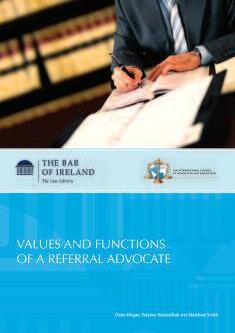
In 2014 the International Council for Advocates and Barristers (ICAB) commissioned a body of research with a view to restating and underpinning the principles of the independent bar This work was under taken by three barristers – Claire Hogan BL from Ireland, Tetyana Nesterchuk from England and Matthew Smith from New Zealand Following presentation and debate of the research at the World Bar Conference in September 2014 the final version has been published The Bar of Ireland is pleased to present each member with an individual copy of this excellent work, which sets out a detailed analysis of the true meaning of an independent advocate, by reference to the existing profession in each of the jurisdictions concerned All members should have received a copy of the booklet with this edition of The Bar Review
Voluntary Assistance Scheme (VAS) Co-ordinator Libby Charlton BL (right) and Shirley Coulter, Director of Communications & Policy at The Bar of Ireland, recently exhibited the VAS at The Wheel Annual Conference Expo in Croke Park This event, attended by over 400 delegates, provided an ideal oppor tunit y to raise awareness of the invaluable free legal advice and suppor t provided by the VAS to the charit y and NGO sector The exhibit was met with an overwhelmingly positive reaction from all those in attendance
Young Bar Committee update
The Young Bar Committee has been active lately, meeting other young bar associations, examining how the delivery of discovery services can be improved, and highlighting EU law oppor tunities for young practitioners.
World Bar Conference: Edinburgh, April 14-16
The World Bar Conference 2016 was hosted by the Scottish Faculty of Advocates Topics varied from the values of the independent referral bar to the impact of technology on the profession Our Chairman, David Barniville SC, addressed delegates on the challenges faced by the Irish Bar, and the Legal Services Regulation Act 2015 Gráinne Larkin BL gave a well-received speech on the topic of women at the Bar, and informed delegates about our female membership survey and pilot mentoring scheme Mark Mulholland QC, former Chairman of the Bar of Northern Ireland, gave an interesting speech on standing up for the rule of law in the context of the prosecution of the 1916 Rising volunteers Lieutenant William Wylie KC, aware that the accused were coming before an in camera court without legal representation, created opportunities for the volunteers to speak in their own defence Wylie’s actions led to reprieves from the death sentence for many of the accused, including one volunteer who was previously his instructing solicitor He was glad of this stay on the basis that the man still owed him fees!
Junior counsel from South Africa, England and Wales, and Northern Ireland addressed the Conference on the issue of the future of the independent referral bar from the junior point of view Our young bar counterparts were interested in the recent formation of our Young Bar Committee, Young Bar Hub and CPD events focused on challenges that face junior members Ron Paschke of the South African Bar spoke about the risk that barristers’ work will be taken over by robots Thankfully, he conceded that: “Other researchers, more credibly, conclude that lawyers’ jobs are at low risk of automation in the next 20 years” We are hopeful that the future of the Young Bar and the Bar in general is safe, at least for the time being
Rachel Baldwin BL
Eve Bolster BL
Ellen O’Callaghan BL
Sean O’Quigley BL
Discover y and the Junior Bar D i s co v e r y a n d
income for young barristers The Young Bar Committee recently launched a discover y counsel database on the Bar of Ireland website The database is being adver tised to solicitors, with the aim that it will be their first por t of call in accessing the talent offered by the Young Bar
In Januar y, the Young Bar Committee hosted a well-attended conference o n d i s co v e
practical tips for young members seeking to join ediscovery projects Sinead Drinan BL delivered an excellent paper on the principles of privilege Aoife Beirne BL described the management of teams of discover y, and how to ensure consistency in projects
Defining the terms of engagement for discover y work is impor tant, but is of ten overlooked The Young Bar Committee has provided a checklist of the issues on its database page
Chief among these, as emphasised by Kar yn Har ty of McCann Fitzgerald, is confidentiality Other impor tant issues to agree upon are hours per week and the hourly rate
Eoin Mar tin BL
European oppor tunities
On Februar y 25, the Irish Society for European Law (ISEL), in conjunction with the Young Bar Committee, hosted an event entitled ‘EU Law: Areas of Interest for Junior Practitioners’ The event was chaired by the Hon Mr Justice Gerard Hogan, and the speakers were Noel J Travers SC , Joanne Finn, Par tner in Eugene F Collins, and Anne Fitzpatrick BL
It was emphasised during this CPD event that junior practitioners should co n s i
they are asked to act Young practitioners should also consider availing of the many oppor tunities to work for one of the EU institutions, for example as a référendaire or stagiaire
The ISEL is pleased to extend its offer of a reduced rate of membership of ¤ 3 0 fo r t h o s e
Membership entitles one to attend all of the ISEL’s events in 2016 free of charge To avail of the special rate, please email youngbar@lawlibrar y ie Aoife Beirne BL
Claire Hogan BL
Volunteers required for af terschool club
Would you like to be involved in this fantastic initiative in Dublin’s inner city?
The Rober t Emmet Community Development Project (RECDP) works with families living in an underprivileged area in Dublin’s South West inner city
I t r u n s a n a f te r s c h o
between eight and 11 years old A number of members of the Bar volunteer to assist the children with their homework and more volunteers are required between 3 00pm and 4 00pm for one day per week
The children are nominated by their school, St Audoen’s, as being the most in need of the ser vice They are provided with a nutritious meal on arrival
fencing The RECDP was previously located in the Mendicity Institution on I
referred to by the children as ‘The Mendo’ When inter viewing the children for this ar ticle, they were bursting to tell me why they love the Mendo It w a s d e s c r i
words of one little girl, “not just good like my brother told me it would be, but extra good” On being asked about their favourite aspects of the club, a number of the children referred to ar twork, cooking (especially chocolate chip cookies), drama, and “the dinners” One girl mentioned that she loved t h e
homework at home
If you would like to take par t in the Afterschool Club, or to make a donation to the RECDP, you can send an email to info@recdp ie
Emma Keane BL
Insurance premiums and legal costs
A closer look at the facts contradicts recent headlines and points to the true causes of insurance premium rises
Allegations
David Barniville SC Aedamair Gallagher
Insurance Ireland, the body representing 95% of the domestic and international-based insurance sector in Ireland, has in recent weeks been actively propagating the message that increasing insurance costs, par ticularly motor insurance premiums, are attributable to a higher number of claims, excessively high cour t awards and rising legal costs It is claimed that costs are “too high” and “account for more than 60% of the compensation awarded” 1 It is accepted that motor insurance premiums are rising (reportedly by between 20% and 35% in the past 12 months) 2 But there is simply no foundation in the allegations that these hikes are directly attributable to increasing numbers of claims, increasing awards or increasing legal costs
In late 2015, Maurice Priestley, in his capacity as the former Interim CEO of the Personal Injuries Assessment Board (now known as the Injuries Board), stated that the number of personal injury claims litigated in cour t fell in 2014, revealing that the scale of rising insurance premiums is “at odds” with the
Board’s own data and does not demonstrate a link between insurance claims and increased premiums 3 With only a repor ted 10% of claims being dealt with through the cour ts, one would have to ask where the insurance industry is getting its data 4
Of most concern is the ¤1 billion difference which has been highlighted between the premium income of Irish insurers and published awards, revealing serious data inconsistencies that need to be addressed As Dorothea Dowling, former Chairperson of the Motor Insurance Advisor y Board and former Chairperson of the Injuries Board, has said, we are simply being asked to “take the industry ’s word for it” and that is not good enough 5
With only a repor ted 10% of claims being dealt with through the cour ts, one would have to ask where the insurance industr y is get ting its data
The allegations and counter allegations have been much debated in the media over the past few weeks 6 Perhaps the most interesting and measured contribution to the debate came from Michael Noonan TD, the Minister for Finance, in a speech to Dáil Éireann on April 20, 2016, where he referred to various potential contributory factors to rising motor insurance premiums and announced the establishment of a working group to look into this
Financial mismanagement
The costs associated with personal injury claims are usually front and centre when it comes to laying blame for premium hikes, but indications of poor business acumen and financial mismanagement in the insurance sector would suggest that there are other, more serious, factors at play
During the period 2012-2014, the insurance sector was effectively operating on a boom-bust model According to the Central Bank: “A number of insurance companies took a very optimistic view of future economic outlook, built up unsustainable overheads and followed an imprudent pricing and underwriting approach which resulted in companies’ business plans becoming less resilient to downside risks such as an increase in frequency and severity of claims” 7 The spectacular demise of Quinn and Setanta made it clear that insurance companies were competing far too aggressively and at the expense of profitability They simply were not charging enough, resulting in losses of almost ¤500 million in three years – losses which inevitably fell to the consumer 8
A policy review
In his speech to the Dáil on April 20, 2016, Minister Noonan identified a range of possible factors which may have contributed to the increase in the cost of motor insurance in Ireland in the past 12 months Among the reasons noted by the Minister are the frequency and scale of claims, the cost of claims and the operation of the insurance market The Minister noted an increase in the frequency of claims over the past year, which he was advised was associated with improving economic conditions, and also referred to an increase in the number of large claims Reference was also made to increases in the jurisdiction of the Circuit Cour t since February 2014, which the Minister said may possibly be leading to increased legal costs, the alleged increased engagement of solicitors in handling of claims, and a recent decision of the High Court (upheld on appeal by the Cour t of Appeal)9 on the real rate of return in a catastrophic injury case
The Minister referred to advice received from the Central Bank on some of these areas, and to the advice he had received that competitive conditions in the Irish insurance market and insurance companies’ focus on maintaining market share had provided an impetus to lower premiums, which was sustainable while there were positive investment returns but was no longer so due to lower returns Significantly, the Minister repor ted that he had established a review of policy in the insurance sector in consultation with the Central Bank and other Depar tments and agencies, the first phase of which is to examine the framework for motor insurance compensation in light of the collapse of the Setanta insurance company This work is being conducted by a joint working group comprising officials of the Depar tment of Finance and the Depar tment of Transpor t The Minister repor ted that the group had already met with a number of “key stakeholders” with an interest in the insurance compensation framework in Ireland including the European Commission, the Irish Brokers Association, the State Claims Agency, the Central Bank, Insurance Ireland and the Accountant of the Cour ts of Justice Council of The Bar of Ireland has welcomed the establishment of this working group and agrees with its principal objective, which is to identify the features of a motor insurance compensation framework that is “comprehensive, effective, affordable and consumer focused” It is noted that the outcome of this work will be used as part of a wider review of policy in the insurance sector,
which will examine the factors contributing to the cost of insurance Officials in the Depar tment of Finance working with the Central Bank have apparently already met a number of stakeholders, including officials in the Depar tment of Jobs, Enterprise and Innovation and the Injuries Board It is understood that a consultation process in this area will continue over the coming months, which will extend to other stakeholders “in due course”
Following publication of his speech, Council of The Bar of Ireland wrote to the Minister on April 26, 2016, informing him of its interest in contributing to the consultation process and in providing appropriate input and assistance to the working group Council felt that as the body representing the overwhelming majority of barristers in practice in the State, who work for claimants and insurance companies in these cases, and in the interests of ensuring a full, thorough and balanced examination into the alleged contributing factors to the increase in the cost of motor insurance, it would be appropriate, and of assistance, to consult with The Bar of Ireland It is hoped that such consultation will take place
The
costs associated with per sonal
injur
y claims
are usually front and centre when it comes to laying blame for premium hikes, but indications of poor business acumen and financial mismanagement in the insurance sector would suggest that there are other, more serious, factor s at play.
According to the Injuries Board, access to data is essential to ensuring a comprehensive understanding of the claims environment and of the factors impacting on premium increases Council of The Bar of Ireland shares the view of the Injuries Board in its recently published Annual Overview for 2015 that: “Greater transparency and data sharing by key stakeholders is vital in ensuring an appropriate policy response to the upward trajector y of insurance premiums” 10 Council also agrees with the sensible comments of the recently appointed Chief Executive of the Injuries Board, Conor O’Brien, concerning the information gap that still exists in terms of data from the insurance companies In announcing the Board’s Annual Overview for 2015 on April 1, 2016, he said:
“A comprehensive understanding of the broader personal injury environment requires the publication of data relating to cases that are settled outside of the Board’s model Bridging this significant information gap should be in the best interest of all stakeholders and an impor tant step in better understanding any claims-related factors impacting on insurance premium increases ”
The true position
Since a fair amount of the public debate on this issue has focused on an allegedly significant increase in the number of claims in the past 12 months or so, and on an alleged increase in the cost of such claims, and since these issues have featured as potential contributing factors to the increased cost of
motor insurance, it might be helpful to refer to some of the published statistics in these areas The Cour ts Service, the Injuries Board and the Central Bank have all recently published impor tant material on these areas First, on the question of an increase in the number of claims, the Injuries Board recently published the outcome of its Annual Overview for 2015 This showed an increase of 6% in the number of new claims submitted to the Board in 2015 compared with 2014 (33,561 new personal injury claims in 2015 compared with 31,576 claims in 2014) The Board noted that this “reflects increased economic and social activity and is not unexpected given there are more people at work, higher traffic volumes and higher footfall in public areas” That explanation for the fairly small increase in the number of claims mirrors the view of the Central Bank in its “Bodily Injury Thematic Review” published in November 2015 Noting that at that stage the insurance industr y was obser ving an average increase of 8 3% in the number of private motor insurance injury claims from 2013 to 2014, the Central Bank observed that such increases were “in line with increases in motor fuel sales and road traffic fatalities in the same period”, reflecting higher traffic volumes year on year These views were also reflected in Minister Noonan’s speech on April 20, 2016 The Cour ts Service Annual Repor t for 2014 (published in June 2015 and the most up-to-date figures available) considered the impact of the increase in the jurisdiction of the Circuit Cour t in personal injury cases from ¤38,000 to ¤60,000 with effect from Februar y 2014 In summar y, there were 7,047 personal injury actions commenced in the High Cour t in 2014 with 9,852 such actions commenced in the Circuit Cour t This represented a 26% decrease in such cases commenced in the High Cour t and a 16% increase in the Circuit Cour t, compared to 2013 While the Cour ts Service Annual Repor t for 2015 is not due to be published until later this year, and until then the figures for 2015 will not be available, it is likely that the figures for 2015 will show an increase in the number of Circuit Cour t personal injury cases commenced and probably a decrease in the number of High Cour t cases commenced compared with 2014 To date, however, the publicly available material does not show anything like the sor t of explosion of claims or proceedings commenced as one might have imagined from some of the public comment made in recent months
A similar picture is presented from the published material available on the number and level of awards In its Annual Overview for 2015, the Injuries Board noted that it made 11,734 awards for personal injur y compensation and awarded a total of ¤268 4 million in compensation in 2015 compared to 12,420 awards and ¤281 2 million awarded in 2014 Although the number of awards and the amount awarded by the Injuries Board fell in 2015 compared with 2014, the Board stated that the reduction in awards did not reflect any change to underlying claim volumes but was due to the timing of awards, with some claims from 2015 running into 2016 The Board projected that by the end of 2016, the number of awards annually would average 12,000 over the three-year period 2014-2016 No significant increase in the number of claims is evident from these figures
On the question of average awards by the Board, it was noted that these remained consistent in 2015 with the previous year The average compensation award made by the Board in 2014 was ¤22,642 with a “modest” 1% increase in 2015 to ¤22,878 The Cour ts Service Annual Repor t for 2014 showed that for that year, the total amount awarded by the High Cour t in personal injury cases was ¤154,915,926, with the highest amount awarded being ¤9 million The total awarded in 2014 by the Circuit Cour t in personal injuries cases was
¤13,794,354 For 2013, the total amount awarded in personal injury cases in the High Cour t was ¤134,119,921 and in the Circuit Cour t, ¤13,243,153 It should be noted, however, that there has been a major increase in clinical negligence claims and awards in the past two years These cases are primarily heard and determined in the High Cour t and since they do not have an impact on motor insurance claims, cannot be a contributing factor to the increase in motor insurance costs In its November 2015 Repor t, the Central Bank looked at the costs of claims in private motor injury cases and noted that the average cost for each accident year was approximately ¤23,400 for 2012 rising to ¤25,200 for 2014, being an 8% increase from 2012 to 2014 It noted that there was some evidence of a continuation of this trend into 2015 It is hard to see this as explaining the repor ted increases of up to 35% in the cost of motor insurance premiums in the past 12 months Doubtless, all of this will be considered by the working group established by Minister Noonan
The Bar of Ireland has established a sub-commit tee of its Policy and Research Working Group to continue to review this area and to assist in its contributions to the working group recently established by Minister Noonan.
Damages
higher in Ireland?
An argument often made by the insurance industry is that damages awarded to injured claimants are higher in Ireland than in other jurisdictions This, the argument goes, means that awards in Ireland (whether by the cour ts or by the Injuries Board) are higher than they ought to be and are, therefore, excessive
The example of ten given is in the case of damages awarded for whiplash injuries It is said that such cases are often settled (by insurance companies) for up to three times the amount for which they settle in the United Kingdom
A number of points can be made in response to this argument
The first is that under our system, a person who sustains genuine personal injuries is entitled to be properly compensated for those injuries whether by settlements entered into by insurance companies or by awards made by the Injuries Board or by the cour ts There are ver y few cases which are purely whiplash injuries without other injuries and symptoms An injured claimant is entitled to be compensated for all of his or her injuries
Secondly, in the case of awards made by the cour ts, these are made by judges who are independent and have no vested interest in the outcome of the case They are independent of the insurance industry and they are independent of claimants They make awards based on what they assess to be fair and appropriate compensation to reflect the level of injuries disclosed in the evidence before them If either side is unhappy with the level of an award, that par ty may appeal The newly established Cour t of Appeal has been very active in reviewing awards of the High Cour t The Cour t of Appeal stated in a recent judgment: “It is impor tant that compensation when awarded by the Cour t in respect of pain and suffering should be reasonable and propor tionate in all of the circumstances” 11 The Court further stated that: “Damages awarded for pain and suffering must be reasonable having regard to the injuries
sustained [and] must also be propor tionate to the awards commonly made to victims in respect of injuries which are of significantly greater or lesser impor t” 12 The concept of reasonableness and propor tionality is inherent in the exercise under taken by a cour t in assessing the appropriate level of damages in any case
Thirdly, while it may be that in some cases, the level of damages awarded in respect of par ticular injuries in Ireland is greater than might be awarded in another jurisdiction, that is not so in respect of all types of claims For example, damages for pain and suffering in catastrophic cases is capped by our cour ts at ¤450,000,13 whereas in other jurisdictions (such as Nor thern Ireland and England and Wales), the general damages in equivalent cases can be higher It should be said that these cases involve the most seriously injured claimants coming before the cour ts In this context, it is noted that the Injuries Board is in the process of conducting a review of its Book of Quantum, which provides a guideline of injuries and value ranges of damages appropriate to par ticular injuries As Minister Noonan pointed out in his speech to the Dáil, the Book of Quantum is not a recommendation for compensation levels but is rather a reflection of the prevailing level of awards being made by the cour ts, settlements entered into by insurance companies and by the State Claims Agency, and awards made by the Injuries Board Its purpose, therefore, is not to lead to an increase or decrease in the level of awards, but rather to ensure that the awards are reflective of compensation levels in these areas Par t of the difficulty, however, is in obtaining information from insurance companies on settlements entered into by them It is that absence of data that led to the Chief Executive of the Injuries Board recently calling for publication of data relating to cases settled by insurance companies
The Bar of Ireland has established a sub-committee of its Policy and Research Working Group to continue to review this area and to assist in its contributions to the working group recently established by Minister Noonan
Legal fees in general
According to the recent report of the National Competitiveness Council (NCC), an economic advisory body to the Government, legal costs are 5 8% higher than 2010 levels, having failed to “adjust downwards to the degree that might
References
1 Insurance Ireland Annual Repor t 2015 [online] Available at: http://www insuranceireland eu/media/Annual-report-2015 pdf 2016: page 14
2 Minister for Finance (Deputy Michael Noonan) Dáil Debates Vol 907 No 1, April 20, 2016: page 35
3 Priestley, M Interview on Morning Ireland, RTÉ Radio 1, September 9, 2015
4 The Irish Times, April 4, 2016, ‘Judges need guidelines for injury pay-outs, says insurance boss’ (by Vivienne Clarke)
5 The Irish Times, October 1, 2015, ‘Time for another investigation into motor insurance prices’ (by Dorothea Dowling)
6 See, for example, The Irish Times, May 2, 2016, ‘Motor insurers charging more to ‘boost’ profits’ (by Mark Hilliard); The Irish Times, May 4, 2016, ‘The great motor insurance price hike myster y ’ (by John McManus); The Sunday Independent, May 8, 2016, ‘The growing insurance gap’ (by Dan White); and, The Irish Times, May 9, 2016, ‘Uncer tainty in motor insurance sector can be eased’ (by Kevin Thompson)
have been expected given economic circumstances” 14 It ought to be highlighted that the legal services data used in this analysis relate to solicitors’ fees only and are based on 16 respondents to a CSO survey 15 Professional fees payable to barristers are not captured by the repor t
Contrary to popular belief, barristers’ fees have fallen significantly During the period 2006-2013, published figures from the various State agencies, who are the biggest consumers of barristers’ services, show that professional fees in respect of barristers saw average decreases of between 26% and 50%
Counsels’ fees represented 19% of the total budget of the Legal Aid Board in 2006, but fell to 11% in 2013 A 34% decrease in total fees paid to counsel occurred during this period, despite increases in the number of applications and cases handled During the period 2008-2014, the DPP showed an average decrease of 30% in counsel fees and, according to the Annual Repor ts of the Attorney General and Chief State Solicitors Office, fees paid to counsel showed a decrease of 45% or more during the same period
These reductions are replicated in other areas of publicly funded work for barristers and are mirrored in other areas of private work
The Legal Services Regulation Act
How will the new Legal Services Regulation Act, 2015 affect the situation?
The Act will introduce a new costs regime that will ensure greater clarity of the principles to be applied by Legal Costs Adjudicators in assessing costs The new system will require greater efficiency and transparency within the Office of the Legal Costs Adjudicators, greater visibility for clients in advance in terms of the costs of litigation, more detailed information on fee notes, a greater obligation to update costs information as a case progresses, and a facility for clients and opposing par ties to challenge costs by means of the new adjudication system, replacing taxation While not necessarily an issue for those acting on the defendant/insurer side, where scales of fees are routinely imposed by insurance companies on their own solicitors and barristers, the new costs regime will be impor tant in terms of the plaintiffs’ costs
Overall, the new system is likely to be positive and should ensure a reasonable and propor tionate means of assessing legal costs
Whether that will please the detractors is anyone’s guess
7 Deputy Pearse Doher ty Dáil Debates Vol 907 No 1, April 20, 2016: page 37
8 The Irish Times, March 14, 2016, ‘More motor insurance price hikes on the way ’ (by Conor Pope)
9 Gill Russell v HSE [2015] IECA 236 (November 5, 2015)
10 Injuries Board 2015 Annual Over view 2016 [online] Available at: http://www injuriesboard ie/eng/News-Information/Press-Releases/Injuries -Board-2015-Annual-Overview pdf
11 Payne v Nugent [2015] IECA 268 (November 10, 2015) per Ir vine J at paragraph 16
12 Per Irvine J at paragraph 19
13 Yang Yun v MIBI [2009] IEHC 318
14 National Competitiveness Council (NCC) (April 2016), Costs of Doing Business in Ireland 2016 [online] Available at: http://www competitiveness ie/Publications/2016/Cost-of-Doing-Busines s-2016 pdf page 6
A directory of legislation, ar ticles and acquisitions received in the Law Library from March 17, 2016 to May 4, 2016
Judgment information supplied by Justis Publishing
Edited by Deirdre Lambe and Vanessa Curley, Law Library, Four Courts
AGRICULTURE
Statutory Instruments
Registration of farm par tnerships regulations 2015 – SI 247/2015
ANIMALS
Statutory Instruments
M i c ro c h i p p i n g o f d o g s ( a m e n d m e n t ) regulations 2015 – SI 427/2015
ARBITRATION
Library acquisitions
Bond, G Mediation practice: 8 cultures, 16 cases, 128 creative solutions Paris: International Chamber of Commerce, 2016 – N398 4
ASYLUM
Asylum, immigration and nationality
The Refugee Act 1996 – Appeal against the decision of the Refugee Appeals Tribunal – (Stewar t J , 12/01/2016) [2016] IEHC 12
L A A (Bolivia) v Refugee Appeals Tribunal
Articles Arnold, S , Goncalves, C The international protection act 2015 and age assessment Irish Law Times 2016; (34) (7): 94
BANKING
Banking and finance
12/04/2016) [2016] IEHC 183
Danske Bank v Connotes Ltd
Banking and finance
s 57 of the Central Bank ACT 1942 –
Lo s s o f W i t h d ra w a l o f F u n d –( N o
IEHC 169
Ombudsman
Banking and finance A p p
A p p e l l a n t s e e k i n g to i n v a l i d a te t h e appointment of a receiver – Whether potential difficulty in conferring good title on the transferees invalidates the appointment of the receiver – Devoy
v H a m i l to n [ 1 9 2 9 ] I R 2 4 6 distinguished (Dunne J , Charleton J , O ’ M a l l e y J , 1 5 / 0 3 / 2 0 1 6 ) [ 2 0 1 6 ]
IESC 14
Freeman v Bank of Scotland PLC
Banking and finance
C o n t ra c t – Re d e m p t i o n o f l o a n –
( H a u g h to n Ro b e r t J , 0 5 / 0 2 / 2 0 1 6 )
[2016] IEHC 67
Sheehan v Breccia & Ors
Banking and finance
H o m e l o a n m o r t g a g e – F i xe d ra te –
IEHC 199
Non-payment of loan – Summary judgment – (McDermott J , 12/04/2016) [2016] IEHC 182 Allied Irish Bank PLC v Fahey Banking and finance
( Tw o m e y J , 1 8 / 0 4 / 2 0 1 6 ) [ 2 0 1 6 ]
S t o w e v F i n a n c i a l S e r v i c e s Ombudsman
Library acquisitions
Gleeson, S , Guynn, R Bank resolution a n d c r i s i s m a
Press, 2016 – N303
Statutory Instruments
E
289/2015
regulations 2015 – SI 522/2015
Central Bank Act 1942 (section 32D) regulations 2015 – SI 429/2015
CHARITY
Articles
Murphy, A Faith, hope and charity Law
Society Gazette 2016 (March): 40
COMMERCIAL LAW
Library acquisitions
B o r k , R , M a n g a n o , R E u ro p e a n cross-border insolvency law Oxford: O x fo rd U
Euro Safety and Training Services Ltd v An Foras Áiseanna Saothair
Company
S 56 of the Company Law Enforcement ACT, 2001 – Joint Liquidators –(O’Connor Tony J , 11/03/2016) [2016] IEHC 168 College Freight Ltd t/a Target Express (in Liquidation) & Companies Acts
judge misdirected himself concerning the nature of the discretion given to
20/01/2016) [2016] IECA 2
Director of Corporate Enforcement v Walsh
Insolvency
Glencar Explorations Limited v Mayo
McCann v Halpin
Librar y acquisitions
F u l l e r, G C o r p o r a t e b o r r o w i n g l a w a n d p r a c t i c e ( 5 t h e d ) B r i s to l :
J o rd a n P u b l i s h i n g , 2 0 1 6 – N 2 6 3
W h i t t a ke r, J , M a c h e l l , J T h e l a w o f l i m i t e d l i a b i l i t y p a r t n e r s h i p s ( 4 t h e d ) H a y w a r d s H e a t h : B l o o m s b u r y P ro fe s s i o n a l , 2 0 1 6 – N 2 6 7
O ’ D o n n e l l , J , N i c h o l a s , J E x a m i n e r s h i p s ( 2 n d e d ) D u b l i n :
Lo n s d a l e L a w P u b l i s h i n g , 2 0 1 6 –N 2 6 2 6 C 5
Ar ticles
Wa d e , G Re ce n t d e v e l o p m e n t s i n t h e l a w o f co r p o ra te g o v e r n a n ce u n d e r t h e C o m p a n i e s A c t 2 0 1 4
C o m m e r c i a l L a w P r a c t i t i o n e r 2 0 1 6 ; 23 (3): 71
Statutor y Instruments
C o m p a n i e s A c t 2 0 1 4 ( p r o fe s s i o n a l i n d e m n i t y i n s u r a n c e ) ( l i q u i d a to r s )
re g u l a t i o n s 2 0 1 6 – S I 1 2 7 / 2 0 1 6
C o m p a n i e s a c t 2 0 1 4 ( s e c t i o n 5 8 0 ( 4 ) m e m b e r s ’ v o l u n t a r y w i n d i n g u p r e p o r t ) r e g u l a t i o n s 2 0 1 5 – S I 2 1 7 / 2 0 1 5
CONSTITUTIONAL LAW
Constitutional and administrative law
Tr i a l – C r i m i n a l t r i a l i n a b s e n ce o f accused – Brennan v Judge Desmond
W i n d l e [ 2 0 0 3 ] 2 I L R M 5 2 0 a p p l i e d
( L a f fo y J , D u n n e J , C h a r l e to n J , 10/02/2016) [2016] IESC 4
O’Brien v Judge Coughlan & anor
C O N S U M E R L AW
Statutor y Instruments
E u ro p e a n U n i o n ( co n s u m e r
m o r t g a g e c re d i t a g re e m e n t s ) regulations 2016 – SI 142/2016
C O U RT S
Statutor y Instruments
C i r c u i t c o u r t r u l e s ( a c t i o n s fo r
p o s s e s s i o n , s a l e a n d w e l l - c h a r g i n g
re l i e f ) 2 0 1 6 – S I 1 7 1 / 2 0 1 6
C i rc u i t co u r t r u l e s ( c h o i ce o f co u r t
( H a g u e C o n v e n t i o n ) a c t 2 0 1 5 )
2 0 1 6 – S I 1 7 2 / 2 0 1 6
D i s t r i c t C o u r t ( a m e n d m e n t ) r u l e s
2 0 1 6 – S I 1 4 9 / 2 0 1 6
D i s t r i c t C o u r t ( d a y s a n d h o u r s )
( A u g u s t s i t t i n g s ) o r d e r 2 0 1 5 – S I
3 2 8 / 2 0 1 5
D i s t r i c t C o u r t d i s t r i c t s a n d a r e a s
( a m e n d m e n t ) a n d v a r i a t i o n o f d a y s a n d h o u r s ( D a i n g e a n U í C h ú i s )
o rd e r 2 0 1 5 – S I 3 2 6 / 2 0 1 5
D i s t r i c t C o u r t ( d i s t r i c t s ) o rd e r 2 0 1 5 – S I 3 2 7 / 2 0 1 5
R u l e s o f t h e S u p e r i o r C o u r t s ( s e r v i c e o f d o c u m e n t s ) 2 0 1 6 – S I
1 4 8 / 2 0 1 6
O f fe n c e s a g a i n s t t h e s t a t e a c t s
1 9 3 9 to 1 9 9 8 S p e c i a l C r i m i n a l C o u r t
n o 1 r u l e s 2 0 1 6 – S I 1 8 2 / 2 0 1 6
O f fe n c e s a g a i n s t t h e s t a t e a c t s
1 9 3 9 to 1 9 9 8 S p e c i a l C r i m i n a l C o u r t
n o 2 r u l e s 2 0 1 6 – S I 1 8 3 / 2 0 1 6
R u l e s o f t h e S u p e r i o r C o u r t s ( C h o i c e o f c o u r t ( H a g u e
C o n v e n t i o n ) a c t 2 0 1 5 ) 2 0 1 6 – S I
1 6 1 / 2 0 1 6
R u l e s o f t h e S u p e r i o r C o u r t s ( p e r s o n a l i n s o l v e n c y ) 2 0 1 5 – S I
5 0 7 / 2 0 1 5
C R I M I NA L L AW
Bail
C u s to d y – E x te n s i o n o f t i m e –
Appellants seeking to be admitted to b a i l – W h e t h e r t h e H i g h C o u r t w a s correct to refuse bail – (Birmingham
J , M a h o n J , E d w a rd s J , 05/04/2016) [2016] IECA 103
Doolan v Ireland
C o n v i c t i o n
C o n s p i r a c y to d e f r a u d – C r i m i n a l
e v i d e n c e – A p p e l l a n t s s e e k i n g to
a p p e a l a g a i n s t c o n v i c t i o n s –
W h e t h e r d o c u m e n t s w e r e w r o n g l y a d m i t te d i n e v i d e n ce – ( B i r m i n g h a m
J , S h e e h a n J , E d w a r d s J ,
1 5 / 0 3 / 2 0 1 6 ) [ 2 0 1 6 ] I E C A 1 1 1
D P P v O ’ M a h o n e y
C o n v i c t i o n
M u r d e r – P r o v o c a t i o n – A p p e l l a n t seeking to appeal against conviction – W h e t h e r t r i a l j u d g e f a i l e d to
i n s t r u c t t h e j u r y i n r e l a t i o n to t h e
s u b j e c t i v e n a t u r e o f p r o v o c a t i o n –
( B i r m i n g h a m J , S h e e h a n J , E d w a r d s J , 1 2 / 0 4 / 2 0 1 6 ) [ 2 0 1 6 ]
I E C A 1 1 2
D P P v S o l o w i o w
C o n v i c t i o n
P o i n t s o f l a w – P u b l i c i n t e r e s t –
A p p e l l a n t s e e k i n g C e r t i f i c a te to t h e e f fe c t t h a t a C o u r t o f C r i m i n a l
A p p e a l d e c i s i o n i n v o l v e s p o i n t s o f l a w o f e x c e p t i o n a l p u b l i c i m p o r t a n c e – W h e t h e r a p p e l l a n t
d e m o n s t ra te d t h a t i t w a s d e s i ra b l e i n t h e p u b l i c i n te re s t t h a t a n a p p e a l
t h e r e f r o m s h o u l d b e t a k e n to t h e
S u p r e m e C o u r t – ( M c Ke c h n i e J ,
2 2 / 0 1 / 2 0 1 6 ) [ 2 0 1 6 ] I E CC A 2
D P P v W i l s o n
C o n v i c t i o n
H a r a s s m e n t – A s s a u l t –
( B i r m i n g h a m J , S h e e h a n J , M a h o n
J , 0 5 / 0 2 / 2 0 1 6 ) [ 2 0 1 6 ] I E C A 2 8
A l i p h o n v D P P
C o n v i c t i o n
R o b b e r y – E v i d e n c e – A p p e l l a n t seeking to appeal against conviction
a n d s e n te n ce – W h e t h e r t r i a l j u d g e failed to properly instruct the jur y as to t h e w e i g h t to b e g i v e n to
e v i d e n c e a d d u c e d a s to t h e
o w n e r s h i p o f a v e h i c l e u s e d d u r i n g
t h e co u r s e o f a ro b b e r y – ( S h e e h a n
J , M a h o n J , E d w a r d s J ,
0 3 / 0 3 / 2 0 1 6 ) [ 2 0 1 6 ] I E C A 7 8
D P P v L y n c h
C o n v i c t i o n
S e x u a l o f fe n c e s – C o r r o b o r a t i o n
w a r n i n g – ( B i r m i n g h a m J , S h e e h a n
J , M a h o n J , 0 4 / 0 3 / 2 0 1 6 ) [ 2 0 1 6 ]
I E C A 1 1 0
D P P v R A ( N o 1 ) & ( N o 2 )
C r i m e a n d s e n te n c i n g
C r i m i n a l J u s t i ce A c t , 1 9 9 9 – A r t 2 7
o f t h e F r a m e w o r k D e c i s i o n –
( Tw o m e y J , 1 8 / 0 3 / 2 0 1 6 ) [ 2 0 1 6 ]
I E H C 1 4 4
D r e w v D P P
C r i m e a n d s e n te n c i n g
Road traffic offences – Drink driving
– Ke l l y v C o m m i s s i o n e r o f A n G a rd a
S í o c h á n a [ 2 0 1 3 ] I E S C 4 7 a p p l i e d ,
S t a t e [ C r e e d o n ] v C r i m i n a l I n j u r i e s
C o m p e n s a t i o n Tr i b u n a l [ 1 9 8 8 ] 1 I R
5 1 a n d M c G o n n e l l v T h e A t to r n e y
G e n e ra l [ 2 0 0 7 ] 1 I R 4 0 0 co n s i d e re d
( H a rd i m a n J , L a f fo y J , D u n n e J ,
2 9 / 0 2 / 2 0 1 6 ) [ 2 0 1 6 ] I E S C 7
O a t e s v D i s t r i c t J u d g e B r o w n e
C r i m e a n d s e n te n c i n g
Ar t 6 (1) of Council Regulation (EC)
N o 5 6 1 / 0 6 – E u r o p e a n
C o m m u n i t i e s ( R o a d Tr a n s p o r t )
( Wo r k i n g C o n d i t i o n s a n d R o a d
S a fe t y ) Re g u l a t i o n s 2 0 0 8 –
( N o o n a n J , 0 7 / 0 4 / 2 0 1 6 ) [ 2 0 1 6 ]
I E H C 1 6 7
Road Safety Authority v Kieran Kelly
H a u l a g e L t d
M u rd e r
Re t r i a l – R i g h t to t r i a l i n d u e co u r s e
o f l a w – ( F i n l a y G e o g h e g a n J ,
H o g a n J , M a h o n J , 2 0 / 0 4 / 2 0 1 6 )
[ 2 0 1 6 ] I E C A 1 1 4
F u r l o n g v D P P
S e n te n c i n g
A s s a u l t – U n d u e l e n i e n c y –
( B i r m i n g h a m J , S h e e h a n J ,
E d w a r d s J , 1 8 / 0 4 / 2 0 1 6 ) [ 2 0 1 6 ]
I E C A 1 1 9
D P P v O ’ D o n o v a n
S e n te n c i n g
D r u g o f fe n c e s – S e v e r i t y o f sentence – (Birmingham J , Sheehan
J , E d w a rd s J , 1 9 / 0 4 / 2 0 1 6 ) [ 2 0 1 6 ]
I E C A 1 2 1
D P P v B r o s z c z a c k
L i b ra r y a c q u i s i t i o n s
Wa l d e n , I C o m p u t e r c r i m e s a n d
d i g i t a l i n v e s t i g a t i o n s ( 2 n d e d )
O x fo r d : O x fo r d U n i v e r s i t y P r e s s ,
2 0 1 6 – M 5 6 5
A r t i c l e s
N í G h a d h r a , C T h e n e e d to
r e - e v a l u a t e m o r a l p a n i c t h e o r y i n
l i g h t o f t h e Pa r i s te r ro r a t t a c k s I r i s h
L a w T i m e s 2 0 1 6 ; ( 3 4 ) ( 5 ) : 6 3 [ p a r t
I ] ; I r i s h L a w T i m e s 2 0 1 6 ; ( 3 4 ) ( 6 ) :
8 4 [ p a r t I I ]
A r m s t ro n g , F Po v e r t y i s t h e ro o t o f
t h e ‘ o l d e s t p ro fe s s i o n ’ L a w S o c i e t y
G a z e t t e 2 0 1 6 ; ( A p r i l ) : 2 6
S t a t u to r y I n s t r u m e n t s
E u r o p e a n U n i o n ( c o m b a t i n g t h e sexual abuse and sexual exploitation
o f c h i l d re n a n d c h i l d p o r n o g ra p h y ) re g u l a t i o n s 2 0 1 5 – S I 3 0 9 / 2 0 1 5
DA M AG E S
Damages
Pain and suffering – Special damages – Applicant seeking to appeal against t w o a w a rd s o f d a m a g e s – W h e t h
point that they should be set aside –( I r v i n e J , H o g a n J , M a h o n J , 18/03/2016) [2016] IECA 93 Shannon v O’Sullivan
Damages
Personal injuries – Loss of earnings –( Pe a r t J , I
v i n
J , M
t t J , 14/04/2016) [2016] IECA 106 Murphy v County Galway Motor Club Ltd
Damages
Quantum meruit – Contractual liability – Appellant seeking to discharge order awarding damages quantum meruit in favour of the respondent – Whether award was made in error – Bergin v Walsh & Ors [2015] IEHC 594 distinguished (Denham C J , O’Donnell Donal J , Laffoy J , 04/02/2016) [2016] IESC 3 Reynolds v Blanchfield
Librar y acquisitions
Varuhas, J N E Damages and human rights Oxford: Har t Publishing, 2016 – N37 1
DATA P R OT E C T I O N
Statutor y Instruments D
regulations
E D U CAT I O N
Statutor y Instruments
Education (miscellaneous provisions) a
2015
Student grant (amendment) scheme 2015 – SI 323/2015
E
Employment
[2016] IEHC 152 Da Silva v Rosas Construtores S
Librar y acquisitions
G o u l d , T F ro s t , Y R u b e n s te i n , M
Unfair dismissal: a guide to relevant c a s e l a w ( 3 4 t h e d ) Lo n d o n :
LexisNexis, 2016 – N192 24
Inverarity, D , Grace, S International
B a r A s s o c i a t i o n L a b o u r a n d
e m p l o y m e n t co m p l i a n ce i n I re l a n d
( 3 rd e d ) Lo n d o n : K l u w e r L a w International, 2015 – N192 C5
R u b e n s te i n , M D i s c r i m i n a t i o n : a guide to the relevant case law (29th
e d ) Lo n d o n : M i c h a e l R u b e n s te i n
Publishing Limited, 2016 – N191 2 Honeyball, S Honeyball and Bowers’
te x t b o o k o n e m p l o y m e n t l a w ( 1 4 t h
ed ) Oxford: Oxford University Press, 2016 – N192
B o w e r s , J , Fo d d e r, M , Le w i s , J
W h i s t l e b l o w i n g : l a w a n d p ra c t i ce
O x fo rd : O x fo rd U n i v e r s i t y P re s s , 2012 – N192 29
Ar ticles
Heer y, C Workplace bullying: a tale
o f t w o s i d e s a n d i n te r p re t a t i o n s to
e v e r y s to r y I r i s h E m p l o y m e n t L a w
Journal 2016; (13) (1): 11
Wa l l e y, P M o n i to r i n g e m p l o y e e
o n l i n e a c t i v i t y a n d t h e E C H R I r i s h
Employment Law Journal 2016; (13) (1): 4
Statutor y Instruments
L a b o u r Re l a t i o n s C o m m i s s i o n ( d i s s o l u t i o n d a y ) o rd e r 2 0 1 5 – S I 413/2015
N a t i o n a l m i n i m u m w a g e ( Lo w Pa y
C o m m i s s i o n ) a c t 2 0 1 5 ( s e c t i o n 2 0 ) (commencement) (no 2) order 2015 – SI 411/2015
Wo r k p l a ce re l a t i o n s a c t 2 0 1 5 (establishment day) order 2015 – SI 412/2015
Wo r k p l a ce re l a t i o n s a c t 2 0 1 5 ( f i xe d payment notice) regulations 2015 –SI 419/2015
S a fe t y, h e a l t h a n d w e l f a re a t w o r k act 2005 (repeals) (commencement) order 2015 – SI 519/2015
S a fe t y, h e a l t h a n d w e l f a re a t w o r k ( d o c k s ) ( re v o c a t i o n ) re g u l a t i o n s 2015 – SI 521/2015
E N V I R O N M E N T
Ar ticles
O’Sullivan, K Low-flying drones and o w n e r s h i p o f a i r s p a ce i n I re l a n d
C o n v e y a n c i n g a n d P r o p e r t y L a w
Journal 2016; (21) (1); 7
Statutor y Instruments
Industrial relations act 1976 (section 8) order 2015 – SI 385/2015 Industrial relations (amendment) act 2015 (commencement) order 2015 –SI 329/2015
E n v i ro n m e n t ( m i s ce l l a n e o u s
p ro v i s i o n s ) a c t 2 0 1 5
(commencement) (no 2) order 2015 – SI 428/2015
E U R O P E A N U N I O N
Librar y acquisitions
Ineli-Ciger, M Singer, S , Stoyanova, V , Bauloz, V Seeking asylum in the European Union: selected protection issues raised by the second phase of t
s
Nijhoff Publishers, 2015 – C206 E95
B a re n t s , R , B re e s
, H E Re m e d i e s and procedures before the EU cour ts T h e N e t h e r l a n d s : K l u
International, 2016 – W86
FA M I LY L AW
Child care
S
L
(Humphreys J , 18/03/2016) [2016]
IEHC 157
C J v Judge Seamus Hughes
Librar y acquisitions
G e o rg e , R , J u d d , F , G a r r i d o , D
Re l o c a t i o n : a p ra c t i c a l g u i d e ( 2 n d ed ) Bristol: Jordan Publishing, 2015 – N173 8
Ar ticles
O’Sullivan, K , Dr Ancillary relief and private ordering: the vulnerability of financially weaker spouses Irish Journal of Family Law 2016; (19) (1): 3
O rd i n a i re , L W h i c h o f y o u i s m y m o t h e r ? B i r t h re g i s t ra t i o n i s s u e s i n
I re l a n d a n d t h e n e e d fo r
w e l l - d e s i g n e d s u r ro g a c y re g u l a t i o n
I r i s h J o u r n a l o f F a m i l y L a w 2 0 1 6 ; (19) (1): 7
Ro c h e , L Le g a l g u a rd i a n L a w Society Gazette 2016 (April): 46
Statutor y Instruments
Children and family relationships act
2 0 1 5 ( p a r t 1 0 ) ( co m m e n ce m e n t ) order 2015 – SI 263/2015
F I NA N C E
Statutor y Instruments
C e n t ra l B a n k ( s u p e r v i s i o n a n d e n fo rce m e n t ) a c t 2 0 1 3 ( s e c t i o n
4 8 ( 1 ) ) ( u n d e r t a k i n g s fo r co l l e c t i v e investment in transferable securities)
regulations 2015 – SI 420/2015
European Union (credit institutions:
f i n a n c i a l s t a te m e n t s ) re g u l a t i o n s
2015 – SI 266/2015
E u ro p e a n U n i o
regulations 2015 – SI 262/2015
E u ro p e a n U n i o n ( u n d e r t a k i n g s fo r collective investment in transferable securities) (amendment) regulations 2016 – SI 143/2016
E u ro p e a n U n i o n ( d e p o s i t g u a ra n te e
s c h e m e s ) re g u l a t i o n s 2 0 1 5 – S I
516/2015
F R E E D O M O F
I N F O R M AT I O N
Librar y acquisitions
M a c d o n a l d , J , C ra i l , R M a c d o n a l d on the law of freedom of information
( 3 rd e d ) O x fo rd : O x fo rd U n i v e r s i t y
Press, 2016 – M209 16
G A R DA S Í O C H Á NA
Statutor y Instruments
G a rd a
S í o c h á n a ( p ro m o t i o n )
( a m e n d m e n t ) re g u l a t i o n s 2 0 1 5 – S I
334/2015
G a rd a S í o c h á n a ( d i s c i p l i n e )
( a m e n d m e n t ) re g u l a t i o n s 2 0 1 5 – S I
503/2015
G a rd a S í o c h á n a ( d i s c i p l i n e )
( a m e n d m e n t ) re g u l a t i o n s 2 0 1 5 – S I
503/2015
H E A LT H
Health
D e n t i s t r y – C o n t ra c t w i t h H e a l t h
S e r v i ce E x e c u t i v e – U P M Ky m m e n e
C o r p o ra t i o n v B W G L i m i te d [ 1 9 9 9 ]
I E H C 1 7 8 a p p l i e d ( H a rd i m a n J , MacMenamin J , Dunne J , Charleton J , O’Malley J , 03/03/2016) [2016] IESC 8
Reid v Health Service Executive
H U M A N R I G H T S
Ar ticles
Le o n a rd , D D a m a g e s fo r u n l a w f u l
judicial jailing Bar Review 2016; (21) (2): 59
M o o re , T I s ra e l : a m o d e r n d a y
a p a r t h e i d ? I r i s h L a w T i m e s 2 0 1 6 ; (34) (5): 67
I M M I G R AT I O N
Librar y acquisitions
H e i n e m a n n , T , H e l e n , I , Le m ke , T , N a u e , U , We i s s , M G S u s p e c t f a m i l i e s : D N A a n a l y s i s , f a m i l y re u n i f i c a t i o n a n d i m m i g ra t i o n
policies London: Routledge, 2015 –C199
Statutor y Instruments
I m m i g ra t i o n a c t 2 0 0 4 ( v i s a s ) (amendment) (no 2) order 2015 – SI 513/2015
E G A L U
I N S U R A N C E
Librar y acquisitions
Birds, J Birds’ modern insurance law ( 1 0 t h e d ) Lo n d o n : S w e e t & Maxwell, 2016 – N290
Ar ticles
Gilhooly, S They think it’s all over Law Society Gazette 2016 (April): 28
I N T E R NAT I O NA L L AW
Ar ticles
S h i t t u , A , Po w e r, S C o r p o ra te e x p l o i t a t i o n o f h y d ro c a r b o n s i
Republic Irish Law Times 2016; (34) (7): 99 [par t I]
I N T E R N E T
Ar ticles
S h a n
Society Gazette 2016 (April): 24
J U D I C I A L R E V I E W
Judicial Review
Ta
[2016] IEHC 92 Lowry v DPP
Librar y acquisitions M a n n i n g , J , S a l m o n , S , B ro w n , R
J u d i c i a l re v i e w p ro ce e d i n g s : a p ra c t i t i o n e r ’s g u i d e ( 3 rd e d )
London: Legal Action Group, 2013 –M306
J U R I S P R U D E N C E
Ar ticles
Ke a t i n g , A S o c i o - l e g a l t h e o r y I r i s h Law Times 2016; (34) (6): 80
L A N D L O R D A N D T E NA N T
Landlord and tenant S 1 2 3 ( 3 ) o f t h e Re s i d e n t i a l Tenancies Act, 2004 – Par t 4 Tenancy – ( B a ke r J , 0 5 / 0 4 / 2 0 1 6 ) [ 2 0 1 6 ] IEHC 174
Hennessy v PRTB
Librar y acquisitions
Wa r w i c k , M Tro m p e te r, N B re a k c l a u s e s ( 2 n d e d ) B r i s to l : J o rd a n Publishing, 2016 – N92
Ar ticles
D w y e r, D A p ro - te n a n t s h i f t i n t h e balance of unreasonable withholding
Substitution
Jurisdiction – Error in law – (Irvine J ,
S h e e h a n J , C o s te l l o J , 11/04/2016) [2016] IECA 104
S t a p l e f o r d F i n a n c e L t d ( a s substituted) v Lavelle
Terms of settlement
B re a c h o f U n d e r t a k i n g s –
A t t a c h m e n t a n d C o m m i t t a l O rd e r –
( R y a n P , Pe a r t J , I r v i n e J , 15/01/2016) [2016] IECA 9 Egan v Byrne
Warrants
Mootness – Point of law – Appellant
s e e k i n g to a p p e a l a g a i n s t p a r t o f a
H i g h C o u r t d e c i s i o n – W h e t h e r t h e
Cour t of Appeal should exceptionally hear the appeal – (Finlay Geoghegan
J , H o g a n J , M a h o n J , 14/03/2016) [2016] IECA 108
K o v a c s v G o v e r n o r o f M o u n t j o y Women’s Prison
Librar y acquisitions
Jackson, The Right Honourable Lord
J u s t i ce C i v i l P ro ce d u re 2 0 1 6 ( 2 0 1 6 e d ) Lo n d o n : S w e e t & M a x w e l l , 2016 – N361
Ar ticles
M c Pa r l a n d , D A s k a n d y o u w i l l re ce i v e ? Bar Review 2 0 1 6 ; ( 2 1 ) ( 2 ) : 54
P R O BAT E
Wills and probate
B e q u e s t s – S u b j e c t i v e m e a n i n g –
Appellant seeking to appeal against t h e co n s t r u c t i o n o f a b e q u e s t –Whether respondent established that he subjectively required the plot for t h e p u r p o s e o f u s i n g s a m e a s a g a rd e n – ( F i n l a y G e o g h e g a n J , 14/04/2016) [2016] IECA 107 Mullen Junior v Mullen
Ar ticles
Ke a t i n g , A T h e re v i v a l o f w i l l s b y co d i c i l C o n v e y a n c i n g a n d P r o p e r t y Law Journal 2016; (21) (1): 2
P U B L I C
P R O C U R E M E N T
Librar y acquisitions
D a v e y, J Fa l l e , J T h e g o v e r n m e n t p ro c u re m e n t re v i e w ( 2 n d e d )
London: Law Business Review, 2014 – W109 6
R E V E N U E
Revenue
Tr i b u n a l o f I n q u i r y ( E v i d e n ce )
( A m e n d m e n t ) A c t 1 9 7 9 – E t h i c s i n
P u b l i c O f f i ce A c t , 1 9 9 5 – ( H e d i g a n
J , 27/01/2016) [2016] IEHC 29
Lowry v Mr Justice Moriarty
Statutor y Instruments
B e t t i n g d u t y a n d b e t t
intermediary duty regulations 2015 –SI 341/2015 Ve
496/2015
Financial accounts repor ting (United
S
regulations 2015 – SI 501/2015
R OA D T R A F F I C
Statutor y Instruments
Ro a d t ra f f i c ( f i x e d c h a rg e o f fe n ce s t y re s ) re g u l a t i o n s 2 0 1 6 – S I 167/2016
S O C I A L P R OT E C T I O N
Domiciliar y care allowance
F
H o g a n J ,
McDermott J , 20/04/2016) [2016] IECA 116
C S B v Minister for Social Protection
Statutor y Instruments
C i v i l re g i s t ra t i o n ( g e n d e r re co g n i t i o n ) ( a b r i d g e d ce r t i f i c a te )
regulations 2015 – SI 378/2015
C i v i l re g i s t ra t i o n ( g e n d e r
recognition) (fees) regulations 2015 – SI 377/2015
G e n d e r re co g n i t i o n a c t 2 0 1 5
( co m m e n ce m e n t ) o rd e r 2 0 1 5 – S I
369/2015
G e n d e r re co g n i t i o n ( fo r m s o f
a p p l i c a t i o n ) re g u l a t i o n s 2 0 1 5 – S I
373/2015
C i v i l re g i s t ra t i o n ( b i r t h s , d e a t h , m a r r i a g e s a n d c i v i l p a r t n e r s h i p s ) ( fe e s ) re g u l a t i o n s 2 0 1 5 – S I 502/2015
TA X AT I O N
Ar ticles
W i l l i a m s , A , H a w k i n s , J C a p i t a l g a i n s i n a n o n - re s i d e n t t r u s t : h o w
t h e y c a n b e t a x a b l e i n I re l a n d I r i s h
Tax Review 2016; (1): 105
F i n n , R C o u n t r y - b y - co u n t r y
repor ting: the Irish perspective Irish Tax Review 2016; (1): 56 M a g u i re , T F i n a n ce a c t 2 0 1 5 a n d a n t i - a v o i d a n ce : t h e p ro ce s s
co n t i n u e s I r i s h T a x R e v i e w 2 0 1 6 ; (1): 72
S m i t h , C C o n n o r, M F i n a n ce a c t
2 0 1 5 : ke y co r p o ra te t a x m e a s u re s Irish Tax Review 2016; (1): 66
O ’ Lo u g h l i n , J , H a w k i n s , J G l o b a l
t ra d e a n d c u s to m s : re ce n t d e v e l o p m e n t s a n d t h e o u t l o o k fo r 2016 Irish Tax Review 2016; (1): 90 F l a n a g a n , D K n o w l e d g e development box: best in class? Irish Tax Review 2016; (1): 61 Jordan, E Petroleum production tax Irish Tax Review 2016; (1): 99 Lynch, L Revised entrepreneur relief: s 3 5 F i n a n ce A c t 2 0 1 5 I r i s h T a x Review 2016; (1): 83
C u l l e n , S S o m e f re q u e n t p e n s i o n q u e r i e s a n s w e re d I r i s h T a x R e v i e w 2016; (1): 110
C o u g h l a n , K S u cce s s i o n f a r m par tnerships Irish Tax Review 2016; (1): 115
G a ra v a n , C Ta x a t i o n i n 1 9 1 6 : t h e n and now Irish Tax Review 2016; (1): 52
D o y l e , E Ta x co n s e q u e n ce s o f re ce i v e r s h i p a n d m o r t g a g e e i n p o s s e s s i o n I r i s h T a x R e v i e w 2 0 1 6 ; (1): 94
Wa l s h , A U n ce r t a i n t y fo r
“non-doms” resident in the UK Irish Tax Review 2016; (1): 119
Statutor y Instruments
F i n a n ce ( t a x a p p e a l s ) a c t 2 0 1 5
( co m m e n ce m e n t ) o rd e r 2 0 1 6 – S I 110/2016
F i n a n ce ( t a x a p p e a l s ) a c t 2 0 1 5 (establishment day) order 2016 – SI 111/2016
Ta x e s C o n s o l i d a t i o n A c t 1 9 9 7 ( a cce l e ra te d c a p i t a l a l l o w a n ce s fo r
e n e rg y e f f i c i e n t e q u i p m e n t ) (amendment) (no 1) order 2015 – SI 254/2015
TO RT
Tor t
D a m a g e s & Re s t i t u t i o n – A s s a u l t & B a t te r y – ( B a r re t t J , 1 5 / 0 1 / 2 0 1 6 ) [2016] IEHC 19 Doran v Bus Eireann-Irish Bus
D a m a g e s a n d Re s t i t u t i o n –M i s fe a s a n ce – ( M c D e r m o t t J , 16/03/2016) [2016] IEHC 138 O’Brien v Revenue Commissioners
T R A N S P O RT
Librar y acquisitions
G a u l t , S H a z e l w o o d , S J , Te t te n b o r n , A M a r s d e n a n d G a u l t collisions at sea (14th ed ) London: Sweet & Maxwell, 2016 – N333 1
T R I B U NA L O F
I N Q U I RY
Library acquisitions
Jacobs, E Tribunal practice and procedure: tribunals under the tribunals, courts and enforcement act 2007 (3rd ed ) London: Legal Action Group, 2014 – N398 1
TRUSTS
Library acquisitions
Hayton, D J , Matthews, P , Mitchell, C Underhill and Hayton law relating to trusts and trustees (19th ed ) London: LexisNexis, 2016 – N210
WARDS OF COURT
Library acquisitions
Johns, R Capacity and autonomy
London: Palgrave Macmillan, 2014 –N176 Z43
Articles
Butler, K In what capacity? Law Society Gazette 2016 (March): 44
WATER
Statutory Instruments
Water services act 2014 (public water forum) (amendment) regulations 2015 –SI 405/2015
Water Services act 2014 (public water forum) regulations 2015 – SI 234/2015
Water services act 2014 (water conservation grant) regulations 2015 – SI 275/2015
Water services (no 2) act 2013 (property vesting day) (no 5) order 2015 – SI 181/2015
Water services (no 2) act 2013 (property vesting day) (no 6) order 2015 – SI 319/2015
Water services (no 2) act 2013 (property vesting day) (no 8) order 2015 – SI 509/2015
No Bills initiated in Dáil Éireann during the period March 17, 2016, to May 4, 2016
No Bills initiated in Seanad Éireann during the period March 17, 2016, to May 4, 2016
No Bills amended during the period March 17, 2016, to May 4, 2016
For up-to-date information please check the following websites: Bills & Legislation –http://www oireachtas ie/parliament/
Government Legislation Programme updated 22nd September 2015 –http://www taoiseach gov ie/eng/Taoise ach and Government/Government Legi slation Programme/
Always a barrister
Peter Sutherland spoke to The Bar Review about migration, European integration, the vital role of the law in decision-making on these issues, and the influence of the Bar on his career.
Ann-Marie Hardiman Journalist and sub-editor at Think Media Ltd
In a career that began at the Bar in Dublin, and progressed through the posts of Attorney General and European Commissioner, to GATT and the World Trade Organisation, and on to BP and Goldman Sachs (see panel), Peter Sutherland has worked at the highest levels of government, business and international diplomacy It’s perhaps no surprise then, that when then United Nations (UN) Secretary General Kofi Annan was looking for someone to take on the role of Special Representative for Migration and Development in 2005, he turned to the man for whom European and global integration has been a personal crusade In what he refers to as “ a co-ordinating role”, Peter works with the myriad agencies involved to try to formulate coherent and cohesive policies in this complex area
“Under the instructions of the Secretary General, I helped to co-ordinate with the Global Migration Group, made up of all of these agencies I also set up the Global Forum on Migration and Development, which meets regularly during the year to try and co-ordinate policy, as well as holding a major five-day session annually, in which up to 150 countries par ticipate ” This is a pro bono role, in which Peter is suppor ted by a small team working out
of London, New York and Geneva Fur ther cementing his commitment to this area, he is also on the advisor y board of the International Organisation of Migration (IOM), and is President of the International Catholic Migration Commission (ICMC), one of the bigger NGOs working on the ground in this area
The thorny question of how to alleviate the current crisis, while formulating policies on migration for the longer term, is currently exercising the most influential minds in Europe For Peter, the answer s lie in the law – both existing and long-established statutes, and the need for new legislation and agreements.
Crisis of our generation
The current refugee crisis, which has seen millions of people fleeing conflict in Africa and the Middle East, and has been referred to as the defining crisis of this generation, on a scale with the aftermath of the Second World War, naturally dominates Peter’s work His role is also very much concerned with how countries and communities deal with these issues in the long term, par ticularly the issue of economic migrants
“The overwhelming majority of migrants are economic migrants and economic migrants seem to be defined (there’s no official definition) as ‘everybody who isn’t a refugee’ Many economic migrants are ‘survival migrants’, who we would consider to be refugees from natural disasters, for example They don’t have the rights which are given to refugees under the 1951 Convention, who are entitled to claim asylum ”
Having been involved in this area for over a decade now, was he shocked by the scale of the current crisis, or did he feel that it was inevitable?
“Everybody instinctively knows that the huge disparities in wealth in different regions – poverty, natural disaster and climate change – were all going to drive huge movements of people It became obvious to me when I started studying this, that it was going to be [the case] I’ve been visiting camps – I’ve been in Bangladesh and Sicily in the last few weeks – and it’s obvious when you’re on the
Ireland’s role in the migration crisis
“With an expanding economy and the rapidly dropping rate of unemployment, I think that we are well placed to continue to contribute to the taking of migrants I think we can do more Again, it’s a question of publicly ar ticulating in European fora our sense of obligation to deal with this crisis – the crisis of our generation And I think we have [that sense of obligation] I think the fact that we haven’t given rise to a racist par ty within Ireland is a positive – it’s an expression of Irish commitment Ireland has always been good in terms of those who are in great disadvantage because we’ve had our own experiences of it ”
As par t of his work as Special Representative for Migration and Development, Peter has visited a number of migrant camps throughout the world, including in Calais (top) in September 2015, and in Athens (above) in May 2016
ground that this issue is irreversible There is no way of creating islands of isolation from the movement of people, no matter how hard some try, and even if you didn’t have a humanitarian bone in your body you would recognise that the practicalities of the world in which we live require us to live with interdependence in the area of people as well as in the area of goods and services ”
We have a collective and global responsibilit y with regard to those who are escaping per secution – refugees –to grant them asylum That, I think, is a definable obligation. It was created in 1951 as a direct response to the failures in this area which had taken place during the Second World War, in par ticular the per secution of Jews
Answers lie in the law
The thorny question of how to alleviate the current crisis, while formulating policies on migration for the longer term, is currently exercising the most influential minds in Europe For Peter, the answers lie in the law – both existing and long-established statutes, and the need for new legislation and agreements
“We have a collective and global responsibility with regard to those who are escaping persecution – refugees – to grant them asylum That, I think, is a definable obligation It was created in 1951 as a direct response to the failures in this area which had taken place during the Second World War, in par ticular the persecution of Jews Much of the current debate is around how you implement that obligation Do you allow the total responsibility to rest with those countries closest to the area that is giving rise to the refugees? The Dublin Regulation, which requires the country people first go to, to be the place where they apply for asylum, creates an unfair burden, and a lot of the European debate is around this ”
The other issue, of so-called economic migrants, is far more complex, and requires a range of measures
“If people are survival migrants, we have an obligation to create some form of humanitarian visas, at least providing temporary protection At the same time there is an entitlement to enforce a rule of returning illegal migrants to where they came from That requires bilateral agreements with the countries of origin of these people, for example with countries in Nor th Africa where there is stable government, to enforce the non-movement of irregular migrants, with the quid pro quo being an increasing number of regular migrants being authorised and some degree of financial contribution, as is being made for example with Turkey ”
The recent agreement between Turkey and the EU, whereby migrants arriving in Greece will be returned to Turkey, epitomises many of the complexities of the current situation Peter, like many others, has serious concerns
“It is not clear whether the legalities of refugee law are complied with in returning people to Turkey You can only do so on the basis of a prior
A glittering career
Peter Sutherland was born in Dublin in 1946 and educated at Gonzaga College, University College Dublin and the King’s Inns He practised at The Bar of Ireland from 1969 to 1981 In 1981 he was appointed to the post of Attorney General by then Taoiseach Garrett FitzGerald, a post he held through two governments from 1981 until 1985 In 1985 he was appointed EU Commissioner, and served as Commissioner responsible for Competition Policy until 1989, and also as Education Commissioner for one year He served as Chairman of Allied Irish Banks until 1993, before becoming the founding Director General of the World Trade Organisation, a post he held until 1995 He has ser ved as Chairman of BP, of the London School of Economics and Political Science, and of Goldman Sachs International, a post he retired from in 2015 to take up the role of United Nations Special Representative of the Secretary General for Migration and Development on a full-time basis
before any
or not merited in Greece You can only do so if you have in place legal mechanisms to ensure that they will be properly treated in Turkey The devil is in the detail here, and in the implementation All of this is intimately connected with legal entitlements ”
For him, this is the crux of the issue: how we interpret the laws that we have, and whether we bow to pressure to change them He is adamant that we should not
“The Danish Prime Minister has suggested that we should look again at the definition of a refugee I don’t believe that at all because the intention of such a move would not be to widen the responsibility for and definition of refugees, it would be to contract it I think we hold firm to what we have and apply it
The uproar around the Turkish Agreement proves that this is still a major force for good ”
Political reaction
There has been vocal resistance in some countries to the idea of accepting large numbers of migrants For Peter, this has to be seen in its historical and political context
“In the 1990s and the first decade of this millennium, we saw the enlargement of the European Union and the collapse of the Iron Curtain That created huge movement of people in Europe, which created in its train political resistance and, in some countries, ‘nativist’ policies – a nationalist response to the movement of people Then you place on top of this the conflict that has spread across North Africa, which has led to huge numbers of refugees They’re not as huge as many of those expressing populist xenophobic views would express They are handleable, but there is a sense of an overwhelming number that creates a political reaction, some of it extreme and utterly reprehensible in my view ”
How do we deal with this opposition in Europe and in our own communities?
“It is, as we’ve found, very difficult Ultra-nationalist, and often xenophobic and racist, par ties have an appeal – they ’ve always had an appeal The only way to contest it is with facts The reality is that migrants are good for economic grow th They work in larger numbers, they have lower unemployment rates and they embrace education The world of the migrant has always been a positive to societies where an attempt is made to integrate them ”
assessment
return as to whether or not their claims are merited
Employee monitoring, privac y and data protection1
Recent cases highlight the need for employers to be extremely careful about how they monitor employees.
Introduction
A recent case before the European Court of Human Rights (ECHR), Barbulescu v Romania, has set the cat among the pigeons on the perennial hot topic of employees’ entitlement to privacy in the workplace
Widespread media reports would give employers to believe that unfettered monitoring of employee emails and internet use is now acceptable, and that engaging in personal email or messaging during working hours is legitimate grounds for dismissal However, this is simply not the case, and employers must beware An employer who monitors indiscriminately and imposes disciplinary sanctions as a consequence can, in fact, expect to find themselves in legal difficulties due to the data protection and privacy rights of employees Furthermore, employees are increasingly becoming aware of their rights in this regard and resorting to litigation to protect them This article will take a practical look at what is permitted, and the enforcement actions that can be taken to protect rights
Technological ability of employers to monitor employees
While employers have always been interested in monitoring employees’ activities, and have used a variety of means to do so, technological change has increased both the incentives and the means Many employers can monitor their employees’ current internet usage or email communications, particularly where the employee is using a company computer or device If employees are using a mobile phone provided by their employer, the employer can then examine text messages, voicemails, and/or listen to telephone conversations
Employers can record the key strokes made by their employees at their computer, the number of calls made by employees in a call centre, and whether or not they hang up or deal properly with the customers calling They can also record the
searches conducted by employees on internet search engines In addition to monitoring of activities on computers, technology allows employees’ movement to be monitored by GPS so that the employer can see where the employee is going
This type of technology is particularly applicable to employees who are not bound to the workplace but are engaged in delivery, field work or in types of work taking them to a variety of locations Technology also allows employers to detect whether an applicant for a job, if they apply online, uses a browser enabler, which could indicate a disability
Employers are facilitated by means of tracking of access panels or other methods of entering selected places in the workplace by requiring the entry of a password, the swiping of an identification card, or fingerprint or iris identification, in establishing employees’ whereabouts in the workplace In this manner, these access panels can determine whether an employee is on their break in the canteen, in the toilet, or in break areas, smoking rooms or other areas throughout the workplace, which can only be accessed by access panels or signing on cards
Barbulescu v Romania
This case concerned a Romanian engineer, Barbulescu, who was in charge of sales in his workplace In July 2007, he was asked by his employer to set up a Yahoo Messenger account for the purpose of responding to clients’ enquiries The employer gave notice to its employees at the beginning of July that internet use would be monitored (although this was disputed by Mr Barbulescu) In the period July 5-13, the employer monitored Mr Barbulescu’s Yahoo communications This identified that Mr Barbulescu had been using the internet for personal purposes, contrary to the company’s rules, which prohibited personal internet use Mr Barbulescu initially denied any personal use, but the employer produced a transcript of his communications and, following a process, dismissed him Mr Barbulescu sought to argue that his employer had violated the Criminal Code and the Romanian Constitution by violating his correspondence, and ultimately brought a complaint to the ECHR He argued that emails are protected by Article 8 of the Convention relating to respect for private life and correspondence
The ECHR first referred to previous jurisprudence and held that, on the face of it, telephone calls from business premises are covered by the concepts of ‘private life’ and ‘correspondence’ for the purposes of Article 8, and that emails, and information
Clíona Kimber BL
1 Obtained and processed fairly and lawfully
2 Stored for specified and legitimate purposes, and not used in a way incompatible with those purposes
3 Adequate, relevant and not excessive in relation to the purposes for which they are stored
4 Accurate and, where necessary, kept up to date
5 Preserved in a form that permits identification of the data subjects for no longer than is required for the purpose for which that data is stored
Data protection within the EU has now been consolidated into a single applicable law, the General Data Protection Regulation (GDPR), which also significantly expands the duties and obligations on data processors, which includes employers While formally adopted on April 14, 2016, by the EU Parliament, it will not come into force for two years from its publication in the Official Journal of the European Union Privacy and personal data are also protected in the Charter of Fundamental Rights of the European Union, Article 7, Respect for private and family life, and Article 8, Protection of personal data, as well as the Treaty on the Functioning of the European Union, Article 16 (1) It is no surprise, therefore, that there should be recent case law placing strong emphasis on privacy rights from the CJEU
Digital Rights Ireland v Minister for Communications
In the first of the series of privacy cases, the CJEU placed a strong emphasis on the right to privacy In Digital Rights Ireland v Minister for Communications, 6 the European Court of Justice found that the Data Retention Directive was incompatible with the Charter of Fundamental Rights, in particular both Article 7 and Article 8 7 This Directive provided that member states were required to store all citizens’ telecommunications data for a minimum of six months and up to 24 months The Court was concerned with the particularly sensitive nature of the data being retained The Court was also concerned at the sheer scope of the surveillance, noting that data was being retained of people who were not criminals and people who had obligations of professional secrecy
Google Spain v Gonzalez
In Google Spain and Google Inc v González, 8 the CJEU found that an individual had a right pursuant to the Data Protection Directive and general principles of privacy law that are part of the EU, to have data taken down and kept down from the internet by Google The CJEU confirmed that the right to privacy and the right to the protection of personal data are fundamental rights of the EU In particular, the Court ruled that Directive 95/46 seeks to ensure a high level of protection of fundamental rights, including the right to privacy, and underlined the importance of the Charter in interpreting the Directive It ruled that the onus is on the data processor to comply with the principles of data processing, in particular that personal data are processed fairly and lawfully, that they are collected for specified, explicit and legitimate purposes and not further processed in a way incompatible with those purposes, and that they are accurate 9 Although the case concerned the activities of internet search engines, in a passage that must apply with equal force to employers, the Court held that the economic interest of the search engine operator did not outweigh the rights of the individual, having regard to the potential seriousness of any breach
Maximillian Schrems v Data Protection Commissioner10
In its judgment of October 6, 2015, Maximillian Schrems v Data Protection
Commissioner, 11 the CJEU invalidated the so-called ‘Safe Harbour Decision’ This judgment had a seismic impact on how EU undertakings, including employers, have to handle personal data flows to the US The dispute had its source in Directive 95/46/EC (the ‘Data Protection Directive’), which states that personal data may only be transferred to countries outside the EU where the country provides an adequate level of protection for personal data The European Commission had deemed the US a Safe Harbour Decision, validating data transfers to companies located in the US In the aftermath of the revelations made by Edward Snowden about the surveillance practices of the US, Mr Schrems complained that the US did not offer adequate protection of personal data against state surveillance and therefore that transfers of data by Facebook to the US were in breach of EU law
The CJEU therefore declared the Safe Harbour Decision invalid The case is notable for its extremely strong statements emphasising the rights of citizens to privacy and data protection, and the fact that these rights are supported by fundamental legal principles in the EU legal order
Summary
These judgments of the CJEU must be taken into account by employers in Ireland in monitoring and surveilling their employees, and in processing their data, as workers are likely to challenge employers who breach their rights
In the Digital Rights, Google Spain and Schrems cases, the CJEU has taken a much stronger line on privacy and data protection than the ECHR in Barbulescu The use of personal data in Irish law is governed by the Data Protection Act 1988 as amended by the Data Protection Act 2003, which was enacted in order to fulfil Ireland’s obligations under Directive 95/46/EC Irish law must therefore be interpreted in line with EU law Irish employers are data processers and controllers, and therefore come within the scope of the Data Protection Acts, and must deal with data and information on their workers in a manner that conforms with the privacy rights of employees and the data protection principles in national and EU law These principles, as the CJEU has held, are fundamentally about the protection of the privacy of the individual and what is done with information that is collected and stored about them This leads to the conclusion that Barbulescu may not be strict enough, and that more would be demanded of employers by EU law, in terms of safeguards and notifications to employees before monitoring took place It is likely, therefore, that employees who are monitored while at work or acting in the course of their employment, or have their data protection rights breached, will resort to legal action to protect those rights
What are the possible avenues for action?
Challenging monitoring and surveillance
(a) Complaints and enforcement notices under the Data Protection Acts
The first method of challenging monitoring and surveillance is to make a complaint to the Data Protection Commissioner under Section 10 of the Data Protection Act 1988 The Commissioner will first try to arrange an amicable resolution between the parties so that a hearing and determination is not needed, but should this not be possible, the Commissioner may then launch a full investigation, and ultimately issue an enforcement notice Failure to comply with this notice is an offence 12 Dublin Bus v The Data Protection Commissioner13 was an appeal on point of law from an order of the Circuit Court in which the High Court upheld an enforcement notice issued by the Commissioner A plaintiff in a personal injuries case sought a copy of CCTV footage of her accident, which had been shown by the appellant to her solicitors; it was accepted that this was sought for the purposes of aiding her
litigation The appellant refused on the basis that the purpose of her request under the Data Protection Acts was only for the purposes of litigation The High Court noted that Irish law allowed no discretion as to disclosure and that the data subject was entitled to the data as of right
(b) Prosecutions under the Data Protection Acts
There can also be prosecution under the Data Protection Acts, as it is an offence under sections 21 and 22 of the Data Protection Act to disclose data without consent Section 29 provides for the prosecution of company directors where an offence by a company is proved to have been committed with the consent or connivance of, or to be attributable to any neglect on the part of, the company directors or other officers In November 2014, two successful prosecutions of the directors of private investigator firm M C K Rentals Limited took place 14 The investigators had obtained access to personal data on behalf of their clients, various credit unions, which had been kept by the Department of Social Protection and by the Health Service Executive M C K Rentals Limited t/a M C K Investigations pleaded guilty and the two directors of M C K Investigations were separately charged with 23 counts of breaches of Section 29 of the Data Protection Acts for their part in the offences committed by the company These prosecutions are highly significant, as they show clearly that not only will companies be liable for breaches of the Data Protection Acts, but also that company directors will be personally liable under criminal law and can be convicted for
breaches The ramifications of these prosecutions for the use by employers of firms of private investigators are clear, and great care will have to be taken by employers not to run the risk themselves of breaching the Data Protection Acts, exposing themselves to actions for breach, or a charge that they have not engaged in fair procedures in a disciplinary or dismissal action
(c) Legitimacy of surveillance as a challenge to a fair dismissal
The statutory tribunals set up to adjudicate on employment rights have considered from time to time whether the legitimacy of surveilling or monitoring of employees can make a dismissal unfair In O’Connor v Galen Ltd, 15 for example, the claimant had been dismissed by the respondent on the alleged grounds that he had submitted false or misleading expense claims for travel allowance and toll charges A tracking device was placed by the respondent on the claimant’s company car, and in conjunction with the observations of a risk management company hired by the respondent to observe the claimant, it appeared that the claimant had remained in the vicinity of his home on occasions when he had claimed to have travelled on behalf of his employers
The Employment Appeals Tribunal (EAT) was critical of the surveillance methods employed by the respondent and found that the procedures used by the respondent rendered the dismissal of the claimant unfair under the Unfair Dismissal Acts 1977 to 2007 16 The Workplace Relations Commission, into which the EAT has been consolidated, will now consider these types of claims
(d) Surveillance as breach of contract
It is also arguable that a breach of privacy is also a breach of implied terms of good faith inherent in a contract of employment It seems logical then that the over-intrusive surveillance of an employee could so damage the employment relationship as to breach the employment contract, a point explored in Sweeney v Ballinteer Community School [2011] I E H C 131, a bullying and harassment case in which part of the personal injury was attributed to the placing of a teacher under the surveillance of a private investigator With the advent of social networking, surveillance is by no means limited to the physical following and photographing of a subject Employers will need to take care, therefore, to avoid claims for personal injuries that might be exacerbated by intrusive monitoring
Section 7 of the Data Protection Act 1988 expressly provides for situations where breach of data protection rights amounts to a legal tort, confirming that a duty of care can exist between a data controller or processor and a data subject
The parameters of Section 7 of the Data Protection Act were considered by Feeney J in Collins v FBD Insurance Plc 17 The plaintiff was awarded ¤15,000 in damages in the Circuit Court; the defendant then appealed to the High Court on the basis that there had been a breach of the plaintiff’s data protection rights, but that no damage had flowed from that breach The Court held that the function of Section 7 was to provide a duty of care to the extent that the same could not already be found in the common law and that damages were not available for mere distress; instead, a claimant must show that he has suffered damages within the traditional definitions
This decision may no longer be correct, following the CJEU cases set out above and in light of analysis of the UK case Google Inc v Vidal Hall, 18 in which the Court of Appeal accepted that a breach of data protection rights could give rise to an action in tort What is notable about this case is that it interpreted section 13(2) of the DPA, the UK implementing legislation, more expansively than the Irish courts, relying expressly on article 23 of the Data Protection Directive and holding that article 23 was not confined to pecuniary loss and included non-pecuniary loss such as distress, and therefore that UK implementing legislation could not be so confined The ruling of the Court of Appeal on this point is currently on appeal to the UK Supreme Court
References
1 The author refers to her book just published, Cyberlaw and Employment (with Pauline Walley SC), which discusses these issues in greater detail
2 (C-293/12), Grand Chamber, April 8, 2014
3 Google Spain v Gonzalez C-131/12, Grand Chamber May 13, 2014
4 (C-362/14) Grand Chamber, October 6, 2015
5 Regulation (EC) No 45/2001 was adopted by the EU legislature under reference to Ar ticle 286 EC (what is now Ar ticle 16 (2) TFEU) to apply the Data Protection Directive to information held by EU institutions
6 (C-293/12), Grand Chamber, April 8, 2014
7 The Data Retention Directive is more properly known as Directive 2006/24/EC of the European Parliament and of the Council of March 15, 2006, on the retention of data generated or processed in connection with the provision of publicly available electronic communications services or of public communications networks and amending Directive 2002/58/EC
8 Case C-131/12 of May 13, 2014
9 Judgment at para 72
10 (C-362/14) Grand Chamber, October 6, 2015
Conclusions
Given the high level of protection, the question is whether and in what circumstances surveillance of employees can take place in the workplace In light of the case law set out above, the main factors in evaluating privacy are as follows:
■ employers must acknowledge that employees have a reasonable expectation of privacy;
■ privacy can only be curtailed by bespoke policy with specific rules on email, instant messaging, social networks, internet surfing, etc , and a comprehensive policy on employee monitoring that explains what is monitored and how;
■ employees must be made aware of the employer’s policies, both in terms of the rules that apply during working hours, and outside working hours, and in terms of any restrictions on the use of company equipment;
■ employees should preferably give their explicit consent to these policies;
■ the enforcement of an employer’s internet policies must be governed by the principles of necessity and proportionality, and must be specific and targeted –continuous monitoring of internet use or emails will not be permissible; and,
■ monitoring will have to be for a specific, defined purpose and comply with data protection laws
In summary, an employer who engages in unbounded monitoring and surveilling of their employees is increasingly likely to be challenged legally by their employees Employers will have to consider what the object of the monitoring is, and adopt policies and procedures to notify employees Imposing disciplinary sanctions or dismissing employees on foot of information obtained as a result of unlawful monitoring may increasingly be subject to challenge
11 (C-362/14) Grand Chamber, October 6, 2015
12 Section 12 of the Data Protection Act 1988 (as amended) Compton and Harkin, The Use of Private Investigators and Photographs in Workplace Investigations, (2014) 11 IEL J 3 87-90 In 2014 the Data Protection Commissioner initiated prosecutions against a private investigator under the Data Protection Acts: Edwards, Private investigator prosecuted for alleged data breaches, The Irish Times, June 23, 2014
13 [2012] IEHC 339
14 Data Protection Commissioner, Media Release, October 6, 2014, available at: http://www dataprotection ie/docs/6-10-14-Data-Protection-Commissioner -welcomes-outcome-of-prosecution-proceedings-against-Private-Investigato rs-/1459 htm
15 (UD 1514/2009) The Data Protection Commissioner Case Study 10/2013 would appear to be in connection with very similar, if not identical facts
16 See Data Protection Commissioner Guidance for Private Investigators
17 [2013] IEHC 137
18 [2015] EWCA Civ 311; [2015] 3 WLR 409
Bankers’ books and hearsay evidence
A recent Supreme Cour t decision has brought clarity to the interpretation of the Bankers Books Evidence Acts.
Introduction
T
re
defendants in claims brought by way of summar y summons The purpose o f t h
non-compliance with the Bankers’ Books Evidence Acts 1879-1989
With the introduction of Section 1 (1) of the Civil Evidence Act 1995 in England and Wales and Section 3 of the Civil Evidence (Nor thern Ireland) O rd e r 1 9 9 7 , t h e co
dispensed with in the context of civil litigation in those jurisdictions No such statutor y provisions exist in this jurisdiction
As a result, the Superior Cour ts have attempted to grapple with the rule against hearsay and the exceptions under the Bankers’ Books Evidence Act i n t h e co n te x t o f t h e s u m m a r y s u m m o n s p ro ce d u re ,
to divergent jurisprudence
The recent Supreme Cour t decision in Ulster Bank Ireland Limited v O’Brien & Or s1 has brought some clarity to the issue
The purpose of this ar ticle is to explore one of these technical defences –non-compliance with the Banker s’ Books Evidence Acts 1879-1989
Bankers’ Books Evidence Acts, 1879-19892
To end the onerous requirement to bring to cour t the original bankers’ books under subpoena duces tecum, the 1879 Act permitted into evidence a copy of an entry in a banker’s book Section 3 provides:
“Subject to the provisions of this Act, a copy of any entry in a banker’s book shall in all legal proceedings be received as prima facie evidence of such entry, and of the matters, transactions, and accounts therein recorded”
Admissibility, however, is subject to sections 4 and 5 Section 4 provides:
“A copy of an entry in a banker’s book shall not be received in evidence under this Act unless it be first proved that the book was at the time of the making of the entry one of the ordinary books of the bank, and that the entry was made in the usual and ordinary course of business, and that the book is in the custody or control of the bank
“Such proof may be given by a par tner or officer of the bank, and may be g i v e n o ra l l y o r b y a n a f f i d a v i t s w o r n b e fo re a n y co m m i s s
authorised to take affidavits”
Sarah Cooney BL
Tomás Keys BL
And section 5 states that:
“A copy of an entry in a banker’s book shall not be received in evidence under this Act unless it be fur ther proved that the copy has been examined with the original entry and is correct
“Such proof shall be given by some person who has examined the copy with the original entr y, and may be given either orally or by an affidavit sworn before any commissioner or person authorised to take affidavits”
Since 2010, two apparent lines of authority have developed in relation to the question of whether strict adherence to the provisions of the Bankers’ Books Evidence Acts was a necessary prerequisite for a bank trying to prove its claim
Strict adherence not necessary
T h e i s s u e o f w h e t h e r a p l a i n t i f f ’s c l a i m co u l d b e d e fe a te d a s a re s u l t o f non-adherence to the provisions of the Bankers’ Books Evidence Act was addressed by Clarke J in his judgment in Moor view Developments Limited & Or s v Fir st Active Plc 3 The purpose of the 1879 Act, according to Clarke J in Moorview, was not to facilitate banks in proving matters Instead it was:
“to enable evidence to be given of the contents of other parties’ bank accounts without the necessity for the attendance of a representative of the bank concerned and the production of the relevant books ”4
Clarke J held that where, as in the case before him, a representative from the bank gave evidence that the records which he produced were the records taken from First Active’s electronic books, and were a faithful record, then it was not necessary to conform with the provisions of the Bankers’ Books Evidence Acts Clarke J opined:
“that legislation is irrelevant to a case where the contents of the bank’s books are proved in the ordinary way by a witness who can give direct evidence of having analysed the books” 5
He further held that:
“Business records of that type are prima facie evidence of a course of dealing between parties, although, of course, any party is free to challenge the accuracy of any such records However, the idea that a bank wishing to prove its case in debt against a customer has to produce a separate bank official who was personally involved in each individual transaction, which gives rise to the customer’s current debt is, in my view, fanciful A witness from a bank is entitled to give evidence of the bank’s records showing the amount due by a customer of that bank That evidence and those records provide prima facie evidence of the liability” 6
Finlay Geoghegan J adopted the approach of Clarke J in her judgment in Bank of Scotland v Fergus 7 At page five she stated:
“In this case Mr Moroney, as a former official of the Bank, is entitled to give evidence of the Bank’s records in relation to the indebtedness of the Company to the Bank Those records include the electronic records of the Bank That evidence is admissible evidence and is prima facie evidence of the liability of the Company to the Bank As pointed out by Clarke J [in Moorview], if a specific element of the records is
challenged, the Court would have to decide on the factual dispute and the weight to be attached to the evidence of the relevant bank official would depend upon his personal knowledge of the matter in dispute”
Since 2010, two apparent lines of authority have developed in relation to the question of whether strict adherence to the provisions of the Bankers’ Books Evidence Acts was necessary.
The views expressed by Clarke J in Moorview and by Finlay Geoghegan J in Fergus, were adopted and applied by Ryan J in his judgment in the High Court of Bank of Ireland v Keehan, 8 where he found that those cases were authority for the proposition:
“that a witness could give evidence by reference to the books and records of the company in order to demonstrate prima facie liability, subject to any rebutting evidence” 9
On the facts, the evidence was ruled admissible Ryan J disagreed with the defendant’s submissions, and held that:
“The test is whether there is sufficient information to enable the defendant to know whether he should discharge the debt The defendant has not asserted any confusion or uncertainty about his liability” 10
A stricter approach
In Bank of Scotland Plc v Stapleton, 11 Peart J found that Moorview was wholly distinguishable on the facts before it It was argued by the defendant that the affidavit evidence adduced on behalf of the plaintiff was inadmissible hearsay as the affidavit was sworn by an employee of Certus, and not by an employee of the bank Bank of Scotland, no longer having a presence in the jurisdiction, outsourced the management of its loan portfolio to Certus Peart J commented that the decision in Moorview was:
“certainly not an authority for the proposition that somebody other than an officer or employee of the plaintiff bank may come to court with a copy of the bank’s records and prove the bank’s entitlement to the amount claimed, simply because he/she has a written authority from the bank concerned to give evidence on its behalf” 12
Peart J ruled that the evidence sought to be relied upon by the plaintiff was inadmissible hearsay, and that while the legislation allowed copy documents to be admitted as evidence, nothing in the legislation, however, relieved the bank from the strictures of the rule against hearsay:
“Where a bank needs to prove by sworn testimony the amount it is due by a defendant customer, that evidence must be provided by an officer or partner of the bank – in other words an employee of the bank itself, and not some person employed by some other company to whom the task of collecting the debt has been
outsourced for whatever reason” 13
In Ulster Bank Ireland Limited v Dermody, 14 one of the issues before O’Malley J was whether an employee of Ulster Bank Limited, a related but separate legal entity to the plaintiff, could swear the affidavit proving the debt on its behalf In her judgment, O’Malley J observed that the decisions in Moorview, Fergus and Keehan were based on:
“the view that business records of this nature are admissible as prima facie evidence of the truth of their contents, without reference to statute Unfortunately, I find myself unable to reconcile this with the decision of the Supreme Court in Hunt and I have not been referred to any other authority, which includes such records as exceptions to the rule at common law” 15
O’Malley J held that she was bound to follow the Supreme Court in Criminal Assets Bureau v Hunt, 16 and in so doing found that the evidence of the employee of Ulster Bank Limited was “not admissible to prove the truth of the contents of the records This was so unless it came within the provisions of the Acts” She also held that the deponent was not an ‘officer’ of the plaintiff bank within the meaning of the Act O’Malley J could see:
“ no legal or factual difference between the service that Ulster Bank Limited provides to Ulster Bank Ireland Limited in debt collection cases and that provided by Certus to Bank of Scotland, as considered by Peart J in Stapleton” 17
The judgment that O’Malley J found herself bound by was the judgment of the Supreme Court in Criminal Assets Bureau v Hunt, 18 where Keane C J stated:
“It is clear that in accordance with the rules of evidence normally applicable in civil proceedings, the documents in question could be proved only by their authors giving sworn evidence and being subject to cross-examination, unless advantage was taken of the provisions of the Bankers’ Books Evidence Acts, 1879-1959 The documents in question, accordingly, should not have been admitted into evidence in the High Court, unless, as the Bureau contend, they were admissible under the provisions to which I have referred” 19
In the case of ACC Bank Plc v Byrne & O’Toole, 20 the plaintiff sought summary judgment against the first defendant on foot of a personal guarantee entered into by him The defendant argued that the plaintiff had not complied with the Bankers’ Books Evidence Acts and therefore the evidence adduced by the plaintiff was inadmissible as a matter of law In examining the provisions of the 1879 Act and its amendments, Cregan J was of the view that in modern application to court, banks are required to comply with sections 4 and 5 of the Act 1879, and if not so proved, the evidence would be inadmissible
Within the past year, both the Cour t of Appeal and the Supreme Cour t have considered the divergent lines of authorit
y that had developed in the High Cour t jurisprudence.
On the affidavit evidence before him, Cregan J came to the view that because the deponent, who was an employee of the bank, did not aver at the time of the making of the entry that the banker’s book was one of the ordinary books of the bank, that the entry was made in the usual and ordinary course of business, and that the banker’s books were in the custody or control of the bank, he found that the Act, i e , sections 4 and 5, had not been complied with The court ultimately adjourned the matter to allow for an affidavit to be sworn by an employee of the bank to show compliance with the Bankers’ Books Evidence Acts
Approach adopted by the Court of Appeal and Supreme Court
Within the past year, both the Court of Appeal and the Supreme Court have considered the divergent lines of authority that had developed in the High Court jurisprudence In Ulster Bank Ireland Limited v Egan, 21 the question before the Court of Appeal was whether the deponent who swore the affidavit on behalf of the bank was entitled to do so The defendant argued that the requirements of the Act of 1879 had not been complied with and submitted that the facts were very similar to the facts in Dermody
Mahon J distinguished Dermody, Hunt and Stapleton Mahon J instead relied on Order 37 rule 1, which provides:
“Every summary summons indorsed with a claim (other than an account) under Order 2 to which an appearance has been entered shall be set down before the Master by the plaintiff, on motion for liberty to enter final judgment for the amount claimed, together with interest (if any) such motion shall be supported by an affidavit sworn by the plaintiff or by any other person who can swear positively to the facts showing that the plaintiff is entitled to the relief claimed and stating that in the belief of the deponent there is no defence to the action ”22 [Emphasis added]
On the facts, Mahon J was satisfied that the plaintiff had complied with Order 37 rule 1 and that the defendants had unequivocally acknowledged their indebtedness to the plaintiff 23
The Supreme Court considered the applicability of the Bankers’ Books Evidence Act in the context of summary proceedings in the case of Ulster Bank Ireland Limited v O’Brien & Ors 24
In that case, the plaintiff sought judgment against the defendants on foot of a summary summons to which the defendants filed appearances In accordance with the provisions of Order 37 rule 1 of the Rules of the Superior Courts, a motion was issued by the plaintiff for liberty to enter final judgment and was made returnable before the Master of the High Court The grounding affidavit was sworn by Mary Murray, described therein as a Senior Relationship Manager with the Global Restructuring Group of Ulster Bank Upon hearing the motion, the Master agreed with an argument on behalf of the first and second defendants that the affidavit evidence adduced by Ms Murray on behalf of the bank amounted to inadmissible hearsay evidence, having not complied with ss 4 and 5 of the 1879 Act, as amended, and he dismissed the motion
On appeal, Hedigan J overturned the decision of the Master and granted the plaintiff judgment in the sum sought This, in turn, was appealed by the defendants to the Supreme Court
In a unanimous decision, Mac Menamin, Laffoy and Charleton J J each delivered written judgments In the context of the summary summons procedure, Laffoy J first considered whether the averments contained in the affidavit of Ms Murray
complied with Order 37 rule 1 of the Rules of the Superior Courts, i e , whether she could swear positively to the facts grounding the plaintiff’s claim The uncontested affidavit of Ms Murray contained the averments that she had responsibility for the daily management of the defendants’ loan facilities, that she made the affidavit with the bank’s authority and consent, and from facts within her own knowledge, from a perusal of the bank’s books and records In Laffoy J ’s view, these averments were sufficient to comply with the requirements of Order 37 rule 1, i e , that a prima facie case had been established against the defendants in respect of the amount due and owing to the bank Laffoy J held that:
“The Bank did not have to rely, and was not relying, on an entry in a banker’s book being admitted in evidence to establish the O’Briens’ indebtedness to it in the sum claimed in accordance with the Act of 1879, as amended, so that the necessity to comply with the provisions of ss 4 and 5 of the Act of 1879 as amended did not arise Accordingly, the submission made on behalf of the O’Briens that there was no admissible evidence before the High Court proving the indebtedness of the O’Briens to the Bank is rejected” 25
Laffoy J found that the crucial aspect of the dicta of Keane C J in Hunt was that the evidence may have been admissible if the statements had been properly proved and not otherwise She found that Hunt therefore had no relevance to the within case, Laffoy J opining that:
“the bank did not have to take advantage of the Act of 1879 as amended to establish its entitlement to judgment in the sum claimed, because the bank put evidence before the High Court, which was not contradicted” 26
In distinguishing the cases of Dermody and Stapleton, but expressing no particular view as to their correctness, Laffoy J commented that they:
“ are both premised on the assumption that compliance with s 4 of the Act of 1879 was a prerequisite to establishing prima facie proof of the relevant plaintiff ’s claim, which had not been complied with because the deponent in each case was neither a par tner nor an officer of the plaintiff ” 27
The Court ultimately agreed with the approach taken by Ryan J in Keehan The approach adopted by the Supreme Court in O’Brien was most recently followed by Baker J in ACCLM v Dolan & Ors, 28 in a case that concerned an application for summary judgment on foot of five guarantees The defendant argued that the proofs advanced by the bank were hearsay and did not come within the exceptions set out by the Act of 1879 The plaintiff relied on the Supreme Court decision in O’Brien, submitting that the bank was not necessitated to comply with the Act of 1879, as amended Baker J found that the plaintiff had established a prima facie case, which entitled it to summary judgment
Conclusion
Bankers’ Books Acts are no longer a necessar y proof for claims brought on foot of a summar y summons, the provisions of the Act may still come into play if the proceedings are adjourned to plenar y hearing and/or there is a serious challenge to the contents of the bank records In that regard, if a defendant seeks to contest any par t of the evidence proffered by a bank, it can do so, and the cour t will accordingly attach the appropriate weight to such evidence
Practitioners should be minded to ensure, where possible, that the deponent of an affidavit grounding a motion for liber ty to enter final judgment is an employee or authorised official within the plaintiff ’s bank, who can swear p
sought
1 [2015] IESC 96 (Unrepor ted, Supreme Cour t, Mac Menamin, Laffoy, Charleton J J , December 16, 2015)
2 Section 141 of the Central Bank Act 1989 provides that the Bankers’ Books Evidence Acts 1879 and 1959, and s 131 and s 141 of the Central Bank Act, 1989, may be cited together as the Bankers’ Books Evidence Act 1879-1989 Section 131 of the Central Bank Act 1989 allows for the admissibility of computer records, once proved in accordance with the replaced section 5 of the 1879 Act
3 [2010] IEHC 275 (Unrepor ted, High Cour t, Clarke J , July 9, 2010)
4 Ibid at page 12
5 Ibid at page 12
6 Ibid at page 22
7 [2012] IEHC 131 (Unrepor ted, High Cour t, Finlay Geoghegan J , March 30, 2012)
8 [2013] IEHC 631 (Unrepor ted, High Cour t, Ryan J , September 16, 2013)
9 Ibid at page 9
10 Ibid at page 11
11 [2013] 3 IR 683
12 Ibid at page 689
13 Ibid at page 690
15 Ibid at page 11
16 [2003] 2 IR 168
28 [2016] IEHC 69 (Unrepor ted, High Cour t, Baker J February 9, 2016) References
14 [2014] IEHC 140 (Unrepor ted, High Cour t, O’Malley J , March 7, 2014)
17 [2014] IEHC 140 (Unrepor ted, High Cour t, O’Malley J , March 7, 2014) at page 12
18 [2003] 2 IR 168
19 Ibid at page 189
20 [2014] IEHC 530 (Unrepor ted, High Cour t, Cregan J , July 31, 2014)
21 [2015] IECA 85 (Unrepor ted, Cour t of Appeal, Mahon J , April 29, 2015)
22 Ibid at page 11
23 Although the Supreme Cour t granted leave to appeal from the Cour t of Appeal judgment pursuant to Ar ticle 34 5 3° of the Constitution, the proceedings were settled before the matter was listed for hearing before the Supreme Cour t
24 [2015] IESC 96 (Unrepor ted, Supreme Cour t, Mac Menamin, Laffoy, Charleton J J , December 16, 2015)
25 Ibid paragraph 13 of Laffoy J ’s judgment
26 Ibid paragraph 17 of Laffoy J ’s judgment
27 Ibid paragraph 24 of Laffoy J ’s judgment
Ross O’Driscoll (O Drisceoil) 1959-2015
Ross O’Driscoll (or O Drisceoil as he liked his name to appear in the Law Library diar y) will be remembered as someone who enjoyed, if not a long, then cer tainly a full and varied life He was born the youngest of six children to Bar tholomew (Bat) and Maureen O’Driscoll in Galway City in February 1959 His childhood was uneventful and appears to have been boisterously happy He was endowed with a lively and active brain, yet chose to live a simple, dignified life in East Clare, combining practice as a barrister on the South Western Circuit with horse and sheep rearing on a farm outside Tuamgraney near Scarriff He was a deeply religious man and had a life-long association with the Benedictine monks at Glenstal Abbey Ross could converse freely and knowledgeably on subjects as diverse as the Rule in Shelley ’s Case, the duties and responsibilities of the Camerlengo on the death of a Pope, the Georgics of Virgil, the Rule of St Benedict, the pathophysiology of diabetes, and the eradication of fluke and worms in sheep and cattle
There were a number of reasons why this was so First, when the time came in the 1970s for Ross to leave secondar y school and enter university he chose to read Classics This was a wise decision, which enriched his psyche and ser ved him well in his later pursuits Second, having mastered Greek and Latin, he decided to follow in his father’s and elder sister’s footsteps and study medicine He graduated with honours and for tuitously ended up working as a GP in neighbouring Co Clare, thereaf ter adopting that county as his home He also travelled regularly as the volunteer physician on the annual Killaloe diocesan pilgrimage to Lourdes, catering to the needs of the sick and infirm of the diocese
In the 70s – long before ephemeral diversions such as reality TV, boy bands, and the Kardashians – Ross was well known among his fellow UCG students for his keen skills as an orator, demonstrated regularly at college debates He was of ten spotted cycling through the campus spor ting a black gown b i l l o w i n g b e h i n d h i m l i ke a p a ra c h u te I n d e e d , a p e r p e t u a l t ro p h y fo r debating has been presented to the college, in his honour, by his former classmates
Perhaps it was his depth of knowledge of the classics and his background in public speaking that drew Ross ultimately to a career in law He enrolled a t t h e K i n g ’s I n n s a n d w a s c a l l e d to t h e B a r i n 1 9 9 6 , fo l l o w i n g i n t h e footsteps of his famous cousin, the late James (Jim) O’Driscoll SC
Above all else, Ross the orator was attracted to the concept of a system of justice dispensed by impar tial decision-makers, be they judges or juries, persuaded by evidence and argument He is remembered for his rigorous re p re s e n t a t i o n s o n b e h a l f o f c l i e n t s i n t h e co u r t s o f t h e S o u t h We s te r n Circuit over the ensuing years His research for cases (big and small) was
prodigious Ever y practitioner on circuit and beyond knew that when you drew Ross as your adversar y you had a battle on your hands Indeed, on one occasion, due to his career change, he had the distinction of appearing in cour t in two different roles on the same day and before the same judge: one as counsel and the other as exper t witness Ross never seemed to stand still, and his devotion to all modes of transpor t – horse (to Mass on Sundays), train (to the Law Librar y and Dublin) and car (to trains and cour ts on circuit) – was notable To take a lif t in a car from Ross was an unforgettable experience The saga always began with the rigmarole of gaining access to the vehicle This was usually, though not u n i v e r s a l l y, a c h i e v e d t h ro u g h t h e d r i v e r ’s d o o r
removed to the rear seat: a bale of hay; a Law Librar y ‘overdue’ volume of s o m e te x t b o o k o r o t h e r ; a h
; copious outdated copies of The Clare Champion; and, when in season, a fe w p u n n e t s o f s t ra w
incarcerated inside the vehicle, it invariably launched at the speed of light Passengers felt compelled to bring his attention animatedly, if fruitlessly, to each ‘stop’ and ‘yield’ sign Clearly, there was no mention of road signs on the Via Appia or the road to Damascus No duck, goose, turkey or hen would attempt to cross the Scarriff/Templemore road between 7 00am and 10 00am any morning during term Ross had a great love of horses and was a keen horseman, although over the years his equestrian pursuits cost him broken bones in most of his body
H e ro d e re g u l a r l y w i t h
Ballinasloe Horse Fair ever y October
Ro s s p o s s e s s e d a l l fo u r c a rd i n a l v
; temperance; courage; and, justice But I believe he will also be remembered
a s a m a n o f s i n ce re co m p a
patience He was regarded by his colleagues, friends, neighbours and many c l i e n t s w i t h g re a t re s p e c t a n d i s s a d l y m i s s e d b y a l l w h o k n e w h i m H e disliked flattery and his favourite epithet was not ‘classical scholar’ ‘doctor’ or, indeed, ‘barrister’, but ‘herdsman’ Although modest, I once saw a wr y smile cross his face when told that someone had remarked (as they had) that he was ‘the best horseman in Clare and beyond’
Ro s s w a s v e r y fo n d a n d p ro u d o f h i s s i b l i n g s a n d e x te n d e d f a m i l y We extend our condolences to them
Ross O’Driscoll was a great gif t from God to all who knew him He will be sadly missed