T H E B A R
R E V I E W

Guardianship and the family


The Bar Review
The Bar of Ireland
Distillery Building
145-151 Church Street
Dublin DO7 WDX8
Direct: +353 (0)1 817 5166
Fax: +353 (0)1 817 5150
Email: rfisher@lawlibrary ie
Web: www lawlibrary ie
EDITORIAL BOARD
Editor
Eilis Brennan BL
Eileen Barrington SC
Gerard Durcan SC
Eoghan Fitzsimons SC
Niamh Hyland SC
Brian Kennedy SC
Patrick Leonard SC
Paul Anthony McDermott SC
Sara Moorhead SC
Brian R Murray SC
James O'Reilly SC
Mary O'Toole SC
Mark Sanfey SC
Claire Bruton BL
Diane Duggan BL
Claire Hogan BL
Grainne Larkin BL
Mark O'Connell BL
Thomas O'Malley BL
Ciara Murphy, Director
Shirley Coulter, Director, Comms and Policy
Vanessa Curley, Law Library
Deirdre Lambe Law Library
Rose Fisher, PA to the Director
Tom Cullen, Publisher
Paul O Grady Publisher
PUBLISHERS
Published on behalf of The Bar of Ireland by Think Media Ltd
Editorial: Ann-Marie Hardiman Paul O’Grady Colm Quinn
Design: Tony Byrne Tom Cullen Niamh Short
Advertising: Paul O’Grady
and
Paul O Grady



A time of change
Sadly, this is my last column as Chairman I am delighted that in the few months since its re-launch, The Bar Review has become the ‘must have’ legal journal in Ireland Great credit for this must go to the editor, Eilis Brennan BL, and to the Editorial Board
Chairman’s Dinner
I recently hosted this year’s Chairman’s Dinner in the King’s Inns In addition to the Chief Justice, Attorney General, Chief State Solicitor and members of the Bar and Bench, we were delighted to have the Tánaiste and Minister for Justice, Frances Fitzgerald TD, and several of her cabinet colleagues present, including Ministers Varadkar, Mitchell O’Connor, Donohoe, Kehoe and Stanton, as well as several Government and opposition par ty politicians, along with representatives of the Law Society (including its President Simon Murphy), the media and several NGOs with whom the Bar engages The Chairman’s Dinner affords a good oppor tunity to promote the Bar and to thank those who have suppor ted or used the services of the Bar, and those with whom the Bar has interacted in various ways over the preceding year or so I was delighted that the Chairs of the Bars of Nor thern Ireland (Gerry McAlinden QC) and of England and Wales (Chantal-Aimée Doerries QC), and the Dean of the Faculty of Advocates in Scotland (Gordon Jackson QC), were all able to attend
Brexit
The major development in the past month has been the Brexit vote in the UK None of us knows how Brexit will pan out, assuming it does actually occur, but if it does the consequences for Ireland will undoubtedly be very serious We can expect increasing interest from barristers and other lawyers from the United Kingdom in practising in Ireland or in seeking to be regulated here While so far we have not seen a significant increase in enquiries from barristers from the UK following the vote, it is to be expected that there will be growing interest from that source over the coming months While Brexit does pose challenges for the Bar, as with all other par ts of society, there may also be potential work oppor tunities for our members, so many of whom are well qualified, and regularly practise, in the area of EU law as well as appearing in, and being very highly regarded by, the CJEU in Luxembourg
The expected move of some businesses to Ireland post Brexit may also lead to greater work oppor tunities for the Bar
Regulatory change
As of the date of writing, the Legal Services Regulation Act, 2015 has not yet been commenced and the various structures provided for in it have not yet been established
This may happen in the autumn While it remains to be seen how the Act will operate in practice, it is cer tainly the case that we are facing into a ver y changed regulatory and professional landscape I know that my successor as Chairman and members of the incoming Council will work with and engage with the new Legal Services Regulatory Authority (on which The Bar of Ireland will have one nominee) to ensure that the new system of regulation is cost-effective and efficient, will allow an independent Bar to flourish, and will best serve the most impor tant interests at stake, namely, those of our clients Several amendments to our Constitution and Code of Conduct will be necessary and will be dealt with at this year’s AGM Trojan work has been done by members of Council and other members of the Bar on these impor tant amendments We should be very grateful to them for the great work they have done on our behalf
Advocacy
I am delighted to repor t that since the last edition of The Bar Review, the Bar of Ireland has entered into an agreement with Community Law and Mediation (formerly Nor thside Community Law Centre) to sponsor its free legal advice clinics over a three-year period The Bar of Ireland has also recently sponsored the second Catherine McGuinness Fellowship with the Children’s Rights Alliance, and I am delighted that our member, Beatrice Vance BL, has accepted her appointment to this year’s fellowship I can personally vouch that the quality of applicants from the Bar for this position was outstanding
International links

The Bar of Ireland continues to develop its international links and is currently engaging with the New York State Bar Association (NYSBA) to enter into a co-operation agreement with that body to promote and enhance links between the two Bars The Bar of Ireland will host the European Circuit of the Bar of England and Wales for its annual conference in Dublin on September 29-30, 2016 I am delighted that the Young Bar Committee is assisting in the programme of events for that conference, which will be par ticularly topical in light of Brexit
I would like to conclude on a sad note Since my last column, we lost one of our finest, most able and most decent colleagues, Colm O’Briain SC Colm’s death was a great shock not only for all of us who knew him but for all members of the Bar and beyond Our thoughts and prayers are and will remain with Bernadette, Conor and Colm Junior Colm is greatly missed by us all

Chairman, Council of The Bar of Ireland
Illuminate and inform
Just last week as I was trawling through the internet in the vain hope of finding a ladybird guide to the taking of DNA evidence, I chanced upon a 2014 ar ticle written by Colm O’Briain SC
The paper analysed the new 2014 Forensic Evidence Act and was described as “ an overview from a criminal practitioner’s perspective” The ar ticle was clear and concise, yet comprehensive and detailed The author had drilled down to the essentials and had dissected the key issues I found what I needed to know in seconds Colm had been asked to prepare that paper for the benefit of his fellow law yers at the annual conference for prosecutors that year I remember he delivered it in his usual low-key but authoritative manner
Colm’s passing has left a gaping hole in the fabric of our legal community
His friends and colleagues are bereft We miss his understated brilliance as a lawyer, his unstinting assistance as a colleague and his wit and company as a friend Our heartfelt wishes are with Bernadette, his family and friends I ver y much hope that this issue of the Review is as illuminating and informative as Colm’s ar ticle on DNA evidence
While the debate about insurance awards and legal costs continues, we analyse the recent Cour t of Appeal decisions reducing High Cour t awards for damages We also note with dismay that there is still no sign of legislation underpinning a periodic payment system for catastrophically injured plaintiffs Such a system has been long promised and is sorely needed to ensure financial security for those who need lifetime care It is to be hoped that the new Government will see this as a legislative priority Elsewhere, we examine the new modernising rules regarding the appointment of guardians and the blurring of the lines between civil and criminal contempt
Every best wish for the last few weeks of this legal year


Eilis Brennan BL Editor ebrennan@lawlibrar y ie
Law Book of the Year

Year Awards ceremony were (from left): DSBA President Eamonn Shannon; Ambassador of the United Kingdom, His Excellency Dominick Chilcott; Michelle Ní Longáin of award sponsors Byrne Wallace; and, Peter McKenna BL, joint winner of the DSBA Law Book of the Year 2016 for his and Tadhg Dorgan BL’s book, Damages
Launch of Justis Irish Caselaw

Pictured at the launch of Justis Irish Caselaw at Hanley at the Bar recently were Masoud Gerami, Managing Director of Justis Publishing (lef t), and David Barniville SC , Chairman, Council of The Bar of Ireland In order to ensure the continued development of the JILL database, which has been in existence since the 1980s, an agreement was reached in January 2016 between The Bar of Ireland and Justis Publishing to combine the JILL archive of unrepor ted judgments with the Justis database of Irish cases, JIC This new product will form one comprehensive, searchable database of Irish case law
Bar to sponsor free legal advice clinics
The Bar of Ireland is delighted to commence a three-year sponsorship of t free legal advice clinics run by Community Law & Mediation, a Coolock- a Limerick-based non-profit organisation, which works to reduce and remo barriers to the law
The sponsorship follows a longstanding, informal tradition, which se barristers providing pro bono services at Community Law & Mediation
Addressing an event to mark the launch of the sponsorship, Chairman, Coun of The Bar of Ireland, David Barniville SC , stated: "Access to justice is fundamental human right, not a luxur y; however, many people can find difficult to navigate the justice system for various reasons We are delight to formalise our relationship with Community Law & Mediation today with t three-year sponsorship"
Community Law & Mediation Chief Executive Rose Wall said: "Everyone shou be able to access basic legal information and advice irrespective of their inco and background We work with many people for whom this is not alway reality and the suppor t provided by The Bar of Ireland is invaluable in th regard This sponsorship arrangement will ensure that our free legal adv clinics will be secured and available for those who need it for the next th years”


Fiasco Da Gama
Conor Bowman BL weaves a tale of drama, intrigue and sardines on The Bar Soccer Trip 2016.
Sometimes those who aspire to high office need to do more than aim at the seventh floor of the building behind the goals! Lisbon is a legendary venue in football terms It has enjoyed the skills and bravery of all of the great players over the decades: Best, Pele, Eusebio, Giles, Ronaldo and Barniville But it is the current crop of young players who are seized with the responsibility of carrying the flag (and the can) for the Bar and they did so with great skill and dedication on this year’s trip to Por tugal After 37 seconds of play, Mark Curran scored a great goal and the Por tuguese were shell shocked How we went from that to a 4-2 defeat is really a simple tale of deceit, subterfuge and appalling refereeing A second goal for the Bar, scored in the middle of the second half (an absolute peach of a step round the keeper by Dave Allen) looked just the catalyst for an honourable draw, but sadly it was not to be A couple of late substitutions added absolutely nothing to the mix and before we knew it, we were sitting down to a veritable culinary mauling by sardines that looked like sharks A marked contrast to the team of lawyers from Lisbon it should be said!
However, the Soccer Trip is not all about soccer, and everyone rallied to the cause of cultural exchange with gusto over the four nights in Lisbon The police did not have to be called out, the hospital A&E wards remained unexplored, and yet a great time was had by all The strangely named Viscious Lounge on the sixth floor of the hotel proved a suitable launching pad (as it were) into the nightlife of that great and ancient city From there it was a mere stroll in a taxi to the Mercator da Ribeira food emporium, where love blossomed for some and wine advanced past its sell-by date for others The elevator of life does not always stop at your desired floor, and so, sometimes, the only option is the stairs The day trip to Belem (by two people called Helen and one called Ellen) was confusing in name only Some voyagers ventured fur ther afield to Sintra and its crazy castle and to Cascais and its bizarre beach Some people seemed to be always arriving straight from nightclubs to breakfast Others quietly contemplated the sights, mourned for absent friends and kept one eye out for Rod Stewar t
Undoubtedly one of the highlights of the trip this year was the group tour to Fatima It was there that we encountered the legendary (and somewhat frail) figure of Antonio Lobo Antunes, Por tugal’s greatest living writer His English is limited, his time is precious, his reputation is immense but he still made time to speak with us We were overcome by his kindness and his interest, and amazed at the insight and depth of his par ting question He asked, not about the meaning of life, but enquired as to the whereabouts of Paul O’Higgins We answered with heav y hear ts that Senor O’Higgins was involved in a long-running criminal trial back in Ireland The great writer spoke for us all when he said, “Then I shall pray for his acquittal ”
Pictured at the sponsorship announcement were Chairman, Council of The Bar of Ireland, David Barniville SC, and Rose Wall, Chief Executive of Communit y Law & Mediation
Meeting of minds
The Bar of Ireland and the Bar of Nor thern Ireland came together recently for the Joint Council Meeting 2016.



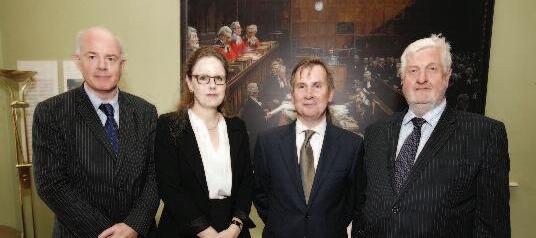
Above from left: Gerry McAlinden QC; Chantal-Aimée Doerries QC; and, David Barniville SC
Left: Lord Kerr delivered the keynote lecture
Maurice Gaf fney SC and his wife Leonie were in attendance at the meeting Maurice, who will turn 100 on October 11, 2016, was honoured by Chairman David Barniville SC, who stated: “You will not find a better example of a person possessing all of the positive attributes of the Bar than Maurice”
A glittering af fair
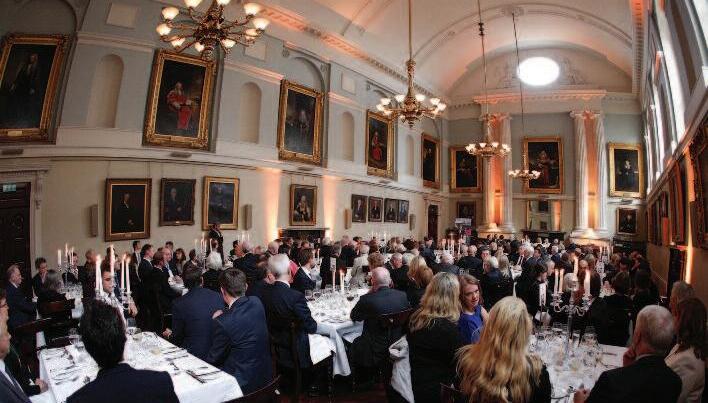
Eminent figures from the legal profession, politics and wider society gathered on June 30 in King’s Inns for this year’s Chairman’s Dinner.



Council Chairman, David Barniville SC
From left: Chief Justice of Ireland, the Hon Mrs Justice Susan Denham; Chairman, Council of the Bar of Ireland, David Barniville SC; Minister for Justice and Equalit y, Frances Fitzgerald TD; and, Attorney General Ms Máire Whelan SC
From left: Gerry McAlinden QC; Chantal-Aimée Doerries QC; David Barniville SC; and, Gordon Jackson QC
A wonder ful setting for a wonder ful evening
Addressing gender issues
Since publishing the results of a recent survey of female members, a series of actions have been considered to address some of the issues raised:
(i) Creating awareness
The decision to publish the results of the survey in The Bar Review was a step towards creating greater awareness of the challenges female practitioners face in progressing with a career at the Bar The Working Group is keen to maintain an open forum for discussion on these issues, and is currently developing an initiative to be introduced in the new legal year, which will facilitate open and honest discussion and foster suppor tive relations between female colleagues
Following the wide publicity of the survey results, an approach came from another professional representative body with an idea to bring a number of different professions together and host an inter-professional conference, which suppor ts and promotes women in the professions This is a valuable oppor tunity for women from different professions to share their experiences and to work together to identify possible solutions Planning is underway and it is hoped that this event will take place early in the new legal year It has also been decided that the hugely successful International Women’s Day Dinner, which took place in March of this year at the King’s Inns, will become an annual feature of The Bar of Ireland’s events calendar
(ii) Education and training

Childcare and maternity leave: The Working Group is committed to finding solutions that provide more suppor t to working parents Proposals for an on-site childcare facility, first introduced in 2012, were recently revisited Taking into consideration the economic viability of such a facility, the availability of suitable space, safety and security concerns, and all of the various legal requirements and HSE standards that pertain to childcare services in Ireland, the Working Group concluded, in consultation with various exper ts that, unfor tunately, an on-site childcare facility is not a viable option The Working Group is currently engaging with a number of childcare agencies, however, which may be able to offer a suitable alternative ‘Nanny Options’ – a professional childcare recruitment agency based in Dublin – assists parents in finding childcare solutions that best fit their individual family needs This could be an ideal solution for families wishing to have more flexibility, par ticularly during a period of maternity leave where female practitioners would like to re-integrate into the workplace and avail of childcare on a more ad hoc basis The Working Group is engaging with a number of agencies that can provide temporar y, flexible childcare to establish the best available options that are most suited to this profession Details will be communicated to members in due course
In an effor t to raise the profile of our female members, a policy has now been adopted to ensure gender balance in the delivery of CPD seminars that are provided by The Bar of Ireland where there is in excess of one speaker, while having regard to the appropriate level of experience and exper tise of available speakers Respondents to the survey also identified a number of areas in which female practitioners might benefit from CPD The ideas that were put forward have already been built into our CPD programme and included the recent CPD on negotiation skills
(iii) Policy and research
Code of Conduct : One of the concerns that arose from the sur vey was in relation to experiences of inappropriate behaviour of some female barristers The Code of Conduct for The Bar of Ireland is currently undergoing a review and a series of amendments will be placed before the Annual General Meeting (AGM) on July 25 One of the amendments proposed is a provision that will explicitly state that barristers must not engage in conduct that may constitute victimisation or harassment or sexual harassment of another barrister It will also provide for a more adequate complaints procedure that can address any instances of inappropriate behaviour of this nature Subject to the approval of members at the AGM, the amended Code of Conduct, together with this new provision, will come into effect in the new legal year
A mechanism to provide a staggered approach to Law Library subscription fees following a period of maternity leave is currently being researched The primary aim is to suppor t and facilitate women who would like to return to work to the Bar on a phased basis in the first six months following the bir th of their child and recognising that their pipeline of work is likely to have significantly reduced arising from their period of maternity leave This measure, together with ‘Nanny Options’, could provide an effective suppor t system for mothers returning to the Bar
Briefing policy: The initial research in relation to briefing policies specific to women in other jurisdictions around the world has been under taken and a proposal is being prepared for consideration at the next meeting of the Working Group
Taking silk: The pilot mentoring scheme for women that was launched in January 2016 will be reviewed at the end of the year and the possibility of its expansion will be considered In addition, guidelines aimed at assisting those who may be considering taking silk and completing the application form will be compiled and published in the coming months in co-operation with the office of the Attorney General
This update provides a brief insight into some of the initiatives being prioritised, and there are many others to be reviewed The work of the Working Group is ongoing and regular updates will be communicated to the membership We hope that our female members, in par ticular, will begin to see positive changes in the new legal year As always, the Working Group continues to welcome your suggestions, comments and feedback
Going from strength to strength
The
VA S
team is working hard to raise awareness of the Scheme among both potential clients and fellow barristers.

Libby Charlton BL
In March of this year, I was lucky enough to be chosen as Diane Duggan BL’s successor in the role of Co-ordinator of the Voluntary Assistance Scheme (VA S) I officially began on April 4, and with the patient guidance of Diane and our Director of Communications & Policy, Shirley Coulter, I have settled in There are four branches of the Scheme that we are currently working on The first branch, and the ever yday work of the VAS, is considering requests that we receive from charities, NGOs and civic organisations seeking pro bono assistance for themselves and their clients Since my coming on board, the VAS has facilitated pro bono advice on issues as diverse as company law and legal opinion on the proposed Parole Bill 2016
said stand in the June edition of The Bar Review) This was a huge event and the chorus of those that visited us was that they had not previously heard of the Scheme Our brochures disappeared quickly, and almost everyone who visited the stand exchanged cards and email addresses with us We exchanged information with in excess of 50 charitable organisations that day
Speaking for ourselves
This leads us seamlessly into the third branch of the Scheme In the past, the VA S has co-ordinated and facilitated the ‘Speaking for Ourselves’ seminar, where The Bar of Ireland provides pro bono oral and written advocacy training to charities and NGOs Exceptionally qualified barristers run workshops for representatives chosen by these organisations on all the elements of effective advocacy
The organisations that benefited were most grateful to, and impressed by, the barristers who so selflessly gave up their time It really is a privilege to witness the generosity of my colleagues first hand In my three months at the helm, no barrister has passed up an oppor tunity to help In conjunction with this work, I have also been meeting with various civic organisations and NGOs to ascer tain if there are ways that we can be of more assistance to the vulnerable in need of legal assistance
Publicity

During the Wheel’s Annual Conference & Expo, we invited applications for this invaluable seminar There was profound interest and places were in high demand It is expected that to cope with the level of interest, we will conduct two ‘Speaking for Ourselves’ seminars a year, with each seminar training twice the number of par ticipants we had previously The next seminar is planned to take place early in the new legal year
Database
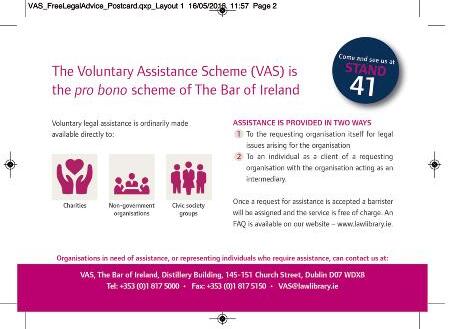
The second branch we are working on is publicising the VAS service to those who could benefit from it, but are perhaps unaware of it
To this end, on May 25, Diane, Shirley and I attended the Wheel’s Annual Conference & Expo in the Conference Centre in Croke Park The Wheel is Ireland’s largest annual gathering for community, voluntary and charity organisations, and VAS exhibited a stand at the Conference (you may have noticed a very fetching photograph of us at
The four th and final branch of our workload is to update and improve the current barrister database Barristers email vas@lawlibrary ie daily offering their services and many colleagues signed up at the VAS stand at the ‘Trial by Media’ conference in Kilkenny, but we can never have enough talent I would like to implore our more junior colleagues to sign up It is my suspicion that they don’t sign up as much as they could because they think that their lack of experience limits what they can offer Nothing could be fur ther from the truth; their dedication and enthusiasm often outshines any lack of experience Please feel free to email me with your details and area of practice if you are interested in helping So what do I think of my new position? I think Carlsberg don’t do jobs at the Bar, but if they did, it would be the VAS Co-ordinator
Tips for success at career event
The Young Bar Committee continues its work, with recent CPD events, and the announcement of the results of its master and pupil surveys.

CPD on practice management and career development
The Young Bar Committee, in conjunction with CPD of The Bar of Ireland, held an event on practice management and career development on May 26, 2016 The Chair and keynote speaker was the Hon Mr Justice John MacMenamin, who addressed the Young Bar on tips for a successful career from the judicial perspective Garrett Wren, Char tered Accountant, spoke on the topic of ‘Record Keeping, Engagement with Revenue and Ongoing Financial Management’, and provided very useful practical financial advice Barry Ward BL spoke about ‘Some Hard-Learned Lessons (from Experience)’, and reminded members of the importance of collegiality and how one enjoys a long career at the Bar courtesy of one’s colleagues Gavin Woods, Partner in Arthur Cox Solicitors, spoke about the benefits of alternative dispute resolution (ADR) qualifications for junior practitioners, highlighting that skill in procedure outside the litigation sphere continues to increase in importance
Junior research panel
The Young Bar Committee has decided to produce a list of junior counsel who are available for research work for senior counsel, or for other more senior juniors The proposal is that barristers will indicate their areas of exper tise gained from completion of study or employment, making it easier for those in need of paid research assistance to avail of same
We have asked members to email youngbar@lawlibrary ie in order to gauge interest, and we are now working on implementing this scheme
Results of twin master and pupil surveys
A key item on the agenda of the Young Bar Committee this year was to address the ongoing dissatisfaction being expressed by young members in relation to Law Library membership subscription fees Two surveys were undertaken during the year to ascertain information on arrangements in terms of fees and views on the master/pupil relationship: a survey of pupils; and, a survey of masters
At present there is no mandatory obligation on masters to pay the fees of their first-year pupil, although it is recommended that they do so The survey of pupils
found that 22% of masters pay the first year Law Library subscription fees of their pupils A further 33% said that their master made a financial contribution during their first year that would equate to the cost of their Law Library fees
Separately, the survey of masters found that 30% of masters said that they pay the registration and annual subscription of their first-year pupil In addition, 83% said they also contributed periodic lump sums, allowing pupils to fee for motions, and covering the cost of lunches and financial support to participate on social trips such as the annual soccer trip
Some 59% of masters supported the proposal that a pupil-master database be compiled and available for prospective pupils in the King’s Inns This database would include details such as the master’s areas of practice, year of call, and whether or not they discharge the Law Library subscription fees of their first-year pupil
Some 39% of masters supported the proposal that the payment by masters of Law Library subscription fees for first-year pupils should be obligatory rather than recommended
It is evident from the feedback received from the surveys of both pupils and masters that dissatisfaction with the status quo was expressed on both sides, and that clarification as to the respective rights and responsibilities of both cohorts would be welcome
The Young Bar Committee, having considered the results and debated the options, has voted, and is proposing as a first step the following suite of measures, which will be considered by Council of The Bar of Ireland at its next meeting:
n that guidelines for pupils that have been drafted be published and made available as part of the induction pack for all new entrants in September 2016;
n that a similar set of guidelines for masters be drafted and published, and communicated to all masters on the register maintained by Council as part of an annual compulsory CPD that would lead to their name being kept on the Register of Masters;
n that the database of masters currently published on the lawlibrary ie website be expanded to include information on the practice areas, practice location (Dublin and/or Circuit) of the master, and an indication of whether or not the master will pay the Law Library subscription fees (registration fee and/or subscription fee) for a first-year pupil – provision of this information will be a necessity for having a master’s name maintained on the Register of Masters; and,
n that an approach is made to the King’s Inns to seek a slot during the course to provide information for all those intending to join the Law Library on the master/pupil arrangements to better explain how the system works
These proposals will be considered by Council at its July meeting
Claire Hogan BL
The word seller
Journalist, author and filmmaker John Carlin
talks about how living under repressive regimes in South America gave him a unique insight into South Africa as that country lef t apar theid behind.
John Carlin never planned to work as a journalist in countries where state repression and political turmoil were the norm As he tells it, he didn’t have a plan at all His return to Argentina (where he lived as a child) after graduating from university in the early 1980s was, as he puts it, a “nostalgia trip”, and it wasn’t until he was planning to return to the UK after two years as an English teacher that the oppor tunity to work for English-language newspaper the Buenos Aires Herald came up
Of course, Argentina probably wasn’t on most people’s list of desirable destinations at the time The military junta had been in power for some time, and arrests, assassinations and ‘disappearances’ were par t of everyday life
“I never lived in a country that was more sinister and repressive than Argentina between 1979 and 1982 It was an absolute police state Everything was at the mercy of the ruling junta The Buenos Aires Herald was a most impressive publication, the only newspaper that systematically denounced the disappearances and the military regime ”
John wrote about film, theatre and spor t, as well as writing about the disappearances (“People warned me not to but I did it any way – I was a reckless youth ”) He was still there when the Falklands War broke out in 1982, which he admits gave him his break in terms of international journalism, as he began to write for the British national press
In the eyes of the law
John’s experiences in Argentina had a profound effect, and played a huge part in his decision to stay in that region for a further six years, four in Mexico, and then a year each in El Salvador and Nicaragua Perhaps for this reason, and

Ann-Marie Hardiman Journalist and sub-editor at Think Media Ltd

because of a self-confessed general ignorance about the country, he did not see a posting in South Africa as a particularly bold move Indeed, his predecessor as South Africa Bureau Chief for The Independent had left the post because he had, in John’s words, become “bored by the ghastly predictability” of reporting on apar theid John arrived in 1989, in time for “ one full year of full-on apar theid”, which gave him a context on which to base his repor ting when everything changed utterly in 1990 with Nelson Mandela’s release
At first, however, John admits he “wasn’t totally taken” by South Africa What finally sparked his passion was an assignment that introduced him to the South African justice system, when he was sent to cover a remarkable trial in a remote town called Uppington
“Twenty-six people had been charged with the murder of one policeman under a law then in existence in South Africa –‘ common cause’ If you shared the will to kill that person you were as guilty as the actual perpetrator of the deed
This trial had been going on for some time, and the upshot was that 14 people were sentenced to death for the murder of one policeman, who had been killed in a confrontation between police and demonstrators I was there in the cour troom when this white judge sentenced 14 black people to death, including a couple in their 50s who had 11 children, and they were whisked off to death row
“I got to know the defence lawyers and the families of the people who’d been sent to death row, and I got to know the place extremely well, so that experience really hooked me ”
John went on to repor t on a number of high-profile trials before and after the end of apar theid, which gave him, as he says “quite a lot of exposure to South African cour trooms” Interestingly, he points out that in many ways, the end of apar theid did not materially alter the South African justice system
“For all the manifest evil of apar theid, they did have a pretty serious judicial system One thing that struck me when I arrived from Central America was that Mandela’s equivalent in El Salvador or Guatemala would have just been

murdered on the spot, whereas even in the darkest days of apar theid in the 1960s, the man who was plotting the over throw of the regime, who was leading an armed struggle, was given a fair trial In fact, the prosecution asked for the death penalty, and a white judge decided that, on the evidence, Mandela did not deserve the death penalty, but a life sentence
“Obviously the law changed, the constitution changed, and now you have black judges and so for th, but respect for the law, whatever that law may be, is something that did distinguish South Africa from some of the tyrannies that I was familiar with ”
The price of truth
While it may be true that South Africa was a country where the rule of law applied (appallingly racist as the law was), dealing with the fallout from years of apartheid required something else John speaks passionately about the Truth and Reconciliation Commission and its accompanying amnesty, where it might be said that the traditional approach to justice and law were abandoned for the sake of the common good, and to enable a society to move on from the horrors of its past
“If you carried out the letter of the law, it would have made the whole business of reconciliation and laying foundations for stable democracy far more difficult
It would have increased massively the risk of a right-wing terrorist movement arising A section of society who had relatives and friends among the victims are going to be forever resentful and bitter But the price you pay is to relinquish some justice in the name of a messy but ultimately more beneficial political deal ”
I ask him if he thinks that this process could be said to have worked He thinks it has “During two years, there was a public airing of all the terrible things that happened People who had committed crimes on both sides (although overwhelmingly on the apar theid side) came forward in public – the whole thing was broadcast live on TV – and confessed to their crimes, and in many
cases were confronted by relatives of victims It was a huge catharsis ”
While other issues have arisen in South Africa – accusations of corruption, or problems with the economy – John points out that very few countries are immune from these, but no one questions the nature of South African democracy
“Obviously the law changed, the constitution changed, and now you have black judges and so for th, but respect for the law, whatever that law may be, is something that did distinguish South Africa from some of the t yrannies that I was familiar with.”
He compares this to Spain post Franco, where there was no truth commission, and the country is still very much divided along civil war lines, or to Russia, where democracy was achieved at around the same time as in South Africa
“South Africa is far more democratic in all the fundamental respects than Russia is You have absolute freedom of the press, freedom of speech, and an independent judiciary ”
Personal life
John is based in London, where the main focus of his life is his 16-year-old son He also loves to read, mainly fiction (“I prefer novels to the kind of books I write”) and likes football “ an awful lot”
“The beauty of football is that, like life, it is so cruelly unfair ”
The
cour t of public opinion
One of the most fascinating stories of the era is the subject of John’s book Playing the Enemy: Mandela and the Game that Made a Nation, which recounts how Mandela brilliantly used the 1995 Rugby World Cup as a tool for political unity (see panel) The story is about the power of sport to move people, and to ignite tribal passions in a way that many other events do not Sport is also a factor in another case that John has written about in recent years: the trial of Olympic and Paralympic athlete Oscar Pistorius for the murder of his girlfriend Reeva Steenkamp in 2013 (his book, Chase Your Shadow: The Trials of Oscar Pistorius, was published in 2014) As we speak, the sentencing hearing is ongoing in South Africa and the final result is unclear (Pistorius was subsequently sentenced to six years’ imprisonment) This case raises a number of fascinating issues, not least the decision to broadcast the entire trial live on television
John spoke at The Bar of Ireland’s Annual Conference this year, which had a theme of ‘Trial by Media’, so I ask him if, on balance, he is in favour of televising criminal trials in this way We first discuss it in the context of the South African truth and reconciliation process
“For the truth and reconciliation process, television was a key element in the whole exercise It was a national purgation, and the more people who saw it the better In the case of Pistorius, it was essentially about viewing figures and enter tainment, about networks making a lot of money ”
He has an interesting take on the trial, bringing us back to spor ting analogies
“People watched that trial in much the same spirit as they would watch a rugby game Most people made up their minds almost immediately after the killing about what side they were on: either that Pistorius was guilty of deliberately murdering his girlfriend, or that it was, as the phrase went, a tragic accident
It was watched as a sor t of reality TV cum spor ts contest between the defence and the prosecution It was televised very much in the way that spor ts events are There was a special 24-hour channel created and the rights were sold abroad – just like a spor ts event There was even a studio panel to analyse proceedings, sometimes even looking back at events, with action replays!”
It’s a somewhat cynical take on things but one that’s not too far removed from the truth On a more serious note, he feels that there was some benefit in televising it for the South African justice system
“It wasn’t a bad thing for South Africa that the trial was televised because I
Playing the Enemy

think most people watching it around the world would have been quite impressed by the solemnity, propriety and seriousness, and indeed quality, of the judge and lawyers on the respective sides, and the way the whole exercise was conducted ”
In this case, the defence team was most against televising the trial Prosecution witnesses who were neighbours of Pistorius were called to testify as to noises that they claimed to have heard These people were the nearest thing to eyewitnesses in the trial, and the defence team claimed that as they could see preceding testimony on live television, they could (unconsciously) tailor their own testimony to fit
“My personal stance? Not being a lawyer I don’t have a sufficient grasp of the legal niceties, but I am sensitive to the point the defence lawyers made about State witnesses This is an entirely personal opinion, but I thought there was something slightly grubby about this par ticular case – it became a ghoulish reality TV show, and I’m not sure it brought out the best in humanity If you were to put me against a wall, on balance I would say don’t televise it ”
Comfor t zones
John currently earns a crust writing for Spanish newspaper El País, but also has a number of interesting irons in the fire He’s working on some projects for television, and is also immersed in research for a book While his work is no longer physically situated in countries where military and political conflict is par t of everyday life, his writing hasn’t left it behind
“I want to do a book based on a true story about my family in the Spanish Civil War This will be outside my comfor t zone as it’s set during another historical period, and also because it will be fiction, although based on true events ”
As someone who has worked in several media throughout his career, I ask if he has a favourite
“I sell words in all kinds of shapes and sizes, be it in newspapers, books, TV documentaries and, these days, speeches I guess I would say I prefer writing because that’s what I’ve done most of I enjoyed making TV documentaries immensely because I’ve always had the good for tune to work with really good people who’ve taught me a lot But writing a book is what I like to do best, as painful and difficult and challenging as it is!”
The genesis of the book Playing the Enemy: Mandela and the Game that Made a Nation, was not a straightforward one, and was sparked by a chance encounter in London
“I made a documentary for PBS in the United States about Mandela as his presidency was coming to an end in 1999, and we worked the story of the Rugby World Cup Final into the end as the climax of the story About six months later, I was having dinner with friends in London, and their babysitter (who was of Iranian extraction) watched the video of the documentary and said that she par ticularly enjoyed the ‘rugby bit at the end’ ”
It struck him that if that aspect of the story had such cross-cultural appeal, it might be an idea to write a book about it It took six more years to bring the idea to fruition, but the resulting book was adapted for cinema by Clint Eastwood into the film Invictus
U P DAT E
The Bar Review, journal of The Bar of Ireland
A directory of legislation, articles and acquisitions received in the Law Library from May 5, 2016, to June 20, 2016
Judgment information supplied by Justis Publishing Ltd
Edited by Deirdre Lambe and Vanessa Curley, Law Library, Four Courts
ABORTION
Ar ticles
Smyth, C -M Restrictive abor tion laws as torture in international law Irish Law Times 2016; 34 (9): 127
ADMINISTRATIVE LAW
Statutory Instruments
Statistics (census of population) order 2015 – SI 445/2015
Public service management (sick leave) (amendment) regulations 2015 – SI 384/2015
ADOPTION
Statutory Instruments
Adoption act 2010 (Register of gender recognition of intercountry adoptions) regulations 2015 – SI 534/2015
ASYLUM
Asylum, immigration and nationality –Depor tation – Refusal to revoke depor tation (Humphreys J –11/05/2016) [2016] IEHC 235
AOM v Minister for Justice and Equality
Asylum, immigration and nationality –S 13 (6) (e) of the Refugee Act, 1996 – Papers only appeal – Considered M A v Refugee Appeals Tribunal [2015] 7 JIC 3116 Referred to B Y (Nigeria) v Refugee Appeals Tribunal & Ors [2015] IEHC 60 Referred to J A v Refugee Appeals Tribunal & Ors [2014] IEHC 565 (Mac Eochaidh J – 29/04/2016) [2016] IEHC 218
S H I v Refugee Appeals Tribunal
Asylum, immigration and nationality –
S 5 of the Illegal Immigrants (Trafficking) Act 2000 – S 3 (11) of the Immigration Act 1999 – Not applied
C O O (Nigeria) v Minister for Justice [2016] 1 JIC 1206 Applied Dos Santos & Ors v Min for Justice & Ors [2015]
IECA 210 Applied Irish Trust Bank Ltd v Central Bank of Ireland [1976-1977] ILRM 50 (Humphreys J –12/05/2016) [2016] IEHC 289
K R A v The Minister for Justice and Equality
Asylum, immigration and nationality –S 5(3) of the Illegal Immigrants (Trafficking) Act, 2000 – Nationality –
Considered M A R A (Nigeria) (infant)
v Minister for Justice [2014] IESC 71
Referred to A (S F) (An Infant) & A (A) v Min for Justice & Ors [2015] IEHC
364 Referred to H I D v Refugee Applications Commissioner [2013] 3 JIC 2209 (Mac Eochaidh J – 25/04/2016)
[2016] IEHC 222
S F A v Minister for Justice
AVIATION
Statutory Instruments
Aviation regulation act 2001 (levy no 16) regulations 2015 – SI 552/2015
BANKING
Banking and finance – Non-payment of loan – Summar y Judgment – Applied
AIB v Galvin Developments (Killarney) Ltd [2011] IEHC 314 Applied Tennants
Building Products Ltd v Dennis
O’Connell [2013] IEHC 197 Referred to
Allied Irish Banks Plc v Taylor [2016] 3
JIC 0405 (Baker J – 06/05/2016)
[2016] IEHC 280
AIB Mortgage Bank v Hayes
Banking and finance – Non-payment of loan – Summar y Judgment – Applied
Aer Rianta cpt v Ryanair Ltd (No 1)
[2001] 4 IR 607 Applied Harrisrange
Ltd v Duncan [2003] 4 IR 1 Referred to
Allied Irish Banks Plc v Taylor [2016] 3
JIC 0405 (Barr J – 12/05/2016)
[2016] IEHC 282
AIB v McPhillips
Banking and finance – Recovery of debts – Summary proceedings – Applied
Aer Rianta cpt v Ryanair Ltd (No 1) [2001] 4 IR 607; Applied Harrisrange Ltd v Duncan [2003] 4 IR 1 (Barrett J –26/05/2016) [2016] IEHC 257
Allied Irish Bank PLC v Hogan
Banking and finance – Summar y judgment – Failure to pay debt –
Applied Dellway Investment Ltd & Ors v National Asset Management Agency (NAMA) & Ors [2011] 4 IR 1 Applied G v DPP [1994] 1 IR 374 Considered Irish Life & Permanent Plc v Duff & Anor [2013] 4 IR 96 (McDermott J –10/05/2016) [2016] IEHC 233 Fagan v ACC Loan Management Ltd
Ar ticles
Cooney, S Banker’s books and hearsay evidence Bar Review 2016; 21 (3); 96
Statutory Instruments
Central Bank reform act 2010 (sections 20 and 22) (amendment) regulations 2015 – SI 545/2015
European Union (requirements for credit transfers and direct debits in euro) (amendment) regulations 2016 –SI 204/2016
European Union (bank recover y and resolution) (amendment) regulations 2016 – SI 234/2016
European Union (interchange fees for card-based payment transactions) (amendment) regulations 2016 – SI 292/2016
BUILDING LAW
Statutory Instruments
Construction Contracts Act 2013 (appointed day) order 2016 – SI 165/2016
Building control (amendment) (no 2) regulations 2015 – SI 365/2015
COMPANY LAW
Company – S 438 of the Companies Act 2014 – Irish Bank Resolution Corporation Act 2013 – Referred to Tempany v Hynes [1976] IR 101 (McGovern J – 12/05/2016) [2016]
IEHC 238
Harcourts Life Assurance Company Ltd v O’Brien
Company – S 819 of the Companies Act, 2014 – Restriction on directorship – Considered Coyle v O’Brien [2003] 2 IR 627 Considered Duignan v Car way [2001] 4 IR 550 Referred to Primor plc v Stokes Kennedy Crowley [1996] 2 IR 459 (O’Connor Tony J - 25/04/2016) [2016] IEHC 227
Ferris v Hui
Ar ticles
Quinn, J The companies act 2014 and the absence of the derivative action Commercial Law Practitioner 2016; 23 (4): 102
Statutory Instruments
Companies act 2014 (section 150) (no 2) regulations 2015 – SI 543/2015 European Union (traded companies –corporate governance statements) regulations 2015 – SI 423/2015
CONSTITUTIONAL LAW
Constitution – Ar t 40 4 2 of the Constitution – Execution of European Arrest Warrant – Applied Roche (also known as Dumbrell) v Governor of Cloverhill Prison [2014] IESC 53 Referred to McDonagh v Governor of Cloverhill Prison [2005] 1 IR 394 Considered OLTECH (SYSTEMS) Ltd v OLIVETTI UK Ltd [High Cour t] [2012] 3 IR 396 (Barrett J – 26/05/2016) [2016] IEHC 267
Corcoran v Governor of Castlerea Prison
Constitution – Ar t 40 4 2 of the Constitution of Ireland, 1937 – S 99 of the Criminal Justice Act 2006 as substituted by s 60 of the Criminal Justice Act 2007 – Not applied Moore v DPP [2016] 4 JIC 1905 Applied DPP v Cunningham [2013] 2 IR 631 Applied State (McDonagh) v Frawley [1978] IR 131 (McDermott J – 27/05/2016) [2016] IEHC 278
Clarke v The Governor of Mountjoy Prison
Constitution – Crime and sentencing
– C o n s t i t u t i o n a l i t y o f S 5 o f t h e
S u m m a r y J u r i s d i c t i o n ( I re l a n d )
A m e n d m e n t A c t , 1 8 7 1 – A p p l i e d
Byrne v DPP (Garda Enright) [2011] 1 IR 346 Applied Scully v DPP [2005] 1 IR 242 Referred to RA S Medical Ltd v Royal College of Surgeons in Ireland
[ 2 0 1 6 ] 4 J I C 1 9 0 2 ( H u m p h re y s J –12/05/2016) [2016] IEHC 288
Bita v DPP
Constitution – Crime and sentencing – S 27A (8) of the Firearms Act, 1964 – Applied Deaton v Attorney General and Commissioners of Inland Revenue
[ 1 9 6 3 ] I R 1 7 0 A p p l i e d Ly n c h v Minister for Justice Equality and Law Reform; Whelan v same [2012] 1 IR 1 Referred to DPP v Daniel Prender ville
[ 2 0 1 5 ] I E C A 3 3 ( Tw o m e y J –09/05/2016) [2016] IEHC 234
E l l i s v M i n i s t e r f o r J u s t i c e a n d Equality
Constitution – Family – S 18 of the C h i l d C a re A c t , 1 9 9 1 – A p p l i e d M e a d o w s v M i n i s te r fo r J u s t i ce , Equality and Law Reform [2010] 2 IR
7 0 1 A p p l i e d S t a te ( A b e n g l e n
P ro p e r t i e s ) v C o r p o ra t i o n o f D u b l i n
[ 1 9 8 4 ] I R 3 8 1 ( B a r re t t J –30/05/2016) [2016] IEHC 285 LON v District Court Judge Daly
C o n s t i t u t i o n – P ra c t i ce a n d p ro ce d u re s – A r t i c l e 4 0 4 2 o f t h e
C o n s t i t u t i o n o f I re l a n d 1 9 3 7 –
Fo l l o w e d S t a te ( G l e e s o n ) v D i s t r i c t
J u s t i ce C o n n e l l a n [ 1 9 8 8 ] I R 5 5 9
A p p l i e d D i l l o n v J u d g e M c H u g h & DPP [2013] 1 IR 430 Applied Ryan v
G o v e r n o r o f M i d l a n d s P r i s o n [ 2 0 1 4 ]
I E S C 5 4 ( H u m p h re y s J –26/05/2016) [2016] IEHC 287
D o n o v a n v G o v e r n o r o f M i d l a n d s
Prison
Constitutional jurisdiction – Summary dismissal – Discrimination – Referred to M a r t h a M c E n e r y v C o m m i s s i o n e r
o f A n G a rd a S í o c h á n a [ 2 0 1 5 ] I E C A 2 1 7 ( C l a r ke J , M a c M e n a m i n J ,
C h a r l e to n J – 1 2 / 0 5 / 2 0 1 6 ) [ 2 0 1 6 ] IESC 26
McEnery v Commissioner of An Garda Síochána
CONSUMER LAW
Statutory Instruments
C o n s u m e r p ro te c t i o n a c t 2 0 0 7
( C o m p e t i t i o n a n d C o n s u m e r P ro te c t i o n C o m m i s s i o n ) l e v y regulations 2015 – SI 457/2015 European Union (alternative dispute resolution for consumer disputes) (no 2) regulations 2015 – SI 368/2015
CONTRACT
Breach of contract – Damages – Res judicata – Considered Murray v Trustees & Admin of the Irish Airlines [Gen Employee] Superannuation Scheme [2007] IEHC 27 Referred to Crowley v Zurich Life Assurance Plc [2015] 3 JIC
0405 Referred to Gallagher v ACC Bank PLC (No 1) [2012] IESC 35 (Irvine J , Hogan J , Mahon J – 04/05/2016) [2016] IECA 128
Murphy v Canada Life Assurance Ireland Ltd
Contract – Compromise – Acceptance of offer – Applied Smyth v Tunney [2009] 3 IR 322 Considered O’Keeffe v Hickey and Others [2009] 2 IR 302 (Barrett J –26/05/2016) [2016] IEHC 268
Mr A v The Minister for Education and Science
Contract – Damages – Breach of contract – Applied Cadbury Ireland Ltd v Kerry Co-operative Creameries Ltd [1982]
ILRM 77 Referred to Igote Ltd v Badsey Ltd [2001] 4 IR 511 Referred to Reardon
Smith Line Ltd v Yngevar Hansen-Tangen (trading as H E Hansen-Tangen) [1976]
1 WLR 989 (Peart J , Irvine J , Hogan J – 05/05/2016) [2016] IECA 131
Tolan v Connacht Gold Co-operative Society Ltd
Contract – Procurement – Public tender – Applied Student Transport Scheme Ltd v Minister for Education and Skills [2015] 12 JIC 1805 Considered Judgment of the Court (Grand Chamber) of December 19, 2012 Azienda Sanitaria Locale di Lecce and Università del Salento v Ordine degli Ingegneri della Provincia di Lecce and Others Considered Re Emergency Ambulance Services in Dublin: Commission of the European Communities v Ireland (Austria, intervening) (Case C-532/03) [2007]
ECR I-11353 (Ryan P , Peart J , Hogan J – 27/05/2016) [2016] IECA 152
Student Transport Scheme Ltd v The Minister for Education and Skills & Anor
Library acquisitions
Beatson, J , Burrows, A , Cartwright, J , Anson, Sir W R Anson’s law of contract (30th ed ) Oxford: Oxford University Press, 2016 – N10
Articles
Breslin, J , Corcoran, E Ex turpi causa and statutory illegality: part I – the doctrine in context and pre-Quinn case law Commercial Law Practitioner 2016; 23 (4): 95 [par t I]; Ex turpi causa and statutory illegality: part II – Quinn v IBRC Commercial Law Practitioner 2016; 23 (5): 130 [part II]
COPYRIGHT
Librar y acquisitions
Birss, the Hon Mr Justice, C , Austen, T , B a ra n , S , Te r re l l , T Te r re l l o n t h e
l a w o f p a te n t s ( 1 8 t h e d ) Lo n d o n : Sweet & Maxwell, 2016 – N114 1 Caddick, N , Davies, G , Harbottle, G C o p i n g e r & S ko n e J a m e s o n copyright (17th ed ) London: Sweet & Maxwell, 2016 – N112
C O S T S
Costs – Termination of employment –
Unfair dismissal – Applied McIlwraith v Fa w s i t t [ 1 9 9 0 ] 1 I R 3 4 3 ( D e n h a m
C J , O’Donnell J , Clarke J (Laffoy J – 10/05/2016) [2016] IESC 20
M i l e y v E m p l o y m e n t A p p e a l s
Tribunal
C O U RT S
Statutor y Instruments
D i s t r i c t C o u r t ( C r i m i n a l J u s t i ce
(Miscellaneous Provisions) Act 1997) rules 2016 – SI 252/2016
R u l e s o f t h e s u p e r i o r co u r t s (bankruptcy) 2016 – SI 232/2016
R u l e s o f t h e S u p e r i o r C o u r t s
( c h a n ce r y a n d n o n - j u r y a c t i o n s :
p re - t r i a l p ro ce d u re s ) 2 0 1 6 – S I
255/2016
Rules of the Superior Cour ts (conduct of trials) 2016 – SI 254/2016
C R I M I NA L L AW
Conviction – Assault – Self – Referred to D P P v M a l a c h y M c G i n t y [ 2 0 0 3 ]
I E CC A 0 6 0 3 0 1 Re fe r re d to D P P v
Pa t r i c k O ’ Re i l l y [ 2 0 0 4 ] 7 J I C 3 0 0 2
Re fe r re d to D P P v Q u i n n [ 2 0 1 5 ] 1 2 JIC 1807 (Birmingham J , Mahon J , E d w a rd s J – 1 2 / 0 5 / 2 0 1 6 ) [ 2 0 1 6 ] IECA 146 DPP v O’Brien
C o n v i c t i o n – D a n g e ro u s d r i v i n g
c a u s i n g d e a t h – R i g h t to p r i v a c y –A p p l i e d N o r r i s v A t to r n e y G e n e ra l [ 1 9 8 4 ] I R 3 6 C o n s i d e re d F l e m i n g v Ireland & Ors [2013] IEHC 2 Referred to Kennedy v Ireland [1987] IR 587 (Birmingham J , Sheehan J , Edwards J – 10/05/2016) [2016] IECA 142 DPP v Harty
Conviction – Harassment – Admission of evidence – Considered Damache v D P P & O t h e r s [ S u p re m e C o u r t ] [2012] 2 JIC 2306 Considered DPP v J C [ 2 0 1 5 ] I E S C 3 1 ( B i r m i n g h a m J , S h e e h a n J , E d w a rd s J –30/05/2016) [2016] IECA 154 DPP v Smith
Conviction – Indecent assault –Corroboration warning – Considered R v Makanjuola; R v Easton [1995] 1 WLR 1348 (Birmingham J , Sheehan J , Edwards J – 30/05/2016 [2016] IECA 155
DPP v K C
Conviction – Indecent assault – Error in law – Applied S H v DPP [2006] 3 IR 575; Referred to DPP v Anton Mulder [2007] 4 IR 796 (Sheehan J , Mahon J , Edwards J – 11/05/2016) [2016] IECA 157
DPP v B O’R
Conviction – Murder – Accomplice evidence – Applied R v Coney (1882) LR 8 QBD 534 Referred to DPP v Jason Murphy [2013] IECCA 1 Referred to DPP v O’Brien [2011] 1 IR 273 (Birmingham J , Sheehan J , Mahon J – 05/05/2016) [2016] IECA 149 DPP v Collopy
Conviction – Murder – Admissibility –Applied DPP v Doyle [2015] 5 JIC 0804 Distinguished DPP v Raymond Gormley & Ors [2014] 2 IR 591 Distinguished Salduz v Turkey (36391/02) (2009) 26 BHRC 223 (Birmingham J , Sheehan J , Mahon J – 12/05/2016) [2016] IECA 147
DPP v Ryan
Conviction – Murder – Causation –Applied In re a Ward of Cour t (withholding medical treatment) (No 2) [1996] 2 IR 79 Applied R v Malcherek [1981] 1 WLR 690 Applied R v Pagett (1983) 76 CrAppR 279 (McKechnie J , Dunne J , Charleton J , O’Malley J – 11/05/2016) [2016] IESC 24
Dunne v DPP
Conviction – Possession of a controlled drug for the purpose of selling or other wise supplying it to another –Exper t testimony – Applied DPP v O’Callaghan [2001] 1 IR 584 Applied DPP v Shorr t [2002] 2 IR 686 Referred to DPP v Heffernan [2015] 12 JIC 2116 (Sheehan J , Mahon J , Edwards J –11/05/2016) [2016] IECA 148 DPP v Ramzan
Conviction – Sexual offences –Corroboration warning – Considered DPP v Wallace 2001 WJSC-CA 2212 (Sheehan J , Mahon J , Edwards J –03/05/2016) [2016] IECA 135
DPP v M M
Convictions – Threatening to kill or cause serious harm – Identification –Applied DPP v Madden [1977] IR 336 Referred to Aberdeen Glen Line SS Co
v Macken, The SS Gairloch [1899] 2 IR
1 Referred to DPP v Campion [2015] IECA 190 (Birmingham J , Mahon J , Edwards J – 30/05/2016) [2016] IECA 156 DPP v Dundon
Crime and sentencing – Complaint against prisoner – Refusal to provide documents – Applied Foy v Governor Of Cloverhill Prison [2012] 1 IR 37 Considered Rober t Egan v Governor of Wheatfield Prison & Anor [2014] 1 IR 64 (Barrett J – 26/05/2016) [2016] IEHC 265
Hogan v The Governor of Mountjoy Prison
Crime and sentencing – Conviction under Road traffic offences – Failure to appear – Considered Callaghan v Governor of Mountjoy Prison & DPP [2007] IEHC 294 Considered O’Brien v District Judge Coughlan & DPP [2011] IEHC 330 Considered Smith v MJE [2013] IESC 4 (Barrett J –26/05/2016) [2016] IEHC 258 White v District Judge Watkin
Crime and sentencing – Drugs offences – Package of drugs dispatched by post – Applied DPP v Walsh [1980] IR 294 Applied Leachinsky v Christie [1947] AC 573 Referred to DPP v JC [2015] IESC 31 (Denham C J , O’Donnell J , McKechnie J , Charleton J –10/05/2016) [2016] IESC 22 DPP v BA
Crime and sentencing – Extradition –European Arrest Warrant – Applied Lynch v Minister for Justice Equality and Law Reform; Whelan v same [2012] 1 IR 1 Considered People (Attorney-General) v O’Callaghan [1966] IR 501 Considered Veen v R 164 CLR 465 (Denham C J , O’Donnell J , MacMenamin J , Dunne J , Charleton J , O’Malley J – 12/05/2016) [2016] IESC 25
Balmer v Minister for Justice and Equality
Crime and sentencing – Leave to seek judicial review – S 2 of the Criminal Justice Act 1960 - Applied Elkhabir v Medical Council [2016] 2 JIC 1203 Distinguished Hashman and Harrup v United Kingdom (App No 25594/94) (2000) 8 BHRC 104 (Humphreys J –12/05/2016) [2016] IEHC 286 McNamee v DPP
Crime and sentencing – Offence of burglaries – Mode of trial – Applied Eviston v DPP [2002] 3 IR 260 Considered Gormley v Judge Smyth & DPP [2010] 1 IR 315 Referred to Carlin
v DPP [2010] 3 IR 547 (Barrett J –26/05/2016) [2016] IEHC 266
Hanrahan v District Judge Fahy
Crime and sentencing – S 3 of the Misuse of Drugs Act 1977 – S 45(1) of the Cour ts (Supplemental Provisions) Act 1961 – Not applied Cullen v DPP [2014] IESC 59; Applied Donoghue v DPP [2014] 2 IR 762; Applied G v DPP [1994] 1 IR 374 (Humphreys J –25/04/2016) [2016] IEHC 210 McD v DPP
Crime and sentencing – S 6(3) of the Transfer of Sentenced Persons Act 1995 – Transfer of prisoners – Applied G v DPP [1994] 1 IR 374 Referred to E S v Refugee Appeals Tribunal & Ors [2014] IEHC 374 Referred to N E (Minor Suing by his father and next friend M E A ) v Refugee Appeals Tribunal & Ors [2015] IEHC 8 Referred to O’Mahony v An Bord Pleanála [2015] 11 JIC 2706 (Humphreys J –25/04/2016) [2016] IEHC 208
McK v Minister for Justice and Equality
Crime and sentencing – Sexual offences – Applied DPP v Nevin [2003] 3 IR 321 Considered O’Brien v DPP [2014] IESC 39 Considered M S v DPP [2015] 12 JIC 2201 (Sheehan J , Mahon J , Edwards J – 12/05/2016) [2016] IECA 150 DPP v E C
Crime and sentencing – Storage of data recorded on PULSE system – Refusal to delete records – Considered D (M) (A Minor) v Ireland AG & DPP [2012] 1 IR 697 Referred to J McD v P L [2010] 2 IR 199 Referred to Meadows v Minister for Justice, Equality and Law Reform [2010] 2 IR 701 (White J –04/05/2016) [2016] IEHC 254 M M v Commissioner of An Garda Síochána
Criminal law – Manslaughter –Mitigating factors – Referred to DPP v Kelly [2005] 2 IR 321 (Finlay Geoghegan J , Pear t J , Mahon J –06/05/2016) [2016] IECA 137 DPP v Millea
Prohibition – Burglary – Arguability –Applied Whelton v District Judge O’Lear y & DPP [2011] 4 IR 544
Referred to Irwin v DPP & Judge Ryan [2010] IEHC 232 (Birmingham J , Sheehan J , Edwards J – 12/05/2016) [2016] IECA 144 Nulty v DPP
Sentencing – Assault causing harm –Severity of sentence – Applied DPP v Counihan [2015] IECA 76 (Sheehan J ,
Mahon J , Edwards J – 21/04/2016) [2016] IECA 127 DPP v Maughan
Sentencing – Theft – Error of principle (Birmingham J , Mahon J , Sheehan J – 26/05/2016) [2016] IECA 159 DPP v Rostas
Sentencing – Theft – Undue leniency –Applied DPP v (Christopher) Byrne [1995] 1 ILRM 279 Considered DPP v McCormack [2000] 4 IR 356 (Sheehan J , Mahon J , Edwards J –21/05/2016) [2016] IECA 132 DPP v O’Rourke
Ar ticles
Robinson, D Keeping us in suspense Law Society Gazette 2016 (May): 28 Kehoe, H En garde! Law Society Gazette 2016 (June): 32 Drislane, S Impaired justice: western Australia’s legal approach to cognitively impaired persons charged with a criminal offence Irish Criminal Law Journal 2015; 26 (2): 49
Statutory Instruments Criminal justice (spent convictions and cer tain disclosures) act 2016 (commencement) order 2016 – SI 215/2016
DAMAGES
Damages – Personal injuries – Functus officio – Distinguished Lynam’s Estate, In re [1928] IR 127 Referred to In re No 56 Denton Road, Twickenham [1953] Ch 51 (Pear t J , Irvine J , McDermott J – 04/05/2016) [2016] IECA 129 Noel Recruitment (Ireland) Ltd v Personal Injuries Assessment Board
Ar ticles
Kane, J Garda patrol Law Society Gazette 2016 (June): 44
DATA PROTECTION
Data protection – Personal data –Frivolous complaints – Applied Judgment of the Cour t (First Chamber) of 29 Februar y 1984 Srl CILFIT and others and Lanificio di Gavardo SpA v Ministero della sanità Reference for a preliminar y ruling: Cor te suprema di Cassazione – Italy (O’Donnell J , McKechnie J , Clarke J , MacMenamin J , Laffoy J , Dunne J , Charleton J –28/04/2016) [2016] IESC 18 Nowak v Data Protection Commissioner
Ar ticles
Wade, G Liability of company officers under data protection legislation Commercial Law Practitioner 2016; 23 (5): 160
DEFAMATION
Defamation – Damages – Delay (Kelly P , Pear t J , Ir vine J – 11/05/2016) [2016] IECA 140 McNamara v Sunday Newspapers Ltd
Defamation – Damages – Termination of contract – Appellant seeking damages from the termination of a contract – Whether the proceedings could properly be described as defamation proceedings – Referred to Bradley & Ors (t/a Malcomson Law) v Maher [2009] IEHC 389 Referred to Dellway Investment Ltd & Ors v National Asset Management Agency (NAMA) & Ors [2011] 4 IR 1 Referred to Lennon v Health Ser vice Executive [2015] IECA 92 (Denham C J , MacMenamin J , Charleton J –25/04/2016) [2016] IESC 16
DRAFTING
Library acquisitions
Fosbrook, D , Laing, A C Contract and copyright draf ting skills Hay wards Heath: Bloomsbury Professional, 2016 – L34
EDUCATION
Education – State Examinations Commission – Reasonable Accommodation for Junior and Leaving Cer tificate Examinations 2016 –Applied Meadows v Minister for Justice, Equality and Law Reform [2010] 2 IR 701 Considered Mallak v Minister for Justice [2012] 3 IR 297 Referred to O’Keeffe v An Bord Pleanála [1993] 1 IR 39 (Noonan J – 27/04/2016) [2016] IEHC 213
Deehan v State Examinations Commission
Statutory Instruments
Teaching Council (election of members) regulations 2015 – SI 540/2015
EMPLOYMENT LAW
Employment – Contract of employment
– Irregularities in financial transactions
– Applied Lingam v Health Ser vice Executive [2005] IESC 89 Applied Mooney v An Post [1998] 4 IR 288 Applied Shor tt v Royal Liver Assurance Ltd [2008] IEHC 332 (Keane J –12/05/2016) [2016] IEHC 237 O’Leary v An Post
Employment – Garda Síochána Code –Decision to transfer – Applied Herlihy v Commissioner of an Gards Síochána & Anor [2012] IEHC 531 Applied M A R A (Nigeria) (infant) v Minister for Justice
[2014] IESC 71 Applied N A A v Refugee Applications Commissioner [2007] 2 IR 787 (Baker J –03/05/2016) [2016] IEHC 224
Maubury v Commissioner of An Garda Síochána
Employment – Reg 7 of the Garda Síochána (Discipline) Regulations –Disciplinary action – Applied Flynn v An Post [1987] IR 68; Referred to McHugh v Governor of Por tlaoise Prison [2015] 10 JIC 2004; Referred to Paul McMahon v Irish Aviation Authority & Anor [2014] IEHC 431 (Baker J –03/05/2016) [2016] IEHC 225
Canavan v Commissioner of An Garda Síochána
Library acquisitions
Walley, P , Kimber, C Cyber law and employment Dublin: Round Hall, 2016 – N192 C5
Ar ticles
Ennis, R , Longwor th, P Using a carrot to catch a crook: par t 1 – an overview of whistleblower protections and white collar enforcement trends in Ireland Commercial Law Practitioner 2016; 23 (4): 108 [par t I]
Ennis, R , Longwor th, P Using a carrot to catch a crook: par t 2 – the case for a whistleblower incentive programme to combat white collar crime in Ireland Commercial Law Practitioner 2016; 23 (5): 135 [par t II]
Kimber, C Employee monitoring, privacy and data protection Bar Review 2016; 21 (3): 91
Kierans, L Full disclosure Law Society Gazette 2016 (June): 36 Greene, J Terminating employment on incapacity grounds Irish Employment Law Journal 2016; 13 (2): 43 Kimber, C Zero and low hours contracts – national legal regulation and the potential of the EU char ter Irish Employment Law Journal 2016; 13 (2): 32
Statutory Instruments
Industrial relations act 1990 (code of practice on Protected Disclosures Act 2014) (declaration) order 2015 – SI 464/2015
Industrial relations act 1990 (code of practice on victimisation) (declaration) order 2015 – SI 463/2015
National minimum wage order 2015 –SI 442/2015
Organisation of working time (non-application of cer tain provisions to persons per forming mobile road transport activities ) regulations 2015 –SI 342/2015
Protection of employment (exceptional collective redundancies and related
matters) act 2007 (duration of par t 2) order 2016 – SI 224/2016
Workplace relations act 2015 (fees) regulations 2015 – SI 536/2015
ENERGY
Statutory Instruments
Electricity regulation act 1999 (public service obligations) (amendment) order 2015 – SI 556/2015
ENVIRONMENTAL LAW
Environment – Order of cer tiorari –Operational Procedures Manual and Operating Rules – Applied Bula Ltd v Tara Mines Ltd (No 6) [2000] 4 IR 412 Applied Curran v Minister for Education [2009] 4 IR 300 Considered Lett & Company Limited v Wexford Borough Council & others [Supreme Cour t] [2012] 2 JIC 0301 (Barrett J –26/05/2016) [2016] IEHC 259
O’Donoghue v South Kerry Development Partnership Ltd
Ar ticles
Ryall, Á Access to information on the environment: the evolving EU and national jurisprudence Irish Planning and Environmental Law Journal 2016; 23 (1): 3
Browne, D The decision in Grune Liga Sachsen (C-399/14): retrospective application of Ar ticle 6 of the habitats directive Irish Planning and Environmental Law Journal 2016; 23 (2): 40
Statutory Instruments
Environment (miscellaneous provisions) act 2015 (commencement) (no 3) order 2015 – SI 537/2015
Water services (no 2) act 2013 (other licences, authorisations and permits) order 2015 – SI 462/2015
Water ser vices (no 2) act 2013 (proper ty vesting day) (no 7) order 2015 – SI 461/2015
EUROPEAN UNION
Library acquisitions
de Witte, B , Mayoral, J A , Jaremba, U
National courts and EU law: new issues, theories and methods Cheltenham: Edward Elgar Publishing Limited, 2016 – W86
Eeckhout, P , Tridimas, T , Thies, A Yearbook of European law Vol 32
2013 Oxford: Oxford University Press, 2013 – W70
Eeckhout, P , Tridimas, T , Thies, A Yearbook of European law Vol 34
2015 Oxford: Oxford University Press, 2015 – W70
Ar ticles
Power, V J G Brexit-selected legal aspects Commercial Law Practitioner 2016; 23 (5): 123
Statutory Instruments
European Communities (free movement of persons) regulations 2015 – SI 548/2015
European Communities (patent agents) regulations 2015 – SI 579/2015 European Communities (wildbirds) (woodcock) regulations 2015 – SI 472/2015
European Union (batteries and accumulators) (amendment) regulations 2015 – SI 347/2015
European Union (Ecodesign requirements for certain energy-related products) (amendment) regulations 2016 – SI 228/2016
EVIDENCE
Library acquisitions
Mitchels, B Children and vulnerable witnesses in cour t proceedings London: Wildy, Simmonds and Hill Publishing, 2016 – M600 Q11
Ar ticles
Reid, C Nothing but the truth Law Society Gazette 2016 (May): 34
EXTRADITION LAW
Extradition – European arrest warrant –Revocation order – Considered Minister for Justice and Equality v Pawel Surma [2013] IEHC 618 Considered Minister for Justice and Equality v Tokarsk [2012] IESC 61 Referred to Min for Justice v Palonka [2015] IECA 69 (Ryan P , Pear t J , Kelly J – 12/05/2016) [2016] IECA 145
Minister for Justice and Equality v Lipinski
Extradition – European arrest warrants – Rule of specialty – Considered Min for Justice v Strzelecki [2015] IESC 15
Referred to Minister for Justice and Equality v Sliwa [2016] 4 JIC 1103
Referred to The State (at the prosecution of Jennings) v J Furlong 53 ILR 9 (Finlay Geoghegan J , Pear t J , Hogan J – 04/05/2016) [2016] IECA 130
Minister for Justice and Equality v Sliwa
International law – Extradition –European Arrest Warrant Act, 2003 –Followed Minister for Justice, Equality &; Law Reform v Rettinger [2010] 5 JIC 0701 (Pear t J – 10/05/2016) [2016] IEHC 240
Minister for Justice and Equality v Langford
FAMILY LAW
Library acquisitions
Kennedy, D , Maguire, E Irish family law handbook (5th ed ) Dublin: Bloomsbur y Professional, 2016 –N170 C5
FINANCE
Statutory Instruments Finance act 2015 (section 17(1)(a)(ii)) (commencement) order 2016 – SI 205/2016 Prize bonds (amendment) regulations 2015 – SI 477/2015
FOOD
Statutory Instruments
European Communities (spirits drinks) (amendment) regulations 2015 – SI 468/2015
FREEDOM OF INFORMATION
Statutory Instruments
Freedom of Information act, 2014 (section 37(8) regulations 2016 – SI 218/2016
GARDA SÍOCHÁNA
Ar ticles
Kane, J Principles of compensation for non-fatal Garda occupational injuries Irish Law Times 2016; 34 (8): 114 Kane, J Garda patrol Law Society Gazette 2016 (June): 44
GARDA VETTING
Statutory Instruments
National Vetting Bureau (children and vulnerable persons) act 2012 (commencement) order 2016 – SI 214/2016
National Vetting Bureau (children and vulnerable persons) act 2012 –(appeals) regulations 2016 – SI 219/2016
National Vetting Bureau (children and vulnerable persons) act 2012 (section 21) (prescribed period) regulations 2016 – SI 223/2016
HEALTH
Statutory Instruments
European Communities (quality and safety of human blood and blood components) (amendment) regulations 2015 – SI 494/2015
European Union (manufacture presentation and sale of tobacco and related
products) regulations 2016 – SI 271/2016
Health professionals (variations of payments to general practitioners) regulations 2016 – SI 233/2016
Infectious diseases (amendment) regulations – SI 276/2016
Public Health (standardised packaging of tobacco) act 2015 (commencement) order 2016 – SI 270/2016
Health act 1970 (section 59(4)) regulations 2015 – SI 382/2015 Health Act 2007 (care and welfare of residents in designated centres for older people) (amendment) regulations 2016 –SI 293/2016
HOUSING
Statutory Instruments
Housing assistance payment (amendment) (no 4) regulations 2015 –SI 474/2015
Housing assistance payment (section 50) (no 3) regulations 2015 – SI 473/2015
HOLIDAY LAW
Articles
McCar thy, J Summer time blues Law Society Gazette 2016; (June): 28
HUMAN RIGHTS
Library acquisitions
Costello, C The human rights of migrants and refugees in European law Oxford: Oxford University Press, 2016 – C200
Articles
Lynch, M States of emergency and the ECHR Law Society Gazette 2016 (May): 32
IMMIGRATION
Library acquisitions
Hailbronner, K Thym, D EU immigration and asylum law: a commentary (2nd ed ) Munchen: Verlag C H Beck oHG, 2016 – W129 5
Symes, M , Jorro, P Immigration appeals and remedies handbook Haywards Heath: Bloomsbury Professional, 2015 –M176
INSURANCE
Library acquisitions
Laney, A ter Haar, R , Levine, M Construction insurance and UK construction contracts (3rd ed ) London: Informa Law, 2016 – N295 C3
Articles
Barniville, D Insurance premiums and legal costs Bar Review 2016; (21) (3): 83
Statutory Instruments
European Union (insurance and reinsurance) regulations 2015 – SI 485/2015
European Union (insurance under-takings: financial statements) (amendment) regulations 2016 – SI 213/2016
INTELLECTUAL PROPERTY
Intellectual proper ty – Assignment of trademark – Infringement of trademark – Applied Leitch v Abbott 31 ChD 374 Applied National Educational Welfare Board v Neil Ryan, I T Upgrade Limited and Peter O’Grady [2008] 2 IR 816 (Barrett J – 26/05/2016) [2016] IEHC 261
Nutrimedical BV v Nualtra Ltd
INTERNATIONAL LAW
International law – The Child Abduction and Enforcement of Custody Orders Act, 1991 – The Hague Convention on the Civil Aspect of International Child Abduction – Applied in the matter of M (Children) [2008] 1 AC 1288 Applied In the Matter of the Child Abduction and Enforcement of Custody Orders Act, 1991, and In the Matter of the Hague Convention, and In the Matter of ANU and AWU (Children), between AU v TNU [2011] 3 IR 683 Referred to E (D) v B (E) [2015] IEHC 180 (O’Hanlon J – 04/05/2016) [2016] IEHC 231 T S v E S
Library acquisitions
Daly, A A commentary on the United Nations convention on the rights of the child: ar ticle 15 the right to freedom of association and to freedom of peaceful assembly The Netherlands: Brill Nijhoff, 2016 – C200 Q11
JUDGES
Library acquisitions
Carroll, J The politics of judicial selection in Ireland Dublin: Four Courts Press, 2016 – L240 C5
JURISPRUDENCE
Ar ticles
Keating, A Positivist legal theory Irish Law Times 2016; (34) (9): 132
Keating, A Naturalist legal theory Irish Law Times 2016; (34) (10): 149
LAND LAW
Sale of lands – Par tition – Cross examination – Considered In re Bartlett
Newman v Hook 16 ChD 561 (Pear t J , Ir vine J , Sheehan J – 01/06/2016) [2016] IECA 158 Rickard v Rickard
Ar ticles
Munro, C An over view of the histor y
(2): 30
LANDLORD AND TENANT
Statutory Instruments
Residential tenancies act 2004 (prescribed form) (no 2) regulations 2016 – SI 217/2016
Residential tenancies (amendment) act 2015 (commencement of cer tain provisions) (no 3) order 2016 – SI 216/2016
LEGAL PROFESSION
Ar ticles
Hardiman, A M Always a barrister –inter view with Peter Sutherland Bar Review 2016; (21) (3): 87
LOCAL GOVERNMENT
Local government – The Planning and Development Act 2000 – Ar t 94 of the Planning and Development Regulations 2001 – Applied Boland v An Bord Pleanála [1996] 3 IR 435 Referred to People Over Wind & Anor v An Bord Pleanála & Ors [2015] IEHC 271 Referred to People Over Wind & Environmental Action Alliance Ireland [2015] IECA 272 (Hedigan J –04/05/2016) [2016] IEHC 226 Dunnes Stores v An Bord Pleanála
Statutory Instruments
Local government (audit fees) regulations 2015 – SI 447/2015
Local government (prescribed bodies) regulations 2015 – SI 446/2015
MEDIA LAW
Library acquisitions Millar, G Newsgathering: law, regulation, and the public interest Oxford: Oxford University Press, 2016 – N345 2
MEDICAL LAW
Library acquisitions Gueret, M Irish Medical Director y 2016-2017: the director y of Irish healthcare Dublin: Irish Medical Directory, 2016 – M608 0022 C5
Ar ticles
Somers, C A curious anomaly: screening, harm and informed consent Medico-Legal Journal of Ireland 2016; 22 (1): 4
Kelleher, A Clinical negligence litigation is changing Law Society Gazette 2016 (May): 22
Wade, K Governance of research ethics committees in Ireland: reform and recommendations Medico-Legal Journal of Ireland 2016; 22 (1): 18
MORTGAGE
Ar ticles
Naessens, P The mor tgage credit regulations 2016: lenders and borrowers Commercial Law Practitioner 2016; 23 (5): 151
PERSONAL INSOLVENCY AND BANKRUPTCY
Bankruptcy – S 97 of the Personal Insolvency Act 2012 as amended –Issuance of protective cer tificate to debtor – Applied Nugent [the Debtor] [2016] 3 JIC 1001 Referred to Motor Insurers Bureau of Ireland v Stanbridge and Others [2011] 2 IR 8 (Baker J –27/05/2016) [2016] IEHC 279 McManus a debtor
Statutory Instruments Bankruptcy (amendment) act 2015 (commencement) (no 2) order 2016 –SI 253/2016
PLANNING AND ENVIRONMENTAL LAW
Planning and development – S 180 of the Planning and Development Act 2000 – Locus standi – Applied Minister for Labour v Grace [1993] 2 IR 53 Applied State (Modern Homes (Ireland) Ltd), The v Dublin Corporation [1953] IR 202 Applied State (Sheehan) v The Government of Ireland [1987] IR 550 (Barrett J – 26/05/2016) [2016] IEHC 262
O’Donoghue v Judge Keyes
Planning and development – S 50 A (7) of the Planning and Development Act 2000 – Leave to appeal to the Cour t of Appeal – Applied Glancré Teoranta v An Bord Pleanála [2006] IEHC 250 Applied K S K Enterprises Ltd v An Bord Pleanála [1994] 2 IR 128 Considered Quinn Group v An Bord Pleanála [2001] 1 IR 505 (Barrett J –26/05/2016) [2016] IEHC 263
Dunnes Stores v An Bord Pleanála
Planning and development – S 50 of the Planning and Development Act 2000 –S 51 of the Roads Act, 1993 – Applied Craig v Bord Pleanála [2013] IEHC 402 Applied O’Keeffe v An Bord Pleanála [1993] 1 IR 39 Applied Sweetman v An Bord Pleanála & Ors (Application for leave to seek judicial review) (No 3) [2010] 3 JIC 0202 (McDermott J –04/05/2016) [2016] IEHC 277 Sweetman v An Bord Pleanála
Planning and development – Substituted consent – Regularisation of developments – Appellants seeking to strike out proceedings – Whether the respondent’s case was properly first against the first appellant and in the alternative against the second and third appellants – Referred to Nawaz v Minister For Justice & Ors [2013] 1 IR 142 (Ryan P , Irvine J , Mahon J –25/04/2016) [2016] IECA 123 Sweetman v An Bord Pleanála
Articles
Hardiman, A Development of strategic infrastructure under Irish planning and development law Irish Planning And Environmental Law Journal 2016; 23 (2): 48 [part I]
Kane, J Examining the theory of proportionality in the review of planning decisions for administrative unreasonableness Irish Planning and Environmental Law Journal 2016; 23 (1): 12
PRACTICE AND PROCEDURE
Contempt of court – Recusal – Objective bias – Applied Fogarty v District Judge O’Donnell [2008] IEHC 198 Applied Goode Concrete v CRH [2015] 7 JIC 3105 Applied O’Callaghan v Mahon [2008] 2 IR 514 (Irvine J , Sheehan J , Hogan J –11/05/2016) [2016] IECA 141 Commissioner of an Garda Síochána v Penfield Enterprises Ltd
Practice and procedure – Appeal – Time – Applied Fox v Taher 1996 WJSC-HC 1102 (Birmingham J , Hogan J , Stewart J – 25/05/2016) [2016] IECA 151 Mooney v The Old Shebeen Ltd
Practice and procedure – O 3, r 19 of the Rules of the Superior Courts – Delivery of documents during non-pendency of proceedings – Referred to Bank of Ireland Mor tgage Bank v Coleman [2009] 3 IR 699 Referred to Felix J McKenna v J G, G G, D G and T G [2006] IEHC 8 (Twomey J – 30/05/2016) [2016] IEHC 284 Fitzpatrick v Byrne
Practice and procedure – Interlocutory injunction – Refusal of renewal of permits – Considered Lingam v Health Ser vice Executive [2005] IESC 89
Referred to Lett & Company Limited v Wexford Borough Council & others [Supreme Cour t] [2012] 2 JIC 0301
Referred to Wallace v Irish Aviation Authority [High Cour t] [2012] 2 ILRM 345 (O’Connor Tony J – 05/05/2016)
[2016] IEHC 248
Feehan v Commissioners of Public Works in Ireland
Practice and procedure – O 19, r 28 of the Rules of the Superior Cour ts –Dismissal of claim - Distinguished Patrick Harrold v Nua Mor tgages Ltd [2015] IEHC 15 Referred to KBC Bank
Ireland plc v BCM Hanby Wallace (a firm) [2013] 3 IR 759 Referred to KBC Bank Ireland PLC v Osborne [2015] 12 JIC 1506 (McGovern J – 28/04/2016) [2016] IEHC 220
Osborne v KBC Bank Ireland PLC
Procedural rules – Books of Appeal –Reinstated appeal (Denham C J , Charleton J , O’Malley J –11/05/2016) [2016] IESC 23 Searson v Ireland
Security for costs – Prima facie defence – Judgment mor tgage – Applied Connaughton Road Construction Ltd v Laing O’Rourke Ireland Ltd [2009] IEHC 7 Applied InterFinance Group Ltd v KPMG Peat Marwick [1998] 6 JIC 2902
Applied Usk District Residents Association Ltd v Environmental Protection Agency [2007] 4 IR 157 (Ir vine J , Sheehan J , Mahon J –09/05/2016) [2016] IECA 133
Mary and Joseph O’Brien Developments Ltd (In Liquidation) v Sobol
Ar ticles
Walsh, M J The service of judicial and extrajudicial documents in the European Union Irish Law Times 2016; 34 (10): 142
PROBATE
Wills and probate – Intestacy – Vacant possession – Applied McGlynn & McGlynn v Gallagher & Gallagher [2007] IEHC 329 (Denham C J , O’Donnell J , McKechnie J –10/05/2016) [2016] IESC 21 Gallagher v McGlynn
Library acquisitions Mar tyn, J R , Evans-Gordon, J , Learmonth, A , Theobald, Sir H S Theobald on wills (18th ed ) London: Sweet & Maxwell, 2016 – N125
PROFESSIONS
P ro fe s s i o n a l co n d u c t – B a r r i s te r –
Wa
Sheehan J , Hogan J – 22/05/2016) [2016] IECA 139
T o a l v H
Inn Barristers Disciplinary Tribunal
P
R i a n t a c p t v R y a n a i r Lt d ( N o 1 )
[2001] 4 IR 607 Applied Harrisrange
Lt d v D u n c a n [ 2 0 0 3 ] 4 I R 1
Considered Spillane v Dorgan [2016]
3 JIC 1401 (Barrett J – 26/05/2016) [2016] IEHC 260 Spring v Joyce
Professional ethics and conduct – The Garda Síochána Act 2005 – Reg 10 of t h e G a rd a S í o c h á n a ( D i s c i p l i n e )
Regulations 2007 – Applied Gallagher v ACC Bank PLC (No 1) [2012] IESC
3 5 A p p l i e d Ke n n y v G a rd a S í o c h á n a
C o m p l a i n t s B o a rd [ 2 0 0 6 ] I E H C 2 2 4
Applied Ryan v Law Society of Ireland [ 2 0 0 2 ] 4 I R 2 1 ( B a r re t t J –26/05/2016) [2016] IEHC 269
M c E v o y v G a r d a S í o c h á n a
Ombudsman Commission
PUBLIC HEALTH
Ar ticles
Lombard, J The implementation and o p e ra t i o n o f t h e c ro s s - b o rd e r h e a l t h c a re d i re c t i v e M e d i c o - L e g a l
Journal of Ireland 2016; 22 (1): 29
PUBLIC SERVICE
Statutory Instruments
P u b l i c s e r v i ce m a n a g e m e n t ( re c r u i t m e n t a n d a p p o i n t m e n t s ) a c t 2004 (extension of application to the p o l i c i n g a u t h o r i t y ) o rd e r 2 0 1 6 – S I 230/2016
Register of patent agent rules 2015 –SI 580/2015
REAL PROPERTY
Ar ticles
G e ra g h t y, S G e n e ra t i o n g a m e L a w Society Gazette 2016 (May): 46
REVENUE
Re v e n u e – Fo r fe i t u re – T h e F i n a n ce
Act, 2001 – Applied Attorney General v S o u t h e r n I n d u s t r i a l Tr u s t Lt d a n d
A n o t h e r 9 4 I LT R 1 6 1 A p p l i e d AG v
Raffer ty t/a Carhill Car Sales [2008] IEHC 396 Applied Autolink Ltd; Cullen v Fe e h i l y [ 2 0 0 8 ] I E H C 3 9 7
( M c D e r m o t t J – 1 2 / 0 5 / 2 0 1 6 )
[2016] IEHC 239 M u r p h y v T h e R
Commissioners
Re v e n u e – Wa i v e r o f C e r t a i n Ta x , Interest and Penalties Act, 1993
Auditor General v Ireland [1997] 1 IR
248 Considered Mennolly Homes Ltd (
(Barr J – 06/05/2016) [2016] IEHC
281
Doyle v Judge Hickson
SOCIAL WELFARE
Statutory Instruments
2015 – SI 549/2015
Social welfare and pensions act 2015 (par t 3) (commencement) order 2016 – SI 229/2016
SOLICITORS
Ar ticles Ro w
(May): 30
Statutory Instruments S
SPORTS
Ar ticles
McDermott, M This spor ting life Law Society Gazette 2016 (May): 24
STATUTORY INTERPRETATION
S
Driving –
13 of the Road Traffic Act 2010 (Prescribed Form and Manner of
, Sheehan J , Mahon J – 10/05/2016) [2016] IECA 136 DPP v Avadenei
SUCCESSION
Ar ticles Ke
(2): 26
Should persons found in contempt in civil proceedings be afforded similar protections to those applying in criminal cases?
Criminal elements of civil contempt1

John Berry BL
The application of the law of contempt is fraught with difficulty Definitions change, the judgments that there are tend to deal with the facts of the case rather than the principles of contempt, and the cases themselves tend to reach finality quickly These difficulties were recognised by Hardiman J :
“The Irish law of contempt of court is amorphous It is extremely difficult for a layperson to understand, principally because the term ‘contempt of court’ is used inexplicably, to mean several quite different things, and it is not always clear which of them is intended Even when the term is used by lawyers – and even judges –the distinctions are not always clear” 2
Contempt law has classically been divided into two spheres: civil and criminal contempt In recent years, the walls dividing these spheres have proved porous
This paper considers developments in civil contempt and contends that the protections associated with criminal law should be recognised as appropriate and necessary in contempt cases arising from purely civil disputes
The wall
Criminal contempt can have many forms, but principally contempt will be characterised as being criminal in nature when it involves contempt in the face of the court, one of scandalising the court, or interference with the administration of justice Civil contempt, on the other hand, is the failure to comply with an order made by a court in civil proceedings
The distinction between and purposes of the sanctions that are to be imposed in cases of civil and criminal contempt were outlined by Ó Dálaigh C J in Keegan v de Burca:3
“Criminal contempt is a common law misdemeanour and, as such, is punishable by both imprisonment and fine at discretion, that is to say without statutory limit
Its object is punitive: see the judgment of this court in Re Haughey [1971] I R 217 Civil contempt, on the other hand, is not punitive in its object but coercive in its purpose of compelling the party committed to comply with the order of the court, and the period of committal would be until such time as the order is complied with or until it is waived by the party for whose benefit the order was made” 4
The majority of reported judgments on contempt concern themselves with the appropriate procedure to be adopted in criminal contempt cases Most of the analysis is directed as to whether contempt proceedings attract the right of a jury trial guaranteed for all non-minor offences in Article 38 5˚ of the Constitution, or whether criminal contempt is not an “offence” such that this right is engaged 5 However, more recently, the Superior Courts have analysed whether incarceration for civil contempt is still purely coercive in nature
“Criminal contempt is a common law misdemeanour and, as such, is punishable by both imprisonment and fine at discretion, that is to say without statutory limit.”
Tear down the wall
The view that incarceration for civil contempt is purely coercive has changed since Keegan v De Burca Imprisonment for civil contempt was described in Flood v Lawlor, 6 a case involving failure to make discovery to a tribunal of inquiry, as being “primarily coercive” but with a “punitive element” In Shell E&P v McGrath, 7 where several protestors were incarcerated arising from protests surrounding the construction of a natural gas pipeline in Mayo, Finnegan P adopted this approach and quoted from Halsbury’s Laws of England:
“In circumstances involving misconduct, civil contempt bears a twofold character, implying as between the parties to the proceedings merely a right to exercise and a liability to submit to a form of civil execution, but as between the party in default and the State, a penal or disciplinary jurisdiction to be exercised by the court in the public interest” 8
This view was challenged in IBRC v Quinn, 9 where Hardiman J considered himself bound by Keegan v de Burca and maintained the strict division between criminal and civil contempt He was in the minority The majority view, as delivered in the judgement of Fennelly J , 10 approved the less clearly delineated structure between civil and criminal contempt He commented that the distinction drawn by Ó Dálaigh C J in Keegan v De Burca may:
“ present an over-simplification and that, on occasion, there may be a punitive element in cases of civil contempt” 11
In Laois County Council v Hanrahan, 12 a case that concerned the failure of the defendants to remediate land upon which waste had been illegally dumped, Fennelly J considered the development of the contempt jurisdiction and held, following a review of the authorities, that:
“On the basis of these authorities, I am satisfied that the principles affecting the exercise of the jurisdiction to punish in cases of civil contempt are as follows:
i It will normally be a matter for the court to decide of its own motion whether the case is one which justifies the imposition of punishment, which may be a fine or a term of imprisonment, although there may be cases involving matters of purely private interest where the cour t may be invited to exercise the jurisdiction
ii The circumstances justifying the imposition of punishment will almost always include an element relating to the public interest, including the vindication of the authority of the court The object is punishment, not coercion
iii A court should impose committal by way of punishment as a last resort The contempt must amount to serious misconduct involving flagrant and deliberate breach of a court order Mere inability to comply will not amount to serious misconduct
iv Committal by way of punishment inherently relates to conduct which has already taken place, not to future conduct A person cannot be punished for his future conduct: that would involve preventive detention
v Any imprisonment must be for a fixed term” 13
It can now be said that the only distinction between sanctions in civil and criminal contempt is that in civil contempt, there remains a possibility of imprisoning a citizen for a coercive purpose The remaining sanctions of punitive imprisonment or fine are shared by both civil and criminal contempt However, despite the increased overlap between civil and criminal contempt, they remain distinct
Extant boundaries
Repeated efforts have been made to argue that as civil contempt proceedings can result in indefinite incarceration, they are criminal in nature This is normally done with a view to attempting to engage the right to jury guaranteed by Article 38 5˚ Parke J accepted this proposition in McEnroe v Leonard, 14 adding that as wilful disobedience of the court order had to be established, there was also a mens rea element, which led to his conclusion that “failure to obey a court order is a crime”, which “must be determined by a jury” 15
This judgment was not followed by Finlay P in State (Commins) v McRann, 16 where Article 40 and judicial review proceedings were brought by the applicant, who had sought a jury trial in respect of a motion for his committal arising from a trespass allegation When denied a jury by the Circuit judge, he took no further part in the proceedings and was committed for contempt Finlay P dismissed his Article 40 application, holding that the decision of Parke J in McEnroe v Leonard was per incuriam earlier authorities, which established the possibility of summary hearing of contempt matters He further held that the indefinite nature of the imprisonment was par t of the exclusively coercive nature of imprisonment for civil contempt and that this provided a complete answer to the applicant’s submission that the length of the sanction meant that the civil contempt was in fact a criminal matter
The difficulties posed by the overlap between civil and criminal contempt still persist In Laois Count y Council v Hanrahan, 17 the form of the order made by Hedigan J in the High Court was such that it appeared to impose a fixed punitive sanction of six months imprisonment for illegal dumping, which would be reviewed if the environmental damage was ameliorated A stay was granted and the order
appealed McKechnie J held that the form of the order, combining punitive and coercive elements, was such that an application for release pursuant to Article 40 would have been successful should a warrant reflecting the order ever have been perfected He held that:
“It seems to me that the trial judge inadver tently conflated his coercive and punitive powers and, in effect, merged or rolled both into one This, the law does not permit” 18
These cases establish that civil and criminal contempt are still viewed in Irish law as separate, and the mere fact that civil contempt can result in incarceration (even punitive) does not necessarily transform all contempt proceedings into criminal proceedings While that is the position in Irish law, what of other jurisdictions?
Article 6 of the European Convention on Human Rights (ECHR) makes guarantees in respect of minimum protections available to those “charged with a criminal offence”. These include prompt notification of the nature of the alleged offence, legal aid if impecunious, the right to cross-examine and the presumption of innocence.
The European dimension
Ar ticle 6 of the European Convention on Human Rights (ECHR) makes guarantees in respect of minimum protections available to those “charged with a criminal offence” These include prompt notification of the nature of the alleged offence, legal aid if impecunious, the right to cross-examine and the presumption of innocence The ECHR has held that, notwithstanding that proceedings may be classified domestically as civil, they may still amount to being “charged with a criminal offence” for the purposes of obtaining the Ar ticle 6 protections This question was considered by the Grand Chamber in the case of Benham v United Kingdom 19 Mr Benham didn’t pay his poll tax There was a scheme to recover unpaid poll tax and he was committed to prison on foot of this scheme for 30 days, a maximum sanction of three months being available He never received any legal assistance nor was offered it The UK argued that the proceedings in which he was committed were civil rather than criminal and, accordingly, the legal aid guarantee in Ar ticle 6(3) did not arise The Grand Chamber reiterated its own jurisprudence for assessing whether a case is criminal or civil:
“The case-law of the Cour t establishes that there are three criteria to be taken into account when deciding whether a person was ‘charged with a criminal offence’ for the purposes of Ar ticle 6 (ar t 6) These are the classification of the proceedings under national law, the nature of the proceedings, and the nature and degree of severity of the penalty” 20
The 21-judge Grand Chamber held unanimously that notwithstanding the classification of a failure to pay poll tax as a civil matter by the UK, this was merely a star ting point, and the statutory nature of the enforcement proceedings, and the length of the sanction, meant that Mr Benham had been “charged with a criminal offence” and that his Ar ticle 6 rights had been breached A question arises as to whether contempt applications arising from civil proceedings are a criminal offence within the meaning of Article 6 of the ECHR The courts of England and Wales have held that they are In a family law case, Hammerton v Hammerton, 21 a husband was committed to prison for three months for contempt in that he failed to obey court orders designed to restrain him from harassing his former par tner He was not legally represented at the hearing Moses L J , citing Benham, held that he was entitled, by virtue of Article 6(3)(c), to legal assistance “when deprivation of liberty is at stake” 22 He further held that “the burden of proving guilt lies on the person seeking committal” and that “ a defendant to committal proceedings is not obliged to give evidence” 23
This finding, that contempt proceedings arising from civil proceedings are criminal in nature, has been followed in further cases In Kings Lynn and West Norfolk Council v Bunning, 24 committal was sought by a local council on foot of a failure to comply with a planning injunction Blake J held that Article 6 was fully engaged, notwithstanding the civil origins of the contempt It is submitted that these findings are persuasive in an Irish context and, notwithstanding the division between civil and criminal contempt, for the purposes of Convention rights, civil contempt proceedings are criminal in nature This submission is based on the following factors:
i the burden of proof is on the moving party seeking committal; ii the standard of proof is beyond reasonable doubt;25 iii the power of imprisonment is unlimited;
iv there is an element of public interest in imposing the sanction on the contemnor; and,
v the sanction can be purely punitive
In O’Shea v The Minister for Justice, 26 a contemnor was imprisoned for 100 days on a purely punitive basis without the opportunity to purge his contempt Rule 59(3) of the Prison Rules excludes, inter alia, contemnors from standard remission, which reduces by 25% all fixed-term sentences imposed for criminal offences He sought a 25% reduction in his sentence on the basis that the sanction imposed on him was criminal in nature and of fixed duration and, accordingly, to exclude him from the operation of remission offended the guarantees of equality in the Constitution The Constitution provides that remission is only available in respect of a “punishment imposed by any cour t exercising criminal jurisdiction” 27 Although McDermott J held that Rule 59(3) is constitutional and denied the reliefs sought, it was accepted by the respondents that “the sentence imposed by the High Cour t in this case was imposed by a cour t ‘exercising criminal jurisdiction’”28 and hence could be reduced by remission
The fact that, in domestic law, purely punitive sanctions imposed arising from civil proceedings are regarded as emanating from a “criminal jurisdiction” is a further basis on which a submission can be grounded that such proceedings amount to being “charged with a criminal offence” within the meaning of Article 6
The practical effect of Article 6 on civil contempt If contempt proceedings are held to be criminal proceedings within the meaning of Ar ticle 6, then fur ther impor tant safeguards are available Currently, in civil proceedings, where an application is made for attachment and committal, it is normally based on affidavit evidence The leave of the cour t is required to cross-examine the deponent of any affidavit 29 It was held by Kelly J (as he then was) in IBRC v Moran30 that in order to obtain such leave, a two-part test applies:
“It is incumbent upon an applicant for such an order to demonstrate: (1) the probable presence of some conflict on the affidavits relevant to the issue to be determined; and, (2) that such issue cannot be justly decided in the absence of cross examination” 31
Such a rule is clearly in conflict with the guarantees against the right to silence32 (in that it requires the prior disclosure of a defence in order to show a conflict on the evidence) and the absolute right to cross-examine witnesses contained in the ECHR Legal aid is a further right that is guaranteed by Article 6 of the ECHR The obligation of the State to make provision for legal aid for alleged contemnors was the subject of proceedings taken when a company installing water meters sought the committal of protestors preventing them from doing so The case proceeded to hearing but, prior to the reserved judgment being delivered, the Civil Legal Aid Board indicated that it would provide legal assistance for the alleged contemnors who met its financial criteria If Ar ticle 6 applies to civil contempt, a question emerges as to whether a judge hearing a contempt case where the alleged contemnor is unrepresented is under an obligation to inform the alleged contemnor that there is a mechanism by which they can avail of legal assistance
References
1 This ar ticle is based on a paper delivered to the Irish Criminal Bar Association conference in Athlone on June 11, 2016
2 IBRC v Quinn [2012] IESC 51 at p 13
3 [1973] IR 223
4 ibid at p 227
5 See, for example, State (DPP) v Walsh [1981] I R 412; Murphy v BBC [2005] 3 I R 336; DPP v Independent Newspapers [2009] 3 I R 598
6 [2002] 3 I R 67
7 [2007] 1 I R 684 It should be noted that in this case, Finnegan P ultimately released the respondent contemnors on the application of the plaintiff to the civil suit and imposed a backdated punitive sanction equivalent to the amount of time they had already spent in custody
8 ibid para 35
9 IBRC v Quinn [2012] IESC 51 at p 16
10 With whom Denham C J , O’Donnell and McKechnie JJ agreed
11 ibid at para 89
12 [2014] 3 I R 143
13 ibid at para 59
14 (unrepor ted, High Cour t, Parke J , December 9, 1975)
15 ibid at p 2
16 [1977] I R 78 – the reasoning in State (Commins) v McRann was subsequently endorsed by the Supreme Cour t in State (H) v Daly [1977] I R 90
This would seem to follow from The State (Healy) v Donoghue, 33 in which O’Higgins C J held that in order to vindicate the constitutional right to legal aid in criminal matters, an accused person must be informed of their right to apply for legal aid
The issue of legal aid in civil proceedings where the liberty of the citizen is at stake was also considered by the High Court in McCann v District Judge of Monaghan, 34 a case in which an unrepresented person who didn’t attend court was given a custodial sanction for failing to pay a civil debt It was submitted, inter alia, during the course of the hearing, that those proceedings were criminal for the purposes of Ar ticle 6 Laffoy J approved cer tain passages of Benham but did not give judgment on the issues raised relating to Article 6, as she was able to decide the case on different constitutional grounds relating to a lack of fair procedures In commenting, without deciding, on the right to legal aid, she noted that while the Civil Legal Aid Board might be in a position to provide legal aid, this could not be ordered by the judge, who has a duty to see fair procedures enacted The power to grant legal aid was subsequently given to judges hearing applications pursuant to the Enforcement of Court Orders Act 1940 on a similar basis to the grant of legal aid in criminal matters 35
If civil contempt proceedings are to attract the protection of Article 6 of the ECHR, it is clear that some changes will have to be made to the manner in which contempt cases are heard If changes are to occur, it is at this point important to note that the Law Reform Commission produced an excellent consultation paper on contempt in 1991 and a report in 1994, which have both been ignored by the Oireachtas, notwithstanding repeated criticism of the current regime Perhaps it is again time to consider eradicating the difficulties encountered on a regular basis by enacting a new statutory code to govern this area
17 [2014] 3 I R 143 at para 140
18 ibid at para 145
19 (Application no 19380/92), [1996] 22 E H R R 293
20 ibid at para 56
21 [2007] EWCA Civ 248 [2007] 3 FCR 107
22 ibid at para 9(i)
23 loc cit
24 [2014] 2 All ER 1095
25 Elliott v BATU [2006] IEHC 340 (unrepor ted, High Cour t, Clarke J , October 20, 2006) at para 3 1
26 [2015] IEHC 636 (unreported, High Court, McDermott J , October 19, 2015)
27 Ar ticle 13 6˚, Bunreacht na hÉireann
28 [2015] IEHC 636 at para 13
29 RSC O 40 r 1
30 [2013] IEHC 295
31 ibid at para 15
32 Found to exist in Ar ticle 6 1 and 6 2 in the case of Heaney v Ireland (2001)
33 E H R R 12
33 [1976] I R 325 at p 352
34 [2009] 4 I R 200
35 Section 6A of the Enforcement of Cour t Orders Act 1940 (as inser ted by the Enforcement of Cour t Orders (Amendment) Act 2009)
Assessment of damages for personal injuries in the Cour t of Appeal
Recent Cour t of Appeal decisions in personal injuries cases indicate a depar ture from previous Supreme Cour t decisions.


Finbarr Fox SC Anita Finucane BL
Introduction
Recent decisions in the Court of Appeal indicate a departure in practice in the assessment of damages in personal injuries litigation in an appellate court The recent judgments in Payne v Nugent, 1 Nolan v Wirenski, 2 and Anthony Shannon v Debbie O’Sullivan & Rita Shannon v Debbie O’Sullivan3 represent a willingness by the Court of Appeal to overturn awards on the basis that they were excessive by reference to the maximum award for general damages awarded by the Supreme Court These determinations show that the Court of Appeal is adopting a practice in the assessment of damages that represents a departure from previous decisions by the Supreme Court This is despite the fact that the Court of Appeal has held that it is simply clarifying the principles to be applied by a trial judge when making an award of damages 4 This article will first consider previous settled authorities regarding the principles applied by an appellate court in assessing the appropriateness of an award of damages in personal injury litigation, and the point at which such appellate court will see fit to interfere It is against this background that the recent above-mentioned decisions will then be considered
In Hay, the Supreme Cour t restated the well-established principle that, as the appellate cour t did not have an oppor tunit y to see the witnesses or assess their demeanour in testimony, it should approach the rever sal of any trial judge’s decision with considerable caution.

The test of “reasonable propor tion”
The scope of review in an appellate court is set out distinctly in Hay v O’Grady 5
The significant determinations of the Supreme Cour t were as follows:
i In the event that the trial judge made a finding of primary fact suppor ted by credible evidence, the appellate cour t was bound by same, irrespective of the volume of evidence which contradicted same
ii Where a trial judge drew an inference of fact, which said inference was based on oral evidence which in itself involved a recollection of fact, an appellate cour t should be slow to interfere with same The basis for such judicial reluctance was tendered on the grounds that a trial judge may well draw an inference, which is driven by an assessment of a par ticular witness in testimony – an assessment that an appellate cour t could not make
iii Insofar as a trial judge drew an inference of fact from circumstantial evidence, an appellate cour t was in as good a position to draw such an inference, and should, if it thought necessary, interfere with such inference
In Hay, the Supreme Cour t restated the well-established principle that, as the appellate cour t did not have an oppor tunity to see the witnesses or assess their demeanour in testimony, it should approach the reversal of any trial judge’s decision with considerable caution In the eloquent words of Mr Justice McCar thy, the arid nature of a transcript is a poor substitute for what a trial judge may have seen before him or her in the course of oral testimony
This methodology shows that the cour t cannot set aside an award of damages on the basis that it is more than the appellate cour t would have awarded However, understandably, there has to be an upward limit that requires the interference of the Cour t
Such a balancing act dates back to McGrath v Bohan, 6 wherein Chief Barron Palles stated that such amounts would be “scandalous”, “outrageous” and “grossly extravagant” to call for the interference of the tribunal However, Chief Barron Palles also acknowledged the difficulty for a tribunal in applying such subjective tests Rather, Chief Barron Palles stated: “The amount should be such that no reasonable propor tion existed between it [the damages] and the circumstances of the case”
The test of “reasonable proportion” was restated by Mr Justice Lavery in Foley v Thermosense Products Limited, 7 wherein it was held that the task of a judge in an appellate cour t was “to make his own estimate of the damages he would award and then compare this estimate with the verdict and say whether there is any reasonable propor tion between the sums or whether the verdict is an entirely erroneous estimate of the damage or is plainly unreasonable” It was reinforced in Foley that the appellate judge must bear in mind that he did not have the oppor tunity to assess the witness, i e , the par ticular significance of observing a witness in the course of the testimony
It should be pointed out that this authority stems from a time when juries determined awards; nonetheless, the cour ts continued to hold that the same degree of caution should apply to any interference with the findings of a trial judge In the more recent decision, of M N v S M, 8 the Supreme Court reduced damages from ¤600,000 to ¤350,000 in a case involving persistent sexual abuse and rape
In that case, Chief Justice Denham held that there were a number of relevant factors to consider in assessing the level of general damages These were said to be as follows:
(a) an award of damages must be propor tionate;
(b) an award of damages must be fair to the plaintiff and the defendant;
(c) an award of damages should be propor tionate to social conditions, bearing in mind the common good; and,
(d) an award of damages should also be propor tionate with the legal scheme of awards made for other personal injuries
The Chief Justice did not identify a precise figure that might represent the “worst case scenario” Reference was made to the higher award for general damages offered at that time by the Book of Quantum for paraplegia and quadriplegia – of up to ¤300,000 This is arguably the first case in which the propor tionality of the award is understood by reference to the general scheme of awards in personal injury cases, and is a decision that is relied on in the recent decisions discussed in the second par t of this ar ticle
I n r e d u c i n g t h e a w a r d o f d a m a g e s i n
t h a t p a r t i c u l a r ca s e , t h e C h i e f J u s t i ce
w a s o f t h e v i e w t h a t t h e i n j u r i e s
s u f fe r e d b y t h e p l a i n t i f f w e r e n o t
“ t h e w o r s t ca s e s ce n a r i o ” a n d , a cco r d i n g l y, r e d u ce d t h e d a m a g e s t o
t h e s u m o f ¤ 3 5 0 , 0 0 0
The last issue to be considered in respect of the settled authorities in this a re a i s t h e e x te n t to w h i c h a l o w e r co u r t m u s t h a v e e r re d b e fo re t h e
appellate cour t should interfere In Reddy v Bates, 9 McCar thy J suggested
t h a t t h e a p p e l l a te co u r t s h o u l d o n l y i n te r fe re i f i t i n te n d e d to re d u ce a n
a w a rd b y a f a c to r o f s o m e 2 5 % T h i s re p re s e n te d a r u l e o f t h u m b , ra t h e r
t h a n a r u l e o f l a w H o w e v e r, t h e s u b s e q u e n t d e c i s i o n o f Ro s s i t e r v D u n
L a o g h a i re R a t h d o w n C o u n t y C o u n c i l 1 0 re fe r re d to t h e 2 5 % r u l e , b u t a l s o
re fe r re d to t h e te s t o f “ re a s o n a b l e p ro p o r t i o n a l i t y ” T h e j u d g m e n t p ro v i d e d w a s a s fo l l o w s :
“ I t ( i e , a n a p p e l l a te co u r t ) s h o u l d o n l y i n te r fe re w h e n i t co n s i d e r s t h a t
there is an error in the award of damages which is so serious as to amount to a n e r ro r o f l a w T h e te s t o f p ro p o r t i o n a l i t y s e e m s to m e to b e a n
a p p ro p r i a te o n e re g a rd l e s s – i t n e e d s c a rce l y b e s a i d – o f w h e t h e r t h e
co m p l a i n t i s o n e o f e xce s s i v e g e n e ro s i t y o r u n d u e p a r s i m o n y ”
T h e p ro p o r t i o n a l i t y b e i n g a d d re s s e d i s t h a t b e t w e e n t h e l o w e r co u r t ’s
a w a rd o f d a m a g e s a n d t h e a p p e l l a te co u r t ’s a s s e s s m e n t o f s a m e
erroneous finding of fact The award was halved to ¤65,000: ¤50,000 in respect of pain and suffering to date and a sum of ¤15,000 in respect of pain and suffering into the future
A number of observations can be made in respect of Nolan Firstly, the Court has again applied the test in Payne whereby the proportionality of the award of the trial court is considered alongside the cap on damages The difficulty with this approach is that it somewhat shif ts the focus from compensating the plaintiff for their individual pain and suffering, and instead places a comparative relevance on that pain in the scheme of similar injuries
Secondly, the Cour t has referred to a fur ther test, grounded in public policy considerations, wherein it holds that an award of damages should be “objectively reasonable in light of the common good and social conditions of the State” It is unclear how a trial judge is to apply that particular measure in the assessment of damages On the face of this decision, it appears to suggest that the level of general damages should fluctuate with the economic wellbeing of the State However, is a practitioner now required to produce evidence in respect of the social conditions of the State?
Anthony Shannon v Debbie O’Sullivan & Rita Shannon v Debbie O’Sullivan – March 18, 2016
This decision concerns two related appeals brought in respect of claims by the plaintiffs Anthony Shannon and Rita Shannon against one Debbie O’Sullivan Both cases arise out of a road traffic accident, which occurred on November 7, 2012 In the High Court, Mrs Rita Shannon was awarded a sum of ¤130,000 in respect of general damages, being ¤50,000 in respect of pain and suffering to date and ¤80,000 in respect of pain and suffering into the future Mr Shannon was awarded the sum of ¤35,000 in respect of pain and suffering to date and ¤55,000 in respect of pain and suffering into the future The Appeal Cour t reduced Mrs Shannon’s award to ¤65,000 and Mr Shannon’s award to ¤40,000 In the case of Mrs Shannon, she complained both of physical and psychiatric injury However, since the time of her accident, she had not missed any time from her work It was contended on her behalf that she was likely to suffer from ongoing neck pain by reason of a disc encroachment In identifying the principles that are to be applied by an appellate cour t in respect of the potential interference with the award of a trial judge, the Court once again quoted from Mr Justice Lavery in Foley v Thermosense Products Limited 15 In like fashion, reliance was also placed on Rossiter v Dun Laoghaire
Rathdown County Council 16 The Court restated the test in Payne and Nolan, and based its reasoning on where the plaintiff ’s cluster of injuries fell on the spectrum of personal injuries
The O’Sullivan cases led to an issue in respect of costs, which came before the Court of Appeal on April 13, 2016 The decision gives a further insight into the Court’s view of the significance of the recent decisions delivered by it In respect of Payne v Nugent, 17 and Nolan v Wirenski, 18 the Court observed as follows:
“Those decisions did not recalibrate damages downwards as appears to be implicit in (Counsel’s) submission Those decisions do no more than clarify the principles to be applied and the proper approach to be taken by a trial judge when making an award for damages for personal injuries so as to ensure the award made is just, equitable and proportionate”
However, this view contrasts with the previous decisions of the Supreme Court, which required damages to be reasonable and proportionate to the suffering of the plaintiff, and generally speaking, not by reference to the maximum cap on special damages
Conclusion
Practitioners are likely to be concerned by the reference to the cap on general damages and the direction that general damages should be assessed by reference to a rather imprecise scale While the Court has observed that this is not a uniform or universal test, the use of a recalibrated proportionality test in the decisions discussed herein suggests that the Cour t of Appeal expects to apply this test on a regular basis This contrasts to previous decisions, whereby an appellate court considered whether an award of damages was proportionate to the injury sustained and the suffering of the individual plaintiff Generally speaking, the trial cour t is the only cour t that will have the benefit of fully assessing that injury While this methodology has recently been employed by the Court of Appeal, it has heretofore been applied by the Supreme Court in M N v S M 19 and Kearney v McQuillan & North-Eastern Health Board;20 however, those cases related to injuries for sexual assault and injuries for a symphysiotomy procedure
At a practical level, it is clear that the Court of Appeal is prepared to interfere with awards of the High Court with greater regularity than was the experience of practitioners who brought such appeals before the old Supreme Court
5
Guardianship and the family
The Children and Family Relationships Act 2015 makes radical changes to the definition of ‘the family ’ in Irish law.


Introduction
The Children and Family Relationships Act 2015 (‘2015 Act’) heralds a vast change in the family law landscape in Ireland, and incorporates an unprecedented change in the concept of ‘the family’ under Irish law It has been described as the “most important change in family law in a generation” by Dr Geoffrey Shannon, the Government rapporteur on child protection 1 The Act addresses a large number of issues, including: guardianship of children; donor-assisted human reproduction (DAHR) (excluding surrogacy); parentage; the ‘best interests’ principle; joint adoption for civil partners/cohabiting couples; access and custody arrangements for a wide range of people; and, maintenance obligations for civil partners or cohabiting couples
The changes brought in by the 2015 Act are vast and radically overhaul the previous legislation governing these issues, as well as addressing certain issues such as assisted human reproduction for the first time For the purposes of this article, we will focus specifically on the changes introduced by the 2015 Act to the area of guardianship
It is important to observe at the outset that the Act envisages a system based on two types of guardianship: ordinary and court appointed Ordinary guardianship occurs where parents satisfy certain conditions, whereas court-appointed guardianship recognises non-marital or de-facto parental responsibility and confers
such people with guardianship rights Court-appointed guardianship is guided by the ‘best interests’ principle 2 These scenarios will be explored in further detail below This article will seek to outline the main changes to the area of guardianship rather than engaging in an in-depth analysis of the provisions of the Act as a whole 3
The Children and Family Relationships Act 2015 (‘2015 Act’) heralds a vast change in the family law landscape in Ireland, and incorporates an unprecedented change in the concept of ‘the family’ under Irish law.
Guardianship of unmarried fathers
Section 6 of the Guardianship of Infants Act, 1964, states that the father and mother of a child shall jointly be the guardians of a child (provided they are married to each other) A same sex married couple will also be guardians of a child they have adopted jointly 4 As we know, this has not been the case when it comes to unmarried fathers, who were not automatically entitled to guardianship of their children, so the above definition relates only to married couples The position of the unmarried father vis-a-vis guardianship rights will now be dealt with One of the most important changes brought in by the 2015 Act is the introduction, for the first time in Irish law, of automatic guardianship rights for natural fathers in certain, defined situations The 2015 Act repeals section 6(4) of the 1964 Act and a new provision replaces it, which guarantees guardianship rights to cohabitees, and to civil partners who adopt children jointly A provision is also inserted into section 6(4)(1A) of the 1964 Act (by section 47 of the 2015 Act), which provides that where the mother of the child
Mary O’Toole SC
Meg Mac Mahon BL
has not married the child’s father, and no other person is the guardian of the child, she shall be the sole guardian of the child Section 2 of the 2015 Act defines a father as not including the biological father of a child who has not married the mother of the child, unless, pursuant to (d), the circumstances set out in subsection (4)A apply Section 2(4A) of the 1964 Act (as inserted by section 43 of the 2015 Act), in defining a ‘father’, states that a man who is not married to the child’s mother will be the ‘father’ of a child where he and the mother of the child have cohabited for not less than 12 consecutive months occurring after the date on which the subsection comes into effect, “which shall include a period, occurring at any time after the birth of the child, of not less than three consecutive months during which both the mother and father have lived with the child” This provision, of course, only confers the status of ‘father’ and not guardian Section 6 of the 1964 Act (as amended by section 47 of the 2015 Act) provides for the rights of parents to guardianship
It would appear that the definition of father as set out at section 2(4A), amending as it does the Guardianship of Infants Act, 1964 (including an unmarried man who has resided with the mother for the 12-month cohabitation period set out above) should be read alongside section 6(1) of the 1964 Act, which states that the father and mother of an infant shall be the guardians of the infant jointly Thus, the amendments to section 6 of the 1964 Act are to be read as conferring automatic guardianship rights to unmarried fathers once the 12-month cohabitation requirement is satisfied All the commentaries on the 2015 Act explicitly state this as the intention of the legislature Thus, for the first time, Irish law provides for a situation where an unmarried father will automatically be the guardian of his child However, it should be noted that the Statutory Instrument commencing the provisions of the Act (SI 12 of 2016) has not commenced all provisions of the 2015 Act yet Part 4 of the 2015 Act (provisions amending the 1964 Act) is commenced, except sections 43 (relating, inter alia, to the definition of father) and section 47 (provisions conferring guardianship rights on unmarried fathers and cohabitees/civil partners who adopt jointly) 5 Thus, the original section 6 remains in force It contains the provision under section 6(4) of the 1964 Act, which states as follows:
“Where the mother of a child has not married the child’s father, she, while living, shall alone be the guardian of the child, unless the circumstances set out in section 2(4) apply or there is in force an order under s 6A (inserted by the Act of 1987), or a guardian has otherwise been appointed in accordance with this Act” 6
The question is whether, in light of the above, the rights of unmarried fathers, as conferred by the 2015 Act, have come into effect It is possible that the courts will regard the first part of section 6 as operative to recognise the unmarried father’s guardianship rights in the circumstances as set out above
One of the most important changes brought in by the 2015 Act is the introduction, for the first time in Irish law, of automatic guardianship rights for natural fathers in certain, defined situations
Other categories of automatic guardians
The woman who gave birth to a child will be in law the mother of the child and will be the guardian and parent of that child 7 The criteria for the acquisition of automatic guardianship rights by the unmarried father of a child have been set out above
A person who has a guardianship order granted in another jurisdiction, which is entitled to recognition in Ireland pursuant to the Hague Convention on jurisdiction, applicable law, recognition, enforcement and co-operation in respect of parental responsibility and/or pursuant to Brussels II Bis, will be entitled to automatic recognition of guardianship under section 6D of the 2015 Act (as inserted by section 49 of the 2015 Act)
Adoptive parents are automatic guardians of their adopted children, and it is noteworthy that section 20 of the Adoption Act, 2010 (as amended by section 110 of the 2015 Act) widens the category of those eligible to adopt to include cohabiting couples and civil partners
Appointment of persons other than parents as guardians
Another extensive change brought in by the 2015 Act means that a court is now empowered to appoint persons other than parents as guardians of children, often where the parents of the child are still alive The court can also appoint step-parents (both same and opposite sex) as guardians of the child, as well as people who have been acting in loco parentis towards children for 12 months or more in certain circumstances, which will, in practice, mean that foster parents can apply for guardianship of the children they have custody of These provisions will now be explored
According to section 6C(2)(a) of the 1964 Act (as inserted by section 49 of the 2015 Act), a person (who is not the parent of a child) can apply for guardianship of a child if they are over 18 years and are married to, or in a civil partnership with, or are a cohabitant of a parent of the child for over three years, and have shared with the parent responsibility for the child’s day-to-day care for more than two years
This provision will assist step-parents who have been looking after the child of a partner to apply for guardianship Such an application has to be made on notice to each person who is a parent or guardian of the child concerned
Section 6C(2)(b) of the 1964 Act states that a non-parent may apply for guardianship if they have, at the date of the application, been providing for the child’s day-to-day care for a continuous period of more than 12 months and there is no parent or guardian willing or able to exercise the rights and responsibilities of guardianship in respect of the child This provision envisages foster parents making applications for guardianship in respect of children in their care Such applications are to be made on notice to the Child and Family Agency (CFA), and the court is mandated under the sub-section to have regard to the views (if any) of the CFA in deciding whether or not to make such an order conferring guardianship
A court is enabled under the new Act to limit the powers of people it confers with guardianship in the above situations (non-parents) if one or both of the child’s parents are still living Section 6(C) (9) of the 1964 Act (as inserted by section 49 of the 2015 Act) provides that a court can (when appointing a person other than a parent as a guardian and one or both of the child’s parents are still alive) limit the extent of the guardianship rights of that person The rights and responsibilities of guardianship are set out at section 6(C)(11) of the 1964 Act (as inserted by section 49 of the 2015 Act) and include: deciding on a child’s place of residence; making decisions regarding the child’s religious, spiritual, cultural and linguistic upbringing; to decide with whom the child is to live; to consent to medical, dental and other health treatment; acting pursuant to certain criminal and employment matters; placing the child for adoption; and, actually consenting to the adoption of the child
Temporary guardianship
Section 6E of the 1964 Act (as inserted by section 49 of the 2015 Act) allows a court to appoint a temporary guardian in respect of a child “in the event the qualifying guardian becomes incapable through serious illness or injury of exercising the rights and responsibilities of guardianship” The Act contemplates that where a qualifying guardian has nominated a temporary guardian, that person must apply to the court for an order if they believe the qualifying guardian has become incapable, through serious illness or injury, of exercising the rights and responsibilities of guardianship The court can then make or refuse to make an order nominating the person as a temporary guardian subject to the provisions of the Act As stated above, the court can place limits on the extent of the guardianship rights of the temporary guardian and can also impose conditions in relation to the periodic review by the court of the appointment The court can also decide when to end the
temporary guardianship, or whether to continue same in conjunction with the qualifying guardian, subject to the restrictions on the powers to be exercised by the qualifying guardian and jointly by the qualifying guardian and the temporary guardian
Testamentary guardianship
Section 7 of the 1964 Act (as amended by section 50 of the 2015 Act) allows the court to appoint testamentary guardians in the event of the death of a child’s guardian The child’s original guardians will have nominated such persons in their lifetime Guardians who are not the parents of a child, but have custody of a child to the exclusion of any living parent, may by will or deed appoint a testamentary guardian In relation to the above, the court has the power to revoke the appointment of a testamentary guardian so that the surviving guardian remains the guardian of the child concerned The court can also direct that a testamentary guardian is to act jointly with the surviving guardian, or can direct that the testamentary guardian is to act as the guardian of the child to the exclusion of the surviving guardian The court can also make orders in relation to the custody of and access to the child by the surviving guardian, and can further order that a parent of the child pays the guardian or guardians maintenance for the child
Power to remove guardians from office
Under the 2015 Act, the court has extensive powers to appoint and remove guardians In relation to the removal of guardians, the court has the power to remove guardians who are: appointed by deed or will; natural fathers who are appointed by means of a statutory declaration; natural fathers who are guardians by virtue of residing with the mother and child for the statutory period; guardians who have acquired guardianship by virtue of having cohabited with the mother and child for the statutory period (whether male or female); guardians who are parents of a child by virtue of section 5 (DAHR provisions) and have been appointed guardians by the mother of the child by way of statutory declaration (whether male or female); persons who are guardians by virtue of the recognition and enforcement of a foreign judgment to that effect; and, someone who has been appointed guardian because they have cared for the child for 12 months and there is no parent or guardian willing or able to exercise rights and responsibilities of guardianship in respect of the child
Where the deceased parent has not appointed a guardian (or a guardian so appointed has refused to act) the court may appoint and remove a guardian The court does not have the power to remove from office parents who are guardians and who are civil partners of each other or married to each other
Section 8 of the 1964 Act (as amended by section 51 of the 2015 Act) allows a court to remove a guardian only where: i) there is another guardian in place or about to be appointed; ii) to do so would be in the best interests of the child; and, iii) the court considers it necessary or desirable to do so There is also a requirement that the guardian whose guardianship is to be terminated: a) consents to the removal; b) is unwilling or unable to exercise the powers, responsibilities and entitlements of guardianship; or, c)
has failed in his/her duty toward the child to such an extent that the safety or welfare of the child is likely to be prejudicially affected if the guardianship is not terminated
Parentage and guardianship in cases of donor-assisted human reproduction
Section 5 of the 2015 Act states that in cases of DAHR, the parents of a child will be the birth mother and the husband, civil partner or cohabitant of the mother, provided such persons have consented to being the parents of the child pursuant to section 5(8) of the 2015 Act The Act contemplates that the DAHR procedure, in many cases, will involve a person other than the woman who gives birth – this other person will be called the ‘intended parent’ That person is the partner of the birth mother and the Act contemplates both same and opposite sex relationships The ‘intended parent’ must be the husband of the mother, the cohabitee of the mother or the civil partner of the mother, and such a person can be legally recognised as the lawful parent of the child (so long as they comply with the statutory registration requirements) Obviously parenthood is for life, compared to guardianship (which endures until the child marries or reaches majority) For this reason, legal parenthood is often of great importance to couples, especially where one may have no genetic link to the child In respect of guardianship, pursuant to section 6B of the 1964 Act, a man who is a parent of a child by virtue of
References
1 “Family legislation most important change in a generation, head of AAI says” Irish Times, April 16, 2015
2 Ar ticle 3(1) of the United Nations Convention on the Rights of the Child (UNCRC) states that: “In all actions concerning children, whether under taken by public or private social welfare institutions, cour ts of law, administrative authorities or legislative bodies, the best interests of the child shall be a primar y consideration” Ar ticle 42A 4 1 of the Constitution states that provision shall be made by law that in the resolution of all proceedings brought by the State as guardian of the common good for the purpose of preventing the safety and welfare of any child from being prejudicially affected, or concerning the adoption, guardianship or custody of, or access to, any child, the best interests of the child shall be the paramount consideration There are various references to the best interests principle throughout the 2015 Act
3 For more detailed analysis of the overall provisions of the Act, see paper delivered by Mary O’Toole SC to the Judicial Studies Conference in Dublin Castle in October 2015 See also ‘All Changed, Changed Utterly: The Marriage Equality Referendum and the Children and Family Relationships Act’ (2015)(18)(4) IJFL by Meg Mac Mahon BL, and a paper given by the same author on the Children and Family Relationships Act, which is available on the CPD section of the Barrister’s Desktop
4 Section 6(1)A of the 1964 Act (as inser ted by section 47 of the 2015 Act)
5 Other provisions from Part 4 of the 2015 Act that remain un-commenced are sections 49, insofar as that section inserts section 6B in the Act of 1964, and
section 5(1)(b), and who is married to the mother of the child, will be a guardian of the child Similarly, a person who, along with the mother of the child, is a parent of the child for the purposes of section 5 of the Act, is also a guardian of the child if they have entered a civil partnership with the mother If the intended parent is a cohabitant of the mother of the child, they will be a guardian of the child if they have been cohabitants for not less than 12 consecutive months (after the relevant provisions come into effect) including three months after the birth of the child The Act also provides for a consent mechanism whereby the mother of the child agrees to the appointment of the other intending parent as a guardian of the child The consent mechanism provides that the mother declares that she and the other intended parent are the parents of the child under section 5 of the Act, and they agree to the appointment of the person as a guardian of the child and have made a statutory declaration to that effect in the form prescribed by the Minister
Conclusion
There is no doubt that the 2015 Act has introduced a large number of changes to the law on guardianship in Ireland, not least recognising unmarried fathers as the automatic guardians of their children in certain situations as set out above The Act also improves access to guardianship rights for those acting as a child’s de facto parents The changes set out above are long overdue, and are a significant advance in recognising the diverse familial situations that are the reality in Ireland today
section 6F of the Act of 1964, inserted by that section, relates to section 6B(3) of the Act of 1964, and section 51, insofar as section 8 of the Act of 1964, amended by that section, relates to section 6B of the Act of 1964 Sections 68 and 70 are commenced Par t 6 is commenced (other than section 72(a), section 75 and section 77) Par t 7 is commenced (other than: i) section 79, insofar as that section inser ts the following definitions in section 33 of the Act of 1987 – “Act of 2015”; “donor-conceived child”; “parent” and “second parent”; and, ii) section 81, insofar as that section inser ts the following definitions in section 37 of the Act of 1987: “Act of 2015”, “DAHR procedure”, “donor-conceived child”, and “parent”) Par t 8 is commenced Section 135 is commenced other than insofar as paragraph (a) of the definition of “dependent child of the civil par tners” inser ted by that section in section 2 of the Act of 2010 relates to a dependent child of both civil par tners or adopted by both civil par tners under the Adoption Act 2010 Sections 136-50 are commenced Sections 152-172 are commenced Par t 13 is commenced other than sections 176 and 177
6 Section 2(4) of the 1964 Act refers to the process whereby an unmarried mother and father of a child declare that they are the father and mother of the child, agree to the appointment of the father as the guardian of the child, have entered into arrangements regarding the custody and access to the child, and have made a statutory declaration to the above effect Section 6A is the provision whereby an unmarried father can apply to the District Cour t to be appointed guardian of his child
7 MR & Anor v An t-Ard Chlaraitheoir & Ors [2014] IESC 60
Periodic payment orders
Legislation on periodic payment orders for catastrophically injured people is long overdue.

Practitioners will be aware that the legislation on periodic payment orders (PPOs) has been promised for some time, the process commencing when the President of the High Cour t established a Working Group on Medical Negligence and Periodic Payments in 2010 Sadly, this promise has still not been fulfilled Urgent action is required from our legislators to provide a system to meet the future care needs of catastrophically injured plaintiffs
A viable alternative
The purpose of PPOs is to provide an alternative to a lump sum compensation payment for plaintiffs who have suffered catastrophic injury and will require lifetime care The objective of legislation underpinning PPOs is to ensure continuity of payment to cover the costs of care, as well as vital medication and therapies, throughout the lifetime of that plaintiff With the prospect of PPO legislation seemingly imminent, some plaintiffs, over the last six years, have accepted interim payments (instead of a lump sum award) in the hope that they could then rever t to periodic payments once the new system was in place Sadly, those vulnerable plaintiffs have been sorely disappointed through years of legislative inactivity
Ongoing uncer tainty carries a cost
The human cost of the failure to introduce PPOs has become readily apparent in a number of cases that have come before the cour ts recently In each case, the person in question received an interim payment some years ago in the expectation that they would be in a position to receive periodic payments thereafter However, the legislative vacuum has forced them to come back to cour t to secure funding for their continued care
In these cases, the injured plaintiff is also required to attend fur ther medical examinations to ascer tain their up-to-date condition This necessitates considerable trauma and upset for plaintiffs and significant expense for both plaintiffs and defendants It also gives no cer tainty to their situation It was hoped that in many of these cases, finality and security could be achieved
Some plaintiffs are still availing of interim payments However, due to uncer tainty as to whether a periodic payment system will ever be introduced, some have simply given up and are asking the cour t to assess damages for the whole of the claim on a lump sum basis
The President of the High Cour t, Mr Justice Peter Kelly, has recently lamented the failure to introduce periodic payments In a recent case, Malee v HSE, ruled
before him on April 28, 2016, the plaintiff secured ¤5 56 million, having already received an interim payment of ¤1 4 million, making a total of ¤7 million The President of the High Cour t said it was:
“ regrettable legislation allowing for phased payments is not yet a reality despite years of waiting and years of promises”
He made similar comments in the case of Patterson v The Coombe Hospital on May 12, 2016 In this case, the plaintiff had originally received an interim payment of ¤1 8 million and a fur ther payment of ¤8 million, making a total of ¤9 8 million He commented as follows:
“It is really shameful that legislation has not yet been introduced allowing periodic payments to be made to catastrophically injured claimants over their lifetime”
In this particular case, the judge noted that it was the third case in three weeks where parents of catastrophically injured children had asked for a final lump sum payment to end the litigation He noted that in this par ticular case, the plaintiff ’s mother was clearly tired and worn out from coming to cour t She told the judge:
“I feel I am so tired Jamie is tired of all this, he just wants to play”
She explained that for ever y cour t date, the child had to endure prior examinations by medical exper ts on both sides
Swift action now required
It is generally accepted that the introduction of periodic payments is not without difficulties and requires significant work to decide how it could be properly implemented The legislation programme introduced by the new Government on June 8, 2016, notes that Heads of Legislation were approved on May 27, 2015, and that drafting is at an advanced stage Swift action is now required to make periodic payments a practical reality for the most vulnerable plaintiffs Six years on, in light of the suffering and uncer tainty involved for the persons affected by their absence, The Bar of Ireland calls upon the legislature to prioritise the introduction of PPOs It is in nobody ’s interest that such litigation is prolonged and represents additional stress both personally and financially for all litigants
In catastrophic injury cases, a great degree of cer tainty would be afforded litigants by the introduction of a periodic payment system, which more accurately reflects their needs The introduction of a periodic payment system is required to allow these plaintiffs, insofar as it is possible, to get on with their lives, free from the cour ts and with a degree of cer tainty that their needs in the future will be secured
Sara Moorhead SC