Thebarreview jan2017 web

Page 1


T H E B A R

Journal of The Bar of Ireland

Litigants in person and the administration of justice

The Bar Review

The Bar of Ireland

Distillery Building

145-151 Church Street

Dublin DO7 WDX8

Direct: +353 (0)1 817 5166

Fax: +353 (0)1 817 5150

Email: rfisher@lawlibrary ie Web: www lawlibrary ie

EDITORIAL BOARD

Editor

Eilis Brennan BL

Gerry Durcan SC

Brian Kennedy SC

Patrick Leonard SC

Paul Anthony McDermott SC

Sara Moorhead SC

Brian Murray SC

James O'Reilly SC

Mary O'Toole, SC

Mark Sanfey SC

Claire Bruton BL

Claire Hogan BL

Mark O'Connell BL

Ciara Murphy, Director

Shirley Coulter, Director, Comms and Policy

Vanessa Curley, Law Library

Deirdre Lambe, Law Library

Rose Fisher, Events and Administration Manager

Tom Cullen, Publisher

Paul O'Grady, Publisher

PUBLISHERS

Published on behalf of The Bar of Ireland by Think Media Ltd

Editorial: Ann-Marie Hardiman Paul O’Grady

Colm Quinn

Design: Tony Byrne

Tom Cullen

Niamh Short

Advertising: Paul O’Grady

Commercial matters and news items relating to The Bar Review should be addressed to:

Paul O’Grady

The Bar Review

Think Media Ltd

The Malthouse, 537 NCR, Dublin DO1 R5X8

Tel: +353 (0)1 856 1166

Fax: +353 (0)1 856 1169

Email: paul@thinkmedia ie Web: www thinkmedia ie www.lawlibrary.ie

Speaking for the independent referral Bar

With significant change on the horizon, the role of the Law Library in representing its members has never been more important.

Legal Services Regulation Act

The Legal Services Regulatory Authority has commenced operating, and an interim CEO has been appointed The stated aim of the Minister for Justice is to have the Act fully in force during 2017

The Council has been engaging with the Authority about a range of issues relevant to the commencement of its operations, including the maintenance of a roll of members of the Law Library

More significantly, the Act provides that consultation processes be completed on a number of issues shor tly These include the provisions on legal partnerships (which the Act mandates) and multidisciplinary practices (MDPs), the final decision on which is very much open for debate The deadline for the consultation on legal par tnerships is the end of March 2017

As a consequence, the Constitution and Code of Conduct for the Bar were amended in July 2016 The latter will be commenced at a time consistent with the coming into effect of the rules on legal par tnerships

At all times during the passage of the legislation, the Council fought to preser ve the freedom of barristers to continue to practise as independent referral sole traders This principle is recognised in the Act This means that all members that subscribe to the Law Librar y must continue to practise in accordance with those principles It is inevitable that there will be some (it is to be hoped ver y few) members who will wish to avail of the alternatives allowed for in the Act Some may decide that the independent referral Bar is not for them Others may be unhappy about the way in which the Bar is organised The Act will allow such individuals to practise as barristers outside the remit of the Council

I believe that our system best meets the demand for barristers’ ser vices in Ireland, and am confident that society will recognise the Law Library brand for what it is: the guaranteed provision of those services at the very highest level The competitive advantage inherent in membership of the Law Library has been the subject of recent information provided by the Council to members We are committed to continually improving services to members to underline that advantage

Judicial appointments

It appears that the system for judicial appointments (with the exception of the District Cour t) is in limbo The Government circulated heads of a bill in December 2016 The Council has made a submission on those heads, consistent with the position it adopted during the 2014 consultation process The submission, which is available online, queries some of the proposals, including the need for another statutor y authority, the presence of a lay majority, the number of candidates to be recommended, legal academics, internal promotions, and so on

Brexit

The hard Brexit signal creates implications for the provision of legal ser vices in Ireland The UK (essentially London) expor ts about ¤4 billion in legal services annually Some 75% of all litigants before the UK Commercial Court are from outside the UK These figures represent oppor tunities for Irish legal services providers at many levels We are urging the Government to take action on a number of fronts to attract some of this revenue to Ireland

Wor thwhile challenges

In this edition, we focus on vulnerable witnesses, asylum seekers and lay litigants.

Against the backdrop of the EU directive that places victims’ rights at the forefront of our criminal justice system, the cour ts are craf ting new procedures to make the cour t system less intimidating for children and other vulnerable witnesses We examine the suppor t measures that have been adopted in this jurisdiction to facilitate the cross-examination of such witnesses, and set out sources of fur ther guidance for lawyers involved in trial advocacy

The International Protection Bill 2015 aims to overhaul the refugee determination process in the State and to streamline and speed up the processing of asylum claims In this edition, the changes to the law are summarised and we analyse whether the new legislation will achieve the aim of simplifying the asylum process Staying with refugees, we look to Greece and the European Law yers in Lesvos project This project was established by the Council of Bars and Law Societies of Europe to provide legal assistance to migrants who are living in tents at a Greek reception centre awaiting the processing of their asylum claims With the Lesvos project coming to its end in July 2017, the need for fur ther legal aid is pressing

In the wake of the financial crash, we have seen a dramatic increase in the number of persons who cannot afford to hire a lawyer to represent their interests in cour t proceedings The increase in lay litigants has led to many challenges for the cour ts and we suggest some changes that could be implemented to help promote the proper administration of justice when it comes to litigants in person

Law & Women Mentorship Programme 2017

initiative of the Council of The Bar of Ireland and the Law Society with the assistance of the Irish Women Lawyers Association – aims to promote

greater levels of suppor t to female law yers in circumstances where the attrition rate for female barristers is ver y high and where the gender pay g

Culturally, men are more likely to mentor another man, whether through social ties or in a spor ting context These oppor tunities are traditionally n

same suppor t to junior female colleagues

A panel of trained mentors comprising judges, senior women in State depar tments and solicitors’ firms, in-house lawyers, and senior and junior counsel, will be assigned a mentee for one year, during which time the mentee will be suppor ted in developing her strengths and her potential, i n f i n d i n g s o l u t

promoting professional development and career progression Every effor t is made to match mentees with a mentor who is best placed to advise the mentee and dedicated training for both mentor and mentee ensures a re l a

feedback was received from last year’s par ticipants with over 90% saying they would either act as a mentor or seek out a mentor again in future As one mentor stated: “It's ver y refreshing to have the oppor tunity to d i s c u

year’s programme is now closed Details will appear in In Brief early next year for those interested in applying in future

Victims’ Directive training

The Bar of Ireland, along with the Law Society of Ireland and the Irish Council for Civil Liber ties, has been awarded an EU-funded training grant to develop an EU training model for the Victims’ Directive Over the coming months the working group will be assessing the training needs of legal professionals, both in Ireland and in several other countries In order to help with this task, The Bar of Ireland will be requesting that all members complete an online survey regarding the treatment of victims This survey will be distributed through our weekly e-zine In Brief Fur ther information about the training model and the Victims’ Directive will be published in coming months

Oireachtas Day 2017

On Wednesday Januar y 25, 2017, members of The Bar of Ireland held an information day for TDs and senators in the AV Room of Leinster House Information packs were distributed outlining The Bar of Ireland's position on a number of key policy issues including motor insurance premiums and judicial appointments The pack also contained useful information on pro bono at the Bar, how legal fees work, the cost-effectiveness of the Irish legal system, and the new costs regime and the Office of the Legal Costs Adjudicator Members met with a large number of TDs and senators throughout the day with a good representation from a cross-section of political par ties The information pack was very well received and follow-up meetings with the various par ties will be arranged in the coming months The papers are available on our website – www lawlibrary ie

Joint solicitor/barrister events

Two events took place in December that involved the solicitor/barrister relationship Firstly, the Young Bar Committee organised a very successful CPD seminar on December 15 entitled 'Personal Injuries Litigation Update' in conjunction with the DSBA Younger Members There were approximately 180 barristers and solicitors in attendance at the seminar, which was chaired by The Hon Ms Justice Irvine of the Cour t of Appeal The audience was updated on this area of law by Alison Fynes BL, Anita Finucane BL, Eoin Coffey BL, and Simon Murphy, solicitor with Crowley Millar

Minding your money

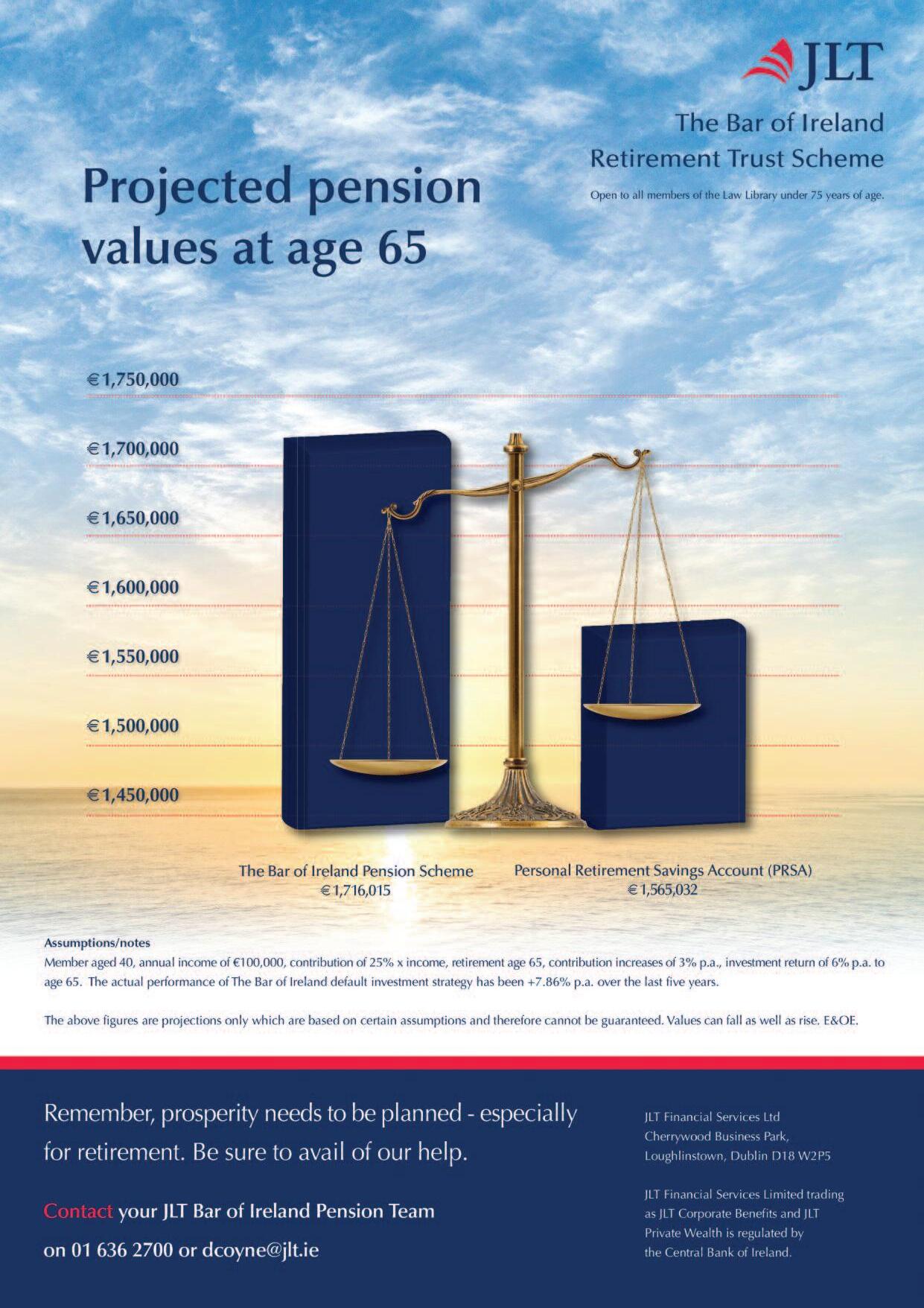
“We are constantly monitoring the performance of The Bar of Ireland Pension Fund investment fund managers ” That’s the statement of Donal Coyne, Director of Pensions with JLT Financial Services Ltd, which administers The Bar of Ireland Pension Fund He explained to The Bar Review that recent economic and political developments have resulted in some market volatility, but that volatility is normal and short term when considered in the context of a 40-year pension investment

“The underlying investment funds and managers are subject to constant review of performance against the market and benchmarks ” Donal said: “The investment managers for The Bar of Ireland Pension Fund have their performance formally reviewed every six months Sub-standard performances result in loss of the investment mandate That way barristers can be assured that we are constantly watching their pension investment on their behalf” The Bar of Ireland Pension Fund is available to all members of the Law Library and, says Donal:

“Being part of a group scheme secures economies of scale, and a combination of lower fund management charges plus good long-term investment returns ensure our members get a better long-term investment performance”

A new element has been added to the New Practitioners’ Programme regarding the solicitor/barrister relationship Stuar t Gilhooly, President of the Law Society of Ireland, and Simon Murphy, former president, were welcomed to the Gaffney Room on December 13 by Paul McGarry SC, and the two solicitors gave their hints and tips for a good working relationship and answered several questions from the audience It is planned that this will be an annual occurrence and that the Law Society will invite the Chairman to address trainee or newly qualified solicitors in return

Donal Coyne, Director of Pensions with JLT Financial Services Ltd

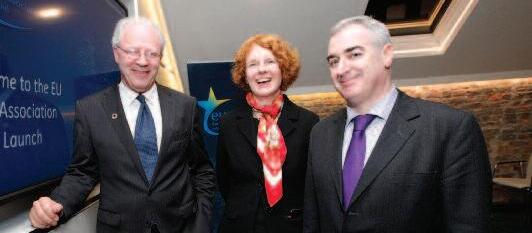
EU Bar Association launched

issues of international law at the launch of the EU Bar Association (EUBA)

area of EU law The Association seeks to promote awareness of the skills and experience of its members and to provide continuing education for barristers in this area The EUBA also seeks to make an active contribution to public debate and to promote reform of the law where the Association perceives it to be necessary The Association's Chairperson is Paul McGarry SC and Vice-Chair is Eileen Barrington SC The launch, which was held in t h e G a f f

featured a presentation by David Conlon Smyth SC on the highly successful Council of Bars and Law Societies of Europe (CCBE)-sponsored European Lawyers in Lesvos project, which commenced in 2016 David's presentation was based on the theme 'Access to Justice' He gave a harrowing account of the plight of migrants arriving in Lesvos and the incredible assistance b e i n g a f fo rd e d t h e m b y t h e v o l u n

working with the European Law yers in Lesvos project Fur ther details can be found on w w w europeanlaw yersinlesvos eu/

ABOVE: Pictured at the launch of the EU Bar Association were (from left): David Donoghue, Irish Ambassador to the UN; Eileen Barrington SC, Vice-Chair, EU Bar Association; and, Paul McGarry SC, Chair, EU Bar Association

LEFT: David Conlon Smyth SC addressed the Conference on the European Lawyers in Lesvos project

Fighting wrongs

Four young Irish barristers spent last summer in the USA working on Innocence Projects trying to exonerate wrongly-convicted prisoners.

Think Media Ltd

I m a g i n e b e i n g c h a rg e d w i t h m u rd e r I m a g i n e y o u d i d n ’t d o i t I m a g i n e nobody believed you There are people in prisons the world over who wake up in this nightmare ever y day, but the high-profile Innocence Project in the USA draw attention to the cases there in par ticular

T h e f i r s t I n n o ce n ce P ro j e c t w a s s e t u p i n N e w Yo r k i n 1 9 9 2 to h e l p exonerate people in the US who have been wrongly convicted Since then, Innocence Projects have been established all across the countr y, and each year The Bar of Ireland offers scholarships to suppor t young law yers who travel to work with different projects in cities across the US

The Bar’s Innocence Project

Roger Cross BL worked with the Innocence Project of Florida in the state’s capital, Tallahassee, and spoke of a murder case he dealt with: “The murder trial went on for two days And at the end of the second day af ter having d o n e a n i n e to f i v e d a y, o n e o f t h e a t to r n e y s m a d e a n a p p l i c a t i o n fo r a postponement until the next day to allow a crucial witness to turn up a n d t h a t w a s re f u

y l i t t

e

s o n T h e a cc u s e d w a s co n v i c te d

murder trial”

P ro j e c t i n C i n c i n n a t i a n d s a i d : “ Po l i ce co r r u

Nothing could have prepared me for the shock of that Reading through cases, I had so many moments where I thought: ‘The police would never do something like that’ And then you’d be looking at proof that they did”

New challenges

The Mid-Atlantic Innocence Project is based in Washington, D C , and it hosted Clíona Boland BL She applied for a place on the project after attending International Women’s Day events which challenged women to try new things in the workplace

While the other barristers who went on the project are in their early years of practice, Clíona was called to the Bar in 2005

“It was a huge risk for me and I said this when I was going for it: I had more to lose than to gain Legal practice when you’re self-employed is quite competitive I had to weigh up the risk of losing some work when I was gone, with the benefits of being involved in something so interesting and so worthwhile ”

She decided it was worth the risk in the end as it gave her a great sense of perspective on the Irish criminal justice system and her own practice

Day to day

Mark Curran BL, who worked with the Innocence Project in Wisconsin, compared the work to the Greek myth of Sisyphus who was condemned to an eternity of pushing a boulder up a hill only to watch it roll back down and crush him Mostly, the Innocence Projects have two types of cases: accepted cases, which they may have been working on for years; and, screener cases, which are applications from prisoners Because the projects operate on limited budgets, the eligibility criteria are quite strict It has to be a prisoner’s last chance They must have exhausted all their appeals, and present something new to the court But in some cases when the trial hasn’t been handled well, it can be used to a prisoner’s advantage Clíona said: “One of the regular grounds for challenging a conviction would be that there was ineffective assistance of counsel I found it quite unusual because it’s rare for solicitors or barristers here to have to use a colleague’s former work on a case to base an appeal” Roger said he had to learn to work in a new way: “You’re putting on your police hat and you’re asking questions like: ‘How did the police arrive at this suspect’? ‘Who incriminated him’? ‘Where did they go from there’? ‘What led them to a piece of evidence’? You’re looking at the very start of the investigative process, what direction it went in, what pieces were collected, rather than the actual legal arguments that were made in the trial or on appeal”

Mark said that around nine out of every ten cases the Innocence Projects take on won’t work out Marie Louise gave an example of how DNA evidence is not always the saviour of the wrongly convicted it is shown to be on television Her client had been in jail since the 1980s for murder and the project managed to get a court order for DNA testing on material from the crime scene, which had never been done She said: “This was massive at the time, or so we thought” Her client was overjoyed because he was sure this would prove his innocence However, when the material was sent to the lab, the technicians said that it was too contaminated In the 80s, there were not the same standards in forensics as there are today and at this crime scene, the equipment they had used to collect evidence had been used at another a few hours before Marie Louise went to the prison to break the news to her client, a man who had thought himself all but exonerated “He just wasn’t getting it”, she said “That’s something I will definitely remember forever because there’s a good chance he’ll spend the rest of his life in prison ” And it’s hard not to feel for these clients: “The likes of him would write us letters very often, handwritten letters that would be quite long asking for updates in the case, asking how we were We would get calls from our clients every single day You kind of have to be a counselling service to them as well because they’re on an emotional rollercoaster where one day they’re excited and hopeful that we’re doing the best we can for them and that they’ll be exonerated, and then the next day they could be completely low and depressed and wondering: ‘Is there any hope at all or am I just going to die in prison?’ That was emotionally very draining”

Learning from flaws

The project has taught everyone who participated in it a lot Roger said: “I think it’s given me an edge in terms of investigations, in terms of the process and how a charge is brought or someone is arrested”

The Innocence Projects are probably most well known for exonerating people through new DNA evidence and techniques, but another field they concentrate on is questioning the validity of certain ‘sciences’ and ‘expert’ witnesses

Mark was lucky in that he got to work almost exclusively on one case It involved a man who had been sentenced to 40 years for the death of his infant child He was prosecuted on evidence that it was a shaken baby death

Mark said: “This shaken baby syndrome is a really current medico-legal topic The reason that so many of these cases are being challenged is that the science behind shaken baby syndrome is becoming more and more challenged and therefore the convictions that are based on this science are open to being tested” Mark, Clíona and Marie Louise all spoke of how science which had previously been considered clear evidence have been debunked or had their validity questioned in recent years And when it comes to expert witnesses, prosecutors only bring to court those that tell them what they want to hear Marie Louise said: “They are used a lot in murder trials in Ireland [For example] they can give an approximate location of where the person’s mobile phone was I learned in America that that is not accurate at all and that it’s incredibly hard to be accurate”

“Two of the bigger cases I worked on were arson cases with murder charges involved”, said Clíona, “That was really interesting because I don’t see a lot of arson here and it’s not regularly before the Irish courts but it’s quite common in America They’ve a high instance of death by fire and arson in the States but it is incredibly hard to prove arson A lot of it is based on faulty science or science that the public and members of the jury believe to be clear and convincing but in fact it sometimes bears the label of junk science without that being made clear to the jury So a lot of people are convicted of murder by arson on very questionable evidence”

Compared to Ireland

Before Marie Louise lef t for the US, she thought that it would have a better c r i m i n a l j u s t i ce s y s te m t h a

convinced her other wise: “It’s just shocking what some people can be found guilty of given the evidence that was presented by the state”

O n e o f Ro g e r ’s c l i e n t s e x

what was, in my view, tenuous identification evidence from a dark evening in Februar y and lost his appeal”

Marie Louise said that although she thinks we have a better system, we could be tougher on criminals when it’s warranted In the States, life means life Here, sometimes if people are caught committing a crime while on bail or on probation they get another chance In the US, those chances don’t exist Mark said Ireland’s criminal justice system is better than the Americans’ and e x p l a i n e d o n e p ro b l e

g ra d u a te s o f te n e i t h e r e n te r d e fe

(district attorneys) and stay on one side for their careers Whereas in Ireland h e s a i d : “ Yo u d o b o t h s i d

someone who’s accused of something, you also understand what it’s like to prosecute That seems to be a huge disadvantage in the US legal system I t h i n k i t l e a d s to a l a c k o f e m p a t h y a n d l e a d s to d i v i s i o n w

profession”

Ro g e r s p o ke a b o u t h o w t h e d i s t r

D P P h a s g u i d e l i n e s fo r p ro s e c u to r s i n I re l a n d w h i c h p ro v i d e t h a t t h e y s h o u l d n ’t o b t a i n b y a n y m e a n s a

seeking a conviction They should just independently lay the evidence before a jur y which they believe is substantial enough to obtain a conviction But my experience from the American prosecution authorities is that they are ruthlessly seeking ever y conviction They ’re less impar tial and less objective than Irish prosecutors”

Clíona said we have a more robust system In the US: “A lot of the time an innocent person will go through multiple cour t applications in order to prove their innocence, whereas in Ireland, it would not get to that point firstly, and s e co n d l y, i f t h e re w a s a m i s c a r

questionability over a jur y ’s verdict, it would be cleared up a lot quicker”

Breaking free

Marie Louise said that since she’s been home, people have been asking her how many people she got out of prison She says to them: “No, that’s not how it works”

The exoneration process is an agonising dream for the wrongly convicted It takes on average ten years to get an innocent person out of prison and they ’re the lucky ones

Marie Louise read a number of cases where she thought the prisoner was probably innocent but the system was against them in some way or the evidence just wasn’t there to exonerate them

She said: “You’d look back at some of the men who were on death row for so long and some of the men who were executed and you’d wonder, how many of them were actually innocent?”

Mark talked about his own case: “I believe that my client is innocent and I would hope that that is recognised, but the reality is that it will be an uphill struggle for him to prove that innocence in a fashion that is acceptable to the cour t”

A reasonable man

On a recent visit to Dublin as a guest of the Free Legal Advice Centres (FLAC), Justice Edwin Cameron spoke about fighting injustice, the South African Constitutional Cour t, and the impact being openly gay and HIV positive has had on his life and career.

For Justice Edwin Cameron of the South African Constitutional Court, the personal and the political have always been inextricably linked His early life cer tainly doesn't fit the stereotype that we in Europe might have of white South African privilege during apar theid, and he experienced a profound sense of his own difference Coming from a poor background, he spent several years in a children's home Education proved to be his escape in the form of scholarships to excellent schools and universities, including a Rhodes Scholarship to Oxford, but he was acutely aware that these opportunities were not offered to everyone: "I grew up with an intense sense of my racial identity contributing to an escape from poverty, and the injustice of that in an overwhelmingly black country I also grew up with

a sense from adolescence of being gay in a deeply homophobic society and then in my early thir ties as a young barrister, becoming infected with HIV So these have been the determining elements of my professional life"

Finding a calling

This powerful sense of injustice crystallised when, while studying law at Oxford, Edwin heard about the death of anti-apartheid activist Steve Biko, who died in police custody in September 1977 Up to that point, he knew very little about Biko and his fellow anti-apartheid activists: "At Stellenbosch [University, where Edwin studied before going to Oxford] one lived in a sea of exclusively white racial privilege We were brought up not to know Then I read Steve Biko's writings, which were pivotal in the development of my racial consciousness as a white person "

From the beginning, Edwin wanted to use the legal system to fight "the human rights atrocity of apartheid" In an interview with The Bar Review last year, journalist John Carlin spoke about how, for all the horrors of apartheid, South Africa had a functioning justice system that was key to reform when the time came, and Edwin agrees: "The paradox is that South African law was used to oppress people but it was a real legal system"

"At Stellenbosch [Univer sit y, where Edwin studied before going to Oxford] one lived in a sea of exclusively white racial privilege We were brought up not to know. Then I read Steve Biko's writings, which were pivotal in the development of my racial consciousness as a white per son " .

A number of human rights organisations such as the Legal Resources Centre, the Centre for Applied Legal Studies, where Edwin worked, and Lawyers for Human Rights, explicitly used the law to combat apartheid The reform process was also very much led by lawyers: "All of the main negotiators – Mandela, de Klerk, Ramaphosa, Roelf Meyer, Slovo – were lawyers, so it was a lawyer-heavy transition" For Edwin, public engagement with the law, and the public's belief that the justice system belongs to them, is also a fundamental principle that defines both the fight against apartheid and the creation of a new South Africa after its defeat: "There was a widespread sense among ordinary, mostly black South Africans, that the law could be used to fight injustice because there had been a number of significant cases The reason why the 'Pass laws' (see panel overleaf) stopped being applied was because of a court case in the then appeal court"

A new world

Post-apartheid South Africa found itself with a unique opportunity to craft an entirely new political and legal system, and a consensus was reached among the negotiators that the new democracy would be best served by a constitution and a bill of rights, supported by a constitutional court Edwin is a passionate defender of this approach, for all its imperfections, and is extremely proud of the South African Constitution: "The result was by far the world's most generous-spirited and progressive constitution, which included gay rights, sexual orientation equality for someone like me as an openly gay man who'd campaigned for equality under apartheid, and a very generous equality clause" Crucially, and unusually, the Constitution also includes social and economic rights In Ireland, we are all too familiar with debates about whether certain rights have a place in a constitution, or whether society is better served by dealing with these issues in the legislative arena Edwin defends the constitutional approach: "The idea that judges can't judge socioeconomic issues is wrong because judges are quite

The truth will set you free

Edwin spoke about what it was like coming out as a gay man in the 1980s in apar theid South Africa: "It was rough There was this great unspoken thing Obviously there have always been people who identify as gay but to come out in apar theid South Africa and to come out in the legal profession of the early '80s was very difficult But it was a personal necessity I was married to a woman and we still cared for each other but it was a mistake for both of us and I realised in the marriage that I was being profoundly untruthful to myself I resolved, just before turning 30, that I would never ever again apologise for being what I was, which was gay " Perhaps surprisingly, he doesn't feel that he suffered a great deal of

capable of making an assessment of reasonableness In South Africa we have right of access to various social and economic goods and then there's an obligation on government to take reasonable legislative and other measures So in the first instance it's the government's responsibility, not the judiciary's responsibility, but the judiciary can assess whether the measures taken are reasonable"

He gives a very striking example of this principle in action in a case that was very close to his heart, the right of people with HIV to access antiretroviral drugs: "I started on antiretroviral treatment in 1997 and I realised that those drugs had saved my life I started speaking out about my own HIV a year or two later and then there was this mass crisis of black South Africans falling sick and government refusing to make the treatment available because President Mbeki was sceptical about the causes of AIDS The Treatment Action Campaign (TAC) took him to court, and the Constitutional Court gave a judgment saying that President Mbeki's policies on AIDS were not reasonable We eventually got the world's biggest publicly-provided treatment programme because of this magnificent Constitutional Court decision It showed the power of the Constitution, of the rule of law, and the power, I think, of legal reasoning We've now got 3 5 million people like me, who owe their lives to antiretroviral treatment, and it's directly attributable to the legal struggle"

The gender gap

In Africa, where AIDS is a predominantly heterosexual disease, the fight to reduce infection is very much tied to larger issues of gender, masculinity and patriarchy, and these are issues Edwin has spoken and written about: "There's no major civilisation that hasn't been patriarchal and Africa also has many patriarchal cultures (there's no single African culture) So it's a very big problem because women bear the brunt of the epidemic There are high levels of gender-based violence, there are high levels of sexual abuse of children and of women, so we ' re dealing with all of these substantial issues in the HIV epidemic"

discrimination, when he came out, or later, when he spoke publicly about his HIV: "I had a very busy practice I was dealing with a range of cases, not just political but many other cases as well, so I don't think I was discriminated against Of course, you don't speak to the people who might be averse When I spoke publicly about my HIV at the beginning of 1999 I had a flood of loving and positive responses I never heard of the people who were negative about it If there were some, they cer tainly never spoke to me " As a campaigner on social justice, he says these momentous and brave decisions were "perilous, but personally imperative It was difficult to close that gap but richly rewarding once I had closed it"

Significant cases in an extraordinar y career

"The cases that were most important to me included conscientious and religious objection cases – young white men who refused to be drafted into the apartheid army We also did cases on removal from the land – where we successfully fought for black communities not to be removed

“We fought many cases against the Pass laws, against residential discrimination I also represented ANC fighters who had been arrested and charged with treason

Those were the cases that stood out

"Since becoming a judge, one Appeal Court case that stands out was when we

We eventually got the world's biggest publicly-provided treatment programme because of this magnificent Constitutional Cour t decision. It showed the power of the Constitution, of the rule of law, and the power, I think, of legal reasoning

He says two things are needed to address this: communication and change in social attitudes: "It's got to star t in communities A large par t of that involves giving young women a voice, and that is being done, but there's a l o n g w a y to g o We ' v e g

country, such as the public protector, Thuli Madonsela, who just completed her office in October [2016]"

Indeed, within the legal profession in South Africa, there are specific formal m e a s u re s i n

to

scheme for female judicial candidates However, the measures fall shor t of gender quotas, another issue that has been the subject of much debate in Ireland While he suppor ts embedding affirmative action measures in the system, Edwin does not feel that quotas are the answer: "In the [South African] Constitution it says that equality includes taking positive measures to undo historical injustice and I suppor t that, but our legislation outlaws q u o t a s a n d I t h i n k t h a t ' s r i g h

We ' v e g o t t a rg e t s a n d i t ' s t r u e t h

distinction between a quota and a target but it's an impor tant distinction I'm in favour of targets and the target must obviously be at least 50%" He points out that his own cour t has three female members out of a total of 11 judges, and while this is not enough, the work continues " I t ' s b o t h a m a t

t h a t decision-making without representation is impoverished In ever y judicial appointment there has been, and rightly so, a consciousness of how many people on that par ticular provincial bench are women Are women severely underrepresented, or are they adequately represented? What will you, as a white man or a black man do? What can you bring to discount the fact that you ' re not bringing gender representivity? It's a legitimate question It's one I was asked and I think it's the right question to ask a white male like myself"

ordered the police and a local authority to rebuild shacks they had illegally demolished The Constitution says that no one may be evicted from his or her home without an order of court given after consideration of all circumstances We made them rebuild the shacks, so that was a pivotal case

"Then there are free speech cases that I recall One of them concerned an opposition party that attacked President Zuma for 'stealing' public money to build his private residence We held that that was protected by a broad ambit of 'protected expression' under the Constitution "

He says that these measures are working in terms of representation of both black people and of women: "I think the statistics tell their own story Within 22 years there's been a quite radical transformation of the judiciary, which is now majority black and one-third female"

A (guarded) success story

Twenty-two years isn't a long time in the scheme of things if you’re talking about creating a new society, and Edwin acknowledges that there is much more to be done to, as he puts it, "eliminate the disjunct between law and justice" He firmly believes that the basis is there, however, par ticularly in the "Founding Values" – of citizenship, rule of law, right to equality and right to freedom – which are enshrined in the Constitution Unlike Ireland, where Constitutional change requires a referendum, the South African Constitution can be changed by a two-thirds majority in parliament However, changing the "Founding Values" requires a three-quar ters majority – a 'super-majority' –making them difficult if not impossible to remove and giving scope for the work to continue Perhaps more impor tantly, he says the South African citizenry has bought in to the concepts: "My view is that there is a widely disseminated sense of internalised constitutional agency The constitution hasn't delivered what it should, which is clean governance, non-corruption, social and economic rights for all, dignity for all, safety and security for all But there is a sense that we should be moving towards it and that people have an entitlement to claim those things, and that's a very impor tant thing that a bill of rights gives people"

Edwin must step down from the Constitutional Court by 2020 when his 12-year term comes to an end, so he has begun to think about what might be next for him: "I hope to do some prison work I think that in most Western societies we don't understand the purposes of punishment We don't understand why crime goes up and down We poorly understand criminology and penology In South Africa there's an enormous need for work on the prisons and prison reform"

Pass laws

The 'Pass laws' were an internal passpor t system used during apar theid to segregate the population Under these laws, all black people over the age of 16 had to carry a pass book at all times in white areas, which stated whether and for how long they were permitted to stay there Pass books without valid entries entitled the authorities to arrest and imprison the bearer The Pass laws were a hated symbol of apar theid and were repealed in 1986

U P DAT E

The Bar Review, journal of The Bar of Ireland

A directory of legislation, articles and acquisitions received in the Law Library from November 10, 2016, to January 18, 2017

Judgment information supplied by Justis Publishing Ltd

Edited by Deirdre Lambe and Vanessa Curley, Law Library, Four Courts.

A D M I N I S T R AT I V E L AW

Librar y acquisitions

I n s t i t u te o f P u b l i c A d m i n i s t ra t i o n

I n s t i t u t e o f P u b l i c A d m i n i s t r a t i o n

Ireland – A Directory 2017 (51st ed )

D u b l i n : I n s t i t u te o f P u b l i c Administration, 2016 – Ref

AG R I C U LT U R E

Statutor y instruments

A s s e m b l y o f a n i m a l s fo r e x p o r t regulations 2016 – SI 212/2016

C a r r i a g e o f l i v e s to c k b y s e a

( a m e n d m e n t ) re g u l a t i o n s 2 0 1 6 – S I 455/2016

H o r s e ra c i n g I re l a n d a c t 2 0 1 6

( co m m e n ce m e n t o f ce r t a i n p ro v i s i o n s ) o rd e r 2 0 1 6 – S I 138/2016

A R B I T R AT I O N

Librar y acquisitions

v a n d e n B e rg , A J I n t e r n a t i o n a l

C o u n c i l f o r C o m m e r c i a l A r b i t r a t i o n

Y e a r b o o k c o m m e r c i a l a r b i t r a t i o n : volume XLI – 2016 The Netherlands: K l u w e r L a w I n te r n a t i o n a l , 2 0 1 7 –N398 3

Ar ticles

Wade, G The Cour t of Arbitration for S p o r t : J u d g i n g t h e O l y m p i c g a m e s

C o m m e r c i a l L a w P r a c t i t i o n e r 2 0 1 6 ; 23 (11): 287

A S Y L U M

Asylum, immigration and nationality – Re f u g e e s t a t u s – C l a i m fo r –

E d u c a t i o n – W h e t h e r f a i l u re to p ro v i d e e d u c a t i o n s u f f i c i e n t to establish grounds for claim for status – C o n s i d e re d B a r r y v M i n i s t e r fo r

A g r i c u l t u r e a n d F o o d [ 2 0 1 5 ] 7 J I C

1 6 0 1 ,

O’Donnell Donal J , Clarke J , Laffoy

J , C h a r l e to n J – 2 1 / 1 2 / 2 0 1 6 ) –[2016] IESC 77

E D ( E d u c a t i o n ) v R e f u g e e A p p e a l s

Tribunal

BA N K I

N G

B a n k i n g – C o n s e n t o rd e r – L i a b i l i t y

– Applied Byrne Motor s Ltd v Rover

Lt d [ 1 9 9 8 ] I E H C 2 3 2 , Re fe r re d to

Allied Irish Banks Plc v Darcy [2016]

7 J I C 1 4 0 1 , Re fe r re d to A l l i e d I r i s h

Banks Plc v Thomas Darcy and Anor

[ 2 0 1 5 ] I E H C 3 5 3 – ( L a f fo y J ,

M c Ke c h n i e J , M a c M e n a m i n J –

10/11/2016) – [2016] IESC 65

Allied Irish Banks plc v Darcy

B a n k i n g a n d f i n a n ce – I n s o l v e n c y –

P ra c t i ce a n d p ro ce d u re s – Re fe r re d

to A A v B A [ 2 0 1 5 ] 1 1 J I C 0 9 0 8 ,

Re fe r re d to G a y n o r v C

S

r v i ce [ 2 0 1 5 ] 1 1 J I C 3 0 0 6 , Re fe r re d to I n

Re Greendale Developments Ltd (No 3) [2000] 2 IR 514 – (Humphreys J – 16/12/2016) – [2016] IEHC 730

Gaynor (A Bankrupt) (No 2) v Courts Service of Ireland

Undue influence – Non est factum –

A rg u a b l e d e fe n

R

1 ) [2001] 4 IR 607, Applied Harrisrange

Ltd v Duncan [2003] 4 IR 1, Applied

Royal Bank of Scotland plc v Etridge (No 2) [2002] 2 AC 773 – (Pear t J , B i r m i n g h a m J , H o g a n J –07/12/2016) – [2016] IECA 371

Ulster Bank (Ireland) Ltd v De Kretser

Statutor y instruments

Central Bank Act 1942 (section 32D) regulations 2016 – SI 508/2016

C e n t ra l B a n k a c t 1 9 7 1 ( a p p ro v a l o f

s c h e m e o f t ra n s fe r b e t w e e n LG T

Bank (Ireland) Limited and LGT Bank Limited) order 2016 – SI 465/2016

C e n t ra l B a n k A c t 1 9 9 7 ( a u d i to r assurance) (amendment) regulations 2016 – SI 445/2016

C e n t ra l B a n k ( s u p e r v i s i o n a n d e n fo rce m e n t ) a c t 2 0 1 3 ( s e c t i o n 4 8 ( 1 ) ) i n v e s to r m o n e y re g u l a t i o n s fo r f u n d s e r v i ce p ro v i d e r s ( a m e n d m e n t ) re g u l a t i o n s 2 0 1 6 – S I 87/2016

C e n t ra l B a n k ( S u p e r v i s i o n a n d

E n fo rce m e n t ) A c t 2 0 1 3 ( s e c t i o n

4 8 ( 1 ) ) ( i n s u ra n ce u n d e r t a k i n g s national specific templates repor ting arrangements) regulations 2016 – SI 159/2016

C e n t ra l B a n k ( S u p e r v i s i o n a n d Enforcement) Act 2013 (section 48) (lending to small and medium-sized e n te r p r i s e s ) ( a m e n d m e n t ) regulations 2016 – SI 280/2016

C e n t ra l B a n k ( S u p e r v i s i o n a n d

E n fo rce m e n t ) A c t 2 0 1 3 ( s e c t i o n

4 8 ( 1 ) ) ( u n d e r t a k i n g s fo r co l l e c t i v e investment in transferable securities)

( a m e n d m e n t ) re g u l a t i o n s 2 0 1 6 – S I 307/2016

C e n t ra l B a n k ( S u p e r v i s i o n a n d Enforcement) Act 2013 (section 48)

( h o u s i n g l o a n re q u i re m e n t s )

( a m e n d m e n t ) re g u l a t i o n s 2 0 1 6 – S I 568/2016

C o n s u m e r C re d i t A c t 1 9 9 5 ( s e c t i o n 2) regulations 2016 – SI 325/2016

C re d i t i n s t i t u t i o n s re s o l u t i o n f u n d l e v y ( a m e n d m e n t ) re g u l a t i o n s 2 0 1 6 – SI 499/2016

C re d i t Re p o r t i n g A c t 2 0 1 3 ( s e c t i o n

6 ) ( a d d i t i o n a l p e r s o n a l i n fo r m a t i o n ) regulations 2016 – SI 485/2016

C re d i t Re p o r t i n g A c t 2 0 1 3 ( s e c t i o n 1 1 ) ( p ro v i s i o n o f i n fo r m a t i o n fo r ce n t ra l c re d i t re g i s te r ) re g u l a t i o n s 2016 – SI 486/2016

C re d i t Re p o r t i n g A c t 2 0 1 3 ( s e c t i o n 17) (access to central credit register) regulations 2016 – SI 487/2016

C re d i t Re p o r t i n g A c t 2 0 1 3 ( s e c t i o n 20) (verification of identity of credit i n fo r m a t i o n s u b j e c t s ) re g u l a t i o n s

2016 – SI 488/2016

C

489/2016

C re d i

regulations 2016 – SI 585/2016

Credit union fund (stabilisation) lev y regulations 2016 – SI 583/2016

E u ro p e

481/2016

European Union (bank recover y and re s o l u t i o n ) re s o l u t i o n f u n d l

y regulations 2016 – SI 202/2016

European Union (payment accounts) regulations 2016 – SI 482/2016

B I L L S O F E X C H A N G E

Librar y acquisitions

G u e s t , A G C h a l m e r s a n d G

s t o n bills of exchange and cheques (18th e d ) Lo n d o n : S w e e t & M a x w e l l , 2016 – N306 2

B U I L D I N G

C O N T R AC T S

Librar y acquisitions

Hussey, A Construction adjudication i n I r e l a n d A b i n g d o n : Ro u t l e d g e , 2017 – N83 C5

C H A R I T Y

Statutor y instruments

Charities act 2009 (commencement) (no 2) order 2016 – SI 424/2016 Charities Act 2009 (commencement) order 2016 – SI 350/2016

C H I L D R E N

Statutor y instruments

C

221/2016

C h i l d re n f i r s t a c t 2 0 1 5 ( co m m e n ce m e n t ) o rd e r 2 0 1 6 – S I 211/2016

C O M M E R C I A L L AW

Librar y acquisitions

C h r i s to u , R D r a f t i n g c o m m e r c i a l agreements (6th ed ) London: Sweet & Maxwell, 2016 – N250

R u d d y, N , M i l l s , S , D a v i d s o n , N

S a l i n g e r o n f a c t o r i n g ( 5 t h e d )

Lo n d o n : S w e e t & M a x w e l l , 2 0 1 7 –N305 8

Ar ticles

Khan, S International comparison of

co r p o ra te g o v e r n a n ce e x e c u t i v e

re m u n e ra t i o n [ p a r t 1 ] I r i s h L a w Times 2016; (34) (18): 262; [par t 2] Irish Law Times 2016; (34) (19): 270;

[ p a r t 3 ] I r i s h L a w T i m e s 2 0 1 6 ; ( 3 4 ) (20): 292

C O M PA N Y L AW

C o m p a n y – S 5 2 o f t h e C o m p a n i e s Act, 2014 – O29 of the Rules of the

S u p e r i o r C o u r t s – A p p l i e d C M C

M e d i ca l O p e r a t i o n s Lt d ( i n liquidation) t/a Cork Medical Centre

v Vo l u n t a r y H e a l t h I n s u ra n ce B o a rd [2015] IECA 68, Applied Ochre Ridge v Cork Bonded [2000] 12 JIC 2001 –( E a g a r J – 1 7 / 1 1 / 2 0 1 6 ) – [ 2 0 1 6 ] IEHC 660

O r c a F i n a n c i a l L t d v B a l l y c r a g Developments Ltd

Librar y acquisitions

H o l l i n g to n , R H o l l i n g t o n o n

s h a r e h o l d e r s ’ r i g h t s ( 8 t h e d )

Lo n d o n : S w e e t & M a x w e l l , 2 0 1 7 –N263

Hutchinson, B , Keane, R Keane on C o m p a n y l a w ( 5 t h e d ) D u b l i n : B l o o m s b u r y P ro fe s s i o n a l , 2 0 1 6 –N261 C5

Ar ticles

D o n n e l l y, D E x p e n s e s , c h a rg e s a n d n e ce s s a r y d i s b u r s e m e n t s o f a l i q u i d a to r fo l l o w i n g t h e C o m p a n i e s

Act 2014: (par t II) Irish Business Law Review 2016; (3) (1): 37 Heslin, M Shareholder oppression –

r i g h t s , i n te re s t s , e x p e c t a t i o n s a n d equity Commercial Law Practitioner 2016; 23 (11): 271

S h a n a h a n , E I s e x a m i n e r s h i p fo r

s m a l l e r co m p a n i e s w o r t h h a v i n g ?

Irish Business Law Review 2016; (3) (1): 51

Statutor y instruments

C o m p a n i e s a c t 2 0 1 4

( co m m e n ce m e n t ) o rd e r 2 0 1 6 – S I 562/2016

C o m p a n i e s a c t 2 0 1 4 ( s e c t i o n 8 3 9 ) regulations 2016 – SI 147/2016

C o m p a n i e s a c t 2 0 1 4 ( s e c t i o n 8 9 7 ) order 2016 – SI 458/2016

B u s i n e s s n a m e s re g u l a t i o n s 2 0 1 6 –

SI 339/2016

C re d i t g u a ra n te e ( a m e n d m e n t ) a c t

2016 (commencement) order 2016 –

SI 504/2016

C

O M P

E T I T I O N L AW

Librar y acquisitions

G ra e f, I E U c o m p e t i t i o n l a w , d a t a

protection and online platforms: data as essential facility The Netherlands: Wolters Kluwer, 2016 – W110

v a n d e r Wo u d e , M , J o n e s , C E U

c o m p e t i t i

n l a w h a n d b

2 0 1 7 ( 2 0 1 7 e d ) Lo n d o n : S w e e t & Maxwell, 2016 – W110

C O N T R AC T

Contract – Practice and procedures –

O8, r 2 of the Rules of the Superior

C o u r t s – A p p l i e d M o n a h a n v B y r n e [ 2

O’Keef fe v G & T Crampton Ltd and

A n o r ( 2 0 0 9 ) 1 6 ( 9 ) C L P 2 0 8 –

( M c D e r m o t t J – 0 9 / 1 2 / 2 0 1 6 ) –[2016] IEHC 704

Pugh v PGM Financial Services Ltd

Librar y acquisitions

C a r t w r i g h t , J M i s r e p r e s e n t a t i o n , m i s t a k e a n d n o n - d i s c l o s u r e ( 4 t h e d ) Lo n d o n : S w e e t & M a x w e l l , 2017 – N15 4 A n d e r s o n , M , Wa r n e r, V D r a f t i n g

a n d n e g o t i a t i n g c o m m e r c i a l

contracts (4th ed ) Hay wards Heath: Bloomsbur y Publishing, 2016 – N10

C O P Y R I G H T

Ar ticles

M a z z i o t t i , G W i l l E u ro p e m a ke

co p y r i g h t b o rd e r l e s s a n d internet-friendly? Irish Business Law

Review 2016; (3) (1): 1

C O S T S

C o s t s – A s s a u l t – N e g l i g e n ce –

A p p l i e d C o u g h l a n v D i s t r i c t J u s t i ce

Pa t w e l l [ 1 9 9 3 ] 1 I R 3 1 , A p p l i e d

McDonnell v Ireland [1998] 1 IR 134

– ( I r v i n e J , H o g a n J , H e d i g a n J –07/12/2016) – [2016] IECA 372

S a v i c k i s v G o v e r n o r o f C a s t l e r e a

Prison

C o s t s – L i a b i l i t y – L i q u i d a t i o n –

Respondent seeking costs – Whether

a p p e l l a n t w a s p a r t y to t h e p ro ce e d i n g s – Re fe r re d to G re e n c

e a n Wa s t e M a n

g e m e n t Lt d v Le a h y ( t / a M a u r i ce Le a h y & C o

Solicitors) [2013] IEHC 74, Referred to S i m p s o n v N o r fo l k a n d N o r w i c h

Univer sit y Hospital NHS Trust [2012] Q B 6 4 0 , Re fe r re d to S te l l a C o

– (Mahon J , Birmingham J , Edwards J – 14/11/2016) – [2016] IECA 332 DPP v Gleeson

n n e J –15/12/2016) – [2016] IESC 72

Costello Transport Ltd v Singh

Costs – Personal injur y – Misconduct – A p p e l l a n t s e e k i n g to a p p e a l

a g a i n s t a n o rd e r d i re c t i n g t h e

p a y m e n t o u t to t h e n o t i ce p a r t y o f the balance of par ty and par ty costs – W h e t h e r o rd e r w a s a l m o s t exclusively based on alleging various acts of misconduct or impropriety, or

o f d i s h o n e s t y – A p p l i e d B a n k o f

I r e l a n d v B r e e n [ 1 9 8 7 ] WJ S C -S C

2 5 4 5 , A p p l i e d B r e w e r v

C o m m i s s i o n e r s o f P u b l i c Wo r k s

[ 2 0 0 3 ] 3 I R 5 3 9 , A p p l i e d E i r e

C o n t i n e n t a l Tr a d i n g C o Lt d v

C l o n m e l Fo o d s Lt d [ 1 9 5 5 ] I R 1 7 0 –

( M c Ke c h n i e J , M a c M e n a m i n J ,

D u n n e J – 1 6 / 1 2 / 2 0 1 6 ) – [ 2 0 1 6 ]

IESC 75

Cadden v Vesey

C O U RT S

Acts

Cour ts Act 2016 – Act No 22 of 2016 – signed on December 28, 2016

Statutor y instruments

C o u r t s a c t 1 9 8 1 ( i n te re s t o n

j u d g m e n t d e b t s ) o rd e r 2 0 1 6 – S I

624/2016

D i s t r i c t C o u r t ( c r i m i n a l j u s t i ce

( fo re n s i c e v i d e n ce a n d D N A

d a t a b a s e s y s te m ) a c t 2 0 1 4 ) r u l e s

2016 – SI 567/2016

D i s t r i c t C o u r t ( i s s u e o f c i v i l p ro ce e d i n g s ) r u l e s 2 0 1 6 – S I 513/2016

District Cour t (solicitors’ costs) rules 2016 – SI 123/2016

F i n e s ( p a y m e n t a n d re co v e r y ) a c t 2 0 1 4 ( fe e s ) o rd e r 2 0 1 6 – S I 549/2016

C R I M I NA L L AW

C o n v i c t i o n – I n d e ce n t a s s a u l t –

Corroboration warning – Referred to DPP v CC [Cour t of Criminal Appeal] [2012] 12 JIC 0601, Referred to DPP v G e n t l e m a n [ 2 0 0 3 ] 4 I R 2 2 ,

Re fe r re d to D P P v R B ( U n re p o r te d , Fe b r u a r y 1 2 , 2 0 0 3 ) – ( B i r m i n g h a m

J , S h e e h a n J , M a h o n J –25/10/2016) – [2016] IECA 307 DPP v F McL

C o n v i c t i o n – Po s s e s s i o n o f d r u g s –

Duress – Considered Braddish v DPP [ 2 0 0 1 ] 3 I R 1 2 7 , C o n s i d e re d D P P v D i c ke y [ 2 0 0 3 ] 3 J I C 0 7 0 6 , Considered R v Lawrence 32 ALR 72

Conviction – Rape – Mental element – Applied DPP v C [2001] 3 IR 345, Applied DPP v Fergal Cagney [2008] 2

IESC 64 DPP v O’R

McLaughlin v Aviva Insurance [2011] IESC 42 – (Keane J – 28/10/2016) – [2016] IEHC 591 M c G u i n n e s s v C

Garda Síochána

C r i m e a n d s e n te n c i n g – D r u g s –Appeal against sentence – Supply of d r u g s o v e r D a r k N e t – S e v e r i t y o f sentence – (Birmingham J , Sheehan J , E d w a rd s J – 0 3 / 1 1 / 2 0 1 6 ) –[2016] IECA 314 DPP v Mannion

Crime and sentencing – Extradition –E u ro p e a n a r re s t w a r ra n t – A p p l i e d L a n i g a n v G o v e r n o r o f C l o v e r h i l l Prison [2016] 10 JIC 1904, Referred to Po w e r, F l y n n a Lt d v M i n i s t e r fo r Fisheries and Forestr y [1985] IR 193, Re fe r re d to I n re D ( A p p l i c a t i o n o f Midland Health Board) [1987] IR 449 – ( F i n l a y G e o g h e g a n J , H o g a n J , H a n n a J – 1 4 / 1 2 / 2 0 1 6 ) – [ 2 0 1 6 ] IECA 388 O w c z a r z v G o v e r n o r o f C l o v e r h i l l Prison

C r i m e a n d s e n te n c i n g – S e x u a l o f fe n ce s – A t te m p te d ra p e s a n d s e x u a l a s s a u l t s – ( B i r m i n g h a m J , S h e e h a n J , M a h o n J –09/12/2016) – [2016] IECA 390 DPP v JF C r i m

[1998] IESC 39,

to

Vye [

09/12/2016) – [2016] IECA 391 DPP v PC

C r i m e a n d s e n te n c i n g – S e x u a l o f fe n ce s – O f fe n ce s co m m i t

(Birmingham J , Sheehan J , Edwards J – 13/12/2016) – [2016] IECA 386 DPP v Kiely

C r i m e a n d s e n te n c i n g – S e x u a l

o f fe n ce s – S e n te n c i n g fo r m u l t i p l e sexual assaults – Applied Mulholland v Mitchell [1971] AC 666, Considered DPP v Cunningham [2002] 2 IR 712, D P P v D u f f y [ 2 0 0 3 ] 2 I R 1 9 2 –

( D e n h a m C J , O ’ D o n n e l l D o n a l J , Clarke J , Charleton J , O’Malley J –28/11/2016) – [2016] IESC 69 DPP v Colbert

Sentencing – Drug offences – Undue

l e n i e n c y – A p p l i e d D P P v

M c C o r m a c k [ 2 0 0 0 ] 4 I R 3 5 6 –(Mahon J , Birmingham J , Sheehan

J – 24/11/2016) – [2016] IECA 356 DPP v Clohessy

S e n te n c i n g – M o n e y l a u n d e r i n g –

S e v e r i t y o f s e n te n ce – Re fe r re d to DPP v McCormack [2000] 4 IR 356, Referred to DPP v McHugh [2002] 1

I R 3 5 2 , Re fe r re d to D P P v T i m o t h y

C u n n i n g h a m [ 2 0 1 3 ] I E CC A 6 2 –(Mahon J , Birmingham J , Sheehan J – 27/10/2016) – [2016] IECA 309 DPP v Trimble

S e n te n c i n g – Ro b b e r y – S e v e r i t y o f

s e n te n ce – A p p e l l a n t s e e k i n g to

a p p e a l a g a i n s t s e n te n ce – W h e t h e r

s e n te n ce w a s u n d u l y s e v e re –

Applied DPP v McCormack [2000] 4 IR 356 – (Birmingham J , Mahon J , Edwards J – 08/12/2016) – [2016] IECA 379

DPP v Obaseki

S e n te n c i n g – S e x u a l o f fe n ce s –

S e v e r i t y o f s e n te n ce – A p p e l l a n t seeking to appeal against sentence –Whether sentence was unduly severe

– ( B i r m i n g h a m J , S h e e h a n J , M a h o n J – 2 7 / 1 0 / 2 0 1 6 ) – [ 2 0 1 6 ] IECA 312

DPP v ET

Librar y acquisitions

A r l i d g e , A , M i l n e , A , S p re n g e r, P Arlidge and Parry on fraud (5th ed )

Lo n d o n : S w e e t & M a x w e l l , 2 0 1 6 –

M547

T h o m s o n Ro u n d H a l l O f f e n c e s h a n d b o o k 2 0 1 6 : c r i m i n a l & r o a d

traffic Dublin: Thomson Round Hall, 2016 – M500 C5 Z14

Ar ticles

L a m b o u r n e , T , Wo o d , S W i l l t h e

co u n te r- te r ro r i s m a n d s e c u r i t y a c t

2 0 1 5 b e t h e f i n a l p i e ce o f counter-terrorism legislation to stem

t h e t i d e o f e x t re m i s m I r i s h L a w

Times 2016; (34) (20): 286

Statutor y instruments

Criminal Justice (Money Laundering a n d Te r ro r i s t F i n a n c i n g ) A c t 2 0 1 0

( co m p e te n t a u t h o r i t y a n d s t a te

co m p e te n t a u t h o r i t y ) re g u l a t i o n s 2016 – SI 453/2016

C r i m i n a l J u s t i ce ( Te r ro r i s t O f fe n ce s )

A c t 2 0 0 5 ( s e c t i o n 4 2 ) ( re s t r i c t i v e

measures concerning cer tain persons and entities associated with the ISIL (Da’esh) and Al-Qaida organisations)

( n o 2 ) re g u l a t i o n s 2 0 1 6 – S I

463/2016

C r i m i n a l J u s t i ce ( Te r ro r i s t O f fe n ce s )

A

measures concerning cer tain persons and entities associated with the ISIL (Da’esh) and Al-Qaida organisations)

( n o 3 ) re g u l a t i o n s 2 0 1 6 – S I

472/2016

C r i m i n a l J u s t i ce ( Te r ro r i s t O f fe n ce s )

A c t 2 0 0 5 ( s e c t i o n 4 2 ) ( re s t r i c t i v e

measures concerning cer tain persons and entities associated with the ISIL (Da’esh) and Al-Qaida organisations)

( n o 6 ) re g u l a t i o n s 2 0 1 6 – S I

563/2016

DA M AG E S

D a m a g e s – N e g l i g e n t m i s s t a te m e n t – M i s re p re s e n t a t i o n – A p p l i e d

Cramaso LLP v Ogilvie-Grant [2014]

S C ( S C ) 1 2 1 – ( R y a n P , Pe a r t J , H o g a n J – 2 3 / 1 1 / 2 0 1 6 ) – [ 2 0 1 6 ] IECA 346

S p e n c e r v I r i s h B a n k R e s o l u t i o n

Corporation Ltd

Librar y acquisitions

L a w s o n , R D a m a g e s f o r b r e a c h o f contract London: Sweet & Maxwell, 2016 – N37 1

Q u i l l , E , F r i e l , R J D a m a g e s a n d c o m p e n s a t i o n c u l t u r e : c o m p a r a t i v e p e r s p e c t i v e s O x fo rd : H a r t Publishing, 2016 – N37 1 008

DATA P R OT E C T I O N

Statutor y instruments

D a t a p ro te c t i o n a c t 1 9 8 8 ( s e c t i o n 2A) regulations 2016 – SI 220/2016

D I S C OV E RY

Librar y acquisitions

T h e B a r o f I re l a n d C P D, D r i n a n , S ,

B e i r n e , A , M a r t i n , E , M c L a u g h l i n , J , Har ty, K Discovery and the Junior B a r C o n f e r e n c e : J a n u a r y 2 9 , 2 0 1 6

The Bar of Ireland CPD: Dublin, 2016 – L130 46 C5

Matthews, P , Malek, H M Disclosure (5th ed ) London: Sweet & Maxwell, 2017 – N386

E A S E M E N T S

Librar y acquisitions

G a u n t , J , M o rg a n , T h e H o n M r

J u s t i ce G a l e o n e a s e m e n t s ( 2 0 t h

e d ) Lo n d o n : S w e e t & M a x w e l l , 2017 – N65 1

E

D U CAT I O N

Statutor y instruments

S t u d e n t g ra n t s c h e m e 2 0 1 6 – S I 153/2016

S t u d e n t s u p p o r t a c t 2 0 1 1

( p re s c r i b e d p e r s o n s ) re g u l a t i o n s 2016 – SI 139/2016

Student suppor t regulations 2016 –SI 154/2016

Te a c h i n g co u n c i l a c t 2 0 0 1

( co m m e n ce m e n t ) o rd e r 2 0 1 6 – S I 407/2016

Te a c h i n g co u n c i l ( a m e n d m e n t ) a c t

2015 (commencement) (no 2) order 2016 – SI 222/2016

Te a c h i n g C o u n c i l ( a m e n d m e n t ) a c t

2015 (commencement) (no 3) order

2016 – SI 408/2016

Te a c h i n g C o u n c i l ( a m e n d m e n t ) a c t

2015 (commencement) (no 4) order

2016 – SI 556/2016

Te a c h i n g C o u n c i l ( d i s c i p l i n a r y

co m m i t te e p a n e l p ro ce d u re s ) r u l e s

2016 – SI 411/2016

Te a c h i n g C o u n c i l ( e v i d e n ce , re p re s e n t a t i o n s a n d e x a m i n a t i o n i n

c a s e o f a l l e g e d m e d i c a l u n f i t n e s s ) regulations 2016 – SI 410/2016

Te a c h i n g C o u n c i l ( re g i s t ra t i o n )

( a m e n d m e n t ) re g u l a t i o n s 2 0 1 6 – S I 557/2016

Te a c h i n g C o u n c i l ( re g i s t ra t i o n )

regulations 2016 – SI 444/2016

E M P L OY M E N T L AW

E m p l o y m e n t – P ro te c t i o n o f

E m p l o y m e n t A c t , 1 9 7 7 –

I n v e s t i g a t i o n o f co l l e c t i v e

re d u n d a n c i e s – A p p l i e d H e a n e y v

Commissioner of An Garda Síochána

[ 2 0 0 7 ] 2 I R 6 9 – ( Tw o m e y J –25/10/2016) – [2016] IEHC 585

F o l e y v W o r k p l a c e R e l a t i o n s

Commission

Librar y acquisitions

D o n o v a n , D E m p l o y m e n t l a w ( 2 n d e d ) D u b l i n : Ro u n d H a l l , 2 0 1 6 –

N192 C5

Ke r r, A E m p l o y m e n t e q u a l i t y

l e g i s l a t i o n ( 5 t h e d ) D u b l i n :

T h o m s o n Ro u n d H a l l , 2 0 1 6 –

N191 2 C5

Ke r r, A T e r m i n a t i o n o f e m p l o y m e n t

s t a t u t e s ( 5 t h e d ) D u b l i n : Ro u n d

Hall, 2016 – N192 2 C5 Z14

Ar ticles

M a g u i re , C T h e e n fo rce a b i l i t y o f

co l l e c t i v e a g re e m e n t s I r i s h

Employment Law Journal 2016; (13) (4): 92

O ’ C a l l a g h a n , E H i s to r i c a l m a t te r s a n d a m e n d m e n t s – a s t a t u to r y e m p l o y m e n t l a w q u e s t i

Employment Law Journal 2016; (13) (4): 100

Wa rd , P M a k

n

w o r k p l a ce investigations work The Bar Review 2016: (21) (6): 180

Statutor y instruments

E m p l o y

(relevant date) regulations 2016 – SI 126/2016 E

363/2016

2016 – SI 403/2016

European Union (posting of workers) regulations 2016 – SI 412/2016 National minimum wage order 2016 – SI 516/2016 Wo r k p l

5 (section 37) (commencement) order 2016 – SI 206/2016

E N E R G Y

Statutor y instruments Energy act 2016 (commencement of cer tain provisions) (no 2) order 2016 – SI 572/2016

E

N V I R O N M E N TA L

L AW

Librar y acquisitions

Wa i te , A , J o n e s , G , Fo g l e m a n , V Waite and Jewell: Environmental law i

Professional, 2016 – N94

Ar ticles

v a n D o

d farm “setback” guidelines Irish Law Times 2016; (34) (19): 270

Statutor y instruments

Air Pollution Act 1987 (registration of fuel bagging operators and suppliers, a

571/2016

Air Pollution Act (fixed payment notice) (paints) regulations 2016 – SI 348/2016

Air Pollution Act (fixed payment notice) (solvents) regulations 2016 – SI 347/2016

A i r Po l l u t i o n A c t ( m a r ke t i n g , s a l e , distribution and burning of specified fuels) (amendment) regulations 2016 – SI 128/2016

B a t h i n g w a te r q u a l i t y ( a m e n d m e n t ) regulations 2016 – SI 163/2016

D e re l i c t s i te s ( u r b a n a re a s ) ( n o 2 ) regulations 2016 – SI 564/2016

D e re l i c t s i te s ( u r b a n a re a s ) regulations 2016 – SI 135/2016

E n v i ro n m e n t ( m i s ce l l a n e o u s

p ro v i s i o n s ) a c t 2 0 1 5 ( p a r t 9 )

( co m m e n ce m e n t ) o rd e r 2 0 1 6 – S I 505/2016

E Q U I T Y A N D T R U S T S

Librar y acquisitions

G ro v e s , M , We e k s , G L e g i t i m a t e

e x p e c t a t i o n s i n t h e c o m m o n l a w

world Oxford: Har t Publishing, 2016 – N200

E U R O P E A N U N I O N

Librar y acquisitions

Hancher, L , Ottervanger, T , Slot, P J

E U s t a t e a i d s ( 5 t h e d ) Lo n d o n : Sweet & Maxwell, 2016 – W110 1

Ar ticles

Ahern, D The EU, close corporations

a n d m e m b e r s t a te s o v e re i g n t y : to o close for comfor t? Critical reflections

o n t h e e v o l v i n g s o c i e t a s u n i u s p e r s o n a e ( S U P ) p ro p o s a l I r i s h

B u s i n e s s L a w R e v i e w 2 0 1 6 ; ( 3 ) ( 1 ) : 21

Bredin, C , Curneen, K Breaking bad Law Society Gazette 2016; (Dec): 34

Statutor y instruments

E u ro p e a n C o m m u n i t i e s ( d i re c t s u p p o r t s c h e m e s ) o f fe n ce s a n d co n t ro l s re g u l a t i o n s 2 0 1 6 – S I 169/2016

E u ro p e a n C o m m u n i t i e s ( i n t ra - co m m u n i t y t ra n s fe r s o f d e fe n ce - re l a te d p ro d u c t s )

( a m e n d m e n t ) re g u l a t i o n s 2 0 1 6 – S I 473/2016

E u ro p e a n C o m m u n i t i e s ( l a te payment in commercial transactions) ( a m e n d m e n t ) re g u l a t i o n s 2 0 1 6 – S I 281/2016

E u ro p e a n U n i o n ( a n t i - m o n e y l a u n d e r i n g : b e n e f i c i a l o w n e r s h i p o f corporate entities) regulations 2016 – SI 560/2016

E V I D E N C E

E v i d e n ce – Re - t r i a l – B u rg l a r y –Appellant seeking re-trial – Whether

t r i a l j u d g e e r ro n e o u s l y e x c l u d e d compelling evidence – Distinguished D P P v D o n n e l l y [ C o u r t o f C r i m i n a l Appeal] [2012] 7 JIC 3002, Applied

R v A r g e n t ( 1 9 9 7 ) 1 6 1 J P 1 2 7 ,

Referred to DPP v JC [2015] IESC 31

– (Denham C J , O’Donnell Donal J , O’Malley J – 14/12/2016) – [2016]

IESC 71 DPP v McD

E X T R A D I T I O N L AW

A d j o u r n m e n t – E u ro p e a n a r re s t

warrant – Notice of appeal – Applied

B a l m e r v M i n i s t e r fo r J u s t i ce a n d

E q u a l i t y [ 2 0 1 6 ] 5 J I C 1 2 0 1 –

( D e n h a m C J , O ’ D o n n e l l J , M c Ke c h n i e J , C l a r ke J , D u n n e J , C h a r l e to n J , O ’ M a

J –27/10/2016) – [2016] IESC 63

Minister for Justice Equality and Law Reform v Wharrie

E u ro p ean a r res t wa r ra n t – Po in t s o f law – Delay – Referred to Minister for

J

Equalit y v Ostrowski [2013] 4 IR 206, Re fe r re d to M i n i s t e r fo r J u s t i ce a n d

E q u a l i t y v J A T N o 2 [ 2 0 1 6 ] 4 J I C 2801 – (Birmingham J , Sheehan J , M a h o n J – 2 5 / 1 0 / 2 0 1 6 ) – [ 2 0 1 6 ] IECA 303

Minister for Justice and Equality v PK

FA M I LY L AW

Librar y acquisitions

H o r to n , M C o m p r o m i s e i n f a m i l y law: law and practice Bristol: Jordan Publishing, 2016 – N170 Z8

Lo w e , N , E v e ra l l , M , N i c h o l l s , M I n t e r n a t i o n a l m o v e m e n t o f c h i l d r e n : l a w , p r a c t i c e a n d p r o c e d u r e ( 2 n d e d ) B r i s to l : Le x i s N e x i s , 2 0 1 6 –N173 8

Ar ticles

C r y a n , A C h a n g i n g d e m o g ra p h i c s : legal responses to polygamy and the c h a l l e n g e s a h e a d fo r I re l a n d I r i s h

J o u r n a l o f F a m i l y L a w 2 0 1 6 ; ( 1 9 ) (4): 82

O’Mahony, C , Parkes, A , Shore, C , Burns, K Child care proceedings and f a m i l y - f r i e n d l y j u s t i ce : t h e p ro b l e m w i t h co u r t f a c i l i t i e s Irish Journal of Family Law 2016; (19) (4): 75

F I NA N C E

Acts

F i n a n ce A c t 2 0 1 6 – A c t N o 1 8 o f 2 0 1 6 – s i g n e d o n D e ce m b e r 2 5 , 2016

F I S H E R I E S

Fisheries – Mussels – Entitlement to f i s h – A p p l i e d M o o r e a n d O r s v A t t o r n e y - G e n e r a l a n d O r s ( N o 3 )

[ 1 9 3 0 ] I R 4 7 1 , C o n s i d e re d N e i l l v

Devonshire (Duke of ) 8 AppCas 135 – ( D e n h a m C J , O ’ D o n n e l l J ,

M c Ke c h n i e J , C l a r ke J , L a f fo y J –

27/10/2016) – [2016] IESC 62

B a r l o w v M i n i s t e r f o r A g r i c u l t u r e ,

Food and the Marine

F R E E D O M O F

I N F O R M AT I O N

Librar y acquisitions

L a m b e r t , P D a t a p r o t e c t i o n l a w i n

Ireland: sources and issues (2nd ed )

D u b l i n : C l a r u s P re s s , 2 0 1 6 –

M209 D5 C5

G OV E R N M E N T

Acts

Appropriation Act 2016 – Act No 16

o f 2 0 1 6 – s i g n e d o n D e ce m b e r 2 0 , 2016

H U M A N R I G H T S

H u m a n R i g h t s – S 1 0 ( 2 ) ( e ) o f t h e

Irish Human Rights and Equality Act, 2 0 1 4 – I r i s h H u m a n R i g h t s a n d

E q u a l i t y C o m m i s s i o n – A p p l i e d

M e a d o w s v M i n i s t e r fo r J u s t i ce ,

Equalit y and Law Reform [2010] 2 IR

7 0 1 – ( E a g a r J – 0 9 / 1 2 / 2 0 1 6 ) –[2016] IEHC 705

LC v Director of Oberstown

Librar y acquisitions

Burson, B , Cantor, D J Human rights

a n d t h e r e f u g e e d e f i n i t i o n :

c o m p a r a t i v e l e g a l p r a c t i c e a n d

t h e o r y T h e N e t h e r l a n d s : Brill/Nijhoff, 2016 – C200

Ar ticles

M c M a h o n , A D o s S a n to s a n d C I : i m p l i c a t i o n s fo r t h e r i g h t to re s p e c t for private life Irish Law Times 2016; (34) (18): 257

I M M I G R AT I O N

I m m i g ra t i o n – O rd e r o f ce r t i o r a r i –

Judicial review – Distinguished I (C)

a n d O r s v M i n i s t e r fo r J u s t i ce a n d

Or s [ 2 0 1 5 ] I E C A 1 9 2 , D i s t i n g u i s h e d

PO v Minister for Justice [2015] 7 JIC

1 6 0 2 , Re fe r re d to D o s S a n t o s a n d

O r s v M i n i s t e r fo r J u s t i ce a n d O r s

[ 2 0 1 5 ] I E C A 2 1 0 – ( F i n l a y

G e o g h e g a n J , Pe a r t J , H o g a n J –15/12/2016) – [2016] IECA 383

B a l c h a n d v M i n i s t e r f o r J u s t i c e a n d

Equality

I m m i g ra t i o n – O rd e r o f ce r t i o r a r i –

Points of law – Applied East Donegal

L u x i m o n v M i n i s t e r f o r J u s t i c e a n d Equality

Librar y acquisitions

C

Textbook on immigration and asylum l a w ( 7 t h e d ) O x fo rd : O x fo rd University Press, 2016 – C199

Routledge, 2015 – C206 E95 F r i

statelessness in the international law o

Publishing Ltd, 2016 – C205 L a w

status: the role of witness, expertise and testimony New York: Cambridge University Press, 2015 – C206 Reneman, M EU asylum procedures and the right to an effective remedy O x fo rd : H a r t P u b l i s h i n g , 2 0 1 6 –C206 E95

Statutor y Instruments

I m m i g ra t i o n a c t 1 9 9

134/2016

I m m i g ra t i o n a c t 2 0 0 4 ( v i s a s ) ( a m e n d m e n t ) o rd e r 2 0 1 6 – S I 502/2016

I n te r n a t i o n a l p ro te c t i o n a c t 2 0 1 5 (commencement) (no 2) order 2016 – SI 133/2016

I N F O R M AT I O N

T E C H N O L O G Y

Librar y acquisitions

T h e B a r o f I re l a n d C P D, J o h n s to n e , P , Harris, M , Kelleher, D , Curran, K U s e o f t e c h n o l o g y i n e t h i c s a n d practice : M a rc h 1 , 2 0 1 6 T h e B a r o f

I re l a n d C P D : D u b l i n , 2 0 1 6 –L130 46 C5

Ar ticles

Ke a v e y, S Re a d a l l a b o u t i t L a w Society Gazette 2016; (Dec): 44

K h a n , S A n i n t ro d u c t i o n to o p e n - s o u rce s o f t w a re fo r l a w y e r s C o m m e r c i a l L a w P r a c t i t i o n e r 2 0 1 6 ; 23 (10): 259

I N S U R A N C E

I n s u ra n ce – Re s j u d i ca t a – S p e c i a l c i rc u m s t a n ce s – Re s p o n d e n t s s e e k i n g a n o n - s u i t a n d t h e s t r i k i n g o u t o f t h e a p p e l l a n t ’s a c t i o n –Whether appellant’s claim was barred

C o - O p e r a t i v e L i v e s t o c k M a r t Lt d v A t t o r n e y G e n e r a l [ 1 9 7 0 ] I R 3 1 7 , Applied The State (Lynch) v Cooney [ 1 9 8 2 ] I R 3 3 7 – ( F i n l a y G e o g h e g a n J , Pear t J , Hogan J – 15/12/2016) – [2016] IECA 382

b y re a s o n o f r e s j u d i ca t a – A p p l i e d

G a l l a g h e r v ACC B a n k P LC ( N o 1 ) [2012] IESC 35, Considered Murphy v Canada Life Assurance Ireland Ltd

[ 2 0 1 6 ] 5 J I C 0 4 0 1 , C o n s i d e re d Murray v Trustees and Admin of the

I r i s h A i r l i n e s [ G e n E m p l o y e e ] Superannuation Scheme [2007] IEHC

2 7 – ( R y a n P , Pe a r t J , I r v i n e J –15/12/2016) – [2016] IECA 381 Crowley v Zurich Assurance plc

Librar y acquisitions

B u c k l e y, A J , B u c k l e y, D I n s u r a n c e

l a w ( 4 t h e d ) D u b l i n : Ro u n d H a l l , 2016 – N290 C5

G u r s e s , O T h e i n s u r a n c e o f

c o m m e r c i a l r i s k s : l a w a n d p r a c t i c e (5th ed ) London: Sweet & Maxwell, 2017 – N294

Re e d , P C o n s t r u c t i o n a l l r i s k s insurance (2nd ed ) London: Sweet & Maxwell, 2016 – N295 C3

Acts

H e a l t h I n s u ra n ce ( A m e n d m e n t ) A c t 2016 – Act No 19 of 2016 – signed on December 26, 2016

Statutor y instruments

H e a l t h I n s u ra n ce A c t 1 9 9 4 ( s e c t i o n 11E(2)) (no 2) regulations 2016 – SI 573/2016

H e a l t h ( re i m b u r s e m e n t l i s t ) (application fees) regulations 2016 –SI 576/2016

I N T E L L E C T U A L P R O P E RT Y

Librar y acquisitions

C l a r k , R S m y t h , S , H a l l , N

I n t e l l e c t u a l p r o p e r t y l a w i n I r e l a n d

( 4 t h e d ) D u b l i n : B l o o m s b u r y Professional, 2016 – N112 C5

J U D I C I A L R E V I E W

A u d i t i n g – N o n - co m p l i a n ce w i t h

a cco u n t i n g a n d a u d i t s t a n d a rd s –

Judicial review – Applied O’Keef fe v

A n B o r d P l e a n á l a [ 1 9 9 3 ] 1 I R 3 9 , Applied State (Keegan and Lysaght)

v S t a r d u s t V i c t i m s C o m p e n s a t i o n

Tr i b u n a l [ 1 9 8 6 ] I R 6 4 2 – ( R y a n P, Pear t J , Edwards J – 26/10/2016) – [2016] IECA 301

N o w a k v I r i s h A u d i t i n g a n d

Accounting Supervisory Authority

Judicial review – Dismissal – Assault

– A p p l i e d G a r d a J o h n Ke l l y v Commissioner of An Garda Síochána

[ 2 0 1 3 ] I E S C 4 7 , A p p l i e d M a l l a c k v Minister for Justice [2012] 3 IR 297 – (Denham C J , O’Donnell Donal J , M c Ke c h n i e J , C l a r ke J , L a f fo y J ,

D u n n e J , C h a r l e to n J –15/11/2016) – [2016] IESC 66

M c E n e r y v C o m m i s s i o n e r o f A n Garda Síochána

Judicial review – Eviction – Unlawful

w a r ra n t – A p p e l l a n t s e e k i n g j u d i c i a l review – Whether the eviction of the a p p e l l a n t w a s u n l a w f u l – A p p l i e d

S h e l l E & P I r e l a n d Lt d v M c G r a t h [ 2 0 1 3 ] 1 J I C 2 2 0 1 , Re fe r re d to M a n c h e s t e r C i t y C o u n c i l v P i n n o c k

(Secretar y of State for Communities

a n d Lo c a l G o v e r n m e n t i n te r v e n i n g )

[2011] 2 AC 104 – (Clarke J , Laffoy

J , O ’ M a l l e y J – 1 3 / 1 2 / 2 0 1 6 ) –

[2016] IESC 70

M

County Council

L AW R E F O R M

Librar y acquisitions

L a w Re fo r m C o m m i s s i o n L a w

Reform Commission issues paper no 11 – accessibility, consolidation and o n l i n e p u b l i c a t i o n o f l e g i s l a t i o n

D u b l i n : L a w Re fo r m C o m m i s s i o n , 2016 – L160 C5

Ar ticles

H

2016; (21) (6): 177

L E G A L H I S TO RY

Librar y acquisitions

Bacik, I , Rogan, M Legal cases that changed Ireland Dublin: Clarus Press Ltd , 2016 – L403

B y r n e , R B i n c h y, W A n n u a l r e v i e w of Irish law 2015 (2015 ed ) Dublin: T h o m s o n Re u te r s I re l a n d L i m i te d , 2016 – K1 C5

Ar ticles

Camps, F E The empire strikes back Law Society Gazette 2016; (Dec): 48

L E G A L P R O F E S S I O N

Librar y acquisitions

T h e B a r C o u n c i l T h e B a r d i r e c t

2 0 1 7 ( 2 0 1 7 e d ) Lo n d o n : S w e e t & Maxwell, 2016 – REF

Barniville, D, The Bar of Ireland CPD

L e g a l s e r v i c e s r e g u

Februar y 1, 2016 The Bar of Ireland

CPD: Dublin, 2016 – L130 46 C5

The Bar of Ireland CPD Disciplinary

p r o c e d u r e s f o r b a r r i s t e r s u n d e r t h e

Legal Services Regulation Act 2015:

February 22, 2016 The Bar of Ireland

CPD: Dublin, 2016 – L130 46 C5

Ar ticles

McDermott, M King of the hill Law

Society Gazette 2016; (Dec): 41

S a v a g e , B P re p a re fo r c h a n g e B a r

Review 2016; (21) (6): 184

Wa l s h , K T h e l a s t C o l l i n s L a w

Society Gazette 2016; (Nov): 46

Statutor y instruments

The European Communities (law yers’ e s t a b l i s h m e n t ) re g u l a t i o n s 2 0 0 3

( q u a l i f y i n g ce r t i f i c a te ) re g u l a t i o n s

2016 – SI 587/2016

T h e s o l i c i to r s a c t s 1 9 5 4 to 2 0 1 1

s o l i c i to r s ( p ra c t i s i n g ce r t i f i c a te ) regulations 2016 – SI 586/2016

L O CA L G OV E R N M E N T

Statutor y instruments

D u b l i n D o c k l a n d s D e v e l o p m e n t

A u t h o r i t y ( D i s s o l u t i o n ) A c t , 2 0 1 5

( D o c k l a n d s o v e r s i g h t a n d

co n s u l t a t i v e fo r u m – p re s c r i b e d

bodies) order 2016 – SI 565/2016

H o u s i n g a s s i s t a n ce p a y m e n t

( a m e n d m e n t ) ( n o 2 ) re g u l a t i o n s

2016 – SI 338/2016

H o u s i n g a s s i s t a n ce p a y m e n t

( a m e n d m e n t ) ( n o 3 ) re g u l a t i o n s

2016 – SI 354/2016

H o u s i n g a s s i s t a n ce p a y m e n t

( a m e n d m e n t ) ( n o 4 ) re g u l a t i o n s

2016 – SI 575/2016

Housing assistance payment (section

5 0 ) ( n o 2 ) re g u l a t i o n s 2 0 1 6 – S I

574/2016

N a t i o n a l o v e r s i g h t a n d a u d i t

co m m i s s i o n ( n u m b e r o f m e m b e r s )

order 2016 – SI 536/2016

S o c i a l h o u s i n g a l l o c a t i o n

( a m e n d m e n t ) re g u l a t i o n s 2 0 1 6 – S I

503/2016

N E G L I G E N C E

N e g l i g e n ce – A s s a u l t – B re a c h o f

co n s t i t u t i o n a l r i g h t s – A p p e l l a n t seeking damages – Whether adverse

j u r y f i n d i n g s w e re p e r v e r s e a n d

u n s u p p o r te d b y e v i d e n ce – A p p l i e d

B u c k l e y v M u l l i g a n [ 2 0 1 6 ] 1 0 J I C

0 4 0 1 , A p p l i e d O ’ C o n n o r v B u s A t h a

C l i a t h [ 2 0 0 3 ] 4 I R 4 5 9 – ( I r v i n e J , Hogan J , Hedigan J – 27/10/2016) – [2016] IECA 310

S a v i c k i s v G o v e r n o r o f C a s t l e r e a Prison

N e g l i g e n ce – S t a n d a rd o f c a re –

E v i d e n t i a l b a s i s – A p p l i e d S i d h u v

B r i t i s h A i r w a y s P l c [ 1 9 9 7 ] S C ( H L ) 2 6 , Re fe r re d to M c C r a c ke n v M c M a n u s [ 2 0 0 1 ] 1 1 J I C 2 1 0 2 –( R y a n P

15/12/2016) – [2016] IECA 384 Bell v Dublin Airport Authority plc

Librar y acquisitions

Powell, J L , Stewar t, R , Jackson, R M Jackson & Powell on professional liability (8th ed ) London: Sweet & Maxwell, 2017 – N33 7

Ar ticles

Dowling-Hussey, A Irish medical professional negligence claims and ADR: still under-used? Medico-Legal Journal of Ireland 2016; 22 (2): 88

PERSONAL INJURIES

Personal injuries – Professional negligence – Damages – Applied Barratt v Ansell (t/a as Woolf Seddon); Ar thur JS Hall and Co v Simons [2002] 1 AC 615, Referred to Murray v Budds [2015] 11 JIC 1907 – (Mahon J , Irvine J , Hogan J – 26/10/2016) – [2016] IECA 302 Vesey v Kent Carty

PERSONAL INSOLVENCY AND BANKRUPTCY

Statutory instruments

Personal insolvency act 2012 (renewal of authorisation of personal insolvency practitioners) regulations 2016 – SI 226/2016

PLANNING AND ENVIRONMENTAL LAW

Library acquisitions

Thomson Round Hall, Flanagan, D , Flynn, T , Dodd, S , Galligan, E , Spence, D , Simons, G Round Hall planning and environmental law conference 2016 Dublin: Round Hall, 2016 – N96 4 C5

Acts

Planning and Development (Housing) and Residential Tenancies Act 2016 –Act No 17 of 2016 – signed on December 23, 2016

Statutory instruments

Planning and development act 2000 (designation of strategic development zone: Poolbeg West, Dublin City) order 2016 – SI 279/2016

PRACTICE AND PROCEDURE

Practice and procedure – Costs –Taxation – Application for review of costs – (Denham C J , MacMenamin J , Laffoy J – 16/12/2016) – [2016] IESC 76

Horan v O’Reilly

Ar ticles

D o n n e l l y, M T h e a s s i s te d decision-making (capacity) act 2015: i m p l i c a t i o n s fo r h e a l t h c a re

d e c i s i o n - m a k i n g M e d i c o - L e g a l

Journal of Ireland 2016; 22 (2): 65

Lo m b a rd , J N a v i g a t i n g t h e

d e c i s i o n - m a k i n g f ra m e w o r k fo r

p a t i e n t s i n a m i n i m a l l y co n s c i o u s

s t a te M e d i c o - L e g a l J o u r n a l o f Ireland 2016; 22 (2): 78

Statutor y instruments

Assisted Decision-Making (Capacity) Act 2015 (commencement of cer tain

p ro v i s i o n s ) o rd e r 2 0 1 6 – S I 515/2016

B i l l s i n i t i a te d i n D á i l É i re a n n

d u r i n g t h e p e r i o d N o v e m b e r 1 0 , 2016, to Januar y 18, 2017

[ p m b ] : P r i v a te M e m b e r s ’ B i l l s a re

p ro p o s a l s fo r l e g i s l a t i o n i n I re l a n d

i n i t i a te d b y m e m b e r s o f t h e D á i l o r S e a n a d O t h e r B i l l s a re i n i t i a te d b y the Government

A n t i - E v i c t i o n s B i l l 2 0 1 6 – B i l l

1 1 6 / 2 0 1 6 [ p m b ] – D e p u t y R u t h

C o p p i n g e r, D e p u t y M i c k B a r r y, Deputy Paul Murphy, Deputy Richard Boyd Barrett, Deputy Bríd Smith and Deputy Gino Kenny

C i v i l L a w ( M i s s i n g Pe r s o n s ) ( N o 2 )

B i l l 2 0 1 6 – B i l l 1 1 2 / 2 0 1 6 [ p m b ] –

D e p u t y Pe a r s e D o h e r t y a n d D e p u t y Jonathan O’Brien

C o m m u n i c a t i o n s Re g u l a t i o n ( Po s t a l

S e r v i ce s ) ( A m e n d m e n t ) B i l l 2 0 1 6 –Bill 118/2016

C o u r t s ( N o 2 ) B i l l 2 0 1 6 – B i l l 120/2016

Disability (Miscellaneous Provisions) Bill 2016 – Bill 119/2016

E m p l o y m e n t E q u a l i t y ( A b o l i t i o n o f M a n d a to r y Re t i re m e n t A g e ) B i l l

2 0 1 6 – B i l l 1 0 7 / 2 0 1 6 [ p m b ] –

Deputy John Brady

Fo s s i l F u e l D i v e s t m e n t B i l l 2 0 1 6 –

B i l l 1 0 3 / 2 0 1 6 [ p m b ] – D e p u t y Thomas Pringle

Hallmarking (Amendment) Bill 2016 – Bill 111/2016

H e a l t h I n s u ra n ce ( A m e n d m e n t ) B i l l 2016 – Bill 94/2016

I n to x i c a t i n g L i q u o r ( B re w e r i e s a n d Distilleries) Bill 2016 – Bill 104/2016 [pmb] – Deputy Alan Kelly

Lo c a l G o v e r n m e n t ( M a y o r a n d

Re g i o n a l A u t h o r i t y o f D u b l i n ) B i l l 2016 – Bill 98/2016 [pmb] – Deputy

E a m o n R y a n a n d D e p u t y C a t h e r i n e

Mar tin

P r i s o n s ( S o l i t a r y C o n f i n e m e n t )

( A m e n d m e n t ) B i l l 2 0 1 6 – B i l l 95/2016 [pmb] – Deputy Clare Daly

P ro h i b i t i o n o f H y d ra u l i c F ra c t u r i n g

( E x t ra c t i o n o f H y d ro c a r b o n ) B i l l

2016 – Bill 93/2016 [pmb] – Deputy

Richard Boyd Barrett

P ro h i b i t i o n o f M i c ro - P l a s t i c s B i l l

2 0 1 6 – B i l l 1 0 2 / 2 0 1 6 [ p m b ] –

Deputy Sean Sherlock

Re s i d e n t i a l Te n a n c i e s ( H o u s i n g

E m e rg e n c y M e a s u re s i n t h e P u b l i c

I n te

Smith, Deputy Richard Boyd Barrett

and Deputy Gino Kenny

Secure Rent and Tenancies Bill 2016

– Bill 99/2016 [pmb] – Deputy Eoin

Ó Broin

S

2016 – Bill 97/2016 [pmb] – Deputy

Jan O’Sullivan

B i l l s i n i t i a te d i n S e a n a d É i re a n n

d u r i n g t h e p e r i o d N o v e m b e r 1 0 ,

2016 to Januar y 18, 2017

A d o p t i o n ( I n fo r m a t i o n a n d Tra c i n g )

Bill 2016 – Bill 100/2016

Civil Liability (Amendment) Bill 2017 – Bill 1/2017

C o n v i c t i o n s fo r C e r t a i n S e x u a l

Offences (Apology and Exoneration)

B i l l 2 0 1 6 – B i l l 1 0 6 / 2 0 1 6 [ p m b ] –

S e n a to r G e ra l d N a s h , S e n a to r I v a n a

Bacik, Senator Kevin Humphreys and Senator Aodhán Ó Riordáin

M e n t a l H e a l t h ( A m e n d m e n t ) B i l l

2 0 1 6 – B i l l 1 1 3 / 2 0 1 6 [ p m b ] –

S e n a to r J o a n F re e m a n , S e n a to r

G e ra rd P C ra u g h w e l l a n d S e n a to r

Marie-Louise O’Donnell

P u b l i c B o d i e s Re v i e w A g e n c y B i l l

2 0 1 6 – B i l l 1 0 5 / 2 0 1 6 [ p m b ] –

S e n a to r Pá d ra i g Ó C é i d i g h , S e n a to r

G e ra rd P C ra u g h w e l l a n d S e n a to r

Rónán Mullen

P ro g re s s o f B i l l a n d B i l l s

a m e n d e d d u r i n g t h e p e r i o d

N o v e m b e r 1 0 , 2 0 1 6 to J a n u a r y 18, 2017

A d o p t i o n ( A m e n d m e n t ) B i l l 2 0 1 6 –

B i l l 2 3 / 2 0 1 3 – C o m m i t te e S t a g e –

Re p o r t S t a g e – Pa s s e d b y D á i l

Éireann

Companies (Accounting) Bill 2016 –Bill 79/2016 – Committee Stage

C o u r t s B i l l 2 0 1 6 – B i l l 8 6 / 2 0 1 6 –

Committee Stage – Repor t Stage

F i n a n ce B i l l 2 0 1 6 – B i l l 8 3 / 2 0 1 6 –

C o m m i t te e S t a g e - Re p o r t S t a g e –

Passed by Dáil Éireann

H e a l t h I n s u ra n ce ( A m e n d m e n t ) B i l l 2 0 1 6 – B i l l 9 4 / 2 0 1 6 – C o m m i t te e

Stage – Repor t Stage

J u d i c i a l A p p o i n t m e n t s C o m m i s s i o n

Bill 2016 – Bill 82/2016 – Committee

Stage P l a n n i n g a n d D e v e l o p m e n t (Housing) and Residential Tenancies

Bill 2016 – Bill 92/2016 – Committee

Stage (Initiated in Seanad) – Repor t Stage – Dáil (Initiated in Seanad)

Road Traffic Bill 2016 – Bill 3/2016 – Repor t Stage

S o c i a l We l f a re B i l l 2 0 1 6 – B i l l 91/2016 – Repor t Stage – Passed by Dáil Éireann

F o r u p - to - d a te i n fo r m a t i o n p l e a s e c h e c k t h e fo l l o w i n g websites: B i l l s a n d Le g i s l a t i o n –http://www oireachtas ie/parliamen t/

G o v e r n m e n t Le g i s l a t i o n P ro g ra m m e u p d a te d S e p te m b e r 2 7 , 2 0 1 6 –http://www taoiseach gov ie/eng/T aoiseach and Government/Govern ment Legislation Programme/

Supreme Cour t Determinations –leave to appeal granted

P u b l i s h e d o n C o u r t s i e –November 10, 2016 to December 31, 2016

Rogers v Sunday Newspapers Limited

a n d O r s – [ 2 0 1 6 ] I E S C D E T 1 3 7 –

Le a v e g ra n te d o n 1 7 / 1 1 / 2 0 1 6 –( C l a r ke J , M a c M e n a m i n J , L a f fo y J )

P e r m a n e n t T S B v L a n g a n – [ 2 0 1 6 ]

I E S C D E T 1 3 9 – Le a v e g ra n te d o n

1 7 / 1 1 / 2 0 1 6 – ( C l a r ke J , MacMenamin J , Laffoy J )

G i l c h r i s t v S u n d a y N e w s p a p e r s

L i m i t e d a n d o r s – [ 2 0 1 6 ] I E S C D E T 138 – Leave granted on 17/11/2016 – (Clarke J , MacMenamin J , Laffoy J )

R o s b e g P a r t n e r s v L K S h i e l d s ( A Firm) – [2016] IESCDET 143 – Leave g ra n te d o n 2 2 / 1 1 / 2 0 1 6 –(O’Donnell J , McKechnie J , Dunne J )

D i r e c t o r o f P u b l i c P r o s e c u t i o n s v

C a m p i o n – [ 2 0 1 6 ] I E S C D E T 1 4 7 –

Le a v e g ra n te d o n 7 / 1 2 / 2 0 1 6 –

( D e n h a m C J , O ’ D o n n e l l J , L a f fo y J , Dunne J , O’Malley J )

F o r u p - to - d a te i n fo r m a t i o n , p l e a s e c h e c k t h e co u r t s w e b s i te –http://www cour ts ie/Judgments ns f/FrmDeterminations?OpenForm&l= en

New rules for refugees

The International Protection Act 2015 is welcome but more work is needed to streamline the asylum process fur ther.

Introduction

The International Protection Act, which was signed by President Higgins on December 30, 2015, was substantially1 commenced on December 31, 2016,2 and constitutes the first comprehensive overhaul of the refugee determination process in the State since the commencement of the Refugee Act, 1996, on November 20, 2000 It also places the subsidiary protection system, introduced by the Qualification Directive3 and incorporated into Irish law by statutory instrument in 2006,4 on a statutory footing

While the principal purpose of the Bill is to reduce the time spent in the system (and therefore in direct provision),5 it also attempts to deal with many other miscellaneous issues which have surfaced in litigation For example, there is now a power to hold an oral hearing on appeal, even where not requested or where s 39(4) findings6 are made,7 and s 5(1) of the Immigration Act 2004 has been amended, presumably to reassert the executive power of the State to control immigration 8 The right of refugees to family reunification is now confined to the nuclear family, the discretionary right in relation to the extended family having been removed,9 and the Act contains an apparent carte blanche to treat an application by a parent as

being also an application on the part of their (non-Irish) child (even if the child arrives in the State or is born while the application is being considered) 10 This will require careful application if it is to survive challenge on fundamental rights grounds, for example, Art 41of the EU Charter of Fundamental Rights (CFR)

However, it is only possible to review here the fundamental purpose of the Act and to offer some comments on the degree to which the major reform introduced by the Act has been offset by the new procedural layers created at leave to remain and deportation stage, although these are unlikely to create the level of duplication which has existed till now

Need for reform

Ireland was the only member state in the EU operating a bifurcated system, with applications for subsidiary protection only being considered after rejection of an application for refugee status Along with the concerns expressed by the Court of Justice of the European Union (CJEU) in M M v Minister for Justice11 and subsequent cases12 about the fairness of Irish subsidiary protection procedures, that Court was also critical of the delays inherent in operating such a dual system 13 In this, the Luxembourg Court merely echoed concerns already highlighted by the Irish superior courts themselves 14

While subsidiary protection was initially considered on the papers by the Minister, interviews and oral hearings were introduced in November 2013,15 but the requirement to make successive applications was retained, notwithstanding the substantial overlap in the grounds for qualification for each status

The bifurcated system also led to increased judicial review, as each successive decision had to be challenged separately This was part of the reason for the long delays in the High Court asylum and immigration list for many years

Fundamental changes

The very welcome reform achieved by the 2015 Act, therefore, is to unify the consideration of asylum and subsidiary protection applications into a single procedure, known as an international protection application This has been accompanied by structural changes: the first instance consideration of an international protection application has been returned to the Minister, acting through international protection officers, with the Refugee Appeals Tribunal being dissolved in favour of a newly established body, the International Protection Appeals Tribunal (IPAT) The pointless discretion of the Minister to grant refugee status, even where an applicant had been unsuccessful, formerly in s 17(1) of the 1996 Act and apparently never exercised, has been removed, and the procedures for seeking consent to the making of a second or subsequent asylum application, and for determining the admissibility of applications, have been upgraded, with specific requirements for first instance determinations and a full right of appeal to the IPAT, albeit without an oral hearing 16

However, the 2015 Act introduces new layers of decision making into the procedures applicable on the failure of an international protection application Although it is unlikely to give rise to the type of delay caused by the bifurcated system, it appears as if the leave to remain/deportation element of the process is now overly complicated This arises from a number of innovations in the Act

New voluntary return procedure

First, s 48 introduces a separate procedure permitting a person to return voluntarily to the country of origin This confers a power on the Minister to afford to a person who has been refused leave to remain a period of five days to confirm that he or she will voluntarily return to their country of origin Absent public policy concerns,17

the Minister cannot then make a deportation order 18 There is no long stop on this provision, which applies for so long as the Minister is of the opinion that the person is making such efforts as are reasonable to expect in order to leave the State

The Minister can afford a similar entitlement to a person whose application for protection has not been determined or is under appeal,19 and this presumably relates to an applicant who intends to withdraw his or her application, as applicants have an entitlement to remain in the State during the currency of their application 20 Although it has recently been confirmed that there is no obligation in law to have a procedure of this nature,21 a clear procedure for voluntary return for unsuccessful applicants is welcome, albeit that it may turn out to have been more workable to simply have a period from the last decision for voluntary return, subject to extension on application of the applicant concerned if for practical reasons he or she requires additional time

Creation of a bifurcated leave to remain process

Secondly, and more importantly for the purposes of considering the success of the Act in streamlining administrative procedures, the integrated process in s 3 of the Immigration Act, 1999, of considering whether to make a deportation order or, in the alternative, to instead grant permission to remain in the State, has been supplemented22 by new provisions on leave to remain and deportation in ss 49 to 51

Section 49 creates a twofold procedure for consideration of what is traditionally (but inaccurately) known as “humanitarian leave to remain” The Minister must consider granting permission to remain after the first instance application for international protection,23 and applicants may apply for review after the decision on appeal 24

The vast majority of applicants will no doubt exercise their right to seek a review

The reasons for this approach are not apparent: if the appeal is processed quickly, it is unlikely that anything new will be submitted for review, and if the appeal becomes long drawn out, then the utility of considering an application for permission to remain before it is heard is questionable It also imposes significant obligations on applicants and their advisers as this is the mechanism not only for any humanitarian representations, but also for any residual human rights-based claim such as European Convention on Human Rights (hereafter “Convention”) or constitutional rights These applications require time and care, and will now have to be done twice

Principle of non-refoulement

Thirdly, any hopes of simplifying the unnecessarily detailed consideration of refoulement issues at depor tation stage appear to have been lost I say unnecessarily because Irish law has to date treated this as a last-ditch protection for failed protection applicants as opposed to one of the key provisional rights which must be afforded to asylum seekers presenting at the border, or who have entered the State unlawfully, in order to give effective protection to ‘refugees’, i e , persons who may be discovered to be refugees once their claim is fairly considered But it does not apply to those who, after such consideration, have failed in their claim, and cannot put forward any new grounds for a second application The principle was originally linked to the definition of refugee in Ar t 1 of the Convention and set out in Art 33(1), which prohibited the expulsion or return of refugees to a territory where their life or freedom would be threatened on account of a Convention reason The terms of Art 33(1) were incorporated into Irish law by s 5 of the 1996 Act 25 As Hathaway explains: “Persons who claim to be refugees are generally entitled to enter and remain in the territory of a State party until and unless they are found not to be Convention refugees” 26 However, as he also confirms: “Convention rights27 may be summarily withdrawn from persons found through a fair inquiry not to be Convention refugees” 28 Indeed, as pointed out by Goodwin-Gill and MacAdam:

“[R]efoulement is a term of art covering, in particular, summary reconduction to the frontier of those discovered to have entered illegally and summary refusal of admission of those without valid papers Refoulement is thus to be distinguished from expulsion or deportation, the more formal process whereby a lawfully resident alien may be required to leave a State, or be forcibly removed” 29

In more recent times, the principle has expanded to include complementary protection derived from international human rights obligations,30 notably Art 3 of the Convention, which comprises an absolute protection against return 31 It is this broader concept which is now recognised in s 50 of the 2015 Act, which has expanded the principle beyond the s 5 definition to also preclude return where there is a serious risk that the person would be subjected to the death penalty, torture, or other inhuman or degrading treatment or punishment It seems from the qualifying phrase in s 51 that it will be considered as part of the process of making a deportation order This is similar to the terms of s 3 of the Immigration Act 1999, which provided that the Minister’s power to make a deportation order was “[s]ubject to the provisions of section 5 of the Refugee Act, 1996 (prohibition of refoulement)” Given the availability of the right under Irish law to make an application for refugee status, a sensible interpretation of s 3 is that it cannot be used to depor t those whose applications for international protection (including applications under s 22) have not yet been refused or which

have succeeded Nevertheless, the general qualification of the power to make a deportation order by reference to s 5 led to an assumption that a fresh analysis of the risk of refoulement was necessary prior to making a deportation order in relation to a failed asylum seeker As practitioners will be aware, this generally consists of lengthy submissions, often with voluminous country of origin information, the purpose of which is usually to restate the application for refugee status, which has already failed It is a time-consuming, and often wasteful, exercise that does nothing to protect refugees It also ignores the facility (now in s 22) for making a new international protection application if fresh grounds have arisen

While in Kouaype v Minister for Justice, 32 the failure of the asylum application was correctly linked to the limited nature of the consideration of non-refoulement at deportation stage, the confirmation by the Supreme Court in Meadows v Minister for Justice33 that s 5 of the 1996 Act required that the Minister herself must be satisfied prior to making a deportation order that there is no risk of refoulement, seems to have been taken as meaning that an entirely fresh assessment must be made at deportation stage

This arguably misunderstands the issues that were before the Supreme Court in Meadows The procedures there under consideration included a facility for making representations on refoulement It was the adequacy of the Minister’s reasons that was at issue, along with the test for reasonableness as a ground of judicial review

The case, naturally, does not consider whether the Minister could rationally satisfy herself that there was no risk of refoulement on the straightforward basis that the application for refugee status had failed (and no fur ther application had been made), as this is not what had actually occurred

It is the view of the writer that, logically, no risk of refoulement exists where an application for international protection has either not been made or has been made unsuccessfully, and where no s 22 application is under consideration While Meadows requires the Minister to satisfy herself that the risk does not exist, it does not consider whether this might be done by simply adopting the final decision on the application for refugee status34 and, indeed, the confirmation in the judgment that the procedures applicable to the Minister’s consideration are extremely limited35 suggests that such an argument would succeed

Such a finding would be consistent with the generally applicable nature of the qualifying phrase in s 3: for many of the classes of person to whom s 3(2) of the 1999 Act applies, the question of refoulement does not arise It would therefore be strange if an express consideration of the principle was always required, and to derive such an obligation from the qualifying phrase in s 3 would be bordering on the absurd This oppor tunity to remove what appears to be an unnecessary additional consideration has now been missed, as s 50 applies to “ a person who is, or was, an applicant” 36 Failed applicants, to whom the principle generally has no application,37 are therefore included and, in practice, will be its primary beneficiaries 38

Moreover, s 50 seems to undermine the argument that the application of the principle of non-refoulement can be determined by reference to the outcome of the application for international protection, as s 50(2) contains specific provisions for what must be considered by the Minister and these are stated to be the information submitted in the course of the application for international protection, and any further information that might be submitted relating to a change of circumstances For some reason, the international protection recommendation and any decision of the IPAT on appeal are not included as matters to which the Minister “shall have regard”, nor is there any general provision permitting the consideration of any relevant matter This looks very

like a wasteful obligation to reconsider the whole matter, which is arguably inconsistent with Meadows, although it is possible that the section would be interpreted purposively to include those decisions as relevant considerations It is therefore a pity that the Act does not simply prohibit the making of a depor tation order during the currency of an application for protection or an application under s 22 This would not only provide the vital protection to which refugees are entitled, but might have led to statutory regulation of the principles by which a person can remain pending consideration of their application pursuant to s 22, despite being subject to a depor tation order

References

Conclusion

None of the above is intended to take from the very welcome and fundamental procedural reforms introduced by the 2015 Act, which should reduce time spent in the international protection system for applicants, as well as removing the need for duplicate consideration of largely overlapping evidence by the determining authorities However, if the process is to be fully streamlined, leaving the resources of the Minister and the IPAT to be directed at the full and fair assessment of international protection applications, it seems likely that the leave to remain, refoulement and deportation provisions will have to be revisited at some point

1 All provisions other than portions of s 6(2) relating to the revocation of certain statutor y instruments have now been commenced Cer tain standalone provisions were commenced earlier by SIs 26/2016 and 133/2016

2 International Protection Act 2015 Commencement (No 3) Order – SI 663/2016

3 2004/83/EC of April 29, 2004

4 SI 518/2006

5 See the second reading of the Bill, December 10, 2015, as published on www oireachtas ie

6 Replacing s 13(6), 1996 Act

7 Sections 42(1)(b) and 43(4) See S U N v Refugee Applications Commissioner [2012] 2 I R 555

8 Section 81(c) See discussion of s 5, IA2004 in Sulaimon v Minister for Justice [2012] IESC 63, and the reference to the power of the executive in the long title to the 2015 Act

9 Sections 56 and 57 Cf section 18, 1996 Act

10 Section 15(3)

11 Case C-277/11, judgment November 22, 2012

12 See also case C-604/12 HN v Minister for Justice, judgment May 8, 2014, and case C-429/15 ED v Minister for Justice, judgment October 20, 2016

13 See in par ticular HN

14 See Okunade v Minister for Justice [2012] 3 I R 155, one of many judicial pleas for reform

15 SI 426/2013 Whether this was legally necessary is currently before the CJEU

See Opinion of Advocate General Mengozzi in Case C-560/14 M v Minister for Justice, May 3, 2016

16 Sections 21 and 22

17 Section 48(6)

18 Section 48(5)

19 Section 48(1)

20 Sections 2(2) and 16

21 AB v Minister for Justice [2016] IECA 48, upholding the High Cour t

22 Section 3 has not been repealed and remains as a parallel system of making depor tation orders

23 Section 49(1)

24 Section 49(7)

25 The derogation in Art 33(2) for those who had been convicted of a particularly serious crime or were a threat to national security was not incorporated, though the Minister now has a discretion to refuse refugee status on this basis: s 47(3)

26 The Rights of Refugees under International Law (CUP, 2005), p 279

27 Hathaway describes the right as one enjoyed provisionally: ibid , p 159

28 Ibid , p 160

29 The Refugee in International Law (3rd ed , OUP, 2007), p 201

30 Ibid , pp 283, and Costello, The Human Rights of Migrants and Refugees in European Law (OUP, 2016), Chapter 5

31 Saadi v Italy (2009) 49 EHRR 349 See also the recent European Cour t of Human Rights decision in Paposhvili v Belgium (December 13, 2016), extending a right to resist removal to some seriously ill depor tees

32 [2005] IEHC 380; [2011] 2 I R 1

33 [2010] 2 I R 701

34 There is oblique reference to this by Fennelly J at para 460, though insofar as it refers to general policy considerations outweighing the obligation in s 5, the dictum is erroneous as that obligation was not subject even to the limited derogation contemplated by Ar t 33(2)

35 See for example, Murray C J at para 87

36 Section 50(7)

37 While the principle applies to the moment of return, any new grounds arising after initial refusal of the application for international protection can be dealt with by way of a s 22 application

38 It should be noted that all aspects of risk covered by s 50 will have been examined as par t of the claim for international protection

Litigants in person and the administration of justice

Litigants in person can create par ticular challenges for the cour ts, but there is much that can be done to suppor t them and assist the administration of justice.1

Litigants in person representing themselves in court is a long-established practice in this jurisdiction and the neighbouring common law jurisdictions While the courts have always exercised a degree of flexibility when litigants represent themselves in court, there are few formal structures and practice directions in place to assist the litigant in person or the opposing party The purpose of this paper is to analyse how the courts and the legal profession in other common law jurisdictions have addressed the issue and to suggest some changes that could be implemented by The Bar of Ireland, the Law Society, the judiciary and the Courts Service to help promote the proper administration of justice when it comes to litigants in person

Approach of the courts

The balancing exercise that a court needs to perform when faced with a litigant in person who insists on their right of self-representation was summarised by Clarke J in his judgment in the High Court in Burke v O’Halloran 2 The case concerned an application by the applicant during the course of a District Court prosecution to dispense with his professional legal representation and represent himself The respondent District Court judge refused the application, the case proceeded and the applicant was convicted The applicant then sought relief in the High Court by way of judicial review While expressing sympathy with the District Court judge,

Clarke J found in favour of the applicant and stated at paragraph 29 of the judgment:

“That an accused person in criminal proceedings has a right to represent him or herself seems to me to be axiomatic"

Clarke J summarised the position at paragraphs 31-33 of his judgment when he held:

“It cannot be that legal representation can be imposed on parties who do not wish to have it

In making this last comment I am more than mindful of the fact that all judges experience from time to time very great difficulty in having to handle proceedings where parties decide to represent themselves While courts have, for good reason, always been mindful to ensure that parties who do represent themselves are not unfairly prejudiced by that fact, it nonetheless has to be recorded that proceedings where parties represent themselves frequently become difficult to handle

Understandably lay litigants do not always understand the rules of procedure or evidence or the law applicable to the case in which they are involved Such parties frequently become frustrated when the court, even allowing some reasonable laxity in the application of those rules or that law, prevents them from doing or saying things that they wish in the course of the proceedings

These and many other factors often lead to such proceedings becoming disjointed, difficult and frequently much more lengthy than they would otherwise be Be that as it may, those factors, true as they are, do not justify depriving a party who wishes to represent him or herself from that opportunity In saying that, it does have to be noted that a party who chooses to represent him or herself is no less bound by the

Tomás Keys BL

laws of evidence and procedure and any other relevant laws, and by the rulings of the court in that regard, than any other party Where a party chooses to represent him or herself and where that party fails to abide by directions of the court concerning the manner in which the case should be conducted in accordance with procedural, evidential and any other relevant law, then the court must take whatever action is appropriate to deal with any such failure"

Case management

While the law is clear that any litigant in criminal or civil proceedings is entitled to exercise their right of self-representation, difficulties can arise as a result of the litigant in person not being familiar with court procedures These difficulties were clearly evident in the case of Talbot v Hermitage 3 In her judgment, Denham C J noted that the day that judgment was being delivered would constitute the “83rd day that the resources of the High Court and the Supreme Court have been directed towards this claim”

The Chief Justice observed at paragraph 16:

“ I consider that the Courts would benefit by a further development and use of case management so that the best use may be made of scarce court resources for the benefit of all litigants”

With the establishment of the new Court of Appeal on October 28, 2014, new case management protocols have been established in the Court of Appeal and the Supreme Court The various practice directions regarding directions hearings, the filing of written legal submissions and lodging of books of appeal and books of authorities apply to litigants with professional legal representation and litigants in person alike Due to the constraints on resources, as noted by the principal registrar of the High Court on foot of representations made to the President of the High Court, certain provisions of SI No 255 of 2016 regarding chancery and non-jury actions are currently on hold 4

Enhancements of cour t procedures and provision of information

Notwithstanding the resource constraints, there have been some additional services and changes to practice and procedure within the past few years, which have been of some assistance to litigants in person

These include:

■ the provision of a specific section on the www courts ie website entitled 'High Court procedure';5

■ the provision of information booklets and staff from MABS and the Insolvency Service of Ireland who attend in the Circuit Court for possession matters;

■ the operation of a dedicated common law list for litigants in person each Monday in the High Court;

■ the provision of legal advice vouchers under the Mortgage Arrears Resolution Service Scheme (Abhaile);

■ the establishment of the Supreme Court Legal Assistance Scheme; and,

■ the case management of Circuit Court appeals to the High Court in Dublin before the Deputy Master of the non-jury list each Monday

There are also many practices that individual judges in the District Court, Circuit Court and High Court have put in place for the more efficient operation of the specific lists and to greatly assist litigants in person

Fake law websites

While many would be familiar with the proliferation of fake news websites during the most recent US presidential election cycle, there has been an equally disturbing trend of fake law websites in this jurisdiction and others The common theme running through these various websites is that the guru or group behind it profess to have a knowledge of the law that will greatly assist litigants in person and that their advice is preferable to that of professionally trained and regulated lawyers

Despite the recognition of the phenomenon of the Organised Pseudo Legal Commercial Arguments (“OPCA”) as identified by Rooke A C J in his seminal judgment in Meads v Meads6 in Alberta, the dangers posed to litigants in person adopting the nonsense arguments of the various OPCA gurus7 operating in and around the courts is not widely known in the general public

It appears that prior to the introduction of some of the debt advice services outlined above, the OPCA gurus managed to get a wide following from people who find themselves in severe financial difficulties, as there was nowhere else to turn to

While the filing of vexatious paperwork may have the effect of delaying bank enforcement proceedings, the additional costs end up being borne by the borrower and any equity left in a property could be destroyed

The various fake law websites and social media pages tout their successes with great fanfare (usually a lengthy adjournment) but fail to provide details of any of the losses that the litigants in person have suffered

The consequences for litigants in person of following the advice of these gurus can lead to large costs orders being made against them, the loss of their home, bankruptcy and even their imprisonment for contempt

In the case of Knowles v Governor of Limerick Prison, 8 the applicant was imprisoned for contempt of court by His Honour Judge Ó Donnabháin as a result of her failure to comply with an order for possession Despite many of the fake law websites making declarations at the time that the applicant’s imprisonment was unlawful, Humphreys J found otherwise During the course of his judgment, he made a finding that the applicant had been afforded numerous opportunities to seek professional legal representation but failed to do so The applicant was granted bail and ultimately afforded the opportunity to purge her contempt

In July 2015, The Irish Times reported9 that Mr Paul Codd was committed to prison for a second time as a result of his refusal to co-operate with the official assignee in bankruptcy A bench warrant had previously been issued for Mr Codd’s arrest on foot of the non co-operation and breach of undertakings On several occasions during 2014, people identifying themselves as “friends of Mr Codd’s” had sought to challenge the court’s jurisdiction to deal with the matter using some of the OPCA tactics that were being promoted at the time through the fake law websites It should be noted that Mr Codd later purged his contempt and gave an undertaking to co-operate with the official assignee

The Irish Times reported on January 16, 2017, that Noonan J questioned the quality of advice being given to litigants in person during the course of dealing with numerous judicial review applications by litigants in person challenging orders for possession granted by Circuit Court judges Each of the judicial review applications were dismissed The article reported that:

“The judge asked some of the applicants if they had got legal advice concerning their cases from ' a friend' or 'from the internet'

The court was told by a number of the personal litigants they had got advice from a 'friend', whose name was not disclosed to the court, when putting their challenges together

The judge remarked there is ' a lot of misinformation out there', adding such advice could damage a person’s chance of bringing an appeal against Circuit Court orders

He told one couple who brought a challenge he sympathised and felt sorry for them given the situation they had found themselves in While they were clearly 'decent people', he had no alternative but to dismiss their application, he said” 10

The role of McKenzie friends T h e co u r t s i n t h i s j

recognised the rights of litigants in person to have McKenzie friends in cour t to assist them The limits to what a McKenzie friend can and cannot do are set out in the Supreme Cour t judgment in Cof fey v Environmental Protection Agency 11 At paragraph 31 of his judgment, Fennelly J stated:

“There would be little point in subjecting the professions to [rigorous legal a n d p ro fe s s i o n a l t ra i n i n g ] i f, a t

persons had complete, parallel rights of audience in the cour ts That would d e fe a t t h e p u r p o s e o f s u c h co n t ro l s a

t h e administration of justice and the elaborate system of controls”

In Walsh v Minister for Justice and Equalit y, Humphreys J recognised the right of a layperson to apply for an inquir y under Ar ticle 40 at the ex par te stage However, in applying the dicta of the Supreme Cour t in Coffey, he ruled that only the applicant himself or a practising barrister or solicitor could run the application and address the cour t In that case, the McKenzie friend sought to rely on some form of “ power of attorney” to afford him a right of audience At paragraph 13 of his judgment Humphreys J stated:

“ S u c h a d o c u m e n t i s i r re l e v a n t to a r i g h t o f a

conceivably have any effect of conferring such a right To allow a power of attorney to confer a right of audience would simply be to drive a coach and fo u r t h ro u g h t h e p u b

[Cof fey v Environmental Protection Agency]"

Despite the ruling, it appears that many of the fake law websites are still inviting litigants in person to execute such documents

There is some anecdotal evidence in this jurisdiction of McKenzie friends charging for the advice they provide This can arise when a cour t makes an order for the litigant in person’s expenses and a bill for the McKenzie friend is then presented As a litigant in person is not entitled to an order for legal costs, it is doubtful that the Taxing Master or county registrar performing the role of taxing master would ever allow for such fees under the existing regime

Other jurisdictions

While it is welcome that new practices have been put in place in this jurisdiction, there are further initiatives that have been put in place in Northern Ireland, and England and Wales, which could be replicated here The Lord Chief Justice of Nor thern Ireland issued Practice Note 3/201213 as a result of the increased number of litigants in person appearing in the courts of Northern Ireland The Practice Note provides a summary of what McKenzie friends can and cannot do The Practice Note set out circumstances in which a litigant in person might be denied the assistance of a McKenzie friend Those circumstances are: i) the assistance is being provided for an improper purpose; ii) the assistance is unreasonable in nature or degree;

iii) the McKenzie friend is subject to an order such as a civil proceedings order or a civil restraint order or has been declared to be a vexatious litigant, by a cour t in Nor thern Ireland or in another jurisdiction of the United Kingdom; iv) the McKenzie friend is using the case to promote his or her own cause or

interests or those of some other person, group or organisation, and not the interests of the personal litigant; v) the McKenzie friend is directly or indirectly conducting the litigation; and, vi) the cour t is not satisfied that the McKenzie friend fully understands and will comply with the duty of confidentiality

In October 2013, the six County Court judges in England and Wales authored ‘A Handbook for Litigants in Person’ 14 The handbook covers a wide range of topics including practice in the County Court, Civil Procedure Rules and appeals over 22 chapters On June 4, 2015, the Law Society of England & Wales, the Chartered Institute of Legal Executives and the Bar Council of England & Wales issued guidelines and a case study in relation to litigants in person and McKenzie friends 15 The guidelines are provided for lawyers interacting with litigants in person A set of notes was also provided for litigants in person and for clients of lawyers in circumstances where litigants in person are on the other side There are currently proposals being debated in England and Wales for the provision of paid McKenzie friends In a speech delivered on December 5, 2016, Etherton M R hailed the importance of schemes for the provision of pro bono services:

“Schemes such as the Chancery BAR litigants-in-person suppor t scheme or CLIPs, the equivalent in the Queen’s Bench Division, the Insolvency pro bono ser vice, and the Cour t of Appeal pro bono scheme, are all providing an excellent level of suppor t for litigants-in-person; increasing their access to accessible guidance, advice and representation As such they help provide a level and type of suppor t – par ticularly where pro bono representation by qualified law yers is concerned under the various schemes – which is immeasurably better than that provided by unqualified and unregulated paid McKenzie friends In that regard, I can only echo the recent words of caution given by Lord Thomas, the Lord Chief Justice, that where such individuals

References

1 The author would like to thank Sara

SC and Mark

BL Any errors or omissions are the author's own

2 [2009] 3 IR 809

3 Unreported Supreme Court, October 9, 2014, Denham C J , Charlton J [2014] IESC 57

4 High Court Notice September 22, 2016 Available from: http://www courts ie/Courts ie/Library3 nsf/pagecurrent/3E33803598D813AF 8025803700520F83?opendocument

5 http://www courts ie/courts ie/library3 nsf/pagecurrent/04AA6AC36D48E36C8025804B00 59B994?opendocument&l=en&p=052

6 2012 ABQB 571

7 Rooke A C J noted that the OPCA gurus promote and sell techniques in order “to disrupt court operations and to attempt to frustrate the legal rights of governments, corporations, and individuals”

8 Unreported, High Court, January 25, 2016, Humphreys J [2016] IEHC 33

9 The Irish Times All-Ireland winning Wexford hurler Paul Codd is jailed July 6, 2015 Available from:

http://www irishtimes com/news/crime-and-law/courts/high-court/all-ireland-winning-wexfo rd-hurler-paul-codd-is-jailed-1 2287247

10 The Irish Times Judge criticises legal advice to people representing themselves January 16, 2017 Available from:

provide assistance there is a ‘real risk of exploitation’” 16

He later suggested that it would be preferable to have law graduates who have not secured pupillage to provide legal advice through various pro bono advice centres, all of whom would be supervised by qualified lawyers, and that this would be significantly preferable to allowing for paid McKenzie friends

Steps that could be taken in this jurisdiction

It is submitted that in the interest of the proper administration of justice in our cour ts, The Bar of Ireland along with the Law Society, the judiciary and the Cour ts Ser vice could do more to address the phenomenon of more litigants in person by adopting some of the initiatives in the neighbouring jurisdictions Currently, the Council of The Bar of Ireland is preparing guidelines for barristers in dealing with litigants in person and this is to be welcomed Some other possible initiatives are:

■ the publication by The Bar of Ireland and the Law Society of guidelines for litigants in person;

■ the presidents of each cour t could issue practice directions in relation to the role of McKenzie friends;17

■ an overhaul of the www cour ts ie website to make it more accessible to members of the public;

■ the establishment of a working group by the various rules committees of the District Cour t, Circuit Cour t and superior cour ts to ensure that the Rules of Cour t are consistent across all jurisdictions in relation to basic matters such as service and pleadings;

■ the dangers of the fake law websites and the OPCA gurus could also be highlighted through press briefings and case studies; and,

■ the Supreme Cour t Legal Assistance Scheme, if proven to be successful, could be expanded to cover the Cour t of Appeal

http://www irishtimes com/news/crime-and-law/courts/high-court/judge-critic ises-legal-advice-to-people-representing-themselves-1 2939247

11 [2014] 2 IR 125

12 Unrepor ted, High Cour t, June 13, 2016, Humphreys J [2016] IEHC 323

13 http://www cour tsni gov uk/en-gb/judicial%20decisions/practice%20direc tions/documents/practice%20note%2003-12/practice%20note%2003-12 htm

14 ‘A Handbook for Litigants in Person’ Available from: https://www judiciary gov uk/wp-content/uploads/JCO/Documents/Guid ance/A Handbook for Litigants in Person pdf

15 http://www lawsociety org uk/suppor t-services/advice/ar ticles/ litigants-in-person-new-guidelines-for-lawyers-june-2015/

16 Lecture by Sir Terence Ether ton MR: LawWorks Annual Pro Bono Awards lecture 2016 Available from: https://www judiciary gov uk/announcements /lecture-by-sir-terrence-ether ton-mr-lawworks-annual-pro-bonoawards-lecture-2016/

17 High Cour t Practice Direction 54 provides for the completion and lodgement of subscribed forms by litigants in person, which summarise the case Despite the provisions for costs orders for failure to comply, such orders are not being pursued and the provisions of the practice direction are not currently being relied upon

Moorhead
Tottenham

Prosecutorial challenges –vulnerable witnesses

When dealing with vulnerable witnesses, there is no 'one size fits all' approach, but cases in this and other jurisdictions can offer guidance on best practice.1

who have an intellectual disability In 2013, it was also extended to apply to a person under 18 years of age (being a person other than the accused) in relation to an offence under –

(I) s 3(1), (2) or (3) of the Child Trafficking and Pornography Act 1998, or

Caroline Biggs SC

Introduction

Rules of evidence and procedure have gradually evolved as society ’s notions of fairness have also developed 2 When dealing with vulnerable witnesses, the prosecutor’s objectives include ensuring that the witness is assisted in achieving his or her best evidence, while causing the least amount of stress to the witness, and also ensuring that the rights of an accused person are not infringed in any way In order to achieve those objectives, prosecutors can seek to utilise various legislative provisions as well as the inherent jurisdiction of the cour ts

The Criminal Evidence Act 1992 provides the following impor tant suppor t measures for cer tain offences:

■ s 13(1)(a) and (b) – use of live video link;

■ s 14(1)(b) – use of intermediaries;

■ s 16(1)(b) – use of recorded examination in chief testimony is a specific provision for the admission of a video-recorded statement taken by a member of An Garda Síochána, or a person competent for the purpose, as examination in chief evidence for certain vulnerable witnesses The witness must be available for cross-examination and the provision applies to complainants under 14,3 or those

(II) s 2, 4 or 7 of the Criminal Law (Human Trafficking) Act 2008;

■ s 19 – application of support measures to persons with an intellectual disability;

■ s 27 – dispensation of the necessity for sworn testimony; and,

■ s 28 – abolition of a mandatory corroboration warning

Further legislative provisions include:

■ video link through s 39 of the Criminal Justice Act 1999 where the witness is in fear or subject to intimidation;

■ s 20 of the Criminal Justice Act 1951 and s 257 of the Children’s Act 2001, which facilitate in camera hearings;

■ s 255 of the Children's Act 2001 applies to s 4F of the Criminal Procedure Act 1967 and the taking of evidence of a child on deposition or by live television link through s 13 of the Criminal Evidence Act 1992;

■ s 252 of the Children’s Act 2001 – the right of anonymity for child witnesses; and,

■ ss 5 and 6 of the Criminal Procedure Act 2010 – the right to provide victim impact evidence though live television link and intermediary

In addition, victims have available to them the optional use of court accompaniment through victim support services, a Garda liaison officer, and use of dedicated witness suites where available

“…it is best practice to hold hearings in advance of the trial to ensure the smooth running of the trial, to give any special measures directions and to set the ground rules for the treatment of a vulnerable witness.”

Inherent jurisdiction

Prosecutors can also ask the cour t to use its inherent jurisdiction to seek additional measures that may assist in achieving the above-mentioned objectives In two recent cases,4 the DPP invited the cour t to invoke its inherent jurisdiction to find means by which a vulnerable witness can be assisted to give evidence by use of special measures and through the use of a ground rules hearing (GRH) The concept of a GRH arose in the UK out of the training of intermediaries Use of the provision was then added to the Criminal Practice Directions in England and Wales,5 and upheld by the Cour t of Appeal:6

“ it is best practice to hold hearings in advance of the trial to ensure the smooth running of the trial, to give any special measures directions and to set the ground rules for the treatment of a vulnerable witness We would expect a ground rules hearing in every case involving a vulnerable witness, save in very exceptional circumstances If there are any doubts on how to proceed, guidance should be sought from those who have the responsibility for looking af ter the witness and/or an exper t" 7

DPP v FE and the ground rules hearing

The concept of the GRH as it has developed in this jurisdiction can involve the use of some or all available legislative provisions, together with the use of further discretionary special measures that the court deems appropriate A GRH was held by the Central Criminal Court in DPP v FE8 and the rulings given in the case (set out below) are examples of the type of rulings that may facilitate the giving of evidence and the smooth running of the trial

1 The Cour t ruled that the complainant’s two DVDs were admissible under s 16(1)(b) of the Criminal Evidence Act 1992 In FE, the court ruled that both of the complainant’s DVDs were admissible in evidence 9 While the courts have allowed for the use of multiple DVDs,10 caution must be exercised before advising that a subsequent DVD should be sought Counsel should not only be satisfied that it is necessary, but should also look to the timing of any subsequent recording and ensure that the Good Practice Guidelines are adhered to 11 In advance of the trial, the prosecution may agree with the defence to exclude portions of any recording, e g , to exclude opinion and/or hearsay evidence In the absence of agreement between the parties, the court will obviously have to rule if portions of the DVD should be redacted The application to admit the DVDs may only be done when the jury is in charge and this may change under new provisions under the Criminal Procedure Bill 12 The use of s 16(1)(b) is dependent on the court being satisfied that the witness is eligible and competent under the criteria of s 27 of the Criminal Evidence Act 1992 Section 27 allows for the admission, in any criminal proceedings, of the unsworn testimony of children under 14 or persons with an intellectual disability who have reached that age The Court must be satisfied that the complainant "is capable of giving an intelligible

account of events which are relevant to those proceedings" It is this criterion that has emerged as the competency test in this jurisdiction under O’Sullivan v Hamill 13 Competency may be particularly relevant if the witness is very young or has an intellectual disability Archbold notes14 that the incompetency of a witness may become apparent, however, only after he or she has commenced to give evidence15 and, at common law, an objection may be made at any time during the trial 16 The question of competence must be determined in the case itself; the trial judge cannot rely on a previous finding of competence by him or her or any other judge in a previous case 17 The case of DPP v P P 18 indicates that the procedure for the inquiry into the assessment of the witness is quite wide once there is no unfairness in the trial itself 19 However, the court stated that it is preferable to hold the inquiry prior to the evidence being heard 20 It is important that idiosyncratic methods of communication and/or difficulties in communication are not confused with incompetency

In advance of the trial, the prosecution may agree with the defence to exclude portions of any recording, e.g., to exclude opinion and/or hearsay evidence

2 Cross-examination by video link

In FE, the cross-examination of the complainant took place by video link under s 13(1)(a) of the 1992 Act The use of video link under s 1(1)(a) Criminal Evidence Act 1992 is now commonplace and the section allows the use of video link unless the court sees good reason to the contrary Section 13(1)(b) was considered and guidance provided in the cases of DO’D v DPP, 21 DPP v Ronald McManus, 22 and DPP v EC 23

3 Measures regarding cross-examination

In FE, prior to cross-examination, the complainant was introduced to the judge, senior counsel and to the courtroom setting, via video link, in the absence of the jury

Counsel and the judge called each other by first name for the duration of the complainant’s testimony Counsel was requested to use informal, jargon-free terminology in the questioning of the complainant, and to ensure that the tone of the questioning was positive, gentle and slowly paced The complainant was to be given sufficient time to answer the questions asked of her and questions were to be constructed in simple, concrete and open-ended language Counsel did not wear gowns, wigs and tabs, and counsel and the judge wore suits for the duration of the complainant’s testimony

4 Refreshing memory

The complainant was allowed to view both of the DVDs in order to refresh her memory and to give her time to assimilate the content of the DVDs before she was required to give evidence It should be noted that the Good Practice Guidelines24 recommend that the complainant be able to watch the DVD, if admitted, as it is being played to the jury While the position in England and Wales is different due to pre-trial hearings, procedural guidance25 and case law provide that the viewing of recorded testimony must take place in controlled circumstances after it has been ruled admissible R v Lubemba states:

“The ground rules hearing should cover, amongst other matters, the general care of the witness, if, when and where the witness is to be shown their video interview, when, where and how the parties (and the judge if identified) intend to introduce themselves to the witness, the length of questioning and frequency of breaks and the nature of the questions to be asked" 26

5 Other suppor t measures: parents/intermediaries

The complainant’s mother was allowed to be present in a room close to the video link room (off camera) as the complainant gave her evidence The court monitored the cross-examination to watch out for signs of stress (tensing of body, etc ) in the complainant as she gave evidence, with a view to allowing her opportunities to pause, regroup and/or change the topic of discussion In FE, an intermediary was not deemed to be necessary and was not used In the very specific circumstances of the case, the expert psychologist and the specialist interviewers were made available to prosecution and defence counsel and the judge, to assist in the phrasing of questions if required

S 14 of the Criminal Evidence Act 1992 provides for the use of an intermediary but this measure is not widely used, perhaps due to the limitations of the section The use of an intermediary is essentially a ‘ one-way street’ where questions may be ‘translated’ but not the responses Since the complainant in FE had very good receptive skills, the use of an intermediary served little purpose However, expert evidence was called in the absence of the jury to explain her idiosyncratic method of communication to the judge and lawyers, and to allow questions to be best phrased The expert remained in court in the event that further assistance was required This further assistance was not required

Archbold notes that the incompetency of a witness may become apparent, however, only af ter he or she has commenced to give evidence and, at common law, an objection may be made at any time during the trial

6. Transcript of the recording

A small portion of the transcript of the recording (where audio was poor) was made available to the jury but in controlled circumstances (i e , the portion was made available while the DVD was being played, but was withdrawn from the jury immediately after the DVD was played) according to the principles outlined in English case law 27

The above examples from DPP v FE are not exhaustive and the outcome of any GRH will depend wholly on the nature of the witness and the case itself It is also submitted that a GRH may be appropriate to facilitate a vulnerable defendant’s full participation in the trial

Fur ther sources of guidance for lawyers dealing with vulnerable witnesses

The Advocate’s Gateway, England and Wales (http://www theadvocatesgateway org) provides free access to practical, evidence-based guidance on vulnerable witnesses and defendants The Gateway is hosted by The Inns of Court College of Advocacy

While the legislation in our neighbouring jurisdiction is different, the toolkits (which are essentially good practice guidelines) available on this website provide a foundation for the preparation of cases involving vulnerable witnesses

At the International Association of Prosecutors Conference in Dublin in September 2016, Anna Giudice Saget, from the United Nations Office on Drug and Crime Justice Section, noted the development of practical guidance at UN level She referred to the 'United Nations Model Strategies and Practical Measures on the Elimination of Violence against Children in the Field of Crime Prevention and Criminal Justice' (United Nations General Assembly – September 25, 2014) as well as 'Justice in Matters involving Child Victims and Witnesses of Crime Model Law and Related Commentary' (United Nations, New York, 2009) These documents are also available on the internet

Fur ther developments

In R v Lubemba28 the court noted that a GRH is necessary in cases involving vulnerable witnesses but it also went further and stated that it may not be appropriate to put all of the defence case to the witness It also suggested that cross-examination questions may be written and submitted in advance 29 Whether or not these further extensive measures will be followed in this jurisdiction remains

References

1 Taken from a paper originally given by Caroline Biggs SC at the 17th Annual National Prosecutors’ Conference, Dublin Castle, November 12, 2016 All errors and omissions are those of the authors

2 Donnelly v Ireland [1998] I IR 321 outlines general principles in respect of the use of special measures

3 KD v DPP and AG [2016] IEHC 21 confirmed that s 16(1)(b) testimony may be admitted after a complainant turns 14, Humphreys J affirming DPP v JPR, an ex tempore judgment of O'Malley J (May 1, 2013)

4 A ground rules hearing was first used here in DPP v FE, Central Criminal Court, November/December 2015 (Bill No 84/2013) and DPP v N R and R N , Central Criminal Cour t, May 2016 (Bill No CCDP 71/2014 and 72/2014)

5 S 3E Criminal Practice Directions [2015] EWCA Crim 1567

6 R v Lubemba and JP [2014] EWCA Crim 2064

7 R v Lubemba and JP [2014] EWCA Crim 2064; [2015] 1 Cr App R 12 (CA (Crim Div)) at para 42

8 DPP v FE, Central Criminal Cour t, November/December 2015 (Bill No 84/2013)

9 "The use of the word ‘shall’ in the section gives the provisions a directory or mandatory flavour in that where the age or mental handicap qualifications are met, the relevant evidence shall then be given by the means specified in the section unless it shall not be in the interests of justice to do so " – DPP v FE, Central Criminal Cour t, November/December 2015 (Bill No 84/2013) as per Hunt J

10 DPP v FE, Central Criminal Cour t, November/December 2015 (Bill No 84/2013); DPP v N R and R N , Central Criminal Cour t, May 2016 (Bill No CCDP 71/2014 and 72/2014)

11 See also Barnahus Repor t Barnahus: Improving the response to child sexual abuse in England (Implications for England) (June 2016 at p 8 ) Children’s Commissioner of England

to be seen A number of legislative proposals are included in draft legislation in the Criminal Law (Sexual Offences) Bill 2015 and the Victims of Crime Bill (General Scheme), and will expand the facilitation of evidence by vulnerable witnesses in criminal proceedings

Whatever legislative developments occur, there is no ' one size fits all' approach, and the courts need to adapt the measures to take into account the characteristics of each individual witness One support measure may be all that is needed for an older, articulate child, whereas a younger child, or a witness with an intellectual disability, may require a range of measures

When a prosecutor takes the view that the legislative measures are insufficient, he or she can, and should, ask a court to provide for additional measures by relying upon a court’s inherent jurisdiction Though much can be done by way of preparation and agreement, the rules or measures that are to be employed can only be done at present when the jury is in charge and during the trial process Prosecutors must not forget the rights of the accused and must ensure that when asking for measures, they satisfy the court that the accused’s rights will not be interfered with It may be that some measures referred to in other jurisdictions will not sit easily with our courts but they no doubt provide valuable assistance in guiding our future development

12 See Head 2 Preliminar y Trial Hearings, Criminal Procedure Bill (General Scheme) (June 2015)

13 O’Sullivan v Hamill [1998] 2 IR 9

14 Archbold Criminal Pleading Evidence and Practice (ed Richardson, P J ) Sweet & Maxwell, 2017, Para 8 55 at p 1386

15 Jacobs v Layborn (1843) 11 M and W 685

16 Stone v Blackburn (1793) 1 ESp 37

17 People (AG) v Keating [1953] I R 200 at 201

18 DPP v PP [2015] IECA 152

19 DPP v PP [2015] IECA 152 at para 30

20 DPP v PP [2015] IECA 152 at para 27 This case also indicates that the recordings of the testimony should not be treated as an exhibit

21 DO’D v DPP and Judge Ryan [2009] IEHC 559 DO’D 2015 IECA 306, DO’D 2015 IECA 273 2

[2011] 4 JIC 1204

23 DPP v E C [2016] IECA 150

24 Good Practice Guidelines An Garda Síochána (July 2003)

25 Achieving Best Evidence in Criminal Proceedings Guidance Ministr y of Justice (March 2011), page 117 at para 4 49

26 R v Lubemba and JP [2014] EWCA Crim 2064; [2015] 1 Cr App R 12 (CA (Crim Div)) at para 43

27 R v Welstead [1996] 1 Cr App R 59 CA; R v Popescu [2011] Crim LR 227 CA ; R v Sardar [2012] EWCA Crim 134

28 R v Lubemba and JP [2014] EWCA Crim 2064; [2015] 1 Cr App R 12 (CA (Crim Div))

29 R v Lubemba and JP [2014] EWCA Crim 2064; [2015] 1 Cr App R 12 (CA (Crim Div)) at para 43

The Chairman of the Migration Law Committee of the Council of Bars and Law Societies of Europe says refugees in Europe need urgent legal assistance.

Dark days for refugees

SC

The refugee crisis remains one of the greatest challenges to European integration, and indeed to the rule of law, since the Second World War Forced displacement worldwide is now at a record high of some 60,000,000 people, many of whom find themselves scattered in countries around the Mediterranean Sea Despite the recent attention of the international media to Brexit and the Trump ascendancy, events to the south have led to legal restrictions in Europe hither to unknown in democratic times, and which patently undermine the international refugee order established by the Geneva Convention in 1951, and now given effect within the EU by Ar ticle 18 of the Char ter of Fundamental Rights Some European countries have embarked on a quasi-criminalisation of migrants in their response to the estimated 1 1m migrants reaching Europe by land and sea in 2015, and 360,000 by sea alone in 2016 (sources: the International Organisation for Migration and the United Nations High Commissioner for Refugees (UNHCR)) Such restrictions within the EU include: the construction of high and for tified border fences or other physical obstacles to prevent access; the introduction of very restrictive border control checks, opening just two hours per day at times; limits on the number of persons who can apply for or obtain asylum; demands for valid passpor ts or national identity cards from migrants (nearly impossible for those coming from war-torn countries, especially unaccompanied children); laws (and proposed laws) sequestering valuables from arrivals to pay for their stay; and, compulsory searches of arrivals to detect valuables

The legal restrictions seem to totally disregard the demographic composition of the arrivals Notably, of the total arrivals by sea in 2016, 23% came from Syria, 12% from Afghanistan and 8% from Iraq Many of these people were genuinely in need of protection and would otherwise not take such drastic measures to come to Europe In the first three weeks of 2017, 230 migrants drowned in the Mediterranean

The EU’s main response to this crisis was, firstly, the EU Council’s relocation decisions covering only 160,000 recognised refugees in Greece and Italy, which were stoutly resisted by cer tain member states One of the decisions is the subject of challenges by Slovakia and Hungary before the EU Cour t of Justice

(Cases C-643/15 and C-647/15) Secondly, the EU also signed its much-criticised agreement with Turkey in March 2016, which has cer tainly reduced the flow of arrivals at present but the continuation of which appears to be under constant threat

A very difficult environment

In the midst of this crisis, the European Lawyers in Lesvos (ELIL) project was established by the Council of Bars and Law Societies of Europe (CCBE), with the Deutsches Anwaltverein (German Bar Association), to provide legal assistance to migrants who may require protection in Lesvos, Greece, and in particular the approximately 5,000 persons in the Moria First Reception Centre Other than ELIL, there is in effect no organisation providing legal assistance to these individuals prior to their asylum interview

Moria is a very difficult environment Thousands of people, including hundreds of women, children and elderly persons are at the moment living in small tents during the cold winter months, and have endured great suffering during the adverse weather conditions, despite the Greek authorities taking steps to provide better accommodation There have been three significant fires since July If it were not for the Lesvos project, almost all of these people would have to navigate the complex asylum process without any legal guidance, and attend their asylum interview without having spoken to a lawyer

ELIL was established at the end of July 2015 on a one-year basis, having signed a memorandum of understanding with the Greek government guaranteeing access to the Moria centre ELIL has now expanded to three co-ordinators and six volunteer lawyers, who travel to Lesvos for around three weeks ELIL has welcomed 39 volunteer lawyers from 12 different European countries, and has assisted over 580 persons from 37 different countries The project has been financed generously by 37 European bars, including Council of The Bar of Ireland and the Law Society of Ireland All practising lawyers are invited to volunteer and details can be found at elil eu You can also contact info@europeanlawyersinlesvos eu

While the ELIL project will come to its end in July 2017, the necessity for fur ther assistance in terms of legal aid could not be greater It is difficult to understand how no money has been earmarked for first instance legal advice, given the funds available in the migration field, e g , up to ¤3 5 billion of EU funds is to be spent on migration in Turkey and Greece alone To ensure that this need is addressed, the CCBE is pursuing the issue of legal aid for migrants with the European Commission at present, and is scheduled to address a committee meeting of the European Parliament in late February, with a view to advocating fur ther for this cause

Turn static files into dynamic content formats.

Create a flipbook
Thebarreview jan2017 web by Th!nk Media - Issuu