

R E V I E W
Journal of The Bar of Ireland T H E B A R
Patrick Pearse in King’s Bench
The Bar Review
The Bar of Ireland
Distillery Building
145-151 Church Street
Dublin DO7 WDX8
Direct: +353 (0)1 817 5166
Fax: +353 (0)1 817 5150
Email: rfisher@lawlibrary ie
Web: www lawlibrary ie
EDITORIAL BOARD
Editor
Eilis Brennan BL
Eileen Barrington SC
Gerard Durcan SC
Eoghan Fitzsimons SC
Niamh Hyland SC
Brian Kennedy SC
Patrick Leonard SC
Paul Anthony McDermott SC
Sara Moorhead SC
Brian R Murray SC
James O Reilly SC
Mary O Toole SC
Mark Sanfey SC
Claire Bruton BL
Diane Duggan BL
Claire Hogan BL
Grainne Larkin BL
Mark O Connell BL
Thomas O Malley BL
Ciara Murphy, Director
Shirley Coulter, Director, Comms and Policy
Vanessa Curley, Law Library
Deirdre Lambe, Law Library
Rose Fisher, PA to the Director
Tom Cullen Publisher
Paul O'Grady, Publisher



Editorial:
Design: Tony Byrne Tom Cullen Ruth O’Sullivan
Advertising: Paul O’Grady
O’Grady

A new era for The Bar Review
Chairman of Council DAVID BARNIVILLE SC introduces some of the impor tant work currently underway at The Bar of Ireland.
This is my first Chairman’s column in the newly launched Bar Review I am delighted that the Editor, Eilis Brennan BL, has agreed to continue to perform that role I am also very grateful to the members of the Editorial Board for enthusiastically volunteering to assist the Editor
Regulatory change
Following much debate and discussion, the Legal Services Regulation Act, 2015, was finally enacted in December 2015 and will be commenced on a phased basis over the coming months The Act will make a number of very significant changes to important aspects of the way we practise as barristers A series of CPD lectures on the Act are being held this term
Broadly speaking, the Act will:
1 Establish a statutory authority, the Legal Services Regulatory Authority (LSRA), to regulate the provision of legal services by barristers and solicitors
2 Establish an independent complaints and disciplinary system, which will include a Legal Practitioners Disciplinary Tribunal to replace existing structures
3 Establish the Office of Legal Costs Adjudicator to replace the Office of the Taxing Master It also provides for certain principles to be applied in adjudicating or assessing legal costs
4 Make provision for legal partnerships and multidisciplinary partnerships (including partnerships among barristers or with solicitors and other professionals), and also provide for direct professional access for barristers in certain circumstances
In addition, the Act addresses a number of miscellaneous areas including the criteria for the grant of patents of precedence, permitted advertising by barristers and solicitors, and for pre-action protocols in clinical negligence cases A Working Group of Council has been established to examine the many ways in which the practices and procedures of Council and of The Bar itself will have to change and adapt in light of the provisions of the Act Council is well aware of the fact that in order to retain members, we must make the offering to members in terms of services, representation, education and facilities as attractive as possible so as to ensure that practice in the Law Library, as a member of The Bar of Ireland, continues to be regarded as the gold standard for the independent Bar
Positive developments
I want to highlight some other important developments of the past couple of months I
am particularly pleased that the Young Bar Committee (YBC) has been formally established and is operating very effectively with Claire Hogan BL as Chair One of its first initiatives was to organise a conference entitled ‘Discovery and the Junior Bar’ on January 29, 2016, to showcase the talents of the Junior Bar and to promote their particular skills to solicitors The Committee will be launching a database of young barristers who are available for discovery projects, which should make it more efficient for solicitors to identify those interested in undertaking this type of work The Criminal and State Bar Committee, working with members of the YBC, has also been focusing on the particular plight of “ young juniors” practising in crime in the District Court on a “split fee” basis
Serious issues have emerged in the practice adopted by some solicitors in this area to the detriment of the Junior Bar, which are being addressed by those Committees and by Council itself I am also pleased to report that the Criminal and State Bar Committee has made the first of a number of submissions to be made to the State authorities, seeking to restore fees that were savagely cut in the period since 2008/2009
Council of The Bar of Ireland is also taking steps to address the particular difficulties faced by women in law Law & Women was recently established as a joint initiative with the Law Society, in collaboration with the Irish Women Lawyers Association, to support women in legal practice It launched a pilot mentoring programme in January 2016 for barristers and solicitors at various stages of their careers
On the pro bono front, I am sorry to announce that Diane Duggan BL is stepping down from her role as co-ordinator of the Voluntary Assistance Scheme (VAS) Diane has worked tirelessly in co-ordinating this important Scheme, and in ensuring that requests for legal assistance from charities and other bodies are matched with barristers who are willing to provide such work on a pro bono basis

This is also an opportunity for me to remind members of the great voluntary legal work done by Irish Rule of Law International (IRLI), a charitable joint venture between Council of The Bar of Ireland and the Law Society, which operates various rule of law projects in developing countries I would encourage members to continue to take part in these various initiatives, which were highly praised by President Michael D Higgins in the Daniel O’Connell Memorial Lecture for The Bar of Ireland, delivered in November 2015
Finally, I would urge all members to ensure that they read the first quarterly report setting out progress on the implementation of our three-year strategic plan, which was issued to members in February It sets out detail on the vast amount of work undertaken by Council and the staff of The Bar of Ireland

David Barniville SC Chairman, Council of The Bar of Ireland
A showcase for Law Librar y talent
The newly relaunched Bar Review will continue to reflect the high standards of The Bar of Ireland, says Editor EILIS BRENNAN BL.
Welcome to the ver y first edition of a relaunched, revamped and, hopefully, a much improved Bar Review
Thanks to our Director, Ciara Murphy, for spearheading the relaunch, to the Editorial Board for their exper tise and enthusiasm, and to Think Media for coming on board as our new publishers We are ver y grateful to all the team at Round Hall, our former publisher, for their considerable suppor t and assistance over a great number of years
In this edition, we explore the ramifications of the far-reaching Cour t of Appeal decision in Russell v HSE and how this will affect future damages awards We also analyse the recently promulgated Building Control Regulations and their impact on the liability of building professionals The reform of the Guardian ad Litem system is an area of great concern for family law yers and we include the Council of The Bar of Ireland submission to the Depar tment of Justice on this topic In life outside of the Law Librar y, we carr y an inter view with barrister and international rugby referee, Wayne Barnes Patrick Pearse BL is the subject of our 1916 commemorative piece We also feature news and updates from our members, including a column from the Young Bar Committee
The success of The Bar Review has always been due to the high quality contributions from our members, and the publication is a showcase for the well of talent and exper tise within our profession
We hope to continue that tradition, and to generate a new energy and vitality in our professional publication To this end, we encourage all our members to consider submitting ar ticles or stor y ideas in your area of exper tise

Eilis Brennan BL, Editor

We are currently drawing up Author Guidelines and these will be available shortly on The Bar of Ireland website Any articles or suggestions for articles can be emailed to ebrennan@lawlibrary ie
Legal Ser vices Regulation Bill passed

Houses of the Oireachtas and signed into law by the President on December 31, 2015
The new Act provides for:
n the regulation of the provision of legal services;
n the establishment of the Legal Services Regulatory Authority;
n the establishment of the Legal Practitioners Disciplinary Tribunal to make determinations as to misconduct by legal practitioners;
n new structures in which legal practitioners may provide services together or with others;
n the establishment of a roll of practising barristers;
n reform of the law relating to the charging of costs by legal practitioners and the system of the assessment of costs relating to the provision of legal services;
n the manner of appointment of persons to be senior counsel;
n matters relating to clinical negligence actions; and,
n other related matters
A series of CPD events is taking place to assist members in their understanding of various aspects of the new legislative requirements There will be ongoing interactions with the new Authority when established, which will now form par t of the continued workload for representatives of Council and the executive staff Council of The Bar of Ireland, at its meeting on January 28, 2016, resolved to nominate David Barniville SC for appointment by the Government as a member of the new Legal Services Regulatory Authority Council was also asked to appoint an alternate, and has confirmed Sara Moorhead SC in this regard
Following its initial presentation to Dáil Éireann on October 9, 2011, the Legal Services Regulation Bill was finally passed by both
Innocence scholarships 2016 launched

For the last number of years, Council of The Bar of Ireland has sponsored junior members to work on Innocence Projects in the USA to assist them in over turning wrongful convictions This year’s innocence scholarships were launched at an event on Januar y 21, 2016, at which Colleen Rohan, a founding member of the International Criminal Law Bureau, spoke on the topic ‘The Burden of Proving Innocence’ Ms Rohan is currently ser ving as counsel and legal consultant on a number of cases at the International Criminal Tribunal for the former Yugoslavia (ICTY) and a United Nations cour t of law dealing with war crimes that took place during the conflicts in the Balkans in the 1990s, and her talk focused largely on the US criminal
Rohan, International Criminal Law Bureau; Michelle Mor tell BL; Grainne Larkin BL; and, Susan Lennox BL
justice system and miscarriages of justice Ms Rohan welcomed The Bar’s par ticipation in innocence work in the US, and was impressed with the fact that over 82% of barristers under take pro bono work, a statistic she also highlighted during an inter view with Sean O’Rourke on RTÉ Radio One Five barristers will be awarded scholarships to work with innocence projects in Wisconsin, Duke, Florida, Cincinnati and Washington in summer 2016
Members wishing to apply for an innocence scholarship should submit a CV and cover letter by email to communications@lawlibrar y ie by Februar y 26, 2016
The Bar of Ireland files amicus cur iae brief in petition to US Supreme Cour t
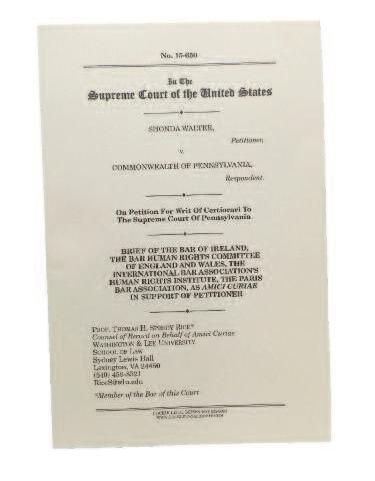
The Bar of Ireland, along with the International Bar Association’s Human Rights Institute and other bar associations, recently filed an amicus curiae brief in a petition to the US Supreme Cour t to hear a challenge to the death penalty in the United States
In Walter v Commonwealth of Pennsylvania, Shonda Walter claimed that all death penalties, including that imposed in her own case, violate the Eighth Amendment to the US Constitution prohibiting cruel and unusual punishment
The Bar of Ireland Human Rights Committee vetted the request on behalf of The Bar of Ireland and, thereaf ter, draf ted The Bar of Ireland’s submission for the amicus brief
The Bar of Ireland submi refers to the abolition of death penalty by constit amendment in 2002 and ratification of the ECHR Protocol abolishing the d penalty in all circumstan The US Supreme Cour t declined to hear the peti in Ms Walter’s case
Pictured at the launch of The Bar of Ireland’s 2016 Innocence Scholarships were (from left): Geraldine McMenamin BL; Ruth O’Connor BL; Kate Hanley BL; Colleen
Medical Negligence and Childbir th
a n d a fo re w o rd b y M r J u s t i ce Ke v i n C ro s s , h e a d o f t h e H i g h C o u r t
Pe r s o n a l I n j u r i e s L i s t , w h o s a y s : “ I t i s t r u l y i n n o v a t i v e i n i t s
co m b i n a t i o n o f l e g a l a n d m e d i c a l l e a r n i n g ”
M r J u s t i ce C ro s s l a u n c h e d t h e b o o k i n t h e S h e d s B a r, D i s t i l l e r y
B u i l d i n g , o n D e ce m b e r 2 , a n d a t T h e L i b ra
M r J u s t i ce C ro s s co m m e n d e
p u b l i s h e d b y B l o o m s b u r y P ro fe s s i o n a l
Author Doireann O'Mahony BL
with Mr Justice Kevin Cross at the recent launch of Medical Negligence and Childbir th Photograph: Paddy Cummins


Librar y values
The Bar of Ireland Library recently under took a survey of Library users – The Bar Review presents the results.

Results

Nuala Byrne Library and Information Services Manager
The delivery of an efficient, relevant and timely library service was identified as a key objective of the new Strategic Plan for The Bar of Ireland The goal to deliver a user-centred service to meet members’ needs into the future requires us to deliver relevant services where, when and in the format required by members To this end, a survey of Library users was carried out during November and December 2015 One objective was to evaluate if the Library is currently delivering a relevant and timely service in the format required
how often do you make use
Answered: 262 Skipped: 17
Of the 2,300 members of the Law Library, 279 responded to the survey, giving a response rate of 12% Of those who responded, 88% were junior counsel and 12% were senior counsel The split of responses between Dublin and non-Dublin practising members was 76% Dublin and 24% non-Dublin
In terms of years in practice, 33% of respondents were in years one to five; 38% were in years six to 12, and 29% were over 12 years The survey was comprised of 28 questions and assessed the usage and value of the Library under a number of headings
Library desks
The Library has five information desks where members may borrow items and get reference or research assistance, as well as access to other services provided by the Library
When asked how often they used the desks, 73% use them daily or weekly, 61% use them weekly or monthly, and 24% use them monthly or less
If you used an information desk, what did you use it for? (tick as appropriate)
Answered: 256 Skipped: 23

frequently By practice location, 8% of Cork-based practitioners use the desks daily, 68% weekly, 8% monthly and 8% less frequently, while of those who practise outside Dublin and Cork, 39% use them daily or weekly, and 60% use them weekly or monthly
Purpose of using a Library desk
Respondents were asked why they used a Library desk Unsurprisingly, 94% said it was to borrow library material and 58% for reference or research assistance When asked how frequently they borrow, 67% borrow material weekly and 86% monthly For Cork members, 65% borrow weekly and 15% monthly For those who practise outside Dublin and Cork, 32% borrow daily or weekly, 31% monthly, and 33% less frequently Only 4% never borrow By year of practice, first years borrow most frequently: 95% borrow on a weekly basis, with 43% borrowing daily In years two to five, 12 5% borrow daily, 62 5% borrow weekly and 12 5% borrow monthly
How impor tant to the Library ’s service are the electronic resources it provides?
Answered: 257 Skipped: 22
Also in years two to five, 9 5% borrow less frequently and 3% never borrow from the Library Borrowing frequency remains similar for years six to 12 and from year 12 onwards Borrowing rates are high across year of practice and by practice location
Satisfaction with material in the Library
When asked if respondents usually found the material they were looking for in the Library, 98% responded usually or always; only 2% accounted for rarely or never
By year of practice, fir st year s borrow most frequently: 95% borrow on a weekly basis, with 43% borrowing daily In year s two to five, 12 5% borrow daily, 62.5% borrow weekly and 12.5% borrow monthly.
Online services
Access to digital resources is as much a par t of the Library collection as the printed material on the shelves We constantly strive to expand access at competitive rates through negotiation with publishers Members rate access highly: 80% rate it as “ very impor tant” and 16% as “impor tant”
As one member commented:
"The Library service is one of the great benefits of Law Library membership If there was no Library service, many members would face great difficulty practising given the cost of legal textbooks and subscription to legal databases"
Ebooks
When asked about using ebooks, 63% said yes, 25% said no and 12% said that they did not know the Library had ebooks By year of practice, 86% of year one
Typically, how often do you use the Library databases (e g , Justis, Westlaw, Bloomsbury)?
Answered: 257 Skipped: 22
use ebooks, 78% in years two to five, 65% in years six to 12, and 43% with over 12 years ' practice While these figures show good usage of the collection, further communication and training is necessary to maximise usage
Databases
Respondents were asked how frequently they use Library databases
Of the total number of respondents, 53% use them daily and 80% use them weekly or more Some 32% use them several times a day
When asked if they had a personal subscription to a database, 91% said no Of the 9% who said yes, only one database on world sports law was not accessible in the Library The majority of the 9% (14 people) subscribed to Stare Decisis, a current awareness website with access to unreported judgments
Information skills training
A key service offered by the Library is our information skills training events, which are offered in various formats, from one-to-one training to group demonstrations and training fairs Each training session qualifies for CPD points When asked how many training sessions they had attended in the previous 12 months, 62% of respondents stated that they did not attend any and 38% attended between one and five sessions One respondent attended six or more events There was little if any variation by practice location This is a disappointing result and indicates that how we offer this service must be reviewed Lack of a dedicated, resourced training location does not help; however, this is not the only reason why uptake is low
Other services
Document
supply
As well as informal document supply, whereby Library staff email articles and cases to members or send library material in the DX to members, the Library also has formal document supply or inter-library loan (ILL) arrangements with numerous other libraries
These include Trinity College Dublin, the King’s Inns Library, the British Library, the Inns of Cour t in London, and the Institute of Advanced Legal Studies (IALS) in London
Inter-librar y loan, email and DX
When asked about ILL, 20% of respondents had used the service in the previous 12 months When asked if ar ticles, cases or other material were requested by email, 50% of respondents stated yes, and 50% said no
Results were not affected by practice location
When asked if they used DX for library material, 84% said no and 16% said yes The service was used most frequently (70%) by members in Cork
Impor
tance to profession
When asked if the profession would suffer if the Library did not exist, 75% of respondents strongly agreed and 16% agreed that the profession would suffer Only 5% neither agreed nor disagreed, and 4% disagreed or strongly disagreed that the profession would suffer
This implies that 91% of respondents value the Library and its impor tance to the profession generally This view was most strongly held by respondents with a practice based mainly in Cork
As one member commented:
"The Library is an essential tool and one of the reasons why people stay members of the Law Library"
The Library would like to take this oppor tunity to thank members for all their continued suppor t and to thank those who took the time to complete the questionnaire
Over the coming weeks and months we will evaluate the answers in more detail, and will use the information to improve our services We strive to provide the most efficient and timely service to our members at all times and your help in achieving our goals is much appreciated
How many Library training sessions do you attend each year?
Answered: 255 Skipped: 24
“The profession of barrister would suffer if the Library did not exist ”
Answered: 242 Skipped: 37
The Bar of Ireland Conference – April 8-9, 2016
Kilkenny has been selected as the destination for the 2016 Biannual Conference of The Bar of Ireland, to be held on Friday and Saturday, April 8 and 9 This year’s Conference offers an outstanding line-up of international exper t speakers on topical issues such as ‘Media in the Cour troom’, including contributions from Joshua Rozenburg QC (Britain’s leading legal commentator) and John Carlin (journalist and author of Chase Your Shadow: The Trials of Oscar Pistorius) The Conference will also focus on the US criminal justice system, which has recently become the focus of public fascination arising from the popular Making a Murderer documentary, with a talk from leading US criminal lawyer Cristi Charpentier, who works on behalf of men and women sentenced to death and of Guantanamo Bay detainees
The excellent CPD-accredited conference sessions will be complemented by a busy social programme, including an opening reception in the stunning surrounds of Kilkenny Castle and a gala dinner in Conference hotel The Lyrath Estate There will also be a Kids Club and babysitting service available, so all the family can come to enjoy what promises to be a very enter taining and informative weekend We look forward to welcoming members to Kilkenny in April

The voice of youth
The Young Bar Committee aims to provide a channel of communication between members of the Junior Bar and Council of The Bar of Ireland in relation to impor tant issues affecting the professional development of members in years one to seven of practice.

Claire Hogan BL Chair, Young Bar Committee
The Year Representatives for the Young Bar Committee were elected at the start of Michaelmas 2015, and are as follows:
Year 1: Hugh Good BL and Ellen O’Brien BL
Year 2: Anita Finucane BL and Hannah Cahill BL
Year 3: Ellen O’Callaghan BL and Paul E Murphy BL
Year 4: Liam O’Connell BL and Eoin Martin BL
Year 5: Gary Hayes BL and Seán O’Quigley BL
Year 6: George Maguire BL and Eve Bolster BL
Year 7: Hugh Madden BL and Rachel Baldwin BL
The representatives have canvassed the views of the Junior Bar in order to frame our agenda for the year and we are grateful for all the helpful responses received
Legal Aid fees
As an early priority, the Committee looked at the issue of District Court Criminal Legal Aid fees Committee members who practise in crime produced a policy document on ‘The Plight of the District Court Criminal Barrister’ This document highlighted the unique issues faced by junior criminal practitioners, specifically with regard to issues surrounding Legal Aid and payment Seán O’Quigley BL and Jane Horgan-Jones BL have been working with the Criminal and State Bar Committee, which drafted submissions on fees for various interested parties, including the Law Society They have aimed to make sure that the voice of the junior end of criminal practice has been included in submissions
Young Bar Hub
In December 2015, the Committee launched the Young Bar Hub in the Members’ Section of The Bar of Ireland website The site contains








information and guidance notes and papers that have been written and collated by the Information, Guidance and Templates Working Group, whose membership includes Tomás Keys BL, George Maguire BL, Ellen O’Callaghan BL and Seán O’Sullivan BL It is designed for barristers in their early years of practice and includes papers such as ‘Practice and Procedure in the Master’s Cour t’ and ‘Guidance on Applying for Civil Legal Aid Panel’
Members can access the Young Bar Hub at https://w w w lawlibrar y ie/secure/young-bar aspx
Discover y work
The Committee has been examining the issue of the Junior Bar’s engagement in discover y work A conference entitled ‘Discover y and the Junior Bar’ was held on Januar y 29, 2016 The conference was chaired by Mr Justice Frank Clarke, and an audience composed of 100 colleagues and litigation solicitors was in attendance
The Conference showcased the talent of junior colleagues who are exper t in discover y work
The Committee is now working to set up a database of discover y counsel on The Bar of Ireland website
EU law and junior practitioners
A free CPD event on EU law and the junior practitioner, hosted by the Irish Society for European Law (ISEL), will be held on Thursday Februar y 25 at 6 30pm in the Atrium of the Distiller y Building There shall be an oppor tunity for junior barristers to receive a year ' s membership of ISEL for the reduced rate of ¤30
The Committee is currently discussing other issues affecting the Junior Bar, in par ticular, Family Law Legal Aid in the District Cour t, fees, the structure of the devil–master relationship, and seating and facilities
All suggestions for events or agenda topics can be sent to youngbar@lawlibrar y ie
In the interests of justice
The Bar of Ireland Voluntary Assistance Scheme (VAS) is operated by Council of The Bar of Ireland and accepts requests for legal assistance from NGOs, civic society organisations and charities acting on behalf of individuals who are having difficulty accessing justice. Please contact us for further details or see the Law Library website under 'Legal Services'.
Speaking for Ourselves – advocacy workshop
On Thursday, November 12, VAS hosted its second advocacy training workshop for charities The aim was to assist charities in the process of making presentations and submissions, writing letters and generally advocating more effectively to achieve their aims We had attendees from the Immigrant Council, Focus Ireland, the Society of Saint Vincent de Paul, Community Law and Mediation, the Migrant Rights Centre of Ireland, Dublin City Volunteer Centre, Enable Ireland, the National Advocacy Service for People with Disabilities, Robert Emmett Community Development Project and Plan International The programme was comprised of four presentations and a practical exercise, which had been well received at the first workshop: 'Preparation for Advocacy', delivered by Michael Cush SC; 'Oral Advocacy', delivered by Mary Rose Gearty SC; 'Written Advocacy', delivered by Bairbre O Neill BL; and, 'Principled Negotiation', delivered by Turlough O'Donnell SC Michael Lynn SC and Aoife Carroll BL prepared a practical exercise In addition to these presentations from The Bar, we invited two speakers from the Oireachtas to give a presentation on 'Effective Engagement with Public Bodies' Alan Guidon (Clerk of the Joint Committee on Justice, Defence and Equality) and Brid Dunne (Clerk of the Joint Committee on European Union Affairs and Clerk to the Committee on Members' Interests) gave this presentation
VAS is grateful to the speakers and presenters who were so generous with their time It is hoped to run this workshop once again in early 2016 If you know of any charities who would be interested in attending, please ask them to contact vas@lawlibrary ie for further information
Once again, feedback on this workshop was very positive:
“I have done this type of training previously but it has been from the private sector, and it has a business slant to it so it is very hard to transfer the skills, but I found this so useful and so transferable It was so clear, so focused Honesty and integrity were mentioned time and time again, which is great to hear in our sector ”
“Very well done and executed professionally ”

“This was one of the most wor thwhile and engaging training events/ workshops I have ever attended I would highly recommend it to others ”
Requests for assistance
VAS has recently received requests for assistance from a number of organisations, including Transparency Ireland, Mental Health Reform, the National Advocacy Service, Le Cheile Youth Justice and Mentoring Programme, Dublin Aids Alliance and a housing co-operative in Ballymun
At the request of VAS, Ar thur Cox Solicitors and Niall Handy BL helped to negotiate a successful agreement between the housing co-operative (whose members would not otherwise have had access to legal services) and Dublin City Council
Please contact vas@lawlibrary ie if you are interested in getting involved
Pictured at the recent VAS advocacy workshop were (from left): Miriam Lewis, Dublin Cit y volunteer; David Barniville SC, Chairman, Council of The Bar of Ireland; and, Diane Duggan BL, VAS Co-ordinator
The Barnes brief
Lawyers and rugby were familiar bedfellows in the days of amateurism. Now the top level of the game is professional, including the referees. Wayne Barnes is a high-profile international rugby referee, and a practising barrister. How does he do it?

Paul O’Grady Managing editor and journalist at Think Media
“It would be an added bonus if Wayne Barnes refrained from refereeing like a deranged old Eton headmaster with a ferret down his pants.”
Risteard Cooper, The Irish Times, February 11, 2010
The barrister and international rugby referee, Wayne Barnes, has real friends because only real friends would be in a hurry to send that quote to a mate – and he got sent it several times It’s now Barnes’ favourite quote about himself, with one caveat – he didn’t go to Eton
In fact, he went to a state comprehensive in the Forest of Dean in the West Country of England, right up against the border with Wales He describes it lovingly as a place where you were dragged up with rugby and brass bands He comes from the village of Bream, where he played with the local rugby club from the age of seven, describing himself as “ a non-tackling back row” At 15 he picked up an injury and got asked to help with some refereeing He did and while he continued to play on Wednesdays when in university, he refereed at the weekends It helped him to pay his way through his law degree at the University of East Anglia While there, at the age of 21, he became the youngest ever member of the English Rugby Union’s panel of national referees He was dedicated to his legal career, though, and had always wanted to be a barrister
The inspiring teacher
Why law? Were there many lawyers in his family? “No, in fact, I was the first member of my family to go to university ” The reason he wanted to become a barrister goes back to a teacher (How often do special teachers inspire people?) Mrs Davies was his English teacher, but she also served as a lay magistrate in a UK court that hears lower level offences

Mark Stenning
She encouraged Wayne, brought him to sittings of her three-magistrate cour t, and he subsequently got a work experience term with barristers in Cardiff He really enjoyed it and set himself the ambition of a career as a barrister He completed his law degree at the highly-ranked East Anglia in Norwich, and after a year as President of the Students’ Union in the University, he got a position on the Barrister Vocational Course at the College of Law in London Similar to the Master–Devil arrangement in Ireland, he underwent pupillage with a barrister for 12 months before applying for and getting a position in Chambers at 3 Temple Gardens He practised in south-east England and in central London, defending or prosecuting in sexual offences, assaults, grievous bodily harm and similar cases He describes it as a fantastic experience, learning a great deal and enjoying his time in cour t
Photograph:

Twin track careers
At the very same time, his refereeing career was also developing He got asked to referee in the 2003/’04 World Rugby Sevens series Interestingly, so did two other referees who were coming through the world ranks at the time: Nigel Owens and Craig Joubert That shared experience has led to the development of close friendships, something which Wayne describes as common in the refereeing community So close are they now, that when Wayne married Polly a few years ago, Nigel Owens sang ‘How great thou art’ in the chapel at the wedding ceremony Polly, by the way, is also from the Forest of Dean, sharing that rugby and brass band culture (she was a cornet player) Together they have a 16-month-old daughter, Juno
That World Rugby Sevens necessitated four weeks away, so being self-employed was certainly a help He could manage his time reasonably well
However, in 2006, he got appointed as a professional referee so, from that point, rugby had to take first call Nonetheless he continued to practise a couple of days a week He was involved in bribery and corruption cases and developed a special interest in the area When new regulations were introduced in the UK, they allowed barristers to form new groupings and, where appropriate, limited companies The Bribery Act was enacted on July 1, 2011, and Wayne and a group of other barristers decided to form Fulcrum Chambers, specialising in bribery and corruption issues The Head of Chambers is David Huw Williams QC who was instructed by the UK Serious Fraud Office in the BAE Systems inquiry (the Saudi arms deal) Based on the 25th floor of The Shard building in central London, it is a limited company, and provides advice to multinational corporations on the structure of their investigatory and administrative processes If a firm is being investigated, Fulcrum Chambers can take over
Rate of risk and return
A recent Cour t of Appeal judgment has significant implications for future compensation awards.


Sara Moorhead SC Claire Hogan BL
On November 5, 2015, the Cour t of Appeal delivered an impor tant judgment in Russell v HSE 1 Gill Russell sustained catastrophic injuries at the time of his bir th in July 2006 due to the admitted negligence of the defendants He requires 24-hour care for the rest of his life, the expectancy of which is 45 years
The appeal centred on two main issues First, the defendants appealed the ruling on the appropriate real rate of return that could be obtained by the plaintiff in investing his lump sum Cross J in the High Cour t had ruled that this was 1 5% per annum on the investment of his award 2 Second, the Cour t took the oppor tunity to lament the lack of periodic payment orders, and press the Oireachtas for their urgent introduction
The two issues of real rate of return and periodic payment orders are interdependent Indeed, the over whelming tenor of the judgment is that in the absence of periodic payment orders, adjustment of the real rate of return is equivalent to applying a sticking plaster to a terminally ill patient
Reduction in the real rate of return
The real rate of return is the return that a plaintiff can obtain on investment of a lump sum award It translates to a discount rate applied to the sum, and aims to avoid over-compensation of the plaintiff
Since the case of Boyne v Dublin Bus, 3 the cour ts in this jurisdiction have assumed that an injured plaintiff will obtain a real rate of return of 3%
However, in setting a lower rate, Cross J decided to break with or thodoxy, and the Cour t of Appeal affirmed his decision The stakes were high, despite these apparently trivial increases in percentage points
In this case, the new rate resulted in an award for special damages of ¤13 million, whereas had the old rate been used, it would have been approximately ¤9 million

On behalf of the Cour t of Appeal, Ir vine J highlighted the delicate nature of its task in this case:
“The interest rate selected is critical in that the objective of the exercise is to decide upon a lump sum which, when invested, will be sufficient to allow the plaintiff, by drawing down both interest and capital, to have exactly what has been determined by the cour t will be required to meet his needs for the period of his agreed life expectancy, but no more ”4
100% compensation rule
Starting from first principles, the Court stressed that calculation of future financial loss must be done on a 100% basis, regardless of the economic consequences that the award may have on a defendant, on the insurance industry or on public finances The Court was critical of the appellant’s resort to public policy arguments While the appellant did not dispute the principle of 100% compensation, it was noted that its submissions “include reference to the likely effect of increased awards on public policy, the insurance industry, the State’s finances, the defendant’s constitutional rights to private property and the principle of proportionality” 5 However, it was acknowledged that over-compensation is to be avoided also
injustice in that, if he outlives the agreed life expectancy, he will run out of money in the course of his lifetime, assuming that the annual sum awarded in respect of his care is spent each year The greater the inaccuracy of the agreed predicted life expectancy, the greater the potential injustice” 17
Irvine J described the current law as “inherently fallible”, “unjust” and also “grossly outdated” by reference to the approach in other jurisdictions 18 The Cour t somewhat wearily rehearsed the repor ts going back decades, which advocated a move to periodic payment orders 19 In May 2015, a general scheme of a Civil Liability (Amendment) Bill 2015 designed to provide for a periodic payment regime was published 20 However, the pace of progress has been glacial Indeed, in October 2012, the Russell proceedings were adjourned for two years on the basis of an agreed interim payment in the hope that the relevant legislation would be enacted – a hope that was not realised
While the Cour t was “mindful of the doctrine of the separation of powers”, it was trenchant in calling for the Oireachtas “to bring to an end, by legislative reform, the potentially unjust manner in which the cour t is presently required to assess damages for future pecuniary loss in catastrophic injury cases” 21
Consequences of decision
The consequences of this decision are significant in monetary terms The case is under appeal to the Supreme Cour t and it will be interesting to see what view will be taken
Irvine J was at pains to emphasise the irrelevance of public policy as a consideration for the Cour t She stated as follows:
“It is thus of vital impor tance to state, in no uncer tain terms, that it is mandatory for the cour t to approach its calculation of future pecuniary loss on a 100% basis regardless of the economic consequences that the resultant award may have on the defendant, on the insurance industry or on the public finances It is acknowledged that it is equally impor tant that the sum awarded does not over compensate the plaintiff and that the defendant is given every oppor tunity to contest each integral component of the final award Public policy has no par t to play in the assessment of damages of this nature If large awards in respect of claims of this nature have an adverse effect on insurance premiums or place pressure on the pockets of State defendants, that is not something that the cour t can take into account and, as a result, in some way moderate or reduce its award The damages so awarded are, af ter all, destined to do no more than restore a plaintiff in financial terms to as close a position as they would have enjoyed in terms of wealth and independence had they not been the unwitting victim of the defendant’s wrongdoing ”22
This view of the Cour t of Appeal would appear to be somewhat at variance with the view taken by the Supreme Cour t in Kearney v McQuillan 23 In that case, the plaintiff had been awarded the sum of ¤450,000 in respect of general damages for a symphysiotomy procedure Liability and quantum were at issue in the appeal but the primary concern in the case was in respect of quantum and the cap on general damages The Cour t reduced the general damages in the case from ¤450,000 to ¤325,000 In so doing, MacMenamin J stated:
“An award of damages must be fair to both the plaintiff and defendant It must be propor tionate to social conditions, bearing in mind the common good It should logically be situated within the legal scheme of awards made for other personal injuries All these elements fall to be “balanced weighed and determined” (see M N v S M p 474; [2005] I R 474; see also Sinnott v Quinnsworth [1984] ILRM 523 O’Higgins C J at p 532 ) It is impor tant in this context to recollect, par ticularly at this time, those criteria of social conditions and common good These are not just empty words The resources of society are finite Each award of damages for personal injuries in the cour ts may be reflected in increased insurance costs, taxation or, perhaps, a reduction in some social ser vice We are living in a time where ordinar y people of ten find it difficult to make ends meet The weight to be given to each of these factors must always be a consideration in the balance” 24
“
The relevant passages in each judgment show that there is a marked divergence between the attitude taken by the Cour t of Appeal and that of the Supreme Cour t It is not clear whether the decision will apply to all plaintiffs or just catastrophically injured ones who need a ver y low-risk strategy However, Ir vine J refers to “most injured plaintiffs” in a non-distinguishing way, which suggests that the former scenario is more likely:
“The catastrophically injured plaintiff who needs to replace their lost income or to provide for their future care is simply not in the same position as the ordinar y investor who has an income and has surplus funds to invest The latter is clearly in a position to absorb greater risk They are not dependant on such monies to meet their basic day-to-day requirements and indeed may not need to access these surplus funds for many years Accordingly, they might prudently be in a position to invest in equities given their ability, should the market fall, to hold onto their investment and wait until the market recovers before selling Even if they end up losing on their investment the outcome is not catastrophic However, most injured plaintiffs enjoy no such comfor t Almost inevitably they are dependant upon their award of damages to meet their needs as they arise on a day-to-day basis ”25
Another aspect of this decision that falls to be determined is the extent to which it is confined to future care costs Ir vine J makes it clear that while it was not argued before her, she would favour a view that loss of earnings would also attract a lower real rate of return:
“For the purposes of clarity it is perhaps of impor tance for this cour t to
state that we do not accept the albeit obiter view expressed by the High Cour t judge in the present case insofar as he indicated that a plaintiff with a claim for future pecuniar y loss confined to loss of earnings might possibly be treated as less risk averse than a plaintiff who has a claim for the cost of future care
An o t h e r a s p e c t o f t h i s d e c i s i o n t h a t
fa l l s to b e d e t e r m i n e d i s t h e e x t e n t to
w h i c h i t i s co n f i n e d to f u t u re ca re
co s t s I r v i n e J m a ke s i t c l e a r t h a t
w h i l e i t w a s n o t a rg u e d b e fo re h e r,
s h e w o u l d fa v o u r a v i e w t h a t l o s s o f
e a r n i n g s w o u l d a l s o a t t ra c t a l o w e r re a l ra t e o f re t u r n .
There appear to be a number of arguments against such a proposition It would seem to admit of the adoption of a potentially higher real rate of return in the loss of earnings claim on the assumption that the plaintiff can necessarily absorb a greater risk when investing their award to secure their future income While of course there may be the rare case where a particular plaintiff may not need their earnings to survive on a day-to-day basis and might thus be in a position to take risks in terms of the investment of their award, most plaintiffs do not fall into that category A plaintiff who will never be in a position to work again and is dependent upon the investment of his lump sum for their own
support and that of his family may be entitled to be treated similarly in terms of the investment risk he should have to absorb to the plaintiff who needs to cover the cost of their future nursing care on an annual basis As this did not arise on the facts herein we consider that a decision on this issue should be left over to an appeal where it does so arise” 26
In effect, the entire thrust of the judgment is to the effect that a plaintiff should not be obliged to speculate It will be impor tant to determine to what extent the judgment is universally applied in terms of the real rate of return The instructions practitioners should give to actuaries depend on this point The tenor of the judgment would appear to be that all plaintiffs should not have to take risk and, therefore, that the cour ts will favour a cautious approach to the real rate of return
There is no doubt that the judgment is profound in its effect on defendants, both State and private The introduction of periodic payments would appear to be more urgent than ever The judgment makes it clear that it is difficult to avoid injustice in the current regime In this regard, the Cour t of Appeal noted:
“It is highly regrettable that, regardless of the outcome of this appeal, it is absolutely cer tain that whatever award is made will visit an injustice on one or other par ty The only issue will be extent of that injustice” 27
The Supreme Court decision is awaited with interest
1 [2015] IECA 236
2 [2014] IEHC 590
3 [2003] 4 I R 47
4 [2015] IECA 236 at [80]
5 Ibid at [63]
6 Ibid at [70]
7 [1999] 1 A C 345
8 He decided that a prudent investor would invest 70% of their award in equities and the remaining 30% in gilts
9 [2015] IECA 236 at [25]
10 [2014] IEHC 590 at [50]
11 [2015] IECA 236 at [85]
12 Ibid at [90]
13 Ibid at [94]
14 Ibid at [132]
15 Noting that Cross J held that government securities were to be preferred over equities as the most risk-averse investment for this plaintiff, the Cour t of Appeal declared it to be unnecessary to deal to any great extent with the High Cour t’s conclusion that if for some reason those in charge of Gill’s investment strategy were unable to conveniently invest his entire fund in ILGS, he might nonetheless be expected to achieve a real rate of return of 1 5% on his fund by taking 50% of the risk that might be taken by the
ordinary investor and by investing in a more conservative mixed por tfolio The Cour t nonetheless made some comments demonstrating suppor t for government securities, mentioning “ unnecessary investment risks” and describing it as “difficult to see a valid basis for this alternative approach to assessing the discount rate” Ibid at [147] – [148]
16 Ibid at [3]
17 Ibid at [4]
18 Ibid at [5]
19 For example, the 1972 interim repor t of the Committee of Inquiry into the Insurance Industry, the 1996 Law Reform Commission Report on Personal Injuries: Periodical Payments and Structured Settlements (LRC 54-1996), and the repor t of the Working Group on Medical Negligence and Periodic Payments chaired by Quirke J , and published on October 29, 2010
20 Compensation by periodic payment order has been in place in the UK since 2003
21 [2015] IECA 236 at [13]
22 Ibid at [64] See also [40] & [157]
23 [2012] IESC 43
24 Ibid at [28]
25 [2015] IECA 236 at [80]
26 Ibid at [89]
27 Ibid at [3]
U P DAT E
The Bar Review, journal of The Bar of Ireland
BANKING
A directory of legislation, ar ticles and acquisitions received in the Law Library from November 11, 2015, to January 18, 2016 Judgment information supplied by The Incorporated Council of Law Reporting
Edited by Deirdre Lambe and Vanessa Curley, Law Library, Four Courts
ADMINISTRATIVE LAW
Acts National Cultural Institutions (National Concert Hall) Act 2015 – Act No 44 of 2015 – signed on December 10, 2015
AGENCY
Library acquisitions
Singleton, S Commercial agency agreements: law and practice – N25
ANIMALS
Statutory Instruments
European Union (birds and natural habitats) (sea-fisheries) (amendment) regulations 2014 – (DIR/2009-147, DIR/92-43 [DIR/1992-43]) – SI 565/2014
European Union (control of avian influenza) regulations 2006 (amendment) (no 2) regulations 2014 – (DIR/2005-94) – SI 570/2014
ARBITRATION
Library acquisitions
Joseph, D Jurisdiction and arbitration agreements and their enforcement –N398
St John Sutton, D , Gill, J , Gearing, M Russell on arbitration – N398
AVIATION
Statutory Instruments
Aviation regulation act 2001 (levy no 15) regulations 2014 – SI 563/2014
Library acquisitions Pa
documents – N303
security – N303 2 C5
BUILDING CONTRACTS
Library acquisitions
n g contracts – N83 8
BUSINESS
Library acquisitions
C ox , J L a w S o c i e t y o f I re l a n d –N250 C5
CITIZENSHIP
Library acquisitions
Mantu, S Contingent citizenship: the l a w a n d p ra c t i ce o f c i t i z e n s h i p deprivation in international, European and national perspectives – M172 E95
COMPANY LAW
Winding up
Petition – Company unable to pay debts – Exercise of discretion – Whether petitioner entitled to invoice company for cost of reading and writing letters –Whether company ’s use of petitioner’s name on documents constituting unauthorised breach of trademark –Whether petitioner entitled to assign arbitrary figure to alleged breach of trademark – Whether debt bona fide –Whether director of company had standing to swear affidavit – Whether evidence of registration of trademark –Whether petition entirely baseless –Companies Act 1963 (No 33), s 213 –Petition dismissed (2015/155COS –Cregan J – 18/5/2015) [2015] IEHC 394
Gleeson v Tazbell Services Group
Library acquisitions
Bruce, M Rights and duties of directors – N264
Reece Thomas, K , Ryan, C , Baylis, D
The law and practice of shareholders’ agreements – N263
Statutory Instruments
Companies act 2014 (section 457) regulations 2015 – SI 498/2015
Companies act 2014 (section 580(4)) (revocation) regulations 2015 – SI 499/2015
Companies act 2014 (section 682) (revocation) regulations 2015 – SI 497/2015
COMPETITION LAW
Library acquisitions
Eaton, S , O’Brien, P Competition law in Ireland – N266 C5
van der Woude, M , Jones, C EU competition law handbook 2016 –W110
COMPUTERS
Library acquisitions
Bettinger, T , Waddell, A Domain name law and practice: an international handbook – N347 4 Clough, J Principles of cybercrime –M540
CONSUMER LAW
Statutory Instruments European Union (online dispute resolution for consumer disputes) regulation 2015 – (REG/524-2013) – SI 500/2015
CONTRACT
Interpretation
Discrete issue – Application of agreement in unforeseen circumstances – Absence of ambiguity in terms of agreement – Enforceability where omission in agreement – Complete agreement clause – Business common
sense – Intentions of parties in light of factual and legal background – Whether fee agreement applied where redemption of loans at par – Whether fee agreement void as clog on equity of redemption – Investors Compensation Scheme v West Bromwich Building Society [1998] 1 All ER 98; Analog Devices BV v Zurich Insurance Co Limited [2005] IESC 12, [2005] 1 IR 274; Antaios Compania Neviera SA v Salen Rederierna AB [1985] AC 191; Mannai Investment Co Limited v Eagle Star Life Assurance Co Limited [1997] AC 749; Jumbo King Limited v Faithful Properties Limited [1999] 2 HKCFAR 279; Rainy Sky SA v Kookmin Bank [2011] 1 WLR 2900 and Bromarin AB & Anor v IMD Investments Limited [1999] STC 301 considered – Agreement found not to be applicable or enforceable where plaintiffs proposed to redeem loans with defendant at par (2015/1200P – McGovern J –13/5/2015) [2015] IEHC 316 Luxor Investments Ltd v Beltany Property Finance Ltd
Library acquisitions
Christou, R Boilerplate: practical clauses – N10
Beale, H G Chitty on contracts – N10 Lewison, K The interpretation of contracts – N10
COPYRIGHT
Library acquisitions
Sterling, J A L , Cook, T Sterling on world copyright law – N114
COURTS
Jurisdiction
Real proper ty – Rateable valuation –Cer tificate of valuation – Mor tgage –Possession – Abolition of valuation procedure for domestic premises –Commencement of possession proceedings in Circuit Court – Whether Circuit Court having jurisdiction to grant order for possession for domestic
premises constructed after abolition of valuation procedure for domestic premises – Whether non-statutory ad hoc procedure of Valuation Office in issuing letters appropriate – Whether non-statutory letters from Valuation Office capable of conferring jurisdiction on Circuit Court – Harrington v Murphy [1989] IR 207 considered – County Officers and Courts (Ireland) Act 1877 – Courts of Justice Act 1924 (No 10) –Cour ts (Supplemental Provisions) Act 1961 (No 39) – Local Government (Financial Provisions) Act 1978 (No 35) – Valuation Act 2001 (No 13), ss 60 and 67 – Civil Liability and Courts Act 2004 (No 31), s 45 – Land and Conveyancing Law Reform Act 2009 (No 27) – Land and Conveyancing Law Reform (Amendment) Act 2013 (No 30) – Appeal allowed; application for possession dismissed (2014/88CA –Murphy J – 20/5/2015) [2015] IEHC 304 Bank of Ireland Mortgage Bank v Finnegan
Articles
Clarke, B Appeals to the Supreme Cour t and the new appellate regime Bar Review 2015; (20) (5): 98
Acts
Courts Act 2015 – Act No 51 of 2015 – signed on December 20, 2015
Statutory Instruments
Circuit Cour t rules (personal insolvency) 2015 – SI 506/2015 Circuit Court rules (jurisdiction and the recognition and enforcement of judgments in civil or commercial matters) 2015 – SI 618/2015 Circuit court rules (Lugano convention and maintenance regulation) 2014 – SI 597/2014
District court (general) rules 2014 – SI 598/2014
District Cour t (jurisdiction and the recognition and enforcement of judgments in civil or commercial matters) rules 2015 – SI 617/2015
Rules of the Superior Cour ts (companies act 2014) (no 2) 2015 – SI 616/2015
Rules of the Superior Cour ts (jurisdiction, recognition and enforcement of judgments) 2016 – SI 9/2016
Rules of the Superior Cour ts (jurisdiction, recognition and enforcement of judgments) (no 2) 2016 – SI 10/2016
CRIMINAL LAW
Judicial review
Refusal of legal aid – Consideration of
financial means of defendant – Gravity of offence – Appeal on merits – Moot – Whether failure to take into account relevant considerations – The State (Healy) v Donoghue [1976] IR 325; O’Neill v Butler [1979] ILRM 243; Carmody v Minister for Justice & Ors [2009] IESC 71, [2010] 1 IR 635; Costigan v Brady [2004] IEHC 16, (Unrep, Quirke J, 6/2/2004); Joyce v Brady [2011] IESC 36, [2011] 3 IR 376 and Tighe (A Minor) v Judge Haughton & Anor [2011] IEHC 64, (Unrep, Hanna J, 18/2/2011) considered – Criminal Justice (Legal Aid) Act 1962 (No 12), s 2 – Constitution of Ireland 1937, Ar t 38 1 – European Convention on Human Rights 1950, ar t 6 –Application dismissed (2013/956JR –Hanna J – 14/5/2015) [2015] IEHC 300 King v Coghlan & Anor
Judicial review
Road traffic offence – Driving without insurance – Mandatory disqualification from driving – Fitness to drive –Jurisdictional error – Discretionary power to state case – Statutory interpretation – Second or any subsequent offence – Error on face of record – Whether second or subsequent offence – Whether error on face of record – Attorney General (Ó Muireadhaigh) v Boles [1963] 1 IR 431 and Conroy v Attorney General [1965] 1 IR 411 applied – State (Daly) v Ruane [1988] ILRM 117; Attorney General (at the suit of Superintendent McConville) v Brannigan [1962] 1 IR 337; R v Skolnick [1982] 2 SCR 37; Howard v Commissioner for Public Works [1994] 1 IR 101; Minister for Justice v Dundon [2005] IESC 13, [2005] 1 IR 261; Damache v DPP [2012] IESC 11, [2012] 2 IR 266; People (DPP) v Birney & Ors [2006] IECCA 58, [2007] 1 IR 337 and People (DPP) v Geraghty [2014] IECA 2, (Unrep, Cour t of Appeal, 10/12/2014) considered –Road Traffic Act 1961 (No 24), s 26 –Courts of Justice Act 1947 (No 20), s 16 – Certiorari granted; matter remitted for sentencing; applicant remained properly convicted (2015/452JR –Kearns P – 15/5/2015) [2015] IEHC 290 Ling v Lindsay
Library acquisitions
Richardson, P J Archbold criminal pleading, evidence and practice 2016 –M500
May, R , Powles, S , May, R , Waine, L Criminal evidence – M600
Articles Dwyer, J 99/8: Nine issues with
section ninety-nine Bar Review 2015; (20) (5): 105
Coulter, C Many challenges in dealing with children’s evidence in child protection cases where child sex abuse is alleged Irish Journal of Family Law 2015; (18) (4): 85
Walsh, J The modern European trial –investigation into truth, or crusade between hostile par ties? Irish Law Times 2015; (33) (19): 282
Acts
Criminal Justice (Burglary of Dwellings) Act 2015 – Act No 56 of 2015 –signed on December 24, 2015
Criminal Justice (Mutual Assistance) (Amendment) Act 2015 – Act No 40 of 2015 – signed on December 1, 2015
Statutory Instruments
Criminal justice (forensic evidence and DNA database system) act 2014 (commencement) order 2015 – SI 508/2015
Criminal justice (forensic evidence and DNA database system) act 2014 (cer tificates) regulations 2015 – SI 526/2015
Criminal justice (forensic evidence and DNA database system) act 2014 –(section 11) order 2015 – SI 527/2015
Criminal justice (forensic evidence and DNA database system) act 2014 –(section 156) regulations 2015 – SI 528/2015
DAMAGES
Personal injuries
Road traffic accident – Assessment –Quantum of damages – General damages – Loss of earnings – Future damages – Care for minor child – Cost of night care worker – Damages awarded (2011/7761P – Barr J –15/5/2015) [2015] IEHC 401 Flynn v Long
Personal injuries
Road traffic accident – Assessment –Quantum of damages – Psychiatric injury – Egg shell skull rule – General damages – Future damages – Damages awarded (2011/8474P – Barr J –15/5/2015) [2015] IEHC 385 Purcell v Long
Personal injuries
Road traffic accident – Assessment –Quantum of damages – Minor dependent – Loss of financial dependency – Loss of care services –Maintenance of home – Solatium –Loss of services by deceased –Damages awarded (2012/10000P –Barr J – 15/5/2015) [2015] IEHC 384
Salkeld (a minor) v Long
DATA PROTECTION
Library acquisitions
Hess, B , Mariottini, C M Protecting privacy in private international and procedural law and by data protection: European and American developments – M209 D5
EDUCATION
Articles
McDonagh, S “They can live in the desert but nowhere else”: Human rights, freedom of religion and the demand for state control over access to faith schools Bar Review 2015; (20) (5): 124
ELECTORAL
Library acquisitions
Kavanagh, J Electoral law in Ireland –N83 4 C5 Bean, D , Parry, I , Burns, A – N232
Acts
Electoral (Amendment) Act 2015 – Act No 62 of 2015 – Signed on December 29, 2015
EMPLOYMENT LAW
Payment of wages
Unlawful deduction – Public service body – Emergency financial measure –Employee of school deemed to be public servant – Whether school wholly or partly funded directly or indirectly by State – Whether public service pension scheme existing or applying or capable of being made in respect of school –Purpose of legislation – Whether reduction in wages represented any saving to State – Whether recitals of Act capable of overriding clear and unambiguous provisions – Bridgeman v Limerick Corporation [2001] 2 IR 517 and The State (O’Connor) v Ó Caomhanaigh (Governor of Mountjoy Prison) applied – Kelly v Board of Management of St Joseph’s National School [2013] IEHC 392 (Unrep, O’Malley J, 6/8/2013) considered –Secondary Community and Comprehensive School Teacher’s Pension Scheme 2009 (SI 435/2009) –Payment of Wages Act 1991 (No 25), s 5 – Education Act 1998 (No 51), s 24 –Financial Emergency Measures in the Public Interest (No 2) Act 2009 (No 41) – Appeal dismissed (2014/423MCA –Baker J – 20/5/2015) [2015] IEHC 305 Nic Bhrádaig v Employment Appeals Tribunal
Library acquisitions
O’Sullivan, M , Turner, T , Kemmy Business School, University of Limerick
A study on the prevalence of zero hours contracts among Irish employers and their impact on employees 2015 –N192 C5
Teague, P , Roche, W K , Gormley, T , Currie, D Managing workplace conflict: alternative dispute resolution in Ireland – N192 C5
Acts
Equality (Miscellaneous Provisions) Act 2015 – Act No 43 of 2015 – Signed on December 10, 2015
ENERGY
Library acquisitions
Heffron, R , Energy law – N84 1 C5
Statutory Instruments
Electricity regulation act 1999 (electricity) levy order 2015 – SI 562/2015
Electricity regulation act 1999 (gas) levy order 2015 – SI 561/2015
Electricity regulation act, 1999 (water) levy order 2015 – SI 559/2015 Gas act 1976 (appointment of majority-shareholding minister) order 2015 – SI 535/2015
Gas regulation act 2013 (commencement) order 2015 – SI 520/2015
ENVIRONMENTAL LAW
Acts
Climate Action and Low Carbon Development Act 2015 – Act No 46 of 2015 – Signed on December 10, 2015
Statutory Instruments
European Communities (assessment and management of flood risks) (amendment) regulations 2015 –(DIR/2007-60) – SI 495/2015
European communities (greenhouse gas emissions trading) (aviation) –(amendment) regulations 2014 –(DIR/2003-87, DIR/2004-101, DIR/2008-101, DIR/2009-29) – SI 553/2014
Waste management (prohibition of waste disposal by burning) (amendment) regulations 2015 – SI 538/2015
EQUITY & TRUSTS
Library acquisitions
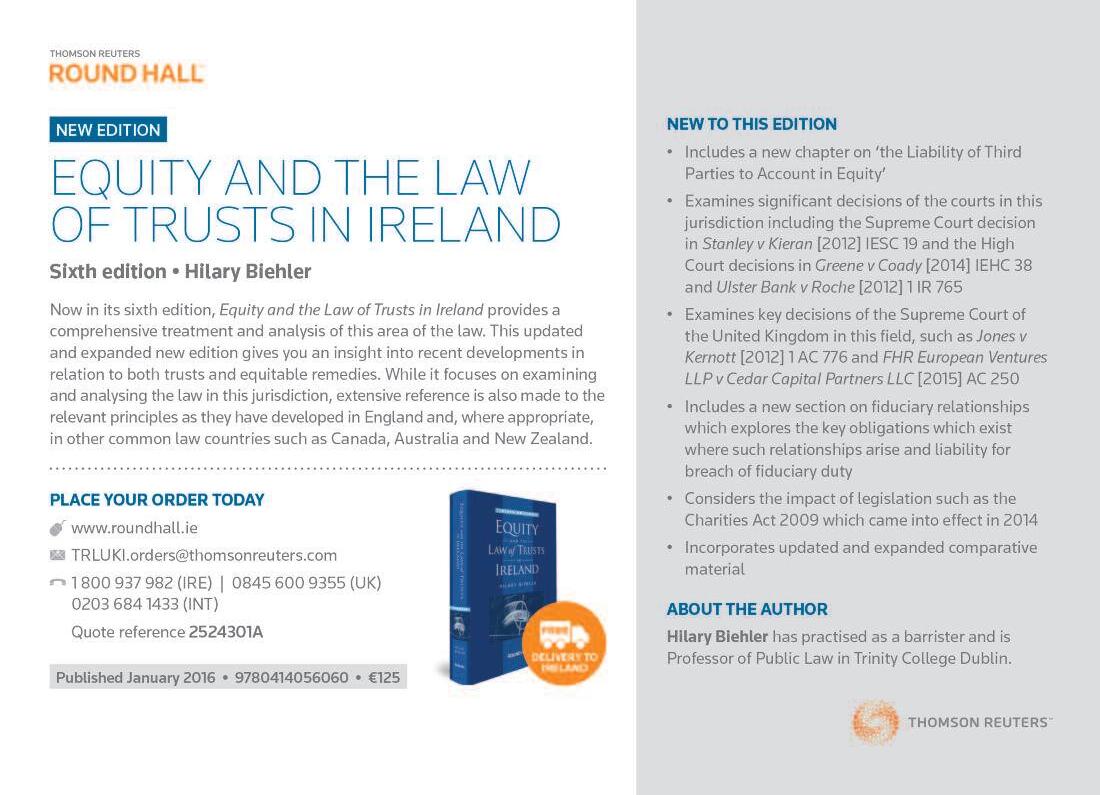
Biehler, H Equity and the law of trusts in Ireland – N200 C5
EUROPEAN UNION
Articles
Hurley, C A Legislating criminal matters at EU level and the minimisation of the
opt-out protocols Irish Law Times 2015; (33) (20): 298
Hurley, C A Legislating criminal matters at EU level and the minimisation of the opt-out protocols Irish Law Times 2015; (33) (20): 298
Statutory Instruments
European Communities (re-use of public sector information) (amendment) regulations 2015 – (DIR/2013-37) – SI 525/2015
European Union (third country auditors and audit entities equivalence, transitional period and fees) (amendment) regulations 2014 –(DEC/2013-281, DEC/2013-288) – SI 555/2014
European communities (Access to Information on the Environment)(Amendment) regulations 2014 – SI 615/2014
European Communities (amendment) act 2012 (commencement) order 2014 – SI 577/2014
European Communities (credit rating agencies) (civil liability) regulations 2015 – SI 399/2015
European Communities (machinery) (amendment) regulations 2015 – SI 621/2015
European Communities (official controls on the impor t of food of non-animal origin) (amendment) regulations 2016 –SI 3/2016
European Union (marketing and use of explosives precursors) regulations 2014 – SI 611/2014
European Union (Restriction of certain hazardous substances in electrical and electronic equipment) (amendment no 2) regulations 2014 – SI/619/2014
European Union (shor t selling) (amendment) regulations 2015 – SI 389/2015
European Union (two or three wheel motor vehicles and quadricycles type-approval) regulations 2015 – SI 614/2015
EVIDENCE
Articles
Tchrakian, J Hearsay evidence in creditor claims: the post-Dermody Lacuna Irish Law Times 2015; (33) (17): 255 [part 1] Irish Law Times 2015; (33) (18): 266 [part 2]
EXTRADITION LAW
European arrest warrant Surrender – Trial in absentia – Possibility of retrial – Conviction warrant –Prosecution warrant – Whether requesting state converted warrant from execution of judgment to prosecution of offences – Whether court ought to order
surrender regardless of defect in domestic warrant procedure –Correspondence – Imprisonment for failure to pay child suppor t – Whether corresponding offence in Irish law – SMR v Governor of Cloverhill Prison [2009] IEHC 442 approved – Minister for Justice v Gherine [2012] IEHC 535 distinguished – Minister for Justice v Kavanagh (Supreme Court, 23/10/2009); Minister for Justice v Ostrowski [2010] IEHC 200, (Unrep, Pear t J, 19/3/2010) and Minister for Justice v Horvath [2013] IEHC 534 considered – European Arrest Warrant Act 2003 (No 45), ss 10, 13, 16, 20 and 45C – Surrender refused (2013/126EXT – Donnelly J –19/5/2015) [2015] IEHC 338 Minister for Justice v B(A)
European arrest warrant Surrender – Trial in absentia – Availability of legal counsellor – Sufficient detail on warrant – Whether sufficient detail given by issuing authority – Whether Irish legislation required certain information specified in Framework Directive to be set out in warrant – Whether national legislation compliant with Framework Decision – Statutory interpretation –Statutory provision stated to apply “where appropriate” – Interpretation contra legem – Whether statute ought to be constructed in accordance with aims and objectives of Framework Decision – Whether defect in warrant insubstantial in nature – Whether trial judge correct in ordering surrender –Minister for Justice v Surma [2013] IEHC 618, (Unrep, Edwards J, 3/12/2013); Attorney General v Parke [2004] IESC 100, (Unrep, SC, 6/12/2004); Howard v Commissioner of Public Works [1994] 1 IR 101; Minister for Justice v Altaravicius [2006] IESC 23, [2006] 3 IR 148; Dundon v Governor of Cloverhill Prison [2005] IESC 83, [2006] 1 IR 518 and Pupino (Case C-105/03) [2005] ECR I-5285 considered – European Arrest Warrant Act 2003 (No 45), ss 16, 45 and 45C – Council Framework Decision on the European Arrest Warrant 2009/299/JHA – European Convention on Human Rights and Fundamental Freedoms 1950, art 6 – Appeal allowed; surrender refused (2014/60 – CA –[2015] IECA 69) [2015] IECA 69 Minister for Justice and Equality v Palonka
FAMILY LAW
Child abduction Hague Convention – Wrongful retention – Habitual residence – Consent of both parents to change of habitual residence of child – Factors to be taken into account – Whether intention to establish
permanent or habitual centre of interests of lasting character – Whether other factors in addition to physical presence indicating presence in State was not temporary or intermittent – Whether fact that both par ties having parental responsibility relevant to habitual residence – Whether onus on applicant to establish habitual residence –Whether appellate court should defer to trial cour t on inferences drawn from primary facts in affidavit evidence – C v M (Case C-376/14 PPU) (Unrep, ECJ, 9/10/2014) applied – AS v CS (Child Abduction) [2009] IESC 77, [2010] 1 IR 370; PAS v AFS [2004] IESC 95, (Unrep, SC, 24/11/2004); SR v MMR [2006] IESC 7, (Unrep, SC, 16/2/2007); G v G [2015] IESC 12, (Unrep, SC, 6/2/2015); Ryanair Ltd v Billigfluege de GmbH [2015] IESC 11, (Unrep, SC, 6/2/2015); Re A (Case C-523/07) [2009] ECR I-2805 and Mercredi v Chaffe (Case C-497/10) [2010] ECR I-4309 considered – Child Abduction and Enforcement of Custody Orders Act 1991 (No 6) – Council Regulation 2201/2003/EC, ar t 2 – Hague Convention on the Civil Aspects of International Child Abduction 1980, arts 3, 12 and 13 – Appeal dismissed; return of child ordered (2015/137 – CA –20/5/2015) [2015] IECA 104 E(D) v B(E)
Articles MacMahon, M All changed, changed utterly: the marriage equality referendum and the Children and Family Relationships Act 2015 Irish Journal of Family Law 2015; (18) (4): 95 Hughes, S A tale of two houses Bar Review 2015; (20) (5): 103 Spain, J Live with me Law Society Gazette 2015 (Dec): 26 Lilienthal, G Policy considerations for the legality of surrogacy Medico-Legal Journal of Ireland 2015; 21 (2): 88 Finner ty, S Who profits from international surrogacy? The legal and bioethical ramifications of international surrogacy Medico-Legal Journal of Ireland 2015; 21 (2): 83 Kearney, S , Ryle, E The allocation of scarce resources: the limits of section 47 of the Child Care Act 1991 Irish Journal of Family Law 2015; (18) (4): 89
Acts
Child Care (Amendment) Act 2015 – Act No 45 of 2015 – Signed on December 10, 2015
Children First Act 2015 – Act No 36 of 2015 – Signed on November 19, 2015
Statutory Instruments Marriage act 2015 (commencement) order 2015 – SI 504/2015
FINANCE
Acts
Finance (Tax Appeals) Act 2015 – Act No 59 of 2015 – Signed on December 25, 2015
Finance Act 2015 – Act No 52 of 2015 –Signed on December 21, 2015
Finance (Local Proper ty Tax) (Amendment) Act 2015 – Act No 50 of 2015 – Signed on December 20, 2015 Appropriation Act 2015 – Act No 48 of 2015 – Signed on December 16, 2015
Finance (Miscellaneous Provisions) Act 2015 – Act No 37 of 2015 – Signed on November 20, 2015
Financial Emergency Measures in the Public Interest Act 2015 – Act No 39 of 2015 – Signed on November 27, 2015
Statutory Instruments
Financial emergency measures in the public interest act 2015 (commencement) order 2015 – SI 546/2015
National Treasury Management Agency (amendment) act 2014 (state authorities) order 2015 – SI 486/2015
National Treasury Management Agency (delegation of claims for costs management functions) order 2015 – SI 505/2015
Investor Compensation Act 1998 (prescription of bodies and persons) regulations 2015 – SI 395/2015
Investor compensation act 1998 (representatives of financial services industry) regulations 2015 – SI 394/2015 Irish collective asset-management vehicles act 2015 (section 145(20) –(relevant jurisdiction) regulations 2015 –SI 371/2015
Irish collective asset-management vehicles act 2015 (section 149(2)) (relevant jurisdictions) regulations 2015 – SI 372/2015
FOOD
Statutory Instruments
European Union (provision of food information to consumers) regulations 2014 – (REG/1169-2011, REG/1155-2013, REG/78-2014) – SI 556/2014
GARDA SÍOCHÁNA
Compensation
Judicial review – Certiorari – Personal injury – Authorisation to apply to High Court for compensation – Minor injury –Limited role of court in judicial review –Nature of injury – Comparator cases –Whether injury minor – Whether decision refusing authorisation unreasonable –James McGuill v Minister for Justice [2012] IEHC 519, (Unrep, Hogan J, 26/11/2012) considered – Certiorari
granted (2014/657JR – Hedigan J –13/5/2015) [2015] IEHC 299
Costigan v Minister for Justice and Equality
Acts
Garda Síochána (Policing Authority and Miscellaneous Provisions) Act 2015 – Act No 49 of 2015 – Signed on December 18, 2015
Statutory Instruments
Garda Síochána (policing authority and miscellaneous provisions) act 2015 (commencement) order 2015 – SI 612/2015
GOVERNMENT
Acts
Houses of the Oireachtas Commission (Amendment) Act 2015
Act No 53 of 2015
Signed on 24 December, 2015
Statutory Instruments
Oireachtas (ministerial and parliamentary offices) (secretarial facilities) (banking inquiry) regulations 2014 –SI 564/2014
HEALTH
Statutory Instruments
European Union (cosmetic products) (amendment) regulations 2015 –(REG/1223-2009, REG/344-2013, REG/483-2013, REG/658-2013, REG/1197-2013, REG/358-2014, REG/866-2014, REG/1004-2014, REG/1190-2015) – SI 512/2015
Infectious diseases (amendment) regulations 2015 – SI 566/2015
Occupational Therapists Registration Board return to practice bye-law 2015 –SI 295/2015
Optical Registration Board application for registration bye-law 2015 – SI 450/2015
Optical Registration Board code of professional conduct and ethics for optometrists bye-law 2015 – SI 452/2015
Optical Registration Board code of professional conduct and ethics for dispensing opticians bye-law 2015 – SI 453/2015
Optical Registration Board conditions for registration in the contact lenses division of the register of dispensing opticians bye-law 2015 – SI 451/2015
Optical Registration Board (regulation and control of prescribing and dispensing of prescriptions and sale of spectacles) bye-law 2015 – SI 455/2015
Optical Registration Board return to practice bye-law 2015 – SI 454/2015
Pharmaceutical Society of Ireland (continuing professional development)
rules 2015 – SI 553/2015
Protection of children’s health (tobacco smoke in mechanically propelled vehicles) (fixed charge notice) regulations 2015 –SI 594/2015
Protection of children’s health (tobacco smoke in mechanically propelled vehicles) act 2014 (commencement) order 2015 –SI 593/2015
Radiographers Registration Board approved qualifications and divisions of the register bye-law 2015 – SI 239/2015
HOUSING
Statutory Instruments
Housing (incremental purchase) (amendment) regulations 2015 – SI 483/2015
Housing (miscellaneous provisions) act 2014 (commencement of cer tain provisions) (no 2) order 2015 – SI 482/2015
Housing (sale of local authority houses) regulations 2015 – SI 484/2015
Housing assistance payment (amendment) (no 2) regulations 2014 –SI 576/2014
Housing assistance payment (section 50) (no 3) regulations 2014 – SI 575/2014
HUMAN RIGHTS
Library acquisitions
Reid, K A practitioner’s guide to the European Convention on Human Rights – C200
Seibert-Fohr, A , Villiger, M E Judgments of the European court of human rights –effects and implementation – C200 Meenan, H , Rees, N , Doron, I Towards human rights in residential care for older persons: international perspectives –N151 4
IMMIGRATION
Asylum
Well founded fear of persecution –Availability of internal relocation –Adverse credibility findings –
Membership of particular social group –Whether credibility findings lacked evidential basis – Whether credibility findings based on personal suppositions – Whether flawed findings of tribunal member infected general credibility finding – Whether other findings of tribunal member tainted by flawed adverse credibility findings – Whether adverse credibility findings severable from decision – Whether grounds to impugn finding that applicant having failed to establish membership of par ticular social group – ME v Refugee Appeals Tribunal [2014] IEHC 145, (Unrep, Mac Eochaidh J, 21/3/2014); CCA v Minister for Justice [2014] IEHC
569, (Unrep, Barr J, 25/11/2014); IR v Minister for Justice [2009] IEHC 353, (Unrep, Cooke J, 24/7/2009); EPA v Refugee Appeals Tribunal [2013] IEHC 85, (Unrep, Mac Eochaidh J, 27/2/2013); Idiakheua v Minister for Justice [2005] IEHC 150, (Unrep, Clark J, 10/5/2005); KD (Nigeria) v Refugee Appeals Tribunal [2013] IEHC 481, (Unrep, Clark J, 1/11/2013); EI v Minister for Justice [2014] IEHC 27, (Unrep, Mac Eochaidh J, 30/1/2014); Nicolai v Refugee Appeals Tribunal [2005] IEHC 345, (Unrep, Ó Néill J, 7/10/2005); AZN v Refugee Appeals Tribunal [2009] IEHC 432, (Unrep, Clark J, 7/10/2009); SZ v Refugee Appeals Tribunal [2013] IEHC 325, (Unrep, Mac Eochaidh J, 10/7/2013); ITN v Refugee Appeals Tribunal [2009] IEHC 434, (Unrep, Clark J, 13/1/2009); AW v Minister for Justice [2010] IEHC 258, (Unrep, de Valera J, 2/7/2010); IG v Refugee Appeals Tribunal [2014] IEHC 207, (Unrep, Mac Eochaidh, 11/4//2014); AVB v Refugee Appeals Tribunal [2015] IEHC 13, (Unrep, Stewart J, 14/1/2015); Fornah v Home Secretary [2006] UKHL 46, [2007] 1 AC 412 and Montoya v Home Secretary [2002] EWCA Civ 620, (Unrep, CA, 9/5/2002) considered – Refugee Act 1996 (No 17), s 11 – Relief refused (2011/555JR –Faherty J – 19/5/2015) [2015] IEHC 342 A(J) v Refugee Appeal Tribunal
Asylum
Judicial review – Application for leave –Pakistan – Political reasons – Credibility – Consideration of medical repor ts –Internal relocation – State protection –Consideration of identity documents –Generalised grounds – Role of cour t in judicial review – Discretionary remedy –Moot – Whether substantial grounds –Whether moot – RT (medical reports, causation of scarring) Sri Lanka [2008] UKAIT 00009, (Unrep, Storey J, 7/2/2008); McNamara v An Bord Pleanála (No 1) [1995] 2 ILRM 125; Re Article 26 and the Illegal Immigrants (Trafficking) Bill 1999, [2000] 2 IR 360; MN v Minister for Justice, Equality and Law Reform [2008] IEHC 130, (Unrep, McGovern J, 7/5/2008); E(P) [Rwanda] v Refugee Appeals Tribunal & Anor 2013] IEHC 253, (Unrep, Clark J, 5/6/2013); K v Refugee Appeals Tribunal [2011] IEHC 125, (Unrep, Cooke J, 25/3/2011); RMK (DRC) v The Refugee Appeals Tribunal [2010] IEHC 367, (Unrep, Clark J, 28/9/2010); Traore v Refugee Appeals Tribunal [2004] IEHC 219, [2004] 2 IR 607; O v Refugee Appeals Tribunal & ors [2013] IEHC 89, (Unrep, Mac Eochaidh J, 22/2/2013) and The State (Polymark (Ireland) Ltd) v The Labour Court and The Irish Transport and General Workers’
Union [1987] ILRM 357 considered –(2010/634JR – Barr J – 14/5/2015) [2015] IEHC 294
B(KH) (Pakistan) v Refugee Appeals Tribunal
Asylum
Application for leave to seek judicial review – Telescoped hearing – Well founded fear of persecution – Adverse credibility finding – Internal relocation –Availability of state protection – Female genital mutilation – Whether decision of tribunal member involved necessary careful enquiry – Whether inconsistent and incoherent approach adopted by tribunal member – Meadows v Minister for Justice [2010] IESC 3, [2010] 2 IR 701; PD v Minister for Justice [2015] IEHC 111, (Unrep, Mac Eochaidh J, 20/2/2015); VFAA v Minister for Justice [2010] IEHC 117, (Unrep, Birmingham J, 20/4/2010) and KD (Nigeria) v Refugee Appeals Tribunal [2013] IEHC 481, (Unrep, Clark J, 1/11/2013) applied – EI v Minister for Justice [2014] IEHC 27, (Unrep, Mac Eochaidh J, 30/1/2014); AMN v Refugee Appeals Tribunal [2012] IEHC 393, (Unrep, McDermott J, 3/8/2012); IR v Minister for Justice [2009] IEHC 353 (Unrep, Cooke J, 24/7/2009; RO v Minister for Justice [2012] IEHC 573, (Unrep, Mac Eochaidh J, 20/12/2012); PD v Minister for Justice [2015] IEHC 111, (Unrep, Mac Eochaidh J, 20/2/2015) and OAYA v Refugee Appeals Tribunal [2011] IEHC 373, (Unrep, Hogan J, 7/10/2011) considered – European Communities (Eligibility for Protection) Regulations 2006 (SI 518/2006), reg 7 – Leave granted; certiorari granted (2010/757JR – Faherty J – 19/5/2015) [2015] IEHC 341 I(T) (a minor) v Minister for Justice, Equality and Law Reform
Library Acquisitions
Holzer, V Refugees from armed conflict: the 1951 refugee convention and the international humanitarian law – C200
Acts
International Protection Act 2015 – Act No 66 of 2015 – Signed on December 30, 2015
INSOLVENCY
Library acquisitions
Forde, M , Kennedy, H , Simms, D The law of company insolvency – N312 C5
INSURANCE
Acts
Health Insurance (Amendment) Act 2015 – Act No 54 of 2015 – Signed on December 24, 2015
Statutory Instruments
Health insurance act 1994 (information returns) (amendment) regulations 2015 –SI 608/2015
Health Insurance Act 1994 (section 11E(2) (no 3)) regulations 2015 – SI 544/2015
JUDICIAL REVIEW
Residential institutions redress
Finding that applicant not subjected to abuse – Appeal to Residential Institutions Redress Review Committee – Whether treatment constituted discipline or abuse – Whether strip searching intrusive and demeaning – Whether respondent erred in law in interpretation of definition of “abuse” – Whether wide and liberal interpretation ought to be given to remedial statute – Whether decision of Committee unreasonable or irrational –O’Keeffe v An Bord Pleanála [1993] 1 IR 39; Meadows v Minister for Justice [2010] IESC 3, [2010] 2 IR 701 and JMcE v Residential Institutions Redress Board [2014] IEHC 315, (Unrep, Moriar ty J, 20/6/2014) applied – Ryan v AG [1965] 1 IR 294; The State (C) v Frawley [1976] 1 IR 365; State (Keegan) v Stardust Victims Compensation Tribunal [1986] IR 642; Kennedy v Ireland [1987] 1 IR 587; People (DPP) v McFadden [2003] 2 IR 105; AG v Residential Institutions Redress Board [2012] IEHC 492, (Unrep, Hogan J, 6/11/2012) and Wiktorko v Poland (2013) 56 EHRR 30 – Mental Treatment Regulations 1961 (SI 261/1961) –Mental Health Act 2001 (Approved Centres) Regulations 2006 (SI 551/2006) – Mental Health Act 2001 (No 25) –Residential Institutions Redress Act 2002 (No 13), ss 1, 7 and 13 – European Convention on Human Rights and Fundamental Freedoms 1950, ar t 3 –Relief refused (2014/295JR – O’Malley J – 19/5/2015) [2015] IEHC 335
M(C) v Residential Institutions Redress Review Committee
Articles
Holmes, M Don’t name names! A new SI on naming judges in judicial review cases Bar Review 2015; (20) (5): 113
JURISDICTION
Acts
Choice of Court (Hague Convention) Act 2015 – Act No 38 of 2015 – Signed on November 25, 2015
JURISPRUDENCE
Articles
Brophy, L Academic criticism of judicial rhetoric: how can we best judge the judges? Irish Law Times 2015; (33) (20): 302
Ní Ghadhra, C The paradox of the rule of law: functionally neutral or dangerously aspirational? Irish Law Times 2015; (33) (19): 288
LAND LAW
Library acquisitions
Bland, P Law of easements – N65 1 C5
Articles
Cannon, R Life estates, leases for lives and rights of residence after the Land and conveyancing law reform act 2009 Conveyancing and Property Law Journal 2015; (20) (4): 91
LANDLORD AND TENANT
Tenancy agreement
Appeal from Circuit Court – Appropriate rent – Commencement of lease – Terms of lease – Readiness for occupation after refurbishment work – Duty to minimise loss – Strict definition of repairing covenants – Costs – Appropriate rent fixed; terms of lease clarified; costs order upheld (2014/18CAT and LNT2/06 –White J – 14/5/2015) [2015] IEHC 292 Hemani v Ulster Bank (Ireland) Limited
Library acquisitions
Wylie, J C W Irish landlord and tenant acts: annotations, commentary and precedents – N90 C5 Z14
Acts
Residential Tenancies (Amendment) Act 2015 – Act No 42 of 2015 – Signed on December 4, 2015
LEGAL CAPACITY
Acts
Assisted Decision-Making (Capacity) Act 2015 – Act No 64 of 2015 – Signed on December 30, 2015
LEGAL SERVICES
Acts
Legal Services Regulation Act 2015 – Act No 65 of 2015 – Signed on December 30, 2015
LOCAL GOVERNMENT
Library acquisitions
Morrell, J , Foster, R Local authority liability – M361
Acts
Dublin Docklands Development Authority (Dissolution) Act 2015 – Act No 55 of 2015 – Signed on December 24, 2015
MARITIME LAW
Acts
Harbours Act 2015 – Act No 61 of 2015 – Signed on December 25, 2015
MEDICAL LAW
Articles
MacDaid, C Blood brothers: is it time to change the rules in blood donation? Medico-Legal Journal of Ireland 2015; 21 (2): 78 Davidson, H , Schweppe, J Time for legislative clarity on consent to medical treatment: children, young people and the “mature minor” Medico-Legal Journal of Ireland 2015; 21 (2): 65
MEDICAL NEGLIGENCE
Library acquisitions
O’Mahony, D , Clements, R V Medical negligence and childbirth – N33 71 C5
MENTAL HEALTH
Library Acquisitions
Graham, M , Cowley, J A practical guide to the mental capacity act 2005: putting the principles of the act into practice – N155 3 Kelly, B D Dignity, mental health and human rights: coercion and the law –N155 3 C5
Acts
Mental Health (Amendment) Act 2015 –Act No 58 of 2015 – Signed on December 25, 2015
PENSIONS
Statutory Instruments
Public service pension rights (no 2) order 2015 – SI 547/2015
PERSONAL INJURIES ASSESSMENT BOARD
Library acquisitions
Foster, C , Bradley, B APIL guide to tripping and slipping cases – N38 1
PERSONAL INSOLVENCY & BANKRUPTCY
Acts
Bankruptcy (Amendment) Act 2015 – Act No 60 of 2015 – Signed on December 25, 2015
Statutory Instruments
Personal insolvency (amendment) act
2015 (commencement) (no 2) order 2015 – SI 514/2015
Rules of the Superior Cour ts (personal insolvency) 2015 – SI 507/2015
PLANNING & ENVIRONMENTAL LAW
Library acquisitions
Thomson Round Hall, Flanagan, D , Flynn, T , Dodd, S , Galligan, E Spence, D , Simons, G , Browne, D Round Hall planning and environmental law conference 2015 – N96 4 C5
Articles
Kane, J How must planning authorities resolve conflicts between ministerial guidelines and development plans? Irish Planning and Environmental Law Journal 2014; (22) (4): 131
Acts Planning and Development (Amendment) Act 2015 – Act No 63 of 2015 – Signed on December 29, 2015
POLICE
Library acquisitions
O’Brien-Olinger, S Police, race and culture in the “ new Ireland”: an ethnography – M615 C5
POWER OF ATTORNEY
Registration
Enduring power of attorney – Capacity of donor – Validity of power of attorney –Cer tification of capacity by medical professional – Burden of proof – Whether burden of proving invalidity of instrument lay with objectors – Whether donor suffering from dementia at time of execution – Whether requirement on medical professional to carry out independent medical assessment of donor – Whether solicitor for attorney followed best practice – Whether contemporaneous or near contemporaneous medical examination required – Whether cour t could apply functional test of capacity – Whether on balance of probabilities donor had sufficient cognitive capacity to understand nature and effect of instrument purpor ted to be created –Whether nature and import of enduring power of attorney properly explained to or understood by donor – Re W (Enduring Power of Attorney) [2001] Ch 609 approved – In re Glynn (deceased) [1990] 2 IR 326; O’Donnell v O’Donnell (Unrep, Kelly J, 24/3/1990); In re a Ward of Court (withholding medical treatment) (No 2) [1996] 2 IR 79; Fitzpatrick v FK [2008] IEHC 104, [2009] 2 IR 7; Scally v Rhatigan [2010] IEHC 475, [2011] 1 IR 639; AA v FF [2015] IEHC 142, (Unrep, Baker J, 20/2/2015); Banks v Goodfellow (1870) LR 5 QB 549 and Key v Key [2010] EWHC 408 Ch, [2010] 1 WLR 2020 considered – Enduring Powers of
Attorney Regulations 1996 (SI 196/1996) – Powers of Attorney Act 1996 (No 12), s 10 – Enduring Powers of Attorney Act 1985 (England and Wales) – Registration refused (Baker J –20/5/15) [2015] IEHC 308
In re an application for registration of an enduring power of attorney of SCR dated 1st November 2013
PRACTICE AND PROCEDURE
Amendment of pleadings
Statement of claim – Claim to invalidate securities for loans – Illegality of underlying loans – Market abuse regulation – Whether amendment of pleadings ought to be allowed – Whether substance of amendment res judicata –Whether plaintiffs delayed in seeking amendment – Whether amendment constituted abuse of process – Whether arguments sought to be made ought to have been raised at outset or earlier stage in proceedings – Whether amendment would cause prejudice – Croke v Waterford Crystal Ltd [2004] IESC 97, [2005] 2 IR 383; Clarke v O’Gorman [2014] IESC 72, (Unrep, SC, 30/7/2014); Morrissey v Irish Bank Resolution Corporation Ltd (in special liquidation) [2015] IEHC 200, (Unrep, Costello J, 11/3/2015); Re Vantive Holdings [2009] IESC 69, [2010] 2 IR 118; Henderson v Henderson (1843) 3 Hare 100; Scott v Browne Doering McNab & Co [1892] 2 QB 724 and Barrow v Bankside Ltd [1996] 1 WLR 257 considered – Market Abuse (Directive 2003/6/EC) Regulations 2005 (SI 342/2005) – Rules of the Superior Cour ts 1986 (SI 15/1986), O 28, r 1 – Companies Act 1963 (No 33), s 60 – Criminal Justice (Theft and Fraud Offences) Act 2001 (No 50) – Application refused (2011/4336P – Haughton J – 20/5/2015) [2015] IEHC 313
Quinn v Irish Bank Resolution Corporation Limited (in special liquidation)
Delay
Motion to strike out part of proceedings seeking to challenge planning legislation – Inadmissible by reason of delay –Collateral challenge – Substituted consent – Conformity with European Union law –Whether collateral challenge – Whether inadmissible by reason of delay –Commission v Ireland (Case C-215/06), [2008] ECR I-04911 considered –Planning and Development Act 2000 (No 30), ss 52 and 261 – Relief sought refused (2015/2JR – Hedigan J –15/5/2015) [2015] IEHC 285
Sweetman v An Bord Pleanála
Discovery
Further and better discovery – Privilege –Dominant purpose – Documents prepared in contemplation of litigation –Whether documents prepared for purpose of engaging with regulatory and investigative processes – Whether defendants entitled to assert privilege –Ahern v Mahon [2008] IEHC 119, [2008] 4 IR 704 – Application refused (2011/4336P – McGovern J –19/5/2015) [2015] IEHC 315 Quinn v Irish Bank Resolution Corporation Limited (in special liquidation)
Discovery
Application for discovery – Fraud –Falsification of signature – Defence of power of attorney – Relevant – Necessary for disposing fairly of cause or for saving of costs – Possession, power or procurement – Discovery as process of trust – Discretion of court – Unlimited in time – Excessively vague – Rules of the Superior Courts 1986 (SI 15/1986), O 31, r 12 – Order for discovery (2014/5751P and 2014/142COM – Costello J –13/5/2015) [2015] IEHC 281 Wheelock v O’Leary
Particulars
Claim against company auditors regarding preparation of financial statements –Technical provisions by insurer for future claims – Whether defendant entitled to further and better particulars arising out of pleadings – Whether defendant entitled to further and better particulars in order to know case being made –Mahon v Celbridge Spinning Co Ltd [1967] IR 1; McGee v Reilly [1996] 2 IR 229; Moorview v First Active plc [2005] IEHC 329, (Unrep, Clarke J, 20/10/2005); Playboy Enterprises International Incorporated v Entertainment Media Network Works Ltd [2015] IEHC 102, (Unrep, Baker J, 19/2/2015); Cooney v Browne [1985] IR 185, Thema International Fund plc v HSBC Institutional Trust Services (Ireland) [2010] IEHC 19, (Unrep, Clarke J, 26/1/2010); Quinn Insurance Ltd v Tribune Newspapers plc [2009] IEHC 229, (Unrep, Dunne J, 13/5/2009); Burke v Associated Newspapers (Ireland) Ltd [2010] IEHC 477, (Unrep, Hogan J, 10/12/2010) and McPhilemy v Times Newspapers Ltd [1999] 3 All ER 775 considered – Rules of the Superior Courts 1986 (SI 15/1986), O 19 – Relief granted (2012/1540P – Costello J – 19/5/2015) [2015] IEHC 303
Quinn Insurance Limited (under administration) v Pricewaterhousecoopers (a firm)
Security for costs
Application for security for costs – Prima
facie defence – Ability to pay costs if unsuccessful – Specific circumstances –Discretion of cour t – Only significant asset of company proper ty subject of proceedings – Whether prima facie defence – Whether plaintiff able to pay costs if moving par ty successful – Usk and District Residents Association Ltd v The Environmental Protection Agency [2006] IESC 1, (Unrep, Supreme Cour t, 13/1/2006) and Interfinance Group Limited v KPMG Peat Marwickt/a KPMG Management Consulting [1998] IEHC 217 (Unrep, Morris P, 29/6/1998) applied – Rules of the Superior Cour ts 1986 (SI 15/1986), O 29, r 1 –Companies Act 1963 (No 33), s 390 –Order for security for costs made (2014/2827P – Keane J – 15/5/2015) [2015] IEHC 291
Property & Investment Company (SE) Ltd v Maloney
Stay
Mental health – Detention – Personal rights under Constitution – Inherent jurisdiction of High Cour t to vindicate personal rights under Constitution – Care plan – Appeal to determine policy obligations of State to vulnerable adults – Application for stay pending appeal –Principle in determining whether to grant stay – Bona fides appeal – Balance of convenience – Stay on terms –Paramount factor of best welfare interests of vulnerable adult – Whether grounds of appeal bona fides – Whether balance of convenience favoured stay – National Irish Bank v Mc Fadden [2010] IEHC 119, (Unrep, Clarke J, 27/4/2010) followed –Irish Press v Ingersoll Irish Publications Limited [1995] 1 ILRM 117 considered –Constitution of Ireland 1937, Art 40 3 –Stay refused (2015/459P – O’Hanlon J –14/5/2015) [2015] IEHC 526 Health Service Executive v KW
Summary summons
Liquidated debt – Loan agreement –Interim judgment – Jurisdiction – Bona fide defence – Service of summons –Substituted service – Unconditional appearance – Duress – Right to fair hearing – Lack of evidence of relationship of deponents to plaintiff – Technical inaccuracy in affidavit – Proof of loan agreement under Bankers’ Books Evidence Acts – Privity of contract –Compliance with statutory code –Solvency of plaintiff – Securitisation of loan – Whether bona fide defence –Freeman and Anor v Bank of Scotland plc and Anor [2014] IEHC 284, (Unrep, McGovern J, 29/5/2014); Harrold v Nua Mortgages Ltd [2015] IEHC 15, (Unrep, Kearns P, 16/1/2015) and Kearney v KBC Bank Ireland plc and others [2014] IEHC 260, (Unrep, Birmingham J, 16/5/2014)
Cherishing the children?
Council of The Bar of Ireland has made a submission on proposed reforms to the Guardian ad Litem system.



Conor Dignam SC
Diane Duggan BL
Natalie McDonnell BL
Section 26 of the Child Care Act 1991 provides that Guardians ad Litem are appointed in child care cases to represent the wishes, feelings and interests of the child
Guardians ad Litem are also appointed in High Cour t cases involving children in secure care In October 2015, the Depar tment of Children initiated a consultation process regarding key aspects of a reformed Guardian ad Litem service
The above-named authors drafted a response on behalf of The Bar of Ireland It was not intended to comment on all matters proposed by the Depar tment of Children, but simply those that were relevant insofar as they impacted the administration of justice These included:
n the appointment of a Guardian ad Litem to a child in the context of proceedings pursuant to the Child Care Act 1991, as amended, at the discretion of the Cour t;
n the status of a Guardian ad Litem and the potential risks of diminishing the role from being a par ty to the proceedings to being a cour t-appointed exper t; and,
n the entitlement of the Guardian ad Litem to legal advice and/or representation, including the potential risks of it only being available on an exceptional basis and on application to the Cour t, and that the Cour t would decide whether to permit such advice/representation and appoint a solicitor giving directions as to the performance of the duties of the solicitor, including directions as to the instruction of Counsel
What follows herein is an edited version of those submissions The full submission is available on the Law Library website at https://www lawlibrary ie/News/reports-and-submissions aspx
Section 26 of the Child Care Act 1991 provides that Guardians ad Litem are appointed in child care cases to represent the wishes, feelings and interests of the child.
Introduction
At the hear t of these issues is the question of whether a Guardian ad Litem is necessary in all cases and whether, in a case in which a Guardian ad Litem is necessary, there is an entitlement to legal representation if the Guardian wishes Significant issues arise in respect of the proper administration of justice in the context of these proposals, as well as considerations as to their compliance with the constitutional, European Convention and international human rights of the child It is submitted from the outset that there are significant risks that the envisaged measures will breach constitutional and administrative legal principles In this regard, extreme caution is urged upon the Depar tment of Children and Youth Affairs in proceeding with these measures for the reasons outlined herein
Legal principles that necessitate an effective Guardian ad Litem system
The right of children to par ticipate in and be heard in proceedings that involve their welfare has long been a feature of international law, which has been recognised in Ireland for some time The inser tion of Ar ticle 42A into the Constitution strengthened and underscored the rights of children There is now a constitutional imperative that the best interests of the child shall be the paramount consideration and where a child is capable of forming his or her own views, these views shall be ascer tained and given due weight having regard to the age and maturity of the child It is arguable that these rights will be breached by diminishing the status of the Guardian ad Litem and inhibiting their right to legal representation If there is any question that the Guardian ad litem, and thus the child they are representing, is to be deprived of legal representation, the child’s access to justice and their rights as enshrined in Ar ticle 42A are breached This is a breach that will occur simpliciter; any attempt to define categories of cases that should or should not engage legal representation immediately offends the principles established in Ar ticle 42A 1
At
the hear t of these issues is the question of whether a Guardian ad Litem is necessar y in all cases and whether, in a
case in which a Guardian ad Litem is necessar y, there is an entitlement to legal representation if the Guardian wishes.
Article 122 of the United Nations Convention on the Rights of the Child effectively establishes that not only does a child have a right to express views freely, either directly or through a representative or an appropriate body, but also that these views should be heard and given due weight It is difficult to see how this can be achieved other than by the appointment of a Guardian ad Litem In this paper, we propose to set out how this means that it is necessary that Guardians ad litem are appointed in all but exceptional cases, and that where they are necessary, they have an automatic right to legal representation, except perhaps in exceptional circumstances Alistair MacDonald QC states3 that the implementation of Article 12 requires more than paying lip service to the principles enshrined in the Convention on the Rights of the Child The Committee on the Rights of the Child observes that:
“ appearing to listen to children is relatively unchallenging; giving due weight to their views requires real change Listening to children should not be seen as an end in itself, but rather as a means by which states make their interactions with children and their actions on behalf of children ever more sensitive to the implementation of children’s rights ”4
The UNCRC makes clear that children are to be viewed as active individuals in a position to have as full an input as possible into matters affecting them 5 Ar ticle 12 of the UNCRC provides that the child who is capable of forming his or her own views has the right to express those views freely in all matters affecting them and that due weight should be given to those views in accordance with the age and maturity of the child Ar ticle 12(2) provides that, in par ticular, the child shall be provided the oppor tunity to be heard in any judicial and administrative proceedings affecting them, either directly, or through a representative or an appropriate body, in a manner consistent with the procedural rules of national law
There
is now a constitutional imperative that the best interests of the child shall be the paramount consideration and where a child is capable of
forming his or her own views, these views shall be ascer tained and given due weight having regard to the age and maturit y of the child.
The par ty status of a Guardian ad Litem and legal representation
There is no superior cour t case law on the status of the Guardian ad Litem in child care proceedings before the District Cour t It is by no means clear that they do not currently enjoy par ty status There is some authority in the District Cour t for suggesting that the Guardian ad Litem is not a par ty to proceedings; however, the extent to which this is binding or has created a precedent of any sor t is questionable
The proposal envisages the Guardian ad Litem having a status of a cour t-appointed adviser to the Cour t in relation to cer tain matters and provides that the Guardian ad Litem will be able to access legal representation in exceptional circumstances This effectively will mean that the Guardian ad Litem is not a par ty to the proceedings and would not have locus standi to take the full range of applications in the welfare of the child that it may be appropriate to take, nor to appeal any decisions of the Cour t It would also deprive the Guardian ad Litem of the locus standi to take cer tain other applications under the Child Care Act 1991, as amended, including those under Section 27, which provides for applications for the procurement of repor ts on children It would therefore significantly weaken the par ticipation and representation of the child in proceedings that centrally affect them
There is a specific reference, on page 10 of the consultation paper, to figures relating to public expenditure on Guardians ad Litem, and it is noted
that “currently no statutory or generally applicable criteria exist to underpin the necessity, value for money or accountability in regard to the engagement of legal services by individual Guardians ad Litem” As noted above, the consultation paper envisages that a Guardian ad Litem would have to make an application to the Cour t in order to obtain legal advice/representation and, having considered any such application, the Cour t may, if it thinks fit, appoint a solicitor to advise and/or represent the Guardian ad Litem in relation to some or all of the issues identified In addition, the document provides that the Cour t may give directions as to the performance of the solicitor’s duties and, if necessary in the view of the Cour t, directions in relation to the instruction of counsel This proposal fetters the Guardian’s role in respect of whether to obtain legal advice/representation and their choice of representation It is also highly unusual and, arguably, an interference with the relationship between solicitor and counsel, in that the solicitor is directed by the Cour t as to which applications/submissions may be made, and as to the briefing of counsel This proposal risks turning the Cour t into the client as well as the arbiter of the case
Guardian ad Litem system in Ireland
It is impor tant to note that the focus, as a result of international human rights standards, has been on representing the child’s interests as opposed to merely repor ting them to the Cour t This clearly implies a full and unfettered ability to act on those interests, where appropriate, by way of legal submission and advocacy and the taking of cer tain application It also implies par ty status in the context of proceedings in the same way as the representation of the interests of the Child and Family Agency or the parents/legal guardians in the proceedings To adopt any other approach is to immediately create an inequality of arms and to fetter the role of the Guardian ad Litem to represent the interests of the child
Some guidance on the role of the Guardian ad Litem was given in the judgment of MacMenamin J , in the case of Health Service Executive v D K (a minor), unrepor ted, July 18, 2007, a case involving a young person for whom an application for special care had been made, but who died before the order could be implemented In giving this guidance, MacMenamin J also implicitly emphasised the central and necessary role played by Guardians ad Litem MacMenamin J stated that “only suitably qualified Guardians ad Litem should be used in High Cour t proceedings on the minor list” (unless in exceptional circumstances) and sets out that the qualifications of the Guardian should be laid before the Cour t and details on Garda vetting should also be supplied MacMenamin J fur ther noted that:
“The function of the Guardian should be twofold; firstly to place the views of the child before the Cour t, and secondly to give the Guardian’s views as to what is in the best interests of the child”
Additionally, the judgment addressed the issue of information exchange between the Guardian ad Litem and the Health Service Executive, par ticularly in relation to circumstances where the child is considered to be at risk Attention is given specifically to the issue of the Guardian communicating any such information to “other care professionals engaged with the minor”, but as Carr notes “however, the judgment does not specifically address the issue of reciprocity in this regard, i e , information
on ‘adverse risk’, which should be communicated to the Guardian” The judgment set out in detail the role and function of the Guardian in High Cour t proceedings
There is nothing in the DK judgment to suppor t the weakening of the role or status of the Guardian ad Litem or to suggest that the Guardian ad Litem has not or should not have par ty status Indeed, the judgment points to the opposite, especially in terms of the role of the Guardian ad Litem in ensuring compliance with the constitutional rights of the minor
The introduction of Ar ticle 42A has focused minds on the concept of the voice of the child in child and family law proceedings, and has resulted in commentary on the mechanisms by which this concept can be realised As stated above, the amendment requires that laws be enacted for securing, in the case of a child who is capable of forming his or her own views, the views of the child and putting them before the Cour t Due weight is to be afforded those views, having regard to the age and maturity of the child
There is a constitutional obligation on the legislature to introduce legislation to give effect to this provision, and to provide for par ticipation and representation in line with international human rights standards 6 The right to fair procedures and the right to natural and constitutional justice apply equally to children as to adults This was clear prior to the coming into effect of Ar ticle 42A of the Constitution and can only have been strengthened as a result of that Ar ticle taking effect 7 Children enjoy the same personal rights as adults and their procedural rights should be promoted and protected
These rights clearly include the right to par ticipate in proceedings affecting their welfare so fundamentally and to have representation, including legal representation, so that they can have access to documents, the right to cross examine witnesses, and to take applications as appropriate
It is impor tant to note that the focus, as a result of international human rights standards, has been on representing the child’s interests as opposed to merely repor ting them to the Cour t.
Legal representation and par ty status: engaging Ar ticle 6 and equality of arms
Does the Guardian ad litem have an entitlement to legal representation by reason of their role in vindicating the rights of the child? If a child is the subject of proceedings concerning his or her welfare, it is established that they enjoy a right to par ticipate, a right to be heard and that their best interests shall be the paramount consideration There is no doubt whatsoever that if a Guardian ad Litem is par ty to the proceedings, he or she is entitled to legal representation of his or her choosing
If a child, via their Guardian ad Litem, does not have equal standing in the case to other par ties, it is difficult to envisage how their rights can be protected This engages the principle of Ar ticle 6 rights to a fair hearing and equality of arms
In R, E, J, K v Cafcass [2012] EWCA Civ 853, Mc Farlane J (at Para 87) notes the following in relation to Ar ticle 6 of the European Convention on Human Rights:
“ECHR, Ar t 6(1) confers a right to a fair hearing within a reasonable time by an independent and impar tial tribunal The right includes a right to par ticipate effectively in the proceedings and to have fair and effective access to the Cour t It was conceded on behalf of the appellants, and is well established by the case law (see, e g , Edwards v United Kingdom (1992) 15 EHRR 417 paras 31-39), that the evaluation of fairness involves looking at the proceedings as a whole, rather than piecemeal”
The rights of par ties to be heard and to be represented are undoubtedly established These rights cannot be abrogated for the sole aim of reducing costs It is the view of The Bar of Ireland that the rights of the child mean that even if a Guardian ad Litem is not to be seen as a par ty to the proceedings, there is still a requirement that the Guardian ad Litem be legally represented, if he or she wishes This must flow from the requirement that the child’s best interests and voice be fully and effectively heard by the cour ts
Conclusion
Serious caution is urged against depriving Guardians ad Litem of party status or legal representation This will offend the fundamental principles of a child’s right to participate in proceedings, to be heard, and to have their best interests considered as the paramount consideration It cannot be the case that a child would, in theory, be forced to choose between having access to a Guardian ad Litem and potentially be deprived of legal representation, and access to the full gamut of legislative provisions that parties avail of, or if they seek to be a party to a case with the rights that accrue, they must do so without a Guardian ad Litem and risk breach of their protections under Article 42A It would be absurd if the very function that Guardians ad Litem are appointed to perform, and the rights that they are entrusted with protecting, could be negated and breached by their very presence in a case
References
1 Ar ticle 42A provides, inter alia:
Provision shall be made by law that in the resolution of all proceedings –
1 i brought by the State, as guardian of the common good, for the purpose of preventing the safety and welfare of any child from being prejudicially affected, or
ii concerning the adoption, guardianship or custody of, or access to, any child, the best interests of the child shall be the paramount consideration
2° Provision shall be made by law for securing, as far as practicable, that in all proceedings referred to in subsection 1° of this section in respect of any child who is capable of forming his or her own views, the views of the child shall be ascer tained and given due weight having regard to the age and maturity of the child
2 1 States that par ties shall assure to the child who is capable of forming his or her own views the right to express those views freely in all matters affecting the child, the views of the child being given due weight in accordance with the age and maturity of the child
Fur thermore, the contention that Guardians ad Litem will continue to be appointed and avail of legal representation in secure care cases creates an unnecessary discrimination between secure care cases and other cases involving children It cannot be the case that children’s constitutional rights enshrined in Ar ticle 42A are protected only in the High Cour t and not in the District Cour t Only a profound misunderstanding of the potential for complexities that can arise in cases involving children could give rise to such a distinction There can be a very fine line between a case involving secure care and a child not in secure care The consultation paper states that “ no statutory or generally applicable criteria exist to underpin necessity, value for money or accountability in regard to the engagement of legal services by individual Guardians ad Litem” It is submitted, on the contrary, that there are ample applicable international and constitutional legal principles, which underpin the necessity for legal services for Guardians ad Litem Council of The Bar of Ireland recognises that issues of resources and public expenditure arise and will engage fur ther with the Depar tment of Children and Youth Affairs on this matter, if required However, it is utterly wrong to select a child’s fundamental right to a Guardian ad Litem and legal representation as an issue that can be reduced to its monetary value or cost
On November 10, 2012, the Irish people voted to enshrine children’s rights in the Constitution, in order to strengthen the role of children in law and enhance their protections in line with international provisions It was a strong statement and endorsement of an Irish vision for how children should be treated and safeguarded The proposals contained in the consultation paper regarding the status of a Guardian ad Litem and their entitlement to legal representation essentially constitutes a step backwards from the progress made in 2012, to the point where there must be serious concerns as to whether the proposal complies with constitutional and international standards Council of The Bar of Ireland recognises that for any legal system to operate at its optimum level, access must be enjoyed by all stakeholders at all levels of society Children are among the most vulnerable of those stakeholders; their access to the legal system must be suppor ted and protected in the highest possible way
2 For this purpose, the child shall in par ticular be provided the oppor tunity to be heard in any judicial and administrative proceedings affecting the child, either directly, or through a representative or an appropriate body, in a manner consistent with the procedural rules of national law
3 The Rights of the Child – Law and Practice (Jordan Publishing, 2011) at 6 14
4 Committee on the Rights of the Child General Comment No 5 General Measures of Implementation of the Convention on the Rights of the Child HRI/GEN/1Rev p 391
5 Ibid
6 See, in par ticular, General Comment No 12 of the UNCRC in which the Committee states that “All States should develop administrative procedures in legislation which reflect the requirements of ar ticle 12 and ensure the right to be heard along with other procedural rights, including the rights to disclosure of per tinent records, notice of hearing and representation by parents or others”
7 See, FN and EB v CO, HO and EK [2004] 4 IR 311
cer tificate analysed above However, it may be that, as long as the Assigned Cer tifier executes his or her Cer tificate of compliance in accordance with its terms, he or she would be able to rely on those terms and not be saddled with the seemingly unqualified under taking to cer tify as set out in the “Under taking by Assigned Cer tifier” Nonetheless, any cer tifier should be aware of the inconsistency between the Cer tificate of Compliance and the Under taking
While the terms “ cer tify” or “ cer tificate” usually connote that the cer tifier is warranting as correct the fact that he cer tifies, it is cer tainly at least arguable that the cer tification in clause 8 cannot be regarded as absolute, given the implicit reference to clause 7 and the explicit reference to reliance on the ancillar y cer tificates
This inconsistency is illustrative of a lack of clarity in delineating the legal relationships inherent in the Regulations The Building Regulations do not specifically state that a Designer or Assigned Cer tifier must be appointed They merely require the submission of the forms, which must be executed by a Designer or Assigned Cer tifier The duties and relationships between the various par ties or entities must be inferred from the terms of the documents themselves For instance, the format of the under taking by the Assigned Cer tifier suggests that the under taking is given to the Building Control Authority with whom it must be lodged, whereas the Cer tificate of Compliance appears to enure to the benefit of the public in general, and in par ticular purchasers and incumbrancers Also, does the giving of an under taking to the Building Control Authority expose the Assigned Cer tifier to liability to that entity in the event of non-compliance with Building Regulations? If so, how is that liability to be identified or quantified? These are issues that are left unanswered by the Regulations, and which may well have to be teased out in litigation
What, then, is the position of an Assigned Cer tifier who has exercised reasonable skill, care and diligence in cer tifying compliance, relying on ancillary cer tificates for specialist designers, electricians, etc , only to find that the negligence of one of those ancillary cer tifiers has caused non-compliance and damage to the owner, lessee, mor tgagee, etc ? While clause 8 of the Cer tificate of Compliance on Completion requires the Assigned Cer tifier to “ cer tify” the compliance of the works with the Building Regulations, the cer tification is qualified by the terms of clause 7 and the phrase “relying on the ancillary cer tificates scheduled ” While the terms “ cer tify” or
“ cer tificate” usually connote that the cer tifier is warranting as correct the fact that he cer tifies, it is cer tainly at least arguable that the cer tification in clause 8 cannot be regarded as absolute, given the implicit reference to clause 7 and the explicit reference to reliance on the ancillary cer tificates On the other hand, it will be argued that the purpose of having the Assigned Cer tifier cer tify compliance with the Building Regulations is to ensure that the individual who is charged under the Regulations with responsibility for inspection and co-ordination of inspection with others, and for liaising with the Building Control Authority in this regard, should be liable if there is in fact non-compliance with the Regulations It may be argued that, in conceding his or her right to rely on the ancillary cer tificates, the Regulations do no more than acknowledge his or her right to seek contribution from ancillary cer tifiers in the event that he or she is found to be liable in respect of an inspection for which he or she was in no way at fault
The Design Cer tificate
The Design Cer tificate under the 2014 Regulations contains the following paragraphs:
“4 I confirm that the plans, calculations, specifications, ancillary cer tificates and par ticulars included in the schedule to the Commencement Notice to which this cer tificate is relevant, and which have been prepared exercising reasonable skill, care and diligence by me, and by other members of the design team and specialist designers whose design activities I have coordinated, have been prepared to demonstrate compliance with [ the Building Regulations]
5. I cer tify, having exercised reasonable skill, care and diligence, that, having regard to the plans, calculations, specifications and par ticulars which have been prepared by me and others and having relied on ancillary cer tificates and par ticulars referred to at 4 above, the proposed design for the building or works is in compliance with the [ the Building Regulations]”
The only significant variation from the terms of the Design Cer tificate in the 2013 Regulations is the introduction in paragraph 5 above of the phrase “having exercised reasonable skill, care and diligence ”
Paragraph 4 remains essentially the same It appears clear from paragraph 4 that the cer tifier is expected to confirm that the “plans, calculations, specifications, ancillary cer tificates and par ticulars included in the schedule to the Commencement Notice ” were prepared, not only by him or her, but also by “other members of the design team and specialist designers whose design activities I have coordinated” with reasonable skill, care and diligence Paragraph 4, taken on its own, may be read as a confirmation and thereby a warranty by the cer tifier of the “reasonable skill, care and diligence” of the design team and specialist designers
Paragraph 5 obliges the cer tifier to exercise reasonable skill, care and diligence, and also suggests that he or she
is entitled to rely “ on ancillary certificates and particulars referred to at 4 above ” However, he or she has already in paragraph 4 effectively warranted that reasonable skill, care and diligence has been exercised by the ancillary certifiers Read as a whole, it seems that there is a significant risk that the certificate would be interpreted as the designer assuming responsibility for the reasonable skill, care and diligence exercised by his or her design team
Implications for liability of certifiers
As with the Assigned Certifier certificate, it may be that it was intended that the certifier, on whom the onus to ensure that the design is correct in as far as possible is placed, has primary responsibility to those to whom a design duty is owed for any design that transpires not to be in compliance with the Building Regulations and causes damage, subject perhaps to a right to obtain contribution from the party who has caused the problem This would be consistent with the views expressed by the Minister for the Environment, Community and Local Government, Phil Hogan TD, on the coming into force of the 2013 Regulations In relation to mandatory certificates, he said that they would be “clear, unambiguous statements on statutory forms stating that each of the key parties to a project certifies that the works comply with the Building Regulations and that they accept legal responsibility for their work” He accepted that this might likely add to the overall cost of building projects, but stressed that the benefit will ultimately be for the consumer 11 It may be that, in this way, the system envisages a “point person” taking legal responsibility, with that person being entitled to seek recourse from other parties on whose work they have relied However:
1 To the extent that it may be possible for a certifier to “rely on ancillary certificates”, he or she must ensure that all such ancillary certificates are in place. This may not always be possible. Alternatively, the necessity to obtain ancillary certificates from all persons or entities with an input into the design or build may be particularly costly and time-consuming
2 If there is any doubt about the extent of the designer’s or Assigned Certifier’s duty, in particular as to whether there may be an obligation on them to take responsibility for the work of others in certifying compliance with the Building Regulations, one may assume that the professional indemnity insurers of such professionals will insist on cover that reflects the extent of the risk. Thus, professional indemnity insurance costs may well increase sharply, particularly in projects where reliance is placed on a number of ancillary certifiers
3 Although the builder is also obliged by the 2014 Regulations to give an undertaking in respect of compliance with the Building Regulations, the extent of that undertaking is limited It appears from the terms of that undertaking that the builder is under an obligation to build in accordance with the documents and designs given to him or her, and as long as he or she does so, he or she does not have liability for any non-compliance with the Building Regulations
The Department’s response
On April 2, 2015, Paudie Coffey TD, Minister of State at the Department of the Environment, Community and Local Government, together with Minister Alan Kelly TD, announced a review of the 2014 Regulations and published a suite of documents to inform the review, including “Information Document No 3 –
The note then purpor ts to give some assurance by stating that those giving a statutor y cer tificate may rely on a statutor y cer tificate given by other par ties, thereby enabling a clear identification of where liabilit y for a par ticular eventualit y properly rests
Professional Liability in the context of the Statute of Limitations and the Building Control Act 1990” 12 If the purpose of the information note was to assuage the concerns of professionals who may feel that they are exposed to greater liabilities and expense as a result of the 2014 Regulations, it is likely to have failed in this regard The note recognises the complaint of professionals that, due to the provisions of the Civil Liability Act and the principles governing concurrent wrongdoers, “the person who is financially strongest may become the target for any claim and this, by virtue of their PII cover, is often likely to be the construction professional” However, the note states that this is an issue relating to the general legal system and that its operation is beyond the remit of the Department
The note goes on to make the point that all professionals who enter into a contract may be held liable for loss or damage caused by their failure to undertake their work properly However, if the effect of certifying in accordance with the Regulations is that the certifier acquires a tortious liability to someone with whom he or she has no contractual relationship, as a result of negligent work on the part of someone on whom he has been obliged to rely, this is a new development over and above the usual rules governing liability, and is a matter of legitimate concern for the professionals involved 13
The note then purports to give some assurance by stating that those giving a statutory certificate may rely on a statutory certificate given by other parties, thereby enabling a clear identification of where liability for a particular eventuality properly rests The note further states that the certs are framed around the signatory having exercised reasonable skill, care and diligence, which allows an appropriate defence against unreasonable claims While this statement may appear to give some comfort to prospective certifiers, it is not at all clear, for the reasons set out above, that the certificates themselves bear this interpretation, or that a court would interpret them in this way 14
Liability under the
cer
tificates
A further point made in the information note above is that section 21 of the Building Control Act 1990, outlined above, places a general limitation on civil proceedings brought under the Act by reason only of the contravention of any provision of the Act or Regulations While it may be that section 21 cannot
Stephen McCann BL (1969-2015)

The esteem in which Stephen McCann was held in legal, media and political worlds was encapsulated by Dearbhail McDonald in the I n dep en de nt on the morning of his funeral
Dearbhail recorded warm and dignified tributes to Stephen from Seamus Mallon, the former SDLP deputy leader and Deputy First Minister of Nor thern Ireland, from David Barniville SC , Chairman of Council of The Bar of Ireland, from James MacGuill, former President of the Law Society, and from Michael O’Higgins SC Similar extensive tributes were made via social media from friends and colleagues, with Séamus Dooley of the National Union of Journalists describing, for all of us, the deep affection and admiration felt for Stephen Of course, the fact that such eminent individuals spoke so highly of Stephen is merely a reflection of the extent of his friendship and the fact that this gentle, funny, kind and intelligent man touched so many of our lives
Accomplished
Stephen was born in Armagh on St Patrick’s Day 1969 and attended school in Armagh, firstly at the Christian Brothers Primar y School and then, from 1980 to 1987, at the adjacent Christian Brothers Grammar School at Greenpark He spent a fur ther year completing two additional A-Levels (in politics and histor y of ar t) at St Catherine’s Sacred Hear t Convent in Armagh Stephen was a gif ted musician (piano and French horn) and an accomplished actor While at school, he par ticipated in plays per formed through Irish and English
From 1988 to 1992, Stephen studied law at the University of Dublin, Trinity College, and af ter graduating with LLB (Hons), he completed the (then) two-year Barrister-at-Law degree course at the Honourable Society of King’s Inns and took the call to the Bar in Trinity 1994 Stephen devilled initially with Peter Charleton and when Peter took silk during his devilling year, Stephen completed his apprenticeship with Felix McEnroy Stephen’s natural intelligence, sophistication and love of the ar ts (in par ticular film and music) forged a close relationship between Peter and Felix, which went beyond the learning cur ve of the devilling year
Varied practice
Exceptionally (though not surprisingly), Stephen’s legal career took off immediately His practice was as varied as it was bourgeoning For example, Stephen was junior counsel for the defence, led by Garrett Cooney SC and instructed by George Gill, solicitor, in the famous Rocca v Ryan case, which was heard before a jur y over two memorable weeks in early Februar y 1997 and presided over by Mr Justice Michael Moriar ty Similarly, just over a year later, in Adams v Mitchell & Others, Stephen, led by Adrian Hardiman SC and instructed by James McGuill, solicitor, represented the Sinn Féin delegates who sought to prevent Senator George Mitchell, General John De Chastelain, Prime Minister Harri
Holkeri and Dr Mo Mowlam MP, then Secretar y of State for Nor thern Ireland, from taking fur ther steps to exclude the Sinn Féin delegation from attending the negotiations chaired by Senator Mitchell at Dublin Castle in Februar y 1998 Such was the nature of this legally complex and potentially ground-breaking case and the clever arguments made over a number of days before the then President of the High Cour t, Mr Justice Frederick Morris, that when the talks process moved to Nor thern Ireland, the proceedings could be withdrawn Stephen had the skills and natural ability to practise at the highest level in civil and criminal law He was par t of a select team of barristers who regularly represented the Health Ser vice Executive (and previously the Health Boards) in a number of challenging cases involving vulnerable children, and which continued over many years At one point, three High Cour t judges were assigned lists to deal with these cases
In addition to the difficult facts presented by such cases, they also provided the backdrop to an impor tant constitutional debate on justiciability and the separation of powers
At the same time Stephen was building a reputation as the junior counsel of choice in defamation cases, and leading silks would recommend his immediate involvement in such cases Stephen reflected the best traditions of the independent Bar and notwithstanding his involvement in these high-profile cases, his easy nature and outgoing personality meant that he enjoyed a fabulous relationship with the media, whom he hugely respected and valued as an essential cornerstone in our democracy
Defending the marginalised
In the latter years of his career, he was to spend less time on his civil practice and more time in practice at the Cour ts of Criminal Justice, acting for both prosecution and defence Indeed, it is fair to say that when faced with the choice of an easier and more lucrative civil practice, Stephen preferred (as James MacGuill obser ved in his tribute recorded in the Independent) to use his legal skills to help the vulnerable and the marginalised
A consequence of providing modern, state-of the-ar t facilities for dealing with the expeditious hearing of criminal trials has been the physical dislocation of the Criminal Bar from the Four Cour ts However, this has never impacted on the best traditions of accessibility and collegiality, which we value Stephen encapsulated this in his life The widespread reaction from The Bar, the solicitor’s profession, politicians, the media and the judiciar y to Stephen’s passing was hear tfelt It was manifested in the large attendance at his funeral mass in St Patrick’s Cathedral, Armagh, and in the recent gathering of friends and family in the Distiller y Building, so kindly facilitated by The Bar
Stephen epitomised George Bernard Shaw’s description of a gentleman as ‘ one who puts more into the world than he takes out' We can only thank his family, to whom he was devoted, for allowing us to share and be par t of his life