The Council of the Bar of Ireland is involved in a number of engagements with and on behalf of members.
Judicial appointments
The manner in which judges are appointed has again been the subject of public discussion As indicated in the last edition of The Bar Review, the Council made a submission on proposals that emerged in December from the Depar tment of Justice At the time of writing, no bill has yet been published The scheme of the original proposals raised serious issues, upon which fur ther detailed submissions will require to be made These include the need for (and cost of) a substantial new quango, the make-up of any new body, and the role of the Government in relation to appointments In this edition, Michael Collins SC identifies issues that require to be considered in any debate about those proposals
LSRA consultation on legal par tnerships
The Council of The Bar of Ireland made a detailed submission to the Legal Services Regulatory Authority in response to an invitation for submissions in relation to the regulation, monitoring and operation of legal par tnerships The submission is available on our website
The LSRA intends to embark on two further consultations in the coming weeks as provided in sections 119 and 120 of the Legal Ser vices Regulation Act, 2015: the establishment, regulation, monitoring, operation and impact of multidisciplinary practices (MDPs) in the State; and, consultation on cer tain issues relating to barristers, client monies restriction and retention, or removal of restrictions on a barrister receiving instructions in a contentious matter directly from a person who is not a solicitor
Engagement with members on Circuit
The Circuit Liaison Committee recently under took a survey of members who primarily practise on Circuit Some 47% of members responded to the survey, which has provided invaluable feedback and will be incorporated into a plan of action to better serve the needs of members on Circuit The next step is to share the feedback received with members and a series of forums is being arranged over the coming weeks to meet with members on Circuit
New requirements for professional indemnity insurance
Members will have received notices about a significant change in the manner of checking members’ compliance with the rules relating to professional indemnity insurance (PII) As a result of data protection issues, one group scheme insurer has indicated that it can no longer provide the Council with details of members who hold PII from May 1, 2017 This means that all members are required to furnish details of cover to the administration staff no later than May 1, 2017 Compliance details are contained in the various notices circulated
Upcoming events
On April 20 and 21 next, the Bar will host a conference in conjunction with the New York State Bar Association (NYSBA) The event is likely to attract a large number of lawyers from the US and Europe who are affiliated with the NYSBA
On May 6 and 7, the Four Jurisdictions Law Conference will take place at the Distillery Building and King's Inns This event brings together barristers and judges from Ireland, Nor thern Ireland, Scotland, England and Wales The Conference is open to all members of the Bar and Bench alike This year the Young Bar Committee will also par ticipate in the organisation of the Conference and would like to invite other Young Bar members (one to seven years in practice) to join them at a discounted rate
In addition, the Australian Bar Association will visit Dublin in early July for its biennial conference The Bar will also collaborate in the organisation of the annual conference of the Bar of England and Wales in November 2017 Further details of these events will be circulated to members
John Philpot Curran
2017 is the bicentenary of the death of John Philpot Curran Par tly because of the explosion of published material in the early 19th centur y and the international interest in legal figures, there is a large volume of material available about Curran As a member of the Irish Bar, he espoused values that we hold to today: integrity, probity, and a willingness to take on difficult cases A number of events will be held during the summer and autumn to honour this outstanding historical figure
Paul McGarry SC Chairman, Council of The Bar of Ireland
Exper t opinion
In this edition, our thoughts run to exper ts and how they can best assist in litigation.
New conduct of trial rules include two novel features for the giving of exper t evidence These are the use of a single joint exper t and the procedure for a debate among exper ts, and we look overseas to see how similar provisions operate in other jurisdictions
Lawyers involved in litigation regarding sexual abuse in schools will need to be familiar with the implications of the recent Supreme Cour t decision of Hickey v McGowan The judgment explores how liability is to be appor tioned between the school manager and the religious order running the school It also appears that the damages awarded in that case represent a significant decrease from previous awards for sexual abuse
The Supreme Cour t has also confirmed that Ar ticle 40 proceedings can be deployed in childcare cases We analyse the judgments, which make it clear that this is a jurisdiction that will be used sparingly and only in the most exceptional cases
And finally, who is to judge the appointment of our judges? In our closing argument, we insist that merit is the only proper basis for the appointment of those who uphold the rule of law and who act as the third pillar of our constitutional democracy We analyse some of the provisions in the present Scheme of a Judicial Appointments Commission Bill and question whether it is in the best interests of justice that the Government and non-lawyers should dominate the selection process
Celebrating women in law
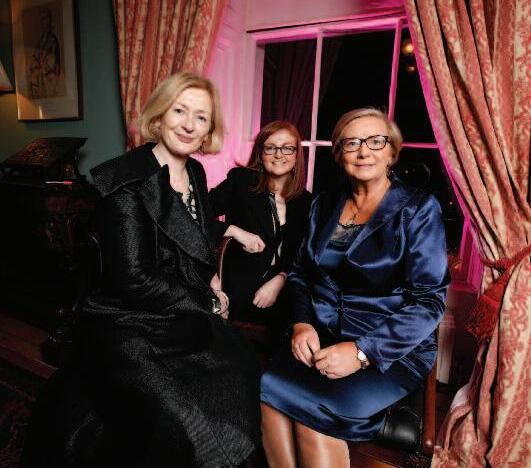
In celebration of International Women’s Day 2017, the Women at the Bar Working Group of The Bar of Ireland hosted the second annual dinner at the King’s Inns to celebrate women in law on Thursday March 9, 2017
An esteemed audience of barristers, judges and solicitors gathered to celebrate their female colleagues and were warmly welcomed by Chair of the Women at the Bar Working Group, Grainne Larkin BL
Af ter dinner, guests were treated to a hear tfelt speech by our wonderful guest speaker Marion McKeon, who has enjoyed a varied career as broadcaster, documentary maker, and features editor and foreign editor for The Sunday Business Post, including a brief detour to the Law Library for three years Now based in the US and working as US correspondent for The Sunday Business Post, Marion gave a fascinating insight into some of her work and shared some inspirational words of wisdom for women forging their legal careers
Eilis Brennan BL Editor ebrennan@lawlibrary ie
Time to get running
This year’s Calcutta Run will take place on Saturday, May 20 The run is Ireland’s legal fundraiser and the money will go to two ver y wor thwhile charities – GOAL and the Peter McVerry Trust
The organisers said: “We are giving you plenty of notice and abundant time to dust off those runners and enjoy those healthy jogs in the park, along the canal or during lunch near your office”
The target for this year is to raise ¤200,000, so be sure to get as many people involved as you can Fur ther information will be posted to the Calcutta Run Facebook and Twitter pages
At the Women in Law dinner at the King's Inns were (from left): Keynote speaker Marion McKeon; Chair of the Women at the Bar Working Group Grainne Larkin BL; and, Tánaiste and Minister for Justice Frances Fitzgerald
Innocence Scholarships launch New online ser vice from Bloomsbur y
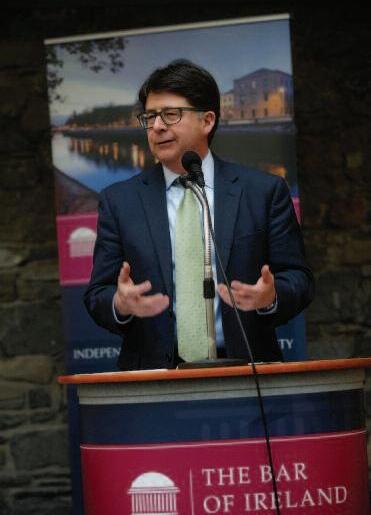
On Wednesday, February 1, Dean Strang, the US attorney from the Netflix documentar y Making a Murderer, launched The Bar of Ireland’s 2017 Innocence Scholarships Addressing a gathering of barristers in the Law Library on the subject of ‘How can you defend those people?’, he spoke about his experience of miscarriages of justice and emphasised the important role played by Innocence organisations and the legal professionals who participate in them The Bar of Ireland provides Innocence Scholarships on an annual basis and this year four barristers will be sponsored to travel to the USA to assist Innocence organisations After a competitive interview process held in March, the successful recipients have been selected and will travel to Cincinnati, Wisconsin and Florida at the end of May, and to Washington at the beginning of August
Look Into Law
The annual Look into Law Transition Year programme run by The Bar of I re l a n d to o k p l a ce i n e
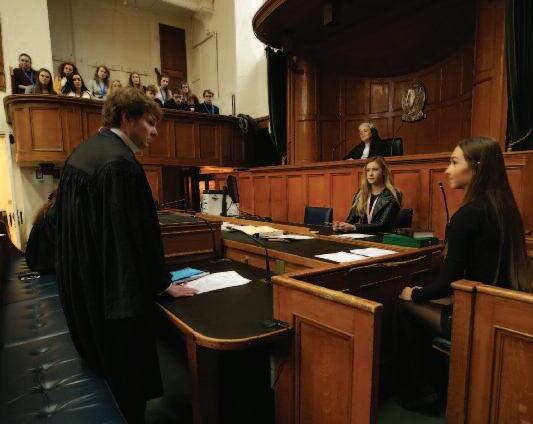
programme enthralled the 100 TY students, 28 of whom were from DEIS schools Ever y morning they shadowed a barrister in a small group and in the af ternoons in larger groups, they toured the Four Cour ts, the CCJ and King’s Inns, and had talks from a sitting judge, a cour t Garda and a legal affairs correspondent On the final day, the highlight for many, they took par t as witnesses, registrar and jur y members in a series of mock trials in the historic setting of Green Street cour thouse Feedback from students w a s o v
barristers, judges, Garda, journalists, librar y and King’s Inns staff, and the Chief Justice, who gave so willingly of their time and ensured that the week was such a success
Bloomsbury Professional has released a new online service called ‘Intellectual Proper ty and IT Law’ This follows a detailed review by the company of the requirements for solicitors practising IT and intellectual proper ty law
Provided as an online subscription, Bloomsbur y states that the ser vice is complementary to its existing por tfolio of online services such as: ‘Proper ty Law’; ‘Company Law’; ‘Employment Law’; ‘Litigation’; ‘Tax Law’; ‘Criminal Law’; and, ‘Wills and Probate’
Intellectual property and IT law is a rapidly developing area of law, often with serious penalties involved for infringement, and Bloomsbur y hopes this ser vice will help practitioners to keep up to date on changes and best practice, share insight easily, and provide accurate and up-to-date counsel in this space
Specifically, the ‘Intellectual Proper ty and IT Law’ service will cover Irish and UK titles around subject areas such as patents, copyright, trademark and data protection law The service will also contain a monthly update, written by David Cullen, Par tner, William Fry solicitors
According to Sean O’Neill, Account Director for Bloomsbur y Professional Ireland: “Legal counsels today are facing a complex environment when it comes to the ever-changing landscape of IT and intellectual proper ty law The internet has created an environment where issues such as privacy and data protection are increasingly contentious and impor tant for leading organisations and private individuals alike The legal professional plays a key role in this where answers are expected as fast as a Google search The Bloomsbury ‘Intellectual Property and IT Law’ service online equips barristers to respond with surety while increasing their variety of work, to draf t documents easily and to quickly search an excellent range of commentary”
As new Bloomsbury Professional titles and editions are published, they will be added to the site at no extra cost
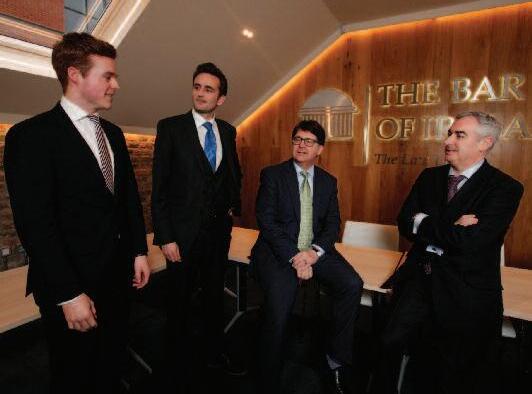
At the launch of The Bar of Ireland Innocence Scholarships 2017 were (from left): Roger Cross BL; Mark Curran BL; Dean Strang; and, Chairman, Council of The Bar of Ireland, Paul McGarry SC
TY students enjoyed taking par t in a mock trial at Green Street cour thouse
Denham Fellowship launched
The Bar of Ireland in association with The Honorable Society of King’s Inns is delighted to announce The Denham Fellowship, a five-year programme of educational, professional and financial support to two aspiring barristers from socioeconomically disadvantaged backgrounds
The Bar of Ireland believes that it is in the best interest of the public we serve that the make-up of the legal profession reflects the diversity of the society it serves We want to encourage students from all backgrounds to consider a career at the Bar As with many professions, becoming a barrister can be a daunting prospect for students if they don’t have the necessary support and we hope to rectify that through the supports offered in this fellowship
Full details of the Fellowship, which includes an annual ¤6,000 stipend, remission of King’s Inns and Law Library fees and a mentoring programme, can be found on our website –www lawlibrary ie
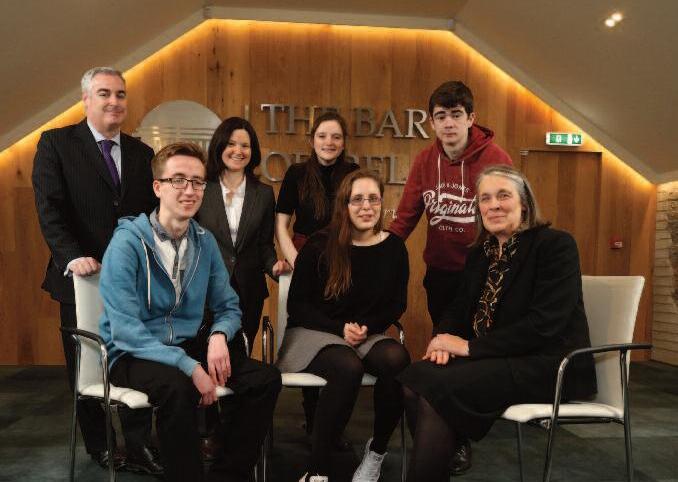
Pictured at the launch of the Denham Fellowship: Back row (from lef t): Chairman, Council of The Bar of Ireland, Paul McGarr y SC; Dr Eimear Brown, Dean of the School of Law at King's Inns; Shauna Lynch, Breifne College, Co Cavan; and, Liam Grant, St Joseph's Secondar y School,
Co Dublin Front row (from lef t): Cian O’Mahoney, Tullamore College, Co Of faly; Aleksandra Roszkowska, St Brendan’s College, Co Mayo; and, Chief Justice Mr s Susan Denham
Bar welcomes colleagues to Dublin
NYSBA International Section
The New York State Bar Association (NYSBA) International Section will hold its Spring Meeting 2017 in Dublin, in association with The Bar of Ireland, on April 20 and 21 The conference chairs will be Paul McGarry SC, Edward K Lenci and Neil A Quantaro The Meeting begins with a lunch and executive committee meeting in the Distillery Building, followed by the official opening by Chief Justice Mrs Susan Denham, Paul McGarry, Neil A Quantaro and Claire Gutekunst, President of the NYSBA There will be two plenary sessions, and attendees will hear views on judging from two top members of the bench on either side of the Atlantic: Loretta A Preska, former Chief judge of the US District Court for the Southern District of New York; and, Mr Justice Frank Clarke of the Irish Supreme Court
The second day will involve panel discussions covering topics such as the impact of Brexit on attorneys, and European and US perspectives on human rights challenges
NYSBA and Bar of Ireland members are eligible for discounted rates
Notice to suspend
Four Jurisdictions
The Four Jurisdictions Conference (for members of the Bars and judiciaries of Ireland, Northern Ireland, Scotland, and England and Wales) will also be held in Ireland this year from May 5-7 Topics will include the question of whether free movement between the four jurisdictions can be maintained post Brexit, as well as a lecture from Mr Justice Donal O’Donnell on the legal stories surrounding the Asgard and the 1914 Howth Gun Running
The fee to attend the entire Conference is ¤260, while junior members (years 1-7) can avail of a reduced price of ¤210 You can opt to only attend parts of the Conference and prices for the different sections range from ¤35-¤170 (¤35-¤110 for junior members) Anyone wishing to attend can register online at https://ti to/bar-of-ireland/ four-jurisdictions-conference-2017-dublin
Queries on either conference should be directed to Rose Fisher at events@lawlibrary ie or 01-817 5166
The Honorable Society Of King's Inns Notice of Decision of Benchers to Suspend Mr Paul McLoughlin, Barrister-At-Law.
Pursuant to Rule 37(4) of the Society, notice is hereby given that the Bar Council made the following complaints to the Disciplinary Committee of the Society in relation to Mr Paul McLoughlin (described in the complaints as the Respondent)
1 The Respondent was convicted in the Dublin Circuit Criminal Cour t of the criminal offence of harassment, contrar y to section 10 of the Non-Fatal Offences Against the Person Act, 1997 on June 8, 2012 The Respondent failed to inform the Bar Council of the conviction The Respondent was thereby in breach of Rule 2 13 of the Code of Conduct of The Bar of Ireland in that he did not for thwith or at all repor t to the Bar Council the fact that he had been convicted of a criminal offence which might bring the profession into disrepute
2 The Respondent engaged in conduct which brought the barristers' profession into disrepute by engaging in conduct which led to his conviction for the offence of harassment contrary to section 10 of the Non-Fatal Offences Against the Person Act, 1997 The conviction was in respect of offending behaviour which occurred between 1st day of May 2006 and 14th day of May 2010 The Respondent was thereby in breach of Rule 1 2{b) of the Code of Conduct of The Bar of Ireland in that he engaged in conduct which may bring the barristers' profession into disrepute
3 The criminal offence in respect of which the Respondent was convicted related to the harassment of a colleague between 1st day of May 2006 and 14th day of May 2010 By so doing, the Respondent did not act in an ethical manner The Respondent was thereby in breach of Rule 1 2{c) of the Code of Conduct of the Bar of Ireland in that he failed to observe the ethics of the barristers' profession
4 The Respondent's harassment of a colleague over a significant period of time from 1st day of May 2006 to the 14th day of May 2010 and subsequent conviction for the offence of harassment contrar y to section 10 of the Non-Fatal Offences Against the Person Act, 1997 amounted to serious breach
of respect for a colleague The Respondent was thereby in breach of Rule 7 1 of the Code of Conduct of the Bar of Ireland in that he did not treat a colleague with civility and respect
5 The Respondent by his harassment of a colleague over a significant period of time from 1st day of May 2006 to the 14th day of May 2010 and subsequent conviction therein fell below the standards expected of a member of the barristers' profession The Respondent was thereby in breach of Rule 2 4 of the Code of Conduct of The Bar of Ireland in that he did not uphold the standards set out in the Code of Conduct, and the dignity and high standing of the profession of barrister and his own standing as a member of the profession
6 The Respondent by his behaviour aforesaid has not upheld the standards set out in the Code of Conduct of The Bar of Ireland The Respondent is thereby in breach of Rule 1 1 of the Code of Conduct of The Bar of Ireland
The Benchers of the Honorable Society of King's Inns at its meeting of January 11, 2017 confirmed the report of the Disciplinary Committee in which it upheld the complaints made on the basis of an acceptance by Mr McLoughlin that the complaints made by the Bar Council in the Complaint document were made out The Benchers confirmed the sanction recommended by the Disciplinary Committee and resolved that Mr Paul McLoughlin be suspended from practice as a Barrister-at-Law to include all rights and privileges as a Barrister, including rights of audience for a period from the making of the final decision of the Benchers until December 11, 2028 In addition, the Committee deemed it appropriate that the aforementioned disciplinar y measure should be the subject of publication/registration in accordance with Rule 37 of the General Rules of the Honorable Society of King's Inns
Mr Paul McLoughlin is therefore suspended from practice as aforesaid until December 11, 2028
Young Bar news and events
A round-up of activities of the Young Bar Committee and upcoming events.
Recent conferences and events
Community Law and Mediation evening
On March 7 last, members of Community Law and Mediation (CLM), based in Coolock and Limerick, addressed members on the value of working at their clinics Michael Cush SC and Jane McGowan BL spoke about their experiences doing pro bono work, and about housing law in particular CLM was happy to confirm that it recruited barristers for its clinics as a result of this information evening If anyone wishes to volunteer or receive further information they can contact Roslyn Palmer of CLM at rozpalmer@gmail com
AIJA digital single market conference
The Young Bar Committee sponsored four junior members to attend the AIJA (International Association of Young Lawyers) conference in Dublin from March 30 to April 1 last The conference was entitled: 'The European Digital Single Market –Breaking Down Digital Barriers, Click by Click' Kate Conneely BL, Theo Donnelly BL, Jennifer M Good BL and Liam O’Connell BL were selected to attend, and enjoyed a packed scientific and social programme with a group of young lawyers from all over the world
Calendar dates to note Four Jurisdictions Conference
The Four jurisdictions Conference will be held in Dublin from May 5-7, 2017
This conference is for members of the four Bars: The Bar of Nor thern Ireland, The Scottish Bar, The Bar of England and Wales, and The Bar of Ireland and their judiciary to meet and exchange ideas A special rate is available for members in years 1-7 and all are encouraged to attend
Bar of Nor thern Ireland Conference and black tie dinner
On May 19, 2017, members from The Bar of Ireland are invited to the Inn of Cour t in Belfast attend their Young Bar Association conference on the theme: 'Brexit – Legal Impact and Oppor tunities' Our colleague John Kerr BL will be speaking about cross-border civil claims A black tie dinner will be held afterwards at the Hilton Hotel Fur ther details are available on the Young Bar Hub
Young Bar Hub blog posts
We have developed an online hub in the members’ section of the Law Library website, which provides resources such as 'Events and Oppor tunities', 'Nationwide Cour t Information' and 'Legal Blog Posts' Any future blog posts, notices or other content can be sent to youngbar@lawlibrary ie
Junior counsel research panel
There was a significant response to the development of a research panel Members have provided their details for the production of a list, which will be published and promoted at the beginning of Easter Term
Claire Hogan BL
Defender at hear t
Dean Strang is recognised all over the world for his role as one of the defence team in the Netflix series Making a Murderer. On a recent visit to Dublin, Dean spoke to The Bar Review about the show, the issues it raises, and its impact on his own career.
Ann-Marie Hardiman Managing Editor at Think Media Ltd
Dean Strang didn’t want to be a lawyer His first choice of career was the somewhat unlikely one of political cartoonist However, he realised that like many creative endeavours, as much as he loved it, it wouldn't be a lasting career: "I didn't have a back-up idea at that point but my Dad suggested I might be a good lawyer" He also had no intention of pursuing a career in criminal law, preferring the area of employee benefits: "There again, it was serendipity, much like going to law school in the first place I got a job with a large firm in Wisconsin [where he is from, and where the events depicted in Making a Murderer take place], and they needed someone in litigation As a brand new associate, I didn’t have much choice I did litigation involving employee health and welfare and pension plans for over two years Around that time, I began to socialise with a group of young public defenders, and I decided what they did was pretty interesting and important, so I decided to explore criminal law"
His first foray into criminal law was on the other side of the courtroom, as it were, as a federal prosecutor, but he felt this was a poor fit: "I wasn't cut out to be a prosecutor I did like criminal law; I just thought I was on the wrong side"
A vacancy arose in one of Wisconsin's top criminal defence firms, and that might be said to be the point where Dean's career began in earnest This time he stayed for years, before leaving to spend five years as the state's first federal public defender It would be natural to assume that a public defender would have a strong social conscience, but throughout our interview Dean is resistant to the idea that his career choices are a reflection of a particular political or ideological view: "I wish I could say that social conscience had been an earlier or stronger development; I wish I could say it was stronger today I think just as a matter of character I tend to side with the underdog"
Fate steps in
Dean finally made the decision to go back into private practice in 2005, and at this point things took an extraordinary turn He had been back in private practice for just six months when he got a call from the Avery family to ask if he would consider defending Steven Avery (see panel), who had been charged with the murder of a young photographer, Teresa Halbach For Dean, it was an opportunity to build the profile of his new practice: "I knew of the case, because it was receiving publicity from the outset, and thought it would be a good time for me to take it It might not be lucrative, but would be good for the visibility of my practice"
At that stage Dean was not aware that the Avery family had agreed to let filmmakers Laura Ricciardi and Moira Demos make a documentary about the case, and he readily admits that he and fellow defence attorney Jerry Buting took a little convincing: "I was leery, and Jerry shared my concerns, but the filmmakers had won the trust of the Averys, and a film was going to be made whether we
participated in it or not So we talked with the filmmakers and agreed that we would co-operate on condition that there was no invasion of lawyer/client privilege, and that nothing whatsoever should be made public until after both cases [of Avery and his nephew Brendan Dassey, who was also charged in connection with the murder] had gone to trial and the trial was completed" Laura Ricciardi's own background was in law, and Dean says she and Demos readily agreed to the conditions It was a slow process of trust building at first – the fascinating scenes where Dean and Jerry are seen sitting in an apar tment discussing the details of the case were not filmed until almost a year into the process Over time, however, he came to see that the two women were interested in broader elements of criminal justice, and were using the stories to pose bigger questions to viewers He says the process became a reciprocal one, as his and Jerry's approach to the case was affected by the filmmaking: "Those were questions that appealed to Jerry and me, issues that we'd thought were important for a long time as well, so in the end we had a really very good relationship with the filmmakers"
Life changing
For us as viewers, Making a Murderer is a relatively recent phenomenon as it was first broadcast in late 2015 The events featured, however, took place a decade before, in the period from 2006 to 2007, so there was quite a lengthy period during which life went back to normal for Dean: "Years went by and we went on with our lives The cases had garnered massive publicity in the state but not too much outside it, so I didn’t know if the film would ever be sold, and I sort of forgot about it"
In fact, Dean didn’t find out that the film had been sold to Netflix until just a couple of months before broadcast Then, in late 2015, everything went crazy: "The week before it came out we had a conference call with Netflix and they said: 'You might get some media calls '"
Having dealt with considerable media attention during the trial, Dean and Jerry felt it wouldn't be anything they couldn't handle, but even Netflix didn't fully anticipate the reaction to the series, in particular the public's interest in the two
Making a Murderer
Making a Murderer follows the trials and conviction of Steven Avery and his nephew Brendan Dassey for murder Avery had previously been incarcerated for 18 years for rape, a conviction that was over turned with the help of the Innocence Project, when DNA evidence not available at the time of his conviction exonerated him After his release in 2003, Avery filed a civil lawsuit against Manitowoc County in Wisconsin, and against officials associated with his arrest and conviction Two years later he was arrested and charged with the murder of Teresa Halbach His nephew, Brendan Dassey, was also arrested and charged in connection with the case, having confessed under interrogation Avery maintains his innocence of this second crime, and claims that he was framed in order to discredit his civil case The series explores accusations of evidence tampering and other issues that cast doubt on the prosecution's case against him It also focuses in some detail on Dassey's case, where issues around his treatment by the police, and by his own legal representatives, led to his conviction being over turned in 2016 Despite this, both men remain incarcerated and a second series of Making a Murderer will follow the developments in their cases
lawyers For Dean, the impact was immediate: "The film came out on December 18, 2015, and by 6 00pm that evening I had my first email from a gentleman in South Carolina who had just watched all 10 hours"
By the middle of the following week, Dean was receiving an average of 150 emails a day, from the media and the public, " a deluge of unexpected attention", almost all of which, he says, was polite and positive: "The attitude of most people has been friendly and remarkably thoughtful – people had clearly taken time to think through what they wanted to say, what Making a Murderer meant to them, how it connected to their lives in some way I can probably count on 10 fingers the number of angry, hostile or insulting messages I received"
It might come as a surprise in this era of internet trolling and 'comment culture' to hear that people can still react sensitively to the complex issues of truth and justice that the Avery and Dassey cases present, but Dean says that both online and in person (he and Jerry Buting did a tour of theatres where they discussed the case and the wider issues around it), questions and comments were often sceptical and tough, but almost always thoughtful and fair It's hard to escape the conclusion that this has more than a little to do with Dean and Jerry's own innate decency, which is clear throughout the show, from their sensitive teasing out of the issues in those filmed case conferences, to their clear commitment to Steven Avery, to getting him the fairest possible trial, and treating him with dignity throughout
The bigger picture
The Avery and Dassey cases were seen as raising a number of issues about the US justice system In the case of Brendan Dassey, there was a perception that practices around the interviewing of and obtaining a confession from an underage young man of below average intellectual development were at the very least highly questionable The programme was seen as raising wider issues too, for example the fact that the system seems to be more about pursuit of a conviction at all costs than pursuit of the truth or of 'justice' Dean agrees with this assessment, and says it is reflected in the correspondence he's received: "Of the people who've selected themselves to write to me, about two-thirds have spoken about their reaction to
what they perceive as an injustice, or a miscarriage of justice, or in some cases a perception that Steven Avery in particular might well be guilty, but that the system shouldn't work that way " Interestingly, but perhaps unsurprisingly, the correspondence varied according to country: "Writers from some countries say it reminded them of a period in their history, or of problems they have today Writers from other countries are shocked and dismayed that this can happen in the United States because it wouldn't happen in their country It's a very interesting difference anecdotally, to see what level of confidence people have that their own nation's criminal justice system would or would not be capable of some of the mistakes or shortcomings they see in the film"
He mentions in particular the response from these islands: "I received more emails per capita from Ireland and the UK than from any country outside the US, and the Irish very often say this reminded them of a time in the 1970s and the 1980s And some of them think things are much better now and some of them say that not all is rosy still That's been a very common Irish reaction, that it touches a chord with a shared historical if not personal experience, with which the Irish are familiar" With characteristic thoughtfulness, Dean is pleased that people are thinking about these issues and wanting something to be done, but he knows it's not that simple: "Legislators shouldn’t be expected to react to any one movie Nonetheless, I do think that we can credit the filmmakers and Netflix with spawning enough interest that in Illinois, Tennessee, and other states, legislators are looking at the interview of juveniles while they're in police custody and there has been some effort, especially in Illinois, to improve the protections of juveniles when they're subjected to custodial police interview"
He also sees Making a Murderer in its wider context as one of several 'true crime' documentaries, and sees this in turn as a reflection of wider social issues, particularly in the States: "We had Serial, the podcast that preceded Making a Murderer We've had The Jinx on HBO, and I think you'll see others We go through cycles of rising and falling interest in true crime stories in the United States but we ' re in a period of rising interest and that has been coupled with a broader public discussion about criminal justice, magnified I think by social media and also, I think, the related discussion Americans are having about police agencies and how they serve their communities The spate of shootings of unarmed people, often people of colour, captured very frequently on smartphones, the Black Lives Matter movement, and the Blue Lives Matter counter-movement are all part of this That discussion had its own genesis but I think has been a catalyst in some ways to expanding discussion
Defending the guilty
Dean Strang visited Dublin to launch The Bar of Ireland's Innocence scholarships, which fund young barristers to work with Innocence projects in the US each year
At the launch, he spoke eloquently on the topic of how lawyers deal with the ethical question: "How do we defend the guilty?" He spoke of the need to be aware of the assumptions both legal professionals and the general public can have about "those people" – the idea of the accused as "the other", and the dangers inherent in these assumptions He felt strongly that if we can break down those assumptions, and realise that there is really no ' us ' and 'them', then the question becomes: "How can I not defend my people?" It's at this point, he felt, that a lawyer will have found a vocation, even if they never actually defend in court: "If you can do that, you ' re a defender at heart"
to include not just the front end of the criminal justice system, which is to say the police investigation role, but the middle, the judicial function I hope eventually the discussion spreads to the back end of the system, which is corrections and prisons"
When we conducted our interview, the legal system and judiciary in the US were under par ticular scrutiny in the wake of responses to President Donald Trump's efforts to restrict access to the US from certain countries Dean refuses to be drawn on his personal views of the current administration, but in characteristic fashion, feels that the overarching philosophical issues raised are timely and impor tant:
"Events of the last several years, certainly including the November election, have reminded Americans that democracy is not a passive project It often requires active engagement, raising your voice, collective assembly The country is divided in its viewpoints, which isn't a bad thing in itself – a diversity of viewpoints is a healthy thing in democracy, as is protest My hope is that as we engage energetically in that active project, we don't lose altogether the ability to converse with one another, that civic protest and even civil disobedience don't replace civility and simply listening to one another It's an exciting time – and that's not to say that it's not also a perilous time"
Returning to the quiet life
Dean is no longer directly involved in the Avery case, and as life slowly returns to normal, he has returned to his practice, and to his other main interest, legal history
Having published his first book, Worse than the Devil: Anarchists, Clarence Darrow, and Justice in a Time of Terror, which recounted the story of a 1917 American miscarriage of justice, he's now in the process of completing another: "It's a more ambitious research and storytelling project for me It's the story of the largest mass trial in US civilian court history, and in many ways it's the story of the emergence of the US Department of Justice in its modern form The Department of Justice took it upon itself to try to combat the Industrial Workers of the World, a labour union at the time, who were seen as the most organised radical opposition to America's entry to World War I It's a fascinating story"
Apart from that, his life now is about getting back to normal: "I'd like to try to restore my law practice from a 50% caseload, where it's been for the last year, to closer to a full caseload I'm also looking forward to spending more time with my wife and my dog, jogging more regularly, and enjoying Madison, Wisconsin, which is really a lovely place to be"
U P DAT E
The Bar Review, journal of The Bar of Ireland
A directory of legislation, articles and acquisitions received in the Law Library from January 19, 2017, to March 14, 2017 Judgment information supplied by Justis Publishing Ltd Edited by Deirdre Lambe and Vanessa Curley, Law Library, Four Courts.
AGRICULTURE
Statutory instruments
A g r i c u l t u re a
s a c t 2 0 0 1 (amendment of schedule) regulations 2016 – SI 638/2016
s u p p o r t s c h
s ) o f fe n
s a n d co n t ro l ( a m e n d m e n t ) re g u l a t i o n s 2016 – SI 483/2016
H o r s e R a c i n g I re l a n d A c t 2 0 1 6 ( co m m e n ce m e n t o f ce r t a i n
p ro v i s i o n s ) ( n o 2 ) o rd e r 2 0 1 6 – S I 629/2016
E u ro p e a n U n i o n ( c a s e i n s a n d
c a s e i n a te s ) re g u l a t i o n s 2 0 1 6 – S I 628/2016 European Communities (marketing of f r u i t p l a n t p ro p a g a t i n g m a te r i a l )
( a m e n d m e n t ) re g u l a t i o n s 2 0 1 7 – S I 39/2017
E u ro p e a n U n i o n ( i d e n t i f i c a t i o n o f e q u i d a e ) ( a m e n d m e n t ) ( n o 2 ) regulations 2015 – SI 291/2015
E u ro p e a n U n i o n ( p ro te c t i o n o f animals used for scientific purposes)
( a m e n d m e n t ) re g u l a t i o n s 2 0 1 6 – S I 552/2016
H o r s e a n d g re y h o u n d ra c i n g f u n d regulations 2017 – SI 35/2017
S e a - f i s h e r i e s ( q u o t a s ) re g u l a t i o n s 2016 – SI 52/2017
Tobacco (areas for 2017) order 2017 – SI 41/2017
ARBITRATION
Library acquisitions
Mockesch, A Attorney-client privilege
i n i n t e r n a t i o n a l a r b i t r a t i o n O x fo rd : O x fo rd U n i v e r s i t y P re s s , 2 0 1 7 –N398 8
Ar ticles D
discover y Irish Law Times 2017; (35) (5): 66
BANKING
Banking and finance – Liquidation –
D i s co v e r y o f re p o r t s – A p p l i e d B A M
PPP PGGM Infrastructure Cooperatie
UA v National Treasur y Management Agency [2015] 11 JIC 0605, Applied Compagnie Financiere du Pacifique v Peruvian Guano Company 11 QBD 55 – ( O ’ C o n n o r J – 2 0 / 0 1 / 2 0 1 7 ) –[2017] IEHC 43
C
Corporation Ltd
Banking and finance – Non-payment
o f l o a n – S u m m a r y j u d g m e n t –
Applied Aer Rianta cpt v Ryanair Ltd
( N o 1 ) [
Harrisrange Ltd v Duncan [2003] 4 IR
1 , A p p l i e d I r i s h B a n k Re s o l u t i o n
Corporation (in special liquidation) v Gerard McCaughey [2014] 1 IR 749 –
( B a r re t t J – 1 5 / 0 2 / 2 0 1 7 ) – [ 2 0 1 7 ]
IEHC 75
Allied Irish Banks PLC v O’Brien
Ar ticles
B re s l i n , J , C o rco ra n , E U n d u e
i n f l u e n ce a n d n o n - co m m e rc i a l
guarantees: Cour t of Appeal decisions
i n U l s te r B a n k ( I re l a n d ) Lt d v D e
Kretser and Bank of Ireland v Curran
Commercial Law Practitioner 2017; 24 (2): 19
Statutory instruments C e n t ra l B a n k a c t 1 9 4 2 (
Ser vices Ombudsman Council) levies
54/2017
C e n t ra l B a n k ( S u p e r v i s i o n a n d
E n fo rce m e n t ) A c t 2 0 1 3 ( s e c t i o n 48(1)) (investment firms) regulations 2017 – SI 60/2017
C re d i t g u a ra n te e s c h e m e 2 0 1 7 – S I 70/2017
BUILDING LAW
Statutory instruments
B u i l d i n g re g u l a t i o n s ( a m e n d m e n t ) regulations 2017 – SI 4/2017
B u i l d i n g re g u l a t i o n s ( p a r t B
a m e n d m e n t ) re g u l a t i o n s 2 0 1 7 – S I 57/2017
CHILDREN
C a re o rd e r – U n l a w f u l d e te n t i o n –
H a b e a s co r p u s – A p p l i e d C o n d o n v M i n i s t e r fo r L a b o u r [ 1 9 8 1 ] I R 6 2 ,
D i s t i n g u i s h e d M F v S u p t B a l l y m u n
G a rd a S t a t i o n [ 1 9 9 1 ] 1 I R 1 8 9 ,
D i s t i n g u i s h e d S t a t e ( M c D o n a g h ) v
F ra w l e y [ 1 9 7 8 ] I R 1 3 1 – ( D e n h a m
C J , O ’ D o n n e l l D o n a l J ,
M a c M e n a m i n J , C h a r l e to n J ,
O ’ M a l l e y J , D u n n e J , L a f fo y J –
23/02/2017) – [2017] IESC 9
Child and Family Agency v McG and JC
Library acquisitions
Nestor, J Law of child care (3rd ed )
D u b l i n : Lo n s d a l e L a w P u b l i s h i n g , 2016 – N176 26 C5
Statutory instruments
C h i l d C a re A c t 1 9 9 1 ( e a r l y y e a r s
s e r v i ce s ) ( a m e n d m e n t ) re g u l a t i o n s 2016 – SI 632/2016
CITIZENSHIP
C i v i l re g i s t ra t i o n – C i t i z e n s h i p –
B a l a n ce o f p ro b a b i l i t i e s – A p p l i e d
F i t z g i b b o n ( A n n e ) v L a w S o c i e t y o f
I re l a n d [ 2 0 1 4 ] I E S C 4 8 – ( I r v i n e J ,
H o g a n J , F i n l a y G e o g h e g a n J –03/02/2017) – [2017] IECA 19 Chesnokov v An tArd-Chláraitheoir
COMMERCIAL LAW
Ar ticles
O ’ C o n n o r, R Fo rg i n g a h e a d : t h e
h i d d e n r i s k s o f a r t i n v e s t m e n t – a legal analysis of the challenges facing the global ar t market today Irish Law Times 2017; (35) (1): 11 [par t 1]; Irish Law Times 2017; (35) (2): 28 [par t 2] Wade, G When is “close of business”? I r i s h L a w T
[par t 1]
COMPANY LAW
Library acquisitions
M o r t i m o re , S C o m p a n y d i r e c t o r s : d u t i e s
ed ) Oxford: Oxford University Press, 2017 – N264
Kershaw, D Company law in context: text and materials (2nd ed ) Oxford: Oxford University Press, 2012 – N261
Ar ticles
(1):
Society Gazette 2017 (Jan/Feb): 48
(35) (2):
(March): 42
Statutory instruments
regulations 2016 – SI 623/2016
COMPETITION LAW
Statutory Instruments
and consumer protection
scheme 2016 – SI 593/2016 European Union (actions for damages for infringements of competition law) regulations 2017 – SI 43/2017
CONSTITUTIONAL LAW
C o n s t i t u t i o n – A r t 4 0 4 2 o f t h e
Constitution – Family S 9 (8) of the
Fa m i l y L a w ( M a i n te n a n ce o f S p o u s e and Children) Act 1976 – Referred to
F X v C l i n i ca l D i re c to r o f C e n t ra l
Mental Hospital and anor [2014] 1 IR
2 8 0 – ( E a g a r J – 0 8 / 0 2 / 2 0 1 7 ) [2017] – IEHC 60
O’Brien v Governor of Cork Prison
Constitution – Crime and sentencing – Validity of S 99(11) of the Criminal Justice Act 2006 – Considered Moore v DPP [2016] 4 JIC 1905, Referred to
G i l l i g a n v I re l a n d [ 2 0 1 3 ] 2 I R 7 4 5 , Referred to Ellis v Minister for Justice
a n d E q u a l i t y [ 2 0 1 6 ] 5 J I C 0 9 0 2 –
( H u m p h re y s J – 1 9 / 0 1 / 2 0 1 7 ) –[2017] IEHC 9
O’Shea v Ireland and ors
CONTRACT
B re a c h o f co n t ra c t – S t r i ke o u t
p ro ce e d i n g s – Ve x a t i o u s c l a i m s –
A p p l i e d I r i s h Pe r m a n e n t B u i l d i n g
S o c i e t y v Re g i s t ra r o f B u i l d i n g
S o c i e t i e s [ 1 9 7 9 ] I L R M 2 7 3 –
( E d w a rd s J , Ke l l y P , H o g a n J –01/02/2017) – [2017] IECA 11
D&L Properties Ltd v Yolanda Ltd
C o n t ra c t – B re a c h o f co n t ra c t –
E n t i t l e m e n t fo r d a m a g e s – Re fe r re d to Doran v Delaney (No 2) [1999] 1
I R 3 0 3 , Re fe r re d to Ro b i n s o n v
H a r m a n 1 5 4 E R 3 6 3 – ( B i n c h y J –14/02/2017) – [2017] IEHC 74 O’Leary v Volkswagen Group Ireland
Library acquisitions
C a l n a n , R P r i n c i p l e s o f c o n t r a c t u a l i n t e r p r e t a t i o n ( 2 n d e d ) O x fo rd : Oxford University Press, 2017 – N10
COPYRIGHT
Library acquisitions
Secker, J , Morrison, C Copyright and e - l e a r n i n g : a g u i d e f o r p r a c t i t i o n e r s (2nd ed ) London: Facet Publishing, 2016 – N112 10
COURTS
Library acquisitions
Wo o d , K T h e C o u r t o f A p p e a l : a g u i d e D u b l i n : C l a r u s P re s s , 2 0 1 7 –N361 C5
Statutory instruments
C o u r t s A c t 2 0 1 6 ( co m m e n ce m e n t )
order 2017 – SI 1/2017
CRIMINAL LAW
Conviction – Failure to make income tax returns – Documentar y evidence – Appellant seeking to appeal against conviction – Whether the prosecution w a s u n
Applied People (At torney-General) v O g l e s b y [ 1 9 6 6 ] I R
30/01/2017) – [2017] IECA 6
DPP v Murphy
C o n v i c t i o n – M u rd e r – E v i d e n ce –
S e n te n c i n g – A g g ra v a te d b u rg l a r y –
S e v e r i t y o f s e n te n ce – A p p e l l a n t seeking to appeal against sentence –Whether sentence was unduly severe – (Mahon J , Birmingham J , Edwards J – 16/01/2017) – [2017] IECA 1
DPP v Murphy (No 2)
Sentencing – Assault causing harm –
To t a l i t y p r i n c i p l e – A p p l i e d D P P v Michael Farrell (applicant) [Cour t of Criminal Appeal] [2010] 7 JIC 0104 –(Mahon J , Sheehan J , Edwards J –09/02/2017) – [2017] IECA 28
DPP v Browne (No 2)
Sentencing – Assault causing serious harm – Undue leniency – (Sheehan J , B i r m i n g h a m J , M a h o n J –09/02/2017) – [2017] IECA 36
DPP v Zaharia
S e n te n c i n g – C o n d u c t to t h e prejudice of good order and discipline – Re d u c t i o n i n ra n k – Re fe r re d to F i n g l e to n v C e n t ra l B a n k o f I re l a n d [ 2 0 1 6 ] 1 J I C 0 4 0 1 , Re fe r re d to R M c C v D P P [ 2 0 0 8 ] 2 I R 9 2 –(Mahon J , Sheehan J , Edwards J –31/01/2017) – [2017] IECA 16
D i r e c t o r o f M i l i t a r y P r o s e c u t i o n s v Donaghy
S e n te n c i n g – D a n g e ro u s d r i v i n g –
C o n s e c u t i v e s e n te n ce s – C o n s i d e re d
DPP v T B [1996] 3 IR 294 – (Mahon
J , B i r m i n g h a m J , S h e e h a n J –23/01/2017) – [2017] IECA 4 DPP v Tobin
S e n te n c i n g – D a n g e ro u s d r i v i n g causing death or serious bodily harm – Severity of sentence – Referred to D P P v Ke i t h J e r v i s a n d a n o r [ 2 0 1 4 ] IECCA 14, Referred to DPP v Stronge [ 2 0 1 1 ] I E CC A 7 9 – ( M a h o n J ,
B i r m i n g h a m J , E d w a rd s J –17/02/2017) – [2017] IECA 34 DPP v Handley
Sentencing – Drug offences – Undue l e n i e n c y – C o n s i d e re d E i re
Continental Trading Co Ltd v Clonmel Foods Ltd [1955] IR 170, Referred to McCann v A and ors [2015] IEHC 366, Referred to McCann v J M [2015] 12
J I C 0 8 0 1
(
J
02/02/2017) – [2017] IECA 14 McCann v J M and Y W
S e n te
(Birmingham J , Mahon J , Edwards J
23/01/2017) – [2017] IECA 2 DPP v Durcan
intimidate another – Undue leniency – Applied DPP v McCormack [2000] 4 IR 356 – (Mahon J , Birmingham J , Sheehan J – 09/02/2017) – [2017] IECA 29
DPP v Walsh
Sentencing – Thef t – Undue leniency – Re fe r re d to D P P v Re
17/01/2017) – [2017] IECA 13 DPP v Zaffer (No 2) S e n te n c i n g – U n d u e l e n i e n c y –Review of sentence – (Birmingham J , Pear t J , Sheehan J – 06/02/2017) – [2017] IECA 33 DPP v Zinck
Ar ticles M u r ra y, A T h e m e n s re a o f ra p e i n I re l
co
Journal 2017; (27) (1): 2
Q u i n n , C F i g h t i n g w ro n g s T h e B a r Review 2017; (22) (1): 9 Ryan, D J J The proposed reform of p ro s t i t u t i o n l a w i n I re
l discourse and the perpetual exclusion o
Journal 2017; (27) (1): 12
M c D o n a l d , M Re b a l a n c i n g v i c t i m s ’ r i g h t s L a w S o c i e t y G a z e t t e 2 0 1 7 (March): 22
Acts
C r i m i n a l L a w (
competent authorities of cer tain third
2017 – SI 68/2017
E u ro p e a n U n i o n ( m a r ke t a b u s e ) ( a m e n d m e n t ) re g u l a t i o n s 2 0 1 7 – S I 11/2017
E u ro p e a n U n i o n ( re c re a t i o n a l c ra f t
a n d p e r s o n a l w a te rc ra f t ) re g u l a t i o n s 2017 – SI 65/2017
European Union (restriction of cer tain hazardous substances in electrical and
e l e c t ro n i c e q u i p m e n t ) ( a m e n d m e n t ) regulations 2017 – SI 44/2017
E u ro p e a n U n i o n ( t h i rd co u n t r y
a u d i to r s a n d a u d i t e n t i t i e s
e q u i v a l e n ce , t ra n s i t i o n a l p e r i o d a n d fees) (amendment) regulations 2017 – SI 67/2017
EVIDENCE
Library acquisitions
Law Reform Commission Law Reform
C o m m i s s i o n r e p o r t o n c o n s o l i d a t i o n
a n d r e f o r m o f a s p e c t s o f t h e l a w o f
e v i d e n c e D u b l i n : L a w Re fo r m Commission, 2016 – L160 C5
EXTRADITION LAW
European arrest warrant – Surrender – Re n d i t i o n – Re fe r re d to c r i m i n a l
p ro ce e d i n g s a g a i n s t P u p i n o ( C a s e C-105/03) [2006] QB 83 – (Edwards
J , Ryan P , Mahon J – 12/01/2017) – [2017] IECA 9
M i n i s t e r f o r J u s t i c e a n d E q u a l i t y v Skiba
FAMILY LAW
Fa m i l y – M a r r i a g e – I r re t r i e v a b l e
b re a kd o w n – Re fe r re d to Ze l g e r v
S a l i n i t r i ( C a s e 1 2 9 / 8 3 ) [ 1 9 8 4 ] E C R
2 3 9 7 – ( F i n l a y G e o g h e g a n J , Pe a r t
J , S h e e h a n J – 2 4 / 0 2 / 2 0 1 7 ) –[2017] IECA 18
M H v M H
Fa m i l y – P ra c t i ce a n d p ro ce d u re s –E n fo rce m e n t o f b re a c h o f a cce s s o rd e r s – A p p l i e d B o ro w s k i v
At torney-General For Canada (1987)
3 9 D L R ( 4 t h ) 7 3 1 , A p p l i e d G o o l d v
M a r y C o l l i n s , a D i s t r i c t C o u r t J u d g e
[ 2 0 0 4 ] 7 J I C 1 2 0 1 , A p p l i e d O ’ D o n o g h u e v Le g a l A i d B o a rd
orders – Applied AQ v KJ (other wise K A) [2016] IEHC 721, Applied Goold v Mar y Collins, a District Cour t Judge [ 2 0 0 4 ] 7 J I C 1 2 0 1 – ( N o o n a n J –25/01/2017) – [2017] IEHC 58
LOG v Child and Family Agency
Library acquisitions
Beaumont, P Hess, B , Walker, L The
Publishing, 2016 – N172 6
FINANCE
Statutory instruments
F
674/2016
F i n a n ce A c t 2 0 1 6 ( s e c t
s 3 8 , 3 9 and 40) (commencement) order 2016 – SI 675/2016
F i n a n ce A c t 2 0 1 6 ( s e c t i o n s 4
, 4 2 and 43) (commencement) order 2016 – SI 676/2016
A
(Minister of State at the Depar tments
o f F i n a n ce a n d P u b l i c E x p e n d i t u re
a n d Re fo r m ) o rd e r 2 0 1 6 – S I
682/2016
F i n a n ce a c t 2 0 1 6 ( s e c t i o n
38(1)(e)(iii)) (commencement) order
2017 – SI 37/2016
F i n a n ce a c t 2 0 1 6 ( s e c t i o n
38(1)(e)(iii)) (commencement) order 2017 – SI 37/2017
F i n a n ce ( n o 2 ) a c t 2 0 1 3 ( s e c t i o n
51(1)(c) (commencement) order 2016 – SI 547/2016
FREEDOM OF INFORMATION
Statutory instruments
F re e d o
( s e c t i o n s 9 ( 6 ) , 1 0 ( 6 ) a n d 3 7 ( 8 ) ) regulations 2017 – SI 53/2017
F re e d o m o f I n fo r m a t i o n A c t 2 0 1 4
( s e c t i o n s 9 ( 6 ) , 1 0 ( 6 ) a n d 3 7 ( 8 ) ) regulations 2016 – SI 558/2016
GOVERNMENT
Statutory instruments
[ 2 0 0 6 ] 4 I R 2 0 4 – ( N o o n a n J –17/01/2017) – [2017] IEHC 4 Conlon v Legal Aid Board Fa m i l y – S 1 3 ( 1 ) o f t
cer tain ministerial offices) order 2017 – SI 14/2017
S t a t i s t i c s ( co m m u n i t y i n n o v a t i o n sur vey) order 2017 – SI 40/2017
HEALTH
Acts
Health (Miscellaneous Provisions) Act 2017 – Act No 1 of 2017 – Signed on Februar y 16, 2017
Statutory instruments
E u ro p e a n U n i o n ( p ro v i s i o n o f fo o d i n fo r m a t i o n to co n s u m e r s )
( a m e n d m e n t ) ( n o 2 ) re g u l a t i o n s 2016 – SI 559/2016
E u ro p e a n U n i o n ( s p e c i f i c co n d i t i o n s applicable to the impor t of foodstuffs
co n t a i n i n g o r co n s i s t i n g o f b e te l leaves from India) regulations 2016 –SI 554/2016
E u ro p e a n U n i o n ( te m p o ra r y s u s p e n s i o n o f i m p o r t s f ro m Bangladesh of foodstuffs containing o r co n s i s t i n g o f b e te l l e a v e s ) regulations 2016 – SI 553
H e a l t h ( re s i d e n t i a l s u p p o r t s e r v i ce s
m a i n te n a n ce a n d a cco m m o d a t i o n
co n t r i b u t i o n s ) ( a m e n d m e n t ) regulations 2017 – SI 58/2017
HOUSING
Statutory instruments
H o u s i n g a s s i s t a n ce p a y m e n t
( a m e n d m e n t ) re g u l a t i o n s 2 0 1 7 – S I
56/2017
Housing assistance payment (section 50) regulations 2017 – SI 55/2017
H o u s i n g ( s t a n d a rd s fo r re n te d
h o u s e s ) re g u l a t i o n s 2 0 1 7 – S I 17/2017
Planning and development (housing)
a n d re s i d e n t i a l te n a n c i e s a c t 2 0 1 6
( co m m e n ce m e n t o f ce r t a i n provisions) order 2017 – SI 7/2017
Planning and development (housing)
a n d re s i d e n t i a l te n a n c i e s a c t 2 0 1 6
( co m m e n ce m e n t o f ce r t a i n
p ro v i s i o n s ) ( n o 2 ) o rd e r 2 0 1 7 – S I 31/2017
Re n t p re s s u re z o n e ( l o c a l e l e c to ra l
a re a o f A s h b o u r n e ) o rd e r 2 0 1 7 – S I 27/2017
Re n t p re s s u re z o n e ( l o c a l e l e c to ra l area of Ballincollig-Carrigaline) order 2017 – SI 18/2017
Re n t p re s s u re z o n e ( l o c a l e l e c to ra l area of Bray) order 2017 – 25/2017
Re n t p re s s u re z o n e ( l o c a l e l e c to ra l area of Celbridge-Leixlip) order 2017
– SI 22/2017
Re n t p re s s u re z o n e ( l o c a l e l e c to ra l
a re a o f G a l w a y C i t y C e n t ra l ) o rd e r
2017 – SI 21/2017
Re n t p re s s u re z o n e ( l o c a l e l e c to ra l
area of Galway City East) order 2017
– SI 23/2017
Re n t p re s s u re z o n e ( l o c a l e l e c to ra l
Re n t p re s
area of Galway City West) order 2017 – SI 19/2017
2017 – SI 29/2017
Re n t p re s s u re
– SI 28/2017
HUMAN RIGHTS
IMMIGRATION
Referred to V N [Cameroon] v Minister for Justice and Law Reform and anor
[2017] IEHC 52
DN v Chief Appeals Officer Asylum, immigration and nationality –A
Cloverhill Prison (Maher) [2015] IEHC 6 3 9 –
IEHC
IECA
Reform
IECA
– Subsidiar y
(M) v Min for Justice and or s (No 3) [2013] 1 IR 370 – (Hogan J , Pear t J , I r
IECA 20
D a n q u a v M i n i s t e r f o r J u s t i c e a n d Equality (No 2)
Ar ticles
Stack, S New rules for refugees The Bar Review 2017; (22) (1): 15
Statutory instruments
I n te r n a t i o n a l P ro te c t i o n A c t 2 0 1 5 ( a p p l i c a t i o n fo r i n te r n a t i o n a l p ro te c t i o n fo r m ) re g u l a t i o n s 2 0 1 6 –SI 660/2016
I n te r n a t i o n a l P ro te c t i o n A c t 2 0 1 5 (commencement) (no 3) order 2016 – SI 663/2016
I n te r n a t i o n a l P ro te c t i o n A c t 2 0 1 5 ( d e p o r t a t i o n ) re g u l a t i o n s 2 0 1 6 – S I 668/2016
I n te r n a t i o n a l P ro te c t i o n A c t 2 0 1 5
( e s t a b l i s h m e n t d a y ) o rd e r 2 0 1 6 – S I 661/2016
I n te r n a t i o n a l P ro te c t i o n A c t 2 0 1 5 ( p l a ce s o f d e te n t i o n ) re g u l a t i o n s 2016 – SI 666/2016
I n te r n a t i o n a l P ro te c t i o n A c t 2 0 1 5
( te m p o ra r y re s i d e n ce ce r t i f i c a te )
( p re s c r i b e d i n fo r m a t i o n ) re g u l a t i o n s 2016 – SI 662/2016
I n te r n a t i o n a l P ro te c t i o n A c t
( p e r m i s s i o n to re m a i n ) re g u l a t i o n s 2016 – SI 664/2016
I n te r n a t i o n a l P ro te c t i o n A c t ( t ra v e l
d o c u m e n t ) re g u l a t i o n s 2 0 1 6 – S I 667/2016
I n te r n a t i o n a l P ro te c t i o n A c t (voluntar y return) regulations 2016 –SI 665/2016
I m m i g ra t i o n A c t 2 0 0 4 ( i m m i g ra n t investor programme) (application for permission) (fee) regulations 2017 –SI 10/2017
INFORMATION TECHNOLOGY
Library acquisitions
B ra d l e y, P E x p e r t i n t e r n e t s e a r c h i n g (4th ed ) Lo n d o n : Fa ce t P u b l i s h i n g , 2013 – N347 4
INSOLVENCY
Library acquisitions
Po l l a rd , D C o r p o r a t e i n s o l v e n c y : p e n s i o n r i g h t s H a y w a rd s H e a t h :
Professional, 2016 – N312
INSURANCE
Library acquisitions
S u r r i d g e , R , M u r p h y, B , J o h n , N , Houseman, D Houseman’s law of life a s s u r a n c e ( 1 5 t h e d ) H a y w a rd s
2016 – N292 1
INTELLECTUAL PROPERTY
Ar ticles
Ke
l y, C C
2017; 24 (2): 27
a
Library acquisitions
Dowding, N , Reynolds, K Oakes, A D i l a p i d a t i o n s : t h e m o d e r n l a w a n d p r a c t i c e Lo n d o n : S w e e t & M a x w e l l , 2013 – N88 4
LEGAL PROFESSION
Ar ticles
Rother y, G Striking out Law Society Gazette 2017 (Jan/Feb): 30
Statutory instruments Le g a l S e r v i ce
( s e c t i o n s 1 1 8 to 1 2
) ( co m m e n ce m e n t ) o rd e r 2 0 1 6 – S I 630/2016
LOCAL GOVERNMENT
Statutory instruments E l e c to ra l re g u l a t i o n s 2 0 1 6 – S I 537/2016
INTERNATIONAL LAW
Library acquisitions M
C2000
B l o o m s b u r y P ro fe s s i o n a l , 2 0 1 6 –N312 Po l l a rd , D C o r p o r a t e i n s o l v e n c
Toth, O The lex mercatoria in theory
a n d p r a c t i c e O x fo rd : O x fo rd
University Press, 2017 – C220
Paterson, S Zakrzewski, R McKnight, Paterson, and Zakrzewski on the law
o f i n t e r n a t i o n a l f i n a n c e ( 2 n d e d )
Oxford: Oxford University Press, 2017 – C222
JUDGES
Library acquisitions
h e I r i s h
constitution Manchester: Manchester University Press, 2017 – L240 C5
JUDICIAL REVIEW
Library acquisitions
d e B l a c a m , M J u d i c i a l r e v i e w ( 3 r d e d ) H a y
Publishing, 2017 – M306 C5 N
review Oxford: Har t Publishing, 2016 – M306
LANDLORD
AND TENANT
NEGLIGENCE
Library acquisitions S a l z e d o , S , S i n g l a , T A c c o u n t a n t s ’ n e g l i g e n c e a n d l i a b i l i t y H a y w a rd s H e a t h : B l o o m s b u r y P ro fe s s i o n a l , 2016 – N33 73
NOTARY PUBLIC
N o t a r y P u b l i c – P u b l i c o f f i ce –A p p o i n t m e n t – ( D e n h a m C J27/01/2017) – [2017] IESC 2 In the matter of Karl O’Connor
PENSIONS
Statutory instruments
E n te r p r i s e I re l a n d S u p e ra n n u a t i o n scheme 2016 – SI 596/2016
S c i e n ce Fo u n d a t i o n I re l a n d
s u p e ra n n u a t i o n s c h e m e 2 0 1 6 – S I 594/2016
Single public ser vice pension scheme (accrual of referable amounts while on s i c k l e a v e ) re g u l a t i o n s 2 0 1 7 – S I 16/2017
Single public ser vice pension scheme ( re t i re m e n t o n m e d i c a l g ro u n d s ) regulations 2017 – SI 15/2017 Wo r k p l a ce Re l a t i o n s C o m m i s s i o n d i re c to r g e n e ra l s u p e ra n n u a t i o n scheme 2016 – SI 595/2016
I n d u s t r i a l D e v e l o p m e n t A g e n c y ( I re l a n d ) s u p e ra n n u a t i o n s c h e m e 2017 – SI 47/2017 M e n t a l H e a l t h C o m m i s s i o n s u p e ra n n u a t i o n s c h e m e 2 0 1 7 – S I
66/2017
Transpor t Infrastructure Ireland (RPA (
)
42/2017
PERSONAL INJURIES
Pe r s o n a l i n j u r i e s – Ro a d t ra f f i c accident – Appor tionment of liability – A p p l i e d C a r ro l l v C l a re C o u n t y Council [1975] IR 221, Applied Snell v Haughton [1971] IR 305 – (Irvine J , Pear t J , Hedigan J – 31/01/2017) –[2017] IECA 10
Moore v Advanced Tyre Company Ltd Pe r s o n a l i n j u r y
Holdings Ltd [2001] 4 IR 600 – (Baker J – 06/02/2017) – [2017] IEHC 59 In re Dunne (A Debtor)
Bankruptcy Act, 1988 – Dismissal of petition for adjudication as bankrupt – Applied Adjudication of Bankruptcy b y ACC
(Costello J – 16/01/2017) – [2017] IEHC 5
Bank of Ireland v Smyth
PLANNING AND ENVIRONMENTAL LAW
Planning and development – S 50 of t
2 4
–( M c G o v e r n J – 1 8 / 0 1 / 2 0 1 7 ) –[2017] IEHC 7
Ó Gríanna v An Bord Pleanála
P l a n n i n g a n d d e v e l o p m e n t – T h e
Planning and Development Act 2000 – Grant of leave for judicial review of planning permission – Applied Adam v Minister for Justice [2001] 3 IR 53, Distinguished De Roiste v Minister for D e fe n ce [ 2 0 0 1 ] 1 I R 1 9 0 , D i s t i n g u i s h e d M c D v C h i l d A b u s e C o m m i s s i o n [ 2 0 0 3 ] 2 I R 3 4 8 –(Haughton Rober t J – 02/02/2017) – [2017] IEHC 46 Sweetman v An Bord Pleanala
POLICE
Library acquisitions
English, J , Card, R Police law (15th ed ) Oxford: Oxford University Press, 2017 – M615
Ar ticles
O’Donnell, J Not above the law? The Bar Review 2016; (21) (5): 143
PRACTICE AND PROCEDURE
E x te n s i o n o f t i m e – C o n te m p t –Exceptional circumstances – Applied
E i re C o n t i n e n t a l Tra d i n g C o Lt d v
C l o n m e l Fo o d s Lt d [ 1 9 5 5 ] I R 1 7 0 ,
A p p l i e d G o o d e C o n c re t e v C R H p l c
a n d o r s [ 2 0 1 3 ] I E S C 3 9 – ( D e n h a m
C J , C l a r ke J M a c M e n a m i n J –10/02/2017) – [2017] IESC 7 Tracey v McCarthy
Practice and procedures – S 52 (1) of the Cour ts (Supplemental Provisions) Act, 1961 – Case stated – Considered
D P P v Pe t e r C u l l e n [ 2 0 1 4 ] 3 I R 3 0 ,
D i s t i n g u i s h e d D P P v R a y m o n d
G o r m l e y a n d o r s [ 2 0 1 4 ] 2 I R 5 9 1 ,
D i s t i n g u i s h e d W h e l to n v D i s t r i c t
Judge O’Lear y and DPP [2011] 4 IR
5 4 4 – ( E a g a r J – 1 3 / 0 1 / 2 0 1 7 ) –[2017] IEHC 3 DPP v Laing
Re p re s e n t a t i o n o f p e o p l e – T h e
Health Act 2004 – Inquir y into State f u n d i n g i n c h a r i t y s e c to r – A p p l i e d
At torney General v Hamilton (No 2) [ 1 9 9 3 ] 3 I R 2 2 7 , C o n s i d e re d B e r t i
[ 2 0 0 8 ] 4 I R 7 0 4 , C o n s i d e re d I v o r
Callely v Pat Moylan [2014] 4 IR 112 – (Kelly P , Noonan J , Kennedy J –31/01/2017) – [2017] IEHC 34
Kerins v McGuinness
S
[2017] IECA 5
Long v Bord Bia
Library acquisitions
B
C
January 2017 (9th ed ) 2017 Dublin: Lo n s d a l e L a w P u b l i s h i n g , 2 0 1 7 –N363 1 C5
B l a c k h a l l P u b l i s h i n g B l a c k h a l l ’ s
D i s t r i c t C o u r t r u l e
D u b l i n : Lo n s d a l e L a w P u b l i s h i n g ,
2017 – N363 2 C5
B l a c k h a l l P u b l i s h i n g B l a c k h a l l ’ s
S u p e r i o r C o u r t r u l e s : u p d a t e d t o 1
J a n u a r y 2 0 1 7 ( 1 0 t h e d ) 2 0 1 7
D u b l i n : Lo n s d a l e L a w P u b l i s h i n g , 2017 – N361 C5
Ar ticles
B i e h l e r, H N o r m a l a n d “ l e a p f ro g ”
a p p e a l s to t h e S u p re m e C o u r t I r i s h
Law Times 2017; (35) (1): 5
Ke y s , T L i t i g a n t s i n p e r s o n a n d t h e
a d m i n i s t ra t i o n o f j u s t i ce T h e B a r
Review 2017; (22) (1): 19
PROPERTY
Proper ty – Preliminar y issues – Abuse
o f p ro ce s s – A p p l i e d H e n d e r s o n v
Henderson [1843-60] All ER Rep 378,
A p p l i e d J o h n s o n v G o re Wo o d & C o ( a f i r m ) [ 2 0 0 2 ] 2 AC 1 – ( F i n l a y
G e o g h e g a n J , Pe a r
10/02/2017) – [2017] IECA 25
O’Connor v Cotter
Library acquisitions
H
Society Gazette 2017 (March): 46
RELIGION
Ar ticles
Mannering, B Burkinis in Bundoran
L a w S o c i e t y G a z e t t e 2 0 1 7 ( M a rc h ) :
50
REVENUE
Statutory instruments
Customs (electronic filing of returns) order 2016 – SI 614/2016 Customs (mandatory electronic filing) (specified persons) regulations 2016 – SI 615/2016
(amendment) (no 2) order 2016 – SI 626/2016
Taxes (countr y-by-countr y repor ting) Regulations 2016 – SI 653/2016
Universal social charge (amendment) regulations 2016 – SI 654/2016
and stock return) (specified provision a
33/2017
Mineral oil tax (mandator y electronic filing and miscellaneous amendments) regulations 2017 – SI 34/2017
ROAD TRAFFIC
Ar ticles
Pierse, R Highway star Law Society Gazette 2017 (March): 33
SOCIAL WELFARE
Statutory instruments
S o c i a l We l f a re ( co n s o l i d a te d c l a i m s , payments and control) (amendment) ( n o 1 ) ( a b s e n ce f ro m t h e s t a te ) regulations 2017 – SI 12/2017
S o c i a l We l f a re ( co n s o l i d a te d c l a i m s , payments and control) (amendment)
( n o 2 ) ( n o m i n a te d p e r s o n s ) regulations 2017 – SI 13/2017
S o c i a l w e l f a re ( co n s o l i d a te d c l a i m s , payments and control) (amendment) (no 3) (change in rates) regulations 2017 – SI 64/2017
S o c i a l w e l f a re ( co n s o l i d a te d
co n t r i b u t i o n s a n d i n s u ra b i l i t y )
( a m e n d m e n t ) ( n o 1 ) ( v o l u n t a r y
co n t r i b u t i o n s ) re g u l a t i o n s 2 0 1 7 – S I 38/2017
S o c i a l w e l f a re ( co n s o l i d a te d
o cc u p a t i o n a l i n j u r i e s ) ( a m e n d m e n t ) (no 1) regulations 2017 – SI 63/2017
S o c i a l w e l f a re ( co n s o l i d a te d
s u p p l e m e n t a r y w e l f a re a l l o w a n ce )
( a m e n d m e n t ) ( n o 1 ) ( d i e t s u p p l e m e n t ) re g u l a t i o n s 2 0 1 7 – S I 71/2017
S o c i a l w e l f a re ( j o b s e e ke r ’s b e n e f i t variation of rate specified in sections 65A and 66(1A) of the social welfare
co n s o l i d a t i o n a c t 2 0 0 5 ) re g u l a t i o n s 2017 – SI 62/2017
S o c i a l w e l f a re ( re n t a l l o w a n ce ) ( a m e n
2017 – SI 72/2017
SOLICITORS
Professional conduct and ethics – The S o l i c i to r s A c t s 1 9 5 4 - 2 0 1
Considered Goode Concrete v CRH plc & Ors [2013] IESC 39, Applied Walsh and or s v Garda Síochána Complaints Board [2010] 1 IR 400 – (Eagar J –13/01/2017) – [2017] IEHC 2 C
Tribunal
Professional ethics and conduct – S 10 of the Solicitors (Amendment) Act 1 9 6 0 a s a m e n
Societ y of Ireland [2016] 7 JIC 2807, Applied In re Burke [2001] 4 IR 445 –( Ke l l y P – 2
IEHC 25 Walsh v Law Society of Ireland
Library acquisitions
Disciplinar y Tribunal, 2017 – L87 C5
Ar ticles
R y a n , I G e t i n ! Law Society Gazette 2017 (Jan/Feb): 44
Ke l l y, T T h e m a rq u e o f t r u s t L a w Society Gazette 2017 (March): 26
TAXATION
Library acquisitions
B u c k l e y, M C a p i t a l t a x a c t s 2 0 1 7 : stamp duties, capital acquisitions tax a n d l o c a l p r o p e r t y t a x D u b l i
2017 – M335 C5 Z14 Fe e n e y, M T a x a t i o n o f c o m p a n i e
Ar ticles
Murray, E Surcharge interest in loan a g re e m e n t s – e n fo rce a b l e o r n
? Commercial Law Practitioner 2016; 24 (1): 3
M
c h a e l J – 2
/
1 / 2 0 1 7 ) – [ 2
1
] IEHC 28 B y r n e v C r i m i n a l I n j u r i e s
Compensation Tribunal
TRADE MARKS
Library acquisitions
Kur, A Senftleben, M European trade
m a r k l a w : a c o m m e n t a r y O x fo rd :
O x fo rd U n i v e r s i t y P re s s , 2 0 1 7 –W109 7
Statutory instruments
C i v i l L i a b i l i t y a n d C o u r t s A c t 2 0 0 4 ( co m m e n ce m e n t ) o rd e r 2 0 1 7 – S I 2/2017
VULNERABLE ADULTS
– CAPACITY
Ar ticles
Biggs, C , Delahunt, M Prosecutorial
c h a l l e n g e s – v u l n e ra b l e w i t n e s s e s
The Bar Review 2017; (22) (1): 23
WATER
Library acquisitions
Rieu-Clarke, A , Allan, A , Hendr y, S R o u t l e d g e h a n d b o o k o f w a t e r l a w
a n d p o l i c y A b i n g d o n : Ro u t l e d g e , 2017 – N85
Bills initiated in Dáil Éireann durin g th e per iod Jan ua ry 19, 2017 , to March 14, 2017
[pmb]: Private Members’ Bills are proposals for legislation in Ireland initiated by members of the Dáil or Seanad Other Bills are initiated by the Government
Consumer Insurance Contracts Bill 2017 – Bill 3/2017 [pmb] – Deputy Pearse Doherty
Education (Disadvantage Committee) Bill 2017 – Bill 38/2017 [pmb] –Deputy Carol Nolan
Electoral (Extension of Voting Rights to Non-Irish Citizens) Bill 2017 – Bill 30/2017 [pmb] – Deputy Ruth
Coppinger, Deputy Mick Barry and Deputy Paul Murphy
Electricity (Supply) (Amendment) Bill
2017 – Bill 12/2017 [pmb] – Deputy
Eugene Murphy, Deputy Anne Rabbitte and Deputy Robert Troy
Ethical Public Investment (Tobacco) Bill
2017 – Bill 2/2017 [pmb] – Deputy
Sean Fleming
European Communities (Brexit) Bill
2017 – Bill 15/2017 [pmb] – Deputy
Gerry Adams
Health (Amendment) Bill 2017 – Bill 27/2017
Irish Nationality and Citizenship
(Restoration of Bir thright Citizenship)
Bill 2017 – Bill 36/2017 [pmb] –
Deputy Ruth Coppinger, Deputy Paul
Murphy and Deputy Mick Barry
Keeping People in their Homes Bill 2017
– Bill 25/2017 [pmb] – Deputy Kevin
‘Boxer’ Moran
Media Ownership Bill 2017 – Bill 7/2017 [pmb] – Deputy Catherine
Murphy and Deputy Róisín Shortall
Mental Health (Amendment) (No 2)
Bill 2017 – Bill 23/2017 [pmb] –
Deputy James Browne
National Famine Commemoration Day
Bill 2017 – Bill 8/2017 [pmb] – Deputy
Colm Brophy
National Food Ombudsman Bill 2017 –
Bill 28/2017 [pmb] – Deputy Charlie
McConalogue
Pensions (Amendment) Bill 2017 – Bill 10/2017 [pmb] – Deputy John Brady,
Deputy David Cullinane and Deputy
Denise Mitchell
Pensions (Amendment) (No 2) Bill
2017 – Bill 14/2017 [pmb] – Deputy
Willie O’Dea
Pensions (Amendment) (No 3) Bill
2017 – Bill 17/2017 [pmb] – Deputy
Willie Penrose
Prohibition of Above-cost Ticket Touting
Bill 2017 – Bill 9/2017 [pmb] – Deputy
Noel Rock and Deputy Stephen S Donnelly
Prohibition of Wild Animals in Circuses
Bill 2017 – Bill 37/2017 [pmb] –
Deputy Paul Murphy, Deputy Ruth
Coppinger, Deputy Mick Barry, Deputy Gino Kenny, Deputy Richard Boyd
Barrett and Deputy Bríd Smith
Protection of Employees (Collective Redundancies) Bill 2017 – Bill 31/2017 [pmb] – Deputy David Cullinane
Public Services and Procurement (Social Value) Bill 2017 – Bill 4/2017 [pmb] –
Deputy Frank O’Rourke and Deputy
Darragh O’Brien
Road Traffic (Minimum Passing Distance of Cyclists) Bill 2017 – Bill 22/2017 [pmb] – Deputy Ciaran Cannon
Rural Equality Bill 2017 – Bill 24/2017 [pmb] – Deputy Martin Kenny
Sale of Tickets (Spor ting and Cultural Events) Bill 2017 – Bill 29/2017 [pmb] – Deputy Maurice Quinlivan
Sentencing Council Bill 2017 – Bill 11/2017 [pmb] – Deputy Jonathan O’Brien
Statute of Limitations (Amendment) Bill 2017 – Bill 35/2017 [pmb] – Deputy Mick Wallace
Bills initiated in Seanad Éireann during the period January 19, 2017, to March 14, 2017
Civil Liability (Amendment) Bill 2017 –Bill 1/2017
Critical Health Professionals Bill 2017 –Bill 32/2017 [pmb] – Senator Mark Daly, Senator Robbie Gallagher and Senator Keith Swanick
Derelict and Vacant Sites Bill 2017 – Bill 16/2017 [pmb] – Senator Grace
O’Sullivan, Senator Colette Kelleher, Senator Lynn Ruane, Senator Alice-Mary Higgins, Senator Frances Black and Senator John Dolan
Domestic Violence Bill 2017 – Bill 13/2017
Intoxicating Liquor (Amendment) Bill 2017 – Bill 26/2017 [pmb] – Senator Billy Lawless, Senator Victor Boyhan, Senator Michael McDowell and Senator Gerard P Craughwell
Minimum Custodial Periods upon Conviction for Murder Bill 2017 – Bill 21/2017 [pmb] – Senator Marie-Louise O’Donnell, Senator Gerard P Craughwell and Senator Kevin Humphreys Sea-Fisheries (Amendment) Bill 2017 –Bill 19/2017
Progress of Bill and Bills amended during the period January 19, 2017, to March 14, 2017
Adoption (Amendment) Bill 2016 – Bill 23/2016 – Committee Stage Communications Regulation (Postal Services) (Amendment) Bill 2016 – Bill 118/2016 – Committee Stage – Report Stage – Passed by Dáil Éireann Criminal Justice (Offences Relating to Information Systems) Bill 2016 – Bill 10/2016 – Committee Stage Criminal Law (Sexual Offences) Bill 2015 – Bill 79/2016 – Report Stage – Passed by Dáil Éireann
Health (Miscellaneous Provisions) Bill 2016 – Bill 9/2016 – Committee Stage Knowledge Development Box (Certification of Inventions) Bill 2016 –Bill 90/2016 – Committee Stage –Repor t Stage – Passed by Seanad Éireann
Medical Practitioners (Amendment) Bill 2014 – Bill 80/2014 – Committee Stage Protection of Cultural Proper ty in the Event of Armed Conflict (Hague Convention) Bill 2016 – Bill 73/2016 –Committee Stage
For up-to-date information please check the following websites:
Bills and Legislation –http://www oireachtas ie/parliament/ Government Legislation Programme updated January 17, 2017 –http://www taoiseach gov ie/eng/Taois each and Government/Government L egislation Programme/
Su prem e Cour t Determ ina tion s –leave to appea l granted
Pub lished on Co urts .ie – Ja nuar y 1, 2017, to Ma rch 15, 2017
The Attorney General -v- Davis – [2017] IESCDET 31 – Leave granted on 13/3/2017 – (Denham CJ, Charleton and O’Malley JJ)
Leap frog appeals
Published on Cour ts ie – January 1, 2017, to March 14, 2017
Sweetman -v- An Bórd Pleanála and ors – [2017] IESCDET 19 – Leave granted on 17/02/2017 – (Clarke J, MacMenamin J , Laffoy J )
F G -v- The Child and Family Agency –[2017] IESCDET 13 – Leave granted on 06/02/2017 – (Denham C J , Charleton J , O’Malley J )
For up-to-date information, please check the courts website –http://www courts ie/Judgments nsf/ FrmDeterminations?OpenForm&l=en
Hickey v McGowan: recent developments in classroom sexual abuse cases
The recent Supreme Cour t decision of Hickey v McGowan and Cosgrove [2017] IESC is an impor tant case that has significant practical consequences for litigation involving sexual abuse in schools run by a religious order.
Introduction
The Hickey v McGowan and Cosgrove judgment explores how liability is to be
appor tioned between the manager of the school and the religious order, and underlines the impor tance of suing all of the appropriate defendants in the action The principles to be applied when suing unincorporated associations are analysed in detail and the decision underscores the need for precision in pleadings The damages award also appears to represent a significant decrease from previous awards for sexual abuse
Background
In this case, the plaintiff attended a national school in Sligo for four years For the final three years at the school he was taught by the second named defendant, who was then a Marist Brother The High Cour t found that, during
Líosa Beechinor BL
Sara Moorhead SC
the period in which he was taught by the second named defendant, he had been sexually abused by him in the classroom during class time That finding was not appealed The national school in question was run according to the p re v a i
discussed in the judgments of the Supreme Cour t in O’Keef fe v Hickey [2009] 2 IR 302) in that it had a board of management which was headed by a school manager The administrator of the parish, on behalf of the Bishop (who was the patron), was the school manager It was this manager who discharged the function of legally appointing teachers to the school, including the principal of the school Those teachers, including the principal, were supplied by the M a r i s t O rd e r T
to provinces, each province having at its head a provincial The Marist Brothers were directed to take up their positions as teachers by the provincial of the Marist Order in Ireland The first named defendant is the current Provincial of the Marist Order in Ireland
It is wor th noting that in these proceedings there was no allegation that the Marist Order knew or ought to have known of the activities of the second named defendant Nor was there any claim that the Marist Order failed to take appropriate steps to deal with the actions of the second named defendant
The administrator of the parish, on behalf of the Bishop (who was the patron), was the school manager. It was this manager who discharged the function of legally appointing teacher s to the school, including the principal of the school Those teacher s, including the principal, were supplied by the Marist Order.
High Cour t
It is against this backdrop that the High Cour t assessed general damages against the second named defendant at ¤350,000, comprising ¤250,000 to date and ¤100,000 for future However, the plaintiff had pleaded that the first named defendant was responsible for the wrongdoing perpetrated by the second named defendant, who was a member of the Order Thus, the High Cour t came to consider whether the first named defendant, and the Marist Order, were vicariously liable for the acts of the second named defendant In this regard, in its defence, the first named defendant had pleaded that:
“The Plaintiff discloses no cause of action against the first named defendant on the basis, inter alia, that the religious order described as the Marist Brothers is an unincorporated association, whose members are not liable in law, either directly or vicariously, for any act or default of each other Further, and without prejudice to the foregoing, the current members of the Order are not liable directly or vicariously for any act or default of any member of the Order committed prior to their becoming members thereof ”
In determining that the Marist Order was vicariously liable for the actions of the second named defendant, the High Cour t considered that the Marist congregation was exclusively responsible for the day-to-day control of the activity of a teacher Initially, any issues arising in respect of a teacher would be addressed between the teacher and the principal of the school and, where the issues could not be resolved within that relationship, they were resolved within the hierarchal structure of the Marist Order Borrowing from the analysis of the UK Supreme Cour t in Catholic Child Welfare Societ y and ors v Various Claimants (FC) and ors [2012] UKSC 56, the High Cour t proceeded to treat the Marist Order as if it were a body corporate and held that the first named defendant was sued as a representative of that body, which was vicariously liable for the acts of the second named defendant
The High Cour t then turned to the plea made by the first named defendant pursuant to s 35(1) of the Civil Liability Act, 1961 to the effect that since the plaintiff had not sued the manager of the school (a concurrent wrongdoer), and that claim was now statute barred, the plaintiff should be deemed responsible for the liability of the manager The Court acknowledged that the manager was the person legally responsible for employing the second named defendant and therefore was vicariously responsible for his activities However, the High Court concluded that, in light of the regime operated by the school, and that the Marist Order consequently had effective control of the school, the manager was only 10% responsible for the wrongdoing perpetrated by the second named defendant, and accordingly damages were reduced by ¤35,000 to ¤315,000
Supreme Cour t
The first named defendant appealed to the Supreme Cour t In giving the majority judgment, O’Donnell J overturned the finding of the High Court that an unincorporated association could be sued as though it were a body corporate However, the Supreme Cour t did find that a religious order, as an unincorporated association, could be vicariously liable for the acts of its members It noted that while, in theory, all members of the Marist Order were vicariously liable for the acts of their fellow member, only the first named defendant had been sued As such, it was only the first named defendant, the Provincial, who was found vicariously liable for the wrongdoing of the second named defendant The Cour t proceeded to reduce the damages awarded to ¤150,000 and assessed the liability of the school manager at 50% Therefore, the final award made against the first named defendant was ¤75,000 There are a number of matters highlighted by this decision that should be borne in mind by practitioners, including the obligation to ascertain the correct defendants to an action, the need for precision in pleadings, the consequences of failing to sue a concurrent wrongdoer, and the attitude of the cour ts to the assessment of damages for sexual abuse
Obligation to ascer tain correct defendants
In his judgment, O’Donnell J warns that: “questions as to whether the correct defendant has been sued are major traps for plaintiffs and their advisors” Here, the plaintiff ’s solicitors sought agreement from the first named defendant’s solicitors that the first named defendant could be treated as a representative of the Marist Order That request was refused and it seems that no fur ther steps were taken by the plaintiff ’s solicitors to achieve a result whereby the first named defendant would be treated as a representative of
the Order As such, the first named defendant was sued as an individual who was a member of the Marist Order
While it appears that a plenar y summons had been prepared naming the Attorney General, Ireland and the Minister for Education as par ties to the proceedings, ultimately, in light of the decision in O’Keef fe v Hickey [2009] 2 I R 302, it seems that the plaintiff decided not to proceed with his claim against the State par ties As such, the only par ties sued were the perpetrator of the sexual abuse and a fellow member of the Marist Order The legal employer of the second named defendant was not named and, according to O’Donnell J , “ no sufficient attempt was made here to endorse the plenary summons with a claim that the [first named] defendant was sued in a representative capacity, or to identify the persons alleged to be represented” He proceeded to advise that:
“[T]he appropriate course in such a case is to write to the order or provincial threatening to sue all individual members of the order unless a defendant is nominated If that course is not taken, then all members who can be identified can be joined as defendants If, however, any judgment is obtained against those defendants, the judgments are individual and whether or not such judgments will be met by insurance, or from assets which may be held for the benefit of the order more generally, may depend on the terms of the insurance, and indeed the terms upon which such assets are held, and perhaps the willingness and ability of the order to make funds available to satisfy any judgment against an individual”
In his dissenting judgment, Charleton J agreed with O’Donnell J insofar as he also considered that there was nothing to suppor t a finding that this action was a representative action It was an action against the named defendants He noted that, if the plaintiff wished to take a representative action, Order 15 Rule 9 of the Rules of the Superior Cour ts provided that in a case where there were “ numerous persons having the same interest in one cause” then by order of the High Cour t, one of them could take an action “ or be authorised by the cour t to defend” for the benefit of or “ on behalf of all persons concerned” In addition, Order 4 Rule 9 provides that where an action is taken or defended in a representative capacity, the indorsement shall identify the capacity in which the plaintiff or defendant sues or is sued However, in the premises, no such application was made The upshot of the failure to identify the correct defendants in this case was that, pursuant to s 35(1)(i) of the Civil Liability Act, 1961 the plaintiff was fixed with the liability of the manager whom he ought to have sued but who was now protected by the limitations of statute
The fir st named defendant appealed to the Supreme Cour t In giving the majorit y judgment, O’Donnell J. over turned the finding of the High Cour t that an unincorporated association could be sued as though it were a body corporate.
Concurrent wrongdoers
The Supreme Court endorsed the close-connection test enunciated by Fennelly J in O’Keeffe v Hickey as the operative test for determining vicarious liability in this jurisdiction, and noted that the test was satisfied in this case in circumstances where the abuse took place during the very act of teaching in the classroom As such, the Cour t considered that there was a close and sufficient connection between the teaching being carried out by the second named defendant and the abuse perpetrated by him O’Donnell J noted that the case had effectively proceeded on the assumption that the manager employer was vicariously liable for the abuse However, the manager had not been sued and so it fell to the Cour t to determine how s 35(1)(i) of the Civil Liability Act, 1961 should be invoked In analysing the operation of that section, O’Donnell J considered that s 35(1)(i) was a deeming provision, which deemed the liability of a statute-barred concurrent wrongdoer a form of contributory negligence, which could then be pleaded against the plaintiff in the reduction of the plaintiff’s award He went on to observe that:
“A difficulty arises because s 35(1)(i) is triggered merely by the failure to sue a party against whom a claim is statute barred and may take no account of the capacity of such a party to meet an award of damages In such a case, although the plaintiff might not have recovered damages against the concurrent wrongdoer, the failure to sue the wrongdoer may result in a reduction in the plaintiff’s award”
While the Court applied s 35(1)(i) in respect of the plaintiff’s failure to sue the manager of the school, it did not apply it in respect of the plaintiff’s failure to sue all members of the Marist Order Since the plaintiff had not taken sufficient steps to sue the first named defendant as a representative of the Marist Order, it would seem that he ought to have sued all members of the Order However, the Cour t was unwilling to permit the first named defendant “to rely on the failure of the plaintiff to sue other members of the religious order when knowledge as to the identity of such members was something much more clearly within the power and control of the first named defendant rather than the plaintiff” It seems that issue was not raised on the pleadings and accordingly the Court considered that it was “neither necessary, nor appropriate, to address the question of the potential liability of other members of the Marist Order for the purposes of s 35(1)(i)”
The Supreme Court continued its analysis of s 35(1)(i) by observing that it had the capacity to operate harshly in various circumstances In the first instance, it observed that where there were a large number of defendants who might be concurrent wrongdoers on the grounds of vicarious liability, and who the plaintiff lacked the capacity to identify, it might be unfair to reduce the plaintiff’s award for his failure to join all potential defendants However, the Court noted that no provision was made in the Act “for the possibility of lack of knowledge on the par t of the plaintiff of the existence of a concurrent wrongdoer when proceedings are commenced, and indeed when a claim came to be statute-barred” Secondly, the Court noted that:
“The symmetry between the provisions of s 35(1)(i) and the general provisions on contribution, while close, is not perfect The limitation period for the initial claim by the plaintiff against the wrongdoers is not identical to the limitation period for a claim for contribution Thus the fact that a plaintiff’s claim against
the concurrent wrongdoer has become statute barred does not necessarily preclude a claim for contribution by any other concurrent wrongdoer who has been sued In such circumstances, which may of course be unusual, a defendant may have the option of either relying on the provisions of s 35(1)(i) or joining the concurrent wrongdoer as a third party”
There is no doubt, O’Donnell J. obser ved, that this mat ter will be revisited in other cases This interpretation of these sections gives rise to real and significant dif ficulties for practitioner s
One of the most interesting and problematic par ts of this judgment is the analysis by O’Donnell J that the failure of the plaintiff to add the manager as a co-defendant represented 50% contributory negligence In the High Court, O’Neill J who, in determining liability, found 90% against the defendant and 10% against the plaintiff, did an analysis of the evidence as to why the manager was far less culpable because of his more limited involvement and concluded that the Marist Order was much more substantially in control of the teaching than the manager of the school In the Supreme Court judgment, there is little analysis of the question of the potential liability of the defendant who was not added O’Donnell J held that, since vicarious liability was liability without fault, it was difficult to see that there could be different degrees of fault as contemplated by s 34 of the Civil Liability Act, 1961 There is no evidential basis in the judgment as to why s 34(1)(a) applied and liability should be appor tioned equally between the par ties There is no doubt, O’Donnell J observed, that this matter will be revisited in other cases
This interpretation of these sections gives rise to real and significant difficulties for practitioners Practically, it would seem that where practitioners are unsure who the correct defendants are, they can advise that an O’Byrne letter should be sent to all potential defendants calling on them to admit liability and, failing the identification of the par ty responsible by that procedure, they should ensure that all potential defendants are sued, thereby protecting their clients from being prejudiced by the operation of s 35(1)(i) of the Act Even if the recovery of damages against one concurrent wrongdoer is unlikely, securing judgment against all will generally enable the plaintiff to avail of s 12 of the Civil Liability Act, 1961, which provides that concurrent wrongdoers are each liable in respect of the whole of the damage
Unincorporated associations
Having noted that the common law treated a religious order, such as the Marist Order, as an unincorporated association, O’Donnell J considered that it was essential to the very nature of an unincorporated association that it was not a body corporate and, therefore, could not be treated as if it were that which it was not Consequently, as noted above, it appears that, in the absence of agreement or a court order that the first named defendant could be sued as a representative of the Marist Order, all members of the Order should have been sued In its analysis on the liability of unincorporated associations, the Court agreed with the first named defendant’s plea that current members of an
unincorporated association were only liable for acts committed during the period of their membership and were not liable for acts of a member prior to their becoming a member of the association However, it noted that if that plea, which was articulated in the first named defendant’s defence, was meant to imply that the first named defendant was not a member of the Marist Order when the acts of sexual abuse were perpetrated, that was not explicitly pleaded and was not addressed in evidence Consequently, the Court was of the view that the plaintiff had established that he was abused by the second named defendant, who was a member of the Marist Order, and he had pleaded that the first named defendant was a member of the Marist Order and that was not denied As such, the first named defendant was vicariously liable for the acts of the second named defendant
Quantum
While not wishing to undermine the significance of the effects of the assaults on the plaintiff’s psyche, O’Donnell J considered that there was a spectrum of cases on which any case must be located In the instant case, he felt that there had been “ even more severe and traumatising cases of abuse” and, as such, this was not a case that should be located at the most extreme end of that spectrum Consequently, the Court substituted an award of ¤150,000 for the sum of ¤350,000 awarded by the High Court, which it then reduced by 50% pursuant to s 34 and s 35 of the Civil Liability Act, 1961 Curiously, in reducing the award, O’Donnell J did not refer to previous cases, including that of M N v S N [2005] IESC 30, in which Denham J used similar language to that of O’Donnell J to find that a plaintiff who had been subjected to sexual abuse over a period of five years, which culminated in rape, should be awarded ¤350,000
O’Donnell J proceeded to call for a correlation between the figures awarded for psychological injuries resulting from sexual abuse and general damages awarded for catastrophic injuries This was the approach taken by Denham J in M N v S N However, their views of quantum in cases of sexual abuse appear to be significantly different and he made no reference to the latter case O’Neill J awarded the plaintiff the sum of ¤350,000 in line with the decision in M N v S N In reducing the damages to ¤150,000 (before deducting 50% for the failure to name the manager as a co-defendant), O’Donnell J did not address the issue of how the trial judge had erred in awarding ¤350,000 and reduced the quantum by reference to the overall assessment of general damages in the context of catastrophic injuries cases There is no reference in the judgment to the manner in which the trial judge erred The award (even before the reduction) under s 35(1)(i) of the Civil Liability Act, 1961 represents a significant reduction in the value of an award for sexual abuse
Conclusion
It seems that, irrespective of whether the decision of the majority in Hickey v McGowan and Cosgrove might be open to criticism, there are impor tant practical consequences for practitioners, including the consequences of failing to name the correct defendants to an action, the need for care when suing unincorporated associations, the need for precise pleading, and the difficulty in advising on the apportionment of liability of concurrent wrongdoers The case also represents a significant development in the approach of the Supreme Court to the assessment of damages for sexual abuse
Exper t evidence: lessons from abroad
International experience of new procedures for the giving of exper t evidence indicates that they have the potential to be a positive addition to the Irish cour ts system.1
Aoife Beirne BL
Introduction
The amendments to the Rules of the Superior Cour ts introduced by the Rules of the Superior Cour ts (Conduct of Trials) 20162 include the addition of two novel features for the giving of expert evidence: the use of a single joint expert and the procedure for a debate among experts This article looks at how similar provisions have operated in other jurisdictions to see what guidance can be gleaned
Single joint exper t
Order 31, rule 58 makes provision for the use of a single joint expert in all High Cour t trials Where two or more par ties wish to offer exper t evidence on a particular issue, the judge has a power to direct that the evidence can be given by a single joint exper t The single joint exper t can either be agreed between
the par ties or, when they disagree, the cour t can select the exper t from a list prepared by the par ties, or direct that the exper t be selected in “such other manner” as the cour t directs The phrase “such other manner” is identical to the phrasing adopted in similar rules in England and Wales This means that the cour t has a large measure of discretion as to how the exper t will be appointed, and leaves open the possibility that the cour t can appoint its own exper t There is also no guidance regarding the circumstances a cour t can consider when deciding whether exper t evidence should be given by a single joint exper t Of course, there was already provision for a cour t-appointed exper t in personal injuries proceedings under section 20 of the Civil Liability and Cour ts Act 2004, but this was rarely used
On the recommendation of the Woolf Interim Repor t,3 Rule 35 of the Civil Procedure Rules (CPRs) in England and Wales provides for the appointment of a single joint exper t Initially, Lord Woolf was clearly of the opinion that single joint exper ts should be the norm and stated, in a curial context in P v Mid Kent Area Healthcare NHS Trust, 4 that the star ting point should be that, unless there is a reason not to have a single joint exper t, then there should only be a single exper t 5 He was also of the opinion that there was no need for the single joint expert’s report to be tested by cross-examination However, the experience in England and Wales suggests that it is cer tainly not the practice of the cour ts there to impose a single joint exper t in every case where
the exper t opinion covers a substantially-established area of knowledge 6 A Practice Direction7 sets out the circumstances in which a joint exper t may be appropriate
It has been held in Daniels v Walker8 that the appointment of a single joint exper t does not prevent par ties from instructing their own exper ts There, the defendant was dissatisfied with the joint expert’s report and wished to appoint another exper t It was held by the Cour t of Appeal that the trial judge should have allowed the defendant to call their own exper t It is also clear from the English jurisprudence that a party will be permitted to appoint their own expert where there might be different schools of thought on an issue, such as in Oxley v Penwarden 9 This concerned an alleged failure on the par t of the defendant to diagnose a vascular condition The Cour t of Appeal recognised that if a single joint exper t were appointed, there was a danger that the cour t would effectively be required to decide on the issue of causation without challenge There was some initial uncer tainty in England and Wales as to whether a judge was obliged to accept the evidence of the single joint expert without question, the difficulty being that there was no alternative exper t opinion to which a judge could compare the single joint exper t’s opinion Despite some initial authority, which suggested that the evidence of the single joint exper t should only be disregarded in ver y rare circumstances,10 the Cour t of Appeal in Armstrong v First York Ltd11 upheld the decision on the par t of the trial judge to prefer the evidence of fact of the claimants to the evidence of the single joint exper t engineer as to how an accident had occurred, which was in direct conflict with their version of events
Single joint exper ts are described as being “the norm” in England and Wales in cases allocated to the small claims track and the fast track 12 The authorities there suggest that a cour t is more likely to permit a par ty to appoint its own exper t in a case where the exper t evidence is primarily opinion evidence and relates to liability or causation, as opposed to quantum
The single joint expert undoubtedly represents a more attractive option to Irish litigants than section 20 of the Civil Liability and Cour ts Act 2004, as there is provision for the par ties to agree a single joint exper t as opposed to having it imposed by the Cour t This means that the procedure may be employed with more frequency However, in line with the English experience, it is likely to be used for questions of quantum, rather than issues of liability and causation where there could be divergent views
Debate among exper ts
It appears from Order 36, rule 61 that the ‘debate among exper ts’ procedure can be directed in situations where the exper ts’ evidence contradicts each other, and after they have met and composed a joint repor t
A similar practice, known as ‘concurrent evidence’, developed in what is now the Australian Competition Tribunal It was subsequently adopted in the Federal Court and the Administrative Appeals Tribunal (AAT), and in the Supreme Court of New South Wales 13 Concurrent evidence has also been a feature of international commercial arbitration for a number of years 14 In 1998, the Australian Federal Cour t Rules were amended to provide for concurrent evidence,15 but the procedure is not mandatory There is no universal practice
regarding concurrent evidence in Australia, and judges are afforded a significant degree of discretion There is no restriction in Australia on the types of cases in which concurrent evidence can be given, and it appears to be used in a wide variety of cases
In Australia, there are two distinct stages to the actual concurrent evidence session 16 The first stage is presided over by the trial judge The course of the evidence generally follows the list of issues which has been provided to the exper ts and which has formed the basis of the joint repor t This stage is primarily judge led, and it is common at this stage for the judge to suggest topics and to ask lots of questions The second stage of the concurrent evidence procedure more closely represents an adversarial trial and involves the lawyers posing questions to the exper ts
The limited empirical evidence in Australia suggests that the reaction to concurrent evidence is generally favourable A study carried out of the practice in the AAT in New South Wales17 provided suppor t for the continued use of concurrent evidence in that forum The findings suggested that the procedure improved the quality of the exper t evidence presented, made evidence comparison easier and enhanced the decision-making process The study also revealed that the concurrent evidence process led either to time savings or was neutral in approximately 80% of cases It was noted, however, that individual exper ts tended to spend longer giving evidence, which can impact on costs for the par ties 18 The AAT has also published guidelines for the use of concurrent evidence 19
However, outside the AAT, there does not appear to be any real consensus on the procedure to be applied Delany20 refers to an Australian study that highlighted the different ways in which concurrent evidence was used in 12 different cases across eight different Australian jurisdictions The concurrent evidence session generally lasted between one and eight days In most, but not all, of the cases counsel cross-examined the experts In addition, the experts were questioned by the judge in most cases However, only in some cases did the exper ts give an opening statement In addition, exper ts were given very limited guidance on the operation of the concurrent evidence procedure In Australia, the courts have not been hesitant to restrict the number of experts taking part in a concurrent evidence session, where there was a risk of repetition and no utility to a party other than “safety in numbers” 21 However, in Strong Wise Ltd v Esso Australia Resources Ltd, 22 eight experts were used It has also been established in Australia that “counsel are not passengers” and can and should seek to raise material issues and put material questions to witnesses 23
Pilot study
In England and Wales, a two-year voluntar y pilot study was conducted in Manchester from 2010 to 2012,24 on the recommendation of Lord Jackson 25 Concurrent exper t evidence orders were made in a wide range of cases, although most later settled The exper ts involved in the pilot included valuers, sur veyors, accountants, engineers, and handwriting exper ts The issues addressed included valuation of land, shares in private companies, pension rights and proper ty developments, tax, defects in and/or value of building works, dilapidations, defective products and disputed signatures 26
The general consensus from the pilot was that concurrent evidence was more efficient, on the basis that it was easier to present the evidence and to assess it In addition, the focus on the issues and areas of disagreement prior to trial meant that time was saved at trial and it was easier for the cour t to compare
contrasting evidence It was generally agreed that the procedure had saved time and costs without compromising the exper t’s independence However, it was acknowledged that sufficient reading time had to be afforded to the judge, otherwise the process of structured dialogue would be affected 27
Subsequently, provision for concurrent evidence was made in the form of a Practice Direction 28 It provides that the court can direct, “at any stage in the proceedings”, that expert evidence be given concurrently 29 The normal practice in England and Wales is that, where expert evidence is required, the court will generally direct that the experts participate in a formal “meeting of experts”, and then prepare a joint statement,30 which is provided to the court for information Like the Australian procedure, the English cour t has discretion in relation to the process and there have been variations in the form of concurrent evidence adopted For example, Re N31 involved a hybrid type of concurrent evidence where counsel and not the judge led the evidence However, the exper ts were permitted to ask questions of each other during the session
Unusually, in contrast to the Irish rules, it is expressly stated in the Practice Direction that, in general, a full cross-examination or re-examination is neither necessary nor appropriate 32 However, this has not tended to be the practice in England and Wales, in that it has been found that in many cases counsel tend to conduct either a full cross-examination or to at least re-examine their own exper ts again 33
Wide application
Despite initial predictions that concurrent evidence would solely be used in construction disputes in England and Wales, it has traversed a number of areas of litigation including: wardship proceedings;34 proper ty and succession disputes;35 motor vehicle accidents;36 construction and building disputes;37 and, medical negligence 38 It has also been suggested in England and Wales that concurrent evidence may be appropriate in judicial review 39
Concurrent evidence was used in a competition law case for the first time in Streetmap EU Ltd v Google Inc and ors40 for economic exper ts Roth J was of the opinion that this led to a constructive exchange and considerably shor tened the time taken to deal with the exper t evidence at trial 41 He did acknowledge that the procedure involves considerable preparation by the trial judge and effectively requires a transcript since the judge is unable to keep a proper note while leading the questioning 42 Additionally, in that case at least, the concurrent evidence procedure did not encourage the exper ts to narrow the areas of disagreement between them, as Roth J noted a “sharp clash” between the exper ts, with each one adamant that the other’s approach was incorrect 43 While not expressly stated in the judgment, there may be the danger of ‘showboating’ on the par t of exper ts
In Re N, 44 Hayden J felt that the concurrent evidence was helpful, time-saving, and he was also satisfied that it helped foster true and objective consensus and discouraged posturing In England and Wales, a working group45 was set up to examine the procedure relating to concurrent evidence The group issued a survey to judges, experts and lawyers aimed at eliciting experience and views of the technique However, given the small range of responses received, one should be cautious about relying on its outcomes In most of the cases surveyed, concurrent evidence had been directed by agreement Out of the judges, legal representatives and exper ts surveyed most, if not all, were in agreement that concurrent evidence assisted the cour t, improved the quality of the evidence and saved hearing time However, the majority of those
surveyed did not feel that concurrent evidence resulted in a cost saving Lord Neuberger remarked extrajudicially that the concurrent evidence procedure tends not to be used,46 due to a fear on the par t of lawyers of losing control and on the par t of judges that it would involve greater preparation and an earlier understanding of the issues involved in the case However, the general consensus appears to be that it has resulted in greater comprehension of expert evidence in that jurisdiction
There is some consensus, between both the proponents and opponents of concurrent evidence, that it renders trials shor ter and less expensive 47 One would hope that a reduction in time would lead to a consequent reduction in cost However, on the basis of the admittedly limited empirical evidence available to date in Australia and England and Wales, this appears not to have
References
1 The author recently completed a PhD entitled ‘The Incorporation of Exper t Evidence in Ireland’ under the supervision of Professor Liz Heffernan at Trinity College Dublin, funded by the Irish Research Council and Arthur Cox I wish to thank Brian Kennedy SC for his invaluable assistance
2 S I No 254 of 2016
3 Lord Woolf Access to Justice: Interim Report to the Lord Chancellor on the Civil Justice System in England and Wales HMSO; London, 1995
4 [2002] 1 WLR 210
5 Ibid at [28]
6 Hodgkinson and James Expert Evidence: Law and Practice (4th ed ) Sweet & Maxwell, 2015: 5-003
12 Civil Justice Council Guidance for the instruction of experts in civil claims August 2014: 34
13 Jackson Concurrent Expert Evidence – A Gift from Australia Lecture by Jackson L J at the London Conference of the Commercial Bar Association of Victoria June 29, 2016: 2
14 Article 8(3)(f) of the International Bar Association Rules on the Taking of Evidence in International Commercial Arbitration 2010
15 Order 34(A) rule 3(2), Australian Federal Court Rules
16 Edmond, G Secrets of the ‘Hot Tub’: Expert Witnesses, Concurrent Evidence and Judge-led Law Reform in Australia Civil Justice Quarterly 2008; 27 (1): 51
17 Downes Concurrent Expert Evidence in the Administrative Appeals Tribunal: The New South Wales Experience Paper presented at the Australasian Conference of Planning and Environment Courts and Tribunals Hobart, February 27, 2004
18 Administrative Appeals Tribunal Final Report 2005-2006: 37
19 Australian Administrative Appeals Tribunal Use of Concurrent Evidence in the AAT
20 Delany ‘Hot-tubs’ and other Exper t Evidence Case Management Techniques: Approach with Caution Speech delivered to the London Conference of the Commercial Bar Association of Victoria, June 29, 2016: 47-48
21 Harris v Bellemore [2011] NSWCA 196
22 (2010) 185 FCR 149
been consistently the case It is widely agreed that the judge-led concurrent evidence procedure will simply not work unless judges have prepared adequately before trial 48 It is clear that much will depend on judicial resources and on the personality of the par ticular judge As against this, it could be said that an understanding of the issues and comprehension of the expert opinions is required in any event to decide the outcome of the case
Conclusion
It can be concluded from this comparative analysis that the single joint exper t is likely to be more appropriate where there is no substantial area of disagreement between the exper ts, with concurrent evidence being the preferable option where there is
23 Turjman v Stonewall Hotel Pty Ltd [2011] NSWCA 392, at [107] per Giles J
24 See appendix to Jackson, op cit For a summary of the interim findings of the pilot, see Genn, Manchester Concurrent Evidence Pilot, Interim Report, January 2012, UCL Judicial Institute For the final findings see: Genn, H Getting to the truth: experts and judges in the “hot-tub” Civil Justice Quarterly 2013; 32 (2): 275
25 Lord Jackson Review of Civil Litigation Costs: Final Report December 2009, ch 38, Recommendation 4 3
26 See Waksman, Appendix to Jackson: Concurrent Expert Evidence – A Gift from Australia Lecture by Jackson L J at the London Conference of the Commercial Bar Association of Victoria, June 29, 2016 See also Genn, op cit , at 286
27 Ibid at [8]
28 Practice Direction 35, which supplements CPR 35
29 Ibid , at 11 1
30 CPR 35 12(3)
31 [2015] EWCOP 76
32 Practice Direction 35, at 11 4(2)
33 Civil Justice Council, op cit at 20
34 PB v RB [2016] EWCOP 12; Re N [2015] EWCOP 76
35 Patel v Vigh [2013] EWHC 3403
36 Armstrong v Richardson [2014] EWHC 3306
37 Stratton v Patel [2014] EWHC 2677 (TCC); Hunt v Optima (Cambridge) [2013] EWHC 681 (TCC)
38 Civil Justice Council, op cit, at 11
39 R (Secretary Of State For Health) v British American Tobacco (UK) Ltd and ors [2016] EWHC 1169 at [644]
40 [2016] EWHC 253
41 Ibid at [47]
42 Ibid c f Re N [2015] EWCOP 76
43 Ibid at [132]–[133]
44 [2015] EWCOP 76
45 Civil Justice Council Concurrent Expert Evidence and ‘Hot-Tubbing’ in English Litigation since the ‘Jackson Reforms’: A Legal and Empirical Study July 25, 2016
46 Lord Neuberger Science and Law: Contrasts and Cooperation Speech to the Royal Society, London, November 24, 2015
47 Jackson, op cit
48 See Waksman, Appendix to Jackson, op cit at [8]
No single bright line rule
The outcome of a recent appeal to the Supreme Cour t has bearing on whether Ar ticle 40 of the Constitution can and should be used in childcare proceedings.
Natalie McDonnell BL
In Child and Family Agency v S MacG and J C , 1 the Supreme Cour t recently considered an appeal from a decision of the High Cour t ordering the release ( i n t h e e n d , o n a p h a s e d
e District Cour t had made interim care orders pursuant to Section 17 of the Child Care Act 1991, as amended The Child and Family Agency (hereaf ter “the CFA”) appealed the decision to the Supreme Cour t arguing, inter alia, that the Ar ticle 40 procedure was inappropriate in childcare proceedings for a number of reasons
M a c M e n a m i n J h e
C
constitutional rights to fair procedures and, that being so, Ar ticle 40 4 was a p
dissented on the basis that the applicants had not proven that there had been a failure of jurisdiction by the District Cour t due to the procedural error
Inadequate time to prepare
The High Cour t had considered an application pursuant to Ar ticle 40 4 2 for an inquiry into the lawfulness of the detention of two children, aged 14 years
and five years, respectively, in respect of whom interim care orders had been made pursuant to Section 17 of the Child Care Act 1991, as amended, taking them into the interim care of the CFA
Counsel on behalf of the mother (later suppor ted by counsel on behalf of the father) complained that the hearing in the District Cour t had been conducted in the absence of fundamental fair procedures in circumstances where the District Cour t judge had refused an application – on consent – for an adjournment in order to permit the parents of the children to engage with the proceedings
This was in circumstances where the mother and her legal team had had a ver y limited time to prepare for the hearing and the father, who was u n re p re s
p a r t i c u l a r b a r r i e r s i
experiencing drug-dependency issues
At the outset of the hearing in the High Cour t, the CFA made a preliminar y objection as to the appropriateness and/or availability of Ar ticle 40 4 2 in childcare cases Baker J noted that there was a long line of case law in which inquiries pursuant to Ar ticle 40 relating to custody of children had b e e n p e r m i t te d A s M a c M
“ re fe r re d to t h a t l i n e o f a u t h o r i t y,
I R 1, The State (D & D) v Groarke [1990] 1 I R 305, [1990] ILRM 10, 130 and more recently, N v The Health Ser vice Executive [2006] IESC 60, [2006] 4 I R 374
Baker J also pointed to the use of Ar ticle 40, albeit in the context of an a d u l t w i t h a d i s a b
concern as to the use of the procedure in that case, or indeed, in N v The Health Ser vice Executive, 4 decided in 2006
This was in circumstances where the mother and her legal team had had a ver y limited time to prepare for the hearing and the father, who was unrepresented and was functionally illiterate, faced par ticular barrier s in preparing for the hearing.
Baker J ultimately concluded that the parents’ rights to constitutional fair procedures had not been fully respected and, relying on KA v Health Service Executive, 5 notes “that there was a continuity in childcare proceedings, and that a fundamental flaw at an early stage in such procedure could have a detrimental effect on the process as a whole” 6
Baker J concluded that there had been a failure by the District Cour t to afford the parents an oppor tunity to fully engage with the evidence and made an order of release from custody in respect of both children pursuant to Ar ticle 40 4 2 The children were not returned to the care of their parents
i n t h e a f te r m a t h o f t h e d e c i s i o n o f t h e H i g h C o u r t , a s t h e re w e re negotiations between the par ties, which resulted in an order providing for the phased return of the children
Leave to appeal
The CFA obtained leave to appeal the order of the High Cour t to the Supreme Cour t on a number of grounds, including the following as set out in the judgment of Charleton J :7
1 Where children are made subject to an interim care order under section 17 of the Child Care Act 1991 requiring that the child named in the order be placed or maintained in the care of the applicant Child and Family Agency, are such children ever subject to a habeas corpus remedy under Ar ticle 40 4 2 of the Constitution as being “unlawfully detained”?
3 Whether the availability of other remedies besides habeas corpus under Ar ticle 40 4 2, such as an appeal, and in the context of such provisions in the Child Care Act 1991 as sections 21 to 23, or such as judicial review, are such as to remove such cases from the jurisdiction of Ar ticle 40 4 2?
3 As a matter of principle, is the habeas corpus remedy under Ar ticle 40 4 2 of the Constitution appropriate for childcare issues?
MacMenamin J noted that the application arose in exceptional circumstances
The Judge observed, in relation to N v The Health Service Executive8 and FX v Clinical Director of the Central Mental Hospital9 that a phased approach to the implementation of an Article 40 order was considered appropriate, and indeed
necessary, where the court concluded, in light of its constitutional duty, that this is in the welfare interests of the child or person concerned MacMenamin J indicated that this will only be on an exceptional basis
The Judge also noted that the Supreme Court has, in Ryan v The Governor of Midlands Prison10 and Roche (also known as Dumbrell) v Governor of Cloverhill Prison11 expressed disapproval of the use of Article 40 in situations other than where there is a defect on the face of the order which goes to jurisdiction, but also noted the exception to this rule, namely, where there has been some fundamental “denial of justice” MacMenamin J stated as follows:
“I would hold that what occurred in the District Court was a fundamental denial of justice, and of the constitutionally implied right to fair procedures Fair procedures, especially in the circumstances, required that both parents be legally represented, and time given to take instructions, and comply with other procedural steps necessary (see, too, McMichael v U K [1995] EHRR 205, at par 87) The effective representation of parents is not only a vindication of their own rights, but of the children’s rights” 12
The Judge points to the judgment of the Supreme Court in McDonagh v Frawley13 in which O’Higgins C J indicated that the Article 40 procedure was “appropriate in the event that there was such a default in the fundamental requirements of justice that the detention might be said to be ‘wanting in due course of law’” 14 MacMenamin distinguished the cases of W v HSE15 and Courier v The Health Service Executive16 in which Peart J and Birmingham J , respectively, deprecated the use of Article 40 in childcare proceedings, on the basis that neither case concerned such a fundamental denial of fair proceedings “ as to render the proceedings effectively a nullity” 17
The judge considered the submissions made by the appellant to the effect that the placing of a child in care does not constitute detention for the purposes of Article 40 and ultimately holds that due to the denial of constitutional rights in the District Court “the children were, in the words of Article 40, not being detained in accordance with the law, or put in another way, without legal mandate” 18 In so holding, the judge distinguishes the case of MF v Superintendent, Ballymun Garda Station19 on the basis that in that case there was no question of “the critical antecedent question of deprivation of fair procedures” 20
The best interests of the child
Section 23 of the Child Care Act 1991 gives to the Court which finds or declares in any proceedings that a care order for whatever reason is invalid, jurisdiction to refuse to exercise a power to order the delivery of the child to the parent if the court is of the opinion that such delivery or return would not be in the best interests of the child MacMenamin J expressed the view that there is nothing to suggest that the section only applies to judicial review proceedings and that the phrase "in any proceedings" should be read to include Article 40 proceedings He also points out that a constitutional interpretation of section 23 requires a sequencing that begins with a finding as to the invalidity of the care order and an order for release and thereafter an order pursuant to section 23 of the 1991 Act for orders protecting the welfare of the child Finally, on the question of mootness, MacMenamin J did not accept that the appeal was moot on the grounds that the order had been made for a short period and that the President of the District Court had since made interim orders, on evidence The judge, pointing to KA v HSE, said that “ a procedural flaw of a fundamental nature, at the outset of a custody case, may have ongoing effects,
which necessarily have continuity”21 and that the Cour t should determine the appeal in the interests of the administration of justice O’Donnell J delivered a concurring judgment He indicated that an Article 40 inquiry should rarely be used in respect of the care and custody of children Noting that the one area of difference between MacMenamin J and Charleton J (dissenting) related to the nature and effect of the breach of fair procedures in the District Court, O’Donnell J indicated his agreement with MacMenamin J “that the breach of fair procedures in the District Court hearing on the 29th of October 2015, even if the product of concern as to the safety of the children, and frustration with the difficulty in providing legal aid, was never theless a fundamental depar ture from the requirements of a fair hearing” 22 O’Donnell J also agreed that what was required was “that the clock should be reset to zero and proceedings should recommence in circumstances where both parents were fully and properly represented, and did not in any way suffer from the fact that there had been a determination made on the application on the 29th October 2015” 23
The judge considered the submissions made by the appellant to the ef fect that the placing of a child in care does not constitute detention for the purposes of Ar ticle 40 and ultimately holds ... “the children were, in the words of Ar ticle 40, not being detained in accordance with the law, or put in another way, without legal mandate”.
Personal liberty and a free society
Both O’Donnell J and MacMenamin J agreed with the remarks of the late Mr Justice Hardiman in N v HSE, 24 that an Article 40 inquiry is “ one of the great bulwarks of personal liberty and of a free society”
O’Donnell J stated that “in cases concerning children, particularly since the coming into force of Article 42A, it should be possible to say that the inquiry under Article 40 4 is also exercised with particular delicacy, and the formidable remedy granted only where it is not merely appropriate but demanded” 25 While the judge accepts that the breach of fair procedures in the instant case was “fundamental and moreover clear-cut”,26 he also notes that the claim could have been brought by way of judicial review He considered that Article 40 is ill suited to quashing the original order and placing the proceedings on a sound footing O’Donnell J does not disagree with the broad outcome of the case as outlined by MacMenamin J (that being the conducting of an Article 40 inquiry leading to an order for release and the subsequent making of such orders pursuant to section 23 of the 1991 Act as are required in the welfare of the children), but he does set out what he describes as “ a slightly different route” to getting to that outcome Noting that the issue as to whether section 23 can only be utilised in judicial review proceedings was not debated in any detail before the Supreme Court, and thereby reserving his position, he does indicate that this would not be a reason not to invoke the Court’s jurisdiction pursuant to Article 40 but rather to treat the case as an application for judicial review
The judge also points to the flexibility of that jurisdiction of which section 23 is an
example and the preference for clarity in respect of the availability of the section O’Donnell J is mindful of the possibility of diluting the potency of the remedy provided for by Article 40 and urges caution in respect of its use and does “not consider that the route adopted here could necessarily be replicated in other fields” 27 He ultimately concludes that “this case should be treated as arising from the very specific history of the application of the writ of habeas corpus in the field of custody of young persons, and the present day application under Article 40 in the context of a Constitution which guarantees the rights of children” 28
Further judgment
Dunne J delivered a short judgment in which she concurs with MacMenamin J and O’Donnell J , and adds some brief observations of her own, primarily revolving around the availability of Section 13 of the Child Care Act 1991, which provides for the making of emergency care orders on an ex parte basis and which may have provided an opportunity in this case for the District Court judge to have balanced the requirements of fair procedures with the presenting concerns in respect of the children who were the subject of the application Charleton J delivered a dissenting judgment, at least in respect of the effect of the procedural defects in the hearing in the District Court, which he did not accept deprived that Court of jurisdiction In relation to the role of the High Court, he indicates his view that that Court had jurisdiction and should have exercised an independent judgment, having determined that the care order was invalid, as to what was in the best interests of the child in terms of care and control However, the question as to whether any form of habeas corpus order was “available within the delicate context of a dispute over the care and welfare of children” and whether “children who are the subject of a care order can truly be said to be in some form deprived of their liberty”29 were, he observed, also relevant questions Surveying the case law, Charleton J noted that the view may be taken, given the wording and import of Article 40 4, that “to permit a ‘controlled’ or ‘phased’ release seems at variance with the plain text of Article 40 4” and that “the stricture of immediate release must also inform the applicability of the remedy to childcare cases in a context where the paramount principle is the welfare of the child” 30 He noted the doubts expressed by judges of the High Court
References
1 [2017] 2 JIC 2301; [2017] IESC 9
2 At para 14
3 [2014] IESC 1, [2014] 1 I R 280
4 [2006] 4 I R 374
5 [2012] 1 I R 794
6 At para 51
7 At para 2
8 [2006] IESC 60, [2006] 4 I R 374
9 [2014] IESC 1, [2014] 1 I R 280
10 [2014] IESC 54 (Supreme Cour t, Judgment of the Cour t (ex tempore) delivered on the 22nd day of August 2014, Denham C J )
11 [2014] IESC 53
12 At para 17
13 [1978] I R 131
14 At page 136 of the Repor t
15 [2014] IEHC 8
16 (Unrepor ted, High Cour t, November 8, 2013)
as to the use of the remedy in childcare cases Ultimately, however, he seems to accept that there are circumstances in which it can be used Charleton J did not dissent on the applicable principles as set out by MacMenamin J but on the question of whether the applicants had proven that there had been a complete denial of justice that nullified the District Court order He was not satisfied that they had He stated as follows:
“What is complained of here is an error as to procedure Nothing worse than that was proved Hence, the dissent in this section is not on principle but on proof There was a hearing No doubt, even though the reports had not been read by the star t of the case, people can catch up It is an unknown factor as to what danger the children were in The District Court took a strong view Perhaps that was wrong The burden of proving a complete casting off of jurisdiction is on the applicant who seeks to obtain habeas corpus notwithstanding an ostensibly valid court order” 31
In relation to the question as to whether childcare orders can amount to detention, Charleton J , having considered the nature of parental authority in Articles 41 and 42 of the Constitution, viewed as unavoidable two conclusions: firstly that parents are entitled to nurture their children; and, that taking a child away from “the embrace of its family” is only possible where real parental failure has been established He concluded that while not every care order made in respect of a child amounts to detention, “when the State removed children from the natural order of family life, such a removal may, depending on the circumstances, amount to detention” 32
Conclusion
It can be seen that the majority decision of the Supreme Court (to use the phrasing of O’Donnell J ) did not provide a single bright line rule in respect of the suitability of Article 40 proceedings in childcare cases However, it is clear that the Court has sounded a note of caution about the use of the procedure in cases other than those which exceptionally fall within the test set out by the Supreme Court in this and related cases
17 At para 20
18 At para 23
19 [1991] I R 189
20 At para 23
21 At para 35
22 At para 1
23 Ibid
24 At p 534
25 At para 7
26 Ibid
27 At para 15
28 Ibid
29 At para 13
30 At para 25
31 At para 32
32 At para 35
Proposals to overhaul the judicial appointments system introduce fur ther bureaucracy and do nothing to address the flaws in the current system.
Choosing judges carefully
Michael M. Collins SC
Independent judges are the constitutional heroes of our democratic system They stand between the citizens and the State, protecting them from abuses of power in a myriad of ways Choosing our judges carefully on merit and safeguarding their independence are therefore critically impor tant issues The problem lies in the fact that under the Constitution, judges are appointed by the President who, however, does so “ on the advice of the Government” The track record of the independence of the Irish judiciary since the foundation of the State is outstanding by any standards And yet, there is a perceived problem with an untramelled process of political appointment without any fixed criteria beyond a minimum period of practice as a lawyer
No merit-based criteria
The Judicial Appointments Advisory Board (JAAB) is obliged to recommend to the Minister at least seven persons for appointment to a par ticular judicial office but the Government is not in any way bound by this There are no express merit-based criteria that constrain the Government in judicial appointments This means that the system fails at least two cardinal principles of ensuring as far as possible that appointments are purely merit based and avoid any potential abuse of Government power Although Ireland has, over the decades, been extraordinarily well ser ved by a judiciar y of exemplar y independence, one cannot take it simply on trust that a flawed system will continue to produce good results In response to concerns about the JAAB process, the Government in 2016 published the Scheme of a Judicial Appointments Commission Bill ('the Scheme') A detailed discussion of its terms is beyond the scope of this brief note but three points may be made First, although it is to be welcomed that the number of candidates to be recommended by the Commission to the Minister is reduced to three, there is no ranking order of preference and the Government remains free to advise the President to appoint persons who have not been recommended by the Commission save that the Government shall “firstly consider” those persons There does not seem any reason inherent in the Government’s constitutional function of recommending to the President who should be appointed to judicial office that such function should not be informed and regulated by only appointing persons who have been approved by the Commission Accordingly, the Scheme leaves in place one of the fundamental concerns that prompted
the proposed revision of the appointment process in the first place
Secondly, extremely elaborate provisions are made in the Scheme for the Commission (through the establishment of a committee to be known as the Judicial Appointments Procedures Committee) to draw up “draf t codes of practice” in relation to a variety of matters such as the effectiveness and application of eligibility criteria, procedures for developing diversity among candidates for judicial appointments, and so for th Critically, any such draft codes of practice have to be submitted to the Minister for approval, thus further undermining the attempt to put some water between politics and judicial appointments The criteria for choosing good judges are not difficult to identify Merit should be the sole criterion, albeit various factors can feed into the merit of a candidate for a particular judicial office A very useful set of guidelines on such factors has been set out in the UK by the Judicial Appointments Commission, which recommends a single candidate, solely on the basis of merit, to the Lord Chancellor The guidelines on merit are elaborated upon under headings such as intellectual capacity, personal qualities, ability to understand and deal fairly, authority, and communication skills and efficiency
Lay majority
Thirdly, and bizarrely, the Scheme provides that the Commission will be made up of a majority of lay members (defined in such a way so as to even exclude retired judges, whose experience and availability would be an invaluable resource to such a process) and where the chairperson of the Commission is to be a lay member, appointed, like all the other lay members, by the Minister subject to the approval of both Houses of the Oireachtas following an open competition conducted by the Public Appointments Service There seems more emphasis and bureaucracy in the Scheme surrounding the appointment of the members of the Commission than there is around the critical choice of the judges themselves No rationale for having a majority of lay people choosing judges is set out in the commentary to the Heads of the Scheme One is reminded of the New Yorker cartoon where a passenger on a plane is standing with his hand raised addressing the rest of the passengers saying: “Those smug pilots have lost touch with regular passengers like us Who thinks I should fly the plane?”
The fact that the Chief Justice is a member of the Commission but not its chairperson is not merely insensitive It is telling in that it betrays a lack of understanding that those best placed to assess candidates for judicial office are the very people who have professionally assessed those candidates at work in courts over years or decades A well-crafted CV is no substitute for the ability of an applicant’s professional colleagues and the judges before whom that applicant may have appeared for many years to judge the merit and temperament of the candidate for the job As one of the greatest of all American legal scholars, John Har t Ely, said in relation to Chief Justice Earl Warren, you don’t need many heroes if you choose carefully