LAW IN PRACTICE
The Defamation (Amendment) Act 2026
Recent decisions in family law
INTERVIEW
Jim O’Callaghan TD, Minister for Justice, Home Affairs and Migration
OBITUARY
LAW IN PRACTICE
The Defamation (Amendment) Act 2026
Recent decisions in family law
INTERVIEW
Jim O’Callaghan TD, Minister for Justice, Home Affairs and Migration
OBITUARY
William Hamilton BL VOLUME 31 / NUMBER 3 / JUNE 2026


Law in practice
The Defamation (Amendment) Act 2026: a backward step?
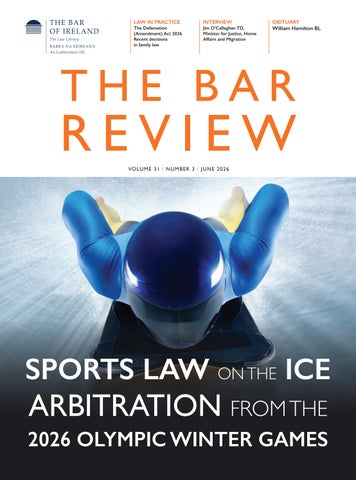
Overview of CAS cases from the Milano Cortina 2026 Olympic Winter Games
EDITORIAL BOARD
Editor
Helen Murray BL
David Conlan Smyth SC
Tom Flynn SC
Clíona Kimber SC
Paul McGarry SC
Cathleen Noctor SC
Sean Ó hUallacháin SC
Proinsias Ó Maolchalain SC
Bairbre O’Neill SC
Peggy O’Rourke SC
Morgan Shelley SC
Lydia Bunni BL
The Bar Review
The Bar of Ireland
Distillery Building
145-151 Church Street
Dublin DO7 WDX8
Direct: +353 (0)1 817 5025
Fax: +353 (0)1 817 5150
Email: communications@lawlibrary.ie
Web: www.lawlibrary.ie
Dearbhla M. Cunningham BL
Liam Dockery BL
Simon Donagh BL
Arran Dowling-Hussey BL
Mary-Paula Guinness BL
Stephen Hanaphy BL
Michael Kinsley BL
Cian McGoldrick BL
Catherine Needham BL
James Nerney BL
Una Nesdale BL
Emer Ní Chúgáin BL
Tim O’Connor BL
Michael O’Doherty BL
Tanya Smyth BL
Shirley Coulter, CEO
Stephen Lowry, Director of Communications & Public Affairs
Dearbhla Shirt, Web & Digital Officer
Gary LaCumber, Law Library
Vanessa Curley, Law Library
Paul O’Grady, Publisher
Ann-Marie Hardiman, Think Media
PUBLISHERS
Published on behalf of The Bar of Ireland by Think Media Ltd
Editorial: Caoimhe Coolican
Ann-Marie Hardiman
Paul O’Grady
Design: Rebecca Bohan
Tony Byrne
Obituary Remembering William Hamilton BL
Advertising: Paul O’Grady
Commercial matters and news items relating to The Bar Review should be addressed to:
Paul O’Grady
The Bar Review
Think Media Ltd, The Malthouse, 537 NCR, Dublin D01 H2F5
Tel: +353 (0)1 856 1166
Email: paul@thinkmedia.ie
Web: www.thinkmedia.ie www.lawlibrary.ie
Views expressed by contributors or correspondents are not necessarily those of The Bar of Ireland or the publisher and neither The Bar of Ireland nor the publisher accept any responsibility for them.
Policy proposals with regard to criminal and civil justice reform should be of concern to all.

Seán Guerin
Ifirst had the honour to pen a message in The Bar Review in September 2024. Drawing inspiration from the campaign for criminal legal aid restoration, led by my predecessor Sarah Phelan SC, I said then that what that campaign showed was that the value of the work done by the Bar for the citizens of Ireland is more appreciated by those ordinary citizens than ill-informed public debate would often suggest.
While I still hold to that view, the experience of the last two years has, if anything, taught me that the appreciation of our fellow citizens isn’t, in itself, sufficient to protect the administration of justice from ill-judged reform proposals, particularly when there is a well-resourced, selfinterested lobby pushing for change adverse to the interests of ordinary citizens.
The Council has been advocating for years for improvement in the terms on which civil legal aid is provided, and this item was at the top of the Council’s agenda in its recent meeting with the Minister for Justice. It is a matter of some regret and very significant concern that, almost a year after publication of the Clarke Review, with a clear recommendation that this issue be addressed immediately, no proposals have yet been published by the Department. It may be that Budget 2027 will be the means by which this reform is achieved. It certainly provides an opportunity to do so, and one which the Council has urged the Minister to seize. On criminal legal aid, there is some better news in that the Minister has given a welcome commitment to implement a further 8% FEMPI-era pay restoration
from July 1, 2026. It should always be remembered that this is only a reflection of the very significant contribution that the Bar has made, through cooperation with reform and improved efficiencies, in the administration of criminal justice.
It is not all good news on criminal justice, however. The Minister has clearly communicated his determination to proceed with reform of solicitors’ fees in the District Court by the imposition of a flat fee structure. It is at this point that the concern about the absence of reasoned, evidence-based public policymaking becomes acute. The data relied on by the Department to justify this reform has not been published, and the Department has refused to release it to the Council. The proposal itself was first formulated without consultation with the Council and
our submission setting out a very detailed, considered and careful explanation for why so many cases in the District Court simply cannot be processed within the average number of adjournments upon which the Department relies, has not been responded to in a meaningful way.
Reason, it seems, has gone out the window altogether in relation to the proposed cost cap in environmental cases. Although provision for such a cap was made in the Planning and Development Act 2024, it can hardly have been thought possible that the purpose of that legislative scheme was to cap costs at a small fraction of what the State’s own independent costs assessment regime has assessed as reasonable. The proposal was formulated without public consultation and on the basis of a consultant’s report that offers no reasoned basis for the particular cap proposed. There was a subsequent public consultation process in which the Council participated. Ours was only one of some 1,400 submissions, 98% of which opposed the proposal. Neither that overwhelming expression of opinion by interested and informed parties, nor the force of the reasoning that supported their objections, were sufficient to make any material difference to the Government’s cost cap proposal. All of these policy developments can, of course, be looked at through the lens of fee income for barristers and other lawyers. And those in whose interest it is to restrict the ordinary citizen’s right of access to the courts in the areas of law that concern them will always try to make that case. The reality is that a range of recent policy proposals have demonstrated a degree of disregard for the rule of law and the right of access to justice, which should be of profound concern to all citizens.
I am immensely grateful to my colleagues on Council and the very many other colleagues who assist in its work, and to the executive team of The Bar of Ireland, led by Shirley Coulter, and previously by Ciara Murphy, for their contribution over the past two years. There remains, however, much vital work for the next Council and Chair to undertake. They will need your support to do it.
This edition features an interview with the Minister for Justice, Home Affairs and Migration, as well as analysis of recent cases in family and sports law, and new defamation legislation.

In this edition’s Bar Review interview, the Minister for Justice, Home Affairs and Migration, Jim O’Callaghan TD, explains his views on legal aid reform and the cap on legal fees for environmental judicial reviews. The Minister speaks at length about the Government’s reason and rationale for the forthcoming changes. Alexis Mina BL provides a comprehensive and interesting review of recent family law decisions, which is essential reading for members practising in this area.
Louise Reilly SC and Robert Kerslake BL examine the decisions made by the Ad Hoc Division of the Court of Arbitration
for Sport, specifically the decisions made at the recent 2026 Winter Olympics in Milano/Cortina. This is a fascinating insight into the issues that arise in the days leading up to and during an Olympic Games competition.
Michael O’Doherty BL reviews the Defamation (Amendment) Act 2026, and reports on the reaction from members during the Media, Internet and Data Protection Bar Association (MIDBA) event in April of this year.
And finally, the Bar Review features an obituary of William Hamilton BL, who sadly passed away in November 2025.
On April 17, legal professionals gathered at The Presidents’ Hall in Blackhall Place for a joint conference hosted by the Irish Immigration Lawyers Association (IILA) and the Immigration, Asylum and Citizenship Bar Association (IACBA).
The conference provided attendees with key updates and insights into recent developments in immigration and asylum law. A panel of experienced speakers delivered in-depth analysis, including Michael Conlon SC, Niamh Harnett BL, Aileen Gittens, solicitor with Poe Kiely Hogan Lanigan Solicitors, and Katie Mannion, Managing Solicitor at the Irish Refugee Council. Participants engaged with topical legal issues and emerging trends affecting practitioners in the field, benefiting from the breadth of expertise represented on the panel. The afternoon concluded with a social gathering and drinks reception, allowing attendees to continue discussions and strengthen professional connections.

On April 24, the Construction Bar Association (CBA) held its Annual Conference, bringing together practitioners from across the construction law sector. The programme began with an opening address before moving into a series of focused sessions. Session One examined key trends in construction law and was chaired by John Trainor SC. Speakers were James Burke SC, Patricia Hill SC, and Dan O’Mahony BL. Session Two addressed expert evidence in construction cases and adjudication. It was chaired by Jonathan Fitzgerald BL, with speakers Michael Binchy SC, Bernard Gogarty, and Martin Cooney. Session Three focused on planning and infrastructure. This session was chaired by Mr Justice Mark Sanfey, with speakers Jarlath Fitzsimons SC, Eileen Barrington SC, and David Browne SC.
At the DDRC, we take pride in delivering exceptionally high-quality meeting spaces and supplementary services in close proximity to the Four Courts complex.
Key features of our centre
Neutrality: DDRC serves as a neutral venue for all parties. Conveniently located in the heart of Dublin's legal community, we are easy to access.

Prime location: on the first floor of the Distillery Building, DDRC offers the perfect setting for consultations, arbitrations, mediations, and settlements. Fully serviced and accessible for all users: we take care of all your business needs. DDRC guarantees a seamless, positive experience.


CONTACT US NOW FOR MORE DETAILS
Flexible hours: meetings can be unpredictable, so we can offer flexibility allowing your meeting to progress in whichever way suits you.

Distillery Building, 145-151 Church Street, Dublin D07 WDX8, Ireland. Tel +353 (0)1 817 5277, Email: ddrc@lawlibrary.ie www.dublinarbitration.ie
The Corporate and Insolvency Bar Association (CIBA) hosted its Annual Conference on April 17 at the Dublin Dispute Resolution Centre. The Conference began with opening remarks by John Kennedy SC, Chair of the CIBA. Attorney General Rossa Fanning SC delivered the opening address, providing insights into current developments in corporate and insolvency law. The first panel discussion, titled ‘Avoiding pitfalls in corporate litigation’ and chaired by Shelley Horan SC, featured contributions from Mr Justice Oisín Quinn, Eoin McCullough SC, Stephen Brady BL, and Kieran Wallace of Interpath. The session explored key risks and practical considerations facing practitioners in corporate litigation. Caren Geoghegan SC delivered a lecture on ‘Equitable
remedies in an insolvency context’, offering a detailed examination of evolving legal principles in this area.
Following a short break, the programme resumed with a second panel discussion on ‘Issues in crossborder liquidations’. Chaired by John Lavelle BL, the panel included Kelley Smith SC, Keith Farry BL, and John Donald of Arthur Cox, who discussed the complexities and challenges arising in international insolvency matters.
One of the highlights of the Conference was a fireside chat, featuring Ms Justice Caroline Costello, President of the Court of Appeal, in conversation with Mr Justice Michael Quinn. The engaging discussion offered valuable insights into judicial perspectives on contemporary legal issues and

touched on the past, with career experiences, cases and points of view from both judges. The Conference concluded with closing remarks from John Kennedy SC. Attendees then gathered for a networking reception, providing an opportunity for further discussion and professional engagement.


Michelle Farrell Fee Recovery Manager Ext: 5053
feerecovery@lawlibrary.ie

The Employment Bar Association (EBA) headed to the Cork Circuit for its Annual Cork Conference on May 7 in The River Lee Hotel. MP Guinness BL, Chair of the EBA, welcomed everyone to the Conference. Una Clifford BL spoke on ‘Redundancy issues’ and Rachel O’Flynn BL spoke about ‘No fault dismissals’. Afterwards there was a panel discussion on how to build and run a successful employment case. This panel was moderated by Alex White SC and the panellists were Lorna Lynch SC, Patrick O’Riordan BL and Mary Fay BL. There was a networking reception after the event.
On May 15 and 16, the Tort and Insurance Bar Association (TIBA) held its Annual Conference in the stunning surrounds of Kylemore Abbey in Galway. The weekend started with a CPD session on Friday, May 15, in Clifden Courthouse. Dr Niamh Howlin, Lecturer in the UCD Sutherland School of Law, presented on ‘The Maamtrasna Murders: Anatomy of a Pardon’.
On Saturday, May 16, Session One of the Conference focused on tort litigation. This session was moderated by Ms Justice Mary Rose Gearty with speakers including Mrs Justice Maura McGowan, Ms Justice Aileen Donnelly and Eoin McCullough SC. Session Two, on expert evidence, was moderated by Ms Justice Emily Egan, with presentations and
The Professional, Regulatory and Disciplinary Bar Association (PRDBA) held a joint event with Addleshaw Goddard in their offices on May 6. This was chaired by Mr Justice Brian Cregan, Judge of the High Court. Stephen McLoughlin, Head of Regulatory Law Group at Addleshaw Goddard, spoke on the role of the complainant in PPC processes. Dr James Meighan, Regulatory and Dispute Resolution at Addleshaw Goddard, spoke about proving matters before an inquiry. Caoimhe Daly BL gave a talk on relevant medical disability, confidentiality and obstruction of justice, and Kevin Kelly BL spoke about the degree of specificity required in a notice of inquiry. The event was in person only, and offered a

discussion from Micheál O’Scanaill SC, Alana McCardle BL and Fiachra Breathnach BL.
After lunch the Conference resumed with Session Three, where presentations focused on the Civil Reform Bill. Ms Justice Mary Faherty moderated the session, with presentations from Alan Keating SC, William Binchy BL and Nicola Saarsteiner BL. Finally, Session Four was moderated by Mr Justice Anthony Barr. Presentations came from Judge John Martin, Helen Callanan SC, Ciara McGoldrick BL and Jennifer Purcell BL, and looked at practical developments in tort litigation.
A lovely meal was had by all attendees in the Abbeyglen Hotel that evening to celebrate a very insightful and well-attended Conference.

unique opportunity to network at the Addleshaw Goddard offices.

Above: Dr Niamh Howlin, UCD Sutherland School of Law, presented on ‘The Maamtrasna Murders: Anatomy of a Pardon’ in Clifden Courthouse.
Beatha phobail – dúchas, cearta, aeráid
Tháinig cleachtóirí dlí, acadóirí, lucht ceaptha beartas, ionadaithe pobail, agus gníomhaithe Gaeilge le chéile ag an gcomhdháil, ‘Beatha phobail – dúchas, cearta, aeráid’. Oidhreacht chultúrtha, cearta teanga, cosaintí comhshaoil agus inbhuanaitheacht phobail thuaithe a bhí mar na príomhréimsí díospóireachta ann. Éamon Ó Cuív, iar-TD agus Aire, an Breitheamh Colm Mac Eochaidh, Breitheamh Chúirt Ghinearálta an Aontais Eorpaigh agus an Dr Seathrún Ó Tuairisg, Ollscoil na Gaillimhe a bhí i measc na hóráidithe.
Bhí sé de phribhléid ag Cumann Barra na Gaeilge fáilte a chur roimh Uachtarán na hÉireann Catherine Connolly chuig an chomhdháil. Ina hóráid, dúirt an tUachtarán: “Is anseo i Ros Muc a chum Pádraig Mac Piarais Óráid Uaighe O’Donovan Rossa: óráid a spreag misneach agus
dóchas inár sinsear i 1915. Óráid aislingeach atá fós tráthúil inniu nuair a chuimhníonn muid ar na tíortha agus ceantair ar fud an domhain nach bhfuil saoirse acu, nach bhfuil síocháin acu. Tá téamaí bhur gcomhdhála tráthúil: Beatha, Dúchas, Cearta agus Aeráid. Guím go mbeidh spreagadh agus inspioráid le fáil ón gceantar álainn agus ón gcomhluadar gnaíúil”.
Legal practitioners, academics, policymakers, community representatives, and Irish language activists came together at the conference titled ‘Beatha phobail – dúchas, cearta, aeráid’. Cultural heritage, language rights, environmental protections and the sustainability of rural communities were among the main areas of discussion. Delegates heard from a number of speakers such as Éamon Ó Cuív, iar-TD agus Aire,

an Breitheamh Colm Mac Eochaidh, Breitheamh Chúirt Ghinearálta an Aontais Eorpaigh, agus an Dr Seathrún Ó Tuairisg, Ollscoil na Gaillimhe. Cumann Barra na Gaeilge was honoured to welcome President Catherine Connolly to the conference. In her address, President Connolly said: “It was here in Ros Muc that Pádraig Pearse wrote the graveside oration which he famously delivered at the funeral of O’Donovan Rossa, an oration that inspired courage and hope in our people in 1915. It is an address that remains of great relevance today, as we think of the countries and regions around the world suffering with neither freedom nor peace. The themes of your conference are timely: Community Life – Heritage, Rights and Climate. I hope that this beautiful area and company will encourage and inspire you in your discussions”.


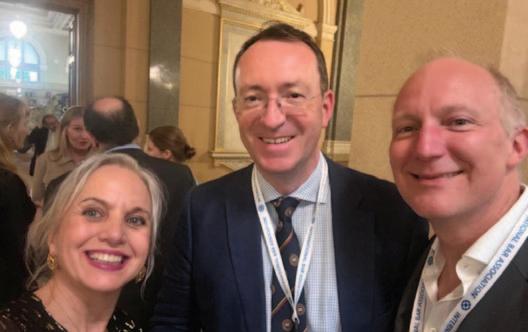
Delegates from The Bar of Ireland attended the International Bar Association (IBA) Mid-Year Leadership Meetings in Prague in May 2026, representing members and engaging on issues affecting the profession. The conference programme addressed a number of matters of direct relevance to the profession, including the rule of law, ethics and international arbitration, climate change, and artificial intelligence, together with roundtables on gender equality, anti-corruption initiatives, and human rights. The sessions were intended to share practical experience between bars, and to develop guidance, resources and toolkits to support bar associations and their members in responding to these challenges. Attendance at the meetings provided an important opportunity to represent our members at international level, and to remain closely engaged with the developments shaping legal practice and professional standards.
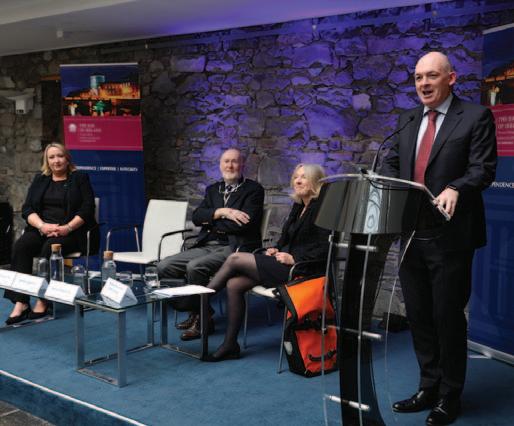
On the evening of Wednesday, May 20, members past and present gathered in the Distillery Building for The Bar of Ireland’s annual alumni event. Attendees heard from a panel of expert speakers who were members of the Law Library at different points in their careers. Rossa Fanning SC, Attorney General, opened the conference and welcomed the speakers. Chairing the panel was Ms Justice Niamh Hyland, moderating an enlightening

conversation between Harry Whelehan SC, Mellissa English SC (Assistant Secretary General and Chief Parliamentary Legal Adviser to the Houses of the Oireachtas), and Charlotte Simpson BL (former Special Adviser to the Taoiseach). The event gave past members the chance to reconnect with the community of the Bar, and gave current members an opportunity to learn from those who had moved on.
Former Taoiseach Enda Kenny has been appointed as the new Chairperson of Ireland for Law. Ireland for Law promotes Irish law and Irish legal services to the international business community, particularly for commercial sectors where Ireland is already a world leader. The Bar of Ireland is among the supporting organisations of this initiative, which was established in 2019.

Richard Bennett, UN Special Rapporteur on Afghanistan, was hosted by The Bar of Ireland’s Human Rights Committee on Monday, May 18, during his visit to Ireland.
This visit facilitated two sessions, the first of which was an informal roundtable with barristers, stakeholders and interested parties. This allowed attendees to share their personal stories, including experiences of migration, and to discuss how to highlight the ongoing struggle in Afghanistan. The second session was introduced by Gavin Rothwell BL with welcoming remarks by Colm O’Dwyer SC. Michael Lynn SC then introduced Richard Bennett, who gave an update on his current work in Afghanistan and the latest developments. This valuable speech was followed by an extensive and thought-provoking Q&A.
The Bar of Ireland’s Voluntary Assistance Scheme (VAS), in collaboration with Community Law & Mediation (CLM), recently launched a new three-part podcast series exploring the past, present and future of community law in Ireland.
Jointly hosted by Gemma McLoughlin-Burke BL, Co-ordinator of the VAS, and Aoife Kelly-Desmond, CEO of CLM, the series highlights the longstanding collaboration between barristers and community law organisations. Each episode features two expert speakers alongside the hosts. The first episode covers the origins of community law in Ireland, the second looks at the practice of community law, and the final episode looks forward to the future of community law.
All episodes can be listened to at https://www.lawlibrary.ie/podcasts/

left: Sayed Anosh; Colm O’Dwyer SC; Richard Bennett, UN Special Rapporteur on Afghanistan; Gavin Rothwell BL; Sunniva McDonagh SC; and, Michael Lynn SC.


The Bar’s Communications and Public Affairs team engages with Government and key stakeholders to advance the aims and values of the profession.

Elaine Bardon Policy and Public Affairs Officer, The Bar of Ireland
The Bar of Ireland’s Communications and Public Affairs team carries out extensive work to promote and uphold the principles of the Bar, both internally and externally. Internally, members are kept informed and engaged through the production of content such as In Brief, Viewpoints, podcasts, mailshots, website updates, social media channels, etc. External work includes public affairs and political engagement, the aim of which is to advance a range of strategic initiatives that raise the profile of the Bar and its members, ensuring that reform strengthens rather than diminishes access to justice, and that it serves the public interest.
In a period of unprecedented legal reform, the Bar must remain engaged and clearsighted. We are committed to carrying out ongoing engagement with key stakeholders across the political and policy spectrum on a range of issues, including access to justice, the administration of the courts, civil legal aid reform, judicial review, civil reform, and criminal justice system resourcing.
A significant part of this is done by monitoring the progression of legislation though the Oireachtas and engaging directly with policymakers and Committees to amplify the views of the Bar on any new legislation relevant to our members. This often involves preparing detailed submissions on specific pieces of legislation under consideration by the Oireachtas. Submissions can be created at various stages of the legislative process, for example at Heads of Bill stage, or while pre-legislative scrutiny is taking place. All of our submissions are member led, ensuring that members’ voices directly feed into the Bar’s participation in the legislative process. Recent submissions that the Communications and Public Affairs team have collaborated with members on include:
■ submission to the Department of Climate, Energy and the Environment on the regulation of costs payable in matters prescribed on foot of s.294 of the Planning and Development Act 2024 (Scale of Fees);
■ submission to the Joint Committee on Justice, Home Affairs and Migration on civil legal aid;
■ submission to the Government’s Cost of Business Advisory Forum on the topic of professional services and legal costs;
■ submission to the Joint Committee on Justice, Home Affairs and Migration on the General Scheme of the Civil Reform Bill 2025;
■ submission to the Department of Justice, Home Affairs and Migration on simplifying criminal legal aid payment in the District Courts; and,
■ submission to the Joint Committee on Artificial Intelligence on AI: justice and law enforcement.
Copies of these submissions can be accessed via the representations section on our website.
Action will continue on the above issues in the months ahead, through meetings and ongoing engagement with the Oireachtas, relevant Departments, and other stakeholders. As always, members will be kept fully informed as developments occur.
This work could not be done without the co-operation, expertise and input of committees, Specialist Bar Associations (SBAs), and individual members of the Bar. The Communications and Public Affairs team is currently working on a campaign around volunteer recruitment, which aims to encourage more members to get involved with the work of the Bar’s many committees and working groups.
There are a variety of ways to get involved, such as joining a committee or working group, aiding in drafting a submission, or contributing to our thought leadership content via our podcasts, social media and website.
Whatever level of time commitment you are in a position to make, there is always a suitable opportunity to lend your voice to the advocacy efforts of the Bar. If you would like to get involved on any topic, you can contact communications@lawlibrary.ie

Jim O’Callaghan TD speaks to The Bar Review about proposed legal reform, and the benefits that legal training brings to his role.

Ann-Marie Hardiman, Managing Editor, Think Media
espite a longstanding interest in politics, Jim O’Callaghan describes himself as a “late developer” politically: “I don’t know what the opposite to ‘meteoric’ is, but I’ve had a fairly pedestrian development in politics. I never got involved in party politics until I was in my mid-30s”. He says that devilling for the late Rory Brady SC, who served as Attorney General under the Fianna Fáil Government from 2002-2007, was influential, and speaks of the strong historical links between the legal profession and the Oireachtas: “Historically, there was always a good link between the Four Courts, the Law Library, and Leinster House. I remember when I was starting off, people saying to me ‘You can’t do both’. But actually, I managed to do both for nearly 10 years before I became a minister”.
He acknowledges the impact that an active role in politics can have on a career at the Bar, but says he’d like to see more barristers get involved nonetheless: “People are more demanding now of barristers, clients are more demanding. They might look slightly unusually at you if their barrister has his poster up on a lamppost. I would like to see more barristers get involved in active politics, seeking to become members of the Dáil. We have to be

careful that we don’t exclude too many people, because the alternative is that the only way people are going to go into politics is if they get involved at 19, 20 years of age. There is an advantage of having people elected to Dáil Éireann who are broadly representative of society and have experience in other forms of employment”.
Perhaps unsurprisingly, he also feels that his experience at the Bar is helpful in his current role: “Barristers have good training. They are required to think independently and they have to make decisions quickly. We have a huge number of laws in this country, and a lot of what I do is based on consideration of or exercise of statutory powers by me or by other statutory entities. So it is good preparation, I think, to have a broad legal knowledge of how the system operates. One of the things I notice as a minister is that legal advice can be very paralysing in terms of the impact it has on a minister. Obviously you have to consider legal advice, but a lot of legal advice is not definitive. I think the advantage of being a lawyer is that you’re aware that these are, in many instances, judgement calls. Obviously, if I get strong legal advice, I follow that advice, but in circumstances where it’s a judgement call and the legal advice tilts one way, you can interrogate it”.
Having been Fianna Fáil Spokesperson on Justice for some years before his appointment as Minister in 2025, Minister O’Callaghan undoubtedly has a list of priorities for his time in office, some of which we will discuss, but he says that his overarching aim is to serve the public: “The main issue of concern for me in terms of what the public expects from me is that they are kept safe, that our communities are safe. So a lot of my primary responsibilities concern ensuring that the Gardaí are well resourced, that the legislation is in place to ensure that communities can be protected, that structures such as local community safety partnerships, which are new innovative proposals around the country, are operating effectively. The main issue for the public is: do they feel safe?”
Reform is also an important part of the Minister’s remit, however, and a number of significant reforms in both the criminal and civil arenas are either imminent or have been commenced. One such proposal is around a flat fee model for criminal legal aid, which has sparked concern among legal professionals. Minister O’Callaghan acknowledges this
concern, but points to a wider context: “I very much recognise the important role played by the legal profession in our criminal justice system, in ensuring that cases are prosecuted and that people have their constitutional right to a fair trial through appropriate, qualified defence. At the same time, I have to look at what can I do to make our legal system operate more efficiently and effectively. When I’m looking at issues to do with the efficiencies of the court or the effectiveness of the court system, the sole focus I have is what’s in the best interests of those people who are before the courts and the administration of justice. My primary concern is in respect of the public and how I can ensure that the system of justice is efficient, effective, and fair”.
He cites research carried out by his Department into how the courts are currently operating: “Although the number of cases in the District Court has decreased since 2015, the cost has increased from ¤19m in 2015 to ¤37m in 2024. Cost isn’t the primary issue for me, but I do want to ensure that the District Court system operates efficiently, and in the review carried out by the Department, there were a number of findings which I just couldn’t ignore. Cases with criminal legal aid take an average of 313 calendar days to complete, compared to 133 days for cases without criminal legal aid. The weighted average appearances for cases with criminal legal aid is five, while the weighted average appearances without criminal legal aid is just over three. And while cases with criminal legal aid take significantly longer than those without, the outcomes are similar”.
He also raises concerns around what he refers to as anomalies within the system: “The pay system at present is that you get paid per appearance, and that, in my opinion, incentivises additional adjournments because the more the case is adjourned, the more you get paid. It’s also the case that multiple certificates have been granted for related cases, and they increase costs and complexity”.
He says the revised fee model will reflect the work required, while hopefully achieving the required efficiencies: “What I intend to do is to put in place a very generous single fee payment. I think it is going to make the system more efficient, and before people agree to adjourn a case for a short period of time, they’ll have to consider deeply, well, are things going to be progressed by the time the adjournment date comes along? I’ve engaged with the Bar and with the solicitors’ profession, but based on the review that’s been done within the Department, it would be negligent of me not to introduce reforms”.
The Bar of Ireland has expressed concerns that such a model would lead to a reduction in participation by practitioners in the Criminal Legal Aid Scheme, but the Minister disagrees with this analysis, citing figures showing an increase in the numbers of legal professionals on these panels in recent years: “It’s a very competitive area. When you look at the statistics, you can see there’s been an increase in the number of practitioners on criminal legal aid panels over the last three years. In 2023, there were 672 solicitors. In 2025, there’s 825. And similarly, from the point of view of barristers, from 740 in 2023, it’s up slightly to 760 in 2025. I certainly wouldn’t introduce any measure if I thought it was going to diminish the quality of criminal legal aid in our courts, and I don’t think it will”.
Civil legal aid is widely held to be in need of significant reform, with broad consensus among practitioners, non-governmental organisations (NGOs) and other stakeholders that the system is now at breaking point. Last year, the Government published a review of civil legal aid carried out by an independent review group chaired by former Chief Justice Frank Clarke SC, and Minister O’Callaghan says he is eager to progress implementation of the report’s recommendations: “I need to get the money to do that, but it is
something that I wish to politically pursue. In the budgetary talks that will start very shortly between myself and Minister Chambers in the Department of Public Expenditure, I have instructed officials here that I want to start the process of improving the civil legal aid system broadly along the lines of the majority report put forward by former Chief Justice Clarke”.
He acknowledges that this will take time: “I mightn’t be able to introduce everything in the first budget, but if we can start a pathway to implementation, that’s what I want to see. It is a political objective of mine”.
In terms of broader reform of the civil justice system, Minister O’Callaghan acknowledges the enormous work carried out by Mr Justice Peter Kelly and the review group into the administration of civil justice: “The area needs reform and improvement. A huge amount of work was done by Mr Justice Kelly and the review group, and I want to start the process of implementing it. In terms of the Civil Reform Bill, most of the discussion in respect of it relates to proposals in the area of judicial review, but there are other areas in civil reform, which also need to be implemented. One of the things I’m concerned about is that discovery is becoming so broad and so demanding that to a large extent, you’d nearly need to be an institutional client in order to comply with the cost and requirements of it, so I want to do something in that area”.
In addition to discussions around the Civil Reform Bill, the topic of judicial review has received a great deal of public attention in recent times, largely because of reporting around judicial reviews into planning and infrastructure matters. The Bar of Ireland, and other groups, have expressed concern at the impact of proposed changes on the administration of justice. Minister O’Callaghan once again wishes to place this reform in the wider public context: “I obviously take into account what
the legal profession is saying, whether they be solicitors or the Bar. They’re the people who are at the coalface. However, the priority for me isn’t the legal profession, it’s to ensure that those seeking access to justice, and indeed the public interest in the broader sense, are represented in the statutory architecture that’s being put in place. I’m not permitted to seek to restrict the full original jurisdiction of the High Court, and nor would I seek to do so. But I do think we can make the system more efficient, and more reflective of what is required. Judicial review is predominantly about identifying procedural error and orders made by the Court in response to that. To a large extent, however, it is being used widely for the purpose of stopping the development of large-scale infrastructural projects. I’m going to try and introduce a legislative mechanism, recognising the absolute independence of the courts, that will reflect the need of the State to ensure that we can progress infrastructural development”.
On the day this interview took place, one element of that reform came into effect, namely a statutory instrument setting out the maximum amount of costs that can be recovered by a successful litigant in Aarhus Convention judicial reviews. Again, the Minister feels strongly that this must happen in

the context of balancing the rights of individuals against the public good: “If people want to pay lawyers more than the recoverable amount, that’s entirely a matter for the client and the lawyer. But as Minister, I’m entitled to recognise the impact that excessive or very high legal costs can have on entities that are operating in the State. For that reason, we have put in place a limitation on the amount of costs that are recoverable, and I think that is appropriate in these circumstances”.
Increasing efficiencies is once again a factor driving this reform: “On many occasions lawyers will run every point before a court, even though they may know that six of their eight points are not very good points. It’ll focus the attention and minds of litigants and lawyers on what is their best point, and the main type of points that can be made. I know at present the courts can limit costs based on the number of arguments you’ve succeeded on, but it is important also that the Executive, through legislation that was approved by the Oireachtas, seeks to set limitations on the amount of costs that can be recovered”.
A Government ministry is always a high-profile
The road to Minister for Justice
Jim O’Callaghan graduated with a BCL degree from University College Dublin, before moving to the UK to study for a master’s degree in law and an MPhil in criminology from Sidney Sussex College, Cambridge. He returned to Dublin to study at the King’s Inns, and commenced a career as a barrister. He was elected to Dublin City Council in 2009 and served on the Council until 2016, when he was elected to Dáil Éireann as the Fianna Fáil candidate for the Dublin Bay South constituency. He was subsequently reelected in 2020 and in 2024. He served as legal advisor to Fianna Fáil from 2011-2016. He was
role, and the justice portfolio might be said to be particularly so. In addition to legal issues such as judicial review, or family law reform, recent weeks have seen national fuel protests, ongoing debates on immigration policy, and of course daily commentary on serious crime, much of which is reflected back to the Minister. Minister O’Callaghan says he deals with the commentary and attention by trying to focus on the job: “Inevitably, if you’re in politics, you’re going to be the subject of a lot of attention and a lot of commentary. What I try to do is focus on the issues rather than focusing on myself. I think it’s important as a minister that I know what I want to do and that I don’t get distracted by noise, and in general, I don’t get distracted by commentary or criticism. I have a limited period of time as a minister. I’m aware that it’ll be over very quickly. There’s nothing as ex as an exminister – when you’re gone, you’re gone. So I try and put in place reforms that I think are appropriate. In a healthy democracy there’s going to be lots of criticism, but I don’t take any criticism personally. I think it is important that you know what you want to do, listen to people, and recognise that this is a short privilege that people have, being a minister”.
appointed Fianna Fáil Spokesperson for Justice and Equality in 2016, and Minister for Justice, Home Affairs and Migration in January 2025. A former rugby player (he was capped for Ireland at under-21 level), these days the Minister prefers to relax off the pitch: “I run and I read. I read The Death of Trotsky by Josh Ireland recently. It’s quite a good read. They talk about politicians now having a tough time. It’s nothing in comparison to what people previously went through, in Ireland or internationally. I also don’t look at social media, which is a good way of relaxing”.

A directory of acquisitions received in the Law Library from March 12, 2026, to May 21, 2026 Judgment information generated by Law Library AI
Edited by Vanessa Curley, Susan Downes and Clare O’Dwyer, Law Library, Four Courts
Administrative law and judicial review –Leave application – Judicial misconduct –Judicial Council Act 2019, ss.2,53 – Courts (Supplemental Provisions) Act 1961, ss.7(4),7(10) – Applicant seeks orders quashing inadmissibility determinations and requiring reconsideration of his complaints – Whether the Complaints Review Committee acted beyond its statutory powers or in a manner lacking independence, fairness or rationality –27/03/2026 – [2026] IEHC 193 Riordan v Complaints Review Committee of the Judicial Council
Commercial law – Referral to arbitration –Arbitration agreement scope – Arbitration Act 2010, art.8 – Arbitration Act 2010, art.16 – Defendants seek a stay of proceedings and referral of disputes to arbitration – Whether the disputes between the parties fall within the scope of the arbitration agreement –28/04/2026 – [2026] IEHC 254 O’Callaghan v O’Callaghan and ors
Banking and finance law – Family Home Protection Act 1976, s.3 – Consumer Credit Act 1995 – Appellants seek to have the Supreme Court’s prior judgment and order in favour of respondent on its unjust enrichment claim set aside or varied, alleging abuse of process and seeking reconsideration under Practice Direction SC 17 – Application to set aside Supreme Court judgment refused; restitutionary
judgment against defendant stands and bank remains entitled to judgment, with adjusted costs orders – 13/05/2026 –[2026] IESC 30
Bank of Ireland Mortgage Bank U.C. v Murray and anor
Financial regulation – Set aside order –Prohibition notice – Central Bank Reform Act 2010, ss.25,43 – Respondent seeks to set aside prohibition notice issued by Central Bank – Whether prohibition notice was vitiated by significant and serious errors in process – 31/03/2026 – [2026]
IEHC 203
Central Bank of Ireland v D(C) Bankruptcy law – Dismissal order – Locus standi – Bankruptcy Act 1988, ss.44,85C – Applicant seeks annulment of bankruptcy and setting aside of judgment – Whether applicant had locus standi to challenge judgment and whether extremely compelling reasons existed to annul bankruptcy – 01/05/2026 – [2026]
IEHC 271
Danske Bank A/S v Coyne and anor
Contract law – Summary judgment –Misrepresentation – Data Protection Acts 1988 and 2003 – Plaintiff seeks to set aside judgment entered in summary proceedings – Whether defendant complied with clause 5(3) of the settlement agreement – 13/02/2026 –[2026] IEHC 82
Dormer and anor v Allied Irish Bank PLC and ors
Construction law – Enforcement order –
Adjudicator’s jurisdiction – Construction Contracts Act 2013, ss.1,2 – Applicant seeks leave to enforce the adjudicator’s decision under s.6(11) of the Construction Contracts Act 2013 – Whether the adjudicator had jurisdiction to determine the payment dispute under the Construction Contracts Act 2013 –27/03/2026 – [2026] IEHC 195
BMC Renovation Limited v Gael Property Investments Limited
Capacity law – Discharge from wardship order – Assisted Decision-Making (Capacity) Act 2015, ss.54,55 – Civil Law (Miscellaneous Provisions) Act 2008, s.27 – Applicant seeks discharge of respondent from wardship and appointment of decision-making representative – Whether the respondent should be discharged from wardship and have a decision-making representative appointed – 23/03/2026 – [2026] IEHC 197
In the matter of A, a ward of court, and in the matter of an application pursuant to Section 55 of the Assisted DecisionMaking (Capacity) Act
Capacity and wardship law – Assisted Decision-Making (Capacity) Act 2015, ss.2,3,8,38,46,55 – Civil Law (Miscellaneous Provisions) Act 2008, s.27 – Applicant seeks declaration of respondent’s lack of capacity, discharge from wardship, and appointment of respondent’s niece as decision-making representative – 23/03/2026 – [2026] IEHC 294
In the matter of C, a ward of court, and in the matter of an application pursuant to Section 55 of the Assisted DecisionMaking (Capacity) Act
Capacity law – Discharge from Wardship –Assisted Decision-Making (Capacity) Act 2015 (ss.2,3) – Civil Law (Miscellaneous Provisions) Act 2008 – Application by respondent for discharge from wardship and appointment of decision-making representatives – Whether respondent lacks capacity to make decisions concerning her affairs, even with assistance of a co-decision-maker –23/03/2026 – [2026] IEHC 242
In the matter of F, a ward of court, and in the matter of an application pursuant to Section 55 of the Assisted DecisionMaking (Capacity) Act
Health law – Assisted Decision-Making (Capacity) Act 2015 – Mental Health Act 2001 – Applicant seeks declarations that it is lawful to apply ceiling of care excluding coercive feeding, coercive
treatment and CPR, orders granting substitute consent for defined palliative care, and orders authorising respondent’s continued detention in approved centre –Application – 06/05/2026 – [2026] IEHC 291
Health Service Executive v J(P)
Capacity law – Detention order – Capacity assessment – Civil Law (Miscellaneous Provisions) Act 2008, s.27 – Assisted Decision-Making (Capacity) Act 2015 –Applicant seeks continuation of orders under inherent jurisdiction to facilitate respondent’s transfer to a step-down placement – Whether respondent lacks capacity – 18/03/2026 – [2026] IEHC 190
Health Service Executive v M(A)
Capacity law – Prohibition order –Capacity assessment – Assisted DecisionMaking (Capacity) Act 2015, ss.2,3 – Civil Law (Miscellaneous Provisions) Act 2008, s.27 – Respondent seeks discharge from wardship under the Assisted DecisionMaking (Capacity) Act 2015 – Whether respondent lacks capacity to make decisions regarding personal affairs –23/03/2026 – [2026] IEHC 233
In the matter of L, a ward of court, and in the matter of an application pursuant to Section 55 of the Assisted DecisionMaking (Capacity) Act
Capacity law – Discharge from wardship order – Assisted Decision-Making (Capacity) Act 2015, ss.2,3 – Civil Law (Miscellaneous Provisions) Act 2008, s.27 – Applicant seeks discharge from wardship and appointment of decision-making representatives – Whether respondent lacks capacity – 23/03/2026 – [2026] IEHC 209
In the matter of N, a ward of court, and in the matter of an application pursuant to Section 55 of the Assisted DecisionMaking (Capacity) Act
Capacity law – Appointment of guardian ad litem – Discharge from wardship –Assisted Decision-Making Capacity Act 2015, ss.2,55 – Respondent seeks
discharge from wardship without support while committee seeks appointment as co-decision-makers – 23/02/2026 –[2026] IEHC 192
In the matter of P, a ward of court, and in the matter of an application pursuant to Section 55 of the Assisted DecisionMaking Capacity Act and in the matter of the ward’s committee seeking to be his codecision-makers
Mental health law – Discharge from wardship – Assisted Decision-Making (Capacity) Act 2015, ss.3,8,55 – Civil Law (Miscellaneous Provisions) Act 2008, s.27 – Applicant seeks discharge from wardship and appointment of decision-making representatives – Whether respondent lacks capacity to make decisions regarding personal affairs – 23/03/2026 – [2026] IEHC 246
In the matter of S, a ward of court, and in the matter of an application pursuant to Section 55 of the Assisted DecisionMaking (Capacity) Act
Capacity law – Discharge from wardship – Assisted Decision-Making (Capacity) Act 2015, ss.2,3 – Civil Law (Miscellaneous Provisions) Act 2008, s.27 – Applicant seeks discharge of respondent from wardship and appointment of a decision-making representative – Whether the respondent lacks capacity to make decisions regarding his personal affairs –23/03/2026 – [2026] IEHC 279
In the matter of T, a ward of court, and in the matter of an application pursuant to Section 55 of the Assisted DecisionMaking (Capacity) Act
Wards of court – Discharge from wardship – Assisted Decision-Making (Capacity) Act 2015, ss.39,55 – Applicant seeks discharge of wardship and appointment of a decision-making representative –Whether the ward’s sister should be appointed as a co-decision maker for personal welfare decisions – 20/03/2026 – [2026] IEHC 176
In the matter of a ward of court
Commercial law – Interlocutory injunction on receivers’ sale – Plaintiff seeks interlocutory injunction restraining receivers from selling secured commercial properties, plus mandatory orders requiring lender to provide financial information and co-operate with proposed refinancing by new funder – Injunction refused – 13/05/2026 – [2026] IEHC 299
Goldstein Property ICAV v Relm Loan Opportunities 2 Designated Activity Company and ors
Corporate law – Sanction order – Scheme of arrangement – Companies Act 2014, ss.84,453 – Irish Takeover Panel Act 1997 – Applicant seeks court sanction for a scheme of arrangement and reduction of share capital – 29/10/2025 – [2025] IEHC 768
Dalata Hotel Group Public Limited Company v Companies Act 2014
Company law – Leave to continue proceedings – Transfer of liability –Companies Act 2014, s.678 – Asset Covered Securities Act 2001, s.58 –Applicant seeks leave to continue proceedings against EBS Mortgage Finance Unlimited Company – Whether the liability of EBS Mortgage Finance Unlimited Company transferred to EBS Designated Activity Company under s.58(9) of the Asset Covered Securities Act 2001 – 28/04/2026 – [2026] IEHC 247
O’Toole v EBS Designated Activity Company and anor
Competition law – Prohibition order –Adjournment request – Civil Law (Miscellaneous Provisions) Act 2008, s.27 – Plaintiff seeks adjournment to instruct replacement economist – Whether trial should proceed on the basis of existing expert materials or be adjourned to allow the plaintiff to instruct a replacement expert – 19/03/2026 – [2026] IEHC 172
ER Travel Limited v Dublin Airport Authority AKA DAA PLC
Constitutional law – Order of certiorari –Effective remedy – Statute of Limitations 1957, s.11 – European Convention on Human Rights Act 2003, s.3 – Appellant seeks to quash the decision excluding him from the Settlement Scheme and obtain damages for breach of constitutional rights – Whether the appellant was entitled to an effective remedy for breach of constitutional rights prior to the Supreme Court decision in Simpson –30/04/2026 – [2026] IECA 68
O’Brien v Governor of Cork Prison and ors Constitutional and human rights law –Declaration of incompatibility –Constitutionality of legislation – National Vetting Bureau (Children and Vulnerable Persons) Act 2012, ss.10,15 – Applicants seek declarations that sections of the National Vetting Bureau (Children and Vulnerable Persons) Act 2012 are unconstitutional and incompatible with the European Convention on Human
Rights – 30/04/2026 – [2026] IEHC 261 OC(D) v Garda Síochána Ombudsman Commission and ors, (L)K v Garda Síochána Ombudsman Commission and ors Constitutional law – Strike out order – Res judicata – Health Act 1947, s.31A –Health (Preservation and Protection and other Emergency Measures in the Public Interest) Act 2020, s.10 – Defendant seeks to strike out plaintiff’s claim as bound to fail – Whether plaintiff’s claim was barred by the doctrine of res judicata and whether constitutional claim could be amended to disclose a stateable cause of action – 24/03/2026 – [2026] IEHC 187 Pysz v Department of Health
Contract law – Decree order –Maintenance fees – Animal Health and Welfare Act 2013, ss.11,13 – Rules of the Superior Courts, Ord.50, r.3 – Plaintiffs seek payment of maintenance and stud fees from defendant – Whether defendant owed maintenance fees and stud fees –19/03/2026 – [2026] IEHC 161 Linley Investments [trading as Coolmore Castlehyde and Associated Stud Farms] v Riley, Coolagown Bloodstock Limited v Riley
Contract law – Order for costs – Contract interpretation – Courts of Justice Act 1936, ss.37,38 – Plaintiffs seek payment of ¤75,000 under the contract – Whether the contract was with the defendant personally or with the company –21/04/2026 – [2026] IEHC 232 O’Brien and anor v Gill
Contract law – Costs order – Costs determination – Landlord and Tenant (Amendment) Act 1980 – Defendants seek costs of the appeal and reinstatement of High Court costs order –Whether the costs of the appeal should follow the event or be adjusted based on the circumstances of the case –23/03/2026 – [2026] IESC 19
ACE Autobody Limited v Motorpark Limited and ors
Civil liability – Differential costs order –Costs allocation – Civil Liability Act 1961, ss.17(1),17(2) – Legal Services Regulation Act 2015, ss.168,169 – Third parties seek costs from day 2 onwards and differential costs order – Whether the defendant should be awarded costs on the Circuit Court scale up to day 1 and the third parties awarded costs from day 2 onwards – 13/03/2026 – [2026] IEHC 162 Ashdrum Lodge Limited [trading as Kiernan Homes] v Barbouti [No. 2]
Costs adjudication – Review order – Legal Services Act 2015, ss.155,161 – RSC (Costs) 2019, O.99, r.38 – Applicant seeks review of costs adjudication by the Chief Legal Costs Adjudicator – Whether the Chief Legal Costs Adjudicator erred in overstating complexity and novelty in determining allowances for solicitor and counsel fees – 01/05/2026 – [2026]
IEHC 283
BC [a minor] v Health Service Executive EU law – Costs order – Costs determination – International Protection Act 2015, s.72A – Asylum Procedures Directive (recast), art.38(1) – State parties seek costs for appeal and mootness hearing – Whether State parties are entitled to costs in Court of Appeal and Supreme Court –19/03/2026 – [2026] IESC 17
E v International Protection Appeals Tribunal and ors, FOM v Minister for Justice and ors
Constitutional law – Costs order – Costs of appeal – Residential Tenancies Act 2004, s.39 – Applicants seek recovery of two-thirds of costs of appeal – Whether applicants should recover 50% of costs –02/04/2026 – [2026] IESC 25
G(Z) and anor v Ireland and ors Judicial review – Costs order – Costs determination – Legal Services Regulation Act 2015, ss.168,169 – Respondents seek costs of the proceedings against the applicant – Whether the ordinary rule of costs should apply or be disapplied in this case – 13/03/2026 – [2026] IEHC 245
Kearney v An Taoiseach and ors
Civil procedure – Costs order – RSC, Ord.122, r.11 – Respondents seek costs against appellant for all court proceedings – Whether delay in proceedings was inordinate and inexcusable – 23/03/2026 – [2026] IESC 18
Kirwan v Connors
Civil procedure – Costs order – Costs of appeal – Legal Services Regulation Act 2015, s.169 – Respondent seeks costs of appeal – 29/04/2026 – [2026] IECA 69 Mars Capital Finance Ireland DAC v Carty and ors
Costs and appeals – Costs order – Costs allocation – Legal Services Regulation Act 2015, s.169(1) – Appellant seeks a departure from the default costs rule under s.169(1) of the Legal Services Regulation Act 2015 – Whether special circumstances justified departure from the normal rule under s.169(1) of the Legal Services Regulation Act 2015 –24/03/2026 – [2026] IESC 20
Mars Capital Finance DAC v Walsh Criminal law – Costs order – Costs ruling – Legal Services (Regulation) Act 2015,
s.167 – Criminal Justice (Theft and Fraud Offences) Act 2001, s.49 – Respondents seek costs against the appellant in the High Court and Supreme Court – Whether the privilege against self-incrimination was engaged by the section and whether costs should be awarded against the appellant – 26/03/2026 – [2026] IESC 24
Poptoshev v DPP and ors
Costs and procedural law – Stay order –Costs determination – Legal Services Regulation Act 2015, ss.168,169 – RSC, Ord.99 – Appellant seeks to reserve costs determination until substantive proceedings conclude – Whether appellant should discharge costs incurred by the respondent in connection with the appeal – 25/03/2026 – [2026] IECA 44
T(P) (a minor) suing by his parents and next friends T(L) and T(M) v Health Service Executive
Civil procedure – Adjudication of costs order – Costs allocation – Protected Disclosures Act 2014 – Appellant seeks a stay on enforcement of costs order pending application to Supreme Court –Whether the respondents’ presumptive entitlement to costs should be displaced – 01/05/2026 – [2026] IECA 73
Von Geitz v Kelly and ors and Von Geitz v Robertson and ors
Civil litigation – Payment on account order
– Costs allocation – Legal Services Regulation Act 2015, ss.168,169 – RSC, Ord.99, r.3 – Plaintiffs seek costs and payment out of costs pending defendant’s appeal – Whether the plaintiffs were entirely successful within the meaning of s.169 of the Legal Services Regulation Act 2015 – 11/03/2026 – [2026] IEHC 155 Webster and anor v Meenacloghspar [Wind] Limited, Shorten and anor v Meenacloghspar [Wind] Limited [No.5]
Criminal law – Leave to seek judicial review – Misuse of Drugs Act 1977 – Applicant seeks leave to judicially review the criminal trial process leading to his sentence –Whether the applicant can seek judicial review of his criminal trial process without exhausting alternative remedies –26/03/2026 – [2026] IEHC 191 Benevicius v DPP and ors
Criminal law – Dismissal of appeal –Appeal against sentence – Criminal Justice (Public Order) Act 1994, s.17 – Firearms and Offensive Weapons Act 1990, s.11 –Appellant seeks to appeal against the sentence imposed for demanding money with menaces – Whether the sentencing judge erred in principle by imposing sentences that were overly severe,
excessive, and disproportionate –09/03/2026 – [2026] IECA 46
DPP v Campbell
Criminal law – Dismissal of appeal –Unfairness due to delay – Offences Against the Person Act 1861, s.48 –Criminal Law (Amendment) Act 1935, s.6 – Appellant seeks to overturn conviction for rape and indecent assault – Whether the trial judge erred in admitting recent complaint evidence and in determining that the delay did not render the trial unfair – Appeal dismissed – 05/05/2026 – [2026] IECA 77
DPP v D(M)
Criminal law – Review of sentence –
Undue leniency – Criminal Justice Act 1993, s.2 – Non-Fatal Offences Against the Person Act 1997, ss.5,15 – Applicant seeks review of sentence for being unduly lenient – Whether the sentencing judge erred in structuring the sentence and whether the overall sentence was unduly lenient – 05/06/2025 – [2025] IECA 168
DPP v Donegan
Criminal law – Consultative case stated –Jurisdiction of District Court – Courts (Supplemental Provisions) Act 1961, s.52 – Criminal Justice (Public Order) Act 1994, ss.4,6 – Accused seeks to challenge the jurisdiction of the District Court due to improper service of summonses – Whether the District Court was deprived of jurisdiction due to improper service of summonses outside the jurisdiction –10/04/2026 – [2026] IEHC 216
DPP [at the suit of Detective Garda Ronan O’Meara] v Evans
Criminal law – Retrial order – Jurisdiction to order retrial – Criminal Procedure Act 1993, s.3 – Offences Against the State Act 1939, s.46(2) – Appellant seeks to prevent retrial on original indictment – Whether the Court of Appeal had jurisdiction to order a retrial under s.3(1)(c) of the Criminal Procedure Act 1993 –25/03/2026 – [2026] IESC 21
DPP v Flynn
Criminal law – Review of unduly lenient sentence – Criminal Justice Act 1993, s.2 – Domestic Violence Act 2018, s.39 –
Applicant seeks review of respondent’s concurrent sentences for sexual assault and coercive control under s.2 of the Criminal Justice Act 1993 on the basis that they are unduly lenient and requests Court of Appeal to quash and replace them –Court of Appeal held that original concurrent sentences were unduly lenient, quashed them, and re-sentenced respondent de novo to higher concurrent custodial sentences with extended postrelease supervision – 17/04/2026 –
[2026] IECA 87
DPP v G(M)
Criminal law – Appeal against criminal conviction – Non-Fatal Offences Against the Person Act 1997 – Criminal Justice Act 1984 – Appellant seeks to overturn conviction alleging errors in the judge’s charge, admission of evidence, and use of inference interviews – Appeal against conviction dismissed; no errors of law found – 21/04/2026 – [2026] IECA 91
DPP v Gierlowski
Criminal law – Conviction appeal order –Appeal against conviction – Criminal Law (Rape)(Amendment) Act 1990, s.2 –Criminal Evidence Act 1984, s.21 –Appellant seeks to overturn conviction for sexual assault on various grounds including delay, missing evidence, and trial judge errors – Appeal against conviction dismissed; trial judge did not err in refusing PO’C/Braddish application or in handling remaining trial issues –05/05/2026 - [2026] IECA 94
DPP v H(B)
Criminal law – Miscarriage of justice certification – Criminal Law (Rape) Act 1981, s.3 – Application for miscarriage of justice certificate refused as nondisclosure and subsequent appeal did not amount to grave defect in administration of justice or an actual miscarriage of justice – 01/05/2026 – [2026] IECA 75
DPP v I(W)
Criminal law – Bail refusal order – Bail pending appeal – Criminal Justice Act 1984, s.25 – Appellant seeks bail pending the hearing of his appeal – Whether the appellant demonstrated a strong discrete ground of appeal warranting bail –27/02/2026 – [2026] IECA 49
DPP v J(A)
Criminal law – Dismissal of appeal –Severity of sentence – Child Trafficking and Pornography Act 1998, s.6 – Sex Offenders Act 2001, s.28 – Appellant seeks to appeal severity of sentence –Whether the cumulative sentence involving an element of consecutivity was excessive or disproportionate –21/04/2026 – [2026] IECA 59
DPP v McGrath
Criminal law – Dismissal of appeal –Corroboration warning – Criminal Law (Rape) (Amendment) Act 1990, s.7 –Appellant seeks to overturn the conviction for sexual assault and oral rape – Whether the trial judge erred in law in refusing to give a corroboration warning –19/03/2026 – [2026] IECA 50
DPP v M(R)
Criminal law – Appeal dismissal order –Amendment of appeal grounds – Offences
Against the Person Act 1861, s.48 –Criminal Law (Rape) Act 1981, s.2(1) –Appellant seeks leave to amend grounds of appeal to particularise a generic ground concerning trial rulings on evidence, and ultimately seeks to overturn his conviction and sentence for rape – Court of Appeal refused motion to amend grounds of appeal, rejected existing generic grounds as unsustainable, and dismissed the appeal against conviction and sentence –20/04/2026 – [2026] IECA 85
DPP v M(S)
Criminal law – Acquittal order – Proof of search warrant – Summary Jurisdiction Act 1857, s.2 – Misuse of Drugs Act 1977, s.26 – Appellant seeks to overturn conviction for obstruction offence –Whether the prosecution proved beyond reasonable doubt that the peace officer was acting in the execution of his duty –30/04/2026 – [2026] IEHC 259
DPP v O’Brien
Criminal law – Sentence appeal dismissal order – Criminal Damage Act 1991, s.2 –Misuse of Drugs Act ss.3,15 – Court of Appeal found no error in principle in the life sentence for manslaughter and refused to interfere with sentencing judge’s decision, dismissing appellant’s appeal and upholding backdating of sentence to date of guilty plea offer – 21/04/2026 –[2026] IECA 86
DPP v O’Sullivan
Criminal law – Appeal dismissal order –Appeal against sentence severity –Criminal Law (Rape)(Amendment) Act 1990, s.2 – Appellant seeks to challenge the severity of the sentence imposed for multiple counts of sexual assault, arguing that the headline sentence is too high, mitigation was not properly credited, and insufficient suspension was granted to facilitate rehabilitation – Court of Appeal held that sentencing judge did not err in principle, and therefore dismissed the appeal – 24/04/2026 – [2026] IECA 93
DPP v Q(T)
Criminal law – Custodial sentence –Severity of sentence – Child Trafficking and Pornography Act 1998, s.6(1) –Criminal Law (Sexual Offences) Act 2017, s.14 – Appellant seeks to reduce the severity of the sentence imposed by the Circuit Criminal Court – Whether the sentencing judge erred in giving excessive weight to aggravating features and insufficient weight to mitigating factors –21/04/2026 – [2026] IECA 60
DPP v Ramamoorthy
Criminal law – Appeal against sentence severity – Criminal Law (Rape) (Amendment) Act 1990, s.3 – Appellant
seeks reduction of 19-year sentence for two counts of aggravated sexual assault by challenging 22-year headline sentence and adequacy of allowance for mitigating factors – Appeal against sentence dismissed and original sentence affirmed – 21/04/2026 – [2026] IECA 92
DPP v T(L)
Criminal law – Dismissal of appeal –Sentence reduction – Non-Fatal Offences Against the Person Act 1997, s.3 –Appellant seeks a greater discount for mitigation, specifically a reduction of 25% for guilty plea – Whether the sentencing judge erred in reducing the headline sentence by only 20% for mitigation –09/03/2026 – [2026] IECA 47
DPP v Ward
Criminal law – Certiorari order –Adjournment refusal – Criminal Justice (Public Order) Act 1994, ss.6,8 –Appellant seeks leave to apply for judicial review to quash the Circuit Court order convicting her of public order offences –Whether the refusal of an adjournment violated the appellant’s right of access to the courts as a person with a disability –26/03/2026 – [2026] IECA 54
Kane v Judge of the Circuit Court
Criminal law – Prohibition order – Status of oral conviction and prohibition – Courts of Justice Act 1928, s.18 – Courts (Supplemental Provisions) Act 1961, s.50 – Applicant seeks certiorari of alleged Circuit Court conviction, prohibition or injunction restraining any rehearing of his appeal, and mandamus directing that District Court appeal be allowed in full –Relief refused – 12/05/2026 – [2026] IEHC 290
McGuinness v Director of Public Prosecutions
Criminal law – Certiorari order – Judicial review – Firearms Act 1925, ss.4A(18),5 –Criminal Justice Act 2006, s.33 – Applicant seeks certiorari to quash District Court conviction and revocation of firearm certificates – Whether District Court Judge erred in interpreting section 4A of the Firearms Act 1925 and whether the revocation of firearm certificates was lawful – 17/04/2026 – [2026] IEHC 226
O’Donnell v Superintendent for the Cahir District and anor
Criminal law – Leave for mid-trial judicial review – Applicant seeks leave to bring judicial review proceedings to prohibit his further prosecution on animal health charges and to challenge warrants, disclosure and authorisation issues –Application for leave for judicial review refused, with no order as to costs –15/04/2026 – [2026] IEHC 227
Rigney v Governor Of Cloverhill Prison and anor
Criminal law – Extension of time – Appeal – Extension of time for appeal – High Court refusal of leave to seek judicial review – Application to prohibit retrial –Criminal Procedure Act 1967, s.4E – RSC, O.86A r.13 – Whether the applicant had shown sufficient grounds to justify an extension of time – Discretion of the Court of Appeal – 23/04/2026 – [2026]
IECA 76
Sutton v Director of Public Prosecutions and ors
Constitutional law – Refusal of jury trial –Jury trial application – Criminal Law (Rape) Act 1981, s.7 – Defamation Act 2009, s.17(2) – Plaintiff seeks a jury trial for his plenary action – Whether the discretion under RSC, Ord.36, r.5 should be exercised to allow a jury trial –17/04/2026 – [2026] IEHC 231
Fox v DPP and ors
Personal injury law – Dismissal of claim –Negligence and duty of care – Occupiers’ Liability Act 1995 – Plaintiff seeks damages for personal injury caused by alleged negligence and breach of duty –Whether defendants were liable for plaintiff’s injuries – 13/03/2026 – [2026]
IEHC 181
Yates v Dublin Bouldering Gym Limited and anor
Data protection law – Permanent injunction – Breach of confidence – Data Protection Act 1988, s.7 – Plaintiffs seek permanent injunctions against the defendant for breach of confidence and return of confidential information –Whether the defendant breached her duty of confidence by retaining, copying, and disseminating confidential information –19/03/2026 – [2026] IEHC 167
Grant Thornton [a firm] and anor v Scanlan
Data protection law – Appeal on the record – Admissibility of new evidence –
Data Protection Act 2018, ss.142,150 –Appellant seeks to appeal respondent’s decision under ss.142 and 150 of the Data Protection Act 2018 – Whether appellant is entitled to rely on evidence or arguments not presented during inquiry process in an appeal under s.150(5) –20/04/2026 – [2026] IEHC 235
LinkedIn Ireland Unlimited Company v Data Protection Commission
Data protection law – Dismissal of appeal – Data access rights – Data Protection Act
2018, ss.60,162 – Appellant seeks to overturn the Data Protection Commission’s decision dismissing his data access complaint – Whether Commission correctly applied the restrictions under the Data Protection Act 2018 and GDPR in refusing the appellant’s data access request – 20/02/2026 – [2026] IEHC 250 O’Brien v Data Protection Commission and ors
Data protection law – Stay order –Interlocutory injunction – Data Protection Act 2018, ss.142,150 – Respondent seeks to overturn the stay granted to TikTok –Whether TikTok should be granted interim relief in aid of its statutory appeal –30/04/2026 – [2026] IESC 27
TikTok Technology Limited and anor v Data Protection Commission
Defamation law – Strike out order – Strike out application – Defamation Act 2009, ss.17,26 – RSC, Ord.19, r.28 – Appellant seeks to strike out defamation proceedings brought by respondent –Whether High Court erred in failing to strike out proceedings under RSC, Ord.19, r.28 – 26/03/2026 – [2026] IECA 48 Guerin v O’Doherty
Defamation law – Discovery order – Nonparty discovery – Defamation Act 2009, s.42 – Defendant seeks to overturn the Circuit Court’s order for non-party discovery of a criminal complaint –18/03/2026 – [2026] IEHC 239
Keegan and anor v Cummins
Defamation law – Extension of time order – Extension of time – Statute of Limitations Act 1957, ss.11(2)(c),71 –RSC, Ord.1B, r.3(2) – Applicant seeks extension of time to bring defamation proceedings – Whether extension of time should be granted – 20/03/2026 –[2026] IEHC 173
McAndrew-Bergson v Hennelly and ors Defamation law – Strike out order –Defamation claim – RSC, Ord.19, rr.27,28 – Civil Liability Act 1961, ss.17,34 –Defendant seeks to strike out paragraphs of amended statement of claim – Whether paragraph 30 should be struck out as disclosing no reasonable cause of action –20/03/2026 – [2026] IEHC 179
People Centre, INC [D/B/A Rippling] and anor v O’Brien and ors [No. 2]
Family law – Discovery order – Discovery application – Civil Partnership and Certain Rights and Obligations of Cohabitants Act 2010, ss.172,173 – Family Law (Maintenance of Spouses and Children)
Act 1976, s.5A – Respondent seeks discovery of electronic communications to establish financial support and credibility of the applicant – Whether the discovery sought by the respondent satisfies the test of necessity and relevance in the context of the financial relief application –14/04/2026 – [2026] IEHC 228
P(O) v R(Q)
Disability and education law – Quashing order – NCSE nomination process –Disability Act 2005, s.8 – Education Act 1998, s.9 – Applicants seek to quash NCSE nomination and compel nomination of an educational psychologist – Whether the NCSE unlawfully fettered its discretion under s.8(3) of the Disability Act 2005 by nominating school principals without individual consideration – 27/03/2026 –[2026] IEHC 194
O’R(TG) [a minor] suing by her Mother and next friend R(JO) v National Council for Special Education and ors, B(A) [a minor] suing by her Mother and next friend B(M) v National Council for Special Education and ors Professional disciplinary law –Confirmation of disciplinary decision –Teaching Council Act 2001, ss.42,44 –Applicant seeks confirmation of panel’s decision to remove respondent from the register and prohibit restoration for 10 years – Whether decision was appropriate – 16/04/2026 – [2026] IEHC 265
Teaching Council v Clancy Professional disciplinary law – Suspension order – Confirmation of disciplinary sanction – Teaching Council Act 2001, s.44(5) – Criminal Justice (Theft and Fraud Offences) Act 2001, s.4 – Applicant seeks confirmation of panel’s decision to suspend respondent and impose conditions – Whether sanction imposed was reasonable and proportionate –13/04/2026 – [2026] IEHC 244
Teaching Council v D(C)
Employment law – Certiorari order –Entitlement to redundancy payment –Redundancy Payments Act 1967, ss.2,7 –Social Welfare Consolidation Act 2005, s.2 – Applicant seeks order of certiorari to set aside review decision denying redundancy payment – Whether the applicant was entitled to redundancy payments under Irish law despite being an undocumented worker – 20/03/2026 – [2026] IEHC 163
De Morais v Minister for Social Protection and ors
Employment law – Damages award order
– Employer liability and contributory negligence – Safety, Health and Welfare at Work Act 2005, ss.8,10 – Safety, Health and Welfare at Work (General Application) Regulations 2007 – Plaintiff seeks damages for personal injuries, allegedly sustained while using an industrial blender at work without proper manual handling training or risk assessment – Plaintiff awarded general damages with a 35% reduction for contributory negligence, plus special damages and two years’ loss of earnings, final figures to be adjusted for recoverable benefits and agreed special damages schedule – 08/05/2026 –[2026] IEHC 287
Govers v Canurie Limited T/A McGeoughs Bar and Restaurant
Employment law – Striking out equitable reliefs – Abuse of process – Companies Act 2014, s.212 – Defendant seeks dismissal of plaintiff’s claim or striking out of equitable reliefs – Whether plaintiff’s actions in accessing confidential and privileged information warranted dismissal of his claim or striking out of equitable reliefs – 23/04/2026 – [2026] IEHC 241
Kelly v Store All Logistics Limited Employment law – Protected Disclosures Act 2014, ss.12,13 – Plaintiff seeks interlocutory injunctive relief to restrain defendant from enforcing her suspension and interfering with her right to contest NEC elections – Whether the plaintiff was afforded fair procedures in relation to her suspension from the union and NEC –24/04/2026 – [2026] IEHC 263
Langan v Mandate Trade Union
Employment law – Protected Disclosures Act 2014, ss.11,12 –- Unfair Dismissals Act 1977 – Plaintiff seeks interlocutory mandatory injunction restraining defendant from treating her contract as terminated, pending trial of her employment claims –Plaintiff’s interlocutory application for mandatory injunction dismissed –08/05/2026 – [2026] IEHC 288
Murphy v ION Trading Ireland Limited
EXTRADITION LAW
Extradition law – Surrender under European arrest warrant - European Arrest Warrant Act 2003, ss.11,16 – Criminal Justice (Theft and Fraud Offences Act)
2001 – Applicant seeks the surrender of the respondent to Norway for prosecution under the European Arrest Warrant Act 2003 – 06/05/2026 – [2026] IEHC 280
Minister for Justice, Home Affairs and Migration v Begean
Extradition law – Surrender order – Abuse of process – European Arrest Warrant Act 2003, ss.14,16 – Applicant seeks
surrender of the respondent to Hungary under the European Arrest Warrant Act 2003 – Whether respondent’s surrender should be ordered – 29/04/2026 –[2026] IEHC 262
Minister for Justice, Home Affairs and Migration v Carp
Extradition law – Surrender order –Extradition to Northern Ireland –European Arrest Warrant Act 2003, s.16 –Misuse of Drugs Act 1977, ss.3,15 –
Applicant seeks the surrender of the respondent to Northern Ireland under the European Arrest Warrant Act 2003 –Whether the respondent’s surrender to Northern Ireland would breach his fundamental rights under the European Convention on Human Rights –16/03/2026 – [2026] IEHC 208
Minister for Justice v Mohamed
Extradition law – Surrender order – Delay in seeking surrender – European Arrest Warrant Act 2003, s.16 – Respondents seek to prevent their surrender to Northern Ireland for trial – Whether the delay in seeking surrender of the respondents constituted an abuse of process or oppressive litigation –16/03/2026 – [2026] IECA 53
Minister for Justice, Home Affairs and Migration v O’Kane/McNicholl
European arrest warrant – Surrender order – Double absentia argument – European Arrest Warrant Act 2003, ss.16,45 –Appellant seeks to prevent surrender to Poland under the European Arrest Warrant – Whether the appellant’s absence at both the substantive trial and sentence activation hearing undermines his rights of defence and re-characterises the latter as a trial resulting in the decision –25/03/2026 – [2026] IECA 45
Minister for Justice v Puk
Surrender order – Objection to surrender based on medical condition and detention assurances – European Arrest Warrant Act 2003, ss.11,20 – Criminal Justice (Theft and Fraud) Offences Act 2001, s.6 –Applicant seeks surrender of respondent to the Republic of Poland on foot of a European arrest warrant for prosecution on eight alleged fraud-related offences –Order for surrender granted and respondent’s objections rejected –08/05/2026 – [2026] IEHC 289
Minister for Justice v Schroeder
Family law – Mandatory order –Enforcement of return order – Child Abduction and Enforcement of Custody Orders Act 1991 – Council Regulation (EU) No. 2019/1111 – Plaintiff seeks
mandatory orders directing Irish Government to secure enforcement of Polish return order and return of his child to Ireland – Whether Irish Government failed to uphold constitutional rights and obligations under international law –21/04/2026 – [2026] IEHC 236
B(A) v An Taoiseach and ors
Childcare law – Care order – Childcare Act 1991, ss.18,24 – Applicant seeks a full care order until the child reaches 18 years – Whether threshold for a care order under section 18(1)(c) of the Childcare Act 1991 has been met and whether the child’s health, development or welfare is likely to be avoidably impaired or neglected –11/03/2026 – [2026] IEDC 5
In the matter of C (a child) – Care Order
Family law – Direction order – Access to overnight transcripts – Civil Partnership and Certain Rights and Obligations of Cohabitants Act 2010, s.173 – Applicant seeks to restrict respondent’s access to overnight transcripts during crossexamination – 27/04/2026 – [2026] IEHC 284
T(S) v X(W)
Child abduction/family law – Return order for child – Whether rights of custody were exercised and if grave risk defence under Article 13 was made out – Applicant mother seeks summary return of child P from Ireland to Japan under the Child Abduction and Enforcement of Custody Orders Act 1991 and the Hague Convention on the Civil Aspects of International Child Abduction 1980 –Court held that applicant mother had and was exercising rights of custody under Articles 3 and 13 of the Hague Convention, that the grave risk defence was not established, and ordered prompt return of the child P to Japan, with further directions on timing and modalities to be heard – 16/04/2026 – [2026] IEHC 293
V(U) v Z(Y)
European Union law – Dismissal of appeal – Reasonableness of inspection – Sea Fisheries and Maritime Jurisdiction Act 2006, ss.11,17 – Council Regulation (EC) No. 1224/2009, arts.60,61 – Appellants seek to challenge validity of Sea Fisheries Protection Authority’s decision to conduct quayside weighing of fish catch – Whether Sea Fisheries Protection Authority acted unreasonably in conducting a quayside inspection at Killybegs in October 2020 –18/03/2026 – [2026] IECA 37
McDowell and ors v Sea Fisheries Protection Authority [No.2] European Union law – Costs order – Costs
determination – Legal Services Regulation Act 2015, s.169 – Council Regulation (EC) No. 1224/2009, art.61 – Appellants seek to challenge validity of respondent’s decision to conduct quayside weighing of fish catches – Whether appellants were justified in contesting the weighing practices and inspection powers exercised by the respondent – 01/05/2026 –[2026] IECA 71
McDowell and ors v Sea Fisheries Protection Authority
Administrative law – Certiorari order –Judicial review – Garda Síochána (Discipline) Regulations 2007, Reg.24 –Appellant seeks to quash proceedings of Board of Inquiry and remit matter for determination in accordance with law –Whether the Board’s refusal to provide access to interview notes rendered the disciplinary process legally unsustainable – 13/03/2026 – [2026] IECA 36
Harrison v Commissioner of An Garda Síochána
Mental health law – Continued detention order – Adequacy of reasons – Criminal Law (Insanity) Act 2006, ss.5,13 – Mental Health Act 2001, ss.3,5 – Applicant seeks judicial review of the Review Board’s decision to continue detention –22/10/2025 – [2025] IEHC 769
K(D) v Mental Health (Criminal Law) Review Board and anor
Human rights law – Declaration order –Language rights – Official Languages Act 2003, s.9 – Applicant seeks recognition of rights to conduct proceedings entirely in Irish and provision of official Irish language version of Directive 2012/13/EU – Whether applicant’s rights under 2003 Act and Art.38.1 of the Constitution were violated due to unavailability of official Irish language version 2012/13/EU – 02/04/2026
Ó Cadhla v An tAire Dlí agus Cirt agus Comhionannais and ors
Immigration law – Order of certiorari – Best interest of minor – Illegal Immigrants (Trafficking) Act 2000, s.5 – International Protection Act 2015, s.49(7) – Applicant seeks to quash decision refusing permission to remain under s.49(7) of International Protection Act 2015 –Whether decision-maker lawfully considered best interest of minor applicant
under Art.42A.1 of the Constitution –04/03/2026 – [2026] IEHC 125
A(AAG) and anor v Minister for Justice Immigration law – Leave application refusal – Judicial review – Illegal Immigrants (Trafficking) Act 2000, s.5 –Applicant seeks leave to challenge Tribunal decision denying international protection claim – Whether applicant meets substantial grounds threshold to challenge decision – 29/01/2026 – [2026] IEHC 49
A(L) v International Protection Appeals Tribunal and anor
Immigration law – Mandamus order –Equal treatment – International Protection Act 2015, s.56 – Applicant seeks to challenge lawfulness of respondent’s appeal decision refusing admission of three family members under Afghan Admission Programme – Whether respondent breached applicant’s right to equal treatment under Art.40.1 of Constitution by applying stricter scrutiny to financial conditions – 16/04/2026 –[2026] IEHC 219
Afzaly v Minister for Justice Immigration law – Judicial review order –Good character assessment – Irish Nationality and Citizenship Act 1956, ss.15,15A – Criminal Justice (Spent Convictions and Certain Disclosures) Act 2016 – Applicants seek to quash Minister’s refusal of naturalisation applications –Whether the applicants satisfied the good character criterion under s.15 and s.15A of the Irish Nationality and Citizenship Act 1956 – 29/04/2026 – [2026] IEHC 256
Alabi v Minister for Justice, Cardoso Seidler v Minister for Justice Immigration law – Order of certiorari –Immigration permission misdating –Immigration Act 2004, s.4 – Immigration Act 2004, s.9 – Applicant seeks correction of immigration permission to reflect rights accrued under EU law – Whether the Irish State is obliged to ensure that immigration permissions issued to Turkish nationals accurately reflect the date upon which EU law rights accrued – 30/04/2026
Akkaya v Minister for Justice, Home Affairs and Migration
Immigration law – Certiorari order –Judicial review – Illegal Immigrants (Trafficking) Act 2000, s.5 – International Protection Act 2015, ss.22,28 – Appellant seeks judicial review of International Protection Officer’s decision and stay on its operation – Whether appellant’s claims of breaches of fair procedures by Officer amounted to fundamental denial of justice requiring judicial review – 25/03/2026 –[2026] IESC 23
B(A) v Chief International Protection
Officer and ors Immigration and asylum law – No order as to costs – Costs in public interest litigation – Appellant seeks costs or a proportion of costs for unsuccessful Supreme Court appeal concerning judicial review of International Protection Officer decision –Supreme Court refused application for costs – 12/05/2026 – [2026] IESC 29
B(A) v Chief International Protection Office and ors
Immigration law – Judicial review order –Judicial review – International Protection Act 2015, ss.7,31 – Applicant seeks judicial review of Tribunal’s decision refusing refugee status or subsidiary protection – Whether Tribunal properly assessed availability of State protection in accordance with applicable legal principles – 05/02/2026 – [2026] IEHC 185
B(A) v International Protection Appeals Tribunal and anor
Immigration law – Leave application refusal – Judicial review – International Protection Act 2015, s.22 – Illegal Immigrants (Trafficking) Act 2000, s.5 –Applicant seeks to challenge the refusal of consent to make a subsequent application for international protection – Whether the refusal to consent to a subsequent application under s.22 of the International Protection Act 2015 was lawful –01/05/2026 – [2026] IEHC 277
D(Y) v International Protection Appeals Tribunal and ors
Immigration law – Certiorari order –Naturalisation application – Irish Nationality and Citizenship Act 1956, ss.14,16 – Appellant seeks to overturn High Court’s dismissal of her application for an order of certiorari against the respondent’s refusal of her naturalisation application – Whether the respondent acted lawfully in refusing the appellant’s application for naturalisation under s.16 of the Irish Nationality and Citizenship Act 1956 – 13/03/2026 – [2026] IECA 34
Diniz v Minister for Justice
Immigration law – International Protection Act 2015, ss.50,51 – Illegal Immigrants (Trafficking) Act 2000, s.5 – Applicant seeks leave to apply for judicial review to challenge deportation order and related decisions – Whether applicant established substantial grounds to challenge decisions of the respondents, including the deportation order and the IPAT decision –22/04/2026 – [2026] IEHC 248
E(T) v International Protection Appeals Tribunal and anor
Immigration law – Deportation order –Revocation of deportation order – Illegal Immigrants (Trafficking) Act 2000, s.5 –
Immigration Act 1999, s.3(11) –Applicants seek revocation of the deportation order issued against the first applicant – Whether the Minister’s decision to affirm the deportation order was lawful and proportionate –16/04/2026 – [2026] IEHC 221
Johnson and anor v Minister for Justice Immigration law – Quashing order –Credibility assessment – Istanbul Protocol – Applicant seeks to quash the Tribunal’s decision and have the case remitted for reconsideration – Whether the Tribunal failed to adequately consider medical evidence and memory issues in assessing the applicant’s credibility – 22/04/2026
K(G) [Ghana, medical evidence, memory] v International Protection Appeals Tribunal and anor
European Union law – Judicial review –Francovich damages – European Communities (Reception Conditions) Regulations 2018, art.11 – International Protection Act 2015, s.49 – Respondents seek to overturn High Court decision granting Francovich damages to applicant – Whether the applicant was responsible for the delay in processing his original application for international protection –16/04/2026 – [2026] IESC 26
K(L) v International Protection Appeals Tribunal, Minister for Justice, Ireland and the Attorney General Immigration law – Certiorari order – Family reunification – International Protection Act 2015, ss.56,56(9) – Respondent seeks to overturn High Court decision setting aside the Minister’s refusal of family reunification visas – Whether the Minister adequately considered SK’s subsidiary protection status and humanitarian circumstances in Afghanistan –20/04/2026 – [2026] IECA 58
K(S) v Minister for Justice Immigration law – Fair procedures in visa exclusion decision – Respondents/ appellants seek to overturn High Court order of certiorari quashing decision imposing five-year exclusion period on applicant/respondent from making further visa applications – Appeal dismissed and High Court order upheld –08/05/2026 – [2026] IECA 78
L v Minister for Justice and Equality Immigration law – Order of certiorari –Lawfulness of refusal under regularisation scheme – Scheme to Regularise LongTerm Undocumented Migrants –Appellant seeks order of certiorari quashing refusal and remittal for reconsideration in accordance with law –Appeal dismissed – 12/05/2026 – [2026] IECA 82
Mateo v Minister for Justice Immigration law – Interlocutory injunction – International Protection Act 2015, ss.33,72 – Applicant seeks an interlocutory injunction restraining deportation pending judicial review –Whether the applicant demonstrated a credible basis for believing he would not receive effective State protection –16/03/2026 – [2026] IECA 39
N v International Protection Appeals Tribunal and anor
Immigration law – Certiorari order –Judicial review – International Protection Act 2015, ss.31,33 – Applicant seeks to quash decision of International Protection Appeals Tribunal denying international protection status – Whether analysis of State protection carried out by first respondent complied with s.31 of the International Protection Act 2015 and art.7 of Directive 2004/83/EC –14/04/2026 – [2026] IEHC 212
N v International Protection Appeals Tribunal and anor
Immigration law – Certiorari order –Revocation of residence card – European Communities (Free Movement of Persons) Regulations 2015, ss.25,27 – Directive 2004/38/EC, art.35 – Appellant seeks to quash Minister’s decision to revoke his residence card – Whether Minister’s decision to revoke appellant’s residence card was based on sufficiently solid factual basis – 13/03/2026 – [2026] IECA 32
Ogidan v Minister for Justice
Immigration law – Order of certiorari –Immigration permission accuracy –Immigration Act 2004, ss.4,9 – Applicant seeks an accurate immigration permission reflecting rights accrued under EU law –Whether the Irish State is obliged to ensure that immigration permissions accurately reflect the date upon which rights under EU law accrued –30/04/2026 – [2026] IEHC 253
Ozek v Minister for Justice, Home Affairs and Migration
Immigration law – Supplemental submissions order – Change of employer – Immigration Act 2004, s.9 – Turkish Association Agreement, art.6 – Applicant seeks recognition of accrued employment rights under the Turkish Association Agreement – Whether the national competent authority authorised a change of employer for the applicant –30/04/2026 – [2026] IEHC 252
Ozkaya v Minister for Justice, Home Affairs and Migration
Immigration law – Order of certiorari –Judicial review – Irish Nationality and Citizenship Act 1956, s.15 – Courts and
Civil Law (Miscellaneous Provisions) Act 2023, s.15C – Applicant seeks order of certiorari to quash decision refusing his naturalisation application – Whether Minister failed to provide adequate reasons and consider exceptional circumstances – 09/03/2026 – [2026] IEHC 268
Ozkaya v Minister for Justice Immigration law – Injunction order –Extension of time – International Protection Act 2015, s.50 – International Protection Procedures and Periods for Appeal Regulations 2017, Regulation 4(5) – Applicant seeks certiorari to quash decision refusing to extend prescribed period for lodging an appeal – Whether Regulation 4(5) of the 2017 Regulations breached the applicant’s constitutional rights under Art.40.3 – 27/04/2026 –[2026] IEHC 238
S(P) v International Protection Appeals Tribunal and ors
Immigration law – Order of certiorari –Credibility assessment – International Protection Act 2015, ss.28(4)(a),(4)(b) –Applicant seeks to quash the Tribunal’s decision rejecting his international protection appeal – Whether the Tribunal erred in assessing the applicant’s credibility and documentary evidence –27/02/2026 – [2026] IEHC 183
T [Algeria] v International Protection Appeals Tribunal and anor Immigration law – Stay order – Stay of appeal proceedings – Illegal Immigrants (Trafficking) Act 2000, s.5 – International Protection Act 2015, ss.39,49 – Applicant seeks a stay of the appeal proceedings pending judicial review – 30/04/2026 –[2026] IEHC 267
T(G) v An International Protection Officer and ors
Contract law – Interlocutory injunction –Repudiation of contract – Plaintiff seeks interlocutory injunctive relief to compel defendant to continue trading at premises – Whether the plaintiff has established a strong case for specific performance of the licence agreement and side letter –01/05/2026 – [2026] IEHC 276
Tesco Ireland Limited v Multi-Home Retail
Limited (trading as Choice Stores)
Judicial review – Certiorari order –Extension of time – RSC, Ord.84, r.21 –Housing (Miscellaneous Provisions) Act 2014 – Appellants seek extension of time to apply for judicial review against respondent’s decision – Whether the
appellants provided sufficient evidence to justify an extension of time for judicial review – 30/03/2026 – [2026] IECA 51
Foley and anor v Dublin City Council Administrative law – Declaratory relief –
Judicial review – Mother and Baby Institutions Payment Scheme Act 2023, s.49(1) – Applicants seek orders compelling Minister to make a regulation adding St Joseph’s and Temple Hill to Schedule 1 of the 2023 Act – Whether Minister correctly applied test under s.49(1) of the Mother and Baby Institutions Payment Scheme Act 2023 –16/02/2026 – [2026] IEHC 258
Kiernan [otherwise John Duncan Morris] v Minister for Children, Equality, Disability, Integration and Youth, Thornton v Minister for Children, Equality, Disability, Integration and Youth Constitutional law – Judicial review dismissal – Constitutional validity –Criminal Law (Sexual Offences) Act 2006, ss.2,3 – Applicant seeks judicial review of the constitutionality of provisions in the Criminal Law (Sexual Offences) Act 2006 – Whether the failure to extend the peer consent defence to reasonable mistakes as to age breaches constitutional guarantees – 27/03/2026 – [2026] IEHC 182
Luke v DPP and ors
Judicial review – Mandamus order – Costs determination – RSC, Ord.40 r.1 –Applicants seek leave to cross-examine respondent’s deponent for costs determination – Whether leave to crossexamine should be granted to resolve costs in moot judicial review proceedings – 30/04/2026 – [2026] IEHC 272
M(JF) [a minor suing through his mother and next friend T(SP)] and anor v Minister for Justice, Home Affairs and Migration Domestic violence law – Certiorari order –Judicial review – Domestic Violence Act 2018, ss.6,16 – Summary Jurisdiction Act 1857, s.2 – Applicant seeks to quash District Court safety order – Whether applicant was entitled to judicial review instead of appealing District Court decision – 19/03/2026 – [2026] IEHC 168
T(Q) v O’F(S)
Residential Tenancies Act 2004, ss.97,104
– Applicant seeks leave to issue judicial review proceedings to quash respondent’s decision refusing applicant’s appeal –Whether applicant has met the threshold on grounds of unequal access to proceedings, bias, and ultra vires findings – 26/03/2026 – [2026] IEHC 273
Akram v Residential Tenancies Board
Contract law – Judgment order –Recovery of rent arrears – Land and Conveyancing Law Reform Act 2009, ss.108,109 – Conveyancing Act 1881 –Plaintiff seeks judgment against defendant for unpaid rent and interest –Whether plaintiff has standing to recover arrears from defendant during receivership – 13/04/2026 – [2026] IEHC 218 Duggan v Supermacs Ireland Limited
Professional regulation – Censure order –Misconduct finding – Solicitors Acts 19542008 – Appellant seeks to challenge the misconduct findings and the recommended sanction – Whether the sanction of censure was appropriate given the upheld misconduct finding –23/01/2026 – [2026] IEHC 275
O’Callaghan v Nirvanna Property Holdings Limited and anor [No. 2]
Media law – Reporting restrictions order – Standing to challenge order – Civil Law (Miscellaneous Provisions) Act 2008, s.27 – RSC, Ord.28, r.11 – Appellant seeks standing to challenge reporting restrictions imposed by High Court –Whether Mediahuis Ireland Limited had standing to challenge High Court reporting restrictions order – 17/04/2026 – [2026] IECA 56
A and anor v E, C and D
Administrative law – Stay of investigation – Broadcasting Act 2009, ss.139ZI,139ZJ – Regulation (EU) 2022/2065, arts.16,25 – Applicant seeks stay of investigation into alleged contraventions of Digital Services Act – Whether greatest risk of injustice lies in granting stay –26/03/2026 – [2026] IEHC 196 Bytedance Ltd v Coimisiún na Meán and anor
Administrative law – Confirmation order –Extension of time – Medical Practitioners Act 2007, ss.75,76 – Applicant seeks extension of time to appeal decision to cancel his registration – Whether s.75 of the Medical Practitioners Act 2007 imposes an absolute time limit for appeals – 14/04/2026 – [2026] IEHC 240
Ahmed v Medical Council
Medical negligence – Stay order – Stay of proceedings – Courts (Supplemental Provisions) Act 1961, s.45 – Defendant seeks a stay of proceedings until plaintiff and her parents undergo genetic testing and clinical examination – 22/04/2026 –[2026] IEHC 234
C [a minor] v Health Service Executive Medical regulation – Cancellation order –Cancellation of registration – Medical Practitioners Act 2007, ss.57,71 – Criminal Law (Sexual Offences) Act 2017, ss.3,7 –Applicant seeks confirmation of decision to cancel respondent’s registration –Whether cancellation was justified under s.71 of the Medical Practitioners Act 2007 – 13/04/2026 – [2026] IEHC 237
Medical Council v Yunos
Property law – Strike out order – Collateral attack on possession order – Central Bank Act 1971, s.41 – Central Bank Act 1971 (Approval of Scheme of KBC Mortgage Bank and KBC Bank Ireland plc) Order 2009 – Substitution of plaintiff – Defence struck out as abuse of process following trespass proceedings after execution of Circuit Court possession order –Defendants seek to overturn High Court orders – Appeals dismissed and orders affirmed, costs presumptively awarded to respondent, subject to written submissions – 11/05/2026 – [2026] IECA 80 KBC Bank NV v Smith and ors
Professional negligence – Dismissal order – Defamation Act 2009, s.42 – Appellant seeks to overturn the High Court’s dismissal of his claim for professional negligence – Whether the appellant instructed the solicitor not to amend the pleadings to include malicious falsehood – 27/03/2026 – [2026] IECA 52
Tolan v Brady and anor
Personal injury law – Judgment order –Contributory negligence – Road Traffic Act 1961, s.15 – Plaintiff seeks damages for injuries sustained in an accident involving defendant’s trailer – Whether defendant was negligent in driving at 20kmph through crowd of intoxicated pedestrians – 28/04/2026 – [2026] IEHC 260
Conway v O’Connell
Personal injuries law – Compensation order – Compensation for multiple injuries – Personal Injuries Guidelines 2021 –Plaintiff seeks compensation for injuries sustained in a road traffic accident and loss of disability allowance – 29/04/2026 – [2026] IEHC 266
Duggan v Logan
Personal injuries law – Award of damages
– Dismissal under s.26 – Civil Liability and Courts Act 2004, ss.26(1),26(2) – Plaintiff seeks compensation for personal injuries sustained in a road traffic accident –
Whether the plaintiff’s claim should be dismissed under s.26 of the Civil Liability and Courts Act 2004 – 23/03/2026 –[2026] IEHC 215
Morrissey v Starrus Eco Holdings Limited and anor
Personal injuries law – Order for costs –Assessment of damages – Judicial Council Act 2019, s.7 – Plaintiff seeks damages for injuries sustained in road traffic accident – Whether plaintiff’s injuries and damages were appropriately assessed under the 2021 Personal Injuries Guidelines –13/02/2026 – [2026] IEHC 230
Shortt v Leonard and anor
Environmental law – Causal link to pesticides – European Communities (Sustainable Use of Pesticides) Regulations 2012 – Plaintiffs seek permanent injunction to stop use of pesticides and agricultural toxins near their property – Whether plaintiffs established fair question to be tried regarding causal link between medical complaints and defendants’ use of pesticides –01/05/2026 – [2026] IECA 70
Aurich and anor v Conroy and ors Planning and environmental law –Certiorari order – Judicial review –Planning and Development Act 2000, ss.50,50B – Applicants seek to quash Commission’s decision to grant planning permission for substation and grid connection – Whether Commission erred in law in granting approval without considering status of solar farm application – 17/04/2025 – [2026] IEHC 224
Connolly and anor v An Coimisiún Pleanála and ors
Environmental law – Certiorari order and dismissal order – Environmental impact assessment and judicial review – Planning and Development Act 2000, s.50 –Climate Action and Low Carbon Development Act 2015, s.15 – RSC, Ord.103, r.40 – Applicants seek to quash Commission’s decisions granting planning permission for data centre and substation and seek judicial review of planning permission – Whether Commission acted consistently with s.15 of the Climate Action and Low Carbon Development Act 2015 and whether applicants demonstrated that a derogation licence was probable as opposed to possible –13/03/2026 – [2026] IEHC 156
Doyle and ors v An Coimisiún Pleanála and ors [No. 3]
Planning and environmental law – Leave to appeal dismissed – Planning and
Development Act 2000, ss.50,50A –Applicant seeks leave to appeal High Court decision dismissing application for certiorari of planning permission for a telecom mast – Whether application should be dismissed based on lack of public importance and absence of substantial doubt about legal issues raised – 01/04/2026 – [2026] IEHC 207
Doyle and anor v An Coimisiún Pleanála [No.2]
Planning and environmental law –Dismissal order – Standing and adequacy of pleadings – Planning and Development Act 2000, ss.34,37,50,50A,50B,160, 162,172,173,177U,177V – Waste Water Discharge (Authorisation) Regulations 2007, reg.43 – Applicant seeks certiorari quashing respondent’s permission and retention permission, multiple declarations and costs protections under environmental costs rules – Proceedings dismissed for lack of standing, inadequate pleadings and failure to discharge burden of proof, with provisional no order as to costs subject to submissions –08/05/2026 - [2026] IEHC 281
Duffy v An Coimisiún Pleanála
Environmental law – Disclosure order –Environmental information – Electricity (Supply) Act 1927, s.53 – Appellant seeks to overturn High Court decision that transcript is not environmental information – Whether transcript constitutes environmental information under art.3(1)(c) of the AIE Regulations –17/04/2026 – [2026] IECA 57
Electricity Supply Board v Commissioner for Environmental Information Environmental law – Order of Certiorari –
Judicial review of planning decision –Planning and Development Act 2000, ss.50,50A,50B – Applicant seeks to quash Commission’s decision granting permission for gas-fired power plant – Whether decision was consistent with Planning and Development Act 2000 and Climate Action and Low Carbon Development Act 2015 – 01/04/2026 – [2026] IEHC 205
Friends of the Irish Environment CLG v An Coimisiún Pleanála and ors
Planning and environmental law –Planning and Development Act 2000, ss.50,50A – Environment (Miscellaneous Provisions) Act 2011 – Whether the notice party is entitled to a pre-emptive costs order or a declaration that any costs awarded against it would be assessed on a not-prohibitively expensive basis –30/04/2026 – [2026] IEHC 264
Glaister and ors v An Coimisiún Pleanála Environmental law – Declaratory relief –Statutory compliance – Climate Action and
Low Carbon Development Act 2015, ss.3(3),(4),(5),4(2)(a),(b),(3) – Appellant seeks to challenge validity of Climate Action Plan 2023 adopted by respondents – Whether respondents complied with statutory obligations under the Climate Action and Low Carbon Development Act 2015 in adopting the Climate Action Plan 2023 – 19/03/2026 – [2026] IECA 42 Friends of the Irish Environment v Minister for the Environment, Climate and Communications and ors Planning and development law –Repayment order – Statutory interpretation – Planning and Development Act 2000, ss.2,48 – Urban Regeneration and Housing Act 2015, s.29 – Plaintiff seeks repayment of development contributions paid under the 2004 scheme – Whether the definition of house under s.2 of the Planning and Development Act 2000 includes a partially constructed building designed for use as two or more dwellings – 27/03/2026 –[2026] IEHC 141
Hibernia Real Estate Group Limited v Dún Laoghaire-Rathdown County Council Planning and environmental law – Leave to appeal application – Planning and Development Act 2000, ss.50,50A –Planning and Development Act 2024, Part 9 – Applicants seek leave to appeal High Court decision dismissing their claim for certiorari and granting declaratory relief –Whether the applicants’ proposed questions for leave to appeal meet the statutory criteria under s.50A(7) of the Planning and Development Act 2000 –20/03/2026 – [2026] IEHC 174
Hoctor and ors v An Coimisiún Pleanála and anor [No. 2]
Planning and environment law – Judicial review order – Restriction on music events – Planning and Development Act 2000, ss.34,37 – Applicant seeks judicial review of Commission’s decision to impose restriction limiting music and dance events to one per week – Whether restriction was lawful – 14/04/2026 – [2026] IEHC 186
Liffeyfield Limited v An Coimisiún Pleanála and anor
Planning and environmental law – Leave to appeal dismissed – Planning and Development Act 2000, ss.50,50A –Applicants seek leave to appeal dismissal of challenge to planning permission for telecoms mast – Whether application should be dismissed based on lack of public importance and relevance of points raised – 01/04/2026 – [2026] IEHC 206 McGowan and anor v An Coimisiún Pleanála [No.2]
Planning and environmental law –
Contempt attachment and committal orders – Enforcement of planning injunction and undertakings through contempt – Planning and Development Act 2000 – European Convention on Human Rights Act 2003 – Applicant seeks coercive civil contempt orders, including attachment, committal, and enforcement directions, to secure demolition of respondents’ unauthorised dwelling and compliance with prior s.160 planning orders and undertakings – Respondents found in contempt for breaching undertakings but discharged from attachment on condition of new undertakings, with issues of costs and motion to revisit contempt adjourned –15/05/2026 – [2026] IEHC 302
Meath County Council v Murray and anor [No. 2]
Planning and environmental law – Validity of development plan zoning and density objective – Planning and Development Act 2000, ss.12(11),28(1A),28(1B) –Environment (Miscellaneous Provisions) Act 2011, ss.3,4 – Applicants seek certiorari quashing respondent’s 2023 development plan decisions changing parts of their land from residential to open space zoning and adopting a density mapbased objective, with mandamus to remake the plan without these elements, declarations, and costs – Proceedings dismissed with recital that the development plan already incorporates masterplan densities and the impugned map-based objective is not less favourable to the applicants; provisional no-order-asto-costs subject to further submissions –08/05/2026 – [2026] IEHC 282
MKN Properties Limited and anor v Fingal County Council
Planning and environmental law – Leave to appeal dismissal – Planning and Development Act 2000, ss.50,50A –Planning and Development Act 2024 –Applicants seek leave to appeal dismissal of their judicial review application –Whether application should be dismissed based on the criteria for leave to appeal –20/03/2026 – [2026] IEHC 175
Moss and ors v An Coimisiún Pleanála and anor [No. 2]
Planning and environmental law –Certiorari order – Certificate to appeal –Planning and Development Act 2000, ss.50,50A – Applicant seeks certificate to appeal judgment refusing planning permission for proposed development –Whether decision involves point of law of exceptional public importance and if appeal to the Supreme Court is in public interest – 20/03/2026 – [2026] IEHC 177
Phelan Walsh v An Coimisiún Pleanála
Planning and environment law – Certiorari order – Environmental impact assessment – Planning and Development Act 2000, ss.50,50A – Roads Act 1993, s.51 –Applicant seeks to challenge Commission’s decision granting approval for bypass of Slane Village – Whether Commission had sufficient expertise to examine Council’s Environmental Impact Assessment Report – 28/04/2026 – [2026] IEHC 257
Rogers v An Coimisiún Pleanála and anor Planning and environmental law – Refusal of leave to appeal order – Planning and Development Act 2000 – RSC, Ord.103, r.38 – Applicants seek leave to appeal High Court dismissal of judicial review challenge to a wind farm permission, advancing alleged points of law of exceptional public importance concerning noise, planning conditions, property rights and environmental impact assessment –Application refused and no order as to costs – 15/05/2026 – [2026] IEHC 300
Rural Residents Wind Aware and Environmental Group and ors v An Coimisiún Pleanála and ors [No. 3]
Planning and environmental law – Leave to appeal order – Planning and Development Act 2000 – Applicants seek leave to appeal High Court dismissal of judicial review challenge to an amending planning permission for a wind farm and to certify points of law of exceptional public importance – Application dismissed; costs in any leapfrog appeal if granted, otherwise no order as to costs; prior substantive orders perfected and remaining declaratory relief listed for further directions – 15/05/2026 – [2026] IEHC 301
Rural Residents Wind Aware and Environmental Group and ors v An Coimisiún Pleanála and ors [No. 3]
Planning and environmental law –Certiorari order – Enforcement notice validity – Planning and Development Act 2000, ss.50,50A – Applicant seeks to quash enforcement notice issued by respondent and obtain declarations regarding use of lands – Whether enforcement notice issued was valid and complied with statutory requirements –17/04/2026 – [2026] IEHC 223
Rutledge v Fingal County Council
Planning and environmental law – Order of certiorari – Challenge to refusal of planning permission – Planning and Development Act 2000, ss.34,37 –Environment (Miscellaneous Provisions) Act 2011, ss.3,4 – Applicant seeks order of certiorari quashing respondent’s refusal of planning permission for proposed
glamping development – Dismissed, no order as to costs unless parties apply otherwise within specified time frame –08/05/2026 – [2026] IEHC 286
Walsh v An Coimisiún Pleanála
Environmental law – Stay application –Stay on injunction – Planning and Development Act 2000, s.160 –
Defendant seeks a stay on the injunction and payment of damages pending appeal – Whether the defendant’s appeal grounds were arguable and whether a stay on the injunction should be granted –11/03/2026 – [2026] IEHC 154
Webster and anor v Meenacloghspar [Wind] Limited, Shorten and anor v Meenacloghspar [Wind] Limited [No.4]
Civil procedure – Directions order – Trial scheduling – RSC, Ord.31 – Plaintiffs seek expedited trial scheduling and avoidance of delays – Whether the Persona and Ganley proceedings should be heard in tandem – 02/12/2025 – [2025] IEHC 767
Comcast International Holdings Incorporated and ors v Minister for Public Enterprise and ors, Persona Digital Telephony Limited and anor v Minister for Public Enterprise and ors
Civil procedure – Stay of proceedings –
Jurisdictional gateways – Regulation (EU) No. 1215/2012, art.7 – Plaintiff seeks to establish jurisdiction in Ireland for defamation and conspiracy claims –Whether the Irish courts have jurisdiction under Regulation (EU) No. 1215/2012, art.7 – 4/04/2026 – [2026] IEHC 243
Delany v SAS Société D’Exploitation Et De Détention Hôtelière Vista and ors, Delany v Maybourne Hotels Limited and ors
Civil procedure – Dismissal order – Delay in prosecution – RSC, Ord.122, r.11 –Defendants seek to strike out proceedings for want of prosecution – Whether plaintiff’s delay in prosecuting was inordinate and inexcusable – 19/03/2026 – [2026] IEHC 170
Dooley v Florentine Properties Limited and anor
Civil procedure – Dismissal for want of prosecution – RSC, Ord.122, r.11 – Third defendant seeks dismissal of proceedings for want of prosecution – Whether the proceedings should be dismissed –31/03/2026 – [2026] IEHC 198
Everyday Finance Designated Activity Company [T/A Link Financial] v Scott and ors
Defamation law – Refusal to strike out –Forum non conveniens – Defamation Act 2009, s.26 – RSC, Ord.11 2024, Ord.11,
r.2 – Defendants seek to challenge jurisdiction of Irish courts and strike out claims against two defendants – Whether Ireland is most appropriate forum –13/03/2026 – [2026] IECA 33
Ganley and anor v Cable News Network Incorporated and ors
Civil procedure – Costs order – Costs of appeal – Legal Services Regulation Act 2015, s.169 – RSC, Ord.19, r.28 –Defendant seeks stay on order for costs pending appeal – Whether the plaintiff is entitled to the costs of the appeal to be adjudicated in default of agreement –05/05/2026 – [2026] IECA 74 Guerin v O’Doherty
Civil procedure – Costs order – Costs ruling – Legal Services Regulation Act 2015, s.169 – Land and Conveyancing Law Reform Act 2009, s.50 – Appellant seeks stay on execution of costs order –Whether appellant’s application should be granted – 29/04/2026 – [2026] IECA 72
Jackson Way Properties Limited v Dún Laoghaire-Rathdown County Council
Civil procedure – Extension of time to appeal interlocutory order – RSC, Ord.12, r.13 – Applicant seeks an extension of time to appeal a High Court order deeming the respondent’s late appearance valid and directing service of that appearance – Application to extend time refused – 14/04/2026 – [2026] IECA 83
Killeen v Higgins trading as Regan McEntee & Partners Solicitors
Defamation law – Extension of time order – Extension of time – Statute of Limitations Act 1957, ss.11(2)(c),71 –RSC, Ord.1B, r.3(2) – Applicant seeks extension of time to bring defamation proceedings against respondents –Whether extension should be granted –20/03/2026 – [2026] IEHC 173 McAndrew-Bergson v Hennelly and ors Civil procedure – Refusal to strike out –Delay in prosecution – Solicitors (Professional Practice, Conduct and Discipline – Conveyancing Conflict of Interest) Regulation 2012 – Appellants seek to strike out proceedings for delay –Whether proceedings should be struck out given balance of justice and nature of allegations – 09/03/2026 – [2026] IECA 38
McAteer as personal representative of the late Hugh McFadden deceased and anor v The Tanyard Development Company and anor
Civil procedure – Striking out order –Abuse of process – Criminal Law Act 1997, ss.2,4 – Plaintiff seeks to challenge the appearances entered by defendants and to strike out their State-funded legal
representation – Whether the plaintiff’s actions constituted an abuse of process and whether the defendants were entitled to State-funded legal representation –11/03/2026 – [2026] IEHC 202
McGreal v Concannon and anor, McGreal v Court Service Executive and ors [No. 2] Civil procedure – Legal Services Regulation Act 2015, s.169 – Judgment in default of defence – Extension of time for delivery of defence – Challenge to High Court order extending time –Whether an unless order under Ord.27, r.9(2) was required – Appeal dismissed –11/05/2026 – [2026] IECA 81
Nowak v Courts Service of Ireland
Employment law – Refusal of amendment order – Amendment of perfected High Court orders – Legal Services Regulation Act 2015, ss.138,168 – Application to amend perfected orders and to re-enter motions for judgment in default of defence refused; no order as to costs, each party to bear own costs – 13/05/2026 –[2026] IEHC 295
Nowak v Intesa Sanpaolo Vita S.P.A Commercial law – Joinder order – Joinder of parties – RSC, Ord.15 – RSC, Ord.12 –Applicants seek to set aside joinder order – Whether the joinder order was valid under RSC, Ord.15, r.13 – 20/03/2026 –[2026] IEHC 178
People Centre, INC [D/B/A Rippling] and anor v O’Brien and ors [No. 1]
Commercial law – Inspection order –Disclosure of termination agreement –RSC, Ord.31, r.18 – Fourth-named defendant seeks order for inspection of termination agreement – Whether agreement should be disclosed to Deel’s lawyers under a confidentiality ring –20/03/226 – [2026] IEHC 180
People Centre, INC [D/B/A Rippling] and anor v O’Brien and ors [No. 3]
Civil procedure – Set aside default judgment – RSC, Ord.13 – RSC, Ord.27 –First defendant seeks to set aside default judgment entered against him in 2018 –Whether special circumstances justify setting aside judgment obtained in 2018 – 27/04/2026 – [2026] IEHC 249
Pepper Finance Corporation [Ireland] Designated Activity Company v Ward and ors
Civil procedure – Dismissal order – Res judicata – Financial Services and Pensions Ombudsman Act 2017, ss.62,64 –Defendant seeks dismissal of plaintiff’s proceedings for failure to reveal a reasonable cause of action – Whether the plaintiff’s claim is barred by the doctrine of res judicata and constitutes an abuse of process – 16/03/2026 – [2026] IEHC 165
Pysz v New Ireland Assurance Company
PLC
Contract law – Summary judgment order – Legal Services Regulation Act 2015, ss.168,169 – RSC, Ord.99 – Plaintiff seeks summary judgment against defendants for debts owed under a guarantee – Whether defendants’ liability was limited to ¤10,000 or extended to all sums due –15/04/2026 – [2026] IEHC 220 SIG Trading [Ireland] Limited v Barrett and anor
Civil procedure – Whether special circumstances justified renewal of summons – RSC, Ord.8, r.1 – Secondnamed defendant seeks to set aside High Court order renewing plaintiff’s plenary summons beyond 12-month validity period – Renewal of summons set aside for lack of special circumstances –15/05/2026 – [2026] IEHC 304
Timmons v The Wellcome Foundation Limited and ors
Civil procedure – Stay order – Costs and stay following successful jurisdiction appeal – RSC, Ord.99 – Legal Services Regulation Act 2015, s.155 –Defendants/appellants seek costs of appeal, High Court application, and proceedings, clarification on inclusion of interlocutory and contempt costs – Appeal allowed, High Court service-out and service orders set aside, party-and-party costs to defendants excluding specified motions and contempt applications –14/05/2026 – [2026] IECA 88
Trafalgar Developments Limited and ors v Mazepin and ors
Civil procedure – Isaac Wunder order –RSC, Ord.19, rr.27,28 – Plaintiff seeks to overturn High Court decision to strike out two actions and prevent future litigation without leave – Whether plaintiff’s claims were bound to fail – 16/03/2026 –[2026] IECA 29
Von Geitz v Kelly and ors and Von Geitz v Robertson and ors
PRISONS
Generating response – Contempt of court – Committal order – Transfer of prisoner –Criminal Justice Administration Act 1914, ss.17(2),17(3) – Prisons Act 2007 –Defendant seeks to challenge legality of transfer from Mountjoy Prison to Castlerea Prison – Whether transfer was lawful –18/03/2026 – [2026] IEHC 171
Board of Management of Wilson’s Hospital School v Burke [No. 5]
PROBATE
Probate law – Costs order – Costs allocation – RSC, Ord.3 – Applicant seeks
costs from estate and respondent’s share
– Whether applicant’s costs should be paid out of estate and from the respondent’s share – 27/03/2026 – [2026] IEHC 201
Dillon v Connolly [No.2]
Probate law – Grant of probate – Foreign estate distribution – Succession Act 1965 – Applicants seek determination of which will governs the foreign estate –23/03/2026 – [2026] IEHC 188
Re: the estate of Patrick Joseph Quinn [deceased]
Property law – Strike out order – Abuse of process – RSC, Ord,19, r.28 – Supreme Court of Judicature (Ireland) Act 1877, s.28 – Defendant seeks to strike out plaintiff’s claim as abuse of process –Whether proceedings should be struck out and barred by res judicata – 18/03/2026 – [2026] IEHC 164
Connaughton v Start Mortgages Designated Activity Company
Property law – Confirmation order –Cancellation of registered charge –Registration of Title Act 1964, s.19 –
Applicant seeks to cancel charge registered on his property – Whether refusal of application was correct in law and on the facts – 01/05/2026 – [2026] IEHC 274
Cumiskey v Mars Capital Finance Ireland Designated Activity Company and anor
Property law – Possession order – RSC, Ord.38 – Whether Everyday Finance DAC is entitled to order for possession –06/05/2026 – [2026] IEHC 278
Kenny and ors v Fennell and ors, Everyday Finance Designated Activity Company [T/A Link Financial] v Kenny and ors
Property law – Declaration order –Adverse possession – Statute of Limitations 1957, ss.13(2),18 –Registration of Title Act 1964, ss.19,49 –
Plaintiffs seek registration as full owners of lands contained in Folio GY4841 –Whether plaintiffs are entitled to be so registered – 23/04/2026 – [2026] IECC 4
Hassett and ors v Register of Titles and anor
Property law – Injunction order –Execution process – Enforcement of Court Orders Act 1926, s.5 – Registration of Title Act 1964, s.31 – Appellants seek to challenge execution process and prevent enforcement of possession order –Whether execution process was defective or appellants were entitled to re-enter the property – 18/03/2026 – [2026] IECA 40
Mars Capital Finance Ireland DAC v Carty and ors
Property law – Interlocutory injunction order – Land and Conveyancing Law
Reform Act 2009, s.40 – Planning and Development Act 2000, s.160 – Plaintiff seeks interlocutory relief to prevent defendants from obstructing access to property and parking areas – Whether plaintiff has case likely to succeed at trial – 14/04/2026 – [2026] IEHC 217
Olive Green IMS Holdings Limited v Carter and anor
Property law – Interlocutory injunction –Legal title to enforce mortgages –Registration of Title Act 1964, s.31 –Plaintiff seeks interlocutory injunction to restrain defendants from selling or marketing two properties – Whether plaintiff established fair question to be tried regarding legal title to enforce mortgages – 27/03/2026 – [2026] IEHC 189
O’Callaghan v Pepper Finance Corporation [Ireland] Designated Activity Company and anor
Property law – Permanent injunction order
– Extension of time – Conveyancing Act 1881, s.21 – Conveyancing Act 1911, s.5 – Defendant seeks extension to file notice of appeal against Circuit Court order –Whether appeal should be granted –01/05/2026 – [2026] IEHC 270
Regan v Heffernan
Property law – Interlocutory injunction –Receiver’s power of sale – Land and Conveyancing Law Reform Act 2009, s.108 – Statute of Limitations 1957, ss.32,33 – Plaintiffs seek interlocutory injunction to restrain defendants from selling certain farmlands until trial –Whether plaintiffs established fair issue to be tried regarding receiver’s power of sale – 09/04/2026 – [2026] IEHC 213
Rogers and anor v Allied Irish Banks PLC and ors
Property law – Interlocutory injunction –Trespass – Personal Insolvency Act 2012, s.59 – Personal Insolvency Act 2012, s.62 – Appellants seek to remain in property pending determination of proceedings –Whether Braganza-type duties should be implied into contract of loan and mortgage and whether respondent breached such duties – 27/04/2026 –[2026] IECA 67
Start Mortgages Designated Activity Company and anor v Simpson and anor
Property law – Interlocutory injunction – Plaintiff seeks to restrain sale of property by public auction – Whether damages are adequate remedy and whether balance of convenience favours granting injunction – 09/04/2026 –[2026] IEHC 214
Terracotta Construction Limited v Everyday Finance DAC and anor
Civil Law – Interpleader order – Ownership of seized trucks – Taxes Consolidation Act 1997, s.960L – RSC, Ord.57, r.10 –Appellant seeks to overturn High Court decision declaring it not the legal or beneficial owner of seized trucks –Whether appellant was legal or beneficial owner of the trucks seized by the Revenue Sheriff – 19/03/2026 – [2026] IECA 43 Lanigan v Twohig and ors and Gorden Transport Ltd v Revenue Commissioners and ors
Administrative law – Judicial review refusal – Exhaustion of alternative remedies – Social Welfare Consolidation Act 2005, ss.317,318 – Appellant seeks judicial review of appeals officer’s decision without exhausting remedies under ss.317 and 318 of Social Welfare Consolidation Act 2005 – Whether appellant was required to exhaust such remedies before seeking judicial review –25/03/2026 – [2026] IESC 22
A(L) v Chief Appeals Officer and ors Social welfare law – No order as to costs – Costs following unsuccessful appeal –Social Welfare Consolidation Act 2005, s.318 – Legal Services Regulation Act 2015, s.169 – Appellant seeks award of costs – Supreme Court made no order as to costs, dismissing appeal against Court of Appeal judgment and confirming that unsuccessful appellant was not entitled to costs despite public interest aspects of the case – 12/05/2025 – [2026] IESC 28
Amariei v Chief Appeals Officer and ors Constitutional and social welfare law –Order striking out proceedings and costs order – Allocation of costs following failed constitutional challenge – Legal Services Regulation Act 2015 – Social Welfare Consolidation Act 2005 –Applicant seeks order for costs in his favour in withdrawn judicial review proceedings – Costs order considered following withdrawal – 12/05/2026[2026] IEHC 292
Slabu v Chief Appeals Officer and ors
Succession law – Dismissal of plaintiff’s claim – Statute of limitations – Statute of Limitations 1957, s.45 – Succession Act 1965, s.117 – Plaintiff seeks to compel the defendants to distribute the estate in accordance with the interpretation of the deceased’s will – Whether the plaintiff’s claim is statute barred by s.45 of the
Statute of Limitations 1957 –29/04/2026 – [2026] IEHC 285
Doyle v Doyle and anor
Tax law – Case stated order – Deductibility of foreign withholding tax – Taxes Consolidation Act 1997, ss.81,77(6B) –Appellant/respondent seeks to overturn Tax Appeals Commission determination allowing respondent/appellant to deduct foreign royalty withholding tax as a trading expense – Commissioner erred in law permitting a deduction under s.81 for foreign withholding tax where the statutory double taxation relief regime in Schedule 24 applied but yielded no credit – 12/05/2026 – [2026] IEHC 305
Accenture Global Solutions Limited v Revenue Commissioners
Tax law – Dismissal order – Right of appeal – Taxes Consolidation Act 1997, ss.811,955 – Finance Act 2012, s.130 –Appellant seeks to challenge the refusal of the Revenue Commissioners to admit his appeal against an amended tax assessment – Whether the appellant had a right to appeal under s.933(1)(c) of the Taxes Consolidation Act 1997 –20/03/2026 – [2026] IECA 41
Falkenthal v Revenue Commissioners
Bills initiated in Dáil Éireann during the period March 12, 2026, to May 21, 2026
[pmb]: Private members’ bills are proposals for legislation in Ireland initiated by members of the Dáil or Seanad. Other bills are initiated by the Government.
Antarctic Treaty (Accension and Implementation) Bill 2026 – Bill 31/2026 [pmb] – Deputy Malcolm Byrne
Comptroller and Auditor General (Due Diligence Complicity Audit) (Amendment) Bill 2026 – Bill 50/2026 [pmb] – Deputy Aengus Ó Snodaigh, Deputy Donnchadh Ó Laoghaire, Deputy John Brady and Deputy Shónagh Ní Raghallaigh
Critical Infrastructure Bill 2026 – Bill 37/2026
Criminal Law (Adult Safeguarding) Bill 2026 – Bill 44/2026 [pmb] – Deputy David Cullinane, Deputy Matt Carthy and Deputy Natasha Newsome Drennan
Dublin Transport Authority (Amendment) Bill 2026 – Bill 52/2026
Finance Bill 2026 – Bill 51/2026
Forty-first Amendment of the Constitution (Right to Housing) Bill 2026 – Bill 34/2026 [pmb] – Deputy Rory Hearne
Garda Síochána (Recording Devices)
(Amendment) Bill 2026 – Bill 43/2026 [pmb] – Deputy James Geoghegan, Deputy Grace Boland, Deputy Maeve O’Connell, Deputy Naoise Ó Muirí and Deputy Emer Currie
Guardianship of Infants (Amendment) Bill 2026 – Bill 53/2026
Health (Abolition of Three Day Wait Rule) (Amendment) Bill 2026 – Bill 47/2026 [pmb] – Deputy David Cullinane
Housing Loans Regulations (Fresh Start –Buyout) (Amendment) Bill 2026 – Bill 29/2026 [pmb] – Deputy Eoin Ó Broin
Industrial Development (Amendment) and Miscellaneous Provisions Bill 2026 – Bill 42/2026
International Co-operation (Omagh Bombing Inquiry) Bill 2026 – Bill 28/2026
Life Annuity (Ireland) Bill 2026 – Bill 38/2026 [pmb] – Deputy Catherine Ardagh
Local Government (Cities) Bill 2026 – Bill 41/2026 [pmb] – Deputy Joanna Byrne
Mineral Oil Tax (Emergency Cost of Living Reduction) Bill 2026 – Bill 30/2026 [pmb] – Deputy Pearse Doherty
National Minimum Wage (Equal Pay for Apprentices and Young Workers) Bill 2026 – Bill 49/2026 [pmb] – Deputy Paul Murphy, Deputy Ruth Coppinger and Deputy Richard Boyd Barrett
National Oil Reserves Agency (Amendment) Bill 2026 – Bill 32/2026 –*bill signed into law by the President on March 26, 2026
National Treasury Management Agency (Miscellaneous Provisions) Bill 2026 – Bill 48/2026
Planning and Development (Material Interest) Bill 2026 – Bill 33/2026 [pmb] –Deputy Peadar Tóibín and Deputy Paul Lawless
Public Health (Tobacco Products and Nicotine Inhaling Products) (Amendment) Bill 2026 – Bill 36/2026
Reproductive Rights (Amendment) Bill 2026 – Bill 40/2026 [pmb] – Deputy Holly Cairns – *bill defeated by vote on April 28, 2026
Residential Tenancies (Temporary Prohibition of Termination Notices) Bill 2026 – Bill 45/2026 [pmb] – Deputy
Conor Sheehan
Valuation (Amendment) Bill 2026 – Bill 39/2026 [pmb] – Deputy Emer Currie, Deputy Colm Burke, Deputy James Geoghegan, Deputy John Paul O’Shea, Deputy Keira Keogh, Deputy Grace Boland, Deputy John Clendennen, Deputy Michael Murphy, Deputy Micheál Carrigy, Deputy David Maxwell, Deputy Brian Brennan, Deputy Paula Butterly, Deputy Joe Neville, Deputy Catherine Callaghan,
Deputy Naoise Ó Muirí, Deputy Noel McCarthy, Deputy Edward Timmins, Deputy Maeve O’Connell and Deputy Peter Roche
Work Life Balance Bill 2026 – Bill 46/2026 [pmb] – Deputy Sinéad Gibney
Bills initiated in Seanad Éireann during the period March 12, 2026, to May 21, 2026
Child Maintenance Bill 2026 – Bill 35/2026 [pmb] – Senator Lynn Ruane, Senator Pauline Tully, Senator Patricia Stephenson, Senator Nessa Cosgrove, Senator Alice-Mary Higgins, Senator Eileen Flynn, Senator Frances Black, Senator Laura Harmon, Senator Maria McCormack, Senator Nicole Ryan, Senator Sharon Keogan, Senator Joanne Collins and Senator Sarah O’Reilly
Progress of Bill and Bills amended in Dáil Éireann during the period March 12, 2026, to May 21, 2026
Arbitration (Amendment) Bill 2025 – Bill 74/2025 – Report Stage
Criminal Justice (Terrorist Offences) (Amendment) Bill 2025 – Bill 34/2025 –Report Stage – Passed by Dáil Éireann
Health (Amendment) (Home Support Providers) Bill 2025 – Bill 84/2025 –Committee Stage – Report Stage
International Co-operation (Omagh Bombing Inquiry) Bill 2026 – Bill 28/2026
– Committee Stage – Report Stage
Mental Health Bill 2024 – Bill 66/2024 –Final Stage
National Oil Reserves Agency (Amendment) Bill 2026 – Bill 32/2026 –Committee Stage
Progress of Bill and Bills amended in Seanad Éireann during the period March 12, 2026, to May 21, 2026
Arbitration (Amendment) Bill 2025 – Bill 74/2025 – Committee Stage International Co-operation (Omagh Bombing Inquiry) Bill 2026 – Bill 28/2026
– Committee Stage
Mental Health Bill 2024 – Bill 66/2024 –Report Stage
Microenterprise Loan Fund (Amendment) Bill 2024 – Bill 18/2024 – Committee Stage
National Oil Reserves Agency (Amendment) Bill 2026 – Bill 32/2026 –Committee Stage
For up-to-date information please check the following websites:
Bills and legislation http://www.oireachtas.ie/parliament/
http://www.taoiseach.gov.ie/eng/Taoise ach_and_Government/Government_Legi slation_Programme/
Supreme Court determinations –leave to appeal granted March 12, 2026, to May 21, 2026
AA and BB v Minister for Social Protection, Ireland and the Attorney General [2026] IESCDET 36 – Leave to appeal from the High Court granted on 20/03/2026 –(Charleton J., O’Malley J., Hogan J.)
Charpentier v Verizon [2026] IESCDET 51 – Leave to appeal from the High Court granted on 30/04/2026 – (O’Malley J., Hogan J., Collins J.)
The Child and Family Agency v D&R and ors [2026] IESCDET 46 – Leave to appeal from the High Court granted on 24/04/2026 – (O’Malley J., Hogan J., Murray J.)
Daly v An Taoiseach, Government of Ireland, Ireland and Attorney General [2026] IESCDET 56 – Leave to appeal from the High Court granted on 15/05/2026 – (Hogan J., Hyland J., O’Moore J.)
Harte and ors v Governor and Company of the Bank of Ireland [2026] IESCDET 35 – Leave to appeal from the Court of Appeal granted on 20/03/2026 –(Charleton J., O’Malley J., Hogan J.)
Minister for Justice, Home Affairs and Migration v Asaiki [2026] IESCDET 40 –Leave to appeal from the High Court granted on 31/03/2026 – (O’Donnell C.J., Hogan J., Donnelly J.)
Minister for Justice, Home Affairs and Migration v King [2026] IESCDET 34 –Leave to appeal from the High Court granted on 20/03/2026 – (O’Malley J., Hogan J., Murray J.)
Minister for Justice, Home Affairs and Migration v Lomas [2026] IESCDET 33 –Leave to appeal from the High Court granted on 16/03/2026 – (O’Malley J., Hogan J., Murray J.)
Murphy v An Taoiseach, Government of Ireland, Ireland and Attorney General [2026] IESCDET 57 – Leave to appeal from the High Court granted on 15/05/2026 – (Hogan J., Hyland J., O’Moore J.)
Singh v McCauley and ors [2026] IESCDET 45 – Leave to appeal from the High Court granted on 24/04/2026 –(O’Malley J., Hogan J., Murray J.)
For up-to-date information, please check the Courts website: https://www.courts.ie/determinations

The amendments contained in the long-awaited Act fall short of offering significant advancement to the statutory underpinning for defamation law in Ireland.

Three years in the making, 12 years overdue, and some 17 years after the enactment of the provision it amends, it might have been expected that the Defamation (Amendment) Act 2026 (the 2026 Act) would constitute a significant advancement to the statutory underpinning for defamation law in the State. Judging by the reception it received from a panel of expert practitioners at the Media, Internet and Data Protection Bar Association (MIDBA) event on April 14 to consider the new legislation,1 however, it falls somewhat short.
To suggest that it was greeted with lukewarm approval would be to apply a considerably higher temperature to the reception that it was afforded on the day, which can be best characterised as a mixture of insouciance, uncertainty and, in some cases, outright hostility. The 2026 Act contains 16 amendments to the Defamation Act 2009 (the 2009 Act), some of them minor, and one – the ‘SLAPP’ provision under s.4A – yet to be commenced. This article will focus on the amendments that have received the most publicity, and were the main subject of discussion at the MIDBA event, namely:
■ the abolition of juries;
■ the “serious harm” requirement for corporate plaintiffs;
■ the amended qualified privilege defence for retailers;
■ the entirely revised s.26 defence of “fair publication on a matter of public interest”;
■ the new “live broadcast” defence;
■ the ‘SLAPP’ provision; and,
■ the Circuit Court identification order.
The abolition of juries
As the provision that has gained most of the commentary, and criticism, it is perhaps worth reminding ourselves of the main reasons advanced for the removal of juries from such
actions. Doing so, it was argued, would shorten trials2 – as the time involved in composing a jury would be removed – while also reducing costs for litigants. Furthermore, it would remove the perceived unpredictability of awards when the issue of quantum was left in the hands of members of the public. Both of these arguments were given short shrift at the MIDBA event. In respect of the issue of shorter and cheaper trials, a UK-based solicitor with experience of the effect of abolishing juries in defamation proceedings directly contradicted the suggestion that it will speed up trials. Ben Hobbs of Schillings International LLP spoke of his firm’s experience in the UK since juries were abolished in 2015, and explained that, if anything, they now take longer than before to come to trial. The reason for this is that without a single date on which all arguments are advanced in front of a jury, parties now habitually bring preliminary applications before a judge on the questions of meaning, publication, and damage. The impact of this move has been that defamation trials have become more expensive and drawn out – the exact opposite effect to that which advocates of the removal of juries have relied on. On the issue of awards, and the perceived unpredictability when quantum is left in the hands of a jury, emphasis has been placed on the fact that since the Court of Appeal decision in Higgins v Irish Aviation Authority, 3 there has been, for the first time, clear guidance as to quantum. Indeed, it should be noted that the oft-cited examples of allegedly excessive awards by juries –Kinsella v Kenmare Resources (¤10m) and Monica Leech v Evening Herald (¤1.87m) – date from 2010 and 2004, respectively.
Ultimately, the main objection to the removal of juries has always been that defamation actions are specifically about a person’s reputation in the eyes of reasonable members of society, and the argument goes that this provision now takes away the decision from those best placed to adjudicate on it. It is an argument that has, ultimately, fallen on deaf ears.
The “serious harm” test for corporate plaintiffs
Perceived as being something of a ‘half-way house’ in response to calls for a serious harm test for all plaintiffs to defamation actions, as was introduced in England and Wales in 2013, the amended s.12 of the 2009 Act creates such a threshold for corporate plaintiffs, while leaving the level of damage required to natural persons undisturbed.
The new provision expands on what is meant by “serious harm” to the reputation of a body corporate, but stating in s.12(3) that, if such a body trades for a profit, it will need to show that it has suffered, or is likely to suffer, “serious financial loss” to ground a claim in defamation. How such a threshold is met will, of course, have to await consideration by the judiciary. To what extent will the test that such harm is “likely” to be suffered allow plaintiffs to extrapolate serious financial loss well into the future from the short-term loss of part of its customer base?
The 2026 Act contains 16 amendments to the Defamation Act 2009 (the 2009 Act), some of them minor, and one – the ‘SLAPP’ provision under s.4A – yet to be commenced.
It is interesting to note that in the first High Court decision to consider defamation via online reviews posted about a business – Stillorgan Gas v Manning & Anor4 – the Court awarded the company ¤40,000 in damages, despite rejecting its submissions that a drop in sales that followed the publication of the reviews was attributable to those reviews. It appears that should those facts be considered under the new regime, the plaintiff’s entire claim would not have been successful.
The point can also be made that even the larger organisations, who may be less reluctant to bring proceedings that can involve expensive preliminary issues, may nonetheless be dissuaded from litigating because of the requirement to show serious financial loss. After all, does a publicly quoted company want the public to know that it has suffered financial damage, the very admission of which may affect public confidence and its share price, regardless of the reasons why such damage was caused?
In what has been a widely called-for move, an enhanced defence has been made available to retailers who have been faced with an increasing number of defamation claims arising from the suspicion that a customer may not have paid for their goods. The new defence provides that retailers can escape liability for the behaviour of their own staff (or the staff of their third-party security provider) if they make an inquiry of the customer as to whether the goods were paid for, so long as their query was not “published excessively”. While the provision is well meaning, doubts were again raised at the MIDBA event as to whether it will ultimately be of any practical use. It was agreed by the panellists that the dispute between the parties in such proceedings almost invariably did not concern whether an inquiry of some sort was made, but rather what exactly was said to the customer.
While the retailer traditionally claims that they were simply enquiring as to whether goods had been paid for or not, the customer traditionally counters that they were explicitly accused of stealing. For this reason, the decision will
almost invariably come down to credibility, rather than a question of excessive publication, which leads one to question whether the new provision will indeed be of assistance to retailers.
Instead, it appears that the defendant will continue to face what is essentially a policy decision. Do they want to defend a claim that, even if they are successful, will more than likely result in them having to bear their own legal costs because of the impecuniosity of the plaintiff? Or do they simply take a pragmatic decision to settle the case early and avoid the cost of litigation, as well as the risk of an adverse finding?
The defence of fair publication on a matter of public interest under s.26
This is, along with the abolition of juries, perhaps the most controversial amendment to be occasioned. Not only does it almost re-write the existing s.26 defence, it also explicitly abolishes the old common law ‘Reynolds’ defence. The new defence is, on the face of it, an improvement over the previously cumbersome s.26 defence of “fair and reasonable publication on a matter of public interest”, which required a defendant to manoeuvre their way through so many legal hoops that it was often not pleaded, and even when pleaded was almost invariably unsuccessful. The amended section now – on the face of it – simply requires a defendant to publish a statement that they reasonably believed was in the public interest, and which they duly published in good faith. In moving away from the emphasis on fact checking by a media organisation in the old section, to a more succinct requirement for “good faith”, the defence now appears to be also open to individuals posting content on social media, rather than just media companies publishing content in their newspapers or broadcast channels. This will, in all likelihood, result in increased judicial consideration as to what exactly constitutes a matter of “public interest”, as individual users of social media attempt to assert that their own particular dispute with an individual engaged with the public interest. The main issue with the section, as explained in robust terms at the MIDBA event, is the brand new s.26(c), which states:
“Where the statement in respect of which the defamation action was brought was an accurate and impartial account of a dispute to which the plaintiff in the defamation action was a party, the court shall, in determining whether it was reasonable for the defendant to believe that publishing the statement was in the public interest, disregard any omission of the defendant to take steps to verify the truth of the imputation conveyed by it”.
Even by the frequently convoluted standards of legislative drafting, this particular section requires several readings before its potential impact can be understood. The fact that it refers to an “account of a dispute to which the
plaintiff in the defamation action was a party”, but does not refer to the defendant in the defamation action as also being a party in that dispute, implies that this is designed to cover third-party reporting of, or commentary on, a separate dispute. The first question to present itself, of course, is what constitutes a “dispute”? Does it require legal proceedings to have been issued; does it require some form of public airing of a differing of opinion; or, could it simply be a private argument between two parties of which only they are aware? Because if it’s the last of these, it suggests two potential scenarios. First, a defendant can report on, and make public, any private dispute between two parties so long as they believe that there is some public interest element to their report, thereby considerably increasing awareness of a dispute that theretofore may have been a private matter between two parties. Second, and more importantly, the section appears to remove any possible repercussions to the defendant for having published allegations without making an inquiry as to the truth of the allegations that are at the centre of the “dispute”. This would, on the face of it, allow someone – be it a media organisation or a private individual – to publish the details of what one person has alleged against another person, regardless of how unfounded, meritless or defamatory those allegations are.
The section, on the face of it, appears to be a disturbing trespass onto the constitutionally protected right to a person’s good name, allowing as it does for the repetition of grossly defamatory allegations without any legal liability befalling the person or organisation making the allegation. Furthermore, it is unclear why the failure to verify the truth of a statement is weighed against the “public interest” element of the defence, rather than the “good faith” element, as would appear more logical.
It goes without saying that judicial interpretation of this section is keenly anticipated.
Along with the ‘retailer’s defence’ considered above, this has been perceived as a response to a fundamental injustice in defamation law, namely that broadcasters were being held automatically liable for the publication of anything said by guests on their shows, despite the fact that the broadcaster may not have endorsed the statement in any way. As with other amendments, however, it may prove well meaning but ultimately of little value.
First, an unintended outcome of this provision is that it may lead to what was described as a “blanding out” of media broadcasts, with broadcasters wary of inviting anyone who might be considered likely to air controversial views, for fear that they would fall foul of the requirement to have applied a risk assessment to that particular guest.
Of even greater concern, however, is the sheer volume of documents that broadcasters may now feel compelled to create, and retain, should such a
defence ever need to be deployed. Not only will this create additional paperwork for increasingly shrinking staff in traditional media organisations, who will become the subject of wide-ranging discovery applications should the defence be raised, it may of itself create grounds for defamation actions. As was pointed out at the MIDBA event, if a guest suddenly found that they had been ‘axed’ following an internal risk assessment, they would be entitled under data protection legislation to obtain copies of all correspondence relating to the decision not to book them, some of which may well be potentially defamatory of the putative guest. Ultimately, it is reasonable to consider the new s.27A defence an improvement in that it is better than nothing, which essentially is what it replaces. But as with the old s.26 defence, which involved a myriad of hurdles to be overcome for it to be successfully raised by a defendant, it appears that the new s.27A defence may prove impossibly cumbersome and ultimately, as with the old s.26 defence, never be successfully pleaded at trial.
The new Part 4A of the Act differs from other amendments in that it is being enacted specifically to give effect to a new piece of EU law, namely Directive (EU) 2024/1069: the ‘strategic lawsuits against public participation’ (SLAPPs) Directive. For this reason, this part of the Act will not be commenced until the broader Strategic Lawsuits Against Public Participation Bill is enacted. It has been generally welcomed as a tool to combat the chilling effect on free speech by repeated, unmeritorious defamation claims being instituted by wealthy individuals and organisations. As with other provisions of the new Act, however, the point could be made that the SLAPP provision does not necessarily provide anything new in practice, as the availability to the defendant of striking out a defamation claim for being an abuse of process has always existed under the general discretion of the courts to strike out such claims.
Finally, some relatively uncontroversial good news. With so much defamation now being conducted by anonymous online users of social media, any potential remedy to victims against such authors in the past relied on the former instituting High Court proceedings against the social media platform to obtain information about the author’s identity, in search of what was commonly referred to as a Norwich Pharmacal Order. The availability of such
References
1. The panel consisted of Ted Harding SC (moderator), Michael McDowell SC, Declan Doyle SC, Jennifer Goode BL, and Ben Hobbs, a partner in Schillings International LLP.
2. It is noteworthy that the time it took for a jury trial to commence has shortened considerably in recent years, down from 64 weeks from the date it was certified as being
an Order has been extended to the Circuit Court – thereby making it theoretically much quicker and cheaper for the victims – and has been placed on a statutory footing for the first time by the new s.45 of the 2026 Act. Unfortunately, the glaring deficiencies in the procedure remain. The plaintiff, it appears, will still have to bear the cost of the application against the social media platform, even though it is the platform that has compelled them to bring this application by refusing to divulge any information they have voluntarily. The plaintiff is then left to cling to the (often forlorn) hope that the author will be a mark for the costs they incurred in obtaining their identity. More importantly, there remains no obligation on the platform to have any useful information that could identify the author, meaning that the Order, when obtained, is often of no evidential value, as it provides little more than an internet protocol (IP) address, whose operator can only be discovered courtesy of a fresh application against the company that provides the user with the internet connection. But at least, in principle, the procedure is now much quicker and cheaper for the victims of anonymous defamation, so perhaps we should be grateful for this marginal gain.
Aside from what the 2026 Act does provide, a final word should be given to what it does not provide for. It appears to have escaped the notice of the legislature that the majority of defamatory publications now take place via social media, often by anonymous users, because absent from the 2026 Act is any provision to deal with this phenomenon other than the new s.45 described above.
A provision was enacted in England and Wales in 2015 to enable victims of anonymous defamation to hold the social media platform itself liable in circumstances where it was not possible to ascertain the identity of the author of the statement. No such provision has been introduced in this jurisdiction, meaning that the giant online platforms who now host – and benefit financially from – the plethora of anonymous defamatory content almost invariably escape any liability. It is unclear why a provision either mandating, or even encouraging, platforms to know the identity of their users, so that Norwich Pharmacal/identification orders would at least serve some guaranteed purpose, was not included.
Then again, perhaps that is scheduled for the next amendment, most likely around 2043 …
ready in 2023, to just 17 weeks in 2024. https://www.courts.ie/docs/defaultsource/courts-annual-reports/courts-service-annual-report-2024.pdf
3. Higgins v Irish Aviation Authority [2022] IESC 13.
4. Stillorgan Gas Heating and Plumbing v Manning and Manning [2025] IEHC 90.



At this year’s Olympic Winter Games, the Court of Arbitration for Sport’s Ad Hoc Division dealt with nine cases, spanning issues related to procedural rules, selection, doping, and freedom of expression.
On the 30th anniversary of its creation for the Olympic Games in Atlanta 1996, the Court of Arbitration for Sport (CAS)’s Ad Hoc Division (AHD) was set up for the Milano Cortina 2026 Olympic Winter Games, to deal with urgent sports disputes on an expedited basis, often within 24 hours. In February 2026, the CAS AHD dealt with nine cases, spanning issues related to procedural rules, selection, doping, and freedom of expression.
The CAS was established in 1984 as an independent arbitral tribunal designed to act as the judicial authority for sports-related disputes internationally. The purpose was to ensure that sports disputes globally were dealt with uniformly, to create a level legal playing field consistent with the requirement for equality and fairness in sports. The CAS also avoids the issue of athletes having to undergo national court proceedings for recourse, which are often long and costly.1
Sports associations, federations, and other sports bodies therefore include arbitration clauses in their statutes, stating that the CAS will be the forum for dispute resolution, or that athletes and other participants will have a right of appeal to the CAS of decisions made by the sports association, federation, or other
The purpose was to ensure that sports disputes globally were dealt with uniformly, to create a level legal playing field consistent with the requirement for equality and fairness in sports.
sports body.2 Sports-related contracts also usually include arbitration clauses giving jurisdiction to the CAS in the event of a dispute.
Since its formation, the CAS has undergone changes, including changes to its governance structure, and updates to its procedural rules. The CAS has also expanded its scope of operations, with the introduction of the CAS Anti-Doping Division (CAS ADD),3 which serves as a first-instance independent body for anti-doping proceedings, and the introduction of the CAS AHD in 1996.
The CAS AHD has been operational in seven editions of the summer Olympic Games, and five editions of the Olympic Winter Games, as well as other major international sporting events, such as the Commonwealth Games, UEFA European Football Championship and the FIFA World Cup. This article discusses the highlights of the CAS AHD at the Milano Cortina 2026 Olympic Winter Games.
A commonly arising issue for the CAS AHD is whether the AHD has jurisdiction to hear a dispute. The AHD’s jurisdiction is limited to disputes arising either during the Olympic Games, or during a period of 10 days preceding the opening ceremony of the Olympic Games.4 The opening ceremony for Milano Cortina 2026 was on February 6, 2026, so the CAS AHD had jurisdiction only for disputes arising in connection with the Olympic Games on or after January 27, 2026.
The jurisdiction of the CAS AHD is a first hurdle that many applicants fail to surmount when bringing cases before the CAS AHD. At the Milano Cortina 2026 Olympic Winter Games, three cases failed on this jurisdictional ground,5 one of which concerned Ireland’s first ever Olympic luge athlete: Elsa Desmond.
The appeal concerned the decision of the International Luge Federation (FIL) to allow an extension for a Russian Individual Neutral Athlete (AIN), Daria Olesik, to meet her qualification criteria. On January 7, 2026, the FIL communicated to the Irish Luge Federation (ILF) that it had granted an extension to the AINs of the deadline to meet their eligibility criteria, from January 12, 2026, to January 19, 2026. On January 16-18, 2026,
Ms Olesik achieved her final eligibility criteria, and became entitled to a place at Milano Cortina 2026, overtaking Elsa Desmond. On January 22, 2026, the ILF wrote to the FIL inter alia challenging the decision to grant the extension, and not to allocate an additional quota place to Elsa Desmond.
On January 29, 2026, the ILF filed an application with the CAS AHD. The ILF claimed jurisdiction on the basis that the FIL qualification places were submitted on January 26, 2026, and so the dispute did not arise before that date. The FIL (and the International Olympic Committee (IOC)) submitted that the CAS AHD lacked jurisdiction.
The Sole Arbitrator held that the CAS AHD jurisprudence is clear that “arise” does not mean “crystallised”, finding that the dispute arose “prior, indeed well prior, to 27 January 2026”. The Sole Arbitrator commented that the dispute arose at least “by the time that the ILF’s solicitors wrote their letter on 22 January 2026”.6
In all cases, even those that require urgent reliefs in connection with the Olympic Games, it is important to analyse all possible paths to remedy. Using this case as an example, had the ILF filed an appeal before the CAS Appeals Division through the normal course, it would have been open to the ILF to seek urgent provisional measures (which may be sought on an ex parte basis, “[i]n cases of utmost urgency”7), or to request that the proceedings be conducted on an expedited basis (as can be directed by the CAS in cases where all parties agree to an expedited procedure). While a request for such reliefs before the CAS Appeals Division may have been unsuccessful, the Sole Arbitrator’s finding that the CAS AHD did not have jurisdiction meant that he did not address any matter relating to the merits of the case.
CAS OG 26/05: Angela Romei v Italian Ice Sports Federation and CAS OG 26/06: Angela Romei v Italian Ice Sports Federation and the World Curling Federation
Despite not being the most exciting scandal to arise from the curling event at the Milano Cortina 2026 Olympic Winter Games, the cases brought by Angela Romei raised interesting points regarding the criteria for selection of athletes to a national Olympic team, and the responsibility of the relevant international federation to exercise oversight in the selection process of the national federation.
The first case (CAS OG 26/05) concerned Ms Romei’s appeal against the decision of the Italian Ice Sports Federation (FISG) of February 2, 2026, in which the FISG refused the athlete’s request for the FISG to reconsider the selection of the 87 Italian athletes who were selected for the five ice sports at Milano Cortina 2026. In particular, Ms Romei objected to the selection of Rebecca Mariani for the five-member curling team. Ms Mariani is the daughter of Marco Mariani, the technical director of the Italian curling team. Ms Romei claimed that the selection of Ms Mariani was arbitrary, and based on bias. The
FISG disagreed, maintaining that the selection process considered appropriate objective and subjective criteria.
The IOC, as interested party, questioned whether the CAS AHD had jurisdiction to hear the dispute, as the initial selection decision was made on January 20, 2026, i.e., more than 10 days prior to the opening ceremony. However, the Sole Arbitrator accepted the jurisdiction of the CAS AHD on the basis that no challenge to the CAS AHD’s jurisdiction was made by the FISG (as the CAS AHD is only required to assess the question of jurisdiction when it is challenged).
The Sole Arbitrator applied the consistent CAS jurisprudence that has established that national federations have a broad discretion in recommending athletes for selection to the Olympic Games, and that, absent proof of arbitrariness or bias, a CAS panel is not entitled to substitute its own assessment for that of the decision-maker exercising a discretionary power.
The Sole Arbitrator held that:
“Curling is a team sport, and ... the selection of the members of a team does not rest solely or even preponderantly on objective criteria, but rather involves a subjective judgement as to whether an athlete fits into the contemporaneous composition of a team or not. It is not for a decision maker with limited expertise in a specific sport and no access to internal team dynamics to replace the decision of those closely involved in the process with his or her own assessment”.
The Sole Arbitrator dismissed the appeal, finding that the selection decision of the FISG was not unreasonable, arbitrary, or based on bias.
The second case (CAS OG 26/06) concerned Ms Romei’s appeal against the World Curling Federation (WCF)’s decision of February 2, 2026, not to intervene in the FISG’s selection decision. The Sole Arbitrator dismissed the appeal on the basis that the decision-making power for the selection of the national team was vested with the FISG, and the WCF did not have the power to substitute or replace a selected athlete.
While doping comprises a significant proportion of cases at the CAS ordinarily, at the Milano Cortina 2026 Olympic Winter Games, there were no adverse analytical findings (positive tests) out of 3,053 samples collected from 1,848 athletes across all participating National Olympic Committees.8
The only doping case that was considered during the Milano Cortina 2026 Olympic Winter Games was the case of Rebecca Passler, an Italian biathlete who applied to lift a provisional suspension imposed upon her by the National Anti-Doping Organisation of Italy (NADO Italia) on February 2, 2026.
Prior to the Milano Cortina 2026 Games, Ms Passler was selected to provide
an out-of-competition urine sample, which tested positive for letrozole at an estimated concentration of 1.1ng/ml (i.e., a very low dose). As per NADO Italia’s rules, Ms Passler was provisionally suspended due to the finding of a prohibited substance in her urine sample.
On February 6, 2026, Ms Passler applied to the CAS AHD to have her provisional suspension lifted, as a provisional measure pending the outcome of her doping case. Ms Passler claimed that she established: (i) a strong prima facie case; (ii) that she would suffer irreparable harm without the provisional measures; and, (iii) that the balance of interests favoured the granting of the provisional measures. Ms Passler claimed that her positive test could be explained by inadvertent contamination by virtue of sharing her environment with her mother, who was taking letrozole medication on a daily basis to treat her breast cancer. Thus, Ms Passler contended that she established a strong prima facie case. Ms Passler relied on the fact that CAS jurisprudence has long held that denial of participation in the Olympic Games is irreparable harm. In Ms Passler’s case, this was augmented by the fact that the Olympic Games were taking place in her home country (and in fact, just kilometres from her home town).
However, the key issue before the CAS AHD was one of jurisdiction and admissibility to the CAS AHD. The respondents claimed that Ms Passler had not exhausted internal remedies, as a framework existed in the internal national anti-doping procedures whereby the National Anti-Doping Appeal Body (NADAB) could set aside the provisional suspension imposed ex parte.9 On February 11, 2026, the CAS AHD panel held that Ms Passler had not established jurisdiction on the basis of failing to exhaust the internal remedies. However, the CAS AHD panel noted that Ms Passler could still apply internally to set aside her provisional suspension, if she applied within 10 days from its issuance, i.e., the following day.
Rebecca Passler applied to the NADAB to set aside her provisional suspension, and was successful. The NADAB issued its decision on Monday, February 14, 2026, meaning that Rebecca Passler was entitled to compete on February 16, 2026.10 Her substantive doping case is still underway.11
CAS OG 26/09:
Vladyslav Heraskevych v International Bobsleigh and Skeleton Federation (IBSF) and IOC
Possibly the most high-profile CAS AHD case from the Milano Cortina 2026 Olympic Winter Games involved the issue of freedom of expression, and the rule against political statements on the field of play. This case concerned the application of Rule 40.2 of the Olympic Charter, which guarantees athletes’ freedom of expression “in keeping with the Olympic values and the Fundamental Principles of Olympism, and in accordance with the Guidelines determined by the IOC Executive Board”. The athlete’s freedom of expression is qualified by the Guidelines put in place for the event, which limit expression
of views during competition on the field of play. The Guidelines were drafted in co-operation with the IOC Athletes’ Commission, and provide certain circumstances in which athletes can express their opinions (mainly off the field of play).
On February 9, 2026, during the official men’s skeleton training heats, Mr Heraskevych, a Ukrainian skeleton athlete, wore a customised helmet depicting the images of Ukrainian athletes who have been killed during the Russian invasion of Ukraine since 2022. Mr Heraskevych announced his intention to wear the customised helmet during the skeleton event scheduled for February 12, 2026. On February 10, 2026, the IOC wrote to Mr Heraskevych, along with the Chef de Mission for the Ukrainian National Olympic Committee, stating that Mr Heraskevych would not be allowed to compete while wearing the customised helmet, as it contravened the IOC Guidelines on Athlete Expression. Despite this letter, Mr Heraskevych announced at the public press conference that evening that he intended to wear the customised helmet in the competition.
On February 11, 2026, the IOC communicated its decision to Mr Heraskevych, whereby the IOC decided not to allow Mr Heraskevych to start the event wearing the customised helmet. On February 12, 2026 (i.e., the day of the event), the International Bobsleigh and Skeleton Federation (IBSF) issued its decision to withdraw Mr Heraskevych from the event, on the basis that he maintained his intention to wear the customised helmet. Mr Heraskevych appealed this decision to the CAS AHD and requested provisional measures allowing him to compete, stating that, inter alia, the IOC exercised selective enforcement and an inconsistent application of expression-related rules in the Olympic movement. Mr Heraskevych claimed that his customised helmet was a commemoration of killed Ukrainian athletes who were members of the Olympic family, and thus it served as a memorial rather than a political message or propaganda.
The IBSF and IOC disagreed, claiming that Mr Heraskevych had repeatedly confirmed publicly that the design of the helmet shall send a message to the spectators and the world that the depicted athletes lost their lives because of the Russian invasion of Ukraine. This, in the submission of the IBSF and IOC, is a clear political message, which goes beyond the sporting competition and is thus contrary to the IOC Guidelines on Athlete Expression. While the IBSF and IOC were clear (in both pre-decision correspondence and in their submissions before the CAS AHD) that the athlete’s anger, grief and compassion for the killed Ukrainian athletes was understandable, this did not provide a basis for an exception to the rule against political commentary at Olympic competitions.
The Sole Arbitrator concluded that the Guidelines on Athlete Expression were compliant with the athletes’ rights under Art. 10(1) of the European Convention on Human Rights (ECHR) protecting freedom of expression. The
Sole Arbitrator recognised the clear limitation on an athlete’s right to express their views applies “during competition on the field of play”, which had been explained by the IOC as serving to limit the focus on the field of play to athletes’ performances, without distraction by the expression of (political) views. This, in the view of the Sole Arbitrator, was not inconsistent with the ECHR. The Sole Arbitrator held that:
“The Expression Guidelines provide a fair and reasonable balance between athletes’ fundamental right of freedom of expression and the IOC’s legitimate aim to provide a “safe space” for athletes during the core moments of their performance in competition, to ensure that public attention during such moments is fully focused on sport”.12
The Sole Arbitrator concluded that there is a distinction between personal acts of remembrance (which fall outside the scope of the Guidelines on Athlete Expression), and an expression commemorating athletes killed in a war, which necessarily has political connotations. The Sole Arbitrator held that the customised helmet was political, and was perceived by the public to be political, and thus constituted an “expression of a view”, which is not allowed on the field of play. The Sole Arbitrator upheld the decision of the IBSF and dismissed the appeal.
References
1. CAS proceedings tend to involve significantly lower costs than national court proceedings, and disputes of a disciplinary nature involving an international federation incur no arbitration costs, per art.R65 of the Code of Sports-related Arbitration (CAS Code). Parties in certain disputes before CAS can apply for legal aid, and per artt.22 and 23 of the International Council of Arbitration for Sport (ICAS) Legal Aid Guidelines, the CAS provides a list of pro-bono counsel to athletes of limited means. See https://www.tas-cas.org/en/arbitration/legal-aid
2. Whether this is a form of forced arbitration has been the subject of much discussion, culminating in the decisions of the European Court of Human Rights (ECtHR) in Mutu and Pechstein v Switzerland, application nos 40575/10 and 67474/10, October 2, 2018. See commentary of Wagner G., Samanci O. Arbitration meets human rights—the Pechstein saga and its implications for commercial disputes. Arbitration International 2025; 41 (2): 257-285.
3. The CAS ADD started as an ad hoc division at the 2016 Rio Olympic Games, and became a permanent tribunal in 2019.
4. CAS AHD Arbitration Rules, art.1.
5. CAS OG 26/01 Bolshunov v International Ski and Snowboard Federation; CAS OG 26/03 Uhlaender v Bobsleigh Canada Skeleton, Joseph Cecchini and International Bobsleigh and Skeleton Federation
6. CAS OG 26/02, at para. 54.
This decision has been somewhat polarising among sports law academics, some of whom claim that it is a disproportionate restriction on the rights of athletes, while others maintain that the decision is a testament to the core principle of sports arbitration that the CAS does not write the rules, but enforces their application. Regardless of one’s opinion in this respect, it cannot be denied that the role of athletes as public commentators on political issues has evolved in the last few years, and continues to evolve. Cases such as the Heraskevych one may become more common as the global political landscape puts pressure on athletes, as public figures, to express their views on the playing field. It remains to be seen how this area will develop in the build-up to the 2028 Olympic Games in Los Angeles.
The purpose of the CAS AHD is to provide a forum for dispute resolution during the Olympic Games on an exceptionally expedited basis. Its effectiveness depends upon both the strict temporal limits of its jurisdiction, and the willingness of arbitrators, parties and counsel to operate under intense time pressure in order that final decisions may be issued within hours of an appeal being filed. The delivery of fair and effective justice within such a compressed timeframe remains one of the defining and enduring challenges of the CAS AHD.
7. Per art.R37 of the CAS Code.
8. International Testing Agency. All NOCs and 63% of Winter Olympians tested: ITA summarises its anti-doping program for Milano Cortina 2026. April 1, 2026. Available from: https://ita.sport/news/all-nocs-and-63-of-winter-olympians-tested-itasummarises-its-anti-doping-program-for-milano-cortina-2026/. CAS OG 26/07 did not fall within the jurisdiction of the CAS ADD, since the proceedings were commenced by NADO Italia prior to the commencement of the 2026 Milano Cortina Olympic Winter Games.
9. CAS jurisprudence is not quite clear about whether the exhaustion of internal remedies is an issue of jurisdiction, admissibility, or merits. See, e.g., CAS 2005/A/899 FC Aris Thessaloniki v FIFA, s.4.2 (the panel considered this question an issue of jurisdiction) in contrast to CAS 2023/A/9404 Huddersfield Town AFC v RCD Espanyol de Barcelona, at para. 91.
10. Ultimately, the Italian biathlon team did not select Ms Passler to compete, for reasons unrelated to the extant anti-doping case.
11. Reuters. Italian biathlete returns to Olympic squad after blaming doping positive on Nutella. The Guardian, February 16, 2026. Available from: https://www.theguardian.com/sport/2026/feb/16/italian-biathlete-winter-olympicsrebecca-passler-doping-positive-nutella
12. CAS OG 26/09, at para. 93.

Recent


This article is an examination of recent decisions and is limited to those cases that involve judicial separation, divorce, and cohabitation. I have not entered into the realm of childcare law or cases involving disputes of access and custody. A number of interesting decisions were reported between May 2025 and May 2026 that include topics such as settlements, the Civil Partnership and Certain Rights and Obligations of Cohabitation Act 2010, and proper provision in both judicial separations and divorces. I propose to deal with them in this order.
H v H
H v H1 is a decision of Mr Justice Binchy delivered on July 14, 2025, in an appeal brought by the appellant from a judgment of
the High Court delivered on December 11, 2024, whereby the High Court judge dismissed the appellant’s motion seeking a series of reliefs against the respondent, including an order that a settlement agreement entered into between the parties on January 18, 2024, be declared unenforceable.
The High Court judge had allowed time for counsel to enter into discussions. These negotiations resulted in a settlement being entered into by both parties, which was ruled on by the Court on the same day in the presence of the appellant. The High Court judge described the terms as being both sensible and fair, and commended the parties for their efforts. However, notwithstanding having executed the terms of settlement agreement and being present in court when the same were ruled and reflected in orders made by the Court, the appellant claimed in her appeal to the Court of Appeal that she remained unhappy and only agreed to the terms of settlement under extreme duress from her own legal team, who she claimed informed her that they would not represent her further if she declined to sign the terms on offer. The appellant’s solicitors filed an application to come off record and were granted same.
The appellant’s motion came on for hearing before Judge Jordan. In his judgment, having summarised the background, the High Court judge noted that the matter for determination by him was whether or not the appellant was entitled to a declaration that the settlement agreement and the court order made on foot thereof were unenforceable on the grounds that the appellant was subject to alleged coercion by her own legal advisers. The judge observed that such a complaint is an issue between the appellant and her legal team unless the respondent and his legal team were, as he said in colloquial terms, ‘in on it’ in terms of claiming duress.
The High Court judge concluded that there was no legal basis for granting the declaration sought by the applicant, and that it would be “completely wrong to declare the settlement court order unenforceable having regard to the evidence before the court”.
There were a number of grounds of appeal, and this articles focuses on the Court of Appeal’s specific decision in respect of duress. The Court of Appeal commented that, significantly, the appellant did not claim that the respondent or his legal representatives were aware of the pressures that she claimed were being exerted upon her by her legal advisers, or that she entered into the terms of settlement under duress. In response to an express question from the Court of Appeal, the appellant accepted that the other side knew nothing of the issues between the appellant and her legal advisers. The Court of Appeal held that the authorities:
“make it plain that for a Judge to form a basis upon which to set a settlement aside the duress must have been known to the other party to the settlement or alternatively the circumstantial notice such that the other party should be fixed with constructive notice of same. It goes without saying that if the other party to the settlement was in any way complicit in the exercise of duress relied upon, then the other party would have had knowledge of it be it by way of actual knowledge or constructive notice”.2
The court further held:
“a party to a settlement is entitled to the benefit of it and to rely upon it, and it may only be set aside by the other party on the establishment of recognised grounds of which duress in the circumstances described in the last paragraph is one”.
Mr Justice Binchy then held that since the respondent had been entirely successful in this appeal and the appellant had not, costs should be awarded against the appellant.
The High Court decision of Ms Justice Jackson in CP v RP and NP, 3 delivered on May 16, 2025, was referenced in the previous Court of Appeal decision. In CP v RP and NP, the matter was listed for hearing. The parties entered into negotiations outside court. The Court was advised after lunch by senior counsel for the wife that the case had settled and needed to be reduced to writing. The Court gave the parties until 4.15pm that day if it was ready to rule, and otherwise to adjourn the matter into the following morning at 11.00am. The next morning, the Court was informed that the wife was no longer satisfied with the arrangement and that she wished to proceed for hearing. Counsel for the husband then informed the High Court that it was
the husband’s position that the matter was settled and that the case should proceed on that basis. Counsel for the wife disputed that there was a legally binding settlement in the first instance. It should be noted that the High Court judge did not have sight of the terms of settlement, nor had she heard any evidence in relation to the matter. Ms Justice Jackson said that the issues arising were:
(a) can oral settlements be achieved in family law proceedings?;
(b) if so, how are the terms of such settlements to be ascertained or determined in the event that there is a subsequent dispute in this regard?;
(c) is compliance with the Statute of Frauds/Land and Conveyancing Law Reform Act 2009 required where settlement terms between the parties include property adjustment orders or orders for the disposition of land?; and,
(d) what is the role of such settlements in the exercise by the Court of its functions under the relevant matrimonial legislation?
In answer to question (a) (can oral settlements be achieved in family law proceedings?), Ms Justice Jackson concluded that they can. Ms Justice Jackson referenced Delany & McGrath Chapter 20, as follows: “Foskett defines a compromise or settlement to mean the complete or partial resolution by agreement of differences before final adjudication by a court or tribunal of competent jurisdiction”. This definition reflects the fact that parties to a dispute are free to reach a settlement at any stage prior to judgment and even after judgment where one of the parties has launched an appeal. The law of compromise is fundamentally based on the law of contract but, as will be seen below, the form of any court order made has important ramifications for the implementation and enforcement of a settlement.
The second question (if so, how are the terms of such settlements to be ascertained or determined in the event that there is a subsequent dispute in this regard?), Ms Justice Jackson held was a matter of contract law and evidence. Ms Justice Jackson noted that the outcome in Xydhias v Xydhias4 is not without critics, but this does not alter the fundamental principle that whether or not there is a concluded agreement is a matter of evidence:
“I do not consider that the legal principles applicable are impacted upon by the postscript to the judgment of Thorpe LJ. I am of the view that this postscript is expressly in the form of lessons to be learned and guidance and best practice, which lessons are clearly wise ones”.
The lessons referred to were twofold. The first was to distinguish clearly between two stages of negotiation. The first stage is to establish what the applicant is to receive, which should be expressed in simple terms in heads of agreement, and signed by both counsel and clients. Secondly, it appeared to
be desirable that counsel should explicitly agree whether their negotiations are open or without prejudice. Ordinarily, they are without prejudice. If they do not achieve a concluded agreement, the aftermath is likely to be the exchange of Calderbank or open correspondence.5
For the third head, (c) (is compliance with the Statute of Frauds/Land and Conveyancing Law Reform Act 2009 required where settlement terms between the parties include property adjustment orders or orders for the disposition of land?), Ms Justice Jackson held that it seemed clear to her that any compromise of divorce or judicial separation is not and does not contain a contract for the sale or disposition of land. Rather, it may, inter alia, contain an agreement that is appropriate to request the court to make an order requiring a sale or disposition of land. In the case of the fourth head (d) (what is the role of such settlements in the exercise by the Court of its functions under the relevant matrimonial legislation?), Ms Justice Jackson stated that:
“It does not appear to me that this issue requires to be definitively determined at this point having in regard to the fact as detailed below that the issue of whether or not there was a concluded agreement remains to be determined if being pursued by the husband. By way of observation only I’ve considered the submissions made in this regard and analysis of the law in this regard in England as set out in Foskett and the relative authorities referenced. However, when considering the role of the court following compromise and determination of proper provision in that context for the purpose of divorce and judicial separation legislation, regard must be had to the constitutional origins of the jurisdiction being exercised and the constitutional protection of the marriage and family. In the context of divorce and judicial separation the factors which court is mandated to consider are set out in Section 20 of the 1996 Act and Section 16 of the 1995 Act. It should be noted that agreement of the parties to what constitutes proper provision is not an express factor listed in Section 20(2) of the 1996 Act or Section 16(2) of the 1995 Act. However, Section 20(1) of the 1996 Act and Section 16(1) of the 1995 Act mandate the court to consider the circumstances in determining proper provision … All relevant circumstances of which a compromise is one, albeit an important one, together with the specific listed matters in subsection 2 of Section 20 of the 1996 Act and section 16(2) of the 1995 Act must be considered and the court addressed in relation to them. It remains open to the court where proceedings are litigated unreasonably or prolonged unnecessarily to reflect this in the context of costs”.
Ms Justice Jackson went on to conclude that
“Compromise of litigation may be orally agreed and often will be so agreed
by way of example in the settlement of personal injury cases. There is no legal requirement for these to be in written form, or indeed signed by the parties. Insofar as the Statute of Frauds or equivalent is concerned, I agree that compromise of matrimonial proceedings does not have to be broken down into the sum of its parts … For there to be a binding agreement, there must in my view have been no conditionality to it or any further substantial or significant steps to be progressed or terms to be agreed”.
Decisions under the Civil Partnership and Certain Rights and Obligations of Cohabitants Act 2010
Ordinary residence
In the case of SC v BT, 6 a judgment of Ms Justice Jackson delivered on October 13, 2025, the issue of ordinary residence was considered for the purposes of a case brought under the Civil Partnership and Certain Rights and Obligations of Cohabitants Act 2010. Pursuant to s.196(3) of the 2010 Act, the parties must be ordinarily resident in the State throughout the one-year period prior to the end of the relationship. The respondent asserted that the applicant did not fulfil this criteria. The decision of Barrett J. in A v B,7 in relation to the interpretation of the word “throughout”, was referred to at paragraph 29 of the said judgment. In particular at paragraph 17 thereof, as to the meaning of the word “throughout” in s.196(3), the Court made the following observations:
1. If it is possible as a matter of Irish law to be ordinarily resident in more than one place, it would seem to be a logical corollary of that fact that in any one year one can live throughout the year at both residences while flitting between them in accordance with the demands of life and one’s personal desire at any one time.
2. If the court is wrong in discerning this logical corollary to present it considers that the 2010 Act can be described as a remedial statute, which yields the conclusions to echo McGuinness in Western Health Board v KM [2002] 2IR 493, that it should be construed as widely and liberally as fairly can be done. Bringing this standard to bear yields the conclusion already reached as to the application, meaning and scope of the word “throughout” as deployed in section 196(3).
A detailed analysis of the evidence was conducted by Ms Justice Jackson in this case. Ms Justice Jackson placed significant weight on the connecting factor of ‘ordinary residence’, which was comprehensively considered by Murray J. in Chubb European Group SE v the Health Insurance Authority.8 Ms Justice Jackson applied the factors in Chubb and held that the applicant did not have a settled usual place of abode in Ireland, nor did she reside in Ireland in a manner that was casual or uncertain. She had not adopted an abode
in Ireland for settled purposes as part of the regular order of her life either of short or long duration, and the objective proofs in the case were not sufficient to discharge the burden of proof, which rested on the applicant. Ms Justice Jackson therefore found that the applicant was not ordinarily resident in Ireland throughout the period of one year preceding the institution of proceedings.
TR v OBC – Circuit Court appeal after settlement
TR v OBC9 involved the procedural complexities that arise when there is an appeal after settlement on foot of cohabitation proceedings that also comprised equity proceedings (a practice not uncommon). The case also gave rise to a complex legal issue, particularly in the context of certain family law proceedings, of the extent to which consent orders may be appealed. In the context of the consent terms, the applicant/appellant had acceded that she was not a qualified cohabitant within the meaning of the Acts and therefore the settlement was effectively drawn in terms of the 2009 Act. The applicant’s main concern in relation to the appeal was that she stated that there had been lack of disclosure on the part of the respondent. She argued that she had not seen his vouching until after the settlement terms were signed and ruled, and she would not have signed the terms had she been aware of the true financial position of the respondent. However, it was noted from correspondence from the applicant/appellant’s then solicitors, that vouching had been provided prior to the resolution of the proceedings in the context of a listing for hearing before the Circuit Family Court. Ms Justice Jackson commented:
“This case gives rise to a complex legal issue and in particular so in the context of certain family law proceedings of the extent to which consent orders may be appealed. At the commencement of the proceedings I raised this issue with both of the parties. Understandably this issue was rendered further difficult by the unrepresented status of both parties and the lack of legal advice and assistance available to them on appeal”.
Ms Justice Jackson at paragraph 26 referred to the fact that the appeal derives from s.37 of the Courts of Justice Act 1936 as applied by s.48(3) of the Courts (Supplemental Provisions Act) 1961, as no oral evidence was heard by the Circuit Family Court. Section 37 states as follows:
“1. An appeal shall lie to the High Court sitting in Dublin from every judgment given or order made by the Circuit Court in any civil action or matter at the hearing or for the determination of which no oral evidence was given.
2. Every appeal under this section to the High Court shall be heard and determined by one judge of the High Court sitting in Dublin and shall be so heard by way of rehearing of the action or matter in which the judgment or
order subject to the appeal was given or made, but no evidence which was not given and received in the Circuit Court shall be given or received on the hearing of such appeal without a specific special leave of the judge hearing such appeal”.
Ms Justice Jackson went on to state:
“There is nothing in subsection 1 of this section which precludes the applicant/appellant from so doing in the context of a consent order. The difficulty arises in the context of subsection 2 of Section 37, which states that such appeals are to be heard by way of rehearing. However, it is amply clear from the relevant case law that there are curtailments on the extent to which and circumstances in which a consent order will be altered on appeal. This arises from the issue of how there can be a rehearing of a matter when there has been no hearing of it at first instance, the essence of an appeal being that it is afforded a second opportunity to reargue the matter. In cases such as the present there has been no argument at first instance and thus no hearing from which the statute envisages a rehearing. The authorities in this regard have been considered most recently by this court in Paes v O’Connor”.10
Ms Justice Jackson then went on to set out the significant extract of the judgment of Parra J. in Mars Capital Ireland DAC v Hunter 11 It was further noted by Judge Jackson that the Paes case regarding the setting aside of a compromise was argued on the grounds of duress and in the present case, the appellant/applicant was arguing that the compromise should be reopened on the grounds of non-disclosure. Ms Justice Jackson then went on to pose the question:
“Is the law in relation to an appeal of a consent order different in family law than the position in other legal areas?”
Ms Justice Jackson went on to state the following:
“In the context of divorce there is a constitutional and legislative mandate upon the court hearing the matter to make proper provision for the members of family and no decree of divorce may be granted absent the court being satisfied that such proper provision has been made. In the first instance the court must have a hearing and determination on this essential proof. There is a legislative checklist of factors to which a court must have regard in determining proper provision. Undoubtedly, the agreement of the parties is one such factor, indeed an important factor, but under the constitutional and legislative code applicable, the compromise of the parties is not and cannot be determinative. Likewise, in the context of a decree of judicial separation
the court is in certain circumstances mandated by legislation to ensure that specific standards of propriety are achieved in the context of ancillary release absent with no decree to be granted, in particular where there are dependent children of the marriage”.
Ms Justice Jackson then went on to state:12
“In the present case the parties reached agreement in relation to these reliefs and there was no court hearing or determination in relation to them. In essence, the applicant/appellant having so compromised matters and having forgone her entitlement to litigate these issues before the Circuit Family Court seeks to have a first instance hearing in the context of an appeal. This is not what is envisaged by statute, is contrary to authority and would negate the function and purpose of the appeal process”.
On this basis the appeal was dismissed.
Judicial separation and divorce
JKM v LM
In the case of JKM v LM, a judgment of Ms Justice Jackson delivered on January 13, 2026, Ms Justice Jackson made some very interesting and helpful comments in relation to assets and the division thereof at paragraphs 42 and 45:
“There are two particular circumstances which I consider to be deserving of particular reference. The first relates to the provenance of the assets of the family. The second relates to income generation and characteristics of certain assets. They are essential to carrying on the business from which the respondent derives and will continue to derive his income”.
“The applicant seeks 50/50 division of assets. She submits that the authorities referenced are distinguishable due to the nature of the assets and due to the growth of the business during the marriage and further assets acquired during the marriage. I do not accept this distinction to be appropriate. The vast bulk
References
1. 2025 IECA 145.
2. Paragraph 43.
3. 2025 IEHC 332.
4. 1998 EWCA Civ.
5. Foskett on Compromise (8th ed.), Sweet & Maxell, 2015: paras 24-37.
6. 2025 IEHC 547.
7. 2021 IEHC 802.
of the real assets in this case derived from the family of origin of the respondent, as did the business. I do not in any manner diminish the fact that there were assets acquired during the marriage, but a very significant portion were not, and in addition there was considerable funding of lifestyle during the marriage also from inherited assets, the disposal of which resulted in an unsustainable lifestyle. I do not consider equal division to be appropriate due to the provenance of the assets and also due to the income generation characteristics of certain of them. The respondent’s income is dependent upon them. As regards provenance, Irish law is clear. Ancillary releases are determined not by asset division percentages but by what constitutes proper provision. Irish law does not recognise any rigid distinction between matrimonial and nonmatrimonial assets. However, assets derived from outside marriage (inheritance, gift, pre-marriage, post-separation assets) are considered to be of somewhat different character. It is not that they cannot be availed of to make proper provision if required, but a more calibrated approach to them is required. Can proper provision be made without them or with limited intrusion upon them? The consequence of this is that in many (if not in most) cases, some possibly substantial regard for them will be needed to achieve proper provision. The extent of such is likely to be less in ample resources cases and especially so where such resources accumulated during the marriage”.
A v A13 was a judgment of the Court of Appeal delivered by Ms Justice Flaherty on January 27, 2025. In this case it should be noted with regard to the division of assets that the Court of Appeal was of the view that proper provision does not require assets to be split equally between the parties, but that does not mean that there are not cases where proper provision can only be achieved with a 50/50 division. On the basis that the assets were acquired during the course of the marriage, the Court of Appeal affirmed the order of the Circuit Court as regards the 50/50 division of assets.
This is an edited version of the paper presented by the author at the Family Lawyers Association of Ireland Annual Circuit Conference on April 27, 2026.
8. 2020 IECA 91, at paras 79 to 97.
9. 2025 IEHC 76.
10. 2024 IEHC 199.
11. 2020 IEHC 192.
12. Paragraph 40.
13. 2025 IECA 9.
In the autumn of 1997, William Hamilton BL descended upon the Law Library like a whirlwind and breath of fresh air in equal measure. As the only son of Liam, then Chief Justice of the Supreme Court, the spotlight inevitably fell upon him. Indeed, his call to the Bar on July 18, 1997, was documented in The Irish Times of the day. If William felt the pressure or weight of expectation, he never outwardly showed it.
William bore many of his father’s characteristics. He was highly intelligent, witty, charming, and effortlessly cool. His suave demeanour was further elevated by nonchalantly drawing upon a Carroll’s cigarette from time to time. And no one can have been oblivious to William’s proud and striking gait, “bolt upright” as some have observed, whether on foot or scooter. The magnificent mane of hair, the envy of anyone with the gift of sight, topped off the unforgettable and distinguished look. The look also came with serious brains and ability. Your writer first became aware of this truth in Blackrock College when William rocked up to Prize Day in sixth year having won the prize for accountancy. Needless to say, he arrived at said Prize Day with the same flamboyance as he arrived at rugby matches: Vespa, no helmet, Carroll’s in mouth. After completing his degrees in Trinity College and King’s Inns, William devilled with his cousin Richard Kean, and benefited from his Master’s instruction and extremely busy, varied and high-profile practice. William, a handsome devil, also slotted seamlessly into the vibrant social scene at the Bar, at that time in its mythical heyday, and his company was sought out by most, including your writer. It seemed
like he had five hundred close friends – he knew everyone and everyone knew him. Given William’s obvious pedigree, abilities and connections in the law, it was no surprise to anyone that his legal practice swiftly flourished. While ready initial access into legal practice was and is by no means a guarantee of a successful and enduring career at the Bar, this caveat mattered not a whit to William. He was an outstanding advocate with a fabulous legal brain. He seamlessly followed his family roots into employment and labour law, representing the trade unions, at which he excelled to the last. He was prominent in personal injuries and medical negligence practice. William also acted for many bereaved families in the Coroner’s Court, where he demonstrated an excellent combination of sensitivity towards his clients and an unfailing capacity to achieve the desired verdict. William’s varied and impressive practice never flagged. The passing of his father Liam in 2000 was a very sad time for William. When William wasn’t at work one might generally find him in Milltown Golf Club or in the west fishing. He was skilled at both sports and, with characteristic humility, described himself as the “Picasso” of fly-tying. On one road trip, your writer asked him to divulge the secret of his excellent salmon fishing skills. He paused for quite a while and delivered his cryptic secret: “I think like a fish ...” William was nothing short of a one-man institution in Milltown. He would play early every Saturday and Sunday, and then while away the afternoon on the sunny balcony, beckoning all-comers to sit with him for a cappuccino, a Carroll’s and a chat, in that order.

He also travelled every year with a particular group of close golfing friends, optimistically named “The Bachelors” many years ago, who cherished him dearly and miss him greatly. For it is as a friend and colleague that William was quite unique and universally loved. The said suave and cool demeanour disguised (thinly) a soft and caring person with a heart of gold. He was sensitive, loyal and fiercely protective of his friends and family. His devils adored him and, like everyone, were inconsolable when he passed. William’s closest friends from his Trinity days were similarly devastated.
Sharing an office with William for twenty-three years gives one a particular insight into the great man. Most strikingly, he spoke about his family with love and pride, practically on a daily basis.
Updates were provided on his beloved mother Maeve and sisters Ruth and Julie. He was, frankly, obsessed with the magnificent sporting, educational and cultural achievements of his amazing niece and nephews.
William Hamilton BL will be sorely missed by all who had the privilege of knowing him, whether at the Bar or elsewhere. A truly special man, one in a million. Rest in reace. NF