Views expressed by contributors or correspondents are not necessarily those of The Bar of Ireland or the publisher and neither The Bar of Ireland nor the publisher accept any responsibility for them.
A PRINCIPLED APPROACH TO AI
The Bar of Ireland is making a specialised legal AI product available to members, guided by the values of the Law Library.
Seán Guerin SC Senior Counsel, Barrister – Member of the Inner Bar Chair of the Council of The Bar of Ireland
Many colleagues will recall a time when the phone service available to members of the Law Library consisted of a small number of fixed lines located in the post room. That was overtaken by fixed-line telephone provision at all desks and offices, and of course, ultimately, by mobile phones. The process of technological change is always ongoing. Progress sometimes occurs in small steps and sometimes in leaps and bounds.
The arrival of artificial intelligence (AI) is undoubtedly one of the technological leaps that has the potential to change the way that law is practised in fundamental ways.
At one level, of course, such technology could be seen simply as providing a solution to the overwhelming volume of documentation that is
often produced in litigation, and as a means to enable lawyers to manage, assimilate and deploy that material. We know by now, however, that AI is capable of much more than that.
At a very simplistic level it might be seen as a form of technology that is capable even of replacing some of the work that lawyers do, and the lawyers who do that work. Thus, AI is often seen as a threat to professional service providers as much as it is an opportunity for them to improve the way they work.
Guiding principles
The question as to whether The Bar of Ireland should avail of this latest form of technology is one that must be considered from important principles.
The first of those principles is that the Bar has always been the leader of the legal profession in
Ireland. The Bar cannot allow itself to be left behind by new technologies that significantly change the way in which law is practised.
The second principle is that membership of the Law Library brings with it the ability to avail of the very best support services and to do so in an economically attractive way. The Bar of Ireland has for several years now published a value for money assessment of the services it provides, and it is important that the range of services offered keeps pace with technological change, as it has done over the years across so many areas.
If, therefore, the Law Library is to provide AI capability to its members, what values guide its deployment?
The first must be our core ethical values and so the Professional Practices Committee produced
an ethical toolkit for barristers using AI, which has been available to members since May 2025. That toolkit emphasises the key values of independence, personal responsibility, transparency, and confidentiality.
Competence is also essential, and so the Law Library makes available to its members through our website an AI Hub with guidance and training, and will continue to invest in the provision of highquality training to members to ensure the effective, responsible, and competent deployment of AI.
Ensuring quality
We also value our collegiality, which requires us to ensure the deployment, on a good-value basis, of the best quality product available to all members. Over the past year we have engaged in a series of trials of a number of the leading legal AI products. I want to acknowledge the significant contribution made by those providers and to thank them, and our executive team in Library Services and IT, for their willingness to engage collaboratively in the assessment and improvement of their products through the experience of our members.
As a result, guided by those principles and values, The Bar of Ireland will be making available to members a specialised legal AI product to assist them in the course of their work, and to help improve the quality and the speed of that work, and therefore the value of the service they provide to their clients.
It must be remembered that what AI cannot do, and never will be able to do, is to replace the judgement and wisdom of experienced counsel, and the skills of advocacy, which have always been the hallmark of The Bar of Ireland.
One of the challenges for the future will be to ensure that our younger members continue to avail of opportunities to gain the experience and exposure necessary to acquire the practical wisdom and judgement needed to operate as an advocate at the highest level. AI certainly presents a challenge in that respect, but it is a challenge that cannot be avoided.
RIGHTS AND RESPONSIBILITIES
This edition covers a wide range of issues, from invasive species and family law to tax appeals.
The growing influence of artificial intelligence (AI) in our professional setting may cause your heart to skip a beat, but this should pale in comparison when you read about the impact of Rhododendron ponticum on the Irish countryside, towns and cities. Liam Vanmechelen BL presents a comprehensive analysis of the significant legislative changes brought about by the EU in an effort to curtail its growth.
For over a century, tax appeals have been resolved in private, providing those with tax issues privacy over their financial affairs. Dearbhla Cunningham BL explains how this may change if the legislative proposals contained in the Finance (Tax Appeals and Fiscal Responsibility) Bill 2025 are enacted. The experiences and views of assessors
directed by the courts to prepare expert reports in the context of family law proceedings are explored by Sarah Jane Judge BL. In her article, she presents her findings following several interviews.
Our own interview in this issue is with Colm Ó Cinnéide, an Irish-trained barrister and Professor of Constitutional and Human Rights Law at University College London. Colm speaks about his work as a legal advisor in the UK and EU, the intersection of law and politics, and the current threats to the post-World War II rights-based order. In our closing argument, Gemma McLoughlin-Burke BL, Voluntary Assistance Scheme (VAS) Co-ordinator at The Bar of Ireland, writes about some of the worthwhile opportunities on offer for those who are willing to volunteer their services.
Helen Murray BL Editor The Bar Review
Specialist Bar Association news
Examining new planning legislation
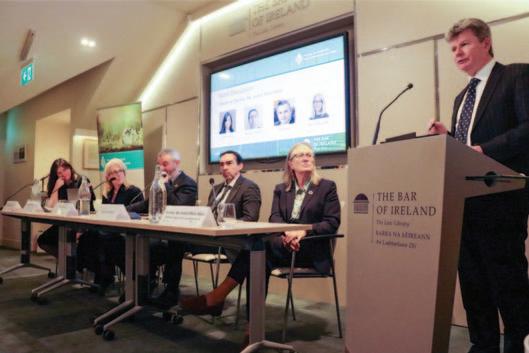
The Planning, Environmental, and Local Government Bar Association (PELGBA)’s conference, held on November 26, brought practitioners together in the Gaffney Room for an in-depth examination of the significant reforms introduced by the Planning and Development Act 2024. The event opened with remarks from Tom Flynn SC, followed by an address from Ms Justice Marie Baker, former Judge of the Supreme Court. Attendees heard presentations from Cormac McNamara SC and Peter Mullan of An Coimisiún Pleanála, before engaging in a Q&A session. A panel discussion chaired by Ms Justice Baker featured contributions from Aoife Carroll SC, Stephen Dodd SC, Rachel Minch SC of Philip Lee LLP, and Fred Logue of FP Logue LLP. Throughout the afternoon, the PELGBA explored the opportunities and challenges arising from the commencement of the 2024 Act, offering participants important insights into the changing landscape of planning and environmental law in Ireland.
From left: Aoife Carroll SC; Rachel Minch SC; Fred Logue; Stephen Dodd SC; Ms Justice Marie Baker; and, Tom Flynn SC (standing).
Certificat etari y Secr an e in Comp Certificat aw e L althcar oma in He Dipl sing and ea tion L via oma in A Dipl
actice w and Pr a l L ia
Certificat w and A a ensions L e in P
APPLICATTIO A SPRING 20 www.lawsocie w: 01 672 4802 t: diplomateam@ e: A TA A CONTTACTDET
W OPEN ONS NO SES 026 COUR ety.ie/diplomacentre @lawsociety.ie AILS
o ls, f professiona ours d c recognise actic cus and pr fo tion w duca l e lega our CPD ll y or a F
ofessionals or pr y d b ere ses deliv Flexible, t | l insigh ca ofessional with pr s in eader | L needs
e appli t ting la Accep
e appli t ting la Accep
rusteeship Applied T e appli t ting la Accep
e appli t ting la Accep actice e appli t ting la Accep
Certificat a tion Pr otec a Pr at e in D
actice oma in In-House Pr Dipl tra l Con cia e in Commer
uary 2026 ebr 21 F acts
uary 2026 ebr 24 F
€3,600 ications
€3,050 ications
€1,950 ications
€1,950 ications
€1,950 ications
€1,950
€3,050
Mediation for inheritance disputes
The Probate Bar Association (PBA) held its Annual Conference on December 10, centred on the theme of resolving inheritance disputes through mediation, reflecting its belief that open family communication is essential to preventing and resolving conflict. Chair John Donnelly SC opened the event, followed by an address from Ms Justice Siobhán Stack, who emphasised the courts’ growing expectation that parties attempt mediation before litigation. Just before the break, Finders International, sponsor of the conference, gave a brief presentation of its work. Finders International hosted an information stand during the tea and coffee break, providing
attendees with an opportunity to raise queries and engage directly with its representatives. After the break, Vinog Faughnan SC outlined the mediator’s role in navigating complex family dynamics, and Catherine Duggan BL gave a counsel’s perspective on preparing clients for constructive engagement. Lisa Cantillon, CEO and Director of KTA Tax, delivered a clear overview of the tax considerations that frequently shape the contours of mediated settlements. A panel comprising Michael Counihan SC, Vinog Faughnan SC, Catherine Duggan BL, Nora Lillis, and Lisa Cantillon subsequently examined and integrated the key themes from the
preceding sessions, highlighting the practical interplay between the mediator’s function, counsel’s role, and the associated tax considerations. The panel discussion wrapped up with a Q&A session, allowing attendees to deepen their understanding of the issues through insights shared by practitioners with extensive first-hand experience.
The conference concluded with a comprehensive case law update from Laurence Masterson BL, and closing remarks from John Donnelly SC, who thanked all the speakers, recognised their expertise, and reaffirmed the Association’s commitment to promoting mediation as an efficient path to resolving inheritance disputes.
Dublin Dispute Resolution Centre
Ireland’s premier dispute resolution venue
At the DDRC, we take pride in delivering exceptionally high-quality meeting spaces and supplementary services in close proximity to the Four Courts complex.
Key features of our centre
Neutrality: DDRC serves as a neutral venue for all parties. Conveniently located in the heart of Dublin's legal community, we are easy to access.
Prime location: on the first floor of the Distillery Building, DDRC offers the perfect setting for consultations, arbitrations, mediations, and settlements.
Fully serviced and accessible for all users: we take care of all your business needs. DDRC guarantees a seamless, positive experience.
Flexible hours: meetings can be unpredictable, so we can offer flexibility allowing your meeting to progress in whichever way suits you.
Clarity, fairness and compassion
The Professional, Regulatory and Disciplinary Bar Association (PRDBA) held its Annual Conference on December 5 in the Gaffney Room, where members gathered for an afternoon of thoughtful discussion and expert analysis on some of the most pressing issues in the regulatory and disciplinary landscape. The conference opened with an address from Ms Justice Caroline Costello, President of the Court of Appeal, who reflected on the continuing evolution of regulatory frameworks and the responsibility of the professions in maintaining public trust.
The programme featured four substantive contributions, each exploring a distinct aspect of the public interest within the disciplinary process. Helen Callanan SC delivered an indepth overview of the exercise of regulatory functions, examining how decision-makers balance individual rights with the overarching obligation to protect the public. Frank Beatty SC followed with a compelling presentation on suspension applications, asking whether the public interest has become a “silent assassin” in such determinations, and encouraging practitioners to consider the subtleties that can influence outcomes. Turning to questions of rehabilitation, Neasa Bird BL addressed the complex interplay between public protection,
ICBA ‘on drugs’
On December 1, the Irish Criminal Bar Association (ICBA) launched its new ‘Common Prosecutions in the District’ CPD series with a well-attended inaugural session, titled ‘ICBA ‘on Drugs’’, which was held at the Criminal Courts of Justice. Designed for practitioners in years one to five, the event offered a clear and practical walk-through of the essential proofs and procedural
Helen Callanan SC addressing the recent PRDBA Annual Conference.
health-related considerations, and the prospects of professional reintegration.
Ronan Kennedy SC concluded the speaker sessions with a thoughtful analysis of how relevant medical disability intersects with findings of misconduct, highlighting the challenges that arise where legal, ethical, and medical perspectives meet. A panel discussion moderated by Mr Justice David Barniville, President of the High Court, brought further depth to the afternoon. Panellists Remy Farrell SC, Valerie Beatty of the Veterinary
Council of Ireland, and Paul Harkin of the Medical Council of Ireland shared practical insights from their respective regulatory spheres, discussing consistency in sanctioning, evolving expectations of transparency, and the role of professional bodies in supporting practitioners while safeguarding the public. The closing address, delivered by Mr Justice Barniville, drew together the themes of the day, emphasising the importance of clarity, fairness, and compassion within disciplinary systems.
requirements underpinning the most commonly prosecuted summary drug offences. Participants explored not only the statutory elements of possession-type offences, but also the evidential and procedural vulnerabilities that frequently arise in practice.
The session was delivered by Gregory Murphy BL, whose expertise in this area ensured a highly
engaging and accessible presentation. The speaker guided attendees through navigating drugs-related certificates, chain of custody issues, and identifying points where evidence could be challenged. His focus on up-to-date practice and procedure was especially valuable for junior practitioners building confidence in district court advocacy.
Immigration issues
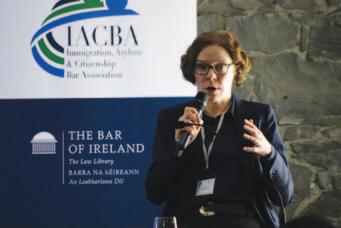
The Immigration, Asylum and Citizenship Bar Association (IACBA) Annual Conference drew a full audience to the Atrium of the Distillery Building on December 12, where leading figures in immigration and asylum law gathered for an afternoon of analysis and debate. The conference opened with a welcome from Aoife McMahon BL, followed by an opening address from Ms Justice Niamh Hyland. Mr Justice Eugene Regan then delivered a comprehensive update on recent Court of Justice of the European Union (CJEU) case law. Further presentations explored several key topics currently affecting practitioners, including applications for residency by non-EEA parents of EU citizen children (by Karen Berkeley), and the
evolving landscape of appellate reform and the Pact on Migration and Asylum (by Joanne Williams BL). Author Mir Rahimi added a personal point of view to the afternoon with insights drawn from his book Across Mountains, Land and Sea. Following a tea and coffee break, the programme continued with contributions from Úna McEvoy, who outlined Ireland’s participation in EU instruments under Protocol 21, and David Leonard BL, who examined the implications of BD v IPAT for partial certiorari. Anthony Hanrahan SC offered a practical overview of deportation enforcement and the asylum list, and Patricia Brazil SC concluded the speaking lineup with an analysis of State protection and safe country assessments following G & M v IPAT
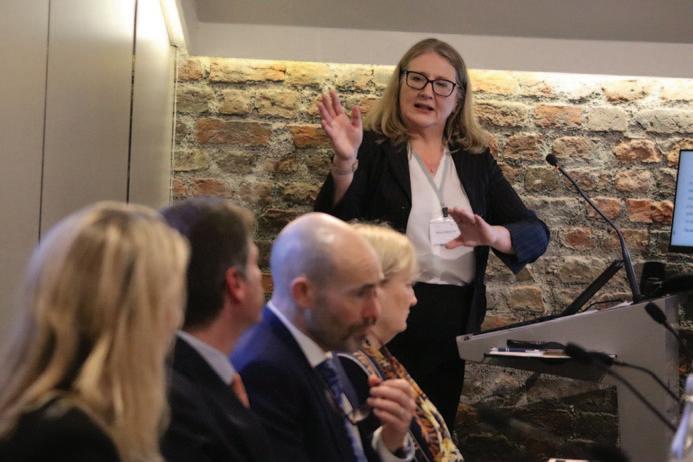
Úna McAvoy addressed the recent IACBA Annual Conference.
The event finished with a lively Q&A session that reflected both the complexity of the current legal landscape and the high level of engagement among attendees. The conference closed with a drinks and canapés reception, where networking among attendees continued.
Sporting sessions
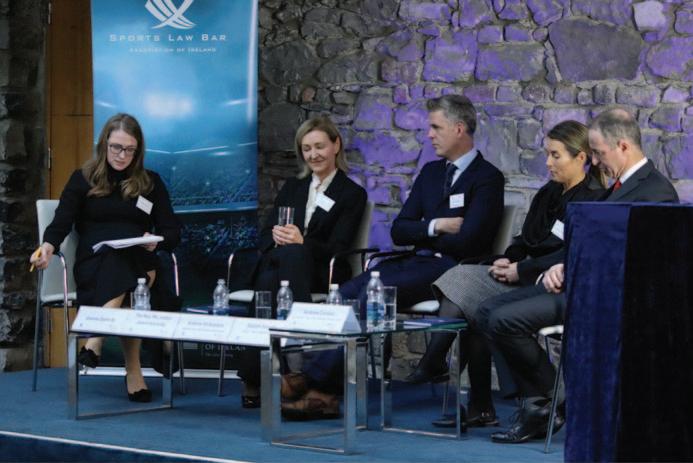
The Sports Law Bar Association (SLBA) marked another successful conference on November 28, as members of the legal community and sporting representatives convened in the Atrium of the Distillery Building for an afternoon programme accredited with 3.25 CPD points. The event opened with remarks from SLBA Chair Mark Curran BL, who welcomed attendees and set the tone for a programme focused on current issues shaping high-profile sporting disciplines. The first session turned to football, where moderator Neal Horgan BL guided a substantive discussion on governance, dispute resolution, and the evolving commercial pressures within the sport. Panellists John Mehrzad KC of Fountain Court Chambers and Barry Lysaght of Lysaght Sports offered contrasting professional perspectives drawn from their advisory and litigation work, engaging the audience with insights into recent trends in player representation, disciplinary matters, and the increasingly complex regulatory landscape. Attention then shifted to the equestrian sector, for a horse sport panel chaired by Gráinne Quinn BL. The panel brought together a diverse group of voices, including Andrew Coonan, Secretary of the Irish Jockeys Association, retired National
Hunt jockey Andrew McNamara, Ms Justice Leonie Reynolds, and Avalon Everett, COO of Horse Sport Ireland. Their discussion explored topics ranging from rider welfare and safety standards to the legal challenges facing governing bodies.
The afternoon concluded on a more personal note, with a fireside-style interview featuring
AI Committee launches web resource for barristers
The Artificial Intelligence Oversight Committee of The Bar of Ireland has launched ‘AI Essentials’, a new series of information web pages now available in the members’ section of the Law Library website. This resource includes introductory explainer videos from colleagues at the Bar, outlining how AI can be used in legal practice, its limitations, and the opportunities it presents for barristers. It also provides ethical guidance for practitioners, details on new software tools available to members, a suite of CPD sessions on AI, and information from a range of institutions and organisations to help you stay up to date on how practitioners are adopting the technology and developing practice frameworks around its use.
‘AI Essentials’ can be accessed at members.lawlibrary.ie/ai.
Irish rugby player Eve Higgins. Conducted by Rebecca Lacy BL, the conversation provided an engaging and candid look at Higgins’ career and the realities of life in elite women’s sport. The Conference was closed by Mr Justice Raymond Groarke, former President of the Circuit Court and Raceday Steward of the Irish Horseracing Regulatory Board.
From left: Gráinne Quinn BL; Ms Justice Leonie Reynolds; former National Hunt jockey Andrew McNamara; COO of Horse Sport Ireland Avalon Everett; and, Secretary of the Irish Jockeys Association Andrew Coonan.
Judicial review – the facts
The Bar of Ireland is concerned that the proposed introduction of a rigid scale of fees and cost cap for environmental judicial reviews would seriously undermine access to justice, weaken environmental protection, and risk breaching constitutional, EU, and international legal obligations.
The Council of The Bar of Ireland sent a detailed
submission to the Department of Climate, Energy and the Environment as part of its Consultation on the regulation of costs payable in matters prescribed on foot of s.294 of the Planning and Development Act 2024 (Scale of Fees).
The Bar warns that the proposed scale of costs would cap legal fees at well below the real cost of bringing complex planning and environmental
Voluntary Assistance Scheme Annual Conference
The Voluntary Assistance Scheme (VAS) Annual Conference took place on Friday, January 16, covering many timely issues. Pro bono work, protecting freedom of expression, and drafting legislation were among the topics covered across two afternoon sessions. The event was opened by VAS Co-ordinator Gemma McLoughlin-Burke BL, who stressed the continued importance of pro bono work and shared her experience on the Global Sumud Flotilla in 2025.
In the first session, the audience heard from Catherine Donnelly SC, Karl Gill of Ferrys Solicitors, Olga Cronin of the Irish Council for Civil Liberties, and Alannah Uí Geargáin of the Irish Network of Legal Observers on the topic of ‘Protests and the Media: Protecting Freedom of Expression’. The panel was moderated by Ms Justice Sara Phelan.
The second session covered ‘Legislative Drafting and Lobbying’, chaired by Ms Justice Emily Egan. Speakers included Lorcan Staines SC, Diane Duggan BL of An Coimisiún Toghcháin, and Martin Collins, Co-Director of Pavee Point Traveller and Roma Centre. Caoilfhionn Gallagher KC delivered a keynote speech on the tactics used to silence journalists: “The thing about practising human rights law – the bad days are bad, but the good days are better than any other area of law”.
Sanfey Essay Prize
judicial review cases. It says that this would not deter unmeritorious litigants, but would instead penalise people and environmental organisations raising legitimate concerns about unlawful decisions, by imposing on them the legal costs of fixing the errors of public bodies and State agencies. You can read the full submission on The Bar of Ireland’s website: lawlibrary.ie.
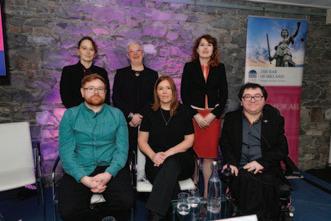
Back row (from left): Catherine Donnelly SC; Ms Justice Sara Phelan; and, Gemma McLoughlin-Burke BL. Front row (from left): Karl Gill; Olga Cronin; and, Alannah Uí Geargáin.
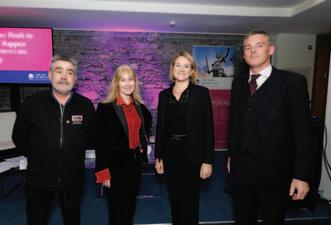
Pictured at the VAS Annual Conference were (from left): Martin Collins; Ms Justice Emily Egan; Diane Duggan BL; and, Lorcan Staines SC.
Caoilfhionn Gallagher KC, keynote speaker.
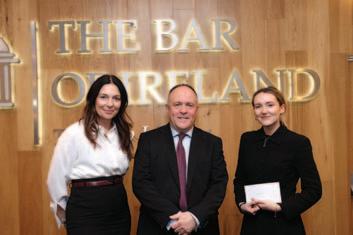
The Construction Bar Association (CBA) was delighted to present the 2025 Sanfey Essay Prize to Eimear Dooley BL on January 21. Eimear accepted her prize at a ceremony attended by colleagues from The Bar of Ireland and members of the CBA. The competition, named after one of the CBA founders, Mr Justice Mark Sanfey, accepts submissions on the topic of construction law from people of all disciplines, including practitioners and students.
WHY PROFESSIONAL DEVELOPMENT MATTERS – EVEN WHEN YOU’RE TOO BUSY FOR IT
In the unpredictable life of an independent referral barrister, the real question is not whether CPD is difficult to prioritise, but whether one can afford not to.
Stephen Swanton Director of Practice and Professional Development, The Bar of Ireland
If you’ve ever sprinted from court to consultation with no time for lunch, you’ll recognise the reality of practice at the Irish Bar: workloads that are often unpredictable and uneven. One week requires preparing late into the night for a complex hearing; the next, you’re juggling multiple briefs and client calls before court.
In that environment, continuing professional development (CPD) can easily feel like just another task on an already overloaded list. It’s tempting to defer a webinar or skip an after-court seminar when something more immediate presents itself. Yet it’s worth pausing to reflect on this, as it’s often in these busiest, most pressurised moments that CPD matters most. Not as a box-ticking
exercise, but as a way of ensuring that even under strain, professionals continue to sharpen the skills and judgement that sustain their practice and uphold professional standards. That pressure is not merely anecdotal. Feedback collected by The Bar of Ireland consistently points to the challenges of long and unpredictable working hours at the Bar – a feature inherent where one has limited or no control over the pace, or trajectory, of work. Against that backdrop, the real question is not whether CPD is difficult to prioritise, but whether one can afford not to.
CPD still
matters when time is tight
The law does not stand still simply because practitioners are busy. New judgments are delivered daily, legislation evolves, and unfamiliar issues – such as wrestling with the potential of artificial intelligence (AI) or compliance with ever-changing regulatory frameworks – increasingly arise in practice.
The Bar of Ireland’s ‘Annual Report 2024/25’ emphasises the need for the profession to “lead with purpose” and “adapt with agility” in this rapidly changing environment, while remaining grounded in the core values of integrity, independence and expertise.1 Standing still, in practical terms, is not a neutral option – nor is it a safe one.
CPD is the mechanism through which barristers keep pace with this change. The Bar’s ‘Continuing Professional Development Requirements’ expressly state that ongoing professional development plays an “important role in ensuring continued competence” and in ensuring that “the public and service users continue to have confidence” in the quality of legal services provided by members of the Law Library.2 CPD therefore safeguards not only individual practice, but also the collective standing of the independent referral Bar.
It is also fair to acknowledge, however, that poorly targeted CPD does not automatically correlate with reduced complaints or disciplinary outcomes, and that CPD’s value depends on relevance, engagement, and quality – all principles that underpin The Bar of Ireland’s CPD framework and offering for members. It is therefore each practitioner’s responsibility to ensure that the time spent provides the return on investment they need to stay current and adapt.
CPD, curiosity and resilience
CPD can also help to guard against burnout and professional stagnation. Adding another commitment when you are already stretched may seem counterintuitive, but learning has a way of re-engaging intellectual curiosity, which is important to job satisfaction.
Increasingly, the Bar’s CPD also addresses practitioner well-being. Recent Bar-organised sessions focusing on resilience, performance under pressure, and sustainable practice reflect a growing recognition that competence is not confined to expertise in substantive law alone.3
Research across the professions consistently links ongoing learning and peer engagement with higher job satisfaction and reduced burnout.4,5 These developments acknowledge an important
truth: resilience, the ability to absorb pressure and recover from setbacks, is as critical to a sustainable career at the Bar as legal knowledge or advocacy skill.6
A framework designed for real practice
Members will be familiar with the requirement to obtain 20 CPD points annually, with a minimum of 12 derived from formal/structured activities, and the importance of diversifying their activity across the four competency domains: legal knowledge, procedure and skills; advocacy, dispute resolution, and negotiation; ethics and professional standards; and, personal professional development and practice management.
This breadth reflects the reality of modern practice. Comparable frameworks in jurisdictions such as England & Wales,7 Canada,8 New Zealand,9 and Australia10 adopt similarly holistic models, recognising that professional competence encompasses advocacy, ethical judgement, business awareness, and personal sustainability, as well as the law itself.
Members will also recognise that ethics occupies a distinct place within the scheme. The requirement for an annual, structured ethics component reflects the reality that ethical
judgement is often tested most under pressure –where time constraints, client expectations and financial considerations intersect. An hour spent revisiting a topic like duty to the court or client confidentiality can fortify against subtle temptations to cut corners that creep in when overloaded. Regular engagement with ethical principles reinforces the professional compass that underpins judicial and public trust in the Bar.
Flexibility that reflects how we learn
One of the strengths of The Bar of Ireland’s CPD scheme is its flexibility. CPD is not confined to formal courses or seminars. Completing a structured learning plan contributes towards CPD,11 as does informal learning – including reading judgments, listening to legal podcasts, mentoring colleagues, peer discussion, and reflective practice.2
For barristers with unpredictable schedules, this flexibility is not a concession; it is essential. It allows learning to be continuous, rather than episodic, and integrated into practice rather than treated as an additional burden.
The collegial side of CPD
CPD also plays an important collegial role. While it is often framed as an individual responsibility, many CPD activities create opportunities for connection and shared learning. In a profession where practitioners operate independently, these opportunities matter. CPD events and workshops provide structured spaces for peer networking, informal mentoring and collective reflection. These interactions support not only competence, but also morale and professional solidarity – qualities that are at the core of the Law Library’s independent referral model.
In 2023, The Bar of Ireland introduced a pilot Sharing and Learning Group for colleagues practising in mediation, and support for the formation of other similar groups is now available to members via the CPD team.12
Keeping up with change
Another reason CPD matters, especially when time feels scarce, is the pace of change in the legal landscape. Technology is reshaping legal research and case management, while regulatory developments continue to affect how barristers practise.
AI provides a clear example. Legal-grade AI tools can enhance efficiency, but only when used competently and ethically.13,14 Regulators and professional bodies increasingly frame technological literacy as part of professional competence. CPD provides a structured space to engage critically with these developments, rather than reacting to them belatedly, whether that is through engagement in formal CPD, trial of new tools, or informally via the Bar’s recently launched AI Essentials Hub.15
The same is true of regulatory change. Time spent understanding new practice directions or guidance through CPD often prevents costly errors and lastminute difficulties. In that sense, CPD functions as a form of risk management: time invested early saves far more time – and stress – later.
Making CPD part of everyday practice
The key to making CPD manageable is a shift in mindset. Much learning already happens in the course of ordinary practice – through challenging cases, unfamiliar legal issues, and peer discussion. Recognising and recording that learning allows CPD to become part of daily professional life rather than an added task.
References
1. The Bar of Ireland. Annual Report 2024/25: Chair’s and Chief Executive’s Reports. 2025.
2. The Bar of Ireland. Continuing Professional Development Requirements for Members. 2021.
3. The Bar of Ireland. My CPD: Personal professional development and practice management Available from: https://pd.lawlibrary.ie/resilience-cpd (accessed on January 23, 2026).
4. Hollar, N., Kuchinka, D.G., Feinberg, J. Professional development opportunities and job satisfaction: a systematic review of research. Journal of International Management Studies, 2022; 22(1).
5. Poljaševi, B.Z., Todorovi, M. The effects of professional development opportunities on job satisfaction. KNOWLEDGE – International Journal, 2021; 45(1).
6. The Honorable Society of King’s Inns. Barrister Competencies: A Qualitative Exploration. February 17, 2020.
7. Bar Standards Board (England & Wales). Continuing Professional Development: New CPD Scheme 2017. Available from: https://www.barstandardsboard.org.uk/forbarristers/cpd.html (accessed on January 23, 2026).
8. The Advocates’ Society. CPD Requirements Across Canada Available from: https://www.advocates.ca/TAS/TAS/Professional_Development/CPD_Requirements_A
CPD is not something to be postponed until practice quietens down – because once a practice takes off, it rarely does quieten. When you find yourself thinking you are ‘too busy’, that is often the clearest signal that professional development is needed.
CPD sharpens judgement, supports resilience, and helps prevent the kind of knowledge gaps that surface at the worst possible time. It is not a distraction from practice; it is how we continue to excel in it.
Useful links
Members events calendar: for details on all upcoming CPD events, with over 100 events held annually – https://members.lawlibrary.ie/eventscalendar/
Catalogue of on-demand CPD: searchable directory of over 400 hours of CPD content – https://pd.lawlibrary.ie/catalogue
Learning plan: download the learning plan template to proactively address your CPD need. Recognised for three formal/structured CPD points –https://pd.lawlibrary.ie/learning-plan
Sharing and Learning Groups: information about setting up a Sharing and Learning Group for your interest area – https://pd.lawlibrary.ie/sharingand-learning
Have an idea for a CPD? Email cpd@lawlibrary.ie
cross_Canada.aspx (accessed on January 23, 2026).
9. New Zealand Law Society. CPD requirements. Available from: https://www.lawsociety.org.nz/professional-practice/continuing-professionaldevelopment/cpd-requirements/ (accessed on January 23, 2026).
10. The Law Society of the Australian Capital Territory. Professional development (CPD). Available from: https://www.actlawsociety.asn.au/practising-law/cpd (accessed on January 23, 2026).
11. The Bar of Ireland. My CPD: Learning Plan Available from: https://pd/.lawlibrary.ie/learning-plan (accessed on January 23, 2026).
12. The Bar of Ireland. My CPD: Sharing and Learning Groups. Available from: https://pd.lawlibrary.ie/sharing-and-learning (accessed on January 23, 2026).
13. Susskind, R. Tomorrow’s Lawyers: An Introduction To Your Future. Oxford University Press, 2023.
14. The Bar of Ireland, Professional Practices Committee. Ethical Toolkit: Ethical Use And Use Cases For Artificial Intelligence in Legal Practice. 2025. Available from: https://pd.lawlibrary.ie/ai-toolkit (accessed on January 23, 2026).
15. The Bar of Ireland. AI Essentials Hub. Available from: https://members.lawlibrary.ie/artificial-intelligence/.
IN THE ROOM LAWYER THE
Ann-Marie Hardiman, Managing Editor, Think Media
BColm Ó Cinnéide is Professor of Constitutional and Human Rights Law at University College London. He spoke to The Bar Review about his legal advisory work, the intersection of law and politics, and global challenges to the post-World War II rights-based order.
orn in Dublin, but raised in Cork, Colm Ó Cinnéide says he chose a career in law as he was drawn to the arts and humanities represented by his English teacher mother: “My father was a civil engineer, but I lacked his aptitude for maths. Law seemed to be a way of being involved in the functioning of society that might be socially useful but didn’t require a high score in Honours Leaving Cert Maths – and that promised to be interesting”. He traces the desire to be “socially useful”, and his interest in anti-discrimination law, to his mother too, who was one of the first cohort of female secondary school teachers in Ireland to be able to return to work after marriage and children, as the infamous ‘marriage bar’ came to an end. After completing undergraduate studies at UCC, the King’s Inns was the obvious choice for someone who enjoyed the play of ideas, and the cut and thrust of debate, but on graduating, Colm decided not to practise at the Bar: “It was interesting doing the King’s Inns and getting my BL in the late 1990s, having come from Cork without a legal background. I learned an awful lot about the Law Library and lots of detail about interesting areas of law. I have an abiding interest in tax law, for example, because of the class in the Inns. But there was,
at that time (I think things have changed quite a lot since), a slightly exclusionary sense, that if you didn’t have connections you were going to face an uphill struggle. A couple of friends who, like me, wouldn’t have had connections, have gone on to have extraordinary and thriving legal careers in the Law Library, but coming from the outside was always going to involve a struggle”. Instead he opted to go to Edinburgh to do a master’s degree, then returned to Ireland to lecture at the University of Limerick for a year, before “itchy feet”, and an extraordinary opportunity, took him back to the UK. He began work with the Odysseus Trust, a legal think tank based around the work of Lord Anthony Lester of Herne Hill. Lord Lester was a leading human rights barrister and advocate, and architect of much of the UK’s anti-discrimination law: “He had written first drafts of the UK sex discrimination and race relations legislation, which in turn very much influenced developments at EU level and in Ireland. He had vast experience of human rights, equality, anti-discrimination law, and using the law as a vehicle for social change”. This was Colm’s introduction to the intersection of law and politics, which has been key to his subsequent career: “Anthony was a Liberal Democrat member of the House of Lords, and frequently tabled amendments and private members’ legislation. Around 30% of my work was helping him in his legal advocacy, doing research, speeches, and other things, but around 70% was parliamentary work – drafting legislation and amendments, discussing things with the Government and the opposition. It was an incredible experience, completely transformative”.
When politics meets law
One of the projects on which Colm worked with Lord Lester was a private members’ bill on civil partnership: “It was the very first bill ever put before the UK Parliament to provide for legal recognition of same-sex couples. I did a lot of research, and helped Anthony write the bill, which involved a crash course in UK family law. It was fascinating to watch the intersection of law and politics. The Blair Government of the time used to say nice things about the possibility of civil partnership, but was very worried that it would alienate traditional voters. Anthony tabling the bill forced their hand. It also forced the hand of the Conservatives in opposition, who’d always been opposed to this, and who ultimately decided to abstain”.
In the end, the bill did not go through the parliamentary process, as the following year, the Labour
Government legislated for civil partnership in the UK. For Colm, it was also a fascinating example of the vital role of lawyers in the political system: “We spent a huge amount of time and energy getting it right on the legal basics, so that it couldn’t be shot down because it was lacking technical detail or unworkable. We put it forward as something that could be introduced in the morning, and that made everyone show their hands, so to speak, and took away some of the political stigma. It’s a very good discipline, being so precise about the legal technicalities, not least because it makes the people who might be dragging their feet about an issue have to engage in the practicalities. That’s something that lawyers are uniquely good at: looking at the law, making concrete proposals, in concrete legal language, turning a set of political aspirations into an enforceable set of legal rules”.
After two years with the Trust it was time to move on, and Colm once again considered a career at the Bar, potentially this time in London. However, the opportunity arose to apply for a post at the Faculty of Laws at University College London: “Very unusually for an academic, I didn’t and still don’t have a PhD, but I did a very good interview, the best interview I’ll ever do. And because of my work with Anthony, that really exceptional mixture of law and politics, they decided to appoint me. As I was told afterwards, they took a risky punt. That forced me to make my decision. Was I going down the academic route or the Bar route? I decided to say yes to UCL”.
Seeking consensus
As his academic career developed, Colm began to be appointed to various advisory roles in both the UK and Europe, including the European Committee of Social Rights in the Council of Europe in Strasbourg, which interprets and applies the European Social Charter. He has also worked as legal advisor to a number of parliamentary committees in Westminster, including as specialist legal advisor on the passage of the Equality Act through the UK Parliament, and specialist legal advisor to the Joint Committee on Human Rights: “The Committee was scrutinising the Equality Bill. My job was to give them expert legal advice on the intersection of European and UK law. It was a fascinating experience. You’re in the room with the parliamentarians, both Commons and Lords, answering their questions, providing legal advice and drafting possible amendments. You’re explaining the complexity of the law, and how things work in different countries. You’re not in the room to be a politician. Your job is just to give advice as requested, but obviously, that’s quite an important role. Because when giving advice, as any lawyer will tell you, you need to make sure to do it well: not to exceed the bounds of your expertise, but also to give a clear and accurate legal opinion about the state of the law, in a way that is useful and workable from the point of view of the people you are advising”.
His international expert and advisory roles (Colm has also worked with the International Labour Organisation [ILO] in Geneva) have given him a unique perspective: “First of all, organisations such as the EU, Council of Europe or the ILO are genuinely multinational. They have different policy concerns, different areas of
political sensitivity, of legal difficulty. And, in areas like equality law and human rights law, starting points are often very different. So, as an academic legal expert working in that multinational setting, your job is to try and set out legal standards and assess state compliance with those standards in a way that works across those different national contexts. And you’re trying to do all that in a way that’s fair to the different national traditions and perspectives. There’s quite a lot of commonalities, but also real differences. And that tension between commonalities and differences can be very instructive and, sometimes, challenging”.
One thing Colm’s experience has taught him is the absolutely vital importance of working together to reach consensus: “I would say this applied to both Westminster and Europe. Westminster is quite bipolar, Labour versus the Tories. But actually, the committee system is designed to try and get consensus. In the committee meeting rooms, they’re not shouting insults at each other like they do in Prime Minister’s Question Time. They’re trying to come together to agree a common report. I can’t emphasise enough how important it is to try and bring people of different political perspectives together to try and discuss common problems, and get agreement on shared legal texts, shared language in a report. Because that involves trying to see the other side. It’s a learning experience for everyone in the room”.
Once again, the legal advisor has to try to help form that consensus, and translate that common ground into a legal framework – which isn’t always straightforward: “At first glance, it should be easy to find common ground, e.g., when it comes to human rights. Everyone says they love human rights. But what are we actually going to commit to in terms of the legal text? That can be when the rubber hits the road, so to speak. You need that consensus-building process to go at the abstract level, but you also need to try and carry it over into the hard work of nailing down agreed positions in formal governance structures. It’s a fascinating process, and absolutely integral to the democratic process”.
Troubling times
We now find ourselves living in times, however, when the statement that ‘everyone loves human rights’ can by no means be taken for granted, and where long-held assumptions are being questioned, and even dismantled. Debates around topics such as immigration have contributed to a view in some quarters that our rightsbased order has ‘gone too far’. While the speed of change seems astonishing, Colm places its roots as far back as 9/11, with the war on terror, extraordinary rendition, and the Iraq War. However, he says that even then, there were checks and balances that seem now to be under threat: “Back then, in the war on terror years, there was still plenty of lip service being paid to human rights values, and many of the human rights legal structures actually proved to be very robust. For example, the European Court of Human Rights made it very clear that extraordinary rendition to Guantanamo was a breach of fundamental first principles, and most European governments eventually recognised that and responded accordingly. But over the years, the anti-rights, anti-equality backlash has gathered momentum. And from
2016 on, with Brexit and Trump, it’s now gone into overdrive. We are now experiencing a real push to overturn that post-war liberal democratic rights-based order, to open up much more unconstrained decision-making by executives”.
‘Populism’ is a word that’s often used to describe the driver of many of these changes, but Colm feels that some care needs to be taken in treating the concept of ‘populism’ as something that is automatically pejorative: “If people are really angry about the state of things, it is crucially important that people can express that demand for change through democracy. But things get dangerous when that demand for change gets channelled towards a desire to overthrow rights constraints, and to revise the post-1945 consensus that equality and non-discrimination are fundamental values that states should strive to respect at all times”.
He feels strongly that human rights-oriented checks and balances are fundamental to this process, and ultimately to the successful functioning of democracy: “Since the Second World War, we’ve been committed to the idea that you can have radical transformative change through democratic processes, and our societies have been radically transformed as a result. But at the same time, such political processes should respect certain basic principles, such as respect for rights, equality and international law. That disciplining effect avoids excesses. It also forces key political actors to behave themselves, to think about the rule of law, about rights, about the consequences of their actions. What we’re seeing now is in country after country, sustained attempts to sweep away some of those constraints”.
So why is this happening now? For Colm, there are various structural factors in play, but also other factors: “We’re living in a period of a certain degree of socio-economic turmoil, where Western economies aren’t growing as fast as they once did. We’re also seeing the rise of China, and economies transforming under the influence of tech. We’ve considerable inequalities, and a growing collective sense of vulnerability. A lot of people experience that in their day-to-day lives and get angry, feel the need for change. There’s a backlash against international governance, a demand to kick over this European regulatory stuff – ‘Our own people should decide’ – ignoring the fact that we’re all interconnected, all dealing with similar stresses and strains, and that you need this international dimension to get things done”.
Speaking up for human rights
Our interview took place the day after Canadian Prime Minister Mark Carney delivered his landmark speech in Davos, which some have interpreted as an elegy for the old rules-based order. Certainly it was a not-so-veiled criticism of the policies of the Trump administration in the US, and Colm agrees that Trump and his supporters have been major agents in the acceleration of attacks on rights-based systems: “It’s happening everywhere, but Trump has become a radical driver of change. He’s expressing this stuff openly, and he’s appointing people like Vance and Stephen Miller and others who are ideologically fundamentally opposed to the post-war settlement, who don’t like the language of rights and equality because they fundamentally disagree with its underlying commitment to the ideal that all
humans enjoy some basic equality of status. It’s why both the Putin Government and the Trump administration really hate the EU, because of all that incremental process of consensus formation, the ‘slow boring of hard boards’, as the German sociologist Max Weber famously phrased it, all done through an overarching commitment to the discipline of rights and equality”.
It’s also impossible to ignore the impact of social media: “Social media can reinforce your views rather than forcing you into a common meeting place. And that can help to loosen the disciplining effect of rule of law processes or human rights concerns”. Social media also serves to dilute the complexity of these issues, and the fundamental point that human rights are not always ‘easy’: “We live in very complicated societies. There’s an instinct in people to look for the easy and quick solution and say, ‘Well, this is democracy. Democracy should deliver what we want’. But of course, there’s different ‘we’s’ at the table. You can change lots of things through democracy and push back against plenty of received wisdom that you might disagree with, but we need to think amidst that churn about how to preserve basic human dignity, equality values, and core elements of the rule of law process”. He brings this back to the concrete functioning of the political process, and thus to the role of the lawyer as the keeper of those ‘checks and balances’: “I’ve been in meeting rooms where ministers, for example, get really angry about constraints on immigration powers imposed by human rights law – national, European or international. They get this pushback against their political agenda, often responding to the views of constituents, from the lawyers in the room. And they don’t always like that pushback. I have actually been that lawyer in the room, saying to the politicians ‘hang on a second, you need to think about this’. It can be overdone; you sometimes can have government being paralysed by too much legalism. But at the same time, it’s incredibly important that politicians, no matter where they are on the political spectrum, think about the concrete consequences of their actions, and the people who will be concretely affected by them”.
He offers an example of current debate in the UK: “I think there’s a very good chance the UK will leave the European Convention on Human Rights after the next election, which would be an earthquake. Part of this is being driven by UK politicians from all ends of the political spectrum saying, ‘we need to be able to deport people to appease public anger’. And yes, lots of the public are quite worked up about this issue. At the same time, if you choose to deport someone, especially if they’ve been resident in a country for decades and have a wife and kids, you are talking about doing something that will impact on the lives of that family in a really fundamental manner. So, when a politician says they want everyone deported who’s committed an offence above a certain level of severity, it is important to have lawyers in the room saying things like, ‘Okay, Minister, but there are other people involved in this. Deportation may involve depriving children of their father, forcing parents to choose between separation or leaving, with all that entails for the future of their children’. Ministers can chafe against those reminders, but it’s precisely the job of lawyers in the room to say this human rights stuff means something”.
UPDATE
A directory of legislation, articles and acquisitions received in the Law Library from November 21, 2025, to January 22, 2026. Judgment information supplied by Vlex Justis Ltd.
Edited by Vanessa Curley, Susan Downes and Clare O’Dwyer, Law Library, Four Courts.
ADMINISTRATIVE LAW
Legal Services Regulation Act 2015 s.161 – Abuse of process – Issue estoppel –Applicant seeking a review pursuant to s.161 of the Legal Services Regulation Act 2015 – Whether the relief sought constituted an abuse of process –05/12/2025 – [2025] IEHC 700 Skoczylas v Minister for Finance
ARBITRATION
Arbitration – Adjournment – Arbitration Act 2010 s.23 – Applicant seeking orders recognising and enforcing a final award of an arbitrator – Whether the decision should be adjourned – 19/11/2025 –[2025] IEHC 668
Site Facility APS v Randridge Holdings Limited
Library acquisitions
Barrett, M. Online Dispute Resolution: Law’s Future in the Digital Age. London: Globe Law and Business, 2025 – N398.6 Tweeddale, A., Ahmed, M. Arbitration of Commercial Disputes: International and English Law and Practice (2nd ed.)
Oxford: Oxford University Press, 2025 –N398.8
ARTIFICIAL INTELLIGENCE
Articles
Cunniffe, A. Ghost in the machine: the challenges of authorship, originality, and copyright in an era of generative artificial intelligence. University of Galway Law Review 2025; 4 (4): 139-171
BANKING
Library acquisitions
Odgers, J., Wilson, I. Paget’s Law of Banking (16th ed.). London: LexisNexis, 2023 – N303
BUILDING CONTRACTS
Construction law – Enforcement order –
Default direction to pay – Construction Contracts Act 2013, ss.4,6 – Applicant seeks leave to enforce an adjudicator’s decision under the Construction Contracts Act 2013 – Whether the Construction Contracts Act 2013 provides for a default direction to pay when a payment claim notice is not responded to – 12/01/2026 – [2026] IEHC 5
Tenderbids Limited [trading as Bastion] v
Electrical Waste Management Limited
Library acquisitions
Britton, P., Bell, M. Residential Construction Law: The UK, Ireland, Australia and New Zealand (2nd ed.)
Oxford: Hart Publishing, 2025 – N83.8
CHILDREN
Articles
Cafferky, R. Broadcasting childhood: the legal risks and ethical dilemmas of family content sharing. University of Galway Law Review 2025; 4 (4): 114-138
COMMERCIAL LAW
Articles
Rooney, J. Moving to a concrete model of damages assessment for non-acceptance: the market price rule and the need for balance. Commercial Law Practitioner 2025; 32 (7): 101-108
COMPANY LAW
Interlocutory injunction – Adequacy of damages – Balance of justice – Applicant seeking an interlocutory injunction restraining his removal as a director –Whether there was a fair question to be tried – 28/11/2025 – [2025] IEHC 664
DAF Truck Services (Cork) Limited v
Companies Act 2014
Companies – Winding up – Companies Act 2014 s.569(1)(e) – Petitioner seeking to have the company wound up – Whether the High Court should exercise its discretion not to grant the winding-up petition – 27/11/2025 – [2025] IEHC 669
O’Neill v Hudner
Company law – Interlocutory injunction –Conditionality of payment obligation –Companies Act 2014, s.570 – Plaintiff seeks an interlocutory injunction restraining the presentation of a winding up petition – Whether the plaintiff unconditionally committed to paying the defendant and defaulted due to TRAM’s alleged default – 13/01/2026 – [2026] IEHC 1
San Leon Energy PLC v Brightwaters Energy Limited
Company law – Winding up order –Fraudulent trading – Companies Act 2014, ss.599,600 – Companies Act 2014, ss.608,609 – Applicant seeks winding up of three companies as if they were one –Whether the first respondent was a de facto director of Hynes Jewellers (Wexford) Limited – 09/01/2026 –[2026] IEHC 6
Tuskar Property Holdings Limited [in liquidation] and ors v Companies Act 2014
COMMUNICATIONS
Communications regulation – Injunction order – Legal interpretation of Regulation 89(6) – Communications Regulation Act 2002, s.46 – European Union (Electronic Communications Code) Regulations 2022, reg.89(6) – Applicant seeks orders requiring respondent to cease contravening Regulation 89(6) of the 2022 Regulations – Whether Sky is required to comply with Regulation 89(6) and provide customers with end-ofcontract notifications and best tariff advice – 14/01-2026 – [2026] IEHC 12 Commission for Communications Regulation v Sky Ireland Limited
CONSTITUTIONAL LAW
Constitutional law – Judicial review –Constitutional interpretation – Ministers and Secretaries (Amendment) (No. 2) Act 1977, s.1 – Ministers and Secretaries (Amendment) (No. 2) Act 1977, s.2 –Applicant seeks to challenge the attendance of Ministers of State at Government meetings – Whether the attendance of Ministers of State at Government meetings infringes the Constitution – 19/12/2025 – [2025] IEHC 729
Daly v An Taoiseach and ors
Constitutional law – Dismissal order –Constitutional validity of attendance –Oireachtas (Allowances to Members) and Ministerial, Parliamentary, Judicial and Court Offices (Amendment) Act 1998, s.3A – Ministers and Secretaries (Amendment) (No.2) Act 1977, s.1 – Plaintiff seeks to challenge the attendance of Super Junior Ministers at Government meetings –Whether the attendance of Super Junior Ministers at Government meetings breaches constitutional provisions –19/12/2025 – [2025] IEHC 730 Murphy v An Taoiseach and ors
Library acquisitions
Sumption, J. The Challenges of Democracy and the Rule of Law. London: Profile Books, 2025 – M31
CONSUMER LAW
Library acquisitions
Donnelly, M., White, F. Consumer Law: Rights and Regulation (2nd ed.). Dublin: Round Hall, 2025 – N284.C5
CONTRACT
Library acquisitions
Beale, H., Chitty, J. Chitty on Contracts (36th ed.). London: Sweet & Maxwell, 2025 – N10 McMeel, G. McMeel on the Construction of Contracts: Interpretation, Implication and Rectification (4th ed.). Oxford: Oxford University Press, 2025 – N10
CONVEYANCING
Library acquisitions
Dolder, A., Rosenthal, A., Groves, C., Dray, M. Barnsley’s Land Options (8th ed.) London: Sweet & Maxwell, 2025 – N74
COSTS
Breach of contract – Bound to fail – Costs – Applicants seeking costs – Whether costs should follow the event –25/06/2025 – [2025] IEHC 744
Harrington v SRF Limited and ors
Personal injury – Time limits – Interests of justice – Defendant seeking to dismiss the plaintiff’s proceedings – Whether the proceedings issued outside the time limit – 10/11/2025 – [2025] IEHC 694
Kmiec v Noonan Services Group Limited
Data protection law – Costs order – Costs allocation – Legal Services Regulation Act 2015, s.169 – Rules of the Superior Courts (RCS), O.99, r.2 – Appellant seeks costs to be costs in the cause – Whether costs of the motion should be determined now –12/01/2026 – [2026] IEHC 8
Meta Platform Ireland Limited v Data Protection Commission
Personal injuries – Costs order –Proportionality of legal costs – Courts and Civil Law (Miscellaneous Provisions) Act 2013, ss.14-17 – Residential Tenancies Act 2004, s.123 – Plaintiff seeks to overturn the decision of the Circuit Court –Whether the plaintiff attempted to overtake a tractor on a road with a continuous white line – 15/12/2025 –[2025] IEHC 682
Putniene v McDonald and ors
CRIMINAL LAW
Conviction – Sexual assault – Admissibility of evidence – Appellant appealing against conviction – Whether there was a breach of the appellant’s right to fair procedures at his trial – 07/11/2025 – [2025] IECA 263
Director of Military Prosecutions v M(R)
Conviction – Assault causing harm – Legal representation – Appellant appealing against conviction – Whether there was a failure of representation on behalf of the appellant – 10/11/2025 – [2025] IECA 262
DPP v Andrianov
Sentencing – Attempted murder –Severity of sentence – Appellant appealing against sentence – Whether sentence was unduly severe –14/11/2025 – [2025] IECA 264
DPP v Biber
Conviction – Conspiracy to pervert the
course of justice – Indictment – Appellant appealing against conviction – Whether there was sufficient evidence against the appellant to convict him of the offence for which he was found guilty – 03/12/2025 – [2025] IECA 265
DPP v Byrne
Sentencing – Sexual offences – Headline sentence – Appellant appealing against sentence – Whether the trial judge erred in setting too high a headline sentence –25/11/2025 – [2025] IECA 271
Against the Person Act 1997, s.13 –Applicant seeks a review of the sentences imposed on the respondent for undue leniency – Whether the suspension of the entire sentence resulted in an unduly lenient sentence being imposed –01/12/2025 – [2025] IECA 294
Undue leniency – Criminal Justice Act 1993, s.2 – Criminal Justice (Public Order) Act 1994, s.15 – Firearms and Offensive Weapons Act 1990, s.11 – Firearms Act 1925, s.15(1)(a) – Non-Fatal Offences Against the Person Act 1997, s.5 – Road Traffic Act 1961, ss.53(1),106(1)(aa),106(1)(d)(ii) – Misuse of Drugs Acts 1977, s.15 – Applicant seeks a review of the sentences imposed on the respondent for undue leniency – Whether the sentences imposed were unduly lenient and required adjustment –06/11/2025 – [2025] IECA 272
DPP v Fogarty
Criminal law – Corroboration warning –Offences Against the Person Act 1861, s.48 – Criminal Law (Rape) Act 1981, ss.2,10 – Criminal Law (Rape) (Amendment) Act 1990, s.21 – Appellant seeks to overturn conviction for rape and indecent assault – Whether the trial judge erred in failing to give a corroboration warning – 16/12/2025 – [2025] IECA 288
DPP v H(R)
Conviction – Sexual offences –Corroboration warning – Appellant appealing against conviction – Whether the trial judge erred in law by declining to give a corroboration warning –
13/11/2025 – [2025] IECA 268
DPP v K(M)
Sentencing – Unlawful possession of a controlled drug – Severity of the sentence – Appellant appealing against sentence –Whether sentence was unduly severe –20/06/2025 – 2025] IECA 269
DPP v Kelly
Sentencing – Assault causing harm –Severity of sentence – Appellant appealing against sentence – Whether sentence was unduly severe –07/11/2025 – [2025] IECA 270
DPP v M(A)
Criminal law – Conviction order – Unsafe and unsatisfactory verdict – Criminal Law (Sexual Offences) Act 2017 – Appellant seeks to overturn the conviction on grounds of unsafe verdict – Whether the jury’s verdict was unsafe and unsatisfactory in all the circumstances –16/12/2025 – [2025] IECA 287
DPP v M(B)
Conviction – Sexual assault – Retrial –Appellant appealing against conviction –Whether the judge should have given a novel direction to the jury – 20/11/2025 – [2025] IECA 261
DPP v M(S)
Criminal law – Community service order –Review of sentence – Criminal Justice Act 1993, s.2 – Applicant seeks review of sentences imposed on respondent for theft and arson – Whether the sentences imposed on the respondent were unduly lenient and should be revised –16/12/2025 – [2025] IECA 295
DPP v McCormack
Criminal law – Dismissal of appeal –Headline sentence – Criminal Justice (Theft and Fraud) Offences Act 2001, s.4 – Appellant seeks reduction of headline sentence and full credit for time served –Whether the sentencing judge erred in the headline sentence and credit for time served – 13/11/2025 – [2025] IECA 283
DPP v McEnroe
Criminal law – Appeal dismissed – Appeal against conviction – Non-Fatal Offences Against the Person Act 1997, ss.3,13 –Firearms and Offensive Weapons Act 1990, s.11 – Appellant seeks to appeal conviction due to alleged failure to preserve video evidence – Whether the trial judge erred in not withdrawing the case from the jury due to alleged failure to preserve video evidence – 04/12/2025 – [2025] IECA 284
DPP v Mullen
Conviction – Murder – Unsatisfactory trial – Appellant appealing against conviction – Whether the trial court erred in law and/or principle in failing to properly
consider the direction application at the close of the prosecution’s case –13/11/2025 – [2025] IECA 267
DPP v Slat
Criminal law – Resentencing order –Sentence severity – Criminal Justice Act 1984, s.4 – Appellant seeks to appeal the sentence imposed for manslaughter –Whether the trial judge erred in the sentence imposed on the appellant –03/12/2025 – [2025] IECA 266
DPP v Scott
Criminal law – Acquittal direction –Admission of witness statements – NonFatal Offences Against the Person Act 1997, ss.3,4 – Criminal Justice (Theft and Fraud Offences) Act 2001, s.13 – Criminal Justice Act 2006, s.16 – Appellants seek to overturn convictions based on the admission of MG’s statements – Whether the trial judge erred in admitting MG’s statements under s.16 of the Criminal Justice Act 2006 – 08/12/2025 – [2025] IECA 285
DPP v Stokes and anor
Criminal law – Dismissal of appeal –Admissibility of evidence – Non-Fatal Offences Against the Person Act 1997, s.3 – Firearms and Offensive Weapons Act 1990, s.11 – Appellant seeks to overturn conviction and sentence – Whether the trial judge erred in law by admitting evidence of the impact of the offences on the complainant – 12/12/2025 – [2025] IECA 286
DPP v W(D)
Criminal law – Certiorari order – Judicial review – Non-Fatal Offences Against the Person Act 1997, s.3 – Criminal Procedure Act 1967, ss.4A,13 – Applicant seeks an order quashing the DPP’s decision refusing consent to a signed plea –Whether the applicant was deprived of the opportunity to benefit from a one-third reduction of sentence due to the DPP’s refusal to consent to a signed plea –18/12/2025 – [2025] IEHC 731
Greaney v DPP and ors
Criminal law – Declaration order – Use of phone material – Police Property Act 1897 – Applicant seeks return of his phone –Whether the Commissioner can use material from the applicant’s phone in disciplinary proceedings – 12/12/2025 –[2025] IESC 54
Hyland v Commissioner of An Garda Síochána
Judicial review – Constitutionality –Criminal Justice (Theft and Fraud Offences) Act 2001, s.49 – Appellant seeking to have s.49 of the Criminal Justice (Theft and Fraud Offences) Act 2001 declared unconstitutional – Whether
s.49 of the Criminal Justice (Theft and Fraud Offences) Act 2001 is incompatible with Article 6 of the European Convention on Human Rights – 24/11/2025 – [2025] IESC 47
Poptoshev v Director of Public Prosecutions and ors
Theft – Destruction of property –Discrimination – Plaintiff claiming compensation founded on allegations of theft, destruction of property and discrimination – Whether the vehicle was lawfully seized – 04/12/2025 – [2025] IEHC 698
Pysz v An Garda Síochána Criminal proceedings – Access to digital audio recording – Costs – Appellant seeking his costs of the appeal – Whether the appellant won the event –28/11/2025 – [2025] IESC 52 Smith v DPP
Library acquisitions
Ní Choileáin, C. Criminal Law (5th ed.)
Dublin: Round Hall, 2025 – M500.C5
Rook, P., Ward, R. Rook and Ward on Sexual Offences: Law & Practice (7th ed.)
London: Sweet & Maxwell, 2025 – M544
DAMAGES
Breach of contract – Damages – Delay –Plaintiffs seeking damages for breach of contract – Whether damages were available for delay – 27/11/2025 –[2025] IEHC 657
CDB Aviation Lease Finance Designated Activity Company and ors v Lloyd’s Insurance Company S.A. and ors
DEFAMATION
Defamation law – Stay of proceedings –Defamation Act 2009, ss.27,31 – Civil Liability Act 1961, s.12 – Appellants seek a stay of proceedings pending the Georgetown case – Whether the High Court’s refusal to stay proceedings pending the Georgetown case was justified – [2025] IECA 279 Tweed v Amazon.com Inc. and anor
Library acquisitions
Eardley, A., Gallop, B., Gilliland, H., Page, A. Duncan and Neill on Defamation and Other Media and Communications Claims (6th ed.). London: LexisNexis, 2025 –N38.2
DISCOVERY
Discovery – Relevance – Evidence –Second appellant appealing against the judgments and orders refusing two interlocutory motions – Whether the second appellant had established any
error in the judge’s analysis or conclusions – 09/12/2025 – [2025] IECA 276
BC McGettigan Limited v Gulic Pejovic and anor
Discovery – Relevance – Fraud – Plaintiff seeking discovery of documents –Whether the discovery sought was relevant – 04/12/2025 – [2025] IEHC 677
KC Capital Property Group Limited v Keegan Quarries Limited
EMPLOYMENT LAW
Employment law – Declaratory relief –Overtime payments – Organisation of Working Time Act 1997 – Plaintiff seeks to have overtime payments included in pension calculation – Whether overtime payments should be reckoned for pension entitlements – 12/01/2026 – [2026] IEHC 4
Browne v Mayo County Council and ors Employment law – Judicial review –Charities Act 1961, s.53 – Charities Act 2009 – Applicant seeks to quash the decision of the Workplace Relations Commission and remit the matter for fresh consideration – Whether the notice parties’ complaints to the WRC are legal proceedings within the meaning of s.53(1) of the Charities Act 1961 – 16/01/2026 – [2026] IEHC 30
County Wexford Community Workshop [New Ross] CLG [trading as Cumas New Ross] v Adjudication Officer and anor
EUROPEAN UNION
Recognition of judgment – Secondment –Brussels I (recast) – Appellant seeking the recognition of a Polish judgment in the State – Whether the secondment of a judge to the Polish Court of Appeal was invalid – 27/11/2025 – [2025] IESC 51 Scully v Coucal
EXTRADITION LAW
Extradition law – Surrender order –Double criminality – European Arrest Warrant Act 2003, s.16 – Education (Welfare) Act 2000, s.25 – Applicant seeks the surrender of the respondent to serve a sentence in Czechia – Whether the surrender of the respondent would constitute a disproportionate interference with her family rights under Article 8 of the Convention – 19/12/2025 – [2025] IEHC 752
Minister for Justice v Balogova
European arrest warrant – Surrender order – Issue estoppel – European arrest warrant Act 2003, ss.11,16 – European Convention on Human Rights, Art.8 –Applicant seeks the surrender of the
respondent under a European arrest warrant – Whether the respondent is entitled to the benefit of the ruling by way of an issue estoppel or accrued right –19/12/2025 – [2025] IEHC 753
Minister for Justice v Cup
FAMILY LAW
Judicial separation – Proper provision –Disparity in valuations – Parties seeking a decree of judicial separation – Whether no normal marital relationship existed between the parties for in excess of 12 months prior to the proceedings –29/10/2025 – [2025] IEHC 706
C(G) v C(J) (proper provision; disparity in valuations; non-disclosure of assets)
Family law – Adoption order – Adoption Act 2010, ss.19,54 – Applicants seek an adoption order for Y, dispensing with the birth father’s consent – Whether the adoption order should be made in favour of the applicants, dispensing with the consent of the birth father – 16/12/2025 – [2025] IEHC 563
Child and Family Agency and ors v Adoption Authority of Ireland and ors
Family law – Provision order – Proper provision – Civil Partnership and Certain Rights and Obligations of Cohabitants Act 2010, s.194 – Applicant seeks provision from the estate of the deceased –Whether proper provision was made for the applicant during the lifetime of the deceased – 11/12/2025 – [2025] IEHC 737
D(C) v F(E)
Family law – Pension adjustment order –Non-disclosure of assets – Family Law (Divorce) Act 1996, ss.17(2),17(3) –Appellant seeks a review of ancillary relief orders due to alleged non-disclosure of assets by the respondent – Whether there was non-disclosure of assets by the respondent during the divorce proceedings – 17/12/2025 – [2025] IEHC 751
D(D) v B(B)
Family law – Maintenance order –Maintenance arrears – Family Law (Divorce) Act 1996, s.2 – Applicant seeks payment of maintenance arrears and compliance with court orders – Whether the respondent was justified in withholding maintenance payments during college vacation period –12/01/2026 – [2026] IEHC 21
G(G) v I(H)
Family law – Return order – Child abduction – Child Abduction and Enforcement of Custody Orders Act 1991 – Council Regulation (EU) 2019/1111 –Applicant seeks an order for the return of the child to Romania – Whether the child
was habitually resident in Romania at the time of wrongful retention – 07/01/2026 – [2026] IEHC 9
IK(H) v S(KL)
Divorce – Transfer of proceedings –Jurisdiction – Respondent seeking the transfer of proceedings to the High Court – Whether the High Court was the more appropriate tribunal – 01/12/2025 –[2025] IEHC 683
K(M) v K(B) (transfer of proceedings; jurisdiction; corporate assets; beneficial ownership)
Family law – Interim custody order –Jurisdiction of the Court of Appeal –Courts of Justice Act 1936, s.39 – Family Law Act 1995 – Appellant seeks to appeal High Court’s decision on interim custody and care orders – Whether the High Court order was made in the exercise of its jurisdiction conferred by Part IV of the Courts of Justice Act 1936 – 19/12/2025 – [2025] IECA 298
M v L
Vouching – Affidavit of means – Strike out – Applicant seeking to strike out the respondent’s replying affidavit – Whether the affidavit should be struck out on the ground of failure to vouch his affidavit of means – 04/11/2025 – [2025] IEHC 712
N(C) v N(T)
Child abduction – Wrongful removal –Return – Applicant asserting that the respondent was in breach of the terms agreed between the parties and ruled by the court – Whether an order in respect of jurisdiction in respect of future applications deprived the court of jurisdiction to hear the matter –03/11/2025 – [2025] IEHC 688
N(R) v K(J) (child arrangements; jurisdiction; remittal; terms of settlement)
Family law – Guardianship order – Child abduction – Child Abduction and Enforcement of Custody Orders Act 1991 – Guardianship of Infants Act 1964, ss.6A,11 – Applicant seeks the return of the abducted child under The Hague Convention – Whether the competent district court had custody rights that might have been violated by the removal – 08/12/2025 – [2025] IEHC 736
T(C) v O’S(K)
Family law – Access order – Child custody and access – Guardianship of Infants Act 1964, ss.3,31 – Courts of Justice Act 1936, s.38 – Appellant seeks unsupervised access to children and removal of restrictions – Whether the appellant’s access to the children should be supervised and under specific conditions – 11/12/2025 – [2025] IEHC 743
(Y)Y v Z(Z)
HEALTH
Disability law – Enforcement order –Challenge to service statement –Disability Act 2005, s.20 – Appellants seek to challenge the determination of the Disability Appeals Officer regarding the provision of services based on the 2020 Assessment – Whether the Disability Appeals Officer erred in law by failing to make a specific recommendation for the provision of services by a specific date – 22/12/2025 – [2025] IEHC 749
J(O) and anor v Disability Appeals Officer Health law – Palliative care order –Withdrawal of life-sustaining treatment –Civil Law (Miscellaneous Provisions) Act 2008, s.27 – Applicant seeks orders to withdraw life-sustaining treatment and switch to palliative care – Whether to allow the withdrawal of life-sustaining treatment and switch to palliative care for the ward – 05/12/2025 – [2025] IEHC 717
In the matter of M(S) [ward of court]
IMMIGRATION
Extension of time – Illegal Immigrants (Trafficking) Act 2000, s.5 – Leave to appeal – Applicant seeking to quash a decision refusing to extend time –Whether the proceedings were subject to s.5 of the Illegal Immigrants (Trafficking) Act 2000 – 18/12/2025 – [2025] IEHC 734
B(G) v International Protection Appeals Tribunal and ors
Judicial review – International protection – Credibility – Plaintiff seeking judicial review – Whether the outcome of the immigration appeal would have been different had the first respondent considered a document submitted on appeal – 12/12/2025 – [2025] IEHC 606 C (Nigeria) (unconsidered documents) v International Protection Appeals Tribunal and anor
Judicial review – Judicial review relief –Adequacy of reasons – International Protection Act 2015, ss.26,35 – Applicant seeks to quash the Tribunal’s decision refusing refugee status and subsidiary protection – Whether the Tribunal failed to take account of the submissions made and explanations given as part of the appeal process – 19/12/2025 – [2025]
IEHC 739
G(S) (Albania) v International Protection Appeals Tribunal and anor
International protection law – Costs order – Costs of appeal – Legal Services Regulation Act 2015, s.169 – Illegal
Immigrants (Trafficking) Act 2000, s.5 –Appellants seek no order as to costs of appeals – Whether the respondents should be awarded costs despite the appellants’ arguments against it –
09/12/2025 – [2025] IECA 258
H and anor v International Protections Appeals Tribunal and ors
Visa application – Judicial review – Breach of fair procedures – Applicant seeking an order of certiorari – Whether the respondent breached the applicant’s right to fair procedures – 09/12/2025 – [2025]
IEHC 708
I(Z) v Minister for Justice
International protection law – Certiorari order – Judicial review – International Protection Act 2015, ss.28,39 – Applicant seeks certiorari of the first instance decision – Whether the first respondent acted unreasonably in failing to await production of the medical report –05/12/2025 – [2025] IEHC 690
L(E) (Georgia) v Chief International Protection Officer and anor
International protection – Judicial review – Leave to apply – Applicant seeking leave to apply for judicial review – Whether the substantial grounds threshold in relation to legal error had been crossed –05/12/2025 – [2025] IEHC 703
M(DE) v International Protection Appeals Tribunal and anor
Family reunification – Constitutionality –
International Protection Act 2015, s.56(9)(d) – Appellant seeking a declaration that s.56(9)(d) of the International Protection Act 2015 is incompatible with the Constitution –Whether there was an alternate remedy –25/11/2025 – [2025] IESC 48
S v Minister for Justice and ors
International protection law – Quashing order – Oral hearing refusal – International Protection Act 2015, ss.35,39 – Applicant seeks an order quashing the Tribunal’s decision rejecting his claim for international protection – Whether the Tribunal erred in refusing an oral hearing in the case – 15/01/2026 – [2026] IEHC 13
S(K) v International Protection Appeals Tribunal and anor
Judicial review – International protection – Credibility – Applicant seeking an order of certiorari quashing the finding of the first respondent that his claim was not credible – Whether the first respondent failed to have regard to country of origin information – 04/12/2025 – [2025] IEHC 686
T(M) v International Protection Appeals Tribunal and anor
INJUNCTIONS
Injunctive relief – Strong case – Balance of justice – Plaintiffs seeking interlocutory injunctive relief – Whether the balance of justice rested with the plaintiffs –04/12/2025 – [2025] IEHC 699
Bhblasted S.R.L. Societa Benefit and ors v Meta Platforms Ireland Limited
Injunction – Adequacy of damages –Balance of justice – Plaintiff seeking an interlocutory injunction – Whether damages would be an adequate remedy –28/11/2025 – [2025] IEHC 666
Coyle v Everyday Finance Designated Activity Company [trading as Link Financial] and ors
INTELLECTUAL PROPERTY
Intellectual property law – Costs order –Costs and form of order – Trade Marks Act 1963, s.19 – Trade Marks Act 1996 –Second defendant/appellant seeks costs of proceedings and confirmation of Controller’s decision – 08/12/2025 –[2025] IECA 257
Diesel SpA v Controller of Patents, Designs and Trade Marks and anor
JUDICIAL REVIEW
Judicial review – Certificate of naturalisation – Good character –Appellant seeking to quash the respondent’s decision refusing his application for a certificate of naturalisation – Whether the decision failed to properly recognise and weigh in the applicant’s favour significant mitigating factors – 03/12/2025 – [2025] IEHC 679
Akande v Minister for Justice and Equality Civil law – Dismissal order – Judicial review – Road Traffic Act 1994, s.35 – Appellant seeks leave to pursue judicial review against the refusal of the High Court –Whether the appeal should be dismissed and the order of the High Court affirmed – 22/12/2022 – [2025] IECA 290
Joyce v National Transport Authority European Union law – Judicial review order – Free movement of goods – Misuse of Drugs Act 1977, s.2 – Appellant seeks judicial review of prohibition on THC products – Whether the prohibition on marketing CBD extracted from entire cannabis plants is contrary to EU law –31/10/2025 – [2025] IECA 216
Lynch v Minister for Health and ors Judicial review – Certiorari order –Statutory interpretation – Legal Services Regulation Act 2015, ss.168,169 – Taxi Regulation Act 2013 – Applicant seeks an
order of certiorari quashing the District Court’s decision on costs jurisdiction –Whether the District Court had jurisdiction to award costs in licensing matters –01/12/2025 – [2025] IEHC 754
Singh v McCauley
Judicial review – Aquaculture licences –Stay – Applicant seeking a stay pending trial of the respondent’s impugned decisions – Whether the order proper to the minimisation of the risk of injustice was to stay the impugned decisions –04/12/2025 – [2025] IEHC 670
TL Mussels Limited v Aquaculture Licences Appeals Board
LANDLORD AND TENANT
Tenancy – Question of law – Residential Tenancies Act 2004, s.123 – Applicant appealing against a determination order of the respondent – Whether an error of law had been established – 08/12/2025 – [2025] IEHC 70
Alsaleh v Residential Tenancies Board
Tenancies – Constitutionality – Residential Tenancies Act 2004, s.39 – Appellants seeking a declaration that s.39 of the Residential Tenancies Act 2004 was repugnant to the Constitution – Whether the law was in breach of the Constitution – 26/11/2025 – [2025] IESC 49
G and anor v Ireland and anor
LEGAL PROFESSION
Professional misconduct – Conflict of interest – Solicitors (Amendment) Act 1960 – Appellant appealing from findings of professional misconduct – Whether the disciplinary charges had been proved to the required standard – 14/11/2025 –[2025] IEHC 693
O’Callaghan v Nirvana Property Holdings Limited
Employment law – Release of file order –Solicitor’s common law lien – Legal Services Regulation Act 2015, s.150 –Plaintiff seeks release of her file from former solicitors to new solicitors –Whether the court should interfere with the enforcement of the solicitor’s common law lien on equitable principles –08/12/2025 – [2025] IEHC 748
Ryan v Twilio Ireland Limited
LICENSING
Judicial review – Standing to challenge regulations – Public Health (Tobacco Products and Nicotine Inhaling Products) Act 2023, s.18 – Applicant seeks to challenge the lawfulness of the statutory instrument setting fees for tobacco licences – Whether the applicant has
standing to challenge the statutory instrument – 18/12/2025 – [2025] IEHC
738
CSNA Company Limited by Guarantee v Minister for Health and ors
LOCAL GOVERNMENT
Public right of way – Delay – Estoppel –Plaintiff seeking a declaration that the disputed road was not a public road –Whether the criteria of estoppel arose –05/12/2025 – [2025] IEHC 705
McDaid v Monaghan County Council
MEDICAL LAW
Medical law – Cancellation order –
Cancellation of registration – Medical Practitioners Act 2007, ss.57,76 –
Appellant seeks confirmation of the decision to cancel the respondent’s registration – Whether the decision of the Medical Council to cancel the respondent’s registration should be confirmed – 08/12/2025 – [2025] IEHC
742
Medical Council v Kwan
NEGLIGENCE
Negligence – Renewal of summons –
Special circumstances – Second defendant seeking to set aside renewal of summons – Whether there were sufficient special circumstances to justify the renewal of the summons – 04/12/2025 – [2025] IEHC 680
Galvin v Sharif and anor
Clinical negligence – Disclosure order –Statutory interpretation – Consumer Insurance Contracts Act 2019, s.21 – Civil Liability Act 1961, s.62 – Plaintiff seeks disclosure of the defendant’s insurer’s name and address – Whether s.21 of the Consumer Insurance Contracts Act 2019 applies to all insurance contracts or only to consumer insurance contracts –07/11/2025 – [2025] IEHC 735
M and anor v Centric Health Primary Care Limited and anor
PENSIONS
Constitutional law – Declaration of unconstitutionality – Constitutional challenge – Civil Partnership and Certain Rights and Obligations of Cohabitants Act 2010, s.172 – Superannuation and Pensions Act 1976, s.1 – Applicant seeks to quash the Minister’s decision to refuse pension benefits under the Scheme –Whether the Scheme’s exclusion of qualified cohabitants from spouses’ pension benefits violates Art.40.1 of the Constitution – 19/01/2026 – [2026] IEHC 19
Jones v Minister For Public Expenditure, National Development Plan Delivery and Reform and ors
PERSONAL INJURIES
Personal injuries law – Dismissal order –Dismissal due to delay – Legal Services Regulation Act 2015, s.169 – Defendant seeks dismissal of proceedings due to plaintiff’s delay – Whether the proceedings must be dismissed by reason of delay – 15/01/2026 – [2026] IEHC 15
Neiser v Leinster Senior College Limited
Personal injuries – Damages – Quantum –Plaintiff seeking compensatory damages – Whether the plaintiff was entitled to aggravated and exemplary damages –10/11/2025 – [2025] IEHC 716
Sweeney v Friel
PLANNING AND ENVIRONMENTAL LAW
Judicial review – Planning permission –Extension of time – Applicants seeking an order for leave to apply for judicial review – Whether time should be extended –28/11/2025 – [2025] IEHC 656
Croft v Dublin City Council Planning and development – Order of certiorari – Judicial review – Planning and Development Act 2000, ss.50,50A,50B –Environment (Miscellaneous Provisions) Act 2011, ss.3,4 – Applicant seeks an order of certiorari to quash the decision granting permission for a mobile phone mast – Whether the proposed development constitutes urban development requiring an EIA –17/12/2025 – [2025] IEHC 725
Doyle v An Coimisiún Pleanála Planning and environment law – Judicial review order – Material contravention of zoning – Planning and Development Act 2000, ss.50,50A,50B – Planning and Development (Housing) and Residential Tenancies Act 2016 – Applicant seeks judicial review to quash planning permission granted by the Commission –Whether the Commission’s decision breached the State’s obligations under the Urban Wastewater Treatment Directive –30/12/2025 – [2025] IEHC 715
Duffy v An Bord Pleanála and ors Environmental law – Order of certiorari –Strategic Environmental Assessment (SEA) – Planning and Development Act 2000, s.28 – Applicants seek an order of certiorari quashing the guidelines issued by the respondent – Whether the guidelines require SEA because they contain criteria and conditions that future development consents must be consistent with – 17/12/2025 – [2025] IEHC 728
McDonald and 0rs v Minister for Housing, Local Government and Heritage Planning and development law – Certiorari order – Judicial review – Planning and Development Act 2000, ss.50,50A –Applicants seek to quash the Commission’s decision granting permission for a telecommunications structure –Whether the Commission’s decision to grant permission for the telecommunications structure was valid –17/12/2025 – [2025] IEHC 727
McGowan and anor v An Coimisiún Pleanála
Planning permission – Request for a preliminary ruling – Addendum –Referring court issuing an addendum to the request for a preliminary ruling –Whether the referred question was moot – 09/12/2025 – [2025] IEHC 709
Massey v An Bord Pleanála and ors [No. 5]
Planning and development – Remittal –Planning and Development Act 2000, s.50A(9A) – Appellant appealing against the refusal to remit the matter back for consideration to the planning authority –Whether it was correct for the trial judge to remit the matter to the respondent for reconsideration – 27/11/2025 – [2025] IESC 50
Milbourne Residents Association v An Bord Pleanála an anor
Planning and environment law – Leave to apply for judicial review – Judicial review – Planning and Development Act 2000, s.37 – Applicants seek amendment of Statement of Grounds and leave to seek judicial review – Whether the applicants have established substantial grounds for contending that the decision of the Commission to grant permission is invalid – 01/12/2025 – [2025] IEHC 649
Moore and anor v An Coimisiún Pleanála
Planning permission – Leave to appeal –Point of law of exceptional public importance – Applicant asking the High Court to certify a question – Whether the question proposed was a point of law of exceptional public importance –08/12/2025 – [2025] IEHC 701
Morehart v An Coimisiún Pleanála
Judicial review – Planning permission –Material contravention – Applicants seeking an order quashing an order granting planning permission – Whether the proposed development materially contravened the Dublin City Development Plan 2022-2028 – 28/11/2025 – [2025]
IEHC 659
Reilly and ors v An Coimisiún Pleanála Planning and development law – Certiorari order – Flood risk management – Planning
and Development Act 2000, s.31 –Applicant seeks to quash the Ministerial Direction and reinstate residential zoning of the subject lands – Whether the zoning of the subject lands for residential use was inconsistent with the Flood Risk Guidelines and NPO 57 – 16/12/2025 –[2025] IEHC 696
Voyage Property Limited v Limerick City and County Council and ors Planning and environmental law – Order of certiorari – Judicial review – Planning and Development Act 2000, s.50 –Environmental (Miscellaneous Provisions) Act 2011, s.3 – Applicant seeks an order of certiorari to quash the decision granting planning permission for wind turbines –Whether a decision can be quashed based on delay in issuing an Irish version of the Commission’s order – 17/12/2025 –[2025] IEHC 726
Wild Ireland Defence CLG v An Coimisiún Pleanála and ors
Articles
Monaghan, C. ‘There are no solutions, there are only trade-offs’. A critique of substantive and procedural rights of nature in Ireland. University of Galway Law Review 2025; 4 (4): 256-283
Wall, R. Bear necessities? Law Society Gazette 2025; Dec: 26-31
PRACTICE AND PROCEDURE
Interlocutory injunction – Set aside application – RSC O.124 – Appellants appealing from the decision of a High Court judge refusing their application to set aside the proceedings heard and order issued by another High Court judge –Whether the appellants’ motion was properly brought under RCS O.124 –28/11/2025 – [2025] IECA 237
Barrington and anor v Attorney General and ors
Trespass – Contempt – Breach of court order – Defendant seeking to have certain paragraphs in a High Court judgment struck out – Whether there were factual errors in the judgment – 09/12/2025 –[2025] IEHC 711
Board of Management of Wilson’s Hospital School v Burke [No. 3]
Summary judgment – Arguable grounds of defence – Contract of guarantee –Plaintiff seeking summary judgment against the second defendant – Whether the second defendant had established an arguable defence – 08/12/2025 – [2025] IEHC 707
BWG Foods Unlimited Company v J.A.J. Supermarkets Ltd and anor
Contract law – Summary judgment order
– Summary judgment – RSC, O.19, r.11 –Plaintiff seeks liberty to enter final judgment against the defendant –Whether the defendant has a bona fide defence to resist summary judgment –15/12/2025 – [2025] IEHC 740
Credebt Exchange Limited v Doran
Civil procedure – Extension of time order – Extension of time – Credit Institutions (Stabilisation) Act 2010 – Respondents seek extension of time for filing notice –Whether the respondents’ notice should be deemed valid despite late filing –12/12/2025 – [2025] IECA 293
Dowling and ors v Ireland and ors
Civil procedure – Extension of time order – Extension of time – Credit Institutions (Stabilisation) Act 2010 – Appellants seek to vary or rescind a final judgment and order of the Court of Appeal – Whether the respondents’ notice was late due to a computer glitch and if an extension of time should be granted – 13/01/2026 –[2026] IECA 1
Dowling and ors v Ireland and ors Civil procedure – Summary judgment –Supreme Court of Judicature Act (Ireland) 1877 – Defendant seeks to have proceedings heard under equitable jurisdiction and stay enforcement of judgment – Whether the defendant can issue a statement of claim to defeat the plaintiff’s motion for summary judgment – 18/12/2025 – [2025] IEHC 721
Everyday Finance Designated Activity Company v Farrell Competition law – Strike out order – Strike out proceedings – Judicature Act (Ireland) 1877, s.27 – RSC, O.63B, r.5 – Defendants seek to strike out proceedings for abuse of process and failure to prosecute –Whether the proceedings should be struck out due to the plaintiff’s continued failure to pay costs owed under the costs orders – 13/01/2026 – [2026] IEHC 11
Goode Concrete v Cement Roadstone Holdings PLC and ors Civil procedure – Strike out order – Want of prosecution – RSC, O.122, r.11 –Defendants seek to strike out the plaintiff’s claim for want of prosecution –Whether the plaintiff’s claim should be struck out for want of prosecution due to inordinate and inexcusable delay –13/01/2026 – [2026] IEHC 3
Graham v CPL Healthcare Limited and anor
Contract law – Strike out order – Abuse of process – RSC, O.19, r.28 – Plaintiff seeks to overturn the High Court’s decision to strike out his claim against the first defendant – Whether the plaintiff’s claim
against the first defendant should be struck out as an abuse of process –16/12/2025 – [2025] IECA 299
Harrington v SRF Limited and ors
Civil procedure – Dismissal order – Delay in prosecution – RSC, O.122, r.11 –
Defendants seek to strike out the plaintiff’s claim due to delay – Whether the plaintiff’s claim should be dismissed due to inordinate and inexcusable delay –12/01/2026 – [2026] IEHC 2
Holmes v Ireland and ors Civil procedure – Dismissal order –Dismissal for delay – RSC, O.122, r.11 –Applicants seek dismissal of the claim for delay – Whether the proceedings should be dismissed for inordinate and inexcusable delay – 19/12/2025 – [2025] IEHC 724
Homes of Heritage Limited v Cunningham and ors
Civil procedure – Isaac Wunder order –RSC, O.19, r.28 – Legal Services Regulation Act 2015, s.169 – Appellant seeks to overturn the High Court’s decision to issue an Isaac Wunder order –Whether the High Court was justified in making an Isaac Wunder order against the appellant – 21/11/2025 – [2025] IECA 224
Houston v Reynolds and ors Aviation law – Judicial review order –
Applicants seek to set aside findings and corrective actions imposed by respondent’s inspections – Whether the respondent had jurisdiction to carry out the inspections on August 16, 2022, and September 16, 2022 – 19/12/2025 –[2025] IEHC 723
Irish Skydiving Club CLG and anor v Irish Aviation Authority DAC Settlement agreement – Equitable recission – Mutual mistake – Plaintiffs seeking an order to have the settlement contract rectified or rescinded – Whether the settlement agreement was vitiated by common, mutual or unilateral mistake –03/12/2025 – [2025] IEHC 697
McCaughey and anor v McCaughey and anor
Personal injuries law – Strike out order –Cumulative delay – RSC, O.122, r.11 –Defendant seeks to dismiss the plaintiff’s case due to delay – Whether the plaintiff’s case should be struck out for want of prosecution due to cumulative delay –22/12/2025 – [2025] IEHC 745
McEvoy v Dublin City Council
Capital sums – Liability – Delay – Plaintiffs seeking judgment in the sum of ¤155,000
– Whether the defendant was liable to the plaintiffs for certain capital sums plus interest – 11/12/2025 – [2025] IEHC 713
O’Dowd and ors v McGinley
Civil procedure – Strike out order – Leave to continue proceedings – Irish Bank Resolution Corporation Act 2013, s.6 –Plaintiffs seek leave to continue proceedings against IBRC – Whether to grant leave to continue proceedings against IBRC – 17/12/2025 – [2025] IEHC 720
Pounds and anor v Irish Bank Resolution Corporation Limited [in special liquidation] and anor
Civil procedure – Renewal of summons –Protected Disclosures Act 2014, s.13 –RSC, O.8, r.1 – Plaintiff seeks renewal of summonses against defendants – Whether special circumstances justified renewal of summonses – 17/12/2025 – [2025] IESC 55
Power v Telia Company AB and ors
Case management – Defamation –Concurrent hearings – Appellant appealing against an order that the four proceedings be heard concurrently by the same judge and jury – Whether the court was entitled to exercise its discretion to make the order under appeal 03/12/2025 – [2025] IECA 256
Tracey v The Irish Times and ors, Tracey v Independent Star Limited and anor, Tracey v Independent Newspapers [Ireland] Ltd and ors
Possession order – Guarantee – Undue influence – Defendants appealing from the dismissal of their application challenging the jurisdiction of the Irish courts to hear and determine the plaintiffs’ action against them – Whether the plaintiffs’ claims came within the scope of RSC, O.11, r.1(h) – 19/12/2025 – [2025] IECA 280
Trafalgar Developments Limited and ors v Mazepin and ors
PROBATE
Probate law – Strike out order – Standing to challenge will – Succession Act 1965 –Appellants seek to revoke the grant of probate and condemn the will – Whether the appellants have standing to challenge the validity of the will – 16/01/2026 –[2026] IECA 2 Lynch and ors v Murphy
Probate law – Probate order –Testamentary capacity – Succession Act 1965 – Applicant seeks to have the 2015 will admitted to probate – Whether the deceased had testamentary capacity on the date of the making of the 2015 will –19/12/2025 – [2025] IEHC 750
Re: The estate of Teresa McGoldrick [deceased]
PROPERTY
Property law – Order for sale – Land and Conveyancing Law Reform Act 2009, s.31 – Applicants seek an order for sale of the property under s.31 of the Land and Conveyancing Law Reform Act 2009 –Whether to make an order for sale pursuant to s.31(2)(c) of the Land and Conveyancing Law Reform Act 2009 –12/01/2026 – [2026] IEHC 10
Connolly and anor v Connolly and anor
Property law – Possession order –Possession of property – Registration of Title Act 1964, s.62 – Plaintiff seeks possession of the property from the defendant – Whether the plaintiff is entitled to an order for possession of the property – 18/12/2025 – [2025] IEHC 722
Everyday Finance Designated Activity Company v Farrell
Property law – Possession order –Existence of tenancy – Housing (Private Rented Dwellings) Act 1982, ss.8,9 –Residential Tenancies Act 2004 –Defendant seeks to appeal the possession order granted to the plaintiff – Whether the defendant can establish the existence of a tenancy, whether in his own right or through the estate of Angela Doody –12/01/2026 – [2026] IEHC 7
Michael v Doody
Property law – Possession order – Delay in prosecuting appeal – Derelict Sites Act 1990 – Plaintiff seeks to strike out the defendant’s appeal for want of prosecution and delay – 05/12/2025 –[2025] IEHC 704
O’Kelly [as personal representative of the estate of O’Kelly] v McGovern [as personal representative of McGovern] Possession order – Guarantee – Undue influence – Plaintiff seeking an order for possession of lands – Whether the defendant granted charges over lands by reason of undue influence – 18/12/2025 – [2025] IEHC 747
Pepper Finance Corporation [Ireland] Designated Activity Company v Coleman Order for possession – Securitisation –Unfair terms – Appellants appealing from an order granting the plaintiff a summary application for possession – Whether the terms of the mortgage charge constituted unfair terms – 04/12/2025 – [2025] IEHC 692
Pepper Finance Corporation [Ireland] Designated Activity Company v Hayes and anor
Property law – Possession order –
Possession of property – Registration of Title Act 1964, s.62(7) – Land and Conveyancing Law Reform Act 2013, s.1 – Plaintiff seeks possession of property from defendant – Whether the matter should be remitted to plenary hearing due to insufficient evidence provided by the plaintiff – 15/01/2026 – [2026] IEHC 1 Pepper Finance Corporation [Ireland] Designated Activity Company v O’Reilly [otherwise O’Reilly]
Order for possession – Transfer of debt –Registration of Title Act 1964, s.62(7) –Plaintiffs seeking a summary order for possession – Whether there were flaws in the proof relating to the transfer of the underlying debt – 03/12/2025 – [2025] IEHC 684
Start Mortgages Designated Activity Company and anor v Curtis and anor
SOCIAL WELFARE
Social welfare law – Judicial review dismissal – Judicial review – Social Welfare and Civil Law (Miscellaneous Provisions) Act 2024, ss.10,11 – Council Directive 2001/55/EC, art.13 – Applicants seek judicial review of changes to social welfare entitlements – Whether the changes to social welfare law contravened Art.40.1 of the Constitution or art.13.2 of the Directive – 10/12/2025 – [2025] IEHC 732
A(A) and anor v Minister for Social Protection and ors
Social welfare law – Judicial review – Nonjudicial punishment – Social Welfare Consolidation Act 2005, ss.210,249 –Appellant seeks to challenge the lawfulness of the decision denying disability allowance while in prison –Whether the denial of the allowance to the appellant while in prison constituted non-judicial punishment contrary to Arts.34 and 38 – 17/12/2025 – [2025] IECA 277
Lordan v Minister for Social Protection and ors
TAXATION
Taxation law – Remit order – Tax assessment – Taxes Consolidation Act 1997, s.949AQ – Appellant seeks to overturn the determination that mileage payments to the director are emoluments subject to PAYE/PRSI/USC – Whether the Appeal Commissioner was correct in law in determining mileage payments as emoluments subject to PAYE/PRSI/USC –18/12/2025 – [2025] IEHC 733
Express Motor Assessors Limited [in liquidation] v Revenue Commissioner
TORT
Civil liability – Preliminary issue order –Statute of limitations – Civil Liability Act 1961, ss.8,9 – Appellant seeks entitlement to the deceased’s estate based on promises allegedly made by the deceased – Whether the appellant’s counterclaim was statute barred under s.9 of the Civil Liability Act 1961 – 16/01/2025 – [2026]
IECA 3
Gorman v Lynch
VULNERABLE ADULTS
Wardship – Capacity – Decision-making representative – Applicant raising an issue concerning what the medical visitor should be asked to assess for the purpose of the respondent’s discharge application –Whether the respondent lacked capacity – 12/12/2025 – [2025] IEHC 714
Health Service Executive v V(V) (a person of unsound mind not so found)
Capacity law – Appointment order –Appointment of decision-making representatives – Assisted DecisionMaking (Capacity) Act 2015, ss.8,37,38,141 – Appellants seek appointment as decision-making representatives for the respondent –Whether the Circuit Court judge erred in not appointing the appellants as decisionmaking representatives for the respondent – 27/11/2025 – [2025] IEHC 674
I(H) and K(J) v M(L)
Bills initiated in Dáil Éireann during the period November 21, 2025, to January 22, 2026
[pmb]: Private Members’ Bills are proposals for legislation in Ireland initiated by members of the Dáil or Seanad. Other Bills are initiated by the Government.
Appropriation Bill 2025 – Bill 81/2025
Agri-Food Regulator (Amendment) Bill 2026 – Bill 5/2026 [pmb] – Deputy
Jennifer Whitmore
Arbitration (Amendment) Bill 2025 – Bill
74/2025
Child Care (Amendment) Bill 2025 – Bill
78/2025
Civil Liability (Child Sexual Abuse Proceedings Against Unincorporated Bodies of Persons) – Bill 2025 – Bill 79/2025 [pmb] – Deputy Ivana Bacik
Criminal Law and Civil Law (Miscellaneous Provisions) Bill 2025 – Bill 1/2026
Dog Welfare (Amendment) Bill 2025 – Bill
69/2025 [pmb] – Deputy Jennifer Whitmore
Electricity Regulation (Climate Action and Connection to Distribution and
Transmission Systems) Bill 2025 – Bill 72/2025 [pmb] – Deputy Ciarán Ahern
Equal Status (Access to Toilet Facilities) Bill 2026 – Bill 4/2026 [pmb] – Deputy Mark Wall
Garda Síochána (Recording Devices) (Amendment) Bill 2025 – Bill 82/2025
Gas Safety (Amendment) Bill 2026 – Bill 2/2026
Gender Recognition (Amendment) (Prisons) Bill 2025 – Bill 77/2025 [pmb] – Deputy Peadar Tóibín and Deputy Paul Lawless
Health (Amendment) (Home Support Providers) Bill 2025 – Bill 84/2025
International Protection Bill 2026 – Bill 6/2026
Public Health (Single-Use Vapes) Bill 2025 – Bill 70/2025
Remediation of Dwellings Damaged by the Use of Defective Concrete Blocks (Amendment) Bill 2025 – Bill 75/2025
Residential Tenancies (Winter Ban on Evictions) Bill 2025 – Bill 83/2025 [pmb]
– Deputy Eoin Ó Broin
Sanctions against the State of Israel Bill 2025 – Bill 73/2025 [pmb] – Deputy Paul Murphy; Deputy Richard Boyd Barrett and Deputy Ruth Coppinger
Seán Lemass Dublin International Airport Bill 2025 – Bill 71/2025
Bills initiated in Seanad Éireann during the period November 21, 2025, to January 22, 2026
Education (Leave for Injuries) Bill 2025 –Bill 85/2025 [pmb] – Senator Laura Harmon, Senator Nessa Cosgrove, Senator Patricia Stephenson, and Senator Malcolm Noonan
Electricity (Supply) (Amendment) (No. 2) Bill 2025 – Bill 76 of 2025 [pmb] –Senator Anne Rabbitte and Senator Paul Daly
National Minimum Wage (Inclusion of Young Persons, Apprentices and Interns) Bill 2025 – Bill 80/2025 [pmb] – Senator Nessa Cosgrove, Senator Laura Harmon, Senator Malcolm Noonan and Senator Patricia Stephenson
Progress of Bills and Bills amended in Dáil Éireann during the period November 21, 2025, to January 22, 2026
Appropriation Bill 2025 – Bill 81/2025 –Committee Stage
Finance Bill 2025 – Bill 60/2025 – Passed by Dáil Éireann
Health Insurance (Amendment) Bill 2025
– Bill 68/2025 – Committee Stage
Irish Film Board (Amendment) Bill 2025 –Bill 67/2025 – Committee Stage
National Training Fund (Amendment) Bill 2025 – Bill 58/2025 – Committee Stage – Report Stage
Remediation of Dwellings Damaged by the Use of Defective Concrete Blocks (Amendment) Bill 2025 – Bill 75/2025 –Committee Stage – Passed by Dáil Éireann
Social Welfare and Automatic Enrolment Retirement Savings System (Amendment) Bill 2025 – Bill 65/2025 – Report Stage
Progress of Bills and Bills amended in Seanad Éireann during the period November 21, 2025 to January 22, 2026
Finance Bill 2025 – Bill 60/2025 –Committee Stage – Report Stage
Health Insurance (Amendment) Bill 2025 – Bill 68/2025 – Committee Stage
National Training Fund (Amendment) Bill 2025 – Bill 58/2025 – Committee Stage
Remediation of Dwellings Damaged by the Use of Defective Concrete Blocks (Amendment) Bill 2025 – Bill 75/2025 –Committee Stage
For up-to-date information, please check the following websites: Bills and legislation http://www.oireachtas.ie/parliament/ http://www.taoiseach.gov.ie/eng/Taoise ach_and_Government/Government_Legi slation_Programme/
Supreme Court determinations –leave to appeal granted Published on Courts.ie – November 21, 2025, to January 22, 2026
Byrne v Tánaiste and ors [2025] IESCDET 160 – Leave to appeal from the High Court granted on 19/12/2005 – (Dunne J., Charleton J., Collins J.)
Minister for Justice v Kaploniak [2026] IESCDET 4 – Leave to appeal from the High Court granted on 19/01/2026 –(Dunne J., Charleton J., O’Malley J.)
TikTok Technology Limited and anor v Data Protection Commission [2025] IESCDET 161 – Leave to appeal from the High Court granted on 23/12/2025 –(O’Donnell C.J., Dunne J., Charleton J.)
For up-to-date information, please check The Courts website: https://www.courts.ie/determinations
IN
PUBLIC ADMINISTERING JUSTICE
A recent Bar of Ireland submission addresses proposed changes to the manner in which appeals are heard by the Tax Appeals Commission, and asks where the constitutionally required balance lies for tax appeals.
Dearbhla M. Cunningham BL
For over 100 years, disputes between taxpayers and the Revenue Commissioners over tax assessments have almost invariably been resolved in private at first instance. This may be about to change if recent legislative proposals are enacted. It is proposed that all tax appeals will be determined in a public hearing enquiring into the financial affairs of the taxpayer in question.
Background
The proposed changes contained in Head 5 of the Finance (Tax Appeals and Fiscal Responsibility) Bill 2025, published in November 2025, are premised on the view that tax appeals before the Tax Appeals Commission (TAC) comprise the administration of justice under Art.34 of the Constitution. They are legitimate on the basis of Art.37 and the changes are required in response to the Supreme Court judgment in
Zalewski v Adjudication Officer [2022] 1 IR 421 (Zalewski). There are myriad tribunals and administrative decision-making bodies, and it is possible that similar issues and proposals for legislative change may arise in the future for other bodies. The Council of The Bar of Ireland made a submission on the proposed changes in late 2025.1 This article considers those submissions (hereinafter ‘the Submission’).
A statutory appeal to the Appeal Commissioners is the main mechanism available to taxpayers to resolve a dispute with the Revenue Commissioners concerning a tax assessment.2 It has been described as a “constitutional procedure”, “competently staffed and efficiently operated to carry out that unpopular but very necessary task”.3
The Appeal Commissioners are now members of a statutory body, the TAC, established by the Finance (Tax Appeals Act) 2015. The Appeal Commissioners were preceded by the Special Commissioners for Income Tax established under the Income Tax Act 1918. One of the main distinguishing features of the TAC is that it is an independent statutory body. One of the main systemic changes to the appeals system with the introduction of the TAC was the removal of the right to a de novo hearing from the Appeal Commissioners to the Circuit Court. The right of appeal on a point of law by way of case stated is now the only right of appeal to the TAC.4
Jurisdiction of the Appeal Commissioners/TAC
The judgment of Murray J. in Kenny Lee v The Revenue Commissioners 5 defined the jurisdiction of the Appeal Commissioners as one that is concerned with the quantum of the assessment only. 6 The Court rejected the taxpayer’s argument that the Appeal Commissioners had jurisdiction to determine whether a dispute had been compromised. Further, the Appeal Commissioners do not have jurisdiction to provide equitable relief or public law remedies.
It was held in Kenny Lee that the jurisdiction of the Appeal Commissioners is limited to determining whether in that case an income tax assessment correctly charged the relevant taxpayer in accordance with the relevant provisions of the Taxes Consolidation Act:
“That means that the Commissioners are restricted to inquiring into, and making findings as to, those issues of fact and law that are relevant to the statutory charge to tax. Their essential function is to look at the facts and statutes and see if the assessment has been properly prepared in accordance with those statutes. They may make findings of fact and law that are incidental to that inquiry. Noting the possibility that other provisions of the TCA may confer a broader jurisdiction and the requirements that may arise under European law in a particular case, they do not in an appeal of the kind in issue in this case enjoy the jurisdiction to make findings in relation to matters that are not directly relevant to that remit, and do not accordingly have the power to adjudicate upon whether a liability the subject of an assessment has been compromised, or whether Revenue are precluded by legitimate expectation or estoppel from enforcing such a liability by assessment, or whether Revenue have acted in connection with the issuing or formulation of the assessment in a manner that would, if adjudicated upon by the High Court in proceedings seeking Judicial Review of that assessment, render it invalid”.7
Current procedures
The statutory provisions underpinning the current procedures before the TAC were introduced in the Finance (Tax Appeals) Act 2015. The statutory provisions in fact provide for all hearings to be held in public but subject to a number of exceptions.8 The main exception permits an appellant taxpayer to request a hearing of an appeal or a specified part of an appeal in camera; where such a request is made, the Appeal Commissioners shall direct that the hearing be in camera. The hearings are invariably in camera because that is the position that appellant taxpayers opt for before the TAC.
The TAC is required to give a written determination to the parties in each appeal and is mandated to publish each determination. Determinations are invariably published in anonymised form in line with a statutory imperative that a published determination should not, insofar as possible, identify any person whose affairs were dealt with on a confidential basis.9
Proposal for change
It is now proposed that tax appeals would be heard in public and determinations would be published in full and unredacted form. The proposal includes limited circumstances where hearings may be in camera and where determinations may be redacted. The proposed changes touch on issues including those of open justice, taxpayer confidentiality, and system efficiency:
“The Department’s [of Finance] position is that following the Supreme Court decision in [Zalewski], as TAC determinations constitute the administration of justice under Article 34, hearings should presumptively be public, but, consistent with Zalewski, section 949Y(4) of the Taxes Consolidation Act 1997 (TCA) should be amended to confer discretion on Appeal Commissioners to direct that a hearing (or part of the hearing) be held in camera where necessary in the interests of justice. It appears implicit, however, that this will apply only in exceptional cases. As a matter of general principle, it is proposed that all appeals against tax assessments will be determined on foot of a public hearing enquiring into the financial affairs of the taxpayer in question” (the Submission, p.3).
Open questions
The Bar’s Submission highlights two open questions around the application of Zalewski to the TAC and the current procedures in the TAC. The first question is whether the TAC administers justice within the meaning of Art.34 of the Constitution. The second question for the legislature is whether the proposed Bill will adequately balance the competing interests of privacy and administering justice in public. The significance of these questions is described in the following terms:
“First, if the TAC is not concerned with the administration of justice under Art.34 then the constitutional requirement of public hearings does not attach in the same way. Secondly, even on the alternative analysis, that the TAC exercises limited judicial functions permitted under Art.37, the constitutional standard identified in Zalewski does not require a universal public-hearing rule. The Court rules against a blanket prohibition on public hearings, whilst noting that there could be private hearings where justified” (the Submission, p.12).
The relevant constitutional provisions concerning the administration of justice are contained in Art.34.1 and 37.1 of the Constitution. Article 34.1 provides that:
“1. Justice shall be administered in courts established by law by judges appointed in the manner provided by this Constitution, and, save in such special and limited cases as may be prescribed by law, shall be administered in public”.
Article 37.1 provides that:
“1. Nothing in this Constitution shall operate to invalidate the exercise of limited functions and powers of a judicial nature, in matters other than criminal matters, by any person or body of persons duly authorised by law to exercise such functions and powers, notwithstanding that such person or such body of persons is not a judge or a court appointed or established as such under this Constitution”.
Earlier authorities and Zalewski
The question of what constitutes the administration of justice and the exercise of limited functions and powers of a judicial nature has received judicial consideration in various contexts including the Appeal Commissioners. The Submission observes that:
“The Courts have not explicitly held that the Appeal Commissioners administer justice within the meaning of Art.34. Earlier authorities treated the Appeal Commissioners’ task as the technical ascertainment of a liability that exists by operation of statute, rather than the adjudication of a justiciable controversy. Zalewski did not explicitly find to the contrary” (p.12).
The question was considered in the mid-1980s by Barron J. in State (Calcul International Ltd) v Appeal Commissioners, 10 who held that the powers of the Appeal Commissioners did not fall within the administration of justice contained in Art.34 of the Constitution in the first place. He continued that if he were wrong in that regard he would also have deemed their function to fall within Art.37 of the Constitution.
In the Supreme Court (Keane C.J.) in Criminal Assets Bureau v Hunt, 11 the jurisdiction of the Appeal Commissioners was characterised as falling within Art.37 of the Constitution. Keane C.J. described the Appeal Commissioners as “one of a huge number” of tribunals and other bodies “which determine matters in controversy between parties and whose functions and powers are properly categorised as ‘limited functions and powers of a judicial nature’”. Both were cited by Murray J. in Kenny Lee12 in rejecting the taxpayer’s proposition, describing it as one which extends significantly the Commissioners’ jurisdiction beyond those limitations.
The Supreme Court in Zalewski held, inter alia, that proceedings before the Workplace Relations Commission (WRC) constituted the administration of justice pursuant to Art.34 but saved by Art.37, and so the constitutionality of the WRC was upheld. However, some of its procedures were unconstitutional and the one with which this article is concerned is the blanket ban on public hearings. O’Donnell J. (as he then was) held as follows:13
“[143] Approached through the lens of Article 37, I cannot accept that there is a justification for a blanket prohibition on hearings in public before the adjudication officer. Article 34.1 makes clear that public hearings are of the essence of the administration of justice. In some cases, this may be practically important because the publicity may bring forward further relevant evidence and witnesses, or because it will allow a party (whether an employee or employer) to achieve public vindication. It may, furthermore, have the general public benefit that it allows the public to see justice administered, which might, for example, make it easier for a judgement to be made on the fairness, competence, and efficiency of the decision-maker ...
[144] The rule established under the Constitution [for the administration of justice in public] is not an absolute one, even for court proceedings, and is not expressly required under Article 37 in respect of the adjudicative processes covered by it. There is a justification for calm, quiet, and private resolution of many disputes which may be of particular sensitivity for the participants, and it may even be permissible to have a presumption in favour of private hearings at first instance, but it is not, in my view, possible to justify the absolute ban contained in s.41(13), particularly when, on appeal, the opposite provision is made … [149.] The features identified above which I consider to be repugnant to the Constitution are not inevitable, or even central, to the operation of the 2015 Act. It is necessary to distinguish between the consequences of each finding. The terms of s.41(13) require that all hearings shall be conducted otherwise than in public. It is appropriate to declare that provision repugnant to the Constitution. The effect is that the prohibition on public hearings is removed, and proceedings may, but not must, be heard in public”.
(emphasis added)
Question of balance
Zalewski was concerned with a blanket ban in the WRC on public hearings. In contrast, the hearings in the TAC are public with an option for the taxpayer to elect for a hearing in camera. In addition, written determinations are given to the parties in full and unredacted form, and may be published in redacted form to preserve confidentiality. Zalewski and the constitutional context support discretion rather than an inflexible default:
“Even if Article 37 applies to the TAC, it permits a calibrated approach in which hearings may be public or private as the interests of justice require. The existing TAC regime reflects that balance: hearings are public unless privacy is sought and determinations are published with sufficient detail to guide the public and practitioners, typically without identifying the taxpayer …
Our position is that transparency and accountability are best achieved through a discretionary model that preserves the ability to protect taxpayer confidentiality where justified, coupled with the publication of reasoned, anonymised determinations. The current statutory framework already permits public hearings and ensures robust public access to reasoned decisions, while providing proportionate privacy safeguards that are essential to a fair and effective appeals system” (the Submission, p.6).
The Submission refers to the finely balanced legal context as follows:
“The legal context is finely balanced [citing para. 144 from the judgment of O’Donnell J. quoted above]. That justice be administered in public is a norm, but not absolute” (p.4).
Zalewski did not mandate an unqualified position that all quasi-judicial hearings must be held in public, and so the key question is “whether the current framework for the TAC already achieves the constitutionally required balance without a default shift to public hearings” (the Submission, p.12), noting “… it is not clear to us why it is said that the judgment in Zalewski renders the current system unconstitutional and yet it would appear that this conclusion underpins all the changes which have been proposed” (p.14).
The reason this is important is that if the balance is not right, then adverse consequences may follow:
“ ... tax administration may lie unchallenged, candour is chilled, there can be higher costs (especially for individuals and SMEs), slower resolution, more satellite disputes about privacy, and unnecessary exposure of commercially sensitive information. That risks fairness, confidence in the system, and voluntary compliance” (the Submission, p.4).
There is a concern that taxpayers who invariably opt for a private hearing at present may be dissuaded from appealing where the appeal will be heard in public (the Submission, p.4).
The tax appeals process is a fundamental part of a properly functioning tax compliance system of charging, assessing, and collecting tax. Voluntary compliance, on which self-assessment is founded, and the distinction between compliant and non-compliant taxpayers, is a feature of the tax code. The Submission refers to:
“A fair and efficient tax system which encourages voluntary compliance requires a fair and accessible means of dispute resolution. Greater publicity risks can pressure ordinary taxpayers to settle or accept consequences with which they disagree rather than to test legitimate disagreements. In our experience, where there is a risk of
public disclosure, taxpayers often pay disputed liabilities rather than face the risk of publicity. For that to now become a widespread concern with default publicity for all appeals would defeat what a fair and efficient tax system should offer in terms of an independent review process” (p.10).
Tax appeals frequently concern highly sensitive personal and commercial information (the Submission, p.6). Furthermore, in public discourse ‘appealing an assessment’ can be conflated with a separate issue of ‘non-compliance’ on the part of a taxpayer. The Submission observes that: “[p]ublicising names at the appeal stage can unfairly result in a certain unmerited stigma associated with tax default and can also result in commercial harm notwithstanding that the appeal is a lawful step to resolve disputes” and “[publicising names at appeal stage] is likely to dilute the already existing penal impact of publication in the list of tax-defaulters for non-compliant taxpayers” (p.11).
That Ireland is a small country means that the reputational ramifications of taking a tax appeal are significantly magnified and “may have a significant deterrent effect” (the Submission, p.10).
In a broader context, tax appeals have an important function as a means for post-enactment legislative scrutiny; thus, changes in tax appeals may have implications for the development of tax law (the Submission, p.11).
Conclusion
The Submission concludes that:
“In short, the best course maintains open justice through the publication of reasoned decisions while safeguarding taxpayer confidentiality in appropriate cases. A discretionary, proportionate model, rather than a blanket assumption of publicity and unredacted publication, best serves constitutional values, access to justice, the efficient administration of appeals, and public confidence in the tax system” (p.7).
References
1. The Bar of Ireland Submission to the Joint Committee on Finance, Public Expenditure, Public Service Reform and Digitalisation. Pre-Legislative Scrutiny of the Finance (Tax Appeals and Fiscal Responsibility) Bill 2025. December 12, 2025. Available from: https://www.lawlibrary.ie/app/uploads/securepdfs/2025/12/Submission-from-TheCouncil-of-the-Bar-of-Ireland-on-Pre-Legislative-Scrutiny-process-of-the-Finance-TaxAppeals-and-Fiscal-Responsibility-Bill-2025.pdf
3. Deighan v Hearne [1986] I.R. 603 at p.615 and cited with approval by Charlton J. in Zalewski at para. 487
4. Section 949AP TCA 1997
5. [2022] IR 388.
6. This also describes the jurisdiction of the TAC (Fahy v Revenue Commissioners (2023) IEHC 710).
7. Kenny Lee at para. 78.
8. Section 949Y TCA 1997.
9. Section 949AO TCA 1997
10. (1986) 3 ITR 577.
11. Unreported, Supreme Court (Keane C.J.), March 19, 2003.
12. Kenny Lee at para. 74.
13. Ibid., O’Donnell J. paras 143, 144 and 149.
CASE STUDY THE LAW OF A IN RHODODENDRON PONTICUM INVASIVE SPECIES:
Liam Vanmechelen BL
Rhododendron ponticum provides an example of how a country’s environment can be affected by invasive species, and how the legislation in this area has developed in recent years.
In a Dáil speech in 2017, Kerry TD Michael Healy-Rae stated to Minister Michael Ring (then Minister of State at the Department of Arts, Heritage, Regional, Rural and Gaeltacht Affairs) that “the Rhododendron situation in Killarney National Park has gone so bad now, Minister, nothing short of calling in the army is going to put it right”.1 His words captured the frustration felt by the national park and its supporters as a result of what has been a long and difficult struggle against a certain species of invasive plant, Rhododendron ponticum (R. ponticum). Invasive species such as R. ponticum pose a significant challenge to modern states. In 2013, the annual economic costs of invasive species to the Irish and Northern Irish economies were estimated at ¤202,894,406 and £46,526,218, respectively, and the cost to the UK economy was estimated at £1.8bn.2 More than a decade later the scale of this problem has only increased. In 2023, the annual cost of invasive species was estimated at £150m to the Northern Irish economy, at £4bn to the UK economy as a whole, and at ¤12bn to the EU economy.3 It has been posited that invasive species caused over US$1.1306 trillion in damage worldwide between 1960 and 2020.4 With greater movement of people, the movement of flora and fauna is a natural corollary, and numerous studies predict that biological invasions are likely to worsen in the future.5 Governments have become increasingly
cognisant of this issue, and the EU has implemented major legislative changes in the area since the 2010s. In this context, R. ponticum provides an illustrative example of both how a country’s environment can be affected by invasive species, and how the legislation in this area has developed in recent years.
R. ponticum is a multi-stemmed evergreen shrub. A member of the Ericaceae, the heather family of flowering plants, it reaches a height of 2-8m, and has glossy, dark green leaves. It is known for its beautiful flowers, which bloom from mid-April in striking pinkish-purple shades. The word ‘Rhododendron’ is a portmanteau from the Greek rhodon, meaning ‘rose’, and dendron, ‘tree’. The species’ main native area is in the region of the Black Sea – Turkey, Georgia and Bulgaria – where its principal distribution stretches from the Caucasus Mountains east of the Black Sea, into northeast Turkey (hence ‘Pontic’, of the Pontic Mountains). There are also disjunct occurrences in Lebanon, Spain and Portugal.6
History
R. ponticum was first introduced to Britain around 1763 as an ornamental, during the socalled Age of the Exotic Specimen, when it became fashionable to display plants from around the world in newly laid-out pleasure gardens and formal demesnes.7 Initially expensive, the plant was easy to propagate, and by the mid to late 19th century it became cheap and popular, quickly spreading outside of the environs in which it had been planted. Landowners did not initially discourage its spread, given that it was found useful as game cover for pheasants.8
The first evidence of the plant having been naturalised in Ireland comes from 1843, when it was documented in Derrycunnihy Wood, Killarney, Co. Kerry,9 where it had almost certainly spread from the gardens at Muckross House, seat of the Herbert family. The first description of the ecological impact of R. ponticum on native vegetation, either in Britain or Ireland, also comes from the Killarney oakwoods. An international team of experts, the “International Phytogeographical Excursion”, visited the woods in August 1911. They acknowledged the “luxuriance” of R. ponticum, and noted that “[it] is not native, but … evidently feels quite at home here” – though they did not mention its impact on native vegetation.10 The plant was finally recognised as a problem between the world wars, and the British Forestry Commission began trials on its control and management in 1949, with private landowners (Argyll Estates) following suit in 1950.11 By 2002, the species was considered “probably the major alien environmental weed” in Britain and Ireland, and by 2004 there were data on 52,000 hectares (ha) of land affected by R. ponticum, more than 30,000ha of it in nature reserves.12
Reasons for invasiveness
While Rhododendron is a diverse genus, with estimates varying from 800-1,200 individual species, only R. ponticum is invasive in the Irish environment. The reasons for this have been debated. While the plant was first thought to be the result of hybridisation of R. ponticum with Rhododendron catawbiense and Rhododendron maximum from the Appalachian Mountains in the US,13 this thesis was later rejected by subsequent studies that did not find any genetic evidence of such hybridisation.14 It is now believed that they
come from Spanish Rhododendron that were subjected to genetic variation as a result of natural and artificial selection by hybridisation, making the plant more suited to the climate in Britain and Ireland.15
Ecologists attribute its invasive success to its biological-ecological characteristics. First, the species produces large quantities of tiny, winddispersed seeds.16 Each flower can produce 5,000 seeds a year, and a large specimen can produce over one million seeds in a season. Germination in the new area occurs on many substrates, and mature seeds generally need no further pre-treatment, germinating immediately when exposed to appropriate environmental conditions. The species is also capable of germinating at low temperatures and different light levels.17
R. ponticum poses a major threat to native communities for a variety of reasons. It produces andromedotoxin, which is highly poisonous if ingested and causes grazing animals to avoid the plant.18 Thick stands of the plant prevent animal grazing. It also exudes toxic polyphenols – naturally occurring compounds that reduce nutrient availability for native species, and have the potential to persist in the soil long after the removal of the plants themselves. A 2017 study suggested that even small quantities of R. ponticum litter can cause profound changes in the plant litter decomposition of some native species.19
R. ponticum is also difficult to exterminate. If cut, it sends up vigorous new growth in the form of suckers, and the waxy cuticles of its foliage render it relatively resilient to herbicides.20 The plant re-colonises cleared areas quickly if any seed sources are left, and while fire will destroy seedlings and shoots, re-sprouting will occur from underground buds.21
Strategy
Successful nationwide eradication of an invasive species is a relatively rare phenomenon, though one that has been achieved in smaller island ecosystems. If control is implemented at the early stage of the invasive process, complete extirpation can be achieved.22 However, once an infestation becomes established, eradication gradually becomes less possible. As a widespread, naturalised species, total eradication of R. ponticum is difficult, though it remains possible through various methods. For smaller plants, physical removal by uprooting is a possibility, but the removal of larger specimens with machinery is considered undesirable, as the disturbance damages habitats and creates new sites for seedling invasion.23 Rhododendron can, however, be treated successfully with the herbicides glyphosate or triclopyr. Currently, injection of glyphosate directly into the base of the stem of the plant – using a chainsaw or electric drill to cut into the stem, depending on the shrub’s size – is considered the most precise and effective method, and was widely espoused by Peter O’Toole, former National Parks and Wildlife Service (NPWS) conservation ranger in Killarney National
Park.24 This method creates minimal habitat disturbance, and the compound remains within the plant without making contact with the soil. Regardless of the method of treatment, studies recommend follow-up treatments 12-24 months after initial treatment of a given area.25
Private individuals, community groups, and State bodies continue to undertake control of invasive species like R. ponticum. There is, however, no cohesive strategy to eradicate the plant. The greatest difficulties associated with removal are effort and expense. Killarney National Park spent approximately ¤200,000 on R. ponticum control in 2019,26 and approximately ¤2.7m between 2020 and 2024. In 2022, eradication of the plant in Ireland was estimated at a cost of ¤2,457/ha.27 Infestations also frequently occur in difficult-to-access, upland areas, meaning that labour costs are often substantial. Another difficulty arises in that R. ponticum commonly infests multiple neighbouring farms, which means that even if successful removal is undertaken by one landowner, chances of re-infestation are high.
Legislative framework
The legislative tools for a plan to eradicate species such as R. ponticum already exist. The Wildlife Act 1976 was introduced, among other reasons, to provide for the conservation of wild flora and fauna, and to protect important ecosystems. It also contained a protected species schedule, although it did not address non-native invasives. The subsequent Wildlife (Amendment) Act 2000 (2000 Act) chiefly gave statutory protection to National Heritage Areas, and introduced further protections of wildlife species and habitats. Section 5 of the Wildlife (Amendment) Act 2023 amended Part V of the 2000 Act, with s.59C of the new Part VA introducing a mandatory requirement for the Minister for Tourism, Culture, Arts, Gaeltacht, Sport and Media to publish a “National Biodiversity Action Plan”. Section 59B made it mandatory for public bodies, listed in s.59H, to comply with the Plan. The 2000 Act also provides that the Minister can issue mandatory directions to public bodies in relation to their observance of the Plan.28
Four National Biodiversity Plans have been released by the Minister, the plans having been originally mandated by Ireland’s ratification of the UN Convention on Biological Diversity in 1996. Each has addressed non-native invasives to a different extent. The most recent – the fourth Plan – was published in 2024, and outlined the target that by 2030 invasive species would be “controlled, managed, and where possible, eradicated”.29 It also provides for the publication of a “National Restoration Plan” by 2026, with its implementation to begin by 2027. This plan, mandated by the EU Nature Restoration Regulation, sets legally binding targets for restoring degrading ecosystems. Ireland’s draft Plan is due on September 1, 2026. It would seem logical for an eradication plan for R. ponticum and other significant invasive species to be included as part of the National Restoration Plan.
The issue of invasive species chiefly falls within the remit of the Department of Housing, Local Government and Heritage. The 2026 Budget had a record funding boost of ¤256m allocated for nature, heritage and biodiversity, which will include a ¤3m allocation for the Local Biodiversity Action Fund, which is operated by the NPWS to assist local authorities targeting the objectives in Ireland’s fourth Biodiversity Action Plan. The fund allows for the support of local community groups engaged in invasive species action.
The Department of Agriculture, Food and the Marine also interacts with invasive species in important ways. Agri-environmental schemes have been popular with farmers since the implementation of the Rural Environmental Protection Scheme in 1994. Under the current scheme – the Agri-Climate Rural Environment Scheme (ACRES) – farmers can engage in ACRES Cooperation Projects if they farm in designated co-operation zones. Within ACRES, Landscape Actions are large-scale actions available to participants in the Co-operation Approach to the scheme, providing payments to farmers for invasive species management and follow-up action. Expanding the availability of such schemes to all farmers on whose land invasive species subsist is imperative to any nationwide eradication scheme. A prohibitive issue in this area is that organic farmers are banned from using synthetic pesticides and herbicides for invasive species management, which is a counterintuitive phenomenon that requires urgent revision – particularly considering that in September 2024 the Minister of State with responsibility for Land Use and Biodiversity stated that the Government aims to reach 10% of land being farmed organically by 2030.30
In areas such as Killarney National Park, State agencies retain the responsibility for the proper management and control of publicly owned land, where it is ideally preserved for its rich, biodiverse environment, for public enjoyment generally, and to protect Killarney’s internationally important habitats. By contrast, in reality the removal of R. ponticum in large, established stands on mountainous farmland not only lacks these incentives, but is also beyond the physical and financial capability of most smallholders in the western parts of Ireland. In Wales, grant aid had been available to farmers in the 2000s under the Tir Gofal scheme, with grants of £2,500/ha available to landowners entering the scheme, and the loss of single farm payments in the event of failure to control them.31 At the same time, almost all farmers surveyed by Snowdonia National Park in 2008 were in favour of controlling R. ponticum, provided there were no significant personal time and costs involved.32 It can be strongly inferred that a similar view would pervade in Ireland, a theory supported by community-led projects launched in Mayo and Galway in 2022. The Dúlra project came about as a collaboration between FORUM Connemara’s European Innovation Partnership for Agriculture (EIP-Agri), the North Connemara Locally Led Agri-Environmental Scheme (NLLAES), and the Leenane Development Association, who are working together on a mapped area in Co.
Galway and Co. Mayo to control the species.33 Other projects have commenced more recently, including two sister projects to Dúlra in north Mayo and north Donegal.34 In Kerry, the MacGillycuddy Reeks EIP similarly aims to control invasive species in its titular mountain range.35 These are welcome developments, but they will need ample support to face the difficulties of the immense effort and expense of large-scale removal.
Recent developments
On January 1, 2015, Regulation (EU) No. 1143/2014 came into force. Introduced specifically to deal with invasive alien species within EU territory, the Regulation set out measures for: preventing the introduction of invasive alien species in the EU; early warning and rapid eradication of invasive species; and, management of widespread invasive species. Centrally, the Regulation created a “list of such invasive alien species considered to be of Union concern”, which is regularly updated. The inclusion of a species on this list automatically prevents, among other things, the species being intentionally kept, bred, transported, placed on the market, used or exchanged, or grown or released into the environment of the EU (Art.7 of the EU Regulation). Article 30 of the EU Regulation requires member states to lay down provisions on penalties applicable to infringements of the Regulation. In 2023, the European Commission brought infringement proceedings against Ireland to the Court of Justice of the European Union (CJEU) for failure to establish penalties in accordance with Art.30. The referral, however, was subsequently withdrawn on October 3, 2024,36 with Ireland having addressed these deficiencies in subsequent legislation: the European Union (Invasive Alien Species) Regulations 2024, (SI 374/2024; the 2024 Regulations), which were signed into law in July 2024. The domestic Regulations give full effect to the EU Regulation in the national context, addressing deficiencies and strengthening existing provisions around non-native invasives in Ireland.
Of particular relevance to R. ponticum, Art.12 of the EU Regulation provided that member states may establish a national list of invasive alien species of “Member State concern”. For those species, the member state can apply for measures provided for in the EU Regulation. Domestically, reg.17 of SI 374/2024 now makes it an offence in Ireland to, among other things, introduce into the State, breed, place on the market, produce, grow, or cultivate certain “invasive alien species of national concern”. These species, listed at column 1 of the First Schedule of the Regulations, now include R. ponticum. A breach of reg.17 may result, on summary conviction, in a class A fine or imprisonment for a term not exceeding six months, or both, or on conviction on indictment to a fine not exceeding ¤100,000 or to imprisonment for a term not exceeding two years, or to both.37 As such, the 2024 Regulations constitute perhaps the most significant Government action to date with regard to R. ponticum
Despite these welcome developments, issues remain. A stark example relates to another of Ireland’s most invasive species, Prunus laurocerasus, the cherry laurel, which is a common invasive in lowland native woodland. Not only is the plant not listed as a species of national concern in Ireland, it is still freely sold in shops and garden centres as a hedging plant.38 Another example relates to Vespa velutina, the Asian hornet. In September 2025, two Asian hornet nests were confirmed and successfully removed in Co. Cork.39 The species, originally from Southeast Asia, is thought to have arrived in Bordeaux in 2004 in a pottery consignment from China. It has since spread throughout continental Europe and is often sighted in Britain, while sightings in Ireland are rare but increasing. The large insect, which is a species on the EU’s list, is particularly damaging to native ecosystems and food production as it predates native honeybee populations, with an individual hornet consuming as much as 11kg of insects per year. The discovery of the species in Cork presented a novel issue. In order to adequately control hornet populations, the relevant nest needs to be located and destroyed. In order to locate a nest, the most effective method is to capture a hornet, tag and release it, following which the insect can be tracked when it returns to the nest. However, as a species of EU concern, it is illegal, under Art.7 of the EU Regulation, to release Asian hornets into the territory of the Union. Pursuant to reg.10 of the domestic 2024 Regulations, experts are required to apply in writing to the Minister for specific permits for such activity. Such applications have to contain extensive
References
1. Lucey, A. Healy-Rae repeats call for Army to tackle rhododendron. The Irish Times, September 15, 2017. Available from: https://www.irishtimes.com/news/environment/healy-rae-repeats-call-for-army-totackle-rhododendron-1.3222477
2. Kelly, J., Tosh D., Dale K., Jackson A. The economic cost of invasive and non-native species in Ireland and Northern Ireland. 2013. Available from: https://invasivespeciesireland.com/wpcontent/uploads/2010/07/Economic_Impact_Assessment_FINAL_280313.pdf
3. O’Doherty, C. Ireland taken to European Court of Justice over failure to protect nature against influx of invasive species. Irish Independent, December 22, 2023. Available from: https://www.independent.ie/irish-news/ireland-taken-to-european-court-ofjustice-over-failure-to-protect-nature-against-influx-of-invasive-species/a127234842 4.html
4. Cuthbert, R.N. et al. Biological invasion costs reveal insufficient proactive management worldwide. Science of The Total Environment, 2022; 819: 153404.
5. Kelly, J., Tosh D., Dale K., Jackson A. The economic cost of invasive and non-native species in Ireland and Northern Ireland, prepared for the Northern Ireland Environmental Agency and the National Parks and Wildlife Service, is one such study.
accompanying information, and a decision must issue within 28 days after a notification is received. Thus, the process can cause significant delay, placing the entire control effort at risk. This is another unanticipated and counterproductive outcome that requires urgent review.40
Conclusion
The law governing invasive species has experienced substantial development since the 2010s. These developments are to be welcomed, and demonstrate that governments have begun to recognise the gravity of the issue. But recognition and legislation alone are insufficient without continued development. In Europe, recent external threats have led to a realisation of the preferability of ‘spending now, so you do not have to spend much more later’. The same principle can be applied to internal problems. The immense cost of dealing with invasive species to the Irish and EU economies has been outlined. How much would be saved in future if species such as R. ponticum were eradicated, rather than controlled? Is this even calculable? Unless the State expands its intervention for the strategic removal of species such as R. ponticum, not only will they continue to cause expense, damage to native plants and animals, and the inhibition of farming, but they will also continue to spread, and to cover new areas of Ireland’s countryside, damaging its biological diversity and fundamentally altering the appearance of our landscape for the worse.
6. Milne, R.I., Abbott, R.J. Origin and evolution of invasive naturalized material of Rhododendron ponticum L. in the British isles. Molecular Ecology, 2000; 9 (5), at p.542.
7. Curtis, W. Rhododendron ponticum. Curtis’s Botanical Magazine, 1803. Cited in: Dehnen-Schmutz, K., Perrings, D., Williamson, C. Controlling Rhododendron ponticum in the British Isles: an economic analysis. Journal of Environmental Management, 2004; 70, at p.324.
8. Dehnen-Schmutz, K., Williamson, M. Rhododendron ponticum in Britain and Ireland: social, economic and ecological factors in its successful invasion. Environment and History, 2006; 12 (3), at p.336.
9. Cross, J.R. Rhododendron ponticum L. Journal of Ecology, 1975; 63 (1). Cited in: Dehnen-Schmutz, K., Williamson, M. Rhododendron ponticum in Britain and Ireland: social, economic and ecological factors in its successful invasion. Environment and History, 2006; 12 (3), at p.330.
10. Rübel, E.A. The International Phytogeographical Excursion in the British Isles. V. The Killarney Woods. The New Phytologist, 1912; 11 (2), at pp.54-55.
11. Dehnen-Schmutz, K., Williamson, M. Rhododendron ponticum in Britain and Ireland: social, economic and ecological factors in its successful invasion. Environment and History, 2006; 12 (3), at pp.325, 340.
12. Dehnen-Schmutz, K., Perrings, D., Williamson, C. Controlling Rhododendron ponticum in the British Isles: an economic analysis. Journal of Environmental Management, 2004; 70, at p.323.
13. Milne, R.I., Abbott, R.J. Origin and evolution of invasive naturalized material of Rhododendron ponticum L. in the British isles. Molecular Ecology, 2000; 9 (5), at p.542; Cross, J.R. Rhododendron ponticum L. Journal of Ecology, 1975; 63 (1), at p.345.
14. Erfmeier, A., Tsaliki, M., Roß, C.A., Bruelheide, H. Genetic and phenotypic differentiation between invasive and native Rhododendron (Ericaceae) taxa and the role of hybridization. Ecology and Evolution, 2011; 1 (3), at p.405.
15. Dehnen-Schmutz, K., Perrings, D., Williamson, C. Controlling Rhododendron ponticum in the British Isles: an economic analysis. Journal of Environmental Management, 2004; 70, at p.327.
16. Cross, J.R. Rhododendron ponticum L. Journal of Ecology, 1975; 63 (1); Shaw, M.W. Rhododendron ponticum: Ecological reasons for the success of an alien species in Britain and features that may assist in its control. Aspects of Applied Biology, 1984; 5. Cited in: Dehnen-Schmutz, K., Williamson, M. Rhododendron ponticum in Britain and Ireland: social, economic and ecological factors in its successful invasion. Environment and History, 2006; 12 (3), at p.327.
17. Erfmeier, A., Bruelheide, H. Invasive and native Rhododendron ponticum populations: is there evidence for genotypic differences in germination and growth?. Ecography, 2005; 28 (4), at p.425.
18. Cross, J.R. Rhododendron ponticum L. Journal of Ecology, 1975; 63 (1); Shaw, M.W. Rhododendron ponticum: Ecological reasons for the success of an alien species in Britain and features that may assist in its control. Aspects of Applied Biology, 1984; 5. Cited in: Dehnen-Schmutz, K., Williamson, M. Rhododendron ponticum in Britain and Ireland: social, economic and ecological factors in its successful invasion. Environment and History, 2006; 12 (3), at p.327.
19. Jones, G.L., Scullion, J., Worgan, H., Gwynn-Jones, D. Litter of the invasive shrub Rhododendron ponticum (Ericaceae) modifies the decomposition rate of native UK woodland litter. Ecological Indicators, 2019; 107, at p.22.
20. Higgins, T. Managing the threat of invasive plant species to Ireland’s woodlands. 2000, at p.215. Available from: https://www.woodlandsofireland.com/wpcontent/uploads/Managing-the-threat-of-Invasive-Plant-Species-to-Irelands-Native-W oodlands-by-Therese-Higgins.pdf
21. Dehnen-Schmutz, K., Williamson, M. Rhododendron ponticum in Britain and Ireland: social, economic and ecological factors in its successful invasion. Environment and History, 2006; 12 (3), at p.327.
22. Mack, R.N., Lonsdale, W.N. Eradicating invasive plants: hard-won lessons for islands. In: Veitch, C.R., Clout, M.N. (eds.). Turning the tide: the eradication of invasive species. International Union for Conservation of Nature, Gland and Cambridge, 2002, at p.166.
23. Jackson, P. Rhododendron in Snowdonia and a strategy for its control. Snowdonia National Park Authority, 2008, at p.12.
24. Woodworth, P. Rhododendron: an ecological disaster in Killarney National Park. The
Irish Times, May 18, 2019. Available from: https://www.irishtimes.com/news/environment/rhododendron-an-ecological-disasterin-killarney-national-park-1.3894358
25. Edwards, C. Managing and controlling invasive rhododendron. Forestry Commission Practice Guide, 2006, at p.31. See also: Long, D., Williams, J. Rhododendron ponticum: impact on lower plants and fungi communities on the west coast of Scotland. Working towards protecting internationally important bryophyte and lichen communities from Rhododendron ponticum invasion. Scottish National Heritage Project No. 19412, 2007.
26. Woodworth, P. Rhododendron: an ecological disaster in Killarney National Park. The Irish Times, May 18, 2019. Available from: https://www.irishtimes.com/news/environment/rhododendron-an-ecological-disasterin-killarney-national-park-1.3894358
27. Ryan, R. Rhododendron removal costs estimated at ¤2,457 a hectare. The Irish Examiner, March 16, 2022. Available from: https://www.irishexaminer.com/farming/arid-40830101.html
28. Section 59G of the Wildlife (Amendment) Act 2000.
29. Government of Ireland. Ireland’s 4th National Biodiversity Action Plan 2023-2030. 2023.
30. Department of Agriculture, Food and the Marine, Teagasc. Frequently Asked Questions Re Organic Farming. September 19, 2024. Available from: https://teagasc.ie/ruraleconomy/organics/frequently-asked-questions/
31. Jackson, P. Rhododendron in Snowdonia and a strategy for its control. Snowdonia National Park Authority, 2008, at p.17.
32. Ibid. at p.18.
33. The Dúlra Project. See: www.dulraproject.com.
34. Plans to tackle invasive plants in Dunlewey area. Donegal News, January 14, 2024. Available from: https://donegalnews.com/plans-to-tackle-invasive-plants-indunlewey-area/
35. Cassidy, B. Farmers wanted for MacGillicuddy Reeks agri-environmental project. Irish Farmers Journal, March 7, 2021. Available from: https://www.farmersjournal.ie/news/schemes/farmers-wanted-for-macgillycuddyreeks-agri-environmental-project-606686
36. European Commission. Infringement decisions. Available from: https://ec.europa.eu/implementing-eu-law/search-infringement-decisions/
37. Regulation 17(5), SI 374/2024.
38. Gaelic Woodland Project. Cherry Laurel Report 2025: The Invasive Plant We Can’t Ignore. August 12, 2025. Available from: https://gaelicwoodlandproject.com/education/cherry-laurel-report-2025-the-invasiveplant-we-cant-ignore/
39. Pollak, S. Asian hornets: 24 verified sightings in Cork and Dublin with two nests seized. The Irish Times, September 11, 2025. Available from: https://www.irishtimes.com/environment/2025/09/11/asian-hornets-24-verifiedsightings-in-cork-and-dublin-with-two-nests-seized/
40. For information, see: https://www.irishbeekeepers.ie/beekeeping/asian-hornet/
IRISH FAMILY LAW SECTION 32 REPORTS
IN
Assessors’ perspectives on challenges in the assessment process reveal that s.32 reports currently operate within a disjointed regulatory regime.
Sarah Jane Judge BL
Section 32 assessments are powerful tools for legal practitioners in addressing custody and access disputes in family law proceedings in Ireland. Nevertheless, in recent years, various studies have identified structural and procedural challenges in the execution of s.32 assessments and the legal and regulatory framework governing the same.1 This article does not intend to revisit the findings of these extensive studies. Instead, it draws on qualitative interview data from three experienced and well-established s.32 assessors in order to examine and understand the reality of conducting these assessments.2 It is hoped that these
insights from assessors can assist practitioners in avoiding and addressing these challenges going forward. Five areas of discussion are addressed:
■ legislative and regulatory framework;
■ the restrictive nature of s.32(1)(b) reports;
■ s.32 reports and parental coaching;
■ the qualifications, supervision and regulation of s.32 assessors;
■ consistency of approach within the s.32 assessment process; and,
■ fee structure for s.32 assessments.
Legislative
and regulatory framework
Section 32 of the Guardianship of Infants Act 19643 allows a court to direct two distinct yet complementary expert reports. Under s.32(1)(a), the court may “give directions for procuring from an expert a report, in writing, on any question affecting the welfare of the child”.4 Section 32(1)(b) allows the court to “appoint an expert to determine and convey the child’s views”.5 A court may also order a dual report addressing both the welfare and the voice of the child.
Section 32(10) bestows upon the Minister for Justice, Home Affairs and Migration the power to specify, by regulation, the qualifications, experience, fees, and expenses
applicable to experts appointed under s.32. The Guardianship of Infants Act 1964 (Child’s Views Experts) Regulations 2018 (the 2018 Regulations) provide five permissible professions that may complete a s.32(1)(b) report. These are psychiatrists,6 psychologists,7 social workers,8 social care workers,9 and teachers.10 All of the aforesaid professionals must have been engaged in their role for a “relevant period” of not less than five years within the 10 years immediately preceding their appointment by the Court to complete the s.32 assessment.11 This does not have to be a consecutive and continuous period. It includes periods that, when taken together, amount to the said relevant period.12
The 2018 Regulations do not apply to the assessments conducted and reports completed pursuant to s.32(1)(a). Assessors appointed under s.32(1)(a) are not subject to minimum qualification requirements, mandatory supervision frameworks, continuing professional development standards, or fee regulation. Similarly, no legislative or regulatory guidance is provided in respect of dualpurpose reports.
In an attempt to bridge this legislative and regulatory lacuna, the Family Law Court Development Committee issued guidelines in relation to the conduct of assessment and preparation of reports under s.32(1)(a).13 McGowan advises that these guidelines emphasise transparency of process, disclosure of all materials and evidence, impartiality of the assessor, and clear communication of timelines, costs and the in camera rule.14 However, as stated by O’Mahony, these guidelines do not appear to be published online.15 This raises concerns regarding the availability of the guidelines to assessors and legal professionals.16
The restrictive nature of s.32(1)(b) reports
Assessors described the procedural and evidential limitations placed on them when completing a s.32(1)(b) assessment. In such assessments, the assessor is unable to consider contextual information or include their opinions in their subsequent s.32(1)(b) report. As one assessor explained:
“First of all, you don’t interview the parents for that process unless it’s stipulated in the letter of instruction. You’re not able to couch any worries or concerns and you’re going blindly to this adolescent, typically. You don’t know who’s explained what to them, [or] what process they think is going to happen. You really are so blind. The best way I could describe it is as if you are going out like a reporter and that’s it”.
The assessor further explained that the lack of contextual information or assessor opinion requires the presiding judge to identify possible anomalies in the child’s views, as provided to the assessor. However, the nature of a judge’s previous areas of practice may hinder their ability to identify such
Section 32 assessments are powerful tools for legal practitioners in addressing custody and access disputes in family law proceedings in Ireland.
irregularities. This is particularly concerning in cases where parental coaching of the child may have arisen:
“Recently, I had an assessment where the child was living, very happily, for years with Mom and went to live with Dad for a very short period of time and then no longer wants to have any contact with Mom. You would hope that any judge would [think] this is a bit strange. But I think if you have a judge that you know is used to dealing, maybe, with criminal cases they may not pick up on it and there’s nowhere for me to write in my report ‘I’m really worried about this’ because, straight away, the other side are going to state ‘we never asked you for that, you haven’t done what was asked of you. You were asked to complete a wishes and feelings report and here you are giving your professional opinion’”.
The rendering of the s.32(1)(b) assessor to the role of ‘reporter’ undermines the value of such an assessment and the subsequent report. The absence of contextual information when conducting the assessment, and later in the report itself, arguably reduces the s.32(1)(b) assessment to the taking of a statement of a child. The constraining of the assessor to a purely descriptive role is particularly problematic when issues such as parental coaching arise.
Section 32 reports and parental coaching
The advent, identification and reporting of parental coaching was noted as a significant and pervasive challenge in the assessment process across all assessor interviews. Commenting on the prevailing presence of parental coaching, one assessor stated: “I take it as read that there is coaching”. Another assessor described how parental coaching can arise and the importance of informed questioning by the assessor to identify it:
“You do see it [parental coaching]. I think the problem is that people think that the process is quite simple. They say to [the child] ‘when [the assessor] asks you where you want to live, this is what you’re going to say’. That’s why
the way that you’re asking questions becomes so important, because the child has an expectation about what’s coming and how it’s going to be questioned. And when you don’t go down that road, sometimes you’ll actually see the child start to panic midway through the interview”.
Elaborating on the anxiety a coached child may feel when the assessor deviates from what the child is coached to expect and say, the assessor provided the following analogy:
“I describe it as when you go into your Irish oral [examination] – you have your story ready on something but you are asked something completely different, and you [realise] that’s not what we were going to talk about”.
The management and reporting of parental coaching presents dilemmas for assessors. They appear to be faced with the difficult task of protecting the child, maintaining the integrity of the assessment process, and remaining within the scope of their role.17 One assessor noted the tension that can arise between full transparency and child protection where parental coaching is apparent:
“Where there’s coaching, there’s also a question for practitioners about whether you reveal the full interview [with the child] … disclosing the interview often puts a child at risk … because the [coaching] mother or the father inevitably reads snapshots of what [the child] has said and goes home and says, ‘what did you say that to [the assessor] for?’”.
The assessor further explained that, following a case where parental coaching was identified, they provided a summary as opposed to a detailed account of the children’s views in their report. This was done in order to protect the children from potential parental recrimination: “Recently I just put in a summary because [one parent] was just going to tear those children to pieces”.
However, the provision of a summary as opposed to a comprehensive account of the views of the children raises concerns regarding the transparency of the assessment process. Furthermore, it hinders the ability of the parties to cross-examine both the findings of the assessor and/or the basis upon which the assessor believes that parental coaching took place. With all expert independent reports, full transparency is an evidential imperative. However, the advent of parental coaching within s.32 assessments provides a fundamental tension between the requirement for a transparent assessment process and creating a risk to the child in question. As highlighted by the assessors interviewed, the current
In an attempt to bridge this legislative and regulatory lacuna, the Family Law Court Development Committee issued guidelines in relation to the conduct of assessment and preparation of reports under s.32(1)(a).
framework does not appear to adequately address how assessors should manage this tension, or what procedural mechanisms should exist to protect children when coaching is identified. As an interim measure, judges should consider giving direction to the parties in respect of the s.32 assessment process prior to the commencement of same. While this direction should explain the assessment process to the parties, it should specifically address the implications of parental coaching by either party, and the significance of the in camera rule.
Qualifications, supervision and regulation of assessors
All assessors interviewed emphasised the absence of robust qualifications and experience requirements for s.32 assessors. No legislative qualification requirements arise for s.32(1)(a) assessors. Although minimum requirements arise for s.32(1)(b) assessors, these vary with regard to qualification level and consistency of relevant experience. No requirement exists for the continuing professional development or clinical supervision of s.32(1)(a) assessors. Furthermore, a centralised complaints mechanism or regulatory body for assessors does not exist.
All interviewees noted the correlation between a lack of expertise and poor practice in s.32 assessments. One assessor highlighted the crucial role of experience, as well as a relevant qualification. Particular reference was made to how such experience is drawn on in the court environment:
“I know more recently that a few social care workers have started doing assessments and I don’t agree with that. I think it’s not only about qualifications, it should be about experience … If you end up in court with the full legal suite of people lined out, applying pressure to normal people, and if they’re not exposed and trained in that specific area, you’re going to have massive problems … we’ve all seen it, where people just buckle in the box”.
Another interviewee highlighted the need for assessors to have knowledge of child-centric theories and models of best practice when assessing the welfare of the child. While the assessor accepts that social workers are likely to have such training, this is not a certainty across all professions that may be engaged to complete s.32 reports. In describing such training, the assessor pointed to the importance of training in attachment theory:
“Social workers will probably have … training on attachment theory. I’ve done a master’s through my job and attachment is like a plug. There are three wires in the plug. The child is a wire and [the parents are] the other wires. When a wire’s missing, the plug doesn’t work right. Attachment affects brain development, affects your whole life … Social workers generally need good attachment training”.
Significant concern arose across all interviewees regarding the traumatic impact for a child where reassessment is required. The need for reassessment can be caused by a lack of assessor expertise or experience. As stated by one assessor:
“If you had a terrible assessor [and] you had serious questions over their practice, the amount of damage that that [assessment] could potentially do is actually quite frightening”.
Reflecting on what amounts to a ‘good assessment’, one assessor opined:
“I think as an assessor, a good assessment is one that doesn’t necessarily need to be repeated. It’s one that kind of stands the test of time. I don’t think it’s helpful for children to be … constantly reassessed. I don’t agree with that. I just think children need to be left to live their lives as best as possible. And a good assessment process is that where you get in and you get out with minimum disruption”.
Another assessor highlighted that a competent assessor also has the ability and willingness to revisit and/or adapt their recommendations, should there be a change in the circumstances of the relevant parties. All interviewees recommended the establishment of a panel of assessors for the completion of s.32 assessments. This panel would provide quality assurance in respect of assessor expertise and experience, and provide for the regulation of all assessors. The establishment of a panel of assessors for the completion of s.32(1)(a) reports was recommended by the Department of Justice in 2024.18 Such a panel has yet to be introduced. In the short term, one assessor recommended that judges and legal representatives engage in greater scrutiny of the qualifications and experience of s.32 assessors prior to their appointment to a case. Highlighting the infrequency of such enquiries,
the assessor reflected that they could not recall the last time that they were required to outline their relevant qualifications or experience to a legal representative or a court.
Consistency of approach within the assessment
process
All assessors interviewed recognised a lack of consistency in how s.32 assessments are conducted. Indeed, all three assessors appear to adopt differing approaches to assessment. One assessor commented that, in their view, a robust and effective assessment must involve visiting the child in the homes of both parents: “You need to get out and see what it’s like in that house. You need to see what it’s like across both of those parents’ houses”. Another assessor stated that they include quotations directly from the child in their report. However, the assessor noted that this approach is not favoured by other assessors. Regarding the legislative changes required to ensure a consistent approach across s.32 reports, one assessor advised that a reporting framework is needed. This suggested framework would detail what particular issues a s.32(1)(a) report should address:
“For a consistent model, I think there probably needs to be a framework that the judge or the court can require in order to make a determination. For example, what is the quality of parental contact? Are there any concerns in respect of each parent? … Are there any welfare issues? So that the court can have a good understanding about the context in which this report is needed”.
All assessors interviewed noted the importance of having all relevant information pertaining to the child’s daily life both prior to and during the assessment process. This includes speaking with all agencies and services engaged with the child, including schools, therapists, and the Child and Family Agency (Tusla). As was stated by one assessor: “You need to be looking at what else is happening in that child’s life. How are they doing in school? Are they going to therapy? What does that therapist say about their progress?” Difficulties appear to arise when such information is not forthcoming. Interviewees reported experiences of being unable to secure background information from Tusla in respect of the child, or parents refusing to allow such information to be provided. In this regard, all three assessors pointed to the importance of the parties’ joint letter of instruction to the assessor prior to the commencement of the assessment process. All interviewees highlighted that where such letters address what information an assessor can access, delays in the assessment process can be avoided. One assessor explained:
“It would probably be really helpful if there was a template in terms of the letter of instruction and [if] it was dispatched out to all of the solicitors, so they knew exactly [what to include]”.
The assessor further suggested that the implementation of a standardised letter of instruction together with establishing a panel of assessors would lead to extensive improvements in the assessment process: “I would say with that [the establishment of a panel of assessors] and a standardised letter of instruction, we’d have a whole different climate”.
Another assessor suggested that assessors themselves should write to the parties’ legal representatives upon appointment, outlining what information they require and what enquiries they intend to carry out during the assessment process. This would allow both parties to decide, from the outset, whether they are prepared to fully engage with the manner in which the assessor intends to conduct the assessment.
Fee structure for assessments
All assessors interviewed raised concerns regarding the fees charged by s.32 assessors. The 2018 Regulations specify a fee structure for s.32(1)(b) reports.19
The Department of Justice has previously highlighted that this fee structure acts as a disincentive for assessors in light of the level of work involved in completing such assessments and reports.20 One assessor also expressed frustration with the fees paid by the Legal Aid Board in respect of s.32 assessments:
“It is [too low]. I was with someone this morning and she came here, she came to meet me at 9.30 and she walked out at 11.40: two hours and 10 minutes. She’s legally aided so I will actually get peanuts for it”.
A fee structure for s.32(1)(a) assessments and reports does not exist. As a result, assessors dictate their own fees, with rates varying significantly between assessors. In circumstances where a dual-purpose report is ordered, assessors appear to dictate their own fees. Previous studies have highlighted that elevated assessor fees act as a significant obstacle to many parties seeking to obtain assessments.21
The legislative and regulatory gap in respect of assessor fees for all forms of s.32 reports was identified across all interviews. While all three assessors expressed no objection to the introduction of a robust regulatory fee scheme, each described the need for adequate pay in light of the workload involved in such assessments and reports. As one assessor stated: “I have no difficulty with the fees being set, but they need to recognise the amount of work for the assessor”.
References
1. See O’Mahony, C., O’Driscoll, L. The voice of the child in private family law proceedings: a comparative review. The Child Law Clinic, School of Law, University College Cork, 2023. Available from:
Recommendations for reform
The legal, regulatory, and procedural flaws pertaining to s.32 assessments are clear. The 2018 Regulations are ineffective in providing oversight and governance of s.32 assessments. The appointment, regulation, minimum qualifications, and experience requirements for s.32 assessors all require legislative intervention. A centrally managed panel of s.32 assessors should be established to ensure assessor competency, availability, supervision, and regulation. Furthermore, legislative guidelines are needed as to how s.32(1)(b) assessors can report concerns such as parental coaching. Such guidelines would help to ensure that the wishes and feelings of the child are conveyed to the court, while not compromising child safety and welfare. A unified and adequate fee structure is also needed for all s.32 assessments. This would allow for transparency and consistency across assessors, and address the financial obstacles that many parties face in obtaining such reports. Until such reforms are considered and implemented, practitioners play a central role in ensuring that the assessment process remains transparent and effective. The benefit of s.32(1)(b) reports should be considered prior to seeking them, along with the merits of obtaining a dual report. The contents of joint letters of instruction are imperative in ensuring expediency in the assessment process and avoiding unnecessary delays for families and children. Furthermore, in the absence of an expert panel of assessors, enquiries by legal representatives and the judiciary into the qualifications and experience of assessors are crucial in ascertaining the assessor’s suitability, prior to their appointment to a given case.
Conclusion
The empirical accounts of assessors reveal that s.32 reports currently operate within a disjointed regulatory regime. Robust safeguards for s.32(1)(b) reports sit alongside striking gaps in those applicable to reports completed pursuant to s.32(1)(a). The restrictive nature of s.32(1)(b) reports, the absence of comprehensive legislative guidelines for s.32(1)(a) reports, a lack of minimum qualifications and experience for assessors, and inconsistent fee regimes all serve to undermine both the best interests and the voices of children. The recommendations arising from a s.32 report can have profound and long-term consequences for the parties and their children. It therefore would be reasonable to assume that the procedural mandates, structures, and systems governing the completion of these reports would be regulated, supervised, and transparent.22
https://www.ucc.ie/en/media/academic/law/2023x2f2024/VoiceoftheChildinPrivateF amilyLawProceedingsAComparativeReview.pdf; Department of Justice, Home Affairs and Migration. Review of the role of expert reports in the family law process. 2024.
Available from: https://www.gov.ie/en/department-of-justice-home-affairs-andmigration/publications/review-of-the-role-of-expert-reports-in-the-family-law-proc ess/; O’Mahony, C. Ascertaining the views of children in guardianship, custody and access proceedings in Ireland. The Child Law Clinic, School of Law, University College Cork, 2025. Available from: https://www.ucc.ie/en/media/academic/law/2023x2f2024/20242025/Ascertaining theViewsofChildreninGuardianshipCustodyandAccessProceedingsinIrelandJanuary202 5Copy.pdf; and, McCaughren, S., Parkes, A., Holt, S. Rethinking court-appointed experts as a medium through which to hear the voice of the child in family law cases. Irish Journal of Family Law, 2023; 26(4), at pp.77-83.
2. Three assessors were interviewed as part of the empirical research completed for this article. All three assessors are actively involved in s.32 assessments, and each has in excess of 10 years’ professional experience in the areas of social work and child protection. Three of the assessors also act as guardians ad litem in childcare cases. Each interview was conducted according to a standardised question-and-answer format, which incorporated eight areas for discussion. The identity of each assessor is anonymous.
3. Guardianship of Infants Act 1964, as amended by the Children and Family Relationships Act 2015.
4. Guardianship of Infants Act 1964, as amended by the Children and Family Relationships Act 2005, s.32(1)(a).
5. Ibid. at s.32(1)(b).
6. Guardianship of Infants Act 1964 (Child’s Views Experts) Regulations 2018, reg.3(1)(a). Available from: https://www.irishstatutebook.ie/eli/2018/si/587/made/en/print
7. Ibid. at reg.3(2)(b).
8. Ibid. at reg.3(1)(d).
9. Ibid. at reg.3(1)(c).
10. Ibid. at reg.3(1)(e).
11. Ibid. at reg.3(2)(a).
12. Ibid. at reg.3(2)(b).
13. McGowan, D. Hopscotch hotchpotch. Law Society Gazette, April 10, 2020. Available from: https://www.lawsociety.ie/gazette/in-depth/voice-of-the-child
14. Ibid. See also, Courts Service of Ireland. Practice Directions: District No. 20 Mallow, Fermoy and Midleton: In the matter of section 32.1 (a/b) of the Guardianship of Infants Act 1964 and In the matter of S.I. 587 of 2018 DC25. 2023. Available from: https://courts.ie/practice-directions/full-practice-direction?id=6e8a5ca2-dbbf40f8-a3eb-2b88752ad31e
15. O’Mahony, C., O’Driscoll, L. The Voice of the Child in Private Family Law Proceedings: A Comparative Review. Child Law Clinic, School of Law, University College Cork, 2023. Available from: https://www.ucc.ie/en/media/academic/law/2023x2f2024/VoiceoftheChildinPrivat eFamilyLawProceedingsAComparativeReview.pdf at p.20.
16. Ibid
17. As stated, that scope depends on the form of report that has been ordered by the court, with s.32(1)(b) assessors being unable to share any opinion regarding the presence of parental coaching in their report.
18. See Department of Justice, Home Affairs and Migration. Review of the role of expert reports in the family law process. 2024. Available from: https://www.gov.ie/en/department-of-justice-home-affairs-andmigration/publications/review-of-the-role-of-expert-reports-in-the-family-law-proc ess/, at p.50.
19. Regulation 7 of the 2018 Regulations provides that an assessor may charge a maximum fee of ¤240 where they “ascertain the maturity of the child” or if they “ascertain whether or not the child is capable of forming his or her views on the relevant matters and reports to the court accordingly”. Regulations 8 and 9 provide that the assessor may charge up to ¤325 if they ascertain the views of the child either generally or on any specific questions on which the court may seek the child’s views, and furnish to the court a report, which shall put before the court any views expressed by the child in relation to the relevant matters. Regulation 10(b) provides that an assessor may also charge expenses for appearing as a witness in the proceedings, up to a maximum of ¤250. Available from: https://www.irishstatutebook.ie/eli/2018/si/587/made/en/print
20. See Department of Justice, Home Affairs and Migration. Review of the role of expert reports in the family law process. 2024. Available from: https://www.gov.ie/en/department-of-justice-home-affairs-andmigration/publications/review-of-the-role-of-expert-reports-in-the-family-law-proc ess/, at p.42.
21. See O’Mahony, C., O’Driscoll, L. The voice of the child in private family law proceedings: a comparative review. The Child Law Clinic, School of Law, University College Cork, 2023, at pp.21-22. Available from: https://www.ucc.ie/en/media/academic/law/2023x2f2024/VoiceoftheChildinPrivat eFamilyLawProceedingsAComparativeReview.pdf; Department of Justice, Home Affairs and Migration. Review of the role of expert reports in the family law process. 2024, at pp.36-37. Available from: https://www.gov.ie/en/department-of-justicehome-affairs-and-migration/publications/review-of-the-role-of-expert-reports-in-t he-family-law-process/; and, O’Mahony, C. Ascertaining the views of children in guardianship, custody and access proceedings in Ireland. The Child Law Clinic, School of Law, University College Cork, 2025, at p.19. Available from: https://www.ucc.ie/en/media/academic/law/2023x2f2024/20242025/Ascertaining theViewsofChildreninGuardianshipCustodyandAccessProceedingsinIrelandJanuary202 5Copy.pdf
22. Sincerest thanks are extended to the assessors who engaged in the interviews as part of the completion of this article.
VOLUNTEERING OPPORTUNITIES
AT THE BAR
Volunteering at the Bar offers many opportunities to make an impact on the law and the lives of others.
Many people are drawn to the law because they want to help people, tackle injustice, or be a voice for those who are marginalised or left out of the decision-making that shapes their lives. Others are drawn to the idea of wigs, wine and wealth. Either is fine (no judgement) but for those in the former category, the Bar offers a range of volunteering opportunities that may feed their need to be a part-time do-gooder when they’re not running motions or engaged in endless drafting.
Irish Council for Civil Liberties Fellowship
The Irish Council for Civil Liberties (ICCL) Fellowship is open to practitioners from first to third year, and gives younger barristers a chance to work with the leading human rights organisation in Ireland. With ICCL, I had the opportunity to draft submissions to Government, attend Oireachtas Justice Committee sessions to make our case for legal reform, and engage with the media on ICCL campaigns. As a person who had limited experience of lobbying and activism, the ICCL Fellowship gave me a chance to learn some new skills. Media training was particularly useful (although admittedly still not something I’m particularly strong on!) and the team briefings meant I was constantly kept up to date on what was happening in Leinster House.
The Fellowship required me to be available one to two days per week and offered a stipend. The nature of the ICCL’s work means that they often have to respond quickly to Government announcements, so being able to think on your feet is essential.
Innocence Project internship
Innocence Project internships are open to
Gemma McLoughlin-Burke BL
practitioners from first to fifth year and generally offer placements in Florida and Wisconsin. I opted for Florida and, Monica-Geller-in-Barbados-style-hair aside, it was an excellent experience. I was assigned incoming referrals and asked to review case files, including transcripts and documentary evidence. The purpose of the review was to ascertain first, if the person’s trial was legally unsound, second, if there might be any new evidence or leads we could chase, and third, whether the case might potentially fall within one of the grounds of appeal open to wrongful conviction cases.
I accompanied one of the investigators on a twoday trip around Georgia and Alabama trying to track down witnesses for two cases. I visited clients in prisons throughout Florida and, where the team managed to secure the release of a client who had been wrongfully convicted, I was invited to greet them when they left prison – an unforgettable and unparalleled experience. Aside from learning about the shocking injustices that have occurred – and continue to occur – in the US, I also got to see the incredible resilience of those wrongfully imprisoned. Even those wrongfully incarcerated for decades never lost hope; even those whose trials were rife with prosecutorial misconduct and suppressed evidence never became bitter. I was confronted
daily with the best of humanity, as well as the power that the law can hold when used for good. The internships generally run for two months and a stipend is offered (protection against alligators and hurricanes not guaranteed).
The Voluntary Assistance Scheme
I took over running the Bar’s Voluntary Assistance Scheme (VAS) a few years ago as a way to keep some voluntary and pro bono work in my life while I developed my practice. The VAS welcomes volunteers at any level to engage with charities and NGOs in matters ranging from advisory work, legal opinions and training, to constitutional challenges and legislative drafting. Often practitioners think that because their practice is limited to a niche area of civil law, they will not have anything to offer the VAS. However, the skills we develop as practitioners are transferable and it is those skills, and the enthusiasm of volunteers, that our clients need.
If you are interested in volunteering with the VAS, send your details and areas of interest to vas@lawlibrary.ie. Usually practitioners will be assigned one query a year, with the option to do more or less depending on what suits your schedule.
Conclusion
Whatever your area of practice, the Bar offers a range of paid and unpaid opportunities here and abroad to engage in voluntary work. Even at a junior level, these opportunities give you the chance to make a real impact on the law and the lives of others. In addition, the internships and fellowships I engaged in have both shaped my practice and given me the confidence and experience to take on bigger (and scarier!) challenges in the human rights sphere.