Society of Chartered Surveyors Ireland, 38 Merrion Square, Dublin 2.
Tel: 01-644 5500
Email: info@scsi.ie Web: www.scsi.ie
Acting Director General Seamus Feely
EDITORIAL BOARD 2014
Chairman: Tom Dunne DIT
Members:
Deirdre Costello Jones Lang LaSalle
John Costello DTZ Sherry FitzGerald
Tom Cullen Think Media
Brian Gilson Lisney
Frank Harrington Smith Harrington
Paul Mooney Strathmore Ivernia Ltd
Emma O’Brien Arup
Paul O'Grady Think Media
Ronan O’Hara Sherry FitzGerald
Rowena Quinn Hunters
Andrew Ramsey McGovern Surveyors
Paddy Shine Dublin City Council
Claire Solon ESB
John Vaudin WK Nowlan & Associates
Editorial: Ann-Marie Hardiman
Celebrating signs of grow th
Society President PAULINE DALY sums up the wide range of activities currently underway in the SCSI
I’d like to welcome you all to this edition of the Sur veyors Journal, which features a range of interesting articles on the key current issues in property, land and construction It has been a very busy quarter for the Society and I would like to thank our members across the country who have been instrumental in many of the Society’s reports, events and other initiatives over the period I was also delighted to see the 25% increase in CAO applications for construction courses around the country, which is a positive sign of recognition that the sector has stabilised and is poised for growth
Annual Dinner
This year’s Annual Dinner was a great success, selling out more than a fortnight in advance It was fantastic to see over 1,300 members from all different sectors come together and enjoy themselves, and our after dinner speaker, Oliver Callan, was very well received A number of other events have taken place over the past quarter including the first SCSI Property and Facilities Managers lunch and also the joint Rural Professional Group and South East Regional briefing, which included a speech by European Commissioner Phil Hogan
SCSI TV advertisement
As the property and construction sectors enter a new phase, the Society wanted to highlight the professionalism and expertise of Chartered Surveyors to the Irish public The Society has created a TV advertisement that will run over 200 times in March, so keep a lookout for it, as it will be airing on primetime slots across RTÉOne, RTÉ2, TV3 and a range of online channels
New SCSI website
The new SCSI website is now available and displays the relevant practice content and information to members using a ‘tagging’ and ‘personalisation’ system It is fully mobile responsive and I would recommend that you all take the time to browse the high level of quality content on your computer, tablet or phone We will shortly formally launch the new website
Policy
The Society has published a range of research reports on the residential and commercial property markets, and submissions on the forthcoming Planning & Development No 1 Bill and the National Transport Authority Strategy for the Greater Dublin Area There have also been policy engagements with Minister Paudie Coffey in relation to Construction 2020, as well as with Minister Gerald Nash in relation to the Construction Contracts Act.
Incoming Director General
We look forward to welcoming incoming Director General of the Society Patricia Byron in early April. Patricia will be joining us from the Injuries Board, where she worked as CEO, and we are looking forward to working with Patricia as we enter the next phase of development of the SCSI I would like to acknowledge the hard work of Seamus Feely over the last six months It has been such a pleasure to work with Seamus, and we all wish him the best for the future
AGMs
The Society’s professional group and regional AGMs will take place in April and I would encourage members who aren’t already involved in the Society to use the forthcoming AGMs as an opportunity to join a professional group or regional committee and play their part in shaping the future of the profession
Pauline Daly President Society of Chartered Surveyors Ireland
Grow th needs accommodation
As 2015 moves along, activities in the construction and property sector are gathering pace as the need for additional space to accommodate what is now thankfully a growing economy becomes evident As is always the case in the early stage of economic recovery, the demand for accommodation increases quickly and accommodation shortages that inevitably emerge lead to rent and price increases that are the normal market signals to developers to prompt them to commence development
Given the depth of the recession and the damage done to the industry, there should be no surprise that the supply response is seriously lagging behind demand, as is evident from the articles in this edition of the Surveyors Journal by Conor O’Donovan and the article on NAMA’s response by Mark Pollard Developers, the entrepreneurs of the sector, are constrained by a lack of finance and the need to deal with legacy issues Builders, contractors and sub-contractors, also constrained by finance and the necessity to rebuild their workforces, will respond as fast as they can but, inevitably, given the gravity of the shock to the industry, will require a period of restoration before full production can be resumed
All in all, the emergence from the great recession will take more time than many expect and than Government would wish for. To help move things on, as is reported on page 23, the Society has been busy meeting Government ministers about the Construction 2020 Strategy and the Construction Contracts Act, and meeting with the Office of Government Procurement on the Public Works Contract, and will be making submissions to the Department of Finance on issues around the taxation of zoned and serviced land
Clearly there is an impatience in Government to have supply increased immediately but, given the damage done to the property and construction sector since 2008, no one should be surprised that time is required to regenerate an industry which was nearly mortally wounded Thankfully the future is bright once more and those in the construction and property industries can do what is necessary to produce the space required to accommodate increased economic and social activity
Tom Dunne Editor
275k
3.4m
Number of visitors per year to the Old Jameson Distillery in Smithfield, Dublin
(page 6)
Number of square feet of commercial proper ty that could be developed in the Strategic Development Zone in the Dublin Docklands
(page 12)
Percentage increase in residential rents in Connacht/Ulster in 2014.
(page 23)
(page 28) 9 5
Percentage increase in the Construction Tender Price Index in 2014
Ann-Marie Hardiman
Ann-Marie is a journalist and sub-editor with Think Media Ltd.
From wild cats in the basement to chandeliers made of whiskey bottles, ANN-MARIE HARDIMAN went to the Old Jameson Distillery to find out about project management at this unique site.
Project of a lifetime
The Old Jameson Distillery in Dublin’s Smithfield is one of the city’s leading tourist attractions, welcoming upwards of 275,000 visitors annually. The road to this extraordinary success has been a long one, starting with the decision in the 1990s to move the smaller visitor centre operation in the Irish Whiskey Corner building to the original distillery building, which dates from the 1700s, and renovate it into a state-of-the-art attraction. General Manager Ray Dempsey has been around for the whole process, and from the very beginning he has employed the services of project manager and building surveyor Krystyna Rawicz Together, they explained the history of the project, and the extraordinary road to today’s amazing facility
“The big challenge was to ensure that we retained the authenticity of the building, and preserved the culture and history We really exhausted all possibilities to get the best possible outcome.”
Shell and core
Production of Jameson Whiskey moved to Co Cork in 1971 (see panel), but Head Office remained in Smithfield To entertain trade guests, a small museum was developed in the Irish Whiskey Corner building, formerly across the road from the current site, and at one time adjacent to John Jameson’s winter home An approach by a tour operator led to the decision to open the premises to the public for tours, and in 1984 they welcomed their first visitors for two tours a day The original buildings, meanwhile, had fallen into considerable disrepair Krystyna takes up the story:
PROJECT MANAGEMENT
“A developer had purchased the derelict buildings here at Smithfield with a view to building Smithfield Village, a mixed-use development of residential, retail and tourism buildings. At the time – this was in the early/mid ‘90s – Smithfield was a ver y neglected and derelict part of the city Tourism was quite a big part of the developer’s interest, and discussions were entered into with Irish Distillers about whether they’d be interested in taking a long-term leasehold interest in the space and developing a modern visitor facility ”
Ray continues: “The shell and core was delivered to us by the developer, but to get it fitted out required the skills of expert museum designers and contractors, who were UK based, so we realised that we would need a project manager to oversee the process” From the ver y beginning it was a complex project, as the fit-out took place almost side by side with the completion of the shell and core, while the developer’s team worked to complete apartment buildings all around them Kr ystyna’s task was to take the original, protected structure, and fit it out with modern, highend equipment, from the commercial kitchen, restaurant and bar areas, to the museum itself And of course, issues such as access for people with disabilities, health and safety, and the all-important budget, had to be taken into account Says Ray: “The big challenge was to ensure that we retained the authenticity of the building, and preser ved the culture and histor y We really exhausted all possibilities to get the best possible outcome ”
And that’s where Kr ystyna came in: “There had to be some ver y clever thinking at times For example, the stone floor, which has now lasted nearly 20 years, is a Liscannor slate floor The original architect wanted to put in a hammered limestone floor that cost IR£165/m2 and we were told there was no budget available for that and we might have to put in a vinyl floor! We researched ver y carefully and found a small local supplier – actually a stonemason
Project manager and Chartered Building Surveyor Krystyna Rawicz with Ray Dempsey, General Manager, Old Jameson Distillery Photos by Ark Photography: www,arkphotography ie
here in Smithfield – who installed the limestone for about IR£60/m2 There were some challenges around the fact that he was a small guy and he did it slower than a bigger company would have done, but ever y project we’ve done, we’ve had to find ways to get around the budgetar y restrictions to find something that works for this space, which is a showcase for Irish Distillers Ever y step of the way there have been different specialist things”.
To u r i s m w a s q u i te a b i g p a r t o f t h e
d e v e l o p e r ’s i n te re s t , a n d d i s c u s s i o n s w e re
e n te re d i n to w i t h I r i s h D i s t i l l e r s a b o u t
w h e t h e r t h e y ’d b e i n te re s te d i n t a k i n g a
l o n g - te r m l e a s e h o l d i n te re s t i n t h e s p a ce
a n d d e v e l o p i n g a m o d e r n v i s i to r f a c i l i t y.
Tourism success
The original tour at the Irish Whiskey Corner reached maximum capacity at 44,000 visitors per annum The new site opened in November 1997, and in 1998 they welcomed 48,000 visitors.
In 1999, this rose to 125,000, and has increased steadily to the present footfall of 275,000 a year Visitors can take the tour, which now includes a comparative taste test of Irish, Scotch and American whiskeys, followed by a drink at the bar, or a bite to eat in the restaurant
Taking it to the next level
In 2007, the decision was made to carr y out another major renovation, with several functions. The restaurant space was moved and reconfigured to allow more space for private banqueting, and to place the restaurant more directly in the path of customers finishing the tour There was also a complete upgrade of the audiovisual aspect of the tour, as well as some more unusual, specialist jobs Ray explains:
“The brick structures in the subfloor area of reception are visible under the flooring, but they were originally displayed within a railing We got rid of the railings and inserted a glass floor, which allowed us to gain more capacity in our reception area”
“That required quite a lot of research,” adds Kr ystyna “It’s an important issue because people are war y of walking on glass, so it had to be a type of glass that people would be comfortable to walk across And it had to comply with regulations ”
All of these jobs demonstrate the value of having a project manager on board: knowing enough to know where the answers lie and then finding the right person to deliver at the right cost
Project management
Krystyna is Managing Director of Krystyna Rawicz & Associates Project Managers and Building Surveyors, based in Kilcoole, Co Wicklow She is also Chair of the Society’s Project Management Group. “We’re a fairly new group in the Society – we’ve only been established for two years, although there have always been project managers within the Society This is a place where project managers can share their experience and grow the profession From the Society’s point of view, we want to enhance the project manager’s role ”
The original renovation of the distillery in the 1990s was carried on amid major renovations in Smithfield as a whole
Above and left: Photographs by David Norton of dndesign ie
Distilling the story of Irish whiskey
John Jameson founded his distiller y in Smithfield in 1780, and from 1780 to 1971 Jameson whiskey was produced there As the city began to engulf the area, it was decided either to renovate the Smithfield site or move, not least because the two main ingredients in Irish whiskey, barley and water, were not accessible there
A site in Midleton in Co Cork was found, with an excellent water source, and in the heartland of Ireland’s rich barley-growing region, so the distiller y in Smithfield closed down and operations moved to Cork That is where all Jameson Irish Whiskey is made today, in one single distiller y for international distribution
“Anybody can bring in specialists right, left and centre,” says Kr ystyna, “but the key is to keep the team small and tight and only pull in people to do specific things that need to be done.”
Invaluable
“I think the value of having Krystyna on board in that capacity is her knowledge through the years,” says Ray. “Because she can remember what it was like pre ‘97, so when we go to do something that knowledge is invaluable But also, Krystyna has learned to understand how the company operates, so if we’re looking to achieve a particular look, we don’t have to spend time articulating exactly what we need, as you might with a new agency
“
Having that lifetime relationship built on understanding what we need to operate and what complements the existing build is really important. “Take, for example, the auditorium seats. They have sat millions of people over the years and they have become worn, so we wanted to upgrade them The big ask is where do I find the people who do this sort of thing? Because you don’t get this in the yellow pages, you know? How are they best to ser ve the purpose that we want them for and accommodate wheelchair access, fire safety regulations? What way do they
A chandelier made from Jameson bottles was one of the more unusual items required
come? Is it fixed or Pullman style seating? With arms, without arms? One phone call to Kr ystyna gets it all sorted for me, even down to the colour palette ” For Kr ystyna, the relationship of trust is also vital “A lot of things we’ve worked on over the years have been ver y slow We might have been working on them and talking about them for a number of years before they actually came to fruition We’ve a couple of projects like that at the moment that are on the back burner and that we’ve done a lot of preliminar y work on, such as obtaining planning permission If the client decides to move on it then we can move ver y quickly We have the sort of relationship where that’s ok ”
All of this means that Kr ystyna feels quite an emotional bond to the distiller y site, and recalls her children, now grown up, playing on the site and sitting in diggers at the end of the working day Also, some of the tasks she’s had to deal with have been unusual to say the least “We’ve been involved in ever ything, from the smallest things to the big projects I remember we had a problem when the museum first opened with wild cats in the basement!”
Ray sums up the value of project management for him: “Legislation is continuously changing My responsibility is to run a visitor centre, to welcome the public in It’s a building that’s going to reflect the quality of Jameson as a brand, so I can ill afford to have a building that isn’t to the spec or to the standard that I have a responsibility to maintain. But how am I meant to know what that is? I absolutely need professional advice from the ver y beginning Kr ystyna and I sit down and go through the issues, and my eyes would be opened to industr y regulations in terms of construction, planning, health and safety. You’ve got to make sure you invest in the right advice to get it right first time ”
Finding the right glass to cover these brick structures in the floor was just one of the challenges
In the first contribution to a new legal column for the Surveyors Journal, MARK WALSH explains how to approach the purchase of a property from a receiver, and looks at the pitfalls and opportunities.
Buying from a receiver
Buying property from a receiver is like buying a second hand car at a car auction:
■ it is sold without the benefit of warranties;
■ you will have no comeback against the seller, in this case the receiver, as they will exclude their personal liability;
■ there will be no warranty for planning matters; and,
■ there will be no warranty for issues relating to easements, rights of way or access
In short, there is no comeback against the bank, the borrower, the receiver or the agents This affects how you deal with the property in carrying out your due diligence
Title
The work on the title will be carried out by a solicitor to make sure that the receiver has the ability to sell, on foot of the mortgage There are two systems of registration of title in Ireland – Land Registry and Registry of Deeds. All titles must now be registered in the Land Registry in Ireland, and if your solicitor believes that the title cannot be registered in the Land Registry, then the property should not be bought
Common issues
The most common issues that we come upon as solicitors in dealing with receiver purchases are: rights of way; easements; planning; and, building regulations
Rights of way
The areas of particular concern here are for agricultural land, and industrial and larger developments A house adjoining a main road will not normally have any issues Is the property landlocked? In many cases the only way of establishing this point is by survey with the title maps Remember that, as the property is sold without warranty, it is essential that this work is carried out to establish if the property requires a right of way for access from the main roads, which are in the charge of the local authority
Easements
The same point applies here as for rights of way Again, often the only way of establishing the position is by a survey of the property The issues that arise here are around access to services such as water, sewage, drainage and utilities It is important to establish if a third party easement is needed to access these services.
Planning
General Condition 36, the planning warranty, is always deleted from the contract for sale in a receiver sale. The contract will include planning documents from when the bank lent the money to the borrower You must employ your own engineer or architect to review the planning
position on a property. Make sure to check:
■ are there planning permissions that affect the property, other than the ones supplied with the contract?;
■ are there other works or developments that require planning permission?;
■ are there enforcement notices, threats or warning letters on the planning file?; and,
■ are there outstanding financial contributions?
Building regulations
■ Does the property comply with the building regulations? You cannot rely on the confirmations in opinions given and must get them checked by your own architect;
■ does the property have a fire safety certificate (if it doesn’t – should it)?; and,
■ is the building compliant with the most up-to-date regulations?
Bargain hunters
There were 220 properties for sale in the February Allsop Space auction
All the major banks in Ireland have made it clear that they have a substantial amount of properties still to dispose of by way of the receiver sales process The opportunities for buyers are that the prices of sale reflect the fact that the banks do not have the information on many of the issues such as planning, rights of way and easements The uncertainty created by the lack of warranty results in properties being sold at a knock down price While this creates opportunity, the onus to carry out due diligence is substantially higher and no doubt some people will have their fingers burnt in their hunt for a bargain!
Horror stories
To illustrate some examples that we have seen in the last few years, I have gathered from colleagues real examples of issues that they have come across in receiver sales:
Foul sewer – no connection into mains sewage; or, the percolation areas for septic tanks not on land in the sale and with no easement for access
Surface water – no proper connection into drains for the property.
Water supply – a house being sold at auction with no water supply
Electricity/gas – no proper connections, or where there is a system, it is in need of substantial upgrade.
Fire alarms/emergency lighting – non-existent or noncompliant with building regulations
Mark Walsh
Mark Pollard
Mark is Head of the Docklands SDZ team within NAMA Asset Management A Chartered Surveyor, Mark has an extensive background in international property development.
NAMA’s Board has undertaken to facilitate the timely and coherent delivery of key Grade A office, retail and residential space within the Dublin Docklands Strategic Development Zone and Dublin’s Central Business District, and to maximise the delivery of residential housing units in areas of most need. MARK POLLARD explains.
Getting strategic in the Docklands
The North Lotts and Grand Canal Docks area of the Dublin Docklands was designated as a Strategic Development Zone (SDZ) in December 2012 by the Minister for the Environment, Community and Local Government. Following adoption of the Docklands SDZ Planning Scheme in May 2014, NAMA has intensified preparatory work in relation to the development land within the SDZ in which it holds an interest as a secured lender through its loans This comprises 75% of the 22 hectares of developable land in the Docklands SDZ area From the initial appraisal exercise, it is estimated that up to 3 4m sq ft of commercial space and 1,848 apartments
could potentially be delivered if all the sites in which NAMA has an interest were to be fully developed over the next five years
NAMA is a shareholder in another fund – the City Development Fund –which has begun the construction of a new building, comprising 50,000 sq. f t of office space, at 6-8 Hanover Quay.
NAMA is providing funding for the planning application to Dublin City Council for the development of the landmark Boland’s Mill site in Dublin’s South Docklands
Reflecting the national regional importance of the SDZ area, NAMA is working very closely with all key stakeholders, with a particular focus on achieving appropriate planning and supporting the delivery of key enabling infrastructure NAMA is, for example, engaging proactively with Dublin City Council in its role both as the planning authority and as the Development Agency for the SDZ NAMA is also engaged with Irish Water and other key service providers with the view to facilitating, where appropriate, the provision of planned bridges, roads, sewers and public realm, which are fundamental to the overall success of SDZ project
The Irish Times published a feature on NAMA’s role in facilitating delivery of the Docklands
SDZ “ …. NAMA is the kingmaker in an area that is of huge strategic impor tance to both Dublin and Ireland in terms of economic development, employment oppor tunities and housing need …. While it will be some time before cranes begin to dot the docklands landscape, NAMA has already provided vital funding for key infrastructure projects …. ”
Boland’s Mill
A business plan for the SDZ sites was approved by the board of NAMA in September 2014, and a dedicated seven-person asset management team and two planners are focused on this project By end of 2014 NAMA’s involvements as a secured lender in a number of key initiatives in the SDZ area were announced NAMA is, for example, providing funding for the planning application to Dublin City Council for the development of the landmark Boland’s Mill site in Dublin’s South Docklands
The application submitted by the site’s joint receivers, Mark Reynolds and Glenn Crann of Savills, includes proposed office, residential, cultural and retail development, totalling almost 400,000 sq ft (approx 36,800 sq m )
Much of the development will be office accommodation but it will also include 42 two- and three-bedroom apartments, and a cultural and exhibition space, in addition to retail and restaurant space
The planning application envisages the creation of a new urban quarter with new streets and open spaces, including a large public square, opening on to Grand Canal Dock. This was the first major planning application to be submitted since approval of the Docklands SDZ Scheme
N o r t h a n d S o u t h
NAMA is a minority shareholder in a fund – the South Docks Fund – which has recently submitted a planning application to
Dublin City Council for the development of over 450,000 sq ft of office and residential accommodation at 5 Hanover Quay and 76 Sir John Rogerson’s Quay in the Docklands. Subject to planning approval, construction is likely to begin during the first quarter of 2015, and the new developments are expected to accommodate up to 2,400 workers and 158 apartments
NAMA is also a shareholder in another fund – the City Development Fund – which has begun the construction of a new building, comprising 50,000 sq ft of office space, at 6-8 Hanover Quay When completed, the building will accommodate 300 staff in the European headquarters of a USbased corporation
The Agency also announced on December 17 that Oxley Holdings Limited is its preferred bidder for a key site located at 72-80 North Wall Quay. Subject to completion of the transaction, Oxley will acquire a long leasehold interest with the right to develop, manage and realise the site
NAMA will retain the freehold interest and will receive a secure income stream in addition to a percentage of any future sales proceeds
Oxley’s proposal comprises the development of more than 645,000 sq ft of Grade A office space, with capacity for up to 5,500 employees, and the deliver y of over 200 apartments. The planning application is likely to be submitted in early 2015 and, subject to this, it is envisaged that construction will begin in late 2015/early 2016
K i n g m a ke r s
Following the announcements, T h e I r i s h Ti m e s published a feature on NAMA’s role in facilitating deliver y of the Docklands SDZ late last year – ‘NAMA projects to make docklands the centre of new construction activity’ – and stated: “After five years when no new offices were developed in Dublin, an explosion of construction activity is now being planned by various parties
By far the biggest is by the National Asset Management Agency in the Dublin Docklands NAMA is the kingmaker in an area that is of huge strategic importance to both Dublin and Ireland in terms of economic development, employment opportunities and housing need While it will be some time before cranes begin to dot the docklands landscape, NAMA has already provided vital funding for key infrastructure projects ”
NAMA’s ongoing work in providing funding on a commercial basis to the Dublin Dockland’s SDZ will make a major contribution in terms of addressing the shortage of high-quality Grade A office space in the Dublin central business area (where Grade A office vacancy levels are just 3%) and, by so doing, will facilitate IDA Ireland in continuing to attract and grow foreign direct investment (FDI) activity and employment in Ireland.
NAMA funding is, in this way, an important facilitator of the planned expansion of existing FDI hubs in the Dublin central business district, including the expansion of the IFSC and the growing presence of some of the world’s leading technology companies in the area that has become labelled Ireland’s Silicon Docks
Paul
Boylan BSc FSCSI FRICS
Paul is a Director of Bruce Shaw He has worked on large-scale projects for major international clients such as Microsoft, Hewlett-Packard, Diageo and IBM.
PAUL BOYLAN looks at two new approaches to project delivery – Lean construction and integrated project delivery.
A better way to work?
When it comes to project delivery, how often have we heard:
■ projects take too long;
■ projects cost too much;
■ the team wasn’t cohesive;
■ there were performance disappointments;
■ why can’t we get it right first time?;
■ what lessons from other industries have we learned?; and,
■ how can we eliminate waste?
As an industry, we have continued to do the same things time and time again in how we approach major construction projects The opportunities are out there to learn and improve our industry
Major clients are working with our sector to take the lessons learned from other industries across to construction projects Recent examples of how our industry is changing and how we are looking differently at the delivery of major capital projects is through the application of Lean design and construction, as well as integrated project delivery (IPD)
Lean design and construction
Lean is a production-based approach to project delivery, and a new way to design and build capital facilities Lean focuses on delivering precisely what the client and end user want Its application requires a fresh approach in thinking about the complete process from design through to construction in order to remove waste, create continuous flow, and radically enhance value to the customer (Figure 1)
The main principles of Lean are:
■ specify value from the end customer's perspective;
■ clearly identify the process that delivers customer values and eliminate all non value-adding steps;
■ make the remaining value-adding steps flow without interruption;
■ let the customer pull – don't make anything until it is needed, then make it quickly; and,
■ pursue perfection by continuous improvement
These principles are now being applied to construction in terms that are easily understood Impressive benefits demonstrated by early practitioners have led to an increasing demand for information on what is involved and how to proceed
Lean is not about:
■ cost cutting;
■ slashing prices;
■ reducing staff numbers; or,
■ squeezing the supply chain
FIGURE 1: The Lean approach encourages thinking about the whole process from design to completion, to remove waste and enhance value
Lean results:
■ the facility and its delivery process are designed together to better reveal and support customer purposes;
■ work is structured throughout the process to maximise value and to reduce waste at the project delivery level;
■ efforts to manage and improve performance are aimed at improving total project performance, because this is more important than reducing the cost or increasing the speed of any particular activity;
■ control is redefined from monitoring results to making things happen; and,
■ the performance of the planning and control systems are measured and improved
Practical example of Lean in the field
The design team, main contractor and the sub-contractors use building information modelling (BIM) to identify and resolve clashes and other issues prior to construction The sub-contractors produce shop drawings by leveraging the 3D data to prefabricate system assemblies off site. Offsite fabrication reduces material waste and transportation costs Because they are able to fabricate off site, sub-contractors can deliver material and systems on a just in time, as-needed basis, which allows for a more controlled and predictable installation process on site.
Integrated project delivery
IPD is a project delivery approach that integrates people, systems, business structures and practices into a process that collaboratively harnesses the talents and insights of all participants to reduce waste and optimise efficiency through all phases of design, fabrication and construction IPD can be applied to a variety of contractual arrangements, and will usually include team members outside the traditional team of owner, architect and main contractor
Overview
IPD starts on day one of the project and continues throughout the full life cycle of project delivery IPD encourages early contribution of knowledge and experience, and requires proactive involvement of key participants from the owner to the sub-contractors IPD is built on collaboration As a result, it can only be successful if the participants share and apply common values and goals
How to deliver an IPD project
The key to successful IPD is assembling a team that is committed to collaborative processes and is capable of working together effectively (Figure 2)
IPD approach
For IPD to succeed, the key participants must be able to freely exchange information and comment on each other’s work in a collaborative manner Leadership must allow ideas to be freely voiced; however, decisions need to be made and then carried out in the best interests of the project. Leadership can consist of one person or party, or may be a collection of people Leaders can be assigned at different stages to make decisions Architects and engineers will tend to lead during the front end of the project, with a transition to the main and sub-contractors as construction commences In addition, leadership may be distributed based on systems, such as mechanical or structural systems, with systems leaders reporting to the overall team leader
The owner’s role in IPD differs significantly from the owner’s role in other project delivery methods The owner in an IPD project must be actively involved during every stage of the process, not just as a reviewer or approver, but as a contributing member of the design and construction team. It thus follows that the owner has a special leadership role as well The owner must continuously communicate its needs and vision while recognising the legitimate interests of the other parties By working with and for the other parties, the owner can expect them to work for the project, and to achieve the owner’s vision
Conclusion
Our industry is constantly going through change, and as Chartered Surveyors we need to lead change, as our clients no longer accept the same results time and time again There must be process improvements that lead to more cost- and time-effective solutions without impacting on safety or quality in design and construction Lean and IPD are two examples of how efficiencies and best practice from other industries can be transferred to the construction sector A number of major Irish construction projects have used Lean and IPD successfully in the last three years with many more planned for the years ahead
FIGURE 2a and 2b: Structuring an IPD project
Alan Hore Alan is Head of Quantity Surveying in the School of Surveying and Construction Management in DIT Bolton Street, and a founding Director of the Construction IT Alliance (CITA).
BIM measures up
Some would say that the statement above adds to the ‘hype’ with which this three-letter word has been associated in recent years This is not a quote from some UK Government building information modelling (BIM) Task Group member, BIM consultant or BIM software vendor: these are my own words based on my engagement with industry and academia over the past decade
What’s not to like?
Is it acceptable that we continue to create design information that is incomplete and rely on this information to form the basis of a firm tender price? Is it a surprise that construction contracts are routinely delayed and disrupted, and that contractors request additional compensation as a consequence? Is it acceptable that clients receive their handover information in a format that is largely unusable and inaccurate? Logic would dictate that the answer to all of these questions is an emphatic ‘no’
BIM can address all of these problems if deployed in the correct way BIM is essentially a new way of working that allows project stakeholders to work in a 3D environment, detect clashes between discipline designs, create more accurate real-time cost estimates, predict and minimise more accurate energy usage and, ultimately, create a digital asset that will greatly assist in the operation and maintenance of completed buildings
One of the common misconceptions is that BIM is solely about ‘technology’ Yes, there are many BIM-enabling technologies, but BIM is about so much more It’s about co-ordinated information management. It’s about creating the correct level of detail, at the correct time and by appropriately trained information managers
Getting personal
This article is a personal appeal to the businesses operating in the property and construction sectors in Ireland to start taking this three-letter word more seriously and to start looking more
What more needs to be said about building information modelling to convince our industry that it is not only good for business, but that it is essential to embrace it if you want to remain in business in the future, asks ALAN HORE?
proactively at how internal BIM capability can add value to your business BIM is business agnostic; it matters not whether your business operates in estate agency, property management, project management, facilities management, contracting, specialist contracting, architecture, structural engineering, product manufacturing, building service engineering, civil engineering, quantity surveying, building surveying, construction management, etc. BIM is essential for everyone in the entire supply chain who operates either directly or indirectly in engineering and the built environment
New UK specifications
Most readers will be aware of the looming UK BIM mandate, which stipulates that collaborative 3D BIM will be specified as a requirement on all centrally funded capital projects by the end of March 2016
As a direct result of this initiative many Irish architectural, engineering and construction businesses operating in the UK have upskilled and invested in BIM to better prepare for the 2016 watershed Enterprise Ireland should be applauded for their BIMEnable and BIM-Implement programmes, which are designed to assist their clients to both develop and implement a BIM Level 2 roadmap that complements the Publically Available Specification (PAS) 1192-2: 2013, which was developed to encourage greater collaborative working in the UK
Working collaboratively does not require more work or effort, as project information still needs to be produced. However, true collaborative working requires mutual understanding and trust, and a consistent application of particular information requirements, such as the PAS 1192-2: 2013 requirement mentioned earlier The benefits of working this way include fewer delays, fewer disputes, better management of project risk and a better understanding of where costs are being incurred
Promoting digitisation I have been involved with the Construction IT Alliance (CITA) since its formation in 2001 Over the past 15 years the CITA has been promoting how digitisation will bring increased prosperity and productivity to the Irish architecture, engineering and construction (AEC) sector Since its inception, the CITA has reported on emerging trends in information and communications technology (ICT), but there has been one consistent message: that the future is “collaborative working” It is reported widely that the main barriers to BIM adoption are the cost of the software and training required Industry should be aware that help is on hand for qualifying businesses from Enterprise Ireland under BIM-Enable or BIMImplement Also, members of the CITA can avail of significant discounts on BIM training through the CITA Skillnet programme In addition, many Irish colleges have developed specific BIM programmes to help educate industry
Most readers will be aware of the looming UK BIM mandate, which stipulates that collaborative 3D BIM will be specified as a requirement on all centrally funded capital projects by the end of March 2016.
Policy requirements
In addition to the Enterprise Ireland BIM programmes, recent Forfás and Irish Government publications like Construction 2020 have acknowledged the strategic importance of BIM for the Irish construction industry The real barriers, unfortunately, are our recalcitrant leaders in both Government and industry For example, in
more recent months the Irish Government Contracts Committee for Construction reported on proposed changes to the Public Works Contracts (PWCs) following consultation with stakeholders Despite submissions from industry stakeholders calling for a more collaborative and co-operative approach, it was astonishing to see so little reference to BIM in this report This was, in my opinion, a missed opportunity
Due regard should be given to people like Simon Fraser of Fraser Hussey Solicitors, who recently reported that the Irish Government must move forward with a fairer contractual environment, which should include enabling the PWC suite of contracts to allow for the adoption of BIM
That is not to say that is all going as planned with the UK BIM adoption programme At the recent RICS BIM conference in London, I was surprised with the relatively low level of adoption reported by delegates In addition, the National Federation of Builders in the UK recently reported that there was still much confusion among clients about what exactly BIM is and how it should be utilised and implemented Clients are starting to ask for BIM and this is increasing year on year Here at home flagship projects like the new Children’s Hospital on the St James’s Hospital site and the Dublin Institute of Technology Grangegorman campus are examples where BIM will play a core role in project delivery
What surprises me most of all about the reaction in some quarters in Ireland to BIM, is the general lack of vision by our elected representatives and captains of industry to organise an orderly review of BIM and its relevance for Ireland The Construction Industry Council of Ireland is representative of professional bodies and Government, and is ideally suited to this task It should not take them too long to come to the conclusion that the rest of the developed world is embracing BIM, so we need to too If there are any policy makers reading this article, please use your influence to persuade the powers that be to embrace a BIM roadmap for Ireland – after all, it’s a no brainer! The rest of the developed world can’t be wrong
Eamonn Maguire Chair of the SCSI Commercial Agency Professional Group
Conor O'Donovan, MBA Director of Policy and Communications at the SCSI.
Strong grow th in commercial
PROPERTY
The Commercial Property Review & Outlook 2015 published by the SCSI reflects on what was an exceptional year in the commercial property market, and identifies the challenges and opportunities that Ireland faces in the months and years ahead, say CONOR O'DONOVAN and EAMONN MAGUIRE.
In 2014, the performance of the commercial sector exceeded all market expectations, with end of year commercial market investment in excess of €4 5bn, a substantial growth on the €1 9bn recorded 12 months previously.
Regional investment
Foreign direct investment (FDI) continued to perform strongly last year with the IDA recording 197 investment projects realised, of which 88 were entirely new to the country Dublin and Cork combined attracted over 60% of all IDA client investments in 2014; however, increased regional dispersion occurred and, significantly, 48% of total FDI investments were made outside Dublin, compared to 41% in 2013
The largest percentage increase in investments was in areas outside the five main Irish cities, signifying great potential for future employment growth in those regions over the coming years
Widespread demand
With an improving economy, there was widespread investor interest and demand across all sectors of the commercial investment property market in 2014 The cessation of the incentive for capital gains tax (CGT) relief on investment property, signalled for December 31, 2014, contributed to an upsurge in investor activity during the year, but more particularly in Q3 and Q4.
Investor interest and activity emanated from many quarters, both domestic and international, and included private investors, private equity funds, REITs and institutions, as a record figure of €4 5bn was invested into the Irish property market.
While office investments proved the strongest performing commercial sector, retail investments intensified, particularly towards the second half
of the year, contributing to a record total investment return for the Irish property market of 40 1%, according to IPD/SCSI data The success of the property market is further emphasised by the fact that it outperformed both Irish bonds and Irish equities, which, in isolation, performed very strongly, with returns of 23 1% and 16 9%, respectively
While Dublin attracted the majority of investor attention in 2014, industry commentators anticipate that retail investors will expand both into the secondary streets and the second tier retail shopping centres in 2015.
Office success in Dublin
SCSI members reported that the Dublin region office rent for prime ‘grade A’ offices in 2014 was €452 per square metre, representing an increase of up to 29% on 2013 prices
Average prime ‘3rd Generation’ offices fetched €389 per sq m, conveying a 13.7% increase. Dublin-based SCSI members expect a 12% increase in rents by year end on prime 'grade A' office space, although with an acute shortage of space in this market segment, that figure could well be exceeded and industry experts anticipate prime 'grade A' office rents to hit €592 per sq m by year end if the positive economic growth trends continue A further increase in 2016 to €645 per sq m is not unrealistic if the economy continues to grow
Lack of supply
While these increases signify positive growth in the Dublin market, members reported widespread concern over the lack of new supply in the region, particularly in prime ‘grade A’ spaces, while the acute shortage of housing to support the expanding workforce was also of concern Having experienced a negligible level of construction since the financial crisis, the year ahead will see the commencement of construction of new and much-awaited commercial building projects in areas such as the Dublin Docklands SDZ We need, however, to keep focused on fast tracking commercial property projects that will support sustainable job creation and boost our economy
Retail
In terms of retail, capital values in Dublin’s Grafton Street alone grew by approximately 28% in 2014 Dublin region-based SCSI members reported an average rental price increase of 11 5% in prime retail units in 2014, as rental prices reached €4,491 per sq m, recording a net yield of 5 6%
Retail rents also increased in the major town centre style malls, where members reported an increase of 17%, as rental values increased to €2,462 per sq m
There were positive trends in the Connacht/Ulster region, with increases of 5% as prime city rental values fetched €1,580 per sq m While Dublin attracted the majority of investor attention in 2014, industry commentators anticipate that retail investors will expand both into the secondary streets and the second tier retail shopping centres in 2015
Industry and land
Nationally, the industrial market experienced a marked improvement in 2014 compared to recent years As reported by members, much of the
SCSI members expect commercial property values to rise nationally during 2015
activity within this sector occurred in the Dublin region, while activity beyond Dublin was reported to be negligible in many areas Members also report that the most significant change in land value in 2014 was recorded in the Dublin region, with a 31.9% increase in residential development land values, followed by an increase of 27% in office development land Nationally, SCSI members anticipate that residential development land values will increase by 16%, with the highest residential land values increase of 17 5% anticipated in the Dublin region
Policy change
The Government announced a number of key legislative reforms that will impact on the commercial property market in 2015, including the Planning and Development (No 1) Bill 2014, which is intended to increase development activity and enact some of the measures contained in the Government’s Construction 2020 Strategy This includes measures introducing a vacant site levy, reducing Part V requirements for developers to 10%, and the provision of a ‘Use it or Lose it’ clause with planning permissions These measures under the new bill may permit some retrospective reductions in the development contributions payable to planning authorities, with the anticipated effect of increasing construction activity The Society is committed to supporting the development of a more sustainable and responsive property market and, to this end, several of its working groups are actively engaging with Government departments and State agencies
The SCSI Commercial Agency Report was prepared in conjunction with Future Analytics Consulting. The full SCSI commercial review & outlook is available to download from www.scsi.ie.
Emma O'Brien Emma is Cost Management Leader at Arup, Dublin.
The Return of the Bill and Nominated Sub-contracts? EMMA O’BRIEN provides an update on progress with the review of the Public Works Contract.
Back to the future
Since 2007 it has been mandatory to use the Public Works Contracts for all construction projects funded or partially funded by the State. Now that the contracts have bedded in, having been in use for a number of years, have they delivered the cost certainty and value for money that their introduction heralded?
Audit
To try to discover the answer to this and other questions, the Office of Government Procurement (OGP) commenced a review of the operation of the contracts in December 2013 As with the drafting of the original contracts, industry representative bodies including the Society of Chartered Surveyors Ireland (SCSI), the Royal Institute of Architects of Ireland (RIAI), Engineers Ireland (EI), the Association of Consulting Engineers of Ireland (ACEI), Government departments, the Construction Industry Federation (CIF), and others, were consulted for their views A questionnaire was also launched in May 2014 to ascertain key performance data on projects using the Public Works Contracts from practitioners
In December 2014, the OGP published its findings in a report that summarised not only the reasons for the introduction of the contracts in the first place, but also the main points of contention with the operation of the contracts from each of the bodies mentioned above Furthermore, the report details proposals that fall into two categories: interim measures, which it is hoped can be implemented by summer 2015; and, a medium-term strategy to be developed through a consultation process expected to commence once the interim recommendations are implemented
Issues
Risk
One of the major issues for industry practitioners has been the risk allocation in the original contracts, a point raised almost universally in the submissions from industry representative bodies It is generally felt that currently too much risk is passed, whether or not the contractor is best able to manage it, that the risk is not priced in tenders in any event, and that much time is spent administering the claim notification procedures and lengthy disputes often follow
The short-term proposal is to reduce the level of risk currently being transferred by making the bill of quantities the primary reference document for tender purposes on employer-designed contracts In the
medium term, a broader view will be taken on risk, encompassing the whole project delivery timeline from public procurement through to commissioning and management of infrastructure and public buildings A risk template is to be developed as the core management tool for decision-making Life cycle costing will also be an integral part of the risk evaluation of a project
Disputes
The current contracts generate significant levels of disputes, and further changes are planned to address this In the short term, informal dispute resolution methods are proposed, with greater engagement between the parties through escalation up to senior management levels as a step before formal proceedings are commenced There is also a Dispute Adjudication Board (DAB)-like proposal for larger contracts, whereby a single adjudicator is appointed by the parties at the outset of the contract, whose task it is to keep pace with the project as it progresses and assist the parties in resolving issues as they arise This is seen as a more cost-effective alternative to current procedures
Specialist works
Another interim recommendation is to introduce a separate tender and sub-contract for specialist works in certain circumstances This will occur simultaneously with the main contract tender or even in advance This is to address current issues with quality, which can occur when low prices are bid The thinking is that direct tendering of specialist works like mechanical and electrical (M&E) works will allow the contracting authority to have greater control over quality while reducing the risk for main contractors The plan is for the M&E works to be measured, with the tendered price of the specialist works package(s) being included in the contract sum The specialist(s) will either be novated or nominated in the main contract and the main contractor will include for the management of all specialists Tendering of specialist works after the letting of the main contract will only be permitted in exceptional circumstances
Pricing
The final interim recommendation is a measure aimed at deterring unsustainable pricing by placing a greater concentration on quality criteria directly linked to the project, for which the OGP intends to
provide guidance to the contracting authorities Despite the shift from Lowest Cost Tender (LCT) to a Most Economically Advantageous Tender (MEAT) award, price will still be the dominant weighting for all but the most complex or innovative of projects The intention is, however, to have a significant quality weighting, which will not be based on the commonly used ‘approach and methodology’ criteria, which tend not to separate the tenderers. Instead, robust award criteria that are objective and linked to the nature of the project are to be developed This means that the quality and long-term performance of building elements will be a factor. Civil engineering projects will need a different approach, with increased scrutiny on the contractor’s methodology to deal with particular, identified risks, as well as the costs included in the tender for such risks
Disappointing response
The OGP report mentions that the response to the questionnaire was disappointing, with performance data on only 31 projects submitted by December 2014 This was considered too small a sample to be representative and has thus been excluded from the review Coupled with the lack of precedence from the resolution of disputes, a fact highlighted by the SCSI submission to the review, there is a lack of objective data on which to base any review The OGP declared at the outset the need for any review to be evidence based, but it remains the case that they are being hampered in this regard
More to do
For the medium term, the report suggests a six-month period of engagement with stakeholders To provide structures and procedures that better manage the delivery of public works projects, aspects wider than the conditions of contract will be considered, including the procurement of key players On the agenda will be measures for encouraging co-operative behaviour, the introduction of performance evaluation for both contractors and design teams, and consideration of alternative forms of contract for heritage, refurbishment and certain high-risk engineering works
In short, while much work has been done on the potential overhauling of these contracts, there is much work still to be done, and we look forward to engaging with the OGP and other stakeholders in the coming months
Homes on the rise
According to the SCSI's Property Review & Outlook 2015, house prices increased nationally but supply remains a key issue. CONOR O'DONOVAN elaborates.
The latest annual survey of SCSI members shows that there was a marked improvement in property market activity levels in 2014 compared to 2013, albeit that there was a slowdown in price inflation in the final quarter of 2014, due in part to uncertainty over Central Bank proposals for new deposit and loan to income ratio rules According to members, the improved economic outlook, increased consumer sentiment and increased levels of mortgage lending all supported more activity in the property market throughout 2014
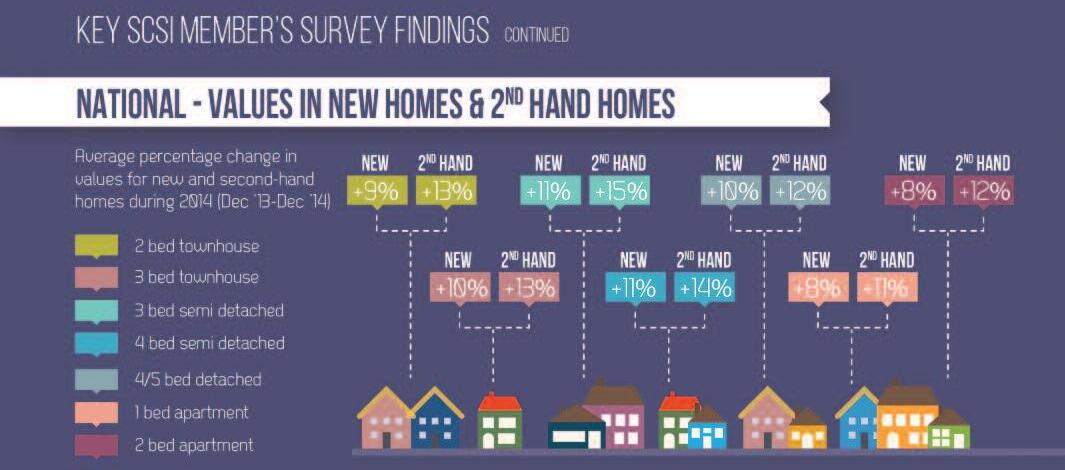
According to the SCSI survey, property values increased by an average of 14% nationally over the period and by 19 5% in the Dublin Region Property values regionally also increased by an average of 15 8% in the Leinster Region, 10% in the Connaught/Ulster Region, and 9.6% in the Munster Region (Figure 1)
It should be noted that there are significant variances in property values depending on location, as the multi-tiered nature of the Irish property market continues to become more evident
FIGURE 1: National values in new and second-hand homes
Conor O'Donovan, MBA
Conor is Director of Policy and Communications at the SCSI.
Positive and enthusiastic at Annual Dinner
The Society's Annual Dinner 2015 took place at the DoubleTree by Hilton on Thursday, February 5 There was a fantastic turnout, with a total of 1,260 construction, land and property professionals and guests in attendance. Society President Pauline Daly addressed the audience, noting changes in the sector over the years, notably that when she first attended the Annual Dinner, there were no more than three ladies present! Impressionist Oliver Callan provided after dinner entertainment. The atmosphere in the room was positive and enthusiastic, a notable step in the right direction from the challenging environment faced by members over the past number of years The event was a fantastic showcase for the industry, and one that we hope to repeat in the future.
Society launches guide to compulsory purchase orders
The Society has published a new consumer guide on compulsory purchase orders (CPOs) and compensation. The purpose of 'A Clear Guide to Compulsory Purchase Orders and Compensation' is to give a brief overview of the issues relating to CPOs for anyone affected by the CPO process
A CPO is a legal function that allows certain statutory bodies that need to take land or property, to do so without the consent of the owner The compulsory
acquisition of land takes place in Ireland to allow a public infrastructure project to go ahead for the common good.
The client guide covers what to do if your property is subject to a compulsory purchase order, how compensation is calculated and how to claim it
The guide is available from the Society's website –www scsi ie
From left: SCSI Director of Innovation and Business Development Fiona Barron; Michael McKenna; Peter Murphy; and, Jim Drew
Over 1,200 surveyors and their guests attended this year's extremely successful event
From left: Susan Brown; Michael Murray; Nick Lions; Brendan O’Regan; and, Johanna Gill
SCSI President Pauline Daly addressed attendees at this year's Annual Dinner
Charitable work in the Southern Region Western region sponsors graduate award
The SCSI Southern Region held a charitable collection on the night of their annual dinner in November in aid of Brú Columbanus, an organisation providing accommodation for families of patients in Cork hospitals, and St Luke's Home The total collected on the night was €1,246, which was split between the charities.
SCSI Western Region recently sponsored the Graduate of the Year Award in the Quantity Surveying Level 8 Honours Degree at
Appointment at Mulcahy McDonagh
Stephen Walsh MSCSI MRICS has been promoted to the position of Associate Director at Mulcahy McDonagh and Partners (MMP) Stephen joined MMP in June 2002 as a graduate and has become a central part of the MMP team He was promoted to Associate Director in September 2014 Stephen has gained wide experience over a 12-year period on all quantity surveying functions on a range of project types He became a Chartered Surveyor in 2007 and has continued with his postgraduate education, recently attaining an MSc in Mechanical & Electrical Quantity Surveying He has a particular interest in BIM-related projects, and is currently involved with BIM research at institute level (SCSI) within the profession
John Daly, MD of MMP (right), congratulates Stephen Walsh on becoming Associate Director
Mick McKenna, Chairman of the SCSI Southern Region, presented a cheque for €623 to Oonagh O’Driscoll, Director of Fundraising at St Luke’s Home Also pictured is David O’Brien, CEO, St Luke’s Home
From left: TJ Cronin, Secretary, SCSI Southern Region; Anne Marie O'Connor, Brú Columbanus; and, Mick McKenna, Chairman, SCSI Southern Region Mick presented Anne Marie with a cheque on behalf of the Southern Region
The
Sligo IT
Pictured are (from left): Professor Vincent Cunnane, President, IT Sligo; Michael O'Brien, winning graduate; and, Jim Drew, Chair, SCSI Western Region
Lightening strikes twice for DIT geomatics
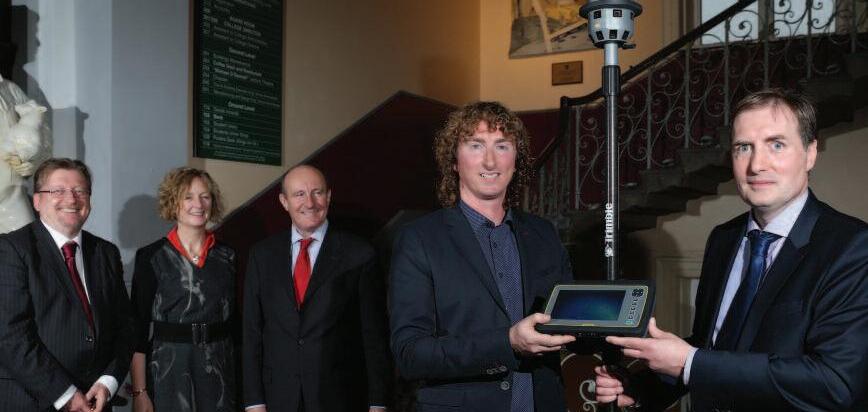
Dr Audrey Martin, Chair, MSc in Geospatial Engineering, DIT; Tom Dunne, Head of School of Surveying and Construction Management, DIT; Kevin O'Mahony, geomatics graduate; and, Ian Pennington, Geospatial Sales Account Manager, Trimble
The Dublin Institute of Technology (DIT) is rapidly becoming known as an international centre for excellence for all things geospatial In September 2014, Kevin O'Mahony, a final-year BSc Geomatics student, won the international Trimble Geospatial Student Competition Kevin is the second consecutive DIT student to win this prestigious award, following on from the success of David Hyland (BSc Geomatics) in 2012. Both students submitted their papers under the supervision of Dr Audrey Martin FSCSI FRICS, Chair of the recently accredited (by SCSI) DIT MSc in Geospatial Engineering
The worldwide student competition is held every two years and is open to all undergraduate and postgraduate students at Masters and Bachelors level, studying geomatics and related disciplines To enter, students must submit a written paper of 1,500 words or more, which describes an application and use of Trimble Geospatial Solutions during the course of their studies In addition to the student prize, Trimble also donates a significant piece of cutting-edge equipment to the students’ Alma Mater In 2012, DIT received an R10 GNSS Rover valued at approximately €25,000 In 2014, the prize was a V10 Imaging Rover complete with an R10 GNSS receiver valued at $50,000 Following the success of the two DIT students, Trimble is now in consultation with DIT exploring the possibility of an internship programme for geomatics students In addition, Trimble intends to visit DIT Bolton Street in late 2015 to search for the best and brightest geomatics students to join them on their graduate programme
The V10 Imaging Rover received by DIT as part of the award
From left: Professor Brian Norton, DIT President;
Online Masters
The CITA online Master in Construction Informatics is open for applications If you are interested in learning more about how technologies and new work practices like building information modelling (BIM) can streamline your business, and you need the flexibility that online education offers, then the Construction IT Alliance (CITA) MSc in Construction Informatics is the programme for you
This part-time programme is designed for a broad range of industr y practitioners who have a common interest in improving the productivity and efficiency of their business communications The programme is fully accredited by the Dublin Institute of Technology and is run over a two-and-a-halfyear period Online deliver y is streamed live on Monday and Wednesday evenings All classes are recorded and assessment is
Essential qualifications for proper ty professionals
Applications for two SCSI/DIT courses aimed at property professionals will open on May 1, 2015 The BSc (Hons) Property Studies and the Higher Certificate in Property and Facility Management offer a flexible approach to learning for those working in the industry, and are aimed at busy property professionals who wish to gain a recognised qualification and competitive edge in today’s challenging and evolving market
Why enrol?
Enhance your career opportunities
Professionals with a recognised academic qualification will be well placed to take advantage of career and promotional opportunities
A stepping stone to a professional qualification
These courses provide a route to obtaining membership of the Society of Chartered Surveyors Ireland and the Royal Institution of Chartered Surveyors
Meet the academic requirements of the property regulator
The BSc in Property Studies provides the minimum academic qualification requirement to obtain a property service provider licence (A, B, C and D) Following successful completion of the first two years, students are entitled to receive a progression award of 120 ECTS/Level 6, which satisfies the PSRA requirements The Higher Certificate in Property and Facility Management meets the PSRA minimum educational requirement (120 ECTS), enabling students to obtain a licence to provide property management services (C and D only)
These courses have become increasingly important and relevant due to changes in regulation and the growing importance of an academic qualification The climbing enrolment numbers reflect the importance of these qualifications, so book early to avoid disappointment.
For further information, contact education@scsi ie
100% project based All modules are delivered jointly by experienced practitioners and highly-qualified academics from both at home and overseas Uniquely, the programme modules are shared across a number of colleges based in Ireland, Austria and Slovenia The following are examples of modules that have been added to the course in the past academic year: BIM Execution Planning and Project Protocols; Sustainable BIM Design and Construction; and, Understanding Data Set Management and BIM
A 20% discount on programme fees can be secured for members of CITA Skillnet
For details on the course and how to apply, see http://www cita ie/training/cita-masters-construction-informatics/
Construction tender prices increase by 5% during 2014
The latest Construction Tender Price Index published by the Society of Chartered Surveyors Ireland (SCSI) shows that tender prices increased by 5% in 2014, but the Society has warned that a shortage of specialist sub-contractors may cause problems for the industry. The SCSI Construction Tender Price Index, which has been running since 1998 and is the only independent assessment of construction tender prices in Ireland, shows that prices increased by 2 9% in the second half of 2014.
Micheal Mahon, Vice Chairman of the Quantity Surveying Professional Group of the SCSI, said: “Construction tender prices have continued to increase steadily since bottoming out in the second half of 2010/first half of 2011, and the rate of increase accelerated slightly during 2014 This trend is likely to continue during 2015 as activity in the industry picks up following the upturn in property transactions in recent years "
“The increase in construction tender prices is most apparent in the Greater Dublin Area, but is likely to spread out from the capital during this year As construction activity picks up it is becoming apparent that there may be a shortage of certain specialist sub-contractors in the near future This is already beginning to manifest itself with glazing and curtain walling contractors,” he said
“Rising prices and a potential shortage of key trades mean that it is important that clients who are embarking on building projects of any significant duration should take professional advice from a Chartered Quantity Surveyor as to the appropriate provisions to make for pricing future risk items,” concluded Mr Mahon
Tender prices peaked in the first half of 2007 and fell rapidly for the following four years before levelling off in the second half of 2010/first half of 2011 At that point prices were down 33% from peak and the Society warned that the trend of below cost tendering was simply not sustainable. Over the last three years prices have risen at a steady pace but are still at 1999 levels
Financial insights at rural briefing
There was an excellent turnout for the Rural Professional Group of the SCSI's recent Technical Briefing in Kilkenny, which was held in partnership with the South East Region The Society's 'Guide to Taxation for the Rural Surveyor', which was produced with input from the Rural Professional Group, was also launched at the event, and the speakers offered excellent insights into finance and taxation issues for rural surveyors
Michael Boyd, Chair of the South East Region, introduced Society President Pauline Daly, who welcomed this collaboration between the Rural and South East groups, and emphasised the important role of rural property professionals in the Society and the economy
A fairer way
The groups welcomed Phil Hogan, European Commissioner for Agriculture and Rural Development, to the event Commissioner Hogan discussed the implications of the new Common Agricultural Policy (CAP) for Ireland
The farm family model is a strong social institution here, but with the age profile of farmers across the EU rising, the Government and the EU have introduced a range of measures to encourage movement of land
Commissioner Hogan said he felt that allocation of direct payments is now fairer, benefiting active farmers and encouraging the entry of younger farmers The new system also contains a strong environmental component, which he felt is likely to increase in the future.
Protect yourself
Rural Group Chair Tom McDonald introduced Breege Lynn of Marsh Commercial, who gave a wide-ranging presentation on professional indemnity (PI) insurance Breege stated that SCSI members are seen as a very benign group in terms of insurance claims, but as professionals they are affected by challenges in the market, such as rising premiums and tightening of the market (fewer companies providing PI insurance) She offered some useful tips for getting the best from your policy:
■ make sure to disclose the full range of services you provide;
■ be aware that PI is 'claims made insurance', i.e., if you don’t have insurance on the day you inform the insurer of a claim, even if the claim occurred when you had insurance, you are not covered;
■ maintain a 'run-off' policy for six years after retirement; and,
■ notify insurers promptly of any incident that might give rise to a claim
Finance actions
After coffee, Jonathan Ginnelly of Deloitte offered an update on the implications of the Finance Act 2014 for taxation in the agricultural sector Substantial tax relief is now available to farmers who engage in long-term leases of at least five years, subject to certain conditions being met Farmers can now also lease to companies and avail of these reliefs Changes to Capital Acquisitions Tax include a tightening of the conditions on agricultural relief to limit its use by non-farmers, such that only those actively farming for six years can avail of relief. This has implications for leasing of land, as the relief would be forfeit if the lessee ceases farming within the six years Jonathan said he hoped Revenue would shortly issue guidance on this
A collaborative future
James Staines of Kennedy Solicitors was the final speaker of the morning, and he gave an overview of the range of structures now available to enable partnership and collaboration between farmers, to increase land mobility and to encourage entry of younger farmers into the sector He praised Teagasc and its researchers, who have prepared template agreements to assist farmers He strongly advised farmers entering into long-term leases to seek professional advice as in his experience, landlord and tenant-drafted leases are rarely correct He also discussed the pros and cons of registered farm partnerships (these are aimed at parents and children but can be used by neighbours), incorporating the farm business (may not suit young farm families with high personal drawings needs), shared farming (can be very effective), and contract rearing (can free up land and labour)
At the recent Rural Technical Briefing were (from left): Eddie McAuley, SCSI; James Lee, REA John Lee; Tom McDonald, Chair, Rural Practice Professional Group; John Dawson, REA John Dawson; and, Paul Good
Phil Hogan, EU Commissioner for Agriculture and Rural Development (second from right), with (from left): Michael Boyd, South East Region Chairman, SCSI; Pauline Daly, President, SCSI; and, Tom McDonald, Chair, Rural Practice Professional Group, SCSI
Sur veyors on the box
The Society’s Communications & Events Committee has launched a new national TV campaign promoting Chartered Sur veyors. It will run on RTÉ One, RTÉ2, TV3 and online channels over a three-week period in March
The TV campaign follows on from the successful ‘Check They’re Chartered’ radio, print and online campaign in 2012 and is the first of its kind for the SCSI. The purpose of the campaign is to raise the profile of the sur veying profession and the role of sur veyors in advising consumers and businesses on major property decisions The ad also highlights sur veyors’ professionalism and expertise, their work in the built environment and their contribution to the wider economy in different contexts
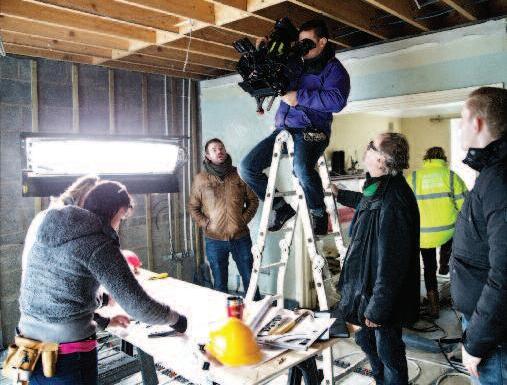
The ad, which was shot during Februar y, features nine Chartered Sur veyors who volunteered their time and locations. We hope to feature a behind-the-scenes article in the next issue of the Sur veyors Journal and encourage all members to help raise awareness of the campaign and share it by linking the new ad on their website and emails.
Business networking
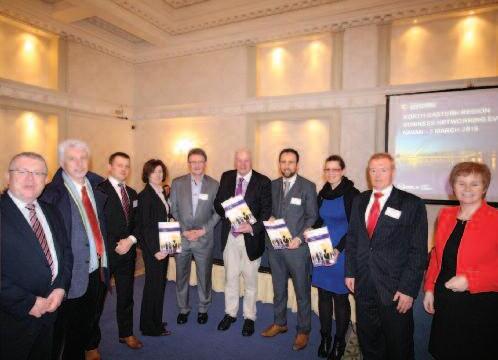
The North Eastern Region of the Society held a business networking event in Navan in early March At the event were (from left): Kevin Stewart, Director of Economic Development, Meath County Council; Pat Gallagher, Director of Planning, Meath County Council; Shane Black, Shane Black Property Advisors and Agents; Deirdre McFerran, Secretary, North East Regional Committee, SCSI, and OPW; Peter Murphy, Chairman, North East Regional Committee, SCSI, and Peter Murphy Chartered Quantity Surveyors; Bobby Kerr, Chairman, Insomnia Coffee, and Newstalk; Frank Harrington, Smith Harrington Chartered Surveyors; Donna Farrell, Navan Chamber President, and Marsh Mackey; Lorcan Kirk, NB King Auctioneers; and, Jackie Maguire, Meath County Manager
Rowena Quinn, Chair of the SCSI Communications & Events Committee
Chartered Quantity Surveyor Patricia Power is part of the new SCSI ad campaign
Nine Chartered Surveyors participated in the new SCSI TV advertisement
Eugen Niculae Eugen is Processing and Quality Manager with Murphy Surveys.
Chartered Geomatics Surveyor
EUGEN NICULAE describes one of his very busy and enjoyable days.
A DAY IN THE LIFE
Pride in the geomatics community
A Chartered Geomatics Surveyor’s job is to collect, process and interpret geospatial information – to set out on the ground the design for various projects (roads, bridges, buildings, plants, etc ) New technology means that we can now take measurements and report data with increased speed and accuracy
Variety is the spice of life
No day is ever the same for a geomatics surveyor Every day we face new projects and new challenges, and this is one reason I like what I do.
A typical day starts at 6 30am After a short stop for morning coffee, I arrive in work at 7 45am to start working on emails and check
progress on existing live projects on EBOSS, our management system. My current position with Murphy Surveys is Processing and Quality Manager, and I lead a team of surveyors and CAD technicians Every second day, a brief meeting at 8 15 with Mick, our Operations Manager, ensures that I’m up to date with current projects and helps me to plan the processing part. These meetings are valuable, as we rarely have the chance to share views on key issues throughout the rest of the day Planning the work ahead for my team depends on what is surveyed on site. Some projects are small and some are large; some take a day, some may take a couple of weeks I try to match the person’s abilities and knowledge to the current and ready to start projects I
Eugen on a railway survey job at Connolly Station in 2013
have to maintain control over the processing part of the projects, as it shouldn’t be underestimated how quickly a project timeline can start to slide I try to prevent this from happening by having a solid relationship with my team and managers, and communicating with them on a regular basis I catch up with individual team members in person and prioritise certain team members if I am dealing with a particular issue on a project
Once a project is ready to be delivered to the client, it is time for the quality audit I make sure the final delivery (CAD drawings, reports, etc.) is as per the original job specifications, and all details requested are included Once the project passes the audit, I will send it to the client I’ll update EBOSS, which will inform admin that the project was sent Mick will contact the client a few days later to see if he is happy with the quality of the delivery. At Murphy Surveys, client satisfaction is key for our success and growth (we have six offices throughout Ireland and the UK)
Monitoring
There are a couple of projects that I look after myself At the moment there are two ongoing monitoring projects The first is monitoring several walls of a protected structure during construction works nearby The second involves monitoring the railway track near an industrial estate, while a new retaining wall is constructed at the base of the embankment where the rail sits
Equipment was installed on site, and as both projects require 24hour observations, the system is automated Data is sent via the mobile phone network and interpreted in the office Graphs are created to show the sensors’ movement There are three alarm levels If the green alarm is raised, an SMS is sent to me and two other people in the office We need to investigate if the reading that triggered the alarm was a spike in the readings or a real alarm This can be done from the office by taking new sets of measurements between the scheduled ones. Multiple readings can be taken to any particular target, to check its position in space If a yellow alarm is raised, several other persons from the construction company will receive the alarm by SMS and further investigation on and off site will happen. If a red alarm is triggered, works stop immediately and the monitored area will be kept free of people and equipment until structural engineers investigate Part of my job is to check all data
on a daily basis, see if any trends occur and, together with my colleagues, ensure the functionality of the system. From the monitoring data observed on site and saved in the database, I issue two reports daily (morning and evening) and a weekly report
Long days
Before leaving the office, I try and give myself a head start on the next day and spend a few minutes reviewing my to-do list In the fast moving surveying world, many off-the-shelf software products don’t offer particular solutions and some in-house specialised software is needed This was one of the reasons I’ve decided to expand my knowledge and learn more about programming Four evenings a week I travel to Griffith College in Dublin where I study computer science part time.
I arrive home at 10 30pm Sometimes I’ll briefly unwind by watching a bit of television (usually things we have recorded) before quickly falling asleep I work in a challenging environment of competing demands and my days are long But I thrive on the responsibility my role brings and I have an immense sense of pride in being a member of the geomatics community I am fortunate that my career is during those exciting years, where the surveying results are used and seen by virtually everyone (such as online maps, SatNav, etc ) Not too long ago, a surveyor might measure a few hundred points per day The latest equipment, the Laser Scanner, can collect up to a million points per second!
Eugen graduated in 1997 with a Bachelor Degree and in 1998 with a Master Degree in Surveying, from the Technical University of Civil Engineering, Bucharest, Romania He joined the Engineering Department of the Romanian National Electricity Company as an engineering surveyor in 1997 and worked for them until early 1999, and from the end of 1999 to March 2001. In 1999 he joined the Romanian Army, Surveying Department, as part of compulsory military service. He came to Ireland in 2001 and worked for DMC Surveys until May 2006, when he joined Murphy Surveys Eugen became a professional member of the SCSI in May 2008 and of the RICS in September 2008.
Eugen on the set of RTÉ’s Fair City during a survey in 2008
Eugen and his wife at the SCSI diploma ceremony in April 2009
Ed Carey FRICS
FSCSI
Edward is a member of the PSRA, Chairman of the Presidential Agency Professional Practice Group of the SCSI, and runs PropertyTeam Carey Auctioneers in Co. Meath.
ED CAREY asks what effect the new Central Bank rules will have on the market.
Step in the right direction, pre-emptive strike or bolting the stable door?
In the first instance, the Governer of the Central Bank, Patrick Honohan, should be applauded for eliminating any ambiguity from the announcement. Prof. Honohan made his own views clear from the outset – he wanted a 20% LTV introduced to stem the rapid increase in house prices that was emerging in 2014, and to introduce measures that would prevent such increases as we saw during the bubble years. He has his way. The less publicised but equally restrictive measure is the 3 5 times income limit
Ultimately the Central Bank decided to impose the limits but in a less punitive fashion than originally proposed I do have a concern about the ‘across the board’ introduction. We are well aware that the dynamics of the property market are significantly different, depending on your location Dublin and its environs are considerably more robust than more rural locations
It is somewhat surprising that the Central Bank did not seek to impose such restrictions during the downturn – lending and transaction levels were so low that any new lending practices would have had little effect on the market, and it is the sudden introduction of the measures that seems to cause the impact In any event, they are here and the world will continue to spin
A funny old world
The property market is a funny thing, often counter intuitive David McWilliams argues that higher prices do not lead to increased supply and that house owners hold off selling because they might get more later He’s probably correct There is evidence of a mass consciousness regarding property, whereby everyone seems to change their sentiment at the same time All of a sudden it seems everyone decides that now is the time to buy but we don’t see the official statistics reflected for a good four months after the property has been ‘sale agreed’ Furthermore, to alleviate the housing shortage, particularly in Dublin, is not a speedy process Planning to occupation can take two years There is some movement on the repossession and sale of investment properties, but it’s a slow process and having little impact on supply in any given area Rents have skyrocketed Rents and house prices skyrocketed during 2014,
and yet prices visibly cooled by the end of the year, so we’re left with the conundrum of dwindling supply not being matched by rising prices.
Was it brought about because of the proposals? We’re all too well aware of previous pre-budget talk of changes to CGT and stamp duty, Peter Bacon’s reports, changes to mortgage interest relief on investment properties and the like – sometimes it’s the uncertainty caused by the intended introduction of a measure that causes the reaction
David McWilliams argues that higher prices do not lead to increased supply and that house owners hold off selling because they might get more later.
Time will tell
The latest measures were brought about to prevent rapid house inflation and cool the market Yet last week, I had the vendor of a property I was just about to list instructing me to increase the asking price by €15,000 so that he would have sufficient equity to provide him with the 20% deposit he now needs to trade up
It’s too early to say what the ultimate impact of the regulations will be Supply is starved and I can’t see how that will improve any time soon Surely that in itself should cause an increase in prices, but I don’t see that happening on current evidence The frenzied bidding of the summer seems to have settled into a steady stream of buyers who are not acting rashly and are sticking to their limits The spring increase in supply is just starting and until the market is in full swing, we’re still in somewhat of a vacuum to judge anything Would the trend to the autumn stabilisation have happened anyway? It’s hard to know But one thing is for certain – we won’t know the effects for a while to come yet