2012






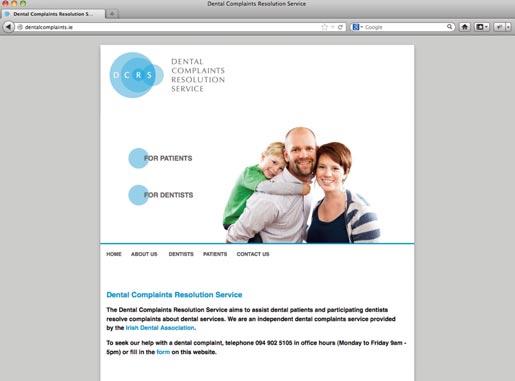
There were more than 7,000 visits to www.dentalcomplaints.ie up to the end of December 2012.
Complaining is difficult in any environment. In Irish culture, we have been bad at it. Consequently, we haven’t been very good at dealing with complaints either. That has led to a situation throughout our society where issues that should be dealt with at first hand end up in formal processes such as the courts or professional bodies.
A noticeable increase in these third party actions took place in Ireland in relation to dentistry in the last few years. This led to a concurrent increase in the number of settlements in insurance claims.
The Irish Dental Association, recognising this challenge, set up an independent body, the Dental Complaints Resolution Service. It commenced operation last year and this is its first Annual Report. As you will read, it has already succeeded in dealing with a significant number of complaints.
We would urge all dentists and any patients considering a complaint to read this Report. It is vital for all of us to understand the process of making and resolving complaints to the mutual satisfaction and benefit of patients and dentists.
As has been stated by Dr Conor McAlister in the past, the setting up of the new Service is a key part of dentists’ overall commitment
to the provision of accessible, safe and high quality dental services for patients. Our objective is clear: to enhance confidence in the quality of care and treatment provided by Irish dentists.
On behalf of the Irish Dental Association, we want to thank Michael Kilcoyne for his excellent and dedicated work for the Dental Complaints Resolution Service; the dentists who made themselves available to assist the Service; Dental Protection for its continued support; the many former Council members who promoted the idea of such a service before it existed; and, Think Media for their services to the DCRS.


Dr Andrew BolasMr Fintan Hourihan PresidentChief Executive Officer
The Dental Complaints Resolution Service (DCRS) was established in April 2012 by the Irish Dental Association. The Service operates independently of the Association. This first Annual Report records the activity from commencement to December 31, 2012.
The Service has been set up as an independent mediator of complaints by patients about their dentists. It is free of charge to any patient who chooses to use it and whose complaint falls within the remit of the Service. It is also free to dentists who are members of the Irish Dental Association. Dentists who are not members of the Irish Dental Association may choose to engage with the DCRS for a fee of €90.
Any patient wishing to make a complaint should, in the first instance, raise the issue with the nominated person in the dental practice. Any patient not satisfied with the outcome of that contact may then get in touch with the Dental Complaints Resolution Service.
The Service developed a very helpful website –www.dentalcomplaints.ie – on which both patients and dentists can find a great deal of information about how to make or deal with a complaint. This website was launched to coincide with the opening of the Service. Patients will find the correct procedures and formats for making a complaint on the website, while dentists can see quickly how we deal with those complaints and how they can access professional guidance on dealing with any complaints.
Patients that are not satisfied with the response they receive to the initial complaint to their dental practice, may then contact the Service. However, it is a condition of the Service that the details of the complaints must be submitted in writing. This can be done by email or through the post. Dentists are then notified of the receipt of a complaint and asked to respond. The Service will then try to mediate an agreement between the two parties.
In the period from the launch to December 31, 2102 (approximately eight months), the Service received a total of 115 complaints (see summary panels on page 6). Up to December 31, 18 had been resolved to the satisfaction of both parties. The results in most cases involved either a refund of fees, additional or corrective work at no extra cost, and/or an apology.
A further 23 cases made good progress and the Service expects a resolution to be agreed in a reasonable time period. Ten of the people who made contact seemed to be happy with the advice they received and have not progressed their complaint any further. The Service is not expecting any further contact from them at this point. Twenty-three people were in touch with complaints verbally, but failed to make a written complaint, which is a requirement for the Service to deal with the matter.
As of December 31, 2012, the Service was awaiting responses from dentists to 18 complaints that had been notified to them. Six cases were from outside the Republic of Ireland; therefore, the Service could not deal with them.
Finally, five cases that originated in 2012 are going to the Complaints Panel for mediation. The DCRS will advise on the outcome of these first cases before the Review Committee in next year’s annual report.
Patients will find the correct procedures and formats for making a complaint on the website, while dentists can see quickly how we deal with those complaints and how they can access professional guidance on dealing with any complaints.
Commentary
The Dental Complaints Resolution Service is now fully operational. In a short period of time it has become an acceptable method of
There is clear evidence from the work of the Dental Complaints Resolution Service that dentists will suffer if they do not train themselves to listen closely to their patients. This is true even in a case where the dentist may not be in the wrong, but by not listening to the views expressed by a patient, can end up having to resolve a problem.
The Service reports that in a small number of cases, if the dentist had just listened to the patient in the first instance, they would not have had a complaint to resolve. Even when work carried out is excellent, if the patient perceives a problem, the dentist has to deal with that perception at some stage. It is much easier to deal with and resolve a problem if the dentist listens to the patient early in the process.
If you have a complaint, it is much better to go directly to the dentist or the dental practice in question and ask them to resolve the issue. If you are ignored, or if the complaint is not resolved to your satisfaction, then come to the Dental Complaints Resolution Service. The Service will need your complaint in writing, but once it is received, work on resolving the complaint, hopefully to your satisfaction, will commence.
Most complaints are about the standard of work. This can apply to almost any aspect of dental work: crowns, bridges, veneers, implants, braces, fillings, extractions, etc. However, complaints also arise about after-care service, cost, the attitude of the dentist, access to records, and delays in treatment.
The Service is happy to mediate a resolution of these issues. The Service cannot deal with issues arising from treatment received outside the Republic of Ireland, nor with those complaints relating to treatment available under the public dental care schemes – the Medical Card scheme, and the PRSI scheme.
to December 31, 2012
Approximately 115 complaints/queries were received.
Eighteen have been resolved to the satisfaction of both parties. Some of the results involved:
-refund of the fees paid;
-additional work to be carried out at no extra cost; and/or, -apology.
-Twenty three cases are nearing completion and should be resolved satisfactorily.
-Ten cases were looking for advice and it seems will not be pursued any further.
-In 23 cases, while the facilitator received complaints verbally, he has not to date received any written complaint.
-In 18 cases, the facilitator is awaiting detailed responses from dentists.
-Six cases are outside the jurisdiction.
-Five cases are being referred to the Complaints Panel.
-Twelve complaints referred to benefits available under the medical card/PRSI system.
The main issues of complaint were as follows:
-standard of work: crowns, bridges, veneers, braces, implants, etc.;
-access to records; -cost;
-attitude of dentist; -after-care service; -time delay in having work completed; -non-response to letters, emails or phone calls; and, -difficulty in obtaining dental records.
This case concerned a patient in the south of the country who made a complaint on behalf of her five-year-old daughter. The little girl had two fillings done at one practice, which fell out. Treatment to resolve this was unsuccessful and the child had become anxious and distressed in the course of this treatment. Her mother decided to move to another practice, which family members had attended in the past. The dentist they saw at the new practice recommended that her daughter should have a stainless steel cap fitted. She said that the fillings would keep falling out, and that the crown would enable the tooth to last until the child was 10 or 11.
The dentist told them that such procedures are generally carried out by a paediatric dentist, but that their practice had recently started doing them. She said that the treatment would require two visits: one to put in separators, and the second to do the crown. She said that these were not complex treatments, and the mother agreed to the treatment. The first stage of treatment went well, but on the day the second stage was due to take place, the practice called to say that the dentist was unwell and another dentist would be performing the treatment. The family consented to this. However, according to the mother, the second dentist showed a total lack of empathy, courtesy or respect towards her and her daughter, repeatedly telling the little girl to “stop whinging” when she became distressed.
The mother contacted the DCRS and gave Michael Kilcoyne permission to contact the dentist. After he had done so, she reported that the dentist had telephoned her and denied that he had been discourteous, or indeed that her child had shown distress during treatment. She felt that he was rude and arrogant towards her. The dentist did not respond to further contact from Michael Kilcoyne, so he wrote to the practice, after which he
received a copy of a memo the dentist had sent to practice management. In this document he gave references to show that the procedure had been carried out correctly, and denied that he had been rude, or that the child had been distressed. He claimed he had been courteous at all times.
The patient later wrote to Michael to inform him that she had received this apology and the matter was now closed. According to Michael Kilcoyne, the essence of this case was in the dentist’s attitude to a distressed child and her mother. Again, a sincere apology from the dentist in the first instance would have quickly resolved the issue.
Michael Kilcoyne sent this document to the mother, who felt that it was inadequate and did not acknowledge his unprofessional behaviour, his rudeness to her daughter or his dismissiveness to herself. She said that she wanted a proper, signed apology from the dentist. Michael wrote to the practice and strongly advised this. The patient later wrote to Michael to inform him that she had received this apology and the matter was now closed. According to Michael Kilcoyne, the essence of this case was in the dentist’s attitude to a distressed child and her mother. Again, a sincere apology from the dentist in the first instance would have quickly resolved the issue.