Association of Secondary Teachers, Ireland



Volume 33: Number 3: May 2015
0790-6560

Volume 33: Number 3: May 2015
0790-6560
Editorial Board
Philip Irwin President
Pat King General Secretary
Máire G. Ní Chiarba President-Elect
Ed Byrne Vice President
Ray St John Honorary Treasurer
Sean O’Neill Standing Committee Nominee
Mary Ohle Standing Committee Nominee
Media and Communications Officer: Gemma Tuffy
Published on behalf of ASTI by Think Media.
Editorial: Ann-Marie Hardiman and Paul O’Grady Design: Tony Byrne, Tom Cullen and Ruth O’Sullivan. Advertising: Paul O’Grady.
Thomas MacDonagh House, Winetavern Street, Dublin 8. Tel: 01-604 0160 Fax: 01-897 2760 astir@asti.ie






ASTIR is published five times annually by the Association of Secondary Teachers, Ireland. The opinions expressed in ASTIR are those of individual authors and are not necessarily endorsed by the ASTI. While every reasonable effort has been taken to ensure information published is accurate, the ASTI cannot accept responsibility for articles or advertisements. The ASTI reserves the right to edit all material submitted for publication.

English teachers stand firm
I have been unimpressed by the efforts of Minister Jan O’Sullivan TD to proceed with implementation of the Framework for Junior Cycle in the absence of an agreement with teachers. I believe that she has targeted English teachers unfairly by attempting to ‘roll out’ CPD in the face of our directive. English teachers have stood firm in declining to attend. In order to protect our more vulnerable members we, along with our TUI allies, have had to picket education centres. From Monaghan to Waterford and from Donegal to Wexford, executive members, branch officers and officials have carried banners with our messages of external assessment, State certification and the maintenance of national standards. We have successfully stopped the CPD and it is time for the Minister to think again.
Further action needed
At the time of going to print we are preparing for our national lunchtime protest in conjunction with the TUI outside every second-level school. In organising this protest we have been mindful of the time of year for our exam students. If the Minister continues to refuse to listen to us, we must be prepared to resume action in the autumn. If we have not achieved our goals I believe that we must be prepared for a national protest to the Dáil.
Improving the transition from school to higher education
In April the Minister launched a document aimed at improving the transition from second-level to higher education. It brought some welcome news for teachers regarding the Leaving Certificate, but also raises some difficult questions, especially for universities. A study carried out by Oxford University and Queen’s University Belfast into concerns about predictability of the Leaving Cert exams found that there is no problematic predictability. The researchers noted that the Leaving Cert is a trusted exam and stated that: “Undermining the value of the Leaving Certificate with claims that the content of examination questions is overly predictable is unwarranted”.
A proposed move from the current 14-point grading scale to an eight-point scale was ‘flagged’ but not finalised. A concern expressed by the NCCA was that this would lead to more students ending up on the same points and that it should only happen if there are more general entry courses available for those entering the first year of university. Will the universities rise to this challenge?
Finally, as this is my last editorial as President of the ASTI, I would like to thank you for your unyielding commitment to the ASTI and to Junior Cycle education over the past two years. ASTI members have remained united and have acted in unison against aspects of the Framework that they believe to be educationally unsound.

The Minister for Public Expenditure and Reform, Brendan Howlin TD, has invited the Irish Congress of Trade Unions’ (ICTU) Public Services Committee to discuss the unwinding of the Financial Emergency Measures in the Public Interest (FEMPI) legislation. This legislation was used to threaten the pay and conditions of ASTI members during the 2013 ballot on the Haddington Road Agreement. In other words, FEMPI was used in a way that undermined the democratic nature of how trade unions operate and negotiate. FEMPI must be abolished for once and for all.
Minister Howlin’s invitation is yet another indication that the economic emergency has passed. Along with the dismantling of FEMPI, the worst of the public sector pay cuts must now be reversed. ASTI Annual Convention has identified these as the public service pension levy and the restoration of new teachers’ pay. A large number of ASTI members of a particular age group are caught in the grip of debt and negative equity. Recently qualified teachers on part-time and temporary contracts are struggling to make ends meet. An improvement to these teachers’ pay will not only ease their personal financial burdens, it will help to increase domestic demand, an essential ingredient for economic recovery. It’s vital that trade unions act together to protect and enhance the pay and conditions of workers. This must include working to ensure the full restoration of pay cuts as guaranteed in the Haddington Road Agreement.
In the past seven years the Irish population has increased by almost half a million; however, in that period the number of public servants has fallen by 10%. In 2008, Ireland’s second-level schools catered for 305,564 students. By 2014 that number had grown to 333,302. During this period the pupil–teacher ratio worsened, the ex-quota guidance counsellor provision was abolished, English language and resource teachers were cut, and a moratorium was placed on posts of responsibility, among other cuts. Productivity is often described as doing more with less. The fact that schools have continued to open their doors and welcome more students every year, the fact that OECD studies have found students in Ireland continuing to perform very well academically, the fact that Ireland has continued to outperform its international counterparts with a second-level education service that is high quality and equitable, provides clear evidence of the productivity given since 2008. On top of this, second-level teachers have been burdened with a range of other “productivity” demands, including the Croke Park hours, additional supervision and substitution duties, and the implementation of several new reform initiatives. Demands on public services are greater than ever. Schools are at breaking point and cannot continue to respond to the legitimate demands of a growing student cohort on greatly diminished resources. Now that the economy has turned the corner Ireland needs a decisive plan for investment in education. Investing in education is not only logical; it is the right thing to do for our young people, for our country and for the future.

ASTI membership increased by 466 in 2014, representing an increase of 3%. A large proportion of these new membership applications were received during the industrial action that members took in December. This reflects the security offered by ASTI membership during a period of industrial unrest. The ASTI also benefitted from the continued local efforts of school stewards and others to encourage newly appointed teaching staff to join the union.
As in 2013, the most significant increases in members occurred among teachers on part-time or temporary contracts, a net increase of 217. These numbers reflect the rising employment of newly qualified teachers, typically on less than full hours contracts, as the sector continues to expand, as well as the attraction of the security of ASTI membership during the recent industrial dispute. Total ASTI membership in December 2014 was 17,807. Women make up 70% of ASTI members.
The Inspectorate has published a number of new reports, which are available on the ASTI website (Pay and Conditions: Inspections and Inspectorate).
The new publications that come into force with effect from September 1, 2015, are:
n Code of Practice for the Inspectorate; n Guidelines for Publication of School Inspection Reports; and, n Procedure for Review of Inspections.
A fourth document, Education Act 1998 (Publication of Inspection Reports on Schools and Centres for Education) Regulations 2015, sets out the regulatory duty of the Chief Inspector to publish certain categories of reports and clarifies the exclusions that apply to publication.
A full list of publications on school inspections is available on the ASTI webpage.
Teachers can apply to have leave due to assaults discounted from their sick leave. While this provision has been available for a number of years, it is particularly important to teachers following the implementation of new sick leave arrangements for public sector workers in 2014. Members should note that assault leave is recorded as sick leave and having the leave discounted requires formal application to the Department/ETB. Applications for the discounting of assault leave from sick leave require documentary evidence. Details are available in Circular M18/99 on the ASTI website. This Circular acknowledges that staff in second-level schools may be victims of violence: “During the course of their work, school staff may be at risk in the form of verbal abuse, threats, assaults or other forms of intimidation”.


Former ASTI member and founder of the SciFest science fairs programme, Sheila Porter, has been awarded the PharmaChemical Ireland Science Educator Award at the 2015 Annual Conference of the Irish Science Teachers’ Association.
Sheila founded the SciFest science fairs programme in 2006 while teaching in Loreto College, St Stephen’s Green, Dublin 2. The aim was to set up a science fair programme that was accessible, inclusive and free to enter, while recognising diversity and the uniqueness of the individual. It also aims to encourage a love of science, technology, engineering and maths (STEM) through active, collaborative, inquirybased learning. More than 28,000 second-level students have participated in the programme since it was launched nationwide in 2008. In 2014 more than 6,000 second-level students participated. Sheila was seconded to Intel Ireland, jointly supported by SFI Discover Science and Engineering, to replicate the model throughout Ireland. The programme was launched nationwide in 2008 and grew so rapidly that three more strands were added in 2011.
Four strands now exist:
n SciFest@School (in-house science fairs in schools);
n SciFest@College (15 regional venues where the ITs and St Mary’s College, Derry host science fairs for second-level students);
n a national final in Dublin in November; and, n students compete on an international stage, at Intel ISEF in America and INESPO in The Hague.
After the maximum five-year secondment, Sheila resigned from her teaching position and, along with her husband George, also a former teacher, set up SciFest as a limited company with charitable status, and with President Higgins as its patron. SciFest is funded today primarily by SFI’s Discover Programme, Intel Ireland and Boston Scientific. It also received support from a number of other partners, including the Irish Science Teachers’ Association. The SciFest@College regional science fairs are hosted each year by the 14 institutes of technology and St Mary’s College, Derry. The project thus creates a valuable link between the second- and third-level education sectors, and between education and industry.

Pictured at the ASTI picket of the Monaghan DES CPD venue are: Gerry Quinn, TUI President; Michael Martin, Monaghan TUI; Philip Irwin, ASTI President; Denyse Hughes, ASTI Standing Committee representative for Monaghan, Cavan, Dundalk and Drogheda; and, Barry Williams, TUI Executive Committee Representative for Cavan, Monaghan, Louth, Meath.
ASTI and TUI representatives picketed Department of Education and Skills Junior Cycle CPD venues around the country in April. The picketing sought to highlight the provocative decision by the Minister for Education and Skills to proceed with CPD for teachers of English at such a critical stage of this dispute. The ASTI and TUI directives on non cooperation with the Framework for Junior Cycle remain in place.
Pierce H. Purcell, ASTI President 1973-74, has published his first novel. The Pensioner is the story of Larry Porter, a pensioner and part-time lecturer who, on his way into the local bank, is kidnapped by a former pupil turned billionaire drugs baron. Larry transforms into a violent survivor, intent on bringing his former pupil to justice.
Pierce is an Honorary Life Member of the ASTI and taught in Ard-Scoil Na mBráithre, Clonmel, before his retirement. The Pensioner is available online in paperback and ebook format, and will soon be available in paperback from Easons.


A Department of Education and Skills Circular published in March outlines new entitlements, which will benefit thousands of temporary and part-time teachers.
The Circular follows a lengthy campaign by the teacher unions to have the issue of casualisation in second-level teaching addressed. The new arrangements, which come into effect in September 2015, mean that teachers in temporary positions will become eligible for a contract of indefinite duration (CID) after two years of teaching, provided they meet the criteria for a CID. This compares to four years under employment legislation. In addition, teachers covering for those on career breaks and secondments will also qualify for CIDs after two years, subject to fulfilling the criteria. It is important that all temporary and part-time teachers are familiar with Circular 0024/2015, which can be found at www.asti.ie.
For more information, see FAQs on CIDs on page 24.
ASTI member Mary Twomey has been awarded a ¤1,500 bursary, funded by Irish Life, towards the cost of her trip to India with Global Schoolroom this summer. While there, Mary will help with the training of student teachers in India. The total cost to send a teacher to India with Global Schoolroom is ¤3,000, which volunteers fundraise themselves. Irish Life awarded one ¤1,500 bursary each to the ASTI, TUI and INTO.
Mary is a learning support teacher at Cross and Passion Secondary School, Kilcullen, Co. Kildare. This is Mary's first time travelling with Global Schoolroom – she will be based in Moharpara in the Northeastern Indian state of Tripura. For the student teachers in Moharpara, this will be their second year of the three-year UCD-accredited Global Schoolroom programme. These students will graduate in 2017, bringing the total number of teachers who have benefitted from Global Schoolroom teacher training to almost 800.
This is one of the only opportunities these teachers have to upskill and gain better salaries, while at the same time improving educational standards for thousands of children in the area. Global Schoolroom is grateful to its lead sponsors, Cornmarket Group Financial Services Ltd and Irish Life, and to the ASTI, for their ongoing support. To follow Mary's progress with Global Schoolroom, log on to www.globalschoolroom.net.
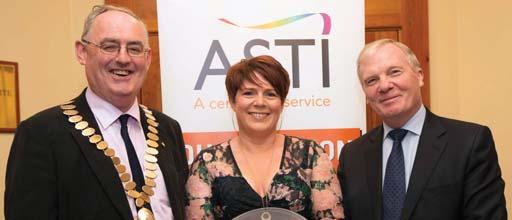
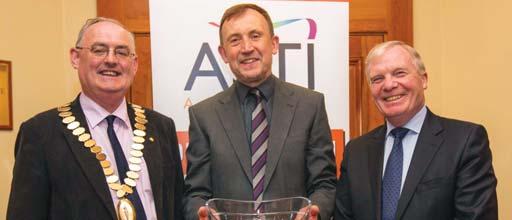
Shirley Higgins and James McGovern each received a 2015 ASTI Achievement Award at a ceremony in Dublin. The ASTI Achievement Awards are presented annually to honour teachers who not only play an important professional role in their schools, but whose talent, commitment and determination enables them and/or their students to excel in areas such as sport, the arts and advocacy. Other awards given on the night were Honorary Member, PJ Kennedy and Thomas MacDonagh. There will be a full report in the September ASTIR
Do we have your up-to-date contact details?
If you have changed postal address, email address or telephone number recently, please let ASTI Head Office know. Contact our membership department at 01-604 0162, or email membership@asti.ie.
NUMBER OF YEARS AFTER which temporary teachers become eligible for a CID, provided they meet the criteria.
(P.13)
PERCENTAGE OF JUNIOR Cycle English classes with more than 25 students, compared to 49% in 2007. (P.23)
During Convention 2015, ASTI representatives speaking to the media focused on the Junior Cycle dispute, and teachers’ pay and conditions, among other issues.

“What we want is an agreement before we have training. Teachers certainly do want training. I think this is where the kernel of the problem is: implementation was commenced without agreement and really that was an opportunity when Jan O’Sullivan became Minister for Education. At that point she had the opportunity to defer implementation until we had agreement and she didn’t take it at that time. But certainly we want an agreement first and then we want training and resources.”
Philip Irwin, ASTI President, Morning Ireland, RTÉ Radio 1, April 7, 2015
“‘Our main concern is the new Junior Cycle CPD, we are of the view there shouldn’t be any training before there’s an agreement,’ said Mr Irwin. 'We see ourselves as protecting our English teachers, who are under particular pressure and we see as being targeted.’”
Philip Irwin, ASTI President, Irish Examiner, April 14, 2015
“‘Teachers will now get CIDs [contracts of indefinite duration] after two years in a school and will get a top-up CID after one further year,' he told delegates. 'I believe that, within two to three years, we will cut the 35% casualisation figure in half and more.' Mr King said the union’s opposition to casualisation and the campaign for decency at work was now an ICTU-wide campaign. 'In this context, I want to salute our trade union colleagues who work in Dunnes Stores for the courageous stand they are taking against casualisation and low contract hours.’”
Pat King, ASTI General Secretary, Irish Examiner, April 10, 2015
“We’ve experienced seven years of pay cuts and worsening working conditions, pension levies, worsening pension arrangements, loss of qualification allowances, particularly young teachers have been severely hit over the last seven years. Many of our young teachers are part-time and temporary, they’re working half hours, they’re earning 10, 12, 14 thousand a year. It’s not a living wage. We’ve been putting up with that for the past seven years. What I said this morning was it’s now time to reverse that.”
Pat King, ASTI General Secretary, The Last Word, Today FM, April 8, 2015
“I’m very concerned about the current situation regarding the Framework for Junior Cycle. There hasn’t been any resolution. Our members are very committed to what we believe in. We believe that we are standing up for standards of education and standards of assessment in this country. We believe in the stance that we have taken. Unfortunately, the Minister has decided that she’s going to go ahead without us and of course that’s not possible, to go ahead without us.”
Máire G. Ní Chiarba, President-Elect, Drivetime, RTÉ Radio 1, April 7, 2015
“It is a matter of great concern that the focus would be diverted from teaching and learning to assessing and grading…We believe in the stance we have taken, but the Minister (for education) has decided to go ahead without us…She would be well advised to look at the foreword to the draft document (on the Framework for Junior Cycle) by Dr Pauric Travers in which he says change cannot be brought about without the support of teachers.”
Máire G. Ní Chiarba, President-Elect, Irish Examiner, April 8, 2015
“‘It is unjust and there should be parity of pay and there should not be three different pay scales for teachers,’ Mr Howley said. ‘It's disgraceful they can expect a teacher to come in and do the exact same job but not be given the same entitlements.’
‘Keith works just as hard as I do and yet we’re not on equal wages and that’s not acceptable at all,’ maths and religion teacher Ms Glennon added.”
Keith Howley and Thérèse Glennon, teachers in Pobalscoil Neasáin, The Herald, April 9, 2015
“We have an excellent State Examinations Commission, which at the moment is in charge of the Leaving Certificate and Junior Certificate. We are very happy with that, it’s something that has always been seen to be very fair, to be very objective, it’s not open to bias or anything like that. We’re very concerned at the break-up of that.”
Matthew O’Connor, Kerry Today Show, Radio Kerry, April 7, 2015

The keynote speeches at this year’s ASTI Convention in Killarney highlighted the issues of greatest importance to teachers, such as Junior Cycle reform and the restoration of pay and conditions.
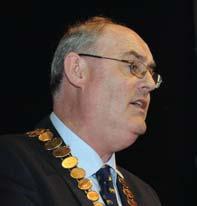
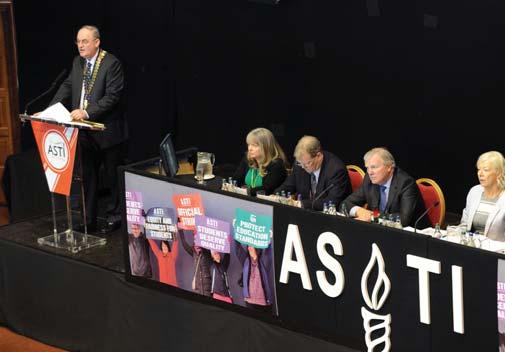
Philip Irwin praised the unwavering commitment of ASTI members to the campaign on Junior Cert reform in his address to Convention 2015.
“We the teachers are the custodians of the education of future generations and we take a long view on what is important, what needs to be retained and what needs to be changed. In this we have been fortunate to be supported by the strong traditional commitment to education of Irish parents and the resilience of Irish students in what has generally been a poorly resourced and underfunded system.”
“I commence with our Junior Cycle campaign in order to pay tribute to you who have led our campaign at school, branch and regional levels. You have been resolute in the implementation of our directives, our lunchtime protest, our petition and our strike days –days on which I believe we gained the support of the public. You have been ambitious in seeking to attain our goal: the retention of State certification and external assessment. You have been unified, disciplined and determined.
We have run a joint campaign with the Teachers Union of Ireland, thereby calling on the strength of 27,000 second-level teachers. This has been a key feature of the campaign. I express fraternal greetings to our allies and friends in the TUI and especially their President, Gerry Quinn, and General Secretary, John MacGabhann.
Minister Jan O’Sullivan had the opportunity to delay implementation of the Framework for Junior Cycle pending agreement with us. Unfortunately, she did not take that opportunity. It was precisely implementation without agreement that triggered our strike ballot in autumn 2014. In the November 2014 talks with the Department, our negotiations achieved a significant breakthrough with the Minister's offer to restore State certification. We have at all times acknowledged and given credit to the Minister for that decision. However, the other half of our agenda demands that State certification be given meaning by the retention of external assessment organised nationally by the State Exams Commission (SEC). This guarantees the maintenance of consistent standards across the country and equity between schools in the interest of all our students. Objectivity, and the integrity and credibility it gives to State certification, does not come in half measures.”
“Our research, conducted by Millward Brown, highlighted among other things the significant increases in class sizes over the past seven years and also the views of teachers that this lessens their ability to give students individual attention and reduces the range of methodologies they use in the classroom. Principals see current teacher workloads as a barrier to reform, while other impositions in recent years have eaten into teacher time in schools, such as the Croke Park Hours and compulsory supervision and substitution. It is also past time for the lifting of the moratorium on appointments to assistant principal and special duties teacher posts, which our research has found that principals view as a barrier to implementing Junior Cycle reform.”
“The crisis for the teaching profession is deeper than I have already outlined. In 2011 the Government cut new teachers' pay by 10% and in 2012 the Government abolished qualifications allowances for new teachers – an anti-education move if there ever was one! Due to the work of the teacher unions there has been some clawback on these unfair cuts but this Convention will be calling for the restoration of the common basic scale for all teachers and will be further calling for the reinstatement of qualifications allowances for new entrants to teaching. In view of the heralded economic recovery, we will be calling for the end of the pension levy for all teachers, which was introduced under emergency FEMPI legislation.
We have achieved some progress in combating casualisation – under the Haddington Road Agreement the length of time to get some permanency has reduced from four to three years for what is termed a CID. The Ward Report of the expert group under Haddington Road on this matter was published six months ago, and in spite of Ministerial commitments a Departmental circular to implement the report only issued in recent weeks. In all of this, the General Secretaries of the ASTI, TUI and INTO –Pat King, John MacGabhann and Sheila Nunan –deserve credit for their persistence on this matter. One important improvement will be the award of CIDs after two years.”
Continuing in dispute
“The Minister says that she is going to press ahead without us and ‘implement’ the ‘Travers document’.
Dr Travers’ proposal on assessment – to limit the State Cert to the terminal exam with everything else being school reported – is not good enough. In ways it is a step backwards: we never sought such a limitation and, contrary to the Minister’s unfair characterisation of us as not having moved, we have always sought the inclusion of projects/portfolios in the State Cert and less reliance on the end exam.
We want the Junior Cert exam modernised and made fit for purpose. This



is where the ground for resolution lies. The centrality of the student–teacher relationship and the maintenance of the advocacy role of teachers on behalf of their students has to be understood and supported by the Minister if progress is to be made.
The Minister states that she is proceeding with implementation without us. If this persists I have this to say: this dispute will go on into next year. In the absence of agreement the Minister is targeting English teachers –we will not have CPD/training before an agreement and we will support and protect our English teachers.
Further to this and in view of the time of year for exam students, along with the TUI, we are organising a [second] national lunchtime protest of 27,000 second-level teachers.
Finally, a year ago we presented the previous Minister with a petition of 10,000 teachers asking that he affirm the role of teachers as advocates on behalf of their students and supporting the retention of external assessment. We have no written acknowledgement of this from the then Minister. If Minister Jan O’Sullivan persists it will be time for the 10,000 signatories and their friends and allies in the TUI to visit the Minister in person [at Leinster House].”
View or read the full speech at www.asti.ie.
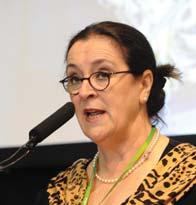
Support for teacher action on external assessment, and a passionate argument for the role of the arts in education, were key themes of Senator O'Donnell's address to Convention. Below are some highlights.
Entirely right
“Those of you who have decided to hold on to the external examination process of all Junior Certificate subjects are entirely and absolutely

correct. Well done for grasping the integrity, the honesty, the arm's length nature, and the objectivity of the examination process, to hold on to what you know as teachers is entirely right. The Department of Education constantly accuses you of thwarting change, and of preventing and frustrating imaginative education. This is deeply false and wholly inaccurate. External examination can never be undermined. I feel that is the beginning and the end of the argument. The Minister knows my feelings on this and I don't intend to change them, and I suggest, as your President has suggested, that you don't change them either.”
Standing up for the arts in education
“The reason I think arts in education are so important is that I think they're about human creativity, imagination and energy. There is a huge need now more than ever for human beings to be able to express creatively. I think the purpose of any education is the pursuit of that individual human creative energy and when I think of the arts, I think of that imagination and artistry.
I do think the arts are at the core of education, and I mean in all subjects. Technology and plugging something in will not teach you how to be. It is not the only source of fulfillment or creativity of purpose.”
Missing the points
“The Government gave 25 points to Project Maths but they didn't give it to music, and they didn't give it to visual art, and they didn't give it to geography. They did it because of computers and technology and engineering – and I'm not against it – but that is answering Google and the banks and the economy. What about the creativity and passion and interest and talent and the other focus of young minds? We are made up of body and heart and hands and eyes and imagination, so the decision to give maths 25 points was against personal creativity. Not that maths isn't creative, it is, but how do you serve legitimate minds when you create an apartheid around subjects? They are all knowledge. If I had a political profile in education I would make the arts compulsory subjects on the primary and secondary curriculum. I would give 25 points to an arts subject of a student's choice. I would also make the human voice, oral expression, a core subject. I would teach subjects like astronomy, politics, media, philosophy, local and national
government, community, religions of the world, law and all the arts subjects. I would invite over the Finnish Prime Minister to tell us how you do it – how you put your money where your mouth is. I would, as one of the most radical thinkers in education, Neil Postman, said, ask young people and parents and teachers to have a common narrative. Do we have a common narrative? At the moment we don't. The Department is not listening and it has to listen. We have money for the banks. We will have it for education or we will not listen to them.
I will leave you with a thought from Seamus Heaney. "I rhyme" he said "to see myself, to set the darkness echoing". That is what education is – it sets the darkness echoing – and that is what the arts do.”
View the full speech at www.asti.ie.

With economic recovery gathering pace, it is time to seek the restoration of pay, conditions and resources lost to austerity cuts, said Pat King.
“A new challenge is beginning to emerge for the ASTI. We must now begin the process of restoring the education system, reinstating the hundreds of teaching jobs lost through the pupil–teacher ratio increase, guidance cuts and cuts in resource teachers. School funding capitation grants that were lost must be reinstated. The gap in school middle management caused by the moratorium must be urgently addressed. As we have so often said before, the best way to ensure long-term economic recovery is through investment in education.”
“The challenge for the trade union movement is to ensure that the new society is based on principles of decency and fairness. But there are other forces that see this current situation as an opportunity for the free market to run riot. I refer to the ongoing Transatlantic Trade and Investment Partnership (TTIP) free trade treaty talks between the EU and the USA. Teacher unions throughout Europe are concerned that, as in the US and the UK, education is becoming more and more a commercial entity. The ASTI is acting along with the TUI, INTO, IFUT and the British teacher unions to oppose the TTIP, or at least to exclude education from its remit. Education is not a commercial commodity. It is a citizen’s right.”
“Pay discussions are due to commence in May. The Government has said that there can be no return to 'old style social partnership’. The job of the public service unions and of the ASTI is:
n to ensure the full restoration of pay as guaranteed by Haddington Road;
n to row back each and every pre Haddington Road pay cut and levy, including the pension levy;
n to further close the gap between the different teacher salary scales; and,
n to restore the overall living standards of teachers and public servants.
I believe that some form of social partnership should not be ruled out. It is a question of whether we want to influence matters outside of pay, e.g., taxation policy, or quality of State services. It is essential that the ASTI is at the negotiating table when teachers’ terms and conditions are discussed.”
“If the take home pay of teachers is to be improved then probably the best way initially to do this is through a reduction in the pension levy. We should be wary of promises of income tax cuts, as taxation is directly linked to the resources that go into the public service. Remuneration for public servants must be no less attractive than is available in other sectors of the economy; otherwise, there will be a further exodus from the public service and we will find it increasingly difficult to attract good people into teaching, nursing, the Gardaí, etc. It's time the country gave due respect to public servants and the public service.”
“It’s been a hard and often frustrating battle for the last five years. However, we have witnessed some signs that a corner has been turned following ASTI representations:
n pay talks are being initiated by the Government to begin in May;
n the retirement grace period has been extended for a further year;
n extra discretion has been given to schools to designate past illnesses as ‘critical’, resulting in some teachers having extra fully paid sick leave;
n there is also some movement on pregnancy-related illness;
n the improved salary scale for the 2011 entrant teachers has resulted in such teachers having the same top of the salary pay scale figure as their more senior colleagues; and,
n the releasing of up to five of the Croke Park hours for individual or group activity is a step in the right direction, as is the greater transparency in the allocation of S&S hours.”
“However, it is my opinion that the most important improvement that has
Upgrading ICT and reducing the pupil–teacher ratio were highest on the agenda among teachers in this year's vox pop, which asked how they would spend any additional investment in education.

Thérèse Glennon, Pobalscoil Neasáin, Baldoyle, Dublin
The big investment needs to be in IT – in wifi routers or whatever is needed to improve access in the classroom. In my school some areas have great access, other rooms don't. We're involved in the accelerated reading programme, which involves students doing online quizzes, but if you can't get a connection that can be difficult and frustrating. I think the Government and schools need to invest in class sets of tablets. It's too expensive to expect parents to do this. Maybe we could have a few of them for each base room or for each subject, where they could be shared. The most important point would be reducing class sizes. I teach English and religion and there can be 30 students in each of my classes.

Justin McGree, Patrician Presentation
Secondary School, Fethard, Co. Tipperary
The first area would be a cut in the pupil–teacher ratio to help with the inclusion of modern teaching methods. I teach geography, English and IT and I'm a guidance counsellor as well so restoration of guidance hours would obviously be a priority for me. We need further spend on ICT to upgrade ageing systems and networks. Our broadband is fine but our hardware network is a big problem. We have servers that are not fit for purpose. I also think we need funded in-school in-service training. It's becoming far more common to offer CPD online. I think we lose the networking of staff, which is very important. It's our only opportunity to find out how other schools are operating.

Richard Terry, St Colman’s College, Fermoy, Co. Cork
We need to push funding towards CPD. The proposed Junior Cert CPD for English is insufficient. We do a degree and a two-year masters, plus NQT years, then are expected to learn a new syllabus in a couple of days. We need CPD that explains to teachers exactly what is involved, a mixture of online and in-service training that lays out the actual specifications of the syllabus. Online resources on an ongoing basis are vital – and must be easy to access and use. I teach maths and the Project Maths website was very difficult to navigate. It has been upgraded and now you can find things. We need CPD that is comprehensive, appropriate and organised.

Mairead Wilson, St Tiernan’s Community School, Dundrum, Dublin
Funding for ICT is important because the Department is really pushing the use of ICT in class – teachers are criticised in their inspection reports for not using ICT when the facilities just aren't available. Some classes have no computers, some don't have data projectors. I'd love a reduction in the pupil–teacher ratio. I work in a DEIS school and there are 27 people in my history class, 16 of whom have issues such as being on the autism spectrum, or having English as an additional language. Trying to cater to people with different languages or with special needs or particular family circumstances is very difficult. I don't even know if I'll have space in the classroom on some days.

Keith Howley, Pobalscoil Neasáin, Baldoyle, Dublin
At the moment there's a great emphasis on group work in the classroom and I think in order to achieve this they need to decrease the pupil–teacher ratio. I can have 30 plus children in my maths class. My other subject is science and that's capped at 24; I think that's a much more reasonable number. There's a focus on ICT in the classroom and you're lucky if you have one computer. We have one computer room for a school of 700 students. So you’re being told to use ICT, you're being told to do group work. You haven't got the space, you haven't got the manpower, and you haven't got the equipment to facilitate it. If every child had access to a computer we could do an awful lot more.

Oliver McCaul, St Aidan’s Comprehensive School,Cavan
First of all teachers’ pay needs to improve. We also need serious investment in special needs. We need investment in the Junior Cycle; it needs to be externally assessed and money could be spent there. Based on my own experience in the classroom, more money should be put into resources to support children from foreign backgrounds and Travellers. That’s where I would spend the money: first teachers’ pay and then more investment in other areas. ICT needs an upgrade at the moment as well. There have been grants for this, and principals have worked hard on upgrading ICT, but that was five years ago and it’s out of date again now.
Once again, opposition to elements of the proposed reform of the Junior Cycle was a key theme of ASTI Convention.

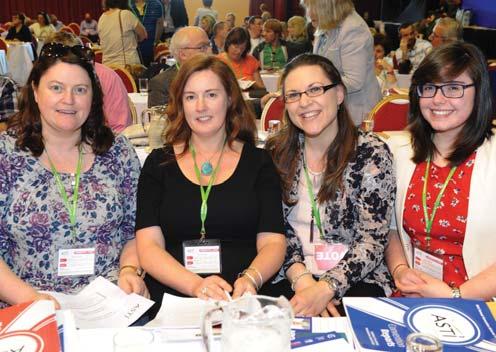

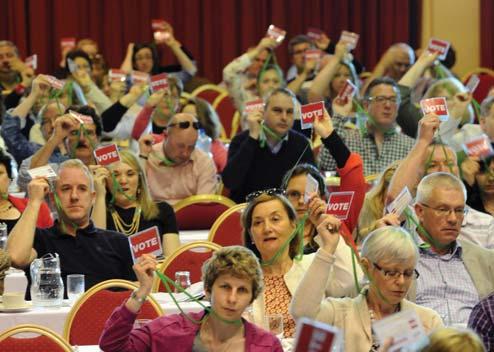
A motion calling for continued non co-operation with any school-based assessment for State certification was passed unanimously by Convention. Seventeen delegates spoke for the motion and none spoke against it. In addition to the debate, ASTI President Philip Irwin read a joint ASTI/TUI statement to outline the two unions’ current united strategy position in relation to the Junior Cycle dispute.
In the statement, he told delegates that the Junior Cycle dispute is now at a critical stage. He said that there remains a number of fundamentally important matters to be resolved, including the need for all subjects to have projects/portfolio work externally assessed for State certification, the need to address teacher workload problems and the need for school resources. He also told Convention that CPD centres would be picketed during the CPD for teachers of English held in the weeks following Convention, and that the ASTI and TUI would be holding a nationwide lunchtime protest outside schools in the coming weeks.
Public support

the time not to back down. Now is the time to remain steadfast in our resolve.”
“What we want is open, fair, transparent external assessment for 100% of our State certification.”
John Byrne, Cork South Paddy Mulcahy Branch
“This is something that all our members have held very dear for a long time, not assessing our own students for State certification … what we want, what we need, is open, fair, transparent, external assessment for 100% of our State certification. Not 40, not 60, 100%. That’s the only number in town as far as I’m concerned. We have considerable public support, we have a mandate for industrial action and the industrial action that has been taken already has been effective. Therefore, now is
“[At a meeting for English teachers held during Convention] there was a thoroughly united group, who will be first on the firing line. Teachers, officers and full-time officials are unwavering in their determination in relation to maintaining our external system. Members will vigorously obey union directives not to attend in-service courses. There are concerns about time and resources, but overall there is an adamant and strong resilience against school-based assessment. The State Exams Commission does an excellent job of independently setting, monitoring and correcting exams. This must continue, without us judging our own students. Furthermore, as has been stated a few times now, when we walked the picket lines we were positively and intensely supported by parents. We had several conversations with parents, indicating that parents also want an external, independent and neutral judgement of their children. They donated pizza, chocolate, apple tarts, tea, beeping horns and comments. This all made us feel that parents do agree with us and are definitely on our side.”
Ann Piggott, Cork South Paddy Mulcahy Branch
“We have a principled position, based on equality and standards in education. In fairness to the Department, it has shown itself to be quite flexible regarding some of the elements of the Framework for Junior Cycle
… The one area where the Department is not flexible is the area of our assessing our own students. Could that possibly be a money-saving exercise? Or is it because there alone the Department of Education and Skills has conviction? Does it not matter that standards could no longer be ensured? That the focus in the classroom could be diverted from teaching and learning to assessing and grading? That the relationship between teachers and students would be damaged? That the possibility of assessing each student fairly and equitably in overcrowded classrooms will be greatly diminished? We have made all the arguments and we have won the debate. Our main concern is the students in our care. This is now widely understood. We know this to be the case, due to the huge support we have from parents and students in our schools and in our own communities.”
Máire G. Ní Chiarba, President-Elect
“Our campaign is in no way related to pay. Our campaign is about education and we have to dispel the myth that it is about money or any future money that may accrue to us. Future pay talks are completely separate to our campaign. Let’s not get sidetracked in any way; they should in no way impinge on our campaign in any way and they are talks for another day.”
Peter Quinn, Clare Branch
“Our position is both reasoned and reasonable. Whenever we have said that we will not assess our students, we have explained why. We’ve provided educational reasons as to why we won’t and our reasons are valid and our reasons are coherent. Now, let’s look at the other side, because what kind of response do we get from our Minister? The response that we get from our
Minister is that she will not address the arguments … the conversation went like this ‘Minister, we feel this is fundamentally wrong for the following reasons…’ The answer we get is ‘I have moved, now you must move’.”
Miriam Duggan, Dublin North 1 Branch
“In relation to this motion, I think the Minister needs to bear in mind that teachers are the gatekeepers of change. No amount of talking or saying teachers are not moving is going to deliver the change without the cooperation of teachers. It should be obvious to her now that teachers have a major issue around assessment. From the point of view of history, this is a 30-year-old argument. I came into education in 1985. Those proposals about teachers assessing their own students were there in the new Junior Cert in the late 80s and we refused to do it and we refused with the same arguments as today, on educational grounds.”
Noel Buckley, Tipperary Branch

Compulsory Croke Park hours are leading to fewer teachers participating in extra-curricular activities, while guidance counsellors are struggling to cope with students in crisis.
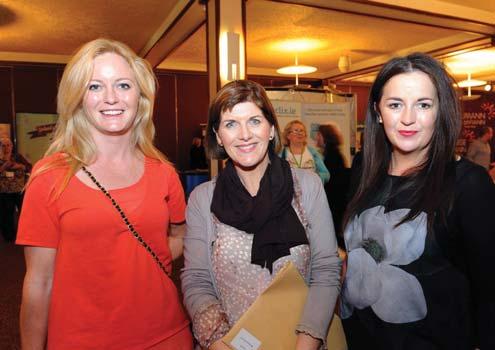
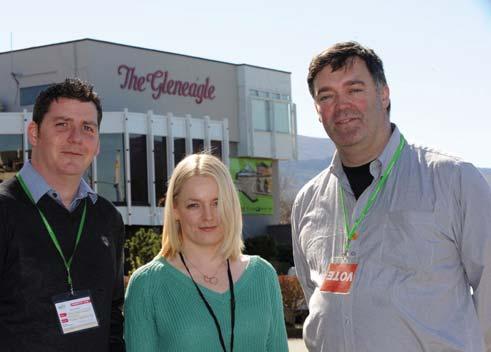
Schools and teachers are doing much more with much less. At a time of greatly diminished resources they are responding to the changing social and economic landscape and its manifestation in schools. Teachers believe that impositions such as the Croke Park hours and compulsory supervision and substitution place unnecessary constraints on them and take away from time for classroom-related work such as planning, marking and lesson preparation. Delegates discussed the impact of key education cutbacks on students and schools, and a number of motions addressed these issues. In particular, cuts to the allocation of guidance counsellors and to posts of responsibility have had a severe effect on pastoral care services in schools.
Delegates debated motions calling for the controversial Croke Park hours to be rescinded, as well as motions demanding that teachers should be able to opt in or out of supervision and substitution. Further motions condemned the removal of ex-quota guidance counselling and the moratorium on posts of responsibility, and called for their immediate restoration.
Motion 24 – Croke Park hours
“I would seriously question the usefulness of at least some of these Croke Park hours, which I believe have led to a lack of goodwill among teachers, something which can be extremely difficult to rebuild…Many of us feel that we have been beaten down by bureaucracy and paralysed by paperwork. These Croke Park hours have outlived any usefulness they may have had and are now impinging on our core work as teachers.”
James McGovern, Enniscorthy Branch

“These hours are viewed by many as ‘detention for teachers’, so it is high time that they were abolished … Schools are losing out because many teachers who in the past would have participated willingly in more hours than those required under Croke Park are now unable or unwilling to do so. The goodwill of teachers must never be underestimated and it has been.”
Máire G. Ní Chiarba, President-Elect
Motion 27 – Supervision and substitution
“This motion is about freedom of choice, equality and fairness. Opting out will not cost the Government any money and it is not cheap for teachers to opt out. This is a form of discrimination.”
Ann Piggot, Cork South Paddy Mulcahy Branch
“It is a shabby and unfair arrangement to compel one group of teachers to do [supervision and substitution] work while others do not, work which was never part of any teacher's contract in the first place.”
James Howley, East Mayo Branch
Motion 11 – Posts of responsibility moratorium
“With the spate of recent retirements, most schools have lost a significant number of assistant principal posts. In my own school the number has been halved from ten to five since 2008. [Teachers working as year heads are] mainly focused on behavioural issues. This is a very important function but to provide the best learning
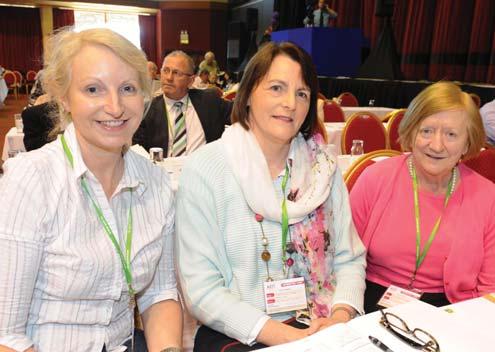

environment we need more than just good behaviour. We need to focus on academic achievement and pastoral care. This can only be properly achieved by lifting this moratorium and letting the staff in each school take on posts of responsibility dedicated to these areas. A properly funded management structure frees teachers to do what they do best, to let their passion for education colour all aspects of school life and provide those extras that make school a positive, lifechanging experience for our students.”
Sarah Murphy, Carlow Branch
Motion 41 – Ex-quota guidance
“This motion proves we have the care of our students at the heart of what we do… The impact of the severe cuts of 2012 is being felt by the most vulnerable students, students in distress and in crisis who need help and who can't access it… We have all been provided with guidelines from the Department of Education and Skills in dealing with students with mental health issues. We’re expected to meet the needs of these students while those best qualified are restricted from doing so."
Beth Cooney, Nenagh Branch
“Over the past three years we have experienced a silent but steady dismantling of student support services in schools. It is vital that the role of the guidance counsellor is protected as a specialist, distinct and important support to young people.”
Cliona O'Sullivan, Carbery Branch


Motions debated at ASTI Convention 2015.
The following motions were adopted at Convention 2015: Motion 24 – Croke Park hours (Desmond)
In light of the recent economic recovery the ASTI demand that the Croke Park hours be rescinded.
Motion 23 – 5 Croke Park hours (Tuam)
That the ASTI negotiates with the Department of Education and Skills that the five individual Croke Park hours become an entitlement of all teachers in all schools and not subject to management decision in individual schools as is currently the case.
Motion 2 – Pension Levy (Fermoy)
That the public service pension levy be removed.
Motion 14 – Posts of responsibility duties – composite motion (Wicklow, Dublin South County)
That the ASTI issue a directive to members not to undertake post of responsibility duties unless pensionably remunerated for this work.
Motion 39 – Sick leave (Fingal)
That the ASTI demand a reversal of the current sick leave arrangements introduced in July 2014.
Motion 27 – supervision and substitution option – composite motion (Cork South Paddy Mulcahy, Sligo, Fingal, Dublin South 1, East Mayo)
That the ASTI negotiate with the Department of Education and Skills that the supervision and substitution scheme would become optional for teachers giving them the right to opt in or to opt out.
Motion 28 – Supervision and substitution annual option (Dublin South Central)
That the ASTI demand that all teachers have the right to opt in or out of supervision and substitution on an annual basis.
Motion 60 – Assessment for State certification (Cork South Paddy Mulcahy)
That the ASTI refuses to co-operate with any school-based assessment for State certification.
Motion 41 – Ex-quota guidance –composite motion (Nenagh, Carbery)
That the ASTI prioritise student welfare and work for the restoration of the ex-quota guidance and counselling allocation in schools and colleges to ensure compliance with Section 9 (c) of the Education Act 1998.
Motion 10 – Posts of responsibility structure (Dundalk)
That the ASTI actively resist any changes in the post structure referred to in the JMB/ACCS document "A proposal for management structures for Post Primary Schools" and continues to campaign for the reinstatement of the post structure.
Motion 6 – Common basic scale – composite motion (Navan, Dublin South Central, Mullingar, Dublin North East)
That in the interests of equality for all its members, the ASTI demand the restoration of the pre 2011 common basic scale for all teachers.
Motion 8 – Qualifications allowances – composite motion (Wexford Tony Boland, Fingal)
That the ASTI, in negotiations with the Department of Education and Skills, seek the reinstatement of qualifications allowances for all post-2011 entrants to the teaching profession.
Motion 36 – pregnancy-related illness (Stillorgan)
That the ASTI negotiate that all pregnancy-related illnesses be recognised as such and not be considered as part of the General Sick Leave Scheme.
Motion 56 – Continuous professional development (Carbery)
That the ASTI demands that any DES or Teaching Council CPD is conducted during school hours.
Motion 11 – Posts of responsibility moratorium – composite motion (Carlow, Galway, Dublin South County)
In the light of the changed economic circumstances and economic growth, this Convention calls on the Department of Education and Skills to lift the moratorium on posts of responsibility and to restore the number of AP and SDT posts to the pre 2008 level.
Motion 78 – Unity with TUI (Dublin North East)
That the ASTI open discussions with the TUI with a view to forming one single union to represent secondary teachers.
The following motion was rejected by Convention 2015: Motion 88 – General Secretary (Dublin North East)
Rule 135: Delete the words “The General Secretary shall be appointed by the CEC.” and replace them with the words “The General Secretary shall be elected by a plebiscite by all members of the Association." Rule 135 would then read: "The General Secretary shall be elected by a plebiscite of all members of the Association. A written contract of employment shall be made between the ASTI and the General Secretary setting forth the conditions of the General Secretary’s employment and the duties
which the General Secretary shall perform. The remuneration of the General Secretary shall be fixed by the CEC. The CEC and, when the CEC is not in session, Standing Committee shall have the power to discipline the General Secretary, including the power to suspend, impose sanctions and dismiss. The procedures to be followed in relation to any such disciplinary action shall be as specified in any contract of employment with the General Secretary.”
Rule 112: Immediately before the words “the Immediate Past President”, delete the words “the General Secretary and”. Add a new sentence: ‘The General Secretary shall be elected in accordance with Rule 135.” The amended Rule 112 would then read: “The Association shall have the following Officers: President, Vice-President, President Elect (from the end of Annual Convention to July 31st) and immediate Past President (from August 1st to the end of Annual Convention), General Secretary and Honorary Treasurer. All the officers, with the exception of the General Secretary, shall be honorary positions and with the exception of the Immediate Past President, the holders thereof shall be elected from year to year in accordance with these Rules. The General Secretary shall be elected in accordance with Rule 135.”
The following motions were referred to Standing Committee: Motion 51 – Teaching Council section 31 (Carbery)
That the ASTI negotiate that any legal expenses incurred by teachers involved in procedures under Section 31 of the Education Act be funded by the Teaching Council.
Motion 65 – School-based ballots (Carlow)
That the ASTI should consider the feasibility of introducing school-based ballots.
Motion 85 – Special Convention – composite motion (Dublin South County, Clare, Dublin South 2, Dundalk, Stillorgan, Enniscorthy)
That this Convention request the President to convene a Special Convention to deal with the rule changes that were on the agenda for the Special Convention on the 14 and 15 November 2014, but not dealt with; that those proposed rule changes that are time bound be appropriately amended by Standing Committee and that this Convention be held on a date or dates in 2015.
Amendment:
By addition after the first semicolon the following, “that the President consult with the Rules Committee when setting the agenda for the Special Convention;” (Waterford)

President Máire G. Ní Chiarba Ed Byrne

Trustees:
Gearóid Ó’Ciaráin
Edmund Keannelly
Michael Kilbride
Steering Committee:
Miriam Duggan
Susie Hall
Mary Lyndon
Deirdre MacDonald
Noelle Moran
Education Committee: Jim Ahern
Gerard Hanlon
Christina Henehan
Margaret Kent
Anne Loughnane
Mary Lyndon
Joe Moran
Ray Silke
James Staunton
Equal Opportunities Committee:
Beth Cooney
Rosabelle Crampton
Jim Duffy
Sheila Flynn
Maura Greaney
Bill Lonergan
Tony McKernan
Mary Ohle
Aaron Wolfe
Business of CEC
Sub-Committee:
John Byrne
John Connelly
Jimmy Staunton
Rules Committee:
Henry Collins
Pat Deery
John McDonnell
Michael McGrath
Padraic McWeeney

Honorary Treasurer Ray St John
Investment Committee:
Patrick Collins
Tony McGennis
Padraic McWeeney
Padraig Murphy
Safety, Health & Welfare Committee:
Jim Ahern
Miriam Duggan
Barry Hazel
Anne Loughnane
Deirdre MacDonald
Pauline Nagle
Benevolent Fund Committee:
John Byrne
Sinead Corkery
Mary Ohle
Awards Committee:
Beth Cooney
Crena Shevlin
Aaron Wolfe
Schools are lacking in key resources necessary to implement the Framework for Junior Cycle, a survey conducted by Millward Brown has found.
The survey of almost 2,200 second-level teachers, commissioned by the ASTI, shows that teachers have not received the requisite CPD and that schools are lacking in vital resources, including IT equipment and science facilities.
The survey found that 88% of school principals believe that classroom teachers’ workloads are a key barrier to the implementation of the Framework for Junior Cycle. Similarly, more than 80% of classroom teachers say their current teaching schedule/workload is incompatible with the wide range of administrative, planning and collaboration work that is part of the Junior Cycle Framework. Some 81% of English teachers and 82% of science teachers said they needed reduced class contact so that they could allocate time to the required planning and collaboration work.
Only 52% of teachers expressed satisfaction with their job compared to 77% in 2009.
Inadequate science facilities are a key barrier to the implementation of the Framework for Junior Cycle science course in the majority of second-level schools. Some 61% of science teachers state that lab facilities are inadequate, while 53% of principals say their school does not have enough science labs. A total of 77% of principals are concerned about their labs not being well stocked, while 66% say their labs do not have adequate storage space.
Other resource issues that are impacting on schools’ capacity to implement the Framework include class sizes and access to IT equipment, the survey has found. Some 83% of all classroom teachers said that class size impacts negatively on the range of methodologies used.
A total of 90% of English teachers surveyed said that they require additional CPD in order to implement the Framework for Junior Cycle specification; 30% said they have a low level of knowledge of the Framework.
The survey also found a stark decline in job satisfaction among teachers compared to 2009. Only 52% of teachers stated that they were satisfied with their job, compared to 77% in 2009. A high level of administrative duties outside the classroom was the top source of job dissatisfaction.
70% of Junior Cycle English classes have more than 25 students, compared to 49% in 2007.
Key findings
Class size
n 70% of Junior Cycle English classes have more than 25 students compared to 49% in 2007;
n almost one in five science classes has more than the recommended maximum of 24 students;
n 93% of teachers agreed that class size affects their ability to provide individual students with the attention they require; and,
n 83% of teachers agreed that class size impacts negatively on the range of methodologies they use in the classroom.
Framework for Junior Cycle
n 90% of English teachers indicated that they needed more training for the English specification;
n over 80% of English and science teachers stated that they need reduced class contact time to collaborate with colleagues on the Framework; and,
n 88% of school principals said that teacher workload is a barrier to implementing the Framework.
Job satisfaction
n 52% of teachers stated that they were satisfied with their job compared to 77% in 2009;
n a high level of administrative duties outside the classroom was the top source of teacher job dissatisfaction;
n class size and too wide an ability range in the classroom are among the top four sources of job dissatisfaction; and,
n heavy workload was the most mentioned source of job dissatisfaction among principals.
Science facilities
n 61% of science teachers agree that current laboratory facilities are inadequate for the new Junior Cycle Framework’s emphasis on practical work;
n 77% of principals do not believe that school funding is adequate to ensure their laboratories are well stocked for experiments; and,
n 53% of principals do not believe that their school has enough science laboratories.
52% of teachers stated that they were satisfied with their job compared to 77% in 2009.
n The majority of classrooms have basic IT equipment – teacher laptop, projector, connectivity;
n only 8% of English classrooms have laptops for students; and,
n 53% of principals believe that their school does not have enough science labs.

New conditions negotiated by the ASTI mean that many teachers are now entitled to a CID after two years.

Q. I am about to complete my second year-long fixed-term contract with the same employer. I have been covering for a teacher who was initially on maternity leave and who is now on career break. I have now completed two full years at the school. My understanding is that the teacher will not be continuing on career break for the next school year. What is my status?
A. You must first ascertain whether there are hours available for you in the school in September. Hours might not be available if the teacher does in fact return – although she should have requested continuation of her career break in February so this should be clearly established. Hours might not be available either in a scenario where the school is in surplus, but the availability of hours in this situation will depend on the curricular needs of the school – your subjects and other related factors. If, as seems likely, there are hours available because of the non-return of the teacher on career break, then you should be entitled to a contract of indefinite duration (CID) on the hours that you hold in the current school year. This is because the report of the Expert Group on Fixed-Term and Part-Time Employment in Primary and Second-Level Education in Ireland (the Ward report), which was negotiated by the ASTI as part of the Haddington Road Agreement, recommended that teachers replacing absentees on career break should no longer be barred from receiving CIDs on the basis of such employment.
However, since you have been covering for a teacher on career break, you may be liable to be redeployed to another school when the absent
teacher returns or if the curricular needs of the school so dictate. If the teacher on career break does return in September and the school offers you some other hours, you should still be entitled to a CID.
Q. Will I have to re-interview for my job, now that it is a CID?
A. No. Under the recommendations of the Ward Report, teachers who have completed a first fixed-term contract will have to re-apply for their position. Teachers who have completed two or more years will not have to do an interview.
Q. If the school offers me a fixed-term contract rather than a CID, what should I do?
If you believe that you are entitled to a CID and the school offers you another fixed-term contract, you should ask your principal for a CID. If this request is refused, you should ask for this refusal in writing. You may appeal this decision to the Independent Adjudicator. However, this appeal must be lodged within four weeks of refusal of the CID, so it is very important that you waste no time in lodging your appeal. If you believe that you are entitled to a CID, or if you are in any doubt as to whether or not you have such an entitlement, contact ASTI Head Office immediately. Appeal forms are available from www.asti.ie.
Disclaimer: The above information is provided on the basis that the cases dealt with are straightforward and that there are no unknown issues, which may affect entitlement to, or terms of, a CID.
The ASTI recently supported a teacher in a successful appeal to the Rights Commissioner, which resulted in the teacher being awarded a contract of indefinite duration (CID).
The teacher, who taught in the North West, had taught in the school since 2009 on successive fixed-term contracts, some of which were Department paid, and some partly Department paid and partly paid by the school. After completing four successive years' service, and with a guarantee of work with the school for the fifth successive year, the teacher wrote to the board of management of the school seeking that they confirm that she would be provided with a CID.
The school management responded that, given the school's ongoing requirement for a teacher, along with the teacher's four successive years teaching in the school, they would not contest the request and would inform the Department of Education and Skills (DES) of their intention to award the CID in September 2014.
The DES refused to award the CID on the grounds that, according to the terms of Department Circular 34/2009, the teacher did not have "appropriate teaching service in an Oireachtas-funded post in the school".
The teacher appealed this decision to the Independent Adjudicator, who determined that the teacher did not meet the requirements set out in the Circular Letter.
With the ASTI's support, the teacher took her case to the Rights Commissioner.
The ASTI claimed that under Section 9 of the Protection of Employees (Fixed-Term Work) Act 2001, the teacher had worked in excess of four successive continuous years of employment in the school. At the commencement of the fifth year, the teacher was provided with a Department-paid fixed-term contract of employment. Under the terms of the Act this should have been a CID and the ASTI and the teacher sought to have the contract amended to a CID.
The school acknowledged that the teacher had been employed by them continuously since September 2009; that they had not set out in writing any objective justification for not awarding a CID; and, that the only objection was from the DES.
The Rights Commissioner found:
"It is not in dispute that the claimant has been continuously employed by the respondent on a series of fixed-term contracts of employment since September 1, 2009. This means that on September 1, 2013, the aggregate duration of her fixed-term contracts of employment exceeded four years. This in turn means that in accordance with the law the claimant's contract of employment became a contract of indefinite duration on that date, unless it was saved by subsection 4 in that there were objective grounds justifying a renewal of her fixed-term contract of employment. No submissions of any
such objective grounds were submitted to me. Indeed the contrary is the case based on correspondence from the respondent.
I find that is it clear by operation of law that on September 1, 2013, the claimant's contract of employment in accordance with the provision of Section 9(3) of the Act becomes a contract of indefinite duration."
The Rights Commissioner upheld the complaint. The school was instructed to provide the teacher with a CID, effective from September 1, 2013.

The teacher in this case was represented by ASTI Industrial Relations Official Ann Marie Ryan.


Represents: Region 6: Carbery, Cork South
Paddy Mulcahy Branches
School: Mount St Michael, Rosscarbery, Co. Cork
I got involved because… having learned about the 1913 Lockout in school, I appreciated the importance of the trade union movement. I was also inspired by the enthusiasm of the dedicated school steward in my own school, who has worked tirelessly over her years in the role. Carbery Branch has played a huge part in my involvement, from their welcome when I was just attending to listen quietly at meetings, to their encouragement when the time came to become a more active trade unionist.
The ASTI’s biggest priorities right now are… firstly the new Junior Certificate reform. For years the Irish education system has had two highly respected, State-certified, externally assessed examinations. These examinations were held in esteem for being as transparent and fair as could possibly be hoped for. While reform is welcome, the positive elements of the original system must be maintained. Secondly, a fundamental principle of any trade union organisation is equal pay for equal work. It is imperative that we as trade union members fight for the restoration of an equitable salary scale for all teachers. Thirdly, as well as pay, working conditions of teachers have drastically deteriorated, particularly in recent times. We must strive to win back what has been lost over the past number of years of austerity.
People may not know… I have lived in various parts of France: the Loire Valley, North of Paris near the Stade de France, and in Normandy. I like running (but not too fast!)

Represents: Region 7: Dungarvan, West Waterford, Fermoy, East Cork and Cork North Branches
School: St Augustine’s College, Abbeyside, Dungarvan, Co. Waterford
I got involved because … I am a firm believer in the power of the collective. I was encouraged to become a member on my first day in school. I have played an active role at school and branch level since then, serving as school steward, branch officer, Convention delegate, CEC delegate and now as Standing Committee Rep for my region. I intend to visit the schools in my region regularly to keep teachers informed. I very much appreciate Region 7 members placing their trust in me.
The ASTI's biggest priorities right now are …
n to maintain our total opposition to any form of school-based assessment for certification purposes;
n to continue to fight for a common basic pay scale for all teachers and to restore qualification allowances;
n to ensure that all pay cuts applied to teachers under Haddington Road and the FEMPI legislation are reversed as promised;
n to end the casualisation in our profession by ensuring that members on part-time/fixed-term contracts get full-time permanent positions; and, n to ensure that all CPD takes place during school hours and with paid substitution.
People may not know … I wish to acknowledge the influence of one dedicated ASTI member on me for over 30 years, namely Liam O’Mahony, Honorary Life Member. Liam played a big part in encouraging me to contest the election and acted as my campaign manager.
Region 1Neil CurranDonegal, Iar Thuaisceart Thír Chonaill, Sligo
Region 2John HolianWest Mayo, East Mayo, Carrick-on-Shannon
Region 3Noelle MoranGalway, Tuam, East Galway
Region 4Peter QuinnClare, Limerick South, Limerick North, Nenagh
Region 5Matthew O’ConnorDesmond, Kerry, West Limerick
Region 6Gloria HelenCork South Paddy Mulcahy, Carbery
Region 7Michael McGrathCork North, Dungarvan, East Cork, Fermoy, West Waterford
Region 8Fintan O’MahonyWexford Tony Boland, New Ross, Enniscorthy, Waterford
Region 9Aidan O’LearyTipperary, Kilkenny, Roscrea
Region 10Eamonn DennehyLaois, Kildare, Carlow
Region 11Brian BurkeLongford, Tullamore, Navan, Athlone, Mullingar
Region 12Denyse HughesDundalk, Monaghan, Cavan, Drogheda Sean Higgins
Region 13Tom HughesDublin South 2, Dublin South County
Region 14Margaret KinsellaStillorgan, Wicklow, Dún Laoghaire, Bray
Region 15Andrew PhelanDublin South West, Dublin North West
Region 16Jim O’NeillDublin North 1, Dublin North Central
Region 17Mark WalsheDublin North East, Fingal
Region 18Breda LynchDublin South Central, Dublin South 1

The news of the death of Nora Cafferkey on August 15, 2014, left those who knew her shocked and saddened. A native of Athlone, Nora was educated by the Mercy Sisters in St Peter’s National School and Summerhill College. She then went on to University College Galway to study for a BA and HDip.
Her first job was in St Louis Secondary School, Kiltimagh, and she remained there until she decided to retire just last year due to ill health. She initially taught French and English, and later studied for the Diploma in Remedial Teaching. She was appointed the Special Needs Co-ordinator in St Louis and became an acknowledged expert in this area.
Nora served as the ASTI school steward on two occasions.
Logical, perceptive and practical, Nora encouraged all her students to develop their skills as independent thinkers, writers and communicators. She also empowered many in overcoming difficulties and learning how best to deal with them.
Difficulties were always addressed with Nora’s practical common sense. As a member of the English Department her expertise could be relied on. She was always on hand to offer help to a young teacher or to those on teaching practice. She was known to be direct and honest; her valued opinion when sought was readily given. Sound advice and practical help – that was the essence of Nora. As joint editor of the school magazine over many years, she inspired many students to enter careers in writing and journalism. Always conscious of the disadvantaged, Nora organised the annual school fast and other fundraising activities in aid of Trocaire and the Sisters of St Louis in the developing world. In her personal life Nora was most happy to be at home with John and Eavan. She enjoyed the simple pleasures: her books and newspapers, her garden, visits to and from her family.
There is no way of measuring the effect Nora had on the lives of so many in St Louis over more than three decades. Present and past management, teachers, parents and students paid their respects to Nora on her tremendous contribution to St Louis Community School by their attendance at the funeral home and funeral mass, which was concelebrated by her brother, Bishop Ray.
Nora’s early death is a great loss to St Louis Community School, to her colleagues, to her friends but especially to her family, the Brownes, to her beloved and loving husband John and her cherished daughter Eavan. May she rest in peace. Ar dheis De go raibh a h-anam.

It is with much fondness that I write about my memories of my good friend Ann and the great times we had together in NUI Maynooth from 1997 to 2000. Ann was a gifted musician and German speaker but above all a beautiful person. We shared many journeys on the 66 bus to Heuston Station where we then took the train home together to Limerick and Tipperary. Ann was an easygoing, pleasant girl, always up for the craic and a laugh, yet humble and unassuming.
We spent many Monday nights in Callan Hall rehearsing for choir, cycling home afterwards, going to the weekly 'Stammtisch' in Caulfields and Platform Concerts in Riverstown Hall, which luckily coincided for a great night out! Attendance at a Mahler lecture the next morning could be a bit arduous!
Ann was a beautiful pianist yet completely underestimated her talent in the company of others. It strikes me looking back that she was always complimenting someone else while the rest of us would be looking for some acknowledgement or praise. Her family at home was always at the top of her thoughts.
After graduating with a BA in 2000, Ann spent a year teaching in Kuwait. She returned to NUIM in 2001 to study for the HDip. Ann taught at St Paul’s, Greenhills, Dublin 12 before moving to Limerick to teach German, music and French at Salesian SS Limerick in 2002. She had met her beloved future husband Mark and they settled in Limerick. They married in Malta in 2008 and their daughter Sophie was born in 2009.
Ann lost her battle with cancer on May 16, 2013.
I will never forget you Ann, you are in my thoughts every day. Some musical works that I associate with our time in Maynooth: Handel’s Messiah, Bach’s St Matthew Passion, Vaughan-Williams' Fantasia on a theme by Tallis, and Mahler’s Das Lied von der Erde
By Róisín Lavery
Join the RSTA to stay in touch with colleagues and keep abreast of pension developments.
Are you thinking of retiring, or do you have friends or colleagues who have recently retired? If so, you really should think about joining the RSTA and/or encouraging your former colleagues to do so. Once a teacher retires, they can no longer be represented by the ASTI. The RSTA represents retired second-level teachers and was a founder member of the Alliance of Retired Public Servants, which now represents some 100,000 members. The RSTA has campaigned tirelessly for the pension rights of retired second-level teachers and continues to do so. But we do not just
engage politically. The RSTA has 18 branches all around the country, which organise regular meetings, cultural events and trips both within the State and abroad. To get a flavour of what we do, log on to www.rsta.ie.
The National Conference of the RSTA will be held in the Sheraton Hotel, Athlone, from May 12-14, 2015. A great mid-week break is guaranteed, as the calendar of events is very exciting – an exceptionally funny play on the first night, the AGM and Conference dinner on May 13, a cruise to Clonmacnoise and other events. It is an occasion not to be missed. Spouses and partners are very welcome to all of the social events.
Annual Subscription €24. Payment options:
1. Standing Order: Please complete the set-up form below and send to the RSTA National Treasurer.
2. Cheque: Please make the cheque payable to “RSTA” and send with this form to the RSTA National Treasurer.
3. Online Bank Payment: To make a transfer or set up a Standing Order online please refer to the Standing Order Form below for details of the RSTA Bank Account.
PLEASE RETURN COMPLETED APPLICATION FORM TO:
RSTA National Treasurer: Mrs Muriel McNicholas, Cordarragh, Kiltimagh, Co. Mayo. E: murielmcnicholas@gmail.com. M: 085-118 1330.
Member’s Name & RSTA Branch:
(To identify the member’s payment on the RSTA bank statement)
Member’s Signature: Date:
(You can cancel this Standing Order instruction at any time by writing to your Bank. The amount of the payment authorised above may not be altered except by your instruction to your Bank.)
The NYCI Child Protection Programme is now inviting applications for the 2015/2016 Certificate in Child Protection and Welfare, which is accredited by Maynooth University. The course will run over 15 days (five three-day blocks) starting in September 2015 and ending in May 2016. The closing date for applications is May 29, 2015.

GOAL is organising its annual sports event for schools to make a difference to those living in the developing world. The organisation is asking that schools arrange a penalty shoot-out competition, with a suggested ¤2 donation from those taking part. It is suggested that schools open the event with a penalty shoot-out for teachers, then arrange a shoot-out for each class, with the winners taking part in a grand final to determine the overall winner. Visit www.goalglobal.org for more information.
The Folens Overseas Teaching Fund will award ¤1,000 each to 10 primary and post-primary teachers in Ireland who are committing their time and energies to teaching overseas as part of a volunteer or charitable programme over the summer. Each winning candidate will receive ¤500 to help finance their trip, and the balance of ¤500 will be donated to their programme, school or organisation. The closing date for entries is May 29, and the winners will be announced on June 19. For more information or to apply, visit www.folens.ie.
BusinessEducation.ie is a new online resource for Leaving Cert business and economics students and teachers. The site includes an overview and the most up-to-date figures on a range of Ireland’s key economic indicators, sample exam questions and answers, and links to business news stories that are relevant to the exam topics covered on the site. Visit www.businesseducation.ie for more information.
The Stanhope Street Girls Choir’s anti-bullying anthem Hold Your Head Up is now available as an EP to download from iTunes and stream on Spotify. The song was recorded for the RTÉ programme Two Tube and was aired on RTÉ2 on Tuesday, February 27, as part of their Hold Your Head Up anti-bullying campaign.
For more information visit their facebook page at www.facebook.com/holdyourheadupofficial.
Alateen is part of the Al-Anon fellowship and is for young people, aged 12-17 inclusive, who are affected by a problem drinker. Alateen members share their ideas and experience in order to gain a better understanding of alcoholism. They learn to accept it as an illness and so lessen its impact on their lives. Alateen groups are sponsored by two adult AlAnon members (Alateen group sponsors are screened and registered with the Al-Anon Family Groups UK & Eire General Service Office). For details of Alateen group meetings, please ring the helpline on 01-873 2699, from 10.00am-10.00pm, seven days a week.
HOUSE FOR RENT in Brittany, France, July/August – 5/6 people – €650/week. Bretagne/Irish family renting comfortable contemporary home on spectacular pink granite coast.10 mins to Perros Guirec, beaches, surfing and sailing schools, 1 hour from Roscoff.
Contact: katell.maher@sfr.fr or 00 33 6 31 84 99 93