It is indeed a great honour to be elected to the esteemed position of President of the Society of Chartered Surveyors.
At the time of writing, the decision of the members to endorse the proposal to create a single organisation through a merger of the SCS and the IAVI is fresh. This is a positive step for all Chartered Surveyors in Ireland, who will now be in a position to enhance and advance the interests of property, land and construction professionals by combining the existing strengths of the SCS and the IAVI, as well as providing the opportunity to ensure high and uniform educational standards for members who are employed widely throughout the sector. I am acutely aware of the concerns that have been expressed by some members who have a contrary view to my own in this regard. It is my intention to engage immediately with all of the Divisions, Regions and the general membership to address these concerns and allay any fears that members may have. I can assure you that there is nothing to be feared and everything to be gained. If you wish to convey your views or speak to me in confidence, please do not hesitate to contact me directly at president@scs.ie.
Operational by January
As it is the intention to have the SCSI operational by January 1, 2011, both organisations will now proceed to engage with all the necessary legal, financial and management experts to ensure the smooth transition from two distinct and separate organisations into a single professional body that all members can be proud of. Back in 1973, I recall my first visit to the then RICS branch office at 8 Merrion Square, which was run at the time by the late retired army Captain Bill Brewer. It was Captain Brewer who kindly briefed me on the various routes into the profession and who guided me at that time. In 1974 I commenced employment as a trainee surveyor, straight from school, with Lisney and Son, as it was then known, and 30 years later became Managing Director of Lisney. During that time, I was fortunate to have three notable mentors – two of which have been past Presidents of the Society – John Broadhead and Harry Whittaker, and the late Ray Ward, a former Chairman of the GP Division. I have witnessed massive changes in the market and the profession over the last 35 years, a period which has presented a wide variety of challenges to Chartered Surveyors. But these past 24 months have undoubtedly been the most testing in my professional career. As we are all aware, and as confirmed by the SCS/IPD indices, capital values of institutional properties are now back at September 1999 levels. Since 1999, values had risen by a factor of 2.14. It now appears that capital values are bottoming out, while rental values may be somewhat behind. It is important that we reach the bottom of the market quickly, so that confidence is renewed and we see a return to increased activity.
There is no doubt that sentiment among Chartered Surveyors has improved over the last six months, helped in no small way by the initiatives taken by the new Financial Regulator. Leases have become considerably shorter, new retailers are appearing, and office enquiries have increased compared to a very quiet second half of 2009. I am also hopeful that the effect of NAMA will start to encourage greater movement in the market as the year progresses. This could well tie in with the ESRI predictions of a return to growth in 2011. This recession has taken a devastating toll on the employment of Chartered Surveyors. However, we now have a somewhat different role to play over the short to medium term in assisting clients, both private and public, in the return to a more
sustainable economy, which will be less transaction based but more advisory in nature. The increasing need for what has perhaps been an undervalued expert service is gaining momentum, and it is a credit to the Society that a number of our members have been employed by NAMA.
Improving in-house understanding
While there was little recruitment of Chartered Surveyors by the banks when property lending was at its peak, I envisage that a trend will surely develop of an increasing number of our members being recruited by financial institutions who will want to enhance their in-house understanding of property, construction, valuation, and real estate transactions. This requirement for property and construction expertise will increase in time throughout our economy, and we have the capacity for this in all of the areas in which we operate.
The SCS has for some time been advocating total transparency in the property market and, accordingly, for the establishment of a national property register to include comprehensive information on all freehold and leasehold transactions and lease variations. We have put it to Government that the State should now seize this recessionary opportunity to set up this register, which could include all pertinent terms attached to a lease, including side arrangements, so that:
1. This information can be properly analysed by agents and valuers, including those involved in arbitrations, where a lack of transparency has led to considerable commercial issues that have been the subject of discussion in the Oireachtas.
2. The information could be used as an efficient base for the collection of a wide range of property taxes where much duplication exists.
3. The functioning of an effective property market would ensue, wherein important commercial and public decisions can be made by all stakeholders with increased confidence for the benefit of the market, the economy and society as a whole.
As I commence my term of office as President of the Society, I assure you, the members, of my personal commitment to the office of President and I look forward to playing my part in ensuring that business, government and those who consume professional services have confidence in the profession of Chartered Surveyors. Please feel free to contact me at any time at president@scs.ie.
Peter Stapleton President
SCSI to become reality in January
The proposed merger between the Society and the Irish Auctioneers and Valuers Institute (IAVI) was approved at two separate EGMs in Dublin just as we went to press. 88% of IAVI members voted in favour of the merger and 54% of SCS members voted in favour. The organisation, which will be called the Society of Chartered Surveyors Ireland (SCSI), will represent up to 4,000 property and construction professionals.
In a joint statement, the Presidents of the two bodies, Kersten Mehl (IAVI) and Peter Stapleton (SCS) described the vote as a landmark decision. “The Society of Chartered Surveyors Ireland (SCSI) will enhance and advance the profession by combining our existing strengths and promoting the highest professional, ethical and educational standards. SCSI will also be in a position to provide quality research, informed market information and expert advice to Government in the public interest,” they said.
Both said that the creation of the SCSI would:
■ enhance the brand of Chartered Surveyors in Ireland;
■ ensure high and uniform educational standards for the property and construction sectors;
■ produce a higher and clearer profile for the profession and its members; and,
■ enhance and augment services to members through a pooling of resources.
Stapleton and Mehl also pointed out that in the current economic climate coming together in one body made even greater sense. The joint Presidents said they were delighted to be leading their respective organisations into the SCSI and were looking forward to working together for the remainder of the year to ensure a smooth transition to the SCSI. They also pointed out that the SCSI will maintain its strong relationship with RICS, the leading internationally recognised body for professionals in the construction and property sectors. It is expected that the SCSI will be based in 38 Merrion Square in Dublin when it becomes operational on January 1, 2011.
IPFMA Annual Members Lunch
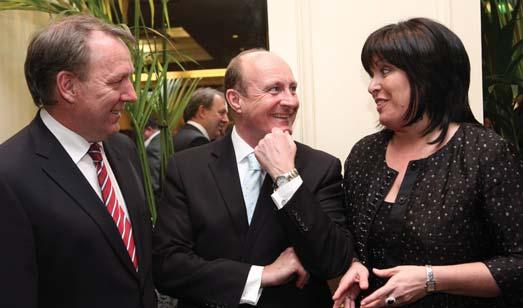
More than 250 members and guests attended this year’s IPFMA (Irish Property & Facility Management Association) Annual Members Lunch, which took place in the Burlington Hotel in Dublin. Pictured at the lunch were (from left): Ken Cribbin, outgoing President of the SCS; Tom Dunne, Chairman of the Irish Property & Facility Management Association; and, Aine Myler, President of the IAVI.
Fellowship
There has been a notable increase in the numbers applying for Fellowship grade of the Society.
Fellowship is a prestigious award that reflects the career achievements of property and construction professionals, and attaining SCS Fellowship is regarded in the industry as a true mark of distinction. In order to be eligible to apply for SCS Fellowship, you must be Chartered for a minimum of five years. In addition, you must be able
Prize giving
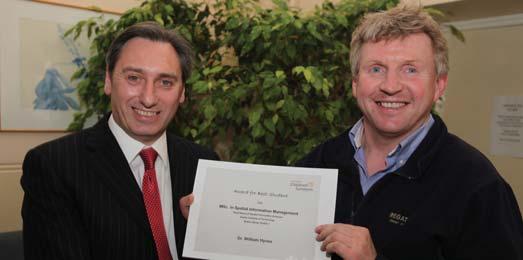
Ben King, Vice-Chair of the SCS Geomatics Division, presenting Dr Billy Hynes with the Society of Chartered
to demonstrate successful career progression, a significant contribution to the profession (this could include participation in Society committees/publications/ APC process), and a planned and committed approach to continuing professional development. Anyone interested in learning more about Fellowship – or indeed making an application – should contact the Education Office, Email: education@scs.ie.
Minister makes appointments to Admissions Board
Arising from correspondence and lobbying by the Society of Chartered Surveyors regarding the appointment of the SCS Registration Body boards, the Society has received formal notice from the Minister for the Environment, John Gormley TD, that he has signed the Ministerial order to appoint the Chairperson of the Admissions Board – Ms Emily Gibson, Barrister-at-Law. Ms Gibson has been appointed as Chairperson of the Admissions Boards for both quantity surveyors and building surveyors. The Minister has undertaken to follow this appointment, shortly, with that of the chairperson of the Technical Assessment Board. Once the latter appointment is made it will enable the Society to proceed with the registration of title of quantity and building surveyors as provided for under the Building Control Act, 2007.
and as such was prejudicing access to such services by members of the Society.
Surveyors prize for best student in the MSc Spatial Information Management in DIT Bolton Street.
The absence of a registration body for quantity surveyors and building surveyors had been giving rise to difficulties for the recognition of the profession among public authorities and, indeed, within the industry as a whole. Adding to these difficulties was the fact that the RIAI Registration Body for architects, which has already been established, was perceived to be distorting competition in the market for those services that can be carried out by both professions,
The Society’s working group, charged with the responsibility to oversee the establishment of the Registration Body, has reconvened to consider the next steps in getting the registration process underway at the earliest opportunity.
A considerable amount of the background administration has already been completed in anticipation of receiving the Minister’s appointments. Members will be kept apprised of developments over the coming weeks and months.
SCS Registration Body Working Group
Members alert! CPD audit
The Education Office will conduct an audit of CPD records during summer 2010. A cross-section of Chartered Surveyors will be randomly selected and requested to submit their CPD records in accordance with the
requirements of the Society’s bye-laws, which state that Professional Members and Fellows of the Society “must complete 60 hours continuing professional development in every consecutive period of three years”.
Conor Hogan Chairman,
New Chairperson of the Admissions Board, Emily Gibson, Barrister-at-Law.
Diploma award ceremony
The 2010 Annual Diploma Award ceremony took place on April 9 at the Pepper Canister Church, Dublin 2. In total, some 120 people received their
diplomas, having successfully completed the Assessment of Professional Competence last year across the quantity surveying,
valuation, building surveying and planning and development routes. The award ceremony was presided over by the President, Mr Ken Cribbin, who
welcomed the new Chartered Surveyors and congratulated them on their success and commitment in the current economic climate.
SCS AGM endorses the SCS/RICS relationship proposal
The recent Annual General Meeting (AGM) of the Society of Chartered Surveyors held in May overwhelmingly endorsed the SCS Council’s proposal to enable the establishment of RICS Ireland in co-operation with the SCS through a set of agreed principles informing the relationship between both parties. As such, an RICS Ireland Board will now be established and will operate in parallel and in partnership with the SCS in much the same way that the RICS and SCS currently do. The remit of the RICS Ireland Board will be to:
1. Award the professional qualification and letters, RICS.
2. Set and promote regulatory standards.
3. Promote professional standards.
The SCS will continue doing all it currently does and will provide all of the members’ services to Chartered Surveyors in Ireland. RICS Ireland will contract with the SCS to provide the necessary APC infrastructure to deliver
and award the Charter. The independence and the autonomy of the SCS are not changed in any way because of this new arrangement.
The SCS Council had recommended adoption of a special resolution at the AGM, which approved the new ‘Principles Informing the SCS/RICS Ireland Relationship’ as set out in an
agreed document between the parties in February 2010. The members of the RICS Ireland Board, who have been appointed for a period of 18 months, are as follows:
■ Desmond Byrne, Chairman
■ Sean McCormack
■ Felix McKenna
■ Richard Mossop
■ Michael Scollard
■ Ciara Murphy
An inaugural meeting of the Board took place in May 2010 and was attended by the new RICS Chief Executive, Sean Tompkins, and outgoing RICS Honorary Secretary, Jim Allan.
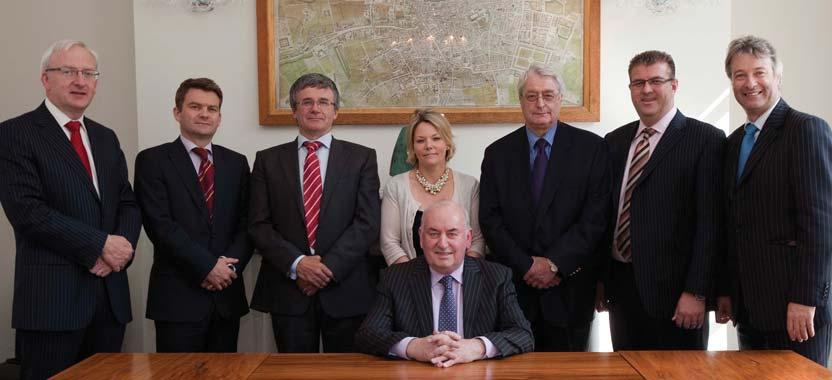
From left: Felix McKenna; Sean McCormack; Richard Mossop; Ciara Murphy; Jim Allan, Honorary Secretary, RICS; Sean Tompkins, Chief Operations Officer, RICS and, Michael Scollard. Seated: Chairman of the RICS Ireland Shadow Board, Des Byrne.
SCS meets with the Financial Regulator on the registration of loss assessors
Following the publication of a notice in the national media by the Financial Regulator in December 2009 advising the general public that persons who operated as loss assessors would be required to register as an “insurance intermediary”, as defined in the Regulations, with the Financial Regulator, and that it is a criminal offence for any individual or firm offering loss assessing services to the public without being registered as an insurance intermediary in accordance with the European Communities (Insurance Mediation) Regulations 2005, the Society met with the Financial Regulator to consider a draft guidance note that the Society intended to issue to members so that members could make a determination on whether or not they would be required to become registered as an insurance intermediary on the basis of a categorisation of services.
The notice published by the Financial Regulator had raised a lot of concern for members of the Society (primarily quantity surveyors and building surveyors), who provide various types of loss assessing services and are already suffering due to the downturn
of the property and construction industries. The meeting with the Regulator has given rise to a categorisation of certain services that do not require registration as an insurance intermediary, and those services that do require registration as an insurance intermediary, as follows:
Category 1 – Advice on building insurance claims
The scope and extent of services can depend on the nature and complexity of the project and the client’s requirements. These services include but are not limited to the following:
(a) calculations and estimation of reinstatement costs;
(b)preparation of schedules of works and/or bills of quantities for issue to contractors for tendering;
(c) evaluation of the prices submitted by the tendering contractors;
(d) provision of additional information in relation to (a), (b) and/or (c) above;
(e) supervision of (re)construction works; and,
(f) recommendation of payments to
Collen Construction goes red for charity
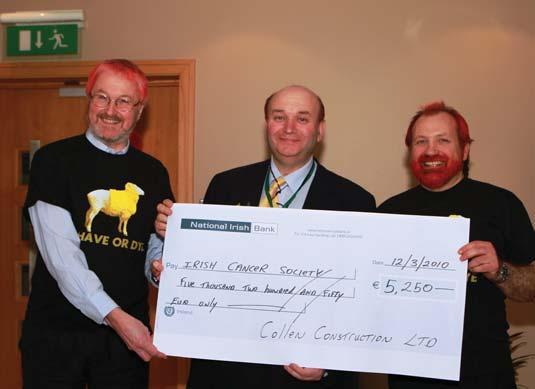
More than 20 staff at Collen Construction, including Chairman Neil Collen, Managing Director Leo Crehan and Company Director Declan Lowry, shaved or dyed their hair in the company’s colour of red in support of the ‘Shave or Dye’ fundraising campaign to raise funds for the Irish Cancer Society. The fundraising event was held in the company’s Head Offices on East Wall Road in Dublin in March, and was attended by John McCormack, Chief Executive of the Irish Cancer Society. More than ¤5,000 has already been contributed to the fundraiser, including a generous donation from the company.
The decision by almost all of Collen Construction’s Head Office staff and management to participate is motivated by the fact that many families have experienced the devastating effects of cancer, according to Neil Collen. “Any initiative that draws attention to cancer prevention, detection, treatment or related fundraising deserves support and we are happy to be able to make this contribution to the community,” he says. Recent major projects by Collen Construction include 232 social housing units at Tyrrelstown, Dublin 15, a new extension to St Andrew’s College, Blackrock, and Finglas Garda Station.
service providers on behalf of the contracting party.
These services fall outside the intended ambit of the regulations and accordingly do not require registration as an insurance intermediary under the regulations.
Category 2 – Services provided to insurance companies
This includes members who are instructed by insurance companies and carry on or assist in activities undertaken as part of the management of an insurance company’s claims, such as examining, quantifying and querying reinstatement costs presented to the insurance company as part of a claim and supervising the reinstatement work and/or payment schedule that is part of a claim on the insurance company’s behalf. These services fall outside the intended ambit of the Regulations and accordingly do not require registration as an insurance intermediary under the Regulations.
Category 3 – Insurance claim negotiations
If a member directly and expressly, in
return for remuneration:
(a) submits and executes claim forms directly as an agent of the insured party;
(b)negotiates directly with the insurance company as an agent of the insured party in relation to insurance claims; or,
(c) is the principal point of contact in relation to claims handling on behalf of the insured party, such a member would be required to register as an insurance intermediary with the Financial Regulator.
The guidance was issued to members in May and is available on the members’ section of the SCS website. It must be stressed that the guidance issued by the Society is not binding and it remains the responsibility of each member to satisfy him or herself whether he or she needs to register, and obtain legal advice if necessary. Further details regarding the insurance intermediary registration process can be found on the Financial Regulator’s website – www.financialregulator.ie.
Micheál O’Connor
Micheál is Chairman of the SCS QS Division.
Collen Construction Managing Director Leo Crehan and Chairman Neil Collen present a cheque to Irish Cancer Society Chief Executive John McCormack (centre) at the company’s ‘Shave or Dye’ event.
February 28, 2010, under the Land and Conveyancing Law Reform Act 2009. Issues have also been raised regarding the transparency and fairness of commercial rent review provisions, e.g., Kidney v Charlton, High Court, January 22, 2009. Further, the Minister for Justice and Law Reform has set up a task force to consider the transparency of commercial rent review processes, including the operation of arbitration related to them. The task force findings, due to be issued later this year, could have far-reaching implications for drafting and operating commercial rent review provisions.
Model Law
The Model Law in the Act is widely accepted throughout the commercial world as providing the preferred procedural framework to govern arbitration disputes. These rules taken together with other procedural rules (if applicable) for the dispute should assist arbitrators in demonstrating the transparency of the process. For example, Article 12 requires an arbitrator to disclose any circumstances likely to give rise to justifiable doubts as to their impartiality or independence during the proceedings.
Turning to the merits of an award, arbitrators also have an interest to see that their awards are upheld and are not subject to being either set aside or remitted by the courts. An arbitrator is expected to follow the principles of fairness, e.g., McCarrick v The Gaiety, [2001] 2 IR 266, and public policy requirements, in making such awards. If fair procedures or public policy requirements are not followed the Model Law provides, for example, that an award may be set aside by the courts if it conflicts with the State’s public policy considerations (Article 34 (2) (b)). An award may also, for example, be set aside by the courts if the arbitration process was unfairly conducted for various prescribed reasons (Article 34 (2) (a)), such as if a party was unable to present its case. The Act should therefore assist in demonstrating greater transparency in the arbitration process.
No substantial changes are envisaged by the Act to statutory based property arbitrations under compulsory purchase order (CPO), planning or housing legislation.
So what new powers do arbitrators have under the Act?
While the Act does not radically overhaul the current system, arbitrators can now order such interim measures as they consider necessary. These measures could include, for example, interim injunctions and securing monies or goods in dispute. The arbitrator can also determine who bears the costs for interim awards and can require security for costs.
This expands existing procedures. The arbitrator now has virtually similar powers to the courts in granting interim relief. The courts, however, have additional ability over arbitration to grant interim relief in relation to third parties. We anticipate that interim relief will be an area of much debate and requirement. Arbitrators are now also obliged to give written reasoned awards, although this mirrors what has been happening in practice. Awards cannot be appealed. They can be set aside only on the specific tightly drawn grounds set out in the Act.
This is a delicate area and the courts are likely to tread carefully in setting aside arbitrator awards. This would be in keeping with judicial policy of noninterference with the arbitral process.
Overall, the Act seeks to harmonise domestic and international commercial arbitration rules with the aim of creating a more streamlined, cost-effective and user-friendly system. This development, together with the growth of other ADR methods such as mediation and conciliation, presents a growing and substantive alternative to litigation, and should be more attractive for domestic and international parties, arbitrators and surveyors alike.