

History for years 1, 2 and 3 Sourcebook 1 vwo
Authors
Ronald den Haan
Raymond de Kreek
Eugenia Smit
Frank Tang
Stef Vink
Final editing
Ronald den Haan
Eugenia Smit
![]()


History for years 1, 2 and 3 Sourcebook 1 vwo
Authors
Ronald den Haan
Raymond de Kreek
Eugenia Smit
Frank Tang
Stef Vink
Final editing
Ronald den Haan
Eugenia Smit
Design cover
Studio Vlak, Utrecht
Image cover
© Art Institute of Chicago
Image research
Daliz, Den Haag / Liane Volgers, Utrecht
Design layout
Tom Lamers, Reclamers, Veghel
Layout
Staalboek, Veendam
Illustrations and cartographic drawings
EMK, www.emk.nl
Adapting images to English Eduardo Media, Stampersgat
Translation
Taalcentrum-VU, Amsterdam
About ThiemeMeulenhoff
ThiemeMeulenhoff is an educational publisher committed to Secondary Education and Secondary Vocational Education. We at ThiemeMeulenhoff share our experience, expertise and effective teaching resources with education professionals. These materials are developed in close and continuous collaboration with educators to make education even better together. We develop teaching methods that can be easily incorporated into other teaching materials, can be adapted as desired and have been proven to be effective. And, needless to say, all our teaching methods are produced as sustainably as possible. In this way, we work together with educators to build a bright future for the next generation.
Learning to innovate together.
www.thiememeulenhoff.nl
ISBN 978 90 06 39896 0 Edition 2, first print, initial circulation, 2026
� ThiemeMeulenhoff, Amersfoort, 2026
All rights reserved. Text and data mining, AI training and comparable technologies are not allowed. No parts of this publication may be reproduced, stored in an automated database, or transmitted in any form or by any means, whether electronic, mechanical, including photocopying, recording, or otherwise, without the prior written permission of the publisher.
Insofar as copies of this publication may be made under Section 16B of the Copyright Act 1912 or the Decree of 23 August 1985 (Bulletin of Acts and Decrees 471) and Section 17 of the Copyright Act 1912, the relevant statutory duties must be paid to Stichting Publicatie- en Reproductierechten Organisatie (PRO), P.O. Box 3060, 2130 KB Hoofddorp (www.stichting-pro.nl). Please contact the publisher concerning permission to use part(s) of this publication in lectures, readers and other compilations (Section 16 of the Copyright Act 1912). For further information on the use of music, film and making copies for educational purposes, see www. auteursrechtenonderwijs.nl.
The publisher has made every effort to meet all statutory regulations concerning copyright. Anyone claiming to have any further rights not covered here should apply to the publisher for details.
The entire production process for this edition was carbon neutral. The paper is FSC® certified and hence was produced from wood derived from responsibly managed forests.
How you work with Phoenix 4
1 In search of the past 6
Background 6
1.1 What is history? 8
1.2 Why is history important? 12 Round-up 16

THE AGE OF HUNTERS AND FARMERS
2 Hunters, farmers and pharaohs 18
Background 18
2.1 The earliest humans: hunters and gatherers 20
2.2 The agricultural revolution 24
2.3 Powerful cities and states 28
2.4 Life before and after death 32
2.5 Three River Valley civilizations World History 36
Researching Egypt and Mesopotamia
Further study 38
Round-up 40

THE AGE OF GREEKS AND ROMANS
3 The Greeks 42
Background 42
3.1 The world of the Greeks 44
3.2 Athens and Sparta 48
3.3 The culture of Greece 52
3.4 Greeks in Egypt and Asia 56
3.5 Early Buddhism World History 60
Researching the Greeks Further study 62 Round-up 64

THE AGE OF GREEKS AND ROMANS
4 Imperium Romanum 66
Background 66
4.1 From city-state to global empire 68
4.2 Kingdom, republic, empire 72
4.3 Along the limes 76
4.4 The end of the Western Roman Empire 80
4.5 The Maya World History 84
Researching the Romans Further study 86 Round-up 88

THE AGE OF MONKS AND KNIGHTS
5 Knights, serfs and monks 90
Background 90
5.1 Charlemagne’s empire 92
5.2 Agrarian society in the Early Middle Ages 96
5.3 The spread of Christianity 100
5.4 A new religion: Islam 104
5.5 The Byzantine Empire World History 108
Researching the Early Middle Ages Further study 110 Round-up 112

THE AGE OF CITIES AND STATES
6 Kings, citizens and crusaders 114
Background 114
6.1 The medieval city 116
6.2 The kingdom of England 120
6.3 Centralization in France 124
6.4 The crusades 128
2.5 China in the Age of the Ming emperors World History 132
Researching the Late Middle Ages Further study 134 Round-up 136
Skills overview 138
Terms 140
Illustration notes 142
You’re going to work with the Phoenix history method. This method uses a coursebook and a workbook. Phoenix gives you assignments that help you to actively engage with the material and find the main elements in texts. Because the
Each chapter starts with a Background. This introduces you to the age that you’ll be studying.
The Background begins with a big picture that tells you about the topic of the chapter. The text in the coloured box tells you more about what you can see in the picture.
‘In this chapter’ tells you what the chapter is about.
After that, you’ll see two pictures that compare the past with the present
Under the Background, you’ll see a timeline that tells you which age the chapter is about.
method is based on an LRN-line, it also has a digital component. When working on assignments in the digital component, you can follow the hyperlinks to access videos, sound recordings or anything else you need to complete the assignment.


Each section also begins with a big picture followed by a text in a coloured box. This text explains what you can see in the picture.
After that, you’ll see the learning objectives you’ll be working towards.
The learning objectives are followed by ‘normal text’. This is the text you have to learn. Each section also has textual sources and visual sources. All of these sources are numbered, but you don’t have to learn them. The workbook contains assignments that are related to these sources. Some sections contain a text in a textbox about a historical skill or about our government. You also need to learn this text.
The World History section is about events in another part of the world during the same age as the chapter. You’ll not only study new material in this section, but also see comparisons with material from previous sections.


The ‘Researching…’ section is an assignment for further study. It’s a chance to learn more about a specific topic from the age that is discussed in the chapter. You’ll research a statement using sources. By the end, you’ll be able to give your own opinion.
Each section in the workbook begins with an assignment called ‘What you already know’. By doing this assignment, you’ll find out what you already know about the topic of this section.
Under the header ‘Learning essentials’, you’ll find the ‘normal assignments’ that belong to the section. At the beginning of an assignment, you can read which text or which sources you must use to complete the assignment. Some assignments also contain textual sources and visual sources. All of these sources also have a number. These numbers are labelled with ‘Assignment Source’. Each section contains an assignment that focuses more on why the topic is important. Above these assignments, you’ll see a text and a brief explanation in a coloured text box labelled ‘Why history is important’. By completing this assignment, you’ll discover why the topic is important. Some assignments allow you to practice historical skills some more. You’ll see the header ‘Practise your knowledge’ above the assignment, followed by the historical skill you can practise.


The Round-up contains all important events, learning objectives, skills and terms from the chapter.
For some assignments, you’ll need a computer or tablet in order to look things up. These assignments are shown by the tablet icon.
Some assignments are done in pairs or groups. The assignments in pairs are shown by an icon with two faces.
The assignments in groups are shown by an icon with three faces.
At the end of each section, you can test whether you’ve achieved the learning objectives of the section. These assignments are shown by the header ‘What do you know now?’
Lastly, each section ends with the learning objectives that you’ve worked on in the section. These learning objectives show which assignments belong to which learning objective.


Achilles turns his head to look the people behind him straight in the eye. They are the king and queen of Troy. The body of their son, Hector, has been tied to Achilles’ chariot. What had happened before this scene? Hector had killed Achilles’ best friend, Patroclus. Achilles was furious and took his revenge. After defeating Hector in a fight, Achilles tied his body to his chariot. He then rode around the city of Troy three times, so that everyone could see the body. If Hector wasn’t buried, his soul would wander the Earth forever. Achilles knew this, which is why he refused to return the body to the Trojans. But Zeus – the king of the gods – said the body had to be buried. He sent a messenger to Hector’s father. The messenger told the king that he should beg Achilles to return his son’s body. Achilles listened, and Hector was given a proper funeral. Hector’s death was an important event in the Trojan War: a major war fought by the Greeks against the city of Troy. Archaeologists don’t know whether the Trojan War really took place. If it did, it must have been in the thirteenth or twelfth century BC. But that is still four centuries before the Greek poet Homer wrote his poems about the war. Even if the war wasn’t exactly as Homer described, his stories were still important to the Greeks.


SOURCE 2 Image of Greek soldiers from the twelfth century BC. The object was found in a Greek castle.

SOURCE 3 BRON 3 A Dutch soldier guards a building. The photo is from 2023.
The Greeks believed that the Trojan War really happened. Parents told their children stories about the war, theatre plays were written about it, and artists made images of the gods and heroes in the stories. Religion was very important to the Greeks. It even played a role in politics: people asked the gods for advice.
Greece wasn’t a state like Egypt. Instead, each Greek city had its own government. The Greeks had many debates about what an ideal government was, which is why different cities had different forms of government. This was the case for the two most important cities around 500 BC: Athens and Sparta. Athenian citizens could take part in decisions about the government. The citizens of Sparta had less influence over their government. They thought it was more important to have a big, strong army. Spartan men trained intensely for combat and fought in many wars.
While there were differences between the Greek cities, the people shared the same culture. All Greeks spoke the same language and believed in the same gods. The style of buildings and statues was also the same. That culture was spread far outside Greece through trade, Greeks settling outside Greece and the conquests of a certain king: Alexander. Even after Greece was conquered by the Romans, Greek culture remained important for centuries, including in the areas conquered by King Alexander. In this chapter, you’ll learn about the Greeks.

SOURCE 4 This image has been carved out of stone. This is known as a relief. This relief is on an Etruscan urn. This was used to store a dead person’s ashes. The Etruscans were a people who lived in central.
The angry Cyclops – a giant with one eye – throws boulders at the ship. The Greek hero Odysseus and his men are sailing away. They have escaped a gruesome death: Polyphemus, the Cyclops, wanted to eat them alive. Polyphemus had trapped them in the same cave in which he kept his sheep at night. He had closed the opening with a large rock. Polyphemus opened the cave every day to take his sheep out to graze in the fields. Once all sheep had left the cave, he quickly sealed the entrance again. This pattern gave Odysseus an idea. He pierced Polyphemus’ eye with a spear, and then he and his men tied themselves onto the sheep’s bellies. When the blinded Polyphemus went to take his sheep to graze as usual, he couldn’t see Odysseus and his men escaping.
Odysseus wasn’t a strong hero like Achilles: he used his smart thinking to defeat the Trojans. After the Trojan War, he travelled around for ten years. Greeks told many stories about his adventures – like how he outsmarted Polyphemus. The Etruscans thought Odysseus was a hero and showed his adventures in their art. They heard stories about him from the Greeks who had settled in Italy. Other Greeks moved far outside Greece, too: along the Mediterranean and Black Sea coasts. As a result, people far outside of Greece became familiar with Greek stories and culture. In this section, you’ll read about why and where this happened. You’ll also learn what Greece itself was like.
• You can explain why poleis emerged in Greece.
• When studying sources, you can recognize monarchy, aristocracy and tyranny as forms of government.
• You can explain why the Greeks had contact with other peoples in the Mediterranean.
There were many cities in Greece until the twelfth century BC. Nearly every city had its own king. Many of these cities were built on a hilltop, so that they could defend themselves easily. The many hills and mountains of Greece separated the cities. In the twelfth century BC, invading peoples raided the cities. The people living in the cities moved away, and the cities became farming villages. They were still ruled by a king, but almost everyone was a farmer. Even so, there was usually only just enough food to survive.
This changed in the ninth century BC. Improved farming techniques led to bigger harvests. This agricultural surplus – producing more food than needed – caused the population to grow. Some villages became as big as cities again. People began to specialize by practising a craft or trading. The wealthy cities attracted more and more people and therefore grew in size. This became a problem, because the hilly landscape in which the cities were built had little land that was suitable for farming. Some cities therefore conquered large parts of the area around them. This is how the Greek cities became city-states, or poleis in Greek. Each polis (singular) had its own territory, rules and government. The English word ‘politics’ comes from ‘polis’.
Although the poleis were at war with each other often, no polis ever took control of all the others. This is because the landscape made it difficult to control a large, connected area. Greece therefore didn’t become a state like Egypt did.
Until the eighth century BC, most Greek city-states were monarchies. The king made important decisions and commanded the army. He and his family were the most important warriors. A small group of the best hoplites – heavily armed Greek soldiers –advised the king and fought for him. These hoplites were the aristoi, which is Greek for ‘the best people’. They were the elite of the polis. Hoplites were also wealthy, as they had to buy their own weapons, which were very expensive. The aristoi’s family were also powerful members of the city-state. They were given important positions in the army and government. People who were not related to the aristoi had little chance of rising to power.
Although the aristoi supported the king, they could also be a threat to him. For example, if a king lost a war or ignored his advisers, he could lose their support. The aristoi would then take power and form an aristocracy. These new rulers are called ‘aristocrats’. This means that a few families shared power and governed the polis together. At the end of the eighth century BC, there were almost no monarchies left in Greece. Sparta was one of the exceptions. The city-state was governed by two kings, a council of old men and a few male citizens of Sparta.

Greek society was very unequal. Right at the top of the hierarchy were the powerful rulers, the aristocrats. They were landowners and used slaves and poor farmers to work their land. While the slaves and farmers were forced to work hard for the landowner, they had almost no possessions of their own. Sometimes, they didn’t have enough to eat. Most people were slaves or farmers, and they weren’t very happy about it. Occasionally, an aristocrat no longer felt like sharing power. He could use the discontent (unhappiness) in society to get rid of the other aristocrats. By promising to give the land of other aristocrats to poor people, for instance, he received support from a large part of the population. And because he was rich, he could pay for mercenaries (professional soldiers who are hired to fight). Because he was supported by the people and the army, the other aristocrats struggled to stop him. This led to a tyranny in some poleis. If a tyrant kept his promises, he would improve many people’s lives in the polis. For instance, they could be given land or pay less for grain. Sometimes, a tyrant ended a long-running war or boosted trade. The tyrant Periander from the wealthy city-state of Corinth even abolished (got rid of) taxes. Some people didn’t like having a tyrant in power. As tyrants ruled alone, they often cracked down on opponents who wanted to gain power in government. But by oppressing and removing opponents, they lost the support of the population.
As the poleis grew, they used all of the fertile ground in Greece. The population continued to grow as a result, making it more and more difficult to produce enough food for everyone. Around 750 BC, the governments of many poleis removed groups of residents. These people had to establish a settlement overseas and use farmland there. This overseas settlement is called a colony. Colonists looked for a colony with fertile soil. There wasn’t much space in North Africa, but the Egyptian pharaoh did allow the Greeks to colonize one area. Most colonists settled in other places, however. Traders shipped some of the grain harvest in the colonies to Greece. The city-states received most of their grain from the Black Sea colonies. As this meant more food was available in Greece, the residents of wealthy poleis could specialize in crafts and trade goods. Athens, for example, grew into a city where a lot of residents lived in luxury and a lot of art was made.
Greek colonies shared many similarities with Greek poleis. Temples and other important buildings were made in Greek style. The colonists also used the Greek writing system and worshipped Greek gods, in turn spreading Greek culture. No new colonies were established after 550 BC, as Greece was receiving enough food at that point.


SOURCE 6
The Mediterranean around 500 BC.
By establishing colonies, the Greeks came into contact with other peoples who were living nearby. The Greeks and these people mostly had a positive relationship. By living near to each other and trading with each other, these people from different cultures became connected and shared customs (traditions) and ideas.
For instance, the Greeks copied customs from the Lydians. The Lydians used coins –something unknown to most people at the time. This was very useful for trade, and so the Greeks started using coins as well. Lydian and Greek traders came into contact with each other in Lydian cities. Greeks and Lydians lived side by side in cities and admired each other’s cultures. Lydian cities were even home to Greek temples.
The Phoenicians from modern Lebanon also had many contacts with the Greeks.
The Phoenicians were skilled sailors who had set up colonies long before the Greeks and traded goods throughout the Mediterranean. The Greeks influenced Phoenician artists, and the Greeks started using the Phoenician alphabet.
However, relationships weren’t always positive. In the fifth century BC, the Greek colony of Himera in Sicily fought two battles against the Carthaginians, who wanted to take over the colony. War also started between the Lydians and Greeks.


“Wrong! Read it again.” The teacher opens the scroll in front of the class once more. The paidagogos, a slave who took the sons of wealthy Athenian families to school, looks up. “You must try harder, boy. Otherwise I’ll tell your father.” At the end of the school day, the paidagogos would report back to the pupil’s father. At school, boys were taught all subjects that Athenians thought were important. This included things like reading and writing, but also public speaking. That’s because Athenian citizens debated things related to the government. So, being a good public speaker was a useful skill. Nevertheless, school was only for the sons of wealthy families. Children from poor families had to start working at a young age. And Athenians girls, whether wealthy or poor, never went to school. Boys from wealthy Athenian families were educated differently from other Greek boys. In most other poleis, such as Sparta, residents couldn’t take part in government at all. That’s why Spartan boys didn’t learn public speaking and were educated differently from Athenian boys. But these weren’t the only differences between Sparta and Athens. In this section, you’ll learn about them and read about a major conflict between these two poleis. But you’ll also learn how Sparta and Athens worked together when they really had to.

• You understand how Athenian democracy emerged and how this democracy functioned.
• You can give examples of differences between Sparta and Athens.
• You can explain why the Peloponnesian War started and explain its effects on Athens.
In the sixth century BC, a group of aristocrats in Athens had a firm grip on power. The rest of the population were excluded from government. There were huge differences in wealth, too. Many Athenians were very poor – some who were in debt were forced to sell themselves into slavery. The Athenian Peisistratus, who wanted to become a tyrant, promised to fight poverty. In 546 BC, he banished (sent away) some of the aristocrats. In the years that followed, he improved the lives of Athenians by taking power and wealth away from the remaining aristocratic families. He gave these families’ land to poor Athenians. He also made sure that the courts were run by judges rather than aristocrats like before, established peace with other city-states and kept taxes low. Athenians became richer. This meant that more and more people could afford to buy weapons. Many Athenians thought that if you could fight, you could take part in government. Peisistratus didn’t like that idea. He and his two sons, who ruled after he died, oppressed people who disagreed with them. The Athenians became increasingly unhappy. At the end of the sixth century BC, one of Peisistratus’ sons was murdered and the other fled Greece.

SOURCE 9 Aristogeiton and Harmodius, the ‘tyrant slayers’. They killed the Athenian tyrant. These are Roman copies of Greek statues. The originals stood at a central location in Athens where many people could see them.
But what happened then? Ordinary Athenians wanted to get rid of the tyrant and run the government themselves. In 508 BC, they established a democracy (in Greek, demos means people, kratos means power) to give power back to the people.
In Athens, citizens had the right to participate in the government of their city-state. But women, children, foreigners and slaves did not have that civil right. Only free, adult men whose father was an Athenian citizen had that right.
How was Athens governed? Citizens met at the people’s assembly, where they talked about important subjects and voted on decisions. As every citizen had a say in the people’s assembly, Athenian democracy was a direct democracy. A group of five hundred citizens known as the Council of Five Hundred implemented the decisions that the people’s assembly made. The citizens were also in charge of the courts. Athenians were proud that citizens governed the polis. All citizens were equal before the law. That meant everyone had a fair trial. You could be part of government whether you were wealthy or poor. However, poor citizens couldn’t afford to take a day off work in order to attend the people’s assembly. They needed the income. That’s why each person was paid a sum of money to take part in the people’s assembly and in the courts. In Athens, seats on the Council of Five Hundred and judges were awarded by drawing lots, so that each citizen held a position at some point.
If somebody was seen as too powerful, the Athenians could vote to banish them (send them away) from the city for ten years. As votes were written on a shard of pottery (Greek: ostrakon), this practice was called ostracism
If you study history, you have to get information from sources. But as you do, you must be able to recognize facts and opinions. A fact is something that is true or which really happened. For instance, it’s a fact that women, slaves and foreigners couldn’t take part in Athenian democracy. This actually happened, so it’s a fact. What someone thinks is called an opinion. If someone says it’s ridiculous that only free men with rights as citizens could take part in democracy, that’s an opinion. It’s what that person thinks, but you may not agree with them. Many people present their opinions as facts. Saying “it’s ridiculous that only free men with rights and citizens could take part in democracy” is an opinion. If you don’t realize that it’s an opinion, you may draw the wrong conclusion.
Everyone living in the Netherlands is equal before the law. This means that nobody is above it and that we must all be treated the same. A citizen may not be treated better or worse than another because of their family connections or wealth, for example. The government must also obey the law and may not arrest or monitor people without reason. Power is also kept in check: nobody can become too powerful. Courts decide who has broken the law. Nobody is allowed to influence that decision. As both citizens and the government in the Netherlands must obey the law, the Netherlands is known as a state of law
Spartans, on the other hand, weren’t interested in Athenian democracy at all. Sparta was ruled by two kings and a council of old men. There was also a people’s assembly of Spartan citizens, but it didn’t meet often and had much less power than the Athenian people’s assembly. What’s more, very few people in Sparta had rights as citizens. Most residents were free people with no rights as citizens, or slaves. They worked the land, so that citizens could spend all their time on what was most important to them: the army. How boys were educated shows just how important the military was to Spartans. Sparta’s government provided education. All boys, whether wealthy or poor, were put in groups of similar ages and toughened up through intense training. They were also taught to be extremely disciplined. At the end of their training, each boy had to kill a slave. After that, they were a real hoplite and ready to fight in the army.
In war time, soldiers lived in very basic conditions. That’s why the Spartans refused the luxury and comfort in which many wealthy Athenians boys were raised. Indeed, education in Athens was very different. Beside learning how to be a good citizen, Athenian boys regularly took part in sport, so that they were fit enough whenever there was a war. Just like the Spartan army, the Athenian army was made up of citizens.
The writer Xenophon wrote this about education for boys:
“ The boys are placed in classes at school. The strongest boy is the supervisor, the leader. He gives orders and punishes the other boys if needed. Everyone is quick to listen to him. The children aren’t allowed to wear sandals, so that the skin on their feet becomes hard. They’re not given enough food and drink, so that they learn how to cope with being hungry and thirsty. They are allowed to steal food, however. After all, a thief has to plan how to steal. That means the boys must be inventive, as all good warriors are. Any thief who is caught is severely punished.”
Paraphrased from: Xenophon, Constitution of the Lacedaemonians (fourth century BC).
SOURCE 10
But in times of need, Athens and Sparta could put aside their differences. When the Persians invaded Greece, all Greeks worked together to defeat their shared enemy. The Persians were from the Middle East. In the sixth century BC, they had conquered presentday Turkey and therefore controlled some Greek colonies. In 492 BC, some of these poleis rebelled against the Persians. Athens and other places in Greece supported these rebellions, and so the Persian king thought this was a good excuse to invade Greece. It fit his plans, too – he’d been looking to conquer more territory for quite some time.
The Persians and Greeks fought major battles during the Persian Wars (492-479 BC), and the Persians even destroyed Athens! But by working together, the Greeks managed to drive the Persians out. The Spartans had an excellent land army, and Athens had a superb navy.
After the Persian Wars, many poleis wanted to continue guarding the seas around Greece. And there was no better protector than Athens. Some city-states therefore entered an alliance with Athens, agreeing to give money to Athens in order to build ships and pay soldiers. They also promised to help each other if ever there were another war.
Although the alliance brought together many city-states, Athens was in charge of all decisions. The allies had to obey Athens, because Athens was a hegemony. As a result, the allies were forced to become democracies and stay in the alliance. Athens attacked and set up an army camp in any poleis that tried to resist its influence. Athens’ power kept on growing, but Sparta wanted to stop it from becoming the most powerful city-state. So, Sparta set up its own alliance and tried to convince other city-states to join it. Eventually, the Greeks split into two camps. In 431 BC, the Peloponnesian War started between the two alliances. Sparta marched over land as the Athenians retreated behind their city walls. The Athenians were able to hold out by shipping food into the city by sea. They only gave up after Sparta had built its own fleet and stopped food from coming into Athens (404 BC).
Sparta then took over Athenian hegemony. But that didn’t last long. Fresh wars started between city-states that wanted more power. Only in the second half of the fourth century BC did peace return to Greece.


SOURCE 12
alliances in the Peloponnesian War
Sparta and its allies
Athens and its allies


SOURCE 11
The goddess Athena, the goddess who protected the polis of Athens. This statue is a copy of a statue from 438 BC. It stood on the Acropolis, was twelve metres high, and was partially coated in gold. It could be seen from far and wide.


alliances in the Peloponnesian War
neutral states
Sparta and its allies
Athens and its allies
neutral states

SOURCE 13 Hades abducts Persephone. Mural from around 340 BC.
It feels like an earthquake. The ground is ripped apart, releasing a cloud of dust into the air. Hades, god of the underworld, appears. He grabs Persephone and carries her off into the underworld. The dust settles. Persephone’s maid has no idea what has happened or where Persephone is. The god Hermes watches the event, but decides to keep it a secret from the other gods. Why? Because he’s a friend of Hades, and sometimes carries dead souls to the underworld. Demeter, Persephone’s mother, hears that her daughter is missing. She’s so upset that she forgets to do her work as the god of farming. As a result, plants suddenly stop growing. Eventually, Demeter finds her daughter and rescues her from the underworld. But Hades has fed Persephone six pomegranate seeds: each year, she has to spend six months in the underworld with him. While Persephone is with Demeter, plants grow, nature blossoms and food is plentiful. But when she’s in the underworld, Demeter is sad, nothing grows and food is scarce.
Greeks believed that the gods caused changes to the world around them. The Greeks honoured the gods by building temples and making statues of the gods. But some Greeks thought that the gods didn’t really have that much power. We’ll explain more about that in this section.
• You can describe the role of religion in the everyday life of Greek men and women.
• You can identify and describe Greek sculpture.
• You can use examples to explain how Greek philosophy and science helped the Greeks to see the world differently.
Greek religion was polytheistic: there were many gods. The gods caused natural phenomena (events). For instance, Zeus created storms and Apollo could cure people or make them ill. The gods looked very much like people. And just like humans, they had good and bad sides – they could be jealous or angry. The gods were very involved in people’s lives and often had children with them. Those children were known as demigods and were often stronger and smarter than normal humans. Many of them were heroes. Other gods played tricks on humans. A story about gods and heroes is called a myth. These stories were both exciting and educational: they showed people how they should behave or explained why things happen the way they do. Before making an important decision, Greeks often sought advice from the gods. To do so, they visited an oracle: a priest or priestess who delivered messages from the gods. People asked the oracle all sorts of questions about what was bothering them. “Will the pain in my leg ever go away?”, “Will I ever have children?”, “I think the god Ares is angry with me. How do I make things better?” Governors of the poleis who had to make difficult political decisions also went to the oracle for advice. But that advice was usually vague, so the person who received the advice had to figure it out on their own.
In Greek society, women were less important than men. The man – the father or husband – controlled his wife or daughter. Fathers married off their daughters when they were young, often to a man who was around 30 years old. It didn’t matter whether they loved one another. The future husband paid a dowry (money for the bride) to the father. The husband worked or went to the people’s assembly while his wife stayed at home. Her most important task was to have children and raise them while managing the household. While wealthy women had slaves to do the housework, poor women did it themselves and were more likely to leave the house to find work. If they didn’t, their families might not have enough money.
Women played an important role in passing on Greek culture by telling mythical stories to their children. Elite women almost never left the house, but when they did, it was often to dance and sing at religious festivals. Some women became priestesses.
But things were different in the city-state of Sparta. Compared with other Greek women, Spartan women had a higher status. As the men were fighting as soldiers, they weren’t at home often. That gave Spartan women a lot of freedom. Spartan women also took part in sports regularly, because it was thought that a strong woman gives birth to strong children.
The historian Plutarch wrote the following about Sparta:
“ Education for girls was very important in Sparta. People believed that girls should be educated in the same way as boys, as women often had to raise their children on their own while their husbands were away fighting. Just like boys, girls had to take part in all sorts of sports. Spartans believed that babies would have the best start in life if they grew in women who had healthy, strong bodies.
Girls, like boys, had to take part in processions naked as well as sing and dance in festivals. The Greeks
were disgusted by young girls parading naked. But the Spartans had no problems with it: they thought it would teach Spartan girls to live simply and appreciate their natural beauty. The girls were proud of their bodies – they were very fit. A foreigner once said to a Spartan women: “You’re the only ones who are in charge of men.” To which the Spartan woman answered: “That’s because we’re the only women who raise real men.””
Paraphrased from: Plutarch, Life of Lycurgus (around 100).
Wherever Greeks lived, they built temples. Just like in Ancient Egypt, each temple usually honoured just one god. The Greeks treated the temple like the house of the god, where a statue of the god was kept. Average Greeks almost never entered the temples; only priests and priestesses were allowed in. Priests held rituals outside the temples to please the gods by offering animals, wine or precious items. Many people’s assemblies believed it was their task to organize religious festivals, such as the Panathenaic Games in Athens. This festival honoured the goddess Athena by placing a fresh set of clothes on her statue (see Source 10), organizing processions and dancing.
Religious festivals also included competitions. Greeks organized competitions for sports, theatre and drama, music and public speaking. Winners earned prizes, and only the top spot counted. Those who came second or third received nothing. This is how the Greeks combined worship with competition. The most famous Greek religious festival is still celebrated today: the Olympic Games. This festival wasn’t just open to Greeks who lived nearby, but all Greeks. The winning athlete was given a wreath of olive branches and had eternal glory. Apart from sports competitions, the Games also included a ritual at the Temple of Zeus, which stood on the grounds.

The Greeks started to make large statues from around the seventh century BC. As the figures or gods were always portrayed standing still, they often looked very stiff. There were no statues of people running, jumping or falling. However, sculptors looked very closely at the human body and tried to recreate it. Bit by bit, they managed to make knees and muscles that were closer to real life. Some sculptors also began experimenting with new poses – a statue taking a step forward or raising an arm, for instance. These statues appeared to move and looked more and more like humans! But did they look like real people? The artists wanted their figures to look perfect: they produced what’s known as a beauty ideal. But as we know, nobody looks perfect. Almost all of the faces these artists created showed no emotion, as that’s how the artists thought the gods would look. From around the fourth century BC, artists wanted to make more realistic statues that looked less like gods. More and more statues began to show imperfections like spots or wrinkles or clear emotions on their faces.


SOURCE 16 A bronze statue of a boxer, made between the fourth and first century BC.
Most Greeks thought that someone suffering from epilepsy was possessed (controlled) by a god. That’s why they called epilepsy ‘holy’. Hippocrates had a different idea.
“ This cannot be a divine illness, as many think. I don’t see any way it could be caused by the gods. It has the same natural cause as all other illnesses. It is triggered by the brain – more precisely, too much mucus (slime). If there’s too much slime in the brain, it can’t escape through the veins. Epilepsy is very dangerous in children, as their veins are smaller. Older people are at risk, too, particularly in winter. They can suffer from cold shock if they move from the warmth of the fire to the chilly outdoors. This causes the slime to move. And when the slime can’t flow through the veins on the left and right, the person has a stroke.”
Paraphrased from: Hippocrates, On the Sacred Disease (around 400 BC).
SOURCE 17
Most Greeks believed that the gods controlled the Earth. However, some tried to explain disease or natural phenomena, like storms, in other ways. One of them was the physician Hippocrates, who thought that the human body was made up of four humours (bodily fluids). Having too much or too little of one humour made you ill. This could be caused by the weather, the food you ate or the way you lived. So, Hippocrates thought the gods had nothing to do with disease.
Although Hippocrates was wrong about the humours, what mattered was that he wanted to find a logical explanation for the phenomenon of ‘disease’. Hippocrates and other scientists did that by first collecting facts and drawing a conclusion from what they had found. They made more and more technological, medical and mathematical discoveries. It was the Greeks, for instance, who invented the alarm and the catapult and calculated the distance around the Earth.
But some Greeks asked questions about people and society rather than about nature. What is justice or bravery, for example? And what is the ideal form of government? The way in which the Athenians Socrates and Plato tried to find answers to questions like these is called philosophy. By debating, discussing and reasoning, these philosophers (Greek for ‘lovers of wisdom’) hoped to learn more about people and society.

The living continue to fight, climbing over the bodies of the dead. It’s an absolute battlefield! On the far left, on the horse, is a man that strikes fear into the hearts of his enemies. It is the Greco-Macedonian king Alexander. He’s about to throw a spear at the Persian soldier in front of him. The soldier is jumping off his fallen horse as he tries to escape. Will he make it?
This relief is probably of the Battle of Issus, one of the biggest battles ever fought between Alexander and the Persians. Alexander had started a war against the immense Persian Empire. He had invaded the empire and marched through large parts of the Middle East and Asia. His army even reached India – where he fought against soldiers riding elephants! Thanks to his many major conquests, Alexander became known as ‘the Great’ shortly after his death.
The effects of Alexander’s campaign were huge. The Greeks established new cities in the conquered territories and spread Greek culture, which mixed with local cultures. In this section, you’ll read why Alexander began his campaign and which effects it had.
• You can explain how the Persian Empire started and how it came into conflict with the Greeks.
• You can name reasons why Alexander the Great’s campaign was successful.
• You can explain what Hellenism is.
During ancient times, the Middle East was home to lots of peoples. The Persians were one of them. Some lived as nomads, while others lived in towns and cities. The Persians were polytheistic and believed that their king was chosen by the god of light, Ahura Mazda. The peoples of the Middle East were regularly at war with one another. In the sixth century BC, the Persians were the most powerful nation. Their king, Cyrus the Great, came to power in 559 BC and conquered a large territory, taking control of nations such as the Medes and Aramaeans. They rose up against their Persian rulers occasionally, but the rebellions were crushed by Cyrus and his successors. The Persians ruled supreme. However, the size of their kingdom put the king in a risky position: he couldn’t govern such a huge area all on his own. The empire was therefore divided into provinces. The king appointed a governor to control each of them while he remained in the capital. Provincial governors protected their interests. And sometimes, a governor wanted more power –perhaps as much power as a king. This led to fights over who would rule.


conquest of Alexander the Great city founded by Alexander the Great Persian Empire


SOURCE 19 The Persian Empire and Alexander the Great’s conquests.

SOURCE 20 The Gate of All Nations in Persepolis, Greek for ‘city of the Persians’. The Persians called the city Parsa. Built in the fifth century BC in modern Iran.
The Gate of All Nations shows the following words in three languages:
“ Ahura Mazda is the great god who created the Earth, the skies, people and all that is good in the world. He chose Xerxes as the king – the king of kings. I am Xerxes, king of all nations and people, the king of this great Earth, and the son of Darius I. With the help of Ahura Mazda, I have built the Gate of All Nations. All the beauty you see in this city was built by me and my father. Ahura Mazda, protect me and my kingdom.”
SOURCE 21
Macedonia was one of the few Greek territories that didn’t have wealthy poleis. Most of the population were poor farmers or shepherds, and Macedonian art was very simple. The territory was ruled by a king, but most Macedonian aristocrats paid almost no attention to him and did as they pleased. That all changed when Alexander’s father, Philip II, became king and took over the gold mines. He earned enough money to buy the aristocrats’ support and pay mercenaries (professional soldiers who were hired to fight) to defeat his opponents. After taking control of the whole of Macedonia, Philip II turned to the city-states. They had been weakened by the Peloponnesian War. As an excellent military leader, Philip II managed to conquer every single polis. In 338 BC, Macedonia had hegemony over the whole of Greece. Macedonian army camps were set up in any citystate that protested.
But while the Macedonian king was at war with the poleis, the Persians were marching towards Greece – just like they’d done around 150 years before. When they gained control of access to the Black Sea, they threatened the imports of grain from Greek colonies in the area. So, Philip II decided to attack the Persians. But before he could, he was murdered. His son, the twenty-year-old Alexander, became king and was determined to carry out his father’s plans.
Alexander’s campaign
In 334 BC, Alexander invaded the Persian Empire just when a conflict had started about who would become king. Macedonian soldiers and Greek soldiers from the poleis fought side by side in Alexander’s vast army. In the following ten years, he conquered huge territories. He drove the Persians out of Egypt and even destroyed the Persian capital city in 330 BC. But Alexander had bigger ambitions: he wanted to be the king of the whole of Asia! In the years that followed, he and his army marched ever deeper into Asia. Alexander was successful wherever he went. That was mainly because the Greeks fought as a team on the battlefield. Alexander used his troops wisely and chose terrain that gave him an advantage over his enemies.
Another thing that helped was that some Persian cities were unhappy with their king Darius III. Alexander used that anger: he said he was chosen by the gods, just like the Persian king. He hoped this would make the Persians more likely to accept him as their king. Some Persians did see Alexander as the person who would set them free. The rulers of the major city of Babylon welcomed Alexander and immediately crowned him king. At the same time, Alexander was quick to crush his opponents: he murdered all the residents of the cities who rebelled against him, or sold them as slaves.
The Greek historian Plutarch wrote the following about Alexander’s campaign in India:
“ Some people in the area of India that Alexander had just conquered tried to turn people against him. Alexander had them hanged. Shortly after, he and the Indian king Porus entered into battle. Between him and Alexander was a river. On one side stood Porus with his elephants and a large army. On the other side stood the smaller Greek army. At night, Alexander ordered his troops to cross the river. As they did, a powerful storm began and lightning
came down on the Indian army. When the Greeks reached the other side of the river, they took their enemies by surprise. Without pausing to think, a thousand horsemen and sixty chariots attacked the Greeks. But four hundred Indian horsemen were swiftly killed, and the rest retreated. Alexander now led the Greek attack on the enemies’ elephants. It was a fierce battle, and Porus fled after eight hours.”
Paraphrased from: Plutarch, Parallel Lives (beginning of the second century AD).
The Macedonian campaign stopped suddenly in 323 BC. Alexander died at the age of 32, following a brief illness. After his death, his most important generals met to discuss who would succeed him. Alexander’s son was still a baby at the time, so he couldn’t become king. This caused a disagreement between the generals, which lasted forty long years. By the end, three kingdoms emerged in the area that Alexander had conquered: one in Greece and Turkey, one in Egypt and one in the Asian territories. These kingdoms were called the Diadochi kingdoms, from the Greek for ‘successor’: diadochos
For Greece, this marked the end of the age of the poleis. The city-states no longer had their own governments, as they were now subjects of a king. Even though the king ruled all of Greece, there was no peace. Various cities were raided or fought each other. To make matters worse, the Romans declared war against the king of Greece in 200 BC. In 146 BC, the Greeks were completely defeated. The Roman conquest also brought down the kingdoms and empires of Alexander’s successors in Egypt and Asia.
The effects of Alexander’s campaign were huge. He established cities wherever he went. He named one of them after his beloved horse Bucephalus, which had recently died. But most of his cities were named after him: Alexandria. Many Greeks, including many former soldiers, lived in these cities. The Greek culture they brought with them became popular in Egypt and Asia. The Greek cities in the conquered territories were very similar to cities in Greece. Greek architectural style was used, and a Greek elite ran the government. Local people who wanted to take part in government first had to adopt Greek culture. The Greek language was widely known in all cities across the huge territory. That made trading much easier. Greek sculpture and architecture also influenced local art.
So, the Greeks influenced other cultures. But other cultures also influenced Greek culture. For instance, the Greek king of Egypt was only accepted by the population once he acted like an Egyptian pharaoh. Some Greek gods and local gods were combined to make new gods. Sometimes, they were worshipped side by side. The combination of Greek culture and other cultures from the Middle East and Asia is called Hellenism. That word is from hellas, Greek for ‘Greece’.

23
To the left and right of the entrance stood a statue of a Greek god. The statue in the centre is an Egyptian-Greek goddess. Built in 84 BC by the Nabataeans, a people in the Middle East.


“One, two, and lift!” Without making a sound, the men raised the horse and its rider into the air. Prince Siddhartha Gautama wanted to leave the palace in complete secrecy. But why? He had a very comfortable life in the palace in Kapilavastu, on the border between modern India and Nepal. But once he was outside the palace walls, he saw how hard life was for most people. At the time, it was widely believed that people and animals continued to suffer after death. Suffering was just part of life. Seeing this, Gautama decided he must also live a life of loneliness and pain. He believed this would stop him suffering. As he knew his wife and parents would try to stop him, he left the palace in secret, in the dead of night.
According to legend, Gautama did spend some time completely alone; he suffered through hunger, cold and humiliation (shame). But while living in isolation, he concluded that this wasn’t the way to freedom and neither was a life of luxury. It was the middle way, the path between the two, that would end his suffering. Gautama decided to spread that message. This is the legend Gautama’s followers tell of how Buddhism began. In this section, you’ll read about the context in which Buddhism began and how it spread.
• You know how Buddhism began and spread between the fifth and second centuries BC.
Gautama, the Buddha
There were many changes in India and Nepal in the fifth and fourth centuries BC. A new writing system emerged, and people started using coins to pay. These changes led to more trade and more contact with people who lived far away. This means ideas could spread easily over a large area. Priests in India, Brahmins, believed in reincarnation after death: being reborn as a person, plant or animal. Some Brahmins isolated themselves from society and put themselves through hunger, thirst, extreme heat or extreme cold. This gave them positive energy, because they believed that these actions would end suffering. But the Brahmins’ main teaching was to worship gods through offerings and rituals.
Siddhartha Gautama, who probably lived between 480-400 BC, was critical of the Brahmins. He believed that doing good deeds (actions) was much more important than worshipping gods. Good deeds would improve your lot in the next life, while bad deeds had the opposite effect. How your actions affect your future lives is called karma. Having lots of karma meant you’d stop reincarnating, and therefore stop suffering. Gautama was said to be a buddha: the title for a wise man who had built up good karma in lots of lives. Soon, Gautama was called the Buddha, or simply Buddha. The teachings of Buddha and his followers is called Buddhism.

Gautama travelled around to tell people about his ideas. After his death, his followers continued to spread the message while living together in groups away from society. Although they chose to isolate themselves, they did travel to towns and cities to encourage people to become Buddhists. This was a slow process, but sped up when the Emperor Ashoka (268-232 BC) became a Buddhist. Ashoka was the emperor of the Maurya empire, which emerged after the death of Alexander the Great (323 BC). Alexander’s successor in India marched to the west of the country to wage war, allowing the kings of the Maurya empire to conquer large territories. Ashoka was the first Maurya emperor to convert to Buddhism. He decided to spread its teachings in his own empire and sent Buddhists to Hellenistic governors. After converting to Buddhism, Ashoka wanted to make his people happy and help them to do good deeds. His edicts were based on Buddhist teaching. For instance, he wanted to protect animals and encourage people to be charitable and practise self-control. He inscribed (wrote) the text of those decisions on stones, bricks and pillars. Ashoka tolerated other religions, but promoted Buddhism. This Buddhist monarchy didn’t last long. After various provinces rebelled against the Maurya empire around 185 BC, worshipping gods became common again in India. But outside India, Buddhism continued to spread.

SOURCE 26 The theatre at Epidaurus, built in the fourth century BC. There was space for fourteen thousand people.
A good citizen goes to the theatre.
Theatre and drama were an important part of life in Greek poleis. Athens, for example, held two theatre and drama festivals each year: one only for Athenians and one for all other Greeks There were also festivals in honour of Dionysus, the god of wine, festivities and theatre.
There were two types of performance: tragedy and comedy. Tragedies were about people’s suffering and were therefore very serious. Most tragedies, but not all, were based on a myth that had a sad ending. Comedy, on the other hand, was meant to make audiences laugh. They could also be about any subject. Male actors played all roles –even female ones. By using masks, the actors could switch between characters. There was also a chorus (a group of performers) who sang, danced and commented on what was happening in the performance.
It cost a lot of money to organize a theatre performance. Tens of people spent a whole year rehearsing for the performance, which meant they were unable to work. The costumes, masks and scenery also had to be paid for. That’s why a few wealthy people were chosen as sponsors. They were happy to be appointed, because it was seen as an honour. Sponsors sat in the front rows and were joined by important priests. Most people in the audience were Athenian citizens (men). Foreigners, slaves and women also went to see plays, but they were made to sit in the worst spots.


Passage from the play Peace, by Aristophanes. Aristophanes says to the audience:
“ People, young or old and wise, give me first prize.
If, like me, you have a bald head, support me. I shall thank you ’till I’m dead. If I win, baldness would be in!
Any fellow without hair would have the world at his feet.
All together now, in one beat: ‘Give him nuts, hand him the bottle, that baldie we shall please, like Aristophanes, whose face is as beautiful as the night and who genius comedies does write.’”
Paraphrased from: Aristophanes, Peace (421 BC)
SOURCE 28

From the play Antigone:
“ Antigone I admit I did it.
Creon Did you know it was forbidden?
Antigone I knew. I won’t deny that.
Creon Why did you dare to break my law?
Antigone Zeus did not say I wasn’t allowed to do it. Neither did the goddess of justice. Your laws are not powerful enough to stop a person breaking the unwritten and most important laws of the gods.
Chorus It is clear that the child has the pride of her father. She cannot compromise.
Creon Pride has no place in someone who must serve as his neighbour’s slave. I wouldn’t be a man if I did not punish her for this. Otherwise, it is she who would be the man.”
Paraphrased from: Sofokles, Antigone (442 BC).
emerge in Greece
• You can explain why poleis emerged in Greece.
• When studying sources, you can recognize monarchy, aristocracy and tyranny as forms of government.
• You can explain why the Greeks had contacts with other peoples in the Mediterranean.
• You understand how Athenian democracy emerged and how this democracy functioned.
• You can give examples of differences between Sparta and Athens.
• You can explain why the Peloponnesian War started and explain its effects on Athens.
• You can describe the role of religion in the everyday life of Greek men and women.
• You can identify and describe Greek sculpture.
559 BC Cyrus the Great becomes king of the Persian Empire
550 BC the period of colonization is over
546 BC the tyrant Peisitratus comes to power in Athens
508 BC Athens becomes a democracy
492-479 BC the Persian Wars
431-404 BC the Peloponnesian War
334 BC Alexander the Great invades Persia
323 BC Alexander the Great dies
• You can use examples to explain how Greek philosophy and science helped the Greeks to see the world differently.
• You can explain how the Persian Empire started and how it came into conflict with the Greeks.
• You can name reasons why Alexander the Great’s campaign was successful.
• You can use examples to explain what Hellenism is.
• You know how Buddhism began and spread between the fifth and second centuries BC.
• You can put events in chronological order.
• You can recognize different types of sources.
• You can recognize causes and effects.
• You can recognize facts and opinions.
146 BC Greece is conquered by the Romans
aristocracy Governance by a small and prestigious group of people.
city-state A city and surrounding area that are governed as an independent state. The Greek word for city-state is polis (plural: poleis).
colonization An area that is conquered and governed by another, often distant country. tyranny An absolute ruler. A tyrant usually takes power by force.
alliance A union of countries, groups or people who support each other during a war.
citizen Inhabitant of a country who has civil rights, such as the right to take part in government.
democracy A form of government in which the people have power. direct democracy A democracy in which each citizen can vote and decide on policy. hegemony When one area controls another, but doesn’t rule it directly.
people’s assembly A gathering of citizens to discuss governance.
state of law A country in which everyone, including the government, must obey the law. myth A story about gods and heroes.
oracle A priest or priestess who delivers messages from the gods.
philosophy A way of thinking that helps us to better understand ourselves and the world. scientist A person who creates knowledge by doing research.


Persian Empire Empire of Alexander the Great (336 - 323 BC) city founded by Alexander (modern name)

SOURCE 33 The regions where the Greeks traveled during ancient times.


www.thiememeulenhoff.nl/phoenix
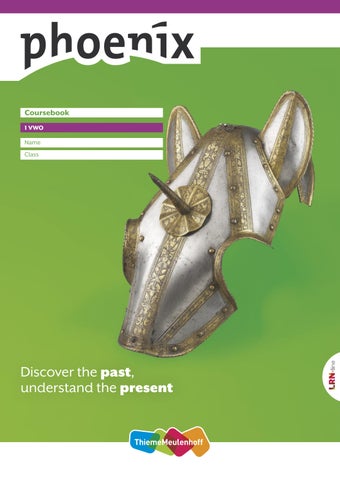
Knights wore a suit of armour in battle in the Middle Ages, as did their horses! A head-piece from such horse armour is shown on the front cover of this book. This armour protected the horse while the spike provided an extra weapon. Combat on horseback is difficult. Knights had to practise for long periods, together with their horses. They also competed in tournaments as preparation for battle. Other weapons were introduced towards the end of the Middle Ages. Gunpowder was invented, as were the crossbow, longbow and large bow and arrow. As these weapons could both penetrate armour and be used from great distances, hand-to-hand combat was no longer suitable. Especially if you first lured the knights and their armoured horses into a marshy area, which is what happened at the Battle of Agincourt, in France (1415). The knights proved too heavy and bulky to move through the mud... This marked the end of the age of knights. Although knights still competed in tournaments after this time, this was more of a combat sport with an audience.
Scan the QR code for more information on the place of horses in history.


