The Dilley detention center promises Central American asylumseekers humanitarian housing—but some may be receiving more abuse.
Editors-in-Chief
Aaron Mak
David Steiner
Publisher Derek Soled
Managing Editors
Kohler Bruno
Samantha Gardner
Senior Editors
Noah Remnick
Justin Schuster
Eric Stern
Associate Editors
Zack Austin
Yuval Ben-David
Alex Cooley
Rhys Dubin
Katherine Fang
Charlotte Finegold
Blog Editor
Azeezat Adeleke
Online Editors
Anthony Kayruz
Salaar Shaikh
Business Manager
Jacek Oleszczuk
Graphic Designer
Ana Barros
Board of Advisors
John Lewis Gaddis
Robert A. Lovett Professor of Military and Naval History, Yale University
David Gergen
Editor-at-Large, U.S. News and World Report
Anthony Kronman
Former Dean, Yale Law School
Ian Shapiro
Director, Yale Center for International and Area Studies
This magazine is published by Yale College students, and Yale University is not responsible for its contents. The opinions expressed by the contributors to The Politic do not necessarily reflect those of its staff or advertisers.
vote
Höw to Build Your Own Political Dynasty
An Instruction Manual
By Madeleine Colbert
So, you want political power? You can picture your name on elementary schools and highways; you dream of a crowd chanting your name under raining red, white, and blue confetti. In America this means you have to run a top-notch, cutthroat campaign while also remaining likeable to voters. This requires hiring the best strategists, making calculated speeches, and pumping money into name recognition. And who runs the best campaigns? Pundits and columnists always have the words on the tip of their tongues: political dynasties. They’re called America’s version of royalty, allegedly given access to more resources than the average candidate could even imagine. So, you want to be powerful? Found a dynasty.
Political dynasties have existed in American politics for centuries. But what does the word “dynasty” really mean in this day and age? It seems antiquated
Many people have their own definitions. Stephen Hess, senior fellow emeritus at the Brookings Institution and a veteran staffer of multiple U.S. presidencies, explained what makes a dynasty in a 2009 Washington Post article. He stipulated that there must be at least three generations of officeholders to call a family a dynasty and that members are related by blood (so, for instance, the Kennedys can’t count Arnold Schwarzenegger).
However, Barbara Kellerman, a professor of Public Leadership at Harvard University’s John F. Kennedy School of Government, had a different take: “In general, if you’re talking about a political dynasty, even one generation probably does it. I don’t think you have to go from grandfather from son to grandchild.” However, she also maintained that the word “dynasty” is not the right way to categorize current political trends.
as women have entered the public arena and gradually assumed leadership roles, [familial political power] is not necessarily a generational thing and but more of what we [might] think of as nepotism—that is, simply being related to a family member if only because of name recognition,” said Kellerman. “A better way to think about this is in the second decade of the 21st century is the importance of kinship, not necessarily dynastic kinship.”
Regardless of how you define it, we can agree that these familial connections exist in today’s politics —a 2016 presidential race between former Secretary of State Hillary Clinton and former Florida Governor Jeb Bush is not unlikely. Political consultant and policy analyst Basil Smikle Jr. explained, “When you have political dynasties, no matter what relationship in the family the elected officials have, they will build into this network of support and that matters a lot.”
How do you start building your political dynasty? Someone has to do the hard work and pave the road to a political office. This could be you, or you could shift the burden to another family member. Russ Baker, investigative journalist and author of Family of Secrets, a history of the Bushes, outlined this scenario.
“There have been people [in America history] who don’t want to be in politics who are the power behind the throne,” explained Baker. “They engineer the election of a sibling or a child who likes the limelight and may be more charismatic. There are a few examples of that actually, where the quieter member of the family was sort of the master planner.” For instance, David Rockefeller decided to remain focused on finance and work “behind the scenes” as his siblings ran for and assumed office.
Once you’ve been elected and have served enough time in office, it is time to encourage the next generation to come up to bat. This is when all the hard work starts paying off for your family.
Smikle believes there are certain steps you can take to follow a family member into office. He noted, “You have to promise to build off the strengths [of your predecessor], but promise you [have improved on] their weaknesses. You have to be able to explain to the voters why you won’t make the same mistakes, sometimes very specifically and openly, and sometimes just implying it.”
But how do you get someone else in your family to run? That is obviously the most essential part of building a dynasty. Well, in some cases they may want to. Doug Wead, a presidential historian and New York Times bestselling author, believes it’s unsurprising that these kinds of political families form. “It’s natural that a child seeks to please their parents
by mimicry and completion. Presidential families are no different. You see it very clearly in the presidents, and you see it all through history with people of power,” he explains. “Among presidential families you see it very clearly in George W. Bush. Andover, Andover. Yale, Yale. Airplanes, airplanes. Baseball, baseball.”
Smikle, on the other hand, contended that more important than parental pressure are the circumstances of the campaign. “You have to be slightly narcissistic to run for office. You have to go out in public and tell people that their lives are going to better because of you. I don’t know if there are particular families that are more inclined to run for office than others, but I know that you can pass [your] political ambition on to family members. However they can’t necessarily pass on the circumstances around a particular campaign,” he said.
Indeed, circumstances drive political campaigns. A candidate has to be running at the right time, with the right platform for the current issues. If the timing is right, a candidate running with a politically active family member is given a jumpstart against their opponent because they have easier access to the most important ingredient in a political campaign: money.
Campaign finance is one of the greatest advantages political dynasties have. According to Kellerman, “People detest giving to people they’ve never heard of. They’d much rather give money to people they have heard of because they think they’re more likely to be winners.”
Campaigns have a wide variety of expenses, but a massive part of their spending is on building name recognition. Smikle claimed that if a family member comes with an established name, those resources can be spent on other efforts. “There is some allowance of inherited elitism and intellectual capital [in American politics],” he asserted.
Take for example former President George W. Bush. He had both the first and last name of a prevoius president, and so his vast financial resources could be spent on other priorities. When Baker was writing his book, he investigated George W. Bush’s first campaign, for the House of Representatives. Baker looked into campaign finances, and found that there were a massive number of donors from all across the U.S. even though he was only running to represent a district in west Texas.
“What I saw was the Bush family had tapped into a network of some of the richest and most conservative people in America for many years and built up this network of people who just sort of understood that the Bush family would look after their interests,” said Baker. “I think the Bush dynasty was built on this idea that the Bushes were going to look after wealthy people, and [wealthy people] could trust them to carry that out.”
Recent developments in campaign finance law have allowed massive floods of money to enter the political arena, specifically the Supreme Court ruling on Citizens United v. Federal Election Commission (FEC) (2010). Baker believes the wealthy favor political dynasties and will use their power on dynasties’ behalves.
Hess, on the other hand, does not see as much inequality when it comes to political dynasties and finance. “When you reach the level of seeking the presidency, it doesn’t come [across] very clearly in the media, but the truth of the matter is that anybody who is a serious candidate can raise a sufficient amount of money,” he explained.
While finances are crucial to a campaign’s success, so is choosing the right time to run. Perhaps the most advantageous environment for a member of a political dynasty is when a member of another dynasty is also running. These combined moves neutralize a potential weakness on both sides—allegations of aristocracy and inequality. “We have an unusual situation as we have dynasties appearing in both parties simultaneously[…] that natural check and balance is gone. It’s frankly why Jeb Bush is running for president, in my opinion. If he ran the next cycle he’d be attacked, but if he runs this cycle what can Democrats say? Hillary Clinton is his opponent,” explained Wead.
One of the biggest questions is whether these dynasties are dangerous for American politics. Wead believes they’re damaging and “very dangerous” to democracy. “They lead to social inbreeding, where small groups of people make all the decisions. In the United States [the number of people in these groups are] in the thousands, but they’re still small.”
Not everyone sees this kind of danger. “To this degree I don’t think that they reflect much. They are actually a very small percent of people actually elected to office,” explained Hess. “Generally, as you study these families over time, they’ve been above average political figures. We haven’t had a great downside from having them, and they can always be defeated.”
Smikle falls somewhere in the middle. “I don’t think they’re dangerous for American democracy. Anyone who wants to run for office should run for office. The problem that we face is that there is a lot less vetting of the candidates than you would normally see in a campaign, because those individuals are leaning hard on their family connections,” he explained, “I think it’s more incumbent upon voters and the media to do their due diligence.”
This phenomenon raises another question: what is the media’s role in all of this? The media landscape is also rapidly changing. Print sales are plummeting, and news networks find themselves with 24
hours to fill so they repeat news over and over again in various permutations. Many people are critical of this new age of media and news’ role in promoting dynasties.
Baker complained that they media does not consider new candidates: “They don’t do much of a star search, asking, ‘Who are the good people out there with great potential who could make a great elected official?’” Therefore, the only candidates with a realistic chance are familiar names. “Frankly, a Kardashian has a better chance than some relatively unknown person who’s really capable.”
Wead recalled a time when he was working in the White House and made some mistakes that he was sure were going to make waves across the press. However, the story never broke. When he asked a friend of his in the White House Press Corps why no one was reporting the mistake, the reporter told him that the story got spiked to keep access to the White House. This interdependency between the media and the government is troubling for Wead, and for him, is an indication of how the media has become less of a check for those in power.
But what about the American public? Certainly they have some responsibility to keep their candidates and political systems in check, so why do they keep electing these political heirs to office? Baker believes it has something to do with the U.S.’ “envy complex regarding royalty.” Americans love Prince William and visiting Buckingham Palace. Perhaps Americans are so accepting of political dynasties because they want to think of them as their own version of royalty, a level of status to strive for and respect. So is there any way for these dynasties to be fixed? Some such as Baker and Smikle suggest amending campaign finance laws by, for example, repealing Citizens United v. FEC or putting in place restrictions on how much money can enter the political system.
Wead disagreed. “In my humble opinion, [campaign finance reform] is kind of like putting a Band-Aid on a cancer.”
Perhaps it will take a major confrontation of political dynasties to get America’s attention. Kellerman believes buzzy election chatter about a race between Hillary Clinton and Jeb Bush in 2016 might wake people up.
“The idea of a Bush-Clinton runoff is somewhat nauseating. I think it’s inevitable, but if it becomes too in-yourface, such as the idea of the next president being between two families that have these clan connections, that would say things about American politics that I don’t think any of us want to own up to,” she predicted. “If it becomes exaggerated, I think many Americans will go, ‘What the hell is wrong with us?’ We’re not a banana republic. We need to fix this.”
Indian Surrogacy Companies Offer Cheaper Alternatives for Foreign Clients Rent a Womb
By Abigail Schneider
A photo of Mongul, an Indian woman in her late twenties, hangs on Pamela Brown’s refrigerator in California. Periodically, Pamela tells her two-yearold son, Asa, “Look, that’s Mongul. That’s where you grew. You grew in Mongul’s tummy.” Though Pamela is Asa’s biological mother, Mongul was his surrogate mother.
In 2006, Pamela had her first child. Due to complications with the delivery, however, she had to have a hysterectomy. Yet, Pamela and her husband Zack still wanted another child. “We realized we would never be able to afford surrogacy in the U.S.,” she explained. In their search for more options, they turned to India’s commercial surrogacy market.
Before coming to India for the procedure, Surrogacy India, the clinic with which Pamela worked, sent Mongul’s profile and questionnaire to Pamela. The profile included a picture of Mongul and, among other facts, her weight, height, religion, and level of education. The questionnaire also asked Mongul more personal questions: Does she feel emotionally supported? Who will support her? What are her hobbies? What foods did she crave in her past pregnancies?
At the start of the process, Pamela and Zack flew to India to meet Mongul and perform in vitro fertilization (IVF), in which an embryo created using Zack’s sperm and Pamela’s egg was transferred into Mongul’s uterus.
After nine months, Pamela got a call from Surrogacy India saying Mongul would be going into labor soon. Pamela and Zack took the next flight to Mumbai, not knowing if their son or daughter had already been born. When the day finally came, Pamela and Zach waited expectantly in the hospital with Mongul’s sister, brother, and father. Zack was able to communicate sparingly with Mongul’s brother, who knew some English.
After Asa was born, Pamela and Zack flew back the United States. They had planned on Skyping with Mongul to show her how Asa was doing, but because of the time difference, Mongul could only Skype when Asa was sleeping. Pamela did not want to wake him up, so contact faded quickly after the pregnancy. “It’s something I feel really guilty about,” Pamela admitted.
Looking back on the experience, Pamela said, “It was just a dream. We had just such a positive impression of Mongul. She was a really great person. She was just really sunshiny. A lot of surrogates you see who go into the doctor’s office don’t look really happy to be there and she didn’t have that sort of aura about her.”
When people think of India’s surrogacy market, stories like Pamela’s don’t often come to mind. The media and the public tend to focus on truly terrible stories. Al Jazeera recently published an article calling India the “Wild West” of surrogacy. The piece describes how middlemen travel to rural villages and convince impoverished women to sign up to be surrogates. The women, usually illiterate, do not understand what they are agreeing to and can end up being paid as little as 1,300 rupees, or $20, a month.
Claire Achmad, a former senior advisor to the chief human rights commissioner and executive director of the New Zealand Human Rights Commission, corroborated these stories. “There is a lot of exploitation of surrogate women. While there are some surrogates in India who come into an arrangement with free and informed consent, there are many who simply don’t understand what they are getting into,” she said. Hari G. Ramasubramanian, a chief consultant at Indian Surrogacy Law Centre, noted, “Most of the time, the surrogate agreements are drafted in languages not known to the surrogate.”
While we cannot discount these abuses, they only reveal one side of a complex business. The Confederation of Indian Industry (CII) estimates that somewhere between 2,400 to 4,000 foreign couples visit India each year for surrogacy procedures, to say nothing of the domestic market. To deal with such demand, over 3,000 IVF clinics exist in India, and the market has been reported to be worth anywhere around $400 million annually. It is important to note that all of these numbers are merely estimates, as no comprehensive study has been done on the breadth of India’s surrogacy market. In any case, the industry is massive and seems to be growing steadily.
India’s market has reached this size for three central reasons. First, it has state of the art facilities. Second, medical procedures are significantly cheaper in India than in other more developed countries. (The average surrogacy in India costs $14,000. In the U.S., the same procedure costs about $70,000.) Third, and most importantly, the market is unregulated. India’s commercial surrogacy market was legalized in 2002, but it was not until 2012 that the Indian government instituted any regulations. Thus, India had ten years for the market to grow with almost no restrictions. Anil Malhotra, the author of Surrogacy in India and a prominent lawyer explained to The Politic, “You can’t stop it. It’s too big. It’s flourished, prospered, and here to stay.”
If we accept that India’s commercial market is not going anywhere, the question then arises: How should the market be regulated to increase the number of stories like Pamela’s and protect the rights of all the individuals
involved—the surrogate, the child, and the commissioning parents?
***
The first place to look for a solution is India’s legal system. In 2012, the Indian Home Ministry published guidelines banning gay couples and single men and women from using their market, making some clinics lose almost 50 percent of their business. Yet, the law did not stop these individuals from trying to have children. They were simply pushed into different markets. Guarav Wanklhede, founder and director of Become Parents, a surrogacy agency that works with clinics in India, Thailand, and Mexico, observed that some people went back to the U.S. or began looking into adoption. “The surrogacy scene in Mexico and Thailand really took off,” he explained.
Though these regulations curbed demand for the market, the government realized that larger problems existed within the current system, even before these regulations were established.
As a first step towards addressing these systemic issues, the Assisted Reproduction Technology (A.R.T.) bill was introduced in 2008. The A.R.T. regulations aimed to standardize surrogacy and lay out the rights of the child, surrogate, and parents. It was redrafted in 2010 and 2013, but has not yet been passed by parliament. It was supposed to be discussed in 2014, but was pushed off the docket because of time constraints in the fall legislative session.
The most recent iteration of the bill available to the public aims to protect the rights of the surrogate mothers by hindering unethical marketing practices through stricter clinic regulations. However, while many of these regulations appear to be steps in the right direction, the bill remains silent on other issues concerning the health and protection of surrogates.
For instance, the bill allows surrogates to undergo surrogacy three times, while in many European countries the maximum is one or two. The bill also fails to address IVFs, C-Sections, and post delivery care necessary to ensure the physical and mental health of the surrogate. Additionally, while the bill does ensure that contracts must be signed between surrogates and parents, no notion of informed legal consent is discussed. “I don’t think you could say that this bill is a comprehensive system of human rights protection,” said Achmad. Insufficient regulations aside, there are inherent cultural values that must be addressed in any comprehensive reform process aimed at women’s health issues. This is evident in one article of the A.R.T. bill that states, “In the event that the woman intending to be a surrogate is married, the consent of the spouse shall
be required before she may act as such surrogate.” Thus, a woman cannot choose to be a surrogate unless her husband allows her to do so.
Professor Geetanjali Chanda is a senior lecturer in the Women’s Gender, and Sexuality Studies department at Yale. She has researched popular culture and feminist and transcultural pedagogy in India. She “would not be surprised at all if women needed their husbands’ permissions to get a surrogacy. It is part of the continuity in India’s history of women being seen as property of their husbands.” This trend is especially concerning given the negative role husbands may play in the surrogacy market. As Achmad noted, “There have been reports of surrogates who have been coerced into these procedures by their husbands and by the clinics themselves.”
Even with perfect regulations, however, there still is something unsettling about the drastic inequalities and power dynamics at play between the people involved in these surrogacy contracts—usually a poor Indian woman and a relatively wealthy foreigner or Indian.
Profiles of surrogates sent to clients at the International Fertility Center, a surrogacy clinic in India, illustrate the peculiar ramifications of these dynamics. Profiles read like baseball cards. One has two pictures of the surrogate woman. She is 32 years old and 5’2” tall. Her “body build” is “slim,” “hair type straight,” and “complexion wheatish.” She is separated from her husband and has an eight-yearold daughter. Her level of education is “basic,” her occupation, a “house wife.” There is something sterile and commodified about the description that seems wildly separate from the highly personal nature of the procedure.
Wanklhede sent The Politic a video distributed by Become Parents in which commissioning parents interview potential surrogates.
A young woman sits on a couch in the lobby of the Become Parent’s clinic. She hugs a blue pillow in her lap. Her English ability is minimal, so a translator is there to help. A man speaks from a computer screen on the couch.
“You don’t have a husband, but you do have one child?” he asked.
“I have a three year girl. I did have a husband but now I’m single. Okay?”
“Okay, so you divorced with your husband?”
“No, I still live with my mother and father.” When struggling to understand another question, the translator chimes in, “If the officer wants to ask you if you have done this willingly will you be okay with that?” The woman nods and smiles. The translator says, “Yes, she’s okay with that Andrew.”
On the surface, these brief interviews and photo profiles prevent the commissioning parents from getting a sense of the potential surrogate’s motivations. It also makes it easier for a casual observer to assume that the women involved are being exploited or are taking the job for the wrong reasons. Yet, the issues may be more nuanced.
Peter is another successful client of Surrogacy India. He had twin girls last summer, and like Pamela, has a picture of their surrogate mother taped to his refrigerator. He understood why the interview might be unsettling, explaining, “It is probably the first time that these women have ever been filmed. It is in some business in a relatively urban place, and it must be an alienating and weird experience.” An interview can naturally be a difficult thing. “It’s exacerbated because of the power dynamics, and economic and cultural circumstances,” he said. “I think it’s partly for that discomfort that we wanted to go with a clinic where we could actually have a relationship with someone to get a sense of how she actually felt about it.”
As with Pamela, one of the reasons Peter chose Surrogacy India was because he and his wife had the opportunity to get to know their surrogate mother personally. By his account, a relationship with a surrogate helped him and his partner resist the impersonal structure of a fundamentally commercial market. Pamela’s and Peter’s surrogates both seemed aware of their choices, the gift they were giving the commissioning parents, and the benefits the payment for carrying another couple’s child would have on their lives.
Nela*, Peter’s surrogate, lived in Hyderabad, a city in southern India. When her husband left her, she and her two young children moved in with her mother. A year after, her mother died. “She went to live with her sister in Mumbai to start the surrogacy process, and from this process she has made enough money to buy a very very modest place for herself,” Peter said.
According to Peter, “She was very clear that she knew how she was giving us the greatest gift that anybody in our lives had ever given us. She felt good, virtuous, generous, magnanimous, and kind-hearted about what she was doing. She was also clearly doing it because there was a financial incentive involved. So I wouldn’t want to say it was only for the money, but she probably wouldn’t have done it if it weren’t for the money.”
Nevertheless, when a market so easily mixes financial incentives with a personal process, it is often difficult to distinguish between exploitation and agency. According to Chanda, “People think they are giving Indian women money, and surrogates see they are giving people life.” While in many cases, surrogacy may not be a woman’s first choice, it does allow her
to give an incredible service to another family while often making more money than she could in a decade. Surrogates are usually paid an average of $6,000. A job as a tailor, the job Nela had before becoming a surrogate, usually yields $50 a month. ***
Surrogacy is fundamentally an economic process, and what clients want is usually conveyed in the language of supply and demand. Pamela did not like the way Rotunda, another clinic in India, treated its surrogates. At Rotunda, she said, “You never met your surrogate. It was a quick hello in the clinic, and contact was discouraged.” The check a commissioning parent can give to ensure that their surrogate is being treated properly did not exist.
Instead, she turned to Surrogacy India. This freedom to choose may be an important way for the situation to change. Wealthy families can demand more from the clinics in terms of rights for the surrogates. To change the system, better laws might have to be paired with higher demands from those who commission the service.
However, this solution should not take away the voice of the surrogate, and moves have been made to give surrogates a greater say in the process. Ramasubramanian, chief consultant the Indian Surrogacy Law Centre, makes the argument that the lack of information, rather than the legal framework, is the central issue in the surrogacy market. He argues that laws are already in place for a surrogate to protect her rights, it is just a matter of informing her and giving her the tools to do so. “Her rights are quite well protected. As far as a surrogate mother is concerned, she has rights to the laws of contract, laws to abortion and protection. And she of course has human rights,” he said. Achmad noted as well, “Education and awareness will be a key thing here— both in India and abroad.” ***
The current 2014 draft of the A.R.T. Bill has yet to be released to the public, but there are rumors that this new draft will drastically change the international surrogacy market. “The indications from the government have been that in this latest version, the 2014 version, surrogacy will be restricted to people with an Indian nationality link,” said Achmad. The new bill would theoretically stop any foreigners from using India’s commercial surrogacy market. Wanklhede and Malhotra had heard similar rumors.
The recent bad press for India’s surrogacy market may be a reason why India would consider closing the market. According to Achmad, “Those sorts of stories may well have highlighted to the Indian government that the world is watching.” In doing so, it seems as if India may be burying the issues rather than confronting them directly.
Nevertheless, as with the 2012 regulations, it seems clear that removing more foreigners does not alter the abuses in the market and will merely push them into more loosely regulated regions.
Many interviewees commented that poorer domestic clinics outside of major cities had higher rates of exploitation and coercion. If India does end up closing it doors, more pressure may have to be put on the international community. Achmad noted, “There has been enough controversy and difficulty shown to exist for the people involved in international commerical surrogacy, that we are at a point now where we should at least be able to agree on some sort of minimum guidelines on how to treat and deal with people who are most vulnerable in international commercial surrogacy.” She added, “This would definitely be a start on the road to harnessing international human rights law to have some positive effect on the situation.”
*Name changed to protect privacy.
Want to get involved in The Politic?
Email us at: editors.thepolitic@gmail.com
online preview World
After Minsk: Putin’s Next Move
By David Shimer
The Russian ruble has collapsed due to plummeting oil prices and crippling sanctions. Putin is backed into a corner. He might abide by the ceasefire in Ukraine, as he has more or less accomplished his goals of pushing back against NATO and increasing Russia’s global relevance. If threats to his leadership emerge, however, history suggests Putin could revert to aggression in an appeal to Russian nationalism.
Opinion
We Are More Than Market Forces:
The Callousness of Laissez Faire Economics
By Scott Remer
Six years into the Obama presidency, America is no closer to living up to its ideals of freedom, equality, and democracy. Yes, Obama and the Democrats have achieved moderate healthcare reform that 1990s Republicans would have approved of, patchwork financial reforms that Wall Street lobbyists have quietly been hacking to pieces, and EPA regulations on coal emissions that might make a dent in our out-of-control carbon dioxide emissions. But on so many fronts we’ve continued to regress.
Interview
Markus Rodlauer:
Deputy Director of the International Monetary Fund
By Jacek Oleszczuk and Salaar Shaikh
Markus Rodlauer is the IMF’s Deputy Director of the Asia and Pacific Department, based out of Washington, D.C., and mission chief for China. He sat down with The Politic to talk about the outlook for China’s economy, China’s outreach effort to Africa, and the implications of Chinese economic reform for American consumers.
Review
Character Reduction
The Imitation Game’s Storytelling
Fails the Test
By Max Norman
The Imitation Game, Morten Tyldum’s biopic on the British mathematician, logician, philosopher, and cryptanalyst Alan Turing (Benedict Cumberbatch), has many laudable qualities. It is an admirably coherent work, but historical embellishments, inferences, and oversimplifications flatten Turing’s story, turning him from a complex character into a simple archetype.
Political Casino
PredictIt Could Change the Future of Electoral Gambling
By Andrew Myers
From the cobbled streets of 16thcentury Venice to the wharfs of 1896 New York City, betting on politics has long transfixed political insiders and laymen alike. PredictIt, a non-profit website launched last year through the University of Victoria, is attempting to make political betting both internet-driven and legal. The idea is undeniably intriguing, but it also has amibiguous legal and ethical ramifications that demand further examination.
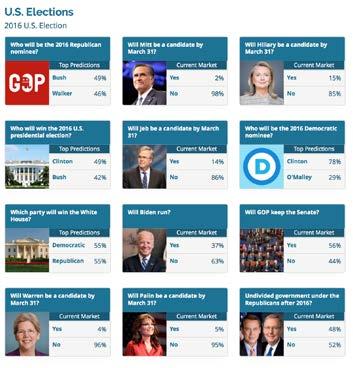
PredictIt allows individuals to buy either “yes” or “no” shares that pay out if a given political binary event occurs. All shares pay out at $1.00, and depending on the likelihood of a given event, shares can cost anywhere from a penny to 99 cents. For example, PredictIt’s users believe there is a 23% chance Senator Elizabeth Warren (D-MA) will secure the Democratic nomination for president. Therefore, you could buy a “yes” share on Warren winning the nomination for 23 cents. If she were to win the nomination, you would make a 77-cent profit on every share you bought. This model resembles
commodities futures markets, and PredictIt’s user interface makes betting on political events simple, entertaining, and rewarding.
John Phillips, the CEO of the political consulting firm Aristotle and the architect of PredictIt, told The Politic that PredictIt is “a hell of a lot of fun.” He further explained his business model: “PredictIt is the gamification of politics. It encourages healthy debates and competition on topics that touch all Americans. It gives all voters a place to engage and voice their opinions.”
‘PredictIt is the gamification of politics. It encourages healthy debates and competition on topics that touch all Americans. It gives all voters a place to engage and voice their opinions.’
the entertainment and predictive value of political markets, there also come risks. If political betting markets continue to grow in the future, insider trading, rigged outcomes, and other legal and ethical issues will likely ensue. In order to understand PredictIt and its potential to alter the way we think about the U.S. political system, I decided to try it out myself.
John Phillips, architect of PredictIt
Beyond encouraging political engagement, political betting markets can provide surprisingly accurate information about which way an election will end. Intrade, a political betting market based in Ireland that the U.S. government shut down in early 2013, correctly predicted the outcome in 49 of 50 states in the 2012 presidential election. However, with all
I initially found it difficult to find events with odds that seemed out of line with my own projections. Eventually, as I scoured through Republican presidential primary wagers, I found a bet worth making. PredictIt’s market showed that former Texas Governor Rick Perry has a 20 percent shot at winning the Republican nomination for president. With his faux intellectual glasses, penchant for forgetting government agencies he would like to cut, and characterization of Social Security as a Ponzi scheme, Perry does not
PredictIt offers lets users bet on political events, such as the 2016 presidential election.
strike me as a serious contender for the Republican nomination. Furthermore, he will have to deal with former Florida Governor Jeb Bush’s massive fundraising apparatus, Wisconsin Governor Scott Walker’s increasing confidence, and a crowded field of other Republican challengers. I purchased $60 worth of “no” shares on Rick Perry winning the Republican nomination. If Governor Perry wins the nomination, I will lose $60. If he does not, I will make $12. I also have the option of selling my shares before the Republican primary for whatever price the market considers a “no” share on Perry to be worth at the time. Perry’s supporters will undoubtedly disagree with my opinion, but the beauty of PredictIt is that it forces honesty. If Perry’s supporters think that Democrats and uninformed participants are artificially pushing his chances down in PredictIt, they have the option of putting their money where their mouths are by buying shares tied to a Perry victory. ***
As Phillips watched the success of the no-limit, for-profit, betting website Intrade in the run-up to the 2012 election, he began to realize the long-term potential for a site like PredictIt. Intrade pulled in over $200 million in political wagers, but for Phillips and his team, the financial success of Intrade was only one important aspect. According to Aristotle Chief Marketing Officer Brandi Travis in an interview with The Politic, prediction markets are “incredibly valuable in determining future results because they harness the value of crowdsourcing.” As Travis observed, “Polls show what people want to happen. Money shows what they think will happen.”
Intrade’s success ultimately became its undoing, and as journalists began to Tweet about Intrade odds from campaign buses, the exchange began to draw scrutiny from the Commodity Futures Trading Commission (CFTC). The CFTC filed a lawsuit against Intrade in November 2012, in which Chief Enforcer David Meister announced, “It is against the law to solicit U.S. persons to buy and sell commodity options, even if they are called ‘prediction’ contracts, unless they are... traded on a CFTC-registered exchange.” He went on to note that shutting down Intrade proved that the CFTC “will intervene in the ‘prediction’ markets, wherever they may be based.”
The lawsuit ultimately crippled Intrade and led to the closure of the online betting market. Intrade had previously tried to stay within the confines of U.S. law by registering its website as a CFTC exchange, but the CFTC turned down the application because the exchange would involve gaming and would be “contrary to the public interest.” While political
futures exchanges may indeed be contrary to the public interest, there is a degree of inconsistency in the CFTC ruling. Futures contracts have long been removed from their simple purpose as a hedge against crop failures, and across the country, traders legally buy futures on anything from oil to tobacco often purely as a way to profit off of geopolitical insight and speculation. Nevertheless, as Phillips and the Aristotle team watched Intrade flounder, their focus became making political futures legal, safe, and CFTCapproved. Travis made no effort to hide PredictIt’s similarity to Intrade, noting, “What worked for them will work for us, and what didn’t work for them, we have to learn from.”
In order to gain CFTC approval for PredictIt, Aristotle has employed a strategy and message focused on crafting an entity with a very different feel from Intrade. PredictIt is modeled on the Iowa Electronic Stock Exchange, which has been in operation since 1988. By partnering with an educational institution, PredictIt has managed to convince the CFTC that their purpose is primarily academic, unlike Intrade.
PredictIt pursued a no-action letter from the CFTC, which gives it permission to operate free of CFTC interference and dramatically reduces the likelihood of PredictIt being sued. Vincent McDonagle, Director of the Division of Market Oversight at the CFTC, distinguished PredictIt’s no-action request from the similar request from Intrade in 2012 based on two central factors. First, McDonagle noted, PredictIt, as run by the University of Victoria, would “represent an academic exercise designed to test the predictive capability of markets.” Second, “because the maximum investable levels would be capped at very low amounts, the political event contracts would not have the same potential to corrupt elections as InTrade.”
PredictIt has taken security seriously. Not only does it meticulously maintain compliance with CFTC regulations, but its leaders have made use of INTEGRITY, Aristotle’s identity verification software, to ensure that users are honest about their personal information.
While PredictIt has strived to create a market that is legal, safe, and fair, its attempt to create an enduring online betting market still requires scrutiny. As Americans, we have a sacrosanct obligation to protect the integrity of our political process, no matter how exciting betting on political events might be. The most pressing concern highlighted by the CFTC in its rejection of Intrade’s request to trade political futures was their belief that such large bets on politics could corrupt the integrity of the political process.
If enormous amounts of money pour into political futures markets, traders could donate to candidates and attempt to mobilize voters for their own monetary
gain rather than to produce positive social change. This perverse process would prove difficult to execute in national races, but in local elections, bets on outcome could potentially far outweigh campaign spending. The creation of a perverse incentive structure where financial interests could outweigh the desire to improve the lives of citizens is a risk against which the CFTC should protect.
More immediately, political futures markets could provide illicit opportunities to profit off of personal friendships, whispers, and personal failures. John Henderson, a Yale political science professor researching elections, thinks insider trading could pose a major problem if political futures markets begin to allow large bets on electoral outcomes. In an interview with The Politic, Henderson contended, “The political world already prizes insider tips and information, and preventing insiders from using private knowledge to game betting markets could be difficult.” Publicly-traded companies are already the targets of illegal insider trades, and it is infinitely easier to garner information that could significantly alter the future of an individual candidate than it is to discover information that will shift the course of a publicly traded company. Anything from knowledge of a candidate’s affair to a conversation with a candidate’s children could provide unfair opportunities to profit in a political futures market.
However, PredictIt has worked hard to diminish concerns traditionally associated with political futures markets. By capping the maximum bet on an event at $850, PredictIt has reduced the possibility of users attempting to influence elections for financial gain and dramatically curtailed the likelihood of insider trading. With these concerns addressed, users are left with an exciting and informative way of testing their theories and instincts. The predictive accuracy of PredictIt’s rapidly expanding user base should provide compelling academic insight into the reliability of political futures markets as outcome indicators.
As the 2016 presidential election approaches, PredictIt is hoping the CFTC will give it permission to accept larger bets. Travis expects the cap on bets to be raised but acknowledges, “It should never be limitless.” The credibility of PredictIt may well be tied to its ability to keep to this promise. PredictIt’s willingness to work with the CFTC thus far suggests that its product has long-term viability. PredictIt is safer than Intrade in that it is less likely to harm the American political process. As long as the CFTC keeps a watchful eye over the exchange and bets remain relatively modest, PredictIt should be given a chance to serve as a source of competition and insight.
“Polls show what people want to happen. Money shows what they think will happen.”
A Bloody, Contested Anniversary The Armenian Genocide A Century Later
By Gabby Deutch
‘Don’t let them take me! Don’t let them take me!’ Satenig cried.
She gave Edward, another Armenian trapped in the schoolhouse basement, the little money she had in exchange for his protection. Each night, Ottoman authorities would raid the basement and remove the Armenians that were either dead or weak. Satenig was weak. She could barely stand, but she needed to appear strong. When the Turkish officials entered to complete their nightly check, Edward held Satenig up, pushed her against the wall, and tried to make her feeble body seem healthy. But the Turks saw through the guise. They dragged her out of the basement and Edward could only watch as Satenig disappeared. The words “Don’t let them take me!” rang in his memory.
Edward, a survivor of the Armenian Genocide, shared his story with the Armenian Genocide Education Project in an effort to teach the world’s youth about the atrocities that occurred in the Ottoman Empire now modern-day Turkey in 1915. Few Americans know anything about the genocide—that is, if they even know that it exists.
This ignorance may be the result of the longstanding friendship between Turkey and the U.S. To the U.S., Turkey has been a strategic ally in the Middle East since the Cold War, when the two nations fought together against Communism as North Atlantic Treaty Organization (NATO) allies. Today, Turkey houses several American military bases and serves as the U.S.’ geographic point of entry to the Middle East and North Africa. It is a nation on the brink of joining the European Union. However, this partnership has come at a heavy price—the U.S. has relaxed its strong standing on human rights. The genocide killed over a million Turkish Armenians, yet neither of the modern governments in America or Turkey recognize the events of 100 years ago as a genocide.
It is no secret that the Ottoman Turks viewed Christians as second-class citizens, and this is exactly how the Armenian population of the Ottoman Empire lived. For the most part, this prejudice rarely yielded violence and strife; rather, it was manifested in inconveniences such as higher taxes and army conscription for Armenians.
But animosity persisted between the Turks and Armenians. In 1914 the Ottoman Empire entered World War I
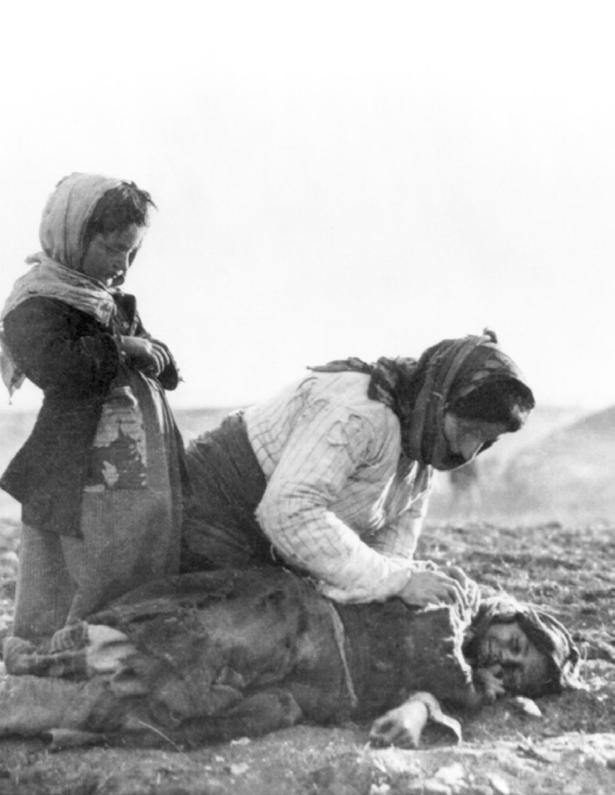
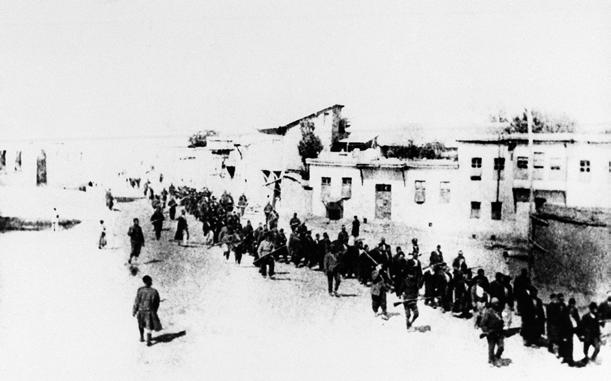
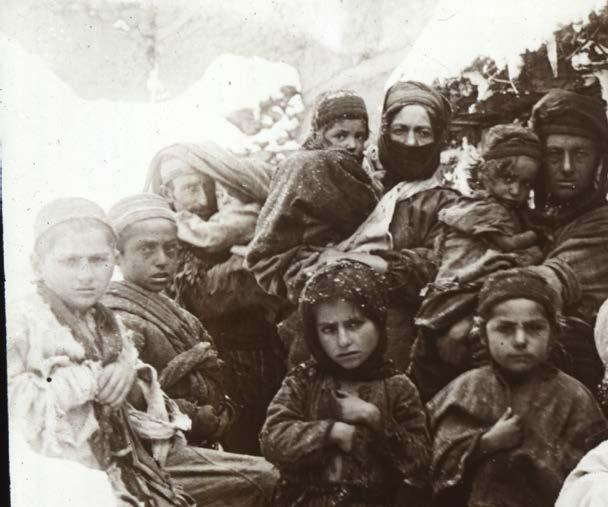
(WWI) on the side of Germany, fighting against Russia in the East. Only a small number of Armenians joined the Russians, but the Turkish forces accused the entire Armenian community of fighting against them and siding with Russia. During the war, the Ottoman Empire grew weaker by the day, and the Turks saw Armenians as a cause of this impending collapse. Tensions escalated. On April 24, 1915, under the guise of war, Ottoman officials arrested and executed hundreds of Armenian intellectuals. Later, adult males were condemned to hard labor camps, where the men were essentially worked to death or massacred. The remaining population— women, children, the elderly—were expelled from the country on death marches through the Syrian desert. The brutality continued throughout WWI, and it did not fully end until 1923.
The massacre of the Armenians did not go unnoticed in the West—well, at least to the Western media. The New York Times’ extensive reporting on the matter portrayed a murderous vision of the Turkish government and a helpless Armenian people. A 1916 headline from the Times blared, “Exiled Armenians Starve in the Desert.” The article documented a dispatch from the American Committee, which stated in no uncertain terms
the death sentence imposed on the Armenians. They were deported from Turkey and made to wander the Arabian Desert without food or water. The article unequivocally concluded that the Armenians were doomed: “The misery and hopelessness of the situation are such that many are reported to resort to suicide.”
Accounts indicate that, before WWI, around 2,000,000 Armenians lived in the Ottoman Empire. By 1923, only a quarter of that population remained in Turkey. Hundreds of thousands of Armenians were permanently displaced, creating an Armenian diaspora that largely resides in the U.S. Yet 100 years later, neither Turkey nor America has recognized what scholars and historians conclusively agree was genocide.
Congressman Adam Schiff (D-CA) aims to change this wrong. “In many respects, it’s a second killing—not having their own government recognize what they went through,” Schiff told The Politic Schiff represents Los Angeles in the U.S. House of Representatives, and his district has more descendants of survivors of the Armenian Genocide than any other district in the country. In every session of Congress since 2007, Schiff has introduced House Resolution 106, or the Affirmation
of the United States Record on the Armenian Genocide Resolution. After it was first introduced, it passed its initial vote in the House Committee on Foreign Affairs with bipartisan support. Schiff, a Democrat, was confident; his bill had the backing of over half of the members of the House of Representatives. But when it came time for a vote, Speaker of the House and fellow Democrat Nancy Pelosi (D-CA) indefinitely postponed the vote. President Barack Obama opposed the resolution, as did then-Secretary of State Hillary Clinton. All eight living Secretaries of State at the time signed a letter expressing their opposition. Three former Defense Secretaries did so as well. At the time, the government of Turkey spent hundreds of thousands of dollars monthly on lobbyists to oppose the passage of the resolution. The message was clear: no such recognition of the Armenian Genocide by the American or Turkish governments would occur. Nor has it, in the eight years since Schiff first introduced House Resolution 106.
This controversy over official recognition of events that occurred 100 years ago seems unwarranted. Those events are widely regarded as fact, although David Simon, director of
Yale’s Genocide Studies Program, noted that even “the word ‘fact’ is used in quotation marks, and ‘contention’ itself is contentious.” There is no binary scale used to determine what constitutes genocide and what does not. The term “genocide” was actually not created until the 1940s, when Polish Jew and Holocaust survivor Raphael Lemkin coined the term. Lemkin cited the Armenian Genocide as his basis for searching for a word to describe the aim to systematically destroy an entire people. Simon’s studies of genocide have proven that controversy arises any time the word “genocide” is used. This is particularly evident in the case of the Armenian Genocide. He believes that an official recognition of the events of 1915 as genocide “would restore some dignity after what is not just an assault, but a personally felt assault.” Schiff agrees: “Words really matter, especially about crimes against humanity.” And for Schiff’s constituents, the genocide is “a contemporary and continuing issue.” But a normative judgment of the Armenian
surounding Schiff’s resolution is a fear that an American recognition of the Armenian Genocide would lead to disastrous consequences for America’s relationship with Turkey. Robert Wexler, current director of the Daniel S. Abraham Center for Middle East Peace, previously served in the House of Representatives, where he created the Congressional Caucus on U.S.-Turkish Relations. “There are overtly political circumstances,” noted Wexler, who recognizes as “the bottom line [that] Turkey is a NATO ally of the United States.” And today, Turkey houses U.S. military bases that hold thousands of American soldiers. “What obligation do you have as a member of Congress?” he wonders. For him, the answer was an unwavering responsibility to protect American military interests.
For Schiff, this response is not good enough. “We can’t politicize the issue of genocide,” he said. Doing so “undermines our ability to be a leader on human rights.” The question is much more complicated than it at first seems,
or given a speech in remembrance of the massacres that occurred in Armenia. The response to Schiff’s resolution is not because of a lack of acceptance of the events of 1915, and this acknowledge could be a good thing—a recognition of Armenian suffering at the hands of the Turks does mean something. But it denies that the Armenian people were targeted specifically for who they were as people, and as such it is not enough. The debate, then, goes much deeper, and has raised the question of whether the U.S. places a greater value on moral ideology or strategic goals.
Currently, Obama opposes Schiff’s resolution, which would demand American recognition of the Armenian Genocide. But when Obama was a presidential candidate in 2007, at the time that Schiff introduced the resolution in Congress, he supported it. In a position paper from his early campaign, he firmly stated, “As president I will recognize the Armenian Genocide.” Obama was a senator at the time, and he no doubt understood the potential political consequences of such a move. Why, then, has he not recognized the Armenian Genocide during his two terms in office? Would adopting Schiff’s resolution and recognizing the events of 1915 as genocide actually alter America’s relationship with Turkey?
Ethnic pride is central to the identities of both Armenians and Turks. This mentality poses a problem when that pride manifests itself as an Armenian demand for recognition of the genocide, for restoration of dignity, and an equally fervent opposition from Turkey, which also seeks to maintain its national pride. Seyla Benhabib, a Yale professor of Political Science and Philosophy who grew up in Turkey, remembered silence about the Armenian Genocide. “Nobody quite knew about the extent of it,” she recalled. When she entered the world of academia, she began to simultaneously learn more about the genocide and notice the Turkish government’s opposition to its recognition, which stemmed from “a kind of cultural pride.” Even though Turkey in 1915 was ruled by a completely different government—that of the Ottoman Empire rather than that of the current Republic of Turkey—this pride is still pervasive today. “We do not want to be the first nation accused of genocide in the 20th century,” Benhabib recounted a government official in Turkey once teling her. It seems Turkey will do whatever it can to ensure it does not gain the infamous title.
Meanwhile, there are some people in Turkey who see normalizing relations with Armenia as a first step to reconciliation. The Turkish government fears the legal and economic repercussions of genocide recognition. It worries about reparations demands. As Simon pointed out, “The crime of genocide doesn’t have a statute of
Accounts indicate that, before World War I, around 2,000,000 Armenians lived in the Ottoman Empire. By 1923, only a quarter of that population remained in Turkey.
‘To forget the dead would be akin to killing them a second time.’
Elie Wiesel
limitations,” so any such demands would be legally permissible.
Over the past few years, Turkey has engaged in other forms of reconciliation. The Turkish government has restored churches in Armenian villages, and it has recognized them as remnants of the Armenian community of Turkey. Diplomatically, Turkey has extended a proverbial olive branch to Armenia. The governments have been communicating, and a few years ago, the president of Turkey attended a soccer match between the two countries in Yerevan, Armenia. “Football diplomacy,” as it has been called, is better than nothing. “I think that one should focus on increasing these peopleto-people contacts, and not just fixate on the G-word,” Benhabib says. And if Turkish recognition of the genocide is realistically not going to happen, this move indeed seems like a feasible alternative. But Turkey, although an American ally, has a long-standing legacy of human rights abuses. If the U.S. wants to maintain its credibility as a defender of human rights in the international arena, it should not take policy cues on this important matter from Turkey.
The last important question is whether Turkey would really cut off the
U.S., its great Western ally, if Congress passed House Resolution 106 and formally recognized the Armenian Genocide. Schiff believes that such curtailed relations are unlikely. “I don’t think becoming complicit in this respect will make them a better friend of the U.S.,” he says. Further, he noted that, of the European countries that have recognized the Armenian Genocide, none have faced any major obstacles in their relationship with Turkey. (Only 22 nations in the entire world have recognized the Armenian Genocide.) And most importantly, he argued, “Turkey will do what is in its natural interest to do—not breaking relations with the United States.”
Wexler is not quite convinced, although for two very different reasons. The first, in Wexler’s eyes, is a lack of interest by the U.S. government to alienate “one of our most important allies against the Soviet Union.” This alliance remains today, and Wexler feels that an American recognition of the Armenian Genocide could cause the government serious harm. “We’re talking about events that occurred 100 years ago, and [now] you’ve got American soldiers on the ground today in Turkey,” Wexler pointed out. For him, as a member of Congress, the question was exclusively political: His constituents were
the undying spirit of those who lost their lives.
Americans, and his sole responsibility was to them. Because of this fact, Wexler saw any action that could potentially threaten American safety as one that should be avoided.
The Ottoman Empire, which inflicted the wounds of the Armenian Genocide, disintegrated after WWI. In its place came the modern-day Republic of Turkey. Turkey joined NATO during the Cold War, when Turkish forces and American forces often joined together. Armenia was a Soviet nation at the time, an immediate enemy of both the U.S. and Turkey, and Armenia’s standing as inferior perhaps still remains today. The factors at play are endless, but the question comes down to whether the U.S. will do what is right or what is convenient. This country is keenly aware of the fact that the greatest human right—life—was taken without reason from over one million Armenians 100 years ago. Perhaps as April 24 approaches, and Armenians dispersed across the globe mark the centennial of their genocide, the U.S. will affirm its long-standing commitment to the rights of all men and women. Holocaust survivor Elie Wiesel reminded us: “To forget the dead would be akin to killing them a second time.”
The eternal flame at the Armenian Genocide Memorial signifies the natonal rebirth of Armenians and
Incivility? Examing the Controversy Behind Civil Forfeiture
By Joanna Lee
An underground marijuana operation. A former high school teacher. An unsuspecting wife. The scene resembles something from Breaking Bad, but for Kathleen von Hofe, the situation became a reality when the Branford, CT, police department raided her home in 2001.
While Harold von Hofe admitted to growing and distributing marijuana in the basement of their house, his wife staunchly maintained her ignorance of the entire operation, pleading guilty only to the possession of a controlled substance. According to the CBS News, both avoided prison time, receiving only a suspended sentence and probation. However, the ordeal continued for Mrs. von Hofe when the federal government seized her house shortly afterward in a legal maneuver known as civil forfeiture.
“Forfeiture is a tool in the government’s bag of tricks and it’s an unfair tool,” said Jonathan Einhorn, the attorney who represented both of the von Hofes. Civil forfeiture refers to a practice in which law enforcement can seize property or assets without necessarily charging their owners with a crime. In von Hofe’s case, the Branford police seized her ranch home despite the lack of charges or indictments against her. When von Hofe, represented by Einhorn, took the case to
the U.S. District Court of Appeals, she won her half of the house back, by arguing that the forfeiture represented an abuse of the excessive fines clause of the Eighth Amendment.
***
A controversial legal practice, civil forfeiture has long been criticized by politicians, lawyers, and civil rights activists. In civil forfeiture, the owner of the property is not necessarily the one charged with a crime—instead, the object seized is considered to be guilty of illegal activity. While criminal forfeiture is what is typically seen in a Person A v. Person B court case, civil forfeiture cases are disputes between police and an object, leading to strange-sounding cases like United States v. Approximately 64,695 Pounds of Shark Fins (2008).
By nature, civil forfeiture calls into question the power and authority of law enforcement. Because police departments can retain most of the property seized to supplement their own revenue, there is a fear that it incentivizes police corruption and aggression in targeting vulnerable individuals and their property.
Last month, Attorney General Eric Holder responded to these criticisms with a move to eliminate the Department of Justice’s Equitable Sharing Program, which allows local and state police forces to seize property and transfer it to the federal government. The forfeiture case is then funneled into the Department of Justice, and the federal government takes about 20 percent of the asset’s worth, meaning that local police departments keep 80 percent of the seized property’s value. While Equitable Sharing began in the 1980s to nobly stop drug cartels, today it may help some police officers steal from the populace. ***
Under Holder’s new policies, the federal government will no longer adopt local and state civil forfeiture cases. Groups like the American Civil Liberties Union (ACLU) lauded Holder’s announcement as a crucial step in meaningful criminal justice reform. Kanya Bennet, Legislative Council at ACLU, said, “In terms of the Attorney General’s order, the ACLU certainly applauded that. It’s a first step in addressing federal civil forfeiture that we feel is really fueling a lot of questionable police practices on the ground.”
Many of these “questionable practices” involve the unsavory topic of racial profiling. The ACLU suspects that minorities are disproportionately victim to having their property seized by the police. Morrow v. City of Tenaha (2012), which featured a civilian against an East Texas town, appears to be an example of
the intersection between civil forfeiture and racial profiling.
The ACLU involved itself in the case “because of the egregious offenses and tactics that were used in the name of civil asset forfeiture,” explained Bennet. These offenses included police officers stopping, searching, and often seizing the property of African American and Latino drivers. According to the ACLU, over 140 cases involved police officers taking passengers’ money, lest the driver be charged for money laundering. The Tenaha police even threatened to put one couple’s children in foster care if they did not hand over $6,000.
Einhorn agreed that minority groups were particularly vulnerable to being singled out by police forces, especially illegal immigrants. “There are entire counties in California where police budgets were funded by forfeitures. They’d pull over someone they’d determine to be illegal, they’d cheat them of their money and there was no way that person would want to have a hearing and end up being deported,” he said.
Unfortunately, Holder’s ban on the Equitable Sharing Program may be little more than a political move. In an interview with The Politic, Stephen B. Duke, a professor at Yale Law School, said, “Attorney General Holder, in terminating the Justice Department’s equitable sharing program, did not put an end to civil forfeiture. The termination simply requires state police to rely on state law in seizing assets and in determining who gets to keep them.” In other words, civil forfeiture still exists; it is now just up to the states to decide whether or not to keep the practice.
Some states had already wisened up to the practice before Holder’s decision to end equitable sharing. For example, Missouri passed the Civil Asset Forfeiture Act (CAFA) in 2001 to specifically close the loophole that allowed police departments to profit from equitable sharing. The new law ensured that seized assets went into a public education fund by defining seizure as the moment police forces took possession of an individual’s property. While Missouri remains only one of the few states that have passed civil forfeiture reforms, several advocacy groups are optimistic that the practice will eventually end or at least be mitigated by more stringent oversight.
“Hopefully, many legislatures, after study, will decide that the fruits of forfeiture should go elsewhere, such as the state’s general funds, schools or public defender organizations,” Duke said. “They will also, hopefully, confine the discretion of the police to seize assets and will reform the procedures by which the legitimacy of the seizures can be tested.”
Plastic Paradise Examining Brazil’s Cosmetic Surgery Boom
By Ian García-Kennedy
A surgeon penetrates the bridge between your two nostrils. Tweezers enter the space created by the incision, lifting the skin off your nose as if it is the hood of a car. Now comes the scalpel, cutting bone and transforming cartilage until the nose takes on its desired shape. This disquieting and quease-inducing procedure— rhinoplasty—should be familiar to anyone who has been even remotely attuned to mainstream American culture since the 1980s; this is a nose job, a tangible reminder that people will do crazy things to stay beautiful.
The U.S., with its old-money, minkdonning socialites and fading Hollywood icons whose Walk of Fame stars have been trod on just a few too many times, is reputed to be the world’s plastic surgery leader. Another country, though, has wholeheartedly embraced the surgery of self-improvement.
In 2014, for the first time in history, Brazil overtook the United States in cosmetic procedures. Brazil accounts for 12.9 percent of all the world’s plastic surgeries, just edging out the 12.5 percent of the U.S. What initially seems like a trivial difference takes on a new significance when one considers that the population of the U.S. is over 50 percent greater than that of Brazil. The statistics raise even more questions when
one takes into account that U.S. GDP is approximately eight times that of Brazil. And yet, Brazil is outpacing the U.S. in operations per capita, with 74 plastic surgeries performed per 10,000 people compared to 45 in the U.S.
Despite Brazil’s unfortunate reputation for poverty-plagued, crime-ridden slums, its people have demonstrated a remarkable skill for upward mobility, much like the country itself—now the world’s eighth largest economy. This relatively new prosperity has awakened a long dormant consumer society. Over 35 million Brazilians have escaped from poverty in the last 12 years, creating a new lower middle class that is far from prosperous but also far from destitute. It is these people for whom self-confidence and self-love are no longer luxuries, and it is this income bracket that is fueling Brazil’s plastic surgery trend.
However, the economic boom does not fully explain plastic surgery boom. The answer lies in culture, particularly in cities dotting Brazil’s massive coastline.
Dr. Paulo Da Luz Moreira, an associate professor in the Spanish and Portuguese department at Yale and an expert on Brazilian issues, describes Brazil as having “a very strong beach culture, an environment where you’re practically naked in front of everyone else since
you’re a baby.” Such an environment may increase the pressures to conform to popular perceptions of beauty and youth. This trend is expensive, but it is made more affordable by Brazil’s tradition of retail financing in installments: consumers split payments with retailers to mitigate exposure to abusive interest rates, making cosmetic procedures available to citizens of the middle class who could otherwise not afford them.
The culture and openness surrounding plastic surgery in Brazil is different than almost anywhere else in the world. Plastic surgery in the U.S., on the other hand, is still shrouded in stigma and taboo. Just a few months ago, actress Renee Zellweger’s apparently post-surgery appearance on the red carpet set off a storm of negative publicity and criticism about the procedures she had supposedly undergone.
In contrast, body modification is a status symbol in Brazil, showing both that you care about your appearance and can afford to pay for a new one. Dr. John Persing, current vice president of the American Association of Plastic Surgeons, told The Politic that plastic surgery in Brazil is “a normal routine for people who can afford it, much like changing hair color was fifty years ago.” During his extensive professional touring of Brazil and its cosmetic clinics, he came to the conclusion that American acceptance of plastic surgery is “not at the same level as in Brazil, where cosmetic surgery is not hidden from friends and the general public and is sometimes emphasized.” He recalled going to lunch at a popular restaurant in which the diners sitting at the next table over “had obviously had rhinoplasty the day before” and were making no attempt to hide this fact. Such openness about plastic surgery has made those who would otherwise fear stigmatization for wanting to alter their appearance embrace attempts at selfimprovement.
There is a dark side to the plastic surgery boom in Brazil, though. As Persing noted, regulation on plastic surgery is much more relaxed than it is in the U.S. and Europe. This lack of regulation does offer at least one obvious benefit: prices are kept relatively low by virtue of the sheer volume of people offering cosmetic procedures; a facelift in Rio de Janeiro costs about $8,000, versus over $14,000 in California. The downside, though, is that some people with no training whatsoever conduct injections. While injections such as Botox and collagen may seem relatively straightforward, especially in comparison to more complex procedures, a botched session can lead to permanent disfigurement.
The potential downsides were brought to the forefront of national news when Andressa Urach, a runnerup in a national beauty pageant, was
left hideously deformed. Chemical filler injections, meant to give more full-looking legs, began to eat away at her flesh. The situation further deteriorated when she went into shock during a corrective procedure. Newspapers published horrifically graphic photos of the now wheelchair-bound Urach with tennis ball size holes in her legs and thighs.
Yet Brazilians continue to flock to plastic surgeons for touch-ups, full-body makeovers, and everything in between. Brazil has an apparent surplus of plastic surgeons, a particularly shocking fact stemming from a country that had to import 10,000 doctors from Cuba to fill its need for doctors in poor areas and the countryside. Foreign plastic surgeons have gotten the message that there is money to be made in Brazil. A short online search of Brazilian clinics yields a surprising number of websites for foreign doctors. Dr. Dennis Hurwitz from Baltimore counts Beverly Hills, Pittsburgh, and São Paolo among the sites of his private clinics.
the possibility that a hatred of our own looks can be just as crippling as a more traditional disorder? What the plastic surgeons of Brazil argue is that they are not just reshaping bodies but saving those who would otherwise spend their lives mired in self-hatred.
The idea of offering charity cosmetic surgery may strike one as odd, and yet, an argument could be made that it is just as much an issue of quality of life as any other charity case. Why should the rich monopolize self-love?
One has to wonder if such a pervasive culture of body modification can harm a national psyche. While “a minority” argue that plastic surgery is an act of feminist empowerment, Dr. Marianne LaFrance, professor of Psychology and Women’s, Gender, and Sexuality Studies at Yale, said that “the evidence would still strongly suggest that women are overvalued for their appearance and are often in the position of doing everything and anything they can to change their appearance.” She also said that there is “a remarkable consensus cross-culturally on what’s an attractive face, what’s an attractive body.”
Yet no single doctor has risen as high as one of Brazil’s very own. Dr. Ivo Pitanguy is something of a Brazilian celebrity. “The Michelangelo of the Scalpel” has achieved fame and fortune as the country’s most eminent and exclusive plastic surgeon. He lives on a private island, far away from the hustle and bustle of his clinic in Rio de Janeiro, and he speaks in elegant rhetoric about the plastic surgeon’s job as “the search for harmony between body and soul.” The idea that a plastic surgeon could achieve national fame sounds absurd to an outsider, but it is what he does with his fortune that takes Brazil’s plastic addiction into the realm of the surreal. Pitanguy clinics are charity-bent. They do the same type of pro-bono work that American plastic surgeons do: fix babies with cleft lips, burn victims, and those disfigured by accident. But they have one more category of surgery that one would not see in the U.S.: the charity cosmetic surgery. Pitanguy’s clinics offer highly discounted cosmetic operations, such as breast augmentation, rhinoplasty, and collagen injections, to the needy and underfunded.
The idea of providing charity cosmetic surgery may strike one as odd, and yet, an argument could be made that it is just as much an issue of quality of life as any other charity case. Why should the rich monopolize self-love? The U.S. suffers from the highest rates of eating disorders and self-harm in history. Can we reject
That consensus tends toward a European standard of beauty. In a country that is largely mixed-race because of a history of slave importation from Africa, the leading celebrities and fashion models—Gisele Bündchen comes to mind—tend to be primarily blonde and light skinned. Even Claudia Alende, the winner of the 2014 Miss Bumbum pageant, wears blue contact lenses in public appearances. Dr. Sharrona Pearl, a professor at the University of Pennsylvania and an expert in physiognomy—the study of the face—has studied how women of color often strive for an Anglo look. “Skin lightening is still widely practiced despite the dangers,” she told The Politic. “There is still a lot of surgery in different countries to make noses narrower and to get the epicanthal folds reduced.” While plastic surgery has given more freedom to women (and men) to control their own bodies, such modifications may be converging towards a whiter perception of beauty. Whatever the reasons and effects, the plastic surgery culture of Brazil shows no signs of subsiding. In fact, it has even become essential in a competitive job market for women to abide by cosmetic norms in order to make themselves more marketable to job interviewers. On one hand, this is a very proactive approach to the issue of aesthetic conformity. By shattering the taboo and inaccessibility surrounding plastic surgery, Brazil may finally be giving its people a way to love their reflections. Maybe one day they won’t feel the need to change the person looking back at them.
Cover story
The Dilley detention center promises Central American asylum-seekers humanitarian housing—but some may be receiving more abuse.
By Anthony Kayruz
Gerardo Gonzalez, a 70-year-old lifelong resident of Dilley, Texas, did not recognize them. The two middle-aged white men dressed in button-ups and slacks stood out ostentatiously among the Mexican watermelon pickers and oilfield workers taking their lunch break in Taqueria Jalisco, one of the few restaurants that offers sit-down dining in the small, 3,000-person town of Dilley. Even the way the two men said taco attracted attention. “It’s not taw-co; it’s thah-co,” Gonzalez thought as he paused from eating his enchiladas verdes to examine the men. They clearly were not locals. Only 85 miles from the South Texas border, Dilley is almost entirely Mexican. Gringos—those with white skin—are conspicuous. Occasionally, white deer hunters pass through, or tourists come to take pictures of Dilley’s haunted Feed and Grain Mill, “Watermelon Capital of Texas” monument, and “Slice of the Good Life” welcome sign, but the two men didn’t wear the faded green attire of hunters nor bear the oblivious smiles of tourists. One of them held a briefcase; they were here on business. The two men, Tommy Alsup, an employee from the private prison company Corrections Corporation of America (CCA), and a representative from Target Logistics, a company that specializes in workforce housing, arrived in Dilley on August 25, 2014, to alert the city council that the 51.5 acre tract outside the town previously used to house oilfield workers would be converted into the South Texas Residential Center, the largest immigrant detention facility in the United States.
The meeting between the two men and the Dilley City Council was merely a formality. CCA and Target Logistics had already received the go-ahead from Immigration and Customs Enforcement (ICE) to begin construction on the detention center. “It was out of our hands because it was a private business leasing out a private piece of land,” Noel Perez, the city administrator of Dilley, recounted. “Even though it’s within our city limit, we
don’t have jurisdiction.” After showing the city council blueprints of the 2,400 bed facility and verifying that Dilley had appropriate water and electrical utilities for the detention center, the two men left town. But their exit did not stem the tide of foreign CCA and Target Logistics workers that would soon arrive. Gerardo, who used to describe Dilley as el pueblo tranquilo or “the tranquil town” now referred to it as a place where “thousands of people come.” From September to December 2014, more and more people appeared in Dilley. Most were “from the West Coast,” according to a young lady who runs the only fitness center in Dilley and has sold many new gym memberships to CCA employees.
Among the new faces was Jeh Johnson, Secretary of Homeland Security, who visited Dilley on December 15. 2014, to officially open the South Texas Residential Center. Standing behind a podium along one of the arid, red dirt roads that line the detention compound, Johnson, in a press conference, announced that the 51.5-acre facility would house women and children who crossed the border illegally.
The Dilley facility is the fourth of its kind. While 250 other immigrant detention centers holding 33,400 undocumented persons dot the United States (U.S.), the Dilley complex is what ICE calls a “family detention space.” The
name, however, is a misnomer. ICE defines a family as only a mother and her children. Fathers are separated from their wives, sons, and daughters and detained at standard immigration detention centers with other individual undocumented adults.
A man whom The Politic will call Luis* was separated from his wife and three sons after attempting to cross the border to flee gang violence perpetrated by the Zetas cartel in Sabinas, Mexico. “It’s hell over there,” Luis told me. “People get decapitated for no reason.” Luis was held in an immigrant detention center in Laredo, TX, away from his family. Every week, he would run to the mail pickup to read a letter from his wife and kids. Even though he was locked up 23 hours a day, his wife’s handwritten scrawl still made him smile. One day, a detention officer demanded Luis give him his wife’s letter. After refusing multiple times, the officer forced Luis downstairs and beat him. He hit Luis with a baton twenty times while instructing him, “You do what we say. You don’t belong to nobody. You belong to us.” A week after the incident, Luis was deported back to Mexico, back to the violence of Sabinas, without his family.
Distraught over his separation from his wife and child, Luis paid a coyote, a person who helps undocumented migrants cross the American-Mexican
border, $2500 and made the trek to the Rio Grande, the dangerous waterway that separates Texas from Northern Mexico, again. When he neared the river, members of the Zetas cartel spotted him. “They told me I had to carry drugs across the border or die,” Luis recounted. Using the night to his advantage, Luis slipped away, sprinted towards the Rio Grande river, and plunged into the water. He let the water submerge him and allowed the current to carry him away from danger. “The night is the best time, but I was still running for my life,” Luis said, grinning, proud of his escape. A month later, he reunited with his family in San Antonio, a year after their initial separation. Luis solemnly informed The Politic that other fathers aren’t as lucky as him.
Division of families causes emotional turmoil, but the U.S. government sees family detention as a necessity. Before the summer of 2014, family detention was not a priority. At the time, only one family detention center existed: Berks County Family Shelter, an 85-bed facility in the small town of Leeport, PA. Since June 2014, however, ICE adopted an aggressive stance of rapid family detention and deportation. The timing of the policy shift is not coincidental. From October 2013 to September 2014, U.S. Customs and Border Protection (CBP) apprehended 68,445 family units (a mother and her children),
a 461 percent increase from the previous fiscal year. An influx of Central American migrants caused the spike in detainments. Of the 68,445 family units that entered the U.S., 61,334 were from Guatemala, Honduras, and El Salvador, collectively known as the Northern Triangle.
Gang violence—similar to what Luis experienced in Mexico—often drives Central Americans from the tropics to the barren desert of South Texas. Maritza, a sixteen-year-old who currently resides in the U.S. with her mother and two sisters, fled with her family from El Salvador to the U.S. after members of the Mara Salvatrucha (MS-13) gang took an interest in her. “In El Salvador, they take young girls, rape them and then throw them in plastic bags,” Gabriela explained to the United Nations (U.N.) Refugee Agency. “My uncle told me it wasn’t safe for me to stay there.” According to the U.N. Office of Drugs and Crime, Honduras, Guatemala, and El Salvador rank one, four, and five respectively for countries with the highest homicide rates. Honduras tops the list with 90.4 killings per 100,000 people. The massive migration of family units from the Northern Triangle to the U.S. this past summer has overwhelmed President Barack Obama’s administration. In an attempt to expedite the legal proceedings of family units to determine asylum status, Obama has based his immigration policy on detaining adults with their children, according to a White House press release. By keeping family units centralized in detention facilities, the government can “enable the prompt removal of individuals who do not qualify for asylum.”
Although Obama’s rhetoric has focused on efficiency, Johnson barged into Dilley with a different message. To him, the South Texas Residential Center carries this refrain to immigrants: you are not welcome here. Johnson sees the facility primarily as a deterrent to potential immigrants. “All those who came here illegally after January 1, 2014—in other words, beginning of this year—are now priorities for removal to their home countries,” Johnson announced in a press conference after the opening of the immigrant detention center in Dilley. He added, “It will now be more likely that you will be apprehended. It will now be more likely that you will be detained and sent back.” He did not mention the U.S. as a possible home for families attempting to escape persecution in the Northern Triangle.
Cristina Parker, the Immigration Projects Director of Grassroots Leadership, a non-profit that monitors private prisons and the detention of immigrants, concluded that “the government is targeting fleeing women and children migrants specifically. I don’t know why, but they are.”
Nina Pruneda, the ICE agent overseeing the Dilley detention center,
refused to comment on the purpose of the new center. “The only person authorized to talk about the matter is the Secretary of Homeland Security,” she told The Politic. Her superior, Vincent Picard, confirmed that ICE was not allowed to comment. All press would go through Johnson.
The South Texas Residential Center officially opened on December 15, 2014, when Johnson left Dilley. It received its first families on December 19, 2014.
Where is Eloy, Arizona?
Harvey Krauss, the city manager of Eloy, Arizona knew that his city had struck a great deal. Pressured to scrap the insufficient 700-bed, federally-run immigrant detention facility in Artesia, NM, for the larger detention complex in Dilley, the Department of Homeland Security looked to the Corrections Corporation of America (CCA) to build a new center. To avoid the bureaucratic red tape of constructing a detention complex from scratch, ICE and CCA added Dilley’s South Texas Residential Center to Eloy’s preexisting contract for the Eloy Detention Facility. Eloy will receive $436,000 a year for the contract expansion.
Besides the fact that Eloy is farremoved from Dilley (931 miles and two states away), the strongest opposition against Eloy’s role comes from the troubling track record of the CCA-led Eloy Detention Center. Of all the detention centers and prisons that ICE oversees (private and federal), the Eloy Detention Center has the highest death rate. Thirteen immigrants have died in the Eloy facility since October 2003. Krauss shrugged off the statistic with the answer: “People die all the time.” Yet, the causes of death are alarming.
On October 8, 2008, Emmanuel Owusu, a 62-year old Ghanaian arrested for shoplifting, hanged himself after spending less than two years in Eloy’s detention center. Two others—a 32-yearold from Guatemala and a 29-year-old from Mexico—also hanged themselves. One died from diabetes at age 34, while another passed away from congestive heart failure at age 54. “What we are seeing here are people who could have survived if offered proper psychiatric and medical care,” remarked Dr. Sandra Vasquez, Director of the St. Mary’s Health Science Center in San Antonio, TX, after reviewing the cases of those who died in the Eloy Detention Center. “If they are really getting screened and taken care of, those deaths shouldn’t happen.”
Krauss, after learning the specifics of Eloy Detention Center deaths, still puts his trust in the Corrections Corporation of America and believes it is a “professional organization and will deal accordingly with issues they have.” A CCA representative from the Eloy facility also confirmed that the center has improved its
medical and psychiatric services, has not had a death in 2014, and receives weekly inspections from ICE officers.
Bob Libal, the executive director of Grassroots Leadership that fights to end for-profit incarceration, is skeptical of CCA’s assurances. “ICE has oversight control of CCA, but it fails. ICE is so dependent on private corporations like the CCA that it completely defers decisions to them.” He recounted an open meeting that ICE and a private prison company conducted to unveil a new private prison in Austin, TX. After introducing themselves, the ICE representatives immediately referred to the CCA directors as the “real experts” who would explain the ins and outs of good prison practice. “The CCA is really in control of its own actions,” Libal said. “Any oversight is minimal. With shareholders in mind and a bad track record, do we really want the Correction Corporation of America at the helm of our immigration policy?”
Don’t Call It a Prison
The two rows of palm trees that line the entrance of the new 2400-bed detention center in Dilley look out of place among the scorched grass and barren dirt roads of South Texas. They evoke thoughts of West Coast sunshine, not piercing, desert heat. Two “South Texas Residential Center” banners hang against a fashionable limestone wall infused with stucco, one next to each set of palm trees. Judging by the name and entrance, a passerby might think that the complex is a wealthy collection of apartments. Only the barbed wire fence around the center’s perimeter signals otherwise.
Inside the South Texas Residential Center, two soccer fields and three playgrounds are nestled among the modular houses and dirt roads. Inside each home is a flatscreen television and two red couches. Common areas have Xboxes, and the learning centers have computers with a rotating Bienvenidos!—“Welcome!” in Spanish—as the screensaver. Residents will be offered three meals a day. The amenities within Dilley’s detention center do not sound like the features of a prison or the work of a private-prison company. Noel Perez, Dilley’s city administrator, said the new center is a “humanitarian move from Immigration and Customs Enforcement to provide decent housing for migrant women and children as they go through the immigration process. They will have better housing and eat better than they did in their home countries.”
Two CCA corrections officers, one male, the other female, agreed to speak with me anonymously about their first week at the Dilley detention center. They cited CCA and ICE policy as their reason for anonymity. “We can’t even give you our names or tell you where we’re from,”
one of them explained. “It’s for our own protection,” the other added.
The male CCA officer, who worked in two other prisons, one federal and one private, described the South Texas Residential Center as a “whole different ball game.” He repeatedly emphasized the residential aspect of the detention center. He remembered the first children running into their temporary homes and smiling as they turned on TVs and jumped on the sofas. “These families are living well” was the refrain that the officer muttered under his breath throughout our conversation.
The female CCA employee explained how at the South Texas Residential Center, corrections officers are called “resident advisors,” RAs, and wardens are called “administrators.” The naming system is reminiscent of a college, where the RA’s job is not just to ensure the safety of their students but also to make sure they have fun. The CCA employees feel the same way.
One six-year-old child from Guatemala ran around the facility playground, pretending to shoot webs out of his wrists. “I’m Spiderman!” he yelled while climbing the dark green monkey bars as if they were part of his fantastical construction of webs. Exhausted, the boy ran inside and saw another child playing with a superhero action figure. He sat against the couch and pouted, “I wish I had a Spiderman toy.” Three minutes later, the female CCA “resident adviser” tapped the boy on the back and said, “Here you go,” as she placed a new Spiderman action figure into his hand. “It looks like a Toys ‘R’ Us inside. You feel like you’re not even at work; you feel like you’re with your grandkids,” she explained.
“It’s not a prison whatsoever. The families love it compared to where they’ve been. They are blessed that they are here,” the male CCA employee concluded.
Nevertheless, the Dilley population, 35.8 percent of whom lives below the poverty line, are divided over the conditions at the detention facility. Some, like Father Antonio Villanueva, who leads
St. Joseph’s Catholic Church in Dilley, are glad that the migrants are being treated humanely. “I am in favor of the facility because it emphasizes the humanity of the women and children,” he proclaimed. For the first time in their lives, they seemingly get to experience Dilley’s motto: a slice of the good life.
Others, burdened by taxes and struggling to make a living, resent the amenities of the South Texas Residential Center. Petra Torres, a small 62-year-old woman who has lived in Dilley her entire life, operates a gaming arcade in the center of town. She has swept the concrete floors and cleaned the slot machines since she was twelve. Petra knows Dilley as well as she knows her arcade; she has seen it grow from a hundred-person outpost to a small town along a major highway. She believes development, whether it be the building of a Dollar General or the construction of a new road, always leads to more taxes and price hikes. Petra held out her mop and sullied cloth to me and confessed, “I have worked the same job for fifty years. I can’t quit because I need the money to get by, and meanwhile my dollars are paying for migrants to live in luxury five minutes from my house.”
Petra is right that housing undocumented family units in a detention center is not cheap. It costs the federal government $266 per day for each detained migrant in the South Texas Residential Center. To put this amount in perspective: it costs $254 to stay at the Hyatt Hill Country Resort and Spa, a four star hotel in San Antonio that boasts a lazy river and a beach area. Assuming the detention center is filled to its 2400-bed capacity throughout the entire year, the government will pay approximately $233 million for the South Texas Residential Center in 2015. It is no surprise that the Secretary of Homeland Security requested supplemental funding from Congress.
The gym teacher at Dilley High School, who also runs the local fitness center, observed that the high school
doesn’t even have “two soccer fields, three playgrounds, or three good meals a day.” She said it is “absurd” that the U.S. pays for migrants to live well while Dilley has its own homeless women and children.
Petra and Dilley’s gym instructor, united in their opposition to the new detention center, still acknowledge that it will provide 600 more jobs for people in Dilley. The jobs will pay $24 an hour, about three times more than minimum wage. Albert DeLeon, Dilley’s Chief of Police, admitted with a hearty laugh, “Lots of people wished they worked there, or even better—lived there.”
Too Good To Be True
Alta García tries to quiet her 10-yearold daughter Ana, who lies on the floor in a sobbing fit. Her younger brother Victor stays quietly curled in the corner. He hasn’t said much since they arrived at the “residential center.” Martín, Alta’s twoyear-old son, has grown accustomed to throwing tantrums and hitting other kids. Alta’s children were not always this way. Ana was well behaved back in El Salvador. Victor, now sulking in the corner, was sociable, and Martín was calm. Their mannerisms changed after a month of being in Karnes County Residential Center, an immigrant detention facility for families in Southern Texas.
Lynette Arnold, a close friend of Alta, visited her in September 2014 and wrote about her experience for CIVIC (Community Initiatives for Visiting Immigrant in Confinement), a nonprofit dedicated to ending immigration detention. She walked through the playfully blue- and red-colored entrance and past the soccer field and play area to reach the visitation room. After speaking with an “RA,” Lynette saw Alta and her children, who ran to embrace her. The RA broke up the hugging and instructed each person to sit in a separate seat. Lynette took a close look at her friend and her children. “They all lost a lot of weight,”
Lynette recounted. “They looked hungry and desperate for comfort.”
Grassroots Leadership’s Bob Libal confirmed that weight loss is not unique to Alta’s family. Libal told me, “I went to Karnes, and I spoke to many women, all of whom said their children were losing weight due to poor nutrition and stress. Moreover, many have been threatened with separation of their kids as a disciplinary mechanism.”
Karnes County Residential Center, where Alta and her children stayed, was built in 2012 as a model for humanitarian immigrant detention. The GEO Group, the private prison company in charge of Karnes, emphasized that the prison staff are “RAs” and that the warden is an “administrator”—just like in Dilley. Converted from a standard immigrant detention center to a family immigrant detention center for Central American women and children in July 2014, the 532-bed facility is full of amenities such as televisions in each room, play rooms with toys, a soccer field, basketball and volleyball courts, and computers with internet access. Sound familiar? It should. Karnes County Residential Center was marketed the same way that Dilley’s South Texas Residential Center is now. San Antonio Congressman Lamar Smith (R-TX) scoffed at Karnes and ICE for going “beyond common sense to accommodate illegal immigrants… and treating them better than citizens.” His remarks read like the criticisms of some Dilley residents today.
However, recent allegations and lawsuits against the Karnes County Residential Center prove that it is not the luxurious place critics imagine. In September 2014—less than two months after the facility began housing immigrant families—the Mexican Legal Defense and Educational Fund (MALDEF), an organization that seeks to protect the rights of Latinos in the U.S., and the University of Texas Immigration Law Clinic filed two formal complaints to
the Department of Homeland Security regarding human rights abuses within the Karnes Center.
The first alleged that the Karnes facility staff did not offer educational programs to children under the age of four, restricted infants from crawling in non-private quarters, threatened to report disciplinary issues to the immigration judge hearing the families’ asylum case, and failed to have a doctor on site to handle complex medical issues such as persistent coughs and depression.
The second allegation accused male residential advisers of sexual abuse and exploitation. Marisa Bono, the Staff Attorney spearheading MALDEF’s complaints, revealed that three or four Karnes employees are suspected of harassing female detainees. A male RA repeatedly called one female detainee “novia” (“girlfriend” in Spanish) as he groped her and tried to kiss her in front of her children. Another detainee was offered assistance with her family’s immigration case in return for sexual favors. MALDEF’s complaint lamented, “The detainees at Karnes Center are predominantly women and children who have fled horrific violence and conditions in their home countries, including sexual violence and extortion. It is deeply disturbing that their experience in the custody of the U.S. government is subjecting them to further exploitation.”
MALDEF further alleged that the environment at Karnes facilitates such abuse. Guards are predominantly male, and they have unrestricted access to residential dorms and the women and children at any time. ICE spokesperson Nina Pruneda commented that the government has a “zero-tolerance policy” with regards to sexual abuse, but refused to cite specific measures taken by Karnes to address the concerns raised by MALDEF. Bono, the MALDEF attorney, worries that the residential advisers who committed sexual harassment still work at Karnes.
A CCA officer who works at the detention center in Dilley assured The Politic that people should not worry about misconduct within the South Texas Residential Center. He said the RAs “look out for one another” and are not afraid to call out a fellow employee who acts against ICE policy.
But Cristina Parker, an antiimmigrant detention advocate who works for Grassroots Leadership, vehemently disagreed with such assurances: “You have to ask yourself: what have the CCA and other private prisons done before? They have a clear, verifiable track record of abuse and mistreatment of detainees. From Eloy to Karnes to every other immigrant detention center, the government and private prison companies have failed to protect the people entrusted to them. We can’t assume Dilley will be any different.”
Moving Forward
The South Texas Residential Center is the result of conflicting approaches. It attempts to be both threatening and humanitarian. One half tells potential migrants, “Stay away or you’ll be detained and sent back quickly,” and the other says, “But if you do come, you will stay in a place with lots of amenities.” Luis, the father who fled to Texas to escape Mexican cartel violence and reunite with his family, said detention centers would not deter him or anyone else he knew who wanted to come to the U.S. “They are already going to risk everything and take their chances. They’re crazy like that—crazy for safety, freedom, and opportunity. If they have a chance to come, they’ll take it no matter what,” he said. The U.N. Refugee Agency confirmed Luis’s presumption when it reported, “There is no empirical evidence that the threat of being detained deters irregular migration or discourages people from seeking asylum” in a June 2014 press release.
Moreover, “humanitarian detention”—the other aspect of the South Texas Residential Center—is a contradiction no matter how anyone dresses it up. “Detention is of itself a violation of people’s liberty,” explained Libal. The Convention of the Rights of the Child and the U.N. Declaration of Human Rights—two international guidelines for conducting humanitarian policy— also denounce detention for restricting people’s liberty. The reality that the U.S. detains asylum-seekers and subjects them to mistreatment within its facilities gives the U.S. a lamentable human rights résumé.
ICE thinks the Dilley detention center is necessary to ensure timely removals of migrants by making sure they attend their court proceedings, but Alternatives to Detention (ATDs), including GPSmonitored ankle bracelets and weekly in-person reporting programs, have also proven effective: in 2010, Congress sponsored a supervision-reporting program that required undocumented asylum-seekers to check in once every week, and 93.8 percent of them attended their court hearings. The program only cost $12 per person per day, substantially less than the cost of detaining families.
“Just don’t lock them up. It’s not right to lock up wife and kids,” Luis said. “While alternatives may have problems of their own, at least you can move. At least you can go outside. At least it’s not a prison.”
*Name changed to protect privacy.
The Silent Surge The New NHPD Strategy That No One’s Talking About
A New Haven activist group, ANSWER, rallied and petitioned to stop the NHPD’s Surge operation.
By Edgar Avina & Victoria Wang
In December 2014, Yale students, Yale faculty, and New Haven activists marched across the city to the beat of drums. Since Michael Brown was shot on a Ferguson, MO, street last August, groups such as the Black Student Alliance at Yale and the community coalition ANSWER (Act Now to Stop War and End Racism) have organized numerous protests, often attended by hundreds, against racial profiling and police brutality.
Just after November 24, when a Missouri grand jury refused to indict Officer Darren Wilson, a new phrase began to sound from the megaphones: The Surge. One protester, Karléh Wilson ‘16, conveyed the furious sentiment: “We demand that New Haven put an end to The Surge, right here, right now.”
The Surge is a New Haven Police Department (NHPD) operation begun last November. According to the New Haven Independent, it consists of semi-regular gatherings of policemen in particular areas to crack down on “loitering, vandalism, and suspicious streetcorner behavior.” The NHPD leverages crime statistics to single out the areas of the city most vulnerable to crime, then deploys groups of ten to fifteen officers to patrol those areas at various intervals, especially during peak arrest times. Typical Surge locations are around the bus stops at the New Haven Green and the corner of Chapel and Orange Streets.
The operation hopes to deter crime by making the presence of NHPD officers felt and promoting a sense of security among local law-abiding residents. However, the timing of its implementation is far from ideal. Recent months have been turbulent as the deaths of Tamir Rice, Michael Brown, and Eric Garner brewed a storm of public outrage. Widespread implementation of the Surge may only
further corrode residents’ trust in law enforcement.
Latrice Dixon, a New Haven resident, voiced this distrust: “I think the police could be more sympathetic to the public. They have a position where they can do whatever they want, walk all over you.”
She cited the death of Eric Garner as a source for her unease, despite the fact that the New York Police Department was not held responsible. Police departments are subject to fluctuations in national sentiment, forcing them cope with fallout of decisions made and actions taken in other jurisdictions.
Protesters found a quick way to turn public opinion against the Surge by associating it with the NYPD’s infamous stop-and-frisk policy, which allows police officers to stop and question pedestrians, then frisk them for weapons and other contraband. Opponents argue that policy is rife with racial profiling and easily degenerates into harassment: the New York Civil Liberties Union reports that between 2003 and 2014, 50% of those stopped were black and 30% were Latino. Those groups together only make up about half of New York City’s total population. A federal appeals court has since ruled stop-and-frisk unconstitutional and in need of reform.
The Surge and stop-and-frisk are, however, very different policies. Whereas stop-and-frisk specifically mandates airport-security-like questioning and searching, the Surge functions as a beat walk: police only patrol, and they will not approach people unless there is cause for suspicion.
A strong police presence may encourage economic development by making business areas safer and more attractive to prospective shoppers. Dave, an employee at a Lower Chapel store, explained that the Green is a hotspot for illegal transactions because traffic and bus
lines converge there from all across the city. To solve the problem, he suggested relocating police officers from relatively quiet neighborhoods to high crime areas.
“If you had a cop sitting here, there wouldn’t be nobody standing around, smoking and selling stuff,” said Dave. “They would have to move around, and eventually they’d get tired of moving around and they would leave altogether. Nobody’s stupid enough to sell in front of a cop.”
Conversely, Dan, an employee at an artisanal store on Upper Chapel, said that the Surge could actually hurt businesses because it may make an area appear more dangerous than it actually is. “As a shopper, I’d be deterred by [the Surge],” he said, and pointed out that a swarm of ten to fifteen police officers in an area is more ominous than a single beat cop strolling down the street.
Dave and Dan’s perspectives reflect the differences between Lower Chapel and Upper Chapel. Lower Chapel is the area around the Green; Upper Chapel is a few blocks away around Yale’s central campus and has a more upscale appearance. It is hard to generalize the Surge’s potential impact when New Haven contains such a wide spectrum of neighborhoods.
Neither Dave nor Dan knew about the Surge until The Politic explained it to them. This highlights a problem for the policy: hardly anyone seems to know about it. The Politic conducted in-person interviews with seventeen random New Haven residents, and not one knew about the Surge. The point of the Surge is to increase the visibility of the police; its anonymity may point to its failure to intimidate criminals and reassure residents.
Moreover, the NHPD has not been forthcoming with information about the Surge. The Politic reached out to Chief Dean Esserman on multiple occasions via phone and email, but he did not respond to inquiries. Policemen, when questioned, explained apologetically that they could not speak on the issue. When The Politic trekked to police headquarters, even the secretary of the Internal Affairs Department denied knowledge of the operation.
It is possible that the information is closely guarded to maintain the operation’s element of surprise, which is useful for deterring crime. But the lack of general knowledge, paired with public discontent with the NHPD, indicates that the Surge has not succeeded in improving relations between the police and the community.
The Surge’s vague parameters make residents wary of racial profiling and police harassment. It is difficult to say what falls under “suspicious behavior” and how race shapes that determination. An employee at City Hall, whom we will call John, asserted that “cops target the
homeless and minorities” under the Surge.
In fact, the most efficient—and least contentious—strategy for diminishing crime seems to have little to do with the police at all. Gene Dostie, owner of the jewelry store Derek Simpson Goldsmith on the upper portion of Chapel Street, told The Politic that New Haven has become safer over the past two decades mostly because of sleek new businesses and residential complexes injecting capital into the city. “I think [the new businesses] help everyone,” he said.
But as the money pours into the Elm City, it can create perverse incentives and lead to gentrification. Karléh Wilson, whose petition to stop the Surge garnered over 170 signatures in the last two months, told The Politic that “[the Surge] is all an attempt to make the downtown New Haven-Yale area appear to be a utopia. Instead of dealing with the poverty and discrimination that persist in the area, the NHPD is being mobilized to simply push them away.” Dave asserted that community programs, especially afterschool programs for children, would be a more beneficial long-run investment. “I went to the YMCA and learned how to play basketball,” he said. “If I weren’t doing that I’d probably be out in the street. If you got kids actively open and cooperative to after-school programs, you got somewhere to put their energy.” This would be a way of treating a cause, not symptom, of crime.
Still, we mandate the NHPD to address crime, not economic or educational reform. Some residents suggested alternative strategies within the NHPD’s purview that simultaneously protect the community and improve the department’s standing within it. Dan said that the NHPD should focus its energy on regular beat-walkers who could forge strong connections with the community. As he put it, “Relationships work.”
Community policing is already a pillar of the NHPD’s tactics. Esserman explained in a November 2014 talk at Yale’s Dwight Hall that community policing involves assigning an officer to a limited geographic area within New Haven. That way, officers become familiar with business owners and employees, walk into community centers and other public spaces to meet residents, and, generally, make themselves highly visible and approachable. Esserman argued that the frequent patrols, in particular, reduce crime sharply.
Malik, a resident of Newhallville, echoed this sentiment. “You can’t put someone in a box,” he said, warning cops against using stereotypes to judge other people’s potential criminality. “Assuming is never a good thing.” He said that he would support the Surge if the police always made an effort to understand people on a human level.
New Haven pamphlet protests the NHPD’s Surge tactics
Luis Moreno Ocampo First Prosecutor of the International Criminal Court
Conducted by David Shimer
Where do you see the ICC 50 years from now? Do you think the ICC will have more influence or remain the way it currently is?
It is difficult to predict. There are 122 countries in the ICC now. In those countries violence will be controlled. But there are many conflicts in the countries that are not ICC’s members: most of the Arab countries—Iran, Iraq, Israel, Pakistan—and India and North Korea. The world could become very messy, because technology has improved our ability to kill each other. Students your age should be worried about that. No state can face the US in military terms, but there are areas like India Pakistan, Korea, Japan, China, and the Middle East that are highly complicated and could create a domino effect. In 20 years, more than 100 countries could be controlled by organized crime. The ICC could be incredibly important then. The new conflicts we face are not wars, but international crime and terrorism. The ICC could help with these problems.
How effective can the ICC be without its own military force?
The ICC should not have a military force. It is about creating solutions using the law. The ICC could help to change behavior
without changing regime. We don’t need arrest operations; we need strong political commitments. Those indicted for genocide cannot be respectable leaders. It is amazing that Omar al-Bashir is still leading Sudan after being indicted for genocide—no one is talking about that.
What do you think should be done in Syria?
Previous action in the region made things more complicated. The US was supporting Sadaam Hussein when he was fighting Iran, but then supported Maliki when he was fighting Hussein. But then Maliki had to be replaced because he produced ISIS. Now the US is planning to ally with Assad against ISIS. That shows we have a problem about how to manage these sorts of conflicts. This is about terrorists and internal conflicts.
The idea to use criminal justice is a different path. One year ago I said the best idea would be for the UN Security Council to refer Syria to the ICC for the future. After it is given time to adjust its law and stop the crimes, Syria could be investigated by the ICC. With these conditions, negotiation is possible. When I was prosecutor, I was making legal decisions, but there weren’t political actors who used the law to end conflict.
We should take advantage of the ICC. We are not taking full advantage of the system we created.
Does the ICC unfairly target African leaders?
All of the ICC cases are the most serious crimes—from the massive abduction of children in the Lubanga case, to the abduction and and killing of thousands of people in the Joseph Kony case, to genocide in Darfur, to Libya and Gadhafi. Yes, they are Africans. But it is like saying that Nuremberg was against German people. No, it was against crimes. I find it incredible that the media talks about African bias but does not talk about the Bashir genocide. Bashir promoted this African bias theory when he was indicted; he created this as a distraction. It is a shame. Seventy percent of Security Council work is on Africa because Africa is still complicated, and the ICC doesn’t ignore Africa either.
How can the ICC improve in the future?
The court is doing its job. The fear in 1998 was that it would be a court that acts without legal limits, but now it is clear that the Court is respecting its legal limits. It is doing fine. There is room for improvement in diplomatic and political decisions.
Erna Solberg Current Prime Minister of Norway
Conducted by Salaar Shaikh
Prime Minister Solberg, thank you for taking the time to speak with us at The Politic. At what point in your life did you realize you wanted to be a politician?
The pleasure is mine. Unlike the image presented by House of Cards, I never had a concrete plan to become a politician. I was engaged in politics in my hometown of Bergen, and in 1989, I was nominated as a candidate to the Parliament representing my county Hordaland.
Describe your political career to us. What stages in your rise to the office of Prime Minister did you enjoy the most? Which were the most challenging?
I have worked hard and focused on the content of politics. A key issue to me has always been shaping politics to solve real issues and real problems experienced by real people. In 2004, I became leader of the Norwegian Conservative Party. However, my party had a bad election in 2005, and we had to forfeit our spot in government and lose executive power. We then spent eight years developing new ideas and better solutions for Norway, and in 2013, we won the election based on a centerright coalition. What is most challenging and most rewarding to me personally is finding political solutions and to observe how they change society for the better.
Has Norway changed much in the last twenty years? If so, in what ways?
Norway has become a better society over the last twenty years. Our economy has grown, our country is more diverse, and social services are better. Nevertheless, we are still based on the “Nordic Model,” a low-hierarchy society with an even income distribution, free education, and high productivity.
What is your view on Norway’s relationship with the rest of the continent? Do you think cooperation with the European Union (EU) and European Economic Area (EEA) is beneficial for the country?
Norway has good relations with the EU and its member countries. Approximately 80 percent of our exports go to EU countries, so our cooperation with the EU through the European Economic Agreement—where Norway, Iceland and Lichtenstein are non-EU participants—is highly beneficial. Although we have comprehensive common legislation with the EU through the EEA, we have no direct influence on EU decisions, as we stand outside.
Norway is known for its high levels of equality and living standards relative
to other countries in the world. To what extent is this because of the taxation system, and what are the challenges your government faces to maintain these standards?
Low levels of inequality is a result of good public schools and free higher education. Both the economist Thomas Piketty and a recent OECD [Organiation for Economic Cooperation and Development] report on inequality clearly state that giving high-quality education to all is essential to efforts to reduce inequality. The more competence and skills workers you have, the more capital owners are willing to invest. Our taxation system is important for re-distribution and the financing of social services, but no social benefit can compensate for the lack of necessary skills to succeed in the labor market.
The debate on immigration has been prominent in Norway for some time now. Where does your government stand on this issue?
Diversity is a benefit for a society. Our primary concern is to offer protection for those who need asylum for different reasons, and to be able to successfully integrate them. Labor immigration is the most common form of migration, and has been a key factor in our economic growth.
Production Paradox
Why Saudi Arabia Has Not Counteracted Falling Oil Prices
By Justin Katz
Dozens of supertankers lurk motionless outside of ports around the world, filled with hundreds of thousands of barrels of crude oil. They filled up in Saudi Arabia, but instead of bringing their cargo to market, they park a few miles offshore and wait.
The tankers are owned by oil trading firms like Vitol, Trifigura, and Gunvor. Those corporations have been heavily investing in oil storage capacity since crude prices began to tumble last June. Paul Sullivan, who teaches energy economics at the National Defense University and studies future resource threats with the Federation of American Scientists, explains, “the traders are taking advantage of contango when prices of a commodity drop and yet are expected to increase.” Today, oil is cheap. Prices have fallen by more than fifty percent over the last eight months; when prices rise, firms that are purchasing and storing crude will make huge profits.
Saudi Arabia, though, as an oil producing country, is suffering from reduced revenues and the risk of decreased global investment for new exploration and drilling. In early October 2014, Saudi Arabia’s representative to the Organization of Petroleum Exporting Countries (OPEC) declared that the country would not cut production in response to falling prices. To understand this seemingly paradoxical move, it is necessary to examine Saudi Arabia’s past experiences in similar gluts and how low oil prices are affecting its adversaries.
The market for oil is truly global, and changes in supply or demand in one part of the world affect prices everywhere. Current low prices developed because supply outpaced demand. At the most basic level, the global economic downturn reduced demand for oil as economic output declined. Richard Jones, former United States ambassador to Israel and Kuwait, past petroleum advisor to the U.S. Embassy in Riyadh, and the current Deputy Director of the International Energy Agency (IEA), emphasized that structural change in the global economy is responsible for the drop in demand. According to Jones, higher prices in the last few years have led to “increased efficiency in the use of oil and increased use of substitutes.”
By June 2014, the gap between supply and demand collapsed oil prices. But, the market did not equilibrate: producers did not curtail production to meet falling demand. Producers are incentivized to keep pumping, even when prices are low, because oil companies incur most of the costs of oil extraction when locating crude deposits, installing drilling equipment, and setting up their wells.
Jones articulated why producers
continue to pump and oil at falling prices continues to flood the market: “Even if prices are low and the producer is losing money by pumping oil, the loss is actually going to be less than if you stop pumping, because you’ve got all that overhead that you have to pay for.”
Historically, the market has had a swing producer or bloc of producers that control enough extra supply, otherwise known as spare capacity—one that can afford to adjust production to balance the market and keep prices steady. Robert McNally, former Senior Director for International Energy on the National Security Council (NSC) explained that in the absence of an actor to control the supply, “prices tend to gyrate wildly in boom-bust fashion.”
Since the 1970s, OPEC has functioned as the market manager. Saudi Arabia, OPEC’s largest producer and the holder of spare capacity, adjusted its supply to keep prices stable. McNally observed, “For most of the 1990s, it was successful at keeping prices in a narrow band.”
When Saudi Arabia does not adjust supply, price volatility returns. “From a price stability standpoint, the only thing worse than OPEC controlling the oil market is OPEC not controlling the oil market,” McNally said. The world’s bulwark of price stability abandoned the market in its time of crisis.
said Jones. Saudi Arabia demonstrated its consistency on January 23 when King Abdullah died. Crown Prince Salman ascended the throne and declared he would keep oil production constant. Jones says this is unsurprising, as Salman was intimately involved in all discussions about oil policy as crown prince.
Salman doesn’t have to rely on guesswork to set policy; the inner circle of the Saudi monarchy remembers the effects of their decision to cut production in a similar glut in the mid-1980s, and was likely trying to avoid repeating the incident. According to Michael Oppenheimer, professor of international affairs at Princeton University, after the Iran crisis caused spikes in prices in the late 1970s, crude prices collapsed in the early 1980s in response to producer competition and falling demand. To adjust to the high prices of the 1970s, “The US passed fuel economy standards for motor vehicles,” Oppenheimer recalled. “They started to bite in 1980, and because of that, greater fuel economy did reduce demand.”
‘Saudi Arabia looks at the U.S. oil boom and says— actually, it’s been a great thing.’
Robert McNally, former Senior Director for International Energy on the NSC
In early October 2014, Saudi Arabia’s representative to OPEC declared that the country would not cut production in response to falling prices.
“Oil is what Saudi Arabia has— enough to last 150-200 years from now— and it wants that to be valuable,” Jones explained. “It doesn’t want to screw things up by setting the price too high now to force the world onto alternatives.”
The Saudis are looking beyond the temporary pressure on their budget, which is largely dependent on oil revenue, and considering their longterm objectives. The Saudi decision to cut production must balance immediate revenue considerations with the risk that their customers will switch to other producers or invest in alternate sources of oil and energy.
Saudi Arabia’s political structure protects itself from large doctrinal shifts when rulers change. The king, the crown prince, and the deputy crown prince have “all been involved in debating the policy,”
Facing lower worldwide prices in the 1980s, OPEC sprung into action, and called upon Saudi Arabia to curtail production. Riyadh did, and prices rose.
But those higher prices effectively encouraged competing producers to increase investment in exploration and expand output, and they ultimately undercut Saudi market share. Keith Crane, director of the Environment, Energy and Economic Development Program at the RAND Corporation, explained, “All the oil producers benefited [from those higher prices] except Saudi Arabia.” The decline in output put substantial financial stress on the kingdom. Jones, who was in the U.S. embassy in Riyadh in the summer of 1985, told The Politic, “Revenues were falling much faster than they could ever tighten spending. We estimated that at current trends, Saudi Arabia would be broke within a year.” Something had to give.
In deciding to maintain production levels today, Saudis planned for the future. By doing so, Saudi Arabia can drive higher-cost producers out of the market and watch supply decline and prices rise while still maintaining its high market share.
“Saudi Arabia looks at the US oil boom and says—actually, it’s been a great thing,” McNally observed. “They love shale because it’s flexible. Unlike most oil, where it takes a long time to increase supply, shale oil comes on really fast with a lot of
oil up front. The Saudis appreciated U.S. shale’s help in putting a $115 ceiling on prices in recent years. Now that supply and demand are weakening a bit, they are insisting the U.S. build the floor—they swung up, now they can swing down.”
Furthermore, if Saudi Arabia reduced production, the producers with the most potential for growth—Iraq and Iran, led by largely-Shiite and all-Shiite governments respectfully, and Russia, which supports the Assad regime in Syria—are Saudi Arabia’s greatest geostrategic threats. McNally concluded, “Saudi Arabia doesn’t want to cut their production just to support Iraq’s production growth, and eventually Iran’s and Russia’s.”
Most actors in the global market did not anticipate Riyadh’s decision. It has been almost 100 years since the boombust cycles of the 1920s that occurred in the absence of an OPEC-like organization. “It’s hard to overstate what a shock it was to market participants” that the Saudis kept up production levels, McNally remarked.
The global and strategic effects of falling oil prices can be near revolutionary. In the late-1980s, Saudi Arabia crushed prices by ramping up production, and, in doing so, crushed the former Soviet Union. The question now is not whether the current prices will change the global landscape, but rather how impactful and long-lasting the changes will be. The countries that rely heavily on oil revenues to keep their budgets intact will be most
affected. Russia and Iran have almost no reserves, putting them in particular in danger.
Russia finances about 65 percent of its annual budget with oil revenues. Economic sanctions imposed on Russia by the U.S. and the European Union since March 2014, in response to Russia’s invasion of Ukraine, have depleted Moscow’s cash reserves.
“When the oil prices go down, then Russian export revenues are hit hard,” Professor Paul Sullivan, who teaches energy economics at the National Defense University, maintained. “Add this to the sanctions, and the Russian economy might drop five percent in 2015.”
the government to spend on supporting separatists in Ukraine.” More importantly to Saudi Arabia, Russia will also be less capable of supporting the al-Assad regime in Syria. At least in the short term, low prices contain the extent of Russian damage on international stability.
The question now is not whether the current prices will change the global landscape, but rather how impactful and long-lasting the changes will be.
While economic pressure theoretically should restrict Vladimir Putin, any change in his actions is unlikely. “He recently increased Russian defense expenditures. He is [not being realistic] about Russia’s economic and political situation. That makes him and Russia all the more dangerous,” Sullivan argued.
Even if the prices do not alter or deter Putin’s geopolitical goals, they will at least stunt his ability to achieve them. “Russia has less money,” Jones observed, “which means it has less revenue from
Iran will similarly struggle. The International Monetary Fund estimated that for Iran to stay fiscally solvent, oil prices need to hover around $130 to $140 a barrel—about three times current prices. However, unlike in Russia, where Putin has a firm hold on internal politics, low prices have the potential to affect the internal dynamics of the Iranian regime.
After the most recent presidential election in 2013, reform factions within the government gained momentum in their efforts to implement economic and foreign policy reforms. Crane explained, “The institutions that support the Supreme Leader [Ali Khamenei]—the theocratic elements of the government— rely on oil money for what they do. This whole apparatus got a lot less money, and so there are a lot of things changing internally.” This structural instability may be the impetus for lasting reforms in internal policy, as conservative forces weaken. This is good news for Riyadh, as the conservative factions in Iran most strongly promote the Shiite ideology that Saudis oppose. Sullivan, though, conceded that low prices have not “slowed down Iran’s activities in Lebanon, Syria, Iraq, Yemen, Eastern Saudi Arabia” in the short term, or Iran’s support of other Shiite groups. While oil prices have potentially large consequences for the internal balance of power in Iranian politics, they likely will have less of an effect on Tehran’s foreign policy strategy.
Ultimately, however, the lasting implications of low oil prices are unclear. “The price will [eventually] go up,” Sullivan contended. The question is by how much, and when. Jones capped the maximum prices for oil in the foreseeable future at around 70 dollars a barrel, higher than current levels but still far below the amount needed for long-term solvency in countries reliant on oil revenues. Riyadh is “weathering the crisis” by relying on its foreign currency reserve and low-enough production costs to offset falling prices, says Professor Tulia Falleti, political scientist at the University of Pennsylvania. For now, Saudi Arabia can sit back, hope its enemies flounder, and plan for the future.
Saudi King Salman and President Obama meet during King Abdullah’s funeral.
Funding the Future:
Obama’s Plan for Free Higher Education Raises Financial Questions
By Carter Helschien
The land of the free, the home of the brave, and a country where education is not a luxury. Last month, during the State of the Union, President Obama announced that any student who is willing to attend school at least half-time and maintains a 2.5 GPA would qualify for fully subsidized tuition for community college. The goal, as outlined by Obama, is for the U.S. to have the highest proportion of college graduates in the world by 2020. In an interview with The Politic, Yale professor of economics Jose-Antonio Espin-Sanchez detailed the long-term benefits that could arise from this ambitious proposal. Increased access to higher education will effectively “increase human capital, make it easier for people to go to college, and also reduce inequality,” Espin-Sanchez said. “A world where the children who go to college is based on merit, and not just the income of your parents, has a more balanced playing field.”
Nonetheless, the cost of the plan— estimated at $60 billion over the next decade between the federal and state governments, with the former funding 75 percent—poses a major obstacle. Individuals who defend the cost, like Yale’s Sterling Professor of Political Science Ian Shapiro, put the cost in a different perspective: “Sixty billion dollars over 10 years…is chump change. It’s two months of the war in Iraq.”
Even among those who justify the cost, however, the question remains as to whether this is the best use of funds. Opponents of the plan argue the money could be more wisely invested in other higher education ventures. Community college students have a stark record of dropping out of college before graduating, with estimates that more than 50 percent drop out before graduating. This number is unlikely to change significantly, even if community college were offered for free; low-income students who currently attend community college free of charge (through Pell grants and other aid) have similarly high dropout rates.
More importantly, the plan fails to account for the underlying expenses that pose significant economic hurdles for underprivileged students. Beneath the plan’s flashy label of “free community college” lie additional costs living expenses, transportation costs, and
inordinately high textbook prices. Shapiro acknowledged this fact, recognizing that textbooks can often cost hundreds of dollars and pose significant financial hurdles for students.
However, some people feel community college tuition relief will indeed make a difference. For Dan Huymh, a community college student at Bellevue College in Washington, not having to pay tuition would make a significant difference. Huymh explains that he and many students work long hours to cover the various costs of attending community college; for these students, Obama’s plan would ease the financial burden, and mean “that they don’t have to work as much to pay for tuition.” In theory, then, fewer students will drop out of college because they can put more time into their studies.
Though many politicians on both sides of the aisle favor expanding access to higher education, ample controversy surrounds the plan’s structure and implementation. The initial proposal planned to mitigate the cost by taxing 529 college saving accounts (in which money saved for college can grow taxfree), but that measure was removed after fervent opposition from politicians on both the right and left. Even with these amendments, a Republican-controlled House will surely beleaguer any effort to enact this plan.
Nonetheless, perhaps the most important takeaway from the proposal is its demonstration of a clear need to improve access to higher education. Even if Obama’s plan may not be a cure-all for expanding access to higher education, the proposal takes a step in the right direction for improving the education system.
But Steven B. Klinsky, a philanthropist who founded the nonprofit, Modern States Education Alliance, advocates for a different—and more innovative—solution to expand access to higher education. Klinsky recently donated one million dollars to edX, a massive open online course (MOOC) provider created by Harvard and MIT. Rather than try to lower the cost of higher education in a manner that fails to account for significant non-tuition expenses, Klinsky advocates making the first year of college entirely free.
The initiative involves making a wide-range of freshman-level college courses available on edX. These courses will focus on preparing students to take Advanced Placement (AP) and College Level Examination Program (CLEP) exams, which—if passed—can be used for college credit. In theory, one could skip the first year of college by earning credits through exams, with the assistance of online courses.
Klinsky’s plan does not necessarily yield the same result as Obama’s proposal, but it represents a creative, immediate, and—most significantly—less costly solution to the problem of unequal higher education opportunities. The strong reaction to Obama’s plan from proponents and critics alike highlights the pressing need to expand access to higher education. Given the prohibitive cost of college that seems to exponentially increase, change will have to come from an unconventional plan or decisive congressional action.
President Obama speaks at the Community College of Allegheny County on his new meritbased college affordability plan.
Feeling Versus Fact Reconciling Ava DuVernay’s Retelling of Selma
By Daniel Judt
The film Selma is not honest, according to Julian Bond, civil rights leader, co-founder of the Student Nonviolent Coordinating Committee (SNCC), and former chairman of the National Association for the Advancement of Colored People (NAACP). “There has never been an honest movie about the civil rights movement,” Bond wrote in an email to The Politic. For that, he says, “We will have to wait a long, long time.”
Bond is one of many critics to question the historical credibility of Ava DuVernay’s film about the marches in Alabama that preceded the 1965 Voting Rights Act. Bond faults the film’s portrayal of the relationship between the SNCC and Southern Christian Leadership Conference (SCLC); many have critiqued its depiction of President Lyndon B. Johnson; others call into question its very mode of storytelling. The critical debate converges on the question of what makes for an “honest” historical portrait and whether the film’s narrative is the one that needs, for political and historical reasons, to be told.
***
Annie Lee Cooper (portrayed by Oprah Winfrey) stands up, alone, in a dark lobby. Cooper walks from her bench to the registration booth, where a balding white
bureaucrat in black vest and white shirt awaits. The exchange is slow, drawing out the pain. “Recite the Constitution’s preamble,” sneers the man. Cooper pauses, braces herself, and begins reciting. Not more than a sentence in, the man interrupts. “How many county judges in Alabama?” The camera flips back to Cooper and lingers, watching her face drop not with dismay but with gritted teeth. Eyebrows raised in defiance, she responds, “67.” The man’s head quivers up and down with hateful pleasure: He is willing to push until she breaks. The nod turns into a smirk, anticipating Cooper’s reaction to his next words. “Name them.”
Selma opened in limited release on December 25, 2014, to rave reviews. Critics praised the film for its poignancy, its jarring use of violence, its inclusion of so many other movement leaders who had long since fallen out of the public eye, and its humanization of Dr. Martin Luther King. “Ms. DuVernay has stripped away layers of fond memory and retroactively imposed harmony to touch the raw, volatile political reality of the mid-1960s,” wrote A.O. Scott of the New York Times. “I have rarely seen a historical film that felt so populous and full of life, so alert to the tendrils of narrative that spread beyond the frame.”
In an interview with The Politic, Scott said Selma depicts less the history
and more the feeling of the political and social turmoil of the mid-1960s. “Feature films are not history—feature films are historical fiction. That doesn’t mean they have a license to invent every event or misrepresent history, but it does mean that they do have great latitude. They’re telling fictional stories based on history,” he opined. “In a case like this, it’s about capturing the mood, the feeling, and to some degree the meaning of what was happening.” For those like Scott, who argue that telling history is more than getting the facts straight, well-made historical films depict the mood of a time period more vividly than a textbook ever could; the scene of Cooper in a courthouse voter registration booth is one of the many ways that the film accomplishes this mood.
The stock, “white” narrative, as critical race theorists call it, is the go-to popular image of civil rights: It depicts Johnson as the savior of a movement led only by King. Mark Harris of Grantland, writing much later than Scott and well after the firestorm of criticism about Selma’s treatment of history erupted, defended the film on these grounds: “This is the rare movie,” he wrote, “about civil rights told from the perspective of the oppressed rather than from that of their putative benefactors.” Yale African
Selma’s problem is that it is to one critic a narrative of memory, to another a seizing of a feeling, to a third an ‘objective’ work of history.
American Studies professor Crystal Feimster, seconded Harris. “This is about memory,” she said at Yale’s panel on the film. “The civil rights activists remember it [Selma] differently [than white politicians].” For many, such scenes in the film expose a perspective on civil rights that is normally excluded from public discourse.
For Feimster and others, Selma’s subjects and storyteller reclaim the memory of civil rights for a black audience. “Those of us who have been so excited about this movie in many ways have been plowing in other people’s fields, gleaning cotton from other people’s fields, and now we can finally have a little acre of our own. This is kind of a first in some ways,” said Feimster. The slavery metaphor is hard to miss.
In an interview with The Politic, Feimster emphasized that Selma is not licensed to tell a completely fabricated history. “Don’t get me wrong—the historian in me loves accuracy,” she said. But, she explained, there is a legitimate place for historical memory that sacrifices exact accuracy in exchange for an unheard perspective. “For DuVernay, the central driving force of the narrative was about black people, and that’s an important narrative to tell,” Feimster argued. Thus, to combat historical misrepresentations of the civil rights movement, Selma may have to twist the facts. It might not deal Johnson or SNCC a fair hand, but it is upfront about its goal: to be a film about
black agency and movement strategy, from the perspective of the movement itself.
That narrative can be told, in part, because of the perspective of Selma’s director—a black woman who spent summers in a small town in between Montgomery and Selma. At the panel, Feimster noted, “We really do see a black woman telling the story.” With Selma, DuVernay clearly claims her own acre of the field.
***
Johnson is barking to his secretary about King. “Are we not done...will this ever end?” he asks exasperatedly, referring, presumably, to the civil rights movement King is leading. When Johnson and King meet, minutes later, the camera lingers carefully on Johnson’s hand as it gently forces King’s shoulder lower in his couch. Johnson patronizingly tells King that he will have to wait “just for a while” for his voting rights act to become part of the agenda. The scene clearly establishes a fraught relationship between King and Johnson: As King pushes Johnson, Johnson resists.
A wave of criticism about Selma’s treatment of Johnson crested soon after glowing reviews like Scott’s had appeared. Scott told The Politic, “I don’t think Johnson’s a villain—I think he’s there to represent partly the strangeness of King’s position at that time. I think what the movie shows, very clearly and very well, is
the way that power worked in the United States.”
On the other hand, critics such as Mark Updegrove in Politico and Joseph A. Califano in the Washington Post, blasted the film’s portrayal of Johnson as inaccurate. Califano and Updegrove, a former aide to Johnson and the director of his presidential library respectively, alleged that Selma demonizes Johnson’s role in the movement, with Califano going so far as to claim that the President was responsible for the idea of the Selma marches (a statement which many historians have since discredited).
Updegrove and Califano sparked other, more cautious critiques from the likes of Daryll Pickney in the New York Review of Books and Andrew Young, the former Mayor of Atlanta who is shown at King’s side throughout the film. Young cautioned that the meetings between King and Johnson were in reality much friendlier and more cooperative than Selma makes them out to be. Pickney, having carefully reviewed several biographies of Johnson and King, concluded that Selma does indeed fail to get their relationship right.
These differing interpretations of Johnson’s relationship with King and the civil rights movement show how difficult it is for history to be objective. Yet, Yale American History Professor David Blight pointed out, Selma “has all of the pretense of conveying an extremely important and powerful part of our history.” While Blight commended the film’s depiction of the bravery and courage of civil rights activists and the emphasis on the tactical and uncertain nature of civil rights movement, he thought the movie failed the test of historical honesty when it comes to Johnson. Blight explained that unlike Django Unchained, a film whose violent, spaghetti-western-style depiction of slavery has no pretense of being a work of history, Selma professes to be treated as a historical work.
Blight does not object to Selma because of its minute, factual inaccuracies. Rather, he fears that the film leaves audiences with inaccurate takeaways— that a demonized Johnson will leave its modern audience, already skeptical of government, thinking that laws and politicians are enemies that need to be resisted, not potential allies that can serve a progressive purpose in popular movements.
***
James Forman and John Lewis sit at a table in the front of a schoolroom. They are not teaching. Instead, a slew of SCLC members—James Bevel, Bayard Rustin, Hosea Williams, and King, among others—are interrogating them about Selma politics. Forman and Lewis (but especially Forman) are less than thrilled with SCLC’s arrival.
They see Selma as their town, a place where they have established roots and committed themselves. SCLC—a fiery Forman snaps—will just come in, get some press, and leave the town worse off than it was in the first place. As the argument escalates, King intervenes. “It’s good grassroots work,” he soothes the men, referring to SNCC’s organizing. Forman, fuming, eventually backs down. But it is not clear, beyond King’s small comment, what work SNCC has in Selma.
For others, the treatment of LBJ is less concerning than the treatment, or lack thereof, of SNCC and its relationship to SCLC. “The film is a crude insult to SNCC,” wrote Glen Ford on Black Agenda Report. Ford believes we should “be angry at having our history treated like a Saturday morning cartoon.” Adolph Reed, Jr., a Political Science professor at the University of Pennsylvania, wrote an article titled “The Real Problem with Selma” in which he argued, “DuVernay reduces the tension [between SCLC and SNCC] to an expression of some of the SNCC activists’ ultimately petty and juvenile turf-protectiveness. Political or strategic differences are beyond her purview.” Like Blight, Reed fears that scenes such as the face-off between SNCC and SCLC will distort the picture of civil rights for an entire generation of moviegoers.
Both Feimster and Scott agree that DuVernay could have done more with SNCC, but they feel that the scene described above reasonably hints at a complex historical relationship between SNCC and SCLC. Said Scott, “You get a sense, at least, of the tensions between the people who had been organizing on the ground and the big shot ministers who sort of roll into town and get all the credit.” Feimster added that DuVernay “can’t quite get at the whole complexity of it, so she just drops a line here, and the people who know the history can figure this narrative out, and for the people who don’t, it’s a tease.”
Reed is certain that Selma will only perpetuate the misconceptions that the civil rights movement was all about SCLC and King, that SNCC was just a bunch of angry students, and that movements can be boiled down to their leaders. A movie’s responsibility to historical accuracy “depends on what claims the filmmakers and advocates want to make for it,” he told The Politic. For Selma, Reed sees a filmmaker, DuVernay, and her advocates claiming that the film tells a greater historical truth. Yet, Reed is troubled by this claim, give the film’s historical inconsistencies. Reed added, “I’m not convinced that it’s better to propagate or to reinforce what I would call the black-history-month-calendar approach to the struggle, because I just don’t think that the simplistic, cartoonish understanding really helps people understand anything other than that there
was an event.”
In many respects, Feimster and Scott want the same counter-narrative to the stock Hollywood version of the civil rights movement for which Blight and Reed are looking. But in other ways, the two camps each want a completely different story. Blight wants a corrected tale that does justice to SNCC, SCLC, and black agency without demeaning Johnson’s confusing but ultimately crucial role in the movement; Feimster, a forceful reclaiming of the movement’s history from the eyes of a black woman. Blight does not believe in skewing facts to push back against the stock narrative; Feimster and her compatriots might argue that it takes a strong counter-narrative, in the form of black memory, to make a lasting dent in the stock narrative of the civil rights movement—a narrative of white memory. And that counter-narrative is at its strongest if it represents the U.S. government as problematic and committed first and foremost to its own best interest.
***
Selma’s problem is that it is to one critic a narrative of memory, to another a seizing of a feeling, to a third an “objective” work of history. That so many critics and historians leave the film assessing it on these radically different planes might indicate that the film is unclear about which playing field it has chosen. Feimster praised DuVernay for dropping lines to so many different parts of the movement, but perhaps that technique is part of the problem. The movie cannot settle on a focus, a lens, a historical purpose—and as a result, neither can the critics.
Pro- and anti-Selma critics have become so polarized over the question of what makes history honest because of the relevance of Selma’s subject matter to our world today. Protests against police brutality and attempts by the Supreme Court to deconstruct the Voting Rights Act have made the civil rights movement painfully pertinent. The history of the civil rights movement vividly teaches us lessons in protest movements, in strategy, in working with radically different forces and institutions that share goals. Getting Selma’s history wrong will have contemporary consequences.
“History is up for grabs,” said Yale College Dean Jonathan Holloway at the panel. Holloway’s words emphasize, as the debate around Selma shows, that there are multiple ways to portray a historical moment. Memory, feeling, and rigidly factual reporting all have their place in piecing together an event like the Selma marches. Accounting for each one, honestly and fairly, is frustratingly difficult. We might, in Bond’s words, have to wait a long, long time.