October 2016 Issue 1 The Yale Journal of Politics & Culture
BETTER, YOU DO BETTER. WHEN YOU KNOW BETTER, YOU DO BETTER
WHEN YOU KNOW BETTER, YOU DO BETTER. WHEN YOU KNOW BETTER, YOU DO BETTER. WHEN YOU KNOW BETTER, YOU DO BETTER. WHEN YOU KNOW BETTER, YOU DO BETTER. WHEN YOU KNOW BETTER, YOU DO BETTER
THE ELEPHANT IN THE ROOM
Boxing Gym Brings New Haven Issues Into The Ring
WHEN YOU KNOW BETTER, YOU DO BETTER. WHEN YOU KNOW BETTER, YOU DO BETTER. WHEN YOU KNOW BETTER, YOU DO BETTER. WHEN YOU KNOW BETTER, YOU DO BETTER. WHEN YOU KNOW BETTER, YOU DO BETTER WHEN YOU KNOW BETTER, YOU DO BETTER. WHEN YOU KNOW BETTER, YOU DO BETTER. WHEN YOU KNOW BETTER, YOU DO BETTER. WHEN YOU KNOW BETTER, YOU DO BETTER. WHEN YOU
CHAIRWOMAN
Ana
Barros
EDITORIAL BOARD
Managing Editors
Ian García-Kennedy
Olivia Paschal
Associate Editors
Sanoja Bhaumik
Sarah Donilon
Gabriel Groz
Michael Mei
Alexander Posner
Will Vester
Lina Volin
Staff Writers
Geneva Decker
Saatchi Kalsi
Thomas Zembowicz
Billy Roberts
Amanda Vosberg
Copy Editors
Samantha Canava
Marshall Rankin
Online Editors
EDITORS-IN-CHIEF
Madeleine Colbert
Zachary Cohen
Diego Fernandez-Pages
Anna Blech
Blog Editor
Alexander “Sandy” Pecht
Senior Editors
Azeezat Adeleke
Alex Cooley
Katherine Fang
Anthony Kayruz
Aaron Mak
BOARD OF ADVISERS
John Lewis Gaddis
Robert A. Lovett Professor of Military and Naval History, Yale University
Ian Shapiro
Henry R. Luce Director of the Whitney and Betty MacMillan Center for International and Area Studies at Yale
Mike Pearson
Features Editor, Toledo Blade
John Stoehr
Managing Editor, The Washington Spectator
CREATIVE TEAM
Creative Director
Caroline Tisdale
Design & Layout
Elliot Briery
Ethan Carpenter
Cerys Holstege
Patrick Shea
Catherine Yang
Julia Zou
Photo Editors
Alice Oh
Joey Ye
BUSINESS TEAM
Business Manager
Ammar Saeed
Sponsorships
Ryan Taggarse
The Politic Presents
Speaker Series
Adam Gerard
Staff Development
Jackson Beck
Technology
Adisa Malik
*This magazine is published by Yale College students, and Yale University is not responsible for its contents. The opinions expressed by the contributors to The Politic do not necessarily reflect those of its staff or advertisers.
SCHMITT
SMITH
BUSTAMANTE
DIMENSTEIN
COOPER
WHEN WE THINK ABOUT POLITICS, we tend to think big –national elections, popular revolutions, world wars, and all the things we read about in history books. Take the idea of a coup d’état: We might bring up the Ides of March, 44 BCE, when Julius Caesar was murdered by a group of conspirators in the Roman Senate, or the 18 Brumaire, 1799, when Napoleon Bonaparte overthrew the French Directory and replaced it with the Consulate.
The concept is familiar, really. We could talk about any number of upheavals that we learned about from high school history–that one political science seminar, or the front page of the paper. But precious few of us would talk about Sunday, June 17, 2016, when a handful of moderators from the popular Facebook group “post aesthetics” ran a script that ejected over 30,000 members from its ranks, and even fewer of us would take it seriously if we did.
That, however, would be a mistake.
“The fall of post aesthetics was something that most
people in the group didn’t see coming,” said Alex Cohen, one of the group’s former members. “I was just using it as I usually did one day, when suddenly I saw some angry posts from moderators complaining about some group drama. The next thing I knew, all of the moderators had been removed from the group, someone new was in charge, and the size of the group was shrinking by the minute.” It turned out to be a classic coup d’etat, in this case perpetrated by the old leaders against the new. Before its collapse, post aesthetics was a repository of what members dubbed ‘good content:’ text and image-based content that was original and eccentric in form. The group was controlled by a handful of people, referred to as admins and moderators (or mods), who had the power to delete any media that had been shared to the group; moreover, they could kick other members out. A group of new mods had recently joined the older ones and differing philosophies about how to run the group–what posts to delete, who to
BY HANNAH SCHMIDT
kick out, and what the space’s goals should be–began to clash. Ultimately, the old moderators became concerned enough about the changing dynamics that, afraid to lose what power they had left, they decided to take matters into their own hands.
“The new mods had taken the group in a different direction than the founders intended,” explained Cohen. “And rather than talk about it, they essentially committed a coup and just took it back over.”
Jules, a former admin of the group, spoke more about the internal dynamics that led to its collapse.
“[The old mods] made it out to be like they were intimidated,” she said. “It’s a strange thing to say, since the new mods couldn’t [stage a] coup like they did, because none of them were admins except one. [...] Even more hilarious was that the coup process was initiated by one admin that was the most paranoid about a potential coup.”
And so post aesthetics collapsed from the inside out,
putting a digital twist on a time-honored classic. But unlike Caesar’s assassination or Napoleon’s uprising, it is easy to dismiss the group’s collapse as frivolous or apolitical. Designated as a space to share “content”– a term used in various online communities to refer to any form of media, from images and articles to videos and personal stories– post aesthetics was populated almost entirely by college students who were fluent in absurdist memes, not the mechanics of revolution.
“The purpose [of the group] was pretty much just to make stupid jokes and share funny, weird, or sad stories, and just be part of something bigger than yourself,” said Zach Cohen, another former member. “But instead of just doing that on normal social media, it was a community of like-minded peers, people going through similar stuff as you, who were always supportive, kind, and hilarious.”
People may have flocked to post aesthetics to crack jokes and make friends, but that doesn’t mean that real
“[Being a mod is] a lot of thankless emotional labor and banning also being held to an unspoken, but high standard to produce you’re creating a safer space.”
political forces weren’t at work within the group. Just as Caesar’s assassination betrayed a fragmenting republic and Napoleon’s coup reflected a decades-long process of revolution, the downfall of post aesthetics speaks to a complex, underlying web of political tensions that simmered for months before erupting. These tensions raise real questions, with real stakes. In fact, they echo urgent debates that have emerged in many other political contexts. From Trump’s campaign to Yale’s campus, they reflect issues related to “free” speech, identity, and ways to create spaces where everyone can contribute without hurting other people.
It speaks to the gravity of the situation that the straw that broke post aesthetics’ back was the banning of “dat boi,” a meme that many members of the group criticized as racist. The meme, which became popular at the beginning of the summer, featured an image of a frog riding a unicycle, harmless in and of itself. However, it also included two phrases “here come dat boi” and “o shit waddup”–that employ a variety of linguistic features that are characteristic of African American Vernacular English, which brought race into the joke in a way that made Black members of post aesthetics feel mocked and excluded.
“The phrase comes from AAVE,” explained Diamond Jack, a former moderator. “It’s slang, it’s mispronounced words, it’s a part of our culture. Us Black folx get teased for the way we say things. It sounds so ‘ghetto’ and broken; it sounds like we’re uneducated. This is where the racism comes in. [...] In reality, those two small sentences [“dat boi” and “o shit whaddup”] are how my family down South speak, how I speak when my inner New York comes out, and so on. It’s not a joke, it’s not silly– it is a piece of Black culture that white people make a spectacle out of, and that made me as well as people in post aesthetics angry.”
Because the humor of the meme depended largely on its spelling and pronunciation, non-Black people who posted versions of it were not only appropriating AAVE, a central element of a culture that did not belong to them, but also exploiting it, using its unique features and phraseology for the sake of comedy without thinking about the expense at which it came to Black members of post aesthetics and society in general.
“The meme surfaced and a lot of white people started to use it,” said Jack. “Everywhere you went, that meme was plastered all over, and the mockery as well as [people saying], ‘LMAO THIS MEME SOUNDS SO STUPID’ followed. While people were laughing at the silliness of “dat boi,” it was a constant reminder to black people that non-black
banning people for trigger warning jokes, produce the best content. On the flip side,
“A
good mod isn’t opinionated, but holds a steady ground for the group rules and tries to listen whenever possible. Identity and life experiences should be encouraged over artistic and academic merit”
people continued to steal our culture and make fun of it.”
In response to the meme, Maya D., another former moderator, invited members of the group to start calling out posts containing dat boi, and was met with an instant backlash.
“I was immediately attacked in the comments by white people trying to delegitimize what I, a Black person, was calling out as antiblack,” said Maya. “Whites came in trying to derail, saying dat boi didn’t count as AAVE, that the meme is about the pic, not the words, that appropriating AAVE isn’t necessarily mocking it, and really any bullshit they could come up with to try to justify using the meme.”
Ultimately, the mods decided to ban dat boi, which meant that any posts containing it would be deleted, and the poster might be kicked out of the group. For the older moderators, most of whom did not support banning the meme, that was the last straw.
“This and many other choices made by new mods in how they chose to mod the group came under fire post-coup in the group chat,” explained Jules. “The person who deleted the group was way against banning [dat boi], and even modding [regulating] the person that started the idea of it, which we ultimately did. Pretty much the only old mods behind banning it were BPOC [black people of color], so go figure.”
Maya explained that the old mods felt that the new mods had violated post aesthetics’ original purpose, which suggests the presence of a disturbing streak of racism within the group.
“It’s kind of telling that our impact as new mods [was] the purging of a lot of antiblackness from the group. We in turn destroyed the original vision of what, according to the original creators of the group, PA was ‘supposed’ to be,” she said.
Indeed, the coup raised a number of questions about the purpose of post aesthetics itself, not to mention the role of its moderators, seeing as they wielded the most power in deciding what was said and done in the group. Jules spoke about what makes a good moderator.
“A good mod isn’t opinionated, but holds a steady ground for the group rules and tries to listen whenever possible,” she said. “Identity and life experiences should be encouraged by a mod over artistic and academic merit. The latter is for your dissertation on ‘What It’s Like When Memes Collide’ or when you get hired by Buzzfeed, not for a joke group kept together by real people with real experiences.”
In other words, the originality or shock value of a
post should not be prioritized over the wellbeing of other people, such as when a meme is racist or otherwise exclusionary. There is a time and place to view and analyze certain kinds of content and a lighthearted, communal space like post aesthetics is not that time. It is the moderator’s job, then, to ensure that this kind of group remains– or, perhaps better said, becomes–inclusive. And, according to Jules, it is far from easy.
“[Being a mod is] a lot of thankless emotional labor and banning people for trigger warning jokes,” she said. “Also being held to an unspoken, but high standard to produce the best content. On the flip side, you’re creating a safer space.”
Indeed, the notion of a “safer space” has implications that reach far beyond a single meme or Facebook group. Post aesthetics had more than a history of racism; that history was also presently reflected and perpetuated by its membership and, thus, needed to be actively dismantled by anti-racist action, such as moderating dat boi. Likewise, there are countless institutions in America that were built on fundamentally exclusive foundations, whether they be political parties, national industries, or supposedly worldclass universities.The politics of post aesthetics, then, can be understood as a microcosm of a vast structural pattern that applies to race, class, gender, sexual orientation, ability, and more.
Because of that, post aesthetics has a lot to teach us. For one, it suggests the naiveté in assuming that these long histories and present realities of exclusion will disappear simply because we would like them to. It proves that even the things that we might think of as small, like a single word or meme, can have serious consequences and must be taken seriously. And it shows us the urgent need for action from everyone and in every context, whether it’s a sidewalk, a classroom, or a Facebook group for seemingly harmless memes that are fraught with political meaning.
Indeed, politics touch every aspect of our lives, no matter how large or small. That’s why it is vital that we think about spaces like post aesthetics and consider ways to make them more inclusive– because everything people do deserves to be taken seriously. There is something to be learned everywhere–even if it’s not the kind of thing we read about in high school classes, political science seminars, or history books.
The fall of post aesthetics looks nothing like what we think about when we think about politics, but it tells us just as much.
tell me the story of race in america tell me the story of race on this campus
tell me the story of race in america tell me the story of race on this campus
tell me the story of race in america tell me the story of race on this campus
tell me the story of race in america tell me the story of race on this campus
tell me the story of race in america tell me the story of race on this campus
tell me the story of race in america
tell me the story of race on this campus
tell me the story of race on this campus
tell me the story of race in america tell me the story of race on this campus
tell me the story of race in america tell me the story of race on this campus
tell me the story of race in america tell me the story of race on this campus
tell me the story of race in america tell me the story of race on this campus
tell me the story of race in america tell me the story of race on this campus
tell me the story of race in america tell me the story of race on this campus
tell me the story of race in america tell me the story of race on this campus
tell me the story of race in america tell me the story of race on this campus
tell me the story of race in america tell me the story of race on this campus
tell me the story of race in america tell me the story of race on this campus
tell me the story of race in america tell me the story of race on this campus
tell me the story of race in america tell me the story of race on this campus
tell me the story of race in america tell me the story of race on this campus
tell me the story of race in america tell me the story of race on this campus
tell me the story of race in america tell me the story of race on this campus
tell me the story of race in america tell me the story of race on this campus
tell me the story of race in america tell me the story of race on this campus
tell me the story of race in america tell me the story of race on this campus
tell me the story of race in america tell me the story of race on this campus
tell me the story of race in america tell me the story of race on this campus
tell me the story of race in america tell me the story of race on this campus
tell me the story of race in america tell me the story of race on this campus
tell me the story of race in america tell me the story of race on this campus
tell me the story of race in america tell me the story of race on this campus
tell me the story of race in america tell me the story of race on this campus
tell me the story of race in america tell me the story of race on this campus
tell me the story of race in america tell me the story of race on this campus
tell me the story of race in america tell me the story of race on this campus
tell me the story of race in america tell me the story of race on this campus
tell me the story of race in america tell me the story of race on this campus
tell me the story of race in america tell me the story of race on this campus
tell me the story of race in america tell me the story of race on this campus
tell me the story of race in america tell me the story of race on this campus
tell me the story of race in america tell me the story of race on this campus
tell me the story of race in america tell me the story of race on this campus
tell me the story of race in america tell me the story of race on this campus
tell me the story of race in america tell me the story of race on this campus
tell me the story of race in america tell me the story of race on this campus
tell me the story of race in america tell me the story of race on this campus
tell me the story of race in america tell me the story of race on this campus
tell me the story of race in america tell me the story of race on this campus
tell me the story of race in america tell me the story of race on this campus
tell me the story of race in america tell me the story of race on this campus
tell me the story of race in america tell me the story of race on this campus
tell me the story of race in america tell me the story of race on this campus
tell me the story of race in america tell me the story of race on this campus
tell me the story of race in america tell me the story of race on this campus
tell me the story of race in america tell me the story of race on this campus
tell me the story of race in america tell me the story of race on this campus
tell me the story of race in america tell me the story of race on this campus
tell me the story of race in america tell me the story of race on this campus
tell me the story of race in america tell me the story of race on this campus
tell me the story of race in america tell me the story of race on this campus
tell me the story of race in america tell me the story of race on this campus
tell me the story of race in america tell me the story of race on this campus
tell me the story of race in america tell me the story of race on this campus
tell me the story of race in america tell me the story of race on this campus
tell me the story of race in america tell me the story of race on this campus
tell me the story of race in america tell me the story of race on this campus
tell me the story of race in america tell me the story of race on this campus
tell me the story of race in america tell me the story of race on this campus
tell me the story of race in america tell me the story of race on this campus
tell me the story of race in america tell me the story of race on this campus
tell me the story of race in america tell me the story of race on this campus
tell me the story of race in america tell me the story of race on this campus
tell me the story of race in america tell me the story of race on this campus
tell me the story of race in america tell me the story of race on this campus
tell me the story of race in america tell me the story of race on this campus
tell me the story of race in america tell me the story of race on this campus
tell me the story of race in america tell me the story of race on this campus
tell me the story of race in america tell me the story of race on this campus
tell me the story of race in america tell me the story of race on this campus
tell me the story of race in america tell me the story of race on this campus
tell me the story of race in america tell me the story of race on this campus
tell me the story of race in america tell me the story of race on this campus
tell me the story of race in america tell me the story of race on this campus
tell me the story of race in america tell me the story of race on this campus
tell me the story of race in america tell me the story of race on this campus
tell me the story of race in america
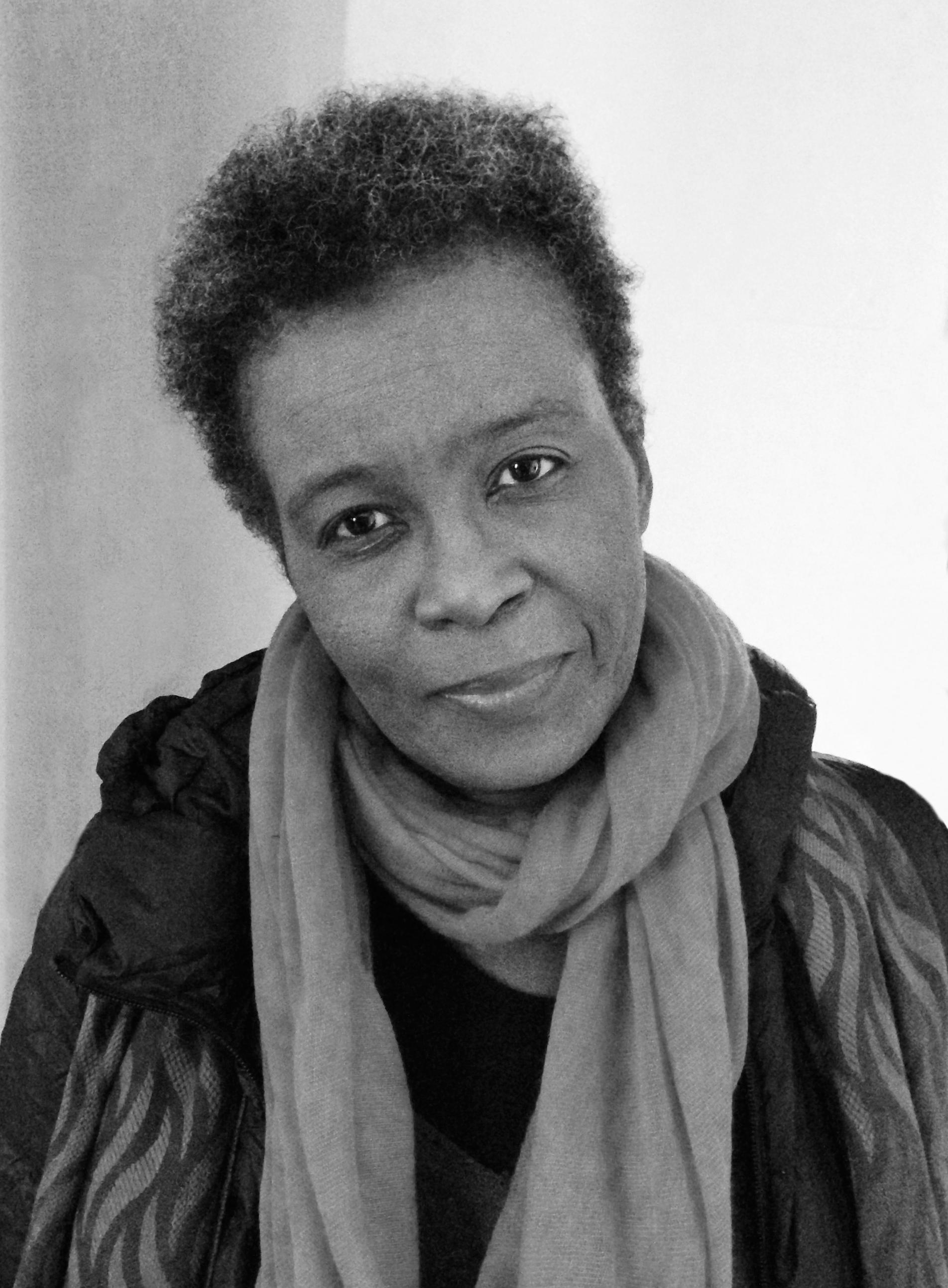
ON THE SECOND FLOOR of 81 Wall Street, students sat in a crowded room in the presence of a great writer and person of color. “TELL ME THE STORY OF RACE IN AMERICA ,” she asked them. And one by one, obliging bodies began to distinguish themselves in the crowded room, telling their stories to Claudia Rankine.
Last year, Yale seemed to ask its students, “TELL ME THE STORY OF RACE ON OUR CAMPUS.” But the university did not ask the question in Rankine’s same languid tone. Instead it asked aggressively. It asked in incidents and injustices: a fraternity barring entrance to a party, an Associate Master sending an email blast before the weekend of Halloween.
And so stories were told. Op-eds were written. Grievances were aired. Protests were held. The question posed by Rankine in Citizen, “Is this an okay conversation to be having?” was asked again and again. Students, faculty, and those outside of the Yale sphere were engaged with one another, talking about conversation itself—a type of meta-discussion.
But then stories seemed inadequate—students turned to direct action. Students of color rallied together in a group known as Next Yale. In a letter to Yale University President Peter Salovey, Yale College Dean Jonathan Holloway, and senior members of the administration, Next Yale listed demands for more substantial conditions and better recognition.
The letter was posted on the website for Yale’s DOWN Magazine on November 13th, 2015. On the same day, Dean Holloway forwarded an email to the student body of Yale College. The subject line: “An Excellent Faculty is a Diverse Faculty.” Dean Holloway urged students to read the forwarded email, in which President Salovey and Provost Benjamin Polak outlined the beginnings for a new initiative promoting greater faculty diversity. Fifty million dollars in resources would be directed toward this goal.
The initiative was not news—it had been announced over a week before. But as the Yale administration felt struck with urgency—“I urge you to read it,” wrote Dean Holloway—it became clear that these issues needed to be addressed. Yale’s students were asking back to the college: “we need YOU to tell us the story of race on our campus and what it will look like in the future.”
Yale answered this question immediately with its announcement of the fifty million dollar initiative, officially named the Provost’s Faculty Development Fund.
Although faculty diversity was not explicitly stated in Next Yale’s list of demands, students raised the issue in many of the conversations and protests that occurred on campus. President Salovey and Provost Polak seemed dedicated to working towards this goal.
“This commitment has been and continues to be one of the university’s most important,” President Salovey and Provost Polak wrote. “Over the past three decades several Yale initiatives helped to foster a more diverse and more inclusive faculty, and all of our schools have worked diligently in recent years to contribute toward this goal…But we can and should do more.”
New faculty members were hired as a result of the initiative, one of them Claudia Rankine. Renowned for her book of poetry, Citizen: An American Lyric, Rankine has contributed greatly to the discussion of race in the United States. Citizen was the first book of poetry to rank as a bestseller in The New York Times nonfiction category, winning several other awards and gaining national recognition. Most recently, when she received the MacArthur Fellowship, Rankine insisted the prize was not awarded to her but rather to the subject of her works—race in America.
Rankine’s new course, Constructions of Whiteness, deals with many of the same topics in her book. In her very first class, she projected a TV commercial on the whiteboard behind her. In it, actors Kristen Bell and Dax Shepard emblemize a white upper-class lifestyle while “Dancing to the Beat,” by Clarence Murray, plays in the background. The commercial, Rankine explained, is a perfect example of Anglo-Saxon sterility foregrounded over something belonging to and appropriated from black culture—in this case, soul music.
“I’m excited to learn about the topic of whiteness,” said Nitya Rayaparti ’19, a student in the class. “It’s kind of vague and nebulous and no one really knows how to define it.”
Another of Rankine’s students, Ivan Kirwan-Taylor ’18, said that the protests last year “woke [him] up to how you can’t really afford to be in America and neglect racism as a problem, maybe America’s premier problem.”
Rankine expressed that it seemed like the right moment to teach this class. “I think the country’s present political climate influenced my desire to teach a class on the construction of whiteness,” she said. “To me, this country’s commitment to white dominance is controlling and limiting all of our possibilities and it’s certainly controlling the dynamics of our upcoming election.” She was happy to see students so receptive to the topic, and so engaged.
The excitement about the class and its topic was evident even in the sheer number of students that showed up. Undergrads sat crowded on air vents, many hugged
the walls or even the floor, and graduate students arriving late tried their hardest to crane their heads in through the doorway, squinting even in glasses.
The crowdedness of students in Claudia Rankine’s classroom almost resembled the crowdedness of Cross Campus nearly a year earlier in November. Everyone seemed to have the same thing on their minds.
Before her departure, Nakamura commented to the Yale Daily News that she considered the 50 million dollar initiative to be “smoke and mirrors” on the administration’s part. But now that we’ve entered a new school year, one in which 26 new professors of color joined Yale’s faculty as a result of the initiative, where do we stand? Does Rankine’s obvious fame play into the smoke and mirrors effect?
“Claudia Rankine was Yale’s very successful and perspicaciously elected replacement, as it were, for Elizabeth Alexander,” responded Kirwan-Taylor.
“With regards to Prof. Rankine,” Kirwan-Taylor added, “the thing I would say most immediately is that after three classes with her, it’s very clear she’s a true artist. I don’t know if we have any other cultural presence like her on campus.”
WHEN RANKINE AGREED to teach at Yale, she became a black woman entering a historically white space. From the looks of her class—the interest people had and the feedback it has gotten so far—she seems victorious. But Claudia Rankine represents only one hire as a consequence of the 50 million dollar initiative.
“I think it’s great that there have been some hires this year, obviously Claudia Rankine has been hired,” said Isis Davis-Marks ’19, who helped organize for Next Yale and who participated in some of the demonstrations on campus. “But I don’t know if it necessarily is balanced out with the amount of faculty we lost last year.”
A glaringly high number of faculty of color left Yale last year.
“I consider myself an artist above all other things,” said Rankine on her first day. And in her class, Rankine encourages her students to engage in artistry as well. By the end of the semester, each student will have made a “maker’s journal” that in essence reflects what he or she gained from the course. Her students will fill the pages with quotes from their readings, with images and clippings, with personal stories and drawings. Throughout this process they will not only learn more about the class’ topic of whiteness, but also learn more about themselves and how receptive they are to this whiteness, how it pervades their day-to-day lives.
“I find the students’ engagement incredibly exciting,” said Rankine. “There seems to be a commitment amongst them to unpacking and understanding why we think and do what we think and do. To be joined by my students in my own intellectual inquiry is a fantastic dynamic to be a part of.”
As students are encouraged to let other aspects of their lives to permeate the journal, it’s possible that Yale’s own whiteness will find itself on the pages of some of these “maker’s journals.” In class, Rankine brought one of the journals to hold up as an example for everyone to see. The notebook stretched out like an accordion, revealing BLANK, WHITE PAGES.
WHILE STUDENTS THANK Yale for bringing Rankine to them, they are still hesitant to thank the school for facilitating inclusion on a larger scale. This is because some of the grievances and demands that were expressed in Yale’s protests remain unanswered.
However, the administration does seem to acknowledge that it is still in the process of becoming better. To repeat the words of President Salovey and Provost Polak, “we can and should do more.” The real issue now is determining whether at the surface, the administration realizes the power that a diverse faculty serves in improving a college campus—making sure that this initiative is sincere, existing beyond a realm of smoke and mirrors.
“I think diversity is incredibly important and inclusion is important, but I also think what you want [at a university] are committed faculty,” said Rankine.
Rankine reflected on her experience as an undergraduate at Williams College. “I did not have a widely diverse faculty, but I did have a wildly committed faculty, ” she said.
Nevertheless, Rankine continued, “I think a more diverse faculty might have spoken to a more well rounded investigation of my interests and that’s why diversity in faculty is incredibly important.”
At Yale, where many students are trying to find what it is that they are interested in, visibility can play into this process of self-discovery. DavisMarks explained that particularly for students of color, “seeing people who look like them in positions of power can often be inspiring, helping them to further their academic careers.”
“[Faculty diversity] enables a scholarly community to pursue intellectual exploration, which has the potential to enhance social and economic development in the United States and throughout the world,” confirmed Lamont A.
Flowers, who serves as Executive Director of the Charles H. Houston Center for the Study of Black Experience in Education.
The lack of faculty diversity on college campuses persists as a nation-wide problem, even though several reports and studies have been conducted in order to address the issue. According to a report published by the American Association of University Professors titled “Does Diversity Make a Difference?”, the diversification of faculty on college campuses has no negative effect on academics or campus life. This fact seems obvious, yet still, only 12 percent of college professors in America are people of color.
A 2013 Stanford report on underrepresented minority faculty included that, “If an institution is doing an evaluation of its diversity efforts…campus climate has a lot to do as to whether people stick around.”
Does Yale’s campus climate make faculty of color want to stick around? This is where the story starts to unravel. While many professors have left, some like Claudia Rankine still find ways to feel energized by the students here.
“I think that I probably wanted to come to Yale for the same reason that you wanted to come to Yale,” Rankine said. “Because it is a thriving environment of intellectual thought.”
Yale, if it really is an environment of intellectual thought, should demonstrate its informedness. It should use its reputation to reflect better recognition for students and faculty of color.
“Given Yale’s position of prominence in the world and in academic spaces, it has the capacity in order to say that they are going to take a strong stance on these issues,” said Davis-Marks.
Rankine’s poetry seems to echo the students’ wishes. They hope that this initiative is not just smoke and mirrors. They hope that Yale doesn’t feel compelled to hire people of color “when there are so many great writers out there.” They hope that Yale, the “historically white space” that it is, lets its faculty of color thrive, compelling them to stay here well into the future. They hope that Yale takes note of the “the tensions, the recognitions, the disappointments, and the failures” of the past, and addresses them in constructive ways. As The Provost’s Faculty Development Fund and Rankine’s course on Constructions of Whiteness play into the story of race on our campus, they also play into the democratization of Yale and the world beyond it. In effect, they contribute to the greater American lyric.
STATE OF CONFUSION
Why North Carolina can’t
make up its mind
BY SABRINA BUSTAMANTE
“GUNS, GAYS, GYNECOLOGY, AND GOD.”
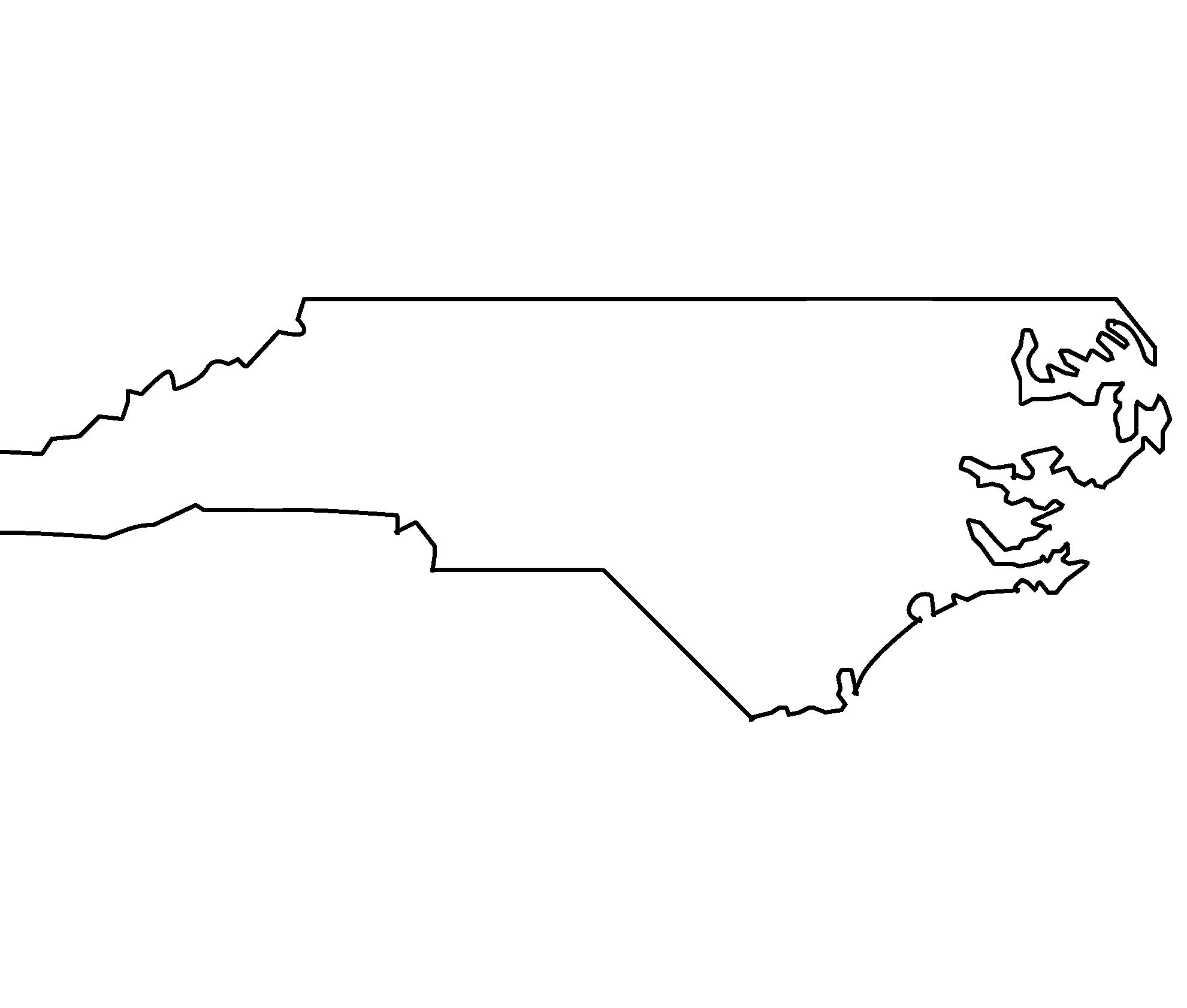
It is easy to boil the politics of North Carolina down to a neat list of hot-button issues. In an interview with The Politic, Jake Fender ‘18, a native of Asheville, NC, cited those four topics as the lens through which the media often covers the state. But he believes this coverage clouds the true spectrum of voter opinions. North Carolina is perplexingly unpredictable, he says, and outsiders ought to look more closely at the state that refuses to pick a side.
What is it we fail to see about North Carolina? The partisan rifts covered by the media create the perception that North Carolina is caught between two opposing crosswinds. At first glance, social issues seem to trump all: laws like House Bill 2, passed by the state legislature and
known informally as the “Bathroom Bill,” dominate public discourse and present a North Carolina fractured along ideological fault lines. But the state’s politics are far more hazy than voters and politicians alike once believed.
Fender contended the state’s unexpected ideological diversity was most evident after the passage of House Bill 2. The immense opposition from both sides of the aisle formed a new coalition of voters who could defy their party affiliations for the sake of repealing the Bathroom Bill. Democrats are especially hopeful that the discriminatory law will motivate North Carolina residents to vote Democratic down the ballot, if
n this election cycle,
North Carolina’s Trump supporters are propelled by the aftermath of a liberal promise fallen flat
only to remove incumbent Republican governor Pat McCrory from office. But they may overestimate the weight of social issues in an election where economic policies matter more to many voters.
The political suspense of the presidential election has hit North Carolina residents hard. The state is no stranger to electoral flip-flopping, but recently, its defining characteristic has been erratic voting trends caused by independent voters. This alone, however, cannot explain why Obama won the formerly Republican state in 2008 but not in 2012, or why North Carolina’s election forecast nervously blinks red, then blue, then red again. All of the nail-biting and fretting over North Carolina begs the question of why the state is at the forefront of the nation’s political consciousness.
North Carolina’s history explains much of its recent political tensions. Years ago, the state had a reputation as a symbol of Southern progressivism; instead of adopting the low-tax economic strategies of its neighbors, it invested in public works projects and infrastructure. The North Carolina university system is a byproduct of such investments. Similar progressive inclinations pushed President Barack Obama to the White House in 2008 — and yet, in a striking political shift, he
lost the state in 2012, two years after Republicans took control of the General Assembly. In 2013, Pat McCrory was elected governor.
North Carolina is vital this year for GOP nominee Donald Trump, whose path to 270 electoral votes most likely depends on winning Pennsylvania, Ohio, Florida, and North Carolina. The former three states have voted persistently Democratic since 2008, making North Carolina the wild card. Hillary Clinton’s path to the presidency, however, does not depend on winning North Carolina. But a Clinton victory in North Carolina would show hope for the promise of progressivism in the state.
And the Clinton camp may have cause to be optimistic. Despite the conservatism that many consider a hallmark of North Carolina politics, a Gallup poll reports that the state is 41 percent Republican and 42 percent Democrat—one of the most politically balanced states in the country. These numbers do not make predicting the outcome of the presidential election any easier. They do, however, imply that each candidate has a chance to capture the state that can’t seem to make up its mind.
IN THIS ELECTION, rural and urban mindsets play a large role in candidate
preference.
The divide between between these two demographics is evident in economics, culture, and politics. In an interview with The Politic, Dr. Rebecca Tippett, the director of Carolina Demography at UNC-Chapel Hill’s Carolina Population Center, said that North Carolina has the largest rural population in any state except for Texas.
“We definitely see that some of the poorer areas are ones that have been fairly hard hit by the decline of manufacturing and of tobacco, which is a major industry. These tend to be rural areas,” she said. Tippett also found that rural areas in western North Carolina tend not to receive the benefits of tourism and are on the whole more economically disenfranchised than the prosperous East Shore.
Trump’s rhetoric has proven effective in his campaign’s efforts in these regions; he appeals to rural manufacturing communities whose residents feel sidelined by federal policies and, ultimately, have little faith in the government.
“Donald Trump has been capitalizing on people who wouldn’t have been voting in the past and who are voting now,” said Fender.
Rural support of Donald Trump is less ideological and more retaliatory. As Democrats applaud the economic growth under the Obama administration, many low-income rural voters feel estranged from the current president’s socially progressive legacy. Economic recovery continues to favor urban areas as residents of the small towns and mountain regions of North
Carolina watch their paltry wealth disappear as industry falters. In this election cycle, North Carolina’s Trump supporters are propelled by the aftermath of a liberal promise fallen flat, reflecting the national mood of those feeling angry, resentful, and abandoned.
WHILE THE
RURAL COALITION
backing Trump in North Carolina is quite dependable, Hillary Clinton’s backers are far more hesitant in their support. Her supporters are urban voters: a diverse coalition of wealthy white liberals and low-income voters of color.
Urban regions in North Carolina are booming. Charlotte is one of the fastest growing large cities in the country, and its proximity to the University of North Carolina at Charlotte attracts young professionals, academics, and wealthy liberals. In an interview with The Politic, Max Schlenker ’20, who hails from Boone, North Carolina, suggested that Democratic voters are centralized within these big cities, where university students strongly favor the Clinton campaign.
“The research triangle is a hyper-liberal space,” said Schlenker, referring to the second-most metropolitan region in North Carolina, after the city of Charlotte.
Although this urban expansion works to the Clinton campaign’s advantage, the state’s recent development is also linked to a rise in poverty among poor urban populations, who are disproportionately of color. Schlenker noted the palpable racial divides in North Carolina cities. In places like Durham, residents of color live in predominantly divided communities, largely as a result of de facto housing segregation and uneven income distribution.
It is usually under these conditions that the Democratic Party’s outreach has resonated most powerfully. Clinton relies on support from
poor voters of color in urban areas, voters dissatisfied with the Republican Party and with Donald Trump’s lack of attention towards communities of color. As uneasiness about urban policing methods, affordable housing shortages, and welfare cuts culminate in powerful protests, even more is at stake for minority voters.
North Carolina’s cities will be crucial for the Clinton campaign in the weeks before the general election. With this combination of poor urban voters of color and wealthy liberals, Clinton could wield a powerful coalition against Trump. To attain these ends, the party has also expanded their Democratic Coordinated Campaign. This political strategy relies on the notion that, if campaigns can get voters to vote for local Democrats down the ballot, these same voters will be more likely to write Hillary Clinton’s name in at the top.
BUT THE PATH to electoral victory in North Carolina will not be easy for Clinton. She is faced with the daunting challenge of voter registration. In an election cycle where a Democratic win hinges on high turnout among underrepresented voters, North Carolina’s long history of voter disenfranchisement poses a significant hurdle for the Clinton campaign.
“Obviously she [Clinton] is going to capture really urban areas. That’s kind of a given. But the question is whether people are going to show up to vote,” Fender told The Politic, with anxiety in his voice.
He is not exaggerating. Many voter groups are all but non-existent in the North Carolina political arena. Hispanic and Latinx voters, one of the fastest-growing populations in the state, are drastically underrepresented on the voter rolls. North Carolina is nine percent Latinx, and yet a shockingly low 2.1 percent of the Latinx population is registered to vote. Harnessing the voting power of this group would be instrumental to a Democratic win, especially in this election, where Donald Trump’s rhetoric has driven the Latinx vote to the left.
However, Schlenker, whose mother participated in an effort to register voters and increase turnout on election day, suggested that intimidation tactics – intentional or not – often deter Latinx voters from going to the polls.
“In small towns with one polling center, it can be intimidating for people with little or no English skills to enter the county courthouse to place their vote,” said Schlenker.
The geographic distribution of North Carolina’s Latinx residents is relatively even across rural and urban areas; if they vote, they may offset Donald Trump’s lead in rural
counties. In many communities, people encourage families with non-English speakers to fill out write-in vote forms in lieu of voting in person.
However, the culture of voter repression still prevails. After the 2016 Supreme Court decision to strike down discriminatory voter ID laws in North Carolina, such tactics may seem surprising, but expected. Ultimately, Clinton’s performance in the state may depend on mobilizing a population just beginning to emerge from a legacy of political disenfranchisement.
The impact Latinx voters will have at the polls this election cycle remains uncertain. No one knows how North Carolina will swing. At the time of publication, the electoral predictions map shows the state engulfed in red when, only days before, the state inched nearer to blue. The outcome is just too close to call.
t the time of publication, the electoral predictions map shows the state engulfed in red when, only days before, the state inched nearer to blue
let’s talk about sex
yale confronts gaps in freshman sex-ed
“MY HIGH SCHOOL told us that birth control gives you cancer and blood clots,” said Makayla Haussler ’19. “Which it doesn’t, unless you’re over forty and have smoked a pack a day for many years. And in health class they had us each put on a rubber glove, to represent a condom, and then walk around shaking hands with people. One glove secretly had a tiny hole in it, so everyone ended up getting an STI.”
Haussler is one of many Yale students whose high schools offered incomplete, inaccurate, or abstinence-only sex education. The result is a freshman class with widely varying levels of knowledge. Universities across the country struggle to provide comprehensive sexual education, especially for students who didn’t receive that in their high schools.
These programs often come in the form of Sex Weeks. Started at Yale in 2002, “sex weeks” include sessions that range from safe sex practices to hook-up culture to the ethics of por-
BY LEAH SMITH
nography. In 2015, Northwestern University introduced a free, animated online class for freshmen about sexual and reproductive health.
In 2005, researchers Cheryl Somers and Amy Surmann at Wayne State University found a strong link between limited sexual health education – especially when taught too late into high school – and sporadic use of protection. Although an abstinence-only education might delay teens’ first sexual experience, it may reduce their use of protection once they become sexually active.
Many students like Haussler, who is from Lincoln, Nebraska, come from towns where the local school board controls sexual education. The curriculum often reflects the political leanings of the area. School districts in the Northeast are more likely to offer comprehensive sexual education than their southern counterparts. According to the Guttmacher Institute, only a small fraction of
southern school districts teach comprehensive sexual education while most preach abstinence.
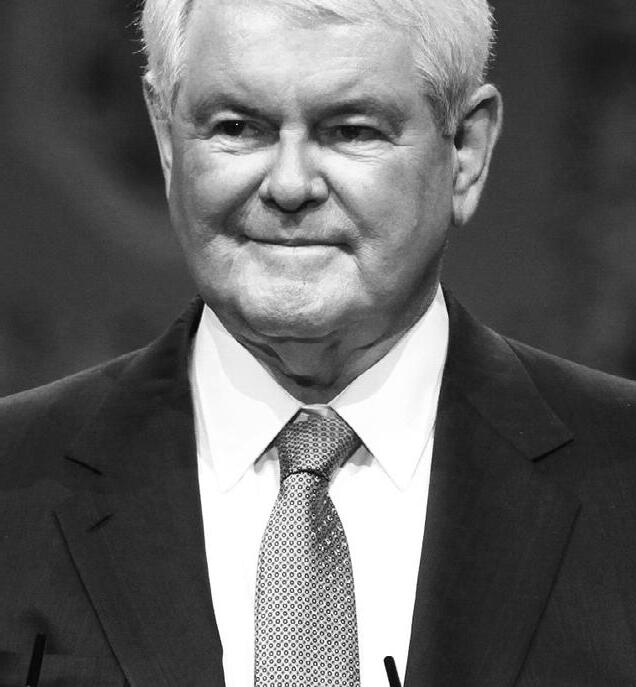
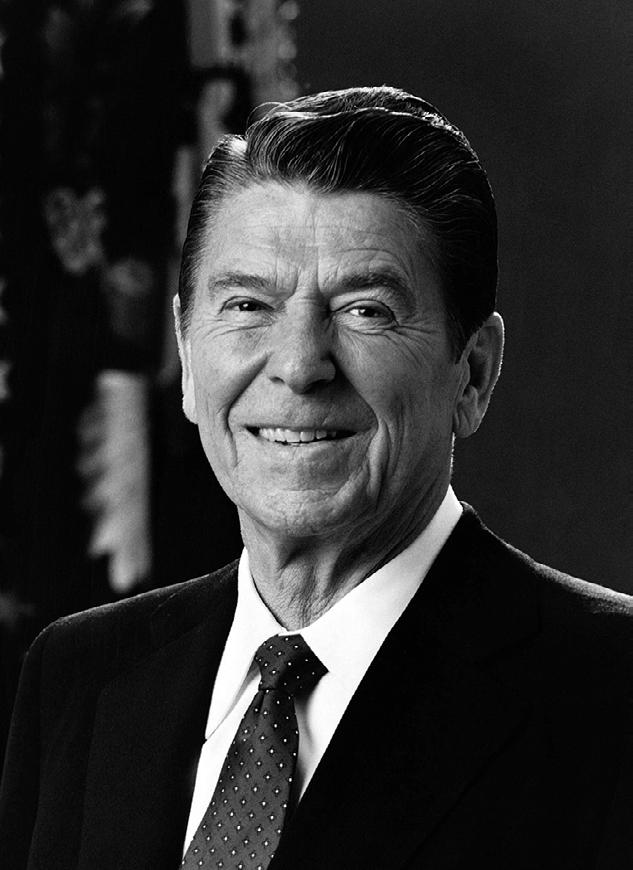
The Reagan administration provided the first federal funding in 1981, for local programs that encouraged “chastity and self-discipline” to reduce teenage pregnancy. The 1996 Welfare Reform Act – when Bill Clinton was President and Newt Gingrich was House Speaker – gave 440 million dollars to local sexual education programs that condemned premarital sex.
Today, seven in ten Americans oppose using federal funds to promote abstinence-only practices. But three-quarters of public high schools teach abstinence as the most effective way to avoid pregnancy and STIs.
In fact, most Americans — Democrats and Republicans, Catholics and evangelicals – support comprehensive sexual education, according to Planned Parenthood and the National Women’s Law Center.
Despite this broad base of support, millions of high school students receive inadequate sexual education. Students arrive at Yale from every state in the country. Some were taught that abstinence was the only option while others became familiar with affirmative consent and birth control.
ANNIE CHENG ’20 attended high school in Polk County, Florida, where teen pregnancies are common. The local schools teach abstinence-only sexual education. And the results speak for themselves – in her town of 100,000 people, there is a high school dedicated to educating teen mothers.
“I remember once asking a question about condoms, and I was told my question was not allowed to be answered,” Cheng said. She believes the more conservative values of the
Three-quarters of public high schools teach abstinence as the most effective way to avoid pregnancy and STIs.
school board members who designed the curriculum do not align with the liberal views of high school students.
“The school board and educational system can’t push conservative values on us. Kids grow up liberal because of the media we’re exposed to, and the educational curriculum needs to be as progressive as the kids are,” she said.
Victoria Quintanilla ’20 is from a county in southern Texas that is in the top quintile for teen pregnancy rates. Her school had a health class, but it was optional. Students often opted for APs or other advanced classes instead.
“Everything except abstinence was kind of taboo,” Quintanilla said. “When kids who took classes at the local college discovered there were free condoms, it was a huge shock.”
ONE OF YALE’S GOALS for Freshman
Orientation is to educate the class on the school’s sexual culture and policies. While its resources on sexual health and practices are available to everyone, they are especially important for students who received minimal or misleading education in high school. One workshop run by the Community Health Educators (CHEs) demonstrates how to use a condom and includes a discussion about different types of birth control.
The other, run by the Communication and Consent Educators (CCEs), is called “The Myth of Miscommunication.” This workshop teaches the idea of affirmative consent, which Yale defines as “positive, unambiguous, and voluntary agreement to engage in specific sexual activity throughout a sexual encounter.” Yale introduced affirmative consent as official policy in 2011. Affirmative consent became the legally mandated standard for all schools in Connecticut in 2016. Transitioning to a school where policies like affirmative consent are
openly discussed can be hard for people with limited sexual education like Taylor Church ’18, a CCE, who attended an all-girls Catholic school in rural Maine.
“The condom demonstration in the CHE workshop was a first for me. I had no idea that they had expiration dates. I didn’t know that STI testing was normal and a good idea,” she said.
She also appreciated the CCE workshop’s emphasis on consent. “The CCE workshop reshaped my experiences and gave me the vocabulary to describe them. I felt like I knew a lot more and was a lot more prepared for Yale afterwards,” she said.
Assistant Dean of Student Affairs Melanie Boyd runs the Office of Gender and Campus Culture, which oversees the CCE program.
“We do not expect Freshman Orientation to be the answer to the complexities of student life,” she said. “We think of it as scaffolding that students can build on, and give them a shared language. There’s no way to dictate to students how to live their lives, let alone their sex lives.”
A major goal of the CCE workshop is to be accessible to students with different experiences in sexuality and varying expectations for college.
“Every time we do the workshop, we get a card from a student who says ‘I’m abstinent and this doesn’t apply to me,’” Josh McGilvray ’18, a CCE, said. “The goal is to ease people into the conversation, and for that reason we don’t want to normalize sex, but we want to establish a culture where sex isn’t scary.”
The CHE program is also sensitive to the wide variety of student backgrounds. “We discuss the parts of people’s backgrounds that may make certain things more intimate, including religion and conservative family members,” said CHE
“Every time we do the workshop, we get a card from a student who says ‘I’m abstinent and this doesn’t apply to me,’” Josh McGilvray ’18, a CCE, said.
Jason Morris ’17. “I’ve definitely had some kids who were quiet and were obviously not super comfortable talking about sex, but I haven’t had a student challenge the idea of discussing sex at all.”
Freshman orientation used to include more detailed sessions, particularly about birth control, but those were dropped in part after complaints to Boyd’s office that this excluded queer students. Intensive sexual education can also form a divide between students who already know the information and those receiving it for the first time.
“There is such a diversity of knowledge in incoming students. If we were to slow it down, there’s no time, and it might set up an uncomfortable dynamic,” said Chamonix Adams-Porter, Student Affairs Fellow in the Office of Gender and Campus Culture. “We want to make sure people don’t feel talked down to, while others feel they are being singled out.”
Beyond official programs, the university also counts on informal education to fill in the gaps for students. “The learning that you do at Yale is very rarely filtered through a mandatory workshop,” Adams-Porter said.
Maria Trumpler, Director of the Office of LGBTQ Resources and a senior lecturer in Women’s, Gender, and Sexuality Studies, believes this informal education is more effective. “At a college age, having someone talk at you doesn’t work. Peer-educators, with the ability to have one-on-one conversations, are more effective,” she said.
“Within the context of what’s possible in Freshman Orientation, we’ve pushed the limit of the amount of sexual education,” Boyd said.
And it’s true that with the two workshops and Bystander Intervention training for sophomores,
Yale outpaces most universities in mandatory sexual education. Many universities rely on high school sexual education programs or use short online programs instead of the more thorough workshops run by CHEs and CCEs. Students seem to agree that the workshops done during Freshman Orientation are well-done and cover the important topics.
“Yale made sure every person got the education. Nobody won’t know what is and isn’t acceptable in sexual conduct,” said Gabe Malek ’16. “I think it’s good they did it in two sessions— health and consent—because they hit all the main things. If anything, they should devote more time to consent, because it can’t be stressed enough.”
And though Yale may set an example for other universities, many on campus still see room for improvement. “I wish Yale offered non-credit sex ed classes in a way that was considered cool and fun,” Trumpler said.
Tracy George, Health Educator for Student Wellness at Yale Health, often has one-on-one meetings with students about sexual health concerns. “I’m very limited in capacity
in my office, but in hopes that my staff grows—meaning, if I can get the funding to hire more health educators, then I would love to ramp up sexual health offerings and reintroduce more regular sexual health workshops on campus.”
Yale’s efforts defy a national trend. Fewer and fewer teenagers between 2006 and 2013 received education on contraception, STIs, and consent. Depending on where they come from, some students arrive at college safer than others. The CCE and CHE workshops help to fill in the gaps. By mandating sex education, Yale is ahead of the curve.
WELCOME WELCOME “WELCOME” TO CAMP LININ but for Poland offers refuge,
BY DANILO ZAK
LIKE MOST OF Poland, Linin is very white and very Catholic.
The small town is tucked into huge swaths of apple and pear orchards, broken only by the Vistula River and highway 801 to Warsaw. Comprised of a school, a few shops, and a church, Linin seems like the picture of rural Polish life. Most of the 1,000 residents work on farms. Walking down the winding roads, one is more likely to encounter a tractor than a car.
But two kilometers from what qualifies as the town center, amid a forest of pines, sits one of Poland’s few refugee camps.
“THE EUROPEAN REFUGEE CRISIS” can evoke starkly different images. Some think of Omran Daqneesh, the young Syrian boy in the back of an ambulance whose picture called the world’s attention to the ongoing humanitarian crisis. Others equate “refugee” with the threat of radical Islam. After the terrorist attacks
in France and southern Germany, many speak of the crisis in terms of European security and border control.
The false dichotomy between safety and humanity distorts many of the problems refugees face in Europe, including issues relating to education, integration, and mental health. Heated rhetoric can propagate misleadingly simple narratives that alternately downplay or escalate the refugee crisis, complicating refugees’ integration into European society.
AT FIRST, THE CAMP IN LININ seems like a balm to the overcrowded and overextended refugee camps in Greece. Its 300 refugees live in apartments, not tents. The camp has a preschool, playground, sewing room, and a cafeteria. Refugees can visit doctors, including psychiatrists, eat good food, and bathe in clean washrooms. A lawyer arrives each Monday to help with asylum cases. Refugees in Linin enjoy free access to dental care, a service not offered to Polish citizens.
But there are no Syrian refugees at Camp Linin. No Afghans, Iraqis,
or Pakistanis either. Most of Linin’s refugees are Chechen, along with some Tajiks and a few Azerbaijanis and Ukrainians. Almost all arrived to Poland by hopping on a train in Belarus and entering at the border in Terespol.
Poland’s ultra-conservative government refuses to accept refugees from the Middle East. “We rarely get any Syrians,” said the director of Camp Linin, Jan Węgrzyn, speaking via a translator in an interview with The Politic. “[The] Law and Justice [party] won’t accept them through relocation, and most of the refugees would rather go elsewhere anyways.”
Europe’s “relocation” project, introduced last September, hoped to offer hundreds of thousands of Syrian refugees in Greece the opportunity to relocate to other European countries that could host them. But Poland’s ruling Law and Justice party won’t recognize the plan or accept any Syrian refugees under the project. Refugees who manage to smuggle themselves into central Europe aim for Germany, in order to avoid discrimination in Poland.
Chechens are almost all devout Muslims, but they are fair-skinned and share a history of Soviet oppression that elicits some sympathy from the Poles.
Notorious European camps – like “the Jungle” in Calais and the Moria camp on Lesbos – bear little resemblance to Linin. There is no organized legal assistance for refugees in Moria, no apartment-style housing for those in Calais. Most of these refugees have fled from the Levant region, and their asylum claims usually cite oppression from the Islamic State (IS) and the Taliban. In Linin, refugees often cite discrimination because of their Muslim faith.
Despite Poland’s conservative refugee policies, the country also shares many of the same problems as refugees in other European countries. Even with diminished levels of diversity, ethnic tensions still inflame Camp Linin. A generally nationalistic attitude among the Chechens leads to them asserting dominance in the camp.
“Chechen Force” is spray-painted in huge block letters along one wall. In early summer, a brawl erupted after some Chechens bristled at a group of
Ukrainian women, who dressed in a way they deemed sacrilegious. Fights often start among the adolescents, who then ask their older brothers to protect them; tensions soon flare between families and spread throughout the camp.
Omar, a Tajik boy, led The Politic to his “army base” in the woody area of Camp Linin. With pride, he described a fight between his friends and older Chechen kids who had come to invade the camp. “There was blood here and here,” he said, swinging a stick and pointing at spots in the underbrush.
Many of the fathers encourage fighting at the camp. For decades, their families struggled with intense poverty in the rural mountains of Chechnya, where they resisted oppression from the secular USSR. Aggression, fierce nationalism, and Islam became pillars of their identity.
Not surprisingly, some Chechens can be convinced by a radical Imam to leave their home and join the Islamic State. “Thirteen of my friends in Grozny left to fight in Syria,”
“In Linin, refugees often cite discrimination because of their Muslim faith.”
“In Linin, refugees often cite discrimination because of their Muslim faith.”
The local primary school is not equipped to facilitate greater numbers of students, particularly those who don’t speak Polish. The local primary school is not equipped to facilitate greater numbers of students, particularly those who don’t speak Polish.
said Abu, a Chechen asylum-seeker in his early twenties. “I was the only one who stayed.”
Back in Linin, these refugees cling to their cultural identity. The lack of diversity among refugees creates a pattern of ethnic tension throughout camps in Poland.
Camp Linin also faces tremendous problems with mental health and education.
That Camp Linin has a psychiatrist is an anomaly; refugees usually have no access to mental health resources. But the psychiatrist admits her work is not comprehensive enough. She only has the capacity to help those who come to her, and so many of the refugees, especially the children, are unwilling to admit their psychiatric issues.
Children are guaranteed access to education, but the local primary school in Linin is not equipped to facilitate greater numbers of students, particularly those who don’t speak Polish.
Many of the older children don’t go to school at all. They can make a few zlotys an hour (one U.S. dollar is 3.84 zlotys) working illegally in the local apple orchards and often skip class to provide some money for their families.
The Camp Linin situation infuriates locals. Their children bear the brunt of an overwhelmed education system. The government makes little effort to improve relations between Polish locals and the refugees, and many Linin Poles perceive the Chechens as violent and crude.
These problems with education and integration create a vicious cycle for refugees. Issues of language, schooling, and assimilation are vital to consider, but typical narratives about the current refugee crisis abstract them out of sight.
These drawbacks plague a camp in Linin that appears exemplary on the surface. In a refugee crisis that continues unabated in Europe and around the world, perhaps it is time to move the discourse beyond the lazy and superficial. In an increasingly connected world, maybe some lessons can be drawn from this remote camp deep in the Polish pines.
The Elephant in the Room
Boxing Gym Brings New Haven Issue Into The Ring
BY SIMON COOPER
“WHEN YOU KNOW BETTER, YOU DO BETTER”
“WHEN YOU KNOW BETTER, YOU DO BETTER”
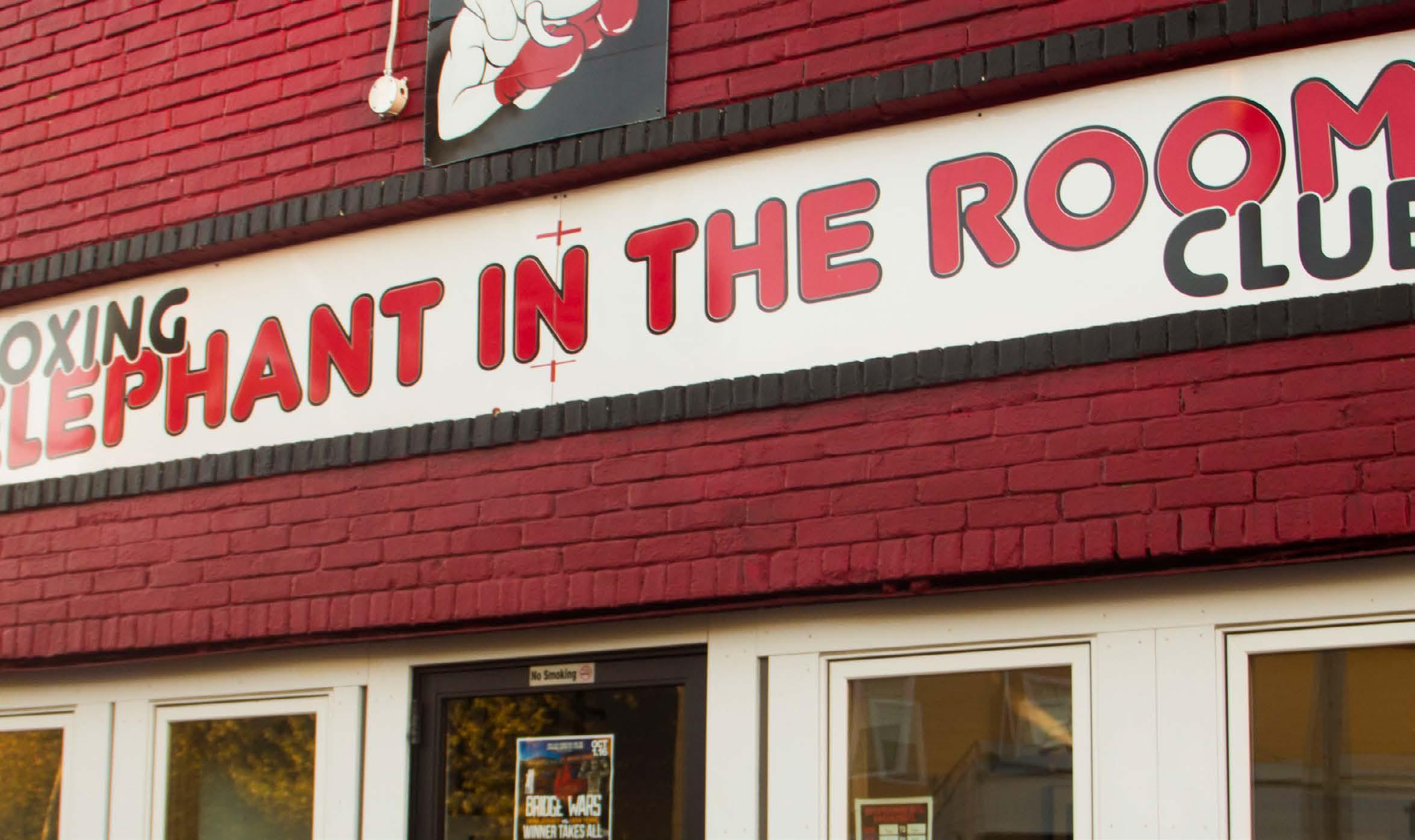
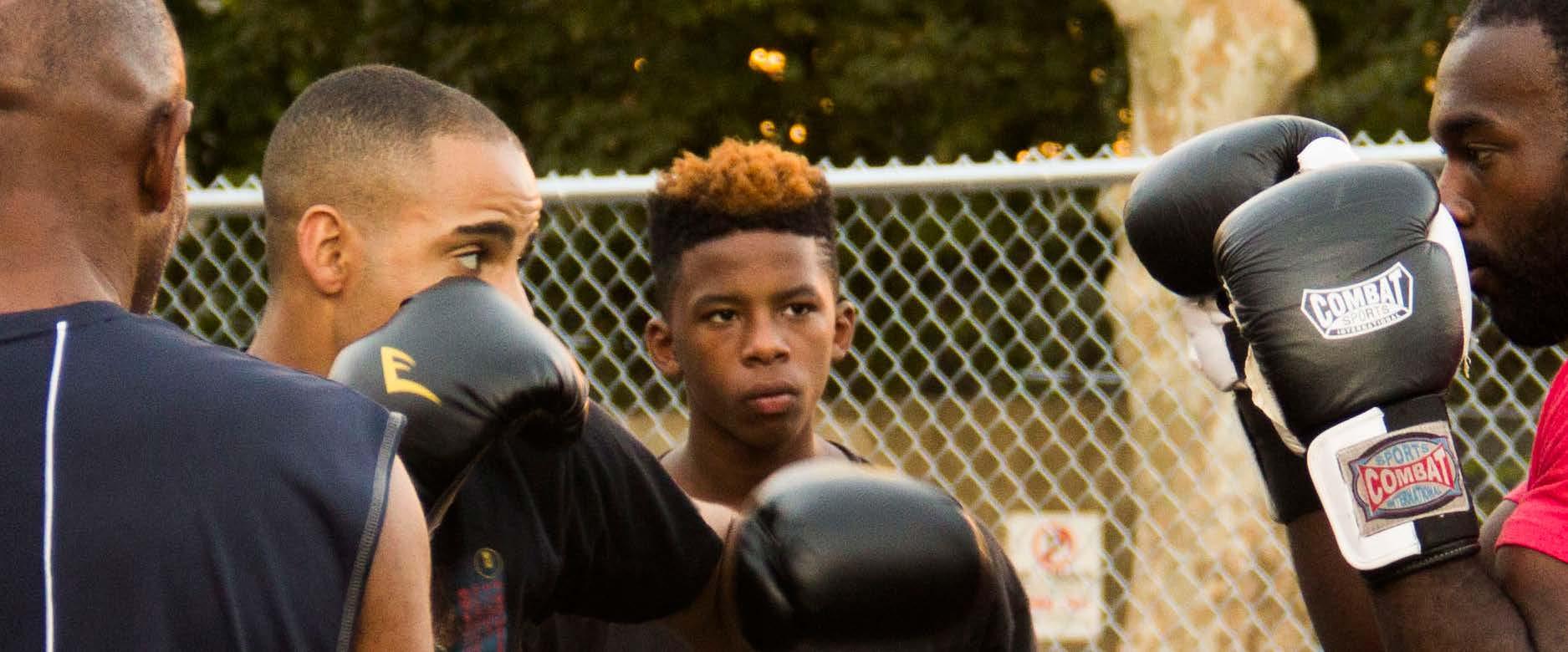
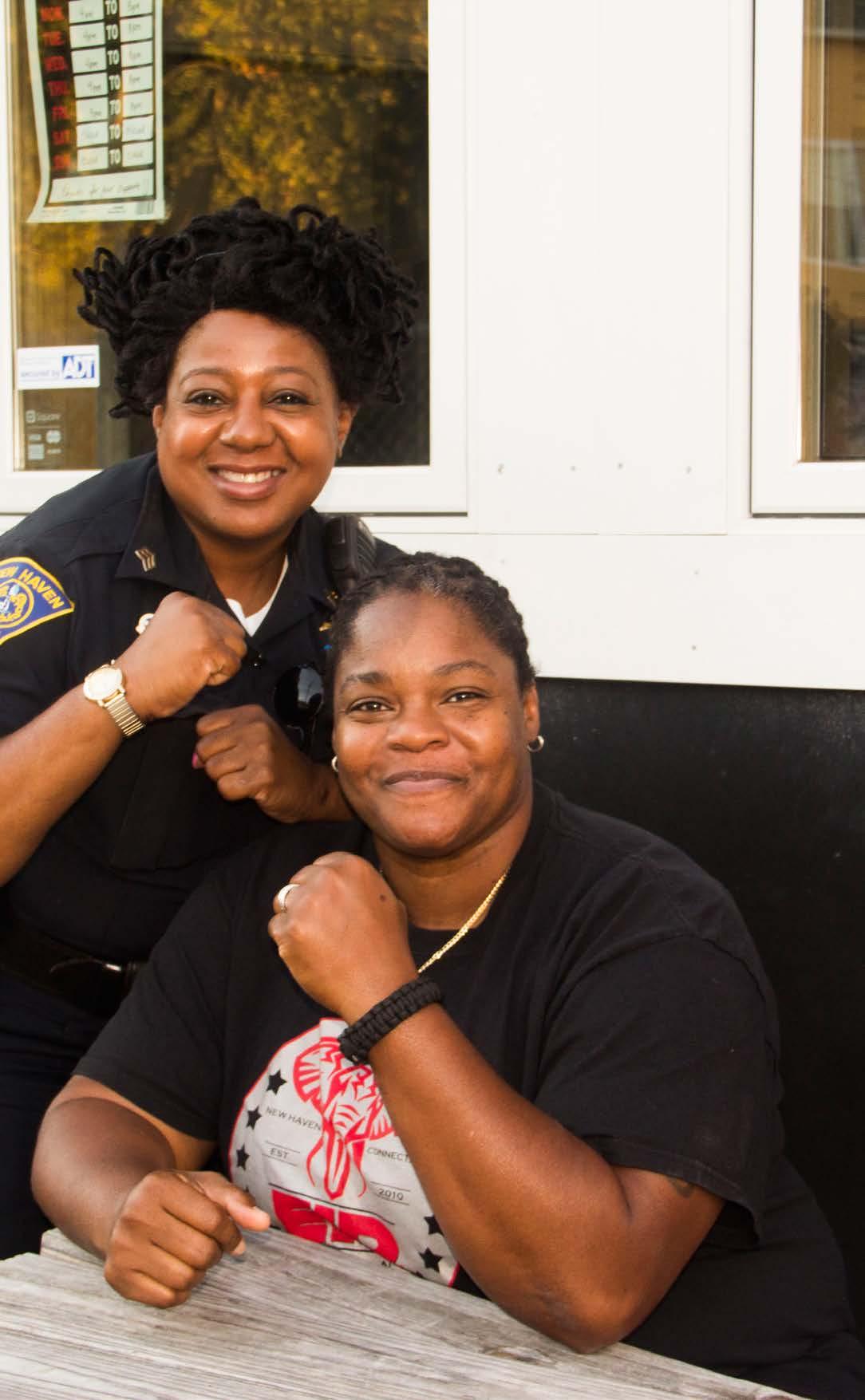
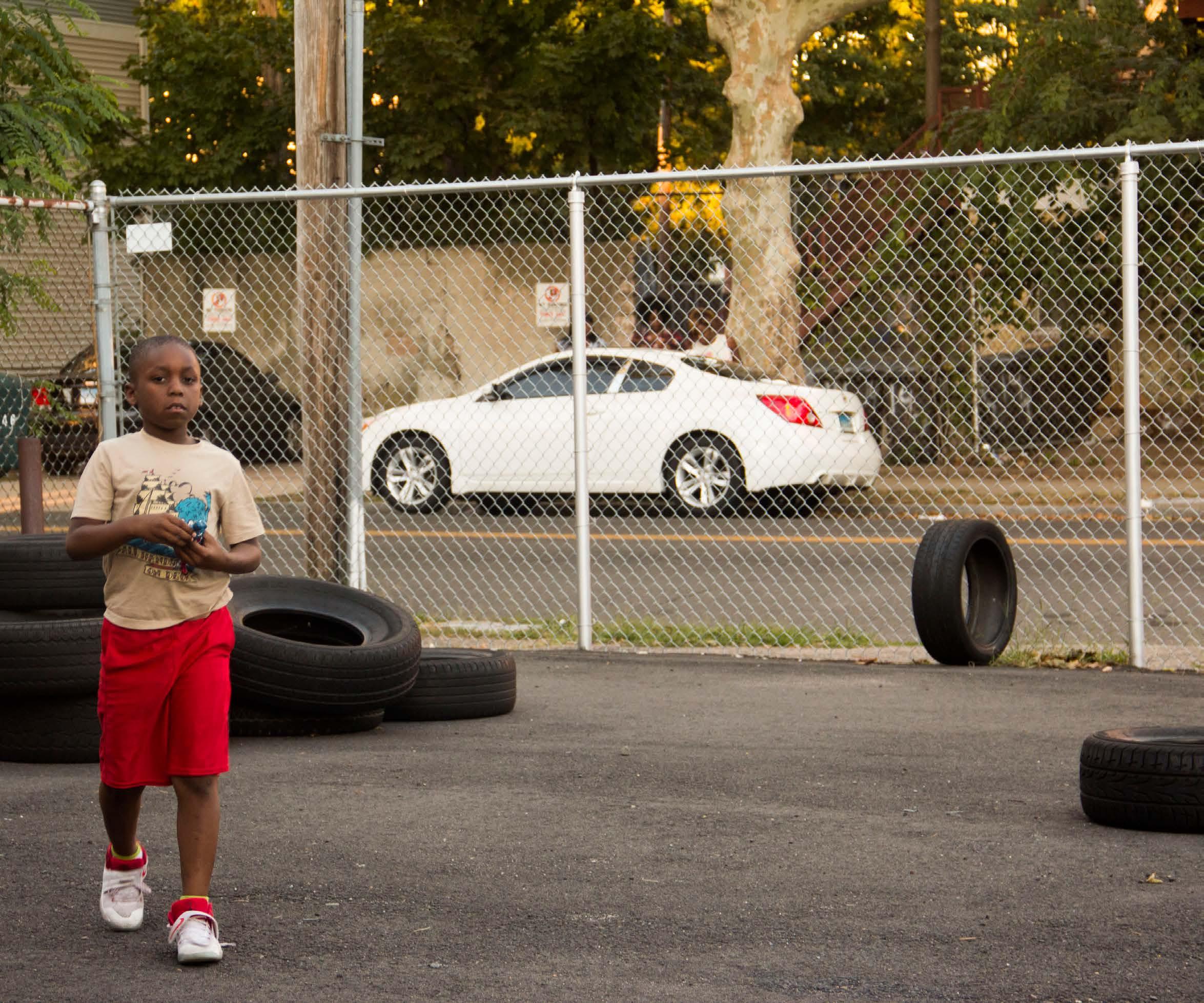
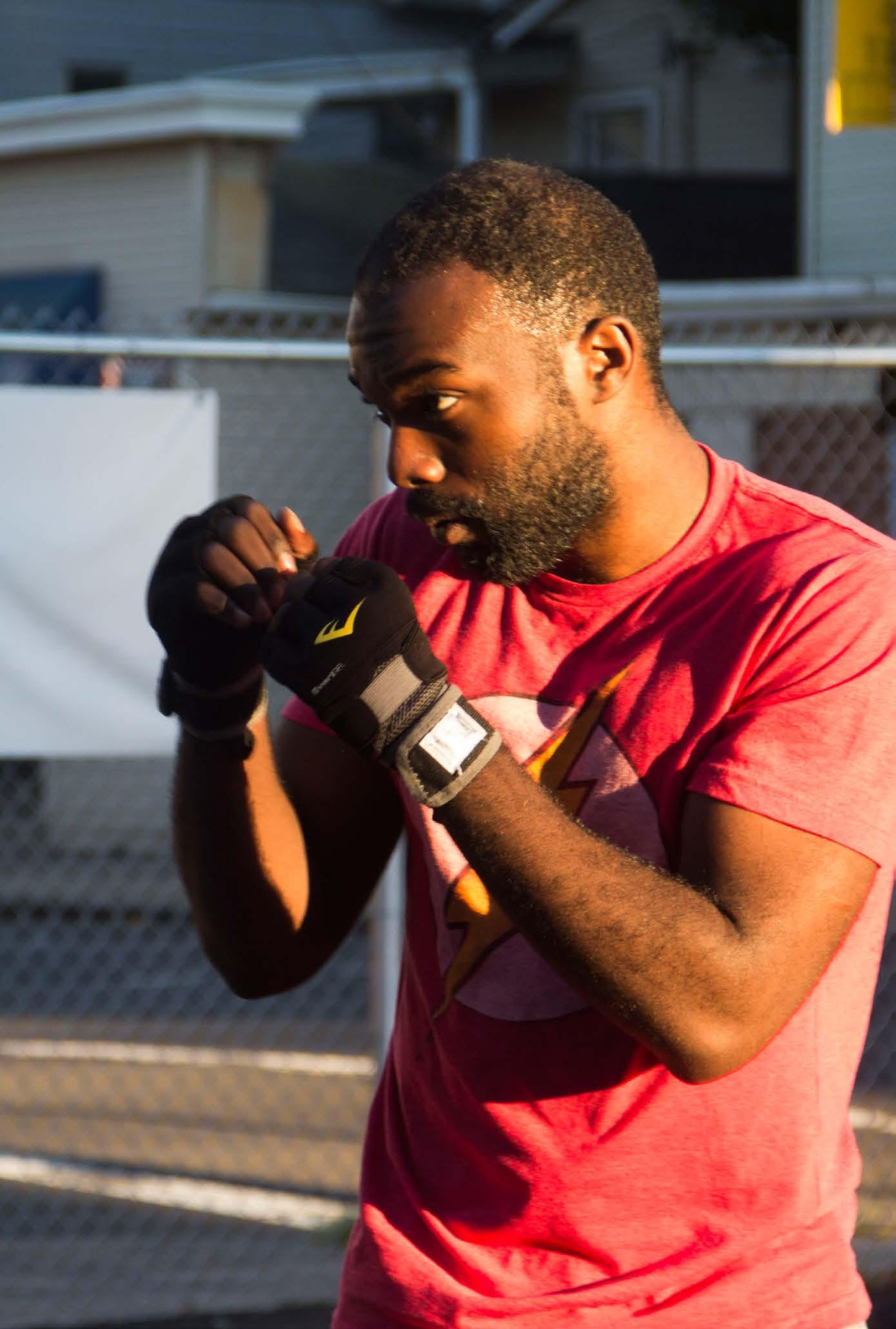
SERGEANT JACQUELINE HOYTE stares up at the sign for a while, then turns to Devonne Canady. “How did your gym get its name?” she asks. The two women are sitting outside on an old picnic table. Sergeant Hoyte is a New Haven police officer. Devonne Canady is owner of The Elephant In The Room Boxing Club.
“The Elephant in the Room is an issue or topic that everyone is aware of but no one really wants to discuss,” says Canady. “When I think of the elephant in the room, I think of all the issues in the community: alcoholism, drug abuse, teen pregnancy, homelessness – all these issues that we’re all aware exist, but that no one is really doing anything.”
Hoyte nods in agreement.
“We’re trying to do something about it but [are not getting] a whole lot from other people,” Canady continues. “That’s the Elephant in the Room.”
A chain fence surrounds the red and black gym, which sits between Orchard Street and Henry Street in New Haven. A mural of Maya Angelou covers one wall of Orchard Market across the street and proclaims: “When you know better, you do better.”
OFFICERS WOULD JUMP OUT OF VANS AND BEAT PEOPLE
Hoyte and Canady’s conversation stems from a broader discussion between New Haven police and the community. Amid reports of police brutality in New Haven and beyond, the two women work together to create a safer neighborhood. Both women grew up in the Dixwell neighborhood of New Haven and graduated from James Hillhouse High School, but they never met until Hoyte became district manager for the Dixwell Neighborhood in May.
“I called Officer Kelly to ask him Lieutenant Brown’s number and he said ‘You know he’s not over District Six no more,’” says Canady. “He was like ‘No, you have Sergeant Hoyte now.’ I was like ‘Okay give her my number.’”
“I have to say I was really happy when I found out you were a woman. I love that girl power,” Canady replies, pumping her fist.
Hoyte first joined the police force to help fight the violence in her neighborhood. She lived on Carmel Street, a short walk from the Elephant in the Room Boxing Club, when New Haven was going through a bad spate of drug violence and police brutality in the late 1990s.
“Officers would jump out of vans and just jump and beat people down right in front of me,” remembers Hoyte. “I was like ‘Oh my god. Why are they coming into my community like this and treating my people like this?’” She joined the police to “stop this nonsense.”
Canady nods – she also remembers what the city was like. “It’s important that we all take part in trying to fix the issue,” she says.
CANADY IS NO STRANGER
to the ring. Although she works full-time as a respiratory therapist, she first competed at the Golden Glove Championships, which she won. And she kept winning – she won the bronze at
PEOPLE DOWN RIGHT IN FRONT OF ME. I WAS LIKE OH MY GOD, WHY ARE THEY COMING INTO MY COMMUNITY LIKE
the 2002 amateur world championships in Turkey.
In 2008, she hoped to represent the United States at the Beijing Olympics — but women’s boxing was not yet an official event. So Canady returned home. She purchased a building that had been abandoned for thirty years and started her own boxing club in 2012.
“I’m like the one-woman band here,” says Canady. “I run the gym, I train, I work my fulltime job, I write the grants, I have a family, I put the shows on. This is my passion.”
“And to think we have her in New Haven,” Hoyte chimes in.
A few minutes later, a man walks by and yells from outside the fence, “I love a woman in a uniform!”
“Thank you sir!” Hoyte calls back. “How are you doing today?”
Canady scowls, but Hoyte seems pleased.
“Policing through partnerships” is the motto of the New Haven Police Department and defines Hoyte’s approach. If a teen has a run-in with the law, explains Canady, Hoyte can introduce the boxing club as a way to keep them off the streets.
“[Hoyte] can say, ‘I have something you can do, why don’t you come and see about this gym, you might like it,’” she says.
Down the street from Hillhouse High School, Elephant in the Room is open from four to eight p.m. each weekday evening. Students arrive right after school – the hours that “kids get in trouble” – when Canady and her trainers do their best to tire each student out. The goal, she says, is to exhaust them such that “they have nothing left but to go home, get something to eat, shower, and go to bed.”
“Go to bed,” Sergeant Hoyte repeats, and the two women look at each other.
STUDENTS COME IN RIGHT AFTER SCHOOL
“In my daily business, I encounter a lot of troubled teens,” says Sergeant Hoyte. She hopes to help deescalate tensions in the community and offer young people an alternative to the criminal justice system. She’s often running against the clock, as many kids enter the system very early on.
Canady nodded this time. The two are keenly aware of the problems facing New Haven, especially its minority residents. Violence is high – residents reported almost 1,400 violent crimes last year. The teen pregnancy rate is more than twice the state average.
Sergeant Hoyte and Canady lament the lack of stable homes in their community. Although they grew up in this neighborhood, they agree the children here today face much larger challenges. Twenty percent of New Haven children live in poverty. A third live in single parent homes.
“How can they focus and get up and go to school and concentrate on their education when they don’t even have a stable home? When they don’t even have a bed to sleep in?,” asks Sergeant Hoyte. “They don’t even have meals to eat? They’re really being set up to fail.”
Hoyte hopes to bridge the gap that often divides the community from the police. “That’s what the police department is working very diligently on – gaining, and regaining, trust. The community’s trust,” says Hoyte.
“Trust,” repeats Canady. “Let’s be realistic about the issue with the community and police. A lot of things with police brutality.”
Canady wants to improve the relationship between the police and the community in New Haven, which struggles with strained relations and allegations of police brutality also common throughout the country. However, as Hoyte attests, the New
Haven Police Department has set a positive example with its focus on community policing.
And New Haven has a long legacy of progressive community policing policies, revived under former police chief Dean Esserman, who emphasized community recruitment in police hiring. Hoyte believes the New Haven Police Department often takes the lead in learning and testing new policing techniques. In her view, New Haven has avoided many of the problems facing other cities.
“A lot of other cities and towns, they’re not even doing or close to doing what New Haven has done,” asserts Hoyte, “Our ex-police chief Dean Esserman reintroduced community policing to New Haven five years ago when he first came back, and we have forged so many good relationships under his command.”
“We have partnerships and collaborations, ” she adds. “That’s the best way. That’s the only way. And it’s working.”
A young girl emerges from the gym with her mother. Canady calls her over. “You did very well today. Very attentive. How old are you?” she asks.
“7, I’m turning 8 on the 30th,” the girl responds. Canady gets up to greet another customer, leaving the girl and her mother alone with Sergeant Hoyte.
“When bad things happen that’s how detectives get their information to solve their crimes that’s because people in the community,” says Hoyte. “People that’s in the community, they see, they know, but if they can trust you they’ll give that information. A lot of times, that’s how we solve our problems, our crimes, our murders or whatever. That’s crucial.”
Hoyte credits Esserman’s “park, walk, and talk” strategy with building trust in the community. “When you move into a community for the first time, how do you build relationships,
how do you build trust?” asks Hoyte. “You introduce yourself.”
Hoyte thinks the city’s police officers can provide some of the stability that teens may lack at home. “[It’s] crucial to have the same officer on the beat,” she says.
“A lot of the officers do a lot of great things with the kids. They’ll buy them lunch and a lot of these kids, they won’t even get to eat,” explains Hoyte. “They do so much for the community. They’re not only policing, they’re also role models.”
Canady also sees her gym as a stable place for kids in the community. “One thing about the gym is almost like once I have them within my reach, they go away sometimes,” says Canady, “but they always come back.”
Canady says that many teens in the neighborhood are unbelievable athletes, but she worries about their academic ability. She asks students struggling at school to leave the gym until they can raise their grades.
“If your grades ain’t good, then I’ll see you later,” says Canady.
Elephant in the Room teaches classes at local schools like Hill Regional Career High School when they can spare the funding. Although the athletic and art departments are usually the first to experience cuts, Canady believes she can make a lasting impact on those that come to the gym.
YOU’RE GOING TO SEE A CHAMPION COME OUT OF HERE
Eventually, she wants the gym to expand to a larger space and play a major role in the community. She plans to teach self-defense classes for women, open a ten-bed youth homeless shelter, and start a store to sell boxing equipment. She also hopes to be replaced soon as Elephant in the Room’s most successful boxer.
“I know one day, one of those kids inside of these four walls is going to make it and you’re going to see a champion come out of here,” says Canady. “And you’re going to remember this conversation.”
WHOSE PARTY NOW?
BY LIBBY DIMENSTEIN
BEN RASMUSSEN ’18 was rushing to make the subway in Manhattan when he received a startling message in the Yale College Republicans (YCR) board group chat. An impostor Twitter account, tweeting from the handle @YaleRepublicans, had announced the group would not endorse Donald Trump for president.
Rasmussen was shocked. YCR had already discussed the possibility of endorsing Trump earlier in the year and had decided against taking a position. But after the fake tweet on August 8, chapter co-presidents Emily Reinwald ’17 and Michaela Cloutier ’18 decided that they needed to take action. Cloutier and Reinwald texted the other five YCR board members to
plan the next steps, but by then Rasmussen was deep underground. The train took about an hour, during which Rasmussen was out of the loop. When he exited the metro, Rasmussen was hit with more alarming news.
In the time he had gone without a signal, Reinwald and Cloutier had released a public statement on the YCR webpage endorsing Trump.
“While not every member of our organization supported Trump in the primary,” the statement read, “as an organization and branch of the GOP we support Republicans up and down the ballot. And yes, that includes supporting Donald Trump for president.”
That day, Rasmussen resigned from the YCR board.
The saga of the Yale College Republicans began four days earlier. On August 4, the Harvard Republican Club (HRC) posted a lengthy statement on Facebook denouncing Donald Trump, calling him a “threat to the survival of the Republic,” and urging other college Republicans to join in “condemning and withholding their endorsement from this dangerous man.” The post received over 181,000 likes and was well-received by many students at Yale. Pressure mounted on the YCR board. Yale students wondered: what would our Republicans do?
Four days later, in the early hours of August 8, the Yale College Republicans appeared to have joined the #NeverTrump bandwagon with the fake tweet: “the Yale College Republicans will not be supporting Donald Trump in the fall.” A screenshot of the tweet quickly went up on the Facebook group Overheard at Yale, drawing over 500 likes.
Against Trump. As the Yale conservative community split, an eerie parallel between the campus conflict and the growing gaps within the national Republic Party arose. Long before the earthquake of Trump’s nomination, fault lines had already appeared among Yale conservatives.
The same day that the co-presidents released their statement, four YCR board members — Rasmussen, Michael Fitzgerald ’19, Grant Gabriel ’17, and Jay Mondal ’19 — resigned. The four then formed a new organization called the Yale New Republicans (YNR).
According to the YCR statement, “...we support Republicans up and down the ballot. And yes, that includes supporting Donald Trump for president.”
But at around 8:30 that morning, Reinwald commented beneath the original post that YCR had been impersonated and was in no way connected to the handle @YaleRepublicans. Less than an hour later, Cloutier commented with a link to YCR’s official statement on the matter.
The Overheard post blew up. Some Yalies expressed outrage, others disappointment, and a few voiced sympathy, angered that YCR had been the target of a hack. Many prominent news outlets, including the Wall Street Journal, picked up the story, comparing Yale’s Republicans to Harvard’s.
Within three days, two new student organizations emerged from the embers: the Yale New Republicans and Yale Undergraduate Conservatives
On August 11, YNR released a statement on its new Facebook page, describing itself as a group that aims to “unify a broad base of politically minded, right-leaning individuals” and that will promote “forward-thinking Republican values.”
Because YNR is not officially associated with the National College Republican organization, they do not face the same constraints that motivated the presidents of YCR to endorse Trump.
In separate interviews with The Politic, Rasmussen, a former vice president of YCR, and Michael Fitzgerald, his YNR co-president, agreed that Reinwald and Cloutier had not given the board an opportunity to discuss the Trump endorsement before they announced it.
The YCR board had already debated whether they should endorse Trump in previous months. Because the seven board members disagreed about Trump, they had decided to refrain from taking a position. Both co-Presidents declined to be interviewed for this article. However, in an email, Cloutier wrote that there
July 25-28: Democratic National Convention
July 31:
Trump-Khan controversy begins
Aug 4:
Harvard Republican Club posts their nonendorsement of Trump
was “no decision to be made by the board” regarding Trump because the YCR constitution holds that the purpose or the organization is to “aid in the election of Republican candidates at all levels of government.” By ratifying the constitution earlier this year, Cloutier argued, all seven board members agreed to support the Republican nominee for president.
Rasmussen and Fitzgerald had both participated in YCR since they arrived at Yale, but they expressed disappointment in the club’s minimal presence and general lack of vigor. Rasmussen described the group as “a bit of a joke on campus.” Rasmussen and Fitzgerald admitted that the only members of YCR who actually participated in group events were the seven board members themselves. At a debate-watching party referenced in the Reinwald and Cloutier’s statement, only the board members attended.
Aug 8:
Yale College Republicans’ Twitter hacked, statement released backing Trump. Five board members resign.
Aug 11:
Yale New Republicans founded by Rasmussen and Fitzgerald
Rasmussen admitted that many young Americans associate the Republican Party with wealth, stuffiness, and intolerance towards LGBTQ and minority communities. He and Fitzgerald hope to change this perception by pivoting away from a socially conservative model—though social conservatives are welcome—and adapting the group to a younger population.
YNR hopes to revitalize the GOP’s presence on campus and build a committed base of Republican activism. Before school began, YNR already had a mailing list of thirty. The group collected about forty new names at the Extracurricular Bazaar, and Rasmussen estimates that the club will have around a hundred members by the end of the school year.
The Yale New Republicans plan to hold weekly meetings, organize voter registration events, and campaign for down-ballot Republican
candidates. Rasmussen and Fitzgerald also hope to engage groups with potentially different viewpoints from their own — organizing town hall conferences with the Yale College Democrats and the Yale Black Men’s Union, for example.
Does YNR plan to endorse a candidate for president this year? It’s up in the air. The group’s members will discuss their options, and while it is unlikely that they will endorse Clinton, some members may vote for her. Fitzgerald will likely write-in a name, and Rasmussen has not yet committed to a candidate. As is the case with many conservative groups, YNR struggles to pick between multiple unsatisfactory options.
AT THE SAME TIME that YNR was emerging, another group of campus conservatives against Trump appeared. Even before the end of
Mid-Aug:
Michaud and Shepherd found Yale Undergraduate Conservatives Against Trump
YUCAT
the previous school year, Alexander Michaud ‘17 had been speaking with Quinn Shepherd ‘19 about organizing against Trump. The idea lay dormant until the YCR statement, at which point Michaud decided that, if the YCR wouldn’t speak out against Trump, someone had to. Within the week he, Shepherd, and Tessa Murthy ‘19 founded Yale Undergraduate Conservatives Against Trump (YUCAT), a group whose mission is to stop Trump from winning the presidency.
Shepherd, who hails from Illinois, is deeply involved in conservative circles on campus. A self-described “loose libertarian,” she is editor-inchief of the right-leaning publication The Yale Free Press and also a member of the Yale Political Union’s Party of the Right. Shepherd does not belong to the YCR, and was unsurprised that the group endorsed Trump. She is nevertheless disappointed in its choice
Nov
to endorse someone she believes does not serve the party well and misrepresents conservative values.
Shepherd attributes the Trump endorsement to the fact that most YCR members are Republicans first and conservatives second. By contrast, Shepherd is a conservative first and then chooses the party that best represents her beliefs. It is therefore unsurprising that the membership of YUCAT, a group of around 15 antiTrump students, overlaps with the YPU, a philosophically oriented organization with four conservative parties.
Whereas the YNR has long-term aspirations, YUCAT’s sole objective is to prevent Trump from reaching the White House. Although YUCAT will present different presidential options, like Gary Johnson of the Libertarian Party or Darrell Castle, the Constitution Party’s nominee, the group
has not yet decided whether it will endorse a candidate. Shepherd is confident that some members of YUCAT will vote for Clinton. She herself will vote for Gary Johnson because she will vote in a solidly blue state, but she says that she would vote for Clinton if she lived elsewhere. YUCAT might canvas or operate phone banks for someone like Johnson, and it may attempt to form an alliance with Latino groups on campus because both they and YUCAT have a “mutual investment in [Trump] not winning.”
But it is unlikely that YUCAT will campaign for down-ballot candidates. Shepherd believes that young conservatives must let the current Republican Party die out and rebuild from the ground up.
When asked about YUCAT’s plans for after the election, Shepherd said that, although they do not have any concrete plans at present, some
Aug 12: Discussion of the YNR announcement via Overheard at Yale
8: Election Day
Sep 2:
Cornell Republicans endorse Gary Johnson via Facebook
group will need to focus on reintegrating Trump supporters and addressing their “very real anger.” She hopes this process will be “as smooth and quick as possible.”
KARL NOTTURNO ’17, a senior philosophy and history major in Silliman College, is perhaps the most notorious Trump supporter on Yale’s campus. Even if students have never met him in person, they are likely to recognize his name from his numerous pro-Trump posts on Overheard at Yale.
Notturno was eager to talk about Yale’s pro-Trump contingent. This year, he said, three freshmen who live on his floor told him that they support Trump. Notturno conceded that the freshmen probably would not want this fact broadcasted, which is typical of Trump supporters on campus. He told The Politic that when a student talks about liking Trump, the volume of his or her voice decreases by “about ten decibels.”
breakup of the YCR board. Although it was within the co-presidents’ constitutional right to endorse Trump without consent from the rest of the board, Notturno thinks Cloutier and Reinwald could have done a better job communicating with their members.
Notturno mentioned he is “a little bit upset at the fracturing” of the Yale Republican community, and that people are too quick to cut ties when a more inclusive group would be beneficial to all, especially a group as small as the Yale Republicans. Still, he realizes that the YNR founders have some “well-grounded policy differences” with Trump, and he hopes the group can coexist peacefully with YCR.
Now, because of Trump, campus conservatism is in chaos, and two broad groups of students who never had a substantial need to work together are scrambling to respond.
Notturno sympathizes with these students, whom he estimates might make up about a third of the Yale student body. When Trump first emerged as a candidate, Notturno initially thought he was “insane.” It was only after Notturno explored Trump’s speeches and policies that he came to believe that Trump had tapped into something very important.
Perhaps because it took him a while to embrace Trump, Notturno loves talking with people about his choice. Notturno’s biggest complaint is that Yale students are unwilling to respectfully debate with one another. He believes that it was this inability to communicate that precipitated the
Notturno is most concerned with the elitism he perceives in campus political discourse. He believes that Yalies, like members of the Republican establishment, are out of touch with the rest of the country. Instead of looking only to the New York Times and Wall Street Journal for their news, Notturno says, Yale conservatives should broaden their media consumption so that they cease to “buy their own spin.” If students looked outside of the elite bubble, maybe they, like Notturno, would believe that Trump will win “in a landslide.”
THE CONSERVATIVE YALE students interviewed for this article stood united in their conviction that the Republican establishment is in shambles. Not only has the Party foundered on social issues like gay marriage, but it has also responded inadequately to members of its base that are angry and disenchanted with American democracy. If conservative leaders at Yale all want a revitalized, younger Republi-
can Party, why can’t they work together to achieve their, in many cases, very similar goals?
Joshua Altman ’17, the president of the conservative William F. Buckley Jr. Program, broke down Yale conservatives into five broad constituencies. The first is what he calls the “Moderate Conservatives,” run-of-the-mill American conservatives who firmly believe in capitalism, the Anglo-American legal tradition, and admire figures like Ronald Reagan. Similar to these conservatives are “GOP Republicans,” a group that holds similar values but is committed to toeing the Party line.
ly-driven YPU. These categories do not need to be mutually exclusive, but on Yale’s campus they often are.
Perhaps Trump’s rise has exacerbated the long-standing tensions on campus between conservatives who prioritize intellectual debate and conservatives who focus more on political action. As if to emphasize the split between the activists and the wouldbe philosophers, Altman described a new faction on campus: the anti-anti-Trump supporters. These students are not necessarily pro-Trump. But they dislike that liberals and establishment Republicans frequently dismiss Trump out of hand, and want to debate his merits.
GOP
Two small but influential groups are the “Christian Conservatives” and the pro-Trump “Alt-Right.” The last group Altman named was what he called the “disaffected liberals”—liberal students alienated by aspects of Yale’s campus culture.
When asked about the split between YCR and YNR, as well as the emergence of YUCAT, Altman gave an ambivalent response. Although he sympathizes with aspects of both YNR and YUCAT, Altman thinks that the YCR statement and ensuing controversy is another example of how the Right “just can’t get its act together.” This lack of coordination, he noted, is especially remarkable for a community that, despite its philosophical diversity, still constitutes a small minority of Yale students.
Part of the problem likely has to do with a split between “philosophical conservatives” and conservatives more interested in advocacy, Altman argued. He noted that YCR and YNR, as campaigning and advocacy organizations, draw from a different population than YUCAT, whose members come mostly from the philosophical-
In past elections, the Republican presidential candidate would be supported by the vast majority of conservatives, sweeping both the activists and the intellectuals. Now, because of Trump, campus conservatism is in crisis, and two groups of students who have never had a substantial need to work together are scrambling to respond.
No one knows whether conservatives can unite to prevent the rise of another Trump. But one thing is certain: the Grand Ol’ Party is splintering. There are fundamental disagreements between old conservatives and young, Christian conservatives and socially-liberal capitalists, the elite and the populists.
Even the conservative community at Yale – made up of students remarkably similar to each other in age, education, and often ideology –stands divided. If they cannot unite, there seems to be little hope for the cohesion of the national Republican Party.
GRAD STUDENTS DIVI DED
TO UNIONIZE
GENDER
BY KEERA ANNAMANENI
ALEXANDRU GEORGESCU GRD
’18 was new to Yale when they first approached him. “I wasn’t yet cynical,” he said, “I thought they were just a few people wanting better health care.” He also wanted better health care, so he signed the piece of paper and walked to his next class.
But four years later, Local 33-UNITE HERE, formerly the Graduate Employees and Students Organization (GESO), still sends representatives – petitions in hand – to Georgescu’s home and office.
Local 33, a graduate student organization on Yale’s campus, is seeking recognition as a union. The graduate students in Local 33 believe that a collective voice would increase their bargaining power, leading to contracts that better reflect graduate students’ needs.
Representatives of Local 33 claim that graduate students work
for Yale by teaching undergraduate students, conducting lab work, and pursuing extensive research projects. Formal recognition as a union would treat graduate students like workers and empower Local 33 to negotiate the terms of their labor.
Local 33, which claims to represent more than a thousand master’s and Ph.D students, often asks the graduate student body to support its unionization efforts. “Once, I was standing outside of my advisor’s door, about to go inside for a meeting, when two of them approached me,” Georgescu said, “They wouldn’t let me go in, and they wouldn’t take no for an answer. I had it with the union then.”
Local 33’s representatives later emailed the Applied Physics department’s administrative assistant asking for the location of Georgescu’s office and went there several times.
When the visits proved unsuccessful, Local 33 sent two representatives to his home, where he was enjoying a Sunday afternoon with his family.
When he asked them to leave, the organizers said, “If you don’t support us, you must not support students’ issues.” Six years after his first interaction with GESO (now known as Local 33), Georgescu was familiar with their
SECURE FUNDING
persistence and did not concede. “My issue is wanting to be left alone on Sunday,” he told them.
They stayed, still refusing to leave. He shut the door in their faces.
“I’m not that kind of guy,” Georgescu said, “I hate having to be rude, but with GESO, you just don’t have any options. They won’t leave, and you’re powerless. They’re pushy and manipulative, but it’s hard to speak out against the union if the organizer is your friend or colleague.”
Many of the Local 33 organizers are graduate students who depend on their friends and colleagues for support, a tactic that Georgescu believes can lead to broken friendships. And while the Local 33 leaders, Aaron Greenberg GRD ’18 and Robin Canavan GRD ’18, are Yale graduate students, many members belong to different unions like Locals 34 and 35 of UNITE HERE, which support Yale’s faculty and staff members, respectively.
In Spring 2016, UNITE HERE, a national labor union with 270,000 members across North America, added a third New Haven branch to its structure: Local 33-UNITE HERE. If the union is recognized, Local 33 will support Yale’s graduate students. While GESO’s recent chartering as Local 33-UNITE HERE affiliates the organization with an established union, Local 33 has not been formally recognized by the National Labor Relations Board (NLRB) or by Yale.
Local 33 is currently in the midst of a formal recognition process. After Columbia University students brought their case, the National Labor Relations Board ruled in August that graduate students at private universities could unionize. The decision allowed Local 33 to seek institutional recognition of their union and overturned a 2004 NLRB ruling that graduate students at Brown University could not be considered employees.
The decision has energized Local 33’s union efforts. A week after the ruling, Local 33 sent petitions to the NLRB from ten departments asking for separate elections to unionize. Graduate students Comparative Literature, East Asian Languages and Literatures, English, Geology and Geophysics, History, History of Art, Mathematics, Physics, Political Science, and Sociology all filed for elections. The university could have voluntarily recognized Local 33 – like the union at New York University – but Yale’s administration remains fiercely opposed to the NLRB ruling and to unionization.
Yale’s administration requested a hearing before the NLRB to challenge Local 33’s bid for unionization and their proposed election strategy. The hearing began on September 12, and the result will uphold or reject Yale’s graduate students’ proposal for an election.
NLRB hearings, unlike conventional court proceedings, do not include a judge; instead, an attorney— in this case, Jennifer Dease—presides over the trial. Dease will record details from the proceedings and report them to John Walsh, the regional NLRB director in Boston. Walsh will then decide whether to approve Local 33’s efforts or to halt the process.
“So many of our allies are incredibly excited that we have made it this far,” Greenberg, the co-chair of Local 33, said, “but we would love to get past the hearing and on to having conversations with the administration, drawing up contracts, and
gaining better rights for our workers.” Greenberg noted that because the hearing is ongoing, Local 33 cannot specify the contents for legal reasons.
In an in-person interview with The Politic, Lynn Cooley, the Dean of the Graduate School of Arts and Sciences, elaborated on the purpose of the hearing. “We just want to make it known that having ten departments vote, instead of the graduate school as a whole, seems like a misstep to us,” she said.
Dean Cooley later clarified in writing, adding: “It is an inappropriate and unfair tactic that raises serious questions about whether the union has the best interest of graduate students in mind. Every graduate student should have a right to vote on their future, and Local 33’s strategy of electoral manipulation seems designed to avoid that.”
Cooley and other administrators hope the hearing will shed light on what they see as the problematic nature of Local 33’s proposed vote. Cooley thinks giving union status to some departments but not others would put graduate students at an academic disadvantage.
“Our courses are purposefully interdisciplinary,” Cooley said, “And graduate students are encouraged to have members of different departments on their theses committees to support interdisciplinary scholarship. Unionizing one department and not another creates artificial boundaries between our departments and devalues interdisciplinary thinking.”
Cooley offered an example: “If a graduate student working toward the Ph.D. in one department or program is teaching in a class in a different department, which department determines their pay? Everything becomes so complicated.”
But Georgescu argues a graduate student-wide vote would almost certainly harm STEM departments if the vote resulted in unionization. Students in Physics and other research-intensive departments, he argued, would be negatively affected. “Even if the union could do what it claims and increase graduate students’ salaries,” Georgescu said, “I don’t know if that would be a good thing for me as a physics student.”
If a graduate student-wide vote were held and passed in favor of Local 33, STEM students would have the same standards and pay as Humanities students, a change that could be detrimental. Physics students, explained Georgescu, receive funding and stipends from external agencies. If the union demands higher salaries for its graduate workers, physics students would have to receive larger grants from organizations, which could possibly prevent science organizations and foundations from funding Yale graduate students.
Yale also takes some of this grant money to pay for overhead charges that allow Yale to keep its labs running. If Yale increases its legal budget to fight union demands, it would incorporate the cost into its overhead budget, increasing the amount of grant money that graduate students will have to request. If Yale students become more expensive, fewer organizations would willingly fund graduate students in science and math departments.
But there is another layer to the differences between quantitative
departments and humanities departments. “It’s hard to confront members of the union because a lot of the time, they’re your classmates, they’re your friends,” Georgescu said, “In the humanities, people become isolated if they don’t stand for the union because people in the unions hang out together, and because if you’re not for the union, you’re against it. And they take that personally.”
In science departments, interactions with Local 33 members are different but Georgescu considers them just as unnerving. “My friend was working in a lab with dangerous chemicals, and the union organizers walked right in,” he said, “They started to talk to him as he was doing his work. He had to say, ‘you’re putting me in danger, please leave.’ Anyone
else would have known not to come in, and anyone who didn’t would have left. They didn’t. He said it four or five times before they finally left.” These persistent, intimidating tactics prevent Georgescu and other graduate students like him from backing Local 33.
“Friends in the psychology department literally prepared back-up experiments in the chance that GESO showed up,” Elizabeth Mo GRD ’18, a student of pharmacology, said. “Because if there’s an interruption, they have to report it, and it messes with their experiment. And they still wouldn’t leave.”
Faculty and graduate students have also voiced concerns about the nature of the vote.
“The vote they’ve proposed is
straight-up gerrymandering,” Mo said, “They know they’ll lose in every department but those ten, so they’re cherry picking which ones they hope will win. And it’s terrible because those 300 students that get to vote will determine my future too because I know if those departments unionize, the effects will ripple out. No doubt.”
Frank Keil, professor of psychology and linguistics, said, “the attempt to balkanize the graduate students into carefully selected, department sized units appears to be a thinly veiled attempt to thwart the will of the graduate student body as a whole, and it bears no resemblance to allegedly comparable subdivisions in the corporate world.”
The unionization battle is also personal for some Local 33 members.
“It’s hard to confront members of the union because a lot of the time, they’re your classmates, they’re your friends,” Georgescu said, “In the humanities, people become isolated if they don’t stand for the union because people in the unions hang out together, and because if you’re not for the union, you’re against it. And they take that personally.”
Canovan, the other co-chair of Local 33, said: “I’m here and fighting for this union because I know how few women go into higher levels of science. More and more drop off with every stage because of sexism inherent in the work force. I’ve been told ‘use your boobs to get a job.’ It shouldn’t be that way.”
Mehmet Dogan GRD ‘17, a student in the physics department, noted that a union would allow him to receive better healthcare. “When my wife needed a root canal, Yale dental didn’t cover it,” he said, “we couldn’t pay out of pocket, so she took pain-killers until we could go to Turkey, where a root canal is cheaper. We shouldn’t have to do that.”
For graduate students and faculty who oppose Local 33, their misgivings are equally personal. One graduate student spoke of a colleague who was on Local 33’s organizing team before quitting because their recruitment tactics became too much to bear. At organizational meetings, she claimed, Local 33 members would routinely discuss the “weak points” of graduate students targeted for recruitment — including highly personal information such as medical and mental health histories. The lack of democracy within the union also disturbed her. Though she still supports graduate student unionization, she maintains that Local 33 should not be that union, pointing to its aggressive recruitment tactics as evidence of a misplaced emphasis on growing membership. These tactics don’t end with recruitment: after leaving the union, she received ten follow-up phone calls in one day.
While some argue that Local 33’s aggressive tactics will end once it is recognized as a union, Georgescu thinks an end to the persistence is unlikely. “What would make them change then?” he asked, “If their ridiculous harassment works and they unionize, they’ll think their strategy
“I’m here and fighting for this union because I know how few women go into higher levels of science. More and more drop off with every stage because of sexism inherent in the work force. I’ve been told ‘use your boobs to get a job.’ It shouldn’t be that way.”
worked. They won’t want to stop.”
But to some Yalies, Local 33 has already been effective. After GESO hosted a rally in the fall of 2014 to garner support for student union recognition, Yale granted funding to sixth-year students. According to Mo, the timeline caused some graduate students to wrongly attribute the changes to GESO, instead of the Graduate and Professional Schools’ Senate (GPSS).
However, Mo, the former president of GPSS, noted that Local 33 was never at the bargaining table during negotiations for sixth year students’ funding. The entire process, according to Mo, took almost a year, and GESO’s rally came just two months before the changes were enacted.
Greenberg emphasized Local 33’s current lack of focus on specific issues of policy. “Our immediate goal is to have an election and win that
election and then negotiate some contracts,” he said.
Mo argued that Local 33’s presence has even caused Yale’s administration to backtrack on certain policy changes. Specifically, the GSA (Graduate Student Assembly) and GPSS were almost finished with a process that would have granted child care services to parents in the graduate and professional schools who were in need. However, once the NLRB decision was released and Local 33 began its campaign for a vote, Yale’s administration shied away from childcare reform, a decision Mo says was made out of fear that “people would think we were bargaining.”
“Basically, GESO prevents changes from happening. They’re hurting their own cause,” Mo said. “And worse, they’re taking credit for the changes we made happen. We did research to find out how many parents were in the graduate school, how much money they needed, what their backgrounds were. And, after months, we had a victory that GESO swooped in and took credit for.”
Even beyond the institutional level Local 33’s campaigns continue to change relationships between individual graduate students— sometimes for the better, sometimes for the worse. “The community Local 33 stands for and brings together is strong and united,” said Greenberg. “I am constantly marveled by the support we have and the people that rally together behind us.”
But some graduate students disagree. Elizabeth Mo said, “GESO is tearing up the graduate school first, by building these micro-units and establishing artificial divisions. And friendships are suffering because conversations no longer feel constructive. You can’t convince a GESO supporter to see your point of view or even to respect you. People just can’t get along anymore.”
Kiribati Fights for Survival
BY RAHUL NAGVEKAR
AFTER LIFTING 349 KILOGRAMS in his Olympic final in August, David Katoatau of Kiribati did something Olympic weightlifters rarely do: he danced right off the stage. His artistic performance, he explained to international news outlets, sought to draw attention to his Pacific country and the challenges it faces due to climate change. Reporters picked up on the cue, with The Atlantic’s Uri Friedman writing: “He’s competing for a nation that might not exist by the 2048 Games.”
Shocking as it may sound, there is a real threat that Katoatau’s country— even if it does not drown beneath the rising ocean—could be uninhabitable by the middle of this century.
Kiribati (pronounced “Kiribas”) is one of the world’s lowest-lying nations. Of its 33 islands, 32 are coral atolls where the average elevation is under ten feet. Though the I-Kiribati, as the country’s people are called, number just 110,000, half of them live in six square miles within the national capital of Tarawa.
With a population density similar to that of Tokyo, Tarawa — roughly halfway between Australia and Hawaii — is not the bucolic idyll its location might suggest. As Kiribati’s economic hub, the city attracts opportunity-seekers of all sorts.
Traditionally, its inhabitants have obtained their drinking water from wells reaching into a thin lens of freshwater six feet underground. But creeping
tion means there is not nearly enough clean water for Tarawa’s growing population. Claire Anterea, co-founder of the Kiribati Climate Action Network, spoke about the problem in an interview with The Politic.
“People are finding saltwater in their wells. They are struggling to find good water for their children,” Anterea said. “In Tarawa, it’s overcrowded, and therefore, water is really contaminated. The scary part is that children could get sick, get diarrhea. It’s really frustrating. For us as mothers, we worry about our children.”
Tarawa does not sound like a paradise to some of its residents, including Kiribati native Ioane Teitiota. Originally from Tabiteuea Atoll, Teitiota spent years in the capital with his wife before the couple moved, in 2007, to New Zealand, where they worked as migrant laborers and had three children.
When they overstayed their visas, Teitiota’s lawyer argued that Tarawa’s poor living conditions— exacerbated by climate change—were sufficient reason for the I-Kiribati family to be granted residency in New Zealand on humanitarian grounds. Teitiota eventually lost an appeal and was deported to Tarawa with his family last year, but not before earning international recognition as the would-be “world’s first climate refugee.”
That label did not make Teitiota popular in Kiribati—some of his compatriots asserted that he insulted their national pride.
“I was really mad at him,” Anterea told The Politic. “In the first place, he didn’t do the right thing for his children. He didn’t show his paperwork so that they could stay in New Zealand. He was saying bad things about Kiribati when he did the wrong thing himself.”
Nevertheless, many I-Kiribati are acutely aware that climate change plays at least some role in the potentially life-threatening issues they face. For example, the country was once thought to be at low cyclone risk. Last year, however, flooding from Cyclone Pam wrecked the Betio Hospital, which serves twenty thousand people. Then-Minister of Health Doctor Kautu Tenaua told Conservation International: “I have never seen this kind of destruction from waves here in Kiribati.”
In an interview with The Politic, Anna Gero, Senior Research Consultant at the Institute for Sustainable Futures in Sydney, discussed some of the climate-related challenges facing Kiribati. “Ocean warming and acidification have huge implications, both for people who are fishing for their families and for fishing exports,” Gero noted, going on to highlight the effects of changing rainfall patterns and coastal erosion.
“Seawalls are being built, but when a storm comes, the sea is still more powerful than all of these things that are built,” Anterea said. “How long are we going to go on building seawalls?”
“It’s really a worry,” Anterea said when asked about climate change. “We’re facing it in our days. When there’s too much rain, heavy
storms, the winds are stronger than our homes, stronger than what we built to protect us. Places are flooded, and people can’t cook because all the firewood [is wet].”
In 2014, the government of then-President Anote Tong bought 8.77 million dollars worth of land in Vanua Levu, Fiji. News reports at the time quoted Tong as suggesting that the whole country of Kiribati could be relocated to the plot.
Some I-Kiribati, including Anterea, believe there is a possible benefit to national resettlement. “Personally, I don’t want to move, but if we have to, I would prefer to move as a nation,” she said.
“I’ve always dreamed that we could move together, so that we could keep our own uniqueness, our culture, our language,” Anterea explained. But she also noted that her government would have to avoid the example set by the British, who relocated the people of Banaba—Kiribati’s only raised island— in 1945 in order to mine the island for phosphates.
“They moved the Banabans to Rabi, in Fiji,” Anterea said. “The people were told they would get good homes. But it was all lies. When they got to Rabi, they found out that they didn’t have homes. They had to sleep in the open air,” she continued with indignation in her voice. “That’s an experience I don’t think we want to have again. We want to have the right to live on this Earth.”
Certainly, relocating the I-Kiribati would be an desperate, lastchance bid for survival. But is it inevitable? The Platform on Disaster Displacement is a state-led, intergovernmental process which seeks to address the needs of those displaced by natural hazards ranging from earthquakes to climate change. Atle Solberg, Head of the Platform’s Coordination Unit, spoke with The Politic in an interview.
“We know that there are millions, every year, who are
displaced in the context of sudden-onset natural hazards, and that others have to move because of the adverse effects of climate change,” Solberg said, acknowledging that the 110,000 I-Kiribati represent the tip of a iceberg.
“Whether some or all of the people of Kiribati will have to move from their homes depends on a lot of factors.”
But he also shared a saying—a warning perhaps—common among Pacific island leaders: “If we fail to plan, we plan to fail.”
And Kiribati has quite a bit to plan for. Jane McAdam, Scientia Professor of Law at the University of New South Wales and a leading authority on climate change and displacement, noted that Kiribati could be one of the first countries to become uninhabitable, creating an unprecedented legal conundrum: Can a ‘State’ continue to exist if its citizens cannot live on their territory? Could the government of Kiribati fulfill its political functions of nationhood—conferring citizenship, electing a parliament, collecting taxes—even if its nationals lived within a different sovereign state?
International law does not provide clear answers to these questions, and the I-Kiribati are carefully considering a host of alternatives to relocation.
Tong had a number of ideas. His government worked with the World Bank on the Kiribati Adaptation Project, a multi-million dollar initiative that has helped build seawalls, reduce coastal erosion by planting mangrove trees, and collect rainwater for drinking across Kiribati.
But Tong, who issued dire
warnings to global media that Kiribati might have to be abandoned within a few decades, is perhaps best known for embracing a policy that he called “migration with dignity.”
The plan, as described by Anterea, is to provide Kiribati citizens with training that they could put to use as skilled laborers abroad. To many, it sounds like an attractive alternative to any perceived indignity associated with being a “climate refugee.”
Solberg endorsed the policy as forward-thinking, safe, and orderly, but he stressed that it had to be voluntary and could only serve as one aspect of any government’s strategy to tackle the impacts of climate change. He was also frank about its potential challenges and the need to open new avenues for legal migration. For instance, New Zealand is a nearby, comparatively wealthy country where I-Kiribati could presumably resettle, but it currently accepts just 75 migrants from Kiribati every year.
Further, in Kiribati or any other country, there will always be people who will simply not want to move. Who can blame them? Anterea described her experience surveying public opinion on the possibility of migration from Kiribati.
“We were asking the community what they really wanted to do if we are forced to move out from our own country because of sea level rise,” she said. “In our talk with them they said, ‘How can we move to an unfamiliar place? We don’t know that place. How can we go fishing there?’”
Anterea continued on to summarize the national sentiment in her country. “Some people are ready to
“ We don’t know that place. ”
move for the sake of their children,” she said. “And some, they say, ‘If we die here, maybe that’s God’s will.’”
Yet for those I-Kiribati who want to (or have to) leave, there is very little in international law to support and protect them. In rejecting Teitiota’s petition to be granted refuge in New Zealand, Justice John Priestley cited a 1951 UN convention that specifically defines refugees as people with “legitimate fear of persecution based on race, religion, nationality, political opinion, or membership in a social group.” The document makes no mention of climate or even natural disasters.
Speaking about the same islanders who were initially scared to move to an unfamiliar place, Anterea recalled, “Some thought twice and said, ‘Well, if we can’t stay in our own lovely country, we have to move, but we don’t know how.’ And then they kind of worried, ‘Does any other country want to take us? We’re not sure if they are preparing to take us.’”
Still, even talk of migration and relocation angers many people in low-lying island states. Why should they have to give up their land, and possibly their culture and traditions, to escape a disaster they played almost no role in creating?
Anterea spoke about a recent visit to one of Kiribati’s outlying islands, where locals questioned why they were the ones being told about climate change and its impacts.
“The villagers told me, ‘You should go talk to the people from those big countries, those countries that contribute more, about what will happen to us,’” she said. “They asked, ‘Why are you telling this to us if it’s not our fault? It’s not us doing all the damage to our world.’”
It is easy to understand how the idea of moving people from Kiribati and other atoll states can be seen as a distraction from these countries’ real challenge—convincing industrialized nations to take responsibility for the climate crisis and cut their green-
house gas emissions. And almost all island leaders, including Anote Tong, have been vocal advocates of global action to limit temperature increases and achieve carbon neutrality.
In this year’s elections, however, Kiribati’s voters opted for the anti-Tong opposition, who had decried the land purchase in Fiji as a “boondoggle” and thought that instead of flying off to international conferences to discuss carbon dioxide emissions, the former president should have paid more attention to pressing local issues in Kiribati such as high infant mortality rates.
The new president, Taneti Maamau, told The New York Times that while he did not doubt the real threat posed by climate change, he intended to focus more government resources on bigger problems related to health and education. Although she acknowledged the shift away from climate-focused policies, Anterea expressed confidence in her country’s current leaders.
“I believe they will do it for the sake of the people,” Anterea said. “They’re not pushing the issue of migration to somewhere else, but they are working hard to give people a good life here in Kiribati.”
But as they adapt to climate change, what will serve the I-Kiribati best is the spirit of community that has sustained their culture for three thousand years.
“Our people are resilient people,” Anterea told The Politic. “We help each other. Our people, our families have been doing that for many years and that will continue.”
The science of predicting climate change is inexact. No one can say with certainty if Kiribati will one day sink below the Pacific, or how many people the country’s resources can sustain and for how long. But what is known for sure is that, even if their seawalls crumble and their water turns brackish, the people of Kiribati will not give up easily on their islands.
“ We want to have the right to live on this
Earth
”
ONLINE PREVIEW
visit www.thepolitic.org for more exclusive content
Nollywood: A Tale of Piracy and PostColonialism in Nigeria’s Film Industry
In Lagos, a booming film industry churns out more movies than Hollywood. This is Nigeria’s Nollywood. Jack Kyono (’20) takes us behind the scenes as he explores the country’s relationship with Africa and the West through film.
Cover Up or Strip Down? Undressing the Burkini Ban
After several terrorist attacks this summer, France prohibited Muslim women from wearing full-length swimsuits on public beaches. Allison Du (’20) dives into the “burkini ban” and what it means for religious freedom in a secular society.
Constituting Education: What Makes an Educational System Adequate?
Last month, a Connecticut district court ruled in favor of Conn. Coalition for Justice in Education Funding v. Rell, continuing a decades-long debate about education quality in Connecticut and the state’s responsibility to uphold it. Billy Roberts (’19) analyzes the story behind the case and its potential consequences.
Pots and Pans Politics: Venezuelans Protest Their Way to Political Reform
As social and economic conditions in Venezuela continue to deteriorate, the country’s ensuing political stalemate becomes deadlier. Arun Sharma (’20) looks into the way the Venezuelan people have taken matters into their own hands through protests manifestations.