Robert A. Lovett Professor of Military and Naval History, Yale University
Ian Shapiro
Director, Yale Center for International and Area Studies
Mike Pearson
Features Editor, Toledo Blade
John Stoehr
Managing Editor, The Washington Spectator
*This magazine is published by Yale College students, and Yale University is not responsible for its contents. The opinions expressed by the contributors to The Politic do not necessarily reflect those of its staff or advertisers.
Offers Low Prices, but Drivers Bear the Burden
ON THE PLAYGROUND When Islamophobia Enters the Classroom
The Short Rise and Fall of Pro Sports in New Haven
FENDER TURKISHNESS FAILED THE KURDS
Brings the Kibbutz to the Campaign Trail
It Fail the Syrians?
Endanger Medical Aid
“I WISH I COULD STRIKE YOU WITH THUNDER”
China’s Vaccine Scandal Reveals a Culture of Corruption
What Does Trump’s Rise Mean for Russia?
COHEN
ZEMBOWICZ
OLIVIA PASCAL
IKIZ
CASSANDRA LIGNELLI
“UBER ANSWERS TO NOBODY”
BY ZACH COHEN
APP OFFERS LOW PRICES
BUT DRIVERS BEAR THE BURDEN
THE DAY AFTER Uber cut its prices in November, again, Marcus Roberts bumped into another driver. They talked about the email as they filled their tanks at a gas station in Orange, CT. “We were both pissed,” Marcus said. His friend planned to quit Uber next week; a group of other drivers had left that day. The new fares were just too low. “What was so cruel about it all,” Marcus tells me, “was they just dropped it on us that day.” There had been no prior warning, no email in advance.
Marcus, 34, may not be an Uber driver for much longer. He had worked for a local limousine company for over a decade, until black ice crashed his car on the interstate last year and he lost his job. During his recovery, Marcus googled Uber and applied. A week after leaving the hospital, he was answering requests on the app. When Marcus joined Uber last April, drivers were paid $1.50 per mile and 18 cents per minute. The November email
lowered prices to $1.10 per mile and sixteen cents per minute.
“I used to make $700 a week, minimum,” Marcus said. “And I didn’t work nearly as hard as I do now because the fares were decent.” Now he struggles to break $500 each week. His last eight paychecks have been even smaller – around $300. His friend at the gas station told Marcus he planned to leave Uber for Dunkin’ Donuts. Marcus had scoffed; he couldn’t believe it. “But at the end of the day,” he said, “this guy might be right.” He would earn more money at Dunkin’ Donuts without ever getting behind the wheel.
Uber, the transportation private taxi service that is now available in 404 cities worldwide, entered Connecticut in April 2014. It quickly became popular among students and professors in the greater New Haven area. Push a button, and a car arrives in minutes. No more long waits, tips, or negotiating over the fare. But that
convenience comes at a cost, a burden increasingly borne by Uber’s full-time drivers. Uber’s lower prices come out of drivers’ pockets.
Uber attracts most of its drivers through an approach that is handsoff. At the limousine company, Marcus wore a suit and often drove customers through the night. He shared the same limo with other drivers working different shifts. Whenever he went over the speed limit, the company would call and tell him to slow down. With Uber, Marcus can drive his own car, wear his own clothes, and work his own hours.
But no strings means no accountability. Uber drivers are not technically employees – even those like Marcus and Maurice who work full-time. They are instead independent contractors, and have no union to voice grievances. And even if they could organize, there is no local office to target. Ever so often, Uber reps rent a local hotel room for the afternoon so drivers can come and ask questions, but the operations for Connecticut are concentrated in New York City.
IT’S A FRIDAY MORNING in April when Maurice Roberts picks me up on the corner of College and Elm. He looks like his nephew Marcus even with his salt-and-pepper beard. Maurice, 50, has lived his whole life in New Haven. He had been a chef for eighteen years at TGI Friday’s, then Chili’s, then Apple Bee’s, and then Texas Roadhouse. But in 2009, heavy lifting in the kitchen caused two ruptured discs in his spine. Back problems led to two surgeries and no job. Maurice was out of work until a year ago, when Marcus introduced him to Uber. “Working for Uber is a godsend,” he said. Once without a job, Maurice became his own boss. “Nobody is keeping track of you,” Maurice said. He has no contact with the company except through an occasional email.
Maurice and I pick up a graduate student named Jenny on Cold Spring Street. Maurice is not supposed to
have another person in the car, but he explains to Jenny that I’m a Yale student shadowing him for the day. She was in a hurry; she was supposed to deliver a presentation at the School of Music in a few minutes. “Don’t worry, Ms. Jenny,” Maurice told her. He called all his passengers by their first name this way. “Sometimes we get overwhelmed with the things in our lives. But we just keep going.”
The ride lasts five minutes as Maurice drives down Whitney Avenue, then Temple Street. Jenny stays quiet as she thumbs through her phone. Then she gets out of the car, on time, and Maurice keeps going. He has to –he can’t find a job anywhere else. He had settled for a sizable lump sum amount after his accident at Texas Roadhouse. His wife works as a nurse at the Smilow Cancer Center. But he wanted to provide for her and their seven children. The extra income from Uber lets him feel useful, but he doesn’t depend on it.
But for his nephew, Uber is his bread and butter. Marcus is almost ready to leave and launch his own taxi company, JMR Enterprise. The name is a combination of his initials and his wife’s. But first he must complete a host of state requirements – the same red tape that Uber has avoided through its Transportation Network Company (TNC) status. Until then, his clientele come from a small network that he has nurtured over the years. He drives the same nurse to work and back most weekdays, thirteen minutes each way. He had met her during the summer,
when she was on maternity leave. Now when she leaves her home in Hamden each morning, Marcus is waiting. “People prefer the same driver,” he explains. He drops the nurse’s son off at daycare then brings her to the Saint Raphael hospital; he completes the roundtrip in the afternoon. They talk every day, he says. “We’ve known each other forever.” Marcus offers his business card after each Uber ride in the hopes of winning new customers. Marcus and Maurice reveal conflicting experiences among Uber drivers in New Haven. Many drivers like Maurice value Uber as an opportunity that wasn’t available to them before. They appreciate the flexibility Uber gives them to earn extra money and set their own schedule. “Drivers can turn the app on and off,” Ariella Steinhorn, a media representative with Uber NYC, told The Politic. “They can drop their kids at school, drive for a few hours and make some extra money, then pick their kids up.” Steinhorn cited Uber’s recent national survey confirming this conclusion. Over two-thirds of drivers wanted to set their own schedule and drive their own hours. Half worked around 10 hours each week.
But Steinhorn seemed to ignore the realities of drivers like Marcus who rely on Uber for their main income, who can’t afford the recent price cuts. The survey, conducted in November
Struggling drivers in New Haven have found an unlikely advocate in the taxi industry, which has always been Uber’s fiercest opponent.
2015, polled just 800 drivers across 24 of Uber’s largest cities. With a population of only 130,000, New Haven was not included. “Their fare is higher than ours,” Marcus said of Uber drivers in New York City. “There are drivers there who make six figures a year.” Data obtained by Buzzfeed News has found that Uber drivers in New York don’t quite make that much money – but they can come close, and they certainly earn more than drivers in New Haven.
STRUGGLING DRIVERS in New Haven have found an unlikely advocate in the taxi industry, which has always been Uber’s fiercest opponent. Bill Scalzi, CEO of Metro Taxi – the largest cab company in Connecticut – attacked Uber for what he called “predatory pricing.” The app, he said in an interview with The Politic, has drastically lowered prices below natural levels to drive its competitors out of business and gain market share. Drivers all around the world have complained. Uber has responded not by raising its rates but lowering them. “They’re losing a billion dollars a year and they’re not fazed,” said Scalzi angrily. “You just can’t provide transportation at that price point.”
Efforts to regulate Uber and other TNCs have fallen through. Uber is notorious for its “my way or the highway” response to such efforts. This February, Uber shut down its service in Paris for four hours to protest France’s new regulatory changes. “They just turned the switch off, like that,” Scalzi told The Politic. “Uber answers to nobody. Uber does what Uber wants to do.”
Scalzi frames Uber as the Goliath to Metro Taxi’s David – a $50 billion company breaking the rules to drive out the competition. Scalzi, who is also the incoming president of the Taxicab, Limousine and Paratransit
Association (TLPA), which represents more than a thousand transportation companies around the world, called Uber a case study in the “disasters of deregulation.” Uber has saturated the New Haven market. Drivers don’t make any money when the delicate balance of supply and demand becomes upended: there are too many cars out on the road and not enough people who want them.
Metro Taxi has its hands tied whereas Uber is given free rein. Connecticut takes two months to inspect and approve a new taxi driver. Uber can hire a new driver in two hours. The Department of Transportation regulates taxi prices while other state regulations require Metro Taxi to have a certain number of drivers on the road, 24/7. No matter how late a customer calls, or where they call from, Metro Taxi must send a cab. Its vehicles are fully insured, and its drivers fully vetted. Half of its 150 cabs are wheelchair accessible – the highest proportion in the nation. But people are drawn to low prices and care little about amenities. “Your entire college is using Uber,” Scalzi told The Politic. “The students, the professors have basically abandoned my company.” Without taxi cabs to provide an alternative to Uber, what happened in Paris could happen in New Haven. “if you don’t play ball, Uber goes home,” Scalzi warned. “What happens if there are no cabs and Uber turns its switch off? What happens to our customers?”
If you don’t play ball, Uber goes home. What happens if there are no cabs and Uber turns its switch off? What happens to our customers?
In the war between taxis and TNCs, drivers are the main casualties. They are victims of a system that regulates Uber more leniently than taxi companies. Scalzi recognizes Uber is here to stay; he understands “the world is changing.” But many taxi regulations are esoteric, he said. For taxis to remain viable competitors, the state needs to update or relax these regulations. Meanwhile, Scalzi added, Uber needs to follow the rules. But there are no rules for TNCs in Connecticut; the state legislature has declined to introduce any bills from the taxi industry this session, which ends May 4. Such inaction has failed to bring Uber and taxi companies to a middle ground.
Nonetheless, Marcus keeps driving with Uber. At the end of the day, he signs off the app, disconnects from his bluetooth, and drives home. Morghan, his ten-year-old stepdaughter, is waiting. So is his wife of seven years, Donna, who he met through a phone chat service, when he worked lonely nights behind the wheel of a limousine.
Tomorrow morning, when you call an Uber, maybe Marcus will be waiting. Remember to ask him for a business card.
PREJUDICE ON THE PL AYGROUND
WHEN ISL AMOPHOBI A ENTERS THE CL ASSROOM
BY THOMAS ZEMBOWICZ
AHMED MOHAMED, A 14-YEAR OLD STUDENT FROM IRVING, TEXAS, ARRIVED AT HIS HIGH SCHOOL ONE MORNING PROUDLY CARRYING AN ELECTRONIC CLOCK HE HAD MADE ON HIS OWN.
Yet, after looking at the Sudanese boy and a device built into a pencil box, Mohamed’s English teacher reported him to the principal, who then called the local police about a hoax bomb. Mohamed spent the rest of the day at a juvenile detention facility being interrogated by law enforcement.
The incident provoked national outrage last September, with many decrying the racial profiling and Islamophobia that led to the boy’s being taken into custody, as well as the police’s unwarranted use of intimidation. Shortly after the incident, Obama invited Mohamed to Washington in the form of a tweet: “Cool clock, Ahmed. Want to bring it to the White House?” Even so, many remain concerned about how Muslim students confront anti-Muslim stereotypes and attitudes in the education system—especially now that Donald Trump is sweeping the nation with messages that puts Muslim-Americans under greater scrutiny.
High school can be difficult enough without having to worry about getting one’s hijab pulled off in the hallway, being called “terrorist” or “ISIS” or “towel-head Taliban” on the walk home, or having one’s engineering project confused for an explosive device. Yet that’s exactly what many Muslim-American youth face on a daily basis, in public schools and other educational institutions throughout the country. Mohamed and countless other students are now part of a conversation about Muslims in the United States that extends far beyond the playground. And in today’s political landscape, many argue that it’s a debate that’s only going to get more dangerous.
WE HAD A FIFTH GRADE STUDENT TELL A MUSLIM STUDENT THAT HE WAS SUPPORTING DONALD TRUMP BECAUSE HE WAS GOING TO KILL ALL OF THE MUSLIMS IF HE BECAME PRESIDENT
ANTI-MUSLIM SENTIMENT, whether in schools or other public spaces, is not a new phenomenon. “We saw a lot of anti-Muslim sentiment in the immediate wake of 9/11, and it’s kind of gone in cycles since then,” said Corey Saylor, the director of the Department to Monitor and Combat Islamophobia at the Council on American-Islamic Relations (CAIR). Now, discrimination and harassment targeting Muslims appear to be on the rise yet again. Saylor said that he tracked 34 incidents of hate and vandalism at mosques in November and December alone last year, more than the low 20s that he usually sees in an entire year.
Saylor suggested that the recent attacks in San Bernardino and Paris only partially explain the apparent uptick. “One of the things that’s been observed is that these cycles have more to do with political events here in the United States rather than terrorist attacks,” Saylor said. And this time around, the astounding success of Donald Trump’s presidential bid seems to be the driving force.
Trump, the New York billionaire businessman who first entered Republican politics during the Birther Movement by demanding President Obama’s birth certificate, made
waves last last year by proposing that Muslims should be barred from entering the United States. He also suggested that his administration would require Muslims to register in a database. Many observers noted similarities between this proposed system of registration and the one used by Nazi authorities to track Jews.
Trump is not alone with his calls for greater surveillance of Muslim-Americans in the public arena. Senator Ted Cruz of Texas, who is also vying for the Republican nomination, shocked many with his suggestion that law enforcement must do more to “patrol and secure Muslim neighborhoods.”
These attitudes lie in stark contrast to those 16 years ago. For example, in 2000 then-Governor George W. Bush’s appealed to tolerance during the second presidential debate against his Democratic opponent, Governor Al Gore.
“Racial profiling isn’t just an issue at local police forces—it’s an issue throughout our society,” said Bush, specifically mentioning Arab-Americans as frequent targets. “And as we become a diverse society, we’re going to have to deal with it more and more. I believe, though—I believe, as sure as
I’m sitting here, that most Americans really care.”
Even though Bush’s actions in Iraq and Afghanistan have diminished his legacy for many, and his administration crafted policies that ended up targeting Muslim-Americans in the name of national security, he upheld a standard of discussion that reaffirmed America’s commitment to inclusion and respect. This attitude that seems to have eroded with the latest slate of Republican candidates.
“Clearly this current political season and the presidential candidates often fuel this permission to bully, harass, and insult people of all types,” said Stephen Glassman M.Arch. ’75, the Executive Director of the American Civil Liberties Union (ACLU) of Connecticut. He added that such permissiveness “tends to calm down when you have leadership that bring facts and reason into the conversation,” but he worries that the rise of Donald Trump has awakened something that had not really been present during previous election cycles where the discussion has been more civilized. “I think that the psyche of America has been changed,” Glassman said.
AS POLITICAL RHETORIC changes, the younger generation is taking notice. Many educators have observed that the political campaign has been disturbing for students, bringing hateful language and new fears into the classroom that detract from learning. The Southern Poverty Law Center recently put out a report titled “The Trump Effect” that examined the impact of presidential campaigns in public schools. More than two-thirds of the approximately 2,000 teachers that participated in the survey reported that their students, mainly from Muslim or immigrant families, expressed concerns about what would happen to them if Trump were to win the presidency.
More than half of the respondents also noticed an “increase in uncivil political discourse” in their classrooms, with about a third specifically identifying an increase in anti-Muslim or anti-immigrant sentiment. Countless accounts described how students mimic the colorful language they see in the campaign or feel emboldened to threaten other students.
“We had a fifth grade student tell a Muslim student that he was supporting Donald Trump because he was going to kill all of the Muslims if he became president,” said one teacher in the report.
Educators are nonetheless divided on how to approach these sensitive topics in the classroom. “I try to not bring it up since it is so stressful for my students,” said one Virginia teacher who was concerned that discussing the election might make students uncomfortable.
Others believe that their role as educators compel them to chime in on a debate where neutrality would violate their conscience, even though pressure from administrators could make speaking out end in termination. One educator from Indiana stated, “I am at a point where I’m going to take a stand even if it costs me my position.”
These concerns are exacerbated by heightened scrutiny over how teachers feature Islam in the classroom. In Williamson County, Tennessee, for example, a curriculum that included modules on core
tenets of Islam came under heavy fire by parents who saw these lessons as “Islamic indoctrination.” And as the Ahmed Mohamed clock incident demonstrated, sometimes administrators themselves are the ones perpetuating stereotypes and engaging in racial profiling.
“You basically have a reaction from the school that is unwarranted, that criminalizes the student immediately,” said Zareena Grewal, professor of American Studies and Religious Studies at Yale on how Ahmed Mohamed’s story reflects a disturbing trend in the public school system. “This isn’t an aberration, unfortunately.”
In such cases, students who face anti-Muslim bullying feel like they have few places to turn.
“This is the first time we ever felt it necessary to write something for parents to help address [this issue],” said Saylor, referring to a guide that CAIR posted on its website in January to help parents talk about Islamophobia, religion-based bullying, and the political campaign with their kids when there seem to be few willing to confront the rhetoric head-on.
THIS IS THE MOMENT WHEN KIDS REALIZE WHAT IT MEANS TO BE A RACIAL MINORITY
Sensing the fears brought on by the election, the U.S. Department of Education circulated a letter last December urging educators to ensure that schools remain free of harassment and discrimination. The letter specifically mentioned “the potential challenges that may be faced by students who are especially at risk of harassment,” including those who are routinely misidentified as Muslims, such as Sikhs who wear turbans. The letter suggested classroom discussions and other activities to promote discussion of current events. Yet in an age where the leading candidate vying for the nomination of a major political party rejects calls for a return to civility, it seems unlikely that the plea will do much to block
Trump’s rhetoric from making its way into classrooms.
ONE DOESN’T HAVE to look very hard to find stories of anti-Muslim bullying or discrimination. Although many see Connecticut as ahead of the curve when it comes to supporting and including marginalized groups, it’s not without its own issues.
“It only takes one or two students to bully and harass, even if the whole school is progressive. That can dramatically affect the life of a single student,” said Glassman, who was cautious to say that “progressive” states such as Connecticut have been much more successful when it comes to protecting Muslim students.
“Generally, we see Connecticut as a more welcoming and inclusive state and we are more responsive to the needs of immigrants and minorities in general, but I think that we are not without these problems.”
“We’re enormously fortunate to live in a city with a history of welcoming people from other places,” said Tanya Kimball Genn, the Education and Youth Services Coordinator at a New Haven agency that resettles refugees called Integrated Refugee and Immigrant Services
(IRIS). Late last year, Connecticut welcomed a family of Syrian refugees that were diverted from Indiana after that state’s governor, Mike Pence, raised concerns about their threat to national security.
IRIS brings about 110 new students, mostly from Syria or Iraq, into New Haven’s public school system every year. Although Genn could count the number of religion-based school incidents she’s had to respond to on just one hand, they have all been relatively recent.
One elementary school girl was approached by students who demanded that she take off her hijab. When she reported the incident to her teachers, they were deeply concerned and took immediate actions to rectify the situation. Although it’s hard to discern whether the children were deliberately targeting the girl because of her religion or simply due to their curiosity, the event was nonetheless troubling for the parents, school administrators, and IRIS.
Even in tolerant New Haven, where Muslim students manage to integrate well into already-diverse schools, anti-Muslim sentiment exists and has been emboldened. Students still worry about what they hear on TV or from their classmates, while parents fear that bullying—which has long been an unfortunate part
of school culture—will become more violent, particularly against Muslims and new arrivals.
However, Glassman notes that there is leadership in Connecticut on every level of government that seeks to foster a welcoming and more inclusive environment. This sets it apart from states like Indiana, where Pence and other state officials use language perpetuating the notion that all Muslims harbor the potential for terror and must therefore be handled with greater scrutiny.
GREWAL IS QUICK to point out that Trump didn’t single-handedly create anti-Muslim sentiment, even if he’s emboldened those who hold such views. Instead, she thinks that Trump’s rhetoric illuminates the discussions and progress that must still occur in American society.
“This is the moment when kids realize what it means to be a racial minority,” said Grewal, who sees this election as a sort of baptismal moment for minority students who have suddenly found themselves under greater fire. “I don’t really see Trump as a problem in and of itself. I think the main problem is the racism, and he is just one symptom of that.”
Some schools are becoming more proactive with broaching issues of race and ethnicity. The San Francisco
Unified School District instituted an ethnic studies curriculum last year in the city’s 19 public high schools after a pilot program yielded positive reactions, with one school board member saying that classes about marginalized racial and ethnic communities taught students to love each other when they are “so bombarded in how to hate themselves.” A Stanford study found an added perk: students who took an ethnic studies class also improved their GPA in other classes.
However, many ultimately see person-to-person conversations as the best way to foster a more inclusive discussion when other safeguards fail.
“I think that you really are dependent upon leadership of principals in schools and teachers in classrooms, and those are really one-onone relationships,” said Glassman of the special responsibilities these leaders have to condemn divisive rhetoric and promote mutual understanding.
“We try to see it here as an opportunity to discuss and educate,” said Kneerim of how IRIS views this election as a chance to better explain who the Syrian and Iraqi immigrants settling in Connecticut really are.
After one incident in an elementary school, the organization’s director spoke to the faculty at a school-wide meeting about the
challenges that their students face. Kneerim also noted that while he routinely gets calls from people with concerns about refugees, they’re often satisfied once they understand the facts and make connections.
“That kind of exchange of information, along with answering questions, goes a long way,” said Kneerim.
Muslim students everywhere in the United States struggle to succeed in an environment where larger narratives obscure their individual accomplishments and experiences. Although it’s hard to measure how Trump’s campaign has affected students’ well being, many agree that the political winds are changing and infusing today’s national conversations with a level of vitriol that few young Americans have ever seen.
The challenge for Muslim students and those who advocate on their behalf is to dismantle the narratives that transform a 14-year-old Sudanese boy interested in engineering into a potential bomb-wielding terrorist. However, Donald Trump’s stunning popularity and the way his message has resonated with Americans throughout the country suggests that Ahmed Mohamed probably won’t be the last to get caught in the fray.
AHMED MOHAMED PROBABLY WON’T BE THE LAST TO GET CAUGHT IN THE FRAY
Die hard:
The short rise anD long fall of pro sports in new haven
BY OLIVIA PASCHAL
THE CHIPPED TEETH, flying pucks, and frequent fights that are the hallmarks of minor league hockey filled the New Haven Coliseum during the New Haven Nighthawks twenty-year stint in the city. The fans didn’t. Despite winning an American Hockey League regular season title and several division titles, their cavernous arena was rarely filled to more than forty percent of its capacity. In its later years, the team was lucky to draw more than 3,500 people to an arena meant to seat 11,000. New Haven is and always has been a city that loves hockey - but New
Haveners have never fully committed to a professional team.
The city has a history of flirting with minor league sports teams that stretches all the way back to 1875, when a minor league team named the Elm Citys played at Howard Field for a single season. Since those days, a parade of teams - baseball, football, soccer, and hockey - has come and gone, staying anywhere from a few months to a few decades. The teams that have lasted for more than a season have never existed on solid fiscal footing, and have constantly
interview with The Politic. “The professional sports relationship was really based on a need for the private owner of the New Haven Arena to fill his building to make a dollar.”
The Eagles went 18-14-0 in their first season and won the Can-Am Championship. When the Can-Am League merged with the International-American Hockey League (later the American Hockey League, or AHL) ten years later, the Eagles were inaugural members.
But the team’s success didn’t last. After jumping from league to league every few years, shutting down during World War II, and briefly relocating to Brooklyn, the Eagles withdrew from the AHL midway through the 1950-51 season. They had posted a dreadful 5-23-0 record and lost what little of their fan base remained. The franchise was dead.
But the Blades were not immune to the instability of minor league sports.
“Minor league hockey is hard to establish,” said Hanley. “Players cycle and continuity is fractured – that makes it hard for minor league hockey anywhere.” The Blades franchise didn’t dissolve because of a lack of local support. In 1972, the Eastern Hockey League itself collapsed, and without a conference to play in, the Blades also hung up their skates, leaving a nearly-empty New Haven Arena behind.
had to compete with more successful college teams for the attention of the city’s relatively small fan base.
Minor league hockey, the most constant presence in New Haven’s professional sports scene, first came to the city in 1926 with the New Haven Eagles. The team shared the New Haven Arena, a newly constructed 4,000 person stadium on Grove Street, with the Yale Bulldogs hockey team. The Eagles, a founding team of the newly formed Canadian-American League, attracted people and profit to the arena on nights when the Bulldogs weren’t playing.
“New Haven was a college sports town to begin with,” said Rich Hanley, historian and professor of journalism at Quinnipiac University, in an
The Eagles folded their wings, but other franchises tried to fill the perceived void of minor league hockey in the city. The New Haven Blades, part of the newly formed Eastern Hockey League, began playing in the New Haven Arena in 1954, two years after the Eagles left. The Blades ushered in what Heather Bernardi and Kevin Tennyson, authors of Hockey in New Haven, dubbed “the golden age of New Haven hockey.”
The Blades filled the New Haven Arena each night. They garnered such a loyal fan base that the arena wrote a letter to season ticket reservation holders during the 1969-1970 season warning that if deposits for season tickets were not on time, ticket holders risked losing their spots. The franchise won a championship in 1956 and consistently made the EHL playoffs. During the 1950s and 1960s, the New Haven Arena was one of the busiest spots in town, regularly hosting hockey games, concerts, and family skating events. For those twenty years, it seemed that New Haven had found a way to sustain a vibrant sports scene at every level.
The New Haven Arena, a long a staple of Elm City hockey, suddenly found itself without any teams to take the ice. The Yale team had moved to Ingalls Rink, an arena constructed specifically to house the Bulldogs, in 1958. Now that the Blades were gone - and no teams were rushing to take their place - the Arena’s biggest attraction was gone.
Adding to the Arena’s woes, a new state-of-the-art stadium was being constructed across town. The New Haven Veteran’s Memorial Coliseum aimed to house the concerts and sporting events that had kept the New Haven Arena in business for nearly fifty years, but on a much bigger scale. It was a behemoth of an arena squeezed onto 4.5 acres of land near the Oak Street Connector, which connected New Haven with the suburbs. Part of then-mayor Richard Lee’s urban redevelopment strategy, the arena could hold over 11,000 spectators. The large parking garage on top of the building - accessible only by quarter-mile-long ramps - was intended to allow suburbanites a convenient place to park when they (and their money) visited the Coliseum for events.
The New Haven Arena found itself without tenants, without the ability to attract headlining bands, and with a deteriorating building. Effectively replaced by the newer building, it was demolished in 1974. The New Haven offices of the Federal Bureau of Investigation now sits in its place.
Above and and pg. 12: The New Haven Coliseum, which stood on the corner of George Street and State Street from 1972 to 2007.
Like the New Haven Arena, the Coliseum hosted everything from rock and roll concerts to WWE fights, and housed several minor league hockey teams including the Nighthawks, the most popular New Haven minor league team in recent memory. But even the brand new, 11,000-seat arena couldn’t generate enough fan support to comfortably maintain a team. The city was just too small, and the team eventually too mediocre. Although the Nighthawks played in the Coliseum for twenty years, many of their players didn’t stick around for more than a season or two, making it hard to build a sense of familiarity between the city and the team.
“New Haven became a victim of geography and technology after the launch of [the Nighthawks] in the 1970s,” said Hanley. “The idea that you had to go into a building to watch good hockey became an anachronism when you could watch at home. The New Haven fanbase, which was never big, shrunk to a few thousand. That’s not enough to sustain a team.”
Mayor Lee and his administration had hoped that the Coliseum, easily accessible from the interstate,
would drive suburban traffic into the city past the stadium and into a newly built downtown shopping center. The influx of people and money from the Coliseum and the department stores, it was thought, would drive economic development outside of the downtown area. Increased tax revenues would allow the city government to better serve a growing city.
The economic benefits the Coliseum meant to bring to the city never came. Not only was the hockey team unable to attract more than the most loyal fans, the arena did not attract shoppers and tourists into the rest of New Haven as the Lee administration had hoped it would. Moreover, a thriving entertainment district in the blocks surrounding the Coliseum never sprung up - an element that the Coliseum’s architect, Kevin Roche, had said from its conception would be crucial to its success.
“Even with a hockey team, you still have 200 nights when it’s dark. You need to put a symphony and restaurants there. Roche understood that the Coliseum had to be part of a bigger arts district. When that didn’t happen, the Coliseum was just a fore-
boding hulk that deadened the neighborhood,” said Hanley.
“The problem with the Coliseum is that it was built for suburban people to come in, go up the ramp, watch an event, and leave the city. In terms of bringing people downtown, it didn’t work. You had people going to events and not parking on city streets,” said Hanley. And as entertainment venues sprung up all over Connecticut, from Wallingford to Bridgeport, fewer people were going to the Coliseum.
“You were left with what was the oldest arena in the state costing the city two million dollars a year,” said former New Haven mayor John DeStefano, who ordered the Coliseum closed in 2002 and demolished five years later. “We never generated any economic development around the building, and we couldn’t justify giving the aging facility a complete rebuild.” The deteriorating structure had become more and more expensive to maintain. Although the New Haven Knights still played hockey games in the arena, they drew few fans. The Coliseum itself struggled to draw outside events.
After closing structurally unstable parts of the building, the city
“the problem with the coliseum is that it was built for suburban people to come in, go up the ramp, watch an event, and leave the city.”
finally abandoned what little hope they had that the Coliseum could be beneficial to the urban economy. One final event, a WWE professional wrestling show, left the sounds of body slams and jeering crowds echoing in the monstrous, empty stadium. Five years later, in 2007, the Coliseum was imploded. It had become too cumbersome of an investment for a city that was now looking to diversify its economic development strategy.
“New Haven specifically has a stronger set of confident assets in the arts, and it does a good job of that,” said DeStefano in an interview with The Politic. “As an economic development strategy, the things that were more interesting were commercialization of science and research out of the medical school, and support of entrepreneurial activity and programs aimed at improving the competitiveness of our workforce.”
And so, when the city’s last minor league hockey team, the New Haven Knights, packed its bags and left New Haven in 2002, it was with an air of finality. Mayor DeStefano was not interested in attracting more minor league teams to the city. The only profession-
al sporting event left in New Haven was the Connecticut Open, an annual week-long professional tennis tournament held at the Cullman-Heyman Tennis Center.
New Haven’s die-hard hockey fans still had games to attend. Most went back to cheering for local college teams. At the end of the 2000s, New Haven had become a hotbed for top-level college hockey. Two of the top teams in the NCAA – the Yale Bulldogs and the Quinnipiac Bobcats, just fifteen minutes apart from each other - developed a fierce conference rivalry. Tickets for games between the schools sell out almost immediately, and the fans maintain a bitter rivalry - particularly after the two schools faced off for the 2013 national championship, which Yale won. Both the Bulldogs and the Bobcats consistently make the NCAA Tournament, and few players leave before their four year eligibility is up - providing a player recognition that never existed for New Haven’s minor league teams. And each college team plays in its own dedicated 3,500 seat arena that is not dependent upon fan support or ticket sales to remain in business, but is nonetheless able to
fill the majority of its seats more often than not.
Said Hanley, “There’s an affiliation with the institution [for college sports], and you don’t need to identify with the players as you do at the professional level. New Haven really just works better with college sports than it does with minor league sports, which just kind of bounce around. That’s just the nature of minor league professional sports. Colleges are institutionsthey’re here forever.”
New Haven’s century-long affair with minor league sports seems to be over for the foreseeable future. With no guaranteed fan base, no local government interest, and - most importantly - no arena to play in, New Haven is no longer an attractive market for a professional sports team. The city’s economic investment interests have focused elsewhere: on revitalizing individual neighborhoods, improving local job prospects, and cultivating the local arts scene. The brutish sport of minor league hockey seems a relic of decades past, out of place in the new New Haven.
Bernie Bringing the Kibbutz to the Campaign Trail
BY
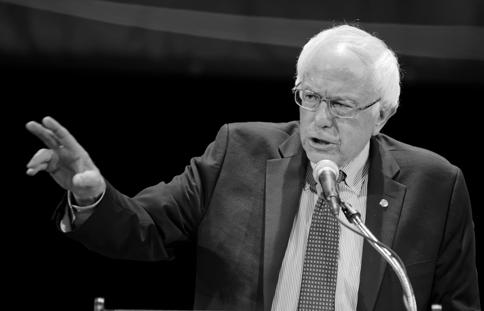
THE SENATOR FROM VERMONT stood before the screaming crowd. Hands raised, he spoke into the microphone. “Our great country was based on a simple principle,” Bernie Sanders said after winning the New Hampshire democratic primary. “And that principle is fairness.” Sanders’ victory that night established him as the first Jewish candidate in American history to win a presidential primary.
But throughout his campaign, Bernie Sanders has downplayed his Judaism. In his same speech, he called himself “the son of a Polish immigrant,” making no mention of his father’s faith. And yet, though he has rejected ties to organized religion, Sanders’ message aligns with Jewish values. The faith shapes Sanders’ view of the world and how America should act. Throughout his campaign, Sanders has invoked ideals similar to those of the Labor Zionist movement – the ideology of the kibbutz, a socialist Jewish collective where he spent several months during the 1960s.
The Labor Zionist movement envisioned a Jewish state, built by Jewish pioneers, where people would live in equality. This state would be
JAKE FENDER
socialist; its values stemmed in part from the idea that Eastern European Jews had lived under oppressive governments for too long. A Jewish state would make them masters over their own destiny and give them the chance to form a government rooted in Jewish values. Sanders worked on a kibbutz, the early Jewish collectives that were symbolic of the movement. Labor Zionists established kibbutzim (pl.) to create a working Jewish class that would become the bedrock of a strong Jewish nation.
Sanders’ efforts to mobilize the American working class echoes Labor Zionism’s attempt to harness the political energy of Jews living in Israel. Just as the kibbutz built a national identity for a new state, so too does Sanders’ rhetoric create a sense of American pride and a renewed commitment to the American dream.
Sanders’ campaign website spell out populist ideas in detail. “Income and Wealth Inequality” is the first issue mentioned. A caveat at the bottom of each page reminds voters that the website is paid for by “Bernie 2016 (not the billionaires).” Sanders’ movement is not Zionist; he focuses on Americans, not Israelis. But his message contains a similar effort to empower the many against the oppressive few.
Zionists rooted kibbutzim in the notion that ordinary workers could join together and create a fair society. Sanders strives to create an American ethos that specifically targets the wealthy. “This campaign is sending a message to the billionaire class,” his website proclaims. “You can’t have it all. You can’t get huge tax breaks while children in this country go hungry.” Sanders wants a fair America and imposes a sense of collective responsibility. “Your greed has got to end,” he wrote. “You cannot take advantage of all the benefits of America, if you refuse to accept your responsibilities as Americans.”
Sanders seems aware of the ideological roots underpinning Judaism’s
values of egalitarianism and social justice. “Bernie Sanders subscribes to a moral code of conduct defined in large part by Jewish traditions,” Diamondstein said. “This has played out often during the primary process when you can see his deeds and words reflecting core tenets of social justice, equality, and fairness.”
Sanders’ message unapologetically seeks to create an equal America by redistributing the nation’s wealth, resources, and influence. And as he addresses his past, his policy increasingly intersects with his Jewish values. His principles highlight those of the Labor Zionist movement and the broader Jewish community.
Sanders’ message resonates most clearly among young members of the Jewish community. “There appears to be a strong connection between Bernie Sanders and young Jewish adults,” said Judy Diamondstein, Chief Executive Officer of the Jewish Federation of Greater New Haven. “His message resonates with them and makes it a little cool to be Jewish.”
Notwithstanding his “Jewish” message, however, Sanders has established himself as a vocal critic of Israel’s policies and its Prime Minister, Benjamin Netanyahu. Sanders has not presented a policy that is “pro-Israel,” or even “pro-Palestine.” He has condemned both Israel and Hamas for unnecessary force. He was the first Senator to announce he would not attend Netanyahu’s February 2015 address to Congress, citing fears that Netanyahu’s address was a publicity stunt for an upcoming election. His official stance on Israel is distinctly bilateral – Palestinians must acknowledge Israel’s right to exist, but they must have a homeland and control over their political future.
Zanger-Tishler thinks Sanders is making the conversation within the Jewish community more dynamic. “The fact that he lived on a kibbutz but also criticizes Israel’s policies has led to many discussions in the
community,” he said. “I can’t think of a public figure who talks about Palestinian rights and is also very pro-Israel. That is becoming a big point of conversation in the Jewish community.”
Zanger-Tishler notes Sanders may create room for many American Jews to identify with both Israel and Palestine instead of choosing a side. Sanders has made it easier, he said, for secular Jews to support Palestine without compromising their Jewish identity.
Despite his position on the Israeli-Palestinian conflict, Sanders has garnered significant attention as the first Jewish candidate to win a presidential primary. Although the issue matters little to those outside of the Jewish community, the Vermont senator has gathered a broad coalition of voters around him. That “seems to indicate to me something positive about the way that America perceives its Jewish citizens,” Yale Hillel President Michael Zanger-Tishler said.
At the Democratic debate in Flint, Michigan, Sanders said he is proud to be Jewish; the faith defines how he sees himself. His father’s family was wiped out in the Holocaust, and he knows firsthand what radical politics can do to minority groups.
Zanger-Tishler agrees with this idea. “Judaism is as much a religion as it is a narrative,” he noted. On Passover, for example, Jews retell the story and recall their own narrative of oppression. “It is really hard to reflect on our narrative, a crucial part of our religion, and not be called to action in the way that Bernie is,” Zanger-Tisher said.
“Jews refer to themselves as part of ‘the Jewish people,’” Dimondstein agreed. “The collective is very important as a source of memory, pride and responsibility. Bernie Sanders’ accomplishment as the first Jewish candidate to win a presidential primary is important and historic.” His victories thus far convey a sense of possibility and confirm a universal belief in the American dream.
IN THE AFTERMATH of the Syrian Civil War, Syrian refugees flooded Europe, creating one of the 21st century’s worst humanitarian crises so far. Perhaps no country has been hit harder by the influx of refugees than Turkey. With a refugee population equal to about 3 percent of the country’s entire population,Turkey is facing a future of tough decisions and harsh consequences.
This January, I traveled to Istanbul, Ankara, and Izmir, Turkey with a group of eleven Yale students. Our goal was to research the Syrian refugee crisis in Turkey. We met with Cengiz Çandar, a columnist for Radikal and the former Foreign Policy Advisor to the eighth Turkish President, and asked him about the Turkish government’s long-term vision for Syrian refugees. He told us of a meeting in 2011 with president Recep Tayyip Erdoğan, in which the president stated, “Over 100,000 refugees is alarming for Turkey.” Çandar continued with a smile, “Do you expect a long term plan from a government that once assumed 100,000 [refugees] was alarming but now houses more than 2 million?”
Çandar writes prolifically about Turkey’s policies on the Syrian Civil War. During our interview with him, he echoed Henry Kissinger, who has claimed that the conflict in Syria is the Middle East’s Thirty Years War. After that long and bloody conflict, the Holy Roman Empire shattered into several independent states. Çandar believes that the civil war in Syria will only end
This article is based on the interviews and meetings I had during a 11 days YIRA sponsored trip. It took place in Istanbul, Ankara, and Izmir.
when the region has fragmented into new states.
After almost three hours of conversation with Çandar, he challenged us to think about the implications of this regional change for Turkey: “Will Turkey itself undergo the same partitioning into regions, perhaps based on ethnic origins?”
Only by looking back at the nation-building process, from the Ottoman Empire to the Turkish Republic in the early 20th century, can we understand the fundamental structural changes Turkey faces.
The Ottoman Empire, the precursor to the Turkish Republic, ruled over many different ethnic and religious entities, including Christians, Jews, Kurds, and Armenians. Ottoman rulers quickly realized the challenges of governing such a heterogenous population. The Ottoman Empire ultimately borrowed the system of millet from previous Muslim nations. Millet gave autonomy to different religious and ethnic groups; the Ottomans only demanded loyalty to their empire. Each millet had its own legal and taxation system. This system worked well until it was threatened by the rise of nationalism within the Ottoman Empire in the 19th Century.
But various groups, especially in the Balkans, began to undermine the millet system and defect from the empire. As a result, Turkey was forced to create a new nation building framework. Some suggested unifying
the empire around a Muslim identity. Others suggested relaxing millet and distributing more autonomy to the individual regions. During this period of transition that the Ottoman Empire entered the Balkan Wars in 1912 and 1913 and, in what turned out to be its final war, World War I. After World War I, the Treaty of Versailles partitioned the Ottoman Empire into various nations. In the empire’s ashes, Mustafa Kemal Ataturk, a former Ottoman lieutenant, led the Turkish people in the 1919 Turkish War of Independence. On October 29, 1923, he founded the Turkish Republic.
The most crucial question was how to build a nation. According to Ahmet İcduygu, Director of the Migration Research Center at Koç University in Istanbul, Ataturk wanted to keep the Turkish population homogenous. When we started our conversation, Professor İcduygu immediately argued that all discussion around refugees in Turkey should be part of the broader framework of the Republic and what it means to be Turkish. For him, Syrian refugees and their issues are not new to Turkish politics, as Turkey has been dealing with refugees since its inception. However, Syrian refugees represent a unique challenge because Ataturk’s framework cannot accommodate those who do not fit the traditional definition of Turkishness. Ataturk re-invented the meaning of Turk, formerly understood as an ethnic group. Instead, any Turkish citizen, regardless of his or her original ethnic identity, would be considered a Turk. This was in stark contrast with the Ottoman Empire’s pluralist approach to its populace.
Professor İcduygu, said “Ataturk and his advisers used Turkish identity combined with a culturally religious tone as a cement to form the society.”
Although Ataturk and his advisers were deeply secular, they also concluded that the country had to adopt Islamic culture, a process which happened with surprising efficiency. Professor İcduygu said, “There
were officially 260,000 non-Muslims in Turkey in 1936. Today’s Turkey has less than 100,000 non-Muslims. By the pattern of demographics, it should have been 2 million by now.” He speculated that many non-Muslims have left or been converted to Islam in the process of nation building.
On the ethnic front, Ataturk’s government also worked effectively for a homogenous society. The 1923 population exchange between Turkey and Greece ensured the exodus of Greeks from Turkey and the influx of Turks from Greece. In total, 2 million people (around 1.4 million Anatolian Greeks and 600,000 Turks in Greece) were involved in the exchange. Next,
law’s legacy. İcduygu concluded that immigration policies in Turkey have been slow to recognize the influx of people who fall outside the parameters of Turkish descent and culture.
This reluctance to adapt is no mistake, but the government’s conscious effort to maintain the ideology of Turkishness. The starkest example of this policy manifested in Turkey’s adoption of the 1951 Convention with “the geographical limitation” that continues to allow Turkey to not take responsibility for refugees coming from outside the Council of Europe. To this day Turkey excludes people of Middle Eastern or South Eastern descent from applying for refugee status, even though they form the majority of immigrants.
“According to Turkish military, since July 2015, 3,953 terrorists and 393 members of security forces were killed in the conflict. The Kurdish problem is a bitter reminder of the failure of the Turkish nationbuilding framework, and the reluctance to change it in the face of evolving challenges.”
in line with the goals of a homogenous society, Turkey passed the 1934 Turkish Resettlement Law. The law infamously legalized the re-arrangement of minorities (e.g. Kurds) into majority Turkish communities for assimilation purposes.
The 1934 Turkish Resettlement Law originated Turkish refugee policy. It allowed only persons of “Turkish stock” and “those attached to Turkish culture” to be accepted into the country. Although now defunct, the law set “Turkish descent” as a key factor in refugee acceptance. More tolerant later laws, like the 1951 Convention relating to the Status of Refugees and its 1967 additional Protocol on the Status of Refugees were ineffective in breaking the 1934
Even before Syrian refugees came to Turkey, the ideology of Turkishness failed another minority ethnic group. Kurds, forming between 16 and 20 percent of the population, are the largest ethnic minority in Turkey. They are not ethnically Turks, but the government has attempted to include them in the Turkishness since its founding. However, efforts to integrate the Kurds created backlashes as early as two years after the founding of the Republic. The Sheikh Said (a Kurdish cleric) rebellion of 1925 was an attempt to win some degree of autonomy for the Kurdish population. The revolt was crushed by the Turkish military. In response to the uprising, Turkey issued a law in 1927 allowing the Turkish government to forcibly relocate 1400 Kurds to western regions to be assimilated. Later Kurdish revolts in Ararat in 1930, and Dersim in 1938, were similarly crushed by the Turkish military. The reports of civilian deaths in Dersim range from 50,000 to 100,000 making it one of the bloodiest episodes in the history of the Republic.
Kurdish frustration with the Turkish government’s unwillingness to recognize their history, culture, language and folklore came to a head in the late 1970s, resulting in
the creation of the Kurdistan Workers’ Party (Partiya Karkerên Kurdistan or PKK)—an organization recognized by NATO and the European Union as a terrorist group— which aimed at countering the government’s forces at the local level.
Over the last four decades, PKK and the Kurdish question have remained major unsolved issues in Turkey. While there are many reasons for this inaction, nationalist ideals are the main culprit. Kurds and their mostly justified demands, such as recognition of the Kurdish language, have gone unanswered because they do not fit into the Turkishness framework. This framework has never been reshaped to accommodate the Kurdish people.
Today, Eastern Turkey is still a scene of war between the Turkish military and Kurdish guerillas. According to Turkish military, since July 2015, 3,953 terrorists and 393 members of security forces were killed in the conflict. The Kurdish problem is a bitter reminder of the failure of the Turkish nation-building framework, and the reluctance to change it in the face of evolving challenges. Given the fact that Turkey now harbors close to 3 million Syrian refugees—all of whom who seem likely be staying permanently— history may be repeating itself.
Merve Ay, the head of the
“The concept of Turkishness is as sacred as the ideal of constitutional rights in the United States.”
International Alliance of Doctors of Istanbul, believes that refugees do not fit into a preconceived vision of Turkish society. She jokingly mentioned, “We called Kurds Mountain Turks for decades, but re-labeling them did not work. There is no denial that Syrians are Arabs, even if we try to call them Turks.”
Syrians will have to be a part of Turkish society in the future, but how they will fit into the nation-building framework is harder to answer. Will Turkey be locked in a total war with another minority in the future? The current government’s efforts to fight Kurdish separatists are in predominantly Kurdish cities. A similar issue seems poised to arise in cities where the Syrian refugee population is increasing. Kilis, a city in southern Turkey, now houses more Syrians than native Turks. What kind of integration policy is needed to not repeat the mistakes of the past? Syrians are still not recognized as refugees, but as temporary asylum seekers in Turkey. Although they have been granted working permits, most recently in late January, these permits restrict employment to cities where Syrians are registered. Unfortunately, Syrians are mostly registered in cities that already have high unemployment rates, and cannot relocate to other cities in order to find jobs. Education
is limited to the few who can speak Turkish. Health service is sorely lacking with “only four pharmacies serving almost a million refugees in Istanbul” said Merve Ay.
Turkey needs to change the nation-building framework, but what can this essential element of the Turkish identity be replaced with? The concept of Turkishness is as sacred as the ideal of constitutional rights in the United States. Perhaps a new constitution is exactly what the Turkish people need, one that recognizes a person’s contribution to the nation, rather than his or her bloodline, as the token of citizenship.
Turkish citizens of the current generation will have to answer many difficult questions in the coming decades. As Syrians become more permanent members of Turkish society, this generation will have to confront deep racism and crippling xenophobia. With the Kurdish question remaining unresolved for 40 years, Turkey’s record does not yield to optimism. One can only hope for the creation of a more tolerant, pluralistic Turkish society. For that, the country needs to immediately recognize the ticking bomb represented by Syrian refugees, and the shortcomings of the rusty old Turkish nation-building framework.
DO NO HARM
MILITARY CAMPAIGNS
ENDANGER MEDICAL AID
BY CASSANDRA LIGNELLI
It has been said that
DEATH STRIKES in THREES.
SUCH WAS THE TRAGIC lesson learned by Médecins Sans Frontières (MSF, known in the U.S. as Doctors without Borders) in Afghanistan, Yemen, and Syria. While MSF and other global aid organizations often face violence, three particularly atrocious attacks against MSF facilities have led many to question international law’s ability to protect humanitarian medical aid workers.
Attacks against hospitals cause more outrage than other types of violence because such attacks are considered war crimes. According to the International Committee of the Red Cross (ICRC), “The Geneva Conventions and their Additional Protocols are international treaties that contain the most important rules limiting the barbarity of war. They protect people who do not take part in the fighting (civilians, medics, and aid workers) and those who can no longer fight (wounded, sick troops, and prisoners of war).” The three attacks against MSF facilities, then, are particularly alarming, because they violate international law.
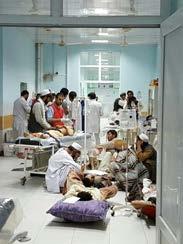
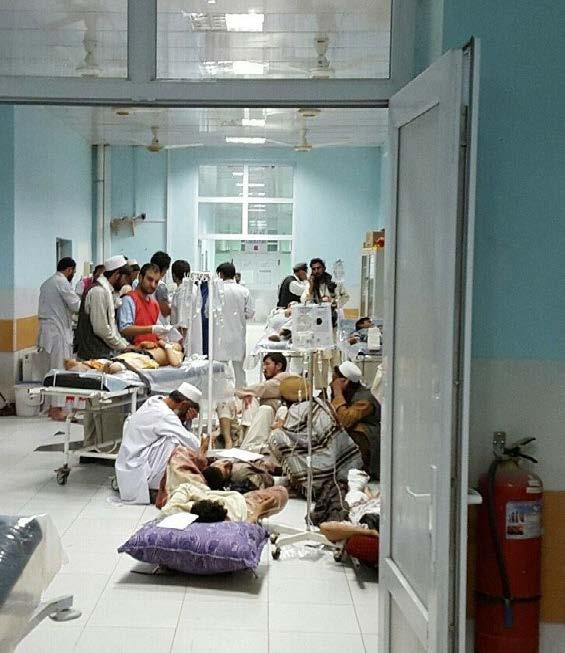
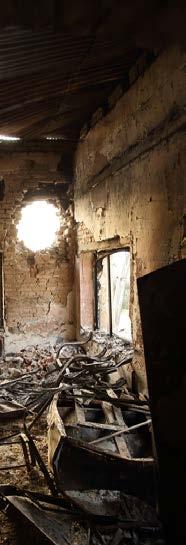
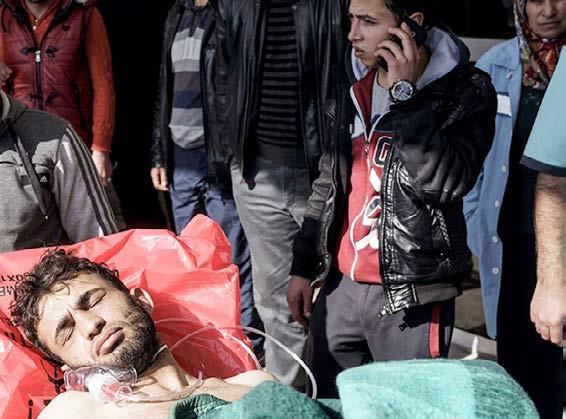
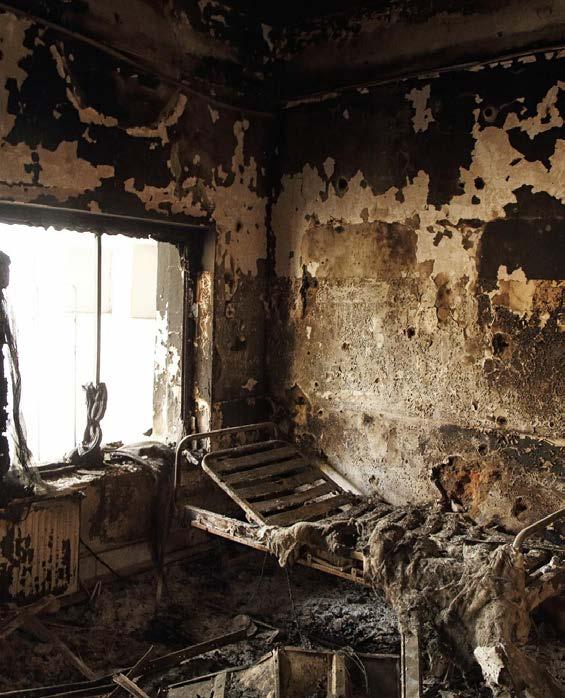
In October 2015, the U.S. launched airstrikes on a MSF trauma center in Kunduz, Afghanistan. Before sunrise, U.S. planes bombed the hospital, then circled back and shot those trying to run away. Thirty staff,
patients, and physicians were killed.
In an interview with the Associated Press, Anayatullah Nazari, a survivor of the attack, said, “It was like they were determined to kill us all and that nobody would survive. It was like doomsday, nothing I could ever imagine." The U.S. took responsibility for the attacks, saying it was an accident. General John F. Campbell, commander of operations in Afghanistan, conceded in a Defense Department press conference that the attack forces had not been properly briefed.
“This was a tragic but avoidable accident caused primarily by human error,” said Campbell. No one is likely to face consequences for the attack.
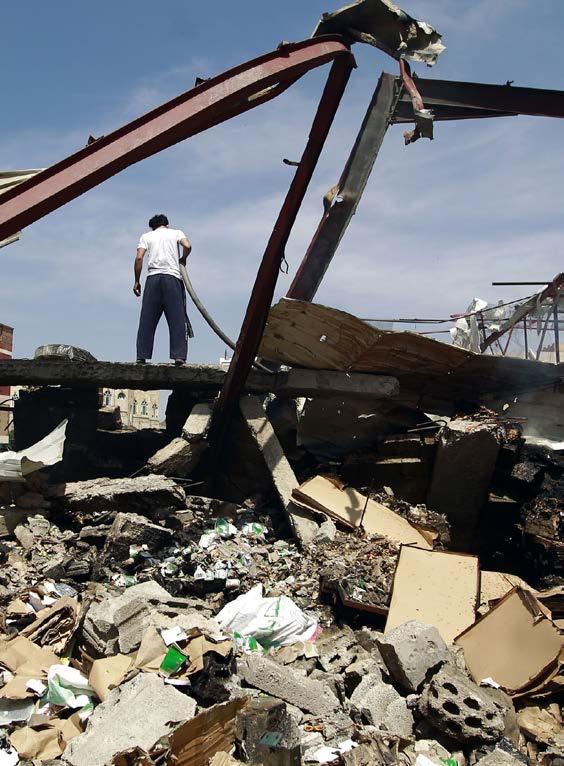
Three weeks later, a Saudi coalition destroyed another MSF hospital in Yemen. While everyone escaped safely, a critical part of the Yemeni medical infrastructure was destroyed, leaving many without trauma care. The Saudis, too, claimed the bombing was an accident—the result of tired troops, poor briefing, and confusion about which buildings are protected and which are not.
Then, in February 2016, a hospital in the Idlib province in northern Syria was bombed, leaving 25 dead and 11 injured. The volatility in Northern Syria has made it difficult to identify those responsible
for the attack. Many speculate Putin and Assad were behind the operation. Some even suggest the attack was intentional, which Putin vehemently denied.
In quick succession, these three attacks have left many wondering if the state of humanitarian aid is changing fundamentally and if the Geneva Conventions--international laws designed to clarify and govern the rules of war--are eroding.
The answer is not immediately clear. The medical aid community, for example, disagrees on the true scale of the violence. While the number of attacks on facilities is increasing, so are the number of aid workers operating in the field. Despite more attacks, the rate of attacks fluctuates. Removing outlier countries like Somalia, Syria, and Afghanistan—regions so conflict-stricken that the risks are significantly higher than average—all but eliminates any increases in the rates of violence against aid workers.
The aid community does agree, however, that public perceptions about humanitarian aid safety have deteriorated; security has become an area of increasing concern for aid organizations. The perception of increased violence, founded or not, will notably affect medical aid in the future.
Augustin Augier, CEO of the Alliance for Medical Action International (ALIMA) – a group that works in seven sub-Saharan African countries –does not agree that the recent violence is exceptional.
In an interview with The Politic, Augier said there is no evidence that humanitarian aid has become more violent. He noted that, Geneva Conventions aside, hospitals have always been targets. “Insecurity is a growing issue in the humanitarian aid community,” he said, “but it has always been a problem.”
Unni Karunakara, the former president of MSF, had a different take on the prevalence of violence today, but came to a similar conclusion with its implications. In an interview with The Politic, he explained that delivering medical aid in conflict zones has always been risky, but, from his interpretation, the data reveals increased violence against aid workers. In other words, “it’s not just a perception.” Karunakara also noted that recent attacks have shaped the practical relevance of the Geneva Conventions. “I don’t think, to my knowledge, there’s ever been a time when the Conventions were absolutely respected,” he said. “There’s always been violations of the Conventions in the past. Hospitals have been attacked.
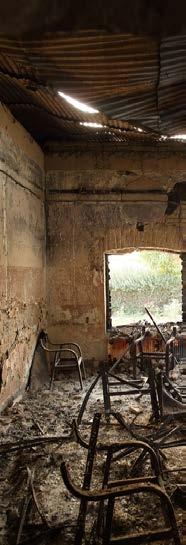
THE DESTROYED MSF TRAUMA CENTER IN KUNDUZ, OCTOBER 2015
“THESE ATTACKS HAVE LEFT MANY WONDERING IF THE INTERNATIONAL LAWS DESIGNED TO CLARIFY AND GOVERN RULES OF WAR ARE ERODING”
Health workers have been attacked in the past as well.”
Despite different opinions on whether violence has increased in the modern age, most of the humanitarian community agree that aid delivery is changing. As Karunakara said, “We are living in the age of security.” While violence has always been a concern for humanitarian aid groups, security seems to have only become a major issue for aid organizations during the last few years. Organizations today, then, are far more risk-averse.
The shift toward caution has two major consequences. First, aid organizations may not be able to reach those most in need of care. Medical workers are most exposed to violence where it already exists. As a result, some of the most vulnerable people may go without medical aid.
“It affects our ability to perhaps reach some of the most difficult humanitarian contexts of our times,” said Karunakara. “It is not possible
today to provide impartial humanitarian assistance, for all the people who need it in Syria, in Somalia, in Afghanistan today. There are many more people going without help or assistance as a result of these conflicts.”
Augier concurred. “Usually medical aid is delivered on the periphery, but many organizations now have been forced or have chosen – like MSF – to work in active conflict zones.” For example, the trauma unit in Kunduz was shuttered after the attacks leaving victims of the bloody conflict without medical care. And in Somalia, MSF ceased operations after the Somalian government failed to carry out a reasonable sentence for the murder of MSF staff. Today, in MSF’s absence, Somalians lack the humanitarian assistance they so desperately need.
This inability to reach those most vulnerable populations is exactly the goal of the perpetra-
tors, Karunakara noted. “That’s also what many of the people who perpetrate the violence want,” he claimed. “They want to deprive people of basic services, and top of that list is health.”
The need to focus on security, instead of aid, drains humanitarian organizations of their time and resources. When an organization has to focus more on security, they focus less on providing medical services.
To further complicate access, increasing security measures often becomes cyclic. Karunakara noted how much has changed since he volunteered as a physician. When Karunakara volunteered, people could go to the local bars after work, visit the market, and be a part of the communities they served. Now, many regions are too dangerous for volunteers to leave MSF facilities. And because they are less visible in the community, these volunteers become outsiders and command less respect in the community. So security measures
require more security measures. A second result of the recent attacks is greater public awareness of international legal systems and their flaws. The Geneva Conventions protect anything that bears the symbol of the ICRC – a red cross, red crescent, or the symbol of medical organizations like MSF. But the Geneva Conventions are hard to enforce because the international institutions overseeing them are notoriously ineffective.
For example, an investigation into the bombing in Kunduz would require one of the governments involved – the U.S. or Afghanistan – to officially request such an investigation. That is unlikely, said Augier. “The attack in Kunduz is the first time MSF has ever had to use the fact-checking assurance of the Geneva Committee, but for the process to go to international court, one of the governments would have to ask the Committee for the investigation. That’s not in the interests of the U.S. or Afghanistan.”
Even in a case like this one where liability is clear, the necessary actors are unlikely to investigate, prosecute, or sanction. In cases where involvement is more tenuous, like the attacks in Yemen or Syria, the appropriate international processes are nearly impossible to activate. Politics get in the way.
“Today, four of five members of the UN Security Council are part of coalitions who have attacked hospitals,” Karunakara commented. “It’s that pervasive. There’s no one to really stand up and say, ‘This has to stop.’ The failure of international relations is the inability to hold violators accountable.”
Another complicating factor is that non-state actors are usually the ones committing violence. International bodies have a hard enough time sanctioning nations for violating international law; they are even less suited to force groups like the Islamic State (IS) or al-Shabaab to answer for war crimes. In many humanitarian contexts, the political climate is too complex to call on highly bureaucratic legal bodies to enforce the human decencies of the Geneva Conventions.
But Karunakara suggests international law is more deeply troubled than just specifically in a humanitarian context. “Once [national] security is invoked,” he said, “it takes more of a priority than other concerns like human rights or sovereignty, which are concerns we’ve had in the past.” He suggests that in international politics, humanitarianism may not be a priority for powerful states. In situations where national interests and international law are in conflict, national interests usually win.
This repainting may be what has led historically human-rights-focused nations to begin to violate international laws during the recent refugee crisis in Europe. Though international law guarantees the right to asylum, many countries have sent refugees back to unstable countries to protect their own national interests. While
the Geneva Conventions seem particularly vulnerable in this age, international legal systems in general play second fiddle to national laws, making international laws difficult to enforce.
But in light of recent violence, many have called for reform. “The change mechanism for international bodies is slow, but there is momentum,” Augier commented. One benefit from this violence, he suggested, is a change to international legal processes.
Chris Torgeson, a colleague of Augier’s, concurred. She explained, “Campaigns for security by bodies like MSF and ICRC may bring about more debate and discussion about the protections under international law, and therefore increase protections for people running humanitarian aid operations, legally speaking.”
Some members of the aid community hope that public outcry over the violence could lead to improvements for investigating and punishing infractions. Amidst all this discussion and media coverage of violence against health workers, some members of the aid community also worry that the violence may become normalized.
Torgeson, who is launching the U.S. branch of ALIMA, voiced such a concern, explaining, “While an increase in incidence of security threats has not been proven, there has been an erosion of understanding of what is protected under international law. Because the events have been so publicized, it makes it seem as though it is acceptable to politicize health.”
Her point reflects widespread anxiety about the desensitization that may result from publication and debate about attacks on medical aid organizations. She was echoed by Karunakara, who fears that normalizing violence against medical workers may decrease outrage, and therefore limit advocacy.
Their concerns are well-founded. “Poverty porn” is a widely-studied phenomenon. The same goes for
“USUALLY MEDICAL AID IS DELIVERED ON THE PERIPHERY, BUT MANY ORGANIZATIONS NOW HAVE BEEN FORCED OR HAVE CHOSEN TO WORK IN ACTIVE CONFLICT ZONES”
drowning donors and policy makers in images of violence at hospitals. Augier noted that though the “aid under attack” rhetoric may motivate public policy and donors in the short term, the publication of violent images may eventually lose power. After all, there is only so much devastation that Western audiences can absorb before they become numb to it.
When supporters of these groups become numb to violence, the ability of these organizations to operate and provide aid seems less dire and more normal. This numbing effect could be highly significant, especially considering that MSF got nearly 90 percent of its income in 2014 from private donors.
MSF is not necessarily targeted more than other aid organizations. While the three most shocking attacks were all against MSF facilities, other aid organizations face violence at roughly the same rate, and have to make choices based on risk and security in the same way.
Karunakara thinks the incidence of violence against MSF, specifically, can be explained by two factors. First, “As an international organization, we can bring much more resources to bear on a particular incident. So, we have a loud voice and you hear about it.” Second, “As an organization, given our experience and capacity, we tend to be in highly insecure areas, more so than other organizations.” While it may seem as though MSF experiences are more at threat than other groups, in fact, violence against health workers is truly universally felt.
Amidst all these complex political and humanitarian concerns, organizations must find a balance between taking risks and making compromises. In this new age of security, it is clear that organizations are thinking more critically than in the past about risk, safety, and their ability to deliver aid to those who need it most. Each organization answers these questions differently; each is
“MEMBERS OF THE AID COMMUNITY WORRY THAT THE VIOLENCE MAY BECOME NORMALIZED”
bound by institutional capacity and objectives. Therefore, while experts in the field feel that organizations are becoming increasingly risk-averse, they still do what they can to push geopolitical boundaries. At the end of the day, despite any dangers, medical humanitarian workers have one objective: to provide care. The stakes are high if they fail.
While a clear consensus has not been reached about whether the perceived increase in violence is historically exceptional, most agree that the aid community has entered an age of security. Whether exceptional or not, violence against aid workers is changing the significance of international legal bodies, limiting the populations that organizations can reach, and normalizing the politicization of health. The image of doctors and patients being shot from above as they ran from a burning hospital is not a forgettable one. It is crucial in the coming years, as medical humanitarian workers navigate complex and often violent political climates, that those who work in global health never forget the injustices that have occurred against humanitarian medical workers.
I WISH I COULD STRIKE YOU WITH THUNDER
China’s Vaccine Scandal Reveals a Culture of Corruption
BY YIFU DONG
CHINA IS BECOMING A PLACE OF unnecessary worries. Parents, in particular, have plenty to worry about: from purchasing safe milk powder from outside China to finding schooling opportunities for migrant children, from trying to give their kids an edge in the all-important gaokao college entrance exam to advertising their still-single children in spontaneous “marriage markets.”
People would have been spared such worries if the authorities had done their jobs: wrongheaded policies, lax supervision, and rampant corruption are just a few culprits blamed for various scandals that have surfaced in recent years. In late March, Chinese people added something else to that seemingly endless list of worries: vaccines.
On March 19, the government of Shandong Province published the names of 300 suspects involved in the “illegal sale of vaccines.” According to the state news agency Xinhua, the operation lasted five years and involved the sale of 25 kinds of vaccines, spread into more than a dozen provinces and municipali-
ties, including Beijing. It yielded an illicit profit of nearly $88 million. The Xinhua report states that the main suspect, a woman surnamed Pang, had been convicted of illegally selling vaccines and given a suspended sentence in 2009. But, nonetheless, she managed to expand her business before serving her sentence, with the help of her medical school-educated daughter. Curiously, police arrested the suspects in April 2015, but only recently has the case become public. Once the news broke, it spread like wildfire on Chinese social media, igniting anxieties over the safety of the vaccines. It also sparked anger at the government’s lack of supervision and the media’s failure to serve as a watchdog. Chinese netizens, active on social media, responded angrily, especially parents whose children were potentially exposed to the hazards.
On March 21, popular actor Jia Nailiang, father of a three-yearold daughter, unleashed his anger on Weibo, China’s microblogging site: “Does anyone care about the vaccine problem? Where did the $88 million worth of vaccines go? What
children received those shots? How many of those vaccines still remain in hospitals? We must investigate it thoroughly!!! For those who make fake vaccines, I wish I could strike you with thunder for ten years and curse at your ancestors!”
Two days after Jia’s call for an investigation, Premier Li Keqiang issued a similar order, which called for a “thorough investigation,” “improved supervision of vaccines” and a “guarantee of people’s health and safety.”
The safety hazards of the so-called “fake vaccines” sound scary, but they are not really fake. Instead, they are sold past their expiry or have been improperly stored in higher temperatures, often becoming ineffective. Health experts have pointed out that such illegal practices are “murder” because for deadly diseases such as rabies and tetanus, vaccines are the cure. Other reports on the recent scandal note that in the past three years, ineffective rabies vaccines have caused several deaths across China. That being said, the vaccine scandal is perhaps not as deadly as most
ON MARCH 19, THE GOVERNMENT OF SHANDONG PROVINCE PUBLISHED THE NAMES OF 300 SUSPECTS INVOLVED IN THE “ILLEGAL SALE OF VACCINES.”
other safety scares in China. In 2008, a dairy company called Sanlu was found to have added melamine, a toxic chemical whose high content of nitrogen makes it count as protein in quality tests, in its baby formula. This caused kidney stones and death among infants. Since the use of melamine was prevalent, a considerable portion of dairy products were removed from the shelves in supermarkets across China. This scandal was shocking because it was the first time when a daily necessity was found to be poisonous. As a consequence, Sanlu was shut down and two suspects received the death penalty.
The vaccine scandal, fortunately, only involves the category 2 (voluntary) vaccines, but not the category 1 (mandatory) vaccines that all children receive. The World Health Organization claimed that “improperly stored or expired vaccine seldom if ever causes a toxic reaction – therefore there is likely to be minimal safety risk in this particular situation.”
The reaction of the Chinese public, however, shows that specific details about the vaccines matter to them less
than their overall concern with the authorities’ neglect. Therefore, even news stories that cater to the public’s demand for information are met with cynicism. On March 22, three days after the scandal came out, a news account on Weibo listed nine pharmaceutical companies that were under investigation, but the 15,000 comments showed concern beyond the vaccine scandal itself. One of the most popular comments read, “We have already tolerated melamine, poisonous capsules, Sudan Red, plasticizer, gutter oil, clenbuterol, milk with melted leather, poisonous ginger, rice with cadmium and expired meat… How is that such a big country like ours cannot guarantee the safety of our children?” In recent years, as various safety scares erupted, this long list of obscure chemicals and unsafe products became widely known in China.
China’s Central Propaganda Department forbade direct commentary on the vaccine scandal, and official media outlets followed the routine methods to gradually remove the scandal from public view. Chinese
propaganda always uses such tactics when the authorities are to blame for the incidents. In the past year, the biggest disasters included an apocalyptic chemical explosion in the port of Tianjin in August and a man-made landslide in Shenzhen in December, but both stories disappeared from the news after an initial outcry.
Efforts to quell people’s worry are usually fruitless. On March 23, a Weibo post by the Communist Party mouthpiece People’s Daily tried to downplay the threats of the vaccine scandal. The post features a series of pictures with captions explaining the effects of the vaccine and its potential adverse effects. At the end, it highlights the sentence: “Most adverse reactions are trivial; they won’t cause death or disability.”
The post, though in line with the WHO’s claim that the vaccines presented a relatively low hazard, failed to convince people. One commenter mocked the usual government playbook for handling such incidents: “Always ‘inferring from one example,’ always ‘patching up after the
The anonymous commentator pointed out that China has enjoyed 60 years of peacetime and 40 years of relative social stability, but the Chinese public has remained in a constant state of panic over the safety of bread and butter issues.
damage is done,’ always ‘promising to punish with due severity’ and always paying attention after the problem ‘becomes big.’ Is there any use? What does the government watchdog do?”
Another reflected upon his own misfortune: “To live in this land up until now really depends on some damn luck!” Another said: “Even if we punish all the corrupt officials, our lives won’t improve…We simply want what many other countries have: cheap housing, free housing and health care, and uncontaminated food, water and air.”
An online commentary by the state-run Guangming Daily indirectly echoed similar sentiments, proclaiming in its title: “In peacetime, we should live normal lives.” The anonymous commentator pointed out that China has enjoyed 60 years of peacetime and 40 years of relative social stability, but the Chinese public has remained in a constant state of panic over the safety of bread and butter issues. The article notes a similar vaccine scandal that broke out six years ago in Shanxi Province, when vaccines caused disability and death among dozens of children. “Six years
ago it was promised that the incident would be dealt with severely, why did it stop being severe only after six years? What can people expect in the next few years?”
Upon learning about the vaccine scandal, many parents in Guangdong Province have flooded nearby Hong Kong hospitals to get their children vaccinated, a similar reaction as parents who bought imported baby formula after the melamine scandal in 2008. Hong Kong hospitals, at capacity, could only turn away the excess of mainland patients that they cannot accommodate.
In the meantime, some Chinese swindlers have also upped their game. In one case reported by Weifang Evening News, a small local newspaper in Shandong Province, the epicenter of the vaccine scandal, fraudsters told one mother that the government had offered her $16,000 and an Apple laptop to compensate for the fake vaccines her child received. As soon as she was hoaxed into providing her bank information, the bank sent her a text message: her money was gone. In the end, like countless other
incidents, people’s pressing concerns about the safety of vaccines remain unaddressed, the authorities are not held accountable, and the media is silent. One Weibo post, written two weeks after the scandal, reflected the disappointment and helplessness of the public: “The fake vaccine incident that everyone talked about a little while ago is now silenced. Neither the batch numbers of the fake vaccines nor the names of the hospitals that still sell them are reported. What about the children?...I hope the government can do more and give our citizens a better explanation.”
But if the government failed to prevent the fake vaccines and other safety scandals, there is little reason to believe that the future will be any different.
Reset, Again
BY BILLY ROBERTS
In Russia, Vladimir Putin embodies a certain kind of machismo. Whether he’s packing heat, riding a horse shirtless, or throwing his opponents in a judo match, the Russian media focuses relentlessly on the authoritarian president’s manliness. Across the Atlantic, news outlets report on Republican frontrunner Donald Trump’s preoccupation with this masculinity, especially the size of his hands and the sex appeal of his female family members. As Trump runs for the Republican nomination, Putin and Trump have complimented each other, their similar personas playing a role in this exchange. But the bond between the two men may run even deeper.
Recently, Putin commented that Trump is “very bright and talented,” according to news coverage by The Guardian. A key member of the Russian Parliament called for Trump to be Time’s “Person of the Year.” And Russian state media has piled on, describing the business mogul as the true voice of the American people and his opponents as desperate elites. These comments from Putin paint a Russia that may desire a Donald Trump presidency, or that at least wants American leadership to diverge from the establishment. This interest adds yet another layer of controversy to an already divisive candidate. It raises questions about Russia’s hopes for American leadership, about Trump’s foreign policy, and about America as a global actor.
Any presidential candidate’s foreign policy would affect Russian interests should said candidate take office. In the case of Donald Trump, this policy diverges from those that many establishment advisers and politicians hold, and it may be what is intriguing Russian leaders.
The most explicit representation of Trump’s uniqueness comes with his panel of foreign policy advisers. This “expert” panel is comprised of a 2009 college graduate, a former Department of Defense inspector general forced to resign following corruption allegations, and a slew of others generally unknown in expert foreign policy circles. But in the end, these advisers take a back seat to Trump, who said on an episode of MSNBC’s “Morning Joe” “My primary consultant is myself and I have a good instinct for this stuff.” Given the sometimes contradictory nature of his public statements, it is difficult to form a comprehensive picture of Trump’s approach to international strategy.
In reviewing his public comments, one can glean a sliver of what Trump’s foreign policy might be. “Putin and Trump share a rhetoric about America’s over-sized role in the world,” said Ambassador Stephen Sestanovich in an interview with The Politic. Sestanovich was the US ambassador-at-large for the former Soviet Union, and now works as the George F. Kennan Senior Fellow for Russian and Eurasian Studies at the Council on Foreign Relations.
“Trump’s talk about how big leaders need to ‘get along’ is very welcome [for Russia],” continued Sestanovich. The Kremlin is accustomed to American leadership attempting to impose its will on Russia. Counter to this is Trump, who seems to advocate for a hands off approach wherever U.S. interests are not directly at stake. In some instances, this means negotiating reduced or eliminated costs for an expensive military presence in allied nations such as South Korea. But more relevant to Russia is Trump’s position on NATO. Trump believes, “NATO is obsolete. NATO was done at a time you had the Soviet Union, which was obviously larger—much larger than Russia is today.”
NATO has helped achieve U.S. interests abroad since its formation in 1949. It has allowed the U.S. to maintain strong economic and political strength throughout the globe, a positive result that comes at relatively little cost. The United States currently provides 22.1 percent, or about $521 million, of NATO’s directly funded budget. This constitutes less than 0.1 percent of the U.S.’s $585 billion defense budget.
Donald Trump is correct when he claims that the U.S. is spending more on NATO than any other member nation. But it does not seem clear that this spending is hurting the U.S. in any way. In fact, given past examples of NATO helping the U.S., particularly in Afghanistan, it may be shortsighted to try and reduce the amount of funding
that the U.S. provides the organization. But Trump does make a point when he claims that other member nations are not pulling their weight.
NATO requires member nations to spend at least two percent of their GDP on defense. Currently, only five of NATO’s twenty-eight member states meet this requirement. “[Other member nations] certainly could be doing more; whether it’s easy to talk them into that or not I doubt,” stated Jeffrey Bergner, former Assistant Secretary of State and current adjunct professor at Georgetown’s National Securities Program, in an interview with The Politic.
Trump boldly states that if member nations want to take advantage of the protection NATO can offer them, they need to contribute what it asks. Trump would refuse, he says, to continue funding the bulk of NATO’s operations while so many states are content to take advantage of NATO membership without burdening themselves with the cost of adequate defense. And unlike most of his positions, this animus against allies “free-riding” on American largesse has been part of Trump’s repertoire for decades. As early as the late 1980s, the businessman published a series of full-page newspapers ads accusing allies as diverse as Japan and Kuwait of taking advantage of the American security umbrella.
But, as Bergner expressed, it is unclear whether Trump would be able to get other member nations
to contribute more. The real estate mogul claims he can negotiate a better deal. But this negotiation may involve threats of reduced U.S. NATO spending, or even U.S. withdrawal, threats that a future president might not want to fulfill. Jochen Prantl, associate professor of international relations at Australia National University, told The Politic that “U.S.-heavy military involvement with NATO can be easily seen as the sine-qua-non for the maintenance of peace and security in Europe.” By reducing U.S. funding to NATO, Donald Trump may open the door to Russian expansionism in Eastern Europe and even undermine Europe’s defenses against terrorism.
The U.S. has repeatedly stepped in to prevent Russia from following through on its expansionist tendencies, and a U.S. military presence in the form of NATO has kept Putin and his military largely at bay, at least in comparison to the worst-case scenario alternatives. The most recent incident involving Ukraine and the annexation of Crimea is a powerful example of European nations requiring the support of both the U.S. and NATO. Eastern Europe and the Baltic states remain particularly vulnerable to the influence and strength of the former Soviet Union, and NATO’s strong presence serves to deter Russia from encroaching on any NATO members or their allies.
In regard to the Ukraine crisis, Trump told The Washington Post that the U.S. was right to impose sanctions
on Russia, but that it should not have been the only country doing so. This comment comes in spite of the fact that the EU also imposed sanctions on Russia. Trump seems to espouse the view that America should not intervene in any conflicts that do not directly affect U.S. interests or combat terrorism. He has consistently claimed that the U.S. should not be solely responsible for helping other nations. He claims that he can strike better deals with foreign nations, getting them to join in U.S. efforts abroad. But what if he can’t?
In the face of failed deal-making, Trump’s logical next step would seem to be to threaten to withdraw U.S. support. He maintains a hard line that the U.S. should not be the only nation responsible for maintaining peace. His policy for ISIS falls along similar lines. He claims that he would put pressure on other nations to fight the Islamic State, while keeping American troops safe at home. Again, it is important to ask what would happen if Trump’s threats did not lead to any action from other nations. A scenario might arise where other nations refuse to send more troops to combat ISIS, which would force Trump to follow through on those threats and withdraw U.S. support, or to maintain the status quo. “I think we’ve had experience with Barack Obama’s so-called ‘red line’ in Syria,” said Bergner in his interview. “A flat threat to withdraw is not the best idea unless one actually intends to do it.”
And what about with NATO? Tad Oelstrom, a retired U.S. Air Force Lieutenant General and current Director of the National Securities Program at the Harvard University’s John F. Kennedy School of Government, told The Politic that if Trump threatened to reduce U.S. funding, it “will only be useful to NATO if in fact other countries within NATO are willing to step up and increase their support marginally to offset that.” So Trump’s threats would have to be effective in getting other nations to contribute more to NATO in order for those threats to do any good.
“If it were decreasing support for the sake of undercutting NATO, that will be a horrible mistake,” he warned. So given the role that NATO plays in deterring Russia from achieving its goals in Europe, it makes sense that Putin would desire a President Trump if that means reduced U.S. support for NATO’s operations. But even if Trump would never decrease U.S. funding to NATO, a scenario that seems far more likely, Russia still has a vested interest in seeing the New York businessman take the Oval Office.
The alternative, in the Kremlin’s eyes, is Hillary Clinton. Clinton took a hard line with Russia during her tenure as Secretary of State, a stance that would likely remain were she to win the presidential election. Her campaign website even has “Standing up to Putin” as one of the key aspects of her national defense plan. President
Russia has every reason to oppose the election of a woman who has a past history of little to no tolerance of its expansionist policies, and who would likely maintain the increased European defense spending tht Obama proposed.
Barack Obama has already proposed quadrupling U.S. military spending in Europe as part of his final budget. This increase is meant to reassure NATO allies of American support given recent Russian actions in Ukraine. Russia has every reason to oppose the election of a woman who has a past history of little to no tolerance of its expansionist policies, and who would likely maintain the increased European defense spending that Obama proposed. In contrast, it seems difficult to believe that Trump would allow the budget to go uncontested if he were to enter office, especially given that, according to him, European nations are already reaping the rewards of American generosity.
Trump’s anti-establishment narrative could also serve as an opportunity to improve U.S.-Russia relations. Such a shift in attitude would open the door for Russia to pursue further interests abroad. The American establishment, represented well by Hillary Clinton, has maintained respectful but cautious relations with Russia since the end of the Cold War. These relations have only soured in recent years, as Putin has taken his country toward illiberal authoritarianism and revanchism. It would be in Russia’s interest to embrace a candidate who seems much more open to adopting friendlier terms with the Kremlin. Putin desires an American president who
will interfere a bit less with Russian interests, allowing him to maintain greater control in the Baltic states and Eastern Europe.
But it may also be the case that Trump is merely being opportunistic in his dialogue with Putin. In an interview with The Politic, Paris Aslanidis, a Yale University lecturer in Political Science, stated, “If the time comes that [Trump] can use the anti-Russian anti-Putin card, he will use it,” and it would fit right into the rest of his foreign policy narrative. Trump has never had trouble flipping positions before why should this time be any different?
Putin may be aware of this possibility. But regardless of whether Trump is sincere in his praise for Putin, having the anti-establishment Republican candidate in office would almost certainly be better for Russia than the alternative: Clinton, whose policy is more about keeping Russia in line than working with it.
It is almost certain that a Trump presidency would give Putin greater opportunity to advance his country’s interests abroad. It would give him a freer hand in controlling the Baltic states, Eastern Europe, and the Middle East, giving the Kremlin a vested interest in seeing the businessman take office. This dynamic underscores the importance the United States plays as a global actor. It also forces us to remember: American interests are not the only ones at stake this November.
ALI VELSHI:
BY PRANAV BHANDARKAR
Let’s begin with the 2008 financial crisis, which I understand is an event you’ve covered in depth. At what point did you believe with certainty that the crisis had begun? In hindsight, do you think the media was sufficiently able to warn the public about the impending crisis?
That’s a great question. I started warning my viewers about it in the Fall of 2007—which was a long time before most journalists were there—largely because my wife is an expert on the consumer, that’s what she was, she was an investor. I had seen home prices start to come down, we’d seen the stock market hitting new records, but toward the end of 2007, November or December, we start to see a weakness in consumer spending. And my wife told me, as I often report, the consumer is responsible for two thirds of the spending decisions in the United States—unlike a planned economy. If the consumer is weakening, it doesn’t matter what the other statistics are telling you, it doesn’t matter what ev-
erything else says. If the consumer is seeing something happen—and by the way, a majority of Americans at that point had said that they felt like there was a recession coming—it countered everything that the economy was telling us. But when the consumer runs the economy, if the consumer says they’re feeling bad, something bad’s going to happen. And I started to say that on TV, and I didn’t have any other information, and well into the Spring [of 2008], April or May, you had stock markets start to come down. You’d have George W. Bush, who was the president at the time, and Ben Bernanke, who was the head of the Fed, coming out on a regular basis saying, “The economy is fundamentally sound.” Not only did the media, generally speaking, not warn people, and not have the sophistication to understand this, but we were working against a government that was being misleading to its people. And the problem with that is that if the President and the head of the Fed came out and said [that] we’re in for a big recession, it has the effect of becoming self-actualizing and self-realizing. The danger though is that it’s like when a hurricane’s coming and you don’t tell people to board up their windows. That’s what the government did in 2007 and 2008, it waited too long to tell people. People could have made better plans. They could have started an aggressive savings plan, or done something to prepare for it. We didn’t do that. I think the government failed the people, and generally speaking, the media failed the people. I realized things were wrong when Lehman Brothers collapsed, when Bear Stearns collapsed—at some point, things were just weird, we’d never heard of these things in 50-60 years. You hadn’t heard about major organizations like this—with some exceptions, [such as] during the Savings and Loans Crisis— of major failures of big institutions. By that time, most people had caught on to the fact that things were going wrong.
THE WAY IN WHICH I PRESENT ECONOMICS AND FINANCE IS FROM THE PERSPECTIVE OF SOMEONE WHO NEEDS TO LEARN IT HIMSELF... I’VE ACTUALLY HAD TO LEARN SOMETHING IN ORDER TO PRESENT IT TO OTHERS.
What are your thoughts on the Obama administration’s response to the crisis? Do you think that it went far enough, or were there aspects of the response you think didn’t take the right approach?
I think the concept of stimulus was correct. I’m not smart enough to know whether the size of the stimulus was correct—as you recall, the actual size was greater than what was first suggested. I will tell you [that] I studied it very, very closely at the time. I studied the programs to which the stimulus money was given. Some of it was wasteful; the concept of shovel-ready projects never really panned out. Grants were given to students at universities—and I have nothing against students at universities—but where one student was given a grant to pursue their research into a particular topic; this [stimulus] should have been highly focused on job-creating enterprises. If you think the average job in America at the time paid $45,000, then every $45,000 should have been geared towards a job...but I actually saw and phoned people who were recipients of federal grant money at the time, and determined that no job was created by this. [Instead, people] were able to do more research or study something more deeply, or whatever the case is. I think that in the rush to get it done, there was more money than they actually had shovel-ready projects [for]—when I say shovel-ready, what I mean is job-creating projects. So the execution was not as well carried out as I think it should’ve been. But fundamentally, [with] America and stimulus versus Europe and austerity, history has shown that, in a time of recession, stimulus is necessary, not austerity.
Moving on to the 2016 Presidential Elections, on both the right and the left, the general sentiment seems to be anti-Establishment. While you mentioned wage stagnation and economic inequality, do you think these are the sole factors behind these sentiments, or are there other factors as well?
No, I think there are other factors. I think one of the factors is frustration with the inability of the so-called “Establishment” to get things done. One thing, for instance, you’ll notice is that a lot of young people are supporting Bernie Sanders. Last election, a lot of them were supporting Ron Paul. Outside of the establishment characters—and one can argue whether Bernie Sanders is or isn’t—but outside the establishment characters, kids don’t understand why, in their world, decisions or actions are taken in real time, and Congress can’t pass a budget in six years. There’s a sense of “how come these people can’t do what I’m expected to do on a daily basis, they can’t do in years and years on the public payroll?” There’s a general dissatisfaction with the lack of ability to govern in this country, the trust levels for Congress are very, very low. So when you combine wage inequality with this sense that we don’t have an effective government—and when I say government, I don’t mean just at the federal level, people are just frustrated by government. This is also not a uniquely American phenomenon. The “throw the bums out” thing is going on all the world—by the way, the Arab Spring was in part about that. So it’s not uniquely American. It is a young generation that is not feeling like society has lived up to its compact, who are saying, “there’s just got to be a better way to do this.” I refer to it as the “Isn’t There an App for That?” protest; people are saying, can’t we just find smart ways to determine the budget, figure out this, figure out that, figuring out Social Security, figuring out
social issues. I also think there’s a frustration with social issues. We’re moving at a pace where some people, some progressives, are frustrated that we can’t sort some of these things out, and a lot of conservatives in this country are not recognizing the country they live in. They’re not recognizing the colors, shapes, and sexual orientations of the people who are coming into power, and it is very, very threatening. So you’ve got polarized forces, both one’s thinking we’re not moving fast enough, the other one thinking we’re moving too fast.
As a Muslim and someone who’s spoken passionately against the opposition to the Park51 mosque in 2011, you’ve watched the dramatic rise of anti-Muslim rhetoric on the right; why do you think it has been such a potent force, and how do we stop this?
You know, this is a complicated question. For whatever reason, there has not been a successful effort to separate Islam as a faith and Muslims as a people from terrorism. It has just become muddled and mushed up, and there are a lot of people we could blame for this. Some people blame moderate Muslims, or mainstream Muslims, for not doing enough; others blame the media. Regardless of what the cause is, it has become a very potent form of scapegoating. Most mainstream or moderate Muslims—or, even not moderate Muslims, even Orthodox or Conservative Muslims—don’t get up in the morning thinking that narrative is about them. So they don’t do anything about it because if there were Muslims who would plant themselves among ourselves and create a terrorist attack, I’m going to be a victim of it like everyone else. So I don’t think it’s my problem to solve, necessarily. But when you have so successfully created this “otherness”—which al-Qaeda and the Taliban and Boko Haram and al-Shabaab and ISIS have done a very
good job of helping us with—it works. When there are economic frustrations and fears of terrorism, if you can encapsulate so much of it in the disdain for an “other,” it works. It works particularly well—I’ve got to tell you, if Donald Trump weren’t into this nonsense, it would have less of an effect, he’s created a real momentum around it. But it’s there, and it’s always there, whether it’s Muslims this time, and someone else in 20 years, it’s always there—
It’s something on which to project fears.
Correct, and to by extension say, “I’ll protect you from it.” But in order to have you elect me to protect you from a fear, I’ve got to convince you that that fear is real. I’m a little shocked and surprised at the degree to which this has taken hold, but it has. I worry about it a little bit, but I fundamentally think that America has gone through these cycles before, it’ll figure itself out.
Let’s also discuss Al Jazeera America. In 2013, you moved to the network after over a decade at CNN. What do you think the network’s role has been in the American media landscape?
I joined Al Jazeera because in my work for CNN, people used to tell me, “Why can’t you be more like Al Jazeera?” So I spent time learning about Al Jazeera, and one thing Al Jazeera did is created greater context, provided fuller analysis, went deeper into stories, believed more in on the ground reporting than just booking analysts and commentators to provide a political spin to issues, wasn’t into the polarization that cable media has contributed to the news environment. So I joined for all of those reasons, and plus, I was the first guy hired, so it was fun to be in a “startup,” sort of, and be able to be formative. And I thought that if the experiment worked, it would raise the game of cable news in America, by
covering stories that were more important in a fulsome manner. I don’t think we succeeded in doing that. I think we succeeded in doing that on Al Jazeera, but I don’t think it succeeded in having the influence across the board. We won lots of awards, we were recognized by our peers, the awards that Al Jazeera won were disproportionate to the number of people who watched us. We hired some of the best people in the industry, we created a fantastic news operation. But in the end, the forces of cable TV being popularized and catering to popular culture more than news are greater than the counter forces that Al Jazeera was able to apply.
The world of business, economic, and financial news is often very complex. How do you make that accessible to a broad audience?
Well, it helps that I don’t come from that world. The way in which I present economics and finance is from the perspective of someone who needs to learn it himself. So I don’t come with the jargon, I don’t come from that world, it’s not second-nature to me. I’ve actually had to learn something in order to present it to others. One day, I’d like to go back to school and get an MBA or something, and actually learn about the things I’ve been telling people about for 20 years, but I didn’t know it, so I had to learn it, and I also realized that it was important— but it can be dry—so I really turned to exposition. My method of delivery is one in which I create accessibility, I don’t like the term “dumbing it down,” I don’t believe it’s what I do, but I create an ability for people who are not financial professionals to understand the economics of a discussion, or I look at global affairs through an economic lens. Ultimately, what people don’t think about actively is that, everything we look at in a given day, generally speaking, is through an economic lens. As a student, you gen-
erally don’t look at it that way, because you’ve decided your fees are paid, and a lot of your structure is not involving money on a daily basis, but generally, once you’re not a student, everything you do is through an economic lens. You endlessly want to consume, and you endlessly have bills, and you have a paycheck, and you’ve got to do that dance every single day, and sometimes it causes tension, and sometimes it causes happiness. So all I do is I look at the world. So when I see things that are going on in the world, I look at the economic of it. And when we look back in history, trade and commerce and economic exchange has been a constant in the world, has been a source of prosperity in the world, it’s been a source of remarkable peace in the world. When people trade with each other, they don’t wish to go to war with each other. So I see economics as a remarkable good for the world. I also see where it’s done a lot of bad, and so my mission is to enhance those parts of economics that are beneficial to society, and to call out and hold to account practices that have been detrimental to society, and let my viewers know about both.
Digital and social media have shifted paradigms in this realm. Where do you see journalism headed in the next few decades?
There’s a great article that came out in the New York Times [Wednesday, February 17] that talks about how it seems weird that we pay somebody millions of dollars to sit in a chair for 22 minutes on the nightly news and deliver other people’s news, news that other people have gathered—not their own news, not their own opinions, not their own lens, other people’s news. That model doesn’t work in digital distribution. Part of it is that distribution has shifted to digital, but the cost structure’s very different. Somebody isn’t paying for a newspaper subscription, and they’re not paying cable rights. So who
pays for this stuff? The way you pay for things on the Internet—things cost less; the cost of distributing is less, the revenue is less. So the net result is that the pay scales in journalism are collapsing, and the amount of money available to do that work is collapsing along with it. In other words, there are some media organizations that do pretty good work but can’t actually pay people enough to make a living. So people will choose not to do that. They’ll choose to do something that does pay them a living. So the quality of journalists will start to suffer, the quality of journalism will start to suffer, and because the way you get paid on the Internet is generally by how many people click on your link, we’ll have more and more so-called “clickbait,” stories that are not as necessary or important, but the kind of thing you’d click on. But the reality is that we can’t hold on to this dream that journalism is what it was. So it’s really important for people in the field to think about creative ways of financing it, and have real discussions about how journalism is just not going to be as profitable as it was in the past, so how do you convince people to invest in it? Because if I have $1,000 to invest, or $100,000, or $1 million, and I invest it in a journalism enterprise, the return on investment is just going to be less than if I invested it somewhere else. We need to convince people that that’s got to be done.
Finally, I’m interested in what advice you have for Yale students, particularly Yale students who are passionate, aspiring journalists, and also Yale students who are anxious about the economic and financial times we live in?
I’m going to be out of the job for the first time in about 25 years. And it occurs to me that the way I’m thinking about the world is the way in which you guys think about the world. You don’t have certainty, you don’t look
at a job as a place that you live in forever, and I find it very liberating. The anxieties are real, but for a few years, graduating college students have always faced anxiety. I would say embrace it. I would say that the opportunity cost of getting as much education as you can and staying in school as long as you can are lower than they have been in the past, so do that. Because you’re not going into a world in which the pay scales are like they were in the late ‘90s—with the exception of certain professions; if you’re a software engineer [for example], but you know what, you’ll always get a job. I think people should be less anxious and enjoy the moment. I am never happier than when I’m on a college campus. In my spare moments, I’ve been walking around this campus thinking what I would do to be back on a campus. Enjoy these moments for what they are, they will all work out, the anxiety doesn’t get you anywhere. It’s energy and calories burned on something that doesn’t get you anywhere. As for journalists, forget about traditional journalism. Just don’t bother. Skip right to the digital world, go out there armed with the various skills—in my world, I was going to be a reporter, that’s all I needed to know how to do; today you’ve got to be a producer, you’ve got to be a booker, you’ve got to be an editor, you’ve got to be a writer, you’ve got to be a photographer, you’ve got to be all of those things, and you’re going to earn a lot less money than I did when I started. Embrace it, because if you want to be a journalist, that’s the model. To come out now thinking that you want to be a TV anchor, it’s a model that’s dying. Don’t be at the dying end of a profession; be at the beginning end of another profession.
BY TOM MCCOY
ACROSS
a smile
Common preservative
Lord of the _____ (possible title for Babe Ruth, or for Levi Strauss)
Picture on a phone
Not even half-baked 15 Place to get back on track? 17 “Either he goes, ___ go!”
Big vessel 19 Opposite of obtuse
20 1610, in Roman numerals
21 Bill ___ the Science Guy
22 The R of “the Notorious RBG”
Like an absurd number of New Hav-
restaurants 26 Hermes or Osiris
Groom, as a bird
Transmits
___ Club (tradition of nightly parties) 32 Go under ground?
34 Taiwanese laptop-making compant
35 With 39-Across, a punny description of what you need to enter in five squares of this puzzle
39 See 35-Across 41 Concerning, at the top of a memo 42 ___ Haven
44 Site on which Yale students login 45 Oft-swiped thing 47 Cuts, as pay
thepolitic.org, for example
Informal text greeting
Read the ____ act 54 Take to court 55 Used to be
_____ wafers 59 First name on the Supreme Court
“___ is the Loneliest Number”
Interrogation technique 64 Secret agency of the Soviet Union
“____, Brute?”
66 When repeated, the band behind “Hungry Like the Wolf”
67 “What did I tell you?”
68 Speak hoarsely
69 Something on an envelope, for short
DOWN
1 Made a loud, annoying noise 2 “If it ____
30 Cynical, jaded college students: Abbr.
31 Passionate or quick-tempered
Geico mascot 35 102, in Romal numerals
Plus maybe some more
Joyful exclamation of relief
Lightbulb alternative that, quite frankly, I believe to be magical
It senses sweetness 43 Event with vuvuzelas
Stranger ______
Italian farewell 49 Ride from someone else
The Bloods or the Crips
____ the Great (detective in
50 You shouldn’t use this type of sentence it is ungrammatical make sure to fix it. 51 ____ Day (quadrennial event) 55 Stir-fry pans 57 Tiny little bit 58 Oodles
60 Type of animal fat (and possibly the ugliest word in English)