Research Paper
Education
E-ISSN No : 2454-9916 | Volume : 3 | Issue : 11 | Nov 2017
DEVELOPMENT AND IMPLEMENTATION OF CLINICAL CURRICULUM FOR PHYSIOTHERAPY STUDENTS IN A TERTIARY TEACHING HOSPITAL 1
Samuel Kirubakaran Durairaj | Andrew Babu 1 2
2
Lecturer, Physiotherapy Unit, Christian Medical College, Vellore, India. Sr. Reader & Head, Physiotherapy Unit, Christian Medical College, Vellore, India.
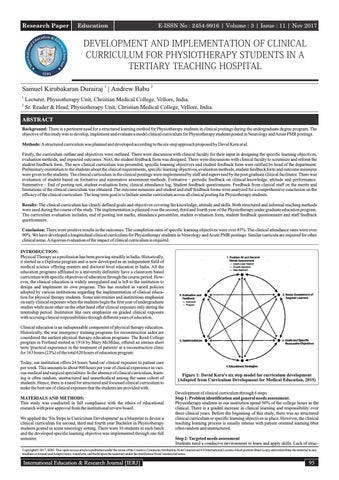
ABSTRACT Background: There is a pertinent need for a structured learning method for Physiotherapy students in clinical postings during the undergraduate degree program. The objective of this study was to develop, implement and evaluate a model clinical curriculum for Physiotherapy students posted in Neurology and Acute PMR postings. Methods: A structured curriculum was planned and developed according to the six-step approach proposed by David Kern at al. Firstly, the curriculum outline and objectives were outlined. There were discussion with clinical faculty for their input in designing the specific learning objectives, evaluation methods, and expected outcomes. Next, the student feedback form was designed. There were discussions with clinical faculty to scrutinize and reform the student feedback form. The new clinical curriculum was presented; specific learning objectives and student feedback form were ratified by head of the department. Preliminary orientation to the students about the clinical requirements, specific learning objectives, evaluation methods, student feedback form and outcome measures were given to the students. The clinical curriculum in the clinical postings were implemented by staff and supervised by the post graduate clinical facilitator. There was evaluation of student based on formative and summative assessment methods. Formative – periodic feedback on clinical knowledge, attitude and performance. Summative – End of posting test, student evaluation form, clinical attendance log, Student feedback questionnaire. Feedback from clinical staff on the merits and limitations of the clinical curriculum was obtained. The outcome measures and student and staff feedback forms were analyzed for a comprehensive conclusion on the efficacy of the clinical curriculum. The long term goal is to Initiate similar curriculum across all clinical posting for Physiotherapy students. Results: The clinical curriculum has clearly defined goals and objectives covering the knowledge, attitude and skills. Both structured and informal teaching methods were used during the course of the study. The implementation is planned over the second, third and fourth year of the Physiotherapy under graduate education program. The curriculum evaluation includes, end of posting test marks, attendance percentiles, student evaluation form, student feedback questionnaire and staff feedback questionnaire. Conclusion: There were positive results in the outcomes. The completion rates of specific learning objectives were over 85%. The clinical attendance rates were over 90%. We have developed a longitudinal clinical curriculum for Physiotherapy students in Neurology and Acute PMR postings. Similar curricula are required for other clinical areas. A rigorous evaluation of the impact of clinical curriculum is required. INTRODUCTION: Physical Therapy as a profession has been growing steadily in India. Historically, it started as a Diploma program and is now developed as an independent field of medical science offering masters and doctoral level education in India. All the education programs affiliated to a university definitely have a classroom based curriculum with specific objectives of education through the course period. However, the clinical education is widely unregulated and is left to the institution to design and implement its own program. This has resulted in varied policies adopted by various institutions regarding the implementation of clinical education for physical therapy students. Some universities and institutions emphasize on early clinical exposure when the students begin the first year of undergraduate studies while most other on the other hand offer clinical exposure only during the internship period. Institution like ours emphasize on graded clinical exposure with accruing clinical responsibilities through different years of education. Clinical education is an indispensable component of physical therapy education. Historically, the war emergency training programs for reconstruction aides are considered the earliest physical therapy education programs. The Reed College program in Portland started in 1918 by Mary McMilan, offered an intense short term 'practical experience in the treatment of patients' at a reconstruction clinic for 163 hours (23%) of the total 620 hours of education program. Today, our institution offers 24 hours 'hand-on' clinical exposure to patient care per week. This amounts to about 900 hours per year of clinical experience in various medical and surgical specialities. In the absence of clinical curriculum, learning is often random, unstructured and unmethodical among the same cohort of students. Hence, there is a need for structured and focussed clinical curriculum to make the best use of clinical exposure that the students are provided with. MATERIALS AND METHODS: This study was conducted in full compliance with the ethics of educational research with prior approval from the institutional review board. We applied the 'Six Steps in Curriculum Development' as a blueprint to devise a clinical curriculum for second, third and fourth year Bachelor in Physiotherapy students posted in acute neurology setting. There were 10 students in each batch and the developed specific learning objective was implemented through one full semester.
Figure 1: David Kern's six step model for curriculum development (Adapted from Curriculum Development for Medical Education, 2015) Development of clinical curriculum through 6 steps: Step 1: Problem identification and general needs assessment. Physiotherapy students in our institution spend 50% of the college hours in the clinical. There is a graded increase in clinical learning and responsibility over three clinical years. Before the beginning of this study, there was no structured clinical curriculum or specific learning objectives in place. However, the clinical teaching learning process is usually intense with patient oriented learning bbut often random and unstructured. Step 2: Targeted needs assessment Students need a conducive environment to learn and apply skills. Lack of struc-
Copyright© 2017, IERJ. This open-access article is published under the terms of the Creative Commons Attribution-NonCommercial 4.0 International License which permits Share (copy and redistribute the material in any medium or format) and Adapt (remix, transform, and build upon the material) under the Attribution-NonCommercial terms.
International Education & Research Journal [IERJ]
95
Research Paper
E-ISSN No : 2454-9916 | Volume : 3 | Issue : 11 | Nov 2017
tured teaching-learning atmosphere reduces the levels of interest among students. We wanted to encourage maximum attendance among students during their clinical postings, hence, transferred the responsibility of maintaining the attendance to the students themselves. A minimum target of 90% attendance was set and any lack thereof would result in compensation during their holidays. From the perspective of the faculty, there was a need for direction to teach and ensure minimum uniform standard of teaching for all students. Step 3: Goals and Objectives The following goal and objectives were set as part of this study. Goal: To evaluate the effectiveness of clinical curriculum for Physical therapy students Objectives: 1. Design a clinical curriculum with specific learning objectives and assessment methods 2.
Implement clinical curriculum in Acute PMR and Neurology Physical ther-
apy areas 3.
Assess different outcome measures to understand the effectiveness of clinical curriculum in Physical therapy education.
Step 4: Educational strategies – Content and Methods The content of the specific learning objectives of the clinical curriculum was designed using the Bloom's Taxonomy of learning, which has three domains – Cognitive, Affective and Psychomotor. ' METHODOLOGY: Study design: Education research design - Post test only design Physical therapy in-patient unit of CMC
Study setting:
Acute PMR and Neurology wards Study duration:
6 months
Study participants: Physical therapy students attending clinical postings (II, III, IV years)
Table 1: Indicator Matrix for Outcome Evaluation Outcomes Students' attendance
Evaluation question
Indicators
What is the attendance of students At least 80% of the students should in clinical posting? have 90% or more
Data source
Data collection method
Students' clinical log note
Documentation
Students' satisfaction in the new learning process
Were the students satisfied with the clinical learning
At least 80% of students will express II, III, and IV years students posted in the clinical postings good or excellent
Students' feedback questionnaire
Completion of clinical curriculum
How much of the curriculum could be completed?
At least 80% of the students should complete 90% of the curriculum
Students specific learning objectives sheet
Checklist
Knowledge gained in the clinicals
What is the average score of marks at the end of postings?
At least 80% should have score more than 70% or more
End-of posting evaluation
Test scores
Table 2: Indicator Matrix for Process Evaluation Evaluation question
Indicators
Data source
Data collection method
What was the attendance percentage?
At least 80% of the students should have 90% or more
Students' clinical log note
Documentation
What was the satisfaction levels in using the new curriculum
At least 80% of students will express good or excellent
Students' feedback questionnaire
Documentation
How much of the curriculum was completed?
At least 80% of the students should complete 90% of the curriculum
Students specific learning objectives sheet
Checklist
Students' clinical log note
Documentation
What is the average score of marks at the At least 80% should have score more than 70% end of postings? or more Step 5: Implementation of the curriculum The following are the steps followed in implementing the clinical curriculum. The implementation of this study started with the discussion with the head of the department. This was followed by an informal discussion with students prior to the implementation of the protocol. There was a meeting with the clinical faculty to ascertain their views and garner their support in implementation of the clinical curriculum program. The faculty and facilitator together developed a clinical curriculum for neurology and acute PMR postings. The draft of the curriculum was further discussed with the head before finalizing the document. The clinical curriculum was implemented uniformly during the beginning of the academic year. There was a blinded student feedback facility at the end of their posting in both the clinical areas. The faculty presented their feedback at the end of the end on the attitude and performance of the students after the implementation of the clinical curriculum. The outcome was measured on various predetermined outcome tools.
Step 6: Evaluation and Feedback The following tools were used to evaluate the outcomes. A structured questionnaire was used obtain the feedback from students and faculty. 1. 2. 3. 4.
Clinical attendance End of posting marks Student's feedback Faculty feedback
RESULTS:
Graph 1: Attendance (in %) following implementation of clinical curriculum Figure 2: Steps involved in implementation of the clinical curriculum
96
Average attendance at the end of the term in neurology and acute PMR posting (N=30) = 93.95% (±3.55)
International Education & Research Journal [IERJ]
Research Paper
E-ISSN No : 2454-9916 | Volume : 3 | Issue : 11 | Nov 2017 Excellent
70.1
III Year
very good Good
25.8 4.1
IV Year
Fair Poor Excellent very good
0 0 68.3 27.5
Good
4.2
Fair
0
Poor
0
Graph 2: End of posting marks (%) following implementation of clinical curriculum Average marks at the end of the term in neurology and acute PMR posting test (N=30) = 83.4% (±6.5)
Graph 5: Satisfaction levels among students on the newly implemented clinical curriculum DISCUSSION: Physical Therapy education has been evolving over the last many decades. The emphasis is currently on evidence based practice, clinical reasoning, problem based learning and so on. - Most institutions emphasize on adequate clinical learning experience during the course duration. In a tertiary teaching hospital like ours, physical therapy students spend around 900 hours per year. This necessitates a strong, focussed clinical curriculum to facilitate uniform and structured learning during the clinical postings. In this study, we attempted to develop and implement a clinical curriculum along with specific learning objectives using the David Kern's Six Steps in Curriculum Development Process model. The stakeholders in this study were faculty, students, administrators, education specialists.
Graph 3: Completion of specific learning objectives: Average completion rate of specific learning objectives at the end of neurology and acute PMR postings = 88.9% (±3.5). Partial completion rate = 11.03% (±3.5)
There were 10 students in each batch totalling to 30 students per clinical area. Each clinical area is run by qualified physiotherapy faculty head by a post graduate teacher. The specific learning objectives were given to the students on the first day of the posting. According to David Kern's six steps in curriculum development model, problem identification and general needs assessment was done as the first step. The current practice in clinical education was reviewed and a needs assessment was done. Feedback was obtained from students on the pros and cons of the current practices. Gaps in clinical education were then identified. A group of faculty then created a list of specific learning objectives which was scrutinized by the head of the department. The clinical curriculum was implemented in the beginning of the semester. The outcomes – clinical attendance, end of posting marks, student's feedback, and faculty feedback – were collected at the end of the semester.
Graph 4: Feedback from the students on various aspects of newly implemented clinical curriculum: Table 3: Satisfaction levels among students on the newly implemented clinical curriculum Year
II Year
In % Excellent
65.5
very good
25.8
Good
8.7
Fair
0
Poor
0
International Education & Research Journal [IERJ]
The results were positive. The attendance and end of posting marks saw considerable increase in percentage scores. The feedback from the faculty on the performance of students and compliance with learning requirements was also obtained. CONCLUSION: Clinical curriculum is a need of the hour in physical therapy education. Implementation of specific learning objectives and clinical curriculum was successful. Acknowledgements: We would like to acknowledge the support rendered by the physiotherapy faculty in implementing this study. We also acknowledge the medical education department for their valuable suggestions during the conceptualization of this study. REFERENCES: 1.
Curriculum Development for Medical Education. (2015). Retrieved from https://jhupbooks.press.jhu.edu/content/curriculum-development-medical-education
97
Research Paper
E-ISSN No : 2454-9916 | Volume : 3 | Issue : 11 | Nov 2017
2.
Dahlgren, M. A., & Dahlgren, L.-O. (2002). Portraits of PBL: Students’ experiences of the characteristics of problem-based learning in physiotherapy, computer engineering and psychology. Instructional Science, 30(2), 111–127.
3.
Forehand, M. (2010). Bloom’s taxonomy. Emerging Perspectives on Learning, Teaching, and Technology, 41, 47.
4.
Gwyer, J., Odom, C., & Gandy, J. (2003). History of Clinical Education in Physical Therapy in the United States. Journal of Physical Therapy Education, 17(3), 34.
5.
Jones, M. A., Jensen, G., & Edwards, I. (2008). Clinical reasoning in physiotherapy. Clinical Reasoning in the Health Professions, 245–256.
6.
Saarinen-Rahiika, H., & Binkley, J. M. (1998). Problem-based learning in physical therapy: a review of the literature and overview of the McMaster University experience. Physical Therapy, 78(2), 195–207.
98
International Education & Research Journal [IERJ]