
ROLE OF GAON PANCHAYATS IN SUSTAINABLE DEVELOPMENT: A STUDY OF THE NAGAON DISTRICT OF ASSAM
INTRODUCTION:
rd The 73 Constitutional Amendment Act accorded constitutional status to the Gaonpanchayatswith29specifiedsubjectsunderitsjurisdictionandprovisions forspecificfundsalongwithfixtenureandtimeboundelectiontotheselocalbodies way back in 1993. Though under the provisions of the 73rd constitutional amendmentact,theAssampanchayatAct1994waspassed,itcameintooperationonlyin2001.ThelastpanchayatelectioninthestatewasheldinDecember 2018.JustbeforetheelectiontheAssamPanchayat(Amendment)Act2018was passedwhichmandatedthatforthepostofGaonPanchayatPresident,aperson should be at least HSLC passed. For SC, ST, OBC and MOBC it was fixed at classVIIIpassed.Thusanewsetofleadershipwithnominaleducationalbackgroundhasassumedofficeinthepanchayatsofthestate.Theyareentrustedwith thehugetaskofruraldevelopment.Capacitybuilding&trainingoftherepresentativesofthePRIshasbecomeanutmostpriorityoftheMinistryofPanchayati raj.TheRashtriyaGramSwarajAbhiyan(RGSA)hasbeeninsistingoncapacity building and training of elected representatives as well as functionaries of the panchayat in order to perform their duties properly India being a signatory for achieving Sustainable Development Goals (SDG), the Ministry of Panchayati Rajhasadoptedafreshapproachtocapacitybuilding&trainingofelectedrepresentatives of panchayats with renewed emphasis on sustainable development. OneoftheobjectivesoftheRashtriyaGramSwarajAbhiyan(RGSA)hasbeen developmentofgovernancecapabilitiesofPanchayatiRajInstitutionstodeliver ontheSDGs.
Thepresentstudy,rationaleandmethodology:
Thepaperisapartofongoingresearchwork“RoleofStateInstituteofPanchayat and Rural Development in Training of Gaon Panchayat Presidents ofAssam” whichaimstoexaminetoroleplayedbytheSIPRD,Assaminprovidingtraining totheelectedGaonPanchayatPresidentsofAssam.Basedonthisbroadobjectivethepaperattemptstounderstandthefollowingobjectives:
Ÿ ThefirstobjectiveofthestudyistoknowwhethertheGPPresidentsare awareoftheSustainableDevelopmentGoals.
Ÿ ThesecondobjectiveofthestudyistoobservetheroleplayedbytheGP PresidentsinfulfillingSDGs.
METHODOLOGY:
Thepaperisbasedonthedatagatheredfromboththeprimaryandthesecondary sources.The secondary data has been collected from different books, journals, government circulars, guidelines, office orders etc. Data regarding trainings werecollectedfromtheSIPRDheadquarter,KhanaparaandKahikushiandthe panchayatofficesoftheselectedpanchayats.Primarydatawerecollectedfrom thegaonpanchayatpresidentsrandomlyselectedforthestudyfromthosewho haveattendedtraining.
RespondentsofthestudyaretheGPPresidents-whoattendedthetraining.Purposivesamplingtechniquewasusedtopickatotal60(30maleand30female) respondents. In order to get samples from each corner of the district, we have picked up our sample from each block in proportion with the attendance in the trainingprogramme.
InordertocollectprimarydatafromtheGaonPanchayatPresidentsastructured interviewschedulewasused.
Studyarea:
Nagaondistrictispurposivelyselectedforthestudyasitisthemiddledistrictof Assam. Nagaon is a miniAssam in the sense that it is the home of many tribal groups like Tiwa, Bodo, Karbi including tea tribes as well as casteAssamese, BengaliHindusandMuslims.
According to 2011 census data geographical area of the district is 2287 sq.km. Populationofthedistrictis18.92lakhs.While13.09%ofthepopulationofthe districtlivesinurbanareas86.91%livesinruralareas.Averageliteracyrateis 71%.Maleliteracyrateis76.51%whilefemaleliteracyrateis68.07%. Inrural areasliteracyrateis70%. Religion-wisedataof2011censusshowsthat43.39% ofthepopulationofthedistrictisHinduwhile55.36%areMuslim.SCpopulationofthedistrictis9.43%whileSTpopulationofthedistrictis4%.
The district has 13 Development Blocks- namely Bajiagaon, Barhampur, Batadraba, Dolongghat, Juria, Kaliabor, Kathiatoli, Khagarijan, Lawkhowa, Pachim Kaliabor, Pakhimoria, Raha and Rupahihat. There are 168 Gaon Panchayatsinthedistrict.Outof168GPs135GPPresidentsparticipatedinthe trainingi.e.80%.WhiletheRahablockhad100%participation,theDolongghat blockhadthelowestparticipationlevelwithmerely45%. Sowhilepickingup respondentswegaveimportancetothepercentageofparticipation.Thuswhile we have picked up 7 out of 16 GPs from Raha block, only 2 respondents were pickedupfrom11GaonPanchayatsoftheDolongghatblock.Asagainst58male President,77WomenPresidentparticipatedinthetraining.Outofthe77female and58malepresidents-whoattendedthetraining30femaleand30malePresidentswererandomlyselected.
Thepaperisbeingorganizedintwosegments.ThepartIcontainsabriefConstitutional background, guidelines and provisions relating to powers of the Gaon Panchayataswellastheprovisionsregardingtrainingfortheelectedrepresentatives of the PRIs, especially the gaon panchayat presidents.The part-II will be findingsandconclusiononthebasisofprimarydatacollectedfromtherespondents.
PART-I
ConstitutionalProvisionsregardingpowersoftheGaonPanchayat: rd The 73 Constitutional Amendment Act was passed with the hope that it will transformoursocietyfromfeudaltodemocraticmodebydevolving'powertothe people' and alter our democracy from representative to participatory mode. It accorded constitutional status and institutional framework to Panchayats to strengthengrassrootsleveldemocracythroughelectedself-governinglocalbodies in the rural areas of the country It also emphasised functional and fiscal decentralisationofpowerstoachievegoodgovernancethroughpeople'sparticipation and thus enabling transparency, responsiveness, equity, efficiency and accountability
Article243GoftheConstitutionprovidesfor:“Powers,authorityandresponsibilitiesofPanchayat.-SubjecttotheprovisionsofthisConstitution,theLegislatureofaStatemay,byLaw,endowPanchayatswithsuchpowersandauthority andmaybenecessarytoenablethemtofunctionasinstitutionsofselfgovernment and such law may contain provisions for the devolution of powers and responsibilitiesuponPanchayats,attheappropriatelevel,subjecttosuchconditionsasmaybespecifiedtherein,withrespectto:
Ÿ
Thepreparationofplansforeconomicdevelopmentandsocialjustice;
Ÿ Theimplementationofschemesforeconomicdevelopmentandsocialjusticeasmaybeentrustedtothemincludingthoseinrelationtothematters listedintheEleventhSchedule.”
TheEleventhScheduleoftheConstitutionofIndiacontains29subjectswhich includes Agriculture, including agricultural extension, Land improvement, implementationoflandreforms,Minorirrigation,watermanagementandwatersheddevelopment,AnimalHusbandry,Fishery,Socialforestry,Povertyalleviation programme,Women and Child Development, Maintenance of community assetsetc.

Research Paper Political Science E-ISSN No : 2454-9916 | Volume : 8 | Issue : 6 | Jun 2022
HarekrishnaBorah
80 InternationalEducation&ResearchJournal[IERJ]
Asstt.ProfessorinPoliticalScience,ThongNokbeCollege,Dokmoka,K/A.
Copyright©2022,IERJ.Thisopen-accessarticleispublishedunderthetermsoftheCreativeCommonsAttribution-NonCommercial4.0InternationalLicensewhichpermitsShare(copyandredistributethematerialinany mediumorformat)andAdapt(remix,transform,andbuilduponthematerial)undertheAttribution-NonCommercialterms.
ElectedRepresentatives(ERs),Gaonpanchayat(GP),NationalInstituteofRuralDevelopment&PanchayatiRaj(NIRD&PR),PanchayatirajInstitutions(PRIs), th president,StateInstituteofPanchayat&RuralDevelopment(SIPRD),SustainableDevelopmentGoals(SDGs),14 FinanceCommission.
th The14 FinanceCommission;Awardsandguidelines:
th The14 FinanceCommissionhasawardedasubstantialgrantofRs.200292.20 crores to be devolved over a period of five years exclusively for the Gram Panchayatsforplanninganddeliveringbasicservicesasmandatedtothem.This th 1 isnearlythreetimesmorethantheawardgivenbythe13 FinanceCommission. Table1
Sashaktikaran Abhiyan was launched for implementation from 01.04.2018 to 31.03.2022withtotalbudgetoutlayofRs.7255.50crore.Oneoftheobjectivesof the RGSAhas been development of governance capabilities of Panchayati Raj InstitutionstodeliverontheSDGs.OneofthefocusareasofRGSAistoensure basicorientationtrainingfortheelectedrepresentativesofpanchayatswithinsix monthsoftheirelection.
th(Rs.InCrores,Source:14 FinanceCommissionReport,2015)
GuidelinesregardingallocationofFund:
1) TheCommissionhasrecommendedgrantsforGramPanchayatsonly(withoutanyshareforother2tiers)asGPsaredirectlyresponsiblefordeliveryof basicservices.
2) ThegrantsaretobedistributedtoGramPanchayatsaspertheapprovedformularecommendedinthelatestStateFinanceCommission(SFC)Report. However,intheabsenceofSFCformula,grantshouldbedistributedusing populationofthePanchayat(2011Census)withaweightof90%andareaof thepanchayatwithaweightof10%.
3) Thegrantistobeusedtosupportandstrengthenthedeliveryofbasicservicesincludingwatersupply,sanitationincludingsepticmanagement,sewerage and solid waste management, storm water drainage, maintenance of community assets, maintenance of roads, footpaths and street-lighting, burial and cremation grounds and any other basic service within the functionsassignedtoGramPanchayatsunderrelevantlegislations.
4) Grantswillbeprovidedintwopartsnamely-i)BasicGrantandii)PerformanceGrant.
The basic grants are to provide basic services to the people like pure drinking water supply, sanitation, sewerage and solid waste management, storm water drainageetc.
Thus, the above constitutional provisions indicate the powers and functions of GaonPanchayatswhilethedirectivesofthe14thFCclearlyindicatetheincreasing responsibilities of the GP Presidents. The fund flow to the GPs has also increasedinmanifold(asexpressedinthetable-1).TheGPsaretherealsourceof authorityinsofarasplanningandimplementationofschemesareconcerned.
TrainingforERs
ofPRIs:theNCBF:
Therewasnohardandfastruleregardingtrainingforelectedrepresentativesof thePRIs.Eversincethepassageofthe73rdamendmentact,theneedtoprovide trainingtotheelectedrepresentativeswasfelturgent.Howevernoconcretestep wastakenuntiltheformationoftheMinistryofPanchayatiRajin2004.TheministryundertheleadershipofMr ManiShankarIyarconductedsevenroundtable conferences with the ministers of panchayati raj of the states in different key issues.ThelastroundtableconferencewhichwasheldinJaipurdecidedtoframe policyregardingCapacityBuilding&Trainingofelectedrepresentativesaswell asfunctionariesofpanchayat.Laterin2006thefirstNationalCapacityBuilding ResultFramework(NCBF)cameintoexistence-whichoutlinesamongothersa comprehensiveapproachwithoverallobjectivestoenableelectedPanchayatrepresentativestoupgradetheirknowledgeandskillstobetterperformtheirresponsibilities. The NCBF mentioned about periodic and time-bound training for elected representatives and called for a close collaboration between MoPR, NIRD as well as the State Institutes of Rural Development at state level. The NCBF-2006wasmodifiedasNCBF-2014whichspecificallymentionedthatthe electedPRIrepresentativesshouldgetthefirstspelloftrainingwithinthefirstsix monthsoftheirelection.Italsospecifiedthecoursecontentofsuchtrainingsand authorized the NIRD to develop such study material in both English as well as Hindi language so that the SIRDs can translate it into their regional languages andincorporatestatespecificitemsinit.
TheRashtriyaGramSwarajAbhiyan(RGSA):
TheMoPRlaunchedRajivGandhiPanchayatSashaktikaranAbhiyanin2013to enhancecapacitiesandeffectivenessofpanchayats.In2018,theRashtriyaGram SwarajAbhiyan (RGSA), a revamped version of the Rajiv Gandhi Panchayat
TrainingofERsofPRIs:theroleofSIPRD,Assam: TheSIPRD,Assambeingtheapexorganizationinthefieldofcapacitybuilding & training, has been mandated with the responsibility to provide much needed trainingtothenewlyelectedrepresentativesofthePRIs.Theinstitutehasconducted 5days orientation training programs for the GP presidents in its headquater-KhanaparaandKahikuchi.ItistobementionedherethattheorientationtrainingprogrammeforthenewlyelectedGPPresidentsofNagaondistrict was held in the Kahikuchi campus of the institute from 26-06-2019 to 28-062019. The training schedule contained a session on sustainable development goals.Theparticipantswereprovidedwithagoodpieceofhandbookwhichcontainedachapteronsustainabledevelopmentgoals.
PART-II
Thescheduledevelopedtocollectdatafromtherespondentscontained3specific questions on sustainable development. Questions were put in Assamese languagesothattherespondentscouldunderstandeasily Thequestionswere:
1) Whatdoessustainabledevelopmentmeans?
2) DoyourGaonPanchayatDevelopmentPlanincludesplanforWaterconservation/plantation/wastemanagement/cleanenergy/poverty reductionplan/supplyofpuredrinkingwater/constructionofpublictoilet.
3) Doyourpanchayathaveundertakenanywork/plannedanyschemeincollaborationwithSHGs/NGOs/educationalinstitutions/farmers/businessmen/religiousinstitutionsetc?
Insofarasthefirstquestionisconcerned,wehavefoundthatonly2femaleGP Presidentsand3maleGPpresidentsansweredpositively (Table-2,Figure-1)
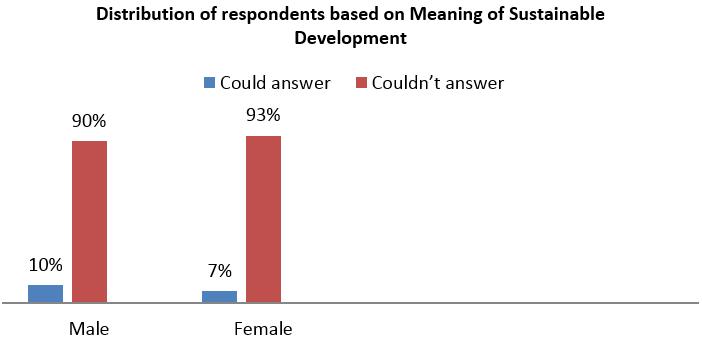
Table2
Figure1
Theabovefigureexhibitsthatonly7%femaleand10%maleGPPresidentshave heardaboutsustainabledevelopmentgoals.Thusroughlymorethan90%ofour localruralleaderswhohavenotonlyauthoritybutalsofundandfunctionariesto plan and implement development projects in rural areas are unaware about the SDGs.
In so far as the answer to the second question is concerned we have found responseswhichareintable-3.
Table3
The
Research Paper E-ISSN No : 2454-9916 | Volume : 8 | Issue : 6 | Jun 2022
81 InternationalEducation&ResearchJournal[IERJ]
Distributionofrespondentsbasedontheiranswerregardingmeaningof SustainableDevelopment
respondent(60) Whatdoessustainabledevelopmentmean? Male-(30) Couldanswer-03 Couldn'tanswer-27 Female-(30) Couldanswer-02 Couldn't
28
State FY 2015-16 FY 2016-17 FY 2017-18 FY 2018-19 FY 2019-20 Grandtotal FY2015-20 Assam 584.80 915.98 1,055.80 1,218.82 1,641.19 5,416.59
Total
answer-
Total Respondent-60 Waterconservation Plantation Wastemanagement Cleanenergy Poverty reductionplan Supplyofpuredrinking water Constructionof Publictoilet M-30,F-30 M-0,F-0 M-0,F-0 M-0,F-0 M-24,
M-0,
M-0,
F-28
F-0
F-0 M-09,F-12
above table shows that the basic issues which are closely connected with SDGsarenottakenupbytherespondents.24maleand28femalerespondents have taken schemes related with clean energy But when talking about the
schemeitwasfoundthattheyhavetakenupschemeforinstallationofsolarpanel Streetlightintheirlocality Only9maleGPPresidentsand12femaleGPPresidents have included schemes for construction of public toilets. When asked
abouttheconstructionsitesitcametoknowthatdemandsforsuchpublictoilets usuallycomesfromreligiousinstitutionslikenamghor,mandir,mosqueetc.Otherwise no scheme for water conservation, plantation, waste management, povertyreductionaswellassupplyofpuredrinkingwaterhasbeentakenbythegaon panchayats. It is to be mentioned here that the 14th FC guidelines specifically mentionedthatbasicgrantstothepanchayatistoprovidebasicserviceslikesupplyofpuredrinkingwater.Thecentralgovernmentalsosetsatargetofproviding cleandrinkingwatertoallby2024.Howevernoschemeforsupplyofpuredrinking water was taken by the panchayts even though the MissionAntyodaya gap reportshowsthatdrinkingwaterfacilityinthevillagesoftheentireNagaondistrictisinmiserablecondition.
st th
Ontheotherhandfrom1 Julyto15 Sept.2019,allthestatesandUTsofIndia worked on Jal ShaktiAbhiyan inspired by the impetus given by the honorable PMonJalSanchay InAssamspecialgaonsabhaonjalshaktiwascalledbyall theGaonpanchayatsofthestate.Yetwehavefoundintheresearchworkthatno schemewastakeninthefieldofwaterconservation.
Insofarasthethirdquestionisconcerneditisfoundthatnopanchayathaseither undertakenorplannedanyschemeincollaborationwithSHGs/NGOs/educationalinstitutions/farmers/businessgroups/religiousinstitutionsetc.Infactit seemsthattheyaretotallyunawareabouttheneedofsynergybetweenpanchayat andothercommunitybasedorganizationslikeSHGs,NGOsetc.
CONCLUSION:
Itisclearfromaboveanalysisthatmorethan90%GPpresidentsoftheNagaon district are still unaware about sustainable development.We know that the last oneofthe17SDGsisthemostimportantamongall-whichsays-partnershipto achieve the goal. This partnership is conspicuously absent in gaon panchayat level.Thereisanurgentneedtore-orienttheGPPresidentsofthestateinsofaras theSDGsareconcerned.TheSIPRDAssammusttakenoteofthesituationwhich simplysignifiesthefailureoftheirtraininginitiativeparticularlyinthecaseof SDGs.ThechapteronSDGsinthehandbookitprovidedtotheERsofPRIsis complex in nature which needs simplification. Merely mentioning the goals in textbookstyleisnotgoingtowork.AstheGPPresidentsareauthorizedtoplan fortheruralfolkandhavefundswellasfunctionariestoimplementsuchplans, theymustbeprovidedwithadequatetrainingandhandholdingsupport.Theyare therealagentsofchangeinourruralareas.
REFERENCES:
I. SubhasCKashyap,CitizensandtheConstitution,(NewDelhi,PublicationsDivision, MinistryofInformationandBroadcasting,GovernmentofIndia,2002).
II. Panchayati Raj Bebosthar Nirbasita ProtinidhiAru Bixoibobia Hokolar Prasikshanar Hatputhi (Training manual for elected representatives and officials of panchayati raj system),SIPRDAssam,Guwahati,2019.
III. AnnualReport,2017-18,SIPRD,Assam,DepartmentofPanchayat&RuralDevelopment,GovernmentofAssam,Khanapara.
IV “TheAssamPanchayatAct1994withRules2008,”Panchayat&ruralDevelopment, Government of Assam, (website) accessed July 23, 2018, https://pnrd.assam.gov.in/ documents-detail/the-assam-panchayat-act-1994-with-rules-2008.
V National Capacity Building Framework, Ministry of Panchayati Raj, Government of India,(website)/NCBF%202006.pdf,www.panchayat.gov.in,
VI. Sustainable development goals and gram panchayats’, government of India and the UN,2018.
th
VII. Reportofthe13 financeCommission,https://fincomindia.nic.in/writereaddata/html.
thVIII.Reportofthe14 financeCommission,https://fincomindia.nic.in/writereaddata/html.
82 InternationalEducation&ResearchJournal[IERJ] Research Paper E-ISSN No : 2454-9916 | Volume : 8 | Issue : 6 | Jun 2022