
INFLUENCE
*R.SwaroopaRani,G.NageswaraRao1DepartmentofChemistry,ANITSEngg.College,SangivalasaVisakhapatnam,India.(*CorrespondingAuthor)
2DepartmentofInorganic&AnalyticalChemistry,SchoolofChemistry,AndhraUniversity,Visakhapatnam,India.

ABSTRACT
EquilibriaofcomplexationofCo(II),Ni(II)andCu(II)ionswithL-asparticacidandethylenediaminewereinvestigatedpHmetricallyin0.0–60.0%v/vpropylene glycol-watermixturesmaintaininganionicstrengthof0.16molL-1at303.0±0.1K.Stabilityconstantsofternarycomplexeswerecalculatedandvariousmodelswere refinedwithMINIQUAD75.Thebestfitchemicalmodelswereselectedbasedonstatisticalparametersandresidualanalysis.ThespeciesdetectedwereMLXH,MLX and ML2X for Co(II), Ni(II) and Cu(II).The appropriateness of experimental conditions was verified by introducing errors intentionally in the concentrations of ingredients.ThestabilitiesofthecomplexesfollowedtheIrving-Williamsorder,i.e.,Co(II)<Ni(II)<<Cu(II).
KEYWORDS:Chemicalspeciation,ternarycomplexes,asparticacid,ethylenediamine,propyleneglycol,MINIQUAD75.
1.INTRODUCTION:
Several studies on ternary stability constants of α-amino acids have been 1,2 reportedindifferentmedia. Metalionsexistinnon-exchangeableform,loosely boundtosomebiologicalligandsandinequilibriumwithavarietyofbioligands indifferentbiofluidslikebloodserum,intestinalfluid,cerebrospinalfluid,gastricjuiceetc.Thus,simultaneousequilibriainvolvingavarietyofmetalionsand ligandsispossibleinbiofluids.Cobalt,nickelandcopperhaveseveralbiological 3,4functions. Therefore,investigationofternarycomplexescontainingametalion andtwodifferentligandsdrewtheattentionofseveralresearchers.Mixedligand complexescanbeconsideredasmodelsforapoenzyme-metalion-substratecomplexes.Inpeptides,proteinsandaminoacids,amidegroupisoneoftheimportantbindingsitesforthecoordinationofthemetalions.Acidityandbasicityofa 5 moleculeisgovernedbyitsstructureandsolventeffects. Propyleneglycol(PG) ischosenasapolarorganicsolventtomimicthepermittivityofthebiologicalfluids.L-Asparticacid(Asp)andethylenediamine(en)arechosenasmodelcompoundstoproteinsandsubstrates.
Asp,anon-essentialaminoacid,playsanimportantroleinmaintainingthesolu6 bility and ionic character of proteins. en is used as an important monodentate, 7 bidentateorabridgingligand. Itisusefulinmanufacturingacceleratororcuring 8 agentinepoxyindustry Itis involvedinthesynthesisofβ-enaminoesters and 9 Schiffbases. Theprotonationconstantsofethylenediaminewerereportedear10,11 12 lierbytheoreticalcalculations. Protonationconstants andbinarystabilitycon13 14 stantsofAsp anden withCo(II),Ni(II)andCu(II)inPG-watermixtureswere reported earlier Hence, chemical speciation of their ternary complexes is reportedinthiscommunication.
2.EXPERIMENTAL:
-1
Aqueoussolutions(0.1molL )ofCo(II),Ni(II)andCu(II)chlorides(GRGrade, E-Merck,Germany)werepreparedbydissolvingthemintripledistilledwater -1 0.05molL aqueoussolutionsofL-asparticacid(GRGradeE-Merck,Germany) andethylenediamine(AR,Qualigen,India)werealsoprepared.Toincreasethe -1 solubilityoftheligandsandmetalsalts,0.05molL hydrochloricacidwasmaintainedinthesolutions.Propyleneglycol(Finar,India)wasusedasreceived.The strength of acid in metal ion solutions was determined using the Gran plot 15,16method. Errorsintheconcentrationsoftheligands,metalionsandalkaliwere 17 subjectedtoanalysisofvariance(ANOVA).
Titrationswerecarriedoutinthemediumcontainingvaryingconcentrationsof -1 PG maintaining an ionic strength of 0.16 mol L with sodium chloride at 303.0±0.1K,withELICO(ModelLI-120)pHmeterof0.01readabilityinconjunction with a glass and calomel electrode.The pH meter was calibrated with -1 -1 0.05molL potassiumhydrogenphthalateinacidicregionand0.01molL borax solutioninbasicregion.TheglasselectrodewasequilibratedinawellstirredPGwatermixturescontaininginertelectrolyte.Theeffectofvariationsinasymmetrypotential,liquidjunctionpotential,activitycoefficient,sodiumionerrorand dissolvedcarbondioxideontheresponseofglasselectrodewereaccountedforin theformofcorrectionfactor(logF)whichwascomputedfromtheexperimental 18 andsimulatedacid-basetitrationdatacalculatedbySCPHDprogram. AcorrectionwasappliedtothepHmeterdialreadingstoaccountsforthesolventeffect onpH.
Titrationofstrongacidwithalkaliwascarriedoutatregularintervalstocheck whether complete equilibration was achieved. The calomel electrode was
refilledwithPG-watermixturesofequivalentcompositionasthatofthetitrand. Ineachofthetitrations,thetitrandconsistedof1mmolofhydrochloricacidina totalvolumeof50mL.Titrationswerecarriedoutinthepresenceofdifferentrelative concentrations of the metal (M) toAsp (L) to en (X) (M:L:X = 1:2.5:2.5, -1 1:2.5:5.0, 1:5.0:2.5) with 0.4 mol L NaOH (Table 1). The best-fit chemical 19 modelforeachsysteminvestigatedwasarrivedatusingMINIQUAD75 ,which exploitstheadvantageofconstrainedleastsquaresmethodintheinitialrefinement and reliable convergence of undamped, unconstrained Marquardt algorithm.Theprotonationconstantsandthestabilityconstantsofthebinarymetal complexesoftheligandswerefixedinrefiningternarycomplexes.
3.
RESULTSANDDISCUSSION:
3.1.ModelingStrategy:
Apreliminaryinvestigationofalkalimetrictitrationsofmixturescontainingdifferent mole ratios ofAsp and en in the presence of hydrochloric acid and inert electrolyteindicatesthatnocondensedspecieswereformed.Theexistenceofthe ternarycomplexeswasdeterminedbyperforminganexhaustivemodelingstudy andtheresultsofatypicalsystemaregiveninTable2.Themodelswereevaluatedassumingthesimultaneousexistenceofdifferentcombinationsofspecies. Modelscontainingvariousnumberandcombinationsofspeciesweregenerated using an expert system package CEES and these models were refined using MINIQUAD75.Asthenumberofspeciesincreased,themodelsgavebetterstatisticsdenotingthebestfit.Thebestfitmodelswerechosenbasedonthestatisti2 calparameterslikeχ,R-factor,skewnessandkurtosisgiveninTable3.Theternary complex species detected are MLX, MLX and MLXH for Co(II), Ni(II) 2 andCu(II).Thepresentvaluesarecomparedwiththosereportedearlierstudies (Table4).
Averylowstandarddeviation(SD)intheoverallstabilityconstants(logβ)indicatestheprecisionoftheparameters.ThesmallvaluesofU (sumofsquaresof corr deviationsintheconcentrationsofthemetal,theligandsandthehydrogenionat allexperimentalpointscorrectedfordegreesoffreedom)indicatethatthemodels represent the experimental data. Small values of mean, standard deviation and mean deviation for the systems corroborate that the residuals are around a zeromeanwithlittledispersion.Foranidealnormaldistribution,thevaluesof kurtosisandskewnessshouldbethreeandzero,respectively Thekurtosisvalues in the present study indicate that most of the residuals are very nearer to leptokurticandafewformmesokurticpatterns.Thevaluesofskewnessrecorded inTable3arebetween-0.46and3.46.Thesedataevincethattheresidualsforma part of normal distribution hence, least–squares method can be applied to the presentdata.ThesufficiencyofthemodelisfurtherevidentfromthelowcrystallographicR-valuesrecorded.
3.2.Solventeffectonstabilityofternarycomplexes: PGisaprotophilicdipolarproticsolventandactsasastructureformer Hence,it removes water from the coordination sphere of metal ions, making them more reactive towards the ligands. As a result, the stability of the complexes is expected to increase.At the same time, it is a coordinating solvent and it competeswiththeligandsforcoordinatingthemetals.Thisdecreasesstabilityofthe complexes.Hence,stabilityofthecomplexesmayincreaseordecrease.Thevariationofoverallstabilityconstantswithco-solventcontentdependsuponelectrostatic and non-electrostatic factors. Born's classical treatment holds good in 20 accountingfortheelectrostaticcontributiontothefreeenergychange. Accordingtothistreatment,theenergyofelectrostaticinteractionisrelatedtodielectric
constant.Hence,thelogβvaluesshouldvarylinearlyasafunctionofreciprocal ofthedielectricconstant(1/D)ofthemedium.Thelinearvariationobservedin thepresentstudy(Figure1)indicatesthatelectrostaticforcesaredominatingthe equilibrium process under the present experimental conditions. This is due to protophilicdipolarproticandstructureformingnatureofthesolvent.ThestabilitiesofthecomplexesfollowtheIrving-Williamsorder,i.e.,Co(II)<Ni(II)<< Cu(II).
3.3.EffectofSystematicErrorsonStabilityofTernaryComplexes:
Inordertorelyuponthebest-fitchemicalmodelforcriticalevaluationandapplication under varied experimental conditions with different accuracies of data acquisition,aninvestigationwasundertakenbyintroducingpessimisticerrorsin the influential parameters like concentrations of alkali, mineral acid, ligand, metal,(Table5).Theorderoftheingredientsthatinfluencethemagnitudesofstabilityconstantsduetoincorporationoferrorsisalkali>acid>Asp>en>metal. Somespecieswereevenrejectedwhenerrorswereintroducedintheconcentrations.Therejectionofsomespeciesandincreasedstandarddeviationsinthestability constants on introduction of errors confirm the suitability of the experimentalconditions(concentrationsofingredients)andchoiceofthebest-fitmodels.
3.4.Stabilityofternarycomplexes:


Thechangeinthestabilityoftheternarycomplexesascomparedtotheirbinary 21,22 analogues was quantified based on the disproportionation constant (log X) given by Equation 1 which corresponds to the equilibrium ML +MX2 2 2MLX. Under the equilibrium conditions one can expect the formation of 50%ternarycomplexesand25%eachofthebinarycomplexesstatisticallyand thevalueoflogXshallbe0.6.AvaluegreaterthanthisaccountsfortheextrastabilityofMLX.
MLXH + MLX+ H (5)
MLH +XH 2 2 2 + MLX+4H 2 (6)
ML+LH+XH2 + MLX+3H 2 (7)
MLX+LH + MLX+H 2 (8)
Thedistributionofmetalionsinvariouscomplexspecies(chemicalspeciation) with pH is represented as distribution diagrams. Some typical distribution diagrams are given in Figure 2. The protonated ligands interact with metal ion (Equilibria2,3and4)toformMLXHandMLX.MLXisalsoformedbythedissociationofMLXH(Equilibrium5)whichisformedbytheinteractionofMLH2 2 withXH (Equilibrium1).SimilarlyMLXisformedbytheinteractionofMLH 2 2 2 2 withXH (Equilibrium6),MLandLHwithXH (Equilibrium7)andMLXwith 2 2 LH (Equilibrium 8), because the concentrations of both MLX and LH are decreasingwithincreasingconcentrationofMLXinthepHrange8.0-10.0. 2
4.STRUCTURESOFCOMPLEXES:
27,28
Theliterature suggeststhatCo(II),Ni(II)andCu(II)complexesshallbeoctahedral.Amino nitrogen can associate with hydrogen ions in physiological pH ranges. Hence, there is often significant competition between hydrogen and metalionforthisdonorsite.Thissituationresultsinthesimultaneousexistence ofanumberofequilibriaproducinganarrayofprotonatedcomplexes,whichare detectedinthepresentstudy Aspsactsasbidentateortridentateliganddependingontheexperimentalconditionsandenactsasbidentateligand.Thusbasedon theaboveequilibriathespeculativestructuresofthecomplexesarepresentedin Figure3.
5.CONCLUSIONS:
The following conclusions have been drawn from the modeling studies of the speciationofternarycomplexesofCo(II),Ni(II)andCu(II)withAspandenin PG-watermixtures.
1. The ternary metal complex species detected are MLX, MLX and 2 MLXHforCo(II),Ni(II)andCu(II),whereL=AspandX=en.
2. ThevaluesofΔlogKandlogXindicatethattheternaryspecieshave extrastabilitycomparedtotheirbinaryspecies.
3. Thelinearincreaseinthestabilitiesofternarycomplexeswithdecreasing dielectric constants is due to the dominance of electrostatic forces overnon-electrostaticforces.
4. TheΔlogKmethodisbasedonstatisticalgroundsandthelogXmethod takes dispropotionation of the binary complexes into consideration. Δ logKshouldbenegativeiftheternarycomplexhasextrastability Any valueforlogXgreaterthan0.6accountsforextrastability
23-25
Another approach to quantify the extra stability of ternary complexes was basedonthedifferenceinstability(ΔlogK)forthereactionsMLwithXandM (aq) with Land X, where Lis the primary ligand (Asp) and X is the secondary ligand (en). It is compared with that calculated purely on statistical grounds as giveninEquation2.TheequationsforthecalculationofΔlogKandlogXare giveninTable6.
The electrostatic theory of binary complex formation and statistical arguments suggest the availability of additional coordination positions of the hydrated metalionforthefirstligandthanforthesecond.Hence,theusualorderofstabilM ML ityK >K applies.ThissuggeststhatΔlogKshouldbenegative,although ML ML2 26 several exceptions have been found. The statistical values of Δ log K for tridentate Land bidentate X are, -6.67 to 7.06 in PG-water mixtures (Table 6). Negative values of Δlog K can be understood as the secondary ligand forms a morestablecomplexwithhydratedmetalionthanwithL.WhenevertheexperimentalvaluesofΔlogKexceedthestatisticalvalues,itcanbeinferredthatthe ternarycomplexisformedasaresultofinteractionofMLwithXorMXwithL. ThelogXandΔlogKvaluescouldnotbecalculatedforsomesystemsduetothe absenceofrelevantbinaryspecies.ThelogXvaluesrangefrom2.12to18.66,all the values are found to be higher than those expected on statistical bases (0.6). Thesehighervaluesaccountfortheextrastabilityoftheternarycomplexes.The extrastabilityofternarycomplexesmakesthemmoreamenableformetaltransport.Thelessstablebinarycomplexesmakethemetalsbioavailable.

3.5.Distributiondiagrams:
12 + - 2- 2+ +
Basedontheactiveformsoftheligands (Lh ,LH,LH,L andXH ,XH and 3 2 2 13,14 X)andtheexistenceofthebinarycomplexspecies (ML,ML,MLH MLH 2 2 2, 2 3 andMLH andMX,MX andMX),thespeciesareassumedtoformthroughthe 2 4 2 3 followingequilibria.
5. The order of the ingredients that influence the magnitudes of stability constants due to incorporation of errors is alkali > acid > Asp > en> metal.
6. Thestudyalsogivesaninsightintothemetalavailability/metaltransportinbiofluids.Theternarycomplexesaremoreamenablefor“metal transport”becauseoftheirextrastability
Acknowledgements:
RSR thanksThe University Grants Commission, New Delhi for financial support.
REFERENCES:
I. B.RamaRaju,K.V S.Devi,N.PadmajaandG.N.Rao,J.Chil.Chem.Soc.,2011, 56,842.
II. G.HimaBinduandG.N.Rao,Proc.Natl.Acad.Sci.,India,2012,82,129.
III. R.H.Holm,P KennepohlandE.I.Solomon,Chem.Rev.,1996,96,2239.
IV S.B.MulrooneyandR.P Hausinger,FEMSMicrobiol.Rev.,2003,27,239.
V J.Hens,“Structuraleffectsonequilibriainorganicchemistry”,Wiley,NewYork, 1975.
VI. H.Tapiero,G.Mathe,P CouvreurandK.D.Tew,Biomed.Pharmacother,2002, 56,446.
VII. P Paoletti,PureAppl.Chem.,1984,56,491.
VIII. F Hiromichi,M.Kenichi,Y Kita,K.OzoraandO.Yuruke,Org.Lett.,2007, 9, 1687.
IX. L.Arash,M.H.Habibi,R.W Harrington,M.MortezaandC.William,J.Fluorine Chem.,2006,127,769.
X. J.Bjerrum,Chem.Rev.,1950,46,381.
XI. D.H.EverettandB.R.W Pinsent,Proc.Roy Soc.,London,1952,215,416.
XII. R.S.Rani,A.ChandraleelaandG.N.Rao,Proc.Natl.Acad.Sci.,India,2012,82, 313.
XIII. R.S.RaniandG.N.Rao,Chem.SpeciationBioavail.,2013(inpress).
XIV R.S.RaniandG.N.Rao,Oxidat.Commun.,2013 (inpress).
XV G.Gran,Analyst,1952,77,661.
XVI. G.Gran,Anal.Chim.Acta,1988,206,111.
XVII. R.S.RaoandG.N.Rao,Computerapplicationsinchemistry,HimalayaPublishingHouse,Mumbai,2005,227.
XVIII. G.N.Rao,Complexequilibriaofsomebiologicallyimportantmetalionsinaquaorganicmedia,Ph.D.thesis,AndhraUniversity,Visakhapatnam,India,1989.
XIX. P Gans,A.SabatiniandA.Vacca,Inorg.Chim.Acta,1976,18,237.
XX. M.Born,Volumeandhydrationheatofions.Z.Phys.,1920,1,45.
XXI. R.GriesserandH.Sigel,Inorg.Chem.,1970,9,1238.
XXII. R.GriesserandH.Sigel,Inorg.Chem.,1971,10,2229.
XXIII. H.Sigel,R.CaracoandB.Prijs,Inorg.Chem.,1974,13,462.
XXIV H.Sigel,P R.Huber,R.GreisserandB.Prijs,Inorg.Chem.,1974,12,1198.
XXV R.B.MartinandR.Prados,J.Inorg.Nucl.Chem.,1974,36,1665.
XXVI. H.Sigel,Angew Chem.Int.Ed.Engl.,1975,14,394.
XXVII. R.T VashiandC.D.Shelat,Int.J.Chem.Tech.Res.,2011,3,911.
XXVIII. P Deschamps, P P Kulkarni, M. Gautam-Basak and B. Sarkar, Coord. Chem. Rev.,2005,249,895.
XXIX. N.V KumarandG.N.Rao,Chem.SpeciationBioavail.,2013,25,43.
1:2.5:2.5 1:2.5:5.0 1:5.0:2.5 10.0 0.100 0.099 0.102 0.2498 0.2498 0.4998
0.2499 0.5000 0.2499
1:2.5:2.5 1:2.5:5.0 1:5.0:2.5 20.0 0.100 0.099 0.102 0.2492 0.2492 0.5001
0.2500 0.5000 0.2500
1:2.5:2.5 1:2.5:5.0 1:5.0:2.5 30.0 0.100 0.099 0.102 0.2510 0.2510 0.4998
0.2502 0.5000 0.2502
1:2.5:2.5 1:2.5:5.0 1:5.0:2.5 40.0 0.100 0.099 0.102 0.2550 0.2550 0.4999
0.2588 0.5000 0.2515
1:2.5:2.5 1:2.5:5.0 1:5.0:2.5 50.0 0.100 0.099 0.102 0.2500 0.2500 0.5001
0.2505 0.5000 0.2505
0.2503 0.5000 0.2503
1:2.5:5.0 1:5.0:2.5
1:2.5:2.5 1:2.5:5.0 1:5.0:2.5 60.0 0.100 0.099 0.102 0.2500 0.2500 0.5001
19.99(12) 12.86(12) 16.93(12)
17.27 .0526
0.16 34.88 1.10 3.71 .0432
20.18(12) 13.34(12) 17.10(12) 21 1.14 12.94 2.01 8.80 .0064 60.0 20.78(12) 13.64(12) 18.37(12) 23 1.52 12.36 1.75 7.55 .0132 Ni(II)(pH=4.0-10.0) 00.0 21.15(57) 15.01(32) 19.87(33) 96 7.84 23.75 1.60 7.73 .0178 10.0 21.95(70) 15.39(49) 19.97(42) 34 9.38 22.09 2.12 8.57 .0163 20.0 22.28(24) 15.59(22) 20.01(39) 36 6.18 14.55 -0.15 3.01 .0134 30.0 22.33(25) 15.72(28) 20.24(36) 35 3.14 32.33 2.47 11.20 .0094 40.0 22.60(18) 16.02(15) 20.40(19) 25 3.28 4.32 -0.22 3.09 .0093 50.0 22.61(11) 16.33(12) 20.71(15) 26 0.60 23.08 2.79 15.08 .0041 60.0 23.27(32) 17.11(63) 22.60(54) 27 9.54 12.59 2.61 10.07 .0178
Cu(II)(pH=2.0-8.0)
00.0 30.31(24) 25.56(45) 32.65(27) 30 2.66 5.87 -0.19 3.36 .0096 10.0 30.09(10) 25.61(25) 33.12(22) 37 3.29 4.63 -0.36 3.07 .0085 20.0 30.83(30) 25.75(35) 33.43(33) 33 2.83 16.11 -0.42 3.38 .0117 30.0 31.00(42) 26.28(49) 33.58(47) 59 4.58 48.07 -0.38 3.58 .0199 40.0 31.22(14) 26.49(40) 34.88(23) 36 1.07 32.44 2.01 10.93 .0083 50.0 31.38(13) 27.66(13) 35.01(13) 37 0.20 17.51 -0.06 4.84 .0016 60.0 32.24(4) 28.18(8) 35.24(7) 39 0.95 10.15 -0.46 3.09 .0034
Co(II)-(L-Asp)-(en) 11.57 14.17 - 14.83 24.29 31.82 0.16 29
Co(II)-(L-Asp)-(en) 11.88 15.51 19.33 - - - 0.16 Presentstudy
Ni(II)-(L-Asp)-(en) 13.89 16.92 - 18.35 26.62 32.46 0.16 29
Ni(II)-(L-Asp)-(en) 15.01 19.87 21.15 - - - 0.16 Presentstudy
Cu(II)-(L-Asp)-(en) 17.81 20.98 - 21.97 30.40 37.11 0.16 29
Cu(II)-(L-Asp)-(en) 25.56 32.65 30.31 - - - 0.16 Presentstudy
Table5:EffectoferrorsininfluentialparametersonthestabilityconstantsofAsp-Co(II)-enternarycomplexesin50%v/vofPG-watermixture. Ingredient %Error logβ (SD)
1111 1110 1210 0 20.18(12) 13.34(12) 17.10(12)
Alkali
-5 Rejected 13.71(29) Rejected -2 16.23(27) 15.70(38) 19.11(48) +2 19.92(41) 15.00(35) Rejected +5 Rejected Rejected 19.15(29)
Acid
-5 19.31(16) 12.82(29) 18.33(29) -2 18.90(23) Rejected 18.96(20) +2 Rejected 14.71(35) 14.82(99) +5 18.35(43) Rejected Rejected
-5 18.73(35) 14.52(67) 16.30(30) -2 18.25(26) 14.17(46) 17.85(27) +2 18.20(25) 14.02(42) 16.15(36) +5 17.97(28) 13.98(38) 15.83(79) en
Asp
-5 17.56(30) 13.86(17) 17.74(42) -2 18.12(26) 13.97(35) 17.23(32) +2 18.59(41) 13.98(78) 17.82(43) +5 19.98(38) 13.69(58) 17.29(40)
19.55(30) 14.20(53) 18.99(28)
19.43(29) 14.04(48) 18.02(31)
14.06(57) 18.14(62)
18.59(39)
20.0 -0.33 -5.12 3.78 4.76 30.0 -0.22 -5.49 3.62 5.65 40.0 -0.41 -6.24 3.20 5.69 50.0 -0.34 -6.25 3.62 6.12 60.0 0.51 -6.08 4.87 7.64
Cu(II) 0.0 3.13 -3.24 15.23 15.77 10.0 6.28 -2.49 15.61 15.78 20.0 5.21 -4.93 13.1430.0 4.96 -4.50 14.48 16.14 40.0 5.38 -2.76 15.34 16.46 50.0 6.21 -3.22 17.09 15.51 60.0 7.06 -2.46 18.66 17.55
Figure1:VariationofstabilityconstantsofAsp-metal-enternarycomplexesinPG-water mixtures.(A)Co(II),(B)Ni(II)and(C)Cu(II)(□)logβMLX, (○)logβ and(Δ)logβ ML2X MLXH.


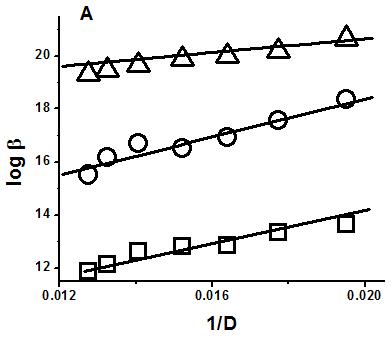
Figure2:SpeciesdistributiondiagramsofternarycomplexesofAspandenin40%v/vPG-watermixtures.(A)Co(II),(B)Ni(II)and(C)Cu(II).The amountsofingrediantsareM(II):1.0mmol,Asp:5.0mmolanden:2.5mmol.


Figure3:SpeculativestructuresofAsp-M(II)-encomplexes,whereSiseithersolventorwatermolecule.


