
1 2
Dr.ShattarkaGMahadik,Dr.SheelaSKohad1AssistantProfessor,ShalyatantraDept.,APM'sAyurvedMahavidyalaya,Sion.
2AssociateProfessor,Shalyatantradept.,APM'sAyurvedMahavidyalaya,Sion
ABSTRACT
Renalcalculi/calculus(Mutraashmari)isoneofthoseailmentswhereinonemayhavetoceaseallhisdailydutiesinstantaneouslyduetothepain.Notonlythat,once thecalculi/calculusisformed&isnotcureditkeepsongivingboutsofpain,painful&burningmicturitionwithorwithouthematuria.Manyresearcheshavebeendone inthisareabuttheadministrationroutebeingoralonly NomuchoftheworkisdoneinthetreatmentofMutraashmariintheformofBasti(Enema).Henceanattempt totreattheMutraashmarijanyaShoolbygivingMatra-bastioftheVarunaditailamasmentionedintheBhaisjya-Ratnavali.Theclinicalstudyentitled“TheClinical StudyonAMinimalInvasiveTreatmentInTheManagementOfMutraashmarijanyaShoolaw.s.r Renalcalculipain”,wasundertakentodiscernandtounderstandthe possiblemechanismofactionofanMatr-BastiofthemedicatedoilwillexhibitandachieveananalgesiceffectinthepacifyingtheMutraashmarijanyaShooland whether will it be able to relieve the associated symptoms too. It won't be an exaggerated statement to make that, the task of taking Bastikarma in Mutraashmari especiallytopacifythecolickypainasatopicforaclinicalstudywasindeedachallengetoundertake.Duringthisclinicalstudy,theconceptofSnehapak-kalpana,the variousmethodsofdrugstandardizationwereimplementedwiththeidealwaysofconductingandhandlingaclinicalresearchwork.
KEYWORDS:Mutraashmari,Renalcalculi/calculus,Mutraashmarijanya-Shool,Pain,Matra-basti,VarunadiTailam.
INTRODUCTION:
IntheIndianculturerightfromthetimeofourbirthweunceasinglyundergothe various 'Samskaras' and the 'Charyas' as preached by our Acharyas. These Samsakaras are actually meant for the natural body clock, ultimately for good health.Anyattempttobreachinfollowingtheserulesgivesrisetodiseases.This goldenconcepthasbeenmentionedthousandsofyearsbackbyourAcharyas.In today's time people are literally competing with the unstoppable Time and in doingsotheyfailtoperformevensmalldailycoresviz.,micturition,defecation, oralhygiene,etc.Nottakingcareofthebody,evenifitsexcretorysystemsignals (Adharneeyavega)fortheexpulsionoftheurineandstoolsandsuppressingthe naturalurgesisseenonlargescaleindailypracticeandillnessistheobviousoutcome to face Suppressing micturition urge, not following Dinacharya, Ritucharya,excessivestress,intakeofthevariousjunkfood&medicinescauses renalsystemailments.Renalcalculusisoneofthoseailmentswhosepaincould be at time so intense that one may have to cease all his daily duties instantaneously Notonlythat,oncethecalculi/calculusisformed&isnotcureditkeeps ongivingboutsofpain,painful&burningmicturitionwithorwithouthematuria. Allopathy has many wonder drugs to kill the pain and associated symptoms immediately,justlikethemagicalwand.Butwithallthis,thesedrugsmayalso causemanyside-effectsrangingfromhyperaciditytosevereanaphylacticshock. Hencesurgicalinterventionremainstheonlyoptioninthehandsoftoday'smodernsurgeons.AlltheAyurvedictextshavementionedmultipledrugscompounds forthetreatmentoftheMutraashmari.Manyresearcheshavebeendoneinthis area but the administration route being oral only hence an attempt to treat the MutraashmarijanyaShoolbygivingmatra-bastioftheVarunaditailam,asmentionedintheBhaisjyaRatnavali .Itisthevitiationofthevata-doshathatgives 1 risetotheseverepainandbastikarma isconsideredthebesttreatmenttocontrol 2 andpacifythevitiatedvata-doshaandtherebyalleviatethemutraashmarijanya Shool.Whilegoingthroughthetexts,wefindthatinthepurvarupa&rupaofthe mutraashmarisnehakarmaisadvised .AlsointheSushrutsamhitaithasbeen 3,4 mentioned that the mutranirmiti (formation of the urine) takes place in the pakwashaaya Consideringallthereferencestheadministrationofthevarunadi- 5 tailaminMutraashmarirogajanyaShoolinthematra-bastishouldyieldresult.
AIMSANDOBJECTIVES:
1. To clinically assess the Shoolaghna (analgesic) properties of Varunadi TailamMatra-Basti
2. To make an effective, cost effective, authentic, accessible conservative alternativeormanagementofMutraashmarijanyaShool.
3. To observe and propose the possible mechanism of the action of the Varunadi-tailam Matra-Basti viz. Varuna (Crataeva nurvula), Gokshura (Tribulusterrestris) andTeeltailam(OilofSesamumindicum)
4. Toobservetheside-effects&thecomplicationsofVarunadi-tailamMatrabasti,ifany
5. To review the complete literature available on acute or chronic pain in Mutraashmari.
Materialsandmethods:ThetherapeuticuseofVarunadiTailamMatra-Bastiin managementofMutraashmarijanyaShool;thisyoga(formulation)hasreference fromtheBhaishjya-Ratnavali.AnOpenuncontrolledstudywasconductedinthe OPD&IPD;attheShalyatantradepartmentoftheconcernedHospital,aftertaking clearance from its Ethical Committee. An informed written consent was takenfromall30thepts.inthelanguagetheywellunderstoodbeforecommencingthetrial.Thepts.clinicallydiagnosedtohaverenalcalculi/calculusandhaving at least two symptoms of the following–painful micturition, burning micturition & hematuria. The exclusion & the inclusion criteria of pts. of the studyaregiven.AllroutineHaematogicalinvestigationsweredonebeforestartingthetrial.OnlyTLC,DLC,RFT,UrineR.&Micro.,X-rayKUB&USG-KUB weredonebothbeforeandaftertoruleoutanyadverseeffectofthetherapyand also to see whether there was any effect on the size & number of the calculi/calculus;thoughasecondaryfinding.Followingwerethemaincriteriafor theclinicalassessmentinthistrial
A) LocalPain
PainfulMicturition
BurningMicturition
Hematuria
Toassesstheimprovementinsymptomsofgradationsonthebasisofseverity& durationthechangesinthegradationsofthesymptomsindicatetheeffectoftrial drug.

Theeffectofthetherapywasassessedintermsofcured(100%relief),markedly improved (50-100% relief), improved (25-50% relief) and unchanged (25% to norelief).
OBSERVATIONS&RESULTS:
Thedatageneratedduringthestudycanbegroupedunder3headings:
A) ChemicalAnalysisofthedrugused:Drugstandardization(authenticationof drugs, various analytical tests of the ingredients & the preparations were doneatknownandastandardpharmaceuticallaboratories)wasdoneasper the norms and recommendations, suggested by the CCRAS, Ministry of health&familywelfare,NewDelhi.
B) Demographic Analysis: Here the pts. analysed with respect to various parameters of the Demography (age, sex, religion, education, occupation, maritalstatus,etc)intheformoftables&graphsarementioned.
C) Clinicalefficacyofdrugaftercompletionofthetherapywasshownasthe% of relief observed in pts. for the particular symptoms.Also the duration of timeneededtoachievethereliefwasshowninformoftablesandbyapplyingappropriateStatisticalanalysis.Wilcoxon-matched-pairs-signed-ranks testwasappliedtothetotalsymptomscorewhichwasseentohighlysignificant.
EffectofTherapyonInvestigationswasstatisticalanalyzedbyapplyingthe't'–pairedtestshowedinsignificanteffectonTLC,DLCwhereasslightsignificant effectinnormalofMeanSrCreatinine,SrUricacid,BUN&BULwasseen.Thus indicatingthattherapycausesnoadverseeffectsonanyoftheinvestigations.As far as Urine Routine and Microscopy is concerned, enough data was not available for the calculation of the statistics. But still the chart shows that the urine infectionwascorrectedattheendofthetreatment.X-Ray&USGKUB:-USGKUBwasdonebeforeandafterthetherapyasitsreportingwasfoundmuchmore reliablethanX-RayKUB.Butasthetherapywasmeantforrelievingthepain& notmuchsignificantchangewasseenintheregressionofsizeofcalculi/calculus aftercompletionofthetherapyinthemaximumnumberofpts.takeninthestudy hencenoneofthestatisticaltestsoranalysiscanbemadehencenotmentioned.
TotalEffectoftherapyon30PatientsofMutraashmariwasassessedintermsas the Patient wise percentage of relief; which showed that out of the 30 patients observed patients (73.33 %) showed 100 % relief in the symptoms & patients (26.67%)weremarkedlyimprovedinthesymptoms.
DISCUSSION:
AspertheAyurvedictexts;suppressionoftheMutravega(Adharaneeyavega), notfollowingthedailycoresoflifeasadvocatedbytheage-oldShastra,notabiding with the Dashavidha Aaharaayatanas & also not carrying out the Samshodhankriyas(Panchkarmas)dulyasperone'sPrakruti,Koshta,Agniand the seasonal variations (Ritus ); all these reasons act as a nidus for the MutraashmariNirmiti.TheetiopathogenesisoftheMutraashmaridescribedby Ayurveda & that by the Modern texts are suggestive of similar pattern of Calculi/calculusformation.
ThisclinicalstudywasselectedbecauseShoolinMutraashmarihasbeennoted tobeanimportantsymptomamongsttherestandhenceasearchforaneffective weapontotackleitistheneedofthehourtoday Thisisso,becausetheAllopathic analgesic drugs are notoriously known to cause adverse-effects ranging from aciditytoanaphylacticshock.Notonlythisbutalargeproportionofpts.showa recurrenceinCalculi/calculusformation(aftertakingModernlineoftreatment) and such patients' lifestyle compels them to carry on taking Analgesics & Antispasmodicstorelievethepainandtocombattheirside-effectstheyhaveto consume other pills. The above scenario in the management of pain related to Mutraashmariarousedthenecessitytofindanalternative.
Shool nirmiti in the Mutraashmari is primarily attributable to the Margaavarodhajanya Vatadosha prakopa especially the Apaanvayu as the Basti is its Karyakshetra.Eventhemodernviewencouragestheabovestatement;thepain/ colickypain/radiatingpainintheUrolithiasisoccurswhenthecalculi/calculus triestopassthroughtheUreter;burning&painfulmicturition,hematuria,fever aretheotherassociatedsymptomstoo.
Sushrutaacharya,thefatheroftheIndianSurgery;afterthoroughlyanalysingthe etiopathogenesis of the Mutraashmari has correctly advised the Snehan via Bastikarma in the Purvaroopa & the Roopa of this disease. Even Bhaisjya Ratnavali opines the same & has advised many medicated Ghrutas & Tailas; VarunadiTailambeingofthem.
VarunadiTailamwasselectedforcombatingtheShoolseenintheMutraashmari via the Per-rectal route (Basti – a Panchkarma). Basti is considered as the half treatmentbytheKayachikitsapradhangranthasbutitisthecompletetreatment ofthevitiatedVatadosha,therebypacifierofShool;andnotwoopinionsonthat canbemade.Thepreparationcomprisesofthemostimportantdrugsviz.Varuna and Gokshura which have been proved to be the best drugs for combating Mutraashmari, till now the route being oral only As the compound has Tila Tailam and on account of its pharmacological qualities it was thought that the abovepreparationwilldefinitelyyieldresultsevenaftertakingper-rectalasthe routeofadministration.
ThesiteofCalculi/calculusseeninpts.understudywereseenmuchmoreinthe Kidney(UVJunction)andmoreinUreterandnegligibleintheBladderindicatingthatthesymptomShool(pain)arisesinthept.whenthecalculi/calculusisat theUVjunction,orimpactedortransversingalongtheUreters.Thisalsohelpsto confirmsthatVataprakopaisalsoMargaavarodhajanya¬alwaysKshayaj.
The pts. under study showed local pain (100%), painful micturition (100%) as main symptoms and 26.66% showed burning micturition and 13.33% pts. showedhematuria.Therebyindicatesthatalmostallthepts.undertrialsuffering from pain either local or radiating in nature indicating the incidence of calculi/calculus formation was seen more in the Kidney & Ureter Painful micturition was seen more than burning micturition as many a times pt. in the stateofagonyisunabletodistinguishthedifferencebetweenpainandburning sensationwhilemicturition.
On observing the efficacy of the therapy 95.51 % of the pts. with local pain, 98.04% of pts. with painful micturition & 90.32 % of pts. with burning micturition were seen to have good result of therapy as they had none of the above symptoms at the end of the therapy.The percentage pts. with hematuria (71.42%)wereseentolessrelivedcomparedtotheabovethreeparameters.
Theobservations&resultsaresuggestiveofthatnoadverseeffectswereseenin
anyoftheinvestigationsthatweredone.Outofthe30patientsobserved73.33% Patients showed 100 % relief in the symptoms, 26.67 % Patients were markedly improvedinthesymptoms.
TheprobablecausefortheaboveresultisthattheVarunadiTailamMatra-Basti was better at pacifying the vitiated Vatadosha as it contained drugs exhibiting diuretic,analgesic,anti-inflammatoryactionsandasthedrugswereabsorbed& assimilationwithoutundergoingdigestion.ThetherapyintheformofBastiprobably has lesser effective action on Hematuria and still lesser as Lithotriptic action.
ProbablemechanismofactionofVarunaditailam: Pain in the Mutraashmari is totally accountable to the Marga-avarodhajanya Vata-prakopa;especiallyApaanVaayudoshaasthebastiisitsKaryakariKshetra. The Basti- upakrama is best known to pacify the Vataprakopa especially the Apaanvayudosha and thereby proves useful in the management of the Mutraashmarijanya Shool. Sushrutaacharya mentions that Snehankarma must bedoneintheformofBasti,Uttarbasti,etc.inthePurvarupa&theRupaofthe Mutraashmari.VarunadiTailamismedicatedwithtwopotentdrugslikeVaruna & Gokshura Varuna has Kashaya & Tikta rasa; Ushna veerya & is Ashmaribhedak (lithotriptic) by its Prabhav Gokshura is Snigdha, Guru, and Madhura in rasa & vipaak.Apart from being Ushaveeryatmak; Madhur, Katu, Tiktainrasa,Madhuravipaki;TeeltailamisVyavaee&Vikashiduetowhichthe action of the drugs incorporated in it spread fast up to the cellular level of the body&theexpectedactionisapparentinthestudyconducted&issuperiorofall theoilsextractedfromthevegetablesources.ThereasonforselectingtheperrectalrouteovertheotherroutesofadministeringdrugsisthattheAyurveda&even theModernstudyshowthesignificanceoftheBastikarma.
Ayurveda:-Ithasbeennotedtopacifythelocalnervoussystem&thereby relievethePain(Shool)&alsodoestheShodhankarmaofthebody
Modern:-Asdrugsgivenviaperrectumroutearenotsubjectedtodigestion in the duodenum & hence said to maintain their nature & effect. Studies show that the absorption & assimilation of the administered medicated oil takesplacewithoutundergoingdigestion.
CONCLUSION:
Afterconductingtheclinicaltrialaconfidentconclusioncanbelaiddownasfollows:
Duringthetrial,thereviewoftheliterature&thepracticalviewofthestudysuggests a relevant relationship between the Mutraashmari & the Urinary calculi/calculus.TheAnatomy&PhysiologyoftheMutravahastrotasdescribedin theAyurvedaappearstobecrudeandalsoappearstohavegivenanimpetustothe Modern anatomist& physiologist to ponder upon it, which probably has given rise to today's microcellular levelled description of the Urinary System. The etiopathogenesisoftheMutraashmari&Urolithiasisappearstobeverysimilar on giving a calm thought; especially the eg. given in Sushruta Samhita of MrittikaghatfilledwithwaterappearstobesimilartoproposedstagesofCalculusformationintheRenalsystem.Theobviousdifferencesfeltduringthestudy ofboththepathiesisduetothefactthatthesearebasedonfundamentalsunique intheirownwayandseeksnodenialevenafterthousandsofyearshaveelapsed. At the commencement of the trial there was deep sense of curiosity about how effectivelywilltheVarunadiTailammatrabastiwillexhibittheAnalgesicpropertyespeciallywhenadministeredperrectally Butitisworthnotingthattheretrospectivestudydidnotfaileventoday;astheresulltsobtainedafterthecompletionoftreatmentisself-explanatory
Onobservingtheefficacyofthetherapy95.51%ofthepatientswithlocalpain, 98.04% of pts. with painful micturition & 90.32% of pts. with burning micturition were seen to have good result of therapy as they had none of the above symptoms at the end of the therapy.The percentage pts. with hematuria (71.42%)wereseentobelessrelievedcomparedtotheabovethreeparameters.
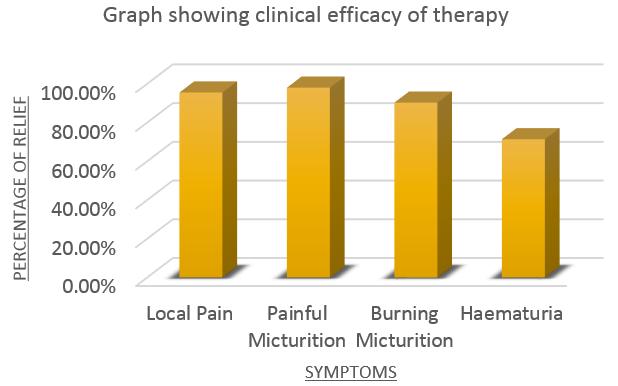
Thepatientwise,percentageofreliefoncompletionoftreatmentis73.33%of ptsshowed100%reliefinthesymptoms,26.67%weremarkedlyimprovedin thesymptoms.

TheprobablecausefortheresultistheVarunadiTailamMatra-Bastiwasbetterat pacifyingthevitiatedVatadoshaasitcontaineddrugsexhibitingdiuretic,analgesic,anti-inflammatoryactionsasthedrugswereabsorbed&assimilationwithout undergoing digestion. The therapy probably has lesser effective action on Hematuriaandstilllesseraslithotripticaction.
Hence it can be concluded that the above therapy in the management of MutraashmarijanyaShoolhadfollowingachievements:
Ÿ
Itrelievesthelocalpainwithinanhourafteradministration.
Ÿ Itrelievesthepainful&burningmicturitionwithinanhourafteradministration.
Ÿ Italsorelieveshematuriatosomeextent.
Ÿ Itdoesn'tcauseanyside-effectsoradverseeffects
Ÿ Itservesasthecosteffective&easilyaccessiblealternativeintheconservativemanagementoftheShoolofMutraashmari.
Ÿ ThetherapycanbecarriedonOPDbasistoo.
Ÿ Itimprovesthequalityoflifeofthepatientespeciallythosewithrecurrence.
It can be concluded that an attempt has been made first to discern our age-old shastra and to study primarily the Shoolaghna (Analgesic) properties of Varunadi-Tailam Matra-basti in the Mutraashmari; whereas the Antiinflammatory, Diuretic (Mutral) & Lithotriptic (ashmarighna) actions were the secondaryobservations&achievementstobemade.Duetothesamplesizeof30 patients, the study results though highly encouraging, merit a more extensive evaluation&mayhopefullyserveasanimpetusforfurtherclinicaltrialsonlarge samplesizewithprolongeddurationoftreatmentinthenearfuture.Aftertaking allthesefactsintoconsiderationitcanbesaidthatthereismajoradvantageofthis classicalformulationforthepatientasitallowsthepatienttocontinuehisday-todayactivities&savesvaluabletime&rendersbetterQualityofLife.
ANNEXURES:
1. BhaishajyaRatnavaliAshmariChikitsasthana.
2. SushrutaSamhitaChikitsasthana7/43.BhaishajyaRatnavaliAshmariChikitsasthana
4. SushrutaSamhitaNidansthana3/21-23
5. SushrutaSamhitaChikitsasthansa35
REFERENCES:
I. Researches in Ayurveda- A classified directory of all Indian PG & PhD thesis of AyurvedabyDr MSBaghel,MriduAyur Publication&sales.Jamnagar,Firstedition.
th
II. BhaisjyaRatnavalibyKavirajNarendranath,8 Edition;EditedbyPt.HaridattShastri, LalChandraVaidya.
III. SushrutaSamhitabyDrBGGhanekar,publishedbyMeherchandLaxmandas,Delhi 1975.
IV Sushruta Samhita with Ayurtatvasandipika by Dr Ambikadatt Shastri published by ChaukhambaSanskritSamsthana,Varanasi.ReprintEdition2004.
V Sushruta Samhita, Dalhana Tika by Vd. Yadavji Trikamji Chaukhamba Sanskrit th Samsthana,Varanasi.4 Edition,1980.
VI. Charak Samhita ofAgnivesa by Prof.Vidyadhar Shukla & Prof. Ravi DuttaTripathi st publishedbyChaukhambaSanskritPratisthana,Delhi.1 editionin1998.
VII. Asthang Sangraha by Kaviraj Atridev Gupta published by Chaukhamba Sanskrit Samsthana,Varanasi.1993.
VIII.SarthaVagbhataLatebyDrGaneshKGadrepublishedbyShreeGajananBookDepot, th Dadar,Mumbai7 edition,1983.
IX. MadhavNidaanbyVijayrakshitwithMadhukosha&ShrikanthadattawithVidhyodini
Tika.
X. Bhavprakash by Dr Brahmanand Tripathi published by Chaukhamba Sanskrit Samsthana,Varanasi.Reprint2006
XI. SharangdharSamhitabyAcharya-ShriRadhakrishnaParashwar
XII. IndianMateriaMedicabyDrKMNadkarnipublishedbyPopularPrakashan,Mumbai. rd3 Edition
nd
XIII.ThePharmacopoeiaofIndia,Govt.ofIndia,MinistryofHealth2 Edition
XIVAyur PanchakarmaVignyanambyVdKasture,publishedBaidyanath1999
XV Methods in Biostatistics by Dr B K Mahajan,Jaypee Bros. Med. Publishers pvt. Ltd. NewDelhi.