Research Paper
Physical Education
E-ISSN No : 2454-9916 | Volume : 5 | Issue : 5 | May 2019
EFFECT OF PLYOMETRIC TRAINING ON EXPLOSIVE POWER AMONG MEN FOOTBALL PLAYERS Dr. I. Karikalan Principal, St.John's College of Physical Education, Veeravanallur, Tirunelveli, Tamil Nadu, India. ABSTRACT The purpose of the study was to find out the effect of plyometric training on explosive power variables among men football player. To achieve the purpose of the study, twelve (12) college men sprinters were selected randomly as subjects from St.Johns College of Physical Education, Veeravanallur. Their age ranged from 17 to 25 years. The players who are participated in college level sprint events were randomly selected as subjects. The selected subjects underwent plyometric training for alternative three days per week up to six weeks. The selected fitness related components were selected as criterion variable explosive power. The above selected variables were tested by using standardized Test. The sample of the present study has been delimited to the twelve (12) college men sprinters. All the subjects were tested on selected variables prior to and immediately after the training period. Subjects were selected on pre and post test single group design. The results of the study shows that there was significant improvement in the explosive power variable and the analyses were carried out through various statistical technique such as descriptive statistics and Dependent 't' test. INTRODUCTION: Sports training aims at education and performance enhancement based on scientific principles through physical exercise. It is a basic groundwork of sportsman for elite performance. The development of physical fitness includes organic functions and increasing the strength and stability of the musculo-skeletal system (hardayal singh, 1991). Plyometrics have their roots in europe, where it was initially termed as jump training. During the early 1970s the interest in jump training has increased in the eastern countries. East europeans dominated the world sport arena. The eastern countries begin to produce superior athletes in track and field, gymnastics and weight lifting which gave rise to practicing this training method. Plyometrics exercises utilize the force of gravity to store energy in the muscles and utilized immediately in an opposite direction, so that the natural elastic properties of the muscles produce kinetic energy. The ability to apply force rapidly with speed strength is the major goal of plyometric training. The speed strength ability is known as power. For an exercise to be truly plyometric, it must be a movement proceeded by an eccentric concentration. This stimulates the proprioceptors sensitive to rapid stretch simultaneously loading the serial elastic components. Some amount of flexibility is important before beginning the plyometric training program. Plyometrics should not be considered an end in itself, but as part of an overall program. (Tirumalaikumar, 2002). Plyometrics training specifically targets the muscles fast twitch fibers which are responsible for speed and higher power production. Before starting a plyometric program, the previous training experience, age, physical maturity, conditioning, flexibility and strength should be analysed. Prepubescent athletes should perform only low intensity plyometrics. Full range of motion, good strength is the prerequisite for performing plyometrics. Sports participation and appreciation have become integral part of lives. Competitive sports make tremendous demands on the physical conditioning, vitality, endurance and mental powers of the participants. Only the players of fitness can play to the best of their ability. Each sport has its own pattern, muscle load, tempo and duration. In addition to the contentment the physical fitness is also an additional healthy remark in sports participation. OBJECTIVES OF THE STUDY: 1. To find out the effect of plyometric training shows any changes on explosive power variable among men football players. STATEMENT OF THE PROBLEM: The purpose of the study was to find out the effect of plyometric training on explosive power variable among men football player. HYPOTHESES: Based on the study conducted and reviewing the related literature available in the area, the investigator framed the hypothesis and it was tested at 0.05 level confidences. 1.
There would be significant improvement on explosive power due to the effect of plyometric training.
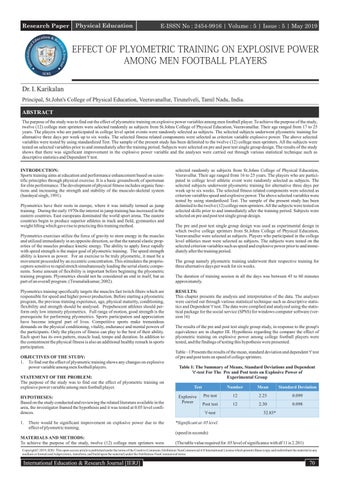
selected randomly as subjects from St.Johns College of Physical Education, Veeravallur. Their age ranged from 16 to 25 years. The players who are participated in college level athletic event were randomly selected as subjects. The selected subjects underwent plyometric training for alternative three days per week up to six weeks. The selected fitness related components were selected as criterion variables speed and explosive power. The above selected variables were tested by using standardized Test. The sample of the present study has been delimited to the twelve (12) college men sprinters. All the subjects were tested on selected skills prior to and immediately after the training period. Subjects were selected on pre and post test single group design. The pre and post test single group design was used as experimental design in which twelve college sprinters from St.Johns College of Physical Education, Veeravanallur were selected as subjects. Players who participated in the college level athletics meet were selected as subjects. The subjects were tested on the selected criterion variables such as speed and explosive power prior to and immediately after the training period. The group namely plyometric training underwent their respective training for three alternative days per week for six weeks. The duration of training session in all the days was between 45 to 60 minutes approximately. RESULTS: This chapter presents the analysis and interpretation of the data. The analyses were carried out through various statistical technique such as descriptive statistics and Dependent 't' test. The data were complied and analyzed using the statistical package for the social service (SPSS) for windows computer software (version 16) The results of the pre and post test single group study, in response to the group's equivalence are in chapter III. Hypothesis regarding the compare the effect of plyometric training on explosive power among college football players were tested, and the findings of testing this hypothesis were presented. Table – I Presents the results of the mean, standard deviation and dependent 't' test of pre and post tests on speed of college sprinters. Table I: The Summary of Means, Standard Deviations and Dependent 't'-test For The Pre and Post tests on Explosive Power of Experimental Group Test Explosive Power
Number
Mean
Standard Deviation
Pre test
12
2.23
0.099
Post test
12
2.30
0.098
't'-test
32.83*
*Significant at .05 level. (speed in seconds)
MATERIALS AND METHODS: To achieve the purpose of the study, twelve (12) college men sprinters were
(The table value required for .05 level of significance with df 11 is 2.201)
Copyright© 2019, IERJ. This open-access article is published under the terms of the Creative Commons Attribution-NonCommercial 4.0 International License which permits Share (copy and redistribute the material in any medium or format) and Adapt (remix, transform, and build upon the material) under the Attribution-NonCommercial terms.
International Education & Research Journal [IERJ]
70
Research Paper
E-ISSN No : 2454-9916 | Volume : 5 | Issue : 5 | May 2019
The table I shows that the obtained pre and post test mean values of experimental group was 2.23 and 2.30 respectively and the obtained dependent 't'-ratio values between the pre and post test means of experimental group was 32.83 The table value required for significant difference with df 11 at .05 level is 2.201. Since, the obtained 't' ratio value of experimental group are greater than the table value, it is understood that plyometric training had significantly improve the performance on explosive power among college men sprinters. Figure - I: Explosive Power
Figure - 2 : Mean Values of Plyometric Training Group on Explosivwe Power DISCUSSION ON HYPOTHESIS: The results of the study indicated that there was significant difference exists between pre and post test on explosive due to Plyometric Training. 1.
It was hypothesized that there would be significant difference between pre and post test on Explosive Power. The results of the study showed the results accordance with researcher research hypothesis, there was significant difference exists between pre and post test on Explosive Power the post test had better performance on Explosive Power when compared to pre test. Hence, the researcher first research hypothesis was accepted and the null hypothesis was rejected.
CONCLUSIONS: From the analysis of the data, the following conclusions are drawn. 1.
There was a significant difference in explosive power for college sprinters pre and post test. Hence, the post had a better performance on explosive power.
REFERENCES: 1.
Barrow, Harold M. and Rose Mary Mc Gee, (1979), A Practical Approach to Measurement in Physical Education, 3rded, Philadephia: Lea and Febiger, p.119.
2.
Fox, & Edward, L. (1984). Sports Physiology, Philadelphia: Saunders College Publishers.
3.
Morehouse, L. E., & Miller, A. T. (1976), Exercise; Exertion; Physiological aspects: Mosby, Saint Louis.
4.
Singh, H. (1991). Science of Sports Training, New Delhi: D.V.S. Publications.
5.
Thirumalaikumar, S. (2002). Plyometrics, Journal of Physical Education and Sports, 13,17.
6.
Thomas, R.B. (1994). Essential of straining training and conditioning, Champaign illinois: human kinetics publishers.
71
International Education & Research Journal [IERJ]