Research Paper
Agriculture
E-ISSN No : 2454-9916 | Volume : 5 | Issue : 6 | June 2019
STUDIES ON EVALUATION OF TOMATO (Solanum lycopersicon L.) HYBRIDS FOR FRUIT YIELD AND OTHER TRAITS IN CHHATTISGARH, INDIA 1
*Khairnar Shrikant Sanjayrao | Kalambe Nilesh Vasantrao
2
1
Technical Assistant “B”, Department of Genetics & Plant Breeding, MACS-Agharkar Research Institute, Pune, Maharashtra, India. 2 Plant Breeder, Department of Genetics & Plant Breeding, Sattva Seeds Pvt. Ltd., Raipur, Chhattisgarh, India. ABSTRACT
The present study which consist 18 hybrids for fruit yield and other yield contributing traits. The experiment was laid out in Randomized Block Design (RBD) with two replications during kharif season of 2017-18 at Sattva Seeds Pvt. Ltd., Raipur, Chhattisgarh. Analysis of variance (ANOVA) revealed significant differences among the hybrids for all the traits except days to initiation of flowering, days to first harvest, days to last harvest and fruit yield per plant (kg). Total fruit yield per plot differed significantly among hybrids which may attributed to significantly higher number of fruits per plant and average fruit weight (g). The highest total fruit yield per plot (149.4 kg) and fruit yield per plant (5.1 kg) were recorded in hybrid TROPICAL LEADER with respect to maximum average fruit weight was recorded in Abhijay (85.6 g). Highest number of fruits per plant was observed in TM 78 (75.6) which was significantly higher than that in all the other hybrids tested in present investigation. The hybrid Abhiraj & TD-159 were the earliest to exhibit initiation of flowering (27.0 DAT) and minimum number of days to first harvesting were observed in SAMPURNA (65.0 DAT). The less number of days to first flowering and harvesting indicated earliness of the hybrid. From an overall view of results, it can be inferred that the hybrids TROPICAL LEADER, TD-159 and Abhiraj were high yielding and suitable for fresh marketing in Chhattisgarh, India. KEYWORDS: Tomato, Lycopersicon esculentum L., Evaluation, Hybrids INTRODUCTION : Tomato (Solanum lycopersicum L.) is one of the most popular and widely grown vegetable in the world. It is a self-pollinated diploid species with twelve pairs of chromosomes (2n = 24). It belongs to the Solanaceae family with other frugally important crops such as pepper, eggplant and potato. Tomato is a rich source of vitamins (A and C), minerals (Ca, P and Fe) and a strong antioxidant against cancer and heart diseases [6]. India is the second largest tomato producing country in the world after China and contributes about 11.5 % to the global tomato production. As per NHB report 2018-19, in India, tomato is grown in an area of 0.814 m ha with annual production of 20.515 m tonnes and productivity of 21.36 t/ha [2]. The major Tomato producing States in the country are Andhra Pradesh, Madhya Pradesh, Karnataka, Gujarat, Odisha, West Bengal, Chhattisgarh, Maharashtra, Bihar, Haryana, Uttar Pradesh, Telangana and Tamil Nadu. These States are account for 91% of the total production of the country. The production of Tomato during the year 2017-18 (First Advance Estimate) is estimated to be 7.8% higher as compared to the previous year. However as compared to past 5 years average production, it is 20% higher [3]. Now a days, inspite of the availability of several hybrids, the growers are finding it difficult to go for cultivation of tomatoes, some of the reasons being, their suitability for a particular region, demand more attentive management, ripe at a time that leads to the problem of storage and processing facilities, lack of high and quality yield under open conditions and unstable inheritance of specific traits. To minimize these problems the new tomato hybrids developed should adapt to varied agro-climatic conditions may be a difficult proposition. However, India being a vast country with varied agro-climatic regions, different genotypes needs to be evolved for specific regions. In general, with ever increasing demand for tomatoes, it has become imperative to develop high yielding hybrids with resistance to biotic and abiotic stresses and suitable to fresh market and processing hybrids for cultivation in different agroclimatic conditions to boost up the tomato production per unit area and per unit time according to the consumers and growers preference. MATERIALS AND METHODS: The experiment was conducted at the Sattva Seeds Pvt. Ltd., Raipur, Chhattisgarh on red soil during the Kharif season of 2017-2018. The land was well tilled to a depth of 35 cm and the nursery bed was neatly prepared. Eighteen hybrids of tomato were used for the experiment. The seeds of each of the eighteen hybrids were separately drilled into the soil, covered lightly with a film of loosed soil and mulched immediately using dry grasses. Seedlings emerged 5-8 days after sowing and mulch materials were removed after seedling emergence to harden the plants. The tomato seedlings were transplanted at four (4) weeks after planting (4 WAP) into a previously harrowed and ridged field. The seedlings were removed singly
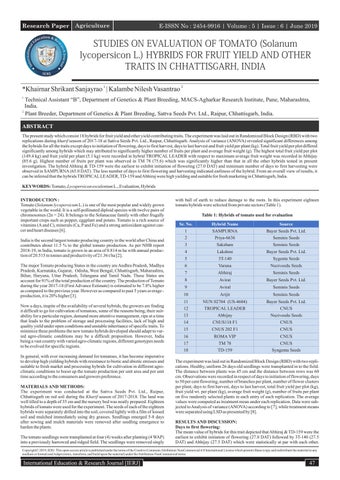
with ball of earth to reduce damage to the roots. In this experiment eighteen tomato hybrids were selected from private sectors (Table 1). Table 1: Hybrids of tomato used for evaluation Sr. No. 1 2
Hybrid Name SAMPURNA
3
Saksham
Seminis Seeds
4
Lakshmi
Bayer Seeds Pvt. Ltd.
5
3T-140
Sygenta Seeds
6
Varuna
Nuziveedu Seeds
7
Abhiraj
Seminis Seeds
8
Avirat
Bayer Seeds Pvt. Ltd.
Priya-6636
Source Bayer Seeds Pvt. Ltd. Seminis Seeds
9
Aviral
Seminis Seeds
10
Arijit
Seminis Seeds
11 12
NUN 02704 (US-4604) TROPICAL LEADER
Bayer Seeds Pvt. Ltd. CNUS
13
Abhijay
Nuziveedu Seeds
14
CNUS118 F1
CNUS
15
CNUS 202 F1
CNUS
16 17
ROMA VIP
CNUS CNUS Syngenta Seeds
18
TM 78 TD-159
The experiment was laid out in Randomized Block Design (RBD) with two replications. Healthy, uniform 26 days old seedlings were transplanted in to the field. The distance between plants was 45 cm and the distance between rows was 60 cm. Observations were recorded in respect of days to initiation of flowering, days to 50 per cent flowering, number of branches per plant, number of flower clusters per plant, days to first harvest, days to last harvest, total fruit yield per plot (kg), fruit yield wt. per plant (kg), average fruit weight (g), number of fruits per plant on five randomly selected plants in each entry of each replication. The average values were computed as treatment mean under each replication. Data were subjected to Analysis of variance (ANOVA) according to [7], while treatment means were separated using LSD as presented by [8]. RESULTS AND DISCUSSION: Days to first flowering: The mean value of hybrids for this trait depicted that Abhiraj & TD-159 were the earliest to exhibit initiation of flowering (27.0 DAT) followed by 3T-140 (27.5 DAT) and Abhijay (27.5 DAT) which were statistically at par with each other.
Copyright© 2019, IERJ. This open-access article is published under the terms of the Creative Commons Attribution-NonCommercial 4.0 International License which permits Share (copy and redistribute the material in any medium or format) and Adapt (remix, transform, and build upon the material) under the Attribution-NonCommercial terms.
International Education & Research Journal [IERJ]
47
Research Paper
E-ISSN No : 2454-9916 | Volume : 5 | Issue : 6 | June 2019
The maximum number of days to initiation of flowering was found in TROPICAL LEADER (31.0 DAT). The population mean was found to be 28.86 DAT. Earlier flowering hybrids could be used for production of early fruits for higher remuneration. Variability in days to initiation of flowering has also been reported by [12] [9]. Days to 50 percent flowering: There was significant difference among different hybrids for days to 50 percent flowering. The mean values for days to 50 percent flowering ranged from 32.0 to 38.0 (Table 2). The minimum value for days to 50 percent flowering was observed in 3T-140 (32.0) followed by Priya-6636 (33.0), Abhiraj (33.0), Arijit (33.0), TD-159 (33.0), SAMPURNA (34.0), Abhijay (34.0) and CNUS118 F1 (34.0), which were statistically at par with each other. The hybrid TROPICAL LEADER exhibited higher value for days to 50 percent flowering (38.0). The population mean was 34.56. Variability in days to 50 percent flowering has also been reported by [12] [9]. Number of branches per plant: There was significant variation in number of branches per plant across the hybrids (Table 2). The mean value for this trait exhibited a range of number of branches from 3.00 to 7.75. Maximum number of branches was found in Abhiraj (7.75) followed by TROPICAL LEADER (7.50), Saksham (6.75), which were statistically at par with each other. Minimum value was found in the CNUS118 F1 (3.00). The population mean for number of branches was observed to be 5.36 (Table 2). Number of flower clusters per plant: The number of flower clusters per plant is an important yield determining trait. Higher number of flower clusters may lead to greater number of fruits per plant in favourable conditions. The data on number of flower clusters per plant indicated that the mean value for this trait ranged from 5.90 to 13.10. The hybrids differed significantly for number of flower clusters per plant. Among all the hybrids, maximum number of flower clusters per plant was observed in TROPICAL LEADER (13.10) followed by statistically at par values in Saksham (11.90) and Abhiraj (11.80). Whereas, minimum number of flower clusters per plant was observed in Lakshmi (5.90), CNUS118 F1 (7.05), Arijit (7.25) and Varuna (7.50). The population mean for this trait was 9.34. The results of present investigation could also be compared with findings of [1] [15]. Days to first harvesting: Tomato hybrids under this study exhibited non-significant difference for days to first harvesting in a range of 65.0 DAT to 72.5 DAT (Table 2). Minimum number of days to first harvesting were observed in SAMPURNA (65.0 DAT) followed by Abhiraj & Arijit (66.5 DAT), which were statistically at par in early harvesting. The population mean for days to first harvesting was 69.08 DAT. The less number of days to first flowering and harvesting indicated earliness of the hybrid. The growing season of tomato in raipur starts from Jun-July and ends in August-September, early hybrids or varieties are essentially required for better yield as during rainy season the crop is adversely affected by foliar diseases and low temperature. Variability in days to first harvesting has also been observed by [1] [13]. Days to last harvesting: Tomato hybrids under this study exhibited non-significant difference for days to last harvesting in a range of 101.0 DAT to 117.5 DAT (Table 2). Minimum number of days to last harvesting were observed in NUN 02704 (US-4604) (101.0 DAT) followed by ROMA VIP (103.5 DAT). The population mean for days to last harvesting was 110.44 DAT. Number of fruits per plant: The difference among the hybrids with respect to number of fruits per plant was
highly significant which varied from 29.4 to 75.6 Maximum number of fruits per plant was observed in TM 78 (75.6) which was significantly higher than that in all the other hybrids tested in present investigation. The other hybrids with comparatively higher number of fruits per plant were Avirat (71.1), TD-159 (66.4). Minimum number of fruits per plant was found in the CNUS118 F1 (29.4). The population mean for this trait was 52.48 (Table 2). In this investigation variation in the number of fruit per plant was due to the genetic make-up of the hybrids as all the hybrids tested were given almost similar type of cultural atmospheric and edaphic environments. The results of present study were in accordance with those reported by [11] [12] [10] [4]. Average fruit weight (g): There was a significant difference among 18 hybrids with respect to average fruit weight (Table 2). The fruit weight ranged between 51.6 g to 85.6 g. Maximum fruit weight was registered in Abhijay (85.6 g). The other hybrids with higher fruit weight were TROPICAL LEADER (83.3 g) and NUN 02704 (US-4604) (80.2 g). Minimum value for fruit weight was observed in TM 78 (51.6 g). The population mean was 69.27. Generally, fruit weight is inversely associated with number of fruits per plant although both of these traits are principal yield attributing traits. The fruit weight which is a function of fruit size may be subject of consumer‟s or market choice but fruit number is independent of the purpose of end use. Therefore, preference should be given to the hybrids with higher number of fruits per plant rather than those having big and bulking fruits. Corresponding to above results variability in average fruit weight and inverse association with number of fruits per plant have also been reported by [11] [13] [14] [4] [5]. Fruit yield per plant (kg): The fruit yield is supposed to be the ultimate economic trait in tomato as well as other fruit vegetables. Fruit yield per plant is an accurate assessment of potentiality of a particular hybrid at individual plant level. The data on fruit yield per plant exhibited a wide variability among the hybrids evaluated. Highest fruit yield per plant was observed in TROPICAL LEADER (5.1 kg) followed by statistically at par values in TD-159 (4.8 kg). The CNUS118 F1, ROMA VIP and Priya-6636 exhibited comparatively lower fruit yield per plant i.e. 2.1 kg, 2.5 kg and 2.6 kg, respectively. The mean of population for this trait was 3.6 kg (Table 2). The results indicated that certain hybrids developed from crosses between commercial grown open pollinated varieties were more heterotic as compared to commercial F1 hybrids developed by different organizations. The cumulative results of fruit weight, number of fruit per plant and fruit yield per plant proved that the hybrids exhibiting maximum number of fruits per plant TM 78 or maximum fruit weight Abhijay did not have maximum fruit yield per plant. This was because of the fact that the hybrid with highest number of fruit per plant had lower fruit weight and vice versa. The hybrid having highest fruit yield per plant i.e. TROPICAL LEADER (5.1 kg) had comparatively higher number of fruits per plant (61.0 kg) as well as heavier fruits (83.3 kg). Variability in fruit yield per plant in tomato hybrids have also been reported by [14] [10] [12]. Total fruit yield per plot (kg): There was a significant difference among 18 hybrids with respect to total fruit yield per plot (Table 2). The total fruit yield per plot ranged between 63.0 kg to 149.4 kg. The data on fruit yield per plant exhibited a wide variability among the hybrids evaluated. Highest total fruit yield per plot was observed in TROPICAL LEADER (149.4 kg) followed by statistically at par values in TD-159 (142.1 kg). The CNUS118 F1 (63.0 kg) and ROMA VIP (70.7 kg) exhibited comparatively lower fruit yield per plot, respectively. The mean of population for this trait was 103.84 kg (Table 2). The hybrid having highest total fruit yield per plot i.e. TROPICAL LEADER (149.4 kg) had comparatively higher fruit yield per plant (5.1 kg), number of fruits per plant (61.0 kg) as well as heavier fruits (83.3 kg). Variability in total fruit yield per plot in tomato hybrids have also been reported by [14] [10] [12].
Table 2: Performance of tomato hybrids for different yield parameters Days to No. of No. of flower Days to Days to 50 Initiation of Branches / clusters / first % flowering flowering plant plant harvest
Days to last harvest
No. of fruits/ plant
65.0
117.5
47.4
64.6
3.1
70.0
116.5
48.1
53.9
2.6
78.0
11.90
68.5
114.0
61.7
62.9
3.9
116.3
5.75
5.90
68.0
107.5
49.0
69.7
3.4
102.6
6.25
10.40
68.5
115.0
60.8
69.0
4.2
131.0
3.50
7.50
68.0
110.0
57.5
76.6
4.4
103.6
7.75
11.80
66.5
111.5
58.1
76.9
4.5
134.0
35.0
6.00
9.25
69.0
106.0
71.1
54.5
3.9
116.3
Sr. No.
Hybrid Name
1
SAMPURNA
29.5
34.0
6.00
10.90
2
Priya-6636
28.5
33.0
5.00
8.90
3
Saksham
29.0
35.5
6.75
4
Lakshmi
30.0
36.0
5
3T-140
27.5
32.0
6
Varuna
29.5
35.0
7
Abhiraj
27.0
33.0
8
Avirat
29.0
Average Fruit yield Total fruit fruit Wt. / plant yield / plot (g) (kg) (kg) 91.8
9
Aviral
30.0
35.5
5.50
10.50
70.0
106.0
52.5
64.5
3.4
101.7
10
Arijit
28.5
33.0
4.15
7.25
66.5
112.5
47.2
72.2
3.4
102.1
11
NUN 02704 (US-4604)
28.5
35.0
4.00
8.05
69.0
101.0
36.2
80.2
2.9
87.2
48
International Education & Research Journal [IERJ]
Research Paper
E-ISSN No : 2454-9916 | Volume : 5 | Issue : 6 | June 2019
12
TROPICAL LEADER
31.0
38.0
7.50
13.10
70.5
113.5
61.0
83.3
5.1
149.4
13
Abhijay
27.5
34.0
5.25
8.70
70.0
108.5
44.8
85.6
3.8
115.2
14
CNUS118 F1
29.5
34.0
3.00
7.05
70.0
112.5
29.4
72.1
2.1
63.0
15
CNUS 202 F1
29.0
36.5
4.25
8.35
72.5
107.5
44.6
63.9
2.9
84.4
16
ROMA VIP
30.0
35.0
3.75
7.95
71.5
103.5
33.3
73.4
2.5
70.7
17
TM 78
28.5
34.5
5.75
10.65
70.0
112.5
75.6
51.6
4.0
80.1
18
TD-159 F' Test
27.0 NS
33.0 **
6.25 *
9.90 **
70.0 NS
112.5 NS
66.4 **
72.3 *
4.8 NS
142.1 * 103.84
GM
28.86
34.56
5.36
9.34
69.08
110.44
52.48
69.27
3.6
SEM
0.68
0.32
0.53
0.49
1.8
4.69
4.06
4.43
0.48
9.72
CD at 5 %
2.02
0.96
1.60
1.46
5.37
13.97
12.09
13.2
1.44
28.91
CV %
3.34
1.32
14.24
7.45
3.7
6.01
10.96
9.07
19.08
13.24
CONCLUSION: The experiment revealed that the significant differences among the hybrids for all the traits except days to initiation of flowering, days to first harvest, days to last harvest and fruit yield per plant (kg). The hybrids TROPICAL LEADER, TD-159 and Abhiraj were high yielding and suitable for fresh marketing. Hence, these hybrids can be recommended as better hybrids for commercial cultivation in Chhattisgarh, India. REFERENCES: 1.
Alam, M.S., Sultana, N., Ahmed, S., Hossain, M.M. and Islam, A.K.M.A. Performance of heat tolerant tomato hybrid lines under hot, humid condition. Bangladesh J. Agril. Res. 2010; 35(3):367-373.
2.
Area and production of vegetable production in India. Anonymous, 2018. www.nhb.org.
3.
State Departments of Horticulture & Agriculture. Anonymous, 2017-18.
4.
Cheema, D.S., Singh, N. and Jindal, S.K. Evaluation of indeterminate tomato hybrids for fruit yield and quality traits under net house and open field condition.Veg. Sci.2013; 40(1):45-49.
5.
Degade, S.B., Borad, A.V. and Dhaduk, L.K. Studies on hybrid vigour in F1 and its retention in F2 for fruit firmness and related traits in tomato, Inter. J. Applied Bio. & Phar. Tech. 2015; 6(1):193-198.
6.
Dhaliwal, M.S., S. Singh and D.S. Cheema. Line × tester analysis for yield and processing attributes in tomato. J. Res. 2003;40:49-53.
7.
Gomez KA, Gomez AA. Statistical Procedure for Agricultural Research. 2nd Edition.
International Education & Research Journal [IERJ]
John Willey and Sons, New York. 1984;1-240. 8.
Obi IU. Statistical methods of detecting differences between treatment means. Snapp Press (Nig) Ltd., Nigeria. 1986;45.
9.
Said, F.A., Farsi, K.A., Khan, I.A., Ali, A., Khan, M.M. and Iqbal, Q. Evaluation of adaptability and nutritional quality of 54 tomato accession grown in Oman. J. Food Agric. & Environ. 2014; 12(2):40-50.
10. Saleem, M.Y., Iqbal, Q. and Asghar, M. Genetic variability, heritability character association and path analysis in F1 hybrids of tomato. Pak. J. Agri. Sci. 2013;50(4):649653. 11. Sekhar, L., Prakesh, B.G., Salimath, P.M., Sridevi, O. and Patil, A.A. Performance of productive single cross hybrids in tomato (Solanum lycopersicon L.). Karnataka J. Agric. Sci. 2009;22(4): 877-878. 12. Shankar, A., Reddy, R.V.S.K., Sujata, M. and Pratap, M. Genetic variability studies in F1 generation of tomato (Solanum lycopersicon L.) JOSR J. Agric. Vet. Sci. 2013;4(5):31-34. 13. Sharma, D., and Sharma, H.R. Production and evaluation of tomato hybrids using diallele genetic design. Indian J. Hort. 2013;70: 4-6. 14. Singh, A., Ahirwar, C.S. and Prasad, V.M. Evaluation of tomato hybrids (Lycopersicon esculentum Mill) in Allahabad agro climatic conditions. Trends in Bioscience. 2013;6(6): 744-746. 15. Singh, T., Singh, N., Bahuguna, A., Nautiyal, M. and Sharma, V.K. Performance of tomato (Solanum lycopersicon L.) hybrids for growth, yield and quality inside polyhouse under Mid Hill Condition of Uttarakhand, Am. J. Drug Discov. Dev. 2014; 68:18.
49