Research Paper
Education
E-ISSN No : 2454-9916 | Volume : 6 | Issue : 1 | Jan 2020
EFFECT OF SELF-STUDY MATERIAL ON LEARNING AMONG SENIOR SECONDARY SCHOOL STUDENTS Mr. Rajkishore Roul Assistant Professor, School of Education, North Orissa University, Baripada, Odisha, India. ABSTRACT The purpose of the study is to determine the effect of self-study material on learning among senior secondary school students by adopting simple random technique. It was hypothesized that there exists a significant effect of self-study learning on achievement of senior secondary school students. The major findings of this study were as the developed Self Study Materials were found to be effective in terms of performance of the students on criterion tests. The developed Self Study Materials were found to be significantly better than those taught through the traditional method. The developed SSM was found significantly better than the traditional method in terms of development of reasoning ability of students in science. KEY WORDS: Self Study Materials, Senior Secondary School Students, Learning. INTRODUCTION: “The world is a University and everyone in it a teacher Makes sure when you woke up in the morning, you go to school” Self-study is important aspect of effective learning. Self-study is one of the most important things not only to qualify for an examination but it is most important to acquire practical approach of theoretical information. One can understand the concept from his point of view, with his own examples rather than any complex example taught by the lecturer. According to psychologists no two individuals are alike. There are individual differences. The individuals differ in their habits, interest's, ideas, thoughts, actions, attitudes, aptitudes, feelings etc. In a class, students also differ in their habits, attitudes, previous knowledge, intelligence etc. Every student is unique so far as behaviour is concerned. The habits are expressed in their thoughts, feelings and action. Different student differ so far as learning is concerned. Some student crams content material. Some students understand subject matter when they write it. Some comprehend and subject matter by listening to it. Some learn by observation. The habits possessed by students in carrying out study is different subjects is also different. Research studies reflect that there is a perfect correlation between the study habits and outcomes of teaching learning process (Parua and Archana, 2011). If the study habits are good and desirable, the chances of realisation of educational objectives are better and vice versa. Therefore, study habits play an important role in the process and product of teaching and learning. Self- study materials develops personality traits like self reliance, self dependence, self confidence among the learners. It develops creativity among the students and makes them research oriented. It broadens the mental horizon of the students. By the help of self-study materials the intellectual capacities of the student develops and could be used for acquiring knowledge and information. The self study method makes the students to utilize the leisure time properly to enrich and increase their fund of knowledge and information. As well as enhance the learning among students (Das, 2019). DESIGN OF THE STUDY: The study is based on experimental research design to explore the facts related to the study regarding the impact of self study material on the academic achievement of senior secondary school students. In the present study the researcher used pre-test –treatment-post test design.a sample of 30 senior secondary school students. The sample was divided equally into two groups (Control and Experimental). The students of Experimental group were taught by self study materials and the students of Control group were taught by the traditional method.
performance of students on different criterion tests and performance as a whole. Table 1: Pretest and Post-test Comparison of Performance of Students on Achievement test Variable
Pre-test
Learning In Science
Mean (Mx) 40.69
Post-test S.D.
Mean (My)
5.06
27.62
't' value S.D.
4.87
29.91
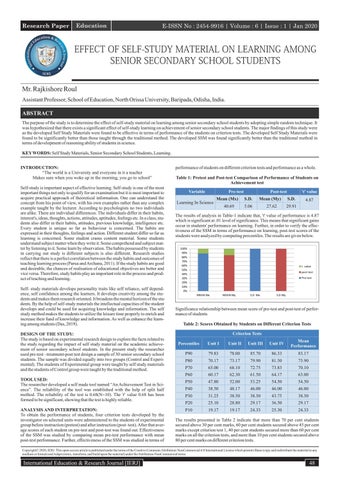
The results of analysis in Table-1 indicate that, 't' value of performance is 4.87 which is significant at .01 level of significance. This means that significant gains occur in students' performance on learning. Further, in order to verify the effectiveness of the SSM in terms of performance on learning, post-test scores of the students were analyzed by computing percentiles. The results are given below.
Significance relationship between mean score of pre-test and post-test of performance of students Table 2: Scores Obtained by Students on Different Criterion Tests Criterion Tests Percentiles
Unit I
Unit II
Unit III
Unit IV
Mean Performance
P90
79.83
78.00
85.70
86.33
83.17
P80
70.17
73.17
79.90
81.50
75.90
P70
65.00
68.10
72.75
73.83
70.10
P60
60.17
62.30
61.50
64.17
63.00
TOOL USED: The researcher developed a self made tool named “An Achievement Test in Science”. The reliability of the tool was established with the help of split half method. The reliability of the test is 0.68(N=10). The 'r' value 0.68 has been formed to be significant, showing that the test is highly reliable.
P50
47.80
52.00
53.25
54.50
54.50
P40
38.50
48.17
46.00
46.00
46.00
P30
31.25
38.50
38.50
43.75
38.50
P20
25.10
28.80
29.17
36.50
29.17
ANALYSIS AND INTERPRETATION: To obtain the performance of students, four criterion tests developed by the investigator on selected units were administered to the students of experimental group before instruction (pretest) and after instruction (post–test). After that average scores of each student on pre-test and post-test was found out. Effectiveness of the SSM was studied by comparing mean pre-test performance with mean post-test performance. Further, effectiveness of the SSM was studied in terms of
P10
19.17
19.17
24.33
25.30
24.33
The results presented in Table 2 indicate that more than 70 per cent students secured above 30 per cent marks, 60 per cent students secured above 45 per cent marks except criterion test 1, 40 per cent students secured more than 60 per cent marks on all the criterion tests, and more than 10 per cent students secured above 80 per cent marks on different criterion tests.
Copyright© 2020, IERJ. This open-access article is published under the terms of the Creative Commons Attribution-NonCommercial 4.0 International License which permits Share (copy and redistribute the material in any medium or format) and Adapt (remix, transform, and build upon the material) under the Attribution-NonCommercial terms.
International Education & Research Journal [IERJ]
48
Research Paper
E-ISSN No : 2454-9916 | Volume : 6 | Issue : 1 | Jan 2020
Hence the results indicate satisfactory students' performance on criterion tests. It means that the developed SSM was found to be effective in terms of performance of the students on criterion tests. Students' reactions towards the SSM were obtained by administering a reaction scale developed by the investigator. The obtained data were analysed by using percentage and chi-square test. The reaction scale consisted of fifty items covering five aspects of the SSM. There were ten items in each aspect and five options against each item. Students were asked to put a tick mark on one of the options. First aspect of the reaction scale elicited reactions from the students with respect to their liking/ disliking towards the developed SSM. It was found that 82.76 per cent of students reacted that subject matter presented through the SSM is very easy to follow. 10.34 per cent students were not in a position to react towards this item. Only 6.90 per cent students were not agreed on this item. 75.87 per cent students were of the opinion that the SSM helps to understand the content without much external support, 6.90 per cent students were unable to decide their responses on this item, whereas 17.24 per cent students were not agreed on this item. 72.41 and 93.10 per cent students agreed that the atmosphere of learning through SSM is healthy in terms of distracting stimuli and it is very interesting to learn through the SSM, respectively. Only 10.35 per cent students disagreed with the former and no one disagreed with the later. However, 17.24 and 6.90 per cent students could not say anything about these two items. Results in terms of percentage indicate that students reacted favourably towards the SSM with regard to instruction through the SSM. Second aspect of the reaction scale was about the presentation of the content. There were eight positive items in this aspect, such as the subject matter presented in small steps is easy to understand, help of the teacher is sufficient to learn, the linkage of different concepts are well done, the content presented in conversational style is friendly to learn, provision of different examples and explanations for a concept help to learn effectively, there are sufficient illustrations to explain the content, explanation of technical words helps in learning, and integration of different illustrations and examples with the content was quite good. 89.66, 96.55, 75.86, 89.65, 86.20, 65.52, 72.41, and 75.86 per cent students respectively reacted favourably towards these items. 3.45 to 31.03 per cent students were not able to react towards these items and only 3.45 to 17.24 per cent students disagreed with these items. There were two negative items such as there should be compulsion to learn in same sequence and explanation of technical words not necessary. 65.52 And 62.07 per cent students respectively disagreed with these items. 10.34 per cent students were not in a position to react to the former and 31.03 per cent were not in a position to react to the latter. Only 30.13 per cent students agreed with the former and 6.90 per cent on the later. The chi-square values with respect to presentation of content were significant. This reflects that the students liked the presentation of the content. Hence, it can be concluded that the developed SSM was found to be effective in terms of students' reaction towards it.
The study opens up a new path for the administrators, principals/headmasters, directors, educational officers in the sense that they should cultivate positive attitude towards the development and use of SSM from economic point of view. They should try to modify the curriculum and encourage both teachers and students for the use of the SSM. In the light of the conclusion that learning through SSM is significantly better than the traditional face-to-face approach to teach General Science to Class XI students, the important implications for the practitioners and planners is that they might consider learning Biological Science to Class XI students through distance mode. REFERENCES: 1.
Bhatt,S.K.(2012) . Using Self-Study Materials for Classroom Teaching. National University of Singapore, Singapore. 9(1), 347–365.
2.
Daniel,C., and Ringdal,A. (2012). Self-Regulated Learning in the Classroom: A Literature Review on the Teacher's Roles. Department of Education, Gustavus Adolphus College, Mattson Hall. Volume 2012, Article ID 423284.
3.
Das, N. (2019). Effect of self Study Materials on Learning among Secondary school students. Unpublished M.ed Dissertation, North Orissa University.
4.
Das,B.C. (2012) . Effectiveness of Self-study Material for Teaching General Science To school students. Department of Education, North-Eastern Hill University, Meghalaya. Virginia Commonwealth University.
5.
Konusikova, M. and Kostelnik,J. (2009). Creation and effectiveness of educational texts for directed self learning at secondary technical schools. Slovak university of technology in Bratislava.
6.
Meyer, W.R. (2010). Independent learning: a literature review and a new project. British Educational Research Association Annual Conference, University of Warwick.
7.
Parua, R.K. and Sharma, K. (2012). Study habits of Secondary School Students in relation to their Scholastic Achievement. Research Analysis and Evaluation, 2(21), 30-33.
8.
Pintrich, P.R. and Groot, V. De; (2009). Motivational and Self-Regulated Learning Components of Classroom Academic Performance. School of Education University of Michigan Ann Arbor Michigan. 82 (2) 33-40.
9.
Sagitova, R. (2014). Students' self-education: learning to learn across the lifespan. Ph.D.disst., Institute of Education and Psychology of Professional Education, Kazan, Russia. 272-277
FINDINGS: Ÿ Developed SSM was found to be effective in terms of performance of the students on criterion tests and reaction towards it. More than 70 per cent of students secured more than 30 per cent marks and reaction of the students towards different aspects of the SSM and material as whole was found to be favorable. Ÿ
The performance of students taught through the developed SSM was found to be significantly better than those taught through the traditional method when students overall performance scores were adjusted with respect to intelligence.
Ÿ
The developed SSM was found significantly better than the traditional method in terms of development of learning of students in science.
Ÿ
The developed SSM was not found to have any significant positive effect on scientific attitude scores of the students when compared with the traditional method.
CONCLUSION: The developed SSM was used for teaching and learning Biological Science and was found to be effective than the traditional method of teaching. It has brought about significant changes in the scientific reasoning abilities of the students. This implies that the science teachers can take the help of such material and procedures involved in it and make their classroom teaching effective. By following the principles of developing the material, science teachers can develop SSM for teaching and learning. By collecting available materials not only for teaching science but also for teaching other subjects and using such material as a support system, the teacher can improve his teaching efficiency and fulfill the present requirements of classroom teaching which is helpful for the learning of students. To cope up with the present changing society, the teacher should have sufficient knowledge in each and every field which is impossible in the present classroom setting having wide variety of students, and a single teacher following a single teaching method. The material developed and used in the present study has proved to be effective for students in learning in terms of learning on their own. Therefore, SSM could be used for effective self-learning by the students. Besides, it could be used to develop awareness among the students about the use of SSM in learning situations and provide training in the use of such material.
49
International Education & Research Journal [IERJ]