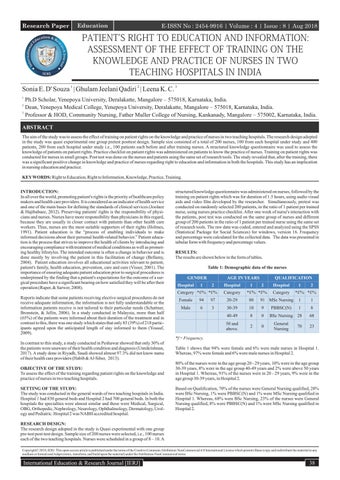
Education
Research Paper
E-ISSN No : 2454-9916 | Volume : 4 | Issue : 8 | Aug 2018
PATIENT'S RIGHT TO EDUCATION AND INFORMATION: ASSESSMENT OF THE EFFECT OF TRAINING ON THE KNOWLEDGE AND PRACTICE OF NURSES IN TWO TEACHING HOSPITALS IN INDIA 1
2
Sonia E. D' Souza | Ghulam Jeelani Qadiri | Leena K. C.
3
1
Ph.D Scholar, Yenepoya University, Deralakatte, Mangalore – 575018, Karnataka, India. Dean, Yenepoya Medical College, Yenepoya University, Deralakatte, Mangalore – 575018, Karnataka, India. 3 Professor & HOD, Community Nursing, Father Muller College of Nursing, Kankanady, Mangalore – 575002, Karnataka, India. 2
ABSTRACT The aim of the study was to assess the effect of training on patient rights on the knowledge and practice of nurses in two teaching hospitals. The research design adopted in the study was quasi experimental one group pretest posttest design. Sample size consisted of a total of 200 nurses, 100 from each hospital under study and 400 patients, 200 from each hospital under study i.e., 100 patients each before and after training nurses. A structured knowledge questionnaire was used to assess the knowledge of patients on patient rights. Practice checklist on patient rights was administered on patients to know the practice of nurses. Training on patient rights was conducted for nurses in small groups. Post test was done on the nurses and patients using the same set of research tools. The study revealed that, after the training, there was a significant positive change in knowledge and practice of nurses regarding right to education and information in both the hospitals. This study has an implication in nursing education and practice. KEY WORDS: Right to Education, Right to Information, Knowledge, Practice, Training. INTRODUCTION: In all over the world, promoting patient's rights is the priority of healthcare policy makers and health care providers. It is considered as an indicator of health service and one of the main bases for defining the standards of clinical services (Joolaee & Hajibabaee, 2012). Preserving patients' rights is the responsibility of physicians and nurses. Nurses have more responsibility than physicians in this regard, because they are usually in closer contact with patients than other health care workers. Thus, nurses are the most suitable supporters of their rights (Holmes, 1991). Patient education is the “process of enabling individuals to make informed decisions about their personal health-related behavior.” Patient education is the process that strives to improve the health of clients by introducing and encouraging compliance with treatment of medical conditions as well as promoting healthy lifestyles. The intended outcome is often a change in behavior and is done mostly by involving the patient in this facilitation of change (Bellamy, 2004). Patient education involves all educational activities relevant to patient, patient's family, health education, prevention, care and cure (Visser, 2001). The importance of ensuring adequate patient education prior to surgical procedures is underpinned by the finding that a patient's expectations for the outcome of a surgical procedure have a significant bearing on how satisfied they will be after their operation (Raper, & Sarwer, 2008).
structured knowledge questionnaire was administered on nurses, followed by the training on patient rights which was for duration of 1.5 hours, using audio visual aids and video film developed by the researcher. Simultaneously, pretest was conducted on randomly selected 200 patients, in the ratio of 1 patient per trained nurse, using nurses practice checklist. After one week of nurse's interaction with the patients, post test was conducted on the same group of nurses and different group of 200 patients in the ratio of 1 patient per trained nurse using the same set of research tools. The raw data was coded, entered and analyzed using the SPSS (Statistical Package for Social Sciences) for windows, version 16. Frequency and percentage were calculated for the collected data. The data was presented in tabular form with frequency and percentage values. RESULTS: The results are shown below in the form of tables. Table 1: Demographic data of the nurses GENDER Hospital
1
AGE IN YEARS 2
Category *f/% *f/% Reports indicate that some patients receiving elective surgical procedures do not receive adequate information, the information is not fully understandable or the information patients receive is not tailored to their particular needs (Schattner, Bronstein, & Jellin, 2006). In a study conducted in Malaysia, more than half (65%) of the patients were informed about their duration of the treatment and in contrast to this, there was one study which states that only 85 (39%) of 218 participants agreed upon the anticipated length of stay informed to them (Yousuf, 2009).
Hospital Category
1
QUALIFICATION 2
*f/% *f/%
Hospital Category
1
2
*f/% *f/%
Female
94
97
20-29
80
91 MSc Nursing
1
1
Male
6
3
30-39
10
9
1
8
40-49
8
0
BSc Nursing 28
68
50 and above.
2
0
PBBSC(N)
General Nursing
70
23
*f = Frequency. In contrast to this study, a study conducted in Peshawar showed that only 30% of the patients were unaware of their health condition and diagnosis (Unnikrishnan, 2017). A study done in Riyadh, Saudi showed almost 97.3% did not know name of their health care providers (Habib & Al-Siber, 2013). OBJECTIVE OF THE STUDY: To assess the effect of the training regarding patient rights on the knowledge and practice of nurses in two teaching hospitals. SETTING OF THE STUDY: The study was conducted in the general wards of two teaching hospitals in India. Hospital 1 had 830 general beds and Hospital 2 had 700 general beds. In both the hospitals the specialties were almost similar and these were Medical, Surgical, OBG, Orthopedic, Nephrology, Neurology, Ophthalmology, Dermatology, Urology and Pediatric. Hospital 2 was NABH accredited hospital.
Table 1 shows that 94% were female and 6% were male nurses in Hospital 1. Whereas, 97% were female and 6% were male nurses in Hospital 2. 80% of the nurses were in the age group 20 - 29 years, 10% were in the age group 30-39 years, 8% were in the age group 40-49 years and 2% were above 50 years in Hospital 1. Whereas, 91% of the nurses were in 20 - 29 years, 9% were in the age group 30-39 years, in Hospital 2. Based on Qualification, 70% of the nurses were General Nursing qualified, 28% were BSc Nursing, 1% were PBBSC(N) and 1% were MSc Nursing qualified in Hospital 1. Whereas, 68% were BSc Nursing, 23% of the nurses were General Nursing qualified, 8% were PBBSC(N) and 1% were MSc Nursing qualified in Hospital 2.
RESEARCH DESIGN: The research design adopted in the study is Quasi experimental with one group pre-test post-test design. Sample size of 200 nurses were selected, i.e., 100 nurses each of the two teaching hospitals. Nurses were scheduled in a group of 8 – 10. A Copyright© 2018, IERJ. This open-access article is published under the terms of the Creative Commons Attribution-NonCommercial 4.0 International License which permits Share (copy and redistribute the material in any medium or format) and Adapt (remix, transform, and build upon the material) under the Attribution-NonCommercial terms.
International Education & Research Journal [IERJ]
38
Research Paper
E-ISSN No : 2454-9916 | Volume : 4 | Issue : 8 | Aug 2018
Table 2: Knowledge of nurses on Patient right to Education and Information. Patient rights
Education
Knowledge of nurses on Patient rights. Nurse must educate the patients on disease and disease prevention, hospital policies and procedures and patient rights. Nurse must provide education to the patient on diet, exercise and medication, before and after surgery. During Admission the patient has the right to know nurses name and qualification.
During Admission the nurse must provide sufficient information to the patient Information regarding hospital policies including visiting timings. During discharge the nurse needs to explain to the patient regarding medications, side effects to watch at home and follow-up.
Hospital
1 2
Before After training training nurses nurses (f/%) (f/%) 26 42
Table 3: Practice of nurses regarding Patient's right to Education and Information. Patient rights
23
57
52
66
Educates before and after surgery.
1
43
76
2
90
93
Educates on disease and disease prevention.
1
63
84
2
92
96
Introduces name and Qualification.
1
22
53
2
42
68
Provides information on policies including visiting timings during Information admission.
1
72
81
2
79
91
1
55
67
2 1
68 64
82
2
71
83
1
62
68
2
76
89
Education 98
2
88
95
Before After training training nurses nurses (f/%) (f/%)
2
Educates patients on rights.
70
73
Hospital 1
70
1
Nurses practice of Patient rights.
1
33
84
2
18
72
1
70
97
2
92
97
Guides towards cost of treatment.
1
38
84
Explains the medication to take at home and its side effects.
2
73
85
During discharge provides summary of treatment.
80
*f = Frequency.
*f = Frequency.
Table 2 shows that before training nurses, 26% of them had knowledge that nurse must educate the patients on disease and disease prevention, hospital policies and procedures and patient rights, after training 70% were found to be knowledgeable on this aspect in Hospital 1. Before training nurses, 42 % of them had knowledge that nurse must educate the patients on disease and disease prevention, hospital policies and procedures and patient rights, after training 70% were found to have knowledge on this aspect in Hospital 2.
Table 3 shows that before training nurses on patient rights, 23% of the nurse's educated patients on rights, after training 57% provided education on this aspect in hospital 1. Before training, 52% of the nurse's educated patients on rights after training 66% provided education on this aspect in hospital 2.
Before training nurses, 73% of them had knowledge that nurse must provide education to the patient on diet, exercise and medication, before and after surgery, after training 98% were found to be knowledgeable on this aspect in Hospital 1. Before training nurses, 88% of them had knowledge that Nurse must provide education to the patient on diet, exercise and medication, before and after surgery, after training 95% were found to have knowledge on this aspect in Hospital 2. Before training nurses, 33% of them had knowledge that during admission the patient has the right to know nurse's name and qualification, after training 84% were found to be knowledgeable on this aspect in Hospital 1. Before training nurses, 18% of them had knowledge that during admission the patient has the right to know nurse's name and qualification, after training 72% were found to have knowledge on this aspect in this aspect in Hospital 2. Before training nurses, 70% of them had knowledge that during admission the nurse must provide sufficient information to the patient regarding hospital policies including visiting timings, after training 97% were found to be knowledgeable on this aspect in Hospital 1. Before training nurses, 92% of them had knowledge that during admission the nurse must provide sufficient information to the patient regarding hospital policies including visiting timings, after training 97% were found to have knowledge on this aspect in Hospital 2. Before training nurses, 38% of them had knowledge that during discharge the nurse needs to explain to the patient regarding medications, side effects to watch at home and follow-up, after training 84% were found to be knowledgeable on this aspect in Hospital 1. Before training nurses, 73% of them had knowledge that during discharge the nurse needs to explain to the patient regarding medications, side effects to watch at home and follow-up, after training 85% were found to have knowledge on this aspect in Hospital 2.
Before training nurses on patient rights, 43% of the nurse's educated patients before and after surgery, after training 76% provided education on this aspect in hospital 1. Before training, 90% of the nurse's educated patients before and after surgery, after training 93% provided education on this aspect in hospital 2. Before training nurses on patient rights, 63% of the nurse's educated patients on disease and disease prevention, after training 84% provided education on this aspect in hospital 1. Before training nurses, 92% of the nurse's educated patients on disease and disease prevention after training 96% provided education on this aspect in hospital 2. Before training nurses on patient rights, 22% of the nurse's introduced their name and qualification, after training 53% provided information on this aspect in hospital 1. Before training nurses, 42% of the nurse's introduced their name and qualification, after training 68% provided information on this aspect in hospital 2. Before training nurses on patient rights, 72% of the nurse's provided information on policies including visiting timings during admission, after training 81% provided information on this aspect in hospital 1. Before training nurses, 79% of the nurse's provided information on policies including visiting timings during admission, after training 91% provided information on this aspect in hospital 2. Before training nurses on patient rights, 55% of the nurse's guided patients towards cost of treatment, after training 67% provided information on this aspect in hospital 1. Before training nurses, 68% of the nurse's guided towards cost of treatment, after training 82% provided information on this aspect in hospital 2. Before training nurses on patient rights, 64% of the nurse's explained the medication to take at home and its side effects, after training 80% provided information on this aspect in hospital 1. Before training nurses, 71% of the nurse's explained the medication to take at home and its side effects, after training 83% provided information on this aspect in hospital 2. Before training nurses on patient rights, 62% of the nurse's provided summary of treatment during discharge, after training 68% provided information on this aspect in hospital 1. Before training nurses, 76% of the nurse's provided summary of treatment during discharge, after training 89% provided information on this aspect in hospital 2. DISCUSSION: In the first hospital under study, 26% of them had knowledge that nurse must educate the patients on disease and disease prevention, hospital policies and procedures and patient rights. 38% of them had knowledge that during discharge the nurse needs to explain to the patient regarding medications, side effects to watch at home and follow-up. This is also consistent with the awareness of patients in a study conducted wherein right to know about the treatment process and course of disease was 39.3% and right to know about complications of therapy and partici-
39
International Education & Research Journal [IERJ]
Research Paper
E-ISSN No : 2454-9916 | Volume : 4 | Issue : 8 | Aug 2018
pation in treatment was 39.6% (Yaghobian, Kaheni, Danesh, & Abhari, 2014). 26% and 42% in Hospital 1 and 2 respectively, had knowledge that nurse must educate the patients on disease and disease prevention. In contrast a study showed that 96.2% of the nurses agreed that patients may require that he/she, family or relatives to be informed about health status, except for mandatory situations related to public health, 92.3% were aware that patients may demand all kind of information related to their health status, verbally or in writing and 93.4% of the nurses were aware that patient should be informed of any attempt related to him/her (Akca, Akpinar, & Habbani, 2015). This may be due to accreditation and reaccreditation of the hospital which might have lead to periodic training of the staff. The national and international scenario which focuses on the importance of Patient Centric Care and preservation of patient rights also influences the Health Care Organizations training effort. Before training nurses, the knowledge of nurses with reference to the right to education and information were found to be higher in hospital 2 compared to hospital 1. The reason could be the accreditation status of the hospital 2 during the research process. Majority of the nurses under study had undergone training or orientation towards patient rights before the NABH assessment. Literature reinforces that accreditation would be the single most important approach for improving the quality of hospitals. National accreditation system for hospitals ensures that hospitals, whether public or private, national or expatriate, play their expected roles in national health system. Accreditation results in high quality of care and patient safety. Patient rights encompass legal and ethical issues in the provider-patient relationship, including a person's right to privacy, right to quality medical care without prejudice, right to make informed decisions about care and treatment options and right to refuse treatment (Shreedevi, 2013). CONCLUSION: The study revealed that the training on patient rights was successful in bringing about change in knowledge and practice on patient rights among the nurses. It is essential for the Health Care Providers and Administrators to view on patient's perspective and plan training programmes for the staff to ensure quality of care and patient satisfaction. REFERENCES: 1.
Akca, S. O., Akpinar, Y. Y., & Habbani, T. (2015). Knowledge and attitudes of nurses regarding patient rights: a Corum/Turkey sample. Revista da Associação Médica Brasileira, 61(5), 452-457.
2.
Bellamy, R. (2004). An introduction to patient education: theory and practice. Medical Teacher, 26(4), 359-365.
3.
Habib F.M. & Al-Siber, H.S. (2013). Assessment of awareness and source of information of patients' rights: A cross-sectional survey in Riyadh Saudi Arabia. American Journal of Research Communication. 1(2):1-9.
4.
Holmes, P. (1991). The patients' friend. Nurse Times. 87(19), 16–17.
5.
Joolaee, S., & Hajibabaee, F. (2012). Patient rights in Iran: a review article. Nursing ethics, 19(1), 45-57.
6.
Raper, S. E., & Sarwer, D. B. (2008). Informed consent issues in the conduct of bariatric surgery. Surgery for Obesity and Related Diseases, 4(1), 60-68.
7.
Schattner, A., Bronstein, A., & Jellin, N. (2006). Information and shared decisionmaking are top patients' priorities. BMC Health Services Research, 6(1), 21.
8.
Shreedevi, D. (2013). Hospital preparedness for NABH accreditation with respect to patient rights and education. International Journal of Business Management & Research (IJBMR) Oct, 3.
9.
Unnikrishnan, B., Trivedi, D., Kanchan, T., Rekha, T., Mithra, P., Kumar, N., ... & Talish, M. (2017). Patients' awareness about their rights: A study from coastal south India. Science and engineering ethics, 23(1), 203-214.
10. Visser A, Deccache A, Bensing J (2001). Patient education in Europe: United differences. Patient Educ Couns. 44:1–5. 11. Yaghobian, M., Kaheni, S., Danesh, M., & Abhari, F. R. (2014). Association between awareness of patient rights and patient's education, seeing bill, and age: a crosssectional study. Global journal of health science, 6(3), 55. 12. Yousuf R, Fauzi A, How S, Akter S, Shah A. (2009). Hospitalized patients' awareness of their rights: A cross-sectional survey from a tertiary care hospital on the east coast of Peninsular Malaysia. Singapore Med J. 50(4):494-99.
International Education & Research Journal [IERJ]
40