Engineering
Research Paper
E-ISSN No : 2454-9916 | Volume : 4 | Issue : 5 | May 2018
USE OF WASTE PLASTIC IN FLEXIBLE PAVEMENT ROAD CONSTRUCTION 1
1
1
1
1
Ms. Jamdade P. K. | Mr. Patil Ravikiran | Mr. Patil Pratik | Mr. Rajurwar Rohit | Mr. Loya Tushar | Mr. Shaikh Amer 1 | Mr. Shaikh Alfaiz 1 1
Department of Civil Engineering, Pravara Rural Engineering College, Loni (Ahmednagar) Maharastra, India.
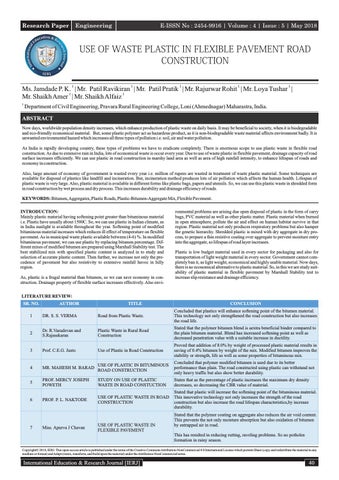
ABSTRACT Now days, worldwide population density increases, which enhance production of plastic waste on daily basis. It may be beneficial to society, when it is biodegradable and eco-friendly economical material. But, some plastic polymer act as hazardous product, as it is non-biodegradable waste material affects environment badly. It is unwanted environmental hazard which increases all three types of pollution i.e. soil, air and water pollution. As India is rapidly developing country, these types of problems we have to eradicate completely. There is enormous scope to use plastic waste in flexible road construction. As due to extensive rain in India, lots of economical waste is occur every year. Due to use of waste plastic in flexible pavement, drainage capacity of road surface increases efficiently. We can use plastic in road construction in marshy land area as well as area of high rainfall intensity, to enhance lifespan of roads and economy in construction. Also, large amount of economy of government is wasted every year i.e. million of rupees are wasted in treatment of waste plastic material. Some techniques are available for disposal of plastics like landfill and incineration. But, incineration method produces lots of air pollution which affects the human health. Lifespan of plastic waste is very large. Also, plastic material is available in different forms like plastic bags, papers and utensils. So, we can use this plastic waste in shredded form in road construction by wet process and dry process. This increases durability and drainage efficiency of roads. KEYWORDS: Bitumen, Aggregates, Plastic Roads, Plastic-Bitumen-Aggregate Mix, Flexible Pavement. INTRODUCTION: Mainly plastic material having softening point greater than bituminous material i.e. Plastic have usually about 1500C. So, we can use plastic in Indian climate, as in India sunlight is available throughout the year. Softening point of modified bituminous material increases which reduces ill effect of temperature on flexible pavement. As in municipal waste plastic available between (4-6) %. In modified bituminous pavement, we can use plastic by replacing bitumen percentage. Different mixes of modified bitumen are prepared using Marshall Stability test. The best stabilized mix with specified plastic content is analyzed in to study and selection of accurate plastic content. Then further, we increase not only the precedence of pavement but also resistivity to extensive rainfall havoc in hilly region. As, plastic is a frugal material than bitumen, so we can save economy in construction. Drainage property of flexible surface increases effectively. Also envi-
ronmental problems are arising due open disposal of plastic in the form of carry bags, PVC material as well as other plastic matter. Plastic material when burned in open atmosphere, pollute the air and effect on human habitat survive in that region. Plastic material not only produces respiratory problems but also hamper the genetic hierarchy. Shredded plastic is mixed with dry aggregate in dry process, to prepare a thin resistive coating over aggregate to prevent moisture entry into the aggregate, so lifespan of road layer increases. Plastic is low budget material used in every sector for packaging and also for transportation of light weight material in every sector. Government cannot completely ban it, as light weight, economical and highly usable material. Now days, there is no economical alternative to plastic material. So, in this we are study suitability of plastic material in flexible pavement by Marshall Stability test to increase slip resistance and drainage efficiency.
LITERATURE REVIEW: SR. NO.
AUTHOR
TITLE
CONCLUSION
1
DR. S. S. VERMA
Road from Plastic Waste.
Concluded that plastics will enhance softening point of the bitumen material. This technology not only strengthened the road construction but also increases the road life.
2
Dr. R.Vasudevan and S.Rajasekaran
Plastic Waste in Rural Road Construction
Stated that the polymer bitumen blend is aextra beneficial binder compared to the plain bitumen material. Blend has increased softening point as well as decreased penetration value with a suitable increase in ductility.
3
Prof. C.E.G. Justo
Use of Plastic in Road Construction
Proved that addition of 8.0% by weight of processed plastic material results in saving of 0.4% bitumen by weight of the mix. Modified bitumen improves the stability or strength, life as well as some properties of bituminous mix.
4
MR. MAHESH M. BARAD
USE OF PLASTIC IN BITUMINOUS ROAD CONSTRUCTION
Concluded that polymer modified bitumen is used due to its better performance than plain. The road constructed using plastic can withstand not only heavy traffic but also show better durability.
5
PROF. MERCY JOSEPH POWETH
STUDY ON USE OF PLASTIC WASTE IN ROAD CONSTUCTION
States that as the percentage of plastic increases the maximum dry density decreases, so decreasing the CBR value of material.
PROF. P. L. NAKTODE
USE OF PLASTIC WASTE IN ROAD CONSTRUCTION
Stated that plastic will increase the softening point of the bituminous material. This innovative technology not only increases the strength of the road construction but also increase the road lifespan characteristics,by increase durability.
6
7
Miss. Apurva J Chavan
USE OF PLASTIC WASTE IN FLEXIBLE PAVEMENT
Stated that the polymer coating on aggregate also reduces the air void content. This prevents the not only moisture absorption but also oxidation of bitumen by entrapped air in road. This has resulted in reducing rutting, raveling problems. So no potholes formation in rainy season.
CopyrightŠ 2018, IERJ. This open-access article is published under the terms of the Creative Commons Attribution-NonCommercial 4.0 International License which permits Share (copy and redistribute the material in any medium or format) and Adapt (remix, transform, and build upon the material) under the Attribution-NonCommercial terms.
International Education & Research Journal [IERJ]
40
Research Paper
E-ISSN No : 2454-9916 | Volume : 4 | Issue : 5 | May 2018
OBJECTIVES: To reduce economical load of treatment of plastic material, we have to use it in flexible road constructions.
FIGURES: Plastic road construction
Objectives which we have to achieve are To obtain optimum plastic percentage, this increases strength and durability of pavement.
Ÿ
Ÿ
To reduce cost on plastic disposal treatment.
Ÿ
Comparative study of bituminous mix and modified bituminous mix.
Ÿ
To increase the use of waste plastic in flexible pavement.
Collection of Plastic: The plastic material is collected from municipal solid waste product. Plastic having softening greater than the bitumen is collected which may be pp or ps. PVC is used as a waste plastic because it have more softening point. Plastic having 160oc to 170 o c melting temperature is selected for the road construction. sssPlasticmaterial cleaned to wash out dust particles and other organic matter and further it dried and shredded in specified size. Then it separated into different size. We use sieve size 4.75mm for passing and plastic retain on 2.36mm size. The density of plastic waste fiber is about 0.4-0.5g/cc, and it is so small compared to bitumen.
Fig: 1
Type of plastic PET HDPE ( high-density polyethylene) PVC (polyvinyl chloride) LDPE (low-density polyethylene) PP ( polypropylene) PS ( polystyrene)
Ÿ Ÿ Ÿ Ÿ Ÿ Ÿ
Methodology: We can use wet process or dry process for analysis. In wet process bitumen is heated with plastic and uniform mix of modified bitumen is prepared. In dry process dry aggregate is coated with layer of molten plastic material. In this plastic is heated with aggregate for temperature about softening point of waste plastic, which coats aggregate. In hot mix plant, aggregate is heated to 165oc to 170oc, because it emits noxious gases above 700oc, which is harmful to human being as well as animals. A layer of few micron seen on surface of rough aggregate. This coating prevents entry of moisture into aggregate, so durability and lifespan of aggregate increases. Then this coated aggregate are mixed uniformly with bitumen. Dry process is more effective to increase Marshall Stability value and stripping value than the wet process.
Fig: 2 Shredded plastic
MATERIAL: SR. MATERIAL NO. NAME
SPECIFICATION
TEST ON MATERIAL
1
Bitumen
Penetration Test (1202-1978) Penetration gradeSoftening point Test 60/70, 80/100 Viscosity grade- VG30 (1205-1978) Ductility Test (1208-1978)0
2
Aggregate
Size-20mm, 10mm
3
Plastic
Plastic passing through 4.75mm sieve and Sieve Analysis retain on 2.36mm sieve.
Sieve Analysis Impact Test Crushing Test Water Absorption Test
Fig: 3
Economy Incorporated: Ÿ A best use of plastic carry bags as well as scrap bottles, which are really most problematic face of Plastic to human being. Ÿ
Government of Maharashtra State budget for Repairs of roads under P.W.D. as well as Z. P. W. D. reaches more than 40000 million annually. Out of which Rs. 17000 million approximately are only for bitumen only.
Ÿ
Bruhn Mumbai Municipal Corporation has its biannual economic budget for bituminous road repairs more than Rs. 8000 million.
Ÿ
Central Government's annual fixed allocation of funds towards roads as well as highways is more than 60, 0000 million.
Ÿ
A large part of budget, spent on municipal waste management by Central Govt., State Governments and local authorities of India to overcome this problems.
Ÿ
Use of waste plastics in road construction give the best results of which today's world is in needs it and saves treatment cost.
41
Fig. 4
International Education & Research Journal [IERJ]
Research Paper
E-ISSN No : 2454-9916 | Volume : 4 | Issue : 5 | May 2018
GRAPH:
Ÿ
More bleeding resistance of road surface.
Ÿ
This increases Marshall Stability value along with increase in stripping value (negligible stripping value when soaking in water).
Ÿ
High flexural strength (>420 kg/cm).
Ÿ
Compressive strength lies between 110-130mpa.
Ÿ
As a whole surface is covered by a thin layer plastic, aggregate is highly durable and strong to increase lifespan of the road.
Ÿ
Cyclic dynamic loading resisting property is also increased.
CONCLUSION: The following conclusions are drawn from above study Ÿ
·
1. Waste plastic content (%)
The ductility and penetration resistance of modified plastic increases within range of 0-12%. Above that value it hampers the stability of the mix. Optimum result obtained from the modified mix at 8.4% of plastic mix
Ÿ
There is better enhancement in the properties as compared to the original mix.
Ÿ
Also, significant decrease in cost of the construction of road.
Ÿ
Less or negligible cost of maintenance by using waste plastic in road construction.
Ÿ
Air voids decreases as we increases the percentage of the waste plastic.
Ÿ
Water absorption of aggregate decreases as plastic content increases, due to plastic layer coating around the aggregate rough surface.
REFERENCES: 1.
Verma S.S. (2008) Roads from Plastic Waste. The Indian Concrete Journal, November, 43-44.
2.
Punith V.S. (2010) Study of the Effect of Plastic Modifier on Bituminous Mix Properties.
3.
Gawande, A., Zamre, G.S., Renge, V.C., Bharsakalea, G.R. and Tayde, S. (2012) Utilization of Waste Plastic in Asphalting of Roads. Scientific Review and Chemical Communication, 2,147-157.
4.
Justo, C.E.G. and Veeraragavan, A. (2002) Utilization of Waste Plastic Bags in Bituminous Mix for Improved Performance of Roads. BangloreUniversity, Bangaluru.
5.
“Use of Waste Plastic for Road Construction”, NATPAC Report, 2011-2012.
6.
Indian Roads Congress, IRC: 81-1997, Guidelines for Strengthening of Flexible Road Pavements Using Benkleman Beam Deflection Technique.
7.
Sherwood, P. T. (1995). “Alternative materials in road construction.”Thomas Telford Publications, London 1995.
8.
IRC: SP: 20-2002. “Rural Roads Manual”, Indian Road Congress.
9.
S Shankar, Prasad C.S.R.K., Evaluation of Rutting Potential for Crumb Rubber Modified Bitumen in Asphaltic Mixes, Emirates Journal for Engineering Research, 14 (2), pp- 91-95, 2009.
10. Bandopandhyay T. K., (2010), “Construction of Asphalt Road with Plastic Waste”, Indian Center for Plastic in Environment (ICPE), ENVIS - Eco-Echoes, Vol.11, Issue 1
2. Air voids (Va) vs. plastic content (%) RESULT TABLE: Table 1. TEST ON AGGREGATE ORIGINAL MODIFIED SAMPLE MIX SAMPLE
SR. NO.
TEST PERFORMED
1
WATER ABSORPTION BY AGGREGATE (%)
2
IMPACT TEST (%)
15.4
10.5
3
CRUSHING TEST (%)
22.5
19.3
5.33
3.24
Table 2. TEST ON BITUMIN SR. NO.
TEST PERFORMED
TEST RESULT
ACCEPTABLE RESULT VALUE
1
SPECIFIC GRAVITY
1.02
0.99 (minimum)
2
PENETRATION VALUE
85
80-100
O
3
SOFTENING POINT( C)
49
35-50
4
DUCTILITY(cm)
89
75 (minimum)
CHANGES IN THE MODIFIED BITUMIN ROAD: Ÿ The modified mix is more capable and water resisting as we compare the original mix and modified mix.
International Education & Research Journal [IERJ]
42