Research Paper
Education
E-ISSN No : 2454-9916 | Volume : 5 | Issue : 8 | Aug 2019
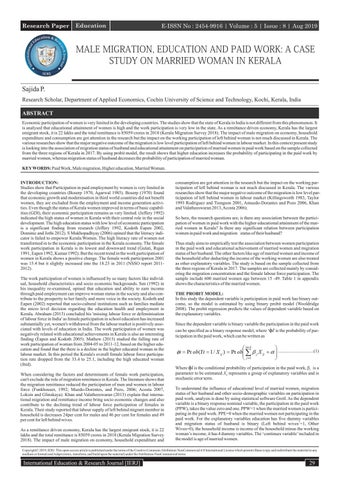
MALE MIGRATION, EDUCATION AND PAID WORK: A CASE STUDY ON MARRIED WOMAN IN KERALA Sajida P. Research Scholar, Department of Applied Economics, Cochin University of Science and Technology, Kochi, Kerala, India ABSTRACT Economic participation of women is very limited in the developing countries. The studies show that the state of Kerala in India is not different from this phenomenon. It is analysed that educational attainment of women is high and the work participation is very low in the state. As a remittance driven economy, Kerala has the largest emigrant stock, it is 22 lakhs and the total remittance is 85059 crores in 2018 (Kerala Migration Survey 2018). The impact of male migration on economy, household expenditure and consumption are got attention in the research but the impact on the working participation of left behind woman is not much discussed in Kerala. The various researches show that the major negative outcome of the migration is low level participation of left behind women in labour market. In this context present study is looking into the association of migration status of husband and educational attainment on participation of married women in paid work based on the sample collected from the three regions of Kerala in 2017. By using probit model, the result shows that higher education increases the probability of participating in the paid work by married women, whereas migration status of husband decreases the probability of participation of married woman. KEY WORDS: Paid Work, Male migration, Higher education, Married Woman. INTRODUCTION: Studies show that Participation in paid employment by women is very limited in the developing countries (Boserp 1970, Agarwal 1985). Boserp (1970) found that economic growth and modernisation in third world countries did not benefit women, they are excluded from the employment and income generation activities. Even though the status of Kerala women improved in terms of basic capabilities (GDI), their economic participation remains as very limited. (Jeffery 1992) indicated the high status of women in Kerala with their central role in the social development. The high education status with low level of economic participation is a significant finding from research (Jeffery 1992, Kodoth Eapen 2002, Dominic and Jothi 2012). S Mukhopadhyay (2006) opined that the literacy indicator is failed to empower Kerala Women. The high literacy rate of women not transformed in to the economic participation in the Kerala economy. The female work participation in Kerala is its lowest and downward trend (Gulati, Rajan 1991, Eapen 1992, Kumar 1992). But the recent trend in the work participation of women in Kerala shows a positive change. The female work participation 2001 was 15.4 but it slightly increased into the 18.23 in 2011 (NSSO report 20112012). The work participation of women is influenced by so many factors like individual, household characteristics and socio economic backgrounds. Sen (1992) in his inequality re-examined, opined that education and ability to earn income through paid employment can improve woman status in the society and also contribute to the prosperity to her family and more voice in the society. Kodoth and Eapen (2002) reported that socio-cultural institutions such as families mediate the micro level decision regarding the education health and employment in Kerala. Abraham (2013) concluded his 'missing labour force or defeminisation of labour force in India' as female participation in school education has increased substantially yet, women's withdrawal from the labour market is positively associated with levels of education in India. The work participation of women was negatively related with educational achievements in Kerala is also an interesting finding (Eapen and Kodoth 2005). Mathew (2015) studied the falling rate of work participation of woman from 2004-05 to 2011-12, based on the higher education and found that the there is a decline in the higher educated woman in the labour market. In this period the Kerala's overall female labour force participation rate dropped from the 33.4 to 25.1, including the high educated woman (ibid). When considering the factors and determinants of female work participation, can't exclude the role of migration remittance in Kerala. The literature shows that the migration remittance reduced the participation of men and women in labour force (Funkhouser, 1992; Muedo-Dorentes, and Pozo, 2006; Acosta 2007, Loksin and Glinskaya). Khan and Valatheeswaran (2013) explain that international migration and remittance income bring socio economic changes and also contribute to the declining trend of labour force participation of females in Kerala. Their study reported that labour supply of left behind migrant member in household is decreases 24per cent for males and 46 per cent for females and 49 per cent for left behind wives. As a remittance driven economy, Kerala has the largest emigrant stock, it is 22 lakhs and the total remittance is 85059 crores in 2018 (Kerala Migration Survey 2018). The impact of male migration on economy, household expenditure and
consumption are got attention in the research but the impact on the working participation of left behind woman is not much discussed in Kerala. The various researches show that the major negative outcome of the migration is low level participation of left behind women in labour market (Killingsworth 1983, Taylor 1993 Rodriguez and Tiongson 2001, Amuedo-Dorantes and Pozo 2006, Khan and Valatheeswaran 2013, Acosta 2006). So here, the research questions are; is there any association between the participation of women in paid work with the higher educational attainment of the married women in Kerala? Is there any significant relation between participation women in paid work and migration status of their husband? Thus study aims to empirically test the association between women participation in the paid work and educational achievement of married women and migration status of her husband. The other factors like age of married women and income of the household after deducting the income of the working women are also treated as other explanatory variables. The study is based on the sample collected from the three regions of Kerala in 2017. The samples are collected mainly by considering the migration concentration and the female labour force participation. The sample include 600 married women age between 15 -49. Table 1 in appendix shows the characteristics of the married women. THE PROBIT MODEL: In this study the dependent variable is participation in paid work has binary outcome, so the model is estimated by using binary probit model (Wooldridge 2008). The probit regression predicts the values of dependent variable based on the explanatory variables. Since the dependent variable is binary variable the participation in the paid work can be specified as a binary response model, where ‘fi' is the probability of participation in the paid work, which can be written as ...............................(1)
Where fi is the conditional probability of participation in the paid work, bj is a parameter to be estimated Xij represents a group of explanatory variables and is stochastic error term. To understand the influence of educational level of married women, migration status of her husband and other socio-demographic variables on participation in paid work, analysis is done by using statistical software Gretl. As the dependent variable is a binary response nominal variable, the participation in the paid work (PPW), takes the value zero and one. PPW=1 when the married women is participating in the paid work. PPE=0 when the married women not participating in the paid work. For the explanatory variables education has five dummy variables and migration status of husband is binary (Left behind wives1=1, Other Wives=0), the household income is income of the household minus the working woman’s income, it has 4 dummy variables. The ‘continues variable’ included in the model is age of married women.
Copyright© 2019, IERJ. This open-access article is published under the terms of the Creative Commons Attribution-NonCommercial 4.0 International License which permits Share (copy and redistribute the material in any medium or format) and Adapt (remix, transform, and build upon the material) under the Attribution-NonCommercial terms.
International Education & Research Journal [IERJ]
29
Research Paper
E-ISSN No : 2454-9916 | Volume : 5 | Issue : 8 | Aug 2019 Standard errors in parentheses *** p<0.01, ** p<0.05, * p<0.1
Table 1: Background Characteristics of Sample Background characteristics Region Northern Central Southern Age of the Respondent Under-20 20-30 30-40 40-50 Level Education of respondent Below High School/high school Higher Secondary Diploma/Job Oriented Courses Higher Education in arts and Science Professional Higher Education Participation in Paid work Yes No Household Income minus working woman income Below-200000 200000-400000 400000-600000 Above 600000
Total Number Percentage 264 146 190
44 24.3 31.7
5 183 265 147
.8 30.5 44.2 24.5
147 132 23 243 55
24.5 22 3.8 40.5 9.2
146 454
24.3 75.7
34 407 139 20
5.7 67.8 23.2 3.3
Source: Primary Survey (2017) The explanatory variables which include the migration status of husband, 67 percentage of the sample are left behind wives and 33 per cent belonging to other wives. In the model the individual variables are age of married women and education attainment. The mean age of married women is 35; the selected category is 15 to 49 years. The percentage of married women belong to the different categories of education are 24.5 per cent to the below high school/high school education, and 22% of them have higher secondary education as their higher educational achievements. The diploma or job oriented course is done by only 3.8 per cent women. The women possess higher education in arts and science is 40.5 per cent, which is the highest ratio in the sample. The professional higher education qualified women are only by 9.2 per cent. The household income minus working woman income is divided into 4 categories; 5.7 per cent of them were below 200000, 67.8 per cent are in between 200000-400000, 23.2 are in between 400000-600000 and only 3.3 are above 600000. The samples collected from three regions of Kerala, 44 percentage of sample from northern region and 24.3 from central, 31.7 southern regions THE RESULT: Table 2: Determinants of Participation in Paid Work Explanatory Variables Constant Migration status of Husband Age of woman Education Professional Higher Education Higher education in Arts and Science Diploma and Job-oriented courses Higher secondary High School education Household income minus Working woman income Income above 600000 400000-600000 200000-400000 Below 2000000 Mcfadden R-squared 0.299
Coefficient Std. Error -2.57393*** -0.950126*** 0.03929***
.606450 .13854 0.01067
Z
Marginal Effects
-6.510 -6.858 -0.267095 3.682 .009696
2.69306***
.300752
8.954
.81877
1.7314***
.23694
7.307
.473660
1.0142**
.42543
2.384
.343984
.697028*** RC
.253694
2.748
.202775
.818053** RC .643813*** 1.03235***
.388626
2.105
.268065
.189726 .307096
3.393 3.362
.141512 .348036
Adjusted R-squared .268891
Likelihood ratio test: Chi square = 198.434
P value 0.000
Table 2 shows the determinants of participation in paid employment. When considering the migration status of husband, one unit change in the other wife to being gulf wife the probability to participate in the paid employment is .26 less likely. As the age increases by one unit, the probability to participate in the paid work is .009 more likely, as their mean age are 35. For the educational attainment, the high school education as taken the reference category. If the woman has one unit increase in the higher education compared to the high school education, the woman is .81 more likely to be in the paid work. If the increase is in the higher education in arts and science subjects it is .47 more likely to be in the paid work. Likewise the one unit change in the diploma and higher secondary there is .34 and .20 more likely to in the paid work respectively. In the case of house hold income minus working woman income, the annual income 40000-60000 is taken as reference category. So one unit change in the household income in the above 600000 category, there is .26 more likely to be in the paid work. The income group 200000-400000 is .14 more likely and the income group below 200000 is .34 more likely to be in the paid work. The controversy of higher education status and low paid employment is not more significance when we discuss the level of education and women participation in paid work. The wives who belong to migrant households spend more time on unpaid household activities; in the sample 85 per cent of them marked domestic duty as their activity. As the income of the household increases the women to participate in the paid employment is decreased. In this case of migrant households they have income as remittances, so they reduced participation in the paid employment. But when we consider the education, it is clear that the most influencing factor on paid work is higher education. As compared to higher secondary education, who have possess higher education arts and science is participating in the paid work and professionally qualified women more take part in the paid work. Khan and Valatheeswaran (2013) explain that international migration and remittance income bring socio economic changes and also contribute to the declining trend of labour force participation of females in Kerala. From the analysis, it is clear that the migration status of husband decreases the wives participation in paid employment, whereas higher education especially professional higher education increases the participation of wives in paid work. There is some increasing trend in the female work participation in the recent data of NSSO2 2011 of Kerala, so it may be due to, the higher education boost the women to be part of the paid work. CONCLUSION: This study is deals with the women paid employment and its determinants. The result implies that the migration status of the husband decreased the participation of women in paid work. The women who belong to migrant households spend more time on unpaid household activities. This finding matches earlier studies (Binzel and asaad 2011, Mendola and Carletto 2008). But vividly it is clear that one of the most influencing factors on paid work is higher education. That means the higher education status of women increased the probability to enter the paid work. REFERENCES: 1.
Abraham, V. (2013). Missing Labour Force or ‘De-Feminization’ of Labour Force in India ? (May), 68. Retrieved from www.cds.edu
2.
Migration, Remittances and Left-behind Members in Home Labour Market: Evidence from Kerala Mohd Imran Khan & Valatheeswaran C. 12. (n.d.), 1–21.
3.
Weekly, P. (2014). Gender beyond Gender Parity Dimensions of Well-Being in Kerala, 40(30), 3278–3286.
4.
Eapen, M., & Kodoth, P. (2002). Family Structure, Women’s Education and Work: ReExamining the High Status of Women in Kerala, Working Paper 341. Centre for Development Studies, (November), 1–60.
5.
S Mukhopadhyay(2006). The Enigma of Kerala Women : Does High Literacy Necessarily Translate into high Status ? Institute of Social Studies Trust, (Iii).
6.
American Academy of Political and Social Science Women, Empowerment, and Economic Development Author (s): Rekha Mehra Source : The Annals of the American Academy of Political and Social Science, Vol . 554 , The Role of NGOs : Charity and Empowerment . (2016), 554(May), 136–149.
7.
R, L. D. K. (2002). Education, Employment , and Job Preference of Women in Kerala : A micro-level case study.
8.
Abdulloev, I., Gang, I. N., & Yun, M.-S. (2014). Migration, Education and the Gender Gap in Labour Force Participation. IZA Discussion Paper, 8226(8226).
9.
Mazumdar, S., & Guruswamy, M. (2006). Female Labour Force Participation in Kerala : Problems and Prospects By, 1–26.
10. Swapna Mukhopadhyay (2006). The Enigma of Kerala Women : Does High Literacy Necessarily Translate into high Status ? Institute of Social Studies Trust, (Iii). Floor, U. G. 11. Susan MATHEW, Shalina. (2015). falling female labour force participation in Kerala: Empirical evidence of discouragement?. International Labour Review. 154. 497-518. 12. Zachariah, K. C., Mathew, E. T., & Rajan, S. I. (2000). Socio-Economic and Demographic Consequences of Migration in Kerala, (303), 1–63.
Source: Primary Data 2017
30
International Education & Research Journal [IERJ]
Research Paper
E-ISSN No : 2454-9916 | Volume : 5 | Issue : 8 | Aug 2019
Notes: 1.
Left behind wives are those married woman their husbands are working in abroad.
2.
National Sample Survey Office
International Education & Research Journal [IERJ]
31