Research Paper
Engineering
E-ISSN No : 2454-9916 | Volume : 4 | Issue : 12 | Dec 2018
STUDY OF COMPOSITE FLOUR COMPOSITIONS AND EXTRUSION TEMPERATURE ON PHYSICOCHEMICAL PROPERTIES OF ARTIFICIAL RICE 1
1
2
Isti Pudjihastuti | Edi Supriyo | Noer Abyor Handayani | Siswo Sumardiono 1 2
2
Vocational Program Study of Chemical Engineering Diponegoro University, Indonesia. Chemical Engineering Department, Faculty of Engineering, Diponegoro University, Indonesia.
ABSTRACT Composite flour from cassava (Manihot esculenta), gembili (Dioscorea esculenta), corn (Zea mays) and koropedang (Canavalia ensiformis) is feasible local commodity for artificial rice production. Purposes of this study were to investigate the effect of extruder temperatures towards nutrients value (carbohydrate, protein, fat, water and ash) of artificial rice. The physicochemical properties (kamba density, water absorption and cooking time) of artificial rice were. Paddy rice IR 36 was also analyzed as a comparison. The best formulation of artificial rice would be determined for organoleptic tests. Artificial rice could be produced through 4 stages: preparation of composite flours, cooking dough, process of extrusion, and analyzes. The results show that the best formulation of artificial rice is obtained in formulae 5 containing 50% of cassava flour, 15% of gembili flour, 15% of koropedang flour, 20% of corn flour at 75°C temperature extruder. The values of kamba density, water absorption, and cooking time of formulae 3 are 0.46 g/ml, 287 %, and 46 %, respectively. Organoleptic score for aroma, texture, colour, and taste properties were 3.15, 3.20, 3.00, and 3.05, respectively. KEYWORDS: artificial rice; composite flour; density kamba; proximate analysis. INTRODUCTION: In 2009, Badan Pusat Statistik Nasional (National Statistics Agency) reported that Indonesian people had already increased 3 million populations each year in the last five years. This phenomenon is in line with the raise of rice consumption. The unbalanced conditions between the production and the consumption rate of rice lead Indonesia to take the import policy which is detrimental to farmers. This situation force Government to minimize the dependence of rice, as staple food, through diversification products. Artificial rice is an artificial of rice originating from non-paddy commodity. Furthermore, it could also have a role as a new value product due to its additional nutrients. Artificial rice production is commonly conducted by two method, granulation method (Hidayat et al., 2017; Budijanto & Yuliana, 2015; Dung et al., 2005) and extrusion methods (Sumardiono et al., 2018; Budi et al., 2016; Santosa et., al 2016; Mishra et al., 2012). Both methods have differences in the gelatinization stage and moulding stage. In addition, granules and oval shaped rice are obtained by granulation and extrusion method, respectively.
Table1. Compositions of cassava, gembili, koropedang, and corn (% w) Formulation
Cassava Gembili Koropedang Corn Temperature of (% w) (% w) (% w) (% w) extruder (°C)
1.
50
15
15
20
65
2.
50
15
15
20
70
3.
50
15
15
20
75
4.
50
15
15
20
80
5.
50
15
15
20
85
Tubers are local commodities from Indonesia which contain high level of carbohydrate and protein, such as cassava, corn, gembili, and koropedang. Furthermore, they could be alternative raw materials to produce artificial rice. Cassava (Manihot esculenta) production had been increased from 15.83 million tons in 1990 to 24.04 million tons in 2011 (BKP, 2012). However, corn (Zea mays L.) production had been also raised from 6.73 million tons in 1990 to 17.64 million tons in 2011 (BKP, 2012). The continuity production of both materials could guarantee the sustainability of artificial production. Another carbohydrate source that can be developed as an alternative food is gembili (Dioscorea esculenta). The national production of gembili is quite large, which is around 2 tons per Ha. Source of protein could be derived from animal proteins and vegetable protein. Koropedang (Canavalia ensiformis L.) is a source of protein from vegetable groups that have high of protein content (2327.6%) in comparison with green beans. In 2012, the production of koropedang reached 300 tons per year. The large production of these materials would lead the diversification of non-rice food products. Furthermore, in accordance with the high nutritional value and the continuity production of cassava, corn, gembili, and koropedang could encourage the artificial rice production from composite flour. Hopefully, this new value product could support the Indonesia's food security program. MATERIALS AND METHODS: Materials: Cassava, corn, gembili, and koropedang were supplied from local market in Semarang. The flours were prepared by drying and grinding into the flours formed. Additional substances (gliserol mono stearat (GMS), sodium chloride, cooking oil) were required to enhance the physicochemical properties of artificial rice.
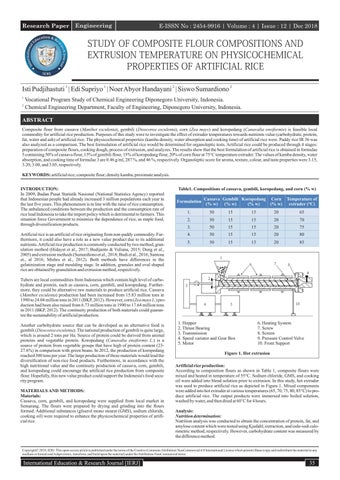
1. Hopper 2. Thrust Bearing 3. Transmission 4. Speed variator and Gear Box 5. Motor
6. Heating System 7. Screw 8. Screen 9. Pressure Control Valve 10. Front Support
Figure 1. Hot extrusion Artificial rice production: According to composition flours as shown in Table 1, composite flours were mixed and heated in temperature of 55°C. Sodium chloride, GMS, and cooking oil were added into blend solution prior to extrusion. In this study, hot extruder was used to produce artificial rice as depicted in Figure 1. Mixed components were added into hot extruder at various temperatures (65, 70, 75, 80, 85°C) to produce artificial rice. The output products were immersed into boiled solution, washed by water, and then dried at 60˚C for 4 hours. Analysis: Nutrition determination: Nutrition analysis was conducted to obtain the concentration of protein, fat, and amylose content which were tested using Kjedahl, extraction, and iodo-iodi calorimetric method, respectively. However, carbohydrate content was measured by the difference method.
Copyright© 2018, IERJ. This open-access article is published under the terms of the Creative Commons Attribution-NonCommercial 4.0 International License which permits Share (copy and redistribute the material in any medium or format) and Adapt (remix, transform, and build upon the material) under the Attribution-NonCommercial terms.
International Education & Research Journal [IERJ]
35
Research Paper
E-ISSN No : 2454-9916 | Volume : 4 | Issue : 12 | Dec 2018
Kamba density determination: Kamba density was measured by adding the uniform artificial rice into 10 ml of measuring flask and tapping for 25 times. The sample was weighting and the value of kamba density was calculated using Equation 1.
The appropriate standard of kamba density of rice in accordance with American Government Specifications is in ranging from 0.40 to 0.42 g/ml. Artificial rice which is lower than 0.36 g/ml will create soft products, such as rice porridge (Carlson et al, 1976). According to Carlson et al (1976), it could be assumed that artificial rice from composite flour was proper in that criterion.
(1) Water absorption determination: Water absorption properties were measured by immersing 25 g of artificial rice into warm water (75°C) for 5 minutes. The value of swelling was calculated using Equation 2. (2)
Water absorption of artificial rice in varying temperature of extruder: Water absorption is the ability of a material to absorb or bind water. Water absorption is influenced by the characteristics of the material itself. The result shows that the maximum (69.52%) and minimum (30.68%) value were obtained by formulation 5 and 1, respectively (Table 3). Franciska et al. (2015) was reported that water absorption of artificial rice from cassava flour and enriched with tuna fish was 206.6-267.9%. Furthermore, water absorption of paddy rice reaches 2 to 2.5 times in common. The higher of water absorption value, hence the more water is required for cooking. Artificial rice from these composite flour has lower water absorption, thus only few of water is needed for cooking.
Where a : mass of sample before immersing; b : mass of sample after immersing Table 3. Water absorption of artificial rice Cooking time determination: Artificial rice (50 g) were immersed into warm water and steamed. Cooking time was determined by recording the required time for steaming the cooked rice. Organoleptic determination: Organoleptic analysis was carried out by measuring the level of consumer's acceptance on colour, texture, aroma, and taste of artificial rice. About 20 panelists had been scored the parameters. RESULTS: Nutrition of artificial rice in varying temperature of extruder: Table 2 shows the effect of temperature of extruder on water, ash, protein, fat, and carbohydrate content (%w). Water content of all formulations was in the range of 7.40% to 9.68%. The utilization of 85°C temperature extruder has the lowest content of water. The increase of temperature allowed water to escape and form vapour, thus led the decrease of its content. Ash content shows the amount of mineral residues left after the high temperatures combustion. It was in the ranged of 1.21% to 1.74%, which was indicated that the increase of extrusion temperature did not significant influence to the ash content of artificial rice. This result is lower in comparison with previous work which depicted that the ash content of artificial rice from tubers Daluga was 2.4% to 2.6%. Furthermore, carbohydrate content of artificial rice was in the range of 71.60% to 74.3%. The higher temperatures of extrusion would increase carbohydrate level due to gelatinization speed was faster occured. Afterwards, the reduction of molecular weight in both amylose and amylopectin might be occurred, since amylopectin was easily broken. High molecular weight of amylopectin (> 107) could increase molecular carbohydrates (105-107) during the extrusion process (Guy, 2001). Protein content of artificial rice was in the range of 13.6 - 14.2%. The increase of temperature caused reduced protein levels due to protein denaturation. Mainly, protein consists of amino acids as the primary bonds of proteins while other molecules are secondary bonded. The mechanical force during extrusion led the rupture of secondary bonds. However, the increase of heat induced the breakdown of primary bonds, thus decrease the protein content of artificial rice (Omohimi et al, 2013). Furthermore, the protein content of both formulation was still greater than paddy rice (3.35%).
Formulations
Parameters Water absorption (%)
1
2
3
4
5
282
273
287
284
268
Cooking time of artificial rice in varying temperature of extruder: Cooking time is the time required to make the food cooked. The data shows that cooking time of artificial rice from formulation 3 was 46 min. However, commercial paddy rice (IR56) only took 30 min to cook which was shorter than artificial product. It might be due to the high content of protein coming from koropedang flour. More energy would be required for gelatinization process and protein denaturation. Organoleptic properties of artificial rice in varying temperature of extruder: Organoleptic test of artificial rice was carried out by 20 respondents who were randomly assigned. Parameters used for this analysis were texture, aroma, taste and colour. Organoleptic analysis shows the consumer's accepstance of artificial rice. Respondents gave an assessment of the range of scores 1 to 5. The value of 1 stated the dislike of product; otherwise the value of 5 represented the most preferred by consumers. Figure 2 shows the scores of aroma, texture, colour, and taste were 3.15, 3.20, 3.00, and 3.05, respectively. Commonly, aroma influence consumer's appetite. Foodstuffs, such as rice, that have a pungent aroma tend to be dislike by consumer. Furthermore, the aroma of product needs to be considered in the preparation of artificial rice. Artificial rice made from composite flour had beans aroma which derived from koropedang flour. It might be due to the largest composition is koropedang.
Table 2. Nutrition of artificial rice in varying temperature of extruder Parameters Water (%)
Formulations 1
2
3
4
5
9.68
8.74
7.90
7.84
7.40
Ash (%)
1.46
1.56
1.21
1.74
1.36
Protein (%)
14.20
14.20
14.10
13.90
13.60
Fat (%)
2.79
1.88
1.19
1.49
2.50
Carbohydrate (%)
70.60
71.20
73.30
71.00
71.90
Fat level of artificial rice was in the range of 1.19% to 2.79%. The increase of temperatures extrusion had no significant effect thus led the instability of fat content. It occurred due to the formation of complex amylase formation from carbohydrate and fat. However, free fatty acids and monoglycerides could be easier to form complex bonds than triglycerides (Camire, 2000). In accordance with proximate analysis, the optimum formulation was obtained in formulation 3 due to the highest level of protein. Kamba density of artificial rice in varying temperature of extruder: Kamba density of artificial rice made from composite flours was 0.46 g/ml (formulation 3). This value was lower than the density of paddy rice (0.827 g/ml) which was indicated that artificial rice had a smaller weight than paddy rice on the same volume. It showed that the porosity of artificial rice was higher and influenced by the nutritional content of artificial rice and the mechanism of drying. The drying process could lead water escape thus artificial rice becomes more porous.
36
Figure 2. Organoleptic properties of artificial rice Other than, texture properties of rice also influence the consumer's appetite. Commonly, the fluffier rice is very popular by the community. The artificial rice which has the similar texture with paddy rice could be as candidate for substituting it. This property is affected by the level of smoothness of the ingredients (cassava, gembili, koropedang and corn flour). Hence, many researches were conducted for finding the right composition and appropriate process for artificial rice production. This was carried out to obtain artificial rice which has the similar properties with paddy rice. Generally, consumers prefer the similar colour of paddy rice (white) and healthy rice (red). However, the colour of artificial rice was brownish yellow colour due to the presence of corn and koropedang flour.
International Education & Research Journal [IERJ]
Research Paper
E-ISSN No : 2454-9916 | Volume : 4 | Issue : 12 | Dec 2018
CONCLUSIONS: The best formulation of artificial rice is obtained in formulae 5 containing 50% of cassava flour, 15% of gembili flour, 15% of koropedang flour, 20% of corn flour at 75°C temperature extruder. The values of kamba density, water absorption, and cooking time of formulae 3 are 0.46 g/ml, 287 %, and 46 %, respectively. Organoleptic score for aroma, texture, colour, and taste properties were 3.15, 3.20, 3.00, and 3.05, respectively. Acknowledgments: This research work was financially supported by Ministry of Research, Technology, and Higher Education 2018 REFERENCES: 1.
Camire, M.E., 2000. Chemical and Nutritional Changes in Food during Extrusion. Extruders in food applications, pp. 127-147.
2.
Carlson, R.A., Robert, R.L., and Farkas, D.F., 1976. Preparation of Quick Cooking Rice Production Using a Centrifugal Fluidizied Bed. Journal of Food Science, Volume 41, pp: 303-310.
3.
Budijanto, S., Yuliana, N.D.. 2015. Development of Rice Analog as a Food Diversification Vehicle in Indonesia. Journal of Developments in Sustainable Agriculture, Volume 10(1), 7-14.
4.
Dung, N.T.P., Rombouts, F.M., Nout, M.J.R., 2005. Development of Defined Mixedculture Fungal Fermentation Starter Granulate for Controlled Production of Rice Wine. Innovative Food Science & Emerging Technologies, Volume 6(4), pp. 429-441.
5.
Franciska, C.Y., 2015. Pembuatan dan Uji Karakteristik Fisik Beras Analog dengan Bahan Baku Tepung Cassava yang Diperkaya dengan Protein Ikan Tuna ;(Doctoral dissertation, Fakultas Pertanian).
6.
BKP (Badan Ketahanan Pangan Kementerian Pertanian Republik Indonesia. 2012. Roadmap diversifikasi pangan Tahun 2011-2015. Jakarta: Kementerian Pertanian.
7.
Budi, F.S., Hariyadi, P., Budijanto, S., Syah, D., 2016. Effect of Dough Moisture Content and Extrusion Temperature on Degree of Gelatinization and Crystallinity of Rice Analogues. Journal of Developments in Sustainable Agriculture, Volume 10(2), pp. 91100.
8.
Guy, J., Hendrich, B., Holmes, M., Martin, J.E., Bird, A., 2001. A mouse Mecp2-null Mutation Causes Neurological Symptoms that Mimic Rett Syndrome. Nature genetics, Volume 27(3), pp. 322.
9.
Hidayat, B., Akmal, S., Muslihudin, M., Suhada, B., 2017. Assessment of Corn-Based Rice Analogues Made from Modified Corn Flour and Cassava Starch Which Processed by Granulation Method as Functional Food. Assessment, Volume 61.
10. Mishra, A., Mishra, H. N., & Srinivasa Rao, P. (2012). Preparation of rice analogues using extrusion technology. International journal of food science & technology, 47(9), 1789-1797. 11. Santosa, H., Handayani, N.A., Cahyono, H., Arum, W., Purbasari, A., Kusumayanti, H., Aryanti, D., 2017. Fortifikasi Seng (Zn) pada Beras Analog Berbahan Dasar Tepung dan Pati Ubi Ungu. Reaktor, Volume 16(4), pp. 183-188. 12. Omohimi, C.I., Sobukola, O.P., Sarafadeen, K.O., Sanni, L.O., 2013. Effect of Process Parameters on The Proximate Composition, Functional and Sensory Properties. International Journal of Biological, Biomolecular, Agricultural, Food and Biotechnological Engineering, Volume 7(4), pp. 269-278. 13. Sumardiono, S., Pudjihastuti, I., Handayani, N. A., & Kusumayanti, H. (2018). The Quality of Analog Rice from Composite Flour: Modified Cassava Flour, Zea mays, Canavalia ensiformis and Dioscorea esculenta Using Hot Extrusion. Advanced Science Letters, 24(12), 9794-9796.
International Education & Research Journal [IERJ]
37