Research Paper Health Science
E-ISSN No : 2454-9916 | Volume : 4 | Issue : 6 | June 2018
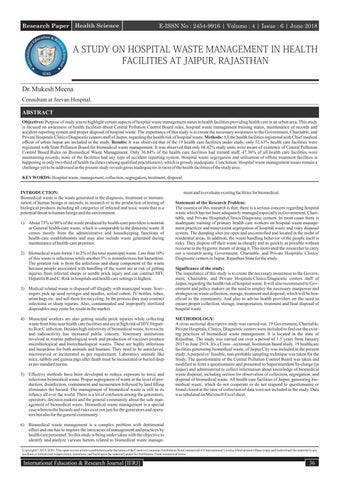
A STUDY ON HOSPITAL WASTE MANAGEMENT IN HEALTH FACILITIES AT JAIPUR, RAJASTHAN Dr. Mukesh Meena Consultant at Jeevan Hospital. ABSTRACT Objectives: Purpose of study was to highlight certain aspects of hospital waste management status in health facilities providing health care in an urban area. This study is focused on awareness of health facilities about Central Pollution Control Board rules, hospital waste management training status, maintenance of records and accident reporting system and proper disposal of hospital waste. The importance of this study is to create the necessary awareness to the Government, Charitable, and Private Hospitals/Clinics/Diagnostic centers staff of Jaipur, regarding the health risk of hospital waste. Methods: All the health facilities registered with Chief medical officer of urban Jaipur are included in the study. Results: It was observed that of the 19 health care facilities under study, only 52.63% health care facilities were registered with State Pollution Board for biomedical waste management. It was observed that only 68.42% study units were aware of existence of Central Pollution Control Board Rules on Biomedical Waste Management. Only 36.84% of the health care facilities had trained staff; 47.36% of all health care facilities were maintaining records; none of the facilities had any type of accident reporting system. Hospital waste segregation and utilization of offsite treatment facilities is happening in only two-third of health facilities (among qualified practitioners), which is grossly inadequate. Conclusion: Hospital waste management issues remain a challenge yet to be addressed as the present study reveals gross inadequacies in most of the health facilities of the study area. KEY WORDS: Hospital waste, management, collection, segregation, treatment, disposal. INTRODUCTION: Biomedical waste is the waste generated in the diagnosis, treatment or immunization of human beings or animals, in research or in the production of testing of biological products including all categories of infected and toxic waste that is a potential threat to human beings and the environment. 1) About 75% to 90% of the waste produced by health-care providers is nonrisk or General health-care waste, which is comparable to the domestic waste. It comes mostly from the administrative and housekeeping functions of health-care establishments and may also include waste generated during maintenance of health-care premises. 2) Biomedical waste forms 1 to 2% of the total municipal waste. Less than 10% of this waste is infectious while another 5% is noninfectious but hazardous. The greatest risk is from the infectious and sharp component of the waste because people associated with handling of the waste are at risk of getting injuries from infected sharps or needle prick injury and can contract HIV, Hepatitis B and C. Risk in hospitals and health care settings is highest. 3) Medical related waste is disposed off illegally with municipal waste. Scavengers pick up used syringes and needles, soiled cotton, IV bottles, tubes, urine bags etc. and sell them for recycling. In the process they may contract infections or sharp injuries. Also, contaminated and improperly sterilized disposables may come for resale in the market. 4) Municipal workers are also getting needle prick injuries while collecting waste from bins near health care facilities and are at high risk of HIV, Hepatitis B or C infection. Besides high infectivity of biomedical waste, its toxicity and radioactivity has increased public concern. Veterinary institutions involved in routine pathological work and production of vaccines produce microbiological and biotechnological wastes. These are highly infectious and hazardous for both animals and humans. They need to be autoclaved, microwaved or incinerated as per requirement. Laboratory animals like mice, rabbits and guinea pigs after death must be incinerated or buried deep as per standard norms. 5) Effective methods have been developed to reduce exposure to toxic and infectious biomedical waste. Proper segregation of waste at the level of production, disinfection, containment and incineration followed by land filling eliminates the hazard. The management of biomedical waste is still in its infancy all over the world. There is a lot of confusion among the generators, operators, decision makers and the general community about the safe management of biomedical waste. Biomedical waste management is a special case wherein the hazards and risks exist not just for the generators and operators but also for the general community.
ment and to evaluate existing facilities for biomedical. Statement of the Research Problem: The essence of this research is that; there is a serious concern regarding hospital waste which has not been adequately managed especially in Government, Charitable, and Private Hospitals/Clinics/Diagnostic centers. In most cases there is inadequate training of primary health care workers on hospital waste management practices and nonexistent segregation of hospital waste and risky disposal system. The dumping sites are open and uncontrolled and located in the midst of residential areas. In addition, the waste handling behavior of the people itself is risky. They dispose off their waste as cheaply and as quickly as possible without recourse to the hygienic means of doing it. This motivated the researcher to carry out a research using Government, Charitable, and Private Hospitals/ Clinics/ Diagnostic centers in Jaipur, Rajasthan State for the study. Significance of the study: The importance of this study is to create the necessary awareness to the Government, Charitable, and Private Hospitals/Clinics/Diagnostic centers staff of Jaipur, regarding the health risk of hospital waste. It will also recommend to Government and policy makers on the need to employ the necessary manpower and strategies on waste collection, storage, treatment and disposal, which will be beneficial to the community. And also to advise health providers on the need to ensure proper collection, storage, transportation, treatment and final disposal of hospital waste. METHODOLOGY: A cross sectional descriptive study was carried out. 19 Government, Charitable, Private Hospitals, Clinics, Diagnostic centers were included to find out the existing practices of biomedical waste management. It is located in the state of Rajasthan. The study was carried out over a period of 1.5 years from January 2017 to June 2018. It's a Cross –sectional; Institution based study. 19 healthcare facilities generating biomedical waste, of Jaipur City was included in the present study. A purposive/ feasible, non-probable sampling technique was taken for the Study. The questionnaire of the Central Pollution Control Board was taken and modified to form a questionnaire and presented to Superintendent/In-charge (in Jaipur) and administered to collect information about knowledge of biomedical waste disposal, including section for observation of collection, segregation, and disposal of biomedical waste. All health care facilities of Jaipur, generating biomedical waste, which do not cooperate or do not respond to questionnaire or found closed at the time of collection of data were not included in the study. Data was tabulated on Microsoft Excel sheet.
6) Biomedical waste management is a complex problem with detrimental effect and one has to implore the intricacies of management and practices by health care personnel. So this study is being under taken with the objective to identify and analyze various factors related to biomedical waste manageCopyright© 2018, IERJ. This open-access article is published under the terms of the Creative Commons Attribution-NonCommercial 4.0 International License which permits Share (copy and redistribute the material in any medium or format) and Adapt (remix, transform, and build upon the material) under the Attribution-NonCommercial terms.
International Education & Research Journal [IERJ]
36
Research Paper
E-ISSN No : 2454-9916 | Volume : 4 | Issue : 6 | June 2018
OBSERVATIONS: Table 1: Registration of health care facility, with State Pollution Control Board, awareness of CPCB rules, training status in hospital waste management, status of maintenance of records and Presence of Accident reporting system Number
Percentage
10
52.63%
6 3
31.57% 15.78%
Aware
13
68.42%
Not Aware
6
31.57%
Trained
7
36.84%
Untrained
12
63.15%
Maintained
9
47.36%
Not Maintained
6
31.57%
No Awareness Accident reporting System
4
21.05%
Present
0
0.00%
Not Present
12
63.15%
Not Aware
7
36.84%
TOTAL
19
100%
S.No. 1
Variable Registration Registered Not Registered Not aware of Registration rules
2
3
4
Awareness of CPCB rules
Training for HWM
Maintenance of records
group. A total of 20 qualified medical practitioners 13 practitioners without any recognized medical qualification (by MCI) responded to the questionnaire. Of the 91 health care facilities under study, only 10 health care facilities were registered with the State Pollution Board for biomedical waste management and 9 health care facilities were not registered. 68.42% Study units were aware of existence of Central Pollution Control Board rules on biomedical waste management. Of the health care facilities, participating in the study, only 36.84% had trained staff in biomedical waste management including health and safety measures. These findings are consistent with findings of Manyele Samwel V which concludes that, a need exists for further education on the nature of the risks posed by medical waste and methods for their proper handling and management for healthcare workers, other workers at risk, and the general public. CONCLUSIONS: There is a significant number of unqualified (Quacks) practicing in Jaipur urban not following any norms of Hospital waste management. Registration with State Pollution Board for biomedical waste management and its knowledge is lacking in significant proportion. Majority of health facilities are not conducting any training sessions regarding hospital waste management. Hospital waste segregation and utilization of offsite treatment facilities is happening in only two-third of health facilities (among qualified practitioners), which is grossly inadequate. RECOMMENDATIONS: 1. All health care facilities generating Bio-medical waste shall strictly ensure segregation, color coding and other provisions of Bio-medical waste (Management & Handling) rules, 1998 and amendments thereof. 2.
Incinerators, which do not confirm to the design and emission norms as per rules, must be modified and air pollution control system may be retrofitted to minimize the emission level.
3.
The operator should ensure proper operation and management (O&M) of incinerator through attainment of required temperature in both the chambers, regular operation of the incinerator, proper maintenance of the logbook and storage of the waste in isolated area, plastic incineration should not be undertaken.
Table 2 : Characteristics of Black Bags, Yellow Bags, Use of Needle destroyer, Disposal of used Syringes and Gloves among 19 health facilities where hospital waste was segregated
4.
Proper training and personal safety equipment / accessories should be provided to waste handling staff.
S.No.
5.
Records of waste generation, treatment and disposal should be maintained by the hospital.
6.
Various regulatory agencies, Hospitals, Medical Association & Municipal Corporation should work together for proper management of Bio-medical waste in the cities/towns.
5
1
2
3
4
5
Characteristic
Number (Facility)
Percentage
Located at right place
14
73.68%
Placed on stand
14
73.68%
Contain only Non-infectious waste
10
52.63%
REFERENCES:
Not torn
14
73.68%
1.
New Delhi; Ministry of Environment and Forest; 1998. Central Pollution Control Board. The Biomedical Waste (Management and Handling) Rules, p 7-11.
Available Sufficiently
14
73.68%
2.
Collected daily
14
73.68%
Kishore J, Ingle OK: biomedical Waste Management in India, 2004, Chapter 1-6, p 161.
3.
Chandigarh, India, 30thJune (2003), p 5. 6. Manyele SV, Medical Waste Management in Tanzania, Current situation and the way forward: Department of Chemical and Process Engineering, University of Dares Salem, Tanzania, p 65-76.
Black Bags
Yellow bags Located at right place
9
47.36%
Placed on stand
9
47.36%
4.
Acharya, D.B & Singh Meeta. (2000). The book of Hospital Waste Management. (1st ed.). New Delhi: Minerva.
Contain only Non-infectious waste
7
36.84%
5.
Not torn
9
47.36%
Blenkharn, J.I. (1995). The disposal of clinical wastes. Journal of hospital infection, 30, 514-520.
Available Sufficiently
9
47.36%
6.
Collected daily
9
47.36%
Glenn, Mc.R & Garwal, R. (1999). Clinical waste in Developing Countries. An analysis with a Case Study of India, and a Critique of the BasleTWG Guidelines.Info Nugget. (1996). Hospital Waste Management and Bio-degradable Waste. Government of India, Press Information Bureau.
7.
Present
11
57.89%
Saini, R.S. & Dadhwal, P.J.S. (1995). Clinical waste management: a case study. Journal of Indian Association for Environmental Management, 22.
Not present
8
42.10%
8.
Srivastava, J.N. (2000). Hospital waste management project at Command Hospital, National Seminar on Hospital waste Management, Bangalore
Are in bucket for disinfection
2
10.52%
No disinfection done
17
89.47%
Use of needle destroyer
Disposal of syringes
Disposal of Gloves Disposed ion the bleaching solution
0
0%
Available in sufficient quantity
15
78.94%
Available in appropriate size
15
78.94%
DISCUSSION: The present study was undertaken to study the biomedical waste generation, segregation process and it's handling as practiced in Jaipur, and to identify and analyze various factors relating to biomedical waste management. A total 19 health care facilities generating biomedical waste participated in the study. 14 Medical care centers, 3 Diagnostic centers and 2 Research Facility formed the study
37
International Education & Research Journal [IERJ]