Research Paper
Engineering
E-ISSN No : 2454-9916 | Volume : 5 | Issue : 8 | Aug 2019
SIXTH GENERATION: THE FUTURE ERA IN MOBILE TECHNOLOGY Dipti Sharma AP, ECE, Sachdeva Engineering College for Girls, India. ABSTRACT As we are testing fifth generation technology worldwide and it is anticipated to be rolled out gradually in 2019, researchers around the world are beginning to turn their attention to what 6G might carry. This paper describes the features of 6G technology ,the vision it will carry and challenges faced to develop this technology. The fifth generation (5G)will exhaust by 2030. Coupled with the rises of Internet-of-Things (IoT), massive machine-type communications (MTC) 5G will carry the following advanced features it will have speed in gigabits as compared to megabits in 4G technology, low battery consumption, better connectivity. The advent of 6G technology will make virtual meeting, remote surgery , gaming all a practical reality. As per CISCO data traffic is estimated to grow at an annual rate of around 55% in 2020–2030 to reach 607 exabytes (EB) in 2025 and 5, 016 EB in 2030. Presumably, 6G will continue to benefit from many 5G technologies, but new technologies will certainly be needed to make the next step change. We will discuss in this article the research techniques needed to move towards 6G technology. It will speculate the most enabling aspects of 6G , though many more features will be introduced as technology grows. The rest of this article is organized as follows. In Section II, we present our 6G vision We will discuss some key challenges in Section III, and present a few visionary technologies or research directions that may form key parts of 6G. Finally, we conclude this article in Section IV. KEYWORDS: Emerging technologies, 5G, 6G.
I. INTRODUCTION: There is an overwhelming increase in the usage of mobile network coming from 2005 now to 2021. The world internet usage has grown 25 times in this period. As predicted by International telecommunication this growth will grow manifold in an exponential manner and will grow in units of zetabyte till 2030as shown in figure 1.
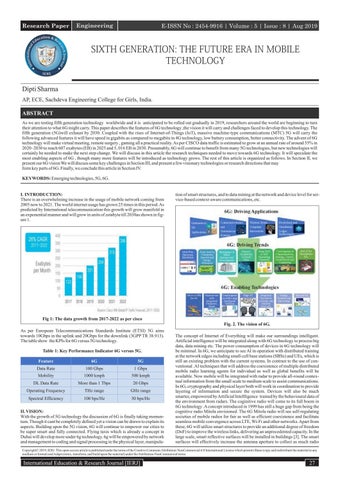
tion of smart structures, and to data mining at the network and device level for service-based context-aware communications, etc.
Fig 1: The data growth from 2017-2022 as per cisco Fig. 2. The vision of 6G. As per European Telecommunications Standards Institute (ETSI) 5G aims towards 10Gbps in the uplink and 20Gbps for the downlink (3GPP TR 38.913). The table show the KPIs for 6G versus 5G technology. Table 1: Key Performance Indicator 6G versus 5G. Feature
6G
5G
Data Rate
100 Gbps
1 Gbps
Mobility
1000 kmph
500 kmph
DL Data Rate
More than 1 Tbps
20 Gbps
Operating Frequency
THz range
GHz range
Spectral Efficiency
100 bps/Hz
30 bps/Hz
II. VISION: With the growth of 5G technology the discussion of 6G is finally taking momentum. Though it cant be completely defined yet a vision can be drawn to explain its aspects. Building upon the 5G vision, 6G will continue to empower our cities to be super smart and fully connected. Flying taxis which is already a concept in Dubai will develop more under 6g technology. 6g will be empowered by network and management to coding and signal processing in the physical layer, manipula-
The concept of Internet of Everything will make our surroundings intelligent. Artificial intelligence will be integrated along with 6G technology to process big data, data mining etc. The power consumption of devices in 6G technology will be minimal. In 6G, we anticipate to see AI in operation with distributed training at the network edges including small-cell base stations (SBSs) and UEs, which is still an existing problem with the current systems. In contrast to the use of conventional .AI techniques that will address the coexistence of multiple distributed mobile radio learning agents for individual as well as global benefits will be available. Now mobile will be integrated with radar to provide all-round contextual information from the small scale to medium scale to assist communications. In 6G, cryptography and physical layer both will work in coordination to provide layering of information and secure the system. Devices will also be much smarter, empowered by Artificial Intellligence trained by the behavioural data of the environment from radars. The coginitive radio will come to its full boom in 6G technology .A concept introduced in 1999 has still a huge gap from being the cognitive radio Mitola envisioned. The 6G Mitola radio will see self-regulating societies of mobile radios for fair as well as efficient coexistence and facilitate seamless mobile convergence across LTE, Wi-Fi and other networks. Apart from these, 6G will utilize smart structures to provide an additional degree of freedom (DoF) to improve the wireless links, delivering an unprecedented capacity. In the large scale, smart reflective surfaces will be installed in buildings [3]. The smart surfaces will effectively increase the antenna aperture to collect as much radio
Copyright© 2019, IERJ. This open-access article is published under the terms of the Creative Commons Attribution-NonCommercial 4.0 International License which permits Share (copy and redistribute the material in any medium or format) and Adapt (remix, transform, and build upon the material) under the Attribution-NonCommercial terms.
International Education & Research Journal [IERJ]
27
Research Paper
E-ISSN No : 2454-9916 | Volume : 5 | Issue : 8 | Aug 2019
signals as possible that had not been possible before for improved energy and spectral efficiency. In the smaller scale, 6G will also see flexible antenna structure possible at UEs. Early results on fluid antennas in [4] revealed a whole new possibility for designing wireless communications systems. Also, metamaterialbased antennas may also be implemented to make even more compact wideband antennas. Such intelligent structures seek to engineer the environment to cater a variety of applications, for example, to improve link quality, block interference, enhance privacy and security, avoid adversarial attacks and many more. There is also glimpse of successes in other emerging areas which are not yet making much of an impact in 5G but could become reality in 6G, including wireless power transfer (WPT) and RF energy harvesting, optical wireless communications or Li-Fi. Furthermore, there is a possibility that 6G will be more than wireless, and need to handle coexistence of traditional mobile communications and interconnects inside PCs [5], as many-core PCs may use digital surface-wave communications for interconnects which might occupy the same band as 6G. Overall, we foresee that AI will penetrate all levels and be the signature for 6G for smarter and more powerful networks. In terms of the requirements in 6G, the consensus seems to be that the data rate will race to 1Tbps to enable autonomous management of various activities in the future smart city. For individual users, data rate is expected to increase from 1Gbps in 5G to at least 10Gbps per user, and up to 100Gbps in some use cases, in the emerging 6G systems. 6G is also expected to integrate with satellites for providing global mobile coverage. Volume spectral efficiency (in bps/Hz/m3 ), as opposed to the often used area spectral efficiency (bps/Hz/m2 ), will be more suitable in 6G to properly measure the system capacity in a three dimensional operating space. Ultra-reliable low-latency communication (URLLC), one key feature in 5G NR, will again be a key driver in 6G pushing the limit further to require latency of less than 1ms. Energy efficiency will be extremely important to prolong the battery life of Ues. III. CHALLENGES: As seen in Table I, 6G looks for several orders of magnitude improvements over 5G in all aspects. The hurdles to be faced by 6G technology will be discussed here.
UE will be more power hungry than ever. Energy efficiency at the device level will once again be a KPI in 6G. Furthermore, for devices to operate like a Mitola radio, new materials and design concepts will need to be sought to break the physical limits of UE and yet operate at wider frequencies with great diversity and multiplexing gains as well as intelligence. IV. CONCLUSIONS: The work towards the emergence of 6G technology has started. While it is too early to define 6G and there are inevitably omissions in any of such discussion, this article has taken a bravery approach to identify possible enabling technologies for 6G and describe the features they bring beyond the capability of 5G This article has also discussed the limitations of 5G that form the basis of our 6G vision. Lastly, we like to add that 6G will see a shift from the electronic era of 5G to the optical and photonics era. REFERENCES: 1.
J. G. Andrews, S. Buzzi, W. Choi, S. V. Hanly, A. Lozano, A. C. K. Soong, and J. C. Zhang, “What will 5G be?,” IEEE J. Sel. Areas Commun., vol. 32, pp. 1065–1082, Jun. 2014.
2.
J. Mitola, and G. Q. Maguire, “Cognitive radio: Making software radios more personal,” IEEE Pers. Commun., vol. 6, pp. 1318-1346, Apr. 1999.
3.
S. V. Hum, and J. Perruisseau-Carrier, “Reconfigurable reflectarrays and array lenses for dynamic antenna beam control: A review,” IEEE Trans. Antennas Prop., vol. 62, pp. 183-198, Jan. 2014.
4.
C. Borda-Fortuny, K.-F. Tong, A. Al-Armaghany, and K.-K. Wong, “A low-cost fluid switch for frequency-reconfigurable Vivaldi antenna,” IEEE Antennas Wireless Prop. Lett., vol. 16, pp. 3151-3154, Nov. 2017.
5.
A. Karkar, T. Mak, K.-F. Tong, and A. Yakovlev, “A survey of emerging interconnects for on-chip efficient multicast and broadcast in many-cores,” IEEE Circuits and Syst. Mag., vol. 16, pp. 58-72, Feb. 2016. [6] E. Bastug, M. Bennis, M. Medard, and M. Debbah, “Toward intercon- ´ nected virtual reality: Opportunities, challenges, and enablers,” IEEE Commun. Mag., vol. 55, pp.110-117, June 2017.
A. Access Network for Backhaul Traffic The recently formed ITU focus group technologies for networks 2030 (FG NET-2030) raised concern that fixed access networks capabilities are already lagging behind emerging 5G systems. The research and development efforts in development of backhaul networks will be needed to cope with the growing demand of traffic on mobile and other devices in 6G communication. The D band using 60 GHz network will be helpful for development in emerging However, they are still in an early G technology .The network and spectrum requirement need to be addressed to fully install 6G future network. B. Sub-Millimeter Wave and THz Frequencies To meet the increasing requirement in the data rate the first and foremost solution is to increase the bandwidth. The frequency in range of terahertz will be considered under 6G communicaton. As per study the maximum band utilization by 5G will not go beyond 140 GHz . In contrast, 6G will utilize spectrum beyond 140GHz with particular application in very short range communication or 'whisper radio' [8]. However, the susceptibility of the THz band to blockage, molecular absorption, sampling and circuits for A/D & D/A conversion and communication range is among the major challenges that need to be addressed in the coming years. Antenna fabrication at higher frequencies is difficult to attain in the current scenario. The propagation characteristics in the terahertz range is not understood with clarity yet. C. Fog Networking and Mobile Edge Computing Fog networking and edge computing have been introduced in 5G to greatly shorten the UEs' distance with the serving base stations and service/application content servers, respectively. Edge caching breaks the network into distributed cloud structure and it will be difficult to make learning in articifical intellence , posing a challenge to AI aspect. D. Resource as a Service (RaaS) The emergence of software defined networking (SDN) and network function virtualization (NFV) facilitates a move towards service oriented and integrated resource distribution which is known as RaaS. This has given rise to the concept of network slicing to create virtual networks over the physical infrastructure. It allows mobile operators or service providers to allocate virtual network resources to meet specific service needs. In 6G, programmable metasurfaces and softwaredefined materials will likely be parts of the network resources. E. Dynamic Topology In light of network densification, each end node will have multiple options to connect and user association decision will have a great impact on the interference pattern. This coupling with dynamic dronecells formed by unmanned aerial vehicles (UAVs) and fast moving vehicular networks, will change the interference dynamics rapidly. F.
Device Capability Every generation of mobile communications has been defined by the UE capability, and this will be more so for 6G because 6G will be AI-led and require high computational power to run the AI algorithms.
28
International Education & Research Journal [IERJ]