Research Paper
Management
E-ISSN No : 2454-9916 | Volume : 4 | Issue : 11 | Nov 2018
MEASUREMENT OF LEARNING OUTCOMES FOR QUALITY ASSURANCE: A SYSTEMATIC APPROACH 1
Dr. Radhakrishnan Perumalsamy | Dr. Jeyanthi Natarajan 1 2
2
Emirates College for Management and Information Technology, Dubai, UAE. Dept. of Mathematics, Sri G.V.G. Visalakshi College, Udumalpet, India.
ABSTRACT Advanced program quality is the characteristic that determines the competitiveness of an Institution in the contemporary market place and is the driving force to reckon with, in making the Institution to contemplate more along quality levels of program for gaining competitive advantage. Efficient and effective management of quality of programs significantly improves the ultimate service provided to the participants in the program of study. Efficient quality management is a complex process which entails the contribution of the various assessment components towards achievement of desired Learning Outcomes (LOs). Ascertaining the desired contribution of the various components of the instructional design is of paramount importance leading to the final quality of the program. In this paper, a systematic methodology is proposed to ascertain the levels of achievement of various Learning Outcomes (LOs) so as to ensure the ultimate program quality provided to the learners. Through enhanced levels of academic rigor, the proposed approach traces the achievement levels of LOs which is an essential information for program quality and effectiveness. KEYWORDS: Quality Assurance, Learning Outcomes, outcome measurement , Learning Analytics. 1. INTRODUCTION: One of the major objectives of the academic programs is to provide comprehensive knowledge and necessary skills to the learners of the program of study. The development of individual program goals, outcomes and assessments mapping with the course outcomes will help to achieve the program and institutional goals. Three is a need for establishing a monitoring mechanism to review the effectiveness of the programs regularly to ensure effectiveness of the programs offered .For each program, course syllabus is planned with a weekly breakup which includes various methods of delivering the course contents along with the learning outcomes. The faculty responsible for teaching a particular course identifies a set of course objectives and course learning outcomes which are aligned with the program expected learning outcomes. Various assessments are carefully designed appropriately for each course so as to meet the complete course syllabus and the learning outcomes.. To what extent the assessment components of the instructional design meet the desired Learning Outcomes (LOs) will decide the course quality and the combination of courses in turn decide the overall Program quality. Efficient quality management is a complex process which entails the management of the processes throughout the Teaching –Learning process flow. Ascertaining the desired quality level at each stage of the Teaching –Learning process is of paramount importance leading to the final quality of the programs. In addition, the complexity of the problem increases when more number of assessment components and the corresponding measurements of quality levels are involved. A better methodology would consider all these factors in the prediction of the quality levels at each stage of Teaching –Learning process in order to ensure the desired final program quality
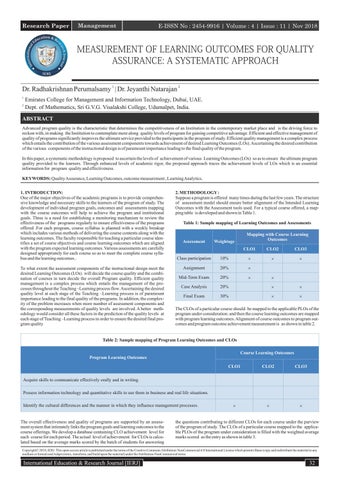
2. METHODOLOGY : Suppose a program is offered many times during the last few years. The structure of assessment model should ensure better alignment of the Intended Learning Outcomes with the Assessment tools used. For a typical course offered, a mapping table is developed and shown in Table 1. Table 1: Sample mapping of Learning Outcomes and Assessments
Assessment
Mapping with Course Learning Outcomes
Weightage
CLO1
CLO2
CLO3
´
´
Class participation
10%
´
Assignment
20%
´
Mid-Term Exam
20%
´
Case Analysis
20%
´
´
Final Exam
30%
´
´
´
The CLOs of a particular course should be mapped to the applicable PLOs of the program under consideration: and then the course learning outcomes are mapped with program learning outcomes. Alignment of course outcomes to program outcomes and program outcome achievement measurement is as shown in table 2.
Table 2: Sample mapping of Program Learning Outcomes and CLOs Course Learning Outcomes Program Learning Outcomes CLO1
CLO2
CLO3
´
´
´
Acquire skills to communicate effectively orally and in writing. Possess information technology and quantitative skills to use them in business and real life situations. Identify the cultural differences and the manner in which they influence management processes.
The overall effectiveness and quality of programs are supported by an assessment system that intimately links the program goals and learning outcomes to the course offerings. We develop a database containing CLO achievement level for each course for each period. The actual level of achievement for CLOs is calculated based on the average marks scored by the batch of students for answering
the questions contributing to different CLOs for each course under the purview of the program of study. The CLOs of a particular course mapped to the applicable PLOs of the program under consideration is filled with the weighted average marks scored as the entry as shown in table 3.
Copyright© 2018, IERJ. This open-access article is published under the terms of the Creative Commons Attribution-NonCommercial 4.0 International License which permits Share (copy and redistribute the material in any medium or format) and Adapt (remix, transform, and build upon the material) under the Attribution-NonCommercial terms.
International Education & Research Journal [IERJ]
32
Research Paper
E-ISSN No : 2454-9916 | Volume : 4 | Issue : 11 | Nov 2018 Table 3: Sample PLO measurement
Department: Business PLO
Course 1
Course 2
PLO CLO1 CLO2 CLO3 CLO1 CLO2 CLO3 CLO4 CLO1 CLO2 CLO3 CLO4 CLO5 Achievement
Acquire skills to communicate effectively orally and in writing
88.33
Possess information technology and quantitative skills to use them in business and real life situations Identify the cultural differences and the manner in which they influence management processes.
Course 3
88.33
54.08 54.08
81.63
88.33
84.26
84.26
Then for each PLO, find the weighted average of all the courses contributing to the particular PLO. Suppose the program has 10 PLOs. Then for PLO1, the weighted average of marks of all the courses contributing to PLO1 gives the Achievement Score for PLO1. 3. RESULTS AND DISCUSSION: The process of assessing the overall performance of the program and achievement of program outcomes are reported for all PLOs.
81.63
80.38
79.33
83.00
54.08
54.08
This mapping is to be done for all the courses comprising the program of study.
82.83
86.10
4. CONCLUSION: Efficient and effective management of quality of programs significantly improves the ultimate service provided to the participants in the program of study. Efficient quality management is a complex process which entails the contribution of the various assessment components towards achievement of desired Course Learning Outcomes. Ascertaining the desired contribution of the various components of the instructional design is of paramount importance leading to the final quality of the program.
Ÿ
If the Achievement score is > 80 implies High achievement
Ÿ
If the Achievement score is between 70 and 80 implies medium achievement
In this paper, a methodology is proposed and implemented to assess to what extent the assessment components of the instructional design meets the desired Course Learning Outcomes for different courses so as to ensure the ultimate quality of the program provided to the participants. The proposed approach uses Learning Analytics to capture the emerging pattern of achievement levels of Learning Outcomes which is an essential information for program quality and effectiveness. By taking necessary steps to focus on the identified shortages of different LOs the quality standards can be enhanced to the desired level.
Ÿ
If the Achievement score is < 70 implies Low achievement
REFERENCES:
Then, we look at the PLO Achievement Score.
Based on the actual score, we can infer the low performing PLOs and find out the remedial measures to set right the same in the upcoming period. By taking necessary steps to focus on the identified shortages of different CLOs, the quality standards can be enhanced to that extent. All these individual course assessment forms are compiled into a database to establish the pattern of achievement levels of various program for quality assurance. The assessments are used to guide each program in improving the services they deliver both academically and administratively.
33
1.
Astin, A. (1985). 'Achieving Educational Excellence: A Critical Analysis of Priorities and Practices in Higher Education', Jossey-Bass, San Francisco.
2.
Clanchy, J. and B. Ballard. (1995). 'Generic Skills in the Context of Higher Education', Higher Education Research and Development, Vol. 14(2), Routledge, London.
3.
Coates, H. and A. Radloff .(2008). 'Tertiary Engineering Capability Assessment: Concept Design', Australian Council for Educational Research (ACER), Camberwell.
4.
Douglass, J. et al.( 2012). 'The Learning Outcomes Race: the Value of Self-Reported Gains in Large Research Universities', Higher Education, Vol. 64, pp. 317-335
5.
OECD (2007). 'Assessing Higher Education Learning Outcomes', OECD, Paris.
6.
OECD (2008). 'Measuring Improvements in Learning Outcomes', OECD Publishing, Paris.
International Education & Research Journal [IERJ]