Research Paper
Education
E-ISSN No : 2454-9916 | Volume : 5 | Issue : 7 | July 2019
PRE-SERVICE MATHEMATICS TEACHERS' KNOWLEDGE ABOUT FORMS OF REPRESENTING THE DISPERSION OF A DATA SET Charles K. Assuah University of Education, Winneba, Dept. of Mathematics Education, P.O. Box 25, Winneba-Ghana. ABSTRACT An analysis of covariance design was adopted to investigate differences in preservice mathematics teachers’ knowledge about forms of representing the dispersion of a data set, while controlling for age, a quantitative covariate. The participants consisted of 160 pre-service mathematics teachers, who were randomly selected from four colleges of education in Ghana. The preservice teachers, with ages ranging between 21 and 27 years, had all completed the Colleges of Education mathematics teaching syllabus. The results indicated that age co-varied significantly with the teachers’ rated responses, F (1, 155) = 6.17, p < .05, partial η2=.04. There were significant differences in the teachers’ rated responses in the four colleges, F (1, 155) = 2.78, p < .05, partial η2=.08, controlling forage. College accounted for 8% of the variability in teachers’ rated responses. Post-hoc pair wise multiple comparison tests using Bonferroni alpha levels, indicated that teachers’ rated responses in College A were greater those in College B, t (78) = 1.64, p < .05. The results further indicated that there were no significant differences in teachers’ rated responses by gender, F (1, 157) = 0.51, p > .05.There was no interaction effect between college and gender, F (3, 151) = 0.30, p > 0.05, there were no main effects by college, F (3,151) = 2.34, p > 0.05, and by gender, F (1, 151) = 0.58, p > 0.05.The descriptive statistics indicated that teachers’ rated responses about forms of representing the dispersion of a data set were highest for variance, M = 8.12, SD = 1.05, range, M = 7.57, SD = 1.13, and standard deviation, M = 7.52, SD = 1.08, but were lower for Coefficient of Variation, M = 4.06, SD = 1.14 and Mean Absolute Deviation, M = 4.17, SD = 1.08. This study has demonstrated that preservice mathematics teachers should thoroughly understand every topic before graduating from the college of education. To achieve these, preservice mathematics teachers must ensure that both content knowledge and pedagogical content knowledge become the bedrock of their classroom instructions. KEY WORDS: Dispersion, preservice mathematics teachers, covariance, colleges of Education, Teachers’ rated responses. INTRODUCTION: Research in mathematics education has provided compelling evidence suggesting that students' learning, motivation, and achievement, are affected by the quality of the learning opportunities teachers offer to these students (Hattie, 2009; McCaffrey, Lockwood, Koretz, Louis, & Hamilton, 2004). In connection to this, teacher knowledge comprising both content knowledge (CK) and pedagogical content knowledge (PCK), have proven to affect teachers' instructional practices and students' mathematics learning and achievement (Baumert et al., 2010; Hill, Rowan, & Ball, 2005). CK represents teachers' understanding of the subject matter. To Shulman (1986), “the teacher needs not only understand that something is so, the teacher must further understand why it is so” (p. 9). Consequently, teachers' CK differs from the academic knowledge generated at colleges of education and universities and from everyday mathematical knowledge that teachers retain after leaving school (Krauss, Brunner, et al., 2008). PCK is needed to make subject matter accessible to students (Shulman, 1986). Two facets of PCK in literature abound: knowledge of students' subject-specific conceptions and misconceptions and knowledge of subject-specific teaching strategies and representations (see also Ball et al., 2008; Borko & Putnam, 1996; Park & Oliver, 2008). Even though empirical research findings have not definitively differentiated between CK and PCK, Hill, Schilling, and Ball (2004) found that teachers' CK and PCK in mathematics are merged into a body of knowledge known as mathematical knowledge for teaching (MKT). Other studies have also found that CK and PCK represent two correlated but separable and unique dimensions (Krauss, Brunner, et al., 2008; Phelps & Schilling, 2004). Given the importance of teacher knowledge in student learning, quality preservice teacher education is necessary and indispensable to impact educational reforms in many countries. However, the understanding of how teacher education programs affect the development of teacher knowledge remains limited (Cochran-Smith &Zeichner, 2005). LITERATURE REVIEW: One difficulty confronting mathematics teacher educators is their inability to adequately assess teacher knowledge. Teacher knowledge is at the heart of teachers' professional competence and practice (Ball, Lubienski, &Mewborn, 2001; Shulman, 1986; Woolfolk Hoy et al., 2006). Recent studies have provided strong evidence that teachers' CK affects their instructional practice, and their students' achievement gains. Hill et al. (2005) found that elementary teachers' MKT was substantially associated with student gains in mathematical understanding (Hill et al., 2008). Despite the high correlation between CK and PCK, CK had lower predictive power for student progress than did PCK. Furthermore, PCK had the decisive effects on key aspects of instructional quality. To this end, how teacher education affects the development of teachers' subject-specific knowledge is crucial to educational reform (Ball et al., 2001). Recent research have developed test instruments that can proximally assess components of teacher knowledge in mathematics (Hill et al., 2005; Krauss, Brunner, et al., 2008; Schmidt et al., 2007; Tatto & Senk, 2011). Krauss, Brunner, et al. (2008) concluded that the latent structure of subject-matter knowledge might vary between different teacher populations. There is some consensus and some preliminary evidence for the notion
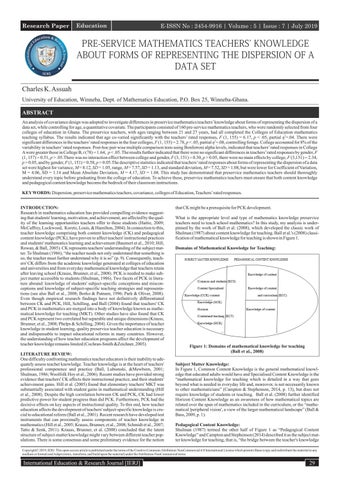
that CK might be a prerequisite for PCK development. What is the appropriate level and type of mathematics knowledge preservice teachers need to teach school mathematics? In this study, my analysis is underpinned by the work of Ball et al. (2008), which developed the classic work of Shulman (1987) about content knowledge for teaching. Ball et al.'s (2008) classification of mathematical knowledge for teaching is shown in Figure 1. Domains of Mathematical Knowledge for Teaching:
Figure 1: Domains of mathematical knowledge for teaching (Ball et al., 2008) Subject Matter Knowledge: In Figure 1, Common Content Knowledge is the general mathematical knowledge that educated adults would have and Specialised Content Knowledge is the “mathematical knowledge for teaching which is detailed in a way that goes beyond what is needed in everyday life and, moreover, is not necessarily known to other mathematicians” (Campton & Stephenson, 2014, p. 13), but does not require knowledge of students or teaching. Ball et al. (2008) further identified Horizon Content Knowledge as an awareness of how mathematical topics are related over the span of mathematics included in the curriculum, or the “mathematical 'peripheral vision', a view of the larger mathematical landscape” (Ball & Bass, 2009, p. 1). Pedagogical Content Knowledge: Shulman (1987) termed the other half of Figure 1 as “Pedagogical Content Knowledge” and Campton and Stephenson (2014) described it as the subject matter knowledge for teaching, that is, “the bridge between the teacher's knowledge
Copyright© 2019, IERJ. This open-access article is published under the terms of the Creative Commons Attribution-NonCommercial 4.0 International License which permits Share (copy and redistribute the material in any medium or format) and Adapt (remix, transform, and build upon the material) under the Attribution-NonCommercial terms.
International Education & Research Journal [IERJ]
29
Research Paper
E-ISSN No : 2454-9916 | Volume : 5 | Issue : 7 | July 2019
and enabling students to know it” (p.14). Shulman viewed this as the way in which the subject matter can be represented in order to be comprehensible to others along with an understanding of what makes topics easy or difficult ( i.e.,use of explanations, diagrams and metaphors; knowledge of students' conceptions; and knowledge of curriculum). Such knowledge is clearly much closer to teaching than that provided by Subject Matter Knowledge. Ball et al. (2008) identified three types of pedagogical subject knowledge: Knowledge of Content and Teaching; Knowledge of Content and Students; and Knowledge of Content and Curriculum. To become effective mathematics teachers, preservice teachers need to develop all these kinds of subject knowledge because, “teaching requires knowledge beyond that being taught to students”(Ball et al., 2008, p. 400).Teachers require what they call 'unpacked' mathematical knowledge which they use to teach 'decompressed mathematical knowledge' to learners so that students eventually “develop fluency with compressed mathematical knowledge”(Ball et al., 2008, p. 400). Teachers gain their knowledge for teaching from various sources (Grossman, 1990). Drawing on Grossman's research, Friedrichsen et al. (2009) distinguished three potential sources of subject-matter knowledge: (a) teachers' own learning experiences, (b) teacher education and professional development programs, and (c) teaching experiences. Clearly, the three types of learning opportunities described by Grossman differ in their levels of formalization and intentional construction (Tynjälä, 2008). Formal learning opportunities are organized and structured by institutions on the basis of learning objectives; they generally lead to qualifications. Formal learning is mainly intentional—the learner has the explicit objective of acquiring knowledge and skills. Informal learning, in contrast, is not intentionally organized and takes place incidentally, as a “side effect” (e.g., of work; Tynjälä, 2008). It has no set objective in terms of learning outcomes and is usually highly contextualized. It is often referred to as learning by experience (Tynjälä, 2008; Werquin, 2010). Informal, but deliberative, learning situations (e.g., mentoring, learning in peer groups, and intentional practice of certain skills or tools) have been described as nonformal learning (Werquin, 2010). In contrast to formal learning, nonformal learning takes place outside educational institutions and does not generally lead to qualifications (Werquin, 2010). Reconsidering Grossman's three sources of teachers' professional knowledge in terms of this classification of learning opportunities, first we can conclude not only that the school mathematics curriculum offers formal learning opportunities for acquiring CK in the pretraining phase but also that learning situations prior to teacher education facilitate the informal construction of PCK (e.g., through observation of one's own teachers). Second, teacher education and professional development programmes provide opportunities to acquire CK and PCK by attending workshops and lectures (formal learning opportunities), collaborating with peers, and in teaching practice (nonformal and informal learning opportunities). Third, teaching experience is a prototypical form of informal learning.Many of the available studies investigating the development of CK and PCK in teacher education or professional development are small samples or case studies (Cochran-Smith & Zeichner, 2005; Darling-Hammond et al., 2009; De Jong & Van Driel, 2004; Friedrichsen et al., 2009; Richardson & Placier, 2001; Zembal-Saul, Krajcik, & Blumenfeld, 2002).Some studies allow in-depth insights into change in teachers' knowledge of subject matter and have provided first evidence that teacher education and professional development may affect the development of CK and PCK. PCK implies a transformation of subject-matter knowledge, so that it can be used effectively and flexibly in the interaction between teachers and students in the classroom (Shulman, 1987). In the teacher knowledge literature, there is some consensus that the degree of conceptual understanding of the respective content provides the scope for PCK development (Ball et al., 2001; Baumert et al., 2010; Friedrichsen et al., 2009). It is well documented that mathematics teachers themselves often have misconceptions and fragmented knowledge that limit, for example, their responses to student conceptions or their ability to create cognitively challenging learning situations (Haidar, 1997; Halim & Meraah, 2002; Van Driel, Verloop, & De Vos, 1998). CK is therefore regarded as a necessary prerequisite for the development of PCK (Friedrichsen et al., 2009). However, strong CK does not necessarily lead to the development of PCK (Lee, Brown, Luft, & Roehrig, 2007).In this study, the following research questions were posed:
METHOD: Design: An analysis of covariance design was adopted for this study because it sought to investigate differences in pre-service teachers' knowledge from responses to a questionnaire rated on a ten-point scale, while controlling for age, a covariate to increase the statistical power of detecting differences. Participants: The participants consisted of 160 pre-service teachers (i.e., 40 from College A, 40 from College B,40 from College C, and 40 from College D), who were randomly selected from each of these four colleges of education in Ghana. The preservice teachers had all completed the Colleges of Education mathematics teaching syllabus, and were preparing to write their final examination. Their ages ranged between 21 and 27 years. Procedure: Each group of forty students from each of these colleges was put into a classroom, after the principal had given his/her consent to allow his/her students to participate in the study. The questionnaire was given to each student to respond on a 10-point quantitative scale the extent to which he/she is knowledgeable about using the range, standard deviation, variance, mean absolute deviation, and coefficient of determination to represent the dispersion of a data set. Each student was given 15 minutes to complete the questionnaire. The data were screened for outliers and then analyzed. RESULTS: Table 1:Estimated Marginal Means by College; One-Factor ANCOVA Tests of Between-Subjects Effects by College, and Post hoc Bonferroni Multiple Comparison Tests, by College Estimated Marginal Means by College 95% C.I College
N
M
SE
College A
40
31.95
.29
31.38
32.54
40
31.65
.29
31.08
32.22
College D
40
31.33
.29
30.75
32.00
College B 40 30.28 30.85 .29 31.42 31.44 .29 Total 160 31.15 31.74 One-Factor ANCOVA Tests of Between-Subjects Effects Source
SS
df
College
28.08
Age
20.72
Error Total
(4) What accounts for differences in pre-service teachers' responses of their mathematical knowledge about forms of representing the dispersion of a data set?
30
Sig.
Partial η2
2.78
0.04
.08
6.17
0.01
.07
MS
F
3
9.34
1
20.72
520.04
155
3.36
568.84
159
Post Hoc Bonferroni Multiple Comparison Tests 95% C.I Interval (I) College
(J) College
Mean Difference
College C
0.26
0.43
1.00
-0.89
1.41
College A
College D
0.57
0.43
1.00
-0.56
1.74
College B
1.64
0.43
0.04
-0.08
2.21
College C
College D
College B
(3) Does pre-service teachers' knowledge about forms of representing the mean depend on students' college and gender, controlling for age as a covariate?
Upper Bound
College C
(1) Are there differences in pre-service teachers' mathematical knowledge about forms of representing the mean by students' college, controlling for age as a covariate? (2) Are there differences in pre-service teachers' mathematical knowledgeabout forms of representing the mean by students' gender, controlling for age as a covariate?
Lower Bound
S.E
Sig.
Lower Bound
Upper Bound
College A
-0.26
0.43
1.00
-1.41
0.89
College D
0.33
0.41
1.00
-0.78
1.43
College B
0.80
0.41
0.32
-0.30
1.91
College A
-0.59
0.43
1.00
-1.74
0.56
College C
-0.33
0.41
1.00
-1.43
0.78
College B
0.48
0.41
1.00
-0.62
1.58
College A
-1.64
0.43
0.04
-2.21
0.08
College C
-0.80
0.41
0.32
-1.91
0.30
College D
-0.48
0.41
1.00
-1.58
0.63
A one-factor between subjects analysis of covariance (ANCOVA) (see Table 1), was used to investigate if there were differences in preservice teachers’ rated responses among the four colleges of education, controlling forage. The results indicated that age co-varied significantly with the dependent variable (i.e., preservice teachers’ rated responses), F (1, 155) = 6.17, p < .05, partial η2 = .07. There were differences among the colleges, F (1, 155) = 2.78, p < .05, partial η2 = .08, after controlling for age. Thus, college accounted for 8% of the variability in preservice teachers’ rated responses. Post-hoc pairwise multiple comparison tests using Bonferroni alpha levels, indicated that preservice teachers’ rated responses for College A were significantly greater than those for College B, t (78)
International Education & Research Journal [IERJ]
Research Paper
E-ISSN No : 2454-9916 | Volume : 5 | Issue : 7 | July 2019
= 1.64, p < .05.The overall estimated marginal mean, M = 31.44, S.E = 0.29, 95% C.I = [31.15, 31.74], indicated that preservice teachers rated responses were closer to the mean (see Table 1). Table 2: Homogeneity of Slopes between Age and Type of Variable Type of Variable Gender
df (1,156)
F 1.23
Sig 0.27
η2 .01
College
(3,152)
1.01
0.39
.02
Gender x College
(3, 144)
0.39
0.76
.03
A two-factor between subjects analysis of covariance (ANCOVA) (Table 4), was used to investigate if college and gender contributed to preservice teachers’ rated responses, after controlling for age. The results indicated that age co-varied significantly with the dependent variable (i.e., preservice teachers’ rated responses), F (1, 151) = 4.71, p < .05, partial η2 =.01. There was no interaction effect between college and gender, F (3, 151) = 0.30, p > 0.05, there were no main effects by college, F (3,151) = 2.34, p > 0.05, and by gender, F (1, 151) = 0.58, p > 0.05. The highest estimated marginal mean for male, M = 32.11, S.E = 0.39, C.I = [31.33, 32.90], was associated with College A, while that for female, M = 31.73, S.E = 0.50, C.I = [30.75, 32.71], was associated with College C (Table 4). Table 5: Forms of Representing the Dispersion of a Data Set
Table 2 indicates homogeneity of slopes between age and variables used in the study. These were the assumptions that had to be satisfied before using ANCOVA as a design. A test of the homogeneity of slopes indicated no significant interaction between age and college (i.e., four treatment groups), F (3, 152) = 1.01, p > .05 partial η2 =.02. Similarly, a test of the homogeneity of slopes indicated no significant interaction between age and gender, F (1, 156) = 1.23, p > .05, partial η2 = .01, and also indicated no significant interaction among college, gender and age, F (3, 144) = .388, p > .05 partial η2 = .03. Table 3: Estimated Marginal Means by Gender and One-Factor ANCOVA Tests of Between-Subjects Effects by Gender 95% C.I N
M
SE
Lower Bound Upper Bound
Male 102 31.45 0.19 31.11 31.85 Female 58 31.43 0.52 30.88 31.88 Total 160 31.44 0.31 31.82 30.12 One-Factor ANCOVA Tests of Between-Subjects Effects by Gender Source
SS
df
MS
F
Sig.
η2
Gender Age
1.79 15.98
1 1
1.79 15.98
0.51 4.56
0.48 0.03
0.01 0.06
Error Total
551.07 568.84
157 159
3.51
A one-factor between subjects analysis of covariance (ANCOVA) (Table 3), was used to investigate if there were differences in preservice teachers’ rated responses for gender, controlling age. The results indicated that age co-varied significantly with the dependent variable (i.e., preservice teachers’ rated responses), F (1, 157) = 4.56, p < .05, partial η2=.06. There were no significant differences by gender, F (1, 157) = 0.51, p > .05. The overall estimated marginal mean, M = 31.44, S.E = 0.31, 95% C.I = [30.12, 31.82], indicated that the means were not different (see Table 3). Table 4: Estimated Marginal Means by College and Gender and Two-Factor ANCOVA Tests of Between-Subjects Effects by College and Gender Estimated Marginal Means by College and Gender 95% C.I Gender
Male
Female
College
Mean
SE
Lower Bound
College A
Upper Bound
32.11
0.39
31.33
32.90
31.63 College D 31.29
0.37
32.38
0.39
30.91 30.52
College B
30.98
0.42
30.31
31.66
College A
31.65
0.47
30.73
32.57
College C
31.73
0.50
30.75
32.71
College D 31.42
0.47
30.49
32.34
College B
0.59
29.33
31.65
College C
30.49
32.06
SS
df
MS
F
Sig.
η2
Age
16.95
1
16.95
4.90
0.03
.01
College
24.34
3
8.12
2.34
0.76
.04
Gender
2.00
1
2.00
0.58
0.45
.02
College x Gender
3.13
3
1.04
0.30
0.83
.06
Error
522.42
151
3.46
Total
568.84
159
International Education & Research Journal [IERJ]
M
SD
160
7.57
1.13
Mean Absolute Deviation
160
4.17
0.94
Standard Deviation
160
7.52
1.08
Variance
160
8.12
1.05
Coefficient of Variation
160
4.06
1.14
DISCUSSION: The pre-service teachers' knowledge about forms of representing the dispersion of a data set has not been very adequate (Ball, Lubienski, &Mewborn, 2001; Shulman, 1986; Woolfolk Hoy et al., 2006). This is evident from the values recorded in the estimated marginal means of their rated responses. This could be due to ineffective teaching strategies used by their teachers which did not engage them in the learning process (Noddings, 1995). These teachers may not have created favourable conditions for these pre-service teachersto develop their mathematical understanding of underlying concepts. They may not have believed that these preservice teachers possessed great capacity to think, reason, communicate, reflect and critique their own methods. They could not promote relationships that created autonomy for the preservice teachers to become independent, critical, and intellectual thinkers (Hattie, 2009; Angier & Povey, 1999). In spite of this, the preservice teachers' rated responses in College A were greater than those inCollege A because, teachers in CollegeA may have used better pedagogically appropriate methods to enhance their preservice teachers' mathematical understanding(Houssart, 2002), than preservice teachers inCollege B. Further, college and gender do not significantly contribute to preservice teachers' knowledge in representing the dispersion of a data set. It is worthy to note that other variables other than those aforementioned could contribute to this knowledge acquisition (Krauss, Brunner, et al. 2008). In the descriptive statistics, the highest responses recorded for variance, followed by range, and then standard deviation, point to the fact that the teachers may have taught the preservice teachers to articulate sound mathematical explanations, justify and communicate their solutions through the use of explicit strategies (McCaffrey, Lockwood, Koretz, Louis, & Hamilton, 2004). These teachers may have paid attention to the preservice teachers' ideas and were able to determine when to intervene to resolve their misunderstanding or confusion (Lobato, Clarke, Ellis, 2005). However, the lower means recorded for Coefficient of Variation and Mean Absolute Deviation, could imply that the teachers were not very conversant with conceptual understanding and application of mathematics. Implications for Teaching and Learning: Preservice mathematics teachers should thoroughly understand every topic that teachers teach them before graduating from the college of education. This understanding must embrace both content knowledge and pedagogical content knowledge for preservice teachers to give off their best in delivering their instruction.
Two-Factor ANCOVA Tests of Between-Subjects Effects by College and Gender Source
N
Range
Table 5 indicates forms of representing the dispersion of a data set. The highest responses were recorded for variance, M = 8.12, SD = 1.05, followed by range, M = 7.57, SD = 1.13, and then standard deviation, M = 7.52, SD = 1.08. The two lower preservice teachers' mean rated responses were recorded for Coefficient of Variation, M = 4.06, SD = 1.14 and Mean Absolute Deviation, M = 4.17, SD = 0.94.
Estimated Marginal Means by Gender Gender
Form of Dispersion
CONCLUSION: Preservice teachers' rated responses in College A were greater than those in College B. College and gender do not significantly contribute to pre-service teachers' knowledge in representing the dispersion of a data set. It is worthy to note that other variables other than these could contribute to this knowledge acquisition. Further, preservice teachers' rated responses on their mathematical knowledge for variance, range, and standard deviation were high, while those for Coefficient of Variation and Mean Absolute Deviation were low. REFERENCES: 1.
Angier, C., & Povey, H. (1999). One teacher and a class of school students: Their perception of the culture of their mathematics classroom and its construction. Educational Review, 51, 147-160.
2.
Ball, D., & Bass, H. (2009). With an Eye on the Mathematical Horizon: Knowing
31
Research Paper
E-ISSN No : 2454-9916 | Volume : 5 | Issue : 7 | July 2019
Mathematics for Teaching to Learners’ Mathematical Futures. Paper prepared based on keynote address at the 43rd JahrestagungfürDidaktik der Mathematikldenburg, Germany, March 1 – 4, 2009. 3.
4.
Ball, D. L., Lubienski, S. T., &Mewborn, D. S. (2001). Research on teaching mathematics: The unsolved problem of teachers’ mathematical knowledge. In V. Richardson (Ed.), Handbook of research on teaching (4th ed., pp. 433-456). New York, NY: Macmillan. Ball, D. L., Thames, M. H., & Phelps, G. (2008). Content knowledge for teaching: What makes it special? Journal of Teacher Education, 59, 389-407. doi:10.1177/0022487108324554
5.
Baumert, J., Kunter, M., Blum, W., Brunner, M., Voss, T., Jordan, A., & Tsai, Y.M. (2010). Teachers’ mathematical knowledge, cognitive activation in the classroom, and student progress. American Educational Research Journal,47, 133-180. doi:10.3102/0002831209345157.
6.
Borko, H., & Putnam, R. T. (1996). Learning to teach. In D. C. Berliner & R. C. Calfee (Eds.), Handbook of educational psychology (pp. 673-708). Washington, DC: Macmillan.
7.
Campton, I., & Stephenson, M. (2014). Partnering theory and practice in mathematics teaching. In R. Hyde & J.-A. Edwards (Eds.), Mentoring Mathematics Teachers: Supporting and inspiring pre-service and newly qualified teachers. Abingdon: Routledge.
8.
Cochran-Smith, M., &Zeichner, K. M. (2005). Teacher education. The report of the AERA Panel on Research and Teacher Education. Mahwah, NJ: Lawrence Erlbaum.
9.
Darling-Hammond, L., Wei, R. C., Andree, A., Richardson, N., &Orphanos, S. (2009). Professional learning in the learning profession: A status report on teacher development in the United States and abroad. National Staff Development Council and the School Redesign Network at Stanford University. Retrieved from http://www.learningforward.org/docs/pdf/nsdcstudy2009.pdf.
29. Shulman, L. S. (1986). Those who understand: Knowledge growth in teaching. Educational Researcher, 15(2), 4-14. doi:10.3102/ 0013189X015002004. 30. Shulman, L. S. (1987). Knowledge and teaching: Foundations of the new reform. Harvard Educational Review, 57(1), 1-22. 31. Tatto, M. T., &Senk, S. (2011). The mathematics education of future primary and secondary teachers: Methods and findings from the Teacher Education and Development Study in Mathematics. Journal of Teacher Education, 62, 115-120. doi:10.1177/0022487110386798. 32. Tynjälä, P. (2008). Perspectives into learning at the workplace. Educational Research Review, 3, 130-154. doi:10.1016/j.edurev .2007.12.001. 33. Van Driel, J., Verloop, N., & De Vos, W. (1998). Developing science teachers’ pedagogical content knowledge. Journal of Research in Science Teaching, 35, 673695. doi:10.1002/ (SICI)1098-2736(199808). 34. Werquin, P. (2010). Recognising non-formal and informal learning: Outcomes, policies and practices. Paris, France: OECD publishing. 35. Woolfolk Hoy, A., Davis, H., &Pape, S. J. (2006). Teacher knowledge and beliefs. In P. A. Alexander & P. H. Winne (Eds.), Handbook of educational psychology (2nd ed., pp. 715-737). Mahwah, NJ: Lawrence Erlbaum. 36. Zembal-Saul, C., Krajcik, J., &Blumenfeld, P. C. (2002). Elementary student teachers’ science content representations. Journal of Research in Science Teaching, 39, 443-463. doi:10.1002/ tea.10032
10. De Jong, O., & Van Driel, J. (2004). Exploring the development of student teachers’ PCK of the multiple meanings of chemistry topics. International Journal of Science and Mathematics Education,2, 477-491. doi:10.1007/s10763-004-4197. 11. Friedrichsen, P. J., Abell, S. K., Pareja, E. M., Brown, P. L., Lankford, D. M., & Volkmann, M. J. (2009). Does teaching experience matter? Examining biology teachers’ prior knowledge for teaching in an alternative certification program. Journal of Research in Science Teaching, 46, 357-383. doi:10.1002/ tea.20283. 12. Grossman, P. L. (1990). The making of a teacher. Teacher knowledge and teacher education. New York, NY: Teachers College Press. 13. Haidar, A. H. (1997). Prospective chemistry teachers’ conceptions of the conservation of matter and related concepts. Journal of Research in Science Teaching, 34, 181-197. 14. Halim, L., & Meraah, S. M. (2002). Science trainee teachers’ pedagogical content knowledge and its influence on physics teaching. Research in Science & Technological Education, 20, 215-225. doi:10.1080/0263514022000030462 15. Hattie, J. (2009). Visible learning: A synthesis of over 800 meta-analyses relating to achievement. London, England: Routledge. 16. Hill, H. C., Blunk, M. L., Charalambous, C. Y., Lewis, J. M., Phelps, G. C., Sleep, L., & Ball, D. L. (2008). Mathematical knowledge for teaching and the mathematical quality of instruction: An exploratory study. Cognition and Instruction, 26(4), 430-511. doi:10.1080/07370000802177235 17. Hill, H. C., Rowan, B., & Ball, D. (2005). Effects of teachers’ mathematical knowledge for teaching on student achievement. American Educational Research Journal, 42, 371406. doi:10.3102/00028312042002371. 18. Hill, H. C., Schilling, S. G., & Ball, D. (2004). Developing measures of teachers’ mathematics knowledge for teaching. Elementary School Journal, 105, 11-30. doi:10.1086/428763. 19. Houssart, J. (2002). Simplification and repetition of mathematical tasks: A recipe for success or failure? The Journal of Mathematical Behavior, 21(2), 191–202. 20. Krauss, S., Brunner, M., Kunter, M., Baumert, J., Blum, W., Neubrand, J., & Jordan, A. (2008). Pedagogical content knowledge and content knowledge of secondary mathematics teachers. Journal of Educational Psychology, 100, 716-725. doi:10.1037/0022- 0663.100.3.716. 21. Lee, E., Brown, M. N., Luft, J. A., &Roehrig, G. H. (2007). Assessing beginning secondary science teachers’ PCK: Pilot year results. School Science and Mathematics, 107, 52-60. doi:10.1111/j.1949-8594.2007.tb17768.x 22. Lobato, J., Clarke, D., & Ellis, A. B. (2005). Initiating and eliciting in teaching: A reformulation of telling. Journal for Research in Mathematics Education, 36(2), 101–136. 23. McCaffrey, D., Lockwood, J. R., Koretz, D., Louis, T. A., & Hamilton, L. (2004). Models for value-added modeling of teacher effects. Journal of Educational and Behavioral Statistics, 29(1), 67-101. doi:10.3102/10769986029001067. 24. Noddings, N. (1995). Philosophy of education. Oxford: Westview Press. 25. Park, S., & Oliver, S. (2008). Revisiting the conceptualisation of pedagogical content knowledge (PCK): PCK as a conceptual tool to understand teachers as professionals. Research in Science Education, 38, 261-284. doi:10.1007/s11165-007-9049-6. 26. Phelps, G., & Schilling, S. (2004). Developing measures of content knowledge for teaching reading. Elementary School Journal, 105(1), 31-48. doi:10.1086/428764. 27. Richardson, V., &Placier, P. (2001). Teacher change. In V. Richardson (Ed.), Handbook of research on teaching (4th ed., pp. 905-947). Washington, DC: American Educational Research Association. 28. Schmidt, W. H., Tatto, M. T., Bankov, K., Blömeke, S., Cedillo, T., Cogan, L., Schwille, J. (2007). The preparation gap: Teacher education for middle school mathematics in six countries. East Lansing, MI: MSU Center for Research in Mathematics and Science Education.
32
International Education & Research Journal [IERJ]