Research Paper
Commerce
E-ISSN No : 2454-9916 | Volume : 4 | Issue : 3 | March 2018
WOMEN ENTREPRENEURS IN ODISHA (A CASE STUDY OF GANJAM DISTRICT) 1
2
Dr. Sudhansu Sekhar Nayak | Kusa Panigrahi | Anupama Mishra
3
1
Lecturer in Commerce , R. N. College, Dura, Berhampur-10, Ganjam (Odisha), India. Guest Faculty, Thuruburai, Ganjam, Odisha, India. 3 Lecturer in Commerce, Raghunathjew Degree College, Cuttack, Odisha, India. 2
ABSTRACT In a fast developing country like India, the forces of commercialization, modernization and industrialization are actively operating and changing the traditional modes of production into modern capitalistic enterprises. Women are the most pre significant segment of the society. In order to improve the status and position of women at home and in the society at large, it is necessary to achieve economic independence for women. International Labour Organization has defined entrepreneurs as "people who have the capability to see and evaluate business opportunities; to gather necessary resources to take advantage of them, and initiate appropriate action to ensure success". The present study is an attempt to analyze the development of women entrepreneurs and to access the performance and socio-economic conditions. It also contemplates an appreciation of the problems faced by women entrepreneurs in managing their business and to evaluate the schemes and impact of policies supported by state and central Governments. KEY WORDS: Emotional, Millennium, prominence, catalyst, mobilize, respondent. INTRODUCTION: In India ancient women have made significant influence to the economic development of a society or nation, but the ministry and religious texts have often looked on them with contempt as being more emotional and less rational compared to men. It is certainly astonishing to note that in the third millennium, B.C. Harappa and Mohenjo-Daro culture indicates that Indian women enjoyed a comparatively great status which beaten that of current civilizations in Ancient Greek, Mesopotamia or Egypt, the Rig-Veda too provides evidence to prove the concept of equality of women with men as regards the access to knowledge. The essence of enterprise makes man an entrepreneur. Such a spirit transformed him from a wanderer to a cattle rarer, to a settled agriculturist, to a trader and to an industrialist. Thus, entrepreneurs are persons who pledge, organize, manage and control the affairs of a business unit, who combine all factors of production to supply goods and services, whether the business pertains to agriculture, industry or trade. The entrepreneur is the central figure of economic activity and propeller of development under free enterprise. Agricultural and industrial development is brought about by entrepreneurship. Development or underdevelopment is the reflection of the development or underdevelopment of entrepreneurship in the society. Entrepreneurship defines as human activity which plays a chief role in economic development. At the Centre of the process man stands as an organizer of the resources, as worker, and as the user of goods produced. Of these three roles, the organizer's function is vital. Without him, the resources of production remain resources and can never become goods or services. This specifies the prominence of entrepreneurship in economic development. Hence, the entrepreneur is defined as a catalyst or a change agent in the economic life of all organized societies. The development of an economy is a stupendous task and in such circumstances the role of entrepreneur becomes more challenging than ever before. STATEMENT OF THE PROBLEM: Ganjam district is one of the backward area of Odisha State. Here agriculture is the chief occupation of people. To meet adequate needs of the family, one man's earning may not be adequate. Due to certainty and advancement in science and technology, women are equally good in all respects, when compared to men. There is a notion on women i.e., "Women known for hard-work, she is capable to manage more effectively and efficiently. So there is a need to spread education and awareness among women. Due to LPG, commerce and industry have been growing at a greater extent. It leads to rise of employment opportunities particularly in the major sections of the society. For instance, raises the standard of living of lower and middle class group of the society. For overall development of society women also play important role. To attain this objective in recent times, central and state Governments have taken some initiations to attract women entrepreneur's especially in SME's.
NEED FOR THE STUDY: Women are progressively looking for entrepreneur ship, is an chance for economic growth with the Government and the semi Government organizations playing very important role in mobilizing women to become entrepreneurs through many programmes. The number of women entrepreneurs are increasing and is expectable to further much more, now the time has ready to make education of women working and economic status, especially in backward areas through the district which is having rich mineral resources. SAMPLE FRAME: Registered women entrepreneurs at commercial banks, District Industries Centre, Khadi and Village Industries Board, Women Development Corporations and Local Associations of women entrepreneurs those who registered in District Industries Centre, Ganjam District were selected. Out of registered women entrepreneurs a sample of 200 women entrepreneurs were stratified using random sampling technique. The information is collected from the 200 sample respondents by regular personal visits. OBJECTIVES OF THE STUDY: The present study covers the following objectives. 1.
To identify the problems faced by Women Entrepreneurs in Ganjam District.
2.
To evaluate the role of Government and institutions in support to the related schemes/ programmes on women entrepreneurs.
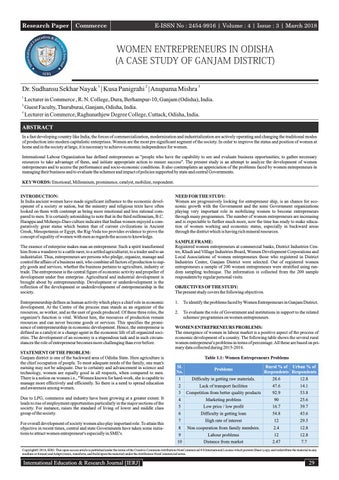
WOMEN ENTREPRENEURS PROBLEMS: The emergence of women in labour market is a positive aspect of the process of economic development of a country. The following table shows the several rural women entrepreneur's problems in terms of percentage. All these are based on primary data collected during 2015-2016. Table 1.1: Women Entrepreneurs Problems Sl. No.
Problems
1
Difficulty in getting raw materials.
28.6
12.8
2 3
Lack of transport facilities Competition from better quality products
47.6 92.9
14.1 53.8
Rural % of Urban % of Respondents Respondents
4
Marketing problem
90
25.6
5
Low price / low profit
16.7
39.7
6
Difficulty in getting loan
54.8
43.6
7
High rate of interest
12
29.5
8
Non cooperation from family members.
2.4
12.8
9 10
Labour problems Distance from market
12 2.47
12.8 7.7
CopyrightŠ 2018, IERJ. This open-access article is published under the terms of the Creative Commons Attribution-NonCommercial 4.0 International License which permits Share (copy and redistribute the material in any medium or format) and Adapt (remix, transform, and build upon the material) under the Attribution-NonCommercial terms.
International Education & Research Journal [IERJ]
29
Research Paper Sl. No
E-ISSN No : 2454-9916 | Volume : 4 | Issue : 3 | March 2018 Rural % of Urban % of Respondents Respondents
Problems
11 Ignorance about agencies and institutions 12 Ignorance about scheme 13 Others.
There are various promotional financial institutions which help women entrepreneurs in establishing the unit. They are as follows:
7.7 20.5
9.5 33.3
Table 1.2: Assistance from Financial Institutions
Source: Field survey data. In the table 1.1, it can be experiential that "competition" was prime problem faced by women entrepreneurs. It might be either from male entrepreneurs or from fellow women entrepreneurs. Women Entrepreneurs problems are totally free from the starting up of an enterprise to marketing of the product. When questions are being asked to women entrepreneurs under the study - "Do you face any problem in establishing your own business venture as women?" 90 percentage of women respondents positively said that it was very tricky to start and run the business venture as a woman separately. In addition to this, all the women entrepreneurs agree that the schemes, policies or incentives implemented by the Government have remained on paper without being passed on to the women entrepreneurs. Moreover, in the rural areas, the workers are generally engage in the low paid, support breaking agricultural activities or work helpers. It is not that women do not have any skill or ability, but they are not trained properly or inculcated in craftsmanship. It is felt that if a skill is imparted to a girl, it is wasted because when she gets wedded, she takes away skills with her. In spite of the availability of good training facilities in different institutes, this dogmatic social attitude keeps women away from these. ASSISTANCE FROM SELECTED FINANCIAL INSTITUTIONS: The promotional agencies help women to cope up with problems of finance, labour, competition and licensing with the Government. It can be said that "if an entrepreneur is the captain of the ship of the enterprise, the organization, agencies and associations which come to help the entrepreneur are like steering wheels of the ship. An attempt is made to discuss briefly towards the influence of different promotional agencies in setting up of an industrial unit by the women entrepreneurs in Ganjam district.
Institutions
No of Women Entrepreneurs
(%) Percentage
KFC / TIIC
45
22.5
KSIDC / SIPCOT
5
2.5
NSIC
15
7.5
SIDBI
25
12.5
Public sector banks
14
7
Co-operative banks
50
25
Regional rural banks
25
12.5
Others
21
10.5
Source: Field survey data. From the table 1.2, it is very clear that all the women entrepreneurs have got the assistance from all financial institutions. Very few women entrepreneurs have awareness about these promotional agencies. With this drawback, they do not avail the opportunity of utilization of these institutions to a major extent. Awareness of EDP and Reasons for Selection of Business: The training programmes should be designed in such a way that they are useful to the entrepreneurs by conveying essential knowledge. They should be designed to fill the gap between the knowledge possessed by the women entrepreneurs and the knowledge required for them. The analysis of effectiveness of training programmes in the form of Entrepreneurial Development Programmes as viewed by women entrepreneurs is presented in table 1.3. Further, with a view to explain awareness of EDPs and selection of the business enterprise by the women entrepreneurs, the relevant data was collected from the respondents of sample entrepreneur and shown in table 1.3.
Table 1.3: Awareness of EDP and Reasons for Selection of Business Awareness of Edp Easy Entrance More Profits Related to Prior Business Have Technical Knowledge Low Capital Investment
Others
Total
Yes
13.6%
6.85%
20.5%
20.5%
20.5%
18.2%
100%
No
18.2%
22.7%
22.7%
22.7%
4.5%
9.1%
100%
Source: Field survey data. Data presented in table 1.3 reveals that, majority of women entrepreneurs are not aware of the EDPs. Only 44% of entrepreneurs, out of 200 women entrepreneurs, had the awareness of Entrepreneurship Development Programmes, which are being conducted by Government agencies and Non- Government agencies such DIC. An analysis of data revealed that, those entrepreneurs who are aware of the EDPs, felt that the reasons for selection of business are possessing technical knowledge, followed by related to prior business, low capital investment, easy to enter into business and probability of earning more profits. AWARENESS ABOUT GOVT. SCHEMES: The respondents are asked as to whether they are aware of various schemes of assistance which the government has launched for entrepreneurs in general and for women entrepreneurs in particular. It is pertinent to mention here that even amongst those who are aware of the existence of such schemes, a majority replied that they are not fully aware of all schemes of assistance. Table 1.4: Awareness About Government Schemes Opinion
Frequency
Having Awareness
127
63.33
Not Having Awareness Total
73 200
36.67 100
Table 1.5: Availing the Schemes
30
Percentage
127
63.5
Not availed
73
36.5
Total
200
100
127 respondents (65.42%) availed the benefits from the government schemes and 73 respondents (34.58%) did not avail the benefits from the government schemes. Most of women entrepreneurs availed the benefits from the government schemes. FINDINGS: The following are the important findings drawn from the study: 1.
Study reveals that nearly 67 % of Women Entrepreneurs belongs to the age group of 18-30 years. They have come forward to start the business and only 13% of women entrepreneurs are in-between 30-50 years and 20 percentage of the total respondents come under the age group of 51 years and above.
2.
It is found that 70% of women entrepreneurs have come from nuclear family and only 30% are from joint family. Women belong to nuclear family are more capable to manage their business enterprises. Therefore, it is clear that to manage business successfully, environment in nuclear family is extra favorable for women entrepreneurs
3.
It is found that Hindus are dominating in starting industrial ventures compared to other castes. Mainly general category women entrepreneurs are availing additional entrepreneurial opportunities than other community people. Because general category women entrepreneurs are more social, economically and educationally forward.
4.
It has been observed that the majority of women entrepreneurs had metric education. But technical and graduated women entrepreneurs are very less
Source: Field Survey data.
AVAILING THE SCHEMES: The data about the number of sample respondents availed the assistance and not availing the assistance is given in the following table 1.5
The Frequency
Availed
Source: Field Survey data.
Percentage
Among the 200 respondents 127 (63.33%) respondents are having awareness about the government schemes especially for women entrepreneurs and 73 respondents (36.67%) are not having awareness about the government schemes. Most of the sample respondents are having awareness about the schemes introduced by the government for the women entrepreneurs.
Availing Assistant
International Education & Research Journal [IERJ]
Research Paper
E-ISSN No : 2454-9916 | Volume : 4 | Issue : 3 | March 2018
in these business ventures. It is being found that majority of the women entrepreneurs i.e., to tune of 63% are running their business under sole proprietorship and the remaining industries are under the partnership. 5.
It is observed that 65 % of industries are located in urban area, rest of the industries are located in semi-urban areas. It is clear that in the study region majority of the women enterprises are located in urban areas.
6.
This is clear from the survey that 45 % of the women entrepreneurs who are running the business like beauty parlour, Xerox shops etc. Where their investment is up to 1 lakh. Whereas the other women entrepreneurs mainly investment is in the range of 5-10 lakhs, in garments and plastic industries which are very famous and playing a major role in improving the economic conditions of women entrepreneurs.
7.
The field survey clearly represents that the women entrepreneurs in the study region are facing innumerable problems but the problems faced by the rural women entrepreneurs are extra than that of urban women entrepreneurs in the form of the problems of Raw-Materials, labour, finance, marketing, high rate of interest, competition etc.
8.
It is an recognized fact that the development of industrial units depends upon the accessibility of skilled laborers and trained persons. But it is observed that the potential entrepreneurs of the district do not have adequate technical knowledge for establishing units.
SUGGESTIONS: There is a need to protected the women a reasonable share of employment opportunities and thus increase their rate of participation in the economic activities. 1.
It is being suggested that in order to attract the age group of women above 30 years the Central and State Governments has to encourage and motivate women to come forward to initiate the business ventures by implementing various policies and measures such as incentives, tax concessions, subsidies etc.
2.
It has been suggested that in order to improve the economic condition of joint family members, the Government has to formulate some specific measures and policies so that family members can contribute something to the country's economic development by establishing more business ventures and there by the economic backwardness of our country can be minimized.
3.
Even though the Government has extended and provided various facilities to the women belonging to other casts such as OBC, SC, ST etc., to start business ventures by providing training programmes, tool kits, industrial sites etc. But it is unfortunate that these facilities are being mis-utilized and thereby the purpose has not been served.
4.
Therefore, it is being suggested the Government has to setup a committee to monitor strictly as well as the Government has to improve certain measures.
5.
In the present scenario due to modernization, Globalization and Liberalization progress of education with increasing awareness, we are seeking gainful employment in several fields. It is suggested that formal education plans should be made more effective by establishing a linkage with industries and commerce. Services of universities, educational institutions, professional associations and NGO's may be involved in conducting training programmes.
6.
The activities of Indian women are usually limited to kitchen activities i.e., 3ps (Papad, pickle, masala powder). Therefore, a woman is hesitant to undertake the responsibility of establishing a business venture alone. Therefore, in order to inspire the industrial development by women folk. The central and state Government's should adopt appropriate measures by giving some incentives and there by establish the business ventures either under partnership basis or joint ventures.
REFERENCES: 1.
M.V. Raghavulu "women entrepreneurship in backward areas", sedme, December2003,p-45646.
2.
George Herbertson Events Jr., "The Entrepreneur and Economic Theory", American Economic Review; 1949,p.335.
3.
Hans Schollhammer and Arthur H. Kuriloff, Entrepreneurship and Small Business Management, (New York: John Wiley Sons, 1993) p.1.
4.
Tandon, B.C., "Entrepreneurial Inputs in Management Studies", Economic Times, December 1990, p.13.
5.
Srivastava, S.B., Practical guide to Industrial Entrepreneurs, (New Delhi: Sultan Chand & Sons, 1992), p.36.
6.
Kirmandevedra, Status and Position of Women in India, (New Delhi: Sakthi Books, 1985), p.13.
International Education & Research Journal [IERJ]
31