Research Paper
Education
E-ISSN No : 2454-9916 | Volume : 5 | Issue : 6 | June 2019
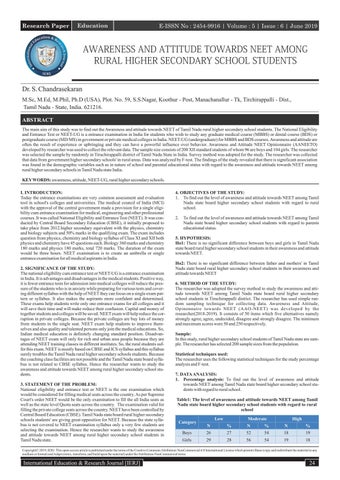
AWARENESS AND ATTITUDE TOWARDS NEET AMONG RURAL HIGHER SECONDARY SCHOOL STUDENTS Dr. S. Chandrasekaran M.Sc, M.Ed, M.Phil, Ph.D (USA), Plot. No. 59, S.S.Nagar, Koothur - Post, Manachanallur - Tk, Tirchirappalli - Dist., Tamil Nadu - State, India. 621216. ABSTRACT The main aim of this study was to find out the Awareness and attitude towards NEET of Tamil Nadu rural higher secondary school students. The National Eligibility and Entrance Test or NEET-UG is a entrance examination in India for students who wish to study any graduate medical course (MBBS) or dental course (BDS) or postgraduate course (MD/MS) in government or private medical colleges in India. NEET-UG (undergraduate) for MBBS and BDS courses. Awareness and attitude are often the result of experience or upbringing and they can have a powerful influence over behavior. Awareness and Attitude NEET Opinionnaire (AANEETO) developed by researcher was used to collect the relevant data. The sample size consists of 200 XII standard students of whom 96 are boys and 104 girls. The researcher was selected the sample by randomly in Tiruchirappalli district of Tamil Nadu State in India. Survey method was adopted for the study. The researcher was collected that data from government higher secondary schools' in rural areas. Data was analyzed by F-test. The findings of the study revealed that there is significant association was found in the demographic variables such as in nature of school and parental educational status with regard to the awareness and attitude towards NEET among rural higher secondary schools in Tamil Nadu state India. KEY WORDS: awareness, attitude, NEET-UG, rural higher secondary schools. I. INTRODUCTION: Today the entrance examinations are very common assessment and evaluation tool in school's colleges and universities. The medical council of India (MCI) with the approval of the central government made a provision for a single eligibility cum entrance examination for medical, engineering and other professional courses. It was called National Eligibility and Entrance Test (NEET). It was conducted by Central Board Secondary Education (CBSE), it initially proposed to take place from 2012.higher secondary equivalent with the physics, chemistry and biology subjects and 50% marks in the qualifying exam. The exam includes question from physics, chemistry and biology syllabus of Class XI and XII both physics and chemistry have 45 questions each. Biology 360 marks and chemistry 180 marks and physics 180 marks, total 720 marks. The duration of the exam would be three hours. NEET examination is to create an umbrella or single entrance examination for all medical aspirants in India. 2. SIGNIFICANCE OF THE STUDY: The national eligibility cum entrance test or NEET-UG is a entrance examination in India. It is advantages and disadvantages in the medical students. Positive way, it is fewer entrance tests for admission into medical colleges will reduce the pressure of the students who is in anxiety while preparing for various tests and covering different syllabus with the help of NEET they can focus on a single exam pattern or syllabus. It also makes the aspirants more confident and determined. These exams help students write only one entrance exams for all colleges and it will save their time and will make reduce their confusion. Capital and money of together students and colleges will be saved. NEET exam will help reduce the corruption in private colleges. Because the private colleges are buy lots of money from students in the single seat. NEET exam help students to improve themselves and also quality and talented persons only join the medical educations. So, Indian medical education is definitely changing standard position. Disadvantages of NEET exam will only for rich and urban area people because they are attending NEET training classes in different institutes. So, the rural students suffer this exam. NEET is mostly based on CBSE and ICS syllabus and this syllabus surely troubles the Tamil Nadu rural higher secondary schools students. Because the coaching class facilities are not possible and the Tamil Nadu state board syllabus is not related to CBSE syllabus. Hence the researcher wants to study the awareness and attitude towards NEET among rural higher secondary school students. 3. STATEMENT OF THE PROBLEM: National eligibility and entrance test or NEET is the one examination which would be considered for filling medical seats across the country. As per Supreme Court's order NEET would be the only examination to fill the all India seats as well as the state level Quota seats across the country. The examination valid for filling the private college seats across the country. NEET have been controlled by Central Board Education (CBSE). Tamil Nadu state board rural higher secondary schools students' are giving great opposition for NEET. Because the state syllabus is not covered to NEET examination syllabus only a very few students are selecting the examination. Hence the researcher wants to study the awareness and attitude towards NEET among rural higher secondary school students in Tamil Nadu state.
4. OBJECTIVES OF THE STUDY: 1. To find out the level of awareness and attitude towards NEET among Tamil Nadu state board higher secondary school students with regard to rural school. 2.
To find out the level of awareness and attitude towards NEET among Tamil Nadu state board higher secondary school students with regard to parents educational status.
5. HYPOTHESIS: Ho1: There is no significant difference between boys and girls in Tamil Nadu state board rural higher secondary school students in their awareness and attitude towards NEET. Ho2: There is no significant difference between father and mothers' in Tamil Nadu state board rural higher secondary school students in their awareness and attitude towards NEET 6. METHOD OF THE STUDY: The researcher was adopted the survey method to study the awareness and attitude towards NEET among Tamil Nadu state board rural higher secondary school students in Tiruchirappalli district. The researcher has used simple random sampling technique for collecting data. Awareness and Attitude, Opinonnaire towards NEET (AAO-NEET) was developed by the researcher(2018-2019). It consists of 50 items which five alternatives namely strongly agree, agree, undecided, disagree and strongly disagree. The minimum and maximum scores were 50 and 250 respectively. Sample: In this study, rural higher secondary school students of Tamil Nadu state are sample. The researcher has selected 200 sample sizes from the population. Statistical techniques used: The researcher uses the following statistical techniques for the study percentage analysis and F-test. 7. DATA ANALYSIS: 1. Percentage analysis: To find out the level of awareness and attitude towards NEET among Tamil Nadu state board higher secondary school students with regard to rural school. Table1: The level of awareness and attitude towards NEET among Tamil Nadu state board higher secondary school students with regard to rural school Category
Low
Moderate
High
N
%
N
%
N
%
Boys
26
27
52
54
18
19
Girls
29
28
56
54
19
18
Copyright© 2019, IERJ. This open-access article is published under the terms of the Creative Commons Attribution-NonCommercial 4.0 International License which permits Share (copy and redistribute the material in any medium or format) and Adapt (remix, transform, and build upon the material) under the Attribution-NonCommercial terms.
International Education & Research Journal [IERJ]
24
Research Paper
E-ISSN No : 2454-9916 | Volume : 5 | Issue : 6 | June 2019
Above the table shows 27% of boys are low level, 54% of boys moderate and 19% of boy's high level of awareness and attitude towards NEET.28% of girl's low level, 54% of girls moderate and 18% of girls high level of awareness and attitude towards NEET.
towards NEET. The mean score shows that, boys mean (73.51), girls mean (67.96), awareness and attitude towards NEET. 2.
There is significant difference was found in father and mother of Tamil Nadu state board rural higher secondary school students in their awareness and attitude towards NEET, The mean score shows that, boys mean (63.61), girls mean (68.66), awareness and attitude towards NEET.
9. RECOMMENDATION OF THE STUDY: 1. The government to conduct awareness programs about the NEET examination among the rural students and parents.
Fig1: The level of awareness and attitude towards NEET among Tamil Nadu state board higher secondary school boys and girls with regard to rural school To find out the level of awareness and attitude towards NEET among Tamil Nadu state board higher secondary school students with regard to parents' educational status. Table2: level of awareness and attitude towards NEET among Tamil Nadu state board higher secondary school students with regard to Parents' educational status. Category Father Mothers
Low
Moderate
High
N
%
N
%
N
%
28 21
29 20
47 59
49 57
21 24
22 23
Above the table shows 29% of father are low level, 49% of fathers' moderate and 22% of fathers' boy's high level of awareness and attitude towards NEET.20% of mothers' low level, 57% of mothers' moderate and 23% of mothers high level of awareness and attitude towards NEET.
2.
Parent should encourage the children about the NEET examination those who have the medical aspirants.
3.
The teachers should encourage the students whose the parent are illiterate towards NEET examination.
4.
The central and state government should provide same syllabus across the country in higher secondary level.
5.
School should provide library facilities for NEET preparation.
6.
School should provide planned reading times and conducting frequents based on NEET.
REFERENCES: 1.
Airasian, P. W. and Gullickson, A. ( 1994). Examination of teacher self-assessment. Journal of Personnel Education in Education, 8(2), 195-203.
2.
National Council of Educational Research and Training (2005). National Curriculum Framework. New Delhi : NCERT
3.
Rowan, B. & Correnti, R. & Miller, R. (2002). What large-scale, survey research tells us about teacher effects on student achievement: Insights from the Prospects study of elementary schools. Teachers College Record, 104(8), 1525-1567.
4.
Das, R. (2001). The spatiality of social relations: An Indian case--‐study. Journal of Rural Studies,17(3), 347-362.
5.
Deb, S. & Mathews, B. (2012). Children's rights in India: Parents' and teachers' attitudes, knowledge and perceptions. International Journal of Children's Rights, 20, 241264.
Statistical analysis: There is no difference between boys and girls in Tamil Nadu state board rural higher secondary school students' their awareness and attitude towards NEET Table3: The association among boys and girls in Tamil Nadu state board rural higher secondary school students' their awareness and attitude towards NEET Category
Sum of square
df
mean
Boys
1528.302
2
799.427
Girls
2581.103
237
101.068
t-value
Significant
6.722
S
(The table value of F for df 2.673 is 3.04) In the above table, since the F-value (=3.658) is greater than the table value (=3.04), the null hypothesis is not accepted at 5%level of significance. This shows that there is significant the Tamil Nadu state board rural higher secondary school students' in their awareness and attitude towards NEET. There is no difference between fathers' and mothers' in Tamil Nadu state board rural higher secondary school students' their awareness and attitude towards NEET Table4: The significant association among fathers' and mothers' in Tamil Nadu state board rural higher secondary school students' their awareness and attitude towards NEET Category
Sum of square
df
mean
t-value
Significant
Father Mother
763.612 26171.289
2 247
319.813 104.372
3.897
S
(The table value of F for df 2.673 is 3.04) In the above table, since the F-value (=3.793) is greater than the table value (=3.04), the null hypothesis is not accepted at 5%level of significance. This shows that there is significant the Tamil Nadu state board rural higher secondary school students' in their awareness and attitude towards NEET. 8. MAJOR FINDINGS: 1. There is significant difference was found in Tamil Nadu state board rural higher secondary school boys and girls in their awareness and attitude
25
International Education & Research Journal [IERJ]