Engineering
Research Paper
E-ISSN No : 2454-9916 | Volume : 6 | Issue : 2 | Feb 2020
PROTOTYPING OF CAPRICIOUS D–DRONE
1
1
1
Adesh Umbarkar | Rajrajeshwar Kshatriya | Danish Mirza, Savita Hande | Prof. T. R. Bhanegaonkar 1
1
Dept. of Electrical Engineering, Amrut vahini College of Engineering, Savitribai Phule Pune University, Sangamner. Maharashtra, India.
ABSTRACT A hybrid of a quad-copter and an all-terrain tank has been called 'Unmanned Aerial and Ground Vehicle' or UAGV. Their use has increased drastically because they are multifunctional and reliable. It's capable of driving across rough terrain, armed with 4 propellers that allow it to take off once the obstacle becomes too big to drive over. The project would have an impact on carrying out future rescue missions and would provide visual and audio aid to the people in distress. This paper tries to give cost effective measures to improve upon some features of 'drones' used in the military, construction site monitoring. KEYWORDS: Tank Quad copter, surveillance, UAGV. I. INTRODUCTION: Unmanned Aerial Vehicles (UAVs) serve a wide range of requirements in the modern age. A multi-rotor copter with a 4 Propeller, 4 motors and 4 arms is termed Quad copters. The craft is in shape of English alphabet 'X' and these rotors are rotating clock wise and anti-clock wise adjacent to one another for to balance the torque produced. It has 4 rotors, so for the motion of the quad copter the 4 rotors are used to push the air downwards and thus creating a thrust in order to keep the quad copter aerial. Some considerations when making a quad copter are size, weight, built material, battery size, motor and propellers etc. The weight needs to be low enough so the Quad copter's upward thrust creates a force great enough for flight to occur [1].
Body Frame Modeling
There are several problems faced in while carrying out rescue operations. It is costly to carry out a rescue operation as it requires many resources and expenditure. Large number of skilled manpower is required for operating rescue missions. Topographical aspects may vary from place to place thus putting additional human efforts. Unfavorable conditions such as bad weather, land sliding, earth quakes could pose as a threat while trying to save people [3]. The Tank Quad Copter Drone is a flying tank, awesome for outdoor and indoor use. It's capable of driving across rough terrain, armed with 4 propellers that allow it to take off once the obstacle becomes too big to drive over. You can explore new places that are out of reach for any other vehicles. The Tank Copter can turn on the spot which is extremely useful in a limited space, as it's driving on the ground, when obstacles become too big, it can simply take off and fly over them [2]. II. METHODOLOGY: The initial step would be to create a chassis (frame) where APM 2.8 controller, the main component would be mounted. Lithium battery will be used as they have the best ratio of weight to power. Motors would be used to spin the propellers. Using Electronic Speed Controller (ESC) unit will control the four motors and provide stability to the copter. When the controller of the quad copter is moved up or down the propeller speed is adjusted causing the quad copter to gain or lose altitude. When a system accelerates mass in one direction, the accelerated mass will cause a force of equal magnitude but opposite direction on that system. Single UAV implies that it can only fly in air. UAGV can not only fly as well as move on the ground with help of caterpillar (track) unit. Caterpillar is mechanism which enables drone to move on the ground and can be achieved by motorwheel-belt or motor-wheel combination.
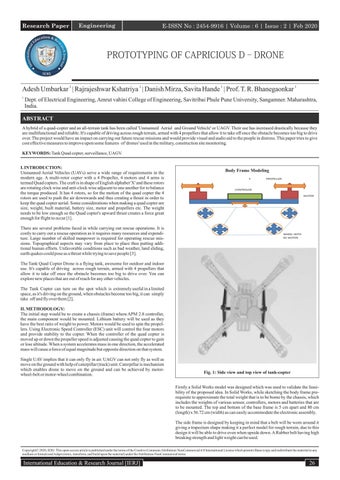
Fig. 1: Side view and top view of tank-copter Firstly a Solid Works model was designed which was used to validate the feasibility of the proposed idea. In Solid Works, while sketching the body frame prerequisite to approximate the total weight that is to be borne by the chassis, which includes the weights of various sensor, controllers, motors and batteries that are to be mounted. The top and bottom of the base frame is 5 cm apart and 80 cm (length) x 56.72 cm (width) as can easily accommodate the electronic assembly. The side frame is designed by keeping in mind that a belt will be worn around it giving a trapezium shape making it a perfect model for rough terrain, due to this design it will be able to drive even when upside down. A Rubber belt having high breaking strength and light weight can be used.
Copyright© 2020, IERJ. This open-access article is published under the terms of the Creative Commons Attribution-NonCommercial 4.0 International License which permits Share (copy and redistribute the material in any medium or format) and Adapt (remix, transform, and build upon the material) under the Attribution-NonCommercial terms.
International Education & Research Journal [IERJ]
26
Research Paper
E-ISSN No : 2454-9916 | Volume : 6 | Issue : 2 | Feb 2020
III. MATHEMATICAL PRELIMINARIES: Resulting thrust is calculated by using Newton's Laws of Motion. Force (F) equals mass (m) time's acceleration (a) or also equal to the momentum change rate. That is force produces a change in momentum.
Ÿ
Air Resistance V = velocity of vehicle= 3.39 km/hr. U = velocity of air = 5 km/hr.
F= ma = d (mv)/d ……… (1) C = drag co-efficient for car = 0.5. The equation (1) is used to explain the relation between velocity and thrust. According to fluid dynamics theory, for airflow encircling the propeller the rate of flow of mass in steady /hovering movement condition can be calculated for a surface area (A). Air density (ρ), velocity of air (u) are the two parameters upon which air pressure force depends is mathematically shown in equation (2) where velocity of the air under the propeller is represented by (v).
AR= 0.5*ϱ*A*C* Where, A=0.18 AR = 0.2937 Newton Ÿ
............. (2) Assume the total mass of the quad-copter is 5000g and the payload capacity of the drone is 5000g the thrust per motor is calculated considering the total weight of the quad-copter.
M = mass of vehicle +mass of rotating parts. t = time to reach top speed. IR = ± M*a Where, a = 0.18848 m/s2
Thrust required = (5000g + 5000g)*1.2 [Assuming thrust required to lift is 20% greater than the total mass] Thrust required = 12000 grams.
Inertia Resistance
IR = 2.544 Newton. Ÿ
Total Tractive Force
TF = 35.316 + 30.46 + 0.2937 + 2.544
Diameter of wheel = 5 cm
= 68.6137 Newton
Considering Belt thickness = 0.5 cm
Ÿ
Total torque = TF * r
Total diameter = 5+ 0.5+0.5= 6 cm
= 68.6137 *0.03
Max rpm of motor = 300
=2.0584 Newton meter. Top speed = km/hr.
(Including losses take 20% extra torque
v= π*d*n/60 v=3.39264 km/hr. Torque Calculations: As we considered
= 1.2*2.0584= 2.47 N-m) Ÿ
Torque in kg- cm
= (2.47/9.81)*100 = 25.179kg-cm
1) µ = 0.3 for belt
Ÿ
2) 20% of extra torque
Torque on each motor = (25.17/4)
3) 20 % of extra load
= 6.294 kg-cm
4) Max air resistance 0.18 m2
Hence motor with torque 8 kg-cm is suitable.
Factors affecting required torque: (Note: All forces are in Newton (N).) 1) Rolling Resistance
3)
A ir Resistance
2) Grade Resistance
4)
Inertia Resistance
Total tractive effort T.E. = sum of all resistances above
Ÿ
All the components are selected on the base of performance, voltage requirements, endurance, and quality.
Ÿ
Each component has its specific operation in tank copter.
Ÿ
Some other components which are needed in tank copter are pulleys and rubber tracks. They have a function in the operation of caterpillar.
Total torque TT = TE*radius of wheel of caterpillar. Ÿ
Rolling Resistance R.R. = μ*m*g μ = 0.3 max (considering sand surface) = 0.3*12*9.81
R.R. = 35.316 N For 1 wheel
Ÿ
= 8.829 Newton
Grade Resistance GR = m*g* sin θ
Fig. 2: Side view of drone (2D Model)
= 12*9.81*sin 15 GR = 30.46 N GR on 1 wheel = 7.61 Newton
27
IV. ADVANTAGES AND FUTURE SCOPE: When there is shortage of power in battery the caterpillar can be used to move the Tank-Copter as
Ÿ
International Education & Research Journal [IERJ]
Research Paper
E-ISSN No : 2454-9916 | Volume : 6 | Issue : 2 | Feb 2020
Ÿ
It consumes very less power as compared to flying domain.
Ÿ
As per calculation above Tank-Copter is able to lift payload of 4kg.
Ÿ
Tank copter can be used as surveillance tool in military operated zones and it can also help to supply medics to the ongoing war zones.
Ÿ
Silent operation with the use of caterpillar
V. CONCLUSION: The detailed study over the Tank-Copter and necessary aspects is conducted in order to achieve most efficient and promising facts. After reviewing all aspects it is concluded that Tank-Copter proves to be very recent drone that can be used for multiple purposes in various sectors. In coming future tank-copter can be manufactured with high precision and can prove to be best drone not only in the field of surveillance but also to carry ammunition in war affected zones or to carry medics where human help cannot come as quick as possible. REFERENCES: 1.
Albin Boban, Ershad V. N, Krishnakumar P., Preethi Sebastian "Solar Empowered Quad-Copter with Smartphone Control” International Journal of Advanced Research in Electrical, Volume 5, Special Issue 3, March 2016.
2.
Swati Sondhi, Sumeet Sagar, Siddharth Aggarwal, Vinayak Chakravarty, Sunidhi Garg "Prototyping of unmanned aerial & ground vehicle” International Conference on Unmanned Aircraft Systems (ICUAS), volume 2,1 June 2018.
3.
Shikhar Chawra, Sayantan Kar, Aaditya D. Rathod, V Nagaveni “Amphibious Drone, Which Can Land and Take Off From Any Water Body Safely" International Journal of Computer Science Trends and Technology (IJCST) – Volume 6 Issue 5, Sep-Oct 2018.
4.
Shreyas Suhas Gadara, Rajneesh Gajadharprasad Verma "DESIGN OF MULTIDOMAIN MULTI-COPTER” International Research Journal of Engineering and Technology (IRJET) Volume: 05 Issue: 07 July 2018.
5.
P. Pounds and R. Mahony, “Design principles of large quad rotors for practical applications,” in Proceedings of the IEEE International Conference on Robotics and Automation (ICRA), pp. 3265 –3270,3 May 2009.
6.
KAUSAR MUKADAM, AISHWARYA SINH AND RUHINA KARANI "Detection of landing areas for unmanned aerial vehicles"-, IEEE Xplore: 23 February 2017.
International Education & Research Journal [IERJ]
28