Engineering
Research Paper
E-ISSN No : 2454-9916 | Volume : 4 | Issue : 6 | June 2018
A COLLECTIVE STUDY ON BUG DETECTION AND REPORTING BUG TRIAGE SYSTEM 1
Nagini K. Dharne | Prof. S. G. Swami
2
1
Department of Computer Science and Engineering, M. S. Bidve Engineering College Latur, Swami Ramanand Teerth Marathwada University Nanded, India. 2 Prof. Department of Computer Science and Engineering, M. S. Bidve Engineering College Latur, Swami Ramanand Teerth Marathwada University Nanded, India. ABSTRACT
Open source development projects typically support an open bug repository to which both developers and users can report bugs. Software artifacts will be developed with the developers build. Existing work has studied the social behavior in software repositories. In one of the most important software repositories, a bug repository, developers create and update bug reports to support software development and maintenance. However, no prior work has considered the priorities of developers in bug repositories. In this paper we address the feature selection and instance selection to reduce the data scale and address the problem of data reduction. the assignment of reports to a developer ,creating the bug triage .We decide the order of bug solve and assign to the developer as per the history record .and build the predictive bug report . KEYWORDS: Bug, bug triage, feature selection, instance selection, bug report. 1. INTRODUCTION: Bug triage aims to assign an appropriate developer to fix a new bug, i.e., to determine who should fix a bug.A bug repository (a typical software repository, for storing details of bugs), plays an important role in managing software bugs. Software bugs are inevitable and fixing bugs is expensive in software development. Software companies spend over 45 percent of cost in fixing bugs. Large software projects deploy bug repositories (also called bug tracking systems) to support information collection and to assist developers to handle bugs. In a bug repository, a bug is maintained as a bug report, which records the textual description of reproducing the bug and updates according to the status of bug fixing. A bug repository provides a data platform to support many types of tasks on bugs, e.g., fault prediction, bug localization, and reopened bug analysis. Bug reports in a bug repository are called bug data.
3. SYSTEM IMPLEMENTATION:
Most open source software developments incorporate an open bug repository that allows both developers and users to post problems encountered with the software, suggest possible enhancements, and comment upon existing bug reports. One potential advantage of an open bug repository is that it may allow more bugs to be identified and solved, improving the quality of the software produced. 2. RELATED WORK: Our approach is used to triage the bug particular user and assign the bug ,also bug reduction so performance of the user ,developer are increases reduction order and each attribute is helpful to the prediction. The primary contributions of this paper are as follows:
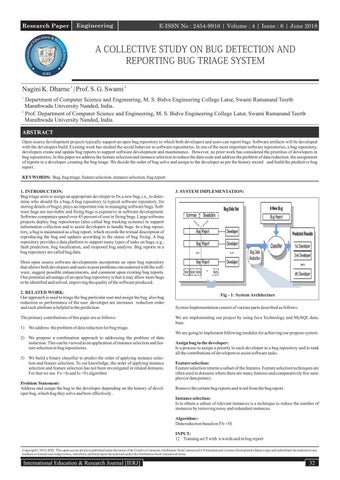
Fig - 1: System Architecture System Implementation consist of various parts described as follows: We are implementing our project by using Java Technology and MySQL database.
1) We address the problem of data reduction for bug triage. We are going to implement following modules for achieving our propose system: 2) We propose a combination approach to addressing the problem of data reduction. This can be viewed as an application of instance selection and feature selection in bug repositories. 3) We build a binary classifier to predict the order of applying instance selection and feature selection. To our knowledge, the order of applying instance selection and feature selection has not been investigated in related domains. For that we use Fs->Is and Is->Fs algorithm Problem Statement: Address and assign the bug to the developer depending on the history of developer bug ,which bug they solve and how effectively .
Assign bug to the developer: Is a process to assign a priority to each developer in a bug repository and to rank all the contributions of developers to assist software tasks. Feature selection: Feature selection returns a subset of the features. Feature selection techniques are often used in domains where there are many features and comparatively few samples (or data points). Remove the certain bug reports and word from the bug report. Instance selection: Is to obtain a subset of relevant instances is a technique to reduce the number of instances by removing noisy and redundant instances . Algorithm:Data reduction based on FS->IS INPUT: 1] Training set T with n words and m bug report
Copyright© 2018, IERJ. This open-access article is published under the terms of the Creative Commons Attribution-NonCommercial 4.0 International License which permits Share (copy and redistribute the material in any medium or format) and Adapt (remix, transform, and build upon the material) under the Attribution-NonCommercial terms.
International Education & Research Journal [IERJ]
32
Research Paper
E-ISSN No : 2454-9916 | Volume : 4 | Issue : 6 | June 2018 Conf. Softw. Eng., May 2006, pp. 361–370.
2] Reduction order feture selection then instance selection 3] final number nf of words 4] final number mI of bug reports OUTPUT: Step1] : Ÿ Reduce dataset TFI for bug triage for all the words Ÿ
Apply FS to n words of T and calculate objective values
Step2] Ÿ Select the top nF words of T and generate a training Ÿ
set T F
Step3] Ÿ apply IS to mI bug reports of T F ; Step4] Ÿ terminate IS when the number of bug reports is equal to Ÿ
or less than mI and generate the final training set T FI
Where F=Feature selection I=Instance selection TFI=final data after feature and instance selection 4. MODULE FLOW: Table 1. Fixed Bug file report Bug File
Assigned to the developer
Uploaded by tester
Completed duration
File 1
Krishna
Wilson
5 days
File 2
John
Shreya
2 week
File 3
Roy
Nandini
1 month
This module shows four parts as follow: 1) Firstly it will show how many bug files are not assigned to any developer. It will give complete status about the bugs to the admin so that he will come to know which bugs are not assigned yet. 2) Secondly it will show how many bugs are not assigned to any developer. It will give complete status about the bugs to the admin so that he will come to know which bugs are assigned. 3) Thirdly it will show how many bugs are rectified by the developers. It will give complete status about the bugs to the admin so that he will come to know which bugs are rectified completely. 4) Fourthly it will show how many bugs are not rectified by the developers. It will give complete status about the bugs to the admin so that he will come to know which bugs are not rectified yet. 5. CONCLUSION: Bug triage is an expensive step of software maintenance in both labor cost and time cost. In this paper, we combine feature selection with instance selection to reduce the scale of bug data sets as well as improve the data quality.We empirically investigate the data reduction for bug triage in bug repositories of two large open source projects, namely Netbeans and Mozilla. In future work, we plan on improving the results of data reduction in bug triage to explore how to prepare a high- quality bug data set and tackle a domain-specific software task. For predicting reduction orders, we plan to pay efforts to find out the potential relationship between the attributes of bug data sets and the reduction orders. 6. REFERENCES: 1.
M. Rogati and Y. Yang, “High-performing feature selection for text classification,” in Proc 11th Int. Conf. Inform. Knowl. Manag., Nov. 2002, pp. 659–661.
2.
Jifeng Xuan, He Jiang, Zhilei Ren, Weiqin Zou,” Towards Effective Bug Triage with Software Data Reduction Techniques” IEEE transactions on knowledge and data engineering, vol. 27, no. 1, january 2015.
3.
D. R. Wilson and T. R. Mart_ınez, “Reduction techniques for instance-based learning algorithms,” Mach. Learn., vol. 38, pp. 257–286, 2000.
4.
J. Anvik, L. Hiew, and G. C. Murphy, “Who should fix this bug?” in Proc. 28th Int.
33
International Education & Research Journal [IERJ]