Research Paper
MIS
E-ISSN No : 2454-9916 | Volume : 5 | Issue : 1 | Jan 2019
EXPLOITING RFID FOR BUSINESS TRANSFORMATION: A STRATEGIC ANALYSIS VIS-À-VIS AGRICULTURAL BANK OF CHINA Dr. Harman Preet Singh Department of Management & Information Systems, College of Business Administration, University of Hail. ABSTRACT RFID has brought transformation of business processes in the present time. It has overcome the limitations of barcode scanners and is also becoming cost effective. Due to this, there is an increase in adoption of RFID by the businesses across the globe. In this paper, the applications of RFID in various business situations have been studied. The transformation brought by the RFID in companies like Walmart, American Apparel, Spectrum Health's Meijer Heart Center, Agricultural Bank of China have been examined. It has been found that RFID has made their processes more automated, streamlined, efficient, reliable, secure and adaptive. In order to conduct strategic analysis of RFID implementation, SWOT and TOWS analyses haves been conducted in Agricultural Bank of China. The strategic analysis shows that Bank has become more efficient, effective, streamlined and consistent after implementing RFID. However, the Bank needs to address RFID installation, connectivity and privacy issues. It should deploy data analytics and data mining based on data collected from RFID to retain its competitive edge. KEYWORDS: Business Transformation, RFID, Strategic Analysis, SWOT Analysis, TOWS Analysis. 1. INTRODUCTION: Information and Communication Technology (ICT) has brought about tremendous transformation in the conduct of modern businesses (Singh et al., 2013). RFID has emerged as a fast developing ICT platform, which has brought transformation in business processes. It belongs to Automatic Identification and Data Capture (AIDC) group of technologies. It captures digital data with the help of radio waves. It provides wireless identification and tracking capability of objects or people. RFID is replacing barcode scanners as the main object tracking system. Barcodes are cheaper than RFID tags but they have a low storage capacity, require a line of sight and cannot be re-programmed. Barcodes can be obscured by grease and nearby objects, and are hard to read in sunlight or when printed on some substrates. However, the cost of RFID tags is decreasing over the years. A basic RFID tag can be purchased for as low as 10 US cents. Further, RFID has better range and speed than barcode scanners. Under ideal conditions, a RFID tag can be detected and read from 30 feet between the tag and scanner (Watson, 2015). So, RFID improves operations management and eliminates human errors. The RFID tags can be re-programmed and can work in harsh environments. The RFID tags do not require a line of sight to be read. They can be read through wood, plastic, cardboard, sunlight etc. (except metal). Due to these advantages, RFID technology is witnessing a rapid growth. The global RFID technology market size was valued at USD 10.53 billion in 2015. It is expected to reach USD 40.5 billion by 2025 (Grand View Research, 2017). According to https://www.statista.com/, the global market for RFID tags is expected to increase to 24.5 billion USD in 2020 from 12.6 billion USD in 2016. 2. COMPONENTS OF RFID: RFID technology broadly consists of following 2 components (Jechlitschek, 2013): Ÿ
Ÿ
RFID tag – It is of the size of a grain of rice and can be embedded in the items to be tracked. It consists of a micro-processor chip and an antenna to transmit radio waves to the RFID reader. It could be passive or active. Passive tag is widely used in consumer goods as it is smaller and less expensive. However, it must be powered by the RFID reader before it can transmit data. Active RFID tag has a battery, which enables it to transmit data at all times. However, it is bigger and more expensive than passive tag. It is commonly used in navigation system for commercial and private aircrafts (Finkenzeller, 2010). RFID reader – RFID reader processes the radio waves and converts them into usable form of data. The reader is also called interrogator because it interrogates the tag and collects data. The collected data can be stored in a database and analyzed.
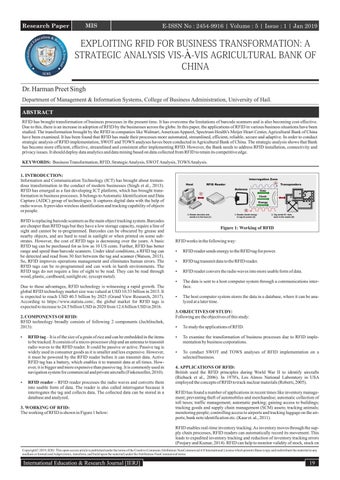
3. WORKING OF RFID: The working of RFID is shown in Figure 1 below:
Figure 1: Working of RFID RFID works in the following way: Ÿ
RFID reader sends energy to the RFID tag for power.
Ÿ
RFID tag transmit data to the RFID reader.
Ÿ
RFID reader convers the radio waves into more usable form of data.
Ÿ
The data is sent to a host computer system through a communications interface.
Ÿ
The host computer system stores the data in a database, where it can be analyzed at a later time.
3. OBJECTIVES OF STUDY: Following are the objectives of this study: Ÿ
To study the applications of RFID.
Ÿ
To examine the transformation of business processes due to RFID implementation by business corporations.
Ÿ
To conduct SWOT and TOWS analyses of RFID implementation on a selected business.
4. APPLICATIONS OF RFID: British used the RFID principles during World War II to identify aircrafts (Rieback et al., 2006). In 1970's, Los Almos National Laboratory in USA employed the concepts of RFID to track nuclear materials (Roberti, 2005). RFID has found a number of applications in recent times like inventory management; preventing theft of automobiles and merchandise; automatic collection of toll taxes; traffic management; automatic parking; gaining access to buildings; tracking goods and supply chain management (SCM) assets; tracking animals; monitoring people; controlling access to airports and tracking luggage on the airports; bank note identification etc. (Kaur et. al., 2011). RFID enables real-time inventory tracking. As inventory moves through the supply chain processes, RFID readers can automatically record its movement. This leads to expedited inventory tracking and reduction of inventory tracking errors (Poojary and Kumar, 2014). RFID can help to monitor validity of stock, stock on
Copyright© 2019, IERJ. This open-access article is published under the terms of the Creative Commons Attribution-NonCommercial 4.0 International License which permits Share (copy and redistribute the material in any medium or format) and Adapt (remix, transform, and build upon the material) under the Attribution-NonCommercial terms.
International Education & Research Journal [IERJ]
19
Research Paper
E-ISSN No : 2454-9916 | Volume : 5 | Issue : 1 | Jan 2019
shelves, misplaced stock etc. (Vats, 2017). Theft management is a big problem in many retail stores. There are transactions of lot of goods and large numbers of customers are engaged in these transactions. So, it becomes difficult to keep an eye on a large number of customers. In order to counter these problems, RFID tag is attached to the object and integrated with a motion sensor. The sensor detects motion of the object. When an effort is made to steal the object, a real-time notification of theft is sent to the store staff. This is particularly useful to secure safety of high value items (Khoo and Cheng, 2011; Hamid et al., 2012).
5. IMPLEMENTATIONS OF RFID BY BUSINESSES: Due to large number of applications of RFID and its benefits, businesses have integrated RFID into their processes. Some noticeable implementations of RFID are discussed below: Ÿ
Walmart – Walmart has been the pioneer of RFID integration into its supply chain. In 2003, Walmart required its top 100 suppliers to insert RFID tags into pallets and cases that were shipped to it. In 2007, Walmart decided to integrate RFID into its stores instead of distribution centers. With the reduction of price of RFID tags, Walmart required its suppliers from July 2010 onwards to insert removable RFID smart tags on individual apparel items. RFID has been credited with reducing Walmart's out of stock situations, cutting the volume of excess inventory in supply chain, reducing bull-whip effect, reducing administration costs, automation of real-time inventory management, improving tracking of products and their expiration dates, automation of invoices and payments, and enhanced data sharing with suppliers along with analytics capabilities (Kosasi et al., 2014).
Ÿ
American Apparel – American apparel distributes and sells fashion apparel for men, women and children in USA, Canada, Mexico, Europe and Asia. In order to serve the customers better and provide their preferred product, American apparel requires store employees to immediately replace the sold item in the shelves. Earlier, store employees had to perform twice-per-week physical inventory count by visually inspecting each shelf. This caused loss of precious man hours and some items still could not be replaced in time. In order to overcome these problems, the company implemented the RFID in 2007. RFID provided the company managers real-time information regarding outof-stock items in aggregate as well as by store. This allowed them to take corrective actions. Managers also got information about sales trends. This allowed them to target the customers better and increase the sales (Read and Baird, 2009).
Ÿ
Spectrum Health's Meijer Heart Center – Spectrum health is a health care provider in Michigan, USA. Spectrum Health's Meijer Heart Center is using RFID to track inventory and billing of thousands of trents. These trents are inserted into patents' arteries and cost up to USD 2000 each. The trents also have an expiration date. Earlier manual systems were used to track stents. The manual systems did not had an accuracy above 95%. Due to the high cost of trents and their high usage running into thousands each year, 5% inaccuracy caused a loss of substantial amount of money to Spectrum Health's Meijer Heart Center. After adopting RFID, the tents are placed in RFIDenabled cabinets. Each stent is given a unique identification number via a RFID tag. The concerned staff can withdraw the stent from the cabinet by swiping their ID to a device attached to cabinet and get information about the patient requiring the stent. The stents withdrawl information gets updated in hospital's information system for billing of patients. In case a withdrawn stent remains unused, then the concerned staff can return it to the cabinet and patient's account is re-credited. The RFID system also tracks the expiration date of the stents as well as monitors their inventory. With the adoption of RFID system, the accuracy of stents tracking is nearly 100 percent (Swedberg, 2010).
Ÿ
Agricultural Bank of China – Agricultural Bank of China is a publicly traded commercial bank in China. It has branches in China, Hong Kong and Singapore. It provides worldwide financial services for 3.5 million personal customers, 9.7 million VIP customers and 260 million enterprise customers. Earlier the bank was using manual system for money sorting, organization and storage. This manual system was labor intensive, time consuming, error prone and caused security risks. To overcome these problems, the bank implemented the RFID system. With the advent of RFID system, an RFID tag is attached to each standard money bag. After sorting, counting and bundling of money bags; appropriate information is recorded into the tag chips. This information is subsequently send to centralized management platform which monitors transfers of bags. This platform records content, status and location information about the bags as well as information about bags handling personnel. Then the bags are sent to the safety vault. Similar process works in reverse while retrieving bags from the safety vault. After the implementation of RFID system, the bags tracking and monitoring has been streamlined. RFID has greatly enhanced the system reliability, improved security, reduced labor requirements, diminished errors, and improved quality and reduced costs (Impinj Inc., 2011).
In many countries, collection of toll taxes is done manually. This causes heavy traffic congestion and delays in collection of taxes. These traffic management problems could be solved by using electronic toll collection systems using RFID (Omarhommadi et al., 2017). Countries like USA, UK, Japan, Germany, China, Australia etc. have already implemented such systems (Nowacki et al., 2008). RFID can help to identify moving vehicles from a distance without requiring a line of sight. In today's automated traffic control lights, the vehicles have to wait as per the preset time even if no vehicle is coming from other direction. RFID solves this problem by installing sensors on traffic lights. This makes the traffic lights smart and help them to detect the traffic patterns and act accordingly (Chattaraj et al., 2009; Ali and Hussein, 2017; Matthews et al., 2017). RFID is used for automatic parking systems. Such automatic parking systems have low operation cost and provides efficient management of vehicles. The manual parking systems consume time for issuing tokens and collect money. RFID based systems overcomes these problems by enabling automatic monitoring of entry and exit of vehicles (Kannadasan et al., 2016). RFID enables tracking of people and objects. It helps in dispensing of goods. It has been employed in healthcare industry to provide identification, tracking, monitoring, and security capabilities over materials and personnel. It has been used to monitor the medication of patients, monitor medical staff and improve access to health records in emergency cases. It enables resource optimization, quality customers' care, enhanced accuracy, and efficient as well as effective healthcare processes (Sultana and Sobhan, 2008; Ishabakaki and Kaijage, 2015). RFID is used by shipping and postal companies to track postal items. Instead of putting barcodes, RFID tags are placed in postal items. These items can be tracked by the RFID gates, which are installed at the entrances or exits of mail processing facilities. Presently, RFID is used by 37 postal operators and covers above 300 postal facilities with approximately 2800 reading points (like UPS, Fedex, USPS etc.) (International Post Corporation, 2018). RFID can be integrated with Global Position System (GPS), General Packet Radio Services (GPRS) and Global System for Mobile Communication (GSM) technology to track vehicles accurately (Ning et al., 2013; Prinsloo and Malekian, 2016). This facilitates automatic tracking of vehicles in normal and complex environments (Prinsloo and Malekian, 2016). RFID chips are installed in staff ID cards to validate them automatically at the airport entrance area using RFID readers. Also, RFID is increasingly used to track passenger luggage in real time, proper loading of baggage, preventing baggage loss and cross pick-up, minimizing sorting errors by the baggage handling system, minimizing the matching time between passengers and baggage, improving tracking and maintenance of unclaimed baggage, checking luggage in real-time for any dangerous items, displaying information about arrived luggage to handling staff etc. (Zhang et al., 2008; Sennou et al., 2013). RFID is used in tracking and monitoring of animals. This is useful to prevent theft of animals. Also, temperature and pH sensors are added to RFID tags to collect and store essential data about animals health (Dogan, 2016). In order to further enhance security and streamline operations for passengers in airports, RFID chip enabled e-passports are issued in certain countries. RFID enabled e-passports have been issued by Malaysia, USA, UK and many European countries. RFID enabled e-passports prevent counterfeiting of paper passports. RFID enabled e-passports securely store biographical information and digital image of concerned passenger. The contactless chip technology allows reading of information from e-passports from a close distance. This facilitates automatic passenger verification and faster immigration security clearances. Epassports use digital signatures to verify the authenticity of the data stored in the chip. This enables greater border protection and security for passengers (Gipp et al., 2007; Vinmathi et al., 2011). RFID can be useful to stop the counterfeiting of bank notes. Despite putting a lot of security features on the bank notes, still counterfeiters are able to find a way around them over a period of time. Countries around the world have been trying to counter this problem by embedding RFID chips in the bank notes. The bank notes verification can be done by specialized RFID readers. Solutions are also developed to verify the banknotes using NFC-enabled smart phones (Eldefrawy and Khan, 2014).
20
6. SWOT ANALYSIS OF RFID IMPLEMENTATION BY AGRICULTURAL BANK OF CHINA In the previous section, implementation of RFID by some businesses was examined. One of them was Agricultural Bank of China. In this section, SWOT analysis of RFID implementation by Agricultural Bank of China is conducted (Table 1).
International Education & Research Journal [IERJ]
Research Paper
E-ISSN No : 2454-9916 | Volume : 5 | Issue : 1 | Jan 2019 I.
Table 1: SWOT Analysis of RFID Implementation by Agricultural Bank of China Strengths
Weaknesses
I. Consistency across branches II. Increase in efficiency of operations III. Better information visibility
II. The loss of connectivity to the RFID system causes disruption of vital processes like serving the customers, coordination among branches, cash settlement etc.
I. Improper RFID software installation leads to incorrect services from the system
Opportunities: The opportunities presented by RFID implementation to Agricultural Bank of China are:
II. Lack of connectivity causes disruption of vital processes
I.
IV. Effective monitoring and control V. Streamlined information flow Opportunities
Threats
I. Competitive advantage
Improper implementation of RFID in some Bank branches leads to incorrect services and faulty results from the system.
RFID enhances the competitive advantage of Agricultural Bank of China vis-à-vis the competitors. The Bank can serve the customers faster and better. The data collected using RFID provides good insights to the Bank and provides opportunities to sharpen its competitive edge.
II. RFID enables the Agricultural Bank of China to provide higher quality of services to customers. This enhances its image in front of customers and allows it to capture higher share of mind of the customers vis-a-vis its competitors.
I. Decrease in profitability in the short-run
II. Higher mindshare of customers II. Threats to privacy
III. RFID enables the Agricultural Bank of China to improve efficiency of its services. It can serve the customers better and faster. This allows it to improve its market share.
III. Improve market share IV. Better security, reliability and trust
III. Competitors could adopt cheaper and advanced technologies
SWOT analysis of RFID implementation by Agricultural Bank of China is explained below:
IV. RFID improves security of Bank's services. The services of the Bank become more reliable in the minds of customers. This increases customer's trust in the Bank.
Strengths: The strengths of RFID implementation by Agricultural Bank of China are:
Threats: The threats of RFID implementation to Agricultural Bank of China are:
I.
I.
RFID enables centralized control of day-to-day operations to Agricultural Bank of China. This leads to consistency across all bank branches.
II. RFID increases efficiency of operations of Agricultural Bank of China. The cost of Bank's operations decrease and enables it to provide on-time services.
There are RFID installation costs and some disruption of services while implementing RFID. Also, there are costs incurred to train employees for properly using RFID. This decreases profitability of Bank in the short-run.
II. RFID causes some threats to privacy of the customers as well as employees data. This can lead to loss of goodwill for the Bank. So, proper security measures need to be put in place. Proper security measures will enable the Bank to offer its services effectively (Singh and Agarwal, 2011; Singh and Grover, 2011).
III. RFID enables better information visibility for customers and workers of Agricultural Bank of China.
III. Agricultural Bank of China competitors could adopt technologies that are cheaper and advanced than RFID like Next-Gen Asset Tracking. This will allow them to improve operational efficiencies immensely and serve customers better than Agricultural Bank of China.
IV. RFID enables better monitoring of money bags and empowers managers to control the flow of information between various branches of Agricultural Bank of China. V. RFID streamlines the information flow between various branches of the Bank and customers.
7. TOWS ANALYSIS OF RFID IMPLEMENTATION BY AGRICULTURAL BANK OF CHINA: In this section, TOWS analysis of RFID implementation by Agricultural Bank of China is conducted (Table 2).
Weaknesses: The weaknesses of RFID implementation by Agricultural Bank of China are:
Table 2: TOWS Analysis of RFID Implementation by Agricultural Bank of China
Opportunities
I.
Strengths
Weaknesses
(Maxi-Maxi Strategy – SO Strategy)
(Mini-Maxi Strategy – WO Strategy)
Leverage data analytics and data mining to classify customers into high, middle and least profitable segments and target them accordingly.
II. Increase reliability of services across all bank branches.
I.
Minimize RFID installation errors to enhance competitive advantage and capture higher mindshare of customers.
II. Minimize connectivity problems to improve reliability of services and increase market share.
(Maxi-Mini Strategy – ST Strategy) Threats
I.
Make RFID installation process more efficient to reduce cost as well as time for installation.
II. Strengthen monitoring and control aspects of RFID to protect private data of employees and customers.
(Mini-Mini Strategy – WT Strategy) I.
Form expert teams to properly install RFID system and reduce threats to profitability.
II.
Improve RFID infrastructure to increase connectivity and reduce threats to privacy.
The TOWS analysis of RFID implementation by Agricultural Bank of China is explained below:
II. Due to better control and visibility of operations, the bank is able to provide better and reliable services. This should be extended to all branches.
Maxi-Maxi Strategy (SO Strategy): Maxi-maxi strategy involves pursuing opportunities that fit well with the Agricultural Bank of China’s strengths. By using this strategy, the Bank should do the following:
Mini-Maxi Strategy (WO Strategy): Mini-maxi strategy involves overcoming weaknesses to pursue opportunities. By pursuing this strategy, the Bank should do the following: I.
I.
The Bank is able to collect a lot of data about the customers after implementing RFID. It should deploy data analytics and data mining to understand customers’ behavior and classify them into highly profitable, middle profitable and least profitable segments. Such classification will help the Bank to target them better and determine appropriate strategies.
International Education & Research Journal [IERJ]
The Bank should make the RFID installation process more streamlined and minimize the installation errors. This would help the Bank to serve the customers better, enhance its competitive advantage and capture higher mindshare of customers.
II. The Bank should minimize the RFID connectivity problems to improve the
21
Research Paper
E-ISSN No : 2454-9916 | Volume : 5 | Issue : 1 | Jan 2019
reliability of its services. Higher reliability of services will help the Bank to attract more customers and increase its market share. Maxi-Mini Strategy (ST Strategy): Maxi-mini strategy involves ways by which a company can use its strengths to reduce vulnerability to external threats. Under this strategy, Bank should do the following: I.
The Bank should make the RFID installation process more efficient. This would help to reduce the cost as well as time for installation.
II. The Bank needs to strengthen the monitoring and control aspects of RFID system. Better monitoring and control will improve the safety of the RFID system and would help to protect the private data of employees and customers.
8.
Hamid S.B.A., Rosli A.D., Ismail W. and Rosli A.Z. (2012), “Design and Implementation of RFID-based Anti-Theft System”, IEEE International Conference on Control System, Computing and Engineering, 23-25 Nov. 2012, Penang, Malaysia, DOI: 10.1109/ICCSCE.2012.6487188
9.
Impinj Inc. (2011), “Banking on RFID: Agricultural Bank of China”, URL: http://wirelesssolutions.co.za/downloads/Agricultural%20Bank%20of%20China%2 0-%20Asset%20Management%20Study.pdf
10. International Post Corporation (2018), “RFID Network: Providing the technology and infrastructure for frictionless, automated, contact-free, RFID-based tracking”, URL: https://www.ipc.be/services/rfid/rfid-network 11. Ishabakaki P. and Kaijage S. (2015), “RFID-based Drug Management and Monitoring System, Case of Public Hospitals in Tanzania, A Review Paper”, Computer Engineering and Applications, Vol. 4, No. 3, September, p-ISSN: 2252-4274, e-ISSN: 22525459. 12. Jechlitschek C. (2013), “A Survey Paper on Radio Frequency IDentification (RFID) Trends”, URL: https://www.cse.wustl.edu/
Mini-Mini Strategy (WT Strategy): Mini-mini strategy involves making a defensive plan to prevent the firm weaknesses from getting susceptible to external threats. By leveraging this strategy, the Bank should do the following:
13. Kannadasan R., Krishnamoorthy A., Prabakaran N., Naresh K., Vijayarajan V., Sivashanmugam G. (2016), “Rfid Based Automatic Parking System”, Australian Journal of Basic and Applied Sciences, Vol. 10, No. 2, pp.186-191, p-ISSN:1991-8178, eISSN: 2309-8414.
I.
14. Kaur M., Sandhu M. and Sandhu P.S. (February 2011), “RFID Technology Principles, Advantages, Limitations & Its Applications”, International Journal of Computer and Electrical Engineering, Vol.3, No.1, ISSN: 1793-8163.
The Bank should form expert teams to properly install RFID system. This will help to reduce threats to profitability in the short-run.
II. The Bank should improve the RFID infrastructure to increase the connectivity. This will help to avoid disruption of vital processes and reduce threats to privacy. Also, the Bank should put in place fool-proof privacy policies to protect private data of employees and customers (Singh, 2011). 8. CONCLUSIONS: Due to weaknesses of bar coding technology, RFID has found a number of applications in recent times. These applications include management of inventory stock outs, preventing theft of items, traffic management, automatic collection of toll taxes, securing buildings, tracking of goods, monitoring personnel, bank note identification etc. There are noticeable implementations of RFID by businesses into their processes. Companies like Walmart, American Apparel, Spectrum Health’s Meijer Heart Center, Agricultural Bank of China etc. have implemented RFID. These companies have seen transformation in their business processes after implementation of RFID. Their business processes have become automated, streamlined, efficient, reliable, secure and adaptive. They have also seen lot of benefits like better inventory management, accurate inventory tracking, reduction of bullwhip effect, reduction of SCM costs, automation of payments and invoices, improved data sharing and data analytics, better targeting of customers, increase of sales, improved system quality etc. SWOT Analysis of Agricultural Bank of China shows that the Bank has become more consistent, efficient, effective and streamlined. Due to RFID implementation, the Bank is in a position to exploit a number of opportunities like gain competitive advantage, higher mindshare of customers, increase market share etc. However, the Bank needs to address RFID installation problems in certain cases and improve connectivity across its branches. It needs to be wary of the threats like decrease in short-term profitability, privacy issues, and threat of new technologies like Next-Gen Asset Tracking. TOWS analysis of Agricultural Bank of China shows that the Bank should leverage data analytics and data mining to classify customers into profitability segments and target them accordingly. Also, it should improve reliability of its services across all branches. It needs to make the RFID installation process more efficient, reduce installation errors and form expert teams for proper installation. It should also strengthen monitoring and control aspects of RFID to protect data privacy, minimize connectivity problems and improve RFID infrastructure. REFERENCES: 1.
2.
Ali A.A. and Hussein H.A. (2017), “Traffic Lights System Based on RFID for Autonomous Driving Vehicle”, Annual Conference on New Trends in Information& Communications Technology Applications-(NTICT'2017), 7-9 March 2017, DOI: 10.1109/NTICT.2017.7976149 Chattaraj A., Bansal S.A. and Chandra A. (2009), “An intelligent traffic control system u s i n g R F I D ” , I E E E P o t e n t i a l s , Vo l . 2 8 , N o . 3 , p p . 4 0 - 4 3 , D O I : 10.1109/MPOT.2009.932094
3.
Dogan H., Caglar M.F., Yavuz M. and Gozel M.A. (2016), Vol. 8, No. 2, pp. 38-53, August, SDU International Journal of Technological Science.
4.
Eldefrawy M.H. and Khan M.K. (2014), “Banknote Validation through an Embedded RFIDChip and an NFC-Enabled Smartphone”, Mathematical Problems in Engineering, Volume 2015, Article ID 264514, 8 pages, DOI: 10.1155/2015/264514.
5.
Finkenzeller K. (2010), RFID Handbook, 3rd Edition, John Wiley & Sons Ltd, UK, ISBN: 978-0-470-69506-7.
6.
Gipp B. Beel J. and Rössling I. (2007), ePassport: The World’sNew Electronic Passport - A Report about the ePassport’s Benefits, Risksand its Security, Createspace Publisher, www.ePassport-Book.com
7.
Grand View Research (2017), “RFID Technology Market Worth $40.5 Billion By 2025 | CAGR: 14.7%”, URL: https://www.grandviewresearch.com/
22
15. Khoo B. and Cheng Y. (2011), “Using RFID for Anti-Theft in a Chinese Electrical Supply Company: A Cost-Benefit Analysis”, IEEE Proceedings of the Wireless Telecommunications Symposium, New York, April 13-15, DOI: 10.1109/WTS.2011.5960892 16. Kosasi S. and Saragih H. (2014), “How RFID Technology Boosts Walmart’s Supply Chain Management”, International Journal of Information Technology and Business Management, Vol. 24, No. 1, ISSN: 2304-0777. 17. Matthews V.O., Ajala, A.O., Popoola S.I. and Atayero A.A. (2017), “SmartVehicular TrafficManagement System using RFID Technology”, Proceedings of the World Congress on Engineering, Vol I, WCE 2017, July 5-7, 2017, London, U.K. 18. Ning Y., Zhong-qinaax W., Malekian R., Ru-chuan W. and Abdullah A.H. (2013), “Design of Accurate Vehicle Location System Using RFID”, Elektronika Ir Elektrotechnika, Vo. 19, No. 8, ISSN 1392-1215. 19. Nowacki G., Mitraszewska I. and Kamiński T. (2008), “The National Automatic Toll Collection System for the Republic of Poland”, Transport and Telecommunication, Vol. 9, No. 2, 24-38. 20. Omarhommadi, Asiri H. and Mamdoohalzahrani (2017), “Comparison of Different toll collections system’s and RFID tool collection system”, American Journal of Engineering Research (AJER), Vol. 6, Issue 1, pp. 118-121, e-ISSN: 2320-0847, p-ISSN : 23200936 21. Poojary A. and Kumar R.S. (2014), “RFID Application to Improve Inventory Management”, International Journal of Management and Business Studies, Vol. 4, Issue 4, OctDec, e-ISSN 2230-9519, p-ISSN 2231-2463. 22. Prinsloo J. and Malekian R. (2016), ‘Accurate Vehicle Location System Using RFID, an Internet of Things Approach”, Sensors, Vol. 16, No. 6, pp. 1-24, DOI: 0.3390/s16060825 23. Read R. and Baird R.W. (2009), “American Apparel Case Study Write-up”, URL: http://rfidjournal.net/PDF_download/American_Apparel_Case_Study.pdf 24. Rieback M.R., Crispo B. and Tanenbaum A.S. (2006), “The Evolution of RFID Secur i t y ” , I E E E P e r v a s i v e C o m p u t i n g , Vo l . 5 , N o . 1 , p p . 6 2 - 6 9 , D O I : 10.1109/MPRV.2006.17 25. Roberti M. (2005), “The History of RFID Technology”, RFID Journal, URL: https://www.rfidjournal.com/ 26. Singh H.P., Bhisikar A. and Singh J. (2013), “Innovative ICT for Cloud Computing”, The IUP Journal of Computer Sciences, Vol. VII, No. 1, pp. 37-52. 27. Singh H.P. (2011), “Role of Human Resource Information System in Banking Industry of Developing Countries”, Special Issue of the International Journal of the Computer, the Internet and Management, Vol. 19, No. SP1, pp. 44.1-44.4, June 2011, ISSN 08587027 28. Singh H.P. and Grover S.T. (2011), “Marketing of E-banking Services: A Critical Analysis on Lifecycle Demographics, Enabling and Disabling Factors”, Zenith International Journal of Multidisciplinary Research, Vol. 1, Issue 7, pp. 20-38, November 2011, ISSN 2231-5780 29. Singh H.P. and Agarwal A. (2011), “Espousal of E-Learning in Adult Education”, Proceedings of the International Conference on Computational Techniques and Artificial Intelligence, 7th-8th October 2011, Organized by ISEM-Planetary Scientific Research Centre, Pattaya, Thailand, pp. 28-31, ISBN 978-81-922428-0-4 30. Sennou A.S., Berrada A., Salih-Alj Y. and Assem N. (2013), “An Interactive RFIDbased Bracelet for Airport Luggage Tracking System”, 4th International Conference on Intelligent Systems, Modelling and Simulation, DOI: 10.1109/ISMS.2013.29 31. Sultana A. and Sobhan A. (2008), “RFID in Healthcare Systems: Applications and Implications”, International Conference on Electronics, Computer and Communication, Bangladesh, June. 32. Swedberg C. (2010), “Spectrum Health's Meijer Heart Center Tracks Stents”, URL: https://www.rfidjournal.com/articles/view?7495 33. Vats P. (2017), “Application of RFID Technology for Enhancing an Inventory Management System”, International Journal of Engineering Technology Science and Research (IJETSR), Volume 4, Issue 10, October, ISSN 2394–3386. 34. Vinmathi M.S., C P. and Mercy M.H. (2011), “The Electronic Passport and Future Government Issued RFID-Based Identification”, International Journal of Mathematics Trends and Technology, May-June Issue.
International Education & Research Journal [IERJ]
Research Paper
E-ISSN No : 2454-9916 | Volume : 5 | Issue : 1 | Jan 2019
35. Watson T. (2015), “Simple Cost Analysis for RFID Options – Choice Must Fit the Organization’s Needs and Budget”, Information Technology Asset Knowledge, URL: http://itak.iaitam.org/ 36. Zhang T., Ouyang Y. and He Y. (2008), “Traceable Air Baggage Handling System Based on RFID Tags in the Airport”, Journal of Theoretical and Applied Electronic Commerce Research, Vol. 3, Issue 1, pp. 106-115, e-ISSN: 0718–1876
International Education & Research Journal [IERJ]
23