Research Paper
Education
E-ISSN No : 2454-9916 | Volume : 6 | Issue : 1 | Jan 2020
A STUDY THE IMPACT OF SOCIAL NETWORKING SITES ON STUDY HABITS AND ADJUSTMENT OF COLLEGE GOING STUDENTS 1
Rashmi Meena | Dr. Meenakshi Meena 1 2
2
Research Scholar, Regional Institute of Education, Ajmer, Rajasthan, India. Assistant Professor, Regional Institute of Education, Ajmer, Rajasthan, India.
ABSTRACT There have been many research works which have been done on the topic, "Impact of social networking sites on children, students, adolescent, adults and society." But there has been a need to have a research on the impact of social networking sites on study habits and adjustment of students and adolescents and therefore, this topic has been chosen by the researcher. Since the education now is not limited to the classroom but has taken lot of change due to availability of information on all subjects through social networking sites, there has been definitely a change in the study habits and adjustment of college students, which need to be looked into. The present study covers the impact of social networking social networking sites Twitter and Facebook available, are the most powerly and widely available social networking sites and therefore, the research has been mainly focused on these two. sites on study habits and adjustment dimensions of adolescents. Among all the Study habits differ from person to person. Some find its more interesting and convenient to study late in the night whereas some cannot awake late but find it more useful to get up early in the morning and study let there be any method or any time, main aim should be to get information through the media of newspapers, magazines, books and other method to enrich the knowledge besides using for the benefit of the reader or student. KEY WORDS: Study Habits, Adjustment, Knowledge, Social Networking Sites, Impact. INTRODUCTION: A social networking service is an online service, platform, or site that focuses on facilitating the building of social networks or social relations among people who, for example, share interests, activities, backgrounds, or real-life connections. A social network service consists of a representation of each user (often a profile), his/her social links, and a variety of additional services. Most social network services are web-based and provide means for users to interact over the Internet, such as e-mail and instant messaging. Online community services are sometimes considered as a social network service, though in a broader sense, social network service usually means an individual-centered service whereas online community services are group-centered. Social networking sites allow users to share ideas, activities, events, and interests within their individual networks. The main types of social networking services are those that contain category places (such as former school year or classmates), means to connect with friends (usually with self-description pages), and a recommendation system linked to trust. Popular methods now combine many of these, with American-based services such as Facebook, Google+, tumblr and Twitter widely used worldwide. There have been attempts to standardize these services to avoid the need to duplicate entries of friends and interests (see the FOAF standard and the Open Source
Initiative A 2011 survey found that 47% of American adults use a social networking service. SOCIAL NETWORKING SITE: "Social networking site" has been around forever. It's the simple act of expanding the number of people you know by meeting your friends' friends, their friends' friends and so on. In fact, many of us today use Twitter and Facebook to promote our existing and upcoming businesses. And people looking to connect with other business-associated contacts usually move to sites like LinkedIn, but one need to understand that . social site is beyond Twitter, facebook, linkedin ,and blogs After observing and running an analysis on hundreds of Social Networking sites The advent of social networking platform may also be impacting the way(s) in which learners engage with technology in general. For a number of years, Prensky's (2001) dichotomy between Digital nativesand Digital Immigrants has been considered a relatively accurate representation of the ease with which people of a certain age range in particular those born before and after 1980 use technology. Prensky's theory has been largely disproved, however, and not least on account of the burgeoning popularity of social networking sites and other metaphors such as White and Le Cornu's "Visitors" and "Residents" (2011) are greater currency.
Copyright© 2020, IERJ. This open-access article is published under the terms of the Creative Commons Attribution-NonCommercial 4.0 International License which permits Share (copy and redistribute the material in any medium or format) and Adapt (remix, transform, and build upon the material) under the Attribution-NonCommercial terms.
International Education & Research Journal [IERJ]
21
Research Paper
E-ISSN No : 2454-9916 | Volume : 6 | Issue : 1 | Jan 2020
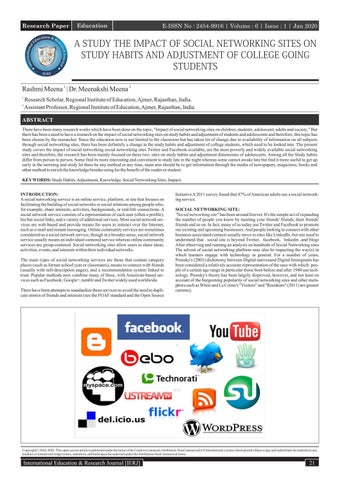
MOST POPULAR SOCIAL NETWORKING SITE: 1.4 Statement of the Proposed Study: The researcher has chosen the under mentioned topic for her research work: “Impact of Social Networking Sites on Study Habits and Adjustment of College Students.” 1.5 Objectives: 1. To prepare a questionnaire for investigating the impact of social networking sites on study habits of college students.
Ÿ
T-test is used for analyzing the variance and testing the significance of difference between statistics specially between means.
Table 1: Impact of Social Networking Sites on the Study Habits of College Girls and Boys of Previous Year Group
Sample
Mean
S.D.
Previous girls
40
33.7
7.51
Previous boys
40
34.45
7.81
T-value 0.437
2.
To know the impact of social networking sites on the study habits of college students of previous year.
3.
To know the impact of social networking sites on the study habits of college girls and boys of final year.
4.
To know the impact of social networking sites on the study habits of college girls of final and previous year.
5.
To know the impact of social networking sites on the study habits of college boys of final and previous year.
6.
To know the impact of social networking sites on the adjustment of college girls and boys of previous year.
7.
To know the impact of social networking sites on the adjustment of college girls of final and previous year.
Discussion: The above table shows that there is no significant gender related difference in the impact of social networking sites on the study habits of college girls and boys of previous year.
8.
To know the impact of social networking sites on the adjustment of college boys of final and previous year. To know the impact of social networking sites on the adjustment of college girls and boys of final year.
Table 2: Impact of Social Networking Sites on the Study Habits of College Girls and Boys of Final Year
9.
HYPOTHESIS: 1. There is no significant gender related difference in the impact of social networking sites on the study habits of college girls and boys of previous year. 2.
There is no significant gender related difference in the impact of social networking sites on the study habits of college girls and boys of final year.
3.
There is significant difference in the impact of social networking sites on the study habits of college girls of previous and final year.
4.
There is significant difference in the impact of social networking sites on the study habits of college boys of final and previous year.
5.
There is no significant gender related difference in the impact of social networking sites on the adjustment college girls and boys of previous year.
6.
There is significant difference in the impact of social networking sites on the adjustment of college girls of final and previous year.
7.
There in no significant difference in the impact of social networking sites on the adjustment of college boys of final and previous year.
8.
There is no significant gender related difference in the impact of social networking sites on the adjustment of college girls and boys of final year.
METHOD: Stratifed random sampling by survey method is employed for the present study. Sample: The study is conducted on a sample of 160 college students of previous and final year of Jaipur city. On the basis of random sampling technique for wider applicability of results both male and female students were included. Tools Used for Present Study: Following tool was used for the present study: Ÿ
Self-prepared Questionnaire on social networking sites.
Ÿ
Study habit tool.
Ÿ
Adjustment tool
STATISTICAL TECHNIQUE USED FOR DATA ANALYSIS: In the proposed study following statistical techniques were used for analysis of data which was collected during the investigation. Ÿ
Mean is calculated.
Ÿ
Standard deviation is calculated.
22
Interpretation: Table1.Shows that there is no significant gender related difference in the impact of social networking sites on the study habit of college girls and boys of previous year. The sample of 40 college girls and 40 college boys of previous year were taken, the number of degree of freedom was taken as(N+N)-2 i.e.(40+40)-2=78. After looking at 0.05 level t-value was found to be 1.99 which is higher than the calculated t-value of 0.437. Similarly at 0.01 level t-value was found to be 2.64 which is again higher than the calculated t-value of 0.437. Result: The calculated t-value is less than the tabulated value at both the levels. So we accept that there is no significant gender related difference in the impact of social networking sites on the study habits of college girls and boys of previous year.
Group
Sample
Mean
S.D.
Final year girls
40
30.25
11.06
Final year boys
40
30.42
13.98
T-value 0.213
Interpretation: Table 2 shows that there is no significant gender related difference in the social networking sites of on the study habit of college girls and boys of final year. The sample of 40 girls of final year and 40 boys of final year were taken, the number of degree of freedom was taken as (N+N)-2 i.e.(40+40)-2=78. After looking at 0.05 level t-value was found to be 1.99 which is higher than the calculated t-value of 0.213. Similarly at 0.01 level t-value was found to be 2.64 which is again higher than the calculated t-value of 0.213. Result: The calculated t-value is less than the tabulated value at both the levels. So we accept that there is no significant gender related difference in the impact of social networking sites on the study habits of college girls and boys of final year. Discussion: The above table shows that there is no significant gender related difference in the impact of social networking sites on the study habits of college girls and boys of final year. Table 3: Impact of Social Networking Sites on the Study Habits of College Girls of Final and Previous Year Group
Sample
Mean
S.D.
Final Year girls
40
30.25
11.06
Previous Year girls
40
33.7
7.51
T-value 1.635
Interpretation: Table 3 shows that there is no significant difference in the impact of social networking sites on the study habit of college girls of final and previous year. The sample of 40 girls of final year and 40 girls of previous year were taken, the number of degree of freedom was taken as (N+N)-2 i.e. (40+40)-2=78. After looking at 0.05 level t-value was found to be 1.99 which is higher than the calculated tvalue of 1.635. Similarly at 0.01 level t-value was found to be 2.64 which is again higher than the calculated t-value of 1.635. Result: The calculated t-value is less than the tabulated value at both the levels. So we accept that there is no significant difference in the impact of social networking sites on the study habits of college girls of final and previous year. Discussion: The above table shows that there is no significant gender related difference in the impact of social networking sites on the study habits of college girls and boys of final year
International Education & Research Journal [IERJ]
Research Paper
E-ISSN No : 2454-9916 | Volume : 6 | Issue : 1 | Jan 2020
Table 4: Impact of Social Networking Sites on the Study Habits of College Boys of Final and Previous Year Group
Sample
Mean
S.D.
Final year boys
40
30.42
13.98
Previous year boys
40
34.45
7.81
Table 7: Impact of Social Networking Sites on the Adjustment of College Boys of Final and Previous Year
T-value 1.59
Group
Sample
Mean
S.D.
Previous year boys
40
197.95
49.5
Final year boys
40
204.775
13.7
T-value 0.844
Interpretation: Table 4 shows that there is no significant difference in the impact of social networking sites on the study habit of college boys of final and previous year. The sample of 40 boys of final year and 40 boys of previous year were taken, the number of degree of freedom was taken as (N+N)-2 i.e.(40+40)-2=78. After looking at 0.05 level t-value was found to be 1.99 which is higher than the calculated tvalue of 1.59. Similarly at 0.01 level t-value was found to be 2.64 which is again higher than the calculated t-value of 1.59.
Interpretation: Table 5 shows that there is no significant difference in the impact of social networking sites on the adjustment of college boys of final and previous year. The sample of 40 boys of final year and 40 boys of previous year were taken, the number of degree of freedom was taken as (N+N)-2 i.e.(40+40)-2=78. After looking at 0.05 level t-value was found to be 1.99 which is higher than the calculated tvalue of 0.844. Similarly at 0.01 level t-value was found to be 2.64 which is again higher than the calculated t-value of 0.844
Result: The calculated t-value is less than the tabulated value at both the levels. So we accept that there is no significant difference in the impact of social networking sites on the study habits of college boys of final and previous year.
Result: The calculated t-value is less than the tabulated value at both the levels. So we accept that there is no significant difference in the impact of social networking sites on the adjustment of college boys of final and previous year.
Discussion: The above table shows that there is no significant difference in the impact of social networking sites on the study habits college boys of final and previous year.
Discussion: The above table shows that there is no significant difference in the impact of social networking sites on the adjustment of college boys of final and previous year
Table 5: Impact of Social Networking Sites on the Adjustment of College Girls and Boys of Previous Year
Table 8: Impact of Social Networking Sites on the Adjustment of College Girls and Boys of Final Year
Group
Sample
Mean
S.D.
Previous year girls
40
205.175
10.8
Previous year boys
40
204.775
13.7
Group
Sample
Mean
S.D.
Final year girls
40
201.175
30.98
Final year boys
40
204.775
13.7
T-value 0.145
T-value 0.672
Interpretation: Table 5 shows that there is no significant gender related difference in the impact of social networking sites on the adjustment of college girls and boys of previous year. The sample of 40 girls of previous year and 40 boys of previous year were taken, the number of degree of freedom was taken as (N+N)-2 i.e.(40+40)-2=78. After looking at 0.05 level t-value was found to be 1.99 which is higher than the calculated t-value of 0.145. Similarly at 0.01 level t-value was found to be 2.64 which is again higher than the calculated t-value of 0.145
Interpretation: Table 5 shows that there is no significant gender related difference in the impact of social networking sites on the adjustment of college girls and boys of final year. The sample of 40 girls of final year and 40 boys of final year were taken, the number of degree of freedom was taken as(N+N)-2 i.e.(40+40)-2=78. After looking at 0.05 level t-value was found to be 1.99 which is higher than the calculated t-value of 0.672. Similarly at 0.01 level t-value was found to be 2.64 which is again higher than the calculated t-value of 0.672.
Result: The calculated t-value is less than the tabulated value at both the levels. So we accept that there is no significant gender related difference in the impact of social networking sites on the adjustment of college girls and boys of previous year.
Result: The calculated t-value is less than the tabulated value at both the levels. So we accept that there is no significant gender related difference in the impact of social networking sites on the adjustment of college girls and boys of final year.
Discussion: The above table shows that there is no significant gender related difference in the impact of social networking sites on the adjustment of college girls and boys of previous year
Discussion: The above table shows that there is no significant gender related difference in the impact of social networking sites on the adjustment of college girls and boys of final year.
Table 6: Impact of Social Networking Sites on the Adjustment of College Girls of Final and Previous Year
CONCLUSION: A prime responsibility of educational research is that of being able to make either a probability or logical inference covering the tenability of his testable hypotheses. The acceptance or rejection of these hypotheses will ultimately determine the contribution of study in the particular area chosen for research. This is especially tried in the analysis for interpretation of data.
Group
Sample
Mean
S.D.
Previous year girls
40
205.175
10.8
Final year girls
40
201.175
30.98
T-value 0.148
Interpretation: Table 5 shows that there is no significant difference in the impact of social networking sites on the adjustment of college students girls of final and previous year. The sample of 40 girls of final year and 40 girls of previous year were taken, the number of degree of freedom was taken as (N+N)-2 i.e.(40+40)-2=78. After looking at 0.05 level t-value was found to be 1.99 which is higher than the calculated t-value of 0.148. Similarly at 0.01 level t-value was found to be 2.64 which is again higher than the calculated t-value of 0.148.
In this data is presented, tabulated and analytical study is conducted on impact of social networking sites on the study habits and adjustment of college students. The data is examined keeping in mind the objective of study. The tables have been made on the basis of mean and standard deviation and the data is analyzed by the use of mean and standard deviation. The researcher has interpreted each table and discussed the inferences derived from these tables. BIBLIOGRAPHY:
Result: The calculated t-value is less than the tabulated value at both the levels. So we accept that there is no significant difference in the impact of social networking sites on the adjustment of college students girls of final and previous year.. Discussion: The above table shows that there is no significant difference in the impact of social networking sites on the adjustment of college students girls of final and previous year.
International Education & Research Journal [IERJ]
1.
A Quarterly Journal of Human Behavior, Vol. 23 No.4, 1986
2.
Baron R.A., Psychology, Prentice Hall India, New Delhi, 1999
3.
Best J. W & Kahn J.V., Research in Education, Pearson prentice Hall India, Delhi, 2006
4.
Buch M.B., Fifth Survey of Educational Research ( Vol.1), NCERT, New Delhi, 198892
5.
Buch M.B., Fifth Survey of Educational Research ( Vol.2), NCERT, New Delhi, 198892
6.
Buch M.B., Fourth Survey of Educational Research ( Vol.1), NCERT, New Delhi,1983-88
7.
Buch M.B., Fourth Survey of Educational Research ( Vol.2), NCERT, New Delhi,1983-88
New
23
Research Paper
E-ISSN No : 2454-9916 | Volume : 6 | Issue : 1 | Jan 2020
8.
Kothari C.R., Research Methodology- Methods & Technique, Wishwa New Delhi, 2002
9.
Ronald J. Burke, Mustafa Koyuncu, Lisa Fiksenbaum, Equal Opportunities national, Barmarick Publications, 2008
10. Singh R,& Sharma O.P., Educational Research & Statistics, Vinod Pustak Agra, 2008
Prakashan, InterMandir,
11. Upadhyay R.K., & Dubey S.K., Methodology of Educational Research and Data Analysis, Radha Prakashan Mandir, Agra, 2007 12. http://www.eric.ed.gov. 13. http://shodhganga.inflibnet.ac.in 14. https://scholar.google.com
24
International Education & Research Journal [IERJ]