Research Paper
Geology
E-ISSN No : 2454-9916 | Volume : 5 | Issue : 3 | March 2019
MAJOR EARTH ELEMENTS GEOCHEMISTRY OF ASIRGARH VOLCANICS, BURHANPUR DISTRICT, M.P. 1
Khadri, S. F. R , Mayura M. Deshmukh
1
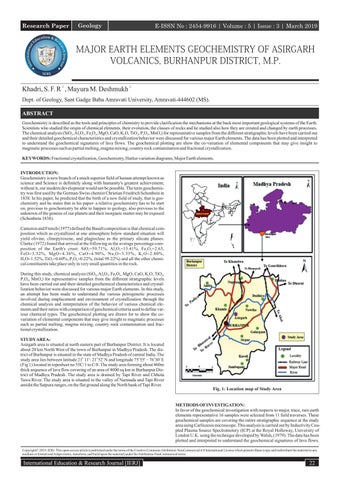
Dept. of Geology, Sant Gadge Baba Amravati University, Amravati-444602 (MS). ABSTRACT Geochemistry is described as the tools and principles of chemistry to provide clarification the mechanisms at the back most important geological systems of the Earth. Scientists who studied the origin of chemical elements, their evolution, the classes of rocks and he studied also how they are created and changed by earth processes. The chemical analysis (SiO2, Al2O3, Fe2O3, MgO, CaO, K2O, TiO2, P2O5, MnO,) for representative samples from the different stratigraphic levels have been carried out and their detailed geochemical characteristics and crystallization behavior were discussed for various major Earth elements. The data has been plotted and interpreted to understand the geochemical signatures of lava flows. The geochemical plotting are show the co-variation of elemental components that may give insight to magmatic processes such as partial melting, magma mixing, country rock contamination and fractional crystallization. KEYWORDS: Fractional crystallization, Geochemistry, Harker variation diagrams, Major Earth elements. INTRODUCTION: Geochemistry is new branch of a much superior field of human attempt known as science and Science is definitely along with humanity's greatest achievement; without it, our modern development would not be possible. The term geochemistry was first used by the German-Swiss chemist Christian Friedrich Schonbein in 1838. In his paper, he predicted that the birth of a new field of study, that is geochemistry and he states that in his paper- a relative geochemistry has to be start on, previous to geochemistry be able to happen to geology, also previous to the unknown of the genesis of our planets and their inorganic matter may be exposed (Schonbein 1838). Cameron and French (1977) defined the Basalt composition is that chemical composition which as crystallized at one atmosphere below standard situation will yield olivine, clinopyroxene, and plagioclase as the primary silicate phases. Clarke (1972) found that arrived at the following as the average percentage composition of the Earth's crust: SiO2=59.71%, Al2O3=15.41%, Fe2O3=2.63, FeO=3.52%, MgO=4.36%, CaO=4.90%, Na 2 O=3.55%, K 2 O=2.80%, H2O=1.52%, TiO2=0.60%, P2O5=0.22%, (total 99.22%) and all the other chemical constituents take place only in very small quantities in the rock. During this study, chemical analysis (SiO2, Al2O3, Fe2O3, MgO, CaO, K2O, TiO2, P2O5, MnO,) for representative samples from the different stratigraphic levels have been carried out and their detailed geochemical characteristics and crystallization behavior were discussed for various major Earth elements. In this study, an attempt has been made to understand the various petrogenetic processes involved during emplacement and environment of crystallization through the chemical analysis and interpretation of the behavior of various chemical elements and their ratios with comparison of geochemical criteria used to define various chemical types. The geochemical plotting are drawn for to show the covariation of elemental components that may give insight to magmatic processes such as partial melting, magma mixing, country rock contamination and fractional crystallization. STUDY AREA: Asirgarh area is situated at north eastern part of Burhanpur District. It is located about 20 km North West of the town of Burhanpur in Madhya Pradesh. The district of Burhanpur is situated in the state of Madhya Pradesh of central India. The study area lies between latitude 210 11'- 210 52' N and longitude 75o55' – 76o30' E (Fig 1) located in toposheet no 55C/1 to C/8. The study area forming about 460m thick sequence of lava flow covering of an area of 4000 sq km in Burhanpur District of Madhya Pradesh. The study area is drained by Tapi River and Chhota Tawa River. The study area is situated in the valley of Narmada and Tapi River amidst the Satpura ranges, on the flat ground along the North bank of Tapi River.
Fig. 1: Location map of Study Area
METHODS OF INVESTIGATION: In favor of the geochemical investigation with respects to major, trace, rare earth elements representative 16 samples were selected from 11 field traverses. These geochemical samples are covering the entire stratigraphic sequence at the study area using Carliszesis microscope. This analysis is carried out by Inductivity Coupled Plasma Source Spectrometery (ICP) at the Royal Holloway, University of London U.K. using the technique developed by Walsh, (1979). The data has been plotted and interpreted to understand the geochemical signatures of lava flows. Copyright© 2019, IERJ. This open-access article is published under the terms of the Creative Commons Attribution-NonCommercial 4.0 International License which permits Share (copy and redistribute the material in any medium or format) and Adapt (remix, transform, and build upon the material) under the Attribution-NonCommercial terms.
International Education & Research Journal [IERJ]
22
Research Paper
E-ISSN No : 2454-9916 | Volume : 5 | Issue : 3 | March 2019
Various models were proposed for understanding the genesis of these rocks. In geochemical analysis, all geochemical data were plotted and balancing of major ions and Piper diagram were plotted by using Hydro-chemical and Rock works software. GEOLOGY OF THE AREA: The major part of the study area is underlain by hard rock's consisting mostly of thick sequences of basaltic flows a part of Deccan trap of Malwa group. The traps are massive, compact, and fine to coarse grained, different chemical types, bluish, grey, and black to brown in color. Alluvium in the study area occurs as a narrow strip along the Tapi River and the Chhota Tawa River and these have individual extension. These alluviums generally comprise of clay, Silt, gravel's and occasionally cobbles. The area is covered by basaltic rocks. Among basalts, compact basalt, amygdaloidal basalt, vesicular basalt and giant plagioclase basalt are the basalt rock type which is observed in this formation. At places the compact basalt shows columnar jointing with parting and also shows one or two sets of joints. GEOCHEMISTRY: The major element variation plays an important role in considerate the nature and categorization of a variety of lava flows and their petro heritable relationship. The variation diagrams are useful for detection and categorization of igneous
rock series and liquid lines of descent, forecast of the composition of the parental magma, detection of magmatic processes responsible for differentiation. The chemical composition of element in general differs with time and space as the basaltic magma or the parental material derived from the earth mantle. On the other hand the crystallization history of the lava flows will normally depend on the original composition of the melt, mode of emplacement, viscosity and volatile constituents present in it. In this study to understand various aspects of crystallization behaviors of lava flows with the help of element variation diagram. During this study, chemical analysis (SiO2, Al2O3, Fe2O3, MgO, CaO, K2O, TiO2, P2O5, MnO,) for representative samples from the different stratigraphic levels have been carried out and their detailed geochemical characteristics and crystallization behavior were discussed for various major earth elements. In this study, an attempt has been made to understand the various petrogenetic processes involved during emplacement and environment of crystallization through the chemical analysis and interpretation of the behavior of various chemical elements and their ratios with comparison of geochemical criteria used to define various chemical types (Table 1). The geochemical plotting are drawn for the show the co-variation of elemental components that may give insight to magmatic processes such as partial melting, magma mixing, country rock contamination and fractional crystallization.
Table 1: Comparison of geochemical criteria used to define various chemical types ASIRGARH AREA Fm CT
DAHINALA CT2
CT1
CT3
II
III
CT4
ASIRGARH CT1
CT5
CT2
CT3
CT1
CT4
AMBA CT1
CT5
CT1
CT3
CT4
CT2
Flow No
I
IV
V
VI
VII
VIII
IX
X
XI
XII
XIII
XIV
XV
XVI
SiO2%
50.14
50.58 49.324
51.21
50.32
51.84
50.64
50.52
50.64
50.26
52.12
51.53
49.13
50.64
49.26
51.24
Al2O3
12.28
13.42
12.56
12.85
12.14
12.42
12.52
12.72
12.58
12.51
12.98
12.32
12.46
12.87
12.54
12.38
Fe2O3
13.54
13.63
12.52
12.52
11.46
15.68
12.50
12.218
13.23
12.63
12.42
15.63
12.52
12.86
12.46
14.72
MgO
6.88
7.31
8.35
6.64
7.18
4.53
6.42
8.32
7.26
8.18
6.43
4.21
8.86
6.43
7.54
5.31
CaO
9.24
10.48
11.31
10.97
9.68
7.65
10.24
9.86
8.98
9.64
10.94
7.32
8.97
8.97
8.97
7.66
Na2O
2.25
2.47
2.16
2.34
2.34
2.04
2.36
2.28
2.34
2.28
2.36
2.12
2.32
2.31
2.36
2.15
K 2O
0.78
0.59
0.26
0.78
0.68
1.21
0.78
0.56
0.68
0.72
0.58
1.26
0.68
0.54
0.73
1.24
TiO2
1.88
1.73
2.08
1.78
2.18
2.86
1.68
1.43
2.12
1.62
1.78
2.41
1.42
1.72
2.08
2.78
P2O5
0.21
0.23
0.22
0.24
0.20
0.34
0.21
0.25
0.22
0.26
0.23
0.32
0.20
0.22
0.26
0.31
MnO
0.20
0.19
0.26
0.18
0.22
0.14
0.24
0.18
0.21
0.24
0.15
0.18
0.20
0.18
0.22
0.13
RESULT AND DISCUSSION: Major element variation are divided into different types such as follows: Alkali Silica Variation: This variation diagram indicates the tholeiitic nature of lava flows in the study area with few lie in alkali basalt field. This variation diagrams has been plotted to understand the nature of basaltic magma and its genetic relationship. These variation diagrams are helpful for the categorization of volcanic rock and as well for differentiate between two categories of parental magma. This variation diagrams are found by Kuno's (1965) and later modified by Sugisaki and Tanaka (1971) and this alkali silica variation diagrams indicate that the basalts in the study area can be grouped into high potash and low potash theoretic fields with few samples showing alkali basalt field. Silica, quartz tholeiitic character of the study area can be believed to be beginning the normative mineralogy. In the total alkali (Na2O + K2O) vs. silica (SiO2) diagrams (Le Bas et al., 1986; Le Maitre, 2002) the samples plot in the field of basalt showing a high-alkaline composition (Fig. 1). HARKER VARIATION DIAGRAM6S: In Harker variation diagrams the variation of major and minor oxides abundances verses SiO2 indicates the thought to be an indication of the evolved character of a magmatic system. In this variation diagrams SiO2Vs major and trace element have been plotted to understand the petro genetic significant of various lava flows expose in study area. Most of the major elements (Al2O3, Fe2O3, CaO, TiO2, P2O5, K2O) show positive correlation with SiO2 indicating the dominance of fractional crystallization. The Al2O3 variation diagram indicates the role of plagioclase in fractionation and the most of the samples are grouped into subalkali field showing the dominance of fractional crystallization with minor amount of crystal contamination. The MgO variation indicates olivine, clinopyroxene and magnetite removal during the fractional trend. The Na2O, K2O, CaO (Fig.6) variation diagrams with a specific trend demarcate fractional crystallization process with crystal contamination. The TiO2variation (Fig 5) indicates the role of olivine and clinopyroxene in the crystallization processes with the presence of magnetite as the fractionating material. However, few samples fall in the alkali field showing a trend of enriched source with decreasing partial melting (Fig. 3, 4). This study indicates the supremacy of cryastal fractionation process from aphyric and mafic phyric flows to plagioclase phyric and GPB flows.
23
Fig. 2: Variation of Na2O+K2O Vs SiO2 indicating the Tholeiitic nature of basalt with fractional crystallization trend.
Fig. 3: Harker variation diagram
International Education & Research Journal [IERJ]
Research Paper
E-ISSN No : 2454-9916 | Volume : 5 | Issue : 3 | March 2019
Fig. 6: Harker variation diagram
Fig. 4: Harker variation diagram
CONCLUSION: The geochemical analysis of rock samples carried out by Inductivity Coupled Plasma Source Spectrometry (ICP). In favor of the geochemical investigation with respects to major, trace, rare earth elements, representative 16 samples were selected from 11 field traverses. These geochemical samples cover the entire stratigraphic sequence of the study area using ICP-MS techniques. The data has been plotted and interpreted to understand the geochemical signatures of lava flows. The geochemical plotting are show the co-variation of elemental components that may give insight to magmatic processes such as partial melting, magma mixing, country rock contamination and fractional crystallization. The geochemical activities of study area have been evaluated based on major, trace and REE properties of samples using geochemical technique. From Alkali silica variation diagrams the Asirgarh basalts are high-K alkali basalt (Tanaka 1971). The Harker variation diagram with number of variation indicates the dominance of crystal fractionation associated with minor degree of crustal contamination, crustal accumulation and partial melting process with varying degree. Most of the major elements like Al2O3, Fe2O3, CaO, TiO2, P2O5, K2O show positive correlation with SiO2 indicating the dominance of fractional crystallization. The Na2O, K2O, CaO variation diagrams with a specific trend demarcate fractional crystallization process with crystal contamination. The geochemical major earth elements investigation have shows significant variation in certain geochemical parameters such as MgO, TiO2, P2O5, etc and led to the establishment of a comperensive flow stratigraphy and geochemical behavior of lava flows of the Burhanpur region. Acknowledgements: The financial assistance received from UGC, New Delhi to SFRK vide sanction letter No: F.No;34/45/2008 dated regarding major research project entitled "Flow stratigraphy, Petrogenesis and Paleomagnetism of Asirgarh Volcanics, Burhanpur District, Madhya Pradesh with emphasis on search and identification of magmatic pulses for assessment of their role in the greatest mass extinctions of the earth history" is hereby acknowledged. REFERENCES: 1.
Fig. 5: Harker variation diagram
International Education & Research Journal [IERJ]
Cameron E. P. and W. J. French, June 1977. The relationship of the order of crystallization of basalt melts to their classification and to the definition of rock series, Department of Geology, Queen Mary College, London Mineralogical Magazine, VOL. 4, and pp. 239-5.
2.
Clarke F. W., 1972. The data of geochemistry, (fifth edition), USGS Bulletin No. 770.
3.
Kuno, H.1965, High alumina basalt, Jour. Petro. 1, pp 121-145.
4.
Le Bas, M.J., Le Maitre, R.W., Streckeisen, A., Zanemn, B., 1986. A chemical classification of volcanic rocks based on the total alkali-silica diagram. Journal of Petrology 27, pp. 745-750.
5.
Le Maitre, R.W., 2002. Igneous Rocks: A Classification and Glossary of Terms. Recommendations of the International Union of Geological Sciences Subcommission on the Systematics of Igneous Rocks. Cambridge. Cambridge UniversityPress, London,pp. 236.
6.
Schonbein Christian Friedrich, 1838, “Study on mineralogy”,
7.
Tanaka, Tsuyoshi and Masuda, A., 1971, Private communication, Geological Survey of Japan and Science University of Tokyo, Kawasaki and Tokyo, Japan.
8.
Walsh, J. N., 1979. “The simultaneous determination of the major, minor and trace constituents of silicate rocks using inductively coupled plasma spectrometry”, Spectrochim. Acta, Vol. 35B, pp. 107-111.
24