Research Paper
Education
E-ISSN No : 2454-9916 | Volume : 5 | Issue : 5 | May 2019
AWARENESS OF SCHOOL SAFETY PROGRAMME AMONG STUDENTS OF HIMACHAL PRADESH 1
Dr. Kuldeep Singh Katoch | Ms. Tanendra Devi 1 2
2
Associate Professor, Department of Education, ICDEOL, H.P. University, Shimla-5 Research Scholar, Department of Education, H.P. University, Shimla-5
ABSTRACT Himachal Pradesh is a hilly state prone to multi hazards including earthquake. It falls in high to very high seismic risk zones. Schools of the State are highly vulnerable. The State Council of Educational Research and Training (SCERT), Himachal Pradesh is implementing school safety programme in order to reduce the disaster risk. In this study impact of school safety programme was evaluated. A structured tool has been employed to assess the student's awareness level. Student's responses have also been evaluated by awarding 5 marks for correct responses and zero marks for incorrect responses. Data interpretations revealed that students have poor understanding of the concepts of earthquake, landslide, cloud burst, flash floods and mock drills. They have also limited knowledge about the safety measures to be taken for these natural hazards. Summary statistics revealed that the minimum, maximum, median, mean, first quartile and third quartile student's scores are 10, 85, 35, 42.93, 30, and 55 respectively. Out of 1200 responding students 34.92% scored less than 35% marks, 47.58% got 35-74% marks and 17.7% scored 75% and above score. KEYWORDS: School Safety, Disaster, Cloudburst, Hazards and Programme. INTRODUCTION: Himachal Pradesh is a hilly state located in the north-western part of the Himalaya. Himalaya was formed due to intercontinental collision between Indian plate and Eurasian Plate. The convergence of Indian Plate towards Asia is still going on. Continuous northward movement of the Indian plate is resulting in the folding, faulting, thrusting, uplift and release of seismic energy (Wadia, 1961, Gansser, 1964, Seeber and Gornitz, 1983, Searle et al. 1987, Scotese et el. 1988, Valdiya, 1998, 2001 and Hodges, 2000). The State is experiencing many mild tremors every year which confirms active tectonics and high probability of mega earthquake events in the future as predicted by many scholars (Thakur, 2004 and Philip at el. 2014). State has already been hit by some devastating earthquakes viz. Kangra earthquake in 1905 and Kinnaur earthquake in 1975. The whole State falls either in zone IV (high seismic risk zone) or in zone V (very high seismic risk zone). The southern part of the State adjoining to Punjab plains and the river valleys are densely populated. Here, the constructions without geotechnical considerations, lack of awareness and unpreparedness of the State to face the earthquake make it highly vulnerable. Further, earthquake triggers for landslides, floods, avalanches, fires, road accidents, industrial disasters etc. due to cascading effect. Besides, this climate change is also causing weather related natural hazards. In such a scenario there is need to create mass awareness campaign, fixing non-structural hazards, practicing mock drills and construction of earthquake resistant structures to minimize the disaster risk. The State Council of Educational Research and Training (SCERT) Solan and Government College of Teacher Education (GCTE) Dharamshala are implementing school safety programme in the State in analogy of National School Safety Project (GOIUNDP,2009- 2012). SCERT implements this programme in Bilaspur, Kinnaur, Shimla, Sirmaur, Solan and Una districts. Under this programme training of school teachers is one important activity (GOHP, 2014). School safety training module includes need and concerns of school safety, basic terminology of disaster management, hazard profile of the State, life-saving skills, structural and nonstructural mitigation measures, operating fire extinguishers, search and rescue techniques, tips for the preparation of school safety plans, and the conduct of mock drills. School teachers further disseminates this knowledge and skills to school children. In this study attempt is being made to assess the effectiveness of school safety programme being implemented by the SCERT of Himachal Pradesh. OBJECTIVES OF THE STUDY: The objectives of the school safety programme organised by the SCERT of
Himachal Pradesh are: Ÿ
To study the impact of school safety programme.
Ÿ
To assess students' achievements in school safety programme.
Ÿ
To assess students' overall performance in school safety programme.
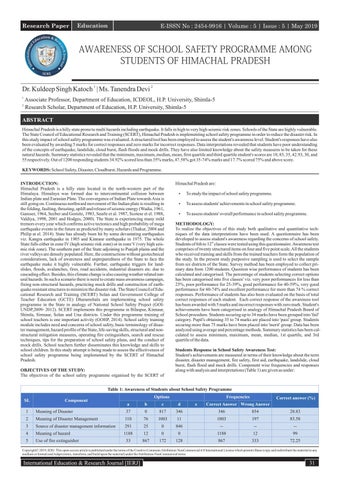
METHODOLOGY: To realize the objectives of this study both qualitative and quantitative techniques of the data interpretations have been used. A questionnaire has been developed to assess student's awareness regarding the concerns of school safety. Students of 6th to 12th classes were tested using this questionnaire. Awareness test comprises of twenty structured items on four and five point scale. All the students who received training and skills from the trained teachers form the population of the study. In the present study purposive sampling is used to select the sample from six districts of the State. Survey method has been employed to collect primary data from 1200 students. Question wise performance of students has been calculated and categorised. The percentage of students selecting correct options has been categorised into five classes' viz. very poor performances for less than 25%, poor performance for 25-39%, good performance for 40-59%, very good performance for 60-74% and excellent performance for more than 74 % correct responses. Performance of students has also been evaluated on the basis of total correct responses of each student. Each correct response of the awareness tool has been awarded with 5 marks and incorrect responses with zero mark. Student's achievements have been categorised in analogy of Himachal Pradesh Board of School procedure. Students securing up to 34 marks have been grouped into 'fail' category. Pupil's obtaining 35 to 74 marks are placed into 'pass' group. Students securing more than 75 marks have been placed into 'merit' group. Data has been analyzed using average and percentage methods. Summary statistics has been calculated to assess minimum, maximum, mean, median, 1st quartile, and 3rd quartile of the data. Students Response in School Safety Awareness Test: Student's achievements are measured in terms of their knowledge about the term disaster, disaster management, fire safety, first aid, earthquake, landslide, cloud burst, flash flood and mock drills. Component wise frequencies and responses along with analysis and interpretations (Table 1) are given as under:
Table 1: Awareness of Students about School Safety Programme SL
Component
Options a
b
Frequencies
c
d
e
Correct answer (%)
Correct Answer Wrong Answer
1
Meaning of Disaster
37
0
817
346
346
854
28.83
2
Meaning of Disaster Management
110
76
1003
11
1003
197
83.58
3
Source of disaster management information
291
25
0
846
--
--
--
4
Meaning of hazard
1188
12
0
0
1188
12
99
5
Use of fire extinguisher
33
867
172
128
867
333
72.25
Copyright© 2019, IERJ. This open-access article is published under the terms of the Creative Commons Attribution-NonCommercial 4.0 International License which permits Share (copy and redistribute the material in any medium or format) and Adapt (remix, transform, and build upon the material) under the Attribution-NonCommercial terms.
International Education & Research Journal [IERJ]
31
Research Paper SL
Component
E-ISSN No : 2454-9916 | Volume : 5 | Issue : 5 | May 2019 Options
Frequencies
a
b
c
d
e
Correct answer (%)
Correct Answer Wrong Answer
6
Knowledge to use fire extinguishers
468
275
434
23
468
732
--
7
Knowledge about first aid
741
0
447
12
741
459
61.75
8
Causes of earth
22
246
468
455
468
723
39.3
9
Seismic zone of school
556
296
60
266
12
60
1130
5.04
10
Safety measures for earthquake
35
567
598
0
0
567
633
47.25
11
Meaning of landslide
36
206
466
492
466
734
38.83
12
Safety measures for landslides
204
79
440
462
440
745
37.13
13
Meaning of cloud burst
336
458
111
295
336
864
28
14
Safety measures for cloud burst
83
535
249
333
333
867
27.75
15
Meaning of flash flood
102
358
522
218
358
842
29.83
16
Safety measures for flash floods
302
86
207
605
605
595
50.42
17
Meaning of disaster preparedness
47
630
456
67
630
570
52.5
18
Meaning of mock drill
801
12
337
50
337
863
28.08
19
Safety measures for earthquake
279
76
97
712
712
452
61.17
20
Benefits of early warning system
94
877
90
139
877
323
73.08
Meaning of Disaster: The meaning of term 'disaster' is known to only 28.33 percent students. It shows poor performance of the students. However, there is separate book on disaster management in 9th class. This reveals that curriculum and the in-service teacher training have made little impact on the students understanding about the term disaster.
students. Exit routes need to be kept open was answered by 47.25 percent students. It was the most appropriate answer. However, majority of students (49.83%) responded to pray the God. Only 2.92 percent students replied that exit routes needs to be kept close. This indicates good performance of safety measures for earthquakes.
Meaning of disaster management: Out of 1200 responding students 83.58 percent tick marked the correct option for the meaning of 'disaster management'. This shows excellent performance.
Understanding of Landslide: In this question 1200 students were tested about their understanding of the term landslide. Sliding on the surface of earth option was marked by 41 percent students and three percent students opted for movement in wide range of area. About seventeen percent mentioned that it is rock fall. However, all these options were incorrect. Remaining approximately 39 percent students answered correctly that it is flow of debris due to failure of slope. This shows poor performances.
Source of Knowledge: Through this question attempt was made to know the source of information from where students came to know about the term disaster management. It was responded by 1162 students. From teachers 25.04 percent students came to know about disaster management. Print media informed 2.15 percent students. Teachers, print media and text books helped to inform 72.81 percent students about the term disaster management. Meaning of Hazard: Meaning of the term 'hazard' was asked in this question. It was responded by 1200 students. Ninety nine percent students marked the correct option which shows excellent performance. Use of Fire Extinguishers: In this question students were asked about the purpose for which fire extinguishers are used. It was responded by 1200 students. Purpose for which fire extinguishers are used is known to 72.25 percent students. It reveals very good performance. Operation of Fire Extinguishers: Student's skills to operate fire extinguishers were assessed through this query. This question was responded by 1200 students. This skill is possessed by 39 percent students and 22.92 percent students don't know how to operate fire extinguishers. A little bit skill is known to 36.17 percent students and 1.92 percent students are not confident to operate first aid firefighting equipment. Knowledge of First Aid Box: In this question students were asked about their knowledge of first aid box. Out of 1200 responding students 61.75 percent students marked the correct option that it is the box of medicines which are used to treat victims or patients. This also shows very good performance. It is a box of books which is given to students securing first position in the class option was marked by 37.25 percent students. Pencil box option was marked by one percent students. Causes of Earthquake: Students were evaluated about their knowledge regarding causes of earthquake. Plate tectonics option was marked by 39.30 percent students which was the right answer. It suggests poor performance of students. Faulty development option as the cause of earthquake was marked by 38.20 percent students. Climatic changes option was marked by 20.65 percent. The remaining students tick marked angriness of god. Seismic Zone of the School: Students knowledge was tested for the seismic hazard zone of their school. This question was answered by 1190 students. Majority of students answered that their school is located in zone II. Location of the school in zone III, IV and V was marked by 24.87, 5.04 and 22.37 percent students. One percent students said that their school is located in no seismic hazard zone. However, whole of the Himachal Pradesh falls either in zone IV or in zone V seismic hazard zone. It indicates that students have very poor knowledge about the seismic threat posed to their school. Safety Measures for Earthquake: In this question students were asked about safety measures to be taken for earthquake. This question was responded by 1200
32
Safety Measures for Landslide: This question was asked to test students' knowledge about the safety measures for landslide. It was answered by 1185 students. Monitoring local weather conditions option was marked by about 17.22 percent students. Use of radio and smart phone option was answered by 6.67 percent students. Correct response was given by 37.13 percent students as both these options were correct. The remaining students said that none of the alternative is correct. This shows poor performances. Meaning of Cloud Burst: In this question meaning of the term cloud burst was tested among 1200 students. Only 28 percent students answered correctly as it is sudden heavy rainfall. Loud sound of lightning alternative was given by 38.17 percent students. Breaking of cloud choice was chosen by 9.25 percent students whereas 24.58 percent students selected the option formation of cloud from fog. Students performed poorly to answer this question. Safety Measures for Cloud Burst: Students were tested about the measures to be taken for the safety from cloud burst. This question was responded by 1200 students. Stay alert and active during the impact or probability of impact was the choice of 6.92 percent students. Locate and go to shelter option was selected by 44.58 percent students. Try to stay with teacher and fellow students alternative was marked by 20.75 percent students. All the above were correct option was selected by only 27.75 percent students which was the most appropriate answer. Students also performed poorly to answer this question. Understanding of Flash Flood: Understanding of the term flash flood was tested among 1200 hundred students. Flow of ice choice was marked by 8.5 percent students. Sudden and more flow of water in a river option was marked by 29.83 percent students. This was the most appropriate option. Slow flow of water alternative was selected by 43.5 percent students. Sudden flow of rocks option was chosen by 18.17 percent students. It also reveals poor understanding of students about flash floods. Safety Measures for Flash Floods: Question regarding safety measures for flash floods was answered by 1200 students. To listen radio and watch television for emergency alert or instructions choice was selected by 25.17 percent students. Beware of flash flood areas such as canals, streams and other drainage channels option was marked by 7.17 percent students. To go to higher elevation areas was chosen by 17.25 percent students. All the above options alternative was the most appropriate answer which was rated by 50.42 percent students. This shows average performance. Disaster Preparedness: In this question students were assigned to pick the most appropriate meaning of disaster preparedness. This question was answered by 1200 students. Preparing for examination option was selected by 3.92 percent students. To prepare for any calamity option was given by 52.5 percent students
International Education & Research Journal [IERJ]
Research Paper
E-ISSN No : 2454-9916 | Volume : 5 | Issue : 5 | May 2019
which was the correct answer. Preparedness for the school's annual function alternative was selected by 38 percent students. Preparations for going to school alternative was opted by 5.58 percent students. It also shows good performance of students.
Table 3: Summary of students score in school safety awareness test Min
1st Qu.
Median
Mean
3rd Qu.
Max
10
30
35
42.93
55
85
Mock drill: This question was associated with the understanding of the term 'mock drill'. It was responded by 1200 students. To exercise 'drop', 'cover' and 'hold' during earthquake option was selected by 66.75 percent students. To rescue the victims with the help of ropes option was marked by one percent students. To practice for safety before disasters choice was the most appropriate answer and chosen by 28.08 percent students. To provide first aid treatment to the victims' choice was selected by 4.17 percent students. Students performed poorly in answering this question. Safety Measures for earthquakes: Students were asked to choose most appropriate option for the safety from earthquakes. This question was responded by 1164 students. To conduct mock drills regularly option was selected by 23.96 percent students. To conduct structural and non-structural mitigation measures choice was chosen by 6.52 percent students. To prepare family and school disaster management plan option was marked by 8.33 percent students. The last alternative of all the above options was ticked by 61.17 percent students which was the most appropriate option. It shows very good performance. Advantage of Early Warning System: Students knowledge was tested for the advantage of early warning system in the schools. This question was responded by 1200 students. In this question students were asked to select most appropriate answer. One can run from school in case of disaster option was selected by 7.83 percent students. We can prepare our self to deal with disasters choice was opted by 73.08 percent students. It was most appropriate choice. It is useful technique to study at school alternative was selected by 7.5 percent students. It is useful to deal with antisocial elements in the school option was selected by 11.68 percent student. It also shows very good performance.
Fig 2 (a)
Overall Performance of Students: Response of students in awareness test (Table 2 and Fig 1) reveals very poor performance in answering one question, poor performance for eight questions, good performance in three questions, very good performance in four questions and excellent performance in two questions. Table 2: Number of Questions Accurately Responded by Students Number of Questions
% Age of Students Marking Performance Category Correct Options
1 8
<25 25-39
very poor Poor
3 4
40-59 60-74
Good very good
2
>74
Excellent
Fig 2 (b)
Fig 2 (b) Fig 2: Performance of Students in School Safety Awareness Test
Fig 1: Number of questions accurately responded by students Each correct response has been awarded with 5 marks and incorrect responses with zero marks. Two questions have been inserted to seek student's opinion. In these two questions all the options are appropriate. This means that every student will score at least ten marks out of one hundred. Student's achievements have been categorised in analogy of Himachal Pradesh Board of School procedure. Students securing up to 34 marks have been grouped into 'fail' category. Pupil's obtaining 35 to 74 marks are placed into 'pass' group. Students securing more than 75 marks have been placed into 'merit' group. Out of 1200 students 34.92% scored less than 35%, 47.58% got marks between 35-74% and the remaining 17.7% scored 75% and above marks (Fig 2 and Fig 3). Summary statistics of students score is given in Table 2. Maximum students have scored between 25 and 40 marks in this test as evident in histogram (Fig. 3).
International Education & Research Journal [IERJ]
Fig. 3: Performance of students in school safety test
33
Research Paper
E-ISSN No : 2454-9916 | Volume : 5 | Issue : 5 | May 2019
CONCLUSIONS: Goal of this study is to assess the impact of school safety programme being implemented by the SCERT of Himachal Pradesh. Data interpretations reveal that the meaning of the term disaster, disaster management and hazard is known to 28.23% and 83.58%, 90% students respectively. Majority of students (72.81%) gained the knowledge of disaster management from teachers, print media and text books. Out of 1200 student's 72.25% know the purpose for which fire extinguishers are used and only 39% know to operate them. Out of 1200 student's only 61.75 percent students know the purpose for which first aid box is used. Students have very poor knowledge about the concepts of earthquake, landslide, and cloud burst flash floods, mock drills 39.30%, 39.0%, 28%, 29.30% and 28.08 % respectively. Students have very poor knowledge of seismic hazard zones. Safety measures for earthquake, landslide, cloud burst and flash floods are known to 61.17%, 37.13%, 27.75%, and 50.42% pupils respectively. Advantage of early warning system is known to 73.08% students. Response of students in awareness test reveals very poor performance in answering one question, poor performance for eight questions, good performance in three questions, very good performance in four questions and excellent performance in two questions. Students' responses have been evaluated by awarding 5 marks to correct response and zero marks for incorrect choice. Summary statistics reveals minimum, maximum, median, mean, first quartile and third quartile of student's score are 10, 85, 35, 42.93, 30, and 55 respectively. Out of 1200 students 34.92% scored less than 35%, 47.58% got marks between 35-74% and the remaining 17.7% scored 75% and above marks. These performances of students can be grouped into low, average and high performance categories. These findings suggest that school safety programme has enabled students to know about the terminology of disaster risk reduction and acquire life-saving skills. However, low and average performance of students in awareness test suggests that there is need to make this programme more effective. REFERENCES: 1.
GOHP (2014). Disaster Management Plan 2014, Disaster Management Cell of the SCERT, Department of higher education, Himachal Pradesh, India.
2.
GOI-UNDP (2009-2012). National School Safety Programme-safe school safe children, NDMA, under disaster risk reduction project, India.
3.
Hodges, K. V. (2000). Tectonics of the Himalaya and southern Tibet from two perspectives. Geological Society of America, Bulletin 112 (3), P. 324-50.
4.
Thakur, V. C. (2004). Active Tectonics of Himalayan Frontal Thrust and Seismic Hazard to Ganga Plain, Current Science, Vol. 86, No. 11, P. 1554-1560.
5.
Philip G. Suresh, N. and Bhakuni S. S. (2014). Active Tectonics in northwestern Outer Himalaya: evidence of large-magnitude place earthquakes in Pinjaur Dun and Frontal Himalaya, Current Science, Vol. 106, No. 2, P. 211-222.
6.
Scotese, C. R., L. M. Gahagan, and R. L. Larson (1988). Plate tectonic reconstructions of Crtaceous and Cenozoic ocean basins. Tectonophysics 155, P. 27-48.
7.
Searle, M. P., B. F. Windley, M. P. Coward, D. J. W. Cooper, A. J. Rex, D. Rex, Tingdong, Li, X. Xuchang, M. Q. Jan, V. C. Thakur, and S. Kumar (1987). The closing of Tethys and the tectonics of the Himalaya, Geological Society of America, Bulletin 98 (1-6), P. 678-701.
8.
Seeber, L., and V. Gornitz. (1983). River profiles along the Himalayan arc as indicators of active tectonics. Tectonophysics 921(14), P. 335-67.
9.
Valdiya, K. S. (1998). Dynamic Himalaya, University Press (India) Limited, Hydrabad.
10. Valdiya, K. S. (2001). Himalaya, University Press (India) Limited, Hydrabad. 11. Wadia, D. N. (1961). Geology of India, Macmillian and Co. Ltd, London.
34
International Education & Research Journal [IERJ]