Research Paper Medical Science
E-ISSN No : 2454-9916 | Volume : 4 | Issue : 7 | July 2018
ASSESSMENT OF PARENTAL ANXIETY ON UNBORN CHILD AMONG FIRST TIME CHILD BEARING COUPLE 1
2
3
V. Dhanalakshmi | Dr. Nalini S. J. | Dr. D. Sureshkumar | Dr. M. Anitha Rani
4
1
Research Scholar, Sri. Ramachandra Medical College and Research Institute, Chennai. Principal, Faculty of Nursing, Sri. Ramachandra Medical College and Research Institute, Chennai. 3 Consultant Infectious Disease, Apollo Hospitals, Chennai. 4 Associate Professor, Department of Community medicine, Sri. Ramachandra Medical College and Research Institute, Chennai.
2
ABSTRACT Aim: Pregnancy is one of the most important events in women's lives. Being pleasant, it is one of the most stressful events in a woman's life as psychologists have cited pregnancy as an emotional crisis. The aim of the present study was to assess and compare the anxiety on unborn child among First time child bearing couple. Methods: Descriptive research design was used to assess the Parental attachment on unborn child among first time child bearing couple visiting antenatal OPD at selected hospital, Chennai. 60 First time child bearing couple (antenatal mothers (60) and her partners (60)) was selected by convenient sampling over a period of one month. Instrumets used for data collection were demographical variable proforma, Obstetrical Variable proforma and Perinatal Anxiety Screening Scale (PASS). Results: The Findings revealed that the Mean score of Anxiety was significantly high in mother (M=48.6, SD=5.23) when compared to father's anxiety (M=27.8,SD =6.23) on unborn child among first time child bearing couple . Conclusion: This study concluded that Mother's anxiety was higher than father's anxiety on unborn fetus among first time child bearing couple. KEY WORDS: Parental Anxiety, Unborn Child,First time child bearing couple. INTRODUCTION: Pregnancy and delivery bring many physiological and psychosocial changes and increased vulnerability for the onset or relapse of a mental illness, anxiety disorders are two to three times more common among pregnant women in compared to general population .(Smith, M,V., Shao, L., Howell ,H., Lin, H., Yonkers, K, A. (2011). “As a fetus grows, it's constantly getting messages from its mother. It's not just hearing her heartbeat and whatever music she might play to her belly; it also gets chemical signals through the placenta. A new study, which will be published in Psychological Science, a journal of the Association for Psychological Science, finds that this includes signals about the mother's mental state. If the mother is depressed, that affects how the baby develops after it's born.”(Science News, Nov 2011). The Objectives of this present study were to assess and compare the parental anxiety on unborn child among first time child bearing couple and to find out the association of parental anxiety with selected demographic variables.
Table 1: Comparison of Anxiety on unborn child among First time child bearing Couple N=60 Variable
Mean score
SD
Mother
48.6
5.23
Father
27.8
6.34
t test 19.43285***
***P<.00001 The above table revealed that mean score of Anxiety was significantly high in mother (M=48.6, SD=5.23)when compared to father's anxiety (M=27.8,sd=6.23) on unborn child among first time child bearing couple and also had significant effect at P<.00001 level.
MATERIALS AND METHODS: Descriptive research design was used to assess the Parental attachment on unborn child among first time child bearing couple visiting antenatal OPD at selected hospital, Chennai. 60 First time child bearing couple were (antenatal mothers (60) and her partners (60)) selected by convenient sampling over a period of one month. The Perinatal Anxiety Screening Scale (PASS)is a valid and reliable 31-item self-report instrument designed to screen for problematic anxiety in antenatal and postpartum women. It differentiates between high and low risk for presenting with an anxiety disorder by measuring four domains that address specific symptoms of anxiety as they present in perinatal women. These domains form subscales which include: 1) Excessive Worry and Specific Fears, 2) Perfectionism, Control and Trauma, 3) Social Anxiety, and 4) Acute Anxiety and Adjustment. The average time taken for respondents to complete the PASS is 6 minutes. The PASS is suitable for use by researchers and clinicians in a variety of settings to screen for problematic perinatal anxiety. Respondents self rate each of the four clusters of anxiety symptoms, indicating the frequency of the symptoms over the previous month. The items are on a scale ranging from 0 (”not at all”) to 3 “(“almost always”). Respondents self rate each of the four clusters of anxiety symptoms, indicating the frequency of the symptoms over the previous month. The items are on a scale ranging from 0 (”not at all”) to 3 “(“almost always”). Inclusion criteria of this study were Couple who were visiting at 28th week of gestation to antenatal OPD at the time of data collection, able to read, write english and or tamil. Exclusion criteria of this study were antenatal mothers who were visiting antenatal OPD without their partner.
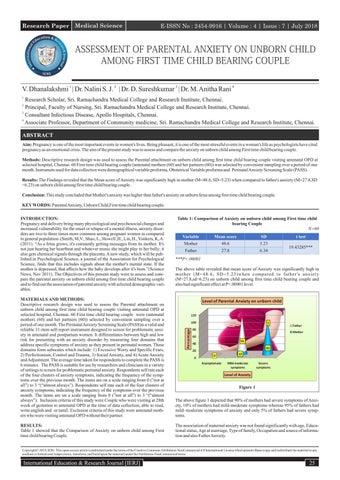
The above figure 1 depicted that 90% of mothers had severe symptoms of Anxiety, 10% of mothers had mild-moderate symptoms whereas 95% of fathers had mild–moderate symptoms of anxiety and only 5% of fathers had severe symptoms.
RESULTS: Table 1 showed that the Comparison of Anxiety on unborn child among First time child bearing Couple.
The association of maternal anxiety was not found significantly with age, Educational status, Age at marriage, Type of family, Occupation and source of information and also Father Anxiety.
Figure 1
Copyright© 2018, IERJ. This open-access article is published under the terms of the Creative Commons Attribution-NonCommercial 4.0 International License which permits Share (copy and redistribute the material in any medium or format) and Adapt (remix, transform, and build upon the material) under the Attribution-NonCommercial terms.
International Education & Research Journal [IERJ]
25
Research Paper
E-ISSN No : 2454-9916 | Volume : 4 | Issue : 7 | July 2018
DISCUSSION: The current study was conducted to assess the anxiety level on unborn child among first time child bearing couple which revealed that mother had severe symptoms of anxiety (90%) whereas only 5%of fathers had severe symptoms of anxiety in third trimester of pregnancy. This study was supported by “prevalence of pregnancy and associated factors” conducted by Madhavanprabhakaran., D'Souza .(2015).The aim of the study is to determine the prevalence of pregnancy-specific anxiety (PSA) and its associated factors among pregnant women during the three trimesters of pregnancy. An exploratory research design with a prospective cohort approach was adopted for the study. State Trait Anxiety Inventory (STAI) and Pregnancy-Specific Anxiety Inventory (PSAI) were used to collect the data. Highest prevalence of pregnancy-specific anxiety (PSA) was reported during the third trimester of pregnancy. All pregnant women rated high levels of third trimester childbirth anxiety compared to other three components of pregnancy-specific anxiety CONCLUSION: The Findings revealed that the Level of Anxiety was significantly high in mother during pregnancy when compared to Father. According to The evidences of some inconsistent studies provide the fact that further studies and researches in the field of the effects of anxiety during pregnancy on the health of children is a serious point. Also it can be concluded that adverse effects resulting from high levels of maternal anxiety in children is a serious and thought-provoking in which the necessity of identifying and screening of anxiety disorders in periodic care during pregnancy seems to be urgent. (Shahhosseini,Z., Pourasghar,M., Khalilian,A., and Salehi.F,2015) . Acknowledgement: It's my pleasure and privilege to record my deep sense of gratitude to Dr. LathaVenkatesan, Principal, Apollo College of Nursing, Chennai and my guide Dr. S. J. Nalini, Principal, Sri Ramachandra college of Nursing, for her inspiring guidance, valuable suggestions, constant encouragement for the completion of the study. Funding: No funding sources Conflict of interest: None declared Ethical approval: The study was approved by the Institutional Ethics Committee. REFERENCES: 1.
Madhavanprabhakaran., Souza, D., Nairy.(2015). Prevalence of pregnancy anxiety and associated factors. International Journal of Africa Nursing Sciences, (3 ),1–7.
2.
Smith, M,V., Shao, L., Howell ,H., Lin, H., Yonkers ,K,A.(2011). Perinatal depression and birth outcomes in a Healthy Start project. Matern. Child Health J;15:401-9.
3.
Shahhosseini, Z., Pourasghar, M., Khalilian, A., and Salehi. F. (2015). A Review of the Effects of Anxiety During Pregnancy on Children’s Health, Mater Sociomed, Jun; 27(3): 200–202.
4.
Somerville, S., Dedman, K., Hagan, R., Oxnam, E., Wettinger, M., Byrne, S., Coo, S., Doherty, D., Page, A.C. (2014). The Perinatal Anxiety Screening Scale: development and preliminary validation. Archives of Women’s Mental Health, DOI: 10.1007/s00737- 014-0425-8.
26
International Education & Research Journal [IERJ]