Research Paper
Education
E-ISSN No : 2454-9916 | Volume : 5 | Issue : 12 | Dec 2019
BAYESIAN NETWORK BASED ON FUZZY LOGIC IN EDUCATIONAL INTELLIGENT SYSTEMS 1
*Afaf Adabashi | Meltem Eryılmaz 1 2
2
Student, Software Engineering, Atilim University, Ankara, Turkey. (*Corresponding Author) Asst. Prof. Dr., Computer Engineering, Atilim University, Ankara, Turkey.
ABSTRACT A Web-based Intelligent Tutoring System is an educational platform that supports the teaching process with the aim of helping students navigate through the online course materials in order to achieve their learning goals. It has an ability to adapt an e-learning system to each individual learner according to his/her characteristics including the knowledge level, which usually come from uncertain information. Artificial intelligence techniques such as fuzzy logic and Bayesian networks are widely used to address uncertainty problems facing the intelligent tutoring systems. This research paper contributed to the field of research by developing an intelligent tutoring system, called FB-ITS using a combination of both the Bayesian network and fuzzy logic in order to support students in learning Excel. The system is validated and evaluated using an empirical method where the pre-test and post-test experiment was conducted in order to determine its effectiveness in providing learning to students. An experiment with 20 participants from undergraduate students yields positive results. It indicates that adapting learning material according to a knowledge level using a combination of Bayesian and fuzzy logic leads to better learning performance than using only the Bayesian network. KEYWORDS: Intelligent tutoring system, Bayesian networks, fuzzy logic, learning performance. INTRODUCTION: The field of Web-based learning is increasingly growing and becoming popular in the academic community for providing enormous amount of benefits over a traditional face-to-face learning in a classroom. Web-based learning system facilitates distance learning and offer easy access to any knowledge domain and learning process at any time for learners from different backgrounds with different needs, preferences, and characteristics (Chrysafiadi and Virvou, 2015). Intelligent Tutoring Systems (ITS) is a web-based learning system that supports student to navigate in a learning environment by adapting the learning material to individual student. The basic architecture of ITSs consists of four components namely student model, knowledge domain model, tutoring model and user interface model (Nwana, 1990). These basic components interact with each other to achieve different functions. The ability of an ITS to provide adaptation is based on the technology of student modeling. According to John Self (1990), student modeling is a process that is responsible for representing student's goals and needs, analyzing the student performance, and determining prior and gained knowledge. ITS uses Artificial Intelligence (AI) methods and techniques to resemble the idea of individual teaching (Self, 1999). Many AI techniques such as Bayesian network (Nguyen 2012) and fuzzy logic (Almohammadi et al., 2016) are used in the literature to solve the problem of uncertainty in adaptive e-learning systems. Bayesian network is a techniques used to manage the knowledge domain and model the interdependencies between domain topics. Also, it able to increase the ability of an ITS to make the appropriate decision based on student's characteristics. Fuzzy logic is able to increase the ability of ITS to examine and assess student's academic performance, which is one of the most important parts of the educational process. This paper aims to develop an ITS, called FB-ITS, which combines the advantages of both fuzzy logic and Bayesian networks techniques, taking into account the adaptation based on knowledge level of student.
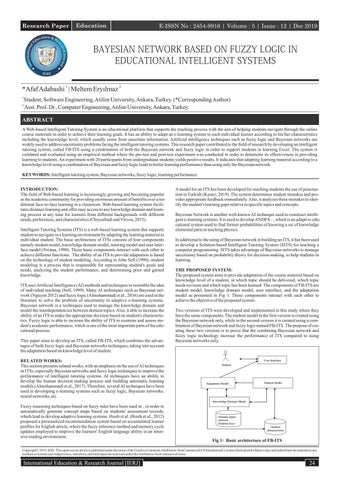
A model for an ITS has been developed for teaching students the use of punctuation in Turkish (Karaci, 2019). The system determines student mistakes and provides appropriate feedback immediately. Also, it analyzes these mistakes to identify the student's learning gaps relative to specific topics and concepts. Bayesian Network is another well-known AI technique used to construct intelligent e-learning systems. It is used to develop ANDES – , which is an adaptive educational system used to find former probabilities of knowing a set of knowledge elemental parts in teaching physics. In additional to the using of Bayesian network in building an ITS, it has been used to develop a Solution-based Intelligent Tutoring System (SITS) for teaching a computer programming. SITS takes advantage of Bayesian networks to manage uncertainty based on probability theory for decision-making, to help students in learning. THE PROPOSED SYSTEM: The proposed system aims to provide adaptation of the course material based on knowledge level of a student, in which topic should be delivered, which topic needs revision and which topic has been learned. The components of FB-ITS are student model, knowledge domain model, user interface, and the adaptation model as presented in Fig 1. These components interact with each other to achieve the objective of the proposed system. Two versions of ITS were developed and implemented in this study where they have the same components. The student model in the first version is created using the Bayesian network only, while in the second version it is created using a combination of Bayesian network and fuzzy logic named FB-ITS. The purpose of creating these two versions is to prove that the combining Bayesian network and fuzzy logic technology increase the performance of ITS compared to using Bayesian networks only.
RELATED WORKS: This section presents related works, with an emphasis on the use of AI techniques in ITSs, especially Bayesian networks and fuzzy logic techniques to improve the performance of intelligent tutoring systems. AI techniques have an ability to develop the human decision making process and building automatic learning models (Almohammadi et al., 2017). Therefore, several AI techniques have been used in developing e-learning systems such as fuzzy logic, Bayesian networks, neural networks, etc . Fuzzy reasoning techniques based on fuzzy rules have been used in , in order to automatically generate concept maps based on students' assessment records, which lead to develop adaptive learning systems. Hsieh et al. (Hsieh et al., 2012) proposed a personalized recommendation system based on accumulated learner profiles for English article, where the fuzzy inference method and memory cycle updates employed to improve the learners' English language ability in an intensive reading environment.
Fig 1: Basic architecture of FB-ITS
Copyright© 2019, IERJ. This open-access article is published under the terms of the Creative Commons Attribution-NonCommercial 4.0 International License which permits Share (copy and redistribute the material in any medium or format) and Adapt (remix, transform, and build upon the material) under the Attribution-NonCommercial terms.
International Education & Research Journal [IERJ]
24
Research Paper
E-ISSN No : 2454-9916 | Volume : 5 | Issue : 12 | Dec 2019
Domain Model: The domain model contains the repository of course materials related to Excel including exam questions, and solution keys. Student Model: Student model stores both the static and the dynamic characteristics of each student. Static characteristics include student name, username, and password. The dynamic characteristic includes the level of student knowledge that is updated during the learning process based on the student's performance. Student model in FB-ITS uses a hybrid method based on Bayesian network and fuzzy logic in order to track the changes of student's knowledge. Adaptation Module: Adaptation module offers a pedagogical option to support the individual student during the learning process. FB-ITS uses drop-down menus to help student navigates and browses the course materials. This menu can be dynamically updated based on the current knowledge state of the student. Adaptive annotation technique is used for highlighting each topic with an appropriate color based on student's knowledge. When a student is first registered in the system, the topics are highlighted dynamically based on the probabilities obtained from the Bayesian network model with have no evidence. After a student studies some topics and does the quiz related to these topics, each topic in the drop-down menu is highlighted with an appropriate color (blue, green, or red), indicate the student's knowledge level regarding these topics. Where the blue color means the topic is learned, the green color means the topic is ready to learn, and the red color means the topic is still not ready to learn. User Interface: A student interacts with the proposed system via the user interface. To use the system for the first time, a student have to enrolment to the course through the registration page and login to the system through the login page if he/she already has account. When a student logs into the system for the first use, she/he is required to complete a pre-test to determine her/his prior knowledge of Excel. The home page of the system appears after finishing the pre-test as shown in Fig 2. In this page, a student can navigate the course lessons from the left dropdown mean.
Fig 3: The membership functions of input and output variables In this paper, the fuzzy rules are provided by experts. Given below are the som of rules using IF-THEN logic: If (pretest-Grade is poor) and (TopicTest-Grade is excellent) then Performance is High If (pretest-Grade is good) and (TopicTest-Grade is poor) then Performance is Low If (pretest-Grade is excellent) and (TopicTest-Grade is good) then Performance is High If (pretest-Grade is good) and (TopicTest-Grade is good) then Performance is High Fuzzy rules are triggered after any change in the value of the test result of a particular topic and updated the performance level of this topic. The output of the fuzzy model is passed to the Bayesian network model as evidence to update the knowledge level of the related topics. BAYESIAN NETWORK IN FB-ITS: In FB-INT, the Bayesian network model consists of 11 nodes, which represent the topics of the Excel course. The dependencies existing among the course topics can be represented as prerequisite relationships. For instance, Topic-1 has to be learned before Topic-2, because understanding Topic-1 is a prerequisite to understanding Topic-2. The Conditional Probability Distribution (CPD) table is designed for each topic node, were obtained by experts in Excel domain. In Excel topics, the probability of a student has learned the topic-1 (Excel environment) denoted by P(Topic-1). Also, the probability of a student learned Topic-2 given Topic-1, denoted by P(Topic-2 | Topic-1). The P(Topic-2 = Learned / Topic-1 = Learned).
Fig 2: System Home Page After the student finishes reading the lesson, she/he has to answer the related test questions. Then the system will feedback according to the test score. FUZZY LOGIC IN FB-ITS: In FB-ITS, the fuzzy logic system was used to determine the student's performance in a particular topic taking into account two factors pre-test grade and topic test grade. These tests used to gather evidence to update BNs. In the fuzzy logic system, two variables were utilized for the inputs and one variable was utilized for the output, where defined as following: Ÿ
Pretest-Grade: the score of the pre-test given to the student after the registration into the system.
Ÿ
TopicTest-Grade: the score of the test given to the student after completing the study of each topic of course material.
Ÿ
Performance: the degree of success in a domain topic.
The trapezoidal fuzzy membership functions for inputs variables and the output variable are defined as shown in Fig 3.
25
The primary purpose of tracking a student's behavior during interaction with the system in each topic using the fuzzy logic system is to collect the evidence from the student to update the Bayesian network model in order to identify the current KL of the related topics. The main purpose of the Bayesian network model is to predict the KL of related topics and identify which topic is ready to learn and which one is still not ready to learn based on the probability. For each topic node in Bayesian network model, there are two states: learned or not learned by the student. The learned state of certain topics of Excel course can be assessed by calculating the posterior probability P(topic = learned/evidence), where the evidence is the student's performance on prerequisite topic obtained from the fuzzy logic model. If the posterior probability of the topic is greater than or equal to 0.8, this topic is marked as "Learned"; otherwise, the topic is marked as "notLearned". After that, the entire Bayesian network is updated and the system can decide what the next topic is ready for the student to learn. SYSTEM EVALUATION: The system was evaluated using an empirical method where the pre-test/post-test experiment was conducted in this study for a period of two weeks. Participants: The participants of this study are from undergraduate students attending the Introduction to Computers and Information Systems course (CMPE 105) at Atilim University in 2018-2019 academic year. Experiment has carried out with 20 participants to evaluate the proposed platform. The sample of participants was divided randomly into two groups where the first group (control group) taught by the ITS designed using Bayesian network and the second group (experimental group) taught by another version of the ITS that designed based on a combination of Bayesian network technique with fuzzy logic.
International Education & Research Journal [IERJ]
Research Paper
E-ISSN No : 2454-9916 | Volume : 5 | Issue : 12 | Dec 2019
Data Collection Tools: Students' performance as a data collection tool was used in this experiment. It was measured by pre-test and post-test. Each test contains 22 questions from multiple options, each with four answer options. The pre-test and the post-test are similar except their sequence. These tests are carefully designed and reviewed by experts who checked the expression of each question and its related multiplechoice answers. Experimental procedure: In first week of the experiment, the participants subjected to a pre-test, which contains a set of questions related to Excel. After that, the students started studying of lessons. At the last week of the experiment, they completed a post-test.
31(8), pp. 3619–3628. doi: 10.1007/s00521-017-3311-2. 10. Nguyen V. A. (2012). Toward an adaptive learning system framework: Using bayesian network to manage learner model. Int. J. Emerg. Technol. Learn., vol. 7, no. 4, pp. 38–47, 2012. 11. Nwana, H. S. (1990) .Intelligent tutoring systems: An overview. Artificial Intelligence Review, 4, pp. 251–277. doi: 10.1007/BF00168958. 12. Self, J. (1990) 'Bypassing the Intractable Problem of Student Modelling. (41), pp. 1–26. 13. Self, J. (1999). The defining characteristics of intelligent tutoring systems research : ITSs care, precisely. International Journal of Artifical Intelligence in Education, 10(1998), pp. 350–364.
RESULTS AND DISCUSSION: As data was nonparametric data, Wilcoxon Signed Ranks Test was used to test the mean difference in learning performance between pretest and posttest results in both the control and the experimental groups. Table 1 Test Statisticsa Group One Group Two (Control Group) (Experimental Group) Z Asymp. Sig. (2-tailed)
posttest - pretest -1.836-b
posttest - pretest -2.701-b
.066
.007
a. Wilcoxon Signed Ranks Test b. Based on negative ranks. Table 1 show that, a Wilcoxon Signed Rank Test revealed a statistically insignificant better learning performance following participation in the learning program for the control group, z = –1.836, p = .06, with a moderate effect size (r = .41). The median score on the learning performance test increased from pretest (Md = 22.50) to posttest (Md = 49.50). On the other hand, the same test revealed a statistically significant better learning performance following participation in the learning program for the experimental group, z = –2.701, p = .007, with a large effect size (r = .60). The median score on the learning performance test increased from pretest (Md = 16.00) to posttest (Md = 60.50). Based on these results the study concluded that adapting learning materials according to a knowledge level using a combination of Bayesian and fuzzy logic leads to better learning performance than using only the Bayesian network. The experiment had some limitations, where it was conducted on a short-term study with a small group of participants. CONCLUSIONS: This paper has presented an intelligent tutoring system, called FB-ITS, for teaching Microsoft Excel. It used Bayesian network and fuzzy logic to predict the knowledge level of student and then adapt the learning materials for each student based on her/his performance. The system was evaluated by conducting a comparison experiment with a group of undergraduate students. The experiment produced a positive results regarding the learning performance. REFERENCES: 1.
Almohammadi K. Hagras H. Alghazzawi D. & Aldabbagh G. (2016). Users-Centric Adaptive Learning System Based on Interval Type-2 Fuzzy Logic for Massively Crowded E-Learning Platforms. J. Artif. Intell. Soft Comput. Res., vol. 6, no. 2, pp. 81–101.
2.
Almohammadi K. Hagras H. Alghazzawi D. & Aldabbagh G. (2017) 'A survey of artificial intelligence techniques employed for adaptive educational systems within elearning platforms', Journal of Artificial Intelligence and Soft Computing Research, 7(1), pp. 47–64. doi: 10.1515/jaiscr-2017-0004.
3.
Bai, S. M. & Chen, S. M. (2008). Automatically constructing concept maps based on fuzzy rules for adapting learning systems. Expert Systems with Applications, 35(1–2), pp. 41–49. doi: 10.1016/j.eswa.2007.06.013.
4.
Chrysafiadi, K. & Virvou, M. (2015). Fuzzy logic for adaptive instruction in an elearning environment for computer programming. IEEE Transactions on Fuzzy Systems, pp. 164–177. doi: 10.1109/TFUZZ.2014.2310242.
5.
Eryılmaz, M., Adabashi, A. M. & Yazıcı, A. (2019) 'Artificial Intelligence Methods in E-Learning', in Handbook of Research on Faculty Development for Digital Teaching and Learning. IGI-global, pp. 287–307. doi: 10.4018/978-1-5225-8476-6.ch015.
6.
Gertner, A. & Vanlehn, K. (2000) 'Andes: A Coached Problem Solving Environment for Physics', Intelligent Tutoring Systems. (1839), pp. 133–142. doi: 10.1007/3-54045108-0.
7.
Hooshyar, D. Ahmad R. B. Yousefi M. Fathi M. Horng S.-J. & Lim H. (2018). SITS: A solution based intelligent tutoring system for students acquisition of problem solving skills in computer programming. Innovations in Education and Teaching International, 55, pp. 325–335.
8.
Hsieh T. C., Wang T. I., Su C. Y., & Lee M. C. (2012). A Fuzzy Logic-based Personalized Learning System for Supporting Adaptive English Learning. Educational Technology and Society, 15(1), pp. 273–288.
9.
Karaci, A. (2019) 'Intelligent tutoring system model based on fuzzy logic and constraint-based student model. Neural Computing and Applications. Springer London,
International Education & Research Journal [IERJ]
26