Research Paper
Education
E-ISSN No : 2454-9916 | Volume : 6 | Issue : 1 | Jan 2020
QUANTITATIVE RESEARCH: NATURE AND SIGNIFICANCE
1
Rashmi Meena | Dr. Meenakshi Meena 1 2
2
Research Scholar, Regional Institute of Education, Ajmer, Rajasthan, India. Assistant Professor, Regional Institute of Education, Ajmer, Rajasthan, India.
INTRODUCTION: Quantitative research is empirical in nature; it is also known as the scientific research paradigm. The paradigm ensures validity by the process of rigorous clarification, definition or use of pilot experiments. That is trying out the instruments before hand, and checking their relevance with experts and assessing their reliability by use of statistical tests. This approach can be further sub-classified into inferential, experimental and simulation approaches to research. Quantitative research involves significant issues where a study seeks to create an understanding of the various assumptions that have been developed in a given study. In general, a lot of quantitative research tends to be confirmatory and deductive. But there are many quantitative researches that can be classified as exploratory as well. The data collected in quantitative research are, as mentioned, hard. The strength of producing numbers as data is that this demonstrates an ordered system Such an approach could be viewed as being necessary in an organization as big as the NHS, for as Spencer (1983) suggests, preparing an off-duty rota for 5000 employees needs quantitative methods and a computer This argument is also supported by Kileen's (1981) study regarding new mothers where there was a need to use numerical data to identify the nursing resources needed, number of nurses involved, and what difference they made to patient outcome, length of stay, cost-effectiveness of discharge planning and the length of the tune patients stayed out of hospital before any re-admission. Quantitative research is considered more reliable than qualitative investigation This is because a quantitative approach aims to control or eliminate extraneous variables within the internal structure of the study, and the data produced can also be assessed by standardized testing (Duffy 1985) This quantitative strength can be seen in the comparative analysis of patient's and nurse's perceptions about nursing activities in a postpartum unit, conducted by Morales-Maim (1989) However one can question the reliability of quantitative research, especially when the data have been stripped from the natural context, or there have been random or accidental events which are assumed not to have happened (Comer 1991). In quantitative research the investigator maintain detached, objective view in order to understand the facts (Duffy 1986) The use of some methods may require no direct contact with subjects at all, as in postal questionnaire surveys It can be argued that even interview surveys require the researcher to have little, if any contact with respondents,
especially if hired staff carry out most of all the interviews (Bryman 1988) The strength of such a detached approach is avoidance of researcher involvement, guarding against biasing the study and ensuring objectivity Spencer (1983) argues that little is derived from such an lndirect researcher-subject relationship especially m the health care setting His major criticism is that the detached approach treats the participants as though they are objects and, as such, places hospitals on par with car repair garages Cormack (1991) also emphasizes the weaknesses of such an approach She argues that the research participants are usually kept in the dark about the study, and are often left untouched by the research itself but are expected to transfer the findings into practice These arguments are examples of the criticism that quantitative methods treat people merely as a source of data As with quantitative research, qualitative methodologies also have supposed strengths and weaknesses regarding the closeness of the relationship between researcher and respondent Duffy (1986) argues that a strength of such an interactive relationship is that the researcher obtains first hand experience providing valuable meaningful data As the researcher and the subject spend more time together the data are more likely to be honest and valid (Bryman 1988) Supporting this argument is the study by Baruch (1981) which revealed that time and the subsequent relationship built between the researcher and the subjects was crucial for a genuine understanding of the dilemma faced by parents of sick or handicapped children This appears to be a major strength of the qualitative approach itself, as Woodhouse & Lavingwood (1991) pointed out in their study of a multiagency substance abuse project They claimed that the approach, because of the interactive method, far exceeded expected evaluation outcomes, by contributing to empowerment, and enhanced communication and clarification of roles among the partners involved in the project The weakness of such a close relationship is the likelihood that it may become pseudo therapeutic, complicating the research process and extending the responsibilities of the researcher (Ramos 1989) The possibility of becoming enmeshed with subjects could also lead to researchers having difficulty in separating their own experiences from those of their subjects (Sandelowski 1986) resulting in subjectivity (Cormack 1991) In its most extreme form this is referred to as 'going native', where the researcher loses awareness of being a researcher and becomes a participant (Bryman 1988)
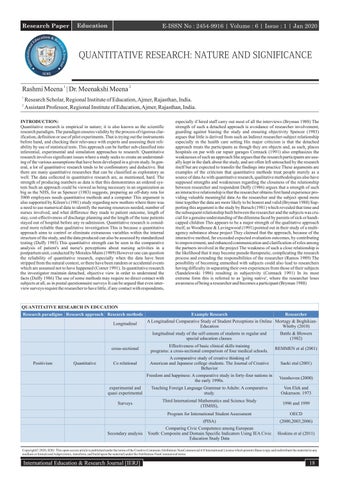
QUANTITATIVE RESEARCH IN EDUCATION Research paradigms Research approach Research methods Longitudinal
Positivism
Quantitative
Example Research
Researcher
A Longitudinal Comparative Study of Student Perceptions in Online Mortagy & BoghikianEducation Whitby (2010) longitudinal study of the self-esteem of students in regular and special education classes.
Battle & Blowers (1982)
cross-sectional
Effectiveness of basic clinical skills training programs: a cross-sectional comparison of four medical schools.
REMMEN et al (2001)
Co relational
A comparative study of creative thinking of American and Japanese college students. The Journal of Creative Behavior
Saeki etal (2001)
Freedom and happiness: A comparative study in forty-four nations in the early 1990s.
Veenhoven (2000)
experimental and quasi experimental
Teaching Foreign Language Grammar to Adults: A comparative study.
Von Elek and Oskarsson. 1973
Surveys
Third International Mathematics and Science Study (TIMSS),
1996 and 1999
Secondary analysis
Program for International Student Assessment
OECD
(PISA)
(2000,2003,2006)
Comparing Civic Competence among European Youth: Composite and Domain Specific Indicators Using IEA Civic Education Study Data
Hoskins et al (2011)
Copyright© 2020, IERJ. This open-access article is published under the terms of the Creative Commons Attribution-NonCommercial 4.0 International License which permits Share (copy and redistribute the material in any medium or format) and Adapt (remix, transform, and build upon the material) under the Attribution-NonCommercial terms.
International Education & Research Journal [IERJ]
18
Research Paper New Approach
E-ISSN No : 2454-9916 | Volume : 6 | Issue : 1 | Jan 2020 Qualitative + Quantitative
Triangulation Design Explanatory Design Embedded Design Exploratory Design
Culture and Pedagogy: International Comparisons in Primary Education
Alexander (2000)
Challenges of Adopting the Use of Technology in Less Developed Countries: The Case of Cambodia
Jayson W. Richardson (2010)
The Assumptions of Quantitative Designs: The time consuming and complexity
Ÿ Ÿ
The Most of the early research projects are non-empirical
The strengths/Integrity of Quantitative research: Providing solutions for a generalized empirical research, the cases studied, only a few conditions have to agree with everything there is to this phenomenon
Ÿ
Ÿ
A reasonable analysis, allowing comparisons with other adult education issues, providing a scientific classification of a research project.
METHODOLOGY: The research processes used in the quantitative approach include descriptive, co relational, quasi-experimental and experimental research (Cormack 1991) The strengths of such methods are that both true experiments and quasi-experiments provide sufficient information about the relationship between the variables under investigation to enable prediction and control over future outcomes This IS achieved by the ability of the researcher to manipulate an independent variable in order to study its effects on the dependent variable. This strength can also be argued to be the weakness of the quantitative method, especially where research
is concerned The methodology dismisses the experiences of the individual as unimportant, which is, demonstrated in the Bockmon & Rieman study (1987), and regards human beings as merely reacting and responding to the environment (Cormack 1991) This causes difficulties research, because nursing uses an holistic view of people and their environment and, according to Bnones & Cecchini (1991), quantitative methods do not permit this approach The qualitative approach includes methods such as grounded theory and ethnographic research (Denzin 1978) The strength of the methodology employed lies in the fact that it has an holistic focus, allowing for flexibility and the attainment of a deeper, more valid understanding of the subject than could be achieved through a more rigid approach (Duffy1986) It also allows subjects to raise issues and topics which the researcher might not have included in a structured research design, adding to the quality of data collected The study by Meha (1982) is a good example of these strengths, and its findings have contributed to the knowledge of student nurses' perspective on nursing A weakness of qualitative methodology, is the possible effect of the researchers' presence on the people they are studying As previously highlighted, the relationship between the researcher and participants may actually distort findings LIMITATIONS OF QUANTITATIVE RESEARCH: The differences between qualitative and quantitative researches (Mc Nab, 2002; Robin and Robin, 2005; Braser et al, 2000)
INDICATOR
QUALITATIVE RESEARCHES
QUANTITATIVE RESEARCHES
Ontology
Multiple realities are mental emerging as contributors' daily experiences natural, logical
A single objective reality
Researchers interact with participants or studied phenomena Epistemology
Researchers are apart and independent from studied variables
Researchers and participants are value and they are Researchers and participants are value and bias free bias Verbal style (literature)
Personal ideas are stated in present tense
Speeches from others are stated in the past tense
Analysis process
They are mostly deductive (specific to general)
They are mostly comparative (general to specific)
Concluding basics
The evidences resulted from events are real and experiences are tangible
The relationships are taken from repeated and countable data
Describing cause-effect link
They are bound to an individual (individualism), an objectivity from integrated events
They are universal (rule-based), relationship among statistical variables
Research proposal
Including new concepts, innovative, and open ended (without boundaries)
Statistical design (a set), concepts are closed (limited) before the research
Research questions
A marginalized set and group, and a study problem, ambiguous issues, open ended questions
Specifiable and measurable variables and relationships
Sampling purpose
(increasing) determining ability, variety, and enrichment
(increasing) generalize ability and indicative factors
DISCUSSION For every strength there appears to be a corresponding weakness in both quantitative and qualitative research It is this dilemma that has fuelled the debate over which approach is superior (Duffy 1986), and which method should therefore be adopted for nursing research Nursing has a history of being divided, researchers in nursing can ill afford to be divided in attitudes to methodologies for this could add to the confusion and the division of the profession (Comer 1991) However, the author does not suggest that rigid uniformity about methodology should be the aim of nurse researchers, as studies have demonstrated that neither method has the upper hand or the complete set of answers Choosing just one methodology narrows a researcher's perspective, and deprives him or her of the benefits of building on the strengths inherent in a variety of research methodologies (Duffy 1986) Atwood (1985) disagreed with this, and argued that nursing should adopt quantitative approaches to build nursing into a science He stated that this would provide nursing with a useful theory base with practical applications Since this argument was posed by Atwood in 1985, studies have demonstrated that the model of measurement, prediction and causal inference does not easily fit a profession where health, illness adjustment, recovery, participation and care are frequently the variables to be measured, whilst assessing the impact of nursing practice (Comer 1991) Relying solely on a quantitative approach to answer research questions has been seen to have serious limitations (Metcalfe 1983) Reliance solely on qualitative approaches has also been shown to have many limitations, although mainly of a different nature (Kileen 1984) This debate could be seen as advantageous to nursing Researchers are being forced to consider the controver-
19
sial issues of both methodologies, and this requires them to have in-depth knowledge of epistemology and methodology and not to be restricted, as m the past, to the tradition of the physical sciences (Duffy 1985) Preference for a specific research strategy is not just a technical choice, it is an ethical, moral, ideological and political activity (Moccia 1988) This debate unearths these issues m relation to both approaches, allowing appropriate methods to be adopted by researchers in order to answer questions. Considering the facts, it is argued that each approach should be evaluated in terms of its particular merits and limitations, in the light of the particular research question under study (Duffy 1987) However this implies that there are only technical differences between the two those of research strategies and data collection procedures (Bryman 1988) There is a suggested alternative to this, that of combining the approaches, pulling on the strengths of each method and therefore counteracting the limitations posed by both This research approach is called triangulation The main research areas that triangulation is concerned with are issues of data, investigator, theory and methodology (Murphy 1989) Morse (1991) argues that triangulation not only maximizes the strengths and minimizes the weaknesses of each approach, but strengthens research results and contributes to theory and knowledge development Silva & Rothbart (1984) hold a different opinion, arguing that a compromise resolution seems to ignore the significance of work presented that acknowledges various philosophies of science as factors in research and theory development The literature demonstrates that there is no agreement between researchers about triangulation This IS not surprising when there is no
International Education & Research Journal [IERJ]
Research Paper
E-ISSN No : 2454-9916 | Volume : 6 | Issue : 1 | Jan 2020
agreement either about quantitative or qualitative methods, employed within the approach The study revealed a richer and deeper understanding of the subject matter than would otherwise be possible Quantitative and qualitative approaches were found to complement each other while the inadequacies of each were actually offset However, it also highlighted the time and cost implications the volume of data produced was immense and an extremely broad knowledge base was required to analyse it, which meant that other researchers were contracted in to work on different parts of the analysis These findings are similar to those of Murphy (1989) who used the method of triangulation to study traumatic life events Considering the evidence, it seems reasonable to suggest that triangulation is not the way forward for all nursing research but that it may help nursing to remove itself from the bipolar debate and restncUons, especially m the light of current financial contrasts on health professions CONCLUSION: In conclusion it can be recommended that the researcher, when selecting the research approach (e.g. qualitative, quantitative or mixed), should always set out from the concrete research problem and research questions or hypothesis. On the basis of the research problem, the researcher should decide which research approach is going to lead him/her easily, swiftly and most efficiently to the most reliable findings that adequately answer the research questions. The main aim of quantitative research is to obtain reliable, exact, precise, measurable, objective and valid results. The use of the standardized research instruments, distinction between the research subject and the research object, use of statistical methods, forming hypotheses and their reliable verification are some of the major methodological principles of the empirical-analytical methodology. REFERENCES: 1.
Alien, O. P. (2009). An analysis of the strengths and limitation of qualitative and quantitative research paradigms. Problems of Education in the 21st Century, 13(1), 13-38.
2.
Bilging, I., Šenocalk, E., & Sözbilir, M. (2009). The Effects of Problem-Based Learning Instruction on University Students' Performance of Conceptual and Quantitative Problems in Gas Concepts. Eurasia Journal of Mathematics, Science & Technology Education, 5(2).
3.
Boodhoo, R., & Purmessur, R. D. (2009). Justifications for qualitative research in organisations: a step forward
4.
Carr, L. T. (1994). The strengths and weaknesses of quantitative and qualitative research: what method for nursing?. Journal of advanced nursing, 20(4), 716-721.
5.
Devetak, I., Glažar, S. A., & Vogrinc, J. (2010). The Role of Qualitative Research in Science Education. Eurasia Journal of Mathematics, Science & Technology Education, 6(1).
6.
Gao, Y. J., & Ma, H. H. (2006). Effectiveness of interventions influencing academic behaviors: A quantitative synthesis of Khakpour, A. (2012). Methodology of comparative studies in education. Contemporary Educational Researches Journal, 2(1), 20-26
7.
Ma, H. H. (2006). An alternative method for quantitative synthesis of single-subject researches: Percentage of data points exceeding the median. Behavior modification, 30(5), 598-617.
8.
Pattaro, C. (2016). Character Education: Themes and Researches. An Academic Literature Review. Italian Journal of Sociology of Education, 8(1).
9.
Tasir, Z., Al-Dheleai, Y. M. H., Harun, J., & Shukor, N. A. (2011, October). Student's Perception towards the Use of Social Networking as an e-Learning Platform. In 10th WSEAS International Conference on Education and Educational Technology, Penang: Malaysia..
10. Thompson, A. D. (2005). Scientifically based research: Establishing a research agenda for the technology in teacher education community. Journal of Research on Technology in Education, 37(4), 331-337. 11. Toloie-Eshlaghy, A., Chitsaz, S., Karimian, L., & Charkhchi, R. (2011). A classification of qualitative research methods. Research Journal of International Studies, 20(20), 106-123.
International Education & Research Journal [IERJ]
20