Research Paper
Education
E-ISSN No : 2454-9916 | Volume : 4 | Issue : 11 | Nov 2018
HEALTH INEQUALITY AND EQUITY IN RURAL AND URBAN SETTING IN NEPAL Sushil Sharma Lecturer, T. U., Prithvi Narayan Campus, Pokhara, Nepal. ABSTRACT This paper investigates the relationship between health policy, equity, and inequality in Nepal. It argues that current inequities in health facilities and outcomes are largely attributable to persistent inequities and biases in the health policy framework. We begin by surveying the complex, multifaceted reality of health facilities disparity in contemporary Nepal and trace these inequalities to exclusionary practices in the policy environment that have persisted in various forms since the inception of an federal state. We then show how these inequities contributed to the civil conflict that engulfed Nepal. Analysis and critique of the most recent policy trends, decentralisation and privatisation, provide insight into the future nexus of health policy and equity in Nepal. We conclude that it is imperative for policymakers to reconceptualise the relationship between health policy, inequality and equity at this critical juncture. KEYWORDS: health service, health for all, inequality, facilities, disparity. CONTEXT: The Constitution of Nepal (2015) has declared the country a Federal Democratic Republic with seven states. It is further divided into 77 districts, 753 local levels including 460 Village Municipalities, 276 Municipalities, 11 Sub-metropolises and 6 Metropolises. About one fourth of the population (25.16%) lives below poverty line (CBS, 2018). So it is very challenging to distribute the health facilities equally. Health For All (HFA) is a programming goal of the world Health Organization (WHO), which envisions securing the health and well being of people around the world that has been popularized since the 1970s. It is the basis for the WHO primary health care strategy, promote health, human dignity, and enhanced quality of life. HFA means that health is to be brought within reach of everyone in a given country. And by "health" is meant a personal state of well being, not just the availability of health services a state of health that enables a person to lead a socially and economically productive life. HFA implies the removal of the obstacles to health that is to say, the elimination of malnutrition, ignorance, contaminated drinking water and unhygienic housing quite as much as it does the solution of purely medical problems such as a lack of doctors, hospital beds, drugs and vaccines. Moreover, HFA means that health should be regarded as an objective of economic development and not merely as one of the means of attaining it. It demands ultimately, literacy for all. Until this becomes reality it demands at least the beginning of an understanding of what health means for every individual. HFA depends on continued progress in medical care and public health. The health services must be accessible to all through primary health facilities, in which basic medical help is available in every village, backed up by referral services to more specialized care. HFA is thus a holistic concept calling for efforts in agriculture, industry, education, housing, and communications, just as much as in medicine and public health. The adoption of HFA by government, implies a commitment to promote the advancement of all citizens on a broad front of development and a resolution to encourage the individual citizen to achieve a higher quality of life. The rate of progress will depend on the political will. The World Health Assembly believes that, given a high degree of determination HFA could be attained by the year 2000. That target date was challenge to all WHO's Member States (WHO, 2003). HFA became the slogan for a movement. It was not just an ideal but an organizing principle: everybody needs and is entitled to the highest possible standard of health. The principles remain indispensable for a coherent vision of global health. Turning that vision into reality calls for clarity both on the possibilities and on the obstacles that have slowed and in some cases reversed progress towards meeting the health needs of all people. We have a real opportunity now to make progress that will mean longer, healthier lives for millions of people, turn despair into realistic hope, and lay the foundations for improved health for generations to come. Health Facilities: Health policy development in Nepal has been profoundly influenced by the 1978 Alma Ata declaration emphasizing the provision of community-oriented preventive, promotive and curative health services (as cited Cueto, 2004) as evident by the establishment of a network of primary health care facilities and deployment of community health workers to provide essential health services at the community level. However, the health system in Nepal faces daunting challenges such
as unequal distribution of health care services, poor infrastructures, inadequate supply of essential drugs, poorly regulated private providers, inadequate budget allocation for health, and poor retention of human resources in rural areas. Table. 1. Indicators of Health Facilities S.N 1 2 3 4 5
Health Facilities Doctors Nurse ANM Govt. Hospital Primary Health Centers
Number 20387 43924 28698 107 200
6 7
Health Post Hospital Bed
3808 6892 CBS, 2018
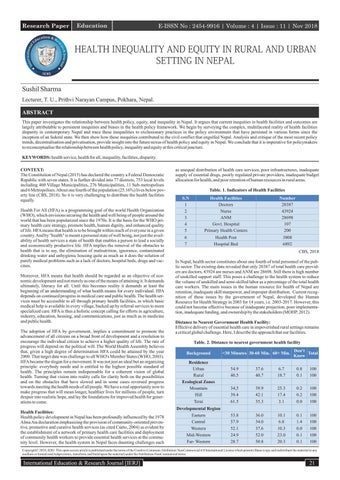
In Nepal, health sector constitutes about one fourth of total personnel of the public sector. The existing data revealed that only 20387 of total health care providers are doctors, 43924 are nurses and ANM are 28698. Still there is high number of unskilled support staff. This poses a challenge to the health system to reduce the volume of unskilled and semi-skilled labor as a percentage of the total health care workers. The main issues in the human resource for health of Nepal are retention, inadequate skill manpower, and improper distribution. Current recognition of these issues by the government of Nepal, developed the Human Resource for Health Strategy in 2003 for 14 years, i.e. 2003-2017. However, this could not become effective because of inadequate projection, poor implementation, inadequate funding, and ownership by the stakeholders (MOHP, 2012). Distance to Nearest Government Health Facility: Effective delivery of essential health care in impoverished rural settings remains a critical global challenge. Here, I describe the approach that our facilities. Table. 2. Distance to nearest government health facility Background
<30 Minutes 30-60 Min. 60+ Min.
Don't Total Know
Residence Urban Rural Ecological Zones Mountain Hill Terai
54.9 40.5
37.6 40.7
6.7 18.7
0.8 0.1
100 100
34,5 39.4 61.5
39.9 42.1 35.3
25.3 17.4 3.1
0.2 0.2 0.0
100 100 100
Developmental Region Eastern Central Western Mid-Western Far- Western
53.8 57.9 52.1 24.9 28.7
36.0 34.0 37.6 52.0 50.8
10.1 6.8 10.3 23.0 20.3
0.1 1.4 0.0 0.1 0.1
100 100 100 100 100
Copyright© 2018, IERJ. This open-access article is published under the terms of the Creative Commons Attribution-NonCommercial 4.0 International License which permits Share (copy and redistribute the material in any medium or format) and Adapt (remix, transform, and build upon the material) under the Attribution-NonCommercial terms.
International Education & Research Journal [IERJ]
21
Research Paper Background
E-ISSN No : 2454-9916 | Volume : 4 | Issue : 11 | Nov 2018
<30 Minutes 30-60 Min. 60+ Min.
Don't Total Know
Province Province 1
50.5
36.6
12.9
0.1
Province 2
69.1
29.2
1.7
1.1
100
Province 3 Province 4
50.6 46.5
9.4 13.7
2.1 0.0
Province 5 Province 6 Province 7
45.3
37.9 39.7 43.4
23.6 28.7
47.9 50.8
11.2 28.5 20.3
0.1 0.0
100 100 100
0.1
100
100 100
NDHS, (2016) People in rural areas generally have less access to healthcare than their urban counterparts. Fewer medical practitioners, mental health programs and healthcare facilities in these areas often mean less preventative care and longer response times in emergencies. The lack of healthcare workers has resulted in unconventional ways of delivering healthcare to rural dwellers, including medical consultations by phone or internet as well as mobile preventative care and treatment programs. There have been increased efforts to attract health professionals to isolated locations, such as increasing the number of medical students from rural areas and improving financial incentives for rural practices as well. Household Food Security: Food security is a condition related to the supply of food, and individuals' access to it. People are considered food secure when they have availability and adequate access at all times to sufficient, safe, nutritious food to maintain a healthy and active life. The obvious reason is that everybody needs food. But the complexity of delivering sufficient food to a national population and to the whole world's population shows why food security is such a priority for all countries, whether developing or developed. In short, this is a global challenge because it's not just about food and feeding people but also about practically all aspects of an economy and society. Table. 3. Household Food Security Background Characteristics
Food Secure
Residence Urban
54.0
17.3
19.9
8.8
100
38.8
23.5
26.0
11.7
100
38.4
18.8
28.9
13.8
100
Hill Terai Developmental Region
46.4 51.0
18.8 20.7
24.4 19.1
10.0 9.2
100 100
Eastern Central
50.8 50.5
21.9 19.9
18.0 20.2
9.2 9.5
100 100
Western Mid-Western Far- Western Province Province 1 Province 2 Province 3 Province 4 Province 5 Province 6 Province 7
57.6 27.7 37.7
18.0 18.6 18.0
18.4 36.8 31.2
6.0 16.9 13.0
100 100 100
52.6 43.1 55.0 56.0 48.4 22.5 37.7
20.3 26.4 16.4 16.9 19.2 17.8 18.0
18.0 19.8 20.0 21.1 22.2 42.2 31.2
9.2 10.7 8.5 6.0 10.2 17.5 13.0
100 100 100 100 100 100 100
Rural Ecological Zones Mountain
Mildly Moderately Severely Food Food Food Secure Secure Secure
Total
NDHS, (2016) There are 48 percent of households in Nepal are food secure and have access to food year round. food insecure households, 20 percent are mildly food insecure, 22 percent are moderately food insecure, and 10 percent are severely food insecure. Urban households are more likely (54%) to be food secure than rural households (39%). as well as Almost all households (95%) have access to an improved source of drinking water and 62 percent of households have an improved toilet facility that is not shared with other households (ibid). DISCUSSIONS: National surveys contain a wealth of family planning, reproductive health, and maternal and child health indicators. Comparing these indicators across sub national groups, such as urban versus rural populations or by relative poverty,
22
can pinpoint inequalities and gaps in coverage and assist policymakers and program planners in developing more effective and efficient interventions. In most developing countries, poverty is highly correlated with place of residence; that is, urban households tend to concentrate among the highest-wealth groups, while rural households tend to concentrate among the poor. Thus, any national comparison of the least poor with the most poor tends to compare the bulk of the urban population with the poorest of the rural poor, making it impossible to determine to what degree the findings reflect inequalities. The development of separate urban and rural wealth indices provides a way out of this dilemma. Separate wealth classifications for urban and rural women were constructed to examine inequalities in key population and reproductive health indicators, including family planning and antenatal care. One of the several issues that Nepal faces is the separation of individuals into different socioeconomic groups and geographic areas. It requires 1-4 hours for the population in rural areas to travel to a local health post (Adhikari, 2013). In rural districts in Nepal, only 28.1percent of people accessed a medical facility (Paudel, Upadhyaya, Pahari, 2012 ). Distance alone is a major hindrance for the individuals to seek prompt and timely care. Moreover, privatization of hospitals causes the rich to segregate care at urban hospitals while the poor are treated at government funded hospitals. Majority of the larger trauma and teaching hospitals are in urban cities. The rural villages consist of smaller healthcare clinics and community hospitals with limited treatment options. Individuals who cannot afford treatment often don't seek care as they feel hopeless. Furthermore, Nepal has 0.3 doctors and nurses per 1000 patients compared to the 2.3 recommended by WHO, leading to unsafe and poor quality care (As cited Bhuvan, Heydon and Norris, 2015). Inequality in Nepal is historically deeply rooted in practices that sought to separate land owning and administrative elites from those who were dependent on them by blocking access to power and mobility. Nepal has been formally divided into 7 federal provinces since the promulgation of the new Constitution in 2015. But there is no effective implementation in health care system. The inequality between urban and rural areas is also high as marginalised populations recognised to be comprised of backward castes/classes. Mainly rural areas are also those parts of Nepal that have proved difficult to access e.g. the terai region, the mountainous mid-western region and the hilly far-western region. The poverty headcount in the far-western development region is the highest. Poverty incidences by caste and ethnicity are highest amongst the hill and terai dalits. In 2011 financial year (FY) these groups were still the poorest with 44 percent of poor amongst the hill Dalit population and 38 percent poor amongst the Terai Dalit population. Terai Dalit group, poverty incidences were highest amongst the other 'backward castes' in the Terai areas at 29 percent in FY 2011, which was followed by the hill Janajatis at 28 percent (CBS, 2011). Equitable efforts of Health Facilities: The health insurance policy came as an effort to reduce impoverishment and catastrophic health expenditure, acknowledging that the current system of health care cannot fully identify and protect the poor. However, insurance contributions and copayments can similarly be a barrier for access to insurance, and it is critical to ensure easy enrolment of the poor and marginalized population into the SHS scheme. The primary health care system in Nepal has an extensive network with at least one health facility in each village development committee with female community health volunteers in the frontline. However, without focusing on further strengthening of the peripheral health system and ensuring equitable distribution of health services Family Planning and Maternal Child Health Care service was given utmost priority in delivery of health services though public health facilities. PHC services are provided at District Health Office clinics and Primary Health Care Centre (PHCC), Health Post (HP) and Sub Health Post (SHP) level facilities by basic and grass-root level health workers. At household level Female Community Health Volunteers (FCHVs) provide counselling to mothers and distribute condom, pills, folic acid, Vitamin A and oral rehydration packets. The Maternal and Child Health Worker (MCHW) position was created and trained to provide ANC, delivery, post delivery care from SHP as well as making home visits. They were also trained to give first aid treatment to complicated obstetric cases before referring to appropriate service center. An Emergency Obstetric Kit box (EOC Kit) with life saving obstetric medicines was given to them. MoHP is working towards better access and higher quality service to improve maternal health (NDHS, 2016). MoHP has developed policies to provide health service for all following the principle of universal access to care and coverage on the basis of need. In 1991, the National Health Policy was implemented with objective of upgrading the health standards of the majority of the population by extending the PHC services up to the village level. In this regard PHCC, HP, SHP and Out Reach Clinics were established. The policy also aims to provide opportunity to the rural people to enable them to obtain the benefits of modern medical facilities by making these accessible to them (MOHP, 2012). To achieve equity in health, the concept of access assumes a central role. The purpose of increased access is to assure that all people but particularly those whose
International Education & Research Journal [IERJ]
Research Paper
E-ISSN No : 2454-9916 | Volume : 4 | Issue : 11 | Nov 2018
health needs often are not being met, are able to use services at rates proportional and appropriate to their need for care (the most vulnerable groups; women and children; the rural population; the poor; the disadvantaged and marginalised). Thus the individual dimensions of access which affect a person's ability to make use of the health system will be addressed in health sector development geographic/physical access, economic access, social/cultural access and organizational access. The constitutional right to health care is being translated into a policy of universal free essential health care. In December 2006, emergency and inpatient services were declared free for the disadvantaged, destitute, underserved, the elderly, the people living with physical and psychological disability, and Female Community Health Volunteers (FCHVs), at district hospitals and primary health care centres (PHCCs). Moreover, outpatient care was declared free in 35 low human development indicator districts. In October 2007, GON further decided to offer Nepal 13 essential health care services free of charge to all citizens at all health and subhealth posts from mid-January 2008 (NPC,2009). CONCLUSION: The distribution of health facilities is unequal in nepal. There are so many well facilitate renown hospital in main cities but not in other areas that's why there are not equal chances to take health service by rural people. When rural people goes to well facilitate renown hospital they have problem to reach on time if they cannot in time, hospitals close the ticket and they must afford extra money for waiting extra time. Again the doctor's turn are not available in each days and they must ready to wait next day for the same doctors turn. As well as, rich people have access to expert, experience and renown doctors and hospitals because they have able to met them in private hospitals. Moreover, such well experienced doctors don't give the time in government hospitals so general people can't met them easily. In the context of rural area, doctors does not like to spend more time in there as possible they want to return back in cities. So how can we assume the equality of health services? As thus there are so many inequalities in health services. Likewise, Civil service worker have a chances to get health service from civil hospital in discounted expenditure, T.U staff and professor has get chances from T.U teaching hospital, Army and Police have such facilities from there army and police hospital but there are no chance any kind of discounted health facilities for normal peoples. At last, I have concluded over this discussion, there are so many inequalities between rich and poor people, employer and non employer people, elite and dominated people as well as public and leader etc. Acknowledgement: I would like to thank International Education and Research Journal Team for providing platform to publish this research article. Likewise, I am indebted to honorable Dean Faculty of Education, T.U. Prof.Dr. Krishna Prasad Gautam and Director, Graduate School of Education, T.U., Prof.Dr. Ganesh Singh Thakuri for their scholarly guidance, genuine suggestions and incessant motivation. Finally, my appreciation goes to authors from whom I received lines to cite and quote in this paper. REFERENCES: 1.
Adhikari S.R. (2013). Choices of health care financing schemes for resource poor country: an analysis of nepal’s experiences. Scientific Research. 2013; 5(8): 1295-1302. http://dx.doi.org/10.4236 /health.2013.58176
2.
Bhuvan, K.C, Heydon, S and Norris, P. (2015). Access to and quality use of noncommunicable diseases medicines in nepal. Journal of Pharmaceutical Policy and Practice. 2015; 8(1): 1-4
3.
Central Bureau of Statistics. (2011). Nepal in figures, Ramshahpath, Thapathali, Kathmandu: Central Bureau of Statistics.
4.
…............... (2018). Nepal in figures, Ramshahpath, Thapathali, Kathmandu: Central Bureau of Statistics.
5.
Garha, M.(2017).Health care in nepal: an observational perspective, Journal of Nursing Education and Practice 2017, Vol. 7, No. 1, Emergency Nursing, British Columbia, Canada: 2016 DOI: 10.5430/jnep.v7n1p114 URL: http://dx.doi.org/10.5430/jnep.v7n1 p114. Sciedu Press.
6.
Ministry of Health and Population.(2012). Human resources for health strategic plan 2011-2015. Kathmandu: Ministry of Health and Population, Government of Nepal.
7.
National Planning Commission.(2009). Revitalizing primary health care country experience: Nepal: Interim Plan, 2007-09, NPC, Govt. of Nepal.
8.
Paudel R, Upadhyaya T, and Pahari DP. (2012). People’s perspective on access to health care services in a rural district of nepal. Journal of the Nepal Medical Association. 2012; 52(1): 20-24. PMid: 23279768
9.
World Health Organization.(2003). Overview of the world health report 2003: shaping the future. Geneva: WHO.
International Education & Research Journal [IERJ]
23